Hideki Takaishi Article Collection January–June 2026
Hideki Takaishi Article Collection
January–June 2026
English Edition
185 articles
Legal Update (items posted January–June 2026)
In order of the month of posting
The monthly Legal Update editions for January through June 2026 are included in order of the month of posting. Each month begins with the monthly overview, highlights, and summaries of all articles.
Article Index
02 2026-01 2024 (Ne) No. 10076 [Retractable Temporary Protective Fence] <Presiding Judge Nakadaira>
03 2026-01 2024 (Gyo-Ke) No. 10024 [X-Ray Inspection Device] <Presiding Judge Nakadaira>
04 2026-01 May 27, 2025; 2021 (Ne) No. 10037 [Antipruritic Agent] <Presiding Judge Hibiku Shimizu>
06 2026-01 Osaka District Court, 2024 (Wa) No. 2705 [Angle-Adjustable Hinge] <Presiding Judge Takemiya>
07 2026-01 Osaka District Court, 2023 (Wa) No. 10970 [Video Viewing Device] <Presiding Judge Takemiya>
09 2026-01 2024 (Ne) No. 10084 [Remotely Controlled Unmanned Boat] <Presiding Judge Nakadaira>
10 2026-01 2024 (Ne) No. 10078 [Porous Air-Permeable Bag Containing Feed for Mites] <Presiding Judge Honda>
11 2026-01 2024 (Ne) No. 10012 [R Badge, Receiving Device] <Presiding Judge Hibiku Shimizu>
12 2026-01 2024 (Gyo-Ke) No. 10042 [Melting Furnace] <Presiding Judge Masuda>
18 2026-01 2023 (Gyo-Ke) No. 10147 [RNA-Dependent Targeted DNA Modification] <Presiding Judge Hibiku Shimizu>
19 2026-01 Tokyo District Court, 2025 (Wa) No. 70003 [Smoking-Article Cartridge] <Presiding Judge Shibuya>
22 2026-01 Tokyo District Court, 2024 (Wa) No. 70283 [Reservation Management Device] <Presiding Judge Sugiura>
23 2026-01 Osaka District Court, 2024 (Wa) No. 4500 [Shopping Payment System] <Presiding Judge Matsuami>
24 2026-01 2024 (Ne) No. 10068 [Leak-Preventing Sealing Material] <Presiding Judge Hibiku Shimizu>
25 2026-01 2025 (Ne) No. 10005 [Jig for a Lifeline Post] <Presiding Judge Masuda>
26 2026-01 Tokyo District Court, 2024 (Wa) No. 70128 [Box-Shaped Vessel] <Presiding Judge Nakashima>
27 2026-01 2025 (Ne) No. 10004 [Wireless Scuff Plate] <Presiding Judge Nakadaira>
30 2026-01 Tokyo District Court, 2024 (Wa) No. 70223 [Game System and Game Program] <Presiding Judge Nakashima>
35 2026-02 2024 (Gyo-Ke) No. 10037 [Wood Composite Material] <Hibiku Shimizu>
36 2026-02 2024 (Ne) No. 10032 [Portable Information Communication Device] <Shimizu>
37 2026-02 2024 (Ne) No. 10001 [Yarn Color Placement System] <Hibiku Shimizu>
38 2026-02 Tokyo District Court Judgment, 2023 (Wa) No. 70079 [Vehicle Guidance System] <Kokubu>
39 2026-02 Tokyo District Court Judgment, 2023 (Wa) No. 70380 [Rod-Shaped Light] <Takahashi>
40 2026-02 A Container Capable of Carrying 10 Cubic Centimeters of Liquid and/or Solid
41 2026-02 2024 (Gyo-Ke) No. 10043 [Elasto-Plastic Hysteretic Damper] <Honda>
42 2026-02 Intellectual Property High Court Judgment, 2024 (Ne) No. 10048 [Battery] <Nakadaira>
44 2026-02 2024 (Ne) No. 10056 [Van-Type Motor Vehicle for Cleaning Work] <Nakadaira>
46 2026-02 [Contract] Tokyo District Court Judgment, 2022 (Wa) No. 9422 <Shibuya>
47 2026-02 Tokyo District Court Judgment, 2023 (Wa) No. 70449 [Fastening Hardware] <Takahashi>
49 2026-02 [Employee Invention] Tokyo District Court Judgment, 2023 (Wa) No. 70495 <Nakashima>
50 2026-02 Osaka District Court Judgment, 2022 (Wa) No. 11405 [Heterocyclic Derivative] <Takemiya>
51 2026-02 2023 (Ne) No. 10107 “PCSK9 (Second Litigation)” <Nakadaira>
52 2026-02 Tokyo District Court Judgment, 2022 (Wa) No. 7976 [Communication Equipment] <Nakashima>
53 2026-02 2024 (Ne) No. 10074 [Filler for Electronic Cigarette] <Masuda>
54 2026-02 2024 (Gyo-Ke) No. 10109 [Assistance Device] <Honda>
55 2026-02 Tokyo District Court Judgment, 2024 (Gyo-U) No. 5001 <Shibuya>
56 2026-02 2024 (Gyo-Ke) No. 10022 [… Antimicrobial Agent] <Honda>
57 2026-02 2024 (Ne) No. 10029 “Claim for Confirmation of the Right to Obtain a Patent” <Masuda>
58 2026-02 2023 (Gyo-Ke) No. 10078 [Audio Controller] <Shimizu> (Defendant: Pixie Dust)
59 2026-02 2023 (Wa) No. 70563 [Transaction Management System] <Shibuya> (Keysoft v. Sankaku Kikaku)
60 2026-02 Tokyo District Court Judgment, 2023 (Wa) No. 70594 [Mattress]
62 2026-02 2023 (Gyo-Ke) No. 10121 [Imaging Device] <Masuda>
63 2026-02 2023 (Wa) No. 70004 [Portable Information Communication Device] <Takahashi>
64 2026-02 Tokyo District Court Decision, 2023 (Yo) No. 30214, Petition for a Preliminary Injunction <Sugiura>
67 2026-02 2024 (Ne) No. 10072 [Draft Difference Measuring Device] <Nakadaira>
69 2026-03 Osaka District Court, 2023 (Wa) No. 10237 [Wild Animal Slaughtering Tool] <Presiding Judge Takemiya>
75 2026-03 IP High Court, 2024 (Gyo-Ke) No. 10081 [Pet Matching System] <Presiding Judge Nakadaira>
76 2026-03 IP High Court, 2024 (Gyo-Ke) No. 10039 [Embossed Bag] <Presiding Judge Hibiku Shimizu>
77 2026-03 Tokyo District Court, 2023 (Wa) No. 70738 [Wine Cellar] <Presiding Judge Takahashi>
79 2026-03 [EPO Board of Appeal Decision] T0070/23 (Immunogenic Composition/GSK)
81 2026-03 [United States] In re Butler (CAFC, September 17, 2025)
88 2026-03 IP High Court, 2024 (Gyo-Ke) No. 10035 [Gaming Machine] <Presiding Judge Honda>
91 2026-03 [Contract] Tokyo District Court, 2023 (Wa) No. 70680 <Presiding Judge Nakashima>
92 2026-03 Osaka District Court, 2023 (Wa) No. 12280 [Seawall] <Presiding Judge Takemiya>
93 2026-03 [Contract] Tokyo District Court, 2023 (Wa) No. 70680 <Presiding Judge Nakashima>
96 2026-03 IP High Court, 2024 (Gyo-Ke) No. 10050 [Information Processing Device] <Presiding Judge Miyasaka>
97 2026-03 IP High Court, 2024 (Gyo-Ke) No. 10053 [Wood-Based Board] <Presiding Judge Hibiku Shimizu>
98 2026-04 2023 (Ne) No. 10063 [Electric impact fastening tool] <Presiding Judge Hibiku Shimizu>
99 2026-04 2023 (Ne) No. 10101 [Lighting device] <Presiding Judge Shoji>
100 2026-04 2024 (Ne) No. 10022 [System for providing inspection and analysis services] <Miyasaka>
101 2026-04 2023 (Gyo-Ke) No. 10061 [Combustor and boiler] <Miyasaka>
102 2026-04 2023 (Gyo-Ke) No. 10110 [Intraoral OCT with color texture] <Honda>
103 2026-04 2023 (Gyo-Ke) No. 10084 [Electric impact fastening tool] <Hibiku Shimizu>
104 2026-04 2023 (Gyo-Ke) No. 10103 [Optical ferrule] <Honda>
105 2026-04 2023 (Gyo-Ke) No. 10107 [Induction heating coil unit] <Presiding Judge Hibiku Shimizu>
106 2026-04 2023 (Gyo-Ke) No. 10104 [Device… formed of a very low resistance material] <Hibiku Shimizu>
107 2026-04 2024 (Ne) No. 10010 [Women’s clothing] <Presiding Judge Nakadaira>
108 2026-04 2023 (Gyo-Ke) No. 10124 [Moving image decoding device] <Presiding Judge Miyasaka> = 2023 (Gyo-Ke) No. 10125
109 2026-04 2023 (Gyo-Ke) No. 10148 [Sales system] <Presiding Judge Nakadaira>
110 2026-04 2024 (Ne) No. 10019 [Rolling device] <Presiding Judge Miyasaka>
111 2026-04 2023 (Gyo-Ke) No. 10143 [Hand-pushing member] <Presiding Judge Hibiku Shimizu>
114 2026-04 2024 (Ne) No. 10045 [Wastewater treatment apparatus] <Presiding Judge Hibiku Shimizu>
116 2026-04 2023 (Gyo-Ke) No. 10132 [Ground solidification material] <Presiding Judge Hibiku Shimizu>
117 2026-04 2025 (Ne) No. 10043 [Vehicle guidance system] <Presiding Judge Honda>
118 2026-04 2024 (Ne) No. 10033 [Eave] <Presiding Judge Nakadaira>
119 2026-04 Tokyo District Court, 2023 (Wa) No. 70272 [Jig for a lifeline support post] <Presiding Judge Kokubu>
120 2026-04 Tokyo District Court, 2023 (Wa) No. 70607 [Remotely controlled unmanned boat] <Presiding Judge Sugiura>
121 2026-04 Tokyo District Court, 2023 (Wa) No. 70219 [Commercial transaction system] <Presiding Judge Sugiura>
123 2026-04 2024 (Ne) No. 10044 [Hair iron] <Presiding Judge Nakadaira>
124 2026-04 2023 (Gyo-Ke) No. 10139 [Gaming machine] <Presiding Judge Hibiku Shimizu>
129 2026-05 【Copyright】 Tokyo District Court, 2023 (Wa) 70125 <Presiding Judge Takahashi>
135 2026-05 【Trademark】 Tokyo District Court, 2022 (Wa) 11316, “Paku to Mogu” <Presiding Judge Kokubu>
137 2026-05 【Authors’ Moral Rights】 Osaka High Court, 2024 (Ne) 1431 <Presiding Judge Morisaki>
139 2026-05 【Trademark Act】 Intellectual Property High Court, 2024 (Gyo-Ke) 10090, “Pon-chan” case
140 2026-05 【Trademark】 Intellectual Property High Court, 2024 (Gyo-Ke) 10072 <Presiding Judge Nakadaira>
141 2026-05 【Copyright】 Intellectual Property High Court, 2024 (Ne) 10065 <Presiding Judge Miyasaka>
142 2026-05 【Trademark】 Intellectual Property High Court, 2024 (Gyo-Ke) 10048 <Presiding Judge Hibiku Shimizu>
144 2026-05 【Trademark】 Intellectual Property High Court, 2024 (Gyo-Ke) 10067, “MYOFOCUS” = 2024 (Gyo-Ke) 10068
145 2026-05 【Copyright】 Intellectual Property High Court, 2024 (Ne) 10017 <Presiding Judge Honda>
146 2026-05 【Trademark】 Appeal 2024-18950
148 2026-05 【Trademark】 Appeal 2025-416
149 2026-05 Osaka High Court, 2025 (Ne) 1750 【Koi Ichigo】<Presiding Judge Morisaki>
150 2026-05 【Trademark】 Osaka District Court, 2024 (Wa) 5007, “Awa Koi Ichigo” <Presiding Judge Matsukawa>
151 2026-05 Tokyo District Court, 2019 (Wa) 32779 【Clothing】 <Presiding Judge Kokubu>
153 2026-05 Intellectual Property High Court, 2023 (Gyo-Ke) 10092 【Bag Processing Machine】 <Presiding Judge Honda>
158 2026-06 2024 (Gyo-Ke) No. 10036 [Chip Detection Device] <Presiding Judge Honda>
159 2026-06 [Article / Patents] Use of AI in Patent Examination (五十嵐康弘, Patent, August 2025)
168 2026-06 2023 (Gyo-Ke) No. 10149 [Multi-Branched Heat Exchanger with Independent Baffles] <Presiding Judge Miyasaka>
170 2026-06 [Trademarks / Similarity] 2025 (Gyo-Ke) No. 10111 “SORA” <Presiding Judge Moritomi>
172 2026-06 [Article / Customs] Customs Expert Advisers (磯貝克臣, Patent, November 2025)
177 2026-06 [Article / Designs] An Overview of Court Decisions on Employee-Created Designs (藤本一, Patent, January 2026)
180 2026-06 [Article / Designs] An Overview of Court Decisions on Employee-Created Designs (藤本一, Patent, January 2026)
183 2026-06 [United States] Focus Prod v. Kartri Sales (CAFC, 2025.9.30)
Legal Update (Items Posted in January 2026)
Scope: The collection supplied as attorney Hideki Takaishi’s January 2026 articles (Nakamura & Partners), including coauthored articles
Number of items included: 34
List page: https://www.nakapat.gr.jp/ja/legal_updates_jp/
All 34 articles, figures, and the English figure descriptions are included. Commentary in the articles should be distinguished from the courts’ holdings.
<Highlights of This Month> Key Points in the January 2026 Intellectual Property and Legal Affairs Update
This month’s legal update addresses 34 court decisions and commentaries spanning a broad range of intellectual-property practice, including chains of divisional applications, new grounds for invalidation in appellate proceedings, scientific errors in specifications, claim construction, international jurisdiction, standard-essential patents, and employee inventions. The important decisions and practical points are as follows.
1. The [Vehicle Guidance System] Case, Which Shakes the Chain of Divisional Applications <Presiding Judge Honda>
The Intellectual Property High Court judgment in 2024 (Gyo-Ke) No. 10086, the [Vehicle Guidance System] case, focused on the configurations that had been indispensable in the fourth-generation specification as originally filed: returning, through a branch lane, a vehicle that could not use ETC, and determining the vehicle subject to return based on whether communication was possible. The fifth-generation divisional application, which did not limit these configurations and also encompassed guidance based on any criterion or method, was held to introduce new technical matter. As a result, retroactive effect of the filing date under Article 44, paragraph 2 of the Patent Act was denied, and the patent at issue, which was of the seventh generation, lacked novelty over the publication of the original application. The Intellectual Property High Court judgment of the same date in 2025 (Ne) No. 10035, the [Vehicle Guidance System] case <Presiding Judge Honda>, likewise limited “entrance/exit for ordinary vehicles” and “guidance means” in accordance with the specification and found non-infringement. At each generation of a divisional-application tree, the deletion of essential configurations and unrestricted generalization should be examined.
2. An Untimely Allegation Not Saved Even by a Statement of Reasons for Appeal — [Women’s Garment] Case <Presiding Judge Nakadaira>
The Intellectual Property High Court judgment in 2024 (Ne) No. 10010, the [Women’s Garment] case, held that a ground for invalidation based on U.S. patent documents submitted for the first time in the statement of reasons for appeal was untimely because it could have been asserted in the court of first instance and there were no circumstances making submission difficult. Nevertheless, because the appellee made a rebuttal in the alternative and the appellant made no further rebuttal, the court also ruled on the invalidity issue, finding that the allegation could not be said to delay completion of the litigation. Even an allegation made at the initial stage of an appeal is not necessarily permitted, and arguments in the alternative must also be fully presented in the court of first instance. In addition, the [Smoking-Article Cartridge] case <Presiding Judge Shibuya> denied an interest in obtaining a declaratory judgment of nonexistence after the claim for damages had been waived, while the [Video Viewing Device] case <Presiding Judge Takemiya> held that an infringement report to Amazon constituted an act of unfair competition on the premise of non-infringement. Attention is required both to the timing of submission of claims and defenses and to the manner of exercising rights.
3. Scientific Accuracy of the Specification and the Limits of Supplementation by Common General Technical Knowledge
The Tokyo District Court judgment in 2023 (Wa) No. 70114, the [Brake Control Device for a Motorcycle] case <Presiding Judge Shibata>, and the appellate judgment <Presiding Judge Honda> held that the only formula for deriving corrected lateral G was a formula that subtracted physical quantities having different dimensions and therefore had no meaning in physics. Although the existence of an error could be understood, the method of correction was not uniquely determined and inconsistencies with other descriptions would also arise; therefore, the assertion that the description contained an error was rejected and a violation of the support requirement was found. By contrast, the Intellectual Property High Court judgment in 2023 (Gyo-Ke) No. 10147, the [RNA-Dependent Targeted DNA Modification] case <Presiding Judge Hibiku Shimizu>, found substantive disclosure based on the first application documents as a whole and the common general technical knowledge as of the filing date, and upheld the benefit of priority. Common general technical knowledge may supplement a disclosure, but it does not reconstruct an error whose content cannot be uniquely determined. Pre-filing verification of formulas, units, and mechanisms is important.
4. Precisely Reading Claim Language, Flows Between Devices, and the Essence of the Invention
The Intellectual Property High Court judgment in 2024 (Ne) No. 10012, the [R Badge, Receiving Device] case <Presiding Judge Hibiku Shimizu>, excluded from the determination of the gist of the invention a limitation concerning the counterpart mobile telephone because it did not specify the structure or function of the receiving device itself, and denied inventive step. On the other hand, the interlocutory judgment of the Intellectual Property High Court in 2024 (Ne) No. 10034, the [Elasto-Plastic Hysteretic Damper] case <Presiding Judge Honda>, did not limit “input” to a horizontal force in a specified direction and found the cause of the damages claim well founded for some products. By contrast, non-infringement was found in the [Remotely Controlled Unmanned Boat] case for lack of a configuration in which one control device determines two conditions; in the [Reservation Management Device] case for lack of direct transmission from the server to the image printing device; in the [Shopping Payment System] case for lack of a camera that acquires images; and in the [Game System and Game Program] case for lack of a configuration that separately stores two types of quantities. Mapping the processing order, information path, and even operations and effects is indispensable to claim drafting and proof of infringement.
5. Cross-Border Enforcement, Standard-Essential Patents, and Employee Inventions
The Osaka District Court judgment in 2024 (Wa) No. 2705, the [Angle-Adjustable Hinge] case <Presiding Judge Takemiya>, denied Japanese jurisdiction over claims for registration of transfer of German and Chinese patent rights on the ground that the courts of the countries of registration had exclusive jurisdiction. The Tokyo District Court judgment in 2023 (Wa) No. 70022, the “LEGAL FORCE” case <Presiding Judge Takahashi>, likewise dismissed claims for trademark infringement and other relief on the ground that the website did not target consumers in Japan, while recognizing jurisdiction concerning a Japanese domain name. The Osaka District Court judgment in 2023 (Wa) No. 7855, the [Method for Mapping a Physical Hybrid Automatic Repeat Request Indicator Channel] case <Presiding Judge Matsuami>, held that Google had indicated willingness to take a license on FRAND terms, had presented counterproposals, and had negotiated sincerely, and therefore held that the injunction claim based on an SEP constituted an abuse of rights. The [Spindle Motor] case denied joint inventorship for lack of contribution to the core of the invention, and the [Article Conveying Facility] case recognized the reasonableness of employee-invention regulations in light of consultation with the labor union, dissemination, solicitation of opinions, and the evaluation system.
Also important are the [Pharmaceutical Composition/Registration of Patent Term Extension] case, which did not regard revision of a package insert as a disposition eligible for patent-term extension; the [Antipruritic Agent] case, which treated the consumption-tax equivalent differently under paragraphs 1 and 3 of Article 102 of the Patent Act; and the [Patent Royalties Relating to a Fulvic Acid Production Method] case, which did not derive a broad exemption from an abstract cautionary clause. The decisions in this issue should be used to review applications, contracts, litigation, and internal corporate systems.
Three-Line Summaries of All Articles
|
Category |
Article Title and Three-Line Summary |
|---|---|
|
Patent |
2024 (Gyo-Ko) No. 10007 [Pharmaceutical Composition/Registration of Patent Term Extension] <Presiding Judge Nakadaira> |
|
Patent |
2024 (Ne) No. 10076 [Retractable Temporary Protective Fence] <Presiding Judge Nakadaira> |
|
Patent |
2024 (Gyo-Ke) No. 10024 [X-Ray Inspection Device] <Presiding Judge Nakadaira> |
|
Patent |
May 27, 2025; 2021 (Ne) No. 10037 [Antipruritic Agent] <Presiding Judge Hibiku Shimizu> |
|
Copyright / Trademark |
[Copyrighted Works and Trademark Rights] Tokyo District Court, 2021 (Wa) No. 32244 <Presiding Judge Nakashima> |
|
Patent |
Osaka District Court, 2024 (Wa) No. 2705 [Angle-Adjustable Hinge] <Presiding Judge Takemiya> |
|
Patent |
Osaka District Court, 2023 (Wa) No. 10970 [Video Viewing Device] <Presiding Judge Takemiya> |
|
Patent |
2025 (Ne) No. 10008 [Method for Deodorizing a Room in Which a Deceased Person and/or an Animal Has Been Left] <Presiding Judge Nakadaira> |
|
Patent |
2024 (Ne) No. 10084 [Remotely Controlled Unmanned Boat] <Presiding Judge Nakadaira> |
|
Patent |
2024 (Ne) No. 10078 [Porous Air-Permeable Bag Containing Feed for Mites] <Presiding Judge Honda> |
|
Patent |
2024 (Ne) No. 10012 [R Badge, Receiving Device] <Presiding Judge Hibiku Shimizu> |
|
Patent |
2024 (Gyo-Ke) No. 10042 [Melting Furnace] <Presiding Judge Masuda> |
|
Patent |
[Patent ★★★] It was held that, because the fifth-generation divisional application violated the divisional requirements, the seventh-generation patent had a ground for invalidation based on lack of novelty over the publication of the original application. — Intellectual Property High Court, 2024 (Gyo-Ke) No. 10086 [Vehicle Guidance System] <Presiding Judge Honda> — |
|
Patent |
[Patent ★★] A case in which, on appeal in a patent-infringement action, a new ground for invalidation asserted in the statement of reasons for appeal was held untimely because it could have been asserted in the court of first instance — Intellectual Property High Court, 2024 (Ne) No. 10010 [Women’s Garment] <Presiding Judge Nakadaira> — (First Instance: Tokyo District Court, 2021 (Wa) No. 18262 <Presiding Judge Kokubu>) |
|
Patent |
[Patent ★] A case holding that the configuration and the like of the counterpart of a subcombination were not matters specifying the invention. ⇒ No inventive step — Intellectual Property High Court, July 10, 2025, 2024 (Ne) No. 10012 [R Badge, Receiving Device] <Presiding Judge Hibiku Shimizu> — |
|
Patent |
[Patent ★] A case in which the description in the detailed description of the invention concerning the method for deriving a parameter in a claim was erroneous, the assertion that the description contained an error was rejected, and the support requirement was denied — Tokyo District Court, 2023 (Wa) No. 70114 [Brake Control Device for a Motorcycle] <Presiding Judge Shibata> — (Same holding on appeal: Intellectual Property High Court, 2024 (Ne) No. 10038 <Presiding Judge Honda>) |
|
Patent |
2025 (Ne) No. 10001 “Patent Royalties Relating to a Fulvic Acid Production Method” <Presiding Judge Honda> |
|
Patent |
2023 (Gyo-Ke) No. 10147 [RNA-Dependent Targeted DNA Modification] <Presiding Judge Hibiku Shimizu> |
|
Patent |
Tokyo District Court, 2025 (Wa) No. 70003 [Smoking-Article Cartridge] <Presiding Judge Shibuya> |
|
Trademark |
[Trademark/Domain] Tokyo District Court, 2023 (Wa) No. 70022, “Legal Force” Case <Presiding Judge Takahashi> |
|
Patent |
Interlocutory Judgment; 2024 (Ne) No. 10034 [Elasto-Plastic Hysteretic Damper] <Presiding Judge Honda> |
|
Patent |
Tokyo District Court, 2024 (Wa) No. 70283 [Reservation Management Device] <Presiding Judge Sugiura> |
|
Patent |
Osaka District Court, 2024 (Wa) No. 4500 [Shopping Payment System] <Presiding Judge Matsuami> |
|
Patent |
2024 (Ne) No. 10068 [Leak-Preventing Sealing Material] <Presiding Judge Hibiku Shimizu> |
|
Patent |
2025 (Ne) No. 10005 [Jig for a Lifeline Post] <Presiding Judge Masuda> |
|
Patent |
Tokyo District Court, 2024 (Wa) No. 70128 [Box-Shaped Vessel] <Presiding Judge Nakashima> |
|
Patent |
2025 (Ne) No. 10004 [Wireless Scuff Plate] <Presiding Judge Nakadaira> |
|
Patent |
Tokyo District Court, 2024 (Wa) No. 70463 [Connecting Fixture for Faucet Elbows] <Presiding Judge Sugiura> |
|
Design |
[Design] Osaka District Court, 2023 (Wa) No. 2668, “Vegetated Earth-Retaining Sandbag” Case <Presiding Judge Matsuami> |
|
Patent |
Tokyo District Court, 2024 (Wa) No. 70223 [Game System and Game Program] <Presiding Judge Nakashima> |
|
Patent |
Osaka District Court, 2023 (Wa) No. 7855 [Method for Mapping a Physical Hybrid Automatic Repeat Request Indicator Channel] <Presiding Judge Matsuami> |
|
Patent |
2025 (Ne) No. 10035 [Vehicle Guidance System] <Presiding Judge Honda> (PXZ v. East Nippon Expressway Company Limited) |
|
Patent |
2025 (Ne) No. 10025 [Spindle Motor] <Presiding Judge Nakadaira> ⇒ Claim for Employee-Invention Remuneration |
|
Patent |
Osaka District Court, 2024 (Wa) No. 7193 [Article Conveying Facility] <Presiding Judge Matsuami> ⇒ Claim for Employee-Invention Remuneration Dismissed |
2024 (Gyo-Ko) No. 10007 [Pharmaceutical Composition/Registration of Patent Term Extension] <Presiding Judge Nakadaira>
2024 (Gyo-Ko) No. 10007 [Pharmaceutical Composition/Registration of Patent Term Extension] <Presiding Judge Nakadaira>
<Issue> Does a “revision of the package insert” for a pharmaceutical product constitute a “disposition” that provides a basis for registration of a patent-term extension (Article 67, paragraph 4 of the Patent Act and Article 2 of the Enforcement Order of the Patent Act)?
⇒ A revision of a package insert does not constitute a “disposition” eligible for registration of an extension.
(1) Legal Nature of the Revision of the Package Insert (Related to Issue 1)
<Distinction from Approved Matters>
In the marketing approval for the pharmaceutical product at issue, the “administration rate” was not applied for as an approved matter (dosage and administration) and was not subject to review. The PMDA’s instruction concerning the administration rate remained administrative guidance and was not a legally binding disposition.
<Not a Lifting of a Prohibition>
Even before the revision of the package insert, the administration method at issue (administration at a high rate) was not prohibited by law. Accordingly, the revision of the package insert did not lift any prohibition (and thereby make working of the patented invention possible).
<Difference from Partial-Change Approval>
Filing a notification of revision of the package insert is performance of an obligation by the marketing authorization holder, and does not in itself mean that an administrative agency changed rights or obligations (a disposition). It therefore differs in legal nature from “partial-change approval” under the Pharmaceuticals and Medical Devices Act.
(2) Whether the Enforcement Order May Be Applied by Analogy (Related to Issue 2)
The “dispositions” that provide a basis for registration of an extension under Article 2, item 2 of the Enforcement Order of the Patent Act are understood to be an exhaustive enumeration.
Although the Enforcement Order has been amended repeatedly, it has not been amended to include revision of a package insert as a disposition even after introduction of the package-insert revision consultation system.
In view of the foundation of the patent system (the public interest), under which anyone may freely use an invention after expiration of the patent term, a “revision of a package insert,” for which there is no express provision, should not be made eligible for registration of an extension by analogical interpretation.
https://www.courts.go.jp/assets/hanrei/hanrei-pdf-94150.pdf
2024 (Ne) No. 10076 [Retractable Temporary Protective Fence] <Presiding Judge Nakadaira>
2024 (Ne) No. 10076 [Retractable Temporary Protective Fence] <Presiding Judge Nakadaira>
The accused product’s “square tube” (a square pipe-shaped post) does not literally satisfy the “pivoting plate-shaped member” of the patented invention.
The problem addressed by the invention is “to provide a raisable and stowable temporary protective fence that can reduce the width of the raising and lowering members of a temporary protective fence and achieve reduced weight, compactness, and the like, while enabling improved efficiency of installation and removal work,” as described in paragraph [0007] of the corrected specification, etc.
⇒ Paragraph [0009] of the corrected specification, etc. states that “because the pivoting plate-shaped member has thickness in the short-side direction, its width in the short-side direction can be made thin” (judgment, p. 12). In summary, the effect described in the holding is that making the pivoting plate-shaped member thin enables the guardrail and the pivoting plate-shaped member to be lowered and housed within the width of the web portion of the base frame (H-shaped steel).
⇒ The configuration of making the post thin by making it “plate-shaped,” so that it fits in the recess (web portion) of the H-shaped steel, is a distinctive technical idea not found in the prior art (= the essential part).
⇒ No infringement under the doctrine of equivalents (Requirement 1 not satisfied).
https://www.courts.go.jp/assets/hanrei/hanrei-pdf-94147.pdf
2024 (Gyo-Ke) No. 10024 [X-Ray Inspection Device] <Presiding Judge Nakadaira>
Original Article URL: https://www.nakapat.gr.jp/ja/note/%e4%bb%a4%e5%92%8c6%e5%b9%b4%e8%a1%8c%e3%82%b110024%e3%80%90%ef%bd%98%e7%b7%9a%e6%a4%9c%e6%9f%bb%e8%a3%85%e7%bd%ae%e3%80%91%ef%bc%9c%e4%b8%ad%e5%b9%b3%ef%bc%9e/
2024 (Gyo-Ke) No. 10024 [X-Ray Inspection Device] <Presiding Judge Nakadaira>
Cited Document 2 describes a “cold-air circulation system” for the sensor section and a “liquid-refrigerant circulation system” for the signal-processing circuit section, but these can be understood as separate technical ideas in terms of cooling configurations.
⇒ Accordingly, the decision did not err in extracting and finding only the “cold-air circulation system” related to cooling of the sensor section.
(Excerpt from the Holding)
The decision at issue is found to have objectively and specifically identified, as a cooling configuration and on the basis of the above descriptions in Cited Document 2, the cold-air circulation system that removes heat from the sensor section, which is one of the two circulation systems that can be understood as embodying different technical ideas. In light of the foregoing, no error is found in the decision’s identification of the technical matter described in Cited Document 2.
https://www.courts.go.jp/assets/hanrei/hanrei-pdf-94148.pdf
May 27, 2025; 2021 (Ne) No. 10037 [Antipruritic Agent] <Presiding Judge Hibiku Shimizu>
May 27, 2025
2021 (Ne) No. 10037 [Antipruritic Agent] <Presiding Judge Hibiku Shimizu>
<Damages> Treatment of the Consumption-Tax Equivalent
Article 4 and Article 2, paragraph 1, item 8 of the Consumption Tax Act, and Basic Circular 5-2-5 on the Consumption Tax Act
⇒ Lost profits calculated as “sales quantity × profit per unit” under Article 102, paragraph 1 of the Patent Act cannot be regarded as “consideration for a transfer of assets, etc.,” and consumption tax therefore cannot be added.
On the other hand, the “amount of money the patentee would have been entitled to receive for the working of the patented invention” under Article 102, paragraph 3 of the Patent Act is an amount equivalent to a royalty determined after the fact between the patentee and the infringer, and can be regarded as “consideration for a transfer of assets, etc.”; accordingly, the consumption-tax equivalent may be added to that extent.
Note: The determinations on the grounds for invalidity of the term-extension registration are to the same effect as the judgment of the same date in 2024 (Gyo-Ke) No. 10033 [Antipruritic Agent (Nalfurafine Hydrochloride/Patent-Term Extension)] <Presiding Judge Hibiku Shimizu>.
https://www.courts.go.jp/assets/hanrei/hanrei-point_pdf-94302.pdf
[Copyrighted Works and Trademark Rights] Tokyo District Court, 2021 (Wa) No. 32244 <Presiding Judge Nakashima>
Former Nakamura & Partners article URL: https://www.nakapat.gr.jp/ja/legal_updates_jp/%e3%80%90%e8%91%97%e4%bd%9c%e7%89%a9%e3%83%bb%e5%95%86%e6%a8%99%e6%a8%a9%e3%80%91%e6%9d%b1%e4%ba%ac%e5%9c%b0%e5%88%a4%e4%bb%a4%e5%92%8c3%e5%b9%b4%e3%83%af32244%ef%bc%9c%e4%b8%ad%e5%b3%b6%ef%bc%9e/
Sources (author: Hideki Takaishi; article title: [Copyrighted Works and Trademark Rights] Tokyo District Court judgment, 2021 (Wa) No. 32244 <Nakashima>)
Blog: https://ameblo.jp/hideki-takaishi/entry-12954423597.html
Personal website: https://www.takaishihideki.com/single-post/linkedin-7512399803360694272-ja
[Copyrighted Works and Trademark Rights] Tokyo District Court, 2021 (Wa) No. 32244 <Presiding Judge Nakashima>
The defendant (AI), a skateboarder and artist, sought registration of transfer of the trademark rights from the plaintiff SI, with which the defendant had entered into a license agreement and conducted business (counterclaim).
① Copyright in each of the copyrighted works at issue belongs to the defendant.
Plaintiff SI asserted that it had acquired the copyright under the 2000 music agreement at issue. Under the proper construction of that agreement, however, musical works and the like were subject to transfer (“shall be transferred”), whereas album cover art and the like were merely subject to the grant of an exclusive right of use for promotional purposes (“shall have the exclusive rights”).
② The plaintiffs are obligated to return each of the trademark rights at issue to the defendant and to cooperate in effecting the return.
Article 11 of the license agreement at issue provides that marks such as “MARK GONZALES” may be registered for protection of the rights, on the condition that the trademark registrations be returned to the defendant upon the defendant’s request.
The plaintiffs asserted acquisitive prescription, but because their use presupposed an obligation to return the rights and no “intention to possess for oneself” was found, acquisitive prescription did not arise.
Note: U.S. and Korean judgments were cited as evidence. Because California law was the governing law, citation of the U.S. judgment is understandable, but citation of the Korean judgment is interesting.
https://www.courts.go.jp/assets/hanrei/hanrei-pdf-93786.pdf
Osaka District Court, 2024 (Wa) No. 2705 [Angle-Adjustable Hinge] <Presiding Judge Takemiya>
Osaka District Court, 2024 (Wa) No. 2705 [Angle-Adjustable Hinge] <Presiding Judge Takemiya>
Claims seeking procedures for registration of transfer of German and Chinese patent rights
⇒ Dismissed as inadmissible.
An action concerning patent registration is subject to the exclusive jurisdiction of the courts of “the place where registration is to be made (that country).” Japanese courts have no jurisdiction.
For the alternative claim for a declaration of ownership, jurisdiction by appearance was recognized under Article 3-8 of the Code of Civil Procedure because the Defendant argued the merits without objecting to jurisdiction. The following discussion of litigation in China, Germany, and Japan concerns the legal interest in that declaratory claim.
(China) Because there is no reciprocity for recognition of judgments between Japan and China, a final Chinese judgment in the defendant’s favour would not be recognised in Japan. Therefore, there is no legal interest in obtaining a declaration of ownership of the patent rights in Japan in order to prevent recognition of that Chinese judgment on the ground of inconsistency with an earlier Japanese judgment.
(Germany) No concrete possibility that the plaintiff would conduct business in Germany was shown, and the legal dispute had not matured.
(Risk of Suit in Japan) The judgment examined territoriality and Article 22 of the Act on General Rules for Application of Laws in relation to claims based on instructions or proposals made in Japan. It also recognized that a damages claim could succeed if the actor in China was merely an instrument and the individual Plaintiff was found to be the direct infringer in China. Nevertheless, the dispute was insufficiently mature in this case to justify an abstract declaration of ownership in anticipation of future litigation. The judgment does not generally exclude claims in Japan based on infringement of foreign patents.
https://www.courts.go.jp/assets/hanrei/hanrei-pdf-94374.pdf
Osaka District Court, 2023 (Wa) No. 10970 [Video Viewing Device] <Presiding Judge Takemiya>
Osaka District Court, 2023 (Wa) No. 10970 [Video Viewing Device] <Presiding Judge Takemiya>
For the accused device to have the “compression” of limitations F and G, where vehicle-travel information exists for period T1 (or for “period T2 + period T1”), the vehicle-travel information must be temporally shortened (compressed) so that it fits within period T2, which is shorter than those periods.
⇒ Limitation not satisfied.
⇒ The claim for damages was partially granted (Case B; JPY 10,700,382) on the ground that the infringement report to Amazon constituted an act of unfair competition!!
https://www.courts.go.jp/assets/hanrei/hanrei-pdf-94185.pdf
2025 (Ne) No. 10008 [Method for Deodorizing a Room in Which a Deceased Person and/or an Animal Has Been Left] <Presiding Judge Nakadaira>
2025 (Ne) No. 10008 [Method for Deodorizing a Room in Which a Deceased Person and/or an Animal Has Been Left] <Presiding Judge Nakadaira>
Court of first instance: Tokyo District Court, 2023 (Wa) No. 70512
Limitation E: “a coating step of covering with paint a place where filth remains and that was exposed by the dismantling work”
⇒ Limitation not satisfied.
(Summary of the Holding)
<Description in the Estimate>
Inclusion in the estimate merely showed a “prediction” that coating work would probably be necessary, and did not provide a basis for finding the objective fact that filth actually remained at a place exposed after dismantling.
<Use of Chemicals>
Even if a cleaning agent or coating was used in special cleaning, its use was not limited to cases in which filth remained and could have been preventive or merely precautionary.
Accordingly, the fact that such work was performed, by itself, cannot support an inference that filth remained at a place exposed by dismantling.
https://www.courts.go.jp/assets/hanrei/hanrei-pdf-94197.pdf
2024 (Ne) No. 10084 [Remotely Controlled Unmanned Boat] <Presiding Judge Nakadaira>
2024 (Ne) No. 10084 [Remotely Controlled Unmanned Boat] <Presiding Judge Nakadaira>
The “first control device” in limitation J is a mechanism capable of making determinations concerning both automatic-return activation condition ① (loss of signal) and condition ② (low remaining power). … It is also clear from Figure 8 of the specification—namely, the flowchart provides that automatic return occurs if no signal is received within a prescribed time; if receipt is confirmed, the process proceeds to determine whether the remaining power is at or below a prescribed value; and, if automatic return has not occurred, both conditions are checked—that the specification does not describe two separate inventions, one having condition ① and the other having condition ②.
⇒ No literal infringement.
No infringement under the doctrine of equivalents either; Requirements 1 and 5 not satisfied.
https://www.courts.go.jp/assets/hanrei/hanrei-pdf-94196.pdf
2024 (Ne) No. 10078 [Porous Air-Permeable Bag Containing Feed for Mites] <Presiding Judge Honda>
2024 (Ne) No. 10078 [Porous Air-Permeable Bag Containing Feed for Mites] <Presiding Judge Honda>
★ The patent is the same as in the court of first instance, Osaka District Court, 2022 (Wa) No. 11025.
* The invention at issue has a structure capable of retaining the attractant internally.
⇒ The accused product merely sandwiches the mite attractant between two nonwoven fabric sheets, gauze, or the like, and the mite attractant falls out from around the perimeter; therefore, the limitation is not satisfied.
Note: … Is the accused product really like that? Should it have been proved through experiments or the like that the material did not fall out?
Supplement: The preceding question is the author’s observation on proof. The court required the structure of a “bag,” including an internal space and an opening that could be closed; an allegation that more than 80% of the attractant was retained was insufficient. It separately rejected “impregnation” in Limitation A-1 and the first and second requirements for equivalence. Proof that the material did not fall out would therefore not, by itself, change the outcome.
(Court of First Instance — Excerpt from the Holding)
According to the specification, the invention at issue aims to exhibit a high mite-capturing capability. Its means are to attract mites over a broad area by diffusing a mite attractant from a woven sheet impregnated with the mite attractant, and then to arrange inside the mat an adhesive tape for capturing mites and porous air-permeable bags containing mite feed attached to the adhesive tape in a staggered pattern, so that mites attracted by the mite attractant further enter the inside from both the front and back surfaces of the mat, contact the adhesive tape, and are captured there. In addition, because the configuration impregnates a woven sheet with “fragrance” as the substance that attracts mites and arranges the porous air-permeable bags containing “feed” on both the front and back surfaces of the double-sided adhesive tape, thereby luring the mites inside the porous air-permeable cover and bringing them into contact with an unmixed adhesive layer so that they are captured, the “porous air-permeable bag” in the invention is expected to have a function that keeps the feed at the same location and does not reduce the adhesiveness of the adhesive layer. Moreover, the structure of the porous air-permeable bag makes it possible to achieve these results with one bag and to reduce the number of constituent materials.
In light of the foregoing, it is appropriate to construe “porous air-permeable bag” in limitation A-3, both according to its dictionary meaning and the specification, as requiring at least a structure capable of retaining the enclosed material inside and preventing its dispersion. In the accused product sold, by contrast, the mite attractant is merely sandwiched between two nonwoven fabric sheets, gauze, or the like, and falls out from around the perimeter; accordingly, the product cannot be found to have a structure capable of retaining the attractant inside.
https://www.courts.go.jp/assets/hanrei/hanrei-pdf-94224.pdf
2024 (Ne) No. 10012 [R Badge, Receiving Device] <Presiding Judge Hibiku Shimizu>
2024 (Ne) No. 10012 [R Badge, Receiving Device] <Presiding Judge Hibiku Shimizu>
* A case in which a subcombination limitation was held not to be a matter specifying the invention.
As of the priority date of the patent at issue, techniques of incorporating smart-card functionality into a mobile telephone and communicating by RFID (Exhibit Otsu 19), and of communicating between a mobile telephone and a receiving terminal instead of using an IC card (Exhibits Otsu 9 and 11), were well-known techniques to a person skilled in the art. The invention of Exhibit Otsu 52 and these well-known techniques shared a technical field, and a person skilled in the art could easily have conceived of adopting a configuration in which the contactless data carrier of the Exhibit Otsu 52 invention was a mobile telephone.
⇒ No inventive step.
(Excerpt from the Holding)
The matter concerning the mobile telephone “according to claim 4,” which is the “other subcombination” in corrected claim 5, can be said to have no meaning for specifying the invention of the “receiving device” in Corrected Invention 5.
Accordingly, in determining the gist of Corrected Invention 5, it is appropriate to exclude the matter “according to claim 4.”
https://www.courts.go.jp/assets/hanrei/hanrei-pdf-94282.pdf
2024 (Gyo-Ke) No. 10042 [Melting Furnace] <Presiding Judge Masuda>
Original Article URL: https://www.nakapat.gr.jp/ja/note/%e4%bb%a4%e5%92%8c%ef%bc%96%e5%b9%b4%e8%a1%8c%e3%82%b110042%e3%80%90%e6%ba%b6%e8%a7%a3%e7%82%89%e3%80%91%ef%bc%9c%e5%a2%97%e7%94%b0%ef%bc%9e/
2024 (Gyo-Ke) No. 10042 [Melting Furnace] <Presiding Judge Masuda>
① Although flat-flame burners were well known, the primary reference deliberately adopted a regenerative holding burner for reasons including energy efficiency.
② The primary reference already included a heat exchanger for exhaust-heat recovery, and there was no motivation to add another heat exchanger.
⇒ Inventive step affirmed.
(Excerpt from the Holding)
Although flat-flame burners were well known for uses such as aluminum melting when the tower-type nonferrous-metal melting and holding furnace of the Exhibit Ko 3 invention was placed on the market, it can be found that a regenerative burner was deliberately adopted as the holding burner from the standpoint of energy efficiency and the like. Accordingly, it cannot be found that a person skilled in the art who encountered the Exhibit Ko 3 invention would have been motivated to deliberately adopt a flat-flame burner in place of that holding burner.
The holding burner of the Exhibit Ko 3 invention is found to employ a regenerative burner, and a regenerative burner has a self-contained waste-heat recovery function, namely, a function of drawing in exhaust gas, exchanging heat in a heat-storage body, and preheating air, and therefore includes a heat exchanger; … thus, no motivation can be said to exist to additionally provide a further heat exchanger.
https://www.courts.go.jp/assets/hanrei/hanrei-pdf-94212.pdf
[Patent ★★★] It was held that, because the fifth-generation divisional application violated the divisional requirements, the seventh-generation patent had a ground for invalidation based on lack of novelty over the publication of the original application. — Intellectual Property High Court, 2024 (Gyo-Ke) No. 10086 [Vehicle Guidance System] <Presiding Judge Honda> —
[Summary of This Judgment and Some Observations]
1. Overview of the Case
The fourth-generation specification, etc. as originally filed states, as indispensable configurations in the invention of a vehicle guidance system, (i) the matter of causing a vehicle that cannot use ETC to travel on a branch lane and return when that vehicle enters an ETC-only lane, and (ii) the matter of determining whether a vehicle is one to be returned according to whether wireless communication between an ETC on-board unit and a roadside antenna is possible; and it does not disclose a technical concept that does not make items (i) and (ii) above essential configurations.
By contrast, each invention recited in the claims of the fifth-generation divisional application introduces, in a three-way branching lane provided with either a lane that branches from an entrance-side lane extending from an ordinary road toward a parking area or service area of a toll road and returns to the ordinary road, or a lane that branches from an exit-side lane extending from a parking area or service area of a toll road toward an ordinary road and returns to the parking area or service area, a new technical matter whereby, with respect to opening and closing the two barriers on the left and right beyond the branch, no determination means is specified, so that, according to any criterion or method not limited to one involving a determination as to whether an inability or failure of wireless communication has occurred between the roadside antenna and the on-board unit of the ETC system, one of the barriers remains closed while the other opens, thereby guiding a vehicle either to continue traveling on the main lane or to enter the branch lane. Because (i) there is no limitation on the circumstances in which the vehicle is caused to travel on the branch lane and return and (ii) there is no limitation on the method for determining a vehicle to be returned, these two configurations constitute an unlimited generalization of the essential configurations described in the fourth-generation specification, etc. as originally filed
Accordingly, each fifth-generation invention should be regarded as introducing new technical matter in relation to the technical matter derived from all the descriptions in the fourth-generation specification, etc. as originally filed. The fifth-generation divisional application is therefore not entitled to application of the main clause of Article 44(2) of the Patent Act, and its filing date is its actual filing date, December 2, 2014.
It follows that the filing date of the application at issue, which is the seventh-generation divisional application, can relate back only as far as December 2, 2014.
Exhibit Ko 9 (Japanese Unexamined Patent Application Publication No. 2006-79580, which is the publication of the first original application), which was distributed in Japan before December 2, 2014, describes the configuration of a vehicle guidance system installed at a toll-road tollgate that includes the respective configurations of Inventions 1 and 2 at issue, and states that a vehicle guidance system having the same configuration may be installed at a service area or parking area.
Accordingly, each invention at issue is an invention described in Exhibit Ko 9 and cannot be patented under Article 29(1)(iii) of the Patent Act.
2. Excerpts from the Holding
According to the wording of the claims, each fifth-generation invention is described as a smart interchange having an ETC-only entrance tollgate, an ETC-only exit tollgate, or both, and including, as its configuration, a three-way branching lane consisting of the lane on which that tollgate is installed (hereinafter the “main lane”) and a lane branching from the main lane on which a vehicle returns (hereinafter the “branch lane”); barriers installed at one location before the branch of the three-way branching lane and at two locations on the left and right beyond the branch; and a vehicle detection device installed on the main lane before the branch of the three-way branching lane. Each invention is further described as opening only one of the barriers installed at the two locations on the left and right beyond the branch when detection of a vehicle by the vehicle detection device serves as the trigger.
By contrast, in each fifth-generation invention, at least (i) the circumstances in which a vehicle is caused to travel on the branch lane and return (Claim 1 of the fourth-generation specification, etc. as originally filed: “when an inability or failure to communicate occurs between the roadside antenna and the on-board unit”) and (ii) the determination, by wireless communication of the ETC system, of whether the vehicle is one that should be returned (a matter such as Claim 3 thereof: “the roadside antenna has a pre-gate antenna for determining whether wireless communication with the on-board unit is possible and an ETC antenna for transmitting and receiving entrance information and toll information”) are not recited as matters specifying the invention.
Accordingly, each fifth-generation invention has (i) no limitation on the circumstances in which a vehicle is caused to travel on the branch lane and return and (ii) no limitation on the method for determining a vehicle to be returned.
…
The fourth-generation specification, etc. as originally filed states, in relation to the problem that, if a vehicle that cannot use ETC enters an ETC-only lane, there is a risk of congestion or collision with a following vehicle, as means for solving that problem, matters such as providing means by which such vehicles that cannot use ETC can leave the ETC-only lane, providing, as the leaving means, a lane branching from the ETC-only lane, and guiding a vehicle by lowering a barrier when entry of the vehicle is detected; and it is recognized that it discloses a vehicle guidance system that, upon detecting a vehicle that cannot use ETC, guides the vehicle so as to cause it to leave the ETC-only lane. In addition, as the method for detecting and identifying a vehicle that cannot use ETC, it is stated, as seen in paragraphs [0010] and [0012], that this is done according to whether there is an “inability or failure to communicate between the roadside antenna and the on-board unit”; and, in the description of the embodiments, paragraphs [0031] to [0053] and [0066] to [0068], Figures 3 to 8, and Figure 12 disclose that this is done according to whether the vehicle is capable of ETC wireless communication. Further, paragraphs [0054] to [0062], Figures 9 and 10, which are an example of an interchange with an enhanced reverse-entry prevention function, and paragraphs [0063] to [0065] and Figure 11, which are an example of a vehicle guidance system for a smart interchange, also state that “Figure 9 is a modified example of Figure 4” ([0055]) and that “except that there are no ordinary-vehicle lanes B and C, the roles of lanes (A→D) and (A→E) at entrance tollgate 12 and the roles of lanes (A→D) and (A→E) at exit tollgate 13 are the same as those in Figures 3, 4, 6 and 7” ([0064]); thus, all of them are premised on guidance according to whether the vehicle is capable of ETC wireless communication. Accordingly, it is recognized that the fourth-generation specification, etc. as originally filed, in the invention of a vehicle guidance system that causes a vehicle unable to use ETC to leave an ETC-only lane in order to solve the problem of congestion and the risk of collision with a following vehicle, respectively describes, as specific means for solving the problem, (i) the matter of causing the vehicle to travel on a branch lane and return when a vehicle unable to use ETC has entered an ETC-only lane, and (ii) the matter of determining whether the vehicle is one to be returned according to whether wireless communication between the ETC on-board unit and the roadside antenna is possible. Moreover, even considering all descriptions in the fourth-generation specification, etc. as originally filed as a whole, there is no other description disclosing or suggesting the circumstances in which a vehicle is caused to travel on a branch lane and return, or a method for determining a vehicle to be returned. Therefore, items (i) and (ii) above should be regarded as indispensable configurations for solving the problem in the invention disclosed in the fourth-generation specification, etc. as originally filed …
By contrast, … each fifth-generation invention introduces, in a three-way branching lane provided with either a lane that branches from an entrance-side lane extending from an ordinary road toward a parking area or service area of a toll road and returns to the ordinary road, or a lane that branches from an exit-side lane extending from a parking area or service area of a toll road toward an ordinary road and returns to the parking area or service area, a new technical matter whereby, with respect to opening and closing the two barriers on the left and right beyond the branch, no determination means is specified, so that, according to any criterion or method not limited to one involving a determination as to whether an inability or failure of wireless communication has occurred between the roadside antenna and the on-board unit of the ETC system, one of the barriers remains closed while the other opens, thereby guiding a vehicle either to continue traveling on the main lane or to enter the branch lane. Because (i) there is no limitation on the circumstances in which a vehicle is caused to travel on the branch lane and return and (ii) there is no limitation on the method for determining a vehicle to be returned, these two configurations constitute an unlimited generalization of the essential configurations described in the fourth-generation specification, etc. Accordingly, each fifth-generation invention should be regarded as introducing a new technical matter in relation to the technical matter derived by considering all descriptions in the fourth-generation specification, etc. as originally filed as a whole. …
The Defendant alleges that Fifth-Generation Invention 1 merely extracts and recites, from among the inventions described in the fourth-generation specification, etc. as originally filed, the invention relating to guidance means that uses a vehicle detection device and barriers to guide a vehicle either to continue traveling on the entrance-side lane or to return to the return road. However, if the invention is one of guidance means that uses a vehicle detection device and barriers to guide a vehicle either to continue traveling on the entrance-side lane or to return to the return road, then, in order to associate the vehicle detection device with the barriers, the guidance means cannot function as such unless there is means or a method for deciding to which lane a detected vehicle is to be guided. Yet, … the fourth-generation specification, etc. as originally filed describes, as the means or method for deciding to which lane a detected vehicle is to be guided, only the method of determining whether wireless communication between the ETC on-board unit and the roadside antenna is possible. It must therefore be said that extracting from the fourth-generation specification, etc. as originally filed an invention of guidance means that uses a vehicle detection device and barriers to guide a vehicle to one of the lanes without specifying the means or method for deciding to which lane the detected vehicle is to be guided introduces a new technical matter in relation to the technical matter described in the fourth-generation specification, etc. as originally filed The Defendant also alleges that, where the invention of the original application is a manufacturing method consisting of a first step and a second step, amending it to an invention of only the first step does not constitute the addition of new matter, and therefore, in this case as well, filing a divisional application directed only to the downstream configuration of the invention described in the fourth-generation specification, etc. as originally filed does not constitute the addition of new matter. However, what is described in the fourth-generation specification as originally filed is a vehicle guidance system having a processing flow such as that shown in Figure 5 below, namely, a system in which the processes of vehicle detection by the vehicle detection device, communication between the pre-gate antenna and the ETC on-board unit, determination of whether ETC toll collection is possible, guidance by the vehicle guidance device, and opening and closing of the barriers are carried out in sequence and achieve the objective as a whole; a system omitting its principal processes (S04, S06, and S07 in the example of Figure 5) cannot function as guidance means. Therefore, it cannot automatically be equated with an invention of a method for manufacturing an article consisting of a first step for obtaining an intermediate product and a second step for obtaining a final product, so as to permit a divisional application directed only to the downstream configuration. Accordingly, the Defendant’s allegation cannot be accepted. ([Figure 5])
The Defendant alleges that Fifth-Generation Invention 1 is an independent invention that has the object of preventing unauthorized vehicles and that prevents unauthorized vehicles from entering in reverse from the lanes by keeping the two barriers installed on the left and right beyond the branch of the three-way branching lane constantly “closed” and opening one of the barriers upon detecting passage of a vehicle. However, in paragraphs [0054] to [0062] of the fourth-generation specification, etc. as originally filed, which refer to preventing entry of unauthorized vehicles, it is stated, as means for solving such a problem, that a new barrier and vehicle detection device are installed in each of the two branched lanes to form a closed section. In addition, it expressly states: “The embodiment described with reference to Figure 4 has the problem that it cannot prevent an unauthorized vehicle, for such a purpose as nonpayment of a toll, from entering an ETC vehicle lane in reverse from the exit of the ETC vehicle lane or the exit of the leaving lane” ([0054]); thus, it is expressly stated that the configuration in which one of the two barriers on the left and right beyond the branch remains closed while the other opens (the configuration described in paragraphs [0034] and [0035] with reference to Figure 4) does not solve the problem alleged by the Defendant. In light of such descriptions, a person skilled in the art could not recognize that the fourth-generation specification, etc. as originally filed describes an invention that has the object, as alleged by the Defendant, of preventing reverse entry of unauthorized vehicles and uses the configurations of the respective fifth-generation inventions as the means for solving that problem. Accordingly, the Defendant’s allegation cannot be accepted. …
3. Infringement Judgment of the Same Date (2025 (Ne) No. 10035) — Non-Satisfaction Under the Same Logic as This Judgment
(1) Non-Satisfaction of “Entrance/Exit for Ordinary Vehicles” (Limitation 2E)
Based on the description of the specification at issue and other matters, the court held that the term “entrance/exit for ordinary vehicles” does not include the entrance/exit for ordinary vehicles of another interchange adjacent to the toll-road tollgate, service area, parking area, or the like at which the vehicle guidance system according to Invention 2 at issue is installed.
(Excerpt from the Holding)
It cannot be read from the description of the parent-application specification at issue that the use, by a vehicle that could not use the smart interchange because ETC toll collection was impossible, of an entrance/exit for ordinary vehicles at another adjacent interchange is the result of guidance by the guidance means according to Invention 2 at issue. Accordingly, the “entrance/exit for ordinary vehicles” in Limitation 2E cannot be construed as including the entrance/exit for ordinary vehicles of another interchange adjacent to the toll-road tollgate, service area, or parking area at which the vehicle guidance system according to Invention 2 at issue is installed.
(2) Non-Satisfaction of “Guidance Means” (Limitation 2E)
The court held that “guidance” means inviting and leading toward a destination and that, where there are no signs or the like (including no sign or the like instructing a U-turn), even if the driver could make a U-turn and return to a point before the ETC-only entrance/exit, this does not constitute “guidance means” for a route returning to a point before the ETC-only entrance/exit.
(Excerpt from the Holding)
“Guidance” means inviting and leading toward a destination. Because no sign or the like instructing a U-turn exists within any of the Plaintiff’s facilities, it cannot be said that the Plaintiff’s facilities invite and lead a vehicle for which ETC toll collection is impossible onto a route returning it again to a point before the ETC-only entrance/exit. Even if it is factually possible for the driver of that vehicle, by the driver’s own choice, to make a U-turn and return again to a point before the ETC-only entrance/exit, it must be said to be unreasonable to characterize such travel of the vehicle based on the driver’s intention as being attributable to guidance means installed at the Plaintiff’s facilities. Accordingly, none of the Plaintiff’s facilities can be said to include guidance means that guide a vehicle for which ETC toll collection is impossible onto a “route returning it again to a point before the ETC-only entrance/exit.”
4. Some Observations
At a time when the proportion of divisional applications is increasing, there is concern that instances will increase in which the addition of new matter in a patent application partway through a divisional tree prevents the filing date from relating back to the filing date of the original application, resulting in denial of novelty or inventive step. Although there have previously been few cases in which courts have so held, such cases are expected to increase.
In particular, in 2025 the Japan Patent Office issued a message suggesting revision of the Examination Guidelines in the direction of making the amendment requirements for so-called “excluding claims” stricter. If inventions claimed in issued patents by means of “excluding claims” begin to be held to have a ground for invalidation based on the addition of new matter, the problem described above will surface, and there is concern that patent practice will become confused in the future. (See the materials of the 18th Working Group of the Examination Standards Subcommittee, Patent System Subcommittee, Intellectual Property Committee, Industrial Structure Council.)
https://www.jpo.go.jp/resources/shingikai/sangyo-kouzou/shousai/kijun_wg/18-shiryou.html
Timing and interpretation note: The preceding passage expresses the author’s assessment and forecast as of the original article’s publication in January 2026. The characterization as “stricter” is not a holding of this judgment and does not mean that every disclaimer claim adds new matter or is automatically invalid.
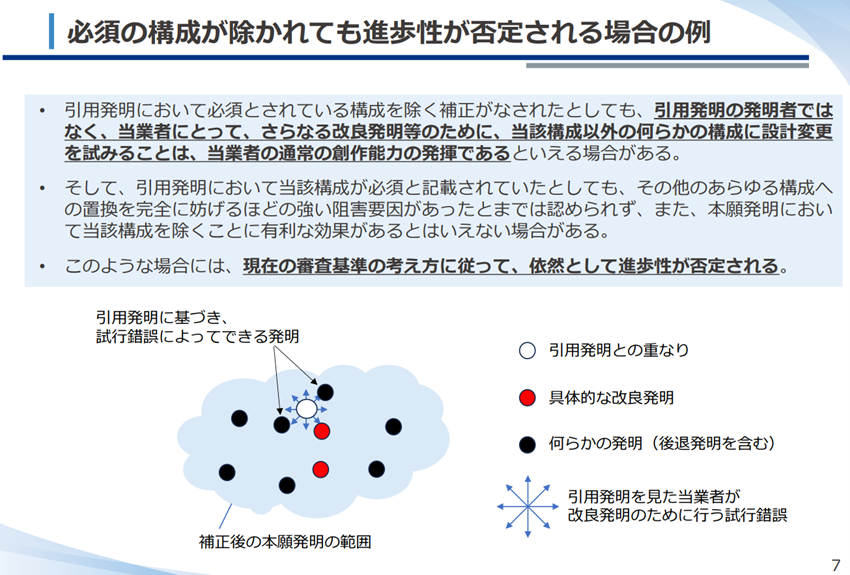
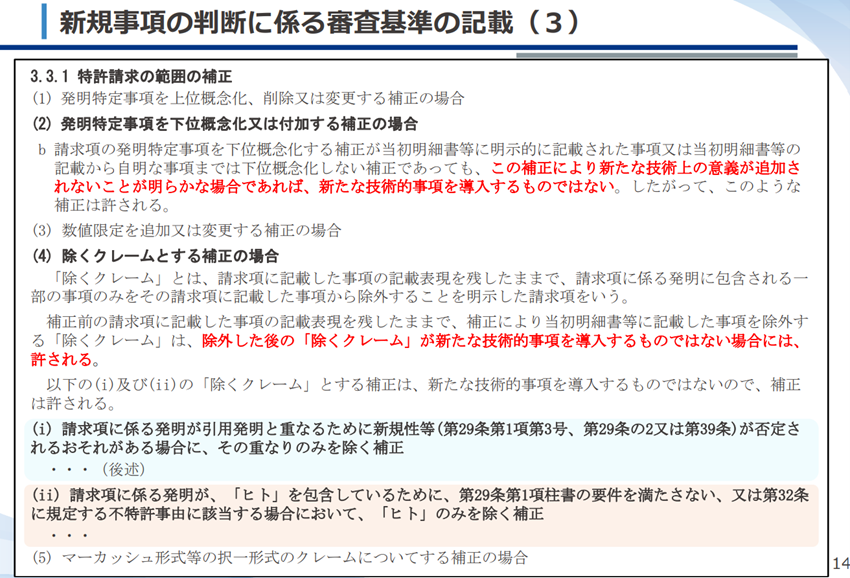
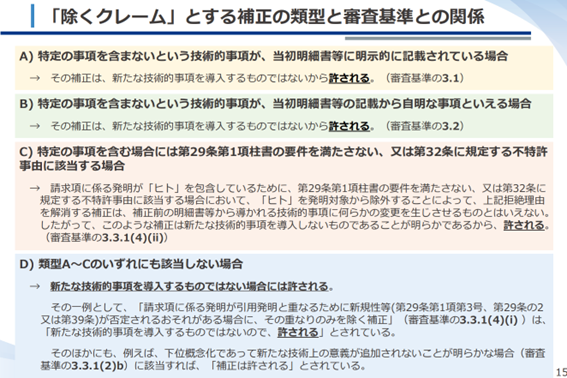
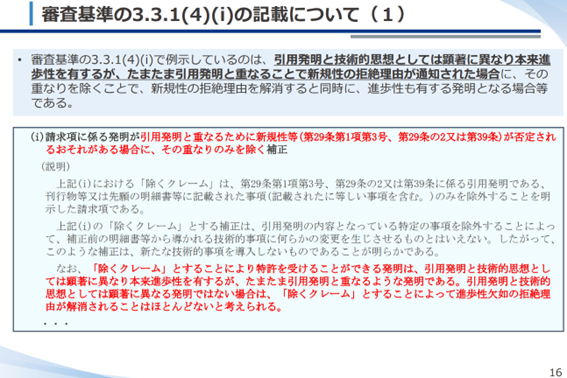
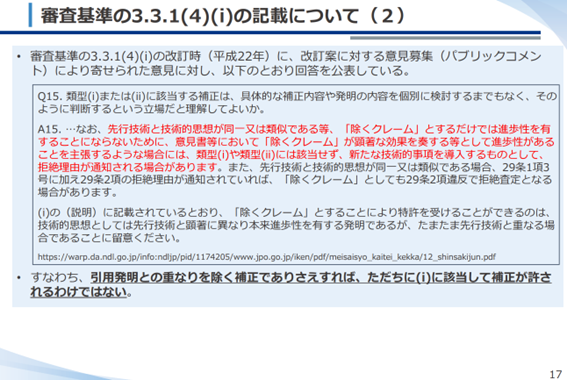
図6 多世代分割出願と補正・取下げの関係
⑤平成28年(行ケ)10263:「分割出願が適法であるための実体的要件としては,①もとの出願の明細書又は図面に二以上の発明が包含されていたこと,②新たな出願に係る発明はもとの出願の明細書又は図面に記載された発明の一部であること,③新たな出願に係る発明は,もとの出願の当初明細書等に記載された事項の範囲内であることを要する。本件出願は,第1出願から数えて5世代目になる分割出願であるため,本件出願が第1出願の出願時にしたものとみなされるには,本件出願,第4出願,第3出願及び第2出願が,それぞれ,もとの出願との関係で,上記①ないし③の分割の要件を満たし,かつ,本件発明が第1出願の出願当初の明細書等に記載した事項の範囲内のものであること,という要件を満たさなければならない。」
同旨:①大阪高判平成14年(ネ)2776<若林>、②東京高判平成15年(行ケ)65<篠原>。
子出願時は適法でも、子を出願後に補正すると、補正の遡及効により、子出願が分割要件違反となる場合がある。その場合、孫出願日は子出願日までしか遡及しない。
補正後が新規事項追加であると、分割要件違反となる。③東京地判平成16年(ワ)第14649号<設樂>。
分割要件=補正要件:⑧東京地判平成15年(ワ)第9215号<三村>。
補正の遡及効:親出願日、子出願日、子の補正、孫の出願日の順序で検討する。補正により分割要件違反(要旨変更)が治癒されると、分割要件違反を免れる。④東京高判昭和50年(行ケ)第75号。
「本件訂正によって請求項の全部が削除されたことにより、本件実用新案登録は、初めから存在しなかったものとみなされる」⑥平成13年(行ケ)421<山下>。
子が取り下げられても、孫の出願日は親の出願日に遡及する。⑦平成27年(ワ)8517【畦塗り機事件】<嶋末>。同事件では、取下げ前に分割要件違反はなかった。特許法39条5項以外、出願取下げに遡及効はない(平成1年審123号)。
分割出願が新規事項追加のまま拒絶・無効確定すると、孫の出願日が親出願日に遡及しない。拒絶で終わる場合にも、新規事項追加を解消する補正を試みるべきである。
Figure 6, case ③: Tokyo District Court, April 13, 2006, 2004 (Wa) No. 14649 (Telephone Call Control System).
図7 画像形成装置事件と分割出願の新規事項
令和元年(ワ)23164【画像形成装置】<田中>。参照:令和2年(行ケ)10131<大鷹>。
子出願が分割要件違反であれば、孫出願の出願日は子出願の現実の出願日までしか遡及せず、親出願日まで遡及しない。大阪高判平成14年(ネ)2776、東京高判平成15年(行ケ)65も同旨。
明細書の追加記載が新規事項追加とされた例として、【人工乳首事件】(平成14年(行ケ)539)と比較する。
「本件出願2が分割出願された時点における本件出願1の明細書等…と、本件出願2の明細書等(本件出願2分割時明細書…)とを比較すると、本件出願2分割時明細書は、例えば、指定キープ指示部によって、電源OFF後も加工条件をキープし、次回以降最初に表示される画面に表示することに関する記載が追加されている点(段落【0100】)、倍率を指示する「一つ上」や「一つ下」の表示によって、使用頻度の高い加工条件である倍率の設定数を減らし、メニューの設定数を減らすことに関する記載が追加されている点(段落【0105】)、登録されたメニューを変更不可にロックする手段を設けることによって、安易なメニュー変更による誤指示を防止することに関する記載が追加されている点(段落【0145】)、図7ないし図15及びこれに関連する記載が追加されている点(段落【0041】…)で、本件出願1査定時明細書の記載と相違しており、本件出願2分割時明細書は、本件出願1査定時明細書には存在しない記載事項を含むものであるから、本件出願1査定時明細書に記載された事項の範囲内であるとはいえない…。そうすると、本件出願2は、…②の分割要件を満たさない…」
親出願日後、子出願日前の引用発明に基づき、進歩性欠如とされた。
優先権主張時は「部分優先」が有り得るが、分割出願時の明細書への追記には注意を要する。原明細書等に開示があれば追記は不要であり、開示がなければ新規事項追加となる。
Figure 7, related decision: Intellectual Property High Court, October 13, 2021, 2020 (Gyo-Ke) No. 10131 (Image Forming Apparatus).
[Related Court Decisions (Concerning Divisional Requirements)]
(1) Intellectual Property High Court, 2024 (Gyo-Ke) No. 10086 [Vehicle Guidance System] <Presiding Judge Honda> (This Judgment)
* The child application violates the divisional requirements ⇒ the filing date of the grandchild application does not relate back to the filing date of the parent application.
<Excerpt from the Holding>
The fourth-generation specification, etc. as originally filed states, in relation to the problem that, if a vehicle that cannot use ETC enters an ETC-only lane, there is a risk of congestion or collision with a following vehicle, as means for solving that problem, matters such as providing means by which such vehicles that cannot use ETC can leave the ETC-only lane, providing, as the leaving means, a lane branching from the ETC-only lane, and guiding a vehicle by lowering a barrier when entry of the vehicle is detected; and it is recognized that it discloses a vehicle guidance system that, upon detecting a vehicle that cannot use ETC, guides the vehicle so as to cause it to leave the ETC-only lane. In addition, as the method for detecting and identifying a vehicle that cannot use ETC, it is stated, as seen in paragraphs [0010] and [0012], that this is done according to whether there is an “inability or failure to communicate between the roadside antenna and the on-board unit”; and, in the description of the embodiments, paragraphs [0031] to [0053] and [0066] to [0068], Figures 3 to 8, and Figure 12 disclose that this is done according to whether the vehicle is capable of ETC wireless communication. Further, paragraphs [0054] to [0062], Figures 9 and 10, which are an example of an interchange with an enhanced reverse-entry prevention function, and paragraphs [0063] to [0065] and Figure 11, which are an example of a vehicle guidance system for a smart interchange, also state that “Figure 9 is a modified example of Figure 4” ([0055]) and that “except that there are no ordinary-vehicle lanes B and C, the roles of lanes (A→D) and (A→E) at entrance tollgate 12 and the roles of lanes (A→D) and (A→E) at exit tollgate 13 are the same as those in Figures 3, 4, 6 and 7” ([0064]); thus, all of them are premised on guidance according to whether the vehicle is capable of ETC wireless communication. Accordingly, it is recognized that the fourth-generation specification, etc. as originally filed, in the invention of a vehicle guidance system that causes a vehicle unable to use ETC to leave an ETC-only lane in order to solve the problem of congestion and the risk of collision with a following vehicle, respectively describes, as specific means for solving the problem, (i) the matter of causing the vehicle to travel on a branch lane and return when a vehicle unable to use ETC has entered an ETC-only lane, and (ii) the matter of determining whether the vehicle is one to be returned according to whether wireless communication between the ETC on-board unit and the roadside antenna is possible. Moreover, even considering all descriptions in the fourth-generation specification, etc. as originally filed as a whole, there is no other description disclosing or suggesting the circumstances in which a vehicle is caused to travel on a branch lane and return, or a method for determining a vehicle to be returned. Therefore, items (i) and (ii) above should be regarded as indispensable configurations for solving the problem in the invention disclosed in the fourth-generation specification, etc. as originally filed …
⇒ Because each fifth-generation invention lacks items (i) and (ii) above (the indispensable configurations for solving the problem), it constitutes the addition of new matter.
(2) Tokyo District Court, 2019 (Wa) No. 23164 [Image Forming Apparatus] <Presiding Judge Tanaka>
Judgment: https://www.courts.go.jp/assets/hanrei/hanrei-pdf-91102.pdf
* The child application violates the divisional requirements ⇒ the filing date of the grandchild application does not relate back to the filing date of the parent application.
* In 2020 (Gyo-Ke) No. 10131 concerning the same patent, the court held: “Considering together … that there was an opportunity to cure the state in which Application 2 at issue violated the divisional requirements by making an amendment such as deleting the added portion above, it was not appropriate for the examiner of Application 2 at issue to overlook the above violation of the divisional requirements, but …”
Judgment: https://www.courts.go.jp/assets/hanrei/hanrei-pdf-90633.pdf
<Excerpt from the Holding>
… The patent application at issue is a patent application obtained by further dividing Application 3 at issue, which was itself obtained by further dividing Application 2 at issue, which was a divisional application of Application 1 at issue. The Defendant alleges that Application 2 at issue violates the divisional requirements; therefore, the court examines this point.
… Where a divisional application is lawful, its filing date relates back to the filing date of the original application (main clause of Article 44(2) of the Patent Act); where a divisional application is unlawful, substantive examination is conducted based on the date on which the divisional application was actually filed. In order for the filing date of a divisional application to relate back to the filing date of the original application, it is reasonable to construe that it is necessary that (i) the matters described in the specification, etc. of the divisional application fall within the scope of matters described in the specification, etc. of the original application as filed, and (ii) the matters described in the specification, etc. of the divisional application fall within the scope of matters described in the specification, etc. of the original application immediately before the division. Where a patent application is divided during a period in which the specification, etc. of the original application may be amended, it is understood that satisfaction of requirement (i) above also satisfies requirement (ii). However, because Application 2 at issue … was not filed during a period in which the specification, etc. of Application 1 at issue could be amended …, it is understood that, as a divisional requirement for Application 2 at issue, requirement (ii) above must also be satisfied separately from requirement (i). …
… Comparing the specification, etc. of Application 1 at issue at the time Application 2 at issue was filed as a divisional application, namely, the specification, etc. of Application 1 at issue at the time of the decision to grant a patent, … with the specification, etc. of Application 2 at issue (the specification at the time of division of Application 2 at issue …), the latter differs from the former in, for example, that it adds a description relating to maintaining machining conditions even after power-off by means of a designated-keep instruction unit and displaying them on the first screen shown on the next and subsequent occasions (paragraph [0100]); that it adds a description relating to reducing the number of settings for the magnification, which is a frequently used machining condition, and reducing the number of menu settings by means of displays indicating magnification, such as “one above” and “one below” (paragraph [0105]); that it adds a description relating to preventing erroneous instructions caused by casual menu changes by providing means for locking a registered menu so that it cannot be changed (paragraph [0145]); and that it adds Figures 7 to 15 and related descriptions (paragraph [0041] …). The specification at the time of division of Application 2 at issue therefore contains matters not present in the specification of Application 1 at issue at the time of the decision to grant a patent and cannot be said to fall within the scope of matters described in the latter specification. … Accordingly, Application 2 at issue fails to satisfy divisional requirement (ii) above and should be regarded as violating the divisional requirements; Article 44(2) of the Patent Act does not apply to Application 2 at issue.
… According to the foregoing, even if the patent application at issue satisfies the divisional requirements in relation to Application 3 at issue and Application 3 at issue satisfies the divisional requirements in relation to Application 2 at issue, Application 2 at issue does not satisfy the divisional requirements in relation to Application 1 at issue. Therefore, the filing date of Application 2 at issue does not relate back to the filing date of Application 1 at issue and is its actual filing date …, and likewise, the filing date to which the patent application at issue relates back is the filing date of Application 2 at issue ….
(3) Osaka High Court, 2002 (Ne) No. 2776 [Concrete Embedded Object] (Mirai Kogyo v. Nichido Denko)
Judgment: https://www.courts.go.jp/assets/hanrei/hanrei-pdf-11279.pdf
* The child application came to violate the divisional requirements due to the retroactive effect of a procedural amendment.
⇒ The filing date of the grandchild application does not relate back to the filing date of the parent application.
* The fact that invalidity of the child application became final is unrelated to whether the filing date of the grandchild application relates back to the filing date of the parent application.
<Excerpt from the Holding>
Considering the divisional filing of the child application, the amendment to the child application … included matters neither described in the specification or drawings of the parent application as filed nor described in the specification or drawings of the child application as filed, and the specification of the child application after the amendment contained matters outside the scope of the specification or drawings of the parent application as filed. The child application therefore could not be said to have been lawfully divided from the parent application under Article 44(1) of the Patent Act. The child application was subsequently patented, and the invalidation decision at issue became final; there was therefore no longer any room to correct, by a procedural amendment or a request for correction, … the content of the procedural amendment. Because the content after the amendment had become final, the child application cannot be said to have been lawfully divided from the parent application under Article 44(1) of the Patent Act and is not deemed to have been filed at the time of the parent application. Because it is not deemed to have been filed at the time of the parent application, … the filing date of the child application is deemed to be … the date on which the amendment was submitted …. In this regard, the Plaintiff alleges that the child application was a divisional application lawfully divided under Article 44 of the Patent Act and that, by the amendment in the procedural amendment, its filing date was merely postponed under Article 40 of the Patent Act, and the division of the child application itself did not become unlawful or invalid. However, … it is clear that the division of the child application did not satisfy the divisional requirements and was unlawful in the first place, and the Plaintiff’s allegation above cannot be accepted. …
Application 1 at issue (the grandchild application) may be considered lawful as a divisional application having the child application as its parent application because it may be said to satisfy the other divisional requirements. However, in relation to the parent application, … because the child application cannot be said to have been lawfully divided from the parent application, Application 1 at issue (the grandchild application) likewise is not deemed to have been filed at the time of the parent application, but is deemed to have been filed at the time of the child application, and is deemed to have been filed on the date … deemed to be the filing date of the child application. …
Enjoyment of the benefit of retroactivity of the filing date of the grandchild application is, after all, enjoyment of the benefit of the filing date of the child application, and is premised on the child application satisfying the divisional requirements and having been lawfully divided; the filing date of the grandchild application does not relate back without limitation to the time of the parent application, independently of the child application and removed from the time at which division was originally possible. The Patent Act recognizes … that an amendment has effect retroactive to the beginning of the procedure, and patent procedures are administered on the premise of such retroactive effect of amendments. In fact, with respect to divisional applications as well, where the invention of the original application and the invention of the divisional application were identical at the time of division but subsequently an amendment to the specification or drawings of the original application rendered the two inventions non-identical, the divisional application is deemed lawful; conversely, where the invention of the original application and the invention of the divisional application were not identical at the time of division but subsequently an amendment to the specification or drawings of the original application rendered the two inventions identical, the divisional application is deemed unlawful. Moreover, even if the retroactive effect of such an amendment gives rise to a situation in which a division is unlawful, the person who made the amendment may cure the ground of unlawfulness by making a further amendment correcting it. In light of these points, where a parent application, a child application, and a grandchild application are divided in sequence, even if the division from the child application to the grandchild application had no defect in the divisional requirements, it is unavoidable that whether the division of the child application from the parent application satisfies the requirements may vary depending on whether and how the child application is amended, thereby changing the filing date of the child application and, in turn, changing the filing date of the grandchild application. …
(4) Tokyo High Court, 2003 (Gyo-Ke) No. 65 [Concrete Embedded Object] (Mirai Kogyo v. Nichido Denko)
Judgment: https://www.courts.go.jp/assets/hanrei/hanrei-pdf-10885.pdf
* The child application came to violate the divisional requirements due to the retroactive effect of a procedural amendment.
⇒ The filing date of the grandchild application does not relate back to the filing date of the parent application.
<Excerpt from the Holding>
… In this case, the patent application at issue (grandchild application) is a further divisional application of the child application, which was a divisional application from the parent application. Therefore, if each of the divisions of the grandchild application (the patent application at issue) and the child application satisfies the divisional requirements under former Article 44(1) of the Patent Act, and Inventions 1 and 2 at issue fall within the scope of matters described in the original specification, etc. of the parent application, the filing dates of Inventions 1 and 2 at issue relate back to the filing date of the parent application. However, the invention of the child application was amended by the procedural amendment dated October 29, 1993 (Exhibit Ko 17), such that it no longer fell within the scope of matters described in the original specification, etc. of the parent application. After registration of establishment of the patent right, the invalidation decision became final with the invention as so amended, and the patent right for the child application was deemed never to have existed. Accordingly, there is no longer any room to correct the amended invention, and the invention of the child application no longer falls within the scope of matters described in the original specification, etc. of the parent application; it is therefore clear that the child application does not satisfy the substantive requirements for division. Thus, without even examining whether the division of the grandchild application was proper, there is no room for the filing date of the patent application at issue, which is the grandchild application, to relate back to the filing date of the parent application. …
… The amendment to the child application … should originally have been rejected as impermissible, but was not rejected; after registration of establishment of the patent right with the invention as amended, the invalidation decision became final and the patent right relating to the child application was deemed never to have existed. … The child application did not satisfy the divisional requirements and was not lawfully divided. …
… The Plaintiff further alleges that, under the Examination Guidelines prepared by the Japan Patent Office in May 1983 and applicable to the patent application at issue, a divisional application filed on the same date on which the original application was withdrawn or abandoned is lawful, except that, where the original application is withdrawn, abandoned, or invalidated, a divisional application is unlawful if the invention of the original application and the invention of the divisional application are identical at the time of such act; and therefore it is the practice of the Japan Patent Office that invalidation of the right relating to the child application after it has become final does not also invalidate the grandchild application. However, as stated above, the child application was deemed, under former Article 40 of the Patent Act, to have been filed on the date on which the procedural amendment was submitted; it was not deemed withdrawn or abandoned. It is also clear that the decision does not hold that the grandchild application is invalid because the child application became invalid. The Plaintiff’s allegation above merely criticizes the decision at issue based on a misunderstanding of it and cannot be accepted.
(5) Tokyo District Court, 2003 (Wa) No. 9215 [Fastener and Cord Fastening Device] (JP3367651) <Presiding Judge Mimura>
Judgment: https://www.courts.go.jp/assets/hanrei/hanrei-pdf-10373.pdf
* Divisional applications and amendments are permitted within the same scope.
= Tokyo District Court, 1998 (Wa) No. 8345 [Ear-Hanging Device for Cultured Shellfish] <Presiding Judge Mimura>
Judgment: https://www.courts.go.jp/assets/hanrei/hanrei-pdf-13449.pdf
<Excerpt from the Holding>
Regarding the division of a patent application, Article 44(1) of the Patent Act provides that “only within the period during which an amendment may be made to the specification or drawings attached to the application, a patent applicant may make a part of a patent application containing two or more inventions into one or more new patent applications.” In order for such a divisional application to be recognized as lawful, the original application must be pending before the Japan Patent Office and must contain two or more inventions; containing two or more inventions is understood not to require that they be contained only in the claims, but is satisfied if the specification contains two or more inventions. A divisional application must also be filed within a period during which an amendment may be made (Article 44(1) of the Patent Act). Further, a divisional application is deemed to have been filed at the time of the original patent application (paragraph (2) of the same Article), and novelty, inventive step, and the like are assessed as of the filing date of the patent application from which the divisional application originated. In light of these matters, division of an application may be said to have a function similar to that of an amendment (Article 17 of the Patent Act); therefore, the permissible scope of a divisional application should likewise be construed as limited to the scope within which the original application may be amended. (If division were permitted even where the requirements for amendment were not satisfied, it would in substance permit circumvention of the amendment requirements by means of the divisional procedure, which would be unreasonable.) Thus, the specification or drawings of a divisional application should be construed not to include anything outside the scope of matters described in the specification or drawings of the original application as filed. …
(6) Tokyo District Court, 2004 (Wa) No. 14649 [Telephone Call Control System] <Presiding Judge Shitara>
Judgment: https://www.courts.go.jp/assets/hanrei/hanrei-pdf-32912.pdf
* A case in which the divisional requirements were assessed based on the claims after amendment (retroactive effect of amendment) — the same logic and conclusion as for the amendment requirements
= Tokyo High Court, 2003 (Gyo-Ke) No. 65; cf. 2016 (Gyo-Ke) No. 10114
<Excerpt from the Holding>
… The first and second amendments to Application 2 at issue added a description of an embodiment in which, before a customer pays a deposit, the amount of the deposit and a special code are stored in advance in memory means of a special exchange unit, and should be regarded as additionally describing an invention producing a new operation and effect, “…”, that was not described in the original specification of Application 2 at issue. Accordingly, the first and second amendments to Application 2 at issue cannot be recognized as amendments that increased, decreased, or changed the claims of the original specification of the divisional application within the scope of matters described in the original specification or drawings of Application 2 at issue. Therefore, the divisional application at issue does not satisfy the divisional-application requirements of former Article 44(1) of the Patent Act and is deemed to have been filed on May 7, 1997. Furthermore, because the first and second amendments to Application 2 at issue cannot be recognized as having been made within the scope of matters described in the original specification or drawings of the divisional application at issue, they violate Article 17-2(3) of the Patent Act. …
(7) Tokyo High Court, 1975 (Gyo-Ke) No. 75
A discussion of the possibility of curing a divisional defect should not be read as a finding that the defect was cured in that case or as an unconditional remedy under current law.
* A violation of the divisional requirements may be cured by an amendment (retroactive effect of amendment).
(Reference) Tokyo High Court, 2003 (Gyo-Ke) No. 65, [Concrete Embedded Object] ⇒ The filing date of a grandchild application divided from a child application does not relate back to the filing date of the parent application where the child application ceases to satisfy the divisional requirements due to an amendment.
⇒ The filing date of the child application is the date on which the procedural amendment was submitted!!
<Excerpt from the Holding>
Insofar as the original specification and drawings of the patent application at issue are concerned, the application does not satisfy, in relation to the original patent application, the divisional requirements concerning the technical matter described above and therefore cannot be regarded as a lawful divisional application. Consequently, retroactivity of the filing date is not recognized, and the application is treated as having been filed on its actual filing date, April 23, 1964.
However, if the divisional requirements above subsequently came to be satisfied by an amendment to the patent application at issue, retroactivity of the filing date may newly be recognized as a result, and therefore the court examines whether the amendment at issue falls within such a case. If the amendment at issue changes the gist of the specification or drawings in relation to the patent application at issue (which is a divisional application and a new application) itself, the amendment is not permitted; not only does the patent application at issue fail, by virtue of the amendment, to satisfy the divisional requirements above, but regardless of whether it falls within the scope of matters described in the original specification or drawings of the original patent application, it cannot be accepted under the former Act and must also be dismissed under the new Act. …
It is recognized that the amendment at issue … does not fall within the scope of matters described in the original specification or drawings of the patent application at issue (and the evidence cited above also establishes that the matter in question is not described in the original specification or drawings of the original patent application). Accordingly, it cannot be said that, by virtue of the amendment at issue, the patent application at issue came to satisfy the divisional requirements above.
(8) Tokyo District Court, 2015 (Wa) No. 8517 [Ridge Plastering Machine] <Presiding Judge Shimasue>
Judgment: https://www.courts.go.jp/assets/hanrei/hanrei-pdf-85939.pdf
* A third-generation patent in a sequence of original application ⇒ first generation ⇒ second generation ⇒ third generation.
* The second-generation application had been withdrawn, but whether its filing date could relate back to the first-generation application and the original application was not disputed.
* Tokyo High Court, 2003 (Gyo-Ke) No. 65, and Osaka High Court, 2002 (Ne) No. 2776, held that invalidity of the child application itself was irrelevant.
<Excerpt from the Holding>
[Defendant’s Allegation]
The configuration in Claim 1 that “the connecting piece is fixed to the rear surface of the ridge-forming surface of the ridge-forming plate positioned on the front side in the direction of rotation among the adjacent ridge-forming plates and does not extend to the ridge-forming surface of the ridge-forming plate positioned on the rear side in the direction of rotation” (the configuration added by the amendment at issue), and the configuration of “a connecting piece provided along the boundary portion,” are each outside the scope of matters described in the specification, claims, and drawings immediately before the division (filing of the patent at issue) of the original application for the patent at issue (Japanese Patent Application No. 2014-78397) (hereinafter collectively the “Specification, etc. at the Time of Division of the Original Application”). … Accordingly, the application relating to the patent at issue (the divisional application of Japanese Patent Application No. 2014-78397) is not a lawful divisional application (Article 44(1)(i) of the Patent Act), and its filing date does not relate back to the filing date of the original application. As a result, each invention at issue lacks novelty or inventive step (Article 29(1)(iii) or (2) of the Patent Act) over the published patent application relating to the original application for the patent at issue (Japanese Unexamined Patent Application Publication No. 2014-128287, distributed on July 10, 2014 [Exhibit Otsu 15]).
…
[Court’s Determination]
Of the descriptions in the Specification, etc. at the Time of Division of the Original Application, the description … relating to the configuration that “the connecting piece is fixed to the rear surface of the ridge-forming surface of the ridge-forming plate positioned on the front side in the direction of rotation among the adjacent ridge-forming plates and does not extend to the ridge-forming surface of the ridge-forming plate positioned on the rear side in the direction of rotation” may be inferred to be the same as the description … in the original specification, etc.; therefore, that configuration should be regarded as self-evident from the above description in the Specification, etc. at the Time of Division of the Original Application. The configuration of “a connecting piece provided along the boundary portion” is likewise recognized as self-evident from the description in the specification at the time of division of the original application. … According to the foregoing, the patents for the respective inventions at issue cannot be found not to relate to lawful divisional applications. …
(9) Intellectual Property High Court, 2016 (Gyo-Ke) No. 10263 [Wiring Box] (Mirai Kogyo v. Nichido Denko) <Presiding Judge Takabe>
Judgment: https://www.courts.go.jp/assets/hanrei/hanrei-pdf-87087.pdf
* General method for assessing the divisional requirements of a fifth-generation (great-great-grandchild) patent
<Excerpt from the Holding>
The substantive requirements for a divisional application to be lawful are that (i) the specification or drawings of the original application contained two or more inventions, (ii) the invention of the new application is part of an invention described in the specification or drawings of the original application, and (iii) the invention of the new application falls within the scope of matters described in the original specification, etc. of the original application. Because the application at issue is a fifth-generation divisional application counted from the first application, in order for the application at issue to be deemed to have been filed at the time of filing of the first application, the application at issue, the fourth application, the third application, and the second application must each satisfy divisional requirements (i) to (iii) above in relation to their respective original applications, and the invention at issue must fall within the scope of matters described in the original specification, etc. of the first application.
End
(Plaintiff) East Nippon Expressway Company Limited
(Defendant) PXZ Limited Company
[Patent ★★] A case in which, in the appellate instance of a patent infringement action, a new ground for invalidity was alleged in the statement of reasons for appeal, but was held untimely because it could have been alleged in the court of first instance — Intellectual Property High Court, 2024 (Ne) No. 10010 [Women’s Garment] <Presiding Judge Nakadaira> — (First Instance: Tokyo District Court, 2021 (Wa) No. 18262 <Presiding Judge Kokubu>)
[Summary of This Judgment and Some Observations]
1. Claims (Claim 1)
A. A women’s garment covering at least the bust portion of a woman, comprising:
B. a cup member covering at least the bust portion of the woman;
C. left and right front-body members disposed on the front-surface side of the cup member in a state separated from the cup member,
the left and right front-body members being provided from the respective left and right underarm portions of the bust portion to a central portion of the lower bust while covering the sides of the bust; and
D. a plurality of connecting members provided so as both to connect the left and right front-body members to each other near the central portion of the lower bust and to permit adjustment of the connecting width of the left and right front-body members,
E. the women’s garment being characterized thereby.
2. Infringement Analysis (First-Instance Judgment / Tokyo District Court, 2021 (Wa) No. 18262 [Women’s Garment] <Presiding Judge Kokubu>)
First-instance judgment: https://www.courts.go.jp/assets/hanrei/hanrei-pdf-92632.pdf
The sixth edition of Kojien sets out two meanings of the term “tomoni”: (i) “as one; together; in company; alike” and (ii) “at the same time.”
The Defendant (the alleged infringer) alleged that, when Kojien sets out two meanings, the meaning listed first is the more general meaning, but this allegation was not accepted.
The Tokyo District Court stated: “There is insufficient evidence to establish that the sixth edition of Kojien adopted an editorial policy of listing meanings beginning with those in broad and general use. Further, … the items specifically exemplified as ‘connecting members’ in the specification … are inconsistent with the Defendant’s … construction. …” It construed the claim term “tomoni” in the patented invention to have meaning (ii), “at the same time,” and found infringement. (The patentee prevailed.)
(Excerpt from the Holding / First-Instance Judgment)
The Defendant alleges that, with respect to “tomoni” in Limitation D, because, when a dictionary is compiled, the meanings of each word or phrase are listed beginning with those in broad and general use, the term should have the meaning listed first in the sixth edition of Kojien, namely, “as one; together; in company; alike.” However, which meanings of a word or phrase are given priority in the description is considered to depend on the editorial policy of each dictionary, and … there is insufficient evidence to establish that the sixth edition of Kojien adopted an editorial policy of listing meanings beginning with those in broad and general use. Further, … each item specifically exemplified as a “connecting member” in the specification at issue is such that its connecting width cannot be adjusted unless the connecting members are disconnected from each other, and is therefore inconsistent with the Defendant’s proposed construction of “tomoni.” …
3. Invalidity Analysis (Although Held Untimely, It Was Nevertheless Considered.)
Grounds for invalidity alleged by the Appellant in the court of first instance
- Lack of novelty and inventive step based on Otsu 8 as the primary reference
- Lack of inventive step based on Otsu 9 and Otsu 10 as secondary references
Grounds for invalidity first alleged by the Appellant on appeal
- Lack of novelty and inventive step based on Otsu 31 to 33 (U.S. patent documents)
The Appellee’s Arguments on Untimeliness and the Intellectual Property High Court’s Determination
1. The Appellee’s argument: There was a time at which it should have been alleged in the court of first instance
- On August 31, 2022, at a procedural session, the court disclosed its preliminary view on infringement.
- It was possible to allege the new grounds for invalidity by that time.
2. The Appellee’s argument: They were neither submitted nor alleged at all in the court of first instance
- “The Appellant did not even submit Otsu 31 to 33 through the end of the proceedings.”
- “Nor did it make any allegations of invalidity based on those documents.”
3. The Appellee’s argument: There were no circumstances making the allegation difficult
- “There are no circumstances suggesting that it was difficult to allege an invalidity defense based on the documents Otsu 31 to 33.”
4. The court’s determination: Delay in concluding the proceedings was not established in this case
- A change in the level of court or in counsel did not justify the late submission. However, the Appellee had responded in the alternative, and the proceedings closed without a further response from the Appellant. To that extent, the court did not find that consideration would delay the conclusion of the proceedings.
- 5. Conclusion
The failure to make the allegation in the court of first instance, despite being able to do so, was held “untimely.” However, delay in concluding the proceedings was not established, and the court addressed the invalidity grounds on their merits.
6. “It cannot be said that it would delay completion of the proceedings”
Because a response to the grounds for invalidity had been made and oral argument was concluded without any further response, the court held that it could not be said that consideration of the grounds would delay completion of the proceedings and therefore decided the invalidity issues.
(Excerpt from the Holding / Appellate Judgment (This Judgment))
First, in examining whether this constitutes an untimely allegation or defense, the Appellant’s new allegation of grounds for invalidity in this appellate instance was made in the statement of reasons for appeal dated February 6, 2024. In a patent infringement action, an invalidity defense may be alleged without awaiting finalization of an invalidation decision in a patent invalidation trial, in order to resolve a dispute concerning patent infringement as promptly as possible within the patent infringement proceedings. Because the defense is made within civil litigation proceedings, which are separate from a patent invalidation trial, it should be dismissed as an untimely allegation or defense when, in light of the course of the proceedings, it would unduly delay the proceedings.
On that basis, reviewing the course of the proceedings in the court of first instance, the Appellant, which was the first-instance Defendant, denied in its answer dated October 22, 2021 and submitted on October 27, 2021 that the Appellee’s product satisfied the limitations of the invention at issue, and alleged a ground for invalidity based on lack of inventive step, using Otsu 8 as the primary reference and combining it with well-known art or using Otsu 9 as a secondary reference. After receiving the Appellee’s response and other submissions, the Appellant added, in Preparatory Brief (3) dated March 18, 2022, a ground for invalidity based on lack of novelty over Otsu 8. After receiving the Appellee’s further response, it additionally alleged, in Preparatory Brief (4) dated May 27, 2022, a ground for invalidity based on lack of inventive step, using Otsu 8 as the primary reference and Otsu 10 as a secondary reference. In response to the Appellee’s arguments on that point, it further replied in Preparatory Brief (5) dated August 29, 2022.
Then, on the premise that the parties had fully presented their allegations and evidence on infringement, in a preparatory proceeding conducted by web conference on August 31, 2022, the court disclosed its preliminary view that the proceedings would move to damages (the progress table for the preparatory proceeding on August 31, 2022 states in the “result of discussion” column: “Both parties: allegations and proof regarding infringement have been completed”; and “Presiding Judge: hereafter, the proceedings will address damages”). Proceedings on damages then continued. At the oral-argument hearing held on September 22, 2023, the Appellant stated that it had no further allegations or evidence, the oral argument in the court of first instance was concluded, and the original judgment was rendered.
In light of this course of proceedings in the court of first instance, the new allegation of grounds for invalidity in this appellate instance constitutes an untimely allegation or defense, and the Appellant was grossly negligent in delaying its submission. It would therefore ordinarily have to be dismissed. However, the Appellee has, albeit in the alternative, responded to the grounds for invalidity submitted in this appellate instance, and the oral argument in this appellate instance has been concluded without any further responsive allegation by the Appellant. To that extent, it cannot be said that considering the grounds would delay completion of the proceedings; therefore, the court will decide them below. …
4. Some Observations
The course of allegations and proof in the court of first instance was ordinary for a patent infringement action. Thus, if, under the reasoning of this judgment, new grounds for invalidity “made in the statement of reasons for appeal” are held untimely, it may in substance become impossible to make any new allegation beginning in the appellate instance.
In the Ichitaro case (discussed below), the assertion of a new ground for invalidity beginning on appeal was permitted because the first-instance proceedings were short and the new primary reference was a foreign-language document. In this case, however, the assertion of a new ground for invalidity using the invention in Otsu 31, an English-language document, as the primary reference was held, in principle, to be untimely.
The Appellee argued that “the Appellant did not even submit Otsu 31 to 33 through the end of the proceedings.” In response to that argument, one might think they should simply have been submitted and alleged even after disclosure of the first-instance court’s preliminary view. Yet another Intellectual Property High Court judgment held an allegation untimely because it had been dismissed as untimely in the first instance; there is therefore no way out.
Separately from whether an allegation is untimely, one possible strategy for obtaining an appellate holding, as in this judgment, that “it cannot be said that it would delay completion of the proceedings” is to make all allegations in the statement of reasons for appeal and then refrain from making a further response to the Appellee’s response. Because the proceedings in this case followed that course, the invalidity issues were decided on the ground that “it cannot be said that it would delay completion of the proceedings.”
If so, when a new ground for invalidity is alleged in the statement of reasons for appeal, the Appellee could adopt a strategy of not responding to its substance and alleging only untimeliness. However, although it would ordinarily be difficult to imagine that the appellate court would close oral argument at that point, uphold the invalidity defense, and reverse in favor of the alleged infringer, a strategy of making no response entails risk. In many cases, therefore, the Appellee will likely respond on the merits as a precaution.
Regarding allegations first made on appeal and untimeliness, many prior Intellectual Property High Court judgments did not find an allegation untimely if made in the statement of reasons for appeal, but found it untimely if made in a preparatory brief after that statement; this judgment is extremely strict. A comprehensive strategy should be formulated while bearing in mind that other Intellectual Property High Court judgments have found that new grounds for invalidity alleged beginning on appeal were not untimely.
For example, 2016 (Ne) No. 10100 [Electric Fishing Reel] <Presiding Judge Takabe> involved a correction defense that had been alleged after the court of first instance disclosed its view that the patent was invalid and had been dismissed as untimely. When the correction defense dismissed below was alleged in the statement of reasons for appeal, however, it was not dismissed as untimely.
That judgment held: “In light of the course of proceedings in the court of first instance and this court, it may be said that it would have been desirable to make the correction defense earlier. Nevertheless, because the Appellant, after the original judgment was rendered and advance notice of the trial decision was issued, set out the correction defense in detail in the statement of reasons for appeal and promptly submitted that allegation in this appellate instance, it cannot be said that the Appellant’s submission of the correction defense was untimely.” This is close to practical sensibilities. Where the first-instance judgment contains an unexpected determination, should not an allegation made on the basis of that determination be permitted on appeal, so long as it is made in the statement of reasons for appeal, at the outset of the appellate proceedings?
[Related Court Decisions Concerning the Timeliness of New Allegations on Appeal]
1. Court decisions addressing the timeliness of allegations made at the outset of the appeal in the statement of reasons for appeal
Intellectual Property High Court, 2024 (Ne) No. 10010 [Women’s Garment] <Presiding Judge Nakadaira> (This Judgment)
Judgment: https://www.courts.go.jp/assets/hanrei/hanrei-pdf-93355.pdf
* A new invalidity defense alleged in the statement of reasons for appeal was held untimely. (On this reasoning, nothing new could be alleged beginning on appeal …)
Supplement: In this case, delay in concluding the proceedings was not established and the invalidity defense was not dismissed. The parenthetical observation is the author’s criticism; the judgment does not impose a categorical prohibition on new allegations on appeal.
“The Appellant’s new allegation of grounds for invalidity in this appellate instance was made … in the statement of reasons for appeal. …
… After receiving the court’s disclosure of its preliminary view that the proceedings would move to damages, … proceedings on damages continued, and … at the oral-argument hearing, the Appellant stated that it had no further allegations or evidence; the oral argument in the court of first instance was concluded; and the original judgment was rendered. … In light of this course of proceedings in the court of first instance, the new allegation of grounds for invalidity in this appellate instance constitutes an untimely allegation or defense, and the Appellant was grossly negligent in delaying its submission. It would therefore ordinarily have to be dismissed. However, the Appellee has, albeit in the alternative, responded to the grounds for invalidity submitted in this appellate instance, and the oral argument in this appellate instance has been concluded without any further responsive allegation by the Appellant. To that extent, it cannot be said that considering the grounds would delay completion of the proceedings; therefore, the court will decide them below. … The allegation of lack of inventive step is without merit.”
Intellectual Property High Court, 2017 (Ne) No. 10055 [Continuous Shellfish Fastening Tool] <Presiding Judge Mori>
Judgment: https://www.courts.go.jp/assets/hanrei/hanrei-pdf-88166.pdf
* Although untimely, the next hearing had been scheduled and completion of the proceedings would not be delayed. ⇒ Not dismissed. ⇒ Lack of novelty.
“It is recognized that the Appellants could have submitted the defense concerning Ground for Invalidity 3 (lack of novelty) no later than January 26, 2017; therefore, it constitutes an ‘allegation or defense submitted untimely’ (Article 157(1) of the Code of Civil Procedure).
However, at the first oral-argument hearing in this appeal, … Appellant Shinwa alleged that, before the date on which the patent at issue was deemed filed, it had sold a product satisfying the limitations of each invention at issue and that the patent at issue therefore lacked novelty. At that hearing, a further hearing was scheduled and additional allegations and proof were contemplated. In those circumstances, there was insufficient basis to find that the allegation at that time would delay completion of the proceedings.” (* January 26, 2017 was the date on which oral argument in the court of first instance was concluded.)
Intellectual Property High Court, 2023 (Ne) No. 10071 [Chip-Type Fuse] <Presiding Judge Miyasaka>
Judgment: https://www.courts.go.jp/assets/hanrei/hanrei-pdf-92795.pdf
* An allegation concerning a different claim that had been dismissed as untimely in the court of first instance was also dismissed as untimely on appeal.
“The facts stated in the attached ‘Course Leading to the Addition of the Cause of Action at Issue’ are recognized as the course of proceedings and other matters in the court of first instance leading to the addition of the cause of action at issue. Specifically, at the answer stage (dated February 28, 2022), the Appellee submitted detailed allegations disputing satisfaction of the fourth requirement of the doctrine of equivalents, specifically identifying such publicly known documents as Otsu 1 and Otsu 3. Thereafter, by November of that year, the Appellant and Appellee exchanged two rounds of briefs containing arguments on that issue and fully presented allegations and proof. During that period, the record of the preparatory proceedings included the Appellee’s procedural position that it would ‘submit a responsive brief focusing on the fourth requirement of the doctrine of equivalents,’ and satisfaction of the fourth requirement was recognized as at least one of the central issues in the case. At a discussion by web conference on November 28, when allegations and proof on infringement had reached a preliminary stopping point (a discussion in written preparatory proceedings; the same applies below), the court disclosed to both parties its preliminary view that the Appellee’s product did not fall within the technical scope of Invention 1 at issue, and the parties were to consider settlement. Settlement negotiations soon failed. At the discussion on January 27, 2023, the Appellant stated that it would submit a preparatory brief setting out a further response concerning the arc-extinguishing action (note: relating to the second requirement of the doctrine of equivalents), supplementation of its prior allegations, and other matters. Nevertheless, in a preparatory brief dated February 27, 2023, the Appellant then alleged the addition of the cause of action at issue. In response, by a preparatory brief dated April 13, 2023, the Appellee moved for dismissal as an untimely method of attack or for a ruling refusing the amendment of the action as one that would substantially delay the proceedings.
… On the basis of the foregoing, first examining whether addition of the cause of action at issue was “untimely,” the Appellant sought that addition because, as long as the issue was whether Invention 1 at issue under Claim 1 fell within the technical scope, it was highly likely, in relation to the publicly known documents submitted by the Appellee, … that the fourth requirement of the doctrine of equivalents (non-equivalence to publicly known art, etc.) would be held unsatisfied; the Appellant therefore attempted to satisfy the fourth requirement by putting at issue Invention 2 under Claim 3, which includes the additional configuration at issue. However, … the Appellee’s allegation disputing the fourth requirement of the doctrine of equivalents had already been submitted in detail and with specificity at the answer stage, and it was possible to consider addition of the cause of action at issue as a countermeasure. Thereafter, the parties exchanged two rounds of briefs over approximately nine months and fully presented allegations and proof on this issue. The Appellant then suddenly added the cause of action at issue after disclosure of the court’s preliminary view and despite having itself stated the procedural position that it contemplated only a supplemental submission. It is clear that this constituted submission of an untimely method of attack.”
Intellectual Property High Court, 2017 (Ne) No. 10072 [Personal-Network Relationship Registration System] <Presiding Judge Tsuruoka>
Judgment: https://www.courts.go.jp/assets/hanrei/hanrei-pdf-87419.pdf
* An allegation under the doctrine of equivalents made at the first appellate hearing was dismissed as untimely.
Cf. 2017 (Ne) No. 10029 and 2015 (Ne) No. 10076, in which the allegations were not dismissed.
“At the first oral-argument hearing in this appellate instance, … this Court dismissed the allegation of infringement under the doctrine of equivalents as an untimely allegation or defense. The reasons are as follows. … The Appellant should naturally have anticipated from the outset that the conclusion on satisfaction or non-satisfaction of the limitations could change depending on the claim construction regarding … and the manner of internal processing by the Appellee’s server. Accordingly, the Appellant had ample opportunity, at the issue-organizing stage in the court of first instance, to consider whether to allege infringement under the doctrine of equivalents even in the alternative and to make that allegation as necessary. (In light of the actual use of planned proceedings in patent infringement litigation, it is reasonable to view the matter in this way; and at least no objective circumstances preventing the Appellant from making the allegation are recognized.) Nevertheless, the Appellant did not make the allegation at the issue-organizing stage below, stated that there were ‘no further allegations or proof regarding infringement,’ and allowed the issue-organizing procedure to conclude. In these circumstances, the Appellant’s addition of an allegation of infringement under the doctrine of equivalents in this appellate instance, as stated above, was clearly untimely even though made before the first oral-argument hearing, and the Appellant is found to have acted intentionally or with gross negligence in that regard. …”
Cf. Intellectual Property High Court, 2015 (Ne) No. 10076 [Circular Table] <Presiding Judge Takabe>
Judgment: https://www.courts.go.jp/assets/hanrei/hanrei-pdf-85463.pdf
* An allegation under the doctrine of equivalents made at the first appellate hearing was not dismissed as untimely (because the appeal was dismissed at the first hearing, meaning the patentee lost).
“The Appellant’s allegation above was set out in … the preparatory brief stating the reasons for appeal, the Appellee also admitted or denied and responded to it, and it could be decided based on evidence already submitted. This Court then … concluded oral argument at the first appellate oral-argument hearing. Accordingly, the Appellant’s allegation above cannot be found to ‘delay completion of the proceedings’ (Article 157(1) of the Code of Civil Procedure), and therefore should not be dismissed as untimely.”
Cf. Intellectual Property High Court, 2014 (Ne) No. 10111 [Method for Mixing Granular Material and Removing Fine Powder] <Presiding Judge Takabe>
Judgment: https://www.courts.go.jp/assets/hanrei/hanrei-pdf-85366.pdf
* An allegation under the doctrine of equivalents made at the first appellate hearing was held untimely, but was decided.
“In light of the course of the proceedings, including that the issues in the first instance concerned exclusively satisfaction of Limitations 2E and 1B; that the notice of appeal did not state reasons for appeal; that the statement of reasons for appeal did not include … an allegation of infringement under the doctrine of equivalents or give notice of such an allegation; and that the Appellant’s first preparatory brief was submitted only five days before … the first oral-argument hearing in this appellate instance, the Appellant’s allegation of infringement under the doctrine of equivalents must be regarded as untimely. However, because the Appellee also admitted or denied and responded to the allegation, the court will decide below whether infringement under the doctrine of equivalents is established.”
Cf. Intellectual Property High Court, 2022 (Ne) No. 10078 [Display Device Capable of One-Handed Support] <Presiding Judge Kanno>
Judgment: https://www.courts.go.jp/assets/hanrei/hanrei-pdf-91824.pdf
* Three correction defenses were alleged in the court of first instance ⇒ a fourth correction defense was alleged in the statement of reasons for appeal; in light of the course of the proceedings, the court stated that it ordinarily would have to be dismissed as untimely. However, because a response had been made, the court decided it.
“Reviewing the course of the proceedings in the court of first instance, after the invalidity defense alleging that the patent at issue lacked novelty and inventive step was made at the first preparatory-hearing date (November 18, 2019) (Defendant’s Preparatory Brief No. 1), the Appellant submitted, by the third preparatory-hearing date (July 27, 2020), Plaintiff’s Preparatory Brief No. 2 concerning a correction defense based on the second correction. In conjunction with correction requests in the patent invalidation trial, it then submitted Plaintiff’s Preparatory Brief No. 5 dated March 3, 2021 and Plaintiff’s Preparatory Brief No. 6 dated May 27, 2021, setting out a correction defense based on the third correction (those briefs, including corrected versions, were stated at the fourth preparatory-hearing date (December 16, 2021)). The original judgment held that neither the correction defense based on the second correction nor that based on the third correction satisfied the correction requirements, and that the patent at issue should be invalidated in a patent invalidation trial. The Appellant then added, in the statement of reasons for appeal, a correction defense based on the fourth correction. In light of this course of proceedings below, the fourth correction constitutes an untimely allegation or defense, and the Appellant was grossly negligent in delaying its submission, so it would ordinarily have to be dismissed. However, the Appellee responded to the correction defense based on the fourth correction, including that the fourth correction does not satisfy the correction requirements. To that extent, it cannot be said that considering the defense would delay completion of the proceedings; therefore, the court will decide it below.”
2. Court decisions in which the allegation was not held untimely on appeal (because, for example, an invalidation decision had issued. ⇒ A similar effect may be expected if proceedings have reached advance notice of the trial decision.)
Intellectual Property High Court, 2018 (Ne) No. 10033 [Aerosol Can Product] <Presiding Judge Otaka>
Judgment: https://www.courts.go.jp/assets/hanrei/hanrei-pdf-88388.pdf
* The same ground for invalidity dismissed below was alleged in the statement of reasons for appeal. ⇒ Not dismissed.
“… The commissioned judge in the court of first instance granted the Appellee’s motion above and dismissed the Appellant’s allegations and evidence relating to the invalidity defense above. The Japan Patent Office, … finding a violation of the support requirement … and the existence of the ground for invalidity relating to the invalidity defense at issue, rendered a separate decision invalidating the patent. …
The Appellant’s invalidity defense in this appellate instance is the same in substance as the allegation dismissed below as an untimely allegation or defense because it was submitted after the infringement phase had concluded and the damages phase had begun. However, the Appellant resubmitted it in this appellate instance after a separate decision invalidating the patent at issue had been rendered before conclusion of oral argument below, recognizing the existence of the ground for invalidity relating to the invalidity defense at issue and other matters. It is also recognized that the Appellant set out the invalidity defense at issue in the statement of reasons for appeal and alleged it from the outset of the appellate proceedings. Therefore, submission of the Appellant’s invalidity defense in this appellate instance cannot be said to have been untimely. In light of the course of the appellate proceedings, it is also not recognized that submission of the invalidity defense by the Appellant would delay completion of the proceedings. Accordingly, … the court will not dismiss it as an untimely allegation or defense.”
Intellectual Property High Court, 2019 (Ne) No. 10066 [Information Management Program] <Presiding Judge Mori>
Judgment: https://www.courts.go.jp/assets/hanrei/hanrei-pdf-89631.pdf
* The same ground for invalidity that was dismissed below. ⇒ Not dismissed.
In the court of first instance, an invalidity defense based on lack of novelty over the Otsu 14 invention had been dismissed as untimely.
⇒ The first-instance Defendant reasserted in the statement of reasons for appeal, in light of the invalidation decision, the lack-of-novelty defense based on the Otsu 14 invention that had been dismissed as untimely below. The appellate court addressed that invalidity ground on its merits.
⇒ The patentee lost on reversal based on lack of novelty. (★ Three months earlier, the same Second Division of the Intellectual Property High Court had rendered a judgment in the action to rescind the trial decision, 2019 (Gyo-Ke) No. 10109, and had upheld the invalidation decision based on lack of novelty.)
3. Other Cases
Intellectual Property High Court, 2016 (Ne) No. 10100 [Electric Fishing Reel] <Presiding Judge Takabe>
Judgment: https://www.courts.go.jp/assets/hanrei/hanrei-pdf-86595.pdf
* A correction defense alleged after the court of first instance disclosed its view that the patent was invalid had been dismissed as untimely.
⇒ When the correction defense dismissed below was alleged in the statement of reasons for appeal, it was not dismissed as untimely.
“The Appellant did not submit a correction defense in the court of first instance before conclusion of the preparatory proceedings, but first alleged it in a preparatory brief submitted after those proceedings had concluded, and it was therefore dismissed by the court of first instance as untimely. (The correction alleged below was identical to the correction in this appellate instance, except for the presence or absence of the words ‘with one hand.’) After the original judgment was rendered on September 8, 2016, the Appellant filed an appeal on September 21. On September 30, advance notice of the trial decision was issued in each patent invalidation trial concerning Patents 1 to 3 at issue. The Appellant therefore set out the correction defense in the statement of reasons for appeal submitted on November 10 of that year. In light of the course of proceedings in the court of first instance and this court described above, it may be said that it would have been desirable to make the correction defense earlier. Nevertheless, because the Appellant, after the original judgment was rendered and advance notice of the trial decision was issued, set out the correction defense in detail in the statement of reasons for appeal and promptly submitted that allegation in this appellate instance, it cannot be said that the Appellant’s submission of the correction defense was untimely. In addition, in light of the content of the correction defense at issue, its submission is not recognized as delaying completion of the proceedings. The court therefore will not dismiss the Appellant’s correction defense as untimely.”
Intellectual Property High Court (Grand Panel), 2005 (Ne) No. 10040 [Ichitaro Case]
Judgment: https://www.courts.go.jp/ip/vc-files/ip/file/10040.pdf
“Whether an allegation or defense should be dismissed under Article 157 of the Code of Civil Procedure as untimely must be determined, in accordance with the specific progress of the litigation, based on whether there were objective circumstances under which it could have been expected to be submitted earlier than it was. Each of the circumstances alleged by the Appellant merely concerns matters unrelated to the specific progress of this litigation concerning the Appellee’s claim.
In the court of first instance, only slightly more than two months elapsed from the first oral-argument hearing until oral argument was concluded at the third hearing, and less than four months elapsed even from filing of the action. Thus, the first-instance proceedings were conducted extremely quickly over a short period. Except for certain supplemental portions, the Appellant’s new allegations and proof in this appellate instance concerning satisfaction of the limitations and the grounds for invalidity of the patent at issue were basically made together with the statement of the reasons for appeal at the first oral-argument hearing in this appellate instance, and were submitted at the outset of the appellate proceedings. Turning to the substance of the additional allegations and proof above, the part concerning satisfaction of the limitations merely supplemented, from a somewhat different angle, the Appellant’s allegation already made below concerning satisfaction of the limitation (the meaning of ‘icon’). The part concerning the grounds for invalidity of the patent at issue was based on newly added documents, but each was an English-language document distributed abroad and had been distributed before the filing date of the patent at issue, which was nearly fifteen years before this action was filed. It was therefore unavoidable that investigating and searching for such publicly known documents would require a certain amount of time. Considering all these circumstances together, the Appellant’s additional allegations and proof newly submitted in this appellate instance concerning satisfaction of the limitations and the grounds for invalidity of the patent at issue cannot be said to have been untimely.”
Intellectual Property High Court, 2018 (Ne) No. 10044 [Optical Information Reading Device] <Presiding Judge Otaka>
Judgment: https://www.courts.go.jp/assets/hanrei/hanrei-pdf-88010.pdf
* A correction defense made four days before the first appellate hearing was dismissed as untimely.
“A correction defense to an invalidity defense should originally be alleged at an appropriate time in the court of first instance. Moreover, although the Appellant could have alleged the correction defense in this appellate instance no later than the deadline for submitting the statement of reasons for appeal, it did not do so and first submitted a preparatory brief setting out the correction defense at issue only four days before the first oral-argument hearing. The correction defense at issue should therefore be regarded as an untimely allegation or defense submitted due at least to the Appellant’s gross negligence.”
Intellectual Property High Court, 2018 (Ne) No. 10031 [Lower-Limb Garment] <Presiding Judge Takabe>
Judgment: https://www.courts.go.jp/assets/hanrei/hanrei-pdf-88234.pdf
* An invalidity defense made after the deadline for submitting the statement of reasons for appeal was dismissed as untimely.
“… More than one month after … the deadline for submitting their statement of reasons for appeal, … the first-instance Defendants submitted … ‘Statement of Reasons for Appeal (3).’ … The addition of the invalidity defense and publicly known-art defense should be dismissed as an untimely allegation or defense under Article 157(1) of the Code of Civil Procedure. …
In addition to the circumstances above, … the grounds for invalidity sought to be added in this appellate instance … number at least six. Addition on appeal of an invalidity defense based on such a large number of grounds for invalidity must be regarded as having been submitted for the purpose of unduly delaying the proceedings. Accordingly, the additional invalidity-defense allegations should also be dismissed under Article 104-3(2) of the Patent Act.”
Intellectual Property High Court, 2021 (Ne) No. 10084 [Printed Retroreflective Sheet] <Presiding Judge Miyasaka>
Judgment: https://www.courts.go.jp/assets/hanrei/hanrei-pdf-92685.pdf
* A new invalidity defense at the first appellate hearing was dismissed as untimely.
Allegations (i) and (ii) of lack of inventive step first made on appeal were dismissed as untimely!!
- The primary reference alleged below + other secondary references
- An allegation changing the construction of the primary reference alleged below (the determination of the primary-reference invention)
Intellectual Property High Court, 2022 (Ne) No. 10008 [Information Providing Device] <Presiding Judge Otaka>
Judgment: https://www.courts.go.jp/assets/hanrei/hanrei-pdf-91603.pdf
* Correction defense alleged after conclusion of written preparatory proceedings on appeal ⇒ dismissed as untimely
The court of first instance found lack of novelty, but the patent was maintained in the JPO invalidation trial. The patentee therefore did not allege a correction defense from the outset of the appeal and did not do so during the appellate issue-organizing procedure before conclusion of the written preparatory proceedings, but alleged it after those proceedings had concluded. ⇒ Dismissed as untimely. <Because the sequence was a decision maintaining the patent followed by the original judgment, the correction defense should have been asserted in the alternative.> The alleged infringer changed its comparison with the primary reference so as to cover the decisive difference on which the decision maintaining the patent had found the patent maintainable, and the original judgment found lack of novelty.
Intellectual Property High Court, 2021 (Ne) No. 10094 [… Work Glove] <Presiding Judge Kanno>
Judgment: https://www.courts.go.jp/assets/hanrei/hanrei-pdf-91303.pdf
* A correction defense alleged after the court of first instance disclosed its view that the patent was invalid had been dismissed below as untimely. ⇒ Although the correction defense dismissed below was alleged in the statement of reasons for appeal, it was again dismissed as untimely.
“The Appellant alleges in the statement of reasons for appeal that the invention at issue should be corrected (a correction defense), but this Court dismissed the allegation as an untimely allegation or defense. The reasons are as follows. According to the record, the correction defense was made after the court of first instance disclosed its view that the patent at issue was invalid and was therefore dismissed below as an untimely allegation or defense. No circumstances are found showing that it could not have been alleged at an appropriate time in the court of first instance. The above allegation in this appellate instance is therefore plainly untimely, the Appellant was at least grossly negligent in that regard, and permitting this allegation or defense would plainly cause substantial delay in completion of these proceedings.”
Intellectual Property High Court, 2020 (Ne) No. 10044 [Fluid Supply Device and … Program] <Presiding Judge Tsuruoka>
Judgment: https://www.courts.go.jp/assets/hanrei/hanrei-pdf-90472.pdf
* The invalidity allegation was made after disclosure of the court of first instance’s preliminary view, but there was a problem with the organization of allegations below (whether there was a judicial admission).
⇒ Whether and when an invalidity argument should be submitted must be assessed in light of the course of the allegations and evidence on infringement. In this case, there were deficiencies in the first-instance court’s organization of the issues, and submission after disclosure of the court’s provisional view did not, by itself, make the argument untimely. — Not dismissed.
“Regarding whether the allegations constituted ‘untimely allegations or defenses’: Invalidity Allegations A, B, and D were made after disclosure of the court of first instance’s preliminary view on infringement and were therefore treated below as untimely. However, as already noted in the section concerning infringement, the organization of allegations in the court of first instance concerning satisfaction of Limitation 1C1 (Non-Infringement Allegation (iv)) and satisfaction of Limitations 1A, 1C, 1F3, and 1F4 (Non-Infringement Allegation (v)) was deficient in that issues that should have been treated as disputed were treated as undisputed. The necessity and timing of allegations concerning invalidity cannot be considered separately from the development of allegations and proof on infringement. Therefore, in this case, where further allegations and proof should originally have been presented on infringement, it is not appropriate to characterize the invalidity allegations as untimely merely because they were made after disclosure of the court of first instance’s preliminary view. The invalidity allegations concerning the above grounds for invalidity were also made promptly after appeal. Accordingly, neither from the perspective of viewing the proceedings below and on appeal as a whole nor from the perspective focused on the appellate proceedings can the first-instance Defendant’s invalidity allegations above be characterized as untimely.”
End
(Appellant) FLORe Co., Ltd.
(Appellee) MIC Co., Ltd.
[Patent ★] A case in which the configuration, etc. of the counterpart subcombination was held not to be a matter specifying the invention. ⇒ No inventive step — Intellectual Property High Court, July 10, 2025; 2024 (Ne) No. 10012 [R Badge, Receiving Device] <Presiding Judge Hibiku Shimizu> —
(1) Criteria for Determining Matters Specifying the Invention in a Subcombination Claim
This judgment has important practical significance because, in determining the gist of a subcombination invention (an invention of a device constituting part of a multifunctional system), it provided guidance on when matters concerning the “other subcombination (counterpart device)” recited in the claim are taken into account as matters specifying the invention (or are ignored).
This judgment confirmed the framework that a description concerning the counterpart device of a subcombination is excluded (ignored) in determining the gist of the invention “where the matters concerning that other subcombination are matters specifying only that other subcombination and do not specify the structure, function, or the like of the subcombination under the claim.”
Quotation source: Judgment, p. 17. Here, the other subcombination refers to the counterpart device, and the subcombination under the claim refers to the claimed device itself.
https://www.courts.go.jp/assets/hanrei/hanrei-pdf-94282.pdf
That is, even if the claim wording merely includes a limitation concerning the counterpart device (for example, a high-function mobile phone, an application-download function, or the like), it is excluded (ignored) from determination of the gist of the invention at issue, which is the premise for assessing novelty and inventive step, if it does not affect the structure, function, or the like of the device under that claim (for example, the receiving device) itself (= if it has no meaning in specifying that device).
(2) Whether the Feature Is Reflected in the “Structure, Function, or the Like” (Comparison with Related Court Decisions)
Viewing this judgment together with the [Related Court Decisions] below (affirmative and negative examples), the dividing line for whether a subcombination claim is recognized as stating a matter specifying the invention may be said to be whether the feature of the counterpart device of the subcombination specifies (limits) the “structure, function, or the like” of the claimed device itself.
(i) Cases in Which the Matter Was Not Recognized as a Matter Specifying the Invention (This Judgment, the “Information Processing Device” Judgment, the “Lock and Key” Judgment, etc.)
In this judgment, whether the mobile phone (the counterpart) had “means for downloading an application and adding a function,” a “credit-card function,” or the like caused no difference, from the perspective of the receiving device, in the basic operation of receiving transmitted identification information (ID). In other words, where only the “internal circumstances” of the counterpart device or the “semantic content of the information” handled by it are described, and the signal format or physical shape at the interface between the two devices does not change, that description is excluded from the gist of the invention.
The “Information Processing Device” judgment discussed below held that the statement concerning the “basis” on which the server extracts information did not specify the content of the information-processing device’s publication-notification means. In the “Rotary Disc Tumbler Lock and Key” judgment, the invention was identified by the matters specifying the key itself. Adding limitations concerning the lock did not limit the key itself and therefore did not constitute a correction for narrowing the claims or another permitted purpose. The latter decision thus also concerns the requirements for correction.
(ii) Cases in Which the Matter Was Recognized as a Matter Specifying the Invention (the “Waste Storage Device” Judgment, the “Liquid Container” Judgment, etc.)
By contrast, in the “Waste Storage Device” judgment discussed below, the existence of the rotating device directly determined the engagement structure and the manner in which the cassette was supported. In the “Liquid Container” judgment, the light-emitting portion of the ink container and the light-receiving portion of the printer body cooperated as a system, and one directly controlled or detected the operation of the other.
As the author’s synthesis of these cases, where the configuration of the counterpart device of a subcombination “necessarily defines” the configuration of the claimed device itself (where there is physical fitting or an inseparable interaction as a system), it is recognized as a matter specifying the invention.
(3) Practical Guidance
In light of this judgment, in drafting a subcombination claim, merely stating “(the claimed device) communicates with (a counterpart device) having the configuration …” entails a risk that the matter will not be regarded as specifying the invention because it does not specify (limit) the structure, function, or the like of the claimed device itself.
For effective acquisition and enforcement of patent rights, it is useful to claim the “reflection” in the structure and function of the claimed device itself corresponding to the characteristic configuration of the counterpart device, such as “what signal processing is performed (decoding, authentication, etc.),” “what physical shape is required (fitting, arrangement, etc.),” and “how timing control changes.”
Going further, where both the claimed device and the counterpart device are manufactured and sold separately, as with a printer and an ink cartridge, one patent-application strategy would be to design them so that each device’s structure and function are specified (limited) by the other device, allowing subcombination claims to be patented for each, and to consider some technical significance of that structure and function and describe it in the specification.
Judgment in the case under discussion: https://www.courts.go.jp/assets/hanrei/hanrei-pdf-94282.pdf
Related decisions and primary sources
1. Intellectual Property High Court, February 10, 2022, 2021 (Gyo-Ke) No. 10056, Information Processing Device and Method, and Program
Judgment pp. 31–36. The court examined whether descriptions of server processing specified the structure or function of the information-processing device and excluded those that did not from the determination of the gist of the invention.
https://www.courts.go.jp/assets/hanrei/hanrei-pdf-90915.pdf
2. Tokyo District Court, November 25, 2011, 2010 (Wa) No. 24818, Rotary Disc Tumbler Lock and Key
Judgment pp. 39–41 and 54. The court identified the invention by the shape of the key itself. A correction adding limitations concerning the lock, without limiting the key, did not narrow the claims or serve another permitted correction purpose.
https://www.courts.go.jp/assets/hanrei/hanrei-pdf-81783.pdf
3. Intellectual Property High Court, Grand Panel, February 1, 2013, 2012 (Ne) No. 10015, Waste Storage Device, and the incorporated first-instance judgment
Appellate judgment p. 22; Tokyo District Court, December 26, 2011, 2009 (Wa) No. 44391 and related case, pp. 77–85. Satisfaction of the limitations was assessed by reference to the cassette’s structure for engagement with, support and rotation by, and suspension from a rotating device. Requiring a structure suitable for that use is distinct from restricting its actual uses exclusively to that use.
https://www.courts.go.jp/assets/hanrei/hanrei-pdf-83009.pdf
https://www.courts.go.jp/assets/hanrei/hanrei-pdf-81995.pdf
4. Intellectual Property High Court, February 8, 2011, 2010 (Gyo-Ke) No. 10056, Liquid Ink Container
Judgment p. 50. The specific ink container dedicated to the system formed the invention as a pair with the recording apparatus. The limitation requiring projection of light to the light-receiving means limited the container’s light-emitting portion, so the recording apparatus could not be disregarded in the obviousness analysis.
https://www.courts.go.jp/assets/hanrei/hanrei-pdf-81062.pdf
[Patent ★] A case in which the description in the detailed description of the invention concerning the derivation method for a parameter in the claims was erroneous, the allegation that the description contained an error was also rejected, and the support requirement was denied — Tokyo District Court, 2023 (Wa) No. 70114 [Brake Control Device for a Motorcycle] <Presiding Judge Shibata> — (Same holding on appeal: Intellectual Property High Court, 2024 (Ne) No. 10038 <Presiding Judge Honda>)
[Summary of This Judgment and Some Observations]
1. Claims (Claim 1)
1A. A brake control device used in a vehicle that is a so-called motorcycle and has at least two wheels,
1B. the brake control device being composed of a vehicle-speed detection device, a vehicle-behavior detection device, an ECU (control unit), and a braking device;
1C. the vehicle-speed detection device being a wheel-speed sensor and obtaining vehicle traveling speed from a detected signal;
1D. the vehicle-behavior detection device being a sensor that detects states in left and right roll directions and left and right lateral directions relative to the traveling direction, and obtaining bank angular velocity (Ψ) and lateral acceleration (Gken) from the detected signal;
1E. the ECU performing calculation of detected signals, calculation of a target braking force according to vehicle behavior, and issuance of a braking command to the braking device;
1F. as the signal calculation, at least having a method of deriving corrected lateral G (Ghosei), obtained by performing a calculation that removes the effect of roll on an acceleration sensor that detects lateral acceleration;
1G1. the braking device being a mechanism that decelerates the vehicle in response to a braking command from the ECU;
1G2. having means for engine braking and for increasing and decreasing pressure on a brake disk;
1H. in the vehicle, vehicle behavior being determined based on a combination of the bank angular velocity (Ψ) and the corrected lateral G (Ghosei); and
1I. a target braking force according to the vehicle behavior being determined, braking being performed at the wheels, and behavior in the roll direction being suppressed by braking, the vehicle brake control device being characterized thereby.
2. This Judgment
(1) Summary of This Judgment
This judgment held that the description in the detailed description of the invention concerning the “method of deriving … lateral G,” a parameter in the claims, was erroneous, rejected the Plaintiff’s (patentee’s) allegation that the description contained a correctable clerical error, and denied compliance with the support requirement.
Paragraph [0073] of the specification states the formula “Ghosei = Gken − (Ψ·Rhsen)” (Formula A). The judgment pointed out that, although Ψ is understood as bank angular velocity and Rhsen as the height of the sensor position, this formula subtracts velocity from acceleration, so the dimensions do not agree and the formula has no meaning in physics. In other words, because Formula A is physically invalid, the court held that a person skilled in the art could not actually use it to derive corrected lateral G.
The Plaintiff alleged that Formula A contained an error and should be corrected to Formula A′ by correcting Ψ in the formula to (the symbol Ψ with a dot above it), which represents bank angular acceleration. The judgment held, however, that because the specification at issue consistently used bank angular velocity Ψ throughout, and correcting it to acceleration would create portions inconsistent with other descriptions and render them incomprehensible, the specification could not be understood as uniquely supporting the alleged correction of the clerical error; therefore, the correction alleged by the Plaintiff could not be assumed.
“Although a person skilled in the art can understand that there is some error because the terms in Formula A have different dimensions, the method of resolving the problem of different dimensions is not limited to the correction alleged by the Plaintiff, and there is insufficient evidence to establish that, from the content of Formula A and other matters, a person skilled in the art would understand that there is no method other than correction to Formula A′ for resolving the problem of different dimensions. Further, if the portions of the specification at issue concerning Formula A are corrected so as to be consistent with the correction of Formula A, it is recognized that the purport of descriptions that previously presented no problem becomes incomprehensible or inconsistent. In light of these circumstances, it cannot be said that the specification at issue would be understood as showing that Formula A is an erroneous description of Formula A′. Accordingly, the Plaintiff’s allegation, which is premised on Formula A being understood as an erroneous description of Formula A′, lacks its premise. … None of the inventions at issue can be said to be an invention described in the specification at issue, and each fails to satisfy the support requirement.”
(2) Excerpts from This Judgment Concerning Violation of the Support Requirement
“(1) Invention 1 at Issue
A. Limitation 1F of Invention 1 at issue is: ‘as the signal calculation, at least having a method of deriving corrected lateral G (Ghosei), obtained by performing a calculation that removes the effect of roll on an acceleration sensor that detects lateral acceleration’; Limitation 1H is: ‘in the vehicle, vehicle behavior is determined based on the combination of the bank angular velocity (Ψ) and the corrected lateral G (Ghosei), …’; and Invention 1 at issue is stated to be a vehicle brake control device (Limitation 1I) that appropriately brakes the wheels by means of an ECU using the calculated corrected lateral G (Ghosei), thereby suppressing behavior in the roll direction.
As stated in Section 1 above, Invention 1 at issue solves the problem that conventional control devices for motorcycles and the like could not accurately detect a bank angle, and makes it possible to detect accurate lateral G while the vehicle is traveling. In light of these matters, the ‘lateral G (Ghosei)’ in Limitations 1F and 1H is recognized as accurate lateral G during banked travel of the vehicle, calculated after, among other things, accurately detecting the bank angle, which could not previously be done.
Because the ‘lateral G (Ghosei)’ serving as the premise for a braking command is stated to be one ‘obtained by performing a calculation that removes the effect of roll on an acceleration sensor that detects lateral acceleration’ (Limitation 1F), ‘lateral G (Ghosei)’ may be understood as a value obtained by applying a correction to the detected value of an acceleration sensor that detects lateral acceleration. However, the claims of Invention 1 at issue merely state, regarding ‘lateral G (Ghosei),’ that a ‘calculation that removes the effect of roll’ is performed on the acceleration-sensor value (Limitation 1F), and do not expressly state what calculation is performed. Accordingly, the claims state only that something capable of solving the conventional problem is used, but do not state the configuration for solving that problem.
B. As stated in Section 1 above, the specification at issue describes the significance of the invention at issue as solving the problem that it had not been possible to detect an accurate bank angle and therefore had not been possible to detect accurate lateral G, thereby making it possible to detect accurate lateral G while the vehicle is traveling.
However, the specification at issue contains no description of how to detect the accurate bank angle that previously could not be detected, or what correction is to be performed to calculate accurate lateral G once that bank angle is known.
On the other hand, as a method of correcting a sensor detection result and calculating lateral G, the specification at issue states Ghosei = Gken − (Ψ·Rhsen) (Formula A) ([0073]). Paragraph [0073] of the specification at issue states that ‘Gken’ is detected lateral G detected during actual banked travel, that ‘Ψ’ is bank angular velocity, and that ‘Ghosei’ is lateral G after correction of Gken using Ψ. (Although ‘Rhsen’ is not defined in the specification at issue, there are descriptions suggesting that ‘hsen’ is the distance between the road surface and the sensor ([0050], [0058], [0061], and Figures 8 and 9); a description that ‘R is the height at which G sensor #23 is installed on the actual vehicle (Figure 8 bhsen)’ ([0063]); and, regarding Ψ·Rhsen, after substituting 1 for Rhsen, a description stating ‘provided, however, that the sensor installation height R is 1 m’ ([0074]). It is therefore possible, at least tentatively, to infer that ‘Rhsen’ is the height of the sensor installation position when the vehicle body is upright.) That ‘Ghosei’ may be understood as the ‘accurate lateral G’ referred to as the problem of the invention at issue. Further, from its form, Formula A may be understood as a formula describing a method of calculating ‘accurate lateral G’ using Gken detected by the ‘lateral G sensor’ and Ψ detected by the ‘angular-velocity sensor,’ as stated in the description of the significance of the invention at issue (see Section 1 above).
However, the bank angle is not calculated from ‘Ψ·Rhsen,’ and Formula A cannot be understood as solving, without calculating the bank angle, the ‘various problems caused by the inability to detect an accurate bank angle.’ Further, Ghosei and Gken have the dimension of acceleration (length/time²), whereas Ψ·Rhsen has the dimension of velocity (length/time), and Formula A is therefore plainly meaningless in physics (the entire purport of the oral argument).
The specification at issue contains no description, other than Formula A, of a method for calculating ‘accurate lateral G’ based on values measured by the sensors.
C. According to the specification at issue, the invention at issue states as its problem that acquisition of ‘accurate lateral G’ is necessary for vehicle control, but the value of an acceleration sensor detecting lateral acceleration cannot be used as-is; and that, to calculate accurate lateral G from that value, it is necessary to acquire the bank angle but this cannot be done. The invention at issue is stated to solve that problem by calculating accurate lateral G during banked travel of the vehicle. Thus, the calculation concerning ‘lateral G (Ghosei),’ described as ‘performing a calculation that removes the effect of roll on an acceleration sensor that detects lateral acceleration,’ is the core part of solving the problem of the invention at issue.
However, the claims do not recite, with respect to that calculation, a configuration sufficient to solve the conventional problem. The relevant descriptions in the detailed description of the invention in the specification at issue are also as stated in B above. Formula A in the specification at issue ([0073]) may tentatively be understood as the above calculation, but there is no other relevant description. As stated in B above, Formula A does not calculate the bank angle that is identified as the problem of the invention at issue and is, in the first place, physically meaningless. A person skilled in the art could not understand that lateral G (Ghosei) usable for vehicle control can be calculated using Formula A.
D. (a) The Plaintiff alleges that the descriptions in the specification at issue contain errors in the description as shown in the attached comparison table and should correctly read as stated in the ‘After Correction’ column of that table. With respect to the ‘calculation’ in Limitation 1F, only Formula A could possibly correspond to it. As found in B above, Formula A subtracts physical quantities having different dimensions and is therefore physically meaningless; a person skilled in the art could understand that Formula A contains some error. On this point, if Formula A were understood, as the Plaintiff alleges, to be an error in the description for
Ghosei = Gken − (Ψ̇·Rhsen) (Formula A′)
(where ‘Ψ̇’ is bank angular acceleration),
the problem that the physical quantities being subtracted have different dimensions would be resolved. However, if the sole purpose is to make the dimensions consistent, the method of correction is not limited to changing it to Formula A′; other methods of resolution may be conceived, and there is insufficient evidence to establish that such conceivable methods would be unreasonable in light of physical laws, technical common knowledge based thereon, or the like. Therefore, the wording of Formula A alone does not uniquely determine the nature of the error.
(b) The Plaintiff further proposes, when correcting ‘Ψ’ in Formula A to ‘Ψ̇,’ to correct not only Formula A but also the other references to ‘Ψ’ in paragraph [0073] to ‘Ψ̇,’ and one reference to ‘bank angular velocity’ to ‘bank angular acceleration,’ because otherwise a contradiction would arise with other descriptions in paragraph [0073] explaining Formula A.
However, under the correction alleged by the Plaintiff, corrected paragraph [0073] would include the following description: ‘This corrected lateral G (Ghosei) is a correction of Gken in Formula (0063) using bank angular acceleration (Ψ̇), and, in relation to Formula (0067), is a condition in which the bank angle does not change. That is, because the term “Ψ̇·Rhsen” in the formula becomes zero, organizing and expressing the two formulas gives …’ Yet even if bank angular acceleration (Ψ̇) is zero, when bank angular velocity (Ψ) is not zero (when banking at a constant speed), the bank angle is changing. Therefore, the fact that the term ‘Ψ̇·Rhsen’ relating to bank angular acceleration (Ψ̇) is zero does not immediately mean ‘a condition in which the bank angle does not change.’ If the correction alleged by the Plaintiff is made, the purport of that description becomes incomprehensible. By contrast, if ‘Ψ’ is not corrected to Ψ̇ at that location, the content is comprehensible.
Similarly, with respect to the following description in paragraph [0073] as corrected by the Plaintiff: ‘… In this way, data in which the term “Ψ̇·Rhsen” in the formula is set to zero are sometimes called data obtained during steady-state circular turning. …,’ during steady-state circular turning the bank angle is constant and therefore the ‘bank angular velocity’ is zero. However, even if a term relating to ‘bank angular acceleration’ is zero, the ‘bank angle’ is not necessarily unchanging (a bank angular acceleration of zero also includes banking at a constant speed). Thus, if the correction is made, the purport of that description becomes incomprehensible. On this point as well, the content is comprehensible if the location is not corrected.
Furthermore, Formula A may be regarded as a formula that corrects measured acceleration (Gken) by the value of angular velocity (Ψ), and this most closely follows, as a matter of wording, the method expressly stated in the specification at issue as the basic method for solving the problem, namely, ‘solving various problems caused by the conventional inability to detect an accurate bank angle by associating the lateral G sensor and the angular-velocity sensor during travel’ (Section 1 above). By contrast, if Formula A is corrected to Formula A′, its content no longer, at least directly, most closely follows that wording.
(c) The Plaintiff further alleges that paragraph [0063], after correction of the errors in the description, shows that an acceleration component (Ψ̇·Rhsen), which is the effect of a change in roll velocity, is superimposed on detected lateral G (Gken) detected during banked travel, and that the superimposed acceleration component can be removed by subtracting bank angular acceleration (Ψ̇), which is the change in velocity of the bank angular-velocity sensor.
However, as explained in B above, the only acceleration mentioned in the specification at issue as an acceleration used for control and obtained by correcting an acceleration value acquired by a sensor is the lateral G (Ghosei) in paragraph [0073]; paragraph [0063] does not describe the method for calculating the ‘lateral G (Ghosei)’ of Invention 1 at issue. Even if paragraph [0063] could be evaluated as containing a description suggesting that the ‘calculation that removes the effect of roll on the acceleration sensor’ according to Invention 1 at issue means subtracting ‘Ψ̇·Rhsen,’ paragraph [0073] is more directly a description of a method of calculating corrected acceleration used for control, yet Formula A has the problem explained in B above.
Paragraph [0063] also states the formula
Gken = g·cos Φ·tan ρ − Ψ·Rhen
(after correction, ‘Gken = g·cos Φ·tan ρ + Ψ̇·Rhsen’).
Although the corrected formula contains the term ‘Ψ̇·Rhsen,’ there is insufficient evidence to establish that, as a matter of physics, ‘g·cos Φ·tan ρ,’ obtained by subtracting it (adding it in the corrected formula), corresponds to the ‘accurate lateral G’ that the invention at issue has the problem of calculating, or that knowing this physical quantity would solve the ‘various problems caused by the inability to detect an accurate bank angle.’ Accordingly, even if the description in paragraph [0063] could be found to be an error in the description as alleged by the Plaintiff, it cannot be understood from that formula alone that subtracting ‘Ψ̇·Rhsen’ from ‘Gken,’ the value detected by the sensor, leads to solving the problem and constitutes the ‘calculation that removes the effect of roll’ in Limitation 1F.
The Plaintiff’s allegations also include an assertion that the descriptions in paragraphs [0061] and [0062] before paragraph [0063] make it possible to understand that the description in paragraph [0063] is an error in the description. However, paragraphs [0061] and [0062] also contain numerous errors in the description, including not only errors concerning ‘Ψ’ and ‘Ψ̇’ but also errors concerning ‘−’ and ‘+’; it is difficult to find that which portions are errors in the description can readily be understood. From the beginning of its explanation and throughout, the specification at issue was originally written, basically consistently, on the premise of a formula that adds or subtracts a physical quantity having the dimension of angular velocity (circumferential velocity) to or from a physical quantity having the dimension of acceleration; as explained in D above, even portions not directly related to that formula were written so as not to contradict it. Correcting that formula in such a specification creates contradictions with other portions. In light of these matters, even if a person skilled in the art would understand that there is an error in the specification at issue, it cannot be found that such a person could understand what was originally intended to be written or which portions contain which errors in the description.
(d) As stated above, although a person skilled in the art can understand that there is some error because the terms in Formula A have different dimensions, the method of resolving the problem of different dimensions is not limited to the correction alleged by the Plaintiff, and there is insufficient evidence to establish that, from the content of Formula A and other matters, a person skilled in the art would understand that there is no method other than correction to Formula A′ for resolving the problem of different dimensions. Further, if the portions of the specification at issue concerning Formula A are corrected so as to be consistent with the correction of Formula A, it is recognized that the purport of descriptions that previously presented no problem becomes incomprehensible or inconsistent.
In light of these circumstances, it cannot be said that the specification at issue would be understood as showing that Formula A is an erroneous description of Formula A′. Accordingly, the Plaintiff’s allegation, which is premised on Formula A being understood as an erroneous description of Formula A′, lacks its premise. …”
(3) Supplemental Allegations in the Appellate Judgment, Intellectual Property High Court, 2024 (Ne) No. 10038 <Presiding Judge Honda>
Appellate judgment: https://www.courts.go.jp/assets/hanrei/hanrei-pdf-93712.pdf
“Focusing on the ‘return angle (ρ)’ alleged by the Appellant, the detailed description of the invention states: ‘Hybrid sensor 20 compactly incorporates acceleration sensor 21 for detecting acceleration in the traveling direction, bank angular-velocity sensor 22 for detecting roll velocity in the traveling direction, and acceleration sensor 23 for detecting acceleration in the roll direction, and is arranged near the combined center of gravity including the rider’s weight. In hybrid sensor 20, both the theoretical bank angle (Φ) occurring during banking and the return angle (ρ) arising from a change in the tire’s load-contact point due to banking are present at the same time. (See Figure 8 as well.) A deviation arises between the force generated at sensor 20 (vector A) and the force actually generated (vector A′). Analysis showed that accurate lateral G could be detected from this deviation angle (return angle (ρ)).’ ([0060]); and ‘The formula can be transformed to Gken = g·cos Φ·tan ρ − Ψ·Rhen, yielding a simple formula. Here, Φ represents the theoretical bank angle of the vehicle, which is also the theoretical inclination angle, and is an angle obtained by time-integrating angular velocity Ψ (rad/sec) detected by bank angular-velocity sensor 22; ρ represents the bank-return angle; and R represents the height at which G sensor #23 is installed on the actual vehicle (Figure 8 bhsen).’ ([0063]). However, these descriptions merely show that, as a result of analyzing ‘lateral acceleration (Gken),’ it can be expressed by a formula using bank angle Φ, bank-return angle ρ, bank angular velocity Ψ, and the like. By contrast, although the claims specify that the ‘lateral acceleration (Gken)’ of Invention 1 at issue is detected by an ‘acceleration sensor that detects lateral acceleration,’ they do not specify that it is derived from the calculation Gken = g·cos Φ·tan ρ − Ψ·Rhen based on bank angle Φ, bank-return angle ρ, bank angular velocity Ψ, and Rhen. The Appellant’s allegation therefore lacks its premise.
Further, if the ‘lateral acceleration (Gken)’ detected by the ‘acceleration sensor that detects lateral acceleration’ were accurate lateral G, detection of accurate lateral G would be an inherent function of the ‘acceleration sensor that detects lateral acceleration’ and would be unrelated to detection of an accurate bank angle. That would also contradict the problem alleged by the Appellant, namely, ‘(i) enabling detection of “accurate lateral G” during travel by “associating the lateral G sensor and angular-velocity sensor during travel” and “detecting an accurate bank angle.”’ The Appellant’s allegation is therefore an independent view inconsistent with the specification at issue and cannot be accepted.”
Quotation note: The Japanese version retains the original judgment’s wording “小型に内蔵されおり” as written (sic). Judgment, p. 6.
https://www.courts.go.jp/assets/hanrei/hanrei-pdf-93712.pdf
3. Some Observations
The support requirement is determined by examining “whether the invention recited in the claims is an invention described in the detailed description of the invention and falls within the scope in which a person skilled in the art can recognize, based on the detailed description, that the problem of the invention can be solved, or, even without such description or suggestion, within the scope in which a person skilled in the art can recognize, in light of technical common knowledge as of the filing date, that the problem of the invention can be solved.”
Where no specific challenge is made to the specification, the analysis may proceed on the basis of its description. The absence of a challenge does not, however, automatically establish compliance with the support requirement. It remains necessary to consider whether the claimed scope is within the range in which a person skilled in the art could recognize that the problem can be solved, in light of the detailed description and common general technical knowledge at the filing date.
Where an error in a mechanism, mode of action, example, comparative example, or the generalization across the claimed scope is specifically disputed, allegations and proof appropriate to the issue are required. Case law places the burden of proving compliance with the support requirement on the patent applicant or patentee, and some decisions also address the applicant’s allegations and proof concerning enablement (see below). The requirements and the procedural contexts, including refusal, invalidation, and infringement proceedings, must nevertheless be distinguished. They cannot be combined into a single proposition concerning the burden of proof that also encompasses qualification as an invention. The party alleging invalidity for lack of inventive step must substantiate that ground, while a patentee or applicant relying on an unpredictable remarkable effect must address the concrete evidence supporting that effect. What must be alleged and proved about the effect should be considered case by case, separately from the debate between the independent-requirement and overall-consideration theories. There are also decisions in which the reliability of an effect stated in the specification was rejected and inventive step was denied (see below).
An allegation that a description in the detailed description is scientifically erroneous (contrary to a law of nature) is often proved by replication testing, publicly known documents (including documents after the filing date), expert opinions, and the like.
[Related Court Decisions (Cases in Which Patentability Requirements Were Denied Because a Description in the Detailed Description of the Invention Was Erroneous)]
1. Court Decisions Denying the Support, Enablement, or Other Disclosure Requirements
(1) Intellectual Property High Court, 2005 (Gyo-Ke) No. 10645 [Method for Inspecting Sealed Packages] <Presiding Judge Tsukahara>
Judgment: https://www.courts.go.jp/assets/hanrei/hanrei-pdf-33052.pdf
Classification note: This judgment rejected compliance with enablement and clarity. It should not be classified as a ruling on the support requirement under Article 36(6)(i) of the Patent Act.
“The trial decision’s determination regarding violations of Article 36(4) and (6) of the Patent Act …
Paragraph [0008] states: ‘Accordingly, when electrode 4 from the voltage-output terminal of high-voltage power supply 6 is brought into contact with or close to side portion 31 of sealed package 3, electrically conductive contents 1 in sealed package 3 are charged by the negative or positive potential of the high voltage (0.6 kV to 30 kV) applied to electrode 4, and negative (−) ions or positive (+) ions are generated.’ Figure 1 depicts only negative (−) ions as if generated throughout the contents. However, it is unclear how these ‘negative (−) ions or positive (+) ions’ are generated, and a person skilled in the art cannot readily carry this out. Specifically, if there is no closed circuit and no displacement current flows, or if charge does not move along side portion 31 of sealed package 3, it is unclear from where the charge for generating negative (−) ions or positive (+) ions is supplied. If negative (−) ions or positive (+) ions are generated in the contents without charge being supplied from outside the contents, this violates the law of conservation of charge.
…
Court’s Determination
…
As in the invention of the application, “bringing … a single electrode 4 into contact with or close to side portion 31 of sealed package 3 … and charging contents 1 in sealed package 3 through electrically insulating coating 2” violates the law of conservation of charge and cannot be realized by anyone. Such an invention must therefore be regarded as unclear, and the detailed description of the invention in the specification of the application cannot be said to describe the invention clearly and sufficiently to such an extent that a person skilled in the art can carry it out. …”
(2) Intellectual Property High Court, 2021 (Gyo-Ke) No. 10094 [PCSK9 (Second Litigation)] <Presiding Judge Kanno>
Judgment: https://www.courts.go.jp/assets/hanrei/hanrei-pdf-91751.pdf
* Successfully proved that the technical significance of the invention at issue (as alleged by the patentee) did not hold true!!
⇒ Support requirement not satisfied.
“… The technical significance of the invention at issue lies in specifying that an antibody competing with the 31H4 antibody has the functional characteristic of being an antibody that neutralizes binding between PCSK9 and the LDLR protein by the same mechanism as the 31H4 antibody. … In the absence of any particular explanation of a mechanism supporting that antibodies of this kind in general exhibit functional characteristics similar to the 31H4 antibody, it cannot be said that ‘an antibody that competes with the 31H4 antibody for binding to PCSK9’ in the invention at issue ‘exhibits functional characteristics similar’ to the 31H4 antibody. …
A person skilled in the art would find it difficult to understand that an antibody competing with the 31H4 antibody is a binding-neutralizing antibody.
… Dr. [name omitted] expressed the opinion that “it is certainly erroneous to say that all antibodies competing with the 31H4 antibody … would have the effect of neutralizing binding.” … According to the foregoing, neither Invention 1 nor Invention 5 at issue is recognized as complying with the support requirement.”
(3) Intellectual Property High Court, 2016 (Gyo-Ke) No. 10064 [Polyvinyl-Alcohol-Based Polymer Film] <Presiding Judge Mori>
Judgment: https://www.courts.go.jp/assets/hanrei/hanrei-pdf-86905.pdf
* It could not be recognized that the problem could be solved by every substance falling within the invention, regardless of type.
* Although the detailed description stated, “The inventors … found that the above objective is achieved by a PVA-based polymer film having a pH within a certain range when dissolved in water …,” the court held that the mechanism could not be recognized.
“… Even when a person skilled in the art encounters the disclosure that, in an example adopting the lauric-acid diethanolamide mixture at issue as the surfactant, setting the numerical range for the content of the nonionic surfactant at ‘0.3 parts by mass’ and setting the numerical range for the pH of the PVA-based polymer film at ‘3.6 to 6.2’ produced an effect of suppressing yellowing in a 30°C long-term storage test and an 80°C short-term storage test, it cannot be recognized that the person skilled in the art could understand that, for any ‘nonionic surfactant (B)’ of Corrected Invention 1 at issue regardless of its type, setting the numerical range for the content of the nonionic surfactant at ‘0.001 to 1 part by mass’ and setting the numerical range for the pH of the PVA-based polymer film at ‘2.0 to 6.8’ would solve the problem of Corrected Invention 1 at issue, namely, providing a PVA-based polymer film capable of suppressing yellowing during long-term storage at room temperature. Accordingly, Corrected Invention 1 at issue exceeds the scope described in the corrected specification at issue in such a manner that a person skilled in the art having the technical common knowledge as of the filing date could recognize that the problem of Corrected Invention 1 at issue can be solved, and cannot be said to comply with the support requirement prescribed in Article 36(6)(i) of the Patent Act.”
(4) Intellectual Property High Court, 2015 (Gyo-Ke) No. 10201 [Beverage in a Container] <Presiding Judge Shimizu>
Judgment: https://www.courts.go.jp/assets/hanrei/hanrei-pdf-86483.pdf
* The problem was specifically identified ⇒ Support requirement not satisfied.
The mechanism for solving the problem could not be read from the examples.
* Although the detailed description stated, “The inventors found that a beverage whose appearance is maintained with little change in color tone even after long-term storage is obtained by causing specified amounts of alcohols to be contained together with isoquercitrin and its sugar adducts and further adjusting the pH within a specified range,” the court held that a person skilled in the art could not recognize that mechanism.
“… It cannot be said that a person skilled in the art would understand that, because isoquercitrin and its sugar adducts were blended in addition to L-ascorbic acid under the conditions of the examples and comparative examples in the specification at issue, browning of L-ascorbic acid did not occur (and therefore that changes in color tone caused by browning of L-ascorbic acid were not included in the changes in color tone of the beverages in the examples and comparative examples of the specification at issue). …
According to the foregoing, in light of the detailed description of the invention in the specification at issue and the technical common knowledge as of the filing date, it cannot be said that a person skilled in the art could recognize that Corrected Inventions 9 to 16 at issue solve the problem of providing a method for suppressing a change in the color tone of a beverage in a container by suppressing changes in the color tone of isoquercitrin and its sugar adducts contained in that beverage.”
(5) Tokyo High Court, 2000 (Gyo-Ke) No. 176 [Continuous Forming and Trimming Method]
Judgment: https://www.courts.go.jp/assets/hanrei/hanrei-pdf-11944.pdf
* Burden of proof where the specification contains no description
⇒ The court found a description deficiency because the specification’s disclosure was insufficient.
(Summary of the holding) A party asserting that the technology recited in the claims is such that a person skilled in the art can readily implement it without further explanation must present sufficient allegations and proof for the court to make that finding. Without them, the specification is treated as deficient.
“The detailed description of the invention must describe the above configuration to such an extent that a person skilled in the art can readily carry it out. … However, where the matter stated in the claims is technology of such a degree that a person skilled in the art, merely upon encountering the wording, can readily carry it out without any further particular explanation, it is a reasonable construction, in light of the purpose of the above provision, that exceptionally it is not always necessary to describe that explanation in the specification. Nevertheless, if, in an action to rescind a trial decision, it becomes disputed whether the matter stated in the claims is technology of the above degree, then unless the party asserting that it is technology of that degree presents allegations and proof sufficient for even a court, which is not a person skilled in the art, to make that finding, the court has no choice but to treat the specification as deficient. …”
(6) Intellectual Property High Court, 2013 (Gyo-Ke) No. 10250 [Polyimide Film]
Judgment: https://www.courts.go.jp/assets/hanrei/hanrei-pdf-85069.pdf
* The applicant bears the burden of proof regarding the enablement requirement.
⇒ (Summary of the holding) Concerning the enablement requirement: The applicant originally bears the burden of allegation and proof regarding compliance with the enablement requirement. Although the specification at issue lacks specific guidance for reducing the coefficient of thermal expansion, the Defendant (applicant) has presented no specific proof.
“… The specification at issue provides no specific guidance whatsoever on how to control solvent content, temperature conditions, stretching speed, and the like so as to reduce the coefficient of thermal expansion to the level of Invention 9 at issue. Although the burden of allegation and proof regarding the enablement requirement originally rests on the Defendant, which is the applicant, the Defendant makes no specific allegation or proof that a two-component ODA/BPDA polyimide film satisfying the range of coefficients of thermal expansion in Invention 9 at issue can be manufactured. …”
2. Court Decision Denying Qualification as an Invention
(1) Tokyo High Court, 2003 (Gyo-Ke) No. 166 [… Topical Agent for Treating Atopic Dermatitis] <Presiding Judge Tsukahara>
Judgment: https://www.courts.go.jp/assets/hanrei/hanrei-pdf-9822.pdf
“Although the specification at issue … describes the results of the clinical trial at issue, it must be said that there is insufficient evidence to establish (i) that the clinical trial at issue was actually conducted, (ii) that the drugs used in the clinical trial were in fact … the topical ointment and topical cream, and (iii) that the results of the clinical trial were accurately stated in the specification at issue. Further, even considering the various points alleged by the Defendant other than the clinical trial at issue, there is insufficient evidence to establish that the drug at issue has a therapeutic effect. It therefore cannot be inferred that the technical content (technical means) of the invention at issue can produce the intended technical effect. The subject matter asserted to be the invention at issue is thus incomplete as an invention, does not constitute an ‘invention’ under the introductory clause of Article 29(1) of the Patent Act, and cannot be patented. …”
3. Court Decision Denying Inventive Step (Unlike the First Judgment, the Unpredictable Remarkable Effect Was Denied)
(1) Intellectual Property High Court, 2012 (Gyo-Ke) No. 10419 [Carvedilol (Second Judgment)] <Presiding Judge Shitara>
Judgment: https://www.courts.go.jp/assets/hanrei/hanrei-pdf-83666.pdf
⇒ (Although the holding concerns a remarkable effect for inventive-step purposes,) a case in which the effect stated in the examples in the specification was denied by post-filing documents and other evidence. No inventive step.
“As explained above, the results of the U.S. carvedilol study had low reliability due to the short treatment period and other factors. Accordingly, even though the study was discontinued because an advantageous effect over placebo was confirmed in the U.S. carvedilol study, it cannot be said that the invention at issue has a remarkable effect.”
(Plaintiff) Individual
(Defendant) Yamaha Motor Co., Ltd.
2025 (Ne) No. 10001 “Patent Royalties Relating to a Fulvic Acid Production Method” <Presiding Judge Honda>
2025 (Ne) No. 10001 “Patent Royalties Relating to a Fulvic Acid Production Method” <Presiding Judge Honda>
⇒ The Appellee’s termination was valid.
The purpose of Article 7 of the agreement is merely to serve as a cautionary provision stating that the three related companies recognize that “among the patents and patent applications covered by the exclusive patent-license agreement executed today, there may be defects that could prevent preservation of registration at the registration authority in the future.”
⇒ It is a provision recognizing the risk of a future unforeseen event, namely, that registration “may not be obtained / may be refused”; it is not a provision exempting liability for a breach of obligation such as the fact that, as of execution of the agreement, authority to grant a license for Patent Rights 1 and 3 at issue had not been obtained from the co-owners (that is, the obligation to grant the license was impossible to perform from the outset).
The principal purpose of the agreement at issue was “assignment of an exclusive patent license + sublicense of a non-exclusive license.” It would be unnatural to derive from the abstract wording of Article 7 an exemption clause broad enough to mean that even a failure to perform this principal obligation “does not constitute a breach of obligation.”
⇒ The “exemption” effect that the Appellant attempted to read into Article 7 was denied.
https://www.courts.go.jp/assets/hanrei/hanrei-pdf-94268.pdf
2023 (Gyo-Ke) No. 10147 [RNA-Dependent Targeted DNA Modification] <Presiding Judge Hibiku Shimizu>
2023 (Gyo-Ke) No. 10147 [RNA-Dependent Targeted DNA Modification] <Presiding Judge Hibiku Shimizu>
* Based on the descriptions in the first-application documents as a whole and the technical common knowledge at the filing date, the subject matter should be regarded as having been disclosed in substance; the invention at issue was therefore entitled, under Article 4A of the Paris Convention, to the benefit of the priority claim based on the first application.
(Excerpt from the Holding)
That is, it can be said that, as of the priority date at issue, the requirement of a PAM sequence for DNA cleavage using the CRISPR/Cas system of bacteria (prokaryotes) had been described in many documents and was well known to persons skilled in the art. … No circumstances are found suggesting that, as of the priority date at issue, it was ordinarily considered that, where DNA is cleaved using that mechanism, a PAM sequence is required only in prokaryotic cells and becomes unnecessary in eukaryotic cells. Accordingly, the fact that, as of the priority date at issue, a PAM sequence must also be present downstream of the target DNA sequence when DNA is cleaved in a eukaryotic cell using the CRISPR/Cas9 system should be regarded as a matter that a person skilled in the art could easily have predicted and confirmed. … Based on the foregoing, it is reasonable to find that, as of the priority date at issue, the existence and role of PAM sequences in the CRISPR/Cas9 system fell within the scope of the technical common knowledge of persons skilled in the art, and the Plaintiff’s allegation cannot be accepted.
The Plaintiff alleges that, as of the priority date at issue, NLS and codon optimization were not well-known art, among other things. … Accordingly, it is reasonable to find that, as of the priority date at issue, although NLS and codon optimization were not indispensable technologies in the CRISPR/Cas9 system, implementation of each had been reported in many documents, and each was well-known technology applicable also to the CRISPR/Cas9 system.
However, the mere fact that the inventors had not succeeded in their experiments as of the priority date at issue does not make the disclosure of the invention in the first-application documents insufficient. If it is recognized that the invention at issue could be carried out based on the descriptions in the first-application documents without requiring undue experimentation, the disclosure is sufficient. In life-science experiments, finding optimal conditions by changing experimental conditions is considered part of ordinary experimentation. The emails and other materials identified by the Plaintiff merely reflect exchanges of views on hypothetical possibilities or concerns in the course of ordinary experimentation; those materials alone make it difficult to recognize the existence of a barrier that would require undue experimentation by a person skilled in the art. Rather, after the inventors published the CRISPR/Cas9 system relating to the first priority application in a publication (Otsu 12, June 28, 2012), it is found that many researchers reported, during the short period from October 2012 to January 2013, that the CRISPR/Cas9 system had been applied to eukaryotic cells and had enabled genome editing (see 2-4 above). This shows that a person skilled in the art could carry out the invention at issue based on the descriptions in the first-application documents without undue experimentation.
Tokyo District Court, 2025 (Wa) No. 70003 [Smoking-Article Cartridge] <Presiding Judge Shibuya>
Tokyo District Court, 2025 (Wa) No. 70003 [Smoking-Article Cartridge] <Presiding Judge Shibuya>
* The right to claim damages was waived during the litigation.
⇒ Although customs proceedings concerning an injunction remained, an action seeking a declaration only that the right to claim damages did not exist lacked an interest in immediate determination.
(Excerpt from the Holding)
It is recognized that, on February 27, 2025, after the actions at issue were filed, the Defendant notified the Plaintiffs that it waived the right to claim damages at issue and would not exercise that right; and, at the second oral-argument hearing in these cases held on April 23 of that year, stated that it waived the right to claim damages at issue and would not allege its withdrawal, revocation, or invalidity, whether within or outside the litigation.
Accordingly, the Defendant admits that it has no right to claim damages against the Plaintiffs. There is no present dispute between the parties on that point, nor can it be said that there is uncertainty or danger concerning the Plaintiffs’ rights or legal status. An interest in immediate determination is therefore not recognized.
Each action at issue seeks a declaration that the right to claim damages at issue does not exist. Even if a judgment granting that relief became final, the determination in the reasons concerning whether the patent right at issue was infringed would not become final with res judicata effect; therefore, the Defendant would not be prevented from exercising against the Plaintiffs a right to seek an injunction based on infringement of the patent right at issue or a claim involved in separate litigation. Rather, to dispute the Defendant’s right to seek an injunction against the products at issue based on infringement of the patent right at issue, the Plaintiffs may directly bring an action seeking a declaration that the right to seek the injunction does not exist. Thus, obtaining a declaratory judgment that the right to claim damages at issue does not exist cannot be said to be necessary and appropriate to remove danger or uncertainty concerning the Plaintiffs’ rights or legal status.
The Plaintiffs also allege that there is a difference in the amount of filing fees between a case in which the Defendant brings an action seeking partial damages and a case in which the Plaintiffs bring an action seeking a declaration that the right to seek an injunction does not exist. Such a circumstance does not directly affect the interest in immediate determination and does not alter the determination above.
https://www.courts.go.jp/assets/hanrei/hanrei-pdf-94270.pdf
[Trademark / Domain Name] Tokyo District Court, 2023 (Wa) No. 70022, “Legal Force” Case <Presiding Judge Takahashi>
[Trademark / Domain Name] Tokyo District Court, 2023 (Wa) No. 70022, “Legal Force” Case <Presiding Judge Takahashi>
Trademark infringement and other relief were sought with respect to the U.S. corporate Defendant’s provision of services in English under the mark.
⇒ The court denied Japan’s international jurisdiction and dismissed the action on the grounds, among others, that the Defendant’s website was not directed to consumers in Japan.
* Did U.S. attorneys residing in Japan not use it?
— Regarding Japanese customers of the Defendant’s trademark-application services: “It is recognized that the Defendant filed trademark applications for 44 Japanese customers.” The legalforcelaw website stated in English: “LegalForce RAPC represents clients in more than 100 countries worldwide”; “Outside the United States, LegalForce RAPC Trademarkia’s top filing countries are as follows: / (… omitted …) Japan 97 /”; and “LegalForce RAPC has supported trademark filings in 88 countries worldwide since 2009 / (… omitted …) Japan.”
“No evidence was found showing that, with respect to ‘AI-based review of contracts and email accounts’ on the Defendant’s website at issue, services were provided to users in Japan.”
⇒ If there had been a person in Japan using the “AI-based review of contracts and email accounts” on the Defendant’s website at issue, would that have changed the conclusion!?
By contrast, with respect to the claim concerning use of a Japanese domain name (.jp), the court recognized jurisdiction because the domain-name administrator was located in Japan.
However, the Defendant had used the name in the United States before the Plaintiff, and automatically directing the domain name to the Defendant’s business website had a legitimate purpose. The court therefore denied both a “purpose of obtaining an illicit gain” and a “purpose of causing damage to another” under the Unfair Competition Prevention Act and dismissed the claim.
https://www.courts.go.jp/assets/hanrei/hanrei-pdf-93748.pdf
Interlocutory Judgment, 2024 (Ne) No. 10034 [Elasto-Plastic Hysteretic Damper] <Presiding Judge Honda>
Interlocutory Judgment, 2024 (Ne) No. 10034 [Elasto-Plastic Hysteretic Damper] <Presiding Judge Honda>
By interlocutory judgment, the court held that, with respect to houses incorporating the Defendant’s Σ-shaped Dampers 5 and 6, the cause of the claim for damages based on the tort of infringement of the patent right at issue (excluding the amount) is well founded (first instance: Tokyo District Court, 2021 (Wa) No. 15964).
Limitation G provides that “the shear portion deforms and absorbs energy when it receives a load from an input.” The court of first instance construed “input” as limited to a horizontal force in a specific direction, such as the bridge-axis direction, and found the limitation not satisfied; the Intellectual Property High Court rejected that construction.
According to the corrected claims and corrected specification at issue, Corrected Invention 1 at issue has a configuration in which “a pair of plate-shaped shear portions” are “provided with mutually different orientations” ([0007]) and does not limit the direction of an “input” to the “shear portions” in any way. Accordingly, it is reasonable to construe “input” in Limitation G as encompassing any load externally applied to a “shear portion” and as not being limited to a particular direction.
According to the underlying facts, each web portion included in the Defendant’s dampers “deforms and absorbs energy when it receives a load from an input”; therefore, the Defendant’s dampers satisfy Limitation G.
Limitation D: “a pair of plates”
In Defendant’s Σ-shaped Dampers 1 to 4, one end of each parallel-plate portion and web portion is welded to a vertical plate portion, and the vertical plate portion is bolted to a column constituting a load-bearing panel. By contrast, the other end of each parallel-plate portion and web portion is directly welded to a steel pipe constituting the load-bearing panel (Defendant’s Σ-shaped Dampers 1 to 3) or to channel steel (Defendant’s Σ-shaped Damper 4). A vertical plate portion and a steel pipe or channel steel cannot be said to be two thin, flat pieces of metal constituting one set. Therefore, Defendant’s Σ-shaped Dampers 1 to 4 cannot be recognized as including “a pair of plates.”
The web portion and parallel-plate portion constituting Defendant’s Σ-shaped Damper 5 are arranged between two connecting plates, and both ends of the web portion and parallel-plate portion are directly welded to the respective connecting plates. The two connecting plates are rectangular metal plates of the same shape and are disposed on the left and right sides so as to sandwich the web portion and parallel-plate portion. They are therefore recognized as constituting “a pair of plates.”
In the load-bearing panel in which Defendant’s Σ-shaped Damper 6 is used, the web portion and parallel-plate portion constituting Defendant’s Σ-shaped Damper 6 are arranged between two stiffeners, and both ends of the web portion and parallel-plate portion are directly welded to the respective stiffeners. The two stiffeners are rectangular metal plates of the same shape and are disposed on the left and right sides so as to sandwich the web portion and parallel-plate portion. They are therefore recognized as constituting “a pair of plates.”
https://www.courts.go.jp/assets/hanrei/hanrei-pdf-94603.pdf
Tokyo District Court, 2024 (Wa) No. 70283 [Reservation Management Device] <Presiding Judge Sugiura>
Tokyo District Court, 2024 (Wa) No. 70283 [Reservation Management Device] <Presiding Judge Sugiura>
In the patented invention at issue, the reservation management device (server), in response to operation of a store terminal, transmits received image data to an image printing device (printer/fax).
Flow: server → printer
Defendant’s system: the server sends image data to a pharmacy terminal (PC/tablet), and the pharmacy terminal sends the data to a printer for printing. The server does not communicate directly with the printer.
Flow: pharmacy terminal → printer
An expansive construction under which it is sufficient for the reservation management device to send the data “through another device” lacks support in the specification.
(Excerpt from the Holding)
“According to the wording of the claims, there is no description suggesting that the reservation management device may transmit image data to the image printing device through another device. The specification at issue likewise contains no description disclosing or suggesting inclusion of a configuration in which, at a store terminal that has received prescription image data from the reservation management device and displays the image data, the image data are printed by the image printing device directly from the store terminal through a user’s operation of the store terminal, without transmitting a legibility instruction or the like to the reservation management device.”
https://www.courts.go.jp/assets/hanrei/hanrei-pdf-94951.pdf
Osaka District Court, 2024 (Wa) No. 4500 [Shopping Payment System] <Presiding Judge Matsuami>
Osaka District Court, 2024 (Wa) No. 4500 [Shopping Payment System] <Presiding Judge Matsuami>
The “camera” of the patented invention at issue acquires an image (video image) in order to identify a product.
By contrast, the “barcode scanner” in the Defendant’s product acquires barcode information (a code), not an image, and performs a different function.
⇒ Limitation not satisfied.
The patented invention at issue requires linking the camera and a “customer terminal” by means of a specific ID or the like.
However, the Defendant’s product establishes a correspondence between the store terminal (cart) and only a membership number (customer identification information), and does not technically “link” the customer terminal itself.
⇒ Limitation not satisfied.
The patented invention at issue treats as an “abnormality” a case in which a product cannot be identified from a camera image.
By contrast, the Defendant’s product detects an abnormality based on a “change in the weight sensor” when an item is placed in the basket without scanning, not based on success or failure of image identification.
⇒ Limitation not satisfied.
(Excerpt from the Holding)
According to the description in the specification at issue and the ordinary understanding of a person skilled in the art, the “camera” of the invention at issue is recognized as a device that uses an optical system to form an image of a subject on the surface of an imaging element or the like (see Kojien, seventh edition). With respect to the barcode scanner in the Defendant’s product, there is insufficient evidence to establish that it performs such a function. Further, in general, a barcode scanner acquires “information” embodied in a barcode and does not acquire an “image,” that is, does not perform imaging. The barcode scanner in the Defendant’s product therefore does not constitute the “camera” in Limitation B.
…
The Plaintiff’s allegation concerning the technical significance of “linking” in Limitation D is unclear. Invention 1 at issue includes as elements that the camera transmits imaging information concerning a product to be purchased to the management server (Limitation E), and that the management server notifies the customer terminal of the product-identification result (Limitation F). “Linking” is therefore construed as establishing, as a premise, a correspondence between the camera and the customer terminal. On this point, the Plaintiff does not dispute that, in the Defendant’s product, the processing under Limitation F is performed by the “store terminal” (and is not performed by the customer terminal). Further considering, as stated above, that shopping can be completed normally in the Defendant’s product even without a customer terminal (that the customer terminal is not an indispensable configuration for realizing the technical concept of the Defendant’s product), it is recognized that the store terminal establishes a correspondence only with customer identification information (the membership number). Beyond that, the “customer terminal” and the barcode scanner of the store terminal are not recognized as being “linked” in the sense described above.
https://www.courts.go.jp/assets/hanrei/hanrei-pdf-94493.pdf
2024 (Ne) No. 10068 [Leak-Preventing Sealing Material] <Presiding Judge Hibiku Shimizu>
2024 (Ne) No. 10068 [Leak-Preventing Sealing Material] <Presiding Judge Hibiku Shimizu>
<The same issues and the same conclusion as in the first-instance judgments, Osaka District Court, 2022 (Wa) Nos. 9112 and 11173 <Presiding Judge Matsuami>.>
“The diameter of the warp or weft of the ground yarn is made smaller than the diameter of the pile yarn” (Limitation 1C)
⇒ “Diameter” is measured in the original-yarn state, not in the product state.
⇒ Limitation not satisfied.
“In the state of use, the direction of the arrangement is inclined relative to the rotational direction of the rotating body such that the direction of the arrangement forms, relative to the rotational direction, an angle φ greater than the predetermined angle θ” (Limitation 1E)
The Defendants were not involved in how the Defendant’s product was installed in toner cartridges manufactured by Canon or its affiliates; the installation position and method were determined by Canon. There was insufficient evidence to establish that Canon installed the Defendant’s product at angle θ < angle φ, and there was no proof that installation by a different method or use was not economic, commercial, or practical.
Accordingly, there was insufficient proof that the Defendant’s product was an article used exclusively for the production of an article infringing the patent at issue (Article 101(i) of the Patent Act), and the Plaintiff’s allegation of indirect infringement could not be accepted.
(Excerpt from the Holding)
The specification at issue includes descriptions concerning the “diameter” of yarn in the original-yarn state and the relative magnitudes thereof, such as: “Figures 4 and 5 each schematically show an example in which yarn having a larger diameter than ground warp yarn 21 and ground weft yarn 22 is used as pile yarn 4 …” (paragraphs [0043], [0033], [0050], and [0052]). As discussed below, it is reasonable to construe “diameter” as synonymous with “thickness” indicated by methods generally used to refer to the “thickness” of fibers. Because the “diameter” of each yarn in the original-yarn state is uniform, the meaning of the “diameter” of each yarn can be understood unequivocally, and on that basis the relative “magnitudes” of the “diameters” of the respective yarns can also be compared. Accordingly, it is reasonable to construe “diameter” and the relative “magnitudes” thereof in Limitation 1C of Corrected Invention 1 at issue as meaning the “diameter” and relative “magnitudes” of yarn in the original-yarn state. D. According to the technical common knowledge in paragraph (3) above, with respect to “thickness,” an important property of fibers, methods indicating fiber thickness by weight per unit length, such as denier, are generally used. Where fibers are made of different materials and have different specific gravities (densities), their thicknesses cannot immediately be compared using denier values, but it is recognized as technical common knowledge that cross-sectional areas can readily be calculated and compared from the fibers’ specific gravities and denier values.
Accordingly, “diameter” of the ground-yarn warp and weft and pile yarn in Limitation 1C of Corrected Invention 1 at issue means the “thickness” of each yarn in the original-yarn state as indicated by a generally used method. It is reasonable, in light of the technical common knowledge of a person skilled in the art at the filing date, to construe the relative “magnitudes” as meaning that the cross-sectional areas of the fibers of the yarns in the original-yarn state are calculated on the premise of that method and the relative magnitudes of the “diameters” are determined. (According to the foregoing, Limitation 1C also cannot be said to be unclear.)
As stated in the original judgment, the Defendants were not involved in how the Defendant’s product was installed in toner cartridges manufactured by Canon or its affiliates; the installation position and method were determined by Canon. There was insufficient evidence to establish that Canon installed the Defendant’s product at angle θ < angle φ, and there was no proof that installation by a different method or use was not economic, commercial, or practical. Accordingly, there was insufficient proof that the Defendant’s product was an article used exclusively for the production of an article infringing the patent at issue (Article 101(1)(i) of the Patent Act), and the Plaintiff’s allegation of indirect infringement could not be accepted.
Quotation note: “Article 101(1)(i)” in the preceding translated excerpt reproduces the judgment’s own citation. The correct statutory reference is Article 101(i) of the Patent Act.
https://www.courts.go.jp/assets/hanrei/hanrei-pdf-94232.pdf
2025 (Ne) No. 10005 [Jig for a Lifeline Post] <Presiding Judge Masuda>
Original Article URL: https://www.nakapat.gr.jp/ja/note/%e4%bb%a4%e5%92%8c7%e5%b9%b4%e3%83%8d10005%e3%80%90%e8%a6%aa%e7%b6%b1%e6%94%af%e6%9f%b1%e7%94%a8%e6%b2%bb%e5%85%b7%e3%80%91%ef%bc%9c%e5%a2%97%e7%94%b0%ef%bc%9e/
2025 (Ne) No. 10005 [Jig for a Lifeline Post] <Presiding Judge Masuda>
Because the hook formed on the side plate of the Defendant’s product was not formed by bending the bottom plate into a U shape, the Defendant’s product did not include the “bent portions bent into a U shape at vertically spaced intervals at an end of the rectangular plate in the first direction” in Limitation C.
⇒ No literal infringement.
Difference in the essential part
⇒ No infringement under the doctrine of equivalents.
⇒ The court affirmed the original judgment, which found notification and dissemination of false facts.
https://www.courts.go.jp/assets/hanrei/hanrei-pdf-94223.pdf
Tokyo District Court, 2024 (Wa) No. 70128 [Box-Shaped Vessel] <Presiding Judge Nakashima>
Original Article URL: https://www.nakapat.gr.jp/ja/note/%e6%9d%b1%e4%ba%ac%e5%9c%b0%e5%88%a4%e4%bb%a4%e5%92%8c6%e5%b9%b4%e3%83%af70128%e3%80%90%e7%ae%b1%e5%9e%8b%e8%88%b9%e3%80%91%ef%bc%9c%e4%b8%ad%e5%b3%b6%ef%bc%9e/
Tokyo District Court, 2024 (Wa) No. 70128 [Box-Shaped Vessel] <Presiding Judge Nakashima>
* Replacement of a pH sensor having a one-year service life did not constitute manufacture of a new product.
⇒ No infringement by that maintenance activity.
The judgment as a whole found patent infringement with respect to other conduct and awarded JPY 932,500 in damages. The statement of “no infringement” here concerns the replacement activity described above.
(Excerpt from the Holding)
No particular service life was specified for the box-shaped vessel itself in the Defendant’s product. Among the components subject to the maintenance at issue, only the pH sensor had a specified service life of one year and was therefore replaced with a new one during the annual maintenance. …
Because the maintenance at issue replaced only the pH sensor, whose service life was one year, out of the entire box-shaped vessel, it may be said merely to replace, in accordance with ordinary use, the pH sensor, which is a consumable component of the box-shaped vessel. Moreover, as to the technical function of the pH sensor, Otsu 4 discloses a box-shaped vessel including a stock-solution supply device that automatically adjusts the supply amount of an acid stock solution based on a value detected by a pH sensor. The pH sensor therefore cannot be said to be a configuration relating to the essential part of the invention at issue. In addition, the economic value of the pH sensor is … extremely small compared with the value of the entire box-shaped vessel falling within the technical scope of the invention at issue. Under these circumstances, the maintenance at issue cannot be said to restore satisfaction of a configuration relating to the essential part of the invention after the product came to lack that configuration. Accordingly, the maintenance at issue cannot be regarded as newly manufacturing a box-shaped vessel lacking identity with the Defendant’s box-shaped vessel, and cannot be construed as constituting “production” under Article 2(3)(i) of the Patent Act.
In response, the Plaintiff alleges that the maintenance at issue changes a product outside the technical scope of the invention at issue (one lacking a pH sensor and therefore lacking Limitation F) into a product within the technical scope, and therefore constitutes “production” under the same item.
However, as explained above, whether an act constitutes “production” should be assessed by considering the circumstances stated above from the perspective of whether the act may be said to restore satisfaction of a configuration relating to the essential part of the invention after the product came to lack that configuration. It is therefore inappropriate to isolate and assess only the act of newly installing a pH sensor after it was absent; the same reasoning applies to the tube alleged by the Plaintiff.
From the foregoing perspective, replacement of the pH sensor alleged by the Plaintiff and replacement of a tube due to deterioration or damage are acts that should be regarded as repair or maintenance itself, and cannot be said to newly manufacture a box-shaped vessel lacking identity. The maintenance at issue therefore cannot be construed as constituting “production” of the invention at issue.
In the first place, the box-shaped vessel alleged by the Plaintiff should be regarded as having already been manufactured before registration of the patent at issue. Even if the Plaintiff did not obtain a benefit relating to that box-shaped vessel, because it predates registration of the patent at issue, the result is not unreasonable as alleged by the Plaintiff.
https://patent-law.hatenablog.com/entry/2025/07/19/230000
2025 (Ne) No. 10004 [Wireless Scuff Plate] <Presiding Judge Nakadaira>
2025 (Ne) No. 10004 [Wireless Scuff Plate] <Presiding Judge Nakadaira>
= First instance: Tokyo District Court, 2023 (Wa) No. 70346 <Presiding Judge Nakashima>
* “Adjustable” means capable of being actively varied.
⇒ Limitation not satisfied.
The “control module that, in accordance with the sensing signal, opens and closes the backlight module with the time interval between its on and off states being adjustable” in Limitation F is construed as meaning a control module that can turn the backlight module on and off in accordance with the sensing signal and can also vary the interval after it is turned on in accordance with the sensing signal until it is turned off after a certain time even without another sensing signal, namely, the duration of illumination.
⇒ None of the Appellee’s products was recognized as including a control module that variably adjusts and controls the illumination duration independently of the timing at which magnetism relating to opening or closing is sensed.
https://www.courts.go.jp/assets/hanrei/hanrei-pdf-94237.pdf
Tokyo District Court, 2024 (Wa) No. 70463 [Connecting Fixture for Faucet Elbows] <Presiding Judge Sugiura>
Tokyo District Court, 2024 (Wa) No. 70463 [Connecting Fixture for Faucet Elbows] <Presiding Judge Sugiura>
The patent application at issue received a decision of refusal, and no specific circumstances suggest that any right was thereafter established for the invention of the application at issue.
Nor can the invention of the application at issue be regarded as included in the subject matter of the agreement at issue.
Further, no specific circumstances suggest any involvement by the Defendant in the patent application at issue or in practicing the invention of the application at issue. Therefore, no tort by the Defendant against the Plaintiff can be found in connection with the application process or practice of the invention. …
https://www.courts.go.jp/assets/hanrei/hanrei-pdf-94920.pdf
[Design] Osaka District Court, 2023 (Wa) No. 2668, “Vegetated Earth-Retaining Sandbag” Case <Presiding Judge Matsuami>
[Design] Osaka District Court, 2023 (Wa) No. 2668, “Vegetated Earth-Retaining Sandbag” Case <Presiding Judge Matsuami>
The shape of the “grass” in Registered Design 1 at issue should be identified, even though grass is a natural object, to the extent that it has regularity and reproducibility as a design.
⇒ The appearance of the Defendant’s sandbag, particularly the manner in which the grass grew, differed substantially from Registered Design 1 at issue and was therefore dissimilar.
* With respect to patent infringement (infringement under the doctrine of equivalents) as well, the configuration in which the vegetation sheet is detachably fixed to the bag body “only at the opening-edge portion” is a characteristic part constituting a distinctive technical concept for producing the operation and effect of preventing deformation of the vegetation sheet and the like, and constitutes an essential part of the invention.
⇒ No infringement under the doctrine of equivalents.
https://www.courts.go.jp/assets/hanrei/hanrei-pdf-93781.pdf
Tokyo District Court, 2024 (Wa) No. 70223 [Game System and Game Program] <Presiding Judge Nakashima>
Tokyo District Court, 2024 (Wa) No. 70223 [Game System and Game Program] <Presiding Judge Nakashima>
<Non-Satisfaction ((i) Game System)>
Patent 1 at issue requires a configuration that separately stores the quantities of purchased items (first items) and items acquired in the game (second items), and preferentially consumes the first items.
However, in the Defendant’s system (LINE: Disney Tsum Tsum), free portions received at purchase and portions acquired in the game are not distinguished but are managed in the aggregate, and the quantity of the second items alone is not stored.
Further, because the two are not distinguished, the system does not have a function of preferentially consuming the first items. It therefore does not satisfy Limitations 1B and 1C.
<Non-Satisfaction ((ii) Game Program)>
Patent 2 at issue is an invention that changes data according to the “cumulative number acquired” of the same item.
However, the relevant value in the Defendant’s program (the value relating to an increase in skill level) includes not only the number of items themselves acquired but also another element, namely, the “number of skill tickets used.” This differs from the pure “cumulative number acquired” specified by the patent.
Supplement: In addition to rejecting literal satisfaction of the limitations, the court found Invention 2 at issue to lack inventive step based on the Otsu 6 and Otsu 39 inventions. This invalidity determination should not be extended to Invention 1 at issue.
https://www.courts.go.jp/assets/hanrei/hanrei-pdf-94988.pdf
Osaka District Court, 2023 (Wa) No. 7855 [Method for Mapping a Physical Hybrid Automatic Repeat Request Indicator Channel] <Presiding Judge Matsuami>
Osaka District Court, 2023 (Wa) No. 7855 [Method for Mapping a Physical Hybrid Automatic Repeat Request Indicator Channel] <Presiding Judge Matsuami>
* Standard-essential patent (SEP) — abuse of rights
⇒ Claim for injunction dismissed.
1. Defendant’s Negotiating Conduct
The Plaintiff proposed license negotiations on June 12, 2020, and Company G (Google) expressed its willingness on July 7 of that year to take a license on FRAND terms.
The NDA negotiations took a total of five months, and review of 22 claim charts took approximately eight months. However, an NDA accompanies disclosure of trade secrets, and the time required was unavoidable as a period for reviewing numerous patents.
Company G presented a counterproposal (Company G’s First Proposal) and subsequent revised proposals in response to the Plaintiff’s proposal. As of the end of November 2023, no lack of good faith in the negotiations was recognized.
2. Proposals of the Plaintiff and Company G
With respect to the Plaintiff’s First Proposal (0.75%), Company G questioned, among other matters, the age of the underlying information, but the Plaintiff did not respond sufficiently. The premise that aggregate royalties should be capped at 27% formed part of the calculation underlying the Plaintiff’s First Proposal, not Company G’s counterproposal. As to Company G’s counterproposal, the court did not regard its calculation method as one that should automatically be excluded from consideration of FRAND terms. It also considered that Company G could not simply be criticized for giving weight to the fact that smartphone prices depend heavily on performance other than communications. The judgment did not, however, determine that 27%, or the royalty rate in Company G’s counterproposal, was the proper FRAND rate.
Calculation note: The Plaintiff’s First Proposal, using aggregate royalties and its share of SEPs, can be characterized as following a top-down approach. The published judgment redacts parts of the specific calculation underlying Company G’s proposals. Those proposals should therefore not be characterized as a top-down calculation using a 27% cap.
⇒ The court found that, even at the relevant time, the end of November 2023, Company G continued sincerely to negotiate toward concluding a license agreement and held that its conduct could not be characterized as bad-faith holdout.
https://www.courts.go.jp/assets/hanrei/hanrei-pdf-94591.pdf
2025 (Ne) No. 10035 [Vehicle Guidance System] <Presiding Judge Honda> (PXZ v. East Nippon Expressway Company Limited)
2025 (Ne) No. 10035 [Vehicle Guidance System] <Presiding Judge Honda>
(PXZ v. East Nippon Expressway Company Limited)
* On the same substantive reasoning by which 2024 (Gyo-Ke) No. 10086 found a violation of the divisional requirements in the grandparent application, this judgment found the limitation not satisfied.
“It cannot be construed that the ‘entrance/exit for ordinary vehicles’ in Limitation 2E includes an entrance/exit for ordinary vehicles of another interchange adjacent to the toll-road tollgate, service area, or parking area at which the vehicle guidance system according to Invention 2 at issue is installed.”
⇒ Limitation not satisfied.
“Guidance” means inviting and leading toward a destination. Where no signs or the like instructing a U-turn exist, a U-turn voluntarily made by the driver cannot be characterized as guidance by the function of the facility.
⇒ “It cannot be said that the Plaintiff’s facilities invite and lead vehicles for which ETC toll collection is impossible onto the route returning them again to a point before the ETC-only entrance/exit.”
⇒ Limitation not satisfied.
https://www.courts.go.jp/assets/hanrei/hanrei-pdf-94616.pdf
2025 (Ne) No. 10025 [Spindle Motor] <Presiding Judge Nakadaira> ⇒ Claim for Employee-Invention Remuneration
2025 (Ne) No. 10025 [Spindle Motor] <Presiding Judge Nakadaira>
⇒ Claim for employee-invention remuneration dismissed
(Status as a joint inventor denied)
The core of the Japanese invention at issue lay in forming a particular “communication hole,” but the written explanation submitted by the Appellant did not mention that specific configuration and explained a completely different problem and solution. The Appellant’s idea therefore did not show the characteristics of the Japanese invention at issue.
(The “Invention/Utility Model Explanation” submitted by the Appellant to the employer merely described a different problem and solution and did not address the specific configuration of the communication hole.)
The U.S. and Chinese patented inventions were based on “Invention A,” which provides a through-hole in a sleeve. Because this configuration clearly differs from the Appellant’s idea of providing a groove between the sleeve and the housing, they were different from the Appellant’s invention.
https://www.courts.go.jp/assets/hanrei/hanrei-pdf-94960.pdf
Osaka District Court, 2024 (Wa) No. 7193 [Article Conveying Facility] <Presiding Judge Matsuami> ⇒ Claim for Employee-Invention Remuneration Dismissed
Osaka District Court, 2024 (Wa) No. 7193 [Article Conveying Facility] <Presiding Judge Matsuami>
⇒ Claim for employee-invention remuneration dismissed.
(i) Process for Establishing and Operating the Rules
Following the 2016 amendment to the Patent Act and publication of the Guidelines, the Defendant consulted with the labor union and explained the reward system and calculation method. When revising the rules, it also solicited opinions from all employees and responded to the Plaintiff’s opinion, following a careful and sincere process. These measures were reasonable.
(ii) Dissemination of the Rules
The rules were available for viewing at all times on the internal system and were also explained during new-employee training. The Plaintiff received rewards while employed and was in a position to understand the system.
(iii) Content of the Rules
Under the system, the business division and intellectual-property division evaluated performance rewards based on objective indicators and determined grades, and inventors were given an opportunity to state their views. The rules were therefore not unreasonable.
(Excerpt from the Holding) “It is questionable whether the reasonableness of the amount of compensation, which in itself might be regarded as entrusted to private autonomy, is naturally included in the viewpoints for determining unreasonableness under Article 35(5) of the Patent Act. Even if it could be one factor for consideration, the matter might be different where, for example, rules provide only small lump-sum filing and registration rewards and do not distribute any of the profits subsequently obtained by the company through practice of the patent right. The Detailed Rules at issue, however, evaluate the economic value of practiced patent rights and the like from various perspectives, including contribution to profits and exclusion of competitors, and pay commensurate performance rewards in stages. No basis for finding them unreasonable can be identified.”
In conclusion, because the rules at issue were not unreasonable, the statutory claim for reasonable benefits under Article 35(7) of the Patent Act, premised on non-application of the rules, was without merit.
https://www.courts.go.jp/assets/hanrei/hanrei-pdf-95035.pdf
Appendix: English Translations of Text Embedded in Figures
This appendix provides English translations of the Japanese text in Figures 1–7.
Embedded Figure 1 — Example in Which Inventive Step Is Denied Even When an Essential Configuration Is Excluded
• Even where an amendment has been made to exclude a configuration described as essential in the cited invention, a person skilled in the art may ordinarily carry out design changes to some configuration other than that configuration for the purpose of further improving the invention. Such work may constitute the ordinary exercise of creative ability by a person skilled in the art.
• Further, even if the configuration is described as essential in the cited invention, unless an impediment is recognized that is strong enough to prevent replacement with any of various other configurations, there may be cases in which excluding that configuration in the claimed invention cannot be said to produce an advantageous effect.
• In such cases, under the current approach of the Examination Guidelines, inventive step is still denied.
Diagram labels:
– Invention obtainable by trial and error based on the cited invention
– Scope of the amended claimed invention
– Overlap with the cited invention
– Specific improved invention
– Some invention (including a regressive invention)
– Trial and error carried out by a person skilled in the art who reviewed the cited invention, for the purpose of an improved invention
Embedded Figure 2 — Description in the Examination Guidelines Concerning Determination of New Matter (3)
3.3.1 Amendment of the Scope of Claims
(1) Where an amendment generalizes, deletes, or changes a matter specifying the invention
(2) Where an amendment narrows a matter specifying the invention to a subordinate concept or adds such a matter
b. Even where an amendment narrowing a matter specifying the invention in a claim to a subordinate concept does not narrow it to a matter expressly stated in the original specification, etc. or to a matter self-evident from the descriptions in the original specification, etc., the amendment does not introduce new technical matter if it is clear that the amendment adds no new technical significance. Such an amendment is therefore permitted.
(3) Where an amendment adds or changes a numerical limitation
(4) Where an amendment uses an “excluding claim”
An “excluding claim” means a claim that expressly excludes, from the matters stated in the claim, only part of the matters included in the invention under the claim while retaining the wording of the matters stated in the claim.
An amendment that retains the wording of the matters stated in the claim before amendment and converts the claim into an “excluding claim” by excluding matters stated in the original specification, etc. is permitted if the “excluding claim” after the exclusion does not introduce new technical matter.
The following amendments using an “excluding claim” do not introduce a new technical matter and are therefore permitted:
(i) Where the claimed invention overlaps the cited invention and novelty, etc. (Article 29(1)(iii), Article 29-2, or Article 39) might therefore be denied, an amendment excluding only that overlap.
(ii) Where a claimed invention includes a “human” and therefore fails to satisfy the requirement in the introductory clause of Article 29(1), or falls under an unpatentable invention prescribed in Article 32, an amendment excluding only the “human.”
(5) Where an amendment concerns a Markush-type or other alternative-form claim
Embedded Figure 3 — Relationship Between Types of Amendments Using an “Excluding Claim” and the Examination Guidelines
A) Where the technical matter of not including a specific matter is expressly described in the original specification, etc.
→ The amendment does not introduce a new technical matter and is permitted. (Examination Guidelines 3.1)
B) Where the technical matter of not including a specific matter is self-evident from the descriptions in the original specification, etc.
→ The amendment does not introduce a new technical matter and is permitted. (Examination Guidelines 3.2)
C) Where inclusion of a specific matter causes failure to satisfy the requirement in the introductory clause of Article 29(1), or causes the invention to fall under an unpatentable invention under Article 32
→ For example, where the claimed invention includes a “human” and therefore fails to satisfy the requirement in the introductory clause of Article 29(1) or falls under Article 32, an amendment excluding “human” from the claimed invention makes the invention no longer fall under the above ground for refusal. It is clear that such an amendment does not introduce a new technical matter and is therefore permitted. (Examination Guidelines 3.3.1(4)(ii))
D) Where none of Types A to C applies
→ The amendment is permitted if it does not introduce a new technical matter.
One example is an “amendment excluding only the overlap where the claimed invention overlaps the cited invention and novelty, etc. might therefore be denied” (Examination Guidelines 3.3.1(4)(i)); the Guidelines state that this is permitted because it does not introduce a new technical matter.
Other examples include amendments that narrow a matter to a subordinate concept where it is clear that no new technical significance is added (Examination Guidelines 3.3.1(2)b); such amendments are stated to be permitted.
Embedded Figure 4 — Regarding the Description in Section 3.3.1(4)(i) of the Examination Guidelines (1)
• The example given in Section 3.3.1(4)(i) of the Examination Guidelines is a case in which the cited invention and the claimed invention have inherently and markedly different inventive concepts, but an overlap happens to cause a novelty rejection; excluding the overlap resolves the novelty rejection while leaving an invention having inventive step.
(i) Where the claimed invention overlaps the cited invention and novelty, etc. (Article 29(1)(iii), Article 29-2, or Article 39) might therefore be denied, an amendment excluding only that overlap
(Explanation)
The “excluding claim” in (i) above is a claim expressly excluding only matters that form part of a cited invention under Article 29(1)(iii), Article 29-2, or Article 39, as stated in a publication or in the specification, etc. of an earlier application (including matters equivalent to those described). The amendment converting the claim into the “excluding claim” in (i) above excludes specific matter forming the content of the cited invention and therefore cannot be said to make any change to the technical matter derived from the specification, etc. before amendment. Accordingly, it is clear that such an amendment does not introduce new technical matter and is therefore permitted.
An invention that can be patented by use of an “excluding claim” is an invention that, as a technical concept, is markedly different from the cited invention and inherently has inventive step, but happens to overlap the cited invention. Where an invention is not markedly different from the cited invention as a technical concept, it is considered that a rejection based on lack of inventive step will almost never be resolved by converting the claim into an “excluding claim.”
Embedded Figure 5 — Regarding the Description in Section 3.3.1(4)(i) of the Examination Guidelines (2)
• When Section 3.3.1(4)(i) of the Examination Guidelines was revised in 2010, the Japan Patent Office published the following response to comments submitted in the public-comment procedure.
Q15. Are amendments falling under Type (i) or Type (ii) judged to fall within those types without separately examining the specific amendment content or the content of the invention?
A15. No. However, where the prior art and the technical concept are identical or similar, so that merely converting the claim into an “excluding claim” does not make the invention inventive, and the applicant argues in a written opinion or the like that the “excluding claim” has inventive step, for example because it produces a remarkable effect, a notice of reasons for refusal may be issued on the ground that the amendment falls under neither Type (i) nor Type (ii) and introduces new technical matter. Further, where the prior art and the technical concept are identical or similar, if a reason for refusal under Article 29(2) is notified in addition to Article 29(1)(iii) or Article 29-2, the application may be finally rejected under Article 29(2) even after conversion to an “excluding claim.”
As stated in the explanation of Type (i), an invention for which a patent can be obtained by converting the claim into an “excluding claim” is an invention that is markedly different from the prior art in technical concept and inherently has inventive step, but merely happens to overlap the prior art.
• Accordingly, the mere fact that an amendment excludes overlap with the cited invention does not immediately mean that it falls under Type (i) and is permitted.
Embedded Figure 6 — Divisional Applications, Amendments, and Retroactive Effect
General rule quoted from Intellectual Property High Court, 2016 (Gyo-Ke) No. 10263:
“The substantive requirements for a divisional application to be lawful are that (i) the specification or drawings of the original application contained two or more inventions, (ii) the invention of the new application is part of an invention described in the specification or drawings of the original application, and (iii) the invention of the new application falls within the scope of matters described in the original specification, etc. of the original application. Because the application at issue is a fifth-generation divisional application counted from the first application, in order for the application at issue to be deemed filed at the time of the first application, the application at issue, the fourth application, the third application, and the second application must each satisfy requirements (i) to (iii) above in relation to the application from which it was divided, and the invention at issue must fall within the scope of matters described in the specification, etc. of the first application as filed.”
Important note:
Even if a child application is lawful when filed, if the child application is amended after filing, the retroactive effect of the amendment may cause the child application to violate the divisional requirements.
Key authorities and labels:
1. Osaka High Court, 2002 (Ne) No. 2776 <Presiding Judge Wakabayashi>
2. Tokyo High Court, 2003 (Gyo-Ke) No. 65 <Presiding Judge Shinohara>
→ The filing date of the grandchild application relates back only to the filing date of the child application.
Note: If the post-amendment content constitutes the addition of new matter, the divisional requirements are violated.
3. 2004 (Wa) No. 14649 <Presiding Judge Shitara>
4. Tokyo High Court, 1975 (Gyo-Ke) No. 75
→ If an amendment cures a violation of the divisional requirements (a change of gist), the violation of the divisional requirements is avoided.
8. Tokyo District Court, 2003 (Wa) No. 9215 <Presiding Judge Mimura>
→ Divisional requirements = amendment requirements.
Timeline: Parent filing date → Child filing date → Amendment of the child → Grandchild filing date
“The amendment has retroactive effect.”
“Because all claims were deleted by correction, the utility model registration at issue is deemed never to have existed from the beginning.” 2001 (Gyo-Ke) No. 421 <Presiding Judge Yamashita>
Even if the child application is withdrawn, the filing date of the grandchild application relates back to the filing date of the parent application. 2015 (Wa) No. 8517 [Ridge Plastering Machine] <Presiding Judge Shimasue>. In that case, there had been no violation of the divisional requirements before withdrawal. (Except under Article 39(5) of the Patent Act, withdrawal of an application has no retroactive effect. 1989 Trial Decision No. 123.)
If a divisional application is finally refused or invalidated while still containing added new matter, the filing date of the grandchild application does not relate back to the filing date of the parent application. Therefore, even if the case is likely to end in refusal, an amendment curing the addition of new matter should be attempted.
Embedded Figure 7 — 2019 (Wa) No. 23164 [Image Forming Apparatus] <Presiding Judge Tanaka>
Cf. 2020 (Gyo-Ke) No. 10131 <Presiding Judge Otaka>.
• If a child application violates the divisional requirements, the filing date of a grandchild application relates back only to the actual filing date of the child application. It does not relate back to the filing date of the parent application. This is the same holding as Osaka High Court, 2002 (Ne) No. 2776, and Tokyo High Court, 2003 (Gyo-Ke) No. 65.
• Has adding descriptions to the specification constituted the addition of new matter since the [Artificial Nipple] case (2002 (Gyo-Ke) No. 539)!?
When the specification, etc. of Application 1 at issue at the time Application 2 at issue was divided is compared with the specification, etc. of Application 2 (the specification of Application 2 at the time of division), the latter differs in that it adds descriptions concerning maintaining machining conditions after the power is turned off and displaying them on the first screen shown on the next and subsequent occasions (paragraph [0100]); reducing the number of magnification settings and menu settings by means of “one above” and “one below” displays (paragraph [0105]); preventing erroneous instructions by locking a registered menu against change (paragraph [0145]); and adding Figures 7 to 15 and related descriptions (paragraph [0041], etc.). Because the specification of Application 2 at the time of division contains matters absent from the specification of Application 1 at the time of the decision to grant a patent, it does not fall within the scope of matters described in the latter specification. Application 2 therefore fails to satisfy divisional requirement (ii). → Lack of inventive step over a cited invention published after the parent filing date and before the child filing date.
• In a priority claim, “partial priority” may be available; however, adding descriptions to the specification when filing a divisional application has no benefit and only causes harm. If the matter is disclosed in the original specification, etc., no additional description is needed; if it is not disclosed there, the additional description constitutes the addition of new matter.
Legal Update (Items Posted in February 2026)
Scope: Articles published in February 2026 by attorneys of Nakamura & Partners: Hideki Takaishi (32 articles), Reiko Tonomura (1 article), and Kei Iida (1 article)
Number of Articles Included: 34
Index Page: https://www.nakapat.gr.jp/ja/legal_updates_jp/ (Legal Update; 2 articles); https://www.nakapat.gr.jp/ja/note/2026/02/ (Attorney Takaishi’s IP News; 32 articles)
<Highlights of the Month> Key Points in the February 2026 Intellectual Property and Legal Affairs Update
This month’s legal update addresses 34 judicial decisions and commentaries across a broad range of intellectual property practice, from claim construction, inventive step, inventorship and employee inventions, pharmaceutical patents and standard-essential patents, to expert-appraisal evidence, statutory procedures, and exceptions under copyright law. The particularly noteworthy decisions and practical points are as follows.
1. Scope of Rights Determined by Claim Language and the Specification
The Tokyo District Court Judgment, 2023 (Wa) No. 70380 [Rod-Shaped Light] <Presiding Judge Takahashi>, found that the accused products, including those using different inputs for storing and emitting a recommended color, did not satisfy the claim elements, and also found a violation of the support requirement because there was no description or suggestion of solving the problem by using the same input method. 2024 (Ne) No. 10074 [Filler for Electronic Cigarette] <Presiding Judge Masuda> construed “cut” as a slit formed artificially and actively with a blade and found that the linear portions formed by crimping did not satisfy the claim element. By contrast, the Tokyo District Court Judgment, 2023 (Wa) No. 70594 [Mattress], did not limit “pressure-bonded” to strong compression, construed it as a state in which pressure is applied to the extent that no gap is formed, and found the claim element satisfied. 2024 (Ne) No. 10080 [Under-Coping Ventilation Structure] <Presiding Judge Nakadaira> held that the ventilation member “itself” must have ventilation and waterproofing performance. It is necessary to take into account the problem, means for solving the problem, effects, and means of formation described in the specification.
2. Common General Technical Knowledge, Predictability, Motivation, and Disincentives that Determine Inventive Step
2024 (Gyo-Ke) No. 10037 [Wood Composite Material] <Presiding Judge Hibiku Shimizu> approved separate consideration because no particular synergistic effect was shown for density, dimensions, and random orientation, and treated them as optimization and selection based on well-known art and the like. 2024 (Ne) No. 10032 [Portable Information Communication Device] <Presiding Judge Hibiku Shimizu> and 2024 (Ne) No. 10001 [Yarn Color Placement System] <Presiding Judge Hibiku Shimizu> likewise emphasized common general technical knowledge regarding image processing and the fact that the adjustments were substantially included in the cited invention or could readily have been conceived by applying common general technical knowledge. By contrast, 2024 (Gyo-Ke) No. 10022 [… Antimicrobial Agent] <Presiding Judge Honda> affirmed inventive step because there was no reasonable expectation that the active ingredient would permeate the nail plate and exert a therapeutic effect. 2024 (Gyo-Ke) No. 10043 [Elasto-Plastic Hysteretic Damper] <Presiding Judge Honda> held that there was no motivation to apply a two-dimensional arrangement to the cited invention premised on unidirectional input and that there was a disincentive, while the Intellectual Property High Court Judgment, 2024 (Ne) No. 10048 [Battery] <Presiding Judge Nakadaira>, emphasized the close relationship between the position of a member in the prior art and its effect. Common general technical knowledge, predictability, motivation, and disincentives should be argued separately.
3. Inventorship and Employee Inventions Are Determined by Involvement in the Characteristic Portion and Application of the Rules
2023 (Gyo-Ke) No. 10078 [Audio Controller] <Presiding Judge Hibiku Shimizu> denied joint inventorship on the ground that persons on the commissioning side had obtained a conception accompanied by a specific means of solution and had completed the invention through the experimental device, while the contractors had merely solved a different problem. 2024 (Ne) No. 10029 “Claim for Confirmation of the Right to Obtain a Patent” <Presiding Judge Masuda> found the professor who had recorded the problem and solution of the vascular plug in a research notebook to be the inventor, and [Employee Invention] Tokyo District Court Judgment, 2023 (Wa) No. 70495 <Presiding Judge Nakashima>, likewise denied the plaintiff’s inventorship after finding that other employees had independently conceived and embodied the invention at issue without the plaintiff’s involvement and that the asserted time of completion was also unsubstantiated. The Osaka District Court Judgment, 2023 (Wa) No. 10217 [Three-Dimensional Network Fiber Assembly] <Presiding Judge Matsuami>, dismissed the claims in light of the procedure for establishing the reward rules and the product’s commercial track record, whereas the Osaka District Court Judgment, 2022 (Wa) No. 11405 [Heterocyclic Derivative] <Presiding Judge Takemiya>, awarded statutory reasonable remuneration of approximately JPY 94 million because there was no provision or agreement applying the rules. Involvement in the characteristic portion should be documented, and the scope and procedures of the rules should be clarified.
4. Scope of Rights and Remedies for Pharmaceutical Patents and Standard-Essential Patents
2023 (Ne) No. 10107 “PCSK9 (Second Litigation)” <Presiding Judge Nakadaira> held that, although “competes” includes competition through steric hindrance, it could not be said that an antibody competing with a reference antibody neutralizes by the same mechanism as the reference antibody, and the specification contained no disclosure at all of the neutralizing activity of antibodies competing through steric hindrance, and found a violation of the support requirement. As to the patentee’s rebuttal based on correction, it rejected that rebuttal without deciding the remaining correction items because Correction Items 1 and 2, which deleted statements from the specification, did not fall within the statutory purposes of correction. The Tokyo District Court Judgment, 2023 (Wa) No. 70527 [Cyclic Protein Tyrosine Kinase Inhibitor] <Presiding Judge Sugiura>, held that the plaintiff’s product was not substantially identical to Sprycel tablets because there was no reliable evidence sufficient to find that the addition or replacement of excipients, made in light of problems arising from the adoption of the anhydrous form and other factors, was based on well-known or commonly used art, and it rather appeared that the plaintiff had made it on the basis of its own technology. It is also noteworthy that the preliminary-injunction decision (granting an injunction) and this judgment (dismissing the main action as inadmissible and the counterclaim on the merits) by the same presiding judge reached different conclusions. The Tokyo District Court Judgment, 2022 (Wa) No. 7976 [Communication Equipment] <Presiding Judge Nakashima>, found infringement of an LTE standard-essential patent but held that the claim for an injunction constituted an abuse of rights, apportioned the royalty under FRAND terms, and did not allow an infringement premium because the defendant had been willing to take a license on FRAND terms.
5. Expert-Appraisal Evidence, Statutory Procedures, and Exceptions under Copyright Law
In the [Plant Variety Protection and Seed Act ★] breeder’s-right infringement case, the credibility of the expert appraisal was denied because of the possibility that mycelium had been mixed in advance into test tubes prepared by the plaintiff and because subsequent verification had become impossible owing to disposal of the parent strain. The judgment held that, under the circumstances of this case, at a minimum, preparation of the test tubes by a third-party institution and preservation of the parent strain were indispensable. The Tokyo District Court Judgment, 2024 (Gyo-U) No. 5001 <Presiding Judge Shibuya>, held that a defect arising from a request for examination made before submission of a translation in a foreign-language patent application was not cured later and that there was no practical benefit in revoking the disposition. 2024 (Ne) No. 10072 [Draft Difference Measuring Device] <Presiding Judge Nakadaira> held that the opposition to the grant of a patent could not be found to have been unlawful and also held that the other patent-application and maintenance expenses lacked an adequate causal relationship with the conduct. The Intellectual Property High Court Judgment of July 31, 2025 (2024 (Ne) No. 10075) [Copyright Act ★] recognized quotation with respect to news photographs found to be related to the purpose of criticism in the text of the posts, and recognized exploitation of incidentally included works with respect to photographs that appeared only slightly on the same newspaper page, adjacent to the criticized article or the masthead. The collection and preservation of evidence, the sequence of statutory procedures, the causal relationship to damages, and each requirement for quotation should be reviewed.
In addition, this issue includes decisions spanning litigation, prosecution, contracts, and internal systems, including a finding of being “objectively unable to pay” under a contract, the denial of a joint tort based on an offer to sell a product under a different name, the technical significance of numerical limitations, and grounds for retrial. This issue should be used to review the organization of issues and the design of evidence.
Three-Line Summaries of All Articles
|
Category |
Article Title and Three-Line Summary |
|---|---|
|
Patent |
2024 (Gyo-Ke) No. 10037 [Wood Composite Material] <Hibiku Shimizu> |
|
Patent |
2024 (Ne) No. 10032 [Portable Information Communication Device] <Shimizu> |
|
Patent |
2024 (Ne) No. 10001 [Yarn Color Placement System] <Hibiku Shimizu> |
|
Patent |
Tokyo District Court Judgment, 2023 (Wa) No. 70079 [Vehicle Guidance System] <Kokubu> |
|
Patent |
Tokyo District Court Judgment, 2023 (Wa) No. 70380 [Rod-Shaped Light] <Takahashi> |
|
Intellectual Property—General |
A Container Capable of Carrying 10 Cubic Centimeters of Liquid and/or Solid |
|
Patent |
2024 (Gyo-Ke) No. 10043 [Elasto-Plastic Hysteretic Damper] <Honda> |
|
Patent |
Intellectual Property High Court Judgment, 2024 (Ne) No. 10048 [Battery] <Nakadaira> |
|
Intellectual Property—General |
[Plant Variety Protection and Seed Act ★] Case in Which the Plaintiff’s Claims Were Dismissed Because the Credibility of the Expert Appraisal Purporting to Prove Infringement of the Breeder’s Right Was Not Established |
|
Patent |
2024 (Ne) No. 10056 [Van-Type Motor Vehicle for Cleaning Work] <Nakadaira> |
|
Intellectual Property—General |
[New YouTube Video] Infringement Analysis (Other than Typical Literal Satisfaction) (Reading Through the Encyclopedia of Patent Judicial Decisions, 4th Edition) November 5, 2025 |
|
Intellectual Property—General |
[Contract] Tokyo District Court Judgment, 2022 (Wa) No. 9422 <Shibuya> |
|
Patent |
Tokyo District Court Judgment, 2023 (Wa) No. 70449 [Fastening Hardware] <Takahashi> |
|
Patent |
Osaka District Court Judgment, 2023 (Wa) No. 10217 [Three-Dimensional Network Fiber Assembly] <Matsuami> |
|
Patent |
[Employee Invention] Tokyo District Court Judgment, 2023 (Wa) No. 70495 <Nakashima> |
|
Patent |
Osaka District Court Judgment, 2022 (Wa) No. 11405 [Heterocyclic Derivative] <Takemiya> |
|
Patent |
2023 (Ne) No. 10107 “PCSK9 (Second Litigation)” <Nakadaira> |
|
Patent |
Tokyo District Court Judgment, 2022 (Wa) No. 7976 [Communication Equipment] <Nakashima> |
|
Patent |
2024 (Ne) No. 10074 [Filler for Electronic Cigarette] <Masuda> |
|
Patent |
2024 (Gyo-Ke) No. 10109 [Assistance Device] <Honda> |
|
Patent |
Tokyo District Court Judgment, 2024 (Gyo-U) No. 5001 <Shibuya> |
|
Patent |
2024 (Gyo-Ke) No. 10022 [… Antimicrobial Agent] <Honda> |
|
Patent |
2024 (Ne) No. 10029 “Claim for Confirmation of the Right to Obtain a Patent” <Masuda> |
|
Patent |
2023 (Gyo-Ke) No. 10078 [Audio Controller] <Shimizu> (Defendant: Pixie Dust) |
|
Patent |
2023 (Wa) No. 70563 [Transaction Management System] <Shibuya> (Keysoft v. Sankaku Kikaku) |
|
Patent |
Tokyo District Court Judgment, 2023 (Wa) No. 70594 [Mattress] |
|
Patent |
2023 (Ne) No. 10114 [Layered Body Having Cube-Corner Elements, and Retroreflective Sheet] <Nakadaira> |
|
Patent |
2023 (Gyo-Ke) No. 10121 [Imaging Device] <Masuda> |
|
Patent |
2023 (Wa) No. 70004 [Portable Information Communication Device] <Takahashi> |
|
Patent |
Tokyo District Court Decision, 2023 (Yo) No. 30214, Petition for a Preliminary Injunction <Sugiura> |
|
Patent |
Tokyo District Court Judgment, 2023 (Wa) No. 70527 [Cyclic Protein Tyrosine Kinase Inhibitor] <Sugiura> |
|
Patent |
2024 (Ne) No. 10080 [Under-Coping Ventilation Structure] <Nakadaira> = Court of First Instance: Osaka District Court Judgment, 2023 (Wa) No. 8403 |
|
Patent |
2024 (Ne) No. 10072 [Draft Difference Measuring Device] <Nakadaira> |
|
Copyright |
[Copyright Act ★] Case in Which, Regarding the Appellee’s (Defendant’s) Acts of Photographing, to the Extent Included in a Single Smartphone Photograph, Articles (Headlines, Article Text, and the Photographs at Issue) in a Newspaper Published by the Appellant (Plaintiff), and Posting Them Together with the Text of Posts on Twitter (X) via the Internet on 25 Occasions, the Appellant Alleged Infringement of Copyright (Right of Making Transmittable) in the Photographs at Issue and Sought Damages in Tort, and the Court Held that the Quotation Defense (Article 32(1) of the Copyright Act) or the Defense of Exploitation of Incidentally Included Works (Article 30-2 of the Copyright Act) Applied and that the Appellant’s Claims Should Be Dismissed |
2024 (Gyo-Ke) No. 10037 [Wood Composite Material] <Hibiku Shimizu>
Original Article URL: https://www.nakapat.gr.jp/ja/note/%e4%bb%a4%e5%92%8c7%e5%b9%b4%e8%a1%8c%e3%82%b110037%e3%80%90%e6%9c%a8%e8%b3%aa%e8%a4%87%e5%90%88%e6%9d%90%e3%80%91%ef%bc%9c%e6%b8%85%e6%b0%b4%e9%9f%bf%ef%bc%9e/
2024 (Gyo-Ke) No. 10037 [Wood Composite Material] <Hibiku Shimizu>
Date of judgment: February 20, 2025.
Inventive Step: ×
The plaintiff asserted that the three elements of density, dimensions of small flakes, and orientation (direction) operated together to produce a synergistic effect and therefore should be considered as a single difference. This judgment, however, approved the JPO’s method of considering them separately, holding that, the specification did not show the effects of the density and orientation configurations as effects of the invention at issue, and the experimental results certificate (Exhibit Ko No. 20) showed only the effects of the individual configurations separately and did not establish a synergistic effect resulting from their combination.
(1) Difference 1: Density (400-550 kg/m³)
The invention of Exhibit Ko No. 1 does not specify density, but it was well known in the prior art (Exhibits Otsu Nos. 2-4) that a density of 0.40-0.65 g/cm³ (400-650 kg/m³) was suitable for a wood board.
⇒ A person skilled in the art could readily optimize or select a preferable numerical density range according to the use (a substrate for flooring material).
(2) Difference 2: Dimensions of the Small Wood Flakes (Thickness of 0.2-0.5 mm, etc.)
The invention at issue specifies the flake size in detail, but similar dimensions were disclosed in the prior art (Exhibits Ko Nos. 4 and 5, among others).
⇒ It was common general technical knowledge that making the flakes smaller produces uniformity and smoothness but reduces strength (a trade-off), and optimizing the numerical values within that relationship was within the ordinary creative ability of a person skilled in the art. The absence of “knots” was also a natural result of reducing the material to small pieces.
(3) Difference 3: Random Orientation of the Fiber Direction
In the invention at issue, the flakes are randomly oriented.
⇒ In OSB, imparting orientation or using a random orientation were well-known alternatives, and it was common general technical knowledge that random orientation eliminates variations in strength depending on direction (anisotropy). It was therefore easy to select random orientation according to the use.
[Supplement] The heading of the original article reads “2025 (Gyo-Ke) No. 10037,” but the case number of the judgment is 2024 (Gyo-Ke) No. 10037 (judgment, p. 1, line 2). Further, regarding the statement in the original article that each element individually produces an effect, the judgment held that the effects of the density-related configuration and the orientation-related configuration are not shown as effects of the invention (judgment, p. 22, lines 8-9), and its statement that the effects produced by each configuration alone were merely shown individually concerned the experimental results certificate (Exhibit Ko No. 20) (judgment, p. 22, line 15 to p. 23, line 8).
https://www.courts.go.jp/assets/hanrei/hanrei-pdf-93877.pdf
* This article provides general information and does not include legal advice.
Author: Hideki Takaishi, Attorney-at-Law and Patent Attorney (Daini Tokyo Bar Association)
Contact regarding this matter: h_takaishi☆nakapat.gr.jp (please replace ☆ with @)
2024 (Ne) No. 10032 [Portable Information Communication Device] <Shimizu>
2024 (Ne) No. 10032 [Portable Information Communication Device] <Shimizu>
Inventive Step: ×
⇒ The judgment of the court of first instance dismissing the claims was affirmed.
At the priority date at issue, it was common general technical knowledge that a mobile telephone receives a radio signal, demodulates it into a digital signal, and that the CPU processes the signal and displays an image.
⇒ The judgment identified Difference 6BDG′ because Exhibit Hei B9 did not describe transmission of a signal from communication unit 12 to CPU 11, and then held that the configuration would have been obvious through application of common general technical knowledge and was not a substantive difference.
In the Exhibit Hei B9 document as well, because data that cannot be fully viewed on the mobile screen is output to an external monitor, there is a “difference in resolution.”
VRAM (image memory) and bitmap data (dot data) were considered in identifying the cited invention, namely how a person skilled in the art would understand Exhibit Hei B9 in light of common general technical knowledge. The court also found that, at the priority date at issue, it was common general technical knowledge to generate and display data having the same resolution as the display panel from display data having a higher resolution, and to view the entire image by scrolling.
Priority date at issue: December 24, 2004.
[Supplement] Regarding the statement in the original article that a person skilled in the art would naturally understand this even if it is not expressly stated in a publicly known document, the judgment found that the Exhibit Hei B9 document contains no statement that any signal is transmitted from communication unit 12 to CPU 11 and recognized Difference 6BDG’ (judgment, p. 12, lines 14-17; p. 18, line 26 to p. 19, line 4), and then held that the configuration could readily have been conceived by applying common general technical knowledge (or that the difference was not substantial in the first place) (judgment, p. 22, lines 13-18). The statement that the use of VRAM and bitmap data was common general technical knowledge was addressed in the judgment as part of the finding of the Exhibit Hei B9 invention, namely how a person skilled in the art would understand the Exhibit Hei B9 document (judgment, p. 15, lines 7-13). The common general technical knowledge found by the judgment is that display data having the same resolution as the display panel is generated from display data larger than the panel resolution and displayed, and the entire image can be viewed by scrolling (judgment, p. 22, lines 20-26); “reducing” is not mentioned in the judgment. The relevant date for the judgment is the priority date at issue (judgment, p. 2, line 15; p. 22, lines 8-12).
https://www.courts.go.jp/assets/hanrei/hanrei-pdf-93879.pdf
* This article provides general information and does not include legal advice.
Author: Hideki Takaishi, Attorney-at-Law and Patent Attorney (Daini Tokyo Bar Association)
Contact regarding this matter: h_takaishi☆nakapat.gr.jp (please replace ☆ with @)
2024 (Ne) No. 10001 [Yarn Color Placement System] <Hibiku Shimizu>
2024 (Ne) No. 10001 [Yarn Color Placement System] <Hibiku Shimizu>
Inventive Step: × ⇒ Appeal Dismissed
“High-Low Control” = A conventional technique in which, when creating a pattern, yarns of colors intended to appear on the surface are left high, while yarns of colors intended to be hidden are pulled back low (or pulled out).
The invention at issue = Because some yarns are hidden, the number actually tufted (the effective rate) is set at a “higher density” than the apparent density of the finished product (the desired rate), and the feed speed of the backing material is controlled accordingly.
⇒ In the prior art (the invention of Exhibit Otsu No. 4), a system already existed that controlled the supply of yarn and the feed of the substrate (backing material) to create a desired pattern.
When some yarns are hidden by using “High-Low Control,” it is self-evident that the actual tufting density (stitch rate) must be increased so that gaps are not created by the hidden yarns; otherwise, the desired apparent density cannot be obtained.
⇒ In order to obtain the “desired apparent density,” setting the “actual tufting density” higher in consideration of the hidden yarns and adjusting the feed speed of the substrate was substantially encompassed by the invention of Exhibit Otsu No. 4; alternatively, it would have been obvious through application of common general technical knowledge to that invention.
(The concept of an “effective stitch rate” asserted by the plaintiff was not a new invention, but merely expressed in different words an adjustment that was necessarily made when carrying out conventional “High-Low Control.”)
[Supplement] Regarding the statement in the original article that this was merely a matter of design that a person skilled in the art would naturally implement, the judgment stated that its determination was based on the grounds that the invention of Exhibit Otsu No. 4 substantially included Corrected Invention 3 and, even if not, that Corrected Invention 3 could readily have been conceived by applying common general technical knowledge to that invention, thereby expressly indicating that its determination was not based on a matter of design (judgment, p. 42, lines 14-20). This judgment is an appellate judgment, and its operative part dismisses the appeal (judgment, p. 1, line 26).
https://www.courts.go.jp/assets/hanrei/hanrei-pdf-93894.pdf
* This article provides general information and does not include legal advice.
Author: Hideki Takaishi, Attorney-at-Law and Patent Attorney (Daini Tokyo Bar Association)
Contact regarding this matter: h_takaishi☆nakapat.gr.jp (please replace ☆ with @)
Tokyo District Court Judgment, 2023 (Wa) No. 70079 [Vehicle Guidance System] <Kokubu>
Tokyo District Court Judgment, 2023 (Wa) No. 70079 [Vehicle Guidance System] <Kokubu>
* The court of first instance found patent infringement. The Intellectual Property High Court judgment of October 20, 2025, 2025 (Ne) No. 10043, set aside the part of the first-instance judgment adverse to the defendant and dismissed the claim because Claim Element F was not satisfied. The discussion below introduces the reasoning of the court of first instance.
With respect to satisfaction of Claim Element A (a system for guiding vehicles entering and exiting through ETC-only entrances and exits), the court found, in substance, that the claim elements of the invention at issue were satisfied because, at the SIC, vehicles seeking to use an ETC-only entrance or exit were guided, by opening and closing barriers and using display devices, to the entry/exit route (Lane c) or the exit/general-road route (Lane d).
The court also found Claim Element F (guidance means, etc.) and the other claim elements satisfied.
(Excerpt from the Judgment)
Because each accused system can be said to guide a vehicle seeking to pass through an ETC-only entrance in order to enter a toll-road tollgate, service area, or the like, and a vehicle seeking to pass through an ETC-only exit in order to leave a toll-road tollgate, service area, or the like, to either Lane c or Lane d by means of the respective start-control devices and roadside display device ⑧ described above, it falls within a “system for guiding vehicles entering and exiting through ETC-only entrances and exits.”
[Supplement] The original article began with “* Patent infringement was found.” and “⇒ Reversed to non-satisfaction in the appellate judgment,” and, in the excerpt from the judgment, joined the two types of vehicles with “or” where the judgment lists them side by side. The judgment lists the vehicles side by side (judgment, p. 48, line 26 to p. 49, line 6).
https://www.courts.go.jp/assets/hanrei/hanrei-pdf-94081.pdf
Summary of the appellate judgment: https://www.courts.go.jp/assets/hanrei/hanrei-point_pdf-94945.pdf
* This article provides general information and does not include legal advice.
Author: Hideki Takaishi, Attorney-at-Law and Patent Attorney (Daini Tokyo Bar Association)
Contact regarding this matter: h_takaishi☆nakapat.gr.jp (please replace ☆ with @)
Tokyo District Court Judgment, 2023 (Wa) No. 70380 [Rod-Shaped Light] <Takahashi>
Tokyo District Court Judgment, 2023 (Wa) No. 70380 [Rod-Shaped Light] <Takahashi>
Claim Elements Not Satisfied + Violation of the Support Requirement
Accused Products 1 and 2 use a “long press” to store and a “short press” to recall, and therefore do not satisfy Claim Element J4, which requires the same input method.
Accused Products 3 and 4 do not emit light in the recommended color solely upon “detection” of the “aforementioned first predetermined input” on the second button, and therefore do not satisfy the configuration “when the aforementioned first predetermined input is detected, … cause light to be emitted.”
“Although the detailed description of the invention in the specification at issue can be said to state that, with respect to storing the recommended color and emitting light in the recommended color, the problem is solved by a configuration using different input methods for the second button, it neither states nor suggests solving the problem by a configuration using the same input method for storing the recommended color and emitting light in the recommended color.”
⇒ Violation of the support requirement
https://www.courts.go.jp/assets/hanrei/hanrei-pdf-94101.pdf
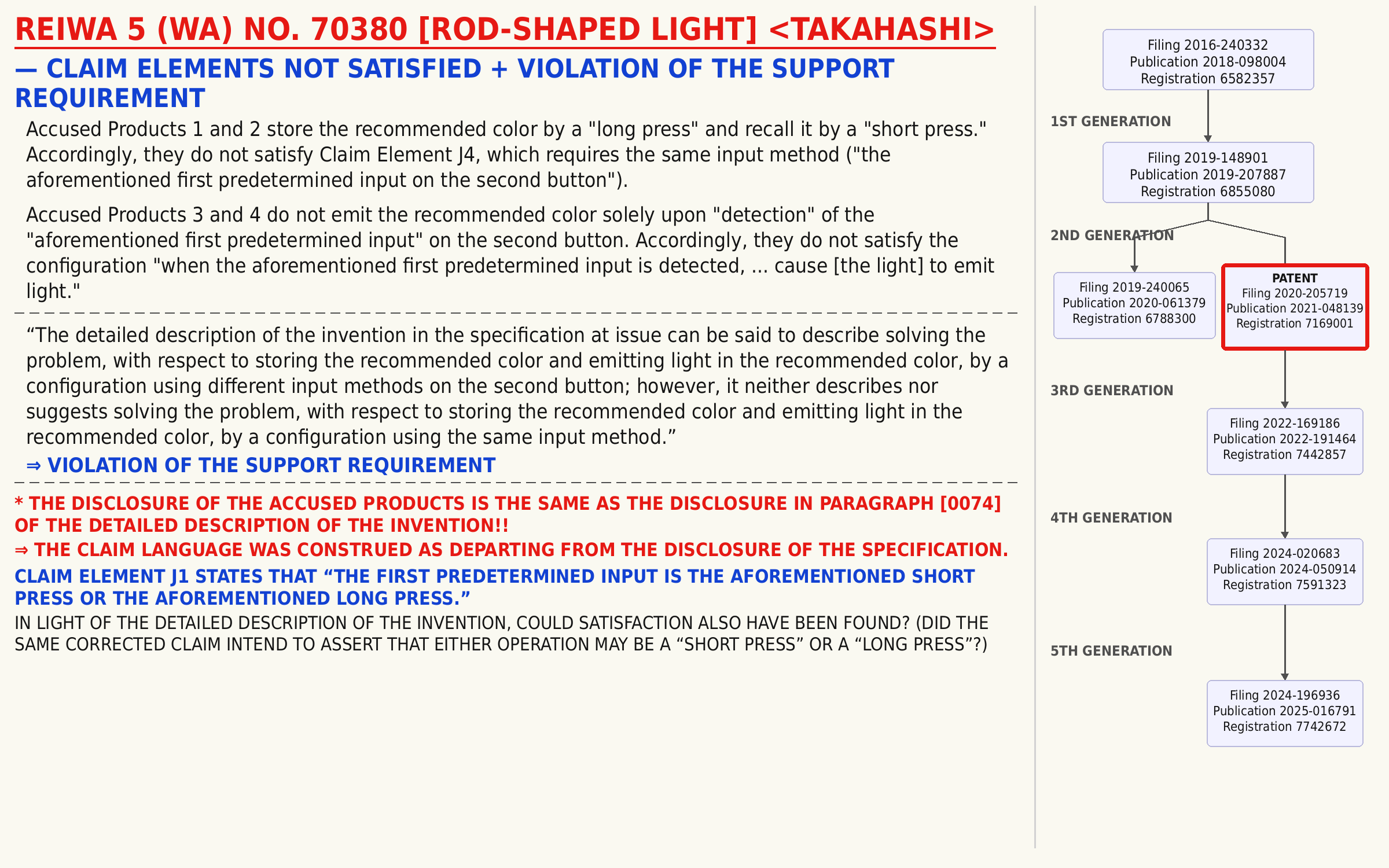
* This article provides general information and does not include legal advice.
Author: Hideki Takaishi, Attorney-at-Law and Patent Attorney (Daini Tokyo Bar Association)
Contact regarding this matter: h_takaishi☆nakapat.gr.jp (please replace ☆ with @)
A Container Capable of Carrying 10 Cubic Centimeters of Liquid and/or Solid
When A and/or B is changed to B by correction, can that constitute an expansion or alteration?
For example:
A container capable of carrying 10 cubic centimeters of liquid and/or solid, perhaps?
The reverse pattern is:
A pattern in which adding language constitutes an expansion or alteration.
For example, “electrically” connected …
* This article provides general information and does not include legal advice.
Author: Hideki Takaishi, Attorney-at-Law and Patent Attorney (Daini Tokyo Bar Association)
Contact regarding this matter: h_takaishi☆nakapat.gr.jp (please replace ☆ with @)
2024 (Gyo-Ke) No. 10043 [Elasto-Plastic Hysteretic Damper] <Honda>
2024 (Gyo-Ke) No. 10043 [Elasto-Plastic Hysteretic Damper] <Honda>
1. <Invention of Exhibit Ko No. 1 + Invention of Exhibit Ko No. 2, etc.>
The plaintiff asserted that it would have been easy to apply the arrangement of the “invention of Exhibit Ko No. 2 (bridge damper),” which accommodates two-dimensional movement, to the “invention of Exhibit Ko No. 1 (building damper),” which accommodates movement in one direction.
However, the invention of Exhibit Ko No. 1 is premised on a load from one direction along the plane of a building structure.
The invention of Exhibit Ko No. 2 is arranged in multiple directions in order to accommodate two-dimensional movement of a bridge.
There is no motivation to apply the arrangement of the invention of Exhibit Ko No. 2 to the invention of Exhibit Ko No. 1; rather, the premise of the invention of Exhibit Ko No. 1 (unidirectional input) creates a disincentive to arranging the components in different orientations.
2. <Invention of Exhibit Ko No. 12 + Invention of Exhibit Ko No. 13>
The invention of Exhibit Ko No. 12 does not have a configuration in which a pair of shear portions is arranged with their orientations differing from each other.
Exhibit Ko No. 13 provides a “recess” in place of a vertical rib, and making only one “recess” results in a configuration in which one portion is recessed and the other is a flat plate; it does not suggest the “pair of shear portions oriented differently from each other” of the invention at issue.
3. <Violation of the Support Requirement>
The plaintiff asserted that the invention at issue is claimed as if it can accommodate “loads from every direction,” but that the specification lacks support for accommodating all directions.
⇒ From the description in the specification, a person skilled in the art can recognize that the problem of a conventional damper having only “one shear portion” (such as being able to accommodate only one direction) can be solved by the invention at issue (arranging two shear portions in different orientations).
The invention at issue does not require “maximum energy absorption with respect to loads from all directions.”
(Excerpt from the Judgment)
The plaintiff asserts that Corrected Invention 1 at issue is specified only as “when a load is received by input, it deforms and absorbs energy,” and is functionally specified as if it could accommodate a load from any direction, whereas the decision at issue, despite recognizing that Corrected Invention 1 at issue cannot absorb energy from all directions, found no violation of the support requirement, and is erroneous in this respect.
However, even in light of the description in the specification at issue, Corrected Invention 1 at issue cannot be found to require maximum energy absorption with respect to loads from all directions. The plaintiff’s assertion is therefore erroneous in its premise and has no merit.
[Supplement] The reason stated in the original article that the corrugated steel plate of Exhibit Ko No. 12 is a single continuous member and therefore differs in configuration is not found in the court’s reasoning. The judgment held that “the shear portion” in Claim 2 refers to one of the “pair of shear portions” in Claim 1, and that the invention of Exhibit Ko No. 12 cannot be found to have a configuration in which a pair (two) of such shear portions are arranged in different orientations (judgment, p. 20, lines 10-14). The expression “loads from every direction” in the original article does not appear in the judgment; the plaintiff’s assertion as stated in the judgment was that Corrected Invention 1 at issue is functionally specified as if it could accommodate a load from any direction (judgment, p. 23, lines 20-24).
https://www.courts.go.jp/assets/hanrei/hanrei-pdf-93912.pdf
* This article provides general information and does not include legal advice.
Author: Hideki Takaishi, Attorney-at-Law and Patent Attorney (Daini Tokyo Bar Association)
Contact regarding this matter: h_takaishi☆nakapat.gr.jp (please replace ☆ with @)
Intellectual Property High Court Judgment, 2024 (Ne) No. 10048 [Battery] <Nakadaira>
Original Article URL: https://www.nakapat.gr.jp/ja/note/%e7%9f%a5%e8%b2%a1%e9%ab%98%e5%88%a4%e4%bb%a4%e5%92%8c6%e5%b9%b4%e3%83%8d10048%e3%80%90%e9%9b%bb%e6%b1%a0%e3%80%91%ef%bc%9c%e4%b8%ad%e5%b9%b3%ef%bc%9e/
Intellectual Property High Court Judgment, 2024 (Ne) No. 10048 [Battery] <Nakadaira>
The judgment of the court of first instance awarding damages of JPY 529,285,945 and delay damages, and dismissing the remaining claims, including the claims for an injunction and disposal, was affirmed.
The operative part states: “Both the appeal and the incidental appeal are dismissed.” JPY 1,277,650,000 was the amount sought in the incidental appeal, not the amount awarded (judgment, p. 1, line 23; p. 2, lines 11-13; p. 3, lines 9-15).
According to the description in the specification at issue, the power-generating element is not limited to a wound type and includes a laminated type. The claim language “outer surface of the uncoated active-material portion” and “the surfaces are joined” likewise does not exclude joining through a member such as a clip.
⇒ Satisfied
The position of the flange in Exhibit Otsu No. 12 is inseparable from the effect of the invention of Exhibit Otsu No. 12, and cannot be construed as not being limited to the specifically disclosed location. … Even if combined, the invention at issue would not be reached.
Exhibit Otsu No. 22 does not lead to Configuration A4, in which terminal-connection members are provided on both the positive and negative electrodes. In Exhibit Otsu No. 23, conductor element 5 cannot be said to be outside the battery casing. Nor was motivation to apply these to the invention of Exhibit Otsu No. 9 found (the same applies to the inventions of Exhibit Otsu No. 10 and Exhibit Otsu No. 11).
⇒ Inventive Step: ○
(Excerpt from the Judgment)
According to the statements in [Claim 1] of the claims of the Exhibit Otsu No. 12 publication and the statements in the detailed description of the invention in the Exhibit Otsu No. 12 publication, it is found that the “flange portion” described in the Exhibit Otsu No. 12 publication is provided on the lower surface of the lid body, and that a rotation-preventing portion engaging an engaging portion of the flange portion is provided on the lower surface of the lid body, thereby producing the effect that the terminal pole does not rotate even when an external force is applied to the terminal pole. …
Further, according to paragraph [0080] of the Exhibit Otsu No. 12 publication, it is also found that an effect of the invention described in that publication is that, by interposing an annular packing between the upper surface of a planar flange portion integrally formed with the terminal pole and the lower surface of the lid body, and by locking an annular compression spring to the pole portion to secure the terminal pole to the lid body, the annular packing is compressed in the vertical direction, thereby allowing the terminal pole to be securely sealed and fixed to the lid plate.
Thus, in the invention described in the Exhibit Otsu No. 12 publication, the provision of the flange portion on the lower surface of the lid body is closely related to the effect of the invention. Accordingly, … the Exhibit Otsu No. 12 publication is found to disclose a configuration in which the flange portion is provided on the lower surface of the lid body; it cannot be said that the Exhibit Otsu No. 12 publication effectively discloses a configuration corresponding to Claim Element A4 of Invention 1 at issue; it also cannot be said that whether to install the flange portion inside or outside the container is a matter of design; and applying the Exhibit Otsu No. 12 configuration to the invention of Exhibit Otsu No. 9 does not reach the configuration of Invention 1 at issue.
[Supplement] The statement in the original article that the court affirmed the first-instance judgment granting an injunction plus JPY 1.27 billion differs from the judgment. The first-instance judgment granted the damages claim to the extent of JPY 529,285,945 and delay damages and dismissed the remaining claims (judgment, p. 3, lines 9-15), and JPY 1,277,650,000 was the amount sought in the incidental appeal (judgment, p. 2, lines 11-13). The claims for an injunction and disposal were directed at the appellant’s Product 2 on the basis of Patent 2 at issue (judgment, p. 2, line 26 to p. 3, line 1), and the appellant’s Product 2 was found not to fall within the technical scope of Invention 2 at issue, with equivalence also rejected (judgment, p. 28, lines 23-25). Further, of the statement in the original article that Exhibits Otsu Nos. 22 and 23 do not reach Configuration A4 in which terminal-connection members are provided on both electrodes, the point concerning both electrodes is a reason relating to Exhibit Otsu No. 22 (judgment, p. 38, lines 19-24); as to Exhibit Otsu No. 23, the judgment held that it could not be found to have a configuration corresponding to Claim Element A4 because conductive element 5 could not be said to be arranged outside the battery casing (judgment, p. 39, lines 13-16; p. 40, lines 2-3).
https://www.courts.go.jp/assets/hanrei/hanrei-pdf-94167.pdf
* This article provides general information and does not include legal advice.
Author: Hideki Takaishi, Attorney-at-Law and Patent Attorney (Daini Tokyo Bar Association)
Contact regarding this matter: h_takaishi☆nakapat.gr.jp (please replace ☆ with @)
[Plant Variety Protection and Seed Act ★] Case in Which the Plaintiff’s Claims Were Dismissed Because the Credibility of the Expert Appraisal Purporting to Prove Infringement of the Breeder’s Right Was Not Established
Tokyo District Court Judgment of April 24, 2025 (2022 (Wa) No. 2829) (Presiding Judge Motoyuki Nakashima)
◆ Full Text of the Judgment
[Overview of the Case]
The plaintiff held a breeder’s right in a shiitake mushroom variety (Registration No. 17039) and sought, jointly and severally, payment of JPY 55,485,724 in damages and delay damages under Articles 709 and 719(1) of the Civil Code, alleging that the defendants’ importation and transfer of mushroom culture beds and their production and transfer of shiitake mushrooms infringed the plaintiff’s breeder’s right.
The court narrowed the core issues to: (1) whether mycelium could have been mixed in advance into the culture medium in the test tubes prepared by the plaintiff itself; and (2) why the plaintiff disposed of the parent strain and whether that disposal was appropriate. This judgment held that the possibility that the plaintiff had mixed mycelium of the plaintiff’s variety into the test tubes at issue in advance could not be sufficiently excluded, that the results of the expert appraisal premised thereon should be found to lack credibility, and that, without needing to decide the remaining points, the plaintiff’s claims lacked merit; it therefore dismissed the plaintiff’s claims.
[Preliminary Explanation Based on Prior Judicial Decisions—Proof of Infringement of a Breeder’s Right under the Plant Variety Protection and Seed Act]
A “variety” protected by the variety-registration system under the Plant Variety Protection and Seed Act means a single grouping of plants that can be distinguished from other groupings of plants by all or part of its characteristics and can be propagated while retaining all of those characteristics (Article 2(2) of the Act). This makes the actually existing grouping of plants itself the object of legal protection. With respect to the scope of a breeder’s right, the Act provides that the holder has the exclusive right to exploit, as a business, “the variety for which variety registration has been obtained (hereinafter referred to as the ‘registered variety’) and any variety that is not clearly distinguishable from the registered variety by its characteristics” (Article 20(1) of the Act). A “variety that is not clearly distinguishable from the registered variety by its characteristics” means a variety that differs in characteristics from the registered variety but lacks a clear difference of a degree sufficient to establish distinctness as a requirement for variety registration. Specifically, it is understood that a variety whose differences in characteristics from the registered variety remain within the class values established for each characteristic (numerical values classifying characteristics by class; for example, where the registered variety is a strawberry, characteristics include the “ratio of fruit length to width,” “fruit size,” and “fruit-skin color”) will often fall within a “variety that is not clearly distinguishable from the registered variety by its characteristics.” Even where the differences in characteristics do not remain within the foregoing range, it has also been held that there may be cases in which a variety can be found to fall within a “variety that is not clearly distinguishable from the registered variety by its characteristics” through comprehensive consideration of the differing items and the degree of difference, the type and nature of the plant, and other matters.
It has also been held that “in order to determine whether a variety is one to which the effect of a breeder’s right extends, it is ultimately necessary to compare the plants themselves and examine whether the variety suspected of infringement is not clearly distinguishable from the registered variety by its characteristics (the actual-object principle)” (Intellectual Property High Court Judgment of June 24, 2015, 2015 (Ne) No. 10002, Appeal in an Action Seeking an Injunction Against Infringement of a Breeder’s Right; court of first instance: Tokyo District Court Judgment of November 28, 2014, 2009 (Wa) No. 47799 / 2013 (Wa) No. 21905). Under the amended Plant Variety Protection and Seed Act effective in 2022, a presumption concerning the scope of a breeder’s right using examination characteristics and a determination system administered by the Minister of Agriculture, Forestry and Fisheries were introduced. The foregoing explains prior judicial decisions and does not mean that only comparison of the actual plants is always permitted under the current system.
[Summary of the Judgment]
1. Determination Concerning the Credibility of the Subculturing Acts at Issue and Related Acts
According to the foregoing basic facts, the foregoing findings of fact, and the entire purport of the oral argument, it is found that the expert appraisal at issue was conducted on mycelium that had been separated from each accused product and subcultured through each separation act at issue, each subculturing act at issue, and the multiple subculturing acts subsequently performed (hereinafter collectively referred to as the “Subculturing Acts at Issue and Related Acts”). Accordingly, as a premise for determining the credibility of the expert appraisal at issue, the credibility of the Subculturing Acts at Issue and Related Acts (Issue 1-1) is examined.
… In view of the fact that the plaintiff deliberately prepared the test tubes at issue in advance within its own company, rather than at a third-party institution such as the Center for Seeds and Seedlings, NARO, and therefore had sufficient time to mix in mycelium of the plaintiff’s variety, it must be said that it was fully possible to mix mycelium of the plaintiff’s variety, of a size not visible to the naked eye, into the test tubes at issue in advance. Moreover, according to the foregoing findings of fact and the entire purport of the oral argument, after the Subculturing Acts at Issue and Related Acts, the plaintiff itself disposed of the parent strain at issue or caused the Center for Seeds and Seedlings, NARO to dispose of it, and has not explained any reasonable ground for doing so. It is therefore found that the plaintiff itself made subsequent verification of the Subculturing Acts at Issue and Related Acts impossible. Considering these circumstances as a whole, the possibility that the plaintiff had mixed mycelium of the plaintiff’s variety into the test tubes at issue in advance cannot be sufficiently excluded, and it is appropriate to find that the results of the expert appraisal at issue, which are premised thereon, lack credibility.
2. Other Matters
The Subculturing Acts at Issue and Related Acts should, by their nature, have been conducted by a fair and neutral third-party institution. Even if circumstances made it unavoidable to conduct them within the plaintiff’s own company, the defendants are correct that conducting them within the plaintiff’s own company inherently created a risk of mixing fungal strains or substituting test tubes. In light also of the matters explained above, when conducting the Subculturing Acts at Issue and Related Acts, it was indispensable, at a minimum, to have a third-party institution such as the Center for Seeds and Seedlings, NARO prepare the test tubes and to preserve the parent strain without disposing of it, given the importance of fairness and transparency in expert appraisals in judicial proceedings. Nevertheless, the plaintiff deliberately failed to take those measures, gave no reasonable explanation of the necessity and appropriateness of preparing the test tubes at issue itself, and, with respect to disposal of the parent strain at issue, merely explained that the parent strain had become unnecessary after the mycelium was subcultured and was therefore disposed of, and that there was no problem. Accordingly, at least the Subculturing Acts at Issue and Related Acts lack credibility, as explained above, and the expert appraisal at issue premised thereon must likewise be said to lack credibility.
[Comment]
This is a valuable judicial decision addressing the credibility of an expert appraisal as evidence proving infringement in a breeder’s-right infringement action. In proof under the actual-object principle indicated by prior judicial decisions, an expert appraisal involving comparative cultivation of the registered variety and the variety suspected of infringement is important. The method of proof must be considered according to the case, also taking account of the presumption based on examination characteristics and the determination system effective in 2022. In this regard, the Center for Seeds and Seedlings, NARO (https://www.naro.go.jp/laboratory/ncss/) is an institution that, under Article 15-2(1) of the Plant Variety Protection and Seed Act, conducts “growing tests” to obtain data, such as distinctness between an applied-for variety and existing varieties, necessary for the national government’s examination of variety registration, and has an extremely high level of expertise in comparative growing tests. Litigation parties are therefore thought often to request an expert appraisal from the Center for Seeds and Seedlings, NARO as a fair and neutral third-party institution. This judgment demonstrates the importance, in doing so, of conducting the expert appraisal with extreme care, including asking the institution conducting the expert appraisal to prepare the test tubes and asking a third party to preserve the parent strain after the expert appraisal.
[Supplement] Reference: Ministry of Agriculture, Forestry and Fisheries, Overview of the Act Partially Amending the Plant Variety Protection and Seed Act: https://www.maff.go.jp/j/shokusan/attach/pdf/shubyoho-22.pdf
[Supplement] The Act Partially Amending the Plant Variety Protection and Seed Act (Act No. 74 of 2020) introduced a provision presuming that a variety not clearly distinguishable by the examination characteristics of a registered variety recorded in the variety registry is a variety not clearly distinguishable from that registered variety by its characteristics (Article 35-2 of the Act) and a system of determination by the Minister of Agriculture, Forestry and Fisheries (Article 35-3 of the Act), both effective April 1, 2022. These provisions provide means of proof other than an expert appraisal involving comparative cultivation. This judgment does not refer to these provisions. Since April 1, 2022, the provision under which NARO (the Center for Seeds and Seedlings) conducts growing tests has been Article 15-2(1) of the Act. Further, what the judgment held to be indispensable was, when conducting the Subculturing Acts at Issue and Related Acts, to have a third-party institution prepare the test tubes and to preserve the parent strain without disposing of it (judgment, p. 22, lines 15-19), and preservation of the parent strain was required for subsequent verification of the subculturing acts (judgment, p. 22, lines 3-7).
[Keywords] Breeder’s Right, Credibility of an Expert Appraisal, Actual-Object Principle
* This article provides general information and does not include legal advice.
Author: Reiko Tonomura, Attorney-at-Law and Patent Attorney (Daini Tokyo Bar Association)
Contact regarding this matter: r_tonomura☆nakapat.gr.jp (please replace ☆ with @)
2024 (Ne) No. 10056 [Van-Type Motor Vehicle for Cleaning Work] <Nakadaira>
2024 (Ne) No. 10056 [Van-Type Motor Vehicle for Cleaning Work] <Nakadaira>
* The appellee offered for sale Product 2, which differed from Product 1 sold by KCS. Product 2 was also found infringing at first instance, and an injunction and disposal were ordered; the appellee did not appeal. ⇒ The offer for sale was not found to have assisted or facilitated KCS’s sales of Product 1, and a joint tort was denied.
(Excerpt from the Judgment)
Even if the appellee received delivery of Appellee Product 2 from KCS and offered it for sale under the name “ECO ACE JET,” which differs from the name of Appellee Product 1 sold by KCS, it cannot be found that this assisted or facilitated KCS’s sale of Appellee Product 1.
[Supplement] Regarding the statement in the original article that the appellee offered for sale a product different from the infringing product, the first-instance judgment also found Appellee Product 2 to fall within the technical scope of the invention and granted an injunction against its transfer and the like and an order for its disposal against the appellee (judgment, p. 2, line 26 to p. 3, line 4), and the appellee did not appeal (judgment, p. 4, lines 2-3). In the judgment, the excerpt above is followed by a parenthetical stating that this conclusion would not change even if the structure, performance, and the like of the vehicle and cleaning device of Appellee Product 2 were the same as those of Appellee Product 1 (judgment, p. 11, lines 7-9).
https://www.courts.go.jp/assets/hanrei/hanrei-pdf-93950.pdf
* This article provides general information and does not include legal advice.
Author: Hideki Takaishi, Attorney-at-Law and Patent Attorney (Daini Tokyo Bar Association)
Contact regarding this matter: h_takaishi☆nakapat.gr.jp (please replace ☆ with @)
[New YouTube Video] Infringement Analysis (Other than Typical Literal Satisfaction) (Reading Through the Encyclopedia of Patent Judicial Decisions, 4th Edition) November 5, 2025
[New YouTube Video] Infringement Analysis (Other than Typical Literal Satisfaction) (Reading Through the Encyclopedia of Patent Judicial Decisions, 4th Edition) November 5, 2025
<Catch up at once, in this single video, on the principal judicial decisions concerning infringement analysis, including the doctrine of equivalents, numerical limitations, and use inventions.>
* This article provides general information and does not include legal advice.
Author: Hideki Takaishi, Attorney-at-Law and Patent Attorney (Daini Tokyo Bar Association)
Contact regarding this matter: h_takaishi☆nakapat.gr.jp (please replace ☆ with @)
[Contract] Tokyo District Court Judgment, 2022 (Wa) No. 9422 <Shibuya>
Original Article URL: https://www.nakapat.gr.jp/ja/note/%e3%80%90%e5%a5%91%e7%b4%84%e3%80%91%e6%9d%b1%e4%ba%ac%e5%9c%b0%e5%88%a4%e4%bb%a4%e5%92%8c4%e5%b9%b4%e3%83%af9422%ef%bc%9c%e6%be%81%e8%b0%b7%ef%bc%9e/
[Contract] Tokyo District Court Judgment, 2022 (Wa) No. 9422 <Shibuya>
The defendant was found to have been in a “state of being objectively unable to pay” (Article 17(2) of the contract at issue), and the termination was held valid.
“According to the evidence (Exhibits Ko Nos. 27, 28, and 30), it can be found that, no later than February 7, 2025, the defendant was in a state of being objectively unable to pay.”
[Supplement] The defendant stated that it did not actively dispute the ground for termination (judgment, p. 3, line 3). The judgment held that the contract at issue, a joint development and business alliance agreement, ended upon termination on February 7, 2025, and ordered payment of the contract fee of JPY 210 million and interest (judgment, p. 1, lines 10-11; p. 2, lines 1-2; p. 3, lines 7-10).
https://www.courts.go.jp/assets/hanrei/hanrei-pdf-94059.pdf
* This article provides general information and does not include legal advice.
Author: Hideki Takaishi, Attorney-at-Law and Patent Attorney (Daini Tokyo Bar Association)
Contact regarding this matter: h_takaishi☆nakapat.gr.jp (please replace ☆ with @)
Tokyo District Court Judgment, 2023 (Wa) No. 70449 [Fastening Hardware] <Takahashi>
Tokyo District Court Judgment, 2023 (Wa) No. 70449 [Fastening Hardware] <Takahashi>
The claim language “in order to induce deformation when an excessive load acts” does not limit the configuration of the invention.
(“It merely indicates the purpose sought to be achieved, or an action or effect necessarily obtained, by the configuration in which the front portion and the rear-edge portion are integrated by a plurality of branch-shaped portions, and has no meaning that limits the configuration of the invention.”)
⇒ Novelty: × based on the design publication
(“Because the plurality of narrow plate portions of the column-member connecting fitting of the invention of Exhibit Ko No. 5 have a configuration identical in shape to the plurality of branch-shaped portions of the fastening hardware of the invention at issue, they necessarily obtain the action or effect expressed as ‘in order to induce deformation when an excessive load acts.’ …”
https://www.courts.go.jp/assets/hanrei/hanrei-pdf-94135.pdf
* This article provides general information and does not include legal advice.
Author: Hideki Takaishi, Attorney-at-Law and Patent Attorney (Daini Tokyo Bar Association)
Contact regarding this matter: h_takaishi☆nakapat.gr.jp (please replace ☆ with @)
Osaka District Court Judgment, 2023 (Wa) No. 10217 [Three-Dimensional Network Fiber Assembly] <Matsuami>
Osaka District Court Judgment, 2023 (Wa) No. 10217 [Three-Dimensional Network Fiber Assembly] <Matsuami>
Action Seeking Remuneration for an Employee Invention
⇒ Dismissed
(Excerpt from the Judgment)
Because the reward rules at issue were established after, in the course of their establishment and amendment, general employment rules and the like had been referred to, opinions had been obtained from persons knowledgeable about intellectual property, drafts had been disclosed to employees and others, and opinions had been heard, it cannot be found unreasonable for the defendant to pay remuneration for employee inventions made at the defendant in accordance with the reward rules at issue, which were established through lawful procedures. …
Although it appears that the defendant’s product had some possibility of being used as a cushioning material or the like as a general-purpose three-dimensional network fiber assembly, in the application as a bedding mattress asserted by the plaintiffs as the basis for excess sales, the product was once commercialized and achieved sales for a certain period, but appears to have received a low evaluation for its performance as a mattress, and commercialization was terminated. …
Under these circumstances, there is nothing unreasonable in the defendant’s determination that the condition for payment of an implementation reward—”when, through the exercise of an industrial property right, a major contribution has been made to the company”—was not met and that no implementation reward should be paid for the inventions at issue.
https://www.courts.go.jp/assets/hanrei/hanrei-pdf-94104.pdf
* This article provides general information and does not include legal advice.
Author: Hideki Takaishi, Attorney-at-Law and Patent Attorney (Daini Tokyo Bar Association)
Contact regarding this matter: h_takaishi☆nakapat.gr.jp (please replace ☆ with @)
[Employee Invention] Tokyo District Court Judgment, 2023 (Wa) No. 70495 <Nakashima>
[Employee Invention] Tokyo District Court Judgment, 2023 (Wa) No. 70495 <Nakashima>
* The plaintiff was not recognized as a joint inventor.
—There was no reliable evidence substantiating the time of completion asserted by the plaintiff.
(Excerpt from the Judgment)
Although the plaintiff asserts that the plaintiff’s invention was completed before the plaintiff prepared the plaintiff’s explanatory document, there is no reliable evidence substantiating that assertion, and the invention at issue was, in the first place, conceived and reduced to a specific form without the plaintiff’s involvement. …
In addition, even after two rounds of assertions and evidence by both parties, the Court found that the actual nature of the plaintiff’s involvement in the invention at issue remained unclear and repeatedly sought clarification … from both parties on two occasions. Even after fully considering the results, in view of the actual nature of the plaintiff’s involvement and other circumstances, the invention at issue was conceived and reduced to a specific form without the plaintiff’s involvement, and the plaintiff cannot be found to be an inventor or joint inventor of the invention at issue.
[Supplement] According to the judgment, the plaintiff asserted the time of completion of the invention (judgment, p. 15, lines 17-18). However, the main reason in the judgment is the finding that the invention at issue had been independently conceived and embodied by Bi, Di, and others without the plaintiff’s involvement (judgment, p. 14, lines 21-23).
https://www.courts.go.jp/assets/hanrei/hanrei-pdf-94170.pdf
* This article provides general information and does not include legal advice.
Author: Hideki Takaishi, Attorney-at-Law and Patent Attorney (Daini Tokyo Bar Association)
Contact regarding this matter: h_takaishi☆nakapat.gr.jp (please replace ☆ with @)
Osaka District Court Judgment, 2022 (Wa) No. 11405 [Heterocyclic Derivative] <Takemiya>
Osaka District Court Judgment, 2022 (Wa) No. 11405 [Heterocyclic Derivative] <Takemiya>
[Claim for Remuneration for an Employee Invention] Approximately JPY 94 million awarded.
* The employee-invention rules are redacted and unclear, but they were not applied to this invention.
⇒ Patent Act prior to the 2004 amendment
(Reason) Although the defendant had employee-invention rules, no agreement to apply them to a case such as the invention at issue was found, and the statutory “reasonable remuneration” was to be calculated.
Employer’s own working portion (the calculation base includes domestic sales and amounts relating to Actelion):
(Excess sales) × (hypothetical royalty rate of 5.9%) × (1 − employer contribution rate of 99%) × (co-inventor’s share of 1/3)
Third-party working portion (license revenue):
(License revenue) × (1 − employer contribution rate of 99%) × (patent contribution rate of 25%*) × (co-inventor’s share of 1/3)
<* Considering the subject matter of the agreement and other circumstances, the court held that the contribution of the patent at issue did not exceed 25%. Part of the agreement’s contents is redacted in the published judgment.>
(Excerpt from the Judgment)
The employee-invention rules at issue provide that ●●●●●●●●●●●●●●●● ●●●●●●●●●●●●●●●●●●●
However, the employee-invention rules at issue contain no provision stating that the rules also apply to inventions, such as the invention at issue, that do not fall within the inventions described in the foregoing provision, and the record contains no evidence sufficient to find that an agreement was reached between the plaintiff and the defendant to apply the employee-invention rules at issue to such an invention.
[Supplement] Regarding “Employer’s own working portion (domestic sales)” in the original article, the judgment held that, in addition to sales of the pharmaceutical at issue in Japan, the amount relating to Actelion (the content of which is redacted in the judgment) should also be included in the sales on which reasonable remuneration is calculated (judgment, p. 30, lines 17-21; p. 31, lines 6-7). The specific subject matter of the license agreement is redacted in the judgment, and the published judgment does not identify that subject matter as know-how and data provision. The judgment held that the patent’s contribution ratio did not exceed 25%, taking into account the technical information at issue, securing of a safety-monitoring system, and other matters (judgment, p. 35, lines 2-24). The awarded amount of approximately JPY 94 million is after deducting JPY 6,519,000 already paid (judgment, p. 36, lines 7-12).
* This article provides general information and does not include legal advice.
Author: Hideki Takaishi, Attorney-at-Law and Patent Attorney (Daini Tokyo Bar Association)
Contact regarding this matter: h_takaishi☆nakapat.gr.jp (please replace ☆ with @)
2023 (Ne) No. 10107 “PCSK9 (Second Litigation)” <Nakadaira>
Original Article URL: https://www.nakapat.gr.jp/ja/note/%e4%bb%a4%e5%92%8c%ef%bc%95%e5%b9%b4%e3%83%8d10107%e3%80%8epcsk9%ef%bc%88%e4%ba%8c%e6%ac%a1%e8%a8%b4%e8%a8%9f%ef%bc%89%e3%80%8f%ef%bc%9c%e4%b8%ad%e5%b9%b3%ef%bc%9e/
2023 (Ne) No. 10107 “PCSK9 (Second Litigation)” <Nakadaira>
* In the second litigation, declarations and empirical experiments by Dr B and Dr C and other materials were newly submitted, resulting in a finding of violation of the support requirement.
Amgen’s patented invention does not limit the specific structure of the antibody (amino-acid sequence), but is an antibody defined by the following functions:
1. Neutralizes: inhibits binding between PCSK9 and LDLR.
2. Competes: competes for binding to PCSK9 with a specified “reference antibody (such as 21B12)” created by Amgen.
The court found that “competes” includes the following two patterns:
1. Direct competition (Direct Blocking): binds to the “same site” as the reference antibody and interferes with it.
2. Competition through steric hindrance (Steric Hindrance): binds to a “different site” from the reference antibody, but, because of the antibody’s large size, physically interferes with and inhibits binding.
The specification at issue described “antibodies that bind to the same site (1 above),” but did not contain sufficient disclosure (support) as to whether “antibodies that bind to a different site and interfere through steric hindrance (2 above)” actually have a neutralizing action.
⇒ Violation of the support requirement
[Appellee’s submission] The appellee submitted that, even if conditions concerning neutralization or competition by Fab fragments were added, the possibility of including antibodies that compete through steric hindrance and bind to different sites would remain (judgment, p. 41, line 19 to p. 44, line 2). [Supplement] Correction Items 3 and 4 add conditions concerning neutralization and competition, respectively, by the Fab fragments of the antibody; they do not limit the subject matter of the invention to Fab fragments themselves (judgment, p. 12, line 20 to p. 13, line 3).
[Court’s holding] The court held that Correction Items 1 and 2 did not fall within the purposes of correction specified in the proviso to Article 134-2(1) of the Patent Act and stated: “Without needing to decide the remaining correction items, the appellant’s rebuttal based on correction is without merit” (judgment, p. 67, lines 5-8 and 17-19). Accordingly, the court did not individually examine Correction Items 3 and 4 concerning Fab fragments and then decide a violation of the support requirement after those corrections.
[Supplement] The original article stated that, even if limited to Fab fragments by the correction, the possibility of including antibodies that compete through steric hindrance but bind to different sites would remain. That sentence presented the appellee’s submission (judgment, p. 41, line 19 to p. 44, line 2) as if it were the court’s holding and summarized Correction Items 3 and 4 as limiting the invention to Fab fragments. Further, regarding the professor’s technical opinion mentioned in the original article, the judgment relied on the statements (verification experiments) of Dr. B and Dr. C (judgment, p. 54, line 25 to p. 55, line 10), and the published judgment does not state that they were professors. The “same site” in the original article is, in the judgment, a site on PCSK9 that is identical to or overlaps with the site at which the reference antibody binds to PCSK9 (judgment, p. 49, lines 10-11). The main reasons for the violation of the support requirement are that an antibody competing with a reference antibody cannot be said to neutralize by the same mechanism as the reference antibody (judgment, p. 53, line 13 to p. 54, line 4) and that, in the verification experiments, roughly 80% or more of the antibodies competing with the reference antibodies lacked binding-neutralizing activity (judgment, p. 55, lines 2-10).
https://www.courts.go.jp/assets/hanrei/hanrei-pdf-94092.pdf
* This article provides general information and does not include legal advice.
Author: Hideki Takaishi, Attorney-at-Law and Patent Attorney (Daini Tokyo Bar Association)
Contact regarding this matter: h_takaishi☆nakapat.gr.jp (please replace ☆ with @)
Tokyo District Court Judgment, 2022 (Wa) No. 7976 [Communication Equipment] <Nakashima>
Tokyo District Court Judgment, 2022 (Wa) No. 7976 [Communication Equipment] <Nakashima>
* Standard-essential patent—infringement.
⇒ The claim for an injunction constituted an abuse of rights (the parties failed to reach agreement because of the difference in royalty rates, and it could not be said that the defendant lacked willingness to obtain a license).
⇒ Damages were calculated as: “Sales of the accused products × aggregate royalty rate for the entire LTE standard ÷ total number of patents for the entire LTE standard (1,300 patents) × number of patents at issue (two patents counted as one because they belong to the same patent family).”
As to the “aggregate royalty rate for the entire LTE standard,” the rate was 9% for products supporting LTE only and 8% for 5G-compatible products (because LTE’s relative contribution is lower).
An increase based on an infringement premium (Article 102(4) of the Patent Act) was not allowed because the defendant was willing to obtain a licence on FRAND terms.
[Supplement] The patents at issue are two patents, Patent 1 and Patent 2 at issue (judgment, p. 2, lines 9-10); because they belong to the same patent family, the court held that they should be counted as one patent to match the unit of the 1,300 patents (judgment, p. 115, lines 18-22). An increase based on an infringement premium was not allowed because the defendant had been willing to take a license on FRAND terms (judgment, p. 112, lines 18-22).
https://www.courts.go.jp/assets/hanrei/hanrei-pdf-94200.pdf
* This article provides general information and does not include legal advice.
Author: Hideki Takaishi, Attorney-at-Law and Patent Attorney (Daini Tokyo Bar Association)
Contact regarding this matter: h_takaishi☆nakapat.gr.jp (please replace ☆ with @)
2024 (Ne) No. 10074 [Filler for Electronic Cigarette] <Masuda>
2024 (Ne) No. 10074 [Filler for Electronic Cigarette] <Masuda>
A review of the entries in various dictionaries on the meaning of “cut” (kirikomi) (Claim Element B) shows that they contemplate the active acts of “cutting into,” “making a score,” and “cutting,” and several examples expressly state that the act is performed with a blade.
Accordingly, “cut” (kirikomi) means a structure or state in which a “score” or “slit” (kirime/kireme) has been artificially and actively formed using a blade.
The specification at issue merely gives examples such as a cutter blade, razor blade, and rotary cutter as means for forming the cuts, and contains no description or suggestion of any means of formation other than a blade.
⇒ Turning to the accused product, the three streak-like portions formed on the surface of the tobacco substrate, substantially parallel to one another, along the longitudinal direction of the tobacco stick (rod) were formed by controlling crimping conditions in the crimping process and were not formed by a blade.
⇒ Claim Element Not Satisfied (for the same reasons as the court of first instance, Tokyo District Court Judgment, 2023 (Wa) No. 70407)
* This article provides general information and does not include legal advice.
Author: Hideki Takaishi, Attorney-at-Law and Patent Attorney (Daini Tokyo Bar Association)
Contact regarding this matter: h_takaishi☆nakapat.gr.jp (please replace ☆ with @)
2024 (Gyo-Ke) No. 10109 [Assistance Device] <Honda>
Original Article URL: https://www.nakapat.gr.jp/ja/note/%e4%bb%a4%e5%92%8c6%e5%b9%b4%e8%a1%8c%e3%82%b110109%e3%80%90%e4%bb%8b%e5%8a%a9%e6%a9%9f%e3%80%91%ef%bc%9c%e6%9c%ac%e5%a4%9a%ef%bc%9e/
2024 (Gyo-Ke) No. 10109 [Assistance Device] <Honda>
The subject of the petition for retrial is understood to be the original decision. The fact that the original decision, which became final before the fourth retrial decision, conflicts with the fourth retrial decision does not constitute a ground for retrial of the original decision under Article 338(1)(x) of the Code of Civil Procedure, as applied mutatis mutandis by Article 171(2) of the Patent Act.
Even assuming that the plaintiff’s position is construed as making the fourth retrial decision the subject of the petition for retrial and asserting, as a ground for retrial, that it conflicts with the original decision, the original decision was a decision finding the appeal against the examiner’s decision of refusal unsuccessful, whereas the fourth retrial decision was a decision dismissing the petition for retrial as unlawful. The fourth retrial decision therefore does not conflict with the original decision, and the plaintiff’s claim has no merit.
https://www.courts.go.jp/assets/hanrei/hanrei-pdf-94030.pdf
* This article provides general information and does not include legal advice.
Author: Hideki Takaishi, Attorney-at-Law and Patent Attorney (Daini Tokyo Bar Association)
Contact regarding this matter: h_takaishi☆nakapat.gr.jp (please replace ☆ with @)
Tokyo District Court Judgment, 2024 (Gyo-U) No. 5001 <Shibuya>
Original Article URL: https://www.nakapat.gr.jp/ja/note/%e6%9d%b1%e4%ba%ac%e5%9c%b0%e6%b1%ba%e4%bb%a4%e5%92%8c6%e5%b9%b4%e8%a1%8c%e3%82%a65001%ef%bc%9c%e6%be%81%e8%b0%b7%ef%bc%9e/
Tokyo District Court Judgment, 2024 (Gyo-U) No. 5001 <Shibuya>
Date of judgment: April 18, 2025.
The plaintiff, having filed an international patent application (PCT application), made a “request for examination” before submitting the “translation” prescribed by the Patent Act. The JPO dismissed the request as unlawful, and the plaintiff sought revocation of that disposition.
⇒ Action dismissed as inadmissible.
Article 184-17 of the Patent Act provides that, for a foreign-language patent application, a request for examination may not be made until “after” procedures such as submission of a translation have been completed.
This provision makes submission of a translation before a request for examination a procedural requirement, and a defect (error) in that sequence is not cured by subsequently submitting the translation.
In this case, it is clear that the translation had not been submitted when examination was requested.
Even if the court were to revoke the disposition at issue, the fact that the request for examination violated the Act would remain unchanged, and there would be no possibility of curing the defect. The JPO would therefore have no choice but to dismiss the request again. Revocation of the disposition at issue would accordingly provide no practical benefit to the plaintiff, and there is no legal interest in bringing the action.
[Supplement] The heading of the original article describes this case as a decision (kettei), but it is a judgment, rendered on April 18, 2025 (judgment, p. 1, line 1).
https://www.courts.go.jp/assets/hanrei/hanrei-pdf-94034.pdf
* This article provides general information and does not include legal advice.
Author: Hideki Takaishi, Attorney-at-Law and Patent Attorney (Daini Tokyo Bar Association)
Contact regarding this matter: h_takaishi☆nakapat.gr.jp (please replace ☆ with @)
2024 (Gyo-Ke) No. 10022 [… Antimicrobial Agent] <Honda>
Original Article URL: https://www.nakapat.gr.jp/ja/note/%e4%bb%a4%e5%92%8c6%e5%b9%b4%e8%a1%8c%e3%82%b110022%e3%80%90%e6%8a%97%e5%be%ae%e7%94%9f%e7%89%a9%e5%89%a4%e3%80%91%ef%bc%9c%e6%9c%ac%e5%a4%9a%ef%bc%9e/
2024 (Gyo-Ke) No. 10022 [… Antimicrobial Agent] <Honda>
In order for it to have been obvious to change the treatment target of the primary cited invention (from tinea pedis or a cutaneous fungal disease) to “onychomycosis” and thereby adopt the configuration relating to the difference,
in light of the technical level at the filing date of the application at issue,
it is necessary that, when the therapeutic agent is simply applied to the nail plate, it could reasonably have been expected that the active ingredient KP-103 would penetrate and permeate into the interior of the nail plate, be delivered to the lower layer of the nail plate and the nail bed, which are the infected sites, and exert a therapeutic effect.
⇒ Inventive Step of the Medical-Use Invention: ○
(Summary of the Judgment)
(1) As common general technical knowledge at the filing date of the application at issue, it is found that: (i) Trichophyton rubrum and Trichophyton mentagrophytes accounted for most of the causative fungi of onychomycosis, as they did for tinea pedis; (ii) in order to treat onychomycosis effectively with a topical agent, it was necessary to cause the antifungal agent to penetrate the keratin of the nail plate and deliver it to the infected site, but, because of the nature of the nail plate, there was an obstacle in that antifungal agents did not readily penetrate or permeate into its interior, and treatment of onychomycosis with a topical agent was considered extremely difficult, while oral agents also presented problems of side effects and development of a topical agent was awaited; and (iii) both nails and hair contain hard keratin and have mutually similar amino-acid compositions.
(2) As technical findings known at the filing date of the application at issue, it is found that: (iv) attempts to deliver a topical antifungal agent to the infected site included development of nail-lacquer preparations and treatments involving chemical or surgical removal of the nail plate, application of an antifungal agent, and use in combination with occlusive dressing therapy (ODT); (v) the Exhibit Ko No. 6 study evaluating the antifungal agent tioconazole as a topical therapeutic agent for onychomycosis had been conducted; (vi) KP-103 had properties such as low adsorption to keratin and high release, without reduction of its anti-Trichophyton mentagrophytes activity even when human hair (keratin) was added; and (vii) there had been research using human hair to evaluate adsorption of antifungal drugs to keratin and reduction in activity upon adsorption to keratin.
(3) (Summary of the judgment) In order for a person skilled in the art to have readily conceived of changing the treatment target of the topical fungal-disease therapeutic agent of the primary cited invention (the invention of Exhibit Ko No. 1-1) to “onychomycosis” and adopting the configuration of the corrected invention at issue relating to the difference, in light of the technical level at the filing date of the application at issue, it is necessary that, when the therapeutic agent is simply applied to the nail plate, it could reasonably have been expected that the active ingredient KP-103 would penetrate and permeate into the interior of the nail plate, be delivered to the lower layer of the nail plate and the nail bed, which are the infected sites, and exert a therapeutic effect. Considering the common general technical knowledge and technical findings in (1) and (2) above as a whole, it cannot be said that a person skilled in the art could reasonably have had such an expectation at the filing date of the application at issue. Further, in light of the common general technical knowledge at the filing date of the application at issue, it would have been difficult for a person skilled in the art to predict the effects of the corrected invention at issue shown in the specification at issue and the like. Accordingly, at the filing date of the application at issue, a person skilled in the art could not readily have made the corrected invention at issue based on the invention of Exhibit Ko No. 1-1.
[Supplement] The second and subsequent sentences of (3) summarize the judgment rather than quote its original text. Further, regarding “external dermatomycosis” in the original article, the treatment target of the invention of Exhibit Ko No. 1-2 is dermatomycosis (judgment, p. 34, lines 4-5).
https://www.courts.go.jp/assets/hanrei/hanrei-pdf-94078.pdf
* This article provides general information and does not include legal advice.
Author: Hideki Takaishi, Attorney-at-Law and Patent Attorney (Daini Tokyo Bar Association)
Contact regarding this matter: h_takaishi☆nakapat.gr.jp (please replace ☆ with @)
2024 (Ne) No. 10029 “Claim for Confirmation of the Right to Obtain a Patent” <Masuda>
2024 (Ne) No. 10029 “Claim for Confirmation of the Right to Obtain a Patent” <Masuda>
Date of judgment: April 24, 2025.
* Y1 graduated from the Faculty of Environment and Information Studies at Keio University and started a business, but had no clinical knowledge.
⇒ Inventorship: ×
(The cooperating professor was the inventor.)
<Inventorship (Employee Invention)>
It is necessary to have actually participated in the creative act concerning the technical idea of the invention, particularly in completing the characteristic portion of the invention relating to the means for solving the prior technical problem.
The characteristic portion of Invention 1-3 at issue lies in the following: in a vascular plug comprising a pusher wire and a mesh portion for embolizing an aneurysm in order to prevent rupture of an aneurysm within a blood vessel, there were problems in that multiple vascular plugs of different sizes had to be prepared and that rapid expansion of the mesh portion risked damaging the aneurysm; therefore, a configuration was adopted in which, when not housed, the distal end of the stent is pushed out from the distal end of the catheter and expands while curling outward; this provides a high degree of freedom in size with respect to the aneurysm and does not damage a bifurcation aneurysm.
Y1 graduated from a humanities faculty and, after working for a financial institution, established the plaintiff company in the first instance together with Y1’s elder brother, who held a doctorate in science; Y1, however, had no clinical knowledge.
By contrast, Professor A, who was a cooperating party, had extensive clinical experience, and Professor A’s research notebook clearly described the problems and means for solving them in Invention 1-3 at issue. It is therefore appropriate to find that Professor A actually participated in completing the characteristic portion of Invention 1-3 at issue.
<Claim for Confirmation of the Right to Obtain a Patent Relating to a PCT Application>
The plaintiff in the first instance states that, after obtaining a judgment in this action confirming the right to obtain a patent, it will select, from among the Contracting States to the Patent Cooperation Treaty, the countries or regions in which it actually wishes to obtain patents and pursue new applications or procedures for restoration of rights. However, in light of the principle of territoriality, how a right to obtain a patent is treated and what effect it has in foreign countries are understood to be determined by the law of the country in which a patent right is registered on the basis of that right to obtain a patent. At present, no new application, national-phase entry, or the like has been made for the invention in any foreign country, and no specific plan has been disclosed. Accordingly, ripeness of the dispute cannot be found with respect to confirmation of the right to obtain a patent for the invention.
[Supplement] The heading of the original article reads “2025 (Ne) No. 10029,” but the case number of the judgment is 2024 (Ne) No. 10029 (judgment, p. 1, line 2). The reference to a humanities faculty in the original article does not appear in the judgment. The judgment found that Y1 graduated from the Faculty of Environment and Information Studies of Keio University and, after working at a bank, started a business (judgment, p. 23, lines 11-13), and held that Y1 could not be found to have such a background (judgment, p. 25, lines 17-21).
https://www.courts.go.jp/assets/hanrei/hanrei-pdf-94055.pdf
* This article provides general information and does not include legal advice.
Author: Hideki Takaishi, Attorney-at-Law and Patent Attorney (Daini Tokyo Bar Association)
Contact regarding this matter: h_takaishi☆nakapat.gr.jp (please replace ☆ with @)
2023 (Gyo-Ke) No. 10078 [Audio Controller] <Shimizu> (Defendant: Pixie Dust)
2023 (Gyo-Ke) No. 10078 [Audio Controller] <Shimizu> (Defendant: Pixie Dust)
C (the contractor) merely solved a problem different from that of the invention at issue.
⇒ Neither misappropriation nor violation of the joint-application requirement was established.
(Supplement: A and B were on the commissioning side (PDT).) (Excerpt from the Judgment)
It is found that A and B had conceived of a “phased-array speaker” before PDT placed an order with the plaintiff for the prototype at issue. … A and B were researchers in ultrasound and are found to have understood the basic principle of the conventional parametric speaker. They had also developed the experimental device at issue, which, although subject to certain limitations, could generate audible sound at a focal position. Accordingly, the conception of A and B was not at the level of a mere idea, as the plaintiff asserts, but was a conception accompanied by a specific means of solution. … …
However, among the functions of the prototype at issue described in (3) A above, the function of emitting the audible-sound waveform with a phase difference such that it converges at the focal position and aligning the audible-sound waveform at the focal position … improves the sound quality of the audible sound. However, the technical problem of the invention at issue is removal of restrictions on the environment of use, not improvement of the sound quality of audible sound. Therefore, that function of the prototype at issue does not constitute the characteristic portion of the invention at issue.
The remaining points are also merely one specific and objective mode of implementing the characteristic portion of the invention at issue. Depending on their content, they may be said to solve a problem different from that of the invention at issue, but cannot be said to solve the problem of the invention at issue.
In other words, the functions of the prototype at issue do not affect the foregoing finding that, through development of the experimental device at issue, the characteristic portion of the invention at issue had been configured in a sufficiently specific and objective manner to enable a person skilled in the art to implement it, and that the invention at issue had been completed.
Accordingly, C and the others cannot be said to be persons who configured the characteristic portion of the invention at issue in a sufficiently specific and objective manner to enable a person skilled in the art to implement it, and they are not inventors (joint inventors) of the invention at issue. …
[Supplement] The persons whom the judgment found to be the inventors of the invention at issue are “A and others” (A and D) listed in the patent gazette (judgment, p. 3, lines 15-16; p. 7, lines 5-7; p. 45, lines 11-13). Further, the passage in the excerpt beginning “Accordingly, among the functions provided in the prototype at issue, …” begins with “However” in the original text of the judgment (judgment, p. 44, line 22).
https://www.courts.go.jp/assets/hanrei/hanrei-pdf-94070.pdf
* This article provides general information and does not include legal advice.
Author: Hideki Takaishi, Attorney-at-Law and Patent Attorney (Daini Tokyo Bar Association)
Contact regarding this matter: h_takaishi☆nakapat.gr.jp (please replace ☆ with @)
2023 (Wa) No. 70563 [Transaction Management System] <Shibuya> (Keysoft v. Sankaku Kikaku)
2023 (Wa) No. 70563 [Transaction Management System] <Shibuya>
(Keysoft v. Sankaku Kikaku)
In the invention at issue, an “intermediary trader” means a person situated between a “downstream trader,” which is the recipient of goods, and an “upstream trader,” which is the shipper of goods, and who conducts stepwise sales transactions for specified goods—that is, a person who receives from the downstream trader an order concerning the sale of the subject goods and, based thereon, places with the upstream trader an order concerning the sale of those goods.
The accused system concerns the “Furusato Nozei system.” Furusato Nozei is a gratuitous provision of an economic benefit (a donation), and provision of a return gift is likewise a gratuitous act of gratitude for the donation and has no relationship of consideration with the donation.
Accordingly, no sales transaction (transaction for consideration) with the donor can be found, and the local government does not qualify as an “intermediary trader.”
Further, as to the operation of the accused system, although an application by a donor causes email notifications to be sent to the local government and the business operator, the system does not contemplate that the local government will receive order information and then notify the business operator, and there is no relationship in which the local government, based on an email from the donor, places an order for goods with the business operator.
Accordingly, the local government cannot be said to be a stepwise trader in goods and, on this ground as well, does not qualify as an “intermediary trader.”
https://www.courts.go.jp/assets/hanrei/hanrei-pdf-94153.pdf
* This article provides general information and does not include legal advice.
Author: Hideki Takaishi, Attorney-at-Law and Patent Attorney (Daini Tokyo Bar Association)
Contact regarding this matter: h_takaishi☆nakapat.gr.jp (please replace ☆ with @)
Tokyo District Court Judgment, 2023 (Wa) No. 70594 [Mattress]
Tokyo District Court Judgment, 2023 (Wa) No. 70594 [Mattress]
In the invention at issue, “pressure-bonded” does not require that the cushion bodies be strongly compressed and stuck together. In light of the purpose of preventing hands, feet, and the like from falling into a gap, it is construed to mean “a state in which some pressure is mutually applied to the cushion bodies to the extent that no gap is formed between them.”
The plaintiff’s measurements established that pressure of at least 0.2 MPa was applied between the inner materials of accused Products 1 and 4, and the same was inferred for the other accused products; accordingly, the accused product satisfies the requirement of being “pressure-bonded.”
⇒ Satisfied
(Excerpt from the Judgment)
A. In the invention at issue, the mattress cover is defined as having a bottomed tubular cover member into which a plurality of cushion bodies can be fitted while being pressure-bonded (Claim Element G), and the plurality of cushion bodies are defined as being incorporated into the mattress cover in a pressure-bonded state (Claim Element H).
The term “pressure-bond” means “to strongly compress and stick together” (Kojien, 7th ed.; Exhibit Otsu No. 1). However, because “pressure” means “to hold down; to press so that something cannot move” (Appendix to Kojien, 7th ed.; Exhibit Ko No. 15), “pressure-bond” can also be said to have a meaning on the order of “to hold down and stick together.”
B. Next, the specification at issue contains, with respect to “pressure-bonding,” the statement: “For example, when incorporating three cushion bodies, first press the respective side surfaces of two cushion bodies against the inner surfaces on both longitudinal sides of the bottom-side cover, and then press the remaining cushion body (which may be mountain-folded) downward between those cushion bodies, thereby making it possible to readily incorporate all of the cushion bodies into the mattress cover in a pressure-bonded state” ([0017]); the statement: “Figure 5 is a conceptual diagram showing an example of the manner in which cushion bodies 21 to 23 are accommodated in the bottom-side cover 10b while being pressure-bonded, with respect to mattress 1” ([0050]); and the statement: “Figure 5 illustrates, as a method of incorporating a plurality of cushion bodies 21 to 23 into mattress cover 10, a method using side portions 13 on both longitudinal sides of bottom-side cover 10b (the front and rear sides of side portion 13). In this method, first, the side surfaces of two cushion bodies 21 and 23 are respectively pressed against the front and rear sides of side portion 13, and cushion body 22 is thereafter pressed vertically downward. By this method, the plurality of cushion bodies 21 to 23 can be readily incorporated into mattress cover 10 in a pressure-bonded state” ([0051]). Figure 5, concerning a method of incorporating a plurality of cushion bodies into the mattress cover, depicts another cushion body being pressed downward between two cushion bodies, with the three cushion bodies installed in contact with one another without gaps inside the mattress cover, but does not express that the cushion bodies mutually exert strong pressure in the left-right direction.
In addition, as stated in 1(2) above, the invention at issue produces the effect of providing a mattress in which hands, feet, and the like are less likely to fall into grooves. According to the specification at issue, that effect results from the fact that “a stretch-preventing member is provided on the peripheral surface portion (side portion) of the mattress cover” ([0011]), and is not stated to result from the cushion bodies being strongly compressed and stuck together. Considering these matters as a whole, although the invention at issue can be said to contemplate that no gap into which hands, feet, and the like may fall is formed at the boundaries between the cushion bodies, so that hands, feet, and the like are less likely to fall in, it cannot be found to contemplate a state in which the cushion bodies are strongly compressed and stuck together.
Accordingly, it is appropriate to construe “pressure-bonded” in the invention at issue as meaning a state in which some pressure is mutually applied to the cushion bodies to the extent that no gap is formed between them.
[Supplement] The heading of the original article reads “<Katsumata>,” but according to the judgment, Judge Katsumata is an associate judge, as shown by the statement that Judge Katsumata was unable to sign and seal owing to transfer and Judge Yoshikawa owing to retirement (judgment, p. 55). Further, regarding the statement in the original article that pressure of 0.2 MPa or more is applied between the inner materials of the accused product, the measurements were made on Accused Products 1 and 4, and the same was inferred for the other accused products (judgment, p. 37, lines 8-15). The appellate court (Intellectual Property High Court Judgment of November 17, 2025, 2025 (Ne) No. 10045) dismissed the appeal (that judgment, p. 1, lines 1-3 and 21). Appellate judgment: https://www.courts.go.jp/assets/hanrei/hanrei-pdf-95075.pdf
https://www.courts.go.jp/assets/hanrei/hanrei-pdf-94144.pdf
* This article provides general information and does not include legal advice.
Author: Hideki Takaishi, Attorney-at-Law and Patent Attorney (Daini Tokyo Bar Association)
Contact regarding this matter: h_takaishi☆nakapat.gr.jp (please replace ☆ with @)
2023 (Ne) No. 10114 [Layered Body Having Cube-Corner Elements, and Retroreflective Sheet] <Nakadaira>
2023 (Ne) No. 10114 [Layered Body Having Cube-Corner Elements, and Retroreflective Sheet] <Nakadaira>
= 2023 (Gyo-Ke) No. 10102
* The technical significance of the numerical limitation is not stated in the specification.
⇒ Matter of design
(Excerpt from the Judgment)
The specification at issue states that “the elements preferably have a dihedral-angle error of 1 to 60 arcminutes” …, but contains no statement whatsoever of the basis for describing that range as preferable.
On the other hand, all of the examples described in the specification at issue … include examples having dihedral-angle errors of less than 1 arcminute, such as 0.1 arcminute, −0.5 arcminute, and 0.8 arcminute, and each of those examples is stated to have a uniformly distributed spot pattern and to produce the action and effects of the inventions at issue. With respect to the upper limit as well, Claim Elements 1-C4 and 4C-1 set it at 60 arcminutes, as stated above, whereas the maximum dihedral-angle error shown in the examples is −19.8 arcminutes …, and there is no statement of any basis for setting the upper limit at 60 arcminutes. Moreover, even if spot patterns consisting only of values within the numerical range stated in the foregoing claim elements were extracted from the examples described in the specification at issue and compared, there is no example showing that the action and effect of uniform distribution of the spot pattern is produced. …
Accordingly, it must be said that the numerical range of the foregoing dihedral-angle error stated in the claim elements of the inventions at issue has no particular technical significance, and it is found to be no more than an exercise of the ordinary creative ability of a person skilled in the art.
* This article provides general information and does not include legal advice.
Author: Hideki Takaishi, Attorney-at-Law and Patent Attorney (Daini Tokyo Bar Association)
Contact regarding this matter: h_takaishi☆nakapat.gr.jp (please replace ☆ with @)
2023 (Gyo-Ke) No. 10121 [Imaging Device] <Masuda>
Original Article URL: https://www.nakapat.gr.jp/ja/note/%e4%bb%a4%e5%92%8c5%e5%b9%b4%e8%a1%8c%e3%82%b110121%e3%80%90%e6%92%ae%e5%83%8f%e8%a3%85%e7%bd%ae%e3%80%91%ef%bc%9c%e5%a2%97%e7%94%b0%ef%bc%9e/
2023 (Gyo-Ke) No. 10121 [Imaging Device] <Masuda>
The statement “orthogonal” in the claim does not define the angle of intersection between the first axis and the second axis, but indicates the positional relationship in which two sides of the rectangular display meet at a right angle at a corner.
The depiction in Figure 4B as if Axis A moves is an obvious error, and a person skilled in the art can readily understand the correct configuration (Axis A does not track the movement).
⇒ Support Requirement: ○
https://www.courts.go.jp/assets/hanrei/hanrei-pdf-94108.pdf
* This article provides general information and does not include legal advice.
Author: Hideki Takaishi, Attorney-at-Law and Patent Attorney (Daini Tokyo Bar Association)
Contact regarding this matter: h_takaishi☆nakapat.gr.jp (please replace ☆ with @)
2023 (Wa) No. 70004 [Portable Information Communication Device] <Takahashi>
2023 (Wa) No. 70004 [Portable Information Communication Device] <Takahashi>
(Related cases: 2023 (Wa) No. 70035
and 2022 (Wa) No. 70131)
At the priority date of the patent at issue, a person skilled in the art who encountered the invention of Exhibit Otsu No. 6 could readily have conceived of applying the common general technical knowledge described in A above to that invention and adopting the configuration relating to Difference (1), in which, as a configuration for externally importing image information that could not be clearly displayed on simplified liquid-crystal display panel 23, communication unit 12 receives a radio signal transmitting that image information, converts it into a digital signal, and transmits it to CPU 11, and CPU 11 receives that digital signal.
⇒ Inventive Step: ×
[Supplement] The excerpt in the original article omits, without an ellipsis, the words referring to a person skilled in the art who had access to the invention of Exhibit Otsu No. 6 (judgment, p. 81, lines 16-17). The judgment also held that Difference (2) (reading of bitmap data of an image having the same resolution as the screen resolution) could readily have been conceived (judgment, p. 83, lines 15-20), and dismissed the claim under Article 104-3(1) of the Patent Act because the patent lacked inventive step (judgment, p. 83, lines 22-25). The related case numbers “= 2023 (Wa) No. 70035” and “= 2022 (Wa) No. 70131” in the original article do not appear in the judgment.
https://www.courts.go.jp/assets/hanrei/hanrei-pdf-94112.pdf
* This article provides general information and does not include legal advice.
Author: Hideki Takaishi, Attorney-at-Law and Patent Attorney (Daini Tokyo Bar Association)
Contact regarding this matter: h_takaishi☆nakapat.gr.jp (please replace ☆ with @)
Tokyo District Court Decision, 2023 (Yo) No. 30214, Petition for a Preliminary Injunction <Sugiura>
Tokyo District Court Decision, 2023 (Yo) No. 30214, Petition for a Preliminary Injunction <Sugiura>
[Supplement] The original article states: “★ Same Presiding Judge Sugiura; in the main action, the patentee lost on reversal.” This means that the preliminary-injunction decision (granting an injunction) and the judgment in the main action and counterclaim (2023 (Wa) No. 70527; main action dismissed as inadmissible and counterclaim dismissed on the merits) by the same Presiding Judge Sugiura reached different conclusions. This does not mean that an appellate court set aside a first-instance judgment.
Tokyo District Court Judgment, 2023 (Wa) No. 70527 [Cyclic Protein Tyrosine Kinase Inhibitor] <Sugiura> | Attorney Hideki Takaishi’s Patent Channel (Attorney-at-Law / Patent Attorney / California Attorney; Passed the Patent Agent Examination)
[Text of the decision] Apart from the statement that the creditor’s petition is found to be reasonable, the published copy (certified copy) of the decision contains no detailed statement of reasons. Copy of the decision: https://www.bms.com/assets/bms/japan/pressrelease/20231129-pdf.pdf
* This article provides general information and does not include legal advice.
Author: Hideki Takaishi, Attorney-at-Law and Patent Attorney (Daini Tokyo Bar Association)
Contact regarding this matter: h_takaishi☆nakapat.gr.jp (please replace ☆ with @)
Tokyo District Court Judgment, 2023 (Wa) No. 70527 [Cyclic Protein Tyrosine Kinase Inhibitor] <Sugiura>
Tokyo District Court Judgment, 2023 (Wa) No. 70527 [Cyclic Protein Tyrosine Kinase Inhibitor] <Sugiura>
The “scope of effect of an extended patent right” extends to the product that was the subject of the disposition designated by Cabinet Order (the originator drug “Sprycel Tablets”) and to products “substantially identical thereto as pharmaceuticals.”
For a patented invention characterized only by the active ingredient of a pharmaceutical product, where the subject product differs in components other than the active ingredient, it is included within substantial identity if the change is based on “well-known and commonly used art.”
In this case, the “Sprycel Tablets” that were the subject of the disposition contained “dasatinib hydrate” as the active ingredient and PEG as an excipient, whereas the plaintiff’s product contained “dasatinib (anhydrous)” as the active ingredient, did not contain PEG, and added carnauba wax and other substances.
The court held that this difference appeared to be based on the plaintiff’s own technology or other measures addressing problems of stability and dissolution properties arising from adoption of the anhydrous form (for example, its lower photostability and higher solubility than the hydrate).
Specifically, replacing PEG with HPC and adjusting the components of the coating agent (including addition of carnauba wax) was not supported by reliable evidence sufficient to find that it was based on well-known or commonly used art, and appeared to be based on the plaintiff’s own technology or other measures.
Accordingly, the plaintiff’s product was not found to be “substantially identical as a pharmaceutical” to Sprycel Tablets, and the effect of the extended patent right at issue did not extend to the plaintiff’s product.
⇒ The court dismissed as inadmissible all claims in Sawai Pharmaceutical’s main action for a negative declaration and dismissed on the merits the defendant patentee’s counterclaim for damages.
[Supplement] The operative part of the judgment dismissed the main action as inadmissible and dismissed the defendant’s counterclaim (judgment, p. 1, lines 8-9). Regarding the statements in the original article that the difference resulted from the plaintiff’s own measures and is inferred to have resulted from active formulation design, the judgment held that there was no reliable evidence sufficient to find that the addition or replacement of excipients was based on well-known or commonly used art and that it appeared that the plaintiff had made it on the basis of its own technology (judgment, p. 38, lines 16-24). Further, regarding the statement in the original article that a change based on well-known or commonly used art falls within substantial identity, the judgment cited, as one category falling within substantial identity, a case in which the target product adds or replaces some different components on the basis of well-known or commonly used art at the time of the application for the cabinet-order disposition (judgment, p. 24, lines 18-23).
[Comment at the time the original article was written] ★ The same Presiding Judge Sugiura reached a different conclusion from the preliminary injunction proceeding (2023 (Yo) No. 30214, Petition for a Preliminary Injunction)!!
⇒ The appeal requires close attention.
Many practitioners and academics have expressed the view that, in light of the Oxaliplatin Intellectual Property High Court judgment, the generic product may well fall within the scope of the extended patent right (i.e., the claim elements are satisfied), and I have not heard the contrary view, so the appeal is noteworthy.
Looking at Remitch as well, the Intellectual Property High Court is pro-patent when it comes to pharmaceuticals.
Even if the conclusion of the dasatinib judgment at first instance does not change, it is also important to watch whether the court maintains the logic of treating the technical significance associated with the problem arising from the difference in excipients as an issue, or whether the scope of the judgment is limited to cases in which the active ingredient differs. If the former is maintained as it stands, a generic company could readily place its product outside the scope of effect by formulating a problem + using different excipients + obtaining a patent.
https://www.bms.com/assets/bms/japan/pressrelease/20231129-pdf.pdf
https://www.courts.go.jp/assets/hanrei/hanrei-pdf-94154.pdf
* This article provides general information and does not include legal advice.
Author: Hideki Takaishi, Attorney-at-Law and Patent Attorney (Daini Tokyo Bar Association)
Contact regarding this matter: h_takaishi☆nakapat.gr.jp (please replace ☆ with @)
2024 (Ne) No. 10080 [Under-Coping Ventilation Structure] <Nakadaira> = Court of First Instance: Osaka District Court Judgment, 2023 (Wa) No. 8403
2024 (Ne) No. 10080 [Under-Coping Ventilation Structure] <Nakadaira>
= Court of First Instance: Osaka District Court Judgment, 2023 (Wa) No. 8403
In light of the language “a ventilation member that exhibits ventilation performance and waterproofing performance” and the description in the specification at issue (the problem, means for solving the problem, and effects), it is natural to construe the claim as requiring the ventilation member “itself” to have ventilation performance and waterproofing performance.
⇒ The plate-shaped portion of the appellee’s product cannot be found, by itself, to satisfy the requirement.
The appellant also asserted that the determination should be based on whether the member “contributes” to waterproofing and ventilation, but the court held that there was neither assertion nor proof of common general technical knowledge or other circumstances supporting the reasonableness of that method.
Even if that method were used, Inclined Portion ⑤ of the appellee’s product narrows the ventilation passage and reduces ventilation performance compared with the case in which it is absent. It therefore cannot be said to contribute to ventilation performance, and Claim Element C is not satisfied.
[Supplement] Regarding the statement in the original article concerning the absence of a reasonable basis for that method, the judgment held that there was neither assertion nor proof of common general technical knowledge or other circumstances supporting the reasonableness of the appellant’s “second determination method” (judgment, p. 14, lines 11-13), and that, even if that method were used, satisfaction of Claim Element C could not be found (judgment, p. 14, lines 21-23). The judgment also held that, although a ventilation passage (ventilation gap) exists, Inclined Portion ⑤ itself narrows the area through which ventilation is possible (judgment, p. 14, lines 14-20).
https://www.courts.go.jp/assets/hanrei/hanrei-pdf-94137.pdf
* This article provides general information and does not include legal advice.
Author: Hideki Takaishi, Attorney-at-Law and Patent Attorney (Daini Tokyo Bar Association)
Contact regarding this matter: h_takaishi☆nakapat.gr.jp (please replace ☆ with @)
2024 (Ne) No. 10072 [Draft Difference Measuring Device] <Nakadaira>
2024 (Ne) No. 10072 [Draft Difference Measuring Device] <Nakadaira>
“Of the patent maintenance expenses and other expenses at issue, the expenses incurred for the opposition proceedings were expenses for responding to oppositions to the grant of the patent at issue filed by the defendant in the first instance and Nippon Steel (Exhibit Ko No. 10). However, because the foregoing oppositions to the grant of the patent cannot be found to have been unlawful, no tort by the defendant in the first instance can be found.
As to the expenses other than those for the opposition proceedings among the patent maintenance expenses and other expenses at issue, the plaintiff in the first instance incurred them, at its own discretion, in applying for and maintaining the patent at issue. In the first place, the conduct of the defendant in the first instance did not cause the plaintiff in the first instance to have to incur those expenses. Accordingly, no adequate causal relationship can be found between the conduct of the defendant in the first instance and the expenditures of the plaintiff in the first instance.”
[Supplement] The original text of the judgment includes “(Exhibit Ko No. 10)” (judgment, p. 6, line 4). In the original text of the judgment, the quoted passage begins with “Further,” and the two sentences form a single paragraph (judgment, p. 6, lines 2-10).
https://www.courts.go.jp/assets/hanrei/hanrei-pdf-94136.pdf
* This article provides general information and does not include legal advice.
Author: Hideki Takaishi, Attorney-at-Law and Patent Attorney (Daini Tokyo Bar Association)
Contact regarding this matter: h_takaishi☆nakapat.gr.jp (please replace ☆ with @)
[Copyright Act ★] Case in Which, Regarding the Appellee’s (Defendant’s) Acts of Photographing, to the Extent Included in a Single Smartphone Photograph, Articles (Headlines, Article Text, and the Photographs at Issue) in a Newspaper Published by the Appellant (Plaintiff), and Posting Them Together with the Text of Posts on Twitter (X) via the Internet on 25 Occasions, the Appellant Alleged Infringement of Copyright (Right of Making Transmittable) in the Photographs at Issue and Sought Damages in Tort, and the Court Held that the Quotation Defense (Article 32(1) of the Copyright Act) or the Defense of Exploitation of Incidentally Included Works (Article 30-2 of the Copyright Act) Applied and that the Appellant’s Claims Should Be Dismissed
Intellectual Property High Court Judgment of July 31, 2025 (2024 (Ne) No. 10075) (Presiding Judge Hibiku Shimizu)
◆ Full Text of the Judgment
[Overview of the Case]
This case concerns the appellee (the “defendant”), a member of the plaintiff, photographing, to the extent that they were captured in a single smartphone photograph, articles appearing in the Seikyo Shimbun newspaper issued by the appellant, a religious corporation (the “plaintiff”)—including the headlines, article text, and the photographs at issue (Photographs 1-37 at issue)—and posting them on Twitter (X), together with the text of the posts, on 25 occasions via the Internet. The plaintiff alleges infringement of copyright in the photographs at issue (the right of making transmittable, Article 23 of the Copyright Act) and seeks damages in tort (Article 709 of the Civil Code and Article 114(3) of the Copyright Act).
The court of first instance (Tokyo District Court, 2023 (Wa) No. 70388) upheld the quotation defense (Article 32(1) of the Copyright Act) with respect to the photographs at issue and dismissed the plaintiff’s claims. The plaintiff filed this appeal.
This judgment held that the quotation defense or the defense of exploitation of incidentally included works (Article 30-2(1) of the Copyright Act) applied to the photographs at issue, that the plaintiff’s claims should be dismissed, and dismissed the appeal.
[Summary of the Judgment]
1. Quotation Defense (Article 32(1) of the Copyright Act)
(1) Requirements for the Quotation Defense and Their Construction
According to the language of Article 32(1) of the Copyright Act, in order to include and use all or part of a work in one’s own creation without the consent of the copyright owner, each of the following requirements must be satisfied: (i) the work being used has been made public; (ii) the use of that work constitutes quotation; (iii) the quotation is consistent with fair practices; and (iv) the quotation is made within a scope justified by the purpose of news reporting, critique, study, or other purposes of quotation.
Considering the purpose of the Copyright Act—to protect the rights of authors and others while giving due regard to the fair exploitation of cultural products such as works, and thereby to contribute to the development of culture (see Article 1 of the Copyright Act)—and the purpose of Article 32(1) of the Copyright Act, which enables fair exploitation of works and other cultural products while protecting copyright, it is appropriate to construe requirement (ii), “quotation,” as generally requiring that the work being used be clearly distinguishable and recognizable from the creation in which it is used, and that there be a principal-subordinate relationship between them, with the using creation being principal and the work being used being subordinate. However, this principal-subordinate relationship should not be determined formally based solely on a quantitative comparison; rather, after considering various factors such as the nature of the using creation and of the work being used, the purpose of the quotation, and the method and manner of quotation, it should be determined substantively in light of social conventions. In that event, the determination will partly overlap with the determination under requirement (iv), whether the use is “within a scope justified by the purpose of the quotation.”
As to whether the quotation under requirement (iii) is “consistent with fair practices,” if fair practices concerning quotation exist in the relevant field, publication medium, or the like, the determination is made based on whether the method and manner of use by quotation are found to conform to those practices. If no such practices exist, the determination is made based on whether the method and the like are found to be reasonable under social conventions. In this connection, disclosure of the source of the work being used may be considered as one factor in determining compliance with the fair practices or with a method that is reasonable under social conventions.
Further, as to whether the quotation under requirement (iv) is made “within a scope justified by the purpose of news reporting, critique, study, or other purposes of quotation,” the matter must be comprehensively assessed, in light of the foregoing purpose of the Copyright Act and the purpose of the provision, by considering the content and legitimacy of the purpose of the quotation, the relationship between the purpose of the quotation and the work being used, the nature of the work being used, the scope and quantity quoted, the method and manner of quotation, the benefit obtained by the user, the degree of disadvantage suffered by the person whose work is used, and other matters.
(2) Application
A. Introduction
The Photographs at Issue (Quotation) (Photographs 1-9, 11-26, and 30-37 at issue) are news photographs published on the same newspaper pages together with the articles in order to report events as an integrated whole. Accordingly, even if they are themselves photographic works, if the purpose of the quotation has a certain relationship to the events reported by the articles, a similar relationship is recognized with respect to the news photographs forming part of those articles. Further, since the language of Article 32(1) of the Copyright Act does not go so far as to require inevitability or strict necessity of quotation, in light of the nature of articles and news photographs, which are intended broadly to inform readers of current events and contribute to the formation of readers’ opinions and the like, from the standpoint of harmonizing copyright protection and exploitation, where a relationship is found between the events reported by the articles and news photographs and the purpose of the quotation, the court is not precluded from finding that quotation of the Photographs at Issue (Quotation) is “within a scope justified by the purpose of the quotation,” after considering whether there was commercial use, whether the principal-subordinate relationship requirement was satisfied, and other circumstances.
B. Constituting Quotation
The portions consisting of the text of the posts at issue and the quoted portions containing the Photographs at Issue (Quotation) can be clearly distinguished and recognized. Further, in light of the content of the posts at issue, the nature of the photographs at issue and other materials, the purpose of the quotation, the method and manner of expression of the quotation, and other matters, it is found, under social conventions, that the portions posted as the body text on Twitter are principal and the Photographs at Issue (Quotation) are subordinate.
C. Consistency with Fair Practices
The defendant, by stating in the text of the posts at issue that the material was quoted from Seikyo Shimbun, by publishing a photograph in which the “Seikyo Shimbun” masthead was captured, or the like, generally continued to post materials, all in a similar format consisting of a photograph of a newspaper page and text criticizing it. In light of this and of the fact that many readers of the posts at issue are thought to have been members of the plaintiff or related persons, the source of the published Photographs at Issue (Quotation) could readily be understood by referring to the content of the post and the preceding and following posts, and the manner of use conforms to a method that is reasonable under social conventions.
D. Within a Scope Justified by the Purpose of the Quotation
Each post at issue consisted of the text of the post and a photograph taken to the extent that the article and the Photographs at Issue (Quotation) on a page of the Seikyo Shimbun were captured in a single smartphone photograph. The purpose of each post at issue is found to have been to criticize the plaintiff’s activities and the like as perceived by the defendant through the article text or the Photographs at Issue (Quotation) in Seikyo Shimbun, the plaintiff’s organ newspaper, and no unreasonable or inappropriate aspect is found in that purpose. Each of the Photographs at Issue (Quotation) is found to be related to the purpose of the quotation. It cannot be found that including the Photographs at Issue (Quotation) appearing on the newspaper pages, to the extent captured in a single smartphone photograph, was excessive in scope as quotations for the purpose of enabling the criticism in the posts at issue to be understood. The scope and quantity of the works used through the quotation at issue must therefore be regarded as reasonable. Further, there is no finding that the defendant obtained any commercial benefit from the posts at issue, and there is no evidence sufficient to find that allowing quotation of the Photographs at Issue (Quotation) would cause the plaintiff any economic disadvantage, such as a reduction in circulation.
E. Conclusion
Accordingly, the quotation defense (Article 32(1) of the Copyright Act) applies to the Photographs at Issue (Quotation) published in the posts at issue.
2. Defense of Exploitation of Incidentally Included Works (Article 30-2(1) of the Copyright Act)
With respect to the defense of exploitation of incidentally included works concerning the Photographs at Issue (Incidental) (Photographs 10 and 27-29 at issue), in light of the absence of transitional provisions, the history and purpose of the statutory amendment, and other matters, it is appropriate to construe Article 30-2 of the Copyright Act, as amended by the 2020 Amendment Act, as also applying to acts performed before the 2020 Amendment Act entered into force.
Based on the proportion occupied by the Photographs at Issue (Incidental) in the photographs of the newspaper pages (the creation/transmission materials) published in the posts at issue, the Photographs at Issue (Incidental) are found to be minor constituent portions (incidentally included works). Further, the defendant had no purpose of obtaining a benefit through their use; because they were adjacent to the newspaper articles that were the subject of criticism, it was difficult to photograph them separately; and they played no particular role in the creation/transmission materials. In light of these and other circumstances, they can be said to have been used, as incidentally included works and within a justified scope, in connection with the reproduction/transmission acts.
Accordingly, the defense of exploitation of incidentally included works applies to the Photographs at Issue (Incidental).
[Comment]
1. Regarding Summary of the Judgment 1(1)
The Supreme Court Judgment of March 28, 1980, Minshu Vol. 34, No. 3, p. 244 [Mad Amano Case], held that requirements (i) and (ii) below were necessary for the quotation defense under the former Copyright Act.
(i) The quoted work must be clearly distinguishable from the work quoting it.
(ii) The quoted work must be subordinate to the work quoting it.
By contrast, Article 32(1) of the current Copyright Act provides as follows concerning the quotation defense:
“It is permissible to quote and thereby exploit a work that has been made public. In such a case, the quotation must be consistent with fair practices and must be made within a scope that is justified for the purpose of news reporting, critique, study, or other purposes of quotation.”
Further, with respect to the obligation to indicate the source of a quoted work, Article 48(1) of the current Copyright Act requires the source of the quoted work to be indicated in a manner and to the extent considered reasonable.
[Supplement] The original article begins the preceding sentence with “Further, with respect to the quotation defense,” instead. However, this obligation is distinguished from the requirements for lawful quotation under Article 32(1) of the Copyright Act. This judgment states that “indication of the source is not made a direct requirement for lawful quotation” and considers the fact that the source is made clear as one factor of the fair practices or of a method or the like that is reasonable under social conventions (judgment, p. 19, lines 6-9 and 12-15).
It is generally considered that the Supreme Court judgment in the Mad Amano Case, which construed the former Copyright Act, may also be applied to the construction of Article 32(1) of the current Copyright Act. Accordingly, concerning the relationship between requirements (i) and (ii) above and the quotation defense under Article 32(1) of the current Copyright Act, there are many divided judicial decisions and academic views, including the following:
A) Requirements (i) and (ii) above are necessary and sufficient requirements (Tokyo High Court Judgment of October 17, 1985, Mutai-shu Vol. 17, No. 3, p. 462 [Tsuguharu Foujita Case], among others).
B) Requirements (i) and (ii) above may be important factors for consideration, but other important factors may also exist, and the determination is made through comprehensive consideration according to the case (Intellectual Property High Court Judgment of October 13, 2010, Hanrei Jiho No. 2092, p. 135 [Painting Appraisal Certificate Case], among others).
C) Requirements (i) and (ii) above are necessary requirements, and other requirements also exist. (Intellectual Property High Court Judgment of March 29, 2022 (2021 (Ne) No. 10060), Courts Website [KuToo Case], among others.)
There are also many divided judicial decisions and academic views concerning the relationship between requirements (i) and (ii) above and each of the terms “quotation,” “consistent with fair practices,” and “within a scope justified by the purpose” in Article 32(1) of the current Copyright Act, including the following:
a) Requirements (i) and (ii) above may relate to each of the phrases “quotation,” “consistent with fair practices,” and “within a scope justified by the purpose” (Tokyo High Court Judgment of October 17, 1985, Mutai-shu Vol. 17, No. 3, p. 462 [Tsuguharu Foujita Case]; Intellectual Property High Court Judgment of October 13, 2010, Hanrei Jiho No. 2092, p. 135 [Painting Appraisal Certificate Case], among others).
b) Requirements (i) and (ii) above relate to the term “quotation” (Intellectual Property High Court Judgment of March 29, 2022 (2021 (Ne) No. 10060), Courts Website [KuToo Case]).
c) Requirement (i) above relates to the term “quotation,” and requirement (ii) above relates to the term “within a scope justified by the purpose” (Tamotsu Shoji, “The Quotation Defense,” in Makiko Takabe (ed.), Intellectual Property Litigation II: Latest Court Practice Series 11 (Seirin Shoin, 2018), pp. 713-714).
The Intellectual Property High Court Judgment of October 13, 2010, Hanrei Jiho No. 2092, p. 135 [Painting Appraisal Certificate Case], held that the material on the quoting side need not itself be a work.
Against this background of judicial decisions and academic views, Summary of the Judgment 1(1) is understood to have basically adopted C) and b) above.
2. Regarding Summary of the Judgment 1(2)
With respect to whether the quotation defense applies, Summary of the Judgment 1(2) carefully applies to the facts of this case not only the requirements for constituting quotation—clear distinguishability and the principal-subordinate relationship—but also the other requirements of consistency with fair practices and being within a scope justified by the purpose of quotation, under the specific constructions of those requirements stated in Summary of the Judgment 1(1), and is useful in practice.
3. Regarding Summary of the Judgment 2
Whereas the court of first instance upheld the quotation defense with respect to all of the photographs at issue, the appellate court upheld the quotation defense, as stated in Summary of the Judgment 1(2), only with respect to the Photographs at Issue (Quotation) (Photographs 1-9, 11-26, and 30-37 at issue), and upheld the defense of exploitation of incidentally included works, as stated in Summary of the Judgment 2, with respect to the Photographs at Issue (Incidental) (Photographs 10 and 27-29 at issue). On this point, it is inferred that the appellate court considered it difficult to uphold the quotation defense with respect to the Photographs at Issue (Incidental) (Photographs 10 and 27-29 at issue) because they were not the subject of criticism in the text of the defendant’s posts and were unrelated to that text.
[Supplement] According to the judgment, the classification into the Photographs at Issue (Quotation) and the Photographs at Issue (Incidental) depends on which defense the defendant asserted (judgment, p. 2, lines 7-13; p. 12, lines 14-15), and the judgment did not decide whether the quotation defense would be established for the Photographs at Issue (Incidental). The finding that they were unrelated to the text of the posts was made in determining the defense of exploitation of incidentally included works (judgment, p. 39, lines 9-10).
[Keywords] Soka Gakkai, Seikyo Shimbun, Quotation Defense, Clear Distinguishability, Principal-Subordinate Relationship, Defense of Exploitation of Incidentally Included Works
* This article provides general information and does not include legal advice.
Author: Kei Iida, Attorney-at-Law and Patent Attorney (Daini Tokyo Bar Association)
Contact regarding this matter: k_iida☆nakapat.gr.jp (please replace ☆ with @)
Legal Update
Articles Published in March 2026
Scope: Articles with publication dates in March 2026 on the list page
Number of articles: 29 (15 patent, 9 general IP, 3 trademark, 1 foreign, and 1 copyright article)
List page: https://www.nakapat.gr.jp/ja/note/
<Highlights of This Month> Key Points in the March 2026 Intellectual Property and Legal Affairs Update
This issue contains 29 articles published on the list page in March 2026: 15 patent, 9 general IP, 3 trademark, 1 foreign, and 1 copyright article. They range from patent amendments and inventive step to trademark distinctiveness, character protection, and contractual liability. Applying them in practice begins with distinguishing judicial and administrative holdings from the questions raised by articles and presentations.
1. Understanding the Limits of Disclaimer Claims through Domestic and Overseas Decisions
In [Pet Matching System], 2024 (Gyo-Ke) No. 10081, inventive step was denied despite a disclaimer excluding animal hospitals and similar locations. The court’s rejection of the premise that the cited invention limited the handover location is significant. Kenji Tanaka and coauthors’ “A Study of the Limits of Disclaimer Claims” organizes four categories: design choices, new references, insufficient exclusion, and exclusion of nonessential features. Kazuo Shibata’s “The Umbrella Theory Has Also Returned! But Should Disclaimer Claims Really Be This Unrestricted?” examines the umbrella theory concerning the exclusionary effect of priority and transformation of inventions through amendment. Read together with In re Butler, these materials call for examination of disclosure of excluded features, distinctions from alternatives, and support for the remaining scope. The article’s recommendation to explain the difference in technical concepts, beyond merely removing overlap with a reference, also merits attention.
2. Examining Inventive Step, Disclosure Requirements, and Procedure through Specific Technical Content
In [Motor Vehicle], [Embossed Bag], and [Gaming Machine], common technical fields, actions, or functions supported findings of obviousness. [Wood-Based Board] treats differences separately in light of the absence of disclosed synergy. By contrast, [Electronic Money Remittance Method] recognizes inventive step based on the different technical significance of electronic certificates and identifiers such as IDs and account numbers. [System for Electronic Patient Care] establishes the meaning of terms through common general technical knowledge and rejects the finding of a lack of clarity and the finding of non-enablement premised on it. In addition, 2025 (Gyo-Ko) No. 10001 rejects curing the defect of requesting examination before submitting translations for a foreign-language international application. Managing the filing sequence is essential alongside assessing technical substance. Similar numbers or terminology should not automatically be equated with identical technical meaning.
3. Separating Distinctiveness and Similarity in Brand Analysis
Rui Asada and Tomohiko Yamada’s article on the current status and issues in distinctiveness appeal decisions addresses falling reversal rates since 2022 and decompositional assessment of composite marks. It considers the problem of being able to use a mark without obtaining exclusivity, together with the structure producing few court challenges. Yamada’s article on recent trademark similarity decisions uses Holmes-kun, 富富富, and AWG Treatment to organize separate observation, comprehensive assessment of appearance, pronunciation, and concept, and the limits of similarity group codes. Masako Nishimura’s article on onomatopoeia as trademarks compares the relationship to quality descriptions and national approaches. Registrability, conflict with others’ rights, and consumer impressions each require examination. The figures’ registration-decision rates and factors for separate observation are also worth consulting alongside the text.
4. Reading Monjiro Ika, Avatars, and Generative AI through Expression and Rights
The IP High Court’s September 24, 2025 judgment in Monjiro Ika found adaptation and public-transmission infringement because the essential expressive characteristics of images from the Kogarashi Monjiro television works could be directly perceived. Kei Iida’s commentary examines the relationship to Popeye Necktie, Candy Candy, and Article 28 of the Copyright Act, and also questions the treatment of individual rights. The holding and commentary should be read separately. Yasuyuki Echi’s article on avatar names and likenesses organizes protection of names, appearance, movement, and voice. Taichi Kakinuma’s “Generative AI and Intellectual Property Rights, etc.” distinguishes development and training from generation and use, and examines non-enjoyment purposes and technical measures. All share a focus on specifying the expression, conduct, and rights involved. The distinction between motion capture and controller operation for avatar movement also deserves attention.
5. Checking the Facts Supporting Enforcement, Contracts, and International Negotiations
In [Wine Cellar], temperature settings and experiments matter; in [Seawall], watertightness throughout the space and its proof matter; and in [Wild Animal Slaughtering Tool], component and circuit structures bear on the findings that limitations were unsatisfied. In [Spindle Motor], proposal timing, communication, and differences in concept underlie the denial of inventor status. Two contract articles on Tokyo District Court case 2023 (Wa) No. 70680 address a representative’s personal joint and several guarantee arising from a payment pledge. [Development of Green Laver Spore Collection Technology Using a Waterwheel] distinguishes an existing idea from joint research results and rejects breach of contract. Akiko Araki’s SEP presentation, EPO decision T0070/23, and Tatsuya Yabuuchi’s patent translation presentation also provide material for considering how differences in jurisdictions, claims, and language affect negotiations and the scope of rights. These articles show the importance of reading contractual wording, research history, actual device behavior, and other evidence in relation to the issue in dispute.
Three-Line Summaries of All Articles
|
Category |
Article Title and Three-Line Summary |
|---|---|
|
Patent |
Osaka District Court, 2023 (Wa) No. 10237 [Wild Animal Slaughtering Tool] <Presiding Judge Takemiya> ① The dispute concerned satisfaction of limitations relating to the rod’s telescopic nature, carrying equipment on the back, the physical parallel arrangement of two electric cords, and the grounding circuit in a wild animal slaughtering tool. ② The court found the limitations unsatisfied because the defendant’s product used a fixed-length rod, required no carrying on the back, had a switch inserted in series along the cord, and had no circuit through the soil. ③ Infringement analysis requires separate comparison of each limitation’s specific structure with the accused product. |
|
Patent |
① The case concerned construction of an “indication as part of a CSI-RS resource set definition” and inventive step in an amended new-radio reference-signal invention. ② The court denied inventive step because both inventions received information indicating part of a resource set and configuring that information as part of a definition was obvious. ③ Inventive-step analysis requires comparison of the information conveyed, as well as the terminology used for the indication. |
|
Patent |
① The dispute concerned clarity and enablement of “transaction-based web services” in a system for electronic patient care. ② The court revoked the appeal decision because the terms were clear in light of common general technical knowledge at the filing date, and the finding of non-enablement premised on a lack of clarity was also erroneous. ③ Assessment of an alleged explanatory deficiency should consider whether skilled persons can understand the terminology through common general technical knowledge. |
|
Patent |
① The case concerned inventive step in prohibiting engine-stop operation upon detecting a braking-force holding device failure. ② The court denied inventive step, finding motivation to combine based on the common technical field and failure problem, with the choice between a warning and an operation prohibition being a design matter. ③ Where failure-response control is the distinguishing feature, analysis should address both the cited invention’s problem and the available response choices. |
|
General IP |
① Tatsuya Yabuuchi’s presentation examines the decisions and thinking that connect technology, law, and language in English-to-Japanese patent translation. ② It introduces examples from the lecture materials, including the translation of treatment, and considers legal terminology, listing syntax, modifier relationships, and consistency of notation as practical supplementary points. ③ Translation review should preserve the original technical content and scope of rights while producing natural Japanese. |
|
Patent |
① A claim for employee invention compensation concerning a spindle motor raised the relationship between the plaintiff’s proposal and the invention and the plaintiff’s inventor status. ② The court denied inventor status and dismissed the claim based on chronology, absence of contact or circulation to the developers, and differences in concept and configuration. ③ Inventorship analysis should examine the proposal’s substance together with evidence of its communication and involvement in development. |
|
Patent |
IP High Court, 2024 (Gyo-Ke) No. 10081 [Pet Matching System] <Presiding Judge Nakadaira> ① The case concerned inventive step in a pet matching system limited to exclude animal hospitals and places where a veterinarian is present. ② The court rejected the plaintiff’s premise that the cited invention confined handover to those locations and found the disclaimer obvious. ③ Use of a disclaimer claim requires careful examination of whether the excluded feature is truly essential to the cited invention. |
|
Patent |
IP High Court, 2024 (Gyo-Ke) No. 10039 [Embossed Bag] <Presiding Judge Hibiku Shimizu> ① The dispute concerned combining film-pattern embossing technologies and inventive step in numerical ranges for surface irregularities. ② The court denied inventive step because the references shared a technical field and function, while the overlapping numerical ranges were design choices responsive to visibility and similar considerations. ③ Numerical limitations require examination of overlap with prior-art ranges and the technical significance of the selected values. |
|
Patent |
Tokyo District Court, 2023 (Wa) No. 70738 [Wine Cellar] <Presiding Judge Takahashi> ① The dispute concerned whether a wine cellar restarted its compressor at a third temperature higher than the second temperature after heater shutdown. ② The court found the limitation unsatisfied despite a delay timer because the settings were identical and experiments sometimes showed a lower restart temperature. ③ Satisfaction of temperature-control limitations should be assessed against both settings and measured operation. |
|
Patent |
① The case concerned legal interest in revoking dismissal of an examination request made before translations were submitted for a foreign-language international application and the procedural defect involved. ② The court recognized legal interest but dismissed the appeal because later submission did not cure the sequencing defect and the disposition was lawful. ③ For foreign-language international applications, procedures must be managed so that translations and related formalities precede the examination request. |
|
General IP |
[EPO Board of Appeal Decision] T0070/23 (Immunogenic Composition/GSK) ① EPO decision T0070/23 addresses whether unrecited therapeutic efficacy can be read into a claim as an implicit functional feature from the description. ② This decision rejected restrictive construction of a clear claim and found no support for specific efficacy in the cited passage. The main request and auxiliary requests 2 to 6 lacked inventive step; auxiliary request 1 was not admitted, and the patent was revoked. ③ Subsequently, G 1/24 required consultation of the description and drawings whenever claims are interpreted. Consultation and importing an unrecited limitation require separate consideration. |
|
General IP |
① Akiko Araki’s presentation examines FRAND negotiations and international litigation concerning standard essential patents. ② It discusses UPC injunctions, Chinese global rate setting, monetary resolution in the United States, ASIs and AASIs, and the proposed EU regulation. The proposal was withdrawn in October 2025. ③ International SEP negotiations require an integrated understanding of jurisdictional developments, injunctions, and royalty determination across forums. |
|
Foreign |
[United States] In re Butler (CAFC, September 17, 2025) ① In re Butler is a nonprecedential decision concerning the written description supporting a negative claim limitation. ② The CAFC generally required disclosure indicating a reason for exclusion, for which distinguishing alternatives may provide a basis, while recognizing cases where skilled artisans necessarily understand an exclusion despite silence. ③ A proposed disclaimer should be checked against disclosure of the excluded component and its distinction from alternatives. |
|
General IP |
① Yasuyuki Echi’s article examines legal protection of avatar names, likenesses, movements, and voices. ② It organizes copyright, trademark and unfair-competition protection, performers’ rights, and portrait and publicity rights; the author argues that continued use after awareness of a coincidental likeness should constitute infringement. ③ Avatar protection requires examination of the rights applicable to each name, appearance, movement, voice, and mode of use. |
|
Trademark |
① Masako Nishimura’s article examines distinctiveness of onomatopoeic trademarks in Japan and other jurisdictions. ② It reviews the relationship to designated goods, dictionary checks, and national examples, emphasizing both registrability and consumer impressions. ③ Adoption of onomatopoeia should consider whether it directly describes quality and what impression it gives consumers. |
|
Patent |
① Kenji Tanaka and coauthors analyze cases where disclaimer claims fail to overcome inventive-step objections and limits arising from disclosure requirements. ② They organize four categories of denied inventive step and issues of added matter, clarity, support, and enablement, and recommend approaches to exclusions and original disclosure. ③ A disclaimer requires joint assessment of essential prior-art features, clarity of the exclusion, and support for the remaining scope. |
|
Trademark |
① Tomohiko Yamada’s article examines recent treatment of composite marks, pronunciation, goods and services, and trade conditions, focusing on Article 4(1)(xi). ② Using cases including Holmes-kun, 富富富, and AWG Treatment, it reviews separate observation, comprehensive assessment, and similarity group codes. ③ Similarity analysis should examine appearance, pronunciation, concept, and general enduring trade conditions, avoiding sole reliance on codes or company-specific circumstances. |
|
General IP |
① Taichi Kakinuma’s presentation separates generative-AI copyright issues into development and training, and generation and use. ② It reviews non-enjoyment purposes under Article 30-4, mixed enjoyment purposes, limits on inferences from outputs, and technical measures. ③ Corporate practice should examine training data, infringement-prevention measures, and operational governance including internal guidelines. |
|
Trademark |
① Rui Asada and Tomohiko Yamada examine stricter distinctiveness assessments in appeals against refusals and difficulties in correcting that trend. ② They analyze falling reversal rates since 2022, decompositional treatment of composite marks, and the structure resulting in few revocation actions. ③ Brand strategy should distinguish the ability to use a mark from the ability to obtain exclusive rights. |
|
Patent |
IP High Court, 2024 (Gyo-Ke) No. 10035 [Gaming Machine] <Presiding Judge Honda> ① The case concerned inventive step in associating vibration and jackpot likelihood in a gaming machine’s image displacement effect. ② The court denied inventive step because both references displayed images appearing different from a reference image and applying vibrating means was routine. ③ Arguments based on different presentation methods should also examine shared display characteristics and the role of added vibration. |
|
Copyright |
① The dispute concerned copyright infringement in the Kogarashi Monjiro television works through manufacturing products bearing the Monjiro Ika design and posting them online. ② The IP High Court found adaptation and public-transmission infringement because the images’ essential expressive characteristics were directly perceptible, partially upholding injunction and damages claims. ③ Analysis should address Article 28 and identification of the protected expression while distinguishing the court’s treatment of individual rights from the author’s differing views. |
|
Patent |
① The case concerned inventive step in an electronic money remittance method, comparing “certification information” with IDs, account numbers, and other cited data. ② The court recognized inventive step because certification information including digital signatures differed technically from mere IDs, and Alipay account numbers and passwords did not qualify. ③ Information-related inventions require comparison of the technical significance of data beyond their names or apparent form. |
|
General IP |
[Contract] Tokyo District Court, 2023 (Wa) No. 70680 <Presiding Judge Nakashima> ① A royalty claim under a patent license agreement concerned whether a payment pledge submitted by the company’s representative created a personal joint and several guarantee. ② The court found a personal guarantee agreement and ordered the company and representative jointly and severally to pay JPY 22 million plus delay damages. ③ When a representative submits a document concerning company debt, the obligations assumed in a personal capacity require careful review. |
|
Patent |
Osaka District Court, 2023 (Wa) No. 12280 [Seawall] <Presiding Judge Takemiya> ① The dispute concerned satisfaction of a seawall limitation requiring “packing for watertightness” between a transparent resin plate and its frame. ② The court required watertightness throughout the intervening space and found the rubber gasket insufficient, with proof still lacking when the glazing bead was included. ③ Functional limitations require attention to the extent of the required effect and proof of actual operation involving multiple components. |
|
General IP |
[Contract] Tokyo District Court, 2023 (Wa) No. 70680 <Presiding Judge Nakashima> ① A royalty claim under a patent license agreement concerned whether a payment pledge submitted by the company’s representative created a personal joint and several guarantee. ② The court found a personal guarantee agreement and ordered the company and representative jointly and severally to pay JPY 22 million plus delay damages. ③ When a representative submits a document concerning company debt, the obligations assumed in a personal capacity require careful review. |
|
General IP |
① The dispute concerned whether publication about waterwheel-based green laver spore collection breached a joint research agreement or obstructed patent acquisition. ② The court found neither unauthorized publication of research results nor contractual nonperformance through patent obstruction, because the idea predated the research and no specific technical details were disclosed. ③ Joint research requires distinguishing preexisting ideas from concrete research results and examining what a publication actually discloses. |
|
General IP |
① Kazuo Shibata’s presentation examines the umbrella theory concerning the exclusionary effect of priority and amendment practice using disclaimer claims as respective topics. ② It raises concerns that later exclusion of undisclosed matter may substantively transform an invention and reviews cases allowing and denying inventive step. ③ A proposed disclaimer requires examination of the invention’s technical content before and after amendment, alongside its ability to overcome an objection. |
|
Patent |
IP High Court, 2024 (Gyo-Ke) No. 10050 [Information Processing Device] <Presiding Judge Miyasaka> ① The dispute concerned whether an information processing device qualified as an invention utilizing laws of nature despite not expressly reciting depreciation calculation. ② The court recognized invention eligibility because software processing was concretely implemented using CPU and memory resources and supported by described embodiments, and dismissed the claim for revocation of the decision rejecting the invalidation request. ③ Even business-related information processing requires examination of concrete hardware implementation and the description. |
|
Patent |
IP High Court, 2024 (Gyo-Ke) No. 10053 [Wood-Based Board] <Presiding Judge Hibiku Shimizu> ① The dispute concerned differences in flake length, homogeneity, and absence of knots in a wood-based board and whether synergistic effects existed. ② The court denied inventive step, endorsing separate treatment of differences in the absence of disclosed synergy and finding length adjustment obvious and other features insubstantially different or obvious. ③ Arguments based on combined features require scrutiny of disclosed interrelationships or synergy and the technical significance of numerical ranges. |
Osaka District Court, 2023 (Wa) No. 10237 [Wild Animal Slaughtering Tool] <Presiding Judge Takemiya>
Publication date on the list page: March 27, 2026
Osaka District Court, 2023 (Wa) No. 10237 [Wild Animal Slaughtering Tool] <Presiding Judge Takemiya>
⇒ Claim limitations not satisfied (according to the original article, the limitations were also not satisfied on appeal).
Limitation A (telescopic nature of the rod):
The invention refers to a structure in which the rod itself extends and contracts, whereas the rod of the defendant’s product has a fixed length.
Limitation F (carried on the back):
The invention requires a configuration in which the battery and other equipment are carried on the back, whereas the defendant’s product is assembled and used at the site, does not need to be carried on the back, and has no such accessories.
Limitation G (physical parallel arrangement of two electric cords):
In the invention, the electric cord connecting the power switch unit to the DC/AC inverter is physically parallel to the electric cord connecting the metal needle to the DC/AC inverter, and the operator holds the rod with one hand and operates the power switch unit with the other. In the defendant’s product, the power switch unit is inserted in series along the electric cord connecting the metal needle to the DC/AC inverter, and the distance between the rod and the power switch unit is also short.
Limitation H (grounding electrode in the soil):
The invention forms a circuit passing through the soil, whereas the defendant’s product does not use a grounding rod or the like and has a circuit configuration that does not pass through the soil.
https://www.courts.go.jp/assets/hanrei/hanrei-pdf-93555.pdf
IP High Court, 2024 (Gyo-Ke) No. 10008 [Methods and Apparatus for Using Reference Signals for Time and Frequency Tracking in New Radio] <Presiding Judge Hibiku Shimizu>
Publication date on the list page: March 27, 2026
IP High Court, 2024 (Gyo-Ke) No. 10008 [Methods and Apparatus for Using Reference Signals for Time and Frequency Tracking in New Radio] <Presiding Judge Hibiku Shimizu>
The “indication as part of a CSI-RS resource set definition” in the amended invention of the application is information constituting part of the information (definition) that clearly limits the content of the CSI-RS resource set, and indicates “part of the CSI-RS resource set.”
Accordingly, the amended invention of the application and the cited invention are common in having “means for receiving information indicating part of a CSI-RS resource set.”
⇒ Configuring the cited invention’s “information indicating part of a set of single-symbol CSI-RS resources” as an “indication as part of a definition,” as in the amended invention of the application, could readily have been conceived by a person skilled in the art.
⇒ No inventive step.
https://www.courts.go.jp/assets/hanrei/hanrei-pdf-93574.pdf
IP High Court, 2024 (Gyo-Ke) No. 10005 [System for Electronic Patient Care] <Presiding Judge Hibiku Shimizu>
Publication date on the list page: March 27, 2026
IP High Court, 2024 (Gyo-Ke) No. 10005 [System for Electronic Patient Care] <Presiding Judge Hibiku Shimizu>
The court found that “web services,” meaning “technology that links multiple application systems distributed over the Internet (conforming to standards such as XML),” and “transaction,” meaning “multiple processes treated as a single unit that can ensure data consistency,” were each common general technical knowledge.
Accordingly, “transaction-based web services” clearly means “web services based on transactions” and cannot be said to be unclear even without a specific explanation in the description.
⇒ The court revoked the appeal decision because both its finding of a lack of clarity and its finding of non-compliance with the enablement requirement based on that lack of clarity were erroneous.
https://www.courts.go.jp/assets/hanrei/hanrei-pdf-93571.pdf
IP High Court, 2024 (Gyo-Ke) No. 10018 [Motor Vehicle] <Presiding Judge Miyasaka> = IP High Court, 2023 (Ne) No. 10042
Publication date on the list page: March 27, 2026
IP High Court, 2024 (Gyo-Ke) No. 10018 [Motor Vehicle] <Presiding Judge Miyasaka>
= 2023 (Ne) No. 10042 <Presiding Judge Miyasaka>
The invention prohibits operation of the engine stopping device when a failure is detected.
The invention of Exhibit Ko 1 (a vehicle equipped with an idle-stop device and a braking-force holding device) and the matters described in Exhibit Ko 5 (abnormality detection and warning in a hill-start assist device) share a technical field: both concern vehicles equipped with a braking-force holding device and using a function that maintains the brakes in the applied state.
A failure of the braking-force holding device is also an anticipated problem in the invention of Exhibit Ko 1, and it is clear that an abnormality in that device would prevent the brake fluid pressure from being maintained; there is therefore motivation to add the matters described in Exhibit Ko 5 (an abnormality detection signal) to solve that problem.
The invention of Exhibit Ko 1 embodies the technical concept of resolving problems such as sudden acceleration upon restarting after an idle stop by operating the braking-force holding device.
Accordingly, where the braking-force holding device fails and cannot operate, using that detection result as a condition for idle stop and adopting a configuration that prohibits its operation (Difference 3) could readily have been achieved by a person skilled in the art.
Whether simply to issue a warning upon failure (Exhibit Ko 5), prohibit operation of the device (the invention), or do both is a matter of design choice.
⇒ No inventive step.
https://www.courts.go.jp/assets/hanrei/hanrei-pdf-93661.pdf
<IP Practice Online> “How English-to-Japanese Patent Translators Think in Supporting the Application Process…” (Tatsuya Yabuuchi)
Publication date on the list page: March 27, 2026
<IP Practice Online> “How English-to-Japanese Patent Translators Think in Supporting the Application Process: Translators’ Decisions and Thinking That Connect Technology, Law, and Language” (Tatsuya Yabuuchi)
The presentation opens up “what goes on inside translators’ heads (the black box)” and articulates the logic and risk hedging on which their choices of translation terms are based.
1. The Translator’s Role in Connecting “Technology, Law, and Language”
“Word-for-word translation (literal or mirror translation)” is frequently discussed in patent translation, but English and Japanese have fundamentally different linguistic structures.
Translators exercise sophisticated judgment while balancing the following three elements.
• Technology
Accurately visualizing and understanding the invention’s physical operation and mechanism (its actual substance), rather than merely the words on the surface.
• Law
Conforming to Japan’s Patent Act, examination guidelines, and IP industry conventions (established practices), so that the translation functions as a legal document that will not be disadvantageous in examination.
• Language
Constructing natural Japanese that examiners and patent attorneys can understand smoothly and without misunderstanding, without changing the scope of rights by even a millimeter.
2. Translators’ “Thinking” and Specific Examples of Decisions
Distinguishing translations of treatment: The lecture materials present an example translating treatment as ‘処置’ in light of the difference in meaning between therapy and treatment. Where therapeutic treatment and prophylactic treatment appear together, translating them as ‘治療的処置’ and ‘予防的処置’ preserves the relationship between the original terms, avoids unnatural Japanese, and reduces subsequent corrections.
Legal consideration: Whether an invention falls within methods of surgery, therapy, or diagnosis of humans must be examined in light of the substance of the invention; translating ‘治療’ as ‘処置’ alone cannot avoid the issue of industrial applicability.
Lecture materials (Tatsuya Yabuuchi, January 22, 2026, slide 17): https://drive.google.com/file/d/10HKuyknaSRHI4g7EB1qdaI0h965vco6l/view
Appropriate selection of legal terminology (practical supplementary point): The expression ‘without wishing to be bound by theory’ in an English patent description may be translated as ‘理論に拘束されることを望むものではないが’. The choice between ‘束縛’ and ‘拘束’ should be considered in light of the original context and consistency with terminology throughout the document.
• Handling syntax without changing the scope of rights (practical supplementary points: the “to” listing format and modifier relationships)
In claims listing elements (A, B, and C), rather than simply translating this as “A、B、及びC,” use the “to” listing format, such as “Aと、Bと、Cと,” to indicate at an early stage whether the relationship is inclusive (and) or alternative (or).
In complex English claims containing lengthy sequences of postmodifiers for constituent elements, avoid “free translation” that prioritizes readability in Japanese and arbitrarily limits or narrows the scope of rights.
Logically distinguish whether “at least one of” should be translated as “〜の少なくとも1つ” (at least one of ~) or “〜のうちの少なくとも1つ” (at least one among ~).
Style guides and consistency of notation: The importance of maintaining consistency throughout the description, including full-width versus half-width numerals and letters, and the use of kanji versus hiragana, such as “及び/および” (and) and “又は/または” (or).
https://www.youtube.com/live/JzBCX4A6yPM?si=n1eV0NT79XBR27Qb
Tokyo District Court, 2023 (Wa) No. 70495 [Spindle Motor] (Claim for Employee Invention Compensation) <Presiding Judge Nakashima>
Publication date on the list page: March 27, 2026
Tokyo District Court, 2023 (Wa) No. 70495 [Spindle Motor] (Claim for Employee Invention Compensation) <Presiding Judge Nakashima>
⇒ Claim dismissed (inventor status denied).
By the time the plaintiff submitted an explanatory document to the plaintiff’s supervisor, the invention by Di and others had already been announced.
At the time, the plaintiff worked in Shiga while Bi and others worked in Kyoto; they had no work-related contact, and there was no evidence that the plaintiff’s proposal had been circulated to Bi and others.
The plaintiff’s proposal was clearly different from the concept underlying the patent at issue.
The plaintiff did not attend the meeting at which Di and others’ invention was announced and did not belong to the development department.
The plaintiff’s proposal differed in configuration from the invention by Di and others.
https://www.courts.go.jp/assets/hanrei/hanrei-pdf-94170.pdf
IP High Court, 2024 (Gyo-Ke) No. 10081 [Pet Matching System] <Presiding Judge Nakadaira>
Publication date on the list page: March 27, 2026
IP High Court, 2024 (Gyo-Ke) No. 10081 [Pet Matching System] <Presiding Judge Nakadaira>
* No inventive step in the disclaimer claim.
A limitation ‘excluding animal hospitals and locations where a veterinarian is present’ was added to distinguish the invention from the prior art (a system encompassing handover at animal hospitals and similar locations, but whose handover location was not found to be limited to those locations), but it was held to be obvious.
(Excerpt from the Holding)
The plaintiff argues that … the handover location in the cited invention being “at least one of a veterinarian or an animal hospital” forms the core of the cited invention’s technical concept and is an essential requirement for solving its problem; changing the handover location from “at least one of a veterinarian or an animal hospital” to a location other than an animal hospital or a place where a veterinarian is present would change an essential requirement that forms the core of the cited invention’s technical concept and solves its problem, and would thus contradict that technical concept, so there is no motivation and, rather, there is a teaching away.
However, this argument by the plaintiff assumes that the animal handover location in the cited invention is limited to an animal hospital or a location where a veterinarian is present; because this assumed premise is not established …, the plaintiff’s argument lacks its premise and cannot be accepted.
https://www.courts.go.jp/assets/hanrei/hanrei-pdf-94642.pdf
IP High Court, 2024 (Gyo-Ke) No. 10039 [Embossed Bag] <Presiding Judge Hibiku Shimizu>
Publication date on the list page: March 27, 2026
IP High Court, 2024 (Gyo-Ke) No. 10039 [Embossed Bag] <Presiding Judge Hibiku Shimizu>
Cited Inventions 1 and 2 both belong to the same technical field of “embossing in which a film is pressed using a roll.”
The “pear-skin textured portion” of Cited Invention 1 and the “multiple rows of waves” in Cited Document 2 share the action and function of “expressing a pattern by forming minute irregularities on the film surface without providing a printing process.”
⇒ Obvious (no inventive step).
★ Numerical ranges are matters of design choice:
The numerical ranges for the period and height of the irregularities (the application’s 0.1 µm–1 mm, etc., overlap with Cited Document 2’s 500 µm–2 mm, etc.) are merely matters of design choice that a person skilled in the art could select as appropriate according to the visibility of the pattern and other considerations.
https://www.courts.go.jp/assets/hanrei/hanrei-pdf-93697.pdf
Tokyo District Court, 2023 (Wa) No. 70738 [Wine Cellar] <Presiding Judge Takahashi>
Publication date on the list page: March 27, 2026
Tokyo District Court, 2023 (Wa) No. 70738 [Wine Cellar] <Presiding Judge Takahashi>
Limitation E3: “Restarting the compressor when the temperature around the cooler after the heating heater has stopped reaches a ‘third temperature (second temperature < third temperature).’”
⇒ In the defendant’s product, the heater stop temperature (P11) and the compressor restart temperature (P6) were set to the same temperature.
The defendant’s product has a “compressor protection function (delay timer),” and restarting may take time even when the temperature settings are the same; however, the experimental results also included cases where the temperature at restart was lower than at heater stop, and it cannot be found that control consistently uses a “third temperature higher than the second temperature.”
⇒ Claim limitation not satisfied.
https://www.courts.go.jp/assets/hanrei/hanrei-pdf-95140.pdf
IP High Court, 2025 (Gyo-Ko) No. 10001 “Appeal in an Action Seeking Revocation of an Administrative Disposition” <Presiding Judge Masuda>
Publication date on the list page: March 27, 2026
IP High Court, 2025 (Gyo-Ko) No. 10001 “Appeal in an Action Seeking Revocation of an Administrative Disposition” <Presiding Judge Masuda>
The judgment below held that there was no interest in revocation because, even if the disposition were revoked, the procedure for the request for examination of the application would inevitably be dismissed as procedurally unlawful.
⇒ The appellate judgment found that the appellant had a legal interest in revocation: if the disposition were revoked by judgment, the Commissioner of the Japan Patent Office could not again dismiss the procedure on the same grounds, and the appellant would be able to receive examination.
Next, as to the unlawfulness of the disposition, the Patent Act provides that a request for examination of an international patent application filed in a foreign language cannot be made until after procedures such as submission of translations have been completed (Article 184-17).
The appellant requested examination before submitting the translations, which does not satisfy the requirements of that provision.
The Patent Act contains no provision permitting a defect in this sequence to be cured.
A request for examination lacking translations should be treated in the same way as a patent application lacking an attached description and other documents; because substantive examination cannot be conducted, the defect is fundamental and cannot be cured by amendment.
Accordingly, even though translations were submitted later, the defect was not cured, and the disposition was not unlawful.
The appellant also argued that the Commissioner of the Japan Patent Office made the disposition only after it had become impossible to request examination again, contrary to the purpose of Article 7 of the Administrative Procedure Act and in excess of discretionary authority; the court rejected this argument, holding that the Commissioner could not be understood to have a general duty to issue a dismissal while it was still possible to request examination again.
⇒ Appeal dismissed. Although the first-instance judgment’s reasoning for dismissing the action as inadmissible was erroneous, the claim was found to lack merit. Because the appellee had filed neither an appeal nor an incidental appeal, the prohibition on a change disadvantageous to the appellant prevented replacing the judgment with a dismissal on the merits, and the court confined its disposition to dismissing the appeal.
https://www.courts.go.jp/assets/hanrei/hanrei-pdf-95134.pdf
[EPO Board of Appeal Decision] T0070/23 (Immunogenic Composition/GSK)
Original Article URL: https://www.nakapat.gr.jp/ja/note/%e3%80%90epo%e5%af%a9%e6%b1%ba%e3%80%91t0070-23-%e5%85%8d%e7%96%ab%e5%8e%9f%e6%80%a7%e7%b5%84%e6%88%90%e7%89%a9-gsk/
Publication date on the list page: March 27, 2026 (Date displayed on the individual article page: March 26, 2026.)
[EPO Board of Appeal Decision] T0070/23 (Immunogenic Composition/GSK)
<Issue>
Whether “therapeutic efficacy,” which is not expressly recited in the claim, should be included in claim construction as an implicit functional feature based on the description.
<Board of Appeal’s Findings in This Decision>
Where the claim itself is clear, the description cannot be used to adopt a restrictive interpretation.
Moreover, the wording of the relevant paragraph is general and does not substantiate any particular efficacy.
⇒ The main request and auxiliary requests 2 to 6 lacked inventive step; auxiliary request 1 was not admitted on procedural grounds, and the patent was revoked.
https://www.epo.org/en/boards-of-appeal/decisions/t230070eu1
Supplement (subsequent Enlarged Board decision): This decision was issued on January 28, 2025. Subsequently, G 1/24 (June 18, 2025) held that, when assessing patentability under Articles 52 to 57 EPC, the description and drawings must always be consulted when interpreting claims, and not only where the claims are unclear or ambiguous. Consulting the description and determining whether an unrecited limitation can be imported into a claim require separate consideration.
Reference: EPO Enlarged Board of Appeal, G 1/24 (June 18, 2025)
<IP Practice Online> The Front Line of Standard Essential Patents (SEPs): Practice in Light of Global Litigation Trends — Akiko Araki
Publication date on the list page: March 27, 2026 (Date displayed on the individual article page: March 26, 2026.)
<IP Practice Online> “The Front Line of Standard Essential Patents (SEPs): Practice in Light of Global Litigation Trends” (Akiko Araki, Attorney at Law, Patent Attorney, and California Attorney)
1. Current Status of SEPs and FRAND Licenses
SEPs are patents essential to implementing standardized technology. Their holders’ obligations to offer licenses on FRAND (fair, reasonable, and non-discriminatory) terms are based on the applicable standard-setting organization’s IPR policy and the holders’ declarations or undertakings.
Basis and scope of FRAND obligations: ETSI’s official explanation states that “holders are requested to provide an irrevocable undertaking in writing”. In summary, the specific basis and scope of FRAND licensing obligations must be examined in relation to each standard-setting organization’s IPR policy and the holder’s FRAND declaration or undertaking; the statement does not mean that identical obligations automatically arise solely because a patent is standard-essential. Source: ETSI official materials
However, disputes over royalty rate determination and the availability of injunctions are intensifying; in particular, licensing negotiations are becoming more complex as the technology spreads to AI and IoT devices.
2. Changes in International Litigation Trends
Europe (use of the UPC): With the European Unified Patent Court (UPC) becoming operational, right holders can obtain injunctions covering a broad area of Europe in a single proceeding.
This is a powerful weapon for right holders and a factor substantially changing the balance of negotiating power.
• Expansion of Chinese Judicial Authority
Chinese courts are actively asserting jurisdiction to determine worldwide licensing rates (global rate-setting jurisdiction), and China has become a focal point of international jurisdictional disputes.
• Developments in the United States
Injunctions remain difficult to obtain, and the principal issue continues to be monetary resolution: “What is the appropriate royalty?”
3. Battles over Injunctions (ASI/AASI)
Exchanges of anti-suit injunctions (ASIs), prohibiting the continuation of litigation in other countries, and countervailing anti-anti-suit injunctions (AASIs) are occurring frequently.
Conflicts of judicial jurisdiction are particularly evident between China and Europe (including Germany), increasing the importance of strategic selection of jurisdictions (forum shopping).
4. Impact of the Proposed EU SEP Regulation
The SEP regulation proposed by the European Commission included essentiality checks and a procedure for determining FRAND terms through a competence centre to be established at the European Union Intellectual Property Office (EUIPO).
Had it been implemented, the proposal could have prompted a rethinking of conventional negotiation processes.
Supplement (status of the proposal): According to the European Parliament’s legislative procedure file, the Commission formally withdrew the proposal in October 2025. In November 2025, Parliament approved maintaining its action before the Court of Justice seeking annulment of the withdrawal decision. Accordingly, a March 2026 account should not present the proposal as continuing through the legislative process without mentioning its withdrawal.
Reference: European Parliament, legislative procedure 2023/0133(COD)
[United States] In re Butler (CAFC, September 17, 2025)
Original Article URL: https://www.nakapat.gr.jp/ja/note/%e3%80%90%e7%b1%b3%e5%9b%bd%e3%80%91in-re-butler%ef%bc%88cafc%e3%80%812025-9-17%ef%bc%89/
Publication date on the list page: March 27, 2026 (Date displayed on the individual article page: March 26, 2026.)
[United States] In re Butler (CAFC, September 17, 2025)
The written description requirement for a negative limitation (disclaimer claim) is assessed by whether the original disclosure conveys to skilled artisans that the inventor possessed the claimed invention remaining after exclusion as of the filing date. Generally, the description must contain some disclosure indicating a reason for exclusion, but the negative limitation need not be recited verbatim.
Distinguishing an element from its alternatives in the description is one way of indicating a reason to exclude it. Even where the description is silent, the requirement may be satisfied if it is established that skilled artisans would always understand the element to be necessarily excluded.
In this case, such support for the limitation excluding germanium was insufficient. Source: judgment, pp. 5 and 7–9.
https://www.cafc.uscourts.gov/opinions-orders/23-2380.OPINION.9-17-2025_2574190.pdf
Supplement: This decision is designated nonprecedential (without binding precedential effect). Its opening note states: “NOTE: This disposition is nonprecedential.”
[Article] Protection of Avatar Names and Likenesses under Intellectual Property Law and Other Laws (Yasuyuki Echi, Patent Supplement, 2025, Vol. 78, No. 31, pp. 217–226)
Publication date on the list page: March 13, 2026
[Article] Protection of Avatar Names and Likenesses under Intellectual Property Law and Other Laws (Yasuyuki Echi, Patent Supplement, 2025, Vol. 78, No. 31, pp. 217–226)
Bibliographic information: Yasuyuki Echi’s “Protection of Avatar Names and Likenesses under Intellectual Property Law and Other Laws” appears in Patent Supplement, 2025, Vol. 78, No. 31, pp. 217–226. Source: J-STAGE publication information
1. Copyright Act
① Names: As with character names, copyright protection is denied because they are merely ideas.
② Likenesses (appearance): Avatars completed by combining parts and finely adjusting parameters using 3D avatar creation software (such as VRoid Studio) are generally recognized as copyrightable works.
Individual parts: If individual parts (eyes, hairstyles, etc.) themselves are creative, unauthorized use of those parts may also constitute infringement.
2. Trademark Act and Unfair Competition Prevention Act
If an avatar serves to indicate the “source” of goods or services (for example, use as a VTuber’s logo), protection is possible under trademark rights or the Unfair Competition Prevention Act (Article 2(1)(i) and (ii)).
3. Avatar “Movements” and Neighboring Rights
① Use of motion capture: If the movements of the “person behind the avatar” are reflected with a reasonable degree of accuracy, they are considered a “performance” by the performer (the person behind the avatar), allowing neighboring rights to be exercised against unauthorized recording or live streaming.
② Controller operation: Conduct similar to controlling a game character does not, in principle, constitute a “performance.”
③ Voice: Voice acting through an avatar is protected directly by performers’ rights (oral performance, recitation, etc.).
4. Examination of Views Concerning Portrait and Publicity Rights
Echi introduces Shinichiro Harada’s view that, if a person’s likeness is understood as something that identifies or specifies that person, a VTuber’s CG avatar may be recognized as the person’s likeness even if it does not reflect the actual appearance of the person behind it. The quoted wording by Harada is ‘彼女・彼の『肖像』と認めることに障害はないはずである’ (translation: ‘there should be no obstacle to recognizing it as her or his likeness’). In summary, this view recognizes protection of an avatar as a likeness on the basis of identification of the person. Echi himself, however, states that there is ‘疑問の余地もある’ (translation: ‘room for doubt’) as to whether identifying information always constitutes a symbol of personality, and also examines the connection with the person’s personality. Source: original article, pp. 223–224 and footnote 41.
5. “Coincidental Similarity” and Liability for Infringement
<Liability after becoming aware> Even if negligence is not established at the time of generation, for example where the likeness was not included in the training data, Echi argues that continued avatar use after becoming aware, through a warning or otherwise, that the likeness is identical to another person’s likeness should constitute infringement of portrait or publicity rights and should give rise to an injunction and damages. This is the author’s view. The original article also states ‘警告前の過去の行為に対する損害賠償は否定される’ (translation: ‘damages for past acts before the warning are denied’), distinguishing generation before awareness from continued use after awareness. Source: original article, p. 226.
https://www.jstage.jst.go.jp/article/patentsp/78/31/78_217/_pdf/-char/ja
[Trademark/Article] “Onomatopoeia as Trademarks—The Current Situation in Japan and Other Countries—” (AIPPI (2025), Vol. 70, No. 11, Masako Nishimura)
Publication date on the list page: March 13, 2026
[Trademark/Article] “Onomatopoeia as Trademarks—The Current Situation in Japan and Other Countries—” (AIPPI (2025), Vol. 70, No. 11, Masako Nishimura)
Original title and author: The Japanese title is “商標としてのオノマトペ―日本の現状と各国の状況―”; the author is Masako Nishimura. Source: AIPPI Japan official contents
1. Current Status and Distinctiveness of Onomatopoeic Trademarks in Japan
Japanese makes extensive use of onomatopoeia (sound-imitating and mimetic words), and numerous onomatopoeic expressions have been registered as trademarks, including “mochimochi” and “sakusaku,” which describe food textures, and the newly coined word “mofumofu.”
In assessing distinctiveness, registration is generally not permitted where an expression indicates the quality of goods or services (is descriptive), but it is registered where that is not the case.
Trends in Court and Appeal Decisions:
In a past case involving “Sasatto” for designated goods including “tea and coffee,” the IP High Court (judgment of April 26, 2006, 2005 (Gyo-Ke) No. 10851) denied distinctiveness because the expression conveyed meanings such as “can be prepared quickly.”
There has also been a case denying distinctiveness to the newly coined word “pien” for designated apparel goods because it expressed a “feeling of disappointment” and similar sentiments.
Judgment (IP High Court, 2005 (Gyo-Ke) No. 10851, April 26, 2006): https://www.courts.go.jp/assets/hanrei/hanrei-pdf-32931.pdf
When assessing distinctiveness, it is necessary to check entries not only in general dictionaries such as Kojien but also in specialized dictionaries such as onomatopoeia dictionaries.
2. Situation in Other Countries and Regions
According to responses to inquiries addressed to law firms and other entities in various countries and regions, no special examination standards exist for onomatopoeic trademarks; they are assessed under general distinctiveness standards.
Europe and North America (Germany, France, the United States, and Canada): In the United States and Germany, there are examples of animal calls and similar expressions being registered for related goods (for example, “BOW-WOW” for dog toys in the United States and “MUH” for dairy products in Germany). In France, expressions such as “Miam” (delicious) have been registered, but there has recently been a trend toward stricter assessment. In Canada, onomatopoeia expressing sounds inherent in the goods (for example, “DING-DING” for bells) is likely to be refused as descriptive.
Asia (China, Hong Kong, South Korea, and Taiwan): In China, distinctiveness is more likely to be recognized where the connection with the designated goods is weak, but it is denied where the expression directly describes texture or similar qualities. Hong Kong is relatively strict, and registration of the tram sound “Ding Ding” is exceptional. In South Korea, distinctiveness is denied where an expression intuitively conveys the nature of the designated goods (for example, “ppodeuk-ppodeuk,” the sound of wiping something clean, for cleaning implements).
3. Conclusions and Recommendations
Japanese is rich in onomatopoeia, so it is frequently adopted for trademarks, but this is not necessarily the case abroad, where it has not become an issue.
When adopting an onomatopoeic trademark, it is important to consider not only registrability but also whether it creates a favorable impression on consumers; future research is needed in “trademark linguistics,” bridging linguistics and trademark practice.
https://www.aippi.or.jp/info/view/515
[Article/Patent] A Study of the Limits of Disclaimer Claims (Kenji Tanaka et al., Patent, 2025, Vol. 78, No. 7, pp. 85–97)
Publication date on the list page: March 13, 2026
[Article/Patent] A Study of the Limits of Disclaimer Claims (Kenji Tanaka et al., Patent, 2025, Vol. 78, No. 7, pp. 85–97)
1. Analysis of Trends in Japan Patent Office Decisions
A study of examination and appeal cases from fiscal year 2021 found that arguments for inventive step based on disclaimer claims were unsuccessful in approximately 12% of cases. The original article treats this proportion as a reference value because different criteria for removing irrelevant cases were used for cases where the grounds for refusal were overcome and those where they were not.
2. Four Categories in Which Inventive Step in Disclaimer Claims Is Denied
Cases where introducing a disclaimer claim did not overcome a lack-of-inventive-step objection fall into the following four categories.
① Design choices: Cases where the technical difference at the excluded boundary was small and considered to fall within the range a person skilled in the art could modify as appropriate.
② New references: Cases where the original reference was avoided but refusal followed based on different prior art.
③ Insufficient scope of exclusion: Cases where the overlapping portion of the cited invention was found not to have been completely excluded.
④ Not an essential configuration of the reference: Cases where only an optional feature of the reference was excluded and omitting that configuration was considered easy.
⇒ Where a nonessential configuration of the primary reference was excluded, a greater tendency toward refusal on the grounds of “design choices” or “not an essential configuration” was found than where an essential configuration was excluded.
Scope of the original article: The article states (translation): ‘When a nonessential configuration of the primary reference was excluded, a tendency toward refusal on grounds of “(i) design matter” or “(iv) not an essential configuration” was found compared with cases where an essential configuration of the primary reference was excluded’ (p. 90). It further assesses claims excluding an essential configuration of the primary cited invention as having ‘進歩性が認められる可能性が比較的高いと考えられる’ (translation: ‘a comparatively high likelihood of recognition of inventive step’) (p. 92). In summary, while recognizing the comparatively high potential effectiveness of excluding essential configurations, the authors caution that a configuration formally recited in a claim is not necessarily essential and that the cited invention’s problem-solving principle must be understood. Excluding an essential configuration does not automatically establish inventive step; the guidance below on ‘what to exclude’ also requires examination of the particular cited invention and the invention remaining after exclusion. Source: Kenji Tanaka et al., A Study of the Limits of Disclaimer Claims, pp. 90 and 92–93. Original source
3-1. “Addition of New Matter” Arising from Disclaimer Claims
Using a boundary value absent from the original description (such as a numerical value in a reference) creates a risk of being regarded as introducing new technical matter.
3-2. “Failure to Satisfy the Clarity Requirement” Arising from Disclaimer Claims
Functional or abstract exclusionary expressions such as “those not falling within ~” are considered to prevent an unambiguous understanding of the scope of rights.
3-3. “Failure to Satisfy the Support and Enablement Requirements” Arising from Disclaimer Claims
An insufficiency of specific working examples or supporting disclosure is identified in the description for the scope remaining after the exclusion.
4. Guidelines for Using Disclaimer Claims
① What to exclude: Prioritize exclusion of an essential configuration of the primary reference (an element without which its problem cannot be solved).
② Drafting techniques: Rather than copying unclear wording from the reference, define the excluded scope clearly in light of common general technical knowledge.
③ Arguments in written opinions: Do not merely state that “the overlap has been excluded”; logically explain how the exclusion clarifies the “difference in technical concepts” from the reference.
④ Preparation at filing: Preserve options for ordinary narrowing amendments by including extensive disclosure of varied subordinate concepts and alternative configurations in the original description.
https://jpaa-patent.info/patent/viewPdf/4660
[Article/Trademark] Recent Court Decisions on Trademark Similarity: Focusing on Article 4(1)(xi) of the Trademark Act (Tomohiko Yamada, Patent, 2025, Vol. 78, No. 11, pp. 20–41)
Publication date on the list page: March 13, 2026
[Article/Trademark] Recent Court Decisions on Trademark Similarity: Focusing on Article 4(1)(xi) of the Trademark Act (Tomohiko Yamada, Patent, 2025, Vol. 78, No. 11, pp. 20–41)
1. <The Courts’ Latest Approach>
The “Tsutsumi no Ohinakkoya” case (Supreme Court, September 8, 2008) has tended to be interpreted as permitting separation only in cases such as where “the portion creates a strongly dominant impression.”
Regarding recent Intellectual Property High Court decisions (for example, judgment of February 22, 2021, 2020 (Gyo-Ke) No. 10088, the Holmes-kun case), the article argues that, although the trends in similarity determinations do not differ greatly from those in pre-Reiwa decisions, the framework for determining when separation is permissible is becoming clearer. The following organizes that framework.
Judgment (Holmes-kun case):https://www.courts.go.jp/assets/hanrei/hanrei-pdf-90043.pdf
① “Separation is permissible if the elements are not inseparably integrated”: Returning to the standard in the Lila Supreme Court decision (December 5, 1963), separation is permissible unless the combination is so firmly integrated that separation would be unnatural in trade.
② “A ‘considerable’ impression is enough”: There is a tendency to allow separate observation not only at the high threshold of “strongly dominant” in the Tsutsumi decision, but also at the level of “capable of functioning independently as a source-identifying sign (a considerably strong impression).”
2. Similarity in Pronunciation: The Importance of the “Ear” in the Internet and AI Era
The original article explains that, from the middle of the Heisei period onward, decisions began to consider appearance and concept together with pronunciation in light of actual trade conditions. It also points out that many recent decisions continue to find similarity by placing weight on identical pronunciation.
Comprehensive Assessment: There are examples finding non-similarity despite identical pronunciation where appearance or concept differs markedly (for example, 2020 (Gyo-Ke) No. 10014, the 富富富 case). However, the original article also states ‘観念・外観において相違していても称呼が同一のケースは類似と判断される判決も多い’ (translation: ‘there are also many judgments finding similarity in cases with identical pronunciation even though concept and appearance differ’). In summary, alongside examples of non-similarity, the continuing importance of pronunciation must be considered in light of the goods or services and actual trade conditions. Source: original article, p. 24.
Dominance of Visual Information: Appearance carries greater weight in transactions where consumers “see and buy,” such as online shopping.
Voice Search as a Countervailing Force: Meanwhile, the spread of AI speakers and voice search creates situations in which the importance of pronunciation is being reassessed. In practice, identical pronunciation remains a significant risk factor for refusal and infringement.
3. Similarity of Goods and Services: How Can the “Presumption” of Similarity Group Codes Be Overcome?
The Japan Patent Office’s “similarity group codes” are a powerful benchmark, but the courts are not bound by them.
Even where the codes indicate non-similarity, goods or services may be found similar if, in actual practice, they are recognized as being provided by the same business operator (for example, 2024 (Gyo-Ke) No. 10028, the AWG Treatment case).
Congestion in 11C01 (Programs): Today, when every industry handles software, similarity group code 11C01, which includes “computer programs” in Class 9, is saturated and presents a major practical obstacle.
4. Taking Actual Trade Conditions into Account: Selecting the “Facts” to Be Considered
Arguments that “there will be no confusion because our company sells in this particular way” (special or limited circumstances) are, in principle, not accepted.
https://jpaa-patent.info/patent/viewPdf/4716

English translation of the original figure
Circumstances considered (general and enduring): industry-wide practices; degree of recognition or fame; the general level of consumer attention.
Circumstances not considered (special or limited): the company’s own sales campaigns; seasonally limited use; individual coexistence arrangements with the owner of the cited trademark.
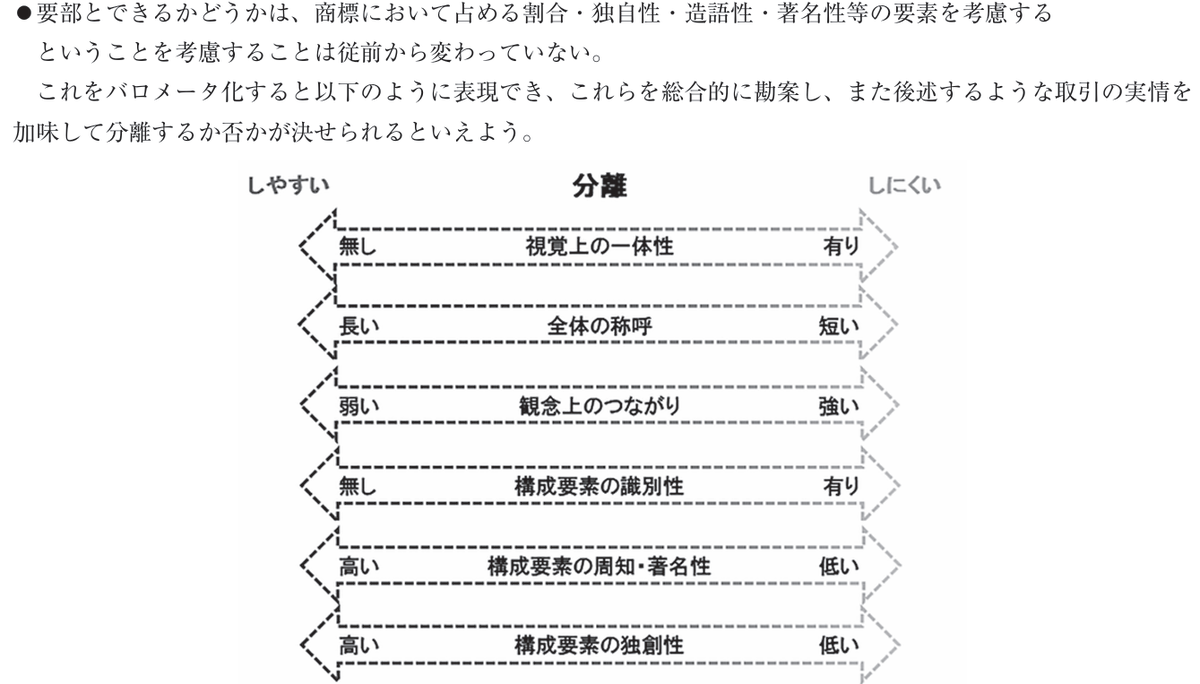
English translation of the original figure
• The approach of considering factors such as the proportion occupied in the mark, originality, coined character, and fame when determining whether a component can be treated as the essential portion has not changed. Expressed as indicators, these factors appear as shown below. Whether to separate the components is determined by considering them comprehensively, together with the actual trade conditions discussed later.
Separation — easier at the left; more difficult at the right.
Visual unity: absent → present.
Pronunciation of the whole: long → short.
Conceptual connection: weak → strong.
Distinctiveness of a constituent element: absent → present.
Recognition or fame of a constituent element: high → low.
Originality of a constituent element: high → low.
<IP Practice Online> “Generative AI and Intellectual Property Rights, etc.” (Attorney Taichi Kakinuma)
Publication date on the list page: March 13, 2026 (Date displayed on the individual article page: March 12, 2026.)
<IP Practice Online> “Generative AI and Intellectual Property Rights, etc.” (Attorney Taichi Kakinuma)
1. The “Development and Training Stage” and the “Generation and Use Stage”
When legally examining generative AI and copyright issues, it is necessary to distinguish clearly between two phases: the “development and training stage,” in which data is fed into AI to create a model, and the “generation and use stage,” in which users enter prompts and obtain outputs.
2. Copyright Act at the “Development and Training Stage” (Article 30-4)
• General rule (lawful)
Under Article 30-4 of Japan’s Copyright Act, works can generally be collected and used for training without the copyright owner’s permission if the purpose is “non-enjoyment,” such as machine-based “information analysis,” rather than enjoying works by viewing or listening to them.
• Exceptions (cases that may constitute copyright infringement)
However, where a “purpose of enjoyment” is included, such as targeting a particular creator’s works to “output their expression as it is (reflecting it in generated outputs for human enjoyment or use),” the exception under that article does not apply, and copyright infringement may arise under the general rule (for example, intentional overfitting).
3. Assessment at the “Generation and Use Stage” and “Technical Measures”
• The “unlawfulness of training” cannot immediately be inferred retrospectively from “output results.”
Even if an output happens to contain expression in common with an original work used to train the AI (similarity), it is ordinarily not possible, “solely from the fact (result) that a similar output was generated,” immediately to infer retrospectively that “a purpose of enjoyment existed (= the training itself was unlawful)” at the earlier development and training stage.
• The Importance of “Technical Measures” to Prevent Infringement
On the other hand, it is important whether AI developers and service providers implement “restrictive technical measures (safeguards such as filters and guardrails)” to avoid generating infringing material similar to existing works.
Implementing effective technical measures may be one circumstance supporting the argument that there was “no purpose of enjoyment” at the development stage.
Purpose of enjoyment: A purpose of enjoyment under Article 30-4 of the Copyright Act is not synonymous with a subjective intent to infringe. The Legal System Subcommittee of the Copyright Subdivision of the Council for Cultural Affairs, in “AI と著作権に関する考え方について” (March 15, 2024), states (translation): “If even one of these multiple purposes includes a purpose of ‘enjoyment,’ the requirements of that article are not met.” In summary, the issue is whether a purpose of enjoyment exists. Footnote 22 on p. 20 of those materials introduces an opinion that effective technical measures may be a circumstance supporting an inference of a non-enjoyment purpose. The presence or absence of technical measures must be evaluated in light of their content, effectiveness, and other circumstances. Source: Subcommittee materials, pp. 19–21. Original source
4. Risk Management and Responses in Corporate Practice
• Risks of Using Pirated Data
Using unlawfully uploaded pirated material (infringing content) as training data while knowing its nature carries very high legal risks in practice.
• Establishing Internal Systems (Governance)
Compliance-conscious operation is required, including implementation of technical measures and establishment of internal guidelines.
[Article/Trademark] Current Status and Issues in Recent Appeal Decisions on Trademark Distinctiveness Following Decisions of Refusal (Rui Asada and Tomohiko Yamada, Patent, 2025, Vol. 78, No. 11, pp. 42–60)
Publication date on the list page: March 13, 2026 (Date displayed on the individual article page: March 12, 2026.)
[Article/Trademark] Current Status and Issues in Recent Appeal Decisions on Trademark Distinctiveness Following Decisions of Refusal (Rui Asada and Tomohiko Yamada, Patent, 2025, Vol. 78, No. 11, pp. 42–60)
1. The Reality of Rapidly “Stricter” Distinctiveness Assessment
In recent years, in appeals against decisions of refusal based on Article 3(1) of the Trademark Act (distinctiveness), the proportion in which the grounds for refusal are overturned and registration is achieved (the reversal rate) has fallen markedly.
After peaking in 2021, the proportion of appeal decisions allowing registration has dropped sharply since 2022.
2. Changes in Assessment Methods: From Overall Observation to “Arbitrary” Decomposition
There is a clear difference in how composite marks (A+B) were viewed through 2021 and how they have been viewed since 2022.
Former approach (through 2021): Where there were few examples of use of the mark as a whole, or where the word order was recognized as coined, there was a tendency to recognize distinctiveness as a kind of coined expression (for example, “Jun-nama Udon” was registered).
Current approach (from 2022): Even without examples of use of the mark as a whole, there is a tendency to scrutinize the meanings of its individual words and arbitrarily combine them to conclude that the mark “produces a particular meaning (such as an indication of quality)” (for example, “Jun-nama Sanuki Udon” was refused).
A Method of Concern (Risk of Hindsight): Keeping the goods or services in mind and adding related words to the meanings of individual characters to force a meaning from them resembles the “hindsight” prohibited in patent inventive-step assessment.
3. Impact on Business and Branding
Stricter distinctiveness assessment may dampen corporate brand strategies.
Difficulty Securing Rights in Suggestive Marks: There is a risk of widespread refusal of “bold naming (suggestive marks)” such as “Oi Ocha” and “Hobo Kani,” which evoke the appeal of the goods while stimulating demand.
4. Why Does “Correction” Not Occur? The Barrier to Actions Seeking Revocation of Appeal Decisions
The mechanism for checking stricter appeal practice is not functioning sufficiently. The principal reason is the extremely small number of actions seeking revocation of appeal decisions based on lack of distinctiveness.
<Survey Results (Why Is Litigation Not Pursued?)>
Lack of Distinctiveness: The survey covered 46 members of the relevant Japan Patent Attorneys Association (JPAA) committee and 28 members of the Japan Intellectual Property Association (JIPA) Trademark Committee for fiscal year 2024. According to the paper, the proportions not proceeding to a revocation action where distinctiveness alone was at issue were 89.1% (41 of 46) and 82.1% (23 of 28), respectively. These are not the percentages selecting “there is no problem with use” as their reason. The paper discusses the fact that refusal prevents exclusivity but does not prevent actual use, together with litigation costs, as factors behind decisions not to sue.
Similarity: Because use may conflict with another party’s rights and risk being stopped, the paper explains that litigation is considered on a roughly fifty-fifty basis where similarity is at issue. However, its JPAA non-filing figure of 54.1% is inconsistent with the stated count of 28 out of 46 people. This should not be presented as a definitive actual filing rate of “approximately 50–60%.”
As a result, a structure has developed in which the Intellectual Property High Court has few opportunities to “check the appropriateness of distinctiveness assessments.”
https://jpaa-patent.info/patent/viewPdf/4717

English translation of the original figure
Ground for refusal | 2021 (reversal rate) | 2023 (reversal rate) | Trend
Article 3(1)(iii) (quality, geographical names, etc.): 76.6% | 24.7% | Sharp decline.
Article 3(1)(vi) (other lack of distinctiveness): 77.1% | 32.9% | Halved.
IP High Court, 2024 (Gyo-Ke) No. 10035 [Gaming Machine] <Presiding Judge Honda>
Original Article URL: https://www.nakapat.gr.jp/ja/note/%e4%bb%a4%e5%92%8c6%e5%b9%b4%e8%a1%8c%e3%82%b110035%e3%80%90%e9%81%8a%e6%8a%80%e6%a9%9f%e3%80%91%ef%bc%9c%e6%9c%ac%e5%a4%9a%e8%a3%81%e5%88%a4%e9%95%b7%ef%bc%9e/
Publication date on the list page: March 13, 2026 (Date displayed on the individual article page: March 12, 2026.)
IP High Court, 2024 (Gyo-Ke) No. 10035 [Gaming Machine] <Presiding Judge Honda>
The invention of the application is characterized by providing, in an “image displacement effect” in which an image moves, a “normal mode” in which no vibration occurs and a “special mode” in which vibration occurs and the likelihood of a jackpot is high.
⇒ The Japan Patent Office found it obvious from a combination of the cited invention (Exhibit Ko 1: an image displacement effect with first and second effect modes having different likelihoods) and the technical matters in Exhibit Ko 2 (technology in which an operation button vibrates together with a stereoscopic display effect at times of high expectation, such as a super-reach state).
The plaintiff argued that the cited invention’s “image displacement effect” and Exhibit Ko 2’s “stereoscopic display effect” differ in method and presentation effect, leaving no motivation to combine them.
⇒ The judgment held that “the effects are common in that they display an image that appears different from the reference image, and it cannot be said that there is no motivation to combine them”; it also held that “applying vibrating means to perform an effect involving vibration in the gaming machine of the cited invention is merely something that would naturally be done.”
⇒ No inventive step.
https://www.courts.go.jp/assets/hanrei/hanrei-pdf-93753.pdf
[Copyright Law ★★] A Case Partially Upholding the Appellants’ Claims for an Injunction and Damages against the Appellee on the Ground That Manufacturing Products Such as “Monjiro Ika” with Particular Designs on Their Labels or Outer Bags and Posting Images of Those Products on a Website Infringed Copyright (the Rights of Adaptation and Public Transmission) in a Television Drama Based on the Novel “Kogarashi Monjiro”
Publication date on the list page: March 6, 2026
Intellectual Property High Court, September 24, 2025 (2024 (Ne) No. 10007) (Presiding Judge Ken Nakadaira)
Judgment date: September 24, 2025.
[Overview of the Case]
The late novelist Saho Sasazawa (B) wrote the serialized novels in the “Kogarashi Monjiro” series (the Novels), whose protagonist is a wandering gambler named “Monjiro.” Manga, television dramas, and films were then produced based on the Novels. After B’s death, copyright in the Novels was inherited by B’s wife, Plaintiff A. The plaintiff company (Company X) obtained an exclusive license from Plaintiff A to use B’s works. The defendant company (Company Y) is a stock company engaged in manufacturing and selling food products and other businesses.
In this case, claims were made on the grounds that Company Y’s manufacture and sale of dried squid products under names including “Monjiro Ika” (the Y Products) with the Y Design shown below on their packaging (labels or outer bags), and its posting of images of the Y Products on a website, infringed copyright (the right of reproduction or adaptation, the right of public transmission, and the right of transfer) in the Novels, manga based on the Novels, the television dramas (the Television Works), or films, as well as Company X’s status as an exclusive licensee; and that manufacturing and selling the Y Products bearing the Y Design constituted unfair competition under Article 2(1)(i) or (ii) of the Unfair Competition Prevention Act (UCPA). The claims sought an injunction against the manufacture, sale, and other handling of the Y Products and their disposal under Article 112(1) and (2) of the Copyright Act or Article 3(1) and (2) of the UCPA, and damages in tort or under the main clause of Article 4 of the UCPA.
First-instance proceedings and appeal: The first-instance case was Tokyo District Court, 2023 (Wa) No. 70139. The features that the plaintiffs identified as a work in the Novels were those of a wandering gambler wearing an oversized conical straw hat low over his eyes and a long travelling cape, holding a long bamboo toothpick in his mouth, and carrying a long wakizashi sword. The first-instance court did not recognize these features as concrete creative expression in themselves and also held that the indication asserted by the plaintiffs was not an indication of goods or business under Article 2(1)(i) or (ii) of the UCPA. It dismissed all claims. After the plaintiffs appealed, A died while the appeal was pending, and A’s children, the X parties, succeeded to the proceedings. As described below, the appellate court found copyright infringement in relation to the Television Works, modified the first-instance judgment, and partially upheld the claims.

Y Design
[Summary of the Judgment]
1. Ownership of Rights
(1) The late author B held copyright in the Novels; after B’s death, the late A acquired that copyright by inheritance, and after A’s death, Appellants X2, X3, and X4 acquired the copyright by inheritance.
(2) With respect to the Television Works, which are derivative works based on the Novels, the late B, the author of the original work—the Novels—exclusively held copyright of the same types (the right of reproduction or adaptation, the right of transfer, and the right of public transmission) as, and coexisting with, the copyright held by the authors of the Television Works (the right of reproduction or adaptation, the right of transfer, and the right of public transmission) (Article 28 of the Copyright Act; Supreme Court, First Petty Bench, October 25, 2001, 2000 (Ju) No. 798, Shumin Vol. 203, p. 285). After B’s death, the late A acquired those rights by inheritance, and after A’s death, Appellants X2, X3, and X4 acquired those rights by inheritance.
2. Reliance on the Existing Work
On a page of its website, Company Y stated, under “Origin of Monjiro Ika,” that the product originated from likening the long toothpick held in the mouth of Kogarashi Monjiro, who was popular on television in 1972, to a skewer. This fact establishes that the name “Monjiro Ika” derives from Monjiro, the protagonist of the Television Works, and also permits an inference that the Y Design was created in reliance on the Television Works.
3. Whether Reproduction or Adaptation Occurred
(1) Monjiro in the Image shown below from the Television Works specifically depicts an image of Monjiro in the Television Works. Comparing the Image with the Y Design therefore clarifies the comparison between the image of Monjiro in the Television Works and the Y Design. Moreover, since the Television Works are derivative works of the Novels, such an image of Monjiro from the Television Works is recognized as a derivative work of the Novels.

The Image
(2) Monjiro in the Image is depicted as a person combining all of the following features: ① wearing a sandogasa traveling hat larger than those ordinarily used in television dramas, films, and the like; ② wearing a vertically striped traveling cape longer than those ordinarily used in television dramas, films, and the like; ③ holding a long, thin toothpick in his mouth; and ④ carrying a long wakizashi sword. No drama, film, novel, or similar work featuring a person combining all of these expressive features ① through ④ is established to have existed before the Television Works were broadcast or the Novels written. Accordingly, the combination of all four expressive features constitutes a creative expressive part of the Image and is recognized as forming its essential expressive characteristics.
(3) The Y Design, on the other hand, is a hand-drawn picture exaggerating the person’s characteristics; its mode of expression differs from the Image, which is a live-action depiction of an actor. Compared with the Image, it is a separate work to which new creativity has been added through hand drawing, and therefore it does not constitute a reproduction of the Image or the image of Monjiro in the Television Works.
(4) Nevertheless, the person in the Y Design wears a sandogasa traveling hat, and that hat is large. Relative to the size of the person’s face, the hat in the Y Design is even larger than the hat worn by Monjiro in the Image; however, this results from emphasizing feature ①, that the hat is large, in the Y Design. It does not prevent perception of feature ①; rather, it makes that perception easier. Accordingly, expressive feature ① of the Image can be directly perceived from the Y Design.
The person in the Y Design also wears a traveling cape, and that cape is long and vertically striped. Relative to the person’s height, the cape in the Y Design is even longer than that worn by Monjiro in the Image; however, this results from emphasizing feature ②, that the cape is long, in the Y Design. It does not prevent perception of feature ②; rather, it makes that perception easier. In addition, while the cape worn by the person in the Image has narrow stripes, those on the cape worn by the person in the Y Design are depicted as wider. This, too, results from emphasizing, in the Y Design, the part of feature ② that the cape is vertically striped, and does not prevent perception of feature ②; rather, it makes that perception easier. Accordingly, expressive feature ② of the Image can be directly perceived from the Y Design.
Furthermore, while Monjiro in the Image holds a long, thin toothpick in his mouth, the person in the Y Design holds a long, thin, rod-like object in his mouth, and it may not be immediately apparent that it is a toothpick. However, it is easy to infer that the long, thin, rod-like object held in the mouth is a toothpick; even if this is not immediately apparent, that does not prevent perception of feature ③. Accordingly, expressive feature ③ of the Image can be directly perceived from the Y Design.
In addition, both the person in the Y Design and Monjiro in the Image carry a long wakizashi sword, so expressive feature ④ of the Image can be directly perceived from the Y Design.
(5) Accordingly, all of expressive features ① through ④, which constitute a creative expressive part of the Image and are recognized as its essential expressive characteristics, can be perceived from the Y Design.
(6) The Image specifically depicts an image of Monjiro in the Television Works, and comparing the Image with the Y Design clarifies the comparison between the image of Monjiro in the Television Works and the Y Design. It is therefore recognized that all of expressive features ① through ④, which constitute a creative expressive part of the image of Monjiro in the Television Works and are recognized as its essential expressive characteristics, can be perceived from the Y Design.
(7) In light of the foregoing, the Y Design relies on the image of Monjiro in the Television Works and, while maintaining the identity of that image’s essential expressive characteristics, alters the specific expression to express thoughts or sentiments creatively anew. A person encountering the Y Design can directly perceive the essential expressive characteristics of the image of Monjiro in the Television Works. The Y Design is therefore recognized as an adaptation of the image of Monjiro in the Television Works.
4. Whether Copyright Infringement or Other Infringement Occurred
By manufacturing the Y Products with the Y Design on their packaging (labels or outer bags) and posting images of the Y Products on a website, Company Y is recognized as having infringed the rights of adaptation and public transmission in the Television Works. By contrast, the right of transfer is the right to offer a work to the public through transfer of its original or copies, so transfer of an adaptation of a work is not recognized as having infringed the right of transfer. Company X’s status as an exclusive licensee is also recognized as having been infringed by Company Y’s copyright infringement.
[Comments]
1. Regarding Judgment Summary 1(2)
Judgment Summary 1(2) follows the Supreme Court decision in the Candy Candy case, October 25, 2001, Hanrei Jiho No. 1767, p. 115. That decision held that the original author of a story manuscript in novel form constituting the original work underlying a derivative serialized manga exclusively holds, under Article 28 of the Copyright Act, rights of the same types as those held by the manga’s author, with both sets of rights coexisting, not only in the serialized manga and thus its panels and cover illustrations featuring the protagonist, but also in newly drawn original illustrations of that protagonist.
2. Regarding Judgment Summary 2
Judgment Summary 2 infers, from the explanation of the Y Products’ origins on Company Y’s website and the product name “Monjiro Ika” itself, that the Y Design was created in reliance on the Television Works. It may be surmised that this clear inference of reliance had a substantial practical influence on the assessment of reproduction or adaptation in Judgment Summary 3.
3. Regarding Judgment Summary 3
(1) Regarding Judgment Summary 3(1)
At first instance, the plaintiffs identified and asserted as the infringed work the description in the Novels of a wandering gambler who ① wears a larger-than-usual sandogasa traveling hat pulled low over his eyes, ② wraps himself in a longer-than-usual sweeping traveling cape, ③ holds a long bamboo toothpick in his mouth, and ④ carries a long wakizashi sword. However, the Supreme Court decision in the Popeye Necktie case, July 17, 1997, Minshu Vol. 51, No. 6, p. 2714, held: “In a serialized manga consisting of self-contained episodes in which a person with particular characteristics such as a name, appearance, and role is repeatedly depicted, each individual episode depicting that person constitutes a work, but the so-called character of that person cannot be regarded as a work apart from the specific manga. This is because what is called a character is an abstract concept, which might be described as the personality of the person distilled from the manga’s specific expression, rather than the specific expression itself, and cannot itself be said to express thoughts or sentiments creatively.” Under that decision, the judgment below held that, although “when a copyright owner alleges infringement of copyright in a serialized novel consisting of self-contained episodes, the owner must specifically identify the textual expression in the particular episode of that serialized novel whose copyright has been infringed,” “on the premise of X and the others’ arguments concerning identification, they fail to identify specifically the work in the books whose copyright is said to have been infringed, and their arguments must therefore be regarded as untenable in themselves.” This holding of the judgment below accords with the judicial research official’s commentary on the Popeye Necktie Supreme Court decision (Ryoichi Mimura, Commentary on Supreme Court Decisions, Civil Cases, Fiscal Year 1997, Middle Volume, p. 943).
On appeal, by contrast, under Judgment Summary 1(2) based on the Candy Candy Supreme Court decision, the infringed work was identified as a visual image of Monjiro in the Television Works, which are derivative works of the Novels, rather than the verbal descriptions of Monjiro in the Novels relied upon at first instance. In particular, as stated in Judgment Summary 3(1), although it was identified directly by the Image of Monjiro in the Television Works, it was ultimately identified as images of Monjiro generally, as specifically depicted by Monjiro in the Image from the Television Works. It is understood that the images of Monjiro in the Television Works generally, identified in this way, were made the subject of examination and determination as to whether the Y Design constituted reproduction or adaptation.
(2) Regarding Judgment Summary 3(2)
Further, Judgment Summary 3(2) addresses the visual expression of Monjiro in the Image as a person combining all of the following characteristics, common to images of Monjiro in the Television Works generally and scarcely different from the verbal descriptions of Monjiro in the Novels that the plaintiffs identified and asserted as the infringed work at first instance: ① wearing a sandogasa traveling hat larger than those ordinarily used in television dramas, films, and the like; ② wearing a vertically striped traveling cape longer than those ordinarily used in television dramas, films, and the like; ③ holding a long, thin toothpick in his mouth; and ④ carrying a long wakizashi sword. Because no drama, film, novel, or similar work featuring a person combining all of expressive features ① through ④ is established to have existed before the Television Works were broadcast or the Novels written, the court recognized this as a creative expressive part of the Image and as forming its essential expressive characteristics.
In this respect, unlike the judgment below, Judgment Summary 3(1) and (2) may be evaluated as accepting identification, as the infringed work, of creative expressive elements or features generalized and abstracted from individual, specific expressions as features common to multiple works or expressions, although they are visual expressions of a character substantially equivalent to the verbal expressions. It may be evaluated as attempting to open a path to substantive protection of creative character expression under copyright law, even under the Popeye Necktie Supreme Court decision denying copyrightability to a “character” itself. In this connection, even after the Popeye Necktie Supreme Court decision, the view recognizing copyrightability in creative character expression as a persona, rather than illustrations, pictures, designs, images, or the like, remains influential in academic commentary (Tatsuhiro Ueno, “Legal Protection of Characters,” Patent Vol. 69, No. 4 (2016), p. 50; Satoshi Ikemura, “Considering ‘Characters and Copyright’ Today,” Copyright Vol. 58, No. 687 (2018), pp. 38–39; Shunji Matsuda, “Legal Protection of Characters in a New Era,” Copyright Vol. 62, No. 742 (2023), p. 15; and others).
Nevertheless, disagreement may arise over Judgment Summary 3(2)’s recognition of features ① through ④ alone as the essential expressive characteristics of Monjiro in the Image, as in the judgment below, which rejected this in obiter dicta on the ground that they were commonplace.
(3) Regarding Judgment Summary 3(3)
Judgment Summary 3(3) rejects the proposition that the Y Design reproduces the Image of Monjiro in the Television Works and, by extension, images of Monjiro generally, and is appropriate.
(4) Regarding Judgment Summary 3(4)–(7)
Judgment Summary 3(4)–(7), probably influenced considerably in practice by the clear inference of reliance in Judgment Summary 2, proceeds on the premise of Judgment Summary 3(2) and follows the Supreme Court decision in the Esashi Oiwake case, June 28, 2001, Minshu Vol. 55, No. 4, p. 837. That decision held: “Adaptation (Article 27 of the Copyright Act) means the act of creating another work by relying on an existing work and, while maintaining the identity of its essential expressive characteristics, making modifications, additions, deletions, changes, or the like to its specific expression to express thoughts or sentiments creatively anew, in such a way that a person encountering it can directly perceive the essential expressive characteristics of the existing work.” Judgment Summary 3(4)–(7) thus affirms that the Y Design adapts the Image of Monjiro in the Television Works and, by extension, images of Monjiro generally; in light of Judgment Summary 2 and on the premise of Judgment Summary 3(2), this is appropriate.
On the other hand, if one disagrees with Judgment Summary 3(2), adaptation might also be denied, as in the judgment below, under the Esashi Oiwake Supreme Court decision’s further holding that “where a work created in reliance on an existing work shares identity with that work only in portions that are not expression itself, such as thoughts, sentiments or ideas, facts or events, or in portions lacking expressive creativity, it does not constitute adaptation.”
4. The Purpose, Interpretation, and Application of Article 28 of the Copyright Act and Copyright Protection of Creative Character Expression
Under the Popeye Necktie Supreme Court decision denying copyrightability to a “character” itself, attention turns to the interpretation and application of Article 28 of the Copyright Act, which prescribes the original author’s rights concerning exploitation of derivative works, as a legal framework for nonetheless providing substantive copyright protection to creative character expression, as this judgment does. Neither the Candy Candy Supreme Court decision nor this judgment based on that decision directly or expressly states the purpose of Article 28 itself. Nevertheless, the application of Article 28 in the Candy Candy Supreme Court decision and in this judgment based on it resulted in findings that use of character pictures, designs, and the like infringed the rights of the original authors in the story manuscripts in novel form, novels, and other works in which those characters appear. In relation to the copyright law principle of protecting creative expression, these findings should be substantively justified rather than treated as exceptions to that principle. If so, it does not seem impossible to understand those findings of infringement as substantively affirming, as the purpose and interpretation of Article 28, protection as a work for creative character expression as a persona in the original story manuscripts in novel form, novels, and similar works.
5. Regarding Judgment Summary 4
Through the application of Articles 21–27 of the Copyright Act via Article 28, which prescribes the original author’s rights concerning exploitation of derivative works, it is considered that, generally under case law and academic commentary and contrary to Judgment Summary 4, infringement could be recognized separately as follows: creation of the Y Design infringes the right of “adaptation” (Article 27); manufacture of the packaging (labels or outer bags) of the Y Products bearing the Y Design infringes the right of “reproduction” (Article 21); sale of the Y Products in packaging (labels or outer bags) bearing the Y Design infringes the right of “transfer” (Article 26-2(1)); and posting images of those Y Products on a website infringes the right of “public transmission” (Article 23(1)).
[Keywords] Kogarashi Monjiro; Monjiro Ika; characters; verbal expression; visual expression; Popeye Necktie Supreme Court decision; Article 28 of the Copyright Act; Candy Candy Supreme Court decision
Written by: Kei Iida, Attorney at Law and Patent Attorney (Daini Tokyo Bar Association)
IP High Court, 2023 (Gyo-Ke) No. 10105 [Electronic Money Remittance Method] <Presiding Judge Nakadaira>
Publication date on the list page: March 6, 2026
IP High Court, 2023 (Gyo-Ke) No. 10105 [Electronic Money Remittance Method] <Presiding Judge Nakadaira>
= 2023 (Gyo-Ke) No. 10106
* Inventive step recognized.
(1) Inventive step recognized (primary reference: a Chinese patent application)
The patented invention’s “certification information (electronic certificate)” and Exhibit Ko 1’s “identity information (ID or telephone number)” differ in technical significance.
⇒ The patented invention’s “certification information” includes digital signatures and the like created on a server or similar device and is distinguished from a mere ID; it therefore could not readily have been conceived from Exhibit Ko 1.
(2) Inventive step recognized (primary reference: Alipay-related technology)
The “account number” and “password” in Exhibit Ko 7 (Alipay’s payment system) do not constitute the patented invention’s “certification information.”
https://www.courts.go.jp/assets/hanrei/hanrei-pdf-93773.pdf
[Contract] Tokyo District Court, 2023 (Wa) No. 70680 <Presiding Judge Nakashima>
Original Article URL: https://www.nakapat.gr.jp/ja/note/%e3%80%90%e5%a5%91%e7%b4%84%e3%80%91%e6%9d%b1%e4%ba%ac%e5%9c%b0%e5%88%a4%e4%bb%a4%e5%92%8c5%e5%b9%b4%e3%83%af7068%ef%bc%9c%e4%b8%ad%e5%b3%b6%ef%bc%9e-2/
Publication date on the list page: March 6, 2026
[Contract] Tokyo District Court, 2023 (Wa) No. 70680 <Presiding Judge Nakashima>
Claim for Royalties and Other Payments under a Patent License Agreement
⇒ Granted (joint and several personal guarantee by the defendant company’s representative).
Plaintiff: Patent owner
Defendant company: Licensee
Defendant B: Representative director of the defendant company
C (not a party): Finance officer of the defendant company; the contact person with the plaintiff who had been postponing payment.
Defendant B issued a written statement saying: “I, B, pledge to make payment to the fullest extent in the event of default.”
The plaintiff argued that because it said “I, B,” it meant payment from B’s personal assets (= a joint and several guarantee).
⇒ The judgment found that a joint and several guarantee agreement had been formed by Defendant B personally.
Summary of the Disposition
The court ordered the defendants (the company and B personally) jointly and severally to pay JPY 22 million plus delay damages at 8% per annum from July 31, 2023 until payment in full.
https://www.courts.go.jp/assets/hanrei/hanrei-pdf-93851.pdf
The two contract articles concern the same judgment, 2023 (Wa) No. 70680, and were published at different URLs. Both are included in this collection of 29 articles.
Osaka District Court, 2023 (Wa) No. 12280 [Seawall] <Presiding Judge Takemiya>
Original Article URL: https://www.nakapat.gr.jp/ja/note/%e5%a4%a7%e9%98%aa%e5%9c%b0%e5%88%a4%e4%bb%a4%e5%92%8c7%e5%b9%b4%e3%83%af12280%e3%80%90%e9%98%b2%e6%bd%ae%e5%a3%81%e3%80%91%ef%bc%9c%e6%ad%a6%e5%ae%ae%ef%bc%9e/
Publication date on the list page: March 6, 2026
Osaka District Court, 2023 (Wa) No. 12280 [Seawall] <Presiding Judge Takemiya>
In light of the description and the meaning of the terms, “packing for watertightness between the transparent resin plate and the frame” (Limitation B③) does not mean that “it is sufficient for packing to exist at any part between the transparent resin plate and the frame”; it requires “packing for rendering the entirety of the space between the transparent resin plate and the frame watertight (preventing water leakage).”
⇒ Claim limitation not satisfied (the defendant’s product’s “rubber gasket” alone does not render the whole space watertight).
+ Even treating the aluminum “glazing bead” as metal packing, watertightness was insufficiently proven.
Cf. 2018 (Ne) No. 10034 [Solenoid] <Presiding Judge Kanno>
* “Sealing fit” does not require the end member itself to produce the effect of preventing corrosion of the solenoid.
⇒ The limitation is satisfied because the effect is achieved together with an O-ring.
https://www.courts.go.jp/assets/hanrei/hanrei-pdf-93806.pdf
[Contract] Tokyo District Court, 2023 (Wa) No. 70680 <Presiding Judge Nakashima>
Original Article URL: https://www.nakapat.gr.jp/ja/note/%e3%80%90%e5%a5%91%e7%b4%84%e3%80%91%e6%9d%b1%e4%ba%ac%e5%9c%b0%e5%88%a4%e4%bb%a4%e5%92%8c5%e5%b9%b4%e3%83%af7068%ef%bc%9c%e4%b8%ad%e5%b3%b6%ef%bc%9e/
Publication date on the list page: March 6, 2026
[Contract] Tokyo District Court, 2023 (Wa) No. 70680 <Presiding Judge Nakashima>
Claim for Royalties and Other Payments under a Patent License Agreement
⇒ Granted (joint and several personal guarantee by the defendant company’s representative).
Plaintiff: Patent owner
Defendant company: Licensee
Defendant B: Representative director of the defendant company (individual)
C (not a party): Finance officer of the defendant company; the contact person with the plaintiff who had been postponing payment.
Defendant B issued a written statement saying: “I, B, pledge to make payment to the fullest extent in the event of default.”
The plaintiff argued that because it said “I, B,” it meant payment from B’s personal assets (= a joint and several guarantee).
⇒ The judgment found that a joint and several guarantee agreement had been formed by Defendant B personally.
Summary of the Disposition
The court ordered the defendants (the company and B personally) jointly and severally to pay JPY 22 million plus delay damages at 8% per annum from July 31, 2023 until payment in full.
https://www.courts.go.jp/assets/hanrei/hanrei-pdf-93851.pdf
The two contract articles concern the same judgment, 2023 (Wa) No. 70680, and were published at different URLs. Both are included in this collection of 29 articles.
[Contract] IP High Court, 2024 (Ne) No. 10058 [Development of Green Laver Spore Collection Technology Using a Waterwheel] <Presiding Judge Hibiku Shimizu>
Publication date on the list page: March 6, 2026
[Contract] IP High Court, 2024 (Ne) No. 10058 [Development of Green Laver Spore Collection Technology Using a Waterwheel] <Presiding Judge Hibiku Shimizu>
1. Whether the Joint Research Agreement Was Breached (Unauthorized Publication of Research Results)
The idea itself of collecting green laver spores using a waterwheel had existed since 1998, before the joint research at issue.
The purpose of the joint research was to clarify specific conditions for spore collection and related matters, whereas the publication at issue merely indicated that “attachment using a waterwheel-type spore collection device is possible” and did not disclose specific technical details (suitable circumstances, conditions, etc.).
The idea itself was a premise of the joint research, not an outcome, and the publication did not constitute publication of “research results”; no breach of contract was therefore found.
2. Whether Patent Acquisition Was Obstructed
Since the idea itself of collecting green laver spores using a waterwheel was well known, merely stating that it “had become possible” would not secure a patent; regardless of whether the publication occurred, disclosure of specific technical details was necessary to obtain a patent.
Accordingly, even if the publication was cited during patent examination, it was not recognized as obstructing the plaintiff’s patent acquisition and did not constitute nonperformance of contractual obligations.
https://www.courts.go.jp/assets/hanrei/hanrei-pdf-93787.pdf
<IP Practice Online> The Umbrella Theory Has Also Returned! But Should Disclaimer Claims Really Be This Unrestricted? (Shibata)
Publication date on the list page: March 6, 2026
<IP Practice Online> “The Umbrella Theory Has Also Returned! But Should Disclaimer Claims Really Be This Unrestricted? A Horizontal and Vertical Overview of Amendment Practice” (Kazuo Shibata)
In current Japanese practice, disclaimer claims are frequently used as a de facto “standard tactic” for easily avoiding prior-art objections (such as lack of novelty or inventive step).
Drawing on experience as an examiner and appeal examiner, the speaker asks: “Should this really be so unrestricted?”
The Umbrella Theory Concerning Priority and the Risk of Transforming an Invention through Disclaimer Claims
The lecture materials state ‘証拠除外効=傘理論’ (translation: ‘exclusionary effect on evidence = umbrella theory’). In summary, this is a discussion of multiple and partial priority under which publications and other events during the priority period corresponding to a constituent part entitled to priority are excluded as evidence for refusal or invalidation of a later application. The speaker examines this principle of priority and discusses recent examples. Source: lecture materials, slides 2 and 5–6.
As to amendments using disclaimer claims, the presentation examines the risk that later exclusion of matters not originally disclosed may substantively transform the invention before and after amendment. The permissibility of an amendment excluding part of a broader concept must be examined as an issue of added matter and related requirements in relation to the original description and other documents; it is not the same principle as the umbrella theory concerning the exclusionary effect of priority.
The presentation explains, from a distinctive perspective, court cases in which inventive step was recognized for disclaimer claims and cases in which it was not.
Lecture materials (Kazuo Shibata, January 15, 2026, slides 2 and 5–6): https://docs.google.com/presentation/d/1RdCOufWS2WiBrweGsKZAV4_qhMGy55rf/edit
IP High Court, 2024 (Gyo-Ke) No. 10050 [Information Processing Device] <Presiding Judge Miyasaka>
Original Article URL: https://www.nakapat.gr.jp/ja/note/%e4%bb%a4%e5%92%8c6%e5%b9%b4%e8%a1%8c%e3%82%b110050%e3%80%90%e6%83%85%e5%a0%b1%e5%87%a6%e7%90%86%e8%a3%85%e7%bd%ae%e3%80%91%ef%bc%9c%e5%ae%ae%e5%9d%82%ef%bc%9e/
Publication date on the list page: March 6, 2026
IP High Court, 2024 (Gyo-Ke) No. 10050 [Information Processing Device] <Presiding Judge Miyasaka>
The decision rejecting the invalidation request was upheld (the claim for revocation of the decision was dismissed).
Judgment text: The operative part of the judgment states (translation): “1. The plaintiff’s claim is dismissed.” In summary, the procedural outcome was dismissal of the claim for revocation of the decision rejecting the invalidation request, leaving that decision in place. Source: IP High Court, 2024 (Gyo-Ke) No. 10050, pp. 1–2
<Qualification as an “Invention” (Utilization of Laws of Nature)>
The plaintiff argued that processing that does not include calculation of depreciation costs is abstract and cannot be described as specific information processing using hardware resources, and is merely a human-made arrangement (business rule), so it is not an “invention.”
⇒ In the invention, information processing by software, such as the respective calculation units and the product optimization unit, is concretely implemented using the hardware resources of a computer (CPU, memory, etc.).
Even if calculation of depreciation costs is not expressly recited in the claim, it is not excluded, and working examples are provided in the description; the subject matter is therefore recognized as a creation of a technical idea (an invention).
https://www.courts.go.jp/assets/hanrei/hanrei-pdf-93778.pdf
IP High Court, 2024 (Gyo-Ke) No. 10053 [Wood-Based Board] <Presiding Judge Hibiku Shimizu>
Original Article URL: https://www.nakapat.gr.jp/ja/note/%e4%bb%a4%e5%92%8c6%e5%b9%b4%e8%a1%8c%e3%82%b110053%e3%80%90%e6%9c%a8%e8%b3%aa%e3%83%9c%e3%83%bc%e3%83%89%e3%80%91%ef%bc%9c%e6%b8%85%e6%b0%b4%e9%9f%bf%ef%bc%9e/
Publication date on the list page: March 6, 2026
IP High Court, 2024 (Gyo-Ke) No. 10053 [Wood-Based Board] <Presiding Judge Hibiku Shimizu>
No inventive step.
The description contains no statement that the respective configurations function in relation to one another or produce a synergistic effect beyond the effects that each achieves individually, nor does it describe a mechanism of action or similar matters. The configurations were not found to act in relation to one another to produce a synergistic effect. The patent revocation decision did not err in identifying Differences 1 and 2 separately.
Judgment text: The court held (translation) that the configurations “are not found to act in relation to one another to produce a synergistic effect.” In summary, even taking account of the description and the experimental-results certificate, a synergistic effect was not established, and there was no error in the patent revocation decision’s identification of the differences separately. Source: IP High Court, 2024 (Gyo-Ke) No. 10053, pp. 24–26
(1) Obviousness of Difference 1 (Length of the Small Wood Flakes)
Although the publication in Exhibit Ko 1 states that the length of the wood flakes “preferably has an average value within the range of 40.0–115.0 mm,” that numerical range is not recognized as having the same technical significance as thickness or width as a means of solving the problem, and selecting a value outside that range does not depart from the technical concept.
On the other hand, it is common general technical knowledge among persons skilled in the art that, as the dimensions of the constituent elements become smaller, the resulting wood-based board becomes more homogeneous and its surface smoother. In light of that knowledge, adjusting the dimensions in the invention of Exhibit Ko 1 according to the intended use of the wood-based board and setting the length to “10 mm or more and 35 mm or less,” as in Invention 1 at issue, is an exercise of the ordinary creative ability of a person skilled in the art and could readily have been conceived. Nor is there any teaching away.
(2) Obviousness of Difference 2 (Homogeneity and Absence of Knots)
In the invention, “uniformly consistent in size and shape” means that dimensions fall within a certain range, which the invention of Exhibit Ko 1 also satisfies.
Moreover, “absence of knots” is a configuration ordinarily present in reconstituted material made by breaking raw wood into small pieces.
⇒ Difference 2 is either not a substantive difference or, even if it is, could readily have been conceived by a person skilled in the art based on the invention of Exhibit Ko 1 and common general technical knowledge.
https://www.courts.go.jp/assets/hanrei/hanrei-pdf-93878.pdf
Legal Update (April 2026 articles)
Scope: Articles with an April 2026 publication date on Nakamura & Partners’ listing page.
Articles: 29 (27 patents, 1 intellectual property generally, 1 trademark).
Authors: Hideki Takaishi (28 articles); Kei Iida (1 article).
Listing page: https://www.nakapat.gr.jp/ja/note/ (section “高石弁護士の知財速報” [Attorney Takaishi’s IP News]; 28 articles); https://www.nakapat.gr.jp/ja/legal_updates_jp/ (section “法情報提供” [Legal Update]; 1 article)
Differences between the original articles and the judgments
[Lighting device] The original article gives “2024 (Ne) No. 10101,” but page 1 of the linked judgment gives 「令和5年(ネ)第10101号」 (2023 (Ne) No. 10101; judgment of June 18, 2024). According to the judgment, Tamotsu Shoji was the presiding judge (judgment, p. 18). Judgment
[Hand-pushing member] The original article gives “2023 (Gyo-Ke) No. 10100,” but page 1 of the linked judgment gives 「令和5年(行ケ)第10143号」 (2023 (Gyo-Ke) No. 10143; judgment of September 25, 2024). Judgment
[Filling material for an electronic cigarette] The original article gives “2024 (Wa) No. 70407,” but page 1 of the linked judgment gives 「令和 5 年(ワ)第 70407 号」 (2023 (Wa) No. 70407; judgment of September 26, 2024). Judgment
[Ground solidification material] The original article gives “2024 (Gyo-Ke) No. 10132,” but page 1 of the linked judgment gives 「令和5年(行ケ)第10132号」 (2023 (Gyo-Ke) No. 10132; judgment of October 30, 2024). Judgment
[Jig for a lifeline support post] The original article also refers to the “second requirement of equivalence,” but page 35 of the judgment states 「均等の第1要件を満たすとは認められない。」 (it cannot be found that the first requirement of equivalence is satisfied) and 「その余の要件を検討するまでもなく」 (without needing to examine the remaining requirements). The term 「小型化」 (“reduced size”) in the original article does not appear in the judgment. Judgment
<This Month’s Highlights> Key Points of the April 2026 IP and Legal Updates
This month’s Legal Update comprises 29 articles: 27 on patents, one on intellectual property generally and one on trademarks. The patent articles cover motivation in inventive step, claim interpretation, the doctrine of equivalents, enablement, addition of new matter and litigation procedure. They are accompanied by the revision of the Trade Secret Management Guidelines and a trademark judgment concerning similarity between machinery goods and rental services. Articles are included according to their April publication dates on the listing page; their judgment dates differ.
1 Circumstances supporting and negating motivation in inventive step
The two articles on [Electric impact fastening tool] address the relationship between the well-known problem of increasing torque and the known advantages of an outer rotor type. In [Combustor and boiler], the societal demand to reduce carbon dioxide emissions at filing and common general technical knowledge concerning ammonia use supported motivation to combine. Conversely, in [Sales system], the secondary references were held not to contain the configuration of the differences, so that the premise for combination was lacking, and, even if list creation were well known, the added list creation and output were held incompatible with the primary cited invention’s purpose of reducing retailers’ workload; in [Hand-pushing member], motivation was denied because the reference (Exhibit Ko 8) has the technical significance of being premised on attachment to the curved part of a squared U-shaped handle, and a factor teaching away was also found. [Ground solidification material] likewise rejected application of injection conditions because solution-type and suspension-type grouts have different solidification principles. In addition to a shared technical field, it is necessary to examine specifically whether the problem, the mechanism of action and the modified configuration are compatible with the cited invention.
2 Grounds for limiting and not limiting claim language
In [Induction heating coil unit], “composed of” was not limited to that material alone, and “unit” was construed as a constituent unit, while specific differences in cooling paths and merging functions supported inventive step for Claims 2 and 3. In [Intraoral OCT with color texture], the alternatives “with or without registration” were held not to change the matters specifying the claimed invention in substance, and “combining” was held not to be limited to particular data dimensionality or display forms. In contrast, “cuts” in [Filling material for an electronic cigarette], “pivoting plate-like member” in [Tiltable and stowable temporary protective fence], “vertical plate portion” in [Eave] and “oxygen supply means” in [Wastewater treatment apparatus] were considered in relation to dictionary meanings, distinctions between configurations in the claims, and the means for solving the problems and the functions and effects described in the description. It is important to verify the basis for a limitation for each term.
3 Fulfillment of functional configurations requires concrete proof
[Rolling device] is a case in which, although findings of fulfillment differing from the original judgment were obtained for the rolling-path and other elements, a no-load region could not be said to be formed in the appellee’s products, which are used under preload, and proof of the frictional-force relationship was also insufficient. In [Commercial transaction system], seller-entered HS codes and a response of “registration complete” alone could not establish the specified acquisition and notification of customs-duty information. In [Vehicle guidance system], a driver’s ability to return to the destination independently after entering a general road or similar location was distinguished from the specified guidance by the system. [Remotely controlled unmanned boat] addresses the relationship between an activation condition of “at least one” and a mechanism capable of assessing both communication interruption and insufficient power. Functional wording must be related to actual processing, information paths, conditions of use and device configurations.
4 Limits of disclosure in description requirements and corrections
In [Device… formed of a very low resistance material], reduced resistance was distinguished from a superconducting state of zero resistance, and support for a phenomenon contradicting common general technical knowledge and specific methods of implementation were at issue. In [Moving image decoding device], information that changes the candidate count as a consequence was distinguished from control information having the purpose of changing that count, and the correction was held to add new matter, and the claims before correction were also held to violate the support requirement. Showing a technical result is not the same as disclosing the configuration or function required by the claim.
5 Timing of submissions and the substance of what is examined
In [Women’s clothing], the court found untimeliness and gross negligence concerning an invalidity ground added in the statement of reasons for appeal, but also considered its substance because the opposing party had responded and there had been no rebuttal, so that, to this extent, conclusion of the litigation would not be delayed. A finding of untimeliness must not be replaced with a conclusion that the argument was actually dismissed. In [DC ultra-high-voltage power supply for a food electric-field treatment apparatus], the addition of documents corroborating well-known status was distinguished from a new refusal ground; in [Gaming machine], an unfair surprise was denied because no notice of reasons for refusal is required by statute for dismissal of an amendment for violating the independent patentability requirement, and, even if an exception were considered, Cited Inventions 1 and 2 were based on the same document, had contents in common to some extent, and that document had already been cited in a notice of reasons for refusal.
6 Trade secret management and similarity between goods and rental services
“Overview of the revision of the Trade Secret Management Guidelines” sets out the positioning of reasonable classification, employees’ recognizability of the intention to maintain secrecy, access management for cloud services and the risks to non-public status associated with generative AI use. In the “ゴミサー” case, goods and services were found similar for a combination with different similar group codes (according to the article’s commentary; the judgment does not refer to similar group codes), based on actual circumstances in which manufacturers and the like both sell and rent construction machinery in Class 7, the same class as the cited designated goods, and on overlapping consumers. Both show the need to understand actual management and trading circumstances specifically, rather than relying only on formal classifications.
Three-point summaries of all articles
|
Category |
Article title and three-point summary |
|---|---|
|
Patents |
2023 (Ne) No. 10063 [Electric impact fastening tool] <Presiding Judge Hibiku Shimizu> ① The case concerned obviousness of differences in motor type and magnet retention in an electric impact fastening tool. ② The court held replacement with an outer rotor type obvious because the invention of Exhibit Otsu 15 had the problem of increasing output torque and Exhibit Otsu 6 suggested the application, and held adhesive attachment of magnets obvious based on well-known technology; it accepted the invalidity defense, also rejected the counter-defense of correction, set aside the portions of the original judgment granting the claims, and dismissed those claims. ③ The case illustrates how shared problems within the same technical field and the well-known nature of technology addressing the differences support motivation to combine. |
|
Patents |
2023 (Ne) No. 10101 [Lighting device] <Presiding Judge Shoji> ① The case concerned whether a product equipped with warm-white and daylight LEDs literally fulfilled Element A (the red, blue and green light-emitting means) of a lighting device, and whether equivalence was established with respect to Element A and Elements C/D (the adjustment unit responsive to biological information). ② The court held that the statement of wavelength ranges in the description does not mean that every light-emitting means emitting light including those wavelengths falls within the light-emitting means of each color, and that Element A requires each of the red, blue and green light-emitting means; it therefore denied literal fulfillment, and also found the first requirement of equivalence not satisfied in light of the contribution over the prior art. ③ The case shows that a statement of wavelength ranges in the description does not by itself determine whether a light-emitting means falls within the means of each color, and that the essential part must be identified in light of the contribution over the prior art. |
|
Patents |
2024 (Ne) No. 10022 [System for providing inspection and analysis services] <Miyasaka> ① The case concerned whether “inspection and analysis” in a system for providing inspection and analysis services means analysis of a sample or remote operation itself. ② The court rejected the appellant’s argument because the claims contained no exclusion of semiconductor inspection equipment, held that verification of remote control is also merely a step in sample analysis, upheld the original judgment finding non-fulfillment and dismissed the appeal. ③ The case shows that interpretations based on prosecution history must also accord with the claims and that a step for inspection and analysis must be distinguished from inspection and analysis itself. |
|
Patents |
2023 (Gyo-Ke) No. 10061 [Combustor and boiler] <Miyasaka> ① The case concerned motivation to apply ammonia-use technology to the primary cited invention and differences including temperature regions in a combustor and boiler. ② The court found motivation based on the societal demand for reduced carbon dioxide emissions and common general technical knowledge at filing, held Differences 1 and 2 obvious, and upheld the revocation decision. ③ The case shows that societal demands and common general technical knowledge at filing can support a shared problem, and that temperature expressions are assessed with regard to their comparators. |
|
Patents |
2023 (Gyo-Ke) No. 10110 [Intraoral OCT with color texture] <Honda> ① The case concerned interpretation of “with or without registration” and “combining” in intraoral OCT. ② The court upheld the JPO appeal decision denying inventive step, holding that the presence or absence of the specifying matter “with or without registration” did not change the matters specifying the claimed invention in substance and that combining was not limited to a particular dimensionality or display form. ③ The case illustrates that language listing alternatives or referring to data combination is not automatically limited to a particular embodiment in the description. |
|
Patents |
2023 (Gyo-Ke) No. 10084 [Electric impact fastening tool] <Hibiku Shimizu> ① The case concerned obviousness of replacing an inner rotor type with an outer rotor type and adhesively attaching magnets in an electric impact fastening tool. ② The court rejected the ground for rescission concerning the requirements for correction, but denied inventive step because increasing torque was a well-known problem and the advantages of the outer rotor type and fixation using adhesive were also well known, and rescinded the JPO trial decision that had dismissed the request for invalidation. ③ The case shows that, when considering component replacement, the relationship between the primary cited invention’s problem and the known advantages of the replacement affects motivation. |
|
Patents |
2023 (Gyo-Ke) No. 10103 [Optical ferrule] <Honda> ① The case concerned interpretation of a “parting line artifact” in an optical ferrule and the position of the parting line when the cited invention is molded in a die. ② The court denied inventive step because no specific size or similar limitation applied to the artifact and molding the cited invention would produce it at the same position. ③ The case shows the need to assess structures arising from manufacture by relating the limits of the wording to what inevitably occurs during manufacture. |
|
Patents |
2023 (Gyo-Ke) No. 10107 [Induction heating coil unit] <Presiding Judge Hibiku Shimizu> ① The case concerned the interpretation of material and unit language and the inventive step of individual claims concerning cooling paths and flow-straightening portions in an induction heating coil unit. ② The court denied inventive step for Claims 1 and 4, held that the determination for Claims 5 and 6 also lacked its premise, and rescinded the part of the JPO trial decision concerning Claims 1 and 4 to 6, while recognizing inventive step for Claims 2 and 3 in light of differences in cooling paths and merging functions, among other matters. ③ The case shows the need to distinguish general wording such as “composed of” and “unit” from the specific configuration and functions of cooling paths. |
|
Patents |
2023 (Gyo-Ke) No. 10104 [Device… formed of a very low resistance material] <Hibiku Shimizu> ① The case concerned sufficiency of the disclosure supporting the realization of a superconducting state and the Josephson effect in a device using a low-resistance material. ② The court found failure of enablement because there were no test results showing zero resistance or specific methods for using a superconducting portion, and no basis for statements contradicting common general technical knowledge. ③ The case shows the need for concrete disclosure supporting the phenomenon and its implementation where an invention presupposes a phenomenon departing from common general technical knowledge. |
|
Patents |
2024 (Ne) No. 10010 [Women’s clothing] <Presiding Judge Nakadaira> ① The case concerned the interpretation of the connecting and adjusting functions in women’s clothing and the treatment of an invalidity ground added in the statement of reasons for appeal. ② The court maintained the infringement finding and, while finding the new invalidity ground untimely, also examined its merits because, to this extent, doing so would not delay the conclusion of the litigation, and did not find the patent invalid. ③ The case shows that timing and gross negligence may be at issue even for arguments in a statement of reasons for appeal, and that actual dismissal also requires consideration of delay to the conclusion of litigation. |
|
Patents |
① In an action against a decision revoking a patent for a moving image decoding device, the case concerned whether “control information for changing the number of motion vector candidates,” a matter common to the claims before and after correction, is described in the description (whether change flags, thresholds Th or the maximum number of vectors fall under it). ② The court held that the control information requires a purpose–means relationship with changing the number of candidates and that consequential or indirect effects are insufficient, so that it is not described in the description; it refused the correction as adding new matter, held that Claims 1 and 2 before correction also violate the support requirement, and upheld the revocation decision. ③ In this case, for a claim containing functional “for” language, where the description describes only a consequential change in the number of candidates, a correction further limiting that language was not allowed and the support requirement was not satisfied. |
|
Patents |
2023 (Gyo-Ke) No. 10148 [Sales system] <Presiding Judge Nakadaira> ① The case concerned whether combining the matters described in Exhibits Ko 2 to Ko 4 with the primary cited invention (the invention of Exhibit Ko 1) in a sales system would arrive at Elements (D) and (E), the differences (extraction of order information based on group information and output of order lists in a form viewable by the group’s person in charge), and motivation to do so. ② The court held that Exhibits Ko 2 to Ko 4 do not describe Elements (D) and (E), so that the premise for combination is lacking, and further that, even if list creation were well known, output in a form viewable by school personnel would be incompatible with the primary cited invention’s purpose of reducing retailers’ workload and there was no motivation; it upheld the JPO trial decision recognizing inventive step. ③ The case shows the need to examine whether an added configuration accords with the purpose of the primary cited invention when assessing obviousness of a combination. |
|
Patents |
2024 (Ne) No. 10019 [Rolling device] <Presiding Judge Miyasaka> ① The case concerned fulfillment of rolling-path structures as well as formation of a no-load region and the relative magnitudes of frictional forces in a rolling device. ② The court found Elements 1-A and 2-A fulfilled, but rejected the patentee’s claim because a no-load region could not be said to be formed in the appellee’s products, which are used under preload, the appellant’s argument concerning centrifugal force lacked specific support, and there was no specific evidence of the frictional-force relationship. ③ The case shows that a broad construction of some elements does not eliminate the need to prove other elements concerning loads, friction and other conditions during use. |
|
Patents |
2023 (Gyo-Ke) No. 10143 [Hand-pushing member] <Presiding Judge Hibiku Shimizu> ① In an action against a JPO trial decision dismissing a request for invalidation, the case concerned motivation, among other things, to apply a safety cover for a squared U-shaped handle (Exhibit Ko 8) to a long hand-pushing member extending vertically. ② The court denied motivation to apply the safety cover of Exhibit Ko 8 to a long vertical hand-pushing member, and also found a factor teaching away, because the cover has the technical significance of using the horizontal part of a squared U-shaped handle as the grip and being attached to its curved part; it also denied obviousness for combinations using Exhibit Ko 9 as the primary reference, and upheld the JPO trial decision. ③ The case shows that the shape of the attachment object presupposed by a cited component, and the component’s technical significance, bear on the examination of motivation to apply it to a component of a different shape and of factors teaching away. |
|
Patents |
① The case concerned whether breaks arising during crimping and related processing of electronic-cigarette filling material constituted “cuts.” ② Based on dictionaries, the description, and functions and effects, the court construed “cuts” as structures artificially and actively formed with a blade and held that tears or cracks did not fulfill the “cuts” element. ③ The case shows that visual similarity alone is insufficient and that the relationship between the claimed structure, its formation means and its functions and effects matters. |
|
Patents |
① The case concerned whether square tubular pivoting members in a tiltable and stowable temporary protective fence constituted “pivoting plate-like members.” ② The court construed the term as a thin plate-like member in light of the description’s statements on reducing thickness and making the structure compact, and denied literal infringement and infringement by equivalents. ③ The case shows that claim language expressing shape is interpreted in relation to the means of solving the problem disclosed in the description. |
|
Patents |
2024 (Ne) No. 10045 [Wastewater treatment apparatus] <Presiding Judge Hibiku Shimizu> ① The case concerned whether means that adds ozone, together with oxygen, to a tank using microorganisms constituted “oxygen supply means” in a wastewater treatment apparatus. ② The court found non-fulfillment because actively adding ozone was incompatible with the technical idea of promoting biological treatment and reducing residual ozone and because the claims distinguish ozone supply means from oxygen supply means, and dismissed the exclusive licensee’s appeal. ③ The case shows that possessing part of a function may not bring a configuration within claim language when an additional function is incompatible with the invention’s solution to its problem. |
|
IP generally |
① The article explains the 2025 revision of the Trade Secret Management Guidelines in relation to teleworking, cloud services, generative AI and recent court decisions. ② It sets out the positioning of reasonable classification, objective recognizability of the intention to maintain secrecy, access management, and the assessment of usefulness and non-public status. ③ It states that the emphasis of the revision has shifted from formal management to ensuring recognizability in line with actual circumstances, predicts that companies will be required to account for the objective recognizability of their management measures, and introduces the addition of statements on, among other things, the risk of losing non-public status through use of data input into generative AI for training. |
|
Patents |
2023 (Gyo-Ke) No. 10132 [Ground solidification material] <Presiding Judge Hibiku Shimizu> ① The case concerned obviousness of applying injection conditions for solution-type grout to suspension-type grout in a ground solidification material. ② The court recognized inventive step and rescinded the revocation decision because solidification by hydraulic properties differed from reaction with alkaline components in soil and no suggestion of applicability existed. ③ The case shows that even within ground improvement technology, transferring injection conditions unchanged may not be obvious where solidification mechanisms differ. |
|
Patents |
2025 (Ne) No. 10043 [Vehicle guidance system] <Presiding Judge Honda> ① The case concerned whether “guidance” to a specified route in a vehicle guidance system is established when a vehicle can return to the destination by a route chosen at will. ② Unlike the original judgment, the court found non-fulfillment because merely being able to return at the driver’s discretion after entering a general road or similar location was not the specified guidance (some of the systems had no return route at all) and the defendant’s systems had no “entrance/exit for general vehicles,” a term that does not include an entrance/exit for general vehicles at another adjacent interchange; it set aside the part of the original judgment against the appellant and dismissed the claim. ③ The case shows the need to distinguish the connections leading to the guidance destination and the range to which the device actually guides the vehicle from reachability through the driver’s voluntary actions. |
|
Patents |
2024 (Ne) No. 10033 [Eave] <Presiding Judge Nakadaira> ① The case concerned whether a squared U-shaped portion of an eave’s front edge plate constituted a “vertical plate portion” whose front face guides rainwater. ② The court denied literal fulfillment based on the shape including a horizontal portion and the separation between the guide surface and the abutting portion, and dismissed the appeal without recognizing infringement by equivalents, finding the first and second requirements of equivalence not satisfied. ③ The case shows the need to examine plate sections, contact locations and the positional relationship of guide surfaces in relation to the purpose of reducing the eave’s size. |
|
Patents |
Tokyo District Court, 2023 (Wa) No. 70272 [Jig for a lifeline support post] <Presiding Judge Kokubu> ① The case concerned fulfillment of the position of a bent portion and the relationship between plate length and flange width in a jig for a lifeline support post, and, in the counterclaim, whether the plaintiff’s infringement notice constituted unfair competition (damage to business reputation). ② The court found that the defendant’s product did not literally fulfill either configuration and that the first requirement of equivalence was not satisfied because the differing portions constituted the essential part, and dismissed the main claims. On the counterclaim, it held that the plaintiff’s infringement notice posted on social media constituted dissemination of a false fact under Article 2(1)(xxi) of the Unfair Competition Prevention Act, and granted the injunction and damages to the extent of 550,000 yen. ③ The case shows that continuity between members and dimensional relationships bear on literal fulfillment and on identifying the essential part in light of comparison with the prior art, and that the conclusion of non-infringement is also directly linked to the determination of whether the content of an infringement notice constitutes a false fact. |
|
Patents |
① The case concerned a configuration assessing two return conditions involving communication interruption and remaining power in a remotely controlled unmanned boat. ② The court construed the first control device (Element J) as presupposing a mechanism capable of dealing with both critical situations, and held that the defendant’s products, in which the remaining charge falls to the 20% range of full charge even when the return-start lower-limit voltage is set to 49 V, the upper limit settable by ordinary methods, did not fulfill Element J; it also denied equivalence for lack of the fifth requirement. ③ The case shows the need to distinguish an activation condition of “at least one” from whether the device must be capable of assessing both conditions, in light of the invention’s problem. |
|
Patents |
Tokyo District Court, 2023 (Wa) No. 70219 [Commercial transaction system] <Presiding Judge Sugiura> ① The case concerned fulfillment of the elements of acquisition of advance customs clearance information including customs-duty information and notification to a commercial transaction device in a commercial transaction system. ② The court held Element D not fulfilled because seller-entered HS codes and receipt of “registration complete” did not establish acquisition of the specified customs-duty information, and held Element E also not fulfilled because, without acquisition of the advance customs clearance information, there could be no notification of it, even leaving aside the uncertainty in the evidence concerning the content transmitted. ③ The case shows the need to identify information content, source and destination, not just its name, and to prove execution of each information-processing step. |
|
Patents |
① The case concerned procedure when adding documents corroborating well-known technology and obviousness of power circuits and related features in a power supply for food electric-field treatment. ② The court held that the additional documents corroborated well-known status rather than introducing a new refusal ground, and denied inventive step based on well-known power circuit and voltage measurement technology. ③ The case shows the need to distinguish whether the addition of cited materials constitutes a new refusal ground or corroboration of an existing finding, and to consider the technical fields of related components as part of the skilled person’s knowledge. |
|
Patents |
2024 (Ne) No. 10044 [Hair iron] <Presiding Judge Nakadaira> ① The appellant sought, under Article 74(1) of the Patent Act, registration of transfer of the patent right from the appellee registered as the patentee, on the ground that the right to obtain a patent for the invention titled “hair iron” had been assigned by a person without authority to represent the appellant. ② The court upheld the original judgment dismissing the claim by analogous application of Article 94(2) of the Civil Code, finding that the appellant bore serious culpability because its own internal circumstances and conduct were a cause of the creation of the false appearance and its true representative left the false appearance unaddressed for a long period, and finding that the appellees were in good faith and without negligence. ③ The case shows the importance, when disputing ownership, of when the false appearance of authority was recognized and whether subsequent corrective measures were taken. |
|
Patents |
2023 (Gyo-Ke) No. 10139 [Gaming machine] <Presiding Judge Hibiku Shimizu> ① The case concerned novelty and inventive step of leaving important presentations to manual operation in a gaming machine’s partial auto mode, and the propriety of dismissing an amendment in the appeal based on a cited invention different from that in the refusal decision without a notice of reasons for refusal. ② The court denied inventive step of the amended invention based on the cited document’s disclosure of non-auto operation only for high-expectation presentations and upheld the dismissal of the amendment, and held the claimed invention substantially identical to Cited Invention 2 (and, in the alternative, lacking inventive step). It further held that no notice of reasons for refusal is required by statute for dismissal of an amendment for violating the independent patentability requirement and that, even if an exception were considered, there was no unfair surprise because Cited Inventions 1 and 2 were based on the same document, had contents in common to some extent, and the document had already been cited in a notice of reasons for refusal. ③ The case shows that, when an amendment filed with a request for appeal is dismissed for violating the independent patentability requirement, a notice of reasons for refusal is in principle not required even if a cited invention not presented in the refusal decision is relied on, and that, if a procedural-safeguard exception is considered, the identity of the source document, the common content and whether that document had already been presented in a notice of reasons for refusal are taken into account. |
|
Patents |
① Following repeated litigation over a ship draft-difference measuring device, a former employee sought damages, alleging that false assertions by the company in earlier litigation had caused unnecessary payment of patent maintenance costs, together with confirmation that the patent right belonged to the former employee, and the company counterclaimed for wrongful litigation. ② The court dismissed the action for confirmation of ownership of the patent right as lacking the interest in bringing an action or as unlawful in light of the purpose of the Patent Act, found neither false statements by the company nor responsibility for patent maintenance costs, and rejected the counterclaim because it could not be said that bringing the action markedly lacked reasonableness. ③ The case shows the need to examine the business, expenses and testing underlying an employee-invention finding (a determination made for the sake of caution after the action for confirmation had been dismissed) and the unlawfulness of filing an action according to their respective requirements. |
|
Trademarks |
① This action for rescission of a JPO trial decision in a trademark invalidation trial concerned similarity between machinery rental services in Class 40 and machinery goods in Class 7 for “ゴミサー.” ② The court found similarity based on actual trading circumstances in which the same business operators and the like sell and rent machinery and on common consumers, and rescinded the JPO trial decision dismissing the request for invalidation. ③ The case shows the need to prove actual trading circumstances in related machinery fields and consumer overlap rather than deciding solely by the difference in similar group codes pointed out in the article’s commentary. |
Full texts of the articles
2023 (Ne) No. 10063 [Electric impact fastening tool] <Presiding Judge Hibiku Shimizu>
Publication date: April 23, 2026
2023 (Ne) No. 10063 [Electric impact fastening tool] <Presiding Judge Hibiku Shimizu>
Inventive step: ×
<Difference A> With respect to the electric motor, the invention at issue is of an “outer rotor type,” whereas the invention in Exhibit Otsu 15 is of an “inner rotor type.”
<Difference B> With respect to how the magnets are held, in the invention at issue, “the magnets are adhesively attached, with a gap provided, on the outer peripheral side of the stator,” whereas the invention in Exhibit Otsu 15 does not expressly disclose how the magnets are held.
1. Obviousness of Difference A (outer rotor type)
Increasing output torque and reducing size and weight were general problems in this technical field.
+ Exhibit Otsu 6 describes a high-torque machine for application to electric hand tools and an outer-rotor laminated-structure machine, and indicates application to electric hand tools. The advantage of the outer-rotor type over the inner-rotor type in increasing torque is also stated in Exhibits Otsu 21 and 22. The judgment also referred to a similar statement in Exhibit Otsu 23, while noting that it was unclear whether that document had been distributed before the priority date.
⇒ It would have been obvious for a person skilled in the art to apply invention A in Exhibit Otsu 6, which belongs to the same technical field, to solve the problem of the invention in Exhibit Otsu 15 and replace the inner rotor type with the outer rotor type.
2. Obviousness of Difference B (magnet fixing structure)
The technique of attaching magnets to a rotor with a gap provided, using an adhesive, in an electric motor was well-known technology as of the priority date of the patent at issue.
Judgment note: Regarding the statement in the original article that 「出力トルクの増大及び小型・軽量化が一般的な課題であった」 (increasing output torque and reducing size and weight were general problems), the judgment states 「工具の小型化及び軽量化を図るとの観点からも、パワーハンドツール(電動手工具)である電動式衝撃締め付け工具においては、電動モータの出力トルクを大きくすることが一般的に要請されていたものと認められる。」 (it is found that, also from the viewpoint of reducing the size and weight of tools, increasing the output torque of the electric motor was generally demanded in electric impact fastening tools, which are power hand tools (electric hand tools)) (judgment, p. 20, lines 2–5). Further, whereas the original article states 「乙6文献には、電動手工具用のアウタロータ型電動モータが高トルク化に有利であることが記載されている」 (the document in Exhibit Otsu 6 states that an outer rotor electric motor for an electric hand tool is advantageous for increasing torque), the judgment cites statements such as that the outer rotor type achieves higher torque than the inner rotor type as statements in Exhibits Otsu 21 to Otsu 23 (judgment, p. 21, line 11 – p. 22, line 13), and cites, for the document in Exhibit Otsu 6, statements such as 「電動手工具(パワーハンドツール)への応用のための高トルク機械」 (a high-torque machine for application to electric hand tools (power hand tools)) (judgment, p. 21, lines 22–23). Judgment
https://www.courts.go.jp/assets/hanrei/hanrei-pdf-93022.pdf
Note: The content of this article provides general information and does not include legal advice.
Author: Hideki Takaishi, Attorney at Law and Patent Attorney (Daini Tokyo Bar Association)
Contact for inquiries concerning this matter: h_takaishi☆nakapat.gr.jp (replace ☆ with @)
2023 (Ne) No. 10101 [Lighting device] <Presiding Judge Shoji>
Publication date: April 23, 2026
2023 (Ne) No. 10101 [Lighting device] <Presiding Judge Shoji>
Case-number note: As stated in the introductory note, the case number in the judgment is 2023 (Ne) No. 10101. The case number in the original article heading differs from that in the judgment. Judgment, p. 1
<Element A (respective red, blue and green light-emitting means)>
<Literal non-fulfillment>
⇒ The court held that not every light-emitting means producing light that includes wavelengths of approximately 610–670 nm can be construed as the red-light-emitting means in Element A. The assertion that the LEDs of the products at issue constituted red-light-emitting means was not accepted.
Furthermore, the patented invention requires having the “three light-emitting means” for red, blue and green, each distinguished from the others, but the products at issue have only two types of light-emitting means, warm white and daylight, and do not fulfill Element A.
<Equivalence not established>
Exhibit Otsu 3 had already disclosed technology that changes the ratio of the amounts of light from two light sources according to biological information (degree of wakefulness) while maintaining a constant total amount of light; therefore, the contribution of the invention at issue over the prior art cannot be said to be substantial, and its essential part is close to the wording of the claims (having an adjusting unit that changes the ratio of the amounts of red, blue and green light in response to biological information concerning wakefulness while keeping their total amount substantially constant). — First requirement: ×
Judgment note: The statement in the original article 「明細書において各発光手段は特定の波長帯域(赤色は概ね610~670nm等)を持つものとして定義されており」 (in the description, each light-emitting means is defined as having a particular wavelength band (approximately 610–670 nm for red, for example)) corresponds to the appellant’s argument; the judgment states 「「概ね610~670nmの波長」を含む光を発する発光手段が全て構成要件Aの「赤色光を発光する赤色発光手段」に含まれると解することはできない。」 (it cannot be construed that every light-emitting means emitting light including “wavelengths of approximately 610–670 nm” falls within the “red light-emitting means that emits red light” of Element A) (judgment, p. 10, lines 11–13). Further, what the judgment identified as the essential part of the invention at issue is having an “adjustment unit” for changing the ratio of the light amounts of the three light-emitting means for red, blue and green according to biological information on the degree of wakefulness while keeping their total substantially constant (judgment, p. 15, lines 8–13). Judgment
https://www.courts.go.jp/assets/hanrei/hanrei-pdf-93282.pdf
Note: The content of this article provides general information and does not include legal advice.
Author: Hideki Takaishi, Attorney at Law and Patent Attorney (Daini Tokyo Bar Association)
Contact for inquiries concerning this matter: h_takaishi☆nakapat.gr.jp (replace ☆ with @)
2024 (Ne) No. 10022 [System for providing inspection and analysis services] <Miyasaka>
Publication date: April 23, 2026
2024 (Ne) No. 10022 [System for providing inspection and analysis services] <Presiding Judge Miyasaka>
Concerning the meaning and subject of “inspection and analysis,” the appellant argued that, in light of matters including the exclusion of inspection equipment for semiconductors and the like during prosecution, the subject of “inspection and analysis” in the invention at issue was “remote operation” itself, rather than a “sample.”
<This judgment>
There is no statement in the claims excluding semiconductor inspection equipment; accordingly, the appellant’s argument is not based on the claim language and cannot be accepted.
The statement in the description that one “checks whether remote control is possible” merely refers to one step for inspecting and analyzing a “sample,” and does not itself mean inspection and analysis.
⇒ Non-fulfillment
Judgment note: 「リモート制御できるか確認する」 (checks whether remote control is possible) in the original article is not the wording of the description itself; the statement in paragraph [0034] of the description at issue cited in the judgment is 「・・・ユーザ自身でユーザのワークステーションまたはパソコンを用いて、検査分析装置のリモート制御できるか、否か、確認できるようにした。」 (… the user can check, using the user’s own workstation or personal computer, whether or not remote control of the inspection and analysis device is possible) (judgment, p. 4, lines 7–9). Judgment
https://www.courts.go.jp/assets/hanrei/hanrei-pdf-93334.pdf
Note: The content of this article provides general information and does not include legal advice.
Author: Hideki Takaishi, Attorney at Law and Patent Attorney (Daini Tokyo Bar Association)
Contact for inquiries concerning this matter: h_takaishi☆nakapat.gr.jp (replace ☆ with @)
2023 (Gyo-Ke) No. 10061 [Combustor and boiler] <Miyasaka>
Publication date: April 23, 2026
2023 (Gyo-Ke) No. 10061 [Combustor and boiler] <Miyasaka>
* Inventive step: × (societal demand at the filing date — motivation existed)
The invention in Exhibit Ko 2 (the primary reference) and the technology in Exhibit Ko 1 both belong to the same technical field as devices that use combustion heat.
At the time of filing the patent application at issue, reducing carbon dioxide emissions was a societal demand, and using the combustion heat of ammonia as a heat source was common general technical knowledge.
⇒ They share the problem and the means of solving it, and a motivation existed for a person skilled in the art to apply the technology in Exhibit Ko 1 to the invention in Exhibit Ko 2.
<Obviousness of Difference 1 (burner structure)>
The technology in Exhibit Ko 1 likewise supplies ammonia to a reducing atmosphere with little oxygen (the second reaction region), thermally decomposes it, and suppresses the formation of nitrogen oxides, and does not differ from the invention at issue in its basic mechanism of action.
<Obviousness of Difference 2 (high-temperature region)>
“Relatively low temperature” in Exhibit Ko 1 is merely a relative expression compared with the hottest region on the outside of the flame. The “second reaction region” in Exhibit Ko 1 is at a temperature sufficient to thermally decompose ammonia, and corresponds to the “high-temperature region” of the invention at issue. Accordingly, Difference 2 also could have been readily conceived by a person skilled in the art.
(Excerpt from the judgment)
It is found that reducing carbon dioxide emissions was a societal demand or a well-known problem at the time of filing the patent application at issue. Furthermore, regarding the use of ammonia combustion heat as a heat source, it is also mentioned as prior art in Exhibit Ko 1 that “it is known to economically utilize the heat generated when ammonia gas is burned,” and, moreover, the evidence (Exhibits Otsu 5–7) permits a finding that the use of ammonia combustion heat as a heat source was common general technical knowledge at the time of filing the patent application at issue. Accordingly, the invention in Exhibit Ko 2 and the technology in Exhibit Ko 1 can be said to belong to the same technical field of devices utilizing combustion heat; furthermore, in light of the above well-known problem and common general technical knowledge, it is apparent to a person skilled in the art that they share the problem and the means of solving it, and there is a motivation to apply the technology in Exhibit Ko 1 to the invention in Exhibit Ko 2….
Judgment note: Regarding the statement in the original article that 「炎の外側の最も高温な領域と比較した相対的な表現にすぎない」 (it is merely a relative expression compared with the hottest region on the outside of the flame), the judgment states 「甲1の「比較的低温で燃焼」という上記記載は、酸素が直接燃焼ガス流に当たって高温を発する「一方の反応領域」との対比において、相対的に低温であると説明するものと理解することができ、そのような理解が不自然ともいえない。」 (the above statement in Exhibit Ko 1, “burning at a relatively low temperature,” can be understood as explaining that the temperature is relatively low in comparison with “one reaction region,” where oxygen directly strikes the combustion gas flow and generates high temperatures, and such an understanding cannot be said to be unnatural) (judgment, p. 26, lines 17–20). Further, regarding 「本件発明の「高温度領域」」 (the “high-temperature region” of the invention at issue) in the original article, the judgment states 「そのような領域は本件発明3及び4の「高温度領域」に相当するものといえる。」 (such a region can be said to correspond to the “high-temperature region” of Inventions 3 and 4 at issue) (judgment, p. 26, lines 12–13). Judgment
https://www.courts.go.jp/assets/hanrei/hanrei-pdf-93197.pdf
Note: The content of this article provides general information and does not include legal advice.
Author: Hideki Takaishi, Attorney at Law and Patent Attorney (Daini Tokyo Bar Association)
Contact for inquiries concerning this matter: h_takaishi☆nakapat.gr.jp (replace ☆ with @)
2023 (Gyo-Ke) No. 10110 [Intraoral OCT with color texture] <Honda>
Publication date: April 23, 2026
2023 (Gyo-Ke) No. 10110 [Intraoral OCT with color texture] <Honda>
* Inventive step: × (appeal decision maintained)
Regarding “with or without registration” in Element D, the description discloses both a form in which data are acquired using a common optical path without additional processing (without registration), and an alternative form in which additional processing is performed using a separate camera (with registration).
⇒ If the cited invention satisfies the “combining” requirement, the presence or absence of this specifying matter, “with or without registration…,” does not change the substantive matters specifying the invention.
Regarding the technical significance of “combining,” the claims do not specify the dimensionality of the data.
Even in light of the description, although “combining” means correlating each of the R, G and B values and the IOCT measurement value for each coordinate (X, Y), it is not understood to limit the form of the image when displayed to any particular dimensionality, texture mapping, or the like.
⇒ There is no error in the findings of the appeal decision.
Judgment note: Regarding 「座標(X、Y)」 (coordinate (X, Y)) in the original article, the judgment writes 「座標(x、y)」 (coordinate (x, y)) (judgment, p. 13, lines 17–18). Judgment
https://www.courts.go.jp/assets/hanrei/hanrei-pdf-93166.pdf
Note: The content of this article provides general information and does not include legal advice.
Author: Hideki Takaishi, Attorney at Law and Patent Attorney (Daini Tokyo Bar Association)
Contact for inquiries concerning this matter: h_takaishi☆nakapat.gr.jp (replace ☆ with @)
2023 (Gyo-Ke) No. 10084 [Electric impact fastening tool] <Hibiku Shimizu>
Publication date: April 23, 2026
2023 (Gyo-Ke) No. 10084 [Electric impact fastening tool] <Hibiku Shimizu>
* Inventive step: ×
<Difference 1 (replacement of an inner rotor type with an outer rotor type)>
“Increasing torque” was a well-known problem in the technical field of the cited invention (Exhibit Ko 2: electric tool), and it was also well known that an outer rotor motor (Exhibit Ko 1) was advantageous for increasing torque.
⇒ A motivation existed to replace the inner rotor motor of Exhibit Ko 2 with the outer rotor type of Exhibit Ko 1, and a person skilled in the art could readily have done so.
<Difference 2 (adhesive attachment of magnets)>
Fixing (adhesively attaching) motor magnets with an adhesive was well-known technology.
Judgment note: The judgment refers to the differences corresponding to 「相違点1」 and 「相違点2」 (Differences 1 and 2) in the original article as 「相違点Ⅰ」 and 「相違点Ⅱ」 (Differences I and II) (judgment, p. 22, line 12 and line 17). Further, whereas the original article states 「アウタロータ型モータ(甲1)が高トルク化に有利であることも周知であった」 (it was also well known that an outer rotor motor (Exhibit Ko 1) was advantageous for increasing torque), the judgment states 「本件優先日当時、甲1発明のようなアウタロータ型モータは、インナロータ型モータよりも高トルク化が容易であることは周知であったと認められる(甲18から20まで)。」 (it is found that, as of the priority date at issue, it was well known that an outer rotor motor such as the invention of Exhibit Ko 1 can more easily achieve higher torque than an inner rotor motor (Exhibits Ko 18 to 20)) (judgment, p. 29, lines 10–12), identifying Exhibits Ko 18 to Ko 20 as the basis for the well-known status. Judgment
https://www.courts.go.jp/assets/hanrei/hanrei-pdf-93258.pdf
Note: The content of this article provides general information and does not include legal advice.
Author: Hideki Takaishi, Attorney at Law and Patent Attorney (Daini Tokyo Bar Association)
Contact for inquiries concerning this matter: h_takaishi☆nakapat.gr.jp (replace ☆ with @)
2023 (Gyo-Ke) No. 10103 [Optical ferrule] <Honda>
Publication date: April 16, 2026
Original article URL: https://www.nakapat.gr.jp/ja/note/%e4%bb%a4%e5%92%8c5%e5%b9%b4%e8%a1%8c%e3%82%b110103%e3%80%90%e5%85%89%e3%83%95%e3%82%a7%e3%83%ab%e3%83%bc%e3%83%ab%e3%80%91%ef%bc%9c%e6%9c%ac%e5%a4%9a%ef%bc%9e/
2023 (Gyo-Ke) No. 10103 [Optical ferrule] <Honda>
The “parting line artifact” in the claimed invention means a parting line (a step or burr) that arises during molding with a mold, and there is no further limitation as to specific size or the like.
When the cited invention is “molded” with a mold, its external shape (a design that avoids undercuts or makes burrs less conspicuous) inevitably causes parting lines, namely parting line artifacts, to arise at the same positions as in the claimed invention (the outer edges or ridges of mating surfaces).
⇒ Inventive step: ×
Judgment note: The judgment states 「金型を用いた成型における「分割線」(パーティングライン)とは、金型の合わせ目のことを意味し」 (a “parting line” in molding using a mold means the joint of the mold) (judgment, p. 15, lines 6–7), and 「本願発明の「分割線加工物」とは、成型品上に生じる金型の合わせ目に起因する段差状ライン又はバリ状ラインのことを意味するものと解される。」 (the “parting line artifact” of the claimed invention is construed to mean a step-like line or burr-like line arising on a molded product due to the joint of the mold) (judgment, p. 15, lines 9–10). The judgment distinguishes the parting line (the joint of the mold) from the parting line artifact arising on the molded product due to it, which differs from the terminology in the original article, 「パーティングライン、すなわち分割線加工物」 (parting lines, namely parting line artifacts). Judgment
https://www.courts.go.jp/assets/hanrei/hanrei-pdf-93253.pdf
Note: The content of this article provides general information and does not include legal advice.
Author: Hideki Takaishi, Attorney at Law and Patent Attorney (Daini Tokyo Bar Association)
Contact for inquiries concerning this matter: h_takaishi☆nakapat.gr.jp (replace ☆ with @)
2023 (Gyo-Ke) No. 10107 [Induction heating coil unit] <Presiding Judge Hibiku Shimizu>
Publication date: April 16, 2026
2023 (Gyo-Ke) No. 10107 [Induction heating coil unit] <Presiding Judge Hibiku Shimizu>
1. Claim 1 (inventive step: ×)
The statement “composed of…” in the claims is not limited to being composed “only” of that material, and also permits that material to be included as part of the composition.
(Excerpt from the judgment)
Claim 1 merely states, regarding the composition of the case, “a case composed of electrically insulating ceramic or resin and housing the heating coil,” and contains no wording indicating that the case is composed “only” of the element of electrically insulating ceramic or resin. Moreover, even upon considering the statements in the detailed description of the invention in the description at issue, there is no statement suggesting that the case recited in the claims is intended to be composed only of the foregoing element. Accordingly, the case of Invention 1 at issue cannot be construed as limited to one composed only of the foregoing element; thus, it is appropriate to construe “a case composed of electrically insulating ceramic or resin and housing the heating coil” in Invention 1 at issue as requiring only a composition that includes that element.
Next, regarding the “induction heating coil unit” of Invention 1 at issue, Claim 1 of the claims of the patent at issue also contains no wording indicating that “unit” has a special meaning. Even upon considering the statements in the detailed description of the invention in the description at issue, there is no statement suggesting any limitation on the composition of the “induction heating coil unit.”
Accordingly, it is appropriate to construe the “induction heating coil unit” of Invention 1 at issue as simply meaning “a constituent unit including an induction heating coil” (a unit means a constituent unit).
2. Claim 2 (inventive step: ○)
The cooling path structure of the invention in Exhibit Ko 4 (induction heating cooker) is unclear, while the arrangement of the intake and exhaust openings and the cooling path configuration (division into multiple flow paths) in the invention in Exhibit Ko 5 (electric cooker) differ from Invention 2 at issue (acute-angle arrangement + partitioning portion).
There is no motivation to combine or modify these, and Invention 2 at issue is not obvious.
3. Claim 3 (inventive step: ○)
The “flow-straightening portion” of Invention 3 at issue causes gas to branch or “merge.”
The “partition plate” of the invention in Exhibit Ko 5 discharges gas while keeping it branched, and does not have a function of merging it inside the case.
4. Claim 4 (inventive step: ×)
An “induction heating coil unit” simply means a constituent unit including a coil, and even the finished “electric cooker” of the invention in Exhibit Ko 5 falls within “unit” because it can be a constituent unit of another system.
Judgment note: Regarding Claim 2, the determination based on the invention in Exhibit Ko 4 is 「甲4発明については、その冷却経路の構造が明らかではなく、甲4発明に基づき、相違点1(第1冷却経路)及び相違点2(第2冷却経路)の構成とすることが当業者にとって容易想到であったと認めるに足りない。」 (as for the invention in Exhibit Ko 4, the structure of its cooling path is not clear, and it cannot be found that a person skilled in the art could readily have conceived of the configurations of Difference 1 (first cooling path) and Difference 2 (second cooling path) based on the invention in Exhibit Ko 4) (judgment, p. 34, lines 17–20), and it was in its determination based on the invention in Exhibit Ko 5 that the judgment stated 「このような構成とすることの動機付けは認められない。」 (no motivation to adopt such a configuration is found) (judgment, p. 47, line 4). Further, although the original article does not refer to Claims 5 and 6, the judgment held that, for Claims 5 and 6 as well, the JPO trial decision’s determinations premised on inventive step being recognized for all of Claims 1 to 4 (for Claim 6, Claims 1 to 5) lacked their premise (judgment, p. 59, lines 23–25; p. 60, lines 8–10), and rescinded the parts of the JPO trial decision concerning Claims 1 and 4 to 6 (judgment, p. 1, lines 16–19). Judgment
https://www.courts.go.jp/assets/hanrei/hanrei-pdf-93344.pdf
Note: The content of this article provides general information and does not include legal advice.
Author: Hideki Takaishi, Attorney at Law and Patent Attorney (Daini Tokyo Bar Association)
Contact for inquiries concerning this matter: h_takaishi☆nakapat.gr.jp (replace ☆ with @)
2023 (Gyo-Ke) No. 10104 [Device… formed of a very low resistance material] <Hibiku Shimizu>
Publication date: April 16, 2026
2023 (Gyo-Ke) No. 10104 [Device… formed of a very low resistance material] <Hibiku Shimizu>
⇒ Enablement requirement: ×
Although the test results stated in the description and other documents (Figures 14A–21B) show resistance decreasing as temperature falls, none shows that the resistance value became zero.
Resistance and resistivity must be distinguished, and the absence of test results or other evidence showing zero resistance means that the material’s superconducting state has not been substantiated.
Even if part of the material became superconducting, no specific method is disclosed for extracting only that part and using it as a conductor.
⇒ Regarding the occurrence of the Josephson effect, the statement in the description that a Josephson current flows through the barrier material despite the absence of support for the conductor being in a superconducting state (zero resistance) contradicts common general technical knowledge.
The description does not state test results or other evidence supporting that such a phenomenon can occur, and the affidavits submitted by the plaintiff also lack a specific basis.
Judgment note: Whereas the original article states 「抵抗値がゼロでない以上、超伝導状態にあるとはいえない。」 (unless the resistance value is zero, the material cannot be said to be in a superconducting state), the judgment did not find that the resistance value was not zero, but stated 「超伝導状態とは抵抗値がゼロの状態であり(技術常識1)、その場合は抵抗率もゼロとなるが、本願発明の材料の抵抗値がゼロとなった試験結果等が記載されていないことは、前記のとおりである。」 (a superconducting state is a state in which the resistance value is zero (common general technical knowledge 1), in which case the resistivity is also zero, but, as stated above, no test results or the like showing that the resistance value of the material of the claimed invention became zero are described) (judgment, p. 14, lines 14–17). Judgment
https://www.courts.go.jp/assets/hanrei/hanrei-pdf-93330.pdf
Note: The content of this article provides general information and does not include legal advice.
Author: Hideki Takaishi, Attorney at Law and Patent Attorney (Daini Tokyo Bar Association)
Contact for inquiries concerning this matter: h_takaishi☆nakapat.gr.jp (replace ☆ with @)
2024 (Ne) No. 10010 [Women’s clothing] <Presiding Judge Nakadaira>
Publication date: April 16, 2026
2024 (Ne) No. 10010 [Women’s clothing] <Presiding Judge Nakadaira>
* The original judgment finding patent infringement was maintained.
* The new invalidity ground asserted in the statement of reasons for appeal was held to be untimely. (It was nevertheless considered.)
<Fulfillment of the claim elements>
“Connects and also” means a configuration that has a connecting function and an adjusting function at the same time, and does not require “adjusting while maintaining the connected state,” as argued by the appellant.
“Connection width” means the amount of overlap in the horizontal direction of the torso.
<Invalidity ground>
Although the argument based on the document in Exhibit Otsu 31 constituted an “untimely allegation or evidence,” the court also considered its merits because the appellee had responded in the alternative and the appellant had not rebutted that response, so that, to this extent, conclusion of the litigation could not be said to be delayed.
⇒ Whereas the invention in Exhibit Otsu 31 covers and compresses the entire breasts to restrain their movement, the invention at issue covers only the sides of the bust and draws them inward from the left and right, and the two clearly differ in mechanism of action and configuration.
Furthermore, there is a factor teaching away from changing a configuration that covers the whole to one that covers only the sides, and inventive step is not denied either.
(Excerpt from the judgment)
First, turning to whether the new assertion constitutes an untimely allegation or evidence: the appellant’s assertion of a new invalidity ground in this appeal was made in the statement of reasons for appeal dated February 6, 2024. In patent infringement litigation, an invalidity defense may be asserted without awaiting a final and binding decision of invalidation in patent invalidation trial proceedings, so that disputes concerning infringement of a patent right may be resolved promptly, as far as possible, within the patent infringement proceedings. Since it is made within civil litigation proceedings that are separate from patent invalidation trial proceedings, if, in light of the course of the proceedings, it would unduly delay the proceedings, it should be dismissed as an untimely allegation or evidence.
Looking at the course of the proceedings in the court of first instance on this basis, the appellant, who was the defendant at first instance, in its answer dated October 22, 2021 and submitted on October 27 of that month, denied that the appellee’s products fell within the elements of the invention at issue, and asserted an invalidity ground of lack of inventive step using the document in Exhibit Otsu 8 as the primary reference, combined with well-known technology or with the document in Exhibit Otsu 9 as a secondary reference. In response to counterarguments and other submissions by the appellee, who was the plaintiff at first instance, the appellant added an invalidity ground of lack of novelty based on the document in Exhibit Otsu 8 in Preparatory Brief (3), dated March 18, 2022. In response to further counterarguments by the appellee, the appellant added a further invalidity ground of lack of inventive step using the document in Exhibit Otsu 8 as the primary reference and the document in Exhibit Otsu 10 as a secondary reference in Preparatory Brief (4), dated May 27, 2022. It further responded to the appellee’s counterarguments on this point in Preparatory Brief (5), dated August 29, 2022.
Then, on the premise that the parties had exhausted their allegations and proof on infringement, in the written preparatory proceedings conducted by web conference on August 31, 2022, the court disclosed its view that it would proceed to examine damages (the progress record of the written preparatory proceedings on August 31, 2022 states in the discussion results column: “Both parties have exhausted their allegations and proof on infringement” and “Presiding judge: The proceedings will now move on to damages”). The examination of damages proceeded, and at the oral argument held on September 22, 2023, the appellant stated that it had no further allegations or proof to present. The oral argument at first instance was closed, and the original judgment was rendered.
In light of this course of proceedings at first instance, the assertion of a new invalidity ground in this appeal constitutes an untimely submitted allegation or evidence, and the appellant was grossly negligent regarding the delay in its submission; it would therefore ordinarily have to be dismissed. However, the appellee has, albeit in the alternative, presented counterarguments concerning the invalidity ground submitted in this appeal, and the oral argument in this appeal has concluded without any rebuttal by the appellant. To this extent, it cannot be said that the conclusion of the litigation would be delayed, and the court will therefore consider the matter below.
Judgment note: The judgment held that the assertion of the new invalidity ground constituted an untimely allegation or evidence and that the appellant was grossly negligent, and then, because the appellee had presented counterarguments and the oral argument had concluded without a rebuttal by the appellant, stated 「この限度では訴訟の完結を遅延させることになるとまではいえないため、以下、判断を加えることとする。」 (to this extent, it cannot be said that the conclusion of the litigation would be delayed, and the court will therefore consider the matter below) (judgment, p. 38, lines 10–16). The structure of the reasons for considering the matter differs from the original article’s statement 「訴訟遅延を避けるため判断を行った」 (the court ruled on it to avoid delaying the litigation). Judgment
https://www.courts.go.jp/assets/hanrei/hanrei-pdf-93355.pdf
Note: The content of this article provides general information and does not include legal advice.
Author: Hideki Takaishi, Attorney at Law and Patent Attorney (Daini Tokyo Bar Association)
Contact for inquiries concerning this matter: h_takaishi☆nakapat.gr.jp (replace ☆ with @)
2023 (Gyo-Ke) No. 10124 [Moving image decoding device] <Presiding Judge Miyasaka> = 2023 (Gyo-Ke) No. 10125
Publication date: April 16, 2026
2023 (Gyo-Ke) No. 10124 [Moving image decoding device] <Presiding Judge Miyasaka>
= 2023 (Gyo-Ke) No. 10125
* This is an action seeking revocation of a cancellation decision in patent opposition proceedings. Information that merely affects the number as a consequence was not held to constitute “control information for changing the number of motion vector candidates.”
In addition to the correction adding new matter, cancellation of the patents for Claims 1 and 2 on the ground of violation of the support requirement was maintained.
— An “on” change flag includes both cases in which the number of candidate vectors changes and cases in which it does not, and does not constitute control information for changing that number. Threshold Th and the maximum vector count contribute only consequentially and indirectly to changing the candidate count and lack a purpose–means relationship. The correction was held to add new matter and not to comply with Articles 120-5(9) and 126(5) of the Patent Act.
“A purpose–means relationship with ‘changing the number of motion vector candidates’ is required, and it is insufficient that the number of motion vectors may merely be affected consequentially or indirectly.”
“The control information concerning the ‘change flag’ cannot be understood as having the purpose of changing the number of motion vector candidates, and the change flag does not constitute ‘control information for changing the number of motion vector candidates.’”
“Although the control information concerning the ‘threshold Th’ is information involved in changing the number of vectors, it merely contributes consequentially or indirectly to the change, and cannot be construed as having the purpose of changing the number of motion vector candidates.”
(Excerpt from the judgment)
…Although the description and other documents at issue contain no particular statement concerning the meaning of “control information for changing the number of motion vector candidates,” as an understanding based on the wording “for,” in light of the technical significance of that “control information,” a purpose–means relationship with “changing the number of motion vector candidates” is required, and it is insufficient that the number of motion vectors may merely be affected consequentially or indirectly…. …
The description at issue… Although the control information concerning the “threshold Th” is information involved in changing the number of vectors, it merely contributes consequentially or indirectly to the change, and cannot be construed as having the purpose of changing the number of motion vector candidates; it therefore does not constitute “control information for changing the number of motion vector candidates.”
Judgment note: This is an action against a decision revoking a patent in opposition proceedings, and the judgment states that the correction 「特許法120条の5第9項、126条5項の規定に適合しない」 (does not comply with Article 120-5(9) and Article 126(5) of the Patent Act) (judgment, p. 20, lines 23–25). 「動きベクトル候補の数を変更するための制御情報」 (control information for changing the number of motion vector candidates) is a matter common to the claims before and after correction (judgment, p. 17, lines 1–2), and the judgment dismissed the claim, stating 「請求項1、2に係る本件特許はサポート要件違反を理由に取消しを免れない。」 (the patent for Claims 1 and 2 cannot escape revocation on the ground of violation of the support requirement) (judgment, p. 22, lines 7–8). Further, the term 「直接の目的」 (immediate purpose) in the original article does not appear in the judgment; the judgment states 「「動きベクトル候補の数の変更」との間に目的・手段の関係があることを要し、単に結果的、間接的に動きベクトルの数に影響する場合があるというのでは足りない」 (a purpose–means relationship with “changing the number of motion vector candidates” is required, and it is insufficient that the number of motion vectors may merely be affected consequentially or indirectly) (judgment, p. 17, lines 9–12). As for the change flag, the judgment stated 「「変更フラグ」オンは、候補ベクトル数が変わる場合と変わらない場合を含んでいることになる。」 (a “change flag” that is on includes both cases in which the number of candidate vectors changes and cases in which it does not) and then held that the change flag does not constitute 「動きベクトル候補の数を変更するための制御情報」 (control information for changing the number of motion vector candidates) (judgment, p. 18, lines 6–10); it was with respect to the threshold Th and the maximum number of vectors that the judgment stated 「変更に結果的、間接的に寄与するものにすぎず」 (merely contributes consequentially or indirectly to the change) (judgment, p. 18, lines 23–24; p. 19, lines 10–11). Judgment
https://www.courts.go.jp/assets/hanrei/hanrei-pdf-93350.pdf
Note: The content of this article provides general information and does not include legal advice.
Author: Hideki Takaishi, Attorney at Law and Patent Attorney (Daini Tokyo Bar Association)
Contact for inquiries concerning this matter: h_takaishi☆nakapat.gr.jp (replace ☆ with @)
2023 (Gyo-Ke) No. 10148 [Sales system] <Presiding Judge Nakadaira>
Publication date: April 16, 2026
2023 (Gyo-Ke) No. 10148 [Sales system] <Presiding Judge Nakadaira>
Motivation to combine the primary reference with another technology
— “Because the purpose of the invention in Exhibit Ko 1 is to reduce the workload of the retailer, producing such a list and outputting it in a form that the school’s person in charge can view is incompatible with that purpose of the invention in Exhibit Ko 1, and there is therefore no such motivation.”
⇒ Inventive step: ○
Note: The content of this article provides general information and does not include legal advice.
Author: Hideki Takaishi, Attorney at Law and Patent Attorney (Daini Tokyo Bar Association)
Contact for inquiries concerning this matter: h_takaishi☆nakapat.gr.jp (replace ☆ with @)
2024 (Ne) No. 10019 [Rolling device] <Presiding Judge Miyasaka>
Publication date: April 16, 2026
2024 (Ne) No. 10019 [Rolling device] <Presiding Judge Miyasaka>
★ The patentee lost for insufficient proof…
① Elements 1-A and 2-A were held fulfilled, reversing the original finding.
— The claims contain no limitation such as “absence of a retainer,” and the appellee’s products have “a rolling path constituted by at least one pair of rolling grooves” and “a plurality of rolling elements interposed so as to roll freely,” and thus literally fulfill the elements.
They are not narrowly construed on the basis of statements in the description (functions and effects).
② Element 1-C (formation of a no-load region) was held not fulfilled.
— Because the appellee’s products (angular contact ball bearings) are used under preload, there is no gap between the balls and the inner and outer rings, and they are always in contact.
⇒ A “no-load region in which the rolling elements contact only one of the rolling grooves” is not formed.
The appellant argued the effect of centrifugal force, but the load due to preload exceeded the centrifugal force, and formation of a no-load region was not proved.
③ Element 2-C (relative magnitudes of frictional forces) was held not fulfilled.
— It was not proved that the requirement is necessarily fulfilled merely because centrifugal force arises.
Judgment note: 「保持器がないこと」 (absence of a retainer) in the original article is not the wording of the judgment; the judgment states 「保持器を備えていることは、その充足を認める妨げになるものではない。」 (having a retainer does not prevent a finding of fulfillment) (judgment, p. 8, lines 2–3). Judgment
https://www.courts.go.jp/assets/hanrei/hanrei-pdf-93425.pdf
Note: The content of this article provides general information and does not include legal advice.
Author: Hideki Takaishi, Attorney at Law and Patent Attorney (Daini Tokyo Bar Association)
Contact for inquiries concerning this matter: h_takaishi☆nakapat.gr.jp (replace ☆ with @)
2023 (Gyo-Ke) No. 10143 [Hand-pushing member] <Presiding Judge Hibiku Shimizu>
Publication date: April 10, 2026
2023 (Gyo-Ke) No. 10143 [Hand-pushing member] <Presiding Judge Hibiku Shimizu>
Case-number note: As stated in the introductory note, the case number in the judgment is 2023 (Gyo-Ke) No. 10143. The case number in the original article heading differs from that in the judgment. Judgment, p. 1
Exhibit Ko 8 is attached to the curved part of the “squared U-shaped handle” of a cart and prevents the hand from slipping onto the vertical pipe portion.
⇒ Exhibit Ko 8 has a shape and dimensions premised on attachment to the curve of a “squared U-shaped” handle, and there is no motivation to attach it to “a single vertical rod” as in the patent at issue.
For the invention of Exhibit Ko 9, the court began with Difference 2. The safety cover of Exhibit Ko 8 presupposes attachment to the curved portion of a squared-U-shaped handle, and no motivation to apply it to the vertically elongated hand-pushing member of Exhibit Ko 9 was found. The flange-shaped guard of Exhibit Ko 3 is an end stopper restricting the hand to the correct gripping position and does not disclose a technical idea solving the problem of the invention of Exhibit Ko 9. The court did not determine Difference 3 concerning the integral structure or difficulty of manufacture.
⇒ Inventive step: ○
Judgment note: The judgment’s 「当裁判所の判断」 (court’s determination) contains no finding on the difficulty of manufacture; the judgment states 「事案に鑑み、甲9相違点2の容易想到性から判断する。」 (in view of the nature of the case, the court first determines the obviousness of Difference 2 relative to Exhibit Ko 9) (judgment, p. 21, line 16) and does not determine Difference 3 relative to Exhibit Ko 9, which concerns the integral structure. Regarding Exhibit Ko 8, the judgment denied motivation and further stated 「甲8発明のハンドルをこのような形状に変更することには、むしろ阻害要因があるというべきである。」 (there is rather a factor teaching away from changing the handle of the invention of Exhibit Ko 8 to such a shape) (judgment, p. 19, lines 13–14). Judgment
https://www.courts.go.jp/assets/hanrei/hanrei-pdf-93400.pdf
Note: The content of this article provides general information and does not include legal advice.
Author: Hideki Takaishi, Attorney at Law and Patent Attorney (Daini Tokyo Bar Association)
Contact for inquiries concerning this matter: h_takaishi☆nakapat.gr.jp (replace ☆ with @)
Tokyo District Court, 2023 (Wa) No. 70407 [Filling material for an electronic cigarette] <Presiding Judge Sugiura>
Publication date: April 10, 2026
Tokyo District Court, 2023 (Wa) No. 70407 [Filling material for an electronic cigarette] <Presiding Judge Sugiura>
Case-number note: As stated in the introductory note, the case number in the judgment is 2023 (Wa) No. 70407. The case number in the original article heading differs from that in the judgment. Judgment, p. 1
“Cuts are formed in the sheet-like member along the first direction” (Element B) is not fulfilled.
• The dictionary meaning of “cut”
• Cutter blades and the like are given as examples of means of forming the cuts in the description at issue.
• The effects of the invention (preventing filling material from falling out and stabilizing the smoking feel) are obtained by controlling the length and other features of the cuts.
⇒ A “cut” means a structure or state in which an incision has been artificially and actively formed by cutting the surface of the sheet-like member with a blade.
⇒ Although three linear breaks along the longitudinal direction are observed in the tobacco substrate of the defendant’s products, these are “tears or cracks” formed when the surface tears or cracks along the ridges or valleys of a corrugated tobacco sheet during the process of crimping the tobacco sheet and gathering it to form a tobacco rod.
⇒ Non-fulfillment
The plaintiff argued, based on the dictionary meaning and articles about the defendant’s explanatory sessions, among other things, that “cuts” are not limited to those formed with a blade. However, the court rejected the plaintiff’s argument on grounds including that the dictionary meaning is also related to the action of “cutting,” and that the description also presupposes formation with a blade.
https://www.courts.go.jp/assets/hanrei/hanrei-pdf-93589.pdf
Judgment note: Based on the dictionary meaning, the judgment stated 「「切込み」とは、刃物を用いて人為的・能動的に「切り目」ないし「切れ目」が形成された構造ないし状態を意味するものと理解される。」 (a “cut” is understood to mean a structure or state in which a “cut” or “slit” has been formed artificially and actively using a blade) (judgment, p. 35, lines 2–4), and then held 「「切込み」(構成要件B)とは、刃物でシート状部材の表面を切ることにより形成された、切れている部分をいうものと解するのが相当である。」 (it is appropriate to construe a “cut” (Element B) as a cut portion formed by cutting the surface of the sheet-like member with a blade) (judgment, p. 35, lines 9–11). The statement in the original article following 「⇒「切込み」とは、」 (⇒ A “cut” means) combines these two statements. Further, regarding control of the cuts and the effects of the invention, the judgment states only that 「何らかの方法により人為的・能動的に制御することが発明の効果を奏する上では少なくとも好ましいものとされていることがうかがわれる。」 (it can be inferred that artificially and actively controlling them by some method is regarded as at least preferable for achieving the effects of the invention) (judgment, p. 34, lines 14–16). Judgment
Note: The content of this article provides general information and does not include legal advice.
Author: Hideki Takaishi, Attorney at Law and Patent Attorney (Daini Tokyo Bar Association)
Contact for inquiries concerning this matter: h_takaishi☆nakapat.gr.jp (replace ☆ with @)
Tokyo District Court, 2023 (Wa) No. 70393 [Tiltable and stowable temporary protective fence] <Presiding Judge Nakashima>
Publication date: April 10, 2026
Tokyo District Court, 2023 (Wa) No. 70393 [Tiltable and stowable temporary protective fence] <Presiding Judge Nakashima>
“Pivoting plate-like member” is not fulfilled.
— In light of the statements in the description (that it is a “thin plate,” and the means of solving the problem by thereby reducing the overall width and making the structure compact), this was construed as literally referring to a “thin plate-like object,” excluding round tubes and square tubes.
⇒ The posts (pivoting members) of the defendant’s products are “square tubular (square pipe-shaped),” and the element is not literally fulfilled.
(Equivalence is also not established.)
https://www.courts.go.jp/assets/hanrei/hanrei-pdf-93477.pdf
Note: The content of this article provides general information and does not include legal advice.
Author: Hideki Takaishi, Attorney at Law and Patent Attorney (Daini Tokyo Bar Association)
Contact for inquiries concerning this matter: h_takaishi☆nakapat.gr.jp (replace ☆ with @)
2024 (Ne) No. 10045 [Wastewater treatment apparatus] <Presiding Judge Hibiku Shimizu>
Publication date: April 10, 2026
2024 (Ne) No. 10045 [Wastewater treatment apparatus] <Presiding Judge Hibiku Shimizu>
* “Oxygen supply means” (Element D) is not fulfilled.
The defendant’s system = intentionally and actively adds “ozone” to the micro-nanobubbles supplied into the second containment tank (aeration tank).
The patent at issue aims to perform biological treatment using microorganisms in the second containment tank.
Because ozone may kill microorganisms, the invention at issue instead addresses the problem of “early reduction of residual ozone.”
Accordingly, deliberately supplying additional ozone to the second containment tank containing microorganisms goes against the purposes of the invention (promoting biological treatment and reducing residual ozone), and is incompatible with the technical idea of the invention at issue.
⇒ “Oxygen supply means” is for supplying oxygen and does not extend to means for actively supplying additional ozone that may harm microorganisms.
https://www.courts.go.jp/assets/hanrei/hanrei-pdf-93482.pdf
Note: The content of this article provides general information and does not include legal advice.
Author: Hideki Takaishi, Attorney at Law and Patent Attorney (Daini Tokyo Bar Association)
Contact for inquiries concerning this matter: h_takaishi☆nakapat.gr.jp (replace ☆ with @)
<IP Practice Online> “Overview of the revision of the Trade Secret Management Guidelines” (Attorney Naoki Kurokawa, Ministry of Economy, Trade and Industry)
Publication date: April 10, 2026
<IP Practice Online> “Overview of the revision of the Trade Secret Management Guidelines” (Attorney Naoki Kurokawa, Ministry of Economy, Trade and Industry)
1. Overview of the revision of the Trade Secret Management Guidelines (2025)
This revision aims to reflect changes in social conditions such as the spread of teleworking, the rise of generative AI and increased labor mobility, as well as developments in recent court decisions.
① The position of “reasonable classification (distinguishing confidential information from general information),” which had previously been emphasized as a criterion for assessing secrecy management measures, was clarified.
⇒ Rather than making reasonable classification an absolute, independent requirement, the revised guidelines incorporate it as one factor in determining the “degree of necessary secrecy management measures.”
While this permits flexible management systems according to a company’s actual circumstances and the nature of the information, it reemphasizes that a state must be secured in which employees can objectively recognize the company’s intention that “this is confidential” (objective recognizability).
② In light of the spread of cloud services, the approach to access rights management was described in detail.
For example, even if access rights are widely granted within a particular department, the requirement of secrecy management may be found to be satisfied if access from outside that department is restricted.
Descriptions reflecting technological trends were also added, including the risk that input data may unintentionally be used for training when generative AI is used, resulting in loss of non-public status; reference to leaks through the dark web; and the relationship between reverse engineering and non-public status.
③ In light of recent court decisions, it was expressly stated regarding usefulness that “as long as the information is used or utilized in business activities, the requirement is satisfied unless there are special circumstances such as a violation of public order and morals,” and that “whether a person who wrongfully acquired it can effectively utilize it is irrelevant.”
Regarding non-public status, the guidelines clarify the standard that information readily ascertainable by analyzing a product is not protected, but non-public status is maintained when considerable time or special techniques are required.
★ This revision shifts the emphasis from “formal management” to “securing recognizability in line with actual circumstances.”
From a multifaceted perspective, it is an attempt to maintain the framework of legal protection while accepting changes in the IT environment as a given.
Examined critically, while management becomes more flexible, companies are predicted to face a heightened responsibility to explain and prove “whether their management measures are objectively recognizable.”
Note: The content of this article provides general information and does not include legal advice.
Author: Hideki Takaishi, Attorney at Law and Patent Attorney (Daini Tokyo Bar Association)
Contact for inquiries concerning this matter: h_takaishi☆nakapat.gr.jp (replace ☆ with @)
2023 (Gyo-Ke) No. 10132 [Ground solidification material] <Presiding Judge Hibiku Shimizu>
Publication date: April 10, 2026
2023 (Gyo-Ke) No. 10132 [Ground solidification material] <Presiding Judge Hibiku Shimizu>
Case-number note: As stated in the introductory note, the case number in the judgment is 2023 (Gyo-Ke) No. 10132. The case number in the original article heading differs from that in the judgment. Judgment, p. 1
⇒ Inventive step: ○ (revocation decision rescinded)
The Japan Patent Office held that the configuration of the invention at issue (particularly the injection conditions) could readily have been conceived by combining the cited invention with technical matters such as the “magma action method.”
This judgment recognized inventive step for the following reasons.
① Difference in solidification principles
The ground solidification material of the invention at issue is a “suspension-type grout” that solidifies through the hydraulic properties of slag. In contrast, the technology described in documents such as Exhibit Ko 5 is a “solution-type grout” that solidifies according to the pH of the ground (reaction with alkaline components in the soil). Their principles of solidification differ.
② Inapplicability of injection conditions (arising from the difference in solidification principles)
The magma action method described in documents such as Exhibit Ko 5 concerns injection conditions (such as injecting for longer than the gelation time in the soil) where an acidic solution-type grout reacts with alkaline components in the soil and solidifies. Because the solidification principles differ, these injection conditions cannot be said to apply unchanged to the suspension-type grout of the invention at issue.
③ Absence of a suggestion
Documents such as Exhibit Ko 5 contain no statement suggesting that the magma action method can be applied to suspension-type grout. Although Exhibit Ko 9 mentions suspension-type grout, its solidification mechanism and relationship with the magma action method are unclear.
https://www.courts.go.jp/assets/hanrei/hanrei-pdf-93495.pdf
Note: The content of this article provides general information and does not include legal advice.
Author: Hideki Takaishi, Attorney at Law and Patent Attorney (Daini Tokyo Bar Association)
Contact for inquiries concerning this matter: h_takaishi☆nakapat.gr.jp (replace ☆ with @)
2025 (Ne) No. 10043 [Vehicle guidance system] <Presiding Judge Honda>
Publication date: April 10, 2026
2025 (Ne) No. 10043 [Vehicle guidance system] <Presiding Judge Honda>
— Reversed: non-fulfillment!!
* For “guidance… to a route returning to the point before…,” guidance only part of the way to the “route returning to the point before…” is insufficient.
1. Regarding “guidance means for guiding… to a route returning again to the point before…”:
In some accused systems, after being returned to a general road or a service area, a driver may find and return to the original ETC-only entrance/exit through the driver’s own will and judgment.
Other accused systems have no route returning to the ETC-only exit that the vehicle attempted to enter. Even where return is possible, “guidance” means “inviting and leading toward an objective,” and it is difficult to regard a driver as having been “guided” merely because the driver can return voluntarily.
The appellee argued that guidance to the “second lane” was sufficient, and that guidance beyond it to the “point before the ETC-vehicle-only entrance/exit” was unnecessary. However, this argument was rejected because construing a vehicle’s ability to reach the destination by any route as “leading to” it disregards a matter specifying the invention and also contradicts the description.
2. “Guidance means… leading to an entrance/exit for general vehicles”
The defendant’s respective systems are not found to have an “entrance/exit for general vehicles.”
The appellee argued that an “entrance/exit for general vehicles at another adjacent interchange” is also included, even if none is present at the facility concerned. However, guidance means leading to an entrance/exit for general vehicles at another adjacent interchange cannot be read from the description, and the fact that vehicles unable to use a smart interchange consequently have no choice but to use a nearby entrance/exit for general vehicles was held “difficult to regard as the result of guidance”; this interpretation was not adopted.
(Excerpt from the judgment)
To hold that “guiding to a second lane leading to a route returning again to the point before the aforementioned ETC-vehicle-only entrance/exit or to an entrance/exit for general vehicles” is fulfilled merely because a vehicle can reach the “point before the ETC-vehicle-only entrance/exit” or an “entrance/exit for general vehicles” by any route from the point where it has left the “second lane” is substantially equivalent to allowing the point to which the “second lane” connects to be any location. It must therefore be said to disregard the matter specifying the invention, “leading to a route returning again to the point before the aforementioned ETC-vehicle-only entrance/exit or to an entrance/exit for general vehicles.” Even looking at the description at issue, the matter specifying the invention, “leading to a route returning again to the point before the aforementioned ETC-vehicle-only entrance/exit or to an entrance/exit for general vehicles,” is based, for example, on the statements “proceeds to lane E, …and returns again to the point of selecting one of lanes A, B and C” ([0035]) and “a configuration may be adopted in which it passes through lane E and merges at a point before the ticket-issuing box 6 in lane B or C; lanes B and C are lanes for general vehicles” ([0036]). These indicate that simply by traveling along the lane, a vehicle is led to reach the “point before the ETC-vehicle-only entrance/exit” or an “entrance/exit for general vehicles,” namely, is “guided.” There is no statement that a vehicle’s ability, after leaving the lane, to reach the point before the ETC-vehicle-only entrance/exit or an entrance/exit for general vehicles by any route constitutes “guidance.”
Judgment note: Returning on the driver’s own initiative was found possible only for some of the defendant’s systems; for the other systems, the judgment states 「当該車両が進入を試みたETC車専用出口に再度戻る経路(ルート)はない。」 (there is no route for returning again to the ETC-vehicle-only exit that the vehicle attempted to enter) (judgment, p. 11, lines 19–21). The (Excerpt from the judgment) is taken from the judgment, p. 13, lines 3–19, with the opening word 「しかし、」 (however) omitted and the judgment’s 「・・・」 written as 「…」. Judgment
https://www.courts.go.jp/assets/hanrei/hanrei-pdf-94945.pdf
Note: The content of this article provides general information and does not include legal advice.
Author: Hideki Takaishi, Attorney at Law and Patent Attorney (Daini Tokyo Bar Association)
Contact for inquiries concerning this matter: h_takaishi☆nakapat.gr.jp (replace ☆ with @)
2024 (Ne) No. 10033 [Eave] <Presiding Judge Nakadaira>
Publication date: April 10, 2026
Original article URL: https://www.nakapat.gr.jp/ja/note/%e4%bb%a4%e5%92%8c6%e5%b9%b4%e3%83%8d10033%e3%80%90%e5%ba%87%e3%80%91%ef%bc%9c%e4%b8%ad%e5%b9%b3%e8%a3%81%e5%88%a4%e9%95%b7%ef%bc%9e/
2024 (Ne) No. 10033 [Eave] <Presiding Judge Nakadaira>
* Appeal dismissed (non-fulfillment)
The patented invention at issue is characterized by a configuration (Element B2) in which the “vertical plate portion” of a “front edge plate” attached to the front end of the eave “abuts the open front end face of the eave plate, and its front face forms a guide surface that guides rainwater downward.”
This eliminates the need for a conventional rain gutter and seeks to reduce the size of the eave and simplify its structure.
⇒ Literal non-fulfillment
Based on the claim language, the “vertical plate portion” is a section of plate extending vertically, separate from the “horizontal plate portion,” and its front face must form the guide surface.
The corresponding part of the defendant’s products is “squared U-shaped” and includes a horizontally extending portion, and therefore does not fall within this definition.
Furthermore, in the defendant’s products, the guide surface and the abutting portion are spaced apart, causing a corresponding forward projection. The court held that construing “vertical plate portion” to include such a configuration, in which the front face of the plate abutting the eave plate’s front end does not form the guide surface, would be inconsistent with the invention’s purpose, including making the eave smaller.
Infringement by equivalents: also ×
Judgment note: What the judgment held inconsistent with the purpose of the invention is not the defendant’s products themselves but the construction that includes such a configuration in the “vertical plate portion”; the judgment states 「このように、「庇板の開放された前端面に当接され」た板部の「前面が雨水を下方へ導くガイド面」となっていない構成が構成要件B2の「縦板部」に含まれるとの解釈は、本件明細書に記載された本件発明の上記目的に整合しない。」 (thus, the construction that a configuration in which the plate portion “abutting the open front end face of the eave plate” does not have “a front face forming a guide surface that guides rainwater downward” is included in the “vertical plate portion” of Element B2 is inconsistent with the above purpose of the invention at issue described in the description at issue) (judgment, p. 12, lines 5–8). Judgment
https://www.courts.go.jp/assets/hanrei/hanrei-pdf-93501.pdf
Note: The content of this article provides general information and does not include legal advice.
Author: Hideki Takaishi, Attorney at Law and Patent Attorney (Daini Tokyo Bar Association)
Contact for inquiries concerning this matter: h_takaishi☆nakapat.gr.jp (replace ☆ with @)
Tokyo District Court, 2023 (Wa) No. 70272 [Jig for a lifeline support post] <Presiding Judge Kokubu>
Publication date: April 10, 2026
Tokyo District Court, 2023 (Wa) No. 70272 [Jig for a lifeline support post] <Presiding Judge Kokubu>
* Non-fulfillment
1. Literal non-fulfillment
Element C: “A U-shaped bent portion formed at an end of a rectangular plate”
The “bent portion” of the invention at issue is construed as being bent at an end of the rectangular plate, but the hook portion of the defendant’s products is at an end of a side plate and is not continuous with the bottom plate (corresponding to the rectangular plate).
Element E: “Length of the rectangular plate > flange width”
The length of the bottom plate of the defendant’s products (100 mm) is not greater than the width of the flange to which it is attached (100 mm or 125 mm).
2. Equivalence not established
The portions differing between the invention at issue and the defendant’s products were held to constitute the essential part of the invention, which was not found in the prior art. The court held that the first requirement of equivalence was not satisfied and rejected infringement under the doctrine of equivalents without examining the remaining requirements.
Judgment note: Page 35 of the judgment states 「均等の第1要件を満たすとは認められない。」 (it cannot be found that the first requirement of equivalence is satisfied) and 「その余の要件を検討するまでもなく」 (without needing to examine the remaining requirements). That is, the court found the first requirement not satisfied and did not separately determine the second requirement. The original article refers to the second requirement; this is the original article’s explanation, rather than a determination made by the court. The term 「小型化」 (“reduced size”) in the original article does not appear in the judgment. On the counterclaim (Article 2(1)(xxi) of the Unfair Competition Prevention Act), the judgment granted the injunction and damages to the extent of 550,000 yen (judgment, p. 2, lines 3–9). The text in quotation marks for Elements C and E in the original article is a summary; in the judgment’s division into elements, Element C is 「前記矩形状の板の前記第1の方向の端部で上下方向に間隔を開けてU字状に折り曲げられた折り曲げ部とを含み、」 (and a bent portion bent into a U shape with a vertical interval at the end of the rectangular plate in the first direction,) (judgment, p. 5, lines 5–6), and Element E is 「前記矩形状の板の前記第1の方向端部より逆方向の端部までの長さは、前記治具が取付けられる形鋼のフランジの幅より長い、治具。」 (a jig wherein the length from the end of the rectangular plate in the first direction to the end in the opposite direction is longer than the width of the flange of the section steel to which the jig is attached) (judgment, p. 5, lines 9–10). Judgment, p. 35
https://www.courts.go.jp/assets/hanrei/hanrei-pdf-93577.pdf
Note: The content of this article provides general information and does not include legal advice.
Author: Hideki Takaishi, Attorney at Law and Patent Attorney (Daini Tokyo Bar Association)
Contact for inquiries concerning this matter: h_takaishi☆nakapat.gr.jp (replace ☆ with @)
Tokyo District Court, 2023 (Wa) No. 70607 [Remotely controlled unmanned boat] <Presiding Judge Sugiura>
Publication date: April 10, 2026
Tokyo District Court, 2023 (Wa) No. 70607 [Remotely controlled unmanned boat] <Presiding Judge Sugiura>
★ Element J specifies a first control device that performs control to automatically return the boat to its initial position when at least one of the following determinations has been made: “no signal has been received from the remote control device for a specified period or longer” (Condition ①), or “the remaining power has been determined to be half or less” (Condition ②).
⇒ To solve the problem of the patented invention (preventing loss), a mechanism capable of dealing with both critical situations, “communication interruption” and “insufficient power,” must be provided.
⇒ Because the condition for the defendant’s products is “return when the remaining power is in the 20% range of the fully charged level, etc.,” the element is not fulfilled.
Judgment note: The defendant’s products return when a voltage below the lower-limit voltage (44 V by default; 49 V at most when set by ordinary methods) is detected for a certain period (judgment, p. 34, lines 4–11). The judgment found that, even with the upper limit of 49 V, the remaining charge at the start of return 「満充電時の電力量に対して20%台にまで低下している」 (has fallen to the 20% range of the fully charged amount) (judgment, p. 37, line 25 – p. 38, line 3), and held Element J (first control device) not fulfilled. Infringement by equivalents was also denied as 「少なくとも均等の第5要件を欠き」 (lacking at least the fifth requirement of equivalence) (judgment, p. 40, lines 10–13). The text in quotation marks for Conditions ① and ② in the original article is a summary; the judgment organizes them as 「自動回帰発動条件①(「前記第1送受信アンテナにより一定時間以上前記遠隔操縦装置からの信号を受信しなかったと判断された場合」)、又は、同②(「前記電源の残量が半分以下になったと判断された場合」)」 (automatic return activation condition ① (“where it has been determined that no signal has been received from the remote control device via the first transmitting/receiving antenna for a specified period or longer”) or condition ② (“where it has been determined that the remaining power of the power source has become half or less”)) (judgment, p. 35, lines 9–11). Judgment
https://www.courts.go.jp/assets/hanrei/hanrei-pdf-93590.pdf
Note: The content of this article provides general information and does not include legal advice.
Author: Hideki Takaishi, Attorney at Law and Patent Attorney (Daini Tokyo Bar Association)
Contact for inquiries concerning this matter: h_takaishi☆nakapat.gr.jp (replace ☆ with @)
Tokyo District Court, 2023 (Wa) No. 70219 [Commercial transaction system] <Presiding Judge Sugiura>
Publication date: April 10, 2026
Tokyo District Court, 2023 (Wa) No. 70219 [Commercial transaction system] <Presiding Judge Sugiura>
Element D (“a step of acquiring advance customs clearance information, including information concerning customs duties, from a customs clearance authentication device”)
In the program at issue, the only item that can be called information concerning customs duties is the HS CODE, but this is information that, in principle, the seller is to input personally.
Although it is found that product information entered by executing the program at issue is examined by the authentication server and status information of “registration complete” is received, there is insufficient evidence to find that, apart from that status information, any information concerning customs duties is received.
According to the description at issue, “information concerning customs duties” is understood to mean customs duty rates and amounts and information for calculating customs duties (such as HS codes), whereas the status information “registration complete” itself cannot be called “information concerning customs duties.”
⇒ Non-fulfillment
Element E (the configuration concerning notification of advance customs clearance information; summary)
. The evidence does not necessarily make clear what specific information the program at issue sends to the e-commerce server (commercial transaction device).
Even leaving that point aside, however, the program does not execute the step of acquiring advance customs clearance information and does not satisfy Element D, and therefore cannot be said to execute the step of notifying that information. ⇒ Element E is also not satisfied.
Judgment note: Regarding the HS CODE, the judgment states 「HS CODEは、出品者が自ら入力し、又は「システム推奨HS CODE」を選択することとして、原則として出品者が入力すべき情報とされている。」 (the HS CODE is, in principle, information to be input by the seller, who either inputs it personally or selects a “system-recommended HS CODE”) (judgment, p. 27, lines 5–6). Regarding Element E, the judgment’s reason is that, because the program at issue cannot be said to cause execution of a step of acquiring advance customs clearance information and does not fulfill Element D, it also cannot be said to cause execution of a step of notifying the advance customs clearance information (judgment, p. 28, lines 9–12); the point that the content transmitted is not clear from the evidence is stated as 「その点を措くとしても」 (even setting that point aside) (judgment, p. 28, lines 13–14). Further, the text in quotation marks for Elements D and E in the original article is a summary; in the judgment’s division into elements, Element D is 「前記通関認証装置から、前記商品についての、関税に関する情報を含む事前通関情報を取得するステップと、」 (a step of acquiring, from the customs clearance authentication device, advance customs clearance information concerning the goods, including information concerning customs duties;) (judgment, p. 3, lines 1–2), and Element E is 「ユーザ端末と接続して電子商取引を実行する商取引装置に対し、当該商取引装置が前記商品情報とともに前記事前通関情報を前記ユーザ端末からアクセスされるサイトに掲載することができるように、前記事前通関情報を通知するステップと」 (a step of notifying a commercial transaction device that connects to user terminals and executes electronic commerce of the advance customs clearance information, so that the commercial transaction device can post the advance customs clearance information together with the product information on a site accessed from the user terminals; and) (judgment, p. 3, lines 3–5). Judgment
https://www.courts.go.jp/assets/hanrei/hanrei-pdf-93576.pdf
Note: The content of this article provides general information and does not include legal advice.
Author: Hideki Takaishi, Attorney at Law and Patent Attorney (Daini Tokyo Bar Association)
Contact for inquiries concerning this matter: h_takaishi☆nakapat.gr.jp (replace ☆ with @)
2023 (Gyo-Ke) No. 10144 [DC ultra-high-voltage power supply for a food electric-field treatment apparatus] <Presiding Judge Nakadaira>
Publication date: April 10, 2026
2023 (Gyo-Ke) No. 10144 [DC ultra-high-voltage power supply for a food electric-field treatment apparatus] <Presiding Judge Nakadaira>
References 1–4 added in the appeal decision were merely added as corroborating evidence to support that the technology was well known in various fields, in response to the plaintiff’s disputing its well-known nature in a written opinion.
⇒ They did not establish a new reason for refusal, and it was therefore unnecessary to issue another notice of reasons for refusal.
A person skilled in the art of the claimed invention is familiar not only with common general technical knowledge concerning food electric-field treatment apparatuses, but also with technology in the technical field of “DC high-voltage power supplies,” which are related components.
⇒ Regarding Difference 1 (supplying DC ultra-high voltage without using a high-voltage transformer), according to the statements in Cited Document 2, References 1–4 and other documents, the Cockcroft–Walton circuit is a well-known power supply circuit used in various fields requiring DC high voltage, including everyday electrical equipment. — Obvious
⇒ Regarding Difference 2 (connecting a high-resistance resistor between the high-voltage output terminal and the GND terminal), based on Cited Documents 2 and 3, the technique of connecting high and low resistances in series and measuring voltage through voltage division (a high-voltage measurement technique) is also well-known technology in high-voltage generators. — Obvious
⇒ Inventive step: ×
Judgment note: In the original article’s statement concerning the person skilled in the art, the specification 「「直流高電圧電源装置」の技術分野」 (the technical field of “DC high-voltage power supplies”) corresponds to a statement in the defendant’s counterargument (judgment, p. 13, lines 3–8); the judgment states 「食品電場処理装置の技術分野の当業者は、食品電場処理装置に付随した各種部材についても、課題解決にあたり検討するものといえるから、食品電場処理装置に関連する部材に係る技術を知悉する者であるといえる。」 (a person skilled in the art in the technical field of food electric-field treatment apparatuses can be said to consider, in solving problems, the various components accompanying food electric-field treatment apparatuses as well, and can therefore be said to be a person familiar with technology concerning components related to food electric-field treatment apparatuses) (judgment, p. 37, lines 7–10). Regarding Difference 1, the expression 「様々な分野で用いられる周知の電源回路」 (a well-known power supply circuit used in various fields) in the original article corresponds to the statement 「様々な分野において用いられる周知の電源回路」 (a well-known power supply circuit used in various fields) in the defendant’s counterargument (judgment, p. 15, line 6), and the judgment, from the statements in Cited Document 2, Exhibit Otsu 5, Exhibit Otsu 6, Reference 1 and Reference 3, states 「直流高電圧を発生させるための電源回路として、コッククロフトウォルトン回路は周知技術であると認められる。」 (the Cockcroft–Walton circuit is found to be well-known technology as a power supply circuit for generating DC high voltage) (judgment, p. 34, line 16 – p. 35, line 14). Regarding Difference 2, the term 「高電圧測定手法」 (high-voltage measurement technique) was defined in the defendant’s counterargument (judgment, p. 17, line 10), and the judgment states 「高電圧発生回路の出力に、高抵抗値の抵抗器と低抵抗値の抵抗器の直列回路を接続して出力電力を測定することは、高電圧を発生する装置における周知技術であると認められる。」 (connecting a series circuit of a high-resistance resistor and a low-resistance resistor to the output of a high-voltage generating circuit to measure the output power is found to be well-known technology in devices that generate high voltage) (judgment, p. 36, lines 8–10). Judgment
https://www.courts.go.jp/assets/hanrei/hanrei-pdf-93471.pdf
Note: The content of this article provides general information and does not include legal advice.
Author: Hideki Takaishi, Attorney at Law and Patent Attorney (Daini Tokyo Bar Association)
Contact for inquiries concerning this matter: h_takaishi☆nakapat.gr.jp (replace ☆ with @)
2024 (Ne) No. 10044 [Hair iron] <Presiding Judge Nakadaira>
Publication date: April 10, 2026
2024 (Ne) No. 10044 [Hair iron] <Presiding Judge Nakadaira>
* A case seeking procedures for registration of a transfer under Article 74(1) of the Patent Act against the appellee (defendant), the current patentee, on the ground that the right had been transferred by a person without authority to represent the company.
The court of first instance dismissed the appellant’s claim by analogous application of Article 94(2) of the Civil Code.
⇒ Appeal dismissed (the original judgment was affirmed)
The appellant’s true representative E was aware by around July, 2015 that B′ and others had become officers and that operations were in confusion, and was aware no later than November 29, 2016 that a false appearance existed that the right to obtain a patent had been transferred to C′.
Nevertheless, for approximately four years until 2021, E did not bring an action for confirmation of the nonexistence of the shareholders’ meeting resolution or take similar steps. Even after the judgment recognizing the nonexistence of that resolution became final and binding in August, 2021, E took no action against C′ for approximately half a year until the patent right was transferred from C′ to the appellee’s subsidiary.
⇒ The appellant bears serious culpability with respect to the creation, etc., of the false appearance, because it left that appearance unaddressed. The appellant’s own internal circumstances and conduct also contributed to creation of the appearance. The appellee and the other relevant transferees were found to have acted in good faith and without negligence, and the claim was rejected through analogous application of Article 94(2) of the Civil Code.
Judgment note: Regarding the appellant’s culpability, the judgment states, in addition to its leaving the false appearance unaddressed, 「そもそも、B’が本件譲渡契約①を締結し、C’が本件特許に係る特許を受ける権利を有しあるいは特許権者であるとの虚偽の外観を作出するに至ったのは、控訴人自身の内部事情や行為にその一因があるといえる。」 (in the first place, the fact that B′ concluded Assignment Agreement ① and that a false appearance came to be created that C′ held the right to obtain a patent for the patent at issue or was the patentee can be said to be partly attributable to the appellant’s own internal circumstances and conduct) (judgment, p. 24, lines 10–13). The judgment also states, regarding the appellees, 「善意無過失であったと認めるのが相当である。」 (it is appropriate to find that they were in good faith and without negligence) (judgment, p. 26, line 7). Judgment
https://www.courts.go.jp/assets/hanrei/hanrei-pdf-93473.pdf
Note: The content of this article provides general information and does not include legal advice.
Author: Hideki Takaishi, Attorney at Law and Patent Attorney (Daini Tokyo Bar Association)
Contact for inquiries concerning this matter: h_takaishi☆nakapat.gr.jp (replace ☆ with @)
2023 (Gyo-Ke) No. 10139 [Gaming machine] <Presiding Judge Hibiku Shimizu>
Publication date: April 10, 2026
2023 (Gyo-Ke) No. 10139 [Gaming machine] <Presiding Judge Hibiku Shimizu>
Content of the invention: In “partial auto mode,” a button is deemed automatically pressed for presentations of low importance (first operation-request presentations), but important presentations relating to winning or losing (second operation-request presentations / win–loss branching) are excluded from automatic operation and left for the player to operate personally.
The cited document stated that “partial auto” could be selected as an “auto button” setting, and, for example, that “only during very high-expectation presentations, non-auto operation (where it is desired to have the player operate) may be selected.”
⇒ The amended claimed invention was held to lack inventive step, and dismissal of the amendment for failure to satisfy the independent patentability requirement was upheld. The unamended claimed invention was held to lack novelty because it was substantially identical to Cited Invention 2 and, in the alternative, to lack inventive step.
The Patent Act does not require notification of reasons for refusal when an amendment is dismissed for failure to satisfy the independent patentability requirement. Even assuming an exception from the standpoint of procedural safeguards, Cited Invention 2, indicated at the refusal decision stage, and Cited Invention 1, used in the appeal decision, were based on the same document (Exhibit Ko 1), had portions in common, and that document had already been cited in a notification of reasons for refusal. ⇒ There was no unfair surprise.
Judgment note: The judgment states that, as to Cited Inventions 1 and 2, 「その内容には共通の部分がある」 (their contents have parts in common) (judgment, p. 28, lines 1–3), and does not hold that their contents are substantially the same. The main reason for denying an unfair surprise is that, when an amendment is dismissed for violating the independent patentability requirement, 「拒絶の理由を通知することは要求されていない」 (notice of reasons for refusal is not required) (judgment, p. 27, lines 7–12); the point that they are based on the same document is a reason presented under 「仮に当事者の手続保障の観点から例外を認める場合でも」 (even if an exception were recognized from the viewpoint of procedural safeguards for the party) (judgment, p. 27, line 26 – p. 28, line 1). As for the claimed invention, the judgment held that it mainly falls under Article 29(1)(iii) of the Patent Act (lack of novelty) and, in the alternative, that it lacks inventive step (judgment, p. 26, lines 14–18). Further, of the original article’s 「激熱演出時(期待度の高い演出)のみ非オート(遊技者に操作させたい)にしてもよい」, the words 「(期待度の高い演出)」 (presentations with a high degree of expectation) are not the wording of Cited Document 1; the statement of Cited Document 1 cited in the judgment is 「激熱演出時のみ非オート(遊技者に操作させたい)にしてもよい」 (non-auto operation (where it is desired to have the player operate) may be selected only during very high-expectation presentations) (judgment, p. 22, lines 1–2). Judgment
https://www.courts.go.jp/assets/hanrei/hanrei-pdf-93414.pdf
Note: The content of this article provides general information and does not include legal advice.
Author: Hideki Takaishi, Attorney at Law and Patent Attorney (Daini Tokyo Bar Association)
Contact for inquiries concerning this matter: h_takaishi☆nakapat.gr.jp (replace ☆ with @)
Tokyo District Court, 2023 (Wa) No. 70619 [Device for measuring the difference in draft between both sides of a ship] <Presiding Judge Nakashima>
Publication date: April 10, 2026
Tokyo District Court, 2023 (Wa) No. 70619 [Device for measuring the difference in draft between both sides of a ship] <Presiding Judge Nakashima>
During employment, the plaintiff made an invention concerning a “device for measuring a ship’s draft difference (draft inspection).”
⇒ Nippon Steel filed an application on the basis that it had succeeded to the right to obtain a patent, but the refusal decision became final and no patent was obtained.
First lawsuit: The plaintiff sought confirmation against Nippon Steel of the right to obtain a patent, but the claim was dismissed because the invention was an employee invention and the right had been transferred to Technoresearch; the appeal was also dismissed. Second lawsuit: The plaintiff sought correction of the named inventors and confirmation of sole inventorship, among other relief. The action was dismissed in part as inadmissible and the claims were otherwise dismissed, including because the refusal decision had become final and the proceedings had ended, so correction could not be sought. The appeal was also dismissed.
⇒ Subsequently, the plaintiff filed an application individually and acquired a patent right (the patent at issue).
Third lawsuit: The plaintiff sought damages against Nippon Steel and the defendant for patent infringement. The first instance dismissed the claims, including because there was insufficient evidence that the inclination-measuring device fell within the technical scope of the corrected invention. The appellate court did not find use or sale of accused Device A after registration. Although accused Device B fell within the technical scope, the relevant patents had a ground for invalidation under Article 123(1)(vi) of the Patent Act, so enforcement was denied under Article 104-3(1), and the appeal was dismissed.
Fourth lawsuit: Claim for compensation for an employee invention
⇒ The plaintiff lost because no benefit exceeding that from a non-exclusive licence was found to have accrued to the company.
The present lawsuit (the fifth): The plaintiff sued, asserting “I suffered loss because the company lied in the earlier litigation.” The company also counterclaimed, alleging that this was a “rehashing” and wrongful litigation.
<This judgment (the fifth)>
• The company is not found to have lied in court.
• The plaintiff paid the costs of maintaining the patent (such as annual fees) voluntarily, and these were not attributable to the company. • The claim for confirmation of ownership of the patent right in the main action was dismissed as inadmissible. The finding concerning an employee invention was stated for completeness after dismissal of that action.
★ Reasons for finding an “employee invention”
The company had been entrusted by Nippon Steel, a related company with “work to improve draft inspection (draft surveys),” and the invention was within the company’s scope of business.
The plaintiff purchased components at the company’s expense and performed tests in the capacity of an employee.
Note concerning the defendant company’s counterclaim
Although aspects of the plaintiff’s claims for confirmation and other relief conflict with earlier judgments, the earlier judgments merely involved matters such as “findings in the reasons of judgments in infringement litigation.”
⇒ The right of access to the courts is important, and the bringing of this action cannot be said to amount to an “unlawful act markedly lacking in reasonableness.”
Judgment note: With respect to the principal action, the judgment states 「特許権が原告に帰属することの確認を求める訴えを却下する。」 (the action seeking confirmation that the patent right belongs to the plaintiff is dismissed) (judgment, p. 1, lines 12–13). The application for the separate invention was filed by Nippon Steel (judgment, p. 3, lines 11–14), and the judgment describes 「株式会社日鐵テクノリサーチ」 (Nittetsu Techno Research Co., Ltd.), which was merged into the defendant, as 「関連会社」 (an affiliated company) of Nippon Steel (judgment, p. 2, lines 20–23). The second lawsuit ended in dismissal of the action and of the claims on grounds such as the refusal decision having become final (judgment, p. 4, lines 9–11), and the claim in the fourth lawsuit was dismissed on the ground that 「通常実施権を超える利益が被告に生じているとは認められない」 (no benefit exceeding that of a non-exclusive license is found to have accrued to the defendant) (judgment, p. 6, lines 13–15). As for the third lawsuit, the first-instance court 「別件発明に係る傾斜測定装置が本件訂正発明の技術的範囲に属することを認めるに足りないなどとして、請求棄却の判決を言い渡した」 (rendered a judgment dismissing the claim on grounds such as that it could not be found that the inclination measuring device relating to the separate invention fell within the technical scope of the corrected invention at issue) (judgment, p. 5, lines 19–21), and it was the appellate judgment that held that the patent at issue had 「特許法123条1項6号に規定する無効理由があり」 (a ground for invalidation prescribed in Article 123(1)(vi) of the Patent Act) (judgment, p. 6, lines 4–5). Judgment
https://www.courts.go.jp/assets/hanrei/hanrei-pdf-93388.pdf
Note: The content of this article provides general information and does not include legal advice.
Author: Hideki Takaishi, Attorney at Law and Patent Attorney (Daini Tokyo Bar Association)
Contact for inquiries concerning this matter: h_takaishi☆nakapat.gr.jp (replace ☆ with @)
[Trademark law ★] A case in which the court held that the designated services in Class 40, “rental of food waste processing machines; rental of chemical machinery and equipment,” of the trademark at issue consisting of the standard characters “ゴミサー” are similar to the cited designated goods in Class 7, “food waste processing machines; liquid fertilizer manufacturing apparatuses,” of the cited trademark consisting of the standard characters “ゴミサー” (falling under Article 4(1)(xi) of the Trademark Act), and rescinded the JPO trial decision dismissing the request for invalidation of the trademark registration at issue, which had held, among other things, that “rental of food waste processing machines” in Class 40 among the designated services at issue was not similar to “food waste processing machines” in Class 7 among the cited designated goods (not falling under Article 4(1)(xi) of the Trademark Act),
Publication date: April 1, 2026
Intellectual Property High Court judgment of December 1, 2025 (2024 (Gyo-Ke) No. 10056) (Presiding Judge Ken Nakadaira)
[Summary of the judgment]
1. Criteria for assessing similarity between designated services and designated goods for the purposes of Article 4(1)(xi) of the Trademark Act
Whether the designated goods of one trademark and the designated services of another trademark are similar should be determined by whether a relationship is found in which, because of circumstances such as those goods and services ordinarily being manufactured, sold or provided by the same business operator, use of identical or similar trademarks for those goods and services is likely to cause them to be mistaken for goods or services manufactured, sold or provided by the same business operator.
2. Actual trading circumstances concerning the sale and rental of goods, and similarity between the designated services at issue and the cited designated goods
At the time the decision to register the trademark at issue was made, actual trading circumstances are found in which manufacturers of construction machinery belonging to Class 7, the same class as the cited designated goods, or their affiliated companies engaged in rental as well as sales. In addition, among companies handling goods such as output equipment, including copying machines and printers, and office equipment, multiple companies list both the sale and rental of goods among their corporate purposes. It is ordinarily not particularly unexpected for a person who uses a trademark on machinery also to rent out that machinery; rather, it is within the range of what can be anticipated. Furthermore, consumers of the designated services at issue are persons who use food waste processing machines, and it is inferred that many consumers of the cited designated goods are also persons who use food waste processing machines; the consumers of both therefore overlap to a substantial extent.
Taking these circumstances into account, it can be said that there is a relationship in which use of identical or similar trademarks for the designated services at issue and the cited designated goods is likely to cause them to be mistaken for goods or services manufactured, sold or provided by the same business operator. Accordingly, the designated services at issue and the cited designated goods are found to be similar.
[Comments]
1. Regarding Point 1 of the Summary of the judgment
(1) Concerning similarity between goods and services prescribed in Articles 4(1)(xi), 37(i) and other provisions of the Trademark Act, Article 2(6) of that Act provides: “In this Act, the scope of things similar to goods may include services, and the scope of things similar to services may include goods.” As a confirmatory interpretative provision, it generally affirms the possibility of similarity between goods and services (Industrial Property System Revision Deliberation Office, General Affairs Division, General Affairs Department, Japan Patent Office, ed., Service Mark Registration System: Article-by-Article Commentary on the Amended Trademark Act (Yuhikaku, 1992), p. 41).
(2) As for the criteria for assessing such similarity between goods and services, according to the commentary of the Japan Patent Office, which administers the Trademark Act, it is appropriate to adopt the confusion theory rather than the attributes theory, in the same manner as the precedent on the criteria for assessing similarity of goods under Article 2(1)(ix) of the former Trademark Act, which held that “whether designated goods are similar should not be determined, as the original judgment did, by whether the goods themselves are likely to be mistaken for or confused with each other in trade; rather, where, because of circumstances such as those goods ordinarily being manufactured or sold by the same business operator, there is a relationship in which use of identical or similar trademarks on those goods is likely to cause them to be mistaken for goods manufactured or sold by the same business operator, even if the goods themselves are not likely to be mistaken for or confused with each other, it is appropriate to construe those trademarks as falling within similar goods referred to in Article 2(ix) of the Trademark Act (Act No. 99 of Taisho 10)” (underlining added by the author; the same applies below) (Supreme Court judgment of June 27, 1961, Minshu Vol. 15, No. 6, p. 1730 [Tachibana Masamune case]) (Industrial Property System Revision Deliberation Office, General Affairs Division, General Affairs Department, Japan Patent Office, ed., Service Mark Registration System: Article-by-Article Commentary on the Amended Trademark Act (Yuhikaku, 1992), p. 39). Not only trademark examination practice concerning Article 4(1)(xi) of the Trademark Act (Trademark Examination Guidelines [16th revised edition], “Part 3,” “X. Article 4(1)(xi) (Another person’s registered trademark pertaining to an earlier application),” p. 20), but also numerous court decisions, including those concerning Article 37(i) of the Trademark Act, adopt the same view (Tokyo District Court judgment of April 28, 1999, Hanrei Jiho No. 1691, p. 136 [Virus Buster case]; Tokyo District Court judgment of October 21, 1999, Hanrei Times No. 1019, p. 250, affirmed by the Tokyo High Court judgment of September 28, 2000, Hanrei Times No. 1056, p. 275 [Village Hakusan case]; Osaka District Court judgment of June 30, 2011, Hanrei Jiho No. 2139, p. 92, affirmed by the Osaka High Court judgment of March 7, 2013 (2011 (Ne) No. 2238), courts’ website [Mon Chouchou case]; Intellectual Property High Court judgment of November 11, 2024 (2024 (Gyo-Ke) No. 10028), courts’ website [AWG treatment case]; and others).
In this respect, Point 1 of the Summary of the judgment likewise states the same view concerning the criteria for assessing similarity between designated services and designated goods for the purposes of Article 4(1)(xi) of the Trademark Act.
(3) More specifically, regarding the criteria for assessing such similarity between goods and services, trademark examination practice states: “In determining similarity between goods and services, for example, the following criteria shall be considered comprehensively and a specific determination shall be made in each case. In this case, in principle, the Examination Guidelines for Similar Goods and Services shall be followed. ① Whether the manufacture and sale of the goods and the provision of the services are generally conducted by the same business operator; ② whether the uses of the goods and services coincide; ③ whether the places where the goods are sold and the services are provided coincide; ④ whether the range of consumers coincides” (Trademark Examination Guidelines [16th revised edition], “Part 3,” “X. Article 4(1)(xi) (Another person’s registered trademark pertaining to an earlier application),” p. 21). It also states that “goods and services assigned the same similar group code are presumed similar in examination,” and that, even for goods and services assigned different similar group codes, where the remarks column states that they are “presumed similar,” although cross-searching is not conducted in principle during examination, it is conducted to the extent possible when information is provided or in similar circumstances (Examination Guidelines for Similar Goods and Services [corresponding to the 12th edition of the International Classification, version 2024], “1-7” and “1-11”).
On the other hand, in numerous court decisions (Tokyo District Court judgment of October 21, 1999, Hanrei Times No. 1019, p. 250, affirmed by the Tokyo High Court judgment of September 28, 2000, Hanrei Times No. 1056, p. 275 [Village Hakusan case]; Osaka District Court judgment of June 30, 2011, Hanrei Jiho No. 2139, p. 92, affirmed by the Osaka High Court judgment of March 7, 2013 (2011 (Ne) No. 2238), courts’ website [Mon Chouchou case]; Intellectual Property High Court judgment of November 11, 2024 (2024 (Gyo-Ke) No. 10028), courts’ website [AWG treatment case]; and others), as a starting point, in principle, irrespective of the above similar group codes and the like, a specific determination is made in each case by comprehensively considering factors similar to factors ①–④ in the Trademark Examination Guidelines. Particularly in recent years, an approach can be seen that somewhat relaxes those factors ①–④ to “the existence and degree of actual circumstances in which the manufacture and sale of goods and the provision of services are conducted by the same business operator, commonality in the uses of goods and services, identity of the places where goods are sold and services are provided, the extent of overlap between consumers of goods and services, and the like” (Intellectual Property High Court judgment of November 11, 2024 (2024 (Gyo-Ke) No. 10028), courts’ website [AWG treatment case]; and others).
In this respect, although Point 1 of the Summary of the judgment itself does not state this directly and expressly, in light of the facts found in the application of the criteria in Point 2 of the Summary of the judgment, this judgment is understood as having made a specific determination in this case by comprehensively considering factors similar to factors ①–④ of the Trademark Examination Guidelines.
2. Regarding Point 2 of the Summary of the judgment
According to the Examination Guidelines for Similar Goods and Services and other sources, the designated services at issue in Class 40, “rental of food waste processing machines; rental of chemical machinery and equipment,” and the cited designated goods in Class 7, “food waste processing machines; liquid fertilizer manufacturing apparatuses,” are assigned different similar group codes: “40J09” and “40J10” for the former, and “09G63” and “11A06,” and “09A06” for the latter, and the remarks column does not state that they are “presumed similar.” Nevertheless, in applying the criteria, Point 2 of the Summary of the judgment affirmed similarity between the designated services at issue and the cited designated goods, unlike the trial decision at issue.
In this respect, whereas the trial decision at issue, in the absence of sufficient allegations and proof by the petitioner (plaintiff) and others, denied similarity between the designated services at issue and the cited designated goods by strictly and restrictively considering factors ①–④ above while considering only general and constant actual trading circumstances relating solely to the designated services at issue and the cited designated goods, Point 2 of the Summary of the judgment is understood as having affirmed similarity between the designated services at issue and the cited designated goods, following supplementation of the allegations and proof by the plaintiff (petitioner) and others, by considering factors ①–④ in a relaxed and expansive manner while also considering individual and specific actual trading circumstances concerning services and goods surrounding and related to the designated services at issue and the cited designated goods, including not only construction machinery but also output equipment such as copying machines and printers and office equipment.
Together with the Intellectual Property High Court judgment of November 11, 2024 (2024 (Gyo-Ke) No. 10028), courts’ website [AWG treatment case], which generally affirmed similarity between the designated services in that other case in Class 44, “rental of medical machinery and equipment,” and the cited designated goods in Class 10, “medical machinery and equipment (excluding ‘walking aids and crutches’),” and the like, which likewise had different similar group codes and no statement in the remarks column that they were “presumed similar,” Point 2 of the Summary of the judgment may be thought to influence future decisions toward more broadly affirming similarity between machinery and equipment and their rental, where rental or leasing readily intervenes in trading in the goods, including medical machinery and equipment, construction machinery, output equipment such as copying machines and printers, and office equipment—items that are often expensive, used for short periods, subject to rapid technological development, and complex to maintain and manage.
[Excerpts from the judgment]
1. Criteria for assessing similarity between designated services and designated goods for the purposes of Article 4(1)(xi) of the Trademark Act
“Whether the designated goods of one trademark and the designated services of another trademark are similar should be determined by whether a relationship is found in which, because of circumstances such as those goods and services ordinarily being manufactured, sold or provided by the same business operator, use of identical or similar trademarks for those goods and services is likely to cause them to be mistaken for goods or services manufactured, sold or provided by the same business operator (see Supreme Court, 1958 (O) No. 1104, Third Petty Bench judgment of June 27, 1961, Minshu Vol. 15, No. 6, p. 1730).”
2. Actual trading circumstances concerning the sale and rental of goods, and similarity between the designated services at issue and the cited designated goods
“There are actual trading circumstances in which manufacturers of construction machinery belonging to Class 7, the same class as the cited designated goods, or their affiliated companies engage in rental as well as sales. In addition, among companies handling goods such as output equipment, including copying machines and printers, and office equipment, multiple companies list both the sale and rental of goods among their corporate purposes (Exhibits Ko 72–74; the defendant’s corporate purposes also include ‘manufacture, sale and rental of industrial machinery and equipment’ [the entire purport of the oral argument]). It is ordinarily not particularly unexpected for a person who uses a trademark on machinery also to rent out that machinery; rather, it is within the range of what can be anticipated. Furthermore, consumers of the designated services at issue are persons who use food waste processing machines, and it is inferred that many consumers of the cited designated goods are also persons who use food waste processing machines; the consumers of both therefore overlap to a substantial extent.
Taking these circumstances into account, it can be said that there is a relationship in which use of identical or similar trademarks for the designated services at issue and the cited designated goods is likely to cause them to be mistaken for goods or services manufactured, sold or provided by the same business operator. Accordingly, the designated services at issue and the cited designated goods are found to be similar.”
Judgment note: Item 1 of the [Excerpts from the judgment] is taken from the judgment, p. 15, lines 1–7, and Item 2 from the judgment, p. 17, lines 5–21; Item 2 omits the opening words 「以上のとおり、」 (as stated above). Judgment
[Keywords] Article 4(1)(xi) of the Trademark Act; similarity between goods and services; sale and rental of goods; actual trading circumstances; ゴミサー
Note: The content of this article provides general information and does not include legal advice.
Responsibility for the text: Kei Iida, Attorney at Law and Patent Attorney (Daini Tokyo Bar Association)
Contact for inquiries concerning this matter: k_iida☆nakapat.gr.jp (replace ☆ with @)
Legal Update May 2026
Scope: The 27 articles dated May 1–31, 2026 in Nakamura & Partners’ Legal Updates and Hideki Takaishi’s IP Updates.
Articles included: 27
Authors: Hideki Takaishi (26 articles); Kei Iida (the article published on May 27).
Article indexes: Legal Updates / Hideki Takaishi’s IP Updates
This Month’s Highlights May 2026 Intellectual Property and Legal Updates
This month covers 27 articles published in May 2026. The articles focus on identifying the subject matter protected and the scope of rights, including the copyrightability of mass-produced utilitarian articles, similarity of composite trademarks, video takedown requests, trade secrets, and patent term extensions. Articles on both the first-instance and appellate judgments in the same dispute also appear, inviting attention to the assessment of the facts underlying the conclusions.
1 Copyrightability of mass-produced utilitarian articles and the essential part of a design
The article on the Supreme Court judgment of April 24, 2026 introduces the standard of whether the shape of a children’s chair can be perceived, conceptually and separately from its function-derived configuration, as a creative expression, and the application of that standard. Copyrightability of the chair was denied. Kei Iida’s commentary examines the relationship with the previous separability theory and the omission of the purpose of creation and the term “aesthetic appreciation” from the standard. In the design field, Osaka District Court, 2023 (Wa) 10125, “Container for a Liquid Soap Dispenser,” identified the specific rear shape as the essential part in light of use by attachment to a wall. The article indicates the need to compare the parts consumers examine when checking functionality, as well as the front appearance.
2 Separate observation of composite trademarks and differences in notation
Articles on both Osaka District Court, 2024 (Wa) 5007, and Osaka High Court, 2025 (Ne) 1750, concerning “Koi Ichigo,” were published in the same month. The first-instance court regarded “awa” as an indication of origin and extracted “koi ichigo,” whereas the appellate court understood the sign as a combination of “awa koi” and “ichigo,” rejected separate observation, and found dissimilarity. Even when packaging and actual trading circumstances are considered, the conclusion may differ according to which portions are understood as a unit. The “VALENTINO” case permitted extraction and comparison because the famous lettering created a strong and dominant impression. In “Paku to Mogu,” however, “パクモグ” was found similar and “PAKUMOGU” dissimilar. The article on Appeal 2024-18950 likewise reports that the decision found “ViCREA” and “BICREA” dissimilar on the basis of differences in appearance despite identical pronunciation, illustrating the need to examine the assessment of each element.
3 Circumstances of trademark acquisition and proof of distinctiveness
The “LEADER/リーダー” and “MYOFOCUS” cases offer a comparison of public order and morality assessments. The former set aside the invalidation decision in light of the acquisition from the lawful right holder and other circumstances; the latter found misappropriation based on close similarity down to details, the timing of filing and other circumstances, and, considering the issue date of the revenue stamp on the submitted receipt and the circumstances of its production, did not find that the related plaintiff’s mark had been created in October 2015. The circumstances of acquisition and subsequent use of a trademark are examined separately. 2024 (Gyo-Ke) 10048, concerning a three-dimensional trademark, denied distinctiveness of a shape related to the product’s function or aesthetics and found the sales record and survey results insufficient to establish acquired distinctiveness. In “Pon-chan,” recognition within the city was distinguished from recognition outside it, raising the relationship between the geographic extent of recognition and the evidence.
4 Video takedown requests and permission to use works
Tokyo District Court, 2023 (Wa) 70125, did not regard notices requesting video removal and other measures as tortious, in part because they had reasonable factual grounds and were not found to have been abused for an improper purpose. In the Osaka High Court article concerning shogi game-record information, it was the video distribution using information obtained from paid distribution that was held tortious; the takedown requests directed against it were not held improper. Osaka High Court, 2024 (Ne) 1431, concerning a film screenplay, found acceptance of changes from consent to the co-screenwriter’s participation and cooperation with revisions. 2024 (Ne) 10017, concerning programs, also found implied permission for reuse and modification while recognizing infringement of the right of attribution, requiring separate consideration of the acts of use and the individual moral rights.
5 Management of customer information and the substance of contractual wording
Osaka District Court, 2023 (Wa) 5749, denied secret management in light of circumstances including access to customer information by all employees using a shared ID and password. It also examined price differences and prospects of concluding contracts when considering causation for the failure to obtain orders. In the non-compete case, Osaka District Court, 2023 (Wa) 9115, the prohibition encompassed areas measured from establishments with which the employee had no involvement, and a restrictive interpretation was also rejected. Tokyo District Court, 2023 (Wa) 70680, recognized a personal joint and several guarantee from the memorandum’s promise to make “the maximum possible payment” and the circumstances of its preparation. Actual information management, the objects of restrictions, and the identity of the payer are not determined solely by formal labels.
6 Scope of patent rights and preparation for use inventions
Osaka District Court Orders, 2025 (Yo) 20008 and 20009, examine the relationship between a later extension registration based on approval of a 12 μg formulation and a 24 μg formulation for which the earlier extended term had expired. The reasoning centers on harmonizing the scope and units of extension registration with the scope of the right’s effect. In “Clothing,” construction of the manner of joining the lifeline passage and motivation to apply ordinary garment technology to clothing for a special use were decided separately. “Bone Anchor with Improved Fixation Strength” focuses on adopting a well-known eyelet, while “Bag Processing Machine” focuses on identifying the earlier application’s processes and waiting state. The introduction to Nobuhiro Tago’s “Patent Protection for Food Use Inventions at the European Patent Office” recommends distinguishing embodiments and target groups for medical and non-medical uses in the application as filed.
Three-Point Summaries of All Articles
|
Category |
Article title and three-point summary |
|---|---|
|
Copyright |
【Copyright Law ★★★】 A precedent holding that, where the shapes and other features of all or part of a mass-produced utilitarian article can be perceived, conceptually and separately from the configuration derived from its function, as a creative expression of thoughts or sentiments, all or part of that article falls within the artistic domain among the works referred to in Article 2(1)(i) of the Copyright Act, affirming the lower court’s denial of copyrightability of the plaintiff’s products shown below, and dismissing the appeal ① The issue was whether the shape of a mass-produced children’s chair constituted an artistic work. ② The Supreme Court applied the test of whether creative expression could be perceived conceptually and separately from the function-derived configuration, denied copyrightability, and dismissed the appeal. ③ It is necessary to examine separable creative expression, rather than merely the aesthetic impression of a product’s shape. |
|
Design |
【Design】 Osaka District Court, 2023 (Wa) 10125, “Container for a Liquid Soap Dispenser” case <Presiding Judge Matsuami> ① The essential part of a design and similarity to the defendant’s product were disputed for a wall-mounted liquid soap dispenser container. ② The court identified the specific rear shape attracting consumers’ attention as essential and denied similarity and a utilization relationship because of differences in the magnets and other features. ③ Design comparison requires examination of the parts consumers observe in light of use and of differences in their specific shapes. |
|
Copyright |
【Copyright】 Tokyo District Court, 2023 (Wa) 70125 <Presiding Judge Takahashi> ① The issue was whether notices alleging copyright and other infringements by videos constituted a tort interfering with the uploader’s expressive activities. ② The court denied a tort in light of the review of removal requests, the notices’ factual grounds, and the absence of abuse for an improper purpose. ③ The legality of a takedown request is examined in light of its grounds, purpose, and the platform’s review system, as well as the form used. |
|
IP General |
【Unfair Competition Prevention Act / Non-Compete】 Osaka District Court, 2023 (Wa) 9115 <Presiding Judge Matsuami> ① The validity of a clause prohibiting competing businesses within two kilometers of the corporation’s establishments during employment and for six months thereafter was disputed. ② The court held the clause invalid as excessively restricting occupational freedom by covering unrelated establishments and also rejected a restrictive interpretation. ③ Non-compete clauses require specific consideration of the employee’s relationship to the establishments, geographic scope, and compensatory measures. |
|
IP General |
【Contract】 Tokyo District Court, 2023 (Wa) 70680 【Method for Screening Inhibitors of Phosphorylation of Telomerase Reverse Transcriptase】 <Presiding Judge Nakashima> ① The issue was whether a memorandum concerning an unpaid lump sum established a personal joint and several guarantee by the company representative. ② The court found an agreement to guarantee jointly and severally from the individual identity of the promisor, the wording, and the circumstances of preparation. ③ Even without the word “guarantee,” the payer’s identity and the performance promised upon the principal debtor’s default may establish a guarantee. |
|
Copyright |
【Copyright】 Osaka District Court, 2023 (Wa) 11871, “Method of Diagnostic Imaging Based on Relativization through Comparison” <Presiding Judge Matsuami> ① Ownership of copyright and other rights in a paper, flowcharts, screen layouts, and a diagnostic imaging system was disputed. ② The court recognized the plaintiff’s rights in the paper, denied copyrightability of the flowcharts and layouts, and held that, even if the system were a copyright work, its author would be Hitachi Software or the defendant that commissioned it, and not the plaintiff. ③ Ideas, creative expression, and the identity of the actual system developer must be distinguished when determining ownership. |
|
IP General |
【Unfair Competition Prevention Act / Trade Secrets】 Osaka District Court, 2023 (Wa) 5749 <Presiding Judge Takemiya> ① Liability for former employees’ acquisition and use of customer information, competition, and deletion of information was disputed. ② The court denied secret management given access by all employees with shared credentials and did not recognize causation for lost orders. ③ The actual secrecy measures and whether orders would have been obtained absent the competition each require proof. |
|
Foreign |
【Paper / European Patents】 Patent Protection for Food Use Inventions at the European Patent Office (Nobuhiro Tago, Patent, September 2025) ① This article introduces a paper on medical and non-medical food use inventions and obtaining protection at the European Patent Office. ② It organizes relevant Board of Appeal decisions, points for drafting specifications, and enforcement of use inventions in Germany. ③ The article recommends distinguishing medical and non-medical embodiments, examples, and target groups from the filing stage. |
|
Trademark |
【Trademark】 Tokyo District Court, 2022 (Wa) 11316, “Paku to Mogu” <Presiding Judge Kokubu> ① Similarity of “パクとモグ” to the defendant’s katakana and alphabetic signs, and damages, were disputed. ② The court found “パクモグ” similar and “PAKUMOGU” dissimilar and set a royalty rate of 1%, considering user numbers after removal of the sign and other circumstances. ③ Differences between katakana and alphabetic notation and trading circumstances can affect similarity, while the sign’s contribution also matters for damages. |
|
Trademark |
【Trademark (Violation of Public Order and Morality)】 Intellectual Property High Court, 2024 (Gyo-Ke) 10079 <Presiding Judge Honda> ① The issue was whether a former distributor’s acquisition of “LEADER/リーダー” trademark rights violated public order and morality. ② The court denied such a violation and set aside the invalidation decision, considering acquisition from the lawful holder after the contractual relationship had ended. ③ Assessment of acquisition circumstances is distinct from remedies for confusing use after acquisition. |
|
Copyright |
【Authors’ Moral Rights】 Osaka High Court, 2024 (Ne) 1431 <Presiding Judge Morisaki> ① The issue was whether additions and revisions by a co-screenwriter infringed the right of integrity. ② The appellate court found acceptance of changes from consent to participation and cooperation with revisions and reversed the first-instance judgment, dismissing the claim. ③ Consent to participation, responses to revisions, and authority to decide the final script affect permission and liability in joint creation. |
|
Trademark |
【Trademark】 Intellectual Property High Court, 2024 (Gyo-Ke) 10089, “VALENTINO” case <Presiding Judge Miyasaka> ① Similarity between a trademark consisting of “GIANNI VALENTINO” and a figure and the cited trademark was disputed. ② The court permitted extraction of the famous “VALENTINO” portion because of its strong and dominant impression and found Article 4(1)(xi) of the Trademark Act applicable. ③ The fame of part of a composite mark may affect whether that part is extracted as its essential portion. |
|
Trademark |
【Trademark Act】 Intellectual Property High Court, 2024 (Gyo-Ke) 10090, “Pon-chan” case ① The issue was whether Tatebayashi City’s mascot “Pon-chan” was a famous sign under Article 4(1)(vi) of the Trademark Act. ② The court required recognition across an appropriately sized geographic area in light of its regional nature and set aside the refusal decision because use outside the city was limited. ③ Recognition within a locality must be distinguished from its spread to surrounding areas when examining use and media exposure. |
|
Trademark |
【Trademark】 Intellectual Property High Court, 2024 (Gyo-Ke) 10072 <Presiding Judge Nakadaira> ① The issue was whether emails to trading partners concerning “INTUITION” established trademark use sufficient to avoid cancellation for non-use. ② The court recognized transmission of product ledgers and materials as use and set aside the decision because lettering size and line breaks caused “INTUITION” to be recognized as a product name. ③ Evidence of use requires attention to materials sent to customers and how product names and model numbers are displayed. |
|
Copyright |
【Copyright】 Intellectual Property High Court, 2024 (Ne) 10065 <Presiding Judge Miyasaka> ① Copyright and related infringement and the need for an injunction were disputed over photographs with mosaic processing and overlaid illustrations. ② The court found infringement because essential expressive features remained perceptible and found a risk of renewed infringement from continued retention of the data and other circumstances. ③ It is necessary to assess the original photograph’s remaining essential features and the risk of reuse indicated by data retention. |
|
Trademark |
【Trademark】 Intellectual Property High Court, 2024 (Gyo-Ke) 10048 <Presiding Judge Hibiku Shimizu> ① Inherent and acquired distinctiveness of a three-dimensional continuous glucose monitor shape were disputed. ② The court denied distinctiveness as a predictable functional or aesthetic shape and did not find acquisition from sales, combined use with a word mark, or survey results. ③ Proof of the shape’s own source-identifying capacity requires consideration of the word mark’s influence and the survey population. |
|
IP General |
【Unfair Competition Prevention Act / Circulation or Communication of False Facts】 Osaka High Court, 2024 (Ne) 338 <Presiding Judge Morisaki> ① The legality of distributing real-time shogi game-record information obtained from paid distribution and of takedown requests against that distribution was disputed. ② The court held the video distribution tortious as exceeding free competition, found its business interests unprotected, and did not find the takedown requests improper. ③ Copyrightability of game records must be distinguished from business-interest infringement through information use and the evaluation of takedown requests. |
|
Trademark |
【Trademark】 Intellectual Property High Court, 2024 (Gyo-Ke) 10067, “MYOFOCUS” = 2024 (Gyo-Ke) 10068 ① The issue was whether acquiring Japanese marks closely resembling a foreign business’s “MYOFOCUS” marks violated public order and morality. ② The court found misappropriation based on detailed similarities and filing circumstances. Considering the issue date of the revenue stamp on the submitted receipt and the circumstances of its production, the court also assessed the credibility of the plaintiff’s assertions and evidence as low and did not find that the related plaintiff’s mark had been created in October 2015. ③ Details of signs, acquisition timing, and authenticity of evidence supporting independent creation affect the legality of trademark acquisition. |
|
Copyright |
【Copyright】 Intellectual Property High Court, 2024 (Ne) 10017 <Presiding Judge Honda> ① Copyrightability of delivered programs, permission for reuse and modification, and infringement of attribution rights were disputed. ② The court recognized copyrightability and implied permission for reuse and modification but also found infringement of attribution rights concerning a creator’s name displayed at startup. ③ The scope of permission and attribution rights are examined separately in light of delivery, prior use, and display to customers. |
|
Trademark |
【Trademark】 Appeal 2024-18950 ① This article introduces a decision on similarity between standard-character “ViCREA” and the figurative cited mark “BICREA.” ② According to the article, despite identical pronunciation as “Bikurea,” the marks were held dissimilar because their appearances differed markedly and were distinguishable. ③ Similarity requires consideration of appearance and concept as well as identical pronunciation. |
|
Patent |
Osaka District Court Orders, 2025 (Yo) 20008 and 20009 【Prostaglandin Derivatives for the Treatment of Abdominal Discomfort】 ① The issue was whether an extension based on approval of a 12 μg formulation also covered a 24 μg formulation whose earlier extended term had expired. ② The court emphasized harmony with the scope and units of extension registration and held that the later extension did not cover products identical to the subject of the earlier regulatory disposition and certain other products. ③ Multiple extensions require matching the ingredients and quantities of each approval with expiry of earlier extensions when examining scope. |
|
Trademark |
【Trademark】 Appeal 2025-416 ① This article introduces a decision on similarity between standard-character “百香” and the cited mark “MOMOCA.” ② According to the article, the marks were held dissimilar in light of “ka” as the Roman-letter spelling of カ, distinguishable appearance, and differences in concept. ③ The concluding question about “CA” is the author’s interrogative comment and does not guarantee registrability generally. |
|
Trademark |
Osaka High Court, 2025 (Ne) 1750 【Koi Ichigo】 <Presiding Judge Morisaki> ① This appeal disputed the first-instance assessment of similarity between “恋 苺” and “あわ恋いちご.” ② The appellate court rejected separating “awa” from “koi ichigo” and reversed on the basis of differences in appearance, pronunciation, and concept. ③ Even a sign containing a place name requires consideration of whether it is understood as a unit in light of other wording, packaging, and trading circumstances. |
|
Trademark |
【Trademark】 Osaka District Court, 2024 (Wa) 5007, “Awa Koi Ichigo” <Presiding Judge Matsukawa> ① The first-instance case concerned extracting “koi ichigo” from “awa koi ichigo” and the defense of use of a registered trademark. ② The first-instance court found similarity by treating “awa” as geographic origin and rejected the registered-mark-use defense, but the appellate court reversed. ③ Use of the first-instance reasoning requires checking the appellate article published in the same month and the changed assessment of separate observation. |
|
Patent |
Tokyo District Court, 2019 (Wa) 32779 【Clothing】 <Presiding Judge Kokubu> ① Satisfaction of the lifeline-passage joining limitation and alleged lack of inventive step based on ordinary garment technology were disputed. ② The court found satisfaction without limiting the joining manner and denied motivation to apply ordinary pocket technology to special-purpose clothing. ③ The joining structure required by the claim and motivation to apply prior technology each require specific examination. |
|
Patent |
Intellectual Property High Court, 2023 (Gyo-Ke) 10062 【Bone Anchor with Improved Fixation Strength】 <Presiding Judge Shoji> ① Construction of the bone anchor’s outer surface, channels, and ribs and inventive step of providing an eyelet were disputed. ② The court regarded the outer surface as the circumference joining the rib tips and denied inventive step because adopting and placing a well-known eyelet was obvious. ③ Correspondence between prior-art parts and claim terms, and whether a “preferred” feature is indispensable, require attention. |
|
Patent |
Intellectual Property High Court, 2023 (Gyo-Ke) 10092 【Bag Processing Machine】 <Presiding Judge Honda> ① The issue was whether transport-speed control and a bag waiting state in an earlier application differed from the claimed bag processing machine. ② The court recognized current control using electromagnetic coils as presupposed and upstream waiting as “stock,” finding a violation of Article 29-2 of the Patent Act. ③ The earlier application’s text and process timing must be examined to identify disclosure of the control method and waiting state. |
【Copyright Law ★★★】 A precedent holding that, where the shapes and other features of all or part of a mass-produced utilitarian article can be perceived, conceptually and separately from the configuration derived from its function, as a creative expression of thoughts or sentiments, all or part of that article falls within the artistic domain among the works referred to in Article 2(1)(i) of the Copyright Act, affirming the lower court’s denial of copyrightability of the plaintiff’s products shown below, and dismissing the appeal
Source article: Nakamura & Partners
Publication date: May 27, 2026
Judgment date: April 24, 2026 Judgment
Supreme Court judgment of April 24, 2026 (2025 (Ju) No. 356) (Presiding Judge Kazumi Okamura)
|
Plaintiff’s products |
|||
|---|---|---|---|
|
|
|
||
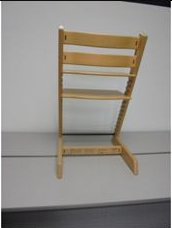
【Summary of the Judgment】
1. Standard for determining copyrightability of mass-produced utilitarian articles
Where the shapes and other features of all or part of a mass-produced utilitarian article can be perceived, conceptually and separately from the configuration derived from its function, as a creative expression of thoughts or sentiments, all or part of that mass-produced utilitarian article falls within the artistic domain among the works referred to in Article 2(1)(i) of the Copyright Act.
2. Copyrightability of the plaintiff’s products
The chair in question is a mass-produced utilitarian article. Its having two legs rising from the floor in an approximately L-shaped form at an angle of approximately 66 degrees, with a seat board and footrest board fixed between the two legs parallel to the floor, is merely a circumstance supporting the proposition that the shape resulting from the arrangement of the legs, seat board, and footrest board, which are configurations derived from the function as a children’s chair, gives rise to an aesthetic impression. The shapes and other features of all or part of the chair can only be perceived as configurations derived from its function as a children’s chair and cannot be perceived, separately from those configurations, as a creative expression of thoughts or sentiments. Accordingly, the chair cannot be said to constitute a work.
【Comments】
1. Regarding point 1 of the summary of the judgment
In recent years, concerning the standard for determining copyrightability of so-called applied art, Intellectual Property High Court precedents have seen the coexistence of the separability theory (Intellectual Property High Court judgment of August 28, 2014, Hanrei Jiho No. 2238, p. 91 [Fashion Show case]) and the unrestricted theory (Intellectual Property High Court judgment of April 14, 2015, Hanrei Jiho No. 2267, p. 91 [TRIPP TRAPP II case]), both differing from the theory imposing heightened requirements based on a staged approach found in many earlier lower-court precedents. Subsequently, the separability theory became predominant in many lower-court precedents, particularly those of the Tokyo District Court. There was also an Intellectual Property High Court precedent understood as adopting the separability theory as a question of whether the subject matter was “a creative expression of thoughts or sentiments” under the first part of Article 2(1)(i) of the Copyright Act (Intellectual Property High Court judgment of December 8, 2021, 2021 (Ne) 10044, Courts website [Octopus Slide case]). However, the judgment below (Intellectual Property High Court judgment of September 25, 2024, 2023 (Ne) 10111, Courts website [TRIPP TRAPP III case]), like another Intellectual Property High Court precedent (Intellectual Property High Court judgment of June 29, 2021, 2021 (Ne) 10024, Courts website [Good Core case]), was understood as adopting the separability theory as a question of whether the subject matter “falls within the … artistic … domain” under the latter part of that item, while using whether it “is an independent object of aesthetic appreciation” as the standard for separability. The judgment below also stated a separate standard that did not address separability but asked whether the purpose of creation was “exclusively for aesthetic appreciation.”
In contrast, point 1 of the summary is understood, regarding the standard for determining copyrightability of mass-produced utilitarian articles, as adopting only the separability theory as a question of whether the subject matter “falls within the … artistic … domain” under the latter part of Article 2(1)(i) of the Copyright Act, without adopting a standard asking whether the purpose of creation was “exclusively for aesthetic appreciation.” Furthermore, it is understood as using whether the subject matter “can be perceived … conceptually and separately from the configuration derived from its function,” rather than whether it “is an independent object of aesthetic appreciation,” as the standard for separability.
These features of point 1 of the summary may be better understood through Justice Akira Ojima’s supplementary opinion, which states that “the opinion of the Court … determined whether, with respect to mass-produced utilitarian articles, their shapes and other features, for which design registration can be obtained, also separately constitute works falling within the artistic domain”; that “the opinion of the Court also indicates a standard delineating the respective areas of application of the Copyright Act and the Design Act to mass-produced utilitarian articles, taking into account their respective subject matter, purposes of protection, requirements and procedures for protection, content of rights and their duration, and other matters, from the perspective of what subject matter our intellectual property legal system has legislatively chosen to protect and how”; and that “the opinion of the Court … does not use the term ‘aesthetic appreciation.’ The intention is that … the term ‘aesthetic appreciation’ may give rise to the mistaken impression that a high degree of creativity or artistry is necessary, and, in the first place, it appears inappropriate for a court to determine whether something merits appreciation as aesthetic art.”
2. Regarding point 2 of the summary of the judgment
Point 2 of the summary applies the standard for copyrightability of mass-produced utilitarian articles in point 1 to the plaintiff’s products and denies their copyrightability. In this respect, as Justice Akira Ojima’s supplementary opinion states, “the … requirement stated in the opinion of the Court is also highly abstract, but, just as the opinion of the Court applies it to the chair in this case, accumulation of various cases will be expected in the future concerning the concrete application of that requirement.”
【Excerpts from the Judgment】
1. Standard for determining copyrightability of mass-produced utilitarian articles
“With regard to mass-produced utilitarian articles, it is inappropriate to adopt an interpretation under which, if their shapes and other features can be said to be creative expressions of thoughts or sentiments, they immediately constitute works as falling within the artistic domain.” “That is, … in light of the requirements for creation of rights, their content and duration, and other matters under Japan’s Design Act and Copyright Act, if the above interpretation were adopted and broad protection under the Copyright Act in addition to the Design Act were recognized for the shapes and other features of mass-produced utilitarian articles, protection for a longer period and over a broader scope might be obtainable under the former Act without deliberately incurring costs and obtaining design registration, potentially undermining the significance of the Design Act’s existence. Furthermore, if copyright protection broadly extended to the shapes and other features of mass-produced utilitarian articles, authors’ moral rights could complicate legal relationships and impede use of such articles, or those shapes and other features could remain unavailable for free use for a long period even after expiry of the design right, potentially obstructing the above purpose of the Design Act of contributing to industrial development.”
“Nevertheless, the shapes and other features of mass-produced utilitarian articles are ordinarily determined subject to certain constraints in relation to the functions necessary for their practical purpose (hereinafter simply ‘functions’) and cannot be perceived separately from configurations derived from those functions. Among them, however, are articles, for example those with decoration exceeding the level of mere patterns or surface treatment added to their surfaces, in which the shapes and other features of the added portions are unrelated to function and can conceptually be perceived as paintings or sculptures separate from the function-derived configurations. Such articles may be described as mass-produced utilitarian articles to which ‘artistic works’ (Article 10(1)(iv) of the Copyright Act) have simply been added, and it is natural that protection under that Act extends to those added portions.
Among mass-produced utilitarian articles are also those, for example articles that can be perceived as sculptures or the like as a whole, in which the shapes and other features of all or part of the article, although related to its function as a utilitarian article, can conceptually be perceived as sculptures or the like separate from the configurations derived from its function. Such shapes and other features can be said to be the same as the aforementioned case of an ‘artistic work’ simply being added, in that a creative expression of thoughts or sentiments can be perceived separately from the function-derived configuration, and it is therefore appropriate to extend copyright protection to them. Shapes and other features of the foregoing kind can be described as exceptional among the shapes and other features of mass-produced utilitarian articles, which are ordinarily subject to certain functional constraints, and the risk that extending copyright protection to them would produce the harmful effects discussed above is small.
On the foregoing basis, where the shapes and other features of all or part of a mass-produced utilitarian article can be perceived, conceptually and separately from the configuration derived from its function, as a creative expression of thoughts or sentiments, all or part of that mass-produced utilitarian article should be held to fall within the artistic domain among the works referred to in Article 2(1)(i) of the Copyright Act.”
2. Copyrightability of the plaintiff’s products
“Applying this to the present case, according to the facts described above, the chair is a mass-produced utilitarian article, and the appellants argue, in substance, that the chair constitutes a work because creativity is recognized in its having two legs rising from the floor in an approximately L-shaped form at an angle of approximately 66 degrees, with a seat board and footrest board fixed between those two legs parallel to the floor. However, this is merely a circumstance supporting the proposition that the shape resulting from the arrangement of the legs, seat board, and footrest board, which are configurations derived from the function as a children’s chair, gives rise to an aesthetic impression. The shapes and other features of all or part of the chair can only be perceived as configurations derived from its function as a children’s chair and cannot be perceived, separately from those configurations, as a creative expression of thoughts or sentiments. Accordingly, the chair cannot be said to constitute a work.”
【Keywords】 Copyrightability of product configurations, copyrightability of applied art, TRIPP TRAPP, Torippu Torappu, Choice Kids
【Design】 Osaka District Court, 2023 (Wa) 10125, “Container for a Liquid Soap Dispenser” case <Presiding Judge Matsuami>
Source article: Nakamura & Partners
Publication date: May 21, 2026
Judgment date: March 17, 2025 Judgment
1. Identification of the “essential part”
The container’s shape (a rectangle with rounded corners) and the configuration of the lid: Because these previously existed, they are not regarded as special innovations (essential parts).
As to the magnet on the rear, because the product is used attached to a wall, consumers (purchasers) focus on the rear out of concern over whether it “attaches firmly to the wall.”
⇒ The “specific shape of the rear (wall-mounting surface)” is the most important part of the design (essential part).
2. Comparison of the registered design and the defendant’s products
Registered design: A large, simple, uncluttered rectangular magnet covering the entire rear.
Defendant’s products: “Anti-slip sheets” are arranged above and below the magnet, creating a complex “I-shaped” form as a whole.
⇒ Dissimilar
3. “Utilization relationship” also denied
Because the characteristics (essential part) of the designs themselves were held different, it cannot be said that another person’s design is being used as a base.
https://www.courts.go.jp/assets/hanrei/hanrei-pdf-93970.pdf
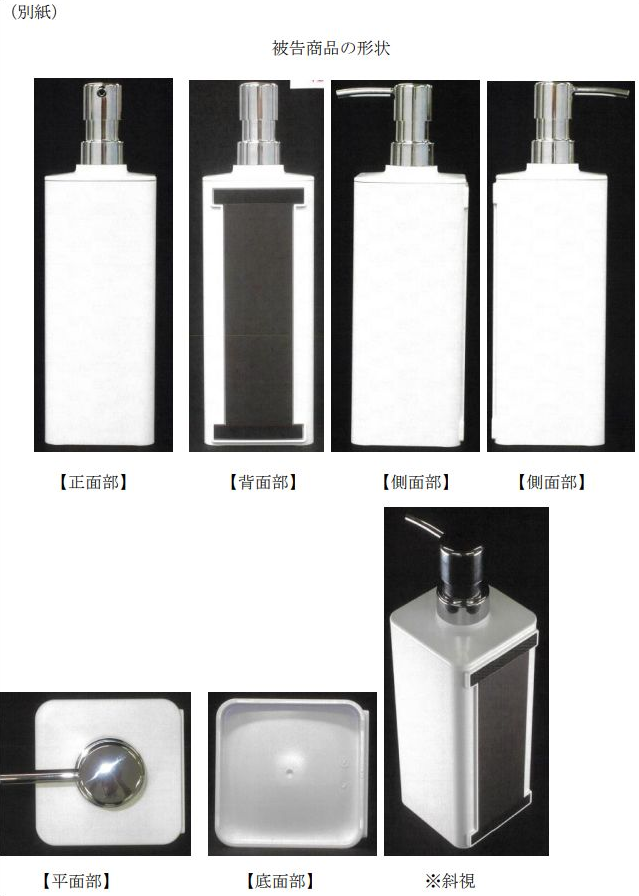
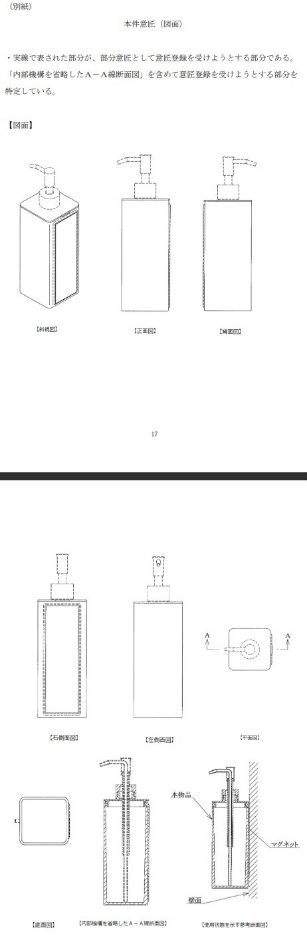
Figure: The defendant’s container, showing front, rear, left and right side views, top and bottom views, and a perspective view; registered-design drawings are shown alongside.
【Copyright】 Tokyo District Court, 2023 (Wa) 70125 <Presiding Judge Takahashi>
Source article: Nakamura & Partners
Publication date: May 21, 2026
Judgment date: March 11, 2025 Judgment
The act of using YouTube notification forms to give notices of copyright infringement, privacy infringement, and defamation concerning uploaded videos was held not to constitute a tort interfering with expressive activities.
1. Google carefully reviews requests for removal based on infringement, and there are instances in which it seeks additional information or rejects requests; removal is therefore not “unconditional.”
The notices in this case complained of infringement of publicity or portrait rights and described corresponding facts (unauthorized use of names and facial photographs). Even if a copyright form was used because a suitable form could not be found, this cannot immediately be said to be unlawful.
2. Under Google’s terms (Community Guidelines), measures such as removal may be taken at its own discretion against videos that a person “finds uncomfortable” or that “harm [the person’s] reputation,” even if the legal requirements for “privacy infringement” or “defamation” are not met.
3. Because the notices had corresponding factual grounds (display of a name, wording calling the person a fraudster, etc.), they cannot be said to have been deliberately based on false facts, and they were not found to have been abused exclusively for an improper purpose (harassment, etc.).
https://jucc.sakura.ne.jp/precedent/precedent-2025-03-11.html
On appeal, the Intellectual Property High Court upheld the judgment and dismissed the appeal on October 16, 2025 (2025 (Ne) 10037). Judgment
【Unfair Competition Prevention Act / Non-Compete】 Osaka District Court, 2023 (Wa) 9115 <Presiding Judge Matsuami>
Source article: Nakamura & Partners
Publication date: May 21, 2026
Judgment date: January 27, 2025 Judgment
* The geographic scope of the non-compete provision was too broad and therefore invalid.
⇒ No restrictive interpretation, from the perspective of its chilling effect.
(Only a very small amount of damages was awarded for preparatory acts during employment as a breach of an ancillary duty under the employment contract.)
(Summary of the holding)
The non-compete provision prohibits operating a competing business “within a radius of 2 kilometers from this corporation,” without the plaintiff’s permission, during employment and for six months after resignation.
The plaintiff has approximately ten establishments in addition to its head-office location in its welfare business division alone, and “within a radius of 2 kilometers from this corporation” must be interpreted as prohibiting opening a business within a radius of two kilometers measured from all those establishments (the plaintiff’s assertion is also understood in that way).
However, given a business of the plaintiff’s kind, it may be reasonable to prohibit post-employment competition for a certain period within a certain distance of an establishment in which the employee was actually involved, but the non-compete provision, which includes establishments with which the employee had no involvement at all, excessively restricts freedom of occupational choice and should be held invalid as contrary to public order and morality (and, in light of the chilling effect of such a provision, it also cannot be regarded as valid within a limited scope through a restrictive interpretation).
It cannot be said that compensatory measures sufficient to justify such a broad prohibition on competition had been taken.
(The actual distance to the defendants’ establishment was not made a premise of the determination, and no specific distance was found.)
https://www.courts.go.jp/assets/hanrei/hanrei-pdf-93798.pdf
【Contract】 Tokyo District Court, 2023 (Wa) 70680 【Method for Screening Inhibitors of Phosphorylation of Telomerase Reverse Transcriptase】 <Presiding Judge Nakashima>
Source article: Nakamura & Partners
Publication date: May 21, 2026
Judgment date: January 30, 2025 Judgment
The wording in the memorandum, “I pledge to make the maximum possible payment in the event of non-performance,” constituted an expression of intent to guarantee, and a joint and several guarantee agreement concerning the obligation to pay the lump sum in question was formed by defendant B personally.
(Excerpts from the judgment)
Because the subject of “I pledge to make the maximum possible payment in the event of non-performance” is “I, B” at the beginning of that sentence, a reasonable interpretation of the contracting parties’ intent is that defendant B personally was to make payment in the event of non-performance by the defendant company.
…
Its content is the very meaning of a guarantee: providing performance of the same content if the principal obligation is not performed, and it is merely a paraphrase of wording synonymous with a guarantee. Accordingly, the memorandum cannot be understood to have been prepared with an intention different from that of a guarantee.
…
Considering not only the meaning of the wording of the memorandum but also the circumstances and situation of its preparation and the parties’ conduct after preparation, it is appropriate to find that defendant B expressed, through the memorandum, an intention jointly and severally to guarantee the obligation to pay the lump sum and agreed with the plaintiff jointly and severally to guarantee that obligation.
…
From a substantive perspective as well, even assuming that C, the defendant company’s finance and contracts officer, bore the principal responsibility for this dispute, defendant B held the position of representative director of the defendant company. It would therefore not be particularly unnatural, in light of the circumstances at the time, for B, taking that position into account, to have provided a joint and several guarantee in response to the request of the plaintiff, who was also B’s senior in the community of medical researchers and had been compelled by non-payment of the lump sum to seek its payment from defendant B.
https://ipforce.jp/Hanketsu/jiken/no/14565
【Copyright】 Osaka District Court, 2023 (Wa) 11871, “Method of Diagnostic Imaging Based on Relativization through Comparison” <Presiding Judge Matsuami>
Source article: Nakamura & Partners
Publication date: May 21, 2026
Judgment date: February 17, 2025 Judgment
The plaintiff sought confirmation of copyright and other relief against the employer concerning a paper, flowcharts, screen layouts, and a diagnostic imaging system based on them that the plaintiff had created.
1. Regarding the paper, the plaintiff’s copyright and moral rights were recognized, with copyright registration (registration of the date of first publication) as one of the reasons.
2. Regarding the flowcharts and screen layouts, copyrightability was denied as they merely illustrated ideas using commonplace expression.
3. Regarding the system, even if it were a work, the author would be Hitachi Software, the system developer, or the defendant that commissioned it, and not the plaintiff.
The judgment, p. 12, identifies Hitachi Software or the defendant that commissioned it as the author, on the assumption that the system constitutes a copyright work.
https://ipforce.jp/Hanketsu/jiken/no/14584
【Unfair Competition Prevention Act / Trade Secrets】 Osaka District Court, 2023 (Wa) 5749 <Presiding Judge Takemiya>
Source article: Nakamura & Partners
Publication date: May 21, 2026
Judgment date: February 13, 2025 Judgment
The plaintiff alleged violations of the Unfair Competition Prevention Act and the duty of fidelity, claiming that former employees had improperly acquired and used customer information to conclude contracts at a competitor, but the allegations were not accepted.
— A password accessible to everyone within the company does not establish “secret management.” (As in numerous precedents.)
The court denied that the information qualified as a “trade secret” under the Unfair Competition Prevention Act (secret management).
The customer information was managed in the plaintiff’s core business system, but all approximately 1,708 employees could easily access it, including from personal devices, using a shared ID and password. No measures restricted viewing authority to specific persons, and general confidentiality provisions in the work rules alone were insufficient secrecy measures. The court held that the information was not in a state in which it could objectively be recognized as managed as secret.
As to breach of the duty of fidelity and the duty not to compete, although establishment of the defendant company and business activities during the individual defendant’s employment were regarded as problematic, causation with damage was denied.
For customers other than customer 6, the differences between the plaintiff’s expected amounts and the actual contract amounts ranged from approximately 7 million yen to slightly under 25 million yen. The difference for customer 6 was approximately 1.5 million yen. However, the plaintiff’s expected amount was already low, at 20 million yen, making a further reduction difficult; the prospect rating was “C” (a probability below 30% of confirmation that month), and no presentation had been made. The court therefore found no prospect that the plaintiff would have concluded that contract either.
The defendants’ ability to obtain the orders was merely the result of price competitiveness that enabled contracting at budgets substantially below the plaintiff’s; it was not recognized that the plaintiff would have obtained the orders without the defendants’ conduct.
Deletion of information from the system was also performed by the individual defendant, who was a branch manager, based on a determination that there was “no prospect of concluding a contract,” and was within the scope of business discretion, not an improper act of concealment.

IP Force intellectual property case reports
【Paper / European Patents】 Patent Protection for Food Use Inventions at the European Patent Office (Nobuhiro Tago, Patent, September 2025)
Source article: Nakamura & Partners
Publication date: May 15, 2026
1. Classification of use inventions at the EPO
The EPO operates by strictly distinguishing use inventions as “medical uses” and “non-medical uses.”
|
Claim type |
Category |
Legal basis |
Example wording |
|---|---|---|---|
|
First medical use |
Product claim |
EPC Article 54(4) |
A composition for use as a medicament |
|
Second medical use |
Product claim |
EPC Article 54(5) |
A composition for use in a method for the treatment of X |
|
Non-medical use |
Method claim |
Guidelines F–IV 4.16 |
Use of a composition for Y |
2. Boundary and criteria between medical and non-medical uses
Because functional foods are situated at the boundary between “prevention of disease (medical)” and “maintenance of health or improvement of physiological functions (non-medical),” that distinction is key to obtaining rights.
In determining whether a use is medical, whether an act by a medical practitioner is contemplated and whether a specific disease or symptom is targeted may serve as factors. These are not stated as necessary conditions common to every case; the determination depends on the specific circumstances of each case.
<Determinations in principal Board of Appeal cases>
T 815/22 (infant formula): The use of “promoting bodily growth so that it is comparable to bodily growth when breast-fed” was not recognized as a medical use (second medical use) in light of specific circumstances including the purpose of ordinary nutrition for healthy infants and a setting involving use by persons other than medical practitioners.
T 158/13 (perfume): The use of “providing relief from physiological and psychological states such as drowsiness, fatigue, and listlessness” inseparably included pathological characteristics (such as depression) and was therefore not recognized as a non-medical use even with a disclaimer of “non-therapeutic use.”
T 1916/19 (antimicrobial composition): Where embodiments such as removal of bacteria in healthy persons, in which the disease-prevention effect is negligibly small, are included, protection as a non-medical use may be recognized.
T 0815/22, Reasons 1.39, states that the assessment “depends on the specific circumstances of each case.” As discussed by Tago at pp. 64 and 67, the involvement of medical practitioners is one contextual factor, rather than the sole basis for a uniform rule.
3. Practical recommendations for obtaining rights for functional foods
In view of the EPO’s strict amendment requirements (the gold standard), it is necessary to provide descriptions from multiple perspectives at the filing stage.
In preparing the specification, clearly distinguishing and describing embodiments and examples of medical uses (specific diseases and patient groups) and non-medical uses (healthy persons and groups at low risk of disease) is extremely important for securing rights in both.
4. Enforcement in Germany
Use inventions granted at the EPO can become powerful rights in Germany and elsewhere.
In Germany, acts accompanied by “manifest preparation (sinnfällige Herrichtung),” such as product design premised on the patented use or attachment of instructions, constitute infringement.
(However, the strictness of labeling under the European Union’s “health claims regulation” must also be considered.)
https://jpaa-patent.info/patent/viewPdf/4694
【Trademark】 Tokyo District Court, 2022 (Wa) 11316, “Paku to Mogu” <Presiding Judge Kokubu>
Source article: Nakamura & Partners
Publication date: May 15, 2026
Judgment date: January 24, 2025 Judgment
Trademark in question: “パクとモグ”
Defendant’s sign 5: “パクモグ” — similar
Defendant’s sign 1: “PAKUMOGU” — dissimilar
Compared with the plaintiff’s trademark “パクとモグ,” the defendant’s sign “パクモグ” differs in the presence or absence of the middle “と,” but is similar in appearance and pronunciation and identical in concept.
⇒ Similar
For the sign in alphabetic notation, the court considered that its appearance differed markedly from the plaintiff’s trademark and actual trading circumstances, including the display of the defendant’s name on its webpages and elsewhere.
+ Even if “パクとモグ” were written in the alphabet with “と” omitted, that notation would not necessarily be “PAKUMOGU.”
⇒ Dissimilar
<Damages>
The number of unique users of the defendant’s website did not decrease after the sign “パクモグ” was removed from the defendant’s webpages.
⇒ Royalty rate of 1%
https://www.courts.go.jp/assets/hanrei/hanrei-pdf-93784.pdf
【Trademark (Violation of Public Order and Morality)】 Intellectual Property High Court, 2024 (Gyo-Ke) 10079 <Presiding Judge Honda>
Source article: Nakamura & Partners
Publication date: May 15, 2026
Judgment date: February 5, 2025 Judgment
Trademark “LEADER/リーダー”
The plaintiff (BROTURES Co., Ltd.) was formerly a distributor of the U.S. company Leader Bike, but after that company’s bankruptcy, acquired the trademark right from Honda Motor Co., Ltd. (Honda) and registered a divided transfer.
In response, the defendant, which succeeded to the business of the U.S. company Leader Bike, requested a trial for invalidation of the trademark registration.
The Japan Patent Office issued an invalidation decision on the ground that Article 4(1)(vii) of the Trademark Act (violation of public order and morality) applied.
⇒ Decision set aside (trademark valid)
(Summary of the holding)
Article 4(1)(vii) of the Trademark Act (violation of public order and morality) is a general provision that should apply only where the circumstances of trademark registration markedly lack social propriety and are contrary to the legal order.
In this case, the plaintiff acquired the “LEADER” trademark, to which neither the U.S. company Leader Bike nor the defendant held rights, from the lawful right holder, Honda Motor Co., Ltd. (Honda).
Because the contractual relationship between the plaintiff and the U.S. company Leader Bike had terminated on that company’s bankruptcy, the acquisition took place in a state in which no subsequent duties existed; the acquisition itself therefore cannot be said markedly to lack social propriety.
Even if the plaintiff described itself as the “exclusive distributor” and engaged in conduct causing confusion with the defendant’s products, that is a matter to be resolved through civil litigation under the Unfair Competition Prevention Act or other laws and does not constitute a ground for invalidating the trademark registration itself (violation of public order and morality).
https://iwanagalaw.livedoor.blog/archives/27042185.html

【Authors’ Moral Rights】 Osaka High Court, 2024 (Ne) 1431 <Presiding Judge Morisaki>
Source article: Nakamura & Partners
Publication date: May 15, 2026
Judgment date: February 27, 2025 Judgment
The first-instance plaintiff, who created the original draft (tenth draft) of a film screenplay, sought damages and other relief against the first-instance defendant, who participated as a co-screenwriter and added to and revised that screenplay (creating the twelfth draft), claiming unauthorized alteration and infringement of the right of integrity.
The first-instance court found infringement in part, but this court reversed and dismissed the claim.
(Summary of the holding)
The first-instance plaintiff consented to the first-instance defendant’s participation as a screenwriter and, during approximately two months in which the first-instance defendant independently performed additions and revisions, did not object and cooperated with research and other work.
⇒ It is appropriate to find that the first-instance plaintiff accepted the first-instance defendant’s changing the screenplay by adding that defendant’s own creation.
Because the first-instance defendant would display a name as a well-known screenwriter, creative additions and revisions were naturally foreseeable, and the first-instance plaintiff can be said to have understood this as well.
Authority to make the screenplay the “final draft” belonged to the production side, including the producer, not the first-instance defendant. Therefore, the first-instance defendant cannot be held legally responsible for the production side’s making it the final draft without the first-instance plaintiff’s express consent.
https://www.courts.go.jp/assets/hanrei/hanrei-pdf-93886.pdf
【Trademark】 Intellectual Property High Court, 2024 (Gyo-Ke) 10089, “VALENTINO” case <Presiding Judge Miyasaka>
Source article: Nakamura & Partners
Publication date: May 15, 2026
Judgment date: February 27, 2025 Judgment
⇒ Violation of Article 4(1)(xi) of the Trademark Act
Trademark in question: “GIANNI VALENTINO (and figure)” (Young Sangyo)
Cited trademark: “VALENTINO (and figure)”
(Summary of the holding)
The lettering “VALENTINO” and other such lettering were recognized as well known and famous among consumers of the designated goods as the brand of the renowned designer Valentino Garavani at the time of the registration examination.
The trademark in question is a composite mark consisting of the words “GIANNI” and “VALENTINO,” but the well-known and famous “VALENTINO” portion creates a strong and dominant impression as a source identifier, so it may be extracted as the essential portion for comparison.
In the cited mark as well, the word “VALENTINO” is displayed prominently in the center and can likewise be extracted as the essential portion.
⇒ Similar
https://ipforce.jp/Hanketsu/jiken/no/14563
【Trademark Act】 Intellectual Property High Court, 2024 (Gyo-Ke) 10090, “Pon-chan” case
Source article: Nakamura & Partners
Publication date: May 15, 2026
Judgment date: March 12, 2025 Judgment
“Fame” under Article 4(1)(vi) of the Trademark Act denied
— Tatebayashi City has a population of slightly under 80,000, compared with approximately 1.97 million for Gunma Prefecture as a whole
For the trademark “ぽんちゃん,” applied for by an individual, the Japan Patent Office refused registration on the ground that, in relation to Tatebayashi City, Gunma Prefecture’s mascot character “ぽんちゃん” (the cited sign), Article 4(1)(vi) of the Trademark Act (a famous sign indicating a non-profit undertaking in the public interest) applied.
⇒ Decision set aside
(Summary of the holding)
To qualify as “famous” under Article 4(1)(vi) of the Trademark Act, recognition throughout Japan is not necessarily required in light of the regional nature of the organization or undertaking, but broad recognition across a “geographic area of an appropriate scale” is nevertheless necessary.
The Nichinan City Emblem judgment (Intellectual Property High Court, October 30, 2012, 2012 (Gyo-Ke) 10125) required broad recognition among traders and consumers across at least one trading area for the designated goods or services. The JPC judgment (Intellectual Property High Court, February 4, 2025, 2024 (Gyo-Ke) 10060) interpreted “famous” in item (vi) as having the same meaning as “well known among consumers” in item (x). The Pon-chan judgment assessed recognition across a geographic area of an appropriate scale in light of the regional character of the organization or undertaking.
The cited sign “ぽんちゃん” was recognized as widely known within Tatebayashi City through manholes, installations, and other uses.
However, outward-facing use beyond the city was limited and sporadic, social media followers numbered only in the thousands, and past media exposure (commercials, etc.) was temporary, so broad recognition in Gunma Prefecture and the surrounding region could not be recognized.
⇒ Does not qualify as “famous.”
Nichinan City Emblem, judgment p. 7 / JPC, judgment p. 9
https://note.com/shuwa_ip/n/nb9518317a838
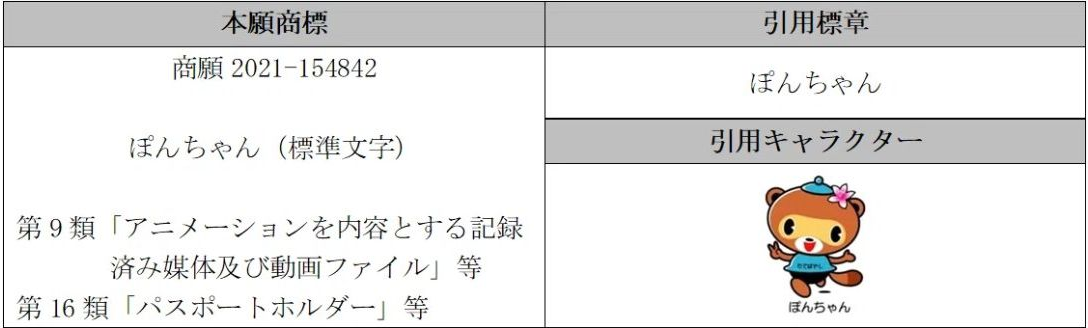
Figure: Left — application 2021-15842 for “ぽんちゃん” (Pon-chan), in standard characters; Class 9 includes recorded media and video files containing animation, and Class 16 includes passport holders. Right — the cited “ぽんちゃん” sign and the cited mascot character.
【Trademark】 Intellectual Property High Court, 2024 (Gyo-Ke) 10072 <Presiding Judge Nakadaira>
Source article: Nakamura & Partners
Judgment date: January 22, 2025 Judgment
The decision cancelling the registration for non-use was set aside.
Trademark concerned: “INTUITION”
The act of an employee of the plaintiff’s non-exclusive licensee sending a product ledger and presentation materials by email to a trading partner during the period requiring proof was recognized as “use of the trademark.”
The defendant asserted, “These are continuous strings of letters and not use of ‘INTUITION’ alone,” but “INTUITION” appeared on a separate line and in larger letters than the other wording (WILL JP, etc.), and consumers would recognize “INTUITION” as the product name (brand name) and “WILL JP,” etc., as its model number or type.
https://www.courts.go.jp/assets/hanrei/hanrei-pdf-93769.pdf
【Copyright】 Intellectual Property High Court, 2024 (Ne) 10065 <Presiding Judge Miyasaka>
Source article: Nakamura & Partners
Judgment date: January 30, 2025 Judgment
The appellant asserted that mosaic processing and other measures made perception of the content impossible, but the mosaic was coarse, and even the portions with overlaid illustrations allowed perception of essential expressive features, such as the subject’s upper body and hair, angle, and lighting. Infringement of the reproduction right and right of integrity therefore could not be avoided.
Regarding the right of attribution, Article 19(2) of the Copyright Act is a provision for users’ convenience, but, at least where unauthorized alteration has been made as in this case, the premise for applying that paragraph is absent.
An injunction is necessary
— In light of the manner of infringement and the history between the parties, the appellant’s deliberate continued retention of the photograph data supports a risk of renewed infringement.
The fact that other persons can obtain the data is not a reason to deny the risk of infringement by the appellant.
https://ipforce.jp/Hanketsu/jiken/no/14539
【Trademark】 Intellectual Property High Court, 2024 (Gyo-Ke) 10048 <Presiding Judge Hibiku Shimizu>
Source article: Nakamura & Partners
Judgment date: January 30, 2025 Judgment
* Distinctiveness of the three-dimensional trademark denied
<Distinctiveness (Article 3(1)(iii) of the Trademark Act)>
The shape of the applied-for trademark (a flattened, substantially circular cylinder, a disk on the bottom, a hole with a gear-like pattern, grooves on the side, etc.) is objectively recognized as adopted to serve the product’s functions (attachment to the body, needle insertion, ventilation, etc.) or aesthetics.
Even if there are characteristic parts not found in other companies’ products, they remain within the range foreseeable as choices for functional or aesthetic reasons in products of the same kind, and the shape, being represented in a commonly used manner, does not distinguish the applicant’s goods from others’.
<Applicability of Article 3(2) of the Trademark Act>
The plaintiff’s product has substantial sales volume and revenue, but its market share is not overwhelming and is declining, and it is always displayed together with the word mark “FreeStyle リブレ” in advertisements and elsewhere, so the shape itself is not recognized as independently creating a strong impression on consumers.
The questionnaire survey submitted by the plaintiff is problematic because its respondents were limited to persons with experience purchasing or providing guidance on CGM (continuous glucose monitors), and it does not reflect general recognition including potential consumers. Taking both the unaided and aided recall results into account, the court found that the shape itself had not acquired independent distinctiveness through use.
https://www.courts.go.jp/assets/hanrei/hanrei-pdf-94002.pdf
Figure: The three-dimensional trademark applied for, depicting the continuous glucose monitor.
【Unfair Competition Prevention Act / Circulation or Communication of False Facts】 Osaka High Court, 2024 (Ne) 338 <Presiding Judge Morisaki>
Source article: Nakamura & Partners
Judgment date: January 30, 2025 Judgment
The appellant, holding exclusive distribution rights for shogi competitions (the Osho and Ginga tournaments), made takedown requests and other requests alleging copyright infringement against the appellee’s videos, which reproduced the tournaments’ real-time moves (game-record information) on a board for distribution.
The appellee’s video distribution was held to constitute a tort. Before deciding whether the game records were copyrightable, the court examined the infringement of business interests through the use of information obtained from the paid distribution.
Organizers such as the Japan Shogi Association use a business model in which, for shogi competitions that do not generate admission-fee revenue, operating costs are covered by consideration for licensing broadcast and distribution rights, and the appellant acquired distribution rights at considerable expense.
⇒ The appellee’s video distribution provided viewers free of charge with real-time game-record information obtained from the appellant’s paid distribution, reducing the number of fans who paid to receive distribution from the appellant and causing direct damage to the appellant.
The appellee, while understanding that business model, used real-time game-record information at only the cost borne by an individual viewer to earn revenue and obstructed the appellant’s revenue structure. In circumstances where other video distributors were devising ways to compete within the rules, this was unlawful conduct exceeding the scope of free competition and infringing the appellant’s business interests, and constituted a tort.
Because the appellee’s distribution conduct constituted a tort, the benefits derived from that business were not legally protected interests.
Even assuming that copyrightability of the game records were denied, videos causing damage to third parties could be subject to removal under the platform’s terms of use; in relation to the appellee, who was a tortfeasor, therefore, the takedown requests in question could not be said to have been improper.
https://www.courts.go.jp/assets/hanrei/hanrei-pdf-93782.pdf
【Trademark】 Intellectual Property High Court, 2024 (Gyo-Ke) 10067, “MYOFOCUS” = 2024 (Gyo-Ke) 10068
Source article: Nakamura & Partners
Judgment date: January 16, 2025 Judgment 1 / Judgment 2
The defendant’s (an Australian corporation’s) trademark was misappropriated.
⇒ Violation of public order and morality (Article 4(1)(vii) of the Trademark Act)
The defendant used “MYOFOCUS” and other trademarks in Australia and also held seminars in Japan.
On September 27, 2019, the day after the defendant’s first seminar in Japan ended, the plaintiff applied in Japan for trademarks closely resembling the defendant’s marks. Registration followed on July 7, 2021. By a letter dated October 27, 2021, the plaintiff then demanded that the defendant cease use.
The marks closely resembled one another down to details, including the features of the figure and the mixed uppercase/lowercase arrangement (mYofocUs); the resemblance could not be regarded as coincidental.
The revenue stamp affixed to the designer’s receipt dated November 24, 2015, submitted by the plaintiff, bore a new design introduced in 2018. Considering this issue date, together with the circumstances in which the receipt was produced, the explanation concerning its reissuance and the failure to produce the original, the court assessed the credibility of the plaintiff’s assertions and evidence as low and did not find that the related plaintiff’s mark had been created in October 2015.
【Copyright】 Intellectual Property High Court, 2024 (Ne) 10017 <Presiding Judge Honda>
Source article: Nakamura & Partners
Judgment date: November 21, 2024 Judgment
The programs in question allow a range of choices in the specific description of the source code and reflect their creator’s individuality.
⇒ Copyrightability recognized
The court did not find that a program reproduced or modified from program 3 was used as the program for the first-instance defendant’s “Silent Robo” product.
As to the reproduction right and the right of integrity, the court found an implied agreement permitting reproduction and modification for use within the first-instance defendant’s business. Programs 3–5 were delivered with their source code. The defendant had previously reproduced and modified delivered programs for sites other than those that prompted the orders. The plaintiff, a former employee who continued to produce and deliver numerous programs after becoming independent, could have been aware of that practice.
For programs 1, 2 and 6, disclosure of source code at delivery was not established. Nevertheless, the specifications imposed no objective restriction on use at other sites, and the plaintiff had made no particular statement restricting reproduction or modification. Taking these circumstances together with the previous practice, the court found the same implied agreement.
For program 3, the creator’s name was displayed for approximately one second at startup, in circumstances in which customers could check it on site, so this constituted “presentation to the public,” and infringement of the right of attribution was established.
Source article: Nakamura & Partners
According to the article, the applied-for mark “ViCREA” (standard characters) and the cited figurative mark “BICREA” were held dissimilar.
The article reports that, although both marks are pronounced “Bikurea,” their appearances differ markedly and are clearly distinguishable, and neither conveys a specific concept.
Osaka District Court Orders, 2025 (Yo) 20008 and 20009 【Prostaglandin Derivatives for the Treatment of Abdominal Discomfort】
Source article: Nakamura & Partners
Order date: February 6, 2026 Judgment
<Issues>
Extension 1: Extension based on approval of the originator’s 24 μg formulation (expired)
Extension 2: Extension based on approval of the originator’s 12 μg formulation (in force)
The creditor asserted that the effect of the subsisting “extension registration based on the 12 μg approval” also extended to the generic “24 μg formulation” (the products being substantially identical).
The scope and units of extension registration (the scope divided into strips) and the scope of the effect of the patent right whose term has been extended (a scope having breadth that includes substantial identity) do not necessarily coincide, and the latter generally has greater breadth. However, only when the two are “interpreted and operated consistently and harmonized with one another can the purpose of the system, equity between the patent holder and third parties, be realized.”
The scope of effect “should be interpreted within the constraint that it not conflict with the scope and units of the registration of extension of duration.”
The court held: “Where extension registrations have been made for the same patent right relating to a pharmaceutical on the grounds of multiple dispositions specified by Cabinet Order, the scope of effect of the patent right subject to a later extension registration … should be interpreted, at least, as not extending to production, assignment, etc., of products identical in ingredients, quantity, administration, dosage, efficacy, and effects to the product covered by the disposition specified by Cabinet Order that formed the basis of the earlier extension registration, because such products are not substantially identical to the product covered by the disposition specified by Cabinet Order that formed the basis of the later extension registration.”
Furthermore, taking as a reference the product covered by the disposition specified by Cabinet Order that formed the basis of the later extension registration, (1) products with a quantitative difference greater than the quantitative difference from the product covered by the earlier disposition (for example, a larger difference in quantity), and (2) products having both the same quantitative difference as the product covered by the earlier disposition and a further qualitative difference (for example, a certain difference in ingredients in addition to the same difference in quantity), are more remote as products and likewise cannot be regarded as substantially identical.
If the creditor’s position were accepted, where the earlier extended duration was shorter, third-party working of its subject product would be prohibited for a period longer than that regulated by the extension system, “greatly undermining the purpose of the patent term extension system, which divides the scope and units at the extension-registration application stage into strips according to ingredients, quantity, administration, dosage, efficacy, and effects, and seeks finely to adjust equity between the patent holder and third parties within those scopes and units.”
https://www.courts.go.jp/assets/hanrei/hanrei-pdf-95654.pdf
Source article: Nakamura & Partners
According to the article, the applied-for mark “百香” (standard characters) and the cited mark “MOMOCA” were held dissimilar.
The article reports that, in Roman-letter spelling, the sound “カ” is spelled “ka,” the appearances are distinguishable, and there is no risk of confusion in concept.
Author’s comment: The original article raises the question whether representing “カ” with “CA” makes dissimilarity more likely and registration easier to obtain.
Osaka High Court, 2025 (Ne) 1750 【Koi Ichigo】
<Presiding Judge Morisaki>
Source article: Nakamura & Partners
Judgment date: February 13, 2026 Judgment
(First instance: Osaka District Court, 2024 (Wa) 5007)
* Dissimilar (reversal)
Trademark in question: “恋 苺”
Defendant’s sign: “あわ恋いちご”
<Separate observation denied (unlike the first instance)>
The trademark holder’s assertion that “awa” means the place name “Awa” and therefore has no source-identifying function, making “koi ichigo” the essential portion, was not accepted.
<Appearance>
The trademark in question is written vertically in kanji, whereas the defendant’s sign is written horizontally in a POP-style typeface in hiragana except for “恋”; they are clearly different.
<Pronunciation>
The pronunciations are “Koi Ichigo” and “Awa Koi Ichigo,” and differ in the number of characters and are not similar.
<Concept>
“Love” and “faint love” evoke different concepts and are not similar.
(Excerpts from the judgment)
Even if the lettering “あわ” evokes the place name “阿波” because the defendant’s sign is affixed to packaging of the above design, in the actual trading circumstances in which that packaging is used for each of the defendant’s products accompanied by strawberries, the defendant’s sign is understood, on the premise that it is a composite mark combining “あわ恋” and “いちご,” merely as making a play on the geographic name “阿波,” the origin of the defendant’s products, in the “あわ” lettering of “あわ恋.” Accordingly, when determining similarity between the defendant’s sign and the trademark in question, it is impermissible to observe the defendant’s sign separately as “あわ” and “恋いちご” … . …
Whereas the trademark in question is written vertically in kanji, the defendant’s sign is written in hiragana except for “恋,” using slightly rounded POP-style lettering arranged at equal intervals in a slightly curved, single continuous horizontal line, and is clearly different in appearance. Moreover, the trademark in question produces the pronunciation “Koi Ichigo,” whereas the defendant’s sign produces “Awa Koi Ichigo”; although they overlap in part, the number of characters differs, and the pronunciations cannot be said to be similar. Both are words coined by combining the fruit name ichigo with a word describing a psychological or emotional state that does not ordinarily express taste, to express the fruit’s taste. However, because “love” and “faint love” evoke different concepts, the concepts resulting from combining each with ichigo likewise cannot be said to be similar. Accordingly, the trademark in question and the defendant’s sign cannot be said to be similar as a whole.
https://www.courts.go.jp/assets/hanrei/hanrei-pdf-95619.pdf


Figures: The defendant’s product packaging and the registered “恋 苺” (Koi Ichigo) mark.
【Trademark】 Osaka District Court, 2024 (Wa) 5007, “Awa Koi Ichigo” <Presiding Judge Matsukawa>
Source article: Nakamura & Partners
Judgment date: July 17, 2025 Judgment
Trademark in question: “恋 苺”
Defendant’s sign: “あわ恋いちご”
① Determination of similarity of composite trademarks (permissibility of separate observation and identification of the essential portion)
The “あわ” portion of the defendant’s sign “あわ恋いちご” has multiple meanings, such as “泡, 粟, 安房, 阿波,” but the packaging of each defendant product prominently displays the words “Produced in Tokushima Prefecture,” illustrations of the Awa dance, and other indications.
In light of these actual trading circumstances, consumers recognize “あわ” as the regional name “阿波” and take it as an indication of origin, so that portion has no distinctiveness.
⇒ It is permissible to extract “恋いちご” from the defendant’s sign and compare it with the trademark “恋苺.”
② Similarity of the trademark in question and the defendant’s sign
Comparing the separated “恋いちご” portion of the defendant’s sign with the trademark “恋苺,” although they differ in appearance, both have the identical pronunciation “Koi Ichigo.”
In concept as well, both are coined expressions combining “love” and “strawberry” and give rise to the same concept of a strawberry that attracts strongly, like romantic love.
The defendant asserted that “あわ恋” means “faint love” and is indivisible, but this was rejected on the facts.
⇒ Similar, with a risk of mistaken identification or confusion
③ Defense of use of a registered trademark
The court held that use of a sign similar to a prior registered trademark in a manner causing mistaken identification or confusion among consumers constitutes an abuse of rights in light of the purpose and intent of the Trademark Act, even if it is use of a registered trademark, and does not establish a defense.
Cf. Reversed on appeal by the Osaka High Court on February 13, 2026 (2025 (Ne) No. 1750).
https://www.courts.go.jp/assets/hanrei/hanrei-pdf-94495.pdf
Tokyo District Court, 2019 (Wa) 32779 【Clothing】 <Presiding Judge Kokubu>
Source article: Nakamura & Partners
Judgment date: April 26, 2024 Judgment
1. Satisfaction of the claim limitations
From the wording of the claims, the “lifeline passage” need only have one end joined to the back side of the garment fabric and be formed in a tubular shape; the manner of joining (cylindrical, at an edge, etc.) is not further limited.
⇒ Satisfied
2. Validity (inventive step)
In the sample in question, one end of the lifeline passage is joined to the “front side” of the garment fabric, whereas in the invention it is joined to the “back side.”
⇒ The invention concerns clothing for a special use addressing prevention of air leakage and other problems, and there is no motivation to apply technology for pockets and the like in ordinary garments.
⇒ Inventive step recognized
https://www.courts.go.jp/assets/hanrei/hanrei-pdf-94061.pdf
Intellectual Property High Court, 2023 (Gyo-Ke) 10062 【Bone Anchor with Improved Fixation Strength】 <Presiding Judge Shoji>
Source article: Nakamura & Partners
Judgment date: May 14, 2024 Judgment
The “outer surface of the anchor body” in the applied-for invention refers not to the uneven surface itself formed by multiple channels and ribs but to the outer perimeter (circumference) joining the rib tips.
⇒ Likewise, in the cited invention, if the outer perimeter joining the tips of the bone-engaging surface portions (corresponding to ribs) is regarded as the outer surface, the “portions between the bone-engaging surface portions” correspond to “channels” formed within the outer surface, and the “bone-engaging surface portions” defined thereby correspond to “ribs.”
The applied-for invention has a configuration in which the channel “intersects” an eyelet (a hole through which a suture passes) in a T shape.
Providing a suture anchor with a through-hole (eyelet) for passing a suture was well-known technology before the application’s priority date.
⇒ Providing a well-known “eyelet” in place of the cited invention’s “continuous groove” could readily have been conceived by a person skilled in the art. In doing so, placing the eyelet at a position communicating with the channel (suture-receiving groove) (a position intersecting in a T shape), within a range that does not impair structural integrity, is merely a design matter that a person skilled in the art could appropriately adopt.
In Exhibit Ko 1, the recess accommodating the knot in the cited invention is described only as a “preferred” configuration, not an indispensable one.
⇒ Inventive step denied
https://www.courts.go.jp/assets/hanrei/hanrei-pdf-93044.pdf
Intellectual Property High Court, 2023 (Gyo-Ke) 10092 【Bag Processing Machine】 <Presiding Judge Honda>
Source article: Nakamura & Partners
Judgment date: May 9, 2024 Judgment
* Violation of the expanded prior-application rule (Article 29-2)
1. Identification of the earlier-filed invention
From the description in the earlier application’s specification (paragraph 0046, Figure 3, etc.), it can be understood that the filling-process time T2 is twice the other-process time T1 and that filling and closing of two groups take place during that time.
2. Difference 1 (adjustment of transport speed)
Whereas the invention adjusts speed through current to electromagnets, the earlier-filed invention uses electromagnetic coils for control.
⇒ The earlier specification describes arbitrary setting of speed through linear transport, and using electromagnetic coils as electromagnets and adjusting speed through current are naturally presupposed in the earlier-filed invention.
3. Difference 2 (stock function)
In the invention, processed bags are “stocked” upstream of the downstream device.
⇒ “Stock” means having the bags wait upstream so that the downstream device can immediately begin the next process.
⇒ In the earlier-filed invention as well, the second group waits upstream (in the third filling region) during sealing of the first group and can move to the sealing process immediately after completion, and this constitutes “stock.”
https://ipforce.jp/Hanketsu/jiken/no/14334
Legal Update (Items Posted in June 2026)
Scope: Articles published in June 2026 by attorney Hideki Takaishi (Nakamura & Partners)
Number of entries included: 32 (30 distinct titles; two titles are each posted at two different URLs)
List page: https://www.nakapat.gr.jp/ja/legal_updates_jp/
Selection: Entries whose publication date on the list page is in June 2026, in descending order of publication date; entries published on the same date retain their list order.
<Highlights of This Month> Key Points in the June 2026 Intellectual Property and Legal Affairs Update
The June 2026 Legal Update contains articles on patent disclosure requirements and inventive step, overseas filing, U.S. designs, protection of intellectual property in virtual space, trade secrets, and litigation procedure. This issue includes all 32 entries based on the publication dates on the list page. Two pairs with identical titles are retained as articles with separate URLs. The following addresses the specific issues and practical points presented in the original articles.
1. Obviousness and Infringement Analysis for U.S. Designs
“New Standards for Determining Obviousness of U.S. Design Patents” (佐々木眞人) addresses the abolition of the Rosen-Durling test by the 2024 LKQ en banc judgment. The framework examines not only the relationship with the primary reference but also the ordinary designer’s viewpoint, differences, and secondary considerations. In contrast, “Changes in the Methods for Determining Design Right Infringement in the United States” (the same author) explains the ordinary observer test after the Egyptian Goddess en banc judgment. It is important to distinguish the person whose viewpoint is adopted and the role of prior designs in obviousness and infringement. Source 1 / Source 2
2. Reviewing Specifications by Distinguishing Clarity from Support
“Examination of Clarity Determinations in Recent Court Decisions” (岡田健太郎 et al.) states that clarity determinations cannot be said to have become stricter and introduces cases in which expressions of degree can be understood through common general technical knowledge. In contrast, 2024 (Ne) No. 10038 [Brake Control Device and Behavior Analysis Device for a Motorcycle] <Presiding Judge Honda> refused to read angular velocity as angular acceleration in a specification consistently using the former, and found a support violation. Supplementing the meaning of a term must be distinguished from understanding a physically contradictory formula by correcting it. “The Support Requirement for Numerical Range Limitations in China” (胡春豊 and 林軍) presents the viewpoint of whether non-working ranges can be excluded without excessive effort, and policies for describing numerical ranges and examples. Source 1 / Source 2 / Source 3
3. Designing Conditions for Overseas Filing and International Licensing
“Differences Between the Japanese and European Patent Systems That Require Attention” (野村和弘 and フロリアン キューベック) organizes the number of independent claims, self-collision, amendments, and descriptions of measurement methods. “Points to Note When Filing Food-Use Inventions in Different Countries” shows the need to examine claim forms such as purpose-limited substances, non-therapeutic uses, methods, and Swiss-type claims according to national practice. In the introduction to “The UK InterDigital v. Lenovo Litigation over the Calculation of FRAND Rates” (小林和人), the process by which the Court of Appeal revised the rate to $0.225 per unit based on analysis of a comparable agreement is important. The High Court rate and Court of Appeal rate must not be confused, and conditions must be understood together with past royalties, the basis for discounts, and compound interest. Source 1 / Source 2 / Source 3
4. Protection in Virtual Space and Avoiding Trademark Confusion
“Protection of Goods and Other Subject Matter in Virtual Space under U.S. Design Law” by 山口洋一郎 and “A Consideration of Future Responses under Japanese Design Law to Design Protection in Virtual Space — In Light of International Trends” by 星野光秀 provide different viewpoints on registrable images and the effect of rights across physical and virtual spaces. The possibilities of protection should be read together with the issues arising from expansion of the system. In trademarks, the article by 星野 addresses specific identification of virtual goods and classification of services. 2025 (Gyo-Ke) No. 10111 “SORA” <Presiding Judge Moritomi> emphasized extraction of the word element and actual trading circumstances of beauty-related services. The article on the consent system also shows the need to explain distribution channels, consumers, and manner of use, in addition to the existence of a consent document. Source 1 / Source 2 / Source 3 / Source 4 / Source 5
5. Litigation Practice That Organizes Evidence and the Scope of Claims Early
“The Practice and Theory of Preservation of Evidence in Intellectual Property Cases and Related Matters” (高村隆司) addresses use of summary courts and the effects of refusing presentation, while “Patent Attorneys as Judicial Research Officials” (髙村和宗 and 岩永勇二) explains the importance of organizing grounds for cancellation and evidence in the first preparatory brief. In Tokyo District Court, 2024 (Wa) No. 4142 [Portable Information Communication Device and Personal Computer System Using the Portable Information Communication Device] <Presiding Judge Kokubu>, separately claiming as a remainder the amount equivalent to consumption tax that could have been asserted in the prior actions was held contrary to good faith. 2024 (Gyo-Ke) No. 10036 [Chip Detection Device] <Presiding Judge Honda> also denied an interest in cancelling the trial decision to grant a patent based on the last amendment. It is important not only to secure evidence but also to organize what is claimed and which amendment is ultimately chosen. Source 1 / Source 2 / Source 3 / Source 4
6. Business Protection through Trade Secrets and IP Mixes
“Infringement Risks Arising from the Use of Other Companies’ Trade Secrets Brought in by Employees Changing Jobs” (石本貴幸) proposes written pledges, training, consultation desks, and checking the process by which results were created. “Intellectual Property and Intangible Assets in the Food Industry” (藤原研二郎) and the Agriculture, Forestry, and Fisheries Committee’s article on IP mixes explain combinations of know-how, brands, plant breeders’ rights, and GIs through specific examples. “Use of AI in Patent Examination” (五十嵐康弘) further addresses use in summarization and translation with attention to access to primary information. These articles provide a perspective on managing information to be protected, technology to be disclosed, and information used in work according to their respective purposes. Source 1 / Source 2 / Source 3 / Source 4
Three-Line Summaries of All Articles
|
Category |
Article Title and Three-Line Summary |
|---|---|
|
IP in General |
① This introduces an article examining the choice of court, a prima facie showing of grounds for preservation of evidence, and the opposing party’s response in intellectual property cases. ② The introductory article recommends using summary courts based on the author’s experience of applications to summary courts and organizes the issues of refusing presentation and deeming allegations true. ③ It is necessary to consider the court and the content of the prima facie showing, while the opposing party should consider how refusal affects the evaluation of evidence in the litigation on the merits. |
|
Design |
① This introduces an article on the change in the test for obviousness of U.S. design patents following the LKQ en banc judgment. ② It explains that the Rosen-Durling test was abolished and replaced by a framework evaluating prior art, differences, the designer’s level of skill, and secondary considerations. ③ Obviousness should be examined not only through selection of the primary reference but also through the viewpoint of an ordinary designer and objective evidence such as commercial success. |
|
IP in General |
① This introduces an article on the infringement risks arising when a receiving company uses another company’s trade secrets brought in by employees changing jobs. ② It presents four defensive measures: written pledges on joining, employee training, internal consultation desks, and detection of unnatural inventions. ③ It is important to establish an internal system covering superiors and subordinates as well as the employee changing jobs, and to check how results produced immediately after joining were created. |
|
Patent |
① This introduces an article comparing recent court decisions and Patent Office trends on clarity, including expressions of degree. ② It explains that clarity determinations cannot be said to have become stricter and that understandability for a person skilled in the art tends to be evaluated from the specification and common general technical knowledge. ③ Explaining definitions, assessment indicators such as public standards, and the relationship between processes and structures in the specification helps prevent disputes. |
|
Patent |
2024 (Gyo-Ke) No. 10036 [Chip Detection Device] <Presiding Judge Honda> ① An applicant who obtained a trial decision to grant a patent based on its own later amendment sought cancellation in order to obtain a patent based on an earlier amendment. ② The court dismissed the action as inadmissible because the plaintiff had no interest in cancelling a trial decision that accepted its request based on the last amendment. ③ Because amendments during trial proceedings change the subject of examination, attention is required to whether an interest exists in challenging the subsequent trial decision to grant a patent in a cancellation action. |
|
Patent |
[Article / Patents] Use of AI in Patent Examination (五十嵐康弘, Patent, August 2025) ① This introduces an article testing the use of cloud and on-premises generative AI for practical patent examination tasks. ② It explains hallucination measures through limiting tasks to summarization and translation, and the need to incorporate patent-specific reasoning and vocabulary. ③ It is important to consider the scope of application suited to examination work while monitoring model updates and maintaining access to primary information. |
|
Patent |
① This introduces an article examining the support requirement for inventions combining numerical ranges in light of a judgment of the Supreme People’s Court of China. ② It emphasizes whether a skilled person can understand the relationships among ranges, obtain suitable embodiments with limited experiments, and exclude non-working ranges without excessive effort. ③ The specification should include guidance and examples for numerical ranges, while invalidity arguments require specific proof that effective ranges cannot be recognized with ordinary effort. |
|
Patent |
① This introduces an article addressing differences between the Japanese and European patent systems concerning claims, self-collision, amendments, and parameter inventions. ② It organizes points to note about Europe’s restrictions on independent claims, strict amendment requirements, disclosure of numerical ranges, and identification of measurement methods and standards. ③ When European expansion is planned, diverse numerical ranges and dependencies should be described from filing, and the timing of related applications and disclosure risks should be considered. |
|
Patent |
① This introduces an article on the calculation of FRAND rates in the UK InterDigital v. Lenovo litigation. ② It explains how the rate based on comparable agreements was revised from the High Court’s $0.175 per unit to the Court of Appeal’s $0.225, and the treatment of past periods and compound interest. ③ License terms should be considered with regard to selection and adjustment of comparable agreements, the basis for volume discounts, past implementation periods, and interest. |
|
Patent |
① This introduces an article examining the role of intellectual property and intangible assets in food industries from their industrial stages and the characteristics of flavor and skills. ② It explains the importance of manufacturing know-how, brand stories, and the passing down of skills in light of the history and regionality of food and the complexity of flavor. ③ It is important to combine not only exclusivity through patents but also know-how management and brand formation according to the business’s role. |
|
Design |
① This introduces an article examining article use and the scope of rights in the protection of goods and other subject matter in virtual space under U.S. design law. ② It discusses the treatment of limitations based on article use, image protection as part of a display, and enforcement between physical and virtual spaces. ③ In filing and enforcing designs for virtual goods, the relationship between displayed articles and their overall appearance should be considered. |
|
Design |
① This introduces an article comparing potential Japanese legal responses to design protection in virtual space with systems and discussions in Europe and the United States. ② It distinguishes expansion of image-design protection from the extension of rights in physical articles to virtual goods and examines the balance between industrial development and freedom of creation. ③ It is necessary to consider not only expansion of design law but also the allocation of roles with copyright and unfair competition prevention law and international harmonization. |
|
Trademark |
① This introduces an article on the Nice Classification and national practices concerning classification and identification of goods and services related to virtual space. ② It explains that virtual goods should be specifically identified and generally classified in Class 9, while the classification of services may change according to the purpose and result of provision. ③ Comprehensive descriptions such as virtual goods should be avoided, and designations should correspond to the content and the purpose of the services provided. |
|
Trademark |
① This introduces an article using model cases to examine preparation of agreements and written opinions under the trademark consent system. ② It explains that consent alone does not lead to registration and that likelihood of confusion must be examined in light of goods and services, distribution channels, consumers, and manner of use. ③ It is important to agree specifically on measures to avoid confusion and prove in written opinions the actual trading circumstances not fully covered in the agreement. |
|
Patent |
① The issues were correspondence between an amended heat-exchanger invention and the baffle cells of a cited invention, and motivation to combine. ② The court held that the baffle cells corresponded to solid walls and that separate walls meant functional distinction regardless of physical separation, and affirmed motivation based on the common technical field and the baffles serving as a means of solving the problem. ③ Correspondence with cited inventions should be examined not only by component names but also by their effects on fluid and functional distinctions. |
|
Patent |
① The issue was whether a brake-control formula satisfied the support requirement by interpreting angular velocity as an erroneous reference to angular acceleration. ② The court refused that reading where the specification consistently referred to angular velocity and found a support violation, holding that physical meaninglessness alone did not establish an error in the description. ③ Physical consistency of formulas and definitions of symbols should be checked at filing, and arguments of erroneous description should be assessed against the specification as a whole. |
|
Trademark |
[Trademarks / Similarity] 2025 (Gyo-Ke) No. 10111 “SORA” <Presiding Judge Moritomi> ① The issues were separate observation of the SORA trademark’s device and word elements and similarity of beauty-related services. ② The court extracted the SORA word element as dominant and found the marks similar, also finding the designated services similar in light of actual trading circumstances. ③ It is necessary to examine distinctiveness of the word element and the reality of combined service provision, rather than seeking to avoid conflict merely by adding a device. |
|
Trademark |
① This addresses protection of the well-known Jägermeister trademark and imitation of packaging, with the body introducing an Austrian Supreme Court decision. ② It examines association with a well-known mark, free riding on its reputation, and damage to reputation under both trademark law and unfair competition prevention law. ③ Adoption of packaging should be considered not only in terms of confusion but also association with the brand and use of its reputation. |
|
IP in General |
[Article / Customs] Customs Expert Advisers (磯貝克臣, Patent, November 2025) ① This introduces an article addressing the selection of customs expert advisers, conduct of proceedings, and preparation of written opinions. ② It explains how three expert advisers form their opinions through individual review, advance meetings, and a hearing, and how customs generally respects the majority opinion. ③ It is important to assemble supporting materials and reasoning through explanations and rebuttals at the hearing of opinions and responses to the expert advisers’ questions. |
|
IP in General |
① This introduces an article on the position and duties of judicial research officials who are patent attorneys and points to note in litigation practice. ② It describes their advance research, attendance at hearings, and preparation of reports, emphasizing early submission of cancellation grounds and reliability of experimental proof. ③ Arguments and evidence should be assembled in the plaintiff’s first preparatory brief, and responses should be prepared with attention to the intent of questions at technical explanation sessions. |
|
IP in General |
① This introduces an article examining the role of the prohibition of abuse of rights in intellectual property infringement through the Ricoh and Goldfish Telephone cases and others. ② It explains, as proposals of the article, solutions that separately adjust the availability of injunctions and disposal and payment equivalent to royalties. ③ In abuse-of-rights arguments, it is important to distinguish injunctions from monetary relief and examine their relationship with implementers’ benefits and freedom of expression and business. |
|
Patent |
① This introduces an article on unity and selection of the subject of examination for inventions expressed in alternatives, such as Markush form. ② It compares Japan’s treatment of the first alternative with U.S. and European practices and examines addition or assertion of a common special technical feature and amendment to an inclusive relationship. ③ Filing and amendment policies should consider the order of alternatives and common structures, as well as shift amendments and the burdens of divisional applications. |
|
IP in General |
① This introduces an article on IP mixes and brand formation in agriculture, forestry, and fisheries with overseas expansion in view. ② It explains combinations of trademarks, plant breeders’ rights, patents, and GIs through examples including Beni Madonna, Soratobu Pumpkin, Zentsuji-san Shikaku Suika, and Kobe Beef. ③ It is important to distinguish variety names from brand names and select which technologies to disclose and which cultivation techniques to manage as trade secrets. |
|
Design |
① This introduces an article examining court decisions on consideration for employee-created designs through differences from employee inventions. ② It explains the effect of design substitutability on excess sales and hypothetical royalty rates and the assessment of creators’ contributions. ③ It is necessary to examine alternative design choices and individual creative contributions instead of applying patent calculation examples unchanged. |
|
Patent |
① This introduces an article on systems and issues surrounding patent protection of biopharmaceuticals and biosimilar entry. ② It explains the effects on entry and choice of de facto patent linkage, re-examination periods, and the high-cost medical expense benefit system. ③ Entry conditions should be examined with regard to use and formulation patents and the approval system, rather than judged solely by expiration of a substance patent. |
|
Patent |
① This introduces an article on system differences in the United States, Europe, China, and South Korea concerning overseas protection of food-use inventions. ② It organizes permissible claim forms, U.S. inherency and laws of nature, and the European distinction between therapeutic and non-therapeutic uses. ③ Instead of translating Japanese claims unchanged, claim forms suited to the destination and distinctiveness of structures and methods should be considered. |
|
Design |
① This introduces an article examining court decisions on consideration for employee-created designs through differences from employee inventions. ② It explains the effect of design substitutability on excess sales and hypothetical royalty rates and the assessment of creators’ contributions. ③ It is necessary to examine alternative design choices and individual creative contributions instead of applying patent calculation examples unchanged. |
|
IP in General |
① This introduces an article on IP mixes and brand formation in agriculture, forestry, and fisheries with overseas expansion in view. ② It explains combinations of trademarks, plant breeders’ rights, patents, and GIs through examples including Beni Madonna, Soratobu Pumpkin, Zentsuji-san Shikaku Suika, and Kobe Beef. ③ It is important to distinguish variety names from brand names and select which technologies to disclose and which cultivation techniques to manage as trade secrets. |
|
Design |
① This introduces an article on changes in U.S. design infringement analysis from Gorham through Egyptian Goddess and thereafter. ② It explains that after abolition of the point of novelty test, overall ornamental impression is evaluated from the viewpoint of an ordinary observer familiar with prior designs. ③ Comparison with allegedly infringing products should include prior designs, functional aspects, and ornamental differences such as logos. |
|
Patent |
[United States] Focus Prod v. Kartri Sales (CAFC, 2025.9.30) ① The issue was whether responses during an election of species in U.S. patent prosecution resulted in exclusion from claim scope. ② The CAFC held that the features of claim 73, which the examiner withdrew as drawn to a nonelected species without the patentee disputing the withdrawal, had been excluded from the claims of the ’248 and ’609 patents, and, as to Marquis, reversed the summary judgment of infringement of those patents (the infringement findings against Kartri were affirmed because Kartri waived its non-infringement arguments). ③ In electing species, it is necessary to check the examiner’s definitions and limitations and consider their effect on the claim scope for the features of unelected species. |
|
Patent |
① The issue was inventive step concerning numerical ranges and inclusion of polyphenols in a nutritional formulation. ② In light of the cited disclosure of 1–35 g of ω-6 fatty acid and well-known matters, the court held that setting 1–40 g and including polyphenols were matters a skilled person could appropriately implement. ③ It is necessary to examine whether differences are merely matters of design in light of inclusion relationships between numerical ranges and known properties of the components. |
|
Patent |
① An amount equivalent to consumption tax that had not been claimed in prior actions was sought in a separate action as unjust enrichment arising from patent infringement. ② The court found no difficulty or reasonable ground for not asserting that amount earlier and dismissed the action as inadmissible for violating good faith because the remainder claim imposed a second defense burden on the defendant. ③ Monetary claims should be organized to include consumption tax amounts, with attention to restrictions on claims for the remainder following a partial loss. |
[Article / Unfair Competition Prevention Act] The Practice and Theory of Preservation of Evidence in Intellectual Property Cases and Related Matters (高村隆司, Patent, June 2025)
Publication date on list page: June 26, 2026
[Article / Unfair Competition Prevention Act] The Practice and Theory of Preservation of Evidence in Intellectual Property Cases and Related Matters (高村隆司, Patent, June 2025)
1. Selection of Jurisdiction
In the statistics of the Intellectual Property Division of the Tokyo District Court for 2013–2015 obtained through the author’s own research, six out of 15 applications were granted, a grant rate of 40%. By contrast, all of the author’s nearly ten applications, made mainly to summary courts (including one application to a district court’s intellectual property division), were granted, and the author recommends using summary courts.
Note on the statistics: 高村隆司’s article, p. 165, states 「認容率は 40%であり、筆者の経験における認容率 100%に比較して大幅に低い。」 (“the grant rate is 40%, substantially lower than the 100% grant rate in the author’s experience”). The 40% figure concerns the specified court, period and sample, rather than district courts generally. The author’s experience of nearly ten applications also includes one district-court application. The article presents these statistics as the result of the author’s own research (p. 165: 「今回の執筆に当り調査した結果、東京地方裁判所知財部の下記の情報が入手できた。」, i.e., “as a result of research conducted for this article, the following information of the Intellectual Property Division of the Tokyo District Court was obtained”). Article, pp. 159 and 165
2. Theory and Legal Nature of Preservation of Evidence
The essence of preservation of evidence is “bringing forward the examination of evidence.” A prima facie showing of the risk of concealment, disposal, or alteration of evidence (grounds for preservation of evidence) is necessary, but there is a dispute as to whether the degree of the showing may be “abstract” or must be “fairly specific,” and the author’s impression from experience is that practice in intellectual property cases follows the former view.
3. Defensive Measures as the Opposing Party
Because preservation of evidence has no physical compulsory force, refusing presentation is also an option.
In that case, there is a risk of “deeming allegations to be true (Articles 232 and 224 of the Code of Civil Procedure)” in the litigation on the merits, but it may be possible to avoid this by presenting the evidence in a later examination of evidence, and tactical consideration is necessary.
https://jpaa-patent.info/patent/viewPdf/4666
[Article / U.S. Designs] New Standards for Determining Obviousness of U.S. Design Patents (佐々木眞人, Patent, June 2025)
Publication date on list page: June 26, 2026
[Article / U.S. Designs] New Standards for Determining Obviousness of U.S. Design Patents (佐々木眞人, Patent, June 2025)
The CAFC en banc judgment of May 21, 2024 (the LKQ en banc judgment) abolished the “Rosen-Durling test,” which had been used for more than 40 years to determine the obviousness of U.S. design patents.
⇒Going forward, the four factual findings (Graham factors) will also apply to design patents, as they do to utility patents.
1. Previous Test: The End of the Rosen-Durling Test
Until now, in the United States, whether a design is obvious has been determined through the following two strict stages.
①First stage (selection of the primary reference): A single primary reference (a Rosen reference) having design characteristics that are “basically the same” as the claimed design is required.
②Second stage (application of secondary references): Secondary references must be “so related” to the primary reference that application of the features of one to the other is suggested.
This two-stage test was extremely strict compared with the obviousness test for utility patents, and it had been considered difficult to invalidate design patents in the United States.
2. Changes Made by the LKQ En Banc Judgment
The CAFC en banc judgment held that the above test did not accord with the “flexible approach” indicated by Supreme Court precedents (including the KSR Supreme Court judgment) and abolished it.
Going forward, the four factual findings (Graham factors) based on the Graham Supreme Court judgment will apply to design patents, as they do to utility patents.
<Four Elements of the New Determination Method>
①Determination of the scope and content of the prior art: The primary reference need not be “basically the same” as the claimed design. However, it must be analogous art, and the analysis starts with an actual prior design most visually similar in overall appearance. Secondary references must also be analogous art, and reasons for modification and other matters are considered from the perspective of an ordinary designer.
Judgment (LKQ en banc):https://www.cafc.uscourts.gov/opinions-orders/21-2348.OPINION.5-21-2024_2321050.pdf
②Determination of differences between the claimed design and the prior art: Visual appearance is compared from the viewpoint of an “ordinary designer.”
③Identification of the level of skill in the art: The knowledge of a designer having ordinary skill in designing the article in question is considered.
④Evaluation of secondary considerations: Objective evidence, such as commercial success, industry praise, and copying by others, is considered.
https://jpaa-patent.info/patent/viewPdf/4664
意匠の非自明性判断―LKQ大合議判決後
2024年5月22日、USPTO(米国特許商標庁)は、この判決を受けた審査官向けガイダンス(覚書)を公表した。
|
項目 |
Rosen–Durlingテスト(旧) |
LKQ大合議判決後の基準(新) |
|---|---|---|
|
主引例要件 |
クレーム意匠と「基本的に同一」 |
類似技術であることを要する。全体の外観が最も近い実在する先行意匠を起点とする。「基本的に同一」である必要はない。 |
|
副引例 |
主引例と「密接に関連」 |
類似技術であることを要する。 |
|
結合動機 |
厳格な関連性が要求される。 |
通常の創作者の観点から、変更の理由等を柔軟に検討する。 |
English translation
On May 22, 2024, the USPTO (U.S. Patent and Trademark Office) published guidance (a memorandum) for examiners following this judgment.
|
Item |
Rosen-Durling Test (Old) |
Test after the LKQ En Banc Judgment (New) |
|---|---|---|
|
Requirement for the primary reference |
“Basically the same” as the claimed design |
Must be analogous art; an actual prior design most visually similar in overall appearance is the starting point. “Basically the same” is not required. |
|
Requirement for secondary references |
“So related” to the primary reference |
Must also be analogous art; the requirement that the references be “so related” is abolished. |
|
Motivation to combine |
Strict relatedness is required |
A reason for a designer to modify is sufficient (flexible determination) |
[Article / Unfair Competition Prevention Act] Infringement Risks Arising from the Use of Other Companies’ Trade Secrets Brought in by Employees Changing Jobs (石本貴幸, Patent, October 2025)
Publication date on list page: June 26, 2026
[Article / Unfair Competition Prevention Act] Infringement Risks Arising from the Use of Other Companies’ Trade Secrets Brought in by Employees Changing Jobs (石本貴幸, Patent, October 2025)
1. “Four Defensive Measures” That Intellectual Property and Legal Personnel Should Take
①Written Pledge at the Time of Joining the Company (Calling Attention)
Obtain a written pledge expressly stating that “no confidential information from the previous employment will be brought in.” This also serves as evidence that the company does not tolerate wrongdoing.
②Effective Employee Training
Thoroughly instill awareness that “using another company’s information is also unlawful.” In particular, training “subordinates where a person changing jobs becomes their superior” is the key to preventing tragedies such as the conveyor-belt sushi case.
③Establishment of an Internal Consultation Desk (a Place of Refuge)
Build a system enabling consultation with the legal or intellectual property department when a superior orders the use of suspicious data.
④Detection of “Unnatural Inventions” Through Intellectual Property Activities
When a person changing jobs produces advanced results (such as formulation tables or design drawings) immediately after joining the company, closely examine the process by which they were created (experimental data, etc.) and check for diversion of another company’s information.
★Experience and Skills: Knowledge generally available in the industry and skills embodied in an individual are free.
https://jpaa-patent.info/patent/viewPdf/4722
転職者による営業秘密持込みの事例
|
事件 |
行為 |
論稿が紹介する結果 |
|---|---|---|
|
回転寿司原価情報事件 |
競合他社の元役員が原価データを持ち込み、転職先の部下に分析・使用させた。 |
元役員、転職先の部下、法人のすべてに有罪判決。 |
|
塗料配合情報事件 |
開発部長が配合表を持ち込み、転職後わずか数ヶ月で「発明」として開示。 |
本人は有罪。法人は和解金を含む訴訟費用3億7200万円を特別損失に計上。 |
|
リフォーム事業情報事件 |
原価・粗利データを共有フォルダに保存し、部内会議等で使用。 |
本人は有罪。法人に対して1815万円の損害賠償等が認められた。 |
|
自動車部品情報事件 |
退職後に元同僚のIDを使って情報を不正取得。 |
本人に有罪判決。 |
English translation
|
Conveyor-belt sushi cost information case |
A former officer of a competitor brought in cost data and had subordinates at the new employer analyze and use it. |
The former officer, subordinates at the new employer, and the corporation were all convicted. |
|
Paint formulation information case |
A development department head brought in formulation tables, disclosing them as an “invention” only a few months after changing jobs. |
The individual was convicted. The corporation recorded ¥372 million in litigation costs, including the settlement, as an extraordinary loss. |
|
Renovation business information case |
Cost and gross-profit data were stored in a shared folder and used in departmental meetings and elsewhere. |
The individual was convicted. Damages of ¥18.15 million and other relief were awarded against the corporation. |
|
Automotive parts information case |
Information was unlawfully acquired after leaving employment by using a former colleague’s ID. |
The individual was convicted. |
Source for the table: 石本貴幸’s article, p. 118, states that the company in the paint formulation information case recorded ¥372 million in litigation costs, including the settlement, as an extraordinary loss. For the renovation business information case, p. 119 states that damages of ¥18.15 million and other relief were awarded. Article, pp. 118–119
[Article / Patents] Examination of Clarity Determinations in Recent Court Decisions (岡田健太郎 et al., Patent, June 2025)
Publication date on list page: June 26, 2026
[Article / Patents] Examination of Clarity Determinations in Recent Court Decisions (岡田健太郎 et al., Patent, June 2025)
It cannot be said that determinations of clarity have become stricter than before!!
1. Determination of Expressions Indicating Degree, Such as “Substantially” and “Approximately”
An Example Found Unclear
The Dies for Polygonal Cross-Section Wire case (No. 17): It was not possible to distinguish whether the expression “substantially polygonal” referred to rounding (tolerance) unavoidably occurring in the manufacturing process or to intentional changes in shape, and the scope of rights was held unclear.
An Example Found Clear
The Tillage Claw case (No. 10): Regarding “substantially” in “at substantially the same position” and “at a substantially constant distance,”
The expression could be understood to mean within the range of mechanical tolerances, and a person skilled in the art could identify the range in light of common general technical knowledge; it was therefore held clear.
2. Trends in Determinations by the Patent Office (Trial Decisions) and Courts (Judgments)
While the Patent Office emphasizes whether formal descriptions exist, courts tend to evaluate substantively whether a person skilled in the art can understand them.
<Patent Office> Where the specification does not describe a direct definition or calculation method, the Patent Office tends to make a formal determination of “unclear.”
<Courts> Even if the specification is insufficiently described, courts consider common general technical knowledge at the time of filing and relevant research results and find the invention “clear” if a person skilled in the art can reasonably understand the scope of rights (examples: the Tape for Fixing In-Vehicle Components case and the Cell Separation Method case).
3. Proposals for Practice
Although determinations of clarity by courts remain flexible, the following measures are effective in preventing disputes.
Definitions of Terms: Include explanations providing guidance for interpretation in the specification even for general terms such as “simultaneously” and “integrally.”
Supplementation of Common General Technical Knowledge: Where numerical limitations are difficult, cite public standards such as JIS or ASTM standards and expressly indicate an objective basis for determination.
Avoidance of PBP: In principle, strive for drafting that identifies a product by its structure and characteristics; where describing a manufacturing process is unavoidable, logically explain the relationship between that process and the product’s structure.
https://jpaa-patent.info/patent/viewPdf/4661
2024 (Gyo-Ke) No. 10036 [Chip Detection Device] <Presiding Judge Honda>
Original article URL: https://www.nakapat.gr.jp/ja/note/%e4%bb%a4%e5%92%8c6%e5%b9%b4%e8%a1%8c%e3%82%b110036%e3%80%90%e5%88%87%e5%b1%91%e6%a4%9c%e5%87%ba%e8%a3%85%e7%bd%ae%e3%80%91%ef%bc%9c%e6%9c%ac%e5%a4%9a%ef%bc%9e/
Publication date on list page: June 26, 2026
2024 (Gyo-Ke) No. 10036 [Chip Detection Device] <Presiding Judge Honda>
*Cancellation of a trial decision to grant a patent was sought. ⇒Dismissed as inadmissible
In the trial against the decision of refusal of the patent application, the plaintiff sought a trial decision stating: “The decision dismissing the amendment is cancelled; on the basis of that amendment, the original decision is cancelled. A patent is to be granted for the invention of this application.” (that amendment being Amendment 1 at issue).
During the proceedings, the plaintiff made amendments on June 9 and December 4, 2023 (the latter being Amendment 2 at issue), and ultimately the Patent Office made a trial decision stating: “The original decision is cancelled. A patent is to be granted for the invention of this application.” This trial decision granted a patent for the invention based on Amendment 2 at issue (Amended Invention 2 at issue), which the plaintiff had submitted last.
⇒The plaintiff brought an action seeking cancellation of the trial decision at issue and other relief, asserting that the invention based on Amendment 1 at issue (Amended Invention 1 at issue) was the invention that should originally have been patented.
This judgment held that, because the trial decision at issue granted all of the requests of the plaintiff as the demandant, the plaintiff had no interest in cancelling it, and that it is impermissible to disavow an amendment previously made at one’s own discretion and seek cancellation of a trial decision made as requested in order to obtain a patent for the invention that would have been granted had the amendment not been made.
https://www.courts.go.jp/assets/hanrei/hanrei-pdf-93722.pdf
[Article / Patents] Use of AI in Patent Examination (五十嵐康弘, Patent, August 2025)
Publication date on list page: June 26, 2026
[Article / Patents] Use of AI in Patent Examination (五十嵐康弘, Patent, August 2025)
Practical tasks in patent examination were tested using cloud models (GPT, etc.) and on-premises models (Llama, etc.).
When introducing generative AI, there are distinctive issues that did not exist with conventional AI.
Addressing hallucinations: It is effective to minimize risks by limiting tasks to those that “reduce (summarize)” or “convert (translate)” information, rather than tasks that “increase” information (creative responses).
Responding to the speed of model evolution: Evolution is so rapid that new models appear during an investigation, making it necessary to prevent methods from becoming obsolete.
While watching the evolution of general-purpose models, incorporating “thought processes (reasoning)” specialized for the patent field will be the key going forward.
Generative AI is now evolving into “reasoning models,” which perform logical inference, and “agent models,” which operate external tools.
In specialized fields such as patent examination, continued “trial and error toward practical application” is necessary to reflect examiners’ comprehensive search methods and patent-specific vocabulary, rather than merely introducing general-purpose models.
Going forward, it will be important to determine when to pursue specialization in particular fields while making maximum use of basic performance (such as context length), whose evolution has slowed.
https://jpaa-patent.info/patent/viewPdf/4704
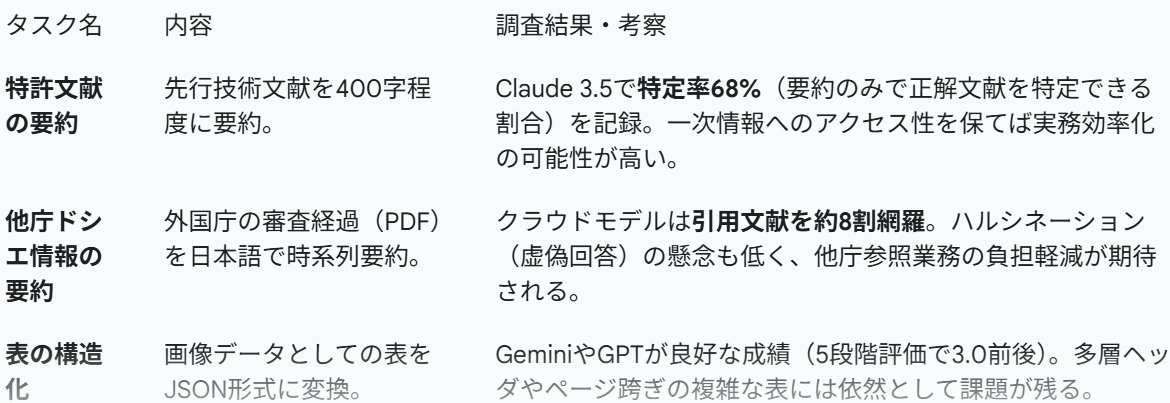
English translation of text in the image
|
Task |
Content |
Investigation Results and Considerations |
|---|---|---|
|
Summarization of patent documents |
Summarize prior-art documents in approximately 400 characters. |
Claude 3.5 recorded an identification rate of 68% (the proportion of correct documents identified using only summaries). There is strong potential for practical efficiency if accessibility to primary information is maintained. |
|
Summarization of other offices’ dossier information |
Summarize the prosecution history (PDF) of a foreign office chronologically in Japanese. |
Cloud models covered approximately 80% of cited documents. Concern over hallucinations (false responses) is also low, and a reduction in the burden of referring to other offices’ information is expected. |
|
Structuring of tables |
Convert tables in image data into JSON format. |
Gemini and GPT perform well (around 3.0 on a five-point scale). Challenges remain for complex tables with multilayer headers or spanning pages. |
AI技術の進展と特許審査への応用(論文掲載時点)
|
時代区分 |
主な技術と特徴 |
|---|---|
|
機械学習期(~2012年) |
SVM(サポートベクターマシン)や決定木など。分類付与支援、検索式の作成支援等に応用。 |
|
ディープニューラルネットワーク期(2012~2016年ごろ) |
DNNによる深層学習が画像認識等で注目され、RNNによる機械翻訳が実用化。 |
|
大規模言語モデルと応用拡大期(2017~2021年ごろ) |
Transformerを基盤としたBERTやGPTが注目され、転移学習により応用が拡大。 |
|
生成AIによる普及期(2022~2025年現在) |
GPT-4o、Claude 3.5、Gemini 1.5などのモデルを用いた要約、翻訳、構造化等の生成タスクへの応用。 |
機械分類付与の精度比較に用いられた基準は非特許BERTである。SVM・LightGBM等に替わる手法として、DeBERTaの導入が順次進められている。
English translation
• Machine-learning period (up to 2012)
: SVM and decision trees; practical
applications include classification support and search-expression support.
• Deep-neural-network period (around 2012–2016): DNN-based deep learning gained attention through image recognition; RNN-based machine translation became practical.
• Period of large language models and expanding applications (around 2017–2021)
: Transformer-based BERT and GPT attracted attention, and transfer learning broadened applications.
• Generative-AI dissemination period (2022–2025, the article’s present): Models such as GPT-4o, Claude 3.5 and Gemini 1.5 were examined
for generation tasks including summarization, translation and structuring.
For machine classification assignment, the accuracy comparison uses non-patent BERT as its baseline. DeBERTa was being introduced as a replacement for SVM, LightGBM and other methods.
Source for the chronology: 五十嵐康弘’s article, p. 33, identifies four periods: machine learning (up to 2012); deep neural networks (around 2012–2016); large language models and expanding applications (around 2017–2021); and dissemination through generative AI (2022–2025, the article’s present). The baseline for the accuracy comparison on p. 34 is non-patent BERT. On p. 35, SVM and LightGBM are methods being replaced by DeBERTa. Article, pp. 33–35
[Article / Chinese Patents] The Support Requirement for Numerical Range Limitations in China (胡春豊 and 林軍, Patent, September 2025)
Publication date on list page: June 19, 2026
[Article / Chinese Patents] The Support Requirement for Numerical Range Limitations in China (胡春豊 and 林軍, Patent, September 2025)
<Supreme People’s Court of China, (2020) Zui Gao Fa Zhi Xing Zhong No. 407>
1. Consideration of the Judgment of the Supreme People’s Court of China
Content of the Patent: An invention with numerical limitations combining a charging cut-off voltage (greater than 4.2 V and not greater than 5.8 V) and a positive/negative electrode ratio (1:1.0 to 1:2.5).
Issue: The specification stated that “characteristics deteriorate when the parameters exceed the ranges,” and Apple asserted that “ranges not covered by the examples (ranges in which the purpose of the invention cannot be achieved) are included, and the support requirement is not satisfied.”
First-Instance Judgment: Holding that “a considerable part of the scope of claim 1 was expressly excluded by the specification, and the generalized scope of claim 1 is too broad relative to the scope disclosed in the specification,” the court set aside the invalidation trial decision that had found Apple’s invalidity grounds not established and ordered the China National Intellectual Property Administration to re-examine the case (Article, pp. 96–97).
Determination of the Supreme People’s Court (Victory on Reversal)
“If a person skilled in the art reads the specification and can confirm mutually corresponding relationships between the technical features of the respective numerical ranges, obtain embodiments meeting the purpose of the invention through a limited number of experiments, and exclude inventions that cannot achieve the purpose of the invention without excessive effort, the claim should be determined to be supported by the specification.”
2. Practical Points to Note
In light of this Supreme People’s Court judgment, the following measures for drafting specifications and handling invalidation proceedings in China are proposed.
①When Drafting Patent Specifications
Multiple Layers of Independent Claims: Consider a configuration that is readily recognizable, such as providing separate independent claims for each numerical group (data groups of examples) in which the effects can reliably be obtained, in addition to claims covering broad ranges.
②Arrangement of Examples
The basic approach is to cover specific data at the starting, ending, and intermediate values of a range in accordance with the Examination Guidelines.
③During Patent Invalidation Proceedings
Merely asserting that “there is a range in which the purpose of the invention cannot be achieved” is insufficient.
It is necessary to use more specific experimental results to prove that “even by following the guidance in the specification, a person skilled in the art cannot recognize the scope of protection (the range in which the effects are obtained) with ordinary effort.”
3. Summary
The Supreme People’s Court of China indicated a new criterion for the support requirement for numerical ranges: “whether a person skilled in the art can exclude non-working ranges without excessive effort.”
It can therefore be said that, even for broad numerical limitations, the possibility of maintaining the rights has increased if the specification contains appropriate guidance.
https://jpaa-patent.info/patent/viewPdf/4697
[Article / European Patents] Differences Between the Japanese and European Patent Systems That Require Attention (野村和弘 and フロリアン キューベック, Patent, September 2025)
Publication date on list page: June 19, 2026
[Article / European Patents] Differences Between the Japanese and European Patent Systems That Require Attention (野村和弘 and フロリアン キューベック, Patent, September 2025)
1. Differences Concerning “Claims”
①Number of Independent Claims:
Japan: No limitation.
Europe: In principle, one per category (Rule 43(2)). Multiple independent claims are not permitted except for exceptions such as interrelated products like a plug and socket, or alternative solutions.
②Categories and Use Limitations:
Japan: Three types: “product,” “process,” and “process for producing a product.” Use limitations (e.g., for anti-fatigue use) are given relatively strong effect.
Europe: Two types: “physical entity” and “activity.” A use limitation such as “a device for …” is interpreted merely as “a device suitable for …” and has weak limiting effect. Therefore, use claims in the form of “non-therapeutic use” are recommended.
③Multiple Dependency (Multiple-Multiple Dependent Claims):
Japan: Restricted since April 2022 (violation of requirements under the delegated ministerial ordinance).
Europe: No restriction. However, additional fees arise where the number of claims is 16 or more.
④Reference Signs:
Europe: It is strongly desirable to insert drawing reference signs in parentheses in the claims (Rule 43(7)).
2. “Prior Art and Publication of Earlier Applications” (Self-Collision and Grace Periods)
In Europe, “one’s own applications” can become powerful grounds for refusal, so attention to filing strategy is required.
3. “Restrictions on Amendments” (Europe’s Strict “Gold Standard”)
European amendment requirements are far stricter than those in Japan, and disclosure in the original specification must be “direct and unambiguous.”
<Amendments to Numerical Limitations>: In Europe, it is very difficult to adopt a value not expressly stated in the specification (for example, an intermediate value of examples) as a boundary value. Combinations of preferred ranges should be expressly stated in the specification in advance.
<Excluding Claims (Disclaimers)>
Japan: Cases in which they are used to overcome a lack of inventive step are increasing.
Europe: G 1/03 addresses undisclosed disclaimers, that is, exclusions without a basis in the application as filed. The decision identifies circumstances permitting restoration of novelty over prior art under Article 54(3) and (4) EPC 1973 (now Article 54(3) EPC) or an accidental anticipation, as well as exclusion of subject matter excluded from patentability for non-technical reasons. An undisclosed disclaimer relevant to assessing inventive step or sufficiency of disclosure is not allowable. Disclaimers disclosed in the application as filed must be distinguished.
Note on the scope of the source: G 1/03, Headnote II, refers to “not disclosed in the application as filed”; II.1 refers to “non-technical reasons”. In summary, the criteria concern undisclosed disclaimers and are not confined to restoring novelty. The source article is coauthored by 野村和弘 and フロリアン キューベック. Article, pp. 82 and 88 G 1/03
4. “Parameter Inventions”
Where an invention is identified by a special parameter, strict treatment of the “measurement method” is required in Europe.
Points to Note in Europe: The measurement method of a parameter may be required to be stated in the claims themselves, as well as in the specification. In addition, when citing a standard such as an ISO standard, there is a risk of being found unclear unless the issue date (year) is specified, taking account of changes to the standard.
5. Summary and Proposals
When considering expansion into Europe based on a Japanese application, the following preparations are essential.
①Considering Europe’s distinctive restrictions on independent claims, file related inventions on the same day wherever possible.
②Because freedom to amend is limited, include diverse numerical ranges and sets in multiple-dependent form in the specification in advance.
③To minimize the risk of loss of novelty through disclosure, treat the European grace period, in principle, as “nonexistent.”
https://jpaa-patent.info/patent/viewPdf/4696
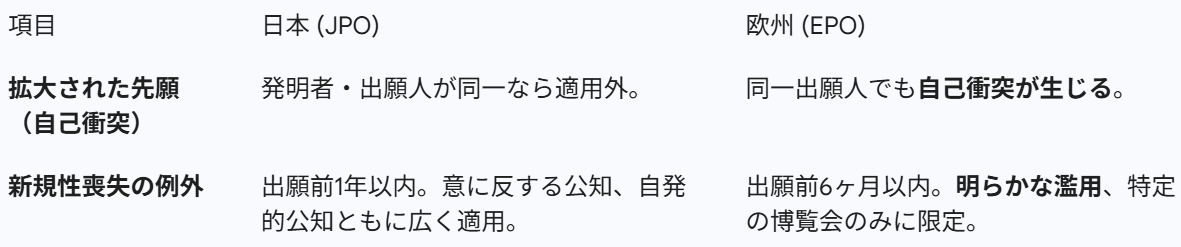
English translation of text in the image
|
Item |
Japan (JPO) |
Europe (EPO) |
|---|---|---|
|
Enlarged earlier applications (self-collision) |
Excluded if the inventor or applicant is the same. |
Self-collision occurs even for the same applicant. |
|
Exceptions to loss of novelty |
Within one year before filing. Broadly applies to both disclosure against one’s will and voluntary disclosure. |
Within six months before filing. Limited to evident abuse and certain exhibitions. |
[Article / UK Patents] The UK InterDigital v. Lenovo Litigation over the Calculation of FRAND Rates (小林和人, Patent, September 2025)
Publication date on list page: June 19, 2026
[Article / UK Patents] The UK InterDigital v. Lenovo Litigation over the Calculation of FRAND Rates (小林和人, Patent, September 2025)
<Main Issues>
①Whether InterDigital’s final offer (5G Extended Offer) conformed to FRAND terms.
②If not, what the specific FRAND rate was.
③Whether an injunction would be granted if Lenovo was not a “Willing Licensee.”
1. Determination of the UK High Court (EWHC 539, 1578)
The High Court held that neither party’s offer was FRAND.
Method of Calculating the FRAND Rate: LG (2017) was selected as the most comparable agreement. Based on it, sales regions and proportions of standards were adjusted, and the rate was calculated as $0.175 per unit (a blended rate).
Determination of the Lump Sum: The entire period from 2007 through the end of 2023 was covered, and $138.7 million was presented as royalties.
Addition of Interest: To eliminate the benefit from delayed payment, interest at 4% per annum, compounded quarterly ($46.2 million), was added, bringing the total to $184.9 million.
Criticism of Volume Discounts: Large discounts of as much as 60–80% applied to Samsung and Apple were identified as discriminatory acts against smaller implementers and as not FRAND.
Whether an Injunction Was Appropriate: Lenovo was given the choice of accepting the judgment’s terms and would be subject to an injunction only if it refused.
2. Determination of the Court of Appeal (EWCA Civ 743)
As a result of both parties appealing, the Court of Appeal followed the High Court’s logic but revised the figures.
Revision of the Rate: It reviewed the analysis of the LG agreement used for comparison and raised the base rate from $0.24 to $0.30 and the adjustment factor from 0.728 to 0.75.
Final Holding: The FRAND rate was revised upward to $0.225 per unit. As a result, the principal amount of the lump sum became $178.3 million, and the court ordered the addition of the same interest (4% per annum, compounded quarterly).
3. Conclusions and Implications
This is an important case in which UK courts emphasized the “comparative approach” and derived a specific global rate through their own calculations. In particular, the following points are important in practice.
①Payment for the Past: It was held that a willing licensee should pay royalties for the entire past period of implementation, irrespective of the limitation period for damages claims.
②Requirement of Transparency: The risk was shown that extreme preferential treatment of large companies (opaque volume discounts) would be rejected from the viewpoint of non-discrimination.
③Importance of Interest: The addition of compound interest was justified to offset the gains from “holdout” through prolonging negotiations.
https://jpaa-patent.info/patent/viewPdf/4695
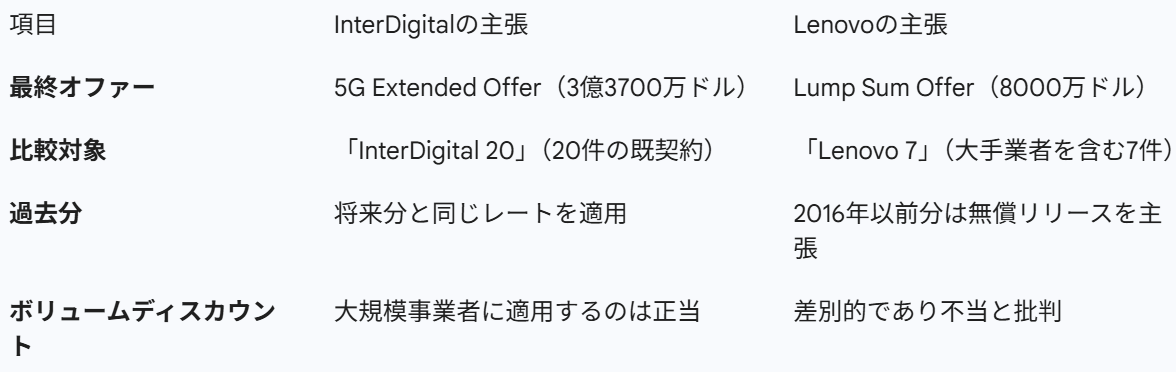
English translation of text in the image
|
Item |
InterDigital’s Arguments |
Lenovo’s Arguments |
|---|---|---|
|
Final offer |
5G Extended Offer ($337 million) |
Lump Sum Offer ($80 million) |
|
Comparators |
“InterDigital 20” (20 existing agreements) |
“Lenovo 7” (seven agreements, including major businesses) |
|
Past periods |
Apply the same rate as for future periods |
Argues for a free release for periods up to and including 2016 |
|
Volume discounts |
Application to large businesses is justified |
Criticized as discriminatory and unjust |
[Article / Patents] Intellectual Property and Intangible Assets in the Food Industry (藤原研二郎, Patent, September 2025)
Publication date on list page: June 19, 2026
[Article / Patents] Intellectual Property and Intangible Assets in the Food Industry (藤原研二郎, Patent, September 2025)
1. In the food industry, intellectual property strategies differ greatly depending on the role (from upstream to downstream).
2. Issues Particular to the Food Field
The food industry has difficulties arising from “history” and “sensation” that differ from those in other technical fields.
“Long History and Regionality”: This industry has continued since the beginning of recorded history, with considerable regional differences, making it difficult to understand what is “publicly known worldwide.”
“Flavor as a Complex System (Difficulty of Digitization)”: Food is not a pure substance but a complex composition that changes over time. It is extremely difficult to verify objectively “flavor,” in which taste, texture, and smell intertwine, resulting in a structure in which one must rely on skills (know-how) that cannot be verbalized.
“Monopoly Does Not Necessarily Mean Maximization of Profit”: The appearance of products similar to a new product can increase “eating experience” across the entire market and consequently expand the market.
3. Use of Know-How and Intangible Assets
In the food industry, the key to continuing business after patent expiration lies in “management of know-how.”
“Manufacturing Know-How”: How to suppress variability in raw materials and how to guarantee quality standards.
“Brand Story”: Turn trust and stories into intangible assets, as in Mishima Foods’ response to a shortage of “aonori” and Sapporo Breweries’ use of place names.
“Skill Succession (Skills)”: Abandon verbalization and pass skills down as “bodily experience” through training and apprenticeship.
“Identification Know-How”: Incorporate the “uses” and “attachment” spontaneously generated by consumers into brand control.
https://jpaa-patent.info/patent/viewPdf/4690
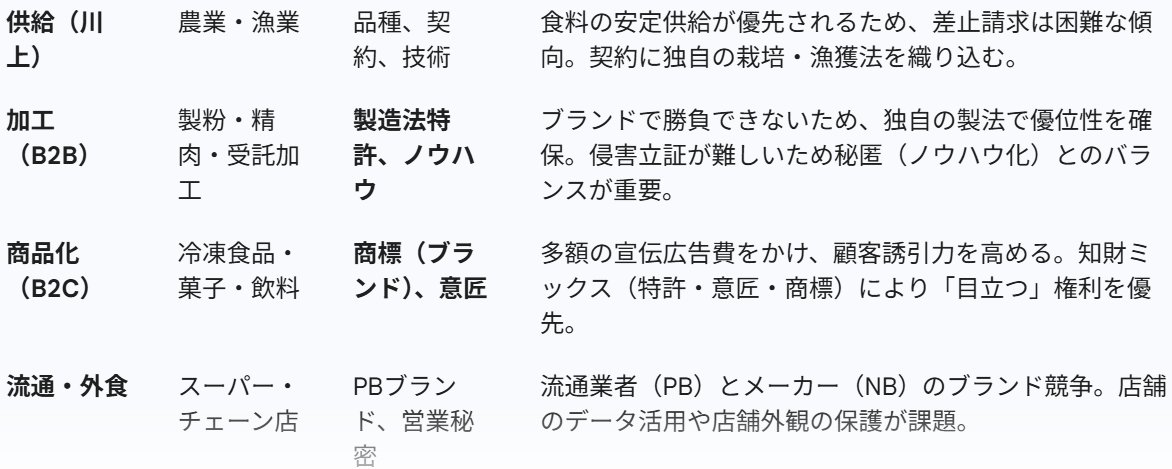
English translation of text in the image
|
Supply (upstream) |
Agriculture and fisheries |
Varieties, contracts, technology |
Because stable food supply takes priority, injunction claims tend to be difficult. Incorporate distinctive cultivation and fishing methods into contracts. |
|
Processing (B2B) |
Flour milling, meat processing, contract processing |
Manufacturing-process patents, know-how |
Because competition through brands is not possible, secure advantages through distinctive manufacturing processes. Because proving infringement is difficult, a balance with secrecy (conversion into know-how) is important. |
|
Commercialization (B2C) |
Frozen food, confectionery, beverages |
Trademarks (brands), designs |
Spend substantial advertising expenses to enhance customer appeal. Give priority to “conspicuous” rights through an IP mix (patents, designs, trademarks). |
|
Distribution and food service |
Supermarkets, chain stores |
Private-label brands, trade secrets |
Brand competition between distributors (PB) and manufacturers (NB). Use of store data and protection of store appearance are issues. |
[Article / U.S. Designs] Protection of Goods and Other Subject Matter in Virtual Space under U.S. Design Law (山口洋一郎, Patent, August 2025)
Publication date on list page: June 19, 2026
[Article / U.S. Designs] Protection of Goods and Other Subject Matter in Virtual Space under U.S. Design Law (山口洋一郎, Patent, August 2025)
Note on the author’s view and scope: The following introduces the view in 山口洋一郎’s article. Page 83 states 「用途の異なる他の物品にも行使可能であると解される」 (“is understood to be enforceable also against other articles having different uses”). By contrast, MPEP 1504.02 states, in discussing novelty, “A design claim is limited to the article of manufacture identified in the claim”. An article’s use must be distinguished from the article identified in the claim, and novelty from infringement. The following does not mean that enforcement between physical and virtual goods is always available; nor does the MPEP statement alone establish that infringement between them is always excluded. In the table below, the image lists the article for US D1,053,219 S as 「仮想3次元キャラを伴うディスプレイ」 (display with a virtual three-dimensional character), whereas p. 84 of the article states 「仮想3次元のキャラクター・アイコンを伴うディスプレイ・スクリーン」 (a display screen with a virtual three-dimensional character icon). Article, pp. 81–87 MPEP 1504.02
1. Article Use and Claim Limitations in the U.S. Design System
U.S. design law is part of patent law (35 U.S.C. §171), and patent principles apply. Yamaguchi’s article identifies the principle that an article’s use is disregarded, as in patent law, as a characteristic. Statements of use must nevertheless be distinguished from a limitation based on the article identified in the claim. Curver recognises the latter limitation.
Yamaguchi’s Explanation Concerning Novelty: Even a known design in a technical field entirely different from that of the article of the application can form a basis for lack of novelty if its shape is substantially identical (for example, there is a case in which novelty of a capsule for compressed gas was denied based on the design of a “bottle”).
Scope of Rights: Yamaguchi’s article expresses the view that design rights may be exercised against other articles having different uses, and also discusses enforcement where the registered design constitutes a part of the allegedly infringing article. Actual enforcement requires examination of the article identified in the claim and the overall visual appearance, among other matters.
2. Protection of Designs in Virtual Space
In the United States, “icons” and “GUIs” shown on a display are eligible for protection as part of the display.
Enforcement from the Physical to the Virtual: Yamaguchi’s article expresses the view that infringement of design rights for a real product, such as a shoe, may be asserted where that product is displayed and sold on a display in virtual space and is sufficiently similar to cause confusion for an ordinary observer. Individual examination in light of the article identified in the claim and other matters is required.
Enforcement from the Virtual to the Physical: Conversely, Yamaguchi’s article expresses the view that design rights for an article represented on a display in virtual space, such as a virtual three-dimensional shoe, may be enforced against a physical product of the same design. It does not introduce an established judicial rule that infringement between physical and virtual spaces generally occurs.
Related decision (Curver Luxembourg v. Home Expressions):https://www.cafc.uscourts.gov/opinions-orders/18-2214.opinion.9-12-2019.pdf
3. Recent Registration Examples in the United States
Symbolic registration examples illustrating the flexibility of U.S. Patent and Trademark Office (USPTO) practice are given.
https://jpaa-patent.info/patent/viewPdf/4710
山口論稿で紹介された米国の意匠登録例
|
登録番号 |
物品名称(要約) |
権利者 |
対象 |
|---|---|---|---|
|
US D975,724 S |
仮想3次元の靴を伴うディスプレイ |
NIKE |
仮想空間でのスニーカーデザインに関する登録例。 |
|
US D1,053,219 S |
仮想3次元のキャラクター・アイコンを伴うディスプレイ・スクリーン |
NIKE |
仮想オブジェクトとしてのキャラクターに関する登録例。 |
|
US D1,021,967 S |
作業車両、玩具、仮想モデル等 |
DEERE |
実車、玩具、仮想モデルを1出願に含む登録例。 |
English translation
|
Registration Number |
Article Name (Summary) |
Right Holder |
Features |
|---|---|---|---|
|
US D975,724 S |
Display with a virtual three-dimensional shoe |
NIKE |
Protects sneaker designs in virtual space. |
|
US D1,053,219 S |
Display screen with a virtual three-dimensional character icon |
NIKE |
Protects a character as a virtual object. |
|
US D1,021,967 S |
Work vehicles, toys, virtual models, etc. |
DEERE |
Covers actual vehicles, toys, and virtual models in a single application. |
[Article / Designs] A Consideration of Future Responses under Japanese Design Law to Design Protection in Virtual Space — In Light of International Trends (星野光秀, Patent, October 2025)
Publication date on list page: June 19, 2026
[Article / Designs] A Consideration of Future Responses under Japanese Design Law to Design Protection in Virtual Space — In Light of International Trends (星野光秀, Patent, October 2025)
1. Expansion of the Scope of Protection of Image Designs (Protection of GUIs)
Trends in Europe and the United States are contrasting.
Europe (EU): The article states that the amended CDR (Council Regulation on European Union Designs), adopted in October 2024, can be interpreted as allowing virtual objects to be protected without particular limitations and that it has become clear that virtual objects are included. However, because this can be interpreted as having long been the case in the EU, whose situation differs from that of the United States and Japan, where protection has long been limited, the article states that this suggests that the scope is too broad, at least as an expansion for the time being.
United States: In registration practice, if an image is integrated with an “article” in the form of a display screen, even content that does not fall within Japan’s operation images or display images (e.g., virtual shoes or models) may be eligible for protection.
<Implications for Japan>
There is concern that expansion without particular limitations, as in Europe, could chill creators’ creative activities. Meanwhile, the U.S. concept of “integration with an article,” which has a high degree of institutional affinity with Japan, is useful as a compromise that promotes industrial development while relaxing the connection with equipment.
2. Extending the Scope of Working of Design Rights into Virtual Space (from Physical to Virtual)
The issue is whether design rights for articles in the real world (such as cars and furniture) extend to digital objects in virtual space.
Europe (Positive Tendency): It adopts an “abstract view” and recognizes protection regardless of changes in dimensions (from real to digital). This is a position under which digital use of a non-digital design may be regarded as infringement.
United States (Negative Tendency): Negative views are strong due to concerns about giving design right holders unjust “windfall” benefits, the risk of infringing freedom of expression such as photography, and increased examination burdens.
<Consideration of Possible Responses in Japan>
①Proposal to Expand Design Rights Limited to Appearance: Extend rights based on similarity of appearance regardless of use. Although this contributes to protecting investment in design, it requires examination of an enormous amount of prior designs and presents substantial practical examination challenges.
②Proposal to Treat Physical and Virtual Articles as Equivalent: Treat articles as similar only where functions in virtual space are recognized as equivalent to those in the real world. The criteria become clear, but protection needs may not be sufficiently covered.
3. Conclusions and Proposals
Because virtual space has no national borders, responses with awareness of international harmonization of systems are indispensable. When Japan expands its system, it will be important to secure a balance between industrial development and freedom of creation.
Rather than seeking a solution solely through design law, a realistic response is to advance legal development in stages while clarifying the allocation of roles with copyright law and unfair competition prevention law.
https://jpaa-patent.info/patent/viewPdf/4723
[Article / Trademarks] Treatment under Trademark Law of Goods and Services Relating to Virtual Space — The Nice Classification and the Situations in Europe, the United States, South Korea, and Japan (星野光秀, Patent, June 2025)
Publication date on list page: June 19, 2026
[Article / Trademarks] Treatment under Trademark Law of Goods and Services Relating to Virtual Space — The Nice Classification and the Situations in Europe, the United States, South Korea, and Japan (星野光秀, Patent, June 2025)
1. Classification and Identification of Goods and Services in Virtual Space
The following points are commonly recognized in examination practice across countries and regions.
Simply referring to “virtual goods” leaves the scope unclear, and it is necessary to identify the related content specifically, as in “downloadable virtual clothing.”
Treatment as Class 9 (Goods): Because virtual goods are treated as digital content, they are classified in Class 9 in principle.
Changes in the Classification of Services: In principle, classification does not change even if the means of provision is virtual space, but it does change if the “purpose or result of provision” changes (e.g., while real transportation is in Class 39, a travel experience in virtual space is treated as entertainment in Class 41).
2. Main Trends and Characteristics of Countries and Organizations
Distinctive characteristics in practical operations and approaches to classification can be seen in each region.
https://jpaa-patent.info/patent/viewPdf/4662
仮想商品・役務に関する主な取扱い(論稿の整理)
|
国・機関 |
主な特徴・取扱い |
|---|---|
|
ニース国際分類 |
2024年版より「ダウンロード可能な仮想被服」(9類)やその小売(35類)が追加。 |
|
欧州(EUIPO/UKIPO) |
EUIPOは現実の商品と仮想商品は機能・目的・性質が同一ではないとする。UKIPOは仮想商品が明確に定義された場合にのみ認容する。 |
|
米国(USPTO) |
現実と仮想の混同は「商業的関連性」に基づいて判断すべきと示唆。 |
|
韓国(特許庁) |
仮想商品を画像ファイル等とは別の独自の類似群コードで管理。 |
|
日本(JPO) |
2024年3月にガイドライン公表。役務の代案(例:模擬レストラン)まで示す運用。 |
English translation
|
Country / Organization |
Main Characteristics and Treatment |
|---|---|
|
Nice Classification |
The 2024 edition added “downloadable virtual clothing (Class 9)” and its retail services (Class 35). |
|
Europe (EUIPO/UKIPO) |
EUIPO states that real and virtual goods are not identical in function, purpose or nature. UKIPO accepts virtual goods only when they are clearly defined. |
|
United States (USPTO) |
Suggests that confusion between the real and virtual should be determined based on “commercial relatedness.” |
|
South Korea (Patent Office) |
A distinctive feature is management of virtual goods through separate, independent similarity-group codes, apart from image files and the like. |
|
Japan (JPO) |
Guidelines were published in March 2024. Careful operation even indicates alternative descriptions of services (e.g., simulated restaurants). |
Source for the table: 星野光秀’s article, p. 112, attributes the statement that virtual goods are not identical in function, purpose or nature to their real-world counterparts to EUIPO material. For UKIPO, p. 113 states that virtual goods are accepted only when clearly defined. Article, pp. 112–113
[Article / Trademarks] Consideration of the Use of the “Consent System” through Model Cases (中山真理子 and 竹山尚治, Patent, October 2025)
Publication date on list page: June 12, 2026
[Article / Trademarks] Consideration of the Use of the “Consent System” through Model Cases (中山真理子 and 竹山尚治, Patent, October 2025)
1. The Core of Japan’s Consent System: A System with Reservation
Unlike many foreign countries, Japan’s consent system is a “system with reservation.”
⇒Registration is not granted simply because there is “consent” from the holder of the cited trademark; registration under Article 4(4) of the Trademark Act is permitted only where the Patent Office ultimately determines that “there is no likelihood of confusion as to source.”
2. Important Practical Points (Insights from Model Cases)
①Devising the Wording of Agreements (Letters of Consent)
Identification of Goods and Services: Wording that the mark will be “used only for specified goods” is close to essential. However, even without stating specific product names, it is possible to indicate the intention to avoid future confusion by expressly stating differences in distribution channels or consumers.
Between Group Companies: Strong wording such as “take measures to avoid confusion with each other” becomes a strong consideration against confusion.
Addition of a House Mark: According to discussions at an exchange of views with the Japan Patent Office, where a house mark is added only to the applied-for trademark, that fact alone generally makes it difficult to find that there is no likelihood of confusion. However, the article states that agreeing on the wording “always to be used together with the house mark” may be taken into account in the direction of denying a future likelihood of confusion, particularly where the applied-for and cited trademarks are not highly similar.
②Arguments in Written Opinions
Fact-Based Explanations: “Business realities (consumer groups, expertise, price ranges, and differences in production divisions)” that cannot be fully covered in the agreement should be proved in detail in the written opinion.
Treatment of Non-Use: Where the cited trademark is actually unused, stating that in the agreement may disadvantage the trademark holder; it is therefore recommended to devise “alternative wording (differences in distribution channels),” for example, to avoid the area of de facto non-use.
https://jpaa-patent.info/patent/viewPdf/4718
2023 (Gyo-Ke) No. 10149 [Multi-Branched Heat Exchanger with Independent Baffles] <Presiding Judge Miyasaka>
Publication date on list page: June 12, 2026
2023 (Gyo-Ke) No. 10149 [Multi-Branched Heat Exchanger with Independent Baffles] <Presiding Judge Miyasaka>
From the description in Cited Document 2, the “baffle cell” itself has a configuration that obstructs fluid flow and changes its direction, and it corresponds to the “baffle” of the amended invention at issue.
In addition, the “baffle cell” includes a solid portion (solid domain) and has the function of blocking the flow path, so it can be described as a “solid wall.”
Furthermore, the meaning of a “wall separate (from the unit cell)” was interpreted as meaning that the elements are functionally “separated” or “different,” regardless of whether they are physically separated, and because the “baffle cell” and “path cell” are functionally distinguished in Cited Invention 2, this also corresponds.
⇒Both inventions concern “heat exchanger” technology in the same technical field and share the configuration of branching flow paths using unit cells. Using baffles to form flow configurations that increase heat transfer efficiency is well-known art (Cited Document 1 contains no description of baffles); therefore, in view of the common technical field and the baffles serving as a means of solving the problem, there is motivation to combine.
https://www.courts.go.jp/assets/hanrei/hanrei-pdf-93719.pdf
2024 (Ne) No. 10038 [Brake Control Device and Behavior Analysis Device for a Motorcycle] <Presiding Judge Honda>
Publication date on list page: June 12, 2026
2024 (Ne) No. 10038 [Brake Control Device and Behavior Analysis Device for a Motorcycle] <Presiding Judge Honda>
Because the description in the specification at issue is consistent in referring to “angular velocity,” reading it as “angular acceleration” by correcting an error in the description is not permitted.
⇒The invention stated in the claims (including a physically contradictory calculation formula) cannot be said to be described in the detailed description of the invention, and therefore violates the support requirement.
(Excerpt from the Holding)
Regarding Formula A, “Ghosei = Gken − (Ψ · Rhsen),” the appellant argues that, if Ψ is understood according to the ordinary meaning of the symbol, the formula subtracts a value having the dimension of velocity, obtained by multiplying angular velocity by the sensor mounting height, from Gken, which has the dimension of acceleration, and thus becomes a formula that has no meaning in physics; therefore, “Ψ · Rhsen” cannot be understood literally as a calculation multiplying angular velocity by the sensor mounting height, while it is clear that “Ψ · Rhsen,” the correction term for lateral G (Gken) in Formula A, is a correction term for removing the change in velocity along a circular trajectory superimposed on Gken, in other words, circumferential acceleration; however, … the fact that it has no meaning in physics does not mean that it is recognized as an error in the description, and Formula A is as stated above, so the appellant’s argument cannot be accepted.
https://www.courts.go.jp/assets/hanrei/hanrei-pdf-93712.pdf
[Trademarks / Similarity] 2025 (Gyo-Ke) No. 10111 “SORA” <Presiding Judge Moritomi>
Publication date on list page: June 12, 2026
[Trademarks / Similarity] 2025 (Gyo-Ke) No. 10111 “SORA” <Presiding Judge Moritomi>
⇒Similar (separate observation of the device and word elements is permissible)
(1) Similarity of the Trademarks
In both trademarks, the device element and word element are arranged with a space between them, and they cannot be said to be so inseparably combined that separate observation would be unnatural. Moreover, because the device elements do not give rise to a specific pronunciation or concept, it is permissible to extract as the dominant element the word element “SORA,” which gives a strong and dominant impression as a source-identifying sign. Comparing the two, their appearances are close and their pronunciation (sora) is identical; therefore, the two trademarks are similar.
⇒In a composite trademark consisting of a device and words, if the device element is abstract and does not give rise to a specific concept, there is a high risk that only the word element will be extracted as the dominant element.
In filing practice, even if a device is added to avoid conflict with an existing word mark, similarity is often found unless the two elements are inseparably combined (for example, through substantial stylization of the logotype or overlap).
(2) Similarity of the Services
Similarity of designated services is determined on the basis of “actual circumstances of trade,” such as the relationship of the means and purposes and whether they are provided by the same business operator or at the same place. In light of trading conditions, such as massages and facial beauty treatments being provided at beauty salons (hair salons), the designated services of the application and the cited designated services share the purpose of beautification, and the business operators and places providing them overlap in reality. Therefore, regardless of differences in strict definitions under the Beauticians Act, the two services are similar.
⇒In determining similarity of services, the “actual circumstances of trade,” namely the combination of services in the actual market (such as the provision of massages in beauty salons), take precedence over whether national qualifications (such as a beautician’s qualification) are held and over distinctions in the legal scope of business. Diversification of corporate business may result in a likelihood of confusion being affirmed even between services previously regarded as dissimilar.
https://www.courts.go.jp/assets/hanrei/hanrei-pdf-95933.pdf
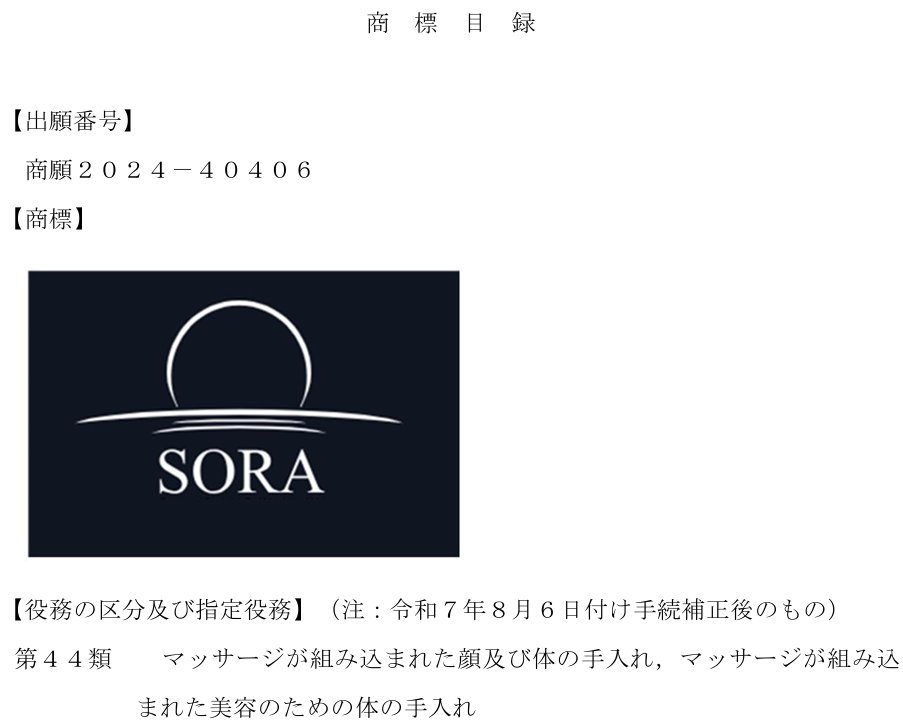
English translation of text in the image
Trademark List
[Application Number] Trademark Application 2024-40406
[Trademark] SORA (device reproduced above)
[Class of Services and Designated Services] (Note: After the procedural amendment dated August 6, 2025)
Class 44: Facial and body care incorporating massage; body care for beauty purposes incorporating massage.
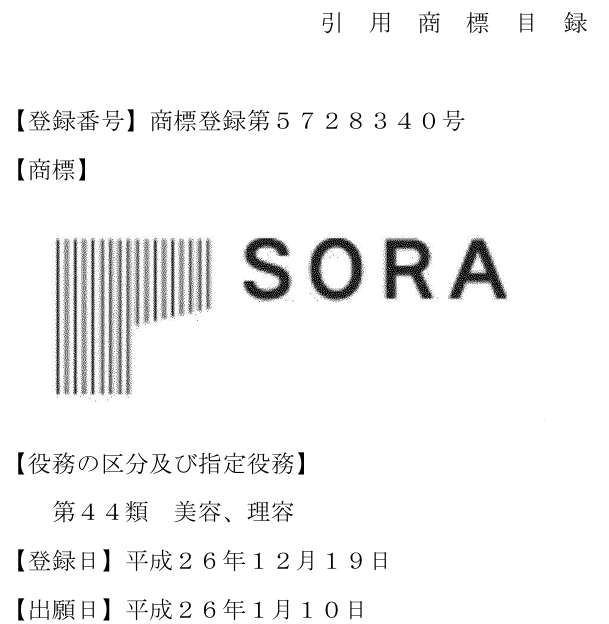
English translation of text in the image
Cited Trademark List
[Registration Number] Trademark Registration No. 5728340
[Trademark] SORA (device reproduced above)
[Class of Services and Designated Services]
Class 44: Beauty care, hairdressing.
[Registration Date] December 19, 2014
[Filing Date] January 10, 2014
[Article / Austrian Trademarks] A Consideration of the Protection of Well-Known Trademarks and Unfair Use through Packaging Imitation Learned from the “Jägermeister” Case (遠藤華英, Patent, November 2025)
Publication date on list page: June 12, 2026
[Article / Austrian Trademarks] A Consideration of the Protection of Well-Known Trademarks and Unfair Use through Packaging Imitation Learned from the “Jägermeister” Case (遠藤華英, Patent, November 2025)
Note on country and procedure: The article by 遠藤華英 states 「オーストリア最高裁判所(OGH)」 (“Supreme Court of Austria (OGH)”) on p. 49. The country concerned is Austria. The proceedings described on p. 54 concern an interim injunction. The Austrian legal information system RIS lists the OGH ruling (4Ob55/23a, May 31, 2023) as a “Beschluss” (decision) rejecting the defendant’s appeal and upholding the lower courts’ interim injunction. Article, pp. 49 and 54
A decision of the Austrian Supreme Court (OGH) in interim-injunction proceedings (4Ob55/23a, May 31, 2023) concerning protection of the well-known trademark “Jägermeister” and imitation of packaging.
1. Overview of the Case: Jägermeister vs SPAR
A case in which the plaintiff, the right holder for the world-famous herbal liqueur “Jägermeister,” brought an action and applied for an interim injunction on the grounds of trademark infringement and violation of unfair competition prevention law against the defendant (SPAR), which sold products imitating the packaging of the plaintiff’s products (an orange band, black lettering, a deer-head device, etc.). The lower courts issued the interim injunction, and the OGH rejected the defendant’s appeal and upheld their decision.
Issue: Whether the defendant’s imitation constituted “unfair exploitation of reputation (free riding)” or “impairment of distinctiveness” of the plaintiff’s well-known trademark.
Conclusion: Interim injunction upheld (the lower courts’ grant of the plaintiff’s application was maintained)
2. Points in the Austrian Court’s Determination
From the perspectives of both trademark law and unfair competition prevention law, the court strictly rejected “parasitic exploitation” of a well-known trademark.
A. Trademark Law Aspect (§10 Abs 2 MSchG)
No Risk of Confusion Required: For a well-known trademark, protection is available if there is sufficient similarity for consumers to make a “mental connection (association) between the two brands.”
Criterion of Similarity: If any one of the three aspects of appearance, pronunciation, or concept is similar, infringement is likely to be found.
Burden of Proof: In principle, the infringer (defendant) bears the burden of proving that there is no unfair use.
B. Unfair Competition Prevention Law Aspect (§1 UWG)
Unfair Exploitation of Reputation: Going beyond mere imitation of a design, free riding on the reputation as a “premium brand” built by the plaintiff over many years is an unfair commercial practice that undermines fairness of competition.
Aggressive Imitation: In particular, the use of brand elements highly popular among young people in a cartoonishly modified form was held to be an “aggressive act” damaging the reputation.
https://jpaa-patent.info/patent/viewPdf/4731
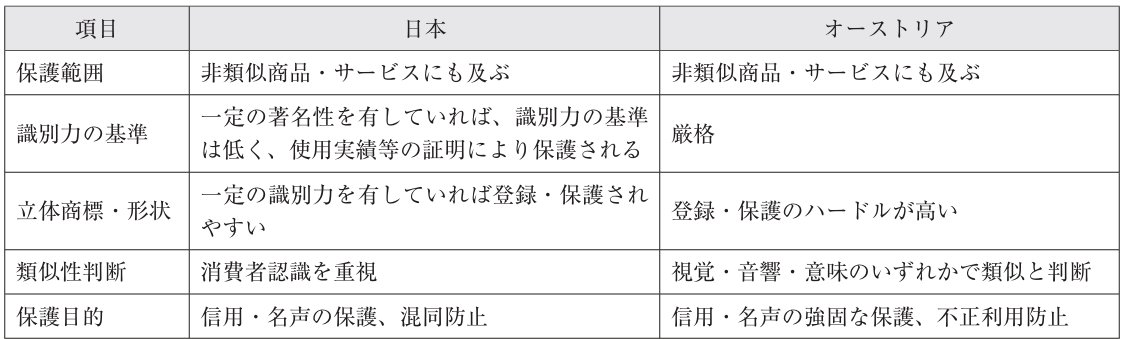
English translation of text in the image
|
Item |
Japan |
Austria |
|---|---|---|
|
Scope of protection |
Extends to dissimilar goods and services |
Extends to dissimilar goods and services |
|
Standard of distinctiveness |
If a certain degree of fame exists, the distinctiveness threshold is low, and protection is available through proof of use and the like |
Strict |
|
Three-dimensional marks and shapes |
Readily registered and protected if a certain degree of distinctiveness exists |
High hurdle for registration and protection |
|
Determination of similarity |
Emphasizes consumer perception |
Similarity found in any of visual, aural, or semantic aspects |
|
Purpose of protection |
Protection of goodwill and reputation; prevention of confusion |
Strong protection of goodwill and reputation; prevention of unfair use |

[Article / Customs] Customs Expert Advisers (磯貝克臣, Patent, November 2025)
Publication date on list page: June 12, 2026
[Article / Customs] Customs Expert Advisers (磯貝克臣, Patent, November 2025)
For each case, three customs expert advisers are selected (for example, a mixture of a university professor, an attorney, and a patent attorney).
Customs makes its determination respecting the majority opinion of the expert advisers unless there are special circumstances such as a clear error of fact.
The list for the term current when the article was written (a two-year term ending December 31, 2025) registered four university professors, 20 attorneys, and 20 patent attorneys.
<Actual Working Process of Expert Advisers>
1. Receipt of Materials and Individual Review
2. Advance Meeting of the Expert Advisers (Web Conference)
An introductory meeting of the three expert advisers and customs officials. Rather than reaching a conclusion here, they discuss whether to make a “request for additional materials” to the parties.
3. Hearing of Opinions (a Setting Similar to an Oral Hearing)
This is an extremely important occasion at which the parties appear in person and make presentations and rebuttals.
Proceedings take place in the order of statements of opinion by the applicant and interested parties, mutual rebuttals, questions from the expert advisers and customs, and final statements.
Through questions, the expert advisers have each party supplement its arguments and clarify the reasoning leading to the ultimate conclusion.
4. Preparation and Submission of Written Opinions
Based on the discussions at the “hearing of opinions” and supplementary written opinions, an expert adviser opinion is prepared in the form of an expert report. Where the opinions of the three members are divided, the majority opinion of two to one is adopted.
https://jpaa-patent.info/patent/viewPdf/4729
[Article / Intellectual Property in General] Patent Attorneys as Judicial Research Officials (髙村和宗 and 岩永勇二, Patent, November 2025)
Publication date on list page: June 5, 2026
[Article / Intellectual Property in General] Patent Attorneys as Judicial Research Officials (髙村和宗 and 岩永勇二, Patent, November 2025)
1. Legal Position of Judicial Research Officials
They are court officials provided for in Article 57 of the Court Act, and under Article 92-8 of the Code of Civil Procedure, upon order of the presiding judge, they have authority to question parties on matters of fact and law and to ask questions directly during the examination of evidence.
Many have experience as trial examiners at the Patent Office, but one person is assigned to the Intellectual Property High Court (mechanical field) and one to the Tokyo District Court (chemical field) in patent-attorney positions. The term is three years.
2. Specific Duties of Judicial Research Officials
①Advance Research: Based on the plaintiff’s arguments, submit materials organizing technical terminology and the logic of the trial decision to the judges.
②Attendance at Hearings
③Preparation of Research Reports
3. Points to Note for Advancing Litigation Advantageously from the Viewpoint of Research Officials
①Actions for Cancellation of Trial Decisions (Intellectual Property High Court)
Opportunities for argument and proof are limited. It is necessary to present all grounds for cancellation in the plaintiff’s first preparatory brief and assemble the evidence.
One should identify errors in the reasoning of the trial decision that affect the conclusion, and not develop an independent line of reasoning excessively.
②Patent Infringement Litigation (District Courts)
Close Examination Before Filing Suit
Reliability of Experimental Proof: It is desirable to have analyses of allegedly infringing products and reproduction experiments conducted by highly reliable external institutions.
Responses to Questions: Questions from judges and research officials at technical explanation sessions and the like are often central questions affecting the outcome of the judgment; it is therefore necessary to grasp their intent accurately and respond.
https://jpaa-patent.info/patent/viewPdf/4728
表1 裁判所調査官の配置(論文掲載時点)
|
技術分野 |
知財高裁(11人) |
東京地裁(7人) |
大阪地裁(3人) |
|---|---|---|---|
|
機械 |
4人(1人は弁理士) |
3人 |
1人 |
|
電気 |
3人 |
2人 |
1人 |
|
化学 |
4人(論文本文による) |
2人(1人は弁理士) |
1人 |
English translation
Table 1 Assignment of Judicial Research Officials
|
IP High Court: 11 |
Tokyo District Court: 7 |
Osaka District Court: 3 |
|
|---|---|---|---|
|
Mechanical |
4 (one is a patent attorney) |
3 |
1 |
|
Electrical |
3 |
2 |
1 |
|
Chemical |
4 |
2 (one is a patent attorney) |
1 |
Source for the table: The body of the article by 髙村和宗 and 岩永勇二, p. 18, gives four mechanical, three electrical and four chemical research officials at the IP High Court. Table 1 in the original article gives two chemical officials. The table here follows the body text, whose breakdown is consistent with the stated total of 11. These are the figures published in the article, not a statement of current staffing. Article, p. 18
[Article / Intellectual Property in General] A Note on the Prohibition of Abuse of Rights in Intellectual Property Infringement (森本晃生, Patent, December 2025)
Publication date on list page: June 5, 2026
[Article / Intellectual Property in General] A Note on the Prohibition of Abuse of Rights in Intellectual Property Infringement (森本晃生, Patent, December 2025)
①The Ricoh Case and the Appropriate Form of “Compulsory Mediation”
The first-instance judgment also rejected damages in their entirety, but as long as the implementer actually enjoys the benefits of the patented invention, a solution that does not grant an injunction but allows payment equivalent to a reasonable license fee (royalty) (in the line of the 1968 Supreme Court judgment) is desirable from the perspectives of legal consistency and equity.
This also accords with the purpose of “compulsory licensing (an award)” and prevents excessive favorable treatment of implementers who neglected license negotiations.
②Use as “Substantive Fair Use” in Copyright Law
The Goldfish Telephone case (Osaka High Court judgment, 2021) — Functional Constraints: Where there are few alternative choices of expression because of purposes such as attracting tourists or sustaining living organisms (aeration), there are situations in which the creator’s “freedom of expression” and “freedom of business” should be protected.
⇒Rather than forcing a finding of non-infringement through the determination of copyrightability (the elements), flexible and equitable solutions become possible by using the abuse-of-rights doctrine (Type ④) to make an adjustment that does not grant an injunction or disposal but allows only damages (equivalent to a royalty).
https://jpaa-patent.info/patent/viewPdf/4750
権利濫用の類型と知財法の事例(森本論稿の整理)
|
類型 |
内容 |
知財法の該当例 |
|---|---|---|
|
①不法行為型 |
加害目的のみの権利行使(シカーネ)。 |
古典的な濫用例。 |
|
②権利範囲明確化型 |
法の欠缺を埋め、権利の限界を画定する。 |
ポパイ・マフラー事件、エマックス事件、キルビー事件(論者の最終整理)。 |
|
③法変化・限界設定型 |
社会情勢の変化に伴い権利を縮小させる。 |
キルビー事件は③とも解し得るが、論者の最終整理は②である。特許法104条の3へ結実。 |
|
④強制調停型 |
権利同士の衝突を調整し、衡平な解決を図る。 |
リコー事件(再生トナー)、やっぱりブスが好き事件。 |
English translation
|
Type |
Content |
Examples in Intellectual Property Law |
|---|---|---|
|
① Tort type |
Exercise of rights solely for the purpose of causing harm (chicane). |
Classical examples of abuse. |
|
② Clarification of the scope of rights |
Fill gaps in the law and fix the limits of rights. |
Popeye Scarf case; Eemax case; Kilby case (the author’s final classification) |
|
③ Legal change and setting of limits |
Reduce rights in response to changes in social circumstances. |
Kilby case (also interpretable under this type; the author’s final classification is Type ②; now reflected in Article 104-3 of the Patent Act) |
|
④ Compulsory mediation |
Adjust conflicts between rights and seek equitable solutions. |
Ricoh case (recycled toner); Yappari Busu ga Suki case |
Note on classification: 森本晃生’s article, p. 105, states 「③の法変化による権利の新たな限界設定事案と解することもできるが」 (“it can also be interpreted as a case of setting new limits on rights through the change in law under ③, but”) and then 「②の法規欠缺の場合の権利内容の明確化を画する事案といえる。」 (“it can be said to be a case that delimits the clarification of the content of rights where there is a gap in the statutory law, under ②.”). In summary, the author ultimately places Kilby in Type ② while also recognizing Type ③ as a possible interpretation. The table presents the author’s final classification and the alternative interpretation. Article, p. 105
[Article / Patents] Research and Proposals on Lack of Unity of Inventions Expressed as Alternatives (Biotechnology and Life Sciences Committee, Patent, December 2025)
Publication date on list page: June 5, 2026
[Article / Patents] Research and Proposals on Lack of Unity of Inventions Expressed as Alternatives (Biotechnology and Life Sciences Committee, Patent, December 2025)
1. The Japan Patent Office (JPO) “First Alternative” Principle
In the chemical and biotechnology fields, compounds and sequences are commonly expressed as alternatives (Markush form), such as “R is A, B, or C” or “any of SEQ ID NOs: 1–4.”
Under Japan’s Examination Guidelines, in determining unity (Article 37 of the Patent Act), the “first-listed alternative” is, in principle, the subject of examination.
If the first-listed alternative is found to lack novelty, an amendment to a later alternative may be disallowed as a “shift amendment (Article 17-2(4)),” even where that is the alternative for which the applicant truly seeks rights, necessitating a divisional application at additional cost. However, adding or arguing a common special technical feature (STF), as discussed below, may enable later alternatives to be examined.
Note on the circumstances: Case 1 on p. 88 of the source article states 「2 番目以降のすべての選択肢を審査対象にできた。」 (“all alternatives from the second onward could be made subject to examination”). In summary, circumstances requiring a divisional application because amendment is disallowed must be distinguished from circumstances in which the measures described below enable examination to continue. Article, pp. 85 and 88
2. Comparison of the Systems of Japan, the United States, and Europe:
There is a decisive difference in operation between Japan and the United States and Europe regarding the “selection of the subject of examination,” and the U.S. and European systems are user-friendly.
3. Types of Responses to Lack of Unity
①Addition of a New STF: Add an unexamined “new special technical feature (STF)” as a configuration common to all alternatives, thereby leading all alternatives to be examined together.
②Argument for a Common Structure: Demonstrate in a written opinion that the first alternative and the other alternatives have a common structure (STF) that has not been recognized in the examination.
③Amendment to an Inclusive Relationship: By making the first alternative an “essential configuration” and the other alternatives “additional configurations,” substantively include them within the subject of examination.
https://jpaa-patent.info/patent/viewPdf/4748
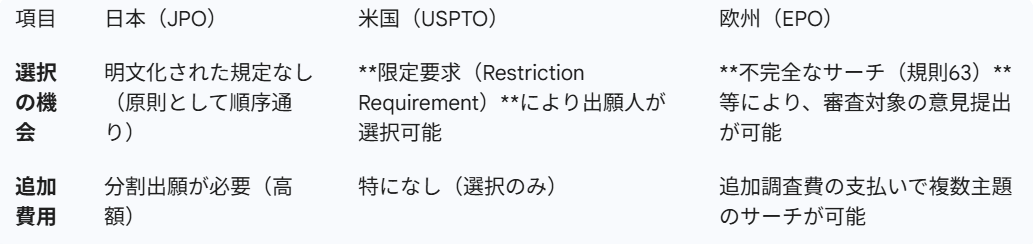
English translation of text in the image
|
Item |
Japan (JPO) |
United States (USPTO) |
Europe (EPO) |
|---|---|---|---|
|
Opportunity for selection |
No express provision (in principle, in the listed order) |
The applicant can select through a Restriction Requirement |
An opinion on the subject of examination can be submitted through incomplete search (Rule 63) and the like |
|
Additional costs |
A divisional application is necessary (expensive) |
None in particular (selection only) |
Multiple subjects can be searched by paying additional search fees |
[Article / Agriculture, Forestry, and Fisheries] Protection and Use of Intellectual Property through an IP Mix with Overseas Expansion in View (Agriculture, Forestry, and Fisheries Committee, Patent, January 2026)
Publication date on list page: June 5, 2026
[Article / Agriculture, Forestry, and Fisheries] Protection and Use of Intellectual Property through an IP Mix with Overseas Expansion in View (Agriculture, Forestry, and Fisheries Committee, Patent, January 2026)
1. Branding by Vegetable Producers
Separation of Plant Breeders’ Rights and Trademarks: Because a registered variety name becomes public domain after the protection period expires, also obtain trademark rights.
For a brand with strong regional ties, strategically distinguish between use of the GI system and the regional collective trademark system.
2. Specific Examples of Use of an IP Mix
①Trademark Rights × Plant Breeders’ Rights: Examples include “Ruby Roman” and the trademark registration of the brand name “Beni Madonna” for the variety name “Ehime Kashi No. 28.”
②Patent Rights × Trademark Rights: “Soratobu Pumpkin,” which combines a patent for the cultivation method with a brand name.
③Patent Rights × Trademark Rights × GI: “Zentsuji-san Shikaku Suika,” protected by a three-part set of a patent for the cultivation container, a trademark, and a GI.
④Trademark Rights × GI (Overseas): In the “Kobe Beef” case, the framework of mutual GI protection with Europe and other regions was used to successfully remove false indications within Europe based on a geographical indication registration in Japanese.
3. Geographical Indications for Alcoholic Beverages and Management of Know-How
①GIs for Alcoholic Beverages: Administered by the National Tax Agency, they protect the characteristics of the place of origin (natural and human factors). Established approximately 20 years earlier than the GI system for agricultural products, the system first designated “Iki,” “Kuma,” and “Ryukyu” on June 30, 1995.
②Management of Know-How: For technologies such as cultivation techniques where disclosure through patenting is to be avoided, it is important to ensure thorough confidential management as trade secrets in the agricultural field.
https://jpaa-patent.info/patent/viewPdf/4767
[Article / Designs] An Overview of Court Decisions on Employee-Created Designs (藤本一, Patent, January 2026)
Publication date on list page: June 5, 2026
[Article / Designs] An Overview of Court Decisions on Employee-Created Designs (藤本一, Patent, January 2026)
Of the seven cases discussed in the article, consideration was claimed in five. Of those, only the Clothes-Drying Device case involved consideration claimed solely on the basis of an employee-created design; within the cases covered by the article, no published decision granting such a claim is identified.
Compared with patents (employee inventions), the following differences and points to note can be identified in the calculation process for “reasonable consideration.”
①“Proportion of Excess Sales”: For designs, because it is easier to choose alternative designs (other designs that do not share the same aesthetic impression) than for patents, the exclusive advantage in the market tends to be estimated lower.
②“Hypothetical Royalty Rate”: The cases examined in the article include assessments of approximately 1.5%–2.0%, about half the royalty rate for patent rights. These examples consider the substitutability of designs, but caution is needed in generalizing them as royalty rates for designs overall.
③“Employee’s Contribution”: The article’s reference to approximately 5%–10% concerns employee inventions and does not state a general range for employee-created designs. Because designs more readily express the creator’s individuality, there is room for a higher assessment depending on the case.
However, cases in existing court decisions in which a high contribution has been recognized involved special circumstances, such as an extremely high degree of dependence on the individual plaintiff.
Note on sources for case numbers and calculation examples: 藤本一’s article, p. 147, states 「⑥〔物干し器〕のみが、原告がデザイナーで、職務創作意匠のみに基づいて相当の対価が請求された事案」 (“only ⑥ [Clothes-Drying Device] is a case in which the plaintiff was a designer and reasonable consideration was claimed on the basis of an employee-created design alone”). In summary, the five consideration cases must be distinguished from the single design-only claim. Case-specific calculation rates should not be generalized. The table below includes all seven cases discussed in the article, including case ② [Sluice Gate] (Osaka High Court decision of September 13, 1990). In addition, the entry “Excess sales attributable to the design portion denied” for the Infusion Container case reflects, according to p. 146 of the article, the first-instance judgment (Osaka District Court, October 16, 2012) (「⑤〔輸液容器〕の一審判決は、…職務創作意匠による超過売上の発生を否定したと理解される」, i.e., “the first-instance judgment in ⑤ [Infusion Container] … is understood to have denied that excess sales arose from the employee-created design”). Article, pp. 144–147
https://jpaa-patent.info/patent/viewPdf/4768
職務創作意匠に関する7事件(藤本論稿の紹介)
|
事件 |
裁判所・日付 |
論稿が紹介する位置付け |
|---|---|---|
|
剛性物質穴あけ用ドリル |
大阪地判昭和62年1月26日 |
法定通常実施権に関する判断。 |
|
水門扉 |
大阪高決平成2年9月13日 |
法定通常実施権に関する判断。 |
|
三角プレート(カネシン) |
東京地判平成4年9月30日 |
職務考案と併せて対価を認容。 |
|
鉄筋曲げ機 |
東京高判平成16年9月29日 |
職務発明等と併せて対価を認容。 |
|
輸液容器(ニプロ) |
知財高判平成25年7月11日 |
意匠部分の超過売上を否定したとするのは、一審(大阪地判平成24年10月16日)についての論稿の評価。 |
|
物干し器(タカラ産業) |
大阪地判平成29年10月12日 |
デザイナーによる請求であるが棄却。 |
|
ファン(三菱電機) |
知財高判令和5年1月23日 |
内部構造で見えない意匠の利益を否定。 |
English translation
|
Case |
Court and Judgment Date |
Overview |
|---|---|---|
|
Drill for Drilling Rigid Materials |
Osaka District Court, January 26, 1987 |
Determination concerning a statutory non-exclusive license. |
|
Sluice Gate |
Osaka High Court, September 13, 1990 |
A decision concerning a statutory non-exclusive licence. |
|
Triangular Plate (Kaneshin) |
Tokyo District Court, September 30, 1992 |
Consideration granted together with an employee utility-model creation. |
|
Reinforcing-Bar Bending Machine |
Tokyo High Court, September 29, 2004 |
Consideration granted together with employee inventions and the like. |
|
Infusion Container (Nipro) |
IP High Court, July 11, 2013 |
The article interprets the first-instance judgment (Osaka District Court, October 16, 2012) as denying excess sales attributable to the employee-created design. |
|
Clothes-Drying Device (Takara Industry) |
Osaka District Court, October 12, 2017 |
Claim by a designer, but rejected. |
|
Fan (Mitsubishi Electric) |
IP High Court, January 23, 2023 |
Profit from an invisible design within an internal structure denied. |
[Article / Patents] Cases and Issues in Patent Protection of Biopharmaceuticals (Biotechnology and Life Sciences Committee, Patent, December 2025)
Publication date on list page: June 5, 2026
[Article / Patents] Cases and Issues in Patent Protection of Biopharmaceuticals (Biotechnology and Life Sciences Committee, Patent, December 2025)
1. “De Facto Patent Linkage” in Japan
Under the practice described in the article based on the Ministry of Health, Labour and Welfare’s former “Two Division Directors’ Notification,” a biosimilar (BS) is not approved where a patent on the active ingredient of the originator product prevents manufacture of that ingredient itself, and, where a patent exists for some indications of the originator product and manufacture of a product claiming the other indications is possible, the patented indications are not approved. The article states that, for this reason, even after the re-examination period expires, approval of a BS is effectively difficult as long as a substance patent or use invention remains in force.
Note on use patents and the updated notification: The Ministry of Health, Labour and Welfare’s notification of October 8, 2025, on pharmaceutical patents in approval examinations and reimbursement listing for prescription generic medicines and biosimilars repealed the former Two Division Directors’ Notification. Section 1(2), in line with the former Two Division Directors’ Notification, permits approval where manufacture or marketing for other indications is possible despite a use patent covering some indications, and states 「この場合、特許が存在する効能効果等については承認しない。」 (“In this case, the indications, etc. for which a patent exists are not approved.”). In summary, the patented indications are not approved; a use patent does not always bar approval of the product for other indications. MHLW notification, p. 2 Article, pp. 40–41 and 54
2. Re-Examination Period
Japan’s distinctive re-examination system functions as a de facto regulatory data protection period (RDP), and in some cases remains a barrier to entry even after patent expiration.
3. Considerations and Future Issues
The existence of the high-cost medical expense benefit system makes it difficult for patients to perceive the benefits of choosing inexpensive BS products. Going forward, in order to reconcile the sustainability of medical finances with protection of innovation, a highly transparent system design involving the judiciary and the development of a market environment that is predictable for foreign companies as well are indispensable.
https://jpaa-patent.info/patent/viewPdf/4745
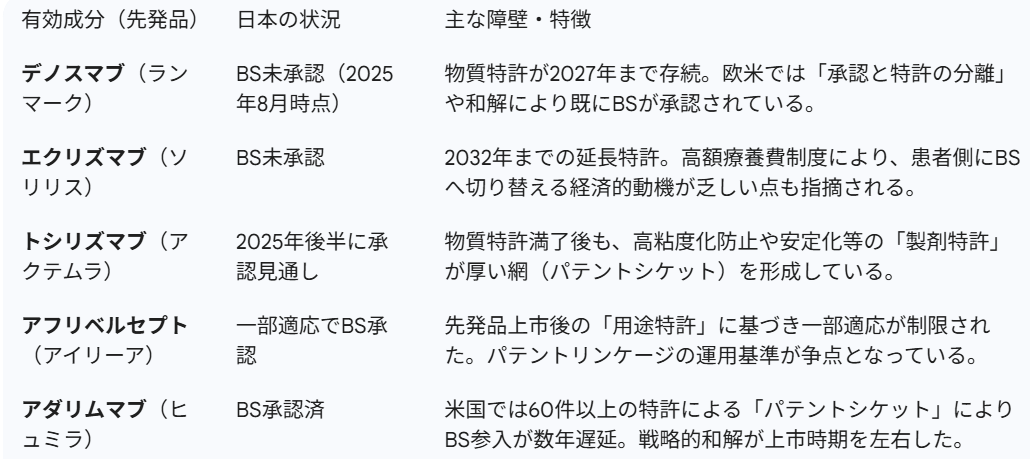
English translation of text in the image
|
Active Ingredient (Originator Product) |
Situation in Japan |
Main Barriers and Features |
|---|---|---|
|
Denosumab (Ranmark) |
BS not approved (as of August 2025) |
Substance patent continues until 2027. In Europe and the United States, BS products have already been approved through “separation of approval and patents” and settlements. |
|
Eculizumab (Soliris) |
BS not approved |
Extended patent until 2032. It is also noted that the high-cost medical expense benefit system gives patients little economic incentive to switch to BS products. |
|
Tocilizumab (Actemra) |
Approval expected in the second half of 2025 |
Even after expiration of the substance patent, “formulation patents” concerning prevention of viscosity increases, stabilization, and similar measures form a dense network (patent thicket). |
|
Aflibercept (Eylea) |
BS approved for some indications |
Some indications were restricted based on “use patents” after launch of the originator product. Operational standards for patent linkage are in dispute. |
|
Adalimumab (Humira) |
BS approved |
In the United States, a “patent thicket” of more than 60 patents delayed BS entry by several years. Strategic settlements determined the timing of market entry. |
Note on the table’s reference date and approval information: “BS not approved (as of August 2025)” for denosumab (Ranmark) in the reproduced table is a statement of the position as of that date. Fuji Pharma’s release of October 31, 2025, concerning its agreement for a denosumab biosimilar states 「2025年9月19日に製造承認を取得した」 (“obtained manufacturing approval on September 19, 2025”) for Denosumab BS Subcutaneous Injection 120 mg RM “F”. In summary, that product obtained approval on September 19, 2025; note 8 on p. 54 of the article also contains a post-submission addendum to this effect. Approval, launch, and reimbursement listing are separate matters. Fuji Pharma release, p. 1 Article, p. 54, note 8
[Article / Patents] Points to Note When Filing Food-Use Inventions in Different Countries (Biotechnology and Life Sciences Committee, Patent, December 2025)
Publication date on list page: June 5, 2026
[Article / Patents] Points to Note When Filing Food-Use Inventions in Different Countries (Biotechnology and Life Sciences Committee, Patent, December 2025)
In Japan, protection for “food-use inventions” was strengthened by the 2016 revision of the Examination Guidelines, but in overseas expansion, there are significant differences in each country’s legal system and examination practice.
1. Permissible Claims
①United States: “Inventions directed to the use of a product” are not recognized and are described as methods. A use stated in the preamble often has no limiting effect.
②Europe: “Purpose-limited substance / use”; for therapeutic use, “Substance A for use in …”; for non-therapeutic use, “Non-therapeutic use of …”. Swiss-type claims are not permissible.
③China: Method / Swiss-type claims (use for manufacturing …) are effective.
④South Korea: Product (food composition); similar to Japan, but novelty tends to be denied where the use does not create a difference in structure or form.
2. Difficulties in Obtaining Rights in the United States:
①INHERENCY — In the United States, even if an unknown use of a known substance is discovered, novelty is denied if it is considered “inherent” in the prior art.
②Laws of Nature — Effects within the body from ingestion are interpreted as being governed by a “law of nature,” and even if new knowledge is merely added to the known step of “eating,” proof of a remarkable effect is extremely difficult.
3. Distinctions in Europe:
①Therapeutic Use: Where the use relates to treatment or prevention of a disease, employ a “purpose-limited substance claim” under EPC 54(4) or (5).
②Non-Therapeutic Use: For health-maintenance purposes such as “recovery from fatigue,” a use claim expressly stating “non-therapeutic” is effective in making clear that the use does not fall within therapeutic acts.
There is a dilemma in that an expression such as “improvement of …” may be held unclear, while naming a specific disease may create a conflict with prior art (medical uses).
4. Strategic Conclusions
Rather than translating and filing unchanged a configuration that received a decision to grant a patent in Japan, amendment to a form appropriate for each country from the national or regional entry stage is indispensable.
In the United States, emphasize “structural differences” or “distinctiveness as a method” rather than use.
Reorganize claims into Swiss-type claims in China and purpose-limited substance claims in Europe.
Even broad rights at the subspecies level recognized in Japan (without limitation to a particular strain) are highly likely to require limitation to a specific deposit number (strain) overseas.
https://jpaa-patent.info/patent/viewPdf/4743
[Article / Designs] An Overview of Court Decisions on Employee-Created Designs (藤本一, Patent, January 2026)
Publication date on list page: June 5, 2026
[Article / Designs] An Overview of Court Decisions on Employee-Created Designs (藤本一, Patent, January 2026)
Of the seven cases discussed in the article, consideration was claimed in five. Of those, only the Clothes-Drying Device case involved consideration claimed solely on the basis of an employee-created design; within the cases covered by the article, no published decision granting such a claim is identified.
Compared with patents (employee inventions), the following differences and points to note can be identified in the calculation process for “reasonable consideration.”
①“Proportion of Excess Sales”: For designs, because it is easier to choose alternative designs (other designs that do not share the same aesthetic impression) than for patents, the exclusive advantage in the market tends to be estimated lower.
②“Hypothetical Royalty Rate”: The cases examined in the article include assessments of approximately 1.5%–2.0%, about half the royalty rate for patent rights. These examples consider the substitutability of designs, but caution is needed in generalizing them as royalty rates for designs overall.
③“Employee’s Contribution”: The article’s reference to approximately 5%–10% concerns employee inventions and does not state a general range for employee-created designs. Because designs more readily express the creator’s individuality, there is room for a higher assessment depending on the case.
However, cases in existing court decisions in which a high contribution has been recognized involved special circumstances, such as an extremely high degree of dependence on the individual plaintiff.
Note on sources for case numbers and calculation examples: 藤本一’s article, p. 147, states 「⑥〔物干し器〕のみが、原告がデザイナーで、職務創作意匠のみに基づいて相当の対価が請求された事案」 (“only ⑥ [Clothes-Drying Device] is a case in which the plaintiff was a designer and reasonable consideration was claimed on the basis of an employee-created design alone”). In summary, the five consideration cases must be distinguished from the single design-only claim. Case-specific calculation rates should not be generalized. The table below includes all seven cases discussed in the article, including case ② [Sluice Gate] (Osaka High Court decision of September 13, 1990). In addition, the entry “Excess sales attributable to the design portion denied” for the Infusion Container case reflects, according to p. 146 of the article, the first-instance judgment (Osaka District Court, October 16, 2012) (「⑤〔輸液容器〕の一審判決は、…職務創作意匠による超過売上の発生を否定したと理解される」, i.e., “the first-instance judgment in ⑤ [Infusion Container] … is understood to have denied that excess sales arose from the employee-created design”). Article, pp. 144–147
https://jpaa-patent.info/patent/viewPdf/4768
職務創作意匠に関する7事件(藤本論稿の紹介)
|
事件 |
裁判所・日付 |
論稿が紹介する位置付け |
|---|---|---|
|
剛性物質穴あけ用ドリル |
大阪地判昭和62年1月26日 |
法定通常実施権に関する判断。 |
|
水門扉 |
大阪高決平成2年9月13日 |
法定通常実施権に関する判断。 |
|
三角プレート(カネシン) |
東京地判平成4年9月30日 |
職務考案と併せて対価を認容。 |
|
鉄筋曲げ機 |
東京高判平成16年9月29日 |
職務発明等と併せて対価を認容。 |
|
輸液容器(ニプロ) |
知財高判平成25年7月11日 |
意匠部分の超過売上を否定したとするのは、一審(大阪地判平成24年10月16日)についての論稿の評価。 |
|
物干し器(タカラ産業) |
大阪地判平成29年10月12日 |
デザイナーによる請求であるが棄却。 |
|
ファン(三菱電機) |
知財高判令和5年1月23日 |
内部構造で見えない意匠の利益を否定。 |
English translation
|
Case |
Court and Judgment Date |
Overview |
|---|---|---|
|
Drill for Drilling Rigid Materials |
Osaka District Court, January 26, 1987 |
Determination concerning a statutory non-exclusive license. |
|
Sluice Gate |
Osaka High Court, September 13, 1990 |
A decision concerning a statutory non-exclusive licence. |
|
Triangular Plate (Kaneshin) |
Tokyo District Court, September 30, 1992 |
Consideration granted together with an employee utility-model creation. |
|
Reinforcing-Bar Bending Machine |
Tokyo High Court, September 29, 2004 |
Consideration granted together with employee inventions and the like. |
|
Infusion Container (Nipro) |
IP High Court, July 11, 2013 |
The article interprets the first-instance judgment (Osaka District Court, October 16, 2012) as denying excess sales attributable to the employee-created design. |
|
Clothes-Drying Device (Takara Industry) |
Osaka District Court, October 12, 2017 |
Claim by a designer, but rejected. |
|
Fan (Mitsubishi Electric) |
IP High Court, January 23, 2023 |
Profit from an invisible design within an internal structure denied. |
[Article / Agriculture, Forestry, and Fisheries] Protection and Use of Intellectual Property through an IP Mix with Overseas Expansion in View (Agriculture, Forestry, and Fisheries Committee, Patent, January 2026)
Publication date on list page: June 5, 2026
[Article / Agriculture, Forestry, and Fisheries] Protection and Use of Intellectual Property through an IP Mix with Overseas Expansion in View (Agriculture, Forestry, and Fisheries Committee, Patent, January 2026)
1. Branding by Vegetable Producers
Separation of Plant Breeders’ Rights and Trademarks: Because a registered variety name becomes public domain after the protection period expires, also obtain trademark rights.
For a brand with strong regional ties, strategically distinguish between use of the GI system and the regional collective trademark system.
2. Specific Examples of Use of an IP Mix
①Trademark Rights × Plant Breeders’ Rights: Examples include “Ruby Roman” and the trademark registration of the brand name “Beni Madonna” for the variety name “Ehime Kashi No. 28.”
②Patent Rights × Trademark Rights: “Soratobu Pumpkin,” which combines a patent for the cultivation method with a brand name.
③Patent Rights × Trademark Rights × GI: “Zentsuji-san Shikaku Suika,” protected by a three-part set of a patent for the cultivation container, a trademark, and a GI.
④Trademark Rights × GI (Overseas): In the “Kobe Beef” case, the framework of mutual GI protection with Europe and other regions was used to successfully remove false indications within Europe based on a geographical indication registration in Japanese.
3. Geographical Indications for Alcoholic Beverages and Management of Know-How
①GIs for Alcoholic Beverages: Administered by the National Tax Agency, they protect the characteristics of the place of origin (natural and human factors). Established approximately 20 years earlier than the GI system for agricultural products, the system first designated “Iki,” “Kuma,” and “Ryukyu” on June 30, 1995.
②Management of Know-How: For technologies such as cultivation techniques where disclosure through patenting is to be avoided, it is important to ensure thorough confidential management as trade secrets in the agricultural field.
https://jpaa-patent.info/patent/viewPdf/4767
[Article / U.S. Designs] Changes in the Methods for Determining Design Right Infringement in the United States (佐々木眞人, Patent, January 2026)
Publication date on list page: June 5, 2026
[Article / U.S. Designs] Changes in the Methods for Determining Design Right Infringement in the United States (佐々木眞人, Patent, January 2026)
Determination of design right infringement in the United States originates in the “ordinary observer test” established by the 1871 GORHAM Supreme Court judgment.
Following the 1984 LITTON SYSTEMS judgment, the CAFC introduced the “point of novelty test” in addition to it. This test requires possession of a “novel design feature (point of novelty)” that distinguishes the patented design from prior designs.
⇒As a result, both substantial identity and appropriation of a novel point became necessary for a finding of infringement.
However, the “point of novelty test” was abolished by the 2008 EGYPTIAN GODDESS en banc judgment. That judgment reconfirmed that the ordinary observer test is the sole test for determining design right infringement. However, it clarified that the comparison in determining infringement should be made from the viewpoint of an “ordinary observer familiar with the prior designs,” and that the effect of differences on the overall design should be evaluated in comparison with the prior designs.
Subsequent judgments have indicated the following points.
①Consider the overall ornamental features after excluding functional aspects at the conceptual level.
②The scope of prior designs used for comparison is limited to those applied to the article identified in the claim.
③A logo affixed to the allegedly infringing product and its placement may also be considered as ornamental differences.
⇒Current determination of design right infringement in the United States is consolidated into the ordinary observer test, which emphasizes the “overall ornamental impression” after considering prior designs and separating functional elements, rather than simple visual similarity.
https://jpaa-patent.info/patent/viewPdf/4765
[United States] Focus Prod v. Kartri Sales (CAFC, 2025.9.30)
Original article URL: https://www.nakapat.gr.jp/ja/note/%e3%80%90%e7%b1%b3%e5%9b%bd%e3%80%91focus-prod-v-kartri-sales%ef%bc%88cafc%e3%80%812025-9-30%ef%bc%89/
Publication date on list page: June 5, 2026
[United States] Focus Prod v. Kartri Sales (CAFC, 2025.9.30)
Where a particular species is elected without challenging the definition or limitation of “species” presented by the examiner, there is a risk that unelected species will be regarded as excluded from the scope of the claims.
⇒Regarding claim 73, because the patentee did not dispute the examiner’s withdrawal of the claim as drawn to a nonelected species (Species V), the features of claim 73 (a ring with a flat upper edge) were held to have been excluded.
—The summary judgment of infringement of the ’248 and ’609 patents reversed as to Marquis (the infringement findings against Kartri affirmed because Kartri waived its non-infringement arguments)
Note on the appellate disposition: Page 16 states “we reverse the district court’s patent infringement determination for the ’248 and ’609 patents.” In summary, “reversed” is the disposition concerning those two patents. For the ’088 patent, page 24 states “Although we agree with the district court’s construction of ‘projecting edge,’ its infringement analysis on this issue was, at a minimum, inadequate to sustain summary judgment.” Thus, while agreeing with the district court’s claim construction, the court vacated and remanded the summary judgment because the infringement analysis was inadequate. These dispositions concern Marquis; as to Kartri, the ’248, ’609, and ’088 patent infringement findings were affirmed because Kartri waived its non-infringement arguments (pp. 3 and 40–41). These outcomes must be distinguished. CAFC judgment, pp. 3, 16–27 and 40–41
https://www.cafc.uscourts.gov/opinions-orders/23-1446.OPINION.9-30-2025_2580961.pdf
2024 (Gyo-Ke) No. 10017 [Optimized Nutritional Formulations, Methods for Selecting Tailored Diets Therefrom, and Uses Thereof] <Presiding Judge Miyasaka>
Publication date on list page: June 5, 2026
2024 (Gyo-Ke) No. 10017 [Optimized Nutritional Formulations, Methods for Selecting Tailored Diets Therefrom, and Uses Thereof] <Presiding Judge Miyasaka>
*No inventive step for an invention with numerical limitations
(The numerical range of the primary reference was included within the numerical range of the invention at issue.)
(Excerpt from the Holding)
… In Example 5 (Table 12) of Cited Document 2, … ω-6 falls within a range of 1–35 g. …
In view of the disclosed range of 1–35 g in Table 12 of Cited Document 2 referred to in item (a) above concerning the dose of ω-6 fatty acid in the composition of Cited Invention 2, which contains a daily optimal amount of fatty acids, making this the dose of “1–40 g of ω-6 fatty acid in an average daily amount” of the composition of the claimed invention was something a person skilled in the art could appropriately have done.
… Cited Document 2 states that nuts and seeds, which are components of the composition, contain antioxidants and polyphenols, and it can be said that polyphenols being antioxidants was well known before the priority date of the application; therefore, including polyphenols as antioxidants in the composition of Cited Invention 2 was also something a person skilled in the art could appropriately have done. …
https://www.courts.go.jp/assets/hanrei/hanrei-pdf-93723.pdf
Tokyo District Court, 2024 (Wa) No. 4142 [Portable Information Communication Device and Personal Computer System Using the Portable Information Communication Device] <Presiding Judge Kokubu> (related case decided the same day: Tokyo District Court, 2024 (Wa) No. 70083, defendant SoftBank Corp.)
Publication date on list page: June 5, 2026
Tokyo District Court, 2024 (Wa) No. 4142 [Portable Information Communication Device and Personal Computer System Using the Portable Information Communication Device] <Presiding Judge Kokubu>
(related case decided the same day: Tokyo District Court, 2024 (Wa) No. 70083, defendant SoftBank Corp.)
*The amount equivalent to consumption tax that had not been claimed in the prior actions was claimed in a separate action, but the action was dismissed as inadmissible for violating the principle of good faith.
The plaintiff argued, among other things, that ①the amount equivalent to consumption tax had not been the subject of examination in the prior actions and therefore the claim did not amount to rehashing the dispute, ②the loss from consumption tax arose from a cause different from the loss of royalties, and ③because the consumption tax rate is determined by the rate at the time the judgment becomes final and binding, it had been difficult to claim it in the prior actions.
⇒The court found that the amount equivalent to consumption tax had not been specifically examined in Prior Actions 1 and 2 and that this action did not go so far as to rehash arguments rejected in those actions. However, there are not a few examples in patent infringement litigation in which amounts equivalent to consumption tax are claimed and awarded as part of damage or loss, and that fact is apparent to this court. Accordingly, it cannot be said that the plaintiff could not have recognized such practical circumstances. Moreover, the amount equivalent to consumption tax could readily be calculated merely by multiplying the amount equivalent to royalties by the then-current consumption tax rate (already 10% at the close of oral argument in Prior Actions 1 and 2, on December 19, 2022), and it cannot be said that it was difficult to assert the amount equivalent to consumption tax as a loss together with the amount equivalent to royalties in Prior Actions 1 and 2. Furthermore, the plaintiff had not expressly stated in the prior actions that it claimed only the damage or loss equivalent to royalties, nor indicated an intention to exclude the consumption tax portion from the subject of examination.
⇒The court assessed that, although the plaintiff could have made the entire loss, including the consumption tax amount, the subject of the court’s examination in Prior Actions 1 and 2, or conversely excluded only the consumption tax portion, it deliberately did neither and made partial claims, losing as to part of them; it concluded that the claim for the remainder in this case contravened the defendant’s reasonable expectation that the dispute concerning the entire claim had been resolved by the final and binding judgments in Prior Actions 1 and 2, and imposed the burden of defending twice.
Consequently, finding no special circumstances, the court held that bringing this action violated the procedural principle of good faith and was impermissible, and dismissed the action itself as inadmissible without reaching the merits of the claim for restitution of unjust enrichment.
(Excerpt from the Holding)
… A judgment rejecting all or part of a quantitatively partial claim is based on the results of the examination thus conducted with respect to the entire claim and indicates a determination that the claim does not exist at all or exists only in an amount less than that claimed as a part; in other words, it is nothing other than a determination that there is no portion that can subsequently be claimed as the remainder.
Accordingly, the plaintiff’s bringing an action for the remainder after the above judgment becomes final and binding substantively rehashes claims and arguments not accepted in the prior action, contravenes the defendant’s reasonable expectation that the dispute concerning the entire claim has been resolved by the final and binding judgment in the prior action, and imposes on the defendant the burden of defending twice.
In light of the foregoing, it is appropriate to interpret that, absent special circumstances, a plaintiff who lost an action on a quantitatively partial monetary claim is not permitted, as contrary to the principle of good faith, to bring an action for the remainder. (See Supreme Court, 1997 (O) No. 849, judgment of the Second Petty Bench of June 12, 1998, Minshu Vol. 52, No. 4, p. 1147 (the 1998 Supreme Court Judgment).)
…
There are not a few cases in patent infringement litigation in which claims for damages or restitution of unjust enrichment equivalent to consumption tax are made, and it is apparent to this court that amounts equivalent to consumption tax have been awarded as part of damage or loss; moreover, even in light of all the evidence in this case, no circumstances can be found such as the plaintiff’s inability to recognize such actual conditions.
Furthermore, because the loss equivalent to consumption tax can readily be calculated by multiplying the loss equivalent to royalties by the prescribed consumption tax rate, it cannot be said that the entirety of the loss, including the consumption tax amount, had not been fixed at the close of oral argument in the fact-finding proceedings of Prior Actions 1 and 2; nor can any circumstances be discerned that made it difficult for the plaintiff, with respect to its unjust enrichment claims in Prior Actions 1 and 2, to assert, in addition to the loss equivalent to royalties, the amount obtained by multiplying that amount by the prescribed consumption tax rate as a loss equivalent to consumption tax, or any reasonable ground for not making that assertion.
Thus, it must be said that, although the plaintiff could have added the loss equivalent to consumption tax to the subject of examination and determination in Prior Actions 1 and 2, or expressly stated that it would not be included in their subject matter, the plaintiff did not do so.
… This action is an action for the remainder brought by a plaintiff who lost actions on quantitatively partial monetary claims, and bringing this action is impermissible as contrary to the principle of good faith.
https://www.courts.go.jp/assets/hanrei/hanrei-pdf-94162.pdf
WORD:Hideki Takaishi Article Collection January–June 2026