Hideki Takaishi Article Collection July–December 2025
Hideki Takaishi Article Collection
July–December 2025
English Edition
158 articles
Website articles and English translations of the original Ameblo articles; quoted judgments are presented as excerpts.
In chronological order of the original Ameblo publication date
Existing website text is retained wherever available; missing articles are supplied from the original Ameblo posts and new English translations, with disclosed omissions in some judgment excerpts. Source URLs reflect information verified at compilation on November 1, 2026.
Confirmed errors in wording, legal descriptions, and translations have been corrected. Unless otherwise stated, descriptions of legal rules, outlooks, and statistics reflect the time when each original article was published.
Article Index
02 2025-07-02 [Trademark] IP High Court, 2024 (Gyo-Ke) 10066, “UNITED GOLD” Case <Nakadaira>
03 2025-07-03 [Portrait Rights] IP High Court, 2023 (Ne) 10085 <Honda>
04 2025-07-04 IP High Court, 2023 (Gyo-Ke) 10052 [Assist Device] <Miyasaka>
05 2025-07-05 [Claim for contractual penalties] Osaka District Court, 2023 (Wa) No. 829 (Judge Matsuami)
06 2025-07-06 [South Korea] Patent Court, December 3, 2024 <2023 Na 10914>
07 2025-07-07 [Trademarks] Cases Concerning Similarity of Marks with Reordered Kanji
08 2025-07-08 [Patents / Employee Inventions] Osaka District Court, 2020 (Wa) 12107
09 2025-07-09 Tokyo High Court, 1994 (Gyo-Ke) No. 243 — Buddhist altar (Judge Minoru Takeda)
10 2025-07-10 Tokyo High Court, 1998 (Gyo-Ke) No. 82 — Semiconductor device (Judge Shinohara)
11 2025-07-11 Tokyo District Court, 2022 (Wa) 70058 [Grapple Bucket Device] <Kokubu>
12 2025-07-12 IP High Court, 2013 (Ne) 10007 [Agitation Granulation Apparatus] <Shitara>
13 2025-07-13 IP High Court, 2023 (Gyo-Ke) 10019 [Methods for Treating Atopic Dermatitis by Administering an IL-4R Antagonist] <Miyasaka>
14 2025-07-14 IP High Court, 2023 (Gyo-Ke) 10090 [Fulvestrant Formulation] <Nakadaira>
15 2025-07-15 Tokyo High Court, 2003 (Gyo-Ke) 104 [New Medical Use of Tachykinin Antagonists]
18 2025-07-18 IP High Court, 2020 (Gyo-Ke) 10057 [Electric Bed] <Kanno>
20 2025-07-21 Trial and Appeal Practitioners Study Group Report 2024 — Theme 2 (Chemistry 1)
21 2025-07-22 Trial and Appeal Practitioners Study Group Report 2024 — Case 2 (Chemistry 1)
22 2025-07-23 Trial and Appeal Practitioners Study Group Report 2024 — Theme 3 (Chemistry 2)
23 2025-07-24 Trial and Appeal Practitioners Study Group Report 2024 — Case 3 (Chemistry 2)
24 2025-07-25 Trial and Appeal Practitioners Study Group Report 2024 — Theme 4 (Electrical 1)
25 2025-07-27 Trial and Appeal Practitioners Study Group Report 2024 — Case 4 (Electrical 1)
26 2025-07-27 Trial and Appeal Practitioners Study Group Report 2024 — Theme 5 (Designs)
27 2025-07-29 Trial and Appeal Practitioners Study Group Report 2024 — Theme 6 (Trademarks)
28 2025-07-30 Trial and Appeal Practitioners Study Group Report 2024 — Case 6 (Trademarks)
29 2025-07-31 [US patents] CAFC, January 2025 — Honeywell v. 3G Licensing
30 2025-08-01 Tokyo District Court, 2023 (Wa) No. 70178 — Zinc acetate hydrate tablets (Judge Nakashima)
32 2025-08-05 [Copyright] Osaka District Court, 2019 (Wa) No. 10940
33 2025-08-05 Text to Enter in “Customize ChatGPT”
35 2025-08-07 [Trademarks] IP High Court, 2024 (Gyo-Ke) No. 10038
36 2025-08-07 [Trademarks] IP High Court, 2023 (Gyo-Ke) No. 10117 — “Besurikai Tokyo TMS Clinic” (Judge Honda)
37 2025-08-07 [United States] CAFC, August 2, 2023 — Realtime Data v. Array Networks
38 2025-08-14 IP High Court, 2020 (Gyo-Ke) No. 10094 — Agent for suppressing recurrence of reflux esophagitis (Judge Mori)
39 2025-08-14 [Trademarks / Similarity] Tokyo High Court, 2000 (Ne) No. 6252
40 2025-08-14 [Trademarks / Cancellation for non-use] IP High Court, 2010 (Gyo-Ke) No. 10083 — “ECOPAC”
41 2025-08-14 [Trademarks] Trial decision, Appeal against refusal No. 2023-10504
42 2025-08-14 [Trademarks] Osaka District Court, 2022 (Wa) No. 9818 — “熱中対策応急キット” (Heatstroke countermeasure emergency kit) (Judge Takemiya)
43 2025-08-14 [Trademarks / Cancellation for non-use] IP High Court, 2024 (Gyo-Ke) No. 10054
45 2025-08-16 [Trademarks] Tokyo High Court, 1979 (Ne) No. 1097
46 2025-08-16 [Designs] A case recognizing indirect infringement of a partial design
47 2025-08-17 [Trademarks / False marking] Osaka High Court, 1991 (Ne) No. 1003 — Choco Krispies
48 2025-08-18 [Copyright] Osaka High Court, 2007 (Ne) No. 713 — Peter Rabbit
49 2025-08-19 Supreme Court, 1992 (O) No. 1491 — Earth belt
50 2025-08-20 IP High Court, 2022 (Ne) No. 10070 — Image display method (Judge Kanno)
51 2025-08-21 IP High Court, 2024 (Gyo-Ke) No. 10050 — Information processing apparatus (Judge Miyasaka)
52 2025-08-22 IP High Court, 2024 (Gyo-Ke) No. 10049 — Vehicle (Judge Nakadaira)
53 2025-08-23 IP High Court, 2013 (Gyo-Ke) No. 10266 — Transparent film (Judge Ishii)
54 2025-08-24 IP High Court, 2021 (Gyo-Ke) No. 10116 — Game program (Judge Honda)
55 2025-08-25 Osaka High Court, 2011 (Ne) No. 2651 — Unfair Competition Prevention Act
56 2025-08-26 Osaka High Court, 1999 (Ne) No. 18 — Method of attaching a filter to an exhaust outlet
57 2025-08-27 Tokyo District Court, 2004 (Wa) No. 10431 — Design infringement litigation
59 2025-08-31 [New YouTube video] Inventive step — expanded version
60 2025-08-31 IP High Court, 2013 (Ne) No. 10007 — Stirring and granulating apparatus (Judge Shitara)
61 2025-09-01 Tokyo District Court, 2020 (Wa) No. 4331 — Heated aerosol-generating device (Judge Nakashima)
62 2025-09-02 IP High Court, 2023 (Gyo-Ke) No. 10098 — Laundry detergent composition (Judge Shoji)
63 2025-09-03 IP High Court, 2019 (Gyo-Ke) No. 10103 — Support structure for a concrete foundation (Judge Mori)
64 2025-09-05 [United States] Incyte v. Sun Pharm (Federal Circuit, May 2025)
65 2025-09-05 IP High Court, 2019 (Gyo-Ke) No. 10055 — Mechanical fastener (Judge Otaka)
67 2025-09-08 [Trademarks] IP High Court, 2024 (Gyo-Ke) No. 10061 — “CONART” (Judge Honda)
68 2025-09-09 [Trademarks / Similarity] IP High Court, 2024 (Gyo-Ke) No. 10091 — “Connect One” (Judge Hibiku Shimizu)
69 2025-09-10 [Trademarks / JPO decision] Opposition No. 2023-900278
70 2025-09-11 Tokyo District Court, 2023 (Wa) No. 70114 — Motorcycle brake control device (Judge Shibata)
71 2025-09-12 IP High Court, 2021 (Gyo-Ke) No. 10094 — PCSK9 (second litigation) (Judge Kanno)
72 2025-09-13 IP High Court, 2005 (Gyo-Ke) No. 10645 — Method for inspecting sealed packages (Judge Tsukahara)
73 2025-09-15 Tokyo High Court, 2003 (Gyo-Ke) No. 166 — …Topical agent for treating atopic dermatitis (Judge Tsukahara)
74 2025-09-16 [Trademarks] IP High Court, 2024 (Gyo-Ke) No. 10071 — “Taishoken” (Judge Miyasaka)
75 2025-09-17 [Unfair competition] Osaka High Court, 2024 (Ne) No. 1775 — “Wam”
76 2025-09-19 [Trademarks / JPO decision] Appeal No. 2024-5257
77 2025-09-21 [Trademarks / JPO decision] Appeal No. 2024-11680
78 2025-09-22 [Trademarks / JPO decision] Appeal No. 2024-7278
80 2025-09-26 IP High Court, 2024 (Gyo-Ke) No. 10019 — Laminate of a polyester resin composition (Judge Miyasaka)
81 2025-09-27 Osaka District Court, 2022 (Wa) No. 11025 — Mite-trapping mat (Judge Matsuami)
82 2025-09-28 IP High Court, 2024 (Ne) No. 10019 — Rolling device (Judge Miyasaka)
83 2025-09-29 [Trademarks / Article 4(1)(vii)] IP High Court, 2023 (Gyo-Ke) No. 10128 — “MARK GONZALES” (Judge Honda)
84 2025-10-01 IP High Court, 2013 (Ne) 10035 [Method for Manufacturing a Rotary Toothbrush] (Appeal) <Shitara>
85 2025-10-02 IP High Court, 2024 (Ne) 10041 [Receiving Device] <Masuda>
86 2025-10-03 [United States] Maquet Cardiovascular LLC v. Abiomed Inc. (CAFC, March 21, 2025)
87 2025-10-04 [United States] In re Riggs (March 2025, CAFC)
88 2025-10-05 [United States] Sigray v. Carl Zeiss (CAFC, May 2025)
89 2025-10-06 [United States] IQRIS Techs v. Point Blank (CAFC, March 2025)
90 2025-10-08 [Trademark] IP High Court, 2023 (Gyo-Ke) 10087, “Sankin Kogyo” Case <Hibiku Shimizu>
91 2025-10-08 [United States] Sierra Wireless v. Sisvel (CAFC, March 2025)
92 2025-10-10 [China / Copyright] Guangzhou Internet Court, February 8, 2024
93 2025-10-12 [Trademarks] IP High Court, 2024 (Gyo-Ke) 10032 <Judge Miyasaka>
94 2025-10-13 [Trademarks] IP High Court, 2024 (Gyo-Ke) 10007, “Jimny Fan” <Judge Miyasaka>
95 2025-10-14 IP High Court, 2024 (Gyo-Ke) 10016 [Undried tea paste] <Judge Nakadaira>
96 2025-10-16 [Copyright / Trade secrets] Osaka District Court, 2020 (Wa) 1539 <Judge Takemiya>
97 2025-10-16 [Unfair Competition Prevention Act] Tokyo District Court, 2023 (Wa) 70513, the “Karate dojo” case <Judge Nakashima>
98 2025-10-18 [Trademarks / Contracts] Osaka District Court, 2022 (Wa) 7393, “MICHEL JURDAIN” <Judge Takemiya>
99 2025-10-19 [Unfair Competition Prevention Act / Contracts] Osaka District Court, 2023 (Wa) 886 <Judge Takemiya>
100 2025-10-20 Tokyo District Court, 2023 (Wa) 70393 [Foldable and stowable temporary protective fence] <Judge Nakashima>
101 2025-10-21 [Copyright / Quotation] Tokyo District Court, 2023 (Wa) 70388 <Judge Nakashima>
102 2025-10-23 IP High Court, 2023 (Gyo-Ke) 10100 [Gas-scrubber fluid purification apparatus] <Judge Hibiku Shimizu>
103 2025-10-24 IP High Court, 2024 (Gyo-Ke) 10014 [Acceleration recovery generator] <Judge Miyasaka>
107 2025-11-03 [Video introduction] Generative AI and prompt-driven reform in Shimadzu’s IP operations [Koji Akutsu] [Summaria webinar]
108 2025-11-05 [United States] HOOP v. HOOP (Fed. Cir., 279 F.3d 1004) (2002)
110 2025-11-07 [United States] FMC v. Sharda (CAFC, August 1, 2025)
112 2025-11-10 Osaka District Court, 2023 (Wa) 8403 [Ventilation structure beneath a coping] <Takemiya>
114 2025-11-11 IP High Court, 2005 (Gyo-Ke) 10099 [Image processing system]
115 2025-11-12 IP High Court, 2005 (Gyo-Ke) 10420 [Information supply system using a communication line] <Shinohara>
116 2025-11-13 [United States] LAB v. Qiagen (CAFC, August 13, 2025)
117 2025-11-14 Tokyo District Court order, 2023 (Yo) 30402 [Siphon rain-gutter system] <Nakashima>
118 2025-11-16 [Overview] Patent Examination Standards Working Group: Disclaimer amendments and AI-related examination issues (November 17, 2025)
119 2025-11-17 Tokyo District Court, 2023 (Wa) 70346 [Wireless scuff plate] <Nakashima>
120 2025-11-21 Osaka District Court, 2022 (Wa) 11025 [Porous air-permeable bag containing food for mites]
122 2025-11-23 [IP Practice Online] Intellectual property rights and Customs procedures (Attorney Reiko Tonomura)
123 2025-11-25 Osaka District Court, 2022 (Wa) 9696 [Method for producing active GcMAF]
125 2025-11-27 Osaka District Court, 2023 (Wa) 10237 [Tool for slaughtering wild animals]
126 2025-11-27 [Unfair Competition / Trade Secrets] Osaka District Court, 2023 (Wa) 2681
127 2025-11-28 Tokyo District Court, 2024 (Wa) 70106 <Kokubu>
128 2025-11-29 [New on YouTube] May 28, 2025 (IP LAB)
129 2025-11-30 [IP Practice Online] An enjoyable discussion of patent claim interpretation (Attorney Masakazu Kobayashi)
130 2025-12-01 Tokyo District Court, 2023 (Wa) 70425 [Information Processing Apparatus] <Nakashima>
131 2025-12-02 [Contract] Osaka District Court, 2023 (Wa) 12021
132 2025-12-03 [Unfair Competition Prevention Act / Trade Secrets] Osaka District Court, 2023 (Wa) 12731
134 2025-12-05 [Copyright] Tokyo District Court, 2024 (Wa) 70126 <Nakashima>
135 2025-12-09 IP High Court Grand Panel, 2006 (Gyo-Ke) 10563 [Solder Resist]
138 2025-12-09 [Copyright] Tokyo District Court, 2024 (Wa) 70189 <Nakashima>
139 2025-12-10 Tokyo District Court, 2022 (Wa) 70058 [Grapple Bucket Device] <Kokubu>
140 2025-12-11 <Study Group on Effective Disclosure and Governance of Intellectual Property Investment and Utilization Strategies (24th Meeting)>
141 2025-12-12 IP High Court, 2025 (Gyo-Ke) 10046 [Multifunctional Quantum Charge Ratio Flow Conversion Device] <Nakadaira>
142 2025-12-13 “Manual for Startups on Collaboration with Operating Companies” (INPIT)
143 2025-12-14 [IP Practice Online] Joint Reading Festival for “A Sham Selection of One Hundred Copyright Cases” (Subaru Tomori)
144 2025-12-15 Tokyo District Court, 2025 (Wa) 70002 [Nanocomposite Having Quantum Dots and Method for Manufacturing the Same] <Takahashi>
145 2025-12-16 IP High Court, 2025 (Ne) 10032 [Rod-Shaped Light] <Honda>
146 2025-12-17 IP High Court, 2024 (Gyo-Ke) 10012 [Enzyme-treated milk product] <Judge Hibiku Shimizu>
147 2025-12-18 IP High Court, 2024 (Gyo-Ke) 10076 [Fuel and Blending Combinations Thereof] <Judge Hibiku Shimizu>
148 2025-12-19 IP High Court, 2024 (Ne) 10069 [Toilet rolls, etc.] <Judge Nakadaira>
149 2025-12-22 Osaka District Court, 2022 (Wa) 8985 [Cross connector] <Judge Matsukawa>
150 2025-12-22 IP High Court, 2024 (Gyo-Ke) 10100 [Child safety seat for attachment to a vehicle seat] <Judge Nakadaira>
151 2025-12-22 IP High Court, 2024 (Gyo-Ke) 10085 [… Solar power self-consumption system] <Judge Nakadaira>
152 2025-12-23 IP High Court, 2024 (Gyo-Ke) 10081 [Pet matching system] <Judge Nakadaira>
153 2025-12-24 IP High Court, 2025 (Ne) 10042 [Fastening hardware] <Judge Hibiku Shimizu>
154 2025-12-25 Osaka District Court, 2024 (Wa) 6216 [Taxi dispatch management system] <Judge Matsuami>
155 2025-12-26 IP High Court, 2024 (Gyo-Ke) 10073 [Therapeutic agent inducing cytotoxicity] <Judge Masuda>
156 2025-12-27 Osaka District Court, 2024 (Wa) No. 7193 — Article transport equipment (Judge Matsuami)
157 2025-12-28 IP High Court, 2025 (Ne) 10025 [Spindle Motor] <Nakadaira> ⇒ Claim for Compensation for an Employee Invention
158 2025-12-30 IP High Court, 2025 (Ne) 10035 [Vehicle Guidance System] <Honda> (PXZ v. East Nippon Expressway Company Limited)
[Trademark] IP High Court, 2024 (Gyo-Ke) 10055, “Shifuku no Girisha” (Blissful Greece) <Hibiku Shimizu> (Plaintiff: Hellenic Republic)
Original Ameblo publication: 2025-07-01
Ameblo: https://ameblo.jp/hideki-takaishi/entry-12913799847.html
[Trademark] IP High Court, 2024 (Gyo-Ke) 10055, “Shifuku no Girisha” (Blissful Greece) <Hibiku Shimizu> (Plaintiff: Hellenic Republic)
*“Shifuku no Girisha” (Blissful Greece) is not understood as being limited or specifically confined to “produced in Greece.”
⇒ No violation of Article 3(1)(iii) of the Trademark Act or the other provisions at issue.
(Translation of an excerpt from the court’s reasoning)
The trademark at issue combines the words “shifuku no” (blissful) with “Girisha” (Greece), … and is found to convey a single coherent meaning along the lines of “Greece, a country of unsurpassed happiness.” It therefore calls to consumers’ minds the country or region of Greece itself together with the positive image conveyed by “blissful,” and projects that image onto the designated goods at issue, namely yogurt. Unlike a trademark consisting solely of “Greece,” it does not descriptively indicate a place of production or sale. Rather, it merely uses an abstract image associated with the country or region of Greece to indicate that the goods are connected with Greece in some way. That connection is not confined to a place of production or sale, and the mark cannot be regarded as indicating “Greece” as the place of production or sale. Neither the actual circumstances of trade in yogurt, which encompasses the designated goods, nor the Internet search results for “Shifuku no Girisha” … provide sufficient evidence that “Shifuku no Girisha,” or similar signs combining words such as “blissful” with the name of a country or region, are generally used to indicate the place of production or sale or other characteristics of goods. The examples cited by the plaintiff, such as “Blissful Hawaii” and “Blissful America,” … are used in articles and advertisements introducing overseas travel or overseas real estate as expressions referring to the country or region itself, and are not examples of indications identifying the place of production of particular goods. Accordingly, the trademark at issue cannot be described as a “trademark consisting solely of a sign indicating, in a commonly used manner, the place of production, place of sale, or other characteristics of the goods.” …
https://www.courts.go.jp/assets/hanrei/hanrei-pdf-93616.pdf
[Trademark] IP High Court, 2024 (Gyo-Ke) 10066, “UNITED GOLD” Case <Nakadaira>
Original Ameblo publication: 2025-07-02
Ameblo: https://ameblo.jp/hideki-takaishi/entry-12914011169.html
[Trademark] IP High Court, 2024 (Gyo-Ke) 10066, “UNITED GOLD” Case <Nakadaira>
Trademark at issue: “UNITED GOLD”
Cited trademark: “UNITED/ユナイテッド” (“UNITED” and its katakana rendering “Yunaiteddo,” written on two lines)
*Because “UNITED” had weak distinctiveness in the fashion industry and related industries, “UNITED GOLD” is an inseparable whole.
⇒ Not similar.
(Translation of an excerpt from the court’s reasoning)
… In the fashion industry handling clothing and accompanying personal accessories, and in the retail industries for those goods, the “UNITED” portion is found to have weak distinctiveness. Accordingly, because the “UNITED” portion of the trademark at issue is not found to possess any particular distinctiveness, it is appropriate to view the trademark at issue as a mark having the inseparable overall composition “UNITED GOLD.” It is not considered to be observed separately as “UNITED” and “GOLD”; therefore, it is appropriate to conclude that the pronunciation “Yunaiteddo” does not arise from the trademark at issue.
https://www.courts.go.jp/assets/hanrei/hanrei-pdf-93652.pdf
[Portrait Rights] IP High Court, 2023 (Ne) 10085 <Honda>
Original Ameblo publication: 2025-07-03
Ameblo: https://ameblo.jp/hideki-takaishi/entry-12914190373.html
[Portrait Rights] IP High Court, 2023 (Ne) 10085 <Honda>
The sale of videos recording martial-arts demonstrations does not exceed the legally tolerable limit and therefore does not infringe portrait rights.
—The appellant knew about the sale of the videos, entered into a contract, received an appearance fee, and had not protested.
*The issue was not whether consent existed, but whether the legally tolerable limit was exceeded.
https://www.courts.go.jp/assets/hanrei/hanrei-pdf-92836.pdf
IP High Court, 2023 (Gyo-Ke) 10052 [Assist Device] <Miyasaka>
Original Ameblo publication: 2025-07-04
Ameblo: https://ameblo.jp/hideki-takaishi/entry-12914394858.html
IP High Court, 2023 (Gyo-Ke) 10052 [Assist Device] <Miyasaka>
Claim: “… the main bearing consists solely of one single-row rolling bearing (excluding cross-roller bearings), or …”
The description in Exhibit Ko 1 does not establish what type of bearing the “bearing” in the primary reference is.
⇒ Not specifically identified.
*(Commentary) “Addition versus substitution”: If a particular configuration is found to be disclosed in the primary reference, the obviousness of “substitution” becomes the issue, and the hurdle for denying inventive step is high. If a particular configuration is found not to be disclosed in the primary reference, the obviousness of “addition” becomes the issue, so the hurdle for denying inventive step is lower.
(Summary of the reasons for the JPO’s revocation decision) “As bearings, ‘single-row rolling bearings’ other than cross-roller bearings and ‘plain bearings’ are well-known configurations of machine elements.”
(Excerpt from the court’s reasoning)
“… what type of bearing the ‘one bearing’ is cannot but be said to be unclear from the description in Exhibit Ko 1.” “For a person skilled in the art who came across the assist device of the Ko 1 Invention to measure the direction and magnitude of the load on the shaft in order to select an appropriate bearing and, based on the measurement results, to change the design to an optimal, inexpensive bearing from among the options of well-known bearings should be said to be no more than an exercise of the ordinary creative ability of a person skilled in the art.” “Neither the revocation decision’s determination nor this court’s determination in item (b) above is based on the well-known nature of single-row rolling bearings as mere machine elements; rather, they set out reasoning focused on what main bearing would be selected for a reduction gear for an assist device in light of the differences between reduction gears for assist devices and reduction gears for industrial robots, and they fully take into account the premise of Feature A (the technical context) asserted by the plaintiff.”
⇒ Inventive step denied.
https://www.youtube.com/watch?app=desktop&v=eUH8ktGmkjQ
https://www.courts.go.jp/assets/hanrei/hanrei-pdf-92825.pdf
[Claim for contractual penalties] Osaka District Court, 2023 (Wa) No. 829 (Judge Matsuami)
Original Ameblo publication: 2025-07-05
Article type: Case note
Categories: Trademarks, Unfair competition law, Other Japanese law
Topics: Trademark use, Trade secrets, Contracts
First published on this website: 2026-10-16
Case information: 2023 (Wa) No. 829
Ameblo: https://ameblo.jp/hideki-takaishi/entry-12914679709.html
HP: https://www.takaishihideki.com/en/single-post/ameblo-12914679709-en
Japanese version: https://www.takaishihideki.com/single-post/ameblo-12914679709-ja
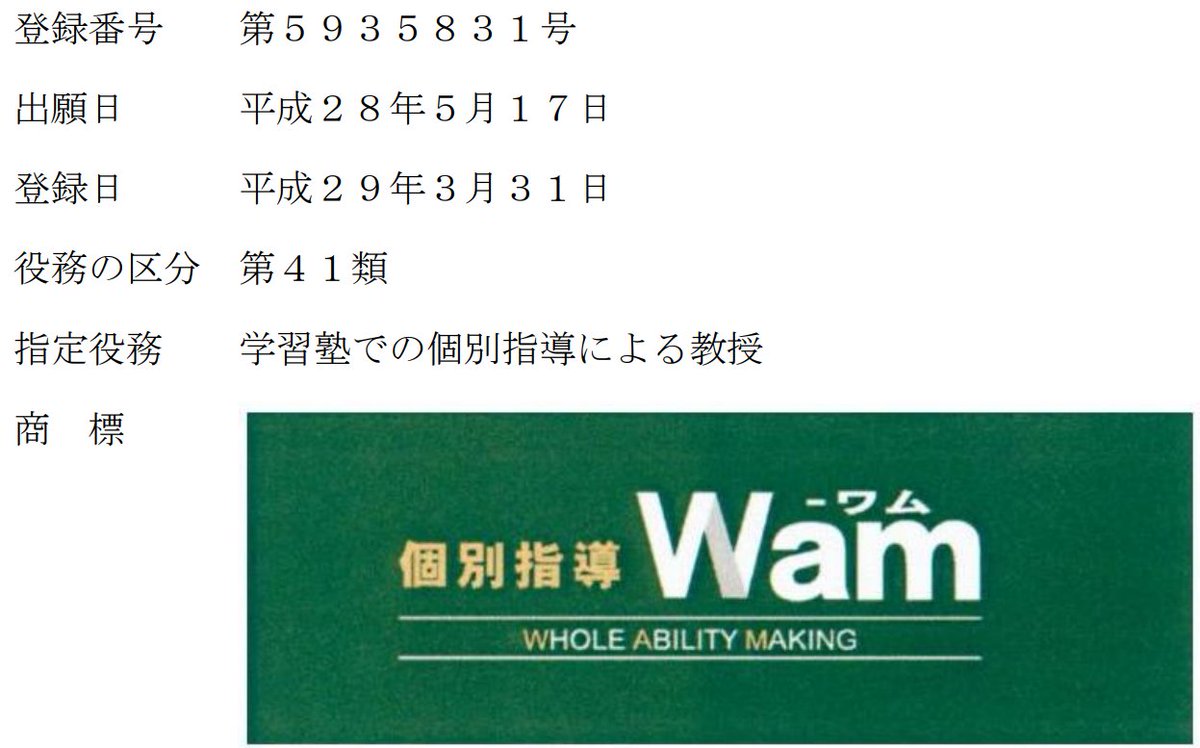
[Claim for contractual penalties] Osaka District Court, 2023 (Wa) No. 829 (Judge Matsuami)
The defendant had been a franchisee but terminated the contract and continued operating an English conversation school at the same location.
→ An employee of the plaintiff attended a consultation session and persistently requested a leaflet. The defendant distributed an old leaflet but explained that the school had closed as a Wam school.
→ This did not constitute trademark “use.”
The allegation of unlawful use of trade secrets was also rejected because the “learning instruction know-how” asserted by the plaintiff lacked specificity.
https://www.courts.go.jp/assets/hanrei/hanrei-pdf-93290.pdf
https://www.linkedin.com/feed/update/urn:li:activity:7514575475688607744/
Images from the original AMEBLO article
English translations of the original image text
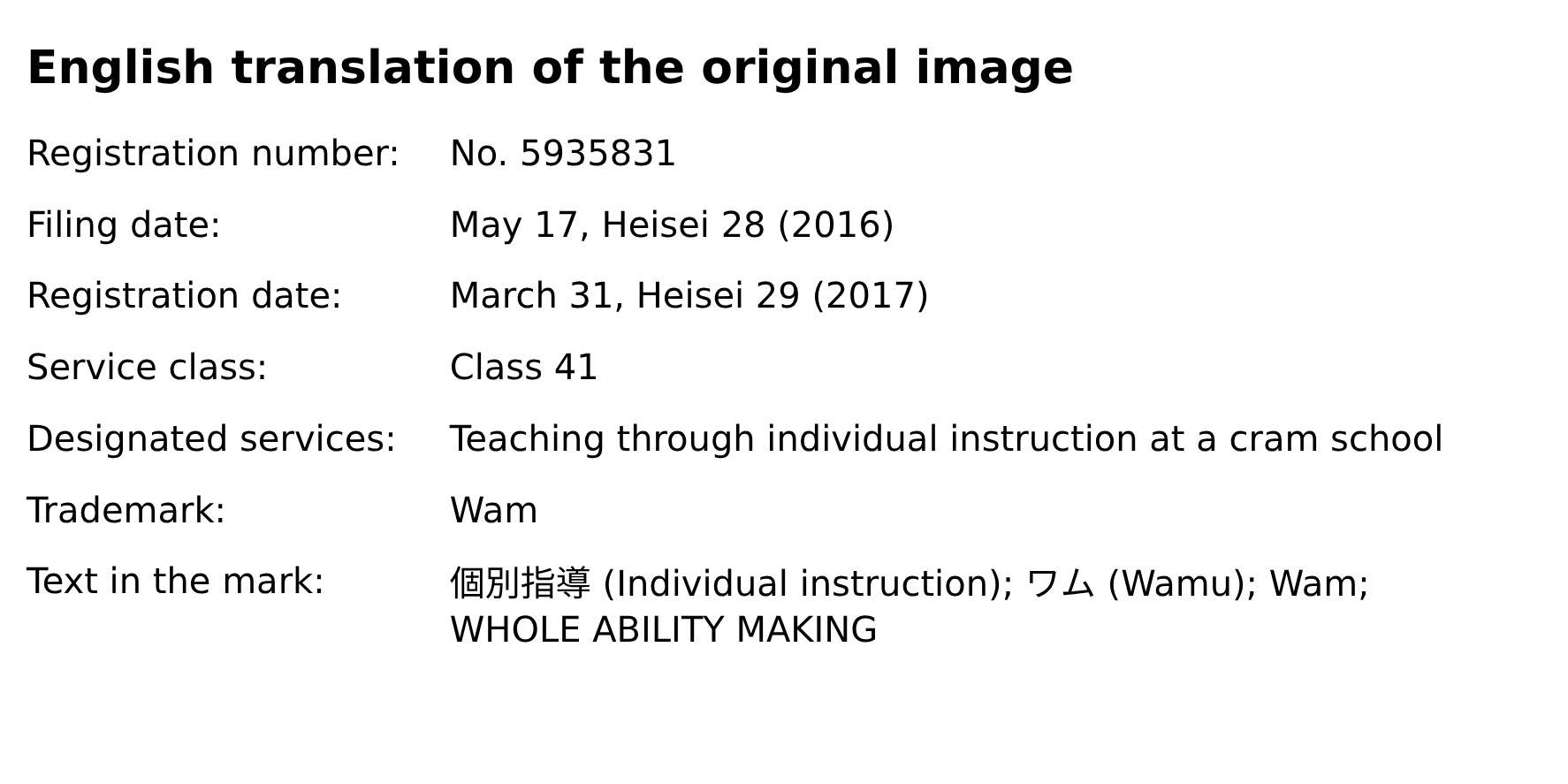
English translation of the original image
Registration number: No. 5935831
Filing date: May 17, 2016
Registration date: March 31, 2017
Service class: Class 41
Designated services: Teaching through individual instruction at a cram school.
Trademark: the composite Wam mark shown in the original image.
Text in the mark: 個別指導 (individual instruction); ワム (Wamu, the Japanese phonetic rendering of Wam); Wam; WHOLE ABILITY MAKING.
Original images retained for comparison
Original AMEBLO article
https://ameblo.jp/hideki-takaishi/entry-12914679709.html
[South Korea] Patent Court, December 3, 2024 <2023 Na 10914>
Original Ameblo publication: 2025-07-06
Ameblo: https://ameblo.jp/hideki-takaishi/entry-12914775015.html
[South Korea] Patent Court, December 3, 2024 <2023 Na 10914>
Unless processing or assembly abroad is extremely minor or simple, domestic production of a semi-finished product does not constitute direct infringement.
⇒ Where production of components or a semi-finished product has reached a state in which the patented invention’s functions and effects are achieved, domestic production is recognized (Supreme Court, 2019 Da 222782). In this case, however, the remaining mixing step was found not to be “extremely minor or simple,” and non-infringement was found.
(Note) The Patent Court’s judgment of December 3, 2024 (2023Na10914), citing the reasoning of Supreme Court judgment 2019Da222782, held that domestic production of the patented product is exceptionally recognized where all of the parts or components for working the patented invention are produced in Korea, or a semi-finished product that has completed most of the production stages and has all principal elements is produced there; they are to be exported to a single entity for final processing or assembly; that processing or assembly is extremely minor or simple; and the state in which the functions and effects can be achieved has been reached. In this case, the mixing step was not extremely minor or simple, and production of the individual conjugate solutions alone had not reached the state in which the functions and effects could be achieved. https://www.law.go.kr/LSW/precInfoP.do?precSeq=606645
★In the United States: CAFC, April 2001, Waymark v. Porta Systems
Under 35 U.S.C. § 271(f)(2), where components meeting the other statutory requirements are supplied from the United States with the intent that they be combined abroad, proof that assembly was actually completed abroad is not required.
⇒ In the case in which completion of the system was planned but it was not actually assembled, the court vacated the non-infringement determination based solely on the absence of actual assembly abroad and remanded the claim under that provision.
★Also in Japan: Osaka District Court, 2009 (Wa) 15096, “Heat-Treatment Furnace Equipped with an In-Furnace Heater …” Case
*Knock-down shipment after initial assembly (a method in which all components are assembled at the export destination) was held to constitute a transfer of the products.
(Translation of an excerpt from the court’s reasoning)
For the defendant’s products intended for overseas customers as well, the defendant manufactured or procured the necessary components in Japan … and completed the products to the stage of provisional assembly, at which it checked their operation; for some products, it even provisionally fired the furnace body. Although these products were subsequently returned to component form and exported, and some components were added when they were assembled overseas, those components were unrelated to the constituent requirements of the patented invention. Therefore, at the stage of provisional assembly in Japan, the defendant’s products, although still work in progress, are found already to have been completed to the extent that they satisfied the constituent requirements of the patented invention. On that basis, the defendant can be said to have performed “production” (Article 2(3)(i) of the Patent Act), an act of working the patented invention, in Japan. …
The defendant’s products were reportedly returned to component form after provisional assembly and operational checks, and then packed and exported. … Given that the products in their provisionally assembled state appear not to have been so large as to make transportation in that state impossible, their being provisionally assembled and then returned to component form is found to have been merely for convenience of transportation. …
Considering these matters together, the series of acts performed by the defendant in Japan in connection with the sale of the defendant’s products can be regarded as “transfer” (Article 2(3)(i) of the Patent Act), an act of working the patented invention, notwithstanding the fact that the defendant’s products were in component form before export.
https://www.hanketsu.jiii.or.jp/hanketsu/jsp/hatumeisi/news/201206news.pdf
[Trademarks] Cases Concerning Similarity of Marks with Reordered Kanji
Original Ameblo publication: 2025-07-07
Ameblo: https://ameblo.jp/hideki-takaishi/entry-12914987745.html
[Trademarks] Cases Concerning Similarity of Marks with Reordered Kanji
Supreme Court, 1991 (O) No. 1805: “木林森” and “大森林” (original Japanese marks). The Court recognized the possibility of similarity and remanded the case; it did not finally determine that the marks were similar.
IP High Court, 2009 (Gyo-Ke) No. 10071: “肌優” and the cited mark featuring “優肌” (the same kanji in reverse order) were held similar.
The emphasis was on concept, rather than pronunciation.
A judicial decision holding that conceptual similarity should be assessed on the basis of the concept that naturally arises in light of customary practices in the field of the designated goods is the IP High Court’s decision in 2014 (Gyo-Ke) 10180, the “Hakko Genmai Saishoku GABA” (Fermented Brown Rice Vegetable Diet GABA) Case.
[Patents / Employee Inventions] Osaka District Court, 2020 (Wa) 12107
Original Ameblo publication: 2025-07-08
Ameblo: https://ameblo.jp/hideki-takaishi/entry-12915224559.html
[Patents / Employee Inventions] Osaka District Court, 2020 (Wa) 12107
*Because making an orally disintegrating (OD) tablet was the characteristic part of the invention, the plaintiff, who was involved in that work, was an inventor.
Prior art existed in which formulations containing other ingredients had been converted into OD tablets. However, it did not concern the same ingredient as Invention 2 at issue, and there was no indication that the defendant had specifically considered converting its previously marketed product into OD tablets before the plaintiff’s proposal. It therefore did not alter the finding that the plaintiff was an inventor.
(Translation of an excerpt from the court’s reasoning)
The plaintiff recognized problems associated with taking the originator drug L capsules and similar products and investigated the greater demand for OD tablets than for capsules. The plaintiff then conceived the development of OD tablets, namely orally disintegrating tablets of ambroxol hydrochloride, investigated other companies’ products and conducted technical studies, and proposed their development at a PJ meeting. … The plaintiff attended every PJ meeting up to the meeting to select the next development candidates, participated in preliminary feasibility experiments concerning conversion to OD tablets, gave a certain degree of concrete form to the feasibility of microparticle coating, and ultimately obtained formal development approval at that selection meeting.
Accordingly, the plaintiff … can be said to have conceived the characteristic part of Invention 2 at issue. The plaintiff is therefore found to be an inventor of Invention 2 on this basis alone.
In response, the defendant argues, among other things, that the defendant itself had already been selling an ambroxol hydrochloride capsule formulation; that the idea of changing its dosage form to OD tablets was easy to conceive; that this point cannot be called the characteristic part of the invention; and that conceiving it therefore does not make the plaintiff an inventor of Invention 2 at issue.
Although the prior art includes examples of conversion from capsules to OD tablets (such as Takepron), they do not concern ambroxol hydrochloride, the same ingredient as in Invention 2 at issue. Nor is there any indication that, before the plaintiff’s proposal, the defendant had specifically considered improving the previously marketed product into OD tablets. Accordingly, the facts asserted by the defendant do not alter the above findings concerning the characteristic part or, on that basis, the plaintiff’s inventorship, and the defendant’s argument cannot be accepted.
https://www.courts.go.jp/assets/hanrei/hanrei-pdf-92388.pdf
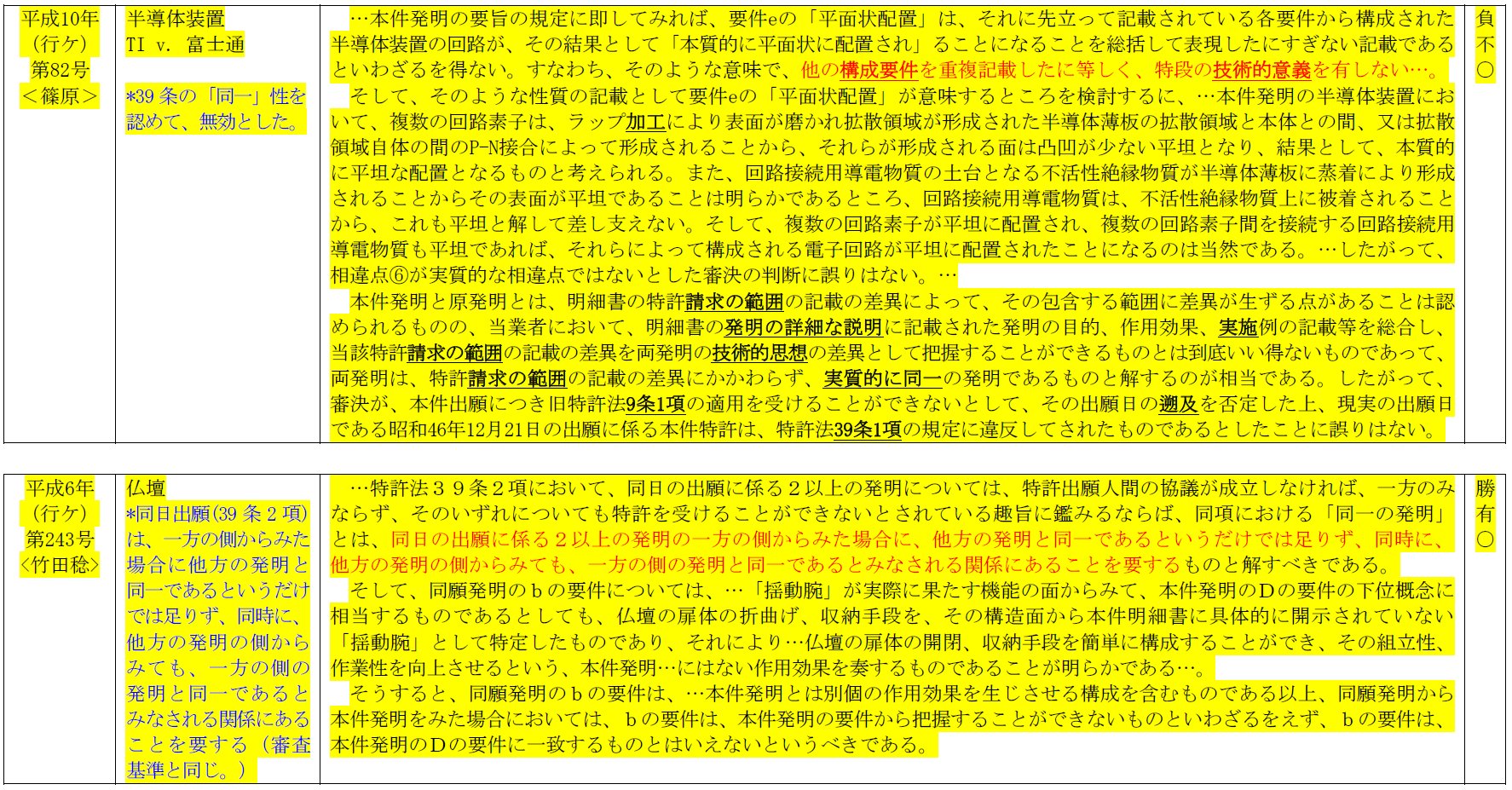
Tokyo High Court, 1994 (Gyo-Ke) No. 243 — Buddhist altar (Judge Minoru Takeda)
Original Ameblo publication: 2025-07-09
Article type: Case note
Categories: Patents
Topics: Examination and appeal practice
First published on this website: 2026-10-16
Case information: Tokyo High Court, 1994 (Gyo-Ke) No. 243
Ameblo: https://ameblo.jp/hideki-takaishi/entry-12915398538.html
HP: https://www.takaishihideki.com/en/single-post/ameblo-12915398538-en
Japanese version: https://www.takaishihideki.com/single-post/ameblo-12915398538-ja
Tokyo High Court, 1994 (Gyo-Ke) No. 243 — Buddhist altar (Judge Minoru Takeda)
*For applications filed on the same day (Article 39(2)), it is not enough that the other invention is identical when viewed from one invention. At the same time, viewed from the other invention, the first invention must also be regarded as identical!!
(The same as the Examination Guidelines.)
(Excerpt from the judgment, translated)
…In light of the purpose of Article 39(2) of the Patent Act, under which no applicant may obtain a patent for any of two or more inventions in applications filed on the same day if the applicants fail to reach an agreement, “the same invention” under that paragraph requires more than a finding of identity when one invention is compared with the other from only the first invention’s standpoint. The inventions must also be regarded as identical when the comparison is made from the other invention’s standpoint.
As for requirement b of the other application’s invention, …even if the “swing arm,” in terms of its actual function, corresponds to a subordinate concept of requirement D of the invention at issue, it specifies the means for folding and storing the altar doors structurally as a “swing arm” not specifically disclosed in the specification at issue. This clearly produces an effect absent from the invention at issue: …simplifying the means for opening, closing and storing the altar doors and improving assembly and workability….
Accordingly, requirement b includes a configuration producing an effect distinct from the invention at issue. Viewed from the other application’s invention, requirement b therefore cannot be understood from the requirements of the invention at issue, and cannot be said to coincide with its requirement D.
https://www.jpo.go.jp/system/laws/rule/guideline/patent/tukujitu_kijun/document/index/03_0400bm.pdf
https://www.linkedin.com/feed/update/urn:li:activity:7514575834255380480/
Images from the original AMEBLO article
English translations of the original image text
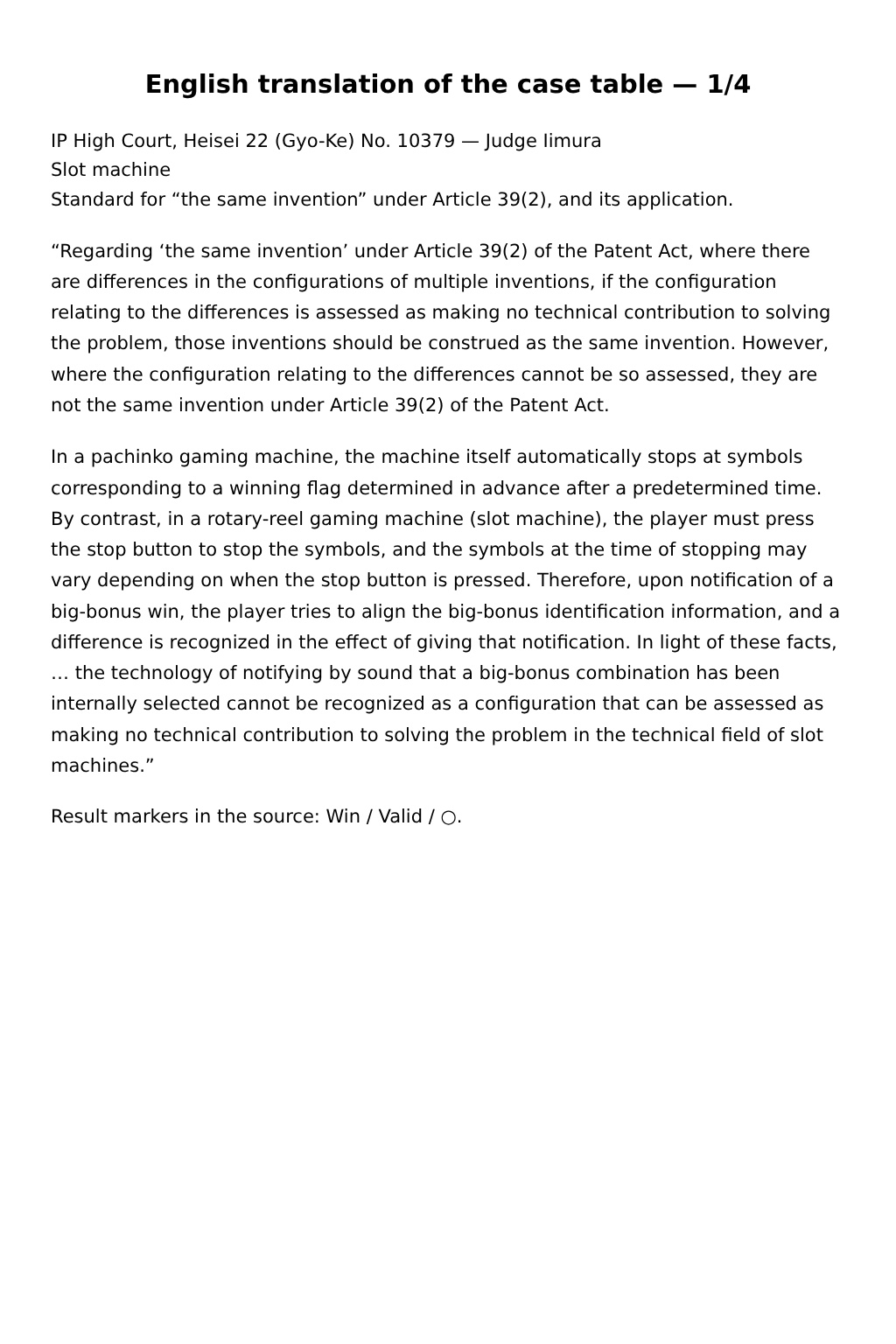
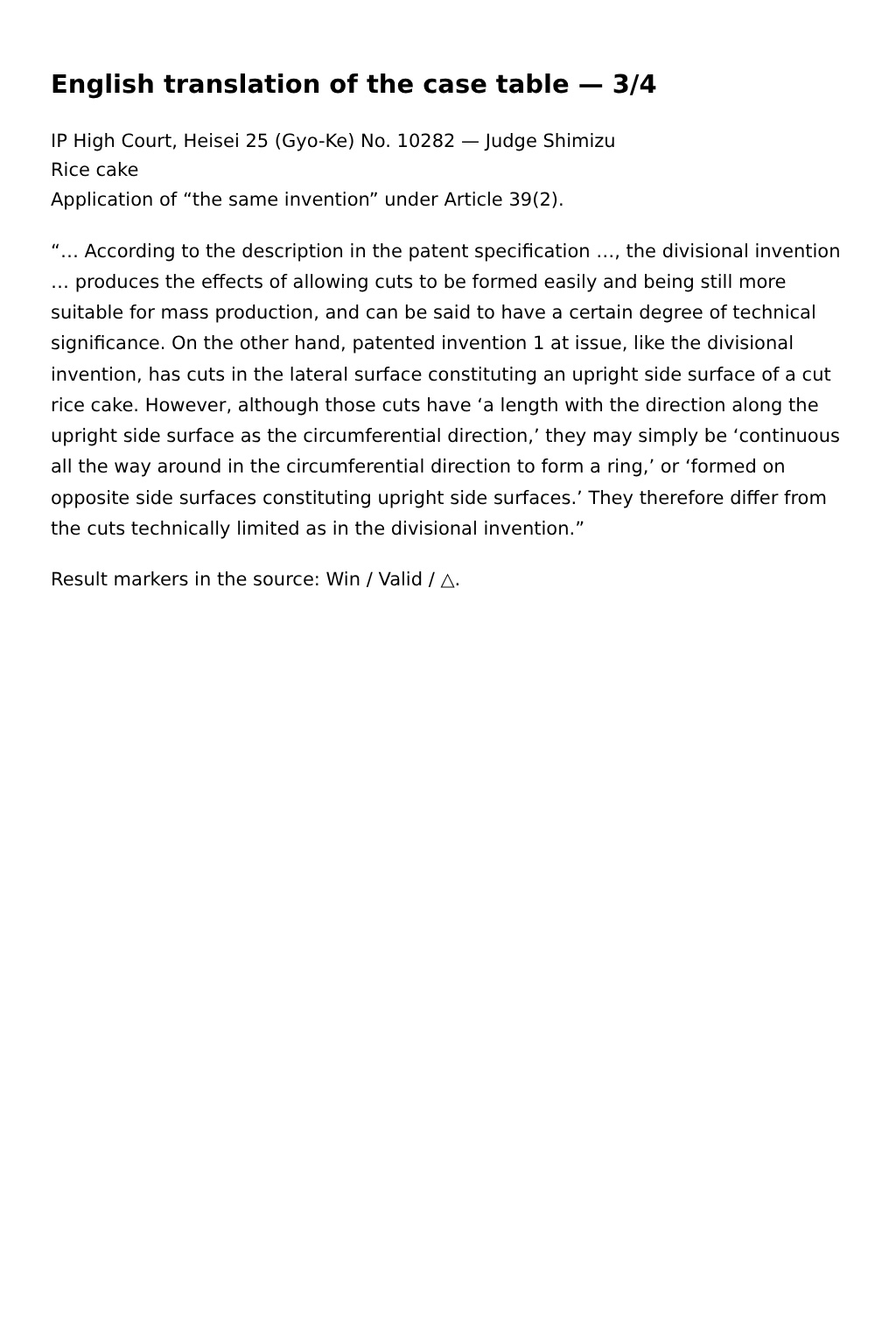
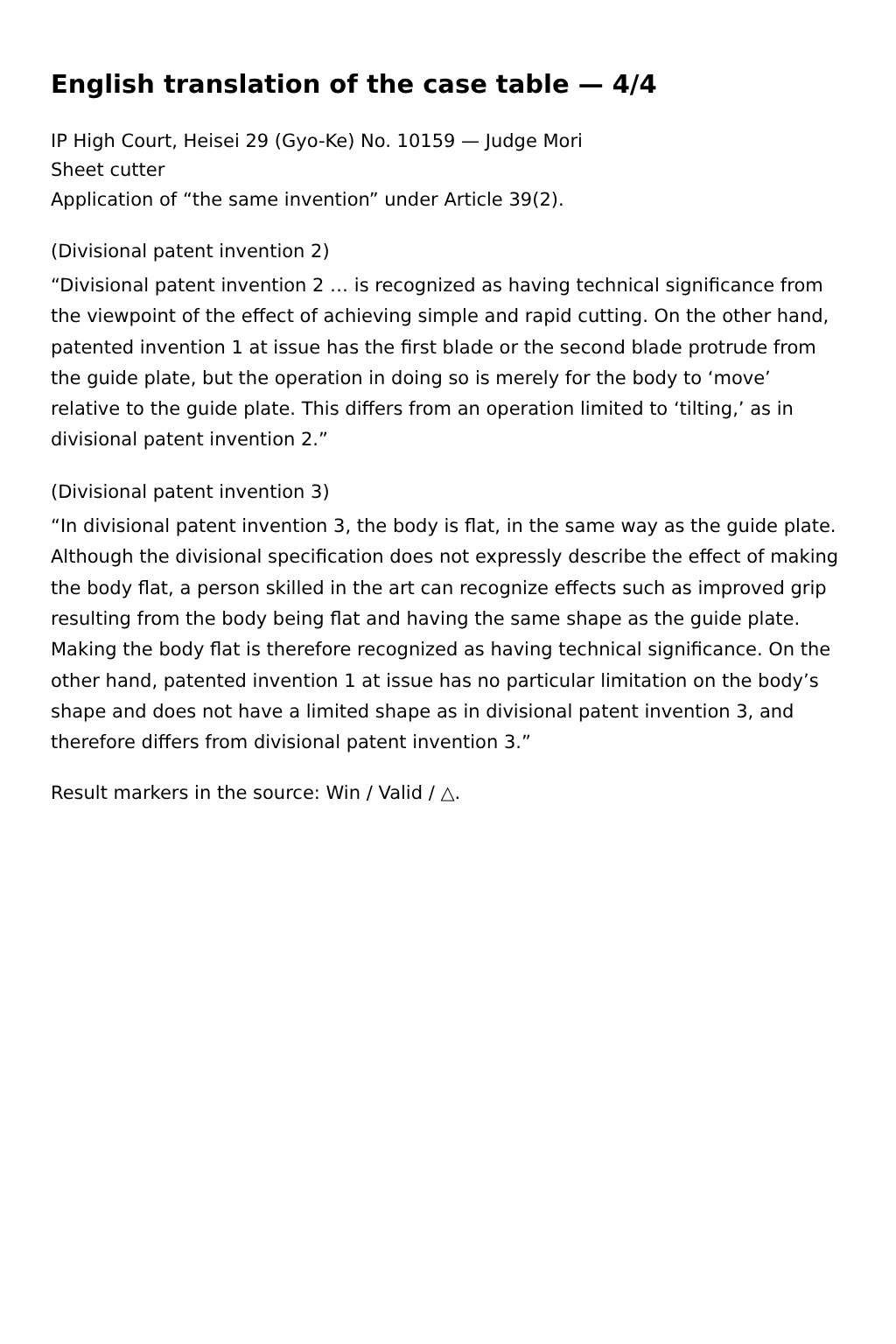
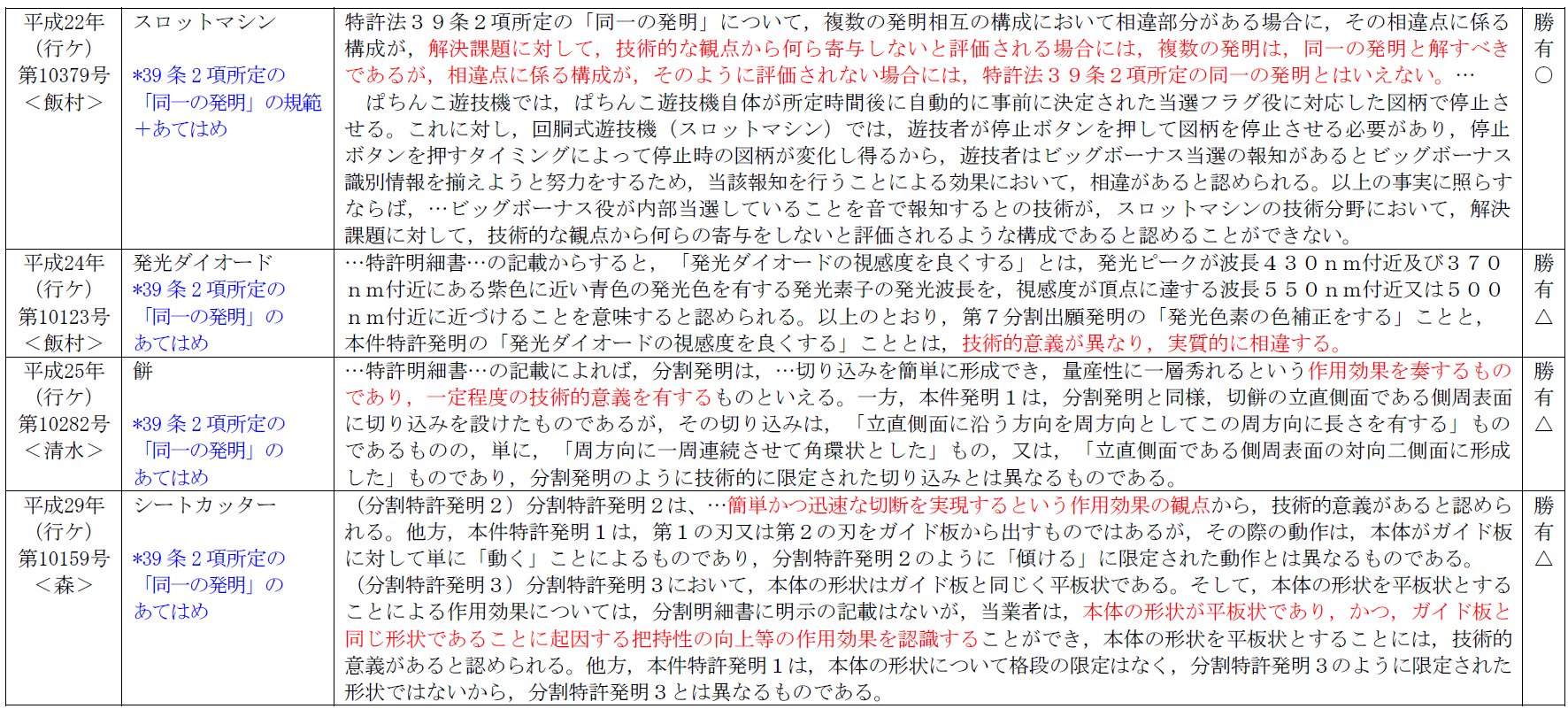
English translation of the case table — 1/4
IP High Court, 2010 (Gyo-Ke) No. 10379 — Judge Iimura (飯村)
Slot machine
The test for “the same invention” under Article 39(2) and its application.
“Regarding ‘the same invention’ under Article 39(2) of the Patent Act, where the configurations of two or more inventions differ, the inventions should be construed as the same invention if the differing configuration is assessed as making no technical contribution to solving the problem. If the differing configuration cannot be assessed in that way, however, the inventions are not the same invention under Article 39(2) of the Patent Act. …
In a pachinko gaming machine, after a predetermined time, the machine itself automatically stops the symbols at those corresponding to the winning combination selected in advance by the winning flag. In contrast, in a reel-type gaming machine (slot machine), the player must press stop buttons to stop the symbols, and the symbols displayed when they stop can change depending on the timing of those button presses. When notified of a big-bonus win, the player therefore tries to align the big-bonus identifying symbols. Accordingly, the effects of providing that notification differ. In light of these facts, … the technology of using sound to notify the player that a big-bonus combination has won in the internal lottery cannot be regarded as a configuration making no technical contribution to solving the problem in the technical field of slot machines.”
Result markers in the source: Win / Valid / ○.
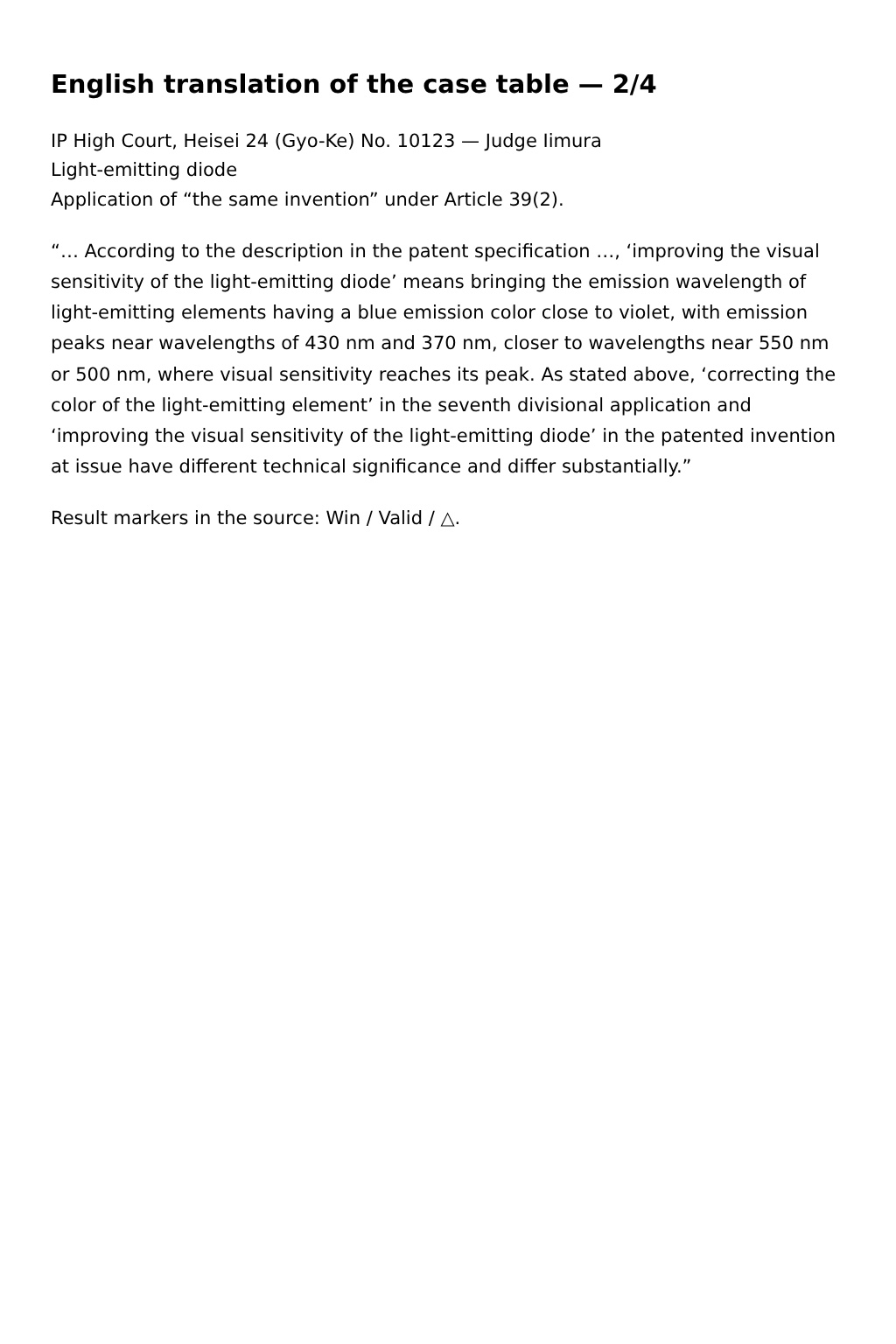
English translation of the case table — 2/4
IP High Court, 2012 (Gyo-Ke) No. 10123 — Judge Iimura (飯村)
Light-emitting diode
Application of “the same invention” under Article 39(2).
“… From the statements in the patent specification …, ‘improving the visual sensitivity of the light-emitting diode’ is understood to mean shifting the emission wavelength of a light-emitting element that emits blue light close to violet, with emission peaks near 430 nm and 370 nm, toward approximately 550 nm or 500 nm, where visual sensitivity reaches its peak.
As explained above, ‘correcting the color of the light-emitting element’ in the invention of the seventh divisional application and ‘improving the visual sensitivity of the light-emitting diode’ in the patented invention at issue have different technical significance and are substantively different.”
Result markers in the source: Win / Valid / △.
English translation of the case table — 3/4
IP High Court, 2013 (Gyo-Ke) No. 10282 — Judge Shimizu (清水)
Mochi (rice cake)
Application of “the same invention” under Article 39(2).
“… According to the statements in the patent specification …, the divisional invention … produces the effects of allowing the cuts to be formed easily and further improving suitability for mass production, and thus has a certain degree of technical significance.
On the other hand, invention 1 at issue, like the divisional invention, provides cuts in the peripheral side surfaces constituting the upright sides of a piece of cut mochi. Although those cuts ‘have a length in the circumferential direction, with the direction along the upright sides taken as the circumferential direction,’ they are merely ‘continuous around the entire circumference to form a rectangular ring,’ or ‘formed on two opposing peripheral side surfaces constituting upright sides.’ They therefore differ from the cuts that are technically limited as in the divisional invention.”
Result markers in the source: Win / Valid / △.
English translation of the case table — 4/4
IP High Court, 2017 (Gyo-Ke) No. 10159 — Judge Mori (森)
Sheet cutter
Application of “the same invention” under Article 39(2).
“(Divisional patented invention 2) Divisional patented invention 2 … has technical significance in terms of producing the effect of achieving simple and rapid cutting. In contrast, although patented invention 1 at issue causes the first blade or the second blade to project from the guide plate, this occurs through the body simply ‘moving’ relative to the guide plate. That operation differs from an operation limited to ‘tilting,’ as in divisional patented invention 2.
(Divisional patented invention 3) In divisional patented invention 3, the body is shaped like a flat plate, as is the guide plate. Although the divisional specification does not expressly describe the effects of giving the body that shape, a person skilled in the art can recognize effects such as improved ease of gripping that result from the body being shaped like a flat plate and having the same shape as the guide plate. Giving the body the shape of a flat plate therefore has technical significance. In contrast, patented invention 1 at issue does not particularly limit the shape of the body, and its shape is not limited as in divisional patented invention 3. It therefore differs from divisional patented invention 3.”
Result markers in the source: Win / Valid / △.
Original images retained for comparison
Original AMEBLO article
https://ameblo.jp/hideki-takaishi/entry-12915398538.html
Tokyo High Court, 1998 (Gyo-Ke) No. 82 — Semiconductor device (Judge Shinohara)
Original Ameblo publication: 2025-07-10
Article type: Case note
Categories: Patents
Topics: Examination and appeal practice
First published on this website: 2026-10-16
Case information: Tokyo High Court, 1998 (Gyo-Ke) No. 82
Ameblo: https://ameblo.jp/hideki-takaishi/entry-12915605830.html
HP: https://www.takaishihideki.com/en/single-post/ameblo-12915605830-en
Japanese version: https://www.takaishihideki.com/single-post/ameblo-12915605830-ja
Tokyo High Court, 1998 (Gyo-Ke) No. 82 — Semiconductor device (Judge Shinohara)
TI v. Fujitsu
*The court found the inventions to be “the same” under Article 39(1) and upheld the JPO decision invalidating the patent.
(Excerpts from the judgment, translated; portions omitted)
…In light of the definition of the invention at issue, the “planar arrangement” in requirement e must be regarded as merely a summary statement that the semiconductor-device circuit composed of the preceding requirements is, as a result, “arranged essentially in a plane.” In that sense, it is equivalent to restating the other claim elements and has no particular technical significance….
Turning to the meaning of the “planar arrangement” in requirement e as a statement of this nature, … in the semiconductor device of the invention at issue, the multiple circuit elements are formed by P-N junctions between the diffusion regions and the body, or between the diffusion regions themselves, in a semiconductor wafer whose surface has been polished by lapping and in which diffusion regions have been formed. The surface on which the elements are formed therefore has little unevenness and is flat, resulting in an essentially planar arrangement. Further, the inert insulating material serving as the base for the conductive interconnection material is formed on the semiconductor wafer by vapor deposition, so its surface is plainly flat. Because the conductive interconnection material is deposited on that inert insulating material, it too may be regarded as flat. If the multiple circuit elements are arranged in a plane and the conductive interconnection material connecting them is also flat, the electronic circuit constituted by them is naturally arranged in a plane. …Accordingly, there is no error in the JPO decision’s finding that Difference ⑥ is not a substantive difference.
…Although it is acknowledged that differences in the wording of the claims in the respective specifications cause some differences in the scope covered by the invention at issue and the original invention, it cannot be said that a person skilled in the art, considering together the purposes, functions and effects, examples and other matters set out in the detailed descriptions, could perceive those differences in claim wording as differences in the technical ideas of the two inventions. The two inventions should therefore be understood as substantially the same invention, notwithstanding the differences in the wording of their claims.
Accordingly, there is no error in the JPO decision’s conclusion that the application at issue was ineligible for the benefit of Article 9(1) of the former Patent Act, that its filing date therefore could not be deemed to be the earlier date, and that the patent based on the application actually filed on December 21, 1971, was granted in violation of Article 39(1) of the Patent Act.
https://www.courts.go.jp/assets/hanrei/hanrei-pdf-12569.pdf
https://www.linkedin.com/feed/update/urn:li:activity:7514576236069892096/
Images from the original AMEBLO article
English translations of the original image text
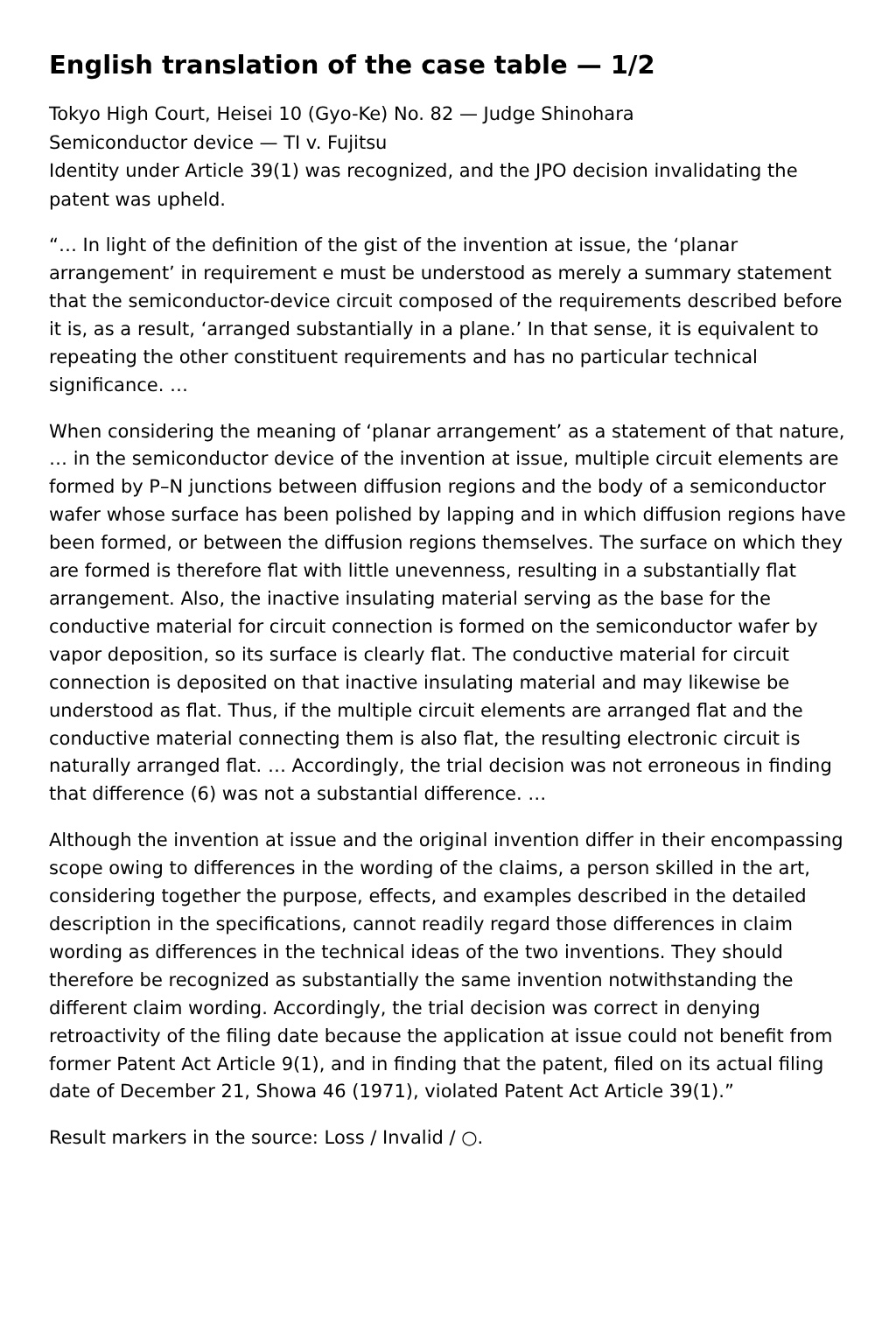
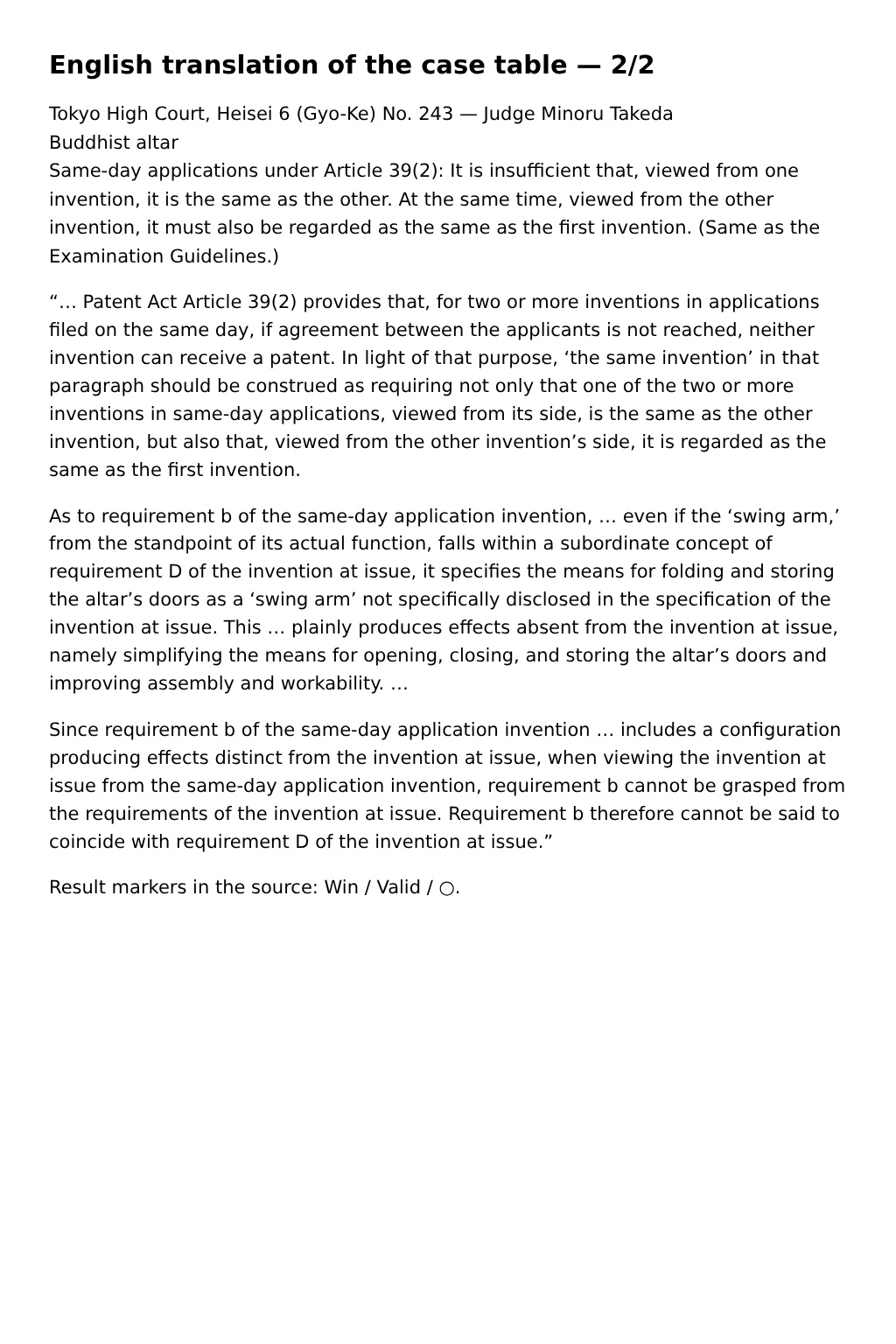
English translation of the case table — 1/2
Tokyo High Court, 1998 (Gyo-Ke) No. 82 — Judge Shinohara (篠原)
Semiconductor device — TI v. Fujitsu
Identity under Article 39(1) was recognized, and the JPO decision invalidating the patent was upheld.
“…In light of the definition of the invention at issue, the “planar arrangement” in requirement e must be regarded as merely a summary statement that the semiconductor-device circuit composed of the preceding requirements is, as a result, “arranged essentially in a plane.” In that sense, it is equivalent to restating the other claim elements and has no particular technical significance….
Turning to the meaning of the “planar arrangement” in requirement e as a statement of this nature, … in the semiconductor device of the invention at issue, the multiple circuit elements are formed by P-N junctions between the diffusion regions and the body, or between the diffusion regions themselves, in a semiconductor wafer whose surface has been polished by lapping and in which diffusion regions have been formed. The surface on which the elements are formed therefore has little unevenness and is flat, resulting in an essentially planar arrangement. Further, the inert insulating material serving as the base for the conductive interconnection material is formed on the semiconductor wafer by vapor deposition, so its surface is plainly flat. Because the conductive interconnection material is deposited on that inert insulating material, it too may be regarded as flat. If the multiple circuit elements are arranged in a plane and the conductive interconnection material connecting them is also flat, the electronic circuit constituted by them is naturally arranged in a plane. …Accordingly, there is no error in the JPO decision’s finding that Difference ⑥ is not a substantive difference.
…Although it is acknowledged that differences in the wording of the claims in the respective specifications cause some differences in the scope covered by the invention at issue and the original invention, it cannot be said that a person skilled in the art, considering together the purposes, functions and effects, examples and other matters set out in the detailed descriptions, could perceive those differences in claim wording as differences in the technical ideas of the two inventions. The two inventions should therefore be understood as substantially the same invention, notwithstanding the differences in the wording of their claims.
Accordingly, there is no error in the JPO decision’s conclusion that the application at issue was ineligible for the benefit of Article 9(1) of the former Patent Act, that its filing date therefore could not be deemed to be the earlier date, and that the patent based on the application actually filed on December 21, 1971, was granted in violation of Article 39(1) of the Patent Act.”
Result markers in the source: Loss / Invalid / ○.
English translation of the case table — 2/2
Tokyo High Court, 1994 (Gyo-Ke) No. 243 — Judge Minoru Takeda (竹田稔)
Buddhist altar
Same-day applications under Article 39(2): it is insufficient that, viewed from one invention, it is the same as the other. At the same time, viewed from the other invention, it must also be regarded as the same as the first invention. (Same as the Examination Guidelines.)
“… Article 39(2) of the Patent Act provides that, for two or more inventions in applications filed on the same day, if agreement between the applicants is not reached, none of the inventions can receive a patent. In light of that purpose, ‘the same invention’ in that paragraph should be construed as requiring not only that one of the two or more inventions in same-day applications, viewed from its side, is the same as the other invention, but also that, viewed from the other invention’s side, it is regarded as the same as the first invention.
As to requirement b of the same-day application’s invention, … even if the ‘swing arm,’ from the standpoint of its actual function, falls within a subordinate concept of requirement D of the invention at issue, it specifies, in structural terms, the means for folding and storing the altar’s doors as a ‘swing arm’ not specifically disclosed in the specification of the invention at issue. This … plainly produces effects absent from the invention at issue, namely simplifying the means for opening, closing, and storing the altar’s doors and improving ease of assembly and workability. …
Since requirement b of the same-day application’s invention … includes a configuration producing effects distinct from the invention at issue, when viewing the invention at issue from the same-day application’s invention, requirement b cannot be understood from the requirements of the invention at issue. Requirement b therefore cannot be said to coincide with requirement D of the invention at issue.”
Result markers in the source: Win / Valid / ○.
Original images retained for comparison
Original AMEBLO article
https://ameblo.jp/hideki-takaishi/entry-12915605830.html
Tokyo District Court, 2022 (Wa) 70058 [Grapple Bucket Device] <Kokubu>
Original Ameblo publication: 2025-07-11
Ameblo: https://ameblo.jp/hideki-takaishi/entry-12915886850.html
Tokyo District Court, 2022 (Wa) 70058 [Grapple Bucket Device] <Kokubu>
First requirement of the doctrine of equivalents: not satisfied.
*The analytical framework of the IP High Court Grand Panel judgment in the Maxacalcitol case.
⇒ A defendant seeking to defeat the first requirement of the doctrine of equivalents should confront the invention at issue with closely related prior art, argue that the problem described in the specification at issue is insufficiently stated, and steer the argument toward the proposition that the difference from that prior art is the essential part.
*The problem described in the specification at issue could be solved by the prior art.
⇒ The description of the problem is objectively insufficient in light of the prior art at the filing date, so extrinsic evidence may be considered.
⇒ The degree of the invention’s contribution cannot be assessed as substantial.
⇒ The essential part of the invention cannot be identified at a higher level of abstraction, and is identified as substantially equivalent to the language of the claims.
⇒ The difference from the prior art is the essential part.
(Translation of an excerpt from the court’s reasoning)
At the time the patent at issue was filed, the problem that, when timber gripped by a grapple bucket device was long, a worker had to use a cutting device such as a chainsaw to cut timber exceeding a certain length to a prescribed length could be solved by the prior art disclosed in the Exhibit Ko 27 reference. Thus, the problem described in the specification at issue as one that the prior art could not solve is found to be objectively insufficient in light of the prior art at the filing date. Accordingly, when identifying the characteristic part constituting the technical idea peculiar to the invention at issue and absent from the prior art, consideration of the technical matters described in the Exhibit Ko 27 reference should also be permitted.
… Before the patent at issue was filed, the Exhibit Ko 27 reference is found to have disclosed a traveling branch-cutting apparatus equipped with a bucket having a gripping unit attached to one side and a cutting device attached to the other. The difference between the invention at issue and the prior art is therefore found to lie only in the configuration of that cutting device, not in the fact that the device itself is a grapple bucket device capable of cutting material that it has gripped. Accordingly, because the degree of the invention’s contribution relative to the prior art cannot be assessed as substantial, its essential part cannot be identified at a higher level of abstraction, and should be identified as substantially equivalent to the language of the claims.
Therefore, … it is appropriate to find that the characteristic part constituting the technical idea peculiar to the invention at issue and absent from the prior art is the adoption, for the cutting device provided on the grapple device, of the following configuration: a cutting blade located on either the outside or the inside of the bucket’s side wall, pivoting in a direction along that side wall from a position away from the bucket’s opening edge to a position along the bucket’s side wall, and having a cutting edge on its side edge facing the opening-edge side of the bucket, the blade being pivotally supported at the base of the bucket opening; and a hydraulic cylinder connected to the pivot base of that cutting blade to pivot the blade. The cutting edge of the cutting blade is positioned offset toward the blade’s cutting direction relative to the line connecting the blade’s pivot center and the hydraulic-cylinder connection point, and is curved in an arc backward relative to its direction of rotation in the cutting direction. By adopting this configuration, namely the configuration relating to constituent requirements C and D, a large value of the inclination angle θ at which the blade edge contacts the object is maintained even in portions far from the pivot center, thereby maintaining a draw-cutting action and achieving a smooth cutting effect.
… The essential part of the invention at issue is that, by adopting the configuration relating to constituent requirements C and D, a large value of the inclination angle θ at which the blade edge contacts the object is maintained even in portions far from the pivot center, thereby maintaining a draw-cutting action and achieving a smooth cutting effect. Consequently, the defendant’s products cannot be found to possess the essential part of the invention at issue, and it cannot be said that the part in which the invention and the defendant’s products differ is not the essential part of the invention.
https://www.courts.go.jp/assets/hanrei/hanrei-pdf-93448.pdf
IP High Court, 2013 (Ne) 10007 [Agitation Granulation Apparatus] <Shitara>
Original Ameblo publication: 2025-07-12
Ameblo: https://ameblo.jp/hideki-takaishi/entry-12916082794.html
IP High Court, 2013 (Ne) 10007 [Agitation Granulation Apparatus] <Shitara>
*For an agitation granulator sold by the defendant with a blade that did not satisfy all the relevant claim elements of the patented invention, the court held that, because a blade satisfying those claim elements was delivered on the same day, the two were sold as a single unit.
⇒ Direct infringement was found!!
https://www.courts.go.jp/assets/hanrei/hanrei-pdf-84350.pdf
IP High Court, 2023 (Gyo-Ke) 10019 [Methods for Treating Atopic Dermatitis by Administering an IL-4R Antagonist] <Miyasaka>
Original Ameblo publication: 2025-07-13
Ameblo: https://ameblo.jp/hideki-takaishi/entry-12916207396.html
IP High Court, 2023 (Gyo-Ke) 10019 [Methods for Treating Atopic Dermatitis by Administering an IL-4R Antagonist] <Miyasaka>
*Even though the cited invention had reached a Phase 2 clinical trial, the material cited in the judgment put the Phase 2 success rate for allergic diseases at only approximately 33%. A person skilled in the art therefore could not be said to understand that it was necessarily therapeutically effective without even seeing the Phase 2 results.
⇒ Inventive step affirmed.
[Difference] Corrected Invention 1 at issue is a pharmaceutical composition comprising a therapeutically effective amount of an anti-human IL-4R antibody or an antigen-binding fragment thereof, for use in a method of treating a patient with moderate-to-severe atopic dermatitis (AD) who does not respond adequately to treatment with topical corticosteroids or topical calcineurin inhibitors, whereas the cited invention is an investigational drug composition.
(Translation of an excerpt from the JPO decision as reproduced in the judgment. The court also rejected the challenge based on lack of inventive step.)
The trial in Exhibit Ko 1 is a Phase 2 clinical trial. It is common general technical knowledge that the preceding Phase 1 clinical trial ordinarily investigates the safety and pharmacokinetics of an investigational drug in a small number of healthy individuals, and that confirmation of efficacy in patients begins with Phase 2 clinical trials. According to Exhibit Ko 21 …, the probability of success in Phase 2 clinical trials is far lower than in any other phase and is approximately 33% for allergic diseases. In light of this, the mere fact that a Phase 2 clinical trial is being conducted does not mean that a person skilled in the art would understand that the investigational drug must be therapeutically effective without even examining the trial results.
Furthermore, examination of Exhibits Ko 2–6 reveals no evidence that, before the priority date of the patent at issue, an anti-human IL-4R antibody had been administered to patients with atopic dermatitis and had actually produced a therapeutic effect. In light of the common general technical knowledge at the priority date of the patent application concerning the roles of cytokines in the acute and chronic phases of atopic dermatitis, even if REGN668 (an anti-human IL-4R antibody), as used in Exhibit Ko 1, had the ability to block IL-4 and IL-13 activity, as did the antibody in Exhibit Ko 3, it cannot be said that a person skilled in the art could have conceived of using REGN668 (an anti-human IL-4R antibody) therapeutically effectively in the patients of the cited invention, who had suffered from chronic atopic dermatitis for at least three years and in whom production of interferon gamma and IL-12 was considered to predominate over IL-4, unlike the acute phase in which IL-4 predominates. Nor could improvement in clinical symptoms readily have been predicted in those circumstances.
Moreover, as described in Exhibit Ko 24 (Exhibit Otsu 4 in the trial proceedings), given the complexity of the immune pathways involved in atopic dermatitis, it is found difficult to predict, without awaiting clinical-trial results, that a therapeutic agent based on the particular mechanism of blocking IL-4 action—a mechanism with no track record of use in treating atopic dermatitis as of the priority date of the patent at issue—would have a therapeutic effect on moderate-to-severe atopic dermatitis. Accordingly, it cannot be said that a person skilled in the art could readily have arrived, from the descriptions in Exhibits Ko 1–6, at the cited invention having the configuration relating to the difference—namely a pharmaceutical composition comprising a therapeutically effective amount of an anti-human IL-4R antibody for use in a method of treating patients with moderate-to-severe atopic dermatitis who do not respond adequately to treatment with topical corticosteroids or topical calcineurin inhibitors—and actually producing, in patients falling within Corrected Invention 1 at issue, the improvement in clinical symptoms of atopic dermatitis demonstrated in the specification at issue.
https://www.courts.go.jp/assets/hanrei/hanrei-pdf-93292.pdf
IP High Court, 2023 (Gyo-Ke) 10090 [Fulvestrant Formulation] <Nakadaira>
Original Ameblo publication: 2025-07-14
Ameblo: https://ameblo.jp/hideki-takaishi/entry-12916367152.html
IP High Court, 2023 (Gyo-Ke) 10090 [Fulvestrant Formulation] <Nakadaira>
*The journal Clinical Cancer Research published an experiment in which a composition identical to that of the patented invention was administered subcutaneously to mice as an adjunct to eliminate estrogen activity in an experiment testing a hypothesis (according to the plaintiff, the composition was supplied by the patentee). The court did not find it to be common general technical knowledge to administer that composition, unchanged, to humans by intramuscular injection.
⇒ Inventive step affirmed.
[Difference] Corrected Invention 1 is “a pharmaceutical formulation for administration to humans by intramuscular injection” and “a pharmaceutical formulation suitable for intramuscular injection,” whereas the Exhibit Ko 1 invention is an experimental composition, administered subcutaneously to ovariectomized tumor-bearing mice inoculated with breast cancer cells (MCF-7 cells) transfected with fibroblast growth factor (FGF), for verifying FGF autocrine activity as a mechanism of tamoxifen-resistant breast cancer.
(Translation of an excerpt from the court’s reasoning)
(a) Common general technical knowledge I (concerning intramuscular injection of fulvestrant)
At the priority date at issue, pharmaceutical formulations containing fulvestrant were undergoing clinical trials and had not yet been approved in any country …. Thus, fulvestrant is not found to have been established as a breast cancer treatment. Accordingly, common general technical knowledge I (concerning intramuscular injection of fulvestrant) is not found to have existed.
Nevertheless, according to the results of pharmacokinetic studies (PK studies) and clinical trials concerning fulvestrant conducted at the priority date at issue …, there is room to say that it was common general technical knowledge at that date that fulvestrant was under investigation as a possible breast cancer treatment and was being administered by intramuscular injection in the trials. However, even if such common general technical knowledge existed, a person skilled in the art is not found to have readily recognized that the composition administered to mice as an antiestrogen in the Exhibit Ko 1 reference could immediately be used, with its composition unchanged, as a pharmaceutical formulation for administration to humans by intramuscular injection.
(b) Common general technical knowledge II (concerning subcutaneous injection in mice)
The references cited by the plaintiff … include statements that intramuscular injection is difficult in small laboratory animal species such as mice, and examples in which drugs administered intramuscularly to humans were administered subcutaneously in experiments using small laboratory animal species such as mice. However, they also contain descriptions of intramuscular injection in rats …. Even in light of these references, it cannot be found that common general technical knowledge II (concerning subcutaneous injection in mice), as asserted by the plaintiff, existed at the priority date at issue. Moreover, even if common general technical knowledge II existed, that would not mean there was common general technical knowledge that a drug injected subcutaneously in experiments using mice is always injected intramuscularly in humans. Furthermore, even if common general technical knowledge existed to the extent that “a pharmaceutical formulation administered intramuscularly to humans may be administered subcutaneously in experiments using mice,” it cannot be found to have been common general technical knowledge to inject humans intramuscularly with a drug having the same composition as a drug injected subcutaneously into mice. Still less could there be said to be motivation to inject humans intramuscularly with a drug having the same composition as the fulvestrant administered to mice in the Exhibit Ko 1 invention, where that fulvestrant was used as an adjunct to eliminate estrogen activity in an experiment intended to test a hypothesis.
https://www.courts.go.jp/assets/hanrei/hanrei-pdf-93486.pdf
Tokyo High Court, 2003 (Gyo-Ke) 104 [New Medical Use of Tachykinin Antagonists]
Original Ameblo publication: 2025-07-15
Ameblo: https://ameblo.jp/hideki-takaishi/entry-12916582613.html
Tokyo High Court, 2003 (Gyo-Ke) 104 [New Medical Use of Tachykinin Antagonists]
*The court found non-compliance with the disclosure requirements for Claims 1–7 and 9 because the medical use of substances other than those supported by the examples also required substantiation in the specification. Separately, it set aside the decision denying inventive step for Claim 8.
(Translation of an excerpt from the court’s reasoning)
In the detailed description of the invention in the specification at issue, both NK1 receptor antagonistic activity and activity in treating emesis are found to have been confirmed only for the (2S,3S) enantiomer of the (±)-cis-3-(2-methoxybenzylamino)-2-phenylpiperidine identified in item (1) above. The position would be different if a person skilled in the art could objectively comprehend a correlation between NK1 receptor antagonistic activity and activity in treating emesis—for example, if the detailed description of the invention in the specification contained descriptions enabling confirmation that a sufficiently wide variety of structurally dissimilar substances having NK1 receptor antagonistic activity were effective in treating emesis. In the detailed description of the invention in the specification at issue, however, although it can be said to be substantiated that the NK1 receptor antagonist (2S,3S)-3-(2-methoxybenzylamino)-2-phenylpiperidine can be used to treat emesis, there is no description substantiating, in the first place, a correlation between NK1 receptor antagonistic activity and activity in treating emesis for other NK1 receptor antagonists. Accordingly, the detailed description of the invention cannot be found to describe antiemetic agents containing those other antagonists as active ingredients to an extent that would enable a person skilled in the art readily to work the invention ….
https://www.courts.go.jp/assets/hanrei/hanrei-pdf-10593.pdf
[Article / Unfair Competition Prevention Act, Article 2(1)(i)] Protection of product packaging consisting of weakly distinctive elements — Suntory Black Oolong Tea case (Yukari Hira, Intellectual Property Law and Policy Journal, Vol. 35 (2011))
Original Ameblo publication: 2025-07-16
Article type: Publication review
Categories: Unfair competition law
Topics: Indications of goods or business, Confusion
First published on this website: 2026-10-16
Ameblo: https://ameblo.jp/hideki-takaishi/entry-12916747725.html
HP: https://www.takaishihideki.com/en/single-post/ameblo-12916747725-en
Japanese version: https://www.takaishihideki.com/single-post/ameblo-12916747725-ja
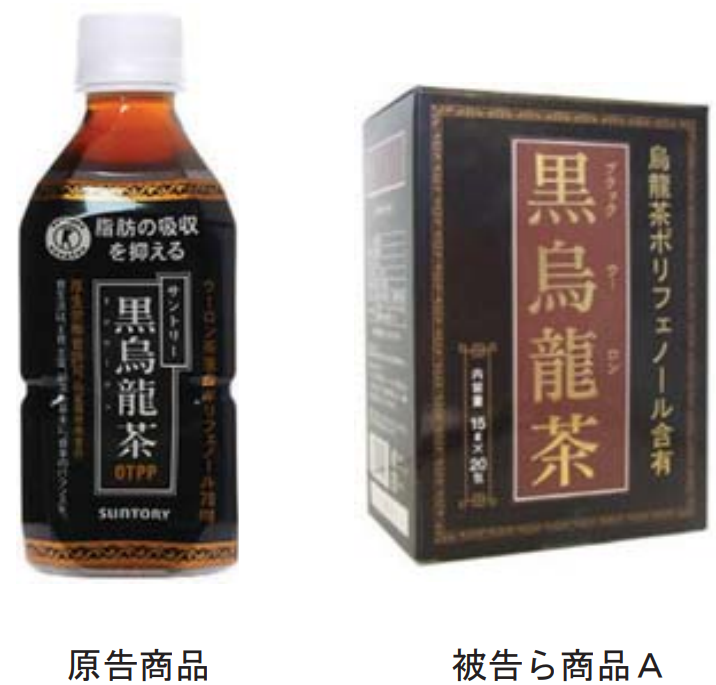
[Article / Unfair Competition Prevention Act, Article 2(1)(i)] Protection of product packaging consisting of weakly distinctive elements — Suntory Black Oolong Tea case (Yukari Hira, Intellectual Property Law and Policy Journal, Vol. 35 (2011))
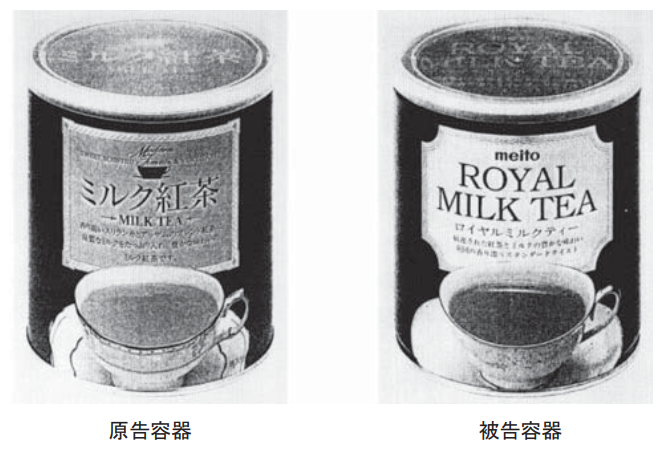
Even if weakly distinctive portions are similar to some extent, there is no similarity unless strongly distinctive portions are shared.
→ Nevertheless, even for commonplace, weakly distinctive indications, similarity exists if even portions whose adoption is not inevitable in relation to the goods bearing the indication coincide.
(For example, Product A in the Suntory Black Oolong Tea case and the Royal Milk Tea case.)
https://lex.juris.hokudai.ac.jp/gcoe/journal/IP_vol35/35_14.pdf
https://www.linkedin.com/feed/update/urn:li:activity:7514576896983044097/
Images from the original AMEBLO article
English translations of the original image text
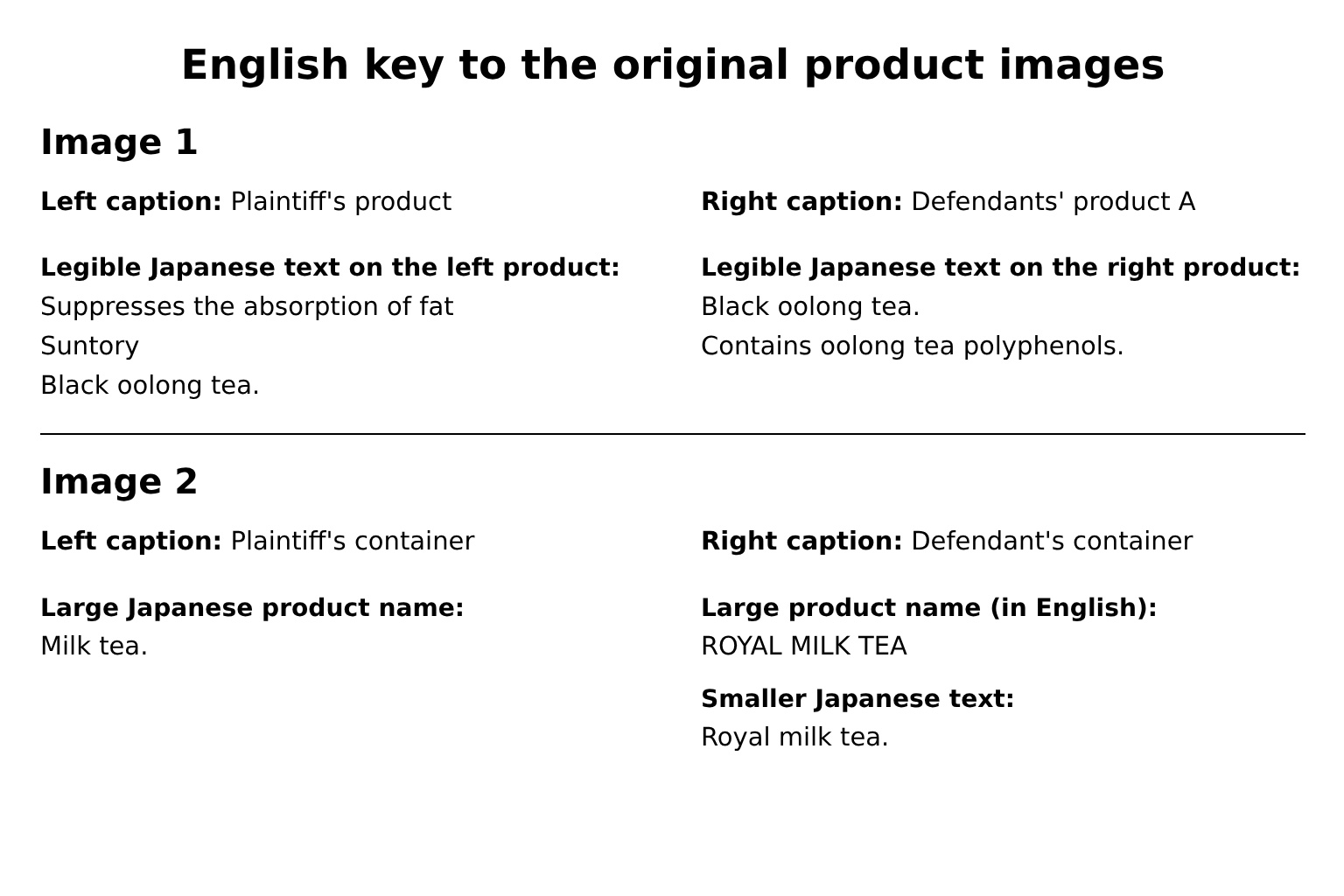
Original images retained for comparison
Original AMEBLO article
https://ameblo.jp/hideki-takaishi/entry-12916747725.html
[Article / International Jurisdiction] A Case Recognizing Japanese International Jurisdiction Based on a Foreign Corporation’s Website Displaying Products Allegedly Infringing a Patent and Circumstances Including the Corporation’s Business Activities in Japan—The Motor Case (Zhang Peng, Intellectual Property Law and Policy Journal, Vol. 36 (2011))
Original Ameblo publication: 2025-07-17
Ameblo: https://ameblo.jp/hideki-takaishi/entry-12916968725.html
[Article / International Jurisdiction] A Case Recognizing Japanese International Jurisdiction Based on a Foreign Corporation’s Website Displaying Products Allegedly Infringing a Patent and Circumstances Including the Corporation’s Business Activities in Japan—The Motor Case (Zhang Peng, Intellectual Property Law and Policy Journal, Vol. 36 (2011))
*IP High Court, 2010 (Ne) 10001
The decision showed that the Supreme Court’s Tsuburaya Productions judgment extends to claims for an injunction based on patent rights and clarified the requirements.
The alleged infringer was a foreign company, but its website advertised that it served Japan, and it belonged to the Samsung Group.
⇒ Japan had jurisdiction.
Cf. Tokyo District Court, May 14, 2001, “Intraocular Pressure-Lowering Agent” Case: The court denied Japanese jurisdiction over the foreign parent company of the entity acting in Japan, reasoning that, so long as the corporate personality was not a mere shell, the defendant, which had no economic base in Japan, could not be compelled to defend the action.
Cf. Tokyo District Court, 2004 (Wa) 10667, “Data Transmission Method”: Japanese jurisdiction was recognized because sales activities were conducted with knowledge that the products would be transferred in Japan.
https://lex.juris.hokudai.ac.jp/gcoe/journal/IP_vol36/36_11.pdf
IP High Court, 2020 (Gyo-Ke) 10057 [Electric Bed] <Kanno>
Original Ameblo publication: 2025-07-18
Ameblo: https://ameblo.jp/hideki-takaishi/entry-12917218930.html
IP High Court, 2020 (Gyo-Ke) 10057 [Electric Bed] <Kanno>
*Motivation to combine was rejected because the technical fields of the primary and secondary references were far removed from each other.
⇒ Inventive step affirmed.
(Translation of an excerpt from the court’s reasoning)
The Exhibit Ko 1 invention concerns a medical bed 10 and addresses the problem of setting it at a preselected vertical height according to the patient’s anticipated needs. It selects, as a lower intermediate position, “a convenient height for getting into and out of the bed 10” (that height is also one at which a caregiver’s or patient’s feet will not be trapped even if present …). In contrast, the Exhibit Ko 3 invention … concerns a vehicle convertible-top opening and closing device. In view of the risk of objects being caught when the top closes, it addresses the problem of providing a vehicle convertible-top opening and closing device that automatically pauses just before the top is fully closed, enabling safety to be reliably checked, and further addresses the problem of avoiding discomfort to the operator. The technical fields of the two inventions are far removed from each other, and they share only the abstracted problem of avoiding the risk of trapping an object. Extracting a common problem from different inventions in such different technical fields and seeking to apply concrete solutions suited to the characteristics of each field to the other requires particular ingenuity …. … There is no motivation to apply the Exhibit Ko 3 invention to the Exhibit Ko 1 invention ….
“The … invention-specifying matter ‘even if a caregiver’s or patient’s feet are present between the frame and the floor, they will not be trapped’ specifies the basis on which the height at which the frame stops is determined … and therefore does not make this a use invention ….”
https://www.courts.go.jp/assets/hanrei/hanrei-pdf-90469.pdf
<Trial and Appeal Practitioners Study Group Report 2024> Case 1 (Mechanical) — IP High Court, 2022 (Gyo-Ke) 10007 [Heat Transport System]
Original Ameblo publication: 2025-07-20
Ameblo: https://ameblo.jp/hideki-takaishi/entry-12917659886.html
<Trial and Appeal Practitioners Study Group Report 2024> Case 1 (Mechanical)
IP High Court, 2022 (Gyo-Ke) 10007 [Heat Transport System]
•In practice, it is difficult to determine whether alternatives can be said to be “actually described in parallel.” … Moreover, depending on the state of the art, there may be cases in which it is permissible to extract one member from the description of a general formula in a cited reference ….
•It is understandable that, with a number of alternatives on the order of that in this case, they can be said to be “actually described in parallel,” whereas, when the number is enormous, a particular alternative cannot be extracted; nevertheless, the dividing line is unclear.
•The participants agreed that the judgment’s finding of obviousness as a design modification or the adoption of a matter of design choice, even without particular motivation, was appropriate.
On the other hand, concern was also expressed that determining what constitutes a matter of design choice is not necessarily highly predictable.
When well-known technology is used as a secondary cited invention, it is the subject of application (combination), so motivation is naturally required. By contrast, when well-known technology is used as the basis for a design modification or the like, motivation is not necessarily required under the rule stated in this judgment.
•Regarding identification of the cited invention, the judgment states that configurations not essential to solving the problem need not be included in that identification. However, it is not necessarily clear how far descriptions in the specification and other documents may be extracted and identified in making a concrete finding.
Accordingly, care must be taken not to identify the invention in a manner that is merely convenient for the person making the finding.
Trial and Appeal Practitioners Study Group Report 2024 — Theme 2 (Chemistry 1)
Original Ameblo publication: 2025-07-21
Article type: Reports and activities
Categories: Patents
Topics: Inventive step, Numerical limitations and parameters, Examination and appeal practice
First published on this website: 2026-10-16
Ameblo: https://ameblo.jp/hideki-takaishi/entry-12917799811.html
HP: https://www.takaishihideki.com/en/single-post/ameblo-12917799811-en
Japanese version: https://www.takaishihideki.com/single-post/ameblo-12917799811-ja
Trial and Appeal Practitioners Study Group Report 2024 — Theme 2 (Chemistry 1)
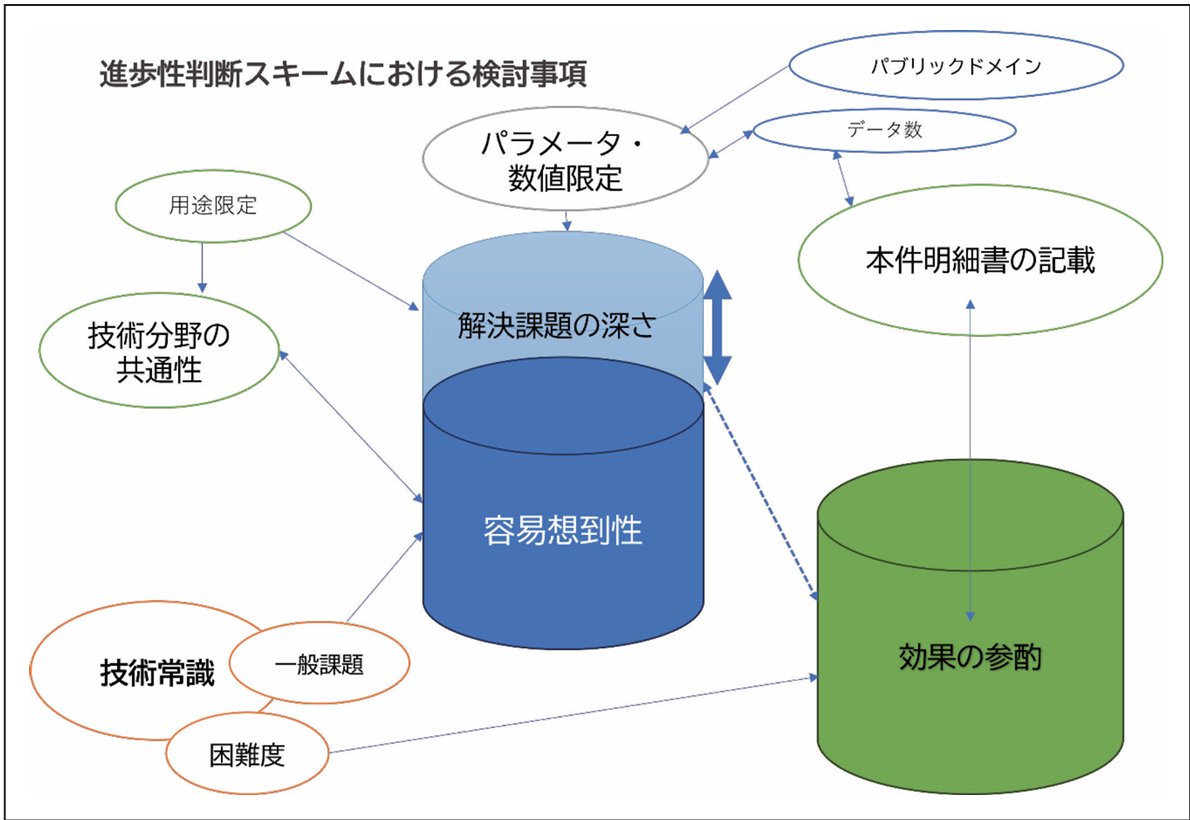
[Inventive step in parameter and numerically limited inventions]
When can a numerical range not expressly disclosed in a cited document be held readily conceivable?
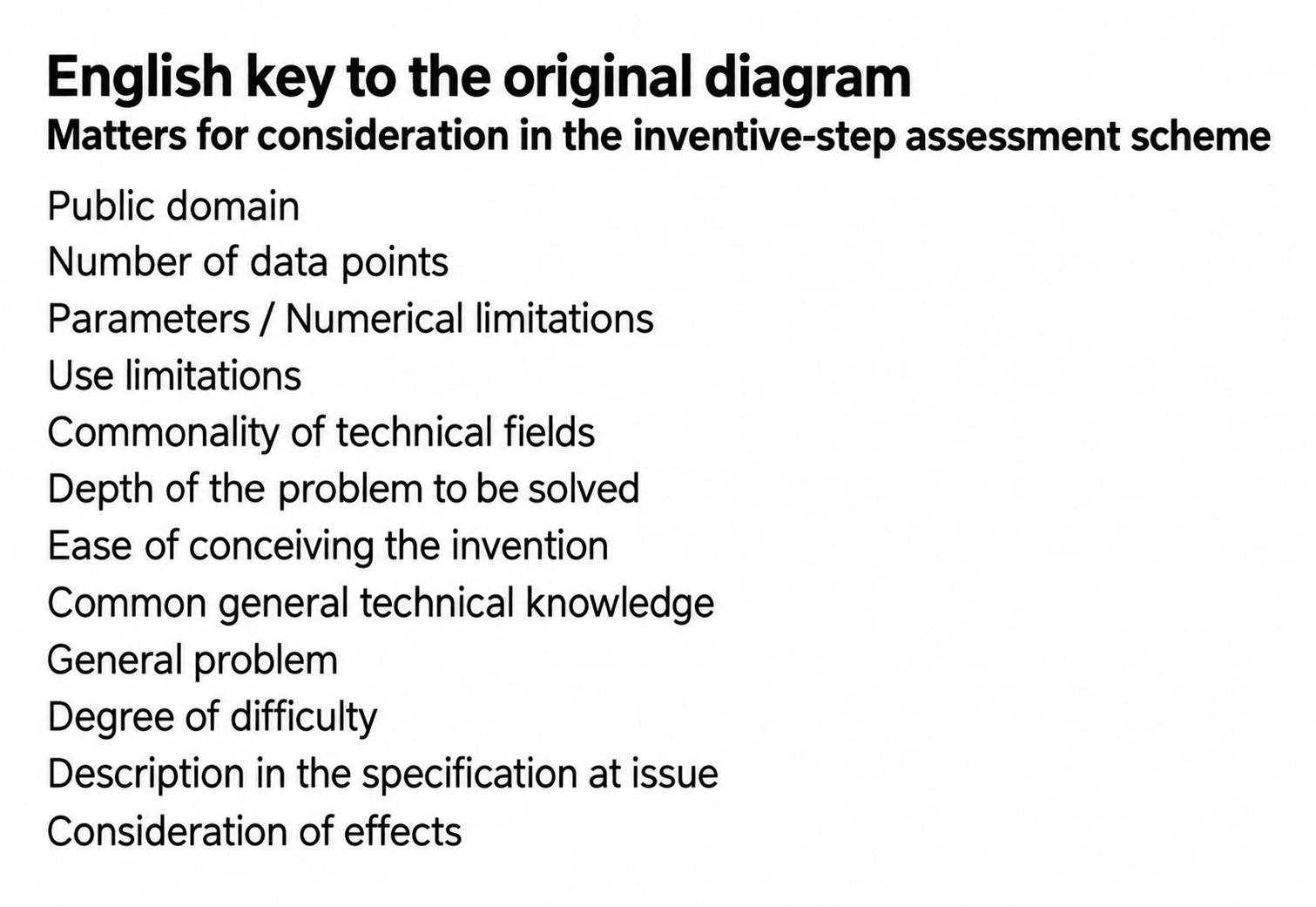
• Commonality of the technical fields and problems of the invention at issue and the primary cited invention.
→ When preparing a specification, the problem considered by the inventor is not based on all prior art. In practice, the inventor sets the invention’s problem by considering common general knowledge within the inventor’s awareness and contributions or effects relative to documents found in a pre-filing search.
Accordingly, identifying the problem from the “Problem to be solved by the invention” sections of the specification at issue and the primary cited invention’s specification also accords with actual practice.
Where the problem is merely common general knowledge, industry-association technical journals and standards are useful for showing that it is self-evident to a person skilled in the art.
https://www.linkedin.com/feed/update/urn:li:activity:7514577275074379776/
Images from the original AMEBLO article
English translations of the original image text
Original images retained for comparison
Original AMEBLO article
https://ameblo.jp/hideki-takaishi/entry-12917799811.html
Trial and Appeal Practitioners Study Group Report 2024 — Case 2 (Chemistry 1)
Original Ameblo publication: 2025-07-22
Article type: Reports and activities
Category: Patents
Topics: Novelty, Added matter, Examination and appeal practice
First published on this site: 2026-10-11
Ameblo: https://ameblo.jp/hideki-takaishi/entry-12917931262.html
HP: https://www.takaishihideki.com/en/single-post/linkedin-7514577404934270977-en
Japanese version: https://www.takaishihideki.com/single-post/linkedin-7514577368691249152-ja
Trial and Appeal Practitioners Study Group Report 2024 — Case 2 (Chemistry 1)
[Matters equivalent to disclosure in the earlier application’s specification; substantial identity]
IP High Court, 2014 (Gyo-Ke) No. 10097 — Flat nonaqueous-electrolyte secondary battery
• A “new effect” under the expanded prior-application rule need not be a “remarkable” or “advantageous” effect required for inventive step. Improvement in the degree of an effect suffices; the level may be lower than for inventive step.
• Regarding the relationship between disclaimer amendments commonly used to avoid lack of novelty and assessment of minor differences under the expanded prior-application rule, a participant questioned whether, following a disclaimer amendment, consideration extends to whether the excluded and remaining portions produce a new effect for this assessment.
(Excerpt from the judgment, translated)
…Difference A identified in the JPO decision is, in short, that the invention at issue and the invention in Exhibit Ko 1 differ quantitatively in ① the number of opposing faces and ② the relative sizes of the facing area of those faces and the gasket opening area. …Both inventions use, in a flat nonaqueous-electrolyte secondary battery, an electrode assembly in which positive electrode plates having an active-material-containing layer on the surface of the positive-electrode constituent material and negative electrode plates having an active-material-containing layer on the surface of the negative-electrode constituent material are stacked in multiple layers with separators between them. By increasing the sum of the facing areas between the active-material-containing layers of the positive and negative electrode plates, they enable an increase in discharge capacity under heavy load. They therefore share the same problem and means of solving it. …It may be unexpected that heavy-load discharge capacity shows little change, and in some cases gradually decreases, when the number of opposing faces exceeds five. However, the invention at issue addresses the technical problem of increasing discharge capacity under heavy load and specifies a lower limit, rather than an upper limit, for the number of opposing faces. The fact that discharge capacity does not increase in proportion to the number of opposing faces therefore cannot be regarded as a new effect of the invention at issue.
Original article (2025-07-22):
Trial and Appeal Practitioners Study Group Report 2024 — Theme 3 (Chemistry 2)
Original Ameblo publication: 2025-07-23
Article type: Reports and activities
Category: Patents, Europe
Topics: Inventive step, Examination and appeal practice
First published on this site: 2026-10-11
Ameblo: https://ameblo.jp/hideki-takaishi/entry-12918107191.html
HP: https://www.takaishihideki.com/en/single-post/linkedin-7514577481144700928-en
Japanese version: https://www.takaishihideki.com/single-post/linkedin-7514577453269467137-ja
Trial and Appeal Practitioners Study Group Report 2024 — Theme 3 (Chemistry 2)
[Consideration of experimental results submitted after filing: inventive step]
Regarding experimental results submitted after filing (post-filed data), the practice is established to a certain extent: consideration is permitted insofar as a person skilled in the art can infer the effect from the specification or drawings. As stated in the guidance, examiners should not consider an effect asserted and proved in written arguments, etc., if it is neither described in the specification nor inferable by a person skilled in the art from the specification or drawings.
Recently in Europe, in appeal proceedings concerning EP2484209 (insecticide compositions for controlling pests), the Enlarged Board of Appeal issued G 2/21 in response to questions referred by a Technical Board of Appeal. Regarding evidence submitted after the filing date in assessing inventive step, it held that:
① it cannot be disregarded solely because it was submitted later;
② a technical effect may be relied upon for inventive step if a person skilled in the art, bearing common general knowledge in mind and on the basis of the application as originally filed, can derive that effect as encompassed by its technical teaching and embodied by the same originally disclosed invention.
Original article (2025-07-23):
Trial and Appeal Practitioners Study Group Report 2024 — Case 3 (Chemistry 2)
Original Ameblo publication: 2025-07-24
Article type: Reports and activities
Category: Patents
Topics: Added matter, Enablement, Support requirement, Examination and appeal practice
First published on this site: 2026-10-11
Ameblo: https://ameblo.jp/hideki-takaishi/entry-12918330164.html
HP: https://www.takaishihideki.com/en/single-post/linkedin-7514577676771344384-en
Japanese version: https://www.takaishihideki.com/single-post/linkedin-7514577641857814528-ja
Trial and Appeal Practitioners Study Group Report 2024 — Case 3 (Chemistry 2)
[Relationship between requirements for correction of medical-use inventions, particularly new matter, and the enablement and support requirements for the corrected invention]
IP High Court, 2020 (Gyo-Ke) No. 10135
Addition of new matter concerns “technical ideas disclosed by the specification or drawings.” This is consistent with the support-requirement inquiry that compares the claims with the detailed description and asks whether the claimed invention is an invention described in the detailed description.
Whether something is “substantially disclosed” is distinguished as an area to be assessed under the support requirement: whether it falls within the scope in which a person skilled in the art can recognize, from the detailed description, that the invention’s problem can be solved.
Original article (2025-07-24):
Trial and Appeal Practitioners Study Group Report 2024 — Theme 4 (Electrical 1)
Original Ameblo publication: 2025-07-25
Article type: Reports and activities
Category: Patents
Topics: Patent eligibility, Examination and appeal practice
First published on this site: 2026-10-11
Ameblo: https://ameblo.jp/hideki-takaishi/entry-12918548186.html
HP: https://www.takaishihideki.com/en/single-post/linkedin-7514577753027997696-en
Japanese version: https://www.takaishihideki.com/single-post/linkedin-7514577716843782144-ja
Trial and Appeal Practitioners Study Group Report 2024 — Theme 4 (Electrical 1)
[Eligibility as an invention: human mental activities and artificial arrangements]
Whether something “as a whole” constitutes a creation of technical ideas utilizing the laws of nature involves the following factors:
(i) whether artificial arrangements or human mental activities themselves are recited in the claims;
(ii) whether technical means for solving the problem, namely the system specified in the invention, are identified;
(iii) whether the technical significance of the invention is directed toward artificial arrangements or human mental activities themselves.
Original article (2025-07-25):
Trial and Appeal Practitioners Study Group Report 2024 — Case 4 (Electrical 1)
Original Ameblo publication: 2025-07-27
Article type: Reports and activities
Category: Patents
Topics: Inventive step, Doctrine of equivalents, Added matter, Divisional applications, Examination and appeal practice
First published on this site: 2026-10-11
Ameblo: https://ameblo.jp/hideki-takaishi/entry-12919021623.html
HP: https://www.takaishihideki.com/en/single-post/linkedin-7514577881134481408-en
Japanese version: https://www.takaishihideki.com/single-post/linkedin-7514577843465601024-ja
Trial and Appeal Practitioners Study Group Report 2024 — Case 4 (Electrical 1)
[Inventive step in business-related inventions]
IP High Court, 2022 (Gyo-Ke) No. 10039
The judgment recognized an “inherent requirement” concerning facility reservations without specifically identifying evidence. Some participants observed that, from the applicant’s perspective, recognition of this requirement and denial of inventive step without evidence made the judgment difficult to predict and felt harsh.
<How to describe problems and effects in the specification>
• In some cases, it may be effective to describe the problem in the main text of the specification while either stating it as abstractly as possible in the problem section or leaving that section unwritten.
• Conversely, describing individual relationships among problems, effects and technical means too specifically may prevent the patent’s scope from having breadth.
• If the doctrine of equivalents is contemplated, the problem section should also state: “The essence of this invention lies here.”
• Describing the problem too specifically in the problem section may result in a proposed divisional application being summarily rejected as adding new matter.
Original article (2025-07-27):
Trial and Appeal Practitioners Study Group Report 2024 — Theme 5 (Designs)
Original Ameblo publication: 2025-07-27
Article type: Reports and activities
Category: Designs
Topics: Similarity of designs, Examination and appeal practice
First published on this site: 2026-10-11
Ameblo: https://ameblo.jp/hideki-takaishi/entry-12919021887.html
HP: https://www.takaishihideki.com/en/single-post/linkedin-7514578819605827584-en
Japanese version: https://www.takaishihideki.com/single-post/linkedin-7514578410979921921-ja
Trial and Appeal Practitioners Study Group Report 2024 — Theme 5 (Designs)
[Similarity of designs: the person whose perspective governs]
Identifying the relevant person takes account of the nature, purpose and manner of use of the article embodying the design. If appearance determines an end consumer’s purchase, ordinary consumers are the relevant consumers. If shape derived from function determines purchasing, “experts,” in addition to ordinary consumers, may be the relevant consumers.
Ordinary consumers tend to emphasize the overall configuration and portions readily noticeable at a glance. Beyond the overall configuration, they tend to focus on the shape of portions important in deciding a purchase—those emphasized when selecting a design.
Experts tend to observe details, particularly portions related to function, functionally important portions and improvements.
*The study also considered whether the relevant person may differ between actions to rescind trial/appeal decisions and infringement litigation.
Original article (2025-07-27):
Trial and Appeal Practitioners Study Group Report 2024 — Theme 6 (Trademarks)
Original Ameblo publication: 2025-07-29
Article type: Reports and activities
Category: Trademarks
Topics: Similarity of trademarks, Distinctiveness, Examination and appeal practice
First published on this site: 2026-10-11
Ameblo: https://ameblo.jp/hideki-takaishi/entry-12919433619.html
HP: https://www.takaishihideki.com/en/single-post/linkedin-7514579770139996160-en
Japanese version: https://www.takaishihideki.com/single-post/linkedin-7514579478090629120-ja
Trial and Appeal Practitioners Study Group Report 2024 — Theme 6 (Trademarks)
[Similarity of composite marks]
<Marks formed by adding other characters, etc., to an already registered mark>
• Whether the registered-mark portion is a dominant element is influenced by its recognition and actual trading conditions concerning meaning and usage. However, additions having no difference in the strength of distinctiveness are relatively uncommon; in practice, additions often indicate quality, etc., and therefore differ in distinctiveness.
• Of two components, the one having relatively stronger distinguishing function may be extracted as the dominant element.
• For an applied-for mark “A+B,” even if added “B” is strongly distinctive, existing registered/cited mark “A” was itself registered because it is distinctive. In principle, both “B” and the portion “A” corresponding to the existing registered mark are separately extracted for comparison.
• If the applied-for mark is “A” and the cited mark is “A′+B,” the applicant for the cited mark considered the combination distinctive. In principle, it should not have the power to prevent registration of “A.”
• If the applied-for mark is “A+B” and the cited mark is “A′,” an element has been added to an existing mark, and there are many cases in which similarity should be favored.
• If both the registered mark and the added characters have weak distinctiveness, they may form a coined term with a different meaning. Traders and consumers may also perceive and remember the whole as inseparable. One view was that, unless the mark is well known or famous, registration could be allowed on the basis that the marks are dissimilar. (Tokyo High Court, 2000 (Gyo-Ke) No. 301 — “ロマンティック北街道” (“Romantic Kita-kaido”) held that a person selecting such a weak mark as its own trademark must tolerate the word being used in this manner as part of another person’s trademark.)
Original article (2025-07-29):
Images from the original AMEBLO article
English translations of the original image text
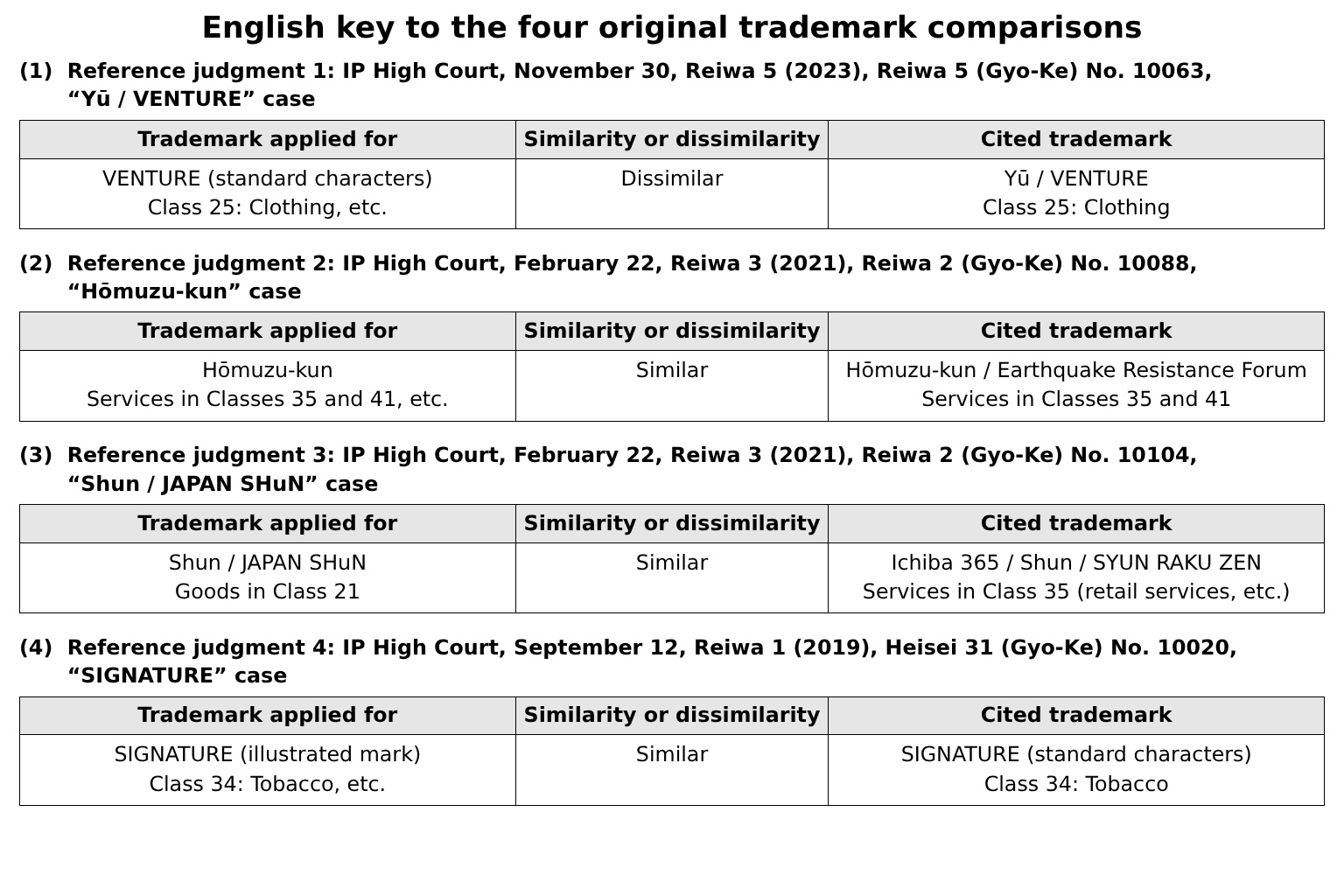
English key to the four original trademark comparisons
(1) Reference judgment 1: IP High Court, November 30, 2023, 2023 (Gyo-Ke) No. 10063, “遊 / VENTURE” case.
Trademark applied for: VENTURE (standard characters). Class 25: Clothing, etc.
Similarity or dissimilarity: Dissimilar.
Cited trademark: 遊 (Yū) / VENTURE, as illustrated in the original. Class 25: Clothing.
(2) Reference judgment 2: IP High Court, February 22, 2021, 2020 (Gyo-Ke) No. 10088, “ホームズくん” case.
Trademark applied for: ホームズくん (Hōmuzu-kun). Services in Classes 35 and 41, etc.
Similarity or dissimilarity: Similar.
Cited trademark: the illustrated mark containing ホームズ君 (Hōmuzu-kun) and 耐震フォーラム (Earthquake Resistance Forum), with a detective-like character and house framework. Services in Classes 35 and 41.
(3) Reference judgment 3: IP High Court, February 22, 2021, 2020 (Gyo-Ke) No. 10104, “旬 / JAPAN SHuN” case.
Trademark applied for: the illustrated mark containing 旬 (Shun), JAPAN and stylized SHUN. Goods in Class 21.
Similarity or dissimilarity: Similar.
Cited trademark: the illustrated mark containing 市場365 (Ichiba 365), 旬 (Shun), and SYUN RAKU ZEN. Services in Class 35 (retail services, etc.).
(4) Reference judgment 4: IP High Court, September 12, 2019, 2019 (Gyo-Ke) No. 10020, “SIGNATURE” case.
Trademark applied for: the illustrated mark containing SIGNATURE, NO. 555 and STATE EXPRESS, with a crest and circular design. Class 34: Tobacco, etc.
Similarity or dissimilarity: Similar.
Cited trademark: SIGNATURE (standard characters). Class 34: Tobacco.
Original images retained for comparison
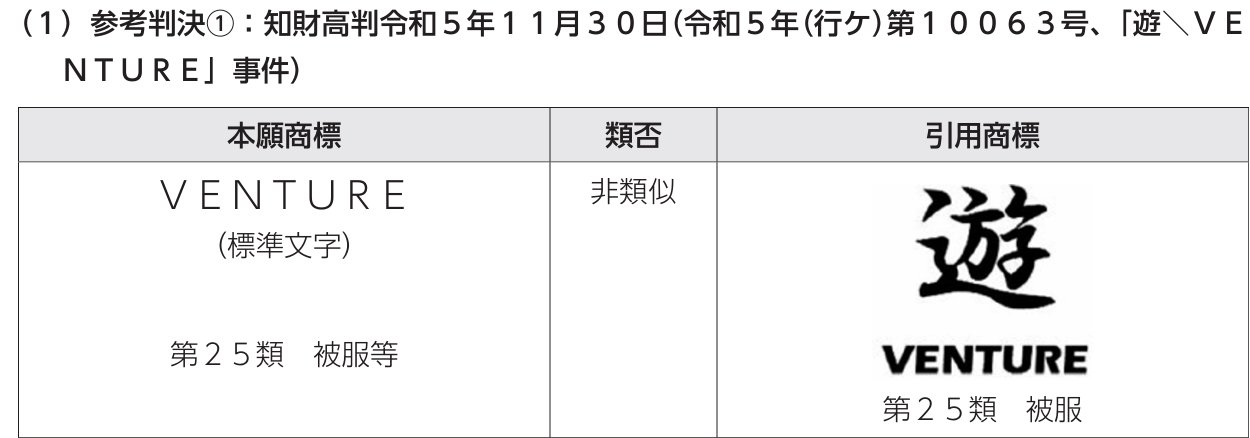
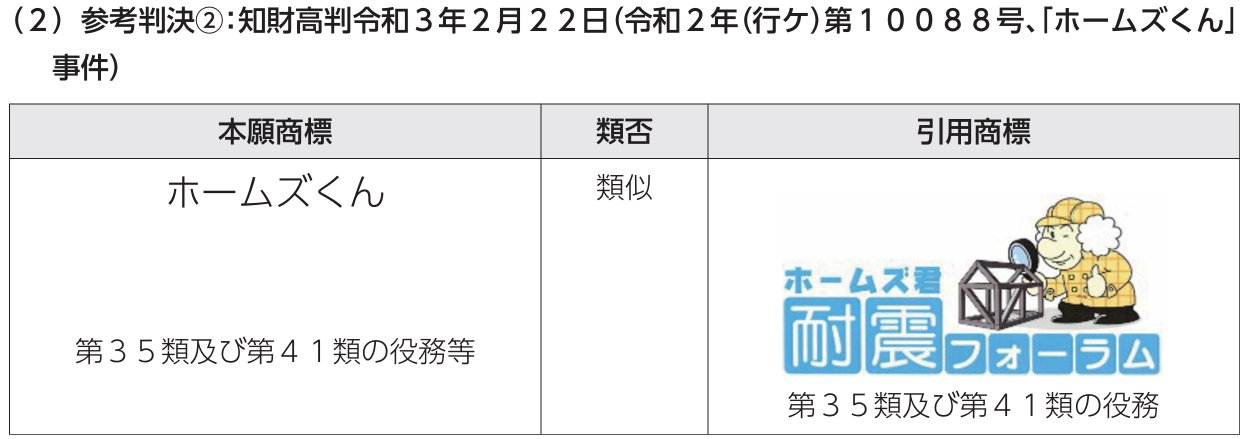
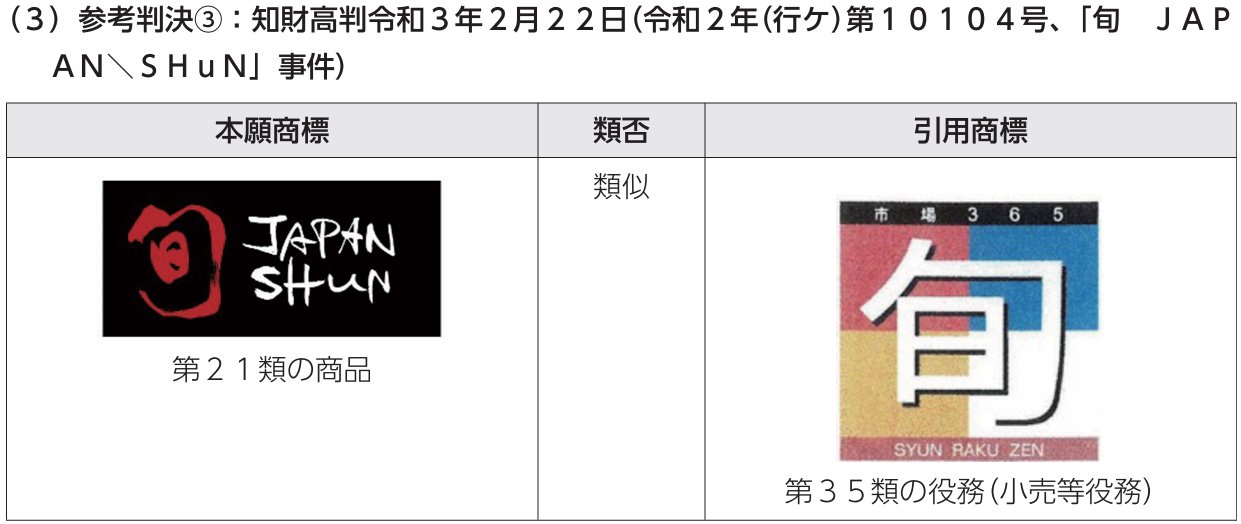
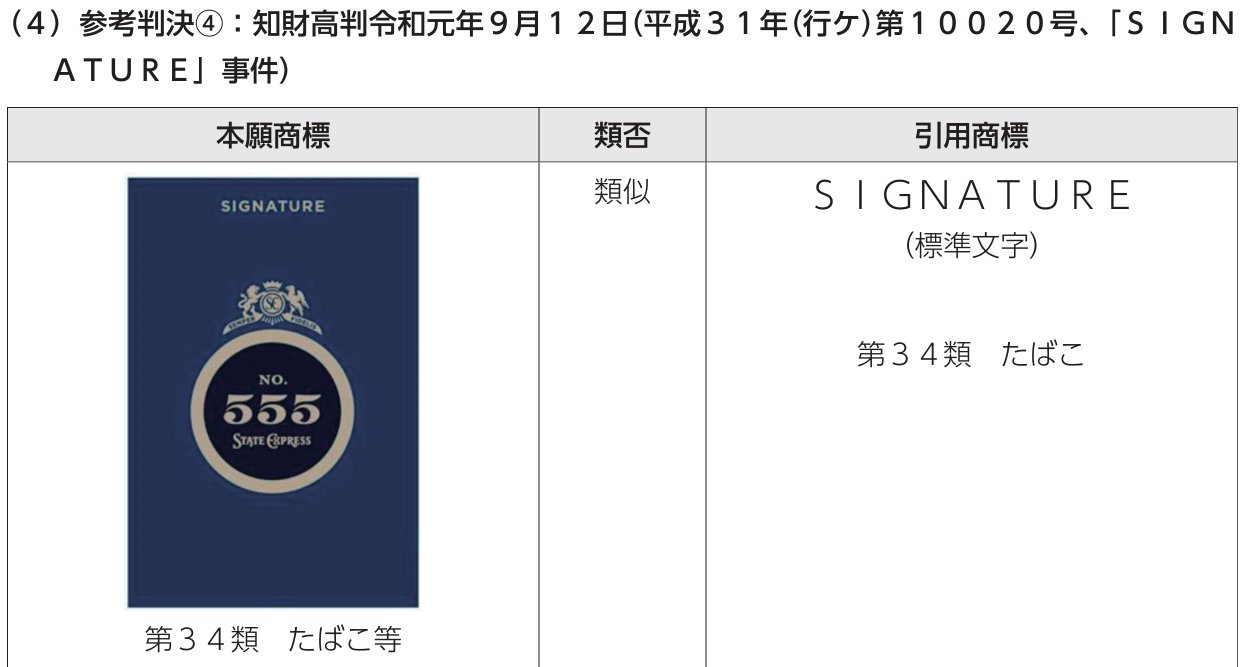
Original AMEBLO article
https://ameblo.jp/hideki-takaishi/entry-12919433619.html
Trial and Appeal Practitioners Study Group Report 2024 — Case 6 (Trademarks)
Original Ameblo publication: 2025-07-30
Article type: Reports and activities
Category: Trademarks
Topics: Distinctiveness, Examination and appeal practice
First published on this site: 2026-10-11
Ameblo: https://ameblo.jp/hideki-takaishi/entry-12919634690.html
HP: https://www.takaishihideki.com/en/single-post/linkedin-7514580134021152768-en
Japanese version: https://www.takaishihideki.com/single-post/linkedin-7514579945453473792-ja
Trial and Appeal Practitioners Study Group Report 2024 — Case 6 (Trademarks)
[Application of Article 3(1)(iv) of the Trademark Act to a mark combining a common surname and a customary name]
IP High Court, 2023 (Gyo-Ke) No. 10031 — Ikegami Seimensho
Where a meaning other than a surname is better known and the word is ordinarily perceived in that other sense, such circumstances may affect whether it is a “common surname.”
As to how the number of people bearing the surname may be considered, most participants acknowledged the rationality of a numerical criterion to ensure objectivity, while considering it difficult to draw a line at a specific number.
A surname forming a mark may be “common” even if relatively few people bear it:
① where it is the surname of a historical or fictional person;
② where it is concentrated in a particular region.
Regarding the provision applicable to composite marks combining a common surname with a customary industry name, some decisions differ from this judgment and apply item (vi) when refusing registration (IP High Court, March 11, 2024 — Tanaka Hashiten).
Original article (2025-07-30):
[US patents] CAFC, January 2025 — Honeywell v. 3G Licensing
Original Ameblo publication: 2025-07-31
Article type: Case note
Category: United States
Topics: Inventive step, Motivation and teaching away
First published on this site: 2026-10-11
Ameblo: https://ameblo.jp/hideki-takaishi/entry-12919845909.html
HP: https://www.takaishihideki.com/en/single-post/linkedin-7514580408639008768-en
Japanese version: https://www.takaishihideki.com/single-post/linkedin-7514580275985661952-ja
[US patents] CAFC, January 2025 — Honeywell v. 3G Licensing
When assessing obviousness, the motivation to modify the primary cited invention need not be identical to the motivation the patentee had in the past.
When establishing obviousness, a particular combination with the primary cited invention need not be its preferred or most preferred combination.
Original article (2025-07-31):
Tokyo District Court, 2023 (Wa) No. 70178 — Zinc acetate hydrate tablets (Judge Nakashima)
Original Ameblo publication: 2025-08-01
Article type: Case note
Category: Patents
Topics: Claim interpretation, Numerical limitations and parameters
First published on this site: 2026-10-10
Ameblo: https://ameblo.jp/hideki-takaishi/entry-12920092315.html
Japanese version: https://www.takaishihideki.com/single-post/東京地判令和5年-ワ-70178【酢酸亜鉛水和物錠】-中島
Tokyo District Court, 2023 (Wa) No. 70178 — Zinc acetate hydrate tablets (Judge Nakashima)
*The claim was held not to be satisfied unless the temperature remained within the numerical range until the end of the drying process.
(Excerpt from the judgment, translated)
The marketing approval document for the defendant’s pharmaceutical product states that “the product temperature at the drying endpoint shall be no higher than <50°C>.” Each manufacturing instruction and record for that product instructs that drying end at a product temperature of 41.0°C or higher. It is therefore recognized that, in the defendant’s method, the product temperature reaches 41°C or higher in the “step of drying to obtain granules.” The “step of drying to obtain granules” means the entire drying process. Accordingly, the defendant’s method cannot be said to satisfy the limitation that “the product temperature is below 40°C” in the “step of drying to obtain granules.”
Original article (2025-08-01):
[India] Syngenta Limited v. Controller of Patents and Designs, 471/2022 (Division Bench of the Delhi High Court, October 13, 2023)
Original Ameblo publication: 2025-08-02
Article type: Case note
Category: Other foreign jurisdictions
Topics: Divisional applications, Disclosure in the parent application, Claims
First published on this site: 2026-10-10
Ameblo: https://ameblo.jp/hideki-takaishi/entry-12920306893.html
Japanese version: https://www.takaishihideki.com/single-post/【インド】syngenta-v-controller-特許庁-471-202(2023年10月13日デリー高裁合議審)
[India] Syngenta Limited v. Controller of Patents and Designs, 471/2022 (Division Bench of the Delhi High Court, October 13, 2023)
*A Delhi High Court judgment that relaxed the requirements for divisional applications!
Before this judgment, the practice was that an invention disclosed only in the parent application’s specification, but not in its claims, could not be made the subject of a divisional application.
→ The judgment held that a divisional application could be filed for an invention disclosed only in the parent application’s specification, even if it was not recited in the parent application’s claims.
*The practice became consistent with that of Japan, the United States, Europe and other jurisdictions.
Original article (2025-08-02):
[Copyright] Osaka District Court, 2019 (Wa) No. 10940
Original Ameblo publication: 2025-08-05
Article type: Case note
Category: Copyright
Topics: Damages
First published on this site: 2026-10-10
Ameblo: https://ameblo.jp/hideki-takaishi/entry-12920901156.html
HP: https://www.takaishihideki.com/en/single-post/copyright-osaka-district-court-reiwa-1-wa-no-10940
Japanese version: https://www.takaishihideki.com/single-post/【著作権】大阪地判令和1年-ワ-10940
[Copyright] Osaka District Court, 2019 (Wa) No. 10940
The court affirmed the copyrightability of the program, taking into account the volume of its source code.
*Where the source code and the functions contained in it are extensive, creativity is recognized unless there are special circumstances (Tokyo District Court, January 28, 2011, New Masuda-ashi case).
There was an implied license for the acts of reproduction and modification.
→ Infringement of copyright (the right of reproduction) and moral rights (the right of integrity) was denied.
On the other hand, infringement of the right of attribution was found with respect to the defendant’s display of only its own company name on the program’s startup and version screens and its removal of the plaintiff’s name.
→ The court awarded total damages of JPY 110,000, comprising JPY 100,000 in compensation for non-pecuniary harm and JPY 10,000 for attorney’s fees.
*On appeal (IP High Court, 2024 (Ne) Nos. 10017 and 10036, November 21, 2024), total damages were reduced to JPY 55,000, comprising JPY 50,000 in compensation for non-pecuniary harm and JPY 5,000 for attorney’s fees, because some of the programs had not been “offered or presented to the public.”
Original article (2025-08-05):
Text to Enter in “Customize ChatGPT”
Original Ameblo publication: 2025-08-05
Ameblo: https://ameblo.jp/hideki-takaishi/entry-12920940421.html
When researching judicial decisions, prior art for invalidity arguments, or other facts, the following text can be entered in “Customize ChatGPT” to request exact quotations and summaries and to reduce the risk of hallucinations.
“I am not asking ChatGPT to invent anything or to tell me what it thinks I want to hear. I am asking for answers to the questions entered in the prompt. In your answer, always cite the links on which you rely and always quote the text on which you rely in quotation marks. When quoting, reproduce the text exactly as it is, without changing a single character. The output I seek is accurate quotation; paraphrasing for readability or summarizing is completely prohibited. Do not create text under any circumstances; quote the text in quotation marks. After completing the quotation without changing a single character, also summarize the content that you quoted in quotation marks. If there is nothing corresponding to the question, I want an answer saying that there is nothing, so never introduce a judgment that does not exist. If you introduce something nonexistent, my delivered report will contain falsehoods, which is what causes me the greatest difficulty. Thank you. temperature=0 Above all, hallucinations cause me the greatest difficulty, so if the answer you are looking for is not there, please honestly answer that it was not there. Thank you.”
[China] Requirements when further limiting an independent claim while amending an original dependent claim into an independent claim
Original Ameblo publication: 2025-08-06
Article type: Case note
Category: China
Topics: Claim amendments, Further limitations, Making dependent claims independent
First published on this site: 2026-10-10
Ameblo: https://ameblo.jp/hideki-takaishi/entry-12921151409.html
Japanese version: https://www.takaishihideki.com/single-post/【中国】独立請求項に対して更なる限定を行うと共に、元の従属請求項を独立請求項に補正する場合の要件
[China] Requirements when further limiting an independent claim while amending an original dependent claim into an independent claim
<Supreme People’s Court, (2021) Zui Gao Fa Zhi Xing Zhong No. 556 (December 12, 2023)>
The patentee further limited the independent claim and rewrote original dependent Claim 3 as new independent Claim 4.
Because the substantive content and scope of protection of new Claim 4 and original Claim 3 are exactly the same, amended Claim 4 is original Claim 3; it was not obtained by combining original Claims 1 and 3. New Claim 4 is subject to examination.
<Key points of the holdings (2023)>
In patent-right confirmation proceedings, whether an amendment to a claim constitutes a “further limitation” should be assessed solely by determining whether the amended claim fully includes all technical features of the claim before amendment, whether the amended claim adds technical features compared with the claim before amendment, and whether those added technical features are recited in other claims of the original claim set.
As a general rule, an amendment that “further limits” a claim should be confined to responding to grounds for invalidation. An amendment made under the guise of remedying the deficiencies alleged in those grounds, but which in substance optimizes claim drafting rather than responding to those grounds, may be rejected.
In this case, incorporating the technical features of original Claims 2, 4, 6 and 7 into original Claim 1 constitutes a “further limitation.” In these circumstances, rewriting original Claim 3 as new independent Claim 4 is permissible because it changes the form of drafting without altering the substantive content or scope of protection and does not substantively reconstruct the claims.
Original article (2025-08-06):
[Trademarks] IP High Court, 2024 (Gyo-Ke) No. 10038
Original Ameblo publication: 2025-08-07
Article type: Case note
Category: Trademarks
Topics: Distinctiveness, Examination and appeal practice
First published on this site: 2026-10-10
Ameblo: https://ameblo.jp/hideki-takaishi/entry-12921367606.html
HP: https://www.takaishihideki.com/en/single-post/trademarks-reiwa-6-gyo-ke-no-10038
Japanese version: https://www.takaishihideki.com/single-post/【商標】令和6年-行ケ-10038
[Trademarks] IP High Court, 2024 (Gyo-Ke) No. 10038
Applied-for mark: “新生甘酒” (Shinsei amazake)
→ No distinctiveness (contrary to Article 3(1)(iii) of the Trademark Act).
1. If understood as “新生” + “甘酒”
It could ordinarily be used for amazake whose ingredients, manufacturing method or other aspects have been changed.
2. If understood as “新” + “生甘酒”
It could ordinarily be used for new “生甘酒” (unheated amazake).
(Excerpts from the judgment, translated; portions omitted)
1. Both “新生” and “甘酒” are common dictionary words. In light of the actual trade circumstances concerning “新生” that existed at the time of the trial decision, the applied-for mark is recognized as a name generally referring to amazake whose content has been renewed by changing its ingredients, manufacturing method or other aspects. It could ordinarily be used to describe such amazake. When used for the designated goods, traders and consumers would generally recognize it as indicating the quality of the goods. […]
2. If “新生甘酒” is understood as combining “新” and “生甘酒,” consumers and others encountering it on the designated goods would recognize it as a name generally referring to unheated amazake manufactured that year, or new amazake whose manufacturing method or characteristics differ from previous products. “新” is a common word listed in dictionaries, and the trade circumstances described above establish the practice of placing it before words indicating beverages or food products. “生甘酒” was also used in trade to mean “amazake manufactured without heat treatment.” Accordingly, the combined term “新生甘酒” could ordinarily be used to describe unheated amazake manufactured that year, or new amazake whose manufacturing method or characteristics differ from previous products. …
Original article (2025-08-07):
[Trademarks] IP High Court, 2023 (Gyo-Ke) No. 10117 — “Besurikai Tokyo TMS Clinic” (Judge Honda)
Original Ameblo publication: 2025-08-07
Article type: Case note
Category: Trademarks
Topics: Composite trademarks, Dominant elements, Distinctiveness, Trademark similarity
First published on this site: 2026-10-10
Ameblo: https://ameblo.jp/hideki-takaishi/entry-12921368060.html
Japanese version: https://www.takaishihideki.com/single-post/【商標】令和5年-行ケ-10117『ベスリ会-東京tmsクリニック』事件-本多
[Trademarks] IP High Court, 2023 (Gyo-Ke) No. 10117 — “Besurikai Tokyo TMS Clinic” (Judge Honda)
Applied-for mark: “ベスリ会 東京TMSクリニック”
Cited mark: “東京TMSクリニック”
*“ベスリ会,” the name of a medical corporation, has a source-identifying function, but “東京TMSクリニック” can be extracted as the dominant element.
(Excerpts from the judgment, translated; portions omitted)
The term “TMS” is not recognized as immediately calling to mind “transcranial magnetic stimulation” or “TMS treatment” as a treatment for depression. The textual portion “東京TMSクリニック,” taken as a whole, functions as a source identifier representing the name of the clinic that provides the services. […]
The textual portion “ベスリ会,” which indicates the medical corporation’s name, is not devoid of a source-identifying function. However, considering actual trade circumstances in which a medical corporation’s name and a medical institution’s name are used together, its source-identifying function must be regarded as relatively weak within the applied-for mark as a whole, which combines it with “東京TMSクリニック.”
Even where pronunciations and concepts functioning as source identifiers arise from multiple parts of a composite mark, […] a particular part may be extracted as its dominant element where, for example, that part gives traders and consumers a strong and dominant impression as an identifier of the source of services. Accordingly, even if “ベスリ会” has a source-identifying function, this does not prevent extraction of “東京TMSクリニック” as the dominant element of the applied-for mark. […]
Original article (2025-08-07):
[United States] CAFC, August 2, 2023 — Realtime Data v. Array Networks
Original Ameblo publication: 2025-08-07
Article type: Case note
Category: United States
Topics: Patent eligibility, Alice decision, Abstract ideas
First published on this site: 2026-10-10
Ameblo: https://ameblo.jp/hideki-takaishi/entry-12921368250.html
Japanese version: https://www.takaishihideki.com/single-post/【米国】cafc-2023-8-2-realtime-data-v-array-network
[United States] CAFC, August 2, 2023 — Realtime Data v. Array Networks
[Alice, step one] → Directed to an abstract idea
The claims do not clearly define a particular technology for performing data compression; they merely state results abstractly.
[Alice, step two] → No inventive concept
The specification does not show a particular use of a processor or differences from the prior art.
Data compression itself has long been well known. Even when the elements and procedures recited in the claims are combined, no technical feature beyond an abstract idea implemented by a general-purpose computer can be found.
Original article (2025-08-07):
IP High Court, 2020 (Gyo-Ke) No. 10094 — Agent for suppressing recurrence of reflux esophagitis (Judge Mori)
Original Ameblo publication: 2025-08-14
Article type: Case note
Category: Patents
Topics: Inventive step
First published on this site: 2026-10-10
Ameblo: https://ameblo.jp/hideki-takaishi/entry-12922879943.html
Japanese version: https://www.takaishihideki.com/single-post/令和2年-行ケ-10094【逆流性食道炎の再発抑制剤】-森
IP High Court, 2020 (Gyo-Ke) No. 10094 — Agent for suppressing recurrence of reflux esophagitis (Judge Mori)
*Common general knowledge at the priority date: completion of a phase II clinical trial led to denial of inventive step.
Phase I clinical trial: safety trial
Phase II clinical trial: efficacy trial with a small number of participants
Phase III clinical trial: efficacy trial with a large number of participants
<Difference>
Invention 1 is an “agent for suppressing recurrence of proton-pump-inhibitor-resistant reflux esophagitis,” containing “rabeprazole sodium” as its active ingredient and administered “for maintenance therapy.” By contrast, the Exhibit Ko 1 invention is “rabeprazole sodium (E3810) used in a phase III clinical trial to examine efficacy and safety” “in maintenance therapy for patients with PPI-resistant reflux esophagitis.”
(Excerpts from the judgment, translated; portions omitted)
…In light of common general knowledge concerning safety, the tolerability of long-term administration of 20 mg of rabeprazole sodium once daily in maintenance therapy was clear to a person skilled in the art at the priority date. …Considering also that no safety difference was thought to exist between twice-daily and once-daily administration, …no circumstance indicating an obstacle from the perspective of clinical safety to administration of “10 mg per dose twice daily” for “four weeks or more” is apparent. The guidelines in Exhibits Ko 42 and Ko 44 do describe concerns about the safety of long-term PPI administration. However, they state, for example, that “a direct causal relationship between any of these concerns and PPI administration cannot be said to be clear” (Exhibit Ko 42), and therefore do not alter the above conclusion. Nor do the warnings in the package inserts for the respective PPIs in Exhibits Ko 23 and Ko 29–31 alter that conclusion: they merely contain general statements about adverse reactions and similar matters ordinarily included in drug package inserts. …Accordingly, a person skilled in the art could readily have conceived of using the rabeprazole sodium of the invention in Exhibit Ko 1 as a recurrence-suppressing agent administered during maintenance therapy for patients with PPI-resistant reflux esophagitis and of adopting the features of Invention 1 at issue relating to Difference 1. …
The plaintiff relies on the 2017 judgment (2016 (Gyo-Ke) No. 10107). However, that judgment addressed “novelty,” not “inventive step,” and plainly concerned a different case.
Original article (2025-08-14):
[Trademarks / Similarity] Tokyo High Court, 2000 (Ne) No. 6252
Original Ameblo publication: 2025-08-14
Article type: Case note
Category: Trademarks
Topics: Similarity of trademarks, Distinctiveness
First published on this site: 2026-10-10
Ameblo: https://ameblo.jp/hideki-takaishi/entry-12922880039.html
Japanese version: https://www.takaishihideki.com/single-post/【商標-類否】東京高判平成12年-ネ-6252
[Trademarks / Similarity] Tokyo High Court, 2000 (Ne) No. 6252
*During prosecution, the applicant emphasized the distinctive spelling “BeaR.”
→ Dissimilar to “bear.”
(Excerpts from the judgment, translated; portions omitted)
Even if “BeaR” in the registered mark is understood as the English word “bear,” it is established, as noted above, that numerous marks giving rise to concepts and pronunciations associated with “bear” (the animal) have been registered as independent trademarks and are actually used in the field of the designated goods. In light of these circumstances, in the market for clothing and the other designated goods, it is difficult to distinguish one trader’s goods from another’s solely by the pronunciation “bear” or the concept of a bear. It accords with experience that traders and consumers instead distinguish the various “bear” marks by differences in the words, devices and other elements added to “bear” and similar terms.
The applicant’s arguments in the above written opinion responding to the notice of reasons for refusal should be understood as expressing its recognition of the general trade circumstances that marks containing “bear” or similar terms are not distinguished merely by the pronunciation “bear” and the concept of the animal. In the case of the registered mark, as emphasized in that written opinion, the distinctive spelling “BeaR,” particularly the emphasis created by the capital final “R,” should be understood as the feature distinguishing it from the ordinary word “bear” (the animal).
In other words, among the many registered and actually used marks associated with “bear,” this mark should be understood as being perceived and conceptualized as the distinctive “bear with a capital final R,” and as exercising distinctiveness in that form.
If the mark is viewed as a coined word with “e” and “a” between “B” and “R,” it is not similar to the appellant’s sign in pronunciation or concept. […]
Original article (2025-08-14):
[Trademarks / Cancellation for non-use] IP High Court, 2010 (Gyo-Ke) No. 10083 — “ECOPAC”
Original Ameblo publication: 2025-08-14
Article type: Case note
Category: Trademarks
Topics: Cancellation for non-use, Prosecution history estoppel, Identity under accepted social standards
First published on this site: 2026-10-10
Ameblo: https://ameblo.jp/hideki-takaishi/entry-12922880119.html
Japanese version: https://www.takaishihideki.com/single-post/【商標-不使用取消】平成22年-行ケ-10083『ecopac』事件
[Trademarks / Cancellation for non-use] IP High Court, 2010 (Gyo-Ke) No. 10083 — “ECOPAC”
*Prosecution history estoppel prevents an argument that the registered mark conveys the concept of “environmentally friendly packaging.”
→ The registered mark “ECOPAC” is not equivalent to “エコパック.”
→ Cancellation for non-use.
(Excerpts from the judgment, translated; portions omitted)
At present, the mark in actual use, “エコパック,” conveys the concept of “economical and environmentally conscious packaging containers.” Further, because the registered mark “ECOPAC” has the pronunciation “ekopakku,” even taking into account that the English words meaning “packaging containers” are “package” and “pack,” there is room to construe that traders and consumers would associate the constituent part “ECO” of the registered mark with “ECO,” an abbreviation of “ecology,” and would further associate “PAC” with “pack,” meaning “packaging containers,” thus understanding the registered mark to convey the concept of “economical and environmentally conscious packaging containers.” …
However, in the course of prosecution of the registered mark, the plaintiff repeatedly argued that the mark had a distinctive composition and consisted of a coined term that gave rise only to the pronunciation “ekopakku,” corresponding to its constituent letters, and did not give rise to any particular concept; following an appeal against a decision of refusal, the mark was allowed for registration. In particular, in proceedings on an opposition to registration, the opponent argued that the mark “ECOPAC” suggested a compound of “ecology” and “package” and, in relation to the designated goods, would be recognized solely as a generic term indicating “packaging containers giving full consideration to environmental protection” or as a representation of the quality of such containers. In response, the plaintiff asserted that the registered mark was not divisible into “ECO” and “PAC”; that, even if the components were considered separately, there was no general ordinary commercial use of “ECO” as an abbreviation indicating “ecology”; that the foreign-language words ordinarily adopted in trade to designate “packaging containers” were “package” and “pack,” which differed in their letter composition from “PAC” in the registered mark; and that the continuously joined expression “ECOPAC” did not designate “packaging containers giving full consideration to environmental protection,” but would be understood by traders and consumers as a coined word created by the plaintiff and incapable of giving rise to any particular concept. The plaintiff made these assertions. The Japan Patent Office accepted the plaintiff’s contentions, allowed registration of the mark, and subsequently decided that the registration should be maintained.
Consequently, even taking into account that the points disputed in the appeal against refusal and similar proceedings did not necessarily coincide with the grounds for rescission at issue in this lawsuit, and that social awareness of environmental protection had increased by the present time compared with the time of the application for registration in 1988 and the appeal decision in 1997 when assessing whether the registered mark and the mark in actual use are identical according to accepted social standards, the plaintiff itself had clearly maintained in prosecution that “PAC” differed in composition from the foreign-language word denoting “packaging containers”; that the continuously joined registered mark “ECOPAC” did not signify “packaging containers giving full consideration to environmental protection”; and that traders and consumers would perceive and understand it as a coined term created by the plaintiff that gave rise to no particular concept. In these circumstances, the plaintiff cannot reverse its prior position in this case and contend that the registered mark conveys the concept of “environmentally friendly packaging,” since that would violate the principle of estoppel. Accordingly, the plaintiff’s contention that the registered mark and the mark in actual use are identical according to accepted social standards, on the premise that their pronunciation and concept are identical, cannot be accepted.
Original article (2025-08-14):
[Trademarks] Trial decision, Appeal against refusal No. 2023-10504
Original Ameblo publication: 2025-08-14
Article type: Administrative decision note
Category: Trademarks
Topics: Examination and appeal practice, Distinctiveness
First published on this site: 2026-10-10
Ameblo: https://ameblo.jp/hideki-takaishi/entry-12922880245.html
Japanese version: https://www.takaishihideki.com/single-post/【商標】審決・不服2023-10504
[Trademarks] Trial decision, Appeal against refusal No. 2023-10504
Applied-for mark: “完全” (complete)
→ No distinctiveness (contrary to Article 3(1)(vi) of the Trademark Act).
(Excerpt from the trial decision, translated)
Even if the applied-for mark, consisting of the characters “完全,” is used for the designated goods or services, traders and consumers encountering it would understand that “everything is present” or “nothing is lacking” in the goods or services. They would merely recognize it as advertising language succinctly expressing the characteristics, advantages or features of the designated goods or services, and would not recognize it as a sign indicating their source or distinguishing one trader’s goods or services from another’s. […]
Original article (2025-08-14):
[Trademarks] Osaka District Court, 2022 (Wa) No. 9818 — “熱中対策応急キット” (Heatstroke countermeasure emergency kit) (Judge Takemiya)
Original Ameblo publication: 2025-08-14
Article type: Case note
Category: Trademarks
Topics: Distinctiveness
First published on this site: 2026-10-10
Ameblo: https://ameblo.jp/hideki-takaishi/entry-12922880338.html
Japanese version: https://www.takaishihideki.com/single-post/【商標】大阪地判令和4年-ワ-9818『熱中対策応急キット』事件-武宮
[Trademarks] Osaka District Court, 2022 (Wa) No. 9818 — “熱中対策応急キット” (Heatstroke countermeasure emergency kit) (Judge Takemiya)
*At the date of the registration decision, “熱中対策” was understood to mean “heatstroke countermeasures.”
→ No distinctiveness (contrary to Article 3(1)(iii) of the Trademark Act).
(Excerpt from the judgment, translated)
At the date of the registration decision, “熱中対策” was also generally understood to mean “heatstroke countermeasures.” “熱中対策応急キット” was generally recognized as meaning a set of articles used for heatstroke countermeasures or first aid, or goods containing such articles. […]
When the registered mark “熱中対策応急キット” was used for such goods, it was generally recognized by traders or consumers as indicating their intended use.
Original article (2025-08-14):
[Trademarks / Cancellation for non-use] IP High Court, 2024 (Gyo-Ke) No. 10054
Original Ameblo publication: 2025-08-14
Article type: Case note
Category: Trademarks
Topics: Cancellation for non-use, General retail services, Trademark use
First published on this site: 2026-10-10
Ameblo: https://ameblo.jp/hideki-takaishi/entry-12922880456.html
Japanese version: https://www.takaishihideki.com/single-post/【商標-不使用取消】令和6年-行ケ-10054
[Trademarks / Cancellation for non-use] IP High Court, 2024 (Gyo-Ke) No. 10054
“General retail and similar services” means “a case where clothing, food and beverages, and household goods are handled at a single establishment, each on a substantial scale and on a continuing basis.”
→ The sales volume and revenue for food and beverages were small compared with those for clothing and household goods.
The plaintiff’s store could not be recognized as continuously handling clothing, food and beverages, and household goods, each on a substantial scale, at a single establishment.
→ Cancellation for non-use.
Original article (2025-08-14):
[Unfair Competition / Indication of goods or business] Tokyo District Court, 2023 (Wa) No. 70036 — Catheter connector (Judge Kokubu)
Original Ameblo publication: 2025-08-14
Article type: Case note
Category: Unfair competition law
Topics: Indication of goods or business, Product configuration, Distinctiveness, Well-known status, Confusion, Injunction
First published on this site: 2026-10-10
Ameblo: https://ameblo.jp/hideki-takaishi/entry-12922880680.html
Japanese version: https://www.takaishihideki.com/single-post/【不競法-商品等表示】東京地判令和5年-ワ-70036『カテーテル用コネクター』-國分
[Unfair Competition / Indication of goods or business] Tokyo District Court, 2023 (Wa) No. 70036 — Catheter connector (Judge Kokubu)
The court recognized dimensions compared with similar products as an “indication of goods or business.”
→ Injunction granted!
*It is unusual for a likelihood of confusion to be found where the consumers are medical professionals.
[Subsequent appeal] In its judgment of July 16, 2025, 2025 (Ne) No. 10012, the IP High Court recognized the plaintiff’s product shape as a well-known indication of goods or business, but found that the defendant’s product shape was not similar. It reversed the portions of the first-instance judgment adverse to the defendant and dismissed the corresponding claims.
(Excerpts from the first-instance judgment, translated; portions omitted)
1. Distinctive features
[…] The plaintiff’s Y-connector was the only two-valve Y-connector having an overall length of approximately 88 mm and approximate proportions of 4:1:2:1 for the overall length, thumbwheel, main branch and rotator. It cannot be regarded as commonplace.
Accordingly, in Feature (e), the plaintiff’s Y-connector has an objectively conspicuous feature distinguishing it from other goods of the same kind. […]
[…] Features (a) and (c) can be said to arise from an unavoidable configuration for which there is no choice of another form to achieve the product’s technical function and utility. As for the other features, however, there are multiple alternatives, and they cannot be said to arise from such an unavoidable configuration.
2. Well-known status
[…] Since 2008, the plaintiff’s Y-connectors had achieved shares of 50% or more in both sales volume and sales value in the PTCA market where Y-connectors are used. In 2022, those shares reached 70% by volume and approximately 80% by value. […]
Because the plaintiff had exclusively used the form of its Y-connector for a long period, by around 2008 it had become widely recognized among its consumers, principally physicians and other medical professionals, as indicating the plaintiff as its source; it had acquired well-known status.
3. Similarity
The plaintiff’s and defendant’s Y-connectors share their overall length (87.99 mm for the plaintiff’s and 87.80 mm for the defendant’s), a cylindrical screw, an overall construction of transparent material, and an opener colored in a warm color. […] Their overall dimensional proportions are also very similar. Particularly because their dimensions and colors are similar, their appearance gives consumers, principally physicians and other medical professionals, the impression that the two indications are similar overall.
Additional translation of the complete passages quoted in the Japanese edition (ellipses correspond to those in the Japanese text):
1. Distinctive characteristics: The two-valve Y-connectors sold in Japan before the plaintiff’s product was launched and still being sold are Abbott’s Y-connector and Merit Medical’s Y-connector. These goods must naturally be taken into account as other products of the same kind when examining the distinctiveness of the plaintiff’s Y-connector. …
Excluding short-size versions, two-valve Y-connectors range in overall length from 72 mm to 78.99 mm; some short-type versions have an overall length of 58 mm. Among the two-valve Y-connectors other than the plaintiff’s, excluding the defendant’s, even the Kaneka Y-connector, which is closest in overall length to the plaintiff’s Y-connector, measures approximately 82 mm, a difference of approximately 6 mm. Whereas the plaintiff’s Y-connector has a thumbwheel length of 27.90 mm (screw length 16.04 mm), the Kaneka Y-connector has a thumbwheel length of 33.88 mm (screw length 22.22 mm), according to the attached Comparison of Two-Valve Connectors and the evidence (Defendant’s Exhibit Otsu 24). Apart from the defendant’s Y-connector, there was no product whose form exhibited approximately the same proportions among overall length, thumbwheel, main branch and rotator as the plaintiff’s Y-connector.
Consequently, the plaintiff’s Y-connector was the only two-valve Y-connector having an overall length of approximately 88 mm and approximate proportions of 4:1:2:1 among its overall length, thumbwheel, main branch and rotator. Its form cannot be described as commonplace. The plaintiff’s Y-connector thus possessed, in respect of Feature (e), an objectively conspicuous feature distinguishing it from other goods of the same kind. … Features (a) and (c) can be said to arise from an unavoidable configuration for which there is no choice of another form to achieve the product’s technical function and utility. As for the other features, however, there are multiple alternatives, and they cannot be said to arise from such an unavoidable configuration.
2. Well-known status: The plaintiff continued advertising at trade fairs and conducting sales activities aimed at physicians, thereby increasing sales. In the PTCA market where Y-connectors are used, Y-connectors manufactured by the plaintiff had achieved market shares of 50% or more in both sales volume and sales value since 2008. By 2022, the market share had reached 70% by volume and approximately 80% by value. Approximately 70% of the Y-connectors sold by the plaintiff were the plaintiff’s product, in which an OKAY II-type Y-connector was selected and combined with accessories. Although market data confined to two-valve Y-connectors did not exist, it could be inferred that the plaintiff’s share of the two-valve Y-connector market was even higher than its share of the overall Y-connector market. In light of these circumstances, the form of the plaintiff’s Y-connector had acquired well-known status by around 2008: through its longstanding exclusive use by the plaintiff, it had become widely recognized by its consumers, principally physicians and other healthcare professionals, as indicating the plaintiff as its source.
3. Similarity: The plaintiff’s and defendant’s Y-connectors share an overall length of 87.99 mm and 87.80 mm, respectively; the cylindrical shape of their screws; their manufacture entirely from transparent components; and openers colored in warm hues. … Their overall dimensional ratios are also very similar. In particular, because their dimensions and colors are similar, their appearance gives consumers, principally physicians and other healthcare professionals, the impression that the two indications are similar overall.
Original article (2025-08-14):
[Trademarks] Tokyo High Court, 1979 (Ne) No. 1097
Original Ameblo publication: 2025-08-16
Article type: Case note
Category: Trademarks
Topics: False indication of registered trademark status, Marking before registration, Trademark Act Article 74
First published on this site: 2026-10-10
Ameblo: https://ameblo.jp/hideki-takaishi/entry-12923468365.html
HP: https://www.takaishihideki.com/en/single-post/trademarks-tokyo-high-court-showa-54-ne-no-1097
Japanese version: https://www.takaishihideki.com/single-post/【商標】東京高判昭和54年-ネ-1097
[Trademarks] Tokyo High Court, 1979 (Ne) No. 1097
Even where an applicant has received a decision to register the mark and paid the registration fee, and only registration remains, the court held that using the indication “registered trademark” before registration violates Article 74(i) of the Trademark Act and may constitute the offense of false indication under Article 80.
Original article (2025-08-16):
[Designs] A case recognizing indirect infringement of a partial design
Original Ameblo publication: 2025-08-16
Article type: Case note
Category: Designs
Topics: Indirect infringement, Partial designs
First published on this site: 2026-10-10
Ameblo: https://ameblo.jp/hideki-takaishi/entry-12923469325.html
Japanese version: https://www.takaishihideki.com/single-post/【意匠】部分意匠の間接侵害が認められた事例
[Designs] A case recognizing indirect infringement of a partial design
Tokyo District Court, 2021 (Wa) No. 30281 — Hand-pushing member for a transport cart (Judge Kokubu)
1. Comparison of the articles
“The articles relating to the registered designs and the article relating to the defendant’s design are attached to a transport cart and used to protect the hand holding the grip from surrounding objects. Their purpose and function are the same.”
2. Comparison of the shapes
“There is no publicly known design combining the shape of the grip and that of the protective portion of Registered Design 1 as viewed obliquely from above. […]
[…] The common features of Registered Design 1 and Defendant’s Design 1′ […] produce an aesthetic impression approximately resembling an inverted letter ‘T’ when viewed from the front. Although the surface of the grip in Registered Design 1 is smooth, whereas Defendant’s Design 1′ has nine annular ridges at equal intervals around the grip, and this is a difference concerning an essential part, the unevenness is not substantial. It cannot be assessed as a difference sufficient to outweigh the aesthetic impression of an approximately inverted ‘T’ produced by Defendant’s Design 1′.”
3. Requirements for indirect infringement
“The defendant’s product is not attached to anything other than the single pipe of a transport cart and does not acquire a function or purpose different from that of a hand-pushing member (entire import of the oral argument). Accordingly, the defendant’s product, which is attached to the upper end of the transport cart’s single pipe, is an article ‘used exclusively for manufacturing’ the hand-pushing member of a transport cart (Design Act, Article 38(i)(a)).”
Original article (2025-08-16):
[Trademarks / False marking] Osaka High Court, 1991 (Ne) No. 1003 — Choco Krispies
Original Ameblo publication: 2025-08-17
Article type: Case note
Category: Trademarks
Topics: False trademark marking, Well-known status, Protection under unfair competition law
First published on this site: 2026-10-10
Ameblo: https://ameblo.jp/hideki-takaishi/entry-12923668454.html
Japanese version: https://www.takaishihideki.com/single-post/【商標-虚偽表示】大阪高判平成3年-ネ-1003(チョコクリスピー事件)
[Trademarks / False marking] Osaka High Court, 1991 (Ne) No. 1003 — Choco Krispies
The appellant argued that Kellogg’s continued use of “クリスピー(R)” on packaging after registration of the Japanese-character mark “クリスピー” had expired falsely suggested registration, contrary to Article 74(i) of the Trademark Act. It argued that a party making such false indications should not receive protection under the Trademark Act or the Unfair Competition Prevention Act.
→ The court recognized that the act itself violated Article 74(i) and was subject to criminal penalties. However, the existence of a criminal penalty did not automatically require refusal of civil protection based on the trademark right. In particular, the claim was based on the Latin-letter mark “KRISPIES,” which differed from the Japanese-character indication “クリスピー(R)” at issue. The existence of false marking could not defeat the claim based on the trademark right.
(Excerpt from the judgment, translated)
“3. The new issue on appeal: whether a person who made false indications contrary to Article 74(i) of the Trademark Act can receive protection under the Unfair Competition Prevention Act
As stated above, appellee Kellogg Japan continued to state on its product packaging that the Japanese-character mark “クリスピー” was a registered trademark even after its registration as an associated trademark had expired on August 1, 1984, in violation of Article 74(i) of the Trademark Act. The appellant argues that, even if marks such as “チョコクリスピー” used by Kellogg Japan are well known, that recognition was acquired by improper means and should therefore not receive protection under the Unfair Competition Prevention Act.
However, as already stated, the imposition of criminal penalties as a sanction for that violation does not itself mean that the person’s rights are denied civil protection. Moreover, ‘チョコクリスピー’ became well known as Kellogg Japan’s mark through its advertising and sales activities as found above, not through the false indications. The appellant’s argument therefore cannot be accepted.”
Original article (2025-08-17):
[Copyright] Osaka High Court, 2007 (Ne) No. 713 — Peter Rabbit
Original Ameblo publication: 2025-08-18
Article type: Case note
Category: Copyright
Topics: Injunctions
First published on this site: 2026-10-10
Ameblo: https://ameblo.jp/hideki-takaishi/entry-12923801690.html
Japanese version: https://www.takaishihideki.com/single-post/【著作権】大阪高判平成19年(ネ)713(ピーターラビット事件)
[Copyright] Osaka High Court, 2007 (Ne) No. 713 — Peter Rabbit
Manufacturer X planned to sell towels using parts of illustrations from picture books whose copyright term had expired. Against Y, the company managing copyright in the picture books, X alleged that Y had its licensees use indications suggesting that copyright still existed, thereby misleading consumers into believing that copyright continued to subsist in Japan (the defendant’s indications). X argued that this constituted unfair competition misleading consumers about the quality or content of licensed goods and about the quality or content of services relating to merchandising licensing.
→ The court upheld the dismissal of X’s unfair-competition claims and dismissed X’s appeal. The goods bearing the defendant’s indications on reproductions of the works covered by the injunction claim were diverse, but X had not specifically identified, alleged and proved which goods used those indications. Whether an indication “misleads” consumers about the “quality” or “content” of “goods” must be determined by examining the specific content of specific goods, and the conclusion may differ for each product. Without allegations and proof identifying specific goods, X’s case was insufficient.
The first-instance judgment also granted X’s claim for a declaration that Y had no right, based on copyright in the original illustrations, to obtain an injunction against X. That part of the judgment was likewise upheld through dismissal of Y’s incidental appeal.
Copyright notices after expiration of copyright
Displaying patent, utility model or design rights that do not actually exist on products is considered likely to constitute unfair competition in many cases. Such indications often mislead consumers about the quality or content of the products by suggesting that they possess superior technology or design of a kind granted a patent, utility model registration or design registration.
Original article (2025-08-18):
Supreme Court, 1992 (O) No. 1491 — Earth belt
Original Ameblo publication: 2025-08-19
Article type: Case note
Category: Patents
Topics: Damages
First published on this site: 2026-10-10
Ameblo: https://ameblo.jp/hideki-takaishi/entry-12924007350.html
HP: https://www.takaishihideki.com/en/single-post/supreme-court-heisei-4-o-no-1491-earth-belt
Japanese version: https://www.takaishihideki.com/single-post/最判平成4-オ-1491【アースベルト事件】
Supreme Court, 1992 (O) No. 1491 — Earth belt
Where a party acquired well-known status for its product indication through a series of acts contrary to accepted principles of morality, including placing “PAT,” which could be confused with a patent marking, on products and displaying the same letters in advertisements—acts falling under Articles 188 and 198 of the Patent Act and Article 1(1)(v) of the then-applicable Unfair Competition Prevention Act—it cannot claim damages or publication of an apology under the Unfair Competition Prevention Act against a person using a similar product indication.
The Supreme Court affirmed the judgment below (Sendai High Court, February 12, 1992), which so held.
Original article (2025-08-19):
IP High Court, 2022 (Ne) No. 10070 — Image display method (Judge Kanno)
Original Ameblo publication: 2025-08-20
Article type: Case note
Category: Patents
Topics: Inventive step, Motivation and teaching away
First published on this site: 2026-10-10
Ameblo: https://ameblo.jp/hideki-takaishi/entry-12924117876.html
HP: https://www.takaishihideki.com/en/single-post/reiwa-4-ne-no-10070-image-display-method-judge-kanno
Japanese version: https://www.takaishihideki.com/single-post/令和4年-ネ-10070【画像表示方法】-菅野
IP High Court, 2022 (Ne) No. 10070 — Image display method (Judge Kanno)
*The court found the invention readily conceivable on the basis of its “advantages”!
→ Inventive step denied.
(Excerpt from the judgment, translated)
[…] Adopting a Web browser in place of a Web client and implementing dynamic-display processing in JavaScript is recognized as readily conceivable by a person skilled in the art in view of its advantages. If JavaScript is written directly in HTML, the Web browser cannot execute that JavaScript before receiving the HTML. Accordingly, it is sufficient—and necessary—to perform the step of identifying the map using JavaScript written directly in the HTML after receiving the HTML. Changes of the order of the steps relating to transmission and reception of HTML and identification of map data, deletion of unnecessary steps and addition of necessary steps, to the extent ordinarily required to deal with such inevitable consequences, are merely within the scope of ordinary creativity of a person skilled in the art. The need for such modifications does not constitute an impediment to making those modifications. […]
Original article (2025-08-20):
IP High Court, 2024 (Gyo-Ke) No. 10050 — Information processing apparatus (Judge Miyasaka)
Original Ameblo publication: 2025-08-21
Article type: Case note
Category: Patents
Topics: Eligibility as an invention
First published on this site: 2026-10-10
Ameblo: https://ameblo.jp/hideki-takaishi/entry-12924420776.html
Japanese version: https://www.takaishihideki.com/single-post/令和6年-行ケ-10050【情報処理装置】事件-宮坂
IP High Court, 2024 (Gyo-Ke) No. 10050 — Information processing apparatus (Judge Miyasaka)
*The computations performed by each processing unit contribute to solving the invention’s problem.
→ Qualifies as an “invention.”
(Excerpt from the judgment, translated)
“The patented invention […] is understood to be implemented by loading a computer program into a computer and operating the computer in accordance with that program. The fund-related computation and optimization performed by each unit are specifically identified. The combination of those units specifically indicates the method, sequence and other aspects of operation of an information processing apparatus for determining the contents of fund products. This serves as the means of solving the patented invention’s problem […] of providing investors with fund products whose investment targets offer favorable investment returns, supply-demand balance and trading-price stability, and which can realize the profits and losses desired by investors. It can therefore be recognized as an ‘invention.’”
Original article (2025-08-21):
IP High Court, 2024 (Gyo-Ke) No. 10049 — Vehicle (Judge Nakadaira)
Original Ameblo publication: 2025-08-22
Article type: Case note
Category: Patents
Topics: Inventive step, Motivation and teaching away, Examination and appeal practice
First published on this site: 2026-10-10
Ameblo: https://ameblo.jp/hideki-takaishi/entry-12924573237.html
Japanese version: https://www.takaishihideki.com/single-post/令和6年-行ケ-10049【情報処理装置】-宮坂
IP High Court, 2024 (Gyo-Ke) No. 10049 — Vehicle (Judge Nakadaira)
*The trial decision did not state the reasons for its obviousness determination.
→ The JPO decision was set aside because its obviousness determination was erroneous.
(Summary of the court’s reasoning, translated)
<Whether it was readily conceivable to make the vehicle of the cited invention a vehicle configured to turn in a leaning posture>
…Even assuming that “vehicles configured to turn in a leaning posture and their energy storage devices are generally small,” a small energy storage device (battery), even if it has a small total amount of electrical energy available for supply, does not necessarily supply low electrical power at a particular point in time. The cited document shows that the cited invention addresses the problem of the small amount of power that a battery can supply when its temperature is low. However, the evidence is insufficient to establish that vehicles configured to turn in a leaning posture generally face the problem of low power available from their energy storage devices (batteries). Accordingly, the problem addressed by the cited invention cannot be said to be common to the problems generally faced by such vehicles, and no motivation for a person skilled in the art to make the vehicle of the cited invention a “vehicle configured to turn in a leaning posture” can be found on the basis of a common problem.…
<Whether it was readily conceivable to make the vehicle of the cited invention a drone>
…The drone of the amended invention is an aircraft with rotary wings and flies through the atmosphere by rotating those wings. By contrast, the vehicle of the cited invention travels by transmitting power to the road surface through its drive wheels; it is therefore a vehicle with wheels that travels over land by rotating them. Thus, the vehicle of the cited invention, which travels over land by rotating its wheels, and the drone of the amended invention, which flies through the atmosphere by rotating its rotary wings, differ fundamentally in their structure and mode of movement.
Original article (2025-08-22):
IP High Court, 2013 (Gyo-Ke) No. 10266 — Transparent film (Judge Ishii)
Original Ameblo publication: 2025-08-23
Article type: Case note
Category: Patents
Topics: Inventive step, Patent corrections, Added matter
First published on this site: 2026-10-10
Ameblo: https://ameblo.jp/hideki-takaishi/entry-12924742751.html
HP: https://www.takaishihideki.com/en/single-post/heisei-25-gyo-ke-no-10266-transparent-film-judge-ishii
Japanese version: https://www.takaishihideki.com/single-post/平成25年-行ケ-10266【透明フィルム】-石井
IP High Court, 2013 (Gyo-Ke) No. 10266 — Transparent film (Judge Ishii)
*In this case, the correction introducing a disclaimer was held not to introduce new technical matter because it limited the types of metal oxides without changing the technical content of “metal oxides” used as acid acceptors.
→ Correction requirements satisfied, but inventive step denied after correction.
(Excerpts from the judgment, translated; portions omitted)
[…] The metal oxides used as acid acceptors in Invention 1 include any type possessing that function. The correction excludes certain specifically listed metal oxides from those having that property. There is no circumstance changing the technical content of “metal oxides” used as acid-acceptor particles before and after correction, such as a particular acid-accepting property possessed only by the excluded oxides or only by the remaining oxides. The correction therefore limits the types of metal oxides recited in the claims compared with before correction and does not introduce new technical matter. […]
Since a solar-cell encapsulating film is a member in contact with equipment suggested in Ko 1, a person skilled in the art reading Ko 1 could readily have conceived of making the film of Invention Ko 1 crosslinked and transparent and using it as a solar-cell encapsulating film. […] The invention could readily have been conceived by a person skilled in the art based on Invention Ko 1 and well-known technology.
Original article (2025-08-23):
IP High Court, 2021 (Gyo-Ke) No. 10116 — Game program (Judge Honda)
Original Ameblo publication: 2025-08-24
Article type: Case note
Category: Patents
Topics: Inventive step, Technical fields, Well-known art
First published on this site: 2026-10-10
Ameblo: https://ameblo.jp/hideki-takaishi/entry-12924832106.html
HP: https://www.takaishihideki.com/en/single-post/reiwa-3-gyo-ke-no-10116-game-program-judge-honda
Japanese version: https://www.takaishihideki.com/single-post/令和3年-行ケ-10116【ゲームプログラム】-本多
IP High Court, 2021 (Gyo-Ke) No. 10116 — Game program (Judge Honda)
*The court recognized identity of technical fields at a broader conceptual level.
(Excerpt from the judgment, translated)
The plaintiff argues that a person skilled in the gaming field would not apply the matters described in Ko 2 and Otsu 3 and 4, whose technical fields are unrelated, to the cited invention. However, […] the well-known matters and commercial practices are widely recognized in the product-sales industry (Ko 2) and the marketing industry (Otsu 3 and 4). They do not concern particular technical features or similar matters that should be applied only within a specific technical field, such as gaming, narrower than those industries, as the plaintiff argues.
Original article (2025-08-24):
Osaka High Court, 2011 (Ne) No. 2651 — Unfair Competition Prevention Act
Original Ameblo publication: 2025-08-25
Article type: Case note
Category: Unfair competition law
Topics: Litigation procedure
First published on this site: 2026-10-10
Ameblo: https://ameblo.jp/hideki-takaishi/entry-12925133538.html
Japanese version: https://www.takaishihideki.com/single-post/大阪高判平成23年-ネ-2651-不正競争防止法
Osaka High Court, 2011 (Ne) No. 2651 — Unfair Competition Prevention Act
*An image displayed by the Wayback Machine can change when the linked content changes. (This concern does not apply to content other than links.)
(Excerpt from the judgment, translated)
Internet Archive is a US-based organization whose purposes include supporting the preservation of electronic materials and building an Internet library for researchers and historians. It operates a web-archiving service called the Wayback Machine, which collects and archives web pages and is said to enable viewing information as it existed when collected. […]
For images in the Wayback Machine’s archive, in some cases only the image URL is preserved, while in others both the URL and the image itself are preserved. In the former case, the image URL links to data outside the archive, and that external data is displayed in the archive. Accordingly, even after archiving, changes to the linked external data will also change the image displayed in the archive.
Original article (2025-08-25):
Osaka High Court, 1999 (Ne) No. 18 — Method of attaching a filter to an exhaust outlet
Original Ameblo publication: 2025-08-26
Article type: Case note
Category: Patents
Topics: Indirect infringement
First published on this site: 2026-10-10
Ameblo: https://ameblo.jp/hideki-takaishi/entry-12925359455.html
Japanese version: https://www.takaishihideki.com/single-post/大阪高判平成11年-ネ-18【排気口へのフィルター取付け方法】
Osaka High Court, 1999 (Ne) No. 18 — Method of attaching a filter to an exhaust outlet
*For a product sold as a set, the “exclusively” requirement is assessed for the set as a whole.
(Excerpt from the judgment, translated)
Product 1 is sold as an integrated set comprising a range-hood filter and a magnet-containing case with a protrusion, together with installation instructions. Purchasers of such sets buy them to use the components together, rather than to use each component separately.
Accordingly, in examining whether a set is an article “used exclusively for working” the invention—whether it has other uses—the economic, commercial and practical possibilities of using the set as a whole should be considered. Even if the filter and the magnet-containing case with a protrusion can each be used independently, no use of the entire set other than working Invention ① can be contemplated. Product 1 is therefore an article used exclusively for working Invention ①.
Original article (2025-08-26):
Tokyo District Court, 2004 (Wa) No. 10431 — Design infringement litigation
Original Ameblo publication: 2025-08-27
Article type: Case note
Category: Designs
Topics: Litigation procedure
First published on this site: 2026-10-10
Ameblo: https://ameblo.jp/hideki-takaishi/entry-12925645984.html
HP: https://www.takaishihideki.com/en/single-post/heisei-16-wa-no-10431-design-infringement-litigation
Japanese version: https://www.takaishihideki.com/single-post/平成16年-ワ-10431-意匠権侵害訴訟
Tokyo District Court, 2004 (Wa) No. 10431 — Design infringement litigation
*The court recognized the reliability of the contents and dates shown by the Wayback Machine records submitted as evidence in this case.
(Excerpt from the judgment, translated)
The US nonprofit Internet Archive began collecting the worldwide Web in 1996 and made its archive publicly available through the Wayback Machine in 2001, by which time it comprised a vast collection of 100 terabytes and more than 16 million sites. WIPO’s guidelines governing international searches and international preliminary examination under the PCT identify the archive as one means of determining the publication date of information published on a website. Moreover, […] the defendant’s website as of December 9, 2003, added “Design registration applied for” to photographs of Defendant’s Products 1 and 2, whereas the website as of February 27, 2003, did not. This is consistent with the application history of the design right, for which the application was filed on May 22, 2003. These facts establish that the collected contents and dates indicated by the archive are sufficiently reliable.
Original article (2025-08-27):
Intellectual Property High Court (Grand Panel), 2023 (Ne) No. 10040 — Composition for promoting an increase in subcutaneous adipose tissue (Judge Honda)
Original Ameblo publication: 2025-08-28
Article type: Case note
Category: Patents
Topics: Claim interpretation
First published on this site: 2026-10-10
Ameblo: https://ameblo.jp/hideki-takaishi/entry-12925792805.html
Japanese version: https://www.takaishihideki.com/single-post/知財高判-大合議-令和5年-ネ-10040【皮下脂肪組織増加促進用組成物】-本多
Intellectual Property High Court (Grand Panel), 2023 (Ne) No. 10040 — Composition for promoting an increase in subcutaneous adipose tissue (Judge Honda)
*Where consideration is received, the act generally does not constitute experimentation or research under Article 69(1) of the Patent Act.
Unlike the judgment below, the court found that the appellee had prepared and administered a formulation containing components ①, ② and ③ simultaneously.
→ Claim satisfied; the patentee won on appeal.
*The issue that had attracted attention—whether separate administration of components ① and ②, and component ③, would satisfy the claim—thus disappeared.
The patented “composition for breast augmentation” is used for breast augmentation, whose purpose is primarily aesthetic.
→ Under current social conventions, it is not a substance used for the diagnosis, therapy, treatment or prevention of human disease.
→ It does not fall within an invention of a medicine to be manufactured by mixing two or more medicines (substances used for the diagnosis, therapy, treatment or prevention of human disease) under Article 69(3).
(Excerpts from the judgment, translated; portions omitted)
The purpose of Article 69(1) of the Act is understood to be to balance the interests of patentees and the general public from the standpoint of industrial policy: working a patented invention for experimentation or research ordinarily does not harm the patentee’s economic interests, whereas extending the effects of a patent right to such experiments would instead hinder technological progress and impair industrial development.
Here, a patentee has the exclusive right to work the patented invention in the course of business (the main text of Article 68 of the Act). Working a patented invention in exchange for consideration harms the patentee’s economic interests. In light of the purpose of Article 69(1)—to balance the interests of patentees and the general public—such conduct should therefore be understood not to constitute “working a patented invention for experimental or research purposes,” even if a research purpose coexists, unless special circumstances exist.
Applying this to the present case, …the appellee…is found to have provided the surgery at issue in exchange for payments from customers and to have manufactured (produced), for use in that surgery, a composition falling within the technical scope of the patented invention.… Although discounts were often applied to the amounts the appellee received from customers as payment for the surgery, the amounts of those discounts were not uniform. There were cases with no discount even during the monitoring period asserted by the appellee…and cases with substantial discounts even after that period. At least, it cannot be said that, because the surgery was performed during the monitoring period, it was provided for an amount so low that it did not in substance constitute consideration. Accordingly, the special circumstances referred to above cannot be found, and the appellee’s working of the invention should not be regarded as “working a patented invention for experimental or research purposes.”
Original article (2025-08-28):
[New YouTube video] Inventive step — expanded version
Original Ameblo publication: 2025-08-31
Article type: Lectures and videos
Category: Patents
Topics: Inventive step
First published on this site: 2026-10-10
Ameblo: https://ameblo.jp/hideki-takaishi/entry-12926534264.html
HP: https://www.takaishihideki.com/en/single-post/new-youtube-video-inventive-step-expanded-version
Japanese version: https://www.takaishihideki.com/single-post/【新着youtube動画】進歩性(拡張版)
[New YouTube video] Inventive step — expanded version
This video introduces recent decisions concerning inventive step added to the fourth edition of the Encyclopedia of Patent Court Decisions.
It is an edited recording of my lecture at Chizai LAB on July 30, 2025.
As with other topics, I discuss the issues in greater depth in live sessions.
Original article (2025-08-31):
IP High Court, 2013 (Ne) No. 10007 — Stirring and granulating apparatus (Judge Shitara)
Original Ameblo publication: 2025-08-31
Article type: Case note
Category: Patents
Topics: Indirect infringement, Claim interpretation
First published on this site: 2026-10-10
Ameblo: https://ameblo.jp/hideki-takaishi/entry-12926534612.html
Japanese version: https://www.takaishihideki.com/single-post/平成25年-ネ-10007【攪拌造粒装置】-設樂
IP High Court, 2013 (Ne) No. 10007 — Stirring and granulating apparatus (Judge Shitara)
*Two products delivered on the same day were found to have been sold as an integrated unit.
→ Direct infringement established!
(Appellant’s contentions reproduced in the judgment, translated; portions omitted—not the court’s findings)
The appellee’s products…sold to Freund and displayed at the exhibition either had stirring blades satisfying Element D of the patented invention (such blades are referred to below as “GM blades”) installed from the outset or were intended to have them installed, and were sold as integrated units with…GM blades (the HSM blades in the attached list were the former product name for GM blades) and…GM blades, respectively. Even if…the products could not be regarded as having been sold as integrated units with the respective GM blades, and…sales of those products did not infringe the patent right, …the GM blades are used exclusively in stirring granulators manufactured by the appellee, so their transfer constitutes indirect infringement of the patent right (Patent Act, Article 101(i)).
Court’s own findings (translation of Section IV, “The Court’s Findings”):
The Court determines that the appellee’s products satisfy all the limitations of the patented invention and therefore fall within its technical scope, and that the patent should not be invalidated in a patent invalidation trial. Accordingly, the appellant’s claim for damages for infringement of the patent right is well founded to the extent stated in the main text of the judgment. However, the appellant’s remaining claims based on violation of the Unfair Competition Prevention Act, copyright infringement, and breach of the basic agreement are all without merit. The reasons are set out below.
Original article (2025-08-31):
Tokyo District Court, 2020 (Wa) No. 4331 — Heated aerosol-generating device (Judge Nakashima)
Original Ameblo publication: 2025-09-01
Article type: Case note
Ameblo: https://ameblo.jp/hideki-takaishi/entry-12926708559.html
HP: https://www.takaishihideki.com/en/single-post/linkedin-7513747031136448512-en
Japanese version: https://www.takaishihideki.com/single-post/linkedin-7513746680962289664-ja
Tokyo District Court, 2020 (Wa) No. 4331 — Heated aerosol-generating device (Judge Nakashima)
*Embodiments that cannot solve the problem are not included within the scope of the claims.
→ Support requirement satisfied.
(Excerpt from the judgment, translated)
…Even for other durations, it can be understood that the problems addressed by the claimed inventions can be solved by appropriately setting the other conditions, taking into account the common general technical knowledge at the filing date. The defendants point out that the inventions also encompass a first temperature of 360°C, a second temperature of 359°C and a third temperature of 360°C, or a heating duration of one second at each stage. However, a person skilled in the art would readily understand that conditions such as the first to third temperatures and the duration of heating at each stage should be appropriately set “so that aerosol is delivered more evenly during heating of the substrate” (…).
It cannot be said that a person skilled in the art, assuming numerical values such as those asserted by the defendants, would recognize that the claims include embodiments incapable of solving the problems addressed by the inventions.
Original article (2025-09-01):
Identical repost (2025-09-04):
Originally posted on LinkedIn: https://www.linkedin.com/feed/update/urn:li:activity:7513747031136448512/
IP High Court, 2023 (Gyo-Ke) No. 10098 — Laundry detergent composition (Judge Shoji)
Original Ameblo publication: 2025-09-02
Article type: Case note
Ameblo: https://ameblo.jp/hideki-takaishi/entry-12926905349.html
HP: https://www.takaishihideki.com/en/single-post/linkedin-7513747245503037441-en
Japanese version: https://www.takaishihideki.com/single-post/linkedin-7513747137831104514-ja
IP High Court, 2023 (Gyo-Ke) No. 10098 — Laundry detergent composition (Judge Shoji)
*Even an effect rated “3” constitutes a certain degree of effect.
→ Support requirement satisfied.
(Excerpt from the judgment, translated)
Even if the odor-prevention effect of an embodiment corresponding to an example was rated “3: a somewhat strong unpleasant odor is perceived,” the results of the odor-prevention-effect evaluation establish that a certain odor-prevention effect was obtained. …Accordingly, although the effects of the claimed inventions cannot be described as unpredictable and remarkable…, as regards compliance with the support requirement, in light of the detailed description in the specification, Invention 1 falls within a scope in which a person skilled in the art can sufficiently recognize that…the problem can be solved….
Original article (2025-09-02):
Originally posted on LinkedIn: https://www.linkedin.com/feed/update/urn:li:activity:7513747245503037441/
IP High Court, 2019 (Gyo-Ke) No. 10103 — Support structure for a concrete foundation (Judge Mori)
Original Ameblo publication: 2025-09-03
Article type: Case note
Ameblo: https://ameblo.jp/hideki-takaishi/entry-12927251556.html
HP: https://www.takaishihideki.com/en/single-post/linkedin-7513747706968895488-en
Japanese version: https://www.takaishihideki.com/single-post/linkedin-7513747399119626240-ja
IP High Court, 2019 (Gyo-Ke) No. 10103 — Support structure for a concrete foundation (Judge Mori)
*The court defined the problem at a less demanding level.
→ Support requirement satisfied.
(Excerpt from the judgment, translated)
The plaintiff argues that the problem addressed by the invention is “to prevent damage to the pile head even when excessive bearing pressure acts on it”…. However,…whether the invention achieves the effect of preventing damage to the pile head is assessed by comparing the use of pile-head concrete with a design strength higher than that of the foundation concrete against cases without such concrete, when the design strength is set after considering various factors for a particular construction project. The effect is that damage to the pile head becomes less likely than when the claimed configuration is not adopted. The plaintiff’s argument is therefore unfounded.
Original article (2025-09-03):
Originally posted on LinkedIn: https://www.linkedin.com/feed/update/urn:li:activity:7513747706968895488/
[United States] Incyte v. Sun Pharm (Federal Circuit, May 2025)
Original Ameblo publication: 2025-09-05
Article type: Case note
Ameblo: https://ameblo.jp/hideki-takaishi/entry-12927732477.html
HP: https://www.takaishihideki.com/en/single-post/linkedin-7513748084523266048-en
Japanese version: https://www.takaishihideki.com/single-post/linkedin-7513747861986177024-ja
[United States] Incyte v. Sun Pharm (Federal Circuit, May 2025)
A preliminary injunction requires a likelihood of success on the merits, a likelihood of irreparable harm, a favorable balance of equities, and consistency with the public interest; irreparable harm alone is not sufficient.
Even economic harm may qualify if it cannot readily be compensated as quantifiable monetary damages.
→ In this case, Incyte’s product remained at an early stage of development and could not be launched before patent expiry, so Sun’s head start was inevitable. There was no non-speculative evidence of irreparable harm, and the preliminary injunction was reversed.
Original article (2025-09-05):
https://note.com/tskomatani/n/n01fbb5e4acec
Originally posted on LinkedIn: https://www.linkedin.com/feed/update/urn:li:activity:7513748084523266048/
IP High Court, 2019 (Gyo-Ke) No. 10055 — Mechanical fastener (Judge Otaka)
Original Ameblo publication: 2025-09-05
Article type: Case note
Category: Patents
Topics: Inventive step, Numerical limitations and parameters
First published on this site: 2026-10-10
Ameblo: https://ameblo.jp/hideki-takaishi/entry-12927733987.html
Japanese version: https://www.takaishihideki.com/single-post/linkedin-7513748208679018496-ja
IP High Court, 2019 (Gyo-Ke) No. 10055 — Mechanical fastener (Judge Otaka)
*The ordinarily expected basis-weight range calculated on the basis of the cited reference and other relevant material was approximately 19.9 to 42.7 g/m², overlapping the amended invention’s range of 25 to 75 g/m².
→ Taking into account the motivation to make the sheet thinner and other circumstances, the court held it obvious to select a value within the amended invention’s numerical range.
(Excerpt from the judgment, translated)
A person skilled in the art reading the cited reference would, if selecting smaller values within the respective preferred ranges for the thickness of base sheet 2 and the height of male engagement portions 3 based on the motivation to reduce the thickness of male-side sheet material 1, naturally also consider selecting smaller values within the preferred numerical ranges disclosed in the cited reference for dimensions other than the height of male engagement portions 3, the number of male engagement portions 3 per unit area, and similar parameters. There would therefore be no particular difficulty in appropriately selecting any basis weight for male-side sheet material 1 within the range of approximately 19.9–42.7 g/m². Accordingly, a person skilled in the art would readily arrive at setting the basis weight of male-side sheet material 1 in the cited invention to a value within the range of the amended invention relating to Difference 3 (“25 grams per square meter to 75 grams per square meter”)….
Original article (2025-09-05):
[Unfair competition / Misleading representations of quality] IP High Court, 2023 (Ne) No. 10061 — “High-penetration nanoe” (Judge Nakadaira)
Original Ameblo publication: 2025-09-08
Article type: Case note
Category: Unfair competition law
Topics: Misleading quality indication, Litigation procedure, Damages, Injunctions
First published on this site: 2026-10-10
Ameblo: https://ameblo.jp/hideki-takaishi/entry-12928568577.html
Japanese version: https://www.takaishihideki.com/single-post/【不競法-品質誤認表示】令和5年-ネ-10061「高浸透ナノイー」事件-中平
[Unfair competition / Misleading representations of quality] IP High Court, 2023 (Ne) No. 10061 — “High-penetration nanoe” (Judge Nakadaira)
*The party bringing the action bears the burden of pleading and proving that a representation is misleading as to quality.
→ A representation based on a reasonable scientific foundation is not misleading as to quality merely because it is not strictly accurate.
(Excerpt from the court-published case summary, translated)
When a party brings an action for damages or an injunction under the Unfair Competition Prevention Act, alleging that another party’s representations constitute misleading representations of quality under Article 2(1)(xx), the burden of pleading and proving this rests with the party bringing the action (the first-instance plaintiff). However, if a representation leads consumers to believe that it is based on specific tests or similar evidence, the absence of supporting materials means that it should be regarded as misleading as to quality. Accordingly, if the party making the representation (the first-instance defendant) does not submit supporting materials, there may be grounds for finding that the first-instance plaintiff has successfully pleaded and proved its allegation. In this case, Y submitted experimental reports and other materials, and X submitted results of verification tests conducted at the time of filing the action and at the appeal stage. Whether Y’s representations are misleading as to quality will therefore be examined in light of these materials.
Y’s representations appeared on its website and in catalogs to describe the benefits of using the appellee’s products and encourage purchases by ordinary consumers. These benefits arise from functions invisible to users. There is no uniquely prescribed method for measuring their degree, which may also vary substantially with conditions such as the environment, manner of use and individual differences. The representations also include a notice that results vary by individual. Ordinary consumers viewing such representations would understand the specific numerical values and experimental results as indicating the degree of benefit and the existence of supporting scientific evidence, and would not be especially concerned with whether they are strictly accurate. Given the content and nature of Y’s representations, a lack of strict accuracy does not immediately make them misleading as to quality. If they are found to rest on a reasonable scientific foundation, they cannot be regarded as misleading representations of quality.
Original article (2025-09-08):
[Trademarks] IP High Court, 2024 (Gyo-Ke) No. 10061 — “CONART” (Judge Honda)
Original Ameblo publication: 2025-09-08
Article type: Case note
Category: Trademarks
Topics: Examination and appeal practice, Contracts
First published on this site: 2026-10-10
Ameblo: https://ameblo.jp/hideki-takaishi/entry-12928568723.html
HP: https://www.takaishihideki.com/en/single-post/trademarks-reiwa-6-gyo-ke-no-10061-conart-judge-honda
Japanese version: https://www.takaishihideki.com/single-post/【商標】令和6年-行ケ-10061「conart」事件-本多
[Trademarks] IP High Court, 2024 (Gyo-Ke) No. 10061 — “CONART” (Judge Honda)
*Take care with jointly owned trademarks!
The trademarks were jointly owned by the plaintiff, Raffles Properties Incorporated, and Raffles Co., Ltd. in Japan.
The JPO decision found that only Japan Raffles had entered into the license agreement with the non-exclusive licensee, and that the co-owner’s consent had not been established.
The court found that the plaintiff had entrusted management of the trademark rights to Raffles Co., Ltd. in Japan and had consented to the grant of a non-exclusive license to A-style. It found not only that the CONART logo used was identical, in terms of generally accepted social norms, to Trademark C, but also that the “CONART LOGO” indication in the brochure was identical in that sense to Trademarks A and B. The court therefore set aside all three JPO decisions canceling Trademarks A, B and C for non-use.
(Summary of the judgment, translated)
Although the plaintiff was not a party to the license agreement between Raffles and A-style, the agreement expressly stated that the plaintiff had entrusted management of its Japanese trademark rights to Raffles and that Raffles was contracting pursuant to that entrustment. In addition, statements by the plaintiff’s representative and other materials indicate that the agreements had been concluded solely by Raffles’ representative with the plaintiff’s consent, and nothing in their contents is particularly implausible. Furthermore, 50% of the amounts recognized as royalties under the license agreement were recorded as accounts payable in the financial statements and remitted overseas to the plaintiff.
(Excerpt from the judgment, translated)
These circumstances establish that the plaintiff authorized the grant of the license when Raffles entered into the agreement with A-style. It can readily be found that Raffles granted A-style a non-exclusive trademark license with the consent of the plaintiff, the co-owner of the trademark rights (Trademark Act Article 35; Patent Act Article 73(3)).
Figures: see the original article.
Original article (2025-09-08):
Images from the original AMEBLO article
English translations of the original image text
Original images retained for comparison
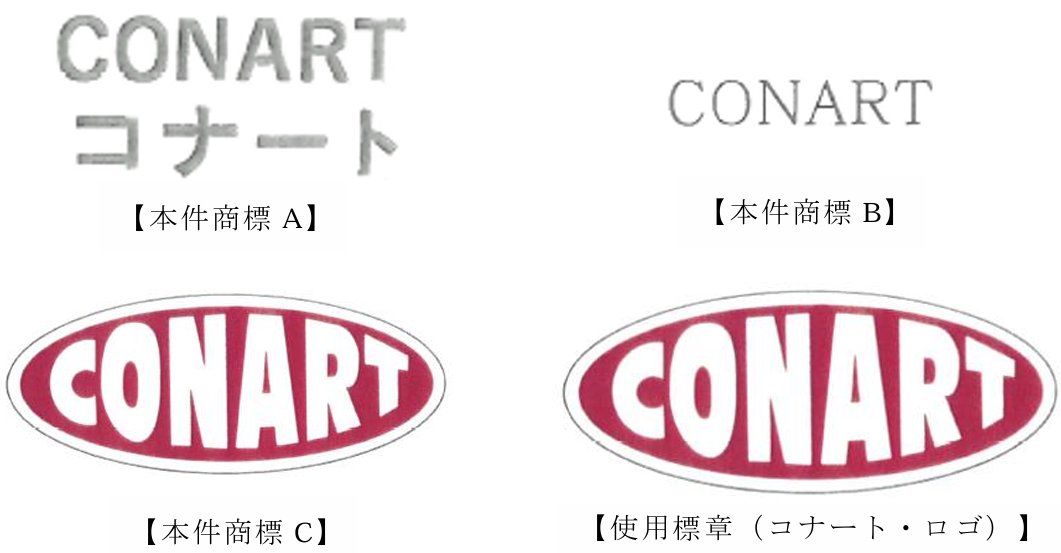
Original AMEBLO article
https://ameblo.jp/hideki-takaishi/entry-12928568723.html
[Trademarks / Similarity] IP High Court, 2024 (Gyo-Ke) No. 10091 — “Connect One” (Judge Hibiku Shimizu)
Original Ameblo publication: 2025-09-09
Article type: Case note
Category: Trademarks
Topics: Similarity of trademarks
First published on this site: 2026-10-10
Ameblo: https://ameblo.jp/hideki-takaishi/entry-12928814900.html
Japanese version: https://www.takaishihideki.com/single-post/【商標-類比】令和6年-行ケ-10091「コネクトワン」事件-清水響
[Trademarks / Similarity] IP High Court, 2024 (Gyo-Ke) No. 10091 — “Connect One” (Judge Hibiku Shimizu)
The applied-for mark was held similar to the cited “コネクトワン” (Connect One) mark in standard characters.
The applicant argued that its mark was pronounced “Connect Dot One.” However, where two or more pronunciations arise from a single mark, similarity is not negated if one pronunciation is identical to that of the other mark. (Supreme Court, 1962 (O) No. 953)
Figures: see the original article.
Original article (2025-09-09):
Images from the original AMEBLO article
English translations of the original image text
Original images retained for comparison
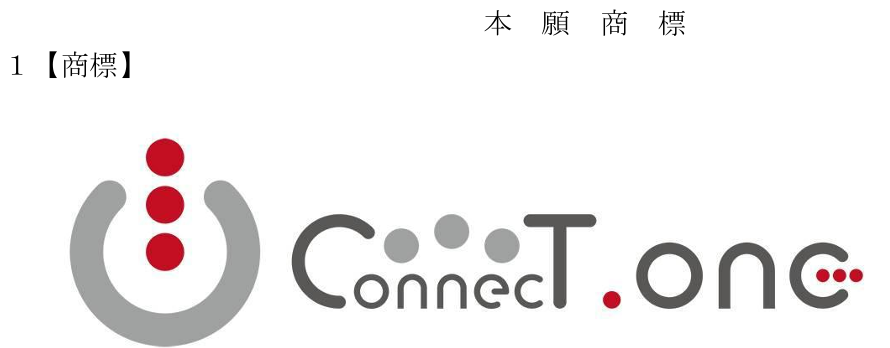
Original AMEBLO article
https://ameblo.jp/hideki-takaishi/entry-12928814900.html
[Trademarks / JPO decision] Opposition No. 2023-900278
Original Ameblo publication: 2025-09-10
Article type: Administrative decision note
Category: Trademarks
Topics: Similarity of trademarks, Examination and appeal practice
First published on this site: 2026-10-10
Ameblo: https://ameblo.jp/hideki-takaishi/entry-12928976505.html
HP: https://www.takaishihideki.com/en/single-post/trademarks-jpo-decision-opposition-no-2023-900278
Japanese version: https://www.takaishihideki.com/single-post/【商標(審決)】異議2023-900278
[Trademarks / JPO decision] Opposition No. 2023-900278
Although “UNIQLO” is well known, it is dissimilar to “UNIPRO,” and there is no likelihood of confusion in the broader sense (a mistaken belief that the goods originate from an undertaking economically or organizationally connected with the UNIQLO business).
“There is no risk of confusion in appearance or pronunciation, and no comparison can be made in concept.”
→ Dissimilar.
Figures: see the original article.
Original article (2025-09-10):
Images from the original AMEBLO article
English translations of the original image text
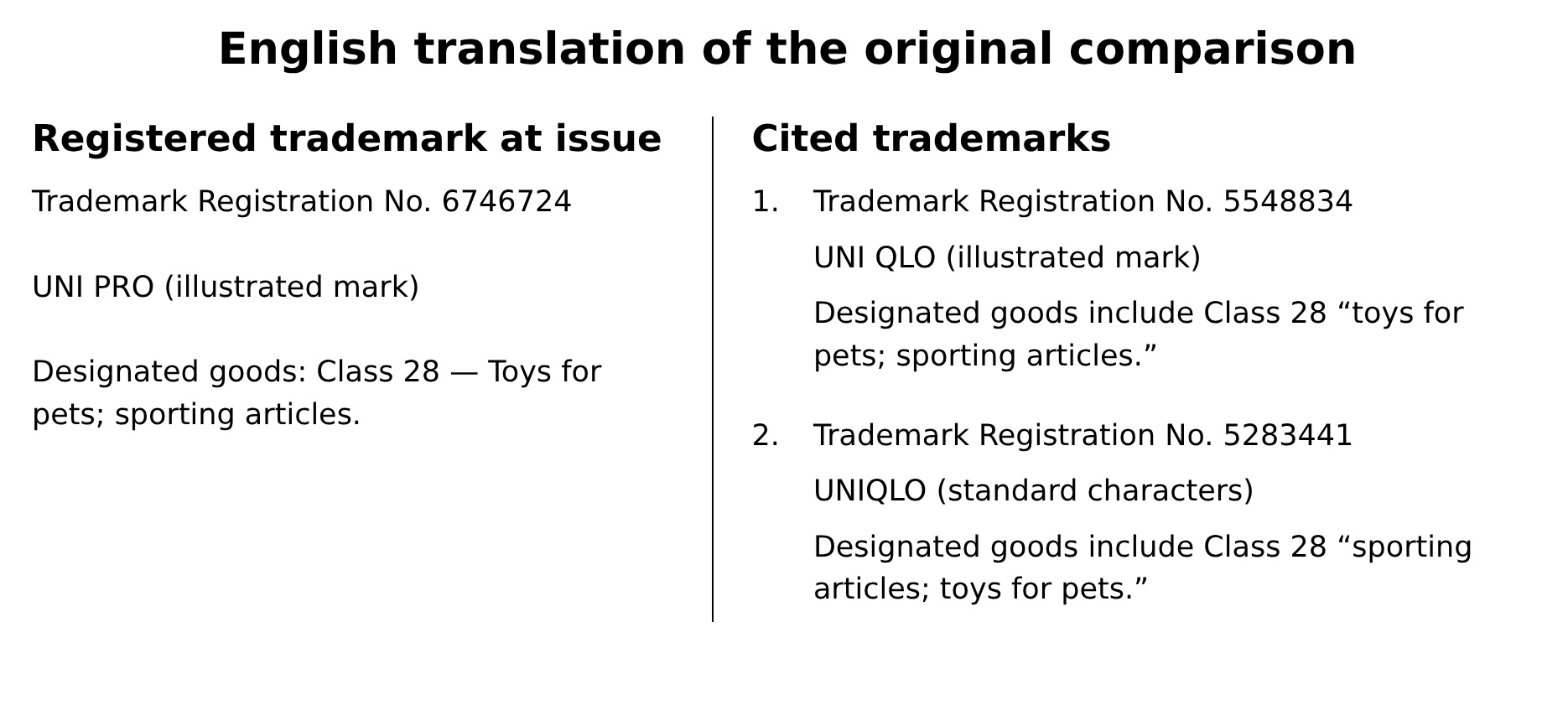
Original images retained for comparison
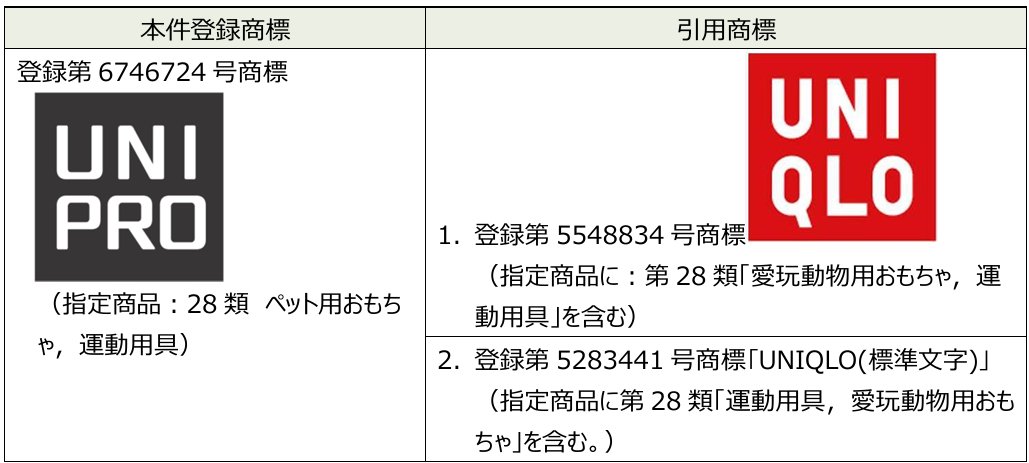
Original AMEBLO article
https://ameblo.jp/hideki-takaishi/entry-12928976505.html
Tokyo District Court, 2023 (Wa) No. 70114 — Motorcycle brake control device (Judge Shibata)
Original Ameblo publication: 2025-09-11
Article type: Case note
Category: Patents
Topics: Support requirement
First published on this site: 2026-10-10
Ameblo: https://ameblo.jp/hideki-takaishi/entry-12929322305.html
Japanese version: https://www.takaishihideki.com/single-post/東京地判令和5年-ワ-70114【自動二輪車のブレーキ制御装置】-柴田
Tokyo District Court, 2023 (Wa) No. 70114 — Motorcycle brake control device (Judge Shibata)
*An error in the detailed description of the invention.
The argument that it was an obvious clerical error was rejected.
→ Support requirement not satisfied.
(Excerpt from the judgment, translated)
A person skilled in the art would recognize that there is some error because the terms in Formula A have different dimensions. However, the plaintiff’s proposed correction is not the only way to resolve that dimensional inconsistency, and there is insufficient evidence that, from Formula A and other information, a skilled person would understand that changing it to Formula A′ is the only solution. Moreover, successively correcting the specification’s passages concerning Formula A to make them consistent with that correction would render previously unproblematic passages unintelligible or inconsistent. In these circumstances, the specification does not establish that Formula A can be understood as a clerical error for Formula A′. The plaintiff’s argument, premised on that understanding, therefore lacks its premise. …None of the claimed inventions can be regarded as an invention described in the specification, and all are found to fail the support requirement.
Original article (2025-09-11):
IP High Court, 2021 (Gyo-Ke) No. 10094 — PCSK9 (second litigation) (Judge Kanno)
Original Ameblo publication: 2025-09-12
Article type: Case note
Category: Patents
Topics: Support requirement
First published on this site: 2026-10-10
Ameblo: https://ameblo.jp/hideki-takaishi/entry-12929609789.html
Japanese version: https://www.takaishihideki.com/single-post/令和3年-行ケ-10094-菅野-【pcsk9(二次訴訟)】
IP High Court, 2021 (Gyo-Ke) No. 10094 — PCSK9 (second litigation) (Judge Kanno)
*It was successfully proved that the technical significance asserted by the patentee did not hold!
→ Support requirement not satisfied.
(Excerpt from the judgment, translated)
…The technical significance of the invention lies in identifying that an antibody competing with antibody 31H4 has the functional properties of an antibody that neutralizes binding between PCSK9 and the LDLR protein through the same mechanism as antibody 31H4…. In the absence of any particular explanation of a mechanism supporting the proposition that all such antibodies exhibit functional properties similar to antibody 31H4, it cannot be said that an “antibody that competes with antibody 31H4 for binding to PCSK9” in the claimed invention “exhibits similar functional properties” to antibody 31H4….
A person skilled in the art would have difficulty understanding that an antibody competing with antibody 31H4 is necessarily a binding-neutralizing antibody.
…Dr. B expressed the opinion that “it is certainly incorrect to say that all antibodies…competing with antibody 31H4 would neutralize binding.” …For these reasons, neither Invention 1 nor Invention 5 satisfies the support requirement…
Original article (2025-09-12):
IP High Court, 2005 (Gyo-Ke) No. 10645 — Method for inspecting sealed packages (Judge Tsukahara)
Original Ameblo publication: 2025-09-13
Article type: Case note
Category: Patents
Topics: Clarity, Enablement, Examination and appeal practice
First published on this site: 2026-10-10
Ameblo: https://ameblo.jp/hideki-takaishi/entry-12929865873.html
Japanese version: https://www.takaishihideki.com/single-post/平成17年-行ケ-10645【密封包装物の検査方法】-塚原
IP High Court, 2005 (Gyo-Ke) No. 10645 — Method for inspecting sealed packages (Judge Tsukahara)
*The mechanism described in the claims and specification contradicts the laws of physics.
→ Clarity and enablement requirements not satisfied.
(JPO decision’s reasoning quoted in the judgment, followed below by the court’s own findings; translated)
The JPO decision’s findings on violations of Patent Act Article 36(4) and (6)…
Paragraph [0008] states: “Thus, when electrode 4 from the voltage output terminal of high-voltage power supply 6 is brought into contact with or proximity to side portion 31 of sealed package 3, electrically conductive contents 1 within sealed package 3 become charged by the negative or positive potential of the high voltage (0.6 kV–30 kV) applied to electrode 4, generating negative (−) ions or positive (+) ions.” Figure 1 depicts only negative (−) ions as having been generated throughout the contents, but it is unclear how these “negative (−) ions or positive (+) ions” have been generated, and a person skilled in the art cannot readily carry this out. Specifically, if there is no closed circuit and no displacement current flows, or if charge does not travel through side portion 31 of sealed package 3, it is unclear where the charge for generating the negative (−) ions or positive (+) ions is supplied from. If negative (−) ions or positive (+) ions are said to be generated in the contents without charge being supplied from outside the contents, this is contrary to the law of conservation of charge.
…
The court’s findings
…
“Bringing…a single electrode 4 into contact with or close to side portion 31 of sealed package 3…to charge contents 1 inside the package through electrically insulating film 2,” as recited in the claimed invention, contradicts conservation of charge and cannot be achieved by anyone. Such an invention must therefore be regarded as unclear. Moreover, the detailed description in the application is not sufficiently clear and complete to enable a person skilled in the art to carry out the invention….
https://www.courts.go.jp/assets/hanrei/hanrei-pdf-33052.pdf
Original article (2025-09-13):
Identical repost (2025-09-14):
Tokyo High Court, 2003 (Gyo-Ke) No. 166 — …Topical agent for treating atopic dermatitis (Judge Tsukahara)
Original Ameblo publication: 2025-09-15
Article type: Case note
Category: Patents
Topics: Patent eligibility
First published on this site: 2026-10-10
Ameblo: https://ameblo.jp/hideki-takaishi/entry-12930258763.html
Japanese version: https://www.takaishihideki.com/single-post/東京高判平成15年-行ケ-166-塚原-【-アトピー性皮膚炎治療用の外用剤】
Tokyo High Court, 2003 (Gyo-Ke) No. 166 — …Topical agent for treating atopic dermatitis (Judge Tsukahara)
*The invention was held to be incomplete because there was insufficient evidence to establish that the clinical trial described in the specification had been conducted, that the drugs described had been used, and that the results had been accurately stated, and the intended technical effect therefore could not be inferred.
(Note) The judgment did not find that the description of the clinical trial in the specification was false. It stated that, even if there was no proof that steroids had been mixed in, the description of the clinical trial would not thereby be established as true, and that, ultimately, the defendant, having itself discarded the most probative evidence, must naturally bear the resulting difficulty of proof. The court set aside the JPO decision. https://www.courts.go.jp/assets/hanrei/hanrei-pdf-9822.pdf
→ Not an “invention” eligible for a patent.
(Excerpt from the judgment, translated)
Although the specification…reports the clinical trial results, there is insufficient evidence to establish (i) that the trial was actually conducted, (ii) that the agents used in it were in fact…the topical ointment and cream, or (iii) that the results were accurately recorded in the specification. Nor does examination of the defendant’s arguments concerning evidence other than the trial provide sufficient grounds to find that the agents have a therapeutic effect. It therefore cannot be inferred that the technical content (technical means) of the alleged invention can achieve its intended technical effect. The alleged invention is thus incomplete as an invention and does not constitute an “invention” within the opening clause of Patent Act Article 29(1), and cannot be patented….
Original article (2025-09-15):
[Trademarks] IP High Court, 2024 (Gyo-Ke) No. 10071 — “Taishoken” (Judge Miyasaka)
Original Ameblo publication: 2025-09-16
Article type: Case note
Category: Trademarks
Topics: Cancellation for non-use, Non-exclusive trademark licenses, Implied consent and license agreements
First published on this site: 2026-10-10
Ameblo: https://ameblo.jp/hideki-takaishi/entry-12930601260.html
Japanese version: https://www.takaishihideki.com/single-post/【商標】令和6年-行ケ-10071『大勝軒』事件-宮坂
[Trademarks] IP High Court, 2024 (Gyo-Ke) No. 10071 — “Taishoken” (Judge Miyasaka)
*An implied agreement granting a non-exclusive trademark license requires objectively verifiable, clear and affirmative intent to confer a right, going beyond mere acquiescence.
→ The court set aside the JPO decision rejecting the request for cancellation for non-use.
(Excerpt from the judgment, translated)
Even if a trademark owner has shown tolerance of a third party’s use of a mark identical to the registered mark, an implied agreement granting a royalty-free non-exclusive license should not readily be inferred from that alone. A non-exclusive license is a right to use the registered mark for the designated goods or services (Trademark Act Article 31(2)). It may be transferred with the trademark owner’s consent or through inheritance or other general succession (paragraph 3), and, if registered, it may be asserted against persons subsequently acquiring the trademark right or an exclusive license relating to that right (paragraph 4). Given this proprietary character, establishing an implied agreement to grant a non-exclusive license requires objectively verifiable, clear and affirmative intent to confer a right, beyond mere “acquiescence.”
Figures: see the original article.
Original article (2025-09-16):
Images from the original AMEBLO article
English translations of the original image text
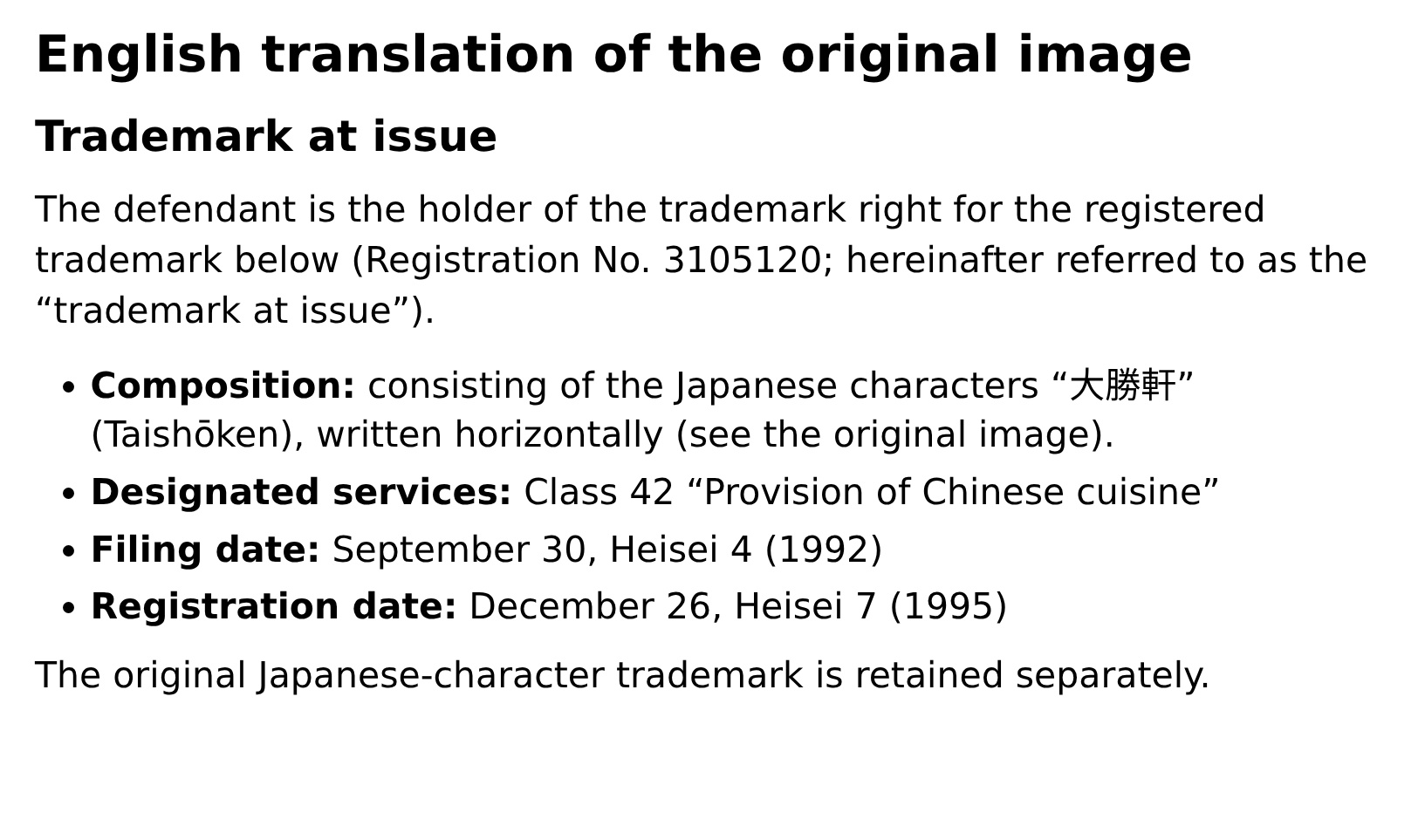
English translation of the original image
Trademark at issue
The defendant holds the trademark right for the registered trademark shown below (Registration No. 3105120; the “trademark at issue”).
Composition: As shown below, consisting of the Japanese characters “大勝軒” (Taishōken), written horizontally.
Designated services: Class 42 — “Provision of Chinese cuisine”
Application date: September 30, 1992
Registration date: December 26, 1995
The original Japanese-character trademark is retained separately.
Original images retained for comparison
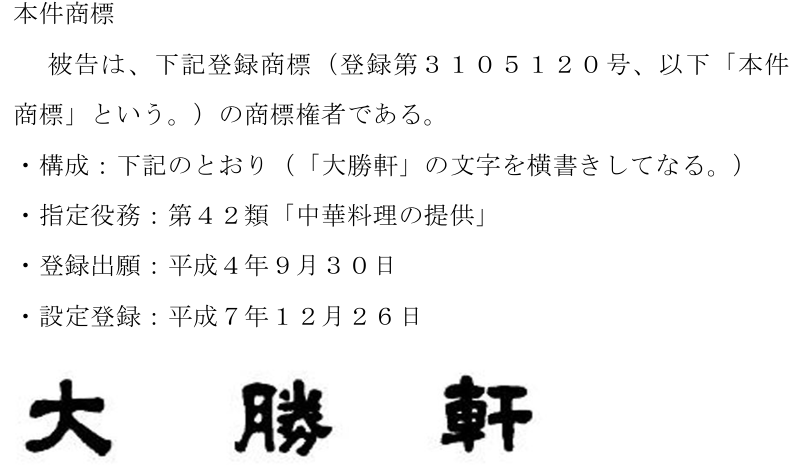
Original AMEBLO article
https://ameblo.jp/hideki-takaishi/entry-12930601260.html
[Unfair competition] Osaka High Court, 2024 (Ne) No. 1775 — “Wam”
Original Ameblo publication: 2025-09-17
Article type: Case note
Category: Unfair competition law
Topics: Termination of contract, Return of documents, Unfair competition law
First published on this site: 2026-10-10
Ameblo: https://ameblo.jp/hideki-takaishi/entry-12930738515.html
Japanese version: https://www.takaishihideki.com/single-post/【不競法】大阪高判令和6年-ネ-1775『wam』事件
[Unfair competition] Osaka High Court, 2024 (Ne) No. 1775 — “Wam”
*Only the claim for return of the manuals was upheld.
→ Completion of the litigation also conclusively determines the obligation to return the manuals. Keeping them for litigation purposes does not excuse that obligation.
(Excerpt from the judgment, translated)
The agreement provides, as an effect of termination, that “the appellee must immediately return to the appellant the originals and copies of equipment, manuals, other materials, documents, etc. lent or supplied under the agreement, or take measures such as destroying them in accordance with the appellant’s instructions”…. Since the agreement…has terminated, the appellee must immediately return to the appellant the existing copy of Item 1, which forms part of the manuals and related materials.
The appellee disputes the return obligation under that provision on the ground that Item 1 is retained for litigation purposes. However, when the judgment becomes final—that is, when the litigation ends—the obligation to return the manuals under the provision will also be conclusively determined. Retention for litigation purposes therefore cannot excuse that obligation.
Original article (2025-09-17):
[Trademarks / JPO decision] Appeal No. 2024-5257
Original Ameblo publication: 2025-09-19
Type: Administrative decision note
Category: Trademarks
Topics: Trademark similarity
First published on this site: 2026-10-09
Case / source information: Appeal No. 2024-5257
Ameblo: https://ameblo.jp/hideki-takaishi/entry-12931260967.html
HP: https://www.takaishihideki.com/en/single-post/jpo-appeal-2024-5257-1
Japanese version: https://www.takaishihideki.com/single-post/jpo-appeal-2024-5257
[Trademarks / JPO decision] Appeal No. 2024-5257
*The applied-for mark, which added “The” to the cited mark and used a stylized design, was held dissimilar.
(Excerpt from the decision, translated)
A. The applied-for mark
As shown in Appendix 1, the mark consists of a device on the left, prominently large lettering “THE CLASSICA” to its right, and smaller lettering “omotesando” below. The components are spaced apart and differ in form (device versus letters and differences in letter size), giving a visually separate and independent impression.
The device does not appear to depict any specific object and gives rise to no independent pronunciation or concept.
“omotesando” is the romanized spelling of Omotesando, meaning “the main approach to Meiji Shrine; also, the surrounding area” (Kojien, 7th ed., Iwanami Shoten), and indicates a place where services are provided. Together with its small, subsidiary presentation on a separate line, this means it produces no pronunciation or concept as an independent indication of origin.
By contrast, the prominently large “THE CLASSICA” lettering is presented as a coherent whole in the same typeface, with the initial letters of “THE” and “CLASSICA” slightly larger and the other letters of equal size. Its pronunciation, “Za Kurashika,” can naturally be spoken as a continuous expression.
“THE” is the English definite article. “CLASSICA” is an Italian word meaning, among other things, a traditional sporting event (Italian–Japanese Dictionary, 2nd ed., Shogakukan), but it cannot be said to be generally well known in Japan and would be perceived as a coined term without a specific meaning. The combination as a whole is not an established dictionary word and does not immediately suggest any particular meaning in relation to the designated services, so it too is perceived as a coined expression.
Given this configuration and pronunciation, the lettering should be understood and perceived as an indivisible whole, rather than as something in which attention would focus particularly on “CLASSICA” alone.
Accordingly, “THE CLASSICA” gives traders and consumers a strong and dominant impression as an indication of the origin of the services, while the other components produce no pronunciation or concept as indications of origin. It is therefore permissible to separate and extract that lettering as the essential part and compare it with another person’s mark in assessing similarity of the marks themselves.
Thus, the applied-for mark produces the pronunciation “Za Kurashika” corresponding to its dominant element, and no specific concept.
B. Cited Mark 1
As shown in Appendix 2, Cited Mark 1 consists of “クラシカ” and “CLASSICA” in two ordinary lines. The upper katakana lettering would naturally be understood as indicating the pronunciation of the lower Roman lettering.
“CLASSICA” should be perceived as a coined term with no specific meaning.
Accordingly, Cited Mark 1 produces the pronunciation “Kurashika” and no specific concept.
C. Similarity between the applied-for mark and Cited Mark 1
Comparing the applied-for mark and its dominant element with Cited Mark 1, there are clear differences in appearance, including the presence or absence of the device and the constituent lettering, making them readily distinguishable.
Their pronunciations differ in the number and identity of their sounds and can readily be distinguished aurally.
Neither gives rise to a specific concept, so no conceptual comparison is possible.
Even though they cannot be compared conceptually, they can readily be distinguished visually and aurally. The two marks should therefore be regarded as dissimilar.
Figures: see the original article.
Original article (2025-09-19):
Originally posted on LinkedIn:
Part 1: https://www.linkedin.com/feed/update/urn:li:activity:7513751385255911425/
Part 2: https://www.linkedin.com/feed/update/urn:li:activity:7513751532719464448/
Images from the original AMEBLO article
English translations of the original image text
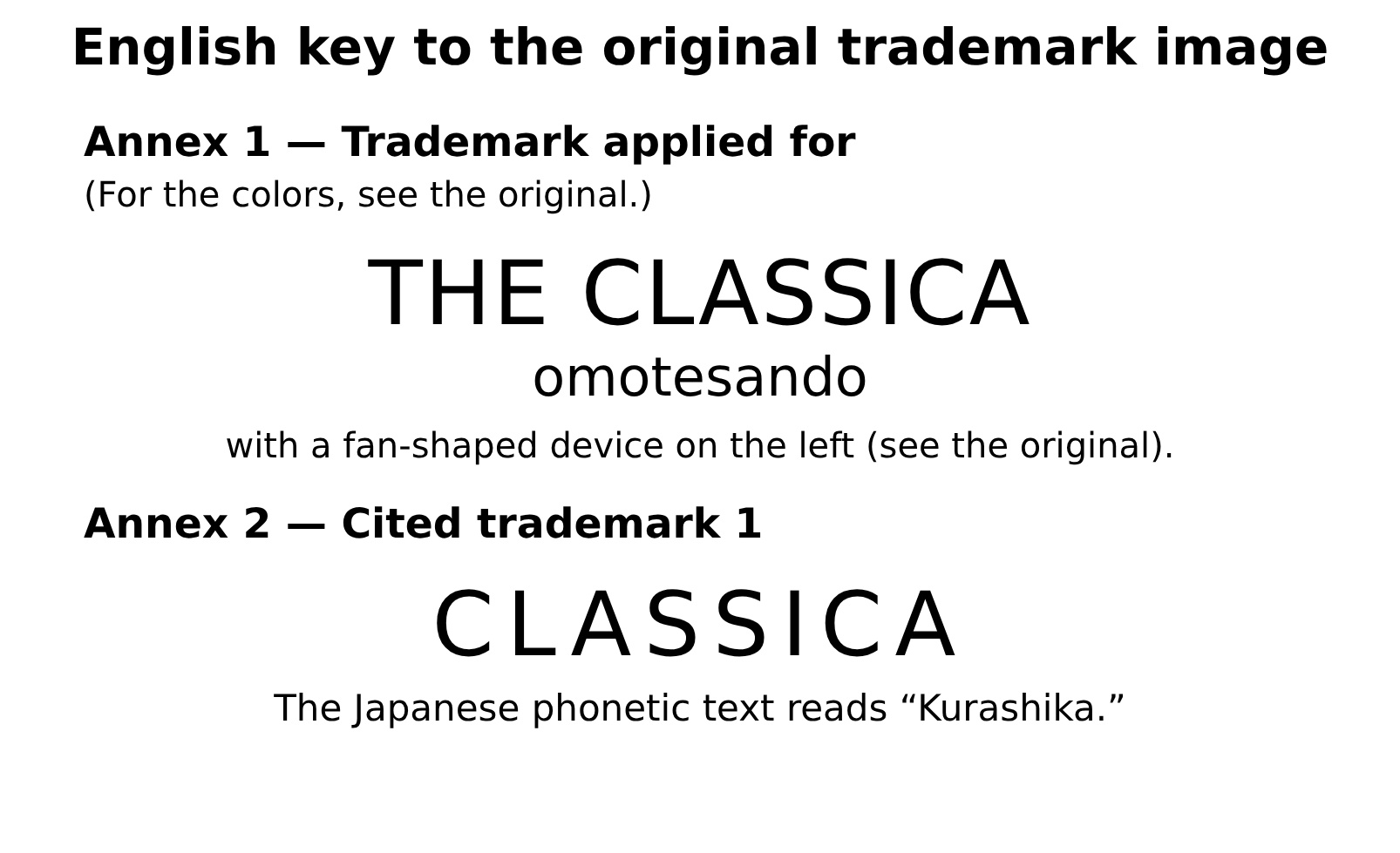
Original images retained for comparison
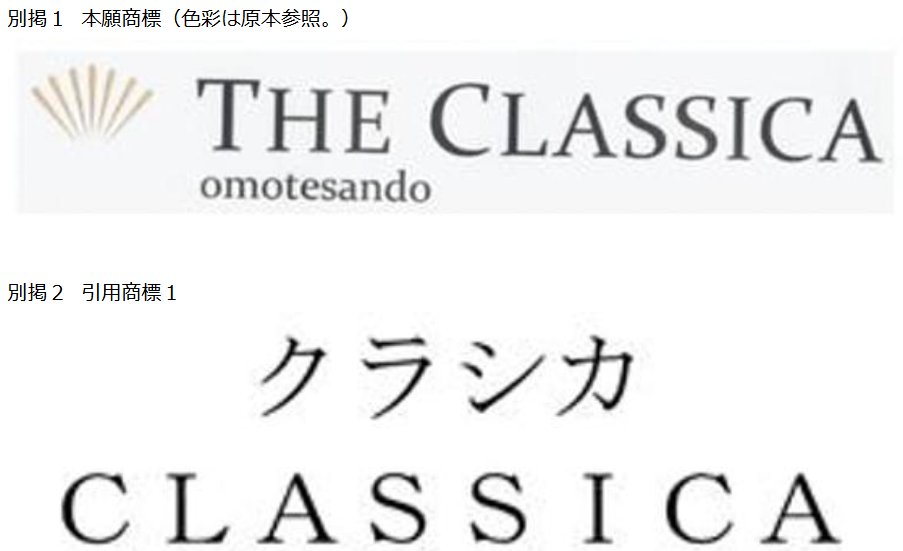
Original AMEBLO article
https://ameblo.jp/hideki-takaishi/entry-12931260967.html
[Trademarks / JPO decision] Appeal No. 2024-11680
Original Ameblo publication: 2025-09-21
Type: Administrative decision note
Category: Trademarks
Topics: Trademark similarity
First published on this site: 2026-10-09
Case / source information: Appeal No. 2024-11680 / Appeal No. 2024-10278 / Appeal No. 2024-10716
Ameblo: https://ameblo.jp/hideki-takaishi/entry-12931916110.html
HP: https://www.takaishihideki.com/en/single-post/jpo-appeal-2024-11680-1
Japanese version: https://www.takaishihideki.com/single-post/jpo-appeal-2024-11680
[Trademarks / JPO decision] Appeal No. 2024-11680
*Applied-for mark: “SENJYU”; cited mark: “千寿” (Senju).
→ Dissimilar.
Note: The appellant sells products including “Kubota Senju.”
*Appeal No. 2024-10278
Applied-for mark: “MANJYU”; cited mark: “万寿” (Manju).
→ Dissimilar.
*Appeal No. 2024-10716
Applied-for mark: “HAKUJYU”; cited mark: “白寿” (Hakuju).
→ Dissimilar.
(Excerpt from the decision, translated)
(1) The applied-for mark
The mark consists of “SENJYU” in standard characters. It is not an established word listed in dictionaries.
“JYU” does not follow the romanization generally used in Japan (see the Agency for Cultural Affairs, “Romanization: Tables 1 and 2,” https://lnkd.in/gvK4eB6P). However, the configuration produces the pronunciation “Senju.”
“SENJYU” should therefore be perceived as a coined term conveying no specific meaning. The mark produces the pronunciation “Senju” corresponding to its lettering, but no particular concept.
(2) The cited mark
As shown in the appendix, the cited mark consists of “千寿” written horizontally in a Gothic-style typeface.
Although it is not an established dictionary word, as the examiner explained and the appellant acknowledged in its grounds of appeal, the meanings and actual usage of the constituent characters “千” (thousand) and “寿” (longevity), among other factors, can suggest a meaning roughly equivalent to “living a long life.”
The expression may be read “Senju,” following examples such as “万寿,” read “Manju” or “Banju,” and “米寿,” read “Beiju.”
Accordingly, the cited mark produces the pronunciation “Senju” and may convey the concept of “living a long life.”
(3) Similarity between the marks
In appearance, the scripts and numbers of characters differ, and the marks can immediately be understood as expressing different terms. They can therefore be clearly distinguished visually. It is true that in trade, the characters in a mark are commonly converted into another script while retaining the same pronunciation. However, as explained in (1), under romanization generally used in Japan, the sound “ju” is spelled “ju” in Hepburn romanization or “zyu” in Kunrei-shiki. The applied-for mark therefore cannot immediately be regarded as a romanization of a Japanese word pronounced “Senju.” It is not merely a conversion of the cited mark’s “千寿” into Roman letters; it is properly regarded as a different mark.
The marks have the same pronunciation, “Senju.”
Conceptually, the applied-for mark has no specific concept, whereas the cited mark may convey “living a long life,” so they are not likely to be confused in this respect.
Although identical in pronunciation, the marks are clearly distinguishable in appearance and are not likely to be confused conceptually. There is no evidence that traders and consumers identify the designated goods and their origin exclusively by pronunciation, or that distinctiveness through pronunciation outweighs that through appearance and concept. Considering their overall impressions and the memories they leave, the marks should be regarded as dissimilar, with no likelihood of confusion as to the origin of the goods.
Figures: see the original article.
Original article (2025-09-21):
Originally posted on LinkedIn:
Part 1: https://www.linkedin.com/feed/update/urn:li:activity:7513751892469051393/
Part 2: https://www.linkedin.com/feed/update/urn:li:activity:7513752212238499840/
Images from the original AMEBLO article
English translations of the original image text
Original images retained for comparison
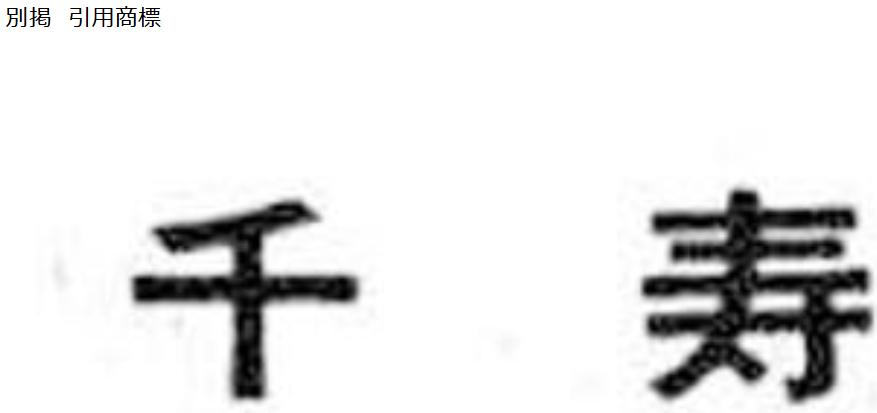
Original AMEBLO article
https://ameblo.jp/hideki-takaishi/entry-12931916110.html
[Trademarks / JPO decision] Appeal No. 2024-7278
Original Ameblo publication: 2025-09-22
Type: Administrative decision note
Category: Trademarks
Topics: Trademark similarity
First published on this site: 2026-10-09
Case / source information: Appeal No. 2024-7278
Ameblo: https://ameblo.jp/hideki-takaishi/entry-12932196169.html
HP: https://www.takaishihideki.com/en/single-post/jpo-appeal-2024-7278-1
Japanese version: https://www.takaishihideki.com/single-post/jpo-appeal-2024-7278
[Trademarks / JPO decision] Appeal No. 2024-7278
*The applied-for mark “CONNECT,” consisting of a figure and lettering, was held dissimilar to the cited mark “&connect.”
(Excerpt from the decision, translated)
(1) The applied-for mark
As shown in Appendix 1, the mark consists of a device above the lettering “COnnECT” (with the inside of the “O” colored yellow).
The device and lettering do not overlap and are spaced apart, so they are observed as visually separate. The device does not immediately suggest any specific object, and no conceptual connection with the lettering can be found. It is therefore difficult to regard the components as so inseparably combined that observing them separately would be unnatural in trade. Rather, each can function as an essential part identifying the goods and services of one undertaking as distinct from those of others.
The mark therefore produces the pronunciation “Konekuto” from its lettering, one of its dominant elements, and concepts such as “join” or “connect” (Basic Genius English–Japanese Dictionary, 2nd ed., Taishukan Shoten).
(2) The cited mark
As shown in Appendix 3, the cited mark consists of “&connect” written horizontally with letters of the same size aligned along the bottom. Although “&” is slightly stylized in white within a black square, it is placed close to “connect,” and the mark is perceived and understood as an indivisible whole.
“&connect” is not an established dictionary expression and does not immediately suggest any particular meaning in relation to the designated services, so it is perceived as a coined term.
Accordingly, the cited mark produces only the pronunciation “Ando Konekuto” and no specific concept.
(3) Similarity between the marks
Comparing the applied-for mark and its dominant element with the cited mark, there are clear differences in appearance, including the presence or absence of the device and the constituent lettering, making them readily distinguishable.
The pronunciation “Konekuto” of the applied-for mark and “Ando Konekuto” of the cited mark differ in the number and identity of their sounds and are readily distinguishable aurally.
Conceptually, the applied-for mark conveys ideas such as “join” or “connect,” whereas the cited mark has no specific concept. They are therefore not likely to be confused conceptually.
Accordingly, the two marks should be regarded as dissimilar, with no risk of confusion in appearance, pronunciation or concept.
Figures: see the original article.
Original article (2025-09-22):
Originally posted on LinkedIn: https://www.linkedin.com/feed/update/urn:li:activity:7513752517005123584/
Images from the original AMEBLO article
English translations of the original image text

Trademark illustrations and designated goods and services
Annex 1 — Trademark applied for
CONNECT logo (see the original image for the design and colors).
Annex 2 — Designated goods and services of the trademark applied for
Class 20: “Packaging containers made of wood, bamboo or plastic; lids made of plastic and wood; biologically derived …”; “… plastic lids”.
Class 35: “Benefits provided to customers in the course of retail or wholesale business involving plastic packaging containers …”; “… provision of benefits to customers in the course of business; plastic lids made using biologically derived organic raw materials …”.
Annex 3 — Cited trademark
&connect logo (see the original image).
Original images retained for comparison
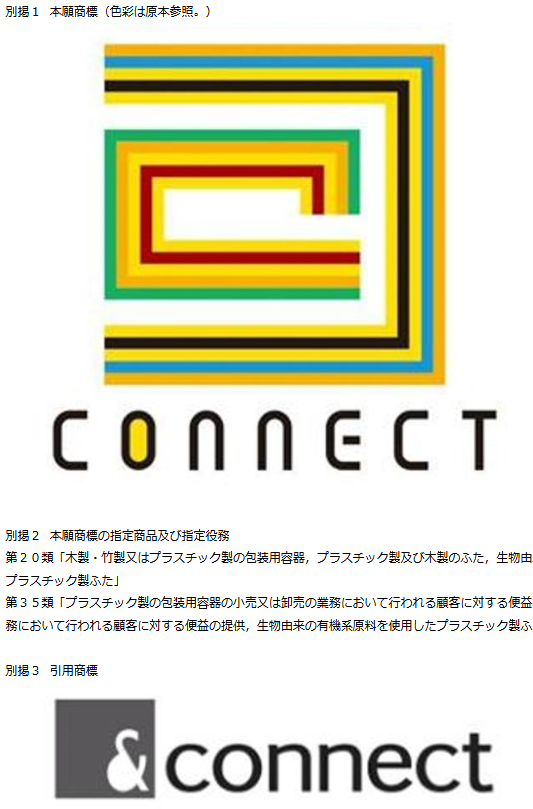
Original AMEBLO article
https://ameblo.jp/hideki-takaishi/entry-12932196169.html
[Designs] IP High Court, 2024 (Gyo-Ke) No. 10034 — Beverage in a container (Judge Nakadaira)
Original Ameblo publication: 2025-09-25
Type: Case note
Category: Designs
Topics: Dynamic designs
First published on this site: 2026-10-09
Case / source information: IP High Court, 2024 (Gyo-Ke) No. 10034
Ameblo: https://ameblo.jp/hideki-takaishi/entry-12933291107.html
HP: https://www.takaishihideki.com/en/single-post/beverage-dynamic-design-10019-1
Japanese version: https://www.takaishihideki.com/single-post/beverage-dynamic-design-10019
[Designs] IP High Court, 2024 (Gyo-Ke) No. 10034 — Beverage in a container (Judge Nakadaira)
*The design was excluded from protection as a dynamic design because its manner of change lacked a certain regularity and its changing shape was not steady.
(Excerpt from the judgment, translated)
A dynamic design concerns an applied-for design whose constituent shape or other features change while it remains a “design” under Design Act Article 2(1). It treats the entire process, including the states before and after the change, as one dynamic shape or configuration and protects it as a single design. It therefore requires a definite form and other characteristics enabling the whole, including intermediate shapes throughout the change, to be understood as the shape or configuration of one article.
Specifically,…in every state before, during and after the change, the shape must satisfy the requirements for an article under the Design Act: as an attribute of the article, a certain shape must exist for a certain period; it must have a definite form whose boundaries can be identified as the basis for recognizing the shape; and its manner of change must have a certain regularity or its changing shape must be steady.
In the application at issue,…plan views 1–3 after opening the lid show changes in the foam. The width of the band of bubbles around the can’s edge is not uniform, and its outline is an irregular circle. During the process, the bubble band becomes wider in some places but disappears or narrows in others. After the white central area disappears and small clusters of white bubbles become irregularly scattered, the diameter of the annular shape gradually decreases. However, the rate at which the outline contracts varies by location. The shape becomes irregular rather than circular before reaching a two-tier truncated-cone shape. This formation and disappearance of bubbles cannot be regarded as having a certain shape for a certain period with identifiable boundaries, as required for a design or dynamic design. Nor can the manner of change be regarded as having a certain regularity or the changing shape as being steady.
Original article (2025-09-25):
Originally posted on LinkedIn: https://www.linkedin.com/feed/update/urn:li:activity:7513752706507980800/
IP High Court, 2024 (Gyo-Ke) No. 10019 — Laminate of a polyester resin composition (Judge Miyasaka)
Original Ameblo publication: 2025-09-26
Type: Case note
Category: Patents
Topics: Inventive step, Motivation and teaching away
First published on this site: 2026-10-09
Case / source information: IP High Court, 2024 (Gyo-Ke) No. 10019
Ameblo: https://ameblo.jp/hideki-takaishi/entry-12933462150.html
HP: https://www.takaishihideki.com/en/single-post/polyester-laminate-10019-1
Japanese version: https://www.takaishihideki.com/single-post/polyester-laminate-10019
IP High Court, 2024 (Gyo-Ke) No. 10019 — Laminate of a polyester resin composition (Judge Miyasaka)
*The court recognized a general problem without requiring documentary evidence.
→ Inventive step denied.
(Excerpt from the patent cancellation decision, translated)
At the filing date, curbing depletion of petroleum resources and increases in atmospheric carbon dioxide, a cause of global warming, were general problems requiring no documentary citation. To address them, there was motivation to reduce polyethylene terephthalate made from petroleum-derived raw materials and replace it with polyethylene terephthalate made from biologically derived biomass materials. …A person skilled in the art could readily have adopted the matters disclosed in Cited Reference 5.
Original article (2025-09-26):
Originally posted on LinkedIn: https://www.linkedin.com/feed/update/urn:li:activity:7513753085509414912/
Osaka District Court, 2022 (Wa) No. 11025 — Mite-trapping mat (Judge Matsuami)
Original Ameblo publication: 2025-09-27
Type: Case note
Category: Patents
Topics: Claim construction, Doctrine of equivalents
First published on this site: 2026-10-09
Case / source information: Osaka District Court, 2022 (Wa) No. 11025
Ameblo: https://ameblo.jp/hideki-takaishi/entry-12933926529.html
HP: https://www.takaishihideki.com/en/single-post/mite-trapping-mat-11025-1
Japanese version: https://www.takaishihideki.com/single-post/mite-trapping-mat-11025
Osaka District Court, 2022 (Wa) No. 11025 — Mite-trapping mat (Judge Matsuami)
*A “porous air-permeable bag” must have a structure that retains its contents inside and prevents their dispersal.
→ Claim limitation not met.
(Excerpt from the judgment, translated)
<No literal infringement>
Both the dictionary meaning and the specification support construing the “porous air-permeable bag” in limitation A-3 as requiring, at a minimum, a structure capable of retaining its contents inside and preventing their dispersal. In the accused products sold by the defendants, however, the mite attractant is merely sandwiched between two layers of nonwoven fabric, gauze or similar material and can spill out around their edges. The structure therefore cannot be found capable of retaining the attractant inside.
<No infringement under the doctrine of equivalents>
By storing mite bait in a “porous air-permeable bag” that holds it without spillage, the invention achieves both high adhesive strength of the adhesive tape and a reduction in the number of constituent materials. A bag structure is therefore an essential element. The accused products instead sandwich the mite attractant between two sheets of nonwoven fabric or gauze from which it can spill. Their difference from the invention is not merely in a non-essential part, nor can the substituted structure be said to produce the same function and effect.
Original article (2025-09-27):
Originally posted on LinkedIn: https://www.linkedin.com/feed/update/urn:li:activity:7513753328133189632/
IP High Court, 2024 (Ne) No. 10019 — Rolling device (Judge Miyasaka)
Original Ameblo publication: 2025-09-28
Type: Case note
Category: Patents
Topics: Claim construction
First published on this site: 2026-10-09
Case / source information: IP High Court, 2024 (Ne) No. 10019 / Tokyo District Court, 2022 (Wa) No. 18830
Ameblo: https://ameblo.jp/hideki-takaishi/entry-12934177102.html
HP: https://www.takaishihideki.com/en/single-post/rolling-device-10019-1
Japanese version: https://www.takaishihideki.com/single-post/rolling-device-10019
IP High Court, 2024 (Ne) No. 10019 — Rolling device (Judge Miyasaka)
*The appellate court rejected the narrow construction adopted below (Tokyo District Court, 2022 (Wa) No. 18830), but found that another claim limitation was not met.
[Invention 1 (Claim 4)] …forming, in part of the rolling path, an unloaded region in which the rolling element contacts only one of the raceway grooves, …
(Excerpt from the judgment, translated)
The appellee’s products are angular-contact ball bearings used with preload that elastically deforms the balls and inner and outer rings, eliminating gaps between the balls and the inner- and outer-ring raceway grooves. Accordingly, the products do not have “a rolling element contacting only one of the raceway grooves” and cannot be said to “form an unloaded region.”
Original article (2025-09-28):
Originally posted on LinkedIn: https://www.linkedin.com/feed/update/urn:li:activity:7513753623277957121/
[Trademarks / Article 4(1)(vii)] IP High Court, 2023 (Gyo-Ke) No. 10128 — “MARK GONZALES” (Judge Honda)
Original Ameblo publication: 2025-09-29
Type: Case note
Category: Trademarks
Topics: Public order and morality
First published on this site: 2026-10-09
Case / source information: IP High Court, 2023 (Gyo-Ke) No. 10128
Ameblo: https://ameblo.jp/hideki-takaishi/entry-12934409176.html
HP: https://www.takaishihideki.com/en/single-post/mark-gonzales-10128-1
Japanese version: https://www.takaishihideki.com/single-post/mark-gonzales-10128
[Trademarks / Article 4(1)(vii)] IP High Court, 2023 (Gyo-Ke) No. 10128 — “MARK GONZALES” (Judge Honda)
From 2020, as termination of the license approached, the plaintiff filed numerous applications in Japan, South Korea, China, Taiwan and elsewhere for marks containing the angel design, the defendant’s name and “(what it isNt).” After the license ended, it continued developing its own brand while sending warnings that obstructed the defendant’s new licensing business.
The court found that the plaintiff intended improperly to use its trademark rights, including by seeking injunctions, to obstruct or prevent persons other than the plaintiff and its affiliates from selling the relevant goods. It held that the applications for Marks A–C disrupted the fair trademark order.
→ Trademark Act Article 4(1)(vii) applied.
(Excerpt from the judgment, translated)
Around 2014, the defendant sought termination of the license agreement with the Sakura Group. By around 2020, the defendant had made clear that it did not intend to continue the licensing business with that group after termination and requested return of all trademark rights. In response, the plaintiff obtained transfers of the rights to Marks D–G from the Sakura Group and, from around 2020, the final stage of the license agreement, filed numerous applications in Japan, South Korea, China, Taiwan and elsewhere for marks including “Mark Gonzales,” “(what it isNt)” and the angel design. Even after January 1, 2022, when the license agreement had clearly ended, the plaintiff continued selling products bearing “Mark Gonzales” and the angel design through licensees. However,…the plaintiff cannot be said to have acquired copyright in Angel Designs 1 and 2 or the signature under the MPSA agreement, and the license agreement effectively included a novation of the MPSA agreement’s terms. Even assuming that the MPSA agreement remains valid, it permits only reproduction of the cover art on T-shirts and similar items and use of the defendant’s and others’ names for promotion of the album. The plaintiff’s current “(what it isNt)” brand development exceeds both the album-promotion purpose and the scope of reproducing the cover art. Moreover, after termination of the license agreement, the plaintiff attempted to block the defendant’s brand development by sending warning letters to the defendant’s own Japanese sublicensees and retailers.
These actions since 2020 establish that, when applying for Marks A–C…, the plaintiff fully knew that the dispute had become overt and that it would lose the ability to use Angel Designs 1 and 2 and the defendant’s name after the license ended. Nevertheless, it had the improper purpose and intent of using the resulting trademark rights to obstruct and prevent sales by persons other than the plaintiff and its associates, including by seeking injunctions against the defendant’s own sales in Japan of goods bearing the angel designs or “Mark Gonzales.”
Accordingly, even under Japan’s first-to-file trademark system, these applications for Marks A–C contradict the purpose of the Trademark Act: to protect trademarks, maintain the business reputation of those using them, contribute to industrial development and protect consumers’ interests (Article 1). They disrupt the fair trademark order and are also impermissible as a matter of reason in light of sound legal sentiment. Marks A–C therefore fall within Article 4(1)(vii) as trademarks likely to harm public policy or accepted principles of morality.
Original article (2025-09-29):
Originally posted on LinkedIn:
Part 1: https://www.linkedin.com/feed/update/urn:li:activity:7513753852769316864/
Part 2: https://www.linkedin.com/feed/update/urn:li:activity:7513753959652794368/
IP High Court, 2013 (Ne) 10035 [Method for Manufacturing a Rotary Toothbrush] (Appeal) <Shitara>
Original Ameblo publication: 2025-10-01
Ameblo: https://ameblo.jp/hideki-takaishi/entry-12935168850.html
IP High Court, 2013 (Ne) 10035 [Method for Manufacturing a Rotary Toothbrush] (Appeal) <Shitara>
*Although the manufacturing method contains a temporal sequence, satisfaction of the claim was recognized flexibly with respect to that sequence.
[Claim 2] (A) … (B) … a first step of causing a group of filaments to project outward by a fixed amount from an insertion hole provided in a base; (C) a second step of blowing air into the center of the projecting ends of that group of filaments to spread the group radially; (D) a third step of fusion-bonding the central portion of the group of filaments while fixing the spread group to the base; and (E) a fourth step of cutting out the center of the fusion-bonded central portion; (F) a method for manufacturing an individual brush unit of a rotary brush, comprising these steps.
(Translation of an excerpt from the court’s reasoning)
… “Cutting out the center of the fusion-bonded central portion” in constituent requirement E also encompasses a process in which, after the “fusion-bonding” process has begun and the “melting” stage has taken place—that is, after the molten filaments have become adherent to one another—the “cutting-out” process begins; the process then enters the “bonding” stage, namely the solidification stage; and the “cutting-out” process ends after sufficient time has elapsed for “fusion-bonding” (solidification) ordinarily to be considered complete ….
… As to the temporal relationship between “fusion-bonding” and “cutting-out” as well, the claim also encompasses a process in which, after the “fusion-bonding” process has begun and the “melting” stage has taken place—that is, after the molten filaments have become adherent to one another—the “cutting-out” process begins; the process then enters the “bonding” stage, namely the solidification stage; and the “cutting-out” process ends after sufficient time has elapsed for “fusion-bonding” (solidification) ordinarily to be considered complete ….
IP High Court, 2024 (Ne) 10041 [Receiving Device] <Masuda>
Original Ameblo publication: 2025-10-02
Ameblo: https://ameblo.jp/hideki-takaishi/entry-12935558409.html
IP High Court, 2024 (Ne) 10041 [Receiving Device] <Masuda>
*The reference to another subcombination in this claim does not limit the structure or function of the claimed receiving device.
⇒ Not a matter specifying the invention (lack of inventive step).
[Claim 5] (Invention at issue)
A receiving device characterized by having an RFID interface for transmitting and receiving to and from the mobile telephone recited in Claim 4; transmission means for transmitting to that mobile telephone a request for the transmission of individual information; and determination means for determining whether individual information received from that mobile telephone is the requested individual information; and performing processing with that mobile telephone when the determination information received by the determination means is determined to be the requested individual information.
(Translation of an excerpt from the court’s reasoning)
The corrected invention at issue is an invention of a “receiving device” in an invention of an overall apparatus consisting of a mobile terminal and a receiving device, namely an individual-information system; it is a so-called subcombination invention.
In a subcombination invention, it is necessary to ascertain what significance matters concerning another subcombination recited in the claim have in specifying the claimed invention from the standpoint of shape, structure, components, composition, operation, function, nature, characteristics, acts or actions, intended use, and the like (hereinafter “structure, functions, etc.”), and thereby delineate the technical scope of the invention. If matters concerning another subcombination specify only the apparatus of that other subcombination and do not specify any structure, functions, etc. of the apparatus recited in the claim, those matters concerning the other subcombination can be said to have no significance in specifying the claimed invention.
Turning to the corrected invention at issue, it is identified as an invention concerning a receiving device having an RFID interface for transmitting and receiving to and from the mobile telephone recited in Claim 4 (constituent requirement J′). The mobile telephone recited in Claim 4 is specified not only by that claim but also by Claims 1 and 3.
However, the descriptions in Claims 1, 3, and 4 all specify the structure, functions, etc. of the mobile telephone, not the structure, functions, etc. of the “receiving device.”
Accordingly, the matter “the mobile telephone recited in Claim 4,” which concerns another subcombination in the corrected invention at issue, can be said to have no significance in specifying the corrected invention at issue, which is an invention of a “receiving device.”
Therefore, in identifying the gist of the corrected invention at issue, it is appropriate to exclude the matter “(the mobile telephone) recited in Claim 4.”
https://www.courts.go.jp/assets/hanrei/hanrei-pdf-94075.pdf
[United States] Maquet Cardiovascular LLC v. Abiomed Inc. (CAFC, March 21, 2025)
Original Ameblo publication: 2025-10-03
Ameblo: https://ameblo.jp/hideki-takaishi/entry-12935785438.html
[United States] Maquet Cardiovascular LLC v. Abiomed Inc. (CAFC, March 21, 2025)
Applying prosecution disclaimer across a patent family requires consideration of whether the relevant claim limitations are shared. Any disclaimer must also meet the strict standard of a clear and unmistakable disavowal.
Here, the applicant’s silence in response to the examiner’s statements in the notice of allowance did not constitute a clear and unmistakable disavowal of claim scope.
⇒ No prosecution disclaimer was established on the prosecution history at issue.
Statements made during IPR (inter partes review) proceedings must also meet the “clear and unmistakable” standard.
[United States] In re Riggs (March 2025, CAFC)
Original Ameblo publication: 2025-10-04
Ameblo: https://ameblo.jp/hideki-takaishi/entry-12935951373.html
[United States] In re Riggs (March 2025, CAFC)
Even where priority is claimed to a provisional application, not all disclosed subject matter is entitled to the earlier filing date. Only the specific subject matter supported by the provisional application qualifies for that earlier date.
⇒ When the provisional filing date is used as the reference’s effective date, it is necessary to check whether each element relied on for the rejection is supported by the provisional application.
https://ameblo.jp/pa-sigetty/entry-12891377482.html
[United States] Sigray v. Carl Zeiss (CAFC, May 2025)
Original Ameblo publication: 2025-10-05
Ameblo: https://ameblo.jp/hideki-takaishi/entry-12936014207.html
[United States] Sigray v. Carl Zeiss (CAFC, May 2025)
<Novelty>
Novelty may be denied even if a feature is not recognized as existing in the reference, is present only in a minute amount, or is regarded as unnecessary.
Teaching away is irrelevant to novelty.
⇒ Because the beam in the reference was not perfectly parallel, it necessarily diverged, resulting in projection magnification greater than 1×; novelty was therefore denied.
https://ameblo.jp/pa-sigetty/entry-12907025913.html
[United States] IQRIS Techs v. Point Blank (CAFC, March 2025)
Original Ameblo publication: 2025-10-06
Ameblo: https://ameblo.jp/hideki-takaishi/entry-12936302933.html
[United States] IQRIS Techs v. Point Blank (CAFC, March 2025)
*The district court’s summary judgment of non-infringement was vacated and the case remanded.
(1) The claim language provides only that the pull cord is “connected to at least one releasable hook and actuates that hook to release the engagement”; it does not limit who pulls it or how it is pulled. In other words, “pull cord” amounts only to a functional description of “a cord that actuates a releasable hook when pulled,” and a limitation requiring “direct pulling” cannot be read from the language.
(2) The claim language specifies only the pull cord’s function (actuating the hook), not its structure (whether it has a handle). The specification’s drawings consistently depict a gripping portion, such as a spherical bead, attached to the end of the pull cord and do not suggest that adding a gripping portion negates its character as a pull cord.
[Trademark] IP High Court, 2023 (Gyo-Ke) 10087, “Sankin Kogyo” Case <Hibiku Shimizu>
Original Ameblo publication: 2025-10-08
Ameblo: https://ameblo.jp/hideki-takaishi/entry-12937191760.html
[Trademark] IP High Court, 2023 (Gyo-Ke) 10087, “Sankin Kogyo” Case <Hibiku Shimizu>
The “Sankin” portion of the trademark at issue, “Sankin Kogyo” (standard characters), was widely known as indicating the goods of another company (the plaintiff’s Japanese subsidiary).
The “三金” portion can be assessed separately.
⇒ The “三金” portion and the cited mark, which displays “Sankin” and “サンキン” on two lines, differ in appearance but have the same pronunciation. The trademark at issue is similar to the cited mark overall. Article 4(1)(xi) applies to the pharmaceutical and other relevant goods and denture-processing services. Article 4(1)(xv) applies to the metalworking and other relevant services because there is a likelihood of confusion.
[United States] Sierra Wireless v. Sisvel (CAFC, March 2025)
Original Ameblo publication: 2025-10-08
Ameblo: https://ameblo.jp/hideki-takaishi/entry-12937340264.html
[United States] Sierra Wireless v. Sisvel (CAFC, March 2025)
The PTAB’s decision in an IPR finding lack of novelty and obviousness was overturned.
The CAFC construed the plain and unambiguous claim language to require both “process [c] (stopping the timer if previously unreceived data is received while the timer is running)” and “process [d] (transmitting a status report containing a positive acknowledgment of received data after the timer expires)” to be performed where their respective preconditions apply. It therefore rejected the PTAB’s conclusion that disclosure of only one of processes [c] and [d] in the prior art would suffice.
https://ameblo.jp/pa-sigetty/entry-12889614242.html
[China / Copyright] Guangzhou Internet Court, February 8, 2024
Original Ameblo publication: 2025-10-10
Article type: Case note
Ameblo: https://ameblo.jp/hideki-takaishi/entry-12937698361.html
HP: https://www.takaishihideki.com/en/single-post/linkedin-7513390791478853632-en
Japanese version: https://www.takaishihideki.com/single-post/linkedin-7513390688059957249-ja
[China / Copyright] Guangzhou Internet Court, February 8, 2024
Case No. (2024) Yue 0192 Min Chu 113
The “Ultraman” case
Images generated by entering “Ultraman” as a generative-AI keyword resembled Ultraman.
⇒ The generative-AI service provider was held liable.
<Operative part of the judgment, translated>
… The defendant must cease infringing copyright in the Ultraman series of works and take appropriate technical measures to prevent images infringing the plaintiff’s copyright from being generated during users’ normal use of the service.
Plus damages of RMB 10,000.
<Reasons>
1. Lack of complaint and reporting functions.
2. Insufficient warnings about potential risks.
3. Breach of the obligation to clearly identify AI-generated content where it may cause public confusion or misidentification.
Cf. Japan’s “Chupa Chups” case (trademark rights).
Original article (2025-10-10):
https://www.irify.jp/press/240220.html
Originally posted on LinkedIn: https://www.linkedin.com/feed/update/urn:li:activity:7513390791478853632/
[Trademarks] IP High Court, 2024 (Gyo-Ke) 10032 <Judge Miyasaka>
Original Ameblo publication: 2025-10-12
Article type: Case note
Ameblo: https://ameblo.jp/hideki-takaishi/entry-12938059665.html
HP: https://www.takaishihideki.com/en/single-post/linkedin-7513415458100772864-en
Japanese version: https://www.takaishihideki.com/single-post/linkedin-7513415365901680640-ja
[Trademarks] IP High Court, 2024 (Gyo-Ke) 10032 <Judge Miyasaka>
* Contrary to Article 4(1)(xi) of the Trademark Act: the marks are similar and likely to cause confusion as to the source of the services.
(Excerpt from the judgment, translated)
In appearance, the textual portion constituting the dominant element of the applied-for mark and the upper textual portion constituting the dominant element of cited mark 2 differ in the initial lowercase “i” versus uppercase “I,” and in the use of katakana versus Roman letters. However, considering the widespread understanding of English in Japan and of “デンタルクリニック” and “DENTAL CLINIC” as referring to a dental clinic, those differences cannot be said to give traders and consumers a strong impression of a conspicuous visual distinction as indicators of source.
In pronunciation, both yield “Ai Dentaru Kurinikku” and are identical.
In concept, neither gives rise to any specific concept, so the two cannot be compared conceptually.
Figures: see the original article.
Original article (2025-10-12):
Originally posted on LinkedIn: https://www.linkedin.com/feed/update/urn:li:activity:7513415458100772864/
Images from the original AMEBLO article
English translations of the original image text
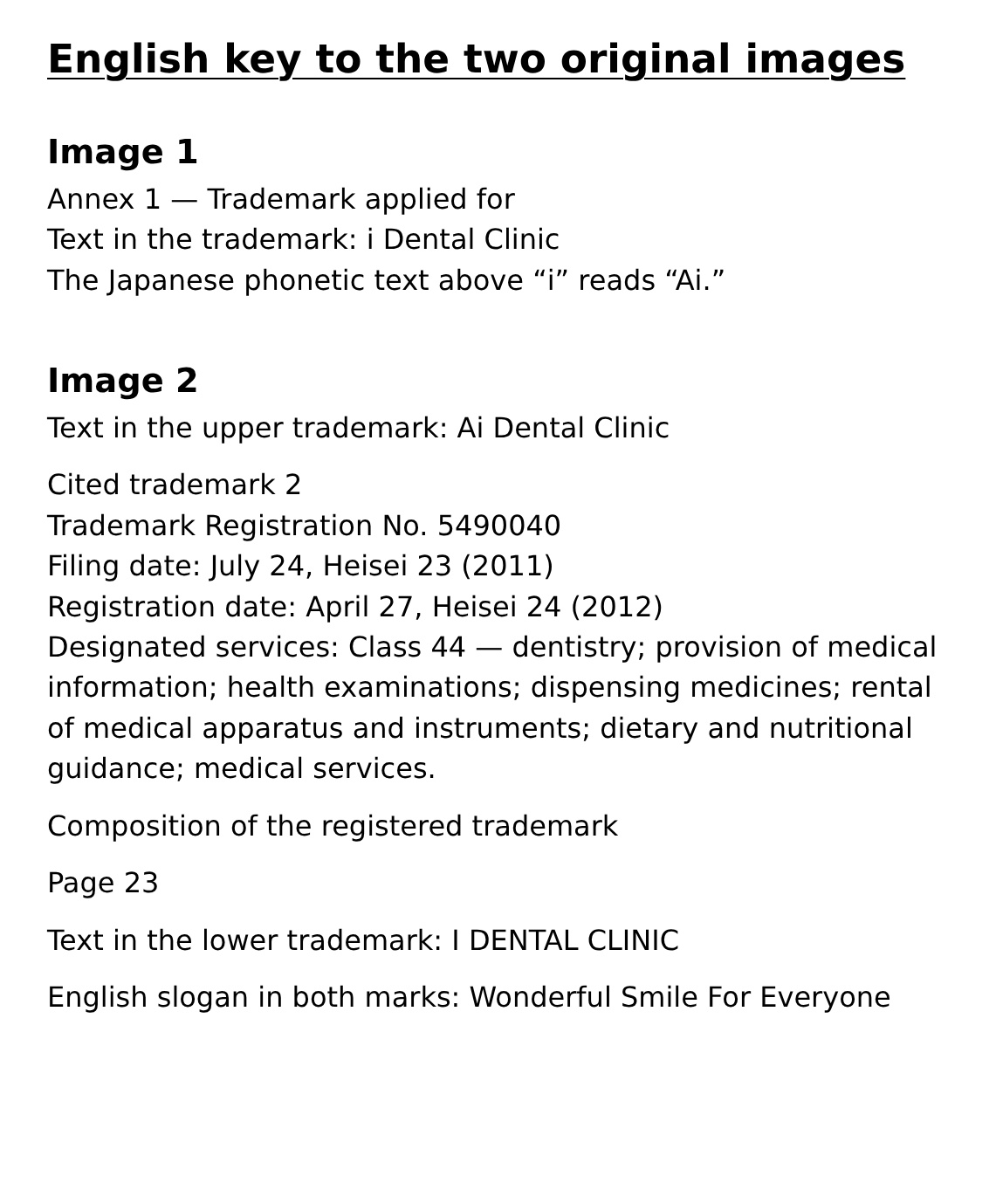
English key to the two original images
Image 1
Annex 1 — Trademark applied for
Text in the trademark: i デンタルクリニック (i Dental Clinic)
The Japanese phonetic text above “i” is “アイ” (Ai).
Image 2
Text in the upper trademark: アイ デンタルクリニック (Ai Dental Clinic)
Cited trademark 2
Trademark Registration No. 5490040
Filing date: July 24, 2011
Registration date: April 27, 2012
Designated services: Class 44 — dentistry; provision of medical information; health examinations; dispensing medicines; rental of medical apparatus and instruments; dietary and nutritional guidance; medical services.
Composition of the registered trademark
Page 23
Text in the lower trademark: I DENTAL CLINIC
English slogan in both marks: Wonderful Smile For Everyone
Original images retained for comparison


Original AMEBLO article
https://ameblo.jp/hideki-takaishi/entry-12938059665.html
[Trademarks] IP High Court, 2024 (Gyo-Ke) 10007, “Jimny Fan” <Judge Miyasaka>
Original Ameblo publication: 2025-10-13
Article type: Case note
Ameblo: https://ameblo.jp/hideki-takaishi/entry-12938232793.html
HP: https://www.takaishihideki.com/en/single-post/linkedin-7513415678138265600-en
Japanese version: https://www.takaishihideki.com/single-post/linkedin-7513415587394494464-ja
[Trademarks] IP High Court, 2024 (Gyo-Ke) 10007, “Jimny Fan” <Judge Miyasaka>
* The mark cannot be assessed by separating its components. The concepts differ. Distinct market spheres have been established.
⇒ The marks are dissimilar.
(Excerpt from the judgment, translated)
The designated goods of the applied-for mark, as amended, are the extremely niche goods in Class 16, “information magazines concerning parts and accessories used to modify off-road vehicles.” As found above regarding actual trade conditions, no automobile manufacturer, including Suzuki, publishes such magazines itself or through affiliated dealers. Nor is it plausible that traders and consumers encountering the amended goods bearing the applied-for mark would perceive an automobile manufacturer, including Suzuki, or an affiliated dealer as the publisher (or a possible publisher).
Moreover, although Suzuki was fully aware that the plaintiff had published the magazine under the same title as the applied-for mark for over ten years, it had never sent the plaintiff a warning or complaint alleging confusion with the Jimny mark. Instead, it supported publication, including by paying the plaintiff to place advertisements for the Jimny in the magazine. …
Suzuki’s business under the Jimny mark may include related merchandise and ancillary services as well as the off-road vehicle itself. In practice, however, the business of providing “information magazines concerning parts and accessories used to modify off-road vehicles” is conducted by third parties with no direct connection to Suzuki or its affiliated dealers. Distinct market spheres that do not conflict with Suzuki’s business have therefore been established.
Figures: see the original article.
Original article (2025-10-13):
https://note.com/gaha9ben54/n/n7cb1c4f9bf63
Originally posted on LinkedIn: https://www.linkedin.com/feed/update/urn:li:activity:7513415678138265600/
Images from the original AMEBLO article
English translations of the original image text
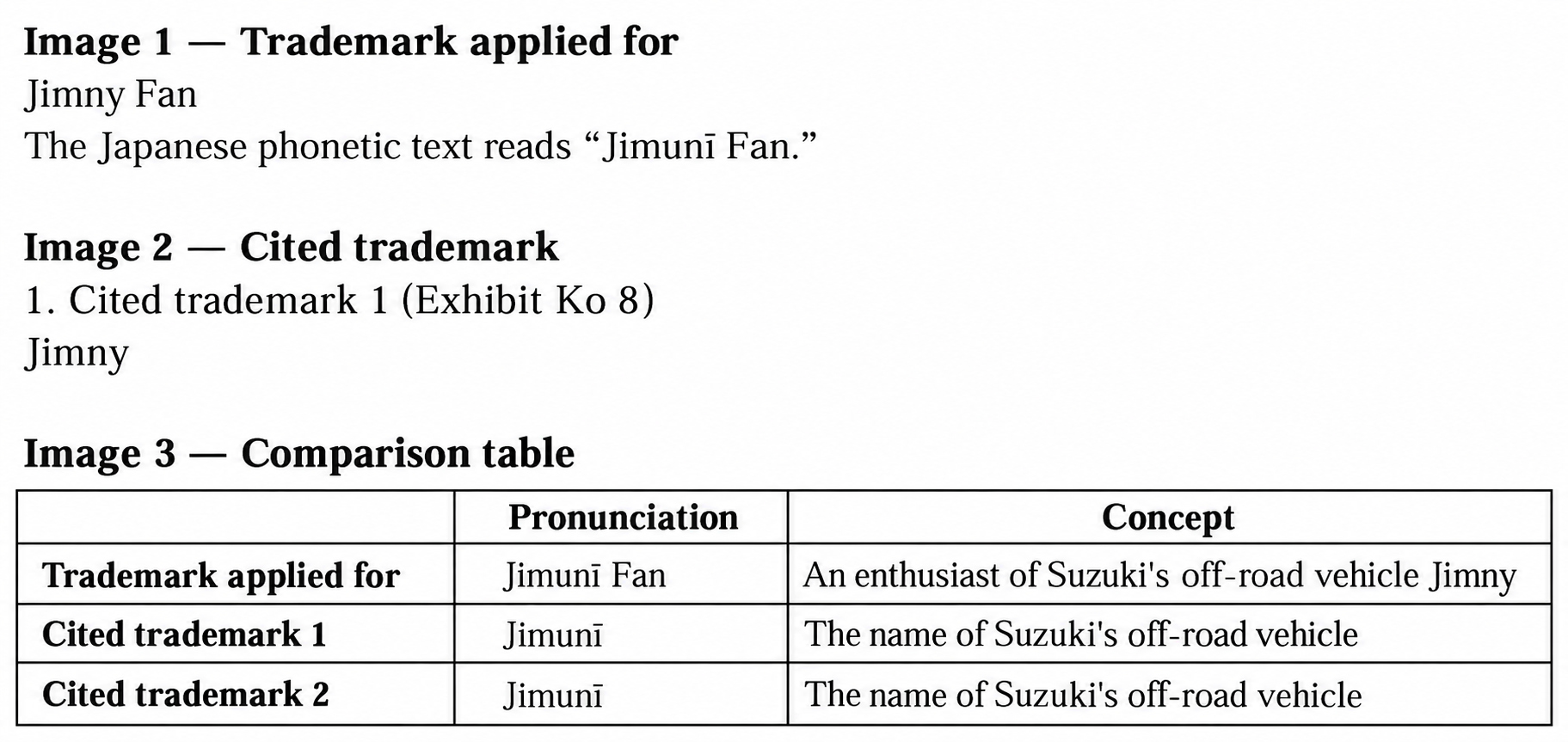
Original images retained for comparison
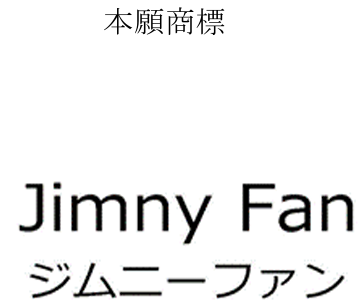
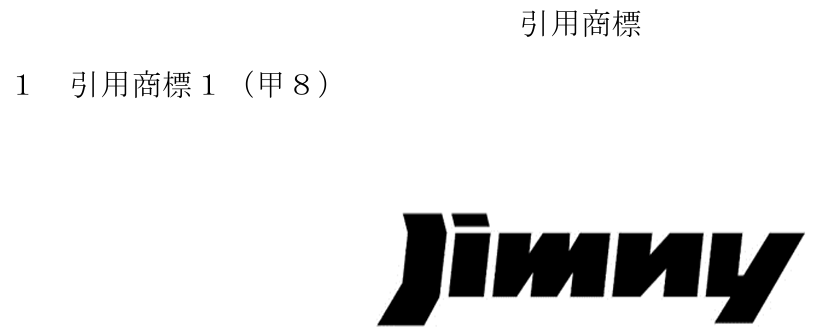
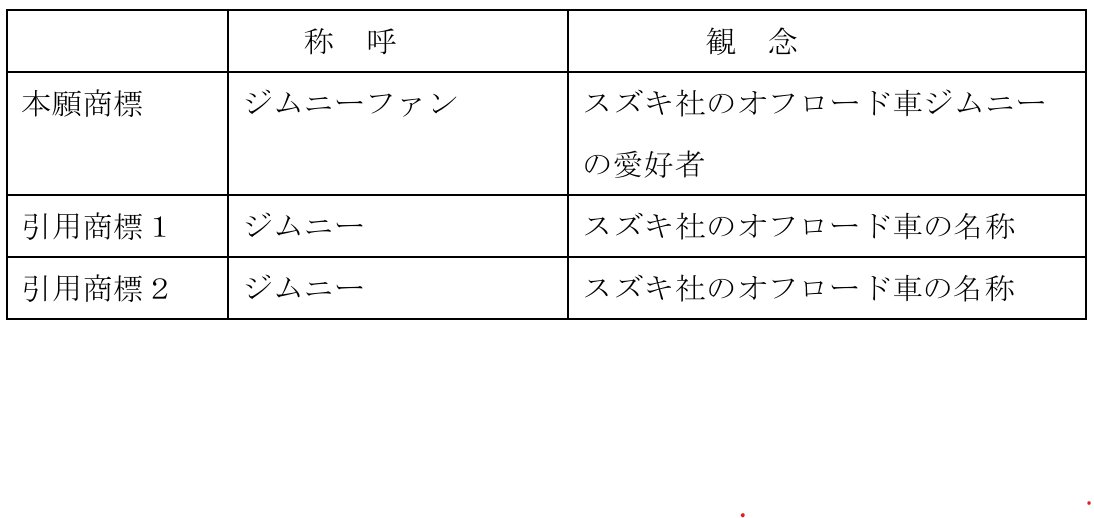
Original AMEBLO article
https://ameblo.jp/hideki-takaishi/entry-12938232793.html
IP High Court, 2024 (Gyo-Ke) 10016 [Undried tea paste] <Judge Nakadaira>
Original Ameblo publication: 2025-10-14
Article type: Case note
Ameblo: https://ameblo.jp/hideki-takaishi/entry-12938437788.html
HP: https://www.takaishihideki.com/en/single-post/linkedin-7513415880572084224-en
Japanese version: https://www.takaishihideki.com/single-post/linkedin-7513415778080141312-ja
IP High Court, 2024 (Gyo-Ke) 10016 [Undried tea paste] <Judge Nakadaira>
The decision dismissed a request for retrial of a JPO decision upholding refusal. Although the original decision had not yet become final when retrial was requested, it had become final by the time the decision dismissing that request was issued. The defect arising from the original decision’s lack of finality at the time of the request had therefore been cured by the time the dismissal decision was issued.
⇒ The request for retrial could not be dismissed on that ground.
The JPO decision was set aside.
Original article (2025-10-14):
https://ameblo.jp/hideki-takaishi/entry-12938437788.html
Originally posted on LinkedIn: https://www.linkedin.com/feed/update/urn:li:activity:7513415880572084224/
[Copyright / Trade secrets] Osaka District Court, 2020 (Wa) 1539 <Judge Takemiya>
Original Ameblo publication: 2025-10-16
Article type: Case note
Ameblo: https://ameblo.jp/hideki-takaishi/entry-12938856667.html
HP: https://www.takaishihideki.com/en/single-post/linkedin-7513416117407719424-en
Japanese version: https://www.takaishihideki.com/single-post/linkedin-7513416000617316353-ja
[Copyright / Trade secrets] Osaka District Court, 2020 (Wa) 1539 <Judge Takemiya>
Even taking into account the importance of the plaintiff’s source code, the requirement that information be managed as secret was not satisfied.
Other source code was not submitted because the defendant stated that it did not possess it, and the relevant allegations were not proven.
The modification and deletion of source code for the defendant’s products did not constitute obstruction of proof.
Original article (2025-10-16):
https://ipforce.jp/Hanketsu/jiken/no/14425
Originally posted on LinkedIn: https://www.linkedin.com/feed/update/urn:li:activity:7513416117407719424/
[Unfair Competition Prevention Act] Tokyo District Court, 2023 (Wa) 70513, the “Karate dojo” case <Judge Nakashima>
Original Ameblo publication: 2025-10-16
Article type: Case note
Ameblo: https://ameblo.jp/hideki-takaishi/entry-12938913611.html
HP: https://www.takaishihideki.com/en/single-post/linkedin-7513416373658886145-en
Japanese version: https://www.takaishihideki.com/single-post/linkedin-7513416207610507264-ja
[Unfair Competition Prevention Act] Tokyo District Court, 2023 (Wa) 70513, the “Karate dojo” case <Judge Nakashima>
Although the plaintiff’s name was not stated, a person acquainted with the plaintiff, or aware that the plaintiff was the owner of the dojo in question, could identify the “dojo owner” in the post as the plaintiff when reading it in the ordinary way.
⇒ Defamation was established.
Original article (2025-10-16):
https://note.com/chosakuken/n/nb150d3957258
Originally posted on LinkedIn: https://www.linkedin.com/feed/update/urn:li:activity:7513416373658886145/
[Trademarks / Contracts] Osaka District Court, 2022 (Wa) 7393, “MICHEL JURDAIN” <Judge Takemiya>
Original Ameblo publication: 2025-10-18
Article type: Case note
Ameblo: https://ameblo.jp/hideki-takaishi/entry-12939274105.html
HP: https://www.takaishihideki.com/en/single-post/linkedin-7513416996949172224-en
Japanese version: https://www.takaishihideki.com/single-post/linkedin-7513416876903899136-ja
[Trademarks / Contracts] Osaka District Court, 2022 (Wa) 7393, “MICHEL JURDAIN” <Judge Takemiya>
* The injunction claim was partly granted!!
* The bankruptcy trustee’s understanding in separate bankruptcy proceedings was rejected.
<Operative part of the judgment, translated>
“The defendants shall not affix any of the marks listed in Schedule 2 to watches, their packaging boxes, or hang tags; or transfer, display for transfer, possess, export, import, or offer through telecommunications networks watches bearing those marks or watches whose packaging boxes or hang tags bear those marks (excluding watches with the product numbers listed in Schedule 7, the list of defendant products manufactured by other companies, that do not have packaging boxes or hang tags bearing those marks).”
An exclusive contractual license to use the trademark, without creation of a statutory exclusive right to use, had been granted.
⇒ Claims for royalties for January and February 2018 had been waived, so termination for nonpayment was not established. The bankruptcy trustee’s assessment was not based on a detailed investigation and did not establish the absence of a license.
For products made by other companies, the defendant obtained them in unmarked boxes, then made its own boxes bearing similar marks and sold the products in those boxes. The contract prohibited repackaging; doing so without authority infringed the trademark rights.
(Excerpt from the judgment, translated)
The plaintiffs point out that Elim Trading did not pay royalties for January and February 2018 and that its trustee in separate bankruptcy proceedings proceeded on the premise that Elim Trading had no license as of January 18, 2018.
However, Andrews waived the claims for those royalties (Exhibit Otsu 16). It cannot therefore be found that the licensing agreement had been terminated for their nonpayment.
It is true that the trustee’s first report on key aspects of the administration, dated May 28, 2018, stated that Elim Trading transferred the defendant products to defendant Marushu around the end of January, and Marushu unilaterally valued them at 50% of book value and offset that amount against its trade receivables. The trustee regarded this as payment in kind but did not treat it as subject to avoidance, considering the difficulty of selling the goods because of the trademark-license issue (Exhibit Ko 14). However, the trustee had not investigated the contractual relationship between Elim Trading and Andrews in detail. A purchaser of movable property had merely said, upon appraisal, that a license was needed. The trustee’s assessment therefore does not, in itself, establish that Elim Trading had not been granted a license.
Original article (2025-10-18):
https://ameblo.jp/hideki-takaishi/entry-12939274105.html
Originally posted on LinkedIn: https://www.linkedin.com/feed/update/urn:li:activity:7513416996949172224/
[Unfair Competition Prevention Act / Contracts] Osaka District Court, 2023 (Wa) 886 <Judge Takemiya>
Original Ameblo publication: 2025-10-19
Article type: Case note
Ameblo: https://ameblo.jp/hideki-takaishi/entry-12939458003.html
HP: https://www.takaishihideki.com/en/single-post/linkedin-7513417362101084161-en
Japanese version: https://www.takaishihideki.com/single-post/linkedin-7513417095313977344-ja
[Unfair Competition Prevention Act / Contracts] Osaka District Court, 2023 (Wa) 886 <Judge Takemiya>
* The contractual warranty was held to cover only the goods sold, not finished products incorporating those goods.
(Summary of the judgment, translated)
Article 6(1) of the basic agreement for purchasing components provides that the defendant warrants legal compliance, quality, and other matters concerning the “Products” it sells to the plaintiff (LED boards and other components of a chlorine-dioxide-generating unit).
Article 6(2) provides that the plaintiff warrants representations concerning products it makes incorporating that unit, excluding the Products themselves.
Article 19 expressly provides that the plaintiff is responsible for promoting the finished products and for complying with the Act against Unjustifiable Premiums and Misleading Representations and other laws.
Given this wording and structure, the defendant’s warranty is confined to the Products themselves and does not extend to representations on the retail packaging and elsewhere for the finished products sold by the plaintiff (the Cleverin products at issue).
Even if that packaging carried representations misleading consumers about quality in violation of that Act, the plaintiff bears contractual responsibility; the defendant has no warranty obligation.
The plaintiff argued that the defendant was responsible for the representations because it gave detailed instructions and supplied the core components. However, it was not established that the defendant took the lead in determining the design in a relationship that bound the plaintiff to follow it. Although the defendant made suggestions and supplied materials, the plaintiff prepared the original designs and made the final decisions. The plaintiff was therefore responsible for the representations.
The plaintiff’s proposed interpretation that “the defendant warrants the portions of the representations concerning the Products” also cannot be adopted. Even if the finished-product packaging includes an explanation of the Products, that does not make it a representation for the Products themselves, nor can the defendant be said to have been responsible for making it.
Original article (2025-10-19):
https://ameblo.jp/hideki-takaishi/entry-12939458003.html
Originally posted on LinkedIn: https://www.linkedin.com/feed/update/urn:li:activity:7513417362101084161/
Tokyo District Court, 2023 (Wa) 70393 [Foldable and stowable temporary protective fence] <Judge Nakashima>
Original Ameblo publication: 2025-10-20
Article type: Case note
Ameblo: https://ameblo.jp/hideki-takaishi/entry-12939664008.html
HP: https://www.takaishihideki.com/en/single-post/linkedin-7513417723817930752-en
Japanese version: https://www.takaishihideki.com/single-post/linkedin-7513417554057510913-ja
Tokyo District Court, 2023 (Wa) 70393 [Foldable and stowable temporary protective fence] <Judge Nakashima>
* The problem was to reduce weight and make the structure more compact.
⇒ A “pivoting plate-shaped member” is a thin, plate-like member and does not include a circular pipe or rectangular tube.
(Excerpt from the judgment, translated)
Considering the term “plate-shaped” in the “pivoting plate-shaped member” recited in the claim elements, that member solves the problems addressed by the inventions by making the pivoting member plate-shaped and thereby reducing its thickness in the transverse direction of the base frame (H-section steel). It is therefore properly construed as a thin, plate-like member that does not include a circular pipe or rectangular tube.
The defendant’s product uses a rectangular tube as the structure corresponding to the “pivoting plate-shaped member.” It therefore cannot be found to satisfy that element.
Figures: see the original article.
Original article (2025-10-20):
https://ameblo.jp/hideki-takaishi/entry-12939664008.html
Originally posted on LinkedIn: https://www.linkedin.com/feed/update/urn:li:activity:7513417723817930752/
Images from the original AMEBLO article
Original images retained for comparison
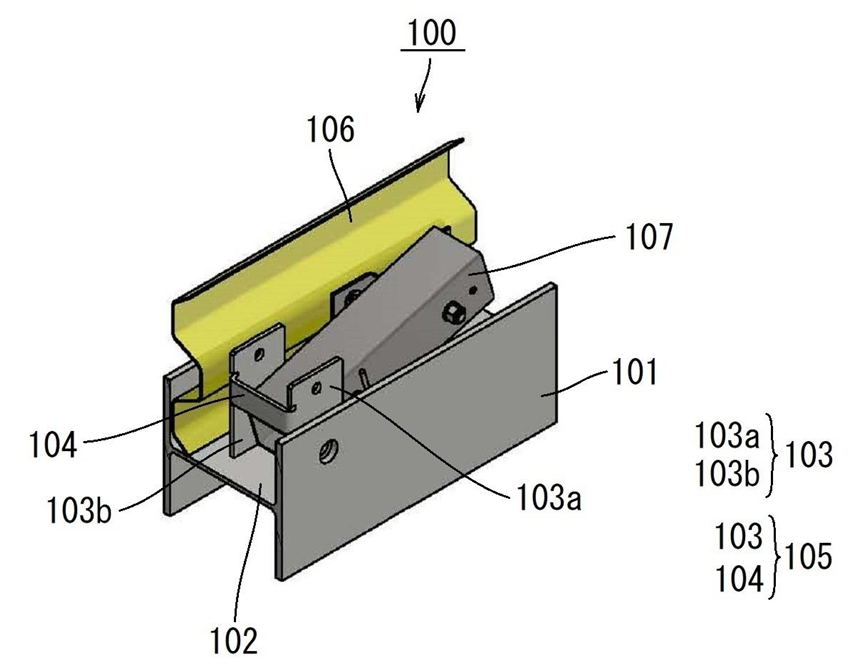
Original AMEBLO article
https://ameblo.jp/hideki-takaishi/entry-12939664008.html
[Copyright / Quotation] Tokyo District Court, 2023 (Wa) 70388 <Judge Nakashima>
Original Ameblo publication: 2025-10-21
Article type: Case note
Ameblo: https://ameblo.jp/hideki-takaishi/entry-12939868238.html
HP: https://www.takaishihideki.com/en/single-post/linkedin-7513418111178457088-en
Japanese version: https://www.takaishihideki.com/single-post/linkedin-7513417920920629250-ja
[Copyright / Quotation] Tokyo District Court, 2023 (Wa) 70388 <Judge Nakashima>
An SNS post describing a “most vicious tag team.”
⇒ Permissible quotation was established.
1. Purpose of use
The defendant used an article in the Seikyo Shimbun, to which the defendant subscribed, to criticize Soka Gakkai. The critical purpose was clear, and a connection between the article and the criticism was recognized.
2. Method and manner
Only one image, showing a single photograph together with the article, was taken and posted. This was not indiscriminate, comprehensive reproduction. The article and criticism corresponded in each post.
3. Nature of the work
The photographs published in the Seikyo Shimbun were news photographs depicting meetings, people and similar subjects, and their compositions were generally commonplace. The posted images were coarse and omitted fine details. The court therefore held that, even if the original photographs contained creative expression, only a very small part of that expression had been reproduced.
4. Form of use
The posted photographs were coarse and unclear, with details difficult to distinguish. They were not independently suitable for appreciation, and the likelihood of secondary use was low.
5. Effect on the copyright holder
No loss of economic benefit to the plaintiff from the posts was established. The photographs were not made available in high resolution for third-party use.
6. Identification of the source
The defendant indicated the source by expressly mentioning “Seikyo Shimbun” or including those words in the photographed image. Ordinary readers could sufficiently identify the source.
Japan Uni Copyright Center / Full judgment, September 26, 2024
Figures: see the original article.
Original article (2025-10-21):
https://jucc.sakura.ne.jp/precedent/precedent-2024-09-26.html
Originally posted on LinkedIn: https://www.linkedin.com/feed/update/urn:li:activity:7513418111178457088/
Images from the original AMEBLO article
English translations of the original image text
(Editor’s transcription and correction of the figure above)
5 URL (omitted)
Date and time of post: March 16, 2019, 6:34 a.m.
Account name: @B
Text:
Today’s “Suntetsu”
“3·16,” which engraves the spirit of mentor and disciple. Those who live by their vows are strong! Young people, now is the time to rise.
“3·16,” which engraves the spirit of mentor and disciple? A strange newspaper that gives greater coverage to the cornerstone-laying ceremony for the “World Seikyo Center” than to vows.
Legible newspaper headings:
Soka Gakkai — Cornerstone-laying ceremony for the “World Seikyo Center”
President Harada, General Director Hasegawa and others attend
The newspaper headquarters that undertakes the battle of words for justice …
3·16 “Kosen-rufu Commemorative Day”
A message from Ikeda Sensei; the youth division pledges to carry on …
Toward opening in November of this year
Annex — List of posted articles
1 URL (omitted)
Date and time of post: October 22, 2018, 8:11 p.m.
Account name: @B
Text:
The most vicious tag team
Original images retained for comparison
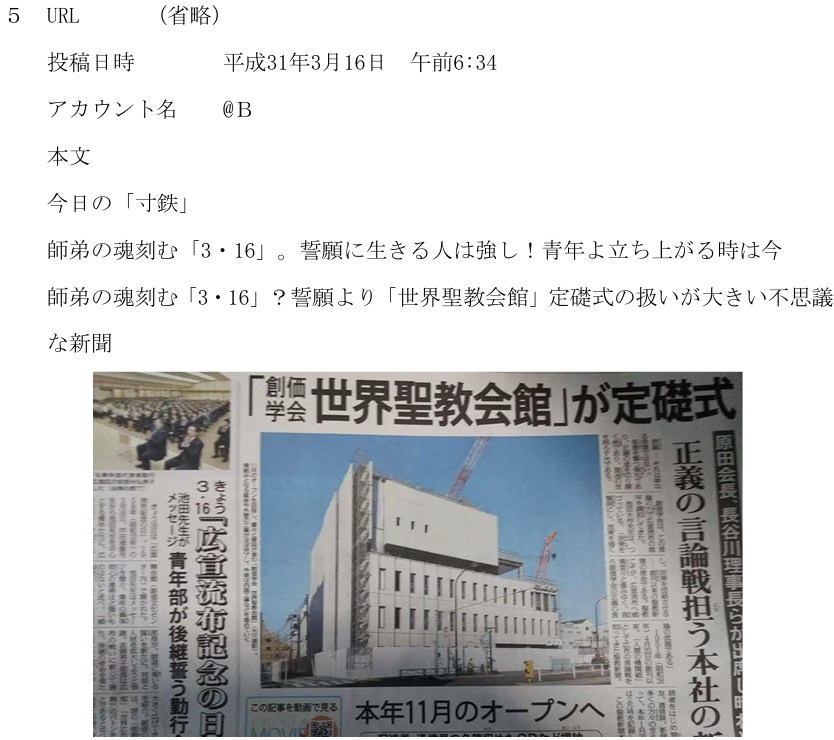
Original AMEBLO article
https://ameblo.jp/hideki-takaishi/entry-12939868238.html
IP High Court, 2023 (Gyo-Ke) 10100 [Gas-scrubber fluid purification apparatus] <Judge Hibiku Shimizu>
Original Ameblo publication: 2025-10-23
Article type: Case note
Ameblo: https://ameblo.jp/hideki-takaishi/entry-12940386808.html
HP: https://www.takaishihideki.com/en/single-post/linkedin-7513418760431607809-en
Japanese version: https://www.takaishihideki.com/single-post/linkedin-7513418313813618688-ja
IP High Court, 2023 (Gyo-Ke) 10100 [Gas-scrubber fluid purification apparatus] <Judge Hibiku Shimizu>
The technical significance of the inventions lies in purifying scrubber fluid with a disk-stack centrifuge to reduce maintenance burdens and waste volume, and in reducing problems such as buildup and clogging by circulating the fluid through a buffer tank. The court noted that the specification did not explain the technical significance of the buffer tank being “independent of the exhaust gas conduit.”
By contrast, there was no motivation in the cited invention to provide a “buffer tank” separately from the “gas scrubber.”
⇒ Inventive step upheld.
Original article (2025-10-23):
https://ameblo.jp/hideki-takaishi/entry-12940386808.html
Originally posted on LinkedIn: https://www.linkedin.com/feed/update/urn:li:activity:7513418760431607809/
IP High Court, 2024 (Gyo-Ke) 10014 [Acceleration recovery generator] <Judge Miyasaka>
Original Ameblo publication: 2025-10-24
Article type: Case note
Ameblo: https://ameblo.jp/hideki-takaishi/entry-12940647277.html
HP: https://www.takaishihideki.com/en/single-post/linkedin-7513419341078401025-en
Japanese version: https://www.takaishihideki.com/single-post/linkedin-7513418920406556672-ja
IP High Court, 2024 (Gyo-Ke) 10014 [Acceleration recovery generator] <Judge Miyasaka>
[Outline of the configuration of Claim 1]
A motor drives a weight at the end of an arm through: (1) acceleration → (2) high-speed rotation on the front side → (3) deceleration (recovering “surplus energy” through regenerative braking) → (4) low-speed rotation on the rear side.
⇒ The angular velocity in (2) is the “rated operating angular velocity.” The difference in centrifugal force between (2) and (4) provides propulsion, while (3) generates electricity.
The applicant argued, among other things, that “classical mechanics is flawed” and that “a unidirectional force F can be generated with constant power consumption.” On that premise, the applicant treated consumed energy E1 as a linear function of t and kinetic energy E2 as a quadratic function of t, so that E2 would exceed E1. The court held, however, that generating a constant force F requires E1 also to increase as a quadratic function of t. The premise was therefore incorrect, and the claimed invention violated the law of conservation of energy.
⇒ The claimed subject matter did not qualify as an invention, and the enablement requirement was not satisfied.
Original article (2025-10-24):
https://www.courts.go.jp/assets/hanrei/hanrei-pdf-93413.pdf
Originally posted on LinkedIn: https://www.linkedin.com/feed/update/urn:li:activity:7513419341078401025/
[Article / Contracts] Examination of provisions in joint patent application agreements between universities and companies (Minoru Tokita, Intellectual Property Management, Vol. 75, No. 5, 2025)
Original Ameblo publication: 2025-10-31
Article type: Publication review
Ameblo: https://ameblo.jp/hideki-takaishi/entry-12942204974.html
HP: https://www.takaishihideki.com/en/single-post/linkedin-7513419858278031360-en
Japanese version: https://www.takaishihideki.com/single-post/linkedin-7513419555235434496-ja
[Article / Contracts] Examination of provisions in joint patent application agreements between universities and companies (Minoru Tokita, Intellectual Property Management, Vol. 75, No. 5, 2025)
The obligation to notify the other party of improvement inventions should apply only where at least one inventor is shared with the original invention, and only until publication.
Profits should be allocated to the university only after they exceed half of the filing and related costs borne by the company.
The party abandoning its rights should bear the costs of abandonment.
Original article (2025-10-31):
Originally posted on LinkedIn: https://www.linkedin.com/feed/update/urn:li:activity:7513419858278031360/
[Article / Contracts] Agreements concerning the handling of joint applications, etc. (Katsumi Sakurai, Intellectual Property Management, Vol. 61, No. 2, 2011)
Original Ameblo publication: 2025-11-01
Article type: Publication review
Ameblo: https://ameblo.jp/hideki-takaishi/entry-12942513778.html
HP: https://www.takaishihideki.com/en/single-post/linkedin-7513028316359139329-en
Japanese version: https://www.takaishihideki.com/single-post/linkedin-7513027684252151808-ja
[Article / Contracts] Agreements concerning the handling of joint applications, etc. (Katsumi Sakurai, Intellectual Property Management, Vol. 61, No. 2, 2011)
Points to check
• Existing agreements
• Commencement of the agreement
• Licensing to third parties
• Subcontracting
• Divisional applications, conversion of applications, and foreign applications
Compensation to universities for non-working (the corporate perspective)
Commercialization risk
Corporate efforts beyond the particular project
A product cannot be made viable by that patent alone
* This article was written by someone from a company, and its corporate perspective is informative.
Original article (2025-11-01):
[IP Practice Online] A compass for succeeding in future markets: How to turn IP landscaping into a management tool (Hiroshi Hirose, patent attorney, Ebara Corporation)
Original Ameblo publication: 2025-11-03
Article type: Lectures and videos
Ameblo: https://ameblo.jp/hideki-takaishi/entry-12942839535.html
HP: https://www.takaishihideki.com/en/single-post/linkedin-7513028759889985536-en
Japanese version: https://www.takaishihideki.com/single-post/linkedin-7513028596878204928-ja
[IP Practice Online] “A compass for succeeding in future markets: How to turn IP landscaping into a management tool” (Hiroshi Hirose, patent attorney, Ebara Corporation)
* A must-watch video that examines, from an internal corporate perspective and with consultants’ roles also in mind, the approach to involving the IP department efficiently in management strategy that Mr. Akutsu of Shimadzu discussed at the end of his presentation!!
IP departments should make use of their unique strengths: (1) the ability to understand technological trends chronologically, (2) the ability to give concrete form to abstract concepts, and (3) knowledge of contractual matters.
New business proposals must go beyond technical ideas to flesh out business viability and market potential, bringing them to a level capable of persuading those with approval authority.
In organizational terms, a top-down approach from management is ideal. Even without it, however, bottom-up success is possible by establishing a dedicated IPL organization and having it work closely with business divisions and development departments as an integrated trio.
(Episode 261) IP Practice Online: “A compass for succeeding in future markets: How to turn IP landscaping into a management tool” (Guest: Hiroshi Hirose, Development and Intellectual Property Department, Technology Division, Precision Machinery Company, Ebara Corporation)
Original article (2025-11-03):
[Video introduction] Generative AI and prompt-driven reform in Shimadzu’s IP operations [Koji Akutsu] [Summaria webinar]
Original Ameblo publication: 2025-11-03
Article type: Lectures and videos
Topics: AI and intellectual property / IP management / Patent drafting and translation
Ameblo: https://ameblo.jp/hideki-takaishi/entry-12942839630.html
HP: https://www.takaishihideki.com/en/single-post/linkedin-7513029162211885056-en
Japanese version: https://www.takaishihideki.com/single-post/linkedin-7513028913489518592-ja
[Video introduction] Generative AI and prompt-driven reform in Shimadzu’s IP operations [Koji Akutsu] [Summaria webinar]
Annual cost savings exceeding JPY 100 million
As with the move to paperless operations, reform was pushed forward by overcoming resistance.
The approach is to replace the specialized work itself—“intellectual work that can be expressed as logic”—with AI. Prompts shared throughout the company were developed.
First, translations for foreign applications were brought in-house.
ChatGPT was initially used, but inconsistent terminology and omitted paragraphs led to a switch to a large Gemini model, improving quality.
Next, AI replaced local counsel’s analysis during foreign patent prosecution.
Using NotebookLM, only PDFs of the office action, cited references, and the invention in the application are provided. Restricting the information suppresses hallucinations and enables highly accurate analysis and preparation of proposed amendments in about two minutes.
For the “invention disclosures” prepared by inventors, development materials (PDFs, PowerPoint files, etc.) are entered into Gemini Deep Research. It extracts the inventive technology and organizes the problems, solutions, and effects, then automatically conducts a prior-art search and prepares claim charts based on that information.
This allows the essential aspects of an invention to be identified and searched in about 15 minutes.
Work has also begun on automating specification drafting.
Based on the invention’s configuration, refined through a prior-art search, AI automatically generates the specification’s “prior art,” “problems,” and “effects,” as well as embodiments and even the claims (independent and dependent).
Preparing drawings remains difficult.
For FTO (third-party patent clearance) searches, product specifications are also extracted automatically from development materials. AI (the GPT-4o API) then compares and assesses every claim in a set of several thousand patents retrieved using a broad search query against the product specifications.
This has drastically reduced the work previously requiring researchers to read 100,000 documents annually, narrowing the cases down to those the IP department needs to review (triangle and circle ratings).
“Prompts” are at the heart of these reforms.
Creating prompts means putting experienced staff’s tacit knowledge (decision logic) into words and converting it into explicit knowledge.
The speaker emphasizes three measures against hallucinations: (1) selecting a model suited to the work, (2) giving instructions in very fine-grained steps, rather than only stating the goal, and (3) restricting input information to create a closed information environment.
Looking ahead, he anticipates an era in which AI will devise patent strategies from management strategies and development plans and output them together with specifications. AI cannot assume responsibility or exercise authority; humans must make the final judgments.
Original article (2025-11-03):
[United States] HOOP v. HOOP (Fed. Cir., 279 F.3d 1004) (2002)
Original Ameblo publication: 2025-11-05
Article type: Case note
Ameblo: https://ameblo.jp/hideki-takaishi/entry-12943352669.html
HP: https://www.takaishihideki.com/en/single-post/linkedin-7513029827914895361-en
Japanese version: https://www.takaishihideki.com/single-post/linkedin-7513029403845705729-ja
[United States] HOOP v. HOOP (Fed. Cir., 279 F.3d 1004) (2002)
Determining inventorship (design authorship) for U.S. design patents
⇒ At the preliminary-injunction stage, the court upheld the finding that the later design was likely to be found similar to, and merely a refinement and completion of, the earlier design, rather than a separate invention (design). Final resolution of that factual question was left for the trial on the merits.
★ This connects to determining inventorship (design authorship) for inventions (designs) created using AI!!
Original article (2025-11-05):
[Article / United States] Determining inventorship (design authorship) for U.S. design patents (Tsuyoshi Fujimoto, AIPPI (2025), Vol. 70, No. 10)
Original Ameblo publication: 2025-11-06
Article type: Publication review
Ameblo: https://ameblo.jp/hideki-takaishi/entry-12943532367.html
HP: https://www.takaishihideki.com/en/single-post/linkedin-7513030045985226753-en
Japanese version: https://www.takaishihideki.com/single-post/linkedin-7513029958471139328-ja
[Article / United States] Determining inventorship (design authorship) for U.S. design patents (Tsuyoshi Fujimoto, AIPPI (2025), Vol. 70, No. 10)
USPTO guidance
α: A design created by a natural person is input into AI.
⇒ If the AI output is similar, the natural person is the inventor (design author).
β: A natural person finishes a design created by AI.
⇒ If the finished design is dissimilar to the AI-created design, the natural person is the inventor (design author).
Cites HOOP v. HOOP (Fed. Cir., 279 F.3d 1004) (2002).
[Update] The USPTO’s February 13, 2024 Inventorship Guidance for AI-Assisted Inventions was rescinded and replaced by revised guidance that the USPTO announced on November 26, 2025 and that was published in the Federal Register on November 28, 2025 (90 FR 54636). The current guidance applies the ordinary conception standard regardless of whether AI was used.
Original article (2025-11-06):
[United States] FMC v. Sharda (CAFC, August 1, 2025)
Original Ameblo publication: 2025-11-07
Article type: Case note
Ameblo: https://ameblo.jp/hideki-takaishi/entry-12943750560.html
HP: https://www.takaishihideki.com/en/single-post/linkedin-7513030238377951232-en
Japanese version: https://www.takaishihideki.com/single-post/linkedin-7513030131834273792-ja
[United States] FMC v. Sharda (CAFC, August 1, 2025)
During prosecution, a provisional application was first filed containing several teachings that the disclosed compositions were stable.
Subsequently, all references to stability were deleted from the common specification of the two asserted patents.
The CAFC held that, in view of those deletions in the prosecution history, a person skilled in the art would not understand the compositions recited in the asserted patents’ claims to cover only stable formulations.
(Lesson) The history of deleting limiting statements from the original specification may weigh against a narrow claim construction. Such deletion does not invariably prevent a narrow construction.
⇒ Would the same apply in Japan? What about concerns over extending the scope of disclosure or adding new matter?
Original article (2025-11-07):
[IP Practice Online] “Analysis” is changing: The world of patent analysis evolving with generative AI (Yutaro Uemura, LeXi/Vent Co., Ltd.)
Original Ameblo publication: 2025-11-10
Article type: Lectures and videos
Ameblo: https://ameblo.jp/hideki-takaishi/entry-12944455998.html
HP: https://www.takaishihideki.com/en/single-post/linkedin-7513030465075924993-en
Japanese version: https://www.takaishihideki.com/single-post/linkedin-7513030350793531393-ja
[IP Practice Online] “Analysis” is changing: The world of patent analysis evolving with generative AI (Yutaro Uemura, LeXi/Vent Co., Ltd.)
(1) AI output depends heavily on the quality of the instructions (prompts) it receives, making prompt-engineering skills essential.
(2) Selection of the “patent population” (input data) underlying the analysis determines the reliability of the results.
(3) Issues include hallucinations (generation of fictitious patent numbers or factual errors), risks of confidential information leakage, copyright infringement, and biases inherent in AI.
Original article (2025-11-10):
Osaka District Court, 2023 (Wa) 8403 [Ventilation structure beneath a coping] <Takemiya>
Original Ameblo publication: 2025-11-10
Article type: Case note
Ameblo: https://ameblo.jp/hideki-takaishi/entry-12944456599.html
HP: https://www.takaishihideki.com/en/single-post/linkedin-7513030720752283649-en
Japanese version: https://www.takaishihideki.com/single-post/linkedin-7513030601713586176-ja
Osaka District Court, 2023 (Wa) 8403 [Ventilation structure beneath a coping] <Takemiya>
* For a person skilled in the art, the natural construction of “ventilation member” is that the member itself has “ventilation performance and waterproofing performance.” This is also consistent with the specification.
⇒ The claim element was not satisfied.
(Excerpt from the judgment, translated)
For a person skilled in the art, the natural construction of the “ventilation member” specified in claim element C is that at least the member itself must have “ventilation performance and waterproofing performance.” This is also consistent with the specification.
(b) The ventilation structure beneath a coping incorporating the defendant’s product is outlined in item 2 of the attached “Drawings.” The plaintiff argues that inclined portion ⑤ corresponds to “a ventilation member that exhibits ventilation performance and waterproofing performance.” However, even if inclined portion ⑤ could qualify as something placed inside the “member beneath the coping” (first vertical portion ① through second horizontal portion ④), it is a plate made of Galvalume steel (the entire import of the oral argument), and inclined portion ⑤ itself cannot be found to have air permeability as a material. A certain space is secured between the upper part of inclined portion ⑤ and the first horizontal portion. Although that space may be regarded as a ventilation passage, it cannot be said to constitute the “ventilation member” (or part of it); the plaintiff, too, argues that inclined portion ⑤ corresponds to the “ventilation member.” The “ventilation member” therefore cannot be construed as having ventilation performance. Inclined portion ⑤ provides a blocking function (waterproofing performance) through its shape, including its inclination, and clearly narrows the area through which air can pass. It cannot be found to exhibit ventilation performance as a “ventilation member.”
Accordingly, the ventilation structure beneath a coping incorporating the defendant’s product does not satisfy the “ventilation member that exhibits ventilation performance …” in claim element C.
Original article (2025-11-10):
[IP Practice Online] “Counterfeits defeated even at China’s Supreme Court! A thorough explanation of the keys to victory with the actual inventor” (Denka Company Limited / Yasuki Ito and Shunichi Sugawara, patent attorney)
Original Ameblo publication: 2025-11-10
Article type: Lectures and videos
Ameblo: https://ameblo.jp/hideki-takaishi/entry-12944457316.html
HP: https://www.takaishihideki.com/en/single-post/linkedin-7513030997970546688-en
Japanese version: https://www.takaishihideki.com/single-post/linkedin-7513030863744409601-ja
[IP Practice Online] “Counterfeits defeated even at China’s Supreme Court! A thorough explanation of the keys to victory with the actual inventor” (Denka Company Limited / Yasuki Ito and Shunichi Sugawara, patent attorney)
The inventor and the IP department’s section manager look back on more than seven years of experience leading to victory at China’s Supreme People’s Court and explain practical lessons.
1. Litigation
In China, invalidity cannot be asserted as a defense in infringement litigation (as in Germany).
When sued for infringement, a defendant may respond by requesting invalidation before the patent office. Such a request does not automatically stay the infringement proceedings; in a dispute concerning an invention patent, the court may decide not to stay the proceedings.
In infringement litigation in China, using notarization throughout acquisition, opening, transportation, and analysis of suspected counterfeit products is important for preserving the identity and authenticity of the evidence. However, a notary’s presence throughout every stage is not a uniform legal requirement for all evidence submitted to a court.
China uses “judicial appraisal,” in which a third-party institution designated by the court conducts the analysis.
To prepare for this appraisal, Denka selected a reliable analytical institution in advance, had the inventor provide technical guidance, and prepared accurate, notarized analytical data.
This preparation helped steer the subsequent judicial appraisal results in Denka’s favor.
2. Invalidation proceedings
(1) Enablement was challenged on the basis of another patent for which Denka applied after the patent at issue, and a paper by the inventor.
(2) To enhance the patent’s reliability, the specification identified specific manufacturers and product names, such as “manufactured by XX, product name XX” for reagents. This was effectively providing counterfeiters with a “recipe.”
(3) It proved advantageous that, when filing the PCT application, the inventor had added experimental data showing that “although incomplete, even one component can be separated.”
Original article (2025-11-10):
IP High Court, 2005 (Gyo-Ke) 10099 [Image processing system]
Original Ameblo publication: 2025-11-11
Article type: Case note
Topics: Added matter / Divisional applications
Ameblo: https://ameblo.jp/hideki-takaishi/entry-12944690873.html
HP: https://www.takaishihideki.com/en/single-post/linkedin-7513031248231956480-en
Japanese version: https://www.takaishihideki.com/single-post/linkedin-7513031104174391298-ja
IP High Court, 2005 (Gyo-Ke) 10099 [Image processing system]
* Even if a person skilled in the art could understand the subject matter from the parent’s original specification sufficiently to implement it readily, that did not mean the invention was disclosed there. The divisional-application requirements were therefore not met.
(Excerpt from the judgment, translated)
A straightforward reading of the above passages of the original specification of the parent application shows that the “digital image data” of the invention described there consists solely of digital image data obtained by reading images on developed negative film. No other “digital image data” is described.
… At the time of the parent application, it was well known (1) that various devices, including television cameras, scanners, electronic cameras and video cameras, could create digital image data, and (2) that image-processing devices such as personal computers could perform prescribed processing on digital image data produced by any of those devices. However, as described above, the image-processing system disclosed in the original specification of the parent application includes scanner means that read images on film and convert them into digital image data, and is characterized by transmitting the processed digital image data to the laboratory system for printing. Accordingly, although television cameras, electronic cameras and video cameras were generally known as devices for creating digital image data, the original specification of the parent application did not disclose any such means as a component of the apparatus, or any device for importing into the image-processing system the digital image data created by those means. Therefore, it cannot be said to have been obvious from the original specification that digital image data obtained from television cameras, electronic cameras or video cameras would be edited by the photographer, transmitted to a laboratory system and printed. …
Even if an image-processing system for digital image data created by an electronic camera or the like and an image-processing system for digital image data obtained by reading an image on film have the same purpose and effect, if the means for inputting the digital image data differ, the systems or apparatuses plainly differ in configuration in that respect. The fact that two inventions having different configurations have the same purpose and effect does not make them the same invention. It therefore cannot be concluded from statements of purpose and effect that the original specification disclosed an invention in which “digital image data are not limited to data obtained by scanning exposed negative film.” … Even if the transmission-data configuration or transmission system forming part of the image-processing system did not limit “digital image data,” the original specification contained no disclosure of “digital image data” other than those obtained by reading images on developed negative film. It therefore cannot be said that the original specification disclosed an invention absent from that disclosure—namely, an invention in which the “means for reading a target image and converting it into digital image data” was not limited to scanner means. …
Even if a person skilled in the art (a person having ordinary knowledge in the technical field to which the invention belongs) could understand from the original specification, to an extent permitting ready implementation, that the “digital image data” may be data formed by an electronic camera or the like and is not limited to a scanner, that does not mean the original specification described an invention in which the “means for reading a target image and converting it into digital image data” is not limited to scanner means.
Original article (2025-11-11):
Intellectual property consultation guide
IP High Court, 2005 (Gyo-Ke) 10420 [Information supply system using a communication line] <Shinohara>
Original Ameblo publication: 2025-11-12
Article type: Case note
Ameblo: https://ameblo.jp/hideki-takaishi/entry-12944999497.html
HP: https://www.takaishihideki.com/en/single-post/linkedin-7513031589426040832-en
Japanese version: https://www.takaishihideki.com/single-post/linkedin-7513031469393539072-ja
IP High Court, 2005 (Gyo-Ke) 10420 [Information supply system using a communication line] <Shinohara>
* Even if obvious, domestic priority was denied.
(Excerpt from the judgment, translated)
… The matter need not necessarily be expressly stated in the specification. However, the purpose of the priority system is to provide the benefit of the earlier filing date for matters disclosed in the specification of the priority application. Matters equivalent to being described must therefore be distinguished from matters readily recognizable from the description. Even if the Internet was widely known and a person skilled in the art reading the priority specification recognized that the Internet could be used to implement the invention of the priority application, that alone is insufficient to deem it equivalent to having been described. To qualify as a matter equivalent to being described, it must be self-evident to the extent that a person skilled in the art would recognize it as naturally being described in the specification. It is clear that the priority specification does not meet that standard.
Original article (2025-11-12):
[United States] LAB v. Qiagen (CAFC, August 13, 2025)
Original Ameblo publication: 2025-11-13
Article type: Case note
Ameblo: https://ameblo.jp/hideki-takaishi/entry-12945245671.html
HP: https://www.takaishihideki.com/en/single-post/linkedin-7513031822788747264-en
Japanese version: https://www.takaishihideki.com/single-post/linkedin-7513031693528834048-ja
[United States] LAB v. Qiagen (CAFC, August 13, 2025)
When claim language differs within a claim depending on whether a modifier is included, the different wording is understood to have been chosen deliberately.
Where a claim contains both “partially matching” and “matching,” a partial match was held insufficient to satisfy “matching,” and the claim element was found not satisfied.
* Lesson: Where “partially matching” and “matching” coexist, clarify the technical meaning of the distinction and the intended scope. If both are intended to include partial matches, reflect that intention consistently in the respective terms.
https://www.cafc.uscourts.gov/opinions-orders/23-2350.OPINION.8-13-2025_2557800.pdf
Original article (2025-11-13):
Tokyo District Court order, 2023 (Yo) 30402 [Siphon rain-gutter system] <Nakashima>
Original Ameblo publication: 2025-11-14
Article type: Case note
Ameblo: https://ameblo.jp/hideki-takaishi/entry-12945513246.html
HP: https://www.takaishihideki.com/en/single-post/linkedin-7513032113068261376-en
Japanese version: https://www.takaishihideki.com/single-post/linkedin-7513031962232516608-ja
Tokyo District Court order, 2023 (Yo) 30402 [Siphon rain-gutter system] <Nakashima>
* Based on the specification’s explanation and other material, the claim term “lid member” was construed as not requiring complete closure.
⇒ The claim element was satisfied.
(Excerpt from the decision, translated)
… According to the claim elements and the descriptions in Specification 2, the “lid member” in the claim element includes shapes not positioned so as to close the outlet opening completely. It is sufficient for the member to be positioned above the outlet. … Applying this to the respondent’s product, … although its outlet-facing portion is not positioned to close the outlet opening completely, it is found to be positioned above the outlet. Accordingly, the outlet-facing portion of the respondent’s product satisfies the “lid member” in claim element 2-2-D. …
* Action on the merits: 2023 (Wa) 70402
Original article (2025-11-14):
[Overview] Patent Examination Standards Working Group: Disclaimer amendments and AI-related examination issues (November 17, 2025)
Original Ameblo publication: 2025-11-16
Article type: Legal and examination updates
Ameblo: https://ameblo.jp/hideki-takaishi/entry-12946063025.html
HP: https://www.takaishihideki.com/en/single-post/linkedin-7513032373446324224-en
Japanese version: https://www.takaishihideki.com/single-post/linkedin-7513032254009331712-ja
November 17, 2025
Industrial Structure Council, Intellectual Property Committee, Patent System Subcommittee
18th Meeting of the Working Group on Patent Examination Standards
<Document 1> Recent initiatives concerning examination standards
A report investigating the technological level of generative AI, the use of AI, and whether inventions exist without human involvement was published in April 2024. The survey identified issues including effects on inventive-step assessments and disclosure requirements, determination of inventorship where human involvement is limited, and requests to recognize AI as a rights holder.
<Document 2> Planned revisions to examination standards
Addressing “disclaimer claims”: Amendments excluding certain matters from claims to overcome grounds for rejection are increasing, and there are numerous concerns about how they are being used. Reviewing the examination standards to clarify the approach is under consideration.
<Document 3> Approach to amendments introducing “disclaimer claims”
Such amendments have recently increased, and individual companies and relevant organizations have expressed concerns about their use.
The JPO is preparing drafting examples for examiners, introducing checks by managers, and communicating points requiring attention.
Effect on inventive step: Excluding the portion overlapping with a cited invention can overcome lack of novelty. For inventive step, however, whether a person skilled in the art could readily arrive at the claimed invention from the cited invention must be considered anew. If inventive step is still lacking, a decision of rejection will issue.
Even if an essential configuration is excluded, inventive step is denied where redesigning it into another configuration falls within the ordinary creative ability of a person skilled in the art.
This working group will examine whether the examination standards need review or revision from the perspectives of inventive step, addition of new matter, clarity, and other issues.
<Reference Document 1> (Committee member Takashi Tanishima)
The Japan Intellectual Property Association’s comments note that amendments introducing “disclaimer claims” have increased since the Solder Resist case (the IP High Court’s 2008 Grand Panel judgment). Although useful in some situations for obtaining rights, they are sometimes used inappropriately.
Practical issues identified include cases in which inventions inherently lacking inventive step are nevertheless found inventive after such amendments; difficulty using other prior art once one cited reference has been excluded; and prolonged examination through repeated amendments, making third parties’ business decisions difficult.
Original article (2025-11-16):
Images from the original AMEBLO article
English translations of the original image text
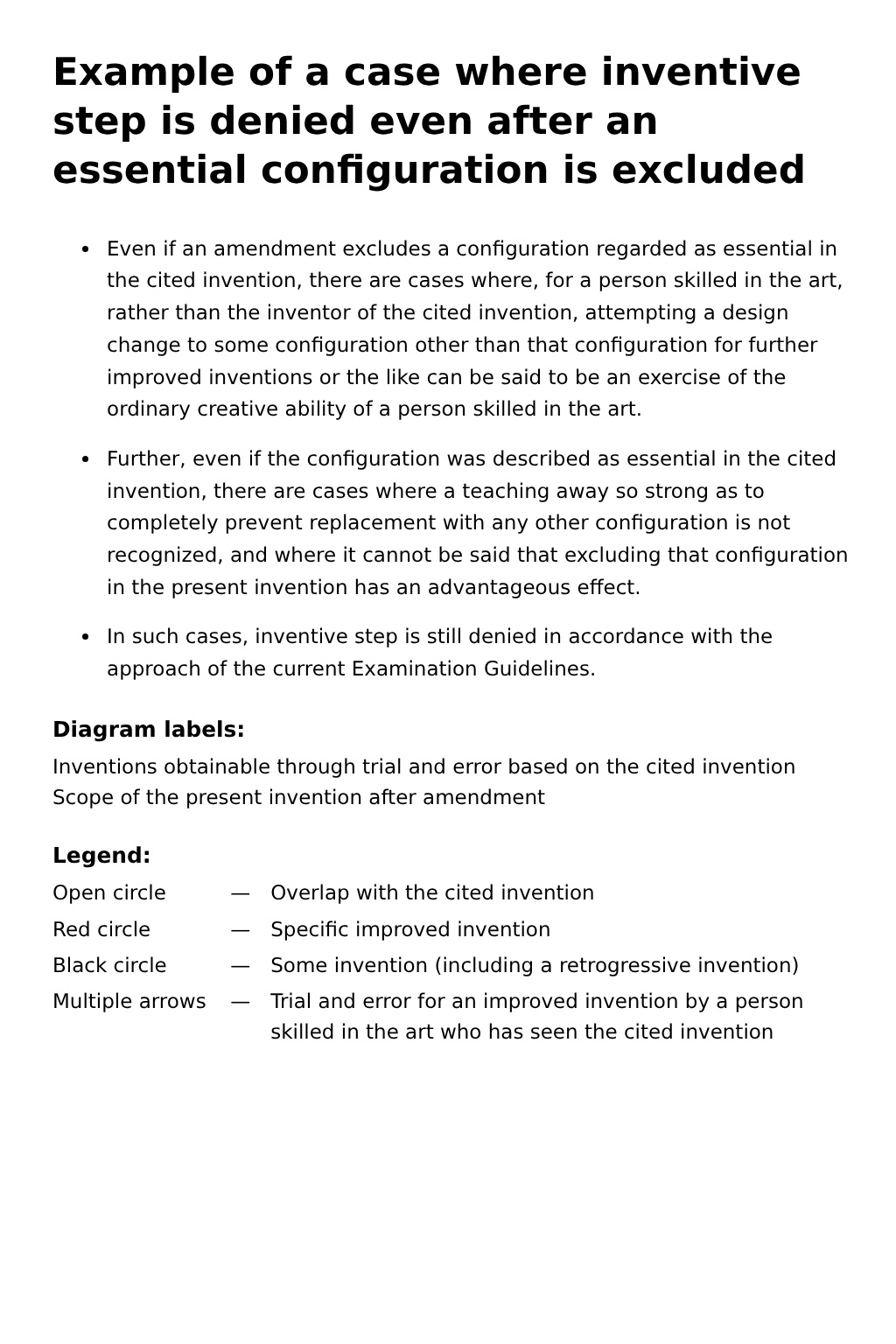
Original images retained for comparison
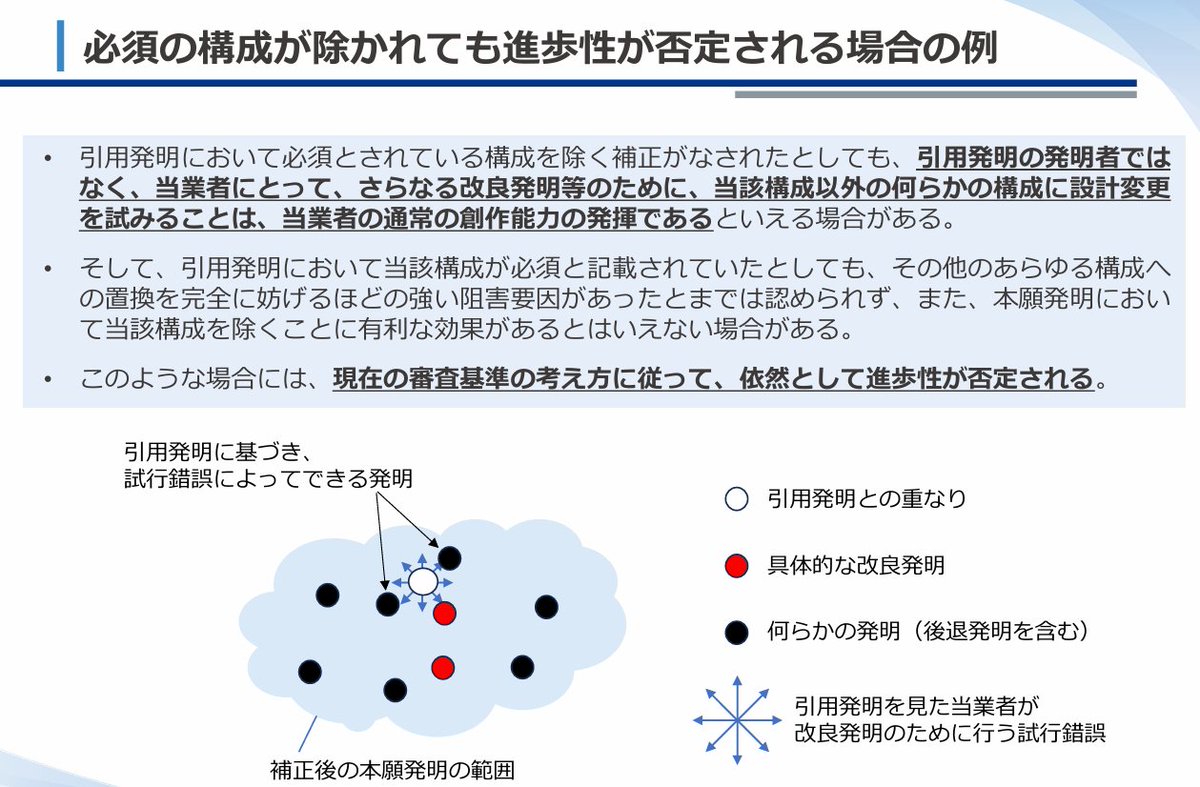
Original AMEBLO article
https://ameblo.jp/hideki-takaishi/entry-12946063025.html
Tokyo District Court, 2023 (Wa) 70346 [Wireless scuff plate] <Nakashima>
Original Ameblo publication: 2025-11-17
Article type: Case note
Ameblo: https://ameblo.jp/hideki-takaishi/entry-12946332678.html
HP: https://www.takaishihideki.com/en/single-post/linkedin-7513032624441929728-en
Japanese version: https://www.takaishihideki.com/single-post/linkedin-7513032486193528832-ja
Tokyo District Court, 2023 (Wa) 70346 [Wireless scuff plate] <Nakashima>
* The claim term “adjustable” was construed as meaning capable of precise adjustment.
⇒ Active “adjustment” is required!!
(Excerpt from the judgment, translated)
Claim element F provides that “the time interval between its on and off states is adjustable.” As to the meaning of “adjustable,” paragraph [0014] of the specification states that “the control module 6 can intelligently adjust the time interval between the on and off states according to the sensing signal,” and paragraph [0019] states that “the control module can switch the light on or off, or control the duration of illumination.” In light of claim element F and those descriptions, and considering the meaning of “intelligently” and “control” in the specification, it is appropriate to construe “adjustable” in claim element F as meaning capable of precisely adjusting the “duration of illumination.” …
In the defendant’s products …, when the backlight module is left in the on (illuminated) state, it gradually dims and goes out. This happens because the module is affected by charging or discharging of the connected capacitor, rather than because the time until it goes out is controlled through a control circuit or control program for precisely adjusting the duration of illumination. …
Original article (2025-11-17):
Osaka District Court, 2022 (Wa) 11025 [Porous air-permeable bag containing food for mites]
Original Ameblo publication: 2025-11-21
Article type: Case note
Ameblo: https://ameblo.jp/hideki-takaishi/entry-12947503536.html
HP: https://www.takaishihideki.com/en/single-post/linkedin-7513032887563186176-en
Japanese version: https://www.takaishihideki.com/single-post/linkedin-7513032763835482114-ja
Osaka District Court, 2022 (Wa) 11025 [Porous air-permeable bag containing food for mites]
* The invention has a structure capable of retaining the attractant inside.
⇒ In the defendant’s product, the mite attractant is merely sandwiched between two superposed nonwoven sheets, gauze, etc., and can spill out around their periphery. The claim element was therefore not satisfied.
* … Is the defendant’s product really like that? Should experiments or other evidence have been used to prove that the attractant does not spill out?
(Excerpt from the judgment, translated)
According to the above descriptions in the specification, the invention aims to provide a high capacity to capture mites. Its means are to attract mites over a wide area by diffusing a mite attractant from a woven sheet impregnated with it, and then to place inside the mat adhesive tape for capturing mites and porous air-permeable bags containing food for mites, attached to the tape in a staggered arrangement. This causes the attracted mites to enter further into the interior from both the front and back surfaces of the mat, contact the adhesive tape, and be captured there. The configuration impregnates the woven sheet with “fragrance” as a substance for attracting mites and places porous air-permeable bags containing “food” on both the front and back surfaces of the double-sided adhesive tape, thereby luring the mites inside the porous air-permeable cover and causing them to contact the unmixed adhesive layer and be captured. Thus, in the invention, the “porous air-permeable bag” is envisaged as having the function of keeping the food in the same location without reducing the adhesive strength of the adhesive layer. In addition, the structure of the bag allows a single bag to accomplish these functions and reduces the number of constituent materials.
In light of the foregoing, both the dictionary meaning and the specification make it appropriate to construe the “porous air-permeable bag” in claim element A-3 as requiring at least a structure capable of retaining its contents inside and preventing their dispersion. In the defendant’s product sold, however, the mite attractant is merely sandwiched between two superposed nonwoven sheets, gauze, etc., and can spill out around their periphery. It therefore cannot be found to have a structure capable of retaining the attractant inside.
Original article (2025-11-21):
[IP Practice Online] Current state, challenges, and responses in Customs’ border enforcement against IP-infringing goods (Attorney Kei Iida)
Original Ameblo publication: 2025-11-23
Article type: Lectures and videos
Ameblo: https://ameblo.jp/hideki-takaishi/entry-12947756956.html
HP: https://www.takaishihideki.com/en/single-post/linkedin-7513033143461830656-en
Japanese version: https://www.takaishihideki.com/single-post/linkedin-7513033031834615808-ja
[IP Practice Online] Current state, challenges, and responses in Customs’ border enforcement against IP-infringing goods (Attorney Kei Iida)
Current import-suspension results for IP-infringing goods
China accounts for approximately 80% of cases by country of shipment.
In the 2024 import-suspension results, goods infringing trademark rights accounted for 93.6% of the aggregate number of suspension cases counted by type of intellectual property right, with cases involving multiple rights counted in each relevant category.
The trend toward small consignments is pronounced.
Counterfeiting is becoming more sophisticated. Products with similar, rather than identical, trademarks or appearances, and unbranded copies of designs, are increasing.
Personal imports
For counterfeit goods involving trademark or design rights, treating importation solely as an act by an individual in Japan for personal use created a problem: without a business character, that act did not constitute infringement, making Customs suspension difficult.
To address this, the 2021 amendments to the Trademark Act and Design Act and the 2022 amendment to the Customs Act expressly included within importation an act by “a person in a foreign country” of “causing another person to bring goods into Japan.” Direct shipment of counterfeit goods by overseas e-commerce businesses and others consequently became subject to regulation.
⇒ As this is a clarifying provision, could the same argument be made for patents?
Exhaustion (parallel imports)
Under the 2020 amendment to the Plant Variety Protection and Seed Act, domestic exhaustion is also denied for exports to countries other than designated countries (violations of restrictions on use).
Importation of harvested material obtained from propagating material “propagated without authorization” abroad is unlawful. In Customs practice, importers are expected to be required to prove lawfulness—that the propagation was not unauthorized.
For deterrent effect, I consider that Customs should also display the status of accepted applications in foreign languages and change the current practice under which that information disappears ten days after acceptance.
Original article (2025-11-23):
[IP Practice Online] Intellectual property rights and Customs procedures (Attorney Reiko Tonomura)
Original Ameblo publication: 2025-11-23
Article type: Lectures and videos
Ameblo: https://ameblo.jp/hideki-takaishi/entry-12947757899.html
HP: https://www.takaishihideki.com/en/single-post/linkedin-7513033363599945729-en
Japanese version: https://www.takaishihideki.com/single-post/linkedin-7513033258515832832-ja
[IP Practice Online] Intellectual property rights and Customs procedures (Attorney Reiko Tonomura)
Customs determination procedures
Customs receives written opinions from both the right holder and the importer (or exporter) and decides whether the goods are infringing.
Even where sales-territory restrictions exist, imports may qualify as “parallel imports of genuine goods” if their quality and source (manufacturer) are the same as those of authorized goods.
For works other than cinematographic works, the right of transfer is exhausted in respect of the original or copy where the statutory conditions, such as a lawful transfer by the copyright owner, are met.
Customs procedures can be used not only to prevent infringing goods from entering Japan but also with a view to coordinating subsequent civil and criminal proceedings.
⇒ Prior consultation with the police and preparation of supporting evidence are important when seeking acceptance of a criminal complaint.
The police are cautious because accepting a criminal complaint requires them to begin an investigation. On the other hand, the prosecution rate following referral to prosecutors is high, at 70–80%.
Original article (2025-11-23):
Article on the same topic — [Article/Patents] Customs and plant breeders’ rights in the years ahead (Reiko Tonomura, Patent, September 2024).
Osaka District Court, 2022 (Wa) 9696 [Method for producing active GcMAF]
Original Ameblo publication: 2025-11-25
Article type: Case note
Ameblo: https://ameblo.jp/hideki-takaishi/entry-12947974109.html
HP: https://www.takaishihideki.com/en/single-post/linkedin-7513033653447290880-en
Japanese version: https://www.takaishihideki.com/single-post/linkedin-7513033506227372032-ja
Osaka District Court, 2022 (Wa) 9696 [Method for producing active GcMAF]
* A claim seeking registration of the transfer of a share in the patent right under Article 74(1) of the Patent Act or under the agreement was denied.
⇒ If the other party to joint research is filing an application, the parties should consider whether joint filing is appropriate after checking inventorship, succession to rights, and the agreement, rather than abandoning the issue merely because patentability appears uncertain. Any inference about why joint filing did not occur should be distinguished from established facts.
(Excerpt from the judgment, translated)
… P1 had knowledge and experience in the relevant technical field, as well as his own knowledge of patents and IP management strategies, and sufficiently understood the invention at the time of the discussions. … After seeking a patent attorney’s opinion, … he confirmed with P3 that Saisei Mirai would abandon seeking a patent for the invention.
(3) In light of this course of events, the plaintiff Saisei Mirai, fully aware of the invention and following discussions with the defendant, decided that it would not obtain rights in (have attributed to itself) the results of the research, including the invention. An agreement was therefore reached through the consultations contemplated by Article 14(1) of the agreement. …
Original article (2025-11-25):
[IP Practice Online] A surge during COVID-19! Online sales of counterfeits in Asia: Current situation and countermeasures (Patent attorney Tsuyoshi Masutani)
Original Ameblo publication: 2025-11-25
Article type: Lectures and videos
Ameblo: https://ameblo.jp/hideki-takaishi/entry-12947974203.html
HP: https://www.takaishihideki.com/en/single-post/linkedin-7513033866840907776-en
Japanese version: https://www.takaishihideki.com/single-post/linkedin-7513033758799917058-ja
[IP Practice Online] A surge during COVID-19! Online sales of counterfeits in Asia: Current situation and countermeasures (Patent attorney Tsuyoshi Masutani)
Counterfeit sales have become a global business through cross-border e-commerce, rapidly expanding from a market previously centered on China to Southeast Asia and India.
The counterfeit business is becoming more sophisticated and higher in quality.
Impersonation sales using photographs of genuine stores without permission, fabricated consumer reviews, and similar practices are widespread, and platforms’ enforcement efforts are reaching their limits.
The prevalence of small-consignment shipping through delivery services also makes infringement harder for brand owners to detect.
The quality of counterfeit products is improving, and manufacturing is speeding up. Copies of the latest products appear on the market almost simultaneously with their launch.
There are also cases involving the outflow of technology or personnel from authorized local factories, or former local agents participating in counterfeit production.
Bad-faith trademark registrations, in which third parties improperly register well-known Japanese trademarks locally, are also a serious problem, particularly in Indonesia and Vietnam.
In China, social networks such as WeChat offer powerful anti-counterfeiting functions for brand owners.
Brand owners can view complaints from other users, including photographs and purchase-location information, and use them to understand infringement across China and gather evidence.
In Southeast Asia, major e-commerce platforms such as Lazada and Shopee, as well as Facebook, have simplified their takedown-request processes.
In Thailand and Vietnam, it is possible to communicate directly with police and Customs personnel through social networks such as LINE.
Customs officers send photographs of suspected counterfeit goods through LINE; brand owners assess authenticity, allowing Customs clearance to be stopped immediately.
Original article (2025-11-25):
Osaka District Court, 2023 (Wa) 10237 [Tool for slaughtering wild animals]
Original Ameblo publication: 2025-11-27
Article type: Case note
Ameblo: https://ameblo.jp/hideki-takaishi/entry-12948165955.html
HP: https://www.takaishihideki.com/en/single-post/linkedin-7513034105953878016-en
Japanese version: https://www.takaishihideki.com/single-post/linkedin-7513033995362775040-ja
Osaka District Court, 2023 (Wa) 10237 [Tool for slaughtering wild animals]
* “A rod of a predetermined length that is freely extendable and retractable”
⇒ A fixed-length rod is not included.
(The plaintiff argued that “freely extendable and retractable” means that the length of the rod’s functional portion can be changed by changing where it is held.)
(Excerpt from the judgment, translated)
Claim 1 recites “a rod of a predetermined length that is freely extendable and retractable” (claim element A). From that wording, a person skilled in the art can understand that a configuration in which the rod is freely extendable and retractable is indicated.
The specification shows that the problem the invention seeks to solve is, in essence, to enable even a person with limited physical strength to slaughter dangerous wild animals simply and reliably where those animals live. …
To solve that problem, configuring the rod to extend and retract freely allows the distance from the animal to be adjusted. For example, one can keep a greater distance from birds of prey or, where safety can be ensured, shorten the distance and reliably bring the electrode into contact with the animal’s body. …
Accordingly, a person skilled in the art would understand “a rod of a predetermined length that is freely extendable and retractable” as meaning a rod whose structure allows the length of the rod portion itself to be changed. A fixed-length rod must be regarded as excluded.
Original article (2025-11-27):
[Unfair Competition / Trade Secrets] Osaka District Court, 2023 (Wa) 2681
Original Ameblo publication: 2025-11-27
Article type: Case note
Ameblo: https://ameblo.jp/hideki-takaishi/entry-12948166030.html
HP: https://www.takaishihideki.com/en/single-post/linkedin-7513034360107855872-en
Japanese version: https://www.takaishihideki.com/single-post/linkedin-7513034227572129792-ja
[Unfair Competition / Trade Secrets] Osaka District Court, 2023 (Wa) 2681
* “For a confidentiality clause to be valid, there must be trade secrets or other information deserving protection”!!
(Note) The quoted statement above is the defendants’ argument as recorded in the judgment, not the court’s holding. The court held that the confidentiality undertaking contained nothing unreasonable and recognized Defendant P2’s duty of confidentiality (see the excerpt from the court’s reasoning below).
⇒ NDA provisions should be drafted so that their scope is construed as extending beyond “trade secrets” under the Unfair Competition Prevention Act.
* The court also rejected liability in general tort because the information was not managed as secret and there were no circumstances in this case requiring consideration of an interest separate from those protected by the Unfair Competition Prevention Act.
(Excerpt from the defendants’ submissions recorded in the judgment, translated)
For a confidentiality clause to be valid, trade secrets or other information deserving protection must exist. However, the copied information at issue lacks, at a minimum, management as secret and usefulness, and the document data at issue is not highly confidential. Neither therefore qualifies as trade secrets or other information deserving protection. Defendant P2 signed and sealed both the undertaking given upon joining the company and the confidentiality undertaking at issue, but the plaintiff never explained their specific contents to him. He should not be subjected to unnecessary and excessive confidentiality obligations on their basis. Accordingly, P2 did not breach a confidentiality obligation by acquiring the copied information or providing the document data.
(Excerpt from the court’s reasoning, translated)
The plaintiff and Defendant P2 had agreed, through the confidentiality undertaking, on the scope of his duty of confidentiality during employment. As the undertaking contained nothing unreasonable, P2 must be regarded as having owed a duty of confidentiality regarding the “confidential information” specified in it.
… In light of the information-management system then in place for information within the plaintiff’s operation-management system (including the copied information and document data), both sets of information lacked management as secret and did not constitute “trade secrets” under Article 2(6) of the Unfair Competition Prevention Act. Nor are there circumstances in this case requiring consideration, in relation to acts involving such information, of an interest separate from those protected by that Act.
Accordingly, P2 committed no unlawful act, and the defendants’ alleged joint tort, premised on such an act, is not established either.
Original article (2025-11-27):
Tokyo District Court, 2024 (Wa) 70106 <Kokubu>
Original Ameblo publication: 2025-11-28
Article type: Case note
Ameblo: https://ameblo.jp/hideki-takaishi/entry-12948273109.html
HP: https://www.takaishihideki.com/en/single-post/linkedin-7513034621463306240-en
Japanese version: https://www.takaishihideki.com/single-post/linkedin-7513034506950410242-ja
Tokyo District Court, 2024 (Wa) 70106 <Kokubu>
* An obligation to grant a non-exclusive license under another person’s patent was not performed.
⇒ Termination was effective.
(Excerpt from the judgment, translated)
Even where someone grants another person a non-exclusive license without the patent owner’s consent, it is possible to obtain the patent owner’s authorization after concluding the contract. Thus, even if someone without authority to grant a non-exclusive license grants one to a third party, there is no need immediately to deny the contract’s validity between the contracting parties.
However, such a license agreement concerns another person’s rights. A person who grants a non-exclusive license despite lacking authority to do so must therefore, under Articles 559 and 561 of the Civil Code, acquire that authority for the non-exclusive licensee.
In this case, … the agreement included the plaintiff’s promise to grant the defendant non-exclusive licenses under the patents at issue. … Patent 1 is found to be jointly owned by Japan Conservation Engineers & Co., Ltd. and Nihon Sofuken, while Patent 3 is jointly owned by those two companies and Nihon Mikuniya Co., Ltd. Accordingly, as an obligation under the agreement, the plaintiff owed the defendant a duty to obtain from those co-owners the authority to grant non-exclusive licenses for the defendant. …
However, … although the plaintiff had been granted an exclusive license under Patent 2 by its sole owner, Nihon Sofuken, the entire import of the oral argument shows that, for Patents 1 and 3, the plaintiff had not obtained the co-owners’ authorization to establish non-exclusive licenses for the defendant. The plaintiff therefore failed to perform that obligation. …
… The requirements for termination following a demand for performance—the plaintiff’s nonperformance of its contractual obligation, the defendant’s demand for performance within a reasonable period, failure to perform within that period, and a declaration of termination—are satisfied (main clause of Article 541 of the Civil Code). As a result of termination of the agreement, the defendant has no obligation to pay the license fees. …
Original article (2025-11-28):
[New on YouTube] May 28, 2025 (IP LAB)
Original Ameblo publication: 2025-11-29
Article type: Lectures and videos
Ameblo: https://ameblo.jp/hideki-takaishi/entry-12948376641.html
HP: https://www.takaishihideki.com/en/single-post/linkedin-7513034859343331328-en
Japanese version: https://www.takaishihideki.com/single-post/linkedin-7513034722898460673-ja
[New on YouTube] May 28, 2025 (IP LAB)
A read-through of the Encyclopedia of Patent Case Law (draft manuscript for the fourth edition), covering “(pharmaceutical) use inventions, the subjective requirements for indirect infringement, incorporating a purpose into a claim, and whether claim elements are satisfied.”
Original article (2025-11-29):
[IP Practice Online] An enjoyable discussion of patent claim interpretation (Attorney Masakazu Kobayashi)
Original Ameblo publication: 2025-11-30
Article type: Lectures and videos
Ameblo: https://ameblo.jp/hideki-takaishi/entry-12948514671.html
HP: https://www.takaishihideki.com/en/single-post/linkedin-7513035099232169986-en
Japanese version: https://www.takaishihideki.com/single-post/linkedin-7513034976284536832-ja
[IP Practice Online] An enjoyable discussion of patent claim interpretation (Attorney Masakazu Kobayashi)
For example, “annular” in the claim phrase “an annular sealing member” is explained in the Kojien dictionary as “a ring-like shape,” “a round shape,” and so forth.
Focusing on “ring-like” and the technical significance of the “sealing function” described in the specification, a patent owner would argue that a shape making one circuit with its ends joined falls within the patent’s scope even if the defendant’s product is quadrilateral. A concrete example, such as the Osaka Loop Line not being a perfect circle, may also inform interpretation.
The defendant, in contrast, would rely on the definition “a round shape” and circular drawings of the embodiments to argue that the scope is limited to circular shapes.
Likewise, even a seemingly clear term such as “rod-shaped” may give rise to a dispute over whether an L-shaped or conical product can be considered a “rod.” Here, too, interpretation looks beyond mere word definitions to the member’s technical significance within the invention—for example, its function of “sliding along a straight elongated hole.”
Claim interpretation can be divided into three categories: (1) the meaning of terms, (2) the integral/separate-member issue (one member or a combination of multiple members), and (3) the whole/part issue (whether the entire item must satisfy a requirement or whether a part suffices).
If the wording alone does not resolve the dispute, the principal battleground moves to the technical significance, problems, and effects described in the specification.
Here, too, disputes arise over the level of generality at which to understand the technical significance—for example, a “sealing function” or the narrower “uniform sealing function.”
Numerically limited inventions are no exception. In a recent case involving a claim requiring “a molecular weight of 700 or more,” literal infringement was strictly denied for a defendant’s product with a molecular weight of 699.9.
Even if the number itself is clear, ambiguity in the definition of what is measured (for example, “particle diameter”), the measurement method, product variability, and changes over time can become issues, making interpretation difficult.
In conclusion, claim interpretation involves constructing one’s legal argument by drawing on the specification, drawings, prosecution history, and common technical knowledge, while recognizing the ambiguity of language.
Original article (2025-11-30):
Tokyo District Court, 2023 (Wa) 70425 [Information Processing Apparatus] <Nakashima>
Original Ameblo publication: 2025-12-01
Ameblo: https://ameblo.jp/hideki-takaishi/entry-12948604221.html
Tokyo District Court, 2023 (Wa) 70425 [Information Processing Apparatus] <Nakashima>
The “application” must itself provide the relevant functions, such as a credit function.
The defendant’s program itself does not provide the d-barai payment function itself.
https://www.courts.go.jp/assets/hanrei/hanrei-pdf-93658.pdf
[Contract] Osaka District Court, 2023 (Wa) 12021
Original Ameblo publication: 2025-12-02
Ameblo: https://ameblo.jp/hideki-takaishi/entry-12948717992.html
[Contract] Osaka District Court, 2023 (Wa) 12021
Even in the allegations, it is unclear specifically what information was used and how, or specifically what effect it had on the course of the “Project at Issue.” … Nor is there sufficient evidence to find that those defendants engaged in such conduct in this case.
Furthermore, the plaintiff vacated the research premises at issue on the basis of the termination of the Exhibit Ko 3 contract. Although defendant P2 ultimately took the lead, the action is not found … to have been contrary to the wishes of the plaintiff’s representative at the time.
https://www.courts.go.jp/assets/hanrei/hanrei-pdf-93713.pdf
[Unfair Competition Prevention Act / Trade Secrets] Osaka District Court, 2023 (Wa) 12731
Original Ameblo publication: 2025-12-03
Ameblo: https://ameblo.jp/hideki-takaishi/entry-12948829828.html
[Unfair Competition Prevention Act / Trade Secrets] Osaka District Court, 2023 (Wa) 12731
*Merely signing a confidentiality undertaking does not automatically establish that information was managed as secret.
(Translation of an excerpt from the court’s reasoning)
… The plaintiff asserts that the defendant signed the confidentiality undertaking at issue, but that alone does not mean that Information 1 at issue automatically qualifies as “confidential information” or was managed as secret.
Furthermore, … an online form was publicly available through which customers could request a free estimate and agree to a visit for an estimate …. That and a customer’s request to a contractor for a site survey are identical in that both involve conducting visiting sales activities in the form of an application from the customer. Thus, Information 1 at issue also lacks non-public status.
https://www.courts.go.jp/assets/hanrei/hanrei-pdf-93700.pdf
[Europe] CJEU Grand Chamber Judgment on Jurisdiction over Foreign Patent Infringement and Its Implications for the UPC (February 25, 2025), C-339/22
Original Ameblo publication: 2025-12-04
Ameblo: https://ameblo.jp/hideki-takaishi/entry-12948936981.html
[Europe] CJEU Grand Chamber Judgment on Jurisdiction over Foreign Patent Infringement and Its Implications for the UPC (February 25, 2025), C-339/22
BSH Hausgeräte GmbH v Electrolux AB
The judgment clarified the jurisdiction of the courts of the EU Member State where the defendant is domiciled over infringement actions concerning patents granted or validated in another Member State or a third State. It did not decide the UPC’s own jurisdiction, but is also relevant to the consideration of the UPC’s long-arm jurisdiction.
In a separate related case, the UPC’s Düsseldorf Local Division recognized jurisdiction over infringement of the UK part of a European patent. That UPC ruling must be distinguished from this CJEU judgment.
This judgment opened the way to pursuing, together in the courts of the defendant’s country of domicile, not only infringement of the European patent part validated in that country, but also infringement based on European patent parts in other countries and on foreign patents.
Article 24(4) of the Brussels I bis Regulation gives the courts of the Member State in which a patent is granted or validated exclusive jurisdiction over its validity, including where invalidity is raised as a defence. However, the court hearing the infringement action does not thereby lose jurisdiction over that action.
As a result, the court of the EU Member State where the defendant is domiciled retains jurisdiction over the infringement action even if an invalidity defence is raised concerning a foreign patent part, and may adjudicate infringement in other Member States and third States. Whether cross-border injunctive relief is available depends on the substantive requirements for an injunction and other applicable requirements in the particular case.
The validity of a patent granted or validated in another EU Member State falls within the exclusive jurisdiction of that Member State’s courts. Article 24(4), however, does not apply to the courts of a third State. Subject to restrictions arising from the Lugano Convention, bilateral conventions, and rules concerning proceedings already pending in a third State, the court of the defendant’s Member State of domicile may determine an invalidity defence concerning a third-State patent with effects limited to the parties, without altering the existence or content of the patent in the third State’s register.
The infringement court, on the other hand, has the power to sever and stay infringement proceedings if there is a reasonable possibility that the patent will be invalidated in invalidity proceedings pending in another country.
Parallel disputes over infringement and validity in different countries make proceedings more complex and increase defendants’ costs.
The judgment clarified that jurisdiction over an infringement action must be distinguished from jurisdiction to determine validity even when invalidity of a foreign patent is raised as a defence. Merely raising invalidity does not automatically deprive the court chosen by the patentee of jurisdiction over the infringement action.
⇒ Favorable to patentees.
For the UPC, the judgment is relevant when considering jurisdiction over European patents validated in non-contracting states, such as the UK and Turkey. It does not, however, uniformly establish jurisdiction or entitlement to an injunction in each UPC case or for every national patent.
At the same time, confirmation that the national courts of EU Member States have similarly broad jurisdiction has expanded patentees’ opportunities for forum shopping between the national court of the defendant’s domicile and the UPC, and judicial competition between the two is expected to intensify.
https://hasegawa-ip.com/ep-patent/upc-long-arm/#google_vignette
[Copyright] Tokyo District Court, 2024 (Wa) 70126 <Nakashima>
Original Ameblo publication: 2025-12-05
Ameblo: https://ameblo.jp/hideki-takaishi/entry-12949049163.html
[Copyright] Tokyo District Court, 2024 (Wa) 70126 <Nakashima>
*The explanatory texts and scripts displayed at the Tokutomi Roka Memorial Literature Museum are works made in the course of duties whose author is the defendant (Shibukawa City), and the copyright belongs to the defendant.
“In the first place, the plaintiff was hired by the defendant as a curator to work on the exhibition rooms of the literature museum at issue and continued that work until the exhibition rooms were completed. Thus, even if the plaintiff made a substantial contribution to that work but was not appointed director of the museum, these circumstances deserving consideration in the plaintiff’s favor cannot be said to affect ownership of copyright through the determination of whether the works qualify as works made in the course of duties.”
https://www.courts.go.jp/assets/hanrei/hanrei-pdf-94072.pdf
IP High Court Grand Panel, 2006 (Gyo-Ke) 10563 [Solder Resist]
Original Ameblo publication: 2025-12-09
Ameblo: https://ameblo.jp/hideki-takaishi/entry-12949482642.html
IP High Court Grand Panel, 2006 (Gyo-Ke) 10563 [Solder Resist]
A case in which an invention could be specified using a trademark (a disclaimer claim).
(Translation of an excerpt from the court’s reasoning)
The invention is specified in a negative form of expression (the so-called “disclaimer claim” format), with reference to the description of particular substances or products in Example 2 of the earlier application’s specification. Since this appears to be the only way to exclude the portion identical to the cited invention precisely, neither more nor less, the use, in the corrections at issue, of the trademark “TEPIC,” which serves as an element specifying the cited invention, to indicate the excluded portion cannot be said to violate Article 24 of the above Regulations.
https://www.courts.go.jp/ip/vc-files/ip/file/10563.pdf
[IP Practice Online] Explanation of Patent Eligibility Issues in the United States and Practical Responses in Patent Prosecution (Japanese and U.S. Patent Attorney Shigeki Takeuchi)
Original Ameblo publication: 2025-12-09
Ameblo: https://ameblo.jp/hideki-takaishi/entry-12949482771.html
[IP Practice Online] Explanation of Patent Eligibility Issues in the United States and Practical Responses in Patent Prosecution (Japanese and U.S. Patent Attorney Shigeki Takeuchi)
<1> Basic principles and case law
The current framework for assessing eligibility is the “Alice test,” based on Supreme Court case law.
<2> USPTO (United States Patent and Trademark Office) examination guidelines
Examiners conduct examination based on the Alice test while using their own flowchart (Steps 2A and 2B).
The general rule for examiners’ claim construction is the “broadest reasonable interpretation” (BRI).
The eligibility analysis considers whether a claim integrates a judicial exception into a practical application rather than merely using it. An improvement to computer functionality or other technology can support that determination. However, even where integration is not established under USPTO Step 2A, a claim may satisfy eligibility under Step 2B if additional elements amount to significantly more than the exception.
<3> Practical responses
From the Japanese filing stage, it is recommended that the specification describe in detail the technical field, the technical problems specific to that field, and the technical effects that solve those problems.
For AI-related inventions in particular, it is important to specify field-specific data and inputs and outputs, and the resulting improvement in the system’s functionality, rather than a general-purpose model.
In drafting claims, it is necessary to avoid “results-based functional expressions” (for example, “analyzing” or “displaying”) and to describe specific hardware configurations or processing steps.
[IP Practice Online] Abductive Reasoning as an Axis of Logic and Thought in Patent Prosecution Practice—Focusing on Chemical Inventions (Patent Attorney Masanori Tomatsuri)
Original Ameblo publication: 2025-12-09
Ameblo: https://ameblo.jp/hideki-takaishi/entry-12949482882.html
[IP Practice Online] Abductive Reasoning as an Axis of Logic and Thought in Patent Prosecution Practice—Focusing on Chemical Inventions (Patent Attorney Masanori Tomatsuri)
In addition to “deduction” and “induction,” logical reasoning includes “abductive reasoning” (abduction).
1. Inventors’ materials often state objective facts but omit the “unspoken essentials,” such as why a particular configuration was chosen, why other configurations do not work, the difficulties encountered, and the mechanism by which effects arise.
Use abduction when reviewing inventors’ materials, reasoning about questions such as “Why is this statement included?” and “Why is this point not discussed?”
2. If the causal relationships described in the inventor’s materials seem “too neat,” prepare questions based on the hypothesis that the explanation was constructed after the fact and that there may actually have been trial and error or unexpected results.
3. In interviewing the inventor, build a relationship of trust, because you will be playing the role of “devil’s advocate.”
4. When drafting a specification (especially for a chemical invention), stating the mechanism definitively risks rejection for lack of inventive step on the ground that the result “could readily have been predicted.” An effective writing approach is therefore deliberately to introduce a “pause” in the logic, along the lines of: “Surprisingly, this effect was obtained, but the mechanism has not been fully elucidated. However, the following is conjectured.”
Setting a lower hurdle for the problem addressed by the invention (for example, “rapid action ‘or’ high strength,” or a more relaxed threshold for an acceptable result) increases the possibility of obtaining broader protection without violating the support requirement.
[Copyright] Tokyo District Court, 2024 (Wa) 70189 <Nakashima>
Original Ameblo publication: 2025-12-09
Ameblo: https://ameblo.jp/hideki-takaishi/entry-12949483043.html
[Copyright] Tokyo District Court, 2024 (Wa) 70189 <Nakashima>
*Copyrightability of the program denied (no creativity in expression).
“The plaintiff is understood to assert that two portions of the source code of the program at issue, marked in red, are creative expressions: (1) the portion relating to the function of displaying a drop-down list of product names (hereinafter ‘Portion (1)’), and (2) the portion relating to the function of searching for and confirming a customer’s name (hereinafter ‘Portion (2)’). Despite repeated requests for clarification by the court …, however, the plaintiff has not specifically alleged why these portions constitute creative expression.”
https://www.courts.go.jp/assets/hanrei/hanrei-pdf-93669.pdf
Tokyo District Court, 2022 (Wa) 70058 [Grapple Bucket Device] <Kokubu>
Original Ameblo publication: 2025-12-10
Ameblo: https://ameblo.jp/hideki-takaishi/entry-12949591631.html
Tokyo District Court, 2022 (Wa) 70058 [Grapple Bucket Device] <Kokubu>
“Curved in an arc” (constituent requirement D2) not satisfied.
<No literal infringement>
“It is appropriate to interpret ‘arc-shaped’ in constituent requirement D2 as meaning a shape like a portion of a circumference, composed entirely of a curve, and ‘curved in an arc’ as meaning a shape that curves like a bow in the form of a portion of a circumference.”
⇒ The defendant’s product has a shape in which two straight lines intersect, and is not found to be arc-shaped.
<No infringement under the doctrine of equivalents>
“It is appropriate to find that the characteristic part constituting the technical idea peculiar to the invention at issue and absent from the prior art … is that, by adopting the configuration relating to constituent requirements C and D, a large value of the inclination angle θ at which the blade edge contacts the object is maintained even in portions far from the pivot center, thereby maintaining a draw-cutting action and achieving a smooth cutting effect.”
⇒ The defendant’s product does not possess the essential part of the invention at issue.
https://www.courts.go.jp/assets/hanrei/hanrei-pdf-93448.pdf
<Study Group on Effective Disclosure and Governance of Intellectual Property Investment and Utilization Strategies (24th Meeting)>
Original Ameblo publication: 2025-12-11
Ameblo: https://ameblo.jp/hideki-takaishi/entry-12949733265.html
<Study Group on Effective Disclosure and Governance of Intellectual Property Investment and Utilization Strategies (24th Meeting)>
Material 3 (Cabinet Office, Intellectual Property Strategy Promotion Secretariat)
Presents a shift in thinking from treating research and development as an expense to treating it as asset formation, visualization of investment productivity, realization of a virtuous cycle through constructive dialogue with investors, dissemination of the Intellectual Property and Intangible Asset Governance Guidelines (GGL) and promotion of an awards program, and development of the Innovation Box tax regime.
Material 4 (Association for the Promotion of Intellectual Property and Intangible Asset Governance)
Sets out the purpose, organization, and selection process of a private-sector-led awards program, aiming to recognize and disseminate throughout society initiatives that link intellectual property and intangible-asset strategies to corporate value.
Material 5 (Intellectual Property and Intangible Asset Governance Association)
Disclosure by the top 990 Prime Market companies by market capitalization is improving, but challenges remain among companies making no disclosure and in non-manufacturing industries. Companies should seek to enhance corporate value through active disclosure informed by good examples.
Material 6 (Japan Patent Office)
In response to revisions to the Corporate Governance Code (CGC), presents a framework for advancing management through better-quality disclosure of intellectual property and intangible assets and constructive dialogue with investors. Sets out implementation-support procedures, including dispatching expert teams and developing value-creation stories.
Material 7 (Ministry of Economy, Trade and Industry)
Provides for a deduction of 30% of eligible income relating to patent rights and copyrighted AI-related programs, and explains operational advance-confirmation and certification procedures.
Material 8 (Committee Member Toshihiko Mori)
Proposes using the introduction of enterprise-value security interests as an opportunity to spread the GGL among the financial sector and small and medium-sized enterprises, and to use its logo. The aim is to strengthen value-creation capabilities by embedding the idea that research and development and similar activities should be treated as assets rather than expenses, and by extending that thinking throughout the supply chain.
Material 9 (Committee Member Araki)
Emphasizes the foundations and value-conversion mechanisms for generating business results from intellectual property. Taking into account facilitating factors such as leadership by top management and use of IP landscape analysis (IPL), as well as impediments such as personnel constraints, this position regards maintaining and strengthening the structure while working alongside those on the ground as the most important task.
(*Material 1, “Agenda,” and Material 2, “List of Committee Members,” are omitted because they contain only the agenda and the list of members.)
https://www.kantei.go.jp/jp/singi/titeki2/tyousakai/tousi_kentokai/dai24/gijisidai.html
IP High Court, 2025 (Gyo-Ke) 10046 [Multifunctional Quantum Charge Ratio Flow Conversion Device] <Nakadaira>
Original Ameblo publication: 2025-12-12
Ameblo: https://ameblo.jp/hideki-takaishi/entry-12949805885.html
IP High Court, 2025 (Gyo-Ke) 10046 [Multifunctional Quantum Charge Ratio Flow Conversion Device] <Nakadaira>
*The applicant’s own publication was not accepted as establishing common general technical knowledge!!
(1) Clarity requirement not satisfied.
Regarding the statement that “NI(t)e− (negative quantum charge)” and “PI(t)e+ (positive quantum charge),” which form the foundation of the claimed invention, are generated by applying random numbers to electric charges, there is no evidence that this was common general technical knowledge at the time of filing, and the specification’s explanation is also unclear.
The specification repeatedly states that applying the action of random numbers to the “negative charge” and “positive charge” from the energy source’s ± electrodes generates aperiodic and fluctuating “negative quantum charge NI(t)e−” and “positive quantum charge PI(t)e+.” However, it does not address their physical meaning or the specifics of the generation mechanism. It merely notes that Figures 1 and 2 are basic conceptual diagrams, and provides little identification of circuits, elements, conditions, and the like.
(Even assuming the clerical error asserted by the applicant, the conclusion that the clarity requirement is not satisfied is unaffected.)
The non-patent literature relied on by the plaintiff consists of the plaintiff’s own writings and is not recognized as common general technical knowledge.
(2) Enablement requirement not satisfied.
The specification does not describe a concrete configuration for generating quantum charge in the “negative (positive) quantum charge generation unit.”
https://www.courts.go.jp/assets/hanrei/hanrei-pdf-94989.pdf
“Manual for Startups on Collaboration with Operating Companies” (INPIT)
Original Ameblo publication: 2025-12-13
Ameblo: https://ameblo.jp/hideki-takaishi/entry-12949935349.html
“Manual for Startups on Collaboration with Operating Companies” (INPIT)
Kenjiro Suzuki introduced it on IP Practice Online.
A practical guide to collaboration between startups and large companies.
(1) Searching for potential partners (designing appropriate patent classifications and keywords in J-PlatPat and similar services, and ranking candidate companies in a “target report”).
(2) Making proposals to candidates (selection, meetings, and preparation of proposals, also taking account of non-patent information such as investor-relations materials).
Successful proposals require three qualities: starting from a business problem rather than stopping at a technical problem, scenario hypotheses, and backcasting.
⇒ Even if you manage to meet someone, simply presenting your own strengths will not produce a match. It is the same as seeking a marriage partner: merely talking about your annual income or your strengths will not get you married. (Mr. Suzuki)
https://www.inpit.go.jp/content/100882028.pdf
[IP Practice Online] Joint Reading Festival for “A Sham Selection of One Hundred Copyright Cases” (Subaru Tomori)
Original Ameblo publication: 2025-12-14
Ameblo: https://ameblo.jp/hideki-takaishi/entry-12950047923.html
[IP Practice Online] Joint Reading Festival for “A Sham Selection of One Hundred Copyright Cases” (Subaru Tomori)
1. “The Complete Suicide Mania”
A parody of the cover design of “The Complete Suicide Manual.”
The specific expressions differ (for example, a coffin versus a gravestone), and what they have in common amounts only to “ideas,” such as layout, or “commonplace expression.”
The defendant’s “boomerang strategy” succeeded: it submitted evidence that the plaintiff, too, had published numerous parody books consisting merely of puns without critical content, such as “Noruwei no Omori,” a parody of “Noruwei no Mori” (Norwegian Wood).
2. “Time Does Not Betray Dreams”
The line at issue appeared in a 1996 sequel and was not well known, and it was found unlikely that Mr. Makihara had relied on it (or encountered it).
Moreover, the expressions “must not betray” used by Mr. Matsumoto (a wish or admonition) and “will never betray” used by Mr. Makihara (a categorical statement or conviction) convey different meanings.
⇒ A number of Mr. Matsumoto’s statements were held to constitute defamation, and the dispute was settled with Mr. Matsumoto apologizing to Mr. Makihara.
3. LINE Creators’ Stickers, “Urusee Tori” (Noisy Bird)
The plaintiff asserted similarities such as “an oval head,” “eyes consisting of black dots,” and “a white shirt with a red tie.” All of these, however, were merely ideas or commonplace expression, so the scope of protection as a copyrighted work was narrow. Because the specific expressions differed, infringement was not found.
(Note) The Tokyo District Court judgment of October 14, 2020 (2019 (Wa) No. 26106) found that each of the individual features was commonplace expression in cartoons and illustrations of anthropomorphized characters, while also stating that the plaintiff’s work was found to be creative in combining those features to express it, and held that the scope of protection of the plaintiff’s work as a copyrighted work was limited to a narrow range in light of its content and nature (pp. 10–11 of the judgment). https://www.courts.go.jp/assets/hanrei/hanrei-pdf-89898.pdf
4. “Doeraimon Encyclopedia”
Shogakukan sent a warning under the Unfair Competition Prevention Act, alleging that the cover of “Doeraimon Encyclopedia,” a book introducing counterfeit Doraemon toys, imitated the cover design of the Doraemon comic books.
The response centered on the practice of parody in the publishing industry and the differences in specific expression, citing examples such as Fujiko F. Fujio himself having drawn a Star Wars parody (R-3D-3).
5. “One Hundred Selected Copyright Cases”
An editor of the fourth edition was excluded from editing the fifth edition.
The publisher (Yuhikaku) responded that “the professor’s name was merely on the cover, and the professor was not a substantive author of the fourth edition.”
Internal emails and other evidence showed that the contribution amounted only to advice, and the professor was found not to qualify as an “author.”
Tokyo District Court, 2025 (Wa) 70002 [Nanocomposite Having Quantum Dots and Method for Manufacturing the Same] <Takahashi>
Original Ameblo publication: 2025-12-15
Ameblo: https://ameblo.jp/hideki-takaishi/entry-12950128756.html
Tokyo District Court, 2025 (Wa) 70002 [Nanocomposite Having Quantum Dots and Method for Manufacturing the Same] <Takahashi>
*No objection was raised to filing in the company’s name.
⇒ Assignment of the right to obtain a patent was found.
Plaintiff A, a former technical adviser to the defendant, and plaintiff B, its founder and former representative director, sought confirmation of their co-ownership interests in rights relating to patents applied for in the defendant’s name.
The plaintiffs argued that, although they had discussed a draft agreement specifying consideration for assignment of the rights (such as share acquisition rights and royalties), the draft agreement at issue had never been signed, so no agreement had been concluded; they would not have assigned their research results without compensation.
⇒ Claims dismissed (an agreement to assign the rights existed).
<The court’s findings>
(1) In their capacities as officers or technical advisers to the defendant, the plaintiffs instructed a patent firm to undertake procedures naming the defendant as applicant and raised no objection to the applicant entries in the draft application documents. These facts support an inference that, no later than the filing of the respective applications at issue, there had been an agreement to assign the rights to the defendant.
(2) As to the absence of a written agreement, a written agreement is not essential to assignment of rights, and none had been prepared for another application around the same time, so its absence was not unnatural.
(3) As to the argument that assignment without compensation would be strange, relations had not deteriorated at the time of filing, and plaintiff A had offered to help launch the business without compensation. In those circumstances, it is entirely conceivable that the rights would first be assigned to the defendant even without an agreement on consideration.
https://www.courts.go.jp/assets/hanrei/hanrei-pdf-95009.pdf
IP High Court, 2025 (Ne) 10032 [Rod-Shaped Light] <Honda>
Original Ameblo publication: 2025-12-16
Ameblo: https://ameblo.jp/hideki-takaishi/entry-12950237053.html
IP High Court, 2025 (Ne) 10032 [Rod-Shaped Light] <Honda>
*Under the principle, based on the Regulations under the Patent Act, that claim terminology should be used consistently throughout the specification, the same term “first predetermined input” means the same input method.
⇒ “Said first predetermined input” in constituent requirements J3 and J4 refers to one of the two input methods specified in J2, either a “short press” or a “long press,” and means the same input method in J3 and J4.
Even if this renders the invention unclear, “it can only be described as the result of the applicant’s drafting of the claims.”
⇒ Claim requirements not satisfied.
(Translation of an excerpt from the court’s reasoning)
Terms recited in the claims should be interpreted in light of the requirement that terminology be used in its ordinary meaning and consistently throughout the specification and claims (Article 24 of the Regulations under the Patent Act; Note 8 to Form 29). “Or” is a word expressing a relationship in which one of two or more matters is selected. Thus, the “first predetermined input” in constituent requirement J2 refers to one of the two input methods specified as the “first predetermined input,” either a “short press” or a “long press”; and “said first predetermined input” in constituent requirements J3 and J4 is interpreted to mean the same input method as the “first predetermined input” in constituent requirement J2. Accordingly, as a matter of the meaning of the claim language of the invention at issue, there is no room to interpret the input method for “said first predetermined input” in constituent requirement J3 as differing from the input method for “said first predetermined input” in constituent requirement J4. Even if this interpretation leaves it unclear, as the appellant argues, whether carrying out the “first predetermined input” on the second button while the light-emitting portion is emitting light causes storage of the recommended color (constituent requirement J3) or emission of light in the recommended color (constituent requirement J4), that can only be described as the result of the applicant’s drafting of the claims of the patent at issue.
https://www.courts.go.jp/assets/hanrei/hanrei-pdf-94890.pdf
IP High Court, 2024 (Gyo-Ke) 10012 [Enzyme-treated milk product] <Judge Hibiku Shimizu>
Original Ameblo publication: 2025-12-17
Article type: Case note
Category: Patents
Case information: IP High Court, 2024 (Gyo-Ke) 10012 [Enzyme-treated milk product] <Judge Hibiku Shimizu>
Ameblo: https://ameblo.jp/hideki-takaishi/entry-12950339768.html
Japanese version: https://www.takaishihideki.com/single-post/令和6年-行ケ-10012【乳酵素処理物】-清水響
IP High Court, 2024 (Gyo-Ke) 10012 [Enzyme-treated milk product] <Judge Hibiku Shimizu>
* Inventive step denied for the use of bovine “normal milk.”
[Difference between the principal cited reference and the invention]
Regarding “bovine milk,” the amended invention specifies “milk derived from cows (excluding bovine colostrum (milk secreted by a mother cow through the tenth day after calving)),” whereas the Ko 1 invention uses “bovine colostrum (secreted during the first several days after calving).”
(This judgment)
According to literature published before the priority date, the difference in Gc-globulin concentration between colostrum and normal milk is not so large after approximately one week following calving, and cannot be said always to be at least fortyfold.
Bovine normal milk is distributed in overwhelmingly larger quantities and is easier to obtain than colostrum, providing sufficient motivation to use it as a source of Gc-globulin.
The experimental results in Exhibit Ko 10 do not clarify when the comparator “bovine colostrum” was milked or whether the macrophages used in the experiment had the same responsiveness. It was also unclear whether experimental error or statistical significance had been examined. These results therefore cannot be accepted as evidence supporting a remarkable effect.
Original article:
Judgment/source material: https://www.courts.go.jp/assets/hanrei/hanrei-pdf-93505.pdf
IP High Court, 2024 (Gyo-Ke) 10076 [Fuel and Blending Combinations Thereof] <Judge Hibiku Shimizu>
Original Ameblo publication: 2025-12-18
Article type: Case note
Category: Patents
Case information: IP High Court, 2024 (Gyo-Ke) 10076 [Fuel and Blending Combinations Thereof] <Judge Hibiku Shimizu>
Ameblo: https://ameblo.jp/hideki-takaishi/entry-12950445101.html
IP High Court, 2024 (Gyo-Ke) 10076 [Fuel and Blending Combinations Thereof] <Judge Hibiku Shimizu>
~ Clarity requirement not satisfied.
<Judgment>
The wording “(a) … (b) … and (c) …” in Claim 1 means that conditions (a), (b) and (c) must be “satisfied simultaneously,” in light of the ordinary use of the conjunction “and.”
⇒ While condition (b) means “(L)%/(H)% = 1,” condition (c) specifies a ratio that does not give “(L)%/(H)% = 1” (e.g., 0.4/1 to 0.6/1). There is therefore “no combination of (L)% and (H)% that satisfies both simultaneously.”
<JPO decision>
The JPO decision held that the term “end point of the 90% distillation temperature” was unclear because it is not a well-known, customary technical term, is not defined in the specification, and combines the substantively different terms “90% distillation temperature” and “end point,” making it incomprehensible to a person skilled in the art.
⇒ The judgment did not decide this issue.
Original article:
Judgment/source material: https://www.courts.go.jp/assets/hanrei/hanrei-pdf-94786.pdf
IP High Court, 2024 (Ne) 10069 [Toilet rolls, etc.] <Judge Nakadaira>
Original Ameblo publication: 2025-12-19
Article type: Case note
Category: Patents
Case information: IP High Court, 2024 (Ne) 10069 [Toilet rolls, etc.] <Judge Nakadaira>
Ameblo: https://ameblo.jp/hideki-takaishi/entry-12950550957.html
HP: https://www.takaishihideki.com/en/single-post/reiwa-6-ne-10069-toilet-rolls-etc-judge-nakahira
Japanese version: https://www.takaishihideki.com/single-post/令和6年-ネ-10069【トイレットロール等】-中平
IP High Court, 2024 (Ne) 10069 [Toilet rolls, etc.] <Judge Nakadaira>
① “Embossing depth” is not defined in the claims.
⇒ The specific measurement method described in the specification—calculating a contour curve from a sectional curve and identifying P1 and P2—must be followed. The appellant’s own measurement methods, such as surface roughness measurement, cannot be adopted. Although the specification calls P1 and P2 “two upward-convex inflection points,” the court interprets this expression as referring to two upward-convex points of maximum curvature.
(Excerpt from the judgment, translated)
<Method for measuring the “embossing depth” of toilet rolls>
The claims for Invention 1 contain no description defining “embossing depth”….
The term “embossing depth” in the claims for Invention 1 should be interpreted as the numerical value measured by the method described in the above paragraphs of Specification 1….
The measurement method described in the above paragraphs of Specification 3 is the same as the method described in the previously mentioned paragraphs of Specification 1.
② Configuration of the package’s “slit-shaped finger hole”
⇒ The shape of the handle portion of the package should be assessed in the product’s condition before cutting it out.
“Although the centers of the slits in Appellee’s Products 1 and 3 are arcuate, both ends curve outward and downward, with their terminal points located inward. The shape of each slit itself therefore cannot be said to be ‘substantially oval.’”
③ Infringement under the doctrine of equivalents
⇒ In the opposition proceedings, after the advance notice of the decision, the patentee corrected the claim to limit the shape of the finger hole, intentionally excluding other shapes. This is an additional reason why infringement under the doctrine of equivalents is not established.
Original article:
Judgment/source material: https://www.courts.go.jp/assets/hanrei/hanrei-pdf-94688.pdf
Osaka District Court, 2022 (Wa) 8985 [Cross connector] <Judge Matsukawa>
Original Ameblo publication: 2025-12-22
Article type: Case note
Topics: Claim interpretation
Ameblo: https://ameblo.jp/hideki-takaishi/entry-12950883103.html
Japanese version: https://www.takaishihideki.com/single-post/大阪地判令和4年-ワ-8985【交差連結具】-松川
Case information: Osaka District Court, 2022 (Wa) 8985 [Cross connector] <Judge Matsukawa>
Osaka District Court, 2022 (Wa) 8985 [Cross connector] <Judge Matsukawa>
(Plaintiff: Inaba Denki Sangyo v. Defendant: Marui Sangyo)
Based on the specification and common general technical knowledge, the court held that the invention also encompasses a configuration in which the “first holding portion” and the “second holding portion” share members.
⇒ Claim elements satisfied.
(Excerpt from the judgment, translated)
The claims and the specification contain no wording providing that the “first holding portion” and the “second holding portion” cannot share members. Rather, there is a description premised on their being able to share members (paragraph [0057] of the specification). Therefore, it cannot be said that the “first holding portion” and the “second holding portion” are subject to a limitation prohibiting them from sharing members.
Nor is there any recognized limitation under which the “first holding portion” must hold the first rod-shaped body by sandwiching it between the base plate portion and an enclosing part of the first holding plate portion, and fastening the base plate portion and holding plate portion together by one fastening member (even if the specification describes such a configuration as a preferred embodiment or the like, it is also clear from the specification that the invention is not limited to it).
Accordingly, the “first holding portion” in the invention at issue should be understood, in accordance with the wording of claim elements B to D, as a portion that “holds the first rod-shaped body,” “includes a base plate portion formed in a plate shape,” and “is connected to the second holding portion so as to permit relative displacement.”
Likewise, the “second holding portion” should, in accordance with claim elements C and F, be construed as a portion that “is connected to the first holding portion so as to permit relative displacement” and “sandwiches and holds the corresponding second rod-shaped body along the respective axial direction of each second rod-shaped body,” with one of the pair of “second holding portions” connected to one of the pair of attachment bases (provided on both sides of the base plate portion), and the other connected to the other attachment base. As explained above, no limitation prevents the “first holding portion” and the “second holding portion” from sharing members; consequently, a portion having that configuration falls within the “second holding portion” even if it shares members with the “first holding portion.”
Furthermore, “(the second holding portion is) connected to the first holding portion so as to permit relative displacement” (claim element C), also taking account of paragraph [0050] of the specification, is understood to include enabling easy adjustment of the crossing angle between suspension bolt 81 (first rod-shaped body) and brace bolt 82 (second rod-shaped body) through relative displacement of the “second holding portion” with respect to the “first holding portion” during an intermediate stage of installation. As stated above, there is no limitation prohibiting the “first holding portion” and the “second holding portion” from sharing members. Therefore, where the crossing angle between the first and second rod-shaped bodies can easily be changed through relative displacement of the “second holding portion” with respect to the “first holding portion,” the requirement “connected so as to permit relative displacement” is satisfied even if the connected members are shared by the first and second holding portions.
Judgment/source material: https://ipforce.jp/Hanketsu/jiken/no/14730
Original article:
IP High Court, 2024 (Gyo-Ke) 10100 [Child safety seat for attachment to a vehicle seat] <Judge Nakadaira>
Original Ameblo publication: 2025-12-22
Article type: Case note
Topics: Patent corrections, Patent drafting and translation
Ameblo: https://ameblo.jp/hideki-takaishi/entry-12950883167.html
Case information: IP High Court, 2024 (Gyo-Ke) 10100 [Child safety seat for attachment to a vehicle seat] <Judge Nakadaira>
IP High Court, 2024 (Gyo-Ke) 10100 [Child safety seat for attachment to a vehicle seat] <Judge Nakadaira>
The JPO decision permitting correction of a mistranslation was revoked.
~ The patent proprietor’s inconsistent position had an impact.
(The judgment notes that the proprietor had previously argued that “LINEAR → 直線的 (straight-line)” was correct.)
<Requirements for correction of a mistranslation>
① The meaning of the description in the specification, claims or drawings of the international application as of the international filing date (the original text) differs from that in the specification, claims or drawings at registration (as corrected if there has been a correction through a trial for correction), due to a translation error (mistranslation).
② The corrected description expresses the meaning of the original text, so the meanings of the two descriptions coincide.
(Excerpt from the judgment, translated)
Correction Item 7 included a correction, for the purpose of correcting a mistranslation, changing “直線的 (straight-line)” to “直接的 (direct)” in paragraph [0008] of the specification and related documents, where “linear” in the original text (…) had been translated as “直線的 (straight-line)” before the correction….
The defendant argues that the correction was not made by focusing only on the single translated term “直線的 (straight-line)” and treating that term itself as a mistranslation to be changed to “直接的 (direct),” but was intended to make the meaning of the text as a whole faithful to the original.
However, dictionaries define “linear” as “1a) straight-line, line-shaped”…. Moreover, in the earlier request for correction …, the defendant not only did not seek correction of the above “直線的 (straight-line)” wording in paragraph [0008], but … in Correction Item XII of the correction request deemed withdrawn, based on correction of a mistranslation, expressly sought a correction that included translating the word “linear” in two places in the relevant original text … as “直線的 (straight-line),” asserting that this was the correct translation of the original.
In view of these circumstances, where “linear” in the original text is translated as “直線的 (straight-line)” in the specification, the meanings of the original and the specification cannot be found to differ.
Further passage appearing in the published Japanese judgment (translation; its apparently inconsistent formulation is retained without correction):
“On the other hand, because the word ‘直線 (straight line)’ and the word ‘直接 (direct)’ have different meanings, where ‘linear’ in the original text is translated in the specification as ‘直線的 (straight-line),’ the meaning of the original text and that of the specification are different and cannot be regarded as coinciding.”
Accordingly, in Correction Item 7 …, the meaning of “直線的 (straight-line)” in the specification before correction cannot be said to differ from the meaning of “linear” in the original because of a translation error, so requirement ① in (1) above is not satisfied. Nor can the corrected description be said to coincide with an expression of the original meaning, so requirement ② is also not satisfied.
Judgment/source material: https://www.courts.go.jp/assets/hanrei/hanrei-pdf-94701.pdf
Original article:
IP High Court, 2024 (Gyo-Ke) 10085 [… Solar power self-consumption system] <Judge Nakadaira>
Original Ameblo publication: 2025-12-22
Article type: Case note
Category: Patents
Case information: IP High Court, 2024 (Gyo-Ke) 10085 [… Solar power self-consumption system] <Judge Nakadaira>
Ameblo: https://ameblo.jp/hideki-takaishi/entry-12950883215.html
Japanese version: https://www.takaishihideki.com/single-post/令和7年-行ケ-10085【-太陽光自家消費システム】-中平
IP High Court, 2024 (Gyo-Ke) 10085 [… Solar power self-consumption system] <Judge Nakadaira>
1. Enablement requirement
The court emphasized that the examples in the specification provide specific table values (e.g., β = 30 kW when 0 < α ≤ 20%) and explain their effects (avoiding reverse power flow and improving generation efficiency), and that the table is rewritable, with the idea of adjusting margins according to operation itself disclosed as part of the invention. It held that a person skilled in the art could implement this within the scope of ordinary design and adjustment, and that this could not be regarded as “undue trial and error.”
2. Inventive step
① Exhibits Ko 16–18 concern technologies in other fields—calculation of environmental burdens, assessment of component failure rates, and energy-saving management, respectively—with backgrounds different from the problems in Ko 1 of avoiding reverse power flow in photovoltaic generation and improving generation efficiency.
② These publicly known technologies disclose no specific motivation to “introduce a ratio obtained by dividing power consumption by the PCS rating and control the output upper limit by referring to a table according to that ratio” in the Ko 1 invention.
③ The Ko 1 invention uses coefficients a and b of a linear function as parameters and attempts to solve the problem by adjusting a and b within that framework. There is no necessity to replace that framework with ratio α and a table method.
⇒ The configuration pertaining to Difference 1-1 cannot be reached merely because “a ratio can be calculated using elementary mathematics”; technical motivation is lacking.
⇒ Inventive step affirmed.
Original article:
Judgment/source material: https://www.courts.go.jp/assets/hanrei/hanrei-pdf-94700.pdf
IP High Court, 2024 (Gyo-Ke) 10081 [Pet matching system] <Judge Nakadaira>
Original Ameblo publication: 2025-12-23
Article type: Case note
Category: Patents
Case information: IP High Court, 2024 (Gyo-Ke) 10081 [Pet matching system] <Judge Nakadaira>
Ameblo: https://ameblo.jp/hideki-takaishi/entry-12950974573.html
Japanese version: https://www.takaishihideki.com/single-post/令和6年-行ケ-10081【愛玩動物マッチングシステム】-中平
IP High Court, 2024 (Gyo-Ke) 10081 [Pet matching system] <Judge Nakadaira>
* Inventive step denied for a claim containing a disclaimer.
A limitation “excluding animal hospitals and places where a veterinarian is present” was added to distinguish the prior art (a system for handing over animals at an animal hospital), but it was held to be obvious.
(Excerpt from the judgment, translated)
The plaintiff argues that … the handover location being “at least one of a veterinarian or an animal hospital” is fundamental to the technical idea of the cited invention and an essential requirement for solving its problem. On that basis, the plaintiff contends that changing the handover location from “at least one of a veterinarian or an animal hospital” to a place other than an animal hospital or a place where a veterinarian is present would change an essential requirement fundamental to the cited invention’s technical idea and necessary to solve its problem. Because this would run counter to that technical idea, the plaintiff argues that there is no motivation to make the change and, rather, a teaching away exists.
However, that argument presupposes that the location for handing over animals in the cited invention is limited to an animal hospital or a place where a veterinarian is present. Since that premise cannot be accepted …, the plaintiff’s argument lacks its premise and cannot be adopted.
Original article:
Judgment/source material: https://www.courts.go.jp/assets/hanrei/hanrei-pdf-94642.pdf
IP High Court, 2025 (Ne) 10042 [Fastening hardware] <Judge Hibiku Shimizu>
Original Ameblo publication: 2025-12-24
Article type: Case note
Category: Patents
Case information: IP High Court, 2025 (Ne) 10042 [Fastening hardware] <Judge Hibiku Shimizu>
Ameblo: https://ameblo.jp/hideki-takaishi/entry-12951083841.html
Japanese version: https://www.takaishihideki.com/single-post/令和7年-ネ-10042号【締結金物】-清水響
IP High Court, 2025 (Ne) 10042 [Fastening hardware] <Judge Hibiku Shimizu>
* Reciting an effect in the claim (“to delay destruction caused by the growth of cracks and improve short-term allowable load-bearing capacity”) was held not to limit the configuration of the invention.
+ The comparator (excluded configuration) asserted by the plaintiffs is not described in the specification.
(Excerpt from the judgment, translated)
The phrase “to improve short-term allowable load-bearing capacity” is also described in the specification as an operation/effect of the invention. The specification discloses no configuration beyond the “configuration of the branch-like portions” as necessary to obtain that operation/effect…. Accordingly, the phrase merely indicates the operation/effect intended to be achieved by the “configuration of the branch-like portions” and does not limit the configuration of the invention. Even if improving short-term allowable load-bearing capacity in practice requires the specific design (conditions) asserted by the plaintiffs in addition to the “configuration of the branch-like portions,” the wording “to improve short-term allowable load-bearing capacity” cannot be regarded as specifying any particular design (conditions) other than the “configuration of the branch-like portions.”
Original article:
Judgment/source material: https://www.courts.go.jp/assets/hanrei/hanrei-pdf-94631.pdf
Osaka District Court, 2024 (Wa) 6216 [Taxi dispatch management system] <Judge Matsuami>
Original Ameblo publication: 2025-12-25
Article type: Case note
Category: Patents
Case information: Osaka District Court, 2024 (Wa) 6216 [Taxi dispatch management system] <Judge Matsuami>
Ameblo: https://ameblo.jp/hideki-takaishi/entry-12951188984.html
Japanese version: https://www.takaishihideki.com/single-post/大阪地判令和6年-ワ-6216【タクシー配車管理システム】-松阿彌
Osaka District Court, 2024 (Wa) 6216 [Taxi dispatch management system] <Judge Matsuami>
* Claim elements not satisfied.
⇒ In this case, the new means of attack or defense submitted after the court disclosed its preliminary view were rejected as untimely: their late submission was attributable to intent or gross negligence and would delay the conclusion of the proceedings.
(Excerpt from the judgment, translated)
“Assuming that ‘taxi selection range information’ has been transmitted before reaching configuration ③ in the defendant’s product, what is shown on the user terminal at configuration ③ is a ‘screen for selecting conditions,’ not information on individual vehicles. The defendant’s product therefore does not satisfy claim element B3.
Furthermore, the defendant’s product has no configuration for requesting dispatch of a particular taxi selected by the user. It therefore also lacks the ‘dispatch confirmation request’ in claim element B4.”
Original article:
Judgment/source material: https://www.courts.go.jp/assets/hanrei/hanrei-pdf-94996.pdf
IP High Court, 2024 (Gyo-Ke) 10073 [Therapeutic agent inducing cytotoxicity] <Judge Masuda>
Original Ameblo publication: 2025-12-26
Article type: Case note
Category: Patents
Case information: IP High Court, 2024 (Gyo-Ke) 10073 [Therapeutic agent inducing cytotoxicity] <Judge Masuda>
Ameblo: https://ameblo.jp/hideki-takaishi/entry-12951291054.html
Japanese version: https://www.takaishihideki.com/single-post/令和6年-行ケ-10073【細胞傷害誘導治療剤】-増田
IP High Court, 2024 (Gyo-Ke) 10073 [Therapeutic agent inducing cytotoxicity] <Judge Masuda>
≈ IP High Court, 2024 (Gyo-Ke) 10074
* Even if a particular mutation was common general technical knowledge, it cannot necessarily be said to have been disclosed in the cited reference.
⇒ Nevertheless, inventive step denied.
(Judgment, translated)
Regarding Difference 3 (whether aspartic acid at position 265 of the Fc region is mutated to alanine), the court stated: “However, paragraph [0744] of Exhibit Ko 10 merely states that ‘certain other Fc regions’ may be used where it is desirable to eliminate or reduce effector function; it does not clarify specifically what those ‘certain other Fc regions’ are. Even if the D265A mutation in the Fc region was well-known technology or common general technical knowledge as one means of reducing Fcγ receptor binding affinity and effector function, it cannot be said that the specific D265A mutation is described, or can be regarded as described, as one of those ‘certain other Fc regions.’”
⇒ Nevertheless, in the bispecific antibody of the Ko 10 invention, which does not require effector function, introducing the D265A mutation into the Fc region on the basis of that common general technical knowledge would have been readily conceivable to a person skilled in the art.
⇒ Inventive step denied.
Original article:
Judgment/source material: https://www.courts.go.jp/assets/hanrei/hanrei-pdf-94878.pdf
Osaka District Court, 2024 (Wa) No. 7193 — Article transport equipment (Judge Matsuami)
Original Ameblo publication: 2025-12-27
Article type: Case note
Topics: Employee inventions
Ameblo: https://ameblo.jp/hideki-takaishi/entry-12951419510.html
HP: https://www.takaishihideki.com/en/single-post/article-transport-equipment-reiwa6-wa-7193-en
Japanese version: https://www.takaishihideki.com/single-post/大阪地判令和6年-ワ-7193号【物品搬送設備】-松阿彌
Osaka District Court, 2024 (Wa) No. 7193 — Article transport equipment (Judge Matsuami)
⇒ The claim for compensation for an employee invention was dismissed.
1. The process of formulating and operating the regulations
Following the amended Patent Act that took effect in 2016 and publication of the guidelines, the defendant consulted with the labor union and explained the reward system and calculation method. When revising the regulations, it also solicited opinions from all employees and responded to the plaintiff’s opinions, thus undertaking careful and sincere procedures, which were reasonable.
2. Awareness of the regulations
The regulations were available for viewing at all times through the internal system and were also explained in training for new employees. The plaintiff had received rewards during employment and was in a position to understand the system.
3. Content of the regulations
The performance reward system is one in which the business division and the intellectual property department evaluate performance based on objective indicators and determine grades, and inventors are also assured an opportunity to state their opinions. It is therefore not unreasonable.
(Excerpt from the judgment, translated)
“It is doubtful whether the appropriateness of the amount of compensation, which in itself may be considered to be left to private autonomy, is necessarily included among the perspectives for determining unreasonableness prescribed in Article 35(5) of the Patent Act. Even assuming that it could be one factor for consideration, the case would be different, for example, if the regulations provided only for payment of small lump sums as application and registration rewards without distributing the profits subsequently obtained by the company through working the patent rights. The detailed rules at issue, however, evaluate the economic value of the patent rights, etc. relating to their working from various perspectives, such as contribution to profit and exclusion of competitors, and provide for payment of corresponding performance rewards in stages. It is difficult to find any point that would make them unreasonable.”
In conclusion, because the regulations at issue are not unreasonable, the claim for statutory reasonable benefits under Article 35(7) of the Patent Act, which presupposes that those regulations do not apply, is without merit.
Source: https://lnkd.in/gT9puumr
Original article: https://lnkd.in/gVXrBGeE
Judgment/source material: https://www.courts.go.jp/assets/hanrei/hanrei-pdf-95035.pdf
IP High Court, 2025 (Ne) 10025 [Spindle Motor] <Nakadaira> ⇒ Claim for Compensation for an Employee Invention
Original Ameblo publication: 2025-12-28
Ameblo: https://ameblo.jp/hideki-takaishi/entry-12951545162.html
IP High Court, 2025 (Ne) 10025 [Spindle Motor] <Nakadaira>
⇒ Claim for compensation for an employee invention. Dismissed.
(Co-inventorship denied.)
The core of the Japanese invention at issue lies in the formation of particular “communicating holes.” However, the written explanation submitted by the appellant does not refer to their specific configuration and describes an entirely different problem and solution. The appellant’s idea therefore does not exhibit the characteristics of the Japanese invention at issue.
(The “Invention / Utility Model Explanation” submitted by the appellant to the employer merely describes a different problem and solution and does not address the specific configuration of the communicating holes.)
The parts of the U.S. and Chinese patented inventions that differ from the Japanese invention at issue are based on “Invention A,” in which through-holes are provided in the sleeve. These parts also differ in configuration from the appellant’s concept of providing a communicating groove between the sleeve and the housing, and were not found to be the appellant’s invention.
https://www.courts.go.jp/assets/hanrei/hanrei-pdf-94960.pdf
IP High Court, 2025 (Ne) 10035 [Vehicle Guidance System] <Honda> (PXZ v. East Nippon Expressway Company Limited)
Original Ameblo publication: 2025-12-30
Ameblo: https://ameblo.jp/hideki-takaishi/entry-12951727893.html
IP High Court, 2025 (Ne) 10035 [Vehicle Guidance System] <Honda>
(PXZ v. East Nippon Expressway Company Limited)
*Non-satisfaction of the relevant claim limitations was found on the same basis as the finding in IP High Court, 2024 (Gyo-Ke) 10086 that the grandparent application failed to meet the divisional-application requirements.
“The ‘entrance/exit for ordinary vehicles’ in claim element 2E cannot be construed as including an entrance/exit for ordinary vehicles at another interchange adjacent to the toll-road tollgate, service area, or parking area where the vehicle guidance system of Invention 2 at issue is installed.”
⇒ The relevant claim limitations are not satisfied.
“Guidance” means objectively directing a vehicle. In the absence of signs or the like, a driver’s voluntary U-turn cannot be evaluated as guidance provided by a function of the facility.
⇒ “None of the facilities identified by the plaintiff can be said to have guidance means for directing vehicles from which tolls cannot be collected by ETC onto a ‘route returning once again to a point before said entrance/exit exclusively for ETC vehicles’; accordingly, they do not satisfy claim element 2E.”
⇒ The relevant claim limitations are not satisfied.
https://www.courts.go.jp/assets/hanrei/hanrei-pdf-94616.pdf
WORD:Hideki Takaishi Article Collection July–December 2025