Hideki Takaishi Article Collection January–June 2025
Hideki Takaishi Article Collection
January–June 2025
English Edition
181 articles
Complete English translations of the revised Ameblo articles
In chronological order of the original Ameblo publication date
Confirmed errors in wording, legal descriptions, and translations have been corrected. Unless otherwise stated, descriptions of legal rules, outlooks, and statistics reflect the time when each original article was published.
Article Index
01 2025-01-03 IP High Court, 2015 (Gyo-Ke) 10200 [Press-Through Pack] <Takabe> — Merely improving accuracy is a matter of design choice
03 2025-01-03 [Trademark] Tokyo High Court, 2002 (Gyo-Ke) 169, “Saikyo Miso”
04 2025-01-03 IP High Court, 2015 (Gyo-Ke) 10205 [Vehicle Roof Antenna] <Shitara> — Orientation is a matter of design choice
05 2025-01-04 IP High Court, 2023 (Gyo-Ke) 10097 and 10120 [Content Receiving Device] <Hibiku Shimizu>
06 2025-01-05 IP High Court, 2008 (Gyo-Ke) 10274 [Antibodies against HCV] <Iimura> — Enablement across the full claim scope is necessary
09 2025-01-08 IP High Court, 2022 (Ne) 10113 [Compression Supporter] <Miyasaka>
10 2025-01-09 [Commercial Code/Copyright] IP High Court, 2023 (Ne) 10060 <Hibiku Shimizu>
11 2025-01-10 [Trademark] IP High Court, 2014 (Gyo-Ke) 10067, “Nationwide Common Meal Voucher” Case <Shitara>
12 2025-01-11 IP High Court, 2019 (Gyo-Ke) 10015 <Tsuruoka> — A disclaimer claim held to add new matter!!
16 2025-01-15 Tokyo District Court, 1997 (Wa) 5741 [Toy Gun with Automatic Bullet-Feeding Mechanism] <Mimura>
17 2025-01-17 [Trademark] Tokyo High Court, 2001 (Gyo-Ke) 363 <Nagai>
18 2025-01-17 [Trademark] IP High Court, 2010 (Gyo-Ke) 10171 <Nakano>
20 2025-01-18 [Trademark] IP High Court, 2010 (Gyo-Ke) 10101 — Mark at issue “Kitto, Sakura Saku yo” + a cherry-blossom-petal design
25 2025-01-22 [Unfair Competition Prevention Act, Article 2(1)(iii)/Imitation of Product Configuration] Osaka District Court, 2022 (Wa) 6582
28 2025-01-26 [Unfair Competition Prevention Act/Misleading Indications of Quality] Osaka District Court, 2014 (Wa) 12570 <Morisaki>
29 2025-01-27 IP High Court, 2024 (Ra) 10003, “Immediate Appeal against a Decision Dismissing an Application to Restrict Inspection and the Like”
31 2025-01-28 IP High Court, 2023 (Gyo-Ke) 10107 [Induction Heating Coil Unit] <Hibiku Shimizu>
32 2025-01-29 [Trademark] IP High Court, 2024 (Gyo-Ke) 10030, “Remote Champagne” <Hibiku Shimizu>
33 2025-01-30 IP High Court, 2023 (Gyo-Ke) 10124 [Moving Image Decoding Device] <Miyasaka>
34 2025-01-31 [Tort/Damage to Business Reputation] IP High Court, 2024 (Ne) 10014 <Honda>
35 2025-02-04 [U.S.] November 2023, CAFC, Actelion v. Mylan, 85 F.4th 1167
36 2025-02-04 IP High Court, 2023 (Gyo-Ke) 10053 [Pellicle Film] <Miyasaka>
37 2025-02-04 IP High Court, 2023 (Gyo-Ke) 10104 [Electrical Devices, Mechanical Devices, Computer Devices, and/or Other Devices Formed from Very Low Resistance Materials] <Hibiku Shimizu>
38 2025-02-04 Osaka District Court, 2022 (Wa) 9112 and 11173 [Leak-Prevention Sealing Material] <Matsuami>
39 2025-02-05 [U.S.] December 2021, CAFC, AstraZeneca v. Mylan
40 2025-02-06 IP High Court, 2023 (Gyo-Ke) 10110 [Intraoral OCT with Color Texture (Method)] <Honda>
42 2025-02-09 IP High Court, 2023 (Ne) 10101 [Lighting Device] <Shoji>
43 2025-02-09 [Unfair Competition] Tokyo District Court, 2022 (Wa) 19400, NHK v. an Individual — “Smash NHK!”
44 2025-02-10 [Unfair Competition Prevention Act] Tokyo District Court, 2021 (Wa) 29242 <Kokubu> — “teamLab”
46 2025-02-12 Tokyo District Court, 2022 (Wa) 11921 [Side Ditch and Catch Basin] <Sugiura>
47 2025-02-13 IP High Court, 2023 (Gyo-Ke) 10098 [Laundry Detergent Composition] <Shoji>
48 2025-02-15 Tokyo District Court, 2023 (Wa) 70114 [Brake Control Device] <Shibata>
49 2025-02-18 IP High Court, 2022 (Gyo-Ke) 10084 [Method for Treating Severe Heart Failure and Pharmaceutical Agent Therefor] <Honda>
50 2025-02-18 IP High Court, 2023 (Gyo-Ke) 10086 [Skin-Stimulating Brush] <Miyasaka>
53 2025-02-19 IP High Court, 2023 (Gyo-Ke) 10016 [Wireless Scuff Plate] <Miyasaka>
54 2025-02-20 [Copyright] IP High Court, 2022 (Ne) 10044 <Honda>
56 2025-02-22 [Copyrightability (of Photographs)] IP High Court, 2005 (Ne) 10094, “Smell Get Case/Appeal” <Tsukahara>
58 2025-02-24 [Article] A Case Denying Business Preparations Where the Nature of the Business Had Not Been Determined (Ye Peng, 2022)
59 2025-02-26 Osaka District Court, 1991 (Wa) 585 [Method of Manufacturing Anchors]
60 2025-02-26 Sapporo District Court, 2000 (Wa) 407 [Method and Apparatus for Raw Shucking of Bivalves]
62 2025-02-28 Osaka District Court, 2022 (Wa) 5553 [Playpen for Infants] <Takemiya>
63 2025-03-01 Tokyo District Court, 2023 (Wa) 70001 — Wastewater Treatment Apparatus (Shibata)
64 2025-03-02 Civil Law — Osaka District Court, 2021 (Wa) 11286 and 2022 (Wa) 9132: No Contractual Nonconformity
66 2025-03-04 Design — IP High Court, 2023 (Gyo-Ke) 10113: Violation of Article 5(ii) of the Design Act, the Hermès Case (Miyasaka)
67 2025-03-05 Patents / Employee Inventions — IP High Court, 2022 (Ne) 10018: No “Monopoly Benefit”!! ⇒ Claim (Appeal) Dismissed (Honda)
68 2025-03-06 Trade Secrets — Osaka High Court, 2023 (Ne) 1657: The Secret Was Not “Disclosed” (Morisaki)
69 2025-03-07 IP High Court, 2023 (Gyo-Ke) 10039 — Laser Processing Apparatus (Miyasaka)
70 2025-03-08 IP High Court, 2023 (Gyo-Ke) 10055 — Laser Processing Apparatus (Miyasaka)
71 2025-03-09 IP High Court, 2024 (Ne) 10026 — Thermoplastic Resin Composition: Rounding and Equivalents (Miyasaka)
72 2025-03-10 IP High Court, 2023 (Gyo-Ke) 10085 — Image Forming Apparatus (Miyasaka)
73 2025-03-11 Trademark — IP High Court, 2023 (Ne) 10091: “Gendai no Riron” (Miyasaka)
74 2025-03-12 Tokyo District Court, 2024 (Yo) 30029 — Age-Related Macular Degeneration (Nakashima, Civil Division 40)
75 2025-03-13 Tokyo District Court, 2024 (Yo) 30028 — Age-Related Macular Degeneration (Kokubu, Civil Division 29)
76 2025-03-14 Two Judgments Specifying the End Date of an Injunction: Patent Expiration or the Expiration Date Before Extension
77 2025-03-15 Contract — Tokyo District Court, 2023 (Wa) 70422: Copyright Assignment Without a Written Agreement (Sugiura)
78 2025-03-17 IP High Court, 2022 (Gyo-Ke) 10118 — Program: A Disclaimer Claim and Inventive Step (Honda)
79 2025-03-18 Osaka District Court, 1998 (Wa) 12899 — Electric Pipe Bending Apparatus
80 2025-03-19 IP High Court, 2023 (Gyo-Ke) 10011 — Device for Remote Operation of a Mobile Terminal (Miyasaka)
81 2025-03-20 Three-Dimensional Trademark — IP High Court, 2024 (Gyo-Ke) 10047: Shin Godzilla (Miyasaka)
82 2025-03-21 IP High Court Grand Panel, 2023 (Ne) 10040 — Composition for Breast Augmentation
83 2025-03-23 IP High Court, 2024 (Ra) 10002 — Jurisdiction over a Taiwanese Provider (Miyasaka)
84 2025-03-23 IP High Court, 2024 (Ne) 10010 — Women’s Clothing: A Late Invalidity Defense (Nakadaira)
85 2025-03-24 IP High Court, 2024 (Ra) 10003 — Restricting Access to Settlement Terms and Litigation Records
86 2025-03-25 Article — Scope of Review in Patent Trial-Decision Revocation Actions: Admissibility of New Arguments on Well-Known Technology — The Laser Processing Optical Apparatus Case (Peng Zhang, 2012)
87 2025-03-26 JPO Status Report 2025
88 2025-03-27 Copyright Article — Identifying the Author of a Compilation (Katsuyuki Izumi, 2013)
89 2025-03-28 Trademark Appeal 2024-278 — “AONO” Does Not Fall Under Article 3(1)(iv)
90 2025-03-29 The JPO’s “Toward Strategic Intellectual Property Management” (2007)
91 2025-03-29 Compilation Copyright — Legal Protection for Works Distributed in Parts over the Internet — The Daily Tear-Off Calendar Case (Takuto Hirasawa, 2009)
92 2025-03-30 Osaka District Court, 2022 (Wa) 3344 — Method for Producing a High-Purity PTH-Containing Lyophilized Preparation (Takemiya)
93 2025-03-31 Deletion of All Claims Is Permitted in the JPO’s Q&A
95 2025-04-01 A Revised Edition of the “Trade Secret Management Guidelines” Has Been Published.
96 2025-04-02 IP High Court, 2021 (Gyo-Ke) 10131 [Sheet-Affixed Structure] <Honda>
97 2025-04-03 [U.S. Patents] Claim Differentiation and 35 U.S.C. § 112(d)
98 2025-04-04 [U.S. Patents] UTTO v. Metrotech (October 2024, CAFC)
99 2025-04-07 IP High Court, 2022 (Gyo-Ke) 10039 [Reservation Support Method] <Honda>
100 2025-04-07 IP High Court, 2017 (Gyo-Ke) 10167 [Laminated Film] <Mori>
101 2025-04-07 IP High Court, 2014 (Gyo-Ke) 10097 [Flat Nonaqueous Electrolyte Secondary Battery] <Shimizu>
102 2025-04-08 [Trademark] Kobe District Court, 1995 (Wa) 661, “Chafukumame”
103 2025-04-09 IP High Court, 2016 (Gyo-Ke) 10146 [Method and Compositions for Preparing Antibodies and Antibody Derivatives with Low Core Fucosylation] <Shimizu>
104 2025-04-10 [Trademark] Osaka District Court, 2013 (Wa) 12788 <Tani> — Registered mark “Raisapo”
106 2025-04-12 IP High Court, 2023 (Ne) 10051 [High-Capacity Water Supply System] <Miyasaka>
108 2025-04-13 Tokyo District Court, 2012 (Wa) 12351 [Rice Cake] — <Damages> Article 102(2): 90% reduction for noncontribution
111 2025-04-16 IP High Court, 2017 (Ne) 10068, “Random Packing” Case <Mori>
112 2025-04-17 IP High Court, 2014 (Ne) 10080 [Method of Manufacturing Spinel-Type Lithium Manganate] <Shimizu>
115 2025-04-21 [Article/Copyright] Ownership of Rights concerning Unknown Methods of Exploitation — The Kaiketsu Lion-Maru Case (Kazuhiro Ando, Intellectual Property Law and Policy Journal, Vol. 26, 2010)
116 2025-04-22 [Article/Unfair Competition Prevention Act] Trends in Regulation of Dead Copies of Product Configuration — Evaluating Legislative Amendments and Case Law in Light of the Purpose of the System (Yoshiyuki Tamura, Intellectual Property Law and Policy Journal, Vol. 25, 2009)
117 2025-04-23 [Article/Portrait Rights] Copyrightability of Snapshot Portrait Photographs and Whether They May Be Freely Used: The Tokyo Outsiders Case (2010)
118 2025-04-24 IP High Court, 2022 (Gyo-Ke) 10084 [Therapeutic Agent for Severe Heart Failure] <Honda>
119 2025-04-25 IP High Court, 2018 (Gyo-Ke) 10094 [System for Characterizing a Stenosis in a Fluid-Filled Vessel] <Mori>
120 2025-04-26 [Freedom to Choose One’s Occupation] IP High Court, 2022 (Ne) 10059 <Honda>
121 2025-04-27 [Copyright] IP High Court, 2021 (Ne) 10048 <Otaka>
122 2025-04-28 [Unfair competition] IP High Court, 2019 (Ne) No. 10002 (Judge Otaka)
123 2025-04-30 [Unfair Competition Prevention Act/Trade Secrets] IP High Court, 2017 (Ne) 10076 <Takabe>
124 2025-05-01 [Contract] Tokyo District Court, 2023 (Wa) 70722 <Nakashima>
125 2025-05-02 [Civil Code/Tort] IP High Court, 2018 (Ne) 10089 <Takabe>
126 2025-05-03 [Trademark/Non-Use Cancellation] IP High Court, 2020 (Gyo-Ke) 10114 <Otaka>
127 2025-05-04 [Article/Trademark] The Possibility of Trademark Parody under Japanese Law: The SHI-SA Case (Takuto Hirasawa, 2009)
128 2025-05-07 [Trademark] IP High Court, 2016 (Gyo-Ke) 10053 <Takabe>
129 2025-05-07 [Trademark] IP High Court, 2015 (Gyo-Ke) 10111 <Takabe>
130 2025-05-07 [Trademark/Management of Affairs without Mandate] IP High Court, 2018 (Ne) 10074 <Takabe>
131 2025-05-08 [Trademark] IP High Court, 2024 (Gyo-Ke) 10029 <Nakadaira>
132 2025-05-09 [Unfair Competition Prevention Act] IP High Court, 2024 (Ne) 10024 <Hibiku Shimizu>
135 2025-05-12 IP High Court, 2015 (Gyo-Ke) 10127 [Laser Processing Apparatus] <Takabe>
136 2025-05-13 IP High Court, 2015 (Gyo-Ke) 10122 [System for Dermatological Treatment] <Takabe>
137 2025-05-15 Tokyo District Court, 2021 (Wa) 11507 [Compression Supporter] <Nakashima>
139 2025-05-18 [Article/Copyright] Scope of Protection for Works of Pictorial Expression: The Professor Illustration Case (Emi Tsubata, 2009)
140 2025-05-18 [Design] Tokyo District Court, 2021 (Wa) 30281 and Other Cases, “Protective Member and Push Handle” <Kokubu>
141 2025-05-19 [U.S. Patents] August 20, 2007, CAFC, Ian Frazer v. C. Richard Schlegel
144 2025-05-22 [Copyright] IP High Court, 2010 (Ne) 10029 <Takizawa>
145 2025-05-23 [Article/Works Made in the Course of Duties] The Air-Conditioning Equipment Training Text Case (Shigeki Ishii, Patent, 2007)
146 2025-05-24 [Copyright] IP High Court, 2005 (Ne) 10070 [Vibration Controller Program Case]
148 2025-05-26 IP High Court, 2016 (Ne) 10047 [Electrical Connector Assembly] <Takabe>
149 2025-05-28 IP High Court, 2016 (Ne) 10042 [Contact Terminal] <Takabe>
150 2025-05-29 [Trademark/Foreign Server] IP High Court, 2024 (Ne) 10031 <Hibiku Shimizu> — “Sushi Zanmai” Case
151 2025-05-30 Tokyo District Court, 2002 (Wa) 23687 [Telephone Card] <Iimura>
152 2025-05-31 Tokyo High Court, 1999 (Ne) 3800 [Underarm Sweat-Absorbing Pad]
153 2025-06-01 Osaka District Court, 2005 (Wa) 12207 [Goggles]
154 2025-06-04 Kyoto District Court, 1996 (Wa) 1597 [Thermal Head]
155 2025-06-04 Tokyo District Court, 1995 (Wa) 23005 [Topical Antifungal Agent]
156 2025-06-04 Shizuoka District Court, 1990 (Wa) 360 and 1992 (Wa) 524 [Alfacalcidol]
157 2025-06-05 Tokyo District Court, 2023 (Wa) 70178 [Zinc Acetate Hydrate Tablets and Method of Manufacturing Them] <Nakashima>
158 2025-06-06 [Article/Trademark] Trademark-Related Judgments in the Reiwa Era (Kentaro Hattori, Patent News, February 14, 2025)
159 2025-06-07 IP High Court, 2010 (Gyo-Ke) 10121 [Natto Food] <Takizawa>
160 2025-06-08 IP High Court, 2024 (Gyo-Ke) 10023 [Information Processing Terminal] <Hibiku Shimizu>
161 2025-06-09 Tokyo District Court, 2022 (Wa) 18332 [Method of Transmitting and Receiving Reference Signals in a Wireless Communication System] <Nakashima>
162 2025-06-10 Tokyo District Court, 2022 (Wa) 70139 and 2023 (Wa) 70009, “Claim for a Declaration of the Right to Obtain a Patent” <Nakashima>
163 2025-06-11 [Copyright] Tokyo District Court, 2023 (Wa) 70080, “Action for Disclosure of Sender Information” <Nakashima>
164 2025-06-12 [Trademarks] Tokyo District Court, 2022 (Wa) No. 16062 — “仙修” (Judge Shibata)
166 2025-06-14 IP High Court, 2023 (Ne) 10093, “Copyright Owner of a Cinematographic Work” <Shoji>
167 2025-06-15 [Trademark] IP High Court, 2023 (Gyo-Ke) 10131, “hololive Indonesia” <Miyasaka>
168 2025-06-16 IP High Court, 2023 (Gyo-Ke) 10034 [Method of Manufacturing a Raised-Pile Sheet] <Hibiku Shimizu>
170 2025-06-18 [Article] Interpretation of Broad Patent Claims (Koichi Hirota, Patent, 2005, Vol. 58, No. 7)
171 2025-06-19 [U.S. Patents] CloudofChange v. NCR (Fed. Cir. 2024)
172 2025-06-20 [Article/Europe] After the Long-Awaited Decision: Are SEPs Now Worthless in Europe? (Christoph Rademacher, 2016)
173 2025-06-23 IP High Court, 2022 (Ne) 10078 [Display Device Supportable with One Hand] <Kanno>
174 2025-06-23 [Trademarks] IP High Court, 2024 (Gyo-Ke) No. 10058 (Judge Hibiku Shimizu)
175 2025-06-23 [Article/Copyright] The Public’s Freedom to Use Accessible Works: The Working Vehicles Case — Maiko Murai
176 2025-06-25 [U.S.] Provisur Tech v. Weber (October 2, 2024), CAFC — Willfulness
177 2025-06-27 IP High Court, 2022 (Ne) 10055 [Specified Heat-Treated Meat Product] <Shoji>
178 2025-06-29 IP High Court, 2005 (Gyo-Ke) 10366 [Method of Manufacturing Bottles for Carbonated Beverages] <Tsukahara>
179 2025-06-29 [U.S.] Finjan v. Secure Computing <November 2010, CAFC>
180 2025-06-29 [U.S.] Provisur Tech v. Weber (October 2, 2024), CAFC
181 2025-06-30 [Criminal/Unfair Competition Prevention Act/Trade Secrets] Acquittal: Nagoya District Court, March 18, 2022, 2017 (Wa) No. 427
IP High Court, 2015 (Gyo-Ke) 10200 [Press-Through Pack] <Takabe> — Merely improving accuracy is a matter of design choice
Original Ameblo publication: 2025-01-03
Ameblo: https://ameblo.jp/hideki-takaishi/entry-12881038971.html
HP: https://www.takaishihideki.com/single-post/ameblo-12881038971-en
Japanese version: https://www.takaishihideki.com/single-post/ameblo-12881038971-ja
2015 (Gyo-Ke) 10200 [Press-Through Pack] <Takabe>
*Merely improving accuracy is a matter of design choice
Even specifying ANSI grade “A” scanning accuracy is a matter of design choice.
“So long as the applied barcode can be read accurately, the degree of barcode-reading accuracy is a matter that a person skilled in the art appropriately determines.”
(Excerpt from the court’s reasoning)
The space for displaying a barcode necessarily is limited … the size of the barcode display is a matter of design choice appropriately selected according to the space for displaying it, so long as its function can be ensured … and a barcode size of “nominally 0.169 mm/module” for barcodes used on prescription drugs … is conventional, well-known technology …. Moreover, it goes without saying that barcodes should be easy to read. So long as a barcode reader can accurately read the applied barcode, the degree of barcode-reading accuracy is a matter that a person skilled in the art appropriately determines. Accordingly, … achieving the highest quality, “A,” in the “overall evaluation prescribed by the ANSI standard when scanned ten times with a barcode verifier” is merely a matter of design choice ….
https://www.courts.go.jp/assets/hanrei/hanrei-pdf-86043.pdf
[Article] The Defense of Abuse of Trademark Rights: Internal Disputes within Organizations under the Iemoto System and among Noren-Wake Businesses (Mio Ishii, 2023)
Original Ameblo publication: 2025-01-03
Ameblo: https://ameblo.jp/hideki-takaishi/entry-12881039113.html
HP: https://www.takaishihideki.com/single-post/ameblo-12881039113-en
Japanese version: https://www.takaishihideki.com/single-post/ameblo-12881039113-ja
[Article] The Defense of Abuse of Trademark Rights: Internal Disputes within Organizations under the Iemoto System and among Noren-Wake Businesses (Mio Ishii, Intellectual Property Law and Policy Journal, Vol. 67 (2023))
1. There can be only one iemoto (head of a traditional school). This is a legal status carrying authority to direct and represent the organization.
⇒ When the iemoto dies without designating a successor, a successor has not been recognized on circumstantial facts alone. In the Shinmakoto-kai case, neither adopted child was recognized as the successor.
(In such a case, even if one party acquires trademark rights, exercising those rights against the other constitutes an abuse of rights.)
2. Noren-wake (allowing a branch business to operate under the original business’s name)
⇒ Unlike designation of a successor under the iemoto system, a license may be recognized by implication. Even if one noren-wake business acquires trademark rights, exercising those rights against other legitimate noren-wake businesses often constitutes an abuse of rights.
(However, in the appellate judgment in the Morihan case, the defendant began using the mark “Morihan Sohonpo.” Because it was not identical under generally accepted social norms to “Morihan,” which had long been used, the court did not allow the abuse-of-rights defense for “Morihan Sohonpo.” In that sense, acquiring trademark rights first has some significance.)
3. In principle, rights do not lapse merely because they have not been exercised for a long time, but exercising them may constitute an abuse of rights in the following two types of cases.
(1) The defendant’s mark has become famous.
(2) There is a special relationship between the plaintiff and defendant.
[Trademark] Tokyo High Court, 2002 (Gyo-Ke) 169, “Saikyo Miso”
Original Ameblo publication: 2025-01-03
Ameblo: https://ameblo.jp/hideki-takaishi/entry-12881039203.html
HP: https://www.takaishihideki.com/single-post/ameblo-12881039203-en
Japanese version: https://www.takaishihideki.com/single-post/ameblo-12881039203-ja
[Trademark] Tokyo High Court, 2002 (Gyo-Ke) 169, “Saikyo Miso”
*Although the plaintiff requested deletion or revision of the entries in dictionaries and encyclopedias after registration, this did not overturn the finding that the term was generic!!
⇒ This does not affect the understanding at the time of registration.
• Even an out-of-print publication continues influencing readers until it becomes difficult to consult in libraries and elsewhere.
• It could not be determined whether the publishers’ responses reflected acceptance of the plaintiff’s assertions as true or measures intended to avoid a dispute.
https://www.courts.go.jp/assets/hanrei/hanrei-pdf-10803.pdf
IP High Court, 2015 (Gyo-Ke) 10205 [Vehicle Roof Antenna] <Shitara> — Orientation is a matter of design choice
Original Ameblo publication: 2025-01-03
Ameblo: https://ameblo.jp/hideki-takaishi/entry-12881046800.html
HP: https://www.takaishihideki.com/single-post/ameblo-12881046800-en
Japanese version: https://www.takaishihideki.com/single-post/ameblo-12881046800-ja
2015 (Gyo-Ke) 10205 [Vehicle Roof Antenna] <Shitara>
*Orientation is a matter of design choice
“The orientation in which AM antenna 22, installed in the internal space in the projecting fin of fin-shaped cover 21, is installed … can be said to be a matter of design choice that can be appropriately determined according to the reception sensitivity of the car radio, the dimensions of the internal space, and other considerations.”
*A case in which a configuration (positional relationship) could be understood by reading the drawings in the cited reference together with its specification.
(Excerpts from the court’s reasoning)
…A person skilled in the art … can design a shorter overall length by adjusting the coil pitch, coil diameter, number of turns, and so on. Thus, even if AM antenna 22 is installed with its axial direction perpendicular to signal amplification circuit board 23, it is possible to configure it so as to avoid problems such as inability to fit inside fin-shaped cover 21 or interference with signal amplification circuit board 23 …. Furthermore, whether AM antenna 22, installed in the internal space in the projecting fin of fin-shaped cover 21, is installed along the upper portion (the invention in Exhibit Ko 1, Figure 2), with its axial direction perpendicular to signal amplification circuit board 23 (Invention 1 at issue, Exhibit Ko 12, Figure 2), or in another orientation is a matter of design choice that can be appropriately determined according to the reception sensitivity of the car radio, the dimensions of the internal space, and other considerations …. Moreover, holding a coil antenna with a retaining cylinder is well-known technology. Accordingly, when installing the “AM antenna” in the invention in Exhibit Ko 1 with its axial direction perpendicular to the signal amplification circuit board, there is no particular difficulty in configuring it to be held by a retaining cylinder projecting from the upper surface of the fin-shaped cover. The configuration of Invention 1 relating to Difference 3 is therefore found to be one that a person skilled in the art could readily have conceived.
Figure 1 of the Ko 1 reference shows an external perspective view of an embodiment of the invention in Exhibit Ko 1. In that drawing, “metal base 25” is drawn with solid lines surrounding the lower portion of “fin-shaped cover 21” and is shown with some thickness. It can therefore be understood that “metal base 25” is positioned below the periphery of the bottom opening of “fin-shaped cover 21.” Furthermore, the “Best Mode for Carrying Out the Invention” in the Ko 1 reference states that “metal base 25 is attached to the bottom of fin-type antenna device 20” ([0013]) and that fin-type antenna device 20 is formed in combination with “fin-shaped cover 21” positioned above “metal base 25” ([0009], Figure 2). These descriptions also make it natural to understand that “metal base 25” is positioned below the periphery of the bottom opening constituting the bottom of “fin-shaped cover 21.”
https://www.courts.go.jp/assets/hanrei/hanrei-pdf-85864.pdf
IP High Court, 2023 (Gyo-Ke) 10097 and 10120 [Content Receiving Device] <Hibiku Shimizu>
Original Ameblo publication: 2025-01-04
Ameblo: https://ameblo.jp/hideki-takaishi/entry-12881126907.html
HP: https://www.takaishihideki.com/single-post/ameblo-12881126907-en
Japanese version: https://www.takaishihideki.com/single-post/ameblo-12881126907-ja
2023 (Gyo-Ke) 10097 and 10120 [Content Receiving Device] <Hibiku Shimizu>
*An action to rescind a trial decision dismissing an appeal against a decision of refusal is compulsory joint litigation requiring all joint applicants to participate!!
⇒ The action brought by one joint applicant was dismissed as inadmissible.
⇒ The other applicant applied to intervene as a co-plaintiff after expiry of the period for bringing the action, but this did not cure the defect.
*Joint application by a corporation and its representative director.
https://www.courts.go.jp/assets/hanrei/hanrei-pdf-92690.pdf
IP High Court, 2008 (Gyo-Ke) 10274 [Antibodies against HCV] <Iimura> — Enablement across the full claim scope is necessary
Original Ameblo publication: 2025-01-05
Ameblo: https://ameblo.jp/hideki-takaishi/entry-12881247875.html
HP: https://www.takaishihideki.com/single-post/ameblo-12881247875-en
Japanese version: https://www.takaishihideki.com/single-post/ameblo-12881247875-ja
2008 (Gyo-Ke) 10274 [Antibodies against HCV] <Iimura>
*Enablement is required across the full scope of the claims.
(The general principle is the same for biotechnology/antibodies!)
“The degree of disclosure in the specification supporting the public disclosure … should not be understood as sufficient merely because it enables only a part of ‘the product.’”
(Excerpts from the court’s reasoning)
The plaintiff argues … that whether the claimed invention is enabled should properly be understood as satisfied when the specification describes how to produce and use one arbitrarily selected part (here, a polypeptide), and that the trial decision erred in requiring that they be obtained “exhaustively.” …
Considering that the patent system, in exchange for public disclosure, permits the holder to exclusively practice “the product” recited in the claims in the case of a product invention, it is natural that the specification supporting that disclosure must describe the invention sufficiently to enable the entirety of “the product.” It should not be understood as sufficient merely because the disclosure enables only a part of “the product.” …
The plaintiff argues that, in biotechnology-related fields, the current enablement requirement does not demand that all embodiments be obtained exhaustively, and that imposing such a demand would produce harsh consequences for applicants, ultimately contrary to the Patent Act’s purpose of encouraging inventions, and would be markedly unreasonable. Certainly, in biotechnology-related fields, even where the detailed description of the invention does not specifically describe every embodiment having a “deletion, insertion or substitution,” it may be permissible for the claims to identify a particular amino acid sequence and additionally encompass cases in which “one or several [amino acids] are deleted, inserted or substituted,” or the like. …However, even where claims in that form are permitted, …if circumstances are found that allow a modified polypeptide having activity similar to that of the original polypeptide to be readily obtained, it is appropriate to regard the so-called enablement requirement as satisfied. But …where practicing the entirety of the technology falling within the claims would require trial and error or ingenuity exceeding what can be expected of a person skilled in the art, the so-called enablement requirement must be regarded as not satisfied.
https://www.courts.go.jp/assets/hanrei/hanrei-pdf-37946.pdf
[Copyright/Copyrightability of Photographs] Osaka High Court, 2023 (Ne) 1384 — Copyrightability recognized in photographic composition!
Original Ameblo publication: 2025-01-06
Ameblo: https://ameblo.jp/hideki-takaishi/entry-12881384383.html
HP: https://www.takaishihideki.com/single-post/ameblo-12881384383-en
Japanese version: https://www.takaishihideki.com/single-post/ameblo-12881384383-ja
[Copyright/Copyrightability of Photographs] 2023 (Ne) 1384
*Copyrightability was recognized in the composition of the photograph!
The first since the Tokyo High Court’s June 21, 2001 watermelon case?
“There are multiple possible choices for selecting, combining and arranging the subjects, adjusting lighting and shading, and selecting the background, and the photographer’s individuality is expressed in the expression of Defendant Image 3 itself.”
⇒ The ultimate conclusion was that no adaptation was established.
https://www.courts.go.jp/assets/hanrei/hanrei-pdf-92728.pdf
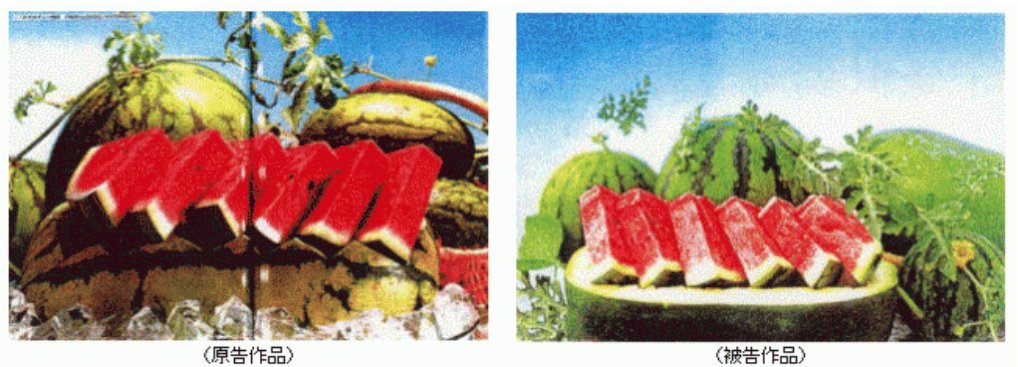
Watermelon photographs in the referenced case: plaintiff’s work (left); defendant’s work (right).
[Article/Unfair Competition Prevention Act] The Validity and Scope of Contracts Prohibiting the Use of Know-How after Leaving Employment (Takuto Hirasawa)
Original Ameblo publication: 2025-01-07
Ameblo: https://ameblo.jp/hideki-takaishi/entry-12881495720.html
HP: https://www.takaishihideki.com/single-post/ameblo-12881495720-en
Japanese version: https://www.takaishihideki.com/single-post/ameblo-12881495720-ja
[Article/Unfair Competition Prevention Act] The Validity and Scope of Contracts Prohibiting the Use of Know-How after Leaving Employment (Takuto Hirasawa, Intellectual Property Law and Policy Journal, Vol. 31 (2010))
Osaka High Court, 2009 (Ne) 1456: the rights holder lost on reversal.
⇒ Of the appellee’s technologies, the portions used by the appellants “include, to a substantial extent, existing technologies or technologies that a practitioner of eyebrow beauty treatments could readily acquire or master, and the appellee cannot secure exclusive rights in those portions alone.”
To the same effect: Tokyo District Court, 2006 (Wa) 15404.
“It is appropriate to construe the noncompetition agreement at issue as prohibiting only business conducted using confidential business information held by the plaintiff. Business conducted using knowledge, experience and the like concerning routine, general operations acquired by the defendant while working for the plaintiff, or using knowledge, experience and the like held by the defendant before the contract at issue, is not subject to the noncompetition obligation.”
The article also introduces numerous other court decisions and considers the limits of post-employment noncompetition obligations. For example, one decision limited the period for which an injunction based on a noncompetition obligation could be granted to two years (Tokyo District Court, 2006 (Wa) 22955, the “Total Service” case).
https://eprints.lib.hokudai.ac.jp/dspace/bitstream/2115/44347/1/IPLPJ31_009.pdf
IP High Court, 2022 (Ne) 10113 [Compression Supporter] <Miyasaka>
Original Ameblo publication: 2025-01-08
Ameblo: https://ameblo.jp/hideki-takaishi/entry-12881658443.html
HP: https://www.takaishihideki.com/single-post/ameblo-12881658443-en
Japanese version: https://www.takaishihideki.com/single-post/ameblo-12881658443-ja
2022 (Ne) 10113 [Compression Supporter] <Miyasaka>
The synthetic “resin” in claim element C does not literally encompass “synthetic fiber.”
⇒ Doctrine of equivalents also rejected.
“Claim element C is a part directly linked to the functions and effects of the invention at issue and is included in its essential part … because claim element C is not satisfied … the essential part is not present.”
https://www.courts.go.jp/assets/hanrei/hanrei-pdf-92458.pdf
[Commercial Code/Copyright] IP High Court, 2023 (Ne) 10060 <Hibiku Shimizu>
Original Ameblo publication: 2025-01-09
Ameblo: https://ameblo.jp/hideki-takaishi/entry-12881740000.html
HP: https://www.takaishihideki.com/single-post/ameblo-12881740000-en
Japanese version: https://www.takaishihideki.com/single-post/ameblo-12881740000-ja
[Commercial Code/Copyright] 2023 (Ne) 10060 <Hibiku Shimizu>
Publishing-contract negotiations broke down ⇒ A claim for remuneration under Article 512 of the Commercial Code was allowed for work performed by the publisher.
Based on the manuscript revised by the plaintiff (the heir), the publisher proofread it while hearing the plaintiff’s views and prepared a final printing manuscript formatted to a publishable state once printed.
*Commercial Code, Article 512: “When a merchant performs an act for another person within the scope of its business, the merchant may claim reasonable remuneration.”
https://www.courts.go.jp/assets/hanrei/hanrei-pdf-92644.pdf
[Trademark] IP High Court, 2014 (Gyo-Ke) 10067, “Nationwide Common Meal Voucher” Case <Shitara>
Original Ameblo publication: 2025-01-10
Ameblo: https://ameblo.jp/hideki-takaishi/entry-12881865738.html
HP: https://www.takaishihideki.com/single-post/ameblo-12881865738-en
Japanese version: https://www.takaishihideki.com/single-post/ameblo-12881865738-ja
[Trademark] 2014 (Gyo-Ke) 10067, “Nationwide Common Meal Voucher” Case <Shitara>
The designated service, “issuance of meal vouchers” … issuance of meal vouchers usable nationwide even at nonparticipating establishments … is practically inconceivable …. The indication “Nationwide Common Meal Voucher” does not … cause misapprehension of the quality of the services.
⇒ No violation of Article 4(1)(xvi).
https://www.courts.go.jp/assets/hanrei/hanrei-pdf-84595.pdf
IP High Court, 2019 (Gyo-Ke) 10015 <Tsuruoka> — A disclaimer claim held to add new matter!!
Original Ameblo publication: 2025-01-11
Ameblo: https://ameblo.jp/hideki-takaishi/entry-12882062461.html
HP: https://www.takaishihideki.com/single-post/ameblo-12882062461-en
Japanese version: https://www.takaishihideki.com/single-post/ameblo-12882062461-ja
2019 (Gyo-Ke) 10015 <Tsuruoka>
*A “disclaimer claim” was held to add new matter!!
From the specification’s … descriptions … one cannot discern a correlation between heat-treatment time and bringing the zero-crossing time closer to zero seconds while suppressing whisker growth … less than 2.30 seconds … is not … self-evident.
[Claim 3] … A tab terminal for an electrolytic capacitor, comprising … in the welded portion between the lead wire and said aluminum core wire (excluding, however, tab terminals for electrolytic capacitors having a zero-crossing time of 2.50 seconds or more as measured in accordance with JIS C-0053, solderability testing method (wetting balance method)).
(Excerpt from the court’s reasoning)
…The specification … contains no express description of a tab terminal having a zero-crossing time of at least zero seconds and less than 2.30 seconds. …Because the specification does not disclose a correlation between heat-treatment time and bringing the zero-crossing time closer to zero seconds while suppressing whisker growth, …it is not self-evident … to suppress whisker generation while setting the zero-crossing time to at least zero seconds and less than 2.30 seconds.
https://www.courts.go.jp/assets/hanrei/hanrei-pdf-89038.pdf
[Article] The Limits of the Concepts of “Publicly” and “the Public” under Copyright Law: The Happy Science Prayer Scripture Case (Takuto Hirasawa, 2015)
Original Ameblo publication: 2025-01-13
Ameblo: https://ameblo.jp/hideki-takaishi/entry-12882328852.html
HP: https://www.takaishihideki.com/single-post/ameblo-12882328852-en
Japanese version: https://www.takaishihideki.com/single-post/ameblo-12882328852-ja
[Article] The Limits of the Concepts of “Publicly” and “the Public” under Copyright Law: The Happy Science Prayer Scripture Case (Takuto Hirasawa, Intellectual Property Law and Policy Journal, Vol. 46 (2015))
Right to prohibit recitation: “The author has the exclusive right to recite the author’s literary work publicly.” (Copyright Act, Article 24)
Copyright Act, Article 2(5): “the public” includes a large number of specified persons.
⇒ Cases often concern playing recordings of recitations of works, but this case (Tokyo District Court, 2012 (Wa) 24933) concerned the recitation itself.
The issue was whether the recitation to persons who visited the defendant after being introduced by E could be said to have been made “publicly.”
⇒ “Whether the use of the work is directed to the public should appropriately be determined in accordance with generally accepted social norms, taking into account not only the strength of preexisting personal ties but also the type and nature of the work, the manner of use, and other factors.”
• The court found that there were five or six people and held that this was not a “large number.”
• The court held that the persons were not “unspecified”: their number did not increase or decrease under arbitrary conditions; the money was not consideration for the prayers; and the readings occurred at most ten times, not regularly or continuously.
⇒ In conclusion, the “publicly” requirement was not satisfied.
*These factual findings also appear in the context of rejecting the plaintiff’s arguments, and their relevance to applying the “unspecified” criterion is unclear.
[Article] Whether Genuine Goods May Continue to Be Imported in Parallel After Assignment of Trademark Rights: The Converse Parallel Import Case (Yoshiyuki Tamura)
Original Ameblo publication: 2025-01-13
Ameblo: https://ameblo.jp/hideki-takaishi/entry-12882329007.html
HP: https://www.takaishihideki.com/single-post/ameblo-12882329007-en
Japanese version: https://www.takaishihideki.com/single-post/ameblo-12882329007-ja
[Article] Whether Genuine Goods May Continue to Be Imported in Parallel After Assignment of Trademark Rights: The Converse Parallel Import Case (Yoshiyuki Tamura, Intellectual Property Law and Policy Journal, Vol. 30 (2010))
⇒ IP High Court, 2009 (Ne) 10058 <Appeal>, and Tokyo District Court, 2006 (Wa) 26725 and 2007 (Wa) 15580: both found trademark infringement (neither the parallel-import defense nor the abuse-of-rights defense was established).
(1) The defendant was parallel-importing genuine goods of Converse, which held the U.S. trademark rights.
(2) Converse assigned its Japanese trademark rights to Itochu Corporation, which sued the defendant.
⇒ Because “identity of the trademark proprietors” and “quality control” were not satisfied, the Fred Perry parallel-import defense failed (as did the abuse-of-rights defense).
(3) Although the defendant had been parallel-importing genuine goods, the change of trademark owner turned this into trademark infringement!!
*In the Tokyo District Court’s December 7, 1984 [LACOSTE] case, the court recognized a common source by following a chain consisting of a capital relationship between the trademark owner and the licensor and a licensing relationship between the licensor and the overseas distributor.
⇒ The author’s view is that the Converse case, too, should still have been treated as noninfringing parallel imports of genuine goods, because Itochu had held 5% of the shares of the new Converse, and the brand was still recognized in Japan as that of the former trademark owner, Converse.
The Tokyo District Court’s January 18, 1999 [ellesse] case, by contrast, rejected parallel imports of genuine goods in circumstances where the Japanese and Korean trademark rights had originally belonged to one person, but only the Japanese rights were assigned, there was no capital relationship, and quality differed, making it difficult to regard them as one group.
https://lex.juris.hokudai.ac.jp/gcoe/journal/IP_vol30/30_9.pdf
[Article] Research on Estoppel concerning Chinese Patent Rights (JIPA’s 3rd International Affairs Committee, 1st Subcommittee, Intellectual Property Management, Vol. 74, No. 9, 2024)
Original Ameblo publication: 2025-01-14
Ameblo: https://ameblo.jp/hideki-takaishi/entry-12882385586.html
HP: https://www.takaishihideki.com/single-post/ameblo-12882385586-en
Japanese version: https://www.takaishihideki.com/single-post/ameblo-12882385586-ja
[Article] Research on Estoppel concerning Chinese Patent Rights (JIPA’s 3rd International Affairs Committee, 1st Subcommittee, Intellectual Property Management, Vol. 74, No. 9, 2024)
● Estoppel established
Supreme People’s Court, (2022) Zhi Min Zhong No. 905
Claim 2 lists alternatives together ⇒ One was added to claim 1.
● Estoppel not established
Supreme People’s Court, (2021) Zhi Min Zhong No. 712
Product invention: a manufacturing method was asserted in the written opinion, but it did not affect patentability.
Supreme People’s Court, (2020) Zhi Min Zhong No. 1593
Deletion of the claim term “substantially.”
Tokyo District Court, 1997 (Wa) 5741 [Toy Gun with Automatic Bullet-Feeding Mechanism] <Mimura>
Original Ameblo publication: 2025-01-15
Ameblo: https://ameblo.jp/hideki-takaishi/entry-12882551685.html
HP: https://www.takaishihideki.com/single-post/ameblo-12882551685-en
Japanese version: https://www.takaishihideki.com/single-post/ameblo-12882551685-ja
Tokyo District Court, 1997 (Wa) 5741 [Toy Gun with Automatic Bullet-Feeding Mechanism] <Mimura>
(Damages)
*Expert accounting opinion
*Royalty-equivalent damages may be claimed against each infringing wholesaler, retailer or other distributor, subject to a limit on total recovery for the same product.
*In this case, the manufacturing company and the sales company within the same corporate group were jointly and severally liable.
“When goods pass through successive stages of distribution … damages may be claimed … against each person.”
Cf. 1999 (Wa) 12586
*Claims against infringers at multiple distribution stages do not permit double recovery for the same product.
https://www.courts.go.jp/assets/hanrei/hanrei-pdf-12681.pdf
[Trademark] Tokyo High Court, 2001 (Gyo-Ke) 363 <Nagai>
Original Ameblo publication: 2025-01-17
Ameblo: https://ameblo.jp/hideki-takaishi/entry-12882765471.html
HP: https://www.takaishihideki.com/single-post/ameblo-12882765471-en
Japanese version: https://www.takaishihideki.com/single-post/ameblo-12882765471-ja
[Trademark] Tokyo High Court, 2001 (Gyo-Ke) 363 <Nagai>
Mark at issue: “鳳凰” (Hōō, phoenix)
Cited mark: “宝桜” (capable of being pronounced “Hōō”; literally, “treasure” and “cherry blossoms”)
*At the filing date, the cited mark’s owner had been declared bankrupt and its dissolution registered.
⇒ “It was a trademark lacking any substantive goodwill to be protected that should be formed through use by a legitimate owner … nor was there … any possibility of confusion.”
⇒ Article 4(1)(xi) inapplicable.
https://www.courts.go.jp/assets/hanrei/hanrei-pdf-11969.pdf
[Trademark] IP High Court, 2010 (Gyo-Ke) 10171 <Nakano>
Original Ameblo publication: 2025-01-17
Ameblo: https://ameblo.jp/hideki-takaishi/entry-12882771948.html
HP: https://www.takaishihideki.com/single-post/ameblo-12882771948-en
Japanese version: https://www.takaishihideki.com/single-post/ameblo-12882771948-ja
[Trademark] 2010 (Gyo-Ke) 10171 <Nakano>
Applied-for mark: “BOOKING.COM” with figurative elements
Cited mark: “Book-ing” with figurative elements (pronounced “bukkingu”)
Appearance: considerably different
Pronunciation: generally shared
Concept: partially shared in the sense of “reservation”
Actual circumstances of trade: in a non-use cancellation trial requested after the original trial decision, the cited mark was found not to have been used.
⇒ Article 4(1)(xi): dissimilar

https://www.courts.go.jp/assets/hanrei/hanrei-pdf-80945.pdf
[Unfair Competition Prevention Act/Misleading Indications of Quality] Tokyo District Court, 2022 (Wa) 2551, “Food Waste Processor” Case <Kokubu>
Original Ameblo publication: 2025-01-18
Ameblo: https://ameblo.jp/hideki-takaishi/entry-12882961467.html
HP: https://www.takaishihideki.com/single-post/ameblo-12882961467-en
Japanese version: https://www.takaishihideki.com/single-post/ameblo-12882961467-ja
[Unfair Competition Prevention Act/Misleading Indications of Quality] Tokyo District Court, 2022 (Wa) 2551, “Food Waste Processor” Case <Kokubu>
*The stated sales performance differed from the facts.
⇒ Sales performance lends authority to goods as being of superior quality and gives consumers reassurance; the indication therefore misleads consumers as to quality.
⇒ No rebuttal of the damages amount calculated from marginal profit!!
https://www.courts.go.jp/assets/hanrei/hanrei-pdf-92506.pdf
[Trademark] IP High Court, 2010 (Gyo-Ke) 10101 — Mark at issue “Kitto, Sakura Saku yo” + a cherry-blossom-petal design
Original Ameblo publication: 2025-01-18
Ameblo: https://ameblo.jp/hideki-takaishi/entry-12882961744.html
HP: https://www.takaishihideki.com/single-post/ameblo-12882961744-en
Japanese version: https://www.takaishihideki.com/single-post/ameblo-12882961744-ja
[Trademark] 2010 (Gyo-Ke) 10101
Mark at issue: “Kitto, Sakura Saku yo” (Surely, the cherry blossoms will bloom for you) + a cherry-blossom-petal design
Cited mark: “Sakura Saku” (Cherry blossoms bloom)
Appearance: significantly different
Pronunciation: quite similar
Concept: the cited mark means “cherry blossoms bloom” or “passed an examination,” while the mark at issue conveys a message to examination candidates and the like; the concepts therefore differ to some degree.
⇒ Article 4(1)(xi): dissimilar
https://www.courts.go.jp/assets/hanrei/hanrei-pdf-80620.pdf

[Unfair Competition Prevention Act/Misleading Indications of Quality] IP High Court, 2023 (Ne) 10112, “Food Waste Processor” Appeal <Shoji>
Original Ameblo publication: 2025-01-19
Ameblo: https://ameblo.jp/hideki-takaishi/entry-12883037707.html
HP: https://www.takaishihideki.com/single-post/ameblo-12883037707-en
Japanese version: https://www.takaishihideki.com/single-post/ameblo-12883037707-ja
[Unfair Competition Prevention Act/Misleading Indications of Quality] 2023 (Ne) 10112, “Food Waste Processor” Appeal <Shoji>
Even if performance does not differ greatly from comparable goods, that does not mean that displaying sales figures higher than the actual figures is not a misleading indication of quality.
+Sales efforts also contributed, constituting grounds to rebut the presumption.
⇒ 50% rebuttal
https://www.courts.go.jp/assets/hanrei/hanrei-pdf-93284.pdf
[Unfair Competition Prevention Act/Misleading Indications of Quality] Tokyo District Court, 2018 (Wa) 3789, “Hagukumi Oligo” Case <Shibata>
Original Ameblo publication: 2025-01-20
Ameblo: https://ameblo.jp/hideki-takaishi/entry-12883134705.html
HP: https://www.takaishihideki.com/single-post/ameblo-12883134705-en
Japanese version: https://www.takaishihideki.com/single-post/ameblo-12883134705-ja
[Unfair Competition Prevention Act/Misleading Indications of Quality] Tokyo District Court, 2018 (Wa) 3789, “Hagukumi Oligo” Case <Shibata>
⇒ The advertising prominently featured characteristics other than the purity of the oligosaccharides.
— 97% of the statutory damages presumption rebutted
https://www.courts.go.jp/assets/hanrei/hanrei-pdf-90080.pdf
Appeal: 2021 (Ne) 10018 <Shoji>
⇒ Continued for four years and four months; direct competition
— 91% of the statutory damages presumption rebutted
https://www.courts.go.jp/assets/hanrei/hanrei-pdf-90899.pdf
[Unfair Competition Prevention Act, Article 2(1)(iii)/Imitation of Product Configuration] Tokyo District Court, 2019 (Wa) 11673 <Kokubu>
Original Ameblo publication: 2025-01-21
Ameblo: https://ameblo.jp/hideki-takaishi/entry-12883260957.html
HP: https://www.takaishihideki.com/single-post/ameblo-12883260957-en
Japanese version: https://www.takaishihideki.com/single-post/ameblo-12883260957-ja
[Unfair Competition Prevention Act, Article 2(1)(iii)/Imitation of Product Configuration] Tokyo District Court, 2019 (Wa) 11673 <Kokubu>
Difference (1): no approximately 2 cm ribbon at the center of the cup section
Difference (2): the lowest of the three pieces of fabric forming the left and right front panels is lace fabric
⇒ These are commonplace configurations, and the idea of replacing them cannot be said to be difficult to conceive.
⇒ Claim for over ¥200 million allowed
https://www.courts.go.jp/assets/hanrei/hanrei-pdf-90576.pdf
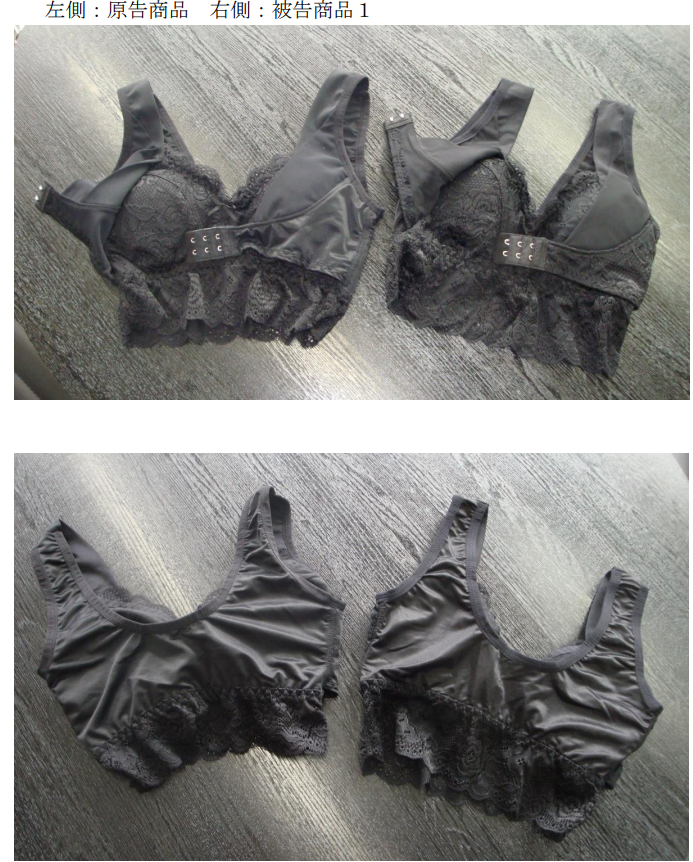
In both comparisons, the plaintiff’s product is on the left and Defendant’s Product 1 is on the right.
[Unfair Competition Prevention Act, Article 2(1)(iii)/Imitation of Product Configuration] Osaka District Court, 2021 (Wa) 4467 <Matsuami>
Original Ameblo publication: 2025-01-21
Ameblo: https://ameblo.jp/hideki-takaishi/entry-12883263884.html
HP: https://www.takaishihideki.com/single-post/ameblo-12883263884-en
Japanese version: https://www.takaishihideki.com/single-post/ameblo-12883263884-ja
[Unfair Competition Prevention Act, Article 2(1)(iii)/Imitation of Product Configuration] Osaka District Court, 2021 (Wa) 4467 <Matsuami>
“The differences … as to whether the hem of the yoke at the upper back is stitched down or is a floating yoke … and whether there is a notch between the collar and lapel … cause little change in the overall configuration of the product and are only minor differences when viewed in the context of the product as a whole.”
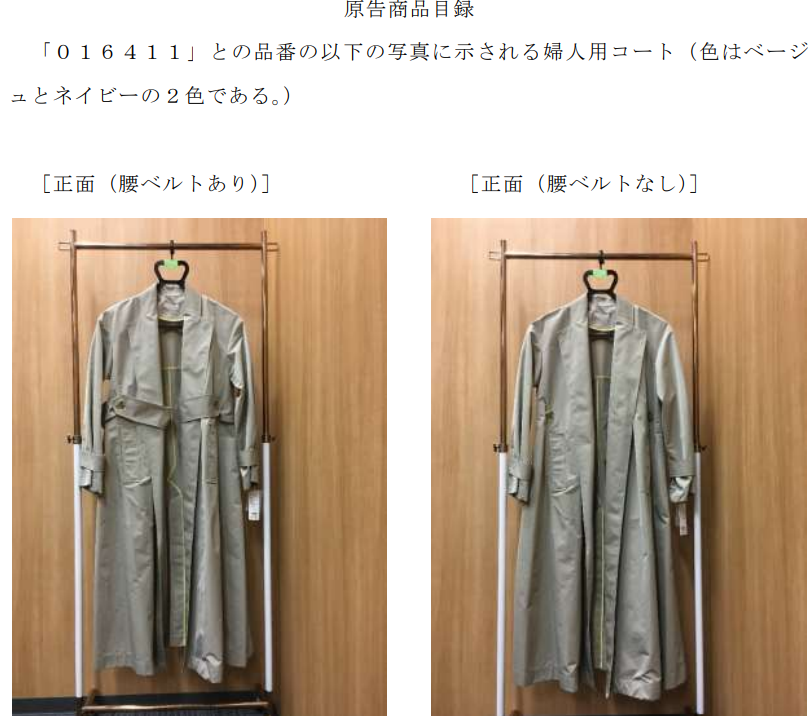
Plaintiff’s product: women’s coat, item no. 016411, available in beige and navy. Front views: with waist belt (left); without waist belt (right).
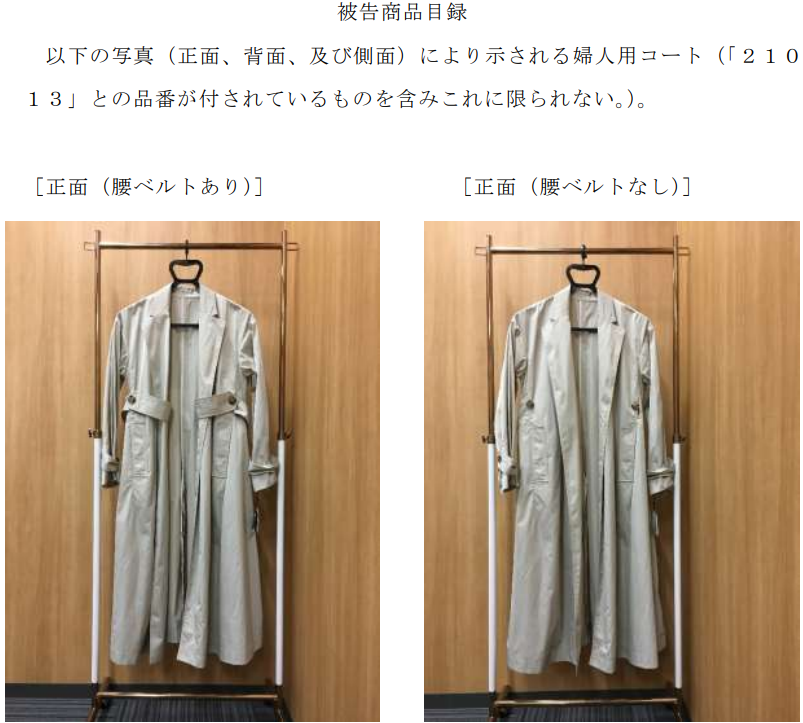
Defendant’s products: women’s coats shown in the photographs (front, back, and side views), including but not limited to products bearing item no. 21013. Front views shown here: with waist belt (left); without waist belt (right).
https://www.courts.go.jp/assets/hanrei/hanrei-pdf-91578.pdf
[Unfair Competition Prevention Act, Article 2(1)(iii)/Imitation of Product Configuration] Osaka District Court, 2022 (Wa) 6582
Original Ameblo publication: 2025-01-22
Ameblo: https://ameblo.jp/hideki-takaishi/entry-12883396626.html
HP: https://www.takaishihideki.com/single-post/ameblo-12883396626-en
Japanese version: https://www.takaishihideki.com/single-post/ameblo-12883396626-ja
[Unfair Competition Prevention Act, Article 2(1)(iii)/Imitation of Product Configuration] Osaka District Court, 2022 (Wa) 6582
Differences: “luster and texture” are also subjects of comparison when imitation of clothing configuration is at issue, and the difference in texture here is such that the garments are worn in different seasons.
⇒ This strongly affects the impression consumers receive of the product as a whole, so the products are not substantially identical.
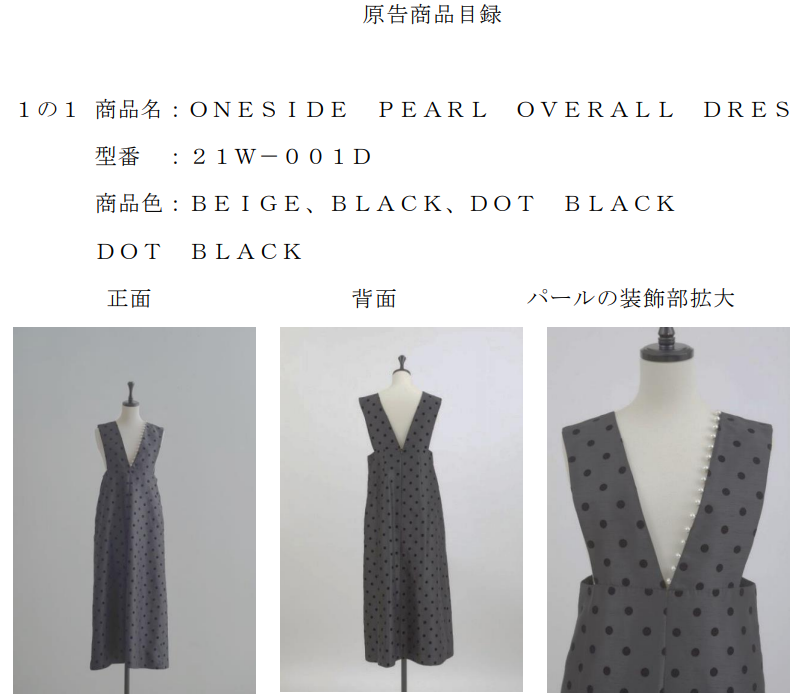
Plaintiff’s Product 1-1: model 21W-001D. Colors: BEIGE, BLACK, DOT BLACK. Shown in DOT BLACK: front (left), back (center), and enlarged pearl-decoration detail (right).
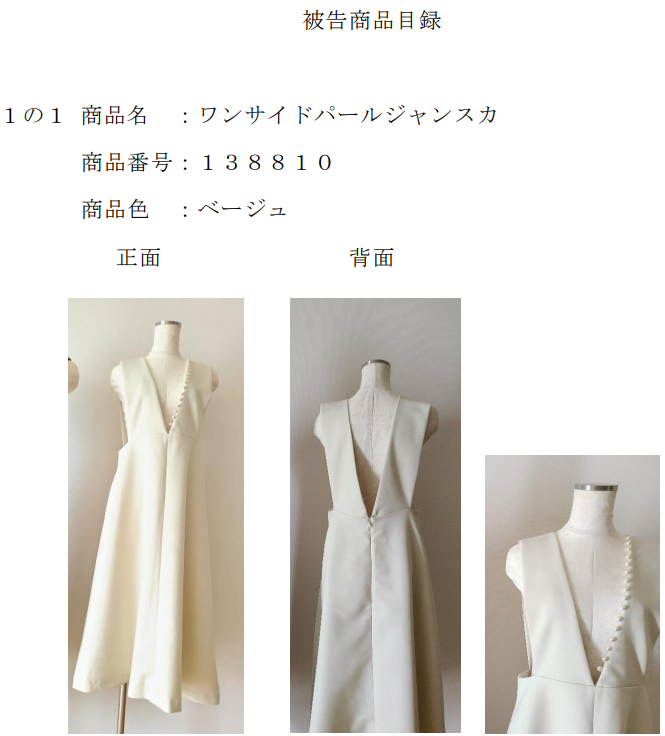
Defendant’s Product 1-1: One-Side Pearl Pinafore Dress (ワンサイドパールジャンスカ), item no. 138810, beige. Front view (left); back view (center); enlarged detail (right).
https://www.courts.go.jp/assets/hanrei/hanrei-pdf-92492.pdf
[Unfair Competition Prevention Act, Article 2(1)(iii)/Imitation of Product Configuration] Tokyo District Court, 2023 (Wa) 4333 <Shibata>
Original Ameblo publication: 2025-01-23
Ameblo: https://ameblo.jp/hideki-takaishi/entry-12883525179.html
HP: https://www.takaishihideki.com/single-post/ameblo-12883525179-en
Japanese version: https://www.takaishihideki.com/single-post/ameblo-12883525179-ja
[Unfair Competition Prevention Act, Article 2(1)(iii)/Imitation of Product Configuration] Tokyo District Court, 2023 (Wa) 4333 <Shibata>
The masks are distributed and purchased by consumers inside their packaging.
⇒ The entire package, together with the masks inside it, constitutes the “product,” and the packaging design constitutes the product’s “patterns and colors.”
⇒ The configurations are substantially identical!!
(However, the claim was dismissed because no causal relationship was found between the damages asserted by the plaintiff and sales of the defendant’s goods.)
https://www.courts.go.jp/assets/hanrei/hanrei-pdf-92679.pdf
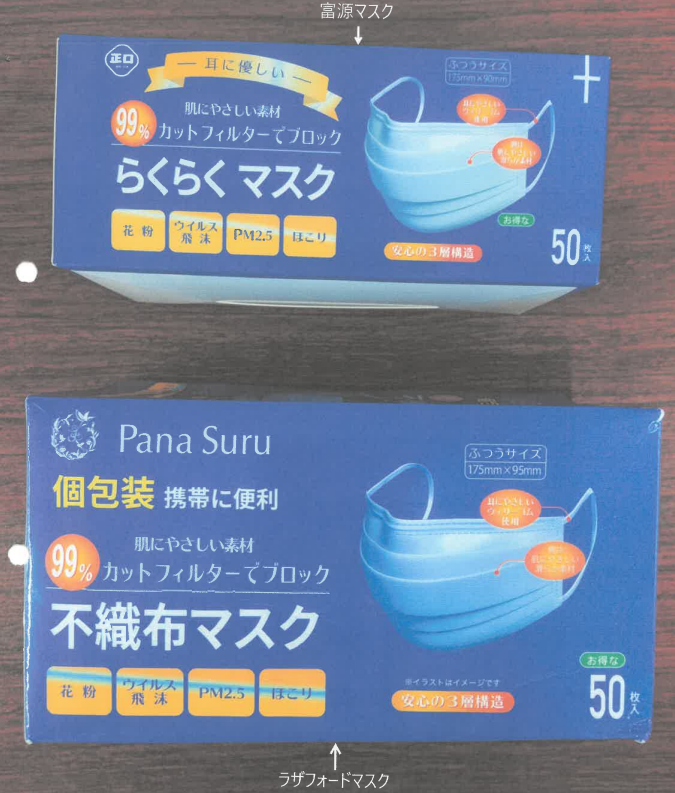
Comparison of mask packages: 富源 mask (top); ラザフォード mask (bottom).
[Unfair Competition Prevention Act, Article 2(1)(iii)/Imitation of Product Configuration] Osaka District Court, 2022 (Wa) 3577 <Matsuami>
Original Ameblo publication: 2025-01-24
Ameblo: https://ameblo.jp/hideki-takaishi/entry-12883664197.html
HP: https://www.takaishihideki.com/single-post/ameblo-12883664197-en
Japanese version: https://www.takaishihideki.com/single-post/ameblo-12883664197-ja
[Unfair Competition Prevention Act, Article 2(1)(iii)/Imitation of Product Configuration] Osaka District Court, 2022 (Wa) 3577 <Matsuami>
Although the products differ in whether they have a back pocket and in the number and placement of small pockets for storing cards and the like, these are all minor differences that do not affect consumers’ impression of the overall product configuration.
⇒ Substantially identical.
https://www.courts.go.jp/assets/hanrei/hanrei-pdf-92601.pdf
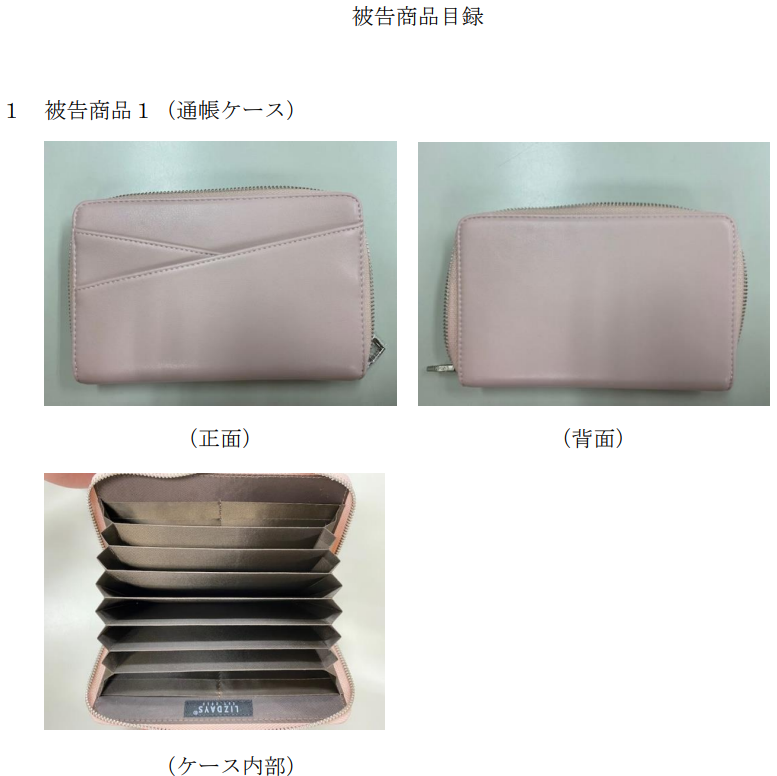
Defendant’s Product 1 (bankbook case): front (upper left), back (upper right), and interior (lower left).
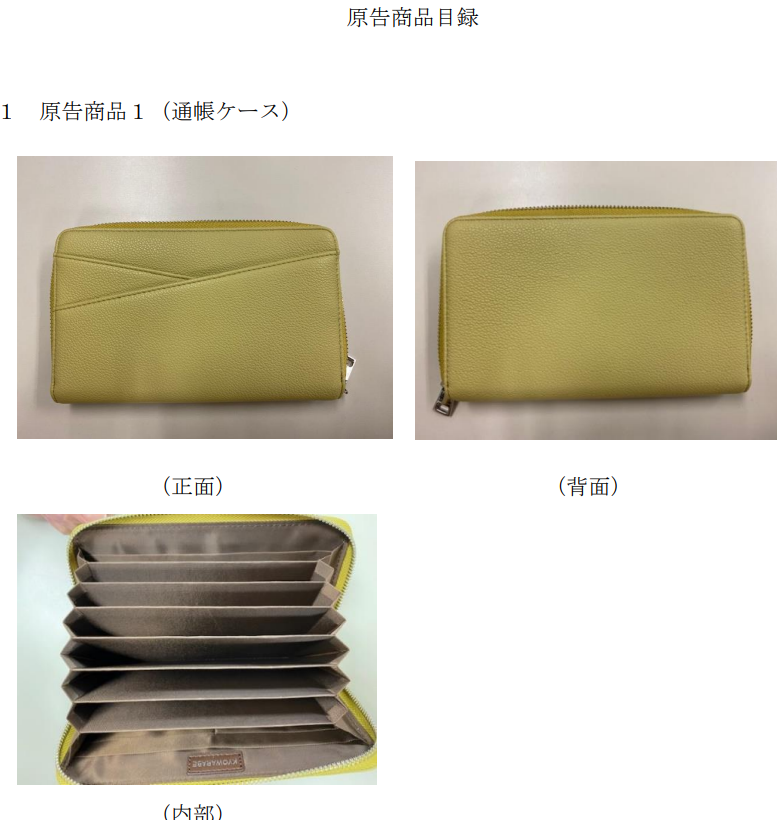
Plaintiff’s Product 1 (bankbook case): front (upper left), back (upper right), and interior (lower left).
[Unfair Competition Prevention Act/Misleading Indications of Quality] Osaka District Court, 2014 (Wa) 12570 <Morisaki>
Original Ameblo publication: 2025-01-26
Ameblo: https://ameblo.jp/hideki-takaishi/entry-12883975466.html
HP: https://www.takaishihideki.com/single-post/ameblo-12883975466-en
Japanese version: https://www.takaishihideki.com/single-post/ameblo-12883975466-ja
[Unfair Competition Prevention Act/Misleading Indications of Quality] Osaka District Court, 2014 (Wa) 12570 <Morisaki>
“Designated toner” is understood as … being used in the plaintiff’s printers …. …In actual practice, genuine and nongenuine products are treated as differing … in quality.
⇒ The expression is understood to indicate … a certain appropriate quality and content.
⇒ It is an indication of “quality and content.”
https://www.courts.go.jp/assets/hanrei/hanrei-pdf-86620.pdf
IP High Court, 2024 (Ra) 10003, “Immediate Appeal against a Decision Dismissing an Application to Restrict Inspection and the Like”
Original Ameblo publication: 2025-01-27
Ameblo: https://ameblo.jp/hideki-takaishi/entry-12884026265.html
HP: https://www.takaishihideki.com/single-post/ameblo-12884026265-en
Japanese version: https://www.takaishihideki.com/single-post/ameblo-12884026265-ja
2024 (Ra) 10003, “Immediate Appeal against a Decision Dismissing an Application to Restrict Inspection and the Like”
“[The party] expresses the view that even if a nondisclosure clause existed, a request by a third party to inspect the records could not … be refused …. However, an application to restrict inspection and the like was made promptly after the settlement was concluded, and there is … no fact showing that inspection or the like actually occurred …. The argument cannot be accepted.”
⇒ If the records are inspected, an application to restrict inspection and the like may fail!!
Anticipating inspection by third parties, a party needing to protect confidential information should promptly apply to restrict inspection and confirm with the court how the records will be handled after the application.
https://www.courts.go.jp/assets/hanrei/hanrei-pdf-93381.pdf
[Article/Patents] What Does “So as to Enable Use” in the Enablement Requirement Mean? (Atsushi Nagano, Intellectual Property Management, 2024)
Original Ameblo publication: 2025-01-27
Ameblo: https://ameblo.jp/hideki-takaishi/entry-12884026476.html
HP: https://www.takaishihideki.com/single-post/ameblo-12884026476-en
Japanese version: https://www.takaishihideki.com/single-post/ameblo-12884026476-ja
[Article/Patents] What Does “So as to Enable Use” in the Enablement Requirement Mean? (Atsushi Nagano, Intellectual Property Management, Vol. 74, No. 11, 2024)
Court decisions are divided on whether “so as to enable use” under the enablement requirement should be construed to mean enabling use in a manner that solves the problem addressed by the invention.
Example 11 in the Examination Handbook adopts the view that the functions and effects need not be achieved.
Looking at decisions from 2010 through 2024, 27 adopt the view that functions and effects are not required, while 15 require them.
*However, many decisions adopting the view that functions and effects are required ultimately found the enablement requirement satisfied, and some decisions adopting the view that functions and effects are not required found a violation of the support requirement. Thus, this issue was decisive to the ultimate patentability outcome in relatively few cases.
https://www.fukamipat.gr.jp/wp/wp-content/uploads/2024/12/202411_chizaikanri.pdf
IP High Court, 2023 (Gyo-Ke) 10107 [Induction Heating Coil Unit] <Hibiku Shimizu>
Original Ameblo publication: 2025-01-28
Ameblo: https://ameblo.jp/hideki-takaishi/entry-12884147129.html
HP: https://www.takaishihideki.com/single-post/ameblo-12884147129-en
Japanese version: https://www.takaishihideki.com/single-post/ameblo-12884147129-ja
2023 (Gyo-Ke) 10107 [Induction Heating Coil Unit] <Hibiku Shimizu>
“From the principle of induction heating … electrically insulating nonmagnetic materials … have the property of allowing magnetic flux to pass through them … and it was well known that ceramics and resins were such materials …. …Selecting … well-known ceramics or resins as electrically insulating nonmagnetic materials … that allow magnetic flux to pass through … could readily have been conceived.”
The patentee also argued, in identifying the gist of the invention, that the entire case consisted of electrically insulating ceramic or resin, but that argument was rejected. (This point could presumably have been addressed by correction.)
https://www.courts.go.jp/assets/hanrei/hanrei-pdf-93344.pdf
[Trademark] IP High Court, 2024 (Gyo-Ke) 10030, “Remote Champagne” <Hibiku Shimizu>
Original Ameblo publication: 2025-01-29
Ameblo: https://ameblo.jp/hideki-takaishi/entry-12884272998.html
HP: https://www.takaishihideki.com/single-post/ameblo-12884272998-en
Japanese version: https://www.takaishihideki.com/single-post/ameblo-12884272998-ja
[Trademark] 2024 (Gyo-Ke) 10030, “Remote Champagne” <Hibiku Shimizu>
The applicant argues that the term means sending champagne or similar gifts without actually visiting the establishment. But that meaning is not generally recognized, and it remains the case that the term presupposes the famous “Champagne” and uses that name.
⇒ Violation of Article 4(1)(vii)
https://www.courts.go.jp/assets/hanrei/hanrei-pdf-93339.pdf
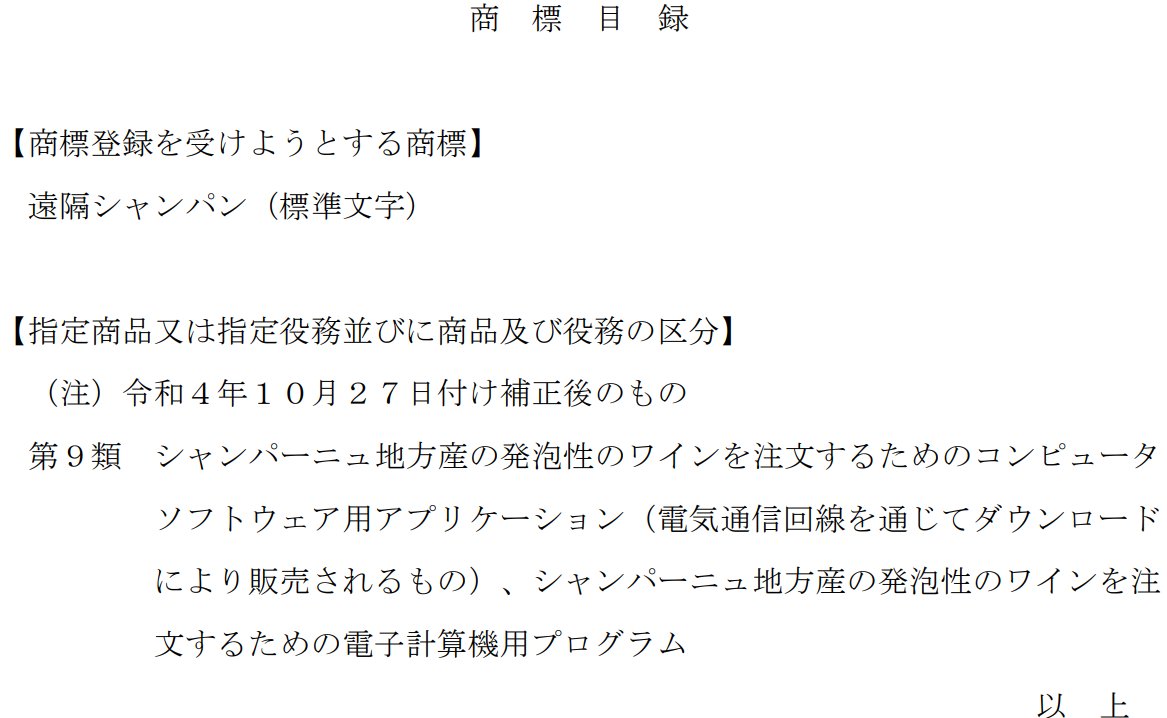
Applied-for mark: 遠隔シャンパン (‘Remote Champagne’), in standard characters. Designated goods, as amended on October 27, 2022 — Class 9: computer software applications for ordering sparkling wine produced in the Champagne region, sold by download via telecommunications lines; computer programs for ordering sparkling wine produced in the Champagne region.
IP High Court, 2023 (Gyo-Ke) 10124 [Moving Image Decoding Device] <Miyasaka>
Original Ameblo publication: 2025-01-30
Ameblo: https://ameblo.jp/hideki-takaishi/entry-12884413992.html
HP: https://www.takaishihideki.com/single-post/ameblo-12884413992-en
Japanese version: https://www.takaishihideki.com/single-post/ameblo-12884413992-ja
2023 (Gyo-Ke) 10124 [Moving Image Decoding Device] <Miyasaka>
None of the “change flag,” “threshold Th” or “maximum number of vectors” in the specification constitutes “control information for changing the number of motion vector candidates” … and the amendment was not made within the scope of the matters disclosed in the specification and other documents.
⇒ Addition of new matter
https://www.courts.go.jp/assets/hanrei/hanrei-pdf-93350.pdf
[Tort/Damage to Business Reputation] IP High Court, 2024 (Ne) 10014 <Honda>
Original Ameblo publication: 2025-01-31
Ameblo: https://ameblo.jp/hideki-takaishi/entry-12884544939.html
HP: https://www.takaishihideki.com/single-post/ameblo-12884544939-en
Japanese version: https://www.takaishihideki.com/single-post/ameblo-12884544939-ja
[Tort/Damage to Business Reputation] 2024 (Ne) 10014 <Honda>
*Posts on the business-matching site Lancers are consulted as a reference for matters such as what work someone does, so they concern matters of public interest and serve a public-interest purpose.
+The material portions were true.
+They did not exceed the bounds of opinion or commentary.
⇒ The first-instance award of ¥500,000 was overturned!!
https://www.courts.go.jp/assets/hanrei/hanrei-pdf-93320.pdf
[U.S.] November 2023, CAFC, Actelion v. Mylan, 85 F.4th 1167
Original Ameblo publication: 2025-02-04
Ameblo: https://ameblo.jp/hideki-takaishi/entry-12885080409.html
HP: https://www.takaishihideki.com/single-post/ameblo-12885080409-en
Japanese version: https://www.takaishihideki.com/single-post/ameblo-12885080409-ja
[U.S.] November 2023, CAFC, Actelion v. Mylan, 85 F.4th 1167
The issue was construction of “a pH of 13 or higher.”
“A pH greater than 11” had been narrowed to secure nonobviousness.
Original judgment: “pH 13” encompasses 12.5–13.4.
This judgment: the prosecution history merely distinguished pH 12; extrinsic evidence is important.
⇒ On remand, the federal district court (1:20-cv-110, D.I. 239) construed the term as “a pH of 12.98 or higher” and found the limitation not satisfied.
IP High Court, 2023 (Gyo-Ke) 10053 [Pellicle Film] <Miyasaka>
Original Ameblo publication: 2025-02-04
Ameblo: https://ameblo.jp/hideki-takaishi/entry-12885143547.html
HP: https://www.takaishihideki.com/single-post/ameblo-12885143547-en
Japanese version: https://www.takaishihideki.com/single-post/ameblo-12885143547-ja
2023 (Gyo-Ke) 10053 [Pellicle Film] <Miyasaka>
*Rough arguments that the cited reference necessarily satisfies the condition, or that it would ordinarily do so, were rejected.
“Merely because the cited invention … has in-plane orientation … does not justify finding that it necessarily satisfies the RB-at-least-0.4 limitation …. Nor are there specific allegations or evidence identifying … the ordinary conception ….”
⇒ Inventive step: satisfied
(Excerpt from the court’s reasoning)
The mere fact that the CNT bundles of Cited Invention 1 have in-plane orientation does not justify finding that they necessarily satisfy the RB-at-least-0.4 limitation. …There are no allegations or evidence specifically identifying the method of manufacturing the thin-film free-standing disordered SWCNT sheet that the defendant says was “manufactured based on an ordinary conception, using SWCNTs having ordinary properties and an ordinarily used process,” or the “film thickness, bundle diameter and self-supporting properties” of that sheet. Accordingly, the nature of the “thin-film free-standing disordered SWCNT sheet considerably more similar to Example 1 than to Comparative Example 1” is also unclear …. On the contrary, …the CNT free-standing films … prepared by the plaintiffs using the method described in Cited Reference 2 had RB values of −0.38 and −0.26 respectively, whereas the CNT free-standing film manufactured when the invention at issue was completed had a value of 1.04. It therefore cannot be said that a thin-film free-standing disordered SWCNT sheet necessarily satisfies the RB-at-least-0.4 limitation.
https://www.courts.go.jp/assets/hanrei/hanrei-pdf-93155.pdf
IP High Court, 2023 (Gyo-Ke) 10104 [Electrical Devices, Mechanical Devices, Computer Devices, and/or Other Devices Formed from Very Low Resistance Materials] <Hibiku Shimizu>
Original Ameblo publication: 2025-02-04
Ameblo: https://ameblo.jp/hideki-takaishi/entry-12885143688.html
HP: https://www.takaishihideki.com/single-post/ameblo-12885143688-en
Japanese version: https://www.takaishihideki.com/single-post/ameblo-12885143688-ja
2023 (Gyo-Ke) 10104 [Electrical Devices, Mechanical Devices, Computer Devices, and/or Other Devices Formed from Very Low Resistance Materials] <Hibiku Shimizu>
To satisfy the enablement requirement, the specification and other documents must describe that
1) both ELR conductors are in a superconducting state,
and
2) a tunneling current flows through the barrier material.
Such descriptions are necessary!!
⇒ No test results in the specification
⇒ The effect may be something other than superconductivity.
⇒ Enablement requirement: not satisfied
https://www.courts.go.jp/assets/hanrei/hanrei-pdf-93330.pdf
Osaka District Court, 2022 (Wa) 9112 and 11173 [Leak-Prevention Sealing Material] <Matsuami>
Original Ameblo publication: 2025-02-04
Ameblo: https://ameblo.jp/hideki-takaishi/entry-12885143862.html
HP: https://www.takaishihideki.com/single-post/ameblo-12885143862-en
Japanese version: https://www.takaishihideki.com/single-post/ameblo-12885143862-ja
Osaka District Court, 2022 (Wa) 9112 and 11173 [Leak-Prevention Sealing Material] <Matsuami>
*The parameter/numerical value cannot be identified from the accused product. ⇒ Limitation not satisfied
The yarn cross sections reported from the image analysis are irregular and lack a circular or nearly circular shape, and it is difficult to identify anything that could be called a “diameter” from those images. …Satisfaction of claim element 1C cannot be said to have been proved ….
⇒ Limitation not satisfied
(Excerpts from the court’s reasoning)
The plaintiff’s … measurement involved dripping adhesive onto the sealing material of the defendant’s product and allowing it to penetrate; after drying, fixing it with masking tape; placing a metal ruler against the sealing material perpendicular to the alignment direction of the pile yarns; cutting it with a single slice of a razor blade used as a cutting jig along the ruler; imaging the cross section; and analyzing the image to determine the cross-sectional areas of the weft and pile yarns. …
However, …claim element 1C concerns the relative sizes of the yarn “diameters.” Using cross-sectional area to compare yarn thickness is contrary to the unambiguous meaning of the wording and is also inconsistent with the common general technical knowledge of a person skilled in the art discussed above …. …Moreover, looking at the specific measurement means as well, the measurement is performed after processing and destroying the defendant’s product, and thus differs in its premise even from what the plaintiff itself calls “measurement in the product state” …. In addition, the cutting method does not guarantee an accurately perpendicular cut relative to the fiber direction, and appears to take no account of changes in cross-sectional area arising from differences in cutting angle or location, raising doubts about control of measurement conditions. In the image analysis as well, it can be seen that the “cross-sectional area” may differ depending on how the outline of the yarn (and its constituent fibers) is identified, whether voids are included, and other factors. …It must therefore be said that neither the image-creation process nor the image analysis ensures accurate and reasonable measurement. Further, the yarn cross sections reported from the image analysis (outlines including voids) are irregular and lack a circular or nearly circular shape, and it is difficult to identify anything that could be called a “diameter” from those images. Accordingly, …satisfaction of claim element 1C cannot be said to have been proved ….
https://www.courts.go.jp/assets/hanrei/hanrei-pdf-93329.pdf
[U.S.] December 2021, CAFC, AstraZeneca v. Mylan
Original Ameblo publication: 2025-02-05
Ameblo: https://ameblo.jp/hideki-takaishi/entry-12885213270.html
[U.S.] December 2021, CAFC, AstraZeneca v. Mylan
*Construction of the claim term “0.001% w/w”: the original judgment construed it as expressed to one significant figure (0.0005%–0.0014%).
⇒ Limitation satisfied
This judgment construed it as “0.00095%–0.00104%,” citing, among other reasons, the prosecution history of narrowing “about 0.0005 to about 0.05% w/w” to “0.001%” and deleting “about.”
⇒ The infringement judgment was vacated and the case remanded. The appellate court did not finally determine noninfringement.
IP High Court, 2023 (Gyo-Ke) 10110 [Intraoral OCT with Color Texture (Method)] <Honda>
Original Ameblo publication: 2025-02-06
Ameblo: https://ameblo.jp/hideki-takaishi/entry-12885338026.html
2023 (Gyo-Ke) 10110 [Intraoral OCT with Color Texture (Method)] <Honda>
Because either “with registration or without registration” is necessarily satisfied, the matters defining the claimed invention do not substantially change depending on whether that claim element is present.
*Accused infringers should consider invalidity arguments on the assumption that the claims will be narrowed to the configuration/process of their own products!!
https://www.courts.go.jp/assets/hanrei/hanrei-pdf-93166.pdf
Osaka District Court, 2021 (Wa) 1720 [Battery] <Matsuami> — (Damages) Refusal to produce documents under a document production order
Original Ameblo publication: 2025-02-07
Ameblo: https://ameblo.jp/hideki-takaishi/entry-12885462031.html
Osaka District Court, 2021 (Wa) 1720 [Battery] <Matsuami>
(Damages)
The defendant refused to produce documents pursuant to a document production order.
⇒ This corresponds to the risk, when granting a license, that the patentee cannot ascertain the licensee’s accurate sales volumes, profits and the like, and is a factor to be considered in calculating (increasing) the royalty.
https://www.courts.go.jp/assets/hanrei/hanrei-pdf-93058.pdf
IP High Court, 2023 (Ne) 10101 [Lighting Device] <Shoji>
Original Ameblo publication: 2025-02-09
Ameblo: https://ameblo.jp/hideki-takaishi/entry-12885745547.html
2023 (Ne) 10101 [Lighting Device] <Shoji>
“[The patentee] argues that the essential part is changing color temperature according to the degree of wakefulness while keeping illuminance substantially constant. However, …the patented invention’s contribution cannot be regarded as large compared with the prior art, so …it cannot be generalized to a broader concept ….”
⇒ First requirement of the doctrine of equivalents: not satisfied
https://www.courts.go.jp/assets/hanrei/hanrei-pdf-93282.pdf
[Unfair Competition] Tokyo District Court, 2022 (Wa) 19400, NHK v. an Individual — “Smash NHK!”
Original Ameblo publication: 2025-02-09
Ameblo: https://ameblo.jp/hideki-takaishi/entry-12885745697.html
[Unfair Competition] 2022 (Wa) 19400, NHK v. an Individual
“Smash NHK!” Along with that slogan, the individual stated that the information at issue would be disseminated unless a meeting with NHK’s president took place.
⇒ Intent to publicize the leak of NHK’s trade secrets and damage confidence in its trade-secret management system
+The full ¥550,000 in attorney fees for the provisional injunction was awarded!!
https://www.courts.go.jp/assets/hanrei/hanrei-pdf-93076.pdf
[Unfair Competition Prevention Act] Tokyo District Court, 2021 (Wa) 29242 <Kokubu> — “teamLab”
Original Ameblo publication: 2025-02-10
Ameblo: https://ameblo.jp/hideki-takaishi/entry-12885852447.html
[Unfair Competition Prevention Act] 2021 (Wa) 29242 <Kokubu>
Although the indication qualified as a famous indication of goods or business by the time relevant to the judgment, it became famous no earlier than around July 2021, approximately three years after teamLab Borderless and teamLab Planets opened.
+The defendant had been using its indications and the like before then.
⇒ Plaintiff lost
https://www.courts.go.jp/assets/hanrei/hanrei-pdf-93291.pdf
[Article] Use of Claim Charts in Obtaining and Utilizing Standard-Essential Patents (Kuniyuki Kajita, Intellectual Property Management, 2024)
Original Ameblo publication: 2025-02-11
Ameblo: https://ameblo.jp/hideki-takaishi/entry-12885969163.html
[Article] Use of Claim Charts in Obtaining and Utilizing Standard-Essential Patents (Kuniyuki Kajita, Intellectual Property Management, Vol. 74, No. 9, 2024)
Filing and obtaining SEP rights
Patent application ⇒ Standardization proposal ⇒ Adoption in the standard ⇒ Aligning the claims
Another company may make a new proposal based on your company’s proposal and file an application for it.
⇒ File in a timely manner before making the standardization proposal!!
Tokyo District Court, 2022 (Wa) 11921 [Side Ditch and Catch Basin] <Sugiura>
Original Ameblo publication: 2025-02-12
Ameblo: https://ameblo.jp/hideki-takaishi/entry-12886106866.html
Tokyo District Court, 2022 (Wa) 11921 [Side Ditch and Catch Basin] <Sugiura>
*At the March 2021 meeting, the plaintiff expressed the understanding that this was a contractual issue rather than patent infringement.
Considering the sequence of events, at that meeting the plaintiff gave Litag its consent to Litag’s licensing agreement with the defendant retroactively to the date the agreement was concluded.
https://www.courts.go.jp/assets/hanrei/hanrei-pdf-93295.pdf
IP High Court, 2023 (Gyo-Ke) 10098 [Laundry Detergent Composition] <Shoji>
Original Ameblo publication: 2025-02-13
Ameblo: https://ameblo.jp/hideki-takaishi/entry-12886230241.html
2023 (Gyo-Ke) 10098 [Laundry Detergent Composition] <Shoji>
*The component has low importance; the numerical range has no particular technical significance ⇒ A matter of design choice
“According to the specification, component (G), meaning a ‘surfactant other than component (A),’ was an optional component … and was not highly important.”
(Excerpt from the court’s reasoning)
…According to the specification, component (G), meaning a “surfactant other than component (A),” was an optional component and was not highly important. Moreover, as to G-2, G-2′ and G-3 included within component (G) specified in Invention 1, the examples using these components did not achieve superior deodorizing effects compared with the other examples in the deodorizing-effect evaluation at issue. Thus, specifying component (G) by general formula (I) or general formula (II) in Invention 1 is not found to have any particular technical significance. At least, examining the content of the nonionic surfactant (component (G)) within the content range of the invention in Exhibit Ko 1 and setting it at “20–25% by mass” is found to be a matter of design choice for a person skilled in the art.
https://www.courts.go.jp/assets/hanrei/hanrei-pdf-93047.pdf
Tokyo District Court, 2023 (Wa) 70114 [Brake Control Device] <Shibata>
Original Ameblo publication: 2025-02-15
Ameblo: https://ameblo.jp/hideki-takaishi/entry-12886554890.html
Tokyo District Court, 2023 (Wa) 70114 [Brake Control Device] <Shibata>
Although formula A in the specification can, at first glance, be understood as a calculation, it does not calculate the inclination angle constituting the problem addressed by the invention, and, in the first place, makes no physical sense.
+It cannot be understood that formula A is a typographical error for formula A′.
⇒ Support requirement: not satisfied
https://www.courts.go.jp/assets/hanrei/hanrei-pdf-92866.pdf
IP High Court, 2022 (Gyo-Ke) 10084 [Method for Treating Severe Heart Failure and Pharmaceutical Agent Therefor] <Honda>
Original Ameblo publication: 2025-02-18
Ameblo: https://ameblo.jp/hideki-takaishi/entry-12886898017.html
2022 (Gyo-Ke) 10084 [Method for Treating Severe Heart Failure and Pharmaceutical Agent Therefor] <Honda>
Although treatment methods differ between acute and chronic heart failure and between severe and mild-to-moderate cases, diuretics were widely used for treatment regardless of those distinctions.
A different mechanism of action and pharmacological effect from existing diuretics instead provides motivation.
https://www.courts.go.jp/assets/hanrei/hanrei-pdf-92879.pdf
IP High Court, 2023 (Gyo-Ke) 10086 [Skin-Stimulating Brush] <Miyasaka>
Original Ameblo publication: 2025-02-18
Ameblo: https://ameblo.jp/hideki-takaishi/entry-12886913373.html
2023 (Gyo-Ke) 10086 [Skin-Stimulating Brush] <Miyasaka>
*An inhibiting factor exists ⇒ Inventive step satisfied
“The invention in Exhibit Ko 1 … presupposes that the comb teeth extend and retract smoothly through contact of their bottom ends with the scalp. Configuring sliding sleeve 4 to bend in the radial direction … impedes smooth sliding.”
https://www.courts.go.jp/assets/hanrei/hanrei-pdf-93071.pdf
[Article/Copyright] Comprehensive Implied Consent to Modification and the Right of Integrity (Yukari Hira, Intellectual Property Law and Policy Journal, Vol. 53 (2019))
Original Ameblo publication: 2025-02-18
Ameblo: https://ameblo.jp/hideki-takaishi/entry-12886913483.html
[Article/Copyright] Comprehensive Implied Consent to Modification and the Right of Integrity (Yukari Hira, Intellectual Property Law and Policy Journal, Vol. 53, 2019)
Tokyo District Court, 2016 (Wa) 23604
⇒ Modifications were planned; no objection to modifications; express consent
⇒ Implied “comprehensive consent” recognized!
*Factors considered in the court decisions
Mention of modifications; modifications assumed; tacit acceptance
[Article/U.S.] Research on Exceptions to Infringement of U.S. Process Patents (JIPA’s 1st International Affairs Committee, Intellectual Property Management, Vol. 74, No. 8, 2024)
Original Ameblo publication: 2025-02-18
Ameblo: https://ameblo.jp/hideki-takaishi/entry-12886928183.html
[Article/U.S.] Research on Exceptions to Infringement of U.S. Process Patents (JIPA’s 1st International Affairs Committee, Intellectual Property Management, Vol. 74, No. 8, 2024)
35 U.S.C. § 271(g)
= Importing into the United States, without authority and during the patent term, a product made by a process patented in the United States constitutes patent infringement.
Exceptions: (1) materially changed by subsequent processes; (2) becomes a trivial and nonessential component of another product.
*Guidance on the “materially changed” exception under § 271(g)(1): the two-phase test
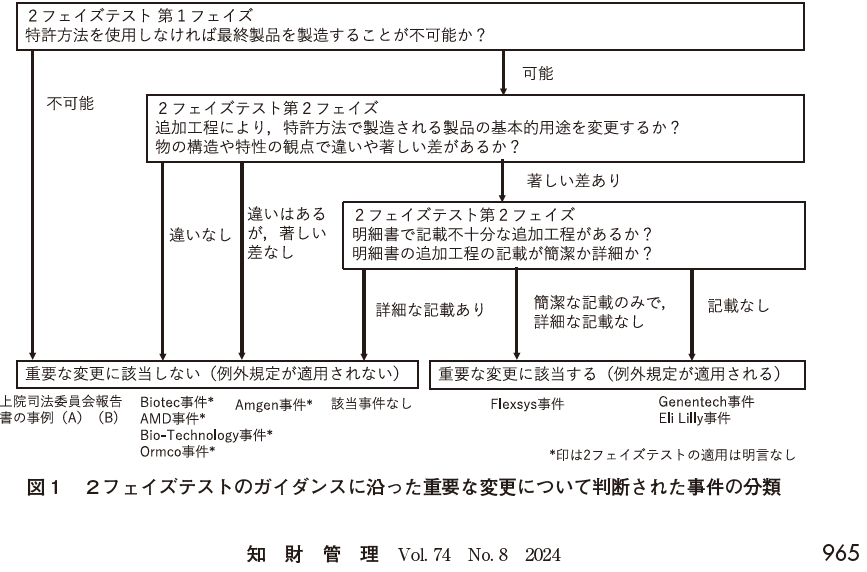
English translation of Figure 1 — Classification of Cases Under the Two-Phase Test for Material Change
The figure concerns the “materially changed by subsequent processes” exception in 35 U.S.C. § 271(g)(1).
Phase 1
Is it impossible to manufacture the final product without using the patented process? If manufacture is impossible, the result is “no material change,” and the exception does not apply. If manufacture is possible, proceed to Phase 2.
Phase 2
Does subsequent processing change the basic use of the product made by the patented process? Is there a difference, or a marked difference, in the product’s structure or properties?
If there is no difference, or there is a difference but it is not marked, the result is “no material change,” and the exception does not apply. If there is a marked difference, continue with the following questions in Phase 2.
Are any additional processing steps insufficiently described in the specification? Is the specification’s description of the additional processing steps brief or detailed?
|
Route in the figure |
Result under the material-change exception |
Examples and cases classified in the figure |
|---|---|---|
|
Phase 1: Manufacture without the patented process is impossible. |
No material change; the exception does not apply. |
Examples (A) and (B) in the Senate Judiciary Committee Report. |
|
Phase 2: No difference. |
No material change; the exception does not apply. |
Biotec*; AMD*; Bio-Technology*; Ormco*. |
|
Phase 2: There is a difference, but it is not marked. |
No material change; the exception does not apply. |
Amgen*. |
|
Phase 2: A marked difference; the additional processing steps are described in detail in the specification. |
No material change; the exception does not apply. |
No corresponding case. |
|
Phase 2: A marked difference; the specification provides only a brief description, with no detailed description. |
Material change; the exception applies. |
Flexsys. |
|
Phase 2: A marked difference; no description in the specification. |
Material change; the exception applies. |
Genentech; Eli Lilly. |
* The decision does not expressly state that the two-phase test was applied.
Figure 1: Classification of cases in which material change was assessed according to the guidance of the two-phase test. Source: 1st International Affairs Committee, “Research on Exceptions to Infringement of U.S. Process Patents,” Intellectual Property Management, Vol. 74, No. 8 (2024), p. 965.
IP High Court, 2023 (Gyo-Ke) 10016 [Wireless Scuff Plate] <Miyasaka>
Original Ameblo publication: 2025-02-19
Ameblo: https://ameblo.jp/hideki-takaishi/entry-12887008237.html
2023 (Gyo-Ke) 10016 [Wireless Scuff Plate] <Miyasaka>
“…Modifying the invention in Exhibit Ko 1 in this way changes the “Ko 1 battery housing configuration,” which is directly connected with solving the problem … so there is no motivation …. …Because there is no … bottom plate …, the abstract point of providing a battery cover from below … does not establish substitutability.”
⇒ Inventive step: satisfied
*Whether the invention has a new part that solves a problem compared with the prior art is not a matter to be considered in assessing the support requirement.
⇒ Support requirement: satisfied
https://www.courts.go.jp/assets/hanrei/hanrei-pdf-92607.pdf
[Copyright] IP High Court, 2022 (Ne) 10044 <Honda>
Original Ameblo publication: 2025-02-20
Ameblo: https://ameblo.jp/hideki-takaishi/entry-12887128482.html
[Copyright] 2022 (Ne) 10044 <Honda>
*A screenshot of another person’s social-media post was attached. ⇒ This constitutes a “quotation”!!
(1) Fair practice: satisfied (purpose of criticism + ensuring objectivity)
(2) Within the extent justified by the purpose of quotation: satisfied (capturing and sharing images is a commonly used method of sharing information)
https://www.courts.go.jp/assets/hanrei/hanrei-pdf-91494.pdf
Osaka District Court, 2022 (Wa) 2058 [Floor Opening Cover] <Takemiya> — Only the third requirement under the doctrine of equivalents was not satisfied!!
Original Ameblo publication: 2025-02-21
Ameblo: https://ameblo.jp/hideki-takaishi/entry-12887242987.html
Osaka District Court, 2022 (Wa) 2058 [Floor Opening Cover] <Takemiya>
*Only the third requirement of the doctrine of equivalents was rejected!! (Second requirement satisfied)
(Note) The court stated that, in view of the circumstances of the case, it would examine the second and third requirements (judgment, p. 12, line 16). It found the second requirement satisfied and the third requirement not satisfied, and did not decide the first, fourth or fifth requirements.
“There is no evidence … that would establish that a person skilled in the art could readily replace the ‘screw hole’ configuration of Invention 1 with the proposed configuration despite the resulting reduction in fastening strength …. Accordingly, the third requirement for infringement by equivalence cannot be recognized.”
(Excerpts from the court’s reasoning)
Invention 1 produces the functions and effects of preventing level differences and rattling by screwing screws into “screw holes” formed on the rear surface of the cover frame to secure the cover surface plate and cover base plate in close contact. In contrast, in the “cover (flooring specification),” a cover-frame assist screw is tightened into the space formed by combining the cover-frame assist-screw arcuate portion provided in the cover frame of Defendant Product 1 with the corresponding arcuate portion of the back cover, securing the back cover and flooring material in close contact and preventing level differences and rattling. In this respect it produces the same functions and effects as Invention 1, so the second requirement for infringement by equivalence is recognized.
On the other hand, it is understood to be common general technical knowledge that forming the space into which a screw is tightened from a single member achieves stronger screw fastening (fixing force) than forming it from multiple members. There is no sufficient evidence establishing that a person skilled in the art could readily replace the “screw hole” configuration of Invention 1 with the above configuration of Defendant Product 1, even though that replacement would be expected to reduce fastening strength. Accordingly, the third requirement for infringement by equivalence cannot be recognized.
https://www.courts.go.jp/assets/hanrei/hanrei-pdf-93073.pdf
[Copyrightability (of Photographs)] IP High Court, 2005 (Ne) 10094, “Smell Get Case/Appeal” <Tsukahara>
Original Ameblo publication: 2025-02-22
Ameblo: https://ameblo.jp/hideki-takaishi/entry-12887424323.html
[Copyrightability (of Photographs)] 2005 (Ne) 10094, “Smell Get Case/Appeal” <Tsukahara>
The photographs are copyrightable, but their degree of creativity is extremely low, close to a borderline case.
⇒ Nevertheless, the photographs were copied as they were and posted on the appellee’s website, constituting infringement of the reproduction right!!
*Similar to copyright in maps!?
https://www.courts.go.jp/assets/hanrei/hanrei-pdf-32817.pdf
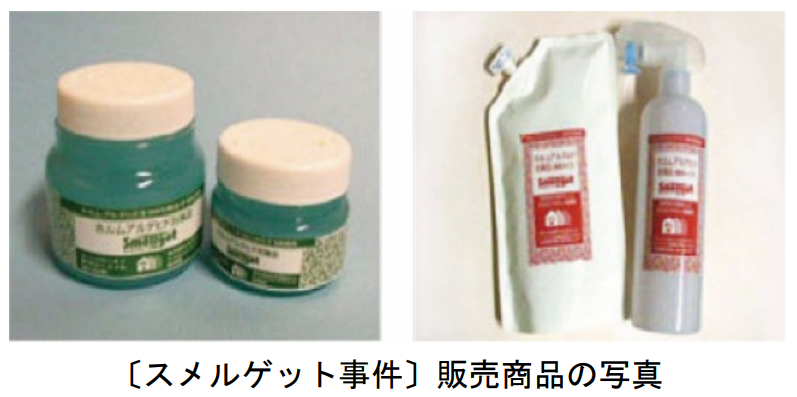
[Article/Copyright] A Case Rejecting Copyright Infringement by an Illustration Made with Reference to a Photograph (Bao Miaokun, 2021)
Original Ameblo publication: 2025-02-23
Ameblo: https://ameblo.jp/hideki-takaishi/entry-12887477528.html
[Article/Copyright] A Case Rejecting Copyright Infringement by an Illustration Made with Reference to a Photograph (Bao Miaokun, Intellectual Property Law and Policy Journal, Vol. 60 (2021))
It lacks the essential characteristics (relationship between the subject and light, combination of colors, contrast between the subject and background, etc.).
⇒ Not an adaptation
+Copyrightability of photographs: introduces numerous court decisions with photographs
[Editorial note: The original article image could not be retrieved.]
[Article] A Case Denying Business Preparations Where the Nature of the Business Had Not Been Determined (Ye Peng, 2022)
Original Ameblo publication: 2025-02-24
Ameblo: https://ameblo.jp/hideki-takaishi/entry-12887605177.html
[Article] A Case Denying Business Preparations Where the Nature of the Business Had Not Been Determined (Ye Peng, Intellectual Property Law and Policy Journal, Vol. 62 (2022))
Numerous decisions have rejected an “intent to practice immediately” where a prototype had been completed but was subsequently improved.
⇒ Some decisions have nevertheless recognized preparation for a business where improvements were made because of defective-product problems!!
https://eprints.lib.hokudai.ac.jp/dspace/bitstream/2115/84916/1/62_06.pdf
Osaka District Court, 1991 (Wa) 585 [Method of Manufacturing Anchors]
Original Ameblo publication: 2025-02-26
Ameblo: https://ameblo.jp/hideki-takaishi/entry-12887859081.html
Osaka District Court, 1991 (Wa) 585 [Method of Manufacturing Anchors]
*The contract was terminated because of defects in prototypes, but repeated improvements led to completion of Product Ha.
⇒ Preparation for a business: established
⇒ Prior-use right: established
“The defendant’s method differs in using an eccentric rotary press, but the patented invention … places no limitation on the tool used for caulking … within the same technical concept.”
——————————————–
Osaka District Court judgment of July 11, 1995 (1991 (Wa) No. 585, claim for an injunction against manufacture and sale based on patent rights, etc.)
Prior-use right recognized: yes
Subject: method of manufacturing anchors (patent right)
[Facts]
• April 1977: The defendant was established as a stock company for the purpose of designing, manufacturing and selling various anchors
and related activities.
• Around 1978–1979: As an anchor for foamed concrete, the defendant began manufacturing a type inserted into a drilled hole in foamed concrete,
whose leg portions at the tip spread like an umbrella when a nut is tightened
(trade name “Ever Catch”), and began selling it to Seiwa Shoji Co., Ltd. and others engaged in
selling and brokering industrial fasteners.
• Summer 1983: At the time, among anchors whose leg pieces expand when driven into foamed concrete,
the prevalent type consisted of two or three overlapping leg pieces welded together at their heads. However, their appearance
was not very good, so the defendant’s representative considered improvements. Referring to the generally practiced method of pressing metal parts to join them to other
parts, he conceived the idea of making an anchor by pressing the heads of leg pieces inserted into a ring.
To realize this structure,
he asked Kazutaka Yoshida, doing business as Yoshida Ironworks, to bundle three iron leg pieces and make an anchor by
crushing their heads under pressure. Shortly thereafter, Kazutaka Yoshida
bundled three iron leg pieces, interference-fitted a washer (ring) around them, removed the drill from a drill press
(a machine that drills holes in metal and other materials by rotating a drill and pressing down from above),
and replaced it with a head having a recess at its tip. While rotating that head, he pressed the projecting portions of the leg pieces,
plastically deforming them to join the leg pieces to each other and to the ring.
By this method (hereinafter the “prior-use method”), he realized the defendant’s representative’s idea
and taught it to him. Based on the prior-use method, the defendant ordered dies for the leg pieces from Sanei Ironworks Ltd.
and had subcontractors, including Yasuo Nii, who operated an ironworks, begin manufacturing anchors
(at this stage, Product Ni, with neither support projections nor bulging portions on the leg pieces).
• Second half of 1983: The defendant presented samples of anchors manufactured using the prior-use method to the above Seiwa Shoji Co., Ltd.
and solicited sales. After confirming that the samples were usable in practice,
Seiwa Shoji marketed them to Densan Kogyo Co., Ltd. (current trade name: JEFCOM Co., Ltd.).
Densan Kogyo confirmed their practical usability and decided to purchase them.
An agreement was reached between Seiwa Shoji and the defendant for Seiwa Shoji to purchase the anchors
from the defendant on a continuing basis.
• Around April 1984: To strengthen its production system, the defendant supplied Yoshio Toyoshima, doing business as Toyoshima Ironworks,
with a head, rings and leg pieces like those described above and asked him to process the anchors.
Yoshio Toyoshima accepted.
• April–September 1984: Yoshio Toyoshima processed a total of 2,215 anchors.
• Around May 1984: To finalize the product, Seiwa Shoji requested final manufacturing drawings from the defendant,
and the defendant submitted drawings.
• May 11, 1984: Yoshihiko Kusumi, the person in charge at Seiwa Shoji, approved the final drawings. Shortly thereafter,
Seiwa Shoji ordered 100,000 anchors in each of the three principal sizes,
300,000 in total, from the defendant, with delivery promised three months later. The defendant, however,
was unable to deliver by the deadline, so approximately one month to forty days after that deadline,
Seiwa Shoji terminated the anchor sales contract.
● Filing date: November 29, 1984
• Around the end of 1985: Because the above anchors lacked both bulging portions and support projections and had problems, the defendant made repeated improvements.
Ultimately, it decided to provide support projections on the leg pieces below the desired ring-fixing position,
and made recesses in the die for manufacturing leg pieces with bulging portions to form those support projections. However,
the recesses were placed incorrectly, so in the anchors manufactured with that die (Product I),
the ring was not fixed at the proper position. Another recess was therefore added at the correct position in the die,
forming support projections on the leg pieces where the ring should be fixed (Product Ha). As a result,
anchor manufacture proceeded smoothly, and the defendant began selling anchors on a full scale through Osaka Tohiuke Seisakusho.
Subsequently, the defendant made a new die
and began manufacturing and selling anchors with support projections at the proper ring-fixing position on the leg pieces
(Product Ro).
[Court’s reasoning]
“III. Issue 3 (Whether the defendant has a prior-use right in relation to the patent at issue)
1. According to the evidence (Exhibits Otsu 4, 6, 7-1 through 7-16, 8-1 through 8-5, 9 through 12, 15,
18-1 through 18-3, 19 through 24, and 26; witnesses Yoshihiko Kusumi, Kazutaka Yoshida and Yoshio Toyoshima;
and the defendant’s representative) and the entire purport of oral argument, the following facts are found.
(1) The defendant is a stock company established in April 1977 for the purpose of designing, manufacturing and selling various anchors and related activities.
From around 1978–1979, it manufactured anchors for foamed concrete that are inserted into a drilled hole in foamed concrete
and whose leg portions at the tip spread like an umbrella when a nut is tightened (trade name “Ever Catch”),
and sold them to Seiwa Shoji Co., Ltd. and others engaged in selling and brokering industrial fasteners.
In 1983, among anchors whose leg pieces expand when driven into foamed concrete,
the prevalent type consisted of two or three overlapping leg pieces welded together at their heads. Their appearance was not very good,
so the defendant’s representative was considering improvements. In the summer of that year, referring to the generally practiced method
of pressing metal parts to join them to other parts, he conceived the idea of making anchors
by pressing the heads of leg pieces inserted into a ring. To realize this idea, he asked Kazutaka Yoshida, doing business as Yoshida Ironworks,
to bundle three iron leg pieces and make an anchor by crushing their heads under pressure.
(2) Shortly thereafter, Kazutaka Yoshida bundled three iron leg pieces, interference-fitted a washer (ring) around them,
removed the drill from a drill press (a machine that drills holes in metal and other materials by rotating a drill and pressing down from above),
and replaced it with a head having a recess at its tip. While slowly rotating that head, he used it to press the projecting portions of the leg pieces,
plastically deforming those portions to join the leg pieces to each other and to the ring. By this method (hereinafter the “prior-use method”),
he realized the defendant’s representative’s idea and taught it to him. Based on the prior-use method, the defendant ordered leg-piece dies from Sanei Ironworks Ltd.
and had subcontractors, including Yasuo Nii, who operated an ironworks, begin manufacturing anchors.
(3) In the second half of 1983, the defendant presented samples of anchors manufactured using the prior-use method to the above Seiwa Shoji Co., Ltd.
and solicited sales. After confirming that the samples were usable in practice, Seiwa Shoji
marketed them to Densan Kogyo Co., Ltd. (current trade name: JEFCOM Co., Ltd.). Densan Kogyo likewise
confirmed their practical usability and decided to purchase them. Consequently, an agreement was reached between Seiwa Shoji
and the defendant for Seiwa Shoji to purchase the anchors from the defendant on a continuing basis.
In response, to strengthen its production system, around April 1984 the defendant also asked Yoshio Toyoshima, doing business as Toyoshima Ironworks,
to process the anchors, providing him with a head, rings and leg pieces like those described above. Judging from the processing quantity and fees,
it was an extremely small job, but Yoshio Toyoshima was impressed by the defendant’s representative’s enthusiasm and accepted. Yoshio Toyoshima
processed a total of 2,215 anchors from April through September of that year (at ¥3.2 each, totaling ¥7,088)
(the delivery slips issued in Toyoshima Ironworks’ name to the defendant [Exhibits Otsu 7-1 through 7-16] were in practice filled out by the defendant’s representative
so as not to trouble Yoshio Toyoshima. Further, because the defendant lost the receipts for these processing fees,
around April 1991, when the defendant was to undergo a tax audit, Yoshio Toyoshima reissued them at the defendant’s representative’s request
[Exhibits Otsu 8-1 through 8-5].).
(4) Seiwa Shoji requested final manufacturing drawings from the defendant to finalize the product.
Around May 1984, the defendant submitted the drawings in Exhibit Otsu 4 (dated April 5 of that year; trade name “Sun Nail”),
and on May 11 Yoshihiko Kusumi, Seiwa Shoji’s person in charge, approved them. The drawings show three leg pieces bundled together
to the left (toward the anchor tip) of “C,” apparently the ring, while anchor head E is shown to the right of “C”
(toward the anchor head). E’s diameter is larger than the diameter of the three bundled leg pieces,
and the lower left of the drawing states: ‘Pass the head portion “E” through “C” and caulk it.’ (Thus, it can be understood
that three leg pieces are bundled together, a ring fitted around them, and their projecting head portions pressed by caulking and deformed
so that they spread outward.)
Shortly after submission of the final drawings, Seiwa Shoji ordered 100,000 anchors in each of the three principal sizes,
300,000 in total, from the defendant, with delivery promised three months later. However, owing to the circumstances described in (5) below,
the defendant was unable to deliver the anchors by the deadline. Approximately one month to forty days after the deadline,
Seiwa Shoji terminated the anchor sales contract.
(5) Those anchors lacked both bulging portions and support projections immediately below the rings on the leg pieces (Product Ni),
causing problems such as the ring slipping too far down or stopping at an angle after pressing. Even when skilled technicians
carefully took time to manufacture them, twenty to thirty percent were defective.
The defendant therefore asked Kazutaka Yoshida to improve them. He first added bulging portions to the leg pieces to stop the rings there,
but defects still occurred. The defendant then devised a method of narrowing the heads (projecting portions) of the leg pieces and reducing the ring-hole diameter,
thereby creating a step so that the ring would stop where the leg-piece diameter became larger.
However, because the heads were narrow and the allowance for crushing was small, the ring could not be adequately fixed.
(6) In view of these circumstances, the defendant ultimately decided to provide support projections on the leg pieces below the position
where it wished to fix the ring.
(i) First, to save costs, the defendant made recesses for forming support projections in the die used to manufacture the leg pieces with bulging portions described in (5).
However, because the recesses were placed incorrectly, in the anchors manufactured with that die (Product I),
the support projections were located entirely away from the intended ring-fixing position and did not contact the ring. Consequently,
the ring ended up fixed by the bulging portions of the leg pieces.
(ii) To save costs, the defendant then added another recess at the correct position in the die described in (i),
providing support projections where the ring should be fixed on the leg pieces (the leg pieces thus had support projections
at both the correct and incorrect positions: Product Ha). As a result, anchor manufacture proceeded smoothly,
and around the end of 1985 the defendant began selling anchors on a full scale through Osaka Tohiuke Seisakusho.
(iii) Subsequently, the defendant made a new die and began manufacturing and selling anchors with support projections
at the intended ring-fixing position on the leg pieces (Product Ro).
2. (1) According to the facts found in 1 above, in 1983 the prevalent type of anchor whose leg pieces expand
when driven into foamed concrete consisted of two or three bundled leg pieces welded together at their heads. Because their appearance
was not very good, the representative of the defendant, a stock company established to design, manufacture and sell various anchors and conduct related activities,
was considering improvements. In the summer of that year, referring to the generally practiced method of pressing metal parts to join them to other parts,
he conceived the idea of making anchors by pressing the heads of leg pieces inserted into a ring.
To realize that idea, he asked Kazutaka Yoshida, doing business as Yoshida Ironworks, to bundle three iron leg pieces and crush their heads
under pressure to make anchors. Kazutaka Yoshida bundled three iron leg pieces, interference-fitted a washer
(ring) around them, removed the drill from a drill press and replaced it with a head having a recess at its tip,
and, while slowly rotating that head, used it to press the projecting portions of the leg pieces, plastically deforming them
and joining the leg pieces to each other and to the ring. By this method, namely the prior-use method, he realized the defendant’s representative’s idea
and taught it to him. Accordingly, the fundamental technical concept of the prior-use method—manufacturing anchors by bundling three iron leg pieces,
interference-fitting a ring around them and crushing their projecting portions under pressure—can be said to have been invented by the defendant’s representative
without knowledge of the patented invention. Even if completion of the invention required inclusion of the specific pressing method
of removing the drill from a drill press, replacing it with a head having a recess at its tip, and, while slowly rotating that head,
using it to press the projecting portions of the leg pieces, the defendant’s representative can be said to have learned that method
from Kazutaka Yoshida.
It is clear that the prior-use method possesses claim element A of the patented invention, ‘fitting a ring around the ends of two or more leg blanks,’
claim element B, ‘caulking those ends to integrate the leg blanks with each other and with the ring, thereby forming the anchor head’
(which, as explained above, means ‘striking or tightening the ends of two or more leg blanks around which a ring has been fitted, using a tool,
to bring the leg blanks and ring into close contact, join and integrate them, and thereby form the anchor head’), and claim element C,
‘a method of manufacturing anchors characterized by the foregoing,’ and falls within the technical scope of the patented invention.
(2) Moreover, since the summer of 1983, before November 29, 1984, the filing date of the patented invention,
the defendant had already been having subcontractors manufacture anchors using the prior-use method (at that stage, Product Ni, namely anchors whose leg pieces
had neither support projections nor bulging portions). Although there is insufficient evidence to find that those anchors were actually sold to others,
in the second half of 1983 the defendant showed samples of anchors manufactured using the prior-use method (Product Ni) to Seiwa Shoji Co., Ltd.,
a preexisting business partner engaged in selling and brokering industrial fasteners, and solicited sales.
It reached an agreement to sell the anchors to that company on a continuing basis. Around May 1984,
at the company’s request, it submitted final manufacturing drawings for the anchors and obtained approval. Shortly thereafter,
it received an order for 300,000 anchors with delivery promised three months later. Even after termination of that sales contract, it continued improving the prior-use method,
and around the end of 1985, when Product Ha was completed, it began selling anchors on a full scale through Osaka Tohiuke Seisakusho and others.
Accordingly, at the time of filing of the patented invention, the defendant can be said to have been actually preparing in Japan
at least to conduct a business of manufacturing anchors using the prior-use method and selling anchors manufactured
using that method.
The prior-use method uses, as the machine pressing the leg-piece heads, a drill press whose drill has been removed and replaced
with a head having a recess at its tip, whereas the defendant’s method differs in using an eccentric rotary press.
However, a prior-use right extends not only to the form of practice that the prior user was actually preparing
at the time of filing of the patented invention, but also to modified forms of practice within a scope that preserves the identity of the invention embodied therein.
The patented invention places no limitation on the tool used for caulking in claim element B, and it is clear that the method using a punch
shown in the specification (publication, column 2, line 13 through column 4, line 3) is one embodiment. Thus, the defendant’s method
must be regarded as merely a modification of the form of practice within the same technical concept as the prior-use method.
Further, Methods I through Ha among the defendant’s methods differ from the prior-use method in that the leg pieces used as material have support projections or bulging portions.
However, the entry of support projections 3b, 3b, 3b or bulging portions 3d, 3d into the circular hole of ring 14 is merely
an additional configuration and does not prevent a finding that the method falls within the technical scope of the patented invention, as explained in II.3 above.
Accordingly, these likewise must be regarded as merely modifications of the form of practice
within the same technical concept as the prior-use method.
(3) According to (1) and (2) above, the defendant must be held to have a prior-use right in relation to the patent at issue within the scope
of manufacturing anchors using the defendant’s method and selling anchors manufactured using that method.”
https://www.jpo.go.jp/system/patent/gaiyo/senshiyo/document/index/saibanrei.pdf
Sapporo District Court, 2000 (Wa) 407 [Method and Apparatus for Raw Shucking of Bivalves]
Original Ameblo publication: 2025-02-26
Ameblo: https://ameblo.jp/hideki-takaishi/entry-12887859361.html
Sapporo District Court, 2000 (Wa) 407 [Method and Apparatus for Raw Shucking of Bivalves]
*Although the design needed revision after prototype manufacture, preparation for a business was established.
⇒ Prior-use right: established
“Although it differs from Product I in such respects as whether the scallop is positioned horizontally or at an angle, the temperature and spraying time of the warm water sprayed onto the shellfish are substantially identical … and it falls within the technical scope of the patented invention.”
[Article/Trademark] A Functional Examination of the Theory of Trademark Use (2, Final Part) (Takuto Hirasawa, Intellectual Property Law and Policy Journal, 2017)
Original Ameblo publication: 2025-02-27
Ameblo: https://ameblo.jp/hideki-takaishi/entry-12887985939.html
[Article/Trademark] A Functional Examination of the Theory of Trademark Use (2, Final Part) (Takuto Hirasawa, Intellectual Property Law and Policy Journal, Vol. 49 (2017))
*Similarity based on post-sale confusion
Tokyo District Court, January 21, 2003; Tokyo High Court, August 31, 2004, “RISOGRAPH”
Karl Storz Endoscopy-America, Inc. v. Surgical Technologies, Inc., 285 F.3d 848 (9th Cir. 2002)
*Similarity based on confusion among other persons
Cartier v. Aaron Faber Inc., 396 F. Supp. 2d 356 (S.D.N.Y. 2005)
Osaka District Court, 2022 (Wa) 5553 [Playpen for Infants] <Takemiya>
Original Ameblo publication: 2025-02-28
Ameblo: https://ameblo.jp/hideki-takaishi/entry-12888104124.html
Osaka District Court, 2022 (Wa) 5553 [Playpen for Infants] <Takemiya>
The plaintiff argues that the screws in the publicly worked product are not used in locations that are routinely removed repeatedly, so removal at the risk of being unable to reassemble it is not contemplated. But the invention as corrected contains no limitation on the manner, frequency or other circumstances of removal.
⇒ Novelty: lacking
https://www.courts.go.jp/assets/hanrei/hanrei-pdf-92566.pdf
Tokyo District Court, 2023 (Wa) 70001 — Wastewater Treatment Apparatus (Shibata)
Original Ameblo publication: 2025-03-01
Article type: Case note
Categories: Patents
Topics: Claim interpretation
First published on this website: 2026-10-16
Case information: 2023 (Wa) 70001
Ameblo: https://ameblo.jp/hideki-takaishi/entry-12888273127.html
HP: https://www.takaishihideki.com/en/single-post/ameblo-12888273127-en
Japanese version: https://www.takaishihideki.com/single-post/ameblo-12888273127-ja
Tokyo District Court, 2023 (Wa) 70001 — Wastewater Treatment Apparatus (Shibata)
“The means for solving the problem … ‘oxygen supply means for supplying micro-nanobubbles containing oxygen into the second containment tank,’ unlike the supply means for the first containment tank, … does not include supply means that supplies micro-nanobubbles to which ozone has been actively added.”
⇒ The claim limitation was not satisfied.
https://www.courts.go.jp/assets/hanrei/hanrei-pdf-92925.pdf
Originally published: 2025-03-01
Original Japanese post: https://ameblo.jp/hideki-takaishi/entry-12888273127.html
Civil Law — Osaka District Court, 2021 (Wa) 11286 and 2022 (Wa) 9132: No Contractual Nonconformity
Original Ameblo publication: 2025-03-02
Article type: Case note
Categories: Other Japanese law
Topics: Contracts, Contract interpretation
First published on this website: 2026-10-16
Case information: 2021 (Wa) 11286 / 2022 (Wa) 9132
Ameblo: https://ameblo.jp/hideki-takaishi/entry-12888358739.html
HP: https://www.takaishihideki.com/en/single-post/ameblo-12888358739-en
Japanese version: https://www.takaishihideki.com/single-post/ameblo-12888358739-ja
Civil Law — Osaka District Court, 2021 (Wa) 11286 and 2022 (Wa) 9132
In response to claims including a claim for compensation for failing to meet the minimum planned purchase quantity, termination and mistake were asserted, but neither was accepted.
The contract did not specify the efficacy of the products, their mechanism of action in the body, the amount of hydrogen generated, or similar matters. These matters could not be found to have been specifically agreed upon as terms of the contract.
⇒ No contractual nonconformity.
https://www.courts.go.jp/assets/hanrei/hanrei-pdf-92359.pdf
Originally published: 2025-03-02
Original Japanese post: https://ameblo.jp/hideki-takaishi/entry-12888358739.html
Trademark — IP High Court, 2023 (Gyo-Ke) 10050: “美容医局” (Biyō Ikyoku) (designated services: employment placement and others) (Hibiku Shimizu)
Original Ameblo publication: 2025-03-03
Article type: Case note
Categories: Trademarks
Topics: Well-known and famous marks, Public order and morality
First published on this website: 2026-10-16
Case information: 2023 (Gyo-Ke) 10050
Ameblo: https://ameblo.jp/hideki-takaishi/entry-12888476433.html
HP: https://www.takaishihideki.com/en/single-post/ameblo-12888476433-en
Japanese version: https://www.takaishihideki.com/single-post/ameblo-12888476433-ja
Trademark — IP High Court, 2023 (Gyo-Ke) 10050 (Hibiku Shimizu)
The trademark at issue: “美容医局” (Biyō Ikyoku; designated services: employment placement and others).
The relevant consumers are “cosmetic surgeons, cosmetic dermatologists, and persons associated with their medical facilities.”
Physicians with no possibility of changing jobs to cosmetic surgery or cosmetic dermatology are not relevant consumers.
⇒ Well-known status: established.
⇒ Violation of Article 4(1)(x) of the Trademark Act.
“Article 4(1)(vii) of the Trademark Act lists ‘a trademark likely to harm public order or morality’ as one category of trademarks that cannot be registered. This includes not only cases in which the composition of the trademark itself is contrary to public order or morality, but also cases in which, in light of the circumstances of the application for trademark registration, permitting registration would be markedly lacking in social propriety.”
⇒ “Considering also that, even in this litigation, the plaintiff has made the factually incorrect assertion that it did not know of the cited trademark and has proposed transferring the trademark for an extremely high price, it is natural to find that the plaintiff’s motive in applying to register the trademark at issue was to have a company under its control indicate that it would use that trademark to provide services of the same kind as the services at issue, thereby confusing consumers, and to await a protest from the defendant so as to secure a transaction on terms favorable to itself.”
⇒ Violation of Article 4(1)(vii) of the Trademark Act.
(The proposal during the litigation to transfer the trademark for payment was used as one of the reasons!!)
https://www.courts.go.jp/assets/hanrei/hanrei-pdf-92774.pdf
Originally published: 2025-03-03
Original Japanese post: https://ameblo.jp/hideki-takaishi/entry-12888476433.html
Design — IP High Court, 2023 (Gyo-Ke) 10113: Violation of Article 5(ii) of the Design Act, the Hermès Case (Miyasaka)
Original Ameblo publication: 2025-03-04
Article type: Case note
Categories: Designs
Topics: Confusion, Well-known and famous marks
First published on this website: 2026-10-16
Case information: 2023 (Gyo-Ke) 10113
Ameblo: https://ameblo.jp/hideki-takaishi/entry-12888606812.html
HP: https://www.takaishihideki.com/en/single-post/ameblo-12888606812-en
Japanese version: https://www.takaishihideki.com/single-post/ameblo-12888606812-ja
Design — IP High Court, 2023 (Gyo-Ke) 10113 (Miyasaka)
Violation of Article 5(ii) of the Design Act (a design likely to cause confusion with an article pertaining to another person’s business).
① The padlock attached at the upper center of the design has the characteristics of Hermès’ H trademark, Registration No. 5864813, which stylizes the Roman letter “H.”
② The H trademark is famous as an indication of source for Hermès.
③ Hermès uses the H trademark on clasps (cadenas).
https://ipagent.jp/magazine/hatsumei2024.05.pdf
https://www.courts.go.jp/assets/hanrei/hanrei-pdf-92792.pdf
Originally published: 2025-03-04
Original Japanese post: https://ameblo.jp/hideki-takaishi/entry-12888606812.html
Reference illustrations: the two original image links were unavailable. These illustrations are from the May 2024 Hatsumei article cited in the original post; identity with the missing images has not been confirmed.
https://ipagent.jp/magazine/hatsumei2024.05.pdf
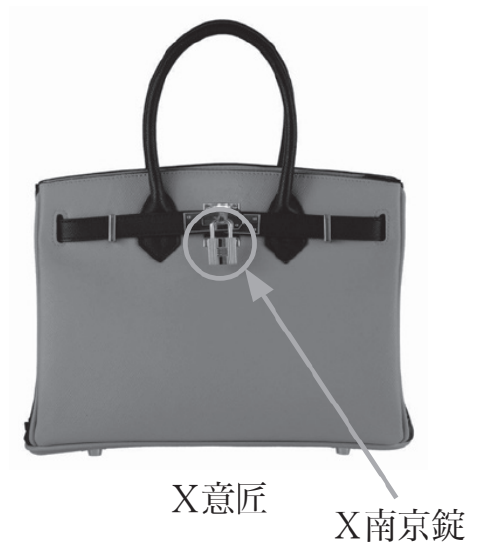
Figure labels: X’s design; X’s padlock (circled).
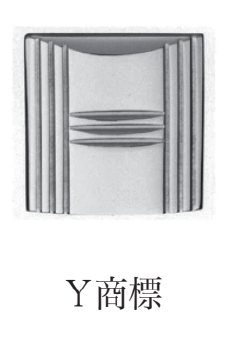
Figure label: Y’s trademark.
Patents / Employee Inventions — IP High Court, 2022 (Ne) 10018: No “Monopoly Benefit”!! ⇒ Claim (Appeal) Dismissed (Honda)
Original Ameblo publication: 2025-03-05
Article type: Case note
Categories: Patents
Topics: Employee inventions
First published on this website: 2026-10-16
Case information: 2022 (Ne) 10018
Ameblo: https://ameblo.jp/hideki-takaishi/entry-12888734028.html
HP: https://www.takaishihideki.com/en/single-post/ameblo-12888734028-en
Japanese version: https://www.takaishihideki.com/single-post/ameblo-12888734028-ja
Patents / Employee Inventions — IP High Court, 2022 (Ne) 10018 (Honda)
* No “monopoly benefit”!! ⇒ Claim (appeal) dismissed.
“Even if, as the appellant argues, the solvent fractionation method entails danger and may sometimes cause serious accidents, … it is difficult to find that, through the exclusionary effect of the patent right, the appellee excluded competitors from adopting the dry fractionation method at issue and thereby obtained benefits exceeding those obtainable from working the invention under the non-exclusive license it holds as an employer.
Furthermore, the increase in the appellee’s share of the CBE market after the facility at issue began operating appears to have resulted from the appellee anticipating increased international demand for CBE in light of deregulation and economic trends, establishing a new production facility with FVO as its base, and that facility actually commencing operations. There are no circumstances suggesting that adoption of the dry fractionation method at issue particularly enabled an expansion of market share.
Taking all of the above together, it cannot be found that the appellee obtained excess benefits through exclusive working under the patent beyond the amount of benefits obtainable from working Invention A2 under the non-exclusive license it holds in respect of Patent Right A2. Accordingly, no monopoly benefit from Invention A2 is recognized for the appellee.”
* Working of the invention by a subsidiary
“With regard to Invention A, … a subsidiary of the appellee … is working it. Therefore, … when examining the benefits that the appellee should receive, it is appropriate to examine the matter as equivalent to a case in which the appellee, whose business purpose is management as the holding company of the appellee’s group, … works the invention itself.”
https://www.courts.go.jp/assets/hanrei/hanrei-pdf-92793.pdf
Originally published: 2025-03-05
Original Japanese post: https://ameblo.jp/hideki-takaishi/entry-12888734028.html
Trade Secrets — Osaka High Court, 2023 (Ne) 1657: The Secret Was Not “Disclosed” (Morisaki)
Original Ameblo publication: 2025-03-06
Article type: Case note
Categories: Unfair competition law
Topics: Trade secrets
First published on this website: 2026-10-16
Case information: 2023 (Ne) 1657
Ameblo: https://ameblo.jp/hideki-takaishi/entry-12888875693.html
HP: https://www.takaishihideki.com/en/single-post/ameblo-12888875693-en
Japanese version: https://www.takaishihideki.com/single-post/ameblo-12888875693-ja
Unfair Competition / Trade Secrets — Osaka High Court, 2023 (Ne) 1657 (Morisaki)
* A trade secret allegedly embodied in experimental equipment cannot be said to have been “disclosed.”
⇒ Claim (appeal) dismissed.
In response to the argument that the trade secret could not be acquired without the appellants’ involvement, the court turned that argument back on them and held that receiving the donation did not constitute having the trade secret “disclosed.”
This can be considered parallel to the patent-law proposition that transfer does not constitute public working where a person skilled in the art cannot readily analyze the invention.
(Excerpt from the decision)
“The appellants argue that the information at issue, which constitutes a trade secret, cannot be analyzed merely by looking at the external appearance of the property at issue and cannot be acquired without the appellants’ involvement, so its non-public nature is maintained. … However, if that is so, even if the appellee received the property as a donation and placed it under its management, that alone would not enable it to learn the information. … There is therefore no room to find the facts alleged by the appellants, namely that, by receiving the property as a donation, the appellee thereby, or on that occasion, had the information constituting the trade secret disclosed to it. The appellants have neither alleged nor proved that, in addition to handing over the property, they disclosed the information to the appellee, and there are no facts suggesting such a disclosure. Moreover, on the appellants’ own arguments, even use of the property for experiments or similar purposes should not enable the appellee thereby to learn the information relating to the structure of the property or other matters. Thus, it cannot be found that the appellee has had the information ‘disclosed’ to it even at the present time.”
https://www.courts.go.jp/assets/hanrei/hanrei-pdf-92747.pdf
Originally published: 2025-03-06
Original Japanese post: https://ameblo.jp/hideki-takaishi/entry-12888875693.html
IP High Court, 2023 (Gyo-Ke) 10039 — Laser Processing Apparatus (Miyasaka)
Original Ameblo publication: 2025-03-07
Article type: Case note
Categories: Patents
Topics: Inventive step, Motivation and teaching away
First published on this website: 2026-10-16
Case information: 2023 (Gyo-Ke) 10039
Ameblo: https://ameblo.jp/hideki-takaishi/entry-12888984577.html
HP: https://www.takaishihideki.com/en/single-post/ameblo-12888984577-en
Japanese version: https://www.takaishihideki.com/single-post/ameblo-12888984577-ja
IP High Court, 2023 (Gyo-Ke) 10039 — Laser Processing Apparatus (Miyasaka)
“Exhibit Ko 1 does not describe any need to ascertain the position or size of the modified region relative to the principal surface of the processing region. … It merely suggests that, by using an infrared image sensor, reflected infrared light (laser light) is used to adjust focus and image the surface of the workpiece. … Nor can it be found that the existence of such a need was well known or part of common general technical knowledge.”
⇒ Inventive step: affirmed.
* The court held that it was inappropriate for the trial decision, as a reason for denying motivation, to attribute to Features F and G of Invention 1 relating to Difference 1 a technical significance not described in the specification. Nevertheless, the conclusion did not change.
Merely pointing out flaws in the trial decision is insufficient to have it revoked. From the patentee’s perspective, there is no need to defend the trial decision’s reasoning.
https://www.courts.go.jp/assets/hanrei/hanrei-pdf-92772.pdf
Originally published: 2025-03-07
Original Japanese post: https://ameblo.jp/hideki-takaishi/entry-12888984577.html
IP High Court, 2023 (Gyo-Ke) 10055 — Laser Processing Apparatus (Miyasaka)
Original Ameblo publication: 2025-03-08
Article type: Case note
Categories: Patents
Topics: Inventive step, Motivation and teaching away
First published on this website: 2026-10-16
Case information: 2023 (Gyo-Ke) 10055
Ameblo: https://ameblo.jp/hideki-takaishi/entry-12889146059.html
HP: https://www.takaishihideki.com/en/single-post/ameblo-12889146059-en
Japanese version: https://www.takaishihideki.com/single-post/ameblo-12889146059-ja
IP High Court, 2023 (Gyo-Ke) 10055 — Laser Processing Apparatus (Miyasaka)
The trial decision stated: “Exhibit Ko 1 has no modified region in the thickness direction of the substrate. Accordingly, there is no need to ascertain the position or size of a modified region in the substrate’s thickness direction, and it cannot be said that a person skilled in the art who encounters Exhibit Ko 1 has a motivation to adopt Feature G relating to Difference 2.” The court held: “Accordingly, Invention Ko 1 has no modified region inside the semiconductor wafer, and it must be said that there is no motivation to configure it to image a modified region that does not exist, that is, to adopt the configuration of Invention 1 at issue relating to Difference 2.”
⇒ Inventive step: affirmed.
* If the “modified region” of the invention at issue is a groundbreaking technical concept absent from the prior art, this is a strong patent. (If a “modified region” had also existed in the prior art, using that prior art as the principal reference might have led to a different conclusion, but this would depend on the other features.)
https://www.courts.go.jp/assets/hanrei/hanrei-pdf-92782.pdf
Originally published: 2025-03-08
Original Japanese post: https://ameblo.jp/hideki-takaishi/entry-12889146059.html
IP High Court, 2024 (Ne) 10026 — Thermoplastic Resin Composition: Rounding and Equivalents (Miyasaka)
Original Ameblo publication: 2025-03-09
Article type: Case note
Categories: Patents
Topics: Numerical limitations and parameters, Doctrine of equivalents, Claim interpretation
First published on this website: 2026-10-16
Case information: 2024 (Ne) 10026
Ameblo: https://ameblo.jp/hideki-takaishi/entry-12889274205.html
HP: https://www.takaishihideki.com/en/single-post/ameblo-12889274205-en
Japanese version: https://www.takaishihideki.com/single-post/ameblo-12889274205-ja
IP High Court, 2024 (Ne) 10026 — Thermoplastic Resin Composition (Miyasaka)
Numerical rounding and the doctrine of equivalents
The issue was whether the ultraviolet absorber contained in the appellee’s product, with a molecular weight of 699.91848, satisfied the numerical limitation of a molecular weight of “700 or more.”
⇒ Ultimately, because the applicant had “deliberately” drawn the line at the integer “700 or more,” a rounding argument could not be used. The fifth requirement of the doctrine of equivalents also failed, because the applicant had objectively and externally acknowledged the exclusion of values below that line from the technical scope.
On this reasoning, if the claim had said “700.0 or more,” would a value of 699.95 or more have satisfied it through rounding?
Would it be better to write “7.00 × 10^2 or more” to make clear that the number has three significant digits, rather than being an integer? Certainly, patents are not exactly the same as science: this is a matter of construing the wording of the claims. A neatly rounded “700” may therefore not be the same as “7.00 × 10^2 or more.”
The molecular weight of the specific compound at issue was calculated from its structural formula; this was not a case involving variability in a measured value. The case may therefore have been less suited to a rounding argument.
Because the numerical limitation failed the fifth requirement for equivalence in this case, a rounding argument, as in earlier cases, may still offer a better prospect than equivalence for numerical limitations.
That said, considering predictability for third parties, patents do not permit either rounding or equivalents to be interpreted as flexibly as in science. The conclusion of this judgment may therefore be appropriate.
* This resonates with Osaka District Court, 2002 (Wa) 10511, which, in rejecting a measurement-error argument, held: “Quite apart from the number of significant digits, where ‘3 microns’ is claimed as the upper limit of the technical scope on the basis of the examples, it is questionable to regard the maximum range of error in the examples as falling within the scope of the right. This is because, if there is an error of 0.5 microns in the examples, the claims could state an upper limit covering that error, namely ‘less than 3.5 microns.’ Yet, without doing so, to state the upper limit in the claims as ‘3 microns’ while asserting that ‘less than 3.5 microns’ is the technical scope would impair the clarity of the claims.”
… Of course, it only becomes apparent upon reading the judgment that this should have been done, so it is harsh on the patentee in that particular case. Nevertheless, we practitioners should draft claims for future applications with this judgment in mind.
★ Conclusion: “Numerical values (ranges) in science differ from numerical values (ranges) in patents!!”
(Excerpts from the judgment in 2024 (Ne) 10026)
① Literal satisfaction (rounding argument) ⇒ Not satisfied
“The numerical range of ‘700 or more’ (for the molecular weight of the ultraviolet absorber) at issue here was set by the right holder (applicant) itself to define the scope of its rights. It is nothing other than a boundary dividing, by a single line, what falls within the technical scope of the patented invention (the scope of the monopoly) from what does not. Accordingly, ‘700,’ the lower limit of that range, should be construed as an integer in its original sense, with neither a fractional part that has been rounded down nor a fractional part that has been rounded up. If a different meaning or role is intended for the numerical range, the claims or specification should explain the method of calculating molecular weight, the treatment of decimal values, and similar matters. As stated above, the specification and other documents at issue contain no such description. Consequently, the claim limitation ‘a molecular weight of 700 or more’ must be construed as not being satisfied (i.e., as not falling within the technical scope) if the molecular weight is below 700 by even 0.00001.”
② Doctrine of equivalents: first requirement satisfied, but fifth requirement not satisfied
“The numerical range has no critical significance. The molecular weight having technical significance in relation to the functions and effects of the inventions at issue is considered to extend across a fairly broad range, rather than being precisely 700. It is therefore understood that the numerical limitation of ‘700 or more’ was adopted as, so to speak, a ‘round number.’ … It is difficult to consider that the properties as an ultraviolet absorber differ substantially between a molecular weight of 699.91848 and one of 700. … Accordingly, the difference in molecular weight cannot be regarded as relating to an essential part of the inventions at issue. The first requirement of the doctrine of equivalents is satisfied in this case.”
“The integer value ‘700 or more’ was deliberately used. In this case, no critical significance is recognized in the molecular-weight value of 700. That value can therefore be said to have been selected and set, so to speak, arbitrarily by the appellant. Furthermore, although it is construed that the appellant could easily have set the numerical range as ‘699.5 or more’ or specified how decimal values of molecular weight were to be treated, it deliberately took neither measure. This should be construed as presupposing not only an understanding that decimal values are not technically meaningful numbers, but also that they have no particular legal implications (are not given any special meaning). Thus, by specifying in the claims the molecular-weight range of ‘700 or more,’ the appellant defined the technical scope of the patented invention by the dividing line between ‘700 or more’ and ‘less than 700.’ It is appropriate to find that the appellant objectively and externally acknowledged that substances with molecular weights even slightly below the lower limit of ‘700’ were excluded from the technical scope. … Accordingly, in this case, the fifth requirement of the doctrine of equivalents is not satisfied, and infringement under the doctrine of equivalents as alleged by the appellant is not established.”
* The first-instance judgment, Osaka District Court, 2022 (Wa) 9521, had also rejected the first requirement of the doctrine of equivalents, holding that “where setting a numerical value has significance for the invention, absent special circumstances, the limitation of the technical scope by that numerical value constitutes an essential part of the patented invention.”
https://www.courts.go.jp/assets/hanrei/hanrei-pdf-93860.pdf
Originally published: 2025-03-09
Original Japanese post: https://ameblo.jp/hideki-takaishi/entry-12889274205.html
IP High Court, 2023 (Gyo-Ke) 10085 — Image Forming Apparatus (Miyasaka)
Original Ameblo publication: 2025-03-10
Article type: Case note
Categories: Patents
Topics: Divisional applications, Patent corrections
First published on this website: 2026-10-16
Case information: 2023 (Gyo-Ke) 10085
Ameblo: https://ameblo.jp/hideki-takaishi/entry-12889359637.html
HP: https://www.takaishihideki.com/en/single-post/ameblo-12889359637-en
Japanese version: https://www.takaishihideki.com/single-post/ameblo-12889359637-ja
IP High Court, 2023 (Gyo-Ke) 10085 — Image Forming Apparatus (Miyasaka)
* Even if a defect in the divisional procedure for a patent application has been overlooked, a “correction” to clarify an ambiguous statement cannot be made to cure it.
If a defect in an amendment or division is overlooked and the patent is registered, the situation may become irreparable!!
There have also been cases in which a violation of the amendment requirements was overlooked and registration took place, breaking the chain of divisional applications. (Osaka High Court, 2002 (Ne) 2776 (Wakabayashi); Tokyo High Court, 2003 (Gyo-Ke) 65 (Shinohara).)
Pair a challenging amendment or divisional application with a safe sibling divisional application!!
(Excerpt from the decision)
“The plaintiffs argue that, because the patent application at issue has a procedural defect in the divisional application, a correction to cure that defect falls within clarification of an ambiguous statement under item (iii) of that paragraph. This argument is understood as follows: ① although the statements in the specification and other documents at the time of registration at issue were within the scope of the statements in the original specification and other documents of the parent application, they were not within the scope of the matters stated in the specification and other documents immediately before division, which had been amended by the time of the patent application at issue; ② as a result, the requirements for a divisional application were not satisfied, but a decision to grant a patent was made without attention being drawn to the problem through a notice of reasons for refusal, leaving the patent at issue defective; and ③ the substantive content of the correction matters being examined is to eliminate that defect by correcting the statements in the specification and other documents at issue from content corresponding to the original specification and other documents of the parent application to content corresponding to the subsequently amended specification and other documents immediately before division. However, ‘the description’ or ‘drawings’ attached to the application as referred to in Article 126(1) of the Patent Act should be understood as the patent specification and drawings at the time of the request for a trial for correction. Accordingly, whether the requirements concerning the purpose of correction under items (ii) and (iii) of that paragraph are satisfied should be determined by comparing the specification and other documents at the time of the request for a trial for correction with those after correction. This is clear both from the wording of the provision and from its purpose (see (2) above). Even if circumstances ①–③ above are found in this case, the defect in the divisional procedure in the relationship between the application specification and other documents immediately before division and the specification and other documents at the time of registration at issue is an issue concerning the application of Article 44 of the Act. That in itself does not mean that the specification and other documents at the time of registration, which are the subject of correction, themselves contain an ambiguous statement (Article 126(1)(iii) of the Act), nor does it constitute an error or incorrect translation under item (ii) of that paragraph. Even assuming that a defect in the divisional procedure for the patent application at issue was overlooked, the plaintiffs’ argument must be regarded as equivalent to seeking to redo the divisional application under the guise of correcting the specification and other documents. No basis can be found to justify this.”
https://www.courts.go.jp/assets/hanrei/hanrei-pdf-92813.pdf
Originally published: 2025-03-10
Original Japanese post: https://ameblo.jp/hideki-takaishi/entry-12889359637.html
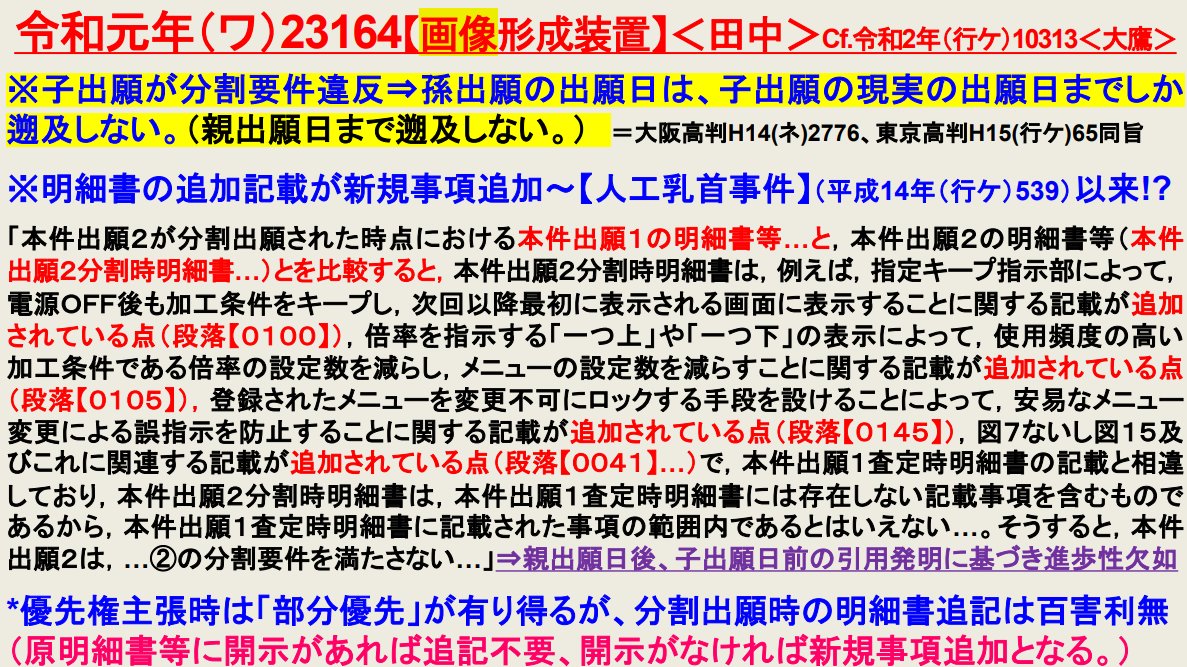
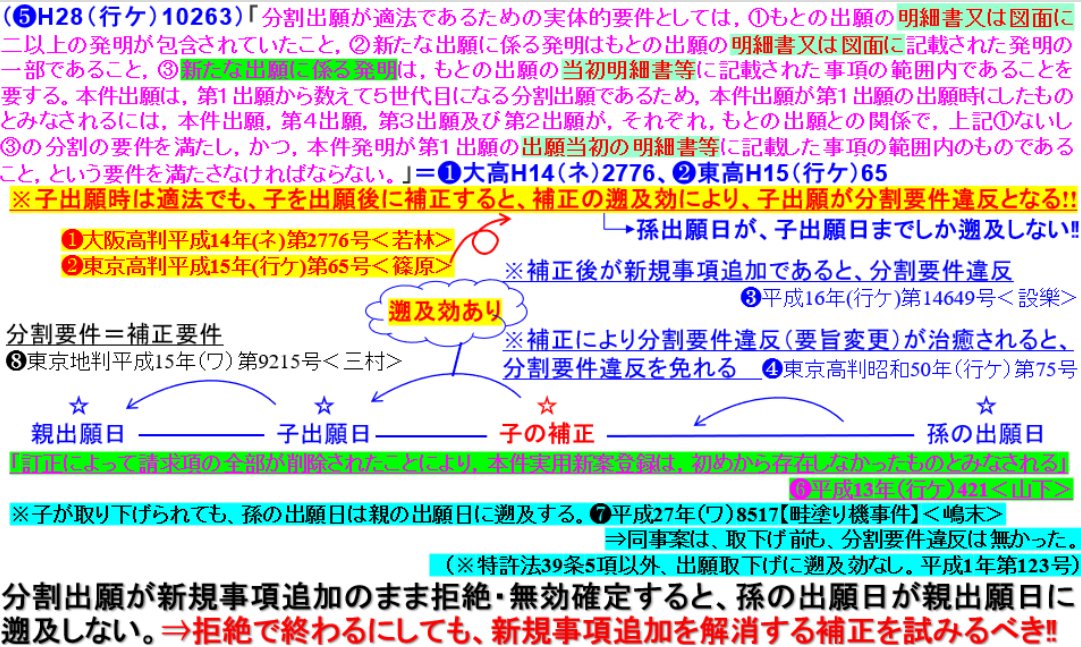
English translations of the Japanese source figures
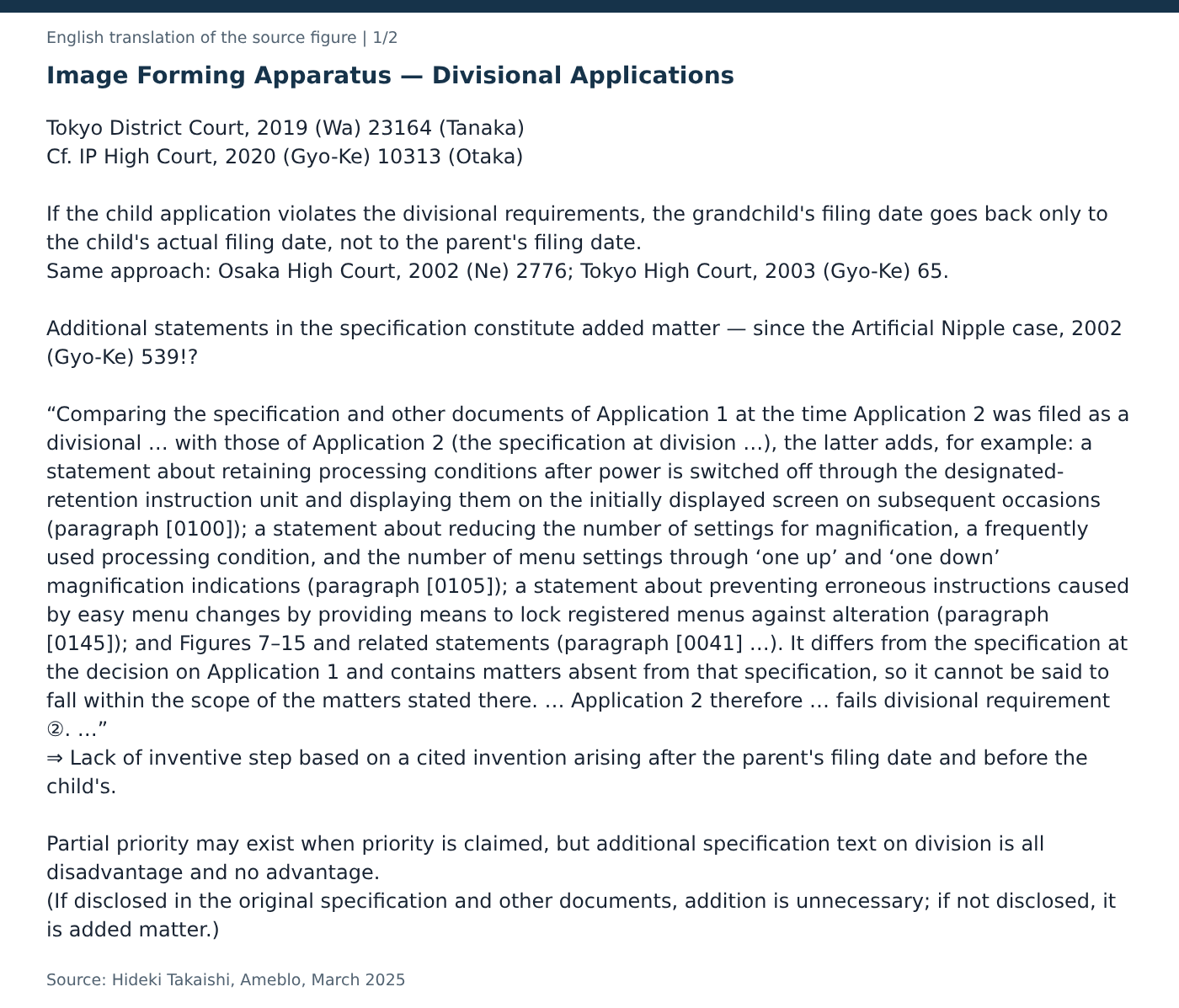
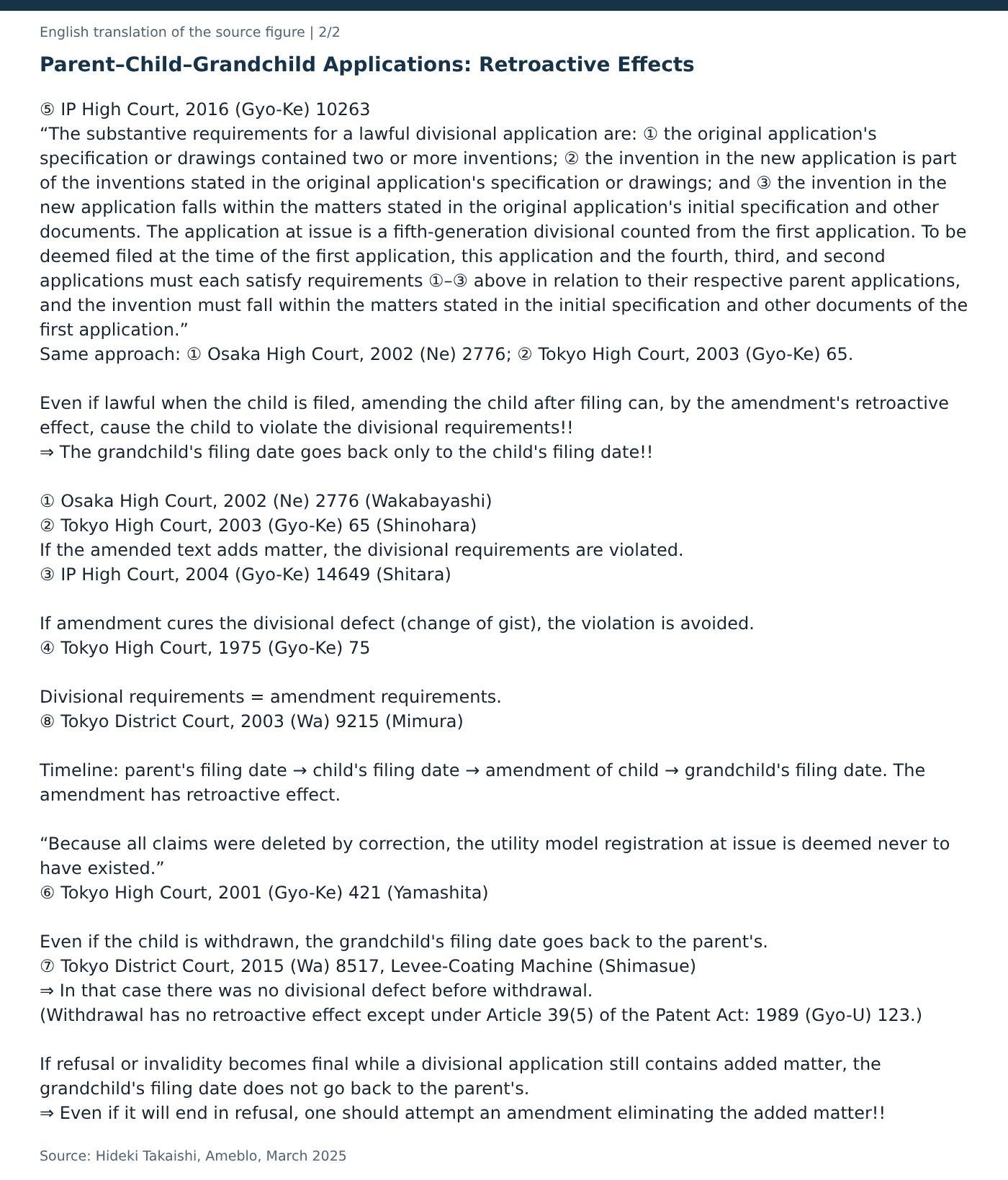
Trademark — IP High Court, 2023 (Ne) 10091: “Gendai no Riron” (Miyasaka)
Original Ameblo publication: 2025-03-11
Article type: Case note
Categories: Trademarks
Topics: Abuse of rights, Trademark use
First published on this website: 2026-10-16
Case information: 2023 (Ne) 10091
Ameblo: https://ameblo.jp/hideki-takaishi/entry-12889488165.html
HP: https://www.takaishihideki.com/en/single-post/ameblo-12889488165-en
Japanese version: https://www.takaishihideki.com/single-post/ameblo-12889488165-ja
Trademark — IP High Court, 2023 (Ne) 10091: “Gendai no Riron” (Miyasaka)
* No abuse of rights. Ultimately, the defendant nonprofit organization’s failure to register the trademark was the reason it lost.
As a member of the “Gendai no Riron Editorial Committee,” the plaintiff has published an electronic edition of “Gendai no Riron” since 2014.
The defendant has published the magazine “Gendai no Riron” since June 2016.
The defendants argued that, as soon as the defendant announced in February 2016 that it would resume publication of the magazine “Gendai no Riron,” the plaintiff obtained Trademark Right 1 with Class 9 “electronic publications” and Class 16 “printed matter” as the designated goods.
The defendants further pointed out that, on March 24, 2021, a trial decision became final revoking, on grounds of non-use, the registration for Class 16 “printed matter” among the designated goods of Trademark 1. Soon afterward, however, on September 6, 2021, the first-instance plaintiff applied to register Trademark 2 with Class 16 “printed matter” as the designated goods, obtained registration, and filed this lawsuit.
⇒ The defendants’ use of their respective signs on printed matter can, at a minimum, be regarded as use on goods similar to Class 9 “electronic publications,” which are designated goods of Trademark 1. Thus, even if the plaintiff has no plans to publish “Gendai no Riron” as “printed matter,” such as a magazine, it can seek an injunction against the first-instance defendants’ acts on the basis of its trademark right designating “electronic publications.”
https://www.courts.go.jp/assets/hanrei/hanrei-pdf-92814.pdf
Originally published: 2025-03-11
Original Japanese post: https://ameblo.jp/hideki-takaishi/entry-12889488165.html
Tokyo District Court, 2024 (Yo) 30029 — Age-Related Macular Degeneration (Nakashima, Civil Division 40)
Original Ameblo publication: 2025-03-12
Article type: Case note
Categories: Patents, Unfair competition law
Topics: Claim interpretation, Novelty, Patent linkage, False allegations, Injunctions
First published on this website: 2026-10-16
Case information: 2024 (Yo) 30029
Ameblo: https://ameblo.jp/hideki-takaishi/entry-12889616530.html
HP: https://www.takaishihideki.com/en/single-post/ameblo-12889616530-en
Japanese version: https://www.takaishihideki.com/single-post/ameblo-12889616530-ja
Tokyo District Court, 2024 (Yo) 30029 — Age-Related Macular Degeneration (Nakashima, Civil Division 40)
★ Application for a provisional injunction based on violation of the Unfair Competition Prevention Act: a case denying patent infringement by finding that the medical-use invention was not worked under an “exclusively” standard and that, on the patentee’s argument that a certain proportion sufficed, novelty would be lacking.
* However, the word “exclusively” does not mean 100%.
1. The court’s reasoning ①: infringement of a use invention
As set out below, the court denied patent infringement. It found non-satisfaction under an “exclusively” standard for working a medical-use invention: “working” under Article 2(3) of the Patent Act satisfies the use limitation when production, use, transfer, or similar acts are performed exclusively for the medical use specified in the claims (in this invention, for administration to the specified patient group). It also held that, on the patentee’s argument that a certain proportion sufficed, the invention lacked novelty.
“A use invention is technically characterized by discovering an unknown property of a known substance and, on the basis of that property, creating a novel use with a remarkable effect. Accordingly, ‘working’ under Article 2(3) of the Patent Act in relation to a use invention should be construed as producing, using, transferring, or otherwise dealing with a known substance exclusively for use in the novel use. Applying this to the invention at issue, the claims and the specification ([0005], [0006], and [0018]) show that anti-VEGF agents, which are known substances, were conventionally recognized as effective for wAMD patients having predominantly classic active subfoveal CNV regions occupying at least 50% of the total lesion size (pCNVwAMD patients). The invention at issue is characterized by creating a novel use with a remarkable effect through administration to wAMD patients who meet certain inclusion and exclusion criteria and have an active CNV lesion size of less than 50% of the total lesion size (sCNVwAMD patients; also referred to below as ‘the specified patient group’), based on the discovery of the unknown property of anti-VEGF agents that they exhibit a superior therapeutic effect in those patients compared with pCNVwAMD patients. Accordingly, ‘working’ under Article 2(3) of the Patent Act for this invention should be construed as producing, using, transferring, or otherwise dealing with an anti-VEGF agent exclusively for administration to the specified patient group. …
Turning to the creditor’s product in this case, according to the underlying facts, the creditor’s product is a biosimilar of the debtor’s product. The proposed package insert for the creditor’s product submitted with the approval application at issue merely states ‘age-related macular degeneration with subfoveal choroidal neovascularization’ as the indication. Neither the ‘Indications or Effects’ section nor the ‘Dosage and Administration’ section contains any reference to the specified patient group, and no statement can be found to the effect that administration to that group produces a remarkable effect. On these findings, the approval application for the creditor’s product cannot be said to be an application for administration to the patient group defined by Claim Limitations A2, B, and C of the invention (the specified patient group). The position might be different if special circumstances established a likelihood that the creditor would deliberately sell or otherwise deal with its product for a use different from that in the approval application. However, even all of the prima facie evidentiary materials in this case are insufficient to clearly establish such special circumstances. In these circumstances, manufacture and sale or similar acts concerning the creditor’s product cannot be regarded as producing, using, transferring, or otherwise dealing with an anti-VEGF agent exclusively for administration to the specified patient group, and are insufficient to establish infringement of the patent right at issue.
Moreover, even if one were to adopt the debtor’s view that manufacture and sale or similar acts concerning the creditor’s product infringe the patent because the product may ultimately be administered to a certain proportion of the specified patient group, the underlying facts show that the creditor’s product is a biosimilar of the debtor’s product, has equivalence and similarity in quality to it, and that the debtor’s product had been manufactured and sold before the priority date at issue. Therefore, like the creditor’s product, the debtor’s product must also be found to have been administered to a certain proportion of the specified patient group. It is thus self-evident that manufacture and sale of the debtor’s product constitutes public working under Article 29(1)(ii) of the Patent Act and that the patent at issue should be invalidated.”
2. The court’s reasoning ②: the Unfair Competition Prevention Act / communication of false facts
The court found that the patentee’s act of responding to the Ministry of Health, Labour and Welfare and others that “manufacturing and selling a biosimilar of the debtor’s product would infringe this patent” (the communication at issue) constituted communication of false facts. However, as set out below, it held that this violates the Unfair Competition Prevention Act only “where there are special circumstances in which the act is found to be markedly inappropriate in light of the purpose and objectives of patent linkage.” It did not find a violation in this case.
“If, under patent linkage, a response by the aforementioned patentees or others stating that there is a patent conflict between a patent relating to an originator drug and a generic drug were immediately unlawful as communication of false facts whenever it differed from a subsequently final court determination, those patentees or others would be unable to fully state their own views on the existence of a patent conflict in the pharmaceutical patent information reporting form. The Ministry of Health, Labour and Welfare and others would consequently be unable to accurately determine whether a stable supply of the generic drug could be ensured, potentially undermining the purpose and objectives of patent linkage. However, patent linkage is intended, from the perspective of ensuring a stable supply of generic drugs, to confirm during approval review whether there is a patent conflict between a patent relating to an originator drug and a generic drug. It is therefore clear that it does not permit patentees or others relating to originator drugs to provide arbitrary information or grant them broad immunity. Accordingly, where a false response under patent linkage by a patentee or other person relating to an originator drug, stating that there is such a patent conflict, outwardly takes the form of information provision under patent linkage but in substance seeks to place the applicant for manufacturing and marketing approval of the generic drug at a disadvantage and to secure a competitive advantage for the respondent, it is appropriate, in light of the above purpose and objectives of Article 2(1)(xxi) of the Unfair Competition Prevention Act, to regard that act as a category of unfair competition obstructing fair competition among businesses. From this perspective, a false response by a patentee or other person relating to an originator drug under patent linkage, stating that there is a patent conflict between the patent relating to the originator drug and a generic drug, should be regarded as unfair competition under Article 2(1)(xxi) where special circumstances establish that it is markedly inappropriate in light of the purpose and objectives of patent linkage, because it communicates false facts damaging the business reputation of a competing applicant for manufacturing and marketing approval of the generic drug.”
3. Some observations
(1) Definition of a “use invention”
First, a “use invention” must be defined as the basis for discussion. Having comprehensively examined Japanese patent judgments, I consider that inventions for which there is no infringement unless manufacture and sale expressly present the relevant “use” are cases where the structural features of the product alone, excluding the “for …” use limitation, lack novelty or inventive step, and novelty or inventive step is recognized only through specification of the “for …” use.
This decision states: “A use invention is technically characterized by discovering an unknown property of a known substance and, on the basis of that property, creating a novel use with a remarkable effect.” It thus defines a “use invention” as an invention whose product features alone, excluding the use limitation, lack novelty. This is a case in which novelty or inventive step is recognized only through specification of the use, and falls within the above category in which manufacture and sale do not infringe unless the “use” is expressly presented.
(2) Technical scope of a “(medical) use invention” specifying the recipients of administration
For a medical-use invention limiting the recipients of administration, under this decision’s “exclusively” standard, the use limitation would apparently not be satisfied unless the product is manufactured and sold with labeling, promotion, or similar representations indicating that the recipients are persons “aged 60 or older,” persons “who have not had a recurrence of breast cancer,” or persons “who have not developed allergic asthma.”
Moreover, Patent No. 5705483, whose novelty was recognized in IP High Court, 2018 (Gyo-Ke) 10036, concerns an invention specifying a newly discovered mechanism as an invention-defining feature, a recent hot topic. Its claim reads: “A composition comprising an antagonist of interleukin-23 (IL-23), for use in an in vivo treatment method for inhibiting interleukin-17 (IL-17) production by T cells.” Since this too appears to be a use invention, the analysis would be that the limitation is satisfied when it is sold or otherwise dealt with “to inhibit IL-17 production”; in other words, it would not be satisfied unless the product is manufactured and sold with labeling or promotion indicating that the recipients are “patients showing elevated IL-17 levels.”
(3) Comparison with the “knowing” requirement for indirect infringement involving multifunctional products (the 25% rule)
The “knowing” requirement for indirect infringement involving multifunctional products (Article 101(ii) and (v) of the Patent Act) concerns producing, transferring or otherwise dealing in an item while knowing that the invention is patented and that the item will be used in working that invention. As in the cases reproduced below, it is held to be satisfied where the indirect infringer knows that persons within a “range that cannot be regarded as exceptional” use it to produce directly infringing products. (This appears to draw on the standard adopted in the Supreme Court decision of December 19, 2011, Keishū Vol. 65, No. 9, p. 1380, the Winny case.) Three decisions have treated approximately “25%” as satisfying a “range that cannot be regarded as exceptional.” (The Supreme Court’s Winny decision, however, denied intent and upheld the acquittal entered by the court below, holding that “it cannot be found that the defendant recognized and accepted that the proportion of users using it for copyright infringement had … extended to a range that could not be regarded as exceptional, such as approximately 40%.” In civil proceedings, an injunction may be available for conduct after the defendant acquires the requisite knowledge, for example through service of the complaint, provided that the other requirements are also met.)
For use inventions, there is also a view that working of the invention is not limited to sales expressly presenting the use through labeling or promotion, but can arise from “the possibility that the product will ultimately be administered to a certain proportion of the specified patient group.” The patentee advanced that argument in this case as well. If that view is assumed, an unresolved issue was what percentage of the products sold the seller must know will be used for the patented use before infringement arises: 100%, 99%, or a “range that cannot be regarded as exceptional” (approximately 25%?).
By contrast, this decision established an “exclusively” standard. If “exclusively” were interpreted quantitatively as 100%, even 1% use for another purpose would defeat the limitation. The decision, however, did not adopt such a numerical threshold. So-called off-label use—use of a drug for an indication or in a manner different from those approved, that is, use not stated in the labeling (package insert)—would thus appear not to infringe a use invention, unless there are circumstances such as promotion of that off-label use. (Nevertheless, “exclusively” does not mean 100%, so the proportion or amount “used for a use other than that of the use invention” that leads to non-satisfaction remains an unresolved issue.)
As to whether such a conclusion is appropriate, this decision holds that a ground for invalidity based on lack of novelty would exist if one “adopted the debtor’s view that manufacture and sale or similar acts concerning the creditor’s product infringe the patent because the product may ultimately be administered to a certain proportion of the specified patient group.”
However, on this approach, not only medical-use inventions but also selection inventions limiting the range of products to those with particularly high effects may face denial of novelty where the selected range had already been worked before filing, because they are not use inventions. Such an approach is not unreasonable, but it does not necessarily align with past practice in every respect. Further examination is therefore needed to seek a consistent understanding.
Furthermore, where inventive step is recognized because of an unpredictable remarkable effect, a question has been raised: does infringement arise only where the product is sold or otherwise dealt with while expressly presenting that effect, as with a so-called use invention, or does infringement arise irrespective of whether that effect is expressly presented? (Misao Shimizu, Hyakusen of Patent Cases, 5th ed., Case 69, “Inventive Step (5)—The Independent-Requirement Theory of Remarkable Effects [Shoe Press Belt Case].”)
https://www.courts.go.jp/assets/hanrei/hanrei-pdf-93519.pdf
Originally published: 2025-03-12
Original Japanese post: https://ameblo.jp/hideki-takaishi/entry-12889616530.html
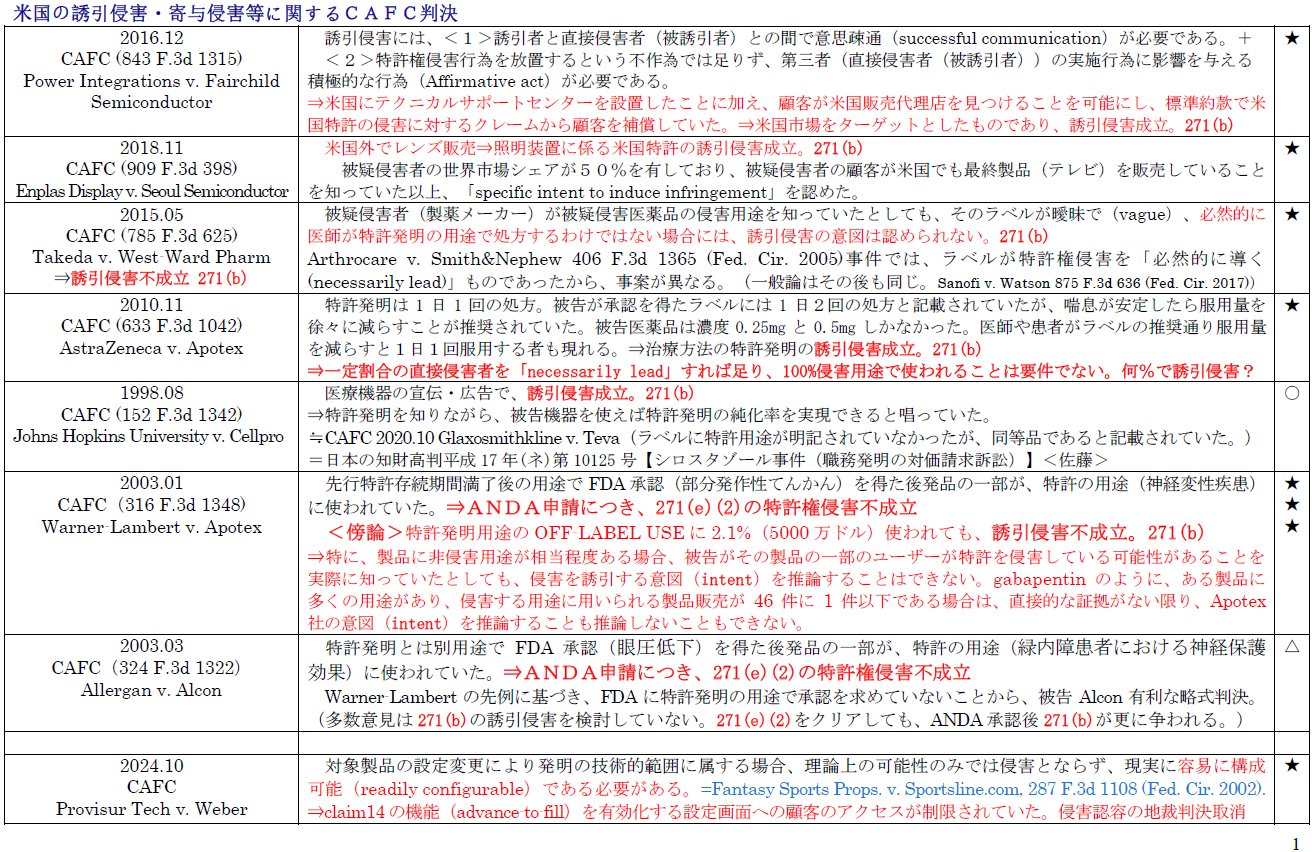
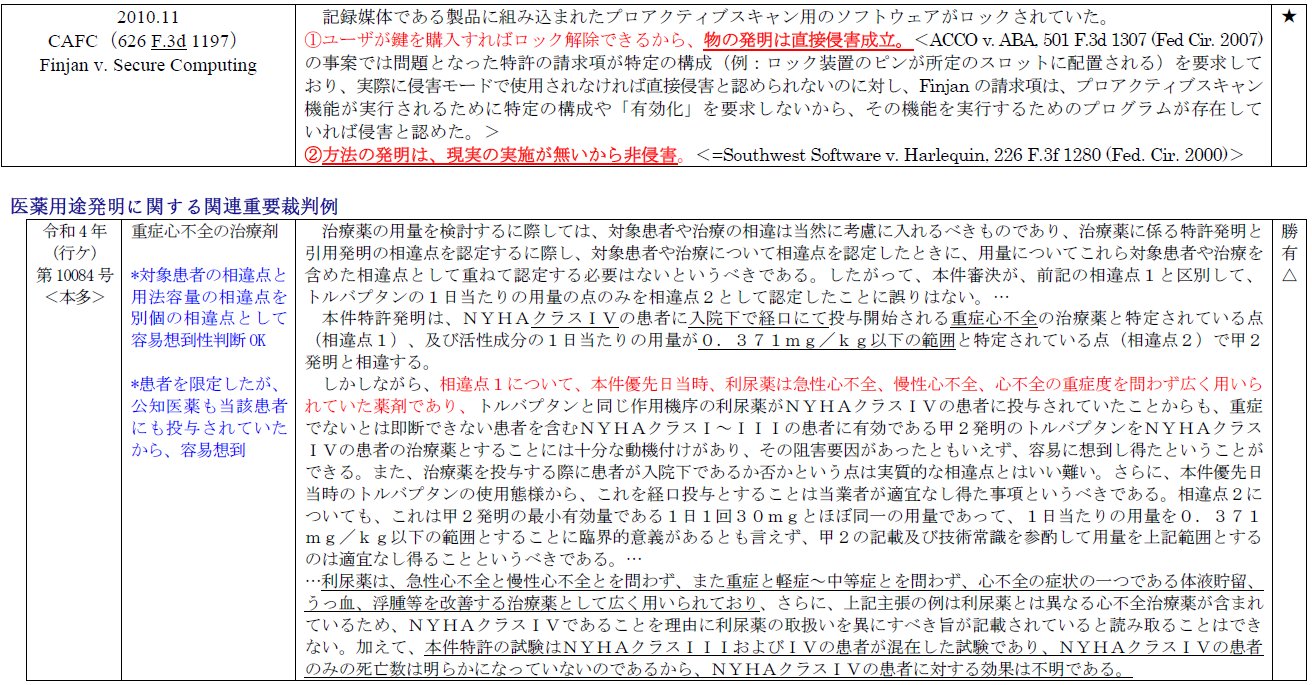
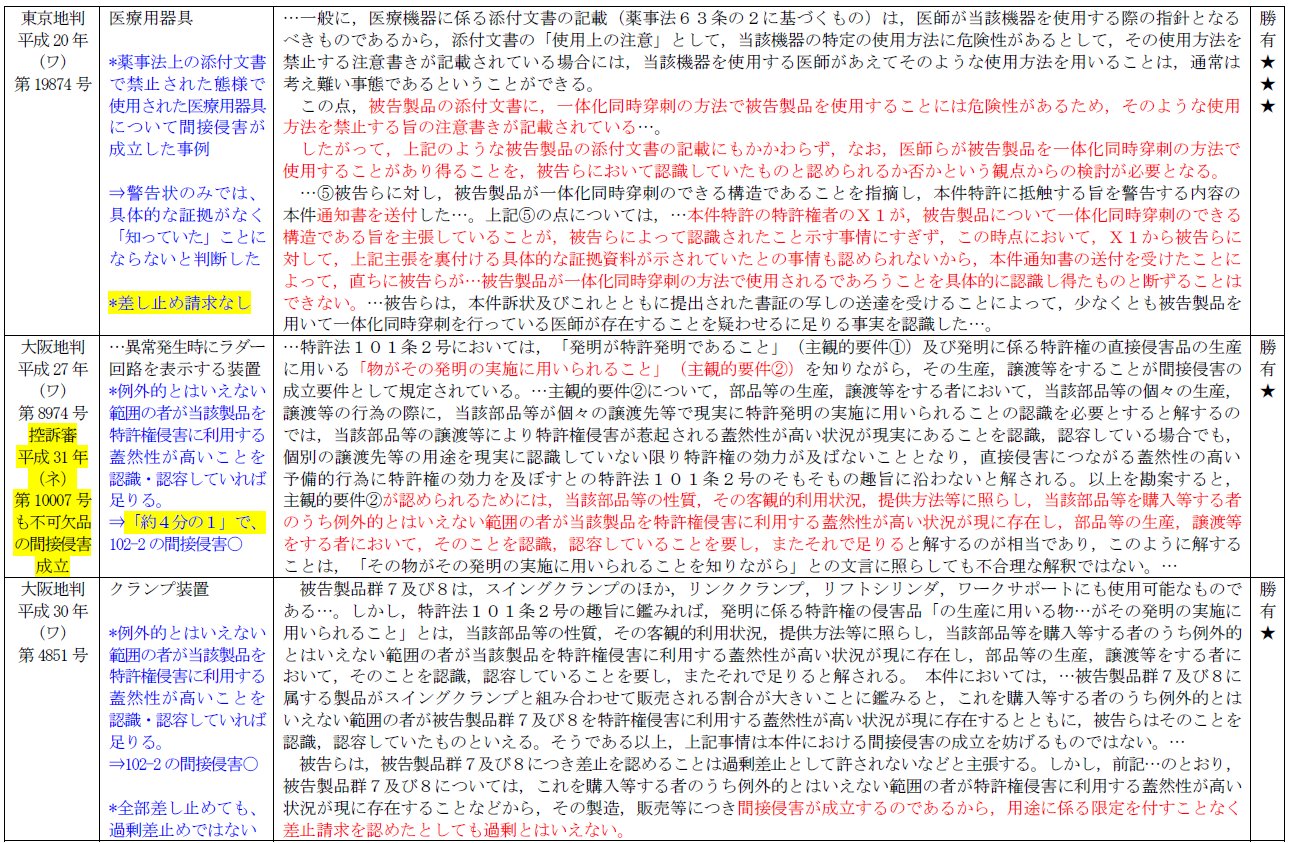
English translations of the Japanese source figures
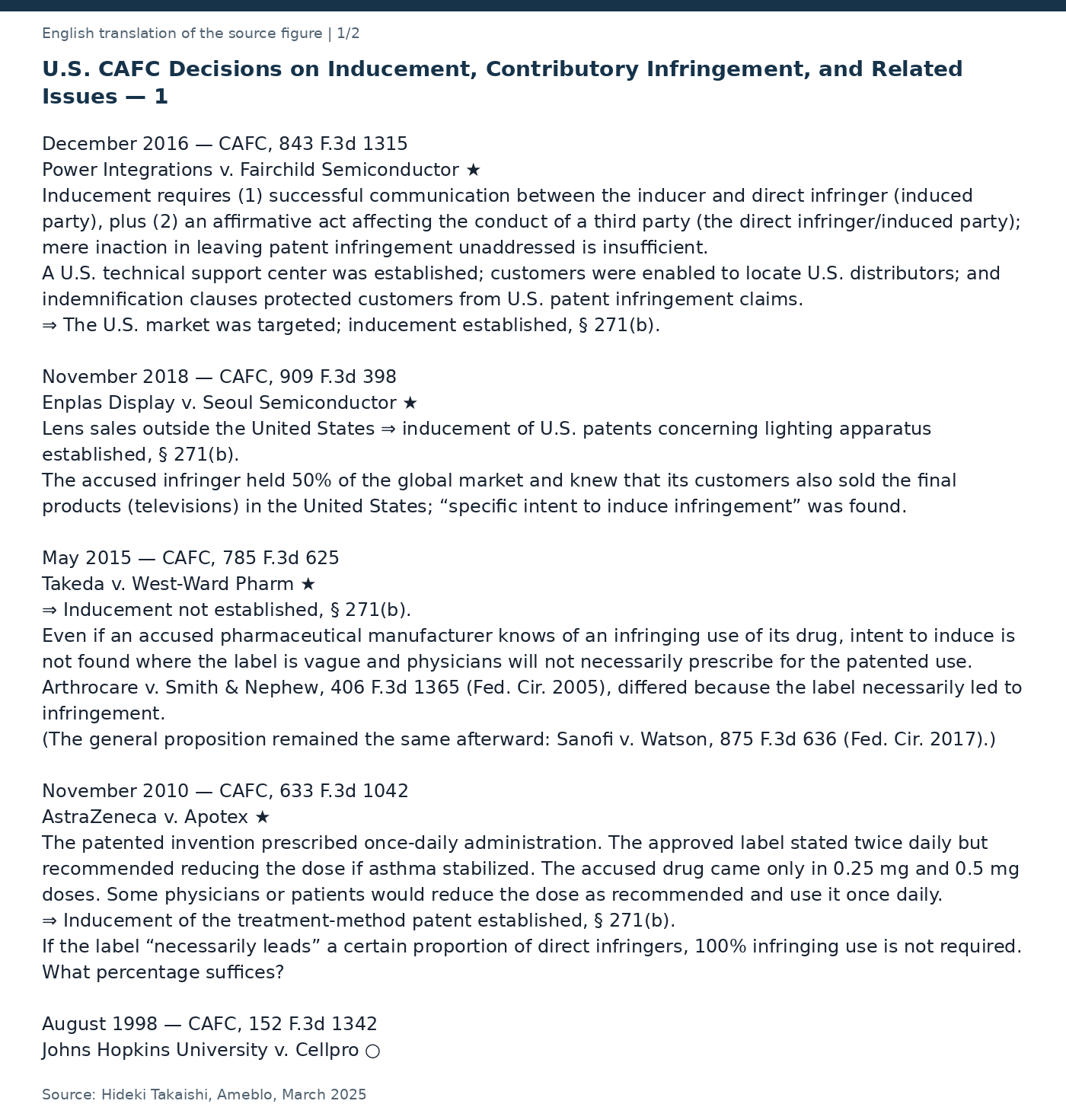
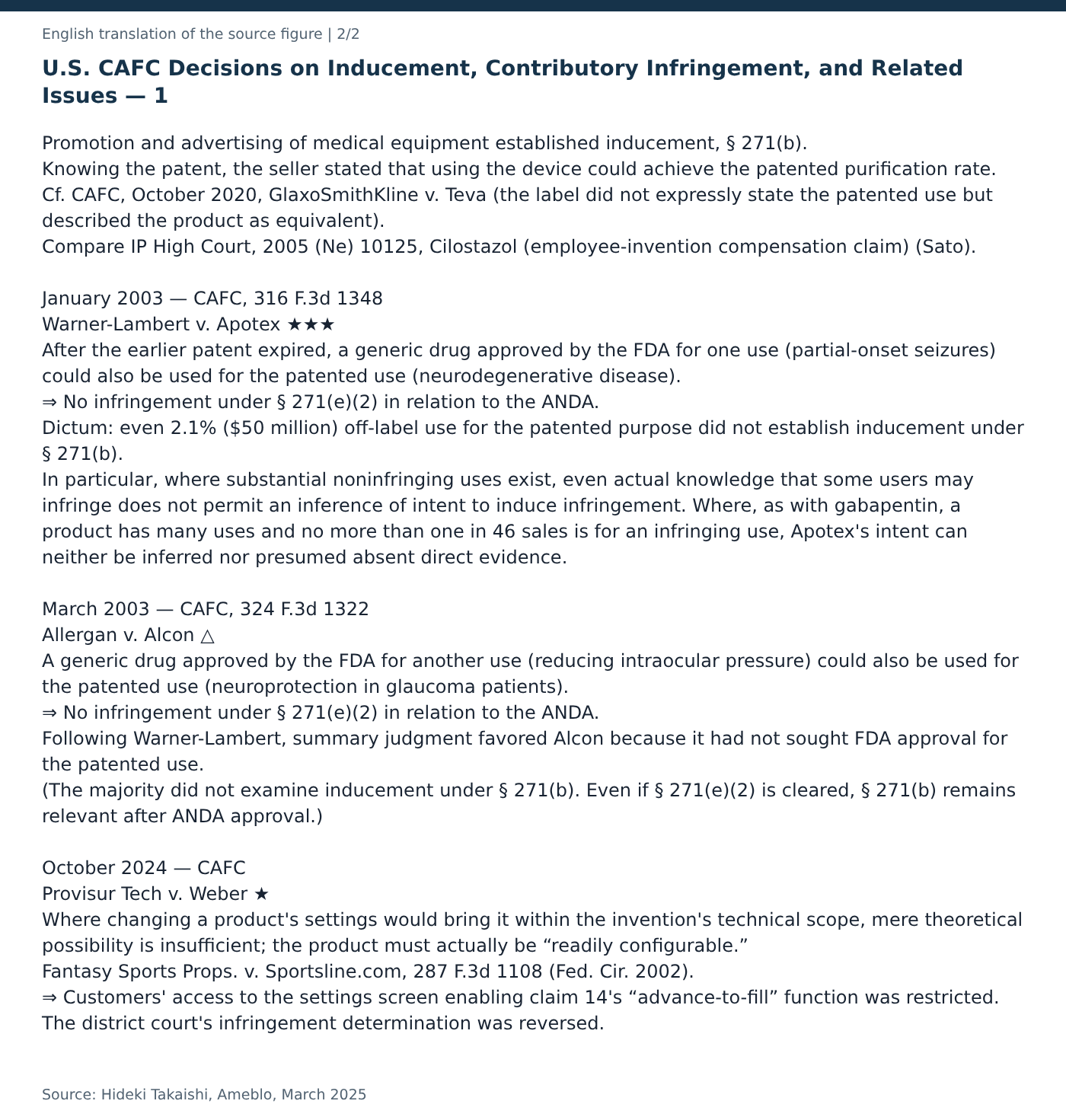
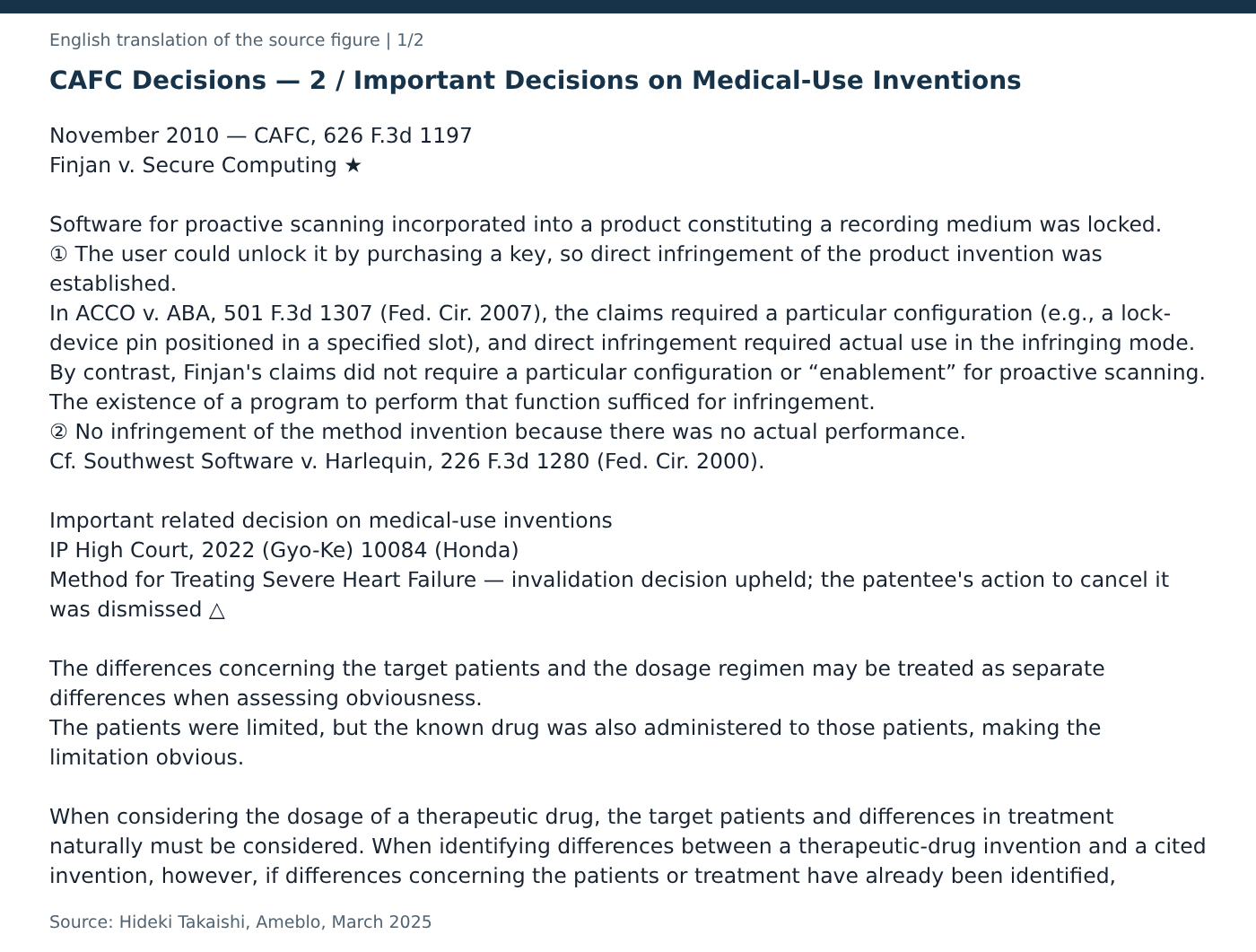
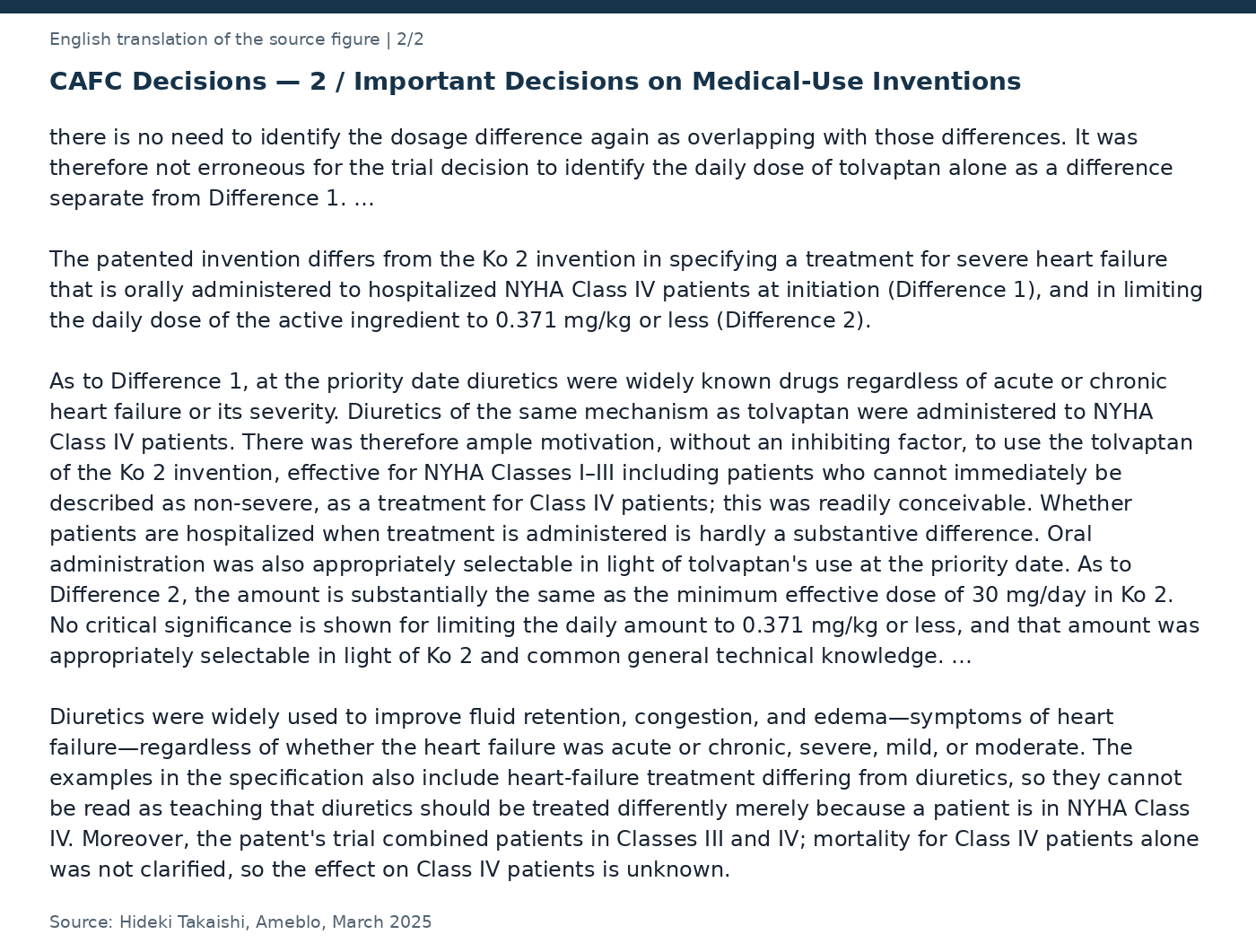
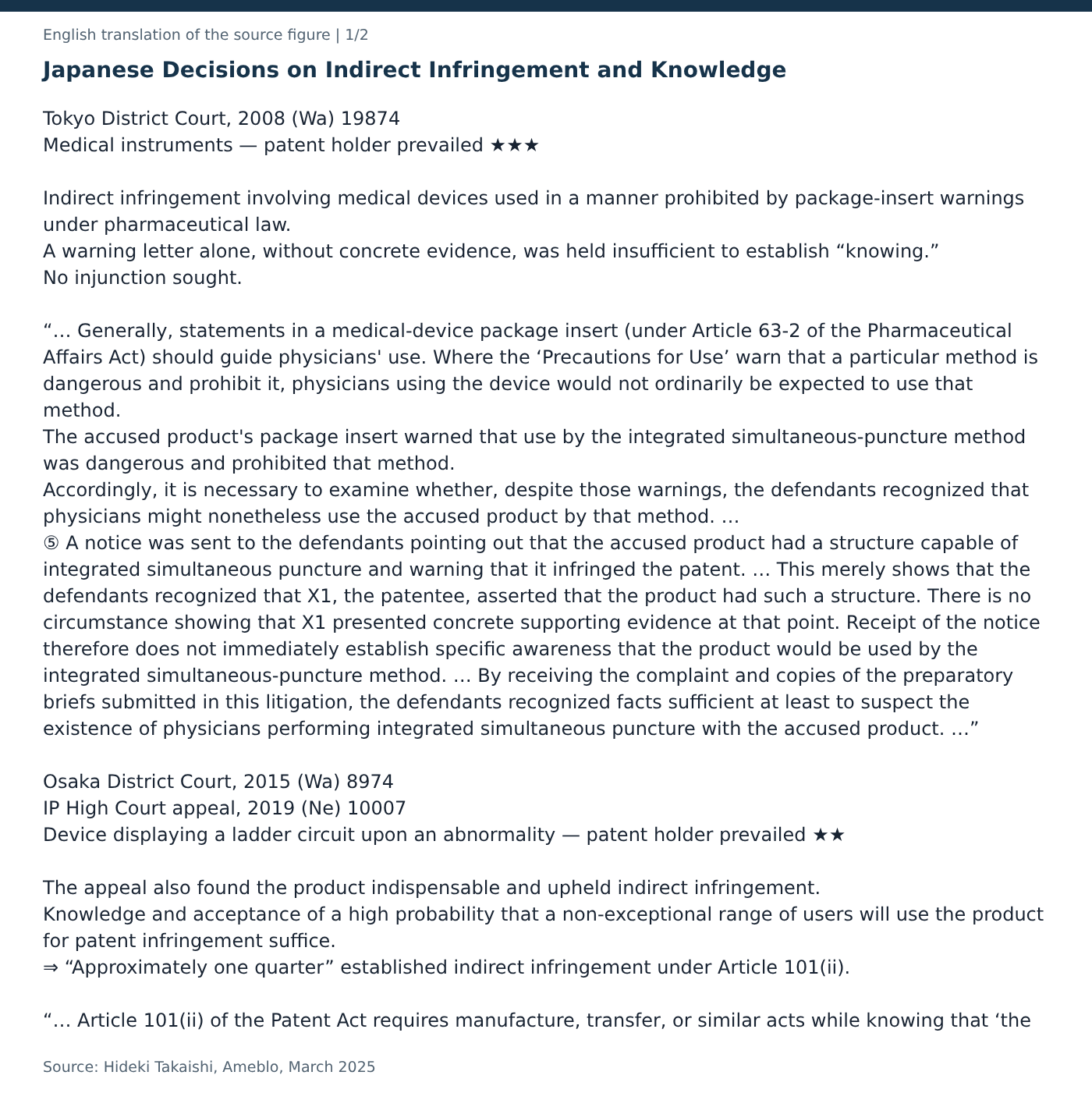
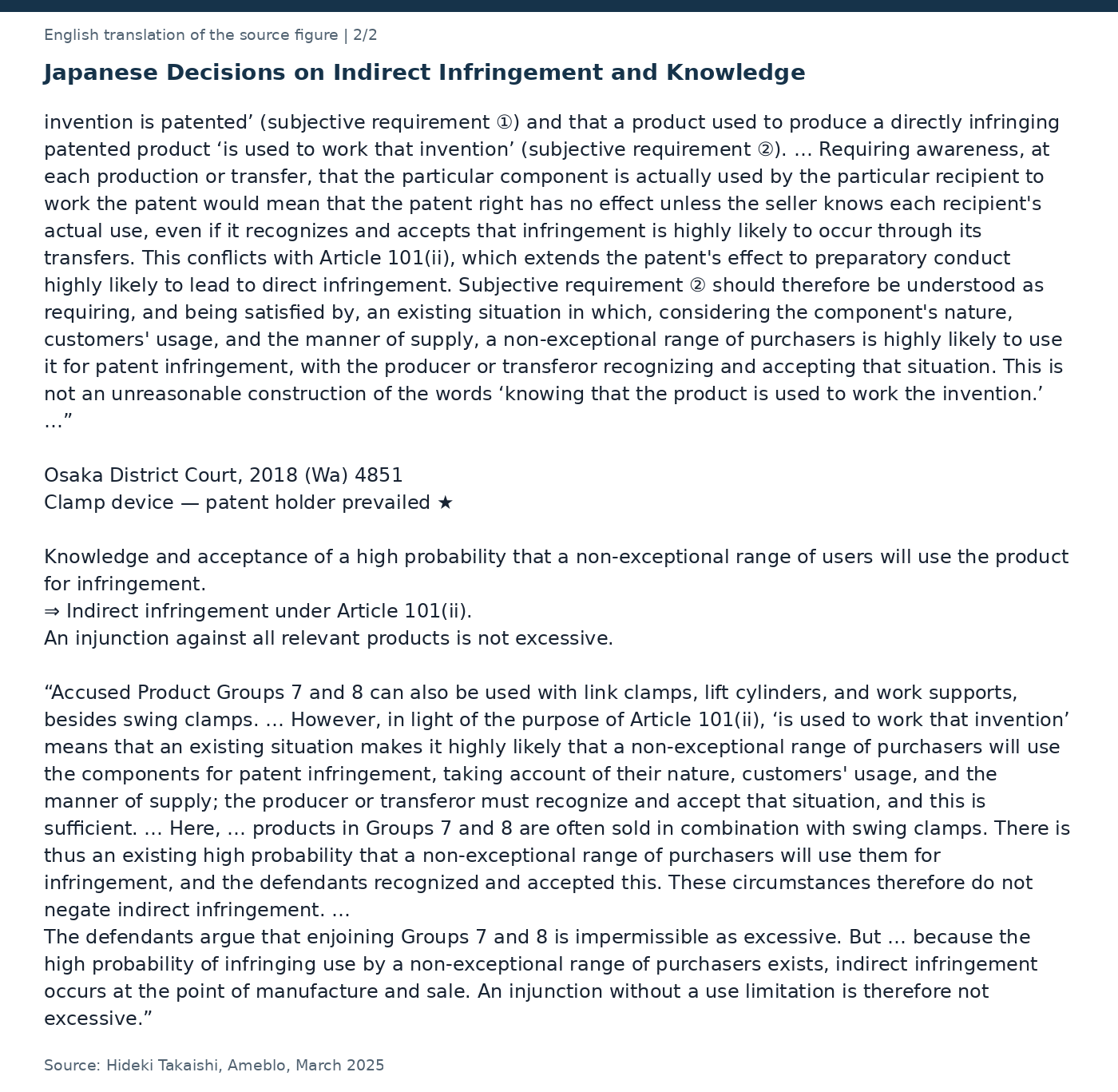
(Editor’s transcription and correction of the figure above)
U.S. CAFC Decisions on Inducement, Contributory Infringement, and Related Issues — 1
December 2016 — Power Integrations v. Fairchild Semiconductor, 843 F.3d 1315 ★
Inducement requires successful communication between the inducer and a third-party direct infringer, resulting in actual inducement of direct infringement. An affirmative act encouraging the third party’s infringing conduct is required; merely leaving infringement unaddressed is insufficient.
Fairchild established a U.S. technical support center, enabled customers to locate U.S. distributors, and indemnified customers against U.S. patent infringement claims. This and other evidence directed to the U.S. market could support a finding of inducement, so the court declined to enter JMOL of noninfringement. However, it vacated the inducement verdict because the jury had been erroneously instructed that actual inducement was unnecessary, leaving inducement for retrial. 35 U.S.C. § 271(b).
November 2018 — Enplas Display v. Seoul Semiconductor, 909 F.3d 398 ★
Sales of lenses outside the United States supported inducement of infringement of U.S. patents covering lighting apparatus. Enplas held a 50% worldwide market share and knew that its customers also sold the final products, televisions, in the United States. Together with its knowledge of the patents and infringing activities, specifications recommending infringing configurations, and other evidence, this supported the jury’s finding of specific intent to induce infringement. 35 U.S.C. § 271(b).
May 2015 — Takeda v. West-Ward Pharm., 785 F.3d 625 ★
Denial of a preliminary injunction was affirmed because a likelihood of success on induced infringement had not been established. Even where a pharmaceutical manufacturer knows of an infringing use, vague label language combined with speculation about physicians’ prescribing behavior does not establish inducement. 35 U.S.C. § 271(b).
In Arthrocare v. Smith & Nephew, 406 F.3d 1365 (Fed. Cir. 2005), sales literature and operating instructions encouraged infringing use. The case Takeda distinguished because following the label necessarily led to infringement was AstraZeneca v. Apotex, discussed below. The general requirement of intent to induce remained the same in Sanofi v. Watson, 875 F.3d 636 (Fed. Cir. 2017).
November 2010 — AstraZeneca v. Apotex, 633 F.3d 1042 ★
The patented method required administration no more than once per day. The proposed generic label specified twice-daily dosing but recommended reducing the dose after asthma stabilized. Only 0.25 mg and 0.5 mg strengths were available, so some physicians or patients following the downward-titration instruction would arrive at once-daily dosing. A likelihood of success on induced infringement was established, and the preliminary injunction was affirmed. 35 U.S.C. § 271(b).
It is sufficient if the label necessarily leads some users to directly infringe; 100% infringing use is not required. What proportion suffices?
August 1998 — Johns Hopkins University v. CellPro, 152 F.3d 1342 ○
The district court found infringement and inducement based in part on promotion and advertising of medical equipment, and the CAFC affirmed the infringement determination. Knowing of the patent, the seller advertised that the device could achieve the patented purification rate. 35 U.S.C. § 271(b).
Compare GlaxoSmithKline v. Teva: the October 2020 opinion was withdrawn in February 2021 and replaced by the August 5, 2021 opinion. The later opinion sustained the inducement verdict based on evidence including instructions remaining in the partial label that encouraged the patented method and promotional materials.
Compare IP High Court, 2005 (Ne) 10125, Cilostazol (employee-invention compensation claim) (Sato).
January 2003 — Warner-Lambert v. Apotex, 316 F.3d 1348 ★★★
Apotex filed an ANDA to sell a generic after expiration of an earlier patent, for the FDA-approved use of treating partial-onset seizures. It did not seek approval for the separately patented use of treating neurodegenerative disease. The ANDA filing did not infringe under 35 U.S.C. § 271(e)(2).
(Obiter) Inducement was also rejected. The court considered Warner-Lambert’s data that 2.1% of gabapentin prescriptions were for neurodegenerative disease and assumed, for argument’s sake, its assertion that this represented $50 million. Those figures did not establish an intent to promote infringement. Particularly where substantial noninfringing uses exist, knowledge that some users may infringe does not by itself permit an inference of intent to induce. Where, as with gabapentin, a product has many uses and fewer than one in 46 sales are for an infringing use, the court could neither infer nor decline to infer Apotex’s intent without direct evidence. 35 U.S.C. § 271(b).
March 2003 — Allergan v. Alcon, 324 F.3d 1322 △
Alcon and the other applicant filed ANDAs for the FDA-approved use of reducing intraocular pressure, rather than the patented use of neuroprotection in glaucoma patients. Although prescribing for the patented use was alleged to be possible, summary judgment of noninfringement under 35 U.S.C. § 271(e)(2) was affirmed under Warner-Lambert.
The majority did not decide inducement under § 271(b) on the facts of this case. Even where an ANDA filing does not infringe under § 271(e)(2), conduct after approval may separately give rise to liability under § 271(b).
October 2024 — Provisur Technologies v. Weber ★
Where changing a product’s settings would satisfy the claim limitations, a theoretical possibility is insufficient; the product must be readily configurable to infringe. Fantasy Sports Props. v. Sportsline.com, 287 F.3d 1108 (Fed. Cir. 2002).
Customers could not access the screens needed to configure the advance-to-fill function of claim 14 of the ’936 patent. The expert also failed to show that he had actually performed that configuration. The denial of JMOL of noninfringement of that claim was reversed.
CAFC Decisions — 2 / Important Decisions on Medical-Use Inventions
November 2010 — Finjan v. Secure Computing, 626 F.3d 1197 ★
Proactive-scanning software incorporated into the products was locked. (1) Users could unlock it by purchasing a key, so direct infringement of the system and storage-medium claims was established.
In ACCO v. ABA, 501 F.3d 1307 (Fed. Cir. 2007), the claims required a particular configuration, such as a lock-device pin positioned in a specified slot, and actual use in the infringing configuration was necessary for direct infringement. By contrast, Finjan’s claims did not require a particular configuration or activation of the proactive-scanning function. The presence of the program for performing the function sufficed.
The method claims were not infringed because performance by the defendants in the United States was not proved. The evidence showed, at most, one test in Germany. See Southwest Software v. Harlequin, 226 F.3d 1280 (Fed. Cir. 2000).
Important Related Decision on Medical-Use Inventions
IP High Court, 2022 (Gyo-Ke) 10084 (Honda) — Method for Treating Severe Heart Failure and a Drug Therefor
Invalidity decision upheld; the patent proprietor’s action to cancel it was dismissed. △
Differences in target patients and differences in dosage and administration may be treated separately when assessing obviousness. Although the patient group was limited, obviousness was found because, among other things, a known diuretic with the same mechanism had been administered to that group.
Excerpts from the Court’s Reasoning
When considering a therapeutic drug’s dosage, differences in target patients and treatment should naturally be taken into account. In identifying differences between a patented therapeutic-drug invention and a cited invention, once differences concerning target patients or treatment have been identified, there is no need to identify them again as part of a dosage difference encompassing those patients or treatment. Accordingly, the trial decision did not err in identifying only the daily dosage of tolvaptan as Difference 2, separately from Difference 1 described above. …
(Summary of the court’s reasoning follows)
The patented invention differs from the invention in Exhibit Ko 2 in being specified as a therapeutic agent for severe heart failure whose oral administration is initiated in hospitalized NYHA class IV patients (Difference 1), and in specifying the daily dosage of the active ingredient as within a range of 0.371 mg/kg or less (Difference 2).
However, regarding Difference 1, at the priority date diuretics were widely used regardless of acute or chronic heart failure or its severity. Diuretics with the same mechanism of action as tolvaptan were also administered to NYHA class IV patients. Thus, there was ample motivation to use the tolvaptan of the invention in Exhibit Ko 2, effective for NYHA class I–III patients, including patients who cannot immediately be regarded as nonsevere, to treat NYHA class IV patients. No inhibiting factor is identified, and this could readily have been conceived. Further, whether the patient is hospitalized when the drug is administered can hardly be called a substantive difference. Moreover, given how tolvaptan was used at the priority date, oral administration was a matter that a person skilled in the art could appropriately adopt. Difference 2 likewise concerns a dosage substantially identical to the dose of 30 mg once daily used in the trial in Exhibit Ko 2. Setting the daily dosage within 0.371 mg/kg or less cannot be said to have critical significance, and adopting that range in light of Exhibit Ko 2 and common general technical knowledge was something that could appropriately be done. …
…Diuretics were widely used to treat fluid retention, congestion, edema and other symptoms of heart failure, regardless of whether it was acute or chronic, severe or mild-to-moderate. Furthermore, because the examples in the above argument include heart-failure treatments other than diuretics, they cannot be read as stating that diuretics should be treated differently because a patient is NYHA class IV. In addition, the trial in the patent included a mixture of NYHA class III and IV patients, and the number of deaths among class IV patients alone is not disclosed, so the effect on NYHA class IV patients is unknown.
Japanese Decisions on Indirect Infringement and Knowledge
Tokyo District Court, 2008 (Wa) 19874 — Medical Instruments; Right Holder Prevailed ★★★
Indirect infringement was found for medical instruments used in a manner prohibited by package-insert warnings under pharmaceutical law. A warning letter alone, without concrete supporting evidence, did not establish the required knowledge. No injunction was sought.
Excerpts from the Court’s Reasoning
“Generally, statements in the package insert for a medical device (under Article 63-2 of the Pharmaceutical Affairs Act) should guide physicians’ use of the device. Where the Precautions for Use warn that a particular method is dangerous and prohibit it, physicians using the device would not ordinarily be expected to adopt that method. The accused product’s package insert warned that use by integrated simultaneous puncture was dangerous and prohibited it, as stated in (b)(c) above. Accordingly, it is necessary to examine whether, despite those warnings, the defendants recognized that physicians might nonetheless use the product by that method.”
The notice identified the product’s structure as allowing integrated simultaneous puncture and warned of patent infringement. The court stated: “With regard to point ⑤ above, this merely shows that the defendants recognized that X1, the patentee, was asserting that the product had such a structure. There is no circumstance showing that X1 presented concrete supporting evidence at that point. Receipt of the notice therefore does not immediately establish specific awareness that the product would be used by integrated simultaneous puncture despite the package-insert warning described in (b)(c) above. … By receiving the complaint and copies of the documentary evidence submitted with it, the defendants recognized facts sufficient at least to suspect that physicians were performing integrated simultaneous puncture with the accused product.”
Osaka District Court, 2015 (Wa) 8974 — Device Displaying a Ladder Circuit upon an Abnormality; Right Holder Prevailed ★★
The IP High Court appeal, 2019 (Ne) 10007, also found the product indispensable and upheld indirect infringement. Recognition and acceptance of a high probability that a non-exceptional range of purchasers will use the product for patent infringement suffice. The court found indirect infringement under Article 101(ii), holding that the defendant’s asserted proportion of approximately one quarter was not substantiated by evidence but, even if assumed, was not so small as to be “exceptional.”
Excerpts from the Court’s Reasoning
“Article 101(ii) requires production, transfer, or similar acts with knowledge that the invention is patented (subjective requirement (1)) and that the product used to produce a directly infringing patented product is used to work that invention (subjective requirement (2)). … On the other hand, as to subjective requirement (2), requiring awareness, at each individual production or transfer, that a particular recipient is actually using the component to work the invention would mean that the patent has no effect unless the supplier knows each recipient’s actual use, even where the supplier recognizes and accepts an existing high probability that its transfers will cause infringement. This would conflict with the purpose of Article 101(ii), which extends the patent’s effect to preparatory conduct highly likely to lead to direct infringement.”
“Accordingly, subjective requirement (2) requires, and is satisfied by, an existing situation in which, considering the component’s nature, its objective usage, and the manner of supply, a non-exceptional range of purchasers is highly likely to use it for patent infringement, and the producer or transferor recognizes and accepts that situation. This is not an unreasonable interpretation of the words ‘knowing that the product is used to work that invention.’ …”
Osaka District Court, 2018 (Wa) 4851 — Clamp Device; Right Holder Prevailed ★
Recognition and acceptance of a high probability of infringing use by a non-exceptional range of purchasers suffice for indirect infringement under Article 101(ii). An injunction covering all the relevant products was not excessive.
Excerpts from the Court’s Reasoning
“Accused Product Groups 7 and 8 can also be used with link clamps, lift cylinders, and work supports, in addition to swing clamps (Exhibits Ko 6 and 10; Exhibits Otsu 4, 5, 9, and 10). However, in light of the purpose of Article 101(ii), the phrase concerning a product used to produce an infringing patented product being used to work the invention requires, and is satisfied by, an existing situation in which a non-exceptional range of purchasers is highly likely to use the component for patent infringement, considering its nature, objective usage, and manner of supply, with the producer or transferor recognizing and accepting that situation. Here, as stated in section 6 below, considering the large proportion of products in Groups 7 and 8 sold in combination with swing clamps, a high probability existed that a non-exceptional range of purchasers would use them for infringement, and the defendants recognized and accepted this. The stated circumstances therefore do not negate indirect infringement. …”
“The defendants argue that an injunction covering Groups 7 and 8 is impermissible as excessive. However, as stated in section 3(2) above, because there is an existing high probability of infringing use by a non-exceptional range of purchasers, among other circumstances, manufacture, sale, and similar acts constitute indirect infringement. An injunction without a restriction by use is therefore not excessive. The defendants’ argument is rejected.”
Tokyo District Court, 2024 (Yo) 30028 — Age-Related Macular Degeneration (Kokubu, Civil Division 29)
Original Ameblo publication: 2025-03-13
Article type: Case note
Categories: Patents, Unfair competition law
Topics: Patent linkage, False allegations, Injunctions
First published on this website: 2026-10-16
Case information: 2024 (Yo) 30028
Ameblo: https://ameblo.jp/hideki-takaishi/entry-12889767027.html
HP: https://www.takaishihideki.com/en/single-post/ameblo-12889767027-en
Japanese version: https://www.takaishihideki.com/single-post/ameblo-12889767027-ja
Tokyo District Court, 2024 (Yo) 30028 — Age-Related Macular Degeneration (Kokubu, Civil Division 29)
(Issued around the same time as Tokyo District Court, 2024 (Yo) 30029 (Nakashima, Civil Division 40).)
⇒ Without deciding whether there was patent infringement, the court, in light of the circumstances, began with “negation of unlawfulness as a lawful act.” It adopted a framework under which, even where an act formally constitutes dissemination or communication of false facts, it is not unlawful as a lawful act contemplated by the patent linkage system if it is found appropriate in light of the purpose of providing pharmaceutical patent information under that system. It found appropriateness in this case.
(Source: Hikaru Takagi, Professor Emeritus, Kyoto University, “Injunctions Against Statements of Opinion by Patentees in the Patent Linkage System,” NBL No. 1285, p. 33.)
https://ameblo.jp/hideki-takaishi/entry-12889616530.html
Originally published: 2025-03-13
Original Japanese post: https://ameblo.jp/hideki-takaishi/entry-12889767027.html
Two Judgments Specifying the End Date of an Injunction: Patent Expiration or the Expiration Date Before Extension
Original Ameblo publication: 2025-03-14
Article type: Case note
Categories: Patents
Topics: Injunctions
First published on this website: 2026-10-16
Ameblo: https://ameblo.jp/hideki-takaishi/entry-12889868336.html
HP: https://www.takaishihideki.com/en/single-post/ameblo-12889868336-en
Japanese version: https://www.takaishihideki.com/single-post/ameblo-12889868336-ja
* Two judgments specifying the end date of an injunction
⇒ In the 4H-type single-crystal silicon carbide case, the injunction ran until the patent’s expiration date. In the maxacalcitol case, although a five-year extension had been registered, the claim was limited to the expiration date before that extension, and the effect of the extension was not at issue.
* Could this reduce the value of the subject matter of the action and save filing-stamp fees!?
IP High Court, 2014 (Ne) 10082 — Method for Producing 4H-Type Single-Crystal Silicon Carbide (Takabe)
“Operative part … The appellee shall not, as against the appellant, import, sell, or display for sale the wafers listed in the attached list of products until December 8, 2015.”
Tokyo District Court, 2013 (Wa) 4040 — Maxacalcitol (Shimasue)
“Operative part … Defendant DKSH shall not import or transfer the maxacalcitol active pharmaceutical ingredient listed in the attached List of Products 1 until September 3, 2017.”
https://note.com/gaha9ben54/n/n873561e37716
Originally published: 2025-03-14
Original Japanese post: https://ameblo.jp/hideki-takaishi/entry-12889868336.html
Contract — Tokyo District Court, 2023 (Wa) 70422: Copyright Assignment Without a Written Agreement (Sugiura)
Original Ameblo publication: 2025-03-15
Article type: Case note
Categories: Copyright
Topics: Contracts, Copyright assignments
First published on this website: 2026-10-16
Case information: 2023 (Wa) 70422
Ameblo: https://ameblo.jp/hideki-takaishi/entry-12890018898.html
HP: https://www.takaishihideki.com/en/single-post/ameblo-12890018898-en
Japanese version: https://www.takaishihideki.com/single-post/ameblo-12890018898-ja
Contract — Tokyo District Court, 2023 (Wa) 70422 (Sugiura)
* An assignment of copyright was found despite the absence of a written agreement.
“In light of the relationship between the plaintiff association and Plaintiff A, the absence of such documentation is not necessarily unnatural or unreasonable. For the same reason, even if the consideration paid was considerably low as consideration for an assignment of copyright, that does not necessarily constitute a circumstance suggesting that no assignment of copyright took place.”
https://www.courts.go.jp/assets/hanrei/hanrei-pdf-93296.pdf
Originally published: 2025-03-15
Original Japanese post: https://ameblo.jp/hideki-takaishi/entry-12890018898.html
IP High Court, 2022 (Gyo-Ke) 10118 — Program: A Disclaimer Claim and Inventive Step (Honda)
Original Ameblo publication: 2025-03-17
Article type: Case note
Categories: Patents
Topics: Inventive step
First published on this website: 2026-10-16
Case information: 2022 (Gyo-Ke) 10118
Ameblo: https://ameblo.jp/hideki-takaishi/entry-12890243998.html
HP: https://www.takaishihideki.com/en/single-post/ameblo-12890243998-en
Japanese version: https://www.takaishihideki.com/single-post/ameblo-12890243998-ja
IP High Court, 2022 (Gyo-Ke) 10118 — Program (Honda)
Claim: “… a control device … wherein the device to be controlled has a speaker but is not a television …”
No particular technical significance was found in the fact that the device controlled in the cited invention was a television.
⇒ Inventive step: denied. (The tactic of excluding an essential part of the cited invention through a disclaimer claim failed.)
(Excerpt from the decision)
In technology for controlling electronic devices using wireless communication, the specific nature of the controlling device … and of the device to be controlled (for example, whether it is a television …) cannot be recognized as having particular technical significance. … Considering also that the technologies corresponding to the respective technologies cannot be found to exclude cases involving devices other than the specific devices described in each publication, … identifying the publicly known technology described in Exhibit Ko 4 without limiting the controlling device and the controlled device to particular devices (respectively, digital camera 3 and high-definition television 1) cannot be regarded as an unjustified abstraction or an excessive generalization to a broader concept. (Additionally, … the description in the application’s specification is itself understood to presuppose that there is no difference in technical significance depending on whether the controlled device is a device with a speaker that is not a television, or is a television.) If the controlling device and the controlled device are not limited to particular devices, it is naturally also permissible to identify the publicly known technology in Exhibit Ko 4 without limiting the place of operation and the content of operations rendered ineffective to the particular place and particular content of the operations described. …
https://www.courts.go.jp/assets/hanrei/hanrei-pdf-92310.pdf
Originally published: 2025-03-17
Original Japanese post: https://ameblo.jp/hideki-takaishi/entry-12890243998.html
Osaka District Court, 1998 (Wa) 12899 — Electric Pipe Bending Apparatus
Original Ameblo publication: 2025-03-18
Article type: Case note
Categories: Patents
Topics: Doctrine of equivalents, Claim interpretation
First published on this website: 2026-10-16
Case information: 1998 (Wa) 12899
Ameblo: https://ameblo.jp/hideki-takaishi/entry-12890374936.html
HP: https://www.takaishihideki.com/en/single-post/ameblo-12890374936-en
Japanese version: https://www.takaishihideki.com/single-post/ameblo-12890374936-ja
Osaka District Court, 1998 (Wa) 12899 — Electric Pipe Bending Apparatus
* The defendant simultaneously sold an “electric straight-pipe bender,” a “bender shoe,” and a “bender guide.” Assembling the three infringed the patent.
⇒ Held to constitute direct infringement!!
* The court rejected the argument for a restrictive claim interpretation under the doctrine of estoppel and found literal satisfaction of the claim limitations.
Arguments that did not affect inventive step.
(Excerpt from the decision)
The portions of the plaintiff’s … statements in written opinions and other documents during prosecution of the patent application that concerned the pipe holder (…) asserted, in comparison with the publicly known technology cited in the notice of reasons for refusal or the decision of refusal, that the invention’s pipe-supporting parts were not at the starting point of bending but were distributed on both sides of it, avoiding undesirable lateral pressure from the outside of the bend. Apart from that, they merely described differences from the cited references in line with the wording of Claim 1 concerning the pipe-supporting member before the complete amendment at issue, and cannot be regarded as expressing an intention specifically to exclude other structures of pipe-supporting members. Moreover, through the complete amendment, the pipe-supporting member (pipe holder), originally described in the specification as “a pipe-supporting member having a straight-axis semicircular groove, connected to the matrix via a base plate and functioning as an auxiliary device freely rotatable about a pin mounted on the base plate so as to cooperate with the matrix and the auxiliary matrix during bending,” became “a pipe holder (…) provided on the outer peripheral portion of the rotary former, holding the pipe near the starting portion of bending, and keeping the pipe integral with the rotary former during rotation of the rotary former.” Accordingly, among the statements concerning the pipe-supporting member in the above written opinions and other documents, those relating to points changed by that amendment provide no basis for limiting the interpretation of the claims after amendment (…). The invention was patented as satisfying the patentability requirements notwithstanding the above changes concerning the pipe holder. The applicant’s statements about the pipe holder in written opinions and other documents during prosecution therefore cannot be regarded as a case in which the applicant made statements limiting the meaning of the claims in response to an examiner’s reasons for refusal or grounds of a patent opposition, those statements were accepted by an examiner or trial examiner, and a decision to grant a patent resulted.
Accordingly, the defendant’s argument for a restrictive interpretation under the doctrine of estoppel cannot be accepted.
https://www.courts.go.jp/assets/hanrei/hanrei-pdf-12264.pdf
Originally published: 2025-03-18
Original Japanese post: https://ameblo.jp/hideki-takaishi/entry-12890374936.html
IP High Court, 2023 (Gyo-Ke) 10011 — Device for Remote Operation of a Mobile Terminal (Miyasaka)
Original Ameblo publication: 2025-03-19
Article type: Case note
Categories: Patents
Topics: Inventive step
First published on this website: 2026-10-16
Case information: 2023 (Gyo-Ke) 10011
Ameblo: https://ameblo.jp/hideki-takaishi/entry-12890499843.html
HP: https://www.takaishihideki.com/en/single-post/ameblo-12890499843-en
Japanese version: https://www.takaishihideki.com/single-post/ameblo-12890499843-ja
IP High Court, 2023 (Gyo-Ke) 10011 — Device for Remote Operation of a Mobile Terminal (Miyasaka)
Claim: “… a display unit displaying images (excluding images captured by a camera) …”
“Nothing in the statements in Cited Reference 1 (Exhibit Ko 1) suggests that ‘image capture,’ that is, capturing images with a camera, is an essential feature of the cited invention.”
⇒ Inventive step: denied. (The tactic of using a disclaimer claim to exclude a feature asserted to be essential to the cited invention failed.)
https://www.courts.go.jp/assets/hanrei/hanrei-pdf-92579.pdf
Originally published: 2025-03-19
Original Japanese post: https://ameblo.jp/hideki-takaishi/entry-12890499843.html
Three-Dimensional Trademark — IP High Court, 2024 (Gyo-Ke) 10047: Shin Godzilla (Miyasaka)
Original Ameblo publication: 2025-03-20
Article type: Case note
Categories: Trademarks
Topics: Distinctiveness, Well-known and famous marks
First published on this website: 2026-10-16
Case information: 2024 (Gyo-Ke) 10047
Ameblo: https://ameblo.jp/hideki-takaishi/entry-12890680721.html
HP: https://www.takaishihideki.com/en/single-post/ameblo-12890680721-en
Japanese version: https://www.takaishihideki.com/single-post/ameblo-12890680721-ja
Trademark / Three-Dimensional Trademark / Article 3(2) — IP High Court, 2024 (Gyo-Ke) 10047 (Miyasaka)
* Article 3(2) applied to the three-dimensional trademark for a Shin Godzilla figurine.
(Excerpts from the decision)
The three-dimensional shape of Shin Godzilla differs in overall proportions from earlier Godzilla characters: the head is smaller, the thinness of the forelimbs (arms) is more pronounced, and the tail is thicker and longer. It also differs in that reddish coloring has been added, particularly from the back through the tail. As the defendant argues, it is therefore inappropriate to regard the two as identical (substantially identical). However, even if the direct object of “use” under Article 3(2) of the Trademark Act is limited to the three-dimensional shape of Shin Godzilla, when determining whether that use has resulted in “consumers being able to recognize the goods as pertaining to the business of a particular person,” nothing precludes consideration of the influence on consumer recognition of the entire “Godzilla” film series leading up to “Shin Godzilla.” Rather, such consideration is necessary.
…
The defendant criticizes each element of the plaintiff’s allegations and proof: there are few types of magazines featuring the goods bearing the mark; the audiences for the books and exhibitions with sales are limited; permanent installations of Godzilla statues are confined to four locations in Tokyo; and the survey contains no question about the relationship between the three-dimensional shape of the applied-for trademark and the plaintiff. However, these are merely minor issues in the face of the overwhelming recognition of the Godzilla character and cannot affect the finding in (2) above.
https://www.courts.go.jp/assets/hanrei/hanrei-pdf-93479.pdf
Originally published: 2025-03-20
Original Japanese post: https://ameblo.jp/hideki-takaishi/entry-12890680721.html
Figure caption: Annex 2 — Trademark at issue (Shin Godzilla).
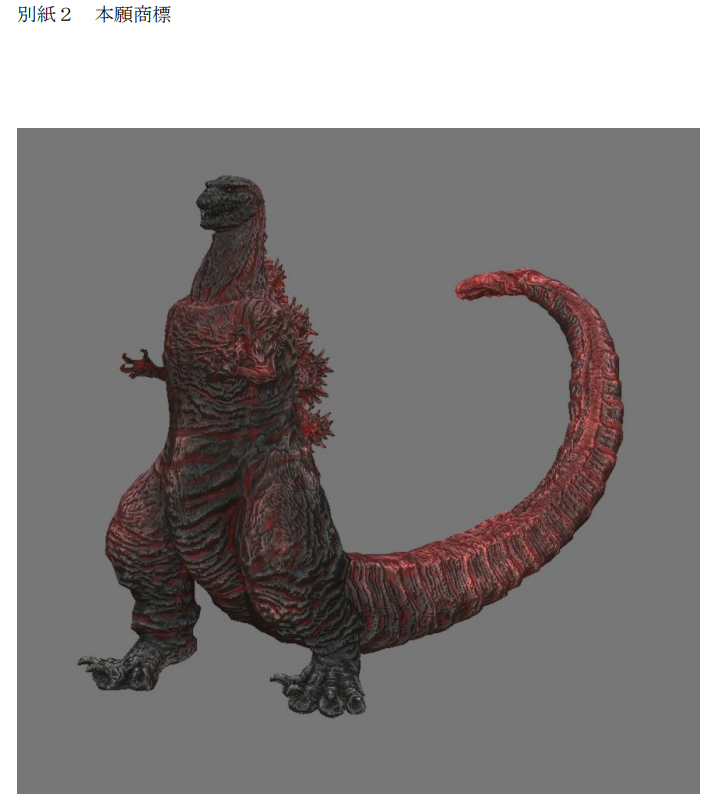
IP High Court Grand Panel, 2023 (Ne) 10040 — Composition for Breast Augmentation
Original Ameblo publication: 2025-03-21
Article type: Case note
Categories: Patents
Topics: Claim interpretation, Working of inventions, Patent eligibility
First published on this website: 2026-10-16
Case information: 2023 (Ne) 10040
Ameblo: https://ameblo.jp/hideki-takaishi/entry-12890754477.html
HP: https://www.takaishihideki.com/en/single-post/ameblo-12890754477-en
Japanese version: https://www.takaishihideki.com/single-post/ameblo-12890754477-ja
IP High Court Grand Panel, 2023 (Ne) 10040 — Composition for Breast Augmentation
Unlike the first-instance judgment, the court found that the appellee had prepared and administered a drug containing components ①, ②, and ③ simultaneously.
⇒ Claim limitations satisfied: the patentee won on reversal.
* The closely watched issue of whether separate administration of components ① and ②, on the one hand, and component ③, on the other, would also satisfy the claim thus disappeared….
The patented “composition for breast augmentation” is used for breast augmentation, and its purpose is considered primarily aesthetic.
⇒ In light of current social norms, it is not a “product used for the diagnosis, treatment, medical care, or prevention of human disease.”
⇒ It does not constitute an “invention of a medicine to be produced by mixing two or more medicines (products used for the diagnosis, treatment, medical care, or prevention of human disease)” under Article 69(3) of the Patent Act.
https://www.ip.courts.go.jp/vc-files/ip/2025/daigougi-5ne10040-n.pdf
Originally published: 2025-03-21
Original Japanese post: https://ameblo.jp/hideki-takaishi/entry-12890754477.html
IP High Court, 2024 (Ra) 10002 — Jurisdiction over a Taiwanese Provider (Miyasaka)
Original Ameblo publication: 2025-03-23
Article type: Case note
Categories: Copyright
Topics: International jurisdiction, Disclosure of sender information
First published on this website: 2026-10-16
Case information: 2024 (Ra) 10002
Ameblo: https://ameblo.jp/hideki-takaishi/entry-12891046084.html
HP: https://www.takaishihideki.com/en/single-post/ameblo-12891046084-en
Japanese version: https://www.takaishihideki.com/single-post/ameblo-12891046084-ja
IP High Court, 2024 (Ra) 10002 (Miyasaka)
Immediate appeal against a decision dismissing an application for an order to disclose sender information.
A Taiwanese provider supplied services within Japan.
⇒ Japanese courts have jurisdiction!!
(The first-instance court had held that jurisdiction could not be found. Reversed!!)
(Excerpts from the decision)
1. Article 9(1)(iii) of the Provider Liability Limitation Act provides that, in addition to the cases listed in items (i) and (ii), Japanese courts have jurisdiction over an application for an order to disclose sender information where the respondent is a person conducting business in Japan and the application concerns that respondent’s business in Japan. Considering the current internationalization of information distribution, appropriate measures are required to avoid obstacles to judicial relief against cross-border copyright infringement on the Internet. In view of the geographically and internationally open nature of Internet access services, it is inappropriate to determine formally and rigidly whether the business of a provider of such services is conducted “in Japan.” Flexible interpretation and application reflecting actual usage and other circumstances are necessary. With these points in mind, the following specific examination is made.
2. Whether the respondent is a “person conducting business in Japan”
According to the case record, although the respondent is a corporation located in Taiwan and engaged in telecommunications, it provides international roaming services within Japan mainly for travelers from Taiwan, and sells SIM cards at Japanese airports and elsewhere for travelers from Japan to Taiwan. Accordingly, the respondent can be regarded as a “person conducting business in Japan.”
3. Whether the “application concerns the respondent’s business in Japan”
According to the case record, … Japanese-language content is present, and it is highly likely that the posts at issue were made using SIM cards supplied for Japanese users or other services the respondent offers to Japanese users. …
https://www.courts.go.jp/assets/hanrei/hanrei-pdf-93389.pdf
Originally published: 2025-03-23
Original Japanese post: https://ameblo.jp/hideki-takaishi/entry-12891046084.html
IP High Court, 2024 (Ne) 10010 — Women’s Clothing: A Late Invalidity Defense (Nakadaira)
Original Ameblo publication: 2025-03-23
Article type: Case note
Categories: Patents
Topics: Litigation procedure, Inventive step
First published on this website: 2026-10-16
Case information: 2024 (Ne) 10010
Ameblo: https://ameblo.jp/hideki-takaishi/entry-12891046166.html
HP: https://www.takaishihideki.com/en/single-post/ameblo-12891046166-en
Japanese version: https://www.takaishihideki.com/single-post/ameblo-12891046166-ja
IP High Court, 2024 (Ne) 10010 — Women’s Clothing (Nakadaira)
*The new invalidity defense raised in the statement of reasons for appeal was found to have been submitted out of time, and the delay was found to be due to gross negligence. Nevertheless, because it would not delay completion of the proceedings in this case, the court considered its merits and rejected it. (New arguments on appeal require attention to the first-instance proceedings and the timing of submission.)
(Excerpts from the decision)
The appellant’s assertion of new grounds for invalidity in this court … was made in the statement of reasons for appeal. …
… After the court disclosed its preliminary view that the proceedings would move on to damages, … the examination of damages proceeded. … At the oral argument hearing, the appellant stated that it had no further allegations or evidence to present. Oral argument in the first instance was then closed and the first-instance judgment was rendered. … In view of this course of proceedings, the new grounds for invalidity asserted in this court constitute allegations and evidence submitted out of time, and the appellant was grossly negligent in submitting them late, so ordinarily their dismissal would be unavoidable. However, the appellee has, albeit in the alternative, responded to the grounds for invalidity submitted in this court, and oral argument in this court has closed without a rejoinder from the appellant. To this extent, it cannot be said that addressing them would delay the conclusion of the proceedings. The court therefore proceeds to examine them below. … The argument that inventive step is lacking is without merit.
https://www.courts.go.jp/assets/hanrei/hanrei-pdf-93355.pdf
Originally published: 2025-03-23
Original Japanese post: https://ameblo.jp/hideki-takaishi/entry-12891046166.html
IP High Court, 2024 (Ra) 10003 — Restricting Access to Settlement Terms and Litigation Records
Original Ameblo publication: 2025-03-24
Article type: Case note
Categories: Patents
Topics: Litigation procedure, Trade secrets
First published on this website: 2026-10-16
Case information: 2024 (Ra) 10003
Ameblo: https://ameblo.jp/hideki-takaishi/entry-12891140309.html
HP: https://www.takaishihideki.com/en/single-post/ameblo-12891140309-en
Japanese version: https://www.takaishihideki.com/single-post/ameblo-12891140309-ja
IP High Court, 2024 (Ra) 10003
Immediate appeal against a decision dismissing an application to restrict inspection and similar access.
A settlement including a nondisclosure clause was reached in patent infringement litigation.
⇒ The defendant applied to restrict inspection of the settlement terms and portions of the preparatory briefs and documentary evidence.
⇒ The IP High Court held that the settlement terms, taken as an indivisible whole, constituted a trade secret and permitted restrictions on access to all of those terms.
(The first-instance decision had granted the application in full as to the portions of the preparatory briefs and documentary evidence covered by it, but had restricted access to only part of the settlement terms and dismissed the remainder of that application.)
(Excerpt from the decision: the section on the “relationship with the principle of open justice”)
… The plaintiff in the underlying action emphasizes in its opinion that Article 91 of the Code of Civil Procedure derives from the principle of open justice under Article 82 of the Constitution. The court therefore sets out its view on this point.
First, what Article 82(1) of the Constitution requires to be public are the “trials” and “judgments” of courts. “Trials” refers to oral argument in civil proceedings and trial proceedings in criminal cases; it does not automatically include the preparatory proceedings in which this settlement took place. It goes without saying that a settlement in litigation, unlike a “judgment,” is not something pronounced in open court.
In civil litigation, the principle of party disposition is adopted as a reflection of private autonomy, leaving the legal relationship constituting the subject matter of the action to the parties, and respect for the parties’ autonomous resolution is required. In the underlying action here, the plaintiff and the defendant (the appellant) chose final resolution through the nonpublic procedure of a settlement in litigation rather than through a judgment procedure subject to the requirement of publicity. They also agreed to a nondisclosure clause, seeking to prevent the release or leakage of information relating to the settlement terms. If, notwithstanding this, third parties could inspect the settlement terms through the procedure under Article 91(1) of the Code of Civil Procedure, that would clearly produce a result contrary to the intentions and expectations of the parties who decided on such a settlement. In such a case, an order restricting inspection and similar access to all of the settlement terms accords with the principle of party disposition, a basic principle of civil litigation, and the requirement to respect the parties’ autonomous resolution, and in no way conflicts with the principle of open justice.
https://www.courts.go.jp/assets/hanrei/hanrei-pdf-93381.pdf
Originally published: 2025-03-24
Original Japanese post: https://ameblo.jp/hideki-takaishi/entry-12891140309.html
Article — Scope of Review in Patent Trial-Decision Revocation Actions: Admissibility of New Arguments on Well-Known Technology — The Laser Processing Optical Apparatus Case (Peng Zhang, 2012)
Original Ameblo publication: 2025-03-25
Article type: Publication review
Categories: Patents
Topics: Litigation procedure, Cancellation of JPO decision, Examination and appeal practice
First published on this website: 2026-10-16
Ameblo: https://ameblo.jp/hideki-takaishi/entry-12891265447.html
HP: https://www.takaishihideki.com/en/single-post/ameblo-12891265447-en
Japanese version: https://www.takaishihideki.com/single-post/ameblo-12891265447-ja
Article — “Scope of Review in Patent Trial-Decision Revocation Actions: Admissibility of New Arguments on Well-Known Technology — The Laser Processing Optical Apparatus Case” (Peng Zhang, Intellectual Property Law and Policy Journal, Vol. 38 (2012))
The Supreme Court’s January 24, 1980 judgment in the “Food Packaging Container” case held that, because judges do not possess knowledge equivalent to that of a person skilled in the art, new allegations and proof of publicly known technology are permissible to establish the common general technical knowledge underlying the trial decision.
⇒ The (lower) court may decide this in its discretion. (See footnote 31.)
https://lex.juris.hokudai.ac.jp/gcoe/journal/IP_vol38/38_4.pdf
Originally published: 2025-03-25
Original Japanese post: https://ameblo.jp/hideki-takaishi/entry-12891265447.html
Original Ameblo publication: 2025-03-26
Article type: Reports and activities
Categories: Patents
Topics: Examination and appeal practice, Divisional applications
First published on this website: 2026-10-16
Ameblo: https://ameblo.jp/hideki-takaishi/entry-12891384718.html
HP: https://www.takaishihideki.com/en/single-post/ameblo-12891384718-en
Japanese version: https://www.takaishihideki.com/single-post/ameblo-12891384718-ja
JPO Status Report 2025
The number of patent applications in Japan is recovering: 306,855 applications.
Appeals against examiners’ decisions of refusal: approximately 20,000.
Requests for invalidation trials doubled to 186 (one person filed more than 50).
Operation of suspension of examination of divisional applications while the parent application is pending in appeal proceedings
Allowing applicants to consider how to handle a divisional application in light of the results of re-examination before appeal or the appeal proceedings for the parent application is expected to help them develop more efficient and effective filing strategies.
• Examination was suspended in 3,553 cases in 2024.
https://www.jpo.go.jp/resources/report/statusreport/2025/index.html
Originally published: 2025-03-26
Original Japanese post: https://ameblo.jp/hideki-takaishi/entry-12891384718.html
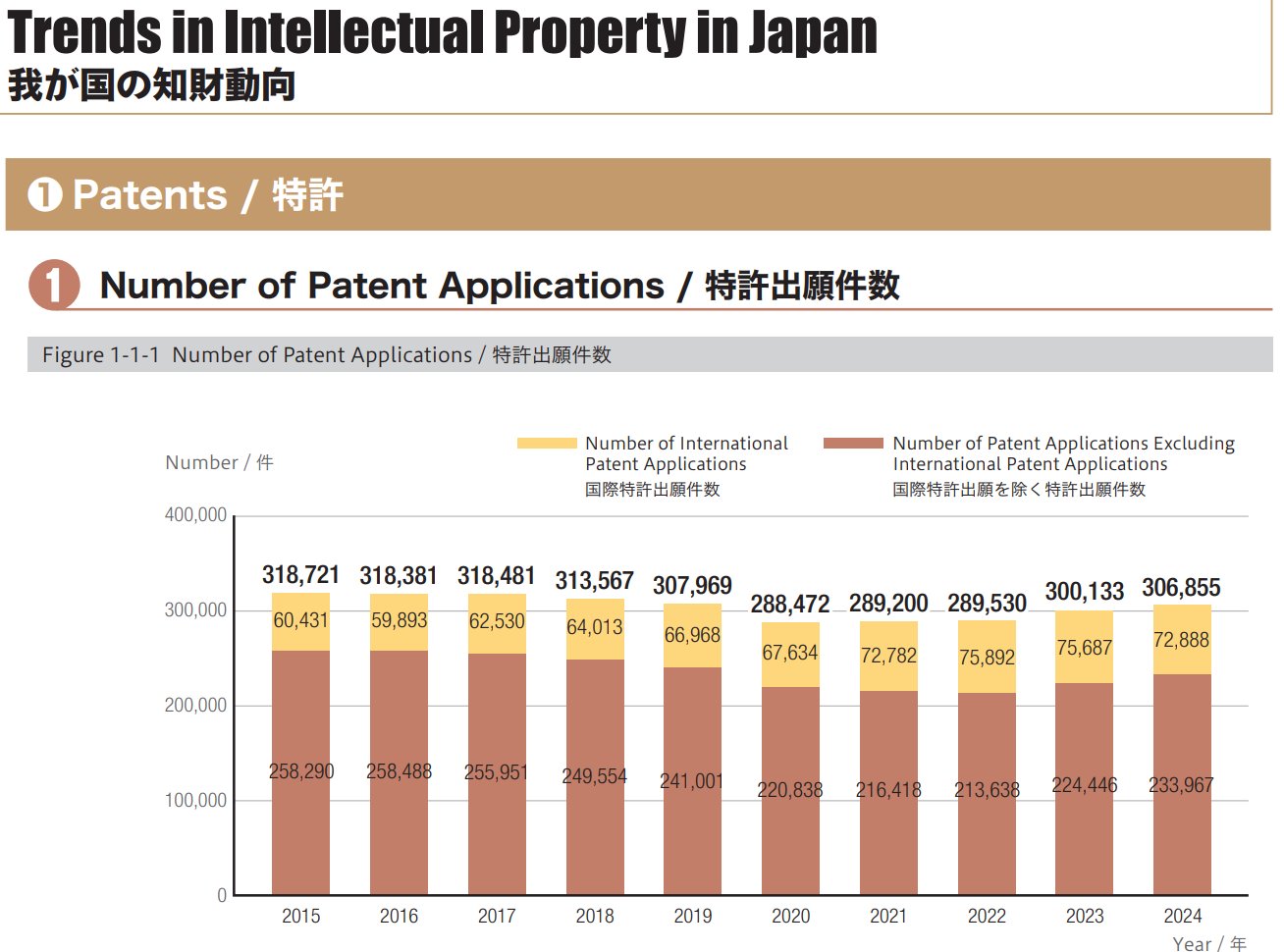
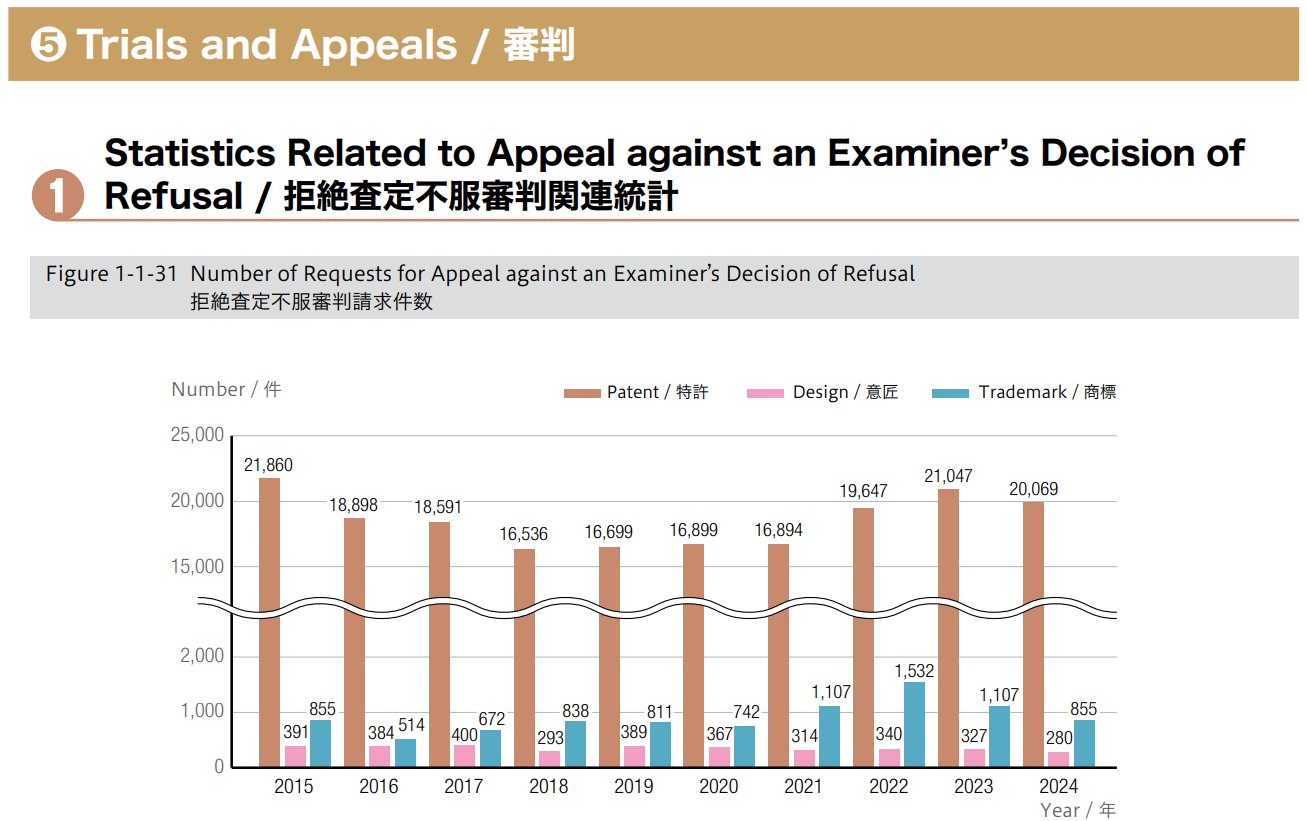
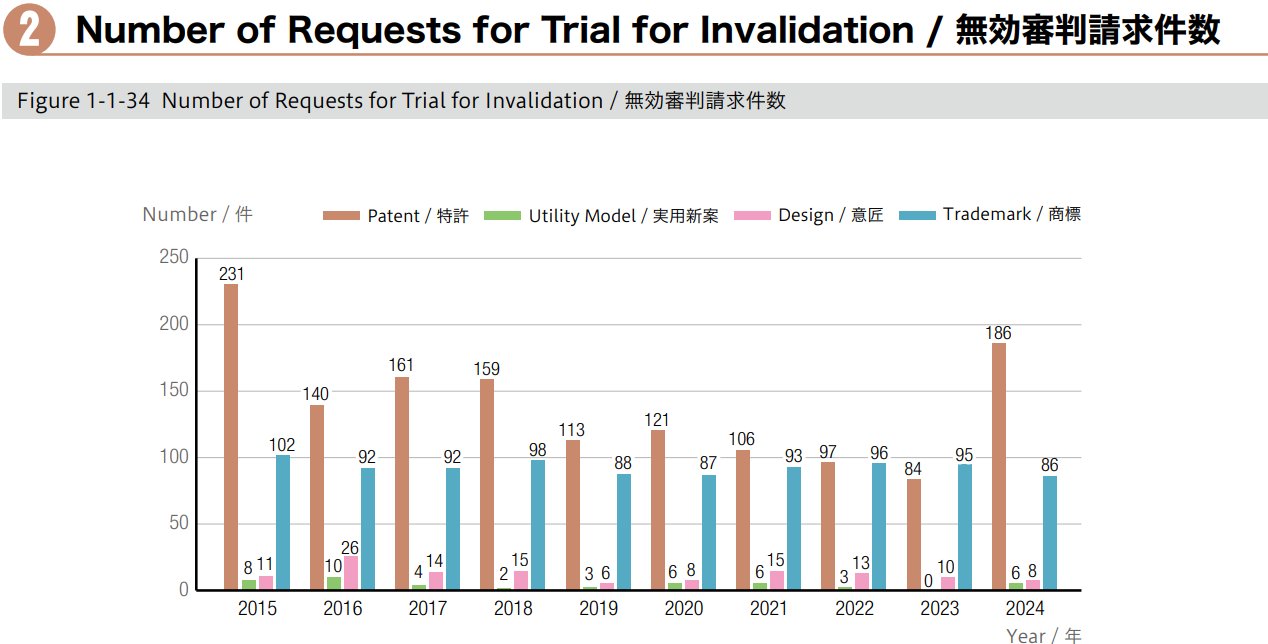
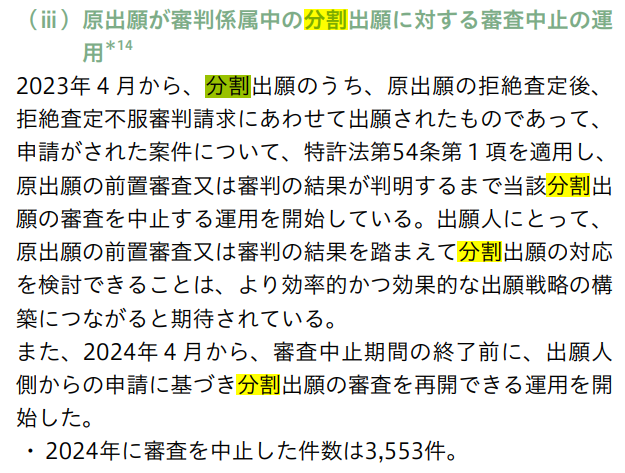
English translations of the Japanese source figures
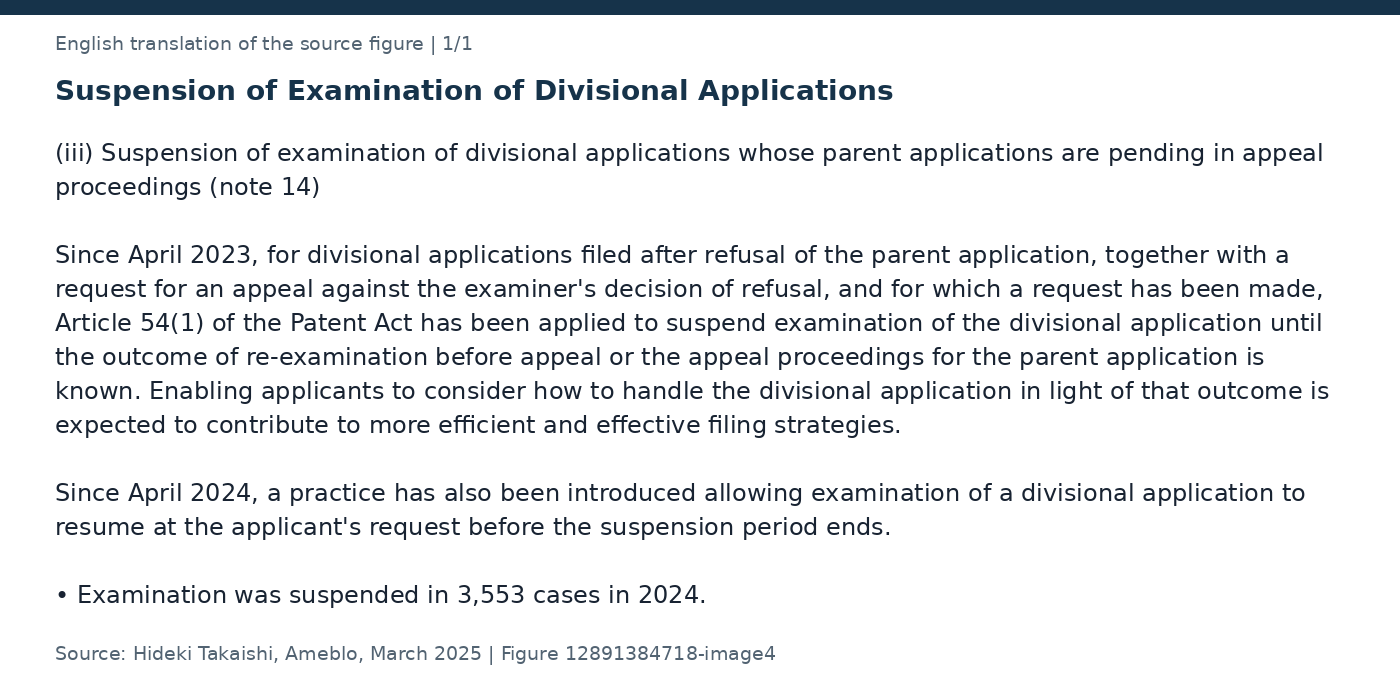
Copyright Article — Identifying the Author of a Compilation (Katsuyuki Izumi, 2013)
Original Ameblo publication: 2025-03-27
Article type: Publication review
Categories: Copyright
Topics: Creators and inventors, Copyrightability
First published on this website: 2026-10-16
Ameblo: https://ameblo.jp/hideki-takaishi/entry-12891500657.html
HP: https://www.takaishihideki.com/en/single-post/ameblo-12891500657-en
Japanese version: https://www.takaishihideki.com/single-post/ameblo-12891500657-ja
Article / Copyright — “Identifying the Author of a Compilation” (Katsuyuki Izumi, Intellectual Property Law and Policy Journal, Vol. 42 (2013))
A compilation work = one “that is creative by reason of the selection or arrangement of its materials” (Article 12(1) of the Copyright Act).
Author of a compilation work = a person who was creatively and substantively involved in the selection or arrangement of the materials.
A person who decided the editorial policy can also be the author of a compilation work. (Tokyo District Court, September 17, 1980, “Chi no Sazamegoto” case.)
The person who commissioned creation of a work or supplied the original proposal can also be an author if that person substantively participated in its creation. (Osaka District Court, March 29, 1985, “Commercial Advertisement” case.)
https://eprints.lib.hokudai.ac.jp/dspace/bitstream/2115/52425/3/42_06.pdf
Originally published: 2025-03-27
Original Japanese post: https://ameblo.jp/hideki-takaishi/entry-12891500657.html
Trademark Appeal 2024-278 — “AONO” Does Not Fall Under Article 3(1)(iv)
Original Ameblo publication: 2025-03-28
Article type: Administrative decision note
Categories: Trademarks
Topics: Distinctiveness, Examination and appeal practice
First published on this website: 2026-10-16
Ameblo: https://ameblo.jp/hideki-takaishi/entry-12891634315.html
HP: https://www.takaishihideki.com/en/single-post/ameblo-12891634315-en
Japanese version: https://www.takaishihideki.com/single-post/ameblo-12891634315-ja
Trademark / Trial Decision — Appeal 2024-278
Applied-for trademark: “AONO”
Does not fall under Article 3(1)(iv).
The surname “Aono” (青野) ranks 797th or 849th, with 20,000 people and 6,000 households.
⇒ Nationwide, the number cannot be regarded as particularly large.
https://www.jpo.go.jp/system/laws/rule/guideline/trademark/kijun/document/index/08_3-1-4.pdf
Originally published: 2025-03-28
Original Japanese post: https://ameblo.jp/hideki-takaishi/entry-12891634315.html
The JPO’s “Toward Strategic Intellectual Property Management” (2007)
Original Ameblo publication: 2025-03-29
Article type: Reports and activities
Categories: Patents
Topics: IP management, AI and intellectual property, Generative AI
First published on this website: 2026-10-16
Ameblo: https://ameblo.jp/hideki-takaishi/entry-12891783183.html
HP: https://www.takaishihideki.com/en/single-post/ameblo-12891783183-en
Japanese version: https://www.takaishihideki.com/single-post/ameblo-12891783183-ja
While looking back through old materials, I found the JPO’s “Toward Strategic Intellectual Property Management” (2007).
I came across this heading:
“Propose research and development themes based on the ‘problem’ sections of other companies’ published patent applications.”
Was this a novel perspective in 2007?
Could we now conduct such research using generative AI?
https://dl.ndl.go.jp/view/prepareDownload?contentNo=1&itemId=info%3Andljp%2Fpid%2F1247684
Originally published: 2025-03-29
Original Japanese post: https://ameblo.jp/hideki-takaishi/entry-12891783183.html
Compilation Copyright — Legal Protection for Works Distributed in Parts over the Internet — The Daily Tear-Off Calendar Case (Takuto Hirasawa, 2009)
Original Ameblo publication: 2025-03-29
Article type: Publication review
Categories: Copyright
Topics: Moral rights
First published on this website: 2026-10-16
Ameblo: https://ameblo.jp/hideki-takaishi/entry-12891783270.html
HP: https://www.takaishihideki.com/en/single-post/ameblo-12891783270-en
Japanese version: https://www.takaishihideki.com/single-post/ameblo-12891783270-ja
Article / Compilation Copyright — “Legal Protection for Works Distributed in Parts over the Internet — The Daily Tear-Off Calendar Case” (Takuto Hirasawa, Intellectual Property Law and Policy Journal, Vol. 24 (2009))
* IP High Court judgment of June 23, 2008
The images were not distributed as a daily tear-off calendar. Instead, once a week, images for nearby dates were excerpted and distributed.
⇒ No infringement of the right to integrity of the compilation work.
Infringement of an “expectation right” was also denied.
* The appellate judgment treated the fact that the photographs constituting the materials had not themselves been altered as one reason for finding no infringement of the right to integrity of the compilation work.
Consent to alterations: the majority view is that it is “valid.”
https://lex.juris.hokudai.ac.jp/gcoe/journal/IP_vol24/24_9.pdf
Originally published: 2025-03-29
Original Japanese post: https://ameblo.jp/hideki-takaishi/entry-12891783270.html
Osaka District Court, 2022 (Wa) 3344 — Method for Producing a High-Purity PTH-Containing Lyophilized Preparation (Takemiya)
Original Ameblo publication: 2025-03-30
Article type: Case note
Categories: Patents
Topics: Claim interpretation, Inventive step, Novelty
First published on this website: 2026-10-16
Case information: 2022 (Wa) 3344
Ameblo: https://ameblo.jp/hideki-takaishi/entry-12891909511.html
HP: https://www.takaishihideki.com/en/single-post/ameblo-12891909511-en
Japanese version: https://www.takaishihideki.com/single-post/ameblo-12891909511-ja
Osaka District Court, 2022 (Wa) 3344 — Method for Producing a High-Purity PTH-Containing Lyophilized Preparation … (Takemiya)
① ★ “Suppressing contact with ozone at 0.1 ppm or less” in Claim Limitation 1C need only be achieved by some method. ⇒ Satisfied.
② ★ Inventive step affirmed on the basis that the purpose differs from the prior art (novelty was not at issue).
* If “suppressing contact with ozone at 0.1 ppm or less” in Claim Limitation 1C is treated as the purpose, and inventive step is upheld because that purpose is absent from the prior art, would it not be inequitable unless satisfaction of the claim is also treated similarly to a labeling-based approach, as with a use invention?
Cf. A comparative examination should be made with Tokyo District Court, 2024 (Yo) 30029, the Age-Related Macular Degeneration case (Presiding Judge Nakashima), which denied patent infringement by finding that the medical-use invention was not worked under an “exclusively” standard and that, on the patentee’s argument that a certain proportion sufficed, novelty would be lacking.
(Excerpts from the judgment)
(1) Satisfaction of Claim Limitation 1C
“Claim Limitation 1C merely specifies suppressing contact between the PTH peptide-containing solution and ozone at 0.1 ppm or less contained in the air inside a sterile injectable-drug manufacturing facility. It does not limit the means to any particular method, and no other claim limitation of the invention contains such a restriction.
Moreover, the specification expressly states that the means for suppressing contact between the PTH peptide-containing solution and ozone at 0.1 ppm or less contained in the air inside a sterile injectable-drug manufacturing facility are not particularly limited. … As examples, it describes suppressing the mobility or flow volume of air around the PTH peptide-containing solution … and replacing the atmosphere around the solution with an inert gas. …
In light of these claim limitations and the specification, the means for suppressing contact between the PTH peptide-containing solution and ozone at 0.1 ppm or less contained in the air inside a sterile injectable-drug manufacturing facility are not limited in Invention 1; achieving that suppression by some method is sufficient. …
In the defendant’s method, contact between the PTH peptide-containing solution and ozone at 0.1 ppm or less contained in the air inside the sterile injectable-drug manufacturing facility is suppressed during steps including the carrying-in step. The defendant’s method therefore satisfies Claim Limitation 1C.”
(2) Invalidity / lack of inventive step (novelty was not raised as an issue)
“Difference 1-3
Invention 1 is specified as a method characterized by suppressing contact between the PTH peptide-containing solution and ozone at 0.1 ppm or less contained in the air inside a sterile injectable-drug manufacturing facility, whereas the invention in Exhibit Otsu 1 contains no statement that it is a method characterized by suppressing contact with ozone at 0.1 ppm or less contained in the air inside a sterile pharmaceutical manufacturing facility.”
“The invention described in the Otsu 1 publication focuses on sterile transfer and cannot be found to have the purpose of suppressing oxidation of a drug. Certainly, as stated in the claims of that publication, the Otsu 1 invention uses a sterilized ‘inert’ protective gas (nitrogen), which has an oxidation-suppressing effect. However, this is understood to serve the purpose of transferring the drug in a sterile state. In light of the detailed description of the invention, it is difficult to find that a person skilled in the art would recognize a purpose of suppressing oxidation caused by contact with surrounding air. Even if, as the defendant argues, common general technical knowledge existed that an inert gas such as nitrogen is not a ‘sterilized inert protective gas’ unless sterilized, and that oxidation of a drug can be prevented by suppressing contact between the drug and surrounding air and filling with an inert gas, the Otsu 1 publication contains no specific statement intended to achieve an oxidation-suppressing effect. It cannot be found to disclose the technical concept of suppressing oxidation by suppressing contact between the drug solution and surrounding air.
Furthermore, … the example in the Otsu 1 publication concerns ‘omeprazole sensitive to carbon dioxide.’ Considering also that omeprazole is cited not as a drug requiring protection against oxidation but as an example of a drug in an unsealed container that is ‘to be transferred in a sterile state,’ a person skilled in the art would not be found to understand this as an example of a drug requiring suppression of oxidation caused by contact with surrounding air. Similarly, … the statement that ‘Container 2 and its contents need not necessarily be pharmaceutical. Other types of containers filled with liquid or solid chemicals requiring hygienic or non-oxidizing transfer or storage conditions can also be treated by the method of the present invention’ should be understood merely as indicating that other types of containers filled with non-pharmaceutical chemicals requiring hygienic or non-oxidizing transfer or similar handling can also be treated by the sterile-transfer method of the Otsu 1 invention.
Even considering the claims, the problems of the prior art, the objectives and effects of the invention, and the examples described in the Otsu 1 publication, the invention focuses on transferring a drug solution in a sterile state. It cannot be regarded as an invention suggesting suppression of oxidation caused by contact between the drug solution and surrounding air.”
“The Otsu 1 invention aims to transfer a drug solution in a sterile state and cannot be found to aim at suppressing oxidation caused by contact between the drug solution and surrounding air during the carrying-in step (transport and carrying-in). Accordingly, the … argument premised on that purpose cannot be accepted. Likewise, the … argument that the structure itself inherently performs the function of suppressing contact between the drug and ozone contained in the air inside a sterile pharmaceutical manufacturing facility cannot be accepted. … The Otsu 1 publication contains no description or suggestion of oxidation of the drug solution by ozone. It does state that other types of containers filled with liquid or solid chemicals requiring non-oxidizing transfer or storage conditions can also be treated by the method of the invention. Nevertheless, even on the understanding of a person skilled in the art, this cannot be regarded as stating that the sterile-transfer method of the Otsu 1 invention can be used to prevent oxidation of a drug solution by ozone. Nor, even considering common general technical knowledge before the patent’s priority date, can it be said that a person skilled in the art applying the Otsu 1 invention to manufacture a PTH peptide lyophilized preparation would naturally understand and recognize that its structure also acts to suppress contact between the drug solution and ozone. Specifically, ③ even if it was common general technical knowledge that PTH peptides are readily oxidized …, those publications and other materials do not identify ozone as the cause of oxidation; and ④ even if it was common general technical knowledge that ozone oxidizes methionine and tryptophan …, Exhibit Otsu 10 concerns free amino acids in an environment with an ozone concentration of 1 ppm …, while Exhibit Otsu 11 concerns ranatensin peptide, which differs from PTH peptide in amino-acid sequence and peptide-chain length, under conditions in which the solvent is evaporated in air. These documents therefore do not establish that PTH peptide is oxidized by ozone contained in air. In the first place, … the invention arose not only from the prior-art problem that preparations containing PTH peptide must be particularly pure, but also from the inventors’ finding that attempts to manufacture PTH peptide-containing lyophilized preparations industrially produced preparations containing PTH-related substances. The Otsu 1 publication contains no description or suggestion of that problem premised on industrial manufacture, and there are no materials establishing that this finding was common general technical knowledge before the patent’s priority date. A person skilled in the art encountering the Otsu 1 publication would therefore not recognize the problem that PTH-related substances are generated during the carrying-in step for PTH-containing lyophilized preparations, and cannot be said to have motivation to suppress contact between the PTH peptide-containing solution and ozone at 0.1 ppm or less contained in the air inside a sterile injectable-drug manufacturing facility. Accordingly, a person skilled in the art cannot be said, on the basis of the Otsu 1 invention and common general technical knowledge, to understand and recognize suppression of contact between the PTH peptide-containing solution and ozone at 0.1 ppm or less contained in the air inside a sterile injectable-drug manufacturing facility. …”
https://www.courts.go.jp/assets/hanrei/hanrei-pdf-93485.pdf
Originally published: 2025-03-30
Original Japanese post: https://ameblo.jp/hideki-takaishi/entry-12891909511.html
Deletion of All Claims Is Permitted in the JPO’s Q&A
Original Ameblo publication: 2025-03-31
Article type: Legal and examination updates
Categories: Patents
Topics: Patent corrections, Examination and appeal practice, Divisional applications
First published on this website: 2026-10-16
Ameblo: https://ameblo.jp/hideki-takaishi/entry-12892033192.html
HP: https://www.takaishihideki.com/en/single-post/ameblo-12892033192-en
Japanese version: https://www.takaishihideki.com/single-post/ameblo-12892033192-ja
A note, although this is hardly new.
Deletion of all claims is permitted in the JPO’s Q&A, and the Trial and Appeal Manual also treats such deletion as a restriction of the scope of claims. I should therefore keep it in mind as a last resort for satisfying the requirement of limiting reduction of claims in the parent-child-grandchild divisional-application problem.
(Note) Q20 of the JPO’s “Q&A on Correction Trials and Requests for Correction” (https://www.jpo.go.jp/faq/yokuaru/shinpan/document/index/03.pdf) answers that a correction deleting all claims is permitted, in the situation where the patentee’s own registered patent has given rise to a violation of Article 39 of the Patent Act. It concerns correction of a registered patent. Section 38-03 of the Trial and Appeal Manual treats deletion of claims, including deletion of all claims, as a restriction of the scope of claims, which is a permitted purpose of correction. The “limiting reduction of claims” requirement referred to above (限定的減縮) is a requirement under Article 17-2(5)(ii) of the Patent Act for amendments made after a final notice of reasons for refusal and in certain other situations.
https://www.jpo.go.jp/faq/yokuaru/shinpan/document/index/03.pdf
Originally published: 2025-03-31
Original Japanese post: https://ameblo.jp/hideki-takaishi/entry-12892033192.html
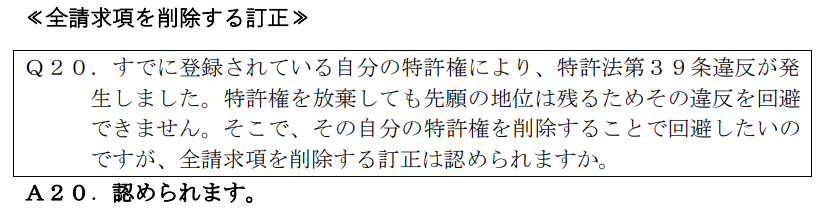
English translations of the Japanese source figures
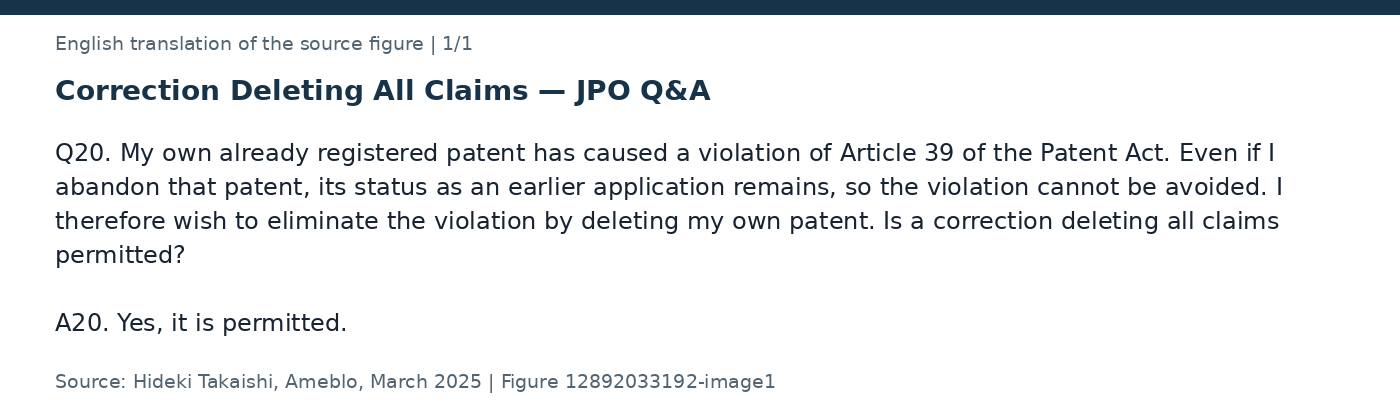
IP High Court, 2024 (Gyo-Ke) 10002 — Nonwoven Fabric for Civil Engineering Work (Shoji) — Motivation to change the specifications of a publicly worked product
Original Ameblo publication: 2025-04-01
Ameblo: https://ameblo.jp/hideki-takaishi/entry-12892137239.html
IP High Court, 2024 (Gyo-Ke) 10002 — Nonwoven Fabric for Civil Engineering Work (Shoji)
*Motivation exists to change the specifications of a publicly worked product.
⇒ Inventive step: lacking
(Excerpts from the court’s reasoning)
In the nonwoven fabric for civil engineering work of Cited Invention 1, increasing or decreasing the proportion of black fibers colored with carbon black to improve weather resistance, abrasion resistance and light shielding; prevent reflected light from hindering workers; prevent impairment of the landscape; and suitably adjust the clarity of the mottled pattern used to measure the fabric’s elongation is merely a matter of design choice for a person skilled in the art. Moreover, as noted above, it was common general technical knowledge at the filing date that, in a nonwoven fabric for civil engineering work combining white fibers with black fibers colored with carbon black, increasing the proportion of black fibers darkens the mottled pattern, facilitating measurement of elongation based on distances between spots, and also improves weather resistance, abrasion resistance and light shielding and suppresses light reflection. Accordingly, there was motivation to increase the proportion of black fibers above 7.5%. …
Even if compliance with the specifications for the 800Z product is required to maintain its identity or quality, developing and manufacturing a new nonwoven fabric product for civil engineering work based on that product with some specifications changed is something naturally undertaken. The fact that the proportion of black fibers is set at a particular value in the 800Z specifications therefore does not establish an inhibiting factor against changing that value. Nor can the fact that the proportion of black fibers specified for the 800Z product is the single-digit figure of 5% be understood as an inhibiting factor against changing it to the double-digit figure of 10%.
Furthermore, …specifying a particular proportion or range for the black fibers is not found to have any particular technical significance, and there was motivation to increase the proportion of black fibers colored with carbon black. Accordingly, no inhibiting factor is found against changing the proportion of black fibers in Cited Invention 1 from the value stated in the above specifications.
https://www.courts.go.jp/assets/hanrei/hanrei-pdf-93103.pdf
A Revised Edition of the “Trade Secret Management Guidelines” Has Been Published.
Original Ameblo publication: 2025-04-01
Ameblo: https://ameblo.jp/hideki-takaishi/entry-12892193335.html
A Revised Edition of the “Trade Secret Management Guidelines” Has Been Published.
Numerous criminal judgments are cited.
<Management as a Secret>
• Nagoya District Court, March 18, 2022 (2017 (Wa [criminal]) 427)
“Even for criminal measures, the requirements for qualifying as a trade secret are understood to be the same as the civil requirements, including in light of the history of the 2003 amendment to the Unfair Competition Prevention Act.”
For the non-public-knowledge requirement, where information consists of a combination of multiple items, the determination depends on whether it is generally available outside the holder’s control, considering such matters as the ease of combination and the time, money and other costs needed to obtain it.
• IP High Court, 2020 (Ne) 10066
Management as a secret should be determined from an objective perspective, including recognizability by employees as a whole, and is not affected by what each individual employee actually understood.
• IP High Court, 2010 (Ne) 10039; Tokyo District Court, December 9, 2022, 2021 (Toku-Wa) 129
Regarding the nature of the information, if it is important to the trade-secret holder and it is obvious to employees that it naturally must be managed as secret, management making use of that employee awareness should be permitted.
• Fukuoka High Court, 2024 (U) 20
Limiting the persons who have contact with the medium does not require strictly examining each employee’s business need before granting access. Even if access is broadly granted within a particular department for operational needs or similar reasons, it remains limited to specified employees.
<Usefulness>
• Tokyo District Court, 2021 (Toku-Wa) 129; Tokyo District Court, 2022 (Toku-Wa) 2148
If the information is used or utilized in the business activities of the enterprise holding the trade secret, the need to protect it as a trade secret can basically be affirmed. Unless protection is inappropriate, for example because the information is contrary to public policy or morals, the usefulness requirement is satisfied. The assessment of usefulness is not affected by whether the person who wrongfully acquired the information can put it to effective use.
• Yokohama District Court, July 7, 2021, 2018 (Wa [criminal]) 1931
The purpose of protecting trade secrets under the Unfair Competition Prevention Act is to protect the competitively advantageous position obtainable through legitimately held information in order to prevent unfair competition and maintain competitive order, not to protect special information possessing inventive step. Thus, to qualify as useful technical information, the information need not necessarily produce “unexpected, particularly superior functions and effects.”
<Not Publicly Known>
• Tokyo High Court, 2021 (U) 1407
Information need not produce “unexpected, particularly superior functions and effects” to qualify as not publicly known.
• Nagoya High Court, 2020 (U) 162
The court affirmed that the information was not publicly known because learning it by analyzing a commercially available product required employing a paint manufacturer’s knowledge and obtaining cooperation from raw-material manufacturers, among other things, and still took a certain amount of time; it was not information that anyone could easily learn.
• Osaka District Court, 2014 (Wa) 11151 and 2013 (Wa) 13167
The court rejected non-public status because the types and mixing ratios of the alloys used in the plaintiff’s products on the market could readily be determined using component analysis, a generally available technical means whose costs were not excessive.
★ 27th Unfair Competition Prevention Subcommittee
List of Main Revisions to the “Trade Secret Management Guidelines”
https://www.meti.go.jp/shingikai/sankoshin/chiteki_zaisan/fusei_kyoso/027.html
https://www.meti.go.jp/policy/economy/chizai/chiteki/guideline/r7ts.pdf
IP High Court, 2021 (Gyo-Ke) 10131 [Sheet-Affixed Structure] <Honda>
Original Ameblo publication: 2025-04-02
Ameblo: https://ameblo.jp/hideki-takaishi/entry-12892273816.html
2021 (Gyo-Ke) 10131 [Sheet-Affixed Structure] <Honda>
*In the primary reference, providing multiple locations has no particular technical significance.
⇒ A single location does not necessarily mean inferior fixing strength (adhesive strength); the desired fixing strength (adhesive strength) can … be provided by appropriately adjusting the size and other aspects of “PSA region 39.”
⇒ Can be appropriately selected
⇒ A matter of design choice
(Excerpt from the court’s reasoning)
…Providing “PSA regions 39” at multiple locations in the invention in Exhibit Ko 3-1 is not found to have any particular technical significance. Furthermore, …having “PSA region 39” at “one location” does not necessarily mean lower fixing strength (adhesive strength) than having it at “multiple locations.” The desired fixing strength (adhesive strength) can … be provided by appropriately adjusting the size and other aspects of “PSA region 39” …. Accordingly, …the number of “PSA regions 39” is a matter of design choice that a person skilled in the art can appropriately select by adjusting various factors, including the material, size, weight and hardness of “laminate 30” and the material and size of “PSA region 39” ….
https://www.courts.go.jp/assets/hanrei/hanrei-pdf-91369.pdf
[U.S. Patents] Claim Differentiation and 35 U.S.C. § 112(d)
Original Ameblo publication: 2025-04-03
Ameblo: https://ameblo.jp/hideki-takaishi/entry-12892403149.html
[U.S. Patents] Claim Differentiation and 35 U.S.C. § 112(d)
2024.10 NexStep v. Comcast
The court rejected the claim-differentiation argument that the audio-output limitation in independent claim 4 required “VoIP” in claims 1 and 7 to encompass one-way communication. Claim 4 did not itself recite a VoIP limitation, and the claims also differed in other respects.
2005.07 CAFC en banc Phillips v. AWH Corp.
In claim construction, intrinsic evidence is more reliable than extrinsic evidence.
Dependent claim 2 and independent claim 17 specifically require the baffles to be oriented at an angle to the panel sections and to function to deflect projectiles. As a reason for not adopting the narrow construction, the court noted that, if the baffles of claim 1 were inherently angled, the other claims specifying that feature would be redundant of claim 1.
https://www.cafc.uscourts.gov/opinions-orders/22-1815.OPINION.10-24-2024_2408132.pdf
[U.S. Patents] UTTO v. Metrotech (October 2024, CAFC)
Original Ameblo publication: 2025-04-04
Ameblo: https://ameblo.jp/hideki-takaishi/entry-12892528928.html
[U.S. Patents] UTTO v. Metrotech (October 2024, CAFC)
Plural claim language is presumed to mean more than one, but the presumption is overcome if the specification indicates a different meaning.
⇒ The district court construed “group of buried asset data points” to require “two or more” data points. Noting statements in the specification such as “one or more,” the CAFC held that further examination was required, vacated the dismissal of the patent-infringement claim and remanded for further claim-construction proceedings. It did not decide whether the district court’s construction was correct or establish that the defendant’s product infringed.
https://www.cafc.uscourts.gov/opinions-orders/23-1435.OPINION.10-18-2024_2404584.pdf
IP High Court, 2022 (Gyo-Ke) 10039 [Reservation Support Method] <Honda>
Original Ameblo publication: 2025-04-07
Ameblo: https://ameblo.jp/hideki-takaishi/entry-12892910857.html
2022 (Gyo-Ke) 10039 [Reservation Support Method] <Honda>
*The court identified an “inherent requirement” argued by neither party and found motivation.
⇒ Inventive step: lacking
“To satisfy the inherent requirement, a person skilled in the art would naturally conceive of avoiding a situation in which one continues waiting a long time for a response from the first facility regarding reservation availability.”
(Excerpt from the court’s reasoning)
The cited invention and the technology described in Cited Reference 2 belong to the same technical field of facility reservation methods in reservation systems covering multiple facilities. They also share the method of querying a first facility about reservation availability and, if a reply indicating unavailability is received from that facility, extracting other facilities similar to it. …In the cited invention, if the first facility does not send a response about reservation availability for a long time, there is a risk of failing to satisfy the inherent requirement of reserving a facility matching the user’s desired conditions before the planned date, or date and time, of use. A person skilled in the art would naturally conceive of avoiding a situation in which one continues waiting a long time for the first facility’s response in order to satisfy that inherent requirement. Thus, there is motivation to apply the timeout processing of the technology described in Cited Reference 2 to the cited invention. Applying that timeout processing to the cited invention would result in processing whereby, if no reply is received from the facility terminal within a preset waiting period during which a reply is validly accepted, one or more second facilities other than the first facility are extracted based on the reservation details, and information about those extracted second facilities is sent to the user terminal, just as when the reservation-registration result in the reservation-result information is NG. Accordingly, a person skilled in the art could readily have conceived of the configuration relating to Difference 3 by applying the technology described in Cited Reference 2 to the cited invention.
https://www.courts.go.jp/assets/hanrei/hanrei-pdf-91648.pdf
IP High Court, 2017 (Gyo-Ke) 10167 [Laminated Film] <Mori>
Original Ameblo publication: 2025-04-07
Ameblo: https://ameblo.jp/hideki-takaishi/entry-12892910986.html
2017 (Gyo-Ke) 10167 [Laminated Film] <Mori>
*The scope of exclusion under Article 29-2 is broader than the scope that would not constitute added new matter based on the earlier application’s specification.
⇒ Different from the generally stated purpose of Article 29-2 of the Patent Act!!
*The difference was that the earlier invention lacked the numerical thickness limitation “0.01–100 μm.”
(Excerpt from the court’s reasoning)
The plaintiff argues that Article 29-2 of the Patent Act was established for convenience in examining later applications. Citing the Solder Resist Grand Panel judgment, the plaintiff further argues that its construction of “within the scope of matters described in the specification or drawings” was a determination of the general interpretation of that language in Article 17-2(3), and that, when interpreting “is identical to” the invention in the “specification, claims” “or drawings” under Article 29-2, a defining feature of a later invention can be said to fall within the technical matters derived by comprehensively considering all descriptions in the specification or drawings originally attached to the earlier application only where that feature is self-evident from the descriptions in the specification and other documents originally attached to the earlier application. …Even if the scope of “is identical to” under Article 29-2 … differs from the scope of permitted amendments under Article 17-2(3), this is the result of construing each provision according to its purpose, and no resulting difficulty is found. Thus, there is little reason to adopt the same interpretation as that governing permissible amendments under Article 17-2(3) when determining the requirements for exclusion of a later application by an earlier application under Article 29-2.
<Reference> Commentary on the Patent Act: “If all inventions described in the original specification and drawings—the maximum scope that can be incorporated into the claims by amendment—are given the effect of excluding later applications, the later application can be processed without waiting for either a request for examination or the examination of the earlier application ….”
⇒ According to the generally stated purpose of Article 29-2, the scope of the expanded earlier application is the same as the scope relevant to addition of new matter.
This judgment differs!!
https://www.courts.go.jp/assets/hanrei/hanrei-pdf-87782.pdf
IP High Court, 2014 (Gyo-Ke) 10097 [Flat Nonaqueous Electrolyte Secondary Battery] <Shimizu>
Original Ameblo publication: 2025-04-07
Ameblo: https://ameblo.jp/hideki-takaishi/entry-12892911085.html
2014 (Gyo-Ke) 10097 [Flat Nonaqueous Electrolyte Secondary Battery] <Shimizu>
*At least five opposing faces are “tantamount to being described” in the earlier specification. +The number of layers is a matter of design choice.
⇒ Violation of the expanded-prior-application rule
(Excerpts from the court’s reasoning)
Although the only number of opposing faces between the positive and negative electrode plates specifically stated in Exhibit Ko 1 … is three, the invention in Exhibit Ko 1 is not, in the first place, limited to three opposing faces. It seeks to enlarge the opposing area between the positive and negative electrode plates by stacking them, and it is also clear that increasing the number of stacked positive and negative electrode plates (that is, the number of their opposing faces) simply increases the opposing area proportionally. Thus, Exhibit Ko 1 can be regarded as tantamount to describing not only three opposing faces between the positive and negative electrode plates, but multiple faces, namely two or four or more. Accordingly, Exhibit Ko 1 is found also to describe at least five opposing faces between the active-material-containing layers of said positive and negative electrode plates facing each other through a separator. The number of stacked positive and negative electrode plates (that is, opposing faces) is merely a matter of design choice determined according to the required discharge-capacity level under heavy-load discharge.
…Difference A identified by the trial decision amounts to quantitative differences between the invention at issue and the invention in Exhibit Ko 1 concerning (1) the number of opposing faces and (2) the relative sizes of the opposing area and the gasket opening area. …Both inventions use, as an electrode group in a flat nonaqueous electrolyte secondary battery, a multilayer stack of positive electrode plates having active-material-containing layers on the surfaces of positive electrode constituents and negative electrode plates having active-material-containing layers on the surfaces of negative electrode constituents, with separators interposed, thereby increasing the sum of the opposing areas between the active-material-containing layers of the positive and negative electrode plates and increasing discharge capacity under heavy-load discharge. They thus share the same problem and means of solving it. …The fact that increasing the number of opposing faces beyond five produces little change in heavy-load discharge capacity, and sometimes diminishing capacity, may be unexpected. However, the invention at issue addresses the technical problem of increasing discharge capacity under heavy-load discharge and specifies a lower limit, not an upper limit, on the number of opposing faces. The failure of discharge capacity to increase proportionally with the number of opposing faces therefore cannot be regarded as a new effect of the invention.
https://www.courts.go.jp/assets/hanrei/hanrei-pdf-84668.pdf
[Trademark] Kobe District Court, 1995 (Wa) 661, “Chafukumame”
Original Ameblo publication: 2025-04-08
Ameblo: https://ameblo.jp/hideki-takaishi/entry-12893042443.html
[Trademark] Kobe District Court, 1995 (Wa) 661, “Chafukumame”
• A coined term
• General consumers encounter the name “Chafukumame” mostly through the plaintiff’s and defendant’s products.
• With two exceptions, the term “Chafukumame” appears in trade publications as the name of a particular product.
• As many as eight businesses used different names.
⇒ It has not become generic!!
IP High Court, 2016 (Gyo-Ke) 10146 [Method and Compositions for Preparing Antibodies and Antibody Derivatives with Low Core Fucosylation] <Shimizu>
Original Ameblo publication: 2025-04-09
Ameblo: https://ameblo.jp/hideki-takaishi/entry-12893172466.html
2016 (Gyo-Ke) 10146 [Method and Compositions for Preparing Antibodies and Antibody Derivatives with Low Core Fucosylation] <Shimizu>
*A substantial number of examples ⇒ Enablement requirement satisfied
(Excerpt from the court’s reasoning)
Even if, as the plaintiff argues, differences in the chemical structures of fucose analogs produce different biological activities, the detailed description in the specification substantiates inhibition of core fucosylation for a substantial number of fucose analogs, and there is no apparent reason to deny this for the other fucose analogs recited in claim 1. It is therefore appropriate to find that the invention can be practiced across its entire scope.
https://www.courts.go.jp/assets/hanrei/hanrei-pdf-86977.pdf
[Trademark] Osaka District Court, 2013 (Wa) 12788 <Tani> — Registered mark “Raisapo”
Original Ameblo publication: 2025-04-10
Ameblo: https://ameblo.jp/hideki-takaishi/entry-12893309858.html
[Trademark] Osaka District Court, 2013 (Wa) 12788 <Tani>
Registered mark: “Raisapo”
Defendant’s mark: “Raisapo Ikeda”
⇒ An abbreviation of “Life Support Network Ikeda,” not trademark use under Article 2(3)(viii) of the Trademark Act.
+Not similar
(Excerpt from the court’s reasoning)
In light of how the defendant’s mark is actually used, persons viewing the website and encountering it are considered to recognize it as a whole, without extracting “Raisapo” alone, and, as described above, to understand it as referring to an organization based in Ikeda City whose purpose is to support people’s daily lives. Consequently, there is no likelihood of misidentification or confusion with the plaintiff’s mark consisting only of the characters “Raisapo,” and the two are not similar ….
[Editorial note: The original article image could not be retrieved.]
https://www.courts.go.jp/assets/hanrei/hanrei-pdf-84302.pdf
[Article/China and Trade Secrets] Trade Secret Protection in China: Focusing on Academic Views and Court Decisions concerning the Secret-Management Requirement
Original Ameblo publication: 2025-04-11
Ameblo: https://ameblo.jp/hideki-takaishi/entry-12893422734.html
[Article/China and Trade Secrets] Trade Secret Protection in China: Focusing on Academic Views and Court Decisions concerning the Secret-Management Requirement (Yang Jianjun, Intellectual Property Law and Policy Journal, Vol. 44 (2014))
China’s “secret-management” requirement was lenient before 2007.
In 2007, the Supreme People’s Court issued a judicial interpretation requiring a finding that the rights holder has taken confidentiality measures where one of the following situations (1)–(7) applies and the measures are sufficient, under normal circumstances, to prevent leakage of the confidential information.
(1) Disclosure of confidential information is restricted, and its contents are communicated only to relevant personnel who need to know.
(2) Protective measures such as locking are applied to media containing confidential information.
(3) Confidentiality markings are placed on media containing confidential information.
(4) Passwords, codes or similar measures are used for confidential information.
(5) Confidentiality agreements are concluded.
(6) Visitor access to machinery, factories, workshops or other facilities involving secrets is restricted, or visitors are required to maintain confidentiality.
(7) Other reasonable measures are taken to ensure confidentiality.
*On September 12, 2020, the Supreme People’s Court put into effect the “Provisions on Several Issues concerning the Application of Law in the Trial of Civil Cases Involving Infringement of Trade Secrets,” further developing rules on the elements of trade secrets and the determination of infringement.
IP High Court, 2023 (Ne) 10051 [High-Capacity Water Supply System] <Miyasaka>
Original Ameblo publication: 2025-04-12
Ameblo: https://ameblo.jp/hideki-takaishi/entry-12893590074.html
2023 (Ne) 10051 [High-Capacity Water Supply System] <Miyasaka>
In view of the wording “based on the remaining-fuel-level signal” in claim element C … the “remaining-fuel-level signal” is understood to be sent to the “automatic supply pump mechanism,” with that signal automatically providing on/off control of fuel supply and stopping.
⇒ Limitation not satisfied
https://www.courts.go.jp/assets/hanrei/hanrei-pdf-92694.pdf
[Article] Examining the Scope of New Evidence Admissible in Actions to Rescind Trial Decisions: A Classification of Court Decisions (Masanori Takahashi, 2014)
Original Ameblo publication: 2025-04-13
Ameblo: https://ameblo.jp/hideki-takaishi/entry-12893715540.html
[Article] Examining the Scope of New Evidence Admissible in Actions to Rescind Trial Decisions: A Classification of Court Decisions (Masanori Takahashi, Intellectual Property Law and Policy Journal, Vol. 44 (2014))
⇒ Of the five types, only (1), (2) and (5) permit submission of new evidence in an action to rescind a trial decision!!
Knitting Machine, Supreme Court (Grand Bench) judgment of March 10, 1976, Minshu Vol. 30, No. 2, p. 79 (The appeal trial proceedings under the former system correspond to present-day invalidation trial proceedings.)
“In an action to rescind a trial decision, a ground for invalidity based on comparison with publicly known facts that were not examined and determined in the appeal trial proceedings cannot be asserted as a reason for holding the trial decision unlawful or lawful.”
(1) State-of-the-art type
Evidence to establish the state of the art for a person skilled in the art at the filing date is, in principle, admissible.
(2) Corroboration type
Evidence clarifying the meaning of technical matters determined in the trial is also, in principle, admissible.
(3) Essential-to-patentability type
Even if intended to corroborate technical matters examined in the trial, evidence concerning matters essential to patentability is inadmissible.
(4) Addition type
Evidence concerning technical matters not determined in the trial is inadmissible.
(5) Nontechnical type
Evidence concerning nontechnical matters among the issues to be examined is admissible.
Tokyo District Court, 2012 (Wa) 12351 [Rice Cake] — <Damages> Article 102(2): 90% reduction for noncontribution
Original Ameblo publication: 2025-04-13
Ameblo: https://ameblo.jp/hideki-takaishi/entry-12893715653.html
Tokyo District Court, 2012 (Wa) 12351 [Rice Cake]
<Damages> Patent Act, Article 102(2): 90% reduction for noncontribution (10% contribution) Approximately ¥800 million awarded
(1) Significance of the invention (appearance of grilled rice cakes; suppression of excessive eruption during expansion)
(2) Advertising on the packaging of the defendant’s products: indicating “slits made in the cut rice cakes”
(3) The defendant’s securities reports and other materials described improved business performance attributable to adding the slits.
https://www.courts.go.jp/assets/hanrei/hanrei-pdf-85042.pdf
[Article] Agreements Not to Exercise Authors’ Moral Rights: A Law-and-Economics Analysis (Nobuko Kawashima, Intellectual Property Law and Policy Journal, Vol. 29 (2010))
Original Ameblo publication: 2025-04-14
Ameblo: https://ameblo.jp/hideki-takaishi/entry-12893802585.html
[Article] Agreements Not to Exercise Authors’ Moral Rights: A Law-and-Economics Analysis (Nobuko Kawashima, Intellectual Property Law and Policy Journal, Vol. 29 (2010))
Nonexercise agreement = an agreement by which an author undertakes not to exercise their own moral rights
Under Japanese law, an author’s moral rights are personal to the author and inalienable (Copyright Act, Article 59). After the author ceases to exist, Article 60 protects moral interests by prohibiting certain conduct; this does not mean that the moral rights themselves continue to subsist.
Recognizing authors’ moral rights imposes verification costs on third parties as works circulate from one party to another, but benefits some stars because their works command a premium. (For the many other artists, this new burden worsens compensation and terms.)
https://lex.juris.hokudai.ac.jp/gcoe/journal/IP_vol29/29_7.pdf
[Article] Copyrightability of two-dimensional patterns — Appeal in the Futon Pattern case (Yuanjie Li, Intellectual Property Law and Policy Journal, Vol. 69, 2024)
Original Ameblo publication: 2025-04-15
Article type: Publication review
Category: Copyright
Topics: Copyrightability, Applied art
First published on this website: 2026-10-16
Ameblo: https://ameblo.jp/hideki-takaishi/entry-12893930031.html
HP: https://www.takaishihideki.com/en/single-post/ameblo-12893930031-en
Japanese version: https://www.takaishihideki.com/single-post/ameblo-12893930031-ja
[Article] Copyrightability of two-dimensional patterns — Appeal in the Futon Pattern case (Yuanjie Li, Intellectual Property Law and Policy Journal, Vol. 69, 2024)
These three cases all denied copyrightability of utilitarian articles bearing two-dimensional patterns:
• Futon Pattern — Osaka High Court, 2022 (Ne) No. 745
• Saga Nishiki Fukuro-Obi — Kyoto District Court, 1985 (Wa) No. 1737
• Chamois — Osaka District Court, 2015 (Wa) No. 9648
In Chateau Katsunuma (IP High Court, 2013 (Ne) No. 10057), copyrightability of a picture on a signboard was denied.
Type 1: Simple patterns combining short text or basic geometric shapes. Copyrightability is often denied.
Type 2: Patterns containing elements depicting real objects with some abstraction. Copyrightability is often recognized.
Type 3: Patterns containing relatively detailed depictions of real objects. Copyrightability is strongly affirmed.
The article proposes a framework for assessing two-dimensional patterns through these three categories and compares its consistency with earlier decisions.
[My comments — Hideki Takaishi]
There are, however, many exceptions; the basis for classification may require further study.
Copyrightability was also denied in the Clock Original Drawing case (Osaka District Court, June 24, 2021). Recognition may be harder when a picture is created for a practical use.
By contrast, copyrightability was affirmed in two T-shirt Illustration cases. The Tokyo District Court’s April 20, 1981 judgment reasoned that expression was not constrained by the practical purpose of printing it on T-shirts. Its September 29, 2023 judgment reasoned that the aesthetic features could be perceived separately from the configuration relating to the practical function of clothing.
Might the result here have differed if the pattern had been created as a painting, rather than for a futon from the outset, and then used as a futon pattern after being presented as a painting? In this case, the design had been drawn and stored as a design proposal for fabric used in mass-produced clothing, and was subsequently selected and acquired for use on futons.
Original AMEBLO article (2025-04-15)
https://ameblo.jp/hideki-takaishi/entry-12893930031.html
https://eprints.lib.hokudai.ac.jp/dspace/bitstream/2115/93511/1/69_06_Ri.pdf
https://www.linkedin.com/feed/update/urn:li:activity:7516364154723700736/
English translations of the original image text
Original images retained for comparison
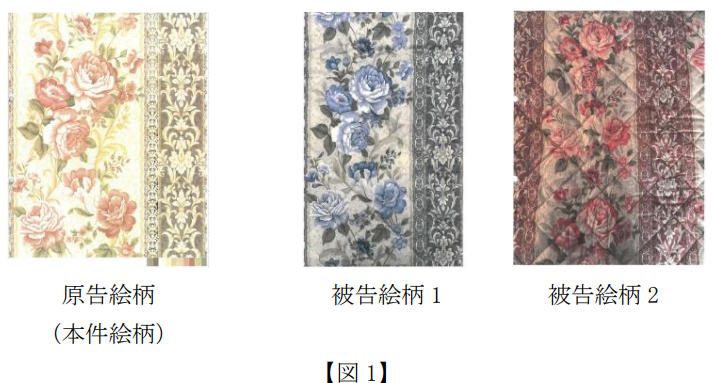
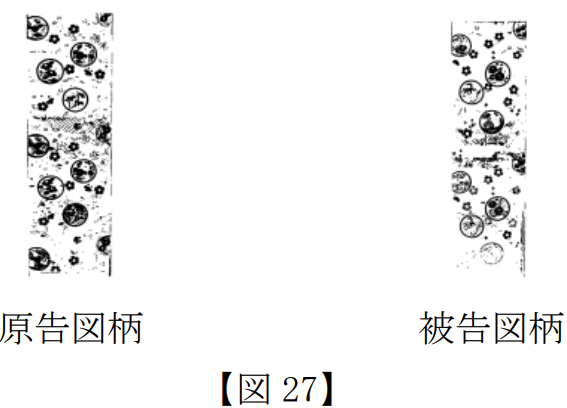
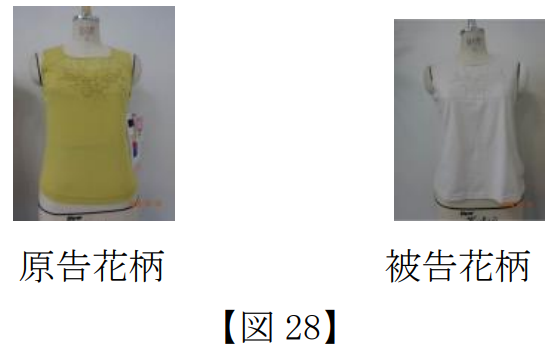
IP High Court, 2017 (Ne) 10068, “Random Packing” Case <Mori>
Original Ameblo publication: 2025-04-16
Ameblo: https://ameblo.jp/hideki-takaishi/entry-12894063622.html
IP High Court, 2017 (Ne) 10068, “Random Packing” Case <Mori>
= First instance: Tokyo District Court, 2015 (Wa) 24688 <Shoji>
Comparison: Tokyo High Court, 2003 (Ne) 366, “PC Frame.” That judgment denied qualification as an indication of goods or business, while leaving room for protection after the effects of exclusivity conferred by intellectual property rights have dissipated.
Fifteen to thirty years had passed since expiration of the utility model rights, and third parties had ample opportunity to enter the market.
⇒ Product configuration qualifies as an “indication of goods or business.”
https://www.courts.go.jp/assets/hanrei/hanrei-pdf-87759.pdf
IP High Court, 2014 (Ne) 10080 [Method of Manufacturing Spinel-Type Lithium Manganate] <Shimizu>
Original Ameblo publication: 2025-04-17
Ameblo: https://ameblo.jp/hideki-takaishi/entry-12894185703.html
IP High Court, 2014 (Ne) 10080 [Method of Manufacturing Spinel-Type Lithium Manganate] <Shimizu>
*A court decision holding a “disclaimer claim” to add new matter
“The specification contains no express description of spinel-type lithium manganate excluding forms ‘substantially containing sodium or potassium in the crystal structure,’ nor can this be said to be self-evident from the description in the specification; therefore, …”
I have the impression that individual patent requirements tend to be assessed more strictly in infringement actions than in actions to rescind trial decisions. Perhaps this is because a value judgment comes into play about whether it is appropriate to grant an injunction on this basis ….
https://www.courts.go.jp/assets/hanrei/hanrei-pdf-85824.pdf
[Article / Copyright] Copyrightability denied for makeup, hairstyling, and the selection and coordination of clothing and accessories in a fashion show, Parts 1–2 (Shun Hashiya, Vol. 47, 2015; Vol. 48, 2016)
Original Ameblo publication: 2025-04-18
Article type: Publication review
Category: Copyright
Topics: Copyrightability, Applied art
First published on this website: 2026-10-16
Ameblo: https://ameblo.jp/hideki-takaishi/entry-12894521514.html
HP: https://www.takaishihideki.com/en/single-post/ameblo-12894521514-en
Japanese version: https://www.takaishihideki.com/single-post/ameblo-12894521514-ja
[Article / Copyright] Copyrightability denied for makeup, hairstyling, and the selection and coordination of clothing and accessories in a fashion show, Parts 1–2 (Shun Hashiya, Vol. 47, 2015; Vol. 48, 2016)
IP High Court, August 28, 2014 (appeal); Tokyo District Court, July 19, 2013
Both courts rejected the claim that broadcasting portions of video footage of the fashion show infringed copyright or related rights. They denied copyrightability and qualification as protected performances for the models’ movements and poses.
The appellate court categorically denied copyrightability of (1) makeup and hairstyles and (2)–(3) combinations of clothing, etc., applying the standards for applied art.
The first-instance court focused on how element (1), makeup and hairstyling, and element (7), background footage, appeared: the scenes were brief and strongly lit, preventing the details from being perceived; the background footage was also brief and blurred, making its specific content difficult to discern.
A related precedent is Setsugekka: Tokyo District Court, October 27, 1999, and Tokyo High Court, February 18, 2002. Copyright infringement was denied because the calligraphic work’s creative expression—the shading and dryness of the ink and the vigor of the brushwork—was not reproduced in the captured image.
Original AMEBLO article (2025-04-18)
https://ameblo.jp/hideki-takaishi/entry-12894521514.html
https://www.linkedin.com/feed/update/urn:li:activity:7516364753015853056/
English translations of the original image text
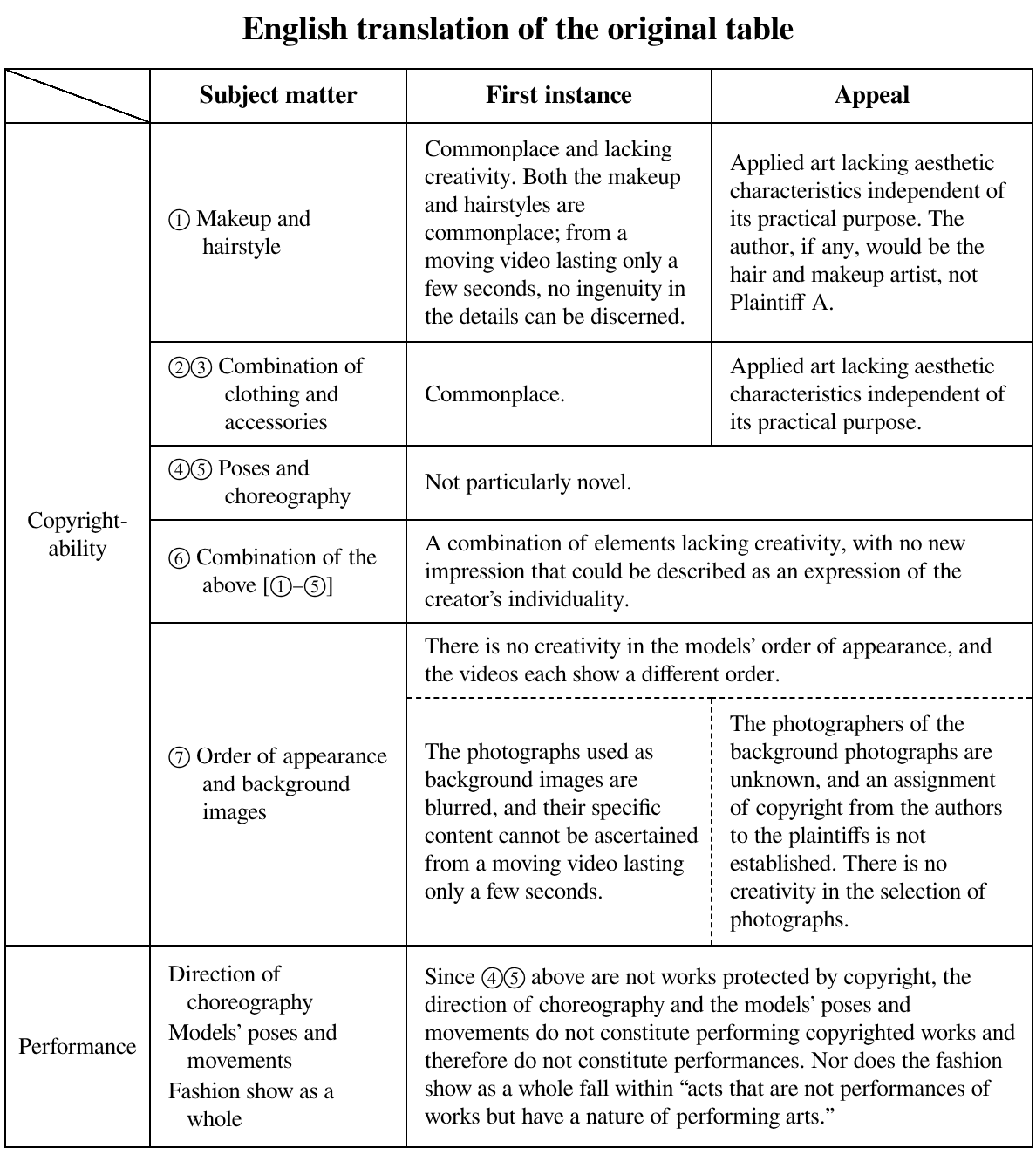
(Editor’s transcription and correction of the figure above)
Fashion Show Case: Summary of the Reasoning at First Instance and on Appeal
|
Subject matter |
First instance |
Appeal |
|---|---|---|
|
Copyright infringement: ① Makeup and hairstyling |
The makeup and hairstyles are commonplace and do not express the creator’s individuality. Even if details are creative, their ingenuity cannot be perceived in moving footage lasting only a few seconds; the broadcast does not make the creative expression perceptible. |
Applied art lacking aesthetic features independent of its practical purpose. Even if copyrightable, the author would be the hair and makeup artist, rather than Plaintiff A. |
|
Copyright infringement: ②③ Selection and combination of clothing and accessories |
Commonplace combinations lacking creativity. |
Applied art lacking aesthetic features independent of its practical purpose. |
|
Copyright infringement: ④⑤ Choreography of poses and movements to remove clothing |
The poses and movements are not particularly novel for fashion-show models and do not express the creator’s individuality. |
The poses and movements are not particularly novel for fashion-show models and do not express the creator’s individuality. |
|
Copyright infringement: ⑥ Combination of ①–⑤ |
The individual elements lack creativity or their creative expression is not perceptible in the broadcast. Their combination creates no new impression expressing the creator’s individuality. |
For each element, Plaintiff A is not established to be its author or copyrightability is absent. Their combination creates no new impression expressing the creator’s individuality. |
|
Copyright infringement: ⑦ Models’ order of appearance |
The order of appearance lacks creativity. The broadcast footage presents scenes in a different order from the show; even if the original order were creative, its creative expression is not conveyed by the broadcast. |
The order of appearance lacks creativity. The broadcast footage presents scenes in a different order from the show; even if the original order were creative, its creative expression is not conveyed by the broadcast. |
|
Copyright infringement: ⑦ Photographs in the background footage |
The photographs are blurred, and their specific content cannot be perceived in moving footage lasting only a few seconds. The broadcast does not make the creative expression perceptible. |
The photographers are unknown, and an assignment of copyright to the plaintiffs is not established. The selection of photographs also lacks creativity. |
|
Performance: Direction of choreography; models’ poses and movements; the fashion show as a whole |
Since ④⑤ are not copyrightable works, the models’ poses and movements do not constitute performing works and are not protected performances. Nor is the fashion show as a whole established to be an act that does not perform a work but nevertheless has the nature of performing arts. |
Since ④⑤ are not copyrightable works, the models’ poses and movements do not constitute performing works and are not protected performances. Nor is the fashion show as a whole established to be an act that does not perform a work but nevertheless has the nature of performing arts. |
Original images retained for comparison
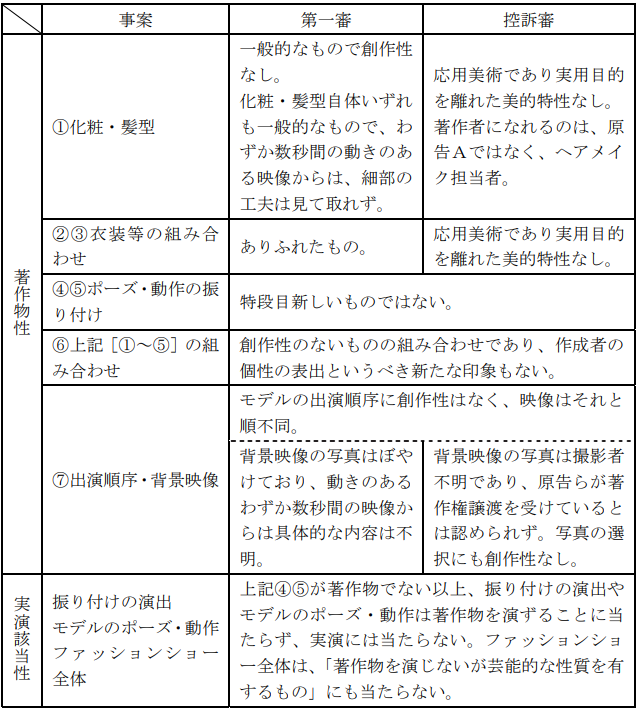
[Article / Copyright] Including tweets in a book held to be lawful quotation under Copyright Act Article 32(1) — #KuToo case (Takuto Hirasawa, Intellectual Property Law and Policy Journal, Vol. 66, 2022)
Original Ameblo publication: 2025-04-20
Article type: Publication review
Category: Copyright
Topics: Quotation, Moral rights, Defamation
First published on this website: 2026-10-16
Case information: Tokyo District Court, 2020 (Wa) No. 19351
Ameblo: https://ameblo.jp/hideki-takaishi/entry-12895471779.html
HP: https://www.takaishihideki.com/en/single-post/ameblo-12895471779-en
Japanese version: https://www.takaishihideki.com/single-post/ameblo-12895471779-ja
[Article / Copyright] Including tweets in a book held to be lawful quotation under Copyright Act Article 32(1) — #KuToo case (Takuto Hirasawa, Intellectual Property Law and Policy Journal, Vol. 66, 2022)
Tokyo District Court, 2020 (Wa) No. 19351
The tweet’s ‘#kutoo’ was reproduced in the book as ‘#KuToo.’ This was a typographical error: it neither defeated the quotation exception nor infringed the right of integrity.
(Excerpt, translated)
Even if expressions such as ‘a strange person’ and ‘suddenly glitches on Twitter’ offended the plaintiff’s feelings of personal honor, these statements may be understood as conveying the following point: although the movement concerned women’s footwear, the tweet criticized it by citing the extreme and unrelated example of men going to work in swimming trunks, and its point—including its use of ‘conversely’—departed from ordinary perceptions and was difficult to understand.
Even if some expressions offended the plaintiff’s feelings of personal honor, they did not constitute insults exceeding socially acceptable limits. No tort was established.
The article examines numerous decisions on the framework for lawful quotation. It further analyzes the framework through the subordinate relationship of the quoted work to the quoting work, conformity with fair practice, and whether the extent is justified by the purpose of quotation.
Original AMEBLO article (2025-04-20)
https://ameblo.jp/hideki-takaishi/entry-12895471779.html
https://www.linkedin.com/feed/update/urn:li:activity:7516365067999744000/
English translations of the original image text
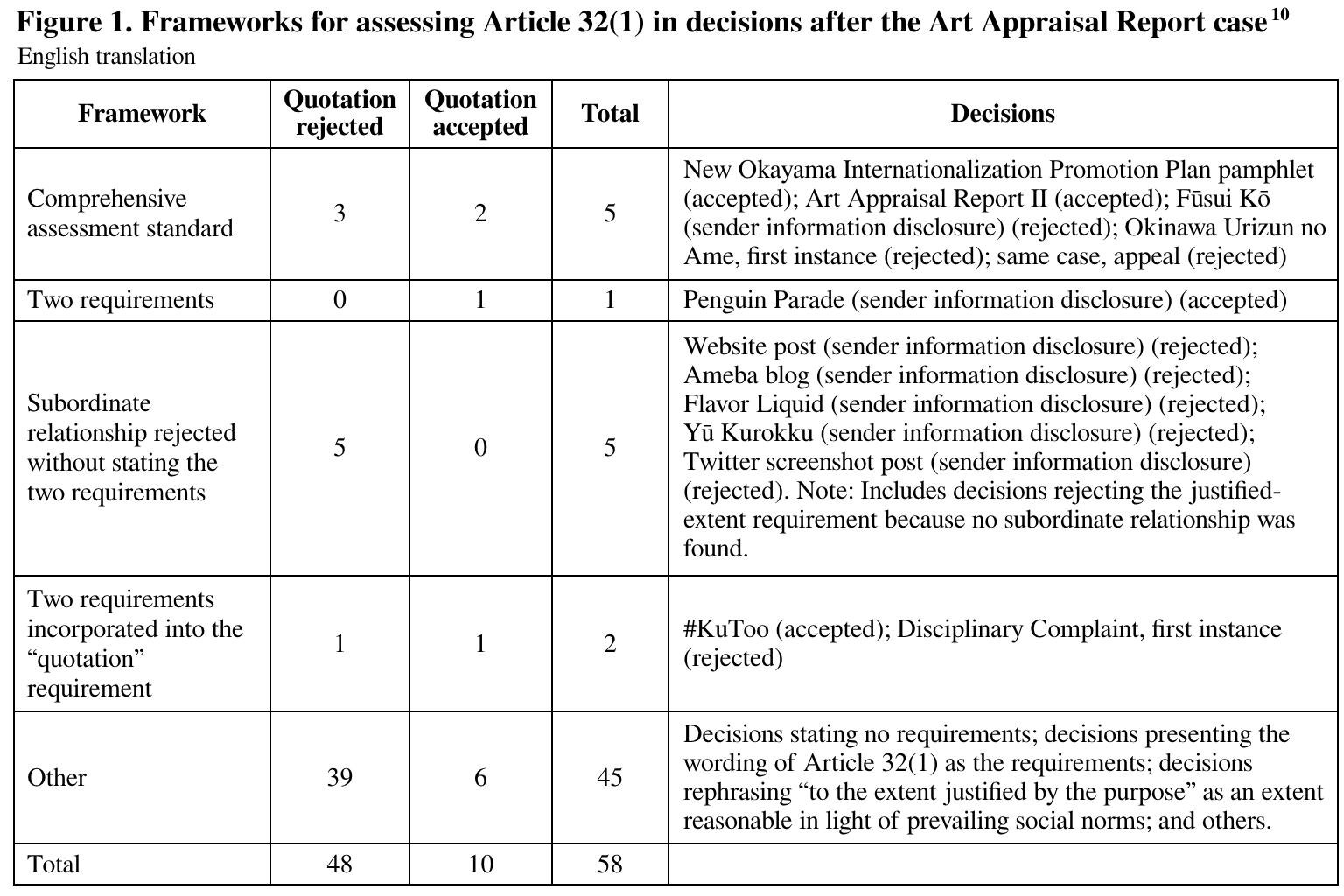
(Editor’s transcription and correction of the figure above)
Figure 1. Frameworks for Assessing Article 32(1) in Decisions after the Art Appraisal Report Case¹⁰
English translation (numbers of decisions)
|
Framework |
Quotation rejected |
Quotation accepted |
Total |
Decisions |
|---|---|---|---|---|
|
Comprehensive assessment standard |
3 |
2 |
5 |
New Okayama Internationalization Promotion Plan pamphlet (accepted); Art Appraisal Report II (accepted); Fūsui Kō (sender information disclosure) (rejected); Okinawa Urizun no Ame, first instance (rejected); same case, appeal (rejected) |
|
Two requirements |
0 |
1 |
1 |
Penguin Parade (sender information disclosure) (accepted) |
|
Subordinate relationship rejected without stating the two requirements |
5 |
0 |
5 |
Website post (sender information disclosure) (rejected); Ameba blog (sender information disclosure) (rejected); Flavor Liquid (sender information disclosure) (rejected); Yū Kurokku (sender information disclosure) (rejected); Twitter screenshot post (sender information disclosure) (rejected). Note: Includes decisions rejecting the justified-extent requirement because no subordinate relationship was found. |
|
Two requirements incorporated into the “quotation” requirement |
1 |
1 |
2 |
#KuToo (accepted); Disciplinary Complaint, first instance (rejected) |
|
Other |
39 |
6 |
45 |
Decisions stating no requirements; decisions presenting the wording of Article 32(1) as the requirements; decisions rephrasing “to the extent justified by the purpose” as an extent reasonable in light of prevailing social norms; and others. |
|
Total |
48 |
10 |
58 |
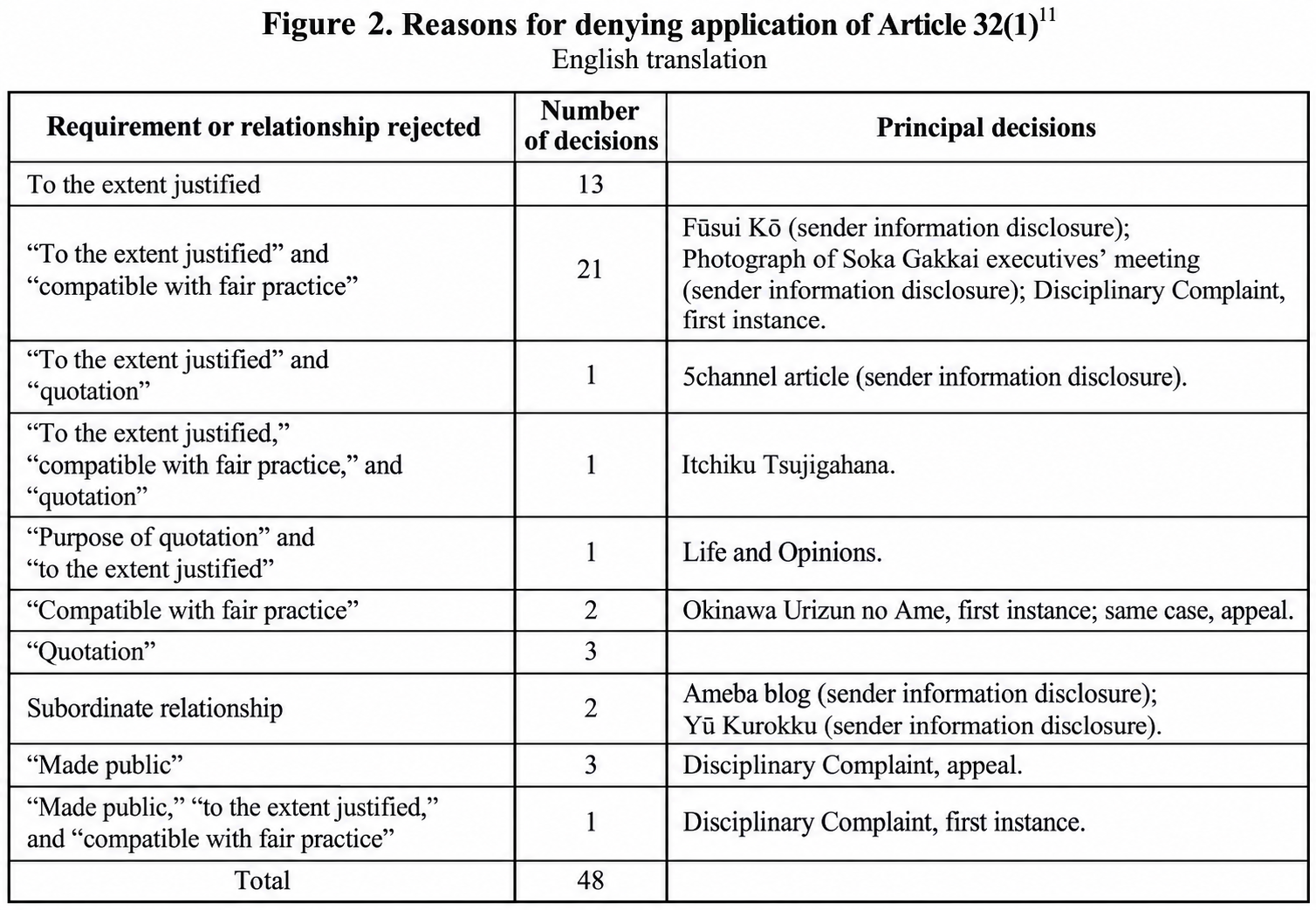
Original images retained for comparison
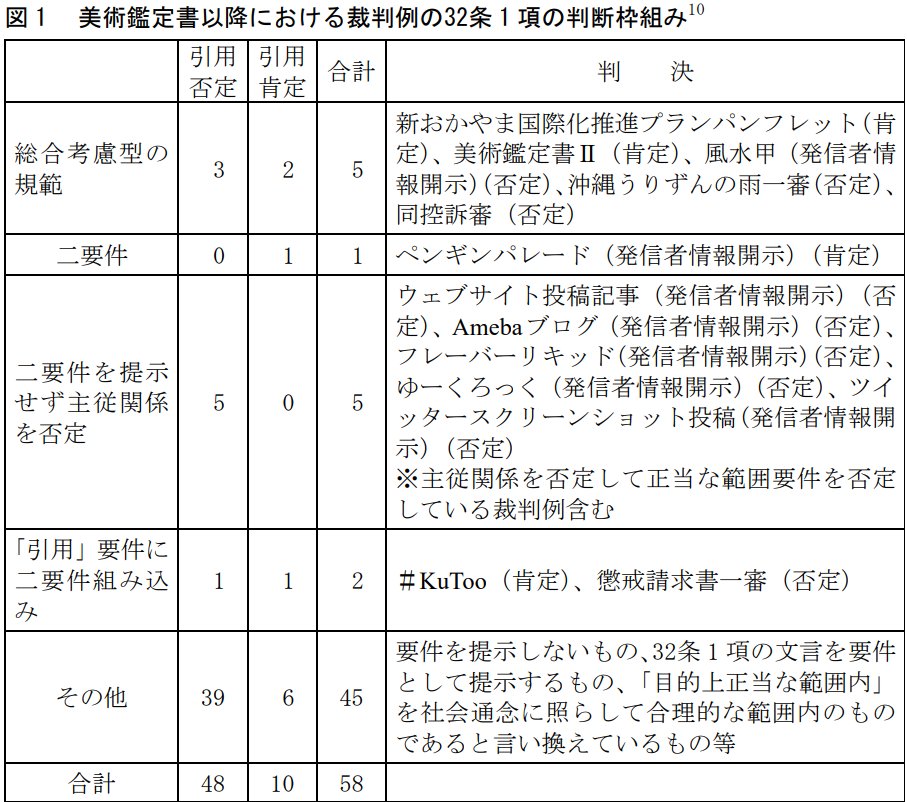
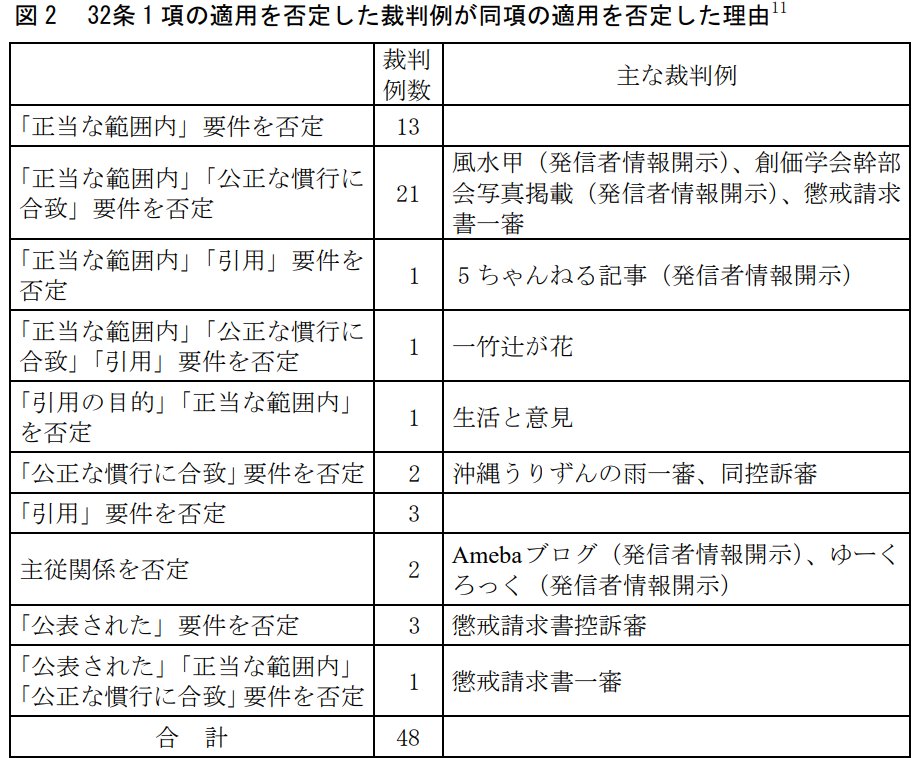
[Article/Copyright] Ownership of Rights concerning Unknown Methods of Exploitation — The Kaiketsu Lion-Maru Case (Kazuhiro Ando, Intellectual Property Law and Policy Journal, Vol. 26, 2010)
Original Ameblo publication: 2025-04-21
Ameblo: https://ameblo.jp/hideki-takaishi/entry-12895752550.html
[Article/Copyright] Ownership of Rights concerning Unknown Methods of Exploitation — The Kaiketsu Lion-Maru Case (Kazuhiro Ando, Intellectual Property Law and Policy Journal, Vol. 26, 2010)
*Tokyo High Court, 2002 (Ne) 5907 (Kaiketsu Lion-Maru case)
The court held that a contract assigning “broadcasting rights” for ¥10 million did not cover rights to broadcast by satellite, a method that had not yet entered practical use when the contract was concluded.
*Tokyo District Court, 2006 (Wa) 1769 (THE BOOM case)
The court held that an agreement to assign exclusively and without restriction all rights held in the master recordings also covered the phonogram producer’s “right to make transmittable,” which did not exist when the agreement was concluded.
⇒ As to the relationship with the Kaiketsu Lion-Maru case, that case concerned a partial assignment of copyright, not a comprehensive assignment of all rights, so the method and substance of interpreting the parties’ intentions naturally differed.
*Tokyo District Court, 2006 (Wa) 8752 (HEAT WAVE case)
“Whether ‘all rights (including the plaintiffs’ neighboring rights)’ in Article 4 of the agreement include performers’ right to make transmittable should be determined in accordance with the method of contractual interpretation, by considering comprehensively … the relevant circumstances, including the adequacy of the consideration.”
⇒ The court held that it also included the “right to make transmittable,” which did not exist at the time of the contract.
https://eprints.lib.hokudai.ac.jp/repo/huscap/all/43627/26_257-291.pdf
[Article/Unfair Competition Prevention Act] Trends in Regulation of Dead Copies of Product Configuration — Evaluating Legislative Amendments and Case Law in Light of the Purpose of the System (Yoshiyuki Tamura, Intellectual Property Law and Policy Journal, Vol. 25, 2009)
Original Ameblo publication: 2025-04-22
Ameblo: https://ameblo.jp/hideki-takaishi/entry-12895914689.html
[Article/Unfair Competition Prevention Act] Trends in Regulation of Dead Copies of Product Configuration — Evaluating Legislative Amendments and Case Law in Light of the Purpose of the System (Yoshiyuki Tamura, Intellectual Property Law and Policy Journal, Vol. 25, 2009)
*Tokyo District Court, November 27, 2002, [Belluna/Ryu Ryu] case
⇒ Clothing identical in configuration apart from having its sleeves cut off was held to fall under Article 2(1)(iii) of the Unfair Competition Prevention Act.
(1) “Ordinarily possessed configuration”
*Tokyo District Court, March 30, 2005, [Frilled Cut-and-Sewn Top] case
⇒ Applying the pre-2005 “ordinarily possessed configuration” provision, the district court denied protection because it considered the combination of existing, publicly known product configurations easy to produce. The appellate court reversed.
(2) Imitation of a part
*Tokyo District Court, May 24, 2005, [Footrest for Precast Manholes] case
⇒ Even a part is treated as equivalent to imitation of the whole if it can be traded as a standalone product.
— Osaka High Court, 2003 (Ne) 3575, [Sekisui House]. The article argues that, because the front of a house is particularly important, copying the front may be treated as copying the whole. The court considered the rear, sides and overall configuration as well as the front, and rejected substantial identity.
(3) Imitation of the interior
⇒ In the Drain Hose case (Osaka District Court, November 28, 1996) and the Small Shoulder Bag I case (Tokyo High Court, September 26, 2001), the two decisions discussed in the article excluded internal structures not observed in ordinary transactions from “product configuration.”
(4) Color, luster and texture
The 2005 amendment expressly included “color, luster and texture” in the definition of product configuration. In discussing the interpretation of that provision, the article refers to the NuBra case (Osaka High Court, April 19, 2006, 2005 (Ne) 2866), which denied protection because of differences in texture.
— Even after the amendment, the Osaka District Court, 2007 (Wa) 8262, [Cosmetic Container] case rejected substantial identity because of differences in luster and color.
https://eprints.lib.hokudai.ac.jp/dspace/bitstream/2115/43612/1/25_33-65.pdf
[Article/Portrait Rights] Copyrightability of Snapshot Portrait Photographs and Whether They May Be Freely Used: The Tokyo Outsiders Case (2010)
Original Ameblo publication: 2025-04-23
Ameblo: https://ameblo.jp/hideki-takaishi/entry-12896288084.html
[Article/Portrait Rights] Copyrightability of Snapshot Portrait Photographs and Whether They May Be Freely Used: The Tokyo Outsiders Case (Atomu Takase, Intellectual Property Law and Policy Journal, Vol. 32 (2010))
*IP High Court, 2007 (Ne) 10003
A photograph taken by a former wife showing her husband and their child was used in a book describing the husband after the portion showing the child was cropped out.
⇒ Copyright infringement
Even everyday snapshots are copyrightable.
The copyright belongs to the former wife, who took the photograph.
Even assuming the defendants’ account that the person who supplied the photograph had said it could be used freely, the court found negligence because they had made no effort to identify the copyright holder and obtain permission to publish it.
Because it was not a work that had been made public, it did not qualify as quotation.
Infringement of the right of attribution
Infringement of the right of integrity
⇒ Even an everyday snapshot may be protected if it is original. Being the subject of the photograph does not, by itself, entitle a person to use it freely.
Even when using a photograph of oneself, one should check the rights involved, obtain any necessary permission from the photographer or other rights holder, or use a self-taken photograph.
Cf. Cases in which “negligence” was rejected
• An academic book published following a proposal brought in by its creator (Medical Faculty Assistant Name Omission case: Chiba District Court, February 19, 1979; Tokyo High Court, September 10, 1980)
⇒ It would be harsh to require publishers to conduct a strict investigation into rights when publishing academic books with low profitability.
• A book on sports medicine (Guutara Kenkoho case: Tokyo District Court, May 31, 1995)
⇒ The infringer was a physician well known in Yamanashi Prefecture, and the defendant publisher was a small local publisher.
• A separate case in which the plaintiff’s work had a certain print run and had been featured in magazines, but was not found to be a widely known book (“Konenki kara no Suteki Diet” case: Tokyo District Court, July 17, 1998).
https://lex.juris.hokudai.ac.jp/gcoe/journal/IP_vol32/32_8.pdf
IP High Court, 2022 (Gyo-Ke) 10084 [Therapeutic Agent for Severe Heart Failure] <Honda>
Original Ameblo publication: 2025-04-24
Ameblo: https://ameblo.jp/hideki-takaishi/entry-12896667332.html
2022 (Gyo-Ke) 10084 [Therapeutic Agent for Severe Heart Failure] <Honda>
*It is permissible to assess obviousness by treating differences in target patients and differences in dosage and administration as separate differences.
*Although the patient group was limited, a known diuretic with the same mechanism of action had also been administered to that group. In light of this and the other evidence, the claimed patient selection and administration regimen were held obvious.
(Excerpts from the court’s reasoning)
When considering a therapeutic drug’s dosage, differences in target patients and treatment should naturally be taken into account. In identifying differences between a patented therapeutic-drug invention and a cited invention, once differences concerning target patients or treatment have been identified, there is no need to identify them again as part of a dosage difference encompassing those patients or treatment. Accordingly, the trial decision did not err in identifying only the daily dosage of tolvaptan as Difference 2, separately from Difference 1 described above. …
(Summary of the court’s reasoning follows)
The patented invention differs from the invention in Exhibit Ko 2 in being specified as a therapeutic agent for severe heart failure whose oral administration is initiated in hospitalized NYHA class IV patients (Difference 1), and in specifying the daily dosage of the active ingredient as within a range of 0.371 mg/kg or less (Difference 2).
However, regarding Difference 1, at the priority date diuretics were widely used regardless of acute or chronic heart failure or its severity. Diuretics with the same mechanism of action as tolvaptan were also administered to NYHA class IV patients. Thus, there was ample motivation to use the tolvaptan of the invention in Exhibit Ko 2, effective for NYHA class I–III patients, including patients who cannot immediately be regarded as nonsevere, to treat NYHA class IV patients. No inhibiting factor is identified, and this could readily have been conceived. Further, whether the patient is hospitalized when the drug is administered can hardly be called a substantive difference. Moreover, given how tolvaptan was used at the priority date, oral administration was a matter that a person skilled in the art could appropriately adopt. Difference 2 likewise concerns a dosage substantially identical to the dose of 30 mg once daily used in the trial in Exhibit Ko 2. Setting the daily dosage within 0.371 mg/kg or less cannot be said to have critical significance, and adopting that range in light of Exhibit Ko 2 and common general technical knowledge was something that could appropriately be done. …
…Diuretics were widely used to treat fluid retention, congestion, edema and other symptoms of heart failure, regardless of whether it was acute or chronic, severe or mild-to-moderate. Furthermore, because the examples in the above argument include heart-failure treatments other than diuretics, they cannot be read as stating that diuretics should be treated differently because a patient is NYHA class IV. In addition, the trial in the patent included a mixture of NYHA class III and IV patients, and the number of deaths among class IV patients alone is not disclosed, so the effect on NYHA class IV patients is unknown.
IP High Court, 2018 (Gyo-Ke) 10094 [System for Characterizing a Stenosis in a Fluid-Filled Vessel] <Mori>
Original Ameblo publication: 2025-04-25
Ameblo: https://ameblo.jp/hideki-takaishi/entry-12897171276.html
2018 (Gyo-Ke) 10094 [System for Characterizing a Stenosis in a Fluid-Filled Vessel] <Mori>
*Even if accurate measurement is not necessarily possible, this is not an issue of clarity (although enablement or support may be at issue)!!
[Claim 1] … A system … comprising a first measurement sensor … taking instantaneous pressure measurements at various locations along said vessel without maximal hyperemic conditions ….
(Excerpts from the court’s reasoning)
In the claimed invention, “without maximal hyperemic conditions” means not being in a state in which blood flow has been maximally increased by administering a drug, and “instantaneous pressure measurements” means … measuring the value at an instant …. …Their meanings are unambiguously clear …. …
Certainly, …examining the blood-pressure ratio calculated from those measurements may not necessarily allow the presence or location of a stenosis in a vessel to be accurately identified. Even so, depending on the degree of stenosis and the measurement method, identifying its presence or location cannot be said to be wholly impossible, so the claimed invention cannot be regarded as entirely meaningless. Moreover, although the enablement requirement … or support requirement … might be at issue from that perspective, those matters were not examined in the trial and therefore cannot be examined in this litigation.
https://www.courts.go.jp/assets/hanrei/hanrei-pdf-88667.pdf
[Freedom to Choose One’s Occupation] IP High Court, 2022 (Ne) 10059 <Honda>
Original Ameblo publication: 2025-04-26
Ameblo: https://ameblo.jp/hideki-takaishi/entry-12897551043.html
[Freedom to Choose One’s Occupation] 2022 (Ne) 10059 <Honda>
*Post-contract restrictions imposed by a talent agency were held contrary to public policy and morals!!
Former members of a band (the first-instance plaintiffs) alleged that, after their exclusive management agreement with their agency (the first-instance defendant company) ended, the agency obstructed their use of the band/group name and continuation of their activities.
1. Invalidity of the Noncompetition Clause
The court held invalid a clause that, for six months after termination, prohibited entering into performance-related contracts without the agency’s consent. The clause restricted the former members’ freedom to choose their occupation or conduct business, and the restriction lacked a rational basis, including in relation to the claimed recovery of upfront investment. The court therefore found it contrary to public policy and morals.
2. Rights in the Band Name
The court held that the members could exercise publicity rights in the band name, and denied the agency any authority after termination to exercise exclusive rights of use or performers’ moral rights (the right of attribution) in that name. It was also undisputed that the agency held no trademark rights in the band name when it made the notices and requests at issue.
3. Copyright in Photographs
The court also rejected the claim that copyright in the photograph at issue belonged to the agency, holding that the copyright belonged to C, the photographer.
4. Illegality of the Agency’s Obstructive Acts
The agency’s acts of obstructing the plaintiffs’ activities through notices and requests containing false information constituted a tort.
5. Damages
¥990,000 for each of the four plaintiffs (¥3,960,000 in total), plus delay damages. Each award comprised ¥700,000 in pecuniary damages, ¥200,000 for emotional distress and ¥90,000 in attorney fees. Pecuniary loss was assessed at ¥884,288 per plaintiff, but recovery was limited to the ¥700,000 partial claim made by each.
(Excerpts from the court’s reasoning)
The first-instance defendants argue that the clause was included to recover upfront investment. However, what appeals to the first-instance plaintiffs’ consumers (their fans) is the plaintiffs’ performances and the like, not those of other performers affiliated with the first-instance defendant company. Thus, restricting the plaintiffs’ performance activities under the clause would not generate profits for the company and thereby achieve the purpose of recovering its upfront investment. There is no relationship between restricting the plaintiffs’ activities under the clause and recovering the company’s upfront investment. Further, even assuming that the company needed to recover upfront investment and that the plaintiffs bore some responsibility in that regard, a monetary resolution would be possible by such means as distributing profits generated by the plaintiffs’ performance activities. That need therefore does not justify restricting the plaintiffs’ activities after termination of the exclusive agreement. (In addition, by July 13, 2019, when the exclusive agreement was terminated by mutual consent, approximately nine years had elapsed since its conclusion on August 1, 2010, and approximately seven years even from July 2012, when all of the plaintiffs had joined the group. The agreement had also been renewed several times (Undisputed Facts (2)). In these circumstances, the company would naturally be considered to have already recovered its upfront investment.)
Accordingly, without considering the remaining points, the restrictions imposed by the clause lack any rational basis. It is therefore appropriate to construe the clause as invalid for violating public policy and morals.
https://www.courts.go.jp/assets/hanrei/hanrei-pdf-91677.pdf
[Copyright] IP High Court, 2021 (Ne) 10048 <Otaka>
Original Ameblo publication: 2025-04-27
Ameblo: https://ameblo.jp/hideki-takaishi/entry-12897705229.html
[Copyright] 2021 (Ne) 10048 <Otaka>
*Copyright infringement (reproduction and adaptation rights) concerning a workbook explaining meeting methods was rejected.
The slogan “Meetings change. The company changes.” is not copyrightable.
“The commonalities between the overall structure of the plaintiff’s workbook and that of the defendant’s handout are the ideas themselves of what items to address in a meeting and in what order, not expression itself.”
https://www.courts.go.jp/assets/hanrei/hanrei-pdf-90658.pdf
[Unfair competition] IP High Court, 2019 (Ne) No. 10002 (Judge Otaka)
Original Ameblo publication: 2025-04-28
Article type: Case note
Categories: Unfair competition law
Topics: Indications of goods or business, Confusion
First published on this website: 2026-10-16
Case information: 2019 (Ne) No. 10002
Ameblo: https://ameblo.jp/hideki-takaishi/entry-12898039255.html
HP: https://www.takaishihideki.com/en/single-post/ameblo-12898039255-en
Japanese version: https://www.takaishihideki.com/single-post/ameblo-12898039255-ja
[Unfair competition] IP High Court, 2019 (Ne) No. 10002 (Judge Otaka)
A violation of Article 2(1)(i) of the Unfair Competition Prevention Act was found for products whose customers were healthcare professionals.
Although many cases find that healthcare professionals will not be confused, confusion was found here because the products were consumables sold through online shops.
The first-instance judgment, 2018 (Wa) No. 13381 (Judge Yamada), also recognized a well-known indication of goods or business and similarity, but denied confusion. The appellate court found confusion and granted an injunction against transfer and related acts, together with disposal of the products.
1. Well-known indication of goods or business
The product had distinctive features differentiating it from others of the same kind and had been sold for 34 years.
2. Similarity
‘Differences in the colors of the lettering, graduations, etc. on the drainage and suction bottles are differences within the same blue color family. Viewed as a whole, they are merely differences in detail.’
3. Confusion
‘Both products are consumable medical devices with the same sales channels. If healthcare professionals encounter the defendant’s product shape, which extremely closely resembles the plaintiff’s, through product images in medical-equipment catalogs or online shops, they may mistakenly believe that the products originate from the same source. The appellee’s sale of the defendant’s products is therefore found to constitute conduct causing confusion with the plaintiff’s products.’
Original AMEBLO article (2025-04-28)
https://ameblo.jp/hideki-takaishi/entry-12898039255.html
https://www.courts.go.jp/assets/hanrei/hanrei-pdf-88902.pdf
https://www.linkedin.com/feed/update/urn:li:activity:7516366546873540608/
English translations of the original image text
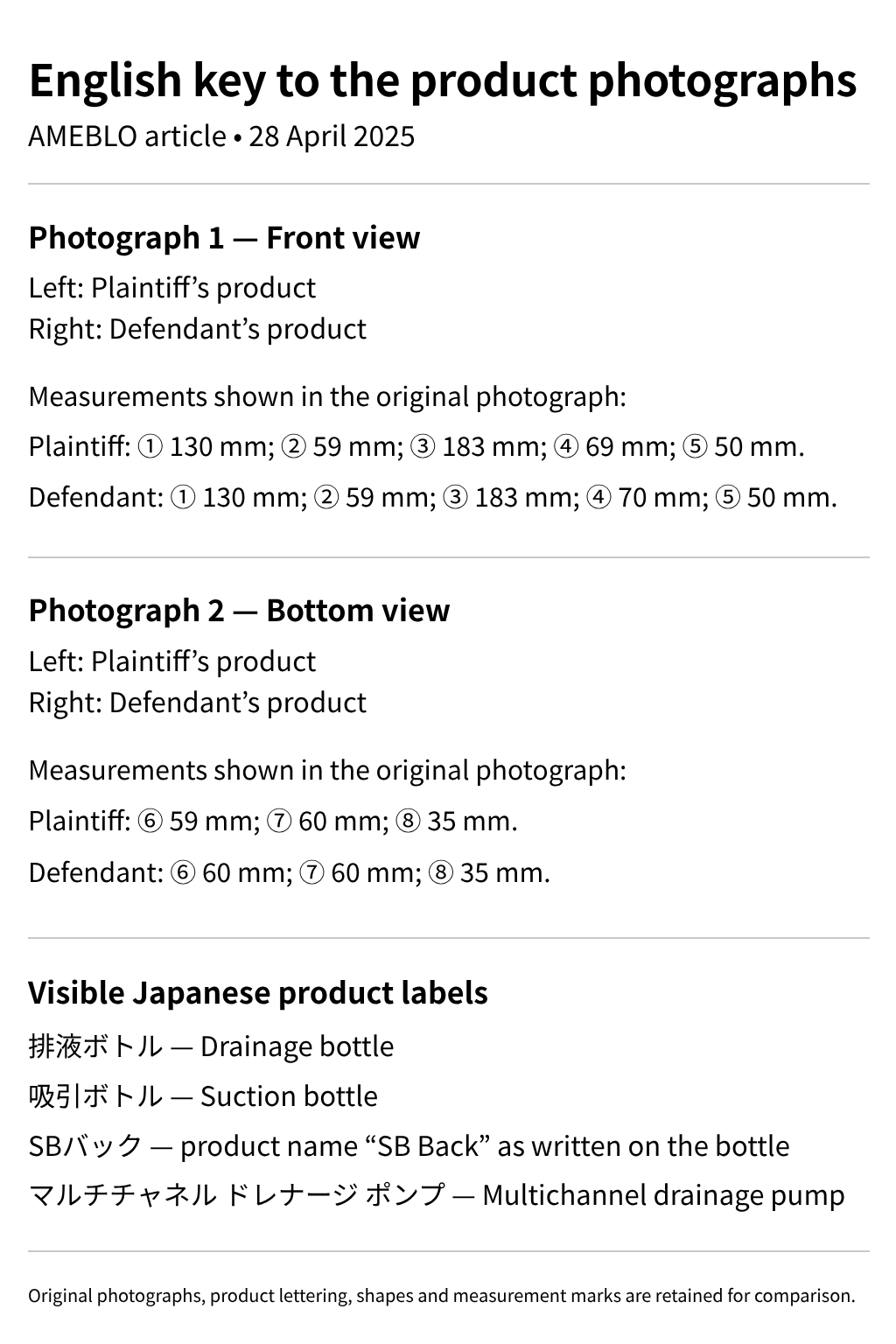
Original images retained for comparison
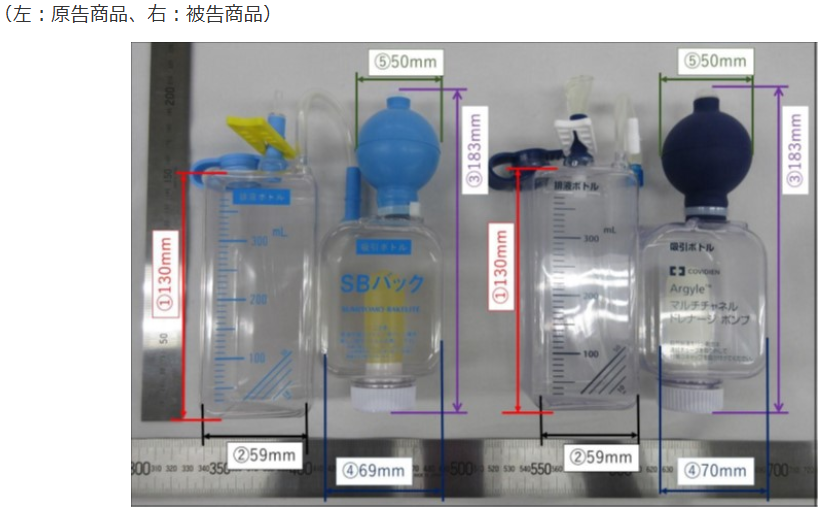
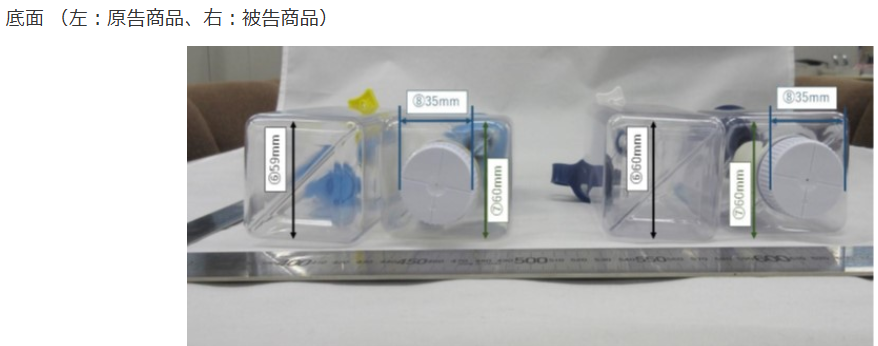
[Unfair Competition Prevention Act/Trade Secrets] IP High Court, 2017 (Ne) 10076 <Takabe>
Original Ameblo publication: 2025-04-30
Ameblo: https://ameblo.jp/hideki-takaishi/entry-12898624499.html
[Unfair Competition Prevention Act/Trade Secrets] 2017 (Ne) 10076 <Takabe>
⇒ Although the documents were marked “Confidential,” a duty of care to investigate wrongful disclosure or similar acts (gross negligence) was rejected.
“It cannot be said that the appellee could have known that a confidentiality agreement existed between the appellant and its business partner or that the documents were covered by that agreement. The numbers of short lamps stated in the documents cannot be regarded as information whose mere disclosure to the appellee would cause the appellant serious disadvantage. Nor does it appear that, when acquiring the documents, the appellee encountered any facts apart from the ‘Confidential’ markings that should have raised suspicion that the information was secret. In light of these circumstances, the ‘Confidential’ markings on the documents cannot immediately be said to indicate that they were subject to a duty of confidentiality. Accordingly, those markings alone do not establish that, when acquiring the documents, the appellee had a transactional duty of care to entertain serious doubts about wrongful disclosure or similar acts and investigate and verify the matter. The appellant’s argument cannot be accepted.”
https://www.courts.go.jp/assets/hanrei/hanrei-pdf-87414.pdf
[Contract] Tokyo District Court, 2023 (Wa) 70722 <Nakashima>
Original Ameblo publication: 2025-05-01
Ameblo: https://ameblo.jp/hideki-takaishi/entry-12899005669.html
[Contract] 2023 (Wa) 70722 <Nakashima>
“Termination by agreement during the contract term” in an exclusive management agreement does not mean waiver of the right to terminate under Civil Code Article 651(1).
Even assuming that “the plaintiffs were negotiating with other agents during the contract term,” that would not justify restricting exercise of the right to terminate a mandate agreement.
https://www.courts.go.jp/assets/hanrei/hanrei-pdf-93212.pdf
⇒ Termination of the contract between the couple YouTubers and the talent management company was confirmed.
[Civil Code/Tort] IP High Court, 2018 (Ne) 10089 <Takabe>
Original Ameblo publication: 2025-05-02
Ameblo: https://ameblo.jp/hideki-takaishi/entry-12899374323.html
[Civil Code/Tort] 2018 (Ne) 10089 <Takabe>
*A seller of predesigned houses sold its own buildings to customers solicited at showgrounds for the appellant’s products.
⇒ Tort established (¥1 million in damages per building)
(Excerpt from the court’s reasoning)
In the Bigfoot business, customers who visited showgrounds or requested materials were registered in a database and, even if an immediate sale was not possible, were called “stock customers” and cultivated …. The stored customer information had pecuniary value in containing the possibility of future sales of Bigfoot products. From this standpoint, the appellees’ sales of their own buildings to those customers reduced or eliminated that possibility and must be regarded as having caused pecuniary damage to the appellant.
https://www.courts.go.jp/assets/hanrei/hanrei-pdf-88974.pdf
[Trademark/Non-Use Cancellation] IP High Court, 2020 (Gyo-Ke) 10114 <Otaka>
Original Ameblo publication: 2025-05-03
Ameblo: https://ameblo.jp/hideki-takaishi/entry-12899720600.html
[Trademark/Non-Use Cancellation] 2020 (Gyo-Ke) 10114 <Otaka>
Settlement agreement: “Do not interfere with the plaintiffs’ trade-name and trademark rights protected by other registrations by Boast or the plaintiff worldwide.”
⇒ A duty not to contest is owed.
⇒ The successor’s request for a trial to cancel the trademark registration violates the principle of good faith.
https://www.courts.go.jp/assets/hanrei/hanrei-pdf-90916.pdf
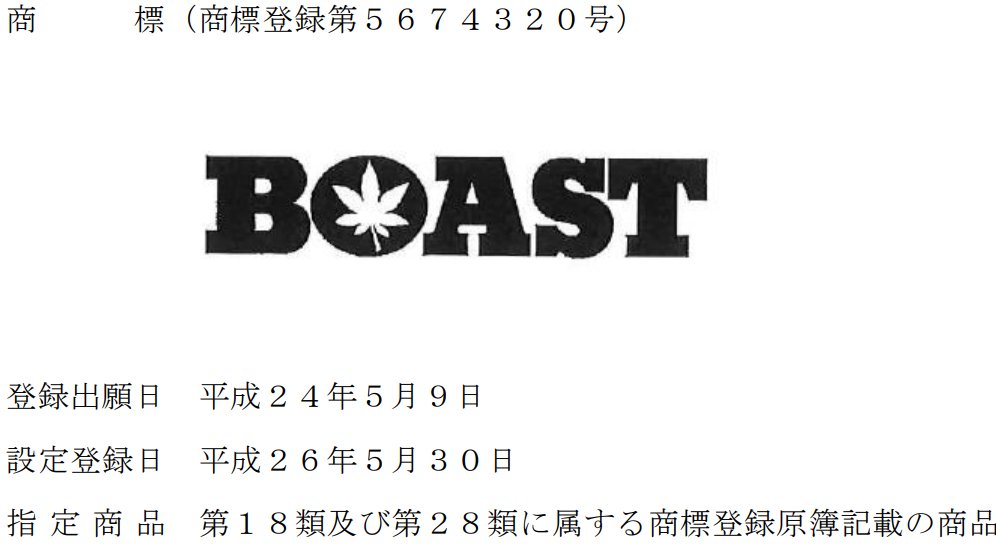
Figure information: BOAST trademark, Registration No. 5674320. Application filed May 9, 2012; registered May 30, 2014. Designated goods: goods recorded in the trademark register in Classes 18 and 28.
[Article/Trademark] The Possibility of Trademark Parody under Japanese Law: The SHI-SA Case (Takuto Hirasawa, 2009)
Original Ameblo publication: 2025-05-04
Ameblo: https://ameblo.jp/hideki-takaishi/entry-12900086657.html
[Article/Trademark] The Possibility of Trademark Parody under Japanese Law: The SHI-SA Case (Takuto Hirasawa, Intellectual Property Law and Policy Journal, Vol. 25 (2009))
Same animal species with a different pose: similar
— Dissimilar when stylized into a character giving a different impression
⇒ Dissimilarity may be found if the pronunciations differ.
*In the SHI-SA case: dissimilar
For parody marks too, it is sufficient to apply the ordinary interpretation of the Trademark Act and Unfair Competition Prevention Act, while taking care not to unduly expand the interpretations of confusion in a broad sense, dilution and tarnishment.
https://eprints.lib.hokudai.ac.jp/dspace/bitstream/2115/43618/1/25_235-300.pdf
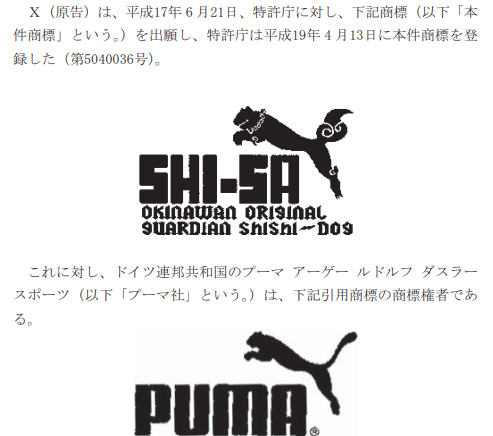
Figure information: X (the plaintiff) filed the SHI-SA mark on June 21, 2005, and it was registered on April 13, 2007 (Registration No. 5040036). The lower figure is the cited PUMA mark owned by Puma AG Rudolf Dassler Sport, Germany.
[Trademark] IP High Court, 2016 (Gyo-Ke) 10053 <Takabe>
Original Ameblo publication: 2025-05-07
Ameblo: https://ameblo.jp/hideki-takaishi/entry-12901068951.html
[Trademark] 2016 (Gyo-Ke) 10053 <Takabe>
*Taking advantage of the fact that the cited mark was unregistered, the applicant intended to free-ride on the business goodwill and customer appeal embodied in it to obtain an unfair profit, and also intended to harm the opponent through reduced DVD sales and the like.
⇒ Violation of Trademark Act Article 4(1)(xix)
https://www.courts.go.jp/assets/hanrei/hanrei-pdf-86070.pdf

[Trademark] IP High Court, 2015 (Gyo-Ke) 10111 <Takabe>
Original Ameblo publication: 2025-05-07
Ameblo: https://ameblo.jp/hideki-takaishi/entry-12901069587.html
[Trademark] 2015 (Gyo-Ke) 10111 <Takabe>
The applied-for mark gives rise to the pronunciation “jee-el-el-see,” corresponding to the four letters G, L, L and C.
⇒ Dissimilar
https://www.courts.go.jp/assets/hanrei/hanrei-pdf-85484.pdf

Upper figure: the applied-for mark, GLLC / Global Life Learning Center.
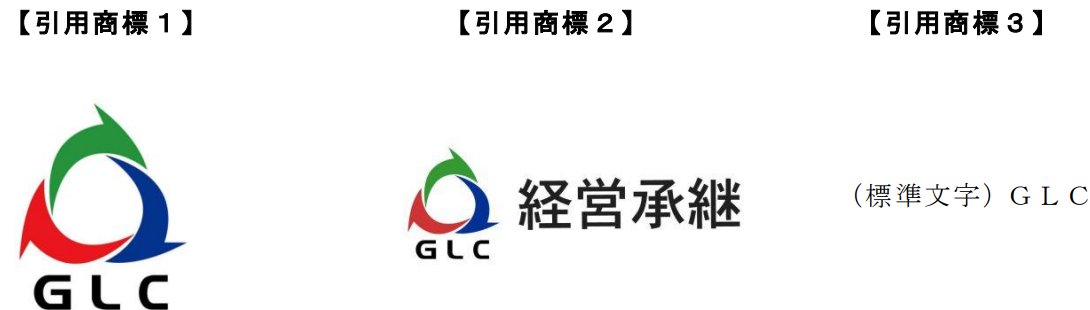
Cited marks, from left to right: (1) the GLC logo; (2) the GLC logo with the Japanese words 経営承継 (“business succession”); and (3) GLC in standard characters.
[Trademark/Management of Affairs without Mandate] IP High Court, 2018 (Ne) 10074 <Takabe>
Original Ameblo publication: 2025-05-07
Ameblo: https://ameblo.jp/hideki-takaishi/entry-12901070058.html
[Trademark/Management of Affairs without Mandate] 2018 (Ne) 10074 <Takabe>
The request for procedures to register transfer of the trademark rights acquired by the appellee was rejected, whether as restitution following rescission of the business-transfer agreement or as management of affairs without mandate.
1. Restitution Obligation upon Rescission of the Business-Transfer Agreement
The appellee independently applied for the trademark registration; it was not an object of the business-transfer agreement and is not subject to restitution.
2. Transfer of Rights Based on Management of Affairs without Mandate
The appellee’s conduct cannot be evaluated as managing affairs for the appellant.
3. Trademark Similarity and the Availability of Remedies
Other trademark rights and remedies (claims for damages and requests for invalidation trials) exist.
4. Fairness and the Purpose of the Trademark Act
The Trademark Act has no provision corresponding to Patent Act Article 74, which permits registration of a transfer in cases of usurpation. Even to eliminate a situation in which similar marks remain separately owned, a claim for registration of a transfer without a substantive legal basis cannot be allowed.
https://www.courts.go.jp/assets/hanrei/hanrei-pdf-88452.pdf

[Trademark] IP High Court, 2024 (Gyo-Ke) 10029 <Nakadaira>
Original Ameblo publication: 2025-05-08
Ameblo: https://ameblo.jp/hideki-takaishi/entry-12901314009.html
[Trademark] 2024 (Gyo-Ke) 10029 <Nakadaira>
Applied-for mark: “マーくん” (Mā-kun)
Cited mark: “Markun.”
⇒ Similar (violation of Article 4(1)(xi))
(Excerpt from the defendant’s (JPO Commissioner’s) arguments as recorded in the judgment)
“Given that both the applied-for mark and the cited mark are represented in standard characters, it is difficult to say that the difference in character types between them gives traders and consumers a strong impression as a conspicuous difference in appearance as an indication identifying source.” “Next, as to pronunciation, the pronunciation ‘Mākun’ arising from the applied-for mark and the pronunciation ‘Mākun’ arising from the cited mark are the same. As to concept, neither mark gives rise to a particular concept, so they cannot be compared conceptually.” “Although the two marks cannot be compared conceptually, it is difficult to say that consumers perceive the difference in appearance as a difference sufficient to outweigh the identity of pronunciation. When observed separately at different times and places, they are similar marks that are liable to be confused with one another.”
(Excerpt from the court’s reasoning)
“Accordingly, since both the applied-for mark and the cited mark are represented in standard characters, it should be said that it is difficult to say that the above difference in character types between them gives traders and consumers a strong impression as a conspicuous difference in appearance as an indication identifying source.” “In pronunciation, the pronunciation ‘Mākun’ arising from the applied-for mark and the pronunciation ‘Mākun’ arising from the cited mark are the same.” “On the other hand, as to concept, neither mark gives rise to a particular concept, so they cannot be compared conceptually.” “Neither the applied-for mark nor the cited mark gives rise to a particular concept, and they cannot be compared conceptually (see (3) above); in addition, the difference in appearance cannot be said to give a strong impression as stated above (see (1) above). It is therefore difficult to say that consumers perceive these differences as differences sufficient to surpass the identity of pronunciation (see (2) above), and when observed separately at different times and places, the applied-for mark and the cited mark are found to be similar marks that are liable to be confused with one another.” “Accordingly, there is no error in the JPO decision’s determination that the applied-for mark and the cited mark are similar.”
https://www.courts.go.jp/assets/hanrei/hanrei-pdf-93468.pdf
[Unfair Competition Prevention Act] IP High Court, 2024 (Ne) 10024 <Hibiku Shimizu>
Original Ameblo publication: 2025-05-09
Ameblo: https://ameblo.jp/hideki-takaishi/entry-12901551895.html
[Unfair Competition Prevention Act] 2024 (Ne) 10024 <Hibiku Shimizu>
Although the product contains nicotine at less than 1 ppm, the purpose is “to indicate that it does not contain an amount of nicotine that adversely affects the body and mind,” so indications such as “0 mg nicotine” do not “unfairly” stimulate consumer demand.
⇒ No violation of Article 2(1)(xx) of the Unfair Competition Prevention Act.
(Excerpt from the court’s reasoning)
The plaintiff argues that analysis at a quantification limit of 0.1 ppm objectively detects nicotine in the product but not in other nontobacco heated sticks, whereas consumers encountering the indication perceive the product as containing no nicotine at all and as superior to other products. However, …the indication is found to be intended to show that the product does not contain an amount of nicotine that adversely affects the body and mind. Nontobacco heated-stick products in which nicotine was not detected by analysis at a quantification limit of 1 ppm (including the plaintiff’s product) are all equivalent in the sense that none contains an amount of nicotine that adversely affects the body and mind. The indication is not intended to state the product’s nicotine content with scientific precision. Even if there are further differences in nicotine content among nontobacco heated-stick products at a level undetectable by analysis with a quantification limit of 1 ppm, this does not make the indication one that causes consumers to perceive this product as “superior” to others. So long as the product meets that level, indications such as “zero nicotine” and “nicotine-free” are considered permissible under generally accepted social norms. The indication therefore cannot be said to “unfairly” stimulate consumer demand for the product, nor is it found to give the defendants an “unfair” competitive advantage.
https://www.courts.go.jp/assets/hanrei/hanrei-pdf-93383.pdf
[Article] Comprehensive Survey of Civil Intellectual Property Judgments of District Courts Other Than Tokyo and Osaka (2020) (Kazuyuki Tanikawa, 2023)
Original Ameblo publication: 2025-05-10
Ameblo: https://ameblo.jp/hideki-takaishi/entry-12901966593.html
[Article] Comprehensive Survey of Civil Intellectual Property Judgments of District Courts Other Than Tokyo and Osaka (2020) (Kazuyuki Tanikawa, Intellectual Property Law and Policy Journal, Vol. 68 (2023))
The proportion of intellectual property judgments of district courts outside Tokyo and Osaka published on the courts’ website is extremely low: the cumulative publication rate for the five years from 2017 through 2021 was only 4.1%.
⇒ A detailed examination of 17 judgments, including unpublished judgments investigated through inspection of court records.
https://eprints.lib.hokudai.ac.jp/dspace/bitstream/2115/90487/1/68_01_Tanikawa.pdf
[Article] A Court Decision concerning Application of “Offers to Transfer (Including Offers for Sale)” to Cross-Border Conduct, the Scope of Damages and the Doctrine of Equivalents
Original Ameblo publication: 2025-05-11
Ameblo: https://ameblo.jp/hideki-takaishi/entry-12902184065.html
[Article] A Court Decision concerning Application of “Offers to Transfer (Including Offers for Sale)” to Cross-Border Conduct, the Scope of Damages and the Doctrine of Equivalents: The First-Instance Judgment in the L-Glutamic Acid Manufacturing Method Case (Masabumi Suzuki, Intellectual Property Law and Policy Journal, Vol. 67 (2023))
*Trends concerning “offers to transfer (including offers for sale)” in the United States, United Kingdom and Germany
*They agree in treating this as an independent infringing act.
Regarding the locations of conduct that may be at issue in relation to the territoriality of patent systems, and the respective locations of “transfer (or sale)” and “the offer thereof”:
(1) In the United States, if the former is domestic, the latter need not be domestic.
(2) In the United Kingdom, both must be domestic. (A UK decision states that infringement is established when both the offer and the infringement occur during the patent term.)
(3) In Germany, the position has been that if the latter is domestic, the former may be domestic or overseas. In recent years, however, the view has gained strength that not only must the offer itself be made in Germany, but its subject must also have a connection with Germany. (In Germany, making an offer during the patent term that promises a transfer after the patent expires also constitutes infringement.)
IP High Court, 2015 (Gyo-Ke) 10127 [Laser Processing Apparatus] <Takabe>
Original Ameblo publication: 2025-05-12
Ameblo: https://ameblo.jp/hideki-takaishi/entry-12902299027.html
2015 (Gyo-Ke) 10127 [Laser Processing Apparatus] <Takabe>
Difference 1: The plaintiff argued that there was no motivation to replace pressurized water with a gas having lower cooling capacity and that, if the pressure medium were replaced with gas while disregarding cooling capacity, there would no longer be a need to circulate it to cool the pressure medium, and hence no reason to provide a fluid discharge path separate from the fluid supply path. The court rejected that argument and held Difference 1 obvious.
Difference 4: “In the cited invention, it is itself unclear whether there is a difference in width (diameter) between the fluid discharge path and the fluid supply path.” +No motivation
⇒ Inventive step: satisfied
https://www.courts.go.jp/assets/hanrei/hanrei-pdf-85766.pdf
——————————
*Difference 1 (whether the fluid is gas or water)
The court first addressed whether “Fluid” in the cited reference generally refers to a fluid encompassing both liquids and gases. The original reference was in German; while “Fluid” may be translated as “fluid,” the plaintiff argued that it could also mean a liquid, as in automotive terminology. Considering several English-German-Japanese and German-Japanese dictionaries and the publication of the corresponding Japanese application, the court found a sufficient possibility that “Fluid” in the cited reference was used as a broad concept encompassing liquids and gases.
The court further found that techniques using gas instead of liquid in mirrors whose curvature is varied to control the laser beam’s focal position were shown in well-known references (such as References 1 and 3). Taking these matters together, it held that adopting gas rather than pressurized water in the cited invention was something a person skilled in the art could readily conceive. In other words, it affirmed obviousness for Difference 1 and, consistently with the trial decision’s conclusion, found no inhibiting factor against the idea of substituting gas based on the cited reference.
*Difference 4 (making the fluid discharge path narrower than the supply path)
Making the gas discharge path narrower than the supply path allows the required pressure to be applied to the rear of the mirror with a small flow rate (specification [0031]). The specification also describes rapid curvature changes and high-speed control of the laser-beam diameter as effects of the apparatus as a whole. A shorter response time does not, however, necessarily follow merely from narrowing the discharge path.
By contrast, the cited invention presupposes circulation of pressurized water and contains no description of narrowing the discharge or supply pipes to generate pressure with a small amount of fluid. The court examined whether a person skilled in the art would derive from the cited invention the idea of “making the discharge path narrower than the supply path to raise pressure efficiently.”
+Examination of well-known technology
The trial decision had cited as well known a technique for raising pressure by restricting the discharge side in systems using gas. However, after examining the cited well-known references (such as References 10 and 11), the court held that they either concerned different technical fields or did not directly show “raising pressure by changing the relative widths of the supply and discharge paths.”
In particular, it held that Reference 11 (gas-replacement technology within a storage chamber) concerned a field entirely different from laser processing and gave no direct suggestion to apply “a configuration making the discharge path narrower than the supply path” to the invention at issue. It also explained that References 7–9 taught that “the piping volume should be reduced because of the compressibility of gas,” but could not be said to suggest relative widths of the “discharge path” and “supply path.”
IP High Court, 2015 (Gyo-Ke) 10122 [System for Dermatological Treatment] <Takabe>
Original Ameblo publication: 2025-05-13
Ameblo: https://ameblo.jp/hideki-takaishi/entry-12902639393.html
2015 (Gyo-Ke) 10122 [System for Dermatological Treatment] <Takabe>
“It is natural to understand the ‘liquid water filter’ of Cited Invention 2 identified by the trial decision as referring to the ‘liquid water filter’ in [0077], not including the suspension filter. And …the ‘liquid water filter’ cannot be said to cool the skin.”
The trial decision concluded that combining Cited Invention 2 with Cited Invention 1 would allow a person skilled in the art readily to conceive of filtering light with a water filter while cooling the skin.
However, after examining the substantive function of the “liquid water filter” in Cited Invention 2, the court found that it adjusted the light spectrum using water as an absorbing medium and could also be used to cool apparatus components, but disclosed no configuration using that water to cool the skin.
In other words, even considering that Cited Reference 2 also described a different form, a suspension filter (an embodiment using frozen liquid), the court pointed out that its operating principle and purpose differed. Although it was found to cool the skin by cooling the waveguide until the liquid completely melted, it was a special configuration that, after melting, became a highly scattering plate and lost its filtering function. The court also distinguished the liquid water filter, which continuously functions as a filter, from the suspension filter, which functions as a filter only while frozen, and held that even combining the disclosure with Cited Invention 1 would not yield the claimed configuration in which the optical filter cools biological tissue.
The court held that replacing the optical filter formed by the prism and the like in Cited Invention 1 with the liquid water filter of Cited Reference 2 would still not yield a configuration using that water to cool the skin. It also rejected the defendant’s proposed design modification: thickening the water layer to cool the skin would reduce light transmission and impair the apparatus’s purpose and function, so such a modification could not readily be assumed feasible. Disposable light sources, the prism’s spacing and contact functions, and more complex sealing structures may be technical issues to consider, but the court cannot be said to have held them to be reasons for affirming inventive step.
https://www.courts.go.jp/assets/hanrei/hanrei-pdf-85871.pdf
Tokyo District Court, 2021 (Wa) 11507 [Compression Supporter] <Nakashima>
Original Ameblo publication: 2025-05-15
Ameblo: https://ameblo.jp/hideki-takaishi/entry-12903070131.html
Tokyo District Court, 2021 (Wa) 11507 [Compression Supporter] <Nakashima>
*Includes a configuration that cannot solve the problem.
(And that configuration is the defendant’s product.)
⇒ Support requirement: not satisfied
(The same structure as the second PCSK9 litigation)
(*The appellate judgment did not decide the support requirement.)
(Excerpt from the court’s reasoning)
In the invention at issue, the method of “fixing a low-stretch material to the body” … is understood to encompass, in addition to a so-called separate-material attachment structure …, the integrally knitted/woven structure … adopted by Defendant Product 17 …. However, the specification and other documents contain no statement that a person skilled in the art could solve the invention’s problem using a supporter with an integrally knitted/woven structure. On the contrary, paragraph [0002] expressly states that such a supporter cannot apply the necessary pressure to an arbitrary location on the knee joint and cannot solve the invention’s problem. Accordingly, in light of the specification and other documents, it cannot be found that, even without a description or suggestion, a person skilled in the art would recognize from the common general technical knowledge at filing that a supporter with an integrally knitted/woven structure could solve the invention’s problem.
https://www.courts.go.jp/assets/hanrei/hanrei-pdf-91504.pdf
[Article/Unfair Competition Prevention Act] Usefulness and Non-Public Status of Trade Secrets: The Tin Alloy Composition Case (Chen Keyu, 2018)
Original Ameblo publication: 2025-05-16
Ameblo: https://ameblo.jp/hideki-takaishi/entry-12903508011.html
[Article/Unfair Competition Prevention Act] Usefulness and Non-Public Status of Trade Secrets: The Tin Alloy Composition Case (Chen Keyu, Intellectual Property Law and Policy Journal, Vol. 52 (2018))
There are two views of the test for “usefulness” of trade secrets: (1) it has only the limited meaning of excluding scandalous information and other information unrelated to incentives for development; and (2) it is a demanding requirement comparable to inventive step.
The Tokyo District Court, 2001 (Wa) 7445, [Crepe Mix Liquid] case and the Osaka District Court, 2014 (Wa) 11151, [Tin Alloy Composition] case (this case) denied usefulness because there was no additional effect over publicly known technology. The article characterizes these as cases denying usefulness to information that confers no competitive advantage, rather than as imposing a demanding requirement comparable to inventive step.
[Article/Copyright] Scope of Protection for Works of Pictorial Expression: The Professor Illustration Case (Emi Tsubata, 2009)
Original Ameblo publication: 2025-05-18
Ameblo: https://ameblo.jp/hideki-takaishi/entry-12904118131.html
[Article/Copyright] Scope of Protection for Works of Pictorial Expression: The Professor Illustration Case (Emi Tsubata, Intellectual Property Law and Policy Journal, Vol. 24 (2009))
Tokyo District Court, 2006 (Wa) 16899
This judgment held that the shared portions lacked creativity.
— Considering how closely the two works resemble each other, and the particular circumstances that the defendant’s video was originally an OEM version of the plaintiff’s video but the defendant continued using the character after ending the OEM agreement, might infringement have been found?
(Excerpt from the court’s reasoning)
“The feature of depicting a plump, elderly man wearing a mortarboard and gown and sporting a mustache or the like is merely an idea …. The remaining specific expressions identified as common to the plaintiff’s and defendant’s professor designs—approximately two-heads-tall proportions emphasizing the upper body including the head, with the lower body depicted as large shoes visible below the gown’s hem; a bottom-heavy trapezoidal face with round cheeks, a centrally positioned nose and a Kaiser mustache extending from it; vertically elongated oval eyes approximately the same width as the nose, eyebrows immediately above both eyes, no depicted neck or ears, and hair bulging at the sides of the head—are extremely commonplace and cannot be regarded as creative expression. The two are identical only in ideas that are not expression or in portions lacking creativity in expression.”
https://lex.juris.hokudai.ac.jp/gcoe/journal/IP_vol24/24_3.pdf
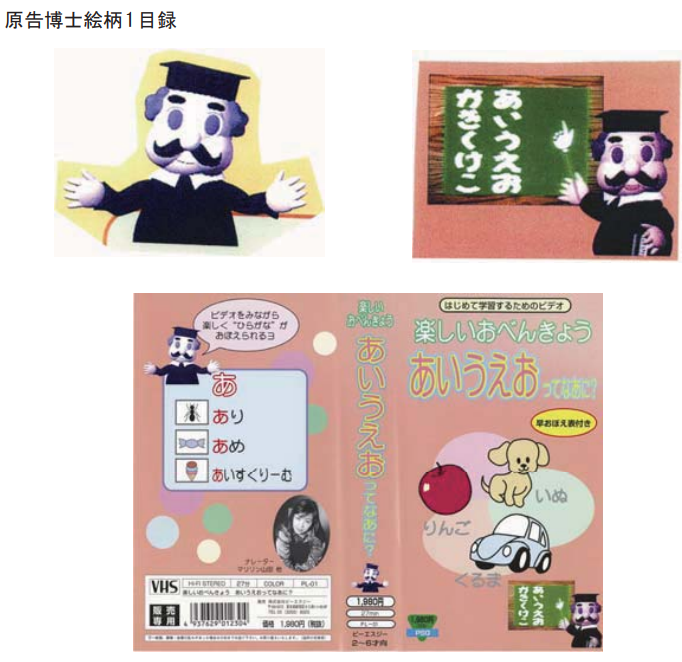
Plaintiff’s Professor Illustration 1: character images and video packaging.
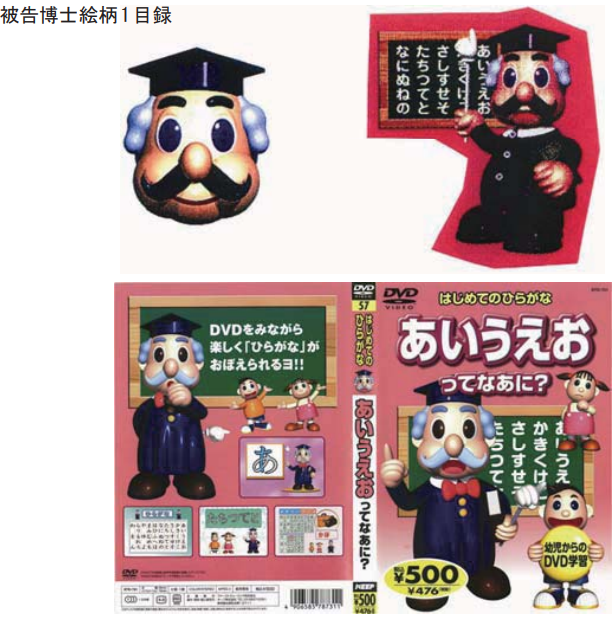
Defendant’s Professor Illustration 1: character images and video packaging.
[Design] Tokyo District Court, 2021 (Wa) 30281 and Other Cases, “Protective Member and Push Handle” <Kokubu>
Original Ameblo publication: 2025-05-18
Ameblo: https://ameblo.jp/hideki-takaishi/entry-12904118561.html
[Design] Tokyo District Court, 2021 (Wa) 30281 and Other Cases, “Protective Member and Push Handle” <Kokubu>
Patent infringement found + design infringement found
⇒ Design infringement: a converted application and indirect infringement of a partial design (Design Act, Article 38(i)(a))!!
The defendants alleged invalidity, arguing among other things that the conversion to the design application was unlawful. However, the court held that the specification of the divisional application disclosed, for example, that the protective portion was disk-shaped and flat underneath, so identity was not negated.
(Excerpts from the court’s reasoning)
The defendant’s product is a handgrip attached to the upper end of a single pipe of a transport trolley, in which case it becomes the trolley’s push handle together with that pipe. It is found that the product would not be attached to anything other than a trolley pipe and thereby acquire a function or use different from a push handle (entire purport of oral argument). Accordingly, the defendant’s product is found to be an “article used exclusively for manufacturing” (Design Act, Article 38(i)(a)) a trolley push handle by being attached to the upper end of its pipe.
The defendants argue that their product is used for purposes other than push handles inserted into their trolleys, can be attached to pipes of various lengths, and therefore does not produce a fixed relationship between the grip length and the total pipe length as in the designs at issue. However, even if the product is attached to different types of trolley or pipe, it remains an “article used exclusively for manufacturing” a trolley push handle by attachment to the pipe’s upper end. The defendants’ argument therefore cannot be accepted.
https://www.courts.go.jp/assets/hanrei/hanrei-pdf-93266.pdf
[U.S. Patents] August 20, 2007, CAFC, Ian Frazer v. C. Richard Schlegel
Original Ameblo publication: 2025-05-19
Ameblo: https://ameblo.jp/hideki-takaishi/entry-12904234387.html
[U.S. Patents] August 20, 2007, CAFC, Ian Frazer v. C. Richard Schlegel
For an invention in an application claiming Paris Convention priority to which examples had been added, the court recognized the effect of priority and first-inventor status, prevailing over another person’s application filed during the priority period.
— Valid priority requires satisfaction of the written-description and enablement requirements in the first paragraph of 35 U.S.C. § 112.
= Japan, 2023 (Gyo-Ke) 10057 <Honda>
(In contrast to the Artificial Nipple case)
https://jpaa-patent.info/patent/viewPdf/4455
[Article/Copyright] The Duty of Care Owed by a Party Commissioning Advertising Materials to Avoid Copyright Infringement (Hajime Moriwaki)
Original Ameblo publication: 2025-05-20
Ameblo: https://ameblo.jp/hideki-takaishi/entry-12904455057.html
[Article/Copyright] The Duty of Care Owed by a Party Commissioning Advertising Materials to Avoid Copyright Infringement (Hajime Moriwaki, Intellectual Property Management, Vol. 58, No. 11 (2008))
*Judgments holding that the commissioning party owed a high duty of care
⇒ “Negligence” established
Osaka District Court, 1997 (Wa) 3805: pharmaceutical company
Tokyo District Court, 1994 (Wa) 23092: Tokyo Metropolitan Government
Tokyo District Court, 2007 (Wa) 1126: shrine
*Judgments holding that the commissioning party did not owe a high duty of care
⇒ No “negligence”
Osaka District Court, 2003 (Wa) 2886: construction company
Osaka District Court, 2005 (Wa) 1311: coffee company
[Article/Trademark] The Meaning of “Goods” under the Trademark Act (Takuya Ueda, Theory and Practice of Intellectual Property Law, Vol. 3)
Original Ameblo publication: 2025-05-21
Ameblo: https://ameblo.jp/hideki-takaishi/entry-12904712939.html
[Article/Trademark] The Meaning of “Goods” under the Trademark Act (Takuya Ueda, Theory and Practice of Intellectual Property Law, Vol. 3)
*Novelty and promotional items
T-shirts in the BOSS case (Osaka District Court, August 26, 1987): if an article is not an independent product in itself but merely packaging or an advertising medium for another product, it is not “goods” under the Trademark Act.
Related example: ballpoint pens in the Hertz Rent-a-Car case (Tokyo High Court, February 27, 2001). The signs on the promotional items advertised car-rental services and did not function to identify the source of the promotional items themselves; use of the trademark for the designated goods was therefore denied.
= Origami paper in the Takeda Pharmaceutical case (Tokyo High Court, November 7, 1989)
*Pamphlets and admission tickets
The Shumi no Kai case (Tokyo District Court, March 2, 1961) and Mokuba Kikaku case (Yokohama District Court, Kawasaki Branch, April 28, 1988) held that pamphlets and admission tickets did not qualify as independently traded “printed matter” goods and therefore were not “goods” under the Trademark Act.
*Decisions are divided on whether food and beverages served inside an establishment constitute “goods.”
Chunagon case (Osaka District Court, December 25, 1986): trademark infringement rejected
Koraku case (Hiroshima High Court, Okayama Branch, June 18, 1986): trademark infringement affirmed
*Real estate: in the Village Hakusan case, the first-instance court found infringement because condominium units for sale constituted “goods” similar to the designated service of “buying and selling buildings.” The Tokyo High Court (September 28, 2000) found infringement on the ground that the signs were used for the service of buying and selling buildings.
[Copyright] IP High Court, 2010 (Ne) 10029 <Takizawa>
Original Ameblo publication: 2025-05-22
Ameblo: https://ameblo.jp/hideki-takaishi/entry-12904952235.html
[Copyright] IP High Court, 2010 (Ne) 10029 <Takizawa>
A research report prepared under a joint-research agreement between a university and an outside organization qualified as a work made in the course of duties, with the university as author.
(1) Initiative of the corporation or other organization
The university concluded a joint-research agreement with Kitami City and others and was obliged to prepare the research report as part of its performance.
(2) Created in the course of duties
Through X’s obligation to submit a research plan and the university’s designation of the research purpose, content, location and other matters, the university was involved to some extent in the substantive content of the research, beyond ordinary labor management.
(3) Published by the corporation or other organization under its own name as author
The covers of the reports displayed names including “Kitami Institute of Technology Regional Joint Research Center,” and their tables of contents and main texts contained no indication of which author wrote which part. Although the appellant was named in the prefaces or other introductory sections as a research member or joint-research representative, the reports were held to have been published under the university’s name as author.
https://www.courts.go.jp/assets/hanrei/hanrei-pdf-80576.pdf
[Article/Works Made in the Course of Duties] The Air-Conditioning Equipment Training Text Case (Shigeki Ishii, Patent, 2007)
Original Ameblo publication: 2025-05-23
Ameblo: https://ameblo.jp/hideki-takaishi/entry-12905268870.html
[Article/Works Made in the Course of Duties] The Air-Conditioning Equipment Training Text Case (Shigeki Ishii, Patent, 2007)
The requirement of being “published under the name of the corporation or other organization” was found not to be satisfied!!
IP High Court, 2006 (Ne) 10027 [Air-Conditioning Equipment Training Text Case]
The notation “X, Head of the Instrumentation Systems Department, Tokyo Branch, Y1 Co., Ltd.” is understood as identifying X as the instructor and stating the instructor’s title and company affiliation.
= Tokyo High Court, 2000 (Ne) 4816 [Esquisse Case]
“Under generally accepted social norms, ‘Waseda University D Laboratory’ merely identifies the affiliation of ‘D,’ which follows it. This notation cannot possibly be regarded as publication under Waseda University’s name as author.”
[Copyright] IP High Court, 2005 (Ne) 10070 [Vibration Controller Program Case]
Original Ameblo publication: 2025-05-24
Ameblo: https://ameblo.jp/hideki-takaishi/entry-12905536486.html
[Copyright] IP High Court, 2005 (Ne) 10070 [Vibration Controller Program Case]
*Despite Copyright Act Article 61(2), assignment of the adaptation right was recognized even though it was not specifically listed in the program-copyright assignment agreement!!
The arrangement presupposed that Y would take the lead in future improvements to the program, while X was positioned only as “contributing.”
Cf. The Memorial Tree case (Tokyo District Court, December 19, 2003), Political Economy Paper case (Tokyo District Court, January 18, 2007), and Space Battleship Yamato case (Tokyo District Court, December 27, 2006) all differed from this case: under the presumption in Copyright Act Article 61(2), the adaptation right and other relevant rights were held to have been retained by the assignor.
https://www.courts.go.jp/assets/hanrei/hanrei-pdf-33474.pdf
[Article/Trade Secrets] Can a Company Enjoin an Employee’s Use or Disclosure of Trade Secrets the Employee Developed or Acquired Personally?
Original Ameblo publication: 2025-05-25
Ameblo: https://ameblo.jp/hideki-takaishi/entry-12905722262.html
[Article/Trade Secrets] Can a Company Enjoin an Employee’s Use or Disclosure of Trade Secrets the Employee Developed or Acquired Personally? (Asayo Ohyori, Theory and Practice of Intellectual Property Law, Vol. 3)
*Cases granting injunctions, and an interlocutory judgment finding trade-secret infringement (item 3)
(1) Sapporo District Court order, July 8, 1994: customer list
(2) Osaka District Court, December 22, 1998: technical guidance received at another company’s research laboratory as part of the employee’s work
(3) Tokyo District Court interlocutory judgment, December 26, 2002: list of dispatched staff (whether to grant an injunction, and its permissible scope, were left for further proceedings)
*Osaka District Court, August 28, 1997: use/disclosure for an improper purpose was rejected, but the determination assumed that the defendant’s acts could fall within item (vii).
*Cases denying an injunction
(1) Tokyo District Court, November 30, 1998: the defendant knew the information thoroughly without needing to consult the customer list. Use rejected.
(2) Osaka District Court, 2002 (Wa) 3162: the defendant knew the addresses and other information without consulting the customer list. Use rejected.
Cf. Other cases concerning the requirement that information be “disclosed” to the recipient
(1) Tokyo District Court, 2001 (Wa) 5663 [Personal Importation of Viagra Case]: patient information obtained by the defendant in the course of duties as a physician was not a trade secret held by the plaintiff, who had commissioned the work.
(2) Tokyo High Court, 2002 (Ne) 1413 [At-Cost Sale Case]: wholesale prices are formed through negotiations between seller and buyer, so each independently acquires the information; it is not information “disclosed” to the recipient.
(3) Tokyo High Court order, March 31, 2003: credit-card application information was independently acquired by both the credit-card company and the points-card issuer, rather than being information “disclosed” to the recipient.
Articles, etc. (2003–June 2015) | Intellectual Property High Court
IP High Court, 2016 (Ne) 10047 [Electrical Connector Assembly] <Takabe>
Original Ameblo publication: 2025-05-26
Ameblo: https://ameblo.jp/hideki-takaishi/entry-12906031295.html
2016 (Ne) 10047 [Electrical Connector Assembly] <Takabe>
*Determinations in the reasoning of a judgment in an action to rescind a trial decision do not bind the determination of the patent’s technical scope in an infringement action. The patentee’s counterarguments on invalidity do not necessarily bind the court’s determination in an infringement action either.
(Excerpts from the court’s reasoning)
…Determinations in the reasoning of a judgment in an action to rescind a trial decision concerning the same patent do not bind the determination of technical scope in an infringement action.
…When construing the technical scope of a patented invention, a party’s arguments made in response to the opposing party’s invalidity allegations do not necessarily bind the court. Further, the claims for Patented Invention 2 do not provide the limitation asserted by the appellant …. Nor are the problem and functions and effects of Patented Invention 2 such that they can be achieved only if, whenever the cable connector is tilted upward—that is, before reaching its final mated position—the rearmost position of the rear edge of the locking projection is always forward of the foremost position of the projection extending inward into the locking groove from its rear edge.
https://www.courts.go.jp/assets/hanrei/hanrei-pdf-86212.pdf
IP High Court, 2016 (Ne) 10042 [Contact Terminal] <Takabe>
Original Ameblo publication: 2025-05-28
Ameblo: https://ameblo.jp/hideki-takaishi/entry-12906556081.html
2016 (Ne) 10042 [Contact Terminal] <Takabe>
*Because the defendant’s product and the patented invention differed in their technical significance, the product did not literally satisfy the claim limitation “pressing member,” and infringement under the doctrine of equivalents was also denied.
(Excerpts from the court’s reasoning)
The plunger pin has an inclined recess of substantially conical-surface shape in its large-diameter portion, and is designed to be urged by a coil spring into contact with the inner peripheral surface of the main casing at two locations, left and right. The top-shaped member is conductive, and is configured so that its spherical portion presses against the inclined recess in the plunger pin’s large-diameter portion, contacting it at only one point and thereby tilting into contact with the casing’s inner peripheral surface at two locations, left and right. The central axis of the top-shaped member and the deepest point of the bottom surface of the plunger pin are offset to ensure that the plunger pin and top-shaped member tilt and contact the casing.
Securing a total of four current paths in this manner reduces the electrical resistance of the defendant’s product, reduces the likelihood that no path other than through the coil spring exists for current flowing through the product, and limits the amount of current flowing through the coil spring.
In addition, because the coil spring is coated with ●●●●●●●, there is no need to use an insulating ball.
By contrast, in the invention at issue, …(1) making the inclined recess substantially conical in shape allows the center of the pressing member’s spherical portion, formed by a spherical surface, to be positioned stably on the inclined recess’s central axis, thereby stabilizing the direction of the coil spring’s biasing force transmitted to the plunger pin through the pressing member; and (2) offsetting the inclined recess’s central axis from the plunger pin’s central axis ensures that the coil spring urges the plunger pin in a direction at a small angle to the casing’s central axis, reliably bringing the plunger pin’s large-diameter portion into contact with the casing’s tubular inner peripheral surface and allowing current to flow reliably into the casing.
Accordingly, the defendant’s product and the invention at issue have different technical significance … in the contact between the pressing member and the plunger pin.
https://www.courts.go.jp/assets/hanrei/hanrei-pdf-86215.pdf
[Trademark/Foreign Server] IP High Court, 2024 (Ne) 10031 <Hibiku Shimizu> — “Sushi Zanmai” Case
Original Ameblo publication: 2025-05-29
Ameblo: https://ameblo.jp/hideki-takaishi/entry-12906944953.html
[Trademark/Foreign Server] 2024 (Ne) 10031 <Hibiku Shimizu>
“Sushi Zanmai” Case
⇒ Reversed: no trademark infringement
[Issue 1: Application of Trademark Act Article 2(3)(viii)]
At first instance, the defendant’s webpages were found to be created mainly for Japan, were recognized as concerning services similar to food and beverage services, and were treated as advertising.
However, the IP High Court held that the website as a whole aimed to promote exports of food ingredients from Japan, and that the defendant’s displayed indications were merely part of an introduction to its overseas-store business, not advertising directed to consumers in Japan.
[Issue 2: Trademark Use and Infringement of the Source-Indicating Function]
The IP High Court held that, even if the display were considered “advertising,” the defendant’s indications concerned overseas restaurants that did not provide services in Japan. The consequence of mistaking their source and receiving their services would occur abroad, so the source-indicating function of the plaintiff’s marks in Japan was not impaired.
[Issue 3: Territoriality and Consistency with the Joint Recommendation]
The IP High Court also held that, in light of trademark independence under the Paris Convention and the principle of territoriality, it would be inappropriate to use Japanese trademark rights to restrict lawful use of marks registered abroad to identify the designated services in those countries, where the use at issue did not impair the marks’ source-indicating or related functions in Japan.
It also concluded, in light of the Joint Recommendation, that there was no trademark use because no commercial effect in Japan was recognized.
*Regarding the Joint Recommendation:
Concerning the “factors for determining commercial effect” listed in Article 3(1) of the Joint Recommendation, the IP High Court
held that, comprehensively considering that “the sushi restaurants do not provide services in Japan and there are no circumstances indicating that they have undertaken plans to do so (subparagraph (a)); the webpages do not display the restaurants’ prices in Japanese currency (subparagraph (c)(ii)) or contact methods in Japan (subparagraph (d)(ii)); and, as noted above, the webpages themselves are intended to advertise the service of exporting food ingredients from Japan, with the defendant’s indications used in the context of introducing restaurant chains that use the exported ingredients abroad,” even taking into account that “the webpages are written in Japanese (subparagraph (d)(iv)) and do not explicitly state the absence of an intention to provide the restaurants’ services to customers in Japan (subparagraph (b)(ii)),” “the use of the defendant’s indications on the webpages cannot be said to have a commercial effect in Japan and thus does not constitute use as trademarks in Japan.”
https://www.courts.go.jp/assets/hanrei/hanrei-pdf-93478.pdf
Tokyo District Court, 2002 (Wa) 23687 [Telephone Card] <Iimura>
Original Ameblo publication: 2025-05-30
Ameblo: https://ameblo.jp/hideki-takaishi/entry-12907044334.html
Tokyo District Court, 2002 (Wa) 23687 [Telephone Card] <Iimura>
*The rights holder’s arguments during prosecution of the parent of a divisional application were considered in construing the claim language.
*Consistent with Osaka District Court, 2005 (Wa) 12207.
“If an applicant intentionally deletes a portion of the original specification and drawings of the parent application by amendment, it is impermissible, in making a divisional application, to expand the device to encompass matters already deleted.”
(Excerpts from the court’s reasoning)
The device at issue was the subject of a divisional application filed from the parent application after its original specification and drawings had been amended and the application published for opposition.
Where the parent application’s original specification or drawings have thus been amended and published for opposition before the divisional filing, the device in the divisional application must be one described both in the original specification or drawings of the parent application and in its amended published specification or drawings.
Accordingly, it is natural that determining the “scope of utility model registration claims” in the divisional application also requires construction taking the parent application’s prosecution history into account.
In particular, if the applicant intentionally deletes a portion of the original specification and drawings of the parent application by amendment, it is impermissible, in making a divisional application, to expand the device to encompass matters already deleted. The “scope of utility model registration claims” in the divisional application must therefore also be construed consistently with that principle.
https://www.courts.go.jp/assets/hanrei/hanrei-pdf-11371.pdf
Tokyo High Court, 1999 (Ne) 3800 [Underarm Sweat-Absorbing Pad]
Original Ameblo publication: 2025-05-31
Ameblo: https://ameblo.jp/hideki-takaishi/entry-12907233624.html
Tokyo High Court, 1999 (Ne) 3800 [Underarm Sweat-Absorbing Pad]
*The determination in the reasoning of another final judgment concerning the same utility model registration is to be respected.
*The argument that this was correction of a typographical error was rejected, and intentional exclusion was found.
Cf. 2016 (Ne) 10047 [Electrical Connector Assembly] <Takabe>
*Determinations in the reasoning of a judgment in an action to rescind a trial decision do not bind the determination of the patent’s technical scope in an infringement action. The patentee’s counterarguments on invalidity do not necessarily bind the court’s determination in an infringement action either.
(Excerpts from the court’s reasoning)
In this litigation, the appellant alleges infringement of its utility model right by the appellee on the premise that “small curvature” in the specification means “small radius of curvature.” However, this premise is substantially the same issue examined in the other litigation. The appellant’s argument therefore seeks precisely to revive and contest a matter that should have been settled when the other litigation became final. Although it does not conflict with res judicata, it seeks to leave unresolved a matter intended to be resolved by a final judgment and plainly gravely harms legal stability. In such circumstances, absent special circumstances such as an error objectively obvious on its face or grounds sufficient to warrant retrial of the other litigation, it is appropriate to respect the determination in the final judgment’s reasoning. Reopening the dispute must be regarded as impermissible under the principle of good faith. …
The plaintiff argues that “small curvature,” which plainly has technical significance in the device at issue, is technically equivalent to “small radius of curvature,” which has the opposite meaning. Ultimately, that argument can stand only on the premise that “small curvature” in the specification is an obvious typographical error for “small radius of curvature.” However, as explained in I above, “small curvature” cannot be construed as such an obvious error. The plaintiff’s argument is therefore plainly without merit, without any need to consider the remaining points.
https://www.courts.go.jp/assets/hanrei/hanrei-pdf-13457.pdf

English Translation of the Source Figure — Electrical Connector Assembly
2016 (Ne) 10047 (Takabe). A patentee’s rebuttal of an invalidity argument does not necessarily bind claim construction. Reasoning in a judgment in an action to cancel a JPO trial decision does not bind the determination of technical scope in an infringement action. ★
“A determination in the reasoning of a judgment in an action to cancel a JPO trial decision concerning the same patent does not bind the determination of the invention’s technical scope in an infringement action. … A party’s arguments, made in response to the opposing party’s invalidity arguments, do not necessarily bind the court’s interpretation of the technical scope of a patented invention. The claims for Patented Invention 2 do not contain the limitation asserted by the appellant. … Nor is the problem addressed or the effect of Patented Invention 2 such that it can be achieved only if, while the cable connector is in an upwardly inclined position—before it reaches the final connector-mating position—the rearmost point of the rear edge of the locking projection always lies forward of the foremost point of the projection extending into the locking groove from its rear edge.”
Osaka District Court, 2005 (Wa) 12207 [Goggles]
Original Ameblo publication: 2025-06-01
Ameblo: https://ameblo.jp/hideki-takaishi/entry-12907494065.html
Osaka District Court, 2005 (Wa) 12207 [Goggles]
*The court considered the deletion of claims from the parent application after division, but found no intentional exclusion of the patented inventions at issue because the deleted claims were not shown to be identical to those inventions.
*Consistent with Tokyo District Court, 2002 (Wa) 23687.
“The plaintiff’s deletion of claims 4 through 7 from the parent application does not establish that it intentionally excluded the patented inventions at issue.”
(Excerpt from the court’s reasoning)
…The amendment concerned the parent application, not the patented inventions in the divisional application. As explained above, claims 4 through 7 of the parent application are not found to be identical to the patented inventions at issue. Thus, the plaintiff’s deletion of those claims cannot be regarded as intentional exclusion of the patented inventions at issue.
https://www.courts.go.jp/assets/hanrei/hanrei-pdf-34563.pdf
Kyoto District Court, 1996 (Wa) 1597 [Thermal Head]
Original Ameblo publication: 2025-06-04
Ameblo: https://ameblo.jp/hideki-takaishi/entry-12908157393.html
Kyoto District Court, 1996 (Wa) 1597 [Thermal Head]
*The patentee’s arguments during prosecution of the parent of a divisional application were likewise not considered in construing the claim language.
“The prosecution history of the invention in the parent application may be considered only in exceptional circumstances where establishment of the patent right in the divisional application is closely related to the parent application, and reference to the parent’s prosecution history clarifies the meaning of the specification or drawings attached to the parent application that already formed the basis for the divisional application at the time of division.”
(Excerpts from the court’s reasoning)
Because the invention in the divisional application and the invention remaining in the parent after division are separate and independent, it is, as above, generally inappropriate to consider the parent invention’s prosecution history in determining the technical scope of the divisional invention. (Statements made during prosecution of the parent invention cannot be regarded as statements about the divisional invention.)
However, the parent invention’s prosecution history may be considered only in exceptional circumstances where establishment of the divisional patent right is closely related to the parent, and reference to the parent’s prosecution history clarifies the meaning of the specification or drawings attached to the parent application that already formed the basis for the divisional application at the time of division. (In that situation, determining the meaning of the parent’s pre-division specification also permits the meaning of the divisional invention described therein to be regarded as already clear at the time of division.)
http://imaokapat.biz/hanrei/jirei039-h8-1597.html
Tokyo District Court, 1995 (Wa) 23005 [Topical Antifungal Agent]
Original Ameblo publication: 2025-06-04
Ameblo: https://ameblo.jp/hideki-takaishi/entry-12908158008.html
Tokyo District Court, 1995 (Wa) 23005 [Topical Antifungal Agent]
*The contents of documents filed in the European application claiming priority from the Japanese application were also considered in construing the claim language.
= Osaka District Court, 1972 (Wa) 1526 [Chakku]
(Excerpts from the court’s reasoning)
…Considering together the wording of the claims, the descriptions and examples in the detailed description, the plaintiff’s arguments during prosecution of the patent application, the contents of its submissions to the European Patent Office, and other matters, the invention can be described as follows. It concerns a topical antifungal agent using miconazole or the like, known as antifungal agents. In light of the problem that directly adding miconazole or the like to a topical base using an ordinary formulation method causes crystals to precipitate and prevents the desired topical agent from being obtained, it employs the novel technical concept of using crotamiton or the like—known as an active ingredient of topical agents but not as a solvent for miconazole or the like—as such a solvent, and formulating that solution with a topical base to obtain a superior topical agent without crystal precipitation.
Accordingly, …“solution” in the claims should appropriately be construed as a solution having compound (I) as the solute and crotamiton or the like as the solvent.
https://www.courts.go.jp/assets/hanrei/hanrei-pdf-13763.pdf
Shizuoka District Court, 1990 (Wa) 360 and 1992 (Wa) 524 [Alfacalcidol]
Original Ameblo publication: 2025-06-04
Ameblo: https://ameblo.jp/hideki-takaishi/entry-12908158087.html
Shizuoka District Court, 1990 (Wa) 360 and 1992 (Wa) 524 [Alfacalcidol]
*The court rejected the argument that the prosecution history of the corresponding German patent precluded explaining a difference in the melting point of the substance covered by the Japanese patent by differences in purity.
Cf. Tokyo District Court, 1995 (Wa) 23005 [Topical Antifungal Agent]; Osaka District Court, 1972 (Wa) 1526 [Chakku]
(Excerpt from the court’s reasoning)
The defendants argue that because the German patent corresponding to the patented invention was granted with emphasis on the fact that the substance obtained by the method was pure, it is impermissible to explain a different melting point of the target substance of this patent, based on the same invention, by lower purity. However, in light of the principle of independence of patents in each country, that argument is plainly without merit.
Tokyo District Court, 2023 (Wa) 70178 [Zinc Acetate Hydrate Tablets and Method of Manufacturing Them] <Nakashima>
Original Ameblo publication: 2025-06-05
Ameblo: https://ameblo.jp/hideki-takaishi/entry-12908424986.html
2023 (Wa) 70178 [Zinc Acetate Hydrate Tablets and Method of Manufacturing Them] <Nakashima>
Even if the presumption under Patent Act Article 104 applied, it has been rebutted.
⇒ The court also stated the following as an alternative observation.
(Excerpts from the court’s reasoning)
Even assuming that the defendant’s pharmaceutical product were presumed under Patent Act Article 104 to have been produced by the manufacturing method of the invention, the explanation in 2 above shows that the presumption is rebutted …. …
It is appropriate to find that, before the priority date, the “product” produced by the invention was known to an extent that provided a person skilled in the art with a clue to how to manufacture it. Accordingly, the defendant’s pharmaceutical product cannot be presumed under Patent Act Article 104 to have been produced by the manufacturing method of the invention.
https://www.courts.go.jp/assets/hanrei/hanrei-pdf-93476.pdf
[Article/Trademark] Trademark-Related Judgments in the Reiwa Era (Kentaro Hattori, Patent News, February 14, 2025)
Original Ameblo publication: 2025-06-06
Ameblo: https://ameblo.jp/hideki-takaishi/entry-12908597417.html
[Article/Trademark] Trademark-Related Judgments in the Reiwa Era (Kentaro Hattori, Patent News, February 14, 2025)
Civil litigation relating to trademarks, 2019–2024
• Of 92 district court cases, 31 resulted in dismissal on the merits or as inadmissible. (However, many concerned abuse of rights; few involved dissimilarity of marks.)
• Of 31 appeals, five resulted in reversals (four of those judgments found no abuse of rights).
Actions to rescind trial decisions
Of 229 cases, the trial decision was rescinded in 47.
Of these, eighteen concerned non-use cancellation and seven concerned Article 3.
https://sakurazakalaw.tokyo/topics/pdf/2025/238.pdf
IP High Court, 2010 (Gyo-Ke) 10121 [Natto Food] <Takizawa>
Original Ameblo publication: 2025-06-07
Ameblo: https://ameblo.jp/hideki-takaishi/entry-12908866363.html
2010 (Gyo-Ke) 10121 [Natto Food] <Takizawa>
*Different standards apply to whether something is an “invention” eligible to serve as a cited invention and whether it is an “invention” when assessing patentability.
(Excerpts from the court’s reasoning)
…It is assumed that there is no discrepancy between the applicant’s original intention and the claim wording. Even if there is such a discrepancy, as noted above, it is properly a matter to be addressed on the applicant’s own responsibility. The examiner therefore does not bear a duty to investigate whether such a discrepancy exists and, if it does, point out that defect or deficiency in the application. …
Identifying an “invention” in a cited invention for assessing inventive step requires, and is satisfied by, disclosure of the technical concept sufficiently to permit its practice, based on the state of the art at the filing date and to the extent necessary for comparison with the invention in the application and the like. In contrast, identifying the “invention” in an application for assessing patentability requires that it be constituted concretely and objectively enough for a person skilled in the art repeatedly and continuously to achieve the intended technical effect. Even if the two identifications of “invention” do not employ the same standard, that is natural given their different purposes and subjects, and cannot be called unreasonable.
Accordingly, although applying different standards to a particular applicant in comparable cases could violate the principle of equality, the plaintiff’s arguments plainly do not establish that the defendant engaged in unequal treatment based on double standards.
https://www.courts.go.jp/assets/hanrei/hanrei-pdf-81149.pdf
IP High Court, 2024 (Gyo-Ke) 10023 [Information Processing Terminal] <Hibiku Shimizu>
Original Ameblo publication: 2025-06-08
Ameblo: https://ameblo.jp/hideki-takaishi/entry-12909092248.html
2024 (Gyo-Ke) 10023 [Information Processing Terminal] <Hibiku Shimizu>
*Claim wording was deleted, but the amendment was held not to add new matter.
(Excerpt from the court’s reasoning)
Amendment 4 deletes “regardless of whether payment-related information is input” from the claimed invention. Literally, …because it deletes a limitation, there is room to interpret it as meaning that “an information processing terminal in which the presence or absence of ‘input of payment-related information’ is relevant to the mode at issue,” previously outside the claimed invention, now falls within the amended invention. However, the claimed invention addresses the difficulty of applying to nonpayment uses the prior-art configuration that performs processing and display prompting the user to read a payment card after the user inputs payment-related information …. It provides an information processing terminal applicable to nonpayment uses and capable of quickly reading required information from an information storage medium, whether contact or contactless …. This is also true of the amended invention. …It can hardly be considered a reasonable interpretation that the invention after amendment, including Amendment 4, encompasses within its technical scope these ‘information processing terminals in which the presence or absence of input of payment-related information is relevant to the mode at issue.’ Rather, construing the technical scopes of the original and amended inventions in light of the specification, it remains true both before and after amendment that ‘input of payment-related information’ is unnecessary to achieve the mode at issue. It is appropriate to understand the phrase ‘regardless of whether payment-related information is input’ as merely specifying applicability to nonpayment uses. Amendment 4 therefore does not cause the amended invention to encompass matters absent from the original invention. …Since Amendment 4 does not add new matter, …the amendment as a whole narrows the claims.
https://www.courts.go.jp/assets/hanrei/hanrei-pdf-93556.pdf
Tokyo District Court, 2022 (Wa) 18332 [Method of Transmitting and Receiving Reference Signals in a Wireless Communication System] <Nakashima>
Original Ameblo publication: 2025-06-09
Ameblo: https://ameblo.jp/hideki-takaishi/entry-12909308720.html
2022 (Wa) 18332 [Method of Transmitting and Receiving Reference Signals in a Wireless Communication System] <Nakashima>
*Not mandatory under the “standard” +Non-satisfaction was confirmed by materials submitted under a protective order.
The LTE standard provides that values such as NID_csh_DMRS are used when supplied by higher layers, and that ordinary cell IDs (such as NID_cell) are used when they are not supplied.
⇒ Whether a terminal is configured to support CoMP (coordinated transmission and reception among multiple base stations) is left to its particular implementation; the LTE standard does not make CoMP mandatory for terminals.
+Further, based on the defendant’s evidence subject to the protective order (Exhibits Otsu 50–52) and the entire purport of the oral argument, the court inferred that the chipsets incorporated in the defendant’s products did not generate or transmit reference signals using the parameters at issue and found no objective evidence to the contrary.
⇒ Limitation not satisfied
https://www.courts.go.jp/assets/hanrei/hanrei-pdf-92805.pdf
Tokyo District Court, 2022 (Wa) 70139 and 2023 (Wa) 70009, “Claim for a Declaration of the Right to Obtain a Patent” <Nakashima>
Original Ameblo publication: 2025-06-10
Ameblo: https://ameblo.jp/hideki-takaishi/entry-12909487358.html
2022 (Wa) 70139 and 2023 (Wa) 70009, “Claim for a Declaration of the Right to Obtain a Patent” <Nakashima>
An action seeking a declaration that the plaintiff held the right to obtain a patent for an invention in an international patent application deemed withdrawn because national-phase procedures were not completed in designated states was dismissed for lack of an interest in declaratory relief.
The court treated the right to obtain a patent arising under Japanese employee-invention law as distinct from the corresponding right under German law. Recognition of the former in Japan would not necessarily establish the latter in Germany. It therefore considered a German action to determine ownership under German law more effective and appropriate for resolving this dispute. This concerned the interest in obtaining declaratory relief in this case, not a general rule that Japanese judgments cannot be recognized in Germany.
(Excerpts from the court’s reasoning)
“Under the principle of territoriality, the right to obtain a patent under Japan’s employee-invention provisions and the right to obtain a patent under Germany’s employee-invention provisions are different. Thus, even if the former is recognized in Japan, the latter is not necessarily recognized in Germany. …
Because the plaintiff can bring an action in a German court seeking a declaration of the right to obtain a patent under German employee-invention provisions, directly seeking a declaration of ownership of that right under German law in a German court, rather than seeking a declaration under Japanese law in a Japanese court, is a more effective and appropriate means of resolving the dispute.”
https://www.courts.go.jp/assets/hanrei/hanrei-pdf-92853.pdf
[Copyright] Tokyo District Court, 2023 (Wa) 70080, “Action for Disclosure of Sender Information” <Nakashima>
Original Ameblo publication: 2025-06-11
Ameblo: https://ameblo.jp/hideki-takaishi/entry-12909727022.html
[Copyright] Tokyo District Court, 2023 (Wa) 70080, “Action for Disclosure of Sender Information” <Nakashima>
The plaintiff sought disclosure of sender information, alleging infringement of privacy and feelings of personal honor through posts about age and related matters, and infringement of copyright and the right of attribution through a separate post linking to an image.
⇒ The court rejected infringement of privacy because the age was already widely known and the legal interest in its nondisclosure did not outweigh the reasons for disclosure. It also held that statements such as “You’re just creepy” and “Act your age!” were opinions and were not clearly insulting acts exceeding socially acceptable limits.
As to the image link, the court found that, under the circumstances of its display and the operations needed to reach the original image, transmission of the information did not directly cause copyright infringement. Infringement of the right of attribution was likewise not shown to be clear. It therefore dismissed the claim for disclosure of sender information.
(Excerpts from the court’s reasoning)
Sending the URL in Post 2 caused a coarse, reduced-resolution version of the original image to be displayed. The original image, however, would not be seen unless a user viewing Post 2 clicked the URL and then clicked the same URL again, alongside which was a notice that it would take the user to another site.
The facts found above also establish that the original image merely showed the plaintiff’s clothing and the like without showing the face, and that a thumbnail was already displayed in Post 2. In light of those facts, circumstances sufficient to find that a user viewing Post 2 would ordinarily deliberately click the URL and then click it again despite the notice of moving to another site cannot be recognized.
Under these circumstances, the sender’s transmission of the URL cannot be found directly to cause infringement of the plaintiff’s copyright through the circulation of information.
Accordingly, Post 2 cannot be found clearly to constitute the above-mentioned “infringement of rights.”
https://www.courts.go.jp/assets/hanrei/hanrei-pdf-92708.pdf
[Trademarks] Tokyo District Court, 2022 (Wa) No. 16062 — “仙修” (Judge Shibata)
Original Ameblo publication: 2025-06-12
Article type: Case note
Categories: Trademarks
Topics: Similarity of trademarks, Trademark infringement
First published on this website: 2026-10-16
Case information: 2022 (Wa) No. 16062
Ameblo: https://ameblo.jp/hideki-takaishi/entry-12909987156.html
HP: https://www.takaishihideki.com/en/single-post/ameblo-12909987156-en
Japanese version: https://www.takaishihideki.com/single-post/ameblo-12909987156-ja
[Trademarks] Tokyo District Court, 2022 (Wa) No. 16062 — “仙修” (Judge Shibata)
Registered mark: 仙脩
① Defendant’s Mark 1 (仙修): similar
② Defendant’s Mark 2 (仙修六神丸): similar
③ Defendant’s Mark 3 (御所 [boxed separately] 仙修): similar
④ Defendant’s Mark 4 (御所仙修): dissimilar
① 仙修 versus 仙脩
Both have two kanji, the first being the identical 仙. The second characters, 脩 and 修, differ in whether part of the lower portion resembles 月 or 彡; the remaining shapes closely resemble each other, as do the overall visual impressions. Both are pronounced “senshu.” Although 脩 originally means dried meat, it also largely encompasses meanings of 修. No conspicuous conceptual difference strongly suggesting distinct meanings to consumers was found. Overall similarity in appearance, pronunciation and concept was therefore established.
② 仙修六神丸
Of the five characters, 六神丸 has long denoted a traditional Chinese medicine/cardiotonic for palpitations and shortness of breath. It lacks inherent source-identifying force for consumers and is close to a generic name. Thus, 仙修 performs the strong source-identifying function. Comparing that portion with 仙脩 establishes similarity in appearance, pronunciation and concept as above; the mark as a whole was held similar.
③ 御所 (boxed separately) 仙修
The four characters comprise 御所 followed by 仙修. A space separates the two portions, and 御所 is boxed, visually dividing them. 仙修 can therefore also function independently as a source identifier. 御所 may be known as a place name in Nara, but it is unclear whether that meaning is immediately familiar nationwide; it may also be read “gosho,” meaning an imperial residence, and does not necessarily evoke one clear concept. The readily separable 仙修 portion resembles 仙脩, so this mark as a whole was also held similar.
④ 御所仙修
The characters run together without a space, and 御所 is not enclosed in a separate frame. Separate observation of the two portions is therefore not inevitable. 御所 also has some source-identifying function, and the whole forms a continuous pronunciation and appearance. Its appearance plainly differs from the two-character 仙脩, and “gose-senshu” or “gosho-senshu” sounds substantially different from “senshu.” On overall observation, the marks were held dissimilar. The court regarded 御所仙修 as a single, fully combined sign, not sufficiently similar to cause confusion with the registered mark.
https://www.courts.go.jp/assets/hanrei/hanrei-pdf-92766.pdf
https://www.linkedin.com/feed/update/urn:li:activity:7515598244681256960/
Images from the original AMEBLO article
English translations of the original image text
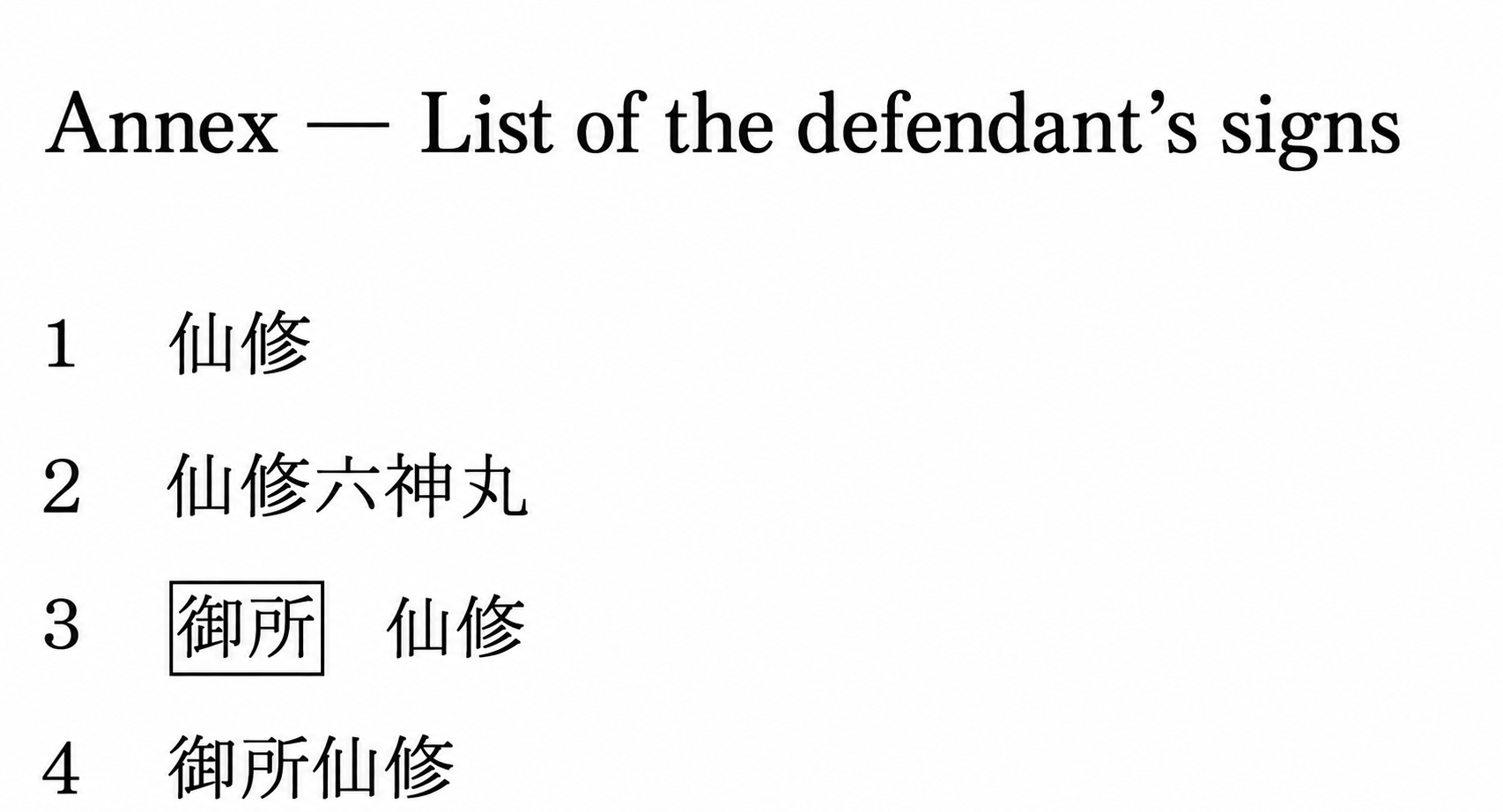
Original images retained for comparison
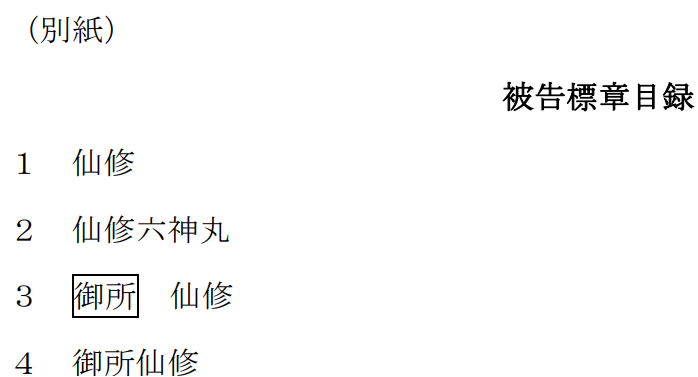
Original AMEBLO article
https://ameblo.jp/hideki-takaishi/entry-12909987156.html
[Unfair Competition Prevention Act/Communication of False Facts] Osaka District Court, 2022 (Wa) 11394, “Shogi Game-Record Information” <Takemiya>
Original Ameblo publication: 2025-06-13
Ameblo: https://ameblo.jp/hideki-takaishi/entry-12910186575.html
[Unfair Competition Prevention Act/Communication of False Facts] Osaka District Court, 2022 (Wa) 11394, “Shogi Game-Record Information” <Takemiya>
The information used in the videos about the shogi players’ moves and conduct was held to be publicly disclosed objective facts falling, in principle, within the sphere of free use.
Game records may include board diagrams and move sequences expressed through symbols. The information used here consisted of the moves and conduct of players in a broadcast game, including whether a player was thinking. The court did not conflate these objective facts with the concrete expressions, such as videos or text, that convey them, and proceeded on the undisputed premise that these videos did not infringe the defendant’s copyright.
The “Guidelines for Use of Game Records in the Osho Tournament” presented by the defendant were merely unilaterally established internal rules, not a legal basis for restricting third parties’ free use of game-record information.
⇒ The plaintiff’s video distribution did not infringe the defendant’s copyright. The plaintiff’s use of the game-record information fell within the scope of free use, and neither its means of acquisition nor manner of distribution was unlawful. The takedown request to the platform therefore constituted “communication of false facts.”
https://www.courts.go.jp/assets/hanrei/hanrei-pdf-92676.pdf
IP High Court, 2023 (Ne) 10093, “Copyright Owner of a Cinematographic Work” <Shoji>
Original Ameblo publication: 2025-06-14
Ameblo: https://ameblo.jp/hideki-takaishi/entry-12910465129.html
2023 (Ne) 10093, “Copyright Owner of a Cinematographic Work” <Shoji>
*Note that even when the film producer acquires copyright under Copyright Act Article 29(1), the author still holds moral rights!!
The appellee published online an animated video (a cinematographic work) created by the appellant without indicating the author’s name.
Because the appellant alone creatively contributed to the overall formation of the video, the appellant is its author.
On the other hand, the appellee was found to be the film producer because it intended to produce the video, held the legal rights and obligations concerning production, was responsible for the related income and expenditure, and bore the ultimate risk of covering production costs. Since the appellant had promised the appellee to participate in production, copyright (economic rights) belongs to the appellee under Copyright Act Article 29(1).
However, the appellant holds the right of attribution as an author’s moral right, so that right (a moral right) was infringed.
https://www.courts.go.jp/assets/hanrei/hanrei-pdf-92915.pdf
[Trademark] IP High Court, 2023 (Gyo-Ke) 10131, “hololive Indonesia” <Miyasaka>
Original Ameblo publication: 2025-06-15
Ameblo: https://ameblo.jp/hideki-takaishi/entry-12910640633.html
[Trademark] 2023 (Gyo-Ke) 10131, “hololive Indonesia” <Miyasaka>
*“hololive Indonesia” violates Trademark Act Article 4(1)(xvi).
Within “hololive Indonesia,” “hololive” is a coined term capable of distinguishing goods and services, while “Indonesia” is widely known among Japanese consumers as referring to the Republic of Indonesia in Southeast Asia.
The application’s designated goods and services span a wide range, including cosmetics, clothing and provision of food and beverages for general consumers, and many have no connection with Indonesia. If the mark is used for goods not produced or sold in Indonesia or services unrelated to Indonesia, the “Indonesia” portion may cause misunderstanding that the goods were produced or sold in Indonesia or that the services relate to Indonesia.
Even if the plaintiff argues that the mark is “the name of an Indonesia-based virtual idol group” and that fans are unlikely to be misled, consumers of the designated goods and services as a whole are not limited to the group’s fans. Many will associate a mark displaying a country name with the goods’ place of production or sale or a connection between the services and that country.
The plaintiff also relied on online subscriber numbers to argue that the mark was well known. The court observed that much of the content on the channels other than “hololive” was posted using Roman characters and that there was no evidence establishing how many subscribers were Japanese consumers. It therefore did not find the mark widely recognized among consumers in Japan.
https://www.courts.go.jp/assets/hanrei/hanrei-pdf-92867.pdf
IP High Court, 2023 (Gyo-Ke) 10034 [Method of Manufacturing a Raised-Pile Sheet] <Hibiku Shimizu>
Original Ameblo publication: 2025-06-16
Ameblo: https://ameblo.jp/hideki-takaishi/entry-12910812675.html
2023 (Gyo-Ke) 10034 [Method of Manufacturing a Raised-Pile Sheet] <Hibiku Shimizu>
B developed the imparting of raised-pile properties through steaming and drying, the characteristic part of the invention, so the defendant’s application was a usurped application filed without the right to obtain a patent.
*In courtroom disputes over usurped applications, the results of witness examination have a major influence!!
(Excerpts from the court’s reasoning)
…The changes in the allegations and statements greatly affect the very problem addressed by the invention, the need for it and its creative process. If A were truly the inventor, it would be hardly conceivable for those accounts to change in this manner merely through faulty recollection or the like.
Furthermore, …Shinei Senshoku initially outsourced the steaming process and performed it in-house from 2007 at the latest. The defendant’s previous allegation that Shinei Senshoku formerly “did not perform a steaming process” therefore cannot be accepted as fact.
Moreover, the defendant’s allegations would mean that Shinei Senshoku’s former dyeing process did not include presetting. Yet A’s account of trial and error concerning presetting was that he experimented with its position in the sequence, without explaining why presetting was introduced. This suggests that the presetting process already existed and A was experimenting solely with its order. Further, the conditions A described trying for steaming were “steam at 90°C for zero, thirty, sixty and 120 minutes,” which do not match the specification’s description of “steaming at 95–110°C for two to three hours” ([0022]). In examination during the trial proceedings, A made statements premised on never having kept an invention notebook himself …. This must be regarded as wholly unnatural for an inventor supposedly engaged in repeated trial and error.
https://www.courts.go.jp/assets/hanrei/hanrei-pdf-92893.pdf
[Article] The Scope of “Quality” in Acts Causing Misapprehension of Quality and the Like under the Unfair Competition Prevention Act (Michihiko Otsuka, Patent, 2025)
Original Ameblo publication: 2025-06-17
Ameblo: https://ameblo.jp/hideki-takaishi/entry-12911048143.html
[Article] The Scope of “Quality” in Acts Causing Misapprehension of Quality and the Like under the Unfair Competition Prevention Act (Michihiko Otsuka, Patent, 2025, Vol. 78, No. 2)
Some court decisions have recognized dual-price displays as acts causing misapprehension of quality and the like.
Marking goods that do not embody a patented invention as patented constitutes a direct indication and an act causing misapprehension of quality and the like.
● Supreme Court decision of March 22, 1978, Keishu Vol. 32, No. 2, p. 316, “Special-Grade Sake Case”
Labeling sake as special grade without the required grade examination and certification, even if its quality is substantially no worse than special-grade sake, constitutes misrepresentation of quality and the like.
● Osaka District Court, January 31, 2017, “Toner Cartridge Case”
The court held: “Even if the defendant’s goods merely lack designation by plaintiff Kyocera DS and objectively are no different in quality or content from the plaintiff’s genuine goods, because the defendant lacks authority to make that designation, its designation indication may still properly be regarded as an indication ‘liable to cause misapprehension’ of quality and content.”
No court decision has been found holding that an indication of founding date or history constitutes an act causing misapprehension of quality and the like.
Where an indication of ranking accompanies a direct indication, it is sufficient to determine whether making that direct indication constitutes an act causing misapprehension of quality and the like.
https://jpaa-patent.info/patent/viewPdf/4609
[Article] Interpretation of Broad Patent Claims (Koichi Hirota, Patent, 2005, Vol. 58, No. 7)
Original Ameblo publication: 2025-06-18
Ameblo: https://ameblo.jp/hideki-takaishi/entry-12911248954.html
[Article] Interpretation of Broad Patent Claims (Koichi Hirota, Patent, 2005, Vol. 58, No. 7)
— The “Holes” Theory —
“When comparing a selection invention with an earlier invention, conceptually the selection invention falls within the earlier invention’s claims. However, it obtained a patent because it went beyond what the inventor of the earlier invention recognized as the invention. From the view that protection is limited to what the inventor recognized, the selection invention is separate and independent of the earlier invention, so on that view there is no dependent-invention relationship: it does not fall within the earlier invention’s technical scope.”
“Regarding the recognition-limit theory, ‘It seeks to afford protection within what the inventor actually recognized; conversely, what the inventor did not recognize should not be protected … taking this view to its logical extreme severely limits the room for applying the doctrine of equivalents discussed below ….’”
[U.S. Patents] CloudofChange v. NCR (Fed. Cir. 2024)
Original Ameblo publication: 2025-06-19
Ameblo: https://ameblo.jp/hideki-takaishi/entry-12911406750.html
[U.S. Patents] CloudofChange v. NCR (Fed. Cir. 2024)
The court examined in detail who constitutes the entity “using” a claimed system and whether the customers’ acts could be attributed to defendant NCR (vicarious liability), and rejected direct infringement by the defendant.
⇒ For system claims, it is advisable to assert active inducement (35 U.S.C. § 271(b)) and contributory infringement (35 U.S.C. § 271(c)). (In this case, the plaintiff had abandoned inducement and contributory-infringement claims.)
1. The Entity Performing “Use”
Referring to Centillion, the court stated that the entity “using” a claimed system is the one that “control[s] the system as a whole and obtain[s] benefit from it.”
Here, “benefit” means not merely earning monetary revenue but enjoying the purpose and effect recited in the claims—that is, the essential advantages achieved by the invention.
Because the patent claims aim at constructing and editing POS terminals and using a system permitting repeated interaction with POS software over a network, the customers actually enjoy the system’s intended purpose and effects.
2. Whether “Vicarious Liability” Is Established
For method claims, as stated in Akamai, even when a third party other than the accused infringer performs some of the steps, the accused infringer may be liable if it directs or controls that conduct or has a special relationship with the third party, such as agency or a contractual relationship.
However, the court pointed out that this case concerns system claims, where the central issue is to whom “use” is attributed, and the analysis differs from that for method claims.
The court applied Akamai’s vicarious-liability principles to this case. The district court’s error was not applying those principles to system claims as such, but conflating customers’ provision of an Internet connection with their “use” of the claimed system as a whole.
The approach in Akamai of examining and aggregating who performed each individual step of a method claim cannot simply be imported into the “use” analysis for a system claim.
For system claims, one must evaluate as a whole “who enjoys the invention’s purpose and effects resulting from operation of all the system’s constituent elements.”
For a system claim, the inquiry is whether the defendant directed or controlled the customer’s use of the entire claimed system. Here, a contractual obligation requiring the customer to supply an Internet connection did not establish NCR’s direction or control of that use.
https://patent-law.hatenablog.com/entry/2024/12/31/025010
[Article/Europe] After the Long-Awaited Decision: Are SEPs Now Worthless in Europe? (Christoph Rademacher, 2016)
Original Ameblo publication: 2025-06-20
Ameblo: https://ameblo.jp/hideki-takaishi/entry-12911615875.html
[Article/Europe] After the Long-Awaited Decision: Are SEPs Now Worthless in Europe? (Christoph Rademacher, Intellectual Property Law and Policy Journal, Vol. 48 (2016))
As standardized technologies have spread, concerns have been raised that patentees may monopolize markets through SEPs.
Germany’s “Orange-Book” judgment (2009) generally allowed patentees to seek injunctions against companies infringing SEPs, but subsequent European Commission policy emphasized the need to offer licenses on FRAND (fair, reasonable and nondiscriminatory) terms.
In 2013, the Huawei–ZTE litigation led to a referral to the CJEU.
The CJEU’s 2015 judgment addressed injunctions and product recalls sought by a dominant SEP holder that had committed to a standard-setting organisation to license on FRAND terms. It set out the following negotiation steps and related options under EU competition law.
(1) The patentee must notify the alleged infringer of the patent infringement.
(2) The alleged infringer must indicate willingness to obtain a license on FRAND terms.
(3) The patentee presents a specific licensing offer based on FRAND terms.
(4) If the alleged infringer objects to the terms, it must present a FRAND counteroffer.
(5) If the parties still cannot agree on FRAND terms after a counteroffer, they may, by common agreement, ask an independent third party to determine the royalty without delay. If the alleged infringer continues using the SEP after its counteroffer is rejected, it must also provide appropriate security and an account of past use.
The judgment clarified that seeking an injunction without complying with FRAND conditions may constitute an abuse of a dominant position. At the same time, deliberate “stalling tactics” in licensing negotiations are not permitted, and alleged infringers must respond promptly as well.
In the United States, contract law and equitable principles apply, while Japan regulates through the doctrine of abuse of rights. In Europe, by contrast, abuse of a dominant position under competition law provides the principal constraint.
Methods of calculating FRAND royalty rates are also discussed, including the equal allocation of value among standard-essential patents used by Japan’s IP High Court and the classification approach proposed by the German judge Thomas Kühnen.
In conclusion, the CJEU judgment imposed certain procedural constraints on both patentees and alleged infringers in enforcing standard-essential patents in Europe.
However, many issues remain unresolved, and national courts’ decisions will have a major impact on future practice.
IP High Court, 2022 (Ne) 10078 [Display Device Supportable with One Hand] <Kanno>
Original Ameblo publication: 2025-06-23
Ameblo: https://ameblo.jp/hideki-takaishi/entry-12912148809.html
2022 (Ne) 10078 [Display Device Supportable with One Hand] <Kanno>
*Obviousness was found based on a shared technical field.
*The angle is a matter of design choice.
(Excerpt from the court’s reasoning)
…The invention in Exhibit Otsu 1′ and the well-known technology both concern the technical field of small foldable electronic devices. Because they share that field, as explained in the original judgment incorporated with modifications …, a person skilled in the art could readily have conceived of adopting the well-known intermediate stopper in the invention in Exhibit Otsu 1′ to obtain the configuration relating to the difference at issue. In doing so, the angle at which the two display panels are fixed is a matter of design choice, and adjusting it to “a predetermined angle within the range of about 150 degrees to about 170 degrees” was also something a person skilled in the art could appropriately do ….
https://www.courts.go.jp/assets/hanrei/hanrei-pdf-91824.pdf
[Trademarks] IP High Court, 2024 (Gyo-Ke) No. 10058 (Judge Hibiku Shimizu)
Original Ameblo publication: 2025-06-23
Article type: Case note
Categories: Trademarks
Topics: Distinctiveness
First published on this website: 2026-10-16
Case information: 2024 (Gyo-Ke) No. 10058
Ameblo: https://ameblo.jp/hideki-takaishi/entry-12912148937.html
HP: https://www.takaishihideki.com/en/single-post/ameblo-12912148937-en
Japanese version: https://www.takaishihideki.com/single-post/ameblo-12912148937-ja
[Trademarks] IP High Court, 2024 (Gyo-Ke) No. 10058 (Judge Hibiku Shimizu)
Three-dimensional shape of a support base for a dental model
→ Registration refused under Article 3(1)(iii); Article 3(2) not satisfied.
(Excerpt from the judgment, translated; portions omitted)
Of the shapes constituting the applied-for mark,
① A generally cuboid shape with a substantially oval top and a hollowed-out bottom, and
② regularly arranged holes, recesses and projections on its top and sides, are ordinary shapes for a support base. …
③ On the top, five holes are equally spaced in a central row. Sloping continuous projections lie inside both longitudinal edges, with several semicircular notches in their slopes (first characteristic shape). A row of small dotted projections lies between one continuous projection and the central holes (second characteristic shape). Both serve the product’s function: connecting and securely fixing the support base to the dental-model fixing plate, which together form the working dental model, through insertion of dowel pins on the underside of the fixing plate and engagement with notches and projections, or increasing their connection strength.
The arrangement of the continuous projections inside both edges and the row of small projections also enhances aesthetic appeal. Many similar competing products have various irregularities, recesses and projections around the top holes and edges. The plaintiff’s patent specification also describes a base with similar three-dimensional features and discloses that these projections and recesses assist connection and further increase the strength of the connection between the base and fixing plate.
In light of these facts, the shape, including its characteristic features, objectively falls within the foreseeable range of choices intended to serve function or aesthetics for similar goods under constraints arising from the goods’ uses and nature. Since the mark includes no sign other than the product’s three-dimensional shape, consumers would perceive it as consisting solely of an indication, in an ordinary manner, of the shape of the designated dental-model support base, without distinctiveness. …
https://www.courts.go.jp/assets/hanrei/hanrei-pdf-93699.pdf
https://www.linkedin.com/feed/update/urn:li:activity:7515601475717500928/
Images from the original AMEBLO article
Original images retained for comparison
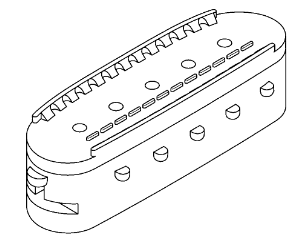
Original AMEBLO article
https://ameblo.jp/hideki-takaishi/entry-12912148937.html
[Article/Copyright] The Public’s Freedom to Use Accessible Works: The Working Vehicles Case — Maiko Murai
Original Ameblo publication: 2025-06-23
Ameblo: https://ameblo.jp/hideki-takaishi/entry-12912149070.html
[Article/Copyright] The Public’s Freedom to Use Accessible Works: The Working Vehicles Case (Maiko Murai, Intellectual Property Law and Policy Journal, Vol. 10 (2006))
*Tokyo District Court, 2001 (Wa) 56
A painter working mainly in outdoor painting alleged copyright infringement and infringement of the author’s moral right of attribution after paintings created on the body of a municipal bus were included in a picture book published by the defendant publisher.
Although the municipal bus operated continuously on public roads and entered a garage at night, it was regarded as permanently located in outdoor places readily viewable by unspecified members of the public.
⇒ This falls under Copyright Act Article 46’s case of “originals of artistic works permanently installed in outdoor places” and permits free use without the copyright owner’s authorization.
The court also considered whether the use fell within Article 46(iv), “reproducing artistic works solely for the purpose of selling their reproductions, or selling those reproductions.” It held that it did not, because the defendant’s picture book had the educational purpose of introducing young children to various vehicles traveling through town, rather than displaying the plaintiff’s works primarily for appreciation or sales promotion.
Regarding the right of attribution, the court held that, given the purpose and manner of use, omitting the author’s name was unlikely to harm the plaintiff’s interests, and ultimately dismissed the plaintiff’s claims.
The judgment is significant in recognizing paintings on moving bus bodies as “permanently installed” artistic works, broadly allowing freedom to use readily accessible works in public places while reaffirming Article 46(iv)’s exclusion from free use of reproductions made solely for the purpose of selling reproductions of the artistic works, and sales of those reproductions.
https://lex.juris.hokudai.ac.jp/coe/english/pressinfo/journal/vol_10/10_9.pdf
[U.S.] Provisur Tech v. Weber (October 2, 2024), CAFC — Willfulness
Original Ameblo publication: 2025-06-25
Ameblo: https://ameblo.jp/hideki-takaishi/entry-12912546111.html
[U.S.] Provisur Tech v. Weber (October 2, 2024), CAFC
*Treatment of evidence concerning willful infringement
35 U.S.C. § 298 provides that an infringer’s failure to obtain advice of counsel concerning alleged patent infringement, or failure to present such advice to the court or jury, cannot be used to prove willful infringement.
(1) The CAFC held that the Provisur expert’s testimony that “Weber did not ask a third party to evaluate the patents” failed to distinguish legal from non-legal services. Provisur could not circumvent § 298 by substituting advice from a third party for advice of counsel, and admitting that testimony violated § 298.
(2) The judgment held that mere awareness or monitoring of the patents was insufficient: proving willful infringement requires specific evidence showing the defendant’s clear intent to engage in particular infringing conduct.
=BASF Plant Sci., LP v. Commonwealth Sci. and Indus. Rsch. Org.(CAFC, March 15, 2022)
https://www.cafc.uscourts.gov/opinions-orders/23-1438.OPINION.10-2-2024_2394588.pdf
IP High Court, 2022 (Ne) 10055 [Specified Heat-Treated Meat Product] <Shoji>
Original Ameblo publication: 2025-06-27
Ameblo: https://ameblo.jp/hideki-takaishi/entry-12913024094.html
2022 (Ne) 10055 [Specified Heat-Treated Meat Product] <Shoji>
*The court rejected obviousness of directly applying the cited technology, which presupposed sufficient heating, to the specified heat-treated meat product at issue under different heating conditions, in light of technical differences concerning sterilization and related matters.
⇒ Inventive step: satisfied
(Excerpts from the court’s reasoning)
Specified heat-treated meat products and heat-treated meat products differ not only in the heating temperature and time at the meat’s center, but also completely in … the principle of color development. Producing a specified heat-treated meat product by changing the heating temperature and time of a heat-treated meat product therefore cannot be regarded as a matter of routine design.
In addition, heat-treated meat products heated to their centers for a sufficient time and adequately sterilized differ entirely in safety from specified heat-treated meat products deliberately not thoroughly heated and eaten as they are. A person skilled in the art would therefore not contemplate applying the technology of heat-treated meat products, whose safety is ensured both by thorough heating and by addition of nitrite during curing, to specified heat-treated meat products that are not thoroughly heated and in which bacteria may proliferate again.
Even if one did apply it, producing a specified heat-treated meat product would require major changes to specifications, such as control of heating temperature and time and whether to use a color-forming agent. Thus, a person skilled in the art encountering pastrami beef, a heat-treated meat product, would not thereby be motivated to apply the same manufacturing technology to make a specified heat-treated meat product.
Furthermore, even if consumers prefer to avoid color-forming agents, this concerns only their product choices when purchasing and does not provide a basis for applying the manufacturing technology as well.
https://www.courts.go.jp/assets/hanrei/hanrei-pdf-92732.pdf
IP High Court, 2005 (Gyo-Ke) 10366 [Method of Manufacturing Bottles for Carbonated Beverages] <Tsukahara>
Original Ameblo publication: 2025-06-29
Ameblo: https://ameblo.jp/hideki-takaishi/entry-12913416981.html
2005 (Gyo-Ke) 10366 [Method of Manufacturing Bottles for Carbonated Beverages] <Tsukahara>
*In explaining its approach to the proceedings in this case, the court stated that, even if it found a difference obvious where the trial decision had found it nonobvious, there could be scope to uphold the decision rejecting invalidation if another difference not decided by the trial decision was nonobvious.
The court reassessed Difference 2, which the trial decision had found “nonobvious,” as “obvious,” and then itself examined Difference 1, on which the trial decision had reserved judgment, and found that “obvious” as well.
The reasoning suggests that if the court had found Difference 1 “nonobvious,” the conclusion itself (no ground for invalidity = rejection of the request) could have been maintained even with Difference 2 “obvious.”
In this case, however, Difference 1 was also found “obvious,” so the trial decision’s conclusion lost its basis and was rescinded.
*Both parties’ consent was obtained.
https://www.courts.go.jp/assets/hanrei/hanrei-pdf-9349.pdf
[U.S.] Finjan v. Secure Computing <November 2010, CAFC>
Original Ameblo publication: 2025-06-29
Ameblo: https://ameblo.jp/hideki-takaishi/entry-12913417899.html
[U.S.] Finjan v. Secure Computing <November 2010, CAFC (626 F.3d 1197)>
Software for proactive scanning incorporated in a product constituting a recording medium was locked.
⇒ Product invention infringed; method invention not infringed.
(1) Because a user could unlock it by purchasing a key, direct infringement of the product invention was established.
*In ACCO v. ABA, 501 F.3d 1307 (Fed. Cir. 2007), the claims required a particular configuration (for example, locking-device pins positioned in particular slots), so direct infringement required actual use in an infringing mode. By contrast, Finjan’s claims did not require a particular configuration or “activation” for the proactive-scanning function to operate; the presence of a program capable of performing that function was sufficient for infringement.
(2) No infringement of the method claims was established because there was no proof that the defendants actually practiced the claimed methods in the United States.
=Southwest Software v. Harlequin, 226 F.3d 1280 (Fed. Cir. 2000)
https://www.cafc.uscourts.gov/opinions-orders/09-1576.pdf
[U.S.] Provisur Tech v. Weber (October 2, 2024), CAFC
Original Ameblo publication: 2025-06-29
Ameblo: https://ameblo.jp/hideki-takaishi/entry-12913418146.html
[U.S.] Provisur Tech v. Weber (October 2, 2024), CAFC
For a claim directed to capability, where changing an accused product’s settings would bring it within the claim’s scope, a theoretical possibility alone does not establish infringement; the product must be “readily configurable” to infringe.
=Fantasy Sports Props. v. Sportsline.com, 287 F.3d 1108 (Fed. Cir. 2002).
⇒ The accused product was sold in “retract-to-fill” mode, and customers’ access to the settings screen needed to enable claim 14’s function (“advance-to-fill”) was restricted.
⇒ The infringement judgment was reversed as to claim 14 of the patent at issue.
https://www.cafc.uscourts.gov/opinions-orders/23-1438.OPINION.10-2-2024_2394588.pdf
[Criminal/Unfair Competition Prevention Act/Trade Secrets] Acquittal: Nagoya District Court, March 18, 2022, 2017 (Wa) No. 427
Original Ameblo publication: 2025-06-30
Ameblo: https://ameblo.jp/hideki-takaishi/entry-12913607755.html
[Criminal/Unfair Competition Prevention Act/Trade Secrets] Acquittal: Nagoya District Court, March 18, 2022, 2017 (Wa) No. 427, “Magnetic Sensor Wire Alignment Process Case”
(1) “It amounts merely to selecting and combining commonplace methods and cannot be said to be not generally known or not readily ascertainable.”
⇒ Not “non-public”
(2) Even setting (1) aside, “the possibility remains that they believed it did not constitute a trade secret, and there were reasonable grounds for that belief.”
⇒ They cannot be held liable for an intentional offense.
(Excerpt from the court’s reasoning)
The information the two defendants explained to e at the meeting concerned a process for aligning amorphous wire on a substrate, but differed significantly in important process steps from the structure of b’s wire-alignment apparatus and the process of aligning amorphous wire on a substrate using that apparatus. Further, the portion corresponding to the process alleged by the prosecutor stripped away the devices for precisely arranging wires on a substrate in light of amorphous wire’s characteristics, and was excessively abstracted and generalized. Even viewed as a unified series of steps, it amounted merely to selecting and combining commonplace methods and could not be said to be not generally known or not readily ascertainable. It therefore did not satisfy the non-public-status requirement among the three requirements for trade secrets (management as secret, usefulness and non-public status). Accordingly, the two defendants cannot be said to have disclosed b’s trade secrets at the meeting. Furthermore, even adopting the view that their conduct objectively constituted disclosure of a trade secret (which is not this court’s view), the possibility remains that they believed the information explained to e at the meeting did not constitute b’s trade secrets, and reasonable grounds existed for that belief. In light of these and other circumstances, neither defendant can be held liable for an intentional offense. Both defendants are therefore acquitted.
https://www.courts.go.jp/assets/hanrei/hanrei-pdf-91195.pdf
WORD:Hideki Takaishi Article Collection January–June 2025