Hideki Takaishi Article Collection July–December 2024
Hideki Takaishi Article Collection
July–December 2024
English Edition
167 articles
Complete English translations of the revised Ameblo articles
In chronological order of the original Ameblo publication date
Existing website text is retained wherever available; missing articles are supplied from the original Ameblo posts and new complete English translations. Source URLs reflect information verified at compilation on November 1, 2026.
Confirmed errors in wording, legal descriptions, and translations have been corrected. Unless otherwise stated, descriptions of legal rules, outlooks, and statistics reflect the time when each original article was published.
Article Index
01 2024-07-01 IP High Court, 2023 (Gyo-Ke) 10057 [Spray Products] <Honda>
03 2024-07-02 IP High Court, 2023 (Gyo-Ke) 10020 [Steel Pipe Pile Pier] <Honda>
04 2024-07-03 [Patent/Employee Invention] IP High Court, 2023 (Ne) 10090 <Hibiku Shimizu> — (Joint) inventor status denied
05 2024-07-04 IP High Court, 2022 (Gyo-Ke) 10127 [Celecoxib] <Miyasaka> (Second judgment) — Correction satisfies support; clarity not satisfied
06 2024-07-05 IP High Court, 2023 (Ne) 10071 [Chip Fuse] <Miyasaka> — No equivalence
07 2024-07-07 IP High Court, 2023 (Gyo-Ke) 10046 [Liquid Cleansing Agent for Removing Keratin Plugs] <Miyasaka>
08 2024-07-07 IP High Court, 2023 (Gyo-Ke) 10054 [Protective Member] <Shoji> — Different from the premise of the publicly worked invention ⇒ Inventive step satisfied
09 2024-07-08 [U.S./Lanham Act—False Advertising] Supreme Court No. 12-761, POM v. COCA-COLA (June 12, 2014)
10 2024-07-09 IP High Court, 2022 (Gyo-Ke) 10110 [Steel Pipe Sheet Pile Quay] <Miyasaka> — Obviousness of a mathematical formula at issue
11 2024-07-10 Osaka District Court, 2003 (Wa) 10959 [Aluminum-Based Sputtering Target Material] <Yamada>
12 2024-07-11 IP High Court, 2023 (Ne) 10026 [Belt for a Shoe Press] <Miyasaka> (First instance: Osaka District Court, 2017 (Wa) 4178)
14 2024-07-14 IP High Court, 2022 (Gyo-Ke) 10052 [Moisture Control Device] <Kanno> — No procedural violation
15 2024-07-15 IP High Court, 2023 (Gyo-Ke) 10024 [Applicator for Applying a Transcutaneous Analyte Sensor] <Hibiku Shimizu>
17 2024-07-17 IP High Court, 2023 (Gyo-Ke) 10011 [Device for Remotely Operating a Mobile Terminal] <Miyasaka> — Disclaimer claim lacks inventive step
18 2024-07-18 Tokyo District Court, 2021 (Wa) 26762 <Kokubu> — “Usurped application” denied
20 2024-07-20 Tokyo District Court, 2021 (Wa) 18262 [Women’s Clothing] <Kokubu>
21 2024-07-22 Osaka District Court, 2021 (Wa) 10586 [No-Wash Rice Retaining Umami and Nutrients]
22 2024-07-22 IP High Court, 2022 (Ne) 10055 [Specified Heat-Treated Meat Products] <Shoji> — Use of a particular measurement method could be recognized
23 2024-07-23 IP High Court, 2021 (Ne) 10084 [Printed Retroreflective Sheeting] <Miyasaka>
24 2024-07-24 Tokyo District Court, 2023 (Wa) 70102 [Semi-Fermented Tea Leaves] <Nakashima>
25 2024-07-25 Tokyo District Court, 2020 (Wa) 25891 <Shibata> = IP High Court, 2023 (Ne) 10015 [… Filter Cigarette]
26 2024-07-26 Tokyo District Court, 2020 (Wa) 25892 [Smoking Article] <Shibata>
27 2024-07-27 IP High Court, 2022 (Ne) 10113 [Compression Supporter] <Miyasaka>
28 2024-07-29 IP High Court, 2022 (Ne) 10107 [… Electrical Probe Unit] <Honda>
29 2024-07-29 Tokyo District Court, 2022 (Wa) 2049 [Packaging Container] <Sugiura>
30 2024-07-30 Osaka District Court, 2018 (Wa) 10590 [Lower-Limb Garment]
31 2024-07-31 [Japan Patent Office Annual Report 2024] Sharp Increase in Patent “Divisional Applications”!! ⇒ Applications Back to 300,000!!
32 2024-08-01 [Right of Publicity] Tokyo District Court, 2023 (Wa) 3171 <Nakashima>
33 2024-08-03 IP High Court, 2020 (Gyo-Ke) 10033 [Removal of Undesirable Components from an Oil Composition] <Tsuruoka>
34 2024-08-03 [Trademark] Osaka District Court, 2020 (Wa) 7918 <Takemiya>
35 2024-08-04 [U.S.] Skinny Labels and “Induced Infringement,” June 2024 <CAFC> Amarin v. Hikma
37 2024-08-06 IP High Court, 2021 (Gyo-Ke) 10091 <Honda> Adhesive Tape Case
38 2024-08-07 IP High Court, 2018 (Ne) 10043 [Factor IX/Factor IXa Antibodies and Antibody Derivatives] <Mori>
39 2024-08-08 Tokyo District Court, 2021 (Wa) 10171 [Folding Table] <Kokubu>
40 2024-08-11 [Contract/Patent Warranty] IP High Court, 2023 (Ne) 10064 <Honda>
41 2024-08-11 [Unfair Competition Prevention Act] IP High Court, 2023 (Ne) 10012 <Shoji>
42 2024-08-12 IP High Court, 2022 (Gyo-Ke) 10113 [Display Device] <Miyasaka>
43 2024-08-13 [Trademark] IP High Court, 2023 (Gyo-Ke) 10095 <Miyasaka> *Hermès’ Orange Box — Trademark Act Article 3(2) not applicable
49 2024-08-22 [Trademark] IP High Court, 2021 (Gyo-Ke) 10028 <Honda> — Mark at Issue “ヒルドマイルド” (Hirudo Mild); Cited Mark “ヒルドイド” (Hirudoid)
50 2024-08-22 [Unfair Competition Prevention Act] IP High Court, 2023 (Ne) 10048 “Dr. Martens” <Miyasaka>
51 2024-08-22 Tokyo District Court Order, 2023 (Yo) 30214 [Dasatinib] <Sugiura> — Provisional Disposition Order
52 2024-08-22 [Design] IP High Court, 2023 (Gyo-Ke) 10072 <Hibiku Shimizu> — Design Act Article 46(2)
54 2024-08-24 IP High Court, 2020 (Gyo-Ke) 10144 [Infusion Preparation Containing Sulfur-Containing Compounds and Trace Metal Elements] <Honda> — Not “Obviousness upon Obviousness”
55 2024-08-25 IP High Court, 2021 (Gyo-Ke) 10129 [… Composition for Cleaving Target DNA] <Kanno> — Not “Obviousness upon Obviousness”
56 2024-08-26 IP High Court, 2022 (Gyo-Ke) 10007 [Heat Transfer System] <Shoji> — Not “Obviousness upon Obviousness”
58 2024-08-28 [Article] Exhaustion in the United Kingdom (Kumiko Yamada, Patent Supplement No. 30)
59 2024-08-29 [Trademark] Osaka District Court, 2023 (Wa) 691, “子どもとママの歯医者さん” (“Dentist for Children and Mothers”) Case
60 2024-08-30 [South Korea/Patent] 2016 Heo 7954 — Equivalence Established for a Numerically Limited Invention
61 2024-09-02 Tokyo District Court, 2022 (Wa) 22517 <Shibata> [Toilet Roll] [Roll Product Package]
62 2024-09-03 IP High Court, 2023 (Gyo-Ke) 10034 [Method of Manufacturing a Raised-Fiber Sheet] <Hibiku Shimizu>
63 2024-09-04 IP High Court, 2023 (Gyo-Ke) 10091 [Barrier Laminate] <Miyasaka>
64 2024-09-05 IP High Court, 2012 (Ne) 10018 [Skeletal Structure of a Large Articulated Soft-Vinyl Doll] <Shibata>
65 2024-09-06 [Contract/Extinctive Prescription] Supreme Court, April 24, 1998, 1995 (O) 2472
66 2024-09-07 [China] Supreme People’s Court, (2016) Zui Gao Fa Xing Zai No. 41, “Daiichi Sankyo Case”
68 2024-09-09 Tokyo District Court, 2005 (Wa) 14346 [Top-Level Setting Aid] <Ichikawa>
71 2024-09-12 [U.S.] July 2023 <CAFC> In re Float’N’Grill LLC — Reissue Application
72 2024-09-13 [Trademark] IP High Court, 2019 (Gyo-Ke) 10101 <Otaka> “南三陸キラキラ丼” (Minamisanriku Kirakira Don) Case
73 2024-09-14 Tokyo District Court, 2018 (Wa) 1130 [Printed Retroreflective Sheeting] <Tanaka>
74 2024-09-14 [U.S.] September 2012 <CAFC> Santarus v. Par Pharmaceutical
75 2024-09-16 [U.S.] November 2015 <CAFC> 805 F.3d 1350, Inphi v. Netlist
76 2024-09-17 [U.S.] June 2014 <CAFC> 752 F.3d 1371, Q.I. Press Controls v. Lee
77 2024-09-18 [U.S.] January 2020 <CAFC> 946 F.3d 1367, Eko Brands v. Adrian Rivera
78 2024-09-18 [U.S.] January 2013 <CAFC> Ernie Ball v. Earvana
79 2024-09-18 [U.S.] June 2022 <CAFC> 38 F.4th 1013, Novartis v. Accord
80 2024-09-20 [U.S.] June 2022 <CAFC> 38 F.4th 1013, Novartis v. Accord
81 2024-09-21 [Trademark] IP High Court, 2023 (Gyo-Ke) 10018, “プレジャー” (“Pleasure”) <Shoji>
82 2024-09-22 Tokyo District Court, 2022 (Wa) 18830 [Rolling Device] <Shibata>
83 2024-09-24 IP High Court, 2023 (Gyo-Ke) 10013 [Method of Manufacturing a Pole Housing] <Hibiku Shimizu>
84 2024-09-24 [U.S./Trademark] U.S. Supreme Court, June 2023, Abitron v. Hetronic
85 2024-09-25 IP High Court, 2022 (Gyo-Ke) 10131 [Heat Exchanger Using Thermally Conductive Knitted Wire Fabric] <Honda>
86 2024-09-26 IP High Court, 2021 (Ne) 10084 [Printed Retroreflective Sheeting] <Miyasaka> — First Raised on Appeal: Rejected as Untimely
87 2024-09-28 IP High Court, 2023 (Gyo-Ke) 10011 [Device for Remotely Operating a Mobile Terminal] <Miyasaka>
88 2024-09-30 [Patent/Civil Code] Tokyo District Court, 2022 (Wa) 19222 <Kokubu> — Analogous Application of Civil Code Article 94(2)
89 2024-09-30 IP High Court, 2022 (Gyo-Ke) 10124 [Robot System for Transferring Egg Packs] <Miyasaka>
90 2024-10-01 Nepal Tiger — Distinctive; Article 4(1)(xvi) Not Applicable / Tibet Tiger — Not Distinctive
91 2024-10-03 For Patent Attorney Oral-Examination Candidates — Questions on Legislative Purpose (Patents)
92 2024-10-04 [U.S.] May 2024, In re Bystolic (Second Circuit Court of Appeals)
93 2024-10-07 [U.S./Design Patent] May 2024, CAFC en banc, LKQ v. GM Global
94 2024-10-07 IP High Court, 2023 (Gyo-Ke) 10084 and 10089 [Electric Impact Tightening Tool] <Hibiku Shimizu>
95 2024-10-07 IP High Court, 2021 (Ne) 10086 [Lamp] <Honda> *Prior-use right established
96 2024-10-08 Tokyo District Court, 2021 (Wa) 18031 [Mobile Phone; Receiving Apparatus] <Kokubu>
97 2024-10-09 IP High Court, 2024 (Gyo-Ke) 10002 [Nonwoven Fabric for Civil Engineering] <Shoji>
98 2024-10-10 IP High Court, 2023 (Gyo-Ke) 10002 [Light Source Unit] <Honda>
99 2024-10-11 IP High Court, 2023 (Gyo-Ke) 10056 [Hydrophilic Filtration During Manufacture of a Vaccine Adjuvant] <Hibiku Shimizu>
100 2024-10-12 Tokyo District Court, 2019 (Wa) 24736 [… Air-Conditioned Clothing] <Kokubu>
101 2024-10-16 IP High Court, 2023 (Ne) 10086 [5-Aminolevulinic Acid Phosphate] <Miyasaka>
102 2024-10-17 IP High Court, 2023 (Gyo-Ke) 10034 [Method of Manufacturing a Raised-Fiber Sheet] <Hibiku Shimizu>
103 2024-10-21 IP High Court, 2023 (Gyo-Ke) 10069 [Soldering Apparatus] <Hibiku Shimizu> — Inventive-Step Assessment and Scope of Res Judicata
104 2024-10-21 IP High Court, 2023 (Gyo-Ke) 10015 [Method of Manufacturing a Refractory for a Gas-Blowing Nozzle] <Shoji>
105 2024-10-21 IP High Court, 2023 (Gyo-Ke) 10049 [Optical Imaging Apparatus] <Miyasaka>
106 2024-10-22 IP High Court, 2022 (Gyo-Ke) 10007 [Heat Transfer System] <Shoji> — Design Matters and Motivation
108 2024-10-24 IP High Court, 2022 (Gyo-Ke) 10123 [Laser Processing Apparatus] <Miyasaka>
109 2024-10-25 IP High Court, 2022 (Gyo-Ke) 10057 and 10054 [Lamp] <Honda> — Support Requirement Satisfied
110 2024-10-26 IP High Court, 2023 (Gyo-Ke) 10101 [Authentication Certification System] <Shoji>
112 2024-10-29 IP High Court, 2023 (Gyo-Ke) 10145 [Light-Emitting Device] <Miyasaka> — Addition of New Matter
113 2024-10-30 [Unfair Competition Prevention Act/Communication of False Facts] Tokyo District Court, 2021 (Wa) 22564 <Kokubu>
114 2024-10-31 Tokyo District Court, 2021 (Wa) 15964 [Elastoplastic Hysteretic Damper] <Shibata>
115 2024-11-01 [Copyright] Tokyo District Court, 2023 (Wa) 70422 <Sugiura>
117 2024-11-05 Osaka District Court, 2023 (Wa) 3375 [Canopy]
118 2024-11-05 IP High Court, 2023 (Ne) 10071 [Chip Fuse] <Miyasaka>
119 2024-11-05 German Patent Attorney Kan Hasegawa: “Has the UPC Abandoned the Problem–Solution Approach?”
120 2024-11-07 IP High Court, 2023 (Gyo-Ke) 10069 [Soldering Apparatus] <Hibiku Shimizu>
121 2024-11-10 IP High Court, 2022 (Gyo-Ke) 10007 [Heat Transfer System] <Shoji> — Relationship between Identification of the Cited Invention and Addition of New Matter
122 2024-11-11 [Germany/AI Inventorship]
123 2024-11-12 Tokyo District Court, 2022 (Wa) 9100 [Method of Manufacturing a Molded Coil] <Shibata>
124 2024-11-13 IP High Court, 2023 (Gyo-Ke) 10098 [Laundry Detergent Composition] <Shoji>
125 2024-11-14 Tokyo District Court, 2023 (Wa) 70454 [Method of Providing a Testing and Analysis Service] <Kokubu>
126 2024-11-15 IP High Court, 2022 (Gyo-Ke) 10003 [Method of Preventing Attachment of Marine Organisms] <Kanno>
127 2024-11-16 IP High Court, 2023 (Ne) 10047 [Nursing Unit] <Miyasaka>
128 2024-11-17 IP High Court, 2023 (Gyo-Ke) 10023 [Aircraft Such as High-Speed Drones] <Miyasaka>
129 2024-11-18 IP High Court, 2022 (Gyo-Ke) 10108 [High-Dynamic-Range Tone Mapping] <Honda>
130 2024-11-20 IP High Court, 2019 (Gyo-Ke) 10022 [Optical Information Reading Apparatus] <Takabe>
131 2024-11-21 IP High Court, 2010 (Gyo-Ke) 10400 <Iimura>
132 2024-11-22 [Trademark] IP High Court, 2024 (Gyo-Ke) 10003 <Miyasaka>
133 2024-11-25 [Trademark] Osaka District Court, 2022 (Wa) 9818 — “熱中対策応急キット” (“Emergency Heat Countermeasure Kit”) ⇒ No Distinctiveness
134 2024-11-25 [U.S.] IOENGINE v. Ingenico (CAFC, May 3, 2024)
135 2024-11-25 [Unfair Competition Prevention Act/Trade Secrets] Osaka District Court, 2020 (Wa) 12387
136 2024-11-27 [Unfair Competition Prevention Act Article 2(1)(i)] Tokyo District Court, 2023 (Wa) 70654 <Nakashima>
137 2024-11-28 IP High Court, 2023 (Gyo-Ke) 10019 [Method of Treating Atopic Dermatitis by Administering an IL-4R Antagonist] <Miyasaka>
138 2024-11-30 IP High Court, 2023 (Gyo-Ke) 10146 [Label Insertion Apparatus] <Honda>
139 2024-12-02 IP High Court, 2022 (Gyo-Ke) 10011 [Electrical Device Formed from Very Low Resistance Material] <Shoji>
140 2024-12-02 IP High Court, 2022 (Gyo-Ke) 10059 [Glass] <Kanno>
141 2024-12-03 IP High Court, 2021 (Gyo-Ke) 10089 [Transdermal Absorption Preparation] <Kanno>
142 2024-12-04 IP High Court, 2022 (Gyo-Ke) 10018 [Pressure-Sensitive Transfer Adhesive Tape] <Kanno>
143 2024-12-05 IP High Court, 2021 (Gyo-Ke) 10164 [Conductive Member Using a Copper–Silver Alloy] <Honda>
144 2024-12-06 IP High Court, 2021 (Gyo-Ke) 10165 [Delivered-Package Storage Apparatus] <Shoji>
145 2024-12-07 IP High Court, 2021 (Gyo-Ke) 10069 [PTH-Containing Agent for Treating/Preventing Osteoporosis] <Kanno>
146 2024-12-10 IP High Court, 2021 (Gyo-Ke) 10080 [Graphic Display Medium] <Honda>
147 2024-12-10 IP High Court, 2020 (Gyo-Ke) 10071 [Agent for Treating/Preventing Osteoporosis] <Kanno>
148 2024-12-10 IP High Court, 2021 (Gyo-Ke) 10072 [Amplifier Output Circuit] <Honda>
149 2024-12-10 IP High Court, 2021 (Gyo-Ke) 10068 [Ball Game Machine] <Otaka>
150 2024-12-11 Tokyo District Court, 2020 (Wa) 22071 [Liquid Cleansing Agent for Removing Keratin Plugs] <Kokubu>
151 2024-12-12 IP High Court, 2021 (Gyo-Ke) 10123 [Tableware] <Otaka>
152 2024-12-13 IP High Court, 2021 (Gyo-Ke) 10097 <Otaka> — General Principles for Amendments Adding Claims
153 2024-12-14 IP High Court, 2021 (Gyo-Ke) 10006 [X-Ray Inspection Apparatus] <Kanno>
154 2024-12-15 IP High Court, 2020 (Gyo-Ke) 10134 [System for Controlling Distribution and Viewing of Digital Art over the Internet and for Image Formation] <Mori>
155 2024-12-16 IP High Court, 2019 (Gyo-Ke) 10120 [Oil-Cooled Screw Compressor] <Tsuruoka>
156 2024-12-17 IP High Court, 2020 (Gyo-Ke) 10110 [Method of Strengthening Blood Vessels] <Kanno>
157 2024-12-18 IP High Court, 2020 (Gyo-Ke) 10032 [Imaging Apparatus] <Kanno>
158 2024-12-19 [Unfair Competition Prevention Act/Trade Secrets] Osaka District Court, 2015 (Wa) 4169, “Alumina Fiber”
160 2024-12-22 [Unfair Competition Prevention Act/Trade Secrets] Yokohama District Court, 2018 (Wa [criminal]) 1931 (criminal case) ⇒ Guilty
161 2024-12-23 [Unfair Competition Prevention Act/Trade Secrets] Tokyo District Court, 2006 (Wa) 29160, “Coenzyme Q”
162 2024-12-24 [Unfair Competition Prevention Act/Trade Secrets] Tokyo District Court, 2009 (Wa) 47959, “Stroopwafel”
163 2024-12-25 [Unfair Competition Prevention Act/Trade Secrets] Tokyo District Court, 2016 (Wa) 26919, “Eyelash Treatment Know-How”
164 2024-12-26 [Unfair Competition Prevention Act/Trade Secrets] IP High Court, 2019 (Ne) 10016, “Eyelash Extension Treatment Histories”
165 2024-12-27 IP High Court, 2015 (Gyo-Ke) 10095 [Fuel-Consumption Reduction Device for an Internal Combustion Engine] <Shitara>
166 2024-12-28 IP High Court, 2014 (Gyo-Ke) 10186 [Circular Knitting of Elastic Fabric Containing Elastomeric Yarn] <Shimizu>
167 2024-12-30 IP High Court, 2017 (Gyo-Ke) 10075 [… Exercise Bike] <Mori>
IP High Court, 2023 (Gyo-Ke) 10057 [Spray Products] <Honda>
Original Ameblo publication: 2024-07-01
Ameblo: https://ameblo.jp/hideki-takaishi/entry-12858278372.html
HP: https://www.takaishihideki.com/single-post/ameblo-12858278372-en
Japanese version: https://www.takaishihideki.com/single-post/ameblo-12858278372-ja
IP High Court, 2023 (Gyo-Ke) 10057 [Spray Products] <Honda>
Examples were added at the time of filing Priority Application 2 for a compound that had been recited in the claims of the Priority Application 1 specification but for which no examples had been provided.
⇒ The claim to priority based on Priority Application 1 was upheld.
The Priority Application 1 specification explained that the compound shared a common mechanism with another compound described in the examples in Specification 1.
* The Artificial Nipple case involved an application filed by another party during the priority period. Had the intervening act instead been another party’s public working or publication, it would probably have raised an issue of partial priority, as in the Brunnian Link case.
* In the United States as well, Ian Frazer v. Richard Schlegel (CAFC, August 20, 2007) recognized the effect of priority and the applicant’s status as the first inventor for an invention in an application claiming Paris Convention priority in which examples had been added, even though another party had filed an application within the priority period. (Patent, 2024, Vol. 77, No. 7, p. 153)
(Excerpts from the court’s reasoning)
… Although the only examples described in the specification and other documents of Priority Application 1 are spray products containing EBAAP as the insect-repellent ingredient, and examples relating to spray products containing icaridin as the insect-repellent ingredient were added in the specification and other documents of Priority Application 2 …, those examples are concrete examples of working Corrected Invention 1 at issue and can also be understood as confirmatory descriptions of concrete examples of working the invention whose defining features had been recited in Claim 1 or 2 of the claims of Priority Application 1. They therefore cannot be said to introduce new technical matters in relation to the technical matters disclosed in the specification and other documents of Priority Application 1. …
In addition to the background art, problem, and means for solving the problem relating to Corrected Invention 1 at issue, the specification and other documents of Priority Application 1 describe the mechanism underlying the effects of the invention and the technical significance of each constituent feature. It can also be understood that these apply in common to EBAAP, p-menthane-3,8-diol, and icaridin. In other words, it is recognized that the specification and other documents of Priority Application 1 set out the technical content of Corrected Invention 1 at issue, including the portion in which the insect-repellent ingredient is icaridin, in a sufficiently concrete and objective form that a person having ordinary knowledge in the relevant technical field (a person skilled in the art) could repeatedly work the invention and achieve its intended technical effects.
https://www.courts.go.jp/assets/hanrei/hanrei-pdf-92886.pdf
“Dr. Martens’ Yellow Stitching” [Trademark] IP High Court, 2023 (Gyo-Ke) 10003 [Unfair Competition Prevention Act] IP High Court, 2023 (Ne) 10048
Original Ameblo publication: 2024-07-01
Ameblo: https://ameblo.jp/hideki-takaishi/entry-12858278614.html
HP: https://www.takaishihideki.com/single-post/ameblo-12858278614-en
Japanese version: https://www.takaishihideki.com/single-post/ameblo-12858278614-ja
“Dr. Martens’ Yellow Stitching”
[Trademark] IP High Court, 2023 (Gyo-Ke) 10003 <Honda>
⇒ Lost
The position mark lacks distinctiveness.
The only evidence concerned products that were black apart from the stitching, so Article 3(2) was also not satisfied.
[Unfair Competition Prevention Act] IP High Court, 2023 (Ne) 10048 <Miyasaka>
⇒ Won
Well-known status and similarity under Article 2(1)(i) of the Unfair Competition Prevention Act: satisfied
Unlike the first-instance court, the court treated it as an “indication of goods or business” in combination with other features!!
IP High Court, 2023 (Gyo-Ke) 10020 [Steel Pipe Pile Pier] <Honda>
Original Ameblo publication: 2024-07-02
Ameblo: https://ameblo.jp/hideki-takaishi/entry-12858354238.html
HP: https://www.takaishihideki.com/single-post/ameblo-12858354238-en
Japanese version: https://www.takaishihideki.com/single-post/ameblo-12858354238-ja
IP High Court, 2023 (Gyo-Ke) 10020 [Steel Pipe Pile Pier] <Honda>
*Although the specification described only examples under particular conditions, the court held, in light of the problem addressed by the invention, that “a person skilled in the art can … take other conditions into account and appropriately incorporate the above technical concept to solve the problems addressed by each invention at issue.”
⇒ Support requirement: satisfied
*The court rejected obviousness of locally increasing strength at particular locations.
⇒ Inventive step: satisfied
(Excerpts from the court’s reasoning)
<Support requirement: satisfied>
The defendant argues that the specification merely states that verification was performed through seismic response analysis (simulation) under particular conditions (number of rows of steel pipe piles, water depth, ground structure, wall thickness and diameter of the steel pipe piles), and that it cannot be understood that adopting the numerical range for curvature φp would solve the problem under different conditions as well. Naturally, the ground and other circumstances where steel pipe pile piers are installed vary, and their performance must be verified by an appropriate method suited to the circumstances. What the specification discloses, however, is the technical concept of locally using steel pipe piles having deformation capacity of at least a specified value only at portions of the piles where the generated curvature is large in the underground portions of at least the piles positioned facing the landward side. When actually conducting performance verification such as seismic response analysis, a person skilled in the art who encounters this disclosure can take other conditions into account and appropriately incorporate that technical concept to solve the problems addressed by each invention at issue. Thus, the mere fact that only results under particular conditions are described does not provide a reason to conclude that the inventions fail to satisfy the support requirement….
<Inventive-step requirement: satisfied>
(Difference 3A) The “steel pipe piles” of Invention 3 are such that “among the steel pipe piles constituting the row of steel pipe piles, portions where the generated curvature is large in the underground portions of at least the steel pipe piles positioned facing the landward side, where the curvature arising in the piles in response to an external force is large, satisfy the relationship φp ≧ 5.65 × 10⁻³/D between the diameter D of the steel pipe piles and the curvature φp corresponding to their fully plastic moment, while the other portions of the underground portions of the steel pipe piles have lower deformation capacity than those portions,” whereas it is unclear whether the “steel pipe piles 9” of the invention in Exhibit Ko 1 have that configuration. …
…Even if ordinary design practice could involve progressively increasing the strength of steel pipe piles based on seismic response analysis results without using the curvature condition formula, it cannot be said that this would naturally lead further to locally placing high-strength steel pipe piles only at portions where the generated curvature is large. At least, it must be said that it is difficult to conclude that the configurations relating to Difference 3A or 3B could have been readily conceived.
https://www.courts.go.jp/assets/hanrei/hanrei-pdf-92697.pdf
[Patent/Employee Invention] IP High Court, 2023 (Ne) 10090 <Hibiku Shimizu> — (Joint) inventor status denied
Original Ameblo publication: 2024-07-03
Ameblo: https://ameblo.jp/hideki-takaishi/entry-12858472717.html
HP: https://www.takaishihideki.com/single-post/ameblo-12858472717-en
Japanese version: https://www.takaishihideki.com/single-post/ameblo-12858472717-ja
[Patent/Employee Invention] IP High Court, 2023 (Ne) 10090 <Hibiku Shimizu>
The contribution was only to a part found in the prior art.
⇒ (Joint) inventor status: denied <recognized in the original judgment>
Although preliminary experiments were conducted on formulating orally disintegrating (OD) tablets, it cannot be said that the person recognized concrete methods for establishing the components and structures of the controlled-release microparticles and the like, and of the OD tablets incorporating them.
https://www.tokkyoteki.com/2024/06/2024-03-25-r5-ne-10090.html
IP High Court, 2022 (Gyo-Ke) 10127 [Celecoxib] <Miyasaka> (Second judgment) — Correction satisfies support; clarity not satisfied
Original Ameblo publication: 2024-07-04
Ameblo: https://ameblo.jp/hideki-takaishi/entry-12858605429.html
HP: https://www.takaishihideki.com/single-post/ameblo-12858605429-en
Japanese version: https://www.takaishihideki.com/single-post/ameblo-12858605429-ja
IP High Court, 2022 (Gyo-Ke) 10127 [Celecoxib] <Miyasaka> (Second judgment)
*The correction satisfied the support requirement. Clarity: not satisfied
“Even when attempting to apply common general technical knowledge, there is not even a clue as to which characteristics should be considered in deciding ….” Before even considering impossible or impractical circumstances … clarity is lacking.
(Excerpt from the court’s reasoning)
…The specification does not describe what action of the pin mill achieves the low cohesiveness and reportedly improved blend uniformity of “celecoxib particles milled in a pin mill.” It is therefore also unclear whether these properties are achieved by impact mills generally, or only by those impact mills sharing some characteristic with a pin mill. Consequently, it must be said that, even when attempting to apply common general technical knowledge, there is not even a clue as to which characteristics should be considered in deciding whether a particular impact mill is an “impact mill such as a pin mill” within the pin-mill limitation at issue. …Before even considering impossible or impractical circumstances, …the manufacturing method itself recited in the claims lacks clarity….
https://www.courts.go.jp/assets/hanrei/hanrei-pdf-92858.pdf
IP High Court, 2023 (Ne) 10071 [Chip Fuse] <Miyasaka> — No equivalence
Original Ameblo publication: 2024-07-05
Ameblo: https://ameblo.jp/hideki-takaishi/entry-12858729219.html
HP: https://www.takaishihideki.com/single-post/ameblo-12858729219-en
Japanese version: https://www.takaishihideki.com/single-post/ameblo-12858729219-ja
IP High Court, 2023 (Ne) 10071 [Chip Fuse] <Miyasaka>
⇒ Doctrine of equivalents: not established (same result as the first-instance Osaka District Court judgment, 2021 (Wa) 10032)
“There is ample motivation to apply to the invention in Exhibit Otsu 1 the configuration of the invention in Exhibit Otsu 3 in which ‘the fuse element portion and external electrodes are formed of an integral metal.’”
⇒ The fourth requirement was applied using the same logic as inventive step.
*The first-instance Osaka District Court judgment, 2021 (Wa) 10032 <Takemiya>, is important in holding that equivalence can be established even when some claim elements are absent.
⇒ The conclusion was no equivalence (second requirement not satisfied). The case became a battle of experiments, and identical functions and effects were not found.
https://www.courts.go.jp/assets/hanrei/hanrei-pdf-92795.pdf
IP High Court, 2023 (Gyo-Ke) 10046 [Liquid Cleansing Agent for Removing Keratin Plugs] <Miyasaka>
Original Ameblo publication: 2024-07-07
Ameblo: https://ameblo.jp/hideki-takaishi/entry-12858971879.html
HP: https://www.takaishihideki.com/single-post/ameblo-12858971879-en
Japanese version: https://www.takaishihideki.com/single-post/ameblo-12858971879-ja
IP High Court, 2023 (Gyo-Ke) 10046 [Liquid Cleansing Agent for Removing Keratin Plugs] <Miyasaka>
*In assessing inventive step, a disclaimer claim was equated with an affirmative numerical limitation.
Cf. IP High Court, 2022 (Gyo-Ke) 10125: addition of new matter
*“Excluding those having 0–10 vol%”
⇒ It suffices to examine whether adopting more than 10 vol% could have been readily conceived.
*The infringement action, IP High Court, 2022 (Ne) 10029 <Otaka> = first-instance Tokyo District Court judgment, 2020 (Wa) 22071 <Kokubu>, found a violation of the support requirement.
(Excerpt from the court’s reasoning)
…The limitation “excluding those having 0–10 vol%” in the disclaimer configuration at issue defines the range obtained by “excluding those having 0–10 vol%” from “0–100 vol%.” Ultimately, it means nothing other than a range of “more than 10 vol%” (“incorporating more than 10 vol%”). Accordingly, in assessing the obviousness of the configuration, it suffices to examine whether a rationale can be established that a person skilled in the art could readily have conceived of making the amount of surfactant incorporated in the invention in Exhibit Ko 1 “more than 10 vol%” (“incorporating more than 10 vol%”). …The position might be different if the numerical limitation in the disclaimer configuration had a remarkable effect, but the invention at issue is not found to be such an invention.
https://www.courts.go.jp/assets/hanrei/hanrei-pdf-92623.pdf
IP High Court, 2023 (Gyo-Ke) 10054 [Protective Member] <Shoji> — Different from the premise of the publicly worked invention ⇒ Inventive step satisfied
Original Ameblo publication: 2024-07-07
Ameblo: https://ameblo.jp/hideki-takaishi/entry-12858973126.html
HP: https://www.takaishihideki.com/single-post/ameblo-12858973126-en
Japanese version: https://www.takaishihideki.com/single-post/ameblo-12858973126-ja
IP High Court, 2023 (Gyo-Ke) 10054 [Protective Member] <Shoji>
Contrary to the “premise” of the publicly worked invention (Exhibit Ko 8), “It can be said that providing a grip portion on the safety cover for carts (protective member) of the invention in Exhibit Ko 8 is not contemplated at all.”
⇒ Inventive step: satisfied
+The statement of the president of the manufacturer of the publicly worked product was also ineffective: priority was given to the objective understanding derived from the brochure.
https://www.courts.go.jp/assets/hanrei/hanrei-pdf-92759.pdf
[U.S./Lanham Act—False Advertising] Supreme Court No. 12-761, POM v. COCA-COLA (June 12, 2014)
Original Ameblo publication: 2024-07-08
Ameblo: https://ameblo.jp/hideki-takaishi/entry-12859099740.html
HP: https://www.takaishihideki.com/single-post/ameblo-12859099740-en
Japanese version: https://www.takaishihideki.com/single-post/ameblo-12859099740-ja
[U.S./Lanham Act—False Advertising] Supreme Court No. 12-761, POM v. COCA-COLA (June 12, 2014)
The Lanham Act false-advertising claim concerning the food and beverage label at issue is not precluded by the FDCA (Federal Food, Drug, and Cosmetic Act) or FDA (Food and Drug Administration) regulations. The statutes serve different purposes and complement each other.
The FDCA’s express pre-emption provision concerning state law does not preclude this claim under the Lanham Act, another federal statute. The decision does not establish a general rule that one federal statute can never preclude claims under another.
https://www.jpaa.or.jp/cms/wp-content/uploads/2017/03/POM-Wonderful-v-Coca-Cola.pdf
IP High Court, 2022 (Gyo-Ke) 10110 [Steel Pipe Sheet Pile Quay] <Miyasaka> — Obviousness of a mathematical formula at issue
Original Ameblo publication: 2024-07-09
Ameblo: https://ameblo.jp/hideki-takaishi/entry-12859226993.html
HP: https://www.takaishihideki.com/single-post/ameblo-12859226993-en
Japanese version: https://www.takaishihideki.com/single-post/ameblo-12859226993-ja
IP High Court, 2022 (Gyo-Ke) 10110 [Steel Pipe Sheet Pile Quay] <Miyasaka>
*The issue was the obviousness of a mathematical formula.
⇒ Inventive step: satisfied
“Exhibit Ko 1 … merely shows that a configuration relating to the formula for ρ … is theoretically possible … it is not found that deriving the formula for ρ … was easy … and this does not negate the inventive step of the configuration relating to the formula for ρ, which is a numerically limited invention.”
*For parameter/numerically limited inventions, merely showing that a mathematical formula is theoretically possible cannot negate inventive step!!
(Excerpt from the court’s reasoning)
In light of the common general technical knowledge at the time of the patent application …, it is difficult to find that an object satisfying the formula for ρ could reasonably have been designed using steel with a higher yield strength than SKY490 without using that formula; the existence of such an abstract possibility does not negate the inventive step of the configuration relating to the formula for ρ, which is a numerically limited invention. Figure 6.9 of Exhibit Ko 1 is found to apply irrespective of whether the piles are steel sheet piles or steel pipe sheet piles, just as the graph in Figure 2 applies to steel pipe sheet piles. However, this merely indicates that a steel pipe sheet pile quay satisfying the configuration relating to the formula for ρ is theoretically possible. It is not found that a person skilled in the art could readily have derived the formula for ρ from the graph in Figure 6.9 …, and this does not negate the inventive step of the configuration relating to the formula for ρ, which is a numerically limited invention.
https://www.courts.go.jp/assets/hanrei/hanrei-pdf-92832.pdf
Osaka District Court, 2003 (Wa) 10959 [Aluminum-Based Sputtering Target Material] <Yamada>
Original Ameblo publication: 2024-07-10
Ameblo: https://ameblo.jp/hideki-takaishi/entry-12859340371.html
HP: https://www.takaishihideki.com/single-post/ameblo-12859340371-en
Japanese version: https://www.takaishihideki.com/single-post/ameblo-12859340371-ja
Osaka District Court, 2003 (Wa) 10959 [Aluminum-Based Sputtering Target Material] <Yamada>
To determine whether a target material satisfies a numerical limitation, if it is homogeneous, satisfaction can be proved by observing part of the microstructure of the product concerned, some of the products, or offcuts.
(However, this was in the context of a prior-use invention.)
Cf. IP High Court, 2023 (Ne) 10026
(Excerpt from the court’s reasoning)
…To determine whether a target material satisfies …, it is sufficient to observe the microstructure of a portion, without observing its entire surface…. Furthermore, where multiple target materials are manufactured using the same manufacturing method and conditions, whether … is satisfied by the other target materials as well can be determined from the observation of some of them. Moreover, if offcuts generated during manufacture can be said to have a microstructure substantially homogeneous with that of target materials manufactured from the same parent rolled plate, observations of those offcuts can be used to determine whether … is satisfied by the target materials manufactured from that same parent rolled plate…. This is because, in industrial practice, observing the microstructure over the entire surface area of target materials that become products … using an optical microscope must be considered practically impossible in the first place. Moreover, observing a target material’s microstructure with an optical microscope involves destructive inspection, including polishing its surface …; performing such inspection on a product before shipment would make it unshippable. Thus, it should be understood that observing only part of the surface of some of the multiple final products manufactured using the same method and conditions suffices for microstructural observation. …Even offcuts, insofar as their microstructure is substantially homogeneous with that of the target material that became the product, do not differ in essence from samples obtained from the product target material. Accordingly, observing such offcuts can also be used to determine whether … is satisfied by the final-product target material….
https://www.courts.go.jp/assets/hanrei/hanrei-pdf-9731.pdf
IP High Court, 2023 (Ne) 10026 [Belt for a Shoe Press] <Miyasaka> (First instance: Osaka District Court, 2017 (Wa) 4178)
Original Ameblo publication: 2024-07-11
Ameblo: https://ameblo.jp/hideki-takaishi/entry-12859462217.html
HP: https://www.takaishihideki.com/single-post/ameblo-12859462217-en
Japanese version: https://www.takaishihideki.com/single-post/ameblo-12859462217-ja
IP High Court, 2023 (Ne) 10026 [Belt for a Shoe Press] <Miyasaka>
(First instance: Osaka District Court, 2017 (Wa) 4178)
The appellant argues that Ra of 2.0 μm or less “over the entire length” of the drainage groove is unrealistic. However, the claims contain no language that should be interpreted to include cases in which some portions exceed 2.0 μm or the average value is 2.0 μm or less.
(Excerpt from the first-instance Osaka District Court judgment, 2017 (Wa) 4178)
Claim element 2B provides “characterized in that the surface roughness of the wall surface of the drainage groove is 2.0 μm or less in terms of arithmetic average roughness (Ra),” and the other claim elements likewise impose no limitation on the extent, proportion, or the like for which the surface roughness must be 2.0 μm or less. Specification 2 also contains no statement limiting the extent or proportion for which the surface roughness must be 2.0 μm or less, or describing conditions under which the same functions and effects as those obtained at 2.0 μm or less are achieved even where the surface roughness exceeds 2.0 μm. Accordingly, it is appropriate to construe “the surface roughness of the wall surface of the drainage groove is 2.0 μm or less in terms of arithmetic average roughness (Ra)” in claim element 2B literally as requiring that the wall surface roughness be 2.0 μm or less in terms of arithmetic average roughness (Ra) over the entire length of the drainage groove….
https://www.courts.go.jp/assets/hanrei/hanrei-pdf-92751.pdf
[Article] Recent Trends in Academic Views and Case Law on the Application of Article 2(1)(xxi) of the Unfair Competition Prevention Act (Acts of Communicating or Disseminating False Facts)—A Checklist for Businesses
Original Ameblo publication: 2024-07-13
Ameblo: https://ameblo.jp/hideki-takaishi/entry-12859778925.html
HP: https://www.takaishihideki.com/single-post/ameblo-12859778925-en
Japanese version: https://www.takaishihideki.com/single-post/ameblo-12859778925-ja
[Article] Recent Trends in Academic Views and Case Law on the Application of Article 2(1)(xxi) of the Unfair Competition Prevention Act (Acts of Communicating or Disseminating False Facts)—A Checklist for Businesses (Patent, Vol. 76, No. 5, 2023) (Eri Senoo (妹尾恵里))
<Factors affecting judgments>
Expert opinions
Disputes after the notification
Whether negotiations with the competitor preceded it
Whether customers were sued
Number of communications sent
Whether a particular company was disparaged
Other factors
https://jpaa-patent.info/patent/viewPdf/4201
IP High Court, 2022 (Gyo-Ke) 10052 [Moisture Control Device] <Kanno> — No procedural violation
Original Ameblo publication: 2024-07-14
Ameblo: https://ameblo.jp/hideki-takaishi/entry-12859841240.html
HP: https://www.takaishihideki.com/single-post/ameblo-12859841240-en
Japanese version: https://www.takaishihideki.com/single-post/ameblo-12859841240-ja
IP High Court, 2022 (Gyo-Ke) 10052 [Moisture Control Device] <Kanno>
⇒ No procedural violation
The JPO decision established the technical matters identified in the refusal decision as common general technical knowledge on the basis of Exhibit Ko 2 and other references, and found obviousness based on the cited invention and that knowledge.
⇒ This was to the same effect as the refusal decision and did not change the thrust of its reasoning. Nor did it take the applicant by surprise.
https://www.courts.go.jp/assets/hanrei/hanrei-pdf-91798.pdf
IP High Court, 2023 (Gyo-Ke) 10024 [Applicator for Applying a Transcutaneous Analyte Sensor] <Hibiku Shimizu>
Original Ameblo publication: 2024-07-15
Ameblo: https://ameblo.jp/hideki-takaishi/entry-12859957318.html
HP: https://www.takaishihideki.com/single-post/ameblo-12859957318-en
Japanese version: https://www.takaishihideki.com/single-post/ameblo-12859957318-ja
IP High Court, 2023 (Gyo-Ke) 10024 [Applicator for Applying a Transcutaneous Analyte Sensor] <Hibiku Shimizu>
*Even though not stated in the specification, the evidence shows that water vapor transmission rate is expressed either per hour or per day.
⇒ Adding “/24h” to the unit and limiting the water vapor transmission rate to a daily basis does not add new technical matter!??
(Excerpt from the court’s reasoning)
…The evidence establishes that water vapor transmission rate is normally expressed on a one-hour or 24-hour (one-day) basis. On that premise, it is self-evident to a person skilled in the art that “less than 10 grams/100 in² or preferably less than 1 gram/100 in²” in Invention 2 of the application means either “less than 10 grams/100 in²/h or preferably less than 1 gram/100 in²/h” or “less than 10 grams/100 in²/24h or preferably less than 1 gram/100 in²/24h”…. Converting “less than 10 grams/100 in²/h or preferably less than 1 gram/100 in²/h” to a 24-hour basis gives “less than 240 grams/100 in²/24h or preferably less than 24 grams/100 in²/24h.” Thus, amended Invention 2 defines water vapor transmission rate within a range identical to or narrower than that recited in the claims for Invention 2. Moreover, nothing indicates that this limitation has any technical significance. Accordingly, the amendment cannot be said to have added new technical matter concerning Invention 2.
https://www.courts.go.jp/assets/hanrei/hanrei-pdf-92665.pdf
[Unfair Competition Prevention Act/Acts Causing Misperception of Quality, etc.] Tokyo District Court, 2022 (Wa) 14148 <Sugiura>
Original Ameblo publication: 2024-07-16
Ameblo: https://ameblo.jp/hideki-takaishi/entry-12860097005.html
HP: https://www.takaishihideki.com/single-post/ameblo-12860097005-en
Japanese version: https://www.takaishihideki.com/single-post/ameblo-12860097005-ja
[Unfair Competition Prevention Act/Acts Causing Misperception of Quality, etc.] Tokyo District Court, 2022 (Wa) 14148 <Sugiura>
Hair-dryer advertisements such as “1.9 times as much moisture in the hair”
⇒ Doubts about the reliability of the plaintiff’s Experiments 1–5
⇒ Claims dismissed
The duty to clarify the specific manner of conduct (Article 6) “requires … substantiation sufficient to regard the filing of the action or the like as prima facie reasonable, from the standpoint of deterring abusive or exploratory litigation and the like.”
*When the “effects” stated in comparative advertising are attacked, a useful litigation strategy is to counterattack the reliability of the plaintiff’s experiments themselves.
https://www.courts.go.jp/assets/hanrei/hanrei-pdf-92092.pdf
IP High Court, 2023 (Gyo-Ke) 10011 [Device for Remotely Operating a Mobile Terminal] <Miyasaka> — Disclaimer claim lacks inventive step
Original Ameblo publication: 2024-07-17
Ameblo: https://ameblo.jp/hideki-takaishi/entry-12860214337.html
HP: https://www.takaishihideki.com/single-post/ameblo-12860214337-en
Japanese version: https://www.takaishihideki.com/single-post/ameblo-12860214337-ja
IP High Court, 2023 (Gyo-Ke) 10011 [Device for Remotely Operating a Mobile Terminal] <Miyasaka>
*Disclaimer claim: inventive step not satisfied
The claim was amended to read “images displayed on a mobile terminal (excluding images captured by a camera).”
⇒ A matter stated in an independent claim of the cited reference was excluded as an “essential feature of the cited invention,” but the argument was rejected.
(Excerpt from the court’s reasoning)
Regarding Difference 2 (the images displayed in the cited invention are captured by a camera), the plaintiff argues that “image capture” of the display screen of the terminal display unit is an essential feature of the cited invention and there is no motivation to replace it.
However, nothing in Cited Reference 1 (Exhibit Ko 1) suggests that “image capture,” namely capturing images with a camera, is an essential feature of the cited invention.
Further, according to Cited Reference 2 (Exhibit Ko 2), cited by the JPO decision, and the examples of well-known technology added by the defendant in this action (Exhibits Otsu 1 and 2), as of the application’s priority date, miracast—a technology using wireless communication to display images shown on the screen of a mobile terminal such as a smartphone on another device’s screen—was widely used in smartphones as a standard in android 4.2. It is also found that outputting smartphone screens via miracast to in-vehicle monitors or car-navigation screens was routinely done. The significance of the “image capture unit 252” in the cited invention is that “by displaying the display screen of the mobile terminal 110 captured by the image capture unit 252 directly on the device display unit 258, the user can recognize the display screen of the mobile terminal 110 as it is” (Exhibit Ko 1, [0081]). In terms of the function of “displaying the display screen of the mobile terminal 110 directly on the device display unit 258,” namely the effect of “enabling the user to recognize the display screen of the mobile terminal 110 as it is,” the “image capture unit 252” and the above technologies such as miracast can be said to have this in common.
Accordingly, using well-known technology such as miracast in place of the “image capture unit 252” in the cited invention to provide a configuration having “a display unit (22) displaying images displayed on a mobile terminal (excluding images captured by a camera),” namely the configuration relating to Difference 2, is something a person skilled in the art could readily have conceived.
https://www.courts.go.jp/assets/hanrei/hanrei-pdf-92579.pdf
Tokyo District Court, 2021 (Wa) 26762 <Kokubu> — “Usurped application” denied
Original Ameblo publication: 2024-07-18
Ameblo: https://ameblo.jp/hideki-takaishi/entry-12860341879.html
HP: https://www.takaishihideki.com/single-post/ameblo-12860341879-en
Japanese version: https://www.takaishihideki.com/single-post/ameblo-12860341879-ja
Tokyo District Court, 2021 (Wa) 26762 <Kokubu>
⇒ “Usurped application” denied
The person was the head of research, and the monthly reports bore the plaintiff’s seal.
⇒ Although in a position to learn the reports’ contents concerning the invention, because the invention involved mixing multiple constituents in different proportions, it would not have been easy to remember it completely after merely glancing at a monthly report.
https://www.courts.go.jp/assets/hanrei/hanrei-pdf-92102.pdf
Tokyo District Court, 2020 (Wa) 29523 [Heat-Shielding Structure Using Uneven Material] <Kokubu> — Substantive point of contact ⇒ Aiding established
Original Ameblo publication: 2024-07-19
Ameblo: https://ameblo.jp/hideki-takaishi/entry-12860459429.html
HP: https://www.takaishihideki.com/single-post/ameblo-12860459429-en
Japanese version: https://www.takaishihideki.com/single-post/ameblo-12860459429-ja
Tokyo District Court, 2020 (Wa) 29523 [Heat-Shielding Structure Using Uneven Material] <Kokubu>
*Acting as the substantive point of contact ⇒ Aiding established
“AA posted examples of heat-shielding sheet installation on its website and induced BB to request the work at issue…. …AA’s representative … had been informed by the defendant of the specific method of installing the heat-shielding sheets….”
(Excerpt from the court’s reasoning)
AA posted examples of heat-shielding sheet installation on its website, induced BB to request the work at issue, and entered into a construction contract with BB. It can therefore be said to have been the substantive point of contact for that work in relation to BB as the client. Moreover, AA’s representative not only visited the construction site with the defendant’s representative to confirm the scope of the work, but had also been informed by the defendant of the specific method of installing the heat-shielding sheets. AA can therefore be assessed as having performed the administrative tasks required for smooth execution of the work while recognizing that the defendant’s heat-shielding structure would be created by that work. …It is appropriate to find that AA at least aided the conduct.
https://www.courts.go.jp/assets/hanrei/hanrei-pdf-92673.pdf
Tokyo District Court, 2021 (Wa) 18262 [Women’s Clothing] <Kokubu>
Original Ameblo publication: 2024-07-20
Ameblo: https://ameblo.jp/hideki-takaishi/entry-12860637127.html
HP: https://www.takaishihideki.com/single-post/ameblo-12860637127-en
Japanese version: https://www.takaishihideki.com/single-post/ameblo-12860637127-ja
Tokyo District Court, 2021 (Wa) 18262 [Women’s Clothing] <Kokubu>
*The sixth edition of Kojien lists two meanings for “tomoni”: (1) “as one; together; in company; likewise,” and (2) “simultaneously.”
⇒ The defendant (alleged infringer) argued that, where Kojien lists two meanings, the first is the more common. This was rejected, and the court construed “tomoni” in the patented invention as meaning (2), “simultaneously.”
⇒ Claim limitation satisfied (patentee prevailed)
“There is insufficient evidence to find that the sixth edition of Kojien adopted an editorial policy of listing widely used general meanings first. Moreover, …the specific examples of ‘connecting members’ in the specification … are incompatible with the defendant’s … interpretation….”
(Excerpt from the court’s reasoning)
Regarding “tomoni” in claim element D, the defendant argues that, because dictionaries list meanings beginning with those widely used in general, the term should … mean “as one; together; in company; likewise,” the first meaning listed in the sixth edition of Kojien. However, the order in which meanings are given priority is considered to depend on each dictionary’s editorial policy, and …there is insufficient evidence to find that the sixth edition of Kojien adopted a policy of listing widely used general meanings first. Moreover, …none of the specific examples of “connecting members” in the specification permit adjustment of the connection width unless the connection between the connecting members is released, and thus they are incompatible with the defendant’s proposed interpretation of “tomoni”….
https://www.courts.go.jp/assets/hanrei/hanrei-pdf-92632.pdf
Osaka District Court, 2021 (Wa) 10586 [No-Wash Rice Retaining Umami and Nutrients]
Original Ameblo publication: 2024-07-22
Ameblo: https://ameblo.jp/hideki-takaishi/entry-12860831203.html
HP: https://www.takaishihideki.com/single-post/ameblo-12860831203-en
Japanese version: https://www.takaishihideki.com/single-post/ameblo-12860831203-ja
Osaka District Court, 2021 (Wa) 10586 [No-Wash Rice Retaining Umami and Nutrients]
“Because rice is a natural product, even within the same variety, different growing environments produce individual differences in the rice grains …; even when milled under identical conditions, the extent of milling differs from grain to grain.”
⇒ Results of other experiments cannot be relied on.
⇒ Claim limitations not satisfied
(⇒ No appeal)
(Excerpt from the court’s reasoning)
…Because rice is a natural product, even within the same variety, different growing environments produce individual differences in the size of each cell layer and the constituents contained in each grain, and it is found that, even when milled under identical conditions, the extent of milling differs from grain to grain. Accordingly, even if starch-staining tests (the Exhibit Ko 7 and Ko 30 tests) confirmed that no aleurone cell layer remained on the surface of grains of the defendant’s products (Miyagi-grown Tsuyahime Haiga Ichiban harvested in 2020 and 2021), this cannot be taken as a premise when examining the results of the Exhibit Ko 82 test conducted on another defendant product (Miyagi-grown Tsuyahime Haiga Ichiban harvested in 2022). …Whether each test conducted by the plaintiff is considered individually or the tests are considered together, in either case they are insufficient … to establish that the subaleurone cell layer is exposed on the surface of the rice grains of the defendant’s products.
https://www.courts.go.jp/assets/hanrei/hanrei-pdf-92688.pdf
IP High Court, 2022 (Ne) 10055 [Specified Heat-Treated Meat Products] <Shoji> — Use of a particular measurement method could be recognized
Original Ameblo publication: 2024-07-22
Ameblo: https://ameblo.jp/hideki-takaishi/entry-12860831474.html
HP: https://www.takaishihideki.com/single-post/ameblo-12860831474-en
Japanese version: https://www.takaishihideki.com/single-post/ameblo-12860831474-ja
IP High Court, 2022 (Ne) 10055 [Specified Heat-Treated Meat Products] <Shoji>
*Although not stated in the specification, it was possible to recognize that one of two measurement methods should be used.
⇒ Numerical limitation satisfied!!
“A person skilled in the art recognizes that the SCI method is … strongly affected by the gloss of the packaging … and is therefore … inappropriate … and could recognize that the SCE method should be used.”
(Excerpt from the court’s reasoning)
The difference between measurements obtained by the SCE and SCI methods arises from whether specular reflection is included in the measured value. It is generally known that highly glossy substances produce stronger specular reflection…. Since visual inspection of meat and similar products covered with packaging often shows that the packaging is glossy, a person skilled in the art would recognize that the SCI method is inappropriate: it would be strongly affected by the gloss of the packaging and would yield absorbance different from that corresponding to the proportion of myoglobin in the measured object. …Taking into account the significance of the invention and this common general technical knowledge, a person skilled in the art could recognize that the SCE method should be used when measuring absorbance through packaging as the basis for calculating the proportion of myoglobin in roast beef in the invention.
https://www.youtube.com/watch?v=DJUlPRGr0tU
https://www.courts.go.jp/assets/hanrei/hanrei-pdf-92732.pdf
IP High Court, 2021 (Ne) 10084 [Printed Retroreflective Sheeting] <Miyasaka>
Original Ameblo publication: 2024-07-23
Ameblo: https://ameblo.jp/hideki-takaishi/entry-12860956350.html
HP: https://www.takaishihideki.com/single-post/ameblo-12860956350-en
Japanese version: https://www.takaishihideki.com/single-post/ameblo-12860956350-ja
IP High Court, 2021 (Ne) 10084 [Printed Retroreflective Sheeting] <Miyasaka>
*The support requirement does not demand exhaustive coverage of conditions affecting solution of the problem.
⇒ Support requirement: satisfied
*The lack-of-inventive-step arguments (1) and (2), first advanced on appeal, were rejected as untimely!! (*The judgment does not make clear whether they were advanced in the statement of reasons for appeal.)
(1) The primary reference asserted at first instance + a different secondary reference
(2) An argument changing the interpretation of the primary reference asserted at first instance (the identification of the primary cited invention)
(Excerpt from the court’s reasoning) <Support requirement>
…Although it cannot be denied that conditions other than whether the printed regions are continuous or separate could affect solution of the above problem, the support requirement does not demand exhaustive coverage of those conditions and their effects. A person skilled in the art, comparing the claims of the patent with the specification, would be able to recognize that the invention is described as one contributing to solution of the above problem.
https://www.courts.go.jp/assets/hanrei/hanrei-pdf-92685.pdf
Tokyo District Court, 2023 (Wa) 70102 [Semi-Fermented Tea Leaves] <Nakashima>
Original Ameblo publication: 2024-07-24
Ameblo: https://ameblo.jp/hideki-takaishi/entry-12861103242.html
HP: https://www.takaishihideki.com/single-post/ameblo-12861103242-en
Japanese version: https://www.takaishihideki.com/single-post/ameblo-12861103242-ja
Tokyo District Court, 2023 (Wa) 70102 [Semi-Fermented Tea Leaves] <Nakashima>
Construction of the claim language “stems have been removed”
⇒ None of the examples contains stems, and nothing suggests that stems may be included.
⇒ Construed as “containing no stems”
⇒ Claim limitation not satisfied
*Limiting claims to the examples is impermissible, but “matters common to all examples” are considered in many judgments addressing the technical scope of an invention!!
https://www.courts.go.jp/assets/hanrei/hanrei-pdf-92608.pdf
Tokyo District Court, 2020 (Wa) 25891 <Shibata> = IP High Court, 2023 (Ne) 10015 [… Filter Cigarette]
Original Ameblo publication: 2024-07-25
Ameblo: https://ameblo.jp/hideki-takaishi/entry-12861255190.html
HP: https://www.takaishihideki.com/single-post/ameblo-12861255190-en
Japanese version: https://www.takaishihideki.com/single-post/ameblo-12861255190-ja
Tokyo District Court, 2020 (Wa) 25891 <Shibata>
= IP High Court, 2023 (Ne) 10015 <Hibiku Shimizu>
[… Filter Cigarette]
*Claim language was construed based on a line break immediately before claim element I in the claims and the presence or absence of the word “said.”
⇒ It means that mainstream smoke does not substantially contact the smoke-modifying agent before reaching the mouth end.
⇒ Claim limitation not satisfied
(Excerpt from the court’s reasoning)
Claim element I provides that “mainstream smoke passes through without substantially contacting the smoke-modifying agent.” Regarding the location on the cigarette of the “smoke-modifying agent” that the mainstream smoke does not contact, the claims have a line break immediately before “mainstream smoke passes through without substantially contacting the smoke-modifying agent” in element I, separating it from the statements in elements A through H. Nor is there language, such as “said smoke-modifying agent,” limiting the smoke-modifying agent in element I to the configuration described in other claim elements. Accordingly, the claims can be understood as separately describing, through the configurations in elements A through H and the configuration in element I, the configuration of the “cigarette” (element J). Thus, on the wording of the claims, “mainstream smoke passes through without substantially contacting the smoke-modifying agent” in element I can be understood to mean that, in the cigarette of the invention, mainstream smoke generated in the tobacco rod does not substantially contact a smoke-modifying agent before reaching the mouth end.
https://www.courts.go.jp/assets/hanrei/hanrei-pdf-92233.pdf
Tokyo District Court, 2020 (Wa) 25892 [Smoking Article] <Shibata>
Original Ameblo publication: 2024-07-26
Ameblo: https://ameblo.jp/hideki-takaishi/entry-12861321032.html
HP: https://www.takaishihideki.com/single-post/ameblo-12861321032-en
Japanese version: https://www.takaishihideki.com/single-post/ameblo-12861321032-ja
Tokyo District Court, 2020 (Wa) 25892 [Smoking Article] <Shibata>
Based on Kojien, “mating end” is construed as “having a definite shape, with the two mating ends having complementary shapes that cause them to fit together with almost no gap.” All disclosures in the specification are consistent with this.
⇒ Claim limitation not satisfied
(Excerpt from the court’s reasoning)
According to the ordinary meanings of the words in … Kojien (seventh edition), “mating end” is understood to mean an end having a definite shape, with the two mating ends each having complementary shapes and fitting together by virtue of those shapes with almost no gap. …
The specification states that the mating end of the cartridge and the mating end (receiving end) of the control housing fit together. As an embodiment, the cartridge is inserted into the receiving chamber of the control housing, so they can be said to have complementary shapes; …this accords with the above ordinary meaning of “mating.” On the other hand, although the specification … and other passages contain descriptions, none states that a part merely contacting or approaching the end face of the cartridge’s mating end constitutes the “receiving end” of the control housing. Nor is there any statement suggesting that “mating” is used in a sense different from the above … ordinary meaning. …
https://www.courts.go.jp/assets/hanrei/hanrei-pdf-92563.pdf
IP High Court, 2022 (Ne) 10113 [Compression Supporter] <Miyasaka>
Original Ameblo publication: 2024-07-27
Ameblo: https://ameblo.jp/hideki-takaishi/entry-12861494440.html
HP: https://www.takaishihideki.com/single-post/ameblo-12861494440-en
Japanese version: https://www.takaishihideki.com/single-post/ameblo-12861494440-ja
IP High Court, 2022 (Ne) 10113 [Compression Supporter] <Miyasaka>
Unlike the first-instance Tokyo District Court judgment, 2021 (Wa) 11507,
the court held that, based on the specification and general knowledge, the claim language “made of resin” means “synthetic resin” and cannot be interpreted as “synthetic fiber.”
⇒ Claim limitation not satisfied. Doctrine of equivalents also rejected.
https://www.courts.go.jp/assets/hanrei/hanrei-pdf-92458.pdf
IP High Court, 2022 (Ne) 10107 [… Electrical Probe Unit] <Honda>
Original Ameblo publication: 2024-07-29
Ameblo: https://ameblo.jp/hideki-takaishi/entry-12861677436.html
HP: https://www.takaishihideki.com/single-post/ameblo-12861677436-en
Japanese version: https://www.takaishihideki.com/single-post/ameblo-12861677436-ja
IP High Court, 2022 (Ne) 10107 [… Electrical Probe Unit] <Honda>
The patentee argued that “sliding” does not mean moving while remaining in contact without separation for even an instant. The court rejected this, holding that, in light of the significance of the invention, continuous contact with one of the pair of plungers is necessary to permit electrical conduction.
⇒ Claim limitation not satisfied
https://www.courts.go.jp/assets/hanrei/hanrei-pdf-92119.pdf
Tokyo District Court, 2022 (Wa) 2049 [Packaging Container] <Sugiura>
Original Ameblo publication: 2024-07-29
Ameblo: https://ameblo.jp/hideki-takaishi/entry-12861679761.html
HP: https://www.takaishihideki.com/single-post/ameblo-12861679761-en
Japanese version: https://www.takaishihideki.com/single-post/ameblo-12861679761-ja
Tokyo District Court, 2022 (Wa) 2049 [Packaging Container] <Sugiura>
*Based on the dictionary meaning and the specification, “bottom panels forming said bottom portion” was narrowly construed to mean members closing the underside of the tubular packaging container.
The plaintiff argued that the bottom portion’s shape-retaining function should be considered, but this was rejected because it was not described in the specification.
⇒ Claim limitation not satisfied
(Excerpt from the court’s reasoning)
“Bottom portion” means the portion constituting the “bottom,” while “bottom” has meanings including “(1) the lower part of a hollow object or container,” and “(2) the underside of an object; bottom surface; also the lower layers of accumulated material” (Exhibit Otsu 1). Thus, the “bottom portion” in Invention 1 is something that the tubular portion of the “packaging container” has together with an opening, and is understood as the “lower part,” namely the bottom, of the tubular structural portion. Moreover, insofar as the tubular structural portion functions as a “container” (a vessel for holding things; a receptacle), its “bottom portion” is understood to refer to the portion closing the underside of the tubular packaging container. …
The specification likewise indicates that the “bottom portion” is at the lower end of the enclosing portion constituting the tubular portion of the packaging container, forms the packaging container together with the upper opening, and is the bottom of the tubular structural portion functioning as a container; it is understood to refer to the portion closing the underside of the tubular packaging container. The “bottom panels” form such a “bottom portion” and are understood to mean members closing the underside of the tubular packaging container when it is formed into a container.
https://www.courts.go.jp/assets/hanrei/hanrei-pdf-92237.pdf
Osaka District Court, 2018 (Wa) 10590 [Lower-Limb Garment]
Original Ameblo publication: 2024-07-30
Ameblo: https://ameblo.jp/hideki-takaishi/entry-12861801098.html
HP: https://www.takaishihideki.com/single-post/ameblo-12861801098-en
Japanese version: https://www.takaishihideki.com/single-post/ameblo-12861801098-ja
Osaka District Court, 2018 (Wa) 10590 [Lower-Limb Garment]
*Construction of “vicinity”: a certain spatial extent was recognized based on the specification and common general technical knowledge.
“The vicinity of the iliac spine point” centers on the anterior superior iliac spine but also includes the vicinity of the anterior inferior iliac spine, and does not include the vicinity of the outermost point of the greater trochanter lying outside the vicinity of the anterior inferior iliac spine….
⇒ Claim limitation satisfied
https://www.courts.go.jp/assets/hanrei/hanrei-pdf-91987.pdf
[Japan Patent Office Annual Report 2024] Sharp Increase in Patent “Divisional Applications”!! ⇒ Applications Back to 300,000!!
Original Ameblo publication: 2024-07-31
Ameblo: https://ameblo.jp/hideki-takaishi/entry-12861922914.html
HP: https://www.takaishihideki.com/single-post/ameblo-12861922914-en
Japanese version: https://www.takaishihideki.com/single-post/ameblo-12861922914-ja
[Japan Patent Office Annual Report 2024]
A sharp increase in patent “divisional applications”!!
This is not a bubble. It is the real economy.
⇒ Applications back to 300,000!!
2014 — 27,878 applications
2015 — 28,242 applications
2016 — 29,717 applications
2017 — 27,535 applications
2018 — 27,267 applications
2019 — 27,665 applications
2020 — 26,827 applications
2021 — 29,319 applications
2022 — 33,528 applications
2023 — 37,279 applications
https://www.e-stat.go.jp/stat-search/file-download?fileKind=2&statInfId=000040196634


Axes for Figures 1-1-17–1-1-21: left axis, number of applications (in units of 10,000); right axis, percentage (%); horizontal axis, year of application.
Figure 1-1-17: Breakdown of patent applications at the JPO. Legend: applications by foreign applicants; applications by domestic applicants; proportion of applications by foreign applicants. Notes: The country breakdown is based on the nationality of the first-listed applicant. Source: Prepared by the JPO based on Part 2, Chapter 2, Section 4(1).
Figure 1-1-18: Breakdown of patent applications at the USPTO. Legend: applications by foreign applicants, excluding Japanese applicants; applications by Japanese applicants; applications by domestic applicants; proportion of applications by foreign applicants. Notes: Covers utility patent applications. The country breakdown follows the definitions in the sources listed below. Source: Prepared by the JPO based on the USPTO website (2014–2020) and data supplied by the USPTO (2021–2023, provisional figures).
Figure 1-1-19: Breakdown of patent applications at the EPO. Legend: applications by applicants from non-EPC member states, excluding Japanese applicants; applications by Japanese applicants; applications by applicants from EPC member states; proportion of applications from outside the EPC member states. Notes: EPC member states are those that were members at the end of each year. The country breakdown follows the definitions in the sources listed below. Source: Prepared by the JPO based on the EPO website, Patent Index 2023, and data supplied by the EPO (provisional figures for 2023).
Figure 1-1-20: Breakdown of patent applications at CNIPA. Legend: applications by foreign applicants, excluding Japanese applicants; applications by Japanese applicants; applications by domestic applicants; proportion of applications by foreign applicants. Notes: The country breakdown follows the definitions in the source listed below. Data for 2023 had not yet been published. Source: Prepared by the JPO based on the CNIPA Annual Report.
Figure 1-1-21: Breakdown of patent applications at KIPO. Legend: applications by foreign applicants, excluding Japanese applicants; applications by Japanese applicants; applications by domestic applicants; proportion of applications by foreign applicants.
Table — (1) Applications. Column headings: application type; 2014–2018 (upper table); 2019–2023 (lower table).
Patents — ordinary applications; of which: applications for registration of a patent-term extension; divisional applications; converted applications; total.
Utility models — ordinary applications; divisional applications; converted applications; total.
Designs — ordinary applications; applications requesting secrecy of designs; divisional applications; converted applications; new applications following dismissal of an amendment; applications filed under the multiple-design filing procedure; total.
Trademarks — ordinary applications; applications for defensive mark registration; divisional applications; new applications following dismissal of an amendment; applications to renew defensive mark registrations; converted applications; applications to renew trademark rights arising from duplicate registrations; total.
[Right of Publicity] Tokyo District Court, 2023 (Wa) 3171 <Nakashima>
Original Ameblo publication: 2024-08-01
Ameblo: https://ameblo.jp/hideki-takaishi/entry-12862040369.html
HP: https://www.takaishihideki.com/single-post/ameblo-12862040369-en
Japanese version: https://www.takaishihideki.com/single-post/ameblo-12862040369-ja
[Right of Publicity] Tokyo District Court, 2023 (Wa) 3171 <Nakashima>
The photographs were used on a website introducing affiliated talent to show that affiliation and supplement information about the individuals.
⇒ They were not used as goods or the like, to differentiate goods or the like, or as advertisements for goods or the like.
⇒ No infringement of the right of publicity
In prior litigation, the talent whose exclusive contract had been terminated disputed their contractual status, and the agency continued displaying the photographs until the judgment against the talent became final.
⇒ At least, there was no sufficient evidence that the mental distress exceeded the limits of what should be tolerated under socially accepted norms; therefore, the allegation of infringement of portrait rights was not accepted.
https://www.courts.go.jp/assets/hanrei/hanrei-pdf-92649.pdf
IP High Court, 2020 (Gyo-Ke) 10033 [Removal of Undesirable Components from an Oil Composition] <Tsuruoka>
Original Ameblo publication: 2024-08-03
Ameblo: https://ameblo.jp/hideki-takaishi/entry-12862350584.html
HP: https://www.takaishihideki.com/single-post/ameblo-12862350584-en
Japanese version: https://www.takaishihideki.com/single-post/ameblo-12862350584-ja
IP High Court, 2020 (Gyo-Ke) 10033 [Removal of Undesirable Components from an Oil Composition] <Tsuruoka>
*The well-known degumming or water-washing treatment could remove hydrophilic impurities as in step (b) of Invention 7, and a skilled person was motivated to apply it to the invention in Exhibit Ko 2.
⇒ The configuration corresponding to the difference in Invention 7 was obvious (likewise for Invention 10).
“Invention 7 … does not differ from … treatment with an aqueous fluid … in that it can separate and remove at least some of the impurities from the oil.”
(Excerpt from the court’s reasoning)
It is found that, as of the priority date, both performing degumming before deacidification by alkali refining in oil refining … and, as one common degumming method, contacting an oil composition with an aqueous fluid such as water or steam to separate and remove hydrophilic impurities including hydrated gums from the oil were well-known technologies. Further, …as of the priority date, degumming or washing with water before deacidification by distillation (physical refining) was well known, and …it was also well known that proteinaceous compounds are removed by contacting an oil composition with an aqueous fluid such as water or steam and then separating it. …Thus, step (b) of Invention 7 must be said to be no different from the above degumming or water-washing treatment using an aqueous fluid such as water or steam, in that it can separate and remove from the oil at least some hydrophilic impurities, including proteinaceous compounds. …
Exhibit Ko 2 states that the oil may be pretreated before the stripping step…. …Furthermore, …given that degumming or water washing using an aqueous fluid such as water or steam before stripping was well known, a person skilled in the art would naturally have been motivated to perform such degumming or water washing before the stripping treatment in the invention in Exhibit Ko 2, thereby separating and removing at least some hydrophilic impurities from the oil.
https://www.courts.go.jp/assets/hanrei/hanrei-pdf-90471.pdf
[Trademark] Osaka District Court, 2020 (Wa) 7918 <Takemiya>
Original Ameblo publication: 2024-08-03
Ameblo: https://ameblo.jp/hideki-takaishi/entry-12862350768.html
HP: https://www.takaishihideki.com/single-post/ameblo-12862350768-en
Japanese version: https://www.takaishihideki.com/single-post/ameblo-12862350768-ja
[Trademark] Osaka District Court, 2020 (Wa) 7918 <Takemiya>
Estoppel precludes infringement claims against goods identical or similar to robots excluded during prosecution in response to a notice of reasons for refusal under Article 3(1)(iii).
In the manner of use at issue, consumers do not understand the defendant’s mark as meaning “robot” or “store.”
⇒ Article 26(1)(ii) does not apply.
https://bran-design.jp/topics/case/2564/
https://www.courts.go.jp/assets/hanrei/hanrei-pdf-92597.pdf
[U.S.] Skinny Labels and “Induced Infringement,” June 2024 <CAFC> Amarin v. Hikma
Original Ameblo publication: 2024-08-04
Ameblo: https://ameblo.jp/hideki-takaishi/entry-12862421999.html
HP: https://www.takaishihideki.com/single-post/ameblo-12862421999-en
Japanese version: https://www.takaishihideki.com/single-post/ameblo-12862421999-ja
[U.S.] Skinny Labels and “Induced Infringement,” June 2024 <CAFC> Amarin v. Hikma
Reversal of the district court’s grant of the motion to dismiss ⇒ The case may proceed in the district court.
Skinny labels for generic drugs and “induced infringement.” Even where a generic drug has been approved with the cardiovascular (CV) indication carved out and its label does not expressly state that indication, labeling and promotional statements may implicate both noninfringing and infringing uses. In this case, the court considered the plaintiff’s allegations about the following labeling, statements, and advertising as a whole and held that they plausibly stated a claim for induced infringement sufficient for the case to proceed.
<1> Amarin alleged that the patient population described in the label’s “Clinical Studies” section overlapped with the population covered by the patented CV indication.
<2> Hikma touted sales figures for Vascepa in its press releases, and Amarin alleged that Hikma knew those sales were largely attributable to the CV indication.
<3> Amarin alleged that Hikma advertised the product under the broad category “Hypertriglyceridemia.”
[Foreign Law/Article] EPO Enlarged Board of Appeal Decision G 2/21 and Practical Suggestions in Light of the Decision (Peter Hoecherl and Nami Saeki, Intellectual Property Management, Vol. 74, No. 4, 2024)
Original Ameblo publication: 2024-08-06
Ameblo: https://ameblo.jp/hideki-takaishi/entry-12862658119.html
HP: https://www.takaishihideki.com/single-post/ameblo-12862658119-en
Japanese version: https://www.takaishihideki.com/single-post/ameblo-12862658119-ja
[Foreign Law/Article] EPO Enlarged Board of Appeal Decision G 2/21 and Practical Suggestions in Light of the Decision (Peter Hoecherl and Nami Saeki, Intellectual Property Management, Vol. 74, No. 4, 2024)
① Evidence supporting a technical effect may not be disregarded solely because it was not publicly available before the filing date and was filed after that date.
② A technical effect may be relied on if the skilled person, having common general knowledge in mind and based on the application as originally filed, would derive it as encompassed by the technical teaching and embodied by the same originally disclosed invention.
IP High Court, 2021 (Gyo-Ke) 10091 <Honda> Adhesive Tape Case
Original Ameblo publication: 2024-08-06
Ameblo: https://ameblo.jp/hideki-takaishi/entry-12862674976.html
HP: https://www.takaishihideki.com/single-post/ameblo-12862674976-en
Japanese version: https://www.takaishihideki.com/single-post/ameblo-12862674976-ja
IP High Court, 2021 (Gyo-Ke) 10091 <Honda> Adhesive Tape Case
The specification inadequately described the technical significance of the four parameters (experimental data).
⇒ Inventive step: not satisfied
Where solution of the invention’s problem correlates with the claimed parameters, technical significance is more likely to be recognized. (A one-to-one correspondence is strongest!!)
https://www.youtube.com/watch?v=oiVwi2Iiy6w
IP High Court, 2018 (Ne) 10043 [Factor IX/Factor IXa Antibodies and Antibody Derivatives] <Mori>
Original Ameblo publication: 2024-08-07
Ameblo: https://ameblo.jp/hideki-takaishi/entry-12862768595.html
HP: https://www.takaishihideki.com/single-post/ameblo-12862768595-en
Japanese version: https://www.takaishihideki.com/single-post/ameblo-12862768595-ja
IP High Court, 2018 (Ne) 10043 [Factor IX/Factor IXa Antibodies and Antibody Derivatives] <Mori>
*The limitations were held not satisfied even though some measured values fell within the invention’s numerical range.
Functional claim
⇒ Invention defined by a numerical range
⇒ The reasons included that “it is considered difficult to ensure identity between a biosimilar … and the original drug.”
(Excerpt from the court’s reasoning)
Considering …the description in the specification as well as …the wording of the claims for each invention, it is found that a person skilled in the art would understand that, among the several evaluation methods, when a chromogenic assay (FVIII assay) is performed, antibodies or derivatives falling within the inventions are those showing a measured-value-to-background ratio of at least 3 (ratio to the negative control). It is therefore appropriate to find that “increases procoagulant activity” means that, when a chromogenic assay is performed, the ratio to the negative control exceeds 3. …
Taking into account also the fact that, generally for biologics, their complex molecular structures and distinctive manufacturing processes make it difficult to ensure identity between biosimilars (follow-on biologics: products similar to an already approved original biologic by demonstrating similarity in quality characteristics, efficacy, and safety through direct or head-to-head comparison) and original drugs, even if some values exceed 3, the above experimental results, in which values are below 3 in many cases, do not permit a finding that the appellee’s product falls within the technical scope of the inventions.
https://www.courts.go.jp/assets/hanrei/hanrei-pdf-88994.pdf
Tokyo District Court, 2021 (Wa) 10171 [Folding Table] <Kokubu>
Original Ameblo publication: 2024-08-08
Ameblo: https://ameblo.jp/hideki-takaishi/entry-12862892981.html
HP: https://www.takaishihideki.com/single-post/ameblo-12862892981-en
Japanese version: https://www.takaishihideki.com/single-post/ameblo-12862892981-ja
Tokyo District Court, 2021 (Wa) 10171 [Folding Table] <Kokubu>
*Even the corresponding portion of the specification imposed no limitation on the “separation-biasing means” beyond describing it as biasing means “for separating the two leg members from one another.”
⇒ The court rejected the defendant’s argument that, because the limitation was functional, its scope was restricted to the structures disclosed in the specification or their equivalents.
⇒ Literal claim limitation satisfied
(Excerpt from the court’s reasoning)
…From the above wording of element C, the “separation-biasing means” is found to mean means disposed on the “underside of the tabletop,” capable of biasing “two leg members” located “at positions facing each other across the axis about which the tabletop member rotates” in directions “separating them from one another.” …
On this point, the defendant argues that element C is a so-called functional claim and its technical scope is therefore limited to structures identical to those disclosed in the specification or their equivalents. However, the claims impose no such limitation as the defendant asserts on the “separation-biasing means.” Nor does the portion of the specification considered to correspond to element C impose any limitation beyond stating that it is biasing means “for separating the two leg members from one another” ([0009]). Accordingly, the defendant’s argument cannot be accepted.
https://www.courts.go.jp/assets/hanrei/hanrei-pdf-92520.pdf
[Contract/Patent Warranty] IP High Court, 2023 (Ne) 10064 <Honda>
Original Ameblo publication: 2024-08-11
Ameblo: https://ameblo.jp/hideki-takaishi/entry-12863239646.html
HP: https://www.takaishihideki.com/single-post/ameblo-12863239646-en
Japanese version: https://www.takaishihideki.com/single-post/ameblo-12863239646-ja
[Contract/Patent Warranty] IP High Court, 2023 (Ne) 10064 <Honda>
“In the event of infringement … at [the party’s] expense and responsibility”
⇒ This also stipulates an affirmative obligation to provide technical knowledge and other information upon request and cooperate so that a lack of information does not lead to losing litigation or a disadvantage in negotiations!!
*However, there is no obligation to accept a settlement proposal from a third party.
⇒ No breach of duty
https://www.courts.go.jp/assets/hanrei/hanrei-pdf-92496.pdf
[Unfair Competition Prevention Act] IP High Court, 2023 (Ne) 10012 <Shoji>
Original Ameblo publication: 2024-08-11
Ameblo: https://ameblo.jp/hideki-takaishi/entry-12863239752.html
HP: https://www.takaishihideki.com/single-post/ameblo-12863239752-en
Japanese version: https://www.takaishihideki.com/single-post/ameblo-12863239752-ja
[Unfair Competition Prevention Act] IP High Court, 2023 (Ne) 10012 <Shoji>
The shape of AstraZeneca’s inhaler for bronchial asthma
⇒ The finding that it was not an “indication of goods or business” is understandable.
The court cut the issue short by finding no “likelihood of confusion” because the primary consumers of prescription drugs are physicians and pharmacists, while patients are secondary consumers. (Many judgments are to the same effect.)
https://www.courts.go.jp/assets/hanrei/hanrei-pdf-92524.pdf
IP High Court, 2022 (Gyo-Ke) 10113 [Display Device] <Miyasaka>
Original Ameblo publication: 2024-08-12
Ameblo: https://ameblo.jp/hideki-takaishi/entry-12863426221.html
HP: https://www.takaishihideki.com/single-post/ameblo-12863426221-en
Japanese version: https://www.takaishihideki.com/single-post/ameblo-12863426221-ja
IP High Court, 2022 (Gyo-Ke) 10113 [Display Device] <Miyasaka>
“Minimum-luminance maintenance control technology and an illuminance–luminance proportional configuration are compatible and can coexist as technical concepts …; this is not a teaching away.”
⇒ Inventive step: not satisfied (refusal decision upheld)
Against an assertion of “teaching away” in inventive step, the response that the technologies “are compatible and can coexist” is effective!!
https://www.courts.go.jp/assets/hanrei/hanrei-pdf-92545.pdf
[Trademark] IP High Court, 2023 (Gyo-Ke) 10095 <Miyasaka> *Hermès’ Orange Box — Trademark Act Article 3(2) not applicable
Original Ameblo publication: 2024-08-13
Ameblo: https://ameblo.jp/hideki-takaishi/entry-12863479337.html
HP: https://www.takaishihideki.com/single-post/ameblo-12863479337-en
Japanese version: https://www.takaishihideki.com/single-post/ameblo-12863479337-ja
[Trademark] IP High Court, 2023 (Gyo-Ke) 10095 <Miyasaka> *Hermès’ Orange Box — Trademark Act Article 3(2) not applicable
A trademark for a packaging box consisting solely of the combination of orange over the entire box and brown around its upper perimeter (commonly called the orange box) (Hermès)
⇒ Because the designated goods/services include inexpensive everyday goods such as “leather creams, watches, key rings, paper boxes, etc., stationery, diaries, photo frames, backpacks, card holders, and umbrellas,” the relevant consumers are consumers generally.
⇒ Trademark Act Article 3(2) not applicable (distinctiveness for goods/services through use and advertising denied)
https://www.courts.go.jp/assets/hanrei/hanrei-pdf-92909.pdf
https://www.nakapat.gr.jp/ja/legal_updates_jp/【商標法★】箱全体の橙色(rgbの組合せ:r/
[Trademark] IP High Court, 2023 (Gyo-Ke) 10079 <Hibiku Shimizu> “地球グミ” (literally, “Earth Gummies”) Case — Falls under Trademark Act Article 4(1)(x)
Original Ameblo publication: 2024-08-14
Ameblo: https://ameblo.jp/hideki-takaishi/entry-12863603716.html
HP: https://www.takaishihideki.com/single-post/ameblo-12863603716-en
Japanese version: https://www.takaishihideki.com/single-post/ameblo-12863603716-ja
[Trademark] IP High Court, 2023 (Gyo-Ke) 10079 <Hibiku Shimizu> “地球グミ” (literally, “Earth Gummies”) Case
By the date of the examiner’s decision to register the mark, the term “地球グミ” (literally, “Earth Gummies”) had become widely recognized among consumers of gummy candies, including young people, as indicating others’ products such as “Planet Gummi.”
⇒ Violation of Trademark Act Article 4(1)(x) (decision maintaining registration set aside)
https://www.nakapat.gr.jp/ja/legal_updates_jp/【商標法★】指定商品「グミキャンディ」(第3/
[Trademark] IP High Court, 2023 (Gyo-Ke) 10067 <Honda> — Comparing the “O!Oi” Portion of the Registered Mark with the Cited Mark
Original Ameblo publication: 2024-08-15
Ameblo: https://ameblo.jp/hideki-takaishi/entry-12863713938.html
HP: https://www.takaishihideki.com/single-post/ameblo-12863713938-en
Japanese version: https://www.takaishihideki.com/single-post/ameblo-12863713938-ja
[Trademark] IP High Court, 2023 (Gyo-Ke) 10067 <Honda> Separating and assessing the essential part of a composite mark
⇒ The “O!Oi” part of the registered mark was compared with the cited mark and found similar (Trademark Act Article 4(1)(xi)). (Decision maintaining registration set aside)
Registered mark “5252byO!Oi” (individual)
Cited mark “OIOI” (Marui)

(Excerpts from the court’s reasoning)
As stated in Part 2, 1(1) above, the mark at issue consists of the numerals, Roman letters, and exclamation mark “5252byO!Oi” written horizontally in one continuous line in black Gothic type, in the same size and at equal intervals. However, “by” is widely used and familiar in Japan as an English preposition indicating, through the usage “by XXX,” that “the source of the goods or services is XXX.” Considering also that “by” is lowercase, the mark as a whole can be said to be configured so that the “O!Oi” following “by” independently attracts the viewer’s attention. Moreover, whereas “5252” merely lists numerals and has no particular distinctiveness, “O!Oi,” though using Roman letters, is not a word recorded in dictionaries. Although it may give rise to pronunciations “oh-oi” or “oh-oh-eye,” its pronunciation is not uniformly determined because it uses an exclamation mark. The alternation of circles and vertical lines gives it a visually striking impression, making it a distinctive element that can be understood as either a coined word or a design. In addition, given that, as stated above, “by XXX” is widely used and familiar as indicating that “the source of the goods or services is XXX,” the “O!Oi” placed after “by” must be said to give a strong and dominant impression as a source identifier within the mark’s composition. Thus, although it is only part of the mark, “O!Oi” is found to perform the source-identifying function of the mark as a whole. It must therefore be permissible to extract this portion as the essential part of the mark and compare only this portion (hereinafter the “essential part at issue”) with another person’s mark to assess similarity.
The essential part at issue gives rise to no particular concept, whereas Cited Mark 3 gives rise to the concept of “Marui’s logo”; their concepts can therefore hardly be called identical.
Next, the essential part at issue may give rise to “oh-oi” or “oh-oh-eye,” while Cited Mark 3 may give rise to “oh-eye-oh-eye,” “oi-oi,” and “Marui.” Although the pronunciations differ strictly because the essential part includes “!”, they share many sounds and must be considered reasonably similar.
Regarding appearance, both the essential part at issue and Cited Mark 3 comprise four letters or symbols in Gothic type, and both have “O” as the first and third characters. Different letters or symbols appear as the second character (“!” versus “I”) and fourth character (“i” versus “I”), but their shapes are similar in that each consists of either a single vertical line or a single vertical line and a dot on its extension. In addition, the arrangement, including the spacing between characters, is close. Thus, although there are differences on close examination, the two appearances must be said to be confusable when observed separately at different times and places.
In addition to the foregoing, the designated goods of both the mark at issue and the cited marks are fashion/apparel-related goods or items worn by ordinary consumers, and their traders and consumers therefore include the general public. The essential part at issue gives rise to no particular concept. The possible pronunciations of the essential part and Cited Mark 3 are not identical but are reasonably similar, and neither can readily be said to have a single definite pronunciation; pronunciation is therefore unlikely to be decisive as a source identifier for traders and consumers. Ordinary consumers are considered to pay attention primarily to the appearance of the goods or logos in identifying the source of apparel, fashion goods, and wearable items. Considering these matters together, the mark at issue has an essential part whose pronunciation is reasonably similar to Cited Mark 3 and whose appearance is confusable with it. Even allowing for the fact that the overall composition is not identical to Cited Mark 3, if both marks are used for the designated goods of the mark at issue, the possibility that traders and consumers will mistake their sources cannot be excluded, and a likelihood of misidentification and confusion as to the source of the goods is found.
Accordingly, when the impressions, memories, and associations given to traders and consumers are considered together and the marks are examined as a whole in light of the actual trading circumstances of the goods, the mark at issue is found similar to Cited Mark 3.
https://www.nakapat.gr.jp/ja/legal_updates_jp/【商標法★】結合商標の分離・要部観察により下/
[Trademark] IP High Court, 2023 (Ne) 10011 “バレナイ二重” (Undetectable Double Eyelids) Case <Hibiku Shimizu> — Appeal: Dissimilar; First Instance: Not Use as a Trademark
Original Ameblo publication: 2024-08-16
Ameblo: https://ameblo.jp/hideki-takaishi/entry-12863825783.html
HP: https://www.takaishihideki.com/single-post/ameblo-12863825783-en
Japanese version: https://www.takaishihideki.com/single-post/ameblo-12863825783-ja
[Trademark] IP High Court, 2023 (Ne) 10011 “バレナイ二重” (Undetectable Double Eyelids) Case <Hibiku Shimizu>
Plaintiff’s mark (two lines)
“バレない [Barenai; undetectable; mixed katakana and hiragana]
ふたえ [Futae; double eyelids; hiragana]”
Defendant’s mark (two lines)
“バレナイ [Barenai; undetectable; katakana]
二重 [Futae; double eyelids; kanji]”
⇒ The appellate court dismissed the appeal on the ground of dissimilarity. The first-instance court dismissed the claims on the ground that the signs were not used as trademarks (Trademark Act Article 26(1)(vi)).
⇒ The dismissal of the plaintiff’s claims was upheld.

Image labels: top, Defendant Marks 1 and 2; bottom, Plaintiff’s Trademark 2.
(Excerpts from the court’s reasoning)
<Similarity>
Even if the mark at issue and the defendant’s marks perform a source-identifying function, the expressions “バレないふたえ” and “バレナイ二重” (both meaning “undetectable double eyelids”) themselves are commonplace expressions concerning the quality and efficacy of the cosmetics at issue. Their source-identifying function must therefore be said to be quite limited. …
In addition, …taking into account also the manner in which the mark at issue and the defendant’s marks are used, it is appropriate to find that consumers of the cosmetics generally identify the source of the goods (the cosmetics at issue) by the specific manner of external indications capable of identifying source (visible letters, patterns, colors, and the like) on the goods or their packaging.
“In light of these actual trading circumstances, in assessing similarity between the mark at issue and the defendant’s marks, the manner of external presentation of the source identifier specifically used on the goods (the cosmetics at issue) or their packaging—namely similarities and differences in the appearance of the source identifier (trademark)—is relatively more important than similarities and differences in pronunciation and concept, as giving consumers a stronger and more dominant impression.”
Further, “while the mark at issue and the defendant’s marks give rise to identical pronunciations and concepts, their appearances differ enough not to be confusable to consumers viewing the cosmetics. Considering these circumstances together as a whole, in light also of the explanation in subsection A above, even if the mark at issue and the defendant’s marks are used on the same goods (the cosmetics at issue), a likelihood of misidentification or confusion as to source cannot be found. It is therefore appropriate to assess the defendant’s marks as not similar to the mark at issue, at least insofar as they are used for the cosmetics at issue.”
<Trademark Act Article 26(1)(vi) (quotation from the first-instance judgment)>
(1) The evidence (as cited) and the entire purport of oral argument establish the following facts. A. Examples of “ばれない,” “バレない,” and “バレナイ” (all read barenai). (a) “ばれない” (barenai) is formed by adding the negative auxiliary “ない” (nai) to the verb “ばれる” (bareru). “ばれる” (bareru) means the exposure of a secret, lie, or wrongdoing, so “ばれない” (barenai) means that a secret or the like is not exposed. Although “ばれない,” “バレない,” and “バレナイ” differ in writing—hiragana only, a combination of hiragana and katakana, or katakana only—the meaning does not differ with the form of writing. (b) Internet search results show that advertisements for cosmetic procedures creating double eyelids and cosmetics for forming double eyelids use expressions such as “No one will know your double eyelids are artificial,” “Hard-to-detect double eyelids,” “Natural double eyelids that no one will notice!?,” “Absolutely undetectable! How to create natural double eyelids,” “Tips for going undetected,” “How to create truly undetectable double eyelids,” “Undetectable double eyelids,” and “Undetectable, non-swelling double-eyelid surgery” (Exhibits Ko 16 and Otsu 2–5). A webpage introducing double-eyelid cosmetics and the like in a ranking format entitled “[Expert-supervised] 15 popular recommended eyelid glues [including options for students and undetectable ones!]” (Exhibit Hei 3) also states, “Many of you are probably worried that people around you will notice your eyelid glue,” and “You want to keep people from realizing you are using it! If being hard to detect matters most, we recommend fiber or film-forming eyelid glue.” Further, descriptions of double-eyelid-shaping cosmetics other than the plaintiff’s and defendant’s products include “Undetectable, surgery-level double eyelids” (Exhibit Hei 1-1), “Undetectable! No shine!” (Exhibits Hei 1-2 and 1-3), “Undetectable even with your eyes closed!” (Exhibit Hei 1-4), “Hard to detect even when closed!” (Exhibit Hei 1-5), “Undetectable double-eyelid shaping with ultrafine fiber” (Exhibit Hei 1-6), and “Undetectable!! Surgery-style makeup” (Exhibit Hei 1-7). In addition to double-eyelid cosmetics, “Undetectable! Easy! Natural-looking finish!” is used to describe nose-contouring cosmetics (Exhibit Hei 2-1), “undetectable artificial nails” to describe artificial nails (nail tips) (Exhibits Hei 2-2 and 2-3), and “undetectable lift” to describe cosmetic cheek procedures (Exhibit Hei 2-4). B. Manner of use of the defendant’s marks on its products. According to the evidence (Exhibit Ko 5), the packaging of Defendant Product 1 has a black heart-shaped figure occupying approximately the upper half of its front. Within that figure, the top row contains the underlined words “Long-lasting hold,” and the middle contains Defendant Mark 1, both in pink, the packaging’s base color. At the bottom of the figure, “Liquid type” appears in black on a green band, and a black circle attached to the left end of that band contains the word “Fine brush” and an illustration of a brush tip in green. In addition, the upper-left portion of the lower packaging has the two-line wording “Eye Catching” and “Beauty” (the “t” in “Beauty” is designed as a cross whose left and lower arms are longer than its right and upper arms); the center-left lower portion has “FUTAE” and “LIQUID” on two lines; and the right lower portion has “#Eye-area illusion makeup.” Through a transparent window between these lower indications, the body of Defendant Product 1 is visible, bearing “Eye Catching” and “Beauty” in the same arrangement as in the upper-left portion of the lower packaging (however, the evidence is insufficient to establish that this indication is visible through the window for all Defendant Product 1 items). On the back, there are “Eye Catching” and “Beauty” in the same arrangement as on the front, “FUTAE LIQUID” in a single continuous line, and wording including “Eye Catching Beauty Futae Liquid (double-eyelid cosmetics),” but no Defendant Mark 1. Next, the evidence (Exhibit Ko 6) shows that the packaging of Defendant Product 2 has a black heart-shaped figure occupying approximately the upper half of its front. Within it, the top row contains the underlined words “Long-lasting hold,” and the middle contains Defendant Mark 2, both in yellow, the packaging’s base color. At the bottom, “Tape type” appears in black on a blue-violet band, and a black circle attached to the band’s left end contains a water-drop illustration in its upper portion, with the word “Water” in black inside it and “Apply with” in blue-violet below it. In addition, the upper-left portion of the lower packaging has “Eye Catching” and “Beauty” in the same arrangement as on Defendant Product 1; the center-left lower portion has “FUTAE” and “MESH TAPE” in the same arrangement as on Defendant Product 1; and the right lower portion has “#Eye-area illusion makeup.” (No lettering is visible on the body of Defendant Product 2 through the transparent window between these lower indications.) On the back are “Eye Catching” and “Beauty” in the same arrangement as on the front, “FUTAE MESH TAPE” in a single continuous line, and wording including “Eye Catching Beauty Futae Mesh Tape (single-sided double-eyelid-forming tape),” but no Defendant Mark 2. (2) Manner of use of the defendant’s marks, etc. A. Given the products’ functions and sales channels (the parties do not dispute that these are physical stores and online retail), the relevant consumers are appropriately regarded as consumers generally, not limited to young women. The defendant’s argument on this point cannot be accepted. B. Considering together the indications on the fronts and backs of the packaging found in (1)B above, ordinary consumers appear to recognize the product names as “Eye Catching Beauty FUTAE LIQUID” and its Japanese rendering “アイキャッチングビューティ ふたえリキッド” (Eye Catching Beauty Futae Liquid) (Defendant Product 1), and “Eye Catching Beauty FUTAE MESH TAPE” and its Japanese rendering “アイキャッチングビューティ ふたえメッシュテープ” (Eye Catching Beauty Futae Mesh Tape) (Defendant Product 2). By contrast, based on the findings in (1), the defendant’s marks are understood as follows. “ばれない,” “バレない,” and “バレナイ” all mean that a secret or the like is not exposed, regardless of their written form. In advertising double-eyelid cosmetics of the kind to which the defendant’s products belong, and cosmetic procedures for forming double eyelids, many combinations of “ばれない” (barenai) or similar wording with “二重” (double eyelids) are used as expressions understood to describe the efficacy of the cosmetics or procedures, or the nature of the services—namely that others will not readily notice that single eyelids have been made into double eyelids—or as catchphrases promoting such efficacy. Furthermore, for beauty-related goods and services other than double-eyelid cosmetics, such as other cosmetics and cosmetic surgery, “ばれない” (barenai) and similar words are also used not infrequently as explanations that others will not notice the use of the cosmetics or procedures, or as catchphrases promoting that effect. This is understood as an attempt by providers to promote effects meeting the desire of many consumers of beauty-related goods and services that others not readily realize that the condition has been created artificially and intentionally using those goods or services, and that the resulting appearance be viewed as natural. Given the widespread use of “ばれない” (barenai) and similar words in beauty-related goods and services, ordinary consumers of double-eyelid cosmetics would normally recognize and understand the defendant’s marks, combining “バレナイ” and “二重,” as explanations of the products’ efficacy—cosmetics whose use to form double eyelids is not readily exposed to others—or as catchphrases promoting that efficacy. This is all the more so considering that, on the packaging, the defendant’s marks are positioned between wording such as “Long-lasting hold” and “Liquid type” (Defendant Product 1) or “Tape type” (Defendant Product 2), and that other indications recognizable as the product names are present. This remains true even allowing for the stylization of the lower part of the character “二” in “二重” (double eyelids) in the defendant’s marks, which appears to have two upward hooks at its left end. For these reasons, ordinary consumers of the defendant’s products understand the defendant’s marks as descriptions or catchphrases concerning the products’ efficacy, and the marks are not found to function as identifiers distinguishing goods or indicating source.
https://www.nakapat.gr.jp/ja/legal_updates_jp/【商標法★★】黒色の背景に「バレナイ」及び「/
[Trademark] IP High Court, 2009 (Gyo-Ke) 10075 <Nakano> — “太極柔力球” (Taiji Rouliqiu) Case: No Distinctiveness; Article 4(1)(xvi) Applies
Original Ameblo publication: 2024-08-17
Ameblo: https://ameblo.jp/hideki-takaishi/entry-12863940154.html
HP: https://www.takaishihideki.com/single-post/ameblo-12863940154-en
Japanese version: https://www.takaishihideki.com/single-post/ameblo-12863940154-ja
[Trademark] IP High Court, 2009 (Gyo-Ke) 10075 <Nakano>
Registered mark “太極柔力球” (Taiji Rouliqiu)
For the designated services “planning, managing, or holding Taiji Rouliqiu events,” “providing sports facilities for Taiji Rouliqiu,” “providing amusement facilities for Taiji Rouliqiu,” and “renting sports equipment for Taiji Rouliqiu” (Class 41), distinctiveness is lacking (Trademark Act Article 3(1)(iii)).
—As of the registration decision, distinctiveness as indicating the trademark owner’s activities was not recognized.
Use on “sports equipment used for teaching tai chi” (Class 28) gives rise to a likelihood of misleading consumers as to the quality of the goods; use for certain designated services other than Taiji Rouliqiu services, among others, gives rise to a likelihood of misleading consumers as to the quality of the services (Trademark Act Article 4(1)(xvi)).
(Case summary and excerpts from the judgment, translated into English)
<Trademark Act Article 3(1)(iii)>
(1) Marks listed in Article 3(1)(iii) of the Trademark Act are considered to lack the requirements for registration because they describe or indicate the place of production, place of sale, or other characteristics of goods, and anyone would wish to use them as necessary and appropriate indications in trade. Allowing one particular person exclusive use would therefore be inappropriate in the public interest. In addition, they are commonly used indications that in many cases lack the ability to distinguish one’s goods from those of others and cannot function as trademarks (see Supreme Court, Third Petty Bench, April 10, 1979, Collection of Judgments in Civil Cases No. 126, p. 507 [Hanrei Jiho No. 927, p. 233]).
(2) Based on evidence submitted by the parties, the court found that Taiji Rouliqiu was devised as a new sport (the activity at issue) in China in 1991 by A, an associate professor at the Jinzhong College of Shanxi Medical University (assistant professor at Shanxi Provincial Health School); that it is a racket-and-ball sport incorporating tai chi movements; and that it was practiced both competitively by hitting a ball across a net on a court and as a performance to musical accompaniment. Regarding its spread in China, the court found that nationwide instructor training courses were held from 1994 to 1996, that Taiji Rouliqiu was an official event at the Third National Workers’ Games in 1996, and that an interview with A appeared in the People’s Daily. It also found that, from 2002 onward, the Chinese Senior Citizens’ Sports Association held training courses promoting it as a sport for older people and organized national tournaments. The court assessed it as clear that the activity had become established as a sport in China by the registration decision date, August 10, 2004. Regarding its spread in Japan, the court found that Plaintiff X2 received instructor training and obtained coaching qualifications in 2002, introduced it in a Sakai municipal citizens’ course, conducted training at the Kanaoka Park Gymnasium in Sakai, and established the Taiji Rouliqiu Promotion Association in August 2003. It further found that the defendant’s citizen-exchange delegation to China participated in celebrations in Beijing marking the 25th anniversary of the Japan–China Treaty of Peace and Friendship, where the activity was demonstrated. The court assessed the activity as having been known in Japan as a Chinese-born sport under the name “Taiji Rouliqiu” by August 10, 2004, the registration decision date.
(3) As of the registration decision date, August 10, 2004, “Taiji Rouliqiu,” the mark at issue, was generally used in China as the name of the sport referring to the activity, and the activity was also known in Japan as a sport originating in China under the name “Taiji Rouliqiu.” Even the facts found above do not permit a conclusion that, as of that date, the mark had distinctiveness as indicating Plaintiff X2’s activities. Therefore, for the designated services “planning, managing, or holding Taiji Rouliqiu events,” “providing sports facilities for Taiji Rouliqiu,” “providing amusement facilities for Taiji Rouliqiu,” and “renting sports equipment for Taiji Rouliqiu,” the mark indicates the quality of those goods or services in a manner in common use and consists solely of such an indication (Trademark Act Article 3(1)(iii)); the JPO decision to that effect cannot be said to be erroneous.
<Trademark Act Article 4(1)(xvi)>
As of the registration decision date, August 10, 2004, “Taiji Rouliqiu,” the mark at issue, was generally used in China as the name of the sport referring to the activity, and in Japan the activity was also known as a Chinese-born sport under that name. Accordingly, use of the mark on its designated goods “sports equipment used for teaching tai chi” gives rise to a likelihood of misperception of the quality of the goods. Further, among its designated services, use for “teaching arts, sports, or knowledge relating to tai chi instruction,” and for “planning, managing, or holding sporting events; providing sports facilities; providing amusement facilities; renting sports equipment” other than “planning, managing, or holding Taiji Rouliqiu events; providing sports facilities for Taiji Rouliqiu; providing amusement facilities for Taiji Rouliqiu; renting sports equipment for Taiji Rouliqiu,” can be said to give rise to a likelihood of misperception of the quality of services (Trademark Act Article 4(1)(xvi)). The JPO decision to that effect cannot be said to be erroneous.
https://www.nakapat.gr.jp/ja/legal_updates_jp/【商標法】本件は、商標「太極柔力球」(称呼「/
[Unfair Competition Prevention Act Article 2(1)(i)] IP High Court, 2023 (Ne) 10048 <Miyasaka> “Dr. Martens” Case — Special Distinctiveness Found
Original Ameblo publication: 2024-08-18
Ameblo: https://ameblo.jp/hideki-takaishi/entry-12864063883.html
HP: https://www.takaishihideki.com/single-post/ameblo-12864063883-en
Japanese version: https://www.takaishihideki.com/single-post/ameblo-12864063883-ja
[Unfair Competition Prevention Act Article 2(1)(i)] IP High Court, 2023 (Ne) 10048 <Miyasaka> “Dr. Martens” Case
*Special distinctiveness found ⇒ Rights holder prevailed
Cf. IP High Court, 2023 (Gyo-Ke) 10003 <Honda> denied distinctiveness of the yellow-stitching position mark, citing, among other things, other companies’ products with yellow stitching in the same position.
⇒ Under the Unfair Competition Prevention Act, numerous commonalities with the defendant’s products beyond yellow stitching were asserted, and “special distinctiveness” was recognized for the combination. <<*This does not mean that different approaches were taken to trademark distinctiveness and special distinctiveness under the Unfair Competition Prevention Act!!>>
(Excerpt from the court’s reasoning)
As found above, the “1460 8-hole boots” (leather boots), sold in Japan as products of the appellee’s “Dr. Martens” brand, are found, in most of their models, to have the following features of appearance: yellow welt stitching (feature (a)), sole edges ((b)), heel loops ((c)), sole patterns ((d)), a sloping heel portion of the outsole ((e)), a rounded forepart of the shoe ((f)), Puritan stitching ((g)), and eight eyelets ((h)). … As stated above, the appellee’s products are found to have conspicuous characteristics differing from other goods of the same kind and to exert strong source-identifying power, particularly in three respects: feature (a) (yellow welt stitching), feature (b) (sole edges), and feature (c) (heel loops). Further, when viewed as a whole in combination with features (d) through (h), which individually cannot be called particularly distinctive, they can be said to possess conspicuous characteristics entirely absent from other goods of the same kind (boots). In other words, the appellee’s products having all the above features (a) through (h) are found to possess so-called special distinctiveness.

Image columns, from left to right: Appellee’s products; Appellant Product 1; Appellant Product 2.
[Trademark] IP High Court, 2021 (Gyo-Ke) 10028 <Honda> — Mark at Issue “ヒルドマイルド” (Hirudo Mild); Cited Mark “ヒルドイド” (Hirudoid)
Original Ameblo publication: 2024-08-22
Ameblo: https://ameblo.jp/hideki-takaishi/entry-12864549043.html
HP: https://www.takaishihideki.com/single-post/ameblo-12864549043-en
Japanese version: https://www.takaishihideki.com/single-post/ameblo-12864549043-ja
[Trademark] IP High Court, 2021 (Gyo-Ke) 10028 <Honda>
Mark at issue: “ヒルドマイルド” (Hirudo Mild)
Cited mark: “ヒルドイド” (Hirudoid)
“ヒルド” (Hirudo) is a coined term; “マイルド” (Mild) has low distinguishing power.
⇒ Separate examination of “ヒルド” (Hirudo) permitted
⇒ (1) Same concept (a moisturizer containing a heparinoid); (2) same first three Japanese characters (cf. the Mevalocut case)
⇒ Similar
https://www.courts.go.jp/assets/hanrei/hanrei-pdf-90597.pdf
[Unfair Competition Prevention Act] IP High Court, 2023 (Ne) 10048 “Dr. Martens” <Miyasaka>
Original Ameblo publication: 2024-08-22
Ameblo: https://ameblo.jp/hideki-takaishi/entry-12864549172.html
HP: https://www.takaishihideki.com/single-post/ameblo-12864549172-en
Japanese version: https://www.takaishihideki.com/single-post/ameblo-12864549172-ja
[Unfair Competition Prevention Act] IP High Court, 2023 (Ne) 10048 “Dr. Martens” <Miyasaka>
(1) Yellow welt stitching
(2) Sole edges
(3) Heel loops
Conspicuous characteristics and strong source-identifying power in these three respects
+ Other features of shape
⇒ Defendant Product 2 also creates misidentification and confusion. Its heel loop (feature (3)) differs in detail but has the same basic form.
⇒ Rights holder prevailed
(Cf. Trademark registration based on feature (1) alone was denied.)
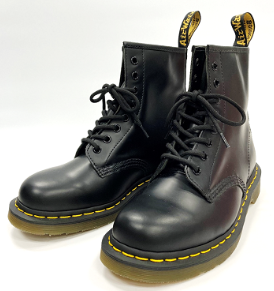
https://www.courts.go.jp/assets/hanrei/hanrei-pdf-92497.pdf
Tokyo District Court Order, 2023 (Yo) 30214 [Dasatinib] <Sugiura> — Provisional Disposition Order
Original Ameblo publication: 2024-08-22
Ameblo: https://ameblo.jp/hideki-takaishi/entry-12864549312.html
HP: https://www.takaishihideki.com/single-post/ameblo-12864549312-en
Japanese version: https://www.takaishihideki.com/single-post/ameblo-12864549312-ja
Tokyo District Court Order, 2023 (Yo) 30214 [Dasatinib] <Sugiura>
July 2023
Application for a provisional disposition order
October
The Ministry of Health, Labour and Welfare approved the additional indication/effect “chronic myeloid leukemia.”
November
Provisional disposition order
“Until the end of January 27, 2024, the debtor must not manufacture, sell, or offer for sale the pharmaceutical products listed in attached Schedules 1 and 2 whose ‘indications or effects’ include chronic myeloid leukemia (excluding imatinib-resistant chronic myeloid leukemia).”
https://www.bms.com/assets/bms/japan/pressrelease/20231129-pdf.pdf
[Design] IP High Court, 2023 (Gyo-Ke) 10072 <Hibiku Shimizu> — Design Act Article 46(2)
Original Ameblo publication: 2024-08-22
Ameblo: https://ameblo.jp/hideki-takaishi/entry-12864549411.html
HP: https://www.takaishihideki.com/single-post/ameblo-12864549411-en
Japanese version: https://www.takaishihideki.com/single-post/ameblo-12864549411-ja
[Design] IP High Court, 2023 (Gyo-Ke) 10072 <Hibiku Shimizu>
*Design Act Article 46(2): “A reason not attributable to the person’s responsibility” was denied.
*The overseas resident had not appointed an administrator.
⇒ Under Patent Act Article 192(3), incorporated by Design Act Article 68(5), service is deemed effected on the date the certified copy of the refusal decision is dispatched, even if it is not actually received.
https://www.courts.go.jp/assets/hanrei/hanrei-pdf-92589.pdf
[“Justifiable Grounds” under Article 16 of the Act on Management Business of Copyright and Neighboring Rights] IP High Court, 2021 (Ne) 10047 <Kanno>
Original Ameblo publication: 2024-08-23
Ameblo: https://ameblo.jp/hideki-takaishi/entry-12864657700.html
HP: https://www.takaishihideki.com/single-post/ameblo-12864657700-en
Japanese version: https://www.takaishihideki.com/single-post/ameblo-12864657700-ja
[“Justifiable Grounds” under Article 16 of the Act on Management Business of Copyright and Neighboring Rights] IP High Court, 2021 (Ne) 10047 <Kanno>
A live-music venue operator did not enter into a music-use license agreement with JASRAC.
⇒ JASRAC prevailed in litigation, but the operator did not pay.
⇒ JASRAC refused the performers’ applications for performance licenses.
⇒ “Justifiable grounds” established
*Although the operator did not collect venue-use fees from the performers, it was found to be the entity responsible for performing the musical works, taking into account, among other things, the structure under which it earned revenue from food and drink charges.
https://www.courts.go.jp/assets/hanrei/hanrei-pdf-90653.pdf
IP High Court, 2020 (Gyo-Ke) 10144 [Infusion Preparation Containing Sulfur-Containing Compounds and Trace Metal Elements] <Honda> — Not “Obviousness upon Obviousness”
Original Ameblo publication: 2024-08-24
Ameblo: https://ameblo.jp/hideki-takaishi/entry-12864780215.html
HP: https://www.takaishihideki.com/single-post/ameblo-12864780215-en
Japanese version: https://www.takaishihideki.com/single-post/ameblo-12864780215-ja
IP High Court, 2020 (Gyo-Ke) 10144 [Infusion Preparation Containing Sulfur-Containing Compounds and Trace Metal Elements] <Honda>
Difference A concerns the “composition of the solution.”
Difference B concerns the “contents and manner of storage.”
⇒ The two differ in technical perspective.
⇒ Even if the differences are identified separately, this is not “obviousness upon obviousness.”
(*The ultimate conclusion was that inventive step was satisfied.)
(Excerpt from the court’s reasoning)
…The defendant argues that Differences A1-1 and B1-1 should not be identified separately. However, Difference A1-1 concerns the composition of the amino-acid-containing solution, while Difference B1-1 concerns what is contained in a container stored in one chamber of a multichamber infusion container and how that container is stored. The two thus differ in technical perspective. The points relied upon by the defendant merely constitute circumstances supporting the view that the configurations of the corrected inventions relating to Differences A1-1 and B1-1 should be understood as part of a cohesive technical concept constituting one cited invention….
<<⇒ Ultimately neither difference was obvious; inventive step satisfied.>>
https://www.takaishihideki.com/_files/ugd/324a18_b3a0678016994ee093daa962aa909252.doc
https://www.courts.go.jp/assets/hanrei/hanrei-pdf-90701.pdf
IP High Court, 2021 (Gyo-Ke) 10129 [… Composition for Cleaving Target DNA] <Kanno> — Not “Obviousness upon Obviousness”
Original Ameblo publication: 2024-08-25
Ameblo: https://ameblo.jp/hideki-takaishi/entry-12864892576.html
HP: https://www.takaishihideki.com/single-post/ameblo-12864892576-en
Japanese version: https://www.takaishihideki.com/single-post/ameblo-12864892576-ja
IP High Court, 2021 (Gyo-Ke) 10129 [… Composition for Cleaving Target DNA] <Kanno>
Adding a nuclear localization signal to the Cas9 polypeptide (Difference 2) follows naturally and simultaneously from attempting to apply the cited invention’s CRISPR/Cas system to eukaryotic cells (Difference 1).
⇒ Not “obviousness upon obviousness”!! (Not two stages)
(Excerpt from the court’s reasoning)
…Because a nuclear localization signal is a conventional means of transferring proteins into the nuclei of eukaryotic cells, when seeking to apply the cited invention’s CRISPR/Cas9 system to eukaryotic cells—namely to transfer the Cas9 polypeptide into their nuclei—it is entirely natural to adopt a means for transferring it into the nucleus. Adding a nuclear localization signal to the Cas9 polypeptide follows naturally and simultaneously from attempting to apply the cited invention’s CRISPR/Cas system to eukaryotic cells. Thus, adding the nuclear localization signal is not a further modification made on the premise of a CRISPR/Cas9 system already applied to eukaryotic cells, and does not constitute so-called “obviousness upon obviousness.”
https://www.courts.go.jp/assets/hanrei/hanrei-pdf-91645.pdf
https://www.takaishihideki.com/_files/ugd/324a18_b3a0678016994ee093daa962aa909252.doc
IP High Court, 2022 (Gyo-Ke) 10007 [Heat Transfer System] <Shoji> — Not “Obviousness upon Obviousness”
Original Ameblo publication: 2024-08-26
Ameblo: https://ameblo.jp/hideki-takaishi/entry-12865028860.html
HP: https://www.takaishihideki.com/single-post/ameblo-12865028860-en
Japanese version: https://www.takaishihideki.com/single-post/ameblo-12865028860-ja
IP High Court, 2022 (Gyo-Ke) 10007 [Heat Transfer System] <Shoji>
One of the matters actually disclosed in a publicly available reference was selected for comparison.
*Even if a mental operation of selecting and presenting a refrigerant combination relevant to the difference was involved, this merely selected the same term as in the claimed invention.
⇒ Not “obviousness upon obviousness”
(Excerpt from the court’s reasoning)
|
The plaintiffs argue that the JPO decision, at the stage of identifying well-known matters, made an estimate or inference by selecting R32 from multiple exemplified refrigerants and did not objectively identify “well-known matters”; that, after encountering the claimed invention, it selected from multiple listed refrigerants the same configuration as the claimed invention, impermissibly introducing an obviousness assessment into the identification of the cited invention; and that, because its findings involved assumptions or inferences at the stage of identifying well-known technology and then an assessment of whether differences between the claimed and cited inventions could be rationalized, this constituted impermissible so-called obviousness upon obviousness…. … However, …Cited References 2 and 11 are found to actually describe combinations of each of the multiple listed primary-side refrigerants with carbon dioxide, and the combination of R32, one of those refrigerants, with carbon dioxide is one of the combinations actually described. Identification of a cited invention is performed so as to enable error-free comparison with and assessment of the claimed invention. Since Difference 1 identifies that the primary-side refrigerant is R32 in the claimed invention but propane in the cited invention, selecting a combination with R32 as the primary-side refrigerant is naturally appropriate as a refrigerant combination relevant to Difference 1. Even if a mental operation of selecting and presenting a combination relevant to Difference 1 is involved, this merely selects a combination relevant to the difference from the reference’s description by searching for the same specific term, “R32,” used in the claimed invention’s elements. This cannot be regarded as an estimate, inference, or assumption departing from the reference’s disclosure, nor can it be said to be an obviousness assessment. |
https://www.courts.go.jp/assets/hanrei/hanrei-pdf-91747.pdf
https://www.takaishihideki.com/_files/ugd/324a18_b3a0678016994ee093daa962aa909252.doc
[Trademark] IP High Court, 2020 (Ne) 10017 <Honda> — First Cumulative Application of Article 38(2) and (3) of the Trademark Act in a Trademark Case
Original Ameblo publication: 2024-08-27
Ameblo: https://ameblo.jp/hideki-takaishi/entry-12865150608.html
HP: https://www.takaishihideki.com/single-post/ameblo-12865150608-en
Japanese version: https://www.takaishihideki.com/single-post/ameblo-12865150608-ja
[Trademark] IP High Court, 2020 (Ne) 10017 <Honda>
One of three parties that had long used the “守半” (Morihan) indication obtained a trademark registration for “守半” (Morihan).
⇒ Enforcing rights against “守半” (Morihan) constitutes an abuse of rights, but enforcing them against “守半總本舗” (Morihan Sohonpo) does not.
For the first time in a trademark case, cumulative application of Article 38(2) and (3) of the Trademark Act was permitted.—“Nonidentity of markets”
https://www.courts.go.jp/assets/hanrei/hanrei-pdf-91601.pdf
[Article] Exhaustion in the United Kingdom (Kumiko Yamada, Patent Supplement No. 30)
Original Ameblo publication: 2024-08-28
Ameblo: https://ameblo.jp/hideki-takaishi/entry-12865271332.html
HP: https://www.takaishihideki.com/single-post/ameblo-12865271332-en
Japanese version: https://www.takaishihideki.com/single-post/ameblo-12865271332-ja
[Article] Exhaustion in the United Kingdom (Kumiko Yamada, Patent Supplement No. 30)
“UK+ Regime”
IP rights in goods placed on the market in the European Economic Area (EEA) by or with the consent of the rights holder are generally exhausted in the United Kingdom.
Placement on the UK market by or with the rights holder’s consent does not, by itself, necessarily exhaust rights in the EEA. Treatment in other countries depends on their exhaustion regimes.
https://www.jstage.jst.go.jp/article/patentsp/77/30/77_137/_pdf/-char/en
[Trademark] Osaka District Court, 2023 (Wa) 691, “子どもとママの歯医者さん” (“Dentist for Children and Mothers”) Case
Original Ameblo publication: 2024-08-29
Ameblo: https://ameblo.jp/hideki-takaishi/entry-12865394372.html
HP: https://www.takaishihideki.com/single-post/ameblo-12865394372-en
Japanese version: https://www.takaishihideki.com/single-post/ameblo-12865394372-ja
[Trademark] Osaka District Court, 2023 (Wa) 691, “子どもとママの歯医者さん” (“Dentist for Children and Mothers”) Case
The lettering “こどもとママの歯科医院” (“Dental Clinic for Children and Mothers”) in the defendant’s composite mark has weak distinctiveness and cannot be extracted.
⇒ Comparing the marks as a whole, the lettering “香椎照葉” (Kashii Teriha) differs, and their appearance, pronunciation, and concept (indicating an area) differ.
⇒ Dissimilar
https://www.courts.go.jp/assets/hanrei/hanrei-pdf-92972.pdf
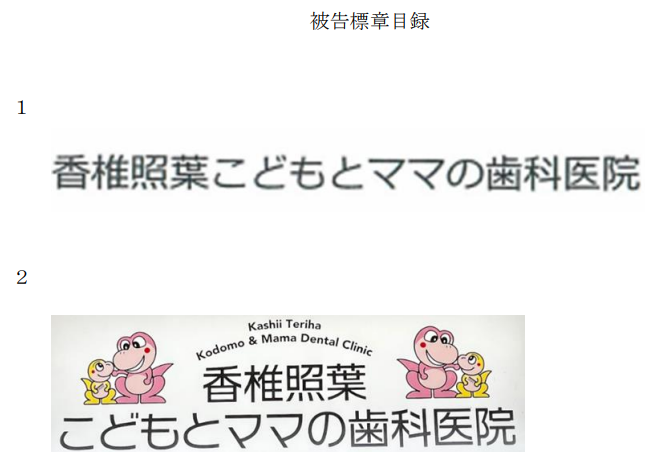
List of the defendant’s marks. The Japanese wording in both Mark 1 and Mark 2 means “Kashii Teriha Dental Clinic for Children and Mothers.”
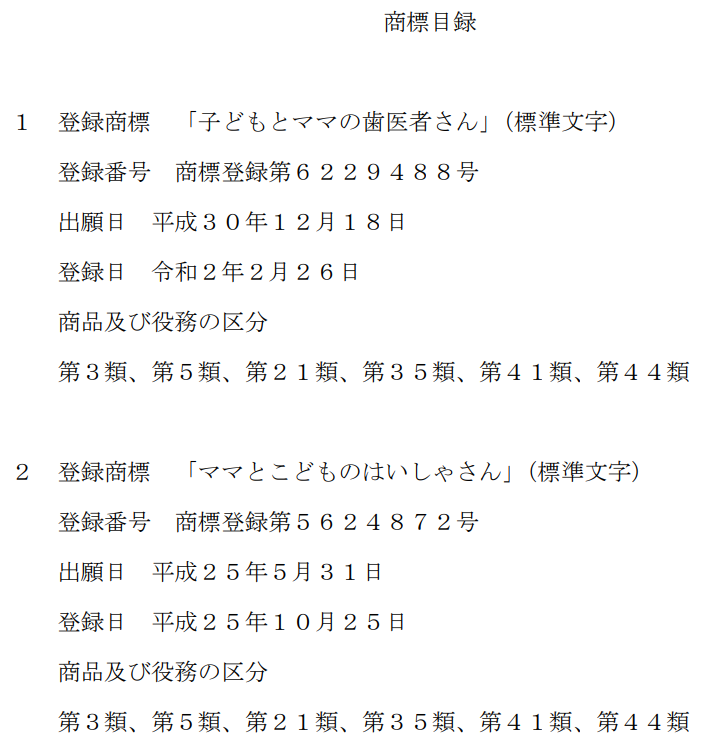
List of trademarks
1. Registered trademark: “子どもとママの歯医者さん” (meaning “Dentist for Children and Mothers”; standard characters). Trademark Registration No. 6229488. Filing date: December 18, 2018. Registration date: February 26, 2020. Classes of goods and services: 3, 5, 21, 35, 41, and 44.
2. Registered trademark: “ママとこどものはいしゃさん” (meaning “Dentist for Mothers and Children”; standard characters). Trademark Registration No. 5624872. Filing date: May 31, 2013. Registration date: October 25, 2013. Classes of goods and services: 3, 5, 21, 35, 41, and 44.
[South Korea/Patent] 2016 Heo 7954 — Equivalence Established for a Numerically Limited Invention
Original Ameblo publication: 2024-08-30
Ameblo: https://ameblo.jp/hideki-takaishi/entry-12865518966.html
HP: https://www.takaishihideki.com/single-post/ameblo-12865518966-en
Japanese version: https://www.takaishihideki.com/single-post/ameblo-12865518966-ja
[South Korea/Patent] 2016 Heo 7954 — Equivalence Established for a Numerically Limited Invention
The weight mixing ratio of microcrystalline cellulose to the main component is “at least 0.5 and no more than 3,” whereas the invention subject to the scope-confirmation request has “at least 0.1 and less than 0.5.”
⇒ The configuration of a coated tablet containing 100–500 mg of the active ingredient was not publicly known, and the relevant claim feature had not been amended.
⇒ No intentional exclusion
⇒ For claim 1, equivalence established for both the numerical-range difference and the difference between anhydrous lactose and lactose hydrate.
https://www.jetro.go.jp/ext_images/world/asia/kr/ip/pdf/han_2018.pdf
Tokyo District Court, 2022 (Wa) 22517 <Shibata> [Toilet Roll] [Roll Product Package]
Original Ameblo publication: 2024-09-02
Ameblo: https://ameblo.jp/hideki-takaishi/entry-12865900106.html
HP: https://www.takaishihideki.com/single-post/ameblo-12865900106-en
Japanese version: https://www.takaishihideki.com/single-post/ameblo-12865900106-ja
Tokyo District Court, 2022 (Wa) 22517 <Shibata>
[Toilet Roll (First Patent)]
*For the double-embossed defendant products, “the embossing on the front and back does not necessarily overlap, and coincidence of the embossing edges is not guaranteed.” The court therefore held that the embossing edges could not be identified and the embossing depth could not be established.
⇒ Claim limitation not satisfied
[Roll Product Package (Second Patent)]
*The court denied only the third requirement of equivalence (obviousness of substitution at the time of manufacture) and the fifth requirement!!
“In the defendant products …, only the central part of the slit is arcuate upward, and its basic shape differs from the configuration of Invention 2….”
(Excerpts from the court’s reasoning)
<Claim element> 1B: The embossing depth of said embossing is 0.05–0.40 mm.
Even assuming the embossing is approximately square, the longest portion a in Specification 1 is not necessarily the length of its horizontal side …, and the location at which the measured sectional curve is obtained to measure embossing depth under the plaintiff’s measurement method is not necessarily the location shown in Specification 1. …The one-shot images of each defendant product … show …that the embossing edges of the products cannot be clearly located. …The defendant products cannot necessarily be said to have an embossing edge fr of the kind presupposed by Invention 1. …
Given the nature of embossing in toilet rolls, some variation in the shapes of individual embossings can be expected. However, the embossing depth D in Invention 1 is measured on toilet rolls for which an embossing height profile on the X–Y plane can be obtained …and the embossing edge fr and its longest portion a can be located, after obtaining sectional curves as in Figure 5(b) and Figure 6. The invention states that its effect is achieved in toilet rolls whose embossing depth D, measured in this manner, has specified numerical values. Each defendant product is ordinary two-ply double embossing formed by ply-bonding without specifically adjusting the relative positions of the embossing protrusions and depressions on the sheets…. In such double-embossed toilet rolls, the embossing applied respectively to the front and back does not necessarily overlap, and the edges are not guaranteed to coincide. As a result, the embossing edges are unclear; displacement of protrusions and depressions can also cause interference and produce embossing of indistinct shape. According to the Exhibit Ko 51 report, in each defendant product, a local maximum of upward-convex curvature in the sectional curve is found at the center of a portion identified by the plaintiff as embossing, among other things. It is therefore not necessarily clear whether that embossing has the depressed shape envisaged for measuring embossing depth D in Invention 1. Nor can it necessarily be said that the embossing height profile on the X–Y plane permits identification of the embossing edge fr and its longest portion a. Thus, even if ten embossings are selected and measured on each defendant toilet roll having such embossing, and a particular depth D is calculated as their average, it cannot be said that the embossing depth D in Invention 1 has been measured.
https://www.courts.go.jp/assets/hanrei/hanrei-pdf-93308.pdf
IP High Court, 2023 (Gyo-Ke) 10034 [Method of Manufacturing a Raised-Fiber Sheet] <Hibiku Shimizu>
Original Ameblo publication: 2024-09-03
Ameblo: https://ameblo.jp/hideki-takaishi/entry-12866026354.html
HP: https://www.takaishihideki.com/single-post/ameblo-12866026354-en
Japanese version: https://www.takaishihideki.com/single-post/ameblo-12866026354-ja
IP High Court, 2023 (Gyo-Ke) 10034 [Method of Manufacturing a Raised-Fiber Sheet] <Hibiku Shimizu>
The patentee entered into a basic purchase agreement with Taiki (タイキ), a party other than the petitioner in the invalidation trial, containing a confidentiality clause stipulating that “confidential matters shall be identified in writing.”
⇒ The process document prepared by Shin-ei Senshoku (新栄染色) was faxed by the patentee to Taiki and was also distributed to employees of Taiki, the patentee, and Shin-ei Senshoku without imposing confidentiality obligations. It contained no indication that the patentee or Taiki had specifically identified the information as confidential.
⇒ Publicly known
⇒ Novelty: not satisfied
+ Usurped application was also found!!
https://www.courts.go.jp/assets/hanrei/hanrei-pdf-92893.pdf
IP High Court, 2023 (Gyo-Ke) 10091 [Barrier Laminate] <Miyasaka>
Original Ameblo publication: 2024-09-04
Ameblo: https://ameblo.jp/hideki-takaishi/entry-12866149667.html
HP: https://www.takaishihideki.com/single-post/ameblo-12866149667-en
Japanese version: https://www.takaishihideki.com/single-post/ameblo-12866149667-ja
IP High Court, 2023 (Gyo-Ke) 10091 [Barrier Laminate] <Miyasaka>
*For a difference concerning a numerical limitation, the court held that technical significance and obviousness of the configuration are not directly linked.
*From a cited invention demonstrating technical significance through three elements (carbon, oxygen, silicon), the numerical ranges for only two elements (carbon, silicon) could not be extracted.
⇒ Revocation decision set aside
(Excerpts from the court’s reasoning)
The invention …provides a surface-coating layer containing a resin material having polar groups with excellent adhesion between a polypropylene film and a deposited film, thereby preventing interlayer separation. It also provides, on the deposited film, a barrier-coating layer made of a resin composition of a metal alkoxide and a water-soluble polymer, including cases where a silane coupling agent is used together with them, thereby preventing cracks in the deposited film. Further, it sets the ratio of silicon atoms to carbon atoms at the surface of the barrier-coating layer within a specified range so as to suppress deterioration of gas-barrier properties even during boiling or retort treatment. It thus has the technical significance of providing a barrier laminate for boiling or retort use with high gas-barrier properties. According to the specification, the upper limit of the silicon-to-carbon ratio (Si/C) is set from the standpoint of suppressing deterioration of gas-barrier properties even when the laminate is bent, while the lower limit is set from the standpoint of suppressing such deterioration even when it is heated…. Therefore, Difference 1-3, concerning whether the laminate is for boiling or retort use, and Difference 1-2, concerning the numerical range of the silicon-to-carbon ratio, should be considered together. …
Even if a person skilled in the art contemplated using the food-packaging material of the invention in Exhibit Ko 3 for boiling or retort applications, the ratio of metal atoms among the atoms constituting the overcoat layer in Exhibit Ko 4 is unrelated to whether gas-barrier properties are maintained upon heating. Moreover, Exhibit Ko 4 states the opposite of Exhibit Ko 3 regarding the ratio of carbon to metal atoms and the brittleness of the film. Given these matters, it is unreasonable to derive motivation to focus, within the laminate of Exhibit Ko 4 concerning an outer covering for vacuum insulation material—which differs in both technical field and layered structure from the invention in Exhibit Ko 3—on the descriptions of the overcoat and inorganic layers in the overcoat-coated film, and to refer to the ratio of metal atoms to carbon atoms in the overcoat layer (number of metal atoms/number of carbon atoms) for application to the invention in Exhibit Ko 3. The decision’s assessment is erroneous. …
The defendant argues that the Si/C numerical range has no particular technical significance, and that, considering also that it was publicly known, as in Exhibit Ko 4, to examine numerical ranges using “Si/C” for the common technology concerning layered structure, a person skilled in the art could readily have adopted the configuration of the invention relating to Difference 1-2 in the invention in Exhibit Ko 3 by referring to Exhibit Ko 4. …
…However, concerning (1) above, …it cannot immediately be said that there is no technical significance. In the first place, whether technical significance is substantiated and whether a configuration is obvious are not directly linked issues.
Regarding (2) above, merely because the …numerical range of the invention in Exhibit Ko 3 encompasses “at least 0.90 and no more than 1.60,” the numerical range of Invention 1, there is no reasonable basis or technical necessity for extracting only carbon and silicon from Exhibit Ko 3’s disclosure, which demonstrates a certain technical significance through numerical ranges of carbon, oxygen, and silicon.
Table 1 of Exhibit Ko 4 discloses …a value within the numerical range of Invention 1, but the table does not show film properties or indicate that this Si/C ratio is superior to other parts-by-mass values outside the range of Invention 1. It therefore cannot be said that a person skilled in the art would focus on that value. Moreover, merely because Exhibit Ko 4—which has no more in common with Exhibit Ko 3 than being “an invention concerning a layered structure”—describes examining numerical ranges using “Si/C,” it cannot be said that a person skilled in the art could readily have adopted the configurations relating to Differences 1-2 and 1-3 by referring to Exhibit Ko 4.
https://www.courts.go.jp/assets/hanrei/hanrei-pdf-92977.pdf
IP High Court, 2012 (Ne) 10018 [Skeletal Structure of a Large Articulated Soft-Vinyl Doll] <Shibata>
Original Ameblo publication: 2024-09-05
Ameblo: https://ameblo.jp/hideki-takaishi/entry-12866280093.html
HP: https://www.takaishihideki.com/single-post/ameblo-12866280093-en
Japanese version: https://www.takaishihideki.com/single-post/ameblo-12866280093-ja
IP High Court, 2012 (Ne) 10018 [Skeletal Structure of a Large Articulated Soft-Vinyl Doll] <Shibata>
*Equivalence can be established even when some claim elements are absent.
⇒ Not established in this case
= Osaka District Court, 2021 (Wa) 10032 [Chip Fuse]
Tokyo District Court, 2012 (Wa) 31523 [Flow Control Valve] <Hasegawa> found equivalence where part of a claim element was absent.
https://www.courts.go.jp/assets/hanrei/hanrei-pdf-82638.pdf
[Contract/Extinctive Prescription] Supreme Court, April 24, 1998, 1995 (O) 2472
Original Ameblo publication: 2024-09-06
Ameblo: https://ameblo.jp/hideki-takaishi/entry-12866400622.html
HP: https://www.takaishihideki.com/single-post/ameblo-12866400622-en
Japanese version: https://www.takaishihideki.com/single-post/ameblo-12866400622-ja
[Contract/Extinctive Prescription] Supreme Court, April 24, 1998, 1995 (O) 2472
For a contractual obligation, the prescription period for a damages claim arising from impossibility of performance attributable to the obligor begins to run when performance of the original obligation could have been demanded.
⇒ <<Take care>> Not from the time performance becomes impossible!!
https://www.courts.go.jp/assets/hanrei/hanrei-pdf-62776.pdf
[China] Supreme People’s Court, (2016) Zui Gao Fa Xing Zai No. 41, “Daiichi Sankyo Case”
Original Ameblo publication: 2024-09-07
Ameblo: https://ameblo.jp/hideki-takaishi/entry-12866528331.html
HP: https://www.takaishihideki.com/single-post/ameblo-12866528331-en
Japanese version: https://www.takaishihideki.com/single-post/ameblo-12866528331-ja
[China] Supreme People’s Court, (2016) Zui Gao Fa Xing Zai No. 41, “Daiichi Sankyo Case”
Markush-form claims are construed under a generalization approach.
⇒ Deletion of arbitrary alternatives raises the issue of uncertainty. The principle is that amendment of a Markush-form claim must not give rise to a group of compounds or an individual compound having new properties and functions, while the circumstances of the individual case must also be considered.
Cf. In Europe, the question is whether the subject matter remaining after deletion of alternatives is within the original disclosure; deletion may be permissible.
⇒ Strengthen dependent claims and disclosure of specific combinations with China and Europe in mind.
https://ipc.court.gov.cn/zh-cn/news/view-14.html
Osaka District Court, 1998 (Wa) 7191 [Ink Tube for a Writing Instrument] *A case in which adding another substance to an otherwise infringing accused product resulted in noninfringement!!
Original Ameblo publication: 2024-09-08
Ameblo: https://ameblo.jp/hideki-takaishi/entry-12866686154.html
HP: https://www.takaishihideki.com/single-post/ameblo-12866686154-en
Japanese version: https://www.takaishihideki.com/single-post/ameblo-12866686154-ja
Osaka District Court, 1998 (Wa) 7191 [Ink Tube for a Writing Instrument] *A case in which adding another substance to an otherwise infringing accused product resulted in noninfringement!!
*Without a gelling agent the limitation was satisfied, but adding a gelling agent resulted in non-satisfaction.
In light of the purpose of the claimed utility-model device (a backflow-preventing agent), gelled polybutene was found to be a different substance from polybutene before gelation.
⇒ “The backflow-preventing agent is polybutene” not satisfied
Cf. Tokyo District Court, 2005 (Wa) 14346
(Excerpts from the court’s reasoning)
…Although the polybutene in the backflow-preventing agent of the accused product is gelled by a gelling agent, it continues to exist as polybutene within the gelling agent’s three-dimensional network. There is therefore some room to view it as having the configuration of the device at issue, “the backflow-preventing agent consists of polybutene.” …
Polybutene gelled by a gelling agent is found normally to exhibit high viscosity, while, as ink flows out during writing, the shear rate of the backflow-preventing agent increases, lowering its apparent viscosity so that it follows the ink. …
From the standpoint of its use as a backflow-preventing agent, it is inappropriate to divide polybutene gelled by a gelling agent into “addition of the gelling agent (or the network structure of the gelling agent)” and “polybutene,” and treat the former as a merely additional configuration. Pure polybutene and polybutene gelled by a gelling agent should be considered different substances. Accordingly, the accused product, whose backflow-preventing agent consists of polybutene gelled by a gelling agent, must be said not to have the configuration of the device at issue, “the backflow-preventing agent consists of polybutene.”

Comparison table: Tokyo District Court, 2005 (Wa) 14346 [Top-Level Setting Aid] <Ichikawa>
*The claim limitations were held to be satisfied even where two configurations were integrated, provided that the mechanism for solving the problem was the same.
Cf. Osaka District Court, 1998 (Wa) 7191.
Claim element B2 of Invention 1 states that “an upper wing portion 2 extending horizontally and perpendicular to the aid body 1 is fixed to the upper portion of the aid body 1,” while claim element D2 states that “a lower wing portion 3 extending vertically and perpendicular to the aid body 1 … is fixed to the lower portion.” The wording does not exclude a lower wing portion 7 positioned directly beneath and integrated with upper wing portion 2….
There is insufficient evidence to establish that the mechanism generating the restraining force asserted by the defendant differs depending on whether upper wing portion 2 and lower wing portion 7 are integrated….
Table notation: 勝 (“win”); 有 (literally, “present”); △.
https://www.courts.go.jp/assets/hanrei/hanrei-pdf-12566.pdf
Tokyo District Court, 2005 (Wa) 14346 [Top-Level Setting Aid] <Ichikawa>
Original Ameblo publication: 2024-09-09
Ameblo: https://ameblo.jp/hideki-takaishi/entry-12866869405.html
HP: https://www.takaishihideki.com/single-post/ameblo-12866869405-en
Japanese version: https://www.takaishihideki.com/single-post/ameblo-12866869405-ja
Tokyo District Court, 2005 (Wa) 14346 [Top-Level Setting Aid] <Ichikawa>
The accused product integrated the two configurations of claim elements B2 and D2.
⇒ (1) The claims do not exclude an integrated structure. + (2) No evidence shows a different mechanism for solving the problem (restraining force).
⇒ Claim limitations satisfied
Cf. Osaka District Court, 1998 (Wa) 7191
(Excerpts from the court’s reasoning)
Claim element B2 of Invention 1 states that “an upper wing portion 2 extending horizontally and perpendicular to the aid body 1 is fixed to the upper portion of the aid body 1,” while element D2 states that “a lower wing portion 3 extending …vertically and perpendicular to the aid body 1 is fixed to the lower portion.” The wording does not exclude a lower wing portion 7 positioned directly beneath and integrated with upper wing portion 2….
There is insufficient evidence to establish that the mechanism generating the restraining force asserted by the defendant differs depending on whether upper wing portion 2 and lower wing portion 7 are integrated….
https://www.courts.go.jp/assets/hanrei/hanrei-pdf-33256.pdf
[Copyright/Corporate Authorship] IP High Court, 2010 (Ne) 10081 — Corporate Authorship Denied (“Initiative of a Corporation or Other Employer” Denied)
Original Ameblo publication: 2024-09-10
Ameblo: https://ameblo.jp/hideki-takaishi/entry-12866999188.html
HP: https://www.takaishihideki.com/single-post/ameblo-12866999188-en
Japanese version: https://www.takaishihideki.com/single-post/ameblo-12866999188-ja
[Copyright/Corporate Authorship] IP High Court, 2010 (Ne) 10081
(1) The publisher asked individual employees to write.
(2) The company’s minutes contained no record of a writing request.
(3) The portions assigned to departing employees were not handed over to other employees.
(4) The series was planned by the publisher.
(5) The publisher paid manuscript fees to the individual employees.
⇒ Corporate authorship denied (“initiative of a corporation or other employer” denied)
https://www.courts.go.jp/assets/hanrei/hanrei-pdf-81151.pdf
[Europe] EPO Decision T 61/14 — Requirements for a parameter invention to satisfy sufficiency of disclosure under Article 83 EPC
Original Ameblo publication: 2024-09-11
Ameblo: https://ameblo.jp/hideki-takaishi/entry-12867121432.html
HP: https://www.takaishihideki.com/single-post/ameblo-12867121432-en
Japanese version: https://www.takaishihideki.com/single-post/ameblo-12867121432-ja
[Europe] EPO Decision T 61/14
*For a parameter invention to satisfy the sufficiency-of-disclosure requirement under Article 83 EPC, throughout the entire claimed range, not only the method of measuring the parameter but also the method of adjusting it must be described in the application as filed, or be practicable by a person skilled in the art based on common general technical knowledge at filing.
[U.S.] July 2023 <CAFC> In re Float’N’Grill LLC — Reissue Application
Original Ameblo publication: 2024-09-12
Ameblo: https://ameblo.jp/hideki-takaishi/entry-12867247179.html
HP: https://www.takaishihideki.com/single-post/ameblo-12867247179-en
Japanese version: https://www.takaishihideki.com/single-post/ameblo-12867247179-ja
[U.S.] July 2023 <CAFC> In re Float’N’Grill LLC
Limits on generalization in a reissue application (35 U.S.C. § 251, Reissue)
⇒ Essential features cannot be deleted.
Because “magnets” are essential to the invention, reissue is unavailable for an invention deleting them.
⇒ The limits on generalization are the same as in Japan!!
https://www.youtube.com/watch?v=caYkLhd5rYM
https://www.cafc.uscourts.gov/opinions-orders/22-1438.OPINION.7-12-2023_2156183.pdf
[Trademark] IP High Court, 2019 (Gyo-Ke) 10101 <Otaka> “南三陸キラキラ丼” (Minamisanriku Kirakira Don) Case
Original Ameblo publication: 2024-09-13
Ameblo: https://ameblo.jp/hideki-takaishi/entry-12867365147.html
HP: https://www.takaishihideki.com/single-post/ameblo-12867365147-en
Japanese version: https://www.takaishihideki.com/single-post/ameblo-12867365147-ja
[Trademark] IP High Court, 2019 (Gyo-Ke) 10101 <Otaka> “南三陸キラキラ丼” (Minamisanriku Kirakira Don) Case
For a trademark right registered in the name of the representative of an unincorporated association, the court held that “it is appropriate to treat the defendant and the Minamisanriku Restaurant Association as the same person,” and denied that they were “another person” under Trademark Act Article 4(1)(x), (xv), and (xix).
⇒ Trademark right upheld
https://www.courts.go.jp/assets/hanrei/hanrei-pdf-89123.pdf
Tokyo District Court, 2018 (Wa) 1130 [Printed Retroreflective Sheeting] <Tanaka>
Original Ameblo publication: 2024-09-14
Ameblo: https://ameblo.jp/hideki-takaishi/entry-12867551138.html
HP: https://www.takaishihideki.com/single-post/ameblo-12867551138-en
Japanese version: https://www.takaishihideki.com/single-post/ameblo-12867551138-ja
Tokyo District Court, 2018 (Wa) 1130 [Printed Retroreflective Sheeting] <Tanaka>
*Although no comparative examples outside the numerical range were provided, the support requirement was satisfied.
(The appellate judgment, IP High Court, 2021 (Ne) 10084 <Miyasaka>, also found the support requirement satisfied.)
The specification’s statement that “at least 0.15 mm² is preferable because moldability is excellent …, and no more than 30 mm² is preferable because … interlayer adhesion strength is not reduced” contributed!!
(Excerpts from the court’s reasoning)
Paragraph [0030] states: “An area of at least 0.15 mm² for an independent printed region is preferable because moldability is excellent and hue adjustment is easy, while an area of no more than 30 mm² is preferable because it does not reduce the interlayer adhesion strength of the two layers sandwiching the printed layer (2) around the printed region.” A person skilled in the art encountering this disclosure would understand that, if the area of a printed layer for improving or adjusting the hue of a retroreflective sheet is too small, the benefit of hue adjustment cannot be obtained, so a certain size is necessary. They would also understand that, if the area of a printed layer having poor adhesion is too large, interlayer adhesion strength decreases, so the printed layer must be sufficiently small. Accordingly, the technical significance of the invention can be understood even without examples comparing printed-region areas below 0.15 mm² or above 30 mm²….
The appellate judgment, IP High Court, 2021 (Ne) 10084 <Miyasaka>, also found the support requirement satisfied.
“The problem addressed by the invention can be said to be providing retroreflective sheeting with improved hue by solving, through an extremely simple and inexpensive method, the prior-art shortcomings of poor weather resistance and water resistance arising when a continuous printed layer is provided to improve hue in triangular-pyramidal cube-corner retroreflective sheeting, vapor-deposited triangular-pyramidal cube-corner retroreflective sheeting, and the like. Although it cannot be denied that conditions other than whether the printed regions are continuous or separate could affect solution of this problem, the support requirement does not demand exhaustive coverage of those conditions and effects. A person skilled in the art, comparing the claims of the patent and the specification, would be able to recognize that the invention is described as one contributing to solution of the above problem.”
https://www.courts.go.jp/assets/hanrei/hanrei-pdf-90776.pdf
[U.S.] September 2012 <CAFC> Santarus v. Par Pharmaceutical
Original Ameblo publication: 2024-09-14
Ameblo: https://ameblo.jp/hideki-takaishi/entry-12867551677.html
HP: https://www.takaishihideki.com/single-post/ameblo-12867551677-en
Japanese version: https://www.takaishihideki.com/single-post/ameblo-12867551677-ja
[U.S.] September 2012 <CAFC> 694 F.3d 1344, Santarus v. Par Pharmaceutical
The negative expression “the gastric medication does not contain sucralfate” satisfied the written-description requirement.
The reason was explained in the specification.
⇒ The specification identified disadvantages of using sucralfate, allowing a skilled person to understand a reason to avoid it. The court did not find that sucralfate itself caused gastric mucosal damage.
https://www.cafc.uscourts.gov/opinions-orders/10-1360.-1380.pdf
[U.S.] November 2015 <CAFC> 805 F.3d 1350, Inphi v. Netlist
Original Ameblo publication: 2024-09-16
Ameblo: https://ameblo.jp/hideki-takaishi/entry-12867728040.html
HP: https://www.takaishihideki.com/single-post/ameblo-12867728040-en
Japanese version: https://www.takaishihideki.com/single-post/ameblo-12867728040-ja
[U.S.] November 2015 <CAFC> 805 F.3d 1350, Inphi v. Netlist
The negative expression “excluding ‘CAS, RAS, or bank address signals’” satisfied the written-description requirement.
An industry association’s standards publication concerning the technology of the invention was incorporated into the specification, enabling a person skilled in the art reasonably to infer that particular signals were excluded.
(The court cited Santarus.)
https://jp.youme.com/sub_news/ipboardopen.aspx?idx=1562
[U.S.] June 2014 <CAFC> 752 F.3d 1371, Q.I. Press Controls v. Lee
Original Ameblo publication: 2024-09-17
Ameblo: https://ameblo.jp/hideki-takaishi/entry-12867852708.html
HP: https://www.takaishihideki.com/single-post/ameblo-12867852708-en
Japanese version: https://www.takaishihideki.com/single-post/ameblo-12867852708-ja
[U.S.] June 2014 <CAFC> 752 F.3d 1371, Q.I. Press Controls v. Lee
The negative expression “the printing-press substrate is not supported at the illumination point” failed the written-description requirement.
Figure 2 appears at first glance not to show support at the illumination point, but the substrate in Figure 2 is floating, and there is no reference to the printing press’s roller hardware or additional drawings, so a person skilled in the art cannot recognize this.
https://eprints.lib.hokudai.ac.jp/dspace/bitstream/2115/81703/1/59_05-Tokii.pdf
[U.S.] January 2020 <CAFC> 946 F.3d 1367, Eko Brands v. Adrian Rivera
Original Ameblo publication: 2024-09-18
Ameblo: https://ameblo.jp/hideki-takaishi/entry-12868000111.html
HP: https://www.takaishihideki.com/single-post/ameblo-12868000111-en
Japanese version: https://www.takaishihideki.com/single-post/ameblo-12868000111-ja
[U.S.] January 2020 <CAFC> 946 F.3d 1367, Eko Brands v. Adrian Rivera
In a partial dissent, Judge Reyna criticized the construction importing a negative limitation excluding “broad, thin mesh” as unsupported. The majority upheld the construction and the finding of non-infringement.
According to that dissent, the specification does not mention mesh, let alone broad, thin mesh, and contains no disclosure supporting the exclusion.
(The dissent observed that the mesh exclusion came from a feature of Eko’s accused product.)
https://www.cafc.uscourts.gov/opinions-orders/18-2215.opinion.1-13-2020.pdf
[U.S.] January 2013 <CAFC> Ernie Ball v. Earvana
Original Ameblo publication: 2024-09-18
Ameblo: https://ameblo.jp/hideki-takaishi/entry-12868002697.html
HP: https://www.takaishihideki.com/single-post/ameblo-12868002697-en
Japanese version: https://www.takaishihideki.com/single-post/ameblo-12868002697-ja
[U.S.] January 2013 <CAFC> 502 Fed. Appx. 971, Ernie Ball v. Earvana
Claim 1, which included a limitation that the arrangement “does not form a sinusoidal arc …,” was held indefinite under former 35 U.S.C. § 112, second paragraph.
The problem was that the curve through the intonation portions was not uniquely specified: the same arrangement could be depicted with sinusoidal or non-sinusoidal curves. The holding did not rest merely on the absence of a definition of “sinusoidal.”
https://www.cafc.uscourts.gov/opinions-orders/12-1276.opinion.1-22-2013.1.pdf
[U.S.] June 2022 <CAFC> 38 F.4th 1013, Novartis v. Accord
Original Ameblo publication: 2024-09-18
Ameblo: https://ameblo.jp/hideki-takaishi/entry-12868002849.html
HP: https://www.takaishihideki.com/single-post/ameblo-12868002849-en
Japanese version: https://www.takaishihideki.com/single-post/ameblo-12868002849-ja
See also the separate article on the same case, published on 2024-09-20.
[U.S.] June 2022 <CAFC> 38 F.4th 1013, Novartis v. Accord
The negative expression requiring administration “at a dosage of 0.5 mg/day without an immediately preceding loading dose” failed the written-description requirement.
As a general rule, where the specification states a basis for exclusion,
or
even without an express statement, the written-description requirement may be satisfied if a skilled person would understand the disclosure necessarily to exclude that matter. Neither basis was established in this case.
https://www.itohpat.co.jp/ip/1900/
[U.S.] June 2022 <CAFC> 38 F.4th 1013, Novartis v. Accord
Original Ameblo publication: 2024-09-20
Ameblo: https://ameblo.jp/hideki-takaishi/entry-12868237057.html
HP: https://www.takaishihideki.com/single-post/ameblo-12868237057-en
Japanese version: https://www.takaishihideki.com/single-post/ameblo-12868237057-ja
See also the separate article on the same case, published on 2024-09-18.
[U.S.] June 2022 <CAFC> 38 F.4th 1013, Novartis v. Accord
The negative expression requiring administration “at a dosage of 0.5 mg/day without an immediately preceding loading dose” failed the written-description requirement.
As a general rule, where the specification states a basis for exclusion,
or
even without an express statement, the written-description requirement may be satisfied if a skilled person would understand the disclosure necessarily to exclude that matter. Neither basis was established in this case.
https://www.cafc.uscourts.gov/opinions-orders/21-1070.OPINION.6-21-2022_1967294.pdf
[Trademark] IP High Court, 2023 (Gyo-Ke) 10018, “プレジャー” (“Pleasure”) <Shoji>
Original Ameblo publication: 2024-09-21
Ameblo: https://ameblo.jp/hideki-takaishi/entry-12868349184.html
HP: https://www.takaishihideki.com/single-post/ameblo-12868349184-en
Japanese version: https://www.takaishihideki.com/single-post/ameblo-12868349184-ja
[Trademark] IP High Court, 2023 (Gyo-Ke) 10018, “プレジャー” (“Pleasure”) <Shoji>
*Even if evidence of use was not submitted during a nonuse cancellation trial, it may be submitted in an action to set aside the trial decision.
⇒ Use established (trial decision set aside)
“In the case decided by the Supreme Court in 1991, too … no allegation or proof of trademark use was made … at the trial-proceeding stage.”
https://www.courts.go.jp/assets/hanrei/hanrei-pdf-92746.pdf
Tokyo District Court, 2022 (Wa) 18830 [Rolling Device] <Shibata>
Original Ameblo publication: 2024-09-22
Ameblo: https://ameblo.jp/hideki-takaishi/entry-12868467962.html
HP: https://www.takaishihideki.com/single-post/ameblo-12868467962-en
Japanese version: https://www.takaishihideki.com/single-post/ameblo-12868467962-ja
Tokyo District Court, 2022 (Wa) 18830 [Rolling Device] <Shibata>
*Effects of the invention
⇒ The functional claim “composed of multiple rolling elements interposed so as to roll freely between the raceways” means a configuration capable of increasing or decreasing the orbital speed of individual rolling elements and adjusting the spacing between them accordingly.
⇒ Claim limitation not satisfied
https://www.courts.go.jp/assets/hanrei/hanrei-pdf-92809.pdf
IP High Court, 2023 (Gyo-Ke) 10013 [Method of Manufacturing a Pole Housing] <Hibiku Shimizu>
Original Ameblo publication: 2024-09-24
Ameblo: https://ameblo.jp/hideki-takaishi/entry-12868714473.html
HP: https://www.takaishihideki.com/single-post/ameblo-12868714473-en
Japanese version: https://www.takaishihideki.com/single-post/ameblo-12868714473-ja
IP High Court, 2023 (Gyo-Ke) 10013 [Method of Manufacturing a Pole Housing] <Hibiku Shimizu>
“There is motivation to apply … Well-Known Matter 1.” “There is motivation to apply Well-Known Matter 2 ….” “A person skilled in the art could readily have conceived … by applying Well-Known Matters 1 and 2 to the cited invention.”
⇒ Inventive step: not satisfied. “Obviousness upon obviousness” was not treated as an issue.
(Excerpts from the court’s reasoning)
(5) Application of Well-Known Matter 2 to the cited invention …
…The cited invention belongs to the technical field of pole housings for electric motors, and Well-Known Matter 1 belongs to the technical field of cylindrical covers and the like used in electric motors, or motors using such covers. On the other hand, …Well-Known Matter 2 is also found to belong to the technical field of tubular housings and the like used in electric motors, or motors using such housings. Accordingly, the cited invention as modified by Well-Known Matter 1, on the one hand, and Well-Known Matter 2, on the other, share the same technical field. …Because Well-Known Matter 1 presupposes forming a stepped portion at the end of a motor housing, the cited invention as modified by it naturally raises the need to consider how to form that stepped portion. This can be called a problem inherent in the cited invention as modified by Well-Known Matter 1. …Well-Known Matter 2 presents a specific method (use of a press apparatus) for forming a stepped portion at the end of a tubular member. It can therefore be said to be a means (technology) capable of solving the above …problem naturally inherent in the cited invention as modified by Well-Known Matter 1. …
For these reasons, it is appropriate to find that there was motivation to apply Well-Known Matter 2 to the cited invention as modified by Well-Known Matter 1.
https://www.courts.go.jp/assets/hanrei/hanrei-pdf-92628.pdf
[U.S./Trademark] U.S. Supreme Court, June 2023, Abitron v. Hetronic
Original Ameblo publication: 2024-09-24
Ameblo: https://ameblo.jp/hideki-takaishi/entry-12868714556.html
HP: https://www.takaishihideki.com/single-post/ameblo-12868714556-en
Japanese version: https://www.takaishihideki.com/single-post/ameblo-12868714556-ja
[U.S./Trademark] U.S. Supreme Court, June 2023, Abitron v. Hetronic
97% of the defendant products’ sales were outside the United States.
⇒ Extraterritorial application involves a two-step test.
(1) Does the statutory provision apply extraterritorially?
if no
(2) Did conduct relevant to the focus of congressional concern occur within U.S. territory?
⇒ Extraterritorial application of U.S. trademark law, §§ 1114(1)(a) and 1125(a)(1), denied
https://www.jetro.go.jp/ext_images/_Ipnews/us/2023/20230706.pdf
IP High Court, 2022 (Gyo-Ke) 10131 [Heat Exchanger Using Thermally Conductive Knitted Wire Fabric] <Honda>
Original Ameblo publication: 2024-09-25
Ameblo: https://ameblo.jp/hideki-takaishi/entry-12868833391.html
HP: https://www.takaishihideki.com/single-post/ameblo-12868833391-en
Japanese version: https://www.takaishihideki.com/single-post/ameblo-12868833391-ja
IP High Court, 2022 (Gyo-Ke) 10131 [Heat Exchanger Using Thermally Conductive Knitted Wire Fabric] <Honda>
*Merely reciting the functions and effects produced by a configuration does not narrow the claim.
= IP High Court, 2021 (Gyo-Ke) 10090 [Spray Product and Spraying Method] <Otaka>
“Selecting metal as the material for … is a routine material selection by a person skilled in the art…. It is also routine, when forming a metal member, to form it integrally by casting or welding.”
⇒ Inventive step: not satisfied
Obviousness upon obviousness was not treated as an issue.
(Excerpt from the court’s reasoning)
Since a person skilled in the art could readily have provided the cited invention with configurations A through C of the claimed invention, configurations D and F would naturally also be satisfied accordingly…. Configuration D specifies the function achieved by having configurations A through C. Because configuration C does not specify what physical components are included in the “device requiring heat dissipation or heat absorption,” whatever components are contained inside the cited invention’s “heat pipe 4 having a heat-generating portion” does not affect identification of the common features and differences concerning configuration C, or the obviousness assessment, and likewise does not affect the assessment of configuration D. …Because configuration F does not specify a comparison standard, “rapidly conducting generated heat over the shortest distance to the largest heat-dissipating surface” in configuration F is a function of a device having configurations A through C, not an action defined by comparison with any standard. …
https://www.courts.go.jp/assets/hanrei/hanrei-pdf-92501.pdf
IP High Court, 2021 (Ne) 10084 [Printed Retroreflective Sheeting] <Miyasaka> — First Raised on Appeal: Rejected as Untimely
Original Ameblo publication: 2024-09-26
Ameblo: https://ameblo.jp/hideki-takaishi/entry-12868946802.html
HP: https://www.takaishihideki.com/single-post/ameblo-12868946802-en
Japanese version: https://www.takaishihideki.com/single-post/ameblo-12868946802-ja
IP High Court, 2021 (Ne) 10084 [Printed Retroreflective Sheeting] <Miyasaka>
(1) The lack-of-inventive-step arguments (i) and (ii), first advanced on appeal, were rejected as untimely!!
(i) The primary reference asserted at first instance + a different secondary reference
(ii) An argument changing the interpretation of the primary reference asserted at first instance (the identification of the primary cited invention)
*The judgment does not make clear whether these were asserted in the statement of reasons for appeal.
(2) *The support requirement does not demand exhaustive coverage of every condition and effect that could influence solution of the problem.
“The problem addressed by the invention can be said to be providing retroreflective sheeting with improved hue by solving, through an extremely simple and inexpensive method, the prior-art shortcomings of poor weather resistance and water resistance arising when a continuous printed layer is provided to improve hue in triangular-pyramidal cube-corner retroreflective sheeting, vapor-deposited triangular-pyramidal cube-corner retroreflective sheeting, and the like. Although it cannot be denied that conditions other than whether the printed regions are continuous or separate could affect solution of this problem, the support requirement does not demand exhaustive coverage of those conditions and effects. A person skilled in the art, comparing the claims of the patent and the specification, would be able to recognize that the invention is described as one contributing to solution of the above problem.”
⇒ Support requirement: satisfied
https://www.courts.go.jp/assets/hanrei/hanrei-pdf-92685.pdf
IP High Court, 2023 (Gyo-Ke) 10011 [Device for Remotely Operating a Mobile Terminal] <Miyasaka>
Original Ameblo publication: 2024-09-28
Ameblo: https://ameblo.jp/hideki-takaishi/entry-12869249848.html
IP High Court, 2023 (Gyo-Ke) 10011 [Device for Remotely Operating a Mobile Terminal] <Miyasaka>
*The disclaimer claim “… images (excluding images captured by a camera)” lacked inventive step.
The argument that “in the cited invention, ‘image capture’ of the terminal display unit’s display screen is an essential feature and there is no motivation to replace it” was rejected.
https://www.courts.go.jp/assets/hanrei/hanrei-pdf-92579.pdf
[Patent/Civil Code] Tokyo District Court, 2022 (Wa) 19222 <Kokubu> — Analogous Application of Civil Code Article 94(2)
Original Ameblo publication: 2024-09-30
Ameblo: https://ameblo.jp/hideki-takaishi/entry-12869448646.html
[Patent/Civil Code] Tokyo District Court, 2022 (Wa) 19222 <Kokubu>
An unauthorized assignment of the right to obtain a patent, followed by successive assignments of the patent right
⇒ The plaintiff bore responsibility for creating a false appearance.
(1) Partly caused by the plaintiff’s own internal circumstances and conduct
(2) Left unaddressed for four years despite knowledge
(3) Left unaddressed for another six months after the judgment finding the shareholders’ resolutions nonexistent became final
+ The defendants acted in good faith and without negligence.
⇒ Civil Code Article 94(2) applied by analogy
(Excerpts from the court’s reasoning)
(2) Whether the requirements for analogous application of Civil Code Article 94(2) are satisfied in this case
A. The plaintiff’s responsibility for creating the false appearance
(a) The evidence cited below and the entire purport of oral argument establish the following facts.
a. D, as an employee of Total Life Factory, was planning with Eternal Co., Ltd. a business manufacturing and selling the “Afloat” hair-treatment iron. H (hereinafter “H”), who supported the plan, established the plaintiff on October 11, 2011 for that business (Exhibits Ko 1 and 26).
b. A, as an assistant at Total Life Factory, handled the company’s customer service and administration under D’s instructions (Exhibit Ko 26; plaintiff’s representative).
c. Around 2014, H decided to resign as the plaintiff’s representative and transfer the plaintiff’s shares to Total Life Factory in order to concentrate on the business of Grace Co., Ltd., which H managed.
D therefore asked A to become the plaintiff’s representative. A assumed that position around June of that year, and the appointment was registered.
As for the plaintiff’s shares, to avoid a direct transfer from H to Total Life Factory, a business partner of Grace Co., Ltd., it was decided to transfer them through A. On June 11, it was contractually agreed, in documentation prepared by D, that the shares would be transferred first from H to A and then from A to Total Life Factory. (Exhibit Ko 26; plaintiff’s representative)
d. D and E assigned the right to obtain a patent for the invention to the plaintiff on November 16, 2014, and the plaintiff filed the application on April 6, 2015. A remained the plaintiff’s representative at least until around June 11 of that year. (Exhibits Ko 3–5 and 7)
e. On July 15, 2015, A convened an extraordinary shareholders’ meeting asserting that A was a shareholder of the plaintiff. The meeting adopted resolutions removing D as a director and appointing A as a director and representative director (Shareholders’ Resolution (1)); those matters were registered on July 22. A also convened an extraordinary shareholders’ meeting on July 30, which adopted a resolution appointing B as a director (Shareholders’ Resolution (2)); that appointment was registered on July 31. (Exhibits Ko 7 and 8) D learned around that month that those registrations had been made. D was not acquainted with B (Exhibit Ko 26; plaintiff’s representative).
f. On August 18, 2015, A entered into Assignment Agreement (1) with B and prepared, in the name of the plaintiff’s representative director, a deed assigning to B the right to obtain a patent for the invention (the Assignment Deed) (Exhibit Ko 6).
g. On March 1, 2016, A convened an extraordinary shareholders’ meeting, which adopted a resolution dissolving the plaintiff and appointing attorney F as its representative liquidator (this resolution, together with Shareholders’ Resolutions (1) and (2), is hereinafter referred to as the “Shareholders’ Resolutions at Issue”). Those matters were registered on March 14 (Exhibits Ko 7 and 8).
h. On April 19, 2016, attorney F, as the plaintiff’s representative liquidator, applied for a payment order against D seeking damages, alleging, among other things, that D had misappropriated the plaintiff’s deposits. The application proceeded to ordinary litigation (hereinafter the “Damages Action”). The validity of the Shareholders’ Resolutions at Issue became an issue in that action. (Exhibit Ko 26)
i. By November 29, 2016, D had learned that the right to obtain a patent for the invention had been transferred to B. D asked patent attorney L of SOCO IP LAW FIRM, who had represented the plaintiff in the patent application (hereinafter “patent attorney L”), about the application’s status. L informed D that the applicant had been changed from the plaintiff to B and, correspondingly, the application representative had been changed to Kyoto International Patent Office, a patent professional corporation (Exhibit Ko 30; plaintiff’s representative).
j. Examination of the patent application was requested on April 6, 2018, a decision to grant was issued on February 14, 2019, and B obtained registration establishing the patent right on May 17, 2019 (Exhibit Ko 5; Exhibits Otsu 1 and 2).
By around that month, D knew that B had obtained registration of the patent right through the above course of events (plaintiff’s representative).
k. In the Damages Action, the Tokyo District Court rendered a judgment dismissing the action as inadmissible on October 11, 2019. An appeal was filed, but the Tokyo High Court dismissed it on March 19, 2020, and that judgment became final (Exhibit Ko 26; plaintiff’s representative).
l. D subsequently asked attorney F to hand over documents concerning the plaintiff. Because F did not comply, D brought an action against the plaintiff in 2021 seeking a declaration that the Shareholders’ Resolutions at Issue did not exist. Despite being duly summoned, the plaintiff did not appear at the oral hearing. On July 20, 2021, the Tokyo District Court granted D’s claim, and the judgment became final on August 5, 2021. (Exhibits Ko 7, 8, and 26; plaintiff’s representative)
m. Following finalization of the judgment in item l, registrations dated August 30, 2021 recorded, among other things, that the judgment declaring nonexistent the resolution removing D as a director had become final and that D’s status as a director had been restored. Further, on September 29, 2021, the registration dated July 15, 2015 of D’s departure from office was canceled ex officio, and restoration of D’s status as representative director was registered (Exhibit Ko 7).
n. On February 1, 2022, B and Reizvoll entered into Assignment Agreement (2), and on April 8, 2022, Reizvoll and the defendant entered into Assignment Agreement (3) (Exhibit Ko 4; Exhibits Otsu 5 and 10; entire purport of oral argument).
(b) As stated in (a)b through d, A, as an assistant at Total Life Factory, handled customer service and administrative tasks under D’s instructions. At D’s request, A became representative director around June 2014 and remained the plaintiff’s representative director at least until around June 11, 2015. Moreover, H, the plaintiff’s founder, decided to transfer the plaintiff’s shares through A to Total Life Factory. On June 11, 2014, it was contractually agreed, in documentation prepared by D, that the shares would be transferred first from H to A and then from A to Total Life Factory. A also used those contractual arrangements in becoming the plaintiff’s representative director through Shareholders’ Resolution (1).
As stated in (a)e and f, A convened an extraordinary shareholders’ meeting on July 15, 2015, at which Shareholders’ Resolution (1) appointing A as representative director was adopted. On August 18, 2015, A and B entered into Assignment Agreement (1), assigning B the right to obtain a patent for the invention.
Accordingly, A’s execution of Assignment Agreement (1) arose from the conduct of H, a shareholder of the plaintiff, and D, said to be its true representative. The plaintiff’s own internal circumstances and conduct must therefore be said to have played a substantial role in creating the false appearance that B held the patent right.
(c) Further, as stated in (a)e and h, by around July 2015 D knew that registrations had been made removing D as a director, appointing A as a director and representative director, and appointing B as a director. In the Damages Action, too, the validity of the Shareholders’ Resolutions at Issue, which included appointing A and B as directors and the like, was disputed.
Moreover, according to (a)e and i and the entire purport of oral argument, by November 29, 2016 at the latest, D knew that the right to obtain a patent for the invention had been transferred to B, with whom D was unacquainted and who appeared to cooperate with A; that the applicant had been changed from the plaintiff to B; and that the application representative had correspondingly been changed to Kyoto International Patent Office.
Further, as stated in (a)j, examination was requested on April 6, 2018, a decision to grant was issued on February 14, 2019, and B obtained registration establishing the patent right on May 17, 2019. D also knew of this course of events.
Thus, D, said to be the plaintiff’s true representative, knew by around July 2015 that A had taken steps such as having A appointed the plaintiff’s representative director. By November 29, 2016, D also knew that the right to obtain a patent had been assigned to B, whom D did not know and who appeared to cooperate with A.
Nevertheless, as stated in (a)k and l, even after the appeal in the Damages Action was dismissed on March 19, 2020, D did not bring an action seeking a declaration of nonexistence of the Shareholders’ Resolutions at Issue until 2021. The entire purport of oral argument also establishes that D took no other measures, such as other contentious or noncontentious proceedings or approaches to B.
(d) Further, as stated in (a)l, even after the plaintiff obtained a favorable judgment on July 20, 2021 in the action seeking a declaration of nonexistence of the Shareholders’ Resolutions at Issue and that judgment became final on August 5, 2021, until the patent right was transferred from B to Reizvoll on February 1, 2022, the plaintiff took neither legal measures, such as demanding that B complete registration of transfer of the patent right or seeking a provisional disposition prohibiting transfer, nor other measures, such as contacting B to request return of the patent registration to the plaintiff or that registration not be transferred to others (plaintiff’s representative; entire purport of oral argument).
(e) As explained above, the plaintiff’s own internal circumstances and conduct were part of the reason A entered into Assignment Agreement (1) and created the false appearance that B was the patentee. Moreover, although D, said to be the plaintiff’s true representative, knew by November 29, 2016 at the latest that this false appearance existed, D did not bring an action seeking a declaration of nonexistence of the Shareholders’ Resolutions at Issue or take similar steps for approximately four years, until 2021. Further, even after the judgment declaring those resolutions nonexistent became final on August 5, 2021, no measures were taken against B during the approximately six months before B transferred the patent right to Reizvoll.
In these circumstances, the plaintiff must be found to bear, for creating the false appearance, responsibility so serious as to be equivalent to having actively participated in creating it or having deliberately left it unaddressed despite knowing of it.
(f) In response, the plaintiff argues that its (D’s) conduct after the judgment declaring the Shareholders’ Resolutions at Issue nonexistent became final on August 5, 2021 was unobjectionable: the court-commissioned registration was not completed until around mid-October, and after the judgment became final it was difficult to envisage B further transferring the patent right, so the plaintiff was seeking the documents from attorney F.
However, by August 5, approximately six years had already elapsed since Assignment Agreement (1), and B was unacquainted with D and appeared to cooperate with A. Once the judgment declaring the resolutions nonexistent became final, there was therefore a strong need promptly to take legal measures against B, such as demanding completion of registration of transfer of the patent right.
Further, as stated in (a)k and l, even after the judgment dismissing the Damages Action became final, attorney F did not comply with D’s request for documents. F, who was regarded as the plaintiff’s representative liquidator in the action seeking a declaration of nonexistence of the resolutions, also failed to attend the oral hearing despite being duly summoned. Given F’s responses and litigation conduct, even after the judgment declaring the resolutions nonexistent became final, it was not reasonable to expect F to comply with D’s request for the documents.
In addition to those circumstances, the plaintiff could have demanded the documents from F while simultaneously pursuing a demand against B for registration of transfer of the patent right. Accordingly, the plaintiff’s argument that there was nothing wrong with its (D’s) conduct after the judgment became final on August 5, 2021 cannot be accepted.
(g) The plaintiff further argues that B was a party to the unlawful takeover of the plaintiff, and that B’s patent attorney would be expected to act according to B’s wishes and would not cooperate with D. Thus, even if D had approached B or B’s patent attorney, it would not have helped remove the false appearance and might even have been counterproductive.
However, first, there is insufficient evidence to establish that B personally was a party to an unlawful takeover of the plaintiff. Moreover, since D never contacted B, there was no indication of how B would respond, and it is unreasonable to conclude categorically that approaching B would not have removed the false appearance or would have been counterproductive. Further, if B or B’s patent attorney did not respond to D’s approach, that would simply mean that B and D disputed ownership of the patent right. In that event, D should promptly have brought an action seeking a declaration of nonexistence of the Shareholders’ Resolutions at Issue or taken similar steps.
Accordingly, that argument of the plaintiff cannot be accepted.
B. The defendants’ good faith and absence of negligence
(a) The evidence cited below and the entire purport of oral argument establish the following facts.
a. Around May 2021, G, the defendant’s employee in charge, received a request from the defendant’s development department to investigate patents relating to a hair iron under development. G discovered the patent and asked a patent attorney firm to conduct a freedom-to-operate investigation into whether the hair iron fell within the invention’s technical scope and whether grounds for invalidity existed (Exhibit Otsu 9; witness G).
b. The investigation in item a concluded that the defendant’s hair iron under development fell within the invention’s technical scope but that grounds for invalidity existed. The defendants therefore decided both to request an invalidation trial and to negotiate with B for assignment of the patent right, entrusting the negotiations to a patent attorney (Exhibits Otsu 6 and 9; witness G).
c. The patent attorney engaged under item b negotiated with B. On February 1, 2022, B visited the patent attorney firm to which that attorney belonged, and B and Reizvoll entered into Assignment Agreement (2) (Exhibit Ko 4; Exhibits Otsu 5, 9, and 10; witness G; entire purport of oral argument).
d. At the time of execution of Assignment Agreement (2), G had received no report from the patent attorney engaged under item b of suspicious circumstances concerning Reizvoll’s entering into that agreement (witness G).
(b) As stated in items a through d above, G asked a patent attorney belonging to a patent attorney firm to conduct a freedom-to-operate investigation and negotiate with B for assignment of the patent right. The attorney arranged for Assignment Agreement (2) to be concluded on February 1, 2022, and G received no report from the attorney of suspicious circumstances concerning its conclusion.
In addition to these circumstances, as of February 1, 2022, when Assignment Agreement (2) was executed, more than six years and five months had elapsed since Assignment Agreement (1), yet its validity was not then expressly disputed. Taking this into account as well, it is appropriate to find that, at the time of Assignment Agreement (2), the defendants were in good faith and without negligence regarding the fact that B had not acquired the right to obtain a patent for the invention and did not hold the patent right.
(c) In response, the plaintiff argues that the defendants must have known, by checking the plaintiff’s commercial register, that A was not its representative on August 18, 2015, when Assignment Agreement (1) was executed, and thus knew that B did not hold the patent right.
However, the evidence (witness G) and the entire purport of oral argument establish that the defendants did not check the plaintiff’s commercial register. Nor does all the evidence establish that the defendants knew that A was not the plaintiff’s representative as of August 18, 2015. The plaintiff’s argument therefore lacks its premise and cannot be accepted.
Accordingly, it is not established that the defendants knew B did not hold the patent right.
(d) The plaintiff also identifies the following suspicious circumstances: (1) it is extremely unusual, as with this patent, for an individual applicant and patentee not to be the inventor; (2) it is highly unnatural for the plaintiff, a corporation practicing the invention for which it applied, to assign the right to obtain a patent to B, an individual; (3) while A used a seal bearing the plaintiff’s name and A’s position as representative director on the April 22, 2015 “Certificate for Application of the Exception to Loss of Novelty,” A used a different personal seal on the Assignment Deed; (4) it is highly unnatural for the plaintiff corporation, only four months after filing, to assign to B, an individual, the right to obtain a patent for an invention it was itself practicing; and (5) neither B individually nor the security and maintenance company B apparently represented was engaged in a hair-iron business, making assignment by the plaintiff to such a B unnatural. On these grounds, the plaintiff argues that the defendants had a duty to verify whether A had authority to represent the plaintiff on August 18, 2015.
However, whether it is unnatural that the applicant and patentee was an individual (B) different from the inventor (point (1)), or that the plaintiff corporation assigned the right to obtain a patent to B four months after filing despite practicing the invention (points (2) and (4)), must be assessed in light of the plaintiff’s internal circumstances. The defendants were not in a position to know the plaintiff’s internal circumstances explained in A(b) above. In those circumstances, it would have been difficult to question the validity of Assignment Agreement (1) and the appearance created by the JPO registration based on it.
As for use of A’s personal seal on the Assignment Deed (point (3)), relatively small companies may use a representative’s personal seal when entering into contracts. This does not immediately entail that the validity of Assignment Agreement (1) and the appearance of the JPO registration based on it should have been questioned.
Nor does the fact that B was not engaged in a hair-iron business (point (5)), by itself, negate a need for B to acquire from the plaintiff the right to obtain a patent for the invention.
In addition to these circumstances, as explained in (b), the validity of Assignment Agreement (1) had not been expressly disputed for more than six years and five months after its execution, and the appearance that B was the patentee had persisted for a substantial period. Even considering all the suspicious circumstances identified by the plaintiff together, they cannot be said to establish a duty on the defendants to question the validity of Assignment Agreement (1) and the JPO registration based on it, and to verify whether A had authority to represent the plaintiff as of August 18, 2015.
Accordingly, that argument of the plaintiff cannot be accepted.
(3) Summary
For these reasons, it is appropriate to construe Civil Code Article 94(2) as applying by analogy in this case, with the result that the plaintiff cannot assert against the defendant that it holds the right to obtain a patent for the invention.
https://www.courts.go.jp/assets/hanrei/hanrei-pdf-92949.pdf
IP High Court, 2022 (Gyo-Ke) 10124 [Robot System for Transferring Egg Packs] <Miyasaka>
Original Ameblo publication: 2024-09-30
Ameblo: https://ameblo.jp/hideki-takaishi/entry-12869448833.html
IP High Court, 2022 (Gyo-Ke) 10124 [Robot System for Transferring Egg Packs] <Miyasaka>
“The specification … describes a configuration in which one machine performs two roles …; therefore, …implementing them as separate devices (dedicated configurations) is technically easy and … can be carried out based on common general technical knowledge.”
⇒ Support and enablement requirements: satisfied
https://www.courts.go.jp/assets/hanrei/hanrei-pdf-92564.pdf
Nepal Tiger — Distinctive; Article 4(1)(xvi) Not Applicable / Tibet Tiger — Not Distinctive
Original Ameblo publication: 2024-10-01
Ameblo: https://ameblo.jp/hideki-takaishi/entry-12869571388.html
[Trademark] IP High Court, 2023 (Gyo-Ke) 10115 <Shoji> “Nepal Tiger” — Distinctiveness satisfied (Article 3(1)(iii)); Article 4(1)(xvi) not applicable
Several websites describe “Tibetan carpets” shaped like tigers as “Tibetan Tiger Rugs” and the like, but none uses “Nepal Tiger.”
+The court regarded “Nepal Tiger” as a unitary coined expression that did not immediately indicate the goods’ origin, place of sale, or quality.
https://www.courts.go.jp/assets/hanrei/hanrei-pdf-92920.pdf
[Trademark] IP High Court, 2023 (Gyo-Ke) 10116 <Miyasaka> “Tibet Tiger” — No distinctiveness; Article 4(1)(xvi) applicable
It conveys the meaning of a tiger of Tibet.
There is no evidence that the place name Tibet is not well known.
Numerous “Tibetan carpets” shaped like tigers are sold as “Tibetan Tiger Rugs” and the like.
https://www.courts.go.jp/assets/hanrei/hanrei-pdf-92801.pdf
[Trademark] IP High Court, 2023 (Gyo-Ke) 10114 <Hibiku Shimizu> “Tibetan Tiger” — No distinctiveness
“Tibetan carpets” shaped like tigers are called “Tibetan Tiger Rugs” and the like.
⇒ A mark consisting solely of an indication describing characteristics such as the quality of Tibetan carpets (goods) shaped in the plan-view outline of a tiger seen from above.
https://www.courts.go.jp/assets/hanrei/hanrei-pdf-92927.pdf
For Patent Attorney Oral-Examination Candidates — Questions on Legislative Purpose (Patents)
Original Ameblo publication: 2024-10-03
Ameblo: https://ameblo.jp/hideki-takaishi/entry-12869897875.html
For Patent Attorney Oral-Examination Candidates — Questions on Legislative Purpose (Patents)
⇒ Likewise, memorize ten purposes each for designs and trademarks.
• Encouragement of inventions + development of industry
• Legal stability
• Prevention of unforeseen disadvantage to third parties
• Guaranteeing an opportunity to defend
• International harmonization
• Speed (resolution in a single proceeding)
• Fairness
• Balance between disclosure and exclusive rights (equity)
• Balance between rights holders and the public’s freedom to practice inventions (equity)
• Alleviating difficulty of proof: presumptions of damages, document-production orders, inspection by a court-appointed expert
• Protecting trade secrets: confidentiality orders, restrictions on inspection and copying, in-camera proceedings
• Excluding double patenting
• Ensuring rational decisions
(Purpose of the patent system)
Grant an exclusive right in exchange for disclosure of the invention.
Encourage inventions and thereby contribute to the development of industry.
(Amendment)
(1) Ensure sufficient disclosure of the invention from the outset and fairness of treatment between applications with insufficient disclosure and applications with sufficient disclosure from the outset.
(2) Prevent unforeseen disadvantages to third parties who acted on the basis of the scope of the invention disclosed at filing.
(Patent Act Article 39)
Exclude double patenting under the principle of one patent per invention.
(Patent Act Article 29-2)
Also take account of avoiding a situation in which appropriate and prompt processing of later applications becomes impossible.
The purpose of requiring reasons in trial decisions (Patent Act Article 157(2)(iv)) is to ensure careful, fair, and appropriate decisions and assist in deciding whether to appeal.
(Patent Act Article 101(ii): indirect infringement involving products indispensable to solving the problem addressed by the invention)
Wholly enjoining the production, transfer, etc. of such products and ordering their destruction accords with the purpose of Patent Act Article 101(ii), which extends the effect of the patent right to acts highly likely to lead to infringement even where multipurpose products are concerned.
(Prior-use right)
The purpose of the system is to achieve fairness between the patentee and a person who had previously practiced the patented invention.
= Adjustment of interests
(Patent Act Article 77(4))
It provides that an exclusive licensee may grant a nonexclusive license to another person with the patentee’s consent, on the premise that granting such a license to a third party does not affect the exclusive licensee’s exclusive license.
(Patent Act Article 102(2))
Purpose: alleviate the difficulty of proving the amount of damages.
Purpose of the system of confidentiality orders
= Protect parties’ trade secrets disclosed in litigation.
(Patent Act Article 167: after a trial decision becomes final and binding, the parties and intervenors may not request another invalidation trial on the same facts and evidence.)
Achieve resolution of disputes in a single proceeding between the same parties.
(Patent Act Article 157(2): requires reasons in the written trial decision)
Ensure rationality and the like in trial decisions, restrain arbitrariness, and eliminate the risk of findings not based on objective evidence (technical materials) or decisions lacking logical reasoning.
(Patent Act Article 134(2), main clause: when an amendment to the trial request is permitted, a copy of the amendment must generally be served on the respondent, who is given an opportunity to file an answer.)
Guarantee the opposing party an opportunity to defend.
[U.S.] May 2024, In re Bystolic (Second Circuit Court of Appeals)
Original Ameblo publication: 2024-10-04
Ameblo: https://ameblo.jp/hideki-takaishi/entry-12869949108.html
[U.S.] May 2024, In re Bystolic (Second Circuit Court of Appeals)
A large and unjustified reverse payment in a pharmaceutical patent settlement may be subject to antitrust scrutiny under the rule of reason, but is not automatically unlawful. In this case, the court affirmed dismissal because the plaintiffs failed plausibly to allege that the payments were unjustified or unexplained.
—Comparison with litigation costs and the value of goods and services is important.
*An issue that often warrants consideration in Japan as well, including outside the pharmaceutical field!!
[U.S./Design Patent] May 2024, CAFC en banc, LKQ v. GM Global
Original Ameblo publication: 2024-10-07
Ameblo: https://ameblo.jp/hideki-takaishi/entry-12870330677.html
[U.S./Design Patent] May 2024, CAFC en banc, LKQ v. GM Global Tech.
The court overturned the 40-year-old Rosen-Durling test (which required a primary reference “basically the same” as the claimed design when assessing design-patent obviousness), holding that the obviousness standard in the Supreme Court’s 2007 KSR decision applies.
IP High Court, 2023 (Gyo-Ke) 10084 and 10089 [Electric Impact Tightening Tool] <Hibiku Shimizu>
Original Ameblo publication: 2024-10-07
Ameblo: https://ameblo.jp/hideki-takaishi/entry-12870330748.html
IP High Court, 2023 (Gyo-Ke) 10084 and 10089 [Electric Impact Tightening Tool] <Hibiku Shimizu>
The primary reference states that its embodiment may be applied to outer-rotor and inner-rotor types.
⇒ In the outer-rotor type, arranging multiple magnets along the outer circumferential side of the stator (the inner circumferential side of the rotor) to hold them was well-known technology.
⇒ Inventive step: not satisfied
https://www.courts.go.jp/assets/hanrei/hanrei-pdf-93258.pdf
IP High Court, 2021 (Ne) 10086 [Lamp] <Honda> *Prior-use right established
Original Ameblo publication: 2024-10-07
Ameblo: https://ameblo.jp/hideki-takaishi/entry-12870330915.html
IP High Court, 2021 (Ne) 10086 [Lamp] <Honda> *Prior-use right established
*For a numerically limited invention, products after design changes were also held within the scope of the prior-use right.
⇒ After finding the variation of the prior-use products (slightly broader than the actual prior-used articles), the court identified the range permitting appropriate adjustment as the range of identity covered by the prior-use right.
⇒ A prior-use right is established even without recognition of the parameter.
“There are no circumstances indicating that Kanaden … participated through joint research or otherwise …; given that … in April 2012, when delivery to Kanaden occurred … the product was already being sold to the public …, it is difficult to regard delivery … to Kanaden as presupposing … a duty of confidentiality.”
⇒ Public working: novelty not satisfied
[Claim 1] …A lamp satisfying the relationship y ≧ 1.09x, where y (mm) is the full width at half maximum of the luminance distribution obtained when light from each of the multiple LED chips passes through the outermost enclosure of the lamp, and x (mm) is the distance between emission centers of adjacent LED chips.
(Excerpts from the court’s reasoning)
…For all 24 of the appellee’s 403W products, y/x was measured for the 25th and 50th LEDs from the left. For the 25th LED, the minimum was 1.303, the maximum 1.388, and the mean-value 3σ limits were 1.281 and 1.397; for the 50th, the minimum was 1.297, the maximum 1.381, and the mean-value 3σ limits were 1.272 and 1.403. Industrial products exhibit quality variation due to various causes even when produced in the same process, and the same can be said of lighting fixtures. As noted, each of the appellee’s 403W products showed numerical variation. It is also understood that one commonly adopted quality-control method compares inspection results with the required quality standard and keeps the difference (manufacturing error) within three standard deviations (3σ)…. In light of these matters, the measured y/x values of the appellee’s 403W products were approximately 1.27–1.38. For 3σ, taking ordinary manufacturing error into account, although the required quality standard for the 403W product is unknown, ordinary control methods would treat the measured mean as that standard; the products’ y/x values can therefore be found to have been approximately 1.27–1.40. …
In light of the foregoing, the range of y/x extending above 1.4 to 1.7 or beyond 1.7 in the invention embodied in the 403W product was a range the appellee had achieved by appropriately adjusting x and controlled as its own. …Further, reducing the grainy appearance of LED lighting, the problem addressed by each Invention 1, was known to persons skilled in LED lighting before the claimed priority date. They can be said to have manufactured lighting fixtures without that grainy appearance through trial and error without using the parameter at issue. In such technical circumstances, where a formula is used to define a product invention, a product practiced or prepared for practice before filing (the claimed priority date) may fall within the technical scope defined by the formula of an invention subsequently filed and patented. The appellee’s lack of recognition of the parameter at issue should therefore not negate establishment of a prior-use right. …
https://www.courts.go.jp/assets/hanrei/hanrei-pdf-93015.pdf
Tokyo District Court, 2021 (Wa) 18031 [Mobile Phone; Receiving Apparatus] <Kokubu>
Original Ameblo publication: 2024-10-08
Ameblo: https://ameblo.jp/hideki-takaishi/entry-12870440371.html
Tokyo District Court, 2021 (Wa) 18031 [Mobile Phone; Receiving Apparatus] <Kokubu>
Identifying the gist of a subcombination invention
The wording “for transmitting and receiving to and from the mobile phone of claim 4” does not specify the receiving apparatus’s own structure, functions, or the like, and therefore does not define the invention relating to the receiving apparatus.
⇒ Excluded from identification of the gist of the invention
⇒ Novelty: not satisfied
https://www.courts.go.jp/assets/hanrei/hanrei-pdf-92974.pdf
IP High Court, 2024 (Gyo-Ke) 10002 [Nonwoven Fabric for Civil Engineering] <Shoji>
Original Ameblo publication: 2024-10-09
Ameblo: https://ameblo.jp/hideki-takaishi/entry-12870567413.html
IP High Court, 2024 (Gyo-Ke) 10002 [Nonwoven Fabric for Civil Engineering] <Shoji>
*Even if compliance with specifications is required to maintain a product’s identity and quality, developing a new product based on it by changing some specifications is naturally done.
⇒ There is no teaching away from changing the proportion of black fibers in the publicly worked product.
https://www.courts.go.jp/assets/hanrei/hanrei-pdf-93103.pdf
IP High Court, 2023 (Gyo-Ke) 10002 [Light Source Unit] <Honda>
Original Ameblo publication: 2024-10-10
Ameblo: https://ameblo.jp/hideki-takaishi/entry-12870690677.html
IP High Court, 2023 (Gyo-Ke) 10002 [Light Source Unit] <Honda>
Identifying the gist of the invention: JPO decision set aside / inventive step not satisfied
The invention does not specify a concrete configuration, such as bolts or hooks, for attaching the “mounting member” to the fixture body.
⇒ Any suitable configuration may be adopted in light of the state of the art.
⇒ Common feature
https://www.courts.go.jp/assets/hanrei/hanrei-pdf-92987.pdf
IP High Court, 2023 (Gyo-Ke) 10056 [Hydrophilic Filtration During Manufacture of a Vaccine Adjuvant] <Hibiku Shimizu>
Original Ameblo publication: 2024-10-11
Ameblo: https://ameblo.jp/hideki-takaishi/entry-12870814041.html
IP High Court, 2023 (Gyo-Ke) 10056 [Hydrophilic Filtration During Manufacture of a Vaccine Adjuvant] <Hibiku Shimizu>
Identification of the cited invention: inventive step not satisfied
Step (III) in the primary reference can be viewed as a step provided for convenience because there are cases in which the adjuvant is combined with an antigen solution and cases in which it is not; in the latter case, the step is not technically essential.
(Excerpt from the court’s reasoning)
Step (III) asserted by the intervenor (filling large bottles with bulk adjuvant emulsion) can be viewed as a step provided for convenience because the adjuvant emulsion may or may not be combined with an antigen solution. At least in the latter case, undergoing that step cannot be said to be technically essential. Accordingly, performing the first and second filtration steps consecutively in the invention described in Exhibit Ko 11 does not in any way conflict with that invention’s technical concept…. Thus, the first and second filtration steps of that invention cannot be said to be separate steps incapable of consecutive performance, and …the intervenor’s argument cannot be accepted.
https://www.courts.go.jp/assets/hanrei/hanrei-pdf-92860.pdf
Tokyo District Court, 2019 (Wa) 24736 [… Air-Conditioned Clothing] <Kokubu>
Original Ameblo publication: 2024-10-12
Ameblo: https://ameblo.jp/hideki-takaishi/entry-12870994669.html
Tokyo District Court, 2019 (Wa) 24736 [… Air-Conditioned Clothing] <Kokubu>
A person skilled in the art encountering the publicly worked invention would recognize the problem of “tying a pair of adjustment cords to the desired length.”
⇒ The adjustment method is well known in the clothing field.
⇒ The fact that air-conditioned clothing itself is an innovative technology does not support inventive step.
⇒ Inventive step: not satisfied
https://www.courts.go.jp/assets/hanrei/hanrei-pdf-92975.pdf
IP High Court, 2023 (Ne) 10086 [5-Aminolevulinic Acid Phosphate] <Miyasaka>
Original Ameblo publication: 2024-10-16
Ameblo: https://ameblo.jp/hideki-takaishi/entry-12871443866.html
IP High Court, 2023 (Ne) 10086 [5-Aminolevulinic Acid Phosphate] <Miyasaka>
*Merely naming a substance in a reference does not disclose the invention unless the reference enables a skilled person to practice it without thought or trial and error requiring creative ability.
⇒ Novelty and inventive step: satisfied
“For a person who invents a manufacturing method or the like after the patent application, interests are adjusted with those of the patentee through an award establishing a nonexclusive license (Article 92 of the same Act).”
(Excerpts from the court’s reasoning)
The appellant argues that, for a substance-patent invention whose compound is expressly identified in a publicly available reference and whose technical significance lies in having made the compound for the first time, the compound itself is publicly known, so the invention should be deemed to lack novelty. Alternatively, if it has novelty, because its technical significance lies in having made the compound, its technical scope should be limited to products made by the manufacturing method actually invented by the inventor or to isolated high-purity compounds. However, this cannot be accepted for the following reasons.
A. Given that an invention is a creation of a technical idea (see Patent Act Article 2(1)), for a product invention to be described in a publication distributed before filing (Article 29(1)(iii)), the publication must disclose not only the invention’s configuration but also its technical idea sufficiently for a person skilled in the art encountering it to implement that idea based on common general technical knowledge at filing without exercising creative ability through thought, trial and error, or the like.
Particularly where the product is a new chemical substance, finding a manufacturing method or other means of obtaining it is often difficult. Thus, for the technical idea to be disclosed in a publication, generally the publication must not merely disclose the substance’s constitution but describe enough to permit understanding of its manufacturing method. Where it does not, a person skilled in the art encountering the publication must be able to discover a manufacturing method or other means of obtaining it based on common general technical knowledge at filing, without exercising creative ability through thought, trial and error, or the like.
Here, the cited reference, a publicly available publication, contains no description of a manufacturing method for 5-aminolevulinic acid phosphate. Nor do the papers in Exhibits Otsu 16–18 establish that a person skilled in the art could have found a manufacturing method or other means of obtaining it based on common general technical knowledge at filing. (The foregoing is the same as Part 3, 3(1)B of the “Facts and Reasons” in the original judgment [p. 14 onward].)
B. By contrast, the specification not only discloses the constitution of 5-aminolevulinic acid phosphate ([0009], [0014]–[0016]) but also contains sufficient description for a person skilled in the art to understand its manufacturing method ([0007], [0019]–[0028], [0034]–[0036]). This discloses the technical idea of the invention, an invention of a new chemical substance, sufficiently for a person skilled in the art to practice it; its technical significance is not limited to a mere manufacturing method.
Where a patent is granted for a product invention, the patent right extends to any product identical in structure, characteristics, and the like, regardless of its manufacturing method (see Supreme Court, Second Petty Bench, June 5, 2015, 2012 (Ju) 1204, Minshu Vol. 69 No. 4, p. 700).
C. For persons who were manufacturing or otherwise practicing at the time of the patent application, as the appellant points out, adjustment of interests with the patentee is achieved through a nonexclusive license by prior use (Patent Act Article 79). For persons who invent a manufacturing method or the like after the application, it is achieved through an award establishing a nonexclusive license (Article 92).
https://www.courts.go.jp/assets/hanrei/hanrei-pdf-92864.pdf
IP High Court, 2023 (Gyo-Ke) 10034 [Method of Manufacturing a Raised-Fiber Sheet] <Hibiku Shimizu>
Original Ameblo publication: 2024-10-17
Ameblo: https://ameblo.jp/hideki-takaishi/entry-12871573705.html
IP High Court, 2023 (Gyo-Ke) 10034 [Method of Manufacturing a Raised-Fiber Sheet] <Hibiku Shimizu>
*Usurped application established (JPO decision set aside)
The true inventor’s statement: pile length 2–3 mm
Claim 4 specifies 3–10 mm, so the statements are consistent.
Even if the usurping applicant devised various refinements to the dyeing process, none was included in the claims.
⇒ Could adding “the configuration devised by the usurping applicant” through correction have complicated the issue?
*Since patentability existed even without “the configuration devised by the usurping applicant,” perhaps this would merely become a violation of the joint-application requirement. If patentability were recognized only after adding that configuration through correction, the invention might have been solely that of the inventor named in the publication. A judgment offering lessons on points to consider when filing alone for an invention involving others!!
https://www.courts.go.jp/assets/hanrei/hanrei-pdf-92893.pdf
IP High Court, 2023 (Gyo-Ke) 10069 [Soldering Apparatus] <Hibiku Shimizu> — Inventive-Step Assessment and Scope of Res Judicata
Original Ameblo publication: 2024-10-21
Ameblo: https://ameblo.jp/hideki-takaishi/entry-12872054956.html
IP High Court, 2023 (Gyo-Ke) 10069 [Soldering Apparatus] <Hibiku Shimizu>
*Inventive-step determinations: distinguish res judicata concerning Invention 4 from the binding effect concerning Invention 1 and related claims.
Concerning Invention 1 and related claims, although there were points the first judgment did not decide, inventive step is a legal determination based on identification of the invention and cited invention and their common features and differences.
The binding effect of the first judgment prevents the trial examiners from finding different facts and making a different determination.
“In light of the purpose of the Supreme Court Grand Bench judgment of March 10, 1976 …, res judicata attaches not to the absence of illegality in the trial decision generally, but to the absence of illegality in the decision on inventive step based on the invention (publicly known technology) described in the particular reference examined in the patent invalidation trial.”
(Excerpts from the court’s reasoning)
In light of the purpose of the Supreme Court Grand Bench judgment of March 10, 1976 (1967 (Gyo-Tsu) 28), Minshu Vol. 30 No. 2, p. 79, it is appropriate to understand that the res judicata effect of a judgment dismissing a claim in an action to set aside a decision in a patent invalidation trial concerning inventive step attaches not to the absence of illegality in that decision generally, but to the absence of illegality in its determination of inventive step based on the invention (publicly known technology) described in the particular reference examined in the invalidation trial.
Applying this to the present case, as found above, the first judgment (the portion dismissing the plaintiff’s claim; the same applies below) held that Invention 4 could not be said to have been readily invented before filing by a person skilled in the art based on the cited invention in Exhibit Ko 1. It upheld the first trial decision to the same effect and dismissed the plaintiff’s claim. Because that judgment subsequently became final, the absence of illegality in the first trial decision, which held that Invention 4 could not be said to lack inventive step based on the cited invention in Exhibit Ko 1, must be regarded as conclusively established with res judicata effect.
The issue here is the illegality of the present trial decision, not the first trial decision. However, the plaintiff’s assertion in this action that Invention 4 lacks inventive step based on the cited invention in Exhibit Ko 1 (Ground for Cancellation 3), and that the portion of the present decision denying lack of inventive step is unlawful, substantively seeks a different determination on the part concerning illegality of the first trial decision that is subject to res judicata (the determination that inventive step cannot be denied on the basis of the same cited invention). This must be regarded as impermissible.
https://www.courts.go.jp/assets/hanrei/hanrei-pdf-92861.pdf
IP High Court, 2023 (Gyo-Ke) 10015 [Method of Manufacturing a Refractory for a Gas-Blowing Nozzle] <Shoji>
Original Ameblo publication: 2024-10-21
Ameblo: https://ameblo.jp/hideki-takaishi/entry-12872056015.html
IP High Court, 2023 (Gyo-Ke) 10015 [Method of Manufacturing a Refractory for a Gas-Blowing Nozzle] <Shoji>
“The bricks of the invention in Exhibit Ko 2 are more likely than the refractory of the invention in Exhibit Ko 1 to be exposed to harsh environments causing damage …; even if preventing deformation … is important for those bricks …, it cannot be said that the invention in Exhibit Ko 1 … necessarily requires the same properties.”
⇒ No motivation: inventive step satisfied
https://www.courts.go.jp/assets/hanrei/hanrei-pdf-92719.pdf
IP High Court, 2023 (Gyo-Ke) 10049 [Optical Imaging Apparatus] <Miyasaka>
Original Ameblo publication: 2024-10-21
Ameblo: https://ameblo.jp/hideki-takaishi/entry-12872056398.html
IP High Court, 2023 (Gyo-Ke) 10049 [Optical Imaging Apparatus] <Miyasaka>
“Reducing the diameter of the insertion portion is a well-known problem in the technical field of endoscopes … and is therefore … inherent in the cited invention…. The well-known method provides a means of solving that problem inherent in the cited invention …, so … motivation exists….”
⇒ Inventive step: not satisfied
https://www.courts.go.jp/assets/hanrei/hanrei-pdf-92742.pdf
IP High Court, 2022 (Gyo-Ke) 10007 [Heat Transfer System] <Shoji> — Design Matters and Motivation
Original Ameblo publication: 2024-10-22
Ameblo: https://ameblo.jp/hideki-takaishi/entry-12872170863.html
IP High Court, 2022 (Gyo-Ke) 10007 [Heat Transfer System] <Shoji>
*Design matters and motivation
“Where the claimed invention is reached by adopting, in the primary cited invention, design changes or design matters accompanying the concrete application of technology for solving its problem, adoption of such design changes or design matters … permits a finding of obviousness even without particular motivation”
(Excerpts from the court’s reasoning)
B. Whether there is motivation to apply well-known technology to the primary cited invention
(a) Whether motivation was assessed
The plaintiffs argue that, even when something is regarded as a design matter based on well-known matters, the mere fact that it is well known does not permit omission of consideration of whether obviousness can be rationalized (including whether there is motivation to apply it or any teaching away). Because the JPO decision did not make these assessments, they argue that its determination is erroneous (Part 3, 3, [Plaintiffs’ Arguments], (2)A above).
In principle, affirming obviousness of the claimed invention requires motivation to combine the primary cited invention with an invention described in a secondary reference or with well-known technology. However, where the claimed invention is reached by adopting design changes or design matters accompanying the concrete application of technology to solve the primary invention’s problem, adopting them is merely an exercise of the ordinary creative ability of a person skilled in the art. Obviousness should therefore be recognized even without particular motivation. As stated in (1) and (2) above, applying to the cited invention the configurations of the claimed invention relating to Differences 1 and 2 is merely an exercise of ordinary creative ability and can be regarded as a design matter; obviousness is recognized even without a showing of particular motivation for that application.
Moreover, as stated in (1) and (2), the problem addressed by the cited invention can be solved by adopting its means of solution, and there are no circumstances indicating that applying the configurations relating to Differences 1 and 2 would prevent solution of that problem. Thus, there is no teaching away from their application. The JPO decision identified the plaintiffs’ teaching-away arguments and rejected them (section 6(3)B [pp. 26–27 of the decision]), and no error is found in that determination. As explained, particular motivation is not required to recognize the obviousness of Differences 1 and 2, but the plaintiffs’ arguments are examined below for completeness.
(b) Whether the technical fields are related
The plaintiffs contend that, when assessing the relationship between technical fields, each technology must not be generalized. They argue that, whereas the claimed invention concerns a multisplit air-conditioning system for buildings, the cited invention focuses on a problem peculiar to a pair-type system and concerns a two-cylinder rotary compressor. Because their specific technical fields differ, motivation to combine other technology with the cited invention to arrive at the claimed invention is extremely weak (Part 3, 3, [Plaintiffs’ Arguments], (2)B above).
However, as stated in 3(2)C, the claimed invention is not limited to a multisplit system for buildings, nor does it specify the concrete structure of the medium pressurizer or the like. Further, as stated in (2), the cited invention’s problem is not peculiar to a pair-type system. The plaintiffs’ argument therefore cannot be accepted at the level of its premise.
https://www.courts.go.jp/assets/hanrei/hanrei-pdf-91747.pdf
Osaka District Court, 2021 (Wa) 2873 [Apparatus for Dehairing Blocks of Edible Livestock Meat] — Damages: Noncompliance with a Document-Production Order
Original Ameblo publication: 2024-10-23
Ameblo: https://ameblo.jp/hideki-takaishi/entry-12872297200.html
Osaka District Court, 2021 (Wa) 2873 [Apparatus for Dehairing Blocks of Edible Livestock Meat]
A document-production order was issued to calculate damages under Patent Act Article 102(2), but the defendant did not produce the documents.
⇒ “Under the plaintiff’s assertions, the profit margin on ten defendant machines would exceed 60%, which can hardly be called reasonable.”
⇒ The defendant’s marginal profit rate was found to be approximately 31%.
★Document-production orders are rarely issued on issues concerning whether the claim limitations are satisfied.
★On damages, document-production orders are often issued when defendants do not produce documents voluntarily.
⇒ Even if the defendant further disobeys the order and refuses production, the court is authorized, but not required, to deem the plaintiff’s assertions true; as this case shows, the amount of damages asserted by the plaintiff is not necessarily awarded.
[Patent] Document-Production Orders (3): Effects of Nonproduction; Denial of Possession
https://www.courts.go.jp/assets/hanrei/hanrei-pdf-93136.pdf
IP High Court, 2022 (Gyo-Ke) 10123 [Laser Processing Apparatus] <Miyasaka>
Original Ameblo publication: 2024-10-24
Ameblo: https://ameblo.jp/hideki-takaishi/entry-12872420296.html
IP High Court, 2022 (Gyo-Ke) 10123 [Laser Processing Apparatus] <Miyasaka>
“The invention in Exhibit Ko 1 … forms a modified region by focusing inside the workpiece and splits it along a planned cutting line…. There is no description … of controlling the laser focal point in the Z-axis direction.”
⇒ No motivation to apply the well-known technology!
https://www.courts.go.jp/assets/hanrei/hanrei-pdf-92618.pdf
IP High Court, 2022 (Gyo-Ke) 10057 and 10054 [Lamp] <Honda> — Support Requirement Satisfied
Original Ameblo publication: 2024-10-25
Ameblo: https://ameblo.jp/hideki-takaishi/entry-12872532550.html
IP High Court, 2022 (Gyo-Ke) 10057 and 10054 [Lamp] <Honda>
In light of the common general technical knowledge that residuals exist between a linear approximation and measured data, a person skilled in the art can understand that even samples falling slightly short of the stated effect in the specification provide “approximately the desired” luminance uniformity and can solve the invention’s problem.
⇒ Support requirement: satisfied
(Excerpts from the court’s reasoning)
A person skilled in the art encountering the specification would recognize that …if the parameter satisfies 1.09 < y/x, the problem of suppressing graininess can be solved. On the other hand, the parameter in each invention defined by the corrected claims appropriately specifies lower and upper limits of y/x within 1.09 < y/x, and further specifies ranges of x (claims 5–8). Thus, it can be understood that the …inventions define a range in which luminance uniformity is approximately 85% or higher. …
The plaintiff argues that a person skilled in the art could not recognize from the experimental results that the problem can be solved, because Figure 7A includes samples …whose luminance uniformity does not reach 85% at y = 1.09x. However, …a person skilled in the art understands the inventions in light of the common general technical knowledge at filing that residuals exist between a linear approximation and measured data. Regarding samples 10, 13, and the like identified by the plaintiff, that knowledge permits understanding that approximately the desired luminance uniformity is obtained and the problems of the inventions can be solved.
https://www.courts.go.jp/assets/hanrei/hanrei-pdf-92986.pdf
IP High Court, 2023 (Gyo-Ke) 10101 [Authentication Certification System] <Shoji>
Original Ameblo publication: 2024-10-26
Ameblo: https://ameblo.jp/hideki-takaishi/entry-12872707022.html
IP High Court, 2023 (Gyo-Ke) 10101 [Authentication Certification System] <Shoji>
*Common general technical knowledge at filing concerning private and public keys
⇒ Private key α1 assigned to product 1 requiring authentication and private key β1 assigned to guarantee card 2 can be understood to be used for identity authentication together with their paired public keys.
⇒ Enablement requirement: satisfied
https://www.courts.go.jp/assets/hanrei/hanrei-pdf-92988.pdf
[Article/Unfair Competition Prevention Act] On the Usefulness and Nonpublic Nature of Trade Secrets—The Tin-Alloy Composition Case … Osaka District Court, 2014 (Wa) 11151, “Tin Alloy”
Original Ameblo publication: 2024-10-28
Ameblo: https://ameblo.jp/hideki-takaishi/entry-12872886872.html
[Article/Unfair Competition Prevention Act] On the Usefulness and Nonpublic Nature of Trade Secrets—The Tin-Alloy Composition Case … Osaka District Court, 2014 (Wa) 11151, “Tin Alloy” (Chen Keyu, Intellectual Property Law and Policy Journal, Vol. 52 (2018))
*“Usefulness” denied: although adopted in the plaintiff’s product, the asserted effects were insufficiently proved.
= Tokyo District Court, 2001 (Wa) 7445, “Crepe Mix,” also denied usefulness, in part because the evidence did not establish any particular effect from the specified formulation conditions.
Cf. Osaka District Court, 2007 (Wa) 11138, “Heat-Generating Cement,” denied usefulness as a design matter a person skilled in the art could readily develop from information disclosed in the specification.
⇒ Tokyo District Court, 2013 (Wa) 30447, “Microscope Assembly Drawings,” recognized usefulness because, although a person skilled in the art could develop them, they shortened development time, among other reasons.
IP High Court, 2023 (Gyo-Ke) 10145 [Light-Emitting Device] <Miyasaka> — Addition of New Matter
Original Ameblo publication: 2024-10-29
Ameblo: https://ameblo.jp/hideki-takaishi/entry-12873009502.html
IP High Court, 2023 (Gyo-Ke) 10145 [Light-Emitting Device] <Miyasaka> ⇒Addition of new matter
Embodiment 3 uses through-hole F as a means of forming the open space, and there is no description or suggestion of a configuration without through-hole F.
⇒ The amendment “the open space is formed by arranging adhesive … without extending around the entire perimeter …” was held to add new matter!!
https://www.courts.go.jp/assets/hanrei/hanrei-pdf-93204.pdf
[Unfair Competition Prevention Act/Communication of False Facts] Tokyo District Court, 2021 (Wa) 22564 <Kokubu>
Original Ameblo publication: 2024-10-30
Ameblo: https://ameblo.jp/hideki-takaishi/entry-12873131844.html
[Unfair Competition Prevention Act/Communication of False Facts] Tokyo District Court, 2021 (Wa) 22564 <Kokubu>
“No circumstances are found establishing that, by the time of the notification, the defendants could specifically have recognized that the patent would be invalidated…. At that time … no assertion whatsoever had been made that it was invalid….”
⇒ False facts because the patent was invalid, but no negligence!!
https://www.courts.go.jp/assets/hanrei/hanrei-pdf-92973.pdf
Tokyo District Court, 2021 (Wa) 15964 [Elastoplastic Hysteretic Damper] <Shibata>
Original Ameblo publication: 2024-10-31
Ameblo: https://ameblo.jp/hideki-takaishi/entry-12873249493.html
Tokyo District Court, 2021 (Wa) 15964 [Elastoplastic Hysteretic Damper] <Shibata>
*The fact that every example had a feature was one reason for a restrictive interpretation.
“The problem … to be solved … exists where inputs from multiple directions are contemplated…. Every example described in the specification involves … inputs from multiple directions….”
⇒ Claim limitation not satisfied
(Excerpt from the court’s reasoning)
…The problems addressed by the inventions arise where inputs from multiple directions, rather than a single direction, are contemplated. The specification describes the above …significance of the inventions, and every example is found to involve inputs from multiple directions that can be accommodated by adopting the configuration of Invention 1. No other part of the specification describes accommodating input from a single direction. From these descriptions and the wording of elements G and H, it is appropriate to construe the damper of Invention 1 as a damper used in portions of structures and the like where inputs from multiple directions are contemplated, receiving inputs from multiple directions at its shear portion and capable of accommodating them.
https://www.courts.go.jp/assets/hanrei/hanrei-pdf-92956.pdf
[Copyright] Tokyo District Court, 2023 (Wa) 70422 <Sugiura>
Original Ameblo publication: 2024-11-01
Ameblo: https://ameblo.jp/hideki-takaishi/entry-12873372809.html
[Copyright] Tokyo District Court, 2023 (Wa) 70422 <Sugiura>
“For the video …, the photograph was used as a thumbnail after mosaic processing …; for the video …, the photograph was used as a thumbnail after removing the background and also cropping E’s portrait portion.”
⇒ Infringement of the right of integrity
https://www.courts.go.jp/assets/hanrei/hanrei-pdf-93296.pdf
[New YouTube Video] Infringement Analysis and Claim Construction / Wins + Losses (Reading the Fourth Edition Together, Part 3), September 11, 2024
Original Ameblo publication: 2024-11-05
Ameblo: https://ameblo.jp/hideki-takaishi/entry-12873878657.html
[New YouTube Video]
[Patent] IP LAB: Infringement Analysis and Claim Construction / Wins + Losses (Reading the Fourth Edition Together, Part 3), September 11, 2024
A comprehensive review in a single video, with case law, of every type of claim construction concerning the technical scope of patented inventions!
https://www.youtube.com/watch?v=aaoI1dK98xc
Osaka District Court, 2023 (Wa) 3375 [Canopy]
Original Ameblo publication: 2024-11-05
Ameblo: https://ameblo.jp/hideki-takaishi/entry-12873878717.html
Osaka District Court, 2023 (Wa) 3375 [Canopy]
The invention’s purpose of “downsizing the canopy and simplifying its structure”
⇒ A configuration in which the portion whose “front face serves as a guide surface directing rainwater downward” is spaced apart from the portion “abutting the open front end face of the canopy plate,” and the front face of the latter portion does not serve as a guide surface, is not included in the “vertical plate portion.”
⇒ Claim limitation not satisfied
https://www.courts.go.jp/assets/hanrei/hanrei-pdf-92899.pdf
IP High Court, 2023 (Ne) 10071 [Chip Fuse] <Miyasaka>
Original Ameblo publication: 2024-11-05
Ameblo: https://ameblo.jp/hideki-takaishi/entry-12873910495.html
IP High Court, 2023 (Ne) 10071 [Chip Fuse] <Miyasaka>
Claim 3 was first asserted after the first-instance court disclosed its preliminary assessment.
⇒ Intended to circumvent the fourth requirement of equivalence, which had been an issue from the outset
Adding an invention under another claim of the same patent as a cause of action is not an amendment of the action, but a means of attack or defense.
⇒ Rejected as untimely
★This directly relates to the extremely important issue of the scope of res judicata!!
*The first-instance Osaka District Court, 2021 (Wa) 10032, treated the addition of the asserted basis for the claim as an amendment adding a claim and disallowed it because it would significantly delay the proceedings (Code of Civil Procedure Article 143(1), proviso, and (4)).
Cf. IP High Court, 2023 (Gyo-Ke) 10069 [Soldering Apparatus] <Hibiku Shimizu>
*The binding effect of the first judgment extends to factual findings concerning the differences!!
⇒ Perhaps it is somewhat harsh to require the petitioner who obtained a finding of invalidity of Invention 1 and the like in the first JPO decision to advance, in the prior lawsuit, arguments that the decision did not address….
⇒ Even the party that prevailed before the JPO must make alternative arguments, or the binding effect may prevent it from raising them in the second lawsuit.
Cf. IP High Court, 2005 (Gyo-Ke) 10179 [Fashion Hair-Enhancement Appliance] <Mimura>*A case upholding a patent-revocation decision after switching the primary and secondary references: “Making arguments different from the trial or revocation decision regarding common features and differences … or combinations … does not … immediately go beyond the framework of comparison with publicly known facts examined and decided in the trial or patent opposition….”
Cf. [Article] Transcript of a Lecture by Former Judge Shiotsuki (Patent, 2011)
Q: Where two invalidity grounds are asserted in a trial, and the decision finds Ground A established but rejects Ground B, issuing a decision of invalidity
A: “Since the two grounds for invalidity have been decided in the JPO decision, I consider that it may be possible to examine and decide both grounds in the action to set aside that decision, within the framework of the 1976 Supreme Court Grand Bench judgment.”
(Note) In the record of Judge Shiotsuki’s lecture (Patent, Vol. 64, No. 15 (2011)), the original wording of this answer is: “Since the two grounds for invalidity have been decided in the trial decision, I consider that it may be possible to examine and decide both grounds in the action to set aside that decision, within the framework of the 1976 Supreme Court Grand Bench judgment.” https://system.jpaa.or.jp/patents_files_old/201112/jpaapatent201112_120-134.pdf
https://www.courts.go.jp/assets/hanrei/hanrei-pdf-92795.pdf
German Patent Attorney Kan Hasegawa: “Has the UPC Abandoned the Problem–Solution Approach?”
Original Ameblo publication: 2024-11-05
Ameblo: https://ameblo.jp/hideki-takaishi/entry-12873910851.html
An article by Kan Hasegawa, German and Japanese patent attorney
“Has the UPC Abandoned the Problem–Solution Approach?”
If the Unified Patent Court changes Europe’s distinctive inventive-step logic (selection of the primary reference), might at least the logic of inventive-step assessment be moving toward a common worldwide approach?
—A double standard with the European Patent Office would be complicated…
https://hasegawa-ip.com/ep-patent/upc-psa/
IP High Court, 2023 (Gyo-Ke) 10069 [Soldering Apparatus] <Hibiku Shimizu>
Original Ameblo publication: 2024-11-07
Ameblo: https://ameblo.jp/hideki-takaishi/entry-12874115556.html
IP High Court, 2023 (Gyo-Ke) 10069 [Soldering Apparatus] <Hibiku Shimizu>
*The binding effect of the first judgment extends to factual findings concerning the differences!!
⇒ Perhaps it is somewhat harsh to require the petitioner who obtained a finding of invalidity of Invention 1 and the like in the first JPO decision to advance, in the prior lawsuit, arguments that the decision did not address….
⇒ Even the party that prevailed before the JPO must make alternative arguments, or the binding effect may prevent it from raising them in the second lawsuit.
(Excerpt from the court’s reasoning)
Admittedly, …the first judgment did not decide the matters the plaintiff identifies as Grounds for Cancellation 1 and 2 in this action (whether the portions corresponding to the configuration at issue among the configurations of Invention 1 and the like relating to Differences 2 or 4 constitute substantial differences)…. However, the inventive-step assessment of Invention 1 and the like based on the cited invention in Exhibit Ko 1 is a legal determination made on the basis of identification of those inventions and the cited invention, and the resulting common features and differences. …Because binding effect extends to factual findings and legal determinations necessary to derive the judgment’s operative part, the first judgment’s binding effect also extends to the factual findings concerning differences between Invention 1 and the like and the cited invention in Exhibit Ko 1 that formed the premise for its legal determination denying lack of inventive step…. Accordingly, when assessing inventive step based on the same cited invention in Exhibit Ko 1, the trial examiners were not permitted by the first judgment’s binding effect to find different facts and make a different determination. The present trial decision, rendered in accordance with that binding effect, is lawful.
https://www.courts.go.jp/assets/hanrei/hanrei-pdf-92861.pdf
IP High Court, 2022 (Gyo-Ke) 10007 [Heat Transfer System] <Shoji> — Relationship between Identification of the Cited Invention and Addition of New Matter
Original Ameblo publication: 2024-11-10
Ameblo: https://ameblo.jp/hideki-takaishi/entry-12874480718.html
IP High Court, 2022 (Gyo-Ke) 10007 [Heat Transfer System] <Shoji>
*An optional additional configuration not essential to solving the cited invention’s problem may be disregarded in identifying that invention!!
⇒ Parallel to addition of new matter!?
Disclosure of the invention in the new-matter context and disclosure of the cited invention in the novelty/inventive-step context can be considered parallel. The standard in this judgment is the same as for new matter.
However, because inventive step involves the range of what is obvious, this does not mean the conclusions are the same.
*Each specifically enumerated alternative in a cited reference is disclosed.
(Excerpts from the court’s reasoning)
…Although the embodiment in Cited Reference 1 can be understood as a pair-type system as described above, claim 1 specifies the compressor configuration constituting the means for solving the problem (one of the two cylinders can switch between compression and noncompression operation), but does not specify concrete configurations such as the number of indoor heat exchangers. Nor does the detailed description suggest that the problem-solving means and concrete configurations such as the number of indoor heat exchangers are inseparably linked. In light of these claim and specification statements, concrete configurations such as the number of indoor heat exchangers 270 are not essential to solving the problem but are optional additions, and the invention described in Cited Reference 1 is not found limited to a pair-type system. Accordingly, the JPO decision did not err in identifying simply “indoor heat exchanger 270,” without specifying their number or the like, based on that reference….
…
…Where primary-side refrigerants are specifically enumerated, as in Cited References 2 and 11, rather than presented in the form of a general formula, combinations of each listed refrigerant with carbon dioxide are found to be actually described in parallel. The publication therefore permits identification of a configuration expressing a concrete technical idea for a particular alternative consisting of a combination of one primary-side refrigerant and carbon dioxide…. …
https://youtube.com/watch?v=caYkLhd5rYM
https://www.courts.go.jp/assets/hanrei/hanrei-pdf-91747.pdf
Original Ameblo publication: 2024-11-11
Ameblo: https://ameblo.jp/hideki-takaishi/entry-12874579575.html
[Germany/AI Inventorship]
For a patent application naming the artificial intelligence “DABUS” as inventor, Germany’s Federal Court of Justice held that artificial intelligence cannot be an inventor.
https://www.jetro.go.jp/ext_images/_Ipnews/europe/2024/20241021.pdf
The EPO Legal Board of Appeal also upheld the refusal of patent applications naming “DABUS” as inventor.
https://www.jetro.go.jp/ext_images/_Ipnews/europe/2022/20220711.pdf
Japan takes the same approach.
https://www.tokkyoteki.com/2024/05/2024-05-16-r5-gyo-u-55001.html
Tokyo District Court, 2022 (Wa) 9100 [Method of Manufacturing a Molded Coil] <Shibata>
Original Ameblo publication: 2024-11-12
Ameblo: https://ameblo.jp/hideki-takaishi/entry-12874704876.html
Tokyo District Court, 2022 (Wa) 9100 [Method of Manufacturing a Molded Coil] <Shibata>
In the defendant’s method:
(1) The gap width, shape, structure, and the like are unknown.
(2) The specific particle-size distribution is unknown.
(3) The evidence is “insufficient to establish that the minimum particle size is larger than ●(omitted)●.”
⇒ The factual premises of the mechanism asserted by the plaintiff were not proved!
⇒ Claim limitation not satisfied
https://www.courts.go.jp/assets/hanrei/hanrei-pdf-92824.pdf
IP High Court, 2023 (Gyo-Ke) 10098 [Laundry Detergent Composition] <Shoji>
Original Ameblo publication: 2024-11-13
Ameblo: https://ameblo.jp/hideki-takaishi/entry-12874830821.html
IP High Court, 2023 (Gyo-Ke) 10098 [Laundry Detergent Composition] <Shoji>
*The component is of low importance.
—No particular technical significance in the numerical range
⇒ A design matter!
“A component positioned as optional … was not highly important …; the examples did not achieve better deodorizing effects than other examples …”; no “particular technical significance”
(Excerpt from the court’s reasoning)
…The specification indicates that component (G), meaning “a surfactant other than component (A),” is positioned as an optional component and was not highly important. Further, for G-2, G-2′, and G-3 included in component (G) specified in Invention 1, the examples using them did not achieve superior deodorizing effects compared with other examples in the deodorizing-effect evaluation. Thus, no particular technical significance is found in specifying component (G) as general formula (I) or (II) in Invention 1. At least, examining the nonionic surfactant (component (G)) content within the range in the invention in Exhibit Ko 1 and setting it at “20–25 mass%” is found to be a design matter for a person skilled in the art.
https://www.courts.go.jp/assets/hanrei/hanrei-pdf-93047.pdf
Tokyo District Court, 2023 (Wa) 70454 [Method of Providing a Testing and Analysis Service] <Kokubu>
Original Ameblo publication: 2024-11-14
Ameblo: https://ameblo.jp/hideki-takaishi/entry-12874951385.html
Tokyo District Court, 2023 (Wa) 70454 [Method of Providing a Testing and Analysis Service] <Kokubu>
The defendant’s server does not contemplate loading samples for testing and analysis and does not have a testing-and-analysis unit that analyzes and tests information and the like by remote operation from a user.
⇒ Not a “testing and analysis apparatus”; claim limitation not satisfied
https://www.courts.go.jp/assets/hanrei/hanrei-pdf-92755.pdf
IP High Court, 2022 (Gyo-Ke) 10003 [Method of Preventing Attachment of Marine Organisms] <Kanno>
Original Ameblo publication: 2024-11-15
Ameblo: https://ameblo.jp/hideki-takaishi/entry-12875069072.html
IP High Court, 2022 (Gyo-Ke) 10003 [Method of Preventing Attachment of Marine Organisms] <Kanno>
*No motivation to combine the secondary cited invention with the primary reference to address a problem of the primary reference that the secondary cited invention has already solved
“…These are examples of the invention in Exhibit Ko 5 … and presuppose a diffuser …; a person skilled in the art would not … simply apply only the numerical values for the chlorine dioxide concentration after the conversion at issue and the hydrogen peroxide concentration in Examples 16 to 20 to the invention in Exhibit Ko 1 … without a diffuser.”
⇒ Inventive step: satisfied
(Excerpt from the court’s reasoning)
The invention in Exhibit Ko 5 …presupposes the problem that adding a chlorine agent in the invention in Exhibit Ko 1 generates trihalomethanes, and adopts the solution of first dispersing a hydrogen-peroxide agent at a specified concentration in an industrial seawater-cooling system and then adding a chlorine agent at a specified concentration. It also provides …regarding those specified concentrations…. Thus, the invention in Exhibit Ko 5 itself solves the above problem of the invention in Exhibit Ko 1 and presupposes use of a chlorine agent. A person skilled in the art therefore cannot be said to have motivation to replace the available-chlorine-generating agent in the invention in Exhibit Ko 1 with chlorine dioxide and additionally combine it with the invention in Exhibit Ko 5. Moreover, Exhibit Ko 5 does not contemplate adding chlorine dioxide and therefore does not disclose a particular concentration ratio for it. Accordingly, a person skilled in the art could not readily have conceived the numerical range at issue within Difference 1 by combining the invention in Exhibit Ko 1 with Exhibit Ko 5.
https://www.courts.go.jp/assets/hanrei/hanrei-pdf-92064.pdf
IP High Court, 2023 (Ne) 10047 [Nursing Unit] <Miyasaka>
Original Ameblo publication: 2024-11-16
Ameblo: https://ameblo.jp/hideki-takaishi/entry-12875188362.html
IP High Court, 2023 (Ne) 10047 [Nursing Unit] <Miyasaka>
“The nursing room of the invention in Exhibit Otsu 6 … was installed by bringing … an enclosure composed of members independent of the walls and floor … into an existing building …; relocation due to a change of installation site or temporary removal … is therefore fully contemplated…. It inherently contains motivation to facilitate movement.”
⇒ Inventive step: not satisfied
https://www.courts.go.jp/assets/hanrei/hanrei-pdf-92420.pdf
IP High Court, 2023 (Gyo-Ke) 10023 [Aircraft Such as High-Speed Drones] <Miyasaka>
Original Ameblo publication: 2024-11-17
Ameblo: https://ameblo.jp/hideki-takaishi/entry-12875349583.html
IP High Court, 2023 (Gyo-Ke) 10023 [Aircraft Such as High-Speed Drones] <Miyasaka>
*A holding reminiscent of the Supreme Court’s Lipase decision
“Even if the examples in Figures 7–9 have such a configuration, it must be said that the term ‘inscribed’ itself cannot be construed in that restrictive sense when no correction (narrowing) adding that configuration to the claims has been made.”
⇒ Inventive step: not satisfied
https://www.courts.go.jp/assets/hanrei/hanrei-pdf-92412.pdf
IP High Court, 2022 (Gyo-Ke) 10108 [High-Dynamic-Range Tone Mapping] <Honda>
Original Ameblo publication: 2024-11-18
Ameblo: https://ameblo.jp/hideki-takaishi/entry-12875436355.html
IP High Court, 2022 (Gyo-Ke) 10108 [High-Dynamic-Range Tone Mapping] <Honda>
The well-known technology solves the problem of the invention in Exhibit Ko 1 and can replace its configuration using a tone-mapping function with little temporal variation in a pre-prepared LUT.
⇒ Motivation to apply it exists.
—Inventive step: not satisfied
https://www.courts.go.jp/assets/hanrei/hanrei-pdf-92315.pdf
IP High Court, 2019 (Gyo-Ke) 10022 [Optical Information Reading Apparatus] <Takabe>
Original Ameblo publication: 2024-11-20
Ameblo: https://ameblo.jp/hideki-takaishi/entry-12875688524.html
IP High Court, 2019 (Gyo-Ke) 10022 [Optical Information Reading Apparatus] <Takabe>
*Inventive step denied based on public working
The technical field and problem are common.
⇒ It was obvious to combine well-known technology with the publicly worked invention and “reduce the degree of obliqueness of reflected light … by arranging the aperture so that the reflected light enters the imaging lens after passing through the aperture.”
https://www.courts.go.jp/assets/hanrei/hanrei-pdf-89110.pdf
IP High Court, 2010 (Gyo-Ke) 10400 <Iimura>
Original Ameblo publication: 2024-11-21
Ameblo: https://ameblo.jp/hideki-takaishi/entry-12875817484.html
IP High Court, 2010 (Gyo-Ke) 10400 <Iimura>
*Public working established
“Even if the document’s author did not personally write it from memory, its contents cannot immediately be said to be untrue …; there is insufficient evidence of circumstances contradicting them…. There is insufficient evidence to support … the suspicion of fabrication … of the receipt stamp … on the drawing-issue document.”
https://www.courts.go.jp/assets/hanrei/hanrei-pdf-81528.pdf
[Trademark] IP High Court, 2024 (Gyo-Ke) 10003 <Miyasaka>
Original Ameblo publication: 2024-11-22
Ameblo: https://ameblo.jp/hideki-takaishi/entry-12875939739.html
[Trademark] IP High Court, 2024 (Gyo-Ke) 10003 <Miyasaka>
“骨格診断7タイプ” (“Seven Types of Body-Structure Analysis”) ⇒ No distinctiveness
“Article 3(1)(iii) of the Act concerns ‘a trademark consisting solely of a mark indicating the quality of the services in a commonly used manner’ …; in objectively identifying what an applied-for mark indicates …, assessment must be based on the perceptions of traders and consumers.”
https://www.courts.go.jp/assets/hanrei/hanrei-pdf-93028.pdf
[Trademark] Osaka District Court, 2022 (Wa) 9818 — “熱中対策応急キット” (“Emergency Heat Countermeasure Kit”) ⇒ No Distinctiveness
Original Ameblo publication: 2024-11-25
Ameblo: https://ameblo.jp/hideki-takaishi/entry-12876269862.html
[Trademark] Osaka District Court, 2022 (Wa) 9818
Registered mark “熱中対策応急キット” (“Emergency Heat Countermeasure Kit”)
⇒ Distinctiveness denied (Trademark Act Article 3(1)(iii))
*Actual trading circumstances: at the registration decision date, third parties used “熱中対策応急キット” (“Emergency Heat Countermeasure Kit”) to mean heatstroke countermeasures.
⇒ It is not unnatural to understand “熱中” (necchu) as “熱中症” (necchusho, heatstroke) with “症” (sho, condition) omitted.
https://www.courts.go.jp/assets/hanrei/hanrei-pdf-92615.pdf
[U.S.] IOENGINE v. Ingenico (CAFC, May 3, 2024)
Original Ameblo publication: 2024-11-25
Ameblo: https://ameblo.jp/hideki-takaishi/entry-12876269974.html
[U.S.] IOENGINE v. Ingenico (CAFC, May 3, 2024)
Under the printed matter doctrine, the court first asks whether a limitation is directed to the communicative content of information. If so, it asks whether the information has a functional or structural relationship with its substrate to determine whether the limitation receives patentable weight.
⇒ The limitations “encrypted communications” and “program code” in the invention’s claims do not claim merely the communicative content of information.
https://openlegalcommunity.com/printed-matter-doctrine-clarified-by-cafc-communicative-content-only/
[Unfair Competition Prevention Act/Trade Secrets] Osaka District Court, 2020 (Wa) 12387
Original Ameblo publication: 2024-11-25
Ameblo: https://ameblo.jp/hideki-takaishi/entry-12876270153.html
[Unfair Competition Prevention Act/Trade Secrets] Osaka District Court, 2020 (Wa) 12387
*Injunction against use of experimental equipment obtained with Grants-in-Aid for Scientific Research denied
The identified information was too abstract to understand concretely. The three requirements for a trade secret could not be examined.
Donation = gratuitous transfer of ownership of the experimental equipment
The information embodied in the equipment did not remain at Osaka University.
The plaintiff argued that the confidential information was not publicly known because it could not readily be analyzed, but the court turned that argument around and ruled this way.
Concluding a confidentiality agreement is important.
https://www.courts.go.jp/assets/hanrei/hanrei-pdf-92216.pdf
[Unfair Competition Prevention Act Article 2(1)(i)] Tokyo District Court, 2023 (Wa) 70654 <Nakashima>
Original Ameblo publication: 2024-11-27
Ameblo: https://ameblo.jp/hideki-takaishi/entry-12876512673.html
[Unfair Competition Prevention Act Article 2(1)(i)] Tokyo District Court, 2023 (Wa) 70654 <Nakashima>
*A book title was held not to constitute an “indication of goods or business.”
“Unless special circumstances exist, a book title … does not constitute an ‘indication of goods or business’…. The title ‘牧野日本植物圖鑑’ (Makino’s Illustrated Flora of Japan) directly indicates the book’s content: an illustrated guide to Japanese plants written by Makino.”
https://www.courts.go.jp/assets/hanrei/hanrei-pdf-93208.pdf
IP High Court, 2023 (Gyo-Ke) 10019 [Method of Treating Atopic Dermatitis by Administering an IL-4R Antagonist] <Miyasaka>
Original Ameblo publication: 2024-11-28
Ameblo: https://ameblo.jp/hideki-takaishi/entry-12876631434.html
IP High Court, 2023 (Gyo-Ke) 10019 [Method of Treating Atopic Dermatitis by Administering an IL-4R Antagonist] <Miyasaka>
The only difference from the primary reference (a clinical-trial protocol) is whether it is a medicine or an investigational drug.
⇒ The Phase 2 success rate for allergic diseases is 33%.
⇒ A person skilled in the art cannot be said to understand, without waiting for the trial results, that the investigational drug is necessarily therapeutically effective.
⇒ Inventive step: satisfied
*For medical-use patents, when to file during clinical trials requires consideration in relation to the support requirement. One would like to file early and claim priority in several stages, but clinical trials last more than a year, so this is always difficult.
https://yorozuipsc.com/blog/510019
“The above mechanism of action is that mAb1, one of the antibodies at issue, binds to IL-4R and blocks IL-4 signaling. In the patients at issue who received mAb1, the clinical symptoms of atopic dermatitis improved and the biomarkers of atopic dermatitis also decreased. It is therefore clear that a person skilled in the art can understand that the other antibodies and fragments at issue—the 32 types other than mAb1, which are anti-IL-4R antagonist antibodies—also have similar functions and effects. The plaintiff’s observation that the pharmacological test results disclosed in the specification concern only mAb1 does not alter the above findings and conclusions.”
⇒ Support requirement: satisfied
https://www.courts.go.jp/assets/hanrei/hanrei-pdf-93292.pdf
IP High Court, 2023 (Gyo-Ke) 10146 [Label Insertion Apparatus] <Honda>
Original Ameblo publication: 2024-11-30
Ameblo: https://ameblo.jp/hideki-takaishi/entry-12876876407.html
IP High Court, 2023 (Gyo-Ke) 10146 [Label Insertion Apparatus] <Honda>
“The plaintiff argues that the cited invention achieves … its purpose … by having the downward extension direction of the incline intersect … the egg-pack conveyance direction …, and that changing the conveyance direction … would defeat that purpose….”
However, the cited invention’s purpose is achieved even if the conveyance direction is changed.
⇒ Inventive step: not satisfied
https://www.courts.go.jp/assets/hanrei/hanrei-pdf-93254.pdf
IP High Court, 2022 (Gyo-Ke) 10011 [Electrical Device Formed from Very Low Resistance Material] <Shoji>
Original Ameblo publication: 2024-12-02
Ameblo: https://ameblo.jp/hideki-takaishi/entry-12877133845.html
IP High Court, 2022 (Gyo-Ke) 10011 [Electrical Device Formed from Very Low Resistance Material] <Shoji>
Obtaining the Josephson effect at resistivity within the claimed numerical range contradicts common general technical knowledge at filing.
⇒ The specification or other application documents must contain test results or the like substantiating that such a phenomenon can occur.
⇒ Enablement requirement: not satisfied
(Excerpt from the court’s reasoning)
“…Given that it was common general technical knowledge at the original filing date that a Josephson junction uses two conductors that are superconductors, obtaining the Josephson effect with resistivity in the above range even when the conductor’s resistance is not zero is a phenomenon contrary to that knowledge. Accordingly, unless the specification and other application documents describe test results or the like substantiating that such a phenomenon can occur, a person skilled in the art would not recognize that the claimed inventions can be practiced….”
https://www.courts.go.jp/assets/hanrei/hanrei-pdf-91802.pdf
IP High Court, 2022 (Gyo-Ke) 10059 [Glass] <Kanno>
Original Ameblo publication: 2024-12-02
Ameblo: https://ameblo.jp/hideki-takaishi/entry-12877134847.html
IP High Court, 2022 (Gyo-Ke) 10059 [Glass] <Kanno>
*A desirable numerical range was claimed.
⇒ In this case, the claimed range was selected from desirable ranges disclosed in the specification, and the support requirement was satisfied even though its endpoints did not coincide with the disclosed endpoints.
“It suffices that the upper and lower limits in the claim are values within the numerical range stated in the specification.”
*The court identified the problem addressed by the invention, which comprises physical-property and composition requirements, as distinct from the physical-property requirements themselves. It therefore held that recognition of a high probability that glass meeting the composition requirements would also meet all the physical-property requirements was unnecessary.
(*Distinguished from IP High Court, 2016 (Gyo-Ke) 10189!!)
(Excerpts from the court’s reasoning)
[Claim 1] …Glass that is an oxide glass having (B) a liquidus temperature of 1140°C or lower, (C) a glass-transition temperature of 672°C or higher, (D) a refractive index nd of 1.825–1.850, and (E) an Abbe number νd of 41.5–44 …
…The upper limit “0.828” in element A⑦ is below “0.85,” the most preferred upper limit in Table 2 of paragraph [0026] of the specification, and can therefore also be called a preferred upper limit…. Similarly, the upper limit “0.50” in element A⑫ is below “0.6,” the most preferred upper limit in Table 22 of paragraph [0063], and can also be called a preferred upper limit…. The invention is found merely to claim a desirable numerical range from the range described in the specification. Thus, it cannot be said that the support requirement fails unless the claimed upper and lower limits match those in the specification; it is sufficient that the upper and lower limits are values within the disclosed numerical range. …
…If a person skilled in the art can understand that, based on the component-adjustment methods explained in the specification and starting with the reference examples, ordinary trial and error in the optical-glass field can lead to a concrete composition satisfying all elements of Invention 1, that invention falls within the scope recognized as capable of solving the problem in light of the detailed description’s statements or suggestions, or common general technical knowledge at filing.
The plaintiff argues, among other things, that …some glasses meet the composition requirements but not the physical-property requirements, and that it is impossible to find a correlation between satisfaction of the two sets of requirements….
However, the invention’s problems are …to reduce the proportions of Gd, Ta, and Yb in the glass composition, provide glass with excellent thermal stability, and provide glass suitable for machining, in order further to enhance the usefulness of high-refractive-index, low-dispersion glass. It seeks to solve these problems by adopting a configuration satisfying both the composition and physical-property requirements.
Accordingly, the composition and physical-property requirements cannot be said to stand in a problem-and-solution relationship. It is therefore unnecessary to recognize a relationship in which glass defined by the composition requirements is highly likely to satisfy all physical-property requirements, including glass-transition temperature. The invention claims glass satisfying both sets of requirements; it does not state that, throughout all numerical ranges of the composition requirements, any glass satisfying them also satisfies the physical-property requirements. Any glass satisfying the composition requirements but not the physical-property requirements is simply outside the claims. Moreover, considering the numerical ranges described as preferred in the specification and the reasons for their selection, the ranges of the composition requirements cannot be found excessively broad. …
(The plaintiff also argues that the criterion stated in another IP High Court judgment [Exhibit Ko 7] should govern support here: “A person skilled in the art must recognize, from the statements or suggestions in the detailed description or common general technical knowledge at filing, that the optical glass defined by the composition requirements is highly likely to satisfy the physical-property requirements.” However, compliance with the support requirement must be determined in relation to the invention’s problem. That judgment identified the problem as “providing optical glass with specified optical constants, high refractive index and high dispersion, and a small partial-dispersion ratio.” It is inappropriate to apply unchanged to this case the reasoning given as a case-specific determination concerning a different problem in a different invention.)
https://www.courts.go.jp/assets/hanrei/hanrei-pdf-92153.pdf
IP High Court, 2021 (Gyo-Ke) 10089 [Transdermal Absorption Preparation] <Kanno>
Original Ameblo publication: 2024-12-03
Ameblo: https://ameblo.jp/hideki-takaishi/entry-12877261654.html
IP High Court, 2021 (Gyo-Ke) 10089 [Transdermal Absorption Preparation] <Kanno>
*Adjusting the viscosity of a liquid solution dried in a mold
⇒ Even a viscous solution can be filled into a mold.
⇒ Considering the drying purpose, increasing the viscosity of the liquid solution is obvious.
⇒ Making a liquid solution containing hyaluronic acid and a drug into “a string-forming paste” is a design matter (inventive step not satisfied).
[Editorial note: The original article image could not be retrieved.]
IP High Court, 2022 (Gyo-Ke) 10018 [Pressure-Sensitive Transfer Adhesive Tape] <Kanno>
Original Ameblo publication: 2024-12-04
Ameblo: https://ameblo.jp/hideki-takaishi/entry-12877384905.html
IP High Court, 2022 (Gyo-Ke) 10018 [Pressure-Sensitive Transfer Adhesive Tape] <Kanno>
“Configured to be capable of causing paper tearing”
⇒ Clarity: satisfied (Almost tautological!?)
“Understood as configured ‘to be capable of causing paper tearing’…. Even if … the occurrence rate and conditions … are not specified …, third parties are not exposed to unforeseen loss….”
(Excerpt from the court’s reasoning)
…Taking the specification and drawings together, “paper tearing” in Invention 1 can be understood as the phenomenon in which, when the adhesive layer of an adhesive product is peeled off, the surface layer of paper adheres to the adhesive and the paper ruptures in its thickness direction. The defining limitation “configured to be capable of causing paper tearing” in Invention 1 can be understood as referring, among “pressure-sensitive transfer adhesive tapes” satisfying the other elements, to those configured “to be capable of causing paper tearing”…. Thus, even if …the occurrence rate or conditions are not specified, the claims are not so unclear as to expose third parties to unforeseen loss. …There is no need to add an interpretive condition that the paper tears “in a state visible to an ordinary user.”
https://www.courts.go.jp/assets/hanrei/hanrei-pdf-91549.pdf
IP High Court, 2021 (Gyo-Ke) 10164 [Conductive Member Using a Copper–Silver Alloy] <Honda>
Original Ameblo publication: 2024-12-05
Ameblo: https://ameblo.jp/hideki-takaishi/entry-12877510785.html
IP High Court, 2021 (Gyo-Ke) 10164 [Conductive Member Using a Copper–Silver Alloy] <Honda>
The reference expressly states that Ni contributes to corrosion resistance. Only Comparative Example 7 lacks added Ni, fails corrosion resistance, and is expressly described as undesirable.
⇒ Adding Ni is essential to solving the cited invention’s problem.
—There is a teaching away from omitting Ni.
⇒ Inventive step: satisfied
(Excerpt from the court’s reasoning)
Exhibit Ko 16 (Cited Reference 5) was not identified during examination or in advance during the appeal proceedings, but was identified for the first time in the JPO decision…. …Had Exhibit Ko 16 (Cited Reference 5) been presented in a notice of reasons for refusal, …the plaintiff’s course of action would have been substantially affected…. …From the standpoint of safeguarding the plaintiff’s procedural rights, assessing inventive step of the amended claimed invention using Cited Invention 5 as the primary reference must be regarded as impermissible.
https://www.courts.go.jp/assets/hanrei/hanrei-pdf-91524.pdf
IP High Court, 2021 (Gyo-Ke) 10165 [Delivered-Package Storage Apparatus] <Shoji>
Original Ameblo publication: 2024-12-06
Ameblo: https://ameblo.jp/hideki-takaishi/entry-12877625987.html
IP High Court, 2021 (Gyo-Ke) 10165 [Delivered-Package Storage Apparatus] <Shoji>
“Invention 1 in Exhibit Ko 2 … is hung … outside the front door … when not storing a delivery, while the wire … connected to the delivery container is connected … inside the front door…. Thus, the wire … must have sufficient length.”
⇒ There is a teaching away from shortening it!!
https://www.courts.go.jp/assets/hanrei/hanrei-pdf-91446.pdf
IP High Court, 2021 (Gyo-Ke) 10069 [PTH-Containing Agent for Treating/Preventing Osteoporosis] <Kanno>
Original Ameblo publication: 2024-12-07
Ameblo: https://ameblo.jp/hideki-takaishi/entry-12877743594.html
IP High Court, 2021 (Gyo-Ke) 10069 [PTH-Containing Agent for Treating/Preventing Osteoporosis] <Kanno>
*Remarkable effects denied ⇒ Inventive step not satisfied
“The defendant argues that, if the fracture-suppressing effect in patients satisfying the three conditions is statistically significant compared with placebo, while that in patients not satisfying the three conditions is not, it can immediately be said that the osteoporosis treatment of Invention 1 has a superior effect in patients satisfying the three conditions.
However, absence of statistical significance merely means that it is unclear whether the effect is superior; it does not immediately mean that the effect is not superior. Nor can it be excluded that the absence of significance results from an insufficient number of cases.”
https://www.courts.go.jp/assets/hanrei/hanrei-pdf-91346.pdf
IP High Court, 2021 (Gyo-Ke) 10080 [Graphic Display Medium] <Honda>
Original Ameblo publication: 2024-12-10
Ameblo: https://ameblo.jp/hideki-takaishi/entry-12878154847.html
IP High Court, 2021 (Gyo-Ke) 10080 [Graphic Display Medium] <Honda>
*The cited reference contains no limitation.
⇒ In light of the evidence showing the common general knowledge at the filing date, Exhibit Ko 4 is understood as also being compatible with printing using light-transmitting ink.
“At the filing date … light-transmitting … CMY inks were widely used …; a person skilled in the art would readily have understood Exhibit Ko 4, which contains no statement or suggestion limiting it to non-light-transmitting … ink, as compatible with light-transmitting … ink.”
(Excerpt from the court’s reasoning)
…Since CMY inks having light-transmitting properties (transparency) were widely used in solvent inkjet printing at the filing date, even if non-light-transmitting inks were sometimes used at that date, a person skilled in the art encountering Exhibit Ko 4—which is compatible with solvent inkjet printing and …contains no statement or suggestion limiting solvent inkjet printing to non-light-transmitting inks—would readily have understood it as compatible with solvent inkjet printing using light-transmitting inks. …The JPO decision’s contrary finding is erroneous.
https://www.courts.go.jp/assets/hanrei/hanrei-pdf-91172.pdf
IP High Court, 2020 (Gyo-Ke) 10071 [Agent for Treating/Preventing Osteoporosis] <Kanno>
Original Ameblo publication: 2024-12-10
Ameblo: https://ameblo.jp/hideki-takaishi/entry-12878155081.html
IP High Court, 2020 (Gyo-Ke) 10071 [Agent for Treating/Preventing Osteoporosis] <Kanno>
*Common general technical knowledge at filing ⇒ Obvious
“Given the common general technical knowledge that osteoporosis incidence increases with age …, age 65 or older … is an entirely natural choice.” “Even if … the risk-reduction rate … for those aged 75 or older is low …, this does not affect … motivation to select patients aged 65 or older … for administration.”
https://www.courts.go.jp/assets/hanrei/hanrei-pdf-90895.pdf
IP High Court, 2021 (Gyo-Ke) 10072 [Amplifier Output Circuit] <Honda>
Original Ameblo publication: 2024-12-10
Ameblo: https://ameblo.jp/hideki-takaishi/entry-12878155229.html
IP High Court, 2021 (Gyo-Ke) 10072 [Amplifier Output Circuit] <Honda>
“The plaintiff’s argument that the cited and claimed inventions differ in input/output voltage assumes a configuration not included in the defining limitations of the claimed invention, and therefore lacks its premise and cannot … be accepted.”
⇒ Inventive step: not satisfied (clarity requirement satisfied)
https://www.courts.go.jp/assets/hanrei/hanrei-pdf-90951.pdf
IP High Court, 2021 (Gyo-Ke) 10068 [Ball Game Machine] <Otaka>
Original Ameblo publication: 2024-12-10
Ameblo: https://ameblo.jp/hideki-takaishi/entry-12878155388.html
IP High Court, 2021 (Gyo-Ke) 10068 [Ball Game Machine] <Otaka>
“When … the state occurs …, the selection rate of the second operating means is high, and when … the state does not occur …, the selection rate of the first operating means is high.”
⇒ Clarity requirement: satisfied
“It cannot be read as prescribing … a case in which both the first and second operating means are operated.”
https://www.courts.go.jp/assets/hanrei/hanrei-pdf-91103.pdf
Tokyo District Court, 2020 (Wa) 22071 [Liquid Cleansing Agent for Removing Keratin Plugs] <Kokubu>
Original Ameblo publication: 2024-12-11
Ameblo: https://ameblo.jp/hideki-takaishi/entry-12878219145.html
Tokyo District Court, 2020 (Wa) 22071 [Liquid Cleansing Agent for Removing Keratin Plugs] <Kokubu>
*Although the problem section was amended, an abstract problem was not accepted.
⇒ Support requirement: not satisfied
“This is not affected … by the fact that, during prosecution …, an amendment deleted the wording ‘made to solve the above problem.’”
(Excerpts from the court’s reasoning)
…Paragraph [0006] merely states that the invention’s purpose is “to provide a liquid cosmetic capable of extracting proteins,” and says nothing about the presence or amount of surfactant or its effect on protein extraction. However, in the specification, [0006] and [0005] are positioned as descriptions of the “Problem to Be Solved by the Invention.” Paragraph [0005] states: “Because surfactants can burden the skin and cause roughness or the like, a method using no surfactant or an extremely small amount of surfactant was sought.” It is therefore reasonable to interpret the purpose in [0006] as premised on solving the prior-art problem described in [0005]. …
The invention’s problem cannot be understood merely as providing a liquid cosmetic capable of extracting proteins; it is providing such a cosmetic capable of extracting proteins even without surfactant or with only a very small amount of surfactant….
https://www.courts.go.jp/assets/hanrei/hanrei-pdf-90979.pdf
IP High Court, 2021 (Gyo-Ke) 10123 [Tableware] <Otaka>
Original Ameblo publication: 2024-12-12
Ameblo: https://ameblo.jp/hideki-takaishi/entry-12878353710.html
IP High Court, 2021 (Gyo-Ke) 10123 [Tableware] <Otaka>
*The court held that detailed dimensions could not be read from the catalog photographs.
⇒ Novelty and inventive step: satisfied
“In light of … the angles, resolution, and the like of the photographs … in Exhibit Ko 4 (see Attachment 2), it is difficult to recognize even the angle ‘between the upright surface and the bottom surface’ or the dimension of the ‘radius.’”
https://www.courts.go.jp/assets/hanrei/hanrei-pdf-91193.pdf
IP High Court, 2021 (Gyo-Ke) 10097 <Otaka> — General Principles for Amendments Adding Claims
Original Ameblo publication: 2024-12-13
Ameblo: https://ameblo.jp/hideki-takaishi/entry-12878473969.html
IP High Court, 2021 (Gyo-Ke) 10097 <Otaka>
*General principles for amendments adding claims
“If a new claim after amendment limits the defining features of a particular corresponding pre-amendment claim …, it constitutes … narrowing.”
⇒ Here, the amendment was held not to narrow the claims and to violate the amendment requirements.
*For amendments adding claims, see Yoshinori Aoki, “Case-Law Review: Recent Judgments,” Tokugikon No. 307, pp. 114–120.
https://www.tokugikon.jp/gikonshi/307/307hanketsu.pdf
https://www.courts.go.jp/assets/hanrei/hanrei-pdf-91141.pdf
IP High Court, 2021 (Gyo-Ke) 10006 [X-Ray Inspection Apparatus] <Kanno>
Original Ameblo publication: 2024-12-14
Ameblo: https://ameblo.jp/hideki-takaishi/entry-12878638981.html
IP High Court, 2021 (Gyo-Ke) 10006 [X-Ray Inspection Apparatus] <Kanno>
*The problems of the primary and secondary references were understood abstractly and found identical.
⇒ Obvious
“Cited Reference 2 … does not disregard cost…. Even if Cited Invention 1 is an apparatus for a product-manufacturing site and Cited Reference 2 … contemplates use in medical inspection equipment, the amount spent … is not directly linked to the technical field.”
⇒ Inventive step: not satisfied
(Excerpts from the court’s reasoning)
The technical matters in Cited Reference 2 use substance-specific highly absorbed X-rays to inspect for drugs concealed in baggage or the human body, or contraband such as explosives and ivory. They therefore concern not only human-body inspection but also X-ray baggage inspection for hidden objects…. Thus, the technical field of Cited Invention 1, an X-ray detection apparatus inspecting foreign matter in food and the like, and the field of Cited Reference 2’s technical matters, concerning medical or baggage inspection, are related as fields using X-ray inspection apparatuses…. …Cited Invention 1 and those technical matters have close relationships and commonalities in technical field, problems addressed, and functions …, providing strong motivation to combine them….
…Even if Cited Invention 1, being a foreign-matter inspection apparatus checking for metal and other foreign matter in workpieces on a conveyor path, is equipment for a product-manufacturing site, while Cited Reference 2 directly contemplates medical inspection equipment, the extent of expenditure is not directly linked to the technical field. Disregarding the nature of the products, the scale of the manufacturing site, and the products’ sales channels, it cannot naturally be said that all manufacturing-site equipment need only be low-performance, that persons skilled in the art pay no attention to improving performance, or that they have no interest in technology for medical inspection equipment….
https://www.courts.go.jp/assets/hanrei/hanrei-pdf-90649.pdf
IP High Court, 2020 (Gyo-Ke) 10134 [System for Controlling Distribution and Viewing of Digital Art over the Internet and for Image Formation] <Mori>
Original Ameblo publication: 2024-12-15
Ameblo: https://ameblo.jp/hideki-takaishi/entry-12878750393.html
IP High Court, 2020 (Gyo-Ke) 10134 [System for Controlling Distribution and Viewing of Digital Art over the Internet and for Image Formation] <Mori>
*Different technical fields ⇒ Inventive step satisfied
(Excerpts from the court’s reasoning)
…Whereas the technology in Exhibit Ko 3 concerns a peer-to-peer system …, the cited invention can perform complex tasks including content ingestion, automatic publishing, distribution, storage, and monetization, and is understood as a method that itself actively performs content ingestion, distribution, and the like. The technology in Exhibit Ko 3 and the cited invention must therefore be said to differ in technical field to a non-negligible extent. Merely because they fall within the broad field of “methods for transmitting and receiving data among transmitting clients, receiving clients, and servers,” it is difficult to find that applying the technology in Exhibit Ko 3 to the cited invention would be obvious without considering their relationships or the like at all. Nor is any other statement in Exhibit Ko 3 found to motivate or suggest applying its technology to the cited invention.
“In Exhibit Ko 2 …, display 110 is treated solely as an external device connected to … display controller 105, and there is no description … of acquiring any information…. It cannot be found that information about display quality or the like is included.”
https://www.courts.go.jp/assets/hanrei/hanrei-pdf-90508.pdf
IP High Court, 2019 (Gyo-Ke) 10120 [Oil-Cooled Screw Compressor] <Tsuruoka>
Original Ameblo publication: 2024-12-16
Ameblo: https://ameblo.jp/hideki-takaishi/entry-12878881346.html
IP High Court, 2019 (Gyo-Ke) 10120 [Oil-Cooled Screw Compressor] <Tsuruoka>
*A general problem
*No teaching away: failure to prove the “facts” underlying the alleged teaching away
“…Even if it bypasses …, compressor 10 is not found to become nonfunctional. Nor is there a basis for concluding that changing the configuration in this way … would substantially increase the number of liquid-pipe joints.”
(Excerpts from the court’s reasoning)
…A person skilled in the art would recognize that the problem of reverse thrust force (a reverse-thrust load state) arises …in screw compressors generally, and could recognize that it also arises in the invention in Exhibit Ko 1…. Thus, for that invention too, …motivation arises to provide an unpressurized path to eliminate reverse-thrust loading and solve that problem…. Accordingly, even if Exhibit Ko 1 does not directly mention the technical problem of reverse thrust force (a reverse-thrust load state) or its elimination, motivation arises to provide an unpressurized path in that invention to solve the problem….
…
The defendant argues that providing a path that does not pass through pressurizing pump 140 or cavity 134 would cause liquid supplied to thrust piston chamber 60 to bypass filter 146, allowing foreign matter …to reach that chamber and cause clogging or other problems, ultimately causing compressor 10 to malfunction; it therefore asserts …a teaching away…. However, even if the liquid supplied to thrust piston chamber 60 bypasses filter 146, most foreign matter will eventually pass through and be removed by the filter as liquid repeatedly circulates through the compressor. If necessary, the configuration can also be changed so that liquid passes through a filter before the pump, allowing both pressurized and unpressurized liquid to pass through the filter. Compressor 10 therefore cannot be found to become nonfunctional. Nor is there a basis for concluding that such a change would substantially increase the number of liquid-pipe joints outside the compressor.
https://www.courts.go.jp/assets/hanrei/hanrei-pdf-90385.pdf
IP High Court, 2020 (Gyo-Ke) 10110 [Method of Strengthening Blood Vessels] <Kanno>
Original Ameblo publication: 2024-12-17
Ameblo: https://ameblo.jp/hideki-takaishi/entry-12878945879.html
IP High Court, 2020 (Gyo-Ke) 10110 [Method of Strengthening Blood Vessels] <Kanno>
“The Ko 1-3 invention contains no description or suggestion of … controlling the pressure-adjusting means that alternately repeats pressurization and depressurization … so that the tightening force applied by the tightening device to the designated site at the ‘lower peak’ … is controlled to a state in which no pressurizing force tightening the particular portion is applied….”
⇒ Inventive step: satisfied
https://www.courts.go.jp/assets/hanrei/hanrei-pdf-90140.pdf
IP High Court, 2020 (Gyo-Ke) 10032 [Imaging Apparatus] <Kanno>
Original Ameblo publication: 2024-12-18
Ameblo: https://ameblo.jp/hideki-takaishi/entry-12879064177.html
IP High Court, 2020 (Gyo-Ke) 10032 [Imaging Apparatus] <Kanno>
*Claiming an effect ⇒ A difference, because the cited invention does not achieve that effect
⇒ Inventive step: satisfied
(Excerpts from the court’s reasoning)
Even if the imaging apparatus is …rotated …into a state parallel to …the horizontal plane …, although use of the first and second inclinations can be read from the disclosure, it does not disclose detecting pitch-direction inclination and using it for the determination. …
The “inclination detector” that “detects” “inclination in the pitch direction” in Invention 1 can be understood as an inclination detector detecting the degree of tilt of the imaging apparatus about its horizontal axis. …By contrast, …the first and second inclinations measured in Exhibit Ko 1 do not calculate pitch-direction inclination, namely the degree of tilt about the apparatus’s horizontal axis, except where that axis is parallel to the horizontal plane. …This is a difference, not a common feature.
https://www.courts.go.jp/assets/hanrei/hanrei-pdf-90205.pdf
[Unfair Competition Prevention Act/Trade Secrets] Osaka District Court, 2015 (Wa) 4169, “Alumina Fiber”
Original Ameblo publication: 2024-12-19
Ameblo: https://ameblo.jp/hideki-takaishi/entry-12879193975.html
[Unfair Competition Prevention Act/Trade Secrets] Osaka District Court, 2015 (Wa) 4169, “Alumina Fiber”
⇒ Injunction granted based on a “risk”
“The defendant … copied and saved the information … with a job change in mind…. Sowa Kasei Co., Ltd. … also entered into a certain relationship with the defendant shortly after the plaintiff dismissed the defendant for disciplinary reasons, despite awareness …; there is ample risk of disclosure … and use.”
https://www.courts.go.jp/assets/hanrei/hanrei-pdf-87262.pdf
[Unfair Competition Prevention Act/Trade Secrets] Tokyo District Court, 2000 (Wa) 22457, “Temporary Staff List” — Secrecy Management Satisfied
Original Ameblo publication: 2024-12-21
Ameblo: https://ameblo.jp/hideki-takaishi/entry-12879486435.html
[Unfair Competition Prevention Act/Trade Secrets] Tokyo District Court, 2000 (Wa) 22457
“Temporary Staff List”
⇒ Secrecy management: satisfied
“…The defendant merely did not submit an undertaking because … the defendant was a director … when confidentiality agreements were concluded with other employees; the defendant knew the importance of the information more thoroughly than ordinary employees.”
https://www.courts.go.jp/assets/hanrei/hanrei-pdf-10714.pdf
[Unfair Competition Prevention Act/Trade Secrets] Yokohama District Court, 2018 (Wa [criminal]) 1931 (criminal case) ⇒ Guilty
Original Ameblo publication: 2024-12-22
Ameblo: https://ameblo.jp/hideki-takaishi/entry-12879575276.html
[Unfair Competition Prevention Act/Trade Secrets] Yokohama District Court, 2018 (Wa [criminal]) 1931 (criminal case) ⇒ Guilty
Although the drawings had no confidential mark, the head office had five officers and 33 employees, and it can be inferred that only a limited number of employees at each factory could access technical information such as drawings.
⇒ In light of the “company’s size,” the other measures objectively made the intention to maintain secrecy sufficiently recognizable.
https://plaza.rakuten.co.jp/03459/diary/202107070000/
[Unfair Competition Prevention Act/Trade Secrets] Tokyo District Court, 2006 (Wa) 29160, “Coenzyme Q”
Original Ameblo publication: 2024-12-23
Ameblo: https://ameblo.jp/hideki-takaishi/entry-12879660203.html
[Unfair Competition Prevention Act/Trade Secrets] Tokyo District Court, 2006 (Wa) 29160, “Coenzyme Q”
*Repayment of retirement benefits under the work rules was allowed against a former employee who removed trade secrets without authorization.
“If disloyal conduct committed during employment is discovered after retirement, …retirement allowances and pensions already paid may be required to be repaid….”
https://www.courts.go.jp/assets/hanrei/hanrei-pdf-80188.pdf
[Unfair Competition Prevention Act/Trade Secrets] Tokyo District Court, 2009 (Wa) 47959, “Stroopwafel”
Original Ameblo publication: 2024-12-24
Ameblo: https://ameblo.jp/hideki-takaishi/entry-12879777167.html
[Unfair Competition Prevention Act/Trade Secrets] Tokyo District Court, 2009 (Wa) 47959, “Stroopwafel”
*A business partnership for operating a store was discussed with a business partner, but no partnership resulted.
⇒ The plaintiff asserted that the partner used trade secrets (the business model) without authorization, but there was no evidence that a confidentiality agreement had been delivered or explained, or that assent had been obtained.
⇒ Lost
https://www.xn--zdkzaz18wncfj5sshx.com/2018/07/blog-post_19.html
[Unfair Competition Prevention Act/Trade Secrets] Tokyo District Court, 2016 (Wa) 26919, “Eyelash Treatment Know-How”
Original Ameblo publication: 2024-12-25
Ameblo: https://ameblo.jp/hideki-takaishi/entry-12879911911.html
[Unfair Competition Prevention Act/Trade Secrets] Tokyo District Court, 2016 (Wa) 26919, “Eyelash Treatment Know-How”
⇒ Secrecy management: not satisfied
(1) The confidentiality provision in the work rules did not clearly identify the specific contents of confidential/secret information.
(2) The specific contents of the confidential information listed in the confidentiality undertaking submitted on departure were also unclear.
(3) No document comprehensively described the know-how at issue.
https://www.courts.go.jp/assets/hanrei/hanrei-pdf-88127.pdf
[Unfair Competition Prevention Act/Trade Secrets] IP High Court, 2019 (Ne) 10016, “Eyelash Extension Treatment Histories”
Original Ameblo publication: 2024-12-26
Ameblo: https://ameblo.jp/hideki-takaishi/entry-12880026268.html
[Unfair Competition Prevention Act/Trade Secrets] IP High Court, 2019 (Ne) 10016, “Eyelash Extension Treatment Histories”
⇒ Secrecy management: not satisfied
*The work rules’ wording “customer information, …business information, confidential information concerning products” is extremely broad and abstract. Such a comprehensive provision cannot be understood as specifically designating treatment histories as secret.
https://www.courts.go.jp/assets/hanrei/hanrei-pdf-88887.pdf
IP High Court, 2015 (Gyo-Ke) 10095 [Fuel-Consumption Reduction Device for an Internal Combustion Engine] <Shitara>
Original Ameblo publication: 2024-12-27
Ameblo: https://ameblo.jp/hideki-takaishi/entry-12880154027.html
IP High Court, 2015 (Gyo-Ke) 10095 [Fuel-Consumption Reduction Device for an Internal Combustion Engine] <Shitara>
*It is …common general technical knowledge …that infrared absorption bands for a water-vapor layer also exist in the …wavelength regions.
⇒ Which infrared wavelength absorption band to use to improve engine combustion efficiency is a design matter a person skilled in the art may appropriately select.
(Excerpt from the court’s reasoning)
It is …common general technical knowledge in fields using infrared or near-infrared light …that infrared absorption bands for a water-vapor layer exist not only at approximately 2.4–3.4 μm, but also at approximately 1.33–1.5 μm and approximately 1.8–2.0 μm. Thus, which absorption band of infrared light to use to improve engine combustion efficiency (reduce fuel consumption) is a design matter a person skilled in the art aware of that knowledge may appropriately select. A person skilled in the art encountering Cited Reference 1 is also found to have motivation to use an absorption band at approximately 1.33–1.5 μm, namely in the near-infrared region, to improve engine combustion efficiency (reduce fuel consumption).
https://www.courts.go.jp/assets/hanrei/hanrei-pdf-85706.pdf
IP High Court, 2014 (Gyo-Ke) 10186 [Circular Knitting of Elastic Fabric Containing Elastomeric Yarn] <Shimizu>
Original Ameblo publication: 2024-12-28
Ameblo: https://ameblo.jp/hideki-takaishi/entry-12880267810.html
IP High Court, 2014 (Gyo-Ke) 10186 [Circular Knitting of Elastic Fabric Containing Elastomeric Yarn] <Shimizu>
The upper draw-ratio limit of 2.5 times in the claimed invention was not particularly high at filing.
*The cited invention uses a close value (2.7 times) for the same parameter (draw ratio).
⇒ The cited invention is not at a limiting value.
—A design matter
(Excerpt from the court’s reasoning)
Assuming ordinary yarn is used, the upper draw-ratio limit of 2.5 times in the claimed invention was not particularly high at filing, regardless of yarn thickness (Exhibit Otsu 5). Indeed, Example 1 of the cited reference …selects a draw ratio of 2.7 times to achieve commercially acceptable shrinkage at 44 dtex, a decitex value within the claimed invention. Thus, there is no technical difficulty in setting a draw ratio of no more than 2.5 times, smaller than 2.7 times. Accordingly, the shrinkage envisaged by the cited invention was not a limiting value under the state of the art at filing. There is no teaching away from increasing the draw ratio while increasing the decitex value in the cited invention, and setting “no more than 2.5 times” in that case is also a design matter a person skilled in the art could readily implement.
https://www.courts.go.jp/assets/hanrei/hanrei-pdf-85181.pdf
IP High Court, 2017 (Gyo-Ke) 10075 [… Exercise Bike] <Mori>
Original Ameblo publication: 2024-12-30
Ameblo: https://ameblo.jp/hideki-takaishi/entry-12880489765.html
IP High Court, 2017 (Gyo-Ke) 10075 [… Exercise Bike] <Mori>
*Differences 1 through 6 were held obvious.
*No new problem solved (no technical significance)
⇒ A design matter
*A limited set of alternatives is a design matter.
*Well-known technology makes it a design matter.
“Because there is no statement that a previously unknown new problem was solved …, it is a design matter.”
(Excerpts from the court’s reasoning)
…The specification contains no statement that adopting the configuration “a city bicycle with dragonfly-style handlebars” solves a previously unknown new problem. Making the handlebars of the exercise bike in Publication 1’s invention into well-known dragonfly-style handlebars is therefore a design matter a person skilled in the art may appropriately select. …
…For training equipment, selecting dimensions suited to the user’s physique and ability is routinely done. A crank is either adjustable or not adjustable. Therefore, making the …crank in Publication 1’s invention “a crank length suited to the person training” and “nonadjustable” is a design matter a person skilled in the art may appropriately select. …
…Exercise-bike saddles that are “height-adjustable” are well known …; making the saddle of Publication 1’s exercise bike height-adjustable is therefore a design matter a person skilled in the art may appropriately select. …
…A “city bicycle with dragonfly-style handlebars” is well-known technology. Thus, providing the handlebars, saddle, and pedals of Publication 1’s exercise bike with “a function of establishing the same riding posture and maintaining the operating feel of an actual city bicycle with dragonfly-style handlebars, excluding the perceived height differences from the rider’s viewpoint” is a design matter a person skilled in the art may appropriately select. …
…For exercise bikes, which provide training through simulated bicycle riding, it is well known …to provide a gear-changing mechanism like that of an actual bicycle. …Where on the exercise bike to place the device operating that mechanism and what form it should take are design matters a person skilled in the art may appropriately select. Accordingly, providing Publication 1’s exercise bike with “a gear-changing function that manually changes the pedal load through a button switch on the electronic equipment and changes the speed of movement of the current position in proportion to the changed load” is a design matter a person skilled in the art may appropriately select.
https://www.courts.go.jp/assets/hanrei/hanrei-pdf-87429.pdf
WORD:Hideki Takaishi Article Collection July–December 2024