Hideki Takaishi Article Collection January–June 2024
Hideki Takaishi Article Collection
January–June 2024
English Edition
167 articles
Complete English translations of the revised Ameblo articles
In chronological order of the original Ameblo publication date
Confirmed errors in wording, legal descriptions, and translations have been corrected. Unless otherwise stated, descriptions of legal rules, outlooks, and statistics reflect the time when each original article was published.
Article Index
02 2024-01-01 Happy New Year January 1, 2024
03 2024-01-01 Tokyo District Court, 2018 (Wa) No. 28930 [Laser Processing Apparatus] <Nakashima>
04 2024-01-04 Tokyo District Court, 2014 (Wa) No. 7643 [Retrofit Sliding Door Device] <Shoji>
05 2024-01-04 [Trademarks / Damages] Tokyo District Court, 2020 (Wa) Nos. 23616 and 23627 <Nakashima>
06 2024-01-04 IP High Court, 2023 (Ne) No. 10030 <Claim for Registration of Transfer of Patent Rights> ⇒ Plaintiff loses
07 2024-01-06 Tokyo District Court, 2005 (Wa) No. 1599 [Rekeyable Pin Tumbler Lock] <Ichikawa>
08 2024-01-06 [Unfair Competition Prevention Act / Trade Secret Infringement Offense / Criminal] Nagoya District Court, 2017 (Wa) No. 427
09 2024-01-09 Osaka District Court, 2017 (Wa) No. 4178 <Takemiya> [Belt for a Shoe Press] Public use ⇒ Lack of novelty
10 2024-01-10 <IP LAB> Attorney Hideki Takaishi’s Patent Channel ② — Inventive Step of Parameter Inventions
11 2024-01-10 <IP LAB ③> Limits on Abstracting a “Secondary” Cited Invention (Inventive Step)
12 2024-01-10 <IP LAB ④> “One-Line Descriptions and Identification of Cited Inventions” (Novelty and Inventive Step)
13 2024-01-10 <IP LAB ⑤> “Disclaimer Claims” and “Inventive Step”
14 2024-01-11 [U.S. Patents] September 2023 CAFC — Apple v. Corephotonics
15 2024-01-12 [Article] Article 38-2 of the Patent Act (Mamoru Suzuki, Intellectual Property Management, Vol. 73, No. 8, 2023)
16 2024-01-14 [U.S. Patents] Cleveland v. True Health, 859 F.3d 1352
18 2024-01-15 [U.S. Patents] Enplas Display v. Seoul Semiconductor, 909 F.3d 398 (CAFC, November 2018)
19 2024-01-16 [U.S. Patents] Power Integrations v. Fairchild, 843 F.3d 1315 (CAFC, December 2016)
20 2024-01-17 [U.S. Patents] Power Integrations v. Fairchild (CAFC, December 2016)
21 2024-01-18 [United States] Takeda v. West-Ward, 785 F.3d 625 (CAFC 2015)
22 2024-01-19 [United States] 2010 CAFC (633 F.3d 1042) AstraZeneca v. Apotex
23 2024-01-21 [United States] 1998 CAFC (152 F.3d 1342) Johns Hopkins University v. Cellpro
24 2024-01-21 [United States] 2003 CAFC (316 F.3d 1348) Warner v. Apotex
25 2024-01-22 [United States] 2003 CAFC (324 F.3d 1322) Allergan v. Alcon
26 2024-01-22 [New YouTube Video] [Patents] Inventive Step of Parameter Inventions (30 minutes from the two-hour 2023 JAFBIC lecture)
27 2024-01-23 [United States] Induced Infringement — Cases Finding Willful Blindness
28 2024-01-24 [Unfair Competition Prevention Act / Trade Secrets] Osaka District Court, 2016 (Wa) No. 648
30 2024-01-26 [Unfair Competition Prevention Act / Trade Secrets] IP High Court, 2017 (Ne) No. 10031 <Mori>
31 2024-01-27 [New YouTube Video] The Support Requirement (A Shortened Version of the December 20, 2023 IP LAB Lecture)
32 2024-01-28 [Unfair Competition Prevention Act / Trade Secrets] Osaka High Court, 2017 (Ne) No. 442
33 2024-01-29 [Unfair Competition Prevention Act / Trade Secrets] Osaka District Court, 2016 (Wa) No. 5649
34 2024-01-30 [Contract (Patent Warranty)] Osaka District Court, 2020 (Wa) No. 7001
35 2024-01-31 [Statistical Data] Percentage of Patent Rights Remaining in Force
36 2024-02-01 [Statistics] Statistics on Patent Infringement Litigation (Tokyo and Osaka District Courts, 2014–2022)
39 2024-02-06 [Article] Shared Data with Limited Access and AI (2023, Izumi Hayashi)
40 2024-02-07 IP High Court, 2023 (Gyo-Ke) No. 10014 [Navigation Device] <Shoji> * Addition of claim language held to constitute a substantive change
41 2024-02-12 [Contract / Patent Act Article 73(2)] Tokyo District Court, 2019 (Wa) No. 3141 <Tanaka>
42 2024-02-12 IP High Court, 2023 (Gyo-Ke) No. 10059 [Prescription with an Entry for the Quantity Held by the Patient] <Shoji> Matter of human convention ⇒ Not an invention
43 2024-02-12 [Article] Dwango IP High Court Grand Panel Judgment (Patent, December 2023 issue, Hideki Takaishi)
44 2024-02-12 [Trademark] Tokyo District Court, 2021 (Wa) No. 10991 <Kokubu> ⇒ Similar trademarks
45 2024-02-12 [Trademark] IP High Court, 2015 (Gyo-Ke) No. 10086 <Otaka> “ハイガード” (HIGUARD) case
46 2024-02-13 [Trademark] IP High Court, 2018 (Gyo-Ke) No. 10103 <Tsuruoka> Mark used: “Buromaga”
47 2024-02-14 [Trademark] Use in a Trial for Cancellation for Non-Use: Must It Be Trademark Use?
48 2024-02-15 [Trademark] IP High Court, 2022 (Gyo-Ke) No. 10087 “EMPIRE STEAK HOUSE” case <Kanno>
49 2024-02-16 [Foreign] Korean Supreme Court, March 31, 2022 (2018Hu10923): Inventive Step of Crystal-Form Inventions
50 2024-02-19 IP High Court, 2022 (Gyo-Ke) No. 10131 [Heat Exchanger Using a Thermally Conductive Knitted Wire Fabric] <Honda>
51 2024-02-19 Osaka District Court, 2020 (Wa) No. 4913 [Electric Impact Tightening Tool] <Takemiya>
52 2024-02-19 IP High Court, 2005 (Gyo-Ke) No. 10223 [Acidic Oil-in-Water Emulsified Seasoning] <Sato>
53 2024-02-24 [Korea] Supreme Court Judgment of December 30, 2021, 2017 Hu 1304
54 2024-02-24 [United States] <Federal District Court> Sonos v. Google LLC (N.D. Cal. 2023)
55 2024-02-24 IP High Court, 2022 (Gyo-Ke) No. 10109 [Anti-Glare Film] <Miyasaka>
56 2024-02-25 [Article / Foreign] Antibody Patents in Europe (Chizai Kanri, Vol. 73, No. 6, 2023, Naho Fujimoto)
57 2024-02-26 Patent Attorneys Association Members’ Website ★ Patent Committee Reports: Essential Information for Modern Patent Practice!!
58 2024-02-27 IP High Court, 2022 (Ne) No. 10008 [Information Provision Device] <Otaka>
59 2024-02-28 IP High Court, 2022 (Ne) No. 10078 [Display Device Supportable with One Hand] <Kanno>
60 2024-02-29 IP High Court, 2021 (Ne) No. 10094 [… Work Gloves] <Kanno>
61 2024-03-03 IP High Court, 2023 (Gyo-Ke) No. 10046 [Liquid Cleansing Agent for Removing Keratin Plugs] <Miyasaka>
64 2024-03-05 [Article] Operational Guidelines Clarified for the “NHK-Fintiv Rule” Governing IPR Institution (Yoshinari Kishimoto …)
67 2024-03-08 [Article] Use Inventions in China (Chizai Kanri, Vol. 73, No. 12, 2023, Ding Wenyun / Wang Weidong)
68 2024-03-09 [Article] Recent U.S. Appeal Decisions Concerning 35 U.S.C. § 112 in Patent Applications by Japanese Companies (2023)
69 2024-03-10 [Article] Extraterritorial Application of U.S. Patent Law (Patent 2023, Vol. 76, No. 13, Aya Tatsuno (龍野 文))
71 2024-03-12 <Damages> Whether Patent Act Article 102(2) and (3) May Be Applied Cumulatively
72 2024-03-13 [U.S. Patents] Caltech v. Broadcom, 25 F.4th 976 (2022)
73 2024-03-14 [U.S. Patents] 2003 CAFC (340 F.3d 1367) Bayer v. Housey
74 2024-03-15 [U.S. Patents] Centillion v. Qwest 631 F.3d 1279 (Fed. Cir. 2011)
75 2024-03-16 [United States] No Standing Where an IPR Petitioner Appealing a PTAB Decision Has No Injury in Fact
77 2024-03-18 [United States] U.S. Supreme Court Decision on Issue Preclusion (B&B Hardware v. Hargis Ind)
78 2024-03-19 [United States] Standard of Review for Claim Construction on Appeal: Supreme Court and Remand Decision, Teva v. Sandoz 2015
79 2024-03-20 [Copyright] “TRIPP TRAPP” Case: Standard for Copyrightability, Tokyo District Court, 2021 (Wa) No. 31529
80 2024-03-21 [United States] Ironburg v. Valve (CAFC, April 3, 2023)
81 2024-03-22 IP High Court, 2023 (Gyo-Ko) No. 10001 <Miyasaka> = First Instance, Tokyo District Court, 2022 (Gyo-U) No. 382 <Sugiura>
82 2024-03-23 [Trademark] IP High Court, 2023 (Gyo-Ke) No. 10030 <Hibiku Shimizu>
83 2024-03-24 [Trademark] IP High Court, 2021 (Gyo-Ke) No. 10100 <Otaka> “Scrum Master”: No Distinctiveness (Trial Decision Rescinded)
84 2024-03-25 IP High Court, 2017 (Ne) No. 10043 [Electronic Program Guide with Digital Storage] <Mori> ⇒ No Indirect Infringement
85 2024-03-27 Tokyo District Court, 2016 (Wa) No. 37954 [Electronic Program Guide with Digital Storage] <Okinaka>
86 2024-03-28 Tokyo District Court, 2020 (Wa) No. 27972 [Lighting Device] <Shibata>
87 2024-03-30 IP High Court, 2021 (Gyo-Ke) No. 10082 [Electrically Insulated Cable] <Shoji>
88 2024-04-01 Osaka District Court, 2021 (Wa) No. 10032 [Chip-Type Fuse] <Takemiya>
89 2024-04-02 IP High Court, 2023 (Ne) No. 10041 [Training Equipment] <Hibiku Shimizu>
90 2024-04-03 [Trademark] IP High Court, 2023 (Gyo-Ke) No. 10067 <Honda> 5252byO!Oi
91 2024-04-06 [Trademark] Tokyo District Court, 2021 (Wa) No. 22287 <Sugiura> “Birkin, Kelly” Trademarks
92 2024-04-06 [Trademark] Tokyo District Court, 2021 (Wa) No. 13895 <Nakashima>
93 2024-04-06 [Trademark] Tokyo District Court, 2022 (Wa) No. 19876 <Sugiura> “Gendai no Riron” case
96 2024-04-11 [Trial and Appeal Practitioners Study Group 2023] (Chemistry 2) “Support Requirement” “Novelty of Use Inventions”
97 2024-04-14 [Trial and Appeal Practitioners Study Group 2023] (Electrical) Inventive Step of Software-Related Inventions
100 2024-04-19 IP High Court, 2021 (Gyo-Ke) No. 10033 [Construction Method Using Short Interior Corner Members] <Kanno> Correction of an Error in the Specification Permitted
101 2024-04-20 IP High Court, 2022 (Gyo-Ke) No. 10081 [Golf Club Shaft] <Honda>
102 2024-04-22 IP High Court, 2022 (Gyo-Ke) No. 10112 [Control System for Fee-Charging Automatic Machines] <Honda>
103 2024-04-22 IP High Court, 2018 (Gyo-Ke) No. 10100 [Transdermal Absorption Preparation] <Tsuruoka> * Correction of Errors in the Detailed Description Allowed
104 2024-04-23 [Article] Prior Use Rights as Seen through Case Law: Focusing on the Burden of Allegation and Proof (Makiko Takabe)
105 2024-04-24 Osaka District Court, 2017 (Wa) No. 1390 [Lamp] * Prior Use Right Recognized for a Numerically Limited Invention
106 2024-04-25 [Article] Product Configuration and Functionality (2023, Professor Masaharu Miyawaki)
108 2024-04-30 I Have Been Recognized by Best Lawyers in the Field of Patent Law!! April 30, 2024
109 2024-04-30 [Unfair Competition Prevention Act] Major Cases, 2018–2020 <METI> * An Excellent Overview Table!!
111 2024-04-30 [Article] Degree of Similarity in Determining Confusion (2023, Shunji Sato)
112 2024-04-30 [Article] Civil Code Tort Law as a Supplement to Unfair Competition Law (2023, Professor Tatsuhiro Ueno)
113 2024-05-01 Tokyo District Court, 2017 (Wa) No. 22010 <Yamada> = Appeal, IP High Court, 2020 (Ne) No. 10038 <Otaka> [… Air-Conditioned Clothing]
114 2024-05-02 [United States] K-Fee System v. Nespresso (CAFC, December 2023)
115 2024-05-04 “Prior Use Rights: A Great Debate on the Main Issues” (Tamura, Iseki, Takabe, Sato, Kajinami, Morita)
116 2024-05-04 IP High Court, 2021 (Ne) No. 10061 Hirano Tecseed, PI v. Kaneka ⇒ No Interest in Bringing Suit (Action for a Declaration of Non-Liability)
117 2024-05-05 Tokyo District Court, 2020 (Wa) No. 8642 [PCSK9]
118 2024-05-06 IP High Court, 2022 (Gyo-Ke) No. 10082 [Antibodies Relating to PIVKA-II] <Shoji> ⇒ Clarity Requirement Satisfied
120 2024-05-08 [Design] IP High Court, 2023 (Gyo-Ke) No. 10066 <Miyasaka> “Roof Tile” Case ⇒ Similar (No Novelty)
121 2024-05-09 [Unfair Competition Prevention Act] Osaka High Court, 2022 (Ne) No. 2081 <Morisaki>
123 2024-05-11 [Design] Tokyo District Court, 2022 (Wa) No. 17015 [Lidded Tray for Steam Cooking] <Shibata>
124 2024-05-12 [Patents] I Have Comprehensively Explained the Case Law on “Addition of New Matter”
125 2024-05-13 IP High Court, 2021 (Gyo-Ke) No. 10133 [Method for Manufacturing a Laminated Rotor Core] <Honda>
126 2024-05-14 I Got a Commemorative Plaque‼️
127 2024-05-15 [Trademark] IP High Court, 2023 (Gyo-Ke) No. 10141 “Chizai Jitsumu Online” <Miyasaka> ⇒ No Distinctiveness
128 2024-05-16 [Right of Publicity] Tokyo District Court, 2023 (Wa) No. 70056 <Nakashima> * Infringement of the Right of Publicity Established
129 2024-05-17 IP High Court, 2013 (Gyo-Ke) No. 10089 [Total Parenteral Nutrition Infusion Preparation in a Two-Chamber Container] <Misao Shimizu>
134 2024-05-22 [Article] Trademark Rights and Territoriality (Yoshiyuki Tamura, Patent, December 2023 Issue)
135 2024-05-23 [U.S. Patents] Amgen v. Chugai (1991 CAFC) 927 F.2d 1200
136 2024-05-24 [U.S. Patents] Conopco v. May Dept. (1994, CAFC) 46 F.3d 1556
137 2024-05-28 IP High Court, 2023 (Gyo-Ke) No. 10009 [Wastepaper Processing Apparatus] <Hibiku Shimizu>
138 2024-05-28 [U.S. Patents] Par v. Hospira (2020, CAFC) * Literal Infringement Affirmed on Appeal; Equivalents Addressed in the Alternative Below
139 2024-05-28 [U.S. Patents] Cohesive v. Waters (2008, CAFC): Numerical Range Construed Broadly!
140 2024-05-28 [U.S. Patents] Ortho-McNeil v. Caraco (2007, CAFC)
141 2024-05-29 [United States] Cordis v. Boston Scientific (2009, CAFC)
142 2024-05-30 [United States] Weber v. Provisur (2024, CAFC)
143 2024-05-31 IP High Court, 2023 (Gyo-Ke) No. 10011 [Device for Remote Operation of a Mobile Terminal] <Miyasaka>
144 2024-06-02 [U.S. Patents] Dyfan v. Target (CAFC, March 2022): MPF in Software Patents
146 2024-06-03 IP High Court, 2022 (Gyo-Ke) No. 10099 [Laser Processing Apparatus] <Honda>
147 2024-06-05 [Contract] IP High Court, 2020 (Ne) No. 10016 <Takabe>
148 2024-06-06 IP High Court, 2013 (Gyo-Ke) No. 10228 [Method for Producing a Photocatalyst] * Agreement Concerning Technical Guidance and Ownership of Rights
149 2024-06-06 IP High Court, 2021 (Ne) No. 10086 [Lamp] <Honda> ≒ First Instance, Osaka District Court, 2017 (Wa) No. 1390: Prior Use Right Established
150 2024-06-08 [Culpa in Contrahendo] Tokyo District Court, 1996 (Wa) No. 20909
151 2024-06-10 IP High Court, 2022 (Gyo-Ke) No. 10097 [Aminosilane] <Honda>
152 2024-06-11 Osaka District Court, 2019 (Wa) No. 5620 [… Power Generation Control System] <Takemiya>
154 2024-06-13 [United States] LG v. Immervision (CAFC, July 11, 2022)
155 2024-06-14 [United States] Salazar v. AT&T Mobility LLC (CAFC, April 5, 2023)
156 2024-06-15 [United States] Arbutus v. ModernaTX (CAFC, April 2023)
158 2024-06-17 IP High Court, 2022 (Gyo-Ke) No. 10003 [Method for Preventing Adhesion of Marine Organisms] <Kanno>
159 2024-06-18 [Unfair Competition Prevention Act / Trade Secrets] Osaka District Court, 2015 (Wa) No. 11753
161 2024-06-20 [Article] Consumer Surveys for Proving Requirements under the Unfair Competition Prevention Act (2023, Yuriko Inoue)
162 2024-06-21 [Article] [India] Positive Judgments on Pre-Grant Amendments (Akiko Yamaguchi, Chizai Kanri 2024)
163 2024-06-22 [Patents] Joint Ownership of Patent Rights and Unilateral Granting of Non-Exclusive Licenses (Comparison of Countries)
I came to the office after reading that 14.3% of entrepreneurs work on New Year’s Day, but… I was the first person to enter the building.
Original Ameblo publication: 2024-01-01
Ameblo: https://ameblo.jp/hideki-takaishi/entry-12834862911.html
I came to the office after reading that 14.3% of entrepreneurs work on New Year’s Day, but… at 1:30 p.m. I was the first person to enter the building

(The building management office was staffed. Thank you for your hard work.) I will start working on my manuscript for the journal Patent.


Happy New Year January 1, 2024
Original Ameblo publication: 2024-01-01
Ameblo: https://ameblo.jp/hideki-takaishi/entry-12834863078.html
Happy New Year. In 2023, I somehow managed to achieve the goals I set at the beginning of the year.
This, too, was the result of the good opportunities and connections that all of you gave me. Thank you so much for your support.
In 2024, in addition to professional achievements, scholarly articles, and daily posts, as in the previous year, my goal is to make exercise a habit!
I will stay healthy in both body and mind and contribute to the smooth functioning of patent practice in Japan!!
Tokyo District Court, 2018 (Wa) No. 28930 [Laser Processing Apparatus] <Nakashima>
Original Ameblo publication: 2024-01-01
Ameblo: https://ameblo.jp/hideki-takaishi/entry-12834863205.html
Tokyo District Court, 2018 (Wa) No. 28930 [Laser Processing Apparatus] <Nakashima>
“Disposition of the judgment… 3. The defendant shall pay the plaintiff 1,506,978,762 yen and the respective sums stated in the attached schedule of delay damages. … 6. This judgment may be provisionally enforced, limited to paragraphs 1 through 3, if the plaintiff provides security of 1 billion yen.”
The court also discussed whether to grant a declaration of provisional enforceability!!
092186_hanrei.pdf (courts.go.jp)
Tokyo District Court, 2014 (Wa) No. 7643 [Retrofit Sliding Door Device] <Shoji>
Original Ameblo publication: 2024-01-04
Ameblo: https://ameblo.jp/hideki-takaishi/entry-12835209578.html
Tokyo District Court, 2014 (Wa) No. 7643 [Retrofit Sliding Door Device] <Shoji>
*Because 20% of the defendant’s products were non-infringing, sales were taken as 80% in calculating the damages presumed under Article 102(2).
⇒ This can be cited as a case in which, where only some of multiple defendant products infringed the patent, damages were calculated according to that proportion.
https://www.courts.go.jp/assets/hanrei/hanrei-pdf-86669.pdf
[Trademarks / Damages] Tokyo District Court, 2020 (Wa) Nos. 23616 and 23627 <Nakashima>
Original Ameblo publication: 2024-01-04
Ameblo: https://ameblo.jp/hideki-takaishi/entry-12835209734.html
[Trademarks / Damages] Tokyo District Court, 2020 (Wa) Nos. 23616 and 23627 <Nakashima>
*The royalty rate doubled after the provisional disposition order!!
“10% before the provisional disposition order… after that order… 20%, taking into account the malicious nature of the infringement, namely that sales of the defendant’s products continued after the order.”
The written confirmation was prepared after the application for a provisional disposition.
⇒ Negligence was not negated.
https://www.courts.go.jp/assets/hanrei/hanrei-pdf-91729.pdf
IP High Court, 2023 (Ne) No. 10030 <Claim for Registration of Transfer of Patent Rights> ⇒ Plaintiff loses
Original Ameblo publication: 2024-01-04
Ameblo: https://ameblo.jp/hideki-takaishi/entry-12835209850.html
2023 (Ne) No. 10030 <Claim for Registration of Transfer of Patent Rights>
⇒ Plaintiff loses
After leaving employment, A filed a patent application in the name of a company A had founded.
At the time of completion of the inventions alleged by the appellant (around May 2018), the former company’s work rules provided for transfer of the rights at the company’s request in return for payment of an amount determined through consultation; no agreement providing for original vesting of the rights in the company was established.
⇒ The later employee-invention regulations providing for original vesting were alleged to apply retroactively. The court held, however, that even if the regulations had been validly adopted, they could not change the original ownership of rights to obtain patents that had already arisen.
*Would there also be no negligence even if a damages claim were brought!?
https://www.courts.go.jp/assets/hanrei/hanrei-pdf-92161.pdf
Tokyo District Court, 2005 (Wa) No. 1599 [Rekeyable Pin Tumbler Lock] <Ichikawa>
Original Ameblo publication: 2024-01-06
Ameblo: https://ameblo.jp/hideki-takaishi/entry-12835536271.html
Tokyo District Court, 2005 (Wa) No. 1599 [Rekeyable Pin Tumbler Lock] <Ichikawa>
*The proportion of infringing products in which the conversion under-pin and ball were not separated was set at 25% to calculate the three defendants’ profits forming the basis for the damages assessment under Article 102(2).
“…taking the proportion of the defendant’s products that were not separated as 25%… calculate the amount of profit… Formula: 28,854,463 ÷ 0.40 ÷ 0.3333 × 0.25 = …”
https://www.courts.go.jp/assets/hanrei/hanrei-pdf-35166.pdf
[Unfair Competition Prevention Act / Trade Secret Infringement Offense / Criminal] Nagoya District Court, 2017 (Wa) No. 427
Original Ameblo publication: 2024-01-06
Ameblo: https://ameblo.jp/hideki-takaishi/entry-12835536632.html
[Unfair Competition Prevention Act / Trade Secret Infringement Offense / Criminal] Nagoya District Court, 2017 (Wa) No. 427
The defendant was a former employee of Aichi Steel and founded MagneDesign.
⇒ Acquitted (the prosecutor abandoned an appeal)
The defendant’s explanation to a third party was excessively abstracted and generalized, amounting only to a combination of commonplace methods.
⇒ The non-public-knowledge requirement was not met (intent was also negated).
(Excerpt from the court’s reasoning)
“Although the information that the two defendants explained to e at the meeting in question concerned a process for aligning amorphous wires on a substrate, there are substantial differences in important parts of the process from the structure of the wire-alignment apparatus owned by b and the process for aligning amorphous wires on a substrate using that apparatus. Moreover, in the portions of that information corresponding to the process asserted by the prosecutor, the measures for arranging wires precisely on a substrate in light of the characteristics of amorphous wire had been stripped away. The information was excessively abstracted and generalized and, even when viewed as a single integrated sequence of operations, amounted merely to selecting and combining commonplace methods. It cannot be said that it was not generally known or could not readily be learned. Thus it cannot be said to satisfy the non-public-knowledge requirement among the three requirements for a trade secret (management as a secret, usefulness, and non-public knowledge). Accordingly, it cannot be said that the two defendants disclosed b’s trade secrets at the meeting in question.
Furthermore, even if one were to adopt the view that the two defendants’ conduct objectively constituted disclosure of a trade secret (this assumption does not represent this court’s view), the possibility remains that the two defendants believed that the information they explained to e at the meeting did not constitute b’s trade secrets. In light of this and the fact that there were reasonable grounds for that belief, the two defendants cannot be held liable for an intentional offense.
Accordingly, both defendants are acquitted.”
https://www.courts.go.jp/assets/hanrei/hanrei-pdf-91195.pdf
Osaka District Court, 2017 (Wa) No. 4178 <Takemiya> [Belt for a Shoe Press] Public use ⇒ Lack of novelty
Original Ameblo publication: 2024-01-09
Ameblo: https://ameblo.jp/hideki-takaishi/entry-12835874853.html
Judgment of January 31, 2023: Osaka District Court, 2017 (Wa) No. 4178 <Takemiya> [Belt for a Shoe Press]
It was possible to focus on the curing agent contained in a product that had been publicly used.
⇒ No novelty
Is this the same benchmark as “it could have been learned by disassembling and analyzing it by ordinary methods” (2015 (Gyo-Ke) No. 10069, [Rod-Shaped Light] <Shitara>)?
⇒ An important judgment to watch, sharing an approach with the IP High Court judgment on prior-use rights, 2017 (Ne) No. 10090 <Presiding Judge Takabe>!!
For Invention 2 in this case, the surface roughness (Ra) of the drainage-groove walls in the defendant’s product must fall within the numerical range along the entire length of the grooves!
⇒ Claim limitation not satisfied
★ According to this judgment, “literally” requires that the drainage-groove walls fall within the numerical range along the entire length of the grooves, and language permitting exceptions is needed in the claim wording or the specification…
(Excerpt from the court’s reasoning)
The plaintiff argues that even if Belt B was delivered to Nippon Paper, it cannot be said that it would have been possible to identify the presence of DMTDA as a curing agent in Belt B’s outer peripheral surface. The plaintiff points out that it is impossible to determine from the physical belt itself how many layers constitute the belt, and so forth; that because the polyurethane constituting the belt consists of various chemicals, it cannot be said that an analysis focusing on the curing agent contained in the polyurethane forming the outer peripheral surface would have been performed; and that, at the time, there were an extremely large number of candidate substances for a curing agent, and even a person skilled in the art did not know that the use of Ethacure 300 could suppress cracking, so it is wholly implausible that someone would have focused on DMTDA as the curing agent, gone out of their way to obtain it, and sent it to an analytical laboratory as a sample with a request for analysis. However, … Belt B was delivered to Nippon Paper and placed in a condition in which it could freely be analyzed and the like. In addition to the fact that its structure and other features could be identified through analysis and the like…, before the filing of Patent 1 in this case, Ethacure 300 had attracted attention and had been put into practical use as a curing agent for urethane. Even if the mass spectrum of DMTDA had not been registered in an analytical laboratory’s library…, it can be said that there was a probability that Ethacure 300 would have been sent to an analytical laboratory as a sample with a request for analysis. It is therefore found that a person skilled in the art could have learned the content of Publicly Worked Invention B. …
https://www.courts.go.jp/assets/hanrei/hanrei-pdf-91743.pdf
<IP LAB> Attorney Hideki Takaishi’s Patent Channel ② — Inventive Step of Parameter Inventions
Original Ameblo publication: 2024-01-10
Ameblo: https://ameblo.jp/hideki-takaishi/entry-12836020741.html
<IP LAB> Attorney Hideki Takaishi’s Patent Channel ②
Inventive Step of Parameter Inventions
Unlike the Examination Guidelines, courts tend to treat a parameter and its range as matters defining the invention and to recognize an inventive step unless their obviousness is demonstrated. As discussed in detail below, where a new parameter is related to solving the invention’s problem, obviousness is more likely to be denied (and inventive step affirmed). Viewed from another perspective, where the invention’s problem, effects, or technical significance are not described in the specification, or are unrelated to the parameter, the parameter is more likely to be regarded as a matter of design choice. In that sense, the relationship between the parameter and the invention’s problem, effects, and technical significance is the central issue.
https://www.takaishihideki.com/_files/ugd/324a18_ed5f0d7975c342ecb2530c6041d32cc5.pdf
https://www.youtube.com/watch?v=MnJC0emQ7Ho
1. Correlation between the invention’s problem and the parameter, and inventive step (general principles)
Where there is a correlation between solving the invention’s problem and the parameter in question, technical significance is recognized in the parameter. If the correlation is one-to-one, the parameter can be said to have high technical significance. On the other hand, if the relationship is one-to-n, or is an indirect, weak correlation, its technical significance is lower and inventive step tends to be harder to establish (obviousness is more readily found). In other words, although the proposition to be assessed in determining inventive step is the obviousness of the parameter and its range, the tendency is to evaluate the technical significance of the parameter itself according to the degree of correlation with the invention’s problem, and to apply a different threshold for obviousness accordingly.
Accordingly, how the invention’s problem is identified is one of the most important issues in an inventive-step assessment and can determine the outcome. The Pyrimidine Grand Panel judgment established the principle (in the context of the support requirement) that the assessment should be based on the description in the specification. The Examination Guidelines take the same approach, allowing reference to external evidence as an exception where an amendment or divisional application has shifted the problem from the one described in the specification.
2. Conditions under which a parameter invention satisfies inventive step
Where numerical values are the only difference between a parameter invention and the cited reference, numerous court decisions have found inventive step if both ① and ② below are satisfied. (In other words, it depends on how the invention’s problem is framed.)
① There is a correlation between solving the invention’s problem and the parameter (throughout the entire numerical range).
② The invention’s problem is neither publicly known nor obvious.
OR
Even if the invention’s problem is publicly known or obvious, focusing on the parameter as a factor contributing to the solution of that problem is neither publicly known nor obvious.
⇒ Conversely, where ① the invention’s problem cannot be read from the specification in question and cannot be identified, or ② the parameter and the invention’s problem (operation and effects) are not correlated (there is no description in the specification), or, even if they are correlated, the parameter was publicly known or could have been focused on, numerous court decisions have held the numerical values themselves to be a matter of design choice, etc. (*This category corresponds to “qualitatively different effects” in the Examination Guidelines.) Very few court decisions have affirmed inventive step by finding critical significance in the numerical range, effects that are of the same kind but remarkable, or unforeseeable remarkable effects.
Examples of decisions denying novelty or inventive step where the setting of a parameter was treated as a matter of design choice or a similar matter, and the parameter and the invention’s problem (operation and effects) were not correlated (or no such correlation was described in the specification), include IP High Court, 2021 (Gyo-Ke) No. 10096, [Light Source] <Presiding Judge Honda>; IP High Court, 2021 (Gyo-Ke) No. 10135, [Vectors Containing Stuffer/Filler Polynucleotide Sequences] <Presiding Judge Kanno> (lack of novelty of Claim 30); and 2010 (Gyo-Ke) No. 10296, [Petrolatum-Based Nasal Ointment] <Presiding Judge Takizawa> (= 2006 (Gyo-Ke) No. 10132, 2005 (Gyo-Ke) No. 10665, 2005 (Gyo-Ke) No. 10754, and 2005 (Gyo-Ke) No. 10189). Outside parameter inventions, examples include IP High Court, 2022 (Gyo-Ke) No. 10111, [Beltline Molding for a Vehicle Door] <Presiding Judge Honda>.
There are also decisions recognizing inventive step on the ground that it was not obvious in which direction, or by how much, to change a parameter (2020 (Gyo-Ke) No. 10044 <Presiding Judge Otaka>, 2019 (Gyo-Ke) No. 10011 <Presiding Judge Takabe>, 2015 (Gyo-Ke) No. 10206 <Presiding Judge Takabe>, etc.). However, these are exceptional, and one should not rely on them.
⇒ Regarding “unforeseeable remarkable effects,” apart from the facts of the Supreme Court’s Doxepin judgment (2018 (Gyo-Hi) No. 69), there are extremely few court decisions in which an invention with an obvious configuration was nevertheless found inventive because of its effects.
Considering that JPO trial/appeal decisions finding inventive step based on unforeseeable remarkable effects are liable to be overturned by the IP High Court, it is preferable to argue a difference in the problem, rather than the effects, from the JPO trial/appeal stage. (*Naturally, it is a different matter where an originator pharmaceutical manufacturer seeks a decision upholding validity in connection with patent linkage.)
3. Where multiple parameters are correlated with solving the invention’s problem
Where the primary reference has multiple parameters, if the issue is whether changing only one of them would have been obvious, it is necessary to demonstrate the rationale for being able to change that one parameter alone.
(1) An example in which it was not possible to change only one parameter in the primary reference (inventive step affirmed) is IP High Court, 2022 (Gyo-Ke) No. 10029, [Antiglare Film] <Presiding Judge Shoji>.
(2) An example in which it was possible to change only one parameter in the primary reference (inventive step denied) is Tokyo District Court, 2015 (Wa) No. 1025, [Low-Extract Beer-Taste Beverage with Adjusted pH] <Presiding Judge Hasegawa>.
End
|
2021 (Gyo-Ke) No. 10096
<Honda> |
Light Source
*Numerical limitation for which there are no example data ⇒ No technical significance ⇒ Matter of design choice |
…(Difference) With respect to the “light conversion layer,” the invention in this case “contains a scattering agent,” and “the scattering agent is contained in an amount of 10% by weight or less relative to the total weight of the light conversion layer,” whereas in the cited invention it is unclear whether there is a “scattering agent.” …
…Regarding the configuration in which “a scattering agent is contained in an amount of 10% by weight or less relative to the total weight of the light conversion layer” …The specification of the application contains only statements such as “may be contained in an amount of 10% by weight or less”…, “it is preferable that it be contained in an amount of 10% by weight or less, and more preferable that it be contained in an amount of 1% by weight or more and 5% by weight or less”…, and “preferably 10% by weight or less.” … Moreover, … the maximum content percentage described in the examples is only 6% by weight…, and the specification contains no description whatsoever of experimental results where that content percentage exceeds 10% by weight…. In view of the foregoing, it must be said that there is no particular critical significance in setting the scattering-agent content at 10% by weight or less relative to the total weight of the light conversion layer. In addition, … the color coordinates of white light can be adjusted by adjusting the content ratio of the scattering agent, red quantum-dot material, and green quantum-dot material in the light conversion layer. Paragraph [0137] of the specification also indicates that the luminance and other properties of white light can be adjusted by adjusting the scattering-agent content. Taking into account as well the statement in paragraph [0116] of Well-Known Document 1 that “[i]n one preferred embodiment, the concentration range of the scatterer is 0.1 to 10% by weight,” a person skilled in the art could appropriately design the scattering-agent content relative to the total weight of the light conversion layer according to the desired characteristics of the white light obtained through that layer. |
Loss / No ★ |
|
2021
(Gyo-Ke) No. 10135 <Kanno> |
Vectors Containing Stuffer/Filler Polynucleotide Sequences
*Numerical limitation with insufficient example data ⇒ Identical technical significance ⇒ The numerical limitation is not a substantive difference!! ⇒ No novelty |
[Claim 1] …a recombinant vector plasmid in which said first inactive filler or stuffer polynucleotide sequence has a length of 7.0 to 10.0 Kb.
There is no technical significance in the filler or stuffer polynucleotide sequence of the vector plasmid having a length within the particular range of “7.0 to 10.0 Kb.” … In the cited invention as well, the stuffer sequence is modified so that the backbone exceeds the packaging capacity of AAV. The combined length of the transgene (4297 nt (approximately 4.297 Kb)) and the length of the stuffer sequence contained in this backbone (the backbone being 6980 bp (approximately 6.980 Kb)) can be understood to exceed at least the packaging capacity of 4.7 Kb. Thus the claimed invention… and the cited invention are identical in their technical significance, and making the filler or stuffer polynucleotide sequence of the vector plasmid a length within the particular range of “7.0 to 10.0 Kb” in the claimed invention… cannot be regarded as a substantive difference. … It cannot immediately be found that the amount of residual DNA contained in the AAV particles of the claimed invention… is even less than 2.69 ± 0.69 pg/10⁹ vg; nor, even if the amount of residual DNA is reduced, can it immediately be found that the reduction results from increasing the length of the oversized backbone…. |
Loss / No ★ |
|
2015
(Gyo-Ke) No. 10206 <Takabe> |
Base Fabric for Airbags
*There was motivation to move the numerical value of the publicly worked product toward the value of the invention in this case. ⇒ However, because it was unclear how far the value needed to be changed to solve the invention’s problem, the value in the invention was not obvious. |
Difference 1B: Dynamic air permeability. In Invention 1 in this case it is “1300 mm/s or less,” whereas in the cited invention it is “1498 mm/s.”
Difference 1C: Pullout resistance of the constituent yarns. In Invention 3 in this case it is “146–200 N/cm/cm,” whereas in Cited Invention 1 it is “53 N/cm/cm.” <JPO trial decision (conclusion: inventive step affirmed; upheld)> Even if the problem is well known, the Exhibit Ko 1 Invention is an “existing product” that has been optimized for its function, so a corresponding motivation is considered necessary to make a change. In the Exhibit Ko 1 Invention, there is no motivation to change the boiling-water shrinkage rate, single-filament fineness of the constituent yarns, pullout resistance of the constituent yarns, and cover factor, which affect dynamic air permeability, within the ranges specified in Invention 1 in this case to the point of bringing dynamic air permeability into the specific range of “1300 mm/s or less.” Nor is there evidence showing that this is possible. <This judgment> (b) Increasing the cover factor …It can be said that, at the priority date in this case, a person skilled in the art would have tried increasing the cover factor of Cited Invention 1 above 2131 to reduce yarn slippage at the seam boundary when the airbag inflates and deploys, and to reduce post-loading dynamic air permeability. However, on the evidence in this case, the relationship between the degree of increase in the cover factor and the degree of decrease in post-loading dynamic air permeability is unclear. Nor is there any indication that common general technical knowledge on this point existed at the priority date. Therefore, it is unclear how much the cover factor of 2131 in Cited Invention 1 should be increased to reduce its post-loading dynamic air permeability from 1498 mm/s… to 1300 mm/s or less. It is conceivable that it would be necessary to increase it beyond the upper limit of 2100–2500, the numerical range of the cover factor stated in Invention 1 in this case to be more preferable “from the perspective of achieving both deployment performance and productivity.” … Moreover, because the cover factor is calculated from the warp/weft average total fineness and the warp/weft average weave density of the constituent yarns…, a change in cover factor can also be said to affect the total fineness of the constituent yarns. … (c) Increasing the pullout resistance of the constituent yarns …It can be said that, at the priority date in this case, a person skilled in the art had motivation to increase the pullout resistance of the constituent yarns in Cited Invention 1 to reduce yarn slippage at the seam boundary when the airbag inflates and deploys and to reduce post-loading dynamic air permeability. However, on the evidence in this case, it is unclear how much the warp/weft average pullout resistance of the constituent yarns in Cited Invention 1, 53 N/cm/cm, would have to be increased to reduce its post-loading dynamic air permeability from 1498 mm/s… to 1300 mm/s or less. It is also unclear whether increasing it to 200 N/cm/cm, the upper limit of that average value in Invention 1 in this case, at which “local stress concentration in the constituent yarns no longer occurs and airbag rupture is not caused,”… would suffice. It is conceivable that an increase beyond that upper limit would be necessary. |
Win / Yes ★★★ |
|
2010
(Gyo-Ke) No. 10296 <Takizawa> |
Petrolatum-Based Nasal Ointment
*Because the technical significance of the numerical limitation is not described in the specification, inventive step is denied even without a direct suggestion. |
[Claim 1] A nasal ointment for the prevention of inhalation-allergic reactions… characterized by having a viscosity of 8 mm²/s (100°C) or more according to DIN 51 562.
The cited reference… admittedly contains no direct suggestion to focus on the viscosity of the mixture of saturated hydrocarbons in relation to preventing inhalation-allergic reactions. However, the specification of the application itself contains no description establishing that the numerical value of 8 mm²/s has special technical significance for the viscosity of the saturated-hydrocarbon mixture. Nor does it describe the technical significance of focusing on viscosity among the various physical properties of petrolatum (density, solidification point, viscosity, cone penetration (a kind of viscosity…), average carbon number, and distribution of hydrocarbon carbon numbers). It therefore cannot be said that the specification discloses the technical significance of the viscosity or its numerical value of 8 mm²/s. … The claimed invention does not go beyond the prior art in which viscosity was not defined by a numerical range, and it cannot be said that the claimed invention has remarkable operation and effects by adjusting the viscosity of the mixture of saturated hydrocarbons. Thus, given that the specification describes neither the technical significance of focusing on viscosity nor the technical significance of specifying a viscosity of 8 mm²/s or more, even if the cited reference does not directly suggest preventing allergic reactions by adjusting the viscosity of the mixture of saturated hydrocarbons, inventive step cannot be recognized on the basis of the matters defining the claimed invention. |
Loss
No △ |
|
2022
(Gyo-Ke) No. 10111 <Honda> |
Beltline Molding for a Vehicle Door
*No description of technical significance in the specification. No effect on operation and effects ⇒ Matter of design choice |
The specification in this case contains no description of the technical significance of the stepped portion extending “substantially horizontally” inward from the lower part of the vertical flange. … Whether the stepped portion extends “substantially horizontally” or “slightly downward” has no influence on the operation and effects of the invention. It therefore cannot be found that there is any technical significance in having the stepped portion extend “substantially horizontally.” Nor, in Exhibit Ko 1 Invention 1, can any technical significance be found in the stepped portion extending “slightly downward” from the lower part of the vertical flange toward the vertically movable window glass (inward). Configuring the stepped portion that extends “slightly downward” in Exhibit Ko 1 Invention 1 to extend “substantially horizontally” should be regarded as nothing more than a matter of design choice that a person skilled in the art could make as appropriate. | Loss / No ○ |
|
2020
(Gyo-Ke) No. 10044 <Otaka> |
Lipid-Containing Composition
*Although the numerical value itself was stated in the publication, there was no suggestion to limit it to that value or less. ⇒ No motivation *It was possible to focus on the parameter and numerical value, but… motivation to make it “that value or less” was denied. |
[Claim 19] …a lipid-containing formulation in which the dose of ω-6 fatty acids is 40 g or less.
The defendant argues as follows: ① Publication 5 states that fat intake has increased to 40 g per day and indicates recognition of this as a problem. The Publication 5 Invention is based on the technical concept of taking ω-6 and ω-3 fatty acids in a balanced manner on the premise of curbing excessive lipid (fat) intake. Therefore, it is only natural to keep ω-6 fatty acids, which are a subset of unsaturated fatty acids that in turn form part of lipids, below a certain level, and there is strong motivation to specify a value of 40 g or less, 40 g being recognized as excessive intake of lipids as a whole. ② Moreover, daily lipid intake also comes from foods other than the drink composition of the Publication 5 Invention, so setting an upper limit of 40 g of ω-6 fatty acids per day or per serving is a technical matter that a person skilled in the art could readily accomplish. Accordingly, a person skilled in the art could easily have arrived at the configuration of the claimed invention relating to Difference 2 in the Publication 5 Invention. However, … Publication 5 states: “The Japanese diet has recently become increasingly Westernized, with a substantial increase in opportunities to eat meat-centered meals. Fat intake has increased to 40 g per day. The types of diseases have changed accordingly, with increases in cardiovascular diseases such as hypertension and heart disease, and in breast cancer and colorectal cancer, thus also becoming Westernized and constituting a major social problem.” This is immediately followed by statements including: “However, as research progressed, it became apparent that this was caused by an imbalance in the intake of the types of unsaturated fatty acids constituting fats.” In light of this, the natural understanding is that the passage neither states that the increase in “fat intake” to “40 g per day” is itself a problem nor suggests that this should be improved. … |
Win
Yes ★★★ |
|
2019
(Gyo-Ke) No. 10010 (Related case: No. 10011, discussed separately above) <Takabe> |
Engineering of Systems, Methods, and Optimized Guide Compositions for Sequence Manipulation
*Identification of the invention in an earlier application (The same exercise as for inventive step) ⇒ 2013 (Gyo-Ke) No. 10199 and 1999 (Gyo-Ke) No. 285 apply the same standard. *The patent applicant pointed out inconsistencies in the experimental data in the earlier application’s specification and argued that the system of the earlier invention could not solve the problem of the claimed invention, but this argument was not accepted. |
…Even in the absence of a specific description in the specification and other documents of the earlier application, the earlier invention may be identified by taking into account the common general technical knowledge of a person skilled in the art when understanding that invention. On the other hand, an invention that is abstract, or whose technical content is still insufficiently disclosed even after considering that knowledge, does not constitute an “invention” for this purpose and does not have the effect of excluding a later application under that Article. The degree of disclosure of technical content required here should be regarded as sufficient if the description enables a person skilled in the art to understand that the earlier invention is presented there and that it can be carried out. … Examples 1–3 of Cited Invention 1 describe in detail the methods of producing each of the vectors (i)–(iii) of Cited Invention 1. Example 4 also expressly describes a specific test method for confirming that the donor sequence (GFP gene) has been incorporated into or near the target sequence. Furthermore, … the experimental results in Example 4 can be understood to show that the combination of an RNA-guided endonuclease containing a nuclear localization signal, guide RNA, and a donor polynucleotide is incorporated into a eukaryotic cell and that double-strand cleavage and repair occur at the target site. The experimental results in Example 5 are not understood to impede that understanding. In addition, the vector system containing the vectors (i)–(iii) above has the technical means necessary for appropriate transcription, translation, nuclear translocation, and so forth in a eukaryotic cell, as well as the technical means necessary for appropriate modification of the target sequence in such a cell. Therefore, as already explained, it can be understood that even when constituted as a vector system, it has the function of cleaving and modifying the target sequence in a eukaryotic cell. Accordingly, Cited Reference 1 contains a description sufficient for a person skilled in the art to understand that the earlier invention is presented there and can be carried out. … It is therefore appropriate to find that technology had been disclosed to an extent sufficient to exclude a later application. | Loss / No △ |
|
2022
(Gyo-Ke) No. 10029 <Shoji> |
Antiglare Film
*Where two parameters are interrelated, the court denied that there was a suggestion to adjust only one parameter of the primary cited invention independently of the other parameter. |
[Claim 1] An antiglare film… having a haze value in a range of 60% or more and 95% or less, and an internal haze value in a range of 0.5% or more and 8.0% or less.
Difference 1-1 / The “antiglare layer” of Invention 1 in this case has “an internal haze value in a range of 0.5% or more and 8.0% or less,” whereas the “internal haze value” of the cited invention is unknown. … Cited Reference 2… describes expressing the degree of unevenness (the surface-diffusion element) more specifically by defining surface haze…. Since the surface haze value defines the shape of the unevenness, which is technically inseparable from sparkle, the description in Cited Reference 2 cannot be understood as suggesting adjustment of sparkle independently of the surface haze value. … Although Well-Known Document A1 also states that “the internal haze is preferably 5–30%,” it also states that “the surface haze is preferably 20–50%.” … It therefore does not suggest adjusting sparkle independently of the surface haze value. |
Win
Yes ★ |
|
2015
(Wa) No. 1025 <Hasegawa> |
Low-Extract Beer-Taste Beverage with Adjusted pH
*If the parameters are unrelated, it is permissible to extract and identify only the specific parameter constituting the difference from the publicly worked invention!! *The problem of the publicly worked product was identified from consumer evaluations. ⇒ Inventive step denied Cf. 2012 (Gyo-Ke) No. 10275 |
The plaintiff argues that the technical concept of the invention in this case lies in discovering a relationship between the respective numerical ranges of total extract, pH, and carbohydrate content and the effects of providing a satisfying drinking sensation and appropriate acidity. Because Publicly Worked Invention 1 does not disclose such a technical concept, the plaintiff argues that it is impermissible to identify Publicly Worked Invention 1 by extracting only total extract, pH, and carbohydrate content from the numerous analysis items for All-Free, and that differences should be identified by treating total extract, pH, and carbohydrate content as a single integrated configuration. …
Although the claims of the invention in this case limit the numerical ranges of total extract, pH, and carbohydrate content, it is sufficient that each respective value fall within its range; no particular correlation among them is specified. Moreover, the detailed description of the invention in the specification contains no statements such as what pH range is desirable when total extract is 0.5% by weight and what pH range is desirable when it is 2.0% by weight. In short, it is sufficient that total extract, pH, and carbohydrate content each fall within their respective numerical ranges. … Among the numerous analysis items for Publicly Worked Invention 1 shown in Appendices 1-1 to 1-3, the analysis results for components and the like other than total extract, pH, and carbohydrates need not be considered when examining inventive step of the invention in this case. … When identifying differences from Publicly Worked Invention 1 as a premise for assessing inventive step, it is sufficient to examine the respective numerical values of total extract, pH, and carbohydrates. … |
Loss
No ★ |
<IP LAB ③> Limits on Abstracting a “Secondary” Cited Invention (Inventive Step)
Original Ameblo publication: 2024-01-10
Ameblo: https://ameblo.jp/hideki-takaishi/entry-12836020890.html
<IP LAB ③>
Limits on Abstracting a “Secondary” Cited Invention (Inventive Step)
Taking as our starting point the IP High Court’s judgment in 2022 (Gyo-Ke) No. 10009, [Gas Fire-Extinguishing Equipment] <Presiding Judge Otaka>, which overturned an opposition decision that had excessively abstracted (generalized) a secondary reference by disregarding the structure on which it was premised, this article considers the “limits on abstracting a ‘secondary’ cited invention” in inventive-step assessments and introduces relevant court decisions.
The Pyrimidine Grand Panel judgment (IP High Court, Grand Panel, 2016 (Gyo-Ke) No. 10182) held: “Where an invention asserted as a cited invention is an ‘invention described in a publication,’ and a compound is described in that publication in the form of a general formula having an enormous number of alternatives, it is appropriate to find that, unless there are circumstances warranting affirmative or preferential selection of the technical idea relating to a particular alternative, a specific technical idea relating to that particular alternative cannot be extracted and cannot be identified as a cited invention. The same reasoning applies when identifying a secondary cited invention from a publication where there is another ‘invention described in a publication’ under paragraph (1), item (iii) of that Article corresponding to the differences between the claimed invention and the primary cited invention (hereinafter a ‘secondary cited invention’), and it is being assessed whether the claimed invention could easily have been made by applying the secondary cited invention to the primary cited invention. Therefore, where the secondary cited invention is an ‘invention described in a publication,’ and a compound is described in that publication in the form of a general formula having an enormous number of alternatives, it is appropriate to find that, unless there are circumstances warranting affirmative or preferential selection of the specific technical idea relating to a particular alternative, that specific technical idea cannot be extracted and cannot be identified as a secondary cited invention.” Thus it described what is combined with the primary reference in an inventive-step assessment as “another ‘invention described in a publication’ under paragraph (1), item (iii) of that Article corresponding to the differences between the claimed invention and the primary cited invention (hereinafter a ‘secondary cited invention’).”
The IP High Court judgment in 2022 (Gyo-Ke) No. 10009, [Gas Fire-Extinguishing Equipment] <Presiding Judge Otaka>, refers to the secondary reference as the “Exhibit Ko 2 technical matters” (as many judgments do). However, it is understood to have held that cherry-picking part of a “coherent technical idea” from a secondary reference (generalizing it) is erroneous. Thus, whether the secondary reference is called the “Exhibit Ko 2 technical matters” or the “Exhibit Ko 2 Invention,” the judgment is consistent with the Pyrimidine Grand Panel judgment. Indeed, many decisions have held that not only a primary reference but also a secondary reference must constitute a “coherent technical idea” (the group of decisions marked ★ below); conversely, there are no decisions expressly stating that a secondary reference need not be a “coherent technical idea.”
Accordingly, a petitioner for a patent invalidation trial should be careful about abstracting or generalizing what is disclosed in primary and secondary references. Conversely, it is preferable for a publicly known document not to contain specific descriptions unnecessary for comparison with the invention in question. Where a publicly known document contains multiple descriptions at different levels of abstraction, it is desirable to present technical matters at an appropriate level of abstraction that do not include specific technical matters that would constitute differences in a comparison with the invention. In that sense, one should always consider whether to use an example in the publicly known document or a general description in it as the cited reference, and at which level of abstraction the disclosure should be cited. (For example, as discussed below, IP High Court, 2022 (Ne) No. 10008 and 2021 (Gyo-Ke) No. 10027, [Information Providing Device] <Presiding Judge Otaka>, illustrate a case in which the outcome of the novelty and inventive-step assessments differed depending on which level of abstraction of the disclosure in the publicly known document was used as the reference.)
In connection with this issue, the following two decisions are important examples in which the court overturned the assessment of the level of abstraction of the invention identified from a cited document and set aside the JPO decision (details follow below).
IP High Court, 2016 (Gyo-Ke) No. 10061 <Presiding Judge Tsuruoka>, held that the cited invention was not limited to the examples described in the cited document and revoked the JPO decision that had affirmed inventive step on the basis of an erroneous identification of the differences.
IP High Court, 2017 (Gyo-Ke) No. 10062 <Presiding Judge Takabe>, affirmed inventive step on the ground that the cited invention was defined by a configuration different from that of the invention in question.
In IP High Court, 2022 (Gyo-Ke) No. 10009, [Gas Fire-Extinguishing Equipment] <Presiding Judge Otaka>, too, the finding that the Exhibit Ko 2 technical matters were “premised on the use of a rupture disk” was decisive, and the reasoning for the case in which a rupture disk was not used was rejected. The level of abstraction of the cited reference is an important issue in novelty and inventive-step assessments.
The author also addresses this important issue of limits on abstracting a cited invention in the following video, “All Issues Concerning Inventive Step.”
https://www.youtube.com/watch?v=HEU-zc-jOXI&t=636s
[Introduction to Related Decisions (Limits on Abstracting a “Secondary” Cited Invention)]
(1) Decisions holding that a secondary reference, too, must be a “coherent technical idea” (★)
IP High Court, 2020 (Gyo-Ke) No. 10066, [Biaxial Hinge] <Presiding Judge Mori> — No motivation to extract only part of the secondary cited invention and apply it to the primary cited invention.
(Excerpt from the court’s reasoning)
…They are functionally interlinked and integrally configured…. There is no motivation to extract only supporting piece 511 and supporting piece 512 from the integrally configured members described above and apply the configuration of having a pair of supporting pieces to the Exhibit Ko 2 Invention…. …The Exhibit Ko 2 Invention includes a member corresponding to the stopper mechanism of the Exhibit Ko 1 Invention… and has selective rotation-restriction means…. The integrally configured members of the Exhibit Ko 1 Invention described above include a stopper mechanism and selective rotation-restriction means, so there is also no motivation to apply those integrally configured members of the Exhibit Ko 1 Invention to the Exhibit Ko 2 Invention….
IP High Court, 2019 (Gyo-Ke) No. 10041, [Wound Dressing] <Presiding Judge Kanno> — No motivation to extract only part of the secondary cited invention and apply it to the primary cited invention.
(Excerpt from the court’s reasoning)
…The invention described in Exhibit Ko 4 has a structure integrating a first layer with numerous holes that form an appropriate retention space between the wound surface and the second layer, retain an appropriate amount of exudate on the wound surface, and prevent the exudate from spreading in the in-plane direction; a second layer that is a sheet material with initial water-pressure resistance; and a sheet material capable of absorbing and retaining water (a third layer). Because its technical significance lies in maintaining a moist wound surface through this structure, there is no motivation to extract only the first layer of the invention described in Exhibit Ko 4 and apply it to the Exhibit Ko 1 Invention. …The three functions of Common General Technical Knowledge 1 asserted by the plaintiff are merely described in the three patent documents above concerning wound dressings having those functions. Disregarding the specific configurations of the wound dressings, those individual descriptions in the patent documents are insufficient to establish that, for wound dressings generally, it was common general technical knowledge to provide the functions of Common General Technical Knowledge 1 in order to perform moist wound healing effectively.
IP High Court, 2013 (Ne) No. 10025 <Presiding Judge Shimizu> — Excessive generalization of the secondary cited invention was rejected. ⇒ The first-instance judgment, Osaka District Court, 2011 (Wa) No. 11104, had denied inventive step based on the same primary and secondary references.
(Excerpt from the court’s reasoning)
Exhibit Otsu 7 does not disclose a configuration in which “side walls” and “inner contact pieces” are connected in that order along the four sides of a “box bottom,” and the “side walls” nearer the four sides are “notched by a length equal to the width of the support posts.” It cannot be said to have been easy for a person skilled in the art to extract, from the Exhibit Ko 2 Invention in which part of an outer side plate farther from the box bottom is notched, a generalized technical idea of notching only part of a side plate, whether inner or outer, and apply it to the inner side plate folded inward in the Exhibit Otsu 13 Invention. The view that this would have been obvious must be regarded as precisely “hindsight” based on knowledge of the configuration of the invention in this case.
IP High Court (Grand Panel), 2016 (Gyo-Ke) No. 10182, [Pyrimidine Derivatives] — A secondary reference, too, must be an “invention” (= a specific technical idea).
(Excerpt from the court’s reasoning)
…In assessing inventive step, an invention under any of the items of paragraph (1) of that Article to be compared with the claimed invention (hereinafter the “primary cited invention,” and collectively with the “secondary cited invention” discussed below, the “cited inventions”) is ordinarily selected from those in a technical field related to the claimed invention and within the scope of what a person skilled in that field would consider. An “invention described in a publication” under paragraph (1), item (iii) of that Article must form the basis for determining whether a person skilled in the art could easily have made the claimed invention on the basis of the state of the art at the time of filing, and must therefore be a specific technical idea that can be extracted from the description in that publication. Where a compound is described in the publication in the form of a general formula having an enormous number of alternatives, a person skilled in the art cannot extract from that description the specific technical idea relating to a particular alternative unless there are circumstances warranting affirmative or preferential selection of that specific technical idea. Accordingly, where the invention asserted as a cited invention is an “invention described in a publication,” and a compound is described in the publication in the form of a general formula having an enormous number of alternatives, the specific technical idea relating to a particular alternative cannot be extracted and cannot be identified as a cited invention unless there are circumstances warranting affirmative or preferential selection of the technical idea relating to that alternative….
The same reasoning applies when identifying a secondary cited invention from a publication where there is another “invention described in a publication” under paragraph (1), item (iii) of that Article corresponding to the differences between the claimed invention and the primary cited invention (hereinafter the “secondary cited invention”), and it is being assessed whether the claimed invention could easily have been made by applying the secondary cited invention to the primary cited invention. Thus, where the secondary cited invention is an “invention described in a publication,” and a compound is described in that publication in the form of a general formula having an enormous number of alternatives, the specific technical idea relating to a particular alternative cannot be extracted and cannot be identified as a secondary cited invention unless there are circumstances warranting affirmative or preferential selection of that specific technical idea…. …
Exhibit Ko 2… describes “−NR4R5” as an alternative for substituent R3 at the 2-position of the pyrimidine ring in the “particularly preferred compounds” among compounds represented by general formula (I), and describes a “methyl group” and an “alkylsulfonyl group” as alternatives for R4 and R5. However, there are an extremely large number of alternatives for R3 in the “particularly preferred compounds” described in Exhibit Ko 2, numbering at least more than 20 million…. Choosing “−NR4R5” as R3, with R4 and R5 being “methyl” and “alkylsulfonyl,” is one of more than 20 million alternatives. Moreover, Exhibit Ko 2 describes not only “particularly preferred compounds” but also “particularly especially preferred compounds,” and “−NR4R5” is not listed as an alternative for R3 in the latter. Furthermore, Exhibit Ko 2… describes Example 8 (R3 is methyl), Example 15 (R3 is phenyl), and Example 23 (R3 is phenyl) as examples of compounds in which X and A in general formula (I) have the same structures as in the Exhibit Ko 1 Invention, but does not describe any example selecting “−NR4R5” as R3. Accordingly, even if an alkylsulfonyl group is described in Exhibit Ko 2, a person skilled in the art cannot find in that description circumstances warranting affirmative or preferential selection of “−NR4R5” as R3 in… general formula (I). Having selected “−NR4R5,” it is also difficult to find circumstances warranting the further selection of “methyl” and “alkylsulfonyl” as R4 and R5.
Therefore, Exhibit Ko 2 cannot be evaluated as permitting extraction of a technical idea of making the group at the 2-position of the pyrimidine ring “−N(CH3)(SO2R′).” It cannot be said that Exhibit Ko 2 describes the configuration relating to Difference (1-i), and the configuration of the invention in this case relating to Difference (1-i) cannot be obtained by combining the Exhibit Ko 2 Invention with the Exhibit Ko 1 Invention. …
(2) Decisions setting aside a JPO decision by overturning the level of abstraction of the cited invention identified from the cited document
IP High Court, 2016 (Gyo-Ke) No. 10061 <Presiding Judge Tsuruoka>, held that the cited invention was not limited to the examples described in the cited document and revoked the JPO decision that had affirmed inventive step on the basis of an erroneous identification of the differences.
(Excerpt from the court’s reasoning)
…Publication 1 shows, as an example, a configuration in which multiple fixed wireless units are provided in respective predetermined rooms of a facility…. However, no particular technical relationship can be found between limiting the installation locations of the multiple fixed wireless units to “each room of a facility” and the means of solving the problem. It is also found that the problem of the Publication 1 Invention can be solved and its operation and effects achieved without such a limitation. It is therefore inappropriate to limit that invention to the technical content of the example described above. (The example merely illustrates one embodiment of the invention; this does not mean that implementation in other forms cannot be read from Publication 1.) Accordingly, it is also inappropriate to limit Cited Invention A… to that technical content, and comparison with Corrected Invention 1 in this case should be made against Cited Invention A identified as including, but not being limited to, “each room of a facility” as the installation locations of the multiple fixed wireless units. …
If Difference 1′ is identified as above, and assuming that the configuration relating to that difference (a configuration in which multiple activation-signal transmitters are installed on one side and the other side of an entrance/exit to detect the position of a moving object) was well known when the patent application was filed, Cited Invention A and that well-known technology would be found to belong to related technical fields and share a common problem in that both aim to detect the position of a moving object. Moreover, because Cited Invention A does not specify (limit) the installation locations of the multiple fixed wireless units, there would be no particular circumstances constituting a factor inhibiting application of the well-known technology….
IP High Court, 2017 (Gyo-Ke) No. 10062 <Presiding Judge Takabe>, affirmed inventive step on the ground that the cited invention was defined by a configuration different from that of the invention in question.
(Excerpt from the court’s reasoning)
…The cited reference is found to describe an invention (…) consisting of “…”. Thus the finding in the decision in this case that one electrode of the SiC MOSFET and one electrode of the SiC Schottky diode were both unknown must be regarded as erroneous. …
Furthermore, the cited reference contains no description or suggestion that, when the combination of IGBT 4 and diode 5 is replaced by a combination of a SiC MOSFET and a Schottky barrier diode, operation should differ before and after replacement.
Moreover, Cited Invention A… is an invention addressing the problem of… and aiming to… (…). Achieving that objective is unrelated to changing the type of SiC MOSFET or the connection direction of the Schottky barrier diode connected in parallel. Therefore, it cannot be said that a person skilled in the art would be motivated, in Cited Invention A, to change “one electrode of said PN-junction diode” and “one electrode of said Schottky barrier diode” from cathode electrodes to anode electrodes in order to achieve that objective. Accordingly, it cannot be found that a person skilled in the art could easily have arrived at the configuration of Invention 1 in this case relating to Difference 1′.
(3) Introduction to 2022 (Ne) No. 10008 and 2021 (Gyo-Ke) No. 10027, [Information Providing Device] <Presiding Judge Otaka>
A case in which patentability assessments differed in IP High Court judgments handed down on the same day by the same division (an infringement appeal and an action to revoke a JPO decision), involving the same patent and the same cited document. ⇒ The logic of an invalidity defense can be changed flexibly!!
The infringement appeal (2022 (Ne) No. 10008) and the action to revoke the JPO decision (2021 (Gyo-Ke) No. 10027) share the following points.
The “information providing device” of the invention in this case means a single device.
The “learning/life support system 1” in the cited document consists of multiple elements (devices): ① a learning/life support server 2 connected via network N, and ② user terminals 3 used by multiple course participants and students.
<Analytical framework and conclusion of the judgment in the action to revoke the JPO decision (2021 (Gyo-Ke) No. 10027)> — Claim dismissed
(On the premise of the comparison made at the JPO trial stage) the “learning/life support system 1” in the cited document consists of multiple devices and therefore does not correspond to the “information providing device” of the invention in this case. The difference is not obvious. ⇒ Inventive step affirmed
<Analytical framework and conclusion of the infringement appeal judgment (2022 (Ne) No. 10008)> — Appeal dismissed
Only “server 2” within the “learning/life support system 1” in the cited document was compared as corresponding to the “information providing device” of the invention in this case. Both are single devices, and under this comparison this becomes a common feature. ⇒ No novelty
<IP LAB ④> “One-Line Descriptions and Identification of Cited Inventions” (Novelty and Inventive Step)
Original Ameblo publication: 2024-01-10
Ameblo: https://ameblo.jp/hideki-takaishi/entry-12836020972.html
<IP LAB ④>
“One-Line Descriptions and Identification of Cited Inventions” (Novelty and Inventive Step)
A primary reference described in a publicly known document and used to deny novelty or inventive step must be an “invention” (Patent Act, Article 29(1)(iii)). (According to the Pyrimidine Grand Panel judgment (IP High Court, 2016 (Gyo-Ke) Nos. 10182 and 10184), a secondary reference must also be an “invention,” but even among JPO decisions and judgments following that Grand Panel judgment, many refer to a secondary reference as “matters” rather than an “invention.”)
Accordingly, at least a primary reference based on documentary prior art must be an “invention.” Even if it need not satisfy the enablement requirement of Article 36(4) of the Patent Act, a person skilled in the art must be able to understand it as an “invention” under Article 29(1), and a so-called one-line description is not recognized as a cited invention. (One could presumably obtain a patent even if an “Anywhere Door” were described in a cited document. There is a decision holding that, even if a cited invention has not been completed as an invention, it is eligible as a cited invention if a person skilled in the art can understand it as an invention (Tokyo High Court, 2000 (Gyo-Ke) No. 315).)
This article considers Tokyo District Court, 2022 (Wa) No. 9716, [5-Aminolevulinic Acid Phosphate], and introduces decisions on the issue of “one-line descriptions and identification of cited inventions” in novelty and inventive-step assessments. In that case, the particular phosphate became capable of being manufactured as a result of the patent application, and the claim limitations were therefore satisfied. However, before the filing date, a person skilled in the art could not manufacture it without thought or trial and error. Thus, although the name of that particular phosphate appeared in a publicly known document, it was not recognized as a cited invention, and novelty and inventive step were affirmed (the patentee prevailed).
(Note) The judgment found the claim limitations satisfied on the ground that each of the defendant’s products contains the 5-aminolevulinic acid phosphate of the invention itself, and held that the compound achieves the effects of the invention even if it is not isolated and even if its concentration in the product is not high (judgment, pp. 12–13). The judgment does not treat the compound’s having become producible through the disclosure in the patent specification as a reason for satisfaction of the claim limitations.
The author has also released the following three videos on the important issue of identifying cited inventions, which are introduced here.
① All Issues Concerning Inventive Step
https://www.youtube.com/watch?v=HEU-zc-jOXI&t=636s
② <Identification of Cited Inventions> Can a cited invention be read from drawings in a patent publication? (Shape, relative size, positional relationships, dimensions, arrangement, direction, existence)
https://www.youtube.com/watch?v=Ew49FtfJVwE
③ Statements in a specification that “various modifications are possible without departing from the spirit of the invention” and inventive-step assessments
https://www.youtube.com/watch?v=m9qsrCbhOI4&t=183s
Tokyo District Court, 2022 (Wa) No. 9716, [5-Aminolevulinic Acid Phosphate] <Presiding Judge Shibata> *Inventive step affirmed (claim limitations also satisfied; patentee wins)
“…It cannot be said that Documents Otsu 16 through Otsu 18 disclose a technique for obtaining 5-aminolevulinic acid itself. In addition, … the cited reference in this case also states that ‘5-ALA is… an extremely chemically unstable substance’ and ‘only an acidic aqueous solution of 5-ALA HCl is shown to be sufficiently stable’ ([0007]). Taking into account that these matters were common general technical knowledge at the priority date in this case, it cannot be found that a technique for obtaining 5-aminolevulinic acid itself was well known at that time.
On this point, the plaintiff argues that, in manufacturing 5-aminolevulinic acid phosphate, 5-ALA need not have been isolated as a substance and may be present mixed with medium components and the like in a fermentation broth. However, at the priority date in this case, a method of adding an acid or base to a mixed solution containing various components cannot be found to have been common general technical knowledge as a method of manufacturing a salt as a compound. Therefore, it cannot be said that a person skilled in the art encountering the cited reference at that time could, without exercising creative abilities such as thought or trial and error, have discovered, as a method of manufacturing the compound 5-aminolevulinic acid phosphate, a method of adding phosphoric acid to a fermentation broth in which 5-aminolevulinic acid was present mixed with medium components and the like (or adding that fermentation broth to a phosphoric acid solution). Moreover, … as is clear from the statement in Document Otsu 17 that the medium contains yeast extract, tryptone, and the like, a fermentation broth mixed with medium components and the like contains various ions as impurities. Even if phosphoric acid is added to such a fermentation broth, this cannot be evaluated as manufacture of the compound 5-aminolevulinic acid phosphate by a neutralization reaction between equimolar quantities of acid and base…. …There are no other circumstances indicating that a person skilled in the art at the priority date could have discovered a method of manufacturing or otherwise obtaining 5-ALA phosphate. …
In light of the foregoing, it cannot be said that a person skilled in the art encountering the cited reference at the priority date could, on the basis of common general technical knowledge at that date, have discovered a method of manufacturing or otherwise obtaining 5-ALA phosphate without exercising creative abilities such as thought or trial and error. Accordingly, 5-ALA phosphate cannot be identified as a cited invention from the cited reference in this case.”
(*“5-ALA phosphate” = “5-aminolevulinic acid phosphate”)
At the beginning of its novelty assessment, this judgment states that “[i]t cannot be found that a technique for obtaining 5-aminolevulinic acid itself was well known at the priority date in this case,” which might prompt a hasty assumption that it conflicts with the finding that the claim limitations are satisfied. However, reading further into the novelty reasoning, the judgment states that “this cannot be evaluated as manufacture of the compound 5-aminolevulinic acid phosphate.” It recognized novelty and inventive step because, at the priority date, a person skilled in the art could not manufacture the novel compound of the invention without trial and error.
In this case, the substance’s name (5-aminolevulinic acid phosphate, the invention in question) was described in the cited document. Nevertheless, the disclosure in that document was not recognized, or its eligibility as a cited invention was denied, because a person skilled in the art at the priority date could not carry it out without trial and error.
Not only this judgment but many decisions hold that, for disclosure of a cited invention to be recognized in a cited document, a person skilled in the art must be able to carry out the configuration and other features of the invention without trial and error, based on the disclosure in the cited document and common general technical knowledge. Applied to this case, at a minimum a person skilled in the art would have needed to be able to manufacture ‘5-aminolevulinic acid phosphate’ as part of a mixture without trial and error.
However, under the state of the art at the priority date, it was difficult not only to isolate it, but also to manufacture 5-aminolevulinic acid ‘phosphate’ even as part of a mixture. That is why novelty and inventive step were recognized despite the substance’s name appearing in the cited document. One should always bear in mind the possible rebuttal that, as in this case, even if the compound of the invention is mentioned by name in a publicly known document, a person skilled in the art could not manufacture it without trial and error under the state of the art at the priority date.
Thus, there is no contradiction between this judgment’s findings on satisfaction of the claim limitations and invalidity. Under the state of the art at the filing date (priority date), a person skilled in the art could not manufacture the compound of the invention without trial and error. However, because the disclosure of the patent specification made it possible for a person skilled in the art at the time of infringement to manufacture the compound without trial and error (otherwise there would be an enablement or support issue), the claim limitations were held to be satisfied.
This situation has something in common with the relationship between the third and fourth requirements of the doctrine of equivalents, in that they use different reference dates. The third requirement asks whether a person skilled in the art could easily have conceived of replacing the claimed configuration with the configuration of the accused product or process at the time of its manufacture or use. The fourth requirement, by contrast, requires that the accused product or process was neither identical to the publicly known technology at the filing date nor easily deducible from it by a person skilled in the art at that date. This can encompass cases where subsequent technological developments make substitution easy, but a change in ease between filing and manufacture is not itself a necessary condition for equivalence.
However, according to the general approach adopted by many decisions, including this one, even if a compound’s name appears in a publicly known document, novelty and inventive step are not immediately denied unless it can be proven that, under the state of the art at the filing date (priority date), a person skilled in the art could manufacture the compound without trial and error. The first person to succeed in manufacturing a particular compound as part of a mixture would therefore be granted a patent even without isolating it, and could enforce that right against those who work a mixture containing the compound after filing. In an invention such as this one, 5-aminolevulinic acid was known, the new substance was obtained by making it into a ‘phosphate,’ and the compound ‘5-aminolevulinic acid phosphate’ itself was expressly mentioned in a publicly known document. Where the technical significance of the invention lies in being the first to manufacture the ‘phosphate,’ there is room for debate as to whether granting a patent as a product invention, rather than a manufacturing-process invention, strikes the proper balance, and whether it is appropriate to allow enforcement against an alleged infringer who manufactures or otherwise deals with a mixture containing that compound by a method other than the manufacturing method actually invented by the inventor.
(Note) Article 66(1) of the Patent Act provides that a patent right becomes effective upon registration of its establishment. Accordingly, a patent right can be enforced only after registration.
There are also cases such as IP High Court, 2007 (Gyo-Ke) No. 10378, [Crystalline Azithromycin Dihydrate], discussed below. Although it was argued that an identical product had existed before filing, the court rejected the asserted lack of novelty because a person skilled in the art at the priority date could not identify that product from the cited document and reproducibility of the described manufacturing method was not established. The court did not decide whether the product in the cited document was in fact identical to the invention. Nevertheless, if the substance was not actually new and the inventor was merely the first to notice it, there is room for debate in relation to the public domain: does granting a patent as a product invention strike the proper balance, and is it appropriate to permit enforcement against an alleged infringer who continues to manufacture and sell the prior art (= a product that in fact contained the substance, though nobody had noticed it)?
<Introduction to Related Decisions>
Tokyo High Court, 1996 (Gyo-Ke) No. 136, [Novel Peptide] — Decision of refusal ⇒ JPO decision revoked (*Ineligible as a cited invention)
“Generally, for a compound to be recognized as described in a cited reference, the compound must actually be made available. Merely showing a chemical structural formula or manufacturing method and demonstrating theoretical manufacturability is insufficient; it must be possible to confirm the compound in practice. The cited reference does not disclose a method of manufacturing the motilin derivative (the motilin of the application) that is…, nor does it state a melting point or any other grounds demonstrating that it was actually manufactured.”
IP High Court, 2009 (Gyo-Ke) No. 10180, [Process for Preparing 4-Amino-1-Hydroxybutylidene-1,1-Bisphosphonic Acid or Its Salts and Certain Salts of Said Acid] — Decision of refusal ⇒ JPO decision revoked (*Ineligible as a cited invention)
*Enablement is required for ‘eligibility as a cited invention.’ (2004 (Gyo-Ke) No. 259 and 2012 (Gyo-Ke) No. 10134 take the same approach.)
⇒ A case denying eligibility as a cited invention to a one-line description in a collection of academic conference abstracts.
*The experimental certificate relies on knowledge that was not common general technical knowledge at the priority date.
“The… trihydrate in this case is a novel chemical substance. Although Document Ko 7 states the chemical formula of an organic compound equivalent to this trihydrate, it neither describes nor suggests a manufacturing method. …These points are also acknowledged by the JPO decision.
The first issue in such a case is therefore whether Document Ko 7 constitutes a ‘publication’ under Article 29(1)(iii) of the Patent Act, which is a prerequisite to applying Article 29(2). Article 29(1) provides that a patent may not be granted for an ‘invention described in a publication distributed… prior to the filing of the patent application’ under item (iii). To say that a ‘product invention’ is described in such a ‘publication,’ it goes without saying that the configuration of that product invention must be disclosed in the publication. Furthermore, given that an invention is a creation of a technical idea (see Article 2(1) of the Act), the invention’s technical idea must be disclosed to an extent enabling a person skilled in the art who encounters that publication to implement it on the basis of common general technical knowledge at the filing date, without exercising creative abilities such as thought or trial and error. Particularly where the product is a novel chemical substance, it is often difficult to discover a method of manufacturing or otherwise obtaining it. Thus, generally, to say that its technical idea is disclosed in a publication requires not merely disclosure of the substance’s configuration but also a description sufficient to understand its manufacturing method. If the publication does not contain a description sufficient to understand the manufacturing method, it is necessary that a person skilled in the art who encounters it be able to discover a method of manufacturing or otherwise obtaining the substance, based on common general technical knowledge at the filing date, without exercising creative abilities such as thought or trial and error….
In this case, … Document Ko 7 cannot be said to contain a description sufficient to understand the manufacturing method. Accordingly, under the assessment standard… above, for Document Ko 7 to constitute a ‘publication’ under Article 29(1)(iii) of the Patent Act, a person skilled in the art encountering Document Ko 7 must be able to discover a method of manufacturing or otherwise obtaining the trihydrate in this case, based on common general technical knowledge at the filing date, without exercising creative abilities such as thought or trial and error…. …In this case, such common general technical knowledge cannot be found to have existed at the time of the application….”
IP High Court, 2007 (Gyo-Ke) No. 10120, [Crystalline Azithromycin Dihydrate] <Presiding Judge Tanaka>
*A case denying eligibility as a cited invention to a one-line description.
“…Article 29(1) of the Patent Act provides that a patent may not be granted for an ‘invention described in a publication distributed… prior to the filing of the patent application’ under item (iii). To say that a ‘product invention’ is described in such a ‘publication,’ … the invention’s technical idea must be disclosed to an extent enabling a person skilled in the art who encounters the publication to implement that technical idea easily, without special thought. Where the product is, for example, a novel chemical substance, it is generally often difficult to discover a method of manufacturing or otherwise obtaining it. Thus, to say that its technical idea is disclosed in a publication may require a description sufficient to understand its manufacturing method.”
IP High Court, 2007 (Gyo-Ke) No. 10378, [Crystalline Azithromycin Dihydrate] <Presiding Judge Tanaka>
*In applying Article 29(1)(iii) of the Patent Act to a novel substance, the issue is whether it could be understood at the priority date that a product identical to the invention was described in the cited document, not whether a product identical to the invention existed before the priority date.
*This case also rejected replication experiments based on the cited document.
*There are many cases in which novelty was assessed through replication experiments.
E.g., 1995 (Gyo-Ke) No. 205, the ‘Ethylene Polymer’ case (see ‘Novelty of Inventions Defined by Physical Properties,’ Intellectual Property Management, April 2010 issue).
= 2007 (Gyo-Ke) No. 10120, ‘Crystalline Azithromycin Dihydrate’ (inventive step over crystalline azithromycin monohydrate)
“[Claim 1] Crystalline azithromycin dihydrate
(1) Article 29(1) of the Patent Act provides that a patent may not be granted for an ‘invention described in a publication distributed… prior to the filing of the patent application’ under item (iii). To say that a ‘product invention’ is described in such a ‘publication,’ first, the configuration of that product invention must be disclosed in the publication. Moreover, given that an invention is a creation of a technical idea (see Article 2(1) of the Act), disclosure of the product invention’s configuration alone is insufficient; the invention’s technical idea must be disclosed to an extent enabling a person skilled in the art who encounters the ‘publication’ to implement it easily without special thought. This requirement—that the technical idea be disclosed to an extent enabling a person skilled in the art to implement it easily without special thought—does not differ at all depending on whether the ‘product invention’ described in the ‘publication’ is an invention of a novel chemical substance or of a known chemical substance. However, in the case of a known chemical substance, a person skilled in the art can often understand how to obtain it from descriptions in prior-art documents, common general technical knowledge, and the like, even if the ‘publication’ itself does not describe a manufacturing or other acquisition method. By contrast, for novel chemical substances it is generally often difficult to discover a manufacturing or other acquisition method. Therefore, it can be said that, in many cases, a description sufficient to understand the manufacturing method is required to say that the technical idea is disclosed in the ‘publication.’ This is why the required content of the description for a substance to be regarded as described in a ‘publication’ (particularly whether a manufacturing method must be described) is sometimes explained as differing between novel and known chemical substances.
…In this case, even if the substance known as azithromycin itself was publicly known, a structure in which two water molecules maintain particular positional relationships to one azithromycin molecule through intermolecular forces, forming a dihydrate crystal structure, was not publicly known at least before distribution of Exhibit Ko 2…. It is therefore clear that whether azithromycin dihydrate is described in Exhibit Ko 2 cannot be assessed in the same way as for an ordinary known chemical substance (that is, on the assumption that, even if Exhibit Ko 2 itself does not describe a method of manufacturing or otherwise obtaining azithromycin dihydrate, a person skilled in the art could understand how to obtain it from prior-art documents, common general technical knowledge, and the like). In this sense, azithromycin dihydrate must be treated as a novel chemical substance.
…The Tokyo High Court judgment of October 1, 1991 cited by the plaintiff upheld a JPO finding that, where (R,S) α-cyano-3-phenoxybenzyl alcohol, a racemic compound (racemate) consisting of a pair of optical isomers (enantiomers), is disclosed in a cited reference, the invention of (S) α-cyano-3-phenoxybenzyl alcohol, one of the pair of optical isomers forming that racemate, should be regarded as described in the same reference. However, that assessment was based on the fact that it was common general technical knowledge among persons skilled in the art that various methods of racemic resolution (optical resolution) had been practiced before the patent application for that invention. It therefore cannot be said to hold that a publication never needs to describe the manufacturing method of a product for a product invention to fall under Article 29(1)(iii) of the Patent Act.
(2) As explained in (1) above, to say that a ‘product invention’ is described in a ‘publication’ under Article 29(1)(iii) of the Patent Act, before requiring disclosure of the invention’s technical idea in the publication, it is first necessary that the product invention’s configuration be disclosed. …It is clear that Exhibit Ko 2 contains no express statement that the resulting crystal (Crystal A) is azithromycin dihydrate, or even that it is a hydrate of azithromycin. Nor are the physical-property data stated as ‘crystallographic data’ such that their description alone makes it easy to recognize Crystal A as azithromycin dihydrate. On the contrary, according to the entire purport of the oral argument, the molecular formula ‘C38H72O12N2’ and molecular weight 748 (Mr = 748 g/mol) stated at the beginning of the ‘crystallographic data’ section both relate to anhydrous azithromycin….
…The plaintiff argues that Crystal A described in Exhibit Ko 2 is identified as azithromycin dihydrate because its lattice constants match the values stated in Exhibits Ko 3 and Ko 4 as the lattice constants of azithromycin dihydrate. However, whether Exhibit Ko 2 can be said to disclose the ‘configuration of azithromycin dihydrate’ concerns whether Exhibit Ko 2 constitutes a publication under Article 29(1)(iii) of the Patent Act. Under that paragraph, for Exhibit Ko 2 to constitute such a publication, it must have been easy to recognize Crystal A described in Exhibit Ko 2 as crystalline azithromycin dihydrate based on the common general technical knowledge or state of the art of a person skilled in the art before filing (…before the priority date in this case…)…. Yet Exhibit Ko 3… and Exhibit Ko 4… were both publications distributed after the priority date in this case…. Accordingly, the knowledge described in those publications does not form part of the common general technical knowledge or state of the art at that priority date. Even if consulting those publications enables a person skilled in the art to recognize easily that Crystal A described in Exhibit Ko 2 is crystalline azithromycin dihydrate, Exhibit Ko 2 cannot be regarded as a publication under Article 29(1)(iii) in relation to the patent application in this case.
The plaintiff argues that Exhibits Ko 3 and Ko 4 are used only to confirm the fact that Crystal A described in Exhibit Ko 2 is a dihydrate, and therefore it is immaterial that Exhibits Ko 3 and Ko 4 themselves were distributed after the priority date. However, as explained above, for Exhibit Ko 2 to constitute a publication under Article 29(1)(iii) of the Patent Act, it must have been easy to recognize Crystal A described there as crystalline azithromycin dihydrate based on the common general technical knowledge or state of the art of a person skilled in the art before…the priority date. Where it is only by relying on common general technical knowledge or the state of the art after the priority date that Crystal A described in Exhibit Ko 2 is first understood to have been crystalline azithromycin dihydrate, Exhibit Ko 2 cannot be regarded as a publication under that item. Furthermore, Exhibits Ko 3 and Ko 4, publications other than Exhibit Ko 2, are relevant only in that the knowledge they describe might form part of the common general technical knowledge or state of the art. Since they were distributed after the priority date and their knowledge does not form part of the common general technical knowledge or state of the art at that date, they cannot affect the assessment of whether Exhibit Ko 2 constitutes a publication under that item in relation to the patent application in this case.
The plaintiff also argues that, in applying Article 29(1)(iii) of the Patent Act, the issue is whether a product identical to the invention existed before the priority date and that this fact is not affected by consulting publications distributed after the priority date. However, application of that item concerns whether, before the priority date, it could be understood that a product identical to the invention was described in Exhibit Ko 2; it does not concern whether a product identical to the invention existed before that date. …
…Neither the replication experiment in Exhibit Ko 7 nor that in Exhibit Ko 17 can be recognized as a replication of the manufacturing method for Crystal A described in Exhibit Ko 2. Nor is there other evidence sufficient to find that, based on common general technical knowledge or the state of the art of a person skilled in the art at the priority date, Crystal A could actually be manufactured from the description of its manufacturing method in Exhibit Ko 2 (that the manufacturing method for Crystal A in Exhibit Ko 2 could be replicated). …It also cannot be found that, at the priority date, Exhibit Ko 2 identified the product azithromycin dihydrate itself through its manufacturing method.”
IP High Court, 2010 (Gyo-Ke) No. 10029, […B-Lymphoblastoid Cell Line]
*The cell line described in the cited document was unobtainable. ⇒ Not described
“Before the priority date of the application, Dr. A (and the joint researchers) are found to have had no intention of complying with third-party requests for provision of the L612 cell line. As a result, the L612 cell line was not available to third parties. The JPO decision’s finding that ‘the L612 cell line described in Cited References 1 and 2 may be presumed to have been in a condition in which it could be provided if a third party requested provision’ is erroneous, and that error may affect the conclusion of the decision….”
IP High Court, 2005 (Gyo-Ke) No. 10445, [Nonaqueous Electrolyte Secondary Battery]
*In identifying the cited invention, the court found that the one-line description merely listed a possible battery structure without disclosing its specific configuration, and therefore did not disclose the relevant cited invention.
Cf. 2010 (Gyo-Ke) No. 10324
“…The plaintiff argues… that, based on the statement in Exhibit Ko 1 that ‘…examples of battery structures include… a cylindrical battery formed by winding a positive electrode, a negative electrode, and, if further required, a separator into a roll,’ Exhibit Ko 1 describes the structure of a spiral-wound secondary battery in which strip-shaped positive- and negative-electrode current collectors are laminated with a separator between them and wound many times. The plaintiff argues that this should therefore have been identified as a common feature of the invention in this case and the Exhibit Ko 1 Invention, and that the JPO decision erred in overlooking it and identifying it as Difference (b)…. …
However, an ‘invention described in a publication’ (Patent Act, Article 29(2) and (1)(iii)) that must be identified as a premise for assessing inventive step means an invention understood from matters described in the publication and matters equivalent to those described. ‘Matters equivalent to those described’ means matters that a person skilled in the art (a person having ordinary knowledge in the technical field to which the invention pertains) can derive from matters expressly described in the publication by taking into account common general technical knowledge at the filing date.
Applying this to Exhibit Ko 1, the above passage cited by the plaintiff appears at the end of the section ‘Means and Operation for Solving the Problems’ in the detailed description of the invention. As is clear from the phrases ‘if further required,’ ‘the battery structure is not particularly limited, but,’ and ‘examples include,’ it merely exemplifies battery structures or forms applicable when working the secondary-battery invention described in the claims and cannot be recognized as disclosing a specific embodiment. In other words, even if Exhibit Ko 1 can be said to disclose a cylindrical battery using as its active material the composite oxide and the like described in its claims, it contains no description whatsoever suggesting the specific form of the electrodes in such a cylindrical battery (whether they are long strips rather than short rectangular pieces, whether other forms are possible, etc.) or the specific manner of forming the active material (whether it is formed on both sides, the respective thickness ranges of the positive and negative electrodes, the relationship between the ratio and sum of their thicknesses, etc.). Moreover, even considering all the evidence in this case, it cannot be found that, at the filing date, it was common general technical knowledge to make the electrodes strip-shaped, apply active material to both sides, or set film thickness within a certain range in a cylindrical battery using the composite oxide and the like described in the claims of Exhibit Ko 1 as the active material. Therefore, even taking common general technical knowledge into account, Exhibit Ko 1 cannot be regarded as describing a secondary battery with the configuration… that the plaintiff says should be identified as a common feature of the invention in this case and the Exhibit Ko 1 Invention (strip-shaped positive- and negative-electrode current collectors forming a spiral-wound body). …”
IP High Court, 2012 (Gyo-Ke) No. 10233, [Antibacterial Glass]
*A case denying eligibility as a cited invention to a one-line description.
“…The defendant argues that Cited Reference 1 discloses borosilicate glass, relying on the statement in its detailed description that ‘the soluble glass used in the present invention is at least one type selected from borosilicate and phosphate types’ (paragraph [0006]). However, … since Claim 1 of Cited Reference 1 limits the soluble glass to phosphate glass, the above passage cannot be found to disclose borosilicate glass…. Cited Reference 1 cites Document Otsu 1 as prior art preceding it…, and that document describes both borosilicate glass and phosphate glass as water-soluble glass. However, on the basis of that context, it is unreasonable to understand the ‘soluble glass’ of the Cited Reference 1 Invention, which limits soluble glass to phosphate glass, as including both borosilicate glass and phosphate glass, and that argument cannot be accepted.”
<IP LAB ⑤> “Disclaimer Claims” and “Inventive Step”
Original Ameblo publication: 2024-01-10
Ameblo: https://ameblo.jp/hideki-takaishi/entry-12836021025.html
<IP LAB ⑤>
“Disclaimer Claims” and “Inventive Step”
1. Relationship between addition of new matter through a “disclaimer claim” and inventive-step assessment
IP High Court, 2021 (Gyo-Ke) No. 10151, the “Vessel” case, is the fourth court decision recognizing inventive step through a disclaimer claim, but more than 1,000 disclaimer claims are granted annually in examination and trials/appeals at the JPO.[i]
Like the previous three decisions recognizing “inventive step” through “disclaimer claims,” 2021 (Gyo-Ke) No. 10151 reasoned, in affirming inventive step, that there was an inhibiting factor against excluding the particular configuration in relation to the problem of the primary cited invention.
On the other hand, like numerous other decisions, 2021 (Gyo-Ke) No. 10151 held, when finding that the correction requirements were satisfied because no new matter was added, that the correction by means of a disclaimer claim did not change the operation and effects of the invention in this case.
Thus, “disclaimer claims” contain a twist: when assessing addition of new matter, the relationship to the problem of the invention in question is at issue, whereas when assessing inventive step, the relationship to the problem of the cited invention is at issue. Some have said this is too convenient for right holders.[ii]
Nevertheless, this may be only a minor twist compared with the major twist in current practice whereby, in an inventive-step assessment, a difference between the problem of the invention and that of the cited invention is a reason to affirm inventive step, while in assessing satisfaction of the claim limitations in infringement litigation, it is not asked whether the accused product or method addresses the problem of the invention.[iii]
The author has released a YouTube video titled “Using Disclaimer Claims” on this important issue of “disclaimer claims and inventive step,” which is introduced here. (It does not include decisions issued after the video was made, but the explanation in the video remains the same as of 2023.)
https://www.youtube.com/watch?v=MCoshkBBcRo
2. Assessment of new matter in “disclaimer claims” (different approaches to enlarged prior-application effect and inventive step)
I have the impression that the assessment of new matter in “disclaimer claims” is applied more strictly when an amendment/correction is made to overcome lack of inventive step than when it is made to avoid the enlarged prior-application exclusion. Below I quote the application of the standards in four decisions.
2021 (Gyo-Ke) No. 10151, the “Vessel” case, found that “‘flood-prevention rooms’ are permitted to have a tank function, and thus there are ‘flood-prevention rooms’ that also serve as tanks and those that do not.” It thereby presented substantive reasoning beyond the formal proposition that the effects of the invention are not changed and no new effects are achieved.
2021 (Gyo-Ke) No. 10111, the [Laser Processing Apparatus] case, likewise found that “it would be unnatural deliberately not to depict ‘grooves’ while depicting ‘planned cutting lines,’” thereby presenting substantive reasoning beyond the formal proposition that the effects of the invention are not changed and no new effects are achieved.
In 2018 (Ne) No. 10006, [Method of Operating a System (Capcom v. Koei)], addition of new matter was not a disputed issue.
The first judgment in 2017 (Gyo-Ke) No. 10032, [Method of Manufacturing a Conductive Material (Silver Flakes)], also held: “It cannot be said that the specification, claims, or drawings attached to the application contain no express description that the ‘fusion’ in Corrected Invention 10 in this case arises from ‘locally oxidizing part of said silver particles.’ Therefore… it does not constitute addition of new matter.”
This has something in common with the approach explained in the European Patent Office’s guidelines below: a double standard under which the assessment framework for new matter itself is strict for disclaimer claims used to establish inventive step.
“G 1/03: An ‘undisclosed disclaimer’ is permitted only in the following three situations:
1. To restore novelty over prior art under EPC Article 54(3) (corresponding to documents under Article 29bis of the Japanese Patent Act).
2. To restore novelty over accidental prior art.
3. To exclude subject matter that is excluded from patentability for non-technical reasons (for example, treatment methods).
However, it is not permitted in the following situations:
(1) Where it is intended to exclude embodiments that cannot be carried out or to remedy insufficient enablement.
(2) Where it is relevant to inventive step.
(3) Where it also restores novelty over prior art other than earlier-filed, unpublished applications (EPC Article 54(3)) or accidentally anticipating prior art.
(4) Where it removes more subject matter than necessary (G 1/03, G 2/03).” (Quoted from European GW)
[Introduction to Related Decisions (Four Court Decisions and One JPO Decision Recognizing Inventive Step Through Disclaimer Claims)]
≪Decisions Favorable to Right Holders≫
If one excludes the portion relating to the primary reference’s principle for solving its problem or its essential part, inventive step can also be recognized!!
● 2021 (Gyo-Ke) No. 10151, “Vessel” <Presiding Judge Shoji>
*Inventive step was recognized by excluding a configuration constituting, or underlying, the primary cited invention’s principle for solving its problem, on the logic that there was an inhibiting factor against removing that configuration from the primary cited invention. Specifically, replacing a tank in the primary cited invention that functioned as a ‘flood-prevention room’ with a ‘flood-prevention room’ having no tank function would require new space to accommodate a tank and would prevent the location previously available for tank use from being used as a tank. On those grounds, an inhibiting factor was found and inventive step was recognized.
(Excerpt from the court’s reasoning) …The ‘aft trimming tank (ballast water tank)’ of the Exhibit Ko 6 Invention inherently has a tank function. It faces the side wall and is a room with a watertight structure that prevents flooding of the ‘room’ in which it is provided even if that side wall is damaged and flooded. It therefore also constitutes a ‘flood-prevention room’ and is found to be a flood-prevention room that also functions as a tank. However, there is no evidence suggesting that a ‘flood-prevention room’ that also serves as a tank should be constituted separately as a tank and a ‘flood-prevention room’ that does not also serve as a tank. Nor is there evidence suggesting that, at the location of a tank originally designed to perform a tank function and understood also to perform a ‘flood-prevention room’ function, a ‘flood-prevention room’ with no tank function should be placed while a separate tank is placed elsewhere. Therefore, in the Exhibit Ko 6 Invention, no motivation can be found to constitute the ‘aft trimming tank (ballast water tank)’ separately as a tank and a non-tank ‘flood-prevention room,’ or to replace it with a void serving as a ‘flood-prevention room.’
Furthermore, if a tank and a ‘flood-prevention room’ with no tank function are constituted separately, and a tank originally designed to perform a tank function and understood also to perform a ‘flood-prevention room’ function is replaced with a ‘flood-prevention room’ having no tank function, new space will be required to accommodate a tank, and a location that could previously be used as a tank will no longer be available for tank use. This impairs freedom of design, and there is therefore an inhibiting factor against doing so. Accordingly, it cannot be found that a person skilled in the art could easily have conceived of replacing the ‘aft trimming tank (ballast water tank)’ in the Exhibit Ko 6 Invention with a void serving as a ‘flood-prevention room’ and placing the ‘aft trimming tank (ballast water tank)’ in the room behind it.
● 2021 (Gyo-Ke) No. 10111, [Laser Processing Apparatus] <Presiding Judge Kanno>
*The absence of grooves was discerned from drawings in the specification, and correction by a disclaimer claim was allowed.
(Excerpt from the court’s reasoning) …Figures 1 and 3 in the specification and other documents are plan views depicting planned cutting lines on workpiece 1. Neither Figure 2, a cross-section along line II–II in Figure 1, nor Figure 4, a cross-section along line IV–IV in Figure 3, shows any grooves being formed. …Figures 1–4 depict ‘planned cutting lines’ but do not depict ‘grooves.’ If the invention before correction had been premised on the existence of ‘grooves,’ it would have been unnatural deliberately not to depict ‘grooves’ while depicting ‘planned cutting lines.’
…It is inconceivable that a person skilled in the art encountering Document Ko 11 would disregard, from substrate 201, groove portions 203 that create the internal stress used to cut the semiconductor wafer. There is not only no motivation to make a modification adopting, as the workpiece, substrate 201 without grooves along the break line and forming a processing-altered portion inside substrate 201 whose surface has no grooves; rather, there is an inhibiting factor against such modification….
● 2018 (Ne) No. 10006, [Method of Operating a System (Capcom v. Koei)] <Presiding Judge Tsuruoka>
*(Unlike the first-instance judgment,) inventive step was recognized through a ‘disclaimer claim’!! ⇒ Because this is substantively a difference in configuration, the assessment is not unusual.
(Excerpt from the court’s reasoning) …If a storage medium incapable of saving ‘character’ and ‘play achievement’ information is adopted, the ‘character’ and ‘play achievement’ information from the earlier game will not be stored on that medium. It is clear that this would make it impossible to implement Publicly Known Invention 1 in this case, namely, ‘playing a later game with a character from an earlier game’ and ‘operating an extended game program in the later game when the earlier character’s level is 16 or higher.’ Therefore, … in Publicly Known Invention 1 there is no motivation to change the storage medium to a ‘storage medium (excluding, however, a storage medium capable of storing save data)’ that cannot save game characters or play achievements, and there is an inhibiting factor against adopting such a storage medium.
● 2017 (Gyo-Ke) No. 10032, [Method of Manufacturing a Conductive Material (Silver Flakes)] <Presiding Judge Takabe> — First judgment
*Inventive step was recognized through a ‘disclaimer claim’!! ⇒ The second judgment (Otaka) reached the same conclusion on grounds of binding effect.
(Excerpt from the court’s reasoning) …The manufacturing method of Cited Invention 1 differs from the method in Corrected Invention 9 in this case of ‘obtaining a conductive material in which said silver particles fuse at mutually adjacent portions (excluding, however, cases in which the silver flakes fuse only at their ends), and having voids thereby generated.’ …Cited Reference 1 merely discloses a method of sintering silver flakes only at their ends so that the ends fuse. It does not suggest to a person skilled in the art that selecting the firing atmosphere or other conditions yields a conductive material in which the portions of the silver particles that fuse are portions other than their ends and cases of fusion only at their ends are excluded….
● <JPO> Correction Trial 2017-390031
[Claim 1] …an antibody or antibody derivative (excluding, however, antibody clone AHIX-5041, manufactured by Haematologic Technologies, and antibody clone HIX-1, manufactured by SIGMA-ALDRICH)
⇒ It would not have been obvious to a person skilled in the art to create an antibody that ‘increases procoagulant activity’ based on the two excluded publicly worked inventions (antibodies).
(Excerpt from the JPO decision) “…No evidence has been presented sufficient to find that these two antibodies were known even to ‘increase procoagulant activity.’ Furthermore, there is no evidence showing that, at the priority date in this case, it was known that an ‘antibody or antibody derivative against factor IX or factor IXa’ ‘increases procoagulant activity.’ Therefore, creating an antibody that ‘increases procoagulant activity’ based on these two antibodies would not have been obvious to a person skilled in the art, and the invention of corrected Claim 1 has inventive step….” ⇒ Inventive step affirmed
≪Decisions Unfavorable to Right Holders≫
● 2014 (Gyo-Ke) No. 10204, [Transdermal Absorption Preparation] <Presiding Judge Ishii>
*Because the portion excluded by the disclaimer claim was not clear as a product, the correction was held not to constitute a restriction of the scope of claims, and the correction requirements were not satisfied. = 2016 (Gyo-Ke) No. 10160 involving the same parties
[i] Hidenori Yorozu, ‘Yorozu Intellectual Property Consulting Blog,’ March 14, 2022 article ‘Disclaimer Claims’ https://yorozuipsc.com/blog/4130957
[ii] Intellectual Property Practice Online, ‘Such Convenient “Disclaimer Claims”’ (patent attorney Kenji Tanaka)
https://www.youtube.com/watch?v=1QfcGA-Nh2E
[iii] Hideki Takaishi, ‘Why Does the “Problem of the Invention in Question” Affect the Inventive-Step Assessment?’ (Intellectual Property Practice Information Lab., published September 12, 2023; updated September 16, 2023) https://chizai-jj-lab.com/2023/09/12/0912/
[U.S. Patents] September 2023 CAFC — Apple v. Corephotonics
Original Ameblo publication: 2024-01-11
Ameblo: https://ameblo.jp/hideki-takaishi/entry-12836138009.html
[U.S. Patents] September 2023 CAFC — Apple v. Corephotonics
The indefinite article ‘a’ in the claim language was construed to mean ‘one or more.’ (a point of view)
Where multiple embodiments are disclosed in the specification, that contributes to construing the claim language as meaning ‘one or more.’
https://www.cafc.uscourts.gov/opinions-orders/22-1350.OPINION.9-11-2023_2188207.pdf
[Article] Article 38-2 of the Patent Act (Mamoru Suzuki, Intellectual Property Management, Vol. 73, No. 8, 2023)
Original Ameblo publication: 2024-01-12
Ameblo: https://ameblo.jp/hideki-takaishi/entry-12836257818.html
[Article] Article 38-2 of the Patent Act (Mamoru Suzuki, Intellectual Property Management, Vol. 73, No. 8, 2023)
Introduced by the 2015 amendment.
A filing date can be secured even without claims.
Unlike a U.S. provisional application, the application itself is examined and must satisfy the disclosure requirements. However, the two are the same insofar as disclosure from the original filing is needed to claim priority.
395d2af9ca5a4aa9b2214f98f4911b7e.pdf (ksilawpat.jp)
[U.S. Patents] Cleveland v. True Health, 859 F.3d 1352
Original Ameblo publication: 2024-01-14
Ameblo: https://ameblo.jp/hideki-takaishi/entry-12836523845.html
[U.S. Patents] Cleveland Clinic Found v. True Health Diagnostics, 859 F.3d 1352 (CAFC, June 16, 2017)
Treatment-method patent
Test results were reported to physicians.
The test reports did not constitute the provision of material or apparatus ⇒ Contributory-infringement claim dismissed
Failure to allege specific facts showing specific intent and action to induce patent infringement ⇒ Induced-infringement claim dismissed
https://www.supremecourt.gov/DocketPDF/17/17-997/20700/20171117152103851_Exhibit%20A.PDF
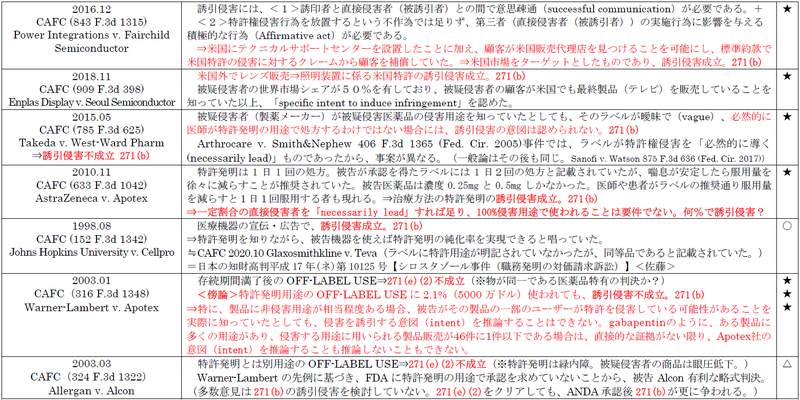
(Note) Regarding the entry “inducement established, 271(b)” in the first row of the figure above (Power Integrations v. Fairchild Semiconductor), the CAFC vacated the jury’s inducement verdict under 35 U.S.C. § 271(b) and remanded because the jury instructions were erroneous (see the table below).
(Editor’s transcription and correction of the figure above)
U.S. inducement decisions
| Case | Holding and comparison | Note |
|---|---|---|
|
2016.12
CAFC, 843 F.3d 1315 Power Integrations v. Fairchild Semiconductor |
Inducement requires successful communication from the inducer to the direct infringer and affirmative conduct that leads to direct infringement; merely allowing infringement to occur is insufficient. Evidence of a U.S. technical support center, assistance in locating U.S. distributors, and indemnification against U.S. patent infringement claims could support a finding of intent to induce infringement in the U.S. market. The CAFC nevertheless vacated the inducement verdict under 35 U.S.C. § 271(b) and remanded because the jury instructions were erroneous. | ★ |
|
2018.11
CAFC, 909 F.3d 398 Enplas Display Device v. Seoul Semiconductor |
The court upheld induced infringement under § 271(b) involving lighting devices in the United States that incorporated lenses sold abroad. The evidence included an approximately 50% worldwide market share, knowledge that customers sold the finished televisions in the United States, prior joint development with the patentee, notice identifying infringing products found in the United States, and product specifications recommending infringing configurations to customers. Taken together, the evidence supported a finding of specific intent to induce infringement. | ★ |
|
2015.05
CAFC, 785 F.3d 625 Takeda Pharmaceuticals v. West-Ward Pharmaceutical |
At the preliminary injunction stage, the court affirmed denial of relief because Takeda had not shown a likelihood of success on induced infringement. Knowledge of an infringing use does not necessarily establish intent where ambiguous labeling does not necessarily lead physicians to prescribe the drug for the patented use. The court distinguished the instructions and other evidence in ArthroCare v. Smith & Nephew, 406 F.3d 1365 (Fed. Cir. 2005). (The general rule has remained the same since; see Sanofi v. Watson, 875 F.3d 636 (Fed. Cir. 2017).) | ★ |
|
2010.11
CAFC, 633 F.3d 1042 AstraZeneca v. Apotex |
The patent concerned once-daily inhalation. The approved label specified twice-daily administration but also directed gradual reduction to the lowest effective dose once asthma was stable. The product was available only in strengths of 0.25 mg and 0.5 mg per 2 mL vial. Following the titration instructions would necessarily lead some patients to once-daily administration. The CAFC affirmed a preliminary injunction based on a likelihood of success on induced infringement. ⇒ It suffices that a certain proportion of direct infringers are “necessarily led” to infringe; use for the infringing purpose in 100% of cases is not required. At what percentage is inducement established? | ★ |
|
1998.08
CAFC, 152 F.3d 1342 Johns Hopkins University v. CellPro |
The court upheld induced infringement under § 271(b) based on promotion and advertising of a medical device, including statements, made with knowledge of the patent, that the device could achieve the patented purity level. Comparison: the 2020 GlaxoSmithKline v. Teva opinion was replaced by the 2021 panel rehearing opinion. The latter sustained the jury’s finding that the partial label still included a patented use and that the carve-out was incomplete, considering the label’s specific language together with promotional statements of equivalence to the brand-name drug and other evidence in sustaining the inducement verdict. ≈ Japan: IP High Court, 2005 (Ne) No. 10125 [Cilostazol case (action for compensation for an employee invention)] <Sato> | ○ |
|
2003.01
CAFC, 316 F.3d 1348 Warner-Lambert v. Apotex |
The patents covering the compound and its approved use for epilepsy had expired, while a patent on a different, unapproved use for neurodegenerative diseases remained in force. Because the ANDA sought approval for an unpatented, approved use, the court found no infringement under § 271(e)(2). (* Is this a ruling specific to pharmaceuticals involving the same product?)
In dicta, the court explained that the plaintiff’s asserted 2.1% rate of off-label use for the patented indication (estimated by the plaintiff at $50 million) did not by itself establish intent to induce infringement under § 271(b). Where substantial noninfringing uses existed and fewer than one in 46 sales were for an infringing use, knowledge that some users might infringe was insufficient. On the record before it, the court could neither infer nor reject an inference of intent from that proportion alone without direct evidence. |
★
★ ★ |
|
2003.03
CAFC, 324 F.3d 1322 Allergan v. Alcon |
The approved use was reduction of intraocular pressure; the patented, unapproved use was optic-nerve protection or neuroprotection. Applying Warner-Lambert, the court held that § 271(e)(2) was not infringed because Alcon did not seek FDA approval for the patented use. The majority did not decide liability for inducement under § 271(b). The absence of § 271(e)(2) liability from filing the ANDA does not rule out a later § 271(b) claim based on actual post-approval conduct. | △ |
[Article / United States] Trends in U.S. Induced-Infringement Decisions and Points to Note in Practice (Intellectual Property Management, November 2023)
Original Ameblo publication: 2024-01-14
Ameblo: https://ameblo.jp/hideki-takaishi/entry-12836524035.html
[Article / United States] Trends in U.S. Induced-Infringement Decisions and Points to Note in Practice (Intellectual Property Management, Vol. 73, No. 11, 2023)
Communication between the inducer and direct infringer + affirmative conduct are required.
In Takeda v. West-Ward, the labeling and other evidence did not establish an intent to induce use for the patented indication, and the likelihood of success on the merits of induced infringement required for a preliminary injunction was not established.
Sales of components outside the United States can constitute induced infringement of a U.S. patent.
Willful blindness
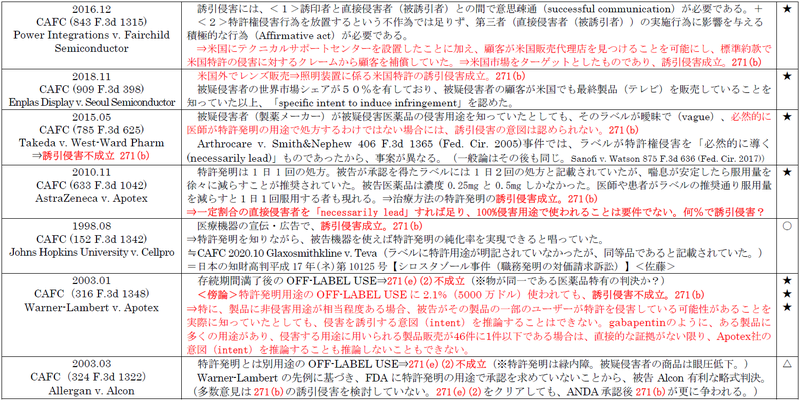
(Note) Regarding the entry “inducement established, 271(b)” in the first row of the figure above (Power Integrations v. Fairchild Semiconductor), the CAFC vacated the jury’s inducement verdict under 35 U.S.C. § 271(b) and remanded because the jury instructions were erroneous (see the table below).
(Editor’s transcription and correction of the figure above)
U.S. inducement decisions
| Case | Holding and comparison | Note |
|---|---|---|
|
2016.12
CAFC, 843 F.3d 1315 Power Integrations v. Fairchild Semiconductor |
Inducement requires successful communication from the inducer to the direct infringer and affirmative conduct that leads to direct infringement; merely allowing infringement to occur is insufficient. Evidence of a U.S. technical support center, assistance in locating U.S. distributors, and indemnification against U.S. patent infringement claims could support a finding of intent to induce infringement in the U.S. market. The CAFC nevertheless vacated the inducement verdict under 35 U.S.C. § 271(b) and remanded because the jury instructions were erroneous. | ★ |
|
2018.11
CAFC, 909 F.3d 398 Enplas Display Device v. Seoul Semiconductor |
The court upheld induced infringement under § 271(b) involving lighting devices in the United States that incorporated lenses sold abroad. The evidence included an approximately 50% worldwide market share, knowledge that customers sold the finished televisions in the United States, prior joint development with the patentee, notice identifying infringing products found in the United States, and product specifications recommending infringing configurations to customers. Taken together, the evidence supported a finding of specific intent to induce infringement. | ★ |
|
2015.05
CAFC, 785 F.3d 625 Takeda Pharmaceuticals v. West-Ward Pharmaceutical |
At the preliminary injunction stage, the court affirmed denial of relief because Takeda had not shown a likelihood of success on induced infringement. Knowledge of an infringing use does not necessarily establish intent where ambiguous labeling does not necessarily lead physicians to prescribe the drug for the patented use. The court distinguished the instructions and other evidence in ArthroCare v. Smith & Nephew, 406 F.3d 1365 (Fed. Cir. 2005). (The general rule has remained the same since; see Sanofi v. Watson, 875 F.3d 636 (Fed. Cir. 2017).) | ★ |
|
2010.11
CAFC, 633 F.3d 1042 AstraZeneca v. Apotex |
The patent concerned once-daily inhalation. The approved label specified twice-daily administration but also directed gradual reduction to the lowest effective dose once asthma was stable. The product was available only in strengths of 0.25 mg and 0.5 mg per 2 mL vial. Following the titration instructions would necessarily lead some patients to once-daily administration. The CAFC affirmed a preliminary injunction based on a likelihood of success on induced infringement. ⇒ It suffices that a certain proportion of direct infringers are “necessarily led” to infringe; use for the infringing purpose in 100% of cases is not required. At what percentage is inducement established? | ★ |
|
1998.08
CAFC, 152 F.3d 1342 Johns Hopkins University v. CellPro |
The court upheld induced infringement under § 271(b) based on promotion and advertising of a medical device, including statements, made with knowledge of the patent, that the device could achieve the patented purity level. Comparison: the 2020 GlaxoSmithKline v. Teva opinion was replaced by the 2021 panel rehearing opinion. The latter sustained the jury’s finding that the partial label still included a patented use and that the carve-out was incomplete, considering the label’s specific language together with promotional statements of equivalence to the brand-name drug and other evidence in sustaining the inducement verdict. ≈ Japan: IP High Court, 2005 (Ne) No. 10125 [Cilostazol case (action for compensation for an employee invention)] <Sato> | ○ |
|
2003.01
CAFC, 316 F.3d 1348 Warner-Lambert v. Apotex |
The patents covering the compound and its approved use for epilepsy had expired, while a patent on a different, unapproved use for neurodegenerative diseases remained in force. Because the ANDA sought approval for an unpatented, approved use, the court found no infringement under § 271(e)(2). (* Is this a ruling specific to pharmaceuticals involving the same product?)
In dicta, the court explained that the plaintiff’s asserted 2.1% rate of off-label use for the patented indication (estimated by the plaintiff at $50 million) did not by itself establish intent to induce infringement under § 271(b). Where substantial noninfringing uses existed and fewer than one in 46 sales were for an infringing use, knowledge that some users might infringe was insufficient. On the record before it, the court could neither infer nor reject an inference of intent from that proportion alone without direct evidence. |
★
★ ★ |
|
2003.03
CAFC, 324 F.3d 1322 Allergan v. Alcon |
The approved use was reduction of intraocular pressure; the patented, unapproved use was optic-nerve protection or neuroprotection. Applying Warner-Lambert, the court held that § 271(e)(2) was not infringed because Alcon did not seek FDA approval for the patented use. The majority did not decide liability for inducement under § 271(b). The absence of § 271(e)(2) liability from filing the ANDA does not rule out a later § 271(b) claim based on actual post-approval conduct. | △ |
[U.S. Patents] Enplas Display v. Seoul Semiconductor, 909 F.3d 398 (CAFC, November 2018)
Original Ameblo publication: 2024-01-15
Ameblo: https://ameblo.jp/hideki-takaishi/entry-12836652957.html
[U.S. Patents] Enplas Display v. Seoul Semiconductor, 909 F.3d 398 (CAFC, November 2018)
Lenses sold outside the United States
⇒ Induced infringement of a U.S. patent concerning a lighting device established
The alleged infringer had a 50% global market share and knew that its customers also sold the finished products in the United States. Evidence that it supplied customers with product specifications recommending infringing configurations also supported the finding.
⇒ Specific intent found!!
https://law.justia.com/cases/federal/appellate-courts/cafc/16-2599/16-2599-2018-11-19.html
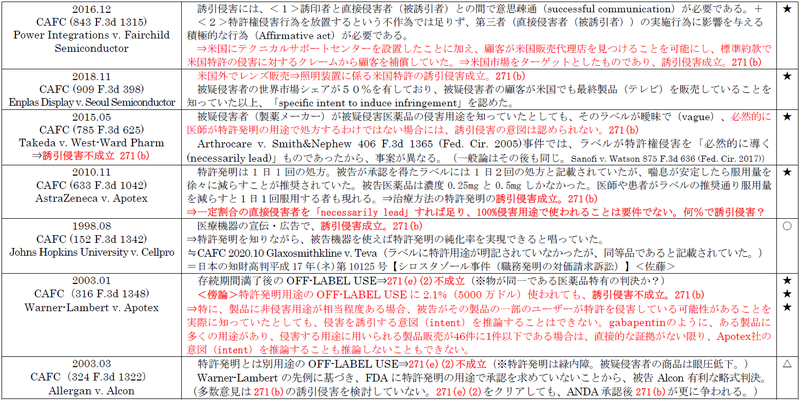
(Note) Regarding the entry “inducement established, 271(b)” in the first row of the figure above (Power Integrations v. Fairchild Semiconductor), the CAFC vacated the jury’s inducement verdict under 35 U.S.C. § 271(b) and remanded because the jury instructions were erroneous (see the table below).
(Editor’s transcription and correction of the figure above)
U.S. inducement decisions
| Case | Holding and comparison | Note |
|---|---|---|
|
2016.12
CAFC, 843 F.3d 1315 Power Integrations v. Fairchild Semiconductor |
Inducement requires successful communication from the inducer to the direct infringer and affirmative conduct that leads to direct infringement; merely allowing infringement to occur is insufficient. Evidence of a U.S. technical support center, assistance in locating U.S. distributors, and indemnification against U.S. patent infringement claims could support a finding of intent to induce infringement in the U.S. market. The CAFC nevertheless vacated the inducement verdict under 35 U.S.C. § 271(b) and remanded because the jury instructions were erroneous. | ★ |
|
2018.11
CAFC, 909 F.3d 398 Enplas Display Device v. Seoul Semiconductor |
The court upheld induced infringement under § 271(b) involving lighting devices in the United States that incorporated lenses sold abroad. The evidence included an approximately 50% worldwide market share, knowledge that customers sold the finished televisions in the United States, prior joint development with the patentee, notice identifying infringing products found in the United States, and product specifications recommending infringing configurations to customers. Taken together, the evidence supported a finding of specific intent to induce infringement. | ★ |
|
2015.05
CAFC, 785 F.3d 625 Takeda Pharmaceuticals v. West-Ward Pharmaceutical |
At the preliminary injunction stage, the court affirmed denial of relief because Takeda had not shown a likelihood of success on induced infringement. Knowledge of an infringing use does not necessarily establish intent where ambiguous labeling does not necessarily lead physicians to prescribe the drug for the patented use. The court distinguished the instructions and other evidence in ArthroCare v. Smith & Nephew, 406 F.3d 1365 (Fed. Cir. 2005). (The general rule has remained the same since; see Sanofi v. Watson, 875 F.3d 636 (Fed. Cir. 2017).) | ★ |
|
2010.11
CAFC, 633 F.3d 1042 AstraZeneca v. Apotex |
The patent concerned once-daily inhalation. The approved label specified twice-daily administration but also directed gradual reduction to the lowest effective dose once asthma was stable. The product was available only in strengths of 0.25 mg and 0.5 mg per 2 mL vial. Following the titration instructions would necessarily lead some patients to once-daily administration. The CAFC affirmed a preliminary injunction based on a likelihood of success on induced infringement. ⇒ It suffices that a certain proportion of direct infringers are “necessarily led” to infringe; use for the infringing purpose in 100% of cases is not required. At what percentage is inducement established? | ★ |
|
1998.08
CAFC, 152 F.3d 1342 Johns Hopkins University v. CellPro |
The court upheld induced infringement under § 271(b) based on promotion and advertising of a medical device, including statements, made with knowledge of the patent, that the device could achieve the patented purity level. Comparison: the 2020 GlaxoSmithKline v. Teva opinion was replaced by the 2021 panel rehearing opinion. The latter sustained the jury’s finding that the partial label still included a patented use and that the carve-out was incomplete, considering the label’s specific language together with promotional statements of equivalence to the brand-name drug and other evidence in sustaining the inducement verdict. ≈ Japan: IP High Court, 2005 (Ne) No. 10125 [Cilostazol case (action for compensation for an employee invention)] <Sato> | ○ |
|
2003.01
CAFC, 316 F.3d 1348 Warner-Lambert v. Apotex |
The patents covering the compound and its approved use for epilepsy had expired, while a patent on a different, unapproved use for neurodegenerative diseases remained in force. Because the ANDA sought approval for an unpatented, approved use, the court found no infringement under § 271(e)(2). (* Is this a ruling specific to pharmaceuticals involving the same product?)
In dicta, the court explained that the plaintiff’s asserted 2.1% rate of off-label use for the patented indication (estimated by the plaintiff at $50 million) did not by itself establish intent to induce infringement under § 271(b). Where substantial noninfringing uses existed and fewer than one in 46 sales were for an infringing use, knowledge that some users might infringe was insufficient. On the record before it, the court could neither infer nor reject an inference of intent from that proportion alone without direct evidence. |
★
★ ★ |
|
2003.03
CAFC, 324 F.3d 1322 Allergan v. Alcon |
The approved use was reduction of intraocular pressure; the patented, unapproved use was optic-nerve protection or neuroprotection. Applying Warner-Lambert, the court held that § 271(e)(2) was not infringed because Alcon did not seek FDA approval for the patented use. The majority did not decide liability for inducement under § 271(b). The absence of § 271(e)(2) liability from filing the ANDA does not rule out a later § 271(b) claim based on actual post-approval conduct. | △ |
[U.S. Patents] Power Integrations v. Fairchild, 843 F.3d 1315 (CAFC, December 2016)
Original Ameblo publication: 2024-01-16
Ameblo: https://ameblo.jp/hideki-takaishi/entry-12836775574.html
[U.S. Patents] Power Integrations v. Fairchild, 843 F.3d 1315 (CAFC, December 2016)
For induced infringement to be established,
① Successful communication between the inducer and the direct infringer is required
+
② Mere inaction in allowing patent infringement to continue is insufficient; an affirmative act affecting the acts of practicing the invention is required.
https://www.cafc.uscourts.gov/opinions-orders/15-1329.opinion.12-8-2016.1.pdf
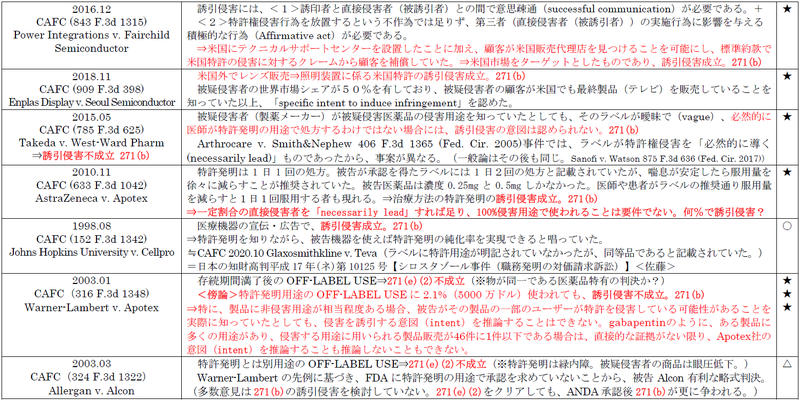
(Note) Regarding the entry “inducement established, 271(b)” in the first row of the figure above (Power Integrations v. Fairchild Semiconductor), the CAFC vacated the jury’s inducement verdict under 35 U.S.C. § 271(b) and remanded because the jury instructions were erroneous (see the table below).
(Editor’s transcription and correction of the figure above)
U.S. inducement decisions
| Case | Holding and comparison | Note |
|---|---|---|
|
2016.12
CAFC, 843 F.3d 1315 Power Integrations v. Fairchild Semiconductor |
Inducement requires successful communication from the inducer to the direct infringer and affirmative conduct that leads to direct infringement; merely allowing infringement to occur is insufficient. Evidence of a U.S. technical support center, assistance in locating U.S. distributors, and indemnification against U.S. patent infringement claims could support a finding of intent to induce infringement in the U.S. market. The CAFC nevertheless vacated the inducement verdict under 35 U.S.C. § 271(b) and remanded because the jury instructions were erroneous. | ★ |
|
2018.11
CAFC, 909 F.3d 398 Enplas Display Device v. Seoul Semiconductor |
The court upheld induced infringement under § 271(b) involving lighting devices in the United States that incorporated lenses sold abroad. The evidence included an approximately 50% worldwide market share, knowledge that customers sold the finished televisions in the United States, prior joint development with the patentee, notice identifying infringing products found in the United States, and product specifications recommending infringing configurations to customers. Taken together, the evidence supported a finding of specific intent to induce infringement. | ★ |
|
2015.05
CAFC, 785 F.3d 625 Takeda Pharmaceuticals v. West-Ward Pharmaceutical |
At the preliminary injunction stage, the court affirmed denial of relief because Takeda had not shown a likelihood of success on induced infringement. Knowledge of an infringing use does not necessarily establish intent where ambiguous labeling does not necessarily lead physicians to prescribe the drug for the patented use. The court distinguished the instructions and other evidence in ArthroCare v. Smith & Nephew, 406 F.3d 1365 (Fed. Cir. 2005). (The general rule has remained the same since; see Sanofi v. Watson, 875 F.3d 636 (Fed. Cir. 2017).) | ★ |
|
2010.11
CAFC, 633 F.3d 1042 AstraZeneca v. Apotex |
The patent concerned once-daily inhalation. The approved label specified twice-daily administration but also directed gradual reduction to the lowest effective dose once asthma was stable. The product was available only in strengths of 0.25 mg and 0.5 mg per 2 mL vial. Following the titration instructions would necessarily lead some patients to once-daily administration. The CAFC affirmed a preliminary injunction based on a likelihood of success on induced infringement. ⇒ It suffices that a certain proportion of direct infringers are “necessarily led” to infringe; use for the infringing purpose in 100% of cases is not required. At what percentage is inducement established? | ★ |
|
1998.08
CAFC, 152 F.3d 1342 Johns Hopkins University v. CellPro |
The court upheld induced infringement under § 271(b) based on promotion and advertising of a medical device, including statements, made with knowledge of the patent, that the device could achieve the patented purity level. Comparison: the 2020 GlaxoSmithKline v. Teva opinion was replaced by the 2021 panel rehearing opinion. The latter sustained the jury’s finding that the partial label still included a patented use and that the carve-out was incomplete, considering the label’s specific language together with promotional statements of equivalence to the brand-name drug and other evidence in sustaining the inducement verdict. ≈ Japan: IP High Court, 2005 (Ne) No. 10125 [Cilostazol case (action for compensation for an employee invention)] <Sato> | ○ |
|
2003.01
CAFC, 316 F.3d 1348 Warner-Lambert v. Apotex |
The patents covering the compound and its approved use for epilepsy had expired, while a patent on a different, unapproved use for neurodegenerative diseases remained in force. Because the ANDA sought approval for an unpatented, approved use, the court found no infringement under § 271(e)(2). (* Is this a ruling specific to pharmaceuticals involving the same product?)
In dicta, the court explained that the plaintiff’s asserted 2.1% rate of off-label use for the patented indication (estimated by the plaintiff at $50 million) did not by itself establish intent to induce infringement under § 271(b). Where substantial noninfringing uses existed and fewer than one in 46 sales were for an infringing use, knowledge that some users might infringe was insufficient. On the record before it, the court could neither infer nor reject an inference of intent from that proportion alone without direct evidence. |
★
★ ★ |
|
2003.03
CAFC, 324 F.3d 1322 Allergan v. Alcon |
The approved use was reduction of intraocular pressure; the patented, unapproved use was optic-nerve protection or neuroprotection. Applying Warner-Lambert, the court held that § 271(e)(2) was not infringed because Alcon did not seek FDA approval for the patented use. The majority did not decide liability for inducement under § 271(b). The absence of § 271(e)(2) liability from filing the ANDA does not rule out a later § 271(b) claim based on actual post-approval conduct. | △ |
[U.S. Patents] Power Integrations v. Fairchild (CAFC, December 2016)
Original Ameblo publication: 2024-01-17
Ameblo: https://ameblo.jp/hideki-takaishi/entry-12836900393.html
[U.S. Patents] Power Integrations v. Fairchild (CAFC, December 2016)
① Established a technical support center in the United States.
② Enabled customers to find U.S. distributors.
③ Indemnified customers against claims of U.S. patent infringement in its standard terms.
⇒ Sales activities targeting the U.S. market were evidence from which intent to induce infringement could be found. However, the induced-infringement verdict was vacated because of an erroneous jury instruction, and the case was remanded.
https://patentlyo.com/patent/2016/12/integrations-fairchild-semiconductor.html
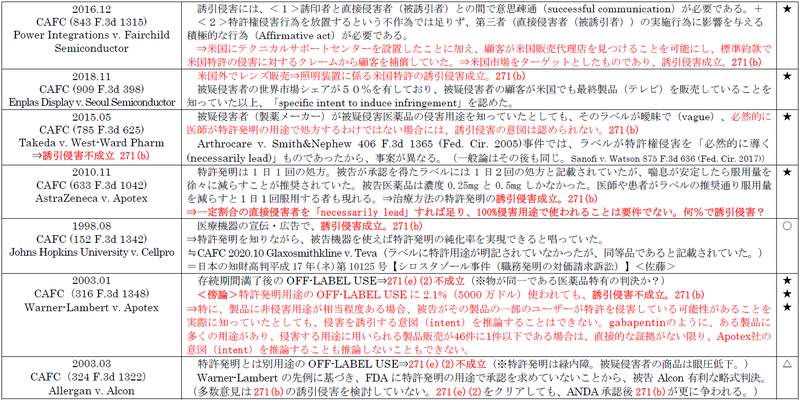
(Note) Regarding the entry “inducement established, 271(b)” in the first row of the figure above (Power Integrations v. Fairchild Semiconductor), the CAFC vacated the jury’s inducement verdict under 35 U.S.C. § 271(b) and remanded because the jury instructions were erroneous (see the table below).
(Editor’s transcription and correction of the figure above)
U.S. inducement decisions
| Case | Holding and comparison | Note |
|---|---|---|
|
2016.12
CAFC, 843 F.3d 1315 Power Integrations v. Fairchild Semiconductor |
Inducement requires successful communication from the inducer to the direct infringer and affirmative conduct that leads to direct infringement; merely allowing infringement to occur is insufficient. Evidence of a U.S. technical support center, assistance in locating U.S. distributors, and indemnification against U.S. patent infringement claims could support a finding of intent to induce infringement in the U.S. market. The CAFC nevertheless vacated the inducement verdict under 35 U.S.C. § 271(b) and remanded because the jury instructions were erroneous. | ★ |
|
2018.11
CAFC, 909 F.3d 398 Enplas Display Device v. Seoul Semiconductor |
The court upheld induced infringement under § 271(b) involving lighting devices in the United States that incorporated lenses sold abroad. The evidence included an approximately 50% worldwide market share, knowledge that customers sold the finished televisions in the United States, prior joint development with the patentee, notice identifying infringing products found in the United States, and product specifications recommending infringing configurations to customers. Taken together, the evidence supported a finding of specific intent to induce infringement. | ★ |
|
2015.05
CAFC, 785 F.3d 625 Takeda Pharmaceuticals v. West-Ward Pharmaceutical |
At the preliminary injunction stage, the court affirmed denial of relief because Takeda had not shown a likelihood of success on induced infringement. Knowledge of an infringing use does not necessarily establish intent where ambiguous labeling does not necessarily lead physicians to prescribe the drug for the patented use. The court distinguished the instructions and other evidence in ArthroCare v. Smith & Nephew, 406 F.3d 1365 (Fed. Cir. 2005). (The general rule has remained the same since; see Sanofi v. Watson, 875 F.3d 636 (Fed. Cir. 2017).) | ★ |
|
2010.11
CAFC, 633 F.3d 1042 AstraZeneca v. Apotex |
The patent concerned once-daily inhalation. The approved label specified twice-daily administration but also directed gradual reduction to the lowest effective dose once asthma was stable. The product was available only in strengths of 0.25 mg and 0.5 mg per 2 mL vial. Following the titration instructions would necessarily lead some patients to once-daily administration. The CAFC affirmed a preliminary injunction based on a likelihood of success on induced infringement. ⇒ It suffices that a certain proportion of direct infringers are “necessarily led” to infringe; use for the infringing purpose in 100% of cases is not required. At what percentage is inducement established? | ★ |
|
1998.08
CAFC, 152 F.3d 1342 Johns Hopkins University v. CellPro |
The court upheld induced infringement under § 271(b) based on promotion and advertising of a medical device, including statements, made with knowledge of the patent, that the device could achieve the patented purity level. Comparison: the 2020 GlaxoSmithKline v. Teva opinion was replaced by the 2021 panel rehearing opinion. The latter sustained the jury’s finding that the partial label still included a patented use and that the carve-out was incomplete, considering the label’s specific language together with promotional statements of equivalence to the brand-name drug and other evidence in sustaining the inducement verdict. ≈ Japan: IP High Court, 2005 (Ne) No. 10125 [Cilostazol case (action for compensation for an employee invention)] <Sato> | ○ |
|
2003.01
CAFC, 316 F.3d 1348 Warner-Lambert v. Apotex |
The patents covering the compound and its approved use for epilepsy had expired, while a patent on a different, unapproved use for neurodegenerative diseases remained in force. Because the ANDA sought approval for an unpatented, approved use, the court found no infringement under § 271(e)(2). (* Is this a ruling specific to pharmaceuticals involving the same product?)
In dicta, the court explained that the plaintiff’s asserted 2.1% rate of off-label use for the patented indication (estimated by the plaintiff at $50 million) did not by itself establish intent to induce infringement under § 271(b). Where substantial noninfringing uses existed and fewer than one in 46 sales were for an infringing use, knowledge that some users might infringe was insufficient. On the record before it, the court could neither infer nor reject an inference of intent from that proportion alone without direct evidence. |
★
★ ★ |
|
2003.03
CAFC, 324 F.3d 1322 Allergan v. Alcon |
The approved use was reduction of intraocular pressure; the patented, unapproved use was optic-nerve protection or neuroprotection. Applying Warner-Lambert, the court held that § 271(e)(2) was not infringed because Alcon did not seek FDA approval for the patented use. The majority did not decide liability for inducement under § 271(b). The absence of § 271(e)(2) liability from filing the ANDA does not rule out a later § 271(b) claim based on actual post-approval conduct. | △ |
[United States] Takeda v. West-Ward, 785 F.3d 625 (CAFC 2015)
Original Ameblo publication: 2024-01-18
Ameblo: https://ameblo.jp/hideki-takaishi/entry-12837091724.html
[United States] Takeda v. West-Ward, 785 F.3d 625 (CAFC 2015)
In this case, the labeling and other evidence did not establish an intent to induce use for the patented indication, and the likelihood of success on the merits of induced infringement required for a preliminary injunction was not established.
Cf. The Arthrocare case (CAFC 2005) involved ‘necessarily lead.’
https://www.finnegan.com/a/web/2896/2G4ikc/15-1139-05-06-15.pdf
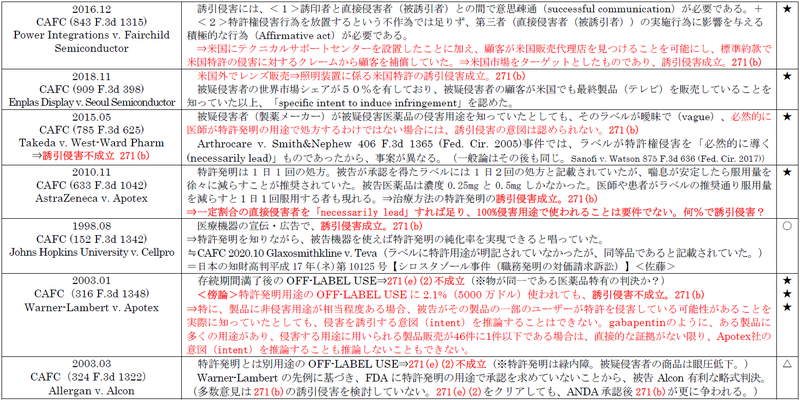
(Note) Regarding the entry “inducement established, 271(b)” in the first row of the figure above (Power Integrations v. Fairchild Semiconductor), the CAFC vacated the jury’s inducement verdict under 35 U.S.C. § 271(b) and remanded because the jury instructions were erroneous (see the table below).
(Editor’s transcription and correction of the figure above)
U.S. inducement decisions
| Case | Holding and comparison | Note |
|---|---|---|
|
2016.12
CAFC, 843 F.3d 1315 Power Integrations v. Fairchild Semiconductor |
Inducement requires successful communication from the inducer to the direct infringer and affirmative conduct that leads to direct infringement; merely allowing infringement to occur is insufficient. Evidence of a U.S. technical support center, assistance in locating U.S. distributors, and indemnification against U.S. patent infringement claims could support a finding of intent to induce infringement in the U.S. market. The CAFC nevertheless vacated the inducement verdict under 35 U.S.C. § 271(b) and remanded because the jury instructions were erroneous. | ★ |
|
2018.11
CAFC, 909 F.3d 398 Enplas Display Device v. Seoul Semiconductor |
The court upheld induced infringement under § 271(b) involving lighting devices in the United States that incorporated lenses sold abroad. The evidence included an approximately 50% worldwide market share, knowledge that customers sold the finished televisions in the United States, prior joint development with the patentee, notice identifying infringing products found in the United States, and product specifications recommending infringing configurations to customers. Taken together, the evidence supported a finding of specific intent to induce infringement. | ★ |
|
2015.05
CAFC, 785 F.3d 625 Takeda Pharmaceuticals v. West-Ward Pharmaceutical |
At the preliminary injunction stage, the court affirmed denial of relief because Takeda had not shown a likelihood of success on induced infringement. Knowledge of an infringing use does not necessarily establish intent where ambiguous labeling does not necessarily lead physicians to prescribe the drug for the patented use. The court distinguished the instructions and other evidence in ArthroCare v. Smith & Nephew, 406 F.3d 1365 (Fed. Cir. 2005). (The general rule has remained the same since; see Sanofi v. Watson, 875 F.3d 636 (Fed. Cir. 2017).) | ★ |
|
2010.11
CAFC, 633 F.3d 1042 AstraZeneca v. Apotex |
The patent concerned once-daily inhalation. The approved label specified twice-daily administration but also directed gradual reduction to the lowest effective dose once asthma was stable. The product was available only in strengths of 0.25 mg and 0.5 mg per 2 mL vial. Following the titration instructions would necessarily lead some patients to once-daily administration. The CAFC affirmed a preliminary injunction based on a likelihood of success on induced infringement. ⇒ It suffices that a certain proportion of direct infringers are “necessarily led” to infringe; use for the infringing purpose in 100% of cases is not required. At what percentage is inducement established? | ★ |
|
1998.08
CAFC, 152 F.3d 1342 Johns Hopkins University v. CellPro |
The court upheld induced infringement under § 271(b) based on promotion and advertising of a medical device, including statements, made with knowledge of the patent, that the device could achieve the patented purity level. Comparison: the 2020 GlaxoSmithKline v. Teva opinion was replaced by the 2021 panel rehearing opinion. The latter sustained the jury’s finding that the partial label still included a patented use and that the carve-out was incomplete, considering the label’s specific language together with promotional statements of equivalence to the brand-name drug and other evidence in sustaining the inducement verdict. ≈ Japan: IP High Court, 2005 (Ne) No. 10125 [Cilostazol case (action for compensation for an employee invention)] <Sato> | ○ |
|
2003.01
CAFC, 316 F.3d 1348 Warner-Lambert v. Apotex |
The patents covering the compound and its approved use for epilepsy had expired, while a patent on a different, unapproved use for neurodegenerative diseases remained in force. Because the ANDA sought approval for an unpatented, approved use, the court found no infringement under § 271(e)(2). (* Is this a ruling specific to pharmaceuticals involving the same product?)
In dicta, the court explained that the plaintiff’s asserted 2.1% rate of off-label use for the patented indication (estimated by the plaintiff at $50 million) did not by itself establish intent to induce infringement under § 271(b). Where substantial noninfringing uses existed and fewer than one in 46 sales were for an infringing use, knowledge that some users might infringe was insufficient. On the record before it, the court could neither infer nor reject an inference of intent from that proportion alone without direct evidence. |
★
★ ★ |
|
2003.03
CAFC, 324 F.3d 1322 Allergan v. Alcon |
The approved use was reduction of intraocular pressure; the patented, unapproved use was optic-nerve protection or neuroprotection. Applying Warner-Lambert, the court held that § 271(e)(2) was not infringed because Alcon did not seek FDA approval for the patented use. The majority did not decide liability for inducement under § 271(b). The absence of § 271(e)(2) liability from filing the ANDA does not rule out a later § 271(b) claim based on actual post-approval conduct. | △ |
[United States] 2010 CAFC (633 F.3d 1042) AstraZeneca v. Apotex
Original Ameblo publication: 2024-01-19
Ameblo: https://ameblo.jp/hideki-takaishi/entry-12837155552.html
[United States] 2010 CAFC (633 F.3d 1042) AstraZeneca v. Apotex
Preliminary injunction affirmed based on a likelihood of success on induced infringement (treatment method)
Cf. Takeda v. West-Ward, 785 F.3d 625 (CAFC 2015)
The patented invention called for once-daily dosing.
The defendant’s label stated twice daily, but recommended gradual dose reduction.
The defendant’s drug was available in only two strengths: 0.25 mg and 0.5 mg per 2 mL vial.
If physicians or patients reduced the dose administered by inhalation in accordance with the label’s recommendation, some patients would receive the drug by inhalation once daily.
https://www.cafc.uscourts.gov/opinions-orders/09-1381-1424.pdf
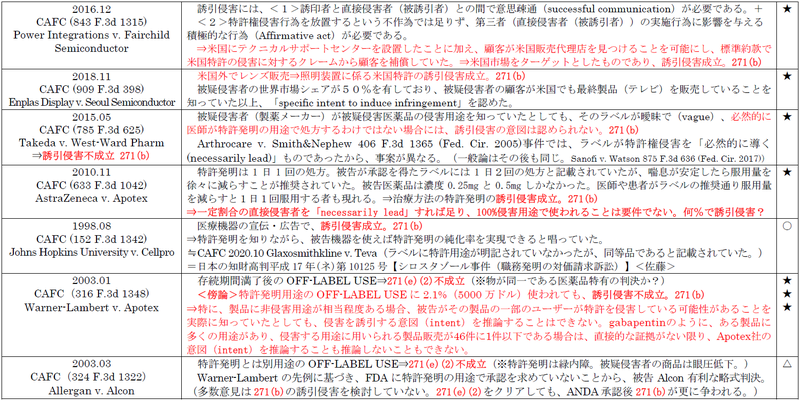
(Note) Regarding the entry “inducement established, 271(b)” in the first row of the figure above (Power Integrations v. Fairchild Semiconductor), the CAFC vacated the jury’s inducement verdict under 35 U.S.C. § 271(b) and remanded because the jury instructions were erroneous (see the table below).
(Editor’s transcription and correction of the figure above)
U.S. inducement decisions
| Case | Holding and comparison | Note |
|---|---|---|
|
2016.12
CAFC, 843 F.3d 1315 Power Integrations v. Fairchild Semiconductor |
Inducement requires successful communication from the inducer to the direct infringer and affirmative conduct that leads to direct infringement; merely allowing infringement to occur is insufficient. Evidence of a U.S. technical support center, assistance in locating U.S. distributors, and indemnification against U.S. patent infringement claims could support a finding of intent to induce infringement in the U.S. market. The CAFC nevertheless vacated the inducement verdict under 35 U.S.C. § 271(b) and remanded because the jury instructions were erroneous. | ★ |
|
2018.11
CAFC, 909 F.3d 398 Enplas Display Device v. Seoul Semiconductor |
The court upheld induced infringement under § 271(b) involving lighting devices in the United States that incorporated lenses sold abroad. The evidence included an approximately 50% worldwide market share, knowledge that customers sold the finished televisions in the United States, prior joint development with the patentee, notice identifying infringing products found in the United States, and product specifications recommending infringing configurations to customers. Taken together, the evidence supported a finding of specific intent to induce infringement. | ★ |
|
2015.05
CAFC, 785 F.3d 625 Takeda Pharmaceuticals v. West-Ward Pharmaceutical |
At the preliminary injunction stage, the court affirmed denial of relief because Takeda had not shown a likelihood of success on induced infringement. Knowledge of an infringing use does not necessarily establish intent where ambiguous labeling does not necessarily lead physicians to prescribe the drug for the patented use. The court distinguished the instructions and other evidence in ArthroCare v. Smith & Nephew, 406 F.3d 1365 (Fed. Cir. 2005). (The general rule has remained the same since; see Sanofi v. Watson, 875 F.3d 636 (Fed. Cir. 2017).) | ★ |
|
2010.11
CAFC, 633 F.3d 1042 AstraZeneca v. Apotex |
The patent concerned once-daily inhalation. The approved label specified twice-daily administration but also directed gradual reduction to the lowest effective dose once asthma was stable. The product was available only in strengths of 0.25 mg and 0.5 mg per 2 mL vial. Following the titration instructions would necessarily lead some patients to once-daily administration. The CAFC affirmed a preliminary injunction based on a likelihood of success on induced infringement. ⇒ It suffices that a certain proportion of direct infringers are “necessarily led” to infringe; use for the infringing purpose in 100% of cases is not required. At what percentage is inducement established? | ★ |
|
1998.08
CAFC, 152 F.3d 1342 Johns Hopkins University v. CellPro |
The court upheld induced infringement under § 271(b) based on promotion and advertising of a medical device, including statements, made with knowledge of the patent, that the device could achieve the patented purity level. Comparison: the 2020 GlaxoSmithKline v. Teva opinion was replaced by the 2021 panel rehearing opinion. The latter sustained the jury’s finding that the partial label still included a patented use and that the carve-out was incomplete, considering the label’s specific language together with promotional statements of equivalence to the brand-name drug and other evidence in sustaining the inducement verdict. ≈ Japan: IP High Court, 2005 (Ne) No. 10125 [Cilostazol case (action for compensation for an employee invention)] <Sato> | ○ |
|
2003.01
CAFC, 316 F.3d 1348 Warner-Lambert v. Apotex |
The patents covering the compound and its approved use for epilepsy had expired, while a patent on a different, unapproved use for neurodegenerative diseases remained in force. Because the ANDA sought approval for an unpatented, approved use, the court found no infringement under § 271(e)(2). (* Is this a ruling specific to pharmaceuticals involving the same product?)
In dicta, the court explained that the plaintiff’s asserted 2.1% rate of off-label use for the patented indication (estimated by the plaintiff at $50 million) did not by itself establish intent to induce infringement under § 271(b). Where substantial noninfringing uses existed and fewer than one in 46 sales were for an infringing use, knowledge that some users might infringe was insufficient. On the record before it, the court could neither infer nor reject an inference of intent from that proportion alone without direct evidence. |
★
★ ★ |
|
2003.03
CAFC, 324 F.3d 1322 Allergan v. Alcon |
The approved use was reduction of intraocular pressure; the patented, unapproved use was optic-nerve protection or neuroprotection. Applying Warner-Lambert, the court held that § 271(e)(2) was not infringed because Alcon did not seek FDA approval for the patented use. The majority did not decide liability for inducement under § 271(b). The absence of § 271(e)(2) liability from filing the ANDA does not rule out a later § 271(b) claim based on actual post-approval conduct. | △ |
[United States] 1998 CAFC (152 F.3d 1342) Johns Hopkins University v. Cellpro
Original Ameblo publication: 2024-01-21
Ameblo: https://ameblo.jp/hideki-takaishi/entry-12837407942.html
[United States] 1998 CAFC (152 F.3d 1342) Johns Hopkins University v. Cellpro
Induced infringement established through promotion and advertising of a medical device.
Knowing of the patented invention, the defendant claimed that use of its device could achieve the purity level of the patented invention.
≈ CAFC 2021, GlaxoSmithKline v. Teva (panel rehearing decision: the attempted carve-out was incomplete, leaving a patented use on the label; the court sustained the inducement verdict based on the label and promotional materials, including statements of equivalence).
https://law.justia.com/cases/federal/appellate-courts/F3/152/1342/543785/
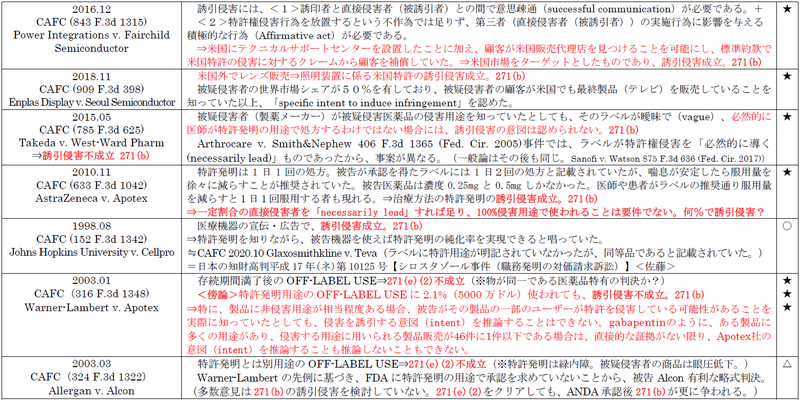
(Note) Regarding the entry “inducement established, 271(b)” in the first row of the figure above (Power Integrations v. Fairchild Semiconductor), the CAFC vacated the jury’s inducement verdict under 35 U.S.C. § 271(b) and remanded because the jury instructions were erroneous (see the table below).
(Editor’s transcription and correction of the figure above)
U.S. inducement decisions
| Case | Holding and comparison | Note |
|---|---|---|
|
2016.12
CAFC, 843 F.3d 1315 Power Integrations v. Fairchild Semiconductor |
Inducement requires successful communication from the inducer to the direct infringer and affirmative conduct that leads to direct infringement; merely allowing infringement to occur is insufficient. Evidence of a U.S. technical support center, assistance in locating U.S. distributors, and indemnification against U.S. patent infringement claims could support a finding of intent to induce infringement in the U.S. market. The CAFC nevertheless vacated the inducement verdict under 35 U.S.C. § 271(b) and remanded because the jury instructions were erroneous. | ★ |
|
2018.11
CAFC, 909 F.3d 398 Enplas Display Device v. Seoul Semiconductor |
The court upheld induced infringement under § 271(b) involving lighting devices in the United States that incorporated lenses sold abroad. The evidence included an approximately 50% worldwide market share, knowledge that customers sold the finished televisions in the United States, prior joint development with the patentee, notice identifying infringing products found in the United States, and product specifications recommending infringing configurations to customers. Taken together, the evidence supported a finding of specific intent to induce infringement. | ★ |
|
2015.05
CAFC, 785 F.3d 625 Takeda Pharmaceuticals v. West-Ward Pharmaceutical |
At the preliminary injunction stage, the court affirmed denial of relief because Takeda had not shown a likelihood of success on induced infringement. Knowledge of an infringing use does not necessarily establish intent where ambiguous labeling does not necessarily lead physicians to prescribe the drug for the patented use. The court distinguished the instructions and other evidence in ArthroCare v. Smith & Nephew, 406 F.3d 1365 (Fed. Cir. 2005). (The general rule has remained the same since; see Sanofi v. Watson, 875 F.3d 636 (Fed. Cir. 2017).) | ★ |
|
2010.11
CAFC, 633 F.3d 1042 AstraZeneca v. Apotex |
The patent concerned once-daily inhalation. The approved label specified twice-daily administration but also directed gradual reduction to the lowest effective dose once asthma was stable. The product was available only in strengths of 0.25 mg and 0.5 mg per 2 mL vial. Following the titration instructions would necessarily lead some patients to once-daily administration. The CAFC affirmed a preliminary injunction based on a likelihood of success on induced infringement. ⇒ It suffices that a certain proportion of direct infringers are “necessarily led” to infringe; use for the infringing purpose in 100% of cases is not required. At what percentage is inducement established? | ★ |
|
1998.08
CAFC, 152 F.3d 1342 Johns Hopkins University v. CellPro |
The court upheld induced infringement under § 271(b) based on promotion and advertising of a medical device, including statements, made with knowledge of the patent, that the device could achieve the patented purity level. Comparison: the 2020 GlaxoSmithKline v. Teva opinion was replaced by the 2021 panel rehearing opinion. The latter sustained the jury’s finding that the partial label still included a patented use and that the carve-out was incomplete, considering the label’s specific language together with promotional statements of equivalence to the brand-name drug and other evidence in sustaining the inducement verdict. ≈ Japan: IP High Court, 2005 (Ne) No. 10125 [Cilostazol case (action for compensation for an employee invention)] <Sato> | ○ |
|
2003.01
CAFC, 316 F.3d 1348 Warner-Lambert v. Apotex |
The patents covering the compound and its approved use for epilepsy had expired, while a patent on a different, unapproved use for neurodegenerative diseases remained in force. Because the ANDA sought approval for an unpatented, approved use, the court found no infringement under § 271(e)(2). (* Is this a ruling specific to pharmaceuticals involving the same product?)
In dicta, the court explained that the plaintiff’s asserted 2.1% rate of off-label use for the patented indication (estimated by the plaintiff at $50 million) did not by itself establish intent to induce infringement under § 271(b). Where substantial noninfringing uses existed and fewer than one in 46 sales were for an infringing use, knowledge that some users might infringe was insufficient. On the record before it, the court could neither infer nor reject an inference of intent from that proportion alone without direct evidence. |
★
★ ★ |
|
2003.03
CAFC, 324 F.3d 1322 Allergan v. Alcon |
The approved use was reduction of intraocular pressure; the patented, unapproved use was optic-nerve protection or neuroprotection. Applying Warner-Lambert, the court held that § 271(e)(2) was not infringed because Alcon did not seek FDA approval for the patented use. The majority did not decide liability for inducement under § 271(b). The absence of § 271(e)(2) liability from filing the ANDA does not rule out a later § 271(b) claim based on actual post-approval conduct. | △ |
[United States] 2003 CAFC (316 F.3d 1348) Warner v. Apotex
Original Ameblo publication: 2024-01-21
Ameblo: https://ameblo.jp/hideki-takaishi/entry-12837408488.html
[United States] 2003 CAFC (316 F.3d 1348) Warner-Lambert v. Apotex
Section 271(e)(2) infringement not established
+
<Obiter dictum> The court held that, even assuming the plaintiff’s estimate that use for the patented indication accounted for 2.1% and represented $50 million in sales was correct, that circumstance alone was insufficient to establish induced infringement for a drug that also had noninfringing uses, as in this case.
*Fewer than one in 46 sales were for the infringing use.
The determination concerned the evidence in this case and did not generally exclude proof of intent to induce infringement by circumstantial evidence.
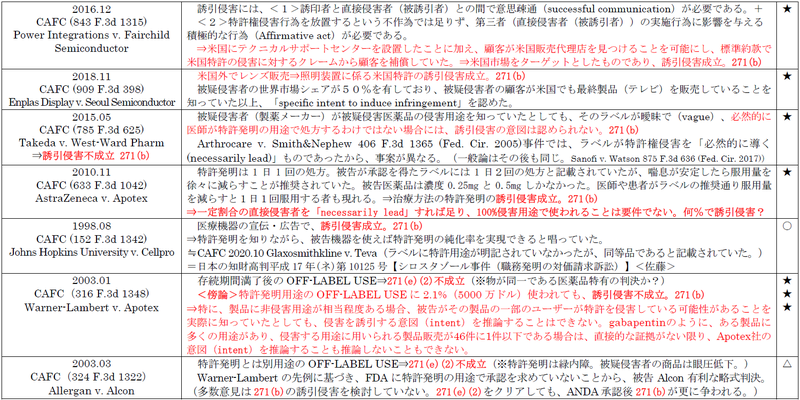
(Note) Regarding the entry “inducement established, 271(b)” in the first row of the figure above (Power Integrations v. Fairchild Semiconductor), the CAFC vacated the jury’s inducement verdict under 35 U.S.C. § 271(b) and remanded because the jury instructions were erroneous (see the table below).
(Editor’s transcription and correction of the figure above)
U.S. inducement decisions
| Case | Holding and comparison | Note |
|---|---|---|
|
2016.12
CAFC, 843 F.3d 1315 Power Integrations v. Fairchild Semiconductor |
Inducement requires successful communication from the inducer to the direct infringer and affirmative conduct that leads to direct infringement; merely allowing infringement to occur is insufficient. Evidence of a U.S. technical support center, assistance in locating U.S. distributors, and indemnification against U.S. patent infringement claims could support a finding of intent to induce infringement in the U.S. market. The CAFC nevertheless vacated the inducement verdict under 35 U.S.C. § 271(b) and remanded because the jury instructions were erroneous. | ★ |
|
2018.11
CAFC, 909 F.3d 398 Enplas Display Device v. Seoul Semiconductor |
The court upheld induced infringement under § 271(b) involving lighting devices in the United States that incorporated lenses sold abroad. The evidence included an approximately 50% worldwide market share, knowledge that customers sold the finished televisions in the United States, prior joint development with the patentee, notice identifying infringing products found in the United States, and product specifications recommending infringing configurations to customers. Taken together, the evidence supported a finding of specific intent to induce infringement. | ★ |
|
2015.05
CAFC, 785 F.3d 625 Takeda Pharmaceuticals v. West-Ward Pharmaceutical |
At the preliminary injunction stage, the court affirmed denial of relief because Takeda had not shown a likelihood of success on induced infringement. Knowledge of an infringing use does not necessarily establish intent where ambiguous labeling does not necessarily lead physicians to prescribe the drug for the patented use. The court distinguished the instructions and other evidence in ArthroCare v. Smith & Nephew, 406 F.3d 1365 (Fed. Cir. 2005). (The general rule has remained the same since; see Sanofi v. Watson, 875 F.3d 636 (Fed. Cir. 2017).) | ★ |
|
2010.11
CAFC, 633 F.3d 1042 AstraZeneca v. Apotex |
The patent concerned once-daily inhalation. The approved label specified twice-daily administration but also directed gradual reduction to the lowest effective dose once asthma was stable. The product was available only in strengths of 0.25 mg and 0.5 mg per 2 mL vial. Following the titration instructions would necessarily lead some patients to once-daily administration. The CAFC affirmed a preliminary injunction based on a likelihood of success on induced infringement. ⇒ It suffices that a certain proportion of direct infringers are “necessarily led” to infringe; use for the infringing purpose in 100% of cases is not required. At what percentage is inducement established? | ★ |
|
1998.08
CAFC, 152 F.3d 1342 Johns Hopkins University v. CellPro |
The court upheld induced infringement under § 271(b) based on promotion and advertising of a medical device, including statements, made with knowledge of the patent, that the device could achieve the patented purity level. Comparison: the 2020 GlaxoSmithKline v. Teva opinion was replaced by the 2021 panel rehearing opinion. The latter sustained the jury’s finding that the partial label still included a patented use and that the carve-out was incomplete, considering the label’s specific language together with promotional statements of equivalence to the brand-name drug and other evidence in sustaining the inducement verdict. ≈ Japan: IP High Court, 2005 (Ne) No. 10125 [Cilostazol case (action for compensation for an employee invention)] <Sato> | ○ |
|
2003.01
CAFC, 316 F.3d 1348 Warner-Lambert v. Apotex |
The patents covering the compound and its approved use for epilepsy had expired, while a patent on a different, unapproved use for neurodegenerative diseases remained in force. Because the ANDA sought approval for an unpatented, approved use, the court found no infringement under § 271(e)(2). (* Is this a ruling specific to pharmaceuticals involving the same product?)
In dicta, the court explained that the plaintiff’s asserted 2.1% rate of off-label use for the patented indication (estimated by the plaintiff at $50 million) did not by itself establish intent to induce infringement under § 271(b). Where substantial noninfringing uses existed and fewer than one in 46 sales were for an infringing use, knowledge that some users might infringe was insufficient. On the record before it, the court could neither infer nor reject an inference of intent from that proportion alone without direct evidence. |
★
★ ★ |
|
2003.03
CAFC, 324 F.3d 1322 Allergan v. Alcon |
The approved use was reduction of intraocular pressure; the patented, unapproved use was optic-nerve protection or neuroprotection. Applying Warner-Lambert, the court held that § 271(e)(2) was not infringed because Alcon did not seek FDA approval for the patented use. The majority did not decide liability for inducement under § 271(b). The absence of § 271(e)(2) liability from filing the ANDA does not rule out a later § 271(b) claim based on actual post-approval conduct. | △ |
[United States] 2003 CAFC (324 F.3d 1322) Allergan v. Alcon
Original Ameblo publication: 2024-01-22
Ameblo: https://ameblo.jp/hideki-takaishi/entry-12837545279.html
[United States] 2003 CAFC (324 F.3d 1322) Allergan v. Alcon
The approved use was lowering intraocular pressure, whereas the patented uses—optic-nerve protection and neural protection—were unapproved uses (OFF-LABEL USE).
⇒ Section 271(e)(2) infringement not established
Binding precedential effect of Warner-Lambert
*The majority opinion does not examine induced infringement under § 271(b).
Even after clearing § 271(e)(2), § 271(b) may be further disputed after ANDA approval.
https://law.justia.com/cases/federal/appellate-courts/F3/324/1322/577219/
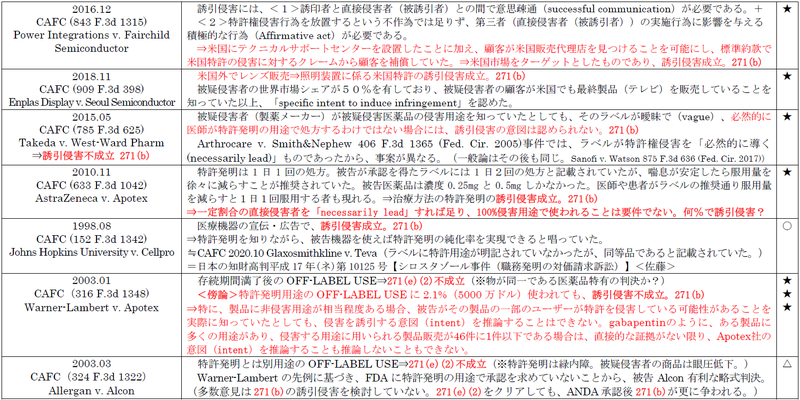
(Note) Regarding the entry “inducement established, 271(b)” in the first row of the figure above (Power Integrations v. Fairchild Semiconductor), the CAFC vacated the jury’s inducement verdict under 35 U.S.C. § 271(b) and remanded because the jury instructions were erroneous (see the table below).
(Editor’s transcription and correction of the figure above)
U.S. inducement decisions
| Case | Holding and comparison | Note |
|---|---|---|
|
2016.12
CAFC, 843 F.3d 1315 Power Integrations v. Fairchild Semiconductor |
Inducement requires successful communication from the inducer to the direct infringer and affirmative conduct that leads to direct infringement; merely allowing infringement to occur is insufficient. Evidence of a U.S. technical support center, assistance in locating U.S. distributors, and indemnification against U.S. patent infringement claims could support a finding of intent to induce infringement in the U.S. market. The CAFC nevertheless vacated the inducement verdict under 35 U.S.C. § 271(b) and remanded because the jury instructions were erroneous. | ★ |
|
2018.11
CAFC, 909 F.3d 398 Enplas Display Device v. Seoul Semiconductor |
The court upheld induced infringement under § 271(b) involving lighting devices in the United States that incorporated lenses sold abroad. The evidence included an approximately 50% worldwide market share, knowledge that customers sold the finished televisions in the United States, prior joint development with the patentee, notice identifying infringing products found in the United States, and product specifications recommending infringing configurations to customers. Taken together, the evidence supported a finding of specific intent to induce infringement. | ★ |
|
2015.05
CAFC, 785 F.3d 625 Takeda Pharmaceuticals v. West-Ward Pharmaceutical |
At the preliminary injunction stage, the court affirmed denial of relief because Takeda had not shown a likelihood of success on induced infringement. Knowledge of an infringing use does not necessarily establish intent where ambiguous labeling does not necessarily lead physicians to prescribe the drug for the patented use. The court distinguished the instructions and other evidence in ArthroCare v. Smith & Nephew, 406 F.3d 1365 (Fed. Cir. 2005). (The general rule has remained the same since; see Sanofi v. Watson, 875 F.3d 636 (Fed. Cir. 2017).) | ★ |
|
2010.11
CAFC, 633 F.3d 1042 AstraZeneca v. Apotex |
The patent concerned once-daily inhalation. The approved label specified twice-daily administration but also directed gradual reduction to the lowest effective dose once asthma was stable. The product was available only in strengths of 0.25 mg and 0.5 mg per 2 mL vial. Following the titration instructions would necessarily lead some patients to once-daily administration. The CAFC affirmed a preliminary injunction based on a likelihood of success on induced infringement. ⇒ It suffices that a certain proportion of direct infringers are “necessarily led” to infringe; use for the infringing purpose in 100% of cases is not required. At what percentage is inducement established? | ★ |
|
1998.08
CAFC, 152 F.3d 1342 Johns Hopkins University v. CellPro |
The court upheld induced infringement under § 271(b) based on promotion and advertising of a medical device, including statements, made with knowledge of the patent, that the device could achieve the patented purity level. Comparison: the 2020 GlaxoSmithKline v. Teva opinion was replaced by the 2021 panel rehearing opinion. The latter sustained the jury’s finding that the partial label still included a patented use and that the carve-out was incomplete, considering the label’s specific language together with promotional statements of equivalence to the brand-name drug and other evidence in sustaining the inducement verdict. ≈ Japan: IP High Court, 2005 (Ne) No. 10125 [Cilostazol case (action for compensation for an employee invention)] <Sato> | ○ |
|
2003.01
CAFC, 316 F.3d 1348 Warner-Lambert v. Apotex |
The patents covering the compound and its approved use for epilepsy had expired, while a patent on a different, unapproved use for neurodegenerative diseases remained in force. Because the ANDA sought approval for an unpatented, approved use, the court found no infringement under § 271(e)(2). (* Is this a ruling specific to pharmaceuticals involving the same product?)
In dicta, the court explained that the plaintiff’s asserted 2.1% rate of off-label use for the patented indication (estimated by the plaintiff at $50 million) did not by itself establish intent to induce infringement under § 271(b). Where substantial noninfringing uses existed and fewer than one in 46 sales were for an infringing use, knowledge that some users might infringe was insufficient. On the record before it, the court could neither infer nor reject an inference of intent from that proportion alone without direct evidence. |
★
★ ★ |
|
2003.03
CAFC, 324 F.3d 1322 Allergan v. Alcon |
The approved use was reduction of intraocular pressure; the patented, unapproved use was optic-nerve protection or neuroprotection. Applying Warner-Lambert, the court held that § 271(e)(2) was not infringed because Alcon did not seek FDA approval for the patented use. The majority did not decide liability for inducement under § 271(b). The absence of § 271(e)(2) liability from filing the ANDA does not rule out a later § 271(b) claim based on actual post-approval conduct. | △ |
[New YouTube Video] [Patents] Inventive Step of Parameter Inventions (30 minutes from the two-hour 2023 JAFBIC lecture)
Original Ameblo publication: 2024-01-22
Ameblo: https://ameblo.jp/hideki-takaishi/entry-12837589112.html
[New YouTube Video]
[Patents] Inventive Step of Parameter Inventions (30 minutes from the two-hour 2023 JAFBIC lecture)
The correlation between the problem and the parameter is the dividing line.
Together with the key court decisions,
I explain in depth how to construct the logic.
*An approach applicable beyond numerical limitations / parameter inventions
⇒ An examination by category of what becomes a ‘matter of design choice’!!
https://www.youtube.com/watch?v=xqcalGBpzmk&t=1s
[United States] Induced Infringement — Cases Finding Willful Blindness
Original Ameblo publication: 2024-01-23
Ameblo: https://ameblo.jp/hideki-takaishi/entry-12837683662.html
[United States] Induced Infringement — Cases Finding Willful Blindness
Supreme Court: Global-Tech
⇒ Did not tell the opinion provider that the product had been copied.
Smith & Nephew v. Arthrex, 502 F. App’x 945 (CAFC 2013)
⇒ Did not compare against the patent.
Global Traffic v. Morgan, 620 F. App’x 895 (CAFC 2015)
⇒ Did not check the contents of the patent.
https://www.youtube.com/watch?v=ITAuaHAXYDw
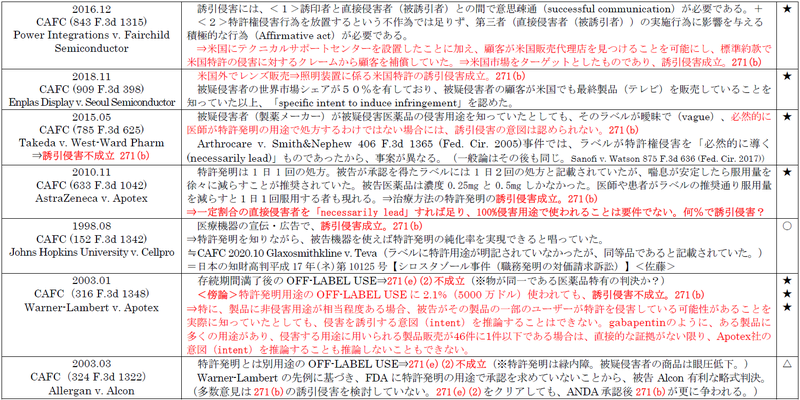
(Note) Regarding the entry “inducement established, 271(b)” in the first row of the figure above (Power Integrations v. Fairchild Semiconductor), the CAFC vacated the jury’s inducement verdict under 35 U.S.C. § 271(b) and remanded because the jury instructions were erroneous (see the table below).
(Editor’s transcription and correction of the figure above)
U.S. inducement decisions
| Case | Holding and comparison | Note |
|---|---|---|
|
2016.12
CAFC, 843 F.3d 1315 Power Integrations v. Fairchild Semiconductor |
Inducement requires successful communication from the inducer to the direct infringer and affirmative conduct that leads to direct infringement; merely allowing infringement to occur is insufficient. Evidence of a U.S. technical support center, assistance in locating U.S. distributors, and indemnification against U.S. patent infringement claims could support a finding of intent to induce infringement in the U.S. market. The CAFC nevertheless vacated the inducement verdict under 35 U.S.C. § 271(b) and remanded because the jury instructions were erroneous. | ★ |
|
2018.11
CAFC, 909 F.3d 398 Enplas Display Device v. Seoul Semiconductor |
The court upheld induced infringement under § 271(b) involving lighting devices in the United States that incorporated lenses sold abroad. The evidence included an approximately 50% worldwide market share, knowledge that customers sold the finished televisions in the United States, prior joint development with the patentee, notice identifying infringing products found in the United States, and product specifications recommending infringing configurations to customers. Taken together, the evidence supported a finding of specific intent to induce infringement. | ★ |
|
2015.05
CAFC, 785 F.3d 625 Takeda Pharmaceuticals v. West-Ward Pharmaceutical |
At the preliminary injunction stage, the court affirmed denial of relief because Takeda had not shown a likelihood of success on induced infringement. Knowledge of an infringing use does not necessarily establish intent where ambiguous labeling does not necessarily lead physicians to prescribe the drug for the patented use. The court distinguished the instructions and other evidence in ArthroCare v. Smith & Nephew, 406 F.3d 1365 (Fed. Cir. 2005). (The general rule has remained the same since; see Sanofi v. Watson, 875 F.3d 636 (Fed. Cir. 2017).) | ★ |
|
2010.11
CAFC, 633 F.3d 1042 AstraZeneca v. Apotex |
The patent concerned once-daily inhalation. The approved label specified twice-daily administration but also directed gradual reduction to the lowest effective dose once asthma was stable. The product was available only in strengths of 0.25 mg and 0.5 mg per 2 mL vial. Following the titration instructions would necessarily lead some patients to once-daily administration. The CAFC affirmed a preliminary injunction based on a likelihood of success on induced infringement. ⇒ It suffices that a certain proportion of direct infringers are “necessarily led” to infringe; use for the infringing purpose in 100% of cases is not required. At what percentage is inducement established? | ★ |
|
1998.08
CAFC, 152 F.3d 1342 Johns Hopkins University v. CellPro |
The court upheld induced infringement under § 271(b) based on promotion and advertising of a medical device, including statements, made with knowledge of the patent, that the device could achieve the patented purity level. Comparison: the 2020 GlaxoSmithKline v. Teva opinion was replaced by the 2021 panel rehearing opinion. The latter sustained the jury’s finding that the partial label still included a patented use and that the carve-out was incomplete, considering the label’s specific language together with promotional statements of equivalence to the brand-name drug and other evidence in sustaining the inducement verdict. ≈ Japan: IP High Court, 2005 (Ne) No. 10125 [Cilostazol case (action for compensation for an employee invention)] <Sato> | ○ |
|
2003.01
CAFC, 316 F.3d 1348 Warner-Lambert v. Apotex |
The patents covering the compound and its approved use for epilepsy had expired, while a patent on a different, unapproved use for neurodegenerative diseases remained in force. Because the ANDA sought approval for an unpatented, approved use, the court found no infringement under § 271(e)(2). (* Is this a ruling specific to pharmaceuticals involving the same product?)
In dicta, the court explained that the plaintiff’s asserted 2.1% rate of off-label use for the patented indication (estimated by the plaintiff at $50 million) did not by itself establish intent to induce infringement under § 271(b). Where substantial noninfringing uses existed and fewer than one in 46 sales were for an infringing use, knowledge that some users might infringe was insufficient. On the record before it, the court could neither infer nor reject an inference of intent from that proportion alone without direct evidence. |
★
★ ★ |
|
2003.03
CAFC, 324 F.3d 1322 Allergan v. Alcon |
The approved use was reduction of intraocular pressure; the patented, unapproved use was optic-nerve protection or neuroprotection. Applying Warner-Lambert, the court held that § 271(e)(2) was not infringed because Alcon did not seek FDA approval for the patented use. The majority did not decide liability for inducement under § 271(b). The absence of § 271(e)(2) liability from filing the ANDA does not rule out a later § 271(b) claim based on actual post-approval conduct. | △ |
[Unfair Competition Prevention Act / Trade Secrets] Osaka District Court, 2016 (Wa) No. 648
Original Ameblo publication: 2024-01-24
Ameblo: https://ameblo.jp/hideki-takaishi/entry-12837798528.html
[Unfair Competition Prevention Act / Trade Secrets] Osaka District Court, 2016 (Wa) No. 648
‘In addition to normative management… such as prohibiting disclosure of customer information in the work rules…, given the importance of customer information to a placement-sales business…, employees, too, could readily understand… that it was subject to management as a secret.’
⇒ Requirement that the information be managed as a secret satisfied
https://www.courts.go.jp/assets/hanrei/hanrei-pdf-87795.pdf
[Unfair Competition Prevention Act / Trade Secrets] IP High Court, 2019 (Ne) No. 10044 <Otaka>= Tokyo District Court, 2017 (Wa) No. 29604 <Yamada>
Original Ameblo publication: 2024-01-25
Ameblo: https://ameblo.jp/hideki-takaishi/entry-12837926295.html
[Unfair Competition Prevention Act / Trade Secrets] 2019 (Ne) No. 10044 <Otaka>
= Tokyo District Court, 2017 (Wa) No. 29604 <Yamada>
‘Under its confidentiality regulations, it treated all equipment at the electrical steel sheet plant, including the technical information in question,… as highly confidential… and made efforts to manage secrecy, including requiring the defendant to submit a written confidentiality undertaking….’
⇒ Requirement that the information be managed as a secret satisfied
https://www.courts.go.jp/assets/hanrei/hanrei-pdf-89431.pdf
[Unfair Competition Prevention Act / Trade Secrets] IP High Court, 2017 (Ne) No. 10031 <Mori>
Original Ameblo publication: 2024-01-26
Ameblo: https://ameblo.jp/hideki-takaishi/entry-12838055350.html
[Unfair Competition Prevention Act / Trade Secrets] IP High Court, 2017 (Ne) No. 10031 <Mori>
‘Design information embodied in wooden shoe lasts’ — Work rules + written undertakings + strict management so employees ordinarily could not handle it.
⇒ Requirement that the information be managed as a secret satisfied
‘Business partner subcontractor information’ — Work rules only; the contents of the trade secrets were not made visible on paper or another medium.
⇒ Requirement that the information be managed as a secret not satisfied
https://www.courts.go.jp/assets/hanrei/hanrei-pdf-87425.pdf
[New YouTube Video] The Support Requirement (A Shortened Version of the December 20, 2023 IP LAB Lecture)
Original Ameblo publication: 2024-01-27
Ameblo: https://ameblo.jp/hideki-takaishi/entry-12838172641.html
[New YouTube Video] The Support Requirement (Reading through the manuscript for Patent Case Law, 4th Edition): an edited, shortened version of the lecture held at IP LAB on December 20, 2023
A comprehensive review of decisions addressing the support requirement, with their key points.
From older cases to the latest, all in this one video!!
*A recording of the Q&A session is also included at the end of the video.
[Unfair Competition Prevention Act / Trade Secrets] Osaka High Court, 2017 (Ne) No. 442
Original Ameblo publication: 2024-01-28
Ameblo: https://ameblo.jp/hideki-takaishi/entry-12838304376.html
[Unfair Competition Prevention Act / Trade Secrets] Osaka High Court, 2017 (Ne) No. 442
First instance: Osaka District Court, 2015 (Wa) No. 7288
Separate case also recognizing management as a secret: Osaka District Court, 2013 (Wa) No. 12149
In 2015 (Wa) No. 7288, the court found that employees could recognize the information as business information that must not be divulged to others.
Although it was not kept in a locked cabinet despite awareness that it should have been…
⇒ Requirement that the information be managed as a secret satisfied
https://www.courts.go.jp/assets/hanrei/hanrei-pdf-87039.pdf
[Unfair Competition Prevention Act / Trade Secrets] Osaka District Court, 2016 (Wa) No. 5649
Original Ameblo publication: 2024-01-29
Ameblo: https://ameblo.jp/hideki-takaishi/entry-12838434437.html
[Unfair Competition Prevention Act / Trade Secrets] Osaka District Court, 2016 (Wa) No. 5649
‘The work rules did not identify the secrets covered, nor can defendant P1 himself be found to have been aware that the drawing data in question were secret; there were no other… measures… enabling recognition that they were trade secrets.’
⇒ Although the defendant was a director, the requirement that the information be managed as a secret was not satisfied.
https://www.courts.go.jp/assets/hanrei/hanrei-pdf-88649.pdf
[Contract (Patent Warranty)] Osaka District Court, 2020 (Wa) No. 7001
Original Ameblo publication: 2024-01-30
Ameblo: https://ameblo.jp/hideki-takaishi/entry-12838571868.html
[Contract (Patent Warranty)] Osaka District Court, 2020 (Wa) No. 7001
The special agreement in this case: ‘…in the event of a conflict, the defendant shall handle and resolve the matter at its own expense and responsibility, and shall not cause loss to the plaintiff company.’
⇒ Because the information needed to make counterarguments was shared, there was no breach of the duty to respond.
⇒ The plaintiff company’s decision to abandon the sales business after its business partners terminated their dealings was ultimately held to reflect the plaintiff company’s own business judgment.
https://www.courts.go.jp/assets/hanrei/hanrei-pdf-92075.pdf
[Statistical Data] Percentage of Patent Rights Remaining in Force
Original Ameblo publication: 2024-01-31
Ameblo: https://ameblo.jp/hideki-takaishi/entry-12838692023.html
[Statistical Data] Percentage of Patent Rights Remaining in Force
The percentages are 70% eight years after registration, 64% at nine years, 57% at ten years, 45% at eleven years, and 35% at twelve years.
(Note) The years are counted from registration. Because the patent term ends 20 years from the filing date (Article 67(1) of the Patent Act), patents expire before 20 years have passed from registration.
With annual fees gradually increasing, the trend is as expected.
This can inform decisions on pruning a patent portfolio.
https://www.e-stat.go.jp/stat-search/file-download?fileKind=2&statInfId=000040077880
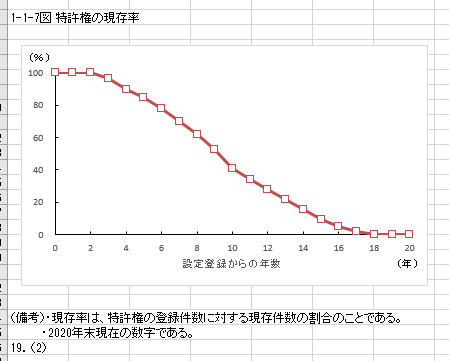
Figure 1-1-7. Percentage of patents remaining in force
Vertical axis: percentage (%), from 0 to 100. Horizontal axis: number of years since registration (years), from 0 to 20.
(Note) The percentage remaining in force is the ratio of the number of patents currently in force to the number of registrations. The figures are as of the end of 2020.
[Statistics] Statistics on Patent Infringement Litigation (Tokyo and Osaka District Courts, 2014–2022)
Original Ameblo publication: 2024-02-01
Ameblo: https://ameblo.jp/hideki-takaishi/entry-12838830485.html
[Statistics] Statistics on Patent Infringement Litigation (Tokyo and Osaka District Courts, 2014–2022)
① Of the 745 cases disposed of by judgment or settlement, 154 resulted in judgments granting relief, including partial relief, representing approximately 21%. Among the 519 judgments alone, the proportion granting relief was approximately 30%. The 154 judgments granting relief and 181 settlements containing payment or other performance obligations totaled 335 cases, approximately 45% of all judgments and settlements.
③ Only 20% of settlements involved neither an injunction nor monetary relief
④ 35 judgments awarding 100 million yen or more
⑤ 29 settlements providing payment of 100 million yen or more
⑥ Where the invalidity defense was adjudicated, the invalidity rate was 50%
https://www.ip.courts.go.jp/vc-files/ip/2023/2022_sintoukei_H26-r4.pdf
[Editorial note] The numbering follows the figure numbers in the source statistics. ① is the sum of ② (content of judgments) and ③ (content of settlements).
[Article] Relationship between “Confusion” and “Business Interests” under Article 2(1)(i) of the Unfair Competition Prevention Act (2023, Hisayoshi Yokoyama)
Original Ameblo publication: 2024-02-02
Ameblo: https://ameblo.jp/hideki-takaishi/entry-12838968451.html
[Article] Relationship between ‘Confusion’ and ‘Business Interests’ under Article 2(1)(i) of the Unfair Competition Prevention Act (2023, Professor Hisayoshi Yokoyama)
Post-sale confusion — Item (i) applies if there is a risk of an unreasonable effect on future choices of goods and the like.
E.g., the direct acquirer knows it is counterfeit, but confusion arises with a subsequent acquirer.
https://www.jstage.jst.go.jp/article/patentsp/76/29/76_43/_pdf/-char/ja
[Article] Legal Protection of Know-How and Trade Secrets as Seen through Court Decisions and Other Sources — Civil Remedies and Criminal Penalties (2023, Hideaki Togawa)
Original Ameblo publication: 2024-02-05
Ameblo: https://ameblo.jp/hideki-takaishi/entry-12839369111.html
[Article] Legal Protection of Know-How and Trade Secrets as Seen through Court Decisions and Other Sources — Civil Remedies and Criminal Penalties (2023, Hideaki Togawa)
For ‘technical information,’ intentional disclosure by former employees predominates.
If reverse engineering is expensive and time-consuming, the information does not lose its non-public character.
According to the article, an injunction against taking employment with a competitor, sought under Article 3(2) of the Unfair Competition Prevention Act, appears not to be available as a matter of interpretation, given the nature of the right to seek an injunction (the article cites the Alumina Long Fiber Trade Secret case, Osaka District Court, October 19, 2017, as an example). As for concluding a confidentiality agreement expressly imposing a non-compete obligation upon retirement, the article notes that this is debated in relation to the constitutional “freedom to choose one’s occupation.”
https://www.jstage.jst.go.jp/article/patentsp/76/29/76_107/_pdf/-char/ja
[Article] Shared Data with Limited Access and AI (2023, Izumi Hayashi)
Original Ameblo publication: 2024-02-06
Ameblo: https://ameblo.jp/hideki-takaishi/entry-12839506662.html
[Article] Shared Data with Limited Access and AI (2023, Izumi Hayashi)
‘…Guidelines’ revised in May, 2022
‘As a business’ — Satisfied if in the course of, or as part of, conducting business
‘Provision’ — Intention alone is sufficient
‘Substantial accumulation’ — Investment may also be considered.
‘(Excluding information managed as secret)’ — This only means that protection under the two systems does not apply cumulatively.
https://www.jstage.jst.go.jp/article/patentsp/76/29/76_131/_pdf/-char/ja
IP High Court, 2023 (Gyo-Ke) No. 10014 [Navigation Device] <Shoji> * Addition of claim language held to constitute a substantive change
Original Ameblo publication: 2024-02-07
Ameblo: https://ameblo.jp/hideki-takaishi/entry-12839638977.html
2023 (Gyo-Ke) No. 10014 [Navigation Device] <Shoji>
* Adding language to the claim was held to constitute a substantive change!!
By adding the words “of candidate points,” the correction removes the “restriction” on the “points” for which location information can be obtained and … can be said to delete part of the matters defining the invention.
(Excerpt from the judgment)
(2) Whether the matters corrected substantially change the scope of the claims
A. Article 126(6) of the Patent Act is intended to prevent unforeseen disadvantages to third parties that could arise if an invention excluded from the scope of the claims before correction were to be included within the scope after correction. Accordingly, whether a correction “substantially enlarges or changes the scope of the claims” within the meaning of that provision should be determined by reference to the meaning of the claims before and after correction, and whether an enlargement or change is “substantial” should be decided from the standpoint of whether the correction would cause unforeseen disadvantages to third parties.
B. Interpretation of the terminology in the specification
Applying this to the present case, both before and after the correction, according to the language of the claims for the invention of claim 1, the candidate points displayed as symbols on the map screen are “candidate points” after extraction by the candidate-extraction means, whereas the location information that can be obtained by the location-information acquisition means concerns “points”; the “points” for which it can be obtained are restricted to the “locations” corresponding to the symbols.
Terminology in a specification must be used in its ordinary meaning and consistently throughout the specification and claims (Article 24 of the Regulations under the Patent Act; Note 8 to Form No. 29). From this standpoint, the meaning of the terms in the present specification is examined below.
First, “point” in the specification is understood to mean any place within the geographical area displayed on the map screen, including places not displayed as symbols, in view of the statements “set points such as waypoints” (paragraphs [0003] and [0004]), “this conventional navigation device obtains location information for a desired point from the map screen displayed on the display device” (paragraph [0005]), “obtains location information for the target location by designating a point with a cursor on the map screen” (paragraph [0030]), “even on a large-scale map screen, an unnecessary point will not be set by mistake” (paragraph [0040]), and “location information cannot be obtained for points other than those corresponding to symbols on the map screen” (paragraph [0042]).
Next, “location” in the specification is used to refer to a “point’s geographical position on Earth,” as in the statements “when candidate points are displayed in a list and the user selects a candidate point from among them, the user cannot confirm the location of the candidate point on the map” (paragraph [0003]) and “when symbols are displayed in this way, while they remain displayed, the points for which location information can be obtained are restricted to locations corresponding to the symbols, and location information can no longer be obtained for other locations” (paragraph [0007]). It is also used to refer to the “vehicle’s current position,” as in “the vehicle’s current location and the destination” (paragraph [0002]) and “measure the vehicle’s location using artificial satellites” (paragraph [0024]). In either case, it is understood to refer to their geographical positions on Earth.
Further, “location information” in the specification is understood to mean information representing a location in the real world, rather than a location on the map screen (screen coordinates), as is clear from the statements “the storage unit 41 [stores] current-location information output from the current-location detection unit 11” (paragraph [0029]) and “in step S101 of Fig. 5, a map screen is displayed on the display device 51; in step S102, location information for the destination is obtained through destination-setting processing; in the subsequent step S103, a route search is performed on the basis of the location information for the current location and destination; and in step S104, the searched route is displayed on the map screen. At this time, for example, as shown in Fig. 8, a cursor c indicating the current location o and a mark indicating the destination p are displayed on the map screen together with multiple candidate routes. The user then selects the desired route R1 as appropriate” (paragraph [0032]). Where this refers to location information for points, it clearly includes the destination, in light of the foregoing statement “on the basis of the location information for the current location and destination” (paragraph [0032]).
C. Meaning of the invention of claim 1 before the correction
On the basis of the meanings of the above terms, the meaning of the invention of claim 1 before the correction is examined.
The [Means for Solving the Problem] section of the detailed description of the invention in the specification states: “The invention of claim 1, which solves the above problem, … when location information for a target point is obtained from the map screen of the display means, narrows down candidate points using the candidate-extraction means and displays the extracted candidate points as symbols on the map screen. When symbols are displayed in this way, while they remain displayed, the points for which location information can be obtained are restricted to locations corresponding to the symbols, and location information can no longer be obtained for other locations” (paragraph [0007]). The statement in paragraph [0007] that “the points for which location information can be obtained are restricted to locations corresponding to the symbols, and location information can no longer be obtained for other locations” is understood to have the same meaning as the claim 1 language “restrict the points for which location information can be obtained by the location-information acquisition means to locations corresponding to the symbols.” As for its meaning, given that “point” in the specification means any place within the geographical area displayed on the map screen, including places not displayed as symbols, the location-information acquisition means could previously obtain location information for any such point displayed on the map screen, but, while symbols are displayed as candidate points on the display screen, the locations for which information representing a real-world location can be obtained are restricted to those corresponding to the symbols, so location information for other points displayed on the screen can no longer be obtained.
Thus, in the invention of claim 1 before correction, while candidate points are displayed as symbols, the points for which location information can be obtained are limited to locations corresponding to those symbols, and location information for other points cannot be obtained. This is also clear from the [Effects of the Invention] section of the detailed description, which states: “According to the invention of claim 1, the candidate-extraction means narrows down candidate points and displays the narrowed-down candidate points as symbols on the map screen, and, while those symbols are displayed, restricts the points for which location information can be obtained to locations corresponding to the symbols; therefore, desired location information can be obtained from the map screen simply by selecting a displayed symbol” (paragraph [0015]), thus limiting the points for which location information can be obtained while symbols are displayed to the locations where symbols are displayed. Furthermore, as stated in (1)B above, the invention provides a navigation device capable of obtaining desired location information from a map screen without requiring the user to perform complicated operations. This interpretation is also consistent with the specification’s statements that, for that purpose, the device “comprises location-information acquisition means 46 for obtaining location information for a target location by designating a point with a cursor on the map screen” (paragraph [0030]); “is configured so that symbols indicating candidate points remain even when the map is displayed at a large scale at which symbols other than candidate points disappear, thereby improving convenience” (paragraph [0038]); “when setting a waypoint, acquisition of location information is restricted for locations other than those corresponding to symbols, so that an unnecessary point will not be set by mistake even on a large-scale map screen” (paragraph [0040]); and “although location information cannot be obtained for points other than those corresponding to symbols on the map screen, the location-information selection cursor may also be made incapable of moving anywhere other than candidate points (symbols), rather than merely preventing acquisition” (paragraph [0042]).
D. Meaning of the invention of claim 1 after the correction
In contrast, the invention of claim 1 after correction provides that “while the candidate points are displayed as symbols,” “the points for which location information of candidate points can be obtained are restricted to locations corresponding to the symbols.” As stated in B above, according to the claim language, the candidate points after extraction by the candidate-extraction means are displayed as symbols on the map screen. Therefore, “locations corresponding to the symbols” means the geographical positions on Earth of the candidate points displayed as symbols on the map screen, and this means the same thing as “points for which location information of candidate points can be obtained” on the map screen. Consequently, in claim 1 after correction, no “restriction” whatsoever is imposed on the points for which location information can be obtained.
In addition, as stated in B above, the location-information acquisition means obtains location information for points, not for candidate points. Thus claim 1 after correction leaves unclear whether, while candidate points are displayed as symbols, the location-information acquisition means can obtain location information for points that are arbitrary places displayed on the map screen other than candidate points.
In other words, by adding the words “of candidate points,” the invention of claim 1 after correction removes the “restriction” on the “points” for which location information can be obtained and makes the range within which location information can be obtained unclear. It renders meaningless the claim language “while the candidate points are displayed as symbols on the map screen of the display means, restrict the points for which location information can be obtained by the location-information acquisition means to locations corresponding to the symbols” (Element G), and can be said to delete part of the matters defining the invention.
E. Comparison between the invention of claim 1 before correction and the invention of claim 1 after correction
Accordingly, Correction 1 changes the invention of claim 1 from one in which, as stated in claim 1 before correction, the points for which location information can be obtained are limited to locations corresponding to symbols and location information for other points cannot be obtained, to one that removes the “restriction” on the points for which location information can be obtained, makes the range of acquisition of location information unclear, and deletes part of the matters defining the invention. This change alters the scope of the claims; it is not a narrowing change, nor can it be said to have the purpose of “clarifying an ambiguous statement.” It clearly causes unforeseen disadvantages to third parties who relied on the wording of claim 1 before correction.
Therefore, Correction 1 is found substantially to change the scope of the claims and must be held not to satisfy the requirements of Article 126(6) of the Patent Act. There is no error in the trial decision’s conclusion to the same effect.
https://www.courts.go.jp/assets/hanrei/hanrei-pdf-92616.pdf
[Contract / Patent Act Article 73(2)] Tokyo District Court, 2019 (Wa) No. 3141 <Tanaka>
Original Ameblo publication: 2024-02-12
Ameblo: https://ameblo.jp/hideki-takaishi/entry-12840272429.html
[Contract / Patent Act Article 73(2)] Tokyo District Court, 2019 (Wa) No. 3141 <Tanaka>
The contract stated that the patent right belongs to the plaintiff,
but after the defendant filed the application, the right was jointly owned.
⇒ After the collaboration ended, the claim for transfer of the ownership share was denied.
(Reason) The contract also terminated when the collaboration ended.
* Would it have been better to stipulate that the right “belongs exclusively to the plaintiff”?
https://www.courts.go.jp/assets/hanrei/hanrei-pdf-90235.pdf
IP High Court, 2023 (Gyo-Ke) No. 10059 [Prescription with an Entry for the Quantity Held by the Patient] <Shoji> Matter of human convention ⇒ Not an invention
Original Ameblo publication: 2024-02-12
Ameblo: https://ameblo.jp/hideki-takaishi/entry-12840272565.html
2023 (Gyo-Ke) No. 10059 [Prescription with an Entry for the Quantity Held by the Patient] <Shoji>
* Matter of human convention ⇒ Does not qualify as an invention
(The specification did not mention an “electronic prescription” or a “PC program.”)
(Excerpt from the judgment)
Among the matters in the claimed invention, the items to be entered on a “prescription” are prescribed by Article 21 of the Regulations for Enforcement of the Medical Practitioners’ Act. Thus the entries for “quantity, usage and dosage” are understood as rules based on laws and regulations, that is, human-made arrangements. Accordingly, the “number of days of administration” entered as “quantity, usage and dosage” is also a human-made arrangement. In the claimed invention, providing an entry for the “quantity held by the patient” under the “number of days of administration” on a prescription is likewise merely a human-made arrangement specifying what a physician is to enter on the prescription, and cannot be said to utilize a law of nature. Moreover, the claimed invention specifies methods for calculating … the administration period excluding the amount corresponding to the medicines held by the patient, but each calculation method is a human-made arrangement specifying how a physician calculates the administration period when prescribing and administering medicines to a patient, and cannot be said to utilize a law of nature. … The specification, etc. contains no statement or suggestion whatsoever that the “prescription” is an “electronic prescription,” nor any statement or suggestion whatsoever concerning a “PC program.” Accordingly, the plaintiff’s arguments concerning an “electronic prescription” and a “PC program” are unrelated to the claimed invention. …
https://www.courts.go.jp/assets/hanrei/hanrei-pdf-92588.pdf
[Article] Dwango IP High Court Grand Panel Judgment (Patent, December 2023 issue, Hideki Takaishi)
Original Ameblo publication: 2024-02-12
Ameblo: https://ameblo.jp/hideki-takaishi/entry-12840272817.html
[Article] Dwango IP High Court Grand Panel Judgment (Patent, December 2023 issue, Hideki Takaishi)
Extending “provision of a program” to “transfer of tangible goods”
(2) Related trademark cases
(2-1) Online-shop server located outside Japan
(2-2) Export of tangible goods from a foreign country to Japan
(3) Patents … important cases
(4) … Cases in other countries
<Contents>
1. Overview
2. IP High Court (Grand Panel), 2022 (Ne) No. 10046 (later case) (production of a system)
(1) Claims (JP6526304 / patent found infringed in the Grand Panel judgment)
(2) Satisfaction of the claim elements (later case, Grand Panel judgment)
(3) Excerpts from the judgment: territoriality (later case, Grand Panel judgment)
(4) Examination of the Grand Panel judgment
(4-1) Appropriateness of the Grand Panel judgment’s legal standard and its application
(4-2) Twist in the logic of the Grand Panel judgment
3. IP High Court, 2018 (Ne) No. 10077 <Presiding Judge Honda> (earlier case) (provision of a program)
(1) Claims (JP4734471 / patent found infringed in the IP High Court judgment in the earlier case)
(2) Satisfaction of the claim elements (earlier case) (reversed on appeal)
(3) Excerpts from the judgment: territoriality (earlier case)
(4) Further examination of IP High Court, 2018 (Ne) No. 10077 (earlier case): rejection of the normative theory of the infringing actor
4. Comparison of the Grand Panel judgment (later case) and the judgment in the earlier case (a consistent understanding of the judgment in the earlier case (2018 (Ne) No. 10077) and the first-instance judgment in the later case (Tokyo District Court, 2019 (Wa) No. 25152))
5. Earlier case: extending “provision of a program” to “transfer of tangible goods” (patents, trademarks, and other countries)
(1) General discussion
(2) Related trademark cases
(2-1) Cases involving online-shop servers located outside Japan
(2-2) Cases involving the export of tangible goods from a foreign country to Japan
(3) Important patent case ([Method for Producing L-Glutamic Acid] case)
(4) Cases in other countries involving servers located abroad
6. Later case (Grand Panel judgment): infringement involving multiple actors
(1) General discussion (including indirect infringement)
(2) Instrumentality theory (single-actor direct infringement)
(3) Control theory (HOYA case, U.S. AKAMAI remand, CAFC en banc) (single-actor direct infringement)
(4) Joint infringement
(5) Instigation and assistance
https://jpaa-patent.info/patent/viewPdf/4344
[Trademark] Tokyo District Court, 2021 (Wa) No. 10991 <Kokubu> ⇒ Similar trademarks
Original Ameblo publication: 2024-02-12
Ameblo: https://ameblo.jp/hideki-takaishi/entry-12840273000.html
[Trademark] Tokyo District Court, 2021 (Wa) No. 10991 <Kokubu> ⇒ Similar trademarks
① No pronunciation
② Identical concept
A woman lying on a beach mat floating on water
③ Similar appearance
(In addition to ②,) both depict a woman in a bikini wearing black sunglasses and shoes, with her legs bent back below the knees and her head facing the back of the picture.
https://www.courts.go.jp/assets/hanrei/hanrei-pdf-92422.pdf
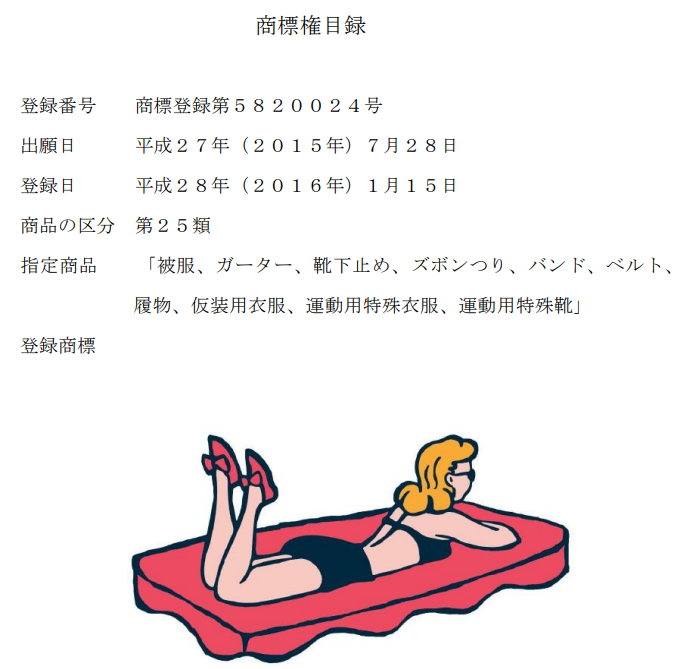
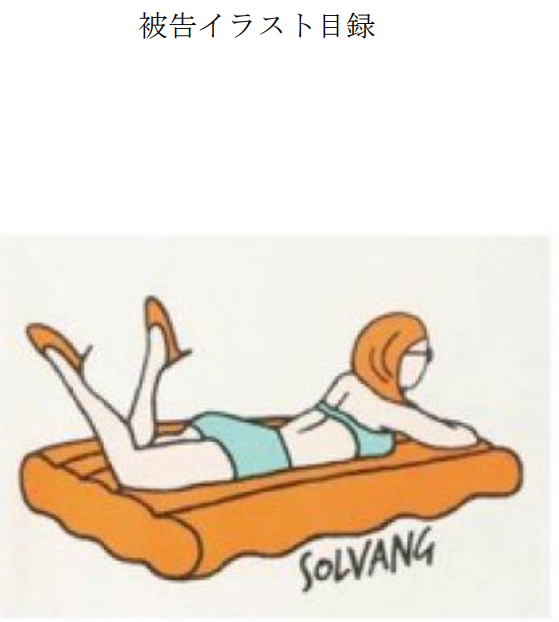
[Trademark] IP High Court, 2015 (Gyo-Ke) No. 10086 <Otaka> — The “ハイガード” (HIGUARD) case
Original Ameblo publication: 2024-02-12
Ameblo: https://ameblo.jp/hideki-takaishi/entry-12840273164.html
[Trademark] 2015 (Gyo-Ke) No. 10086 <Otaka>
Mark used: “ハイガード”
Registered mark: “ハイガード” and “HIGUARD” on two lines
The registered mark gives rise to the same concept as the katakana “ハイガード” (= “high-level defense” OR “a high degree of protection of things”).
⇒ Considered identical under generally accepted social norms
* Two-line presentation where the upper and lower lines have the same “concept”
https://www.courts.go.jp/assets/hanrei/hanrei-pdf-85357.pdf
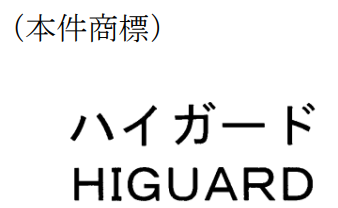
[Trademark] IP High Court, 2018 (Gyo-Ke) No. 10103 <Tsuruoka> Mark used: “Buromaga”
Original Ameblo publication: 2024-02-13
Ameblo: https://ameblo.jp/hideki-takaishi/entry-12840411839.html
[Trademark] 2018 (Gyo-Ke) No. 10103 <Tsuruoka>
Mark used: “Buromaga”
Registered mark: katakana + English on two lines
“BlogMaga” on the lower line of the registered mark is pronounced “Burogu Maga,” differently from the upper line. Both are coined words and have no concept.
⇒ Not considered identical under generally accepted social norms
⇒ Cancellation for non-use
* Two-line presentation where the upper and lower lines have the same “pronunciation”
https://www.courts.go.jp/assets/hanrei/hanrei-pdf-88220.pdf

[Trademark] Use in a Trial for Cancellation for Non-Use: Must It Be Trademark Use?
Original Ameblo publication: 2024-02-14
Ameblo: https://ameblo.jp/hideki-takaishi/entry-12840542430.html
[Trademark] Use in a Trial for Cancellation for Non-Use: Must It Be Trademark Use?
* View that it is required
2021 (Gyo-Ke) No. 10076, Chihon Shugi <Honda>
* View that it is not required
Tokyo High Court, February 28, 1991, POLA
2016 (Gyo-Ke) No. 10086, LE MANS <Takabe>
2014 (Gyo-Ke) No. 10234, Eye Light (アイライト) <Takabe>
2015 (Gyo-Ke) No. 10032, European <Takabe>, found trademark use.
[Trademark] IP High Court, 2022 (Gyo-Ke) No. 10087 “EMPIRE STEAK HOUSE” case <Kanno>
Original Ameblo publication: 2024-02-15
Ameblo: https://ameblo.jp/hideki-takaishi/entry-12840672026.html
[Trademark] 2022 (Gyo-Ke) No. 10087 “EMPIRE STEAK HOUSE” case <Kanno>
⇒ Separate consideration of components is possible
⇒ Similar to the cited mark “EMPIRE”
The verbal portion does not give the impression of being buried in the figurative portion.
+
There are spaces between the words, so it is perceived as three words.
“EMPIRE” has a strong function of distinguishing one’s services from those of others, while “STEAK HOUSE” has a weak one.
https://www.courts.go.jp/assets/hanrei/hanrei-pdf-91732.pdf
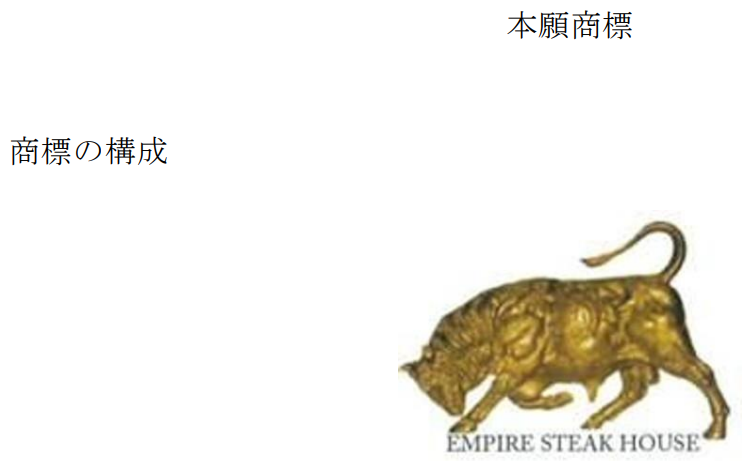
[Foreign] Korean Supreme Court, March 31, 2022 (2018Hu10923): Inventive Step of Crystal-Form Inventions
Original Ameblo publication: 2024-02-16
Ameblo: https://ameblo.jp/hideki-takaishi/entry-12840800818.html
[Foreign] Korean Supreme Court, March 31, 2022 (2018Hu10923): Inventive Step of Crystal-Form Inventions
Previously, a remarkable effect or an effect different in nature was required.
⇒ The court held that, in addition to ④ advantageous effects,
① whether crystalline polymorphism was expected,
② motivation to arrive at the particular claimed crystal form, and
③ whether it falls within the scope examined in routine polymorph screening
should be considered in making the determination.
https://www.jetro.go.jp/ext_images/world/asia/kr/ip/pdf/han_2022.pdf
IP High Court, 2022 (Gyo-Ke) No. 10131 [Heat Exchanger Using a Thermally Conductive Knitted Wire Fabric] <Honda>
Original Ameblo publication: 2024-02-19
Ameblo: https://ameblo.jp/hideki-takaishi/entry-12841202853.html
2022 (Gyo-Ke) No. 10131 [Heat Exchanger Using a Thermally Conductive Knitted Wire Fabric] <Honda>
Elements D and F merely claim effects necessarily produced by configurations A, B and C.
⇒ No inventive step
* For an effect recited in a claim to constitute a matter defining the invention, it must define the invention. Adding an effect necessarily produced by the configuration does not contribute to novelty or inventive step.
(Excerpt from the judgment)
Since a person skilled in the art could easily have conceived of providing the cited invention with configurations A through C of the claimed invention, the cited invention would, as a consequence, naturally also be provided with configurations D and F of the claimed invention. … Configuration D specifies an operation realized by having configurations A through C. Because the “device requiring heat dissipation or heat absorption” in configuration C does not specify what members it includes as physical components, whatever components are contained within the cited invention’s “heat pipe 4 having a heat-generating portion” do not affect the identification of common features and differences between the claimed invention and the cited invention concerning configuration C, or the determination of obviousness, and do not affect the determination concerning configuration D either. … Since configuration F does not specify a basis for comparison, “rapidly conducting the generated heat over the shortest distance to the largest heat-dissipating surface” in configuration F is a function possessed by a device having configurations A through C, and is not an operation specified by comparison with some criterion. …
https://www.courts.go.jp/assets/hanrei/hanrei-pdf-92501.pdf
Osaka District Court, 2020 (Wa) No. 4913 [Electric Impact Tightening Tool] <Takemiya>
Original Ameblo publication: 2024-02-19
Ameblo: https://ameblo.jp/hideki-takaishi/entry-12841203377.html
Osaka District Court, 2020 (Wa) No. 4913 [Electric Impact Tightening Tool] <Takemiya>
* Cumulative application of paragraphs (2) and (3) denied: competing products were found not to satisfy the claim elements.
“Looking at the competing products … none is found to employ an outer-rotor electric motor … the plaintiff cannot be said to have lost an opportunity to grant a license … with respect to the rebutted portion.”
https://www.courts.go.jp/assets/hanrei/hanrei-pdf-92070.pdf
[Claim 1] … An electric impact tightening tool characterized in that the electric motor … is an outer-rotor electric motor.
(Excerpt from the judgment)
The portion for which the presumption is rebutted on the ground of the existence of competing products in the market is based on the probability that, even if the infringing products had not been sold, competing products other than those of the infringer and the patentee would have been sold. For the portion for which the presumption is rebutted because of the probability of competing products being sold, the plaintiff patentee does not stand in a relationship of granting a license to the defendant; therefore, it cannot be found that the plaintiff could have granted a license to the defendant. Moreover, looking at the competing products in this case, although all have performance and the like similar to the effects of the corrected invention, none is found to employ an outer-rotor electric motor, and they are found to have mechanisms different from the configuration of the corrected invention. From this standpoint as well, the plaintiff cannot be said to have lost an opportunity to grant a license with respect to that rebutted portion. … In this case, paragraph (3) of Article 102 of the Patent Act cannot be applied to the portion for which the presumption under paragraph (2) of that Article is rebutted.
IP High Court, 2005 (Gyo-Ke) No. 10223 [Acidic Oil-in-Water Emulsified Seasoning] <Sato>
Original Ameblo publication: 2024-02-19
Ameblo: https://ameblo.jp/hideki-takaishi/entry-12841203804.html
2005 (Gyo-Ke) No. 10223 [Acidic Oil-in-Water Emulsified Seasoning] <Sato>
* A case recognizing inventive step in view of an unpredictable synergistic effect
“Using them together … compared with using one of them … produces a synergistic effect … of making oil-phase separation less likely. … Also taking into account that a person skilled in the art could not predict the synergistic effect …” the invention was not obvious.
(Excerpt from the judgment)
Invention 1 is found to produce the effect of making oil-phase separation less likely when subjected to heat treatment in the form of baking or frying, by using phospholipase A-treated egg yolk together with octenyl succinate starch, as compared with using either phospholipase A-treated egg yolk or octenyl succinate starch alone. According to (c) above, it can be inferred that when only one of phospholipase A-treated egg yolk and octenyl succinate starch is used, oil-phase separation occurs and shape retention is lost upon baking even if its content is increased. Accordingly, the above effect of Invention 1 should be recognized as a synergistic effect arising from the combined use of phospholipase A-treated egg yolk and octenyl succinate starch. …
… Also taking into account that the synergistic effect could not be predicted by a person skilled in the art from the disclosures of Publications 1 and 2, it cannot be said that a person skilled in the art could easily have conceived of incorporating octenyl succinate starch in accordance with the teaching of Publication 2, instead of the starch, dextrin or gums that Publication 1 states may be incorporated into the cited invention as necessary. …
https://www.courts.go.jp/assets/hanrei/hanrei-pdf-32956.pdf
[Korea] Supreme Court Judgment of December 30, 2021, 2017 Hu 1304
Original Ameblo publication: 2024-02-24
Ameblo: https://ameblo.jp/hideki-takaishi/entry-12841843999.html
[Korea] Supreme Court Judgment of December 30, 2021, 2017 Hu 1304
Where the manufacturing method disclosed in an earlier paper “necessarily” results in the configuration of the patented invention, inherent disclosure is recognized and novelty is denied.
“Probability” is insufficient.
Materials dating after the filing date may be used as evidence to ascertain inherent properties.
https://www.jetro.go.jp/ext_images/world/asia/kr/ip/pdf/han_2022.pdf
[United States] <Federal District Court> Sonos v. Google LLC (N.D. Cal. 2023)
Original Ameblo publication: 2024-02-24
Ameblo: https://ameblo.jp/hideki-takaishi/entry-12841844322.html
[United States] <Federal District Court> Sonos v. Google LLC (N.D. Cal. Oct. 6, 2023)
Sonos claimed, in a continuation application, an invention that read on Google’s products
⇒ The jury awarded $32.5 million
However, the judge held the patent unenforceable, finding it unfair to amend claims after seeing a competing product. (The lengthy period during which the application had been pending also had a major influence.)
⇒ Google restored the functionality
★ If this judgment is upheld by the CAFC, it will likely fundamentally overturn patent divisional-application strategies.
★ The thinking is akin to the Chinese Supreme People’s Court’s restrictions on the timing of divisional applications.
★ According to a comment I received after posting, Brazil apparently follows the same practice as China.
https://patentlyo.com/patent/2024/02/redefining-continuation-strategy.html
[2026 editorial update] On August 28, 2025, the Federal Circuit reversed the invalidity judgments for lack of written description and the findings of unenforceability for prosecution laches concerning U.S. Patent Nos. 10,469,966 and 10,848,885. It affirmed the obviousness-based invalidity judgment concerning the asserted claims of U.S. Patent No. 10,779,033. The statement above beginning “If this judgment is upheld” reflects the perspective at the time of the 2024 post, not the later appellate outcome.
IP High Court, 2022 (Gyo-Ke) No. 10109 [Anti-Glare Film] <Miyasaka>
Original Ameblo publication: 2024-02-24
Ameblo: https://ameblo.jp/hideki-takaishi/entry-12841844520.html
2022 (Gyo-Ke) No. 10109 [Anti-Glare Film] <Miyasaka>
1. Clarity requirement satisfied
There is no particular difficulty in taking several photographs to determine the F-number that produces the highest contrast.
Even if the size of the photographic subject varies individually, using the apparatus described in the specification and adjusting it according to the described method naturally determines the shooting distance for each subject.
2. Support requirement satisfied
“By varying the haze value, the clarity of a transmitted image can also be adjusted. … To improve anti-glare performance while suppressing sparkle, it is sufficient not only to reduce the surface irregularities of the anti-glare layer … but also to increase the slope of the irregularities … to make them steeper and increase their number ([0078]).”
3. Enablement requirement satisfied
In response to the defendant’s argument, the court held that “the shape of the irregular structure formed by condensation of fine particles is understood to be similar to the shape of the above droplet-phase structure resulting from the progress of aggregation in spinodal decomposition; therefore, reference can be made to the irregular structure of the first embodiment.”
https://www.courts.go.jp/assets/hanrei/hanrei-pdf-92560.pdf
[Article / Foreign] Antibody Patents in Europe (Chizai Kanri, Vol. 73, No. 6, 2023, Naho Fujimoto)
Original Ameblo publication: 2024-02-25
Ameblo: https://ameblo.jp/hideki-takaishi/entry-12841968141.html
[Article / Foreign] Antibody Patents in Europe (Chizai Kanri, Vol. 73, No. 6, 2023, Naho Fujimoto)
Inventive step in Europe: effects are important
The question is whether it is credible that the effect is obtained over the full scope.
⇒ If the effect is not recognized, the problem becomes “providing an alternative,” and the invention is regarded as obvious.
Even structural claims face difficulty establishing inventive step merely because their sequences differ.
Amgen’s invention was also found to lack inventive step.
Patent Attorneys Association Members’ Website ★ Patent Committee Reports: Essential Information for Modern Patent Practice!!
Original Ameblo publication: 2024-02-26
Ameblo: https://ameblo.jp/hideki-takaishi/entry-12842108769.html
Patent Attorneys Association Members’ Website ★ Patent Committee Reports: Essential Information for Modern Patent Practice!!
① Disclaimer claims and inventive step: research on “trial decisions”
⇒ The same as court decisions
② Indirect infringement: reassessing systems and methods that do not produce a product!!
The most recent 10 years
Success rate under items (i) and (iv): 83% (30 cases)
* However, some cases were captured under items (ii) and (v)
Success rate under items (ii) and (v): 47% (9 cases)
* Few cases reject the “indispensability requirement”!!
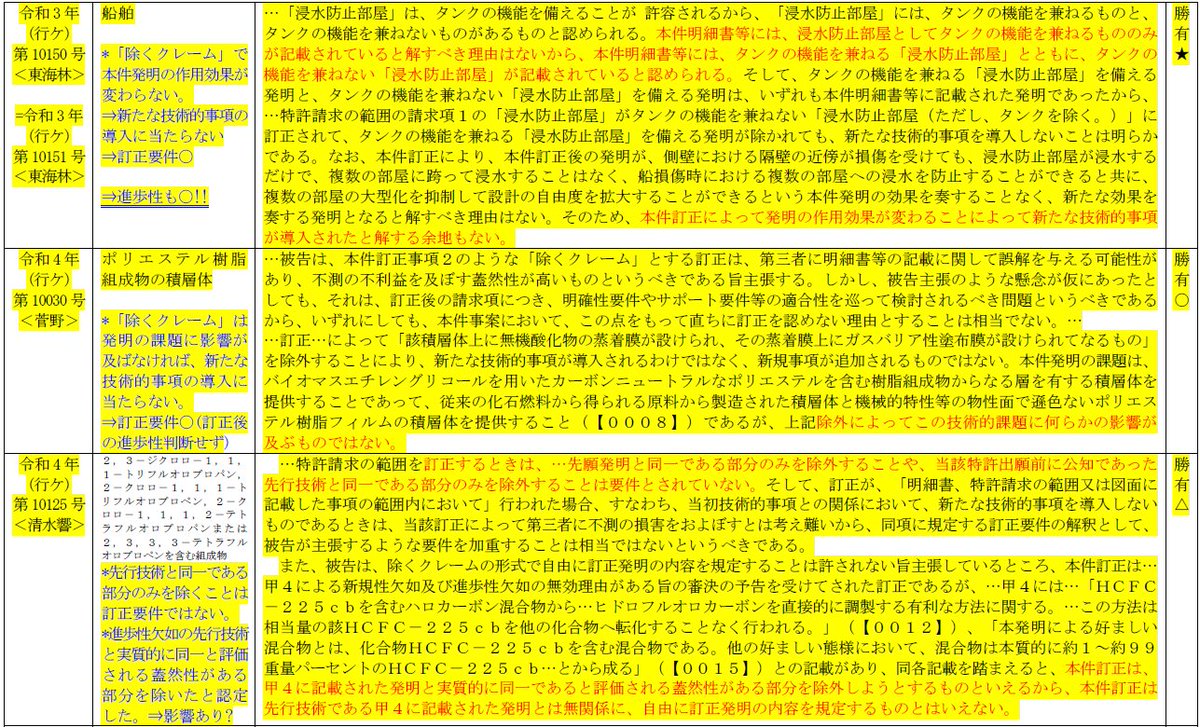
English translation of the case table
2021 (Gyo-Ke) Nos. 10150 and 10151 <Shoji>. Ship. The operation and effects of the invention do not change through a disclaimer. ⇒ No introduction of new technical matter. ⇒ Correction requirements satisfied. ⇒ Inventive step also affirmed!! Outcome: wins ★.
…An “anti-flooding compartment” is permitted to have a tank function; therefore, “anti-flooding compartments” are understood to include those that also have a tank function and those that do not. There is no reason to understand the specification and other documents as describing only those anti-flooding compartments that also have a tank function. The specification and other documents are therefore found to describe both anti-flooding compartments that also have a tank function and anti-flooding compartments that do not. Thus, an invention having an anti-flooding compartment that also has a tank function and an invention having one that does not are both inventions described in the specification and other documents. …Even if the anti-flooding compartment in claim 1 is amended to read “an anti-flooding compartment that does not also have a tank function (excluding a tank)” and inventions having an anti-flooding compartment that also has a tank function are excluded, it is clear that no new technical matter is introduced. Moreover, there is no reason to understand the corrected invention as a different invention producing a new effect instead of the effects of the invention in question: even if an adjacent partition wall is damaged, only the anti-flooding compartment is flooded, without flooding across multiple compartments; flooding of multiple compartments when the ship is damaged can be prevented; and an increase in the size of multiple compartments can be restrained, increasing freedom of design. Accordingly, there is no room to understand the correction as introducing new technical matter through a change in the operation or effects of the invention.
2022 (Gyo-Ke) No. 10030 <Kanno>. Laminate of a polyester resin composition. Unless a disclaimer affects the problem addressed by the invention, it does not introduce new technical matter. ⇒ Correction requirements satisfied (the inventive step of the corrected invention is also affirmed). Outcome: wins ○.
…The defendant argues that a correction employing a disclaimer, such as correction item 2, should be recognized only where there is a high likelihood of causing third parties to misunderstand the description in the specification and other documents or of causing unexpected disadvantage. However, even assuming a concept of the kind asserted by the defendant, it is a matter to be considered through the clarity and support requirements for the corrected claims. In any event, it cannot be a reason for refusing the correction in this case merely on that ground. …By excluding through the correction “a laminate in which an inorganic-oxide deposited film is provided on the laminate and a gas-barrier coating film is provided on that deposited film,” new technical matter is not introduced; nor is any new matter added. The problem of the invention is to provide a laminate having a layer made of a resin composition containing a polyester having a furandicarboxylic acid component as a main acid component, in which the mechanical properties and other physical properties of the laminate manufactured from raw materials obtainable from later biomass raw materials are suitable for a polyester resin film laminate, compared with a laminate manufactured from raw materials obtainable from conventional fossil raw materials ([0008]). The foregoing exclusion has no influence on this technical problem.
2022 (Gyo-Ke) No. 10125 <Shimizu>. Composition comprising 2,3-dichloro-1,1,1-trifluoropropane; 2-chloro-1,1,1-trifluoropropene; 2-chloro-1,1,1,2-tetrafluoropropane; or 2,3,3,3-tetrafluoropropene. Exclusion only of a portion identical to the prior art is not a correction requirement. A portion having a high likelihood of being evaluated as substantially identical to the prior art relied on for lack of inventive step was excluded. ← Influence? Outcome: wins ★.
…Correction of the claims … is not subject to a requirement that only a portion identical to the prior invention, or only a portion identical to prior art publicly known before the patent application, be excluded. Furthermore, where a correction is made within the matters described in the specification, claims, or drawings, so long as it introduces no new technical matter in relation to the technical matters in question, it is difficult to consider that the correction causes unexpected disadvantage to third parties. It is therefore inappropriate to impose additional requirements of the kind asserted by the defendant as an interpretation of the correction requirements prescribed by that provision. …The defendant also argues that it is impermissible to specify the content of the corrected invention freely in the form of a disclaimer. However, the correction was made following a preliminary trial decision finding grounds of invalidity for lack of novelty and inventive step based on Exhibit Ko 4. …Exhibit Ko 4 states … “a method useful for preparing heptafluoropropane directly from a chlorofluorocarbon mixture containing HCFC-225cb. …This method is performed without converting a considerable amount of HCFC-225cb into other compounds.” ([0012]), and “a preferred mixture according to the invention is a mixture containing the compound HCFC-225cb. In another preferred embodiment, the mixture consists essentially of about 1 to about 99 weight percent HCFC-225cb…” ([0015]). In light of those statements, the correction seeks to exclude a portion having a high likelihood of being evaluated as substantially identical to the invention described in Exhibit Ko 4. The correction is therefore not an attempt to specify freely the content of the corrected invention without relation to the invention described in Exhibit Ko 4 as prior art.
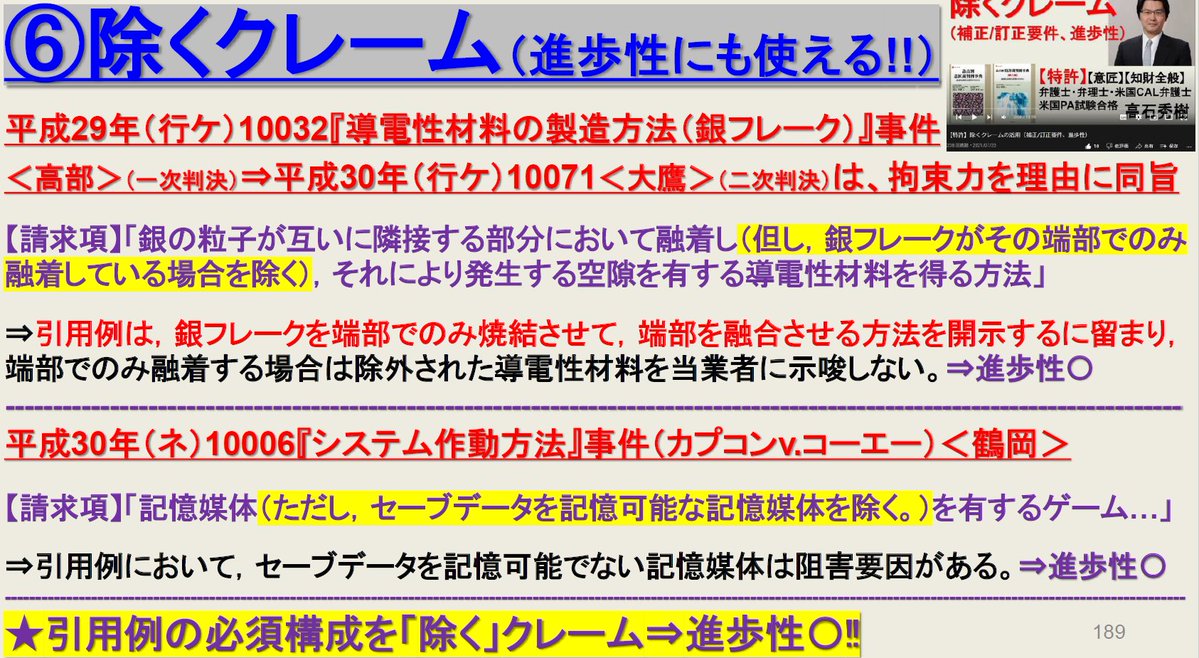
English translation of slide 189
6. Disclaimers (usable for inventive step as well!!)
2017 (Gyo-Ke) No. 10032, [Method of Manufacturing an Electrically Conductive Material (Silver Flakes)] <Takabe> (first judgment) ⇒ 2018 (Gyo-Ke) No. 10071 <Otaka> (second judgment) reached the same result on the ground of the binding effect.
[Claim] “A method of obtaining an electrically conductive material having voids produced by silver particles being fused at portions adjacent to each other (excluding the case in which the silver flakes are fused only at their end portions).”
⇒ The cited reference merely discloses a method of sintering silver flakes only at their end portions and fusing the end portions; it does not suggest to a person skilled in the art an electrically conductive material from which cases of fusion only at the end portions are excluded. ⇒ Inventive step affirmed.
2018 (Ne) No. 10006, [System Operation Method] (Capcom v. Koei) <Tsuruoka>.
[Claim] “A game having a storage medium (excluding a storage medium capable of storing save data)…”
⇒ In the cited reference, there is a factor discouraging a storage medium incapable of storing save data. ⇒ Inventive step affirmed.
★ A disclaimer excluding an essential configuration of the cited reference ⇒ Inventive step affirmed!!
Inset: Disclaimers (amendment/correction requirements; inventive step). Patents [Designs] [Intellectual property generally]. Attorney-at-law, Patent Attorney; former CAFC law clerk; former USPTO examination training participant. Hideki Takaishi.
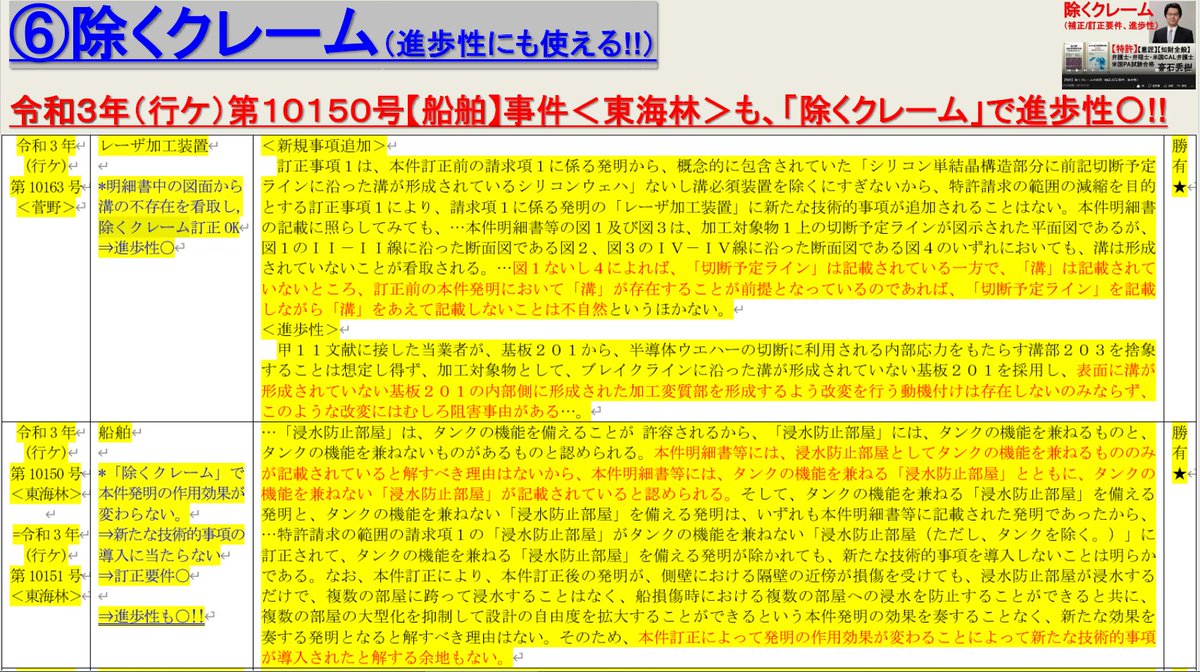
English translation of the additional disclaimer slide
6. Disclaimers (usable for inventive step as well!!)
2021 (Gyo-Ke) No. 10150, [Ship] <Shoji>, also: inventive step affirmed through a disclaimer!!
2021 (Gyo-Ke) No. 10163 <Shimizu>. Laser Processing Apparatus. Absence of a groove is read from the drawings in the specification, and correction by disclaimer is accepted. ⇒ Inventive step affirmed. Outcome: wins ★.
<Addition of new matter> Correction item 1 merely excludes from the invention of claim 1 before correction, to reduce the scope of the claim, a silicon wafer having grooves formed along scheduled cutting lines in a silicon single-crystal structure portion, or an apparatus requiring grooves, which had conceptually been included. The correction therefore introduces no new technical matter into the “laser processing apparatus” of claim 1. In light of the description in the specification and other documents, … Figures 1 and 3 are plan views showing scheduled cutting lines on workpiece 1. In Figure 2, a sectional view taken along line II–II in Figure 1, and Figure 4, a sectional view taken along line IV–IV in Figure 3, the absence of a groove can be read. …According to Figures 1 through 4, “scheduled cutting lines” are described, while “grooves” are not. If the existence of “grooves” had been assumed in the invention before correction, it would be rather unnatural to describe “scheduled cutting lines” without also describing “grooves.”
<Inventive step> A person skilled in the art encountering Exhibit Ko 11 could not conceive of removing groove portion 203, which relieves internal stress used to cut a semiconductor wafer, from substrate 201. There is not only no motivation to adopt, as the workpiece, a substrate 201 without a groove along the break line and modify it to form a modified processing layer inside substrate 201 whose surface has no groove, but also a clear factor discouraging such a modification.
2021 (Gyo-Ke) Nos. 10150 and 10151 <Shoji>. Ship. The operation and effects of the invention do not change through a disclaimer. ⇒ No introduction of new technical matter. ⇒ Correction requirements satisfied. ⇒ Inventive step also affirmed!! Outcome: wins ★.
…An “anti-flooding compartment” is permitted to have a tank function; therefore, “anti-flooding compartments” are understood to include those that also have a tank function and those that do not. There is no reason to understand the specification and other documents as describing only those anti-flooding compartments that also have a tank function. The specification and other documents are therefore found to describe both anti-flooding compartments that also have a tank function and anti-flooding compartments that do not. Thus, an invention having an anti-flooding compartment that also has a tank function and an invention having one that does not are both inventions described in the specification and other documents. …Even if the anti-flooding compartment in claim 1 is amended to read “an anti-flooding compartment that does not also have a tank function (excluding a tank)” and inventions having an anti-flooding compartment that also has a tank function are excluded, it is clear that no new technical matter is introduced. Moreover, there is no reason to understand the corrected invention as a different invention producing a new effect instead of the effects of the invention in question: even if an adjacent partition wall is damaged, only the anti-flooding compartment is flooded, without flooding across multiple compartments; flooding of multiple compartments when the ship is damaged can be prevented; and an increase in the size of multiple compartments can be restrained, increasing freedom of design. Accordingly, there is no room to understand the correction as introducing new technical matter through a change in the operation or effects of the invention.
Inset: Disclaimers (amendment/correction requirements; inventive step). Patents [Designs] [Intellectual property generally]. Attorney-at-law, Patent Attorney; former CAFC law clerk; former USPTO examination training participant. Hideki Takaishi.
(Editor’s transcription and correction of the figure above)
⑥ Disclaimer claims (also useful in the inventive-step analysis)
2021 (Gyo-Ke) No. 10150, “Vessel” (Presiding Judge Shoji), also upheld inventive step for a claim containing a disclaimer.
| Case | Summary and translated excerpts |
|---|---|
|
2021 (Gyo-Ke) No. 10111
Laser Processing Apparatus Presiding Judge Kanno Favorable ★ |
The drawings disclosed the absence of grooves, supporting correction by a disclaimer. Inventive step was also upheld.
[Addition of new matter — translation of excerpts] “Correction 1 merely excludes a ‘silicon wafer having grooves along the planned cutting lines in the silicon single-crystal structure portion,’ or an apparatus requiring grooves, that was conceptually encompassed by the invention of Claim 1 before correction. Consequently, Correction 1, which restricts the scope of the claims, adds no new technical matter to the ‘laser processing apparatus’ of Claim 1. … Figures 1 and 3 in the specification and other documents are plan views showing planned cutting lines on workpiece 1. Both Figure 2, a cross section along line II–II in Figure 1, and Figure 4, a cross section along line IV–IV in Figure 3, show that no grooves are present. … Figures 1–4 depict ‘planned cutting lines’ but do not depict ‘grooves.’ If the invention before correction had presupposed the existence of grooves, it would be unnatural deliberately to omit grooves while depicting the planned cutting lines.” [Inventive step — translation of excerpt] “It is inconceivable that a person skilled in the art encountering Document Ko 11 would disregard groove portions 203 in substrate 201, which create the internal stress used to cut the semiconductor wafer. There is not only no motivation to make a modification in which substrate 201 without grooves along the break line is adopted as the workpiece and a processing-altered portion is formed inside that substrate, whose surface has no grooves; rather, there is an inhibiting factor against such a modification….” |
|
2021 (Gyo-Ke) Nos. 10150 and 10151
Vessel Presiding Judge Shoji Favorable ★ |
The disclaimer did not change the invention’s operation or effects or introduce new technical matter. The correction requirements were satisfied and inventive step was upheld.
[New matter and effects — translation of excerpts from No. 10151] “…Because a ‘flood-prevention room’ is permitted to have a tank function, such rooms are found to include both those that also function as tanks and those that do not. There is no reason to interpret the specification and other documents as describing only flood-prevention rooms that also function as tanks. Accordingly, the specification and other documents are found to describe both ‘flood-prevention rooms’ that also function as tanks and ‘flood-prevention rooms’ that do not. Both an invention having a ‘flood-prevention room’ that also functions as a tank and an invention having a ‘flood-prevention room’ that does not were disclosed in the specification and other documents. Therefore, even if Correction 1 amends the ‘flood-prevention room’ in Claim 1 to a ‘flood-prevention room (excluding tanks)’ that does not also function as a tank, thereby excluding the invention having a ‘flood-prevention room’ that also functions as a tank, it is clear that no new technical matter is introduced. Moreover, there is no reason to interpret the correction as resulting in an invention that achieves a new effect without achieving the effects of the invention in this case: even if the sidewall near a bulkhead is damaged, only the flood-prevention room is flooded and flooding does not extend across multiple rooms, thereby preventing flooding of multiple rooms when the vessel is damaged, while also increasing freedom of design by limiting the enlargement of multiple rooms. Consequently, there is no basis for interpreting the correction as introducing new technical matter through a change in the invention’s operation or effects.” |
IP High Court, 2022 (Ne) No. 10008 [Information Provision Device] <Otaka>
Original Ameblo publication: 2024-02-27
Ameblo: https://ameblo.jp/hideki-takaishi/entry-12842238055.html
2022 (Ne) No. 10008 [Information Provision Device] <Otaka>
* A “patentee’s correction-based rejoinder to an invalidity defense” was asserted in the appeal after the conclusion of written preparatory proceedings. ⇒ Dismissed as untimely
Given the chronology in which the original judgment finding a lack of novelty followed a trial decision maintaining the patent, a correction-based rejoinder to an invalidity defense should have been asserted in the alternative for claim 1 or 5.
https://www.courts.go.jp/assets/hanrei/hanrei-pdf-91603.pdf
IP High Court, 2022 (Ne) No. 10078 [Display Device Supportable with One Hand] <Kanno>
Original Ameblo publication: 2024-02-28
Ameblo: https://ameblo.jp/hideki-takaishi/entry-12842365112.html
2022 (Ne) No. 10078 [Display Device Supportable with One Hand] <Kanno>
* In the court below, the patentee asserted correction-based rejoinders to invalidity defenses based on the second and third corrections.
⇒ It asserted a correction-based rejoinder to an invalidity defense based on the fourth correction “in the statement of reasons for appeal,” but the court stated that, in light of the course of proceedings, it should ordinarily be dismissed as untimely.
(However, the court ruled on it because a rebuttal had been submitted.)
(Excerpt from the judgment)
Examining the course of proceedings in the court below, in response to the invalidity defense asserting that the patent lacked novelty and inventive step (Defendant’s First Preparatory Brief), raised at the first preparatory-proceedings date (November 18, 2019), the appellant submitted Plaintiff’s Second Preparatory Brief concerning a rejoinder based on the second correction by the third preparatory-proceedings date (July 27, 2020). In conjunction with the request for correction in the patent invalidation trial, it then submitted Plaintiff’s Fifth Preparatory Brief dated March 3, 2021, and Plaintiff’s Sixth Preparatory Brief dated May 27 of that year, setting out a rejoinder based on the third correction. (These briefs, including correction documents, were presented at the fourth preparatory-proceedings date (December 16, 2021).) The original judgment held that neither the rejoinder based on the second correction nor that based on the third correction satisfied the correction requirements and that the patent should be invalidated in a patent invalidation trial. The appellant then added an assertion of a rejoinder based on the fourth correction in its statement of reasons for appeal. In view of this course of proceedings in the court below, the fourth correction constitutes an untimely submitted means of attack or defense, and the appellant was grossly negligent in submitting it late, so dismissal would ordinarily be unavoidable. However, the appellee has submitted rebuttal arguments concerning the rejoinder based on the fourth correction, including that the fourth correction does not satisfy the correction requirements. To this extent, it cannot be said that this would delay the conclusion of the litigation, so the court will examine it below.
https://www.courts.go.jp/assets/hanrei/hanrei-pdf-91824.pdf
Related case: Intellectual Property High Court, 2021 (Gyo-Ke) No. 10037, [Display Device Capable of Being Supported with One Hand]
Judgment date: February 2, 2022
The following is an excerpt from the court’s reasoning on the admissibility of the correction in that action seeking revocation of a trial decision.
… It is clear that the intermediate left-right open-position fixing means in configuration e, which “fixes” two display panels “with a stopper” at any angle within a range of approximately 120 degrees to approximately 170 degrees, is a means for “temporary fixation,” whereas the arbitrary-angle holding means in configuration C, which “holds” the two display panels “by frictional force,” is a means for “semi-fixation.” It can naturally be understood that these are separate means employing different fixing means. … There is no basis for narrowly interpreting “an arbitrary angle” in relation to the arbitrary-angle holding means as meaning an angle within the range of approximately 120 degrees to approximately 170 degrees …; in accordance with its ordinary meaning, it should be understood to include the range from 0 degrees to 360 degrees. … Such a configuration is not described in the specification before correction. …
IP High Court, 2021 (Ne) No. 10094 [… Work Gloves] <Kanno>
Original Ameblo publication: 2024-02-29
Ameblo: https://ameblo.jp/hideki-takaishi/entry-12842496801.html
2021 (Ne) No. 10094 [… Work Gloves] <Kanno>
* In the court below, the patentee asserted a “correction-based rejoinder to an invalidity defense” after the court disclosed its provisional view that the patent was invalid; it was dismissed as untimely.
⇒ “In the statement of reasons for appeal,” it asserted the “correction-based rejoinder to an invalidity defense” dismissed below, but it was again dismissed as untimely.
Cf. The exact opposite of 2016 (Ne) No. 10100 <Takabe>!!
★ There is still no judgment dismissing as untimely a “new” argument raised on appeal “in the statement of reasons for appeal”!!
(Excerpt from the judgment)
In its statement of reasons for appeal, the appellant asserted that it would correct the invention (a correction-based rejoinder to an invalidity defense), but this court dismissed that argument as an untimely means of attack or defense. The reason is that, according to the case record, this rejoinder based on correction was raised after the court below disclosed its provisional view that the patent was invalid and was therefore dismissed below as an untimely means of attack or defense. No circumstances can be found that prevented its being raised at an appropriate time in the court below. Accordingly, the above argument in this appeal is clearly untimely, the appellant was at least grossly negligent in this respect, and permitting this means of attack or defense would clearly delay the conclusion of this litigation considerably.
https://www.courts.go.jp/assets/hanrei/hanrei-pdf-91303.pdf
IP High Court, 2023 (Gyo-Ke) No. 10046 [Liquid Cleansing Agent for Removing Keratin Plugs] <Miyasaka>
Original Ameblo publication: 2024-03-03
Ameblo: https://ameblo.jp/hideki-takaishi/entry-12842951645.html
2023 (Gyo-Ke) No. 10046 [Liquid Cleansing Agent for Removing Keratin Plugs] <Miyasaka>
* Disclaimer claim concerning a numerical range ⇒ No inventive step
“The limitation ‘excluding those having 0 to 10 vol%’ in the disclaimer configuration … means nothing other than … the range ‘greater than 10 vol%’ …”
⇒ No inventive step
* This interpretation differs from 2022 (Gyo-Ke) No. 10125 <Hibiku Shimizu>!!
* The infringement action, 2022 (Ne) No. 10029 <Otaka> = first instance, Tokyo District Court, 2020 (Wa) No. 22071 <Kokubu>, found a violation of the support requirement.
https://www.youtube.com/watch?v=hMHc8iJvPTQ&t=1s
[Trademark] Composite Word Marks (Components Cannot Be Considered Separately ⇒ Similar in Two Cases; Dissimilar Even Assuming Separate Consideration in One Case)
Original Ameblo publication: 2024-03-03
Ameblo: https://ameblo.jp/hideki-takaishi/entry-12842951821.html
[Trademark] Composite Word Marks
★ Components cannot be considered separately ⇒ Similar in two cases
2010 (Gyo-Ke) No. 10332 <Nakano>
“天下米” (Tenka Mai) v. “天下” (Tenka)
2010 (Gyo-Ke) No. 10215 <Iimura>
“ハーブヨーグルトン” (Herb Yogurton) v. “ヨーグルトン” (Yogurton)
★ Even assuming separate consideration of the component ⇒ Dissimilar in one case
2011 (Gyo-Ke) No. 10135 <Iimura>
“スーパー / みらべる” (Super / Miraberu) v. “MIRABELL / ミラベル” (MIRABELL / Miraberu)
[Unfair Competition Prevention Act / Trade Secrets] Tokyo District Court, 2018 (Wa) No. 33583 <Kokubu> “Resin Delivery Box” case
Original Ameblo publication: 2024-03-04
Ameblo: https://ameblo.jp/hideki-takaishi/entry-12843032720.html
[Unfair Competition Prevention Act / Trade Secrets] Tokyo District Court, 2018 (Wa) No. 33583 <Kokubu>
“Resin Delivery Box” case
Although no password was set, a confidentiality agreement had been concluded between the plaintiff and defendant, and a defendant employee who received other data without a confidentiality marking acted on the premise that it was confidential (requesting permission to disclose it to another company).
⇒ Secrecy-management requirement satisfied
https://www.courts.go.jp/assets/hanrei/hanrei-pdf-91398.pdf
[Article] Operational Guidelines Clarified for the “NHK-Fintiv Rule” Governing IPR Institution (Yoshinari Kishimoto …)
Original Ameblo publication: 2024-03-05
Ameblo: https://ameblo.jp/hideki-takaishi/entry-12843162379.html
[Article] Operational Guidelines Clarified for the “NHK-Fintiv Rule” Governing IPR Institution (Yoshinari Kishimoto, Chizai Kanri, Vol. 73, No. 12, 2023)
The PTAB can exercise discretion to deny institution when the trial date is near.
The Supreme Court did not decide whether this was appropriate (denying certiorari).
Discretionary denials have been declining since peaking in the first half of 2021.
Review is instituted where the likelihood of invalidity is very high.
[Article] Consideration of Whether Experimental Results Certificates May Be Taken into Account against Grounds for Revocation Based on Disclosure-Requirement Violations (Chizai Kanri, Vol. 73, No. 12, 2023)
Original Ameblo publication: 2024-03-06
Ameblo: https://ameblo.jp/hideki-takaishi/entry-12843296777.html
[Article] Consideration of Whether Experimental Results Certificates May Be Taken into Account against Grounds for Revocation Based on Disclosure-Requirement Violations (Chizai Kanri, Vol. 73, No. 12, 2023)
Number of opposition cases in which experimental results certificates submitted by the patentee were taken into account
Article 29: 51/62 (82%)
Article 36: 56/63 (89%)
All seven Article 36 cases in which they were not taken into account resulted in revocation decisions
Insufficient because the claims were too broad: four cases; insufficient experimental conditions: three cases
[Article] A Study of Overlapping Protection by Design Rights and Trademark Rights (Eri Murakami, Tokyo Zokei University Research Bulletin 24)
Original Ameblo publication: 2024-03-07
Ameblo: https://ameblo.jp/hideki-takaishi/entry-12843431805.html
[Article] A Study of Overlapping Protection by Design Rights and Trademark Rights (Eri Murakami, Tokyo Zokei University Research Bulletin 24)
* Examples in which design and trademark rights were obtained at around the same time
① Hair iron (three-dimensional trademark)
② Woven fabric (two-dimensional pattern)
⇒ Obtain a design registration designating woven fabric as the article, and pursue infringement claims against the manufacture, importation, etc. of the fabric used as a raw material.
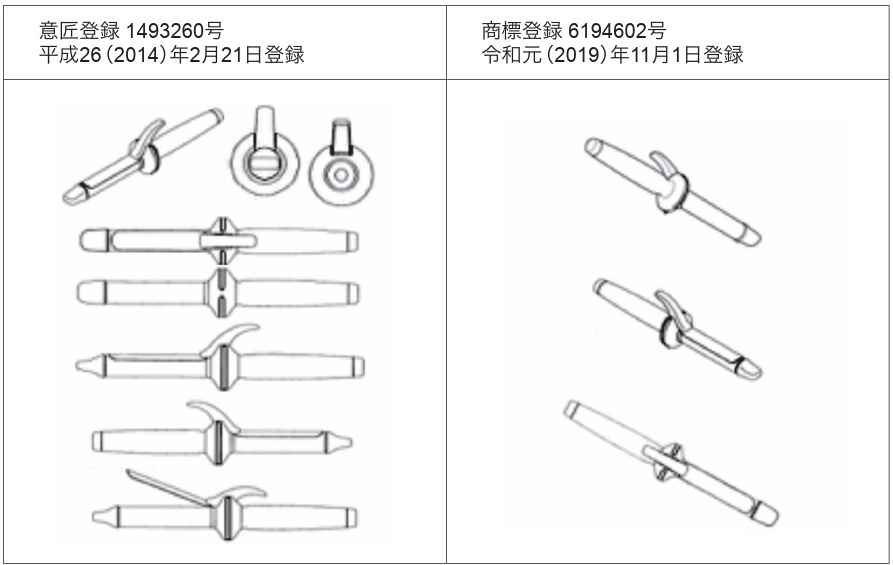
English translation of the registration captions
Left: Design Registration No. 1493260. Registered on February 21, 2014 (2014).
Right: Trademark Registration No. 6194602. Registered on November 1, 2019 (2019).
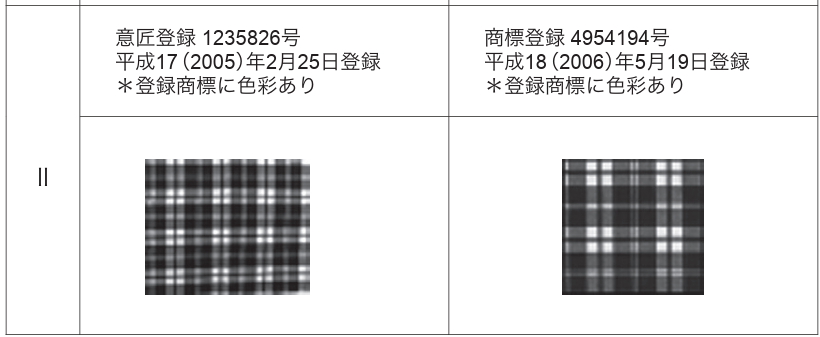
English translation of the registration captions (II)
Left: Design Registration No. 1235826. Registered on February 25, 2005 (2005). *The registered trademark is in color.
Right: Trademark Registration No. 4954194. Registered on May 19, 2006 (2006). *The registered trademark is in color.
[Article] Use Inventions in China (Chizai Kanri, Vol. 73, No. 12, 2023, Ding Wenyun / Wang Weidong)
Original Ameblo publication: 2024-03-08
Ameblo: https://ameblo.jp/hideki-takaishi/entry-12843551531.html
[Article] Use Inventions in China (Chizai Kanri, Vol. 73, No. 12, 2023, Ding Wenyun / Wang Weidong)
Use inventions in China are expressed as “use of …” or “application of …”
A limitation “for …” does not contribute to novelty if it merely describes an intended use or manner of use.
For example, a “hook for a crane” and a “hook for fishing” have different structures, so novelty is recognized.
[Article] Recent U.S. Appeal Decisions Concerning 35 U.S.C. § 112 in Patent Applications by Japanese Companies (2023)
Original Ameblo publication: 2024-03-09
Ameblo: https://ameblo.jp/hideki-takaishi/entry-12843742562.html
[Article] Recent U.S. Appeal Decisions Concerning 35 U.S.C. § 112 in Patent Applications by Japanese Companies (Patent, Vol. 76, No. 4, 2023, Shintaro Yamada)
Rejections by USPTO examiners ⇒ Reversed on appeal <Most recent five years>
Written-description requirement: 22/59
Enablement requirement: 12/23
Definiteness requirement: 15/54
⇒ Dependence on the particle-size measurement method does not immediately make a claim indefinite.
https://jpaa-patent.info/patent/viewPdf/4171
[Article] Extraterritorial Application of U.S. Patent Law (Patent 2023, Vol. 76, No. 13, Aya Tatsuno (龍野 文))
Original Ameblo publication: 2024-03-10
Ameblo: https://ameblo.jp/hideki-takaishi/entry-12843841664.html
[Article] Extraterritorial Application of U.S. Patent Law (Patent 2023, Vol. 76, No. 13, Aya Tatsuno (龍野 文))
Delivery of products outside the United States
Pricing + contract negotiations in the United States: § 271(a) liability denied (Halo decision)
Activities in the United States can also lead to § 271(a) liability (Caltech decision)
Section 271(f) does not apply to method patents
Section 271(f)(2) concerns only acts within the United States
https://jpaa-patent.info/patent/viewPdf/4328
[Article] Invention Disclosure Forms for Improving Patent Specification Quality (Katsuyuki Ishibashi, Chizai Kanri, Vol. 73, 2023)
Original Ameblo publication: 2024-03-11
Ameblo: https://ameblo.jp/hideki-takaishi/entry-12843940032.html
[Article] Invention Disclosure Forms for Improving Patent Specification Quality (Katsuyuki Ishibashi, Chizai Kanri, Vol. 73, No. 7, 2023)
Provide material (text and specific examples / data) concerning the principle for solving the problem in the invention disclosure form. Provide modifications as well, regardless of whether the company plans to adopt them.
⇒ A patent firm cannot create material out of nothing!!
<Damages> Whether Patent Act Article 102(2) and (3) May Be Applied Cumulatively
Original Ameblo publication: 2024-03-12
Ameblo: https://ameblo.jp/hideki-takaishi/entry-12844070008.html
<Damages> Whether Patent Act Article 102(2) and (3) May Be Applied Cumulatively
Portion exceeding working capacity: Yes, 2020 (Ne) No. 10024
Non-identity of markets: Yes, 2020 (Ne) No. 10024
Existence of competing products: No, Osaka District Court, 2020 (Wa) No. 4913 (Yes in JPO materials)
Infringer’s sales efforts: Yes, 2018 (Ne) No. 10034
Performance of infringing products: No, Osaka District Court, 2020 (Wa) No. 4913; 2018 (Ne) No. 10034
Patented invention worked only in part of the infringing product: No, 2020 (Ne) No. 10024
https://www.takaishihideki.com/_files/ugd/324a18_7c43370f2fed4ec5809c5d5f8933212e.pdf
[U.S. Patents] Caltech v. Broadcom, 25 F.4th 976 (2022)
Original Ameblo publication: 2024-03-13
Ameblo: https://ameblo.jp/hideki-takaishi/entry-12844196643.html
[U.S. Patents] Caltech v. Broadcom, 25 F.4th 976 (Fed. Cir. 2022)
Much of the sales activity took place within the United States: even if delivery occurs abroad, the transaction can constitute a domestic sale.
Halo v. Pulse, 831 F.3d 1369 (Fed. Cir. 2016), does not categorically hold that design wins arising from a sales cycle cannot constitute domestic transactions.
https://www.aoyamapat.gr.jp/news/3207
[U.S. Patents] 2003 CAFC (340 F.3d 1367) Bayer v. Housey
Original Ameblo publication: 2024-03-14
Ameblo: https://ameblo.jp/hideki-takaishi/entry-12844326330.html
[U.S. Patents] 2003 CAFC (340 F.3d 1367) Bayer v. Housey
Products under 35 U.S.C. § 271(g) are limited to “physical goods.”
⇒ It does not extend to importing into the United States “information” obtained by using a screening method (a method that does not produce a product).
* This can be considered in parallel with Japanese patents for manufacturing methods.
https://www.youtube.com/watch?v=0Inc-wqmOe8
[U.S. Patents] Centillion v. Qwest 631 F.3d 1279 (Fed. Cir. 2011)
Original Ameblo publication: 2024-03-15
Ameblo: https://ameblo.jp/hideki-takaishi/entry-12844450335.html
[U.S. Patents] Centillion v. Qwest 631 F.3d 1279 (Fed. Cir. 2011)
* “Making” a system under § 271(a) requires combining all the claim elements, but the court held that the user, not Qwest, did so.
This differs from the IP High Court Grand Panel judgment, 2022 (Ne) No. 10046.
It is the same as the first-instance judgment, Tokyo District Court, 2019 (Wa) No. 25152 <Presiding Judge Kokubu>.
⇒ This U.S. CAFC decision is also 13 years old, so a different conclusion might be reached today, with the advancement of the networked society.
https://patent-law.hatenablog.com/entry/2022/10/02/151755
[United States] No Standing Where an IPR Petitioner Appealing a PTAB Decision Has No Injury in Fact
Original Ameblo publication: 2024-03-16
Ameblo: https://ameblo.jp/hideki-takaishi/entry-12844630544.html
[United States] Introduction to a CAFC Decision Dismissing an Appeal for Lack of Standing Where an IPR Petitioner Appealing a Patent Trial and Appeal Board (PTAB) Decision in Inter Partes Review (IPR) to the CAFC Had No Injury in Fact
IPR brought by a petitioner developing a product
⇒ PTAB upheld some of the claims
⇒ CAFC dismissed the appeal because there was no injury in fact
Would the same apply to a PAE?
https://www.jpaa.or.jp/cms/wp-content/uploads/2019/08/JTEKTvGKN_final20190808.pdf
[United States] Section 103 Nonobviousness Requirement; Consideration of New Arguments in an IPR Petitioner’s Reply Brief Improper
Original Ameblo publication: 2024-03-18
Ameblo: https://ameblo.jp/hideki-takaishi/entry-12844827439.html
[United States] Introduction to a CAFC Decision Clarifying the Nonobviousness Requirement of Section 103 and Holding It Improper to Consider New Arguments in an IPR Petitioner’s Reply Brief and Other Submissions
Both “motivation to combine references” and a “reasonable expectation of success” must be proved!!
New arguments in a Reply Brief will not do!!
https://www.jpaa.or.jp/cms/wp-content/uploads/2017/03/Biosystems-v.-Illumina.pdf
[United States] U.S. Supreme Court Decision on Issue Preclusion (B&B Hardware v. Hargis Ind)
Original Ameblo publication: 2024-03-18
Ameblo: https://ameblo.jp/hideki-takaishi/entry-12844834285.html
[United States] U.S. Supreme Court Decision of March 24, 2015, on Issue Preclusion (B&B Hardware v. Hargis Ind)
Provided the general requirements of issue preclusion are satisfied, a TTAB decision has issue-preclusive effect where the trademark usages considered by the TTAB are materially the same as those at issue in court.
However, cases satisfying the general requirements of issue preclusion are limited.
https://www.jpaa.or.jp/cms/wp-content/uploads/2017/03/2_S.C.BB20150714.pdf
[United States] Standard of Review for Claim Construction on Appeal: Supreme Court and Remand Decision, Teva v. Sandoz 2015
Original Ameblo publication: 2024-03-19
Ameblo: https://ameblo.jp/hideki-takaishi/entry-12844963381.html
[United States] Supreme Court and CAFC Remand Decisions Concerning the Standard of Review for Claim Construction on Appeal: Teva v. Sandoz (2015)
On remand, the CAFC examined the issue under the standard in Nautilus, 134 S. Ct. 2120 (2014), considering the prosecution history as to whether a person skilled in the art would consider it reasonably certain that “molecular weight” in the claims referred to Mp.
https://www.jpaa.or.jp/cms/wp-content/uploads/2017/03/7_TEVAv.Sandoz.pdf
[Copyright] “TRIPP TRAPP” Case: Standard for Copyrightability, Tokyo District Court, 2021 (Wa) No. 31529
Original Ameblo publication: 2024-03-20
Ameblo: https://ameblo.jp/hideki-takaishi/entry-12845120352.html
[Copyright] “TRIPP TRAPP” Case: Standard for Copyrightability
Tokyo District Court, 2021 (Wa) No. 31529 <Nakashima>
“Where, separately from the function associated with its practical purpose, it possesses creativity such that it is independently an object of artistic appreciation in itself”
⇒ No infringement (neither reproduction nor adaptation), without examining copyrightability
https://www.courts.go.jp/assets/hanrei/hanrei-pdf-92439.pdf
IP High Court, 2014 (Ne) No. 10063 <Misao Shimizu>
“Whether the creator’s individuality is expressed”
⇒ Copyrightability recognized; no infringement (“The appellee’s products cannot be said to be similar to the portions of the appellant’s products for which copyrightability is recognized.”)
https://www.courts.go.jp/assets/hanrei/hanrei-pdf-85044.pdf


[United States] Ironburg v. Valve (CAFC, April 3, 2023)
Original Ameblo publication: 2024-03-21
Ameblo: https://ameblo.jp/hideki-takaishi/entry-12845216529.html
[United States] Ironburg v. Valve (CAFC, April 3, 2023)
For IPR estoppel—which, after a final written decision in an IPR, bars assertion in court or the ITC of invalidity grounds raised or reasonably available in that IPR—the test is whether a skilled searcher exercising reasonable diligence could reasonably have been expected to discover the grounds. The patent owner asserting estoppel bears the burden of proof.
+ Invalidity grounds on which review was not instituted became subject to IPR estoppel.
⇒ Invalidity arguments based on grounds included in the petition but not instituted were barred. For grounds not included in the petition and discovered later, however, the estoppel ruling was vacated and remanded because the district court had incorrectly placed the burden of proof on the patent challenger.
IP High Court, 2023 (Gyo-Ko) No. 10001 <Miyasaka> = First Instance, Tokyo District Court, 2022 (Gyo-U) No. 382 <Sugiura>
Original Ameblo publication: 2024-03-22
Ameblo: https://ameblo.jp/hideki-takaishi/entry-12845343834.html
IP High Court, 2023 (Gyo-Ko) No. 10001 <Miyasaka> = First Instance, Tokyo District Court, 2022 (Gyo-U) No. 382 <Sugiura>
* A divisional application was filed within 30 days from service of the certified copy of the decision to grant a patent (Patent Act Article 44(1)(ii)), but the patent fees had been paid and the patent registered before the divisional application was filed.
⇒ The disposition dismissing the divisional application because the filer was no longer a “patent applicant” was held lawful.
https://www.courts.go.jp/assets/hanrei/hanrei-pdf-92405.pdf
[Trademark] IP High Court, 2023 (Gyo-Ke) No. 10030 <Hibiku Shimizu>
Original Ameblo publication: 2024-03-23
Ameblo: https://ameblo.jp/hideki-takaishi/entry-12845531025.html
[Trademark] 2023 (Gyo-Ke) No. 10030 <Hibiku Shimizu>
“Kuruntto Maegami Curler” (“Curling Bangs Curler”): no distinctiveness (trial decision rescinded)
When used in relation to hair, including bangs, the word “kurunto” is ordinarily used to indicate “the state of (hair) being curved into a round shape.” … It indicates “the state of (bangs) being curved into a round shape.” …
https://www.courts.go.jp/assets/hanrei/hanrei-pdf-92351.pdf
[Trademark] IP High Court, 2021 (Gyo-Ke) No. 10100 <Otaka> “Scrum Master”: No Distinctiveness (Trial Decision Rescinded)
Original Ameblo publication: 2024-03-24
Ameblo: https://ameblo.jp/hideki-takaishi/entry-12845627399.html
[Trademark] 2021 (Gyo-Ke) No. 10100 <Otaka> “Scrum Master”: No Distinctiveness (Trial Decision Rescinded)
(Excerpt from the judgment)
… The extent of actual use or whether it is well known is not at issue. … It also gives rise to concepts such as a person who has learned “Scrum,” one of the methods of agile software development, or a person proficient in “Scrum.”
https://www.courts.go.jp/assets/hanrei/hanrei-pdf-91256.pdf
IP High Court, 2017 (Ne) No. 10043 [Electronic Program Guide with Digital Storage] <Mori> ⇒ No Indirect Infringement
Original Ameblo publication: 2024-03-25
Ameblo: https://ameblo.jp/hideki-takaishi/entry-12845724255.html
2017 (Ne) No. 10043 [Electronic Program Guide with Digital Storage] <Mori>
⇒ No indirect infringement
* “Indispensability” requirement not satisfied
“The distinctive technical means not found in the prior art lies in the interactive television program guide system incorporating … a digital storage device. … The accused products … do not incorporate one. …”
(Excerpt from the judgment)
The invention is intended to provide an interactive television program guide system with a digital storage device in order to offer users advanced functions unavailable with a stand-alone analog storage device. The distinctive technical means not found in the prior art should be understood to lie in the interactive television program guide system having, that is, incorporating, a digital storage device. Accordingly, because the accused products do not incorporate a digital storage device, they cannot be said to be “indispensable for solving the problem” by means of the invention.
* “Article used for production” requirement not satisfied
“… Recording becomes possible only by connecting an external USB hard disk… to the accused products, so there is no room to incorporate digital storage into the accused products. …”
(Excerpt from the judgment)
The accused liquid-crystal television products merely receive broadcasts and none itself has a memory portion (digital storage) capable of recording. Recording destinations are external USB hard disks or Toshiba recorders compatible with REGZA Link; only by connecting these to the accused products can programs received by the accused products be recorded onto the above hard disks or the like. Accordingly, there is no room to incorporate digital storage into the accused products. Thus the accused products cannot be called “articles used for production” of an interactive television guide system having user television equipment that includes a digital storage device.
https://www.courts.go.jp/assets/hanrei/hanrei-pdf-87430.pdf
Tokyo District Court, 2016 (Wa) No. 37954 [Electronic Program Guide with Digital Storage] <Okinaka>
Original Ameblo publication: 2024-03-27
Ameblo: https://ameblo.jp/hideki-takaishi/entry-12846010046.html
Tokyo District Court, 2016 (Wa) No. 37954 [Electronic Program Guide with Digital Storage] <Okinaka>
Estoppel in interpretation of the wording!
= Tokyo District Court, 2012 (Wa) No. 16103 <Hasegawa>
To argue inventive step, the applicant asserted a temporal sequence in which, unlike the cited reference, “a program is stored before program data is stored.”
[Claim 1] (Element D) A system comprising means for digitally storing a plurality of program data in the digital storage device (31), using the interactive television program guide, in response to the digital storage of the plurality of programs, each of the plurality of program data being associated with one of the plurality of programs, and … .
(Excerpt from the judgment)
United, the applicant for the patent, argued to the JPO during prosecution that, in the invention, unlike the invention described in “Cited Reference 3” …, “a program is stored before program data is stored,” for the purpose of showing that the invention differed from the invention in that reference and possessed inventive step. The JPO is understood to have granted the patent on the basis that the invention differed from the invention in “Cited Reference 3” and was not obvious from it, taking United’s above arguments into account as well. Accordingly, the temporal sequence between storage of programs and storage of program data in Element D of the invention should be interpreted, in accordance with United’s above argument, as “a program is stored before program data is stored.” The plaintiff, which succeeded to the position of the patent applicant, is not permitted to make an argument in this litigation inconsistent with the above argument of the patent applicant, as doing so would violate the principle of estoppel. … Since the accused products are not found to have the temporal sequence in which “a program is stored (recorded) before program data is stored,” they do not satisfy Element D.
https://www.courts.go.jp/assets/hanrei/hanrei-pdf-86498.pdf
Tokyo District Court, 2020 (Wa) No. 27972 [Lighting Device] <Shibata>
Original Ameblo publication: 2024-03-28
Ameblo: https://ameblo.jp/hideki-takaishi/entry-12846102586.html
Tokyo District Court, 2020 (Wa) No. 27972 [Lighting Device] <Shibata>
* The extent of each lens portion cannot be identified
⇒ Claim elements not satisfied
(Excerpt from the judgment)
According to the claims and specification, the diffusion lens of each invention has multiple lens portions, each with an identifiable position and shape, and it is possible to ascertain, for each lens portion, the radius of curvature in the direction in which the LEDs are arranged side by side and the radius of curvature in the direction perpendicular to that direction.
The claims and specification also establish that each invention has the technical significance of producing the effects described in 1(2) above for an invention having such lens portions in a diffusion lens. … Given the shapes of the LSDs used in the accused products, the extent of each “lens portion” referred to in “multiple lens portions” and “each lens portion” … of the inventions cannot be identified in any accused product. Thus the accused products cannot be said to have “each lens portion” as referred to in the inventions, and the radius of curvature in the direction in which the LEDs are arranged side by side and that in the perpendicular direction cannot be ascertained for each lens portion. Nor can the accused products be said to satisfy the configurations … concerning the radii of curvature of the inventions.
https://www.courts.go.jp/assets/hanrei/hanrei-pdf-91871.pdf
IP High Court, 2021 (Gyo-Ke) No. 10082 [Electrically Insulated Cable] <Shoji>
Original Ameblo publication: 2024-03-30
Ameblo: https://ameblo.jp/hideki-takaishi/entry-12846335663.html
2021 (Gyo-Ke) No. 10082 [Electrically Insulated Cable] <Shoji>
* Although the problem is common, the cited invention has already solved it by other means.
⇒ No motivation to further combine a secondary reference
= 2007 (Gyo-Ke) No. 10238
= 2012 (Gyo-Ke) No. 10328
= 2016 (Gyo-Ke) No. 10103
= 2017 (Gyo-Ke) No. 10013
“In the cited invention … the problem common to the claimed invention has already been solved by means different from those of the claimed invention … there is no need … to wrap both wire cores with a tape member, thereby placing the tape member between both wire cores and the sheath. …”
(Excerpt from the judgment)
The claimed invention concerns the ease of removing a coating layer to expose a core wire. Conventional cables with powder applied to the outer peripheral surface of the core material had the problem that the powder scattered into the surroundings when the core material was removed, reducing workability. The invention has technical significance in seeking to solve this problem by providing, between the core wire and coating layer, a tape member arranged in a state wrapped around the core wire, thereby allowing the core wire and coating layer to be separated easily by removing the tape member. On the other hand, … one of the problems addressed by the cited invention is facilitating removal of the wire cores, and in that respect it shares a problem with the claimed invention. However, it seeks to solve that problem by a configuration in which only the outer peripheries of the power-supply and signal wire cores are covered with a sheath, so its means for solving the problem differ from those of the claimed invention. In this way, the cited invention has already solved the problem common to the claimed invention by different means. It must therefore be said that there is no need, in addition to those problem-solving means, to wrap both wire cores with a tape member, thereby placing the tape member between the wire cores and the sheath. If such a configuration were added to the cited invention, removing the wire cores would require not merely removing the sheath but also removing the tape member, which would instead impair workability and detract from the effects of the cited invention. Moreover, Publication Ko 1 contains no statement suggesting any technical significance in wrapping both wire cores with a tape member even at the expense of the effects of the cited invention.
★ On this issue,
Cases favorable to patentees include:
• 2016 (Gyo-Ke) No. 10103 <Takabe>, Wire Gripper
• 2017 (Gyo-Ke) No. 10013 <Takabe>, Method for Producing Dried Noodles
• 2021 (Gyo-Ke) No. 10082 <Shoji>, Electrically Insulated Cable
• 2022 (Gyo-Ke) No. 10003 <Kanno>, Method for Preventing Adhesion of Marine Organisms
Cases unfavorable to patentees include:
• 2010 (Gyo-Ke) No. 10328 <Takizawa>, Safety Shield Assembly
* Combining multiple means for similar purposes and providing them redundantly was held obvious
• 2015 (Gyo-Ke) No. 10114 <Takabe>, Tire
* A person skilled in the art would also try other solutions in order to solve the primary reference’s problem completely
• 2016 (Gyo-Ke) No. 10039 <Shimizu>, Medical Multi-Chamber Container
* Even if a secondary reference solves the cited invention’s problem, the motivation to solve it by another method is not lost
https://www.courts.go.jp/assets/hanrei/hanrei-pdf-91207.pdf
Osaka District Court, 2021 (Wa) No. 10032 [Chip-Type Fuse] <Takemiya>
Original Ameblo publication: 2024-04-01
Ameblo: https://ameblo.jp/hideki-takaishi/entry-12846653463.html
Osaka District Court, 2021 (Wa) No. 10032 [Chip-Type Fuse] <Takemiya>
* The case became a battle of experiments, and identical function and effect were not established.
⇒ Second requirement of the doctrine of equivalents not satisfied
The experiments did not themselves compare the respective functions and effects of the accused product’s “sealed space” and the invention’s “arc-extinguishing material portion” …; their results contradicted the defendant’s … test report … .
* The court also stated the general proposition that equivalence can be established even when part of a claim element is missing. (★ In Tokyo District Court, 2012 (Wa) No. 31523 <Hasegawa>, equivalence was found for Product A, which lacked part of a claim element!!)
(Excerpt from the judgment)
The plaintiff submits as evidence experimental reports, etc. … to show that the “sealed space 26 formed by bonding with adhesive” in configuration c of the accused product has the same function and effect (arc extinguishing) as the “arc-extinguishing material portion” in Element C of the invention. These reports compare the duration of arc discharges in products having the same structure as the accused product when the fuse-element portion has a sealed structure, when it has an unsealed structure, or when a terminal-integrated fuse element is removed and mounted on a board for interruption testing. The results indicate that the duration in the sealed structure was one-half to one-third that in the unsealed structure or the like. However, these experiments do not themselves compare the respective functions and effects of the accused product’s “sealed space” and the invention’s “arc-extinguishing material portion.” In addition, according to the test report … submitted as evidence by the defendant, the durations of arc discharges were recorded for the accused product, a fuse comprising the accused product with an arc-extinguishing material portion added, and the fuse element of the accused product alone, and the accused product had the longest duration. With respect to the respective arc-discharge durations of the accused product and the fuse element, these results contradict the experimental reports … submitted by the plaintiff. Accordingly, the above evidence submitted by the plaintiff and other circumstances do not sufficiently establish that configuration c of the accused product has the same function and effect as Element C of the invention. At least the second requirement therefore cannot be said to be satisfied.
Even where the product or other subject matter lacks part of a claim element of the patented invention, infringement under the doctrine of equivalents is understood to be possible if that part is not an essential part of the patented invention and the other requirements for equivalence described above are met. In response, the defendant argues that applying the doctrine of equivalents where part of a claim element is missing impermissibly asserts an enlargement of the claims. However, there is no reasonable basis for distinguishing a case in which part of a claim element is replaced with another configuration from one in which part of a claim element is missing. …
https://www.courts.go.jp/assets/hanrei/hanrei-pdf-92171.pdf
IP High Court, 2023 (Ne) No. 10041 [Training Equipment] <Hibiku Shimizu>
Original Ameblo publication: 2024-04-02
Ameblo: https://ameblo.jp/hideki-takaishi/entry-12846760261.html
2023 (Ne) No. 10041 [Training Equipment] <Hibiku Shimizu>
The court rejected the identification of the bar alone, extracted from the apparatus described in Exhibit Ko 7, as an independent cited invention, and also denied that removal of the weight-supporting portion would have been obvious.
“… Bar 10 alone … cannot be identified as an independent cited invention; the cited invention … includes not only bar 10 but also the weight-supporting portion … in determining inventive step … the question is whether removing the weight-supporting portion would have been obvious.”
(Excerpt from the judgment)
… In this case, bar 10 alone (the Ko 7 invention) cannot be identified as an independent cited invention. Rather, it is appropriate to identify the Ko 7 invention (defendant), which comprises not only bar 10 but also the weight-supporting portion, as the cited invention. Therefore, in determining the inventive step of the inventions using the invention described in Publication Ko 7 as the cited invention …, the question is whether it would have been obvious to remove the weight-supporting portion from that Ko 7 invention (defendant). Bar 10 in the Ko 7 invention (defendant) is one of the members constituting that invention and is inseparable from the weight-supporting portion. Thus bar 10 alone cannot be regarded as the ring-shaped apparatus asserted by the plaintiff. …
https://www.courts.go.jp/assets/hanrei/hanrei-pdf-92504.pdf
[Trademark] IP High Court, 2023 (Gyo-Ke) No. 10067 <Honda> 5252byO!Oi
Original Ameblo publication: 2024-04-03
Ameblo: https://ameblo.jp/hideki-takaishi/entry-12846874803.html
[Trademark] 2023 (Gyo-Ke) No. 10067 <Honda>
Mark at issue: 5252byO!Oi
⇒ O!Oi is the dominant portion
Cited mark: OIOI (Marui)
“The dominant portion, which is reasonably similar in pronunciation and mutually confusable in appearance … when used for the designated goods of the mark at issue, the possibility that traders and consumers will mistake the source of the two cannot be denied …”
https://www.courts.go.jp/assets/hanrei/hanrei-pdf-92567.pdf


[Trademark] Tokyo District Court, 2021 (Wa) No. 22287 <Sugiura> “Birkin, Kelly” Trademarks
Original Ameblo publication: 2024-04-06
Ameblo: https://ameblo.jp/hideki-takaishi/entry-12847333484.html
[Trademark] Tokyo District Court, 2021 (Wa) No. 22287 <Sugiura>
“Birkin, Kelly” trademarks
“In light of the fact that some of Plaintiff’s Product 1 sold in the secondhand market are priced considerably lower than new products … and the absence of sufficient evidence to establish that purchasers in ordinary transactions invariably check for an engraved mark or a zippered pocket before purchasing …, the possibility of confusion as to the source of Defendant’s Product 1 cannot be ruled out.”
https://www.courts.go.jp/assets/hanrei/hanrei-pdf-91965.pdf
[Trademark] Tokyo District Court, 2021 (Wa) No. 13895 <Nakashima>
Original Ameblo publication: 2024-04-06
Ameblo: https://ameblo.jp/hideki-takaishi/entry-12847333789.html
[Trademark] Tokyo District Court, 2021 (Wa) No. 13895 <Nakashima>
No violation of Trademark Act Article 4(1)(i)
“Although the mark at issue and the Swiss national flag have in common a broad cross inside them, they are found to differ in that the Swiss national flag is square, has no white outer border, and is bright red apart from the internal cross.”
⇒ Dissimilar
https://www.courts.go.jp/assets/hanrei/hanrei-pdf-92147.pdf
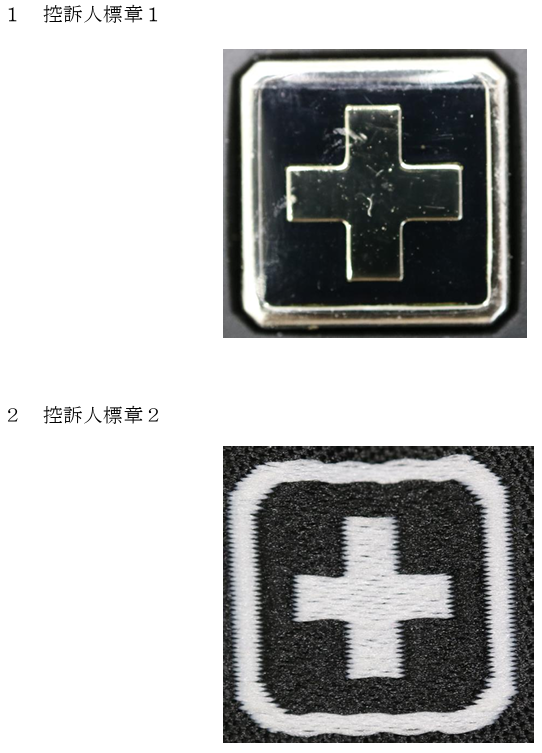
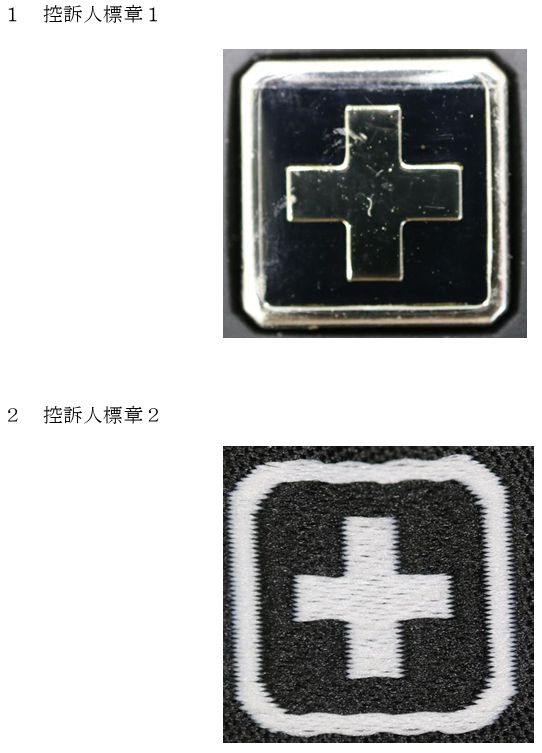

[Trademark] Tokyo District Court, 2022 (Wa) No. 19876 <Sugiura> “Gendai no Riron” case
Original Ameblo publication: 2024-04-06
Ameblo: https://ameblo.jp/hideki-takaishi/entry-12847333913.html
[Trademark] Tokyo District Court, 2022 (Wa) No. 19876 <Sugiura> “Gendai no Riron” case
In 2016, when the trademark application was filed, it was widespread practice for the same person to publish magazines and other publications with identical content in paper and electronic editions.
⇒ “Electronic publications” (Class 9) and “printed matter” (Class 16) are similar goods
https://www.courts.go.jp/assets/hanrei/hanrei-pdf-92397.pdf
[Trial and Appeal Practitioners Study Group 2023] (Mechanical) “Inventive Step of Numerically Limited Inventions” (The Subgroup in Which Takaishi Participated)
Original Ameblo publication: 2024-04-08
Ameblo: https://ameblo.jp/hideki-takaishi/entry-12847567252.html
[Trial and Appeal Practitioners Study Group 2023] Case 1 (Mechanical) “Inventive Step of Numerically Limited Inventions” (The Subgroup in Which Takaishi Participated)
① Where the technical significance of a numerical limitation (its function and effect as means for solving the problem of the claimed invention) is low, inventive step is likely to be denied (as a design matter, etc.).
② Where the technical significance of a numerical limitation is high, the motivation to apply a numerical limitation from a secondary reference to the primary cited invention becomes an issue.
⇒ To establish inventive step, the most important thing is to state in the specification what functions and effects are produced by setting the numerical range of the limitation as means for solving the problem of the claimed invention.
Case 7 (Mechanical) “Inventive Step of Numerically Limited Inventions”
2021 (Gyo-Ke) No. 10091, “Adhesive Tape” case
The differences concerning the four numerical limitations all have low technical significance.
The specification describes general effects of the numerical limitations, but not their mechanisms, and the preferred numerical ranges are broad.
⇒ Design matters; no inventive step
[Trial and Appeal Practitioners Study Group 2023] (Chemistry 1) “New Matter” “Support Requirement for Parameter Inventions in the Food Field”
Original Ameblo publication: 2024-04-10
Ameblo: https://ameblo.jp/hideki-takaishi/entry-12847828499.html
[Trial and Appeal Practitioners Study Group 2023] Case 2 (Chemistry 1)
“New Matter”
Given the present situation in which “disclaimer claims” can be used freely, not only to secure novelty, it is difficult to restrict them on the basis of new matter.
⇒ The support requirement should be used to check whether the invention after the exclusion produces a common effect as a whole and can solve the problem
Cf. 2022 (Gyo-Ke) No. 10125
[Trial and Appeal Practitioners Study Group 2023] Case 8 (Chemistry 1)
“Support Requirement for Parameter Inventions in the Food Field”
2016 (Gyo-Ke) No. 10147, “Tomato-Containing Beverage” case
• Align the experimental conditions
• Mention factors other than the matters defining the invention that influence its problem and effects.
• For sensory evaluation, ensure objectivity by establishing a basis for comparison.
[Trial and Appeal Practitioners Study Group 2023] (Chemistry 2) “Support Requirement” “Novelty of Use Inventions”
Original Ameblo publication: 2024-04-11
Ameblo: https://ameblo.jp/hideki-takaishi/entry-12847983100.html
[Trial and Appeal Practitioners Study Group 2023] Case 3 (Chemistry 2) “Support Requirement”
No participant objected to the proposition that the basic approach to the support requirement for numerically limited inventions is the same as for inventions other than numerically limited inventions, and that the standard of the Grand Panel (Polarizing Film) applies.
⇒ If the technical meaning can be understood, limited specific examples are sufficient.
[Trial and Appeal Practitioners Study Group 2023] Case 9 (Chemistry 2) “Novelty of Use Inventions”
2021 (Gyo-Ke) No. 10066
The judgment rejected an “unknown attribute” and a “new use” because a person skilled in the art would recognize that the pathological condition, purpose and effect, and operation did not differ from those of the Ko 1 invention.
Another court decision recognizing patentability of a use invention is difficult to distinguish from the public domain.
[Trial and Appeal Practitioners Study Group 2023] (Electrical) Inventive Step of Software-Related Inventions
Original Ameblo publication: 2024-04-14
Ameblo: https://ameblo.jp/hideki-takaishi/entry-12848331171.html
[Trial and Appeal Practitioners Study Group 2023] Case 4 (Electrical)
“Assessment of Inventive Step in Software-Related Inventions, Focusing Particularly on Functionally Expressed Features of Information and Information Processing”
In the software field, warning letters are frequently sent. Even warnings based on abstract claims exert a “deterrent effect,” for example by being flagged in due diligence and causing investment to be abandoned.
[Trial and Appeal Practitioners Study Group 2023] Case 10 (Electrical)
“Treatment of Commercial Practices and the Like in Software-Related Inventions”
2021 (Gyo-Ke) No. 10116
The primary cited invention is in the “gaming” field
⇒ “Commercial practices” in the product-sales and marketing industries cannot be applied without motivation.
⇒ For an invention of a business system, a modification taking cross-industry commercial practices into account is a design matter.
[Trial and Appeal Practitioners Study Group 2023] (Design) “Articles” “Scope of Knowledge and Materials of a Person Skilled in the Art in Determining Ease of Creation”
Original Ameblo publication: 2024-04-15
Ameblo: https://ameblo.jp/hideki-takaishi/entry-12848429963.html
[Trial and Appeal Practitioners Study Group 2023] Case 5 (Design) Identification of the “Article to Which a Design Pertains”
In determining similarity of “articles to which designs pertain,” similarity may be recognized broadly where common uses and functions create a possibility of similarity in form.
The “consumer” in Design Act Article 24(2) is the person whose perspective determines the points of attention and weighting of evaluations concerning the form of the design, rather than the article.
[Trial and Appeal Practitioners Study Group 2023] Case 11 (Design) “Scope of Knowledge and Materials of a Person Skilled in the Art in Determining Ease of Creation”
2021 (Gyo-Ke) No. 10158
It is appropriate to premise the analysis on circumstances in which a person skilled in the art of the article to which the design pertains would “naturally encounter” the material
The part of the holding that transferring a motif is easy where the function is identical can vary with individual circumstances.
[Trial and Appeal Practitioners Study Group 2023] (Trademark) “Trademark Act Article 3(1)(iii): Distinctiveness” “Similarity of Composite Marks”
Original Ameblo publication: 2024-04-17
Ameblo: https://ameblo.jp/hideki-takaishi/entry-12848686359.html
[Trial and Appeal Practitioners Study Group 2023] Case 6 (Trademark) “Trademark Act Article 3(1)(iii): Distinctiveness”
If a mark is generally recognized as describing the quality of services, “including in the future,” it lacks distinctiveness
For example, where the content of goods or services can be imagined from a word or concept used as a particular quality indication in another goods or services field sharing some consumers.
[Trial and Appeal Practitioners Study Group 2023] Case 12 (Trademark) “Similarity of Composite Marks”
Approaches to applying the legal standards of the Supreme Court decisions to individual cases
The general rule is to consider a composite mark as a whole
⇒ There can be various perspectives for determining unity, so it is important to reach a reasoned determination based on a legal standard appropriate to the case
* All the other points merely present opinions of some committee members
IP High Court, 2021 (Gyo-Ke) No. 10033 [Construction Method Using Short Interior Corner Members] <Kanno> Correction of an Error in the Specification Permitted
Original Ameblo publication: 2024-04-19
Ameblo: https://ameblo.jp/hideki-takaishi/entry-12848944205.html
2021 (Gyo-Ke) No. 10033 [Construction Method Using Short Interior Corner Members] <Kanno>
* Correction of an error in the specification was allowed
Before the correction … the two terms “joining” and “connecting” were used for the same stage, so the correction can be said to unify the terminology and constitutes correction of an error.
(Excerpt from the judgment)
(1) Whether the correction constitutes correction of an error …
Before the correction, “joining” was used in claim 1 and paragraph [0022] of the pre-correction specification for the third step, which is the construction stage, whereas paragraph [0025] of that specification stated, with respect to the construction stage, “at this time, the end faces of the first and second short interior corner members 21-1 and 21-2 are connected without cutting … .” Since the two terms “joining” and “connecting” were used for the same stage, the correction can be said to unify the terminology and constitutes correction of an error. …
(2) Whether the correction constitutes clarification of an ambiguous statement …
Before the correction, the work at the same construction stage was described as “joining” in claim 1 and “connecting” in paragraph [0025] of the pre-correction specification, so the correction constitutes clarification of an ambiguous statement.
https://www.courts.go.jp/assets/hanrei/hanrei-pdf-90805.pdf
IP High Court, 2022 (Gyo-Ke) No. 10081 [Golf Club Shaft] <Honda>
Original Ameblo publication: 2024-04-20
Ameblo: https://ameblo.jp/hideki-takaishi/entry-12849120132.html
2022 (Gyo-Ke) No. 10081 [Golf Club Shaft] <Honda>
Torque (1.6 ≤ Tq ≤ 4.0)
Ratio of total bias-layer weight to the combined total weight of the bias and straight layers (0.5 ≤ B / (B + S) ≤ 0.8)
Ratio of small-diameter-side bias-layer weight to total bias-layer weight (0.05 ≤ A / B ≤ 0.12)
Ratio of small-diameter-side bias-layer weight to large-diameter-side bias-layer weight (1.0 ≤ A / C ≤ 1.8)
The court examined separately the upper and lower limits of these four numerical ranges (eight boundary values in total), and held that “a person skilled in the art at the filing date could not have recognized that the problem of the invention could be solved…”.
Tq is the torque of the shaft (°); B is the total weight of the bias layers (g); S is the total weight of the straight layers (g); A is the weight of the small-diameter-side bias layer (g); and C is the weight of the large-diameter-side bias layer (g).
⇒ Support requirement not satisfied
(Excerpt from the judgment)
It is appropriate to find that the problem addressed by the inventions is “to provide a golf club shaft made of fiber-reinforced resin with high torsional rigidity (a low-torque fiber-reinforced resin golf club shaft), which has high swing stability and excellent stability in both flight distance and direction regardless of the player’s swing speed or ability” (hereinafter “the problem”). …
The feature of setting the shaft torque at 4.0° or less cannot be said to fall within a range in which a person skilled in the art at the filing date could recognize, in light of the common general technical knowledge at that time, that the problem could be solved. …
The feature of setting the shaft torque at 1.6° or more cannot be said to fall within a range in which a person skilled in the art at the filing date could recognize, in light of the common general technical knowledge at that time, that the problem could be solved. …
The feature of setting the total weight of the bias layers at 50% or more of the sum of the total weight of the bias layers and the total weight of the straight layers cannot be said to fall within a range in which a person skilled in the art at the filing date could recognize, in light of the common general technical knowledge at that time, that the problem could be solved. …
The feature of setting the total weight of the straight layers at 20% or more of the sum of the total weight of the bias layers and the total weight of the straight layers cannot be said to fall within a range in which a person skilled in the art at the filing date could recognize, from the detailed description of the invention in the specification, that the problem could be solved. …
The feature of setting the weight of the small-diameter-side bias layer at 180% or less of the weight of the large-diameter-side bias layer cannot be said to fall within a range in which a person skilled in the art at the filing date could recognize, from the detailed description of the invention in the specification, that the problem could be solved. …
The feature of setting the weight of the small-diameter-side bias layer at 100% or more of the weight of the large-diameter-side bias layer cannot be said to fall within a range in which a person skilled in the art at the filing date could recognize, from the detailed description of the invention in the specification, that the problem could be solved. …
The feature of setting the weight of the small-diameter-side bias layer at 12% or less of the total weight of the bias layers cannot be said to fall within a range in which a person skilled in the art at the filing date could recognize, from the detailed description of the invention in the specification, that the problem could be solved. …
The feature of setting the weight of the small-diameter-side bias layer at 5% or more of the total weight of the bias layers cannot be said to fall within a range in which a person skilled in the art at the filing date could recognize, from the detailed description of the invention in the specification, that the problem could be solved.
https://www.courts.go.jp/assets/hanrei/hanrei-pdf-92205.pdf
IP High Court, 2022 (Gyo-Ke) No. 10112 [Control System for Fee-Charging Automatic Machines] <Honda>
Original Ameblo publication: 2024-04-22
Ameblo: https://ameblo.jp/hideki-takaishi/entry-12849321194.html
2022 (Gyo-Ke) No. 10112 [Control System for Fee-Charging Automatic Machines] <Honda>
“Since the problem can be solved provided that … is possible, individual factors such as the types of input signals and the determination method, which are details of the means for solving the problem …, were encompassed by that configuration in the original specification, etc. …”
⇒ No addition of new matter
(Excerpt from the judgment)
… Like Invention 1 before the amendment, amended Invention 1 can solve the problem provided that a device having an IC card reader/writer unit and a communications unit can “output information indicating whether or not [the machine] is operating” to a management server, irrespective of the types of input signals or the specific method for determining “operating” or “not operating.” Thus individual factors such as the types of input signals and the determination method, which are details of the “monitor and transmit” and “output information” configurations constituting the means for solving the problem, can be said to have been encompassed by those configurations in the original specification, etc. Even if amended Invention 1 comes to include types of input signals or determination methods not exemplified in the original specification, etc., this does not add a new technical matter to the technical matters derived from the original specification, etc. as a whole.
https://www.courts.go.jp/assets/hanrei/hanrei-pdf-92460.pdf
IP High Court, 2018 (Gyo-Ke) No. 10100 [Transdermal Absorption Preparation] <Tsuruoka> * Correction of Errors in the Detailed Description Allowed
Original Ameblo publication: 2024-04-22
Ameblo: https://ameblo.jp/hideki-takaishi/entry-12849321437.html
2018 (Gyo-Ke) No. 10100 [Transdermal Absorption Preparation] <Tsuruoka>
* Correction of errors in the detailed description of the invention was allowed. (Slightly more lenient than for claim language?)
There is no evidence sufficient to establish that “hinai” and “hifunai” are medical terms with different concepts … and it is inconceivable that “hinai” was used in the corrected passage to express such a different concept.
(Excerpt from the judgment)
Correction 12 changes “hinai” to “hifunai” in paragraph [0003] of the specification. It is clear from the context that the passage explains, as background art, inserting microneedles, particularly self-dissolving microneedles, into the “skin” (“hifu”). Considering also that all other occurrences in paragraph [0003] use the term “hifu,” it is appropriate to understand “hinai,” the term corrected, as having omitted the character “fu” from “hifu” and as properly having been intended to read “hifunai” (“within the skin”). Accordingly, Correction 12 satisfies the requirements for correction as correction of an error. In response, the plaintiff argues that “hinai” is a medical term expressing a concept different from “hifunai” and that “hinai,” expressing that different concept, was also used in the corrected passage. However, there is no evidence sufficient to establish that “hinai” and “hifunai” are medical terms with different concepts. At least in the corrected passage of paragraph [0003], it is inconceivable that “hinai” was used to express such a different concept, as already explained. Accordingly, the trial decision allowing Correction 12 is appropriate in its conclusion and should be held lawful. …
Correction 16 changes “the surface and dermis of the skin” to “the epidermis and dermis of the skin” in paragraph [0077] of the specification. That passage explains the solubility of the target substance in the skin in relation to surfactants used as absorption enhancers. The invention is, in the first place, a transdermal absorption preparation having a base and a target substance, used by insertion into skin consisting of epidermis and dermis. It is therefore clear that the solubility of the target substance is relevant in “the epidermis and dermis of the skin,” not “the surface and dermis of the skin.” Taking into account also that paragraph [0030], which should be regarded as corresponding to paragraph [0077], uses the term “the epidermis or dermis of the skin” …, it is appropriate to understand “surface,” the term corrected, as having been written in error where “epidermis” should have been written. Accordingly, Correction 16 satisfies the requirements for correction as correction of an error.
https://www.courts.go.jp/assets/hanrei/hanrei-pdf-88401.pdf
[Article] Prior Use Rights as Seen through Case Law: Focusing on the Burden of Allegation and Proof (Makiko Takabe)
Original Ameblo publication: 2024-04-23
Ameblo: https://ameblo.jp/hideki-takaishi/entry-12849453247.html
[Article] Prior Use Rights as Seen through Case Law: Focusing on the Burden of Allegation and Proof (Makiko Takabe)
2017 (Ne) No. 10090 <Presiding Judge Takabe>
⇒ Some case commentaries say that the prior user must recognize the technical significance of the numerical value (concerning moisture content), but the judgment did not intend to require such recognition and did not so hold.
https://jpaa-patent.info/patent/viewPdf/4366
Osaka District Court, 2017 (Wa) No. 1390 [Lamp] * Prior Use Right Recognized for a Numerically Limited Invention
Original Ameblo publication: 2024-04-24
Ameblo: https://ameblo.jp/hideki-takaishi/entry-12849582464.html
Osaka District Court, 2017 (Wa) No. 1390 [Lamp] * Prior Use Right Recognized for a Numerically Limited Invention
No change over time.
The 403W invention has y = 15.7 mm and x = 11.7 mm, and thus the configuration y = 1.34x.
⇒ While maintaining its function, it is possible to modify the design to a numerical range satisfying the relationship between x and y specified by the inventions.
https://www.lawlibrary.jp/pdf/z18817009-00-111652435_tkc.pdf
[Article] Product Configuration and Functionality (2023, Professor Masaharu Miyawaki)
Original Ameblo publication: 2024-04-25
Ameblo: https://ameblo.jp/hideki-takaishi/entry-12849706108.html
[Article] Product Configuration and Functionality (2023, Professor Masaharu Miyawaki)
<United States> Deliberately adopting a particular configuration despite its having no functional advantage is considered a strong circumstance against functionality.
Where there is a patent, status as an indication of goods or business should be denied unless alternatives are available that satisfy the claims while being dissimilar to the plaintiff’s configuration.
https://www.jstage.jst.go.jp/article/patentsp/76/29/76_79/_pdf
[Design] IP High Court, 2023 (Gyo-Ke) No. 10008 (Shoji) * Violation of Joint-Application Requirement (Plaintiff Employee’s Creatorship) Rejected
Original Ameblo publication: 2024-04-26
Ameblo: https://ameblo.jp/hideki-takaishi/entry-12849832079.html
[Design] 2023 (Gyo-Ke) No. 10008 (Shoji)
* Violation of the joint-application requirement (plaintiff employee’s creatorship) rejected
“To qualify as a creator of a design … one must have actually participated in creating its aesthetic appearance, that is, actually have been involved in the act of creating the aesthetic appearance, particularly in completing the distinctive portions differing from those of previous designs.”
https://www.courts.go.jp/assets/hanrei/hanrei-pdf-92226.pdf
I Have Been Recognized by Best Lawyers in the Field of Patent Law!! April 30, 2024
Original Ameblo publication: 2024-04-30
Ameblo: https://ameblo.jp/hideki-takaishi/entry-12850338724.html
I have been recognized by Best Lawyers in the field of patent law!!
I am grateful to those who recommended me, and intend to work even harder so as not to disappoint their expectations.
2024.4.30
https://www.bestlawyers.com/search?q=hideki+takaishi&sort=relevancy

[Unfair Competition Prevention Act] Major Cases, 2018–2020 <METI> * An Excellent Overview Table!!
Original Ameblo publication: 2024-04-30
Ameblo: https://ameblo.jp/hideki-takaishi/entry-12850338898.html
[Unfair Competition Prevention Act] Major Cases, 2018–2020 <METI> * An Excellent Overview Table!!
Acts causing confusion through well-known indications (civil)
Misappropriation of famous indications (civil)
Provision of products imitating another product’s configuration (civil)
Trade secret infringement (civil) (criminal)
Provision of devices circumventing technological restriction measures (civil)
Misleading representations (criminal)
Acts injuring business reputation (civil)
Bribery of foreign public officials (criminal)
https://www.meti.go.jp/shingikai/sankoshin/chiteki_zaisan/fusei_kyoso/pdf/011_s03_00.pdf
[Unfair Competition Prevention Act] Tokyo District Court, 2022 (Wa) No. 4104 <Nakashima> Does Not Qualify as an “Indication of Goods or Business”!
Original Ameblo publication: 2024-04-30
Ameblo: https://ameblo.jp/hideki-takaishi/entry-12850339290.html
[Unfair Competition Prevention Act] Tokyo District Court, 2022 (Wa) No. 4104 <Nakashima>
Gas valves sold exclusively for more than 20 years
In the circumstances of this case, transactions do not focus on their shape.
⇒ Does not qualify as an “indication of goods or business”!
Even if a product configuration has secondary meaning, it does not qualify as an indication of goods or business under Article 2(1)(i) of the Unfair Competition Prevention Act if it does not serve to indicate origin in the relevant transactions.
091854_hanrei.pdf (courts.go.jp)
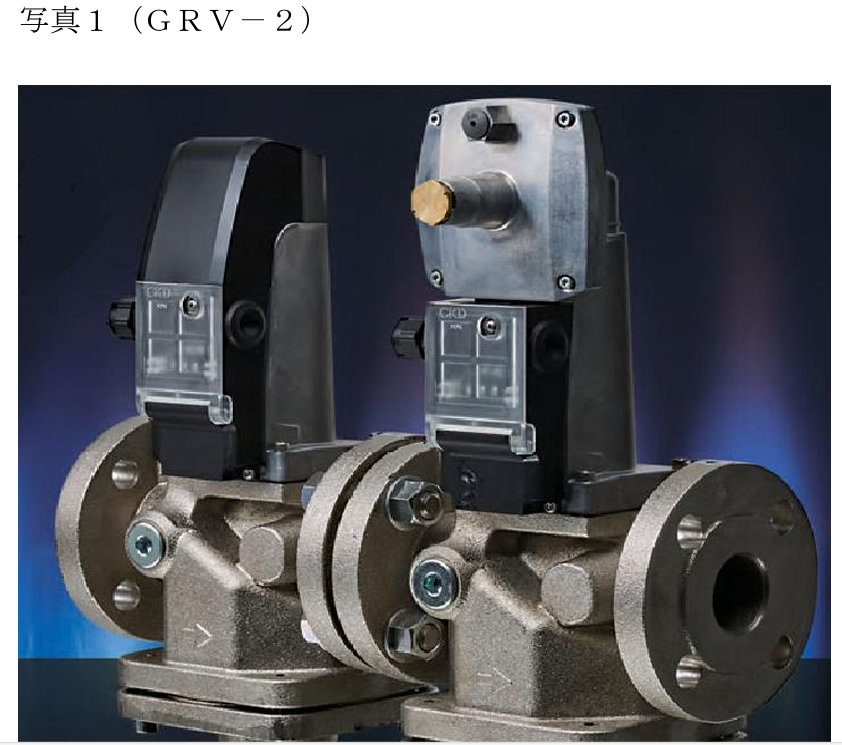
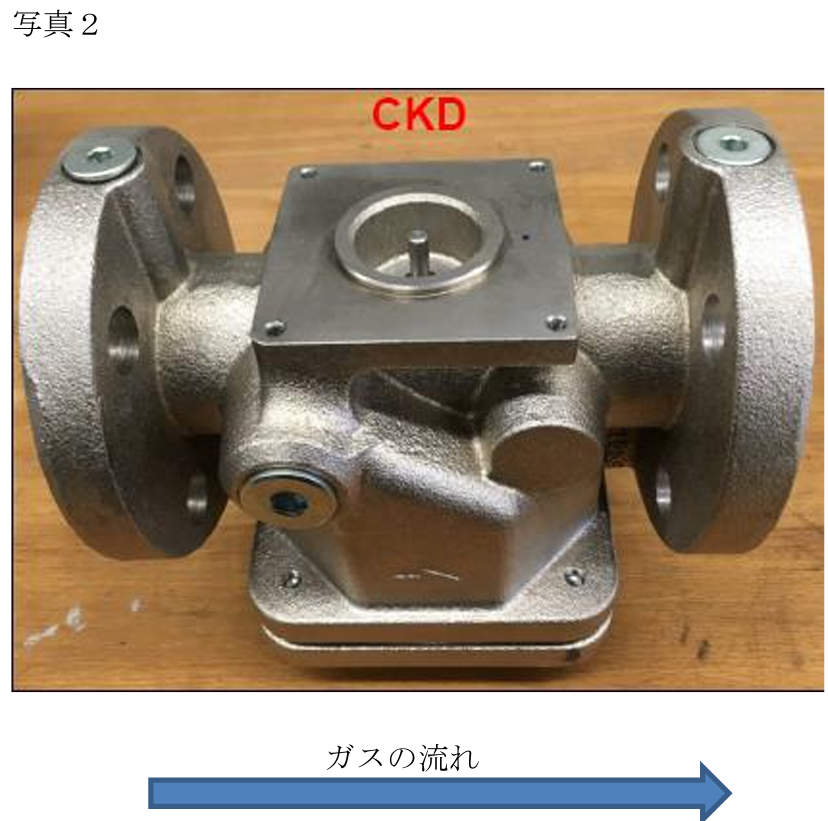
[Article] Degree of Similarity in Determining Confusion (2023, Shunji Sato)
Original Ameblo publication: 2024-04-30
Ameblo: https://ameblo.jp/hideki-takaishi/entry-12850339446.html
[Article] Degree of Similarity in Determining Confusion (2023, Shunji Sato)
The comparison table for Trademark Act Article 4(1)(x), (xi), and (xv) is extremely useful!!
The U.S. Polaroid and DuPont tests also need to be checked!!
Most cases applying item (xv) (likelihood of confusion with goods or services pertaining to another person’s business) fall into the category where the marks are identical / similar but the goods or services are dissimilar
https://jpaa-patent.info/patent/viewPdf/4255
[Article] Civil Code Tort Law as a Supplement to Unfair Competition Law (2023, Professor Tatsuhiro Ueno)
Original Ameblo publication: 2024-04-30
Ameblo: https://ameblo.jp/hideki-takaishi/entry-12850339567.html
[Article] Civil Code Tort Law as a Supplement to Unfair Competition Law (2023, Professor Tatsuhiro Ueno)
Since the Supreme Court’s North Korea decision, no court decision has recognized a tort where protection is unavailable under intellectual property law.
⇒ One possible view is that situations requiring legal protection, such as imitation of product configurations, domains, and shared data with limited access, have been addressed through legislation.
https://jpaa-patent.info/patent/viewPdf/4166
Tokyo District Court, 2017 (Wa) No. 22010 <Yamada> = Appeal, IP High Court, 2020 (Ne) No. 10038 <Otaka> [… Air-Conditioned Clothing]
Original Ameblo publication: 2024-05-01
Ameblo: https://ameblo.jp/hideki-takaishi/entry-12850474762.html
Tokyo District Court, 2017 (Wa) No. 22010 <Yamada> = Appeal, 2020 (Ne) No. 10038 <Otaka> [… Air-Conditioned Clothing]
<Indirect infringement> “Only” requirement satisfied
“A mode of use involving no harness-type safety belt at all is not contemplated as an economic, commercial or practical use”
<Prior use right> Denied
A prototype was tried on within the company, but it was unclear whether immediate working was possible
(Excerpt from the judgment)
<Indirect infringement>
The defendant’s air-conditioned clothing catalog states that “garment only” products are “garments only for use as a spare while washing or for people who already own fans, batteries, etc.” Products 3 and 6 are described as “air-conditioned clothing exclusively for wearers of full-harness safety belts. The lanyard can be brought out through the back. Of course, air will not escape. …” In view of these descriptions and other circumstances, Products 3 and 6 should be found to be sold for wearing harness-type safety belts. A mode of use involving no harness-type safety belt at all cannot be regarded as an economic, commercial or practical use; therefore, they should be found to be used only for manufacturing the accused products, which are articles embodying the registered utility model.
<Prior use right>
Even though a hand-drawn diagram of the configuration of air-conditioned clothing compatible with a full harness was prepared, a prototype was made, and it was tried on within the company, it is not necessarily clear that the defendants were in a position to work it immediately. … The defendants began manufacturing and selling the accused products in May, 2016, more than a year after the prototype was made and tried on in March and April, 2015. In light of this as well, at the filing date, at least, it cannot be said that the defendants’ intention to work immediately the business relating to the accused products embodying the device had been expressed in an objectively recognizable manner and to an objectively recognizable extent. …
https://www.courts.go.jp/assets/hanrei/hanrei-pdf-89683.pdf
[United States] K-Fee System v. Nespresso (CAFC, December 2023)
Original Ameblo publication: 2024-05-02
Ameblo: https://ameblo.jp/hideki-takaishi/entry-12850604781.html
[United States] K-Fee System v. Nespresso (CAFC, December 2023)
<Issue> Can “bit code” satisfy the claim term “bar code”?
The court below construed the term narrowly on the basis of the patentee’s arguments concerning the corresponding EP patent and found it not satisfied.
⇒ Taking the patentee’s EPO arguments into account, the CAFC nevertheless rejected the narrow construction and remanded to the court below.
https://www.cafc.uscourts.gov/opinions-orders/22-2042.OPINION.12-26-2023_2244064.pdf
“Prior Use Rights: A Great Debate on the Main Issues” (Tamura, Iseki, Takabe, Sato, Kajinami, Morita)
Original Ameblo publication: 2024-05-04
Ameblo: https://ameblo.jp/hideki-takaishi/entry-12850931826.html
“Prior Use Rights: A Great Debate on the Main Issues” (Tamura, Iseki, Takabe, Sato, Kajinami, Morita, Patent Supplement 2024)
Except for patent attorney Morita (p. 89), the participants appear to interpret “the invention” in Patent Act Article 79 differently from an “invention” publicly worked.
⇒ If the concept of “invention” under the Patent Act is not uniform, what about the “invention” being worked?
* Must an “invention” publicly worked also be managed??
https://www.jstage.jst.go.jp/article/patentsp/77/30/77_167/_pdf
IP High Court, 2021 (Ne) No. 10061 Hirano Tecseed, PI v. Kaneka ⇒ No Interest in Bringing Suit (Action for a Declaration of Non-Liability)
Original Ameblo publication: 2024-05-04
Ameblo: https://ameblo.jp/hideki-takaishi/entry-12850932078.html
2021 (Ne) No. 10061 <Shoji> Hirano Tecseed, PI v. Kaneka
“Only the manufacture and sale of machinery by the first-instance plaintiff falls within the scope of the license agreement”
For resin film manufactured using machinery sold under license, no obligation on the patentee not to enforce its patent rights was recognized under the contract at issue.
Separately, there was no interest in bringing the claim for a declaration of non-existence of the obligation (action for a declaration of non-liability)
https://www.courts.go.jp/assets/hanrei/hanrei-pdf-92503.pdf
Tokyo District Court, 2020 (Wa) No. 8642 [PCSK9]
Original Ameblo publication: 2024-05-05
Ameblo: https://ameblo.jp/hideki-takaishi/entry-12850981052.html
Tokyo District Court, 2020 (Wa) No. 8642 [PCSK9]
(Patentee’s argument)
Although EGFa-mimic antibodies could not be obtained at the filing date, it is not required to provide means for solving a problem that did not exist at the time of filing.
(Judgment)
The specification does not disclose “the configuration of means for solving … a problem to be solved in the future,” so the support and enablement requirements are violated
* The support and enablement requirements also become an issue when something unknown at the filing date but falling within the claims is discovered after filing.
⇒ This is an unavoidable problem, but can it be addressed through a disclaimer claim?
(The judgment has not been published, so this is unclear, but since it was an infringement action, the accused product may have been an “EGFa-mimic antibody.”)
(Note) The statement in parentheses above reflects the explanation in the original article as of May 5, 2024.
* Curiously, under the doctrine of equivalents, infringement can be asserted against things that became known after the filing date; although the fourth requirement applies, support and enablement are not questioned with respect to the equivalent.
I have doubts about this point and consider this judgment to have exposed that contradiction. In other words, if the original claim language did not encompass “EGFa-mimic antibodies,” there would be room to assert the doctrine of equivalents against them; yet if it does encompass them, this results in a violation of the support and enablement requirements.
(Even if the claim were narrowed now by a disclaimer, would the fifth requirement bar equivalence? Or, since there are many cases in which equivalence was allowed despite narrowing to avoid support- or enablement-requirement violations, might there still be a chance?)
IP High Court, 2022 (Gyo-Ke) No. 10082 [Antibodies Relating to PIVKA-II] <Shoji> ⇒ Clarity Requirement Satisfied
Original Ameblo publication: 2024-05-06
Ameblo: https://ameblo.jp/hideki-takaishi/entry-12851115255.html
2022 (Gyo-Ke) No. 10082 [Antibodies Relating to PIVKA-II] <Shoji>
⇒ Clarity requirement satisfied
(The support and enablement requirements and inventive step were also upheld, and the challenge under the extended prior-application rule was rejected.)
A person skilled in the art would understand “specifically recognizes and binds to PIVKA-II” to mean that the binding protein’s reactivity varies depending on the presence or absence of a specific structural site containing Glu at position 6 and/or 7 of PIVKA-II.
The claim language “specifically recognizes and binds to PIVKA-II” was construed as “an antibody having higher affinity for PIVKA-II, a variant of normal prothrombin, than for normal prothrombin.”
Cf. Page 13 of the 2023 Judicial Symposium on Intellectual Property: this differs from Japan’s interpretation of “specifically binds” as “for example, does not bind to others”!?
https://www.courts.go.jp/assets/hanrei/hanrei-pdf-92709.pdf
https://www.jpo.go.jp/news/kokusai/seminar/document/chizaishihou-2023/5-03.pdf

[Statistics] Trends in Numbers of Patent Invalidation Trials and Oppositions: Invalidation Decisions (Including Partial Invalidation) Just under 20%
Original Ameblo publication: 2024-05-07
Ameblo: https://ameblo.jp/hideki-takaishi/entry-12851247423.html
[Statistics] Trends in Numbers of Patent Invalidation Trials and Oppositions
From 2018 through 2022, the annual number of requests for patent invalidation trials ranged from 97 to 159, with an annual average of 119.2.
Of the 626 final dispositions by the Trial and Appeal Department shown in the table for that period, 106 granted the request, including partial grants, representing approximately 16.9%.
For that period, 159 final dispositions involved withdrawal or abandonment, representing approximately 25.4%. In 2022 alone, 41 of the 115 final dispositions involved withdrawal or abandonment, representing approximately 35.7%.
⇒ Only cases linked to infringement litigation remain, and they are withdrawn upon settlement.
From 2018 through 2022, the annual number of patent oppositions, counted by patent right, ranged from 1,029 to 1,322, with an annual average of 1,151.8.
Of the 5,555 final dispositions by the Trial and Appeal Department shown in the table for that period, counted by patent right, 628 were revocation decisions, including partial revocation, representing approximately 11.3%.
* Reasonable, given that correction requests are made?
https://www.jpo.go.jp/resources/report/nenji/2023/index.html
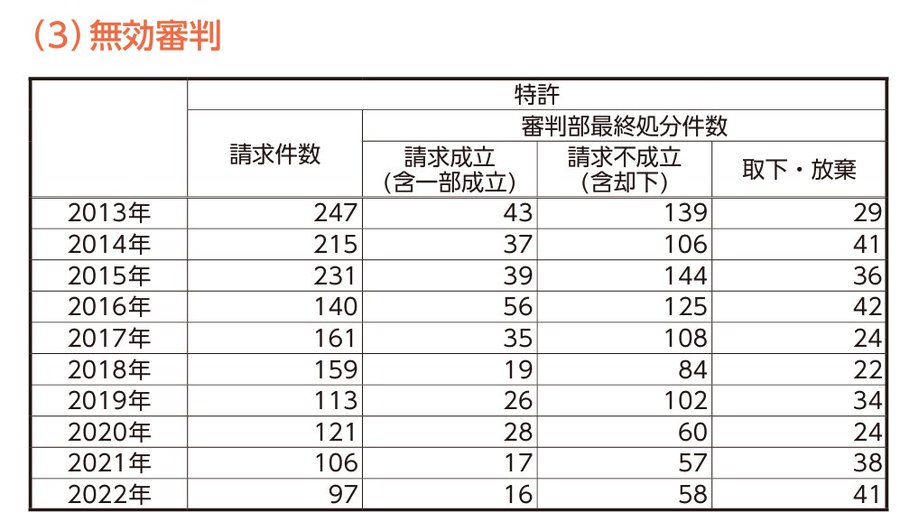
(3) Invalidation trials — Patents
The last three columns show final dispositions by the Trial and Appeal Department.
| Year | Requests | Requests granted (including partial grants) | Requests rejected (including dismissals) | Withdrawal / abandonment |
|---|---|---|---|---|
| 2013 | 247 | 43 | 139 | 29 |
| 2014 | 215 | 37 | 106 | 41 |
| 2015 | 231 | 39 | 144 | 36 |
| 2016 | 140 | 56 | 125 | 42 |
| 2017 | 161 | 35 | 108 | 24 |
| 2018 | 159 | 19 | 84 | 22 |
| 2019 | 113 | 26 | 102 | 34 |
| 2020 | 121 | 28 | 60 | 24 |
| 2021 | 106 | 17 | 57 | 38 |
| 2022 | 97 | 16 | 58 | 41 |
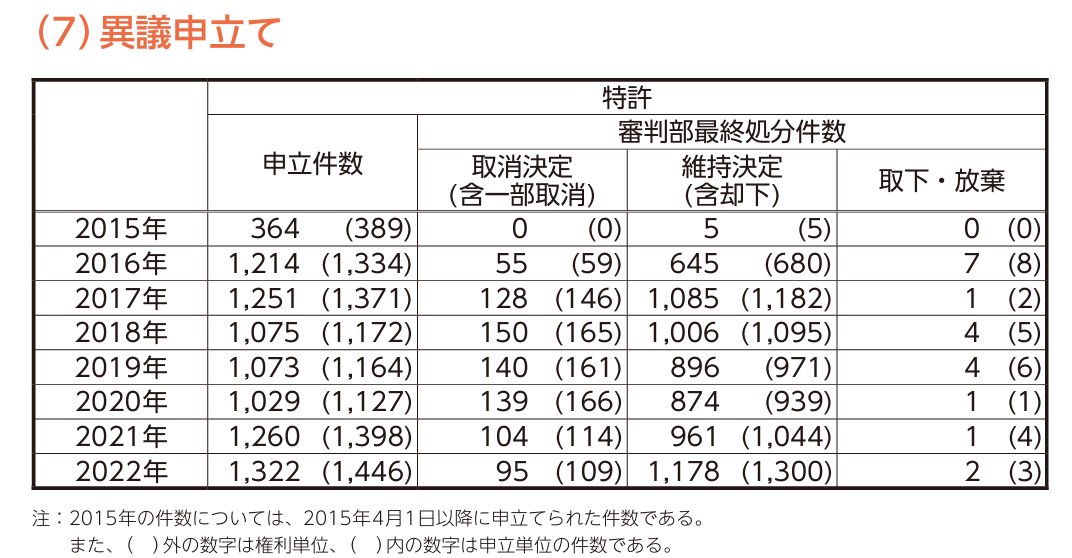
(7) Oppositions — Patents
The last three columns show final dispositions by the Trial and Appeal Department.
Note: Figures for 2015 concern oppositions filed on or after April 1, 2015. Numbers outside parentheses are counted by patent right; numbers in parentheses are counted by opposition.
| Year | Oppositions filed | Revocation (including partial revocation) | Maintenance (including dismissal) | Withdrawal / abandonment |
|---|---|---|---|---|
| 2015 | 364 (389) | 0 (0) | 5 (5) | 0 (0) |
| 2016 | 1,214 (1,334) | 55 (59) | 645 (680) | 7 (8) |
| 2017 | 1,251 (1,371) | 128 (146) | 1,085 (1,182) | 1 (2) |
| 2018 | 1,075 (1,172) | 150 (165) | 1,006 (1,095) | 4 (5) |
| 2019 | 1,073 (1,164) | 140 (161) | 896 (971) | 4 (6) |
| 2020 | 1,029 (1,127) | 139 (166) | 874 (939) | 1 (1) |
| 2021 | 1,260 (1,398) | 104 (114) | 961 (1,044) | 1 (4) |
| 2022 | 1,322 (1,446) | 95 (109) | 1,178 (1,300) | 2 (3) |
[Design] IP High Court, 2023 (Gyo-Ke) No. 10066 <Miyasaka> “Roof Tile” Case ⇒ Similar (No Novelty)
Original Ameblo publication: 2024-05-08
Ameblo: https://ameblo.jp/hideki-takaishi/entry-12851367146.html
[Design] 2023 (Gyo-Ke) No. 10066 <Miyasaka> “Roof Tile” case
⇒ Similar (no novelty)
“… Ultimately, the appearance after installation that satisfies the client is considered the most important. Accordingly, configurations that cannot be perceived from the installed state of the roof tiles have a relatively small influence on the determination of design similarity. …”
https://www.courts.go.jp/assets/hanrei/hanrei-pdf-92650.pdf
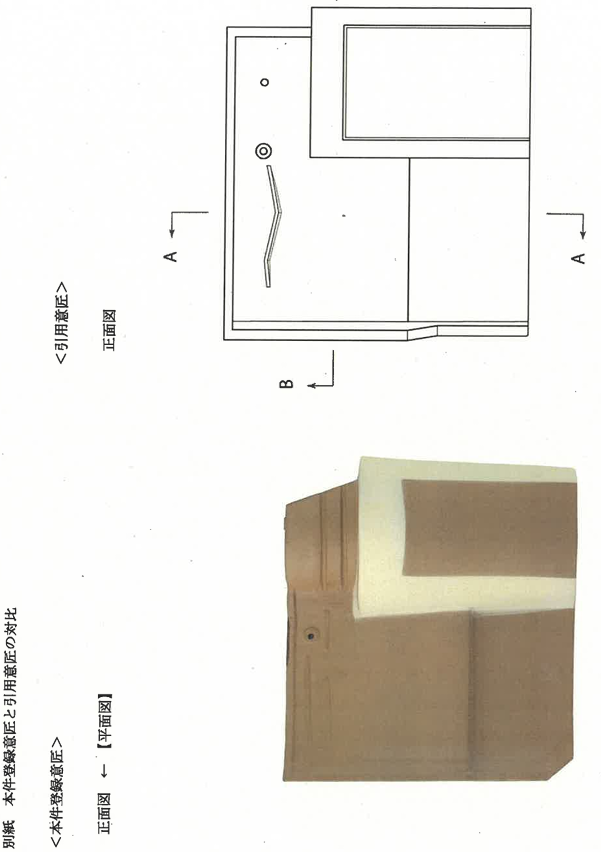
[Unfair Competition Prevention Act] Osaka High Court, 2022 (Ne) No. 2081 <Morisaki>
Original Ameblo publication: 2024-05-09
Ameblo: https://ameblo.jp/hideki-takaishi/entry-12851525538.html
[Unfair Competition Prevention Act] Osaka High Court, 2022 (Ne) No. 2081 <Morisaki>
Even if consumers distinguish types such as stick floats and conical floats by their product configurations, they do not select “floats” on the basis of minute differences in configuration. For a float’s product configuration to have “special distinctiveness,” it “must have an unusual configuration far removed from other floats.”
https://www.courts.go.jp/assets/hanrei/hanrei-pdf-92074.pdf
[Trademark] IP High Court, 2023 (Gyo-Ke) No. 10030 “Kuruntto Maegami Curler” <Hibiku Shimizu> ⇒ No Distinctiveness (Falls under Trademark Act Article 3(1)(iii))
Original Ameblo publication: 2024-05-10
Ameblo: https://ameblo.jp/hideki-takaishi/entry-12851617918.html
[Trademark] 2023 (Gyo-Ke) No. 10030 “Kuruntto Maegami Curler” <Hibiku Shimizu>
⇒ No distinctiveness (falls under Trademark Act Article 3(1)(iii))
(Excerpt from the judgment)
It is appropriate to find that the word “kuruntto” in the mark, placed immediately before “maegami” (“bangs”), … is ordinarily perceived by the consumers and others concerned as indicating “the state of (bangs) being curved into a round shape.”
https://www.courts.go.jp/assets/hanrei/hanrei-pdf-92351.pdf
[Design] Tokyo District Court, 2022 (Wa) No. 17015 [Lidded Tray for Steam Cooking] <Shibata>
Original Ameblo publication: 2024-05-11
Ameblo: https://ameblo.jp/hideki-takaishi/entry-12851811067.html
[Design] Tokyo District Court, 2022 (Wa) No. 17015 [Lidded Tray for Steam Cooking] <Shibata>
“The specific configurations, such as the specific shape, including curvature, of each portion of the lid on the premise of a circular dome shape, and the specific shape of the handle on the premise that a handle exists at the top of the lid”
There are marked differences in the dominant portions.
⇒ Dissimilar
https://www.courts.go.jp/assets/hanrei/hanrei-pdf-92639.pdf
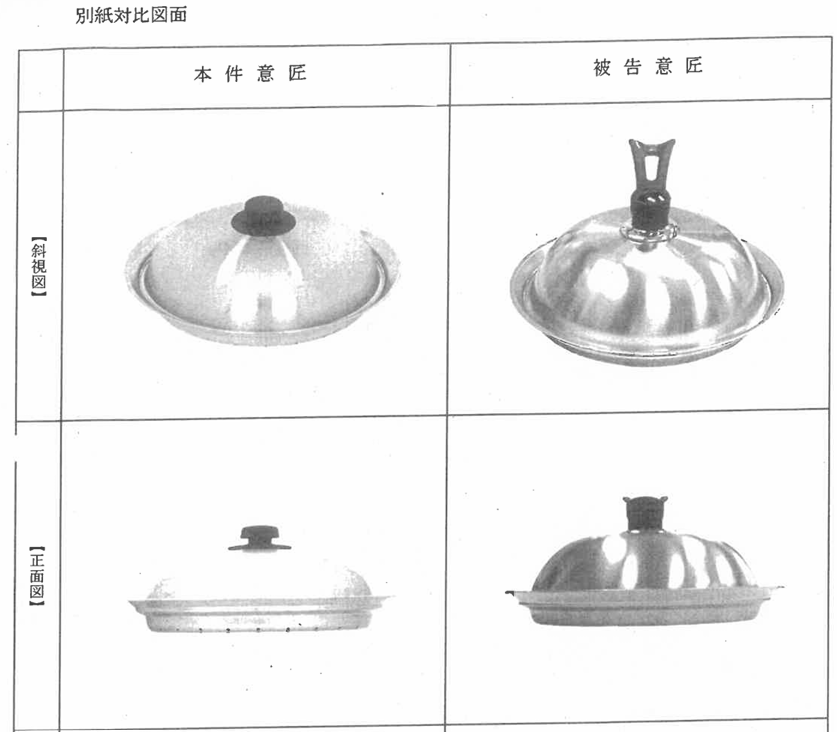
[Patents] I Have Comprehensively Explained the Case Law on “Addition of New Matter”
Original Ameblo publication: 2024-05-12
Ameblo: https://ameblo.jp/hideki-takaishi/entry-12851877254.html
[Patents] “Addition of New Matter”
I have comprehensively explained the case law on addition of new matter.
This is an edited version of the April 10, 2024 “Chizai LAB” mini-lecture.
Please obtain the presentation materials using the link in the description.
https://www.youtube.com/watch?v=cYifFclB3is
IP High Court, 2021 (Gyo-Ke) No. 10133 [Method for Manufacturing a Laminated Rotor Core] <Honda>
Original Ameblo publication: 2024-05-13
Ameblo: https://ameblo.jp/hideki-takaishi/entry-12852003522.html
2021 (Gyo-Ke) No. 10133 [Method for Manufacturing a Laminated Rotor Core] <Honda>
* Even though it was examined in depth in the original application’s specification, it was held not to be “essential” to the invention.
⇒ Not an addition of new matter.
“… Even if … is particularly highlighted and examined in depth in the problems to be solved by the invention and elsewhere in the specification of the earliest parent application … the invention described in that specification, etc. is not … limited to one including that configuration. …”
(Excerpt from the judgment)
… The plaintiff … argues, among other things, that the invention described in the specification, etc. necessarily requires a configuration having a relief space. However, even if matters concerning the configuration having a crimped portion and relief space are particularly highlighted and examined in depth in the problems to be solved by the invention and elsewhere in the specification of the earliest parent application, this does not immediately limit the invention described in that specification, etc. to one including that configuration. … Accordingly, Invention 1 is found to have been described in the original application’s specification, etc. …
https://www.courts.go.jp/assets/hanrei/hanrei-pdf-91427.pdf
I Got a Commemorative Plaque‼️
Original Ameblo publication: 2024-05-14
Ameblo: https://ameblo.jp/hideki-takaishi/entry-12852189445.html
I got a commemorative plaque

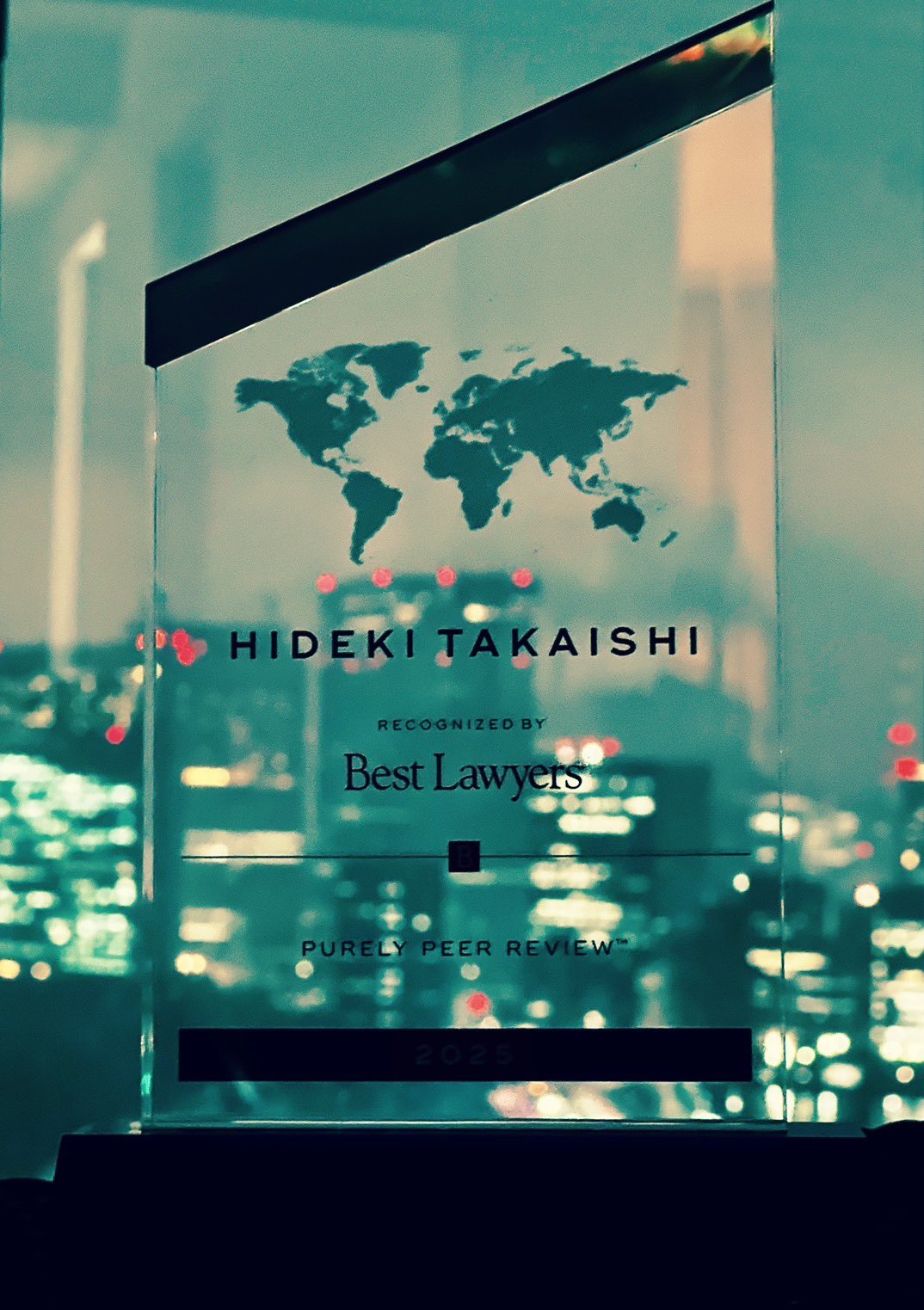
[Trademark] IP High Court, 2023 (Gyo-Ke) No. 10141 “Chizai Jitsumu Online” <Miyasaka> ⇒ No Distinctiveness
Original Ameblo publication: 2024-05-15
Ameblo: https://ameblo.jp/hideki-takaishi/entry-12852270768.html
[Trademark] 2023 (Gyo-Ke) No. 10141 “Chizai Jitsumu Online” <Miyasaka>
Classes 9, 41 and 45 ⇒ No distinctiveness
<Applicant’s arguments>
① None of the more than 40,000 intellectual-property professionals use the mark
② Merely indirectly indicates characteristics of the goods and services
③ A coined word
④ The examples of use cited in the trial decision also indicate source
⑤ Like a periodical’s title, it indicates source as well as content
<Excerpts from the judgment>
① The trademark applicant’s argument that “none of the more than 40,000 intellectual-property professionals use the mark”
⇒ In view of the meanings of “chizai jitsumu” (“intellectual property practice”) and “online” and the general circumstances of marks with “online” appended at the end, the applied-for mark is found to be perceived as indicating the quality of goods or services. Although evidence of third-party use could further support this finding, the absence of third-party use does not affect it.
② The trademark applicant’s argument that it “merely indirectly indicates characteristics of the goods and services”
③ The trademark applicant’s argument that it is “a coined word”
⇒ Consumers perceive the applied-for mark as meaning “something providing information on intellectual property practice online.” Even if there is some breadth in its content, it is still understood as indicating the quality of goods or services and cannot be called a coined word without a definite meaning.
④ The trademark applicant’s argument that “the examples of use cited in the trial decision also indicate source”
⇒ Except for examples in which the words before “online” themselves function as source identifiers, the examples in Appendix 2 are not found to be used in a manner that is perceived as a source identifier by the addition of “online.” The social media post in Exhibit Ko 3 concerning “Jinja Bukkaku Online” (“Shrines and Temples Online”) in Example 16 does not affect this finding.
⑤ The trademark applicant’s argument that “like a periodical’s title, it indicates source as well as content”
⇒ Periodicals such as newspapers and magazines, unlike books authored by individuals, are mainly edited and published continuously by particular newspaper companies or publishers. Their content varies by newspaper company or publisher (including publication of articles with little connection to the title). They thus have trading circumstances different from other goods: even where a title indicates quality or content, it can serve as a source identifier. (The June 16, 1932, judgment of the Great Court of Cassation cited by the plaintiffs is understood to have the same purport.)
Apart from electronic periodicals that are digitized versions of such periodicals, there is insufficient evidence to find that the designated goods and services of the application have the same trading circumstances as periodicals.
For example, designated services ⑩ and ⑪ involve providing videos and the like online. Internet video-posting and sharing services, represented by YouTube, generally allow anyone to post videos easily. Therefore, limitations such as “concerning intellectual property” and “different content provided periodically or successively on each occasion” do not establish trading circumstances equivalent to those of periodicals such as newspapers and magazines.
The plaintiffs refer to discussions of broadcast program titles in the revision of the Trademark Examination Guidelines and argue that goods and services concerning “programs” for which it is clear that “different content is provided periodically or successively on each occasion” are equivalent to periodicals. However, online provision of videos and the like includes diverse content and characteristics. Even considering the current situation in which some “broadcast programs” are also provided online, the trading circumstances cannot be found equivalent to those of broadcast programs themselves.
Further, among periodically issued electronic publications concerning intellectual property (designated goods ⑤), those corresponding to books authored by individuals cannot immediately be equated with periodicals such as newspapers and magazines.
It is true that, with recent advances in electronic and communications technologies, information content and its means of transmission have expanded and diversified, and the boundaries between traditional goods and services such as “periodicals” from newspaper companies and publishers and “broadcast programs” from television and radio stations, and other information content transmitted online, are also changing. Nevertheless, this does not mean that the trading circumstances concerning “periodicals” formed over many years of traditional trade are immediately established for the provision of videos and the like online.
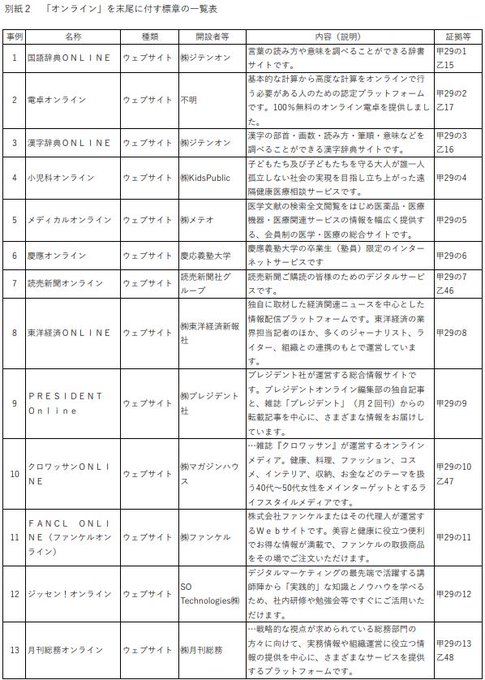
Appendix 2. List of marks with “Online” at the end — English translation
Example 1. 国語辞典ONLINE — Japanese Dictionary ONLINE
Type; operator, etc.: Website; Jitenon Co., Ltd..
Content (explanation): A dictionary website where the readings and meanings of words can be looked up.
Evidence, etc.: Ko 29-1; Otsu 15.
Example 2. 電卓オンライン — Calculator Online
Type; operator, etc.: Website; unknown.
Content (explanation): A certified platform for people who need to perform basic to advanced calculations online. We provided a 100% free online calculator.
Evidence, etc.: Ko 29-2; Otsu 17.
Example 3. 漢字辞典ONLINE — Kanji Dictionary ONLINE
Type; operator, etc.: Website; Jitenon Co., Ltd..
Content (explanation): A kanji dictionary website where radicals, stroke counts, readings, stroke order, meanings, and other matters can be looked up.
Evidence, etc.: Ko 29-3; Otsu 16.
Example 4. 小児科オンライン — Pediatrics Online
Type; operator, etc.: Website; KidsPublic Inc..
Content (explanation): A remote health and medical consultation service established to realize a society in which no child, or adult protecting children, is isolated.
Evidence, etc.: Ko 29-4.
Example 5. メディカルオンライン — Medical Online
Type; operator, etc.: Website; Meteo Inc..
Content (explanation): A members-only comprehensive medical and health-care website providing a broad range of information, including searches and full-text viewing of medical literature and information on pharmaceuticals, medical devices, and medical-related services.
Evidence, etc.: Ko 29-5.
Example 6. 慶應オンライン — Keio Online
Type; operator, etc.: Website; Keio University.
Content (explanation): An internet service limited to graduates (alumni) of Keio University.
Evidence, etc.: Ko 29-6.
Example 7. 読売新聞オンライン — Yomiuri Shimbun Online
Type; operator, etc.: Website; Yomiuri Shimbun Group.
Content (explanation): A digital service for subscribers to the Yomiuri Shimbun.
Evidence, etc.: Ko 29-7; Otsu 46.
Example 8. 東洋経済ONLINE — Toyo Keizai ONLINE
Type; operator, etc.: Website; Toyo Keizai Inc..
Content (explanation): An information distribution platform centered on independently reported economic news. It is operated through collaboration with many journalists, writers, and organizations, in addition to Toyo Keizai reporters responsible for individual industries.
Evidence, etc.: Ko 29-8.
Example 9. PRESIDENT Online — PRESIDENT Online
Type; operator, etc.: Website; President Inc..
Content (explanation): A comprehensive information website operated by President Inc. It delivers various information, mainly original articles by the President Online editorial department and articles reprinted from the magazine President (published twice a month).
Evidence, etc.: Ko 29-9.
Example 10. クロワッサンONLINE — Croissant ONLINE
Type; operator, etc.: Website; Magazine House Co., Ltd..
Content (explanation): …Online media operated by the magazine Croissant. Lifestyle media primarily targeting women in their forties and fifties, covering health, cooking, fashion, cosmetics, interiors, storage, money, and other subjects.
Evidence, etc.: Ko 29-10; Otsu 47.
Example 11. FANCL ONLINE(ファンケルオンライン) — FANCL ONLINE
Type; operator, etc.: Website; FANCL Corporation.
Content (explanation): A website operated by FANCL Corporation or its agent. It is full of convenient, beneficial information useful for beauty and health, and products handled by FANCL can be ordered on the spot.
Evidence, etc.: Ko 29-11.
Example 12. ジッセン!オンライン — Jissen! Online
Type; operator, etc.: Website; SO Technologies Co., Ltd..
Content (explanation): “Practical” knowledge and know-how can be learned from instructors active at the forefront of digital marketing, and can therefore be used immediately for in-house training, study sessions, and the like.
Evidence, etc.: Ko 29-12.
Example 13. 月刊総務オンライン — Gekkan Somu Online
Type; operator, etc.: Website; Gekkan Somu Co., Ltd..
Content (explanation): …A platform providing various services to people in general affairs departments, for whom a strategic perspective is required, centered on practical information and information useful for organizational management.
Evidence, etc.: Ko 29-13; Otsu 48.
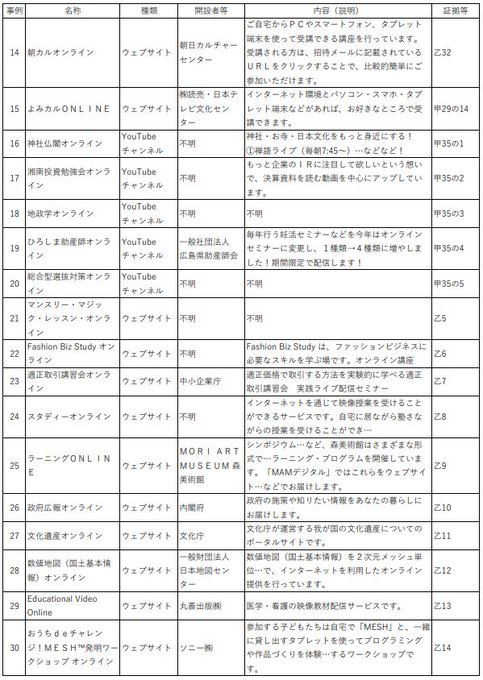
Appendix 2. List of marks with “Online” at the end — English translation
Example 14. 朝カルオンライン — Asakaru Online
Type; operator, etc.: Website; Asahi Culture Center.
Content (explanation): We hold courses that can be attended from home using a PC, smartphone, or tablet. Participants can join relatively easily by clicking the URL in the invitation email.
Evidence, etc.: Otsu 32.
Example 15. よみカルONLINE — Yomikaru ONLINE
Type; operator, etc.: Website; Yomiuri Nippon Television Culture Center Co., Ltd..
Content (explanation): With an internet connection and a computer, smartphone, tablet, or similar device, you can attend from wherever you like.
Evidence, etc.: Ko 29-14.
Example 16. 神社仏閣オンライン — Shrines and Temples Online
Type; operator, etc.: YouTube channel; unknown.
Content (explanation): Bringing shrines, temples, and Japanese culture closer to you! ① Zen sayings live (every morning from 7:45) …and more!
Evidence, etc.: Ko 35-1.
Example 17. 湘南投資勉強会オンライン — Shonan Investment Study Group Online
Type; operator, etc.: YouTube channel; unknown.
Content (explanation): With the wish that people pay more attention to companies’ investor relations, we mainly upload videos reading financial-results materials.
Evidence, etc.: Ko 35-2.
Example 18. 地政学オンライン — Geopolitics Online
Type; operator, etc.: YouTube channel; unknown.
Content (explanation): Unknown.
Evidence, etc.: Ko 35-3.
Example 19. ひろしま助産師オンライン — Hiroshima Midwives Online
Type; operator, etc.: YouTube channel; Hiroshima Midwives Association, general incorporated association.
Content (explanation): This year, we changed our annual seminars on preparing for pregnancy and other subjects to online seminars, and increased the number of types from one to four! They will be streamed for a limited period!
Evidence, etc.: Ko 35-4.
Example 20. 総合型選抜対策オンライン — Comprehensive Selection Preparation Online
Type; operator, etc.: YouTube channel; unknown.
Content (explanation): Unknown.
Evidence, etc.: Ko 35-5.
Example 21. マンスリー・マジック・レッスン・オンライン — Monthly Magic Lesson Online
Type; operator, etc.: Website; unknown.
Content (explanation): Unknown.
Evidence, etc.: Otsu 5.
Example 22. Fashion Biz Study オンライン — Fashion Biz Study Online
Type; operator, etc.: Website; unknown.
Content (explanation): Fashion Biz Study is a place to learn the skills required for the fashion business. Online courses.
Evidence, etc.: Otsu 6.
Example 23. 適正取引講習会オンライン — Fair Transactions Workshop Online
Type; operator, etc.: Website; Small and Medium Enterprise Agency.
Content (explanation): A fair transactions workshop for learning experimentally how to transact at appropriate prices. Practical live-streamed seminar.
Evidence, etc.: Otsu 7.
Example 24. スタディーオンライン — Study Online
Type; operator, etc.: Website; unknown.
Content (explanation): A service through which video lessons can be taken over the internet. While at home, you can take lessons just like those at a cram school…
Evidence, etc.: Otsu 8.
Example 25. ラーニングONLINE — Learning ONLINE
Type; operator, etc.: Website; MORI ART MUSEUM.
Content (explanation): The Mori Art Museum holds …learning programs in various formats, including symposiums…. “MAM Digital” delivers these through the website …and other means.
Evidence, etc.: Otsu 9.
Example 26. 政府広報オンライン — Government Public Relations Online
Type; operator, etc.: Website; Cabinet Office.
Content (explanation): We deliver government measures and information you want to know to your daily life.
Evidence, etc.: Otsu 10.
Example 27. 文化遺産オンライン — Cultural Heritage Online
Type; operator, etc.: Website; Agency for Cultural Affairs.
Content (explanation): A portal website about Japan’s cultural heritage operated by the Agency for Cultural Affairs.
Evidence, etc.: Otsu 11.
Example 28. 数値地図(国土基本情報)オンライン — Digital Maps (Basic Geospatial Information) Online
Type; operator, etc.: Website; Japan Map Center, general incorporated foundation.
Content (explanation): Digital maps (basic geospatial information) are provided online over the internet in two-dimensional mesh units….
Evidence, etc.: Otsu 12.
Example 29. Educational Video Online
Type; operator, etc.: Website; Maruzen Publishing Co., Ltd..
Content (explanation): A distribution service for medical and nursing video teaching materials.
Evidence, etc.: Otsu 13.
Example 30. おうちdeチャレンジ!MESH™発明ワークショップ オンライン — Try It at Home! MESH™ Invention Workshop Online
Type; operator, etc.: Website; Sony Corporation.
Content (explanation): A workshop in which participating children experience programming and creating works …at home using “MESH” and a tablet loaned together with it.
Evidence, etc.: Otsu 14.
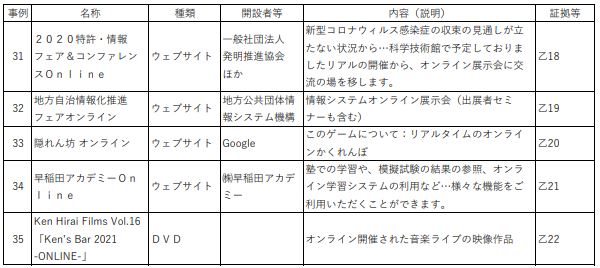
Appendix 2. List of marks with “Online” at the end — English translation
Example 31. 2020特許・情報フェア&コンファレンスOnline — 2020 Patent and Information Fair & Conference Online
Type; operator, etc.: Website; Japan Institute for Promoting Invention and Innovation, general incorporated association, and others.
Content (explanation): Because there is no prospect of the COVID-19 outbreak subsiding …we are moving the place for interaction from the in-person event planned at the Science Museum to an online exhibition.
Evidence, etc.: Otsu 18.
Example 32. 地方自治情報化推進フェアオンライン — Local Government Informatization Promotion Fair Online
Type; operator, etc.: Website; Japan Agency for Local Authority Information Systems.
Content (explanation): Information systems online exhibition (including exhibitor seminars).
Evidence, etc.: Otsu 19.
Example 33. 隠れん坊 オンライン — Hide-and-Seek Online
Type; operator, etc.: Website; Google.
Content (explanation): About this game: real-time online hide-and-seek.
Evidence, etc.: Otsu 20.
Example 34. 早稲田アカデミーOnline — Waseda Academy Online
Type; operator, etc.: Website; Waseda Academy Co., Ltd..
Content (explanation): You can use various functions …including studying at a cram school, viewing mock-examination results, and using an online learning system.
Evidence, etc.: Otsu 21.
Example 35. Ken Hirai Films Vol.16 “Ken’s Bar 2021 -ONLINE-”
Type; operator, etc.: DVD; [blank].
Content (explanation): A video work of a live music performance held online.
Evidence, etc.: Otsu 22.
https://www.courts.go.jp/assets/hanrei/hanrei-pdf-92967.pdf
[Right of Publicity] Tokyo District Court, 2023 (Wa) No. 70056 <Nakashima> * Infringement of the Right of Publicity Established
Original Ameblo publication: 2024-05-16
Ameblo: https://ameblo.jp/hideki-takaishi/entry-12852378350.html
[Right of Publicity] Tokyo District Court, 2023 (Wa) No. 70056 <Nakashima> Infringement of the Right of Publicity Established
“The plaintiff is widely recognized … as the legendary cabaret-club hostess who earned the most in Japan … the plaintiff’s name or likeness … has customer-attracting power that promotes the sale of goods and the like”
“The acts fall within the second category of the Pink Lady judgment and infringe the right of publicity”
(Excerpt from the judgment)
Despite the court’s request for clarification, the defendants have not contested whether the acts fall within the three categories in the Pink Lady judgment, but the court will examine the matter below for completeness.
According to the foregoing background facts and factual findings, the plaintiff’s name and likeness have customer-attracting power that promotes sales of goods and the like. Considering the manner in which the name and likeness were displayed and other circumstances, and the fact that the brand value of Enrike was placed at the forefront across all services provided by the defendants, it is appropriate to find that the defendants attached the plaintiff’s name or likeness to their trade names, marks, web pages and domain names to differentiate their services from those of other businesses of the same kind through that customer-attracting power: Enrike Kukan in its interior-design and related business, Enrike Style in its aesthetic-salon operation and related business, and Enrike Staff in its worker-dispatch and related business.
Accordingly, the defendants’ use of the plaintiff’s name or likeness falls within the second category of the Pink Lady judgment and infringes the right of publicity.
https://www.courts.go.jp/assets/hanrei/hanrei-pdf-92634.pdf
IP High Court, 2013 (Gyo-Ke) No. 10089 [Total Parenteral Nutrition Infusion Preparation in a Two-Chamber Container] <Misao Shimizu>
Original Ameblo publication: 2024-05-17
Ameblo: https://ameblo.jp/hideki-takaishi/entry-12852510705.html
2013 (Gyo-Ke) No. 10089 [Total Parenteral Nutrition Infusion Preparation in a Two-Chamber Container] <Misao Shimizu>
* Applying high-pressure steam sterilization causes vitamin decomposition
⇒ A disincentive exists
⇒ Inventive step recognized
Since the amount decomposed differs for each type of vitamin, the amount of each vitamin must be adjusted, creating a separate technical problem.
(Excerpt from the judgment)
… Even if high-pressure steam sterilization of infusion preparations is well known … there is no motivation to apply it to the cited invention. Rather, given the common general technical knowledge that vitamins generally decompose readily through heat and light, high-pressure steam sterilization … after adding a multivitamin preparation could decompose the vitamins and prevent sufficient achievement of the acidosis-prevention effect. Thus there is a disincentive to high-pressure steam sterilization. … Thermal stability varies among vitamins, and the amounts decomposed by high-pressure steam sterilization differ. Accordingly, to achieve the original objective of adequate replenishment of electrolytes and nutrients, simply increasing the dosage of Neolamin Multi V is insufficient; the amount of each type of vitamin must be adjusted, which can only be regarded as a separate technical problem. It is generally difficult to envisage performing high-pressure steam sterilization despite the creation of such a new technical problem.
https://www.courts.go.jp/assets/hanrei/hanrei-pdf-84358.pdf
[Unfair Competition Prevention Act Article 2(1)(i) / Criminal] Nagoya District Court, December 16, 2022 <Checkered Pattern (Demon Slayer)>
Original Ameblo publication: 2024-05-18
Ameblo: https://ameblo.jp/hideki-takaishi/entry-12852690966.html
[Unfair Competition Prevention Act Article 2(1)(i) / Criminal] Nagoya District Court, December 16, 2022 <Checkered Pattern (Demon Slayer)>
“When combining four or more types, there are countless choices … selecting similar patterns … is itself … highly unlikely to occur unless they are intentionally selected with knowledge of the work”
Cf. The two-color patterns received decisions of refusal under Trademark Act Article 3(1)(vi)
(Excerpt from the judgment)
First, examining Patterns A through C, each individual pattern merely selects one or two colors and applies them to traditional patterns or generally used decorative designs such as checkered, hemp-leaf and scale patterns. They cannot be said to possess special distinctiveness.
In contrast, Patterns D through F each select three colors. Pattern D itself combines a tortoiseshell pattern and a plain area, with two particular colors assigned to the tortoiseshell pattern and one to the plain area. Pattern E is a gradation of three particular colors, characterized also by their particular order within the gradation and the large proportion of white. Pattern F is characterized by a flame pattern expressed through a particular order of three colors and the shape of the boundary between the yellow and adzuki-bean-colored portions. In addition to these characteristics, research into traditional Japanese and kimono patterns revealed no patterns similar to Patterns D through F (Witness G), and these patterns have individually been registered as trademarks. Taking these matters together, Patterns D through F are found to possess special distinctiveness individually.
Further, as stated in (2) above, “KMT” merchandise comprises a wide variety of products and in many instances each product is commercialized with multiple variants. Thus, even if a combination of the patterns contains patterns that are not specially distinctive individually, at least the combination of Patterns A through D includes Pattern D, which is individually specially distinctive. Moreover, even if Patterns A through C individually are merely combinations of simple colors and simple patterns, there are countless ways to choose and combine four such patterns arbitrarily. The probability of arbitrarily selecting only Patterns A through D from among them is therefore extremely low, and combining Patterns A through D cannot be said to restrict others’ freedom to use colors and shapes.
Taken together, these circumstances establish that the combination of Patterns A through D possesses special distinctiveness. Accordingly, the combination of six patterns formed by adding Patterns E and F naturally possesses special distinctiveness as well.
https://www.courts.go.jp/assets/hanrei/hanrei-pdf-91740.pdf
Tokyo District Court, 2018 (Wa) No. 28931 [Laser Processing Apparatus] <Shibata> ⇒ Article 102(2) Inapplicable, Article 102(1) Applicable
Original Ameblo publication: 2024-05-19
Ameblo: https://ameblo.jp/hideki-takaishi/entry-12852747265.html
Tokyo District Court, 2018 (Wa) No. 28931 [Laser Processing Apparatus] <Shibata>
* The plaintiff manufactured and sold a product (SD engine) corresponding to part of the defendant’s product (SD apparatus).
⇒ Article 102(2) inapplicable
⇒ Article 102(1) applicable
★ Always plead paragraph (1) in the alternative as well
* Did the court generally reject cumulative application of Article 102(1) and (3)!?
(Excerpt from the judgment)
(2) Application of Patent Act Article 102(2)
The presumption in Patent Act Article 102(2) … can be said to presuppose a relationship in which, absent the infringer’s acts of patent infringement, the patentee could have earned the profits obtained by the infringer through those acts or profits of the same nature. Accordingly, where there is categorically no relationship in which the patentee could have earned profits of the same nature as those obtained by the infringer through patent infringement even if the infringement had not occurred, the basis for applying that Article is lacking.
In this case, the plaintiff manufactures and sells SD engines …, but does not manufacture or sell SD apparatuses. An SD engine is a component of an SD apparatus; customers for SD engines are manufacturers of semiconductor manufacturing equipment, whereas customers for SD apparatuses are semiconductor manufacturers. … The plaintiff merely manufactures and sells SD engines corresponding to components used in the manufacture, etc. of SD apparatuses embodying the inventions, and does not sell SD apparatuses. Thus, even without the defendant’s patent infringement, the plaintiff would not have been able to sell SD apparatuses equipped with SD engines in place of the defendant. The defendant’s profits in this case are profits from selling SD apparatuses. Even absent the defendant’s infringement of the patent rights, it cannot be found that the plaintiff could have earned profits of the same nature as those from selling such SD apparatuses. Thus there is categorically no relationship in which the plaintiff could have earned the profits obtained by the defendant through patent infringement. Accordingly, the basis for applying Patent Act Article 102(2) is lacking in this case. …
(3) Application of Patent Act Article 102(1)
The “articles that [the patentee, etc.] could have sold if there had been no infringement” in Patent Act Article 102(1) need only be the patentee’s products whose sales volume is affected by the infringement. The plaintiff patentee sells its engines, which are SD engines. Since an SD engine was necessary for an SD apparatus, the defendant’s sales of SD apparatuses affect the sales volume of the plaintiff’s engines. Accordingly, there is a basis for applying Patent Act Article 102(1) in this case. …
… Patent Act Article 102(1) presumes the patentee’s damages through the paragraph as a whole, including its individual items, and paragraph (3) of the same Article is not applied in addition to paragraph (1).
https://www.courts.go.jp/assets/hanrei/hanrei-pdf-92821.pdf
[Unfair Competition Prevention Act Article 2(1)(iii)] Tokyo District Court, 2021 (Wa) No. 25324 <Shibata> ⇒ Substantially Identical Configurations; Configuration Imitation Found!!
Original Ameblo publication: 2024-05-20
Ameblo: https://ameblo.jp/hideki-takaishi/entry-12852882011.html
[Unfair Competition Prevention Act Article 2(1)(iii)] 2021 (Wa) No. 25324 <Shibata>
⇒ Configuration imitation found because the configurations were substantially identical!!
Plaintiff’s goods: ¥17,800–19,800
Defendant’s goods: ¥1,980–3,980
The shapes are almost identical.
The rear zipper and hooks and the width of the shoulder straps are trivial differences that are noticed only when pointed out.
https://www.courts.go.jp/assets/hanrei/hanrei-pdf-92651.pdf
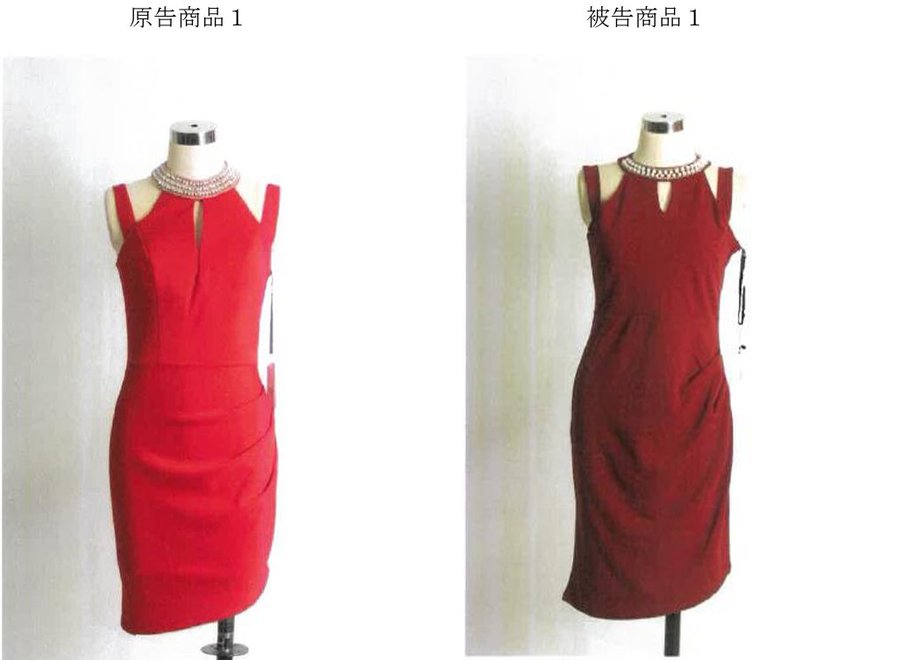
[Article] Monosodium Glutamate Case / Tokyo District Court, September 24, 2020 (2016 (Wa) No. 25436) (Yuki Hirai, Patent, September 2021 issue)
Original Ameblo publication: 2024-05-21
Ameblo: https://ameblo.jp/hideki-takaishi/entry-12853008951.html
[Article] Monosodium Glutamate Case / Tokyo District Court, September 24, 2020 (2016 (Wa) No. 25436) (Yuki Hirai, Patent, September 2021 issue)
For goods transferred abroad by an overseas affiliate, an “offer for transfer” was also found because the Japanese defendant had jointly conducted sales activities in Japan with that affiliate.
⇒ In the damages analysis, the overseas affiliate’s profits were also evaluated as the Japanese defendant corporation’s marginal profits (Article 102(2))!
https://jpaa-patent.info/patent/viewPdf/3871
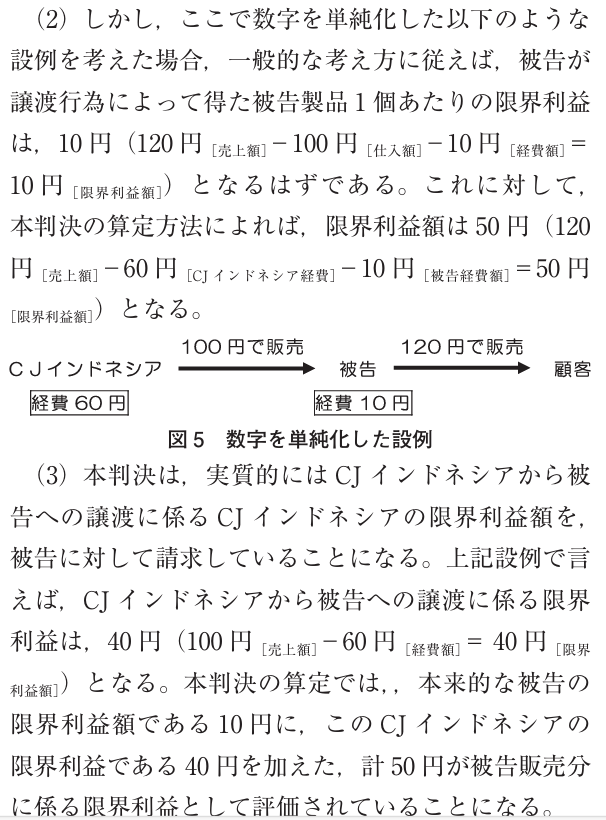
English translation of the excerpt and Figure 5
(2) However, when considering a hypothetical example with simplified figures as set out below, under the usual approach, the marginal profit obtained by the defendant through the transfer per unit of the defendant’s product should be JPY 10 (JPY 120 [sales amount] − JPY 100 [purchase amount] − JPY 10 [expenses] = JPY 10 [marginal profit]). In contrast, under the calculation method in this judgment, the marginal profit is JPY 50 (JPY 120 [sales amount] − JPY 60 [CJ Indonesia’s expenses] − JPY 10 [defendant’s expenses] = JPY 50 [marginal profit]).
Figure 5. Hypothetical example with simplified figures. CJ Indonesia (expenses: JPY 60) sells to the defendant for JPY 100. The defendant (expenses: JPY 10) sells to the customer for JPY 120.
(3) In substance, this judgment results in a claim against the defendant for CJ Indonesia’s marginal profit from the transfer from CJ Indonesia to the defendant. In the hypothetical example above, the marginal profit from the transfer from CJ Indonesia to the defendant is JPY 40 (JPY 100 [sales amount] − JPY 60 [expenses] = JPY 40 [marginal profit]). In the calculation in this judgment, CJ Indonesia’s marginal profit of JPY 40 is added to the defendant’s original marginal profit of JPY 10, and the total of JPY 50 is assessed as the marginal profit from the units sold by the defendant.
[Article] Trademark Rights and Territoriality (Yoshiyuki Tamura, Patent, December 2023 Issue)
Original Ameblo publication: 2024-05-22
Ameblo: https://ameblo.jp/hideki-takaishi/entry-12853142492.html
[Article] Trademark Rights and Territoriality (Yoshiyuki Tamura, Patent, December 2023 Issue)
The purpose of the registered trademark system is to guarantee the source-identifying function
⇒ In the case of use on the Internet, the trademark law of a place where consumers exist to a meaningful extent should apply.
* The server’s location does not affect the conclusion.
+ This is also consistent with past Japanese court decisions.
https://jpaa-patent.info/patent/viewPdf/4339
[U.S. Patents] Amgen v. Chugai (1991 CAFC) 927 F.2d 1200
Original Ameblo publication: 2024-05-23
Ameblo: https://ameblo.jp/hideki-takaishi/entry-12853261248.html
[U.S. Patents] Amgen v. Chugai (1991 CAFC) 927 F.2d 1200
For the claim language “a specific activity of at least about 160,000 IU per absorbance unit at 280 nm,” the specification and prosecution history provided no hint as to which intermediate values between that figure and the prior art’s “specific activity of 128,620 IU” would infringe
⇒ Indefinite
[U.S. Patents] Conopco v. May Dept. (1994, CAFC) 46 F.3d 1556
Original Ameblo publication: 2024-05-24
Ameblo: https://ameblo.jp/hideki-takaishi/entry-12853386701.html
[U.S. Patents] Conopco v. May Dept. (1994, CAFC) 46 F.3d 1556
The accused product’s “162.9 : 1” did not satisfy the claim language “about 40 : 1.” No equivalence either
Under the ordinary and customary meaning of “about,” the upper limit of “about 40:1 to 1:1” cannot be expanded “as far as the prior art allows.”
https://law.justia.com/cases/federal/appellate-courts/F3/46/1556/591683/
IP High Court, 2023 (Gyo-Ke) No. 10009 [Wastepaper Processing Apparatus] <Hibiku Shimizu>
Original Ameblo publication: 2024-05-28
Ameblo: https://ameblo.jp/hideki-takaishi/entry-12853895453.html
2023 (Gyo-Ke) No. 10009 [Wastepaper Processing Apparatus] <Hibiku Shimizu>
The fact that the invention and the cited invention have the same purpose was used as the reason for treating the difference as a design matter.
(Other differences were held obvious by combining the primary and secondary cited inventions because they had the same purpose. Parallel reasoning was adopted for design matters and combinations.)
(Excerpt from the judgment)
In the cited invention, the “estimated recycling duration” is displayed on the display unit as a warning to the user when, for example, it is shorter than the “operating duration” set by the user. (According to paragraph [0054] of Ko 1, such a warning is intended to alert the user that operation will continue after the raw material stored in the raw-material storage unit has been used up.) Adopting a technique that displays the “estimated recycling duration” as such a warning and adopting one that displays the “scheduled operation-end time” differ only in displaying a duration rather than a clock time. It is appropriate to find that these are design matters that a person skilled in the art could select as appropriate by exercising ordinary creative ability as means of achieving the same purpose. …
https://www.courts.go.jp/assets/hanrei/hanrei-pdf-92483.pdf
[U.S. Patents] Par v. Hospira (2020, CAFC) * Literal Infringement Affirmed on Appeal; Equivalents Addressed in the Alternative Below
Original Ameblo publication: 2024-05-28
Ameblo: https://ameblo.jp/hideki-takaishi/entry-12853895740.html
[U.S. Patents] Par v. Hospira (2020, CAFC): Claim Language “about 6 to 8 mg/mL”
⇒ The Federal Circuit affirmed literal infringement; the district court had also found infringement under the doctrine of equivalents in the alternative.
① Using “about” with a numerical range avoids a strict interpretation of the boundaries
② The extent to which “about” can expand a numerical range is what a person skilled in the art would regard as reasonable
③ …
https://openlegalcommunity.com/what-is-about/
[2026 editorial clarification] The Federal Circuit affirmed the finding of literal infringement, applying the claim term “about” to the numerical range. It did not decide infringement under the doctrine of equivalents; the district court had reached that issue only in the alternative. This appellate decision should not be cited as holding that infringement under the doctrine of equivalents was established.
[U.S. Patents] Cohesive v. Waters (2008, CAFC): Numerical Range Construed Broadly!
Original Ameblo publication: 2024-05-28
Ameblo: https://ameblo.jp/hideki-takaishi/entry-12853895948.html
[U.S. Patents] Cohesive v. Waters (2008, CAFC)
The claim language requiring an average diameter “greater than about 30 μm” was construed to mean either (1) greater than 25.434 μm, or (2) greater than 23.044 μm and a particle diameter sufficiently large to ensure that the column is capable of attaining turbulent flow.
⇒ Reversed the district court’s summary judgment that 25 μm did not satisfy the claim.
★ The summary judgment of no literal infringement for the 25 μm columns was reversed and remanded, with the numerical range construed broadly. The summary judgment of no infringement under the doctrine of equivalents was affirmed.
https://www.cafc.uscourts.gov/opinions-orders/08-1029.pdf
[U.S. Patents] Ortho-McNeil v. Caraco (2007, CAFC)
Original Ameblo publication: 2024-05-28
Ameblo: https://ameblo.jp/hideki-takaishi/entry-12853896066.html
[U.S. Patents] Ortho-McNeil v. Caraco (2007, CAFC)
The claim language “about 1 : 5” was construed to mean “approximately 1:5, encompassing a range of ratios no greater than 1:3.6 to 1:7.1”!!
⇒ The accused product’s “1 : 8.67” did not satisfy the claim. No equivalence either
* The district court’s claim construction, which relied on both intrinsic evidence (the claims and the specification) and expert testimony (extrinsic evidence) that the scope included the statistical 95% confidence interval, was affirmed.
https://law.justia.com/cases/federal/appellate-courts/cafc/06-1102/06-1102-2011-03-27.html
[United States] Cordis v. Boston Scientific (2009, CAFC)
Original Ameblo publication: 2024-05-29
Ameblo: https://ameblo.jp/hideki-takaishi/entry-12854022998.html
[United States] Cordis v. Boston Scientific (2009, CAFC)
For qualification as a “printed publication,” public accessibility can be negated where a document is distributed only to a limited number of persons under a binding confidentiality agreement.
However, such a binding confidentiality agreement is not essential.
https://www.cafc.uscourts.gov/opinions-orders/08-1003.pdf
[United States] Weber v. Provisur (2024, CAFC)
Original Ameblo publication: 2024-05-30
Ameblo: https://ameblo.jp/hideki-takaishi/entry-12854145857.html
[United States] Weber v. Provisur (2024, CAFC)
Weber’s product manuals, relied on by Weber as the IPR petitioner, were distributed to a limited number of recipients and carried copyright notices restricting copying and transfer. Nevertheless, they qualified as “printed publications” because interested members of the public could obtain them through reasonable efforts. The Federal Circuit reversed the PTAB’s determination that those notices and related terms defeated public accessibility.
https://patent-law.hatenablog.com/entry/2024/02/11/150656
IP High Court, 2023 (Gyo-Ke) No. 10011 [Device for Remote Operation of a Mobile Terminal] <Miyasaka>
Original Ameblo publication: 2024-05-31
Ameblo: https://ameblo.jp/hideki-takaishi/entry-12854276036.html
2023 (Gyo-Ke) No. 10011 [Device for Remote Operation of a Mobile Terminal] <Miyasaka>
An amendment introducing a disclaimer: “… (excluding images captured by a camera)”
⇒ Although an independent claim in the cited reference recited “… an imaging unit,” it was not found to be an essential configuration (for solving the cited invention’s problem). …
⇒ No inventive step
https://www.youtube.com/watch?v=V5JxxqbXTZQ
[U.S. Patents] Dyfan v. Target (CAFC, March 2022): MPF in Software Patents
Original Ameblo publication: 2024-06-02
Ameblo: https://ameblo.jp/hideki-takaishi/entry-12854558605.html
[U.S. Patents] Dyfan v. Target (CAFC, March 2022)
Means-Plus-Function claims in software patents where the word “means” is absent
⇒ Based on expert testimony, the claim terms “code/application” and “system” were held not to invoke MPF because a person skilled in the art would understand them to connote structure.
https://www.cafc.uscourts.gov/opinions-orders/21-1725.OPINION.3-24-2022_1926111.pdf
[Copyright] Osaka High Court, 2023 (Ne) No. 1384: Product Photograph of Vocabulary Cards — Copyrightability Recognized Contrary to the Court Below!!
Original Ameblo publication: 2024-06-02
Ameblo: https://ameblo.jp/hideki-takaishi/entry-12854558738.html
[Copyright] Osaka High Court, 2023 (Ne) No. 1384
Product photograph of vocabulary cards: copyrightability recognized contrary to the court below!!
“By fanning out the second and subsequent vocabulary cards … so that each photograph is just visible, the image expresses that a different photograph is printed on each vocabulary card, and the white background has the effect of … making them stand out”
https://www.courts.go.jp/assets/hanrei/hanrei-pdf-92728.pdf
[Editorial note: The original article image could not be retrieved; the photograph of the subject product reproduced in the judgment (Attachment “Defendant’s Image List 3”) is shown instead.]
IP High Court, 2022 (Gyo-Ke) No. 10099 [Laser Processing Apparatus] <Honda>
Original Ameblo publication: 2024-06-03
Ameblo: https://ameblo.jp/hideki-takaishi/entry-12854662370.html
2022 (Gyo-Ke) No. 10099 [Laser Processing Apparatus] <Honda>
* A feature whose presence in the primary cited invention was unclear was held not obvious to add!!
<Difference> The invention performs AF (autofocus) control, whereas this is unclear in the primary cited invention.
“It is not established that displacement in the Z-axis direction is of a degree that creates a problem of reduced quality”
(Excerpt from the judgment)
The disclosure … in Ko 1 does not establish that displacement in the Z-axis direction of the position where the modified region is formed, caused by warping of the silicon wafer or vibration of the X- and Y-axis stages, is of a degree that creates a problem of reduced quality. Thus, even in light of that passage, it cannot be said that a person skilled in the art would understand from Ko 1 that AF control of the focal point during processing would naturally be adopted in the Ko 1 invention.
https://www.courts.go.jp/assets/hanrei/hanrei-pdf-92185.pdf
[Contract] IP High Court, 2020 (Ne) No. 10016 <Takabe>
Original Ameblo publication: 2024-06-05
Ameblo: https://ameblo.jp/hideki-takaishi/entry-12854927653.html
[Contract] 2020 (Ne) No. 10016 <Takabe>
Joint-application agreement among four parties, A, B, C and D: “If any party newly acquires any of the rights at issue or engages in production or sales without prior consultation and permission, that party shall be deprived of the rights at issue.”
⇒ A sold products without permission: A lost its ownership share!!
⇒ B, C and D began selling: A could not enforce the rights because it had lost its share
https://www.courts.go.jp/assets/hanrei/hanrei-pdf-89675.pdf
IP High Court, 2013 (Gyo-Ke) No. 10228 [Method for Producing a Photocatalyst] * Agreement Concerning Technical Guidance and Ownership of Rights
Original Ameblo publication: 2024-06-06
Ameblo: https://ameblo.jp/hideki-takaishi/entry-12855061241.html
2013 (Gyo-Ke) No. 10228 [Method for Producing a Photocatalyst] * Agreement Concerning Technical Guidance and Ownership of Rights
The “Confirmation Regarding the Handling of Inventions Related to Technical Guidance” between the Saga Ceramics Research Laboratory and Tanaka Tensha provided for obtaining the consent of the governor of Saga Prefecture before filing an application for an independently made invention related to the technical guidance.
⇒ Although the plaintiffs did not obtain the governor’s consent when filing, this does not immediately mean that the right to obtain a patent belongs to the governor.
(All that remains is the question of whether the procedure requiring consent was breached.)
https://www.courts.go.jp/assets/hanrei/hanrei-pdf-84241.pdf
IP High Court, 2021 (Ne) No. 10086 [Lamp] <Honda> ≒ First Instance, Osaka District Court, 2017 (Wa) No. 1390: Prior Use Right Established
Original Ameblo publication: 2024-06-06
Ameblo: https://ameblo.jp/hideki-takaishi/entry-12855106770.html
2021 (Ne) No. 10086 [Lamp] <Honda> ≒ First Instance, Osaka District Court, 2017 (Wa) No. 1390
⇒ Having found variation in the prior-use products, the court recognized the adjustable range as the scope of the prior use right.
* The court mentioned that products worked before the filing date could be encompassed by the patented invention!
⇒ A prior use right is established even without recognition of the parameter
* This judgment has been described as recognizing prior use rights flexibly, and that may be true, but it can also be regarded as consistent with past case law.
① No court decision has required recognition of the parameter for a prior use right in a parameter invention.
In 2017 (Ne) No. 10090 [Pharmaceutical] <Takabe>, the court also noted in dictum that the prior user had not controlled the numerical value (moisture content), but Judge Takabe herself explains in an article that the judgment did not require recognition of the numerical value (moisture content).
https://jpaa-patent.info/patent/viewPdf/4366
② Although this was in the context of the completion of a publicly worked “invention,” the Tokyo District Court, 2012 (Wa) No. 11800 [Polyimide Film] <Takano>, held as follows: while repeatability is necessary to say that an “invention” publicly worked has been completed, repeatability was satisfied in that case and public working was recognized. In that case, it was not necessary to have targeted the numerical values of the patented invention. ⇒ The present judgment (Lamp case) likewise identifies the range of variation of the prior-use products and finds that it falls entirely within the numerical range of the patented invention.
“… An ‘invention’ under Patent Act Article 2(1) is a highly advanced creation of technical ideas utilizing a law of nature. It therefore requires that a person skilled in the art be able to obtain the same result by repeatedly working the created technical subject matter, that is, that it be repeatable (Supreme Court, 1998 (Gyo-Tsu) No. 19 …). The defendant … manufactured 28 prior products falling within the technical scope of the prior invention, and the prior invention was repeatable, so it is clear that the defendant … had completed the prior invention. Certainly, as shown in the attached table, even within a single lot of the prior products, αMD was sometimes below 10 ppm/°C, or αTD was below 3 ppm/°C or above 7 ppm/°C. However, from the entire purport of the oral argument, this is found to have been merely because the defendant did not know the content of Invention 1 and was not targeting αMD of at least 10 ppm/°C and αTD of at least 3–7 ppm/°C. …
The plaintiff argues that the above transfers were for jointly developing polyimide film for COF and that the parties were subject to mutual confidentiality obligations. However, … an article submitted to an industry journal by Toray Industries, Inc., one of the copper-clad laminate manufacturers …, is found to state that a polyimide film with αTD lower than αMD is suitable for COF. In light of this fact, it is difficult to believe that the defendant and the copper-clad laminate manufacturers were subject to mutual confidentiality obligations.”
③ Once a prior use right is established, past case law has been very flexible concerning its scope. Except for “encroachment” (2020 (Ne) No. 10004 [Light Irradiation Apparatus] <Otaka> = Osaka District Court, 2017 (Wa) No. 7532 <Sugiura>), modifications within the patented invention’s scope have been held to fall within the scope of prior use rights in the great majority of cases.
(Excerpt from the judgment / 2021 (Ne) No. 10086 [Lamp])
[Claim 1] … A lamp satisfying the relationship y ≥ 1.09x, where y (mm) is the full width at half maximum of the luminance distribution obtained when the light of each of the plurality of LED chips passes through the outermost boundary of the lamp, and x (mm) is the spacing between the light-emission centers of adjacent LED chips.
… When the y/x values for the two LEDs positioned 25th and 50th from the left were measured for all 24 of the appellee’s 403W products, the 25th LED from the left had a minimum of 1.303, a maximum of 1.388, and mean-value 3σ values of 1.281 and 1.397, while the 50th LED from the left had a minimum of 1.297, a maximum of 1.381, and mean-value 3σ values of 1.272 and 1.403. Industrial products vary in quality for various reasons even when produced through the same production process, and the same is understood to hold for lighting fixtures. As described above, the appellee’s 403W products likewise exhibit variation in their numerical ranges. In addition, one commonly adopted quality-control method is understood to compare product inspection results with the required quality standard and keep the difference (manufacturing error) within three standard deviations (3σ). … In light of these matters, the measured y/x values of the appellee’s 403W products were approximately 1.27–1.38. As for 3σ, which takes ordinary manufacturing error into account, although the quality standard required of the 403W products is unknown, the measured mean can be regarded as that standard in light of ordinary control methods, and the y/x values of the appellee’s 403W products can be found to have been approximately 1.27–1.40. …
In light of the foregoing, the range of y/x values from above 1.4 to 1.7 or above 1.7, constituting the invention embodied in the 403W product, is a range that the appellee had realized by appropriately adjusting x and had brought under its own control. … Further, suppressing the dot-like appearance of LED lighting, which is the problem of each Invention 1, was a problem known to persons skilled in LED lighting before the priority date. Persons skilled in the art can be said to have manufactured lighting fixtures without a dot-like appearance through trial and error, without using the parameter at issue. Under such technological circumstances, where a mathematical formula is used to define an invention of a “product,” products worked or prepared for working before filing (the priority date) may fall within the technical scope defined by the formula of an invention subsequently filed and patented. The establishment of a prior use right should therefore not be denied merely because the appellee did not recognize the parameter at issue. …
https://www.ip.courts.go.jp/app/hanrei_jp/detail?id=6176
https://www.courts.go.jp/assets/hanrei/hanrei-pdf-93015.pdf
[Culpa in Contrahendo] Tokyo District Court, 1996 (Wa) No. 20909
Original Ameblo publication: 2024-06-08
Ameblo: https://ameblo.jp/hideki-takaishi/entry-12855357108.html
[Culpa in Contrahendo] Tokyo District Court, 1996 (Wa) No. 20909
No joint development agreement was concluded
— X completed development, but Y failed
— A time-limited memorandum was concluded; marketing activities premised on sales; Y’s letter of apology; Y’s error in selecting hardware; a year and a half of negotiations
⇒ X’s expectations deserved legal protection; claim for development expenses allowed
⇒ Reversed on appeal; lost 💦
home.j02.itscom.net/it-adr/Hanrei-Ichirann-HYOpage1.html
IP High Court, 2022 (Gyo-Ke) No. 10097 [Aminosilane] <Honda>
Original Ameblo publication: 2024-06-10
Ameblo: https://ameblo.jp/hideki-takaishi/entry-12855558148.html
2022 (Gyo-Ke) No. 10097 [Aminosilane] <Honda>
Even if a substance’s name appears in a reference, disclosure is not recognized unless a person skilled in the art can work it without trial and error
⇒ The mere ability to generalize a reaction formula is insufficient
= 2022 (Gyo-Ke) No. 10091 <Shoji>, 2022 (Wa) No. 9716 <Shibata> [5-Aminolevulinic Acid Phosphate]
1. Claims (Claim 1)
An aminosilane represented by the following formula.
[Chemical Formula 1]
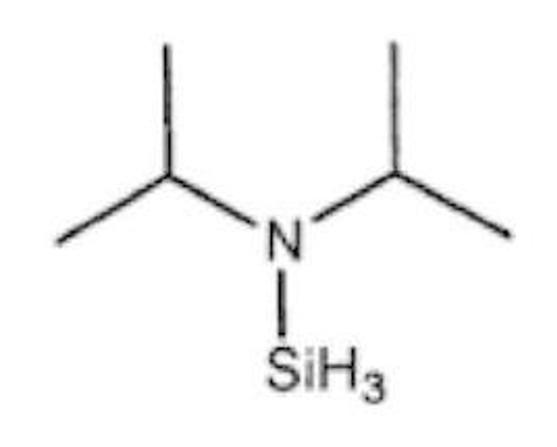
2. Excerpts from the judgment
(1) Novelty
“… At least in chemistry, it may be possible to write a chemical formula or name of a chemical substance formally regardless of whether a method for its manufacture or other acquisition has been found. Accordingly, for a publication to disclose the technical idea constituting an invention of a chemical substance, it should generally be required not merely to disclose the substance’s structure, but also to contain a description sufficient to understand its manufacturing method or another means of obtaining it. Where the publication does not contain a description sufficient to understand its manufacturing method or another means of obtaining it, a person skilled in the art encountering the publication must be able to find such a method on the basis of common general technical knowledge at the time of the patent application, without exercising creative ability through thought, trial and error, or the like. …
Although Ko 1 can be said substantially to state ‘diisopropylaminosilane,’ the name of a chemical substance corresponding to the formula ‘SiH3[N(C3H7)2],’ it contains no description sufficient to understand a manufacturing method or another means of obtaining it.
… Even if the reaction formula could be generalized, it cannot be found that a person skilled in the art could immediately understand how to synthesize compounds falling within its subordinate concepts, or that such methods were common general technical knowledge. …
Accordingly, ‘diisopropylaminosilane’ cannot be identified as the chemical substance of an invention described in Ko 1, constituting an ‘invention described in a publication’ under Patent Act Article 29(1)(iii). …
Even compounds that appear at first sight to be encompassed by the organic aminosilanes of the Ko 1 and Ko 1′ inventions are understood not to be encompassed by the organic aminosilanes of those inventions as inventions described in a publication if they do not satisfy the above prerequisite.”
(2) Inventive step
“As examined above … although it was known before the priority date that dimethylaminosilane and diethylaminosilane could be manufactured, it was not known that diisopropylaminosilane could be manufactured or obtained. Even for a person skilled in the art with ordinary creative ability, it cannot be said to have been easy before the priority date to obtain the diisopropylaminosilane of Invention 1.”
3. Some observations
This judgment denied qualification as a cited invention because, although the reference named the substance, a person skilled in the art could not work it without trial and error. It is consistent with the recent Tokyo District Court judgment, 2022 (Wa) No. 9716, “5-Aminolevulinic Acid Phosphate” <Presiding Judge Shibata>, and IP High Court judgment, 2022 (Gyo-Ke) No. 10091, “5-Aminolevulinic Acid Phosphate” <Presiding Judge Shoji>, and is important in practice.
In this case, the reference named the substance (the aminosilane of the invention), but a person skilled in the art at the priority date could not obtain or manufacture it without trial and error, so disclosure of the aminosilane in the reference was not recognized, or its qualification as a cited invention was denied.
Not only this judgment but also numerous other decisions require, for disclosure of a cited invention in a reference to be recognized, that a person skilled in the art be able to work (obtain or manufacture) the configuration, etc. of the invention without trial and error, on the basis of the reference’s disclosure and common general technical knowledge. Applied to this case, at least a person skilled in the art must have been able to obtain or manufacture the invention’s “aminosilane” without trial and error.
However, since the state of the art at the priority date made obtaining or manufacturing the invention’s “aminosilane” difficult, novelty was recognized even though the reference named the substance. Inventive step was also recognized because a person skilled in the art at the priority date could not manufacture the compound. One should always bear in mind that, as in this case, even where a publicly known reference names the compound of the invention in words, it may be possible to argue that a person skilled in the art could not obtain or manufacture it without trial and error at the state of the art at the priority date. (This is akin to the requirement, for microorganism inventions, to deposit the microorganism under the “Budapest Treaty on the International Recognition of the Deposit of Microorganisms for the Purposes of Patent Procedure,” adopted in 1977, and make samples available upon request (Articles 27-2 and 27-3 of the Regulations under the Patent Act), because a person skilled in the art cannot necessarily obtain or culture the microorganism.)
In other words, at the state of the art on the filing date (priority date), a person skilled in the art could not obtain or manufacture the compound without trial and error, but the patent specification’s disclosure enabled that person to manufacture it without trial and error (at least after publication of the application). This explains why novelty was not denied despite the invention’s “aminosilane” being named in a publicly known reference, and why the enablement and support requirements were not at issue.
This situation is also useful when considering the different reference dates under the doctrine of equivalents. The third requirement concerns the ease of replacing the invention’s configuration with the configuration of the accused product or process at the time of its manufacture or other relevant act. The fourth requirement, by contrast, is that the accused product or process was neither identical to nor easily conceivable from the prior art at the time of the patent application; the subject of the assessment is also different. Satisfaction of both requirements therefore cannot be explained solely by a change in the obviousness of the same subject matter between filing and manufacture.
However, according to the general proposition adopted in numerous decisions, including this one, even where a compound’s name appears in a publicly known reference, novelty and inventive step are not immediately denied unless it can be proved that, at the state of the art on the filing date (priority date), a person skilled in the art could manufacture the compound without trial and error. Thus the first person to succeed in manufacturing a particular compound as part of a mixture can be granted a patent without isolating it and can enforce the right against someone who works a mixture containing that compound after filing. (This issue arose directly in the “5-Aminolevulinic Acid Phosphate” judgment cited above, rather than in the present judgment. That case involved an invention of a new substance made by converting known 5-aminolevulinic acid into a “phosphate,” while the compound “5-aminolevulinic acid phosphate” itself was expressly named in a publicly known reference. For an invention whose technical significance is the first successful manufacture of the “phosphate,” there may be debate over whether granting a patent as a product invention, rather than a manufacturing-method invention, strikes the proper balance, and whether it is appropriate to allow enforcement against an alleged infringer who manufactures, etc. a mixture containing the compound using a method other than the manufacturing method actually invented.)
(Note) Article 66(1) of the Patent Act provides that a patent right becomes effective upon registration of its establishment. Accordingly, a patent right can be enforced only after registration.
On this point, there may also be debate in relation to the public domain in a case such as the IP High Court judgment, 2007 (Gyo-Ke) No. 10378 [Crystalline Azithromycin Dihydrate]. The court held that the issue was whether, on the basis of the common general knowledge before the priority date, a person skilled in the art could understand that the cited reference described an identical product, rather than whether an identical product had in fact existed before that date; it did not find a lack of novelty. In light of that reasoning, if a substance is not in fact new and the inventor is merely the first to notice it, does granting a patent as a product invention strike the proper balance, and is it appropriate to allow enforcement against an alleged infringer who continues manufacturing and selling the prior art (= a product that in fact contained the substance although nobody had noticed it)?
https://www.courts.go.jp/assets/hanrei/hanrei-pdf-92666.pdf
Osaka District Court, 2019 (Wa) No. 5620 [… Power Generation Control System] <Takemiya>
Original Ameblo publication: 2024-06-11
Ameblo: https://ameblo.jp/hideki-takaishi/entry-12855682326.html
Osaka District Court, 2019 (Wa) No. 5620 [… Power Generation Control System] <Takemiya>
* Only the defendant can change the settings.
⇒ An accused product configured for dedicated use satisfies the “only” requirement.
“To change a specification once set, the only option is for the defendant … to perform the work using special tools and send the reconfigured device to the site”
(Excerpt from the judgment)
… Performing configuration work on the programs for Specifications ① through ③ installed in the accused product unlocks and activates one of the programs, but nobody other than defendant Field Logic can perform that work. To change a specification once set, the only option is for defendant Field Logic to perform the work using special tools and send the reconfigured device to the site. … Accused Product ②, in which the program for Specification ② was actually running, … is found to be used in the defendant’s system. It is impossible to continue using Accused Product ② while using it with the program for Specification ① or ③ operating; such use therefore cannot be called another use of Accused Product ②. … Indirect infringement under item (i) of that Article is established. …
https://www.courts.go.jp/assets/hanrei/hanrei-pdf-91085.pdf
Osaka District Court, 2021 (Wa) No. 4920 [Functional Water] <Takemiya> * Intention behind Numerical Values of Products in Public Use Not at Issue
Original Ameblo publication: 2024-06-12
Ameblo: https://ameblo.jp/hideki-takaishi/entry-12855815046.html
Osaka District Court, 2021 (Wa) No. 4920 [Functional Water] <Takemiya>
* The intention behind the numerical values of the publicly used products was not at issue.
* An invention reciting a function in the claims lacked novelty due to public use (analyzed like a use)
“The (old product) has a function of maintaining the freshness of fresh fish and was sold primarily for maintaining fish freshness”
(Excerpt from the judgment)
[Claim 1] “… the function is … at least one of maintaining the freshness of seafood or meat, aging seafood or meat, regulating plant growth, extending the life of cut flowers, regulating the flowering of cut flowers, exterminating pests, controlling Anisakis, antimicrobial activity, antiviral activity, reducing fecal odor, lowering blood pressure, raising body temperature, and improving the oral environment …”
The defendant provided one of the stored bottles … to Tosoh Analysis and Research Center, Ltd. The Center … analyzed it and found a weight-average molecular weight of 4.5 × 10⁴. … Mugen Nanasei FISH (無限七星FISH) has a function of maintaining the freshness of fresh fish and was sold primarily for maintaining fish freshness. Further, the evidence … and the entire purport of the oral argument establish that the ingredients of the old ATW sold by Liberal to the defendant were labeled “polymerized amine, water.” …
https://www.courts.go.jp/assets/hanrei/hanrei-pdf-91670.pdf
[United States] LG v. Immervision (CAFC, July 11, 2022)
Original Ameblo publication: 2024-06-13
Ameblo: https://ameblo.jp/hideki-takaishi/entry-12855946712.html
[United States] LG v. Immervision (CAFC, July 11, 2022)
* Where a reference’s disclosure contains an obvious error, that disclosure cannot be used as a basis for obviousness.
⇒ In light of the major differences between the examples, it was unreasonable for Tables 3 and 5 to contain the same data.
In re Yale (1970) involved a typographical error. This case involved a copy-and-paste error in a table in the U.S. reference, also confirmed by comparison with the Japanese priority application; the same legal principle applied.
https://knpt.com/contents/cafc/2022.08.10.pdf
[United States] Salazar v. AT&T Mobility LLC (CAFC, April 5, 2023)
Original Ameblo publication: 2024-06-14
Ameblo: https://ameblo.jp/hideki-takaishi/entry-12856060548.html
[United States] Salazar v. AT&T Mobility LLC (CAFC, April 5, 2023)
“a microprocessor” means one or more
⇒ As a general rule, “said microprocessor” refers back to “a microprocessor” and retains its non-singular meaning.
Convolve decision: “a …” and “the …” must perform all steps
Varma decision: “a …” means one request
⇒ In this case, at least one microprocessor must be capable of performing all the recited functions.
* The choice between “a” and “said” depends on the claim as a whole; this decision does not establish a general rule against using “said.”
https://www.fukamipat.gr.jp/region_ip/9674/
[United States] Arbutus v. ModernaTX (CAFC, April 2023)
Original Ameblo publication: 2024-06-15
Ameblo: https://ameblo.jp/hideki-takaishi/entry-12856250601.html
[United States] Arbutus v. ModernaTX (CAFC, April 2023)
A composition having the lipid composition prepared by the DDM (manufacturing method) described in the prior reference necessarily possesses the invention’s morphological property, so novelty was denied (regardless of whether that property could have been known).
(What is called an “invention in a publication in the broad sense” in Japan)
https://www.cafc.uscourts.gov/opinions-orders/20-1183.OPINION.4-11-2023_2108936.pdf
[Book] “The Strongest IP Management That Strategy Consultants Do Not Know” (Rikikazu Hayashi, Takahiro Shibuya) “An Offensive Open IP Strategy”
Original Ameblo publication: 2024-06-16
Ameblo: https://ameblo.jp/hideki-takaishi/entry-12856311150.html
[Book] “The Strongest IP Management That Strategy Consultants Do Not Know” (Rikikazu Hayashi, Takahiro Shibuya)
“An Offensive Open IP Strategy”
① Strong players (high technological capability) partner outside their corporate groups and build ecosystems
② Weaker players (high cost competitiveness) secure freedom to operate through cross-licensing
During its rapid-growth period, Japan surpassed Europe and the United States through ②
Later, Japan remained with ② and was overtaken by China, South Korea and Taiwan
Japan should pursue ①
IP High Court, 2022 (Gyo-Ke) No. 10003 [Method for Preventing Adhesion of Marine Organisms] <Kanno>
Original Ameblo publication: 2024-06-17
Ameblo: https://ameblo.jp/hideki-takaishi/entry-12856435347.html
2022 (Gyo-Ke) No. 10003 [Method for Preventing Adhesion of Marine Organisms] <Kanno>
* The secondary cited invention itself solves the problem of the primary reference and presupposes the use of a chlorine agent. There is therefore no motivation to replace the primary reference’s available-chlorine-generating agent with chlorine dioxide and then additionally combine the secondary cited invention.
“The Ko 5 invention … itself solves … the problem of the Ko 1 invention …, so … there is no motivation … to combine the Ko 5 invention … with the Ko 1 invention.”
<Decisions to the same effect>
2021 (Gyo-Ke) No. 10082 [Electrically Insulated Cable] <Shoji>
* Although the problem is common, the cited invention has already solved it by other means.
⇒ No motivation to further combine a secondary reference
= 2007 (Gyo-Ke) No. 10238
= 2012 (Gyo-Ke) No. 10328
= 2016 (Gyo-Ke) No. 10103
= 2017 (Gyo-Ke) No. 10013
(Excerpt from the judgment)
The Ko 5 invention … presupposes the problem that adding a chlorine agent in the Ko 1 invention generates trihalomethanes, and adopts the solution of dispersing a hydrogen peroxide agent at a particular concentration in an industrial seawater cooling system in advance and then adding a chlorine agent at a particular concentration; moreover, it specifies … for each particular concentration. … Thus the Ko 5 invention itself solves the above problem of the Ko 1 invention and presupposes use of a chlorine agent. Accordingly, a person skilled in the art cannot be said to have motivation to replace the available-chlorine-generating agent of the Ko 1 invention with chlorine dioxide and then additionally combine the Ko 5 invention. Furthermore, the Ko 5 reference does not contemplate adding chlorine dioxide and thus does not disclose a particular concentration ratio for chlorine dioxide. Therefore, a person skilled in the art could not easily have conceived of the numerical range at issue in Difference 1 by combining the Ko 1 invention with the Ko 5 reference.
https://www.courts.go.jp/assets/hanrei/hanrei-pdf-92064.pdf
[Unfair Competition Prevention Act / Trade Secrets] Osaka District Court, 2015 (Wa) No. 11753
Original Ameblo publication: 2024-06-18
Ameblo: https://ameblo.jp/hideki-takaishi/entry-12856560877.html
[Unfair Competition Prevention Act / Trade Secrets] Osaka District Court, 2015 (Wa) No. 11753
“He himself took measures to keep the plaintiff’s customer information confidential … and, after resigning as representative director … promised not to divulge … information obtained during his tenure”
⇒ Secrecy-management requirement satisfied
“Secrecy management also extended to customer information memorized in his capacity as representative director”
https://www.courts.go.jp/assets/hanrei/hanrei-pdf-87802.pdf
[Article] Relationship between Prior Art from Simultaneous Worldwide Publication and Time Differences, and the Grace Period (Patent, May 2023 issue, Janice Logan et al.)
Original Ameblo publication: 2024-06-19
Ameblo: https://ameblo.jp/hideki-takaishi/entry-12856700852.html
[Article] Relationship between Prior Art from Simultaneous Worldwide Publication and Time Differences, and the Grace Period (Patent, May 2023 issue, Janice Logan et al.)
Japan and South Korea assess novelty by “time of day”
The time of filing in Japan can be confirmed through a request under Patent Act Article 186(1)
Foreign public disclosures are compared using the time converted into Japanese time
https://jpaa-patent.info/patent/viewPdf/4206
[Article] Consumer Surveys for Proving Requirements under the Unfair Competition Prevention Act (2023, Yuriko Inoue)
Original Ameblo publication: 2024-06-20
Ameblo: https://ameblo.jp/hideki-takaishi/entry-12856817241.html
[Article] Consumer Surveys for Proving Requirements under the Unfair Competition Prevention Act (2023, Yuriko Inoue)
Measures to discourage guesses, such as providing a “don’t know” option, are necessary.
The article presents multiple survey methods for each of well-knownness, likelihood of confusion, and genericization, explaining their characteristics.
https://jpaa-patent.info/patent/viewPdf/4233
[Article] [India] Positive Judgments on Pre-Grant Amendments (Akiko Yamaguchi, Chizai Kanri 2024)
Original Ameblo publication: 2024-06-21
Ameblo: https://ameblo.jp/hideki-takaishi/entry-12856946733.html
[Article] [India] Positive Judgments on Pre-Grant Amendments (Akiko Yamaguchi, Chizai Kanri, Vol. 74, No. 1, 2024)
NIPPON case <Delhi High Court>
An amendment changing a PBP claim to a method claim was held to be “within the scope of the claims of the specification before amendment.”
Allergan case <Delhi High Court>
The method-of-treatment claims could be changed to product claims, adding features that had not been recited in the original claims but had been disclosed in the original specification.
[Patents] Joint Ownership of Patent Rights and Unilateral Granting of Non-Exclusive Licenses (Comparison of Countries)
Original Ameblo publication: 2024-06-22
Ameblo: https://ameblo.jp/hideki-takaishi/entry-12857130830.html
[Patents] Joint Ownership of Patent Rights and Unilateral Granting of Non-Exclusive Licenses (Comparison of Countries)
<Japan> No freedom to grant licenses
<Germany> Permitted with majority consent (majority by size of shares; limited to proper administration and use; BGB Section 745(1))
<United States> Freedom to grant licenses
No statutory provision on licensing to third parties (35 U.S.C. § 262 provides for the co-owners’ own practice; licensing to third parties rests on case law: Ethicon, 135 F.3d 1456 (Fed. Cir. 1998)).
A co-owner cannot grant a license unilaterally if the co-owners have agreed otherwise.
<China> Freedom to grant licenses (non-exclusive licenses absent an agreement; Patent Law, Article 14)
* Obligation to distribute royalties received from licensing
<France> Non-exclusive licenses permitted, subject to equitable compensation of co-owners not working the invention and prior notice with an offer to assign the share; within three months of the notice, other co-owners may oppose by acquiring that share (IP Code, Article L613-29(c)).
Comparative chart on jointly owned patents (source published in 2020)
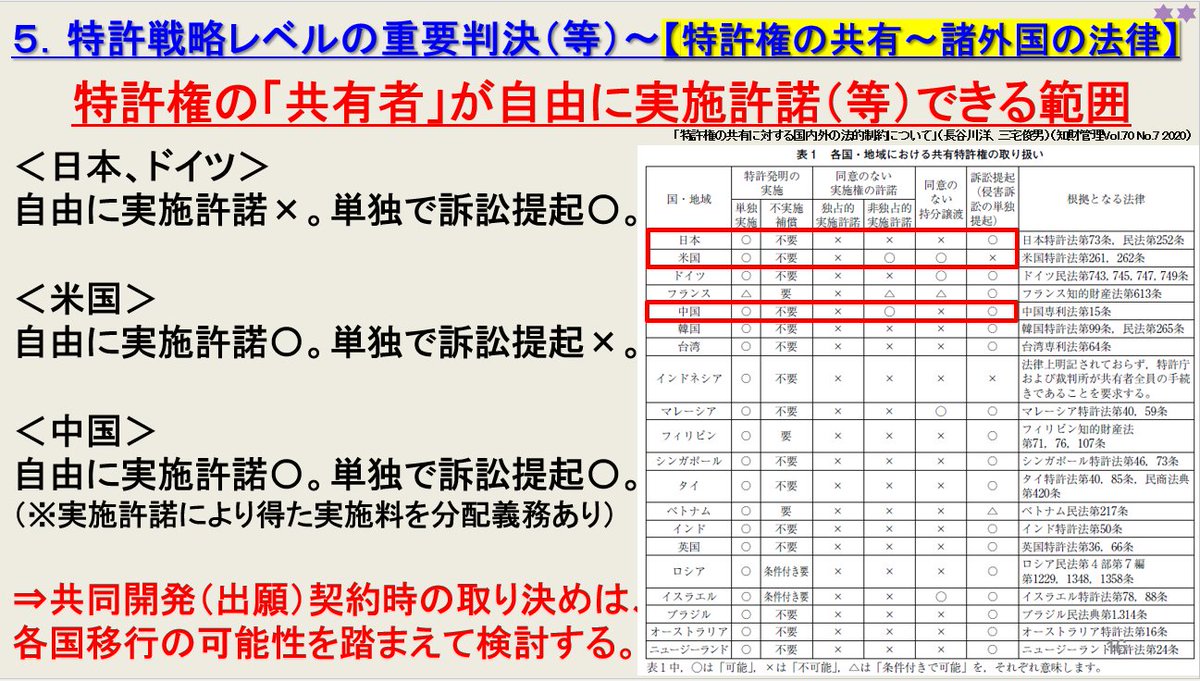
English translation of the 2020 comparative slide
5. Important judgments (and other matters) at the patent-strategy level — Joint ownership of patent rights: laws of various countries.
Extent to which a “co-owner” of a patent right may freely grant licenses and take other actions.
<Japan, Germany> Freedom to grant licenses: no. Bringing an action alone: yes.
<United States> Freedom to grant licenses: yes. Bringing an action alone: no.
<China> Freedom to grant licenses: yes. Bringing an action alone: yes. *There is an obligation to distribute royalties obtained through licensing.
⇒ Arrangements in joint development (application) agreements should take account of the possibility of proceeding in each country.
Table 1. Treatment of jointly owned patents in each country or region (2020 chart)
Symbols: ○ = permitted; × = not permitted; △ = conditionally permitted. “Compensation” means compensation for a co-owner not working the patented invention.
Japan: Working alone: ○; compensation: Not required; exclusive licensing without consent: ×; non-exclusive licensing without consent: ×; assignment of a share without consent: ×; bringing an infringement action alone: ○. Legal basis: Patent Act, Article 73; Civil Code, Article 252.
United States: Working alone: ○; compensation: Not required; exclusive licensing without consent: ×; non-exclusive licensing without consent: ○; assignment of a share without consent: ○; bringing an infringement action alone: ×. Legal basis: Patent Act, Sections 261 and 262.
Germany: Working alone: ○; compensation: Not required; exclusive licensing without consent: ×; non-exclusive licensing without consent: ×; assignment of a share without consent: ○; bringing an infringement action alone: ○. Legal basis: Civil Code, Sections 743, 745, 747 and 749.
France: Working alone: △; compensation: Required; exclusive licensing without consent: ×; non-exclusive licensing without consent: △; assignment of a share without consent: △; bringing an infringement action alone: ○. Legal basis: Intellectual Property Code, Article 613.
China: Working alone: ○; compensation: Not required; exclusive licensing without consent: ×; non-exclusive licensing without consent: ○; assignment of a share without consent: ×; bringing an infringement action alone: ○. Legal basis: Patent Law, Article 15.
South Korea: Working alone: ○; compensation: Not required; exclusive licensing without consent: ×; non-exclusive licensing without consent: ×; assignment of a share without consent: ×; bringing an infringement action alone: ○. Legal basis: Patent Act, Article 99; Civil Act, Article 265.
Taiwan: Working alone: ○; compensation: Not required; exclusive licensing without consent: ×; non-exclusive licensing without consent: ×; assignment of a share without consent: ×; bringing an infringement action alone: ○. Legal basis: Patent Act, Article 64.
Indonesia: Working alone: ○; compensation: Not required; exclusive licensing without consent: ×; non-exclusive licensing without consent: ×; assignment of a share without consent: ×; bringing an infringement action alone: ×. Legal basis: Not expressly provided by statute; the Patent Office and courts require action by all co-owners..
Malaysia: Working alone: ○; compensation: Not required; exclusive licensing without consent: ×; non-exclusive licensing without consent: ×; assignment of a share without consent: ○; bringing an infringement action alone: ○. Legal basis: Patents Act, Sections 40 and 59.
Philippines: Working alone: ○; compensation: Required; exclusive licensing without consent: ×; non-exclusive licensing without consent: ×; assignment of a share without consent: ×; bringing an infringement action alone: ○. Legal basis: Intellectual Property Code, Sections 71, 76 and 107.
Singapore: Working alone: ○; compensation: Not required; exclusive licensing without consent: ×; non-exclusive licensing without consent: ×; assignment of a share without consent: ×; bringing an infringement action alone: ○. Legal basis: Patents Act, Sections 46 and 73.
Thailand: Working alone: ○; compensation: Not required; exclusive licensing without consent: ×; non-exclusive licensing without consent: ×; assignment of a share without consent: ×; bringing an infringement action alone: ○. Legal basis: Patent Act, Sections 40 and 85; Civil and Commercial Code, Section 420.
Vietnam: Working alone: ○; compensation: Required; exclusive licensing without consent: ×; non-exclusive licensing without consent: ×; assignment of a share without consent: ×; bringing an infringement action alone: △. Legal basis: Civil Code, Article 217.
India: Working alone: ○; compensation: Not required; exclusive licensing without consent: ×; non-exclusive licensing without consent: ×; assignment of a share without consent: ×; bringing an infringement action alone: ○. Legal basis: Patents Act, Section 50.
United Kingdom: Working alone: ○; compensation: Not required; exclusive licensing without consent: ×; non-exclusive licensing without consent: ×; assignment of a share without consent: ×; bringing an infringement action alone: ○. Legal basis: Patents Act, Sections 36 and 66.
Russia: Working alone: ○; compensation: Conditionally required; exclusive licensing without consent: ×; non-exclusive licensing without consent: ×; assignment of a share without consent: ×; bringing an infringement action alone: ○. Legal basis: Civil Code, Part IV, Section VII, Articles 1229, 1348 and 1358.
Israel: Working alone: ○; compensation: Conditionally required; exclusive licensing without consent: ×; non-exclusive licensing without consent: ×; assignment of a share without consent: ○; bringing an infringement action alone: ○. Legal basis: Patents Law, Sections 78 and 88.
Brazil: Working alone: ○; compensation: Not required; exclusive licensing without consent: ×; non-exclusive licensing without consent: ×; assignment of a share without consent: ×; bringing an infringement action alone: ○. Legal basis: Civil Code, Article 1314.
Australia: Working alone: ○; compensation: Not required; exclusive licensing without consent: ×; non-exclusive licensing without consent: ×; assignment of a share without consent: ×; bringing an infringement action alone: ○. Legal basis: Patents Act, Section 16.
New Zealand: Working alone: ○; compensation: Not required; exclusive licensing without consent: ×; non-exclusive licensing without consent: ×; assignment of a share without consent: ×; bringing an infringement action alone: ○. Legal basis: Patents Act, Section 24.
[Article] “Determining Unreasonableness” in Providing Reasonable Benefits under Employee Invention Rules (Tatsuro Fujita, Chizai Kanri, Vol. 74, No. 1, 2024)
Original Ameblo publication: 2024-06-24
Ameblo: https://ameblo.jp/hideki-takaishi/entry-12857330295.html
[Article] “Determining Unreasonableness” in Providing Reasonable Benefits under Employee Invention Rules (Tatsuro Fujita, Chizai Kanri, Vol. 74, No. 1, 2024)
2013 (Wa) No. 6158 examined whether the amount compensated for deficiencies in the “state of consultation,” “state of disclosure,” and “hearing of opinions,” but the appeal, 2014 (Ne) No. 10126, found it unreasonable “without even needing to examine the appropriateness of the calculation result.”
Tokyo District Court, 2013 (Wa) No. 21383 <Shimasue>: Enforcement of Declared-Essential Patents, Abuse of Rights, and Notification of False Facts
Original Ameblo publication: 2024-06-24
Ameblo: https://ameblo.jp/hideki-takaishi/entry-12857330513.html
Tokyo District Court, 2013 (Wa) No. 21383 <Shimasue>
Notification to the other party’s customers that the patentee “has a right to seek an injunction” based on a declared-essential patent. Although the parties had remained far apart on license terms for a long period, the other party’s willingness to take a license was not denied, and the circumstances were such that exercise of the right to seek an injunction was impermissible as an abuse of rights.
⇒ Constitutes notification of false facts
https://www.courts.go.jp/assets/hanrei/hanrei-pdf-84904.pdf
Tokyo District Court, 2013 (Wa) No. 21383 (February 18, 2015): Judgment
Osaka District Court, 2022 (Wa) No. 9521 [Thermoplastic Resin Composition]: Numerical Limitation — Rounding Argument Rejected, No Equivalence
Original Ameblo publication: 2024-06-26
Ameblo: https://ameblo.jp/hideki-takaishi/entry-12857582824.html
Osaka District Court, 2022 (Wa) No. 9521 [Thermoplastic Resin Composition]
* Rounding was not allowed and the claim was not satisfied. No equivalence either
<Rounding argument>
“For significant figures … whether to use decimal places or, even for integers, the tens or hundreds place varies by field and purpose of use. … The defendant’s UVA has a molecular weight of 699.91848 … and does not … have a molecular weight of 700 or more. …”
<Doctrine of equivalents>
For a numerically limited invention … in which setting a particular numerical value has significance, the patent is considered to have been granted by limiting the invention to technology within that numerical range. Accordingly, absent special circumstances, the limitation of the technical scope by that numerical value constitutes an essential part of the patented invention ⇒ No equivalence
(Excerpt from the judgment)
<Rounding argument>
… The plaintiff points out that, for UVA represented by the same molecular formula as the defendant’s UVA, catalogs, other patent publications, etc. sometimes give its molecular weight as 700 … . However, there are also examples using “699.9” or “699.92” …, so it cannot be found to be common general technical knowledge among persons skilled in the art to round the calculated molecular weight of UVA to an integer. (The plaintiff itself admits that whether significant figures are expressed as integers, decimal places, or even tens or hundreds for integers varies by field and purpose of use.) … Accordingly, the defendant’s UVA has a molecular weight of 699.91848 and is not a UVA with a “molecular weight of 700 or more” under Elements 1B and 6B. …
<Doctrine of equivalents>
… The essential part of the inventions is found to lie in enabling the provision of a resin composition with excellent heat resistance at the high temperature of 110°C or more, suppression of foaming and bleed-out during high-temperature molding, and reduction of problems caused by UVA volatilization, through the discovery that a UVA having a hydroxyphenyltriazine skeleton and a molecular weight of 700 or more is compatible with a thermoplastic acrylic resin having a ring structure in its main chain. … For an invention that limits its technical scope numerically (a numerically limited invention) and in which setting that numerical value has significance, the patent is considered to have been granted by limiting the invention to technology within that numerical range. Accordingly, absent special circumstances, the numerical limitation of the technical scope should be understood to constitute an essential part of the patented invention. The above examination shows that setting the molecular weight at “700 or more” has technical significance, and no such special circumstances are apparent in this case.
https://www.courts.go.jp/assets/hanrei/hanrei-pdf-92802.pdf
[Unfair Competition Prevention Act] Tokyo District Court, 2022 (Wa) No. 14148 <Sugiura> ⇒ No Breach of Duty to Clarify the Specific Manner of Conduct
Original Ameblo publication: 2024-06-28
Ameblo: https://ameblo.jp/hideki-takaishi/entry-12857834321.html
[Unfair Competition Prevention Act] 2022 (Wa) No. 14148 <Sugiura> ⇒ No Breach of Duty to Clarify the Specific Manner of Conduct
“… To be entitled to demand clarification of the specific manner of conduct, from the standpoint of deterring abusive or exploratory litigation and the like, corroboration sufficient to make filing suit, etc. prima facie reasonable is required, taking into account the nature and content of the case and other circumstances”
⇒ The plaintiff’s experiments were inappropriate
⇒ No breach of the duty to clarify the specific manner of conduct
* This is also consistent with the approach under Patent Act Article 104-2!!
https://www.courts.go.jp/assets/hanrei/hanrei-pdf-92092.pdf
WORD:Hideki Takaishi Article Collection January–June 2024