Hideki Takaishi Article Collection July–December 2023
Hideki Takaishi Article Collection
July–December 2023
English Edition
171 articles
Complete English translations of the revised Ameblo articles
In chronological order of the original Ameblo publication date
Confirmed errors in wording, legal descriptions, and translations have been corrected. Unless otherwise stated, descriptions of legal rules, outlooks, and statistics reflect the time when each original article was published.
Article Index
01 2023-07-01 [Trademark] Intellectual Property High Court, 2020 (Ne) 10017, the Morihan case <Honda>
03 2023-07-02 IP High Court (Grand Panel), 2018 (Ne) No. 10063, judgment of June 7, 2019 (Presiding Judge Takabe) <Damages>
04 2023-07-02 IP High Court (Grand Panel), 2012 (Ne) No. 10015, judgment of February 1, 2013 (Presiding Judge Iimura) <Damages>
05 2023-07-05 Tokyo District Court, 2020 (Wa) 19221 [Auxiliary Laundry Washing Product] <Kokubu>
06 2023-07-06 Intellectual Property High Court, 2022 (Ne) 10008 [Information Providing Device, System and Program] <Otaka>
07 2023-07-07 Intellectual Property High Court, 2021 (Ne) 10099 [Hydrogen Gas Supply Device for Living Organisms] <Kanno>
08 2023-07-08 [Copyright] Intellectual Property High Court, 2022 (Ne) 10059
09 2023-07-09 [Trademark] Intellectual Property High Court, 2022 (Gyo-Ke) 10067 <Kanno>
11 2023-07-11 [Copyright / Directors’ Personal Liability] Tokyo District Court, 2021 (Wa) 20472 <Nakashima>
13 2023-07-13 [Patent / Utility Model] Tokyo District Court, 2020 (Wa) 15955 <Shibata>
14 2023-07-14 [Unfair Competition Prevention Act] Tokyo District Court, 2020 (Wa) 21047 <Kokubu>
19 2023-07-20 Intellectual Property High Court, 2022 (Gyo-Ke) 10010 [CNS Delivery of Therapeutic Agents] <Honda>
20 2023-07-22 [Article] A Study of Prior User Rights under the Patent Act (2) (Professor Yoshiyuki Tamura)
21 2023-07-23 [Article] Analysis of Recent Reversals in Actions to Revoke JPO Trial Decisions (IP Management, Vol. 73, No. 7, 2023)
23 2023-07-25 Intellectual Property High Court, 2020 (Gyo-Ke) 10143 [Vinylidene Chloride Resin Wrapping Film] <Otaka>
24 2023-07-26 [New YouTube Video] Dwango v. U.S. FC2 Grand Panel Judgment (Later Action): 10-Minute Condensed Version
25 2023-07-27 Intellectual Property High Court, 2022 (Gyo-Ke) 10012 [Touch-Operated Input Device] <Kanno>
26 2023-07-28 Intellectual Property High Court, 2022 (Gyo-Ke) 10007 [Heat Transport System] <Shoji> Specific problems need not be common unless the problems to be solved differ greatly
27 2023-07-30 Intellectual Property High Court, 2022 (Gyo-Ke) 10007 [Heat Transport System] <Shoji>
29 2023-07-31 Osaka District Court, 2020 (Wa) 3473 [Lighting Fixture]
31 2023-08-02 [Article] Laser Processing Apparatus Case (IP Management, Vol. 73, No. 6, 2023; Masaharu Takahashi and Shunsuke Migita)
32 2023-08-03 Tokyo District Court, 2018 (Wa) 1130 [Printed Retroreflective Sheet]
33 2023-08-04 Osaka District Court, 2016 (Wa) 4815 [Oil-Cooled Screw Compressor] Rebuttal of the Article 102(2) presumption: 90% rebutted
36 2023-08-07 Tokyo District Court, 2016 (Wa) 25436 [Method for Constructing Amino Acid-Producing Bacteria] <Damages>
37 2023-08-08 Intellectual Property High Court, 2022 (Gyo-Ke) 10003 [Method for Preventing Attachment of Marine Organisms] <Kanno>
39 2023-08-10 [Trademark] Osaka District Court, 2020 (Wa) 4272
40 2023-08-11 Intellectual Property High Court, 2021 (Gyo-Ke) 10150 [Vessel] <Shoji> = 2021 (Gyo-Ke) 10151 ⇒ Inventive step upheld through a disclaimer claim
41 2023-08-11 Intellectual Property High Court, 2022 (Gyo-Ke) 10029 [Antiglare Film] <Shoji>
42 2023-08-15 Tokyo District Court, 2022 (Wa) 9716 [5-Aminolevulinic Acid Phosphate] <Shibata>
43 2023-08-17 Intellectual Property High Court, 2022 (Gyo-Ke) 10059 [Glass] <Kanno>
44 2023-08-18 Osaka District Court, 2018 (Wa) 5189 [Nutrient Supplement for Farmed Fish and Shellfish and Method for Producing It] <Tani>
45 2023-08-19 [Trademark] Intellectual Property High Court, 2022 (Gyo-Ke) 10073 <Kanno>, the zhiyun case
46 2023-08-22 [Trademark] Intellectual Property High Court, 2022 (Gyo-Ke) 10090, the HEAVEN case
47 2023-08-23 [Article] Methods of Calculating Royalties Based on ‘Use’ in U.S. Case Law (Hiroshi Takahashi, Patent 2022)
48 2023-08-24 [Trademark / Two JPO Trial Decisions] Appeal 2022-10002; Invalidation 2022-890031
50 2023-08-28 Osaka District Court, 2020 (Wa) 7486 [Device for Instantaneously Removing Blood from Fish] ⇒ Joint inventorship affirmed
51 2023-08-29 Intellectual Property High Court, 2018 (Ne) 10034 [Solenoid] <Kanno>
52 2023-08-30 Intellectual Property High Court, 2020 (Ne) 10004 [Light Irradiation Device] <Otaka>
53 2023-08-31 [Trademark] Intellectual Property High Court, 2019 (Gyo-Ke) 10151, the CORE ML case
55 2023-09-03 Tokyo District Court, 2017 (Wa) 29228 [Fluid Supply Device] <Damages> Rebuttal of the Article 102(2) presumption: 40%
56 2023-09-03 Osaka District Court, 2017 (Wa) 7576 [Spacer for Foundation Packing] Grounds for rebutting the Article 102(2) presumption: 70%
59 2023-09-06 Intellectual Property High Court, 2016 (Ne) 10082 [Raw Seaweed Foreign-Matter Separation and Removal Apparatus] No grounds to rebut the Article 102(2) presumption; contribution rate 100%
60 2023-09-07 Osaka District Court, 2021 (Wa) 10032 [Chip-Type Fuse] <Takemiya>
61 2023-09-08 Tokyo District Court, 2021 (Wa), 26762 [Hardener for Ground-Stabilization Chemical Solution] <Kokubu>
62 2023-09-09 Tokyo District Court, 2012 (Wa) 35757 [Water-Erasable Ink Composition for Calligraphy and Painting]
63 2023-09-10 [Trademark] Intellectual Property High Court, 2020 (Gyo-Ke) 10108, the Sushi Zanmai case
64 2023-09-11 [Trademark] Intellectual Property High Court, 2019 (Gyo-Ke) 10167, the GUZZILLA case <Takabe>
65 2023-09-12 [Article] ‘Intellectual Property Local Benchmark’ (Tomohiko Inui) (Patent, 2020, Vol. 73, No. 9)
66 2023-09-12 <IP LAB ①> Why Does ‘the Problem of the Invention at Issue’ Affect Inventive-Step Assessment?
67 2023-09-13 [Trademark] Intellectual Property High Court, 2020 (Gyo-Ke) 10126, the Matsumoto Kiyoshi case <Otaka>
68 2023-09-14 [Trademark] Intellectual Property High Court, 2020 (Gyo-Ke) 10017, the Air-Conditioned Clothing case <Takabe>
69 2023-09-15 [Unfair Competition Prevention Act] Tokyo District Court, 2018 (Wa) 29036, the Pore-Care Lotion case
70 2023-09-18 [Copyright] Osaka High Court, 2019 (Ne) 1735, the Goldfish Telephone Booth case
73 2023-09-19 [Unfair Competition Prevention Act / Trade Secrets] Tokyo District Court, 2018 (Wa) 35263, 2WAY-Compatible Oxygen Chamber
74 2023-09-20 Intellectual Property High Court, 2006 (Gyo-Ke) 10053 [Tissue-Paper Storage Box] <Shinohara>
75 2023-09-22 Intellectual Property High Court, 2010 (Gyo-Ke) 10407 [Method for Operating a Wind Park] <Iimura>
76 2023-09-22 [Copyright] Intellectual Property High Court, 2020 (Ne) 10018 <Tsuruoka>
77 2023-09-24 Intellectual Property High Court, 2009 (Gyo-Ke) 10153 [Method for Making a Cutting-Tool Insert …] <Nakano>
78 2023-09-24 Intellectual Property High Court, 2007 (Gyo-Ke) 10241 [Exhaust Valve for a Storage Bag]
79 2023-09-25 Intellectual Property High Court, 2005 (Gyo-Ke) 10677 [Memory Control Device] <Mimura>
80 2023-09-26 Intellectual Property High Court, 2009 (Gyo-Ke) 10142 [Apparatus for Mixing Powder and Granules and Removing Fine Powder …] <Nakano>
81 2023-09-27 Intellectual Property High Court, 2011 (Gyo-Ke) 10193 [Chair-Type Massage Machine] <Shiotsuki>
82 2023-09-28 Intellectual Property High Court, 2010 (Gyo-Ke) 10318 [Storage Case for a Recording-Medium Disc] <Iimura>
83 2023-09-29 Intellectual Property High Court, 2011 (Gyo-Ke) 10364 [… Electric Motor with High Specific Output]
84 2023-09-30 Intellectual Property High Court, 2021 (Gyo-Ke) 10053 [Method for Making a Container for Microwave-Heated Food] <Otaka>
85 2023-09-30 Tokyo District Court, 2011 (Wa) 3292 [Battery-Powered Alarm] (Damages) <Osuga>
86 2023-10-02 Intellectual Property High Court, 2013 (Ne) 10017 and 2013 (Ne) 10041 [Open-Type Fermentation Treatment Apparatus]
87 2023-10-03 Intellectual Property High Court, 2019 (Gyo-Ke) 10043 [High-Contrast Tire Pattern] <Tsuruoka>
88 2023-10-04 Intellectual Property High Court, 2017 (Gyo-Ke) 10146 [Light-Guide Film] <Tsuruoka>
89 2023-10-05 Intellectual Property High Court, 2022 (Gyo-Ke) 10012 and 10045 [Touch-Operated Input Device] <Kanno>
90 2023-10-06 Intellectual Property High Court, 2022 (Ne) 10061 [Magnetic Screen Device] <Honda>
91 2023-10-10 Tokyo District Court, 2021 (Wa) 26762 et al. [Hardener for Ground-Stabilizing Chemical Solution] <Kokubu>
92 2023-10-10 Intellectual Property High Court, 2021 (Gyo-Ke) 10152 [Method for Resin-Sealing Permanent Magnets] <Honda>
93 2023-10-11 Tokyo District Court, 2015 (Wa) 25780 [Ground-Improvement Device] <Shimasue>
95 2023-10-13 Intellectual Property High Court, 2019 (Gyo-Ke) 10126 <Tsuruoka> [Steel Sheet-Pile Press-In and Extraction Machine], third judgment
96 2023-10-14 Intellectual Property High Court, 2020 (Gyo-Ke) 10054 [Nucleic-Acid Decomposition Treatment Apparatus] <Kanno>, second judgment
97 2023-10-16 Intellectual Property High Court, 2014 (Gyo-Ke) 10057 [Deposit Terminal] <Ishii>
98 2023-10-17 Intellectual Property High Court, 2011 (Gyo-Ke) 10115 [Cyclohexane Compound] <Takizawa>
99 2023-10-18 Osaka District Court, 2008 (Wa) 10819, and its appellate judgment, Intellectual Property High Court, 2013 (Ne) 10026 <Iimura>
100 2023-10-19 Intellectual Property High Court, 2022 (Gyo-Ke) 10094 [Insole] <Honda>
101 2023-10-20 Intellectual Property High Court, 2022 (Ne) 10094 [Composition Containing … Tetrafluoropropene] <Hibiku Shimizu>
102 2023-10-20 [U.S. Patents] Netflix v. DivX (CAFC, September 11, 2023) – Analogous Art
103 2023-10-23 Tokyo District Court, 2020 (Wa) 25891 [… Filtered Cigarette] <Shibata>
106 2023-10-26 [Trademark] Intellectual Property High Court, 2021 (Gyo-Ke) 10148 <Kanno>, the NICO case
107 2023-10-27 [Trademark] Intellectual Property High Court, 2011 (Gyo-Ke) 10093 <Iimura>, the PAG case
108 2023-10-30 [Trademark] Intellectual Property High Court, 2022 (Gyo-Ke) 10121 <Kanno>, the TART case
109 2023-10-30 [Article] Legality of Dismissal of Amendments Under Article 53(1) of the Patent Act: … (Patent Studies, March 2013; Hiroshi Yoshida)
110 2023-10-30 [Trademark] Intellectual Property High Court, 2023 (Gyo-Ke) 10005 <Otaka>, the KAZE case
111 2023-10-31 [Trademark] Intellectual Property High Court, 2022 (Gyo-Ke) 10119 <Honda>, the CLEAR case
112 2023-11-01 [Trademark] Tokyo District Court, 2021 (Wa) 33526 <Sugiura>
115 2023-11-04 Intellectual Property High Court, 2021 (Gyo-Ke) 10090 [Spray Product and Spraying Method] <Otaka>
116 2023-11-05 Intellectual Property High Court, 2022 (Gyo-Ke) 10017 [Pressure-Sensitive Transfer Adhesive Tape] <Kanno>
117 2023-11-07 [Trademark] Osaka District Court, 2020 (Wa) 4272, the LEADERBIKES case
118 2023-11-08 Tokyo District Court, 2021 (Wa) 29388 [HFO-1234yf] <Sugiura> — Fourth generation of the patent in 2019 (Wa) 30991
119 2023-11-09 Intellectual Property High Court, 2022 (Gyo-Ke) 10061 [Excavator] <Kanno>
121 2023-11-12 * Cases in which a party and its supporting intervenor shared the same attorney
122 2023-11-12 [Copyright / Provider Liability Act] Intellectual Property High Court, 2022 (Ne) 10102 ⇒ Reversal and disclosure order
123 2023-11-13 Intellectual Property High Court, 2021 (Gyo-Ke) 10091 [Adhesive Tape] <Honda>
124 2023-11-14 Intellectual Property High Court, 2022 (Gyo-Ke) 10001 [Ultra-High-Sensitivity Micromagnetic Sensor] <Kanno>
125 2023-11-15 Intellectual Property High Court, 2022 (Gyo-Ke) 10111 [Beltline Molding for a Vehicle Door] <Honda>
126 2023-11-16 [Trademark / Contract] Osaka District Court, 1996 (Wa) 6700 — Abuse of the right to terminate
127 2023-11-17 [Portrait Rights] Tokyo District Court, 2021 (Wa) 28420 <Principal Action> <Nakashima>
128 2023-11-18 Intellectual Property High Court, 2022 (Gyo-Ke) 10099 [Laser Processing Apparatus] <Honda>
129 2023-11-18 Osaka District Court, 2022 (Wa) 2695, Employee Invention
130 2023-11-20 [Article] Individual Directors’ Liability for Damages to Patentees in Patent-Infringement Cases (Keijiro Miwa and Kazunari Sugimitsu)
131 2023-11-21 Osaka District Court, 2017 (Wa) 7384 [Massage Machine] <Damages>
132 2023-11-22 Intellectual Property High Court, 2021 (Ne) 10088 and 2022 (Ne) 10014 [Information Communication Unit]
133 2023-11-23 Tokyo District Court, 2012 (Wa) 12351 [Rice Cake]
134 2023-11-24 Tokyo District Court, 2013 (Wa) 33070 [Agricultural-Produce Sorting Apparatus] <Hasegawa>
136 2023-11-26 [Article] Supplementing Unfair-Competition Protection Through Civil Code Tort Law (Patent Supplement, 2023; Professor Tatsuhiro Ueno)
137 2023-11-27 [U.S. Patents] November 6, 2023, CAFC <ACTELION v. MYLAN> — Interpretation of Numerical Limitations and Rounding
139 2023-11-29 [Unfair Competition Prevention Act / Trade Secrets] Tokyo District Court, 2014 (Wa) 1397, the Shoe Last case
140 2023-11-30 [Design / Estoppel] Intellectual Property High Court, 2021 (Gyo-Ke) 10067 <Honda>
142 2023-12-02 [Copyright / Publication Right] Tokyo District Court, 2021 (Wa) 13720 <Kokubu>
143 2023-12-03 [Trademark] Intellectual Property High Court, 2019 (Gyo-Ke) 10157, the NUDE NAIL case <Kanno> <Agent of a foreign trademark owner>
144 2023-12-04 [Examination Handbook for Patent and Utility Model / Annex A] Addition of New Matter: Amendments Based on Drawings (8 Examples), p. 549
145 2023-12-05 Osaka District Court, 2011 (Wa) 15499 [Lid and Container Equipped with the Lid]
146 2023-12-06 Osaka District Court, 2011 (Wa) 6878 [Method for Stabilizing the Coloration of a Colored Plaster Composition] <Damages> Article 102(2)
147 2023-12-07 Osaka District Court, 2009 (Wa) 10811 [Method and Apparatus for Manufacturing a Rotary Toothbrush] <Damages> Article 102(1)
148 2023-12-08 Osaka District Court, 2011 (Wa) 3850 [Flexible Plastic Container]
149 2023-12-09 Intellectual Property High Court, 2011 (Ne) 10002 [Rice Cake] <Iimura> <Damages> Article 102(2)
150 2023-12-09 [Trademark] Intellectual Property High Court, 2023 (Gyo-Ke) 10063 <Miyasaka>, the VENTURE case — Composite marks
151 2023-12-10 Intellectual Property High Court, 2010 (Ne) 10032 and 2010 (Ne) 10041 [Solid Golf Ball] Damages, Article 102(1)
152 2023-12-11 Intellectual Property High Court, 2010 (Ne) 10091 [Treatment Agent for Immobilizing … Heavy Metals in Fly Ash] <Damages> Articles 102(1) and 102(3)
153 2023-12-13 Tokyo District Court, 2008 (Wa) 2944 [Normally Closed Flow-Control Valve] <Damages> Article 102(2)
154 2023-12-13 Osaka District Court, 2007 (Wa) 13513 [X-Ray Foreign-Matter Inspection Apparatus] <Damages> Article 102(2)
155 2023-12-14 Tokyo District Court, 2003 (Wa) 19926 [Coagulant Composition for Tofu] <Damages> Article 102(1)
156 2023-12-15 [Trademark] Tokyo District Court, 2022 (Wa) 18610 <Kokubu>
157 2023-12-16 [Trademark] Intellectual Property High Court, 2016 (Gyo-Ke) 10164 and 2017 (Gyo-Ke) 10169
158 2023-12-19 Intellectual Property High Court, 2021 (Gyo-Ke) 10097 [Golf Swing Monitoring System] <Otaka>
159 2023-12-19 Tokyo District Court, 2022 (Wa) 5905 [Composition for Promoting Increased Subcutaneous Tissue] <Shibata>
160 2023-12-19 Intellectual Property High Court, 2018 (Gyo-Ke) 10146 [Pachinko Machine] <Otaka>
161 2023-12-20 [Design] Intellectual Property High Court, 2023 (Gyo-Ke) 10001 <Shoji> — Ease of creation denied
162 2023-12-21 Intellectual Property High Court, 2022 (Gyo-Ke) 10125 <Hibiku Shimizu>, Disclaimer Claims and Correction Requirements
163 2023-12-22 [Unfair Competition Prevention Act, Article 2(1)(iii)] Tokyo District Court, 2017 (Wa) 21145 <Sato>
164 2023-12-23 [Article / Europe] Intermediate Generalization — A Special EPC Patent Procedure
165 2023-12-26 [Article / Foreign Jurisdictions] Selection Inventions at the EPO (Patent, Vol. 73, No. 14, 2020; Charles Renney and Eleanor Maciver)
166 2023-12-27 Intellectual Property High Court, 2015 (Gyo-Ke) 10190 [Method for Reducing Environmental Pollutants in Oils or Fats] <Tsuruoka>
167 2023-12-28 Intellectual Property High Court, 2005 (Gyo-Ke) 10717 [… Siloxane …] <Tsukahara>
168 2023-12-30 Tokyo High Court, 2003 (Gyo-Ke) 405 [Substituted 1,3-Oxathiolanes with Antiviral Activity] <Sato>
169 2023-12-30 Intellectual Property High Court, 2008 (Gyo-Ke) 10366 [Gastritis Treatment Agent] <Iimura>
170 2023-12-30 <New YouTube Video> [Patents] IP Strategy That Serves Business (Publicly Releasable Extracts from a Five-Hour Paid Lecture)
171 2023-12-31 Intellectual Property High Court, 2013 (Gyo-Ke) 10209 [Agent for Suppressing Vascular Intimal Thickening] <Shimizu>
[Trademark] Intellectual Property High Court, 2020 (Ne) 10017, the Morihan case <Honda>
Original Ameblo publication: 2023-07-01
Ameblo: https://ameblo.jp/hideki-takaishi/entry-12810193045.html
[Trademark] Intellectual Property High Court, 2020 (Ne) 10017, the Morihan case <Honda>
Morihan: No enforcement for nearly 40 years. The defendant, too, had contributed to the accumulation of goodwill.
⇒ Abuse of rights!!
Morihan Sohonpo: The defendant began using this in 2006. Its trademark application was also refused (Trademark Act, Article 4(1)(xi)). It would alter the relationship among the three Morihan entities.
⇒ Not an abuse of rights!!
https://www.courts.go.jp/assets/hanrei/hanrei-pdf-91601.pdf
Osaka District Court, 2015 (Wa) 4292 (the first-instance judgment underlying the Grand Panel judgment) [Carbon Dioxide-Containing Viscous Composition]
Original Ameblo publication: 2023-07-02
Ameblo: https://ameblo.jp/hideki-takaishi/entry-12810335103.html
Osaka District Court, 2015 (Wa) 4292 (the first-instance judgment underlying the Grand Panel judgment) [Carbon Dioxide-Containing Viscous Composition]
<Damages> Rebuttal of the presumption under Article 102(2) rejected
① There is insufficient evidence to establish that the effects and efficacy of carbon dioxide on the skin differ substantially between the plaintiff’s and defendant’s products.
② Advertising for the defendant’s products emphasized their ability to achieve improvements in cosmetic skin problems and localized obesity through carbon dioxide, which considerably influenced consumers’ purchase motivations.
③ There is insufficient evidence to establish that the defendant’s products fall within the technical scope of inventions covered by the plaintiff’s patents other than the patents at issue.
④ For a competing product to constitute a ground for rebutting the presumption, it must have effects equivalent to those of the patents at issue and compete as an equivalent alternative for consumers, the relevant customers.
⑤ There was a factor teaching away from combining the common general technical knowledge asserted by the defendant with the prior art, and the combination cannot be found to have been easily conceivable. The technical value of the inventions at issue therefore cannot be said to be low.
https://www.courts.go.jp/assets/hanrei/hanrei-pdf-87963.pdf
IP High Court (Grand Panel), 2018 (Ne) No. 10063, judgment of June 7, 2019 (Presiding Judge Takabe) <Damages>
Original Ameblo publication: 2023-07-02
Ameblo: https://ameblo.jp/hideki-takaishi/entry-12810340433.html
IP High Court (Grand Panel), 2018 (Ne) No. 10063, judgment of June 7, 2019 (Presiding Judge Takabe) <Damages>
[Carbon Dioxide-Containing Viscous Composition] <Damages> Rebuttal of the presumption under Article 102(2) rejected
<General principles>
“These are understood to be circumstances that disrupt an adequate causal relationship between the profits obtained by the infringer and the damage suffered by the patentee. Examples include: ① differences in the business models and other circumstances of the patentee and infringer (different markets); ② the existence of competing products in the market; ③ the infringer’s sales efforts (brand strength and advertising); and ④ the infringing product’s performance (features other than the patented invention, such as functions and design).”
“Where the patented invention is worked in only part of the infringing product …, this is determined by comprehensively considering such circumstances as the position within the infringing product of the part in which the invention is worked and the invention’s customer-attracting power.”
<Application to the facts>
• The sales periods, market shares, and other details of the alleged competing products are unknown, and the evidence is insufficient to establish that they compete with the defendant’s products in the market.
• Even if ingenuity or sales efforts within the ordinary range were employed, they cannot be regarded as grounds for rebutting the presumption.
• Even if an infringing product has superior efficacy compared with the patentee’s product, this does not immediately warrant rebuttal of the presumption; circumstances showing that the superior efficacy contributed to the infringer’s sales are necessary.
• Even if an infringing product embodies another patented invention, this does not immediately warrant rebuttal of the presumption; circumstances such as a contribution to sales of the infringing product from working that other patented invention are necessary.
IP High Court (Grand Panel), 2012 (Ne) No. 10015, judgment of February 1, 2013 (Presiding Judge Iimura) <Damages>
Original Ameblo publication: 2023-07-02
Ameblo: https://ameblo.jp/hideki-takaishi/entry-12810342559.html
IP High Court (Grand Panel), 2012 (Ne) No. 10015, judgment of February 1, 2013 (Presiding Judge Iimura) <Damages>
[Waste Storage Cassette and Waste Storage Device] <Damages> Rebuttal of the presumption under Article 102(2) rejected
• The plaintiff (a foreign company) sells its cassettes in Japan through Combi, and Combi is not the only entity earning profits from sales of the plaintiff’s products in Japan.
• It is argued that Product I does not produce the effects of the invention when used with the Mark II main unit, but the number used with the Mark II main unit is unknown and cannot be determined.
• Like the plaintiff’s cassettes, Product I is ordinarily used together with the plaintiff’s main unit solely for that purpose. (The invention is claimed as a subcombination.)
• The price difference between Product I and the plaintiff’s cassette is small (approximately 167 yen per unit).
• Combi, which the plaintiff designated as its distributor in Japan, is not inferior in brand strength in Japan to Aprica (the defendant).
Full judgment (Courts of Japan)
Tokyo District Court, 2020 (Wa) 19221 [Auxiliary Laundry Washing Product] <Kokubu>
Original Ameblo publication: 2023-07-05
Ameblo: https://ameblo.jp/hideki-takaishi/entry-12810766628.html
Tokyo District Court, 2020 (Wa) 19221 [Auxiliary Laundry Washing Product] <Kokubu>
* A purity of 99.95% was held to fall within “substantially 100% by weight.”
* Includes cases in which it is used solely to work the inventions at issue.
⇒ Not a mere standard or general-purpose product.
⇒ Indirect infringement established
Note: Recently, the various requirements of Article 101 have almost always been found satisfied!!
(Extract from the court’s reasoning)
The defendant’s product consists of “metallic magnesium particles having a purity of approximately 99.95% …” …; these are … “a plurality of metallic magnesium particles” (Configuration c), and thus there are “a plurality” of metallic magnesium particles (Element 1A). … They fall within “particles containing substantially 100% by weight of elemental metallic magnesium (Mg)” (Element 2A).
The specification states that, as to the composition of metallic magnesium particles used as an auxiliary laundry washing product, particles containing substantially 100% by weight of elemental metallic magnesium (Mg) are more preferred ([0020]), and that an average particle diameter of 4.0–6.0 mm is most preferred for the metallic magnesium particles used as an auxiliary laundry washing product ([0022]). … The defendant’s product satisfies both of these points. It follows that enclosing the defendant’s product in a laundry net necessarily completes an auxiliary laundry washing product satisfying the elements of each invention at issue. The defendant’s product is therefore found to include cases of use solely to work those inventions … and cannot be described as a mere standard or general-purpose product.
https://www.courts.go.jp/assets/hanrei/hanrei-pdf-91828.pdf
Intellectual Property High Court, 2022 (Ne) 10008 [Information Providing Device, System and Program] <Otaka>
Original Ameblo publication: 2023-07-06
Ameblo: https://ameblo.jp/hideki-takaishi/entry-12810902603.html
Intellectual Property High Court, 2022 (Ne) 10008 [Information Providing Device, System and Program] <Otaka>
The first-instance court found lack of novelty, but because the invalidation trial resulted in a decision maintaining the patent, the patentee did not raise a rebuttal to the invalidity defense based on correction of the patent claims from the beginning of the appeal and first raised it at the first oral argument hearing.
⇒ Rejected as untimely
⇒ If only the rebuttal to the invalidity defense based on claim correction had been raised in the alternative …
https://www.courts.go.jp/assets/hanrei/hanrei-pdf-91603.pdf
Intellectual Property High Court, 2021 (Ne) 10099 [Hydrogen Gas Supply Device for Living Organisms] <Kanno>
Original Ameblo publication: 2023-07-07
Ameblo: https://ameblo.jp/hideki-takaishi/entry-12811056503.html
Intellectual Property High Court, 2021 (Ne) 10099 [Hydrogen Gas Supply Device for Living Organisms] <Kanno>
The difference between Product I and the invention did not concern an essential part (focusing on the generated hydrogen gas … and maintaining it below a certain concentration outside the explosive range by …), but there was no motivation to make the substitution.
⇒ The first and second requirements of the doctrine of equivalents were satisfied, but the third was not (the fifth was not addressed)
Note: The third requirement must be considered independently of the essential part!!
(Extract from the court’s reasoning)
In Corrected Invention 6, “an electrolytic chamber into which raw water to be electrolyzed is introduced” refers to a chamber whose interior and exterior are completely separated by a diaphragm so that water does not communicate between the inside and outside, allowing them to remain separate, independent states. …
Corrected Invention 6 focuses on the generated hydrogen gas and maintains it below a certain concentration outside the explosive range by blowing a diluting gas onto the cathode or the cathode water surface. This should be regarded as the essential part of Corrected Invention 6. Therefore … because it does not concern the hydrogen gas concentration, it cannot be said to replace an essential part. Accordingly, Defendant’s Product 1 satisfies the first requirement for equivalence.
… Defendant’s Product 1 also blows air onto the cathode water surface approximately 6 cm above the cathode, and supplies a living organism with a mixed gas containing hydrogen gas and air at a hydrogen gas concentration of 2.6 vol%. It can therefore be said to produce the same effect as Corrected Invention 6. Accordingly, Defendant’s Product 1 satisfies the second requirement. …
None of the well-known technologies asserted by the appellant can be regarded as providing motivation to replace the configuration of “one or more diaphragms separating the inside and outside of the electrolytic chamber” in Corrected Invention 6 with the configuration of “① part of the side wall of inner tank 6, ② the bottom of inner tank 6 having outflow hole 3, and ③ four polymer membranes 10” in Defendant’s Product 1. On these facts, such a substitution cannot be said to have been easy, and Defendant’s Product 1 does not satisfy the third requirement for equivalence.
https://www.courts.go.jp/assets/hanrei/hanrei-pdf-91706.pdf
[Copyright] Intellectual Property High Court, 2022 (Ne) 10059
Original Ameblo publication: 2023-07-08
Ameblo: https://ameblo.jp/hideki-takaishi/entry-12811246567.html
[Copyright] Intellectual Property High Court, 2022 (Ne) 10059
A post-termination noncompete clause in an exclusive management agreement between a music agency and performers (a band)
⇒ Although the noncompete period was six months, it was unrelated to recovery of upfront investment
⇒ Contrary to public policy
Note: Noncompete obligations upon leaving employment are a separate issue because confidentiality is involved.
I think there is often a need to recover upfront investment. Even then, just as an acceptable noncompete period varies with the type of work, the period that does not violate public policy will vary according to the need to recover the upfront investment.
I am not speaking specifically about this case. My point is that, just as the threshold for violating public policy in noncompete cases differs by type of work, where there is a need for “recovery of upfront investment,” as discussed in this case, the threshold will likely differ depending on the degree of that need.
https://www.courts.go.jp/assets/hanrei/hanrei-pdf-91677.pdf
[Trademark] Intellectual Property High Court, 2022 (Gyo-Ke) 10067 <Kanno>
Original Ameblo publication: 2023-07-09
Ameblo: https://ameblo.jp/hideki-takaishi/entry-12811305482.html
[Trademark] Intellectual Property High Court, 2022 (Gyo-Ke) 10067 <Kanno>
* Japan Patent Office
The registration of the trademark at issue (OLYMBEER) was revoked for violating Article 4(1)(vi) in relation to the cited signs “OLYMPIAD” and “Olympiad” in katakana.
* Court
The signs were found dissimilar and the decision was set aside
Although the four letters OLYM are identical …
The court considered the voiced sound “bi” in the trademark at issue and the semi-voiced sound “pi” in the cited signs as supporting dissimilarity!
https://www.courts.go.jp/assets/hanrei/hanrei-pdf-91704.pdf

[Article / Foreign Law] European Patent Strategy after the Entry into Force of the Unified Patent Court (UPC) Agreement: Effective Use of the German Patent System for Japanese Companies
Original Ameblo publication: 2023-07-10
Ameblo: https://ameblo.jp/hideki-takaishi/entry-12811464796.html
[Article / Foreign Law] European Patent Strategy after the Entry into Force of the Unified Patent Court (UPC) Agreement: Effective Use of the German Patent System for Japanese Companies (IP Management, Vol. 73, No. 5, 2023) (Toshiko Takenaka, Christoph Karl)
The patentee win rate in Germany is approximately 65% (approximately 50% of cases end before judgment)
In Japan, approximately 25%
In the United States, 75% for jury verdicts, but 95–97% of cases end before trial
[Copyright / Directors’ Personal Liability] Tokyo District Court, 2021 (Wa) 20472 <Nakashima>
Original Ameblo publication: 2023-07-11
Ameblo: https://ameblo.jp/hideki-takaishi/entry-12811600750.html
[Copyright / Directors’ Personal Liability] 2021 (Wa) 20472 <Nakashima>
No practice was recognized of “not seeking a license from creators, at least for a manner of posting … without measures to prevent unauthorized copying …”
+ Personal liability of the representative director was upheld: “The company’s internal system for preventing infringement of intellectual property rights was inadequate.”
092100_hanrei.pdf (courts.go.jp)
[Patent] Different novelty determinations on the same patent and the same cited reference by the same division on the same day. A rebuttal to the invalidity defense based on claim correction rejected as untimely.
Original Ameblo publication: 2023-07-11
Ameblo: https://ameblo.jp/hideki-takaishi/entry-12811616256.html
[Patent] IP High Court judgments by the same division on the same day, involving the same patent and the same cited reference (an action to revoke a JPO trial decision and an appeal in an infringement action) that reached different conclusions on novelty. A case in which a rebuttal to the invalidity defense based on claim correction was rejected as untimely.
(1) Judgment in the action to revoke a JPO trial decision finding novelty ⇒ Inventive step also upheld
Judgment delivered November 29, 2022 [Information Providing Device] case
Intellectual Property High Court, 2021 (Gyo-Ke) No. 10027 <Otaka>
Oral argument concluded September 22, 2022
091607_hanrei.pdf (courts.go.jp)
Patent No. 6538097
Primary cited reference: Japanese Unexamined Patent Application Publication No. 2015-102994 (Exhibit Ko 1)
⇒ The JPO decision held that the “learning and daily-life support system 1” of the Ko 1 invention differed from the “information providing device” of the invention at issue.
⇒ The judgment was the same. (It upheld the JPO decision finding novelty. Inventive step was also upheld.)
(Quotation from the judgment) The “learning and daily-life support system 1” of the Ko 1 invention “comprises a learning and daily-life support server 2 connected via a network N, and user terminals 3 used by multiple course participants and students.” It comprises multiple elements (devices) and therefore differs from the “information providing device” of Invention 1, which, as stated above, means a single device. Accordingly, there is no error in the JPO decision’s finding of Difference 3.
(2) Judgment on appeal in the infringement action finding lack of novelty
Judgment delivered November 29, 2022 [Information Providing Device] case
Intellectual Property High Court, 2022 (Ne) No. 10008 <Otaka> (first instance: Tokyo District Court, 2019 (Wa) No. 25121 <Tanaka>)
Oral argument concluded September 22, 2022
091603_hanrei.pdf (courts.go.jp)
Patent No. 6538097
Primary cited reference: Japanese Unexamined Patent Application Publication No. 2015-102994 (Exhibit Otsu 8)
⇒ The defendant (appellee), taking into account the point identified as a difference in the JPO decision—that the invention’s “information providing device” is a single device—asserted the “invention of a learning and daily-life support server” (Otsu 8 Invention 1) as a supplementary argument on appeal in the infringement action. In short, taking into account that the cited reference’s “learning and daily-life support system 1” had been distinguished because it included both a “learning and daily-life support server 2” and “user terminals 3,” unlike in the invalidation trial, it successfully converted that difference into a common feature by redoing the comparison using only the “learning and daily-life support server 2” as the cited prior art!!
Note: The first-instance judgment, however, also compared it with the “learning and daily-life support server of the Otsu 8 invention”; the comparison was not changed only on appeal.
<Some observations>
(1) Identification of the cited invention (limits on generalizing or particularizing a cited invention; here, the limits on particularization)
To avoid a difference between a single element and multiple elements, where the cited reference contained multiple elements, the comparison was narrowed to the single element needed for comparison with the invention, successfully turning a difference into a common feature. (Like teaching-away factors and switching the primary and secondary references, this is one type of case in which novelty and inventive-step determinations may differ depending on the reasoning even with the same cited reference.)
Of course, there is the question of whether a cited reference′ confined to a single element can be identified from the cited reference (the limits on generalizing or particularizing the cited invention; here, the limits on particularization). In this case, partly because the plaintiff was self-represented, it did not raise the issue of “identification of the cited invention” or thoroughly contest whether the cited invention called “Otsu 8 Invention 1” could be identified—that is, whether the primary reference could be understood to disclose only the “learning and daily-life support server 2” as the primary cited invention, disregarding the “user terminals 3,” rather than the “learning and daily-life support system 1.”
A review of the case law indicates that the limits on generalizing or particularizing cited inventions in novelty and inventive-step assessments depend on whether one can discern, from the cited reference (or publicly worked products, etc.), “a coherent body of technical matters”. This parallels the analysis of the disclosure in the specification when determining whether new matter has been added.
(2) Rejection as untimely (new arguments after submission of the statement of reasons for appeal)
The patentee did not raise a rebuttal to the invalidity defense based on claim correction at the initial stage of the infringement appeal (by submission of the statement of reasons for appeal). It raised the rebuttal at the first oral argument hearing on September 22, 2022, on the basis of its fourth preparatory brief dated September 5. On the appellee’s application, the court rejected it as an untimely means of attack or defense.
Since there had been a JPO decision maintaining the patent and finding novelty and inventive step over the same primary cited reference, one can understand the patentee’s strategy of challenging the matter without raising a rebuttal to the invalidity defense based on claim correction, hoping that novelty and inventive step would be recognized without correction. The judgment may thus seem harsh. However, regarding the decisive “Difference 3” on which the JPO based its decision to maintain the patent (novelty and inventive step upheld), the defendant had changed the comparison so that “Difference 3” in that decision became a common feature and argued lack of novelty; the first-instance judgment then found lack of novelty. In those circumstances, it is difficult to call excessively harsh the appellate judgment emphasizing that the patentee had failed to raise its rebuttal to the invalidity defense based on claim correction in a timely manner at first instance or before the written preparatory proceedings on appeal concluded. (In my view, if the patentee was to raise this rebuttal on appeal, it should have done so at the initial stage, by the time it submitted its statement of reasons for appeal. As a tactical matter, it could also have raised a rebuttal to the invalidity defense based on claim correction for only some claims from the outset of the appeal.)
This was an unusual case because a JPO decision maintaining the patent had recognized novelty and inventive step over the same primary cited reference. Generally, however, in cases where new arguments (new invalidity grounds, a rebuttal to the invalidity defense based on claim correction, the doctrine of equivalents, other defenses, etc.) were first raised on appeal, many were not rejected as untimely if raised at the initial stage (by submission of the statement of reasons for appeal). Conversely, many were rejected as untimely if raised after submission of that statement, particularly after the first oral argument hearing on appeal.
In any event, when making new arguments on appeal, they should probably be raised in the statement of reasons for appeal, using such approaches as raising them for only some claims.
[Patent / Utility Model] Tokyo District Court, 2020 (Wa) 15955 <Shibata>
Original Ameblo publication: 2023-07-13
Ameblo: https://ameblo.jp/hideki-takaishi/entry-12811878964.html
[Patent / Utility Model] Tokyo District Court, 2020 (Wa) 15955 <Shibata>
Before presentation of the utility model technical evaluation report, no intent or negligence regarding infringement of the utility model right was found.
(Infringement itself was established. This differs from a claim for compensation. The defendant knew of the right itself, but …)
⇒ The unjust-enrichment restitution claim was upheld because intent or negligence is not required!!
https://www.courts.go.jp/assets/hanrei/hanrei-pdf-91693.pdf
[Unfair Competition Prevention Act] Tokyo District Court, 2020 (Wa) 21047 <Kokubu>
Original Ameblo publication: 2023-07-14
Ameblo: https://ameblo.jp/hideki-takaishi/entry-12812006613.html
[Unfair Competition Prevention Act] Tokyo District Court, 2020 (Wa) 21047 <Kokubu>
The plaintiff’s employees freely used surplus promotional USB drives.
⇒ Ownership lay with the defendant (a former employee)
There was no evidence that the defendant had used or disclosed confidential information up to the present time
⇒ The claim based on the confidentiality agreement was dismissed without prejudice (as an improper action) because there was no “necessity to make the claim in advance” (Code of Civil Procedure, Article 135)!!
https://www.courts.go.jp/assets/hanrei/hanrei-pdf-91485.pdf
[Article / Foreign Law] Patentability Requirements for Computer-Implemented Inventions in Europe: An Examination of “Technical Features” — Patent 2019
Original Ameblo publication: 2023-07-15
Ameblo: https://ameblo.jp/hideki-takaishi/entry-12812168083.html
[Article / Foreign Law] “Patentability Requirements for Computer-Implemented Inventions in Europe: An Examination of ‘Technical Features’” (Nobukazu Ito, Hidetoshi Kitade, Seiji Sogo, Kumiko Yamada; Patent, 2019, Vol. 72, No. 10)
“If there is a difference and that difference makes a technical contribution, an objective technical problem is formulated on the basis of that technical effect.”
Introduces numerous EPO decisions with both positive and negative outcomes
https://jpaa-patent.info/patent/viewPdf/3415
[Article] “The Geographical Indication System: From a Comparative Perspective with Trademark Law” (Reiko Tonomura) (Patent, 2020, Vol. 73, No. 2)
Original Ameblo publication: 2023-07-15
Ameblo: https://ameblo.jp/hideki-takaishi/entry-12812168334.html
[Article] “The Geographical Indication System: From a Comparative Perspective with Trademark Law” (Reiko Tonomura) (Patent, 2020, Vol. 73, No. 2)
* For regional collective trademarks, the applicant must have legal personality
* The geographical indication system does not require well-known status
* Regional collective trademarks are easier to adapt when designing a regional brand in a wide variety of variations
https://jpaa-patent.info/patent/viewPdf/3491
Dwango v. U.S. FC2: IP High Court Grand Panel Judgment (the foreign-server issue, including a comparison with the earlier judgment)
Original Ameblo publication: 2023-07-16
Ameblo: https://ameblo.jp/hideki-takaishi/entry-12812260523.html
Dwango v. U.S. FC2: Grand Panel Judgment (including a comparison with the earlier case)
— (Earlier case) IP High Court, 2018 (Ne) No. 10077 <Presiding Judge Honda> —
A case in which transmitting a program from a server located abroad to users in Japan was assessed as an act in Japan. The finding on satisfaction of the claim elements was reversed, and the patentee won on appeal.
— (Later case) IP High Court Grand Panel, 2022 (Ne) No. 10046 <Presiding Judge Otaka> —
A case in which U.S. FC2’s act of “producing” a “(comment delivery) system” that includes a server located abroad was assessed as an act in Japan. The patentee won on appeal.
◆ Full text of the judgment (later case)
★ Commentary on the earlier judgment (Nakamura & Partners)
[Summary of the IP High Court Grand Panel Judgment and Some Observations (Including a Comparison with the Earlier Case)]
1. Claims (JP6526304 / the patent found infringed in the Grand Panel judgment)
(1) Claim 1
1A A comment delivery system comprising a server and a plurality of terminal devices connected thereto via a network, wherein:
1B the server receives a first comment and a second comment concerning a video, added by users viewing the video transmitted from the server;
1C the server transmits the video and comment information to the terminal devices;
1D the comment information includes the first comment and the second comment, and comment addition times that are video playback times indicating elapsed video time measured from the beginning of the video, corresponding to the times when the first comment and the second comment were respectively added;
1E the system comprises means for displaying on a display device of a terminal device, on the basis of the video and the comment information, the video and the first comment and the second comment moving horizontally while overlapping at least part of the video at the video playback times corresponding to the comment addition times;
1F a determination unit that determines whether the display position at which the second comment is displayed on the one video overlaps the display position of the first comment; and
1G a display position control unit that, when overlap is determined, adjusts the first comment and the second comment to be displayed at positions where they do not overlap, wherein, in the comment delivery system:
1H by the server transmitting the video and the comment information to the terminal devices, the display device of a terminal device displays the video and the first comment and the second comment moving horizontally while overlapping at least part of the video at the video playback times corresponding to the comment addition times, such that the first comment and the second comment do not overlap;
1I comment delivery system.
(2) Claim 2
2A A comment delivery system comprising a video delivery server and a comment delivery server, and a plurality of terminal devices connected thereto via a network, wherein:
2B the comment delivery server receives a first comment and a second comment concerning a video, added by users viewing the video transmitted from the video delivery server;
2C1 the comment delivery server transmits comment information to the terminal devices;
2C2 the video delivery server transmits the video to the terminal devices;
2D the comment information includes the first comment and the second comment, and comment addition times that are video playback times indicating elapsed video time measured from the beginning of the video, corresponding to the times when the first comment and the second comment were respectively added;
2E the system comprises means for displaying on a display device of a terminal device, on the basis of the video and the comment information, the video and the first comment and the second comment moving horizontally while overlapping at least part of the video at the video playback times corresponding to the comment addition times;
2F a determination unit that determines whether the display position at which the second comment is displayed on the one video overlaps the display position of the first comment; and
2G a display position control unit that, when overlap is determined, adjusts the first comment and the second comment to be displayed at positions where they do not overlap, wherein, in the comment delivery system:
2H by the comment delivery server transmitting the comment information and the video delivery server transmitting the video, respectively, to the terminal devices, the display device of a terminal device displays the video and the first comment and the second comment moving horizontally while overlapping at least part of the video at the video playback times corresponding to the comment addition times, such that the first comment and the second comment do not overlap;
2I comment delivery system.
2. The principle of territoriality
(1) First-instance judgment (Tokyo District Court, 2019 (Wa) No. 25152): “Production” in Japan denied
Based on the principle of territoriality, the first-instance court established the rule that, to constitute “production” under Article 2(3)(i) of the Patent Act (“production” in Japan), a product satisfying all claim elements of the patented invention must be newly created in Japan. It then held that the appellees could not be found to have “produced” the defendants’ systems in Japan, because all the defendants’ servers constituting those systems were in the United States, and the user terminals in Japan alone did not satisfy all claim elements of the invention covered by the patent. (Note: The first-instance court found that the defendants’ systems fell within the technical scope of the patented invention, but denied “production” in Japan.)
(2) This judgment (IP High Court Grand Panel): “Production” in Japan affirmed (summary based on the court’s case summary)
For an invention such as Invention 1, involving a system in which a server and terminals are connected through a network such as the Internet and perform an integrated function as a whole (a network-type system), “production” is understood to mean the act of newly creating the system by connecting, through the network, multiple elements that individually do not satisfy all claim elements of the invention, so that they have an organic relationship with one another and, as a whole, acquire functions satisfying all claim elements of the invention.
In the FLASH version of Defendants’ Service 1, when the user terminal receives the files, Appellee Y1’s servers and the user terminal are connected via an Internet-based network, making it possible to display comments overlaid on a video in the user terminal’s browser. Accordingly, Defendants’ System 1, equipped with functions satisfying all claim elements of Invention 1, is newly created when the user terminal receives those files. (This act is referred to below as “Production 1-1”.)
In Production 1-1, the transmission of the files from a server in the United States to user terminals in Japan, and the terminals’ receipt of them, take place across the United States and Japan. The newly created Defendants’ System 1 also exists across the United States and Japan.
In network-type systems, it is now common for servers to be installed outside Japan (abroad). Moreover, the country in which a server exists is no obstacle to using a network-type system. Thus, even if a server is abroad, if a terminal constituting the system is in Japan (domestically), that terminal can be used to utilize the system in Japan, and such use may affect the economic interests that the patentee could obtain by working the invention in Japan. Accordingly, for inventions of network-type systems, it would be inappropriate to construe territoriality strictly and uniformly exclude them from “working” under Article 2(3) of the Japanese Patent Act merely because the server, one constituent element of the system, is abroad. That would make patents easy to evade simply by locating servers abroad and would prevent sufficient protection of patents for such system inventions.
As to whether an act newly creating a network-type system constitutes “production” in Japan, even where a server, one constituent element of the system, is abroad, the specific manner of the act, the functions and roles in the invention of those system elements located in Japan, the place where the invention’s effects are obtained through use of the system, and the effects of that use on the patentee’s economic interests, among other circumstances, must be considered comprehensively. Where the act can be regarded as having been carried out within Japanese territory, it is appropriate to construe it as “production” under Article 2(3)(i) of the Patent Act.
Production 1-1 occurs through transmission of the files from a server in the United States to user terminals in Japan and receipt of them by those domestic terminals. Transmission and receipt are performed as an integrated whole, and Defendants’ System 1 is completed when a domestic user terminal receives the files. Accordingly, that transmission and receipt can conceptually be regarded as taking place in Japan. Next, Defendants’ System 1 consists of Appellee Y1’s server in the United States and user terminals in Japan. Those domestic terminals perform the functions of the determination unit in Element 1F and the display position control unit in Element 1G, which are necessary to display comments on a video at nonoverlapping positions, a principal function of Invention 1. Furthermore, Defendants’ System 1 can be used from within Japan through user terminals. The effect of Invention 1—enhancing the entertainment value of communication using comments—arises in Japan, and domestic use may affect the economic interests that the appellant derives from using the system of Invention 1 in Japan. Considering these circumstances comprehensively, Production 1-1 can be regarded as having been carried out within Japanese territory.
As regards Defendants’ System 1, U.S. FC2 installs and manages the web server, video delivery server, and comment delivery server. Those servers transmit HTML files, SWF files, video files, and comment files to user terminals. The terminals receive those files automatically in accordance with the instructions in the program uploaded to the servers by U.S. FC2, without any separate user operation. Accordingly, the entity that “produced” Defendants’ System 1 must be considered to be Appellee Y1 (U.S. FC2).
(3) The appellee’s (U.S. FC2’s) arguments in the Grand Panel case and the court’s reasoning in response
… The appellees argue that: ① Appellee FC2’s acts relating to “production” of the defendants’ systems consist solely of making the programs corresponding to those systems and uploading them to servers, all of which are completed in the United States. Thereafter, before comments and videos are displayed on user terminals, there are acts of use by users, including uploading comments and videos, but the display device of a user terminal is a general-purpose browser and those acts of use are unrelated to the characteristic parts of the inventions. ② In Defendants’ System 1, a user terminal merely passively displays videos and comments in accordance with the instructions in the program uploaded to the server by Appellee FC2, and the content of comments uploaded by third parties to Appellee FC2’s server and videos uploaded to Appellee FC2’s server (in Defendants’ Systems 2 and 3, videos uploaded to third-party servers). Display of videos and comments on a user terminal is merely the result of the user utilizing an already produced device (the defendants’ systems) through the terminal’s general-purpose browser; there is no act of “newly” “creating” a “product.” ③ Exhibit Otsu 311 states: “Generally, communication systems involve transmission and receipt of data. An interpretation of ‘production’ encompassing repeated production and disposal of a first, second, third, … nth communication system each time data are transmitted or received would mean that the system is reproduced each time data are exchanged within it, and is difficult to adopt.” In view of that observation, Appellee FC2’s acts should not constitute “production” of Invention 1.
However, regarding ①, Appellee FC2’s merely making the program corresponding to Defendants’ System 1 and uploading it to the server does not complete Defendants’ System 1 equipped with functions satisfying all claim elements of Invention 1, as described in a above.
Regarding ②, as stated in a above, Appellee FC2’s video delivery server and comment delivery server are connected to the user terminal through an Internet-based network, and receipt of the necessary files by the user terminal newly creates Defendants’ System 1 equipped with functions satisfying all claim elements of Invention 1. If the user terminal does not receive those files, Defendants’ System 1 cannot perform its functions.
Regarding ③, as stated above, Defendants’ System 1 is newly created when Appellee FC2’s video delivery server and comment delivery server are connected to the user terminal through an Internet-based network and the terminal receives the necessary files. It continues to exist until the files stored in the terminal browser’s cache are discarded. Moreover, even if Defendants’ System 1 is created each time those files are received repeatedly, that fact does not justify concluding that the act is not “production.”
Accordingly, the appellees’ above arguments are without merit.
3. Comparison with the earlier case (Dwango v. U.S. FC2)
(1) IP High Court, 2018 (Ne) No. 10077 <Presiding Judge Honda> (earlier case)
Some of the patented inventions at issue in the earlier case concerned a “program.” As to whether U.S. FC2’s act of delivering a “program” from a server it owned in the United States to users located in Japan constituted “provision” under the Japanese Patent Act, the judgment reasoned as follows and held that it constituted (domestic) “provision” under that Act. (Indirect infringement of the “display device” claims was also established.)
“… If infringement of a patent for an invention capable of transmission through a network required … every act to be completed within Japanese territory even in a formal sense, … liability for patent infringement could easily be avoided by moving some equipment, such as a server, abroad. … Allowing such evasive conduct would be gravely contrary to justice. …
① Whether the provision can clearly and easily be divided into a part taking place outside Japanese territory and a part taking place within it;
② whether control over the provision takes place within Japanese territory;
③ whether the provision is directed at customers or others located within Japanese territory; and
④ whether the effects of the patented invention obtained through the provision arise within Japanese territory, among other circumstances, are to be considered;
where, viewed substantively and as a whole, the provision can be assessed as taking place within Japanese territory, it constitutes “provision” under the Japanese Patent Act—that is the appropriate interpretation.”
“…The delivery at issue is initiated and completed when a user located within Japanese territory accesses a website for one of the appellees’ services … ,
① It is difficult to divide the delivery clearly and easily into a part taking place outside Japanese territory and a part within it;
② control over the delivery is exercised by users located within Japanese territory; and
③ the delivery is directed at users located within Japanese territory who wish to view videos. Furthermore,
④ only through the delivery can users located within Japanese territory view … videos to which comments and the like have been added. The effects of Inventions 1-9 and 1-10 obtained through that delivery arise within Japanese territory.
In light of these circumstances, even if part of the delivery takes place outside Japanese territory, when considered substantively and as a whole, it is appropriate to assess it as having taken place within Japanese territory.”
(2) Comparison between the Grand Panel judgment (later case) and the earlier judgment
For provision of a program from a foreign server to Japan, the earlier judgment identified and considered the above factors ①②③④. These factors seem always to be satisfied when a program is transmitted from a foreign server to a user in Japan in response to that user’s request. The judgment likewise applied them naturally and recognized provision of the “program” in Japan.
This IP High Court Grand Panel judgment (the later case) calls for comprehensive consideration, even where a server is abroad, of the specific manner of the act, the functions and roles in the invention of the system elements located in Japan, the place where the invention’s effects are obtained through use of the system, and the effects of that use on the patentee’s economic interests, among other circumstances. The test itself thus remains evaluative and strikes a balance between the patentee and the alleged infringer.
However, the application of “the specific manner” consists of “transmitting the files from a server in the United States to user terminals in Japan, and receipt of them by those domestic terminals, with transmission and receipt being performed as an integrated whole and Defendants’ System 1 being completed when a domestic user terminal receives the files”—an abstract description of transmitting and receiving files that always holds true for a cross-border network.
On the other hand, as to “the functions and roles in the invention of the system elements located in Japan”, the court stated in its application that “the user terminals located in Japan perform the principal function of Invention 1 of displaying comments on the video at positions where they do not overlap, by performing the necessary functions of the determination unit in Element 1F and the display position control unit in Element 1G”. It identifies the fact that an important part relating to the invention’s solution to its problem is realized by user terminals in Japan. Arguments concerning the technical significance and essential part of the invention therefore become important. (This type of discussion has something in common, for example, with the way the invention’s problem affects the conclusion when discussing the support requirement.) In any event, under this criterion, network-related inventions generally exhibit the patented invention’s functions and roles at the terminal location rather than the server location. The criterion is therefore readily satisfied where the server is abroad and the terminals are in Japan. (Note: Conversely, it is difficult to satisfy where the server is in Japan and the terminals are abroad; but would the court find no domestic working in such a case? Furthermore, it would be necessary to consider whether one would feel any discomfort if a foreign court in that situation found infringement of a patent in that foreign country.)
Next, as to “the place where the invention’s effects are obtained through use of the system”, this too seems always to be satisfied when a program is transmitted from a foreign server to users in Japan.
Finally, as to “the effects of that use on the patentee’s economic interests, among other circumstances”, because transmitting a program from a foreign server to users in Japan causes the above “effects” to arise in Japan, this too seems always to be satisfied for a Japanese patentee, particularly one conducting a competing business in Japan.
Thus, among the four factors in the test set out by this IP High Court Grand Panel judgment (the later case), the factor with a major influence on the conclusion is “the functions and roles in the invention of the system elements located in Japan”. This is not invariably satisfied when a server is abroad: the server itself may perform important functions and roles, in which case domestic working might be denied. Conversely, even where the server is in Japan and the terminals are abroad, domestic working might be affirmed if the server performs important functions and roles in the invention. As a patent application strategy anticipating that some component, not necessarily the server, will be abroad, there is therefore room to devise claims locating the invention’s problem-solving principle in the server, in the terminal device, and in various other configurations. (However, as stated above, network-related inventions generally exhibit the patented invention’s functions and roles at the terminal location rather than the server location. The criterion is therefore readily satisfied where the server is abroad and the terminals are in Japan.)
4. Some observations
(1) Appropriateness of the Grand Panel judgment’s test and its application (later case)
In the later case, concerning the finding that the appellee (U.S. FC2) was the entity “producing” the system of the patented invention, the court held: “Appellee FC2 installs and manages the above web server, video delivery server, and comment delivery server, and those servers transmit HTML files, SWF files, video files, and comment files to user terminals. The terminals receive those files automatically in accordance with the instructions in the program uploaded to the servers by Appellee FC2, without any separate user operation. In view of this, the entity that ‘produced’ Defendants’ System 1 must be considered to be Appellee FC2. … The users’ acts are confined to those performed through browsing webpages managed by Appellee FC2, and the users cannot be assessed as themselves independently carrying out the act of ‘producing’ Defendants’ System 1.”
There is nothing particularly troubling about treating the appellee (U.S. FC2) as the entity “producing” the patented system. In determining that entity, however, the judgment emphasizes the importance of the servers: “Appellee FC2 installs and manages the above web server, video delivery server, and comment delivery server, and those servers transmit HTML files, SWF files, video files, and comment files to user terminals. The terminals receive those files automatically in accordance with the instructions in the program uploaded to the servers by Appellee FC2, without any separate user operation.”
By contrast, in determining how to assess the place of “production” of the patented system, the judgment states: “The user terminals located in Japan perform the functions necessary to display comments on a video at nonoverlapping positions, a principal function of Invention 1: the function of the determination unit in Element 1F and the function of the display position control unit in Element 1G.” This emphasizes the importance of the functions and roles of user terminals. In response to the appellee’s counterarguments, it also states: “Appellee FC2’s merely making the program corresponding to Defendants’ System 1 and uploading it to the server does not complete Defendants’ System 1 equipped with functions satisfying all claim elements of Invention 1, as described in a above. … Appellee FC2’s video delivery server and comment delivery server are connected to the user terminal via an Internet-based network, and receipt of the necessary files by the user terminal newly creates Defendants’ System 1 with functions satisfying all claim elements of Invention 1; without receipt of those files by the user terminal, Defendants’ System 1 cannot perform its functions.” In short, the patented system is not completed by the servers alone; it is completed through “receipt of the necessary files by the user terminal“, that is, newly created. The judgment thus emphasizes the importance of the functions and roles of user terminals.
In this way, with respect to “production” of the patented system, the Grand Panel judgment in the later case (this judgment) emphasizes the servers’ importance in identifying the actor, but emphasizes the importance of the functions and roles of user terminals when assessing the place of production. Even if this is not outright contradictory, there is a tension.
(The earlier Dwango judgment rejected a normative theory of conduct treating users’ acts as U.S. FC2’s acts. Also, although it was a copyright case, the Supreme Court (First Petty Bench), in its judgment of October 24, 2022 (2021 (Ju) No. 1112), rejected a normative theory of conduct treating students’ performances as performances by the music school. In light of these decisions, the Grand Panel judgment in this case likewise does not adopt reasoning that treats users’ acts as U.S. FC2’s acts.)
(2) Extending the reasoning on “provision of a program” in the earlier Dwango judgment to “transfer of tangible goods”
Even previously, numerous judgments in non-use cancellation cases (Trademark Act, Article 50) addressed whether trademark use could be assessed as occurring in Japan in the context of the “foreign-server issue.” Where the use was directed at Japanese people, in Japanese, with payment in Japanese yen, it has been assessed as use of the trademark in Japan.
I consider this judgment (the later Dwango case), together with the earlier Dwango case, groundbreaking in introducing a similar value judgment for patents.
Both Dwango cases concern network inventions. They are qualified by statements such as “from the perspective of appropriately protecting patent rights for inventions of network-type systems” (this judgment / the later Dwango case), and “in today’s digital society, where numerous useful network-related inventions exist, allowing such evasive conduct would be gravely contrary to justice” (the earlier Dwango case). Whether similar reasoning is appropriate for tangible goods is therefore a separate question.
On the other hand, Article 2(3)(i) of the Patent Act defines working a patented invention as, “in the case of an invention of a product (including a program, etc.; the same applies hereinafter), acts of producing, using, transferring, etc. (meaning transfer or lease, and, where the product is a program, etc., including provision through a telecommunications line; the same applies hereinafter), exporting or importing the product, or offering it for transfer, etc. (including displaying it for the purpose of transfer, etc.; the same applies hereinafter).” Under Japanese patent law, a program is a product and provision of a program falls within “transfer, etc.” of a product. There is therefore room to treat provision of a program and transfer of tangible goods as parallel to a certain extent, and the earlier Dwango case may influence cases concerning transfers of tangible goods.
Indeed, looking at case law concerning transfer of tangible goods, Tokyo District Court, 2016 (Wa) 25436 “Method for Producing L-Glutamic Acid” case <Presiding Judge Yamada> recognized an “offer for transfer” and ruled for the patentee because, although the place of transfer was abroad (Indonesia), the destination was Japan. Using this Glutamic Acid judgment and the earlier Dwango case as starting points, the limits on extending the reasoning of the Dwango judgments to transfers of tangible goods will likely be debated.
There have also been numerous judgments on the “foreign-server issue” in other countries. Because the results of litigation in different countries influence one another from the perspective of international harmonization as well, constant monitoring is essential.
[Unfair Competition Prevention Act / Communication and Dissemination of False Statements] Tokyo District Court, 2021 (Wa) 18135 ⇒ Claim dismissed on the merits
Original Ameblo publication: 2023-07-18
Ameblo: https://ameblo.jp/hideki-takaishi/entry-12812541903.html
[Unfair Competition Prevention Act / Communication and Dissemination of False Statements] 2021 (Wa) 18135
⇒ Claim dismissed on the merits
“The essential point is … to seek whatever cooperation could be envisaged to advance the work promptly without inconveniencing those concerned in the Kurihara City project, whose delivery deadline was approaching. … There is insufficient basis to find that the identity of the business partner … was actually given importance.”
https://www.courts.go.jp/assets/hanrei/hanrei-pdf-91558.pdf
Intellectual Property High Court, 2022 (Gyo-Ke) 10010 [CNS Delivery of Therapeutic Agents] <Honda>
Original Ameblo publication: 2023-07-20
Ameblo: https://ameblo.jp/hideki-takaishi/entry-12812811737.html
Intellectual Property High Court, 2022 (Gyo-Ke) 10010 [CNS Delivery of Therapeutic Agents] <Honda>
The wording of Claim 1 makes clear that the pharmaceutical composition of Invention 1 “comprises phosphate.” It is clear that any amount of phosphate, however small, satisfies the invention-defining feature relating to phosphate in Invention 1, provided it is no more than 50 mM …
⇒ Clarity requirement satisfied
In light of common general technical knowledge, it is necessary to find not only that the priority specification substantially disclosed the … composition, but also that the delivery effect of the … composition was substantially disclosed as an effect in the case of ICV administration.
⇒ Priority claim rejected (but inventive step upheld)
The disclosure of a “formulation invention” in the secondary reference was questioned; even assuming such disclosure, obviousness was rejected: “It is questionable whether Ko 6 describes the … formulation sufficiently to identify a cited invention as an invention of a formulation in the first place; even assuming that it does … it was not easily conceivable …”
[Claim 1] … A pharmaceutical composition characterized in that it is administered intracerebroventricularly to a subject suffering from, or susceptible to, a lysosomal storage disease involving a reduced level or activity of a lysosomal enzyme, wherein the composition comprises the replacement enzyme at a concentration of 5 mg/ml–100 mg/ml and up to 50 mM phosphate, and further characterized in that the composition has a pH of 5.5–7.0.
(Extract from the court’s reasoning)
… The wording of Claim 1 of the patent makes clear that the pharmaceutical composition of Invention 1 “comprises phosphate.” It is clear that any amount of phosphate, however small, satisfies the invention-defining feature relating to phosphate in Invention 1, provided it is no more than 50 mM. It is therefore evident that the failure to specify a lower limit for phosphate causes no unforeseen harm to third parties.
… In light of common general technical knowledge, for Invention 1 to be recognized as an invention disclosed in Ko 17, it is necessary to find not only that Ko 17 substantially disclosed the composition of Invention 1, but also that it substantially disclosed the delivery effect of that composition as an effect in the case of ICV administration. … Although Ko 17 can be said to describe ICV and IT administration as alternative administration routes, it contains no description clarifying that delivery can occur similarly through either route, or the like. … It therefore does not describe the delivery effect of the composition of Invention 1 in the case of ICV administration … and the application cannot claim priority based on Priority Application 2.
… It is difficult to find immediately that Ko 6 specifically describes delivery or therapeutic effects when the … formulation is administered; nor is there any description clarifying that the therapeutic effects of IT and ICV administration can be equated. … It is questionable whether Ko 6 describes the … formulation sufficiently to identify a cited invention as an invention of a formulation in the first place. Even assuming that it does, there are insufficient circumstances to find that a person skilled in the art could readily have arrived at the configuration of Invention 1 by applying the … formulation for IT administration to the Ko 2′ invention concerning ICV administration. …
https://www.courts.go.jp/assets/hanrei/hanrei-pdf-92007.pdf
[Article] A Study of Prior User Rights under the Patent Act (2) (Professor Yoshiyuki Tamura)
Original Ameblo publication: 2023-07-22
Ameblo: https://ameblo.jp/hideki-takaishi/entry-12813146811.html
[Article] A Study of Prior User Rights under the Patent Act (2) (Professor Yoshiyuki Tamura)
A situation in which one must rely solely on a prior user right, rather than an invalidity argument based on public prior use
= Where a later patent coexists as a selection invention and the two rights block each other
⇒ In that situation, unless “encroachment” is permitted, even a prior user right will not protect the earlier patentee (whether it should do so is a separate question)
https://eprints.lib.hokudai.ac.jp/repo/huscap/all/76026/
[Article] Analysis of Recent Reversals in Actions to Revoke JPO Trial Decisions (IP Management, Vol. 73, No. 7, 2023)
Original Ameblo publication: 2023-07-23
Ameblo: https://ameblo.jp/hideki-takaishi/entry-12813218328.html
[Article] Analysis of Recent Reversals in Actions to Revoke JPO Trial Decisions (IP Management, Vol. 73, No. 7, 2023)
<Rates of judgments revoking JPO decisions, 2018–2020>
Decisions on appeals against refusal: 22% (19/85)
Opposition decisions: 72% (18/25)
Decisions finding invalidity: approximately 22% (35/161)
Decisions rejecting invalidity: 26% (79/305)
<Author’s observation> Some actions to revoke decisions on appeals against refusal result from a choice to maintain broad claims without amendment and contest the refusal.
⇒ The main pattern is a challenge for broad coverage after securing the principal claims in a divisional application. (Note: Slightly off topic, the Lipase Supreme Court case likewise involved challenging claims without the qualifier “Ra” after already securing rights to Ra lipase.)
In oppositions, the revocation rate is low, and even after a revocation decision there are many reversals finding validity.
⇒ Possible reasons for the low revocation rate include that patentees can have interviews, that there is no accused product and thus no reluctance to seek correction to preserve the patent, and that decisions maintaining patents are not reviewed by courts.
[Article] The Significance of “Unforeseeable Remarkable Effects” in Inventive-Step Assessment (Professor Takeshi Maeda) (Patent 2021)
Original Ameblo publication: 2023-07-24
Ameblo: https://ameblo.jp/hideki-takaishi/entry-12813344179.html
[Article] The Significance of “Unforeseeable Remarkable Effects” in Inventive-Step Assessment (Professor Takeshi Maeda) (Patent, 2021, Vol. 74, No. 7)
Because the earlier judgment is binding … if one proceeds on the premise of the determination that application to the … use was easily conceivable … the human conjunctival mast cell-stabilizing action falls within the range of what could be expected … and might not be regarded as an unforeseeable remarkable effect.
https://jpaa-patent.info/patent/viewPdf/3816
Intellectual Property High Court, 2020 (Gyo-Ke) 10143 [Vinylidene Chloride Resin Wrapping Film] <Otaka>
Original Ameblo publication: 2023-07-25
Ameblo: https://ameblo.jp/hideki-takaishi/entry-12813478705.html
Intellectual Property High Court, 2020 (Gyo-Ke) 10143 [Vinylidene Chloride Resin Wrapping Film] <Otaka>
* The specification identifies a particular measuring instrument and states “in accordance with JIS”
⇒ It is natural to understand this as stating that measurements followed the instrument’s instruction manual, and that matters not covered in the manual followed JIS.
⇒ Enablement requirement satisfied
* Even without working examples reaching both ends of a numerical range, general descriptions in the specification can satisfy the support requirement!!
Tear strength (cN)
Invention at issue: 2–6
Working examples: 2.4–3.0
Tensile modulus (MPa)
Invention at issue: 250–600
Note: The patentee also won the infringement action
[Claim 1] (Elements A, B, and D specify the “physical-property values”; E–G specify what the judgment calls “composition values,” including film thickness; and C and H identify the product. ⇒ Cited Invention 1-2 (Otsu 12) is a vinylidene chloride resin wrapping film that meets the requirements of E–G, but whether it meets the physical-property values in A, B, and D is unknown.)
A Having a tear strength of 2–6 cN in the TD direction (width direction of the wrapping film), and
B a tensile modulus of 250–600 MPa in the MD direction (machine direction of the wrapping film),
C a vinylidene chloride resin wrapping film,
D having a low-temperature crystallization onset temperature of 40–60°C measured by a temperature-modulated differential scanning calorimeter,
E comprising, relative to a polyvinylidene chloride resin containing 72–93% vinylidene chloride repeating units,
F 0.5–3% by weight of epoxidized vegetable oil and 3–8% by weight of at least one compound selected from the group consisting of citrate esters and dibasic acid esters, and
G having a thickness of 6–18 μm,
H a vinylidene chloride resin wrapping film.
(Extract from the court’s reasoning)
… From paragraph [0038] of the specification, it can be understood that the TD-direction tear strength of the “wrapping film of this embodiment” (the invention at issue) was set at “2–6 cN” because, if it is “2 cN or more,” it can “reduce tearing, particularly when drawing wrapping film from the roll, and suppress unintended tearing problems during use of the wrapping film,” while, if it is “6 cN or less,” it is “easy to tear when cutting the film in the TD direction with the serrated blade attached to the dispensing box, improving cuttability.” The specification also shows that Working Examples 1–6, with TD-direction tear strengths of “2.4 cN” to “3.0 cN,” were rated “◎” or “○” for “suppression of tearing problems” and all rated “◎” for “cuttability.” This confirms the invention’s effect of “reducing tearing problems when drawing film from the roll and when picking out the film end that has wound back into the dispensing box, while maintaining the vinylidene chloride resin wrapping film’s cuttability with the film-cutting blade.” Although the specification provides no working examples in the range “above 3 cN up to 6 cN,” paragraph [0038] indicates that increasing “TD-direction tear strength” to “2 cN or more” suppresses tearing problems. It can thus be understood that film in the range “above 3 cN up to 6 cN” also reduces tearing problems. As for “cuttability,” paragraph [0009] states: “Although it is possible to increase the film’s tear strength by methods such as making the film thicker to suppress tearing problems, this made the film difficult to cut and less convenient to use.” In light of this, the object can be understood not so much as improving cuttability with the cutting blade itself, but as “maintaining cuttability” without reducing it through methods such as thickening the film to increase tear strength. Paragraph [0038] further indicates that, at “6 cN or less,” the film is “easy to tear when cutting it in the TD direction with the serrated blade attached to the dispensing box, improving cuttability.” Accordingly, film in the range “above 3 cN up to 6 cN” can also be understood to maintain cuttability. …
From paragraph [0039] of the specification, it can be understood that the “MD-direction tensile modulus” of the “wrapping film of this embodiment” (the invention at issue) was set at “250–600 MPa” because, at “250 MPa or more,” it “suppresses elongation of the film in the MD direction when force is applied to cut it with the serrated blade, allowing the blade to bite into the film more readily and improving cuttability,” while, at “600 MPa or less,” the “film is soft, allowing clean cutting along the shape of the serrated blade and suppressing the formation of numerous tears on the cut edge.” The specification shows that Working Examples 1–6, with MD-direction tensile moduli of “510 MPa” to “540 MPa,” were rated “◎” or “○” for “suppression of tearing problems” and all rated “◎” for “cuttability.” This confirms the invention’s effect of “reducing tearing problems when drawing film from the roll and when picking out the film end that has wound back into the dispensing box, while maintaining the vinylidene chloride resin wrapping film’s cuttability with the film-cutting blade.” Although the specification gives no working examples in the range “250 MPa to 500 MPa,” there is no evidence suggesting that paragraph [0039] is unreasonable. That paragraph therefore allows one to understand that film within that range also produces the invention’s stated effects. Accordingly, a person skilled in the art can recognize from the detailed description that the invention’s stated effects are achieved throughout the entire numerical range of “250–600 MPa” for its “tensile modulus,” and can recognize that the invention’s problem—providing a vinylidene chloride resin wrapping film with those effects—can be solved. …
Working Examples 1–6 in the specification all concern the specific “distribution and storage” condition of being “stored for one month in a constant-temperature chamber set at 28°C.” … However, … the specification enables understanding of the meaning of the invention’s “low-temperature crystallization onset temperature” and of the mechanism by which controlling it within “40–60°C” suppresses “tearing problems when drawing film from the roll and when picking out the film end that has wound back into the dispensing box.” …
… The plaintiff argues that, although the specification states … that “tear strength” was measured using a light-load tear tester (manufactured by Toyo Seiki), in accordance with JIS-P-8116, … the method using that tester … and the method specified in JIS-P-8116 … differ in measuring equipment, number of test pieces (and consequently their thickness), and tear length. Thus … the equipment and the JIS standard to be followed do not correspond, and the method of measuring the invention’s “tear strength” is not uniquely determined … so the enablement requirement is not satisfied. …
Considering this argument, the specification states regarding tear-strength measurement: “To simulate distribution after shipment and storage in the home, the manufactured wrapping film was stored for one month in a constant-temperature chamber set at 28°C before measurement. Measurements were made with a light-load tear tester (manufactured by Toyo Seiki), and evaluation was performed in an atmosphere of 23°C and 50% RH. The tear strength of the wrapping film was measured in accordance with the method described in JIS-P-8116.” … A person skilled in the art would have no particular difficulty preparing test pieces of vinylidene chloride resin wrapping film, operating the device (the “light-load tear tester”), and measuring the pieces’ “tear strength” based on the sections headed “Intended Use of the Equipment,” “Specifications” (test piece dimensions, measurement range, number of test pieces, etc.), “Test Piece Preparation,” and “Measurement Principle” in Toyo Seiki’s instruction manual … entitled “Model D, Product Name: Light-Load Tear Tester,” issued before the application. … In context, the statements that “measurements were made with a light-load tear tester (manufactured by Toyo Seiki)” and “measured … in accordance with the method described in JIS-P-8116” are naturally understood to mean that the invention’s “tear strength” was measured according to the instruction manual of the light-load tear tester actually used, and that matters not covered by that manual (for example, the definition of “tear strength” or “expression of test results”) followed JIS-P-8116. Therefore, differences between the tear-strength measurement method in JIS-P-8116 and the method using the light-load tear tester do not mean that the method for measuring the invention’s “tear strength” is not uniquely determined.
https://www.courts.go.jp/assets/hanrei/hanrei-pdf-91270.pdf
[New YouTube Video] Dwango v. U.S. FC2 Grand Panel Judgment (Later Action): 10-Minute Condensed Version
Original Ameblo publication: 2023-07-26
Ameblo: https://ameblo.jp/hideki-takaishi/entry-12813605661.html
[New YouTube Video] Dwango v. U.S. FC2 Grand Panel Judgment (Later Action): 10-Minute Condensed Version
(Hideki Takaishi, Attorney-at-Law, Patent Attorney, and California Attorney)
https://www.youtube.com/watch?v=J-ybGVNq6OU
◆ AMEBLO article
https://ameblo.jp/hideki-takaishi/entry-12812260523.html
★ Presentation materials for this video
https://www.takaishihideki.com/_files/ugd/324a18_0bf5a828b98a472fa747ce104a5ee595.pdf
◆ Full text of the judgment (this Grand Panel judgment / later case)
https://www.courts.go.jp/ip/vc-files/ip/2023/4n10046chizaisaishuu.pdf
★ Commentary on the earlier judgment (Nakamura & Partners website)
★ Explanatory video covering the earlier case: Extending the reasoning on “provision of a program” to “transfer of tangible goods”
https://www.youtube.com/watch?v=nxFYw1cqaQI
⇒ Related materials
https://www.takaishihideki.com/_files/ugd/324a18_a2d829f6a90746178fb8549d5b8da7ff.pdf
Intellectual Property High Court, 2022 (Gyo-Ke) 10012 [Touch-Operated Input Device] <Kanno>
Original Ameblo publication: 2023-07-27
Ameblo: https://ameblo.jp/hideki-takaishi/entry-12813742811.html
Intellectual Property High Court, 2022 (Gyo-Ke) 10012 [Touch-Operated Input Device] <Kanno>
* Combining even well-known technology requires motivation and the like
⇒ The court criticized combining the primary reference and well-known technology after generalizing their respective technical fields.
Note: The patentee previously prevailed at first instance in an infringement action against the plaintiff Apple on the same patent (336,641,920 yen awarded). 2007 (Wa) Nos. 2525 and 6312
(Extract from the court’s reasoning)
… Ground for Revocation 1-1 (error in assessing inventive step of Patented Invention 1 with the Ko 1 invention as the primary reference) …
Even if Well-Known Technology 1 is understood at a generalized level as a technology that generates some input information by confirming a touch-panel selection with a push switch, the Ko 1 invention lacks the function to be assigned to the push switch (confirming a selection) in the first place. Although Ko 1 describes continuous control of magnetic tape travel direction and speed using a touch panel, it neither describes nor suggests an operation confirming the travel direction or speed selected with the touch panel, or a button or other configuration corresponding to that operation. There is therefore no motivation to apply Well-Known Technology 1 to the Ko 1 invention. …
… Ground for Revocation 2-1 (error in assessing inventive step of Patented Invention 1 with the Ko 2 invention as the primary reference) …
The Ko 2 invention addresses the fact that conventional jog dials increase the number of parts and have limits on thickness reduction, hindering thinner operation panels. It therefore aims to provide a jog-dial-like switch that, with a simple configuration, allows a thinner operation panel and improved operability. … Applying the push button of Well-Known Technology 1 would increase the number of parts and run counter to the demand for reduced thickness; there is thus a teaching-away factor. …
… Ground for Revocation 3-1 (error in assessing inventive step of Patented Invention 1 with the Ko 3 invention as the primary reference) …
Deliberately dividing among multiple components a composite function already achieved by a single key would also contradict the Ko 3 invention’s problem and effects … of “reducing switch thickness and cost.”
https://www.courts.go.jp/assets/hanrei/hanrei-pdf-91805.pdf
Intellectual Property High Court, 2022 (Gyo-Ke) 10007 [Heat Transport System] <Shoji> Specific problems need not be common unless the problems to be solved differ greatly
Original Ameblo publication: 2023-07-28
Ameblo: https://ameblo.jp/hideki-takaishi/entry-12813872860.html
Intellectual Property High Court, 2022 (Gyo-Ke) 10007 [Heat Transport System] <Shoji>
* When selecting a primary reference, the specific problems need not be common unless the problems to be solved differ greatly
“At the stage of selecting a primary reference, unless the problems to be solved by the claimed invention and the primary cited invention differ greatly in the first place, their specific problems need not be common …”
⇒ In Europe, the closest prior art is an important issue!!
(Extract from the court’s reasoning)
At the stage of selecting a primary reference, unless the problems to be solved by the claimed invention and the primary cited invention differ greatly in the first place, their specific problems need not be common. … In this case, the … problem of the claimed invention … is not particularly new, but is, so to speak, a self-evident problem. It can be said to have been solved in the cited invention, which adopts carbon dioxide as the heat transport medium.
https://www.courts.go.jp/assets/hanrei/hanrei-pdf-91747.pdf
Intellectual Property High Court, 2022 (Gyo-Ke) 10007 [Heat Transport System] <Shoji>
Original Ameblo publication: 2023-07-30
Ameblo: https://ameblo.jp/hideki-takaishi/entry-12814140381.html
Intellectual Property High Court, 2022 (Gyo-Ke) 10007 [Heat Transport System] <Shoji>
* When selecting a primary reference, the specific problems need not be common “unless the problems to be solved by the claimed invention and the primary cited invention differ greatly”
⇒ … If the problems to be solved differ greatly, would suitability as a primary reference be denied even in Japan!?
⇒ In Europe, the closest prior art is an important issue!!
Note: Intellectual Property High Court, 2010 (Gyo-Ke) 10237, Water Treatment Apparatus <Takizawa>: The Hanrei Times commentary explains that it is necessary to demonstrate that selecting the cited reference was easy. The judgment, however, treats the issue as an error in identifying common features and differences: the cited invention concerns “hydrothermal reaction treatment” and is not within the category of “water treatment” of the invention at issue. This is not necessarily the same as the Hanrei Times explanation.
(Extract from the court’s reasoning)
At the stage of selecting a primary reference, unless the problems to be solved by the claimed invention and the primary cited invention differ greatly in the first place, their specific problems need not be common. … In this case, the … problem of the claimed invention … is not particularly new, but is, so to speak, a self-evident problem. It can be said to have been solved in the cited invention, which adopts carbon dioxide as the heat transport medium.
https://www.courts.go.jp/assets/hanrei/hanrei-pdf-91747.pdf
[Article] “Legal Liability for Improper Enforcement of Trademark Rights: From the Perspective of Japanese Law” (Professor Toshiya Kaneko)
Original Ameblo publication: 2023-07-30
Ameblo: https://ameblo.jp/hideki-takaishi/entry-12814140650.html
[Article] “Legal Liability for Improper Enforcement of Trademark Rights: From the Perspective of Japanese Law” (Professor Toshiya Kaneko)
Within the cases covered by this article, in the category of communicating or disseminating false statements, there had been only one case since 2011 in which unlawfulness was excluded on the basis of legitimate conduct. Findings of no negligence have also decreased.
(FY 2022 Japan–China Joint Research Report on Intellectual Property, p. 198)
E.g., 2021 (Wa) 22940
https://www.jpo.go.jp/resources/report/takoku/nicchu_houkoku/2022.html

Table 2. Damages claims relating to warnings of infringement of intellectual property rights (limited to cases found to fall within Article 2(1)(xxi) of the Unfair Competition Prevention Act)
|
Outcome |
2000 or earlier |
2001–2010 |
2011 onward |
Total |
|---|---|---|---|---|
|
Claims entirely dismissed |
21 |
12 |
9 |
42 |
|
Claims upheld in whole or in part |
25 |
37 |
27 |
89 |
|
Total |
46 |
49 |
36 |
131 |
|
Rate of complete dismissal |
45.7% |
24.5% |
25.0% |
32.1% |
|
Unlawfulness excluded in whole or in part (△/×) |
1 |
8 |
1 |
10 |
|
Exclusion of unlawfulness rejected (○) |
0 |
10 |
14 |
24 |
|
Intent/negligence not established in whole or in part (△/×) |
11 |
8 |
6 |
25 |
|
Intent/negligence established in full (○) |
15 |
24 |
25 |
64 |
|
Damages entirely denied (×) |
5 |
0 |
2 |
7 |
|
Limitation period expired |
4 |
1 |
0 |
5 |
Osaka District Court, 2020 (Wa) 3473 [Lighting Fixture]
Original Ameblo publication: 2023-07-31
Ameblo: https://ameblo.jp/hideki-takaishi/entry-12814274660.html
Osaka District Court, 2020 (Wa) 3473 [Lighting Fixture]
<Damages> Rebuttal of the Article 102(2) presumption: 80% rebutted
① Functions and elements that should naturally be ensured in the product
② The extent of cost reduction was unknown
③ Competing products
④ Availability of alternative technology: The plaintiff’s successor product achieves similar effects using technology different from the invention
⇒ Substantial rebuttal of the presumption
https://www.courts.go.jp/assets/hanrei/hanrei-pdf-91850.pdf
[Article] A Group Company Sells the Patented Products … An IP High Court Judgment Allowing Application of Patent Act Article 102(2) (Hideki Takaishi)
Original Ameblo publication: 2023-08-01
Ameblo: https://ameblo.jp/hideki-takaishi/entry-12814414651.html
[Article] “An IP High Court Judgment Allowing Application of Patent Act Article 102(2) on the Ground That a Group Company Sells the Patented Products: The Fracture Fixation System Case” (IP Management, Vol. 73, No. 7, 2023, Hideki Takaishi)
The reach of the framework: “Where there are circumstances indicating that the patentee would have earned profits but for the infringer’s patent infringement”
— Including a comparison with the Waste Storage Device Grand Panel judgment —
Contents
1. Introduction
2. Overview of the case
2.1 The plaintiff Zimmer Biomet group
2.2 The plaintiff’s arguments and the court’s determination in the first-instance judgment (Tokyo District Court, 2019 (Wa) No. 14314) ⇒ Patent Act Article 102(2) inapplicable
2.3 The plaintiff’s and defendant’s arguments and the court’s determination in this judgment (IP High Court, 2021 (Ne) No. 10091) ⇒ Application of Patent Act Article 102(2) affirmed
3. Analysis
3.1 Analysis of this judgment (comparison with the first-instance judgment)
3.2 Comparison with IP High Court, 2012 (Ne) No. 10015 [Waste Storage Device Grand Panel case]
3.3 The reach of the framework: “Where there are circumstances indicating that the patentee would have earned profits but for the infringer’s patent infringement”
4. Conclusion (related issues)
https://www.takaishihideki.com/_files/ugd/324a18_7c43370f2fed4ec5809c5d5f8933212e.pdf
[Article] Laser Processing Apparatus Case (IP Management, Vol. 73, No. 6, 2023; Masaharu Takahashi and Shunsuke Migita)
Original Ameblo publication: 2023-08-02
Ameblo: https://ameblo.jp/hideki-takaishi/entry-12814563321.html
[Article] Laser Processing Apparatus Case — ① Disclaimer Claims, Addition of New Matter, Narrowing of Claims, and Inventive Step; ② Amendments and Corrections Based on Drawings — (IP Management, Vol. 73, No. 6, 2023; Masaharu Takahashi and Shunsuke Migita)
In the authors’ practical experience, the tendency to treat amendments based on drawings as new matter is greatest in the following order:
Europe > China >> Japan ≈ Korea > United States
⇒ Put the information in the drawings into words in the Japanese priority application, and review it again when filing the PCT application to supplement that verbal description
https://chizai-jj-lab.com/2023/07/04/0704/
Tokyo District Court, 2018 (Wa) 1130 [Printed Retroreflective Sheet]
Original Ameblo publication: 2023-08-03
Ameblo: https://ameblo.jp/hideki-takaishi/entry-12814697441.html
Tokyo District Court, 2018 (Wa) 1130 [Printed Retroreflective Sheet] <Damages> Rebuttal of the Article 102(2) presumption: 20% rebutted
The plaintiff’s lower-priced product rebuts the presumption, but because its sales volume might be greater, substantial rebuttal is inappropriate.
It is inappropriate to regard products as competing products while disregarding their prices, performance, and other features.
<Grounds for rebutting the presumption>
The defendants’ argument, which posits a technical feature by focusing on only part of the invention, lacks a proper premise.
The appropriateness of the conditions and environment of weather-resistance tests on the defendants’ old and new products is not necessarily clear, so the results do not establish an absence of substantial differences.
Catalogues and websites for the defendants’ old products contain numerous statements emphasizing superior water resistance, weather resistance, and hue performance—the invention’s technical features.
Even if the defendants possess the brand strength of the 3M group, there is no evidence establishing the extent of its contribution to sales of their old products.
Even if sales did not change substantially before and after switching from the defendants’ old products to their new products, it is uncertain whether customers recognized the differences. The possibility that the old products’ previous customer-attracting power influenced subsequent sales of the new products cannot therefore be ruled out.
To qualify as a competing product, a product must compete with the infringing product in the market. It is inappropriate to treat retroreflective sheets as competing products merely because they serve similar uses, disregarding their prices, performance, and other features.
The plaintiff’s lower unit selling price rebuts the presumption, but because its sales volume might exceed the defendants’ sales volume, substantial rebuttal is inappropriate.
(Extract from the court’s reasoning <Rebuttal circumstances>)
Considering the points asserted by the defendants as grounds for rebutting the presumption under the proviso to Patent Act Article 102(1), it is appropriate to allow a 20% rebuttal, as follows.
(a) The defendants argue that the limitation on the area of the printed regions in the print layer, identified as a feature distinguishing the invention from prior inventions, contributes nothing to attracting customers; that the weather resistance of their old and new products does not substantially differ; that even in the catalogue for their old products the size of the print-layer area is not presented as a selling point; and that the plaintiff does not sell products embodying the invention in Japan. They therefore argue that the invention cannot be said to contribute to sales of their old products.
However, as explained in 1(9) above, the invention’s technical feature distinguishing it from the prior art lies in combining the following configurations in the print layer of a retroreflective sheet: “the printed regions form independent regions arranged in a repeating pattern without forming a continuous layer,” “the area of each independently printed region is 0.15–30 mm²,” and “containing a white organic pigment … colorant.” This combination improves adhesion around the print layer, improves water and weather resistance, and improves hue. The defendants’ argument that isolates only part of that combination to posit the technical feature therefore lacks a proper premise. As for the weather-resistance test results for the defendants’ old and new products (Otsu 45–49), the appropriateness of the test conditions and environment is not necessarily clear, and those results cannot immediately establish an absence of substantial differences in weather resistance. Moreover, the evidence (Ko 3, 4, 9, 10, 23, 67–70) and the entire purport of oral argument establish that catalogues and websites for the defendants’ old products contain numerous statements emphasizing superior water resistance, weather resistance, and hue performance, which are the invention’s technical features.
It is therefore inappropriate to recognize the defendants’ above arguments as grounds for rebutting the presumption.
(b) Next, the defendant argues that the invention does not contribute to sales of the old products to customers; rather, the defendants’ credibility, track record, and name recognition backed by the 3M brand make an extremely large contribution. It points out that sales in fact did not change substantially before and after the switch from the old products to the new products.
However, even assuming that the defendants possess the brand strength of the 3M group, no adequate evidence has been submitted establishing how much it contributed to sales of the old products. Even if sales did not change substantially before and after the switch, it is uncertain whether customers recognized the differences between the old and new products. The possibility that the old products’ previous customer-attracting power influenced subsequent sales of the new products cannot be ruled out, and this does not immediately establish that the invention made no contribution to sales to customers.
It is therefore inappropriate to recognize the defendants’ above arguments as grounds for rebutting the presumption.
(c) The defendants also argue that, for long-roll products including their products used for road signs on major national roads and expressways, they have an extremely large sales share as pioneers in retroreflective sheets, and the plaintiff lacks the capacity to work the invention for the quantity of the defendants’ old products sold. They argue that the sales ratios of their products and their other products (Diamond-grade and Engineering-grade retroreflective sheets) are respectively ●(omitted)●, while the plaintiff’s products have a 10% ratio; thus, if Defendant Product (1) could no longer be sold, only ●(omitted)● (= 10 / (10 + ●(omitted)●)) of that demand would shift to the plaintiff’s products.
However, to qualify as a competing product in the first place, a product must compete with the infringing product in the market. The defendants assume that their Diamond-grade and Engineering-grade retroreflective sheets are competing products. The entire purport of oral argument suggests, however, that the former costs at least ●(omitted)● of the price of their old products, and that the latter does not have performance equivalent to their old products. It is inappropriate to disregard these products’ prices, performance, and other features and treat them as competitors simply because they are retroreflective sheets serving similar uses. Accordingly, the Diamond-grade and Engineering-grade retroreflective sheets asserted by the defendants cannot be recognized as competing with their old products in the market. Demand for the old products therefore cannot be said to be allocated in proportion to the sales shares of those Diamond-grade and Engineering-grade sheets and the plaintiff’s products.
It is therefore inappropriate to recognize the defendants’ above arguments as grounds for rebutting the presumption.
(d) Furthermore, the defendants argue that, even if all demand for the old products shifted to the plaintiff’s products, the plaintiff’s lost profits would be limited to the quantity of old products sold multiplied by the plaintiff’s marginal profit rate. The plaintiff’s unit selling price is in a range of approximately ●(omitted)● of that of the old products, while deductible costs, including production costs, should likewise be approximately ●(omitted)●, as for the old products. They argue that the plaintiff’s marginal profit rate can therefore be inferred to be only approximately ●(omitted)● of that of the defendants’ products, and that damages presumed under Patent Act Article 102(2) would substantially exceed the plaintiff’s lost profits.
On this point, the entire purport of oral argument establishes that the plaintiff’s unit selling price is in a range of approximately ●(omitted)● of that of the defendants’ old products. Even if the old products had not been sold, it is difficult to find that the plaintiff could have earned marginal profits equal to those of the old products. It is therefore appropriate to allow rebuttal of the presumption to a certain extent on this ground. On the other hand, the low unit selling price of the plaintiff’s products might have resulted in a sales volume exceeding that of the defendants’ products. Accordingly, substantial rebuttal of the presumption cannot be considered appropriate either.
(e) Considering all these circumstances comprehensively, among the grounds asserted by the defendants, only the difference between the unit selling prices of the plaintiff’s products and the defendants’ old products should be considered as a ground for rebuttal. A rebuttal rate of 20% is appropriate.
https://www.courts.go.jp/assets/hanrei/hanrei-pdf-90776.pdf
Osaka District Court, 2016 (Wa) 4815 [Oil-Cooled Screw Compressor] Rebuttal of the Article 102(2) presumption: 90% rebutted
Original Ameblo publication: 2023-08-04
Ameblo: https://ameblo.jp/hideki-takaishi/entry-12814830804.html
Osaka District Court, 2016 (Wa) 4815 [Oil-Cooled Screw Compressor]
<Damages> Rebuttal of the Article 102(2) presumption: 90% rebutted
Approximately 1.38 billion yen awarded
The plaintiff’s advertisements neither directly describe nor suggest the effects of the invention.
The plaintiff itself does not work the invention either.
The plaintiff’s and defendant’s business models differ substantially.
<Grounds for rebutting the presumption>
Advertisements prepared by the plaintiff for its products contain neither direct descriptions nor specific statements suggesting the effects of the invention. The plaintiff itself does not work the invention either.
The substantial difference between the plaintiff’s and defendant’s business models suggests that demand for the infringing NewTon system and demand for the plaintiff’s products have qualitatively different aspects.
⇒ It is unreasonable to assume that, absent sales of the defendant’s plants incorporating its products, all demand would have shifted to the plaintiff’s products, screw compressors incorporating them, or plants using them. Rather, such demand would be very limited. (★ The 90% rebuttal relates to the high monetary value. High sales suggest added value apart from the patent.)
⇒ Reversed on appeal (inventive step rejected)
In the appellate judgment of May 19, 2021, IP High Court, 2020 (Ne) No. 10019, the invention was found to lack inventive step; the portion adverse to the defendant was reversed ⇒ the claim was dismissed on the merits.
(Extract from the court’s reasoning)
”C. Rebuttal of the presumption
(A) Underlying circumstances
a. The NewTon system, Defendant Products 2-2 and 2-3, and related matters
(a) Features of the NewTon system and promotional activities
The NewTon system was commercialized as NewTon3000 in 2007 and has been sold for use in the defendant’s plants since 2008 (Ko 8-3, Otsu 45). It is essentially not sold separately and independently from freezing and refrigeration plants. Not only Defendant Products 2-2 and 2-3 but all Defendant Products 2 are compressors dedicated to the NewTon system (Ko 3), necessarily purchased when buying a defendant-manufactured plant using that system. Like the NewTon system itself, these are essentially not sold separately and independently. NewTon3000 was also said to achieve 20% energy savings over conventional models through such measures as an IPM motor. Initial sales targets were 200 units per year at launch and 800 units per year after ten years (Otsu 45, 116).
The defendant continued development of the NewTon system. In 2012 it expanded the series to include NewTonC exclusively for chilled applications, NewTonF exclusively for freezers, and other models, selling a cumulative total exceeding ●(omitted)● units by 2016. In July 2016 it also began selling F-300, F-600, and other freezer-only models that maintained energy efficiency while reducing refrigerant charge, improving maintainability, and reducing size and weight (Ko 8-3, Otsu 45).
The NewTon system was described as featuring greater economy and energy efficiency through such measures as an IPM motor developed by the defendant itself; an indirect cooling method using the natural refrigerant ammonia to cool carbon dioxide as a response to fluorocarbon refrigerants scheduled for complete phaseout in 2020, with safe ammonia use enabled by confining it to the machine room and rapid response to leaks enabled by leak sensors and other equipment; a compact unit design facilitating installation; and a 24-hour, 365-day support system including remote monitoring and maintenance diagnostic systems. Promotional activities emphasized these points (Ko 8-3, Otsu 38, 45).
Advertisements for the NewTon system and Defendant Products 2-2 and 2-3 contain no direct reference to, or specific indication of, the invention’s effects as described in the specification (Ko 3, 8-3, Otsu 38, 66-1).
(b) Assessments by businesses that installed the NewTon system
In articles it produced entitled “Customer’s Point of View,” the defendant introduces customers’ reasons for installing the NewTon system and the results after installation. They include the following statements.
• In addition to eliminating fluorocarbons, the customer particularly valued energy efficiency and system completeness, with improvements in operational management also decisive in adopting the NewTon system. The results included eliminating fluorocarbon use, an average 15–18% reduction in electricity consumption, and a safer, less labor-intensive operational management system through a maintenance contract (Otsu 67).
• The customer adopted the NewTon system because it could support highly efficient production without fluorocarbons and because it valued the defendant’s comprehensive construction and maintenance capabilities. This enabled an efficiency-focused production line, increased production capacity, and enhanced environmental and energy-saving measures. The packaged approach also shortened construction time, while fully automated operation provided a safe, less labor-intensive operational management system (Otsu 68).
• The customer adopted the NewTon system because of its energy efficiency, cooling speed, and continuous operating time compared with conventional equipment. It achieved approximately 40% lower annual electricity consumption, stable production of high-quality frozen bread dough, reduced environmental burden by addressing the complete phaseout of fluorocarbons, and less maintenance effort through fully automated operation.
This customer reportedly received proposals from several companies and investigated and considered them thoroughly when renewing its equipment (Otsu 69).
• The customer adopted the NewTon system because of its energy efficiency and safety compared with direct ammonia cooling. Compared with facilities of the same scale, it achieved an average reduction of approximately 38% in electricity consumption, lower carbon dioxide emissions, reduced construction work and time, and improved safety (reduced risk of ammonia leaks, remote monitoring, etc.) (Otsu 70).
(c) The Ministry of the Environment’s website contains a “Collection of Interviews with Company Representatives Introducing Energy-Saving Natural-Refrigerant Equipment,” with articles on customers apparently using the NewTon system. These include the following statements.
• As part of advancing one of the company’s key themes, its “plan to eliminate all fluorocarbon refrigeration machines,” it is replacing refrigeration equipment with equipment using natural refrigerants (Otsu 60).
• The customer installed the high-efficiency natural-refrigerant refrigeration machine “NewTon” in a refrigerated warehouse. It chose a natural-refrigerant machine because subsidies could reduce initial installation costs and it expected energy savings to reduce electricity bills. It received proposals from several companies on the premise of natural-refrigerant refrigeration, and selected the defendant’s proposal as a model that could be installed at an economically viable level using the subsidy. Although some aspects of the energy-saving effect remained unclear because little time had passed since installation, a substantial reduction in peak electricity demand was one benefit (Otsu 61).
• Energy-saving natural-refrigerant equipment was installed to comply with fluorocarbon regulations. In addition to avoiding risks by selecting a natural refrigerant, the customer considers reduced electricity bills a major benefit. Installation costs are approximately 10–15% higher than for the previous equipment, but the customer considers that difference unavoidable in view of global warming (Otsu 62).
• Among the benefits of installing energy-saving natural-refrigerant equipment, average electricity consumption was reduced by 15–20%. However, company-wide policy prioritizes eliminating fluorocarbons over energy savings, and a certain degree of reduction has also been achieved in that respect (Otsu 63).
(d) Presentation materials entitled “Initiatives to Introduce Natural-Refrigerant Equipment” at a Japan Association of Refrigerated Warehouses seminar state that installation of ten refrigeration machines in total, covering two NewTon-series models, together with other equipment, achieved approximately 50% lower electricity consumption and a reduction of 2,073 tonnes of carbon dioxide emissions annually (Otsu 118).
(e) In the articles and other materials described in (b)–(d), none of the customers directly mentions the invention’s effects either as a reason for adopting the NewTon system or as a result of doing so, and there are no specific statements suggesting its contribution.
(f) Awards received by the defendant in connection with the NewTon system
• The defendant received the Minister of the Environment’s FY 2008 Commendation for Global Warming Prevention Activities for its efforts to eliminate fluorocarbons by using ammonia and carbon dioxide as refrigerants and for developing highly efficient, energy-saving refrigeration equipment (Otsu 64).
• The large refrigeration machine “NewTon3000” received the Nikkei Superior Products and Services Award 2008 for adopting a refrigeration system using natural refrigerants such as ammonia and carbon dioxide without any alternative fluorocarbons, and for reducing electricity consumption by approximately 30% compared with conventional models through permanent magnets in its independently developed motor (Otsu 65).
• The MAYEKAWA Freezer Pack, combining the high-efficiency natural-refrigerant NewTon F refrigeration system with various freezer models, received the FY 2015 “Nisshoku Excellent Food Machinery, Materials and Ingredients Award,” which recognizes products supporting development of the food industry through cost reduction and other benefits (Otsu 66).
None of the stated reasons for these awards directly mentions or specifically suggests the invention’s effects (Otsu 64–66).
(g) Articles concerning the NewTon system
An interview report entitled “Co-Creating Innovation: Co-Creation with Customers and with Sales” (Marketing Journal, Vol. 35, No. 4 (2016); Otsu 45) features the defendant’s NewTon system. It identifies such features as outstanding energy-saving performance, environmental responsiveness, shorter construction periods through standardized production, high reliability and safety, and services providing “predictive maintenance” through a 24-hour remote monitoring network. It also states that continual performance improvements and other measures maintain the product’s competitive advantage. Although operating costs are 20–40% lower, the product price is three to four times that of competitors’ products using alternative fluorocarbons. As the reason for growing adoption despite this, the report cites a business model that packages the manufactured product with other refrigerated-warehouse equipment and handles everything through construction and maintenance. This absorbs some of the product price difference within plant orders and reduces total costs while providing customers with reassurance and confidence.
The report, however, contains no direct reference to, or specific statement suggesting, the invention’s effects.
(h) Manufacturing cost ratio
The evidence (Ko 6) and the entire purport of oral argument establish that, within the NewTon systems incorporating Defendant Products 2-2 and 2-3, not only the portions alleged by the defendant to be infringing (compressor body, oil separator, and piping) but also the oil cooler, filter, drive motor, and controller are necessary components of an oil-cooled screw compressor. Conversely, the evidence (Otsu 109) and the entire purport of oral argument establish that the oil-return component in those systems is not a necessary component of an oil-cooled screw compressor.
The evidence (Otsu 75, 84, 109, 110) and the entire purport of oral argument establish that the manufacturing costs of the components necessary for the oil-cooled screw compressor account for ●(omitted)●% of the NewTon system’s manufacturing costs.
b. The plaintiff’s products
(a) Features of the plaintiff’s products
Among the plaintiff’s products, those called compressor units correspond to screw compressors, and those called condensing units correspond to screw compressors equipped with condensers (Ko 13). The entire purport of oral argument establishes that none of the plaintiff’s products works the invention.
Among those products, the SHN series improves reliability against gas and oil leaks and is advertised as environmentally friendly refrigeration equipment that does not deplete the ozone layer and has a low global-warming potential (Ko 13).
An article entitled “Two-Stage Semi-Hermetic Ammonia Refrigeration Machine” (Kobe Steel Engineering Reports, Vol. 63, No. 2 (Sept. 2013); Ko 13-5) describes the iZ series as refrigeration equipment featuring superior energy efficiency, greater refrigerating capacity, and quiet operation. Improved energy efficiency contributes to reducing customers’ operating costs and carbon dioxide emissions; greater refrigerating capacity reduces initial costs and improves the quality of the objects being cooled. The semi-hermetic ammonia refrigeration machines are also said to fit the trends toward preventing global warming and environmental conservation, with cumulative shipments exceeding 200 units as of September 2013. Advertising emphasized high energy efficiency, elimination of concern over ammonia leakage and improved maintainability through semi-hermetic construction, increased refrigerating capacity compared with conventional machines, and emergency-response capability through constant monitoring of operating conditions (Ko 13).
The plaintiff’s advertisements for its products, however, contain no direct description of, or specific statement suggesting, the invention’s effects (Ko 13).
(b) Promotional activities by distributors of the plaintiff’s products
A business claiming to “provide comprehensive factory energy-saving solutions” through “compressor sales and system proposals” introduces the plaintiff’s iZ series among its offerings. Alongside the achievement of receiving the “FY 2003 Japan Machinery Federation Chairman’s Award,” it emphasizes a 40% improvement in refrigerating capacity over conventional machines, emergency-response capability through constant monitoring of operating conditions, and energy-saving performance (Ko 15-2).
(c) Awards received by the plaintiff’s products
Among the plaintiff’s products, the iZ series received the FY 2003 Japan Machinery Federation Chairman’s Award for outstanding energy-saving equipment (Ko 15-2), and in 2004 received a technology award from the Japan Refrigeration and Air Conditioning Industry Association (Ko 15).
c. Sales records of the NewTon system and the plaintiff’s products
The evidence (Ko 13-4, Otsu 73) and the entire purport of oral argument establish that the market for oil-cooled screw compressors used in refrigeration machines for ammonia/carbon dioxide refrigerant refrigeration facilities is effectively a duopoly of the plaintiff and defendant, and that sales trends from 2008 to 2016 for the defendant’s NewTon systems incorporating Defendant Products 2-2 and 2-3 and for the plaintiff’s products are as shown in the following graph.
●(omitted)●
Meanwhile, the evidence (Ko 18, 19, Otsu 73, 85, 93, 110) and the entire purport of oral argument establish that, during the same period, the defendant’s sales of NewTon systems incorporating Defendant Product 2-1 totaled no more than ●(omitted)●.
(B) Analysis
a. As found above, the defendant essentially does not sell Defendant Products 2-2 and 2-3, which are oil-cooled screw compressors, independently. The same is true of the NewTon systems incorporating them: the defendant sells plants using those NewTon systems. By contrast, the plaintiff merely sells its products consisting of screw compressors or screw compressors with added condensers. At the plant level, those products are sold as components of packages proposed to customers by other businesses, sometimes called “set manufacturers.” This substantial difference in business models suggests that demand for the infringing NewTon system and demand for the plaintiff’s products have qualitatively different aspects. Accordingly, even if NewTon systems incorporating Defendant Products 2-2 to 2-3 had not been sold, it is difficult to envisage any of the plaintiff’s products directly substituting for Defendant Product 2-2 or 2-3. On the other hand, all or part of the demand corresponding to the quantity of Defendant Products 2-2 and 2-3 transferred might in that case have shifted to plants using systems incorporating the plaintiff’s products. In that event, demand would ultimately have shifted to the plaintiff’s products. However, the plaintiff merely sells compressors constituting part of a plant, and its influence over the overall configuration and price of the plant and over promotional activities directed at customers appears limited.
The existence and extent of rebuttal of the presumption are considered below with these perspectives also in mind.
b. Since Defendant Products 2-2 and 2-3 fall within the technical scope of the invention, they can generally be expected to produce its effects, and no circumstances suggest that they fail to do so. The defendant argues that those products do not produce the invention’s effects, but that argument cannot be accepted.
Nevertheless, the invention’s effects consist of reducing vibration and noise with a simple, compact structure by, among other things, increasing the thrust bearing’s load capacity, increasing the balance piston’s pressure-receiving area, and eliminating reverse-thrust load conditions. Whatever their technical significance, these effects are not necessarily of a nature to have a strong impact on the economic value of products embodying the invention or systems incorporating them. This is supported by the defendant’s failure to refer directly to those effects in promotional activities for Defendant Products 2-2 and 2-3; the absence of external evaluations of the NewTon system directly related to, or suggesting, those effects; and the fact that even the plaintiff patentee does not work the invention in its own screw compressors and other products. Accordingly, the invention’s effects themselves should be regarded as having relatively weak customer-attracting power.
The entire purport of oral argument also establishes that the NewTon system forms the core of the customer-attracting power of the defendant’s plants and that Defendant Products 2-2 and 2-3 are indispensable components for operating the system. Considering the NewTon system’s customer-attracting power, the defendant’s promotional activities emphasize energy savings, safety, support arrangements, and other features. These features are also positively evaluated by third parties: they have been cited as reasons for awards, motivated adoption, and reportedly produced actual results. (The plaintiff argues that energy savings and safety are also effects of the invention. However, the NewTon system’s energy savings and safety appear attributable to measures such as adoption of an IPM motor and indirect cooling, unrelated to the invention’s effects. The plaintiff’s argument on this point cannot be accepted.)
c. The proportion of the NewTon system’s manufacturing costs attributable to Defendant Products 2-2 and 2-3 does not directly reflect their technical or commercial value, but is one circumstance from which it may be estimated. Although those products are indispensable to operation of the NewTon system, their manufacturing costs account for only ●(omitted)● of the system’s manufacturing costs.
d. Because the market for oil-cooled screw compressors used in refrigeration machines for ammonia/carbon dioxide refrigerant refrigeration facilities is effectively a duopoly of the plaintiff and defendant, sales of defendant-manufactured plants using NewTon systems and of other similar plants can be inferred to correspond roughly to deliveries of compressors manufactured by the defendant and plaintiff, respectively. Sales of defendant-manufactured plants using NewTon systems have the upward trend ●(omitted)●. It is also difficult to envisage compressors not manufactured by the defendant (naturally, the plaintiff’s products would be the candidates) being incorporated into NewTon systems used in the defendant’s plants. Accordingly, if the defendant sold, or could easily sell, noninfringing products, it is reasonable to think that, even without sales of NewTon systems incorporating Defendant Products 2-2 and 2-3, much of the demand would have shifted to plants using NewTon systems incorporating noninfringing products manufactured by the defendant.
In addition to Defendant Products 2-2 and 2-3, the defendant manufactures Defendant Product 2-1 as a NewTon-specific product that does not infringe the invention, and it could substitute for Products 2-2 and 2-3. The plaintiff points out that sales of NewTon systems incorporating Product 2-1 were low. However, because there were actual deliveries, the possibility of demand shifting to substitution with Product 2-1 cannot be excluded so long as it meets customers’ needs.
At the time of infringement, the defendant did not manufacture NewTon-specific oil-cooled screw compressors other than Defendant Products 2. Nevertheless, the entire purport of oral argument suggests relatively few physical constraints on, for example, adding an oil pump and providing a pressurized flow path in the NewTon system to avoid infringement, and the associated costs do not appear sufficiently high to be problematic. It therefore appears relatively easy to have responded to customers wanting the defendant’s plants by customizing an existing model and thereby avoiding infringement. Although in reality Product 2-1 was the only NewTon-specific noninfringing compressor, and no such customization occurred, it is reasonable to consider this point as a circumstance warranting rebuttal. The plaintiff argues that only products actually present in the market can be considered competing products, but, as stated above, that argument cannot be accepted.
e. On the premise that the defendant’s NewTon business has a higher marginal profit rate than the plaintiff’s compressor business, the defendant argues that, where profits calculated under Patent Act Article 102(2) exceed the profits the plaintiff patentee could have earned based on its capacity to work the invention, the presumption is rebutted to that extent.
However, even if the defendant’s NewTon business has a higher marginal profit rate, that does not mean that the plaintiff’s compressor business has less capacity to work the invention than the defendant’s NewTon business. The argument therefore lacks a proper premise.
The defendant’s argument on this point cannot therefore be accepted.
f. Considering the foregoing circumstances comprehensively, it is unreasonable in this case to assume that, absent sales of defendant-manufactured plants using NewTon systems incorporating Defendant Products 2-2 and 2-3, all corresponding demand would have shifted to the plaintiff’s products, screw compressors incorporating them, or plants using them. Rather, such demand is considered very limited. Accordingly, the presumption under Patent Act Article 102(2) should be rebutted to the extent of 90%.”
089306_hanrei.pdf (courts.go.jp)
Tokyo District Court, 2019 (Wa) 2675 [Blowgun Darts] <Damages> Rebuttal of the Article 102(2) presumption: 65% rebutted for profits during part of the sales period
Original Ameblo publication: 2023-08-07
Ameblo: https://ameblo.jp/hideki-takaishi/entry-12815238520.html
Tokyo District Court, 2019 (Wa) 2675 [Blowgun Darts] <Damages> Rebuttal of the Article 102(2) presumption: 65% rebutted for profits during part of the sales period
<Grounds for rebutting the presumption>
Most of the defendant’s products were purchased by customers connected with the blowgun association, and a considerable proportion were purchased because they were association-approved equipment.
⇒ Because the plaintiff’s blowgun equipment was not association-approved, not all demand for the defendant’s products would have shifted to darts manufactured and sold by the plaintiff.
(Extract from the court’s reasoning)
It is appropriate to find that most of the defendant’s products were purchased by customers connected with the blowgun association. A considerable proportion were purchased by persons connected with the association because the products were association-approved equipment. Since the plaintiff’s blowgun equipment was not association-approved from December 1, 2020 onward, not all demand for the defendant’s products purchased for that reason would have shifted to darts manufactured and sold by the plaintiff. On the other hand, some people apparently would have bought the plaintiff’s darts even without the association’s approval, so it cannot be said that none of the demand would have shifted to the plaintiff’s blowgun equipment.
The defendant seeks rebuttal of the presumption concerning its sales from December 1, 2020 onward because the plaintiff’s equipment was not association-approved. In light of the above circumstances, it is appropriate to find the presumption of damages rebutted by 65% for profits from that date onward.
https://www.courts.go.jp/assets/hanrei/hanrei-pdf-90335.pdf
Tokyo District Court, 2017 (Wa) 7207 [Vacuum Cleaning Apparatus] <Damages> Rebuttal of the Article 102(2) presumption: 50% rebutted
Original Ameblo publication: 2023-08-07
Ameblo: https://ameblo.jp/hideki-takaishi/entry-12815238865.html
Tokyo District Court, 2017 (Wa) 7207 [Vacuum Cleaning Apparatus] <Damages> Rebuttal of the Article 102(2) presumption: 50% rebutted
<Grounds for rebutting the presumption>
The invention concerns the drying process of a vacuum cleaning apparatus. The apparatus’s principal purpose is cleaning workpieces. The patent contributes only to part of the defendant’s product as a whole.
Customers are particularly interested in whether the desired workpieces can be cleaned. The invention’s rapid-drying effect has less influence on attracting customers than cleaning capacity does.
Because both are “non-immersion” types, the plaintiff’s product is more substitutable for the defendant’s product than competitors’ products are.
(Extract from the court’s reasoning)
Patent Act Article 102(2) establishes a presumption. If the infringer alleges and proves that some or all of its profits lack an adequate causal relationship with the patentee’s damage, the presumption is rebutted to that extent. As considered below, the presumption should be rebutted by 50%; the damage suffered by the plaintiffs from manufacture and sale of the defendant’s product itself can therefore be found to be 321,115,130 yen.
A. Patent Right 2 concerns the drying process of a vacuum cleaning apparatus. As also described in paragraphs [0023]–[0031] of the specification and related documents, the apparatus performs a series of operations including preparation, loading, cleaning, drying, and unloading. Although drying also plays an important role, the apparatus’s principal purpose is cleaning workpieces. The patent can therefore be said to contribute only to part of the defendant’s product as a whole.
Customers purchasing a vacuum cleaning machine are also considered particularly interested in whether it can clean the desired workpieces. The rapid-drying effect of Invention 2 therefore has less influence on attracting customers than cleaning capacity does.
B. The evidence (Ko 36, attachment) establishes that market shares for vacuum cleaning apparatuses in the fiscal year ended March 2015 were: Nachi-Fujikoshi, 52.5%; the plaintiff, 25.0%; Aqua Chemical Co., Ltd., 7.5%; Cleanvy Co., Ltd., 4.5%; and the defendant, 4.5%.
On the other hand, for example, market leader Nachi-Fujikoshi is strong in “immersion” products (washing by immersing products in cleaning liquid within the cleaning chamber), whereas both the plaintiff and defendant also focused on developing and selling “non-immersion” products (washing using vapor, showers, etc.) (Ko 50).
In fact, the defendant’s product is a “non-immersion” type that enables rapid drying through a large-capacity L-shaped vacuum valve and a water-cooled baffle. Its product brochure (Ko 37) states, for example, “Rapidly dries products. Drastically shortens conventional drying time from 10 minutes to 1–2 minutes.” Compared with competitors’ brochures emphasizing cleaning performance and the like (Ko 38–43), it was, like the plaintiff’s product (Ko 44), a product that appealed to customers by highlighting rapid drying.
Accordingly, even if some customers would have purchased vacuum cleaning apparatuses from competitors rather than the plaintiff absent infringement of Patent Right 2, the defendant’s product’s non-immersion type and emphasis on rapid drying mean that the plaintiff’s product is more substitutable for it than competitors’ products are.
C. The defendant argues that Invention 2 has a low degree of inventive step. (Since this argument concerns damages, the plaintiffs’ contention that it is an untimely means of attack or defense and should be rejected is without merit.)
However, to solve the problem that the conventional method of evacuating cleaning and drying chambers with a vacuum pump to reduce pressure requires a long drying process, Invention 2 adopts configurations including “a condensing chamber depressurized by the vacuum pump independently of the cleaning chamber and maintained in that depressurized state” (Element 2D), and
“drying the workpiece by placing the cleaning chamber … in communication with the condensing chamber” (Element 2G). It achieves rapid drying through condensation caused by communication between the condensing and cleaning chambers. There is insufficient evidence that the invention’s technical concept or characteristic configuration was publicly known when Patent 2 was applied for.
Accordingly, in this case it is inappropriate to consider the degree of inventive step of Invention 2 as a circumstance concerning inability to sell the defendant’s product.
D. Considering these circumstances comprehensively, the above presumption of damages under Patent Act Article 102(2) should be rebutted to the extent of 50%.
https://www.courts.go.jp/assets/hanrei/hanrei-pdf-90438.pdf
Tokyo District Court, 2016 (Wa) 25436 [Method for Constructing Amino Acid-Producing Bacteria] <Damages>
Original Ameblo publication: 2023-08-07
Ameblo: https://ameblo.jp/hideki-takaishi/entry-12815239110.html
Tokyo District Court, 2016 (Wa) 25436 [Method for Constructing Amino Acid-Producing Bacteria] <Damages>
<Rebuttal of the Article 102(2) presumption: 50% rebutted>
Competing products (allocation according to market share)
<Grounds for rebutting the presumption>
Sales of competing products (reduction according to market share)
⇒ There is no evidence establishing the volume imported from Indonesia by businesses other than the plaintiff. Nevertheless, at least approximately 50% of the demand for the MSG sold by the defendants may have shifted to monosodium glutamate imported and sold by parties other than the plaintiff.
<Contribution rate> Production of glutamic acid by fermentation includes fermentation and purification stages, with multiple reactions within the strain during fermentation. Even if the invention concerns only a particular stage or reaction, this does not establish that the patented inventions made a low contribution to production of the MSG at issue.
(Extract from the court’s reasoning)
Grounds for rebutting the presumption
(A) Sales of competing products (reduction according to market share)
a. The evidence (Otsu 101, 117) and the entire purport of oral argument establish that imports of monosodium glutamate into Japan from each country during the periods in which the defendants’ respective processes were used were as stated in columns ①–⑩ of Appendix 16, “Imports of Monosodium Glutamate during the Periods of Use of the Defendants’ Respective Processes.” Of these, all imports from ① Thailand and ② Brazil were imported by the plaintiff and sold in Japan. Imports from ③ Indonesia included imports by the plaintiff as well as the quantities sold by the defendants (③A). For calculation of the 2017 figures, the quantities in Attachment 7, rather than Attachment 6, to Exhibit Otsu 101 were used as data comparable to the 2011–28 materials (Otsu 117).
b. The MSG at issue is monosodium glutamate. All monosodium glutamate described in a above that was imported during the periods of use of the defendants’ respective processes is found to constitute products competing in the Japanese market as equivalents of the MSG sold by the defendants.
The existence of these competing products, in addition to those sold by the defendants and imported and sold by the plaintiff, should be considered a circumstance warranting rebuttal of the presumption under Patent Act Article 102(2) for part of the total marginal profits of the defendants described in E above.
c. The rebuttal rate based on these circumstances is considered below.
Regarding the quantity (③B) of imports from ③ Indonesia other than the defendants’ sales (③A), the defendant argues that half is presumed attributable to businesses other than the plaintiff. However, there is no evidence establishing the volume imported from Indonesia by such other businesses.
Taking account of the plaintiff’s assertion that it accounted for almost all of quantity ③B, and assuming that this quantity was imported by the plaintiff, the plaintiff’s imports and sales (⑪) are calculated. The ratio of those imports and sales (⑪) to the quantity obtained by deducting the defendants’ sales (③A) from total imports (⑩), is then calculated. As shown in that appendix, the annual ratios during the periods of use of the defendants’ processes range from ●(omitted)●% to ●(omitted)●%, and the annual average is calculated as 44.7%.
Regarding the Ministry of Finance trade statistics submitted by the defendant (Otsu 117, Materials 3–10), the plaintiff also argues that quantities not included in those materials were imported as glutamic acid and processed domestically into monosodium glutamate, and that almost all such imports were by the plaintiff. However, it has submitted no specific supporting materials, and the evidence (Otsu 101, Attachment 7) suggests that imports of such glutamic acid were small compared with imports of monosodium glutamate.
Thus, even taking the plaintiff’s arguments into account, it is appropriate to find that, had the defendants’ quantities not been sold during the periods of use of their respective processes, at least approximately 50% of the demand for the MSG they sold might have shifted to monosodium glutamate imported and sold by parties other than the plaintiff. A 50% rebuttal of the presumption on this basis is appropriate.
(B) Degree of contribution of the patents at issue to damages
The defendant argues that the inventions covered by these patents contribute only to a very small part of the complex and diverse processes for producing glutamic acid, and that their respective contributions to producing the MSG at issue are low. It therefore argues that calculation of damages under Patent Act Article 102(2) should take account of each patent’s contribution rate, or alternatively that rebuttal should be allowed according to those contribution rates.
However, Invention 1-1 (Corrected Invention 1-1), Invention 1-2 (Corrected Invention 1-2), Invention 1-4 (Corrected Invention 1-3), and Invention 2-5 (Corrected Invention 2-5), all found to have been worked during the periods of use of the defendants’ respective processes, are inventions of methods of producing glutamic acid (an amino acid) using strains with particular characteristics. Where working of these patented inventions is established through sales or other acts involving MSG produced with those strains, each patented invention must be regarded as worked in relation to the entirety of the MSG sold.
Production of glutamic acid by fermentation includes fermentation and purification stages, with multiple reactions within the strain during fermentation. Even if these patented inventions concern only particular stages or reactions, that does not establish that their contributions to production of the MSG were low. Nor does any other evidence establish circumstances warranting rebuttal of the Article 102(2) presumption for the claims based on these patents on grounds of their contribution rates. The defendant’s argument cannot therefore be accepted.
https://www.courts.go.jp/assets/hanrei/hanrei-pdf-90053.pdf
Intellectual Property High Court, 2022 (Gyo-Ke) 10003 [Method for Preventing Attachment of Marine Organisms] <Kanno>
Original Ameblo publication: 2023-08-08
Ameblo: https://ameblo.jp/hideki-takaishi/entry-12815371164.html
Intellectual Property High Court, 2022 (Gyo-Ke) 10003 [Method for Preventing Attachment of Marine Organisms] <Kanno>
“The Ko 5 invention … addresses the problem that adding an available-chlorine-generating agent in the Ko 1 invention generates trihalomethanes … and solves that problem on the premise of using a chlorine agent … by adding that agent at a specified concentration. No motivation can therefore be found for a person skilled in the art deliberately to replace the chlorine agent with chlorine dioxide.”
⇒ Inventive step upheld
https://www.courts.go.jp/assets/hanrei/hanrei-pdf-92064.pdf
[Unfair Competition Prevention Act / Imitation of Product Configuration] Osaka District Court, 2019 (Wa) 11484: “Reliance” found ⇒ Violation of Article 2(1)(iii) of the Unfair Competition Prevention Act
Original Ameblo publication: 2023-08-09
Ameblo: https://ameblo.jp/hideki-takaishi/entry-12815506613.html
[Unfair Competition Prevention Act / Imitation of Product Configuration] Osaka District Court, 2019 (Wa) 11484: “Reliance” found ⇒ Violation of Article 2(1)(iii) of the Unfair Competition Prevention Act
“The defendant, being in the same business as the plaintiff, could have made its product based on the plaintiff’s product. … The configuration of the defendant’s product is substantially identical to that of the plaintiff’s product. … Furthermore, the defendant argues that, around the summer of 2017, it communicated its desired functions and image to a Chinese manufacturer and completed the design based on a product (sample) already manufactured by that manufacturer, but its explanation of that process lacks specificity. … There are no instructions, proposals, or other evidence of communications with the manufacturer substantiating the design process. It is difficult to believe that, merely by communicating abstract functions and an image to the manufacturer by telephone as the defendant’s representative testified, a product closely resembling the plaintiff’s product was created by coincidence. … Considering these circumstances together, the defendant’s product is found to have been created based on the plaintiff’s product.”
⇒ Violation of Article 2(1)(iii) of the Unfair Competition Prevention Act
https://www.courts.go.jp/assets/hanrei/hanrei-pdf-91609.pdf
[Trademark] Osaka District Court, 2020 (Wa) 4272
Original Ameblo publication: 2023-08-10
Ameblo: https://ameblo.jp/hideki-takaishi/entry-12815639374.html
[Trademark] Osaka District Court, 2020 (Wa) 4272
Where five years have elapsed from registration of the trademark right without a request for an invalidation trial based on Article 4(1)(xi) of the Trademark Act, an abuse-of-rights defense based on that ground of invalidity cannot be raised absent special circumstances, such as the opposing party in the infringement action being the owner of the other person’s registered trademark relevant to Article 4(1)(xi).
* The Emax Supreme Court case concerned Article 4(1)(x)
⇒ This judgment concerns Article 4(1)(xi)
https://www.courts.go.jp/assets/hanrei/hanrei-pdf-91719.pdf
Intellectual Property High Court, 2021 (Gyo-Ke) 10150 [Vessel] <Shoji> = 2021 (Gyo-Ke) 10151 ⇒ Inventive step upheld through a disclaimer claim
Original Ameblo publication: 2023-08-11
Ameblo: https://ameblo.jp/hideki-takaishi/entry-12815755637.html
Intellectual Property High Court, 2021 (Gyo-Ke) 10150 [Vessel] <Shoji> = 2021 (Gyo-Ke) 10151 ⇒ Inventive step upheld through a disclaimer claim
① “There is no reason to interpret the specification and related documents as describing only flood-prevention chambers that also function as tanks.”
+ The disclaimer claim does not change the invention’s effects.
⇒ Does not introduce new technical matter
② Replacing a tank that functions as a “flood-prevention chamber” with a “flood-prevention chamber” having no tank function requires new space for a tank and prevents use as a tank of a location previously available for that purpose.
⇒ Teaching-away factor exists
⇒ Inventive step upheld through a disclaimer claim
<Some observations>
(1) Relationship between addition of new matter and inventive-step assessment for disclaimer claims. This is the fourth court decision recognizing inventive step through a disclaimer claim, although more than 1,000 disclaimer claims per year are patented through JPO examination and trial proceedings. Like the preceding three court decisions recognizing ‘inventive step’ through disclaimer claims, this judgment reasoned, in its inventive-step analysis, that excluding a particular configuration involved a teaching-away factor in relation to the problem of the primary cited invention. On the other hand, like many other decisions, when finding the correction permissible because it did not add new matter, the judgment held that the correction to a disclaimer claim did not change the invention’s effects. Disclaimer claims thus involve a tension: the relationship to the problem of the invention at issue matters when assessing new matter, whereas the relationship to the cited invention’s problem matters when assessing inventive step. Some say this is overly convenient for right holders. Still, this may be only a minor tension compared with the larger tension in current practice: a difference between the invention’s problem and the cited invention’s problem is a reason to uphold inventive step, whereas in infringement analysis, whether the accused product or process addresses the invention’s problem is not treated as an issue. (2) New-matter assessment of disclaimer claims (different approaches to earlier-filed, later-published applications and inventive step). It seems that new-matter assessment for disclaimer claims is applied more strictly to amendments/corrections avoiding lack of inventive step than to those avoiding conflict with an earlier-filed, later-published application. The application passages from four decisions are quoted below. Intellectual Property High Court, 2021 (Gyo-Ke) No. 10151, Vessel <this judgment>, found that ‘because a flood-prevention chamber is permitted to have a tank function, flood-prevention chambers include both those that also function as tanks and those that do not.’ It thus adopted substantive reasoning going beyond the formal proposition that the invention’s original effects are unchanged and no new effects arise. Intellectual Property High Court, 2021 (Gyo-Ke) No. 10111, Laser Processing Apparatus, likewise found that ‘it would be unnatural to describe planned cutting lines while deliberately not describing grooves,’ adopting substantive reasoning going beyond that same formal proposition that the invention’s original effects are unchanged and no new effects arise. In Intellectual Property High Court, 2018 (Ne) No. 10006, System Operating Method (Capcom v. Koei), addition of new matter was not disputed. The first judgment in Intellectual Property High Court, 2017 (Gyo-Ke) No. 10032, Method for Producing Conductive Material (Silver Flakes), addressed a correction adding a mechanism of action to Claim 10, separately from the disclaimer in Claim 9, and held: ‘It cannot be said that the specification, claims, or drawings attached to the application lack an express description that the “fusion” in Corrected Invention 10 results from “locally oxidizing some of the silver particles” … and thus no new matter is added.’ This has something in common with the European Patent Office Guidelines, which permit undisclosed disclaimers in certain circumstances to restore novelty over earlier-filed applications and certain other disclosures, but do not permit them to contribute to inventive-step assessment. Where the excluded subject matter was disclosed in the application as filed, a different test applies: whether the invention remaining after the exclusion is directly and unambiguously derivable from the application as filed.
(Extract from the court’s reasoning)
① … Because a “flood-prevention chamber” is permitted to have a tank function, such chambers are recognized as including both those that also function as tanks and those that do not. There is no reason to interpret the specification and related documents as describing only chambers that also function as tanks. They therefore disclose both a “flood-prevention chamber” with a tank function and one without it. Since both inventions—with and without a tank function—were disclosed, … correcting Claim 1’s “flood-prevention chamber” to a “flood-prevention chamber (excluding a tank)” without a tank function, thereby excluding the invention with a tank function, clearly introduces no new technical matter. Nor is there any reason to interpret the correction as transforming the invention into one producing new effects without producing its original effects: even if the side wall near a partition is damaged, only the flood-prevention chamber floods, not multiple rooms, thereby preventing flooding across multiple rooms when the vessel is damaged while restraining enlargement of those rooms and increasing design freedom. There is therefore no room to regard new technical matter as introduced through a change in the invention’s effects caused by the correction.
② … The “stern trimming tank (ballast water tank)” in the Ko 6 invention inherently functions as a tank, faces the side wall, and is a room with a watertight structure that prevents flooding of the “room” in which it is installed even if the side wall is damaged and water enters. It therefore also qualifies as a “flood-prevention chamber” and is a chamber that also functions as a tank [the source here uses the expression ‘watertightness-prevention chamber’]. However, there is no evidence suggesting separate construction of the tank and a “flood-prevention chamber” without a tank function in place of a chamber serving both purposes. Nor is there evidence suggesting placement of a nontank “flood-prevention chamber” at the location of a tank originally designed to function as a tank and also understood to function as a flood-prevention chamber, while placing a separate tank elsewhere. Thus no motivation is recognized in the Ko 6 invention to construct the “stern trimming tank (ballast water tank)” separately as a tank and a nontank “flood-prevention chamber,” or to replace it with an empty space serving as a “flood-prevention chamber.”
Moreover, separately constructing a tank and a “flood-prevention chamber” without a tank function, and replacing a tank originally designed to function as a tank and also understood to function as a flood-prevention chamber with a nontank flood-prevention chamber, would require new space to house the tank. It would also make a location previously usable as a tank unavailable for that purpose, impairing design freedom. There is therefore a teaching-away factor against doing so. Accordingly, a person skilled in the art could not readily have conceived of replacing the Ko 6 invention’s “stern trimming tank (ballast water tank)” with an empty space serving as a “flood-prevention chamber” and placing a “stern trimming tank (ballast water tank)” in the rear room.
https://www.courts.go.jp/assets/hanrei/hanrei-pdf-91422.pdf
Intellectual Property High Court, 2022 (Gyo-Ke) 10029 [Antiglare Film] <Shoji>
Original Ameblo publication: 2023-08-11
Ameblo: https://ameblo.jp/hideki-takaishi/entry-12815756027.html
Intellectual Property High Court, 2022 (Gyo-Ke) 10029 [Antiglare Film] <Shoji>
① Enablement upheld even if the embodiments described in the specification include shapes and structures outside the claims (support requirement also upheld)
② Measurement conditions are inherently subject to limits, and a person skilled in the art measures reasonably ⇒ Clarity requirement satisfied
③ Where two parameters are interrelated, the court found no suggestion to adjust only one parameter of the primary cited invention independently of the other ⇒ Inventive step upheld
[Claim 1] “An antiglare film … having a haze value within the range of 60% to 95%, inclusive, and an internal haze value within the range of 0.5% to 8.0%, inclusive.”
(Extract from the court’s reasoning)
① Even if some antiglare films obtainable by the first embodiment cannot be made by the second or third embodiment, this does not negate the ability to work the inventions through the first embodiment. Even if some second-structure antiglare layers made by the second embodiment and third-structure antiglare layers made by the third embodiment have shapes and structures different from the first-structure antiglare layer and do not satisfy the inventions’ three optical characteristics, this merely means that those layers do not embody the inventions; it does not negate enablement of the inventions.
② … A person skilled in the art would seek to set measurement conditions to avoid fluctuations in the results. There is no evidence showing that conditions avoiding fluctuations cannot be set when obtaining the standard deviation of the luminance distribution in the inventions. Moreover, … it cannot be supposed that a person skilled in the art would measure … luminance distribution under conditions that produce a marked divergence from the sparkle perceived by display users. Accordingly, permissible conditions for measuring luminance distribution in the inventions are subject to limits, such as setting them so that results for the same antiglare film remain constant without fluctuation. A person skilled in the art can be inferred to set and measure under conditions within a reasonable range subject to those limits. …
③ Difference 1-1: In Invention 1 the “antiglare layer” has “an internal haze value within the range of 0.5% to 8.0%, inclusive,” whereas the cited invention’s “internal haze value” is unknown. …
Reference 2 … states that specifying surface haze more specifically expresses the degree of unevenness (the surface diffusion element). … The surface haze value defines the shape of the unevenness, which is technically inseparable from sparkle, so Reference 2 cannot be understood as suggesting adjustment of sparkle independently of surface haze. … Well-Known Reference A1 also states that “internal haze is preferably 5–30%,” but also states that “surface haze is preferably 20–50%.” … It therefore does not suggest adjusting sparkle independently of surface haze either.
https://www.courts.go.jp/assets/hanrei/hanrei-pdf-91988.pdf
Tokyo District Court, 2022 (Wa) 9716 [5-Aminolevulinic Acid Phosphate] <Shibata>
Original Ameblo publication: 2023-08-15
Ameblo: https://ameblo.jp/hideki-takaishi/entry-12816299668.html
Tokyo District Court, 2022 (Wa) 9716 [5-Aminolevulinic Acid Phosphate] <Shibata> July 28, 2023
<Whether the claim limitations are met>
An invention of a novel substance: the claim is satisfied even without isolation and even at low concentration!!
Cf. Tokyo High Court, 2003 (Ne) 3034 <Shinohara>
[Process for Producing a Morphologically Homogeneous Form of a Thiazole Derivative]
* The mixture was prior art ⇒ The invention was a particular crystalline form!
“… Taking the prosecution history into account … on the premise that a mixture of Form A … and Form B … existed … it was limited to the particular crystalline form ‘Form B famotidine.’”
<Invalidity>
Novelty upheld: The reasoning is the same as in Intellectual Property High Court, 2022 (Gyo-Ke) 10091 [5-Aminolevulinic Acid Phosphate] <Shoji>, March 22, 2023
⇒ Even if a substance’s name appears in a cited reference, disclosure is not recognized unless a person skilled in the art is found able to carry it out without exercising creative ability through thought, trial and error, or similar efforts.
⇒ The cited reference and other materials, together with common general technical knowledge, must have enabled production of ‘the phosphate,’ at least as part of a mixture.
★ At the filing date, the phosphate was difficult to produce!!
⇒ This connects with the third requirement of the doctrine of equivalents!!
<Some observations>
In its analysis of whether the claim limitations were met, this judgment held that the accused products satisfied the claim merely by containing the invention’s 5-aminolevulinic acid phosphate in a mixture, even though it was not isolated. At the beginning of its novelty analysis, the judgment stated, ‘It is not recognized that technology for obtaining 5-aminolevulinic acid in its free form was well known at the priority date.’ One might hastily think this contradicts the infringement analysis. Reading further, however, it stated that ‘it cannot be assessed that the compound 5-aminolevulinic acid phosphate was produced.’ The lack-of-novelty argument was rejected because a person skilled in the art was not found to have been able to produce the novel compound without exercising creative ability through thought, trial and error, or similar efforts at the priority date. In this case, the cited reference stated the substance’s name (the invention’s 5-aminolevulinic acid phosphate), but because a person skilled in the art was not found to have been able to carry it out without exercising creative ability through thought, trial and error, or similar efforts, disclosure in the reference was not recognized, or its eligibility as a cited invention was denied. Not only this judgment but many court decisions require that, for a cited invention to be recognized as disclosed in a reference, a person skilled in the art must be able to carry out the relevant configuration and other features without exercising creative ability through thought, trial and error, or similar efforts, based on the reference’s disclosure and common general technical knowledge. Applied here, it was necessary that a person skilled in the art could produce ‘5-aminolevulinic acid phosphate’ at least as part of a mixture without exercising creative ability through thought, trial and error, or similar efforts. However, the state of the art at the priority date made it difficult not only to isolate the substance but also to produce 5-aminolevulinic acid ‘phosphate’ even in a mixture. The lack-of-novelty argument was therefore rejected despite the name appearing in the reference. One should always keep in mind the possible counterargument, as in this case, that even if a published document names the compound of the invention, a person skilled in the art could not produce it without exercising creative ability through thought, trial and error, or similar efforts at the state of the art at the priority date. Thus there is no contradiction between this judgment’s infringement and invalidity analyses. At the filing date (priority date), the skilled person could not produce the compound without exercising creative ability through thought, trial and error, or similar efforts, whereas infringement was found because the accused products actually contained the claimed compound. This was not a finding that the specification’s disclosure caused manufacture to become possible. Enablement and support are separate issues. This situation has something in common with the third requirement of the doctrine of equivalents. The third requirement concerns whether the substitution would have been easy at the time of manufacture or other relevant acts. The fourth concerns whether the accused product or process was identical to, or readily inferable from, the prior art at filing. The different assessment dates offer a point of comparison, but the subjects of the two inquiries also differ; equivalence does not require that a single form of ease change over time. However, under the general approach adopted by this and many other judgments, even where a published reference names the compound, novelty and inventive step are not immediately negated unless it can be proved that the skilled person could produce the compound without exercising creative ability through thought, trial and error, or similar efforts at the state of the art at the filing date (priority date). The first person to succeed in producing a particular compound within a mixture may therefore obtain a product patent without isolating it, provided the other patentability requirements are also met, and may enforce that patent against persons working mixtures containing the compound. Here, 5-aminolevulinic acid was known, the novel substance was its ‘phosphate,’ and the compound ‘5-aminolevulinic acid phosphate’ itself was expressly named in published literature. Where the invention’s technical significance lies in first enabling manufacture of the ‘phosphate,’ there is room to debate whether granting a product patent rather than a manufacturing-process patent strikes the right balance, and whether enforcement should be allowed against alleged infringers who produce or otherwise deal in mixtures containing the compound through processes other than the one actually invented. This issue also relates to IP High Court, 2007 (Gyo-Ke) No. 10378 [Crystalline Azithromycin Dihydrate]. That judgment asked whether a skilled person could understand the cited reference as describing a product identical to the invention on the basis of the common general technical knowledge and state of the art before the priority date. It did not treat the mere factual existence of an identical product before that date as decisive. The court held that the cited reference did not disclose the invention’s configuration, without deciding whether the crystal described in that reference could objectively be identified as azithromycin dihydrate. Taking that reasoning as a starting point, one can consider the hypothetical case in which the substance was not actually new but the inventor first recognized its presence. Whether granting a product patent in that situation strikes the right balance, and whether enforcement should be allowed against alleged infringers continuing to manufacture and sell the prior art—products actually containing the substance although no one had noticed it—are matters of debate in relation to the public domain.
(Extract from the court’s reasoning)
<Whether the claim limitations are met> ⇒ Because this is an invention of a novel substance, the claim is satisfied even without isolation and even at low concentration!!
The defendant argues that its products do not fall within the technical scope of the invention because they are amino-acid-containing foods, the 5-aminolevulinic acid phosphate is not isolated, and its purity is low. However, the invention concerns a novel chemical substance. Its purpose is to provide 5-aminolevulinic acid phosphate as a novel chemical substance, not to increase its purity. If it is the invention’s 5-aminolevulinic acid phosphate, it can be said to produce the invention’s effects even if it is not isolated and even if its concentration in the containing product is not high.
<Invalidity (novelty)>
⇒ Novelty upheld (same reasoning as Intellectual Property High Court, 2022 (Gyo-Ke) 10091 <Shoji>)
… References Otsu 16–18 cannot be said to disclose technology for obtaining 5-aminolevulinic acid in its free form. In addition, … the cited reference states that ‘5-ALA is … chemically extremely unstable’ and that ‘only acidic aqueous solutions of 5-ALA HCl are shown to be sufficiently stable’ ([0007]). Considering also that these matters were common general technical knowledge at the priority date, technology for obtaining 5-aminolevulinic acid in its free form cannot be recognized as well known at that date.
On this point, the plaintiff argues that production of 5-aminolevulinic acid phosphate does not require 5-ALA to have been extracted as a substance, and that it may remain mixed with culture-medium components and the like in a fermentation liquid. However, at the priority date, adding acid or base to a mixture containing various components was not recognized as common general technical knowledge for producing a salt compound. A skilled person encountering the cited reference at that date therefore could not, without exercising creative ability such as thought or trial and error, have found the method of adding phosphoric acid to fermentation liquid containing 5-aminolevulinic acid mixed with medium components (or adding that fermentation liquid to a phosphoric acid solution) as a method for producing the compound 5-aminolevulinic acid phosphate. Furthermore, … as is also evident from Otsu 17’s description of yeast extract, tryptone, and other ingredients in the medium, fermentation liquid mixed with medium components contains various ions as impurities. Even if phosphoric acid is added to such liquid, it cannot be assessed that the compound 5-aminolevulinic acid phosphate has been produced through neutralization of equal molar amounts of acid and base. … There are no other circumstances indicating that a skilled person at the priority date could have found a method of producing or otherwise obtaining 5-ALA phosphate. …
Accordingly, a skilled person encountering the cited reference at the priority date could not, without exercising creative ability such as thought or trial and error, have found a method of producing or otherwise obtaining 5-ALA phosphate based on the common general technical knowledge at that date. Thus 5-ALA phosphate cannot be identified as a cited invention from that reference.
https://www.courts.go.jp/assets/hanrei/hanrei-pdf-92268.pdf
Intellectual Property High Court, 2022 (Gyo-Ke) 10059 [Glass] <Kanno>
Original Ameblo publication: 2023-08-17
Ameblo: https://ameblo.jp/hideki-takaishi/entry-12816621161.html
Intellectual Property High Court, 2022 (Gyo-Ke) 10059 [Glass] <Kanno>
* The court identified the invention’s problem as distinct from its physical-property requirements, and held that it was unnecessary for a product meeting the composition requirements to be likely to meet the physical-property requirements.
⇒ Glass meeting the composition requirements but not the physical-property requirements simply falls outside the claims.
Distinguished from Intellectual Property High Court, 2016 (Gyo-Ke) 10189 [Optical Glass] <Tsuruoka>!!
[Claim 1] … Glass that is oxide glass having a liquidus temperature of 1140°C or below, a glass transition temperature of 672°C or above, a refractive index nd in the range of 1.825–1.850, and an Abbe number νd of 41.5–44
(Extract from the court’s reasoning)
The plaintiff argues … that some glass meets the composition requirements but not the physical-property requirements, making it impossible to find a correlation between satisfying the two sets of requirements … .
However, the invention’s problems are … to further enhance the usefulness of high-refractive-index, low-dispersion glass by reducing the proportions of Gd, Ta, and Yb in its composition; to provide glass with superior thermal stability; and to provide glass suitable for machining. It seeks to solve those problems by adopting a configuration satisfying both the composition and physical-property requirements.
Accordingly, the composition and physical-property requirements cannot be said to stand in a problem-and-solution relationship. It is therefore unnecessary to recognize a relationship under which glass defined by the composition requirements has a high probability of satisfying every physical-property requirement, including glass transition temperature. The claims cover glass satisfying both sets of requirements; they do not assert that, throughout the entire numerical ranges of the composition requirements, every glass satisfying those requirements also satisfies the physical-property requirements. Any glass meeting the former but not the latter simply falls outside the claims. Moreover, in light of the numerical ranges described as preferred in the specification and the reasons for selecting them, it is difficult to find the composition ranges excessively broad. …
(The plaintiff argues that the support requirement should be assessed here using the standard stated in another IP High Court judgment (Ko 7): ‘A person skilled in the art can recognize, from the description or suggestions in the detailed description or common general technical knowledge at the filing date, that the optical glass defined by the composition requirements is highly likely to satisfy the physical-property requirements.’ However, support must be assessed in relation to the invention’s problem. In that other judgment, the problem was ‘providing optical glass with specified optical constants, a high refractive index and high dispersion, and a small partial dispersion ratio.’ It is inappropriate simply to apply to this case reasoning given as a fact-specific determination concerning a different problem in a different invention.)
https://www.courts.go.jp/assets/hanrei/hanrei-pdf-92153.pdf
Osaka District Court, 2018 (Wa) 5189 [Nutrient Supplement for Farmed Fish and Shellfish and Method for Producing It] <Tani>
Original Ameblo publication: 2023-08-18
Ameblo: https://ameblo.jp/hideki-takaishi/entry-12816730871.html
Osaka District Court, 2018 (Wa) 5189 [Nutrient Supplement for Farmed Fish and Shellfish and Method for Producing It] <Tani>
* Working by a co-owner exhausted the patent right.
⇒ The manufacturing-process patent is exhausted with respect to those products already sold, too!!
= Appeal, Intellectual Property High Court, 2019 (Ne) 10065
“Where the defendant’s products were manufactured as embodiments of the jointly owned patented invention and sold to the defendant company, the jointly owned patent right … is exhausted.”
※The IP High Court Grand Panel judgment in the Ink Tank case (not the Supreme Court judgment) stated in obiter dicta, broadly speaking, that a manufacturing-process patent is exhausted in circumstances where indirect infringement would otherwise arise. However, the passage ‘(… whether this is called “exhaustion” of the patent right or an “implied license” is merely a matter of expression)’ has also been criticized.
⇒ By contrast, Osaka District Court, 2018 (Wa) 5189 is noteworthy for unequivocally stating that the right is ‘exhausted.’
https://www.courts.go.jp/ip/vc-files/ip/file/10021.pdf
(Extract from the court’s reasoning)
Defendant P2, a co-owner of the jointly owned patent right, … can work the jointly owned patented invention without the plaintiff’s consent. Thus, if P2 manufactured the defendant’s products as embodiments of that invention and sold them to the defendant company, the jointly owned patent right would be exhausted as having achieved its purpose. The plaintiff, as another co-owner, could not exercise the patent right against the defendant company’s transfer or other disposal of those products. The defendant company also sold to third parties products it had purchased from the dissolved company. Those products had been manufactured under a license from the plaintiff and Defendant P2, the joint patentees, and sold to the defendant company; the jointly owned patent right is therefore likewise considered exhausted for those products.
https://www.courts.go.jp/assets/hanrei/hanrei-pdf-88930.pdf
[Trademark] Intellectual Property High Court, 2022 (Gyo-Ke) 10073 <Kanno>, the zhiyun case
Original Ameblo publication: 2023-08-19
Ameblo: https://ameblo.jp/hideki-takaishi/entry-12816838841.html
[Trademark] Intellectual Property High Court, 2022 (Gyo-Ke) 10073 <Kanno>, the zhiyun case
Violation of Article 4(1)(vii) (contrary to public policy)
“This is a case of making large numbers of plagiaristic trademark applications under the guise of the first-to-file principle … unrelated to the function of identifying commercial origin, to obtain financial gain … . It is not merely a private issue between particular parties; there is a serious violation concerning the fair trading order itself.”
(Extract from the court’s reasoning)
Before September 24, 2018, the filing date of the trademark application at issue, the defendant had achieved substantial overseas sales of stabilizers and other products bearing the cited mark or similar marks. In Japan as well, gimbal heads and stabilizers bearing the cited mark or similar marks had been sold on Amazon Japan since no later than July 13, 2016. The defendant participated in a trade fair in 2017 and entered the Japanese market in earnest in 2018.
According to C above, this application was one of a large number filed by the plaintiff between September 25, 2017 and May 11, 2021. Twenty-two of those registrations were transferred within one or two years after registration; at least eighteen had been applied for after others began using similar marks. Many of the plaintiff’s marks were distinctive coined words that could not plausibly have coincidentally matched the earlier marks, and the plaintiff also sought royalties for the mark at issue.
These circumstances compel the conclusion that the plaintiff is in the business of obtaining financial gain by filing applications for marks similar to others’ earlier-used marks under the guise of the first-to-file principle. The mark at issue, too, is a coined word that cannot be regarded as Japanese or English and cannot be found independently devised by the plaintiff. It can be inferred that, knowing of the defendant’s substantial overseas sales of stabilizers and gimbal heads bearing the cited mark, the plaintiff sought financial gain by obtaining the first Japanese registration for the same designated goods. In light of the circumstances leading to the application, granting registration would be gravely contrary to the fair trading order envisaged by the Trademark Act. The registration must therefore be regarded as contrary to public policy.
https://www.courts.go.jp/assets/hanrei/hanrei-pdf-91769.pdf
[Trademark] Intellectual Property High Court, 2022 (Gyo-Ke) 10090, the HEAVEN case
Original Ameblo publication: 2023-08-22
Ameblo: https://ameblo.jp/hideki-takaishi/entry-12817283359.html
[Trademark] Intellectual Property High Court, 2022 (Gyo-Ke) 10090, the HEAVEN case
Application: Class 43, ‘provision of food and drink at host clubs …’
Cited mark: Class 43, ‘provision of Indian curry and Indian cuisine’
There are no special circumstances requiring Indian cuisine such as curry to be excluded from the food and drink provided at host clubs.
⇒ Likelihood of confusion as to commercial origin
⇒ Similar services
https://www.courts.go.jp/assets/hanrei/hanrei-pdf-91756.pdf
[Article] Methods of Calculating Royalties Based on ‘Use’ in U.S. Case Law (Hiroshi Takahashi, Patent 2022)
Original Ameblo publication: 2023-08-23
Ameblo: https://ameblo.jp/hideki-takaishi/entry-12817384954.html
[Article] Methods of Calculating Royalties Based on ‘Use’ in U.S. Case Law (Hiroshi Takahashi, Patent, 2022, Vol. 75, No. 13)
In damages analysis in Japanese patent litigation, I have not found examples based on ‘use’ rather than sales volume.
⇒ Examines valuation based on ‘use,’ drawing on U.S. case law.
https://jpaa-patent.info/patent/viewPdf/4114
[Trademark / Two JPO Trial Decisions] Appeal 2022-10002; Invalidation 2022-890031
Original Ameblo publication: 2023-08-24
Ameblo: https://ameblo.jp/hideki-takaishi/entry-12817552871.html
[Trademark / Two JPO Trial Decisions]
Appeal 2022-10002
Application: ‘チョコモ~モ~’ (‘Choco Moo Moo’)
Cited mark: ‘モーモーチョコ’ (‘Moo Moo Choco’)
⇒ Dissimilar
Invalidation 2022-890031
Registered mark: ‘Swan Angel’
Cited mark: ‘ANGEL SWAN’
⇒ Similar
‘It is natural to consider that consumers … recognize and understand the constituent words as merely appearing in reverse order’; ‘No circumstances such as the generation of distinct concepts are recognized.’
[Trademark] Intellectual Property High Court, 2020 (Gyo-Ke) 10114, Nonchallenge Obligation under a Settlement Agreement (‘will not interfere’)
Original Ameblo publication: 2023-08-25
Ameblo: https://ameblo.jp/hideki-takaishi/entry-12817646544.html
[Trademark] Intellectual Property High Court, 2020 (Gyo-Ke) 10114
A nonchallenge obligation under a settlement agreement (‘will not interfere’)
⇒ A request for non-use cancellation (Trademark Act, Article 50) violates good faith
⇒ The JPO decision allowing non-use cancellation was revoked
The defendant did not appear.
However, the clause does not automatically prevent an independent third party that is not bound by the agreement from requesting non-use cancellation, so the trademark owner cannot rely on the clause alone. A contracting party’s use of another person’s name requires a separate assessment under the agreement and the principle of good faith.
https://www.courts.go.jp/assets/hanrei/hanrei-pdf-90916.pdf
Osaka District Court, 2020 (Wa) 7486 [Device for Instantaneously Removing Blood from Fish] ⇒ Joint inventorship affirmed
Original Ameblo publication: 2023-08-28
Ameblo: https://ameblo.jp/hideki-takaishi/entry-12818054706.html
Osaka District Court, 2020 (Wa) 7486 [Device for Instantaneously Removing Blood from Fish]
⇒ Joint inventorship affirmed
‘A creative contribution to completion of the characteristic part of the invention is required in the process of conceiving and concretizing a solution to the problem. The characteristic part … means the part not found in the prior art … that forms the basis of the invention’s distinctive means of solving the problem.’
https://www.courts.go.jp/assets/hanrei/hanrei-pdf-90980.pdf
Intellectual Property High Court, 2018 (Ne) 10034 [Solenoid] <Kanno>
Original Ameblo publication: 2023-08-29
Ameblo: https://ameblo.jp/hideki-takaishi/entry-12818180628.html
Intellectual Property High Court, 2018 (Ne) 10034 [Solenoid] <Kanno>
<Damages for a jointly owned patent>
* Calculation under Patent Act Article 102(2)
— Deduct the royalty-equivalent amount payable to a co-owner under paragraph (3).
* Calculation under Patent Act Article 102(1)
— Unlike the presumption of damages under paragraph (2), the royalty-equivalent amount payable to a co-owner under paragraph (3) cannot be deducted.
(Extract from the court’s reasoning)
For damages calculated under Patent Act Article 102(1), the amount obtained by multiplying the quantity of the articles constituting the infringing act transferred by the infringer by the profit per unit of the products the patentee or other right holder could have sold absent infringement does not include the nonworking co-owner’s royalty-equivalent damages corresponding to the transferred quantity. Nor does that amount constitute a circumstance preventing the patentee or other right holder from selling all or part of that quantity. Therefore, unlike the presumption of damages under paragraph (2) discussed below, the nonworking co-owner’s royalty-equivalent amount cannot be deducted.
… Royalty-equivalent damages may be claimed irrespective of whether the patent is worked. Even a co-owner who does not work the jointly owned patent may therefore receive royalty-equivalent damages presumed under Patent Act Article 102(3) when it is infringed. If the entire amount presumed under paragraph (2) were treated as the working co-owner’s damage, the infringer would become liable for damages exceeding its actual profits. Accordingly, when a working co-owner claims the infringer’s profits as damages under paragraph (2), the nonworking co-owner’s damages presumed under paragraph (3) should be deducted.
https://www.courts.go.jp/assets/hanrei/hanrei-pdf-91122.pdf
Intellectual Property High Court, 2020 (Ne) 10004 [Light Irradiation Device] <Otaka>
Original Ameblo publication: 2023-08-30
Ameblo: https://ameblo.jp/hideki-takaishi/entry-12818315731.html
Intellectual Property High Court, 2020 (Ne) 10004 [Light Irradiation Device] <Otaka>
Note: Damages where the other co-owner also worked the invention
(The issue of ‘encroachment’ under a prior user right is also important!!)
‘… When the infringer alleges and proves that another co-owner works the patented invention, the presumption under paragraph (2) is rebutted … through apportionment according to the extent of the other co-owner’s working (the ratio of profits from working among the co-owners) …’
(Extract from the court’s reasoning)
The fact that the patent is jointly owned and that another co-owner earns profits from working the patented invention may constitute grounds for rebutting the presumption. Where the infringer alleges and proves joint ownership, the presumption is rebutted to the extent of royalty-equivalent damages under paragraph (3) corresponding to the other co-owner’s ownership share. Where the infringer alleges and proves that another co-owner works the invention, it is appropriate to construe the paragraph (2) presumption as rebutted to the extent of damages apportioned according to that co-owner’s extent of working (the ratio of profits from working among co-owners).
[Trademark] Intellectual Property High Court, 2019 (Gyo-Ke) 10151, the CORE ML case
Original Ameblo publication: 2023-08-31
Ameblo: https://ameblo.jp/hideki-takaishi/entry-12818452732.html
[Trademark] Intellectual Property High Court, 2019 (Gyo-Ke) 10151, the CORE ML case
Applied-for mark: CORE ML
Cited trademarks: CORE and コア (Koa)
<Summary of the JPO decision and the defendant’s argument> ML is an abbreviation for Machine Learning.
⇒ Recognized as a term indicating product quality
⇒ The first component, CORE, gives a strong, dominant impression and can therefore be extracted as the essential part
⇒ The JPO and the defendant considered the marks similar under Article 4(1)(xi) of the Trademark Act.
<Court’s holding> In relation to the designated goods, CORE did not give a strongly dominant impression, and the source-identifying function of ML could not be said to be particularly weak. It was therefore impermissible to extract CORE alone for the similarity analysis.
⇒ Comparing the marks as a whole, the court found the applied-for mark dissimilar to both cited marks, CORE and コア (Koa), and revoked the JPO decision.
https://www.courts.go.jp/assets/hanrei/hanrei-pdf-89516.pdf
IP High Court Grand Panel, 2019 (Ne) 10003 [Beauty Device] <Damages> Rebuttal circumstances: 50% under the proviso to Article 102(1)
Original Ameblo publication: 2023-09-01
Ameblo: https://ameblo.jp/hideki-takaishi/entry-12818608181.html
IP High Court Grand Panel, 2019 (Ne) 10003 [Beauty Device]
<Damages> Rebuttal circumstances: 50% under the proviso to Article 102(1)
Price difference: Plaintiff’s product, 24,000 yen; defendant’s products, 3,000–5,000 yen
Circumstances applicable to both parties’ products
⇒ Not rebuttal circumstances
The plaintiff’s product generates a microcurrent
⇒ The defendant’s products have weaker customer-attracting power
⇒ Not rebuttal circumstances
<Rebuttal circumstances> Proviso to Article 102(1): Circumstances preventing the plaintiff from selling its product
Price difference: The plaintiff’s product costs 24,000 yen, while the defendant’s products cost 3,000–5,000 yen. Purchasers of the defendant’s products would not necessarily have purchased the plaintiff’s product if the defendant’s products had not existed.
It is difficult to recognize any rule of experience that people buying goods from major mail-order retailers or department stores do not buy goods at discount stores or variety shops. Apart from the price difference, the differences in sales methods between the plaintiff’s and defendant’s products are not found to influence purchase motivations and cannot be recognized as circumstances preventing sales.
Competing products: There is insufficient evidence that products competing with the plaintiff’s product were sold in the market, so this cannot be recognized as a circumstance preventing sales.
The defendant’s asserted circumstance that ‘the bearing portion cannot be recognized from external appearance’ applies to both parties’ products. Its existence therefore cannot mean that, absent the defendant’s products, demand would not shift to the plaintiff’s product. These circumstances cannot be recognized as preventing sales.
The plaintiff’s product has a mechanism generating a microcurrent, whereas the defendant’s products do not. This means that the defendant’s products have weaker customer-attracting power than the plaintiff’s product, and can hardly be considered a circumstance preventing demand from shifting to the plaintiff’s product in their absence.
<Contribution rate>
The fact that Invention 2 is characterized by only part of the beauty device has already been considered in calculating the plaintiff’s profit per unit, so it need not be considered again.
(Extract from the court’s reasoning)
Circumstances under the proviso to Article 102(1)
(A) The first-instance defendant asserts differences in prices and retail outlets between the parties’ products as circumstances preventing sales.
a. As stated in (2)C and (3)A above, the plaintiff’s product is sold by major mail-order retailers and department stores for 23,800 yen or a similar price, whereas the defendant’s products are sold at discount stores and variety shops for approximately 3,000–5,000 yen. The plaintiff’s product is thus a relatively expensive beauty device, while the defendant’s products cost only approximately one-eighth to one-fifth as much. Purchasers of the defendant’s products would not necessarily have purchased the plaintiff’s product in their absence. The price difference can therefore be recognized as a circumstance preventing sales.
Because this price difference is not small, the quantity corresponding to sales prevented by it is likewise recognized as not small.
On the other hand, both products are beauty devices. Given the nature of such goods, it can be inferred that a considerable number of customers do not prioritize price: they buy an inexpensive product if available, but buy an expensive one if no inexpensive option exists. Moreover, as stated in (3)A above, the plaintiff’s product has platinum-coated roller surfaces and a solar panel generating a microcurrent, so its quality is higher than that of the defendant’s products lacking these features. Thus, even at approximately 24,000 yen, the plaintiff’s product can attract a certain number of customers for the defendant’s products priced around 3,000–5,000 yen. Accordingly, the quantity corresponding to sales prevented by the price difference cannot be recognized as particularly large.
b. The price difference can thus be said to influence purchase motivations. However, it is difficult to recognize any rule of experience that people buying goods from major mail-order retailers or department stores do not buy goods at discount stores or variety shops. Apart from price, the differences in sales methods are not found to influence purchase motivations and cannot be recognized as circumstances preventing sales.
(B) The first-instance defendant asserts the existence of numerous competing products as a circumstance preventing sales.
At least 29 kinds of products of the same type as the parties’ products were sold as of April 2019 (Otsu 176 and the entire purport of oral argument). However, the evidence is insufficient to establish that products competing with the plaintiff’s product were sold in the market during the infringement period (December 4, 2015 to May 8, 2017). This cannot therefore be recognized as a circumstance preventing sales.
(C) The first-instance defendant argues that Invention 2 concerns a bearing, whose manufacturing cost is only a small part of the defendant’s products’ total manufacturing costs, and that the bearing is akin to an accessory; it asserts this as a circumstance preventing sales.
However, the fact that Invention 2 is characterized by only part of the beauty device has already been considered in calculating the plaintiff’s profit per unit. It need not be considered again as a circumstance preventing sales.
(D) The first-instance defendant asserts that the bearing portion is not externally visible and that alternative technology exists, among other circumstances preventing sales.
However, these circumstances apply to both parties’ products. Their existence therefore cannot mean that demand for the defendant’s products would not shift to the plaintiff’s product in their absence, and they cannot be recognized as circumstances preventing sales.
(E) The first-instance defendant asserts as a circumstance preventing sales that the plaintiff’s product has a microcurrent-generating mechanism, whereas the defendant’s products do not.
As stated in (3)A above, the plaintiff’s product indeed has a microcurrent-generating mechanism, while the defendant’s products do not. However, this means that the defendant’s products have weaker customer-attracting power. It can hardly be considered a circumstance preventing demand from shifting to the plaintiff’s product in their absence. It cannot therefore be recognized as a circumstance preventing sales.
(F) The first-instance defendant asserts its own sales efforts as a circumstance preventing sales. However, the evidence does not establish sales efforts of a degree sufficient to qualify as such a circumstance.
C. In view of the foregoing, taking account of the circumstances discussed in B(A)a above, it is appropriate to find that the quantity corresponding to the circumstance preventing sales is approximately 50% of the total.
Contribution rate
As stated in (3) and (5) above, when calculating the plaintiff’s profit per unit, it is appropriate to deduct 60% from the full marginal profit to account for the degree to which Invention 2 contributes to profits from sales of the plaintiff’s product. It is also appropriate to deduct 50% under the proviso to Patent Act Article 102(1) from the first-instance plaintiff’s damages calculated by multiplying the defendant’s sales quantity by that profit per unit. Even if the first-instance defendant’s argument seeks a further reduction, separate from these deductions, based on Invention 2’s contribution to sales of the defendant’s products, there is no statutory provision or other basis permitting it. Such a further contribution-based reduction cannot be allowed.
Tokyo District Court, 2017 (Wa) 29228 [Fluid Supply Device] <Damages> Rebuttal of the Article 102(2) presumption: 40%
Original Ameblo publication: 2023-09-03
Ameblo: https://ameblo.jp/hideki-takaishi/entry-12818904762.html
Tokyo District Court, 2017 (Wa) 29228 [Fluid Supply Device]
<Damages> Rebuttal of the Article 102(2) presumption: 40%
(Note) The following concerns the damages analysis in the first-instance judgment. The appellate judgment of the Intellectual Property High Court of June 28, 2021, 2020 (Ne) 10044 [Fluid Supply Device] <Tsuruoka>, reversed the portion of the first-instance judgment in which the plaintiff prevailed and dismissed the claims relating to that portion.
In addition to market circumstances surrounding setting devices at gas stations, ‘the defendant had strong business and other relationships with former EMG-affiliated gas stations.’
⇒ It could not be found that the plaintiff could have sold as many setting devices as the defendant sold.
<Rebuttal circumstances>
In light of market circumstances surrounding gas-station setting devices and the defendant’s strong business and other relationships with former EMG-affiliated stations, the plaintiff could not be found capable of selling as many devices as the defendant sold. Rebuttal at a rate of 40%.
(Extract from the court’s reasoning)
The presumption under Patent Act Article 102(2) is understood to be rebutted where circumstances disrupting an adequate causal relationship between the infringer’s profits and the patentee’s damage are established.
In light of the market circumstances described above and indications that the defendant had strong business and other relationships with former EMG-affiliated gas stations, it cannot be found that the plaintiff could have sold as many setting devices as the defendant sold. Circumstances disrupting an adequate causal relationship between the infringer’s profits and the patentee’s damage are therefore recognized. The foregoing establishes that the plaintiff could not have sold equivalent devices for at least 40% of the defendant’s unit sales (total unit sales ●(omitted)● × 0.4 = ●(omitted)●). Consequently, the presumption of damages under Patent Act Article 102(2) arising from sales of the defendant’s setting devices is rebutted by 40%.
Osaka District Court, 2017 (Wa) 7576 [Spacer for Foundation Packing] Grounds for rebutting the Article 102(2) presumption: 70%
Original Ameblo publication: 2023-09-03
Ameblo: https://ameblo.jp/hideki-takaishi/entry-12818905126.html
Osaka District Court, 2017 (Wa) 7576 [Spacer for Foundation Packing]
<Damages> Grounds for rebutting the Article 102(2) presumption: 70%
The defendant’s catalogue emphasizes matters other than the invention (strength and ventilation performance; stability of supply, quality, and price; and a labor-saving installation product with a distinctive, easy-to-cut shape, among other things).
The product may be used without producing the invention’s effects.
<Grounds for rebutting the presumption>
The defendant’s catalogue does not conclusively establish that the effect ‘does not hurt when held with bare hands’ arises from the ‘tapered portion.’ Nor does it mention the invention’s effects.
The catalogue lists ‘fast installation’ among ‘six features,’ but does not explain the structure of the connecting portion described as a ‘coupling structure,’ how connection occurs, or its effects.
⇒ The catalogue emphasizes matters other than the invention (the product’s strength and ventilation performance; stability of supply, quality, and price; and a labor-saving installation product with a distinctive, easy-to-cut shape, among other things).
This also applies to the plaintiff’s catalogues and those of other companies in the industry. Although the plaintiff’s catalogues mention the “tapered portion” and “connecting portion,” their structures are not specifically shown, and their effects are emphasized less than other features.
The defendant’s product may be used in a manner that does not produce the invention’s effects.
The defendant points to increased sales after changing the product’s shape, but the data merely aggregate sales for four months after the change.
(Extract from the court’s reasoning)
Rebuttal grounds
• Products asserted by the defendant to be competitors ⇒ Rejected because they were not recognized as competing products
• Considering the existence and degree of the technical significance of Patents 2 and 3 in Defendant Product 2 from the perspective of customer-attracting power, first, the defendant’s catalogue states among its ‘six features’ that Product 2 ‘does not hurt when held with bare hands.’ Taking account also of the defendant’s interpretation of ‘tapered portion,’ this could be understood to suggest such a portion, but it does not specifically explain what configuration makes the product painless to hold with bare hands. The accompanying photograph shows fingers inserted through the anchor-bolt opening and the entire palm gripping one of the members forming the long sides around that opening (Ko 4, Otsu 32). It therefore cannot be conclusively said that the effect arises from the tapered portion. Nor is there any reference to Effect 2 of Invention 2.
The catalogue also lists ‘fast installation’ among its six features, with the description ‘coupling structure’ attached to the connecting portion at one end of Defendant Product 2. However, it does not explain the structure of that connecting portion, the manner of connection, or its effects.
Rather, as found above, the catalogue emphasizes Product 2’s strength and ventilation performance; stability of supply, quality, and price; and its labor-saving installation and distinctive, easy-to-cut shape, among other things.
This is also common to the plaintiff’s and competitors’ catalogues and other materials. Although the plaintiff’s materials mention the tapered and connecting portions, their structures are not specifically shown, and their effects receive less emphasis than other descriptions.
Instead, easy installation around the entire perimeter and specially structured ventilation slits and rodent-proofing materials are prominently emphasized.
In addition to these circumstances, it cannot be denied that Defendant Product 2 may be used without producing Invention 2’s effects. (However, because the proportion of such use in practice is unknown, this circumstance cannot be overemphasized in rebutting the presumption.) There are also, as stated above, other methods of preventing movement of the foundation packing member in the width direction. In view of this, although Inventions 2 and 3 have some customer-attracting power through ease of installation, the customer-attracting power attributable to Invention 2’s tapered portion and the configurations in Elements 3C–3G of Invention 3 is relatively small.
The defendant points out that sales increased after changing Product 2’s shape. However, the supporting material (Otsu 60) merely aggregates four months’ sales after the change, and various factors may cause sales fluctuations. This circumstance therefore cannot immediately substantiate that Patents 2 and 3 have only a small influence on demand for Product 2.
Considering these circumstances comprehensively, it is appropriate to find the presumption under Patent Act Article 102(2) rebutted to the extent of 70%. The contrary arguments of both the plaintiff and defendant cannot be accepted.
https://www.courts.go.jp/assets/hanrei/hanrei-pdf-89022.pdf
Tokyo District Court, 2015 (Wa) 23843 [Raw Seaweed Foreign-Matter Removal Machine] <Damages> No rebuttal of the Article 102(2) presumption
Original Ameblo publication: 2023-09-04
Ameblo: https://ameblo.jp/hideki-takaishi/entry-12819017561.html
Tokyo District Court, 2015 (Wa) 23843 [Raw Seaweed Foreign-Matter Removal Machine]
<Damages> No rebuttal of the Article 102(2) presumption
The invention avoids co-rotation, prevents clogging of the clearance, and achieves efficient, continuous separation of foreign matter. It concerns a central structural part of the raw seaweed foreign-matter removal apparatus. … A reduction in its contribution rate is inappropriate.
<Contribution rate>
The invention avoids co-rotation, prevents clogging of the clearance, and achieves efficient, continuous separation of foreign matter. It concerns a central structural part of the raw seaweed foreign-matter removal apparatus.
⇒ It is inappropriate to reduce the invention’s contribution rate to sales of the defendant’s products.
(Extract from the court’s reasoning)
Contribution rate
The defendants argue that the inventions’ contribution should be fully considered when calculating damages, specifying contribution rates of 10% for the defendant’s apparatus, 25% for the fixed ring at issue, and 100% for the plate-shaped member at issue.
However, the inventions avoid co-rotation, prevent clearance clogging, and achieve efficient, continuous foreign-matter separation. They must be regarded as concerning a central structural part of the raw seaweed foreign-matter removal apparatus.
Even if conventional raw seaweed foreign-matter removal apparatuses passed a raw seaweed mixture through a clearance between a sorting casing (fixed ring) and a rotating disc to separate and remove foreign matter unable to pass through, those conventional devices clearly had the problems solved by the inventions. This is inferred to have a strong influence on customers’ purchasing behavior. Considering this, and the absence of allegations or proof concerning current sales of conventional devices, working the inventions appears indispensable to customers for raw seaweed foreign-matter removal apparatuses.
Conversely, the defendants’ arguments for reducing the inventions’ contribution to their products all lack specificity.
It is therefore inappropriate to reduce the inventions’ contribution rate to sales of the defendant’s products.
https://www.courts.go.jp/assets/hanrei/hanrei-pdf-87343.pdf
Tokyo District Court, 2015 (Wa) 16829 [Termite-Control Composition] <Damages> Grounds for rebutting the Article 102(2) presumption: 30%
Original Ameblo publication: 2023-09-05
Ameblo: https://ameblo.jp/hideki-takaishi/entry-12819157728.html
Tokyo District Court, 2015 (Wa) 16829 [Termite-Control Composition]
<Damages> Grounds for rebutting the Article 102(2) presumption: 30%
The invention’s effects are among the most important effects of the defendant’s product, a termite-control composition.
The defendant’s customers are building contractors and the like; its sales efforts and continuing customer relationships played a substantial role in its sales.
<Rebuttal circumstances>
The invention’s effects are among the most important effects of the defendant’s termite-control composition and are strongly connected to customers’ willingness to buy.
On the other hand, the customers are building contractors and the like, and the product is not of a nature to be retailed to ordinary consumers. It cannot be denied that factors such as the defendant’s sales efforts and continuing customer relationships played a substantial role in its sales.
⇒ Substantial rebuttal of the presumption under Article 102(2) is not warranted. The presumption is rebutted to the extent of 30%.
(Extract from the court’s reasoning) Rebuttal rate
The corrected invention’s above effects are among the most important effects of the defendant’s termite-control composition and are strongly connected to customers’ willingness to buy.
On the other hand, the defendant’s product is a termite-control agent applied to building materials in the foundation area beneath floors to form a coating. Its customers are building contractors and the like, and it is not of a nature to be retailed to ordinary consumers. It cannot be denied that the defendant’s sales efforts and continuing customer relationships played a substantial role in sales. The evidence (Ko 6, 63, 64-1 and 64-2, 68, 76-1 and 76-2) establishes that distributors and architects who used the product offered opinions concerning its boric-acid content and introduced the inclusion of charcoal and boric acid as characteristics of the product. These facts also suggest that the defendant had built continuing relationships with customers.
As stated above, the corrected invention concerns the entire coating-forming termite-control composition, and its effects are strongly connected to customers’ willingness to buy. Substantial rebuttal of the Article 102(2) presumption is therefore not warranted. On the other hand, it cannot be denied that the defendant’s sales efforts and continuing customer relationships played a major role in sales. It is consequently appropriate to rebut the presumption in A above by 30% and find the plaintiff’s damage from the defendant’s patent infringement to be 70% of the damage stated in A.
https://gkchizai.exblog.jp/26142053/
Intellectual Property High Court, 2016 (Ne) 10082 [Raw Seaweed Foreign-Matter Separation and Removal Apparatus] No grounds to rebut the Article 102(2) presumption; contribution rate 100%
Original Ameblo publication: 2023-09-06
Ameblo: https://ameblo.jp/hideki-takaishi/entry-12819293124.html
Intellectual Property High Court, 2016 (Ne) 10082 [Raw Seaweed Foreign-Matter Separation and Removal Apparatus]
<Damages> No grounds to rebut the Article 102(2) presumption; contribution rate 100%
Even if the plaintiff is merely a manufacturer without personnel assigned to after-sales service, it cannot be said that, despite the invention’s customer-attracting power, the plaintiff could not have had opportunities to sell to those customers.
<Contribution rate> <Grounds for rebutting the presumption>
Even if the plaintiff is merely a manufacturer without enough personnel to provide after-sales service like the defendant company, a distributor, it cannot be said that, despite the customer-attracting power of products embodying the invention, the plaintiff could not have had opportunities to sell to those customers. ⇒ Insufficient to rebut the presumption under Patent Act Article 102(2).
(Extract from the court’s reasoning)
<Contribution rate>
Regarding the arguments concerning the inventions’ contribution to sales, the inventions avoid co-rotation, prevent clearance clogging, and achieve efficient, continuous foreign-matter separation. They may be regarded as concerning a central structural part of the raw seaweed foreign-matter removal apparatus. Even if, as first-instance defendants Wanman and Seibu Kihan point out, conventional apparatuses passed a raw seaweed mixture through a clearance between a sorting casing (fixed ring) and a rotating disc to separate and remove foreign matter unable to pass through, those conventional devices clearly had the problems the inventions solve. This is inferred to have a strong influence on purchasing behavior. Considering this and the absence of allegations or proof concerning current sales of conventional devices, working the inventions appears indispensable to customers for such apparatuses.
Conversely, all grounds advanced by first-instance defendants Wanman and Seibu Kihan for reducing the inventions’ contribution to the apparatus lack specificity.
Accordingly, it is inappropriate to reduce the inventions’ contribution rate to sales of the apparatus and its components.
<Rebuttal grounds>
As to grounds for rebuttal, first-instance defendants Wanman and Seibu Kihan essentially argue only that, because the first-instance plaintiff is a manufacturer rather than a distributor, it cannot earn profits comparable to Wanman, which both manufactures and sells, or Seibu Kihan, which distributes. That asserted fact alone does not establish that, despite the customer-attracting power of products embodying the inventions, the plaintiff could not have had opportunities to sell to those customers. Nor are there any other special circumstances negating the loss of business opportunities.
The circumstances identified by Wanman and Seibu Kihan must therefore be regarded as insufficient to rebut the presumption under Article 102(2).
https://www.courts.go.jp/assets/hanrei/hanrei-pdf-86532.pdf
Osaka District Court, 2021 (Wa) 10032 [Chip-Type Fuse] <Takemiya>
Original Ameblo publication: 2023-09-07
Ameblo: https://ameblo.jp/hideki-takaishi/entry-12819437709.html
Osaka District Court, 2021 (Wa) 10032 [Chip-Type Fuse] <Takemiya>
‘Even where an accused product lacks some claim elements of the patented invention, infringement by equivalence can arise if those elements are not essential parts … and the other requirements are satisfied.’
⇒ Equivalence not established in this case
Cf. Tokyo District Court, 2012 (Wa) 31523 <Hasegawa>: equivalence established
(Extract from the court’s reasoning)
Even where an accused product or process lacks some claim elements of the patented invention, infringement by equivalence can arise if those elements are not essential parts and the other requirements for equivalence are satisfied. The defendant argues that applying the doctrine of equivalents where some elements are missing impermissibly expands the claims. However, there is no rational reason to distinguish replacing some elements with other configurations from omitting some elements. …
https://www.courts.go.jp/assets/hanrei/hanrei-pdf-92171.pdf

English translation of the slide — Tokyo District Court, 2012 (Wa) 31523, “Flow control valve” <Hasegawa>
The author’s introductory notes: Only the third requirement of the doctrine of equivalents was disputed. The slide states that no appellate judgment was located. The court found infringement by equivalence in a case involving the removal, rather than alteration, of a component.
Quoted reasoning (English translation of the slide, checked against the official judgment):
“… Defendants’ product 3 … differs from the invention, in which the water-control insert is installed in the water-flow chamber through a bushing fitted inside the coupling. … Product 3 instead omits the bushing and installs the insert in the chamber by press-fitting it into a V-shaped taper formed in the coupling. It therefore … does not literally satisfy [Element D].
“… Even the detailed description of the invention contains no description of the bushing’s specific construction or of the operation and effects achieved by providing it. In view of … the invention’s technical significance—namely, that installing the water-control insert in the water-flow chamber enables a single insert to accommodate various flow-control requirements …—the insert must be secured within the chamber of the shape described above so that it cannot fall out through the lower end and water cannot leak between the insert and the chamber.
“… The insert can be secured in the chamber either by joining the two directly or by connecting them indirectly through another component. The invention adopts the latter approach, but the specification does not explain the technical significance of interposing a bushing. Moreover, when manufacturing an article, reducing the number of components to cut manufacturing costs, reduce process steps, or shorten production time is a matter that a person skilled in the art would naturally consider.
“Accordingly, a person skilled in the art who read the claims and detailed description of the invention would be expected to attempt a design change that omitted the bushing and joined the insert directly to the chamber. As shown in the embodiment, the chamber has a circular cross-section and the insert is circular, and water flows from the upper end of the chamber toward its lower end. It would therefore have been easy for a person skilled in the art to conceive of forming the inside of the coupling as a V-shaped taper narrowing toward the lower end and directly press-fitting the disk-shaped insert into that circular tapered portion, thereby securing the insert so that it would not fall out through the lower end and water would not leak between the insert and the chamber.”
The author’s additional note on the slide: There are also many decisions finding that the third requirement is not satisfied where an added feature produces a new effect. The note refers to “Part 3” later in the source presentation.
Tokyo District Court, 2021 (Wa), 26762 [Hardener for Ground-Stabilization Chemical Solution] <Kokubu>
Original Ameblo publication: 2023-09-08
Ameblo: https://ameblo.jp/hideki-takaishi/entry-12819564286.html
Tokyo District Court, 2021 (Wa) 26762 [Hardener for Ground-Stabilization Chemical Solution] <Kokubu>
‘The hardener invention … is encompassed by the patented invention … but there is no evidence that Bi and Ci … contributed to the creative activity … of conceiving the configurations corresponding to the differences and concretizing them to complete the patented invention.’
⇒ Unauthorized appropriation of the invention not established (prior user right established)
(Extract from the court’s reasoning)
The hardener invention is encompassed by the patented invention in Elements B2, D, G, H, and I, and the two are recognized as differing in those respects. They therefore cannot be considered identical. … There is insufficient evidence that Bi and Ci contributed to creative activity conceiving and concretizing the configurations corresponding to the differences to complete the patented invention. Nor does the evidence as a whole establish that they invented it. They therefore cannot be recognized as the inventors of the patented invention. … The patent cannot be said to have been granted on an application filed by a person not entitled to the invention.
https://www.courts.go.jp/assets/hanrei/hanrei-pdf-92102.pdf
English translation of the diagram — Determining inventorship, including joint inventorship
The author’s framework, based on Shin Chūkai Tokkyohō (“New commentary on the Patent Act”) and case law:
1. Identify the part of the invention that is absent from the prior art: the part that underpins the invention’s distinctive means of solving the problem (the part that gives rise to patentability).
2. Examine the process leading to the invention and each person’s contribution to its creation.
(i) A person who merely provided the problem or objective of the invention: if the problem is novel and not readily conceivable, and the effect is self-evident or the person suggested how to verify it, that person may qualify as an inventor. In the electrical and mechanical fields, an invention can often be completed through conception alone.
(ii) A person who conceived the means of solving the problem: that person qualifies as an inventor provided those means are not self-evident. The slide cites Tokyo District Court, 2005 (Wa) 14399, and IP High Court, 2007 (Ne) 10037.
(iii) A person who confirmed that those means solve the problem: in a field where results are difficult to predict, that person may qualify as an inventor if verifying the effect required more than routine ingenuity.
Tokyo District Court, 2012 (Wa) 35757 [Water-Erasable Ink Composition for Calligraphy and Painting]
Original Ameblo publication: 2023-09-09
Ameblo: https://ameblo.jp/hideki-takaishi/entry-12819765702.html
Tokyo District Court, 2012 (Wa) 35757 [Water-Erasable Ink Composition for Calligraphy and Painting]
<Damages> No rebuttal of the Patent Act Article 102(2) presumption; no contribution-based reduction
The defendant’s product is named ‘Ink That Washes Out,’ its advertisements include comparative photographs from washing tests, and it features the ability to ‘remove stains accidentally transferred to clothing.’ This is the principal purchase motivation.
<Rebuttal circumstances>
The defendant’s product is named ‘Ink That Washes Out,’ its advertisements include comparative photographs from washing tests, and it is sold with the ability to ‘remove stains accidentally transferred to clothing’ as its foremost feature. Producing the same effects as the inventions is the principal purchase motivation.
⇒ A post-infringement change in configuration does not establish that the invention’s contribution was low.
https://www.courts.go.jp/assets/hanrei/hanrei-pdf-84867.pdf
[Trademark] Intellectual Property High Court, 2020 (Gyo-Ke) 10108, the Sushi Zanmai case
Original Ameblo publication: 2023-09-10
Ameblo: https://ameblo.jp/hideki-takaishi/entry-12819835642.html
[Trademark] Intellectual Property High Court, 2020 (Gyo-Ke) 10108, the Sushi Zanmai case
The wording ‘Sushi Zanmai’ gives traders and consumers a strong, dominant impression as an indicator of the origin of goods and services.
⇒ The wording can be extracted as the essential part when assessing similarity.
The brush-calligraphy style is also common to both
⇒ Similar (violation of Trademark Act Article 4(1)(xi))
https://www.courts.go.jp/assets/hanrei/hanrei-pdf-90016.pdf


English guide to the trademark images: The first image, labelled “Registered trademark,” shows the mark at issue. It contains “宅配専門” (“specializing in home delivery”) and “寿司ざんまい” (“Sushi Zanmai”). The second image, labelled “Cited trademark 1” and “Registered trademark,” contains “つきじ喜代村” (“Tsukiji Kiyomura”), “すしざんまい” (“Sushi Zanmai”), and “SUSHIZANMAI.” The original Japanese lettering is retained to show the marks as registered.
[Trademark] Intellectual Property High Court, 2019 (Gyo-Ke) 10167, the GUZZILLA case <Takabe>
Original Ameblo publication: 2023-09-11
Ameblo: https://ameblo.jp/hideki-takaishi/entry-12819972193.html
[Trademark] Intellectual Property High Court, 2019 (Gyo-Ke) 10167, the GUZZILLA case <Takabe>
The further the opposition or invalidation proceedings progress without division of the trademark right, the more the party asserting invalidity comes to rely on the right remaining undivided.
⇒ Asserting division of the trademark right in this action is an abuse of rights.
https://www.courts.go.jp/assets/hanrei/hanrei-pdf-89644.pdf
[Article] ‘Intellectual Property Local Benchmark’ (Tomohiko Inui) (Patent, 2020, Vol. 73, No. 9)
Original Ameblo publication: 2023-09-12
Ameblo: https://ameblo.jp/hideki-takaishi/entry-12820114048.html
[Article] ‘Intellectual Property Local Benchmark’ (Tomohiko Inui) (Patent, 2020, Vol. 73, No. 9) This article examines six intellectual property indicators modeled on the Local Benchmark formulated by the Ministry of Economy, Trade and Industry in March 2016.
① IP growth rate (IP sustainability)
② IP contribution rate (contribution)
③ IP productivity (productivity)
④ Licensing income–expense balance (soundness)
⑤ Average years of maintenance (efficiency)
⑥ Ratio of self-worked, self-owned IP (safety)
https://jpaa-patent.info/patent/viewPdf/3604
<IP LAB ①> Why Does ‘the Problem of the Invention at Issue’ Affect Inventive-Step Assessment?
Original Ameblo publication: 2023-09-12
Ameblo: https://ameblo.jp/hideki-takaishi/entry-12820114434.html
<IP LAB> Attorney Hideki Takaishi’s Patent Channel ①
Why Does ‘the Problem of the Invention at Issue’ Affect Inventive-Step Assessment?
This is the first video I made when I started YouTube three years ago. It explains Japanese courts’ approach to inventive step, the most important patentability requirement. (Recently, the JPO has generally taken a similar approach.)
https://www.youtube.com/watch?v=jIR0ckvmv3c
https://www.takaishihideki.com/_files/ugd/324a18_a734b0f7356e4b72891f8a16f910c022.pdf
This article fills in what is left between the lines in that video and explains the subject more fully.
<Contents>
1. Japanese Examination Guidelines, case law before establishment of the IP High Court, and European and U.S. practice
2. Japanese case law: ‘the problem of the invention at issue’ affects inventive-step assessment
3. Why does ‘the problem of the invention at issue’ affect inventive-step assessment?
<Main text>
1. Japanese Examination Guidelines, case law before establishment of the IP High Court, and European and U.S. practice
(1) JPO Examination Guidelines (Japan)
The Examination Guidelines treat a common problem between the primary and secondary cited inventions as one factor in assessing motivation to combine. A difference in their problems may weigh against motivation and in favor of inventive step, but related technical fields, common functions or operations, suggestions in the references, and other relevant factors are also considered together.
However, the Guidelines also explain: ‘Where the problem to be solved by the claimed invention is novel and is not one that a person skilled in the art would ordinarily conceive, the problems to be solved by the claimed invention and the primary cited invention are usually substantially different. Accordingly, the fact that the claimed invention’s problem is novel and not one ordinarily conceived by a person skilled in the art may be a circumstance favoring inventive step.’ They thus explain [i] that differences between the problems of the invention at issue and the primary cited invention can affect inventive-step assessment.
(2) Case law before establishment of the IP High Court (Japan)
Some commentators on pre-IP High Court case law say that many judgments rejected inventive step where, even though the problems of the invention at issue and the primary cited invention differed, a skilled person at the priority date could readily combine the primary and secondary cited inventions using another problem or other consideration as a starting point. The Tokyo High Court’s 2003 Sewing Machine judgment [ii] is sometimes cited as an example.
A close reading, however, shows that even the Sewing Machine judgment stated: ‘Where two inventions differ in configuration, it may be found that the configuration corresponding to the difference is not easily conceivable because the purpose of providing the configuration common to both differs; even then, the difference in purpose does not itself become a difference between the inventions.’ It thus held that different ‘purposes’ of the invention at issue and the primary cited invention could affect obviousness. Since ‘purpose’ and ‘problem’ here have essentially the same meaning, it too recognized that the invention’s problem could matter.
Of course, based on my own detailed review of patent cases dating back to the Showa era, I perceive an increase around the establishment of the IP High Court—more precisely, from around 2010—in pro-patent inventive-step judgments emphasizing and specifically identifying the invention’s problem. However, I consider this a change in the tendencies of problem identification and obviousness assessment themselves, not a change in the legal test as to whether ‘the problem of the invention at issue’ is a factor in inventive-step assessment.
(3) Current U.S. practice
Under current U.S. practice, even if the invention’s ‘problem’ differs from the primary reference’s problem, the invention is deemed obvious if the primary and secondary references can be combined for a problem different from the invention’s own. This differs from Japanese practice. Explaining this distinction consciously when Japanese clients enter the U.S. phase, or when U.S. counsel requests Japanese entry, helps prosecution proceed smoothly and appropriately.
(4) Current European practice
The European Examination Guidelines (GL G-VII 5.2) adopt the ‘problem-and-solution approach.’ They state that, after identifying the closest prior art (CPA), obviousness is assessed by: a) identifying the distinguishing features over the CPA; b) identifying the technical effects of those features; and c) formulating the technical problem. They expressly note that the objective technical problem derived in this manner may differ from the ‘problem’ presented by the applicant in its application.
Thus, the European Guidelines differ somewhat from Japanese practice in determining the ‘objective technical problem’ to be solved by comparison with the prior art without being bound by the specification’s wording. They are, however, the same as Japanese practice in that ‘the problem of the invention at issue’ affects inventive-step assessment.
French courts are said to have an approach close to the EPO. In a French judgment in a case with which I am actually involved, one of two asserted primary references was rejected because it was not the closest prior art (CPA). European strategy therefore must take account of differences from Japanese practice. For example, in Japan it is sometimes effective to use as the primary reference a known invention with many structural differences but the same problem. In Europe, strategy must account for a possible objection that it is not the CPA.
2. Japanese case law: ‘the problem of the invention at issue’ affects inventive-step assessment
Since around 2008, inventive-step assessment has tended to emphasize differences between the problems of the invention at issue and the cited invention as a factor negating motivation to combine, and many cases identify the invention’s ‘problem’ specifically[iii]. This tendency is, of course, an important factor favoring inventive step, but it is not the principal subject of this article and will not be explored further here.
That ‘the problem of the invention at issue’ affects inventive-step assessment in Japanese case law is illustrated, for example, by the IP High Court’s 2011 Ventilation Fan Filter judgment [iv]. It held: ‘Whether an invention could readily have been conceived is a comprehensive assessment. To find an invention easily conceivable, it is not enough merely that “adopting a particular configuration to solve the problem was easy”; it may also be necessary that “setting the problem to be solved was easy.” In other words, even if adopting a particular configuration to solve the problem was easy, where “the setting of or focus on the problem was unique” (for example, where a problem not ordinarily conceived was identified), the invention cannot automatically be said to have been easily conceivable.’
Among recent judgments, the IP High Court’s X-Ray Fluoroscopic Imaging Apparatus judgment [v] held: ‘It is entirely possible to evaluate the claimed invention as significant in newly identifying, from the operator’s perspective, a problem concerning facilitating image adjustment. … It cannot be said that, assuming the existence of that problem, … there is motivation to adopt the configuration corresponding to the difference. …’
Figures 1 and 2 below illustrate this schematically. Even where the prior art is close to the claimed invention (there are few differences), inventive step is more readily affirmed if the invention’s problem is novel. To understand this consistently with the JPO Examination Guidelines, one can view a problem different from the prior art’s as producing a ‘qualitatively different effect’ through its solution. This makes the understanding more coherent.
Conversely, even where the prior art is distant from the claimed invention (there are many differences), inventive step is more readily denied if the problem is known. By analogy with climbing a mountain, climbing a cliff from the ninth station is harder than following a mountain path from the foot. Thus, even with the same inventive configuration (identical claim wording), there is room for ingenuity in describing the ‘problem.’ When filing a patent application, it may therefore be necessary to reconsider working-example data from new perspectives.
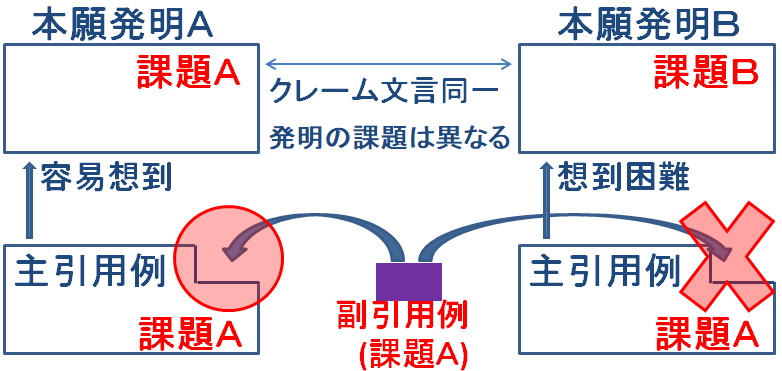
<Figure 1: Even with identical claim wording, the invention’s problem may affect the inventive-step determination.>
Figure 1 — translation of labels: Claimed Invention A / Claimed Invention B; Problem A / Problem B; identical claim wording; the problems of the inventions differ; obvious / not obvious; primary reference; secondary reference (Problem A).
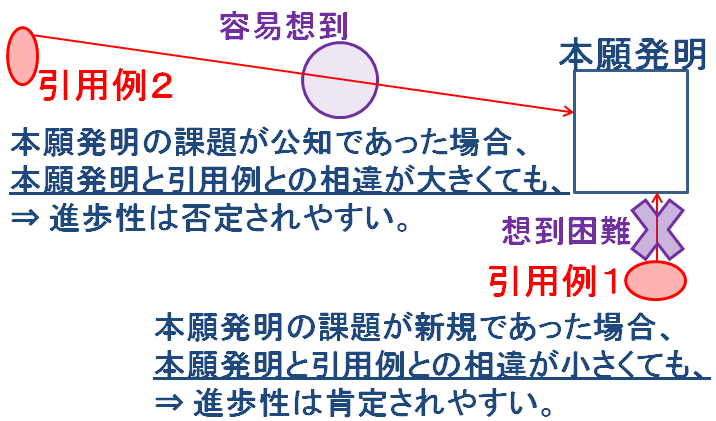
<Figure 2: Prioritize as the primary reference an invention sharing the same problem over one with fewer differences.>
Figure 2 — translation of labels: Reference 2; obvious; claimed invention; Reference 1; not obvious. If the problem addressed by the claimed invention was already known, inventive step tends to be denied even when the differences between the claimed invention and the reference are substantial. If the problem addressed by the claimed invention was new, inventive step tends to be recognized even when the differences are small.
In summary, identifying the invention’s ‘problem’ abstractly at a higher level of generality (a lower level of demand) tends toward denying inventive step, whereas identifying it concretely at a lower level of generality (a higher level of demand) tends toward affirming it. (This tendency is the reverse of the support requirement. For support, an abstract, less demanding problem may suffice even without high-level working examples or disclosure of a mechanism. Conversely, a concrete, more demanding problem raises the issue whether disclosure allows the skilled person to understand that the problem can be solved at that level, making support harder to satisfy. These interrelationships among patent-law issues complicate practice while leaving substantial room for ingenuity in the original specification even for exactly the same invention.)
When acting for a petitioner seeking invalidation for lack of inventive step, it is often more effective to use as the primary reference prior art sharing the invention’s problem, even if it has many differences, and fill the differences with a secondary reference, rather than choosing prior art with few differences—provided the issue of ‘obviousness upon obviousness’ does not arise[vi]. Therefore, where combining two prior-art teachings leads to the invention, the ease of combination is at issue, but the conclusion may change depending on which is the primary reference[vii]. Arguing both directions of the combination is therefore worth considering in practice[viii].
3. Why does ‘the problem of the invention at issue’ affect inventive-step assessment?
(1) If an invention is understood as a ‘configuration,’ then even if the primary cited invention’s problem differs from the invention’s problem, shared problems between the primary and secondary references should lead to a finding of lack of inventive step whenever at least the invention’s ‘configuration’ is easily conceivable. Thus, while similarities and differences between the primary and secondary references’ problems would matter, similarities and differences between the invention’s problem and that of the primary (or secondary) reference should not affect inventive-step assessment.
On this point, the courts’ view is that an invention is a ‘technical idea (a technical problem and the means for solving it)’[ix]. When deciding whether one could arrive from the references at the ‘technical idea’ constituting the invention, the issue is whether the invention’s problem can be solved. The predominant case law therefore treats similarities and differences between the invention’s problem and that of the primary (or secondary) reference as affecting inventive-step assessment.
This article attempts to construct a rationale that reasonably explains this case-law trend, putting aside whether it is desirable.
(2) Patent Act Article 2(1) provides: ‘In this Act, “invention” means a highly advanced creation of technical ideas utilizing the laws of nature.’ Paragraph (2) provides: ‘In this Act, “patented invention” means an invention for which a patent has been granted.’ An invention possessing inventive step is therefore a ‘technical idea.’
The term ‘technical idea’ appears nowhere else in the Patent Act outside Article 2. Considering its ordinary meaning, in light of the description in the Industry–Academia Collaboration Keyword Dictionary, technology can be understood as concrete means for achieving a specified purpose that can be used in practice and transmitted as knowledge. Also, the Seisenban Nihon Kokugo Daijiten (Selected Edition of the Great Dictionary of the Japanese Language) defines ‘idea’ as ‘the content of what is thought … the meaning understood within logical structures such as sentences and inferences.’ Redefined in patent terminology, a ‘technical idea’ can therefore be understood as ‘the thought content of concrete means for achieving the invention’s problem-solving objective.’
Thus, an ‘invention’ under Japanese patent law can be understood as including not only the configuration (for a product invention) or steps (for a method invention) that are the concrete means of achieving the problem-solving objective, but also the ‘problem of the invention’ itself. This is why an IP High Court judgment expressly describes an ‘invention’ as a ‘technical idea (a technical problem and the means for solving it)’[x].
For example, in Japan, a ‘use invention’ (‘an invention based on (i) discovering an unknown attribute of a product and (ii) finding that the attribute makes the product suitable for a new use’) may have novelty and inventive step because its ‘use’ is an invention-defining feature, even when the product itself is known. As one instance, case law has recognized novelty and inventive step through limiting the patient population, for example by disease progression, even with the same active ingredient for the same disease[xi]. Thus, because novelty and inventive step may be recognized in Japan even where the configuration as a product is identical to the prior art, it is accepted in practice as a fundamental premise that an ‘invention’ under Japanese patent law is not confined to the configuration constituting concrete means for solving its problem.
As stated above, current U.S. practice finds an invention obvious even if its problem differs from the primary reference’s, provided the primary and secondary references can be combined for a different problem. This is consistent with the U.S. patent-practice view that an ‘invention’ is a configuration and that intended use does not constitute an invention-defining feature for a product invention.
(Note) MPEP 2111.02 states that “The determination of whether a preamble limits a claim is made on a case-by-case basis in light of the facts in each case”. For a statement of the purpose or intended use of the claimed invention, it requires an evaluation of whether the statement results in a structural difference (or, for process claims, a manipulative difference) between the claimed invention and the prior art, and states: “If so, the recitation serves to limit the claim.” https://www.uspto.gov/web/offices/pac/mpep/s2111.html
Moreover, the Supreme Court’s 2019 Topical Ophthalmic Formulations judgment [xii] held that, even where an earlier judgment finding both the configuration and use of a use invention easily conceivable had become final and binding, inventive step could still be recognized if there were ‘unforeseeable remarkable effects’[xiii]. On remand, the IP High Court found such effects and upheld inventive step[xiv]. Japan thus goes beyond the use inventions described above, where the defining feature of use differs: even where an earlier judgment determining that all invention-defining features, including ‘use,’ were easily conceivable by the skilled person at the priority date [xv] has become final, inventive step may still be recognized depending on the invention’s effects[xvi].
Patent Act Article 29(2) provides: ‘Where, before the patent application, a person with ordinary knowledge in the technical field to which the invention pertains could easily have made the invention based on inventions listed in the items of the preceding paragraph, a patent may not be granted for that invention notwithstanding that paragraph.’ Thus, if inventive step can be recognized depending on effects (= the invention could not ‘easily have been made’) even though the invention-defining features, including use, were easily conceivable at the priority date, ‘invention’ must encompass not only those features but at least its ‘effects’ as well.
The Supreme Court’s Topical Ophthalmic Formulations judgment shows that it too proceeds on the fundamental premise that an ‘invention’ under Japanese patent law is not confined to the configuration constituting concrete means for solving the problem. Effects are the reverse side of a problem[xvii] (although it should be noted that the reverse side of an effect is not necessarily a problem: different problems may be solved to produce the same effect, so there is no one-to-one correspondence). Moreover, considering the invention’s problem and effects when assessing whether its defining features were easily conceivable presents a relatively lower hurdle than recognizing inventive step from effects where those features were easily conceivable. The Supreme Court can therefore be understood as also presupposing this Japanese practice.
Accordingly, in light of the statutory text and the Supreme Court’s Topical Ophthalmic Formulations judgment, an ‘invention’ may be understood not merely as configurations, steps, or invention-defining features, but as the concept comprising those together with the invention’s problem and effects. This understanding accords with the majority of lower-court decisions and provides a coherent explanation of inventive-step assessment. It also more reasonably explains why the invention’s problem affects support, addition of new matter, and other patent-law issues.
End
[i] Examination Guidelines, Part III, Chapter 2, Section 2, Inventive Step 3.3(2)
[ii] Tokyo High Court, February 27, 2003, Courts website / 2002 (Gyo-Ke) 58, Sewing Machine <Presiding Judge Yamashita>
[iii] Cases in which specific consideration of the invention’s problem, its effects, or its relationship to cited inventions supported a finding of inventive step
• IP High Court, December 25, 2008, Hanrei Jiho No. 2046, p. 134 / 2008 (Gyo-Ke) No. 10130, Radar
• IP High Court, January 28, 2009, Hanrei Jiho No. 2043, p. 117 / 2008 (Gyo-Ke) No. 10096, Circuit Connection Member
• IP High Court, May 27, 2010, Courts website / 2009 (Gyo-Ke) No. 10361, Method for Evaluating Resistance to Oil Staining
• IP High Court, November 30, 2011, Hanrei Jiho No. 2134, p. 116 / 2011 (Gyo-Ke) No. 10018, Use of Carbazole Compounds in Treating Congestive Heart Failure
• IP High Court, March 21, 2013, Courts website / 2012 (Gyo-Ke) No. 10262, Method for Forming a Glass Melt
• IP High Court, March 6, 2013, Hanrei Jiho No. 2197, p. 119 / 2012 (Gyo-Ke) No. 10278, Ventilation Fan Filter and Method for Producing It
• IP High Court, April 10, 2013, Courts website / 2012 (Gyo-Ke) No. 10328, Odor-Neutralizing and Liquid-Absorbing Waste Bag
• IP High Court, July 17, 2014, Courts website / 2013 (Gyo-Ke) No. 10242, Lighting Device
• IP High Court, December 10, 2015, Courts website / 2015 (Gyo-Ke) No. 10059, Agricultural Produce Sorting Apparatus
• IP High Court, November 16, 2016, Courts website / 2016 (Gyo-Ke) No. 10079, Tire
• IP High Court, February 7, 2017, Courts website / 2016 (Gyo-Ke) No. 10068, Pneumatic Tire;
• IP High Court, February 8, 2021, Courts website / 2020 (Gyo-Ke) No. 10001, (Meth)acrylic Acid Ester Copolymer <Presiding Judge Tsuruoka>
• IP High Court, April 15, 2021, Courts website / 2019 (Gyo-Ke) No. 10159, X-Ray Fluoroscopic Imaging Apparatus <Presiding Judge Kanno>; and many other cases
[iv] IP High Court, January 31, 2011, Hanrei Jiho No. 2107, p. 131 / 2010 (Gyo-Ke) No. 10075, Ventilation Fan Filter <Presiding Judge Iimura>
[v] IP High Court, April 15, 2021, Courts website / 2019 (Gyo-Ke) No. 10159, X-Ray Fluoroscopic Imaging Apparatus <Presiding Judge Kanno>
[vi] Hideki Takaishi, ‘The Reach of “Obviousness upon Obviousness” (The Position of a Third Prior-Art Reference)’ (Patent, Vol. 71, No. 13, 2018)
[vii] IP High Court, March 30, 2016, Courts website / 2014 (Ne) No. 10080 and related cases, Method for Producing Spinel-Type Lithium Manganate <Presiding Judge Shimizu>
[viii] IP High Court, January 17, 2017, Hanrei Times No. 1440, p. 137 / 2016 (Gyo-Ke) No. 10087, Surface Decoration Structure of an Article <Presiding Judge Takabe>, decided the issue in an action to revoke a JPO trial decision where both parties sought an assessment switching the primary and secondary references considered in that decision. Conversely, without both parties’ agreement, an invalidity ground alleging lack of inventive step by switching the primary and secondary references cannot be raised in such an action because the subject matter of the litigation differs.
(Note) The official case summary of this judgment states (in translation): “This judgment held that, in this case, where Cited Inventions 1 to 3 were publicly known facts examined in the trial as inventions falling under Article 29(1)(iii) of the Patent Act, both parties accepted that the alternative argument be examined and determined in this action and did not wish it to go through examination and determination at the JPO, and the parties’ arguments and evidence on that point had been fully presented, examining and determining the alternative argument was also permissible from the viewpoint of resolving the dispute in a single proceeding.” The judgment thus cited, as reasons for permitting examination of the argument with the primary and secondary references switched, that the prior-art facts had been examined in the trial, that both parties accepted examination and determination in this action and did not wish it to go through the JPO, that the parties’ arguments and evidence on that point had been fully presented, and the viewpoint of resolving the dispute in a single proceeding. https://www.courts.go.jp/assets/hanrei/hanrei-point_pdf-86435.pdf
[ix] IP High Court, March 17, 2021, Courts website / 2020 (Ne) No. 10052, Appeal Concerning a Claim for Registration of Partial Transfer of a Share in a Patent Right and Related Relief <Presiding Judge Otaka>
[x] Same as [ix].
[xi] IP High Court, January 12, 2023, Courts website / 2021 (Gyo-Ke) Nos. 10157 and 10155, Therapeutic Agent for Motor Disorders <Presiding Judge Honda>
[xii] Supreme Court, August 27, 2019, Shumin Vol. 262, p. 51 / 2018 (Gyo-Hi) No. 69, Topical Ophthalmic Formulations Containing … Doxepin Derivatives
[xiii] Hideki Takaishi, ‘Supreme Court Judgment of August 27, 2019, 2018 (Gyo-Hi) No. 69, Eye Drops for Treating Allergic Eye Disease: The Comparator and Role of “Unforeseeable Remarkable Effects” in Inventive-Step Assessment’ (Patent, Vol. 73, No. 1, 2020)
[xiv] IP High Court, June 17, 2020, Hanrei Jiho No. 2461, p. 30 / 2019 (Gyo-Ke) No. 10118 <Presiding Judge Mori> (remand proceedings following the Supreme Court judgment)
[xv] IP High Court, July 30, 2014, Courts website / 2013 (Gyo-Ke) No. 10058 <Presiding Judge Tomita>
[xvi] The view that inventive step may be recognized depending on effects even where the invention-defining features are easily conceivable is called the independent-requirement theory. For example, Tokyo High Court, March 28, 2002, Courts website / 2000 (Gyo-Ke) No. 312, Baked Confectionery, held: ‘Effects that justify patentability for an invention whose configuration itself is found easily conceivable must be difficult to predict or discover for that configuration and, on that premise, would have to be exceptionally remarkable compared with the effects predicted or discovered for it.’ Tokyo High Court, December 25, 2003, Courts website / 2001 (Gyo-Ke) No. 499, Method for Producing Concrete Products, was to the same effect. These decisions indeed develop their general reasoning on the independent-requirement theory, but may also be understood as mere lip service while denying inventive step. One of the few cases actually recognizing inventive step under that theory is IP High Court, July 24, 2013, Courts website / 2012 (Gyo-Ke) No. 10207, Acid Addition Salts of Optically Active Piperidine Derivatives and Processes for Their Preparation <Presiding Judge Shitara>. (See Hideki Takaishi, ‘The Significance of “Qualitatively Different Effects” in Inventive-Step Assessment: An Integrated Understanding of “Problems” and “Qualitatively Different Effects” in the Obviousness Inquiry,’ Patent, Vol. 69, No. 5 [Supplement No. 15], 2016.)
[xvii] IP High Court, July 15, 2010, Hanrei Jiho No. 2088, p. 124 / 2009 (Gyo-Ke) No. 10238, Sunscreen Composition <Presiding Judge Iimura>
[Trademark] Intellectual Property High Court, 2020 (Gyo-Ke) 10126, the Matsumoto Kiyoshi case <Otaka>
Original Ameblo publication: 2023-09-13
Ameblo: https://ameblo.jp/hideki-takaishi/entry-12820247573.html
[Trademark] Intellectual Property High Court, 2020 (Gyo-Ke) 10126, the Matsumoto Kiyoshi case <Otaka>
Where, in light of the actual circumstances of trade, it is not found that, at the time of the trademark application, persons encountering a sound mark would ordinarily associate or recall a person’s full name from the sounds constituting it … the mark does not constitute a trademark containing ‘another person’s name’ under Article 4(1)(viii) of the Trademark Act.
https://www.courts.go.jp/assets/hanrei/hanrei-pdf-90553.pdf
[Trademark] Intellectual Property High Court, 2020 (Gyo-Ke) 10017, the Air-Conditioned Clothing case <Takabe>
Original Ameblo publication: 2023-09-14
Ameblo: https://ameblo.jp/hideki-takaishi/entry-12820397901.html
[Trademark] Intellectual Property High Court, 2020 (Gyo-Ke) 10017, the Air-Conditioned Clothing case <Takabe>
To fall within ‘causing confusion with goods or services connected with another person’s business’ under Article 51(1) of the Trademark Act, the specific manner in which the trademark is displayed must give rise to a concrete likelihood of confusion with goods, etc. connected with another person’s business.
⇒ No confusion as to commercial origin
https://www.courts.go.jp/assets/hanrei/hanrei-pdf-89794.pdf

English guide to the trademark image: “空調風神服” (Kūchō Fūjin Fuku), comprising “空調” (air conditioning), “風神” (wind god), and “服” (clothing).
[Unfair Competition Prevention Act] Tokyo District Court, 2018 (Wa) 29036, the Pore-Care Lotion case
Original Ameblo publication: 2023-09-15
Ameblo: https://ameblo.jp/hideki-takaishi/entry-12820519455.html
[Unfair Competition Prevention Act] Tokyo District Court, 2018 (Wa) 29036, the Pore-Care Lotion case
⇒ Claim under Article 2(1)(i) of the Unfair Competition Prevention Act upheld
‘… When sold in stores, products are ordinarily displayed with the front of the outer box visible to consumers … the central part that performs the function of distinguishing one’s goods from others’ goods or identifying commercial origin is the design on the front.’
https://www.courts.go.jp/assets/hanrei/hanrei-pdf-90083.pdf

English guide to the comparison image: The left pair shows the outer boxes, and the right pair shows the containers. In each pair, the plaintiff’s LaboLabo Super-Keana Lotion is on the left and the defendant’s Juliette Ray KEANA LOTION is on the right. The Japanese product descriptions “毛穴ローション” and “毛穴化粧水” both mean pore-care lotion.
[Copyright] Osaka High Court, 2019 (Ne) 1735, the Goldfish Telephone Booth case
Original Ameblo publication: 2023-09-18
Ameblo: https://ameblo.jp/hideki-takaishi/entry-12820915962.html
[Copyright] Osaka High Court, 2019 (Ne) 1735, the Goldfish Telephone Booth case
— Copyrightability upheld
‘It expresses an extraordinary scene … bubbles could not ordinarily emerge from the earpiece of a telephone receiver either. … It evokes the image of a telephone conversation in progress and makes a strong impression on the viewer. … Individuality is manifested.’
https://www.courts.go.jp/assets/hanrei/hanrei-pdf-90019.pdf
[Unfair Competition Prevention Act] Osaka District Court, 2019 (Wa) 7786, Kyoto City University of Arts and Kyoto University of the Arts
Original Ameblo publication: 2023-09-18
Ameblo: https://ameblo.jp/hideki-takaishi/entry-12820916055.html
[Unfair Competition Prevention Act] Osaka District Court, 2019 (Wa) 7786
Plaintiff: Kyoto City University of Arts
Defendant: Kyoto University of the Arts
⇒ No violation of Article 2(1)(i) or (ii) of the Unfair Competition Prevention Act
Although well known,
‘They differ in appearance and pronunciation. … Their concepts … differ as to whether they evoke Kyoto City as the operating entity. Actual trading circumstances … if even a part differs … they are distinguished as different universities.’
https://www.courts.go.jp/assets/hanrei/hanrei-pdf-89685.pdf
[Trademark] Intellectual Property High Court, 2021 (Gyo-Ke) 10047, the Fukumai case — Article 50(1) of the Trademark Act: an implied license was found
Original Ameblo publication: 2023-09-18
Ameblo: https://ameblo.jp/hideki-takaishi/entry-12820916209.html
[Trademark] Intellectual Property High Court, 2021 (Gyo-Ke) 10047, the Fukumai case
Article 50(1) of the Trademark Act: an implied license was found
‘Given that the sticker at issue … displays the registration certificate for the trademark at issue, the plaintiff … knew that Katsuragaoka Development was selling “Fukumai 2018” with that sticker affixed to the rice-bag packaging …’
https://www.courts.go.jp/assets/hanrei/hanrei-pdf-91355.pdf
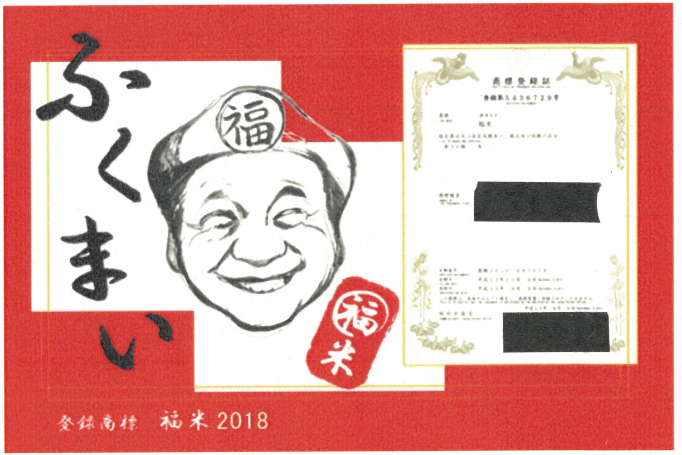
[Unfair Competition Prevention Act / Trade Secrets] Tokyo District Court, 2018 (Wa) 35263, 2WAY-Compatible Oxygen Chamber
Original Ameblo publication: 2023-09-19
Ameblo: https://ameblo.jp/hideki-takaishi/entry-12821056781.html
[Unfair Competition Prevention Act / Trade Secrets] Tokyo District Court, 2018 (Wa) 35263, 2WAY-Compatible Oxygen Chamber
Constitutes a trade secret under Article 2(6) of the Unfair Competition Prevention Act (secrecy management, usefulness, and non-public nature)
‘The … assertion that the purpose was to inspect or check it is unnatural and unreasonable. … However … there is no … evidence that the data were actually read out and acquired … .’
Commentary including quotations from the judgment: https://www.ip-bengoshi.com/archives/5812
Intellectual Property High Court, 2006 (Gyo-Ke) 10053 [Tissue-Paper Storage Box] <Shinohara>
Original Ameblo publication: 2023-09-20
Ameblo: https://ameblo.jp/hideki-takaishi/entry-12821189126.html
Intellectual Property High Court, 2006 (Gyo-Ke) 10053 [Tissue-Paper Storage Box] <Shinohara>
* For a mechanical invention, the effect and function itself—‘locking recesses (which press against each other at the innermost portions of the locking recesses) biting into the respective push-up pieces are formed’—was incorporated into the claim.
⇒ Treating this as a difference, novelty and inventive step were upheld
* Incorporating effects into claims has worked for a long time. It simply had not attracted attention.
https://www.courts.go.jp/assets/hanrei/hanrei-pdf-33572.pdf
Intellectual Property High Court, 2010 (Gyo-Ke) 10407 [Method for Operating a Wind Park] <Iimura>
Original Ameblo publication: 2023-09-22
Ameblo: https://ameblo.jp/hideki-takaishi/entry-12821507010.html
Intellectual Property High Court, 2010 (Gyo-Ke) 10407 [Method for Operating a Wind Park] <Iimura>
For an electrical invention, a function (= setting at 0–100% of rated output power) was incorporated into the claim; treating this as a difference, novelty and inventive step were upheld.
‘The cited invention and the claimed invention differ in their problems to be solved … and their means for solving them.’ ⇒ A teaching away exists
(Extract from the court’s reasoning)
In the invention disclosed in Reference 1, the purpose of adjusting individual wind-power installations within a range of 0 to 100% of their rated output power is to set the output power of the entire wind-power facility at the maximum permissible transmission capacity of the grid according to the grid voltage, not to make the output power of the entire wind-power facility lower than the grid’s maximum permissible transmission capacity. In the invention disclosed in Reference 1, moreover, the maximum output power of the wind-power facility, obtained by adding the rated output power of the individual wind-power installations, exceeds the grid’s maximum permissible transmission capacity. Therefore, setting the output power of the entire wind-power facility at 100% of rated output power would exceed that maximum permissible transmission capacity, and a setting producing output power exceeding the grid’s maximum permissible transmission capacity in this way is not contemplated either. Accordingly, Reference 1 cannot be said to substantially disclose ‘setting the output power of the entire wind-power facility at a desired value within a range of 0 to 100% (of its rated output power) according to the grid voltage.’ … The cited invention and the claimed invention differ in the problems to be solved. … They differ in the means for solving those problems. … There is a teaching away from combining the configuration relating to Difference 2 with the cited invention … .
https://www.courts.go.jp/assets/hanrei/hanrei-pdf-81852.pdf
[Copyright] Intellectual Property High Court, 2020 (Ne) 10018 <Tsuruoka>
Original Ameblo publication: 2023-09-22
Ameblo: https://ameblo.jp/hideki-takaishi/entry-12821507077.html
[Copyright] Intellectual Property High Court, 2020 (Ne) 10018 <Tsuruoka>
Unauthorized copying of fan-created works constitutes copyright infringement
‘Even where … infringement of the copyright in the original work is established … it cannot be said to constitute an abuse of rights to claim infringement of the copyright in the respective manga and seek damages, etc. … on the basis of the portions in which copyright in a derivative work may arise.’
https://www.courts.go.jp/assets/hanrei/hanrei-pdf-89748.pdf
Intellectual Property High Court, 2009 (Gyo-Ke) 10153 [Method for Making a Cutting-Tool Insert …] <Nakano>
Original Ameblo publication: 2023-09-24
Ameblo: https://ameblo.jp/hideki-takaishi/entry-12821732714.html
Intellectual Property High Court, 2009 (Gyo-Ke) 10153 [Method for Making a Cutting-Tool Insert …] <Nakano>
* A case holding that the drawings in the cited reference did not disclose the claimed method invention
‘Figures 3 to 5 … of the cited document … do not describe a sequence of steps of providing a retaining member having geometrical features … and joining that provided retaining member … to a cutting body.’
(Extract from the court’s reasoning)
Figures 3 to 5 … of the cited document illustrate the recesses formed in the hard metal, and it is stated that a desired cross-sectional shape can be selected for those recesses … . … With respect to a method of forming a cutting tool for a lathe, the cited document … describes the formation of geometrical features comprising grooves, dovetails, etc. in the cutting body, and the close fixation of hard metal to a retaining member by die-casting, pressing, molding, or casting. However, it cannot be said to describe that geometrical features comprising grooves, dovetails, etc. are formed in the retaining portion before the hard metal is fixed to that portion by casting or the like … . Accordingly, the cited document cannot be said to describe a sequence of steps of providing a retaining member having geometrical features … and joining that provided retaining member to a cutting body through those geometrical features.
https://www.courts.go.jp/assets/hanrei/hanrei-pdf-38193.pdf
Intellectual Property High Court, 2007 (Gyo-Ke) 10241 [Exhaust Valve for a Storage Bag]
Original Ameblo publication: 2023-09-24
Ameblo: https://ameblo.jp/hideki-takaishi/entry-12821732857.html
Intellectual Property High Court, 2007 (Gyo-Ke) 10241 [Exhaust Valve for a Storage Bag]
* A case in which a configuration could not be read from the drawings in the cited reference
‘… It is not impossible to see the lid body 2 as being rotated approximately three times, but … drawings attached to an application … are not necessarily as detailed or accurate as engineering drawings. Therefore, the mere fact that the depicted relative positions of the threaded portion 11 and threaded portion 21 in Figures 1 to 3 of Exhibit Ko 1 appear as described above … does not permit limiting the invention in Ko 1 to one in which the lid body 2 is rotated “several turns” … .’
https://www.courts.go.jp/assets/hanrei/hanrei-pdf-36376.pdf
Intellectual Property High Court, 2005 (Gyo-Ke) 10677 [Memory Control Device] <Mimura>
Original Ameblo publication: 2023-09-25
Ameblo: https://ameblo.jp/hideki-takaishi/entry-12821865301.html
Intellectual Property High Court, 2005 (Gyo-Ke) 10677 [Memory Control Device] <Mimura>
* Motivation to adopt technology older than the cited invention was denied
⇒ Inventive step upheld
‘The cited invention … takes the limitations on the access unit in the … system as its premise and has … as its objective … . Therefore … it does not provide an occasion to change to page mode, departing from that specific premise.’
(Extract from the court’s reasoning)
The cited invention takes as its premise the limitations on the access unit in the nibble-mode access system and has as its objective enabling support for both nibble-mode and normal-mode access. Therefore, the mere facts that nibble-mode access and page-mode access are generally known as high-speed memory-access systems, or that page-mode access is known to be an older technology, do not provide an occasion for a person skilled in the art encountering the cited invention to depart from its specific premise and change the particular nibble-mode access system adopted there to page mode.
https://www.courts.go.jp/assets/hanrei/hanrei-pdf-33477.pdf
Intellectual Property High Court, 2009 (Gyo-Ke) 10142 [Apparatus for Mixing Powder and Granules and Removing Fine Powder …] <Nakano>
Original Ameblo publication: 2023-09-26
Ameblo: https://ameblo.jp/hideki-takaishi/entry-12822005883.html
Intellectual Property High Court, 2009 (Gyo-Ke) 10142 [Apparatus for Mixing Powder and Granules and Removing Fine Powder …] <Nakano>
* Identity of technical field alone does not establish obviousness; motivation is required
* Outcomes differed by claim
‘Even if the technical fields or technical content are identical or closely related, or the purposes and functions are similar … there may be countless technologies that can be combined … circumstances linking them, for example a common problem and motivation based on it, are required.’
(Extract from the court’s reasoning)
Even if the technical fields or technical content are identical or closely related, or the purposes and functions are similar, there may be countless technologies capable of being combined, and it goes without saying that not every such combination can be called obvious. In that sense, for a combination of technologies having a certain relationship, etc. as described above to be obvious to a person skilled in the art (a person having ordinary knowledge in the technical field to which the invention belongs), circumstances linking them, for example a common problem and motivation based on it, are necessary, and these are absent in this case … .
https://www.courts.go.jp/assets/hanrei/hanrei-pdf-80063.pdf
Intellectual Property High Court, 2011 (Gyo-Ke) 10193 [Chair-Type Massage Machine] <Shiotsuki>
Original Ameblo publication: 2023-09-27
Ameblo: https://ameblo.jp/hideki-takaishi/entry-12822140937.html
Intellectual Property High Court, 2011 (Gyo-Ke) 10193 [Chair-Type Massage Machine] <Shiotsuki>
‘It arises generally and is not a problem peculiar to Ko 2 … through Ko 4 … . … For a person skilled in the art … to minimize the projection amount when moving … the treatment elements … in order to solve the above general problem … is a measure that may be taken as appropriate, even without any suggestion, etc. in the Ko 1 publication itself.’
(Extract from the court’s reasoning)
… In the technical field of massage machines, … problems such as danger to the user’s body or a large load on the drive device when treatment elements are moved with a large amount of projection arise generally from moving treatment elements along the human body; they are not problems peculiar to cases in which the treatment elements are provided in the backrest, etc., as in the massage machines disclosed in the Ko 2 through Ko 4 publications. … When a person skilled in the art encounters the Ko 1 invention, which provides moving treatment elements for the legs, that person may recognize the above general problems concerning movement of the treatment elements and, to solve them, apply well-known technical matters to the Ko 1 invention. It should be said that, even without any suggestion, etc. in the Ko 1 publication itself, that person may appropriately minimize the projection amount, namely put the elements into a non-projecting state, or appropriately adjust that amount downward when the control circuit moves the treatment elements (together with the leg-support platform) in response to input such as operation of a switch.
https://www.courts.go.jp/assets/hanrei/hanrei-pdf-82035.pdf
Intellectual Property High Court, 2010 (Gyo-Ke) 10318 [Storage Case for a Recording-Medium Disc] <Iimura>
Original Ameblo publication: 2023-09-28
Ameblo: https://ameblo.jp/hideki-takaishi/entry-12822273649.html
Intellectual Property High Court, 2010 (Gyo-Ke) 10318 [Storage Case for a Recording-Medium Disc] <Iimura>
* ‘As a result’ of applying well-known technology
⇒ Not ‘obviousness built upon obviousness’
‘On the basis of well-known technology, arranging … at … in the disc-storage case of the Ko 1 invention and, as a result, forming … to project … are … matters that a person skilled in the art could readily conceive.’
(Extract from the court’s reasoning)
… On the basis of the well-known technology exemplified in Ko 2 and Ko 13 through Ko 16, a person skilled in the art could readily conceive, in the disc-storage case of the Ko 1 invention, of arranging the peripheral walls at the upper and lower edges of the lid-side case member outside the peripheral walls at the upper and lower edges of the body-side case member, arranging the upper and lower hinge portions of the body-side case member outside those of the lid-side case member, and, as a result, forming the hinge shafts provided in the hinge portions of the body-side case member to project from the opposing inner surfaces of the upper and lower hinge portions.
https://www.courts.go.jp/assets/hanrei/hanrei-pdf-81469.pdf
Intellectual Property High Court, 2011 (Gyo-Ke) 10364 [… Electric Motor with High Specific Output]
Original Ameblo publication: 2023-09-29
Ameblo: https://ameblo.jp/hideki-takaishi/entry-12822408137.html
Intellectual Property High Court, 2011 (Gyo-Ke) 10364 [… Electric Motor with High Specific Output]
* Enablement of an invention comprising multiple components should be examined component by component (Shojihomu, Analysis of Judgments Rescinding Patent Trial Decisions, p. 91)
* In this case, enablement was upheld despite some lack of clarity in the explanation of effects and in matters outside the claimed invention’s components.
* Enablement upheld although no upper limit was specified
* Enablement of the claimed invention, which comprises multiple components, should be examined for each component constituting the claimed invention. (* Analysis in Shojihomu, Analysis of Judgments Rescinding Patent Trial Decisions, p. 91.)
(Extract from the court’s reasoning)
[Claim] A fluid-cooled electric motor comprising a motor housing made of a polymer material and containing a stator … characterized by containing a thermally conductive, electrically insulating filler in an amount of at least 40% by weight
The claimed invention … is a product invention, but it is an electric motor having the configuration recited in its claims (Section 2.2 above). Therefore, for the claimed invention to be enabled, it must be said that the detailed description of the invention in the application specification must specifically describe methods for producing the components constituting the claimed invention, or, even without such a description, a person skilled in the art must be able to produce those components on the basis of the specification and common general technical knowledge at the filing date.
… Paragraph [0006] of the application specification merely refers to the effects of the claimed invention and does not refer to a method of carrying it out. Therefore, even if that passage is unclear, this does not make it impossible for a person skilled in the art to produce the ‘polymer material’ and related components, which, among the components constituting the claimed invention, are particularly related to that passage. …
… The defendant argues that the configuration of the claimed invention includes cases where the filler content is nearly 100% by weight, with the result that a person skilled in the art cannot readily implement a way of forming the motor housing. However, according to the description … and Figure 1 of the application specification, it is clear that the ‘motor housing’ of the claimed invention is a structural component equipped with a pump, an electric micromotor, etc. It must be regarded as an obvious premise that it has sufficient strength, etc. to be usable as a ‘fluid-cooled electric motor with high specific output.’ As for the ‘polymer material’ constituting the motor housing, imagining the use of a material containing nearly 100% filler by weight and almost no duromer, its principal component, is itself an unreasonable premise. Accordingly, the defendant’s argument cannot be accepted because it is inherently unreasonable.
The defendant also argues that, because the properties of the duromer (liquid epoxy resin) serving as the ‘polymer material’ of the claimed invention and the thermal conductivity of the filler (fine Al2O3 powder) are not uniquely determined, the effects of the claimed invention cannot be inferred; not only is the reason (criticality) why thermal conductivity markedly increases when duromer is contained in an amount of at least 40% by weight unclear, but the liquid epoxy resin and fine Al2O3 powder are also not specified sufficiently concretely for a person skilled in the art to carry out the invention. However, the existence of effects and the technical significance of the weight ratio of duromer are each merely one of the factors that may be considered in assessing the obviousness of the claimed invention and do not directly relate to enablement. Moreover, the above liquid epoxy resin and fine Al2O3 powder are both readily obtainable as commercial products … . Therefore, the absence of details of those materials in the application specification does not prevent a person skilled in the art from carrying out the claimed invention.
Paragraph [0014] of the application specification … is somewhat unclear as Japanese … and it would be desirable to amend it to make it clearer. However, … neither the above ‘bearing’ nor the ‘shaft seal’ is a component constituting the claimed invention. Thus, even though the quoted passage is somewhat unclear as stated above, this does not make it impossible for a person skilled in the art to carry out the claimed invention. …
https://www.courts.go.jp/assets/hanrei/hanrei-pdf-82338.pdf
Intellectual Property High Court, 2021 (Gyo-Ke) 10053 [Method for Making a Container for Microwave-Heated Food] <Otaka>
Original Ameblo publication: 2023-09-30
Ameblo: https://ameblo.jp/hideki-takaishi/entry-12822614181.html
Intellectual Property High Court, 2021 (Gyo-Ke) 10053 [Method for Making a Container for Microwave-Heated Food] <Otaka>
‘… In a container for microwave-heated food, the shape and extent of holes provided to release steam generated during heating are design matters that a person skilled in the art selects as appropriate, taking the amount of steam discharged into account.’
⇒ Inventive step denied
(Extract from the court’s reasoning)
Reference 1 neither describes nor suggests limiting the shape of the ‘small holes’ provided in the lid of a container holding instant food to a particular shape, and neither describes nor suggests a specific method of forming those ‘small holes.’ … In a container for microwave-heated food, the shape and extent of holes provided to release steam generated during heating are design matters that a person skilled in the art selects as appropriate, taking the amount of steam discharged into account. The opening area of each ‘small hole’ (opening 9) in the instant-food container of Example 1 described in Reference 1 is approximately 8.03 mm², and the total opening area is approximately 64.24 mm² (8.03 mm² × 8). … In light of these matters, a person skilled in the art encountering References 1 and 5 would be motivated, in order to discharge to the outside the steam generated from the food contained in the instant-food container of Example 1 of Reference 1, to make the eight circular ‘small holes’ in the lid ‘elongated holes’ and, to form them, adopt the processing method disclosed in Reference 5, which uses laser irradiation to process a plastic structure to form through-holes no more than 200 μm wide, and attempt to set the width of those ‘elongated holes’ at no more than 200 μm (no more than 0.2 mm) so that their total opening area is approximately 64.24 mm². It is therefore found that that person could readily conceive of configuring the above ‘small holes’ as ‘an exhaust portion comprising a group of elongated exhaust holes formed by boring multiple elongated exhaust holes’ within the numerical range of ‘0.15–1.0 mm in width.’
https://www.courts.go.jp/assets/hanrei/hanrei-pdf-90972.pdf
Tokyo District Court, 2011 (Wa) 3292 [Battery-Powered Alarm] (Damages) <Osuga>
Original Ameblo publication: 2023-09-30
Ameblo: https://ameblo.jp/hideki-takaishi/entry-12822614433.html
2011 (Wa) 3292 [Battery-Powered Alarm] (Damages) <Osuga>
<Circumstances rebutting the presumption>
Proviso to Article 102(1): circumstances under which the plaintiff would have been unable to sell its products
It is appropriate to find that the proportions considered to have been substituted by other companies’ competing products and the proportions considered to have been sold owing to the defendant’s own sales capabilities, characteristics of the defendant’s products other than the portions implementing the invention at issue, etc., taken together, constitute ‘circumstances under which [the plaintiff] would have been unable to sell’ its products. In light of the above circumstances, it is appropriate to regard the above quantity as 70%.
https://www.courts.go.jp/assets/hanrei/hanrei-pdf-84120.pdf
Intellectual Property High Court, 2013 (Ne) 10017 and 2013 (Ne) 10041 [Open-Type Fermentation Treatment Apparatus]
Original Ameblo publication: 2023-10-02
Ameblo: https://ameblo.jp/hideki-takaishi/entry-12822827625.html
Intellectual Property High Court, 2013 (Ne) 10017 and 2013 (Ne) 10041 [Open-Type Fermentation Treatment Apparatus]
<Proviso to Article 102(1)>
The only characteristic portion of the invention at issue is the ‘V-shaped scooping member’
Only a few of the numerous paddles
Minimal cost
The defendant’s pamphlet, the plaintiff’s website, and the product catalog do not present the adoption of a scooping member that prevents the accumulated material from spreading as a product feature.
<Grounds for rebutting the presumption> Proviso to Article 102(1): circumstances under which the plaintiff would have been unable to sell its products
The invention at issue is an improvement invention; the only characteristic portion forming the basis of the invention is the ‘V-shaped scooping member.’ The other configuration of the open-type fermentation apparatus lacks inventive step.
The ‘V-shaped scooping member’ is used only for one to a few paddles from the outer end of the rotary shaft located on the elongated open-side-face side, among the paddles comprising numerous long rods.
The cost of the ‘V-shaped scooping member’ is negligible compared with the cost of the open-type fermentation apparatus.
The defendant’s pamphlet, the plaintiff’s website, and the product catalog do not present the adoption of a scooping member that prevents the accumulated material from spreading as a product feature, and it cannot be said that the member’s shape made a major contribution to consumers’ motivation to purchase.
The ‘V-shaped scooping member’ is technically important.
The designs of the respective companies suggest that adoption of the shape of the ‘V-shaped scooping member’ was an essential improvement accompanying adoption of an open-type fermentation tank.
(Extract from the court’s reasoning)
Grounds for rebuttal
Corrected Invention 2 at issue is an improvement invention over Invention 1 at issue, and the characteristic portion forming the basis of the invention is the V-shaped scooping member. As for the other configuration of the open-type fermentation apparatus, since Invention 1 at issue is invalid for lack of inventive step in comparison with the KS7-12 invention, as stated above, it does not possess inventive step. These circumstances should be considered as ‘circumstances under which sales could not have been made’ under the proviso to Article 102(1) of the Patent Act.
The configuration of Corrected Invention 2 other than the configuration relating to the V-shaped scooping member does not possess inventive step, and the characteristic portion forming the basis of the invention is confined to that scooping member. Furthermore, that scooping member is used only for at least one to a few paddles from the outer end of the rotary shaft located on the elongated open-side-face side, among the paddles comprising numerous long rods arranged axially around the peripheral surface of the rotary shaft. It is also clear that the cost associated with the scooping member is negligible compared with the cost of the open-type fermentation apparatus. The defendant’s pamphlet (Ko 5), plaintiff Nikkan Engineering’s website (Otsu 12-1 to 12-3 and 68), and the product catalog (Ko 15) contain no description indicating as a feature the adoption of a scooping member capable of preventing the accumulated material from spreading toward the elongated open side face; it cannot be said that the shape of the scooping member made a major contribution to consumers’ motivation to purchase.
However, as stated above, Corrected Invention 2 has the effect of preventing the accumulated material from spreading, collapsing, etc. when scooped outward, thereby eliminating inconveniences such as compost reaching the wheel tracks of the carriage traveling on the floor and obstructing smooth travel, and the need for the troublesome task of manually scooping up the material that has collapsed and spread outward with a shovel, etc. and piling it on the top surface of the accumulated material. As a configuration for this purpose, the V-shaped scooping member of Corrected Invention 2 was adopted for at least one to a few paddles from the outer end of the rotary shaft located on the elongated open-side-face side. The open-type fermentation apparatus does not adopt a pit-type fermentation tank with parallel elongated walls between which material to be treated is placed and accumulated; instead, one side is an elongated wall and the other is an elongated open side face. It is therefore inevitable that the accumulated material spreads toward the elongated open side face as the agitator reciprocates. In light of this, the V-shaped scooping member of Corrected Invention 2 is important as a configuration for preventing this. Indeed, according to the evidence cited below and the entire purport of the oral argument, the ‘Open-Type KS5-H1200 Mixer’ (the mixer at issue), manufactured by plaintiff Nikkan Engineering, sold to Ebara Corporation, and delivered and installed by that company at the ‘Compost Center’ located in [location omitted in source], underwent a post-delivery test run around March, 2000, but shortly thereafter, on May 8 of that year, its parts were replaced free of charge with triangular claws (V-shaped scooping members) (Ko 12-7; Otsu 15 and 16). Of the Type B apparatuses sold by the defendant to Suzuki Construction, the unit delivered to Masuda Farm likewise had its members replaced free of charge with scooping members 105d within two months of delivery, and when a unit was subsequently delivered to Oki Farm, scooping members 105d were fitted from the outset (Ko 6 and 7; Otsu 66). Embodiments of Patent 2 were not limited to the three units previously found to have been manufactured by plaintiff Nikkan Engineering under the contractually exclusive non-exclusive license at issue (License 2): V-shaped scooping members were also used in open-type fermentation apparatuses delivered and installed at ‘Eco Max Sendai,’ a compost manufacturing facility located in [location omitted in source], the ‘Oe Asahi Compost Center’ located in [location omitted in source], the ‘Namie Town Joint Organic Compost Center’ located in [location omitted in source], the ‘Sakegawa Village Compost Center’ located in [location omitted in source], and the ‘Nakayoshi Yuki Center’ located in [location omitted in source] (Ko 32–38, 57 and 61). Taking these matters together with the motivation and circumstances of development of Corrected Invention 2 described in Corrected Specification 2, it can be inferred that adoption of the V-shaped scooping member of Corrected Invention 2 was an essential improvement accompanying adoption of an open-type fermentation tank.
Considering the foregoing circumstances comprehensively, it is appropriate to find that, for 80% of the number of Type B apparatuses sold, there were circumstances under which plaintiff Nikkan Engineering would have been unable to make the sales.
https://www.courts.go.jp/assets/hanrei/hanrei-pdf-84077.pdf
Intellectual Property High Court, 2019 (Gyo-Ke) 10043 [High-Contrast Tire Pattern] <Tsuruoka>
Original Ameblo publication: 2023-10-03
Ameblo: https://ameblo.jp/hideki-takaishi/entry-12822964310.html
Intellectual Property High Court, 2019 (Gyo-Ke) 10043 [High-Contrast Tire Pattern] <Tsuruoka>
* Combining a secondary reference that solved a problem different from that of the primary reference was held obvious ‘for another reason’
⇒ Inventive step of a numerically limited invention denied
‘When combining it with the Ko 1 invention, setting surface roughness at 5 μm–30 μm is … an appropriate design choice.’
⇒ Inventive step of the numerically limited invention denied
(Extract from the court’s reasoning)
[Difference 2] Invention 3 at issue contains the feature that ‘the blade wall has, over at least one-quarter of its area, an average roughness Rz of 5 μm–30 μm, and the blade wall having this average roughness is located in the lower quarter of the blade height,’ whereas the Ko 1 invention does not specify the average roughness of the wall-like structure formed from numerous fine grooves 4. …
… Improving the distinctiveness of a display mark is one means of improving the appearance of a tire, and if there is a means of further improving the appearance of the tire of the Ko 1 invention, it can be said to be desirable. … Since the Ko 2 document is said to aim at improving appearance, a person skilled in the art encountering the Ko 1 invention would be expected to consider the content described in the Ko 2 document. …
The matters described in the Ko 2 document are considered suitable for further improving the appearance of the tire of the Ko 1 invention, including the display-mark portion. Therefore, a person skilled in the art can be said to have sufficient motivation to attempt to combine the matters described in the Ko 2 document with the Ko 1 invention.
… The Ko 2 document contains no idea of increasing contrast; nevertheless, as is clear from the foregoing, combination with the Ko 1 invention would be attempted for another reason. … When combining it with the Ko 1 invention, setting surface roughness at 5 μm–30 μm can be said to fall within the scope of matters that a person skilled in the art designs as appropriate.
https://www.courts.go.jp/assets/hanrei/hanrei-pdf-89248.pdf
Intellectual Property High Court, 2017 (Gyo-Ke) 10146 [Light-Guide Film] <Tsuruoka>
Original Ameblo publication: 2023-10-04
Ameblo: https://ameblo.jp/hideki-takaishi/entry-12823106349.html
Intellectual Property High Court, 2017 (Gyo-Ke) 10146 [Light-Guide Film] <Tsuruoka>
* Inventive step of a parameter invention denied
‘The trial decision did not … find obviousness … by further combining the projections of Reference 3 … with the cited invention and Reference 2 … . … The numerical ranges … concerning the shape of the “bonded portion” of the claimed invention have no critical technical significance … .’
(Extract from the court’s reasoning)
… The plaintiff argues that … although Reference 3 describes a structure in which projections are provided on the bottom surface of a prism having an upward-facing structure, those projections cannot immediately be moved to the prism’s apex, and that further referring to Reference 3 after combining the technology described in Reference 2 with the cited invention constitutes so-called ‘obviousness built upon obviousness’ and is impermissible. However, the trial decision merely cites Reference 3 as one example (basis) for considering that a person skilled in the art could implement a shape (of a fixed portion) approximately 5 μm wide and 10 μm long within the range of well-known materials and production methods … ; it did not find the configuration relating to the difference obvious by further combining the projections on the prism’s bottom surface described in Reference 3 with the cited invention and the technology described in Reference 2. … The numerical ranges in (1) through (3) above concerning the shape of the ‘bonded portion’ of the claimed invention are not found to have critical technical significance.
Full judgment: https://www.courts.go.jp/assets/hanrei/hanrei-pdf-87773.pdf
Intellectual Property High Court, 2022 (Gyo-Ke) 10012 and 10045 [Touch-Operated Input Device] <Kanno>
Original Ameblo publication: 2023-10-05
Ameblo: https://ameblo.jp/hideki-takaishi/entry-12823240127.html
Intellectual Property High Court, 2022 (Gyo-Ke) 10012 and 10045 [Touch-Operated Input Device] <Kanno>
* Even well-known technology requires motivation, etc. for combination
⇒ The court criticized combining the primary reference and the well-known technology after abstracting their respective technical fields to a higher level.
* Prevailed at first instance against Apple on the same patent: 2007 (Wa) 2525
⇒ Inventive step upheld
‘The Ko 1 invention does not, in the first place, have a function … to be assigned to a push switch, and … there is neither description nor suggestion of an operation … confirming the running direction or running speed.’
(Extract from the court’s reasoning)
… The touch panel of the Ko 1 invention for controlling the running direction and running speed of magnetic tape and Well-Known Technology 1 relating to a device for inputting positional data that does not include running direction or running speed differ in what they control. Even if both share the configuration of a touch panel, it cannot be said to be easy to apply Well-Known Technology 1, which relates to a device for inputting positional data, to the Ko 1 invention, which is a device for supplying magnetic-tape control signals. Ultimately, the plaintiffs’ assertion that Well-Known Technology 1 can be applied to the Ko 1 invention attempts to apply substantially different technologies by abstracting them to a higher-level concept, and is inappropriate. …
Even assuming that Well-Known Technology 1 is understood at a higher level of abstraction as technology that generates some input information by confirming a touch-panel selection with a push switch, the Ko 1 invention does not, in the first place, have a function to be assigned to a push switch (a function for confirming a selection). Moreover, although the Ko 1 document describes continuously controlling the running direction and speed of magnetic tape with a touch panel, it neither describes nor suggests an operation for confirming the running direction or speed selected on the touch panel or a configuration such as a button corresponding to that operation. There is therefore no motivation to apply Well-Known Technology 1 to the Ko 1 invention.
https://www.courts.go.jp/assets/hanrei/hanrei-pdf-91805.pdf
Intellectual Property High Court, 2022 (Ne) 10061 [Magnetic Screen Device] <Honda>
Original Ameblo publication: 2023-10-06
Ameblo: https://ameblo.jp/hideki-takaishi/entry-12823369472.html
Intellectual Property High Court, 2022 (Ne) 10061 [Magnetic Screen Device] <Honda>
(1) Addition or substitution of well-known, conventional technology + design matter
⇒ Violation of the extended prior-application rule
‘The Otsu 10 publication contains no statement … that there is a handle. … At the time of filing, … providing a handle on a case was a well-known and conventional means. … It could be selected as appropriate when necessary for convenience in carrying, etc. … .’
(2) Even if it does not fit entirely inside, it is ‘housed’
⇒ Limitation satisfied
(Extract from the court’s reasoning)
(1) … The Otsu 10 publication discloses a configuration in which the pressing portion is fixed … . …
The Otsu 10 publication does not state that the pressing portion is rotatable. … Making the portion that contacts a moving sheet-like object … rotatable, and causing a roller to rotate as a result of sliding contact with a sheet, were … well-known and conventional means at the time of filing, and this was likewise true in the field of magnetic screen devices such as Patent 1 at issue … . … Making a pressing portion whose cross-sectional shape is an arcuate surface rotatable, with the result that the pressing portion rotates owing to sliding contact with the screen that is unwound or wound while contacting it, is merely within the range of choices a person skilled in the art makes as appropriate in devising the configuration of the pressing portion … . …
The Otsu 10 publication contains no statement that the ‘storage case’ corresponding to … the casing has a handle. … At the time of filing, … providing a handle on a case is found to have been a well-known and conventional means in the technical field of magnetic screen devices. Providing a handle on the storage case in Cited Invention 1-1 is also found to be something that a person skilled in the art could select as appropriate when necessary for convenience in carrying, etc.
(2) … Regarding the position of the elongated member, Specification 1 contains statements concerning one embodiment such as ‘The elongated member 30 is likewise housed inside the casing 40 adjacent to the screen sheet 10 in its wound state’ ([0044]) and ‘The elongated member 30 is positioned at the opening 46 of the casing 40’ ([0048]); Figure 9 also depicts a configuration in which the elongated member is located inside the casing. However, there is no statement that the elongated member is housed inside the casing to protect it from dropping, vibration, collision, or soiling. Even in light of the remaining description in Specification 1, Invention 1 after the further correction cannot be interpreted as requiring the elongated member to be neatly contained inside the casing, without being exposed outside it, so as to be protected as much as possible from impact and soiling.
… In the appellee’s product, most of the pressing roller is placed inside the main-body case, so the elongated member can be said to be housed in the casing. … The limitation is satisfied.
https://www.courts.go.jp/assets/hanrei/hanrei-pdf-91775.pdf
Tokyo District Court, 2021 (Wa) 26762 et al. [Hardener for Ground-Stabilizing Chemical Solution] <Kokubu>
Original Ameblo publication: 2023-10-10
Ameblo: https://ameblo.jp/hideki-takaishi/entry-12823937535.html
2021 (Wa) 26762 et al. [Hardener for Ground-Stabilizing Chemical Solution] <Kokubu>
⇒ Prior-user right established; usurpation (unauthorized application by a non-entitled person) not found
‘The plaintiff filed … the application … more than fourteen years after leaving employment … the possibility that the plaintiff completed the patented invention after leaving employment cannot be excluded … and the defendants did not know the content of the patented invention … .’
(Extract from the court’s reasoning)
The hardener invention at issue is encompassed by the patented invention in respect of limitations B2, D, G, H, and I, and the two are found to differ in those respects. The patented invention and the hardener invention therefore cannot be said to be identical … . There is insufficient evidence to find that Bi and Ci conceived the configuration relating to the differences between those inventions and contributed to the creative activity of concretizing it to complete the patented invention; nor can it be found from all the evidence in this case that the two invented the patented invention. Accordingly, Bi and Ci cannot be found to have been the inventors of the patented invention. … The patent cannot be said to have been granted … on an unauthorized application.
https://www.courts.go.jp/assets/hanrei/hanrei-pdf-92102.pdf
Intellectual Property High Court, 2021 (Gyo-Ke) 10152 [Method for Resin-Sealing Permanent Magnets] <Honda>
Original Ameblo publication: 2023-10-10
Ameblo: https://ameblo.jp/hideki-takaishi/entry-12823937904.html
Intellectual Property High Court, 2021 (Gyo-Ke) 10152 [Method for Resin-Sealing Permanent Magnets] <Honda>
* A divisional application deleting a configuration essential to solving the problem
⇒ Support requirement not satisfied
‘According to … the specification, a transport tray is an essential configuration for solving Problem 2 of the prior art … nor is there evidence … that an alternative configuration is clear … to a person skilled in the art.’
(Extract from the court’s reasoning)
Invention 1 includes not only an invention with a configuration including a transport tray carrying a laminated rotor core, but also an invention with a configuration without that transport tray. If the claims are taken as written without including the transport tray as a component, … the invention cannot be said to fall within the scope in which it can be recognized that the problem of Invention 1—providing a method of resin-sealing permanent magnets permitting inexpensive operation—can be solved. … Paragraph [0010] contains a detailed description of the invention premised on … not making the transport tray an essential configuration. However, … according to the detailed description in the specification, the transport tray is essential to solving Problem 2 of the prior art; thus, solving the problem of the invention without a transport tray is understood to require a configuration replacing it. Although the specification contains descriptions … of the specific structure of the transport tray, it contains no description specifically suggesting a replacement configuration, and there is no evidence sufficient to establish that such a replacement would be clear to a person skilled in the art. Therefore, even in light of common general technical knowledge at filing, it cannot be said to fall within a scope in which a person skilled in the art could recognize, without any specific description in the detailed description, that the problem relating to the steps of fixing the laminated rotor core on the lower mold and removing it from that mold could be solved.
https://www.courts.go.jp/assets/hanrei/hanrei-pdf-92382.pdf

Translation of the author’s explanatory diagram (a hypothetical sequence of divisional applications):
Premise and question: The embodiments in the original specification include feature combinations A + B and B + C. Feature A solves problem α. Can a claim directed to feature B be drafted without adding new matter?
The table has three substantive columns: Features; Problem; Remarks.
Original application — Features: A + B (one of the embodiments). Problem: α (stated in the specification). Remarks: Feature A is essential to solving problem α.
First generation — Features: A. Problem: α. Remarks: Feature B is unrelated to solving problem α, so it may be omitted.
Second generation — Features: B + C (one of the embodiments). Problem: β (not stated in the specification; common general technical knowledge at filing). Remarks: Features B and C are unrelated to solving problem α. Feature B is essential to solving problem β … Thus, if the problem addressed by the invention changes to β … .
Third generation — Features: B. Problem: β. Remarks: Feature C is unrelated to solving problem β, so it may be omitted.
The diagram’s concluding line reads: ‘The problem may be changed when filing a divisional application’ + ‘Features not directly related to solving the problem may be omitted’ ⇒ [text obscured in the source image].
Tokyo District Court, 2015 (Wa) 25780 [Ground-Improvement Device] <Shimasue>
Original Ameblo publication: 2023-10-11
Ameblo: https://ameblo.jp/hideki-takaishi/entry-12824047833.html
Tokyo District Court, 2015 (Wa) 25780 [Ground-Improvement Device] <Shimasue>
* Joint inventorship affirmed
⇒ Claim for confirmation of a co-ownership share upheld
‘It cannot be said that merely having the defendant’s disclosure of the idea … to the plaintiffs would make its construction as something concrete and objective and its repeated implementation no more than self-evident to the parties.’
(Extract from the court’s reasoning)
The defendant merely showed the plaintiffs … an idea for the basic configuration and handed over reference materials … ; no fact is established that it went beyond this to provide a simple model, drawings, etc. … The plaintiffs … required more than six months, and manufacturing a product that actually operated required trial and error in adjusting the gears, etc. In view of these circumstances as well, it cannot be said that merely having the defendant’s disclosure of the idea … to the plaintiffs would make its construction as something concrete and objective and its repeated implementation no more than self-evident to the parties. Accordingly, in the process of concretizing the … idea presented by the defendant’s employees to a degree enabling implementation by a person skilled in the art, the plaintiffs made a commensurate creative contribution …
https://www.courts.go.jp/assets/hanrei/hanrei-pdf-87456.pdf
Tokyo District Court, 2012 (Wa) 15621 [Cu-Ni-Si Alloy with Excellent Strength and Bendability] <Presiding Judge Takano; signed on his behalf by Judge Mitsui>
Original Ameblo publication: 2023-10-12
Ameblo: https://ameblo.jp/hideki-takaishi/entry-12824183089.html
Tokyo District Court, 2012 (Wa) 15621 [Cu-Ni-Si Alloy with Excellent Strength and Bendability] <Presiding Judge Takano; signed on his behalf by Judge Mitsui>
The ‘invention for which the patent application was filed’ is the invention after correction
⇒ The court rejected the defendant’s argument that the numerical range before correction should be used as the basis for determining the prior-user right.
★ This connects with the issue of ‘encroachment’ by a prior-user right!
Cf. Intellectual Property High Court, 2020 (Ne) 10004 [Light-Irradiation Device]
(Extract from the court’s reasoning)
On the premise that the ‘invention for which the patent application was filed’ in Article 79 of the Act should be interpreted as meaning the invention in the application actually filed, the defendant argues that the local maximum values of the X-ray random intensity ratios of its respective prior-used products fell within the range of 2.0 to 10.0, inclusive, that applied before the First Correction at issue. However, because the trial decision concerning the Second Correction became final and binding, the patent application is deemed to have been filed on the basis of the specification, claims, or drawings after correction (Article 128 of the Act). It is therefore clear that the ‘invention for which the patent application was filed’ in this case is the invention after the Second Correction.
Intellectual Property High Court, 2019 (Gyo-Ke) 10126 <Tsuruoka> [Steel Sheet-Pile Press-In and Extraction Machine], third judgment
Original Ameblo publication: 2023-10-13
Ameblo: https://ameblo.jp/hideki-takaishi/entry-12824319969.html
Intellectual Property High Court, 2019 (Gyo-Ke) 10126 <Tsuruoka> [Steel Sheet-Pile Press-In and Extraction Machine], third judgment
Inventive step denied
No counterargument from the patentee throughout the trial decisions and judgments
Trial decision favorable to the patentee
Judgment unfavorable to the patentee
⇒ However, this is not a matter subject to deemed admission. This judgment reached its conclusion after assessing inventive step, etc.
(Extract from the court’s reasoning)
It is established that similar invalidity grounds were asserted in the trial proceedings at issue and in the invalidation-trial proceedings relating to the second trial decision, so a conflict with the second trial decision, etc. is not entirely without issue. However, according to the same evidence, the invalidity grounds asserted in the two proceedings differed in their primary references as well as in the evidence submitted in support of them. Therefore, the plaintiff’s assertion of lack of inventive step based on the Ko 1 invention in this case does not violate the effect of the second trial decision; nor is there sufficient evidence to find that the assertion reopens an already settled issue and thereby violates the principle of good faith.
★ For the scope of admissions, see Tokugikon No. 301 ↓↓
http://www.tokugikon.jp/gikonshi/301/301hanketsu.pdf
Intellectual Property High Court, 2020 (Gyo-Ke) 10054 [Nucleic-Acid Decomposition Treatment Apparatus] <Kanno>, second judgment
Original Ameblo publication: 2023-10-14
Ameblo: https://ameblo.jp/hideki-takaishi/entry-12824515153.html
Intellectual Property High Court, 2020 (Gyo-Ke) 10054 [Nucleic-Acid Decomposition Treatment Apparatus] <Kanno>, second judgment
* Second judgment after a request for correction following the first judgment denying inventive step
⇒ The court examined the obviousness of the configuration added by correction.
(* No discussion of its relationship to the other differences.)
‘It is further determined … whether the configuration of Corrected Invention 2 … can be called obvious.’
(Extract from the court’s reasoning)
… Since actions to rescind trial decisions are governed by the Administrative Case Litigation Act, the binding effect of the above rescission judgment extends to the renewed examination and trial decision under Article 33(1) of that Act. This binding effect covers the factual findings and legal determinations necessary to derive the operative part of the judgment, and findings or determinations conflicting with those of the rescission judgment are impermissible (see Supreme Court, Third Petty Bench, judgment of April 28, 1992, Minshu Vol. 46, No. 4, p. 245). An action to rescind the trial decision challenging that trial must likewise be decided on that premise. …
The trial decision at issue … added to that difference the feature ‘characterized by maintaining the differential pressure inside the exposure chamber at a constant negative pressure,’ which was a configuration added to Corrected Invention 2 by the Correction at issue. In view of the foregoing sequence of events, assessing inventive step of Corrected Invention 2 requires … further determining whether its configuration of ‘maintaining the differential pressure inside the exposure chamber at a constant negative pressure’ can be called obvious. …
A person skilled in the art encountering Ko 1 and Ko 2 would be motivated, in order both to generate sterilizing gas of a stable concentration in the Ko 1 invention and to obtain a sufficiently assured sterilizing effect, to apply the configuration described in Ko 2 for controlling the formaldehyde-gas concentration, humidity, and temperature in the space to be sterilized to respective predetermined values and maintaining a constant pressure in that space. …
https://www.courts.go.jp/assets/hanrei/hanrei-pdf-90493.pdf
Intellectual Property High Court, 2014 (Gyo-Ke) 10057 [Deposit Terminal] <Ishii>
Original Ameblo publication: 2023-10-16
Ameblo: https://ameblo.jp/hideki-takaishi/entry-12824709803.html
Intellectual Property High Court, 2014 (Gyo-Ke) 10057 [Deposit Terminal] <Ishii>
* General principles for amendments increasing the number of claims
‘Article 17-2(5)(ii) of the Patent Act … does not turn on whether the amendment increases the number of claims; rather, it is necessary and sufficient that (1) … narrowing …, (2) … limitation …, and (3) the industrial fields of application and the problems to be solved … before and after amendment … are the same.’
(Extract from the court’s reasoning)
… Article 17-2(5)(ii) of the Patent Act … clearly prescribes its requirements, including the parenthetical wording. Therefore, for an amendment to fall within one aimed at ‘narrowing the scope of claims’ under that item, the question is not whether it is a so-called amendment increasing the number of claims. Rather, it is necessary and sufficient to satisfy the requirements … that (1) it narrows the scope of claims; (2) it limits matters necessary to specify the invention recited in the pre-amendment claim; and (3) the industrial fields of application and problems to be solved of the invention recited in that claim before amendment and the invention recited in that claim after amendment are identical … .
https://www.courts.go.jp/assets/hanrei/hanrei-pdf-84872.pdf
Intellectual Property High Court, 2011 (Gyo-Ke) 10115 [Cyclohexane Compound] <Takizawa>
Original Ameblo publication: 2023-10-17
Ameblo: https://ameblo.jp/hideki-takaishi/entry-12824853593.html
Intellectual Property High Court, 2011 (Gyo-Ke) 10115 [Cyclohexane Compound] <Takizawa>
* Eligible as a cited invention
The reference expressly states the dielectric-anisotropy and optical-anisotropy values of the cited invention, and thus its inventor had actually produced the cited invention.
The (pure) starting materials described in the reference were not difficult to obtain either.
(Extract from the court’s reasoning)
There is no dispute that the claimed invention encompasses the cited invention, and the claimed invention … claims a particular novel compound. Accordingly, for the claimed invention to be said to be described in the reference, a person skilled in the art must have been able to produce the cited invention encompassed by it by considering the reference’s description and common general technical knowledge at the filing date. …
… In attempting to synthesize the cited invention described in the reference, a person skilled in the art would recognize that the cited invention could be obtained by using … . This is also corroborated by the fact that … the reference expressly states the dielectric-anisotropy and optical-anisotropy values of the cited invention, and thus its inventor had actually produced it.
https://www.courts.go.jp/assets/hanrei/hanrei-pdf-82053.pdf
Osaka District Court, 2008 (Wa) 10819, and its appellate judgment, Intellectual Property High Court, 2013 (Ne) 10026 <Iimura>
Original Ameblo publication: 2023-10-18
Ameblo: https://ameblo.jp/hideki-takaishi/entry-12824994527.html
Osaka District Court, 2008 (Wa) 10819, and its appellate judgment, Intellectual Property High Court, 2013 (Ne) 10026 <Iimura>
[Method and Apparatus for Mixing Powder and Granules and Removing Fine Powder]
‘… The defendant’s publicly worked invention cannot be said to fall within the technical scope of the respective patented inventions, and the assertion of a prior-user right lacks its premise … .’
⇒ This decision, too, connects with the discussion of ‘encroachment’ by a prior-user right.
* Indirect infringement under item (iv) established for some of the Type B apparatuses
(Note) The first-instance court denied indirect infringement under Article 101(iv) of the Patent Act for the Type A product, but found indirect infringement under Article 101(v) in relation to Patented Invention 1 and under Article 101(ii) in relation to Patented Invention 2. For some Type B products, it found indirect infringement under Article 101(iv) in relation to Patented Invention 1. The following extract concerns the first-instance court’s determination under Article 101(iv) for the Type A product.
(Extract from the court’s reasoning)
… The Type A product is not itself connected to a material supply source and is not an apparatus premised on processing multiple kinds of materials; its configuration also allows it to be used solely to remove fine powder from a single material. Accordingly, the Type A product is not a ‘product used exclusively for use of the process’ of Patented Invention 1. The defendant’s acts concerning the Type A product therefore do not constitute indirect infringement under Article 101(iv) of the Patent Act of the patent right relating to Patented Invention 1.
https://www.courts.go.jp/assets/hanrei/hanrei-pdf-83053.pdf
Intellectual Property High Court, 2022 (Gyo-Ke) 10094 [Insole] <Honda>
Original Ameblo publication: 2023-10-19
Ameblo: https://ameblo.jp/hideki-takaishi/entry-12825135207.html
Intellectual Property High Court, 2022 (Gyo-Ke) 10094 [Insole] <Honda>
‘For the cited invention … in light of common general technical knowledge, etc., applying the Ko 2 technology based on the technical concept of adjusting a projection to an appropriate position, so as to adjust the position of the toe post more appropriately to an individual’s foot … and providing multiple toe-post mounting holes in the left-right direction as well would be … readily conceivable.’
(Extract from the court’s reasoning)
… The Ko 2 technology, too, can be said to present the technical concept of adjusting a projection to an appropriate position according to the dimensions and shapes of the shoe and foot, so that supporting the projection between the toes, etc. prevents friction between the toes and the shoe.
… It is a publicly known fact that the shapes, lengths, widths, etc. of toes differ among individuals, and it is found to be common general technical knowledge (the Technical Knowledge at issue) that the position of the interdigital cleft differs among individuals not only front-to-back but also left-to-right (Ko 3-1 and 3-2).
Furthermore, when walking in shoes, a foot can move within a certain range inside the shoe not only front-to-back but also left-to-right, depending on the dimensions and shapes of the shoe and foot, the direction of travel, road-surface conditions, etc. In such cases, the direction of movement is not clearly divided into front-to-back or left-to-right; movement in oblique directions can also be envisaged.
… In view of the foregoing, it should be said that a person skilled in the art encountering Ko 1 could readily conceive, with respect to the cited invention and in light of the … common general technical knowledge, etc. described above, of applying the Ko 2 technology based on the technical concept of adjusting a projection to an appropriate position in order to adjust the toe-post position more appropriately to an individual’s foot, and configuring the mounting position of toe post 14A located in the interdigital cleft between the first and second toes to have multiple toe-post mounting holes not only in the front-to-back direction of insole body 4A but also in the left-to-right direction.
https://www.courts.go.jp/assets/hanrei/hanrei-pdf-92079.pdf
Intellectual Property High Court, 2022 (Ne) 10094 [Composition Containing … Tetrafluoropropene] <Hibiku Shimizu>
Original Ameblo publication: 2023-10-20
Ameblo: https://ameblo.jp/hideki-takaishi/entry-12825253409.html
Intellectual Property High Court, 2022 (Ne) 10094 [Composition Containing … Tetrafluoropropene] <Hibiku Shimizu>
Fourth generation of 2019 (Wa) 30991
The specification does not describe a problem.
⇒ Even if a problem could be inferred, the invention is not described in the specification, so the support requirement is not satisfied.
First instance, Tokyo District Court, 2021 (Wa) 29388: divisional-application requirements not satisfied (addition of new matter) ⇒ Novelty denied
(Extract from the court’s reasoning)
… The specification can be said to state that HFO-1234yf is known to have a low global warming potential (GWP) and is a good candidate to replace high-GWP saturated HFC refrigerants; that small amounts of certain additional compounds are present when HFO-1234yf is prepared; that one of the additional compounds contained in the composition of the invention is less than approximately 1 weight percent HFC-143a; and that byproducts arising in the process of preparing HFO-1234yf, and impurities contained in HFO-1234yf or its starting materials (HCFC-243db, HCFO-1233xf, and HCFC-244bb), constitute additional compounds.
However, it is clear even from the wording of [0010] itself that HFO-1234yf was already known before the original filing date to be useful as a compound having a low global warming potential (GWP). Therefore, unless the specification describes what technical significance results from the presence of small amounts of additional compounds when preparing HFO-1234yf, what effects arise, and what problem is thereby solved, it cannot be said to describe the problem the invention sought to solve. Yet the specification says nothing about these points; nor does its remaining description contain any passage suggesting the problem the invention sought to solve. Under ‘Technical Field,’ the specification states: ‘The present disclosure relates to the field of compositions useful as heat-transfer compositions, aerosol propellants, foaming agents, blowing agents, solvents, cleaning agents, carrier fluids, displacement drying agents, buffing abrasives, polymerization media, expansion agents for polyolefins and polyurethanes, gaseous dielectrics, fire-extinguishing agents, and fire-extinguishing agents in liquid or gaseous form. In particular, the present disclosure relates to compositions useful as heat-transfer compositions, such as compositions containing 2,3,3,3,-tetrafluoropropene (HFO-1234yf or 1234yf), or 2,3-dichloro-1,1,1-trifluoropropane (HCFC-243db or 243db), 2-chloro-1,1,1-trifluoropropene (HCFO1233xf or 1233xf), or 2-chloro-1,1,1,2-tetrafluoropropane (HCFC-244bb)’ ([0001]). However, that passage merely explains the technical field to which the invention belongs and does not enable an understanding of the problem the invention seeks to solve. Accordingly, the ‘problem to be solved by the invention’ formally stated in the specification is insufficient as a description of the problem of this invention, and it must be said that the specification does not describe that problem. That being so, it also cannot be said that a person skilled in the art could recognize from the specification that the problem of the invention can be solved. …
Even if the above wording of [0001] were understood as explaining the problem of the invention, … that problem would have to be understood as ‘providing a composition useful as a heat-transfer composition, such as a composition containing 2,3,3,3,-tetrafluoropropene (HFO-1234yf or 1234yf), or 2,3-dichloro-1,1,1-trifluoropropane (HCFC-243db or 243db), 2-chloro-1,1,1-trifluoropropene (HCFO-1233xf or 1233xf), or 2-chloro-1,1,1,2-tetrafluoropropane (HCFC-244bb).’ The invention would then solve that problem through a composition containing (1) HFO-1234yf, (2) no more than 0.2 weight percent HFC-143a, and (3) no more than 1.9 weight percent HFC-254eb. However, the specification cannot be said to describe a composition containing (1) through (3). … Moreover, the specification neither states nor suggests in what sense a composition having this configuration would be a ‘useful’ composition beyond the above usefulness of HFO-1234yf itself. Therefore, a person skilled in the art also could not understand from the specification that a composition having the configurations (1) through (3) is a composition ‘useful’ as a heat-transfer composition. Accordingly, a person skilled in the art would not recognize from the specification that the problem of the invention can be solved.
https://www.courts.go.jp/assets/hanrei/hanrei-pdf-92407.pdf
[U.S. Patents] Netflix v. DivX (CAFC, September 11, 2023) – Analogous Art
Original Ameblo publication: 2023-10-20
Ameblo: https://ameblo.jp/hideki-takaishi/entry-12825329121.html
[U.S. Patents] Netflix v. DivX (CAFC, September 11, 2023) – Analogous Art
In re Bigio, 381 F.3d 1320, 1325 (Fed. Cir. 2004).
⇒ The test for whether prior art constitutes ‘analogous art’ (eligibility as a cited invention)
– (1) Whether the art is from the same field of endeavor, regardless of the problem addressed;
or
– (2) If the reference is not within the field of the inventor’s endeavor, whether the reference still is reasonably pertinent to the particular problem with which the inventor is involved.
In Netflix, the PTAB held that Netflix had not argued (1), then rejected (2), and denied analogous-art status (eligibility as a cited invention).
By contrast, although the CAFC agreed with the PTAB on (2), it remanded to the PTAB for reconsideration of (1), holding that, viewed in substance, Netflix’s arguments did address (1).
* Even in the United States, (2) above from In re Bigio concerns the similarities and differences between the problem of the invention at issue and those of the primary and secondary references, so at first glance one might mistakenly think it is the same as in Japan. However, according to what I heard from U.S. counsel, in most cases the technical field is common under (1), so the analysis never reaches (2), making arguments under (2) weak. Indeed, in Netflix as well, (1) seems likely ultimately to be upheld on remand. Thus, differences between Japanese and U.S. inventive-step assessments still remain, and Netflix might even be understood as highlighting those differences instead.
https://patent-law.hatenablog.com/entry/2023/09/24/210001
Tokyo District Court, 2020 (Wa) 25891 [… Filtered Cigarette] <Shibata>
Original Ameblo publication: 2023-10-23
Ameblo: https://ameblo.jp/hideki-takaishi/entry-12825643857.html
Tokyo District Court, 2020 (Wa) 25891 [… Filtered Cigarette] <Shibata>
‘Mainstream smoke passes through without substantially contacting the smoke-modifying agent’ means providing a channel to preserve taste quality, etc. that is not substantially altered by keeping the contents of the mainstream smoke from contacting the smoke-modifying agent.
⇒ The defendant’s product has a smoke-modifying agent in a portion without a channel
⇒ Limitation not satisfied
= Appeal: Intellectual Property High Court, 2023 (Ne) No. 10015 <Hibiku Shimizu>
(Extract from the court’s reasoning)
Limitation I provides that ‘mainstream smoke passes through without substantially contacting the smoke-modifying agent.’ As for the position on the cigarette of the ‘smoke-modifying agent’ that the mainstream smoke does not contact, the claims place a line break immediately before ‘mainstream smoke passes through without substantially contacting the smoke-modifying agent’ in limitation I, separating it from limitations A through H. In addition, the ‘smoke-modifying agent’ in limitation I is not worded, for example, as ‘said smoke-modifying agent’ so as to limit the agent concerned to a configuration described in another limitation. Accordingly, the claims can be understood as describing, respectively, the configurations of limitations A through H and the configuration of limitation I as configurations of the ‘cigarette’ (limitation J). On the face of the claims, the wording in limitation I that ‘mainstream smoke passes through without substantially contacting the smoke-modifying agent’ can be understood to mean that, in the cigarette of the invention, mainstream smoke generated in the tobacco rod does not substantially contact a smoke-modifying agent before reaching the mouth end.
https://www.courts.go.jp/assets/hanrei/hanrei-pdf-92233.pdf
[Article / United States] Appellate Judgment on Licensing ‘Standard-Essential Patents’ Across Industries (Intellectual Property Management 73)
Original Ameblo publication: 2023-10-24
Ameblo: https://ameblo.jp/hideki-takaishi/entry-12825782275.html
[Article / United States] Appellate Judgment on Licensing ‘Standard-Essential Patents’ Across Industries — Continental Automotive Systems, Incorporated v. Avanci, L.L.C., et al. (Intellectual Property Management, Vol. 73, No. 6, 2023; Kazuyuki Saka)
U.S. Court of Appeals for the Fifth Circuit
In this case, the dismissal of the supplier’s claims under Sections 1 and 2 of the Sherman Act was affirmed with respect to licensing standard-essential patents to automobile manufacturers without licensing them to suppliers.
⇒ Implications for Japan’s automobile industry and other industries
[Article / Copyright] Comparison of How Copyright Law Operates in Real Space and in Virtual and Digital Space (Intellectual Property Management)
Original Ameblo publication: 2023-10-25
Ameblo: https://ameblo.jp/hideki-takaishi/entry-12825913447.html
[Article / Copyright] Comparison of How Copyright Law Operates in Real Space and in Virtual and Digital Space (Intellectual Property Management, Vol. 73, No. 6, 2023; Copyright Committee)
Dancing in real space = a performance
Metaverse space
⇒ A prevailing interpretation is that dancing in real space when motion data are captured constitutes a performance, but the linked avatar’s simulated performance is not ‘that performance’
[Trademark] Intellectual Property High Court, 2021 (Gyo-Ke) 10148 <Kanno>, the NICO case
Original Ameblo publication: 2023-10-26
Ameblo: https://ameblo.jp/hideki-takaishi/entry-12826045066.html
[Trademark] Intellectual Property High Court, 2021 (Gyo-Ke) 10148 <Kanno>, the NICO case
Applied-for mark: ‘natural baby soap / nico (stylized)’
Cited mark: ‘NICO / ニコ (Niko)’
⇒ The ‘nico’ portion of the applied-for mark may be assessed separately
Stylizing the letter o to depict a face is common
The illustration above the o is not unusual either and produces no particular concept
⇒ Similar
Cf. Intellectual Property High Court, 2011 (Gyo-Ke) 10093, the PAG case
https://www.fujimarks.jp/pdf/sp01_153.pdf

[Trademark] Intellectual Property High Court, 2011 (Gyo-Ke) 10093 <Iimura>, the PAG case
Original Ameblo publication: 2023-10-27
Ameblo: https://ameblo.jp/hideki-takaishi/entry-12826172582.html
[Trademark] Intellectual Property High Court, 2011 (Gyo-Ke) 10093 <Iimura>, the PAG case
Applied-for mark: ‘PAG (stylized)’
Cited mark: ‘PAG’
(1) ‘PAG’ and ‘!’ are in a distinctive typeface
(2) The letters PAG on the upper line evoke the initials of Point AD Game on the lower line
(3) An orange footprint-shaped figure provides an accent
⇒ Dissimilar
Cf. Intellectual Property High Court, 2021 (Gyo-Ke) 10148, the NICO case
https://www.courts.go.jp/assets/hanrei/hanrei-pdf-81715.pdf

[Trademark] Intellectual Property High Court, 2022 (Gyo-Ke) 10121 <Kanno>, the TART case
Original Ameblo publication: 2023-10-30
Ameblo: https://ameblo.jp/hideki-takaishi/entry-12826616882.html
[Trademark] Intellectual Property High Court, 2022 (Gyo-Ke) 10121 <Kanno>, the TART case
Trademark at issue: Julius Tart
Cited mark: TART
‘There is a space, but … the letters are in the same typeface and size … and are not emphasized … it cannot be called a well-known trademark … “Tart” does not … give a strong, dominant impression as an indication of commercial origin.’
⇒ Tart cannot be extracted as the essential portion
⇒ Dissimilar
https://www.courts.go.jp/assets/hanrei/hanrei-pdf-92054.pdf
[Article] Legality of Dismissal of Amendments Under Article 53(1) of the Patent Act: … (Patent Studies, March 2013; Hiroshi Yoshida)
Original Ameblo publication: 2023-10-30
Ameblo: https://ameblo.jp/hideki-takaishi/entry-12826617076.html
[Article] Legality of Dismissal of Amendments Under Article 53(1) of the Patent Act: Taking as a Starting Point a Case in Which Dismissal of an Amendment Was Held to Violate Due Process (Patent Studies, March 2013; Hiroshi Yoshida)
After a final notice of reasons for rejection, claim amendments are limited to deleting claims, restrictive narrowing, correcting errors, or clarifying ambiguous statements identified in the reasons for rejection. The article focuses on restrictive narrowing as an effective means of arguing patentability.
Under the statutory wording, the proviso to Article 50 does not require a notice of reasons for rejection when an amendment is dismissed under Article 53(1).
⇒ Rather than an inquiry, a notice of reasons for rejection should be issued to give the applicant an opportunity to amend.
https://www.inpit.go.jp/content/100526198.pdf
[Trademark] Intellectual Property High Court, 2023 (Gyo-Ke) 10005 <Otaka>, the KAZE case
Original Ameblo publication: 2023-10-30
Ameblo: https://ameblo.jp/hideki-takaishi/entry-12826617253.html
[Trademark] Intellectual Property High Court, 2023 (Gyo-Ke) 10005 <Otaka>, the KAZE case
Applied-for mark: KAZE (stylized)
Cited mark: KAZE
The stylized ‘A’ portion of ‘KAZE’ alone does not give a strong, dominant impression as an indication of commercial origin.
Both produce the pronunciation ‘kaze’ and share the concepts of ‘wind (air movement)’ and ‘a cold (illness).’
⇒ Similar
https://www.courts.go.jp/assets/hanrei/hanrei-pdf-92195.pdf

[Trademark] Intellectual Property High Court, 2022 (Gyo-Ke) 10119 <Honda>, the CLEAR case
Original Ameblo publication: 2023-10-31
Ameblo: https://ameblo.jp/hideki-takaishi/entry-12826717183.html
[Trademark] Intellectual Property High Court, 2022 (Gyo-Ke) 10119 <Honda>, the CLEAR case
Applied-for mark: design + GINZA CLEAR
Cited marks: Clear, etc.
The ‘CLEAR’ lettering in the applied-for mark has strong source-identifying force, whereas the figurative portion and ‘GINZA’ lettering have weak source-identifying force
Pronounced stylization
Different typefaces
Gives a visually separate, independent impression
⇒ Extraction of the essential portion permitted
⇒ Similar
https://www.courts.go.jp/assets/hanrei/hanrei-pdf-92087.pdf

[Trademark] Tokyo District Court, 2021 (Wa) 33526 <Sugiura>
Original Ameblo publication: 2023-11-01
Ameblo: https://ameblo.jp/hideki-takaishi/entry-12826858099.html
[Trademark] Tokyo District Court, 2021 (Wa) 33526 <Sugiura>
Trademark at issue: Barenai Futae (‘Undetectable Double Eyelids’)
Defendant’s sign: Barenai Futae (‘Undetectable Double Eyelids,’ with different Japanese orthography)
‘It is perceived and understood as an explanation of the efficacy, etc. of the defendant’s product—that the formation of double eyelids is not easily revealed to others …—or as a catchphrase for such efficacy, etc.’
⇒ The right does not extend to the defendant’s sign (Trademark Act, Article 26(1)(vi))
https://www.courts.go.jp/assets/hanrei/hanrei-pdf-92101.pdf
Osaka District Court, 2020 (Wa) 3473 [Lighting Fixture] <Matsuami> <Damages> Rebuttal of the presumption under Article 102(2): rebutted by 80%
Original Ameblo publication: 2023-11-02
Ameblo: https://ameblo.jp/hideki-takaishi/entry-12826996220.html
Osaka District Court, 2020 (Wa) 3473 [Lighting Fixture] <Matsuami>
<Damages> Rebuttal of the presumption under Article 102(2): rebutted by 80%
<Grounds for rebutting the presumption>
(1) Significance 1 at issue—preventing deformation and damage to the exterior portion—is a function and element that a product should naturally ensure.
⇒ It can also be achieved through technologies other than the invention, such as choices of material, bracket-mounting method, and mounting-portion structure.
(2) Significance 3 contributes to reducing manufacturing costs by reducing the defect rate, but the extent of cost reduction (reflection in product prices) is unknown.
(3) Alternative technology: the fact that the plaintiff’s successor product achieves similar effects through technology different from the invention is a circumstance rebutting the presumption to a large extent.
(4) Competing products: generally in approximately the same price range as the plaintiff’s practicing product and the defendant’s products.
(Extract from the court’s reasoning)
Significance 1 at issue
Spotlight products generally had existed on the market long before the patented invention, and a mature market had already formed (Otsu 5; entire purport of the oral argument). According to a market-trend survey, development of spotlight products with high added value in color rendering, color temperature, etc. is expected (Otsu 30 and 31). Catalogs, etc. of the plaintiff, defendant, and competitors also appear to promote light-distribution control and characteristics, light color, lens design, energy savings, product size, lightness, design, etc. (Ko 5 and 6; Otsu 15, 16, and 25–29). By contrast, Significance 1, preventing deformation and damage to the exterior portion, may be said to be, so to speak, a function and element that a product should naturally ensure. Moreover, it can also be achieved through technologies other than the respective inventions, such as choices of material, bracket-mounting method, and mounting-portion structure, and is considered to be an effect generally achieved in practice by lighting-fixture manufacturers.
Since 2014, the plaintiff has also sold, under the same series and product names as its practicing product, a successor product that prevents deformation and damage to the exterior portion by attaching the bracket to the exterior portion rather than the heat-dissipating portion and making the exterior portion thick-walled (entire purport of the oral argument). In other words, Significance 1 can be assessed as having only such customer-attracting power that a product lacking it can still be sold to customers as the same series and product. This remains so even taking into account that, although the catalog does not expressly state Significance 1 in words, the characteristics relating to it can be perceived from the product photographs.
Significance 3 at issue
Significance 3 can be said to contribute to reducing manufacturing costs through a lower defect rate, but, considering that the extent of the cost reduction (reflection in product prices) due to Significance 3 is unknown, etc., it cannot be found to contribute greatly to profits on the defendant’s products.
In view of these circumstances, the customer-attracting power of Significance 1 and Significance 3 is limited, and it must be said that their contribution to sales of the defendant’s products is small.
Sales performance
The plaintiff has not manufactured its practicing product since the registration date at issue, its sales methods (channels), etc. are substantially limited, and the scale is extremely small. Although the plaintiff sells its successor product, that product achieves effects similar to those of the respective inventions through different technology. While these matters cannot be said to negate the underlying facts for the presumption under Article 102(2) of the Patent Act explained in (1) above, they should be regarded as circumstances rebutting the presumption to a large extent.
Competing products
During the relevant period, multiple products had the feature that the bracket was attached not to the exterior portion but to another portion, including the heat-dissipating portion: these included Panasonic’s TOLSO series (Otsu 25), Odelic’s C1000 series (Otsu 27-2 to 27-4), and Mitsubishi Electric’s AK, Saimei, Senmei, and LED Spotlight series (Otsu 29). These products are generally in approximately the same price range as the plaintiff’s practicing product and the defendant’s products.
In view of the foregoing, competing products are found to exist for the defendant’s products, and their existence also constitutes a circumstance rebutting the presumption.
Considering the foregoing circumstances comprehensively, with particular emphasis on the technical significance of the patented invention and the sales situation of the practicing product, the probability that, absent sales of the defendant’s products, the corresponding demand would have been directed to the plaintiff’s practicing or successor product should instead be regarded as low. It must therefore be said that 80% of the damages presumed under Article 102(2) of the Patent Act are rebutted. Neither the plaintiff’s nor the defendant’s arguments to the contrary can be accepted.
https://www.courts.go.jp/assets/hanrei/hanrei-pdf-91850.pdf
An IP High Court Judgment on the Meaning of a ‘Trademark Widely Recognized Among Consumers’ as a Requirement for Registration of a Defensive Mark
Original Ameblo publication: 2023-11-03
Ameblo: https://ameblo.jp/hideki-takaishi/entry-12827166886.html
[Trademark / Article] An IP High Court Judgment on the Meaning of a ‘Trademark Widely Recognized Among Consumers’ as a Requirement for Registration of a Defensive Mark (Patent Studies, March 2011; Masaharu Miyawaki)
In 2009 (Gyo-Ke) 10189, the Intellectual Property High Court required strong distinctiveness—that is, fame—sufficient to cause confusion as to commercial origin even for dissimilar goods or services
⇒ The article regards the conclusion as appropriate but disagrees with the general proposition.
https://www.inpit.go.jp/content/100126269.pdf
Intellectual Property High Court, 2021 (Gyo-Ke) 10090 [Spray Product and Spraying Method] <Otaka>
Original Ameblo publication: 2023-11-04
Ameblo: https://ameblo.jp/hideki-takaishi/entry-12827279339.html
Intellectual Property High Court, 2021 (Gyo-Ke) 10090 [Spray Product and Spraying Method] <Otaka>
* Even if a purpose is not manifested in a publicly used product, an objectively ascertainable product effect is a point of identity. ⇒ Inventive step denied
Whether the ‘water’ in the publicly used product corresponds to the ‘volatilization-suppressing component’ of the invention is determined by whether it can objectively be understood to be a component for suppressing volatilization after spraying.
⇒ Not affected by the purpose of its addition or whether it was recognized as a volatilization-suppressing component.
* Correction requirements not satisfied
Merely describing the effects produced by a configuration does not constitute narrowing.
(Extract from the court’s reasoning)
<Inventive step> ⇒ Inventive step denied
The ‘water having a vapor pressure of 2.3366 kPa at 20°C’ contained in Publicly Worked Invention 1-1 is found to correspond to the ‘volatilization-suppressing component’ of Invention 1, so Difference 1 is not found to be a substantive difference. … On this point, the trial decision gives as one reason for finding Difference 1 substantive that, although Publicly Worked Invention 1-1 contains water, according to Ko 2 the water was added as a ‘solvent’ and cannot be found to have been recognized as a volatilization-suppressing component for suppressing volatilization after spraying. However, in light of the fact that the scope of claims of a patent for a product invention is specified by its structure, characteristics, etc., whether the ‘water’ contained in Publicly Worked Invention 1-1 corresponds to the ‘volatilization-suppressing component’ of Invention 1 should be determined by whether that water can objectively be understood to be a component for suppressing volatilization after spraying. The determination is therefore not affected by the purpose for which water was added or whether it was recognized as a volatilization-suppressing component for suppressing volatilization after spraying.
<Correction requirements> ⇒ Correction requirements not satisfied
Correction Item 1 … changes ‘spray product’ to ‘spray product with reduced mucous-membrane irritation,’ and Correction Item 2 … changes ‘spraying method’ to ‘spraying method that reduces mucous-membrane irritation.’ … They are found to add to the respective descriptions ‘spray product’ and … ‘spraying method’ wording concerning an action, namely ‘with reduced mucous-membrane irritation’ or ‘that reduces mucous-membrane irritation,’ respectively. …
The specification neither describes nor suggests that, even with the respective configurations in pre-correction claims 1 and 3, there are cases in which the effect of ‘reducing mucous-membrane irritation’ is not produced. Accordingly, the wording concerning an action added by Correction Items 1 and 2, ‘with reduced mucous-membrane irritation’ or ‘that reduces mucous-membrane irritation,’ merely describes the effects produced by the respective configurations in pre-correction claims 1 and 3. Correction Items 1 and 2 therefore cannot be found to narrow the scope of claims for the respective inventions in pre-correction claims 1 and 3. … Accordingly, Correction Items 1 and 2 cannot be found to aim at ‘narrowing the scope of claims’ … .
https://www.courts.go.jp/assets/hanrei/hanrei-pdf-91366.pdf
Intellectual Property High Court, 2022 (Gyo-Ke) 10017 [Pressure-Sensitive Transfer Adhesive Tape] <Kanno>
Original Ameblo publication: 2023-11-05
Ameblo: https://ameblo.jp/hideki-takaishi/entry-12827397676.html
Intellectual Property High Court, 2022 (Gyo-Ke) 10017 [Pressure-Sensitive Transfer Adhesive Tape] <Kanno>
<Clarity requirement>
* Products not satisfying the claimed effect ‘configured to be capable of causing paper tearing’ are excluded from the invention.
⇒ Clarity upheld even though the claims do not specify the frequency or conditions of occurrence of ‘paper tearing’
<Inventive step>
* Even if the numerical range overlaps the cited reference, the values are not disclosed as significant in relation to the claimed effect ‘capable of causing paper tearing.’ ⇒ A difference
* Configurations that do not cause ‘paper tearing’ are also explained as comparative examples.
Cf. Intellectual Property High Court, 2021 (Gyo-Ke) 10091 [Adhesive Tape] <Honda>
(Extract from the court’s reasoning)
<Clarity requirement>
… Considering the description and drawings in the specification together, ‘paper tearing’ in Invention 1 can be understood as the phenomenon in which, when the adhesive layer of an adhesive product is peeled off, the surface layer of the paper adheres to the adhesive and the paper ruptures in its thickness direction. The feature specifying Invention 1 as ‘configured to be capable of causing paper tearing’ can be interpreted as selecting, from among ‘pressure-sensitive transfer adhesive tapes’ satisfying the other limitations, those configured to be ‘capable of causing paper tearing’; configurations ‘incapable of causing paper tearing’ can be understood not to fall within the technical scope of Invention 1. Accordingly, even though claim 1 relating to Invention 1 does not specify the frequency or conditions of occurrence of ‘paper tearing,’ the claims cannot be said to be so unclear as to cause unforeseen harm to third parties.
<Inventive step>
… Leaving aside the lack of evidence that all commercially available ‘permanent bonding type’ tape glues are ‘capable of causing paper tearing,’ … Invention 1 … presupposes ‘pattern coating.’ According to the specification … none of the comparative examples subjected to pattern coating exhibited the property of being capable of tearing paper … ; Comparative Example 9, etc. … expressly state that ‘the adhesive layer was partially deactivated so that only the adhesive positioned in substantially the same locations as the adhesive arrangement in the coating pattern used in the pattern-coating suitability test exhibited adhesive force.’ … The plaintiff also argues … regarding Differences 3 and 4 that they fall within the scope of well-known technology because they overlap the numerical ranges stated in the respective documents it invokes. However, the numerical ranges in those documents are not disclosed as values significant in relation to paper tearing … and the argument misses the point.
https://www.courts.go.jp/assets/hanrei/hanrei-pdf-91543.pdf
[Trademark] Osaka District Court, 2020 (Wa) 4272, the LEADERBIKES case
Original Ameblo publication: 2023-11-07
Ameblo: https://ameblo.jp/hideki-takaishi/entry-12827678007.html
[Trademark] Osaka District Court, 2020 (Wa) 4272, the LEADERBIKES case
(1) Five years elapsed after registration
⇒ In this case, neither an invalidity defense for violation of Article 4(1)(xi) of the Trademark Act nor an Emax defense is available
(2) It is not improper for the plaintiff, which manufactured the former Leader company’s products, to acquire the trademark right in the bankruptcy proceedings of the former Leader company, etc.
⇒ No abuse of rights
https://www.courts.go.jp/assets/hanrei/hanrei-pdf-91719.pdf
Tokyo District Court, 2021 (Wa) 29388 [HFO-1234yf] <Sugiura> — Fourth generation of the patent in 2019 (Wa) 30991
Original Ameblo publication: 2023-11-08
Ameblo: https://ameblo.jp/hideki-takaishi/entry-12827806311.html
Tokyo District Court, 2021 (Wa) 29388 [HFO-1234yf] <Sugiura>
Fourth generation of the patent in 2019 (Wa) 30991
The original application’s initial specification neither describes nor suggests the technical significance of the ‘additional compounds’ incorporated into the claim!!
⇒ It merely described the presence of small amounts of impurities and byproducts
⇒ Divisional-application requirements not satisfied (addition of new matter)
⇒ Novelty denied
Cf. The appellate court, the Intellectual Property High Court, 2022 (Ne) No. 10094 <Hibiku Shimizu>, held that the invention claimed in the divisional application was not described in the specification and found that the support requirement was not satisfied.
(Extract from the court’s reasoning)
… The original application’s initial specification lists other compounds to be combined with HFO-1234yf as embodiments of the invention originally disclosed. Although HFC-143a is expressly included, HFC-254eb is not expressly mentioned and is not included among the compounds used to make the disclosed compositions … ; it is merely shown in the above examples as one product of the uncatalyzed conversion of HCFC-244bb to HFO1234yf. Although these products could also be understood as certain additional compounds … present in small amounts when preparing new low-global-warming-potential compounds such as HFO-1234yf, the original application’s initial specification contains no description or suggestion of the technical significance, etc. of the presence of these ‘additional compounds.’ Accordingly, the products other than HFO-1234yf shown in Examples 15 and 16 are understood merely as descriptions that, when preparing HFO-1234yf, small amounts of impurities or byproducts … contained in its starting materials, etc. are present as ‘additional compounds.’ … The examples must be understood merely to state the compounds found by analysis and their proportions. …
… The claims of the original application describe compositions, etc. containing HFO-1234yf and HFC-254eb together with at least one member selected from the group consisting of HFC-245cb and HFC-143a. Even taking that description into account, however, one cannot necessarily derive selecting HFC-143a and HFC-254eb in addition to HFO-1234yf from those compositions, specifying the amounts of those two components as no more than 0.2 wt% HCFC-143a and no more than 1.9 wt% HFC-254eb, and combining them with HFO-1234yf.
https://www.courts.go.jp/assets/hanrei/hanrei-pdf-91940.pdf
Intellectual Property High Court, 2022 (Gyo-Ke) 10061 [Excavator] <Kanno>
Original Ameblo publication: 2023-11-09
Ameblo: https://ameblo.jp/hideki-takaishi/entry-12827950447.html
Intellectual Property High Court, 2022 (Gyo-Ke) 10061 [Excavator] <Kanno>
An amendment was made on the basis of the description of the prior art.
⇒ (1) It does not disclose that the configuration described under [Embodiments for Carrying Out the Invention] has the prior-art configuration, and (2) there is no description suggesting that it presupposes the prior-art configuration.
⇒ Addition of new matter
(Extract from the court’s reasoning)
… The statement ‘… issues a warning when there is danger’ in [0002] of the initial specification … explains prior art; it does not disclose that the configuration described under [Embodiments for Carrying Out the Invention] has such a prior-art configuration. Nor are there circumstances making the configuration described under [Embodiments for Carrying Out the Invention] untenable unless such a configuration is assumed. There is also no other description suggesting that the configuration described under [Embodiments for Carrying Out the Invention] presupposes the prior-art configuration. …
https://www.courts.go.jp/assets/hanrei/hanrei-pdf-91936.pdf
[Unfair Competition Prevention Act, Article 2(1)(i)] Imitation of a Well-Known Product Configuration <Damages> Intellectual Property High Court, 2022 (Ne) 10095 and 10112 <Honda>
Original Ameblo publication: 2023-11-10
Ameblo: https://ameblo.jp/hideki-takaishi/entry-12828064892.html
[Unfair Competition Prevention Act, Article 2(1)(i)] Imitation of a Well-Known Product Configuration <Damages> Intellectual Property High Court, 2022 (Ne) 10095 and 10112 <Honda>
Liability became final in Intellectual Property High Court, 2019 (Ne) 10002
First-instance judgment: 2020 (Wa) 17626 <Sugiura>
⇒ It is difficult to consider all Y’s sales attributable to misidentification or confusion with X’s products
⇒ A 40% deduction under Article 5(1) of the Unfair Competition Prevention Act for circumstances preventing sales
Appeal: Intellectual Property High Court, 2022 (Ne) 10095 and 10112 <Honda>
⇒ Even without actual misidentification or confusion, (1) there was strong competition, and (2) the sales method encouraged switching
⇒ No deduction for circumstances preventing sales under Article 5(1) of the Unfair Competition Prevention Act
https://www.courts.go.jp/assets/hanrei/hanrei-pdf-91955.pdf
* Cases in which a party and its supporting intervenor shared the same attorney
Original Ameblo publication: 2023-11-12
Ameblo: https://ameblo.jp/hideki-takaishi/entry-12828335509.html
* Cases in which a party and its supporting intervenor shared the same attorney
Tokyo District Court, April 27, 2022 (2020 (Wa) 29604): defendant and defendant’s supporting intervenor
Tokyo District Court, May 29, 2019 (2017 (Wa) 44053): plaintiff and plaintiff’s supporting intervenors
IP High Court, December 18, 2018 (2017 (Ne) 10086): appellee and appellee’s supporting intervenor
Tokyo District Court, September 21, 2017 (2016 (Wa) 24175): defendant and defendant’s supporting intervenor
Cf. Osaka District Court, December 18, 2018 (2016 (Wa) 6494): three defendants
[Copyright / Provider Liability Act] Intellectual Property High Court, 2022 (Ne) 10102 ⇒ Reversal and disclosure order
Original Ameblo publication: 2023-11-12
Ameblo: https://ameblo.jp/hideki-takaishi/entry-12828335651.html
[Copyright / Provider Liability Act] Intellectual Property High Court, 2022 (Ne) 10102 ⇒ Reversal and disclosure order
‘… Considering the circumstances particular to this case comprehensively, denying disclosure of sender information … on the ground that Login 2, which is temporally closer to the tweet than Login 1, exists … would be contrary to the purpose of Article 5 of the amended Act, which seeks to ensure effective relief.’
⇒ Reversal and disclosure order
091992_hanrei.pdf (courts.go.jp)
Intellectual Property High Court, 2021 (Gyo-Ke) 10091 [Adhesive Tape] <Honda>
Original Ameblo publication: 2023-11-13
Ameblo: https://ameblo.jp/hideki-takaishi/entry-12828468834.html
Intellectual Property High Court, 2021 (Gyo-Ke) 10091 [Adhesive Tape] <Honda>
*In this case, obviousness was found in light of, among other matters, the overlap with the numerical range of the cited invention.
(Difference as described in the judgment and extract from the court’s reasoning)
The peak temperature of the loss tangent based on the dynamic viscoelastic spectrum of adhesive portion (B), measured at a frequency of 1 Hz, is ‘−25°C to 5°C’ in Invention 1, whereas the peak temperature of the loss tangent is unknown in the Ko 1 invention. (Hereinafter ‘Difference γ.’)
… Regarding Difference γ, it need not be found that the peak temperature of tan δ of the pressure-sensitive adhesive layer of the Ko 1 invention, readily conceivable from the Ko 1 invention and well-known technology, falls within ‘−25°C to 5°C.’ If it is found to overlap that range even partially, the configuration of Invention 1 relating to Difference γ can be said to be obvious … .
Cf. Intellectual Property High Court, 2022 (Gyo-Ke) 10017 [Pressure-Sensitive Transfer Adhesive Tape] <Kanno>
* Even if the numerical range overlaps the cited reference, the values are not disclosed as significant in relation to the claimed effect ‘capable of causing paper tearing.’ ⇒ A difference
https://www.courts.go.jp/assets/hanrei/hanrei-pdf-91160.pdf
Intellectual Property High Court, 2022 (Gyo-Ke) 10001 [Ultra-High-Sensitivity Micromagnetic Sensor] <Kanno>
Original Ameblo publication: 2023-11-14
Ameblo: https://ameblo.jp/hideki-takaishi/entry-12828594027.html
Intellectual Property High Court, 2022 (Gyo-Ke) 10001 [Ultra-High-Sensitivity Micromagnetic Sensor] <Kanno>
Invalidation petitioner: Aichi Steel
Patentee: MagneDesign
(Extract from the court’s reasoning)
‘Whether an effect is distinguishable from prior technology in a natural-scientific sense … is unrelated to patentability requirements … a patent is granted if the technical idea could not readily have been conceived.’
⇒ Support requirement satisfied
https://www.courts.go.jp/assets/hanrei/hanrei-pdf-91863.pdf
Intellectual Property High Court, 2022 (Gyo-Ke) 10111 [Beltline Molding for a Vehicle Door] <Honda>
Original Ameblo publication: 2023-11-15
Ameblo: https://ameblo.jp/hideki-takaishi/entry-12828723031.html
Intellectual Property High Court, 2022 (Gyo-Ke) 10111 [Beltline Molding for a Vehicle Door] <Honda>
The specification does not describe the technical significance of the stepped portion extending ‘substantially horizontally.’
Whether the stepped portion extends ‘substantially horizontally’ or ‘slightly downward’ does not change the effects produced by the invention.
⇒ Merely a design matter. Inventive step denied
* A feature specifying the invention whose technical significance is not described in the specification, and which does not affect the invention’s effects.
⇒ Merely a design matter; inventive step denied
Technical significance is also at issue in parameter inventions
Intellectual Property High Court, 2021 (Gyo-Ke) 10096
Intellectual Property High Court, 2021 (Gyo-Ke) 10135
Intellectual Property High Court, 2010 (Gyo-Ke) 10296
Intellectual Property High Court, 2006 (Gyo-Ke) 10132
Intellectual Property High Court, 2005 (Gyo-Ke) 10665
Intellectual Property High Court, 2005 (Gyo-Ke) 10754
Intellectual Property High Court, 2005 (Gyo-Ke) 10189
(Extract from the court’s reasoning)
The specification contains no description of the technical significance of the stepped portion extending inward ‘substantially horizontally’ from the lower portion of the vertical flange. … Whether the stepped portion extends ‘substantially horizontally’ or ‘slightly downward’ does not change any of the effects produced by the invention. Accordingly, no technical significance is found in having the stepped portion extend ‘substantially horizontally.’ In the Ko 1 Invention 1 as well, no technical significance is found in the stepped portion extending ‘slightly downward’ from the lower portion of the vertical flange toward the vertically moving window glass (inward). Configuring the ‘slightly downward’ stepped portion of Ko 1 Invention 1 to extend ‘substantially horizontally’ should therefore be regarded as merely a design matter that a person skilled in the art may undertake as appropriate.
https://www.courts.go.jp/assets/hanrei/hanrei-pdf-92217.pdf
[Trademark / Contract] Osaka District Court, 1996 (Wa) 6700 — Abuse of the right to terminate
Original Ameblo publication: 2023-11-16
Ameblo: https://ameblo.jp/hideki-takaishi/entry-12828845326.html
[Trademark / Contract] Osaka District Court, 1996 (Wa) 6700
The plaintiff had tacitly permitted the defendant’s submission of a written rebuttal.
⇒ In an ongoing contractual relationship, this cannot be assessed as a material contractual breach sufficient to destroy the relationship of trust.
⇒ In the circumstances of this case, exercising the right to terminate by invoking a violation of some contractual provisions constitutes an abuse of the right to terminate.
https://www.courts.go.jp/assets/hanrei/hanrei-pdf-13056.pdf
[Portrait Rights] Tokyo District Court, 2021 (Wa) 28420 <Principal Action> <Nakashima>
Original Ameblo publication: 2023-11-17
Ameblo: https://ameblo.jp/hideki-takaishi/entry-12828975257.html
[Portrait Rights] 2021 (Wa) 28420 <Principal Action> <Nakashima>
‘It filmed … the circumstances of the plaintiff’s arrest in flagrante delicto … on a street in broad daylight, with one of the plaintiff’s hands handcuffed by a police officer … . … The content of the arrest video insults the plaintiff beyond the limits that should be tolerated under socially accepted norms … .’
⇒ Infringement of portrait rights (JPY 300,000 awarded as compensation for emotional distress caused by infringement of both reputation and portrait rights)
https://www.courts.go.jp/assets/hanrei/hanrei-pdf-91515.pdf
Intellectual Property High Court, 2022 (Gyo-Ke) 10099 [Laser Processing Apparatus] <Honda>
Original Ameblo publication: 2023-11-18
Ameblo: https://ameblo.jp/hideki-takaishi/entry-12829167945.html
Intellectual Property High Court, 2022 (Gyo-Ke) 10099 [Laser Processing Apparatus] <Honda>
Motivation to apply well-known technology denied
⇒ Inventive step upheld
‘A person skilled in the art encountering the description in Ko 1 cannot be said to understand that … would cause … a deterioration in quality. Accordingly, motivation to perform AF control in the Ko 1 invention cannot be found.’
https://www.courts.go.jp/assets/hanrei/hanrei-pdf-92185.pdf
Osaka District Court, 2022 (Wa) 2695, Employee Invention
Original Ameblo publication: 2023-11-18
Ameblo: https://ameblo.jp/hideki-takaishi/entry-12829168821.html
Osaka District Court, 2022 (Wa) 2695, Employee Invention
An agreement between a company and a former employee under which ‘all claims, including the right to claim reasonable remuneration, are extinguished’ in exchange for JPY 300,000 was held valid in light of the negotiation history.
⇒ Claim dismissed
The defendant sent a warning letter two months after the agreement.
⇒ It could not be found that, at the time of the agreement, the defendant knew that another company’s products infringed the patent at issue.
https://www.courts.go.jp/assets/hanrei/hanrei-pdf-91696.pdf
[Article] Individual Directors’ Liability for Damages to Patentees in Patent-Infringement Cases (Keijiro Miwa and Kazunari Sugimitsu)
Original Ameblo publication: 2023-11-20
Ameblo: https://ameblo.jp/hideki-takaishi/entry-12829359437.html
[Article] Individual Directors’ Liability for Damages to Patentees in Patent-Infringement Cases (Keijiro Miwa and Kazunari Sugimitsu) (Patent, Vol. 76, No. 5, 2023)
Factors for assessing the duty of due care of a prudent manager
(1) Duty to investigate, including obtaining an opinion from an impartial expert
(2) Cessation of working acts and reserving an amount equivalent to damages
⇒ At the time of the article’s review, no uniform standard had been established.
https://jpaa-patent.info/patent/viewPdf/4202
Osaka District Court, 2017 (Wa) 7384 [Massage Machine] <Damages>
Original Ameblo publication: 2023-11-21
Ameblo: https://ameblo.jp/hideki-takaishi/entry-12829494841.html
Osaka District Court, 2017 (Wa) 7384 [Massage Machine] <Damages>
<Damages> Rebuttal of the presumption under Article 102(2): 98% rebutted (Invention 2), 85% rebutted (Invention 3)
JPY 5.5 billion claimed; approximately JPY 2.78 billion awarded
<Grounds for rebutting the presumption>
(1) Invention II made only a slight contribution, while Invention III made a limited contribution. Most of the defendant’s products relating to Invention II were purchased because of functions or other features unrelated to the characteristics of Invention II.
(2) Numerous competing products are made by Panasonic, which has the second-largest market share.
(* Although the percentages rebutted differ between Invention II and Invention III, the wording applying the law in the judgment is largely the same.)
(Extract from the court’s reasoning)
Among the defendant’s products at issue, those relating to Invention II received only a slight contribution from Invention II, and most are found to have been purchased because of functions, etc. other than the features of Invention II. Taking into account, in addition, the existence of numerous competing products made by Panasonic, which has the second-largest share of the massage-chair market, and other circumstances, there are circumstances substantially impairing the causal relationship between the defendant’s profits and the plaintiff’s damage. It is therefore appropriate to find the presumption rebutted for 98% of the defendant’s profits.
For the defendant’s products relating to Patent III, the contribution of Invention III can be said to be limited. Considering the existence of numerous competing Panasonic products mentioned above and other circumstances, there are circumstances impairing to a considerable degree the causal relationship between the defendant’s profits and the plaintiff’s damage. It is therefore appropriate to find the presumption rebutted for 85% of the defendant’s profits.
For the defendant’s products relating to both Patents II and III, it is appropriate, as with those relating to Patent III, to find the presumption rebutted for 85% of the defendant’s profits.
<Application of Article 102(3) to the rebutted portion>
Even where rebuttal of the presumption under Article 102(2) of the Patent Act is accepted, so that the amount of lost profits from a reduction in the profits earned by the patentee from practicing the invention, etc., presumed from the infringer’s profits, cannot be recognized as damages without adjustment, the invention was nonetheless worked without permission in respect of that portion. The assessment of damage for that portion therefore cannot be said to be exhausted, and it is appropriate to interpret that the patentee, etc. may seek compensation for the loss of royalties it should have received from the infringer. Accordingly, it is appropriate to interpret that damages under Article 102(3) may be claimed for the portion for which the presumption under paragraph (2) has been rebutted.
https://www.courts.go.jp/osaka/vc-files/osaka/attachmentfile/attachmentfile-file-204868.pdf
Intellectual Property High Court, 2021 (Ne) 10088 and 2022 (Ne) 10014 [Information Communication Unit]
Original Ameblo publication: 2023-11-22
Ameblo: https://ameblo.jp/hideki-takaishi/entry-12829616666.html
Intellectual Property High Court, 2021 (Ne) 10088 and 2022 (Ne) 10014 [Information Communication Unit]
<Damages> Rebuttal of the presumption under Article 102(2): 15% rebutted because of competing products
* ‘Responding to individual customer requests,’ ‘securing inventory,’ ‘clearly stating maintenance-service details on the website,’ etc. do not constitute exceptional sales efforts sufficient to rebut the presumption under Article 102(2)!!
(Extract from the court’s reasoning)
<Grounds for rebuttal>
On the alleged absence or weakness of the customer-attracting power of the respective inventions: As stated in Part 2, Section 3(1)(c), c(a) above, the appellant argues that effects (1) and (2) of the respective inventions, to which the original judgment attributed customer-attracting power, do not enhance that power.
However, the respective inventions can be said to have customer-attracting power in the combination of compactness and communication speed, which should be evaluated together, through the combined action of effects (1) and (2). Indeed, according to the weekly reports of the appellant’s sales representatives (Otsu 54), during the appellant’s development process there were instances of losing sales competitions because the product it sold before the respective defendant’s products was inferior to the appellee’s product in ‘compactness’ and ‘communication speed.’ The appellant’s argument therefore cannot be accepted.
On the alleged lack of identity of markets: As stated in Part 2, Section 3(1)(c), c(b) above, the appellant argues that the respective defendant’s products and the plaintiff’s product essentially do not compete in terms of direct customers and hardly compete even at the end-user level.
However, not only are the plaintiff’s product and the respective defendant’s products highly interchangeable as wall-embedded information-outlet-type wireless LAN access points compatible with JIS-standard outlet plates, but of the ●●●●●●● units sold by the appellant between 2016 and 2021, ●●● ●●● units are found to have been sold to the appellee’s customers (Otsu 48; Ko 78). The argument that the markets are not identical therefore cannot be accepted.
On the existence of competing products: As stated in Part 2, Section 3(1)(c), c(c) above, the appellant argues that there are products competing with the plaintiff’s product other than the Ko 56 product.
Indeed, according to the evidence (Ko 78; Otsu 60-2 to 60-4 and 61), Elecom sells, in addition to the Ko 56 product, three types of JIS-compatible wall-embedded information-outlet-type wireless LAN access points that can compete with the plaintiff’s product; it is well known and has price competitiveness compared with the plaintiff’s product.
According to the evidence (Ko 78; Otsu 61–66), Ruijie has sold wall-embedded information-outlet-type wireless LAN access points capable of competing with the plaintiff’s product since 2020; its sales were JPY 170 million in 2020 and JPY 579 million from January through November, 2021.
Meanwhile, sales of the plaintiff’s product were ●●●●●●●●●●●●●●●●●● ●●●●●●●●●●●●●●●●●●●●●●●●●●●●●●●●●●●●●●●●●●●●●●●●●●●●●●●●●●●●●●●● ●●●●●●●●●●●●●●. Considering together the sales situation of the above competing products (including the Ko 56 product) and sales of the plaintiff’s product, the existence of these competing products should be considered grounds for rebutting the presumption of the amount of damage under Article 102(2) of the Patent Act, and 15% is found appropriate as the proportion.
https://www.courts.go.jp/assets/hanrei/hanrei-pdf-91319.pdf
Tokyo District Court, 2012 (Wa) 12351 [Rice Cake]
Original Ameblo publication: 2023-11-23
Ameblo: https://ameblo.jp/hideki-takaishi/entry-12829752808.html
Tokyo District Court, 2012 (Wa) 12351 [Rice Cake]
<Damages> Patent Act, Article 102(2): 90% reduction for non-contribution (10% contribution); approximately JPY 800 million awarded
<Contribution rate>
(1) Significance of the invention (appearance of grilled rice cakes and suppression of eruption caused by sudden swelling)
(2) Advertising on the exterior packaging of the defendant’s products: displaying the ‘slits made in the cut rice cakes’
(3) The defendant’s securities reports, etc. describe improved performance from adding slits
(Extract from the court’s reasoning)
<Contribution rate>
As to the contribution rate of the invention covered by the patent, the plaintiff argues that 15% is appropriate and the defendant argues that approximately 1–1.5% is appropriate. This issue is examined below.
The evidence establishes the following facts, and there is no reliable evidence sufficient to overturn them.
A. With cut rice cakes, which are small rectangular rice-cake pieces placed on a grilling mesh, grilled, and eaten, conventional problems included the interior rice cake suddenly swelling outward during heating and flowing downward onto the mesh. This dirtied the mesh, made the rice cakes difficult to lift off and eat, prevented uniform grilling of the whole cake and grilling many at once, and produced an undesirable finished appearance. To solve these problems, the invention adopts its stated configuration, using cuts to control (suppress) eruption caused by sudden swelling during grilling. It aims thereby to provide rice cakes that can be grilled uniformly without impairing appearance, are easy to eat and appetizing, and can in fact be enjoyed deliciously (Section 1(1)(b) above).
B. The defendant advertises the slits made in its cut rice cakes by displaying the following on the back of the exterior packaging of its products. [Ko 32-1 and 32-2]

Translation of the packaging text: Effects of “Paritto Slit” processing: (1) They grill up puffy and delicious. (2) They are also delicious when boiled. (3) They can also be split easily by hand.
C. The defendant also makes the following statements in its securities reports, etc. (Ko 77–79), and the Food Marketing Handbook contains the following statements (Otsu 219-1 to 219-9).
• ‘Overview of performance for the current fiscal year
In the packaged rice-cake division, we established production systems for the Paritto Slit type at all packaged rice-cake plants and, from September, 2004, added 700 g and 1 kg sizes to the existing 400 g size to expand sales. As a result, “Sato’s Cut Rice Cakes Paritto Slit” performed steadily. However, owing to a shortage of glutinous rice caused by the poor 2003 harvest and the warm winter at the end of last year, sales declined by 3.8% year on year to JPY 12,978 million.’ [Ko 77: Securities Report (fiscal year: May 1, 2004–April 30, 2005; filed July 22, 2005)]
• ‘(1) Overview of performance for the current fiscal year
In the packaged rice-cake division, kagami-mochi sales grew as we expanded the lineup to respond to consumer purchasing trends, including “Sato’s Satto Kagami Mochi,” requiring no assembly, and “Sato’s Kagami Mochi with Cut Rice Cakes,” containing Paritto Slit-type cut rice cakes. In addition, “Sato’s Cut Rice Cakes Paritto Slit” and “Sato’s Round Rice Cakes Single Pack” performed steadily. As a result, packaged rice-cake sales increased by 0.5% year on year to JPY 13,045 million.’ [Ko 78: Securities Report (fiscal year: May 1, 2005–April 30, 2006; filed July 28, 2006)]
• ‘In the packaged rice-cake division, to further improve convenience and texture for consumers, we introduced “Paritto Slit,” which our company pioneered in the packaged rice-cake industry, into all cut-rice-cake types. We also introduced “Junjo Mochi” and “Value-Package Pounded Mochi” as products competing in the low-price range to stimulate in-store demand. However, nationwide warm-winter conditions depressed consumption, including demand for hot-pot dishes, and sales conditions during the peak year-end and New Year season remained severe. As a result, unit sales increased by 1.9% year on year, but sales value declined by 1.7% to JPY 12,819 million.’ [Ko 79: Securities Report (fiscal year: May 1, 2006–April 30, 2007; filed July 27, 2007)]
• ‘(1) Sato Foods … launched “Paritto Slit” in 2003, with cuts allowing it to be divided into four by hand. It has gradually shifted from “Freshly Pounded Single Pack” and is putting substantial effort into this in 2004.’ ‘(2) Echigo Seika … also saw steady performance for its “Echigo Nama Ichiban” cut rice cakes. In 2003 it launched “Fukkura Meijin,” with cuts in the sides of round rice cakes, which had been considered technically difficult, and has begun a slit-rice-cake battle with Sato Foods.’ [Otsu 219-1, second sheet]
• ‘In 2003 … technology for putting cuts in rice cakes was developed, and rice cakes that brown even in a toaster oven without dirtying the appliance were commercialized and attracted attention. Leading manufacturers Sato Foods and Echigo Seika are increasing their focus on rice cakes with cuts.’ ‘In 2005, Sato Foods and Echigo Seika are increasing their focus on cut rice cakes with slits, and attention is being paid to whether these can become the mainstream in cut rice cakes.’ [Otsu 219-2, first sheet]
• ‘(1) Sato Foods launched “Sato’s Cut Rice Cakes Paritto Slit,” processed with cuts, in 2004, and cut-rice-cake sales remained at the previous year’s level … . In 2005 it will increase its focus on “Sato’s Cut Rice Cakes Paritto Slit” as a main product and expand sales channels. For kagami mochi … it newly introduced “Sato’s Kagami Mochi with Cut Rice Cakes,” containing “Sato’s Cut Rice Cakes Paritto Slit,” … seeking to recover from the previous year.’
‘(2) Echigo Seika … in 2005 adopted cuts (“Fukkura Cut”) throughout its flagship “Echigo Nama Ichiban” line, promoting superior cooking characteristics and seeking to increase market share.’
‘Sato Foods and Echigo Seika are focusing on expanding sales of rice cakes with cuts, but many other companies are taking a wait-and-see approach. Depending on future trends in rice cakes with cuts, those with cuts are expected to become mainstream among retail cut rice cakes, and interest in them is increasing.’ [Otsu 219-2, second sheet]
• ‘(3) Kimura Foods, which focuses on commercial use, switched “Usagi Individually Packed Round Mochi” in 2008, following its cut rice cakes, to a slit-containing version made with specially cultivated rice … . Because sales remained strong even after price revisions, the year ended with growth.’
‘The overall trend is dominated by products emphasizing convenience; slit-containing products that are easy to break and grill to an attractive appearance occupy the top three positions … .’ [Otsu 219-6, second sheet]
• ‘Product development is progressing that emphasizes ease of eating and use, including best-before dates on individual packages and slits.’ [Otsu 219-7, first sheet]
• ‘(1) Sato Foods is advancing the switch from “Single Pack” to “Sato’s Cut Rice Cakes Paritto Slit.” In 2009, promotion of the functionality of “Paritto Slit” captured demand, and the positive effect of the switch also helped performance exceed the previous year. In 2010 it is pursuing concentrated development of “Paritto Slit.” Although reduced demand caused by the extreme summer heat has had an impact, it plans to exceed the previous year’s performance while promoting functionality and strengthening the brand.’ [Otsu 219-7, second sheet]
D. Considering comprehensively the facts in A through C above, particularly the significance of the invention, the content of the defendant’s slit advertising, and the extent of improved performance from adding slits, as well as the facts that the patent was registered on April 18, 2008, and that the products subject to this damages claim are the defendant’s products other than the representative products in the earlier case for which damages, etc. had already been sought, a 10% contribution rate for the patent relating to the invention is found appropriate in calculating damages under Article 102(2) of the Patent Act.
https://www.courts.go.jp/assets/hanrei/hanrei-pdf-85042.pdf
Tokyo District Court, 2013 (Wa) 33070 [Agricultural-Produce Sorting Apparatus] <Hasegawa>
Original Ameblo publication: 2023-11-24
Ameblo: https://ameblo.jp/hideki-takaishi/entry-12829877402.html
Tokyo District Court, 2013 (Wa) 33070 [Agricultural-Produce Sorting Apparatus] <Hasegawa>
<Damages> Rebuttal of the presumption under Patent Act, Article 102(2): Invention 1, 75%; Invention 2, 95%
(1) In the defendant’s equipment, sorting categories vary as appropriate according to the accumulation state, reducing overflow compared with a configuration without this feature.
(2) Profits from equipment other than the inventions are also included.
(3) The respective inventions were not tender requirements.
(Extract from the court’s reasoning)
<Grounds for rebuttal>
As to the proportion in which the respective inventions contributed to the defendant’s above profits, for Invention 1 the defendant asserts 2.5% and the plaintiff 50%; for Inventions 2-1 and 2-2, the defendant asserts 0.3% for Type B equipment, 0.9% for Type D equipment, and 0.2% for Type F equipment, while the plaintiff asserts 30%. They argue that the presumption under Article 102(2) of the Patent Act is rebutted for the remaining portion.
Upon examination, according to Specification 1 (Ko 2), Invention 1 concerns an agricultural-produce sorting apparatus and has technical significance primarily in providing a return conveyor and devising its terminal portion; according to Specification 2 (Ko 4), Inventions 2-1 and 2-2 concern an internal-quality inspection apparatus and have technical significance primarily in providing multiple light sources and devising light-shielding means. On the other hand, as stated in Section 1(1) above, Type B through Type E equipment adopt a configuration in which sorting categories set on the pool conveyor vary as appropriate according to the accumulation state. As a result, the number of trays containing fruit or vegetables that overflow is found to decrease compared with a configuration without this feature, and to that extent the proportion in which Invention 1 contributed to the defendant’s above profits is considered reduced.
According to the evidence cited below and the entire purport of the oral argument, the following facts are also established: (1) Type B through Type F equipment comprise, in addition to sorting equipment and internal-quality inspection apparatuses, receiving equipment (excluding Type D), packing equipment, carton-sealing and product-conveying equipment, carton-forming and empty-carton-conveying equipment, and other equipment, and the profits in B above include profits from their manufacture and installation (Otsu 38–41); (2) under the tender conditions for each installation site of Type B through Type F equipment (Ko 14–18), at least placing the return conveyor’s return point at the position specified in Invention 1 and providing the multiple light-emitting sources specified in Inventions 2-1 and 2-2 in the internal-quality inspection apparatus were not mandatory requirements.
In view of the above technical significance and facts, circumstances are found that rebut, for part of the above profits, the presumption that they constitute the plaintiff’s damage from patent infringement. It is appropriate to find that proportion to be 75% for Invention 1 and 95% for Inventions 2-1 and 2-2.
https://www.courts.go.jp/assets/hanrei/hanrei-pdf-86137.pdf
[Article] Judicial Decisions on Infringement Warnings and Notification of False Facts Under the Unfair Competition Prevention Act (Patent Supplement, 2023; Professor Toshiya Kaneko)
Original Ameblo publication: 2023-11-25
Ameblo: https://ameblo.jp/hideki-takaishi/entry-12830068905.html
[Article] Judicial Decisions on Infringement Warnings and Notification of False Facts Under the Unfair Competition Prevention Act — Focusing on Recent Developments and Cases Concerning Unregistered IP (Patent Supplement, 2023; Professor Toshiya Kaneko)
Infringement complaints to platform operators such as Amazon
Tokyo District Court, 2016 (Wa) 12829 [CERAKOTE / complaint to Facebook]
⇒ Expression of a subjective perception, not notification of a fact.
IP High Court, 2018 (Ne) 10068 [Jolen Creme Bleach] (first instance: Tokyo District Court, 2016 (Wa) 15812) is a separate related case.
2018 (Wa) 22428
⇒ Violation of the Unfair Competition Prevention Act
* Among the recent decisions examined in the article, few denied unlawfulness or negligence.
https://jpaa-patent.info/patent/viewPdf/4168
[Article] Supplementing Unfair-Competition Protection Through Civil Code Tort Law (Patent Supplement, 2023; Professor Tatsuhiro Ueno)
Original Ameblo publication: 2023-11-26
Ameblo: https://ameblo.jp/hideki-takaishi/entry-12830137987.html
[Article] Supplementing Unfair-Competition Protection Through Civil Code Tort Law — The State of the Debate on Intellectual Property Law and Tort Law (Patent Supplement, 2023; Professor Tatsuhiro Ueno)
The Supreme Court’s North Korean Films judgment (December 8, 2011) concerned use of films not protected under the Copyright Act. The article reports that, among the subsequent decisions it examines, it found no case recognizing general tort liability where protection under copyright, unfair-competition law, or design rights was denied.
https://jpaa-patent.info/patent/viewPdf/4166
[U.S. Patents] November 6, 2023, CAFC <ACTELION v. MYLAN> — Interpretation of Numerical Limitations and Rounding
Original Ameblo publication: 2023-11-27
Ameblo: https://ameblo.jp/hideki-takaishi/entry-12830270100.html
[U.S. Patents] November 6, 2023, CAFC <ACTELION v. MYLAN>
For the claim language “a pH of 13 or higher,” the district court construed the “pH of 13” component, using rounding, to encompass 12.5–13.4. The words “or higher” remained part of the claim; 13.4 was not an upper limit. The district court had not addressed the extrinsic evidence, including textbooks.
⇒ The CAFC vacated the claim construction and the infringement judgment and remanded for consideration of the extrinsic evidence and its bearing on how a person skilled in the art would understand the significant digits.
* The use of rounding itself was not rejected!!
https://jpaa-patent.info/patent/viewPdf/3011
https://www.cafc.uscourts.gov/opinions-orders/22-1889.OPINION.11-6-2023_2217732.pdf
[Article] The Relationship Between ‘Confusion’ and ‘Business Interests’ Under Article 2(1)(i) of the Unfair Competition Prevention Act (Professor Hisayoshi Yokoyama)
Original Ameblo publication: 2023-11-28
Ameblo: https://ameblo.jp/hideki-takaishi/entry-12830400515.html
[Article] The Relationship Between ‘Confusion’ and ‘Business Interests’ Under Article 2(1)(i) of the Unfair Competition Prevention Act (Patent Supplement, 2023; Professor Hisayoshi Yokoyama)
‘Post-sale confusion’
The article argues that item (i) applies if confusion among persons other than the (direct) purchaser may unreasonably influence future choices of goods or services.
https://jpaa-patent.info/patent/viewPdf/4191
[Unfair Competition Prevention Act / Trade Secrets] Tokyo District Court, 2014 (Wa) 1397, the Shoe Last case
Original Ameblo publication: 2023-11-29
Ameblo: https://ameblo.jp/hideki-takaishi/entry-12830530025.html
[Unfair Competition Prevention Act / Trade Secrets] 2014 (Wa) 1397, the Shoe Last case
‘Because shoe leather is flexible, it is impossible … to reproduce from leather shoes on the market a last of exactly the same shape and dimensions as that used to manufacture the shoes and obtain its design information.’ + No circumstances allowing acquisition without particular effort
⇒ The information was not publicly known
086520_hanrei.pdf (courts.go.jp)
[Design / Estoppel] Intellectual Property High Court, 2021 (Gyo-Ke) 10067 <Honda>
Original Ameblo publication: 2023-11-30
Ameblo: https://ameblo.jp/hideki-takaishi/entry-12830655860.html
[Design / Estoppel] Intellectual Property High Court, 2021 (Gyo-Ke) 10067 <Honda>
Whether grounds for rejection exist for a design-registration application is a matter the examiner must determine ex officio and is not subject to the binding effect of admissions.
In this case, the action to rescind the JPO decision concerned whether a right should be granted, and the applicant’s change of position did not unfairly harm the interests of the administrative agency as defendant. The court therefore held that estoppel did not bar the argument.
⇒ The applicant was permitted to advance an argument about the article to which the applied-for design relates that differed from its argument before the JPO.
https://www.courts.go.jp/assets/hanrei/hanrei-pdf-90849.pdf
[Trademark] Osaka High Court, 2021 (Ne) 2608, the Roller Sticker case — * The acts of removing or obliterating the registered trademark and related acts in this case do not, in themselves, constitute trademark infringement.
Original Ameblo publication: 2023-12-02
Ameblo: https://ameblo.jp/hideki-takaishi/entry-12830954072.html
[Trademark] Osaka High Court, 2021 (Ne) 2608, the Roller Sticker case
* The acts of removing or obliterating the registered trademark and related acts in this case do not, in themselves, constitute trademark infringement.
‘Removing and erasing a trademark … in the distribution process … and distributing the goods under one’s own different sign … does not create a likelihood of misidentification or confusion as to commercial origin … and differs from the form of protection contemplated by the Trademark Act.’
https://www.courts.go.jp/assets/hanrei/hanrei-pdf-91175.pdf
[Copyright / Publication Right] Tokyo District Court, 2021 (Wa) 13720 <Kokubu>
Original Ameblo publication: 2023-12-02
Ameblo: https://ameblo.jp/hideki-takaishi/entry-12830954149.html
[Copyright / Publication Right] 2021 (Wa) 13720 <Kokubu>
‘If creative expression is found in the common portions referred to above, the defendant … created its cover, etc. as a separate work and can therefore be said to have adapted the plaintiff’s cover. … In either event, the defendant’s cover, etc. cannot be found to have “reproduced … without alteration” the plaintiff’s cover (Copyright Act, Article 80(1)(i)).’
⇒ No infringement of the publication right in the plaintiff’s manga!!
https://www.courts.go.jp/assets/hanrei/hanrei-pdf-91733.pdf
[Trademark] Intellectual Property High Court, 2019 (Gyo-Ke) 10157, the NUDE NAIL case <Kanno> <Agent of a foreign trademark owner>
Original Ameblo publication: 2023-12-03
Ameblo: https://ameblo.jp/hideki-takaishi/entry-12831091457.html
[Trademark] Intellectual Property High Court, 2019 (Gyo-Ke) 10157, the NUDE NAIL case <Kanno>
<Agent of a foreign trademark owner>
Five deliveries during the relevant period, totaling JPY 12.61 million.
Premised on an ongoing trading relationship.
The plaintiff sought to acquire a right to use the trademark.
⇒ Regardless of the existence of an agency agreement, etc., the plaintiff qualifies as an ‘agent’ under Article 53-2 of the Trademark Act.
https://www.courts.go.jp/assets/hanrei/hanrei-pdf-91407.pdf
[Examination Handbook for Patent and Utility Model / Annex A] Addition of New Matter: Amendments Based on Drawings (8 Examples), p. 549
Original Ameblo publication: 2023-12-04
Ameblo: https://ameblo.jp/hideki-takaishi/entry-12831181576.html
[Examination Handbook for Patent and Utility Model / Annex A] Addition of New Matter: Amendments Based on Drawings (8 Examples), p. 549
The presence or absence of a component and positional relationships are relatively easy to perceive from drawings.
but
(1) Unclear whether the groove in the drawing is ‘for inserting a screwdriver’
(2) Contact is depicted, but it is unclear whether this means ‘light contact in a horizontal, non-depressed key state’
⇒ Amendment not permitted
https://www.jpo.go.jp/system/laws/rule/guideline/patent/handbook_shinsa/document/index/app_a.pdf
Osaka District Court, 2011 (Wa) 15499 [Lid and Container Equipped with the Lid]
Original Ameblo publication: 2023-12-05
Ameblo: https://ameblo.jp/hideki-takaishi/entry-12831314773.html
Osaka District Court, 2011 (Wa) 15499 [Lid and Container Equipped with the Lid]
<Damages> Article 102(2)
Approximately JPY 32.57 million awarded
Contribution rate 15% (85% reduction)
Alternative technologies: numerous containers can hold food and be heated
⇒ Only the plaintiff’s product, the defendant’s respective products, and the embodiment of the Otsu 30 invention integrally mold the flap portion and lid.
(Extract from the court’s reasoning)
<Contribution rate>
The parties do not dispute that, in addition to the plaintiff’s product and the defendant’s respective products, numerous containers exist that can hold food and heat it. However, among those integrally molding the flap portion and lid, only the plaintiff’s product, the defendant’s respective products, and an embodiment of the Otsu 30 invention can be established.
The respective patented inventions have technical significance in producing the effect that ‘after cooking, moisture inside the container can be discharged through the opening. As a result, the container of the invention can suitably be used for cooking pasta, etc.’ (paragraph [0023]). Considering comprehensively these circumstances concerning the availability of substitutes, the technical significance of the respective patented inventions, and all other circumstances appearing in this case, a 15% contribution of the respective patented inventions to sales of the defendant’s products is appropriate.
https://www.courts.go.jp/assets/hanrei/hanrei-pdf-83697.pdf
Osaka District Court, 2011 (Wa) 6878 [Method for Stabilizing the Coloration of a Colored Plaster Composition] <Damages> Article 102(2)
Original Ameblo publication: 2023-12-06
Ameblo: https://ameblo.jp/hideki-takaishi/entry-12831440848.html
Osaka District Court, 2011 (Wa) 6878 [Method for Stabilizing the Coloration of a Colored Plaster Composition]
<Damages> Article 102(2)
Approximately JPY 26.78 million awarded
<Grounds for rebutting the presumption> 60%
(1) Existence of competitors
(2) Features other than the invention: the defendant’s catalog does not list the invention’s ingredients or the accompanying uniformity and stability of coloration, prevention of uneven color, etc. as features
<Grounds for rebutting the presumption>
The invention has the effect of making the coloration of a colored plaster composition uniform and stable and preventing uneven color in the colored plaster coating formed when that composition is used. For a colored plaster composition used as a wall-coating material, this enhances usefulness and directly relates to commercial value, contributing to profits from sales of the defendant’s product.
However, Patented Invention 1 is neither a product invention nor an invention of a method for producing a product, but a process invention other than a process for producing a product. Its contribution to profits from sales of the product must therefore be evaluated as low.
Features other than the invention: the website and catalog introducing the defendant’s product did not list as product features the ingredients specified in the invention or the resulting effects of uniform and stable coloration or prevention of uneven color in the colored plaster coating formed when the product is used. Rather, while taking plaster’s humidity-regulating function, etc. as a basis, the website and catalog emphasized features such as deodorizing through the inclusion of titanium oxide and antibacterial action through silver ions. These features also appear actually to have stimulated a certain amount of demand.
Existence of competitors
(Extract from the court’s reasoning)
<Grounds for rebuttal>
Under Article 102(2) of the Patent Act, where a person infringing a patent right (or a contractually exclusive non-exclusive license) obtains profits from that infringement, the amount of those profits is presumed to be the amount of damage. However, part of that presumption is understood to be rebuttable depending on the degree to which working the patented invention contributed to those profits.
On this point, as also discussed in B above, Patented Invention 1 has the effect of making the coloration of a colored plaster composition uniform and stable and preventing uneven color in the colored plaster coating formed when that composition is used. For a colored plaster composition used as a wall-coating material, this enhances usefulness and directly relates to commercial value, and it certainly contributes to profits from sales of the defendant’s Product 1.
However, Patented Invention 1 is neither a product invention nor an invention of a method for producing a product, but a process invention other than a process for producing a product. Its contribution to profits from sales of the product must therefore be evaluated as low.
The website (Ko 25) and catalog (Ko 26) introducing the defendant’s Product 1 did not list as its features the ingredients specified in Patented Invention 1 or the accompanying effects of uniform and stable coloration or prevention of uneven color in the colored plaster coating formed when the product is used. Rather, while taking plaster’s humidity-regulating function, etc. as a basis, the website and catalog emphasized features such as deodorizing through the inclusion of titanium oxide and antibacterial action through silver ions. These features also appear actually to have stimulated a certain amount of demand (Otsu 50–52).
Considering, in addition to the foregoing circumstances, the existence of competitors (Ko 33; Otsu 12 and 13), it is appropriate to find the presumption under Article 102(2) of the Patent Act rebutted to the extent of 60%.
https://www.courts.go.jp/assets/hanrei/hanrei-pdf-83546.pdf
Osaka District Court, 2009 (Wa) 10811 [Method and Apparatus for Manufacturing a Rotary Toothbrush] <Damages> Article 102(1)
Original Ameblo publication: 2023-12-07
Ameblo: https://ameblo.jp/hideki-takaishi/entry-12831575626.html
Osaka District Court, 2009 (Wa) 10811 [Method and Apparatus for Manufacturing a Rotary Toothbrush]
<Damages> Article 102(1)
Contribution rate 10% (90% reduction)
Circumstances preventing sales: 80%
<Circumstances preventing sales> Proviso to Article 102(1)
(1) Trading relationships with numerous retailers
(2) Advertising activities
(3) Price difference
<Contribution rate>
Merely advanced the manufacturing method on the premise of a product invention
<Circumstances preventing sales> Proviso to Article 102(1): circumstances under which the plaintiff would have been unable to sell its product
The defendant can be said to have achieved that sales volume by setting a suggested retail price of JPY 500, maintaining relationships with numerous retailers, and combining these with advertising activities involving substantial expenditure.
Sales of the plaintiff’s product peaked in 2003 and 16, declined in 2005–18, and by the latter year the business was showing signs of reaching an impasse.
There are structural differences: the cylindrical brush is rotatably mounted in the plaintiff’s product, whereas in the defendant’s product it is fixed to the brush handle.
Price difference: the defendant’s suggested retail price is JPY 500; the plaintiff’s retail price is JPY 1,500–3,000, considerably high for a toothbrush.
<Contribution rate>
The greatest feature of the plaintiff’s product is that a rotary brush formed by stacking numerous individual brush discs is rotatably attached to the handle member. The effects of this structure, including plaque removal and prevention or improvement of periodontal disease through gum massage, as well as the aesthetic appeal of its form, distinct from ordinary toothbrushes, can be said to stimulate demand among consumers.
⇒ What the defendant infringed, however, was a patent right for inventions of methods and apparatuses for efficiently manufacturing such rotary brushes and individual brush discs without skilled techniques, and
the method invention is positioned merely as advancing the manufacturing method on the premise of a product invention. ⇒ A contribution rate of 10% for the invention is appropriate.
(Extract from the court’s reasoning)
Circumstances preventing sales
Over approximately four years from November 9, 2007, the defendant transferred ●●●●●●●●●●●●●●●●●●●●●●● of its products. It can be said to have achieved that sales volume by setting a suggested retail price of JPY 500 (Ko 27-2 and 27-3), maintaining trading relationships with numerous retailers (Ko 33 and 34), and combining these with advertising activities involving substantial expenditure (Ko 9; Ko 27-1 to 27-3; entire purport of the oral argument).
By contrast, the plaintiff’s product had been manufactured and sold by TC Dental, whose representative director is plaintiff P1, before plaintiff T World was established on November 9, 2007 and granted the contractually exclusive non-exclusive license at issue. From that date onward, only plaintiff T World manufactured and sold it. The combined sales volumes of the two companies were approximately as follows (Ko 55). (Passage omitted)
Namely, sales of the plaintiff’s product peaked at approximately ●●● units in 2003 and approximately ●●● units in 2004, and by 2005–18 had already fallen to the ●●-unit range per year; in the latter year the business was showing signs of reaching an impasse (Ko 56). Moreover, since November 9, 2007, when the contractually exclusive non-exclusive license was granted (or, indeed, since July 6 of that year, when the patent right was registered), the plaintiff’s product has not been sold in retail stores (Ko 56; entire purport of the oral argument). Although TC Dental had previously advertised it (Ko 23 and 53), there is insufficient evidence of prominent advertising such as television commercials or magazine placements after that time, apart from its own website (plaintiff T World itself admits that no advertising expenses were incurred for its product).
Although the plaintiff’s and defendant’s products both have cylindrical brushes, they differ structurally: the plaintiff’s brush is rotatably mounted, whereas the defendant’s is fixed to the handle (Ko 23–25, 27-1 to 27-3, 28, 31 and 32). Moreover, although specific sales volumes are unknown, similar products can be found both among toothbrushes with rotatably mounted cylindrical brush portions like the plaintiff’s product and among toothbrushes with cylindrical brush portions fixed to the handle like the defendant’s product (Otsu 56–68). It is therefore difficult to find that all customers would have purchased the plaintiff’s product had the defendant’s product not been sold.
In addition, the plaintiff’s retail price was JPY 3,000 when TC Dental sold it and JPY 1,500 even under plaintiff T World, considerably high for a toothbrush. This point alone makes it doubtful whether the same number as the defendant’s product could have been sold. Plaintiff P1 himself states that the plan was ‘●●●●●●●●●●●●●●●●’ (Ko 56). Thus, insofar as the damages claim assumes a high price in calculating profit per unit of the plaintiff’s product, it can be said that the plaintiff should accept a finding of a smaller number that could have been sold.
In view of the foregoing, since November 9, 2007, when plaintiff T World obtained the contractually exclusive non-exclusive license, even absent the defendant’s infringement of that license, there were necessarily circumstances under which the plaintiff’s product could not have achieved the same volume of ●●●●●●●● units as the defendant’s product. It is appropriate to find the quantity deductible for these circumstances to be ●●●●●●●● units, equivalent to 80% of the defendant’s transferred quantity of ●●●●●●●● units.
Contribution rate
In examining the contribution of the patented method invention to the plaintiff’s profits from its product, as plaintiff T World itself emphasizes, the product’s greatest feature is that a rotary brush formed by stacking numerous individual brush discs is rotatably attached to the handle member. The effects of that structure, including plaque removal and prevention or improvement of periodontal disease through gum massage, as well as the aesthetic appeal of its form, distinct from ordinary toothbrushes, can be said to stimulate demand among consumers. However, what the defendant infringed here was the patent right for inventions of methods and apparatuses for efficiently manufacturing such rotary brushes and individual brush discs without skilled techniques; these do not directly concern the functions of the rotary brush or individual brush discs. The plaintiff’s product itself is an embodiment of an invention for which plaintiff P1 separately applied for a patent (Japanese Patent Application 2000-83736; Exhibit Hei 17 contained in Otsu 45-1; the evidence does not establish whether a decision to grant was issued). The patented method invention at issue is positioned merely as advancing the manufacturing method on the premise of that product invention. The plaintiff also registered a design for the form of its product described above (Ko 47), and the registered design is expressly identified on the product’s packaging (Ko 11). As stated above, while the packaging identifies another patent entitled ‘Roll Toothbrush’ (Ko 45), it does not identify the patent at issue.
Viewed in this way, the patented method invention can be said to make a certain contribution to profits from the plaintiff’s product as technology for manufacturing the individual brush discs that constitute the rotary brush, the principal part of the product, ‘efficiently, without requiring a high degree of skill and with as few steps as possible’ compared with prior art (Ko 2). Nevertheless, its contribution must be regarded as considerably lower than the contribution of the plaintiff’s product itself, namely its structural features, effects, and the aesthetic appeal of its form.
Accordingly, it is appropriate to find the contribution rate of the patented method invention to be 10%.
https://www.courts.go.jp/assets/hanrei/hanrei-pdf-83148.pdf
Osaka District Court, 2011 (Wa) 3850 [Flexible Plastic Container]
Original Ameblo publication: 2023-12-08
Ameblo: https://ameblo.jp/hideki-takaishi/entry-12831702139.html
Osaka District Court, 2011 (Wa) 3850 [Flexible Plastic Container]
<Damages> Article 102(1)
Approximately JPY 19.73 million awarded
Contribution rate 10% (90% reduction)
<Contribution rate>
The number of complaints concerning leaks and other problems referred to in the judgment was extremely small compared with annual sales volumes.
Even in the plaintiff’s advertising, the effect of reducing pinhole risk is merely described under ‘Detailed Functional Improvements.’
<Circumstances preventing sales> Proviso to Article 102(1): circumstances under which the plaintiff would have been unable to sell its product
The parties do not dispute that, in the market for flexible plastic containers similar to the plaintiff’s or defendant’s product, the plaintiff’s share is 30.4% and the defendant’s is 28.6%.
The defendant’s sales volume was within the plaintiff’s capacity to work the invention, and no alternative technology for the invention has been proven.
<Contribution rate> The invention’s contribution rate is 10%
No alternative technology has been proven.
Technical significance of the invention: protecting the ridge with reinforcing ribs serving particular functions and preventing pinholes.
⇒ However, compared with annual sales volumes of the plaintiff’s and defendant’s products, even the total number of complaints referred to in the judgment was extremely small.
Plaintiff’s advertising: sales advertisements for its product devote a substantial proportion to the patented invention’s effect of reducing pinhole risk, alongside foldability, lightness, and other measures improving container reliability. ⇒ Various factors other than pinhole risk are also considered; even the plaintiff’s advertising describes the patented invention’s pinhole-risk reduction under ‘Detailed Functional Improvements’ … . Its contribution to sales should not be overestimated.
Defendant’s advertising: the defendant sent customers a document entitled ‘Proposal for the Improved 20-Liter Product (20A).’ The contribution rate in the defendant’s product is equivalent to that in the plaintiff’s product.
(Extract from the court’s reasoning)
Circumstances under the proviso to Article 102(1)
The parties do not dispute that, in the market for flexible plastic containers similar to the plaintiff’s or defendant’s product, the plaintiff’s share is 30.4% and the defendant’s is 28.6%.
However, as stated in (1) above, the defendant’s sales volume is found to have been within the plaintiff’s capacity to work the invention, etc.; moreover, as stated below, there is no allegation and proof sufficient to establish alternative technology for the patented invention.
Accordingly, it is appropriate to regard the defendant’s product as having substituted for the plaintiff’s product, which embodies the patented invention.
Contribution rate
In light of the following circumstances, a contribution rate of 10% for the patented invention is appropriate.
(1) Usefulness of the patented invention
A. Technical significance of the patented invention
(Passage omitted)
According to the foregoing, the essential feature of the patented invention is found to lie in protecting the ridge with reinforcing ribs serving those functions and preventing pinholes.
B. Availability of alternative technology
The defendant argues that the Otsu 1 invention and the invention described in Japanese Unexamined Patent Publication 1996-48364 (hereinafter the ‘Otsu 10 publication’; the invention is hereinafter the ‘Otsu 10 invention’) constitute alternative technologies for the patented invention. This argument cannot be accepted for the following reasons.
(Passage omitted)
Although the Otsu 10 invention can be said to solve a problem similar to that of the patented invention, there is insufficient evidence concerning its implementation or effects, so it is unclear whether it can substitute for the patented invention.
C. Effects of the patented invention
According to the evidence, of a total of ●●● complaints in fiscal 1995, before the plaintiff began manufacturing and selling its product in 1996, ●● concerned leakage from the folding-groove portion (Ko 26). By contrast, in fiscal 1999, ● complaints concerned leakage from the folding-groove portion, representing ●●●●% of total complaints (Ko 27-2).
These matters establish that the patented invention has a commensurate effect in solving the problem of preventing pinholes.
However, compared with annual sales volumes of the plaintiff’s and defendant’s products, the above number of complaints, even in total, is extremely small.
(2) Advertising by the plaintiff
According to the evidence (Ko 23-1 to 25-2), the plaintiff’s sales advertising for its product devotes a substantial proportion to the patented invention’s effect of reducing pinhole risk, alongside foldability, lightness, and other measures improving container reliability.
Flexible plastic folding containers themselves have a relatively simple structure, and the plaintiff has continued manufacturing and selling them for approximately forty-two years (Ko 28). The technical field is therefore considerably mature, and the patented invention is found to have commensurate value in differentiating the product from competitors under those circumstances.
On the other hand, as is clear from the content of the plaintiff’s advertising, various factors other than pinhole risk are also considered when purchasing the plaintiff’s or defendant’s product. Even in the plaintiff’s advertising, the patented invention’s pinhole-risk reduction is described under ‘Detailed Functional Improvements.’ In light of this and the discussion in (1)C above, the patented invention’s contribution to sales should not be overestimated.
(3) Advertising by the defendant
According to the evidence (Ko 3), the defendant sent customers a document entitled ‘Proposal for the Improved 20-Liter Product (20A).’ The document reports an improvement from the defendant’s existing product to the defendant’s product having the configuration relating to the patented invention and encourages purchase.
This supports an inference that working the patented invention also contributed to sales of the defendant’s product.
Even if, as stated in (3) above, various factors other than pinhole risk are considered when purchasing the plaintiff’s or defendant’s product, it is appropriate to regard the patented invention’s contribution rate to sales of the defendant’s product as equivalent to its contribution rate in the plaintiff’s product.
(4) Changes in sales volumes of the defendant’s product
According to Otsu 31 and 48, for the liquid container manufactured and sold under the product name ‘Baron Box,’ the defendant switched from its existing product to the product at issue and later switched back to its existing product. Sales volumes from June, 2008 to February, 2012 show no major change, but a gradual increase overall, and that trend appears unchanged even after sales of the product at issue ceased.
https://www.courts.go.jp/assets/hanrei/hanrei-pdf-82662.pdf
Intellectual Property High Court, 2011 (Ne) 10002 [Rice Cake] <Iimura> <Damages> Article 102(2)
Original Ameblo publication: 2023-12-09
Ameblo: https://ameblo.jp/hideki-takaishi/entry-12831894367.html
Intellectual Property High Court, 2011 (Ne) 10002 [Rice Cake] <Iimura> <Damages> Article 102(2)
Approximately JPY 800 million awarded
Contribution rate 15% (85% rebutted)
<Contribution rate>
(1) Significance of the invention (appearance of grilled rice cakes and suppression of eruption caused by sudden swelling)
(2) Advertising for the defendant’s products: displaying and advertising the ‘slits made in the cut rice cakes’
+ Value of the infringing portion, customer-attracting power, and consumers’ motivation to select and purchase
(Extract from the court’s reasoning) <Contribution rate>
As shown in the attached drawings of the defendant’s products (perspective views), the defendant’s products have cuts 13 formed in the long sides of the side peripheral surface 12, namely two opposing side faces. Like the invention, they are configured so that, during grilling, the portion above cut 13 rises relative to the portion below it and swells and deforms into a state in which the expanded contents are sandwiched between upper and lower grilled plate-like portions, like a monaka wafer sweet or sandwich, thereby suppressing outward eruption caused by swelling.
It is also found that the defendant (1) has sold the products under the name ‘Sato’s Cut Rice Cakes Paritto Slit’ since around September, 2003, actively emphasizing in promotion and advertising that cuts in the upper, lower, and side faces of the rice cakes allow them to grill plumply; (2) from around 2005, packaged rice cakes with cuts became widely known among consumers, contributing to increased sales; and (3) from fiscal 2010, almost all its packaged rice cakes contained cuts. Taken together, these matters show that forming cuts, etc. on the side peripheral surface, which is the upright side face of a cut rice cake, and the resulting ability to grill well are connected to consumers’ selection of the defendant’s products (Attached Product Lists 1–5) and contribute considerably to increased sales (Ko 4, 21–26, 43, 51, 56-1 to 56-22, and 60–63; Otsu 152, 153 and 164–167).
Considering, as above, the value or importance of the infringing portion in the defendant’s products (Attached Product Lists 1–5), customer-attracting power, consumers’ motivation to select and purchase, etc., it is appropriate to find that the patent contributed 15% of the profits the defendant obtained from sales of those products (Attached Product Lists 1–5).
https://www.courts.go.jp/assets/hanrei/hanrei-pdf-82175.pdf
[Trademark] Intellectual Property High Court, 2023 (Gyo-Ke) 10063 <Miyasaka>, the VENTURE case — Composite marks
Original Ameblo publication: 2023-12-09
Ameblo: https://ameblo.jp/hideki-takaishi/entry-12831894769.html
[Trademark] Intellectual Property High Court, 2023 (Gyo-Ke) 10063 <Miyasaka>, the VENTURE case — Composite marks
Separation is permitted ‘… (1) … (2) … (3) where, in light of the appearance, etc. of the trademark, the mark as a whole has little structural unity, traders and consumers understand and apprehend it separately and recognize part of it as an abbreviation, etc., with the result that the component is considered to function independently as an indication of commercial origin.’
⇒ ‘Not every separated component automatically becomes an essential portion …’
⇒ ‘遊’ (yū, meaning ‘play’) is the essential portion of the cited mark
⇒ Dissimilar to the applied-for mark VENTURE
★ As a test for whether a composite mark can be understood and apprehended separately, the court stated (3) as a general proposition in addition to the established (1) and (2)!!
https://www.courts.go.jp/assets/hanrei/hanrei-pdf-92548.pdf

Configuration of the registered trademark
Intellectual Property High Court, 2010 (Ne) 10032 and 2010 (Ne) 10041 [Solid Golf Ball] Damages, Article 102(1)
Original Ameblo publication: 2023-12-10
Ameblo: https://ameblo.jp/hideki-takaishi/entry-12831955596.html
Intellectual Property High Court, 2010 (Ne) 10032 and 2010 (Ne) 10041 [Solid Golf Ball] <Damages> Article 102(1)
Approximately JPY 921.52 million awarded
Contribution rate 50%
The proportion remaining after deduction for circumstances preventing sales was 40% in the first-instance judgment. Taking the 50% contribution rate into account as well, this judgment applied a remaining proportion of 20% (an 80% deduction).
Proviso to Article 102(1)
Highly rated for high quality, high performance, and consistent quality
ZnPCTP costs account for 1.0–4.1% of the total
A specific chemical in the core ⇒ Does not necessarily translate directly into profits on the entire product.
<Contribution rate> <Circumstances preventing sales> Proviso to Article 102(1): circumstances under which the plaintiff would have been unable to sell its products
The defendant’s golf-ball products are highly rated for their high quality, high performance, and consistent quality, and their usage rate is extremely high not only worldwide but also on Japanese tours.
The plaintiff’s product catalog lists ‘core technology,’ ‘cover technology,’ and ‘dimple technology’ in parallel as golf-ball technologies. Under ‘mechanism of flight,’ it also lists spin, launch angle, and dimples alongside initial ball speed.
In the defendant’s golf-ball products, zinc pentachlorothiophenolate (ZnPCTP) costs account for approximately 1.0–4.1% of total product costs. ⇒ The patent, characterized by using a specific chemical in the golf ball’s core, does not necessarily translate directly into profits on the entire product (golf ball).
Golf balls are said to be bundles of patents, and the plaintiff’s golf balls also use many patents besides this patent. ⇒ For golf balls, not only the core but also the cover and dimples are important; performance relating to spin, launch angle, dimples, etc. is important in addition to flight performance.
⇒ The patent’s contribution rate is found to be 50%. As the proportion remaining after the deduction corresponding to the quantity attributable to ‘circumstances under which [the plaintiff] would have been unable to sell,’ taking the original judgment’s 40% as the basis and also accounting for the patent’s 50% contribution rate, the post-deduction proportion is found to be 20%.
(Extract from the court’s reasoning) <Contribution rate and circumstances under the proviso to Article 102(1)>
a. Around 2005 (2005), Acushnet Company, the first-instance defendant’s parent company, held approximately 49.6% of the U.S. golf-ball market by volume and approximately 60% by value. At the same time, the first-instance plaintiff held about 40% of the Japanese market, but its U.S. share was approximately 5.6% by volume and 4.8% by value.
b. The first-instance defendant’s golf-ball products are highly rated for high quality, high performance, and consistent quality, and their usage rate is extremely high not only worldwide but also on Japanese tours.
Around 2003, golf magazines also prominently advertised that the first-instance defendant’s golf balls were widely used in Europe and the United States and had a high winning percentage, etc.
c. Although a golf ball is a small rubber sphere, it is said to be a bundle of patents packed with cutting-edge science and technology.
d. The invention covered by this patent aims to provide a solid golf ball with further improved flight performance and is characterized by forming the core from a rubber composition containing a specific chemical.
e. A total of 233 golf-ball-related patents held by the first-instance plaintiff or its parent, Bridgestone Corporation, remained in force during the period from January, 2003 through February, 2006.
f. The first-instance plaintiff’s ‘PRECEPT LADY,’ sold in the United States around February 2005 (2005), used at least six Japanese patents corresponding to U.S. patents (including the patent at issue). Its ‘PRECEPT MC LADY’ likewise practiced seven U.S. patents of the first-instance plaintiff.
g. The first-instance plaintiff’s product catalog lists ‘core technology,’ ‘cover technology,’ and ‘dimple technology’ in parallel as golf-ball technologies.
Under ‘mechanism of flight,’ the same catalog also lists spin, launch angle, and dimples alongside initial ball speed.
h. In the first-instance defendant’s golf-ball products, zinc pentachlorothiophenolate (ZnPCTP) costs account for approximately 1.0–4.1% of total product costs.
(c) Because this patent, characterized by using a specific chemical in the golf ball’s core, does not necessarily translate directly into profits on the entire product (golf ball), its contribution rate will be considered in applying the proviso to Article 102(1) of the Patent Act.
As stated in (a) and (b) above, in Japan’s golf-ball market from 2003 through 2007, the first-instance plaintiff had the largest share and the first-instance defendant the third-largest. Assuming a market excluding the first-instance defendant, the plaintiff’s share would be slightly above approximately 40%. Meanwhile, in the United States around 2005 (2005), Acushnet Company held the largest golf-ball market share and was also extremely well known in Japan through advertising, etc.
As stated above, golf balls are said to be bundles of patents, and the first-instance plaintiff’s golf balls use many patents besides this patent. The patent is characterized by forming the core from a rubber composition containing a specific chemical and aims at further improving flight performance.
For golf balls, not only the core but also the cover and dimples are important; performance relating to spin, launch angle, dimples, etc. is important in addition to flight performance.
Considering all these circumstances comprehensively, the patent’s contribution rate is found to be 50%. In this case, as the proportion remaining after the deduction corresponding to the quantity attributable to ‘circumstances under which [the first-instance plaintiff] would have been unable to sell,’ it is appropriate to take the original judgment’s 40% as the basis and, also considering the patent’s 50% contribution rate, find the post-deduction proportion to be 20%.
https://www.courts.go.jp/assets/hanrei/hanrei-pdf-82056.pdf
Intellectual Property High Court, 2010 (Ne) 10091 [Treatment Agent for Immobilizing … Heavy Metals in Fly Ash] <Damages> Articles 102(1) and 102(3)
Original Ameblo publication: 2023-12-11
Ameblo: https://ameblo.jp/hideki-takaishi/entry-12832089491.html
Intellectual Property High Court, 2010 (Ne) 10091 [Treatment Agent for Immobilizing … Heavy Metals in Fly Ash]
<Damages> Articles 102(1) and 102(3)
Approximately JPY 1.8 billion awarded
Circumstances preventing sales were assessed by reference to competitors present in fiscal 2003–18, with quantities calculated according to market share (Article 102(3): Period 1, before sales of the plaintiff’s product; Article 102(1): Periods 2 and 3, after sales began).
Proviso to Article 102(1)
Competitors
The argument concerning the defendant’s sales efforts, including its filing of a notification at a particular time, was rejected as a circumstance preventing the patentee from making the sales.
(Article 102(3): Period 1, before sales of the plaintiff’s product; Article 102(1): Periods 2 and 3, after sales began) Proviso to Article 102(1): circumstances under which the plaintiff would have been unable to sell its product
Existence of competitors: suggests competitors existed in fiscal 2003–18. ⇒ Apportioned according to market share.
The evidence does not establish what significance the defendant’s sales efforts, etc. (filing a notification at a particular time) had for the subsequent formation of the market for piperazine-based products among fly-ash heavy-metal immobilization agents.
The premise that the level of the plaintiff’s average unit selling price is immediately reflected in tender prices is not necessarily correct.
(Extract from the court’s reasoning)
(6) Application of the proviso to Article 102(1) of the Patent Act (circumstances preventing sales) in Periods 2 and 3
A. The underlying market size
(a) In this appeal, the first-instance defendant argues that, in calculating the quantity of the plaintiff’s product that could have been sold absent sales of the defendant’s product, the market for all fly-ash heavy-metal immobilization agents, including non-piperazine agents (Otsu 60, 61, 64, 94 and 108), should be used as the premise.
(b) However, non-piperazine fly-ash heavy-metal immobilization agents use active chemical substances different from those in piperazine-based agents, and therefore cannot in the first place be regarded as substitutes.
In addition, it is difficult to conclude, solely from the wording of tender specifications of some waste-treatment entities, as the first-instance defendant argues, that non-piperazine fly-ash heavy-metal immobilization agents may have been sold as substitutes for the defendant’s product. This is also corroborated by the fact that many tender specifications (Ko 68; Otsu 96) list only piperazine-based fly-ash heavy-metal immobilization agents as eligible products (Ko 67-1).
Accordingly, the first-instance defendant’s above argument cannot be accepted.
B. Existence of competitors
(a) Market size and market shares for piperazine-based fly-ash heavy-metal immobilization agents
(1) The first-instance defendant argues that, because competitors other than the first-instance plaintiff and defendant also manufacture and sell piperazine-based fly-ash heavy-metal immobilization agents, even assuming the defendant’s product had not existed in the market, the plaintiff could not have sold the entirety of the defendant’s sales volume. It argues that a market excluding the defendant’s product should be assumed and that, of the defendant’s sales volume, the quantity corresponding to competitors’ shares in that market constitutes a quantity attributable to ‘circumstances under which [the plaintiff] would have been unable to sell.’
(2) Upon examination, Article 1 of both the former Chemical Substances Control Act and the Chemical Substances Control Act effective April 1, 2004 states that their purpose is to regulate as necessary the manufacture, etc. of new chemical substances to prevent environmental contamination by substances that may harm human health. Dipotassium piperazine-1,4-bis(carbodithioate) and potassium piperazine-1-carbodithioate were designated as designated chemical substances under Article 2(4) of the former Act (Ministry of Health, Labour and Welfare, Ministry of Economy, Trade and Industry, and Ministry of the Environment Joint Public Notice No. 1 of January 9, 2004; Otsu 55). Accordingly, before that date those substances were new chemical substances under Article 3 of the former Act, and thereafter they were designated chemical substances. Both substances also constitute Type II Monitoring Chemical Substances under Article 2(5) of the Chemical Substances Control Act.
Article 23(1) of both the former and the current Chemical Substances Control Acts requires persons manufacturing or importing designated chemical substances or Type II Monitoring Chemical Substances to notify the Minister of Economy, Trade and Industry annually of the quantities manufactured and imported. Article 45(ii) of the former Act prescribes a fine of no more than JPY 100,000 for violations, and Article 45(ii) of the current Act likewise prescribes a fine of no more than JPY 300,000. Article 23(2) of both Acts provides that the Minister shall annually publish the notified quantities manufactured and imported.
As above, the accuracy of the total manufacturing and import quantities of the respective substances published by the Minister under Article 23(2) of the former or current Act is secured by criminal penalties. Those totals should therefore be regarded as accurately reflecting the market size (sales volume) of those substances in Japan.
(3) Next, there is no material directly establishing the overall market size (sales volume) of piperazine-based fly-ash heavy-metal immobilization agents using those substances, and the first-instance defendant has not submitted particularly specific evidence of competitors other than the plaintiff and defendant in the market for piperazine-based heavy-metal immobilization agents. Meanwhile, a statement by an employee of the first-instance plaintiff (Ko 67-1) states that, from April, 2006 onward, the only piperazine-based fly-ash heavy-metal immobilization agents on the market were the plaintiff’s and defendant’s products.
Upon examination, the total manufacturing and import quantities of those substances published in Ministry of Economy, Trade and Industry notices are found to be 5,619 tonnes in fiscal 2003 (Ko 35-1), 7,773 tonnes in fiscal 2004 (Ko 4-1), 7,586 tonnes in fiscal 2005 (Ko 4-2), 10,434 tonnes in fiscal 2006 (Ko 35-2), 7,482 tonnes in fiscal 2007 (Otsu 54-1 and 54-2), 7,893 tonnes in fiscal 2008 (Otsu 54-1 and 54-2), and 7,023 tonnes in fiscal 2009 (Ko 50). No material is available to confirm the quantity for fiscal 2010, so an accurate figure cannot be determined; for calculation purposes, the most recent fiscal 2009 quantity will be substituted. The plaintiff’s and defendant’s products are manufactured and sold as aqueous solutions containing those substances at an average concentration of 38%. Dividing the total notified quantity of the substances by 0.38 therefore gives a provisional market size (sales volume) for piperazine-based fly-ash heavy-metal immobilization agents based solely on the published figures.
Calculating provisional annual market sizes (sales volumes) for piperazine-based fly-ash heavy-metal immobilization agents in Periods 2 and 3 by the above method gives the figures in Column C of Attached Table 3.
Using the defendant’s sales volumes found in (5)B(a) above (Column B of Attached Table 3) and the plaintiff’s sales volumes established by Table 4 of Expert Report A and Ko 64 (Column A of Attached Table 3), provisional annual market shares of the plaintiff’s and defendant’s products in Periods 2 and 3 are as shown in Column D of Attached Table 3. Their products account for the entire provisional market in fiscal 2007 and also show high shares of ● ●●●% to ●●●●% in fiscal 2008–22. By contrast, their combined share of the provisional market in fiscal 2006 is only ●●●●%.
(4) As above, the manufacturing and import quantities of the substances published by the Minister and the market size (sales volume) of piperazine-based heavy-metal immobilization agents do not necessarily coincide. Nevertheless, the plaintiff employee’s statement that only the plaintiff’s and defendant’s products occupied the market is corroborated for fiscal 2007 by their occupation of the entire provisional market. For fiscal 2008, their combined provisional share is high and close to those for fiscal 2009 and 22; for fiscal 2009 and 22, the statement is also corroborated by many waste-treatment entities’ tender specifications listing only the plaintiff’s or defendant’s product as eligible products (Ko 68). The statement is therefore credible insofar as it concerns fiscal 2007–22. For those fiscal years, in which the plaintiff’s product objectively shows a high market share even on the provisional figures, it is appropriate to find that only the plaintiff’s and defendant’s products existed in the market for piperazine-based fly-ash heavy-metal immobilization agents.
For fiscal 2006, however, the waste-treatment entities’ tender specifications supporting the statement all relate to fiscal 2009 and 22, years removed from fiscal 2006, and the combined share of the plaintiff’s and defendant’s products in the provisional market is only 75.2%. The statement that their products occupied the entire market therefore lacks sufficient corroboration. Rather, as explained in (2) above, the accuracy of the notified manufacturing and import quantities underlying the publication is secured by criminal penalties. The above provisional share of ●●●●% for fiscal 2006 shows a significant difference from the provisional shares for fiscal 2007 onward (●●●●%–●●●%) found in (3). In the absence of sufficient evidence that large quantities of the substances were used for purposes other than fly-ash heavy-metal immobilization agents, this difference should be regarded as sufficient to infer the existence of competitors in fiscal 2006.
Fiscal 2003–17, moreover, was a period in which three OEM companies existed as competitors in the market.
Accordingly, for fiscal 2003–18, absent other reliable evidence, when considering circumstances under which the first-instance plaintiff would have been unable to sell, the manufacturing and import quantities of those substances notified to the Minister, which approximately accurately reflect the market size for piperazine-based heavy-metal immobilization agents, must be treated as corresponding to that market size.
(5) Therefore, of the defendant’s sales volumes in fiscal 2003–18, after excluding quantities considered to have been sold by competitors had the defendant’s product not been sold, the quantity of the plaintiff’s product that the first-instance plaintiff could have sold should appropriately be the defendant’s sales volume (the fiscal 2003–18 portions of Column A of Attached Table 4) multiplied by the plaintiff’s market share calculated above in the market for piperazine-based fly-ash heavy-metal immobilization agents excluding the defendant’s product (the fiscal 2003–18 portions of Column B of Attached Table 4). The resulting quantities appear in the fiscal 2003–18 portions of Column F of Attached Table 4.
For fiscal 2007–22, by contrast, as stated above, only the plaintiff’s and defendant’s products are found to have existed in the market for piperazine-based fly-ash heavy-metal immobilization agents. The existence of competitors therefore cannot be found as a circumstance under which the first-instance plaintiff would have been unable to sell its product.
https://www.courts.go.jp/assets/hanrei/hanrei-pdf-82109.pdf
Tokyo District Court, 2008 (Wa) 2944 [Normally Closed Flow-Control Valve] <Damages> Article 102(2)
Original Ameblo publication: 2023-12-13
Ameblo: https://ameblo.jp/hideki-takaishi/entry-12832384709.html
Tokyo District Court, 2008 (Wa) 2944 [Normally Closed Flow-Control Valve] <Damages> Article 102(2)
Approximately JPY 396.20 million awarded
Contribution rate 40% (60% reduction)
<Contribution and grounds for rebutting the presumption>
Alternative technology: pressure-type control devices and thermal-type flow-control devices fundamentally differ in their underlying approach to flow control; one is not an improved version of the other, and their characteristics each have advantages and disadvantages. Users therefore choose the method best suited to what is to be controlled, considering each device’s features. As stated above, many features of the defendant’s product that the defendant invokes could also have been accommodated by the plaintiff in a mass-flow controller if customers had requested similar specifications.
(Extract from the court’s reasoning) <Contribution and grounds for rebutting the presumption>
… As above, pressure-type control devices and thermal-type flow-control devices fundamentally differ in their underlying approach to flow control; one is not an improved version of the other, and their characteristics each have advantages and disadvantages. Users can therefore be said to choose the method best suited to what is to be controlled, considering each device’s features. As stated above, many features of the defendant’s product that the defendant invokes are found to have been capable of accommodation by the plaintiff even in a mass-flow controller if customers had requested similar specifications.
(Passage omitted)
Considering comprehensively the circumstances found in Section 8 above, a 40% contribution of the invention to sales of the defendant’s product is appropriate.
The defendant argues, by contrast, that (1) its product was jointly developed with its customer; (2) it has features absent from the plaintiff’s product (flow control using a pressure sensor); and (3) the plaintiff had no sales history with that customer, which had previously purchased mass-flow controllers from companies other than the plaintiff. On these grounds, it argues that even absent infringement, there was no possibility that the plaintiff could have sold its product to the defendant’s customer and that the plaintiff did not suffer damage equivalent to the profits from sales of the defendant’s product. However, in light of the circumstances found in Section 8 above, it cannot necessarily be said that the defendant’s product is superior to the plaintiff’s, or that competitors’ products are superior to the plaintiff’s and the defendant’s customer would have purchased a competitor’s product if the defendant’s product had not been sold. Such circumstances cannot be established. Accordingly, circumstances rebutting the presumption under Article 102(2) of the Patent Act are not found in this case.
https://www.courts.go.jp/assets/hanrei/hanrei-pdf-81244.pdf
Osaka District Court, 2007 (Wa) 13513 [X-Ray Foreign-Matter Inspection Apparatus] <Damages> Article 102(2)
Original Ameblo publication: 2023-12-13
Ameblo: https://ameblo.jp/hideki-takaishi/entry-12832385120.html
Osaka District Court, 2007 (Wa) 13513 [X-Ray Foreign-Matter Inspection Apparatus] <Damages> Article 102(2)
Approximately JPY 371.50 million awarded
Contribution rate 20% (80% rebutted)
(1) An important function for maintainability, but an ancillary function.
(2) The defendant has the leading 48% share of the X-ray foreign-matter inspection apparatus market and a comprehensive support system.
The invention concerns the very support structure for the conveying mechanism and line sensor, important components of an X-ray foreign-matter inspection apparatus, and is indispensable to the overall structure of the defendant’s product.
In its product pamphlet, the defendant emphasizes ‘cleanability,’ stating that the apparatus ‘can be easily disassembled and washed with water,’ in relation to easy maintenance, an effect of the patented invention. ⇒ The invention, which directly relates to the belt conveyor’s cleanability, should be regarded as making a considerable contribution to sales of the defendant’s product. However, the product’s primary function is to inspect food for foreign matter using X-rays; although maintainability is important, it is only ancillary. The patented invention’s contribution is therefore assessed within the limits of that ancillary function.
Defendant’s sales capabilities: its leading 48% share in the X-ray foreign-matter inspection apparatus market and comprehensive support system contribute commensurately to sales of its product.
Competitor activities: the exclusivity of a patent right (Patent Act, Article 68) is a special legal effect, and unauthorized working by competitors does not diminish it.
Rather, because, as the defendant argues, competitors such as Anritsu, Nissin Electronics, and System Square practice the patented invention, the invention is found highly useful in X-ray foreign-matter inspection apparatuses, with no readily substitutable alternative technology.
(Extract from the court’s reasoning)
(a) Position of the patented invention in the defendant’s product
The patented invention concerns the very support structure for the conveying mechanism and line sensor, important components of an X-ray foreign-matter inspection apparatus, and is found indispensable to the overall structure of the defendant’s product.
Regarding easy maintenance, an effect of the patented invention, the defendant’s product pamphlets (Ko 5 and 15) emphasize ‘cleanability,’ stating that the apparatus ‘can be easily disassembled and washed with water.’ The defendant’s product principally inspects food, and food-related machinery must always be kept hygienic, particularly conveyors carrying food. The defendant’s instruction manual also recommends daily cleaning: ‘After finishing operation for the day, clean each part of the conveyor.’ Accordingly, the patented invention, which directly relates to the belt conveyor’s cleanability, should be regarded as making a considerable contribution to sales of the defendant’s product.
However, the defendant’s product primarily functions to inspect food for foreign matter using X-rays; although maintainability is an important function, it is only ancillary.
The patented invention’s contribution should therefore also be assessed within the limits of that ancillary function.
(b) Availability of alternative technology
The defendant argues that the configuration of the publicly used apparatus is an alternative technology to the patented invention. Admittedly, the technical idea of facilitating maintenance can also be perceived in that apparatus. However, its solution is to support the conveyor unit constituting the conveying mechanism with a member separate from the support member of the main body of the X-ray foreign-matter inspection apparatus, and then pull the unit forward, which differs greatly from the patented invention. Although in Otsu 6 and Otsu 13 the defendant shows cleaning without pulling the conveyor unit forward, the publicly used apparatus’s instruction manual (Ko 9, p. 126) states that the conveyor unit is to be pulled out as part of the conveyor-cleaning procedure (despite being the seller of the publicly used apparatus, the defendant shows a maintenance procedure different from its manual). Thus, the means of solving the problem of easy maintenance in the publicly used apparatus should be regarded as pulling the conveyor unit forward. Because the apparatus adopts that structure, it requires correspondingly more work and must be regarded as inferior to the patented invention in maintainability.
Accordingly, although the publicly used apparatus has a configuration facilitating maintenance, it cannot be found to be an alternative technology readily substitutable for the patented invention.
(c) Defendant’s technical capabilities
The defendant argues that its product sells because of technical elements other than the patented invention, specifically citing that the space below its conveyor is open and easy to clean.
However, the defendant’s pamphlets (Ko 5 and 15) say nothing about that effect. The defendant also points out that the space below the plaintiff’s product is not open, but according to the plaintiff’s pamphlets (Ko 20, p. 2; Ko 21, p. 3), opening the inspection-chamber door also permits easy cleaning beneath the conveying mechanism in the plaintiff’s product. Taking into account as well that daily cleaning is recommended for food-related X-ray foreign-matter inspection apparatuses, it is difficult to regard the open space below the defendant’s conveyor as a major selling point.
The defendant also argues that its product sells because of ‘missing-item inspection accuracy,’ ‘durability,’ and ‘ease of handling,’ but there is insufficient evidence to establish this.
(d) Defendant’s sales capabilities
The entire purport of the oral argument establishes that X-ray foreign-matter inspection apparatuses are used before or after computer scales, checkweighers, etc. on the same line; that sales capabilities for those peripheral devices led to opportunities to sell X-ray foreign-matter inspection apparatuses; that the defendant has the leading 48% share of the market; and that the defendant maintains a comprehensive support system. These facts are found to contribute commensurately to sales of its product.
The plaintiff argues on this point that the defendant was able to secure a position in the field of X-ray foreign-matter inspection apparatuses because the plaintiff and defendant cooperated closely and inseparably. However, whether the plaintiff contributed to establishing the defendant’s sales network is basically unrelated to assessing the patented invention’s contribution to sales of the defendant’s product, and the argument cannot be accepted.
(e) Competitor activities
The defendant argues that competitors such as Anritsu practice the patented invention in the X-ray foreign-matter inspection apparatus market, and that the patented invention lacks deterrent force and therefore has no exclusive value.
However, the exclusivity of a patent right (Patent Act, Article 68) is a special effect granted by law, and unauthorized working by competitors does not diminish that legal effect.
Rather, because, as the defendant argues, competitors such as Anritsu, Nissin Electronics, and System Square practice the patented invention (the parties do not dispute this fact here, so it is taken as a premise), the invention is found highly useful in X-ray foreign-matter inspection apparatuses, with no readily substitutable alternative technology.
(f) As above, although the patented invention does not concern the primary function of an X-ray foreign-matter inspection apparatus, it is highly useful for maintainability, an important function for food-handling equipment, and no readily substitutable alternative technology is found. Considering also that the patented invention is structurally indispensable to the defendant’s product, even accounting for the defendant’s sales network’s contribution to sales, a contribution rate of 20% for the patented invention is appropriate.
https://www.courts.go.jp/assets/hanrei/hanrei-pdf-38170.pdf
Tokyo District Court, 2003 (Wa) 19926 [Coagulant Composition for Tofu] <Damages> Article 102(1)
Original Ameblo publication: 2023-12-14
Ameblo: https://ameblo.jp/hideki-takaishi/entry-12832479061.html
Tokyo District Court, 2003 (Wa) 19926 [Coagulant Composition for Tofu] <Damages> Article 102(1)
Approximately JPY 152.29 million awarded
<Circumstances preventing sales> Proviso to Article 102(1): none
⇒ In light of the rapidly expanding demand for emulsified nigari products for tofu, etc., it cannot be said that the plaintiff’s product and the defendant’s respective products lack a complementary relationship.
(Extract from the court’s reasoning)
The defendants argue, as circumstances under the proviso to Article 102(1) of the Patent Act, that (1) demand for their respective products arose from the products’ own characteristics and the defendants’ sales efforts, and (2) defendant Kawa Shoji supplies the respective products only through the sales channels of Hoshitaka Co., Ltd., to which the plaintiff ceased supplying. They therefore argue that the plaintiff’s product and their products have no mutually complementary relationship.
However, even all the evidence in this case does not establish the circumstances concerning transactions between Hoshitaka Co., Ltd. and the plaintiff. In light of the fact that, since April, 1998, demand for emulsified nigari products for tofu has rapidly expanded among major mass-production tofu manufacturers (Ko 8-1 and 8-2), etc., it cannot be said that the plaintiff’s product and the defendants’ respective products lack a complementary relationship. Nor is there other sufficient evidence of facts supporting the defendants’ assertions, which therefore cannot be accepted.
https://www.courts.go.jp/assets/hanrei/hanrei-pdf-9931.pdf
[Trademark] Tokyo District Court, 2022 (Wa) 18610 <Kokubu>
Original Ameblo publication: 2023-12-15
Ameblo: https://ameblo.jp/hideki-takaishi/entry-12832606903.html
[Trademark] Tokyo District Court, 2022 (Wa) 18610 <Kokubu>
If the bankruptcy trustee of Onkyo Home Entertainment sells the remaining inventory bearing the Pioneer mark after the agreed six-month period following termination of the license agreement has expired, those sales constitute trademark infringement.
The Supreme Court’s Fred Perry judgment concerns unlawfulness of parallel imports. This case concerns unlawfulness of acts by the former licensee itself and is factually different.
https://www.courts.go.jp/assets/hanrei/hanrei-pdf-92167.pdf
[Trademark] Intellectual Property High Court, 2016 (Gyo-Ke) 10164 and 2017 (Gyo-Ke) 10169
Original Ameblo publication: 2023-12-16
Ameblo: https://ameblo.jp/hideki-takaishi/entry-12832797762.html
[Trademark] Intellectual Property High Court, 2016 (Gyo-Ke) 10164
Trademark at issue: ゲンコツメンチ (Genkotsu Menchi)
Cited mark: ゲンコツ (Genkotsu)
⇒ Dissimilar; cannot be separated.
The word menchi is not particularly widespread as a noun meaning menchi-katsu (minced-meat cutlet).
[Trademark] Intellectual Property High Court, 2017 (Gyo-Ke) 10169
Trademark at issue: ゲンコツコロッケ (Genkotsu Korokke)
Cited mark: ゲンコツ (Genkotsu)
⇒ Similar; separable. The korokke (‘croquette’) portion has low distinctiveness.
Intellectual Property High Court, 2021 (Gyo-Ke) 10097 [Golf Swing Monitoring System] <Otaka>
Original Ameblo publication: 2023-12-19
Ameblo: https://ameblo.jp/hideki-takaishi/entry-12833126467.html
Intellectual Property High Court, 2021 (Gyo-Ke) 10097 [Golf Swing Monitoring System] <Otaka>
* General principles for amendments increasing the number of claims
An amendment increasing the number of claims is itself permitted ‘if a new post-amendment claim limits the invention-specifying features of a particular corresponding pre-amendment claim’!!
* In this case, deleting the configuration did not constitute a narrowing amendment
★ For amendments increasing the number of claims, see Tokugikon No. 307
https://www.tokugikon.jp/gikonshi/307/307hanketsu.pdf
Tokyo District Court, 2022 (Wa) 5905 [Composition for Promoting Increased Subcutaneous Tissue] <Shibata>
Original Ameblo publication: 2023-12-19
Ameblo: https://ameblo.jp/hideki-takaishi/entry-12833126611.html
Tokyo District Court, 2022 (Wa) 5905 [Composition for Promoting Increased Subcutaneous Tissue] <Shibata>
The defendant maintained that the drugs were administered separately. The court found insufficient evidence that the defendant had compounded and manufactured a preparation containing the drugs together and administered that preparation to the patient.
⇒ No literal satisfaction of the claim (no allegation of indirect infringement)
Related cases: Tokyo District Court, 2011 (Wa) 19435, and Osaka District Court, 2011 (Wa) 7576 [Pioglitazone]
https://www.courts.go.jp/assets/hanrei/hanrei-pdf-92235.pdf
Intellectual Property High Court, 2018 (Gyo-Ke) 10146 [Pachinko Machine] <Otaka>
Original Ameblo publication: 2023-12-19
Ameblo: https://ameblo.jp/hideki-takaishi/entry-12833126637.html
Intellectual Property High Court, 2018 (Gyo-Ke) 10146 [Pachinko Machine] <Otaka>
* ‘A predetermined number of game balls’ was construed as, in principle, multiple balls
⇒ No effect on the outcome
‘The claimed invention and the invention according to Claim 1 … differ only in configuration G … . Therefore … “a predetermined number of game balls” in the claimed invention is also construed in the same way as … in claim 1.’
https://www.courts.go.jp/assets/hanrei/hanrei-pdf-88767.pdf
[Design] Intellectual Property High Court, 2023 (Gyo-Ke) 10001 <Shoji> — Ease of creation denied
Original Ameblo publication: 2023-12-20
Ameblo: https://ameblo.jp/hideki-takaishi/entry-12833247790.html
[Design] Intellectual Property High Court, 2023 (Gyo-Ke) 10001 <Shoji> — Ease of creation denied
‘The shapes of the upper end, opening end, and bottom face of the main body, and the shape of the handle of the design at issue … are neither changes achievable by commonplace techniques, minor modifications, nor a mere aggregation. Novelty of conception or originality cannot be denied in their forming a coherent, unified aesthetic with the overall substantially inverted truncated-cone shape, whose left and right edges, viewed from the front and side, spread outward toward the top like a V. The design at issue cannot be said to be easily creatable from the above designs, and there is no error in the JPO decision.’
https://www.courts.go.jp/assets/hanrei/hanrei-pdf-92129.pdf
Intellectual Property High Court, 2022 (Gyo-Ke) 10125 <Hibiku Shimizu>, Disclaimer Claims and Correction Requirements
Original Ameblo publication: 2023-12-21
Ameblo: https://ameblo.jp/hideki-takaishi/entry-12833371802.html
Intellectual Property High Court, 2022 (Gyo-Ke) 10125 [Composition Containing 2,3-Dichloro-1,1,1-Trifluoropropane, 2-Chloro-1,1,1-Trifluoropropene, 2-Chloro-1,1,1,2-Tetrafluoropropane, or 2,3,3,3-Tetrafluoropropene] <Hibiku Shimizu>
Disclaimer Claims and Correction Requirements
(1) Excluding only the portion identical to an earlier-filed invention or prior art is not a correction requirement.
(2) The court found that the correction excluded a portion likely to be assessed as substantially identical to prior art relied on for grounds of invalidity based on lack of novelty and inventive step.
⇒ An impact on correction requirements?
(1) was held for the first time!!
Assessment of the holding in (2) may stir controversy …
(Extract from the court’s reasoning)
… When correcting the claims, … there is no requirement to exclude only the portion identical to an earlier-filed invention or only the portion identical to prior art publicly known before the patent application. Where a correction is made ‘within the scope of matters described in the specification, claims, or drawings,’ that is, where it introduces no new technical matter in relation to the original technical matters, it is difficult to envisage unforeseen harm to third parties from the correction. It should therefore be said to be inappropriate to add requirements of the kind asserted by the defendant when interpreting the correction requirements of that paragraph.
The defendant also argues that the content of a corrected invention cannot be freely defined in the form of a disclaimer claim. The correction at issue … followed an advance notice of a trial decision finding invalidity grounds of lack of novelty and inventive step based on Ko 4. However, … Ko 4 states … ‘This concerns an advantageous method of directly preparing … hydrofluorocarbons from a halocarbon mixture containing HCFC-225cb. … The method is performed without converting a substantial quantity of that HCFC-225cb into other compounds’ ([0012]) and ‘A preferred mixture according to the invention is a mixture containing the compound HCFC-225cb. In another preferred embodiment, the mixture consists essentially of approximately 1 to approximately 99 weight percent HCFC-225cb …’ ([0015]). In light of those passages, the correction can be said to seek to exclude the portion likely to be assessed as substantially identical to the invention described in Ko 4. It therefore cannot be said to freely define the corrected invention’s content independently of the prior-art invention described in Ko 4.
https://www.courts.go.jp/assets/hanrei/hanrei-pdf-92409.pdf
[Unfair Competition Prevention Act, Article 2(1)(iii)] Tokyo District Court, 2017 (Wa) 21145 <Sato>
Original Ameblo publication: 2023-12-22
Ameblo: https://ameblo.jp/hideki-takaishi/entry-12833494414.html
[Unfair Competition Prevention Act, Article 2(1)(iii)] Tokyo District Court, 2017 (Wa) 21145 <Sato>
* ‘Goods’ under the Unfair Competition Prevention Act include intangible things
The plaintiff’s software has economic value separate from the tablet and can independently be traded … ; it can therefore be called ‘goods,’ and … the screen’s shape, patterns, colors, etc. may constitute ‘configuration.’
https://www.courts.go.jp/assets/hanrei/hanrei-pdf-88101.pdf
[Article / Europe] Intermediate Generalization — A Special EPC Patent Procedure
Original Ameblo publication: 2023-12-23
Ameblo: https://ameblo.jp/hideki-takaishi/entry-12833680537.html
[Article / Europe] Intermediate Generalization — A Special EPC Patent Procedure (Patent, Vol. 72, No. 13, 2019; Christian Köster)
<Permitted examples>
T2297/16
The Board found no reason to consider the 10% concentration of N-acetyl glucosamine closely associated with the other technical features or linked to a particular property of the cream composition.
T1396/13
They are not inseparably linked.
https://jpaa-patent.info/patent/viewPdf/3454
[Article / Foreign Jurisdictions] Selection Inventions at the EPO (Patent, Vol. 73, No. 14, 2020; Charles Renney and Eleanor Maciver)
Original Ameblo publication: 2023-12-26
Ameblo: https://ameblo.jp/hideki-takaishi/entry-12834008813.html
[Article / Foreign Jurisdictions] Selection Inventions at the EPO (Patent, Vol. 73, No. 14, 2020; Charles Renney and Eleanor Maciver)
For selection inventions at the EPO, a combination obtained by selections from two or more lists of a certain length may be novel where that combination is not specifically disclosed in the prior art (the two-list principle). This does not mean that every finding of novelty requires selection from at least two lists.
The article generally envisages three or more elements for a list “of a certain length.” This is not a fixed numerical threshold; the assessment is case-specific.
The article explains that, when selecting from three or more lists, even two elements may be considered sufficiently long (citing T686/99).
https://jpaa-patent.info/patent/viewPdf/3722
Intellectual Property High Court, 2015 (Gyo-Ke) 10190 [Method for Reducing Environmental Pollutants in Oils or Fats] <Tsuruoka>
Original Ameblo publication: 2023-12-27
Ameblo: https://ameblo.jp/hideki-takaishi/entry-12834137552.html
Intellectual Property High Court, 2015 (Gyo-Ke) 10190 [Method for Reducing Environmental Pollutants in Oils or Fats] <Tsuruoka>
* Replacing some steps of the cited invention with well-known technology would leave two of its three problems unsolved.
⇒ There is a reason not to make the proposed substitution!!
★ For a patentee, it is strategically advantageous to argue that the primary reference solves multiple problems!!
(Extract from the court’s reasoning)
The Ko 1 … invention … requires, to solve the problems in D(1) and D(3), ‘performing selective transesterification using lipase to generate an oil composition containing fatty-acid esters,’ followed by molecular distillation to obtain a residual glyceride fraction substantially free of undesired saturated and monounsaturated fatty acids. Replacing this step with ‘externally adding a volatile working fluid to the oil composition’ followed by molecular distillation might solve the problem in … D(2), but could not solve the problems in … D(1) and D(3). Thus, adopting in the Ko 1 … invention the well-known configuration of ‘externally adding a volatile working fluid to the oil composition’ in place of ‘performing selective transesterification using lipase to generate an oil composition containing fatty-acid esters’ would mean deliberately replacing a configuration essential to solving the invention’s problems with another that cannot solve them. A person skilled in the art has no motivation to make such a replacement; rather, there is a reason not to make that substitution … . …
The Ko 1 … invention … should be regarded as premised on solving the problems in D(1) through D(3) even without … optional, additional steps, and for that purpose the configuration of ‘performing selective transesterification using lipase to generate an oil composition containing fatty-acid esters’ is indispensable … . … Even considering the existence of subsequent steps does not alter the above … determination … .
https://www.courts.go.jp/assets/hanrei/hanrei-pdf-86533.pdf
Intellectual Property High Court, 2005 (Gyo-Ke) 10717 [… Siloxane …] <Tsukahara>
Original Ameblo publication: 2023-12-28
Ameblo: https://ameblo.jp/hideki-takaishi/entry-12834261339.html
Intellectual Property High Court, 2005 (Gyo-Ke) 10717 [… Siloxane …] <Tsukahara>
* Planarization is essential in the primary reference, but the secondary reference is unsuitable for it.
⇒ There is a reason not to make the proposed substitution!!
‘The overcoat layer of Cited Invention 1b must be capable of substantially planarizing the uneven surface of the light-scattering portion, but Cited Invention 3 … is unsuitable for planarization … .’
(Extract from the court’s reasoning)
… The overcoat layer of Cited Invention 1b must be capable of substantially planarizing the uneven surface of the light-scattering portion. However, there is insufficient evidence that the siloxane of Cited Invention 3 has characteristics suitable for planarization, including its formation method and film thickness; rather, … it appears unsuitable for planarization. Accordingly, even though both Cited Invention 1b and Cited Invention 3 have light-emitting portions (the organic EL element in 1b and the laminated structure in 3) covered by coating layers (the overcoat layer in 1b and the siloxane in 3), and even though both belong to the same technical field of organic light-emitting elements, those facts alone do not logically establish that a person skilled in the art could readily use the siloxane of Cited Invention 3 in place of the overcoat layer of Cited Invention 1b.
https://www.courts.go.jp/assets/hanrei/hanrei-pdf-33644.pdf
Tokyo High Court, 2003 (Gyo-Ke) 405 [Substituted 1,3-Oxathiolanes with Antiviral Activity] <Sato>
Original Ameblo publication: 2023-12-30
Ameblo: https://ameblo.jp/hideki-takaishi/entry-12834554514.html
Tokyo High Court, 2003 (Gyo-Ke) 405 [Substituted 1,3-Oxathiolanes with Antiviral Activity] <Sato>
‘Even if cross-resistance is likely … there is strong motivation to conduct experiments to confirm the drug’s efficacy … and simply performing the experiments readily reveals whether it exhibits cross-resistance.’
⇒ Inventive step denied
Obvious to try
https://www.courts.go.jp/assets/hanrei/hanrei-pdf-10075.pdf
Intellectual Property High Court, 2008 (Gyo-Ke) 10366 [Gastritis Treatment Agent] <Iimura>
Original Ameblo publication: 2023-12-30
Ameblo: https://ameblo.jp/hideki-takaishi/entry-12834554708.html
Intellectual Property High Court, 2008 (Gyo-Ke) 10366 [Gastritis Treatment Agent] <Iimura>
* Criteria for assessing inventive step of second-medical-use inventions
* Post-filing literature and opinion letters contradicting the alleged obstacles were also examined as evidence of common general technical knowledge at the filing date!!
⇒ Inventive step denied
‘… Post-filing literature and opinion letters … also contain the view that … ; throughout the period before and after filing, there was no established view that gastric ulcers and gastritis differ in their pathology and mechanisms of onset … .’
(Extract from the court’s reasoning)
[Claim] A therapeutic agent for gastritis caused by reflux of bile acids into the stomach, comprising … as an active ingredient
For an invention concerning use of a substance, it goes without saying that whether a newly discovered property (use) could readily have been conceived by a person skilled in the art should be determined on the basis of publicly known technology and common general technical knowledge in the invention’s field. In this case, where efficacy as a ‘gastric-ulcer treatment agent’ was known before filing, whether a person skilled in the art could readily conceive the technical idea that it also has efficacy as a ‘gastritis treatment agent’ should be determined by comprehensively considering (1) whether gastric ulcers and gastritis differ in pathology and mechanisms of onset; (2) whether gastric-ulcer and gastritis treatment agents differ in mechanisms of action; (3) comparison and examination of other drugs effective for both gastric ulcers and gastritis; and (4) whether factors discourage applying the compound to gastritis treatment, etc. …
At the time of filing … acute gastric mucosal lesions appear to have begun being identified as a cause of acute gastritis, but attacks on normal mucosa through gastric-juice irritation were also identified for gastric ulcers. It cannot be found that their pathologies or mechanisms of onset were recognized as clearly distinct. Post-filing literature and opinion letters show changes in gastritis classification after the discovery of H. pylori, but regarding the relationship between gastric ulcers and gastritis, some take the view that gastric ulcers are advanced gastritis (Otsu 8), while others, such as the plaintiff’s opinion letter, take the view that they differ in their mechanisms of onset (Ko 52). It should therefore be said that, throughout the period before and after filing, there was no established view that gastric ulcers and gastritis differ in pathology and mechanisms of onset. Accordingly, it is difficult to find that, at the filing date, persons skilled in the art recognized gastric ulcers and gastritis as different in pathology and mechanisms of onset and their therapeutic agents as different in mechanisms of action.
https://www.courts.go.jp/assets/hanrei/hanrei-pdf-38010.pdf
<New YouTube Video> [Patents] IP Strategy That Serves Business (Publicly Releasable Extracts from a Five-Hour Paid Lecture)
Original Ameblo publication: 2023-12-30
Ameblo: https://ameblo.jp/hideki-takaishi/entry-12834565399.html
<New YouTube Video> [Patents] IP Strategy That Serves Business (Publicly Releasable Extracts from a Five-Hour Paid Lecture / Two Hours)
★ More than half of the material was cut because it was unsuitable for general release, so there are places where the speech jumps. Thank you for your understanding.
<Contents>
1. Introduction — IP Landscaping
2. Overview of the Patent System (+ IP Landscaping) (‘Open/Closed Strategy’ omitted)
⇒ IP that decision-makers should understand in light of the Corporate Governance (CG) Code
IP that decision-makers should understand in light of the CG Code — Viewing IP as an ‘asset.’
IP due diligence: ‘Intellectual Property Due Diligence Standard and Commentary’ (Japan Patent Office, March, 2018)
3. Strong (Patentable) Inventions (Pioneering Inventions) = Initial Specifications Enabling Divisional Applications That Capture Future Accused Products
4. Patent-Filing Strategies by Technical Field (IT, Pharmaceuticals and Biotechnology)
5. Important Judgments, Etc. at the Patent-Strategy Level + Important Points on IP Other Than Patents
Co-ownership of patent rights: laws of various countries
Doctrines permitting refusal to produce materials in U.S. litigation discovery
(1) Attorney-client privilege
(2) Work-product doctrine
‘Evidence gathering’ using U.S. courts <28 U.S.C. § 1782>
Presumption of negligence (Patent Act, Article 103)
Patent rights and competition law
Divisional-application strategy (Patent Act, Article 44)
Advantages and disadvantages of numerical-limitation / parameter inventions: how to describe the invention’s problem in the initial specification
Prior-user rights (denial of ‘encroachment’)
Second requirement of the doctrine of equivalents
Multiple actors — Comparison of Japanese and U.S. exhaustion doctrines
Personal liability of (nominal) directors — Overseas servers and domestic working
[Trademarks] The Mon Chouchou and Takoyaki Kobo cases
[Unfair Competition Prevention Act] Criminal trade-secret infringement cases, the three trade-secret requirements, dissemination and notification of false facts,
[Copyright] Essential wording in copyright contracts — IP combinations (trademark + design) (patent + design)
[Designs] Non-publication after rejection, partial designs, converted applications, related designs, image designs, protection of ‘functions,’ and similarity between the accused product and designs made public after filing,
6. ‘Resolution’ of the Invention (★) ⇒ ‘Resolution of the invention described in the specification’ in light of patentability requirements
7. Filing Strategies That Preserve Room (‘Option Rights’) to Obtain Rights to Another Invention After Filing and After Seeing Competitors’ Products, While Maintaining Priority of the Filing Date (★) ⇒ Divisional-application strategy (‘addition of new matter’ in judicial decisions) ⇒ Filing strategies with foreign filings in mind (devising the specification of the priority application / practice in various countries)
8. Other Techniques to Maximize Patent-Application Value (A Wide Variety of Small Techniques)
(1) Reasons for rejection and amendments to claim wording: devising prosecution responses!!
(2) Utilizing dependent claims: claim differentiation
(3) Functional claims: worth considering as independent claims in every case!!
(4) Subcombination claims: among the cases discussed in the lecture, no infringement claim was unsuccessful because of a difference in intended application
(5) Specifying ‘use’ and ‘manner of use’: among the cases discussed in the lecture, only one case in which a difference in the specified use led to an unsuccessful infringement claim
(6) Disclaimer claims: inventive step upheld by excluding an essential element of the primary reference!!
(7) Numerical-limitation and parameter inventions: paired with a new ‘problem’!!
(8) Incorporating effects into claims: the ultimate technique when obviousness of the configuration cannot be avoided
(9) Manufacturing-method inventions
(10) Using separate applications
(11) Terms expressing degree
(12) Anticipating indirect and multiple-actor infringement (reviewing system claims)
Intellectual Property High Court, 2013 (Gyo-Ke) 10209 [Agent for Suppressing Vascular Intimal Thickening] <Shimizu>
Original Ameblo publication: 2023-12-31
Ameblo: https://ameblo.jp/hideki-takaishi/entry-12834656128.html
Intellectual Property High Court, 2013 (Gyo-Ke) 10209 [Agent for Suppressing Vascular Intimal Thickening] <Shimizu>
* The claim describes an ‘agent’ having specified effects, rather than directly specifying its use as an ‘agent for suppressing vascular intimal thickening’!!
(Incorporating effects into the claim)
[Author’s comment] ⇒ It is a use invention in the sense of ingestion into the human body, but might its technical scope not be limited to pharmaceuticals?
‘In particular, the ACE-inhibitory activity of IPP and VPP is considerably lower than that of the above ACE inhibitors … ; therefore, selecting … them for testing is not readily conceivable … .’
(Extract from the court’s reasoning)
[Claim 1] An agent comprising … Ile Pro Pro and/or Val Pro Pro as an active ingredient and having at least one of the actions of improving vascular endothelial function and suppressing vascular intimal thickening
At the priority date, although there were examples in which ACE inhibitors exhibited an action improving vascular endothelial contraction and dilation or suppressing vascular intimal thickening, it could not be said that ACE inhibitors generally possessed at least one of those actions. Persons skilled in the art are found generally to have understood that whether individual ACE inhibitors actually had those actions could only be known by confirming them through separate experiments. … IPP and VPP differ greatly in properties and structure from the above ACE inhibitors, and, in particular, their ACE-inhibitory activity can be said to be considerably lower. Selecting IPP and/or VPP for testing is therefore not readily conceivable … .
https://www.courts.go.jp/assets/hanrei/hanrei-pdf-84454.pdf
Image Retrieval Notes
Figures 1 and 2 in Article 66 have been restored at their original positions from another publication of the same article. The packaging illustration in Article 133 has been restored from the judgment published by the court. The article text and existing illustrations have been retained.
Article ID: 12820114434
Figure 1: included in the article
Article ID: 12820114434
Figure 2: included in the article
WORD:Hideki Takaishi Article Collection July–December 2023