Hideki Takaishi Article Collection 2022
Hideki Takaishi Article Collection
2022
English Edition
388 articles
Complete English translations of the revised Ameblo articles
In chronological order of the original Ameblo publication date
Confirmed errors in wording, legal descriptions, and translations have been corrected. Unless otherwise stated, descriptions of legal rules, outlooks, and statistics reflect the time when each original article was published.
Article Index
01 2022-01-04 Tokyo District Court, 2010 (Wa) 26341, Oil-Based Liquid Cleansing Composition <Osuga>
02 2022-01-04 United States, June 2004, CAFC, Honeywell v. Hamilton
03 2022-01-04 UK Supreme Court, [2017] UKSC 48; German Federal Court of Justice, X ZR 29/15; Actavis v. Eli Lilly
04 2022-01-04 United States, March 2002, CAFC en banc, Johnson & Johnston v. R.E. Service
05 2022-01-04 United States, November 2006, CAFC, DePuy Spine v. Medtronic
06 2022-01-04 United States, March 2009, CAFC, Crown Packaging v. Rexam
07 2022-01-04 United States, May 2017, CAFC, Mylan v. Aurobindo Pharma
08 2022-01-05 May 2017, U.S. Supreme Court, TC Heartland [Venue in Patent Infringement Litigation]
09 2022-01-06 May 2017, U.S. Supreme Court, Water Splash v. Menon
10 2022-01-07 IP High Court, 2020 (Gyo-Ke) 10044, Lipid-Containing Composition <Otaka>
11 2022-01-07 The third edition of Patent Case Law Encyclopedia by Issue was published today. (Keizai Sangyo Chosakai)
12 2022-01-08 IP High Court, 2020 (Gyo-Ke) 10132, Therapeutic Agent for Osteoporosis <Kanno>
13 2022-01-08 IP High Court, 2020 (Gyo-Ke) 10106, Reading Device <Mori>
14 2022-01-08 IP High Court, 2020 (Gyo-Ke) 10115, Beauty Device <Kanno>
15 2022-01-11 IP High Court, 2020 (Gyo-Ke) 10134, System for … Controlling Digital Art Distribution and Viewing … <Mori>
17 2022-01-13 Osaka District Court, 2020 (Wa) 3247, Device for Detecting Water-Leak Locations in Water Supply Piping <Sugiura>
18 2022-01-14 Osaka District Court, 2017 (Wa) 10716, Handrail Mounting Device <Sugiura>
19 2022-01-17 Osaka District Court, 2018 (Wa) 6015 <Sugiura>
20 2022-01-17 IP High Court, 2014 (Ne) 10109, Transdermal Preparation, Transdermal Preparation Holding Sheet … <Otaka>
21 2022-01-17 IP High Court, 2020 (Ne) 10045, Dot Pattern <Kanno>
22 2022-01-18 IP High Court, 2013 (Gyo-Ke) 10346, Method for Manufacturing a Crystal Oscillator <Ishii>
23 2022-01-19 IP High Court, 2016 (Gyo-Ke) 10257, Portable Information Communication Device <Mori>
24 2022-01-20 IP High Court, 2020 (Gyo-Ke) 10027, Sensor Assembly for Body Fluids <Mori>
25 2022-01-21 Tokyo District Court, 2019 (Wa) 30991, Composition Containing … or 2,3,3,3-Tetrafluoropropene <Tanaka>
26 2022-01-24 [Gas Dissolution Apparatus] Can a Person Skilled in the Art Recognize that the Problem Can Be Solved When 0.8 < L < 1.4?
27 2022-01-24 Osaka District Court, 2015 (Wa) 5869, Scour Prevention Material for Underwater Structures <Morisaki>
28 2022-01-24 IP High Court, 2020 (Gyo-Ke) 10147, Game Program <Mori>
29 2022-01-25 IP High Court, 2019 (Gyo-Ke) 10159, X-Ray Fluoroscopy Imaging Apparatus <Kanno>
30 2022-01-26 Tokyo District Court, 2011 (Wa) 27781, Touch-Screen Display …, Interlocutory Judgment <Osuga>
31 2022-01-27 IP High Court, 2020 (Gyo-Ke) 10030, Drain Plug Device <Otaka>
32 2022-01-28 Osaka District Court, 2007 (Wa) 2076, Combination Weighing Apparatus
33 2022-01-31 IP High Court, 2020 (Gyo-Ke) 10037, Gaming Machine <Otaka>
34 2022-02-01 Tokyo District Court, 2019 (Wa) 31214, Vinylidene Chloride Resin Wrapping Film <Tanaka>
35 2022-02-03 [U.S. Designs] September 2019, CAFC, Curver Luxembourg v. Home Expressions
36 2022-02-03 [U.S. Designs] October 2021, CAFC, In re SurgiSil, L.L.P.
37 2022-02-03 June 2014, U.S. Supreme Court, Nautilus v. Biosig
38 2022-02-03 October 2019, CAFC, HZNP v. Actavis
39 2022-02-03 August 2021, CAFC, Eli Lilly v. Teva
41 2022-02-04 IP High Court, 2008 (Ne) 10061, Refrigeration System and Condensing Heat Exchanger <Nakano> — Jurisdiction over Patent Cases
42 2022-02-05 IP High Court, 2020 (Gyo-Ke) 10075, Package <Mori>
43 2022-02-07 [Trademarks] Osaka District Court, 2018 (Wa) 11672, “Re Shukatsu” and “Rishu Katsu”
45 2022-02-09 [Request for Disclosure of Sender Information] Osaka District Court, 2020 (Wa) 1995
47 2022-02-12 IP High Court, 2020 (Gyo-Ke) 10103, Multicolor Penlight <Shoji>
48 2022-02-12 IP High Court, 2020 (Gyo-Ke) 10011, Catheter Assembly <Otaka>
49 2022-02-14 IP High Court, 2020 (Ne) 10025, Light-Emitting Device and Other Inventions <Mori>
50 2022-02-14 Tokyo District Court, 2012 (Wa) 14227, Method for Manufacturing a p-Type Gallium Nitride Compound Semiconductor <Takano>
51 2022-02-15 Osaka District Court, 2016 (Wa) 2688, Coated Copper Wire for Ball Bonding
52 2022-02-16 Osaka District Court, 2006 (Wa) 6162, Lead-Free Solder Alloy <Yamada>
53 2022-02-17 Tokyo District Court, 2013 (Wa) 3360, Ferromagnetic Sputtering Target with Dispersed Nonmagnetic Material Particles <Hasegawa>
54 2022-02-18 Tokyo District Court, 2017 (Wa) 44053, Combination Therapy for … B-Cell Lymphoma <Yamada>
56 2022-02-21 [Article] “Transfer of Articles Used to Work a Patented Invention and Whether Exhaustion Arises,” Professor Yasuyuki Echi
57 2022-02-21 I Was Ranked in Band 4 by Chambers.
58 2022-02-22 IP High Court, 2013 (Ne) 10026, Apparatus for Mixing Powder and Granular Material and Removing Fine Powder <Iimura>
59 2022-02-22 United States, 2009, CAFC en banc, Cardiac v. St. Jude Medical
60 2022-02-24 United States, April 2007, Supreme Court, Microsoft v. AT&T
61 2022-02-25 United States, July 2004, CAFC, Pellegrini v. Analog Devices
62 2022-02-28 United States, June 2000, CAFC, Rotec v. Mitsubishi
63 2022-02-28 United States, April 2001, CAFC, Waymark v. Porta Systems
64 2022-02-28 United States, June 2018, Supreme Court, WesternGeco v. ION Geophysical
65 2022-02-28 February 27, 2022 — I Took the 160th Unified Grade 2 Bookkeeping Examination (Paper-Based).
66 2022-03-01 United States, June 2008, Supreme Court, Quanta v. LG Electronics
67 2022-03-02 United States, May 2017, Supreme Court, IMPRESSION PRODUCTS v. LEXMARK
68 2022-03-03 United States, 1961, Supreme Court, ARO <Exhaustion>
69 2022-03-04 May 2002, CAFC, Husky v. R&D Tool & Engineering
70 2022-03-05 May 2011, U.S. Supreme Court, Global-Tech v. SEB
71 2022-03-05 May 2015, U.S. Supreme Court, Commil v. Cisco
72 2022-03-07 2005, CAFC, NTP v. Research in Motion (BlackBerry Case)
73 2022-03-08 June 2014, U.S. Supreme Court; August 2015, CAFC, LIMELIGHT v. AKAMAI
74 2022-03-09 Narrowing Amendments During Prosecution and the Doctrine of Equivalents: Global Case-Law Trends and Japanese Cases
76 2022-03-11 IP High Court, 2020 (Gyo-Ke) 10124, Method for Manufacturing … Ink Composition <Shoji> — *Not an Issue of “Obviousness upon Obviousness”
77 2022-03-12 — Tokyo District Court, 2016 (Wa) 25436, Method for Producing L-Glutamic Acid <Presiding Judge Yamada> —
79 2022-03-15 European Patent Practice (1) <Procedure> (From the lecture transcript of German patent attorney Kan Hasegawa)
80 2022-03-16 European Patent Practice (2) <Claim Drafting> (From the lecture transcript of German patent attorney Kan Hasegawa)
82 2022-03-18 European Patent Practice (3) <Amendments> (From the lecture transcript of German patent attorney Kan Hasegawa)
83 2022-03-18 I successfully passed the 160th Unified Grade 2 Bookkeeping Examination (paper-based, February 27, 2022). (78 points)
84 2022-03-22 European Patent Practice (4) <Pitfalls in Novelty> (From the lecture transcript of German patent attorney Kan Hasegawa)
85 2022-03-22 <Narrowing Amendments During Prosecution and the Doctrine of Equivalents>
86 2022-03-22 IP High Court, 2019 (Gyo-Ke) 10046 <Otaka> [Circuit Breaker Mounting Structure] (1) Inventive step: yes; (2) Divisional application requirements: satisfied
87 2022-03-23 IP High Court, 2020 (Gyo-Ke) 10103 [Multicolor Penlight] <Shoji>
88 2022-03-24 Tokyo District Court, 2018 (Wa) 36690 [Portable Information Communication Device] <Kokubu>
90 2022-03-25 IP High Court, 2019 (Ne) 10057 [Mixed Solution for Extracting Protein] <Otaka> = 2017 (Wa) 41474 <Tanaka>
91 2022-03-28 IP High Court, 2020 (Ne) 10045 [Dot Pattern] <Kanno> Support requirement: not satisfied; amendment requirements: not satisfied (added matter)
92 2022-03-29 Tokyo District Court, 2018 (Wa) 1233 [Support Structure for Concrete Foundations] <Kokubu> * Damages
93 2022-03-30 IP High Court, 2020 (Gyo-Ke) 10016 [Barbed Suture Having … Concave-Convex Barbs] <Kanno>
94 2022-04-02 <Article> “Overview of Actions to Revoke JPO Trial Decisions in 2020”
95 2022-04-02 South Korean Supreme Court Judgment of April 8, 2021, 2019 Hu 10609
96 2022-04-02 <Article> “All Issues in Inventive Step” (Hideki Takaishi, January 2022)
98 2022-04-03 [Skit (Sword of Intellectual Property)] Incorporating Effects into Claims
99 2022-04-03 [Skit (Sword of Intellectual Property)] Broadening Further with a Divisional Application
100 2022-04-03 [Skit (Sword of Intellectual Property)] Put Various Things in the Original Description
101 2022-04-03 [Skit (Sword of Intellectual Property)] Craft the Original Description Based on Case Law
102 2022-04-04 <Article> “Protection of ‘Data (Structures)’ under Patent Law” (Tsutomu Shimohagiwara)
103 2022-04-05 <Article> “Construction of Method Patent Claims in China—Focusing on Chinese Supreme Court Judgments”
104 2022-04-05 European Patent Practice (1)(2)(3)(4) <ALL> (From the lecture transcript of German patent attorney Kan Hasegawa)
105 2022-04-06 <Article> “Consideration of Publicly Known Designs in Assessing Design Similarity” (Professor Motoki Kato)
106 2022-04-07 <Article> “The Support Requirement for Parameter Inventions” (Hideki Takaishi, May 2021)
107 2022-04-08 <Article> [Brunnian Link Making Device] Case (Kazuo Shibata)
108 2022-04-09 <Article> [Designs] “Why Is the Assessment of Design Similarity Difficult to Understand?” (January 2021, Yuriko Kudo)
110 2022-04-12 <Article> “Inequitable Conduct after Therasense” (Satoshi Yoshida, Mineko Fukamachi)
112 2022-04-14 <Article> “Disclosure Requirements for Patent Descriptions in China” (March 2021, Jun Lin and Chunfeng Hu)
113 2022-04-15 <Article> Comparators and the Position of “Unpredictable Remarkable Effects” in Inventive-Step Assessment (2021, Hideki Takaishi)
114 2022-04-18 <Article> “Intermediate Generalization—A Special EPC Patent Procedure” (November 2019, Christian Koster)
115 2022-04-18 <Article> “Judicial Assessment of Whether Computer Programs Qualify as Trade Secrets” (July 2019, Takayuki Ishimoto)
117 2022-04-19 <Article> Effectiveness of “Method for Producing an XX System” Claims (October 2018, Kansai Patent Study Group, Software Study Team)
118 2022-04-20 <Article> New Decision Recognizing US Patent Agent Privilege in State as Well as Federal Courts … (Kenichi Hattori)
119 2022-04-21 <Article> “Claim Satisfaction and the Clarity Requirement for Numerically Limited Inventions” (May 2018, Hideki Takaishi)
120 2022-04-25 IP High Court, 2020 (Gyo-Ke) 10057 [Electric Bed] <Kanno>
121 2022-04-25 IP High Court, 2020 (Gyo-Ke) 10053 [Composition for Percutaneous and Transmucosal Absorption of Carbon Dioxide] <Kanno>
122 2022-04-25 IP High Court, 2012 (Gyo-Ke) 10252 [Thermostable Ribonuclease H] <Shibata>
123 2022-04-25 <Article> “Markman Claim Construction in US Patent Infringement Litigation” (March 2017, York M. Faulkner, Aya Suzuki)
125 2022-04-27 <Article> “The Scope of Rights for ‘Use Inventions’ (Direct and Indirect Infringement)” (January 2017, Hideki Takaishi)
126 2022-04-28 <Article> “The Reach of ‘Obviousness upon Obviousness’ (The Position of a Third Prior-Art Reference)” (December 2018, Hideki Takaishi)
127 2022-04-29 <Article> “License Agreements with Foreign Companies” (Yoshihiko Ryujin, Japanese Patent Attorney and New York Attorney)
132 2022-05-04 <Issue> “Enablement and Clarity Requirements” (One Hundred Selected Patent Cases, 5th Edition, Hideki Takaishi)
133 2022-05-05 <New YouTube Video> Reversal to a “Win” on Appeal (1-1): Claim Not Satisfied ⇒ Satisfied
134 2022-05-06 <New YouTube Video> Reversal to a “Loss” on Appeal (1-2): Claim Satisfied ⇒ Not Satisfied
135 2022-05-08 <New YouTube Video> Reversal to a “Win” on Appeal (2-1): Invalid ⇒ Valid
136 2022-05-08 <New YouTube Video> Reversal to a “Loss” on Appeal (2-2): Valid ⇒ Invalid
137 2022-05-09 Osaka High Court, 2002 (Ne) 2776 [Object Embedded in Concrete] = Tokyo High Court, 2003 (Gyo-Ke) 65
138 2022-05-13 Tokyo District Court, 2019 (Wa) 25152 [Comment Distribution System] <Kokubu> (Dwango v. FC2)
139 2022-05-16 IP High Court, 2021 (Ne) 10007 [Infusion Preparation Containing Sulfur-Containing Compounds and Trace Metal Elements] <Honda> Reversal Finding Literal Claim Satisfaction
142 2022-05-20 IP High Court, 2020 (Ne) 10059 <Presiding Judge Honda> (Appeal) [Method of Manufacturing an Equol-Containing Extract …]
143 2022-05-23 [New YouTube Video] Incorporating Effects into Claims (Inventive Step)
144 2022-05-24 [New YouTube Video] Offers to Assign (Etc.) (Place (Domestic or Overseas) + Timing (Offers Shortly before Expiration))
145 2022-05-25 IP High Court, 2020 (Gyo-Ke) 10122 [Method of Improving Myocardial Performance in Fontan Patients Using a Udenafil Composition] <Kanno>
146 2022-05-26 [Copyright Law—“Architecture” Not Copyrightable] IP High Court, 2021 (Ne) 10044 <Otaka>
147 2022-05-27 [Copyright Law—“Architecture” Not Copyrightable] Osaka High Court, 2003 (Ne) 3575, “Grenier Dyne Case”
148 2022-05-29 IP High Court, 2020 (Gyo-Ke) 10150 [Equol-Containing Fermented Soybean Hypocotyl Product] <Honda>
149 2022-05-30 [Trademark Rights] Osaka District Court, 2019 (Wa) 784, “Takoyaki Kobo Case”
150 2022-06-01 Tokyo District Court, 2019 (Wa) 7470, 7476 [… Graphitic Carbon Material] <Sato>
151 2022-06-02 Tokyo District Court, 2020 (Wa) 8506 [Work Gloves for Electrical Work] <Sato>
152 2022-06-03 IP High Court, 2020 (Gyo-Ke) 10004 [Agent for Treating or Preventing Osteoporosis] <Kanno>
153 2022-06-04 IP High Court, 2020 (Gyo-Ke) 10123 [Fuel Cell System] <Honda>
155 2022-06-06 <Trademarks> IP High Court, 2021 (Gyo-Ke) 10113, “Sleep Consultant” (Shoji)
157 2022-06-07 [US Patents] January 2022 CAFC: Nature Simulation v. Autodesk
158 2022-06-08 [US Patents] 1961 US Supreme Court: ARO v. Convertible Top Replacement
159 2022-06-09 [US Patents] June 2008 US Supreme Court: Quanta v. LG Electronics
160 2022-06-10 [US Patents] May 2017 US Supreme Court: IMPRESSION PRODUCTS v. LEXMARK
161 2022-06-11 [US Patents] April 2007 US Supreme Court: KSR v. Teleflex
162 2022-06-11 [US Patents] March 2010 US CAFC: Jeffrey Griffin v. Heidi Marrin
163 2022-06-13 [US Patents] July 2010 US CAFC: In re Giacomini, et al.,
164 2022-06-15 [US Patents] November 2012 US CAFC: Voter Verified v. Premier
165 2022-06-15 IP High Court, 2020 (Ne) 10057 <Otaka>, “Ricoh Case” ⇒ First-Instance Finding of an Antimonopoly Act Violation Changed!!
166 2022-06-16 [US Patents] June 2011 US Supreme Court: Microsoft v. i4i
167 2022-06-17 [US Patents] April 2015 US CAFC: INEOS v. BERRY PLASTICS
168 2022-06-20 [US Patents] August 2013 US CAFC: Hamilton Beach v. Sunbeam
169 2022-06-20 [US Patents] July 2016 US CAFC: Medicines v. Hospira
170 2022-06-20 [US Patents] January 2019 US Supreme Court: Helsinn v. Teva
171 2022-06-21 [US Patents] 2017 US CAFC en banc: Aqua Products v. Matal
172 2022-06-22 [US Patents] April 2021 US CAFC: Raytheon Technologies v. GE
173 2022-06-23 [US Patents] May 2018 US CAFC: TAOS v. Intersil
174 2022-06-24 [US Patents] 1998 US CAFC: Ethicon v. U.S. Surgical Corp.
175 2022-06-25 [US Patents] May 2001 US CAFC: Mycogen Plant v. Monsanto
178 2022-06-28 IP High Court, 2019 (Gyo-Ke) 10174 [Aerosol Generation Device] <Mori>
179 2022-06-29 IP High Court, 2021 (Gyo-Ke) 10056 [Information Processing Device Case] <Shoji>
180 2022-06-30 IP High Court, 2020 (Gyo-Ke) 10128 [Safety Confirmation System] <Shoji>
182 2022-07-01 IP High Court, 2019 (Gyo-Ke) 10108 [Control Channels in a Communication Network System] <Kanno>
183 2022-07-03 IP High Court, 2020 (Gyo-Ke) 10037 [Gaming Machine] <Otaka>
184 2022-07-04 [Trademark] IP High Court, 2021 (Gyo-Ke) No. 10100 (Presiding Judge Otaka)
185 2022-07-05 Osaka High Court, 2002 (Ne) 2481 — A case in which a Chinese judgment was not recognized as effective in Japan
186 2022-07-06 IP High Court, 2016 (Gyo-Ke) 10078 [System for Managing Combined Execution of Instruction Threads] <Mori>
187 2022-07-07 [Trademark] IP High Court, 2020 (Ne) 10062 “2UNDR Case” — Parallel imports of genuine goods
188 2022-07-08 [Unfair Competition Prevention Act] Tokyo District Court, 2015 (Wa) 30656 — Unused confidential information and calculation of damages
190 2022-07-11 IP High Court, 2010 (Gyo-Ke) 10265 [Socks] <Takizawa>
191 2022-07-11 [Trademark Rights] Tokyo District Court, 2019 (Wa) 8117 — Prior-use right not established
192 2022-07-12 “On the Validity of Non-Compete Agreements” (Ministry of Economy, Trade and Industry)
193 2022-07-13 [Article] “Comparison of Trends in Judgments on Addition of New Matter with JPO Examination Guidelines and Other Materials” (2017.10)
194 2022-07-13 IP High Court, 2020 (Gyo-Ke) 10015 [Novel Formulations for Stabilizing Immunogenic Compositions and Inhibiting Precipitation] <Tsuruoka>
195 2022-07-14 IP High Court, 2008 (Gyo-Ke) 10304 [Oxygen Absorbent for Incorporation into Resin] <Takizawa>
196 2022-07-15 IP High Court, 2016 (Gyo-Ke) 10212 [Contact Terminal] <Takabe>
197 2022-07-16 IP High Court, 2019 (Gyo-Ke) 10026 [Fluid-Pressure Cylinder and Clamping Device] <Tsuruoka>
198 2022-07-16 Support requirement for an invention specified in terms synonymous with its problem
200 2022-07-18 How the technical concept underlying motivation affects assessment of effects
201 2022-07-19 IP High Court, 2018 (Gyo-Ke) 10175 <Takabe> [Access Port]
202 2022-07-20 IP High Court, 2017 (Gyo-Ke) 10006, 10015 [Run-Flat Tire] <Takabe> — Clarity requirement satisfied
203 2022-07-21 IP High Court, 2017 (Gyo-Ke) 10172 <Takabe> [Antiviral Agent]
204 2022-07-22 <Trademark> Osaka District Court, 2020 (Wa) 8061 — “Hashtag (#) + brand name” recognized as trademark use
205 2022-07-23 IP High Court, 2021 (Gyo-Ke) 10111 [Laser Processing Apparatus] <Kanno>
206 2022-07-23 IP High Court, 2015 (Gyo-Ke) 10206 [Base Fabric for Airbags] <Takabe>
207 2022-07-25 IP High Court, 2013 (Gyo-Ke) 10275 [Vulcanized Rubber Composition] <Ishii>
208 2022-07-26 IP High Court, 2018 (Gyo-Ke) 10108 [Waste Treatment Method] <Takabe>
209 2022-07-27 IP High Court, 2012 (Gyo-Ke) 10005 [Glucosamine-Containing Poultice] <Shiotsuki>
210 2022-07-28 IP High Court, 2017 (Gyo-Ke) 10147 [Crystalline Polymorphs of … Thiazolecarboxylic Acid] <Takabe>
211 2022-07-29 IP High Court, 2016 (Gyo-Ke) 10152 [Charge Control Agent] <Mori>
212 2022-07-29 We have published an “Open Innovation” page on the NAKAMURA & PARTNERS website.
213 2022-07-30 IP High Court, 2015 (Gyo-Ke) 10081 [Crystals of Pitavastatin Calcium Salt] <Takabe>
214 2022-07-30 IP High Court, 2015 (Gyo-Ke) 10256 [Backflow Prevention Device] <Shimizu>
215 2022-08-01 IP High Court, 2017 (Gyo-Ke) 10113 [… Foamable Composition] <Tsuruoka>
216 2022-08-02 IP High Court, 2015 (Gyo-Ke) 10052 [Treatment of Diseases Using Nalmefene …] <Shitara>
217 2022-08-03 IP High Court, 2018 (Gyo-Ke) 10134 [Liquid-Crystal Medium] <Mori>
218 2022-08-04 IP High Court, 2019 (Gyo-Ke) 10120 [Oil-Cooled Screw Compressor] <Tsuruoka>
219 2022-08-05 <Article> “Issues under Patent Law and the Consistent Thread of the ‘Problem’” (2019, Hideki Takaishi)
220 2022-08-08 <Article> “Application of Article 105(1) of the Patent Act — Focusing on ‘Necessity’ and ‘Legitimate Grounds’”
221 2022-08-08 <Article> “The Significance of ‘Effects Different in Kind’ in Assessing Inventive Step” (2016, Hideki Takaishi)
222 2022-08-08 <Article> “… The ‘Problem’ in the Support Requirement” (2019.6, Intellectual Property Management, Hideki Takaishi)
223 2022-08-09 <Article> “Criteria for Determining ‘Substantial Change’ in Corrections to Claims” (2009, Hideki Takaishi and Shogo Nakamura)
224 2022-08-10 <Article> “Transfer of Indirectly Infringing Products and ‘Exhaustion’ of Patent Rights” (2015, Hideki Takaishi)
225 2022-08-11 IP High Court, 2020 (Gyo-Ke) 10077 [5-HT1A Receptor Subtype Agonists] <Otaka>
226 2022-08-12 <Copyright> Tokyo District Court, 2018 (Wa) 38486 <Kokubu>
227 2022-08-12 IP High Court, 2011 (Gyo-Ke) 10127 [Swing Clamp] <Shiotsuki>
228 2022-08-12 IP High Court, 2005 (Gyo-Ke) 10737 [Bactericide] <Mimura>
229 2022-08-15 IP High Court, 2021 (Ne) 10022 [Webpage Browsing Method] <Shoji>
230 2022-08-16 Tokyo District Court, 2017 (Wa) 3569 [Solenoid] <Shimasue>
231 2022-08-17 Appeal: IP High Court, 2018 (Ne) 10034 [Solenoid] <Kanno>
232 2022-08-18 U.S. Supreme Court judgment, 2022.6.13, ZF Automotive v. Luxshare
234 2022-08-22 Tokyo District Court, 2021 (Wa) 3816 [Vitamin D Derivative Crystals and Method for Producing Them] <Shibata>
235 2022-08-22 2022.01 U.S. CAFC — Evolusion v. Juggernaut
236 2022-08-22 <Trademark> IP High Court, 2021 (Gyo-Ke) 10010 (Otaka)
237 2022-08-23 Tokyo District Court, 1998 (Wa) 8345 [Ear-Hanging Apparatus for Cultured Shellfish] <Mimura>
238 2022-08-24 Tokyo High Court, 1998 (Gyo-Ke) 298 — Generalizing the CD-ROM embodiment to “disk recording and/or reproduction apparatus”
239 2022-08-25 Tokyo District Court, 2003 (Wa) 3552 [Quartz Crystal Resonator] <Takabe>
240 2022-08-26 Osaka District Court, 2002 (Wa) 6178 [Artificial Kidney Perfusion Agent for Bicarbonate Dialysis] <Komatsu>
241 2022-08-27 Osaka District Court, 2016 (Wa) 2688 [Coated Copper Wire for Ball Bonding]
242 2022-08-27 Tokyo District Court, 2002 (Wa) 16268 [Copper-Based Alloy for Electrical Connectors] <Iimura>
243 2022-08-29 Tokyo District Court, 2003 (Wa) 9102 [Nonaqueous Secondary Battery] <Iimura>
244 2022-08-30 IP High Court, 2005 (Ne) 10052 [Electronically Detectable and Deactivatable Marker] <Tsukahara>
246 2022-09-01 Tokyo District Court, 2003 (Wa) 6742 [Narrow-Necked Bottle with Packaging Label] <Takabe>
247 2022-09-02 Osaka District Court, 1992 (Wa) 6690 [Transfer Printing Sheet] <Komatsu>
248 2022-09-03 IP High Court, 2021 (Ne) 10007 [Infusion Preparation Containing Sulfur-Containing Compounds and Trace Metal Elements] <Honda>
249 2022-09-03 IP High Court, 2019 (Ne) 10009 [Roll Paper for Packaging Medicine into Individual Doses] <Otaka>
250 2022-09-05 Tokyo District Court, 2002 (Wa) 9503 [Nucleic Acid Amplification Reaction Monitoring Apparatus]
251 2022-09-06 Osaka District Court, 2003 (Wa) 13703 [Hair Treatment Promoting Apparatus] <Yamada>
252 2022-09-07 Tokyo High Court, 2004 (Gyo-Ke) 4 [Pipe-Mounting Fitting for Balconies] <Tsukahara>
253 2022-09-08 Tokyo High Court, 2001 (Gyo-Ke) 392 [Biaxially Oriented Polyamide Film and Method for Producing It] <Sato>
254 2022-09-09 IP High Court, 2020 (Gyo-Ke) 10004; IP High Court, 2020 (Gyo-Ke) 10056
255 2022-09-10 Tokyo District Court, 2018 (Wa) 35053 “2UNDR Case”
256 2022-09-12 Tokyo High Court, 2000 (Gyo-Ke) 120 [Nickel Electrode Active Material for Alkaline Storage Batteries] <Yamashita>
257 2022-09-12 Tokyo District Court, 2002 (Wa) 1943 [Finely Powdered Fossil Coral] Case
258 2022-09-13 IP High Court, 2021 (Gyo-Ke) 10136, 10138 [Soldering Apparatus] <Honda>
259 2022-09-13 I will speak at “Sugoi Chizai EXPO” (October 6–7, 2022) on “20 Selected Important Patent Decisions”
260 2022-09-14 IP High Court, 2020 (Ne) 10059 [Equol-Containing Extract and Method for Producing It] <Honda>
261 2022-09-15 <Article> A Study of Judicial Determinations on Priority (Intellectual Property Management, Vol. 72, No. 4, 2022)
262 2022-09-15 Trade Secrets (Keeping Information Confidential) — Choosing a Strategy for Protecting Corporate Technical Information
263 2022-09-16 IP High Court, 2008 (Gyo-Ke) 10196 [Die-Bonding Material and Bonding Method] <Nakano>
264 2022-09-20 IP High Court, 2019 (Gyo-Ke) 10142 [Roll Product Package] <Mori>
265 2022-09-20 Tokyo High Court, 2001 (Ne) 959 [Substituted Purines (Acyclovir)] <Yamashita>
266 2022-09-20 Tokyo High Court, 2004 (Ne) 1589 <Tsukahara> [Liquid-Crystal Composition] = First instance: Tokyo District Court, 2002 (Wa) 25697
267 2022-09-20 [Design] IP High Court, 2021 (Gyo-Ke) 10067 — The articles of the design at issue and the cited design differ. ⇒ Novelty affirmed.
268 2022-09-20 [YouTube Shorts] [Patent] Comparison of Exhaustion Doctrines in Japan and the United States
269 2022-09-20 [YouTube Shorts] [Patent] The “Resolution” of an Invention
270 2022-09-20 [YouTube Shorts] [Patent] What Is a Pioneer Invention?
271 2022-09-21 Tokyo District Court, 2020 (Wa) 22071 [Liquid Cleansing Agent for Removing Keratin Plugs] <Kokubu>
272 2022-09-22 Tokyo High Court, 2002 (Gyo-Ke) 58 “Sewing Machine” (Yamashita)
273 2022-09-23 [Unfair Competition Prevention Act; Copyright] Kyoto District Court, 2020 (Wa) 1874
274 2022-09-23 [YouTube Shorts] The Extent to Which a Patent “Co-Owner” May Freely Grant Licenses and Take Similar Actions
275 2022-09-23 NAKAMURA & PARTNERS Has Been Rated Outstanding in the Asialaw Rankings
276 2022-09-27 IP High Court, 2010 (Gyo-Ke) 10122 <Iimura>
277 2022-09-27 [YouTube Shorts] CGC (Corporate Governance Code) Revision and Intellectual Property
278 2022-09-27 Legal Information and Newsletter from NAKAMURA & PARTNERS
279 2022-09-27 IP High Court, 2021 (Gyo-Ke) 10037 [Display Device Supportable with One Hand] <Kanno>
280 2022-09-27 [YouTube Shorts] Doctrine of Equivalents (Summary, 2022 Edition)
281 2022-09-27 IP High Court, 2020 (Gyo-Ke) No. 10150 [Equol-Containing Fermented Soybean-Hypocotyl Product] <Honda>
282 2022-09-27 [YouTube Shorts] Functional Claims
283 2022-09-27 IP High Court, 2019 (Gyo-Ke) 10108 [Control Channels in a Communication Network System] <Kanno>
284 2022-09-28 [Foreign-server issue] IP High Court, 2018 (Ne) 10077 (Dwango v. FC2, INC.) <Presiding Judge Honda>
285 2022-09-29 IP High Court, 2021 (Ne) 10049, 10069 [Blowgun dart] <Honda> Loses on reversal (claim limitations not satisfied)
286 2022-09-29 “Act on the Protection of Personal Information” has been posted on the Nakamura & Partners website.
287 2022-09-30 Appeal: IP High Court, 2020 (Ne) 10029 [Cellulose powder] <Otaka>
288 2022-10-03 Tokyo District Court, 2019 (Wa) 7038, 9618 <Kokubu> Graphitic carbon material used as a graphene precursor
289 2022-10-03 IP High Court, 2019 (Ne) 10078 <Kanno> [Construction method for a roof chimney penetration and waterproof structure for a roof chimney penetration]
290 2022-10-04 IP High Court, 2019 (Gyo-Ke) 10043 “High-contrast tire pattern” <Tsuruoka>
291 2022-10-05 Tokyo District Court, 2013 (Wa) 30271 <Action seeking remuneration for an employee invention>
292 2022-10-06 [Copyright] IP High Court, 2021 (Ne) 10028 “Idle RPG” case <Otaka>
293 2022-10-07 [Unfair Competition Prevention Act] Osaka District Court, 2018 (Wa) 8708
294 2022-10-08 Osaka District Court, 2018 (Wa) 5037
295 2022-10-11 Tokyo District Court, 2003 (Wa) 19324 [Method for producing Branut granules] <Mimura>
296 2022-10-11 Tokyo High Court, 2002 (Ne) 2457 [Method for reusing ready-mixed concrete sludge] <Yamashita>
297 2022-10-11 IP High Court, 2021 (Gyo-Ke) 10059 [Container for microwave-heated food] <Shoji>
298 2022-10-12 Tokyo District Court, 2017 (Wa) 24942 [Webpage browsing method … apparatus] <Sato>
299 2022-10-13 [Copyright] Tokyo District Court, 2021 (Wa) 4491 <Sato>
300 2022-10-14 Tokyo District Court, 2019 (Wa) 23407 […Suspension … apparatus] <Shibata>
301 2022-10-16 Tokyo District Court, 2019 (Wa) 23164 [Image-forming apparatus] <Tanaka>
302 2022-10-16 Intellectual property that decision-makers should understand in light of the CGC (Corporate Governance Code)
303 2022-10-16 [Patents: Case introduction (YouTube)] IP High Court, 2020 (Ne) 10057 <Otaka>
304 2022-10-16 [Patent YouTube #short] ① Responding to rejections; ② Utilizing dependent claims (claim differentiation)
305 2022-10-17 IP High Court, 2021 (Gyo-Ke) 10006 [X-ray inspection apparatus] <Kanno>
306 2022-10-18 US Patents 2016 CAFC Shaw Industries v. Automated Creel
307 2022-10-19 [US Patents] 2016.06 US Supreme Court Cuozzo Speed v. Lee
308 2022-10-20 Tokyo District Court, 2020 (Wa) 33027 [Control system for fee-charging automatic machines] <Nakashima>
309 2022-10-21 Tokyo District Court, 2021 (Wa) 13905 […Use of eribulin] <Shibata>
310 2022-10-21 [Individual Patent Case Introduction (YouTube)] IP High Court, 2020 (Ne) 10004 [Light irradiation] case <Otaka>
311 2022-10-24 2021.08 CAFC Gsk v. Teva Sale of skinny-label generics—Induced infringement found
312 2022-10-24 2014.03 CAFC Endo v. Actavis Settlement of earlier litigation—Scope of presumed implied license
313 2022-10-25 US Designs 2019 CAFC Curver Luxembourg v. Home Expressions
314 2022-10-26 2015 CAFC INEOS USA v. Berry Plastics Inventions with numerical limitations and novelty
315 2022-10-27 IP High Court (Grand Panel), 2020 (Ne) No. 10024 [Chair-type massage machine]
316 2022-10-27 An article on “Rights of Publicity” has been uploaded to the Nakamura & Partners website.
317 2022-10-28 2014.06 US Supreme Court Nautilus v. Biosig
318 2022-10-29 Section 252 of the US Patent Act—Effect of reissue (intervening rights)
319 2022-10-31 2022.01 CAFC Evolusion v. Juggernaut
320 2022-11-01 <WIPO Japan Office Webinars> Past videos and materials have been uploaded.
321 2022-11-01 [US Designs] 2021.10 CAFC In re SurgiSil, L.L.P., Peter Raphael, Scott Harris
322 2022-11-02 Tokyo High Court, 1997 (Gyo-Ke) 87 [False-twist processing method] case <Ito>
323 2022-11-04 IP High Court, 2012 (Gyo-Ke) 10328 <Shibata> [Odor-neutralizing and liquid-absorbing waste bag]
324 2022-11-04 Osaka District Court, 2019 (Wa) 9113 [Information communication unit] <Sugiura>
325 2022-11-05 2004.8.16 US CAFC Fisher-Price v. Safety 1st, Inc
326 2022-11-05 IP High Court, 2021 (Gyo-Ke) 10082 [Electrically insulating cable] <Shoji>
327 2022-11-07 [Copyright] Osaka District Court, 2020 (Wa) 9992 Copyrightability of the clock’s “original artwork” was denied.
328 2022-11-07 [Patents] Support requirement: Polarizing Film Grand Panel judgment—On “parameter inventions”
329 2022-11-08 [Designs] Tokyo District Court, 2018 (Wa) 38585 and other cases (Status as creator of the design ⇒ denied)
330 2022-11-09 IP High Court, 2021 (Ne) 10091 […Fracture fixation system] <Honda>
331 2022-11-11 IP High Court, 2016 (Gyo-Ke) 10118 [High-efficiency propeller] <Shimizu> “Publication” under Article 29(1)(iii)
333 2022-11-12 [Patents] Addition of new matter (parent, child, and grandchild applications)
334 2022-11-12 Osaka District Court, 2020 (Wa) 3474 [Lighting fixture] <Tani>
335 2022-11-14 [Article] “Practice of Patent Licensing Agreements” (Professor Masayasu Ishida)
337 2022-11-16 IP High Court, 2021 (Gyo-Ke) 10111 [Laser processing apparatus] <Kanno> Correction to a negative limitation ⇒ Inventive step satisfied
338 2022-11-17 Tokyo District Court, 2019 (Wa) 33246 [(Sequel) case] <Kokubu> ⇒ Pursuing the earlier infringement action was not a tort.
339 2022-11-18 My posts were mentioned in “Sotoku Diary.”
340 2022-11-18 IP High Court, 2020 (Ne) 10004 <Otaka> [Light irradiation apparatus] =Osaka District Court, 2017 (Wa) 7532 <Sugiura>
341 2022-11-21 IP High Court, 2014 (Gyo-Ke) 10059 Ishii Package containing a dry liposomal pharmaceutical composition containing an iodophor
342 2022-11-21 Tokyo District Court, 2020 (Wa) 8506 […Work gloves] <Sato>
343 2022-11-21 YouTube [Patents] Inventive step (parameter inventions)
344 2022-11-21 [Trademarks] Osaka District Court, 2020 (Wa) 3646
345 2022-11-21 IP High Court, 2021 (Ne) 10029 [Handrail installation method] case <Shoji> ≪Multi-actor infringement≫ ⇒ Joint direct infringement established
346 2022-11-22 Tokyo District Court, 2018 (Wa) 1130 [Printed retroreflective sheeting] <Tanaka> Damages
347 2022-11-24 IP High Court, 2021 (Ne) 10088 and other cases [Information communication unit]—No concurrent application of paragraphs (2) and (3) to deductions for competing products
348 2022-11-24 [Copyright] Osaka District Court, 2021 (Wa) 3208 Sale of pirated copies ⇒ Damages under Article 114(3) of the Copyright Act
349 2022-11-24 IP High Court, 2017 (Ne) 10090 [Pharmaceutical] case <Takabe>
350 2022-11-25 Tokyo District Court, 2020 (Wa) 13326, 13331 [Forearm-fracture inhibitor containing eldecalcitol] <Shibata>
351 2022-11-26 IP High Court, 2020 (Ne) 10048 <Tsuruoka> ⇒ A case denying a claim for employee-invention remuneration for know-how
352 2022-11-26 [Patents] Offer for assignment: Tokyo District Court, 2016 (Wa) 25436 [Method for producing L-glutamic acid] <Yamada>
353 2022-11-28 IP High Court, 2010 (Ne) 10001 [Motor] <Nakano> *International jurisdiction
355 2022-11-28 [US Patents] 2022.06 CAFC Novartis v. Accord Healthcare
356 2022-11-29 <Trademarks> IP High Court, 2021 (Gyo-Ke) 10013 “Lingua Franca” Cancellation for non-use
357 2022-11-30 Tokyo High Court, 2001 (Gyo-Ke) 489 [Spring structure] <Tsukahara> *No patentability even if a previously known product happens to fall within the numerical range.
358 2022-12-01 [Article] (United States) ITC Features Worth Knowing for Litigation Strategy (IP Management, Vol. 69, No. 1, 2019)
359 2022-12-02 [Article] A case dismissing an action against a corporate representative because the arbitration agreement extended to the representative (JCA Journal, Vol. 69, No. 8)
361 2022-12-04 Osaka District Court, 2020 (Wa) 4023 […Attachment-assisting plate] <Tani>
362 2022-12-05 Osaka District Court, 2018 (Wa) 866 <Claim for employee-invention remuneration> Exclusivity benefit denied ⇒ Claim dismissed
365 2022-12-08 IP High Court, 2019 (Gyo-Ke) 10132 <Tsuruoka> [Brunnian link-making device and kit]
366 2022-12-09 IP High Court, 2019 (Gyo-Ke) 10120 [Oil-cooled screw compressor] <Tsuruoka> Motivation found from a general problem
367 2022-12-10 Tokyo District Court, 2020 (Wa) 13326, 13331 <Shibata> [Forearm-fracture inhibitor containing eldecalcitol]
368 2022-12-12 IP High Court, 2021 (Ne) 10031 <Shoji> [Semiconductor integrated circuit device] =Tokyo District Court, 2020 (Wa) 6675
369 2022-12-12 Tokyo District Court, 1997 (Wa) 938 [Fragrant liquid bleach composition] (Kabi Killer)
370 2022-12-13 IP High Court, 2019 (Gyo-Ke) 10041 [Wound dressing] <Kanno> Support requirement satisfied; inventive step satisfied
372 2022-12-16 [US Patents] 2009 CAFC Section 271(f) of the US Patent Act does not apply to method claims.
373 2022-12-17 [US Patents] 2016.03 CAFC Could have been raised ⇒ IPR not instituted ⇒ No estoppel for invalidity grounds
374 2022-12-17 [Individual Case Introduction] Tokyo District Court, 2019 (Wa) 30991 […Composition] <Tanaka>
375 2022-12-17 [US Patents] 2016 Supreme Court Claim construction in IPR proceedings also followed the BRI standard under the rules then in force
376 2022-12-19 2019.05 US Supreme Court Mission Product v. Tempnology
379 2022-12-21 [US Patents] Scope in which an implied license is presumed from settlement of earlier litigation (general proposition)
380 2022-12-22 [US Patents] Induced infringement found for a skinny-label generic pharmaceutical product.
381 2022-12-26 [US Patents] 2014.06 US Supreme Court Nautilus v. Biosig Standard for the definiteness requirement
383 2022-12-27 [US Patents] HZNP v. Actavis “consisting essentially of”
384 2022-12-27 IP High Court, 2017 (Gyo-Ke) 10089, 10090 [Medical flexible container] case <Takabe>
385 2022-12-28 [US Patents] Eli Lilly v. Teva The purpose of a method of use is construed restrictively by the preamble
386 2022-12-28 “Valuation of Intellectual Property Rights” has been uploaded to the Nakamura & Partners website.
387 2022-12-31 [United States] CAFC Evolusion v. Juggernaut Construction of claim language
388 2022-12-31 “Valuation of Intellectual Property Rights—Ensuring an Objective Valuation When Transferring … Within a Group—”
Tokyo District Court, 2010 (Wa) 26341, Oil-Based Liquid Cleansing Composition <Osuga>
Original Ameblo publication: 2022-01-04
Ameblo: https://ameblo.jp/hideki-takaishi/entry-12719352846.html
Tokyo District Court, 2010 (Wa) 26341, Oil-Based Liquid Cleansing Composition <Osuga>
*An example of applying the enablement requirement in which the court held that a person skilled in the art could work the invention by appropriately changing the blending proportions
(The same applies to the support requirement.)
*In construing the claim wording “oil-based liquid cleansing composition,” the effect of “transparency” was treated as a claim limitation.
⇒ Ultimately, infringement was found because “transparency” was satisfied.
(Infringement was found even though the transparency was below the numerical value in the dependent claim.)

English translation of the figure
Tokyo District Court, 2010 (Wa) 26341, “Oil-Based Liquid Cleansing Composition” <Osuga>
Independent claim (Claim 1): “… an oil-based liquid cleansing composition” (no transmittance specified). Dependent claim (Claim 2): “the transmittance of light having a wavelength of 750 nm is 75% or more.” Dependent claim (Claim 3): “the viscosity is … 300–1,000 mPa·s.”
“The invention of Claim 1 (Invention 1 at issue) is described as providing an oil-based liquid cleansing composition that can be used when the hands or face are wet, is transparent, and has a viscosity giving an excellent feeling in use, which are the general functions and effects common to Claims 1 to 5. The above functions and effects are therefore interpreted as not being identical to the higher functions and effects specifically defined by numerical values in Claims 2 and 3, but as being sufficient at a lower level than those. … Since the specification at issue contains no description specifically referring to the ‘transparency’ of the functions and effects of Invention 1 at issue, the above transparency should be sufficient if the oil-based liquid cleansing composition is ‘transparent’ for practical use.” ⇒ The transparency requirement is satisfied.
(The so-called “claim differentiation” was established.) ⇒ Specifying numerical values in dependent claims establishes the following reasoning: even if the independent claim requires functions and effects relating to those numerical values, a lower level than the numerical values specified in the dependent claims is sufficient!!
<Excerpts from the judgment>
Infringement
• Independent claim (claim 1): “…an oil-based liquid cleansing composition” (no transmittance specified)
• Dependent claim (claim 2): “a transmittance of 75% or more for light at a wavelength of 750 nm”
• Dependent claim (claim 3): “a viscosity of … 300–1,000 mPa·s”
“The invention of claim 1 (Invention 1 at Issue) is described as producing the above general effects common to claims 1 through 5: providing an oil-based liquid cleansing composition that can be used when the hands or face are wet, is transparent, and has a viscosity that gives an excellent feel in use. Those effects are not identical to the higher effects specifically defined by numerical values in claims 2 and 3; a lower level than those is sufficient. … Since no passage in the Specification at Issue specifically addresses the meaning of ‘transparent’ in relation to the effects of Invention 1 at Issue, the above ‘transparent’ should be understood as requiring only that the oil-based liquid cleansing composition be ‘transparent’ for practical purposes.” ⇒ “Transparency” satisfied.
(*So-called “claim differentiation” was established.)
⇒ By specifying numerical values in a dependent claim, one can establish the logic that, even if the independent claim is required to produce the effects associated with those values, a level below the numerical values specified in the dependent claim is OK!!
Article 36(4) of the Patent Act (enablement requirement)
…The effect of Invention 1 at Issue is to provide an oil-based liquid cleansing composition that can be used when the hands or face are wet, is transparent, and has an appropriate viscosity. That effect is presented as common to the inventions of claims 1 through 5 of the Patented Invention at Issue. In addition to the features of Invention 1 at Issue, claim 2 limits the transparency aspect of those effects by light transmittance, showing that a higher effect may be obtained.
Accordingly, Invention 1 at Issue can be said to encompass cases falling within claim 2. … The “appearance” and “transmittance” in the descriptions of the Examples … in the Specification at Issue demonstrate the effects of claim 2. Thus, the Specification at Issue discloses a composition consisting of components (A) through (D) and states that the effects of claim 2 were obtained in that case. … Although the Specification at Issue does not describe the effects of the features of Invention 1 at Issue alone, it does demonstrate the effects of claim 2, which includes the features of Invention 1 at Issue, and therefore contains disclosure substantiating that Invention 1 at Issue produces its effects. …
Moreover, the Specification at Issue gives specific examples … of components (A) through (D), discloses preferred amounts of each component …, and shows specific combinations and amounts of the components in Examples 1 through 7. … A person skilled in the art who reads the Specification at Issue can therefore obtain an oil-based liquid cleansing composition producing the effects of Invention 1 at Issue by referring to that disclosure and appropriately determining the specific combinations and amounts of the substances used as components (A) through (D), in accordance with common general technical knowledge. This is also clear from the fact that oil-based liquid cleansing compositions producing the effects of Invention 1 at Issue were obtained in the experiments conducted by the plaintiff and the defendant (Plaintiff’s Exhibits 25, 27, 29, and 30; Defendant’s Exhibit 2-8).
In this regard, the defendant argues that the Inventions at Issue lack enablement because even some compositions containing components (A) through (D) with blending proportions determined in accordance with the Examples in the Specification at Issue … lacked stability. However, … the defendant’s experimental results concern either compositions in which, among the substances used as components (A) through (D) in the Examples in the Specification at Issue, component (C) was replaced with a substance different from that in the Examples and part of component (D) was likewise replaced, while the blending proportions of the components were kept identical to those in the Examples (…) or compositions in which decaglyceryl diisostearate, blended as component (E) in the Examples, was omitted and the proportion of the oil agent was increased by the corresponding amount (…). Although the defendant’s experiments produced results such as a lack of stability, the plaintiff has submitted experimental results (…) showing that an oil-based liquid cleansing composition producing the effects of Invention 1 at Issue was obtained by changing the blending proportions without changing the substances used for each component from those in the defendant’s experiments. Thus, a person skilled in the art can work Invention 1 at Issue by appropriately changing the blending proportions of components (A) through (D), taking into account the properties of each substance and so forth, in response to changes in the substances used as components (A) through (D) or the omission of component (E). Such appropriate changes in the blending proportions and so forth are possible in accordance with the common general technical knowledge of a person skilled in the art.
Article 36(6)(i) of the Patent Act (support requirement)
…The Specification at Issue describes specific examples of substances usable as components (A) through (D) and preferred blending proportions for each component. Moreover, … of the Specification at Issue states: “…The amount of the oil agent is desirably 40–95% by mass relative to the total amount of the oil-based liquid cleansing composition. Below 40% by mass, the effect of lifting makeup cosmetics from the skin is poor; above 95% by mass, rinsing off after blending with the makeup cosmetics becomes difficult”; … “…The amount of the dextrin fatty acid ester is preferably 0.5–5% by mass. Below 0.5% by mass, sufficient viscosity is difficult to obtain; above 5% by mass, transparent dissolution becomes difficult and the formulation tends to become too firm”; … “The ester of a fatty acid having 8–10 carbon atoms and polyglycerol is preferably blended in a range of 1–40%, particularly 5–25%, of the total composition of the cleansing composition of the present invention. Below 1%, the composition’s cleansing and water-rinsing properties become insufficient; above 40%, possibilities include ‘poor flowability, preventing maintenance of an oil-based liquid state’ and ‘problems such as skin irritation during use’”; and … “…The amount of the anionic surfactant is preferably 0.1–1% by mass. Below 0.1% by mass, the effect of transparently dispersing the dextrin fatty acid ester is difficult to obtain; at 1% by mass or more, the anionic surfactant may precipitate.” These passages explain why the above blending proportions and so forth are preferred in relation to cleansing power when the skin is wet, transparency, stability, and viscosity. A person skilled in the art reading the Specification at Issue can therefore recognize from those passages that the problem addressed by the Inventions at Issue—providing an oil-based liquid cleansing composition that can be used when the hands or face are wet, is transparent, and has an appropriate viscosity—can be solved.
Accordingly, the Inventions at Issue do not lack the so-called support requirement. …
https://www.courts.go.jp/assets/hanrei/hanrei-pdf-82335.pdf
United States, June 2004, CAFC, Honeywell v. Hamilton
Original Ameblo publication: 2022-01-04
Ameblo: https://ameblo.jp/hideki-takaishi/entry-12719426346.html
United States, June 2004, CAFC, Honeywell v. Hamilton
Where an independent claim is canceled during prosecution and a dependent claim is rewritten in independent form, estoppel is presumed, and the doctrine of equivalents generally cannot be asserted.
⇒ The requirements of the U.S. Supreme Court’s Festo decision are applied.
Tokyo District Court, 2016 (Wa) 35182 <Shimasue>
Intellectual Property High Court, 2017 (Ne) 10096 <Takabe>
To the same effect
Honeywell v. Hamilton CAFC en banc June 02 2004www.tatsuoyabe.aki.gs
UK Supreme Court, [2017] UKSC 48; German Federal Court of Justice, X ZR 29/15; Actavis v. Eli Lilly
Original Ameblo publication: 2022-01-04
Ameblo: https://ameblo.jp/hideki-takaishi/entry-12719429225.html
UK Supreme Court, [2017] UKSC 48, Actavis v. Eli Lilly
The Supreme Court decision that recognized the doctrine of equivalents for the first time in the United Kingdom.
Although the claims were narrowed by amendment during European prosecution, the court held that the amendment was intended to overcome an added-matter objection based on an impermissible intermediate generalization and merely satisfied the requirements for amendment.
German Federal Court of Justice, X ZR 29/15, Actavis v. Eli Lilly
If the reason for an amendment is to limit the subject matter over the prior art, the doctrine of equivalents is excluded. An amendment prompted by formal requirements (added matter or clarity), however, is not deemed a selection decision by the patentee, and the doctrine of equivalents is not excluded.
⇒ This has spread to Japan!
Tokyo District Court, 2016 (Wa) 25436 <Yamada>
United States, March 2002, CAFC en banc, Johnson & Johnston v. R.E. Service
Original Ameblo publication: 2022-01-04
Ameblo: https://ameblo.jp/hideki-takaishi/entry-12719429450.html
United States, March 2002, CAFC en banc, Johnson & Johnston v. R.E. Service
(The dedication doctrine)
Embodiments disclosed in the specification but not recited in the patent claims are deemed dedicated to the public, and the doctrine of equivalents cannot be asserted.
=PSC v. FOXCONN (CAFC2004.01)
= Supreme Court of Japan, 2016 (Ju) 1242
United States, November 2006, CAFC, DePuy Spine v. Medtronic
Original Ameblo publication: 2022-01-04
Ameblo: https://ameblo.jp/hideki-takaishi/entry-12719429671.html
United States, November 2006, CAFC, DePuy Spine v. Medtronic
(The vitiation doctrine)
If replacing part of a claim limitation would vitiate that limitation, equivalence is not established.
Approach to determining “vitiated”
Phillips v. AWH(CAFC en banc2005)
“…Where a claim term is expressly defined in the specification, the specification acts as a dictionary.”

United States, March 2009, CAFC, Crown Packaging v. Rexam
Original Ameblo publication: 2022-01-04
Ameblo: https://ameblo.jp/hideki-takaishi/entry-12719430053.html
United States, March 2009, CAFC, Crown Packaging v. Rexam
The inquiry is whether the limitation performs substantially the same function in substantially the same way to achieve substantially the same result. In this case, equivalence could not be ruled out.
Where both method and product inventions are included, but only the method invention is asserted, patent marking is unnecessary and 35 U.S.C. § 287(a) does not apply.
*Different from the May 2017 CAFC decision!!
https://www.cafc.uscourts.gov/opinions-orders/08-1284.pdf
United States, May 2017, CAFC, Mylan v. Aurobindo Pharma
Original Ameblo publication: 2022-01-04
Ameblo: https://ameblo.jp/hideki-takaishi/entry-12719430321.html
United States, May 2017, CAFC, Mylan v. Aurobindo Pharma
Of the equivalence frameworks derived from Graver Tank (U.S. Supreme Court, 1950), the court suggested considering whether the insubstantial differences test would be more appropriate in this case.
The court did not categorically exclude use of the function-way-result test.
When applying the function-way-result test, differences in how the oxidizing agents operate and other relevant differences must be assessed for each claim limitation.
May 2017, U.S. Supreme Court, TC Heartland [Venue in Patent Infringement Litigation]
Original Ameblo publication: 2022-01-05
Ameblo: https://ameblo.jp/hideki-takaishi/entry-12719539970.html
May 2017, U.S. Supreme Court, TC Heartland v. Kraft Foods
[Venue in Patent Infringement Litigation]
If the defendant is a U.S. corporation,
(1) The state of incorporation
or
(2) The district where the defendant has committed acts of infringement and has a regular and established place of business.
*Although non-U.S. companies fall outside its scope, Japanese companies are also affected in relation to their U.S. subsidiaries!!
Overturning the 1990 VE decision (CAFC), the Court returned to the standard of the 1957 U.S. Supreme Court decision in Fourco.
⇒ The May 2018 CAFC decision (In re: HTC Corporation) held that a patent action against a non-U.S. company may be brought in any U.S. federal district court that has personal jurisdiction over the defendant and where the defendant can be properly served with the complaint.
https://www.jetro.go.jp/ext_images/_Ipnews/us/2017/20170525.pdf
May 2017, U.S. Supreme Court, Water Splash v. Menon
Original Ameblo publication: 2022-01-06
Ameblo: https://ameblo.jp/hideki-takaishi/entry-12719709986.html
May 2017, U.S. Supreme Court, Water Splash v. Menon
Where the receiving state has not objected, the Hague Service Convention does not prohibit service by mail. Such service must also be authorized under otherwise-applicable law.
⇒In December 2018, the Japanese government declared its objection to Article 10(a) of the Hague Convention; therefore, direct service by mail on a defendant located in Japan is not permitted.
<Remaining issues>
Whether direct service by email is permitted
Whether a complaint in English (without a Japanese translation) is permitted
https://japanese.pillsburylaw.com/sitefiles/41049/legal%20wire%2059_ver2%2020230213.pdf
IP High Court, 2020 (Gyo-Ke) 10044, Lipid-Containing Composition <Otaka>
Original Ameblo publication: 2022-01-07
Ameblo: https://ameblo.jp/hideki-takaishi/entry-12719914040.html
IP High Court, 2020 (Gyo-Ke) 10044, Lipid-Containing Composition <Otaka>
*Although the publication stated the numerical value, it did not suggest limiting the amount to that value or less.
The disclosure in Publication 5 neither states that the increase in “fat intake” to “40 g per day” is itself a problem nor suggests that it should be improved.
⇒ Super pro-patent!!?
(Excerpts from the judgment)
[Claim 19] …a lipid-containing formulation wherein the dose of ω-6 fatty acids is 40 g or less.
The defendant argues as follows: (1) Publication 5 states that fat intake has increased to 40 g per day and recognizes this as a problem. The invention of Publication 5 is based on curbing excessive intake of lipids (fat) and embodies the technical concept of consuming ω-6 and ω-3 fatty acids in a balanced manner. It is therefore natural to keep ω-6 fatty acids, a subset of unsaturated fatty acids that themselves constitute a subset of lipids, below a certain level, and there is strong motivation to specify an amount no greater than 40 g, which is recognized as excessive for lipids as a whole. (2) Moreover, daily lipid intake also comes from foods other than the drink composition of the invention of Publication 5. Setting an upper limit of 40 g or less of ω-6 fatty acids per day or per dose is therefore a technical matter that a person skilled in the art could readily accomplish. Accordingly, a person skilled in the art could easily have conceived of adopting, in the invention of Publication 5, the features of the claimed invention relating to Difference 2.
However, … the statement in Publication 5 that “The recent Japanese diet has become increasingly Westernized, with a substantial increase in opportunities to eat meat-centered meals and an increase in fat intake to 40 g per day. Accompanying this, the types of disease have also changed: cardiovascular diseases such as hypertension and heart disease, as well as breast cancer and colorectal cancer, have increased, likewise showing Westernization and becoming a major social problem,” neither states that the increase in “fat intake” to “40 g per day” is itself a problem nor suggests that it should be improved. Furthermore, even considering the disclosure of Publication 5 as a whole, it contains no description or suggestion that fat intake should be restricted to 40 g per day, or that the “dose of ω-6 fatty acids” should be “40 g or less” per day or per dose. In addition, in this case there is no other evidence sufficient to establish that making the “dose of ω-6 fatty acids 40 g or less” was common general technical knowledge. …
https://www.courts.go.jp/assets/hanrei/hanrei-pdf-90569.pdf
The third edition of Patent Case Law Encyclopedia by Issue was published today. (Keizai Sangyo Chosakai)
Original Ameblo publication: 2022-01-07
Ameblo: https://ameblo.jp/hideki-takaishi/entry-12719980022.html
The third edition of Patent Case Law Encyclopedia by Issue was published today. (Keizai Sangyo Chosakai)
400 court decisions added since the second edition!!
100 more pages!!
Complete with an index!!
In addition to using it as an encyclopedia, please use it as you see fit: dip into the ★★★ cases to grasp recent judicial trends, skim the one-line commentaries to identify the issues, and so on!!
(I would be delighted if you could write a review on Amazon, if possible!!)
Thanks to all of you, this edition has again reached No. 1 in Amazon’s “Inventions and Patents” category.
I promise that this third edition will meet your expectations, and I intend to work even harder going forward.
I look forward to your continued guidance and encouragement.
Hideki Takaishi, Attorney-at-law and Patent Attorney

English translation of the book listing
Patent Case Law Encyclopedia by Issue, Third Edition (Modern Industry Selected Books, Intellectual Property Practice Series). Large-format book — January 8, 2022. Hideki Takaishi (author).
Cover: Patent Case Law Encyclopedia by Issue, Third Edition. For rapid investigation and use. Hideki Takaishi. Keizai Sangyo Chosakai.
No. 1 bestseller — category: inventions and patents. View all formats and editions. Large-format book: ¥7,920. Points earned: 79 points. One new copy from ¥7,920. Coupon usable for your first purchase of a Kindle book. Obtain the coupon. View this image.
IP High Court, 2020 (Gyo-Ke) 10132, Therapeutic Agent for Osteoporosis <Kanno>
Original Ameblo publication: 2022-01-08
Ameblo: https://ameblo.jp/hideki-takaishi/entry-12720173501.html
IP High Court, 2020 (Gyo-Ke) 10132, Therapeutic Agent for Osteoporosis <Kanno>
*Unpredictable and remarkable effects
It is permissible to take into account the effects of the cited invention selected as having features close to those of the invention at issue, as well as effects of the same kind already achieved in the state of the art.
= IP High Court, 2020 (Gyo-Ke) 10056 <Kanno>
= IP High Court, 2020 (Gyo-Ke) 10004 <Kanno>
<Excerpts from the judgment>
Whether the effects of an invention are unpredictable and remarkable must be examined from the perspectives of whether, as of the reference date for assessing patentability, a person skilled in the art could not have predicted that the features of the invention would produce those effects, and whether the effects are remarkable in exceeding the range of effects that a person skilled in the art could have predicted from those features (Supreme Court, 2018 (Gyo-Hi) No. 69 …). Nevertheless, … it is permissible to take into account the effects of the cited invention selected as having features close to those of the invention at issue, as well as effects of the same kind already achieved in the state of the art. … The effects must be regarded as within the range that a person skilled in the art could have predicted from the features of the Invention at Issue.
https://www.courts.go.jp/assets/hanrei/hanrei-pdf-90550.pdf
IP High Court, 2020 (Gyo-Ke) 10106, Reading Device <Mori>
Original Ameblo publication: 2022-01-08
Ameblo: https://ameblo.jp/hideki-takaishi/entry-12720173926.html
IP High Court, 2020 (Gyo-Ke) 10106, Reading Device <Mori>
*Eligibility as a cited invention denied (“Exhibit Ko 1 Invention 2”)
⇒ If standalone use is not contemplated, eligibility as a cited invention fails.
The “read/write module 200” of the Exhibit Ko 1 Invention cannot, on its own, be recognized as the “reading device” to be compared with the Invention at Issue.
(Excerpts from the judgment)
…The “read/write module 200” of the Exhibit Ko 1 Invention is not contemplated as being used on its own without a “barrier”; in other words, prevention of radio-wave leakage or interference by the “read/write module 200” alone is not contemplated. The function of preventing radio-wave leakage to the outside or interference is indispensable to the “reading device” to be compared with the Invention at Issue. Accordingly, the “read/write module 200” of the Exhibit Ko 1 Invention cannot, on its own, be recognized as the “reading device” to be compared with the Invention at Issue. It follows that Exhibit Ko 1 Invention 2 cannot be identified and compared with the Invention at Issue in the manner adopted in the Trial Decision at Issue.
…The defendant cites … as publicly known publications and the like that treat a reading device as an independent invention. However, the configuration of the “read/write module 200” of the Exhibit Ko 1 Invention differs from the technologies described in those prior publications. The defendant’s argument therefore does not affect the above … conclusion.
https://www.courts.go.jp/assets/hanrei/hanrei-pdf-90343.pdf
IP High Court, 2020 (Gyo-Ke) 10115, Beauty Device <Kanno>
Original Ameblo publication: 2022-01-08
Ameblo: https://ameblo.jp/hideki-takaishi/entry-12720174348.html
IP High Court, 2020 (Gyo-Ke) 10115, Beauty Device <Kanno>
Given the wording “may be spherical or of any other arbitrary shape,” it is natural to understand a “sphere” as the primary shape contemplated.
⇒ No motivation to make the central handle of the primary reference elongated. There is a teaching away.
= IP High Court, 2020 (Gyo-Ke) 10057 <Kanno>
<Excerpts from the judgment>
Exhibit Ko 1 recites in claim 1 a “central handle of arbitrary shape,” and its detailed description states that the central handle gripped by the user “may be spherical or of any other arbitrary shape.” It can therefore be understood not to exclude an elongated handle. However, given the wording “may be spherical or of any other arbitrary shape,” it is natural to understand a “sphere” as the primary shape contemplated. Moreover, the accompanying drawings … in Exhibit Ko 1 are all front views of the device and are said to depict embodiments; in light of the shape of the handle and the overall balance shown, they can only be understood to disclose a spherical handle. … Even if the handle may have an arbitrary shape and is not limited to a sphere, making the spherical handle of the Exhibit Ko 1 Invention elongated would create a problem with operability. Thus, there is no motivation to make the central handle of the Exhibit Ko 1 Invention elongated when only a spherical embodiment is disclosed. … Rather, there is a teaching away. …
https://www.courts.go.jp/assets/hanrei/hanrei-pdf-90449.pdf
IP High Court, 2020 (Gyo-Ke) 10134, System for … Controlling Digital Art Distribution and Viewing … <Mori>
Original Ameblo publication: 2022-01-11
Ameblo: https://ameblo.jp/hideki-takaishi/entry-12720653960.html
*The primary and secondary references concern different technical fields.
It is difficult to find the application obvious merely because they belong to a broad technical field, without considering their relationship or any other circumstances.
⇒ Inventive step affirmed.
<Excerpts from the judgment>
…Whereas the Exhibit Ko 3 Technology concerns a peer-to-peer system …, the Cited Invention can perform compound tasks such as content ingestion, automatic publishing, distribution, storage, and monetization, and is understood as a method that itself actively performs content ingestion, distribution, and so forth. The Exhibit Ko 3 Technology and the Cited Invention therefore differ in technical field to no small degree. In this regard, it is difficult to find that a person skilled in the art could easily have conceived of applying the Exhibit Ko 3 Technology to the Cited Invention merely because they fall within the broad technical field of “methods for transmitting and receiving data among a transmitting client, a receiving client, and a server,” without considering their relationship or any other circumstances. Nor can any other passage in Exhibit Ko 3 be recognized as providing motivation or a suggestion to apply the Exhibit Ko 3 Technology to the Cited Invention.
https://www.courts.go.jp/assets/hanrei/hanrei-pdf-90508.pdf
Osaka District Court, 2019 (Wa) 5444, Carbon Dioxide-Containing Viscous Composition — Liability of the Defendant Director under Companies Act Article 429(1) Affirmed
Original Ameblo publication: 2022-01-12
Ameblo: https://ameblo.jp/hideki-takaishi/entry-12720849524.html
Osaka District Court, 2019 (Wa) 5444, Carbon Dioxide-Containing Viscous Composition
*After the Grand Panel judgment, the defendant went bankrupt.
⇒ Liability of the defendant director under Article 429(1) of the Companies Act affirmed.
Cf. Tokyo District Court, 2016 (Wa) 2720, Foreign Matter Removal Machine for Raw Nori <Shimasue>
⇒ Joint tort liability of the defendant’s wholly owning parent company and liability of the defendant director under Article 429(1) of the Companies Act were denied.
(Excerpts from the judgment)
…Even after receiving a warning of patent infringement, defendant P3 continued selling Defendant’s Product 14 and committing the tort of patent infringement until the court disclosed its preliminary view, relying mainly on explanations from Neochemir, the manufacturer of Defendant’s Product 14, without taking measures such as those considered in items ① through ④ in (1) above. Because this caused damage to the plaintiff, P3 breached the duty of care of a prudent manager owed as a director. …
https://www.courts.go.jp/assets/hanrei/hanrei-pdf-90602.pdf
Osaka District Court, 2020 (Wa) 3247, Device for Detecting Water-Leak Locations in Water Supply Piping <Sugiura>
Original Ameblo publication: 2022-01-13
Ameblo: https://ameblo.jp/hideki-takaishi/entry-12721028813.html
*Bringing a patent infringement action was held to constitute a tort!!
⇒ ¥500,000 awarded.
“The plaintiff had not necessarily conducted its own proactive investigation, before bringing this action, into the leak-detection method used by the defendant or the equipment used for that method.”
(Excerpts from the judgment)
In the series of exchanges between the plaintiff and the defendant, although the defendant sometimes responded that its method “does not violate the law, including by patent infringement,” the plaintiff never mentioned why it believed the method and so forth used by the defendant infringed the plaintiff’s patent rights. Moreover, the first time the plaintiff asked questions or the like about the specific leak-detection method used by the defendant and the equipment used for it was in its “Final Notice” dated February 7, 2018. In addition, in light of the plaintiff’s arguments and evidence in this case, particularly the plaintiff’s own statement that “Until filing the lawsuit, I had no way of knowing the method the defendant was using,” and the fact that the plaintiff has actually presented its arguments and evidence on the premise of the configuration of the Defendant’s Device as asserted by the defendant, it appears that the plaintiff had not necessarily conducted its own proactive investigation, before bringing this action, into the leak-detection method used by the defendant or the equipment used for that method. Considering these circumstances leading to the filing of the action, the course of the litigation, and so forth, as well as the fact that, as stated above, the Defendant’s Device does not fall within the technical scope of any of the Inventions at Issue, it is appropriate to view the plaintiff as having deliberately brought this action to impede the defendant’s business development—that is, to interfere with its business—even though at least an ordinary person could easily have known that the rights or legal relationship asserted in this action lacked a factual and legal basis. Thus, the plaintiff’s institution of this action is found to be markedly unreasonable in light of the purpose and objectives of the judicial system and constitutes a tort against the defendant.
https://www.courts.go.jp/assets/hanrei/hanrei-pdf-90580.pdf
Osaka District Court, 2017 (Wa) 10716, Handrail Mounting Device <Sugiura>
Original Ameblo publication: 2022-01-14
Ameblo: https://ameblo.jp/hideki-takaishi/entry-12721197597.html
Osaka District Court, 2017 (Wa) 10716, Handrail Mounting Device <Sugiura>
*Patent Act Article 102(2): rebuttal of the presumption to the extent of 20%
*“Profits” under Article 102(2) also include the amount corresponding to consumption tax.
= IP High Court, 2016 (Ne) 10082 <Tsuruoka>
[Device for Preventing Co-Rotation of Raw Nori in a Device for Separating and Removing Foreign Matter from Raw Nori]
https://www.courts.go.jp/assets/hanrei/hanrei-pdf-86532.pdf
⇒ Consumption tax is calculated at the rate applicable at the time of infringement.
https://www.courts.go.jp/assets/hanrei/hanrei-pdf-90093.pdf
Osaka District Court, 2018 (Wa) 6015 <Sugiura>
Original Ameblo publication: 2022-01-17
Ameblo: https://ameblo.jp/hideki-takaishi/entry-12721743528.html
Osaka District Court, 2018 (Wa) 6015 <Sugiura>
*The assignee of the patent rights also succeeded to the licensor’s position.
⇒ The licensee terminated the agreement for breach of the obligation under the license agreement to maintain the patents.
⇒ Restitution claim granted: ¥88.57 million.
*There are various views on a licensor’s obligation to maintain patents, but this case concerned a contractual obligation to maintain the patents.
(Excerpts from the judgment)
…Taking all the circumstances into account, the defendant succeeded to JRT’s position as licensor under the License Agreement at Issue in connection with the Assignment Agreement at Issue. …
The defendant’s allowing Patent Rights 5 through 8 at Issue to lapse through nonpayment of patent fees constitutes nonperformance of its obligation to maintain the patents (…) under the License Agreement at Issue. Accordingly, because the License Agreement at Issue was terminated by the plaintiff’s declaration of termination …, the defendant owes the plaintiff an obligation to refund the royalties paid by the plaintiff under that agreement and to pay interest, as restitution (Civil Code Article 545). … Of the Patent Rights at Issue, Patent Right 6 … was the last to lapse. Until then, the plaintiff enjoyed its status as a non-exclusive licensee under the License Agreement at Issue. Consequently, upon termination of that agreement, the plaintiff is also obliged to return the benefit it enjoyed during that period.
https://www.courts.go.jp/assets/hanrei/hanrei-pdf-90194.pdf
IP High Court, 2014 (Ne) 10109, Transdermal Preparation, Transdermal Preparation Holding Sheet … <Otaka>
Original Ameblo publication: 2022-01-17
Ameblo: https://ameblo.jp/hideki-takaishi/entry-12721744471.html
*The scope in which indirect infringement would be established was considered in determining whether there was a substantial change.
“If such a … correction were permitted, … the scope in which indirect infringement … would be established would also differ, potentially prejudicing the interests of third parties generally who rely on the wording of the claims.”
(Excerpts from the judgment)
…The Correction at Issue … changes “…a transdermal absorption agent” … to “…a transdermal preparation holding sheet that is …” … and can be regarded as changing the subject of the invention from a product invention directed to a “transdermal preparation” to a product invention directed to a “transdermal preparation holding sheet.”
If a correction changing the subject of a product invention in this manner were permitted, the scope in which indirect infringement (Article 101(i) through (iii) of the same Act) would be established through acts such as producing “a product used exclusively for producing that product” or “a product used for producing that product” would also differ, potentially prejudicing the interests of third parties generally who rely on the wording of the claims. …
https://www.courts.go.jp/assets/hanrei/hanrei-pdf-85412.pdf
IP High Court, 2020 (Ne) 10045, Dot Pattern <Kanno>
Original Ameblo publication: 2022-01-17
Ameblo: https://ameblo.jp/hideki-takaishi/entry-12721744986.html
IP High Court, 2020 (Ne) 10045, Dot Pattern <Kanno>
*Two incompatible embodiments were combined and claimed.
⇒ Addition of new matter.
“The two dot patterns use incompatible methods of defining information, and combining the two dot patterns amounts to nothing other than creating an entirely new method of defining information.”
= IP High Court, 2013 (Gyo-Ke) 10346, Method for Manufacturing a Crystal Oscillator <Ishii>; IP High Court, 2016 (Gyo-Ke) 10257, Portable Information Communication Device <Mori>
(Excerpts from the judgment)
According to the appellant’s argument, part (1) of Amendment 1 at Issue is based on the Figure 105 dot pattern, while part (2) corresponds to the Figure 5 dot pattern. Amendment 1 at Issue therefore combines these two patterns. … The two dot patterns use incompatible methods of defining information, and combining the two dot patterns amounts to nothing other than creating an entirely new method of defining information.
https://www.courts.go.jp/assets/hanrei/hanrei-pdf-90069.pdf
IP High Court, 2013 (Gyo-Ke) 10346, Method for Manufacturing a Crystal Oscillator <Ishii>
Original Ameblo publication: 2022-01-18
Ameblo: https://ameblo.jp/hideki-takaishi/entry-12721929610.html
IP High Court, 2013 (Gyo-Ke) 10346, Method for Manufacturing a Crystal Oscillator <Ishii>
*Adding a combination of matters described independently in two paragraphs of the specification ⇒ Addition of new matter.
⇒ Correction requirements not satisfied.
“Because the configurations described in the respective passages are independent of each other, what is disclosed there consists of separate technical matters, and …”
[(Corrected) Claim 1] A step of forming grooves on at least one of the upper and lower surfaces of a first tuning-fork arm, on both sides of a neutral line while leaving that neutral line intact, so that the partial width including said neutral line is less than 0.05 mm and the width of each groove is less than 0.04 mm; and a step of forming grooves on at least one of the upper and lower surfaces of a second tuning-fork arm, on both sides of a neutral line while leaving that neutral line intact, so that the partial width including said neutral line is less than 0.05 mm and the width of each groove is less than 0.04 mm; …
(Excerpts from the judgment)
…Paragraph [0041] of the Patent Specification at Issue describes a configuration in which grooves are formed on both sides of a neutral line while leaving that neutral line intact, the partial width W7 of the tuning-fork arm including the neutral line is less than 0.05 mm, and the width of each groove is less than 0.04 mm. It also states that this configuration can make M1 greater than Mn. Paragraph [0043] states that the tuning-fork-shaped flexural crystal resonator used in the crystal oscillators of the first through fourth embodiments, in which grooves are provided in the tuning-fork arms so as to straddle (include) the neutral line, is configured such that the capacitance ratio r1 in fundamental-mode vibration is smaller than the capacitance ratio r2 in second-harmonic-mode vibration. It further states that this configuration makes the frequency change of a flexural crystal resonator vibrating in the fundamental mode greater than that of a flexural crystal resonator vibrating in the second-harmonic mode for the same change in load capacitance CL.
However, the configurations described in paragraphs [0041] and [0043] above are independent of each other. What is disclosed there consists of separate technical matters; these passages cannot be combined to say that they disclose the Added Matter at Issue, namely, that “where grooves are formed on both sides of a neutral line while leaving said neutral line intact, such that the partial width including said neutral line is less than 0.05 mm and the width of each groove is less than 0.04 mm, the capacitance ratio r1 in fundamental-mode vibration is smaller than the capacitance ratio r2 in second-harmonic-mode vibration, and the figure of merit M1 in the fundamental mode is greater than the figure of merit Mn in harmonic-mode vibration.” … Accordingly, the addition of the Added Matter at Issue must be regarded as introducing a new technical matter in relation to the technical matters derived by considering all the disclosures in the Patent Specification and Other Documents at Issue together.
IP High Court, 2016 (Gyo-Ke) 10257, Portable Information Communication Device <Mori>
Original Ameblo publication: 2022-01-19
Ameblo: https://ameblo.jp/hideki-takaishi/entry-12722094731.html
IP High Court, 2016 (Gyo-Ke) 10257, Portable Information Communication Device <Mori>
*Adding a combination of matters described independently in two paragraphs of the specification ⇒ Addition of new matter.
“Paragraph [0143] contains no disclosure suggesting a relationship with the cases of browsing a web page or displaying television video described in paragraphs [0117] and [0118].”
(Excerpts from the judgment)
C. The plaintiff argues that Function A of the Invention-Defining Matter at Issue is derived by a person skilled in the art by considering together the disclosures in paragraphs [0117], [0118], [0120], [0143], and so forth of the Specification at Issue.
(a) However, paragraph [0117] does not describe downloading an image data file from a web server; it describes browsing a web page. The “page image” in that paragraph is an image of a web page displayed by a browser and cannot be regarded as a disclosure concerning downloading image data as a data file.
Moreover, that paragraph states that, when the web page being browsed uses a fixed-width layout wider than the horizontal screen resolution of LCD panel 15A, central processing circuit 1_10A1 generates a command to render a page image with the same number of horizontal pixels as that fixed width and writes it to VRAM 1_10C, while graphics controller 1_10B extracts bitmap data for an image having the same resolution as the screen resolution of LCD panel 15A and transmits it to LCD driver 15B. However, “as a result, the page image is displayed in a scrolling manner on LCD panel 15A.” Because the signal transmitted to LCD driver 15B is a signal containing bitmap data corresponding to a portion of the image, it cannot be said that, in this case, the resolution is changed from an image whose original resolution is greater than the screen resolution of the display panel to an image having the same resolution as the screen resolution of the display panel.
Next, paragraph [0118] describes the functions of graphics controller 1_10B, VRAM 1_10C, and so forth when mobile telephone 1 is used to watch television programs. Since the “image” displayed by mobile telephone 1 is the “image of a television program” received by television reception antenna 112A, this must be distinguished from downloading image data as a data file.
Furthermore, paragraph [0143] contains no disclosure suggesting a relationship with the cases of browsing a web page or displaying television video described in paragraphs [0117] and [0118]. Its disclosure is as stated above and describes displaying an image data file without changing its resolution. A person skilled in the art who reads paragraph [0143] therefore cannot be expected to associate it with paragraphs [0117] and [0118] and understand it as disclosing changing the resolution of an image file when downloading an image data file from a web server and displaying the image.
(b) Paragraph [0120] states that “digital audio signals and/or digital moving-image signals are converted into data files and stored, or the stored data files are read out and subjected to the necessary processing,” and that “image data files and/or audio data files can also be stored by accessing a website, … having central processing circuit 1_10A1 receive the received and converted digital signals via bus 19, perform the necessary conversion, and write them to flash memory 14A.” However, paragraph [0120] merely describes converting received “digital audio signals and/or digital moving-image signals” into data files in mobile telephone 1 and storing them, or reading them out for playback. Even considering that disclosure together with paragraph [0143], the content of which is described above, a person skilled in the art cannot be expected to conceive of the function of reading bitmap data of an image having the same resolution as the screen resolution of the display panel from VRAM, generating a digital display signal conveying the bitmap data read out, and transmitting it to the display control means, when downloading from a web server an image data file whose original resolution is greater than the screen resolution of the mobile telephone’s display panel and displaying the image.
(c) Accordingly, even considering together the respective disclosures in the Specification at Issue relied upon by the plaintiff, they cannot be found to yield the function relating to Correction Matter 7 of “when downloading an ‘image data file whose original resolution is greater than the screen resolution of the display panel’ from said web server and displaying the image, reading ‘bitmap data of an image having the same resolution as the screen resolution of said display panel’ from said VRAM, generating ‘a digital display signal conveying said bitmap data read out,’ and transmitting said digital display signal to said display control means.” There is no other description or suggestion in the Specification at Issue concerning implementation of that function.
D. Therefore, Correction Matter 7 cannot be regarded as having been made within the scope of the matters disclosed in the Specification and Other Documents at Issue.
https://www.courts.go.jp/assets/hanrei/hanrei-pdf-87162.pdf
IP High Court, 2020 (Gyo-Ke) 10027, Sensor Assembly for Body Fluids <Mori>
Original Ameblo publication: 2022-01-20
Ameblo: https://ameblo.jp/hideki-takaishi/entry-12722272844.html
IP High Court, 2020 (Gyo-Ke) 10027, Sensor Assembly for Body Fluids <Mori>
*Numerical values are matters of design choice.
In view of the respective disclosures in the cited reference … and in general, … changing the dimensions of a spacer groove according to sample size, sample amount, and so forth is a matter appropriately undertaken by a person skilled in the art.
⇒ Making the dimensions of the spacer’s cutout groove … is obvious.
(Excerpts from the judgment)
In view of the respective disclosures … and the general principle that, for devices performing biochemical component analysis using electrodes, changing the dimensions of a spacer groove according to sample size, sample amount, and so forth is a matter appropriately undertaken by a person skilled in the art, making the dimensions of the spacer’s cutout groove “10–50 mm in length, 1–5 mm in width, and 0.2–0.6 mm in depth” (giving an internal volume of 2–150 μL when calculated on this basis) must be regarded as something a person skilled in the art could readily have conceived.
https://www.courts.go.jp/assets/hanrei/hanrei-pdf-90218.pdf
Tokyo District Court, 2019 (Wa) 30991, Composition Containing … or 2,3,3,3-Tetrafluoropropene <Tanaka>
Original Ameblo publication: 2022-01-21
Ameblo: https://ameblo.jp/hideki-takaishi/entry-12722444687.html
*The original specification disclosed no basis for a combination of three particular compounds, each separately described, being inevitable.
— Nor did it state any reason for focusing on these compounds.
⇒ Amendment requirements not satisfied (addition of new matter).
(Excerpts from the judgment)
…Through the … amendment (the Amendment at Issue), claims 1 and 2 … of the Claims at Issue came to contain the wording “comprising … HFO-1243zf and HFC-245cb in an amount greater than zero weight percent and less than 1 weight percent.” …
In the first place, the Original Specification does not in any way describe selecting, from among the many compounds listed as “additional compounds” to HFO-1234yf, the particular combination of HFO-1243zf and HFC-245cb. In this regard, although HFO-1234yf, HFO-1243zf, and HFC-245cb are each separately described in the Original Specification, they are not described as a combination of three particular compounds, nor is any basis disclosed for that particular combination of three compounds being inevitable. Furthermore, Table 6 (Example 16) lists eight compounds and an “unknown” component, but the Original Specification states no reason for focusing on “245cb” and “1234yf” among them. Moreover, the Original Specification describes many compounds not included in Table 6, as listed in claim 1 as originally filed. Nevertheless, selecting HFO-1243zf alone from among them and combining it with HFC-245cb and HFO-1234yf to form a configuration combining three compounds would require disclosure motivating a person skilled in the art to derive such a configuration, and no such disclosure can be found. (There is no evidence sufficient to establish that, between the priority date claimed for the Patent at Issue and the filing date, any disclosure was made to a different effect from the foregoing explanations.) …
[Gas Dissolution Apparatus] Can a Person Skilled in the Art Recognize that the Problem Can Be Solved When 0.8 < L < 1.4?
Original Ameblo publication: 2022-01-24
Ameblo: https://ameblo.jp/hideki-takaishi/entry-12722979001.html
(1) Tokyo District Court, 2017 (Wa) 13797 <Sato>
*It must be possible to recognize that the problem can be solved throughout the entire numerical range.
⇒ Support requirement not satisfied.
(2) IP High Court, 2019 (Gyo-Ke) 10025 <Otaka>
*The problem addressed by the invention was understood in abstract terms.
⇒ Support requirement satisfied.
*The different outcomes on the support requirement for the same patent, JP6116658, may partly reflect a change in the judges making the decision. However, I believe the difference is one of timing: (1) was a judgment during the two dark years, whereas (2) was a judgment after the pro-patent turn on the support requirement following the Pyrimidine Grand Panel decision.
⇒ Under the approach used in (1), many numerical-limitation inventions and parameter inventions would violate the support requirement!!
(Excerpts from judgment (1))
(a) …The Correction at Issue specifies the internal diameter and length of the “narrow tube” in claim 1 as “a narrow tube having an internal diameter greater than 1.0 mm and not greater than 3.0 mm (excluding those having a length of 0.8 m or less).” According to the wording of claim 1 after the Correction at Issue, the length of the corrected “narrow tube” encompasses all lengths greater than 0.8 m.
(b) The objectives of the Corrected Invention at Issue are (1) to dissolve a gas in a liquid in a supersaturated state and provide it while stably maintaining that supersaturated state, and (2) to provide a gas dissolution apparatus that can readily be attached to a water dispenser or the like. … Concerning the supersaturated concentration to be maintained, the Specification and Other Documents state that “the supersaturated state can be maintained by being greater than 2.0 ppm.” … Regarding the “tubular passage” of the Corrected Invention at Issue, … they state that “depending also on the pressure of the liquid flowing inside it, tubular passage 5a is preferably relatively long and has a small diameter.” According to these passages, stably maintaining the supersaturated state, which is the problem addressed by the Corrected Invention at Issue, requires a supersaturated concentration greater than 2.0 ppm. However, as to the length of the tubular passage (narrow tube), the only disclosure is that a relatively long length is preferred; it is unclear what specific length would solve the problem addressed by the Corrected Invention at Issue.
(c) Turning to the Examples and Comparative Examples disclosed in the Specification and Other Documents at Issue, Examples 1 through 13 reportedly used narrow tubes 1.4 m to 4 m long and obtained hydrogen water in a supersaturated state that could be maintained continuously. By contrast, the Comparative Examples reportedly used narrow tubes 0.4 m and 0.8 m long but could not obtain hydrogen water in a supersaturated state of 2.0 ppm or above. … The Examples and Comparative Examples … show that the problem addressed by the Corrected Invention at Issue can be solved using narrow tubes 1.4 m to 4 m long, but cannot be solved using narrow tubes 0.8 m or less in length. They do not, however, show results demonstrating that a narrow tube longer than 0.8 m but shorter than 1.4 m can produce hydrogen water capable of solving that problem.
(Excerpts from judgment (2))
The Correction at Issue … changed “a tubular passage serving as a pressure-reducing transfer means” to “a tubular passage serving as a pressure-reducing transfer means consisting of a narrow tube having an internal diameter greater than 1.0 mm and not greater than 3.0 mm (excluding those having a length of 0.8 m or less),” thereby limiting the numerical values for the internal diameter and length of the narrow tube. …
…The Specification at Issue is found to disclose that the problem addressed by Patented Invention 1 at Issue is to provide a “gas dissolution apparatus” that “dissolves a gas in a liquid in a supersaturated state and stably maintains that supersaturated state,” and that, as the means for solving that problem, it adopts a configuration in which “a pressure-reducing transfer means is provided and the pressure applied to the liquid is further adjusted.” …
It is common general technical knowledge that a larger value of pressure Y in the pressurized gas dissolution means allows more gas to dissolve in the liquid but may increase the velocity of the liquid flowing through the narrow tube, and that a larger value of narrow-tube length L may decrease the velocity of the liquid through resistance from the inner wall of the tube. … Where the internal diameter X of the narrow tube and the flow rate of hydrogen water are the same, it can be understood that the hydrogen concentration can be increased by selecting the respective values so that the rate of increase in pressure Y of the pressurized gas dissolution means exceeds the rate of increase in narrow-tube length L.
…From the detailed description of the invention in the Specification at Issue and common general technical knowledge, a person skilled in the art would understand that the gas dissolution apparatus of Patented Invention 1 at Issue generates hydrogen water by dissolving hydrogen in water and discharges it through an outlet; that it comprises gas generation means for generating a gas, pressurized gas dissolution means for pressurizing and dissolving the gas in a liquid, a dissolution tank for receiving the gas-containing liquid and maintaining it in solution and in storage, and pressure-reducing transfer means for reducing the pressure as the liquid flows through a tubular passage consisting of a narrow tube; and that its characteristic lies in preventing pressure fluctuations within the tubular passage caused by discharge of hydrogen water from the outlet and forming laminar flow within that passage through the pressure-reducing transfer means, rather than necessarily in strict numerical control. For example, even when the internal diameter X of the narrow tube is greater than 1.0 mm and not greater than 3.0 mm, and the length L is within a numerical range greater than 0.8 m and less than 1.4 m, the skilled person can take into account that “where the internal diameter X and the hydrogen-water flow rate are the same, the hydrogen concentration can be increased by increasing pressure Y of the pressurized gas dissolution means; and, where both pressure Y and narrow-tube length L are increased, the hydrogen concentration can be increased by selecting the respective values so that the rate of increase in pressure Y exceeds the rate of increase in narrow-tube length L.” … By selecting X, Y, and L to form laminar flow in the hydrogen water within the tubular passage consisting of the narrow tube, the skilled person can recognize that the problem of Patented Invention 1 at Issue—“dissolving a gas in a liquid in a supersaturated state and stably maintaining that supersaturated state”—can be solved.
Osaka District Court, 2015 (Wa) 5869, Scour Prevention Material for Underwater Structures <Morisaki>
Original Ameblo publication: 2022-01-24
Ameblo: https://ameblo.jp/hideki-takaishi/entry-12722980329.html
Osaka District Court, 2015 (Wa) 5869, Scour Prevention Material for Underwater Structures <Morisaki>
*If the publicly worked product falls within the numerical range, public working is established even without recognition of the range!!
“The plaintiff argues … that the numerical limitations would not be recognized, but if the manner of use of the publicly worked OB Net Unit falls within the above limited numerical values … then … the invention was publicly worked.”
(Excerpts from the judgment)
[Claim 1] …A scour prevention material for underwater structures, wherein the amount of lump material filling the bag body is such that, when the bag body is lifted by a suspension rope, 25%–80% of the height of the scour prevention material formed into a conical shape constitutes a conical void containing no lump material.
The plaintiff argues that, to the extent of the recognition described above, the numerical limitation “formula 3 ≤ N/M ≤ 20” in constituent feature A or “25%–80%” in constituent feature E of the Invention at Issue would not be recognized. However, if the manner of use of the publicly worked OB Net Unit falls within the above limited numerical values—that is, corresponds to a subordinate concept of the Invention at Issue—it is proper to say that the Invention at Issue was publicly worked. The plaintiff’s argument on this point is therefore without merit.
IP High Court, 2020 (Gyo-Ke) 10147, Game Program <Mori>
Original Ameblo publication: 2022-01-24
Ameblo: https://ameblo.jp/hideki-takaishi/entry-12722981205.html
IP High Court, 2020 (Gyo-Ke) 10147, Game Program <Mori>
A person skilled in the art reading the Original Specification would understand that the “specific item” is not something “stored and retained in an item box.”
⇒ The invention-defining matter … of “storing and retaining a ‘specific item’ in an ‘item box’” constitutes added matter.
(Excerpts from the judgment)
…A person skilled in the art reading the Original Specification would understand that the “specific item” is not something “stored and retained in an item box.” Accordingly, the new invention-defining matter of “an item storage function that stores said specific item in association with an item box associated with said user,” which means “storing and retaining a ‘specific item’ in an ‘item box,’” cannot be regarded as falling within the scope of the technical matters derived by a person skilled in the art from considering all the disclosures in the Original Specification and Other Documents together.
https://www.courts.go.jp/assets/hanrei/hanrei-pdf-90452.pdf
IP High Court, 2019 (Gyo-Ke) 10159, X-Ray Fluoroscopy Imaging Apparatus <Kanno>
Original Ameblo publication: 2022-01-25
Ameblo: https://ameblo.jp/hideki-takaishi/entry-12723163707.html
IP High Court, 2019 (Gyo-Ke) 10159, X-Ray Fluoroscopy Imaging Apparatus <Kanno>
It is entirely possible to regard the invention as significant for newly identifying the matter as a problem to be solved. …
It cannot be said that there is motivation, premised on the existence of such a problem, to adopt the features constituting the difference from the Cited Invention. …
“It is entirely possible to regard the claimed invention as significant for focusing on the operator’s convenience and newly identifying, from the operator’s perspective, a problem to be solved in order to facilitate image adjustment. …
Cited Document 1 neither describes nor suggests the problem (Problem B2) that the viewing direction of the ‘operator,’ who operates while looking at ‘operating liquid crystal display device 21,’ does not coincide with the direction in which the ‘surgeon,’ who looks at ‘diagnostic image monitor device 17,’ views the ‘subject.’ … It cannot be said that there is motivation, premised on the existence of such a problem, to adopt the features constituting the difference from the Cited Invention. …”
=IP High Court, 2010 (Gyo-Ke) 10075, Ventilation Fan Filter <Iimura>
(Excerpts from the judgment: X-Ray Fluoroscopy Imaging Apparatus)
…The defendant argues that … a person skilled in the art would … refer to the well-known problem … of aligning an image with each operator’s direction of viewing the subject (viewing direction), where “operators” face the subject from different directions in an image display device showing the affected part of a subject during surgery, and would naturally identify the problem of aligning the orientation of the image on operating liquid crystal display 21 viewed by an operator facing the subject from a different direction with that operator’s direction of viewing the subject (viewing direction), thereby providing motivation to apply Technical Matter 2 to the Cited Invention. However, … as the plaintiff argues, in light of the difference in relative authority and roles between the surgeon and the operator, operators previously concentrated on adjusting the image in the direction desired by the surgeon, in accordance with the surgeon’s instructions, without specifically recognizing such a problem; by contrast, it is entirely possible to regard the claimed invention as significant for focusing on the operator’s convenience and newly identifying, from the operator’s perspective, a problem to be solved in order to facilitate image adjustment. …
The difference between the claimed invention and the Cited Invention is solely that the claimed invention “comprises an image rotation mechanism that rotates only the X-ray image displayed on said display unit among said X-ray images,” whereas the Cited Invention contains no such specification (the image rotation mechanism itself in the claimed invention is nothing new). However, Cited Document 1 neither describes nor suggests the problem (Problem B2) that the viewing direction of the “operator,” who operates while looking at “operating liquid crystal display device 21,” does not coincide with the direction in which the “surgeon,” who looks at “diagnostic image monitor device 17,” views the “subject.” The documents submitted by the defendant are insufficient to establish the existence of a problem, in an image display device showing the affected part of a subject during surgery, of aligning the orientation of the image on operating liquid crystal display 21 viewed by an operator facing the subject from a different direction with that operator’s direction of viewing the subject (viewing direction). Therefore, there is no motivation, premised on the existence of such a problem, to adopt the features constituting the difference from the Cited Invention. Moreover, the Trial Decision at Issue erred in identifying Technical Matter 2, and it cannot be said that the features constituting that difference would be conceived from the matters disclosed in Cited Document 2 (Technical Matter 2′). Accordingly, the claimed invention ultimately cannot be regarded as one that a person skilled in the art could readily have conceived based on the Cited Invention and Technical Matter 2′ disclosed in Cited Document 2. The contrary conclusion in the Trial Decision at Issue is erroneous, without any need to decide the remaining issues.
(Excerpts from the judgment: Ventilation Fan Filter)
…Whether an invention could readily have been conceived is a comprehensive determination. Thus, finding that an invention was obvious may require not only that “adopting a particular configuration to solve the problem was easy,” but also that “setting the problem to be solved was easy.” In other words, even if “adopting a particular configuration to solve the problem was easy,” where “the setting of, or focus on, the problem to be solved was unique” (for example, where a problem not generally conceived was identified), the invention cannot automatically be said to be obvious. Since assessing whether “setting the problem to be solved was easy” concerns the ease of the conception itself, hindsight and subjective judgments are liable to intrude. A logical explanation based on evidence is therefore indispensable to prevent such judgments. It also goes without saying that, as a premise, accurately understanding the problem the invention sought to solve is particularly important in reaching a conclusion on obviousness. …
…Even the examples in Exhibits Ko 18, 19, 32, and so forth do not show the setting of the problem of “facilitating easy separation after use of a metal filter frame and a nonwoven filter material in a ventilation fan filter in which they are bonded by an adhesive, while maintaining a strong bond under ordinary conditions.” A person skilled in the art therefore cannot be regarded as having been able readily to conceive of the features of Invention 1 at Issue differing from Invention A by applying the invention disclosed in Exhibit Ko 2 to Invention A. In other words, Exhibit Ko 2 does not suggest proceeding from Invention A to the characteristic feature of Invention 1 at Issue, namely, “using an aqueous emulsion adhesive containing a film-forming polymer (which bonds firmly under ordinary conditions but whose adhesive strength decreases upon immersion in water, allowing the metal filter frame and nonwoven filter material to be separated easily).” Ultimately, therefore, applying the invention disclosed in Exhibit Ko 2 to Invention A cannot be regarded as easy.
https://www.courts.go.jp/assets/hanrei/hanrei-pdf-90249.pdf
Tokyo District Court, 2011 (Wa) 27781, Touch-Screen Display …, Interlocutory Judgment <Osuga>
Original Ameblo publication: 2022-01-26
Ameblo: https://ameblo.jp/hideki-takaishi/entry-12723344450.html
*Objects covered by 28 U.S.C. § 1782: necessity of examining the evidence denied.
“The above request for inspection and applications for an order to present objects for inspection and an order to produce documents are unnecessary to prove public working.”
(Excerpts from the judgment)
5. Request for inspection and applications for an order to present objects for inspection and an order to produce documents
Regarding their allegations of public working at Macworld and elsewhere and through the iPhone guided tour, the defendants requested inspection of, and an order to present for inspection, (1) the iPhone used in the demonstration at Macworld 2007, (2) the iPhone used in the demonstration in the iPhone guided tour, and (3) an iPhone installed with an executable file of the same version of the operating system installed on the iPhones in (1) and (2). They also applied for an order to produce a recording medium containing the source code for executing the same operating system as that installed on the iPhones in (1) and (2). However, the above request for inspection and applications for an order to present objects for inspection and an order to produce documents are unnecessary to prove public working, and all are therefore dismissed.
IP High Court, 2020 (Gyo-Ke) 10030, Drain Plug Device <Otaka>
Original Ameblo publication: 2022-01-27
Ameblo: https://ameblo.jp/hideki-takaishi/entry-12723523451.html
IP High Court, 2020 (Gyo-Ke) 10030, Drain Plug Device <Otaka>
Even well-known technology requires motivation to combine.
⇒ No motivation (inventive step affirmed).
*Former Judge Shimizu stated that motivation is unnecessary for well-known technology if the technical field is the same, but the context was that “well-known technology” means technology so well known that motivation is unnecessary.
(Excerpts from the judgment)
Even considering the entire disclosure of Exhibit Ko 1 (including its drawings), … there is no passage suggesting a problem requiring improvement in terms of mounting strength, watertightness, or the like. … Exhibits Ko 3, 5, and 8 concerning the Well-Known Technology at Issue contain no discussion of the action or the like of the configuration in which an inward flange formed at the bottom of a cylindrical recessed portion is mounted by being clamped between a drain fitting and a connecting pipe. Nor do Exhibits Ko 3, 5, and 8 suggest that, in terms of mounting strength, watertightness, or the like, the configuration in which an inward flange is mounted by being clamped between a drain fitting and a connecting pipe is superior to the configuration shown in the drawings of Exhibit Ko 1, in which edge portion 2 is mounted by being clamped between drain cup 6 and drain casing 3. … A person skilled in the art who reads Exhibit Ko 1 cannot be said to recognize a problem with the configuration of edge portion 2 of the Exhibit Ko 1 Invention in terms of mounting strength or watertightness. Accordingly, motivation to apply the configuration of the Well-Known Technology at Issue to edge portion 2 of the Exhibit Ko 1 Invention cannot be found.
https://www.courts.go.jp/assets/hanrei/hanrei-pdf-90279.pdf
Osaka District Court, 2007 (Wa) 2076, Combination Weighing Apparatus
Original Ameblo publication: 2022-01-28
Ameblo: https://ameblo.jp/hideki-takaishi/entry-12723691765.html
Osaka District Court, 2007 (Wa) 2076, Combination Weighing Apparatus
*Sales to overseas customers were used as the basis for the damages calculation.
(A general principle was also stated.)
Cf. The Intellectual Property High Court Grand Panel decision, 2012 (Ne) 10015, “Waste Storage Device,” also concerned overseas lost profits of the plaintiff (a foreign corporation).
*Although the patent was corrected after expiration of its term, negligence was presumed under Article 103 of the Patent Act.
(Excerpts from the judgment)
The evidence … and the entire purport of oral argument establish that, during the term of the Patent at Issue …, the defendant manufactured and sold 236 units of the Defendant’s Products for the domestic market and 4,562 units for foreign markets; that during that period sales of the Defendant’s Products for the domestic market amounted to ¥915,598,000 and those for foreign markets amounted to ¥25,537,859,000; that gross profit, calculated by deducting cost of sales from sales, was ¥85,938,000 for domestic sales and ¥6,965,416,000 for foreign sales; and that operating expenses associated with sales of the Defendant’s Products (the total of selling expenses and general administrative expenses) were ¥455,759,000 for domestic sales and ¥4,829,031,000 for foreign sales. … It is appropriate to calculate the defendant’s marginal profit by deducting from the gross profit associated with sales of the Defendant’s Products the respective portions of the defendant’s foreign operating expenses (… yen …) and domestic operating expenses (… yen …). …
Needless to say, the Patent Right at Issue is effective only within Japan. However, as the patentee, the plaintiff exclusively holds the right not only to manufacture products embodying the Patented Invention at Issue in Japan and sell them in Japan in the course of business, but also to work the invention by manufacturing such products in Japan and selling (exporting) them to foreign customers and others in the course of business. The plaintiff has exclusive rights under the Patent Right at Issue over these acts of working. … The defendant established … YDW … as a sales company in the United States; received, through YDW, orders compiling customers’ requirements for the model, specifications, and presence or absence of accessories of the Defendant’s Products; manufactured the products in Japan; sold them initially to YDW; and then delivered them to customers. It is also established that the Defendant’s Products were sold to customers in foreign countries other than the United States in the same manner. These acts plainly infringe the plaintiff’s above exclusive rights, and it is equally clear that they deprived the plaintiff of profits it could have obtained based on those rights. …
Even if the plaintiff and its affiliate have brought damages actions in Europe under patent EP268346 against the defendant’s customers concerning the same Defendant’s Products manufactured and sold by the defendant as those at issue in this litigation, patent EP268346 and the Patent Right at Issue are separate rights. Moreover, in this action the plaintiff seeks compensation under Article 102(2) of the Patent Act for the profits obtained by the defendant through manufacturing and selling the Defendant’s Products, treating those profits as damages. It does not seek compensation for the profits obtained by the defendant’s customers as damages suffered by the plaintiff. Accordingly, the plaintiff cannot be found to be seeking double recovery in Japan and Europe for the same Defendant’s Products, and it is not appropriate to limit the plaintiff’s claim in this action concerning the Defendant’s Products destined for Europe. …
As examined above, all Defendant’s Products manufactured in Japan and sold for foreign markets must be included within the scope of the damages sought in this claim.
The defendant also argues that the presumption of negligence under Article 103 of the Patent Act does not apply where grounds for invalidity appear to exist in the patent before correction. However, even if grounds for invalidity existed in the patent based on the claims before correction, it is possible that they would be overcome through a request for a correction trial or a request for correction in an invalidation trial, and this must be regarded as readily foreseeable. Accordingly, the presumption of negligence under Article 103 should require only foreseeability that one’s conduct is an act of working falling within the technical scope of the patented invention. The mere existence of grounds for invalidity in the patent before correction cannot be understood to rebut the presumption of negligence under Article 103. …
Article 724 of the Civil Code establishes a time limit (extinctive prescription) for tort damages claims. In view of the fact that legal relationships arising from tort may occur between previously unknown parties based on unexpected circumstances, it provides a special rule for the starting point of extinctive prescription with the victim’s exercise of a damages claim in mind. Thus, “the time when [the victim] comes to know of the damage and the perpetrator” in that Article should be understood to mean the time when the victim learns of these matters to an extent that makes a damages claim against the perpetrator practically possible, in circumstances permitting such a claim. The time when the victim comes to know of the damage should be understood as the time when the victim actually recognizes that damage has occurred. For a damages claim based on the tort of patent infringement, as in this case, even if the victim knows that the perpetrator is manufacturing and selling a product, the victim cannot actually recognize resulting damage or exercise a damages claim unless the victim actually recognizes, by comparing the product with its patented invention, that the product falls within its technical scope and that the perpetrator’s conduct infringes the victim’s patent right. Accordingly, “knowing of the damage and the perpetrator” should be understood to require actual recognition that the perpetrator’s conduct infringes the victim’s patent right. …
The defendant argues that … the Settlement at Issue licenses it to work the U.S. ’125 Patented Invention, which concerns substantially the same technology as the Patented Invention at Issue; that this also permits manufacturing the Defendant’s Products embodying the U.S. ’125 Patented Invention in Japan for export to the United States; and that the Defendant’s Products destined for the United States are therefore outside the scope of damages. … (However,) the Settlement at Issue expressly defines the scope of licensed patent and other rights as those listed in the Schedule at Issue, “patent rights concerning automatic quantitative weighing apparatuses granted by the date of this settlement,” and “rights relating to pending patent applications concerning automatic quantitative weighing apparatuses published by the date of this settlement.” Because the application for the Patent at Issue was published after the Settlement at Issue, the wording of the settlement terms clearly excludes the Patent Right at Issue from the license granted by that settlement. Furthermore, patent rights are separate rights arising in each country. Even where they concern substantially identical technology, it is entirely possible, and not at all unnatural, to grant a license under a patent in one country but not another according to each country’s market conditions and so forth. In addition, the Schedule at Issue, which lists the rights licensed under the Settlement at Issue, classifies the licensed patent and other rights by country. It is therefore clear that the plaintiff and the defendant naturally proceeded on the premise that the Settlement at Issue would determine separately, for each country’s patent rights, whether a license would be granted.
https://www.courts.go.jp/assets/hanrei/hanrei-pdf-38428.pdf
IP High Court, 2020 (Gyo-Ke) 10037, Gaming Machine <Otaka>
Original Ameblo publication: 2022-01-31
Ameblo: https://ameblo.jp/hideki-takaishi/entry-12724234706.html
IP High Court, 2020 (Gyo-Ke) 10037, Gaming Machine <Otaka>
This would change the grounds for refusal in the trial decision at the litigation stage. Allowing such a change would deprive the appellant in the appeal against the examiner’s refusal of an opportunity to defend itself in those appeal proceedings;
*Even if the primary cited document is the same, a new technical matter cannot be asserted in an action to rescind the trial decision.
(Excerpts from the judgment)
…The defendant’s above argument amounts to asserting that the Amended Claimed Invention lacks novelty based on an invention relating to Technical Matter A that differs from the Cited Invention identified in the Trial Decision at Issue as the invention disclosed in Cited Document 1. It changes, at the stage of this litigation, the grounds for refusing the application stated in the Trial Decision at Issue. Allowing such a change in grounds for refusal would deprive the appellant of its opportunity to defend itself in the proceedings for an appeal against the examiner’s refusal (Patent Act Articles 159(2) and 50). The argument itself should therefore not be permitted merely because the primary cited reference is the same. …
https://www.courts.go.jp/assets/hanrei/hanrei-pdf-90211.pdf
Tokyo District Court, 2019 (Wa) 31214, Vinylidene Chloride Resin Wrapping Film <Tanaka>
Original Ameblo publication: 2022-02-01
Ameblo: https://ameblo.jp/hideki-takaishi/entry-12724415647.html
Tokyo District Court, 2019 (Wa) 31214, Vinylidene Chloride Resin Wrapping Film <Tanaka>
A case affirming inventive step by rejecting the obviousness of focusing on a “parameter,” and also finding the support requirement satisfied, where it was unclear whether satisfying the composition values would also satisfy the physical-property values. Infringement was also affirmed.
I have uploaded a commentary to the firm’s website!!
[Summary of This Judgment and Some Observations]
1. Claims (Claim 1)
(A, B, and D are “physical-property values”; the others are “composition values.” ⇒ The primary reference matches all the “composition values,” but its “physical-property values” are unknown.)
A. Having a tear strength in the TD direction (the width direction of the wrapping film) of 2–6 cN, and
B. a tensile modulus in the MD direction (the machine direction of the wrapping film) of 250–600 MPa,
C. a vinylidene chloride resin wrapping film,
D. having a low-temperature crystallization onset temperature of 40–60°C as measured by a temperature-modulated differential scanning calorimeter,
E. relative to a polyvinylidene chloride resin containing 72–93% vinylidene chloride repeating units,
F. containing 0.5–3% by weight of an epoxidized vegetable oil and 3–8% by weight of at least one compound selected from the group consisting of citric acid esters and dibasic acid esters, and
G. having a thickness of 6–18 μm,
H. the vinylidene chloride resin wrapping film.
2. Inventive Step of Parameter Inventions (Related Cases Are Presented Below)
*This judgment recognized inventive step by rejecting the obviousness of focusing on the parameter (= IP High Court, 2019 (Gyo-Ke) No. 10137, Celecoxib Composition <Otaka>).
*The court recognized critical significance, but it was not decisive (= IP High Court, 2020 (Gyo-Ke) No. 10043, Crosslinked Acrylic Resin Particles <Mori>).
*The court held that the evidence did not establish that the problem addressed by the Invention at Issue had been known.
(Excerpts from the judgment)
…The defendant argues that a “vinylidene chloride resin wrapping film” satisfying the composition values of the Invention at Issue necessarily also satisfies its physical-property values (constituent features A, B, and D). However, … because that relationship is not established for the Invention at Issue, Cited Invention 1-2 cannot be found necessarily to satisfy the physical-property values merely because it is a “vinylidene chloride resin wrapping film” satisfying the composition values of the Invention at Issue. Nor is there other evidence sufficient to establish this. … It cannot be said to lack novelty. …
Although Cited Reference 1-2 (Defendant’s Exhibit 12), the primary reference, describes “adhesiveness” and “cuttability” as performance characteristics of wrapping film, it does not describe the related physical properties of “tear strength” or “tensile modulus,” nor does it suggest that setting numerical ranges for them is a problem to be solved. It is therefore difficult to say that a person skilled in the art reading Cited Reference 1-2 would have motivation to single out “tear strength” and “tensile modulus” from among various physical properties and apply Cited Reference 2. The above difference cannot be regarded as readily conceivable. …
The defendant argues that, even if there is a difference between the Invention at Issue and Cited Invention 1-2 relating to the physical-property value in constituent feature D of the Invention at Issue (a low-temperature crystallization onset temperature of 40–60°C), the numerical range for that property lacks critical significance and cannot support inventive step. However, according to the Specification at Issue, the Invention at Issue seeks to solve the problem of suppressing unwanted tearing by controlling the “low-temperature crystallization onset temperature,” which exceeded 60°C in conventional wrapping films, to “40–60°C” (it does not fall below 40°C), through adjustments to the film stretching environment, stretching ratio and speed, relaxation environment and ratio, storage environment of the original film roll, and so forth. Its effect is demonstrated by the Examples and Comparative Examples. … Accordingly, the numerical range for the physical-property value in constituent feature D cannot be said to lack critical significance. Moreover, neither Cited Reference 1-2 nor Cited Reference 2 describes “low-temperature crystallization onset temperature” or suggests that setting its numerical range is a problem to be solved. A person skilled in the art reading Cited Reference 1-2 (and Cited Reference 2) therefore cannot be said to have motivation to single out “low-temperature crystallization onset temperature” from among various physical properties, and the above difference cannot be regarded as readily conceivable. The defendant’s argument cannot be accepted. … Nor can the Invention at Issue be said to lack inventive step based on Cited Invention 1-2.
3. The Proper Relationship Between “Composition Values” and “Physical-Property Values” Under the Support Requirement
*This judgment also found the support requirement satisfied where it was unclear whether satisfying the “composition values” would satisfy the “physical-property values,” without requiring that a film defined by the “composition values” have a high probability of satisfying the “physical-property values” (the exact opposite of the IP High Court decision in 2016 (Gyo-Ke) No. 10189, Optical Glass <Tsuruoka>!!).
*In the IP High Court case 2016 (Gyo-Ke) No. 10189, Optical Glass <Tsuruoka>, the court held that “it is necessary that a person skilled in the art can recognize, from descriptions or suggestions in the detailed description of the invention or from common general technical knowledge at the filing date, that the optical glass defined by the composition requirements of the application can satisfy the physical-property requirements of the application with a high probability.” (*However, the outcome in Optical Glass favored the rights holder.)
*In the IP High Court case 2012 (Gyo-Ke) No. 10151, High-Strength, High-Ductility Steel Sheet for Containers <Shibata>, the question was likewise whether an “alloy,” limited only in its carbon weight percentage, would satisfy the numerical limitations specified in the claim even with compositions other than those described in the specification. The court found a violation of the support requirement.
(Excerpts from the judgment)
…The defendant argues that, if the relationship whereby a wrapping film satisfying the composition values of the Invention at Issue also satisfies its physical-property values is rejected, … the support requirement is not satisfied. … Considering this point, … the “Problem to Be Solved by the Invention” section of the Specification at Issue states that, with conventional vinylidene chloride resin wrapping films, lowering the tear strength to improve cuttability leads to frequent unwanted tearing, while increasing the tear strength to reduce such tearing worsens cuttability, and that achieving both suppression of unwanted tearing and improved cuttability was therefore a problem. … Furthermore, the “Means for Solving the Problem” section states that, as the means for solving that problem, the Invention at Issue adopts … a vinylidene chloride resin wrapping film having physical-property values of a tear strength in the TD direction of 2–6 cN, a tensile modulus in the MD direction of 250–600 MPa, and a low-temperature crystallization onset temperature of 40–60°C measured by a temperature-modulated differential scanning calorimeter. … Thus, … the problem addressed by the Invention at Issue is to provide a vinylidene chloride resin wrapping film achieving both suppression of unwanted tearing and improved cuttability. As its means of solution, the Invention at Issue adopts a film satisfying the physical-property values in addition to the composition values. It can readily be recognized that this results in a vinylidene chloride resin wrapping film achieving both suppression of unwanted tearing and improved cuttability. …
On the foregoing basis, the Invention at Issue is described in the detailed description of the invention in the Specification at Issue and falls within the scope in which it can be recognized from that description that the problem can be solved. The Patent at Issue therefore cannot be said to have a ground for invalidity (Patent Act Article 123(1)(iv)) based on failure to satisfy the support requirement (Article 36(6)(i)).
4. Infringement of Parameter Inventions
*The plaintiff’s measurement conditions and so forth were appropriate, while the defendant’s measurement conditions were inappropriate. ⇒ Infringement.
*Where numerical measurements vary depending on the measurement conditions, if those conditions can be derived from the specification or from common general technical knowledge at the filing date, whether a product falls within the scope is determined by the results obtained under those conditions. One point to note for this category is that, where multiple measurement conditions were conventionally known and the specification does not uniquely identify the conditions, the technical scope of the invention is narrower when specific measurement conditions are not recited in the claim (the opposite of the usual intuition). This is because, without specific measurement conditions in the claim, infringement must be established under every one of the “conventionally known measurement conditions.”
(Excerpts from the judgment)
…Regarding “tear strength in the TD direction” in constituent feature A of the Invention at Issue, the defendant argues that the method for measurement using a “light-load tear tester (manufactured by Toyo Seiki)” in accordance with “JIS P 8116” is unclear, and that measurements made through a third-party organization in accordance with “JIS P 8116” produced a result of approximately 7 cN. However, … according to paragraph [0057] of the Specification at Issue, a person skilled in the art can understand how to measure the “tear strength in the TD direction” of wrapping film using a “light-load tear tester (manufactured by Toyo Seiki).” The “Test Method” field of the test certificate … prepared by Kaken Test Center, a general incorporated foundation, and submitted by the defendant states “JIS P 8116 applied mutatis mutandis,” and the number of superimposed test specimens was 16. It is therefore considered that the measurement used an “Elmendorf-type tear tester” … described in “JIS P 8116” … rather than the “light-load tear tester (manufactured by Toyo Seiki)” … specified in the Specification at Issue. … The measurement method itself thus differs from the method that can be understood from the Specification at Issue. …
[Related Cases: Inventive Step of Parameter Inventions]
Regarding inventive step of numerical-limitation inventions and parameter inventions, the JPO Examination Guidelines present an approach that recognizes inventive step where there is an unpredictable advantageous effect that is either “different in kind” from that of the cited invention or “of the same kind but remarkable,” and denies inventive step for inventions lacking such effects.
Looking back at past cases, until around 2010 there were a certain number of judgments, like the JPO Examination Guidelines, determining inventive step of numerical-limitation inventions and parameter inventions according to whether the invention had an “effect different in kind” or an “effect of the same kind but remarkable.” Under that test, the rights holder must allege and prove the effects and thus bears the burden of proof.
However, looking at more recent cases, the Pharmaceutically Stable Formulation of Oxaliplatinum case <Iimura> (Intellectual Property High Court, January 31, 2011, see the courts’ website, 2010 (Gyo-Ke) No. 10122) held: “Generally, in determining whether an invention could readily have been conceived, it is reasonable to reach a conclusion by comparing the invention with a particular prior invention, identifying the features that differ, and examining whether, given the state of the art at the filing date, a person skilled in the art could readily have arrived at the features of the invention relating to those differences. … This approach does not differ at all even where the features relating to the differences include features limited by a numerical range. Needless to say, the invention’s technical significance, the nature of the problem solving, its effects, and so forth must be considered comprehensively, including the features relating to other differences.” From around that time, the overwhelming majority of judgments have differed from the JPO Examination Guidelines: they regard the parameters or numerical values as invention-defining matters and assess whether setting those parameters or values and their ranges would have been obvious, recognizing inventive step if it would not. As with ordinary inventive-step analysis, this framework places on the party denying inventive step the burden of alleging and proving the obviousness of setting the parameter or numerical value and its range. Once a new parameter or numerical value is set, proving obviousness is often difficult, except where it can be uniquely converted to an existing one (in which case it is difficult to call it new). Many judgments have therefore been unable to deny inventive step conclusively.
That is, (1) where the parameter or numerical value itself is new and motivation to focus on it cannot be demonstrated, the mainstream in recent case law is to reject the obviousness of the invention-defining matter and affirm inventive step. In contrast, (2) turning to cases where the parameter or numerical value itself was found to have been known or capable of attracting attention, even recent case law contains many instances in which its range was held obvious and inventive step was denied (on grounds such as that it was a matter of design choice or that combination with a secondary cited invention disclosing the parameter or numerical value was obvious).
Accordingly, (1) the decisive issue in assessing inventive step for an invention whose scope is defined by a new “numerical value” or “parameter” is whether a person skilled in the art at the filing date could readily have focused on that value or parameter. This is consistent with the general reasoning for denying inventive step of a parameter invention stated in the Stretch Wrapping Film case discussed below (Intellectual Property High Court, September 26, 2005, see the courts’ website, 2005 (Gyo-Ke) No. 10222): “There must be motivation to focus on the parameter, and specific means for achieving Requirements B and C must be known to a person skilled in the art.” Also instructive are the Film-Like Adhesive for Circuit Connection and Circuit Board case below (Intellectual Property High Court, April 12, 2005, see the courts’ website, 2005 (Gyo-Ke) No. 10091), which relied on the upper and lower limits of the numerical range each solving a particular problem as grounds for affirming inventive step, and the Run-Flat Tire case below <Takabe> (Intellectual Property High Court, December 21, 2017, see the courts’ website, 2017 (Gyo-Ke) No. 10058), which denied inventive step through the following reasoning: (1) the parameter could have attracted attention ⇒ (2) there was motivation to combine the primary and secondary references ⇒ (3) the numerical values had no remarkable effect ⇒ (4) the numerical range was a matter of design choice. Beyond these, my analysis of all the cases leads me to believe the key phrase is “the problem addressed by the invention.” If it can be demonstrated that a person skilled in the art at the priority date knew of, or could have focused on, the problem addressed by the invention, it may be possible to reason that focusing on the “numerical value” or “parameter” from that problem was also obvious. Conversely, if a person skilled in the art at the priority date could not have focused on the problem addressed by the invention, it is difficult to establish that focusing on the new “numerical value” or “parameter” was obvious, making inventive step more likely to be affirmed.
(2) Even where the parameter or numerical value itself was found to have been known or capable of attracting attention, if the problem addressed by the invention was known or could have attracted attention, the range of that “numerical value” or “parameter” is more likely to be regarded as a matter of design choice. If a secondary reference discloses that “numerical value” or “parameter,” combining it with the primary reference is more likely to be held obvious.
These observations are not peculiar to numerical-limitation inventions and parameter inventions; rather, they align with recent case-law trends for inventions generally. When assessing whether combining primary and secondary references is obvious, recent judgments give considerable weight not only to the commonality of problems between those references, as indicated by the JPO Examination Guidelines, but also to the commonality of problems between the invention at issue and the primary reference. Where those problems differ, courts tend to affirm inventive step on the basis that arriving at the invention at issue from the primary reference would not have been obvious.
⇒ When assessing whether combining primary and secondary references is obvious, recent judgments give considerable weight not only to the commonality of problems between those references, as indicated by the JPO Examination Guidelines, but also to the commonality of problems between the invention at issue and the primary reference. Where those problems differ, courts tend to affirm inventive step on the basis that arriving at the invention at issue from the primary reference would not have been obvious.
For numerical-limitation inventions and parameter inventions as well, insofar as the “numerical value” or “parameter” is treated as an invention-defining matter and its obviousness is assessed, the question, as with ordinary inventions, is whether arriving at that value or parameter from the primary reference would have been obvious. In that assessment, considerable weight tends to be given to the commonality of problems between the invention at issue and the primary reference. Together with the recent judicial tendency to regard “numerical values” or “parameters” as invention-defining matters, this has brought the problem addressed by the invention into focus for numerical-limitation inventions and parameter inventions as well.
Finally, I consider the relationship between the framework in the JPO Examination Guidelines and that in recent case law, and which is more likely to result in an affirmative finding of inventive step. For a rigorous analysis, first consider the relationship between an invention’s “problem” and “effect.” Even if “whether a problem to be solved and a means of solving it have been presented is inseparably related to the nature of the ‘effect of the invention,’” the two do not correspond one to one. If solving any of Problems A, B, or C produces Effect α, there are three possible problems whose solution can produce Effect α. Thus, if the inquiry is whether the “effect” differs in kind, as in the JPO Examination Guidelines, inventive step may be denied because the effect does not differ in kind from that of a reference solving a problem (for example, Problem B or C) different from the invention’s problem (for example, Problem A). Under the framework in recent case law, however, even in such a situation inventive step may still be affirmed on the basis that focusing on the “numerical value” or “parameter” to solve new Problem A, which differs from the problem addressed by the cited invention, was not obvious. First, therefore, in terms of the relationship between the invention’s “problem” and “effect,” the latter framework (recent case law) appears to permit a broader range of affirmative inventive-step findings. (However, where the “effect” differs, the invention’s “problem” often differs too.)
Continuing this analysis, where an “effect different in kind” is recognized under the JPO Examination Guidelines’ framework, the corresponding relationship is that the parameter or numerical value is new and focusing on it is not obvious. Where an “effect of the same kind but remarkable” is recognized, the corresponding relationship is that the range is not obvious even if the parameter or numerical value is publicly known. Accordingly, when an “effect different in kind” or an “effect of the same kind but remarkable” is recognized, both frameworks reject obviousness of the parameter/numerical invention and affirm inventive step. Conversely, where neither type of effect is recognized, the JPO Examination Guidelines’ framework immediately yields a negative inventive-step finding. Under the framework in recent case law, however, inventive step is affirmed unless, in light of the problem addressed by the invention, both focusing on the “numerical value” or “parameter” and defining its range would have been obvious. Inventive step is therefore easier to establish under the recent case-law framework. In fact, in reviewing and analyzing all the cases, I have found that this judicial tendency is reflected in the many judgments since 2008 rescinding trial decisions that had denied inventive step. This also supports the foregoing analysis.
The converse of these observations is that, in constructing an argument against inventive step of a parameter or numerical value under the recent case-law framework, one should focus first on (1) proving that “the parameter or numerical value itself was known,” or first proving that the problem addressed by the invention was known and then using this as a foothold to prove that “a person skilled in the art at the priority date could have focused on the parameter or numerical value itself.” Next comes (2) a second stage, again using the problem addressed by the invention as a foothold, attempting to establish that the range of the parameter or numerical value was a matter of design choice or was disclosed in a secondary reference that could readily be combined, and so on. Thus, two stages of reasoning are required (three if proof that the problem addressed by the invention was known is counted separately).
Below, among the cases treating parameters or numerical values as invention-defining matters, I introduce those affirming inventive step (finding non-obviousness), followed by those denying inventive step (finding obviousness). Comparing the two sets of cases reveals the reasoning and argument strategy described above for denying inventive step of numerical-limitation inventions and parameter inventions.
<Omitted in the original>
[U.S. Designs] September 2019, CAFC, Curver Luxembourg v. Home Expressions
Original Ameblo publication: 2022-02-03
Ameblo: https://ameblo.jp/hideki-takaishi/entry-12724778130.html
[U.S. Designs] September 2019, CAFC, Curver Luxembourg v. Home Expressions
In assessing infringement of a U.S. design patent, although the drawings in the design patent publication did not show a “chair,” the claim wording had been amended to a pattern for “a chair.”
⇒ The design patent right is limited to a pattern for a chair.

[U.S. Designs] October 2021, CAFC, In re SurgiSil, L.L.P.
Original Ameblo publication: 2022-02-03
Ameblo: https://ameblo.jp/hideki-takaishi/entry-12724778280.html
[U.S. Designs] October 2021, CAFC, In re SurgiSil, L.L.P.
In assessing anticipation of a U.S. design patent, the claimed design is limited to the lip implant identified in the claim and depicted in the drawings. A prior-art design for an art tool therefore does not anticipate the claimed lip implant merely because the shapes are similar.
Cf. 2019 CAFC “Curver”
https://www.cafc.uscourts.gov/opinions-orders/20-1940.opinion.10-4-2021_1843781.pdf
June 2014, U.S. Supreme Court, Nautilus v. Biosig
Original Ameblo publication: 2022-02-03
Ameblo: https://ameblo.jp/hideki-takaishi/entry-12724778476.html
June 2014, U.S. Supreme Court, Nautilus v. Biosig
Definiteness requirement: the reasonable-certainty standard. The Court changed the test to indefiniteness where a person skilled in the art, even after consulting the specification and prosecution history, cannot understand the scope of the invention with reasonable certainty.
⇒ A violation of the definiteness requirement is now more likely to be found!!
https://www.jpaa.or.jp/cms/wp-content/uploads/2017/03/Nautilus-v-Biosig.pdf
October 2019, CAFC, HZNP v. Actavis
Original Ameblo publication: 2022-02-03
Ameblo: https://ameblo.jp/hideki-takaishi/entry-12724778588.html
October 2019, CAFC, HZNP v. Actavis
Definiteness requirement: the claim language “consisting essentially of.” To determine whether an unnamed, unrecited ingredient materially changes the basic and novel properties, the standard in the Supreme Court’s Nautilus decision requires those properties to be known and clear.
⇒ The conclusion was indefiniteness.
https://www.oliff.com/wp-content/uploads/2019/11/2017-2149-OBJP.pdf
August 2021, CAFC, Eli Lilly v. Teva
Original Ameblo publication: 2022-02-03
Ameblo: https://ameblo.jp/hideki-takaishi/entry-12724778695.html
August 2021, CAFC, Eli Lilly v. Teva
In contrast to product claims, a method of use depends entirely on “what is done.” Since what is done is ordinarily recited in the preamble, the purpose of a method of use tends to be construed as limited by the preamble.
In the United States, a method claim’s preamble may be limiting in light of the specification and other relevant context; it was limiting in this case.
https://www.cafc.uscourts.gov/opinions-orders/20-1876.opinion.8-16-2021_1819528.pdf
I Have Uploaded an Article Introducing the LINE Furufuru (“Shake It”) Lawsuit to the Firm’s Website. Tokyo District Court, 2017 (Wa) 36506 <Sato>
Original Ameblo publication: 2022-02-03
Ameblo: https://ameblo.jp/hideki-takaishi/entry-12724873890.html
I have uploaded an article introducing the LINE Furufuru (“Shake It”) lawsuit to the firm’s website.
(1) A case in which the logic of extracting only the “GPS search function” from a secondary reference and applying it to the primary reference was rejected, and inventive step was recognized because there was a teaching away from that application.
(2) A case holding that the defendant’s services for which infringement had not been argued were outside the scope of damages, and that sales having “at most a tenuous relationship” lacked an adequate causal relationship and were outside the scope of damages under paragraph (3).
[Summary of This Judgment and Some Observations]
1. Claims (Claim 1)
A. A computer system that supports interaction through communication over a network using a computer, by users who have met in the real world operating user terminals,
B. comprising contact-list display control means for controlling the display to a user of a list of multiple contacts so that users who have mutually agreed to interact through communication can interact;
C. input-content notification means for notifying, at said user terminals, content entered by a user and a selected other user through operation of their user terminals, so that, when the user selects and designates a person with whom the user wishes to communicate from among the multiple contacts displayed by said contact-list display control means, the selecting user and the selected other user can convey their entered content to each other and send and receive messages;
D. search means for obtaining location information of said user terminals and, based on that information, searching for user terminals located within a predetermined distance during a predetermined time;
E. and contact-addition means for performing a contact-addition process that adds a terminal as a new contact to said contact list to enable sending and receiving said messages with the terminal found by the search, on the necessary condition that said search means has found a user terminal located within said predetermined distance during said predetermined time;
F. wherein, when a person who has selected and designated a person with whom to communicate from among said multiple contacts performs an operation of entering and sending a message to the selected person, control is executed to provide, at the selected person’s user terminal, a pop-up notification that a message has been entered, while
G. in response to a request from one of the user terminals designated as said contacts and capable of sending and receiving messages with each other, control is performed so that said pop-up notification is not given even if an operation of entering and sending a message is performed from the other user terminal;
H. and wherein said contact list is displayed on said user terminal based on control from said computer, thereby enabling said users to interact without disclosing personal contact information to each other;
I. the computer system.
2. Excerpts from the Judgment (1): The Inventive-Step Analysis
(1) Differences from the Primary Cited Invention (Exhibit Otsu 5)
“(b) Difference 2
The Inventions at Issue comprise so-called GPS search means for obtaining the location information of user terminals and searching, based on that information, for user terminals located within a predetermined distance during a predetermined time, whereas the Exhibit Otsu 5 Invention does not comprise such search means.
(c) Difference 3
The Inventions at Issue obtain location information of user terminals and perform a contact-addition process to add a contact to the contact list on the necessary condition that, based on that location information, a user terminal located within a predetermined distance during a predetermined time has been found. By contrast, the Exhibit Otsu 5 Invention adds other-party IDs to a list based on short-range wireless communication between the users’ encounter-support devices 11.”
(2) Assessment of the Obviousness of Differences 2 and 3
“Difference 2 … and Difference 3 … concern the following distinction: the Inventions at Issue use GPS search means to obtain location information of user terminals and perform a contact-addition process to add a contact to the contact list on the necessary condition that a user terminal located within a predetermined distance during a predetermined time has been found based on that information, whereas the Exhibit Otsu 5 Invention adds other-party IDs to a list based on short-range wireless communication between the users’ encounter-support devices 11.
On this point, the defendant argues that, as described in Publications Otsu 42 through 45, means for detecting the distance between user terminals in encounter-support systems using such terminals are known to include wireless radio communication between terminals and GPS searches; that it is common general technical knowledge that a person skilled in the art appropriately selects between these; and that Publication Otsu 5 not only permits methods other than transmitted and received radio waves for detecting proximity between users but also contemplates integration with a PDA having GPS functionality. The defendant therefore argues that a person skilled in the art could readily have conceived of configuring the Exhibit Otsu 5 Invention to detect proximity using GPS search means.
(a) Considering this issue, the technologies disclosed in Publications Otsu 43 through 45 cited by the defendant all presuppose disclosure to the other party of personal information such as name, address, telephone number, and email address. There is therefore a teaching away from applying those technologies to the Exhibit Otsu 5 Invention, whose purpose is ‘to improve the likelihood of encounters between users, particularly between men and women, with matching hobbies and preferences, without the other party learning important personal information in the initial stages of an encounter.’ Moreover, in light of the fact that Exhibit Otsu 42 was published three months before the priority date of the Patent at Issue (February 15, 2010), on December 17, 2009 [sic], the technology disclosed in that publication cannot be recognized as well known at the priority date of the patent application at issue.
(b) Next, we consider the defendant’s argument that Publication Otsu 5 not only permits methods other than transmitted and received radio waves for detecting proximity between users but also contemplates integration with a PDA having GPS functionality.
It is true that paragraph [0063] of Publication Otsu 5 states that an encounter-support device may detect proximity using infrared rays or a combination of infrared rays and radio waves. However, that infrared communication also detects proximity through direct communication between encounter-support devices.
By contrast, using GPS functionality in the Exhibit Otsu 5 Invention would require a more complex system in which each encounter-support device obtains location information and the like by GPS, while a server or the like separately determines proximity based on that information and transmits the result to each device (see Exhibits Otsu 27, 28, and 55). It is difficult to identify any particular reason to adopt such a cumbersome configuration. Thus, the existence of the above disclosure does not make it easy to replace the short-range wireless communication technology of the Exhibit Otsu 5 Invention with a method using GPS functionality.
Furthermore, paragraph [0065] of Publication Otsu 5 states that a PDA or the like may be substituted for the PC terminal. In the Exhibit Otsu 5 Invention, however, it is encounter-support device 11, not PC terminal 102, that determines proximity and so forth between users. Even if GPS was well known as one function of a PDA, it is difficult to find that a person skilled in the art would readily have conceived of replacing the proximity determination and so forth performed by encounter-support device 11 with a method using GPS functionality.
(c) Accordingly, a person skilled in the art cannot be found readily to have conceived of the features relating to Differences 2 and 3 by applying the technologies disclosed in Publications Otsu 42 through 45 to the Exhibit Otsu 5 Invention.”
3. Excerpts from the Judgment (2): The “Sales Revenue” Portion of the Damages Analysis
“(1) Sales Revenue
(a) The parties’ arguments
The plaintiff argues that, among the defendant’s businesses, the businesses subject to the Patent Right infringement at issue are … sales from ‘account advertising’ and ‘communication’ within its core business.
The defendant, in contrast, argues that account-advertising sales, which mainly come from companies and others holding accounts on the Defendant’s App, are not included in the damages calculation, and that even if communication sales can be included, only the portion related to the Function at Issue should be covered.
(b) Findings of fact
Considering this matter, the underlying facts set out above, the evidence cited below, and the entire purport of oral argument establish the following facts.
(i) The defendant’s businesses and sales revenue (…) …
a. Nature of account-advertising sales and related matters
Account-advertising sales comprise sales from (1) official accounts, (2) Business Connect, (3) LINE@, (4) sponsored stickers, (5) sales promotions, (6) advertisements, (7) ●(omitted)●, (8) ●(omitted)●, and (9) limited-edition stickers.
Items (1) through (3) are services through which companies and others can open accounts and send messages and the like to users who have added those accounts as friends. The defendant earns revenue from monthly and other fees paid by companies and others using paid plans.
Item (4) is a service allowing companies and others to provide users with their own original stickers free of charge for advertising and promotional purposes. Companies must pay a fixed amount to use it, generating revenue for the defendant.
Item (5) comprises services allowing campaigns through the Defendant’s App and services through which users receive ‘LINE Points’ free of charge only if they satisfy certain conditions (missions). Companies and others must pay fees corresponding to the campaign content and so forth, generating revenue for the defendant.
Item (6) consists of advertisements placed by companies and others in the Defendant’s App, generating advertising-fee revenue for the defendant.
Item (7): ●(omitted)●
Item (8): ●(omitted)●
Item (9) involves the defendant receiving payment from companies and others when it sells stickers through them.
b. Nature of communication sales and related matters
Communication sales comprise sales from (a) LINE Stickers, (b) LINE Themes, (c) LINE Emoji, (d) Creators’ Stickers, (e) Creators’ Themes, (f) Creators’ Emoji, (g) LINE Stickers Premium, and (h) LINE Out.
Stickers ((a), (d), and (g)) are illustrations that can be sent in chats between users and purchased from the Sticker Shop within the Defendant’s Service.
Themes ((b) and (e)) change the background of a user’s own Defendant’s App and can be purchased from the Theme Shop within the Defendant’s Service.
Emoji ((c) and (f)) can be inserted into text messages in chats between users and purchased from the Sticker Shop within the Defendant’s Service. Also, tapping or otherwise selecting a sticker or emoji used by another person (a friend or the like) in a chat room takes the user to the Sticker Shop selling that sticker. Users can therefore visit the Sticker Shop and purchase the sticker or emoji in that way as well.
When users purchase stickers, themes, and emoji ((a) through (g)), the purchases generate revenue for the defendant.
Item (h) is a service allowing users to make paid voice calls using telephone lines, and use of it generates revenue for the defendant. Users of the Defendant’s App can, however, make free calls to each other within the app using an internet connection, so there is no need for them to use paid service (h).
(ii) Means of adding friends (Exhibits Otsu 81 and 101)
●(omitted)●
(iii) Adding corporate and other accounts as friends through ‘Shake It’ (Drawings of the Defendant’s System and Other Products, Figure 38; Exhibit Ko 61)
Where companies and others using services such as LINE@ have registered location information for their addresses in advance, an ordinary user who selects ‘Shake It’ on the add-friends screen of the Defendant’s App and shakes the smartphone in hand is also shown those companies and others within a 1 km radius as candidates to add as friends. If the user performs the add-friend process for such a company or other entity, it is additionally registered as that user’s friend.
(c) Sales and other matters relating to adding friends by methods other than ‘Shake It’ and exports to overseas companies
The plaintiff argues that damages should not be limited to adding friends through ‘Shake It’ and interacting with users who became friends that way, but should also include other methods of adding friends, such as QR codes and ID searches, and should cover consolidated sales including overseas companies.
(i) However, from the outset of this action, the plaintiff consistently argued that adding friends through ‘Shake It’ and subsequent interaction fall within the technical scope of the Inventions at Issue (…). Allegations and proof that adding friends by other means and related acts fall within that scope were not included in the infringement phase. Thus, the sales revenue covered by damages must be limited to the scope having an adequate causal relationship with adding friends through ‘Shake It.’
(ii) Furthermore, the argument that consolidated sales including overseas companies should be covered is understood to seek inclusion of sales from the defendant’s exports of products embodying the inventions to overseas companies. However, the defendant’s acts of working targeted by the plaintiff in the infringement phase were limited to use of the Defendant’s System and production, transfer, and offers for transfer of the Defendant’s App. Even if the Defendant’s System and Other Products are exported, the evidence in this case does not establish whether those products include the Function at Issue. The plaintiff’s argument on this point is therefore also difficult to accept.
(d) Scope of sales revenue covered by damages
We therefore consider … the scope of sales revenue covered by damages in this case.
(i) Account-advertising sales
Account-advertising sales concern revenue from companies and others. Although ordinary users can add such companies and others as friends through ‘Shake It,’ in that case the companies and others must have registered location information for their addresses in advance, and it is difficult to envisage them operating smartphones at the time. Accordingly, it is difficult in the first place to find that this case meets ‘interaction through communication using computer (14), through nearby users operating smartphones (2) to add each other as friends’ (feature a and so forth). There is no other adequate allegation or proof that the Defendant’s System and Other Products in this case fall within the technical scope of the Inventions at Issue.
Moreover, … considering the nature of the respective categories comprising account-advertising sales, they must all be regarded as having either no relationship or, at most, a tenuous relationship with ordinary users adding each other as friends through the Function at Issue.
Thus, it is appropriate to conclude that account-advertising sales are not covered by damages in this case.
(ii) Communication sales
a. Among communication sales, themes (items (b) and (e) in (b)(i)b above) change the background of a user’s own Defendant’s App and must therefore be regarded as having either no relationship or, at most, a tenuous relationship with adding friends through the Function at Issue and subsequent interaction.
Furthermore, given that users of the Defendant’s App can make free calls to one another within the app, it can be inferred that LINE Out ((h) above) is ordinarily used when a user of the Defendant’s App calls someone who is not a user. It likewise must be regarded as having either no relationship or, at most, a tenuous relationship with adding friends through the Function at Issue and subsequent interaction.
By contrast, stickers ((a), (d), and (g) above) and emoji ((c) and (f) above) are used, for example by being sent to one another, when users registered as friends communicate in chat rooms. They can therefore be said to be used in connection with adding friends through ‘Shake It’ and subsequent interaction, and their sales revenue is related to the defendant’s infringing conduct. … Sales revenue for stickers and emoji during the Damages Calculation Period at Issue (sales of stickers and emoji in the Sticker Shop) is found to be ●(omitted)●. …
4. Some Observations
(1) The Inventive-Step Analysis
The issue was whether, in the primary reference (Exhibit Otsu 5), it would have been obvious to “use GPS search means to obtain location information of user terminals and perform a contact-addition process to add a contact to the contact list on the necessary condition that a user terminal located within a predetermined distance during a predetermined time has been found based on that information.”
Because the secondary references (Exhibits Otsu 42 through 45) disclosed means for detecting the distance between user terminals using GPS searches, the defendant (LINE) argued that it would have been obvious to perform the “contact-addition process to add a contact to the contact list” “using GPS search means” instead of the short-range wireless communication in the primary reference (Exhibit Otsu 5).
However, this judgment found a teaching away because the purpose and problem of the primary cited invention (Exhibit Otsu 5) are “to improve the likelihood of encounters between users, particularly between men and women, with matching hobbies and preferences, without the other party learning important personal information in the initial stages of an encounter,” whereas the secondary references “presuppose disclosure to the other party of personal information such as name, address, telephone number, and email address.” This analysis does not directly take up and assess the logic of omitting the personal-information notification features of the secondary references (Exhibits Otsu 42 through 45), extracting only the technology of “detecting the distance between user terminals using GPS searches” as a secondary cited invention (or well-known technology), and then combining that extracted secondary cited invention (or well-known technology) with the primary reference (Exhibit Otsu 5). It would have been interesting to see how the appellate court assessed this point, but I understand that a settlement was reached before the appellate judgment.
Below, I organize cases in which part of a cited invention’s configuration could, or could not, be extracted.
(2) The “Sales Revenue” Analysis in the Damages Phase
As a general principle, the presumption in Article 102(3) of the Patent Act extends only to the “amount” of damages; the patentee bears the burden of alleging and proving the existence of damage.
Moreover, the “amount of money that should be received for the working of the patented invention” is calculated as “sales revenue” related to working the patented invention × “reasonable royalty rate.” This judgment held that “sales revenue” under paragraph (3) is “limited to the scope of sales revenue having an adequate causal relationship” with working the patented invention (adding friends through ‘Shake It’), and then determined that scope separately for each of the defendant’s services.
There were broadly two issues in this case, both decided in the defendant’s favor.
(2-1) First, the plaintiff argued that damages should not be limited to adding friends through ‘Shake It’ and interacting with users who became friends that way, but should also include other methods of adding friends, such as QR codes and ID searches, and should cover consolidated sales including overseas companies. However, the judgment found that “from the outset of this action, the plaintiff consistently argued that adding friends through ‘Shake It’ and subsequent interaction fall within the technical scope of the Inventions at Issue,” and held that “adding friends by other means and related acts” were not covered by damages because infringement had not been argued for them.
On this point, for example, where there are ten types of accused products, it is often the case that infringement is argued for one representative type and the conclusion also extends to the other nine. Naturally, however, if the other nine present non-infringement arguments different from those concerning the representative type, the conclusion does not extend to them. This case falls into the latter category. Even if the scope of accused products was narrowed through case management in the infringement phase, one must also consider the scope of the damages claim. Where it is disputed whether the result of the infringement proceedings concerning the representative product extends to the other accused products, it is necessary to insist on separate infringement arguments for each accused product.
(2-2) Second, account-advertising sales and LINE Out sales within communication sales were held outside the scope of damages as revenues not falling within “the scope having an adequate causal relationship with adding friends through ‘Shake It.’” (As to account-advertising sales, the judgment also points out that infringement had not been sufficiently argued, but in a separate paragraph from that context it states, as with LINE Out, that there is “either no relationship or, at most, a tenuous relationship.”)
The judgment uses the expression “either no relationship or, at most, a tenuous relationship.” In particular, exploring the boundary at which a relationship is deemed “at most tenuous” (so that an “adequate causal relationship” is denied and damages are unavailable) will be extremely important in future patent practice. It would also have been interesting to see how the appellate court assessed this point, but I understand that a settlement was reached before the appellate judgment.
[Cases in Which the Issue Was Whether Part of a Cited Invention’s Configuration Could Be Extracted]
In identifying a cited invention, a cohesive set of features and a technical concept contained in it can be extracted.
1. Cases Favorable to the Rights Holder
*Cases in which part of the features of a secondary cited invention could not be independently extracted
(1) IP High Court, 2019 (Gyo-Ke) No. 10102, Vertical Shaft Construction Machine <Takabe>
(Excerpt from the judgment) Identifying from Cited Reference 3 the invention described in Section 3.2 [Plaintiffs’ Arguments] (1) above would focus only on part of the slewing bearing. Because that part alone would not allow the slewing bearing to function as an integrated whole, it is inappropriate to identify an invention from Cited Reference 3 in the manner argued by the plaintiffs.
(2) IP High Court, 2015 (Gyo-Ke) No. 10077, Flush Toilet <Shimizu>
(Excerpt from the judgment) In the technical field of flush toilets, the number of flush-water outlets, the structure of the water passage, the flush-water supply path, and the flow path constitute a series of technical matters. Focusing on only one aspect of such a series of technologies and extracting part of a cohesive set of technical matters is itself an act of creating a technical concept. Simplistic abstraction or generalization to a higher-level concept is therefore impermissible; careful examination corresponding to the technical matters is required. … Flush-toilet washing involves various forms of flush-water supply, numbers of outlets, and shapes of water passages and flow paths. Without considering these differences in flushing methods, it is inappropriate to recognize the provision of a horizontal water passage guiding flush water to the upper edge of a bowl surface as well-known technology regardless of the number of outlets or the flush-water flow path, which necessarily differs accordingly. At least, whether such well-known technology can be recognized should be assessed on the premise of a flush-toilet washing method having a single outlet supplying flush water horizontally and a unidirectional flow path, as in the Corrected Invention at Issue and the Exhibit Ko 1 Invention.
(3) IP High Court, 2017 (Gyo-Ke) Nos. 10119 and 10120, Pneumatic Tire <Takabe>
= IP High Court, 2009 (Gyo-Ke) 10242; = IP High Court, 2016 (Gyo-Ke) 10226
(Excerpt from the judgment) The technical matters in (b)(1) through (3) above are inseparable as features for solving the problem described in Exhibit Ko 4. The natural understanding is that all those features together solve the problem of the invention described in Exhibit Ko 4: providing a pneumatic radial tire for passenger cars with improved wear resistance as well as improved dry-road performance, wet-road performance, and ride comfort. Accordingly, it is not possible to disregard the fact that Exhibit Ko 4 Technology A presupposes a block pattern and further extract only the technical matter relating to the groove-area ratio, thereby finding that Exhibit Ko 4 discloses the Exhibit Ko 4 Technology.
(4) IP High Court, 2011 (Gyo-Ke) No. 10284, Open-Type Fermentation Treatment Apparatus
(Excerpt from the judgment) …In the Cited Invention, the configuration of the agitator and the travel path are functionally linked. …
(5) IP High Court, 2011 (Gyo-Ke) No. 10385, Heat-Treatment Furnace with an Internal Heater <Shibata>
= IP High Court, 2015 (Gyo-Ke) 10077
(Excerpt from the judgment) The characteristic feature of the Cited Invention is the configuration with fan 28 inside the furnace to solve the problems of the conventional firing furnace shown in Figures 3 and 4. Identifying the Cited Invention as if that characteristic were absent would mean identifying an invention while disregarding the technically most important part of the elements constituting the cohesive technical concept disclosed in the cited reference, and must be deemed impermissible. In the Cited Invention, fan 28, driven by a drive motor located outside the furnace body and supported by one furnace wall, forcibly agitates the atmosphere gas heated by the heater to make the furnace temperature uniform. It is therefore reasonable for heater 33 to be located between fan 28 and the stack of saggers 22 containing the objects to be fired, and a configuration in which heating elements are arranged in parallel along the furnace sidewall cannot be contemplated.
(6) IP High Court, 2011 (Gyo-Ke) No. 10100, High-Tensile-Strength Galvannealed Steel Sheet
(Excerpt from the judgment) …Table 1 of the cited reference illustrates five separate steels, giving the contents of the elements contained in Steels 1 through 5. For alloys, a difference in the content or the like of even one constituent normally changes the overall properties of each alloy, and the entire combination of alloying elements in predetermined amounts is technically evaluated as an integrated whole. … Even considering all the evidence in this case, it cannot be found that “each element constituting an alloy always has an inherent action unaffected by other elements,” or, in other words, that “the content and so forth of each element independently has a particular technical significance.”
2. Cases Unfavorable to the Rights Holder
*Cases in which part of the features of a cited invention could be independently extracted
(1) IP High Court, 2006 (Gyo-Ke) No. 10499, Wireless Door-Lock Control Device <Shinohara>
(Excerpt from the judgment) Cited Reference 2 does not describe only a single technology; … it describes various inventions. From among them, it is possible to identify the publicly known technology of Cited Invention 2A, or to identify publicly known technology that includes Incidental Matters (1) and (2). The former is clearly a broader concept encompassing the latter, but the usual approach in identifying and assessing inventive step in comparison with publicly known technology is to select the technology closest to the Invention at Issue. … Where a switch is exposed, unintended contact and the like can cause accidental operation, which is clear from experience. In a structure that locks and unlocks using an exposed switch, a person skilled in the art would naturally recognize, and should be aware of, the common general technical knowledge that unintended accidental operation of the switch may release the lock. Accordingly, focusing on and selecting Cited Invention 2A from Cited Reference 2 is extremely easy for a person skilled in the art.
(2) IP High Court, 2010 (Gyo-Ke) No. 10220, Portable Household Generator
Cf. IP High Court, 2010 (Gyo-Ke) 10162;
= IP High Court, 2005 (Gyo-Ke) 10105, Microwave Rice Cooker
(Excerpt from the judgment) Admittedly, the Cited Invention is one configuration for solar power generation and charging in the “portable fan” described in the cited reference, and can be said primarily to serve the operation of that fan. However, the disclosed structure and mechanism for solar power generation and charging are not directly related to operating the fan. They are technically independent in themselves and can be discussed separately from the operation of the fan. … Accordingly, a person skilled in the art reading those disclosures in the cited reference can, considering its disclosures as a whole, identify the Cited Invention—a solar cell capable of multipurpose use—as an independent technical concept. …
(3) IP High Court, 2010 (Gyo-Ke) No. 10160, Dicing/Die-Bonding Tape and Method for Manufacturing Semiconductor Chips
Cf. IP High Court, 2010 (Gyo-Ke) 10162;
(Excerpt from the judgment) In Cited Invention 2, … the function of permitting easy peeling performed by adhesive layer (2a) is achieved through the coexistence of a function independent of adhesive layer (2b). It is therefore not affected by the presence of adhesive layer (2b), but is performed independently by adhesive layer (2a) alone. Thus, … a person skilled in the art can recognize adhesive layer (2a), with relatively weak adhesive strength, and adhesive layer (2b), with relatively strong adhesive strength, in Cited Invention 2 as separate features, and can recognize their respective technical significance individually. Accordingly, adhesive layer (2a) can be independently extracted as a layer having relatively weak adhesive strength by focusing on its easy-peeling property when chip-shaped workpieces are peeled from the adhesive layer.
(4) Tokyo High Court, 2004 (Gyo-Ke) No. 159, Housing Case for a Control Circuit Board in a Gaming Machine
(Excerpt from the judgment) The Decision at Issue cited Publications 2 and 3 to establish that, at the filing date of the Patent at Issue, it was well known, in housing cases for gaming-machine control circuit boards, to provide projecting board-fixing pins on the bottom plate of the housing case and to secure the control circuit board to that bottom plate with those pins. In light of Publications 2 and 3 and common general technical knowledge, it is clear that the technology of fixing a control circuit board to the bottom plate of its housing case is technically unrelated to the technology of providing electrostatic (electromagnetic-wave) countermeasures for the housing case. Applying the above technical matters in Publications 2 and 3 to the Publication 1 Invention therefore raises no issue of adverse effects on electrostatic countermeasures. …
(5) IP High Court, 2005 (Gyo-Ke) No. 10672, High-Frequency Bolt Heater
(Excerpt from the judgment) …In identifying a cited invention, a cohesive set of features and a technical concept contained in it may be extracted, and there is no reason to regard that process as limited to the particular embodiments described in the cited publication. … The specific configuration for high-frequency induction heating itself, which Exhibit Ko 1 does not describe in an implementable manner, … was common general technical knowledge … at the filing date of the Patent at Issue. Thus, a person skilled in the art could have understood the Exhibit Ko 1 Invention as capable of implementing high-frequency induction heating by considering the specific configuration of the induction heating body that was such common general technical knowledge in relation to high-frequency induction heating by the “…high-frequency heating torch” of Exhibit Ko 1.
Plaintiff (patentee): Future Eye Co., Ltd.
Defendant (alleged infringer): LINE Corporation
IP High Court, 2008 (Ne) 10061, Refrigeration System and Condensing Heat Exchanger <Nakano> — Jurisdiction over Patent Cases
Original Ameblo publication: 2022-02-04
Ameblo: https://ameblo.jp/hideki-takaishi/entry-12724970735.html
IP High Court, 2008 (Ne) 10061, Refrigeration System and Condensing Heat Exchanger <Nakano>
“Actions relating to patent rights” broadly encompass litigation connected with patent rights … and are not limited to actions seeking injunctions or damages for patent infringement or payment of compensation for employee inventions. They also include litigation concerning agreements establishing exclusive or non-exclusive patent licenses, as in this case.
⇒ The original judgment (Saitama District Court, 2007 (Wa) 1020) was rendered without jurisdiction.
*Commentary in Hanrei Times
⇒ The term is understood also to include actions seeking payment of royalties under patent license agreements, declarations of ownership of the right to obtain a patent or of patent rights, registration of transfers of patent rights, and litigation concerning the existence or ownership of an exclusive license.
(Excerpts from the judgment)
It is appropriate to construe “actions relating to patent rights” here as broadly encompassing litigation connected with patent rights, not limited to actions seeking injunctions or damages for patent infringement or payment of compensation for employee inventions, but also including litigation concerning agreements establishing exclusive or non-exclusive patent licenses, as in this case. Accordingly, because the first-instance plaintiff is domiciled in Tokyo and all first-instance defendants are domiciled in Saitama Prefecture, territorial jurisdiction at first instance belongs exclusively to the Tokyo District Court under Article 6(1) of the Code of Civil Procedure. The original judgment was therefore rendered without jurisdiction and must be reversed.
https://www.courts.go.jp/assets/hanrei/hanrei-pdf-37256.pdf
IP High Court, 2020 (Gyo-Ke) 10075, Package <Mori>
Original Ameblo publication: 2022-02-05
Ameblo: https://ameblo.jp/hideki-takaishi/entry-12725250732.html
IP High Court, 2020 (Gyo-Ke) 10075, Package <Mori>
*Obviousness cannot be found solely on the basis of a common technical field.
*The problems were identified specifically, and motivation to combine was denied because the primary and secondary references addressed different problems.
⇒ Inventive step affirmed.
“Exhibit Ko 1 … prevents deformation of the container and distortion of the tube during packaging … Exhibit Ko 3 … addresses the problem of achieving high mechanical strength in the width direction perpendicular to the principal shrinkage direction …”
(Excerpts from the judgment)
The Exhibit Ko 1 Invention and the invention disclosed in Exhibit Ko 3 have little in common either in their problems or in their means of solution. Motivation to apply the matters disclosed in Exhibit Ko 3 to the Exhibit Ko 1 Invention therefore cannot be found. …
The defendant argues that the Exhibit Ko 1 Invention and the matters disclosed in Exhibit Ko 3 share the action and function of heat shrinkage. However, heat shrinkage is ordinarily only one of the basic actions and functions of a boxed-meal package. The defendant’s argument therefore amounts to finding motivation based substantially on a common technical field alone, which is insufficient as a basis for motivation. Accordingly, motivation to apply the heat-shrinkable film shown in the matters disclosed in Exhibit Ko 3 as the heat-shrinkable film in the Exhibit Ko 1 Invention cannot be found.
The Exhibit Ko 1 Invention and the matters disclosed in Exhibit Ko 3 are both found to belong to the technical field of boxed-meal packaging. … However, the Exhibit Ko 1 Invention addresses the problem, in a boxed-meal package using a heat-shrinkable tube, of preventing deformation of the container and distortion of the tube during packaging without cumbersome control of heat shrinkage, and also preventing deformation of the meal container when reheated by microwave at the store. … By contrast, the invention disclosed in Exhibit Ko 3 addresses the problem of making a heat-shrinkable film for a label that not only has good shrinkability in the longitudinal direction, its principal shrinkage direction, and high mechanical strength in the perpendicular width direction, but also has a good shrink finish after being wrapped directly from a film roll around a bottle and heat-shrunk, good workability in subsequent processing, and improved tearing behavior. … To solve its problem, the Exhibit Ko 1 Invention forms tube (20) from non-heat-shrinkable film (21) and heat-shrinkable film (22), as a tubular body in which the circumferential width of heat-shrinkable film (22) is no more than half the total tube circumference; heat shrinkage of film (22) reduces the tube circumference to approximately the outer circumference of the meal container and secures it to the container. By contrast, the heat-shrinkable film of the invention in Exhibit Ko 3 specifies respective numerical values as stated in its claims. The two inventions thus have little in common either in their problems or in their means of solution. Motivation to apply the matters disclosed in Exhibit Ko 3 to the Exhibit Ko 1 Invention therefore cannot be found.
https://www.courts.go.jp/assets/hanrei/hanrei-pdf-90112.pdf
[Trademarks] Osaka District Court, 2018 (Wa) 11672, “Re Shukatsu” and “Rishu Katsu”
Original Ameblo publication: 2022-02-07
Ameblo: https://ameblo.jp/hideki-takaishi/entry-12725524372.html
[Trademarks] Osaka District Court, 2018 (Wa) 11672
Trademark owner: “Re Shukatsu”
Alleged infringer: “Rishu Katsu”
After the warning,
an application for the “Rishu Katsu” trademark ⇒ Registration.
⇒ The opposition decision also found dissimilarity.
The Osaka District Court found similarity, reasoning that recruiting companies would not be confused but job seekers would.
⇒ Settlement on appeal on terms reflecting dissimilarity.
Tokyo District Court, 2019 (Wa) 2034 <Sato> — Breach of the Non-Compete Obligation in a Business Transfer Agreement ⇒ Injunction
Original Ameblo publication: 2022-02-08
Ameblo: https://ameblo.jp/hideki-takaishi/entry-12725700445.html
Tokyo District Court, 2019 (Wa) 2034 <Sato>
After transferring its business to the plaintiff, the defendant resumed the same kind of business.
⇒ Breach of the non-compete obligation in the business transfer agreement.
(The scope of the non-compete obligation was disputed.)
⇒ Injunction against the defendant’s business granted!!
(The damages claim was dismissed for failure of proof.)
*In general, contract-based injunctions are unusual.
https://www.courts.go.jp/assets/hanrei/hanrei-pdf-90186.pdf
[Request for Disclosure of Sender Information] Osaka District Court, 2020 (Wa) 1995
Original Ameblo publication: 2022-02-09
Ameblo: https://ameblo.jp/hideki-takaishi/entry-12725874810.html
[Request for Disclosure of Sender Information] Osaka District Court, 2020 (Wa) 1995
A request for disclosure of sender information based on login records after the infringing information was posted was granted!!
⇒ Previous case law was divided, but in light of the necessity also noted in this judgment and the purpose of Article 4, legislative work is proceeding toward allowing such disclosure.
https://www.soumu.go.jp/main_content/000708778.pdf
[Unfair Competition Prevention Act] IP High Court, 2019 (Ne) 10008 — Advertisements Such as “100% Survival Rate” Were Held to Be Quality-Misrepresenting Indications!!
Original Ameblo publication: 2022-02-10
Ameblo: https://ameblo.jp/hideki-takaishi/entry-12726078767.html
[Unfair Competition Prevention Act] IP High Court, 2019 (Ne) 10008
Advertisements such as “100% survival rate” were held to be quality-misrepresenting indications (in violation of Article 2(1)(xx) of the Unfair Competition Prevention Act).
⇒ Damages of ¥43.46 million awarded.
Reversing the first instance (Presiding Judge Okinaka), which had held that proof of a survival rate other than 100% was unsuccessful!!
(The plaintiff bears the burden of proving that the survival rate is not 100%.)
https://www.courts.go.jp/assets/hanrei/hanrei-pdf-90568.pdf
IP High Court, 2020 (Gyo-Ke) 10103, Multicolor Penlight <Shoji>
Original Ameblo publication: 2022-02-12
Ameblo: https://ameblo.jp/hideki-takaishi/entry-12726518744.html
IP High Court, 2020 (Gyo-Ke) 10103, Multicolor Penlight <Shoji>
*The trial decision erred in identifying the problem inherent in the primary reference.
*“Color rendering” in relation to the primary reference’s problem means something different from the “color rendering” identified as a technical matter disclosed in the secondary reference.
⇒ It cannot provide a basis for motivation.
⇒ Inventive step affirmed (trial decision rescinded).
(Excerpts from the judgment)
…Exhibit Ko 1 cannot be found to disclose a problem inherent in producing the yellow color designated “yellow.” …
The technical fields of the Exhibit Ko 1 Invention and the technical matters disclosed in Exhibit Ko 2 cannot be said to coincide completely; they are merely related. Thus, finding it easy to conceive of Invention 1 at Issue by adopting the technical matters in Exhibit Ko 2 in the Exhibit Ko 1 Invention requires commensurate motivation to make that adoption. …
As a premise for finding motivation to adopt the technical matters in Exhibit Ko 2 in the Exhibit Ko 1 Invention, and for finding that Invention 1 at Issue could readily have been conceived through that adoption, the Trial Decision at Issue found that the Exhibit Ko 1 Invention had a problem inherent in producing the yellow color designated “yellow” … and shared with Exhibit Ko 2 the problem of improving color rendering. … However, … the finding that the Exhibit Ko 1 Invention has a problem inherent in producing the yellow color designated “yellow” is erroneous. Moreover, the “color rendering” … identified by the Trial Decision at Issue in relation to the problem of the Exhibit Ko 1 Invention differs from the “color rendering” identified as a technical matter disclosed in Exhibit Ko 2—that is, “color rendering” in its general sense of whether the color of an illuminated object approximates its appearance under natural light. … The Trial Decision at Issue therefore erred in identifying the problem of the Exhibit Ko 1 Invention that would underpin motivation to adopt the technical matters in Exhibit Ko 2. … Such motivation cannot be found.
https://www.courts.go.jp/assets/hanrei/hanrei-pdf-90618.pdf
IP High Court, 2020 (Gyo-Ke) 10011, Catheter Assembly <Otaka>
Original Ameblo publication: 2022-02-12
Ameblo: https://ameblo.jp/hideki-takaishi/entry-12726519465.html
IP High Court, 2020 (Gyo-Ke) 10011, Catheter Assembly <Otaka>
*Inventive step of functional claims
The reference cannot be seen to have the function.
⇒ A difference.
From Figure 26 of the cited document …, it cannot immediately be discerned that slit 462 is “openable to permit inflow and outflow” of fluid. Nor is there any disclosure suggesting this.
(Excerpts from the judgment)
[Claim 1] …A catheter assembly characterized in that … the second valve member is openable so as to permit flow in both the proximal and distal directions …
Cited Document 1 … does not state that slit 462 is “openable to permit inflow and outflow” of fluid. Moreover, in light of the shape of slit 462 shown in Figure 26, it cannot immediately be discerned from that figure that the slit is “openable to permit inflow and outflow” of fluid. Even considering the entirety of Cited Document 1 (including the drawings), there is no disclosure suggesting that slit 462 is configured to be “openable to permit inflow and outflow” of fluid.
https://www.courts.go.jp/assets/hanrei/hanrei-pdf-90032.pdf
IP High Court, 2020 (Ne) 10025, Light-Emitting Device and Other Inventions <Mori>
Original Ameblo publication: 2022-02-14
Ameblo: https://ameblo.jp/hideki-takaishi/entry-12726785172.html
IP High Court, 2020 (Ne) 10025, Light-Emitting Device and Other Inventions <Mori>
*Following the rule in the Grand Panel judgment, damages under Patent Act Article 102(3) were calculated on the basis of the defendant’s products (televisions), not the patented products (LEDs).
⇒ ¥132 million awarded.
*The first instance (2017 (Wa) 27238 <Shibata>) awarded approximately ¥17.95 million based on LED sales.
(Excerpts from the judgment)
(a) The base to which the royalty rate is applied (royalty base)
(i) In addition to the points concerning Article 102(3) of the Patent Act noted in (1) above, (1) the LEDs at Issue were installed in direct-lit backlights used in the First-Instance Defendant’s Products, and those backlights are one of the core components incorporated within those liquid crystal televisions and cannot be said to be readily separable from them; (2) LED performance greatly affects the picture quality of liquid crystal televisions, while the choice of LEDs and their manufacturing method also affect manufacturing costs; and (3) as described in (b) below, the first-instance defendant sold its products as finished products taking advantage of the characteristics of the LEDs at Issue and earned revenue from those sales. In light of these circumstances and others, it is appropriate to calculate the amount equivalent to a royalty under Article 102(3) based on sales of the First-Instance Defendant’s Products. …
The First-Instance Defendant’s Products, which are liquid crystal televisions, consist of many components other than the LEDs at Issue, so it is inappropriate simply to apply the royalty rate in (i) above. However, … the technology of Inventions 1 through 3 at Issue was greatly utilized in white LEDs for liquid crystal television back monitors, and the First-Instance Defendant’s Products sold well … with image beauty as one selling point, among others. The technology of Inventions 1 through 3 at Issue therefore made a considerably large contribution to those sales. … Even taking into account circumstances such as the price of white LEDs …, it is appropriate to find that the royalty rate, when based on sales of the First-Instance Defendant’s Products, is no lower than 0.5%.
https://www.courts.go.jp/assets/hanrei/hanrei-pdf-89853.pdf
Tokyo District Court, 2012 (Wa) 14227, Method for Manufacturing a p-Type Gallium Nitride Compound Semiconductor <Takano>
Original Ameblo publication: 2022-02-14
Ameblo: https://ameblo.jp/hideki-takaishi/entry-12726788288.html
★The permissible range of “impurities” is the range that does not impede the effects of the invention.
*“Substantially free of” ⇒ Infringement despite a trace amount.
https://www.courts.go.jp/assets/hanrei/hanrei-pdf-84218.pdf
Cf. Tokyo District Court, 2000 (Wa) 22926: non-infringement.
Cf. Tokyo District Court, 2000 (Wa) 12193: “free of,” with a trace amount found non-infringing.
(Excerpts from the judgment)
[Claim 1] …A method for manufacturing a semiconductor … characterized by annealing … in an atmosphere substantially free of hydrogen … to release hydrogen …
Using a gas containing hydrogen atoms, such as NH3 or H2, in the annealing atmosphere, or a material containing hydrogen atoms in the cap layer, is considered undesirable because the reaction for producing p-type conductivity—thermally dissociating hydrogen atoms bonded to p-type impurities—may fail to proceed and the above effects may not be achieved. Conversely, however, the reaction for producing p-type conductivity by thermally dissociating hydrogen atoms bonded to p-type impurities may proceed and achieve those effects. Accordingly, using a gas containing hydrogen atoms, such as NH3 or H2, in the annealing atmosphere, or a material containing hydrogen atoms in the cap layer, cannot be said to be entirely excluded.
If so, “an atmosphere substantially free of hydrogen” in constituent feature B should be construed to mean an atmosphere that produces such effects; in other words, an atmosphere containing hydrogen only to an extent that does not prevent obtaining a low-resistance p-type gallium nitride compound semiconductor through annealing.
https://www.courts.go.jp/assets/hanrei/hanrei-pdf-84218.pdf
Osaka District Court, 2016 (Wa) 2688, Coated Copper Wire for Ball Bonding
Original Ameblo publication: 2022-02-15
Ameblo: https://ameblo.jp/hideki-takaishi/entry-12726972710.html
Osaka District Court, 2016 (Wa) 2688, Coated Copper Wire for Ball Bonding
★The permissible range of impurities is the range within which the problem can be solved.
⇒ The permissible Pd content is approximately 2%.
“If more than approximately 2% palladium (Pd) from the inner coating layer mixes into the surface coating layer formed of gold (Au), the problem-solving principle of the Inventions at Issue, utilizing the relative melting points of the metals, no longer holds.”
(Excerpts from the judgment)
…Where palladium is used for the intermediate coating layer, … the melting point increases above approximately 1064°C as the palladium content increases, and when the palladium content exceeds approximately 2%, it rises above copper’s intrinsic melting point of approximately 1085°C. … Thus, if more than approximately 2% palladium (Pd) from the inner coating layer mixes into the surface coating layer formed of gold (Au), the problem-solving principle of the Inventions at Issue, utilizing the relative melting points of the metals, no longer holds. Conversely, if palladium admixture remains within approximately 2%, the gold-palladium alloy’s melting point is lower than that of copper (Cu), and, as stated above, the melting point of that alloy reflects the respective intrinsic melting points of gold (Au) and palladium (Pd). The problem-solving principle of the Inventions at Issue therefore remains applicable. Accordingly, where palladium (Pd) is used for the intermediate coating layer, the “gold (Au) skin layer” need not consist solely of gold (Au), but, as the defendant argues in the alternative, should be construed to require a layer with no more than approximately 2% palladium (Pd) admixture.
https://www.courts.go.jp/assets/hanrei/hanrei-pdf-88033.pdf
Osaka District Court, 2006 (Wa) 6162, Lead-Free Solder Alloy <Yamada>
Original Ameblo publication: 2022-02-16
Ameblo: https://ameblo.jp/hideki-takaishi/entry-12727151261.html
Osaka District Court, 2006 (Wa) 6162, Lead-Free Solder Alloy <Yamada>
*A case finding non-infringement for Product I, which contained a component not recited in the alloy claim.
★The permissible range of “impurities” is the range that does not impede the effects of the invention.
Even if exceptionally permitted, … they are limited to substances foreseeably having no effect on the improvement in the alloy’s fluidity. …
(Excerpts from the judgment)
…According to the Specification at Issue, the technical significance of the Invention at Issue lies in discovering that a lead-free solder alloy with the composition … “0.3–0.7% by weight Cu, 0.04–0.1% by weight Ni, and the balance Sn” … has the property of “suppressing formation of intermetallic compounds and improving fluidity.” In general, however, alloys normally differ greatly in properties when their component composition differs. This is considered to be why the composition of the Invention at Issue is strictly limited as stated above.
In light of these points, the Invention at Issue should be construed as not, in principle, permitting components other than those recited in constituent feature A. Even if exceptions are allowed, they are limited at most to unavoidable impurities identified as such in the Specification at Issue, or substances similarly and readily foreseeable, in light of common general technical knowledge at the filing date or priority date, as having no effect on the improvement in the alloy’s fluidity. The Defendant’s Product, however, contains 0.084% Ag as stated above, exceeding the permissible impurity range (0.05%) for Sn-Cu solder alloys under the JIS standard at the filing date or priority date of the Invention at Issue, and therefore cannot be regarded as an unavoidable impurity. Even if the JIS standard was amended after the filing or priority date, that amendment is presumed to have been based on the common general technical knowledge and circumstances at that later time. Thus, the fact that JIS Z 3282 enacted in 2006 specifies 0.10% Ag or less for Sn-Cu lead-free solder does not establish that it was readily foreseeable, in light of the common general technical knowledge at the filing or priority date, that approximately 0.084% Ag would not affect the improvement in the alloy’s fluidity. Nor is there other evidence sufficient to establish this.
Details of Case Law Search Result | Courts — Courts in Japanwww.courts.go.jp
Judgment (full text): https://www.courts.go.jp/assets/hanrei/hanrei-pdf-35950.pdf
Tokyo District Court, 2013 (Wa) 3360, Ferromagnetic Sputtering Target with Dispersed Nonmagnetic Material Particles <Hasegawa>
Original Ameblo publication: 2022-02-17
Ameblo: https://ameblo.jp/hideki-takaishi/entry-12727328595.html
★The permissible range of “impurities” is the range that does not impede the effects of the invention.
*“All particles” ⇒ Every particle must satisfy the limitation.
“Constituent feature 1-B … requires that none of the nonmagnetic material particles be coarse particles (…).”
(Excerpts from the judgment)
[Claim 1] …All particles of nonmagnetic material in the structure observed on a polished surface consist of particles that are smaller than every imaginary circle of radius 2 μm centered on any point within a nonmagnetic material particle, or have a shape and dimensions such that said imaginary circle and the interface between the ferromagnetic and nonmagnetic materials have at least two points of tangency or intersection …
Constituent feature 1-B … requires that none of the nonmagnetic material particles be coarse particles (particles large enough to contain an imaginary circle of radius 2 μm). According to the results of the commissioned expert examination and the parties’ arguments, however, at least four coarse particles exist on the polished surface of Defendant’s Product 1 after the second polishing. …
Tokyo District Court, 2017 (Wa) 44053, Combination Therapy for … B-Cell Lymphoma <Yamada>
Original Ameblo publication: 2022-02-18
Ameblo: https://ameblo.jp/hideki-takaishi/entry-12727504574.html
Tokyo District Court, 2017 (Wa) 44053, Combination Therapy for … B-Cell Lymphoma <Yamada>
*According to the package insert for the Defendant’s Formulation, its dosage and administration differ from the patented invention.
*The disclosures in the specification were not found to correspond to the use of the invention.
⇒ Rather than focusing on the problem to be solved, the court found no description or suggestion of the use of the invention.
(Excerpts from the judgment)
[Claim 1] A pharmaceutical composition comprising rituximab for use in combination with chemotherapy in a human patient in the treatment of low-grade/follicular non-Hodgkin’s lymphoma (NHL), wherein a therapeutically effective amount of said pharmaceutical composition is administered to said patient during said chemotherapy, and said chemotherapy is CVP.
…In light of the descriptions in numerous publications issued before the filing date of the Original Application at Issue, it is appropriate to regard many of the publications cited by the plaintiffs as containing descriptions differing from the general understanding amid research into diverse chemotherapies. It is appropriate to find that CVP therapy and COP therapy were distinguished by the timing of cyclophosphamide administration: from day 1 through day 5 in CVP therapy, but only on day 1 in COP therapy.
…The package insert for the Defendant’s Formulation includes “when used in combination with other antineoplastic agents” in the dosage and administration section. As a precaution relating to dosage and administration, it states: “When used in combination with other antineoplastic agents, thoroughly understand the content of the [Clinical Results] section regarding the dosing intervals, timing of administration, and other matters studied in clinical trials of the reference biologic, and refer to the latest domestic and overseas guidelines and the like.” The clinical-results section states, as clinical results for the Defendant’s Formulation, that patients with previously untreated advanced follicular lymphoma received either the Defendant’s Formulation or the reference biologic under an R-CVP regimen. It also states, as clinical results for the reference biologic, that patients with follicular non-Hodgkin’s lymphoma (NHL) received remission-induction therapy under an R-CVP regimen and other therapies in an overseas phase III clinical trial (the PRIMA trial). … The R-CVP regimen described in the package insert for the Defendant’s Formulation is found to administer rituximab on day 1, cyclophosphamide (CPA) and vincristine (VCR) on day 1, and prednisolone or prednisone (PSL) from day 1 through day 5.
Accordingly, the Defendant’s Formulation cannot be said to satisfy “CVP” in constituent feature 2B because the R-CVP regimen described in its package insert administers cyclophosphamide only on day 1, not from day 1 through day 5.
…Regarding the timing of administration of rituximab, identified as an anti-CD20 antibody or a chimeric anti-CD20 antibody, paragraph [0015] merely lists “before or after other therapies” alongside “simultaneously or within the same time frame (that is, the therapies proceed concurrently, but the drugs are not administered at exactly the same time).” Paragraph [0017] likewise merely lists “before … or after chemotherapy” alongside “during it.” Neither explains the dosing periods or drug-free intervals of the agents used in chemotherapy. It is therefore difficult to recognize from those disclosures the use of Invention 1 at Issue, in which rituximab is administered during the dosing periods of the respective agents in CHOP therapy. Nor, of course, can one recognize the use of Invention 3 at Issue, in which the pharmaceutical composition containing rituximab and the respective chemotherapy agents are administered on day 1 of each chemotherapy cycle. … These are use inventions specifying the target disease, the chemotherapy used in combination, and the timing of administration of a pharmaceutical composition containing rituximab. Paragraph [0015] does not specify the target disease or the combined chemotherapy, while paragraph [0017] does not specify the target disease and lists CHOP therapy only as one of numerous options for combined chemotherapy. In this respect as well, those passages are insufficient to be recognized as describing or suggesting the uses of Inventions 1 and 3 at Issue.
[Article] “The Actual-Material Approach under the Plant Variety Protection and Seed Act,” Judges Kazuhide Shimasue and Yasuo Nishimura
Original Ameblo publication: 2022-02-21
Ameblo: https://ameblo.jp/hideki-takaishi/entry-12728046395.html
[Article] “The Actual-Material Approach under the Plant Variety Protection and Seed Act,” Judges Kazuhide Shimasue and Yasuo Nishimura
Reasons for adopting an actual-material approach rather than a claim-based approach
(1) The application examination stage uses an actual-material approach.
(2) The UPOV Convention
(3) Finding infringement merely because all registered characteristics of the registered variety happen to be satisfied would be excessive.
(4) Even if some registered characteristics are not satisfied, infringement occurs if the actual material is identical.
(5) Promotion of deposits
And others
https://ci.nii.ac.jp/ncid/BB19076064
[Article] “Transfer of Articles Used to Work a Patented Invention and Whether Exhaustion Arises,” Professor Yasuyuki Echi
Original Ameblo publication: 2022-02-21
Ameblo: https://ameblo.jp/hideki-takaishi/entry-12728046580.html
[Article] “Transfer of Articles Used to Work a Patented Invention and Whether Exhaustion Arises,” Professor Yasuyuki Echi
Cf. Ink Tank Grand Panel Decision
All steps of the method invention can be performed using the item (iv) product alone + the product is exclusively dedicated
⇒ The method invention is exhausted.
The item (iv) product is used only for some steps of the method invention.
⇒ The method invention is generally not exhausted.
[Patents] Exhaustion (2): Transfer of Indirectly Infringing Products and Exhaustion — YouTube
I Was Ranked in Band 4 by Chambers.
Original Ameblo publication: 2022-02-21
Ameblo: https://ameblo.jp/hideki-takaishi/entry-12728047051.html
I was ranked in Band 4 by Chambers.
I will work even harder to meet the expectations of those who recommended me.
『He is described by market sources as “a recommended lawyer who studies cases really well.”』
I am truly delighted that my enthusiastic commitment has been recognized!!
Hideki Takaishi, Global | Chambers Profiles
IP High Court, 2013 (Ne) 10026, Apparatus for Mixing Powder and Granular Material and Removing Fine Powder <Iimura>
Original Ameblo publication: 2022-02-22
Ameblo: https://ameblo.jp/hideki-takaishi/entry-12728216862.html
= Osaka District Court, 2008 (Wa) 10819
*General principle concerning “indispensable”
⇒ At first instance, indirect infringement under item (iv) was not established for Product I (indirect infringement under items (ii) and (v) was, however, established).
⇒ On appeal, indirect infringement under item (v) was likewise upheld (the appellate court adopted the first-instance reasoning).
Not an exclusively dedicated product ⇒ An injunction granted without limitation by use (excluding the injunction against export and import).
“It is appropriate to recognize the necessity of enjoining manufacture, sale, and other acts regardless of use, and granting such relief cannot be regarded as imposing an excessive burden on the defendant.”
(Excerpts from the first-instance judgment (Osaka District Court, 2008 (Wa) 10819), whose reasoning the appellate judgment adopted)
“Indispensable for resolving the problem through the invention” is a concept different from the constituent elements of the invention (invention-defining matters) recited in the claims. It can include tools, raw materials, and the like used to produce a product or use a method, even if they are not constituent elements of the invention.
Conversely, even a constituent element recited in the claims does not qualify as “indispensable for resolving the problem through the invention” if it was conventionally required irrespective of the problem the invention seeks to solve. In other words, parts, tools, raw materials, and the like whose use makes it possible for the first time to solve “the problem the invention seeks to solve” fall within that category. Put differently, it encompasses distinctive components, raw materials, tools, and the like that directly provide the particular configuration or ingredient characterizing the distinctive technical means, absent from the prior art, newly disclosed by the invention as a method of solving the problems of the prior art.
Accordingly, even components, ingredients, and the like recited in the claims are not “indispensable for resolving the problem through the invention” if they do not directly form the distinctive technical means newly disclosed by the invention to solve the problem. …
…Feature e of Product I is: “A level meter (70) is provided above horizontal pipe (4B) to measure the level of resin material within vertical pipe (4A) while said suction air source is stopped.” This is identical to the above “distinctive technical means absent from the prior art” relating to Patented Invention 2 at Issue. Product I therefore directly forms the distinctive technical means newly disclosed by Patented Invention 2 at Issue to solve the problem. …
* The link in the heading points to the first-instance judgment (Osaka District Court, 2008 (Wa) 10819, February 21, 2013). Appellate judgment (IP High Court, 2013 (Ne) 10026, March 27, 2014): https://www.courts.go.jp/assets/hanrei/hanrei-pdf-84160.pdf
United States, 2009, CAFC en banc, Cardiac v. St. Jude Medical
Original Ameblo publication: 2022-02-22
Ameblo: https://ameblo.jp/hideki-takaishi/entry-12728315716.html
United States, August 2009, CAFC en banc
Cardiac Pacemakers v. St. Jude Medical
35 U.S.C. § 271(f) does not apply to method claims.
(Reason) Congress enacted § 271(f) intending to overturn the Supreme Court’s Deepsouth decision (406 U.S. 518 (1972)).
Deepsouth concerned exports of the “physical components” of an apparatus.
⇒ Legislative purpose
Judgment (English original): Cardiac Pacemakers, Inc. v. St. Jude Medical, Inc.
United States, April 2007, Supreme Court, Microsoft v. AT&T
Original Ameblo publication: 2022-02-24
Ameblo: https://ameblo.jp/hideki-takaishi/entry-12728583561.html
United States, April 2007, Supreme Court, Microsoft v. AT&T
Copies of Windows installed on computers constitute “components” under 35 U.S.C. § 271(f).
An extra step—encoding the software instructions on a computer-readable medium to produce a copy—is needed to make software a usable, combinable part of a computer. ⇒ Such a copy, rather than abstract code itself, qualifies as a “component” that is “combinable” under § 271(f). In this case, the master disk “supplied” from the United States was not the copy actually installed on the foreign-made computers.
So long as copying of the code (information) occurs outside the United States, the copies (installed on computers) that constitute “components” have not been “supplied” from the United States.
Microsoft v. AT&T: Supreme Court Reverses the Lower-Court Judgment (jetro.go.jp)
United States, July 2004, CAFC, Pellegrini v. Analog Devices
Original Ameblo publication: 2022-02-25
Ameblo: https://ameblo.jp/hideki-takaishi/entry-12728741625.html
United States, July 2004, CAFC, Pellegrini v. Analog Devices
Even if design and sales instructions concerning components of an invention covered by a U.S. patent are issued within the United States, there is no infringement of § 271(f)(1) so long as manufacture, sale, and offers for sale of the components occur outside the United States.
(Unless the components physically exist within the United States, they have not been “supplied” abroad.)
United States, June 2000, CAFC, Rotec v. Mitsubishi
Original Ameblo publication: 2022-02-28
Ameblo: https://ameblo.jp/hideki-takaishi/entry-12729290697.html
United States, June 2000, CAFC, Rotec v. Mitsubishi
An offer to sell outside the United States does not constitute “supply … in or from the US” and therefore does not infringe 35 U.S.C. § 271(f)(2).
(Section 271(f)(2) requires actual supply of components. The “offer to sell” language of § 271(a) cannot be applied by analogy to § 271(f).)
ROTEC INDUSTRIES INC v. Mitsubishi International Corporation, Defendant-Appellee. | FindLaw
United States, April 2001, CAFC, Waymark v. Porta Systems
Original Ameblo publication: 2022-02-28
Ameblo: https://ameblo.jp/hideki-takaishi/entry-12729291033.html
United States, April 2001, CAFC, Waymark v. Porta Systems
Under § 271(f)(2), where a semifinished product has been supplied outside the United States, it is unnecessary to prove that the patented product was actually completed abroad; proof of an intention to combine is sufficient.
⇒ In a case where completion of the system was planned but it was never actually assembled, the court vacated the summary judgment of non-infringement under § 271(f)(2), which had required actual assembly, and remanded.
Waymark Corp. v. Porta Systems Corp., 245 F.3d 1364 | Justia
United States, June 2018, Supreme Court, WesternGeco v. ION Geophysical
Original Ameblo publication: 2022-02-28
Ameblo: https://ameblo.jp/hideki-takaishi/entry-12729291340.html
United States, June 2018, Supreme Court, WesternGeco v. ION Geophysical
The Court held that damages under 35 U.S.C. § 284 could include profits lost outside the United States as a result of infringement under § 271(f)(2).
(The damages awarded to WesternGeco by the district court based on lost profits outside the United States resulted from a domestic application of 35 U.S.C. § 284.)
WesternGeco LLC v. ION Geophysical Corp., 585 U.S. 407 (2018) | Cornell LII
February 27, 2022 — I Took the 160th Unified Grade 2 Bookkeeping Examination (Paper-Based).
Original Ameblo publication: 2022-02-28
Ameblo: https://ameblo.jp/hideki-takaishi/entry-12729291807.html
I took the 160th Unified Grade 2 Bookkeeping Examination (paper-based). (2022.02.27)
I am deliberately posting this before the results are out: it was considerably easier than the various predicted-question practice tests.
On the practice tests I only just reached 70 points and used the full 90 minutes, but in the actual examination I had 20 minutes left.
There is little information about whether the predicted questions match the actual examination’s difficulty, so I am sharing my experience. (It will be quite a laugh if I fail … but I am posting despite the risk of embarrassment.)
Some candidates may feel discouraged because the predicted questions are too difficult. But the actual examination is not that hard, so please do not give up—keep at it!!
(Perhaps the predicted questions have not become easier even though the time limit was reduced from 120 minutes to 90. And because past papers since the time reduction have not been published, the available information seems likely to be skewed. However, the pass rate for recent unified examinations has not fallen, so it would not add up unless the questions had become easier—and that proved to be the case.)
Next, Grade 1 bookkeeping … no, I will not be doing that.
[Bookkeeping YouTuber?] Masayuki Fukushima — YouTube
English translation of the text in the photograph
Upper left: TAC Bookkeeping Examination Course. Nissho Bookkeeping Grade 2, 2021 edition. “Marutto: Complete Prediction Question Collection.” From slightly easier to more difficult questions; from the computer-based examination to the unified examination. Includes a computer-based mock-examination program for all questions. Fully compatible with the new examination, both computer-based and unified. Master every important question pattern with 12 sets of predicted questions. The main volume, separate question sheets and separate answer sheets are detachable; an answer-sheet download service is included. TAC Publishing. Nissho bookkeeping examination preparation books: No. 1 in sales for 17 consecutive years (2004–2020).
Upper right: Japan Chamber of Commerce and Industry. [Nissho Bookkeeping] Revision of the examination subject classification table: Grade 2 sample questions concerning new topics.
Notes: These sample questions were prepared for bookkeeping instructors, concentrating on the revisions, to show examples of how the topics newly included in Grade 2 following revision of the examination subject classification table may be tested. They are not mock examination questions for candidates. In the actual examination, questions will cover a broad range together with topics that have traditionally been within the scope of Grade 2. Additional questions concerning the interim declaration and closing treatment of securities, and the closing treatment of companies including manufacturers, have been included (Questions 13–15). Japan Chamber of Commerce and Industry, Business Department. Copyright 2015, The Japan Chamber of Commerce and Industry. All rights reserved.
Lower left: Nissho Bookkeeping Grade 2, fourth edition. “The Book of Extremely Easy Solution Methods That Everyone Wanted!” By Nanami Takizawa. Includes a computer-based mock-examination program that can be taken in exactly the same environment as the actual examination. Anyone can solve both the unified and computer-based examinations. Full disclosure of the tips for solving questions. If you grasp the essence of a question, you can solve the actual examination smoothly! 55 easy solution patterns. Master methods for reliably solving “consolidation,” “tax effects” and “standard costs” as well. A succession of five-star reviews from successful candidates on Amazon.co.jp. Fully compatible with the new examination. TAC Publishing.
Lower right: For the computer-based examination and the 160th examination, held on February 27, 2022. “Ataru: TAC Last-Minute Predicted Mock Examination,” Nissho Bookkeeping Grade 2. Fully compatible with the new examination, both computer-based and unified. TAC’s own predicted questions: three unified-examination sets plus one computer-based-examination set. No. 1 in sales. Includes a computer-based mock-examination program that can be challenged in the same environment as the actual examination (Windows 8 or 10), scheduled to become available from early January. Includes an important journal-entry completion card usable on paper or a smartphone; video mini-lectures on selected difficult important problems; and an answer-sheet download service. Your ability to solve questions will improve rapidly! Finish your preparation immediately before the examination with a sense of the actual questions. “TAC’s Ataru really predicts well!” Edited by TAC Bookkeeping Examination Course. TAC Publishing.
United States, June 2008, Supreme Court, Quanta v. LG Electronics
Original Ameblo publication: 2022-03-01
Ameblo: https://ameblo.jp/hideki-takaishi/entry-12729470802.html
United States, June 2008, Supreme Court, Quanta v. LG Electronics
(1) Earlier U.S. case-law practice treated transfer within the United States as a fundamental prerequisite for “exhaustion.” Quanta, however, focused not on whether the transfer occurred in the United States, but on whether it was authorized by the patentee (⇒ the U.S. Supreme Court’s LEXMARK decision settled the issue).
(2) Patent rights covering method inventions are also subject to “exhaustion.”
(3) The requirements for “exhaustion” of patent rights are not distinguished between product and method inventions.
(4) In a transfer of indirectly infringing products, where they “substantially embody” the patent, sale of the components by a licensee exhausts the patent rights. “Substantially embody” means both “(1) the components’ only reasonable and intended use is to practice the patented invention” and “(2) the components practice the essential features of the patented invention.”
(5) “Exhaustion” of patent rights resulting from an authorized sale could not be avoided, at least on the facts of that case. (The decision did not generally rule out avoiding “exhaustion” through a conditional license agreement.)
324a18_166eedf312b84aa9b36e2d0765082189.pdf (takaishihideki.com)
United States, May 2017, Supreme Court, IMPRESSION PRODUCTS v. LEXMARK
Original Ameblo publication: 2022-03-02
Ameblo: https://ameblo.jp/hideki-takaishi/entry-12729660332.html
United States, May 2017, Supreme Court, IMPRESSION PRODUCTS v. LEXMARK
U.S. patent rights are exhausted even for items sold outside the United States!! (Different from Japan.)
Exhaustion bars enforcement of patent rights against a recycler that obtains used cartridges sold by the patentee subject to a single-use condition, refills them with ink, and sells them (citing the U.S. Supreme Court’s 2008 Quanta decision). U.S. patent rights are also exhausted for items sold outside the United States. (Boesch v. Graff, cited by the CAFC, showed that patent rights are not exhausted where the foreign sale is unrelated to the patentee.) Contractual obligations remain binding. (*Related decision: in copyright infringement as well, the U.S. Supreme Court in Kirtsaeng held that the first-sale doctrine under 17 U.S.C. § 109(a) applies to overseas transfers.)
Transfer of Indirectly Infringing Products and “Exhaustion” of Patent Rights (jpaa.or.jp)
United States, 1961, Supreme Court, ARO <Exhaustion>
Original Ameblo publication: 2022-03-03
Ameblo: https://ameblo.jp/hideki-takaishi/entry-12729835938.html
United States, 1961, Supreme Court, ARO <Exhaustion>
⇒ The conduct in that case was held to be “repair.” (*Anti-patent compared with Japan.)
Whether the component is indispensable is not important.
Purchasing a patented apparatus includes a license to use it—that is, the right to maintain the claimed combination in a condition fit for use insofar as it may be affected by wear or breakage.
• In distinguishing “repair” from “reconstruction,” the durability and expense associated with replacing a component, and whether it is indispensable, are not important.
• Purchasing a patented apparatus includes a license to use it—that is, the right to maintain the claimed combination in a condition fit for use insofar as it may be affected by wear or breakage.
• “Reconstruction” is limited to “such a true reconstruction of the entity as to ‘in fact make a new article,’ after the entity, viewed as a whole, has become spent.”
<95B68F915F328341836283762D332E786477> (hokudai.ac.jp)
May 2002, CAFC, Husky v. R&D Tool & Engineering
Original Ameblo publication: 2022-03-04
Ameblo: https://ameblo.jp/hideki-takaishi/entry-12730022079.html
2002.05 CAFC Husky v. R&D Tool & Engineering
(1) Where the entire patented subject matter has been spent and reconstruction is necessary to make it usable again,
⇒ This constitutes “reconstruction” and infringes the patent. (Cotton-Tie Co. v. Simmons, 106 U.S. (16 Otto) 89 (1882))
(2) Where a worn-out component is replaced,
⇒ Under the rule laid down by the U.S. Supreme Court in Aro, replacement of the worn-out component is “repair” (unless that component is separately patented) and does not constitute “reconstruction.”
(3) Where a component that has not worn out is replaced to change the apparatus’s function,
⇒ This is akin to “repair” and does not infringe.
May 2011, U.S. Supreme Court, Global-Tech v. SEB
Original Ameblo publication: 2022-03-05
Ameblo: https://ameblo.jp/hideki-takaishi/entry-12730261006.html
May 2011, U.S. Supreme Court, Global-Tech v. SEB
To establish induced infringement (35 U.S.C. § 271(b)), in addition to (1) the existence of direct infringement, (2) knowledge that the direct infringement would occur, or willful blindness to the fact of infringement, is required!!
⇒ When exporting copied products from Hong Kong to the United States, the alleged infringer did not tell the U.S. attorney preparing the opinion that the products had been copied.
Global-Tech Appliances, Inc. v. SEB S.A. – Wikipedia
May 2015, U.S. Supreme Court, Commil v. Cisco
Original Ameblo publication: 2022-03-05
Ameblo: https://ameblo.jp/hideki-takaishi/entry-12730261330.html
May 2015, U.S. Supreme Court, Commil v. Cisco
A good-faith belief that a patent is invalid does not prevent induced infringement (35 U.S.C. § 271(b)) from being established.
Read with Global-Tech, a good-faith belief in non-infringement may negate the knowledge required for induced infringement, but merely obtaining a non-infringement opinion does not automatically defeat liability. A belief that the patent is invalid is not a defense negating that knowledge.
13-896 Commil USA, LLC v. Cisco Systems, Inc. (05/26/2015) (govinfo.gov)
2005, CAFC, NTP v. Research in Motion (BlackBerry Case)
Original Ameblo publication: 2022-03-07
Ameblo: https://ameblo.jp/hideki-takaishi/entry-12730571370.html
August 2005, CAFC, NTP v. Research in Motion (BlackBerry Case)
Use of a product (system) invention occurs at “the place where control of the system is exercised and beneficial use of the system is obtained.”
For a method invention, each step must be performed within the United States, and “a process cannot be used ‘within’ the United States as required by § 271(a) unless each step is performed within the United States.”
⇒ No infringement of the method claims; infringement of the system claims.
“RIM’s customers located in the United States controlled transmission of information and benefited from the resulting exchange of information.”
⇒ Centillion v. Qwest (January 2011) and Georgetown Rail Equipment v. Holland (August 2017) are to the same effect for product (system) inventions.
June 2014, U.S. Supreme Court; August 2015, CAFC, LIMELIGHT v. AKAMAI
Original Ameblo publication: 2022-03-08
Ameblo: https://ameblo.jp/hideki-takaishi/entry-12730744428.html
June 2014, U.S. Supreme Court, LIMELIGHT v. AKAMAI
For method inventions, the Court held that induced infringement under 35 U.S.C. § 271(b) requires direct infringement and relied in part on a comparison with § 271(f)(1) to reverse the CAFC en banc decision finding induced infringement.
(A case where customers performed part of the method invention. ⇒ Continued in the August 2015 CAFC en banc decision.)
2015.08 CAFC en banc AKAMAI v. LIMELIGHT
★After the June 2014 Supreme Court decision, the issue was direct infringement (§ 271(a)), not induced infringement (§ 271(b)).
Where a method invention is divided among multiple actors, direct infringement is established if all steps are performed by or attributable to a single entity.
Examples: directing or controlling another party; forming a joint enterprise with another party.
Narrowing Amendments During Prosecution and the Doctrine of Equivalents: Global Case-Law Trends and Japanese Cases
Original Ameblo publication: 2022-03-09
Ameblo: https://ameblo.jp/hideki-takaishi/entry-12730925337.html
<Narrowing Amendments During Prosecution and the Doctrine of Equivalents: Global Case-Law Trends and Japanese Cases>
Under Japanese case law, infringement under the doctrine of equivalents requires the following five conditions. (Supreme Court, February 24, 1998, “Ball Spline”; Supreme Court, March 24, 2017, “Maxacalcitol”)
1. The part of the patented invention’s configuration differing from the accused product or process is not an essential part of the patented invention. (Non-essential part)
2. Even if the differing part is replaced with the corresponding feature of the accused product or process, the purpose of the patented invention can be achieved and the same effects are produced. (Replaceability; identity of effects)
3. Replacing the differing part with the corresponding feature of the accused product or process could readily have been conceived at the time of manufacture or other relevant act involving the accused product or process. (Ease of replacement)
4. The accused product or process is not identical to the publicly known technology at the filing date of the patented invention, nor readily inferable from that publicly known technology.
5. There are no special circumstances, such as the accused product or process having been intentionally excluded from the claims during prosecution of the patented invention.
Earlier Japanese cases applied the so-called “file-wrapper estoppel” doctrine to claim limitations added by amendment in response to a notice of reasons for refusal for lack of novelty or inventive step, finding equivalence unavailable under the fifth requirement.
In contrast, two decisions have now found the fifth requirement satisfied and recognized infringement under the doctrine of equivalents for limitations added by amendment in response to a lack-of-inventive-step rejection. I introduce them below while comparing the situation in other countries (the United States, Germany, and the United Kingdom).
Tokyo District Court, 2017 (Wa) No. 18184, “Osteotomy Spreader,” held: “The written opinion contains no statement showing awareness of or suggesting the configuration of the engagement portion—that is, whether it is formed as part of the swinging member or by a member separate from the swinging member. Accordingly, … that statement cannot establish that, when constituent feature E was added by the Amendment at Issue filed together with the opinion, the plaintiff intentionally excluded from the claims a configuration in which the engagement portion is a member separate from the swinging member.” The court recognized infringement under the doctrine of equivalents (the fifth requirement was satisfied).
Tokyo District Court, 2016 (Wa) 25436, “Method for Producing L-Glutamic Acid,” held: “At the filing date, it cannot be found that the plaintiff, as applicant, could readily have identified a specific configuration using a mutant yggB gene derived from Corynebacterium callunae capable of solving the problem addressed by Invention 2 at Issue and recited it in the claims in a manner satisfying the support requirement and other disclosure requirements. … No special circumstances can be found. …” The court recognized infringement under the doctrine of equivalents (the fifth requirement was satisfied).
What is important here is that the reference date for foreseeability was the filing date. The judgment does not state the reason. However, even if reciting the feature in the claims “in a manner satisfying the support requirement and other disclosure requirements” would have been readily possible at the amendment date, amendments may be made only within the scope of the original specification. Setting the reference date at the “amendment date” would therefore be harsh on the applicant, which is presumably the reason.
The use of the filing date as the reference date for foreseeability is consistent with the U.S. Supreme Court’s May 2002 Festo decision. While adopting a flexible bar, Festo set out “three grounds for rebutting the presumption when prosecution history estoppel applies: (1) the subject matter was unforeseeable ‘at the time of the application’; (2) the underlying reason for the narrowing amendment bears only a tangential relation to the subject matter; and (3) there is a reasonable explanation for why the subject matter could not have been described.” (However, many subsequent CAFC decisions used the “amendment date” as the reference date for unforeseeability, and those decisions are said to have created the trend toward using that date. (“Prosecution History Estoppel, Equivalents at the Filing Date, and the Doctrine of Equivalents,” Yasuyuki Echi, Annual Report of the Japan Association of Industrial Property Law (2015).))
This tendency to recognize infringement under the doctrine of equivalents (on the premise of a Flexible Bar) for limitations added by amendment in response to a lack-of-inventive-step rejection had been recognized by the UK Supreme Court and the German Federal Court of Justice in the “Eli Lilly” litigation pending in various countries shortly before the two Japanese decisions above. It was therefore suggested that Japan might follow, and that is what actually happened.
The “Eli Lilly” Cases in the United States, United Kingdom, and Germany ⇒ Equivalence Recognized for Narrowed Claims in All Three
● UK Supreme Court, [2017] UKSC 48 (v. Actavis) — The first Supreme Court decision recognizing the doctrine of equivalents in the United Kingdom
⇒ Although the claims were narrowed during European prosecution, the amendment was held to have been intended to overcome an added-matter objection based on an impermissible intermediate generalization, and merely to satisfy the amendment requirements.
● German Federal Court of Justice, [2016] X ZR 29/15 (v. Actavis)
⇒ If an amendment limits the subject matter over the prior art, the doctrine of equivalents is excluded. However, an amendment prompted by formal requirements (added matter or clarity) is not deemed a selection decision by the patentee, and the doctrine of equivalents is not excluded.
● U.S. CAFC, August 9, 2019 (Eli Lilly and Company v. Hospira, Inc.)
⇒ Prosecution history estoppel arises where a patent applicant narrows claim scope during prosecution for a substantial reason relating to patentability. Such a narrowing amendment creates a presumption that all equivalents within the territory between the original and amended claims have been surrendered. The patentee may rebut that presumption, for example by proving that the reason for the amendment bears only a “tangential” relation to the equivalent in question.
Finally, I also introduce the Supreme Court’s March 24, 2017, “Maxacalcitol” decision because it is an important precedent on the fifth requirement of the doctrine of equivalents. It does not, however, concern the “file-wrapper estoppel” discussed above, but rather the dedication doctrine (typically, the doctrine that a feature disclosed in the specification but not claimed is deemed dedicated to the public and is unavailable under the doctrine of equivalents).
The Supreme Court held: “Where, at the filing date, the applicant could readily have conceived of the configuration of the accused product or process corresponding to the differing part of the claimed configuration but did not recite it in the claims, and where it can be said that, viewed objectively and externally, the applicant indicated that it deliberately refrained from claiming that configuration despite recognizing it as an alternative to the configuration recited in the claims, special circumstances exist, such as the accused product or process having been intentionally excluded from the claims during prosecution of the patented invention. …”
Nevertheless, including the facts of “Maxacalcitol,” Japan has hardly any decisions (possibly none) denying the fifth requirement of the doctrine of equivalents under the dedication doctrine. Although it is a general principle stated by the Supreme Court, it is a dangerous, leaky boat for an alleged infringer to rely on.
End
“Infringement of a U.S. Patent by Importing into the United States … Products Made by a Process Covered by That Patent” (Takayuki Yahagi)
Original Ameblo publication: 2022-03-10
Ameblo: https://ameblo.jp/hideki-takaishi/entry-12731096042.html
(Article Introduction)
“Infringement of a U.S. Patent by Importing into the United States, Selling There, or Otherwise Dealing in Products Made by a Process Covered by That U.S. Patent” (Takayuki Yahagi, Japanese Patent Attorney and New York Attorney)
United States, December 2019, CAFC, Syngenta v. Willowood
The “single-entity requirement” (that all steps recited in the claim be performed by, or in a manner attributable to, a single person) does not apply to 35 U.S.C. § 271(g), the “provision treating importation into the United States and similar acts involving products made by a process covered by a U.S. patent as infringement of that U.S. patent.”
Even products made outside the United States through a process divided among multiple persons infringe the U.S. patent under § 271(g) if imported into the United States.
(*Different from 35 U.S.C. § 271(a).)
35 U.S.C. § 271(a)
Except as otherwise provided in this title, whoever without authority makes, uses, offers to sell, or sells any patented invention within the United States, or imports any patented invention
into the United States during the term of the patent therefor, infringes the patent.
35 U.S.C. § 271(g)
Whoever without authority imports into the United States or offers to sell, sells, or uses within the United States a product made by a process patented in the United States shall be liable as an infringer if the importation, offer to sell, sale, or use of the product occurs during the term of that process patent. In an action for infringement of a process patent, no remedy may be granted for infringement on account of noncommercial use or retail sale of a product unless there is no adequate remedy under this title on account of the importation or other use, offer to sell, or sale of that product. For purposes of this title, a product made by a patented process is no longer considered to have been made by that process after—
(1) it is materially changed by subsequent processes; or
(2) it becomes a trivial and nonessential component of another product.
IP High Court, 2020 (Gyo-Ke) 10124, Method for Manufacturing … Ink Composition <Shoji> — *Not an Issue of “Obviousness upon Obviousness”
Original Ameblo publication: 2022-03-11
Ameblo: https://ameblo.jp/hideki-takaishi/entry-12731264347.html
IP High Court, 2020 (Gyo-Ke) 10124, Method for Manufacturing a Solvent-Based Gravure Printing Ink Composition for Reverse Printing <Shoji>
*Not an issue of “obviousness upon obviousness”
“A person skilled in the art would be motivated … to use biomass-derived components as raw materials for Exhibit Ko 1 Invention 1. … This does not assess obviousness after adding to Exhibit Ko 1 Invention 1 a configuration of the kind alleged by the plaintiff. …”
(Excerpts from the judgment)
The plaintiff argues, concerning Difference 2, that … the Decision at Issue assessed obviousness after adding to Exhibit Ko 1 Invention 1 the feature of “using biomass-derived components as raw materials for the polyurethane-urea resin composition,” and that this … reasoning corresponds to “obviousness upon obviousness.”
However, … at the Priority Date at Issue, increasing the biomass content of products to at least 10% by mass was a general problem in the technical field of printing inks. In those circumstances, a person skilled in the art would have motivation to use biomass-derived components as raw materials for the polyurethane-urea resin composition of Exhibit Ko 1 Invention 1 and, further, to use biomass-derived sebacic acid as such a component. In light of this analysis, the assessment does not add a configuration of the kind alleged by the plaintiff to Exhibit Ko 1 Invention 1 before assessing obviousness, nor does its reasoning stand in the relationship of so-called “obviousness upon obviousness.”
The Scope of “Obviousness upon Obviousness” (The Role of a Third Prior-Art Document) (jpaa.or.jp)
090731_hanrei.pdf (courts.go.jp)
— Tokyo District Court, 2016 (Wa) 25436, Method for Producing L-Glutamic Acid <Presiding Judge Yamada> —
Original Ameblo publication: 2022-03-12
Ameblo: https://ameblo.jp/hideki-takaishi/entry-12731540844.html
Tokyo District Court, 2016 (Wa) 25436, Method for Producing L-Glutamic Acid <Presiding Judge Yamada>
(1) A case finding infringement under the doctrine of equivalents for a method excluded by an amendment responding to a lack-of-inventive-step rejection (consistent with the global tendency to apply the flexible bar flexibly).
(2) An “offer for transfer” was established although the transferor and the person making the offer differed and the “transfer” occurred abroad.
[Summary of This Judgment and Some Observations]
1. Claims (Corrected Invention 2-2 at Issue)
“A coryneform bacterium having the ability to produce L-glutamic acid, whose L-glutamic acid-producing ability is improved relative to an unmodified strain through introduction of a mutant yggB gene, wherein the mutation in said mutant yggB gene substitutes threonine for alanine at position 100 and/or threonine or valine for alanine at position 111 in the amino acid sequence of SEQ ID NO: 6, 62, 68, 84, or 85.”
2. Excerpts from the Judgment (1): Doctrine of Equivalents
(1) Three Differences Between Corrected Invention 2-2 at Issue and Defendant’s Process 4
“Difference 1: The introduced mutant yggB gene is derived from Corynebacterium glutamicum (the amino acid sequence before mutation is SEQ ID NO: 6) in the strain with the type-19-mutation configuration, whereas in the strains used in Defendant’s Process 4 (strains (12) and (13)), it is derived from Corynebacterium callunae (strain DSM20147).
Difference 2: The mutation introduced into the yggB gene substitutes threonine for alanine at position 100 of the amino acid sequence encoded by the yggB gene (A100T mutation) in the strain with the type-19-mutation configuration, whereas in the strains used in Defendant’s Process 4 it substitutes threonine for alanine at position 98 of the amino acid sequence encoded by the yggB gene (A98T mutation).
Difference 3: In the type-19-mutation configuration, only the A100T mutation is introduced into the yggB gene, whereas in the strains used in Defendant’s Process 4, in addition to the A100T mutation [sic], a mutation substituting isoleucine for valine at position 241 of the amino acid sequence encoded by the yggB gene (V241I mutation) is also introduced.”
(2) First Requirement (*None of the three differences is an essential part.)
“Compared with the prior art described in Specification 2 at Issue, the distinctive technical concept (problem-solving principle) of Invention 2 at Issue, absent from the prior art, lies in providing a new technology for increasing glutamic-acid production capacity by focusing on the yggB gene of coryneform bacteria, whose effect on glutamic-acid production was previously unknown, and modifying YggB protein, a type of mechanosensitive channel, using mutant yggB genes such as those with C-terminal mutations or mutations in transmembrane regions. …
Accordingly, none of Differences 1 through 3 between the type-19-mutation configuration and Defendant’s Process 4 is an essential part of the patented invention. Defendant’s Process 4 using strains (12) and (13) is therefore found to satisfy the first requirement for equivalence.”
(3) Third Requirement (*Ease of replacement was recognized under the same framework as inventive-step analysis. A double standard for the third requirement of equivalence was argued, but no specific assessment was given.)
“…It is appropriate to find that a person skilled in the art could readily have conceived, as of July 2016 when manufacture using Defendant’s Process 4 began, of replacing the features of the type-19-mutation configuration with those relating to Differences 1 and 2: namely, replacing Corynebacterium glutamicum with Corynebacterium callunae as the strain from which the mutant yggB gene is derived and, correspondingly, changing the position in the amino acid sequence encoded by the yggB gene at which alanine is replaced by threonine from position 100 to position 98.
The defendant argues that ‘readily conceivable’ under the third requirement should mean a degree of ease such that every person skilled in the art can recognize it as if it were expressly recited in the claims, and that such ease did not exist here. However, in light of the above circumstances, measured against the average technician in the industry of glutamic-acid fermentation using bacteria to which Invention 2 at Issue belongs—that is, a person skilled in the art—Differences 1 and 2 must be regarded as readily conceivable, and the defendant’s argument on this point cannot be accepted. …”
(4) Fifth Requirement (*A case finding infringement under the doctrine of equivalents for a method excluded by an amendment responding to a lack-of-inventive-step rejection, consistent with the global tendency to apply the flexible bar flexibly.)
“…As a result of two amendments made in response to notices of reasons for refusal, … configurations using a mutant yggB gene derived from Corynebacterium callunae, as in Defendant’s Process 4, ceased to fall literally within the technical scope of Invention 2 at Issue. Moreover, … at filing, Specification 2 at Issue mentioned Corynebacterium callunae only in paragraphs [0012] and [0013], and those portions were not amended in the above amendments. …
(a) Under the fifth requirement, equivalence cannot be asserted where special circumstances exist, such as the accused product or process having been intentionally excluded from the claims during prosecution of the patented invention. The reason is that, where the patentee has once acknowledged that a product or process is outside the technical scope of the patented invention, or has acted in a manner that can outwardly be understood that way, estoppel bars the patentee from later making a contrary assertion (see the 1998 and 2017 Supreme Court judgments).
(b) …Claim 1 as filed could encompass configurations using a mutant yggB gene derived from Corynebacterium callunae, such as Defendant’s Process 4, but the amendments caused such configurations to cease to be literally included in Invention 2 at Issue.
(c) However, … the complete genome of Corynebacterium callunae strain DSM20147 and the amino acid sequence encoded by its yggB gene were not analyzed and made available until around March 2013 or later. At the Priority Date at Issue … or the filing date …, it was not possible to identify the amino acid sequence encoded by the yggB gene of Corynebacterium callunae. Accordingly, …at the filing date, it cannot be found that the plaintiff, as applicant, could readily have identified a specific configuration using a mutant yggB gene derived from Corynebacterium callunae capable of solving the problem addressed by Invention 2 at Issue and recited it in the claims in a manner satisfying the support requirement and other disclosure requirements.
(d) Furthermore, … claim 1 as filed did not identify any bacterial species more specifically than the general expression ‘a coryneform bacterium having the ability to produce L-glutamic acid.’ In particular, it did not describe a configuration using a mutant yggB gene derived from Corynebacterium callunae. References to Corynebacterium callunae in Specification 2 at Issue merely list it as an example of bacteria usable as the coryneform bacterium of Invention 2 at Issue ([0012], [0013]). Specification 2 at Issue contains no reference to a configuration using a yggB gene derived from Corynebacterium callunae either before or after the amendments.
(e) In light of the circumstances in (c) and (d), the filing and amendment history in (b), viewed objectively and externally, does not indicate an intention deliberately to exclude from the claims a configuration using a mutant yggB gene derived from Corynebacterium callunae. Nor does all the other evidence in this case establish, for Defendant’s Process 4, special circumstances under the fifth requirement, such as intentional exclusion from the claims during prosecution of the patented invention.”
3. Excerpts from the Judgment (2): Support and Enablement Requirements
Before correction, the support requirement was not satisfied because the claim included subject matter incapable of solving the problem. ⇒ Satisfied through the correction-based reply to the invalidity defense.
“Among the inventions recited in Invention 1-1 at Issue, at least the methods for producing arginine using coryneform bacteria with mutations introduced into the GDH, CS, ICDH, and PDH genes exceed the scope within which a person skilled in the art could recognize, from the detailed description of the invention in Specification 1 at Issue, that the above problem of constructing, through genetic recombination or mutation, mutant strains capable of producing amino acids in high yield could be solved. Nor, beyond the disclosures in Specification 1 at Issue, can common general technical knowledge at the filing date be found that would enable a person skilled in the art to solve that problem for arginine-production methods using mutations in those genes. …
Invention 1-1 at Issue before correction included inventions using coryneform bacteria with a particular nucleotide sequence introduced into the promoter sequence of the ICDH gene, PDH gene, or argininosuccinate synthase gene. Correction 1 at Issue removed those inventions from Corrected Invention 1-1 at Issue. Accordingly, neither a support-requirement violation nor an enablement-requirement violation concerning introduction of mutations into the promoters of the ICDH, PDH, and argininosuccinate synthase genes can be found for Corrected Invention 1-1 at Issue.”
4. Excerpts from the Judgment (3): Offers for Transfer
(1) An “offer for transfer” was established even though the transferor and the person making the offer differed, where they had a certain relationship. (2) An offer for transfer was established even though the “transfer” occurred abroad. (3) Patent Act Article 102(2) was applied using overseas sales as the basis. (There were special circumstances: all foreign sales were to Japanese buyers, and even though delivery itself occurred on shipment, subsequent importation into Japan by the buyers was contemplated.)
<In this case, all the Defendant’s Processes were used abroad, and the resulting products were imported into and sold in Japan.>
“…Although the transfer itself of the MSG at Issue in the CJ Indonesia Sales cannot be found to have taken place within Japan, … considering the relationship between the defendant and CJ Indonesia within the CJ Group; … the fact that purchase orders for CJ Indonesia Sales were sometimes submitted to the defendant and forwarded through it to CJ Indonesia; … the Commission Agreement at Issue between the defendant and CJ Indonesia providing for payment to the defendant of part of the revenue from CJ Indonesia Sales; … the defendant’s delivery of samples and collection of defective MSG at Issue in Japan in connection with CJ Indonesia Sales; and … the recording of expenses relating to CJ Indonesia Sales in the defendant’s accounts, … it is appropriate to find that, during the periods in which the Defendant’s Processes were used, the defendant jointly conducted sales activities for CJ Indonesia Sales with CJ Indonesia within Japan, and that the defendant made offers for transfer. Since … the MSG at Issue manufactured during those periods was manufactured by one of the Defendant’s Processes (the Defendant’s Products), the defendant’s offers for transfer of the MSG at Issue during those periods constitute working of Invention 1 or Invention 2 at Issue by the defendant (Patent Act Article 2(3)(iii)). …
(a) The defendant argues that an ‘offer for transfer’ is an act performed by the seller, who will be the transferor, and that no offer for transfer exists where the person performing the offering act, such as advertising, differs from the person making the transfer. Thus, even if the defendant, which was not the seller, had some involvement in CJ Indonesia Sales, its acts did not constitute offers for transfer. However, in light of the purpose of treating offers for transfer as acts of working distinct from transfers, an offering act should be capable of being construed as an offer for transfer even if not performed by the seller/transferor, where circumstances exist such as its being performed by a person having a certain relationship with that seller. … CJ Indonesia and the defendant belong to the same corporate group and had a close relationship, including entering into the Commission Agreement at Issue and sharing profits from CJ Indonesia Sales. The fact that CJ Indonesia, rather than the defendant, was the party to the sales contracts does not prevent a finding that the defendant’s … involvement constituted offers for transfer of the MSG at Issue.
(b) The defendant also argues that ‘transfer’ under the Patent Act means a transfer within Japan and that an ‘offer for transfer,’ as a preparatory act, likewise means an offer for a transfer within Japan; thus, its acts concerning CJ Indonesia Sales do not constitute offers for transfer. It is true that … the transfer to buyers of the MSG at Issue in CJ Indonesia Sales took place outside Japan. However, all CJ Indonesia Sales were to Japanese buyers, and even if delivery itself occurred on shipment, subsequent importation into Japan by those buyers was contemplated. In light of the purpose of treating offers for transfer as acts of working distinct from transfers, for goods such as the MSG at Issue in CJ Indonesia Sales that are sold to Japanese buyers as a result of sales activities in Japan and imported into Japan, it is inappropriate to reach different conclusions on whether those sales activities constitute offers for transfer in Japan solely according to whether transfer to the buyer occurs outside or inside Japan. … It is therefore appropriate to construe the defendant’s and CJ Indonesia’s joint sales activities in Japan concerning CJ Indonesia Sales as ‘offers for transfer’ by the defendant, and the defendant’s argument cannot be accepted. …
The defendant argues that damages from the act of working consisting of ‘offers for transfer’ in connection with CJ Indonesia Sales should not be calculated from the revenue of those sales but should be confined to the scope peculiar to the ‘offers for transfer.’ However, … the defendant and CJ Indonesia are joint tortfeasors concerning CJ Indonesia Sales, so damages must take account of the profits not only of the defendant but also of defendant CJ Indonesia. … All CJ Indonesia Sales were to Japanese buyers, and importation into Japan after delivery to those buyers was contemplated. Thus, even if the ‘transfer’ itself occurred abroad, it is appropriate, for purposes of Article 102(2) of the Patent Act, to regard the defendants’ profits calculated from the revenue of CJ Indonesia Sales as profits obtained through ‘offers for transfer’ within Japan. The defendant’s argument cannot be accepted.”
5. Some Observations on the Doctrine of Equivalents
(1) The First Requirement
The analysis follows the criteria of the Intellectual Property High Court Grand Panel decision in Maxacalcitol.
⇒ Even though there are three differences, the criteria are applied straightforwardly to each.
<Reference> [Patent ★★★] Supreme Court Decision Affirming the Intellectual Property High Court Grand Panel Judgment Finding Infringement under the Doctrine of Equivalents of a Patented Invention Relating to a Method for Producing a Chemical Substance (Maxacalcitol)
(2) The Third Requirement
The case-law and prevailing view is that the third requirement of equivalence (ease of replacement), although assessed at a different reference date, is harder to satisfy than obviousness in inventive-step analysis, and applies a standard requiring “a degree of ease such that, unlike under Article 29(2) of the Patent Act, every person skilled in the art can recognize it as if it were expressly recited in the claims” (Tomoji Yamada, “Significance and Function of the Third Requirement of the Doctrine of Equivalents,” Intellectual Property Management, Vol. 63, No. 5, 2013).
Applying that standard would seem likely to result in rejection of the third requirement, and hence equivalence, in many cases. A review of past decisions, however, shows extremely few cases that affirmed the first and/or second requirement but rejected only the third.
⇒ Among judgments rejecting ease of replacement under the third requirement, four held that the claimant must allege and prove the higher threshold, beyond obviousness in inventive-step analysis, of “a degree of ease such that, unlike under Article 29(2) of the Patent Act, every person skilled in the art can recognize it as if it were expressly recited in the claims.” (The three cases presented in “Case-Law Trends and Strategies Concerning the Doctrine of Equivalents,” Patent, Vol. 70, No. 1, p. 54, cited below, and Tokyo District Court, 2016 (Wa) No. 7763, Self-Laminating Rotatable Cable Marker Label with a Split Portion <Shimasue>.)
However, examining judgments affirming ease of replacement under the third requirement shows that many do not demonstrate matters to that extent but adopt the same framework as obviousness in inventive-step analysis. Conversely, many judgments rejecting ease of replacement adopt a different framework. A comprehensive examination thus reveals a tendency: decisions affirming the third requirement frequently use the inventive-step obviousness framework, while those rejecting it use a different framework and impose a higher threshold. Put another way, in cases affirming the third requirement, ease of replacement is accepted at approximately the same level as inventive-step obviousness. In cases rejecting it, however, courts require “a degree of ease such that, unlike under Article 29(2) of the Patent Act, every person skilled in the art can recognize it as if it were expressly recited in the claims,” and tend not to proceed to analyze whether a person skilled in the art could readily have conceived of it even without its being described in a publicly known document.
Against that background, this judgment (Tokyo District Court, 2016 (Wa) No. 25436 <Yamada>, Method for Producing L-Glutamic Acid) held: “The defendant argues that ‘readily conceivable’ under the third requirement should mean a degree of ease such that every person skilled in the art can recognize it as if it were expressly recited in the claims, and that such ease did not exist here. However, in light of the above circumstances, measured against the average technician in the industry of glutamic-acid fermentation using bacteria to which Invention 2 at Issue belongs—that is, a person skilled in the art—Differences 1 and 2 must be regarded as readily conceivable, and the defendant’s argument on this point cannot be accepted.” Without directly answering the defendant’s argument identifying a double standard for the third requirement, the court rejected it in one line as if the two standards were identical.
However, the Tokyo District Court’s decision in 2016 (Wa) No. 7763, Self-Laminating Rotatable Cable Marker Label with a Split Portion <Shimasue>, cited below, held: “The third requirement that a ‘person skilled in the art’ ‘could readily have conceived of [the replacement] at the time of manufacture or other relevant act involving the accused product or process’ differs from ‘could easily have made the invention’ based on publicly known inventions under Article 29(2) of the Patent Act or ‘could readily have inferred’ by a ‘person skilled in the art’ under the fourth requirement. It requires a degree of ease such that every person skilled in the art can recognize it as if expressly recited in the claims—that is, as substantially identical (see Tokyo District Court, October 7, 1998, 1991 (Wa) No. 10687, Hanrei Jiho No. 1657, p. 122).” It thus rejected the third requirement using a criterion clearly different from inventive-step analysis.
This judgment too raises concern about a double standard for the third requirement. In any event, the accumulation of future decisions will need close attention.
Reference: “Case-Law Trends and Strategies Concerning the Doctrine of Equivalents,” Patent, Vol. 70, No. 1, p. 54
https://system.jpaa.or.jp/patents_files_old/201701/jpaapatent201701_054-067.pdf
(3) The Fifth Requirement
This judgment held: “…At the filing date, it cannot be found that the plaintiff, as applicant, could readily have identified a specific configuration using a mutant yggB gene derived from Corynebacterium callunae capable of solving the problem addressed by Invention 2 at Issue and recited it in the claims in a manner satisfying the support requirement and other disclosure requirements.” It thus recognized infringement under the doctrine of equivalents for a method excluded by an amendment responding to a lack-of-inventive-step rejection, consistent with the global tendency to apply the flexible bar flexibly.
Further, the criterion of whether it “would readily have been possible to recite the configuration in the claims in a manner satisfying the support requirement and other disclosure requirements” is the same criterion used in the series of Eli Lilly decisions worldwide discussed below (German Federal Court of Justice, UK Supreme Court, and U.S. CAFC) when recognizing the application of the doctrine of equivalents to features (compounds) excluded by amendments during prosecution. International harmonization thus appears to be taking place.
(Note) In the UK Supreme Court case ([2017] UKSC 48), the amendments during prosecution responded to the examiner’s objections under Articles 83 and 84 EPC (disclosure and clarity) and Article 123(2) EPC (added matter). In the CAFC case (Eli Lilly v. Hospira, August 9, 2019), the amendment was made to avoid an anticipation rejection over Arsenyan. The German Federal Court of Justice (X ZR 29/15) set aside the judgment that had rejected equivalence and remanded the case to the court of appeal.
One reasonable explanation for using the “filing date” as the reference date for foreseeability is that, even if the product/process was foreseeable at the “amendment date,” it could not be added by amendment if not disclosed in the specification, because that would introduce new matter. Using the filing date, when it could have been included in the specification, is therefore rational. If, instead, the prosecution history showed that the product/process was foreseeable at the amendment date and disclosed in the specification, yet a more restrictive amendment was made, it might be possible to conclude on a different rationale that there was intentional exclusion and the fifth requirement was not satisfied.
As related background, the U.S. Supreme Court’s May 2002 decision in Festo v. Shoketsu Kinzoku stated the following criteria: “(1) Where claims are narrowed during prosecution, prosecution history estoppel applies, whether or not the narrowing is intended to avoid prior art, so long as it is intended to satisfy a requirement of patent law (developing the U.S. Supreme Court’s Warner-Jenkinson decision). (2) If the patentee cannot explain the reason for a narrowing amendment, it is presumed to have been made for a substantial reason related to patentability. (3) Even where prosecution history estoppel applies following claim narrowing, equivalence is not automatically excluded (= flexible bar). (4) Three alternative grounds for rebuttal where prosecution history estoppel applies: (a) the subject matter was unforeseeable at the ‘filing date’*; (b) the underlying reason for the narrowing amendment bears only a tangential relation to the subject matter; or (c) there is a reasonable explanation for why the subject matter could not have been described.” However, many subsequent CAFC judgments used the “amendment date” as the reference date for unforeseeability, and those subsequent judgments are said to have created the trend toward using that date. (“Prosecution History Estoppel, Equivalents at the Filing Date, and the Doctrine of Equivalents,” Echi, Annual Report of the Japan Association of Industrial Property Law (2015).)
[Related Case: Third Requirement]
Tokyo District Court, 2016 (Wa) No. 7763, Self-Laminating Rotatable Cable Marker Label with a Split Portion <Shimasue>
*Only the third requirement (conceivability of replacement at the start of manufacture) was rejected.
*Ease of replacement was rejected under a framework different from inventive-step analysis.
“…The third requirement that a ‘person skilled in the art’ ‘could readily have conceived of [the replacement] at the time of manufacture or other relevant act involving the accused product or process’ differs from ‘could easily have made the invention’ based on publicly known inventions under Article 29(2) of the Patent Act or ‘could readily have inferred’ by a ‘person skilled in the art’ under the fourth requirement. It requires a degree of ease such that every person skilled in the art can recognize it as if expressly recited in the claims—that is, as substantially identical (see Tokyo District Court, October 7, 1998, 1991 (Wa) No. 10687, Hanrei Jiho No. 1657, p. 122). …
Regarding the configuration of the Defendant’s Product, even if it was well-known technology in the field of labels attached to articles to form a nonlinear separation line, including a U-shaped line, and divide the label into multiple portions along that line (…), it is difficult to say that the configuration was so easy that every person skilled in the art would recognize it as if expressly recited in the claims of Invention 1 at Issue. …
The plaintiff argues that no motivation is required for the configuration in which the ‘first adhesive region 16′’ in the Defendant’s Product fixes the label at two points at its two corners, because that configuration falls within the technical scope of Invention 1 at Issue. The issue here, however, is whether the specific configuration of the Defendant’s Product relating to its differences from Invention 1 at Issue can readily be conceived from the wording of the claims. That specific configuration necessarily includes where within the label the ‘first adhesive region’ is located. Thus, the mere facts that the Defendant’s Product has a portion capable of constituting the ‘first adhesive region’ of Invention 1 at Issue and that forming a U-shaped separation line is well-known technology are insufficient to say that the configuration of the Defendant’s Product would be recognized as if expressly recited in the claims of Invention 1 at Issue.”
[Related Cases: Fifth Requirement]
(1) UK Supreme Court, [2017] UKSC 48 (Actavis v. Eli Lilly)
A UK Supreme Court decision recognizing the doctrine of equivalents. Although the claims were narrowed during European prosecution, the amendment was held to be intended to overcome an added-matter objection based on an impermissible intermediate generalization and merely to satisfy the amendment requirements.⇒ Equivalence established.
(2) German Federal Court of Justice, X ZR 29/15 (Actavis v. Eli Lilly)
An amendment distinguishing the subject matter from the prior art may indicate a selection decision excluding other configurations from protection. By contrast, such a selection decision ordinarily cannot be inferred from an amendment made to meet formal requirements (added matter or clarity). ⇒ The judgment excluding equivalence was set aside, and the case was remanded for findings on equivalent effect, ease of identifying the substitute, and other matters.
(3) U.S. CAFC / Eli Lilly v. Hospira (Fed. Cir. Aug. 2019)
During prosecution, Eli Lilly had unnecessarily narrowed claim 12 of the ’209 patent to “pemetrexed disodium salt,” whereas Hospira sought approval to market “pemetrexed ditromethamine salt.”
The U.S. Supreme Court’s Festo decision (2002) adopted a flexible bar and set out the following three grounds for rebutting the presumption of prosecution history estoppel arising from a narrowing amendment during prosecution.
①Equivalent may have been unforeseeable at the time of the application.
②The rationale underlying the amendment may bear no more than a tangential relation to the equivalent in question.
③Some other reason suggesting that the patentee could not reasonably be expected to have described the insubstantial substitute in question.
This CAFC decision is important as a case in which the presumption of prosecution history estoppel was rebutted before the U.S. CAFC and equivalence recognized for a claim narrowed during prosecution, on the ground of “no more than a tangential relation to the equivalent in question.”
This CAFC decision was probably not unrelated to the UK Supreme Court decision recognizing infringement under the doctrine of equivalents and the German Federal Court of Justice decision setting aside and remanding the judgment that had rejected equivalence in relation to family patents (the two cases above).
Japan too has recently seen a case recognizing infringement under the doctrine of equivalents for a limitation added by amendment: the Osteotomy Spreader case, Tokyo District Court, December 21, 2018, 2017 (Wa) No. 18184 <Presiding Judge Sato>, discussed below. (The appellate judgment, Intellectual Property High Court, 2019 (Ne) No. 10005 <Presiding Judge Tsuruoka>, found literal infringement.)
★In 2019, the CAFC recognized equivalence in three cases. Although some had wondered whether the U.S. doctrine of equivalents was dead, a signal of its revival may have been sent.
UCB, Inc. v. Watson Labs. Inc. (Fed. Cir. June 24, 2019)
Ajinomoto Co. v. USITC (Fed. Cir. Aug. 6, 2019)
Eli Lilly & Co. v. Hospira, Inc. (Fed. Cir. Aug. 9, 2019)
(4) Japan (Tokyo District Court, December 21, 2018, 2017 (Wa) 18184 <Presiding Judge Sato>)
“…Regarding the fifth requirement, the defendant argues as follows. Constituent feature E was added by the Amendment at Issue. The Written Opinion at Issue responding to the Notice of Reasons for Refusal states: ‘The present invention differs from the invention disclosed in Cited Document 1 … in comprising two sets of swinging members and in providing one swinging member with an engagement portion that engages the other.’ This can be understood as the plaintiff intentionally excluding from the patented invention a configuration, such as the Defendant’s Product, in which the engagement portion is a separate member. Therefore, infringement under the doctrine of equivalents is not established.
However, the Written Opinion at Issue contains statements including: ‘Cited Document 1 discloses a retractor assembly having a pair of jaws arranged to open and close through a rotatable connection at their ends’; ‘Such a configuration [court’s note: the configuration of the Invention at Issue] allows two sets of swinging members to open simultaneously, facilitating enlargement of an incision formed in a bone and preventing locally excessive pressing force on the cut surfaces of the incision’; ‘Merely combining two retractor assemblies detachably cannot yield the configuration of the present invention’; and ‘Cited Invention 1 provides no suggestion of the problem of reducing the pressing force acting on the cut surfaces of the incision, or of the action of the engagement portion in opening two retractor assemblies as an integrated unit.’
According to those statements, the main point of the Written Opinion at Issue is to explain to the JPO examiner that Cited Reference 1 discloses a pair of swinging members, whereas the Invention at Issue combines two pairs of openable and closable swinging members and provides an engagement portion for engaging one swinging member with the other, enabling both to open simultaneously. The opinion contains no statement showing awareness of or suggesting the configuration of the engagement portion—that is, whether it is formed as part of the swinging member or by a member separate from it. Accordingly, the statement identified by the defendant, ‘comprising two sets of swinging members and providing one swinging member with an engagement portion that engages the other,’ merely describes the configuration of the Invention at Issue in the context of that explanation. It cannot establish that, when constituent feature E was added by the Amendment at Issue filed together with the opinion, the plaintiff intentionally excluded from the claims a configuration in which the engagement portion is a member separate from the swinging member.”
(5) May 2002, U.S. Supreme Court, “Festo v. Shoketsu Kinzoku”
(1) Where claims are narrowed during prosecution, prosecution history estoppel applies, whether or not the narrowing is intended to avoid prior art, so long as it is intended to satisfy a requirement of patent law (developing the U.S. Supreme Court’s Warner-Jenkinson decision).
(2) If the patentee cannot explain the reason for a narrowing amendment, it is presumed to have been made for a substantial reason related to patentability.
(3) Even where prosecution history estoppel applies following claim narrowing, equivalence is not automatically excluded (= flexible bar).
(4) Three grounds for rebuttal where prosecution history estoppel applies: (a) the subject matter was unforeseeable at the time of the application; (b) the underlying reason for the narrowing amendment bears only a tangential relation to the subject matter; or (c) there is a reasonable explanation for why the subject matter could not have been described.⇒ On remand: prosecution history estoppel is a question of law for the judge.
[Excerpts from Related Judgments: Recent Cases Recognizing Infringement under the Doctrine of Equivalents]
(1) IP High Court, 2009 (Ne) No. 10006, Hollow Golf Club Head (Iimura)
(1) Replaceability
…The purpose and effects (or problem-solving principle) of using a “stitching member (made of fiber-reinforced plastic)” are to increase the joint strength between the metal shell member and the fiber-reinforced-plastic shell member. … In the Defendant’s Product, molding by heating and pressing with FRP lower shell member 9 applied is performed not only at the bonding interface of the metal shell member but also on the opposite side. Strip 8 is therefore integrally joined to the fiber-reinforced-plastic shell member (FRP upper shell member 9) also on the side opposite the metal shell member’s bonding interface. … Thus, strength need not be secured by passing strip 8 repeatedly through the through-hole provided in the metal shell member. … Because the purpose and effects (or problem-solving principle) are common, replaceability exists.
(2) Ease of replacement …
(3) Whether the difference is a non-essential part
The purpose and effects of the Invention at Issue are … to increase the joint strength between the metal shell member and the fiber-reinforced-plastic shell member. In light of the claims and the detailed description in the Specification at Issue, the invention seeks to achieve that purpose by providing a through-hole in the joint portion of the metal shell member and passing a fiber-reinforced-plastic member through it. The important part for solving the problem lies in the configuration of joining “said fiber-reinforced-plastic shell member and said metal shell member” by passing the member “through said through-hole” to “the bonding-interface side of said metal shell member with said fiber-reinforced-plastic shell member and the opposite side.” … “Being a stitching member” cannot be regarded as the central, characteristic part of the technical concept underlying the means for solving the problem addressed by the Invention at Issue.
(2) IP High Court, 2010 (Ne) No. 10014, Round Cover for Underground Structures (Nakano, Shoji)
(d) Whether the first requirement for applying the doctrine of equivalents is satisfied
The effect that “when closing the cover, the cover body can be smoothly accommodated within the receiving frame merely by dragging it with a crowbar or pushing it from behind” (Effect (1) at Issue) … and the effect that “rattling of the cover body can be prevented, as can entry of earth, sand, rainwater, and the like into the underground structure” (Effect (2) at Issue) … The respective convex curved portions of the cover body and receiving frame play the most important role in achieving Effect (1). … The appellant’s argument that “the receiving frame need only have a recess, and a concave curved portion is unnecessary” is found justified, and the receiving frame’s “concave curved portion” is not an essential part of the Invention at Issue. … In the description of the Specification …, whether the recess of the receiving frame is a “curved portion” is not at issue for producing Effect (2). … Thus, for producing Effect (2) as well, the receiving frame’s recess being a “curved portion” is not an essential part.
(e) Whether the second requirement for applying the doctrine of equivalents is satisfied
…Although the demonstration in court depends greatly on the demonstrator’s skill in opening and closing, Defendant’s Product B is also found to produce Effect (1) to a certain degree, and there is no substantial difference depending on whether the receiving frame has a “concave curved portion” or a “recess.” …
(3) IP High Court, 2010 (Ne) 10089, Method and Apparatus for Encrusting and Forming Food (Takizawa)
(c) Requirement (1) for infringement under the doctrine of equivalents
…Invention 1 at Issue is characterized by using the already provided sealing shutter to adjust the position of the outer skin material—a step closely related to, and important for, the subsequent bowl-forming and sealing steps—and by achieving that important step with a simple configuration without providing separate means.
In Invention 1 at Issue, relative movement bringing the shutter pieces and support member closer to the nozzle member and dough-holding member is important, but which side is raised or lowered is not technically important. Accordingly, the difference that Invention 1 at Issue lowers the nozzle member and dough-holding member toward the shutter pieces and support member, whereas Defendant’s Method 2 raises the shutter pieces and support member toward the nozzle member and dough-holding member, is not an essential part of Invention 1 at Issue.
(d) Requirement (2) for infringement under the doctrine of equivalents
Defendant’s Method 2, which does not lower the pressing member but instead raises the shutter pieces and support member toward the nozzle member and dough-holding member, rather than lowering the nozzle member and dough-holding member toward the shutter pieces and support member, can still adjust the position of the outer skin material so that it fits in a predetermined position. It produces the same effects as Invention 1 at Issue: correcting variations in shape and positional displacement of the outer skin material in advance to permit more reliable forming ([0008], [0013]); placing the outer skin material more stably and holding it securely ([0011]); and greatly simplifying the apparatus configuration ([0012]). …
(4) Tokyo District Court, 2011 (Wa) No. 8085, Level for a Washing Machine (Takano)
To solve a technical problem not achievable by the prior art—providing a washing-machine level requiring no separate mounting parts, capable of inexpensive and accurate installation even on an uneven contact surface, and offering good visibility—Invention 4 at Issue integrally forms the case and engagement portion and integrally provides an external case outside the case that projects below both the case and the lid. This is found to be the characteristic part underlying the means of solution distinctive to Invention 4 at Issue.
Accordingly, … the configuration “the inner bottom surface of the mounting portion” is not an essential part of Invention 4 at Issue. …
The defendants argue that Invention 4 at Issue solves the problem of improving installation-level accuracy by bringing the lower end surface of the external case into contact with the inner bottom surface of the mounting portion as a reference surface. They therefore assert that the configuration “the inner bottom surface of the mounting portion” also embodies the substantive value of Invention 4 at Issue and is an essential part. However, as stated above, the inner bottom surface of the mounting portion is a configuration that gave rise to the technical problem because its unevenness impaired installation accuracy, not a configuration that solved the problem.
(5) IP High Court, 2013 (Ne) No. 10017, Open-Type Fermentation Treatment Apparatus (Shimizu)
(1) Essential part (first requirement)
…To eliminate problems such as outward scattering and collapse of the deposited material during scooping, the front and rear pair of plate-shaped scooping members are each directed inward at a predetermined angle relative to the axial direction of the rotating shaft (toward the long wall of the open fermentation tank). The outside of the inwardly inclined member contacts the outer-edge deposit on the long open-face side of the material accumulated ahead of it and scoops it diagonally inward. Arranging the inclined plates inward at predetermined angles in this manner is the characteristic part underlying Corrected Invention 2 at Issue. …
Because the agitator of Corrected Invention 2 at Issue rotates forward or backward as it travels reciprocally, the scooping portion may contact the outer-edge deposit in either the forward or backward direction perpendicular to the rotating shaft. The material must be scooped in either case. For this purpose, scooping members are arranged front and rear and inclined relative to the front-rear direction, with the outer surface of the front inclined plate facing diagonally forward to one side and the outer surface of the rear inclined plate facing diagonally backward to that side. Thus, the configuration in which the scooping members are inclined in both front and rear directions is also a characteristic part underlying Corrected Invention 2 at Issue. …
By contrast, Corrected Specification 2 at Issue contains no explanation of the technical significance of using two plates for the scooping member. … What matters is that the outer surfaces of the inclined plates contact the outer-edge deposit during forward and reverse rotation respectively. There is therefore no particular technical significance in the scooping member of Invention 2 at Issue being composed of two plates. There is no technical difference between directly welding two members into a V shape, as described in Corrected Specification 2 at Issue, and bending a single member into a V shape, so this point is not an essential part. Moreover, … the front and rear inclination angles need only be 10°–80° relative to the central axis of rotating shaft 5a, including a reverse-chevron shape. The scooping member is not limited to a flat plate, but need only contact the outer-edge deposit and scoop it inward. In light of these matters, its being formed from flat plates is likewise not an essential part.
(6) Tokyo District Court, 2012 (Wa) No. 31523, Flow-Control Valve (Hasegawa)
…Whereas the Invention at Issue installs the flow-control disk inside the water-flow chamber through a bushing fitted inside the coupling fitting …, Defendant’s Product 3 … adopts a configuration in which the disk is installed in the chamber by press-fitting it into a V-shaped taper formed in the coupling fitting without a bushing. … It therefore does not literally satisfy the limitation.
Even the detailed description in the specification contains no disclosure of its specific configuration or the effects of providing a bushing. Moreover, … in light of the invention’s technical significance … of enabling a single flow-control disk to accommodate diverse flow control by installing it inside the water-flow chamber, the disk must be fixed within the chamber of the above shape so that it remains in place without falling from the lower end and without water leaking between the disk and the chamber. … Fixing the disk to the chamber can be done either by directly joining them or by indirectly joining them through another member. The Invention at Issue adopts the latter, but the technical significance of interposing a bushing is not described in the specification. Furthermore, when manufacturing products, reducing the number of parts to lower manufacturing costs or reduce steps and shorten production time is something a person skilled in the art should naturally consider. (★There are also many cases rejecting the third requirement where added features produce new effects.)
Thus, a person skilled in the art reading the claims and detailed description of the Invention at Issue would be expected to attempt a design modification omitting the bushing and joining the flow-control disk directly to the water-flow chamber. As shown in the embodiment, the chamber cross-section and the disk are circular, and water flows from the upper end toward the lower end. It would therefore have been readily conceivable to form the inside of the coupling fitting as a V-shaped taper narrowing toward the lower end and directly press-fit the disk-shaped flow-control member into its circumferential portion, thereby fixing the two so that the disk neither falls from the lower end nor permits water leakage between the disk and the chamber.
(7) Osaka District Court, 2014 (Wa) No. 5210, Facial Mask Sheet (Takamatsu)
(a) Non-essential part
…Conventional sheets also had no cuts over the upper part of the nose …, and the prior art already achieved coverage of the region near the inner corners of the eyes corresponding to the upper nose. By contrast, the technical problem addressed by the Patented Invention at Issue was to fit snugly even over the nasal wings of the nose, the most prominent part of the face, because conventional facial mask sheets left large uncovered gaps around the nasal wings and the corresponding sheet portions lifted away. The Patented Invention at Issue arranges perforation-like cut lines within a “substantially trapezoidal region.” Together with the nonwoven material’s tendency to stretch laterally, this allows the sheet naturally to stretch and spread laterally along the nasal bridge and the angle of the nose, fitting snugly over the nasal wings without gaps.
Accordingly, the distinctive effect of the Patented Invention at Issue lies in achieving coverage of the nasal wings, difficult in the prior art, by arranging multiple rows of perforation-like cut lines in the nose portion. Thus, the absence of cut lines in the Defendant’s Product in the area from the height of the inner eye corners to slightly below them is not a difference belonging to the essential part underlying that distinctive effect. …
(b) Replaceability
…The Defendant’s Product is found to fit closely over the entire nose, including the nasal wings, even without perforation-like cut lines in the area from the height of the inner eye corners to slightly below them. It therefore can achieve the purpose of the Patented Invention at Issue and produces the same effects.
(8) Intellectual Property High Court (Grand Panel), 2015 (Ne) 10014, Maxacalcitol
<Second requirement> Although the carbon skeleton corresponding to Z in the Corrected Invention, within starting material A and intermediate C of the Appellants’ Method, is a trans-vitamin D structure, whereas the carbon skeleton of Z in the starting material … and intermediate … of the Corrected Invention is a cis-vitamin D structure, the starting materials and intermediates in both methods perform the same function and effect: producing maxacalcitol by reacting a 20-position alcohol compound with a vitamin D structure with the same epoxy hydrocarbon compound, thereby proceeding through an intermediate consisting of a vitamin D structure into which a side chain having an epoxy group has been introduced through an ether bond in a single step. Replacing the above starting material and intermediate having a cis-vitamin D structure in the Corrected Invention with those having a trans-vitamin D structure in the Appellants’ Method is therefore found to achieve the same purpose and produce the same effects as the Corrected Invention.
The appellants argue that the only effect described in the corrected specification is a reduction in the number of steps; that the effect of the Corrected Invention is to shorten, relative to the prior art, the steps for introducing the side chain of maxacalcitol when starting from a cis compound; and that efficiency through step reduction should be determined by the total number of manufacturing steps, so methods with different total numbers of steps do not have the same effects. However, … for a patented invention whose specification has no “Effects of the Invention” description, it is inappropriate to infer a limited set of effects solely by comparison with part of the prior art. … The Corrected Invention also encompasses a step converting a steroid ring structure into a vitamin D structure and does not particularly recognize a difference (reduction) in the total number of steps, including the presence or absence of that conversion step, as its distinction from the prior art. Its effect therefore cannot be identified as reducing the total number of steps required to produce a target substance such as maxacalcitol relative to the prior art.
(9) Osaka District Court, 2014 (Wa) No. 4916, Forefoot Support Pad (Takamatsu)
(2) First requirement (non-essential nature of the differing part)
In light of the technical significance of the Device at Issue, its essential effects lie in fitting a forefoot support pad beneath the bases of the toes, raising the toe pads and bases of the second through fourth toes to form a transverse arch, maintaining the arch of the foot and thus the longitudinal arch, and supporting the body at three points: the toe pads and ball-contact portions of the big and little toes, and the heel. … Because the big and little toes contact the ground and support the body, fitting the pad between the upper edges of their ball-contact portions and the lower edges of their toe pads is not indispensable to achieving those effects. … Thus, the difference between constituent feature (4) of the Device at Issue and the Defendant’s Product—whether the pad’s horizontal portion reaches the area up to the lower edge of the little toe pad—is not a difference in the essential part underlying the effects of the Device at Issue. … Accordingly, … the difference concerning the horizontal portion extending to the lower edge of the little toe pad and the upper surface of that portion and the side surface of the third convex portion being gently curved to fit closely beneath the base of the little toe … must be regarded as outside the essential part underlying the distinctive effects of the Device at Issue.
⇒ This judgment too identifies, in assessing the first requirement, the portion underlying the device’s distinctive effects as the essential part. Its relationship between the first and second requirements is consistent with the Maxacalcitol Grand Panel decision.
(10) Tokyo District Court, 2015 (Wa) No. 6812, Juice-Extracting Juicer (Hasegawa)
According to the Specification at Issue, the presence of the pressure-discharge passage is not directly related to the problem the invention seeks to solve. Nevertheless, … the passage is intended to prevent some juice produced as ingredients are finally compressed and dehydrated at the bottom of the mesh drum from flowing over the waterproof cylinder and outside the housing. There is therefore room to regard forming a juice-discharge passage at the lower edge of the waterproof cylinder on the bottom surface of the housing as an essential part of the invention. However, achieving that effect only requires the passage to exist at the lower edge of the waterproof cylinder; the effect does not differ according to the members used to form it. It is therefore appropriate to construe the differing portion as not an essential part of the Invention at Issue.
⇒ As one reason for finding the first requirement satisfied, this judgment also notes that the “pressure-discharge passage,” absent from the Defendant’s Product, is not directly related to the problem addressed by the invention, consistent with the Maxacalcitol Grand Panel decision. Even if the features relating to the difference between the invention and the accused product are connected with the invention’s effects, the judgment maintains its conclusion that they are not an essential part because the effects “do not differ according to the members used to form [the passage].”
(11) Tokyo District Court, 2013 (Wa) 7478, Method for Manufacturing Semiconductor Chips
<First requirement> …The Specification and Other Documents at Issue state that there is no particular restriction on the technique for forming the “second dividing groove,” and that etching, dicing, scribing, and other techniques may be used. Scribing is merely described as particularly preferable for reasons such as permitting a narrow line width. … Thus, the method of forming the “second dividing groove” is not particularly limited.
Nor are there circumstances in this case suggesting that the problem described in the Specification and Other Documents at Issue as unresolved by the prior art is objectively insufficient in light of the prior art at the filing date. … It is appropriate to find that the characteristic part constituting the invention’s distinctive technical concept, absent from the prior art, lies in the following: when cutting into chips a wafer having a gallium nitride compound semiconductor laminated on a sapphire substrate, a first dividing groove—that is, a linear portion facilitating cutting—is formed by etching on the semiconductor-layer side, a second dividing groove—that is, a linear portion facilitating cutting—is formed by some method on the sapphire-substrate side, the positions of the two are aligned, and the line width on the sapphire-substrate side is made narrow. Whether the second dividing groove on the sapphire-substrate side, namely the linear portion facilitating cutting, is a hollow groove, and which method is adopted to form that linear portion, do not constitute that characteristic part.
(12) Tokyo District Court, 2017 (Wa) No. 18184, Osteotomy Spreader (Sato) *First-instance judgment
<Second requirement> The defendant argues that the Invention at Issue’s effects include automatic disengagement from the other swinging member as one swinging member is closed, and that the Defendant’s Product does not produce the same effects because merely closing one swinging member does not automatically disengage it from the other. However, the effect stated in the Specification and Other Documents at Issue is that “the present invention facilitates insertion of an implant while maintaining the incision in an enlarged state” (paragraph [0012]). This effect can be achieved by removing one pair of swinging members after enlarging the incision with two pairs. Automatic disengagement is not included in the invention’s effects. …
<Fifth requirement> The main point of the Written Opinion at Issue is to explain to the JPO examiner that Cited Reference 1 discloses a pair of swinging members, whereas the Invention at Issue combines two pairs of openable and closable swinging members and provides an engagement portion for engaging one swinging member with the other, enabling both to open simultaneously. The opinion contains no statement showing awareness of or suggesting whether the engagement portion is formed as part of the swinging member or by a separate member. Accordingly, … that statement cannot establish that, when constituent feature E was added by the Amendment at Issue filed together with the opinion, the plaintiff intentionally excluded from the claims a configuration in which the engagement portion is a member separate from the swinging member.
(13) Tokyo District Court, 2017 (Wa) No. 29228, Fluid Supply Apparatus and … Program (Shibata)
The Defendant’s Fuel-Dispensing Apparatus adds an amount to the storage medium after fueling based on the difference between the selected and actual fuel quantities. In substance, this can be described as settling after fueling against the amount deducted before fueling. …
In Invention 1 at Issue, settlement after fluid supply is performed by subtracting the amount corresponding to the flow quantity from the amount of the pre-supply deposit data and adding the resulting difference to the monetary-amount data. In the Defendant’s Fuel-Dispensing Apparatus, the difference between the selected and actual fuel quantities is measured and multiplied by the unit price of fuel to determine the refund. Each invention has calculation means and payment-settlement means for performing those operations. However, these are differences in how, upon completion of fluid supply, the difference between the initially deposited amount and the amount corresponding to the fuel actually supplied is calculated. In light of the foregoing, they cannot be regarded as the characteristic part constituting the distinctive technical concept of Invention 1 at Issue that is absent from the prior art.
(14) Tokyo District Court, 2017 (Wa) No. 32839, Beauty Device (Tanaka)
<First and second requirements> In light of the technical concept of the Invention at Issue, even where the shaft holes in the branched portions do not communicate with the recess in the handle body, configuring the handle from a handle body having a recess and a handle cover covering that recess still solves the technical problem arising from the deficiencies of the conventional configuration. Replacing this feature therefore cannot be said to create a different overall technical concept from the Invention at Issue. Moreover, even a noncommunicating configuration without “communicating shaft holes,” as in the New Defendant’s Product, produces the same effects as the Invention at Issue: maintaining high molding accuracy and strength of the handle while improving assembly workability of the beauty device. Thus, the differing part between the Invention at Issue and the New Defendant’s Product is not an essential part of the invention (first requirement satisfied), and replacing the invention’s configuration with that of the New Defendant’s Product still achieves the invention’s purpose and produces the same effects (second requirement satisfied). …
<Fourth requirement> Shine has a configuration entirely different from the New Defendant’s Product. Compared with that product, it must be evaluated as based on a different technical concept with an entirely different problem-solving principle.
(15) Osaka District Court, 2019 (Wa) No. 3273, Learning Aid <Sugiura>
Considering the Exhibit Ko 11 Invention and the Exhibit Otsu 6 Invention in addition to the prior art described in the Specification at Issue, the following aspects of the Invention at Issue were also present in the prior art: a learning aid comprising a computer for memorizing an original image having a corresponding word or phrase by associating the image with that word or phrase; the computer includes a recording unit (image file FV) storing multiple sets of image data, each consisting of the original image (corresponding to complete character 22 of the Exhibit Otsu 6 Invention; hereafter in this paragraph, parentheses identify corresponding features of that invention) and a related image (part-related animation 24); means for selecting image data to display from the multiple sets stored in the recording unit (reading the English-word data for one section as one unit); image-display means (display 7) for sequentially displaying the original image and its related image using the selected data; a recording unit (audio file FA) storing audio data of words or phrases corresponding to the original image and related image (English-word audio data and associative-sentence audio data, respectively); means for selecting the audio data of those words or phrases from the recording unit (reading the English-word data for one section as one unit); and means for playing the selected audio data (speaker 6); and the image-display means displays the original image and related image in synchronization with playback of the corresponding words or phrases (synchronized output processing).
On the other hand, complete character 22 and part-related animation 24 in the Exhibit Otsu 6 Invention do not have a relationship that can be described as an original image; a first related image having an outline similar to, or suggestive of, the original image and a corresponding word or phrase; and a second related image having an outline similar to, or suggestive of, both the original image and the first related image and a corresponding word or phrase. Their playback order is also complete character 22 followed by part-related animation 24, not first related image, second related image, and original image. In the Exhibit Ko 11 Invention as well, although the kanji character, ancient character, and pictograph have mutually similar outlines, their display order is not prescribed, no words or phrases correspond to the ancient character and pictograph, and the recited mnemonic does not include words or phrases corresponding to them.
Accordingly, the following aspects of the Invention at Issue are not described in either Exhibit Ko 11 or Exhibit Otsu 6, let alone in the prior art described in the Specification at Issue: recording on an image-set recording medium, as one unit of an image set, a set consisting of an original image, a first related image having an outline similar to or suggestive of the original image and a corresponding word or phrase, and a second related image having an outline similar to or suggestive of the original image and the first related image and a corresponding word or phrase; displaying the images on the image-display means in the order of first related image, second related image, and original image; recording on an audio recording medium audio data consisting of the word or phrase corresponding to the first related image, the word or phrase corresponding to the second related image, and the word or phrase corresponding to the original image, playing it through audio-playback means, and displaying the first related image, second related image, and original image in synchronization with playback of their corresponding words or phrases.
Those points must therefore be regarded as the essential parts of the Invention at Issue.
Plaintiff (patentee): Ajinomoto Co., Inc.
Defendant (alleged infringer): CJ Japan Corp.
★ Decisions affirming and denying directors’ liability under Article 429(1) of the Companies Act in intellectual property litigation
Original Ameblo publication: 2022-03-14
Ameblo: https://ameblo.jp/hideki-takaishi/entry-12731806502.html
Osaka District Court, 2019 (Wa) 3277 [Ground Reinforcement Method] [Navigation Device]
* Liability of a (nominal) director under Article 429(1) of the Companies Act was affirmed.
“Even a nominal director owes a duty to monitor and supervise the representative director …; therefore, there was neglect of duty, and at least gross negligence is established in that regard.”
=Osaka District Court, 2019 (Wa) 5444 [Carbon Dioxide-Containing Viscous Composition]
* The defendant went bankrupt after the Grand Panel judgment. The director’s liability under Article 429(1) of the Companies Act was affirmed.
“… Even after receiving a warning of patent infringement, Defendant P3 relied principally on explanations from NeoChemir, the manufacturer of Defendant’s Product 14, and, without taking any of the approaches examined in (1), items (i) through (iv), above, continued the tort of patent infringement by selling Defendant’s Product 14 until the court disclosed its provisional assessment, thereby causing damage to the plaintiff. Accordingly, P3 breached the duty of care of a prudent manager as a director ….”
※Tokyo District Court, 2019 (Wa) 30282 (an Unfair Competition Prevention Act case) also affirmed the director’s liability under Article 429(1) of the Companies Act.
※Tokyo District Court, 2016 (Wa) 2720 <Shimasue> “Foreign Matter Removal Machine for Raw Seaweed”
⇒ Joint tort liability of the defendant’s wholly owning parent company and the defendant director’s liability under Article 429(1) of the Companies Act were denied. “The fact that settlement negotiations were underway in the prior litigation concerning the old products … cannot be regarded as a circumstance supporting bad faith or gross negligence.”
Companies Act, Article 429 – Wikibooks
European Patent Practice (1) <Procedure> (From the lecture transcript of German patent attorney Kan Hasegawa)
Original Ameblo publication: 2022-03-15
Ameblo: https://ameblo.jp/hideki-takaishi/entry-12731995194.html
From the lecture transcript of German patent attorney Kan Hasegawa
European Patent Practice (1) <Procedure>
On entry into the European phase,
• Not amending the description.
⇒ Fees are calculated based on the number of English-language pages and become higher.
• Not amending the claims with patentability in mind.
⇒ The results of the international search are not referred to very much.
• Prove the assignment of the priority right.
• File divisional applications early.
⇒ Maintenance annuities are calculated from the filing date of the parent application.
Profile | Random Notes on European Intellectual Property Practice (hasegawa-ip.com)
European Patent Practice (2) <Claim Drafting> (From the lecture transcript of German patent attorney Kan Hasegawa)
Original Ameblo publication: 2022-03-16
Ameblo: https://ameblo.jp/hideki-takaishi/entry-12732158270.html
From the lecture transcript of German patent attorney Kan Hasegawa
European Patent Practice (2) <Claim Drafting>
(1) Prepare numerous dependent claims.
⇒ This can prevent the inefficiency of repeated rejections following amendments and new references.
(2) Multiple-multiple dependent claims
⇒ Europe is strict about added matter.
⇒ Even claim 2 + claim 3 may be found to constitute added matter.
⇒ Even for Japanese applications filed from April onward, including multiple-multiple-claim-like language in the description can reduce concerns about added matter in Europe.
(3) As a rule, only one independent claim per category is permitted. (The exceptions also merit study!!)
⇒ Possible drafting approaches: A + (b1 or b2), A + B
(4) Avoid references to external tangible objects.
⇒ References to external tangible objects tend to be disregarded.
[Takaishi] In Japan, I would think that these become features defining the invention in a subcombination claim. A difference in practice.
(5) Do not write effects into the claims.
⇒ An effect incorporated into a claim is unlikely to become a feature defining the invention and instead raises concerns about an irremediable failure to meet the enablement requirement.
[Takaishi] In Japan, effects incorporated into claims often become features defining the invention, so practice differs.
(6) Keep the features in an independent claim to a minimum.
⇒ They are difficult to delete later.
⇒ Features unrelated to the problem of the invention can sometimes be removed, but the approach is stricter than in Japan.
(7) Do not state numerical ranges as separate upper and lower limits. (For future amendments)
“5–20 wt%, preferably 10–15 wt%”
permits amendment to either
“10–20 wt%” or
“5–15 wt%.”
but
“The lower limit is 5 wt%, preferably 10 wt%. The upper limit is 20 wt%, preferably 15 wt%”
does not permit those amendments.
Profile | Random Notes on European Intellectual Property Practice (hasegawa-ip.com)
“Amendment to narrow scope of claim in process of prosecution and application of doctrine of equivalents (international trend in court cases and overview of Japanese court cases)”
Original Ameblo publication: 2022-03-17
Ameblo: https://ameblo.jp/hideki-takaishi/entry-12732428611.html
“Amendment to narrow scope of claim in process of prosecution and application of doctrine of equivalents (international trend in court cases and overview of Japanese court cases)”
My article above has been posted in the “Court Decisions” section of the JPAA website.
European Patent Practice (3) <Amendments> (From the lecture transcript of German patent attorney Kan Hasegawa)
Original Ameblo publication: 2022-03-18
Ameblo: https://ameblo.jp/hideki-takaishi/entry-12732514394.html
From the lecture transcript of German patent attorney Kan Hasegawa
European Patent Practice (3) <Amendments>
Conditions under which “intermediate generalization” (= an amendment abstracting an embodiment and adding it to a claim) is permitted
– The feature is not related to the other features of the embodiment.
– The overall disclosure justifies the generalized isolation of the feature and its introduction into the claim.
[Takaishi] In Japan, too, for “intermediate generalization” (= an amendment abstracting an embodiment and adding it to a claim), the tendency is that portions unrelated to the problem of the invention may be left out, but portions related to that problem may not.
——————————————
In Europe, amendments based solely on drawings are treated strictly.
[Takaishi] In Japan, too, for amendments based solely on drawings, both the question of whether the feature can be discerned at all and the limits of abstraction (generalization to a broader concept) are fairly strict. (This parallels identification of a cited invention from drawings.)
I successfully passed the 160th Unified Grade 2 Bookkeeping Examination (paper-based, February 27, 2022). (78 points)
Original Ameblo publication: 2022-03-18
Ameblo: https://ameblo.jp/hideki-takaishi/entry-12732541808.html
I successfully passed the 160th Unified Grade 2 Bookkeeping Examination (paper-based, February 27, 2022). (78 points)
A perfect score in industrial bookkeeping.
In commercial bookkeeping,
I got partial credit on Questions 2 and 3 as intended.
I thought I had a perfect score on Question 1, but …
⇒ I will compare my answers when the answers are released.
I studied using Masayuki Fukushima’s YouTube videos and repeatedly worked through practice problems.
Masayuki Fukushima’s YouTube videos go beyond the level needed to pass, but when you consider why you are taking the examination, I do not think it is right to discard everything unnecessary for passing.
To be honest, I passed Grade 3 using technique alone, so this time I reflected on that and went back to watch the Grade 3 YouTube videos.
As I also wrote on the day, the actual examination is far easier than TAC’s predicted questions, and time is not tight.
In fact, I also tried taking the computer-based examination on March 5 (and passed that one too). Again, it was far easier than TAC’s predicted questions, and time was not tight.
Everyone,
please do not be discouraged if TAC’s predicted questions defeat you!!
Some examinees may have lost heart because the predicted questions are too difficult. But the actual examination is not that difficult, so please keep trying without giving up!!
(I suspect that although the time was shortened from 120 minutes to 90 minutes, the level of the predicted questions was not lowered. And because past papers after the time reduction have not been released, the available information seems likely to be skewed. However, the pass rate for the most recent unified examination has not fallen, so it would not make sense unless the questions had become easier—and that was indeed the case.)
And if you study until you pass, you will pass, so keep at it!!
Next, Grade 1 bookkeeping … is not what I will be doing.
Next, I will work toward making a film.
[Bookkeeping YouTuber?] Masayuki Fukushima – YouTube
https://www.youtube.com/channel/UCGDec349YIziUytZzc3d7Yg
European Patent Practice (4) <Pitfalls in Novelty> (From the lecture transcript of German patent attorney Kan Hasegawa)
Original Ameblo publication: 2022-03-22
Ameblo: https://ameblo.jp/hideki-takaishi/entry-12733229989.html
From the lecture transcript of German patent attorney Kan Hasegawa
European Patent Practice (4) <Pitfalls in Novelty>
(1) Few exceptions to loss of novelty
⇒ There is no equivalent of Article 30(2) of the Japanese Patent Act!!
(2) Intended use
⇒ In principle, it does not limit the claim!
[Takaishi] Practice differs greatly from Japan.
Enforcement of “Use Inventions” (Direct and Indirect Infringement) (jpaa.or.jp)
(3) Selection inventions ★
⇒ Novelty is not recognized unless the selection is from two or more lists!!!!
[Takaishi] Practice differs greatly from Japan. In South Korea, too, a recent Supreme Court judgment took the same approach as Japan.
(Note) The EPO Guidelines for Examination (2023 edition, G-VI, 8; G-VI, 7 from the 2024 edition onward) state that a selection from a single list of specifically disclosed elements does not confer novelty, and that, where a selection from two or more lists of a certain length has to be made, the resulting combination not specifically disclosed in the prior art confers novelty. Novelty of a sub-range selected from a numerical range is assessed under separate criteria.
(4) Self-collision
⇒ There is no equivalent of Article 29-2 of the Japanese Patent Act!
(Note) Article 54(3) EPC includes in the state of the art, for the assessment of novelty, the content of European patent applications filed earlier and published later. However, there is no provision corresponding to the proviso to Article 29-2 of the Japanese Patent Act (the exception where the applicant is the same). An applicant’s own earlier application may therefore destroy the novelty of its own later application (self-collision).
<Narrowing Amendments During Prosecution and the Doctrine of Equivalents>
Original Ameblo publication: 2022-03-22
Ameblo: https://ameblo.jp/hideki-takaishi/entry-12733231414.html
<Narrowing Amendments During Prosecution and the Doctrine of Equivalents>
On the basis of the flexible bar, the tendency to recognize infringement under the doctrine of equivalents for limitations added by an amendment responding to a notice of reasons for rejection is a worldwide trend!
⇒ Pro-patent
Two Japanese decisions
UK Supreme Court, German Federal Court of Justice, and US CAFC “Eli Lilly cases”
IP High Court, 2019 (Gyo-Ke) 10046 <Otaka> [Circuit Breaker Mounting Structure] (1) Inventive step: yes; (2) Divisional application requirements: satisfied
Original Ameblo publication: 2022-03-22
Ameblo: https://ameblo.jp/hideki-takaishi/entry-12733232469.html
IP High Court, 2019 (Gyo-Ke) 10046 <Otaka> [Circuit Breaker Mounting Structure] (1) Inventive step: yes; (2) Divisional application requirements: satisfied
(1) The small size of the components was a reason for finding non-obviousness!!
“… It is difficult to consider that it would have been easy to conceive of additionally providing operating handles, projections, etc. on small components such as leaf springs and branch switches, in a structure that maintains their precision.”
(2) The matter in the divisional application is not directly related to the problem of the invention.
⇒ A divisional application generalizing the express disclosure in the parent application’s original description, etc. to a broader concept is OK.
“Which part is the claw or the recess, and the specific manner of fitting … are not directly related to solving the problem.”
IP High Court, 2020 (Gyo-Ke) 10103 [Multicolor Penlight] <Shoji>
Original Ameblo publication: 2022-03-23
Ameblo: https://ameblo.jp/hideki-takaishi/entry-12733403586.html
IP High Court, 2020 (Gyo-Ke) 10103 [Multicolor Penlight] <Shoji>
* The trial decision incorrectly identified the problem inherent in the primary reference.
* “Color rendering” in the primary reference and “color rendering” in the secondary reference have different meanings.
⇒ They do not provide a basis for motivation to combine.
“The ‘color rendering’ … identified by the trial decision in relation to the problem of the Exhibit Ko 1 invention differs from the ‘color rendering’ identified as a technical matter disclosed in Exhibit Ko 2, namely ‘color rendering’ in the ordinary sense of whether the color of an illuminated object is close to its color when viewed in natural light.”
(Excerpts from the judgment)
… Exhibit Ko 1 cannot be found to disclose a problem inherent in the yellow color emission itself described as ‘yellow.’ …
Since the Exhibit Ko 1 invention and the technical matter disclosed in Exhibit Ko 2 cannot be said to belong to exactly the same technical field, but only to closely related fields, to say that it would have been easy to arrive at Invention 1 at Issue by adopting the technical matter of Exhibit Ko 2 in the Exhibit Ko 1 invention requires corresponding motivation to adopt that technical matter ….
As a premise for finding motivation to adopt the technical matter disclosed in Exhibit Ko 2 in the Exhibit Ko 1 invention, and for finding that Invention 1 at Issue could readily have been conceived by doing so, the trial decision found that the Exhibit Ko 1 invention had a problem inherent in the yellow color emission itself described as “yellow” … and that the Exhibit Ko 1 invention had the problem of improving color rendering in common with Exhibit Ko 2 …. However, … the trial decision’s finding that the Exhibit Ko 1 invention has a problem inherent in the yellow color emission itself described as “yellow” is incorrect; furthermore, the “color rendering” … identified by the trial decision in relation to the problem of the Exhibit Ko 1 invention differs from the “color rendering” identified as a technical matter disclosed in Exhibit Ko 2, namely “color rendering” in the ordinary sense of whether the color of an illuminated object is close to its color when viewed in natural light …. Thus, the trial decision incorrectly identified the problem of the Exhibit Ko 1 invention that would provide a basis for motivation to adopt the technical matter disclosed in Exhibit Ko 2 in that invention, … and such motivation cannot be found.
Tokyo District Court, 2018 (Wa) 36690 [Portable Information Communication Device] <Kokubu>
Original Ameblo publication: 2022-03-24
Ameblo: https://ameblo.jp/hideki-takaishi/entry-12733575323.html
Tokyo District Court, 2018 (Wa) 36690 [Portable Information Communication Device] <Kokubu>
NPE wins—royalty rate of 0.01%
Although not an SEP (standard-essential patent), the court considered “the defendant’s” actual circumstances of licensing on a patent-family basis.
(The plaintiff had no licensing track record.)
Following Apple/Samsung, IP High Court, 2013 (Ne) 10043, the special characteristics of smartphones were taken into account.
(Excerpts from the judgment)
… Although the “Research Report on the Utilization of Patents, etc. Based on Intellectual Property Valuation—Survey of Intellectual Property (Asset) Values and Royalty Rates—Main Report, March 2010” prepared by Teikoku Databank, Ltd. (… “the Report”) … and the aforementioned “Royalty Rates [5th Edition]” contain average royalty rates, etc. for electrical and other fields, the Report states that, in actual license negotiations in the electronics industry, the enormous number of patents related to a single device gives royalty-rate arrangements distinctive characteristics; the royalty rates exemplified there are far below the above averages. These circumstances are considered also to apply to the defendant’s products, which are mobile phones (smartphones). It is therefore inappropriate to adopt the above average figures, etc. as prevailing industry royalty rates for the defendant’s products. …
The aforementioned statement by the defendant’s employee explains that, under license agreements relating to the defendant’s products other than those for standard-essential patents, the royalty rate per patent on a patent-family basis was …%; of these, the agreement with Company C, which used a running-royalty arrangement, had an average royalty rate of approximately …%; and, around 2010, in connection with sales of the defendant’s products, the defendant paid total license fees of … US dollars per unit, including patent license fees for standards relating to image processing and external output (… sales revenue per unit of the defendant’s products was approximately ●(omitted)● yen). …
Taking into overall account the circumstances that (ii) the invention at issue is not shown to be irreplaceable for the defendant’s products; (iii) the extent of the defendant’s benefit from practicing it is also unclear; … and (iv) the plaintiff and defendant are not competitors, and although the plaintiff does not practice patented inventions itself and has a business policy of earning royalties by licensing them to other companies, it has never concluded a license agreement for any patented invention it holds, it is appropriate to find that the royalty rate receivable for manufacture and sale of the defendant’s products in respect of the invention at issue is 0.01%.
Restrictions on “Multiple-Multiple Dependent Claims”—Revised Examination Guidelines, explanatory materials, videos, and public-comment results have been released.
Original Ameblo publication: 2022-03-24
Ameblo: https://ameblo.jp/hideki-takaishi/entry-12733615939.html
Restrictions on “Multiple-Multiple Dependent Claims”
The Japan Patent Office has released revised Examination Guidelines, explanatory materials, videos, and public-comment results.
Even “or” can create a multiple-multiple dependent claim.
⇒ Measures such as including claim-like language are needed to avoid added matter in Europe, where multiple-multiple dependent claims are not prohibited.
IP High Court, 2019 (Ne) 10057 [Mixed Solution for Extracting Protein] <Otaka> = 2017 (Wa) 41474 <Tanaka>
Original Ameblo publication: 2022-03-25
Ameblo: https://ameblo.jp/hideki-takaishi/entry-12733742753.html
IP High Court, 2019 (Ne) 10057 [Mixed Solution for Extracting Protein] <Otaka>
* “Extraction” was construed to mean separation into two layers.
⇒ Claim not satisfied
(Excerpts from the judgment)
Paragraph [0026] of the description at issue states: “If the ratio of protein to aqueous solvent in the protein-containing layer is higher than the ratio of protein to aqueous solvent in the liquid to be extracted, it can be said that protein has been extracted from the liquid to be extracted.” However, this merely states that extraction of protein from the liquid can be considered to have occurred where the ratio of protein to aqueous solvent in the protein-containing layer is higher than that in the liquid to be extracted. It cannot be understood as stating that “extraction” in “extracting protein” in Element B is limited to such cases. …
The claims of the invention at issue contain no provision defining the meaning or method of “extraction” in “extracting protein.” …
… Taken as a whole, the description at issue indicates that “extraction” in “extracting protein” in Element B means separating the liquid to be extracted, which contains protein, an aqueous solvent, etc., into at least two layers, so that a protein-containing layer is formed. …
It cannot be found that the “extraction material” to which the defendant’s product was added was separated into two layers by that product, with a protein-containing layer formed below. Nor can the defendant’s product be found to have a configuration capable of … “extracting protein.”
= [First instance] Tokyo District Court, 2017 (Wa) 41474 [Mixed Solution for Extracting Protein] <Tanaka>
(Excerpts from the judgment)
In a mixed solution “for extracting protein,” the amount of surfactant contained is construed … as being limited to a level that does not require a step of removing the surfactant from the separated or otherwise treated target substance.
⇒ Claim not satisfied
IP High Court, 2020 (Ne) 10045 [Dot Pattern] <Kanno> Support requirement: not satisfied; amendment requirements: not satisfied (added matter)
Original Ameblo publication: 2022-03-28
Ameblo: https://ameblo.jp/hideki-takaishi/entry-12734296412.html
IP High Court, 2020 (Ne) 10045 [Dot Pattern] <Kanno> Support requirement: not satisfied; amendment requirements: not satisfied (added matter)
* Mere consistency of the disclosure in the description with the claimed invention (i.e., that the two can be construed without contradiction) is insufficient as a disclosure …
⇒ The description must be worded so that it should be understood as adopting that configuration!!
⇒ Support requirement: not satisfied (Claim 3)
* An amendment claiming a combination of two incompatible embodiments was found to constitute added matter. (Claim 1)
= IP High Court, 2013 (Gyo-Ke) 10346 [Method of Manufacturing a Crystal Oscillator] <Ishii>
= IP High Court, 2016 (Gyo-Ke) 10257 [Portable Information Communication Device] <Mori>
(Excerpts from the judgment)
<Portion concerning failure to meet the support requirement>
… Admittedly, it is clear that the orientation of a dot pattern can be recognized by providing dots or dot groups indicating its direction and arranging them without rotational symmetry; also, the “x, y coordinate flags” or “general code flags” shown in Figures 5 through 8 can be said to be arranged in positions without rotational symmetry, so it is possible for them to serve also as dots indicating the dot pattern’s orientation. However, Description 3 at Issue is not worded so that it should be understood as adopting such a configuration, and cannot be said to disclose in the first place which selection of “ways of shifting from the original position” was used to configure Invention 3 at Issue ….
<Portion concerning added matter>
According to the appellant’s argument, portion (i) of Amendment 1 at Issue is based on the dot pattern in Figure 105, while portion (ii) corresponds to the dot pattern in Figure 5; thus, Amendment 1 at Issue combines these two patterns. … The two dot patterns employ incompatible methods of defining information, and combining them amounts to nothing less than creating an entirely new method of defining information.
Tokyo District Court, 2018 (Wa) 1233 [Support Structure for Concrete Foundations] <Kokubu> * Damages
Original Ameblo publication: 2022-03-29
Ameblo: https://ameblo.jp/hideki-takaishi/entry-12734466536.html
Tokyo District Court, 2018 (Wa) 1233 [Support Structure for Concrete Foundations] <Kokubu> * Damages
Taisei Corporation v. Obayashi Corporation (patent infringement established)
Construction sites with negative marginal profit ⇒ Marginal profit calculated as zero
The effects of the invention had a somewhat limited influence on customer appeal.
⇒ Partial rebuttal of the presumption of damages under Article 102(2)
Damages were determined as the sum of the higher of the amounts under paragraphs (2) and (3) for each construction site where the invention was practiced.
(Excerpts from the judgment)
For Defendant’s Structure 6, the marginal profit of the structure as a whole was negative, and the amount equivalent to revenue from completed construction under the above calculation would be below the cost of completed construction. However, the court determined that this did not immediately make those figures abnormal, and then set the marginal profit attributable to cast-in-place concrete piles at zero. …
For the cast-in-place concrete piles involved in the practice at issue, the effects of the invention on customer appeal must be regarded as somewhat limited. This should be considered a circumstance warranting partial rebuttal of the presumption of damages under Article 102(2). …
For each structure involved in the practice at issue, … the greater of the damages calculated under Article 102(2) and (3) of the Patent Act is recognized as the plaintiff’s damages.
IP High Court, 2020 (Gyo-Ke) 10016 [Barbed Suture Having … Concave-Convex Barbs] <Kanno>
Original Ameblo publication: 2022-03-30
Ameblo: https://ameblo.jp/hideki-takaishi/entry-12734640608.html
IP High Court, 2020 (Gyo-Ke) 10016 [Barbed Suture Having … Concave-Convex Barbs] <Kanno>
<Addition and Substitution>
* The transition point in the cited invention is unclear ⇒ The transition point is a matter of design choice!!
“The configuration in the cited reference is unclear ⇒ A matter of design choice
The configuration in the cited reference is definite ⇒ Motivation to change it is required.”
Since that is the direction of the approach,
“The patentee should argue that the configuration in the cited reference is definite,
while the invalidation-trial requester will want to argue that it is unclear.”
“In the cited invention … there is a transition region in which the direction of curvature changes. As a shape transitioning from a concave to a convex surface, transition through a region or transition at a point is one of the alternatives that a person skilled in the art may adopt.”
(Excerpts from the judgment)
In the cited invention, it is unclear at first glance whether a transition point is provided, and whether the concave portion extends between the connecting portion and a transition point and the convex portion between that transition point and the tip. At least, however, there is a transition region where the direction of curvature changes in the region transitioning from the concave to the convex portion. Since transition through a region or transition at a point can be understood as one of the alternatives available to a person skilled in the art for a shape transitioning from a concave to a convex surface, it would have been easy for such a person to replace the shape transitioning from the concave to the convex portion through the transition region of the cited invention’s outer edge with a shape transitioning at a point, thereby arriving at the configuration of the amended invention relating to Difference 1.
[Patents] “Addition” and “Substitution” in Inventive-Step Assessment (Obviousness) – YouTube
<Article> “Overview of Actions to Revoke JPO Trial Decisions in 2020”
Original Ameblo publication: 2022-04-02
Ameblo: https://ameblo.jp/hideki-takaishi/entry-12735231953.html
<Article> “Overview of Actions to Revoke JPO Trial Decisions in 2020”
A compact compilation of recent important intellectual property judgments
<Example included>
IP High Court, 2019 (Gyo-Ke) 10174 [Aerosol Generation Device]
The claim language was narrowly construed in light of the problem.
⇒ Support requirement: satisfied
The claim is limited to configurations capable of solving the problem and therefore meets the support requirement.
(Excerpts from the judgment)
The support requirement is assessed by comparing the claims with the detailed description of the invention. As a premise for that comparison, however, when identifying the invention from the claims, if it is necessary to clarify the meaning or technical significance of features defining the invention stated in the claims, consideration of the description and drawings as necessary should not be precluded; the Lipase judgment cited by the parties cannot be construed as prohibiting this. In this case, in light of the description at issue, Claims 1 and 15 can be understood as found in (1) above. Comparing the claims and detailed description on that basis, the claimed invention is an invention disclosed in the detailed description and falls within the scope in which a person skilled in the art can recognize, from that disclosure, that the invention’s problem can be solved.
(b) The plaintiff argues that allowing a narrow construction of the claims based on the detailed description when assessing support would mean that, however broadly worded the claims, they would never fail the support requirement, defeating its purpose, and would also allow infringement to be asserted on the basis of broad claims, creating an improper double benefit. However, even where the detailed description is considered in assessing support, a violation of the support requirement can still arise if the content of the invention recognized from the claims with reference to the detailed description is not supported by that description (for example, where the invention recognized from the claim language with reference to the detailed description includes both A and B, but only B appears in the examples, etc., A may be found unsupported). Thus, failure to meet the support requirement is not invariably avoided. Further, because the description and drawings are to be taken into account when determining the technical scope of a patented invention (Patent Act, Article 70(2)), the double benefit alleged by the plaintiff cannot be said to arise.
Overview of Actions to Revoke JPO Trial Decisions in 2020 (jpaa.or.jp)
South Korean Supreme Court Judgment of April 8, 2021, 2019 Hu 10609
Original Ameblo publication: 2022-04-02
Ameblo: https://ameblo.jp/hideki-takaishi/entry-12735232618.html
South Korean Supreme Court judgment
Delivered April 8, 2021, 2019 Hu 10609
Even when assessing inventive step for a “selection invention,” difficulty in arriving at its configuration is considered, as for ordinary inventions.
= The approach is now the same as Japanese case law!!
* The court below (High Court), like the Japanese Examination Guidelines, had held a “selection invention” unpatentable without a qualitatively different or remarkable effect.
https://system.jpaa.or.jp/patent/viewPdf/3920
<Article> “All Issues in Inventive Step” (Hideki Takaishi, January 2022)
Original Ameblo publication: 2022-04-02
Ameblo: https://ameblo.jp/hideki-takaishi/entry-12735233618.html
<Article> “All Issues in Inventive Step” (Hideki Takaishi, January 2022)
Recent hot topics are:
(1–1) ★ Inherent properties
(1–6) Publicly worked inventions
(2–4) ★★★ Incorporating effects into claims
(3–2) Differences between the problems of the invention at issue and the cited invention
(3–7) ★ Numerically limited inventions / parameter inventions
(3–9) ★★★ Disclaimer claims
⇒ Many patents have recently been granted with disclaimer claims: more than 1,000 in 2021 alone. There is room to incorporate them into patent filing strategies.
(Takaishi stepped down under the 6–8 rule, but the Japan Patent Attorneys Association’s Patent Committee plans to study this in fiscal 2022.)
Comprehensive Coverage of All Issues in Inventive Step (jpaa.or.jp)
<Article> “Service of Process in US Civil Litigation and Responses by Japanese Companies” (Kazuma Segawa, Attorney Admitted in the District of Columbia)
Original Ameblo publication: 2022-04-03
Ameblo: https://ameblo.jp/hideki-takaishi/entry-12735377286.html
2017 US Supreme Court: Water Splash
= Service by mail is permissible if the receiving state has not objected and otherwise-applicable law authorizes it.
⇒ In 2018, the Japanese government declared its objection to Article 10(a) of the Hague Convention.
⇒ Direct service by mail into Japan is not permitted.
(Service by email may be possible. Is a Japanese translation unnecessary?)
https://system.jpaa.or.jp/patent/viewPdf/3922
[Skit (Sword of Intellectual Property)] Incorporating Effects into Claims
Original Ameblo publication: 2022-04-03
Ameblo: https://ameblo.jp/hideki-takaishi/entry-12735378939.html
[Skit (Sword of Intellectual Property)] Incorporating Effects into Claims
In Japan, an effect incorporated into a claim becomes a feature defining the invention unless it necessarily results from the configuration.
⇒ It contributes to inventive step.
Because the claim is construed so as to produce the effect, the scope of rights (technical scope of the invention) is not narrowed.
Since products that do not produce the effect are outside the scope of rights (gist of the invention), the support requirement is also easier to satisfy.
(Hideki Takaishi, Attorney-at-Law, Patent Attorney, and California Attorney)
[Skit (Sword of Intellectual Property)] Broadening Further with a Divisional Application
Original Ameblo publication: 2022-04-03
Ameblo: https://ameblo.jp/hideki-takaishi/entry-12735379146.html
[Skit (Sword of Intellectual Property)] Broadening Further with a Divisional Application
After a decision to grant a patent, you can file a divisional application seeking an even broader patent.
(In the skit I say that the patent has been obtained, but I mean that a decision to grant has been obtained.)
⇒ At that point, portions unrelated to the problem of the invention can be left out when abstracting the specific disclosure of the embodiments, etc.
(Hideki Takaishi, Attorney-at-Law, Patent Attorney, and California Attorney)
[Skit (Sword of Intellectual Property)] Put Various Things in the Original Description
Original Ameblo publication: 2022-04-03
Ameblo: https://ameblo.jp/hideki-takaishi/entry-12735379875.html
[Skit (Sword of Intellectual Property)] Put Various Things in the Original Description
By including “material” for division, amendment, and correction in the original description, you can develop the claims while looking at competitors’ products even after filing the patent application.
⇒ One possible patent filing strategy is therefore to disclose a great deal in the original description.
* However, the fifth requirement of the doctrine of equivalents may not be met where the applicant objectively manifested a deliberate decision to omit a disclosed alternative from the claims (Maxacalcitol, Supreme Court of Japan). Merely declining to file repeated divisional applications does not automatically defeat that requirement.
(Hideki Takaishi, Attorney-at-Law, Patent Attorney, and California Attorney)
[Skit (Sword of Intellectual Property)] Craft the Original Description Based on Case Law
Original Ameblo publication: 2022-04-03
Ameblo: https://ameblo.jp/hideki-takaishi/entry-12735380174.html
[Skit (Sword of Intellectual Property)] Craft the Original Description Based on Case Law
To embed “material” for division, amendment, and correction in the original description, understand the types of claims recognized in case law and anticipate future claims.
For example: parameters and numerical limitations, disclaimer claims, incorporation of effects and problems into claims, functional claims, uses, and subcombination claims.
(Hideki Takaishi, Attorney-at-Law, Patent Attorney, and California Attorney)
<Article> “Protection of ‘Data (Structures)’ under Patent Law” (Tsutomu Shimohagiwara)
Original Ameblo publication: 2022-04-04
Ameblo: https://ameblo.jp/hideki-takaishi/entry-12735572831.html
<Article> “Protection of ‘Data (Structures)’ under Patent Law” (Tsutomu Shimohagiwara)
Eligibility as an invention—products include “computer programs, ‘etc.’”
Examination Guidelines—“data structures (the logical structure possessed by data, expressed by interrelationships among data elements)” may qualify as “computer programs, ‘etc.’”
⇒ This article examines specific cases and is useful in practice.
https://www.jstage.jst.go.jp/article/patentsp/74/26/74_121/_pdf/-char/ja
<Article> “Construction of Method Patent Claims in China—Focusing on Chinese Supreme Court Judgments”
Original Ameblo publication: 2022-04-05
Ameblo: https://ameblo.jp/hideki-takaishi/entry-12735724499.html
(1) Dedication principle
A sequence disclosed only in the description, not in the claims
⇒ Outside the scope of protection
(Hot-Water Bottle Manufacturing Method case)
(2) Principle of limitation by sequence
Even if not stated in the claims, the claim is bound by a sequence directly and clearly understood from the description.
(Elastic Hinge Manufacturing Method case)
* The approach to interpreting method inventions appears close to Japan’s. This explanation based on Chinese Supreme Court judgments is useful in practice.
European Patent Practice (1)(2)(3)(4) <ALL> (From the lecture transcript of German patent attorney Kan Hasegawa)
Original Ameblo publication: 2022-04-05
Ameblo: https://ameblo.jp/hideki-takaishi/entry-12735726237.html
From the lecture transcript of German patent attorney Kan Hasegawa—European Patent Practice (1)(2)(3)(4) <ALL>
European Patent Practice (1) <Procedure>
On entry into the European phase,
• Not amending the description.
⇒ Fees are calculated based on the number of English-language pages and become higher.
• Not amending the claims with patentability in mind.
⇒ The results of the international search are not referred to very much.
• Prove the assignment of the priority right.
• File divisional applications early.
⇒ Maintenance annuities are calculated from the filing date of the parent application.
European Patent Practice (2) <Claim Drafting>
(1) Prepare numerous dependent claims.
⇒ This can prevent the inefficiency of repeated rejections following amendments and new references.
(2) Multiple-multiple dependent claims
⇒ Europe is strict about added matter.
⇒ Even claim 2 + claim 3 may be found to constitute added matter.
⇒ Even for Japanese applications filed from April onward, including multiple-multiple-claim-like language in the description can reduce concerns about added matter in Europe.
(3) As a rule, only one independent claim per category is permitted. (The exceptions also merit study!!)
⇒ Possible drafting approaches: A + (b1 or b2), A + B
(4) Avoid references to external tangible objects.
⇒ References to external tangible objects tend to be disregarded.
([Takaishi] In Japan, I would think that these become features defining the invention in a subcombination claim. A difference in practice.)
(5) Do not write effects into the claims.
⇒ An effect incorporated into a claim is unlikely to become a feature defining the invention and instead raises concerns about an irremediable failure to meet the enablement requirement.
([Takaishi] In Japan, effects incorporated into claims often become features defining the invention, so practice differs.)
(6) Keep the features in an independent claim to a minimum.
⇒ They are difficult to delete later.
⇒ Features unrelated to the problem of the invention can sometimes be removed, but the approach is stricter than in Japan.
(7) Do not state numerical ranges as separate upper and lower limits (for future amendments).
“5–20 wt%, preferably 10–15 wt%”
permits amendment to either
“10–20 wt%” or
“5–15 wt%.”
but
“The lower limit is 5 wt%, preferably 10 wt%. The upper limit is 20 wt%, preferably 15 wt%”
does not permit those amendments.
European Patent Practice (3) <Amendments>
Conditions under which “intermediate generalization” (= an amendment abstracting an embodiment and adding it to a claim) is permitted
– The feature is not related to the other features of the embodiment.
– The overall disclosure justifies the generalized isolation of the feature and its introduction into the claim.
([Takaishi] In Japan, too, for “intermediate generalization” (= an amendment abstracting an embodiment and adding it to a claim), the tendency is that portions unrelated to the problem of the invention may be left out, but portions related to that problem may not.)
In Europe, amendments based solely on drawings are treated strictly.
([Takaishi] In Japan, too, for amendments based solely on drawings, both the question of whether the feature can be discerned at all and the limits of abstraction (generalization to a broader concept) are fairly strict. (This parallels identification of a cited invention from drawings.))
European Patent Practice (4) <Pitfalls in Novelty>
(1) Few exceptions to loss of novelty ⇒ There is no equivalent of Article 30(2) of the Japanese Patent Act!!
(2) Intended use ⇒ In principle, it does not limit the claim!
([Takaishi] Practice differs greatly from Japan.)
(3) ★ Selection inventions ⇒ Novelty is not recognized unless the selection is from two or more lists!!!!
([Takaishi] Practice differs greatly from Japan. In South Korea, too, a recent Supreme Court judgment took the same approach as Japan.)
(Note) The EPO Guidelines for Examination (2023 edition, G-VI, 8; G-VI, 7 from the 2024 edition onward) state that a selection from a single list of specifically disclosed elements does not confer novelty, and that, where a selection from two or more lists of a certain length has to be made, the resulting combination not specifically disclosed in the prior art confers novelty. Novelty of a sub-range selected from a numerical range is assessed under separate criteria.
(4) Self-collision ⇒ There is no equivalent of Article 29-2 of the Japanese Patent Act!
(Note) Article 54(3) EPC includes in the state of the art, for the assessment of novelty, the content of European patent applications filed earlier and published later. However, there is no provision corresponding to the proviso to Article 29-2 of the Japanese Patent Act (the exception where the applicant is the same). An applicant’s own earlier application may therefore destroy the novelty of its own later application (self-collision).
Profile | Random Notes on European Intellectual Property Practice (hasegawa-ip.com)
<Article> “Consideration of Publicly Known Designs in Assessing Design Similarity” (Professor Motoki Kato)
Original Ameblo publication: 2022-04-06
Ameblo: https://ameblo.jp/hideki-takaishi/entry-12735909107.html
<Article> “Consideration of Publicly Known Designs in Assessing Design Similarity” (Professor Motoki Kato)
(Design infringement cases) The temporal reference point for publicly known designs considered when identifying the essential parts of a design
—Case law is divided on whether they are limited to those known by the filing date.
* Osaka High Court, 2020 (Ne) 211 held that designs becoming publicly known after the application for the registered design also affect identification of the essential parts.
Consideration of Publicly Known Designs in Assessing Design Similarity (jpaa.or.jp)
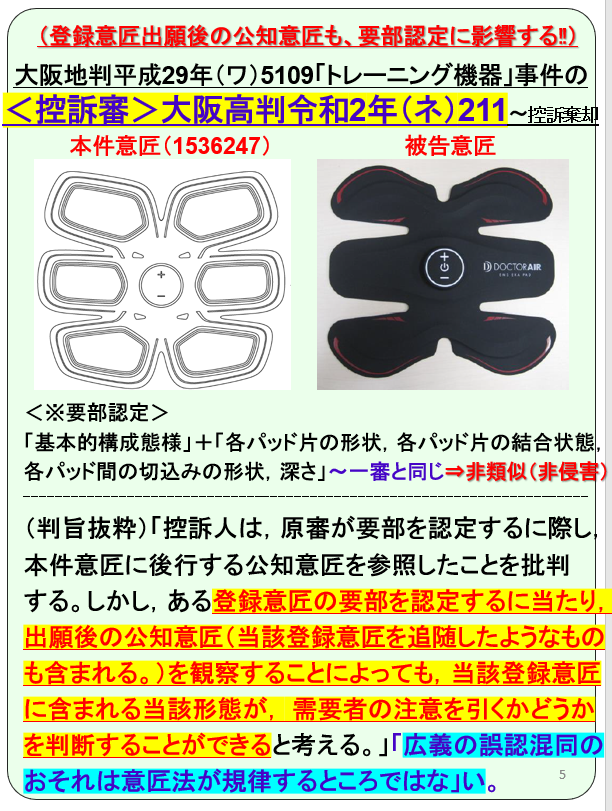
English translation of the figure
(Designs publicly known after the filing of the registered design also affect identification of the essential features!!) Osaka District Court, 2017 (Wa) 5109, “Training Equipment”; appeal: Osaka High Court, 2020 (Ne) 211 — appeal dismissed.
Left: registered design at issue (1536247). Right: accused design. Product marking: DOCTORAIR EMS SIX PAD.
Identification of essential features: “basic overall configuration” plus “the shape of each pad piece, the state of connection of each pad piece, and the shape and depth of the cuts between the pads.” Same as the first instance ⇒ dissimilar (no infringement).
(Excerpt from the judgment) “The appellant criticizes the original judgment for referring, when identifying the essential features, to publicly known designs subsequent to the design at issue. However, when identifying the essential features of a registered design, we consider that observing designs publicly known after the filing (including those that follow the registered design) makes it possible to determine whether the relevant configuration included in the registered design attracts the attention of consumers.” “A likelihood of confusion in a broad sense is not what the Design Act regulates.”
Slide 5.
<Article> “The Support Requirement for Parameter Inventions” (Hideki Takaishi, May 2021)
Original Ameblo publication: 2022-04-07
Ameblo: https://ameblo.jp/hideki-takaishi/entry-12736081534.html
<Article> “The Support Requirement for Parameter Inventions” (Hideki Takaishi, May 2021)
The IP High Court Grand Panel judgment in Polarizing Film imposed an additional requirement for a “parameter invention” to satisfy support: that “the technical meaning of the relationship between the range indicated by the formula and the effect (performance) obtained” be recognizable.
⇒ However, since that Grand Panel judgment, the only decision assessing support by applying this additional requirement is the [Tomato-Containing Beverage case] (IP High Court, 2016 (Gyo-Ke) 10147)!!
⇒ Are there almost no “parameter inventions” in the sense used by the Grand Panel judgment!?
<Article> [Brunnian Link Making Device] Case (Kazuo Shibata)
Original Ameblo publication: 2022-04-08
Ameblo: https://ameblo.jp/hideki-takaishi/entry-12736258915.html
<Article> [Brunnian Link Making Device] Case (Kazuo Shibata)
An article examining “partial priority” in the greatest depth
Also explains the position in countries around the world
(1)…
(2) Where a new configuration added in the later application is not deprived of novelty or inventive step by prior art arising between the basic application’s filing date and the actual filing date,
priority is recognized.
(Note) In 2019 (Gyo-Ke) No. 10132, the IP High Court held that Paris priority is denied only for the components not included in the basic application, and that, to invalidate the patent, those components must lack novelty or inventive step in light of the cited inventions (judgment, p. 33).
<Article> [Designs] “Why Is the Assessment of Design Similarity Difficult to Understand?” (January 2021, Yuriko Kudo)
Original Ameblo publication: 2022-04-09
Ameblo: https://ameblo.jp/hideki-takaishi/entry-12736431440.html
Using specific refrigerator designs, this article considers that, although there is no contradiction between the Examination Guidelines’ method of assessing similarity and the Good Design Award’s evaluation, a difference emerges as to whether the subject evaluated is the product itself or the abstracted “design” (an idea apprehended from the standpoint of aesthetic impression).
Why Is the Assessment of Design Similarity Difficult to Understand? (jpaa.or.jp)
<Article> “The Influence of the Problem of the Invention at Issue in Patent Infringement Litigation” (September 2021, Japan Patent Attorneys Association Patent Committee)
Original Ameblo publication: 2022-04-11
Ameblo: https://ameblo.jp/hideki-takaishi/entry-12736807031.html
Through a comprehensive examination of recent case law, this article confirms that the “problem of the invention” is important for both plaintiffs and defendants fighting patent infringement litigation, and is a key to winning or losing, while also introducing important judgments.
It extracts the essence of a report exceeding 100 pages and provides the information in a compact form.
<Article> “Inequitable Conduct after Therasense” (Satoshi Yoshida, Mineko Fukamachi)
Original Ameblo publication: 2022-04-12
Ameblo: https://ameblo.jp/hideki-takaishi/entry-12736983682.html
<Article> “Inequitable Conduct after Therasense” (Satoshi Yoshida, Mineko Fukamachi)
The number of cases in which inequitable conduct is discussed after the Federal Circuit’s Therasense judgment has remained stable.
Even under the stringent standard in the Therasense judgment, there is a certain number of cases in which inequitable conduct appears provable.
Even after Therasense, the inequitable-conduct defense remains viable.
<Article> IP High Court Judgment Holding That Filing a Correction Trial Is Unnecessary to Assert a Correction Rebuttal (Professor Hiroshi Yoshida)
Original Ameblo publication: 2022-04-13
Ameblo: https://ameblo.jp/hideki-takaishi/entry-12737167417.html
Correction rebuttal—many judgments hold filing unnecessary at a time when a correction trial/request is legally unavailable.
The [Optical Information Reading Device case] suggests a shift from the view that filing is conditionally unnecessary to the view that it is wholly unnecessary.
<Article> “Disclosure Requirements for Patent Descriptions in China” (March 2021, Jun Lin and Chunfeng Hu)
Original Ameblo publication: 2022-04-14
Ameblo: https://ameblo.jp/hideki-takaishi/entry-12737365790.html
(Supreme People’s Court of China)
Where the descriptions of the technical problem, technical concept, and beneficial effects in the patent description contradict one another,
the court may
make findings as to the technical problem the patent seeks to solve and the technical effects it seeks to achieve.
<Article> Comparators and the Position of “Unpredictable Remarkable Effects” in Inventive-Step Assessment (2021, Hideki Takaishi)
Original Ameblo publication: 2022-04-15
Ameblo: https://ameblo.jp/hideki-takaishi/entry-12737522502.html
Although the prior judgment holding the configuration (medical use) obvious had become final and was binding, inventive step could still be recognized based on “unpredictable remarkable effects.” Compatible with the independent-requirement theory.
“Ultimately, the court below must be understood as having revoked the trial decision by immediately denying that the effects of the inventions at issue were unpredictable and remarkable, solely because it was known at the priority date that the other compounds at issue had effects equivalent to the compound at issue, on the premise that applying that compound to the uses of the inventions at issue could readily have been conceived, without adequately examining whether those effects, particularly their degree, were unpredictable and remarkable from the perspectives of whether a person skilled in the art could not have predicted them at the priority date as effects produced by the configurations of the inventions, and whether they were remarkable effects exceeding the range that such a person could have predicted from those configurations. Such a determination by the court below must be said to involve an unlawful error in the interpretation and application of law.”
⇒ After remand: IP High Court, 2019 (Gyo-Ke) 10118 <Mori>
“… Even where there is motivation to arrive at an invention’s configuration, if, at the priority date, its effects are remarkable and exceed the range of effects that a person skilled in the art could have predicted as resulting from that configuration, the invention cannot be found to have been readily made by such a person. The prior judgment did not decide whether such unpredictable remarkable effects existed, and its binding effect (Administrative Case Litigation Act, Article 33(1)) does not extend to that issue ….”
⇒ Inventive step recognized based on “unpredictable remarkable effects”
<Article> “Intermediate Generalization—A Special EPC Patent Procedure” (November 2019, Christian Koster)
Original Ameblo publication: 2022-04-18
Ameblo: https://ameblo.jp/hideki-takaishi/entry-12738053161.html
At the EPO, intermediate generalization is in principle not allowed, but there are instances in which it is permitted.
⇒ By citing decisions allowing and disallowing it, this article proposes assessment criteria and approaches to argument—useful for European patent practice!!
Intermediate Generalization—A Special EPC Patent Procedure—(jpaa.or.jp)
<Article> “Judicial Assessment of Whether Computer Programs Qualify as Trade Secrets” (July 2019, Takayuki Ishimoto)
Original Ameblo publication: 2022-04-18
Ameblo: https://ameblo.jp/hideki-takaishi/entry-12738053378.html
Where source code contains no distinctive processing, the subject protected as a trade secret is construed as the actual source code itself, and the scope of unauthorized use is narrow.
There are no decisions recognizing an algorithm as a trade secret.
Judicial Assessment of Whether Computer Programs Qualify as Trade Secrets (jpaa.or.jp)
<Article> “Analysis of Case Law Trends on the Extended Effect of Earlier Applications” (January 2019, Japan Patent Attorneys Association Patent Committee)
Original Ameblo publication: 2022-04-18
Ameblo: https://ameblo.jp/hideki-takaishi/entry-12738054292.html
<Relationship between the extended effect of earlier applications and added matter>
In light of the purpose of the system, the scope of an earlier application’s effect in excluding later applications … should coincide with the standard for determining added matter, which governs whether amendment, correction, or division is permissible.
Exception—IP High Court, 2014 (Ne) 10080
As an exception, in the IP High Court case 2014 (Ne) 10080, “Method of Manufacturing Spinel-Type Lithium Manganate,” the court held: “… The description at issue does not expressly disclose spinel-type lithium manganate excluding forms that ‘substantially contain sodium or potassium in the crystal structure,’ nor can this be said to be a matter self-evident from the description; therefore, the technical matter ‘(excluding those substantially containing sodium or potassium in the crystal structure)’ cannot be said to be disclosed in the description.” It thus found the correction introducing a “disclaimer claim” to constitute added matter. However, since that case differs from a typical disclaimer-claim case excluding a single point in the structural formula of a chemical substance, careful examination is required before generalizing it. In any event, whether this approach is appropriate will be an issue for future examination.
Analysis of Case Law Trends on the Extended Effect of Earlier Applications (jpaa.or.jp)
<Article> Effectiveness of “Method for Producing an XX System” Claims (October 2018, Kansai Patent Study Group, Software Study Team)
Original Ameblo publication: 2022-04-19
Ameblo: https://ameblo.jp/hideki-takaishi/entry-12738237929.html
They include all the technical features of a system claim while reducing, compared with conventional approaches, the problems arising from the “in the course of business” requirement, working the invention abroad, and involvement of multiple actors.
⇒ A greater likelihood of obtaining a patent and greater effectiveness than system claims.
Effectiveness of “Method for Producing an XX System” Claims (jpaa.or.jp)
<Article> New Decision Recognizing US Patent Agent Privilege in State as Well as Federal Courts … (Kenichi Hattori)
Original Ameblo publication: 2022-04-20
Ameblo: https://ameblo.jp/hideki-takaishi/entry-12738410610.html
<Article> “New Decision Recognizing US Patent Agent Privilege in State as Well as Federal Courts—Possibility of Expanded Privilege for Japanese Patent Attorneys” (July 2018, Kenichi Hattori)
Where advice on Japanese patent law is sought from a Japanese patent attorney,
⇒ the underlying law is Japanese law, and because Japanese patent attorneys have privilege, privilege is also recognized in US courts.
New Decision Recognizing US Patent Agent Privilege in State as Well as Federal Courts (jpaa.or.jp)
<Article> “Claim Satisfaction and the Clarity Requirement for Numerically Limited Inventions” (May 2018, Hideki Takaishi)
Original Ameblo publication: 2022-04-21
Ameblo: https://ameblo.jp/hideki-takaishi/entry-12738586462.html
1. Numerical values (parameters) have multiple meanings.
2. Significant digits where a value falls slightly outside the numerical range
3. Elements outside the numerical range coexist in a single product.
4. Manufacturing tolerances
5. Changes over time after manufacture
6. Claims expressing degree—sufficiently, approximately, substantially
Claim Satisfaction and the Clarity Requirement for Numerically Limited Inventions (jpaa.or.jp)
IP High Court, 2020 (Gyo-Ke) 10057 [Electric Bed] <Kanno>
Original Ameblo publication: 2022-04-25
Ameblo: https://ameblo.jp/hideki-takaishi/entry-12739302480.html
IP High Court, 2020 (Gyo-Ke) 10057 [Electric Bed] <Kanno>
The technical fields of the primary and secondary references are far apart.
⇒ Motivation to combine denied (Claim 2)
Does being in a different technical field mean that a person skilled in the art would not know it?
If so, why is this an issue of motivation to combine?
If the technical field differs from that of the claimed invention, is suitability as the primary reference denied?
(Excerpts from the judgment)
The Exhibit Ko 1 invention concerns a medical bed 10 and addresses setting it at a preselected vertical height according to the patient’s anticipated needs; it selects a “convenient height for getting into and out of bed 10” as the lower intermediate position (that height also prevents entrapment even if the caregiver’s or patient’s feet are present …). In contrast, the Exhibit Ko 3 invention concerns … a vehicle convertible-roof opening and closing device. In view of the risk of trapping an object when closing the roof, its problem is to provide such a device that automatically pauses just before the roof closes completely, allowing safety to be reliably checked; it additionally seeks to avoid causing discomfort to the operator.
The two technical fields are far apart and have in common only the abstracted problem of avoiding the risk of trapping objects. Extracting a common problem from different inventions in such different technical fields and attempting to apply specific solutions suited to their respective characteristics across those fields requires particular creativity …. … There is no motivation to apply the Exhibit Ko 3 invention to the Exhibit Ko 1 invention ….
IP High Court, 2020 (Gyo-Ke) 10053 [Composition for Percutaneous and Transmucosal Absorption of Carbon Dioxide] <Kanno>
Original Ameblo publication: 2022-04-25
Ameblo: https://ameblo.jp/hideki-takaishi/entry-12739302910.html
The primary reference cannot be recognized as having the problem of the invention at issue.
⇒ Inventive step affirmed.
⇒ It is necessary to consider, above all, what problem can be recognized from the primary reference.
⇒ Difference 1 (“thickener content of 1–15 mass%”) is not obvious.
(Excerpts from the judgment)
The deliberate instruction in the Exhibit Ko 1 invention to “wait until [Babu] has completely dissolved” is understood to have the technical significance of waiting until a sufficient amount of carbon dioxide is generated from Babu and dissolved in the water. A person skilled in the art encountering Exhibit Ko 1 would therefore understand from that disclosure that its invention completely dissolves the Babu pieces and seeks to promote blood circulation through percutaneous absorption of carbon dioxide dissolved in the hot water. Such a person cannot be found to recognize a problem of “continuously retaining carbon dioxide in bubble form” in that invention. … Exhibit Ko 1 expressly instructs one to “wait until [the Babu pieces] have completely dissolved.” Even if a person skilled in the art visually observed carbon dioxide bubbles being generated from Babu, it is difficult to find that the person would focus on carbon dioxide in bubble form, which is merely a process or means of producing dissolved carbon dioxide and cannot itself be said to contribute to percutaneous absorption. Nor is there sufficient evidence to establish, in the first place, that preventing carbon dioxide from escaping into the air without dissolving in the hot water is a problem of the Exhibit Ko 1 invention. The plaintiff argues that the problem of “continuously retaining carbon dioxide in bubble form” is self-evident or readily discoverable and that it is therefore unnecessary to determine whether it can be recognized from the Exhibit Ko 1 invention. However, … in considering whether the invention at issue could readily have been conceived from that invention, it is necessary above all to consider what problem a person skilled in the art encountering the Exhibit Ko 1 invention could recognize from it. The plaintiff’s argument must therefore be rejected.
IP High Court, 2012 (Gyo-Ke) 10252 [Thermostable Ribonuclease H] <Shibata>
Original Ameblo publication: 2022-04-25
Ameblo: https://ameblo.jp/hideki-takaishi/entry-12739303434.html
IP High Court, 2012 (Gyo-Ke) 10252 [Thermostable Ribonuclease H] <Shibata>
* Remarkable effects cannot be established from a publication distributed after filing.
* Identifying pre-filing inventions or common general technical knowledge based on knowledge disclosed in the patent description is impermissible, because it may result in assessing inventive step for the patent application with hindsight.
(Excerpts from the judgment)
In general, inventive step is assessed as of the filing date (or the claimed priority date where priority is claimed), not at the time of examination (Patent Act, Article 29(2)). The knowledge that may be considered in assessing inventive step is therefore knowledge available before filing; this applies equally to assessing whether the configuration is obvious and whether the effects are remarkable. Moreover, identifying pre-filing inventions or common general technical knowledge based on knowledge disclosed in the description of the patent application may result in assessing that invention’s inventive step with hindsight, contrary to the purpose of that paragraph, and is impermissible.
<Article> “Markman Claim Construction in US Patent Infringement Litigation” (March 2017, York M. Faulkner, Aya Suzuki)
Original Ameblo publication: 2022-04-25
Ameblo: https://ameblo.jp/hideki-takaishi/entry-12739303686.html
Claim construction when assessing whether the claim limitations are met in US patent infringement litigation—useful in practice!
ordinary and customary meaning
broadest reasonable interpretation (BRI)
Strategic considerations concerning two standards
075-081_Suzuki.mcd (jpaa.or.jp)
<Article> “Trends and Strategies in Case Law on the Doctrine of Equivalents” (January 2017, Japan Patent Attorneys Association, Patent Committee)
Original Ameblo publication: 2022-04-26
Ameblo: https://ameblo.jp/hideki-takaishi/entry-12739474765.html
The pros and cons of disclosing multiple problems and effects in the description
The pros and cons of describing the problem in broader conceptual terms
Cases addressing the second requirement from the standpoint of the quantity or degree of the effects in their holdings
Double standards for the third requirement
Trends and Strategies in Lower-Court Case Law on the Doctrine of Equivalents (jpaa.or.jp)
<Article> “The Scope of Rights for ‘Use Inventions’ (Direct and Indirect Infringement)” (January 2017, Hideki Takaishi)
Original Ameblo publication: 2022-04-27
Ameblo: https://ameblo.jp/hideki-takaishi/entry-12739651689.html
<Article> “The Scope of Rights for ‘Use Inventions’ (Direct and Indirect Infringement)” (January 2017, Hideki Takaishi)
Use inventions and direct infringement
(1) An approach limiting the definition of a use invention
(2) An approach construing the meaning of the claim wording “for …” case by case
Viewing a use invention as a subcombination invention
Use inventions and indirect infringement
Enforcement of “Use Inventions” (Direct and Indirect Infringement) (jpaa.or.jp)
<Article> “The Reach of ‘Obviousness upon Obviousness’ (The Position of a Third Prior-Art Reference)” (December 2018, Hideki Takaishi)
Original Ameblo publication: 2022-04-28
Ameblo: https://ameblo.jp/hideki-takaishi/entry-12739825224.html
<Article> “The Reach of ‘Obviousness upon Obviousness’ (The Position of a Third Prior-Art Reference)” (December 2018, Hideki Takaishi)
* Where multiple secondary references must be combined to bridge multiple differences, if the differences are technically independent of one another, this is not a problem of “obviousness upon obviousness”!!
Cf. IP High Court, 2020 (Gyo-Ke) 10124 <Shoji>
<Article> “License Agreements with Foreign Companies” (Yoshihiko Ryujin, Japanese Patent Attorney and New York Attorney)
Original Ameblo publication: 2022-04-29
Ameblo: https://ameblo.jp/hideki-takaishi/entry-12739995913.html
<Article> “License Agreements with Foreign Companies” (Yoshihiko Ryujin, Japanese Patent Attorney and New York Attorney)
Explanation of patent licenses by type
Enforcement type
Technical-assistance type
Hybrid type
Joint-development type
Without delimiting the subject matter, it would be a waste if unexpected technology emerged.
Know-how licenses—use should become unrestricted after a certain period.
License Agreements with Foreign Companies—Secrets of Success and Pitfalls—(jpaa.or.jp)
<Issue> “Inventive-Step Assessment of Parameter Inventions” (2021 Annual Report of the Japan Association of Industrial Property Law, Hideki Takaishi)
Original Ameblo publication: 2022-05-03
Ameblo: https://ameblo.jp/hideki-takaishi/entry-12740839685.html
<Issue> “Inventive-Step Assessment of Parameter Inventions” (2021 Annual Report of the Japan Association of Industrial Property Law, Hideki Takaishi)
The decisive issue in assessing inventive step for an invention whose scope is defined by a new “parameter” is whether it would have been obvious for a person skilled in the art at the filing date to focus on that “parameter.”
⇒ The key phrase is “the problem of the invention”!!
<Article> “Is There a Double Standard between ‘the Technical Scope of an Invention’ and ‘Identification of the Gist of an Invention’?” (December 2015, Japan Patent Attorneys Association, Patent Committee)
Original Ameblo publication: 2022-05-03
Ameblo: https://ameblo.jp/hideki-takaishi/entry-12740840040.html
With the PBP Supreme Court judgment, 2012 (Ju) 1204, there is a move toward a unified interpretation of identification of the gist of an invention (invalidity) and the technical scope of an invention (claim satisfaction).
… What about IP High Court, 2021 (Ne) 10020?
<Article> “… Survey of Important Decisions Assessing the Clarity Requirement and Analysis of Decision Trends” (November 2021, Intellectual Property Management, Hideki Takaishi)
Original Ameblo publication: 2022-05-03
Ameblo: https://ameblo.jp/hideki-takaishi/entry-12740840266.html
<Article> “… Survey of Important Decisions Assessing the Clarity Requirement and Analysis of Decision Trends” (November 2021, Intellectual Property Management, Hideki Takaishi)
A pro-patent tendency for the clarity requirement “as well”
Language expressing degree—clear in the sense of the range within which the problem can be solved
Even if the endpoints of a numerical range are not precisely determined, the clarity requirement is satisfied if the “variation” is slight.
1110_Case Law and Practice.indd (takaishihideki.com)
<Article> “Comprehensive Examination of Issues concerning Well-Known and Famous Indications and Applied Art Relating to ‘Product Configuration’” (September 2020, Hideki Takaishi and Tsubasa Yamamoto)
Original Ameblo publication: 2022-05-03
Ameblo: https://ameblo.jp/hideki-takaishi/entry-12740840452.html
<Article> “Comprehensive Examination of Issues concerning Well-Known and Famous Indications and Applied Art Relating to ‘Product Configuration’” (September 2020, Hideki Takaishi and Tsubasa Yamamoto)
Most judgments adopt a strict standard for the copyrightability of “applied art.”
⇒ Even where copyrightability is recognized, protection is narrow.
Cases recognizing product shapes as “indications of goods or business” are not numerous, but are increasing.
<Issue> “Enablement and Clarity Requirements” (One Hundred Selected Patent Cases, 5th Edition, Hideki Takaishi)
Original Ameblo publication: 2022-05-04
Ameblo: https://ameblo.jp/hideki-takaishi/entry-12740876923.html
<Issue> “Enablement and Clarity Requirements” (One Hundred Selected Patent Cases, 5th Edition, Hideki Takaishi)
Does the enablement requirement require that the invention be practicable in a way that solves its problem?
⇒ There is no inconsistency if the answer is YES, while recognizing that some cases appear to require only practicability because the problem of the invention is being able to manufacture it at all (as with a new substance).
<New YouTube Video> Reversal to a “Win” on Appeal (1-1): Claim Not Satisfied ⇒ Satisfied
Original Ameblo publication: 2022-05-05
Ameblo: https://ameblo.jp/hideki-takaishi/entry-12741066096.html
<New YouTube Video> Reversal to a “Win” on Appeal (1-1): Claim Not Satisfied ⇒ Satisfied
★ IP High Court, 2009 (Ne) 10006, “Hollow Golf Club Head” case <Iimura>
⇒ Reversal finding infringement under the doctrine of equivalents (first requirement reversed)
★★★ IP High Court, 2017 (Ne) 10092, “… Device for Cooling Power Electronics” case <Takabe>
IP High Court, 2010 (Ne) 10031, “Kitchen Sink” case <Iimura>
Tokyo High Court, 2003 (Ne) 1223, “Method for Searching for a Stable Complex Structure of Ligand Molecules” case <Yamashita>
⇒ The problem of the invention was identified differently from the court below, broadening the literal construction!!
⇒ Reversal finding literal claim satisfaction
★ IP High Court, 2018 (Ne) 10016, “Nozzle for Spraying a Liquid as Fine Particles” case <Otaka>
IP High Court, 2011 (Ne) 10002, “(Cut) Rice Cake” <Iimura>
IP High Court, 2014 (Ne) 10082, “Method for Manufacturing 4H-Type Single-Crystal Silicon Carbide” <Takabe>
⇒ Literal construction was broadened in light of the invention’s “problem”!!
⇒ Reversal finding literal claim satisfaction
IP High Court, 2010 (Ne) 10089, “Method and Apparatus for Encrusting and Forming Food” <Takizawa>
IP High Court, 2007 (Ne) 10025, “Seal Base Material” <Tsukahara>
IP High Court, 2005 (Ne) 10119, “Range Hood Filter Device” <Tsukahara>
IP High Court, 2008 (Ne) 10065, “Device for Automatically Creating Telephone Number Information” <Iimura>
⇒ Literal construction was broadened without directly relying on the invention’s “problem”!! ⇒ Reversal finding literal claim satisfaction
★ IP High Court, 2017 (Ne) 10027, “Financial Instruments Transaction Management Method” case <Mori>
⇒ Changed findings identifying the accused method
IP High Court, 2012 (Ne) 10023, “Apparatus for Processing Material with a Laser” <Iimura>
⇒ Changed factual findings in the comparison
(3) [Patents] + Survey of Appellate Reversals (1-1): Claim Not Satisfied ⇒ Satisfied – YouTube
<New YouTube Video> Reversal to a “Loss” on Appeal (1-2): Claim Satisfied ⇒ Not Satisfied
Original Ameblo publication: 2022-05-06
Ameblo: https://ameblo.jp/hideki-takaishi/entry-12741249961.html
<New YouTube Video> Reversal to a “Loss” on Appeal (1-2): Claim Satisfied ⇒ Not Satisfied
★ IP High Court, 2009 (Ne) 10033, “Heat-Dissipating Sheet Made of a Thermally Conductive Silicone Rubber Composition” case <Nakano>
⇒ Interpretation of numerical limitations—the underlying “treatment” discernible from the embodiments is important.
★ IP High Court, 2005 (Ne) 10047, “Chair-Type Air Massage Machine” case <Tsukahara>
⇒ Doctrine of equivalents applicable to a narrowed claim (the only such case in a Tokyo high court)
(Note) In this case, literal infringement was rejected, but infringement under the doctrine of equivalents was found for Accused Products 3 and 4. This does not mean that all of the patentee’s claims were dismissed.
⇒ Numerous cases at the Osaka District Court and Osaka High Court. Tokyo District Court, 2017 (Wa) 18184, “Osteotomy Spreader” <Sato>
★★★ IP High Court, 2020 (Ne) 10044, “Fluid Supply Device … and Program” case <Tsuruoka>
* Merely stating “admitted” in an answer does not establish a “judicial admission.” The answer must be considered as a whole!!
* A configuration in which the invention’s problem does not arise does not satisfy the claim!! (Narrow problem ⇒ narrow invention. Cf. IP High Court, 2017 (Ne) 10092)
★★★ IP High Court, 2017 (Ne) 10033, “Renovation Sliding Door Device” case <Tsuruoka>
<Appeal> Problem of the invention—“does not reduce the effective opening area”—“substantially the same height” = does not include a step
<First instance> Problem of the invention—“the degree … of reduction of the effective opening area is substantially smaller than in the prior art”
⇒ The court below held that a height difference substantially smaller than in the prior art was “substantially the same height.”
(3) [Patents] + Survey of Appellate Reversals (1-2): Claim Satisfied ⇒ Not Satisfied – YouTube
<New YouTube Video> Reversal to a “Win” on Appeal (2-1): Invalid ⇒ Valid
Original Ameblo publication: 2022-05-08
Ameblo: https://ameblo.jp/hideki-takaishi/entry-12741655979.html
<New YouTube Video> Reversal to a “Win” on Appeal (2-1): Invalid ⇒ Valid
★★ IP High Court, 2017 (Ne) 10086, “Beauty Roller” case <Tsuruoka>
= ★★ IP High Court, 2019 (Ne) 10009, “Roll Paper for Packaging Medication” case <Otaka>
⇒ A petitioner who lets a trial decision maintaining the patent become final without seeking revocation cannot raise an invalidity defense based on the same facts and evidence, absent special circumstances.
★ IP High Court, 2018 (Ne) 10006 [Capcom v. Koei] <Tsuruoka>
⇒ Unlike the court below, the appellate court recognized a teaching away.
★ IP High Court, 2013 (Ne) 10025, “Metal Wagon” case <Shimizu>
⇒ Unlike the court below, it did not delve into the technical significance of the features defining the invention.
★ IP High Court, 2009 (Ne) 10028, “Device for Correcting the Vertical Alignment of Steel Columns” case <Takizawa>
★ IP High Court, 2008 (Ne) 10085, “Method of Providing Access to an Internet Server” case <Takizawa>
⇒ Emphasis was placed on the difference between the “problems” of the invention at issue and the primary reference!!
(3) [Patents] + Survey of Appellate Reversals (2-1): Invalid ⇒ Valid – YouTube
<New YouTube Video> Reversal to a “Loss” on Appeal (2-2): Valid ⇒ Invalid
Original Ameblo publication: 2022-05-08
Ameblo: https://ameblo.jp/hideki-takaishi/entry-12741656187.html
<New YouTube Video> Reversal to a “Loss” on Appeal (2-2): Valid ⇒ Invalid
IP High Court, 2005 (Ne) 10004, “Nucleic Acid Amplification Reaction Monitoring Device” <Nakano>
⇒ Circumstantial facts establishing the date of public availability
IP High Court (Grand Panel), 2005 (Ne) 10040 [Ichitaro]; IP High Court, 2017 (Ne) 10055, “Continuous Shellfish Fastener” <Mori>; IP High Court, 2018 (Ne) 10033, “Aerosol Can Product” <Otaka>; IP High Court, 2019 (Ne) 10066, “Information Management Program” <Mori>
⇒ There are no cases of rejection as untimely when submitted together with the statement of reasons for appeal.
★ IP High Court, 2016 (Ne) 10083, “Therapeutic Marker” case <Mori>
In light of the original judgment, a new secondary cited invention (Exhibit Otsu 9) and well-known technology were submitted on appeal,
and combined with the same primary invention. ⇒ No inventive step
★ IP High Court, 2014 (Ne) 10080 et al., “Method of Manufacturing Spinel-Type Lithium Manganate” case <Shimizu>
* In light of the original judgment, the primary and secondary cited inventions were switched ⇒ No inventive step
★ IP High Court, 2008 (Ne) 10088, “Method of Obtaining a Magnified Image by Reversing the Positional Relationship between the Objective Lens and the Sample” case <Iimura>
* “while bringing the sample to be observed into direct contact with the lens”—support requirement not satisfied
(3) [Patents] + Survey of Appellate Reversals (2-2): Valid ⇒ Invalid – YouTube
Osaka High Court, 2002 (Ne) 2776 [Object Embedded in Concrete] = Tokyo High Court, 2003 (Gyo-Ke) 65
Original Ameblo publication: 2022-05-09
Ameblo: https://ameblo.jp/hideki-takaishi/entry-12741796809.html
Osaka High Court, 2002 (Ne) 2776 [Object Embedded in Concrete]
= Tokyo High Court, 2003 (Gyo-Ke) 65
The child application violates the divisional requirements because of an amendment’s retroactive effect.
⇒ The grandchild application’s filing date does not relate back to the parent application.
* A final finding of invalidity of the child application is irrelevant to whether the grandchild application’s filing date relates back to the parent application.
Everything depends on whether the child application satisfies the divisional requirements!!
Tokyo High Court, 2001 (Gyo-Ke) 421 <Yamashita> [Drainage Channel Structure]
* All claims deleted by correction ⇒ No interest in maintaining the action
“All claims were deleted … deemed never to have existed from the outset ….”
★ For a grandchild divisional application, when the child application receives a final notice of reasons for rejection for added matter, is an amendment deleting all claims OK!?
2015 (Wa) 8517 [Paddy Ridge Plastering Machine] <Shimasue> The judgment concerned a third-generation patent in a chain of original application ⇒ first generation ⇒ second generation ⇒ third generation. Although the second-generation application had been withdrawn, it was never disputed that the third generation’s filing date could relate back to the first generation and original application.
Tokyo High Court, 1989 (Gyo-Ke) 135 <Takeda> [Aqueous Suspension Polymerization Method for Vinyl Chloride]
* Withdrawal of an application has no retroactive effect except under Article 39(5) of the Patent Act.
⇒ Withdrawal cannot cure a child’s failure to meet the divisional requirements due to added matter.
⇒ At worst, amend to delete all claims; but if one prepares a claim that does not add matter at the time of division …
99F18E381FDF9C6049256D39000E304 (courts.go.jp)
Tokyo District Court, 2019 (Wa) 25152 [Comment Distribution System] <Kokubu> (Dwango v. FC2)
Original Ameblo publication: 2022-05-13
Ameblo: https://ameblo.jp/hideki-takaishi/entry-12742511150.html
2019 (Wa) 25152 [Comment Distribution System] <Kokubu> (Dwango v. FC2)
* To constitute “production” of a product invention, a product satisfying all the elements of the patented invention must be newly created within Japan.
⇒ No “production” within Japan
⇒ The elements are satisfied, but no infringement!!
(Excerpts from the judgment)
… “Production” as “working” a product invention (Patent Act, Article 2(3)(i)) is understood as the act of newly creating a “product” falling within the technical scope of the invention. Further, under the principle of territoriality, meaning that a patent right is effective only within the territory of the country concerned (see Supreme Court, Third Petty Bench judgment of July 1, 1997, 1995 (O) 1988, Minshu Vol. 51, No. 6, p. 2299; and Supreme Court, First Petty Bench judgment of September 26, 2002, 2000 (Ju) 580, Minshu Vol. 56, No. 7, p. 1551), it is appropriate to construe such “production” as limited to production within Japan. Accordingly, to constitute “production,” a product satisfying all the elements of the patented invention must be newly created within Japan. … The “server” … must be regarded as playing an important role as a component achieving the objective. From this standpoint too, … the mere fact that the user terminals are located in Japan does not establish that most components of Defendant’s System 1, the subject of “production,” are located within Japan …. …
The defendant’s service supported Japanese and appears to have been provided to users residing in Japan; … it is also established that Defendant HPS, a Japanese corporation, was commissioned by Defendant FC2 to perform work relating to services operated by FC2, including the defendant’s service. Nevertheless, … no circumstances supporting an assessment that the result would be grossly inappropriate have been established, such as Defendant FC2, a US corporation, placing the video-distribution and comment-distribution servers outside Japan to evade liability for infringement of the patent at issue while substantially managing them from within Japan. …
… Although the defendant’s system is found to fall within the technical scope of the invention at issue, … production of that system by the defendants within Japan after May 17, 2019, when the patent was registered, is not established, nor can the defendants be found to have worked the invention within Japan. Accordingly, infringement of the patent right by the defendants cannot be established.
IP High Court, 2021 (Ne) 10007 [Infusion Preparation Containing Sulfur-Containing Compounds and Trace Metal Elements] <Honda> Reversal Finding Literal Claim Satisfaction
Original Ameblo publication: 2022-05-16
Ameblo: https://ameblo.jp/hideki-takaishi/entry-12743084420.html
IP High Court, 2021 (Ne) 10007 [Infusion Preparation Containing Sulfur-Containing Compounds and Trace Metal Elements] <Honda> (First instance: Tokyo District Court, 2018 (Wa) 29802 <Tanaka>)
Construction of the claim language “multiple chambers”—the product invention limited by “capable of communication” was held not satisfied, while the method invention without that limitation was held satisfied.
⇒ Reversing the first-instance judgment that neither was satisfied!!
[Summary of This Judgment and Some Observations]
1. Claims (Claim 1 and Claim 10)
(Claim 1)
1A In an infusion container having multiple chambers partitioned by partition means capable of opening communication through external pressure,
1B one chamber is filled with a solution containing at least one substance selected from the group consisting of sulfur-containing amino acids and sulfites,
1C another chamber houses a trace-metal-element container containing a liquid that includes at least one trace metal element selected from the group consisting of iron, manganese, and copper,
1D the trace-metal-element container being a bag made of thermoplastic resin film,
1E An infusion preparation characterized by the foregoing.
(Claim 10)
10A In a multichamber infusion preparation,
10B a chamber containing a solution that includes at least one substance selected from the group consisting of sulfur-containing amino acids and sulfites, and
10C a separate chamber housing a trace-metal-element container containing a liquid that includes at least one trace metal element selected from the group consisting of iron, manganese, and copper,
10D the trace-metal-element container being a bag made of thermoplastic resin film,
10E A method of stabilizing an infusion preparation during storage, characterized by the foregoing.
2. Claim Construction in the First Instance, Tokyo District Court, 2018 (Wa) 29802 (Excerpts from the Judgment)
The court will determine … whether the defendant’s product and method have the configuration in Elements 1C and 10C of “a trace-metal-element container … housed in a chamber.” …
Because infusion solutions ordinarily do not contain trace metal elements such as copper, patients receiving long-term infusions develop so-called trace metal deficiency. However, storing the trace metal elements needed to prevent this in a mixture with the infusion solution causes quality deterioration through chemical reactions. To prevent this, when one chamber is filled with an amino-acid infusion solution containing sulfur-containing amino acids and the trace-metal-element container is placed in that same chamber, a technical problem arises: the solution containing trace metal elements becomes unstable even though the amino-acid infusion solution and the trace metal elements are isolated from one another.
The inventions at issue should be regarded as solving this technical problem by adopting a configuration in which one of multiple chambers partitioned by partition means capable of opening communication is filled with a solution containing sulfur-containing amino acids, and a container containing trace metal elements is housed in a different chamber, thereby achieving the effect of providing an infusion preparation having a solution containing sulfur-containing compounds, characterized by the stable presence of the trace metal elements.
Accordingly, the distinctive technical configuration of the inventions at issue in terms of solving the problem lies in housing the trace-metal-element container not in the same chamber as the solution containing sulfur-containing amino acids, but in another chamber capable of communicating with it. On the premise of an infusion container having multiple chambers partitioned by partition means capable of opening communication, each of the multiple “chambers” is structured to be filled with and store a different infusion solution; the adopted technical configuration is therefore one in which the “chamber” housing the trace-metal-element container is structured to be filled with and store an infusion solution different from the solution containing sulfur-containing amino acids.
In other words, in the inventions at issue, “multiple chambers” in Element 1A and “multichamber” in Element 10A are construed as respective spaces structured to be filled with and store various infusion solutions. For a space provided in an infusion container to constitute the “chamber” in Elements 1C and 10C, one of those chambers, it must have a structure capable of being filled with and storing an infusion solution …. …
Considering the defendant’s product and method, … the space between the outer and inner resin films of small chamber T does not communicate with the middle chamber and small chamber V during use. In light of this, that space cannot be found to have a structure capable of being filled with and storing an infusion solution, and cannot be regarded as a “chamber.”
3. Claim Construction in the IP High Court, 2021 (Ne) 10007 (Excerpts from the Judgment)
… Regarding the problem of the corrected inventions at issue …
The corrected inventions at issue concern the following circumstances. Infusion containers having multiple chambers partitioned by partition means capable of opening communication are used in hospitals. Infusion solutions ordinarily lack trace metal elements, causing trace metal deficiency with long-term administration. However, storing trace metal elements mixed with infusion solutions causes quality deterioration, so they continue to be mixed immediately before infusion. In light of this, research began to create an infusion preparation using a container with multiple chambers partitioned by partition means capable of opening communication through external pressure, allowing trace metal elements to be mixed in at the time of use without the possibility of bacterial contamination, and offering excellent storage stability. It was then discovered that filling one chamber with an amino-acid infusion solution containing sulfur-containing amino acids and placing the trace-metal-element container in that same chamber creates the problem that the trace-metal-element solution is unstable even when the amino-acid infusion solution and trace metal elements are isolated. On that basis, the inventions aim to provide an infusion preparation having a solution containing sulfur-containing compounds, characterized by the stable presence of trace metal elements. …
Corrected Inventions 1 and 2 at Issue address providing an infusion preparation having a solution containing sulfur-containing compounds, characterized by the stable presence of trace metal elements. More specifically, they are understood to address providing an infusion preparation using a container having multiple chambers partitioned by partition means capable of opening communication through external pressure, with trace metal elements stored in advance in a form allowing their admixture at use, in which those elements remain stable even when one chamber is filled with a solution containing sulfur-containing compounds. Similarly, Corrected Inventions 10 and 11 at Issue address providing a method of stabilizing such an infusion preparation during storage. …
… Regarding “chambers” …
… In the infusion container of the appellee’s product, the space formed by the fundamental series of members in its configuration can be described as the space formed by the series of members directly constituting the large and middle chambers and also constituting the exterior of small chambers T and V. … Paragraph [0024] of the description at issue expressly states that the “chamber housing the trace-metal-element container” may or may not be filled with a solution, and paragraph [0033] expressly states that “in the infusion preparation of this embodiment, first chamber 4 of the infusion container shown in Figure 1 may or may not be filled with a solution.” Accordingly, in the corrected inventions at issue, whether a space is filled with an infusion solution is not an indispensable factor in determining whether it is a “chamber” …. …
In Element 1A …, the specification “partitioned by partition means capable of opening communication through external pressure” precedes “an infusion container having multiple chambers.” … The appellee’s product does not satisfy the requirement that the “chambers” be “capable of communication,” and therefore does not satisfy Element 1A …. …
Unlike Element 1A …, Element 10A … does not require the “chambers” to be “capable of communication.” Accordingly, … the appellee’s method satisfies Element 10A ….
4. Some Observations
The first-instance judgment stated that it would determine “whether the defendant’s product and method have the configuration in Elements 1C and 10C of ‘a trace-metal-element container … housed in a chamber.’ …” It then construed the “chambers” of the invention at issue, “on the premise of an infusion container having multiple chambers partitioned by partition means capable of opening communication,” as structures for filling with and storing different infusion solutions, solving the “technical problem that, when one chamber is filled with an amino-acid infusion solution containing sulfur-containing amino acids and the trace-metal-element container is placed in that same chamber, the trace-metal-element solution becomes unstable even though the amino-acid infusion solution and trace metal elements are isolated from one another.” It found non-satisfaction, holding: “Considering the defendant’s product and method, … the space between the outer and inner resin films of small chamber T does not communicate with the middle chamber and small chamber V during use. In light of this, that space cannot be found to have a structure capable of being filled with and storing an infusion solution, and cannot be regarded as a ‘chamber.’”
By contrast, unlike the first-instance judgment, the appellate judgment did not premise its analysis on the multiple chambers being capable of communication. It identified the invention’s problem as “providing an infusion preparation having a solution containing sulfur-containing compounds, characterized by the stable presence of trace metal elements.” It then held that Element 1A (product invention) includes, before “an infusion container having multiple chambers,” the specification “partitioned by partition means capable of opening communication through external pressure,” and thus is not satisfied by the defendant’s product, which is not “capable of communication.” Element 10A (method invention), however, does not require the “chambers” to be “capable of communication,” so it is satisfied even by the defendant’s method that is not “capable of communication.”
Thus, the difference in conclusions between the first-instance and appellate judgments arose because, although Element 10A (method invention) did not require the “chambers” to be “capable of communication,” the first-instance court construed it as being “on the premise of an infusion container having multiple chambers partitioned by partition means capable of opening communication,” adopting a narrow construction that added a “capable of communication” limitation absent from the claim language. The appellate judgment, in contrast, pointed out that Claim 1 (product invention) has the defining feature “capable of communication,” while Claim 10 (method invention) does not, and declined that narrow construction. Where multiple claims include one with the defining feature “capable of communication” and one without it (although not in a dependent relationship), the latter claim was held not to carry that limitation, resulting in non-satisfaction of the former and satisfaction of the latter. This is not a typical “claim differentiation” case, but it can be understood as a case making manifest the entirely possible difference in outcomes between claims with and without a defining feature, whether dependent or independent. (Of course, the result might have been the same had Claim 1 not existed and only Claim 10 been disputed. Still, varying defining features among multiple claims in this way—for example, establishing a relationship in which a limited dependent claim corresponds to a more specific “problem”—may reduce uncertainty arising from narrow construction.)
The appellate judgment first identified the problem as “providing an infusion preparation having a solution containing sulfur-containing compounds, characterized by the stable presence of trace metal elements,” and then identified it “more specifically” as “providing an infusion preparation using a container having multiple chambers partitioned by partition means capable of opening communication through external pressure, with trace metal elements stored in advance in a form allowing their admixture at use, in which those elements remain stable even when one chamber is filled with a solution containing sulfur-containing compounds.” I considered whether the result had changed (been reversed) because the first-instance and appellate judgments interpreted the invention’s problem differently, as in the IP High Court judgment in 2017 (Ne) 10092, “Device for Cooling Power Electronics,” cited below. However, insofar as I have examined the appellate judgment’s logic, identifying the problem more specifically does not appear directly related to the conclusion that the method invention of Claim 10 should not be narrowly construed as including “capable of communication,” which is absent from the claim language.
[Introduction to Related Decisions (Comprehensive Coverage of the Last 16 Years’ Decisions Reversed on Appeal)]
≪(1) Claim Not Satisfied ⇒ Satisfied (Reversal in Favor of the Patentee)≫
(1) ★ IP High Court, 2009 (Ne) 10006, “Hollow Golf Club Head” case <Iimura>
“(1) Possibility of substitution … The purpose and effects (or principle of solving the problem) are shared.
(2) Ease of substitution
(3) Whether the difference is a non-essential part
The purpose and effects of the invention at issue … lie in increasing the bonding strength between the metal shell member and the fiber-reinforced-plastic shell member.” ⇒ Infringement under the doctrine of equivalents: yes
First instance: Tokyo District Court, 2007 (Wa) 28614 <Abe>
“The invention at issue … increases the bonding strength between the two shell members by using … a stitching material in addition to adhesive bonding, because simply bonding the joint portion of the metal shell member to the joint portion of the fiber-reinforced-plastic shell member does not provide sufficient strength. … Joining the metal shell member and the fiber-reinforced-plastic shell member with stitching material is the distinctive configuration for solving the problem, and that stitching material must be regarded as an essential part of the invention.” ⇒ Infringement under the doctrine of equivalents: no (first requirement not satisfied)
(2) ★★★ IP High Court, 2017 (Ne) 10092, “Device for Cooling Power Electronics” case <Takabe>
“The cooling-fluid passage is a configuration for cooling the heat-dissipating bridge …. From the standpoint of cooling efficiency, the wall formed by the bottom surface of the heat-dissipating bridge must extend over the entire length of the cooling-fluid passage. In contrast, … the rear bearing is not cooled by air passing through the cooling-fluid passage, … and [the wall] need not necessarily extend over the entire cooling passage.”
⇒ The accused product’s “rear-bearing bridge-side passage” does not extend along the entire longitudinal length, but literal claim satisfaction was found on reversal.
* Limiting the problem of the invention to cooling the “heat-dissipating bridge” broadened the invention!!
First instance: Tokyo District Court, 2016 (Wa) 13239 <Shibata>
“The claims prescribe that Invention 1 at Issue has multiple portions serving as paths for fluid, … and can be said to prescribe that the ‘cooling-fluid passage (17)’ is the space in which the above longitudinal walls face one another.” ⇒ Claim not satisfied
(3) IP High Court, 2010 (Ne) 10031, “Kitchen Sink” case <Iimura>
“Element C1 … addresses the prior-art problem that … dedicated cooking plates had to be separately prepared … for the upper and middle stepped portions. To solve that problem, the rear wall is formed so that the front-to-back distances of the upper and middle stepped portions are substantially equal, allowing the same plate to be selectively laid across either stepped portion.” ⇒ Claim satisfied
⇒ The accused product’s “inclined surface” includes a vertical surface beyond the portion extending rearward, but literal claim satisfaction was found on reversal.
* Identifying the problem as eliminating the need to prepare dedicated cooking plates broadened the invention!!
First instance: Tokyo District Court, 2009 (Wa) 5610 <Shimizu>
* Being able to “enlarge the interior space” (paragraph [0018]) is a problem of the invention at issue.
“From the statement ‘…’ ([0018]), … the ‘inclined surface extending rearward as it extends downward’ in Element C1 means an inclined surface having a certain area and angle of inclination, which, between the upper and middle stepped portions, extends rearward as it extends downward to form an ‘interior space’ with a certain rearward expanse.” ⇒ Claim not satisfied
(4) Tokyo High Court, 2003 (Ne) 1223, “Method for Searching for a Stable Complex Structure of Ligand Molecules” case <Yamashita>
* The problem of the invention at issue was identified differently from the court below. ⇒ Even numerous “dummy atoms” are OK.
“The core technical concept of the patented invention … lies in searching for ligand molecules that bind stably in the hydrogen-bonding region of a biopolymer, focusing on hydrogen bonds, etc., and comparing the distances between dummy atoms placed at positions of heteroatoms capable of serving as hydrogen-bonding partners for hydrogen-bonding functional groups in the biopolymer with the distances between hydrogen-bonding heteroatoms in the ligand molecule, while simultaneously estimating the ligand molecule’s active conformation. Although dummy atoms themselves are indispensable, their number is not directly related to this technical concept of the patented invention ….” ⇒ Reversal finding literal claim satisfaction
First instance: Tokyo District Court, 2001 (Wa) 21278 <Mimura>
“A ‘dummy atom’ in the patented invention is set as one atom for each hydrogen-bonding region of each atom capable of hydrogen bonding in the biopolymer.” ⇒ Claim not satisfied
(Reasons) (i) The description uses it to indicate a single point. (ii) The plaintiff’s own paper also sets only one dummy atom. (iii) Numerous dummy atoms would fail to achieve the invention’s purpose of speeding up calculation. (iv) If numerous dummy atoms are included, the disclosure requirements are violated.
(5) ★ IP High Court, 2018 (Ne) 10016, “Nozzle for Spraying a Liquid as Fine Particles” case <Otaka>
“Claim 4 … contains no wording limiting the particle diameter of ‘fine particles’ to a particular numerical range. … Reading the description … as a whole, … it does not state that being able to spray fine particles with a diameter of ‘10 μm or less’ has any particular effect. … ‘Fine particles’ means particles with a small diameter; the numerical range of that diameter is not limited ….” ⇒ Reversal finding literal claim satisfaction
* The numerical value stated in the description was not what solved the invention’s problem. ⇒ No numerical limitation!!
First instance: Osaka District Court, 2015 (Wa) 12965 <Takamatsu>
“The description at issue first points out the prior-art drawback that nozzles capable of spraying fine particles with a diameter of 10 μm or less clog extremely easily, then explains that the invention aims to solve that clogging problem, and further explains in the section on means for solving the problem … that it ‘succeeds’ in spraying fine-particle droplets with a diameter of 10 μm or less. … ‘Spraying a liquid as fine particles’ in the invention means that the thin-film flow of liquid pressed by high-speed air becomes fine droplets of 10 μm or less when it leaves the smooth or inclined surface.”—Limited to the numerical value in the description ⇒ Claim not satisfied
(6) IP High Court, 2011 (Ne) 10002, “(Cut) Rice Cake” case <Iimura> ⇒ Reversal finding literal claim satisfaction
≪Issue≫ Whether the claim “providing … a groove on the peripheral side surface, which is the upright side face of the upper surface portion of this small rice-cake body, rather than the bottom resting surface or flat top surface of the cut rice cake” includes the accused product, which has “grooves” not only on the body’s “peripheral side surface” but also on its “flat top surface.”
(i) There is no punctuation as in “rather than the bottom resting surface or flat top surface, on the peripheral side surface, which is the upright side face of the upper surface portion of this small rice-cake body.” (ii) “There is no passage in the detailed description … explaining, for example, that forming cuts, etc. on the bottom resting surface or flat top surface prevents the above effects.” (iii) An amendment to “only on the peripheral side surface” was met with a notice of reasons for rejection on the ground of added matter, and the applicant withdrew it.
First instance: Tokyo District Court, 2009 (Wa) 7718 <Otaka> ⇒ Claim not satisfied
(i) “If the intention were not to exclude such an embodiment, the appropriate claim expression would have been ‘the … peripheral side surface that is not the bottom resting surface or flat top surface.’” (ii) “The effect of being ‘capable of practical use without impairing the aesthetic appearance of the rice cake after grilling’ … excludes embodiments with grooves on the bottom resting surface or flat top surface.” (iii) The applicant’s written opinion, submitted with the withdrawal of the amendment and stating that the claim was not limited, did not affect the conclusion.
(7) IP High Court, 2014 (Ne) 10082, “Method for Manufacturing 4H-Type Single-Crystal Silicon Carbide” case <Takabe>
Neither the claims nor the description at issue contains language limiting the starting material charged into the crucible.
References “expressly stating that the material charged into the crucible is not limited to solid silicon carbide” (Exhibits Ko 14 and Ko 40-5)
Based on the descriptions in “books on semiconductor silicon carbide technology” (Exhibits Ko 3 and 25), the court found no fundamental difference between seeded sublimation recrystallization and the Lely method as to the starting material charged into the crucible.
“It cannot be said that interpretation should be limited only to the embodiments …. … ‘Sublimation recrystallization’ … also includes an embodiment using silicon and carbon as starting materials … to form crystalline silicon carbide, and sublimating that silicon carbide to form single-crystal silicon carbide on the seed crystal.” ⇒ Reversal finding literal claim satisfaction
First instance: Tokyo District Court, 2011 (Wa) 23651 <Takano> ⇒ Claim not satisfied
“To solve a problem that could not be solved even by the improved Lely method introduced to obtain high-quality single-crystal silicon carbide, which uses silicon carbide powder as the raw material and performs sublimation recrystallization using a seed crystal, the invention adopted … a method of heating and sublimating silicon carbide raw material, supplying it onto a seed crystal of single-crystal silicon carbide, and growing single-crystal silicon carbide on that seed crystal …. … ‘Sublimation recrystallization’ … means sublimating a polycrystalline solid raw material consisting of the same substance as the product (note: solid silicon carbide) and then crystallizing it to obtain a single-crystal product.”
(8) IP High Court, 2010 (Ne) 10089, “Method and Apparatus for Encrusting and Forming Food” case <Takizawa>
“Although the effects described assume that a pushing member enters the outer skin material to a certain depth, forms it into a ‘bowl shape,’ and then places the filling inside the bowl-shaped portion while the pushing member rises, they do not exclude other placement methods, and the claims impose no particular limitation on the manner of placement. … If the pushing member enters the outer skin material to a certain depth, forms it into a ‘bowl shape’ (Element 1D), and supplies filling from the pushing member so that filling is placed in the outer skin material, … the element is satisfied.” ⇒ Reversal finding claim satisfaction (another element satisfied by equivalence)
First instance: Tokyo District Court, 2009 (Wa) 1201 <Abe>
“The ‘pushing member’ in Invention 1 at Issue … is contemplated to enter deeply into the outer skin material, to an extent requiring prevention of ‘the outer skin material stretching farther downward than necessary’ and ‘contraction of the outer skin material as the pushing member rises,’ and to form the outer skin material into a bowl shape while stretching its peripheral region. It means a member that forms the outer skin material into a ‘bowl’ shape with a depth approximately equal to the height of the formed product and discharges filling into the bowl-shaped portion formed by that member.”—The accused product’s “nozzle member” does not constitute the “pushing member” ⇒ Claim not satisfied
(9) IP High Court, 2005 (Ne) 10119, “Range Hood Filter Device” case <Tsukahara>
Although there were grounds for invalidity, negligence in communicating or disseminating false facts under the Unfair Competition Prevention Act was denied because the claim was satisfied.
≪Caution≫ Negligence in communicating or disseminating false facts is not invariably denied simply because the patent is “invalid but the claim is satisfied”!!
“Given that Element (7) provides ‘formed into similar rectangular shapes in plan view,’ and that ‘similar shapes’ modifies ‘rectangular shapes in plan view,’ mere rectangularity cannot be construed as satisfying ‘similar shapes.’ However, construing ‘similar shapes’ with mathematical rigor would make even practicing the invention difficult. Ultimately, if the ratios of the lengths of the vertical and horizontal sides are approximately equal, the shapes can be considered similar.” ⇒ Reversal finding literal claim satisfaction (negligence in communicating or disseminating false facts denied)
First instance: Osaka District Court, 2005 (Wa) 1394 and 2005 (Wa) 3681 <Yamada>
“In ordinary usage, a square and a rectangle, or rectangles with markedly different length-to-width ratios, are not called ‘similar’ shapes …. … Even considering the statement … ‘The filter may have a similar shape corresponding to the planar shape of the metal filter or filter element. For example, the filter may be rectangular in plan view, corresponding to a rectangular metal filter or filter element’ ([0018]), ‘similar shapes’ cannot be understood as used in a sense different from ordinary usage.” ⇒ Claim not satisfied
(10) IP High Court, 2007 (Ne) 10025, “Seal Base Material” case <Tsukahara>
“Although the ‘core material’ … is defined, insofar as the claim wording is concerned, as ‘consisting of transparent synthetic resin injected into the tubular body,’ its shape is not specifically prescribed. … ‘Core material’ must exist inside the inner circumferential surface of the tubular body and inside the sheet body, but nothing further is prescribed. … According to the description, ‘core material’ means a transparent synthetic resin injected in liquid form inside the sheet body within the tubular body and subsequently hardened by a solidification treatment …; however, no wording … indicating the limitation imposed by the original judgment … that it must be located in the middle or center can be found. … ‘Core’ also means ‘the essential part,’ and the synthetic resin here … performs that function. Thus, even taking dictionary meanings into account, the original judgment’s determination is inappropriate.” ⇒ Reversal finding literal claim satisfaction
First instance: Osaka District Court, 2005 (Wa) 3668 <Yamada>
“Linguistically, ‘core’ is also written with the character meaning ‘heart,’ and is generally understood from dictionaries to mean ‘the middle of an object: (1) the central (hard) portion of an object; (2) the essential part, foundation, or inherent nature; (3) fabric inserted in a collar, obi, etc. to maintain and arrange its shape; (4) in flower arrangement, the name of the principal central branch.’ Because the invention … concerns a seal base material, … ‘core’ is construed in sense (1), not (2), (3), or (4).” ⇒ Claim not satisfied
(11) IP High Court, 2008 (Ne) 10065, “Device for Automatically Creating Telephone Number Information” case <Iimura>
Other claim language and the technical level at filing (ISDN) led to reversal of the first-instance construction limited to the embodiments!!
“Given that the ‘connection signal’ in Element B … should be understood as a broader concept encompassing both audible and inaudible signals, there is no basis for limiting the ‘response message’ in Element C to audible messages either. … Since ISDN technology already existed at filing, and obtaining information returned from an ISDN network and determining telephone-number validity from it were known, a person skilled in the art encountering the description would not recognize the technical concept of the invention as being disclosed with ISDN technology excluded ….”—Not limited to voice messages!! ⇒ Reversal finding literal claim satisfaction
First instance: Tokyo District Court, 2007 (Wa) 32525 <Otaka> ⇒ Claim not satisfied
“In the description, ‘message’ is used to mean a voice announcement (voice communication) returned from an exchange. … The expression ‘response message’ is not used, nor is there any disclosure or suggestion that the three types of telephone numbers can be identified and sorted using connection signals other than ‘voice messages.’”—Limited to voice messages
(12) ★ IP High Court, 2017 (Ne) 10027, “Financial Instruments Transaction Management Method” case <Mori>
* The identification of the accused method differs from that of the court below!! ⇒ Reversal finding literal claim satisfaction
“On Screen 2, the customer recognizes the ‘price interval’ between multiple orders and the ‘profit margin’ from the difference between the newly designated rate and the profit-taking rate, and after making changes as necessary can choose not to order by clicking ‘Back’ or ‘Cancel.’ Nevertheless, the customer can click ‘Order’ … to place the order. The customer therefore inputs ‘information indicating the price interval’ and ‘information indicating the profit margin’ as buy/sell order application information ….”
First instance: Tokyo District Court, 2015 (Wa) 4461 <Shoji>
“Defendant’s Service 1 … has no field for inputting, as buy/sell order application information, the ‘profit margin’ when buying (selling) at a prescribed price and then selling (buying) at another price; it therefore does not receive and accept the ‘profit margin’ as buy/sell order application information.” ⇒ Claim not satisfied
(13) IP High Court, 2012 (Ne) 10023, “Apparatus for Processing Material with a Laser” case <Iimura>
* Claim construction is the same as in the court below. The accused product was found to use a “green laser”!!
“Considering that (i) the defendant’s product uses a green laser, and even with a green laser, insufficient flow speed causing water to remain in the focus-cone tip region for a long time can lead over time to a thermal lens and damage to the nozzle wall, and (ii) measures to prevent nozzle-wall damage are required in the defendant’s product, among other matters, the flow speed in the focus-cone tip region within its liquid reservoir can be said to be sufficiently high to suppress thermal-lens formation to the point where part of the laser beam does not damage the nozzle wall. The defendant’s product therefore … satisfies the element.” ⇒ Reversal finding literal claim satisfaction
First instance: Tokyo District Court, 2008 (Wa) 12409 <Otaka>
“‘Without a stagnation space’ means … that the liquid flow speed is sufficiently high … to suppress formation of a thermal lens that causes nozzle-wall damage …. … ‘The liquid flow speed is sufficiently high’ means that the speed is high enough that ‘in the focus-cone tip region (56), thermal-lens formation is suppressed to the point where part of the laser beam does not damage the nozzle wall.’”—Causal relationship denied between the absence of damage and the configuration “without a stagnation space” ⇒ Claim not satisfied
≪(2) Claim Satisfied ⇒ Not Satisfied (Reversal against the Patentee)≫
(1) IP High Court, 2016 (Ne) 10031, “Oxaliplatin Solution Composition” case <Tsuruoka>
“The invention … aims to provide an oxaliplatin solution composition containing fewer impurities … than the Exhibit Otsu 1 invention, etc., and adopts as its solution a configuration containing a prescribed quantity of ‘oxalic acid …’ as a ‘buffering agent’ …. … The ‘buffering agent’ of the invention acts so that … fewer impurities are produced than in the Exhibit Otsu 1 invention …. … Dissociated oxalic acid naturally generated … by decomposition of oxaliplatin naturally exists in the Exhibit Otsu 1 invention as well ….”
“In the embodiments too, the ‘buffering agent’ … is added from outside …. … Compared with … Example 18(b), which is similar to the Exhibit Otsu 1 invention, … only a significantly smaller quantity of impurities is produced ….”
⇒ The “buffering agent” does not include dissociated oxalic acid naturally generated by decomposition of oxaliplatin.
First instance: Tokyo District Court, 2015 (Wa) 12416 <Hasegawa>
No limitation in the claim. / Dissociated oxalic acid also functions as a buffering agent. / The embodiments are one factor to consider.
⇒ The “buffering agent” includes dissociated oxalic acid naturally generated by decomposition of oxaliplatin.
* Argument that including dissociated oxalic acid would negate novelty—the accuracy of the replication experiment was rejected.
(2) ★ IP High Court, 2009 (Ne) 10033, “Heat-Dissipating Sheet Made of a Thermally Conductive Silicone Rubber Composition” case <Nakano>
[Claim 1] “Thermally conductive inorganic filler … 40 vol%–80 vol% of the total composition”
“The embodiments also show coupling treatment of the entire amount of thermally conductive inorganic filler before filling it into silicone rubber, and confirm the effect by comparison with entirely untreated filler. … A person skilled in the art would understand … that the entire amount undergoes coupling treatment ….”
⇒ If the entirely treated thermally conductive inorganic filler is “80 vol% or less,” the cured molded article can be prevented from becoming hard and brittle. Under the plaintiff’s argument (that the amount excludes the coupling agent), even 1% surface-treated thermally conductive inorganic filler and 39–79% untreated filler would satisfy the claim, including configurations not producing the effects. ⇒ The numerical amount includes the coupling agent. ⇒ Claim not satisfied
First instance: Osaka District Court, 2006 (Wa) 11429 <Tanaka>
“Given the statement explaining the numerical limitation that ‘it is difficult to obtain high thermal conductivity below 40 vol%,’ what must be at least 40 vol% is the amount of the thermally conductive inorganic filler itself affecting thermal conductivity, not the amount including the coupling agent ….” ⇒ Accused product (GR-n) literally satisfies the claim
(3) IP High Court, 2006 (Ne) 10075, “Method of Inhibiting Decomposition of a Fluoroether Composition …” case <Tanaka>
[Element D] A step of coating the inner wall surface of the container with a Lewis acid inhibitor that supplies electrons to the vacant orbital of a Lewis acid having a vacant orbital
[Accused method d] A step of coating the inner wall surface of the container … with an epoxy phenolic resin lacquer
⇒ From the description, the purpose of the “Lewis acid inhibitor” was identified as inhibition through “neutralization.” Non-satisfaction was found even assuming that Lewis-acid inhibition could be achieved through a different causal mechanism.
IP High Court, 2008 (Gyo-Ke) 10276: “Enablement requirement not satisfied”—Since the concept of “Lewis acid” is unclear, the concept of a “Lewis acid inhibitor” donating electrons to that “Lewis acid’s” vacant orbital is also unclear ….
First instance: Tokyo District Court, 2005 (Wa) 10524 <Shitara>
“Epoxy phenolic resin interacts with the vacant orbital of a Lewis acid, thereby blocking its potential reactive sites and inhibiting the Lewis-acid-induced decomposition of fluoroether compounds, such as sevoflurane, contacting that acid. It therefore constitutes … the ‘Lewis acid inhibitor’ of the patented invention.” ⇒ Claim satisfied (no failure of enablement)
(4) ★ IP High Court, 2005 (Ne) 10047, “Chair-Type Air Massage Machine” case <Tsukahara>
The appellate court found no literal satisfaction ⇒ Doctrine of equivalents applied to a narrowed claim (the only such case in a Tokyo high court)
(Note) In this case, literal infringement was rejected, but infringement under the doctrine of equivalents was found for Accused Products 3 and 4. This does not mean that all of the patentee’s claims were dismissed.
⇒ Numerous cases at the Osaka District Court and Osaka High Court. Tokyo District Court, 2017 (Wa) 18184, “Osteotomy Spreader” <Sato>
“The description contains no suggestion of placing a bag on only one side of a leg and holding both legs together, or of a specific configuration for doing so; the embodiments and drawings disclose or depict only configurations in which leg bags are arranged on both sides of each of the left and right legs. … Considering also that, to achieve the objective … of securely holding the legs with air bags, … a configuration holding each leg from both sides with bags is more suitable, while holding both legs together with air-inflated bags is decidedly unstable, ‘the user’s legs’ means ‘each of the left and right legs.’” ⇒ No literal satisfaction
First instance: Tokyo District Court, 2001 (Wa) 3485 <Iimura>
* The claim language is not limited to “a configuration in which leg bags are arranged on both sides of each of the left and right legs.” Nor is it limited by the embodiments, etc. ⇒ Literal satisfaction
(5) ★★★ IP High Court, 2020 (Ne) 10044, “Fluid Supply Device …” case <Tsuruoka>
Problem of the invention—“Because the prepaid card cannot be seen, there is a risk that, after refueling, the user will forget that the prepaid card is inserted and leave the gas station with the card still there,” plus two other problems
((i) Whether a “judicial admission” was established) “… Whether an admission has been established should be examined in light of the party’s answer as a whole …. … Although the first-instance answer stated that satisfaction of Element 1C was ‘admitted,’ … it should substantively be understood as arguing that the processing performed in the defendant’s refueling device differs from the processing performed in Element 1C of Invention 1 at Issue ….”
((ii) No literal satisfaction) “… Unless the storage medium contemplates settlement combining ‘retention of the medium’ with ‘later deduction,’ the three problems at issue do not arise; consequently, the configuration of the invention cannot be said to achieve the effect of solving them. A storage medium that cannot contemplate settlement using that combination therefore does not constitute the ‘storage medium’ of the invention.” ⇒ Claim not satisfied
First instance: Tokyo District Court, 2017 (Wa) 29228 <Shibata>
* Judicial admission established for Element 1C
* Doctrine of equivalents satisfied for other elements
* Indirect infringement established for the program invention
(6) ★★★ IP High Court, 2017 (Ne) 10033, “Renovation Sliding Door Device” case <Tsuruoka>
Problem of the invention—“does not reduce the effective opening area”—“substantially the same height” = does not include a step
“‘Substantially the same height’ … is understood as an expression intended also to include cases where dimensional or design tolerances, etc. prevent the two from being exactly ‘the same height.’ … It does not include … cases reaching a level that would be considered a ‘step’ …. The invention concerns … ‘renovation,’ … and interpreting ‘substantially the same height’ as including something deliberately installed during renovation … that would be considered a ‘step’ would differ from a person skilled in the art’s ordinary understanding. According to the evidence (Exhibits Otsu …), … step shapes with design dimensions of 3 mm or less are treated as ‘no step’ under barrier-free housing standards.” ⇒ Claim not satisfied
First instance: Tokyo District Court, 2014 (Wa) 7643 <Shoji>
Problem of the invention—“the degree … of reduction of the effective opening area is substantially smaller than in the prior art”
“… Making the height ‘substantially the same’ is a configuration for achieving the effect of securing a large opening area …. In view of the above problem and effect, … a difference substantially smaller … than the height difference in the prior art … can be regarded as ‘substantially the same height.’”
<Article> “Injunctive Relief for Network-Related Inventions Whose Infringing Acts Span National Borders” (Ryu Yuasa, Patent Attorney; Patent Special Issue, Special Issue No. 26)
Original Ameblo publication: 2022-05-17
Ameblo: https://ameblo.jp/hideki-takaishi/entry-12743218399.html
<Article> “Injunctive Relief for Network-Related Inventions Whose Infringing Acts Span National Borders” (Ryu Yuasa, Patent Attorney; Patent Special Issue, Special Issue No. 26)
(1) Internet Number case (IP High Court, March 24, 2010)
⇒ The invention at issue is not an invention of “access,” but of a “method of providing access.”
⇒ Although the server was in South Korea, patent infringement was found and an order to remove the server was issued.
(2) The 2001 WIPO recommendation that the use (location) of trademarks should be assessed by “commercial effect”
= It was recommended that whether use of a sign on the Internet is recognized as use in a particular country be determined by the presence or absence of “commercial effect.”
(3) The option of using site blocking to restrict access to services, etc. engaging in infringement
Tokyo District Court, 2020 (Wa) 19924 <Sato> et al. [… Analgesic]—Use Invention Not Satisfied Because the Use Was Excluded; Correction Requirements Also Not Satisfied
Original Ameblo publication: 2022-05-18
Ameblo: https://ameblo.jp/hideki-takaishi/entry-12743383652.html
The use of the defendant’s drug is a use excluded during prosecution.
⇒ The “use” limitation is not satisfied!!
“Even if there are cases in which it is difficult to determine what type of pain the patient is complaining of, … that does not affect … claim satisfaction.”
* Enablement requirement not satisfied
* Support requirement also not satisfied
* Correction requirements also not satisfied (without disclosure enabling practice so as to produce the effect, correction requirements for a use invention are not met) = IP High Court, 2020 (Gyo-Ke) 10135
(Excerpts from the judgment <(1) Claim satisfaction>)
Element 3B is “in the treatment of pain caused by inflammation or pain caused by surgery,” … and Element 4B is “in the treatment of hyperalgesic pain due to inflammatory pain, or hyperalgesic or allodynic pain due to postoperative pain.” … In the written submission … filed with the JPO at the time of the correction, the plaintiff explained, among other things, that “in Corrected Inventions 3 and 4, the pain to be treated with the analgesic was limited to ‘pain caused by inflammation (inflammatory pain)’ and ‘pain caused by surgery (postoperative pain),’ which the advance notice of the trial decision found to satisfy the enablement and support requirements.” … Thus, “pain caused by inflammation” and “pain caused by surgery” in Element 3B and “inflammatory pain” and “postoperative pain” in Element 4B all mean inflammatory or postoperative pain classified as nociceptive pain, and do not include neuropathic pain or fibromyalgia …. … The defendant’s drug has “neuropathic pain and pain associated with fibromyalgia as its indications and effects,” and does not target “pain caused by inflammation,” “pain caused by surgery,” “inflammatory pain,” or “postoperative pain”; it therefore does not satisfy Elements 3B and 4B. …
The plaintiff argues that the defendant’s drug, indicated for neuropathic pain, is used for pain caused by inflammation or surgery, on grounds including that tissue damage from inflammation or surgery causes neuronal sensitization, a functional abnormality of the nerves, leading to hyperalgesia and allodynia. However, even if neuronal sensitization can occur in nociceptive pain, this does not mean that the defendant’s drug, indicated for “neuropathic pain and pain associated with fibromyalgia,” is used for pain caused by inflammation or surgery, etc. …
The plaintiff argues that pain is a patient’s subjective psychological state and that, in mixed pain, nociceptive and neuropathic pain constitute one pain in the same patient and cannot be distinguished. However, even if in actual clinical practice it is sometimes difficult to determine the type of pain a patient complains of, that does not alter the above conclusion concerning satisfaction of the claim elements.
(Excerpts from the judgment <(2) Enablement and support requirements>)
For a pharmaceutical use invention, merely identifying the substance, chemical structure, etc. generally makes it difficult to predict the usefulness of the use, and the drug cannot be used for that use. To satisfy enablement, the detailed description must therefore disclose pharmacological test results enabling a person skilled in the art to understand the drug’s usefulness. As held above, however, the description, etc. at issue contains no pharmacological test results enabling such a person to understand that the compound at issue is effective for treating hyperalgesic or allodynic pain due to neuropathic or psychogenic pain. …
Even if hyperalgesia appearing in nociceptive pain, neuropathic pain, etc. can be said to be related to central sensitization caused by activation of spinal NMDA receptors, it is difficult to find that, at the patent filing date, it was common general technical knowledge that all hyperalgesia appearing in the nociceptive pain (inflammatory pain, postoperative pain, osteoarthritic pain associated with metastatic cancer, gout, burn pain, etc.) or neuropathic pain (trigeminal neuralgia, acute herpetic neuralgia, diabetic neuropathy, causalgia, etc.) described in the description, etc. resulted from functional nerve abnormalities consisting of sensitization of peripheral or central neurons. Still less can it be said that those passages, without pharmacological test results, enabled a person skilled in the art to recognize the compound’s effectiveness in treating neuropathic pain.
(Excerpts from the judgment <(3) Correction requirements (for a use invention)>)
The correction relating to Invention 1 at Issue limits the targeted pain to “hyperalgesic or allodynic pain.” However, the description, etc. contains only test results relating to nociceptive pain. It does not disclose that the compound is effective for “hyperalgesic or allodynic pain due to neuropathy,” which is neuropathic pain, or “hyperalgesic or allodynic pain due to fibromyalgia,” included in psychogenic pain, nor is this self-evident from the description, etc. The same is true even considering common general technical knowledge at the patent filing date …. The correction relating to Invention 2 at Issue limits the pain treated by the analgesic to “hyperalgesic or allodynic pain due to neuropathy or fibromyalgia.” However, for the same reasons as above …, this correction adds new matter not disclosed in the description, etc., and therefore fails the correction requirements …. …
On the premise of the plaintiff’s argument that Inventions 3 and 4 at Issue include “pain due to neuropathy” or “fibromyalgia,” the corrections relating to those inventions add new matter absent from the description and violate the correction requirements ….
IP High Court, 2020 (Ne) 10059 <Presiding Judge Honda> (Appeal) [Method of Manufacturing an Equol-Containing Extract …]
Original Ameblo publication: 2022-05-20
Ameblo: https://ameblo.jp/hideki-takaishi/entry-12743735915.html
IP High Court, 2020 (Ne) 10059 <Presiding Judge Honda> (Appeal) [Method of Manufacturing an Equol-Containing Extract …]
The “filing date of the patent application for the patent at issue” could relate back to the priority date (also in relation to the defendant’s method). (The conclusion differs from the original judgment on this point.)
Products publicly known only between the priority date and the parent application’s filing date were not considered; the product was held not to have been publicly known as of the priority date.
⇒ Article 104 of the Patent Act was applied!!
⇒ Reversal in favor of the patentee
(Passage concerning the “filing date of the patent application for the patent at issue”)
“A person skilled in the art encountering the above disclosure in Basic Applications A and B, together with the common general technical knowledge at the priority date, should be regarded as having been able to recognize that, even when ‘a raw material containing daidzeins’ other than ‘soybean hypocotyls’ is used as the fermentation material, allowing the ‘daidzeins’ in that material to be metabolized together with arginine by a microorganism capable of producing equol and ornithine, such as Lactococcus strain 20-92, can produce a powdered fermentation product for use as a food ingredient, containing at least 8 mg of ornithine and at least 1 mg of equol per gram of dry weight. The corrected invention at issue can therefore be read from Basic Applications A and B. Accordingly, it is at least an invention disclosed, or equivalent to one disclosed, in Basic Applications A and B, and should enjoy the effect of the priority claims based on those applications.
Accordingly, for application of Article 104 of the Patent Act, the patent at issue is deemed to have been applied for on the priority date …. In considering whether the product of the corrected invention was ‘not publicly known’ in Japan before the patent application under that Article, Exhibit Otsu B3 …, published after the priority date, cannot be considered. … The product of the corrected invention can be said to have been ‘not publicly known’ at the priority date. … Since it has not been proven that the method of the corrected invention was not used to produce the appellees’ raw material, the presumption under Article 104 cannot be found rebutted.”
(Passage concerning “not publicly known”)
“For a product to qualify as ‘publicly known’ under Article 104 of the Patent Act, there must, at the reference date, be facts known at least to an extent that gives a person skilled in the art a clue to manufacturing it. The product of the corrected invention cannot be said to have been disclosed in Exhibits Otsu B16 and B24, which were publicly known at the priority date, nor could the corrected invention readily have been conceived from either reference …. Thus, a person skilled in the art encountering Exhibit Otsu B16 or B24 at the priority date cannot be said to have obtained a clue to manufacturing the product of the corrected invention.
The appellees also argue that the product of the corrected invention is ‘publicly known’ because it is merely ‘992 mg’ of the fermentation product of ‘Example 1’ in Exhibit Otsu B16, in which ‘1–3 mg of equol is produced per gram of dry weight,’ with ‘8 mg’ of ornithine of ‘97.48%’ purity added as a nutritional fortification additive (the international publication of Exhibit Otsu B67, WO2006/051940). However, … the product of the corrected invention is ‘a powdered fermentation product containing ornithine and equol, in which at least 8 mg of ornithine and at least 1 mg of equol are produced per gram of dry weight of the fermentation product, used as a food ingredient.’ Even combining Exhibit Otsu B67 with Exhibit Otsu B16 does not yield a product in which ‘at least 8 mg of ornithine and at least 1 mg of equol were produced per gram of dry weight of the fermentation product.’ The appellees’ argument therefore cannot be accepted.”
<Some Observations>
In this decision (the appellate judgment), the presumption concerning a process for producing a new substance under Article 104 of the Patent Act was recognized, and the patentee won.
Of that Article’s requirements, “before the patent application,” where a priority claim is recognized, means before the priority date (the filing date of the basic application). In this case, the description of the basic applications disclosed only “soybean hypocotyls” as the fermentation material, not daidzeins other than soybean hypocotyls. On those facts, the first-instance judgment took a partial-priority approach: the “patent application” date was the priority date only for “an invention in which the fermentation material is soybean hypocotyls,” whereas for “an invention in which the fermentation material is daidzeins other than soybean hypocotyls,” the “filing date of the patent application for the patent” did not relate back to the priority date. The appellate judgment, by contrast, held that the problem-solving mechanism disclosed in the basic applications’ descriptions applies equally whether the fermentation material is “soybean hypocotyls” or “daidzeins other than soybean hypocotyls.” Thus, even for “daidzeins other than soybean hypocotyls” as in the defendant’s product, the “filing date of the patent application for the patent” was the priority date, and products becoming publicly known after that date were not “publicly known products” under Article 104.
In applying “publicly known product” under Article 104, the appellate judgment held: “Since the product of the corrected invention is ‘a powdered fermentation product containing ornithine and equol, in which at least 8 mg of ornithine and at least 1 mg of equol are produced per gram of dry weight of the fermentation product, used as a food ingredient,’ even combining Exhibit Otsu B67 with Exhibit Otsu B16 does not yield a product in which ‘at least 8 mg of ornithine and at least 1 mg of equol were produced per gram of dry weight of the fermentation product.’” Under this logic, narrowing the claim wording by amendment or correction so that “the defendant’s product just barely falls within it,” irrespective of inventive step, makes it harder for past publicly known products to fall within “publicly known products” under Article 104. This should be kept in mind when enforcing a patented process for producing a new substance. Conversely, for defendants, the appellate judgment does not reject, in the first place, the very possibility of asserting a product combining products disclosed in two references as a “publicly known product.” Thus, a “publicly known product” under Article 104 may include one obtainable by combination, as in an inventive-step analysis, even if it was not known in a manner depriving it of novelty. In this sense, “publicly known product” under Article 104 is a concept encompassing inventive-step-like arguments for both patentees and accused infringers.
https://www.courts.go.jp/assets/hanrei/hanrei-pdf-90953.pdf
2018 (Wa) 18555 <Tanaka> (First instance)
[Method of Manufacturing an Equol-Containing Extract …]
* The “filing date of the patent application for the patent at issue” cannot relate back to the priority date (in relation to the defendant’s method) …
⇒ Article 104 of the Patent Act inapplicable because of products becoming publicly known between the priority date and the parent application’s filing date
* Partial-priority approach ⇒ The defendant’s method is an embodiment not covered by partial priority.
[New YouTube Video] Incorporating Effects into Claims (Inventive Step)
Original Ameblo publication: 2022-05-23
Ameblo: https://ameblo.jp/hideki-takaishi/entry-12744262223.html
[New YouTube Video] Incorporating Effects into Claims (Inventive Step)
* Where an invention’s “effect” is incorporated into a claim, the great majority of decisions recognize it as a feature defining the invention unless the configuration necessarily produces that effect.
* In the Examination Guidelines and the inventions in the decisions in which an “effect” stated in a claim was not recognized as a defining feature, the claimed “effect” does not further specify the product (its configuration, use, etc.), and is therefore not recognized as such a feature.
On the other hand, * in the great majority of inventions in decisions recognizing an “effect” stated in a claim as a defining feature, that claimed “effect” further specifies the product (its configuration, use, etc.).
* Further, the above-cited IP High Court decisions in 2017 (Gyo-Ke) 10041, “Hot-Pressed Member,” and 2020 (Gyo-Ke) 10015, “… Novel Formulation,” adopt a framework recognizing inventive step unless the claimed “effect” was one that a person skilled in the art could recognize at the priority date. Further case law is awaited on whether an “effect” can become a defining feature even without further specifying the product (its configuration, use, etc.).
(9) [Patents] Incorporating Effects into Claims (Inventive Step) – YouTube
[New YouTube Video] Offers to Assign (Etc.) (Place (Domestic or Overseas) + Timing (Offers Shortly before Expiration))
Original Ameblo publication: 2022-05-24
Ameblo: https://ameblo.jp/hideki-takaishi/entry-12744437118.html
[New YouTube Video] Offers to Assign (Etc.) (Place (Domestic or Overseas) + Timing (Offers Shortly before Expiration))
(1) Must an act of “offering to assign” take place within Japan?
⇒ Japan—yes (IP High Court, 2010 (Ne) 10001, “Motor,” Presiding Judge Nakano—a case concerning international jurisdiction)
⇒ United States—not necessary? (Is it enough that the “assignment” takes place within the US?) (Transocean decision (2010))
(2) Can an “offer to assign” be established even if the “assignment” takes place abroad?
⇒ Japan—most academic views hold that no “offer to assign” is established.
* “Method of Producing L-Glutamic Acid” case—“all overseas sales were intended to be sales to buyers in Japan.” Special circumstances existed.
⇒ United States—not established unless the intended future place of sale is within the US (TAOS decision (2018))
* Meaning of (“domestic”) “assignment”—both “transfer of possession” and “transfer of ownership”?
⇒ If the product itself is abroad, does concluding the sales contract domestically still fail to establish a “domestic” assignment? (There is a similar US district court decision.)
(3) Where “assignment” is planned for after expiration of the patent term ⇒ Infringement established
(4) Other matters ⇒ A “general standard” for website presentations constituting “offers to assign” (IP High Court, 2015 (Ne) 10109)
IP High Court, 2020 (Gyo-Ke) 10122 [Method of Improving Myocardial Performance in Fontan Patients Using a Udenafil Composition] <Kanno>
Original Ameblo publication: 2022-05-25
Ameblo: https://ameblo.jp/hideki-takaishi/entry-12744630707.html
* Problem of the invention: “improving” exercise tolerance—a pharmaceutical use invention
(The description distinguishes “maintenance” from “improvement.”)
⇒ The description must enable a person skilled in the art to understand that it can be used for “improvement.”
Enablement requirement not satisfied
* Support requirement also not satisfied
(Excerpts from the judgment)
… A person skilled in the art encountering the application’s description can be said to understand that the regimen at issue can bring about improved exercise tolerance. (The description distinguishes cases where peak-exertion VO2 values are “maintained” from those where they are “improved” ([0078]); a person skilled in the art can therefore be said to understand that mere “maintenance” of peak-exertion VO2 values is not included in “improvement.”) …
The claimed invention … is a pharmaceutical composition administering a specified amount of udenafil to Fontan patients, based on the hypothesis that administering a PDE5 inhibitor with a longer half-life than sildenafil prevents or improves the decline in aerobic capacity after Fontan surgery, to improve exercise tolerance measured by peak-exertion VO2 in patients who have undergone that surgery, and because the PDE5 inhibitor udenafil may be useful as once-daily treatment for various conditions. It is therefore a pharmaceutical use invention. To satisfy enablement, the application’s detailed description must enable a person skilled in the art to understand that administering udenafil or a pharmaceutically acceptable salt thereof at 87.5 mg per dose, twice daily, can be used to improve exercise tolerance measured by peak-exertion VO2 in patients who have undergone Fontan surgery. …
The plaintiff argues that some patients actually experienced substantial improvement in symptoms …. However, the description presents the test results in Example 3 as a whole. Considering that disclosure as a whole, it cannot be said that a person skilled in the art would understand that the regimen could be used to improve exercise tolerance measured by peak-exertion VO2 in patients who have undergone Fontan surgery ….
[Copyright Law—“Architecture” Not Copyrightable] IP High Court, 2021 (Ne) 10044 <Otaka>
Original Ameblo publication: 2022-05-26
Ameblo: https://ameblo.jp/hideki-takaishi/entry-12744790766.html
[Copyright Law—“Architecture” Not Copyrightable] IP High Court, 2021 (Ne) 10044 <Otaka>
“Because the ‘architecture’ to which the plaintiff’s slide belongs is analogous to applied art, its copyrightability is assessed … by a standard similar to that for applied art.”
* Copyrightability as “applied art” also denied
= Osaka High Court, 2003 (Ne) 3575, “Grenier Dyne case”
[Copyright Law—“Architecture” Not Copyrightable] Osaka High Court, 2003 (Ne) 3575, “Grenier Dyne Case”
Original Ameblo publication: 2022-05-27
Ameblo: https://ameblo.jp/hideki-takaishi/entry-12744978011.html
[Copyright Law—“Architecture” Not Copyrightable] Osaka High Court, 2003 (Ne) 3575, “Grenier Dyne Case”
“For an ordinary residence to be protected as an ‘architectural work’ under copyright law, … it must independently be an object of aesthetic appreciation … and possess artistic qualities as plastic art.”
= IP High Court, 2021 (Ne) 10044 <Otaka> “Octopus Slide”
IP High Court, 2020 (Gyo-Ke) 10150 [Equol-Containing Fermented Soybean Hypocotyl Product] <Honda>
Original Ameblo publication: 2022-05-29
Ameblo: https://ameblo.jp/hideki-takaishi/entry-12745319527.html
IP High Court, 2020 (Gyo-Ke) 10150 [Equol-Containing Fermented Soybean Hypocotyl Product] <Honda>
(1) Novelty: yes
The fermentation materials and conditions differ between Table 3 of the description at issue and the test examples in the cited reference.
⇒ The amount of ornithine per gram of dry weight also changes.
IP High Court, 2019 (Ne) 10015 <Otaka>: narrow construction ⇒ Claim not satisfied
(2) Inventive step: yes
The factors considered when finding an invention obvious by applying a secondary cited invention to a primary cited invention also apply when determining whether it could readily have been invented by applying well-known technology to a cited invention.
(3) Divisional application requirements: satisfied
[(Corrected) Claim 1] A method of manufacturing … at least 8 mg of ornithine and at least 1 mg of … per gram of dry weight of the fermentation product
—Only the lower limit of “8–15 mg” in the original description was incorporated into the claim.
(Excerpts from the judgment)
<Violation of the delegated ministerial-ordinance requirement>
… The plaintiff points out that paragraph [0010] under [Problem to Be Solved by the Invention] in the description contains no mention of ornithine. However, … Article 24-2 of the Regulations under the Patent Act concerns the “statement of the detailed description of the invention,” so it is sufficient that the matter can be understood from the description as a whole; the matters necessary to understand the invention’s technical significance need not necessarily appear in the “Problem to Be Solved by the Invention” section.
<Divisional application requirements>
… Paragraph [0050] of the original description states: “Specific examples of the ornithine content in the equol-containing fermented soybean hypocotyl product are approximately 5–20 mg, preferably 8–15 mg, and more preferably 9–12 mg of ornithine per gram of dry weight of the equol-containing fermented soybean hypocotyl product.” It thus states a preference for 8–15 mg of ornithine per gram of dry weight. Configuration (iii) above can be said to be specified by the lower limit of the “8–15 mg” exemplified in the original description.
<Novelty>
… The plaintiff’s argument assumes that Table 3 of the description shows conversion from arginine to ornithine well over 100% (approximately 159%). However, … the fermentation materials and conditions differ. The fermentation product’s dry weight can vary greatly with the solid content of the fermentation materials and culture medium, so changing the fermentation material also changes the amount of ornithine per gram of dry weight. Thus, the ornithine yield per gram of dry weight can vary greatly between using soybean hypocotyl solution and using soy milk as the fermentation material. The conversion rate from arginine to ornithine can also differ with culture conditions. Accordingly, it is inappropriate to rely on Table 3 of the description in estimating ornithine production in the test examples of Exhibit Ko 1. … Because the composition of the BHI broth used as the medium in those examples is unspecified, the Exhibit Ko 1 invention does not necessarily produce at least 8 mg of ornithine per gram of dry weight …. It therefore cannot be said to “produce at least 8 mg of ornithine per gram of dry weight of the fermentation product.”
<Inventive step>
… When determining whether the claimed invention could readily have been made by applying a secondary cited invention to a primary cited invention, it is appropriate (i) to assess motivation to apply the secondary invention to the primary invention and arrive at the claimed invention by comprehensively considering suggestions within either invention, relationships between technical fields, commonality of problems, actions or functions, etc.; and (ii) also to consider factors obstructing application, unpredictable remarkable effects, etc. (see IP High Court judgment of April 13, 2018 [2016 (Gyo-Ke) 10182 and 10184]). This also applies when determining whether the claimed invention could readily have been made by applying well-known technology to a cited invention.
090780_hanrei.pdf (courts.go.jp)
[Trademark Rights] Osaka District Court, 2019 (Wa) 784, “Takoyaki Kobo Case”
Original Ameblo publication: 2022-05-30
Ameblo: https://ameblo.jp/hideki-takaishi/entry-12745500719.html
[Trademark Rights] 2019 (Wa) 784, “Takoyaki Kobo Case”
Defendant’s business: since 1994
Plaintiff’s (trademark owner’s) business: since 1997
Application filed in 2002
As of 2002, the defendant’s sign was not found to have been “widely recognized among consumers” as indicating the defendant’s goods or services.
⇒ Prior-use right not established
★ The importance of filing trademark applications
090322_hanrei.pdf (courts.go.jp)
Tokyo District Court, 2019 (Wa) 7470, 7476 [… Graphitic Carbon Material] <Sato>
Original Ameblo publication: 2022-06-01
Ameblo: https://ameblo.jp/hideki-takaishi/entry-12745869166.html
Tokyo District Court, 2019 (Wa) 7470, 7476 [Graphitic Carbon Material Used as a Graphene Precursor] <Sato>
If a publicly worked product falls within the numerical limitation, public working is established even without recognition of that fact (not disputed).
The defendant’s products (publicly worked products) were:
not subject to a prohibition on resale;
generally sold graphite powder;
outside the scope of nondisclosure agreements.
X-ray diffraction is not explained even in the description at issue.
(Excerpts from the judgment)
[Claim 1] … A graphitic carbon material … having Rate(3R) of 31% or more. Rate(3R) = P3 / (P3 + P4) × 100 … (Equation 1), where P3 is the peak intensity of the (101) plane of the rhombohedral graphite layer (3R) measured by X-ray diffraction, and P4 is the peak intensity of the (101) plane of the hexagonal graphite layer (2H) measured by X-ray diffraction.
The defendant’s products … are graphite powders used in conductive materials, conductive paints, etc., and there is no indication that their resale was prohibited …. It is difficult to consider purchasers obligated to keep secret the physical properties of graphite powders such as those products. … There is insufficient evidence that the defendants concluded nondisclosure agreements imposing such an obligation on customers. The plaintiff submits sample basic agreements … as evidence, but those agreements merely prescribe confidentiality for “the other party’s technical information and business secrets” …; the sample basic agreements … submitted by the defendant likewise cover only “business-related confidential matters.” The plaintiff also submits … a confidentiality agreement … concluded with Defendant Nippon Graphite Industries, but it concerns “consideration” of matters such as “joint technical development” … and does not establish that product purchasers owe a confidentiality duty. It is difficult to regard the physical properties of generally sold graphite powder, such as the defendant’s products …, as automatically subject to such a duty. …
The plaintiff argues that, even if the defendants sold their products … before the applications at issue, neither the defendants nor their customers possessed technology allowing them to analyze the products and determine whether they fell within the claims of the inventions at issue. However, X-ray diffraction appears to be a general method of analyzing substances, as indicated by its mention without particular explanation in the descriptions, etc. It is found that measurement and analysis could have been outsourced to an external provider. …
090941_hanrei.pdf (courts.go.jp)
Tokyo District Court, 2020 (Wa) 8506 [Work Gloves for Electrical Work] <Sato>
Original Ameblo publication: 2022-06-02
Ameblo: https://ameblo.jp/hideki-takaishi/entry-12746044679.html
Tokyo District Court, 2020 (Wa) 8506 [Work Gloves for Electrical Work] <Sato>
“The plaintiff … argues, on the premise that the “irregularities” must have been intentionally formed, that they are merely “surface roughness” inevitably arising in manufacture. However, … the irregularities on the surface of the Exhibit Otsu 1 gloves … cannot be said to have arisen inevitably in manufacture, but were intentionally formed.”
⇒ Does public working require intentional formation?
Even exclusive sales amount to “disclosure to a third party” and constitute public working. (* No evidence establishing a nondisclosure agreement)
The surface irregularities of the publicly worked product were intentionally formed.
Other matters not limited by the claim language are not differences.
(Excerpts from the judgment)
[Claim 1] … Work gloves for electrical work, characterized by irregularities formed along the fibers and mesh portions of the fabric body.
The plaintiff argues that Tohoku Electric Power was a joint developer because the design of the Exhibit Otsu 1 product was based on its workers’ requests. However, Tohoku Electric Power merely collected its workers’ opinions and requests about revising the size of the previous product and conveyed the results to Defendant Yotsugi. There is no other sufficient evidence that Tohoku Electric Power jointly developed the Exhibit Otsu 1 product with Yotsugi. …
The plaintiff argues that Tohoku Electric Power was the exclusive purchaser of the Exhibit Otsu 1 product and would not disclose the Exhibit Otsu 1 invention to third parties under commercial custom. However, there is no evidence establishing such a custom. Yotsugi sold the product to Tohoku Electric Power and transferred ownership, and there is insufficient evidence that Tohoku Electric Power had a duty not to disclose the configuration of its purchased products to third parties. In fact, the product was used by Tohoku Electric Power’s on-site workers, so the invention’s content must be regarded as having been disclosed to third parties ….
The plaintiff argues, on the premise that the “irregularities” in Element H must have been intentionally formed, that they are merely “surface roughness” inevitably arising in manufacture. However, … the surface of the Exhibit Otsu 1 gloves displays a mesh-like pattern formed by the knit fabric in the intermediate portion, with irregularities along the fibers and mesh portions of the fabric body. They therefore cannot be said to have arisen inevitably in manufacture, but must be regarded as intentionally formed. …
The plaintiff argues … . However, … Element E … is not limited to … .
090942_hanrei.pdf (courts.go.jp)
IP High Court, 2020 (Gyo-Ke) 10004 [Agent for Treating or Preventing Osteoporosis] <Kanno>
Original Ameblo publication: 2022-06-03
Ameblo: https://ameblo.jp/hideki-takaishi/entry-12746221883.html
IP High Court, 2020 (Gyo-Ke) 10004 [Agent for Treating or Preventing Osteoporosis] <Kanno>
= IP High Court, 2020 (Gyo-Ke) 10038 <Kanno>
* Limiting the treated patients (50 or more and less than 80) is obvious.
The deliberation results report classifies renal impairment using creatinine clearance as the indicator: “80 or more,” “50 or more and less than 80,” “30 or more and less than 50,” and “less than 30.”
(Excerpts from the judgment)
… Since Condition (4) at Issue merely selects from osteoporosis patients the group satisfying all Three Conditions at Issue and confirms safety in that group, the Three Conditions and Condition (4) can be understood as independent conditions serving different purposes. The plaintiff argues that the Four Conditions are organically combined into a single whole, but … that argument cannot be accepted. …
… A person skilled in the art encountering Exhibit Ko 7’s express exclusion of patients with severe renal impairment would recognize that the treated patients in the Exhibit Ko 7 invention include a substantial number with mild or moderate renal impairment …. Further, … it is clear that safety confirmation in patients with renal impairment was also required for osteoporosis drugs. Thus, a person skilled in the art encountering the Exhibit Ko 7 invention would naturally focus on the treated patients’ renal function; doing so is nothing exceptional. …
Exhibit Ko 10 defines patients with “mild” renal impairment as those with “GFR 50–79 ml/min,” treating patients with creatinine clearance of 50–79 ml/min as mildly impaired. … The deliberation results report … classifies renal impairment by creatinine clearance along those values as “80 or more,” “50 or more and less than 80,” “30 or more and less than 50,” and “less than 30” …. … Accordingly, selecting from the treated patients of the Exhibit Ko 7 invention those with … “50 or more and less than 80 ml/min” would present no difficulty to a person skilled in the art.
090548_hanrei.pdf (courts.go.jp)
IP High Court, 2020 (Gyo-Ke) 10123 [Fuel Cell System] <Honda>
Original Ameblo publication: 2022-06-04
Ameblo: https://ameblo.jp/hideki-takaishi/entry-12746440268.html
IP High Court, 2020 (Gyo-Ke) 10123 [Fuel Cell System] <Honda>
* It is not obvious to change a cited invention detecting a malfunction into a configuration checking periodically.
⇒ Inventive step: yes (rejection decision revoked)
(Difference)
The “prescribed condition” for adjusting gas flow is:
Claimed invention—“periodically”
Cited invention—“output voltage below approximately 0.4 V”
(Excerpts from the judgment)
It is difficult to say that a person skilled in the art could readily conceive of performing “periodically,” irrespective of whether the actual output has changed to or above the threshold, the cited invention’s operation “when the fuel cell output voltage falls below 0.4 V,” which specifically detects a condition indicative of fuel-cell malfunction …. … Exhibit Ko 3 … contains descriptions other than … “when [the voltage] falls to a range below approximately 0.4 V,” but the other characteristic parameters listed likewise remain within the category of detecting a condition indicative of fuel-cell malfunction. Reference to the well-known matter … of periodically increasing the fuel cell’s moisture level does not alter this conclusion.
090621_hanrei.pdf (courts.go.jp)
<South Korea> Manufacturing According to a Prior Reference “Necessarily” Produces the Same Product as the Patented Invention ⇒ No Novelty
Original Ameblo publication: 2022-06-04
Ameblo: https://ameblo.jp/hideki-takaishi/entry-12746441185.html
<South Korea>
If it is proven that manufacture according to the production method described in the prior reference “necessarily” produces the same product as the patented invention, novelty is denied.
Supreme Court, 2017 Hu 1304
Japan takes the same approach, but proving “necessity” is difficult.
⇒ The hurdle is high already at the stage of showing that the replication experiment follows the same manufacturing method as the prior reference.
<Trademarks> IP High Court, 2021 (Gyo-Ke) 10113, “Sleep Consultant” (Shoji)
Original Ameblo publication: 2022-06-06
Ameblo: https://ameblo.jp/hideki-takaishi/entry-12746755250.html
<Trademarks> IP High Court, 2021 (Gyo-Ke) 10113, “Sleep Consultant” (Shoji)
The mark consisting of the horizontally written words “Sleep Consultant” is a necessary and appropriate indication in trade describing the quality of the designated services, and when used for those services, traders and consumers generally recognize it as indicating the quality
of the services.
⇒ Falls under Article 3(1)(iii) of the Trademark Act
[New YouTube Video] ++ Doctrine of Equivalents (Integrated Edition) + Five Judgments Recognizing Equivalence since the 2020 Recording Added!!
Original Ameblo publication: 2022-06-06
Ameblo: https://ameblo.jp/hideki-takaishi/entry-12746775127.html
[New YouTube Video] ++ Doctrine of Equivalents (Integrated Edition) + Five Judgments Recognizing Equivalence since the 2020 Recording Added!!
In addition to the four previous videos (first and second requirements, third requirement, fifth requirement, and introduction to decisions recognizing equivalence),
five judgments recognizing equivalence since the 2020 recording have been added!!
(13) 2016 (Wa) 21762
(14) 2017 (Wa) 29228
(15) 2017 (Wa) 32839
(16) 2016 (Wa) 25436
(17)´ IP High Court, 2021 (Ne) 10040
[US Patents] January 2022 CAFC: Nature Simulation v. Autodesk
Original Ameblo publication: 2022-06-07
Ameblo: https://ameblo.jp/hideki-takaishi/entry-12746939374.html
[US Patents] January 2022 US CAFC: Nature Simulation v. Autodesk
Definiteness was assessed using the claims, specification, prosecution history, and the understanding of a person of ordinary skill, including the examiner-proposed amendment that led to allowance. Examiner involvement alone does not conclusively establish definiteness.
⇒ The first-instance finding of indefiniteness was reversed.
(Judge Dyk dissented.)
“Search for multiple neighboring triangles”
“Modified Watson method”
January 2022 Federal Circuit Newsletter (Japanese).pdf (knobbe.com)
[US Patents] 1961 US Supreme Court: ARO v. Convertible Top Replacement
Original Ameblo publication: 2022-06-08
Ameblo: https://ameblo.jp/hideki-takaishi/entry-12747115379.html
[US Patents] 1961 US Supreme Court: ARO v. Convertible Top Replacement
⇒ The conduct in that case was held to be “repair.”
* “Reconstruction” occurs in cases of “such a true reconstruction of the entity as to “in fact make a new article,” after the entity, viewed as a whole, has become spent.”
Opinion (365 U.S. 336 (1961), U.S. Reports, Library of Congress): https://tile.loc.gov/storage-services/service/ll/usrep/usrep365/usrep365336/usrep365336.pdf
[US Patents] June 2008 US Supreme Court: Quanta v. LG Electronics
Original Ameblo publication: 2022-06-09
Ameblo: https://ameblo.jp/hideki-takaishi/entry-12747281272.html
[US Patents] June 2008 US Supreme Court: Quanta v. LG Electronics
Patent rights for method inventions are also “exhausted.”
For assignment of a product subject to indirect infringement, where it “substantially embodies” the patent, the licensee’s sale of the component exhausts the patent right.
= Close to the requirements for indirect infringement (in Japan).
Transfer of Indirectly Infringing Products and “Exhaustion” of Patent Rights (jpaa.or.jp)
[US Patents] May 2017 US Supreme Court: IMPRESSION PRODUCTS v. LEXMARK
Original Ameblo publication: 2022-06-10
Ameblo: https://ameblo.jp/hideki-takaishi/entry-12747464347.html
[US Patents] May 2017 US Supreme Court: IMPRESSION PRODUCTS v. LEXMARK
After the patentee sold the products subject to a single-use condition, they were refilled with ink, etc. and sold.
⇒ Exhaustion established (citing the Supreme Court’s Quanta judgment)
US patent rights are also exhausted for products sold outside the United States (* different from Japan!!).
The contract’s binding effect as a contractual obligation is recognized.
324a18_166eedf312b84aa9b36e2d0765082189.pdf (takaishihideki.com)
[US Patents] April 2007 US Supreme Court: KSR v. Teleflex
Original Ameblo publication: 2022-06-11
Ameblo: https://ameblo.jp/hideki-takaishi/entry-12747733493.html
[US Patents] April 2007 US Supreme Court: KSR v. Teleflex
While endorsing the TSM test (teaching-suggestion-motivation test), the Court held that the CAFC’s rigid TSM test was erroneous.
Any need, problem, etc. can also be incorporated into the TSM test.
[US Patents] March 2010 US CAFC: Jeffrey Griffin v. Heidi Marrin
Original Ameblo publication: 2022-06-11
Ameblo: https://ameblo.jp/hideki-takaishi/entry-12747737217.html
[US Patents] March 2010 US CAFC: Jeffrey Griffin v. Heidi Marrin
Even stating the intended use “for permitting a user to write thereon without the use of a marking implement” in the preamble does not establish novelty.
(In this case, the intended use stated in the preamble of the product claim was held not to limit the claim’s scope and therefore did not establish novelty.)
2008 yokoben 2 (2008.3.30).pdf (ebiaya.com)
[US Patents] July 2010 US CAFC: In re Giacomini, et al.,
Original Ameblo publication: 2022-06-13
Ameblo: https://ameblo.jp/hideki-takaishi/entry-12747998820.html
[US Patents] July 2010 US CAFC: In re Giacomini, et al.,
Under 35 USC §102(e), even an earlier application unpublished at the priority date has an effect excluding later applications once it is subsequently published or patented. Where the present application’s priority date falls between the earlier application’s provisional and nonprovisional filing dates, the reference date for the earlier application’s effect in excluding later applications is its provisional filing date.
[US Patents] November 2012 US CAFC: Voter Verified v. Premier
Original Ameblo publication: 2022-06-15
Ameblo: https://ameblo.jp/hideki-takaishi/entry-12748362948.html
[US Patents] November 2012 US CAFC: Voter Verified v. Premier Election
A document publicly accessible on the Internet can qualify as a “printed publication” even without evidence of indexing. In this case, the reference rendered claim 49 obvious.
https://law.justia.com/cases/federal/appellate-courts/cafc/11-1553/11-1553-2012-11-05.html
IP High Court, 2020 (Ne) 10057 <Otaka>, “Ricoh Case” ⇒ First-Instance Finding of an Antimonopoly Act Violation Changed!!
Original Ameblo publication: 2022-06-15
Ameblo: https://ameblo.jp/hideki-takaishi/entry-12748421034.html
IP High Court, 2020 (Ne) 10057 <Otaka>, “Ricoh Case”
⇒ The first-instance judgment finding an Antimonopoly Act violation and treating the injunction and damages claims as an abuse of rights was changed!!
“Even when remanufactured cartridges are installed in the plaintiff’s printers, the remaining-toner display shows ‘?’ together with ‘Printing is possible.’ Users can therefore readily recognize that the remaining amount is not displayed because the cartridge is remanufactured, and are not found to harbor concerns that printing functionality is impaired …. Some users choose remanufactured products in light of the above functional difference—the absence of a remaining-toner display—and the price difference from genuine products.”
“By devising the shape of the electronic components, it is technically possible to manufacture components outside the technical scope of Inventions 1 through 3 at Issue, replace the plaintiff’s electronic components with them, avoid infringement of the patents, and enable remaining-toner display.”
<Conclusion>
⇒ “It cannot be found that the sole purpose was to exclude recycled products from the market.”
“It cannot be found that the appellant, by an unreasonable and unnecessary act in the form of the rewriting restriction at issue, forced the appellees to remove the plaintiff’s electronic components installed in the plaintiff’s products and replace them with the defendants’ components, thereby preventing the above exhaustion. Considering comprehensively the above findings and all other circumstances appearing in this case, the appellant’s exercise against the appellees of injunction and damages claims based on the patents in relation to the defendants’ electronic components cannot be said to contravene the Antimonopoly Act as interference with a competitor’s transactions (Articles 19 and 2(9)(vi) of that Act; paragraph 14 of the General Designation). Nor can it be said to impede ‘the development of industry,’ the purpose of the Patent Act, or depart from the purpose of the patent system. Accordingly, it cannot be regarded as an abuse of rights.”
[US Patents] June 2011 US Supreme Court: Microsoft v. i4i
Original Ameblo publication: 2022-06-16
Ameblo: https://ameblo.jp/hideki-takaishi/entry-12748530204.html
[US Patents] June 2011 US Supreme Court: Microsoft v. i4i
In a patent invalidity defense, the accused infringer must present “clear and convincing evidence” and bears the burden of proving invalidity!!
* At the USPTO examination stage, rejection is based on a “preponderance of the evidence”!! (Double standard)
https://www.jetro.go.jp/ext_images/world/n_america/us/ip/news/pdf/110610.pdf
[US Patents] April 2015 US CAFC: INEOS v. BERRY PLASTICS
Original Ameblo publication: 2022-06-17
Ameblo: https://ameblo.jp/hideki-takaishi/entry-12748709831.html
[US Patents] April 2015 US CAFC: INEOS v. BERRY PLASTICS
Even if the claimed numerical range overlaps the range disclosed in the prior art, the claim may avoid anticipation by showing that the claimed range is critical to the operability of the invention.
⇒ The conclusion in this case was negative.
(Japan: inventive step was recognized in the Tokyo High Court cases 1994 (Gyo-Ke) 30 and 1990 (Gyo-Ke) 269.)
https://system.jpaa.or.jp/patents_files_old/201002/jpaapatent201002_046-067.pdf
[US Patents] August 2013 US CAFC: Hamilton Beach v. Sunbeam
Original Ameblo publication: 2022-06-20
Ameblo: https://ameblo.jp/hideki-takaishi/entry-12749228503.html
[US Patents] August 2013 US CAFC: Hamilton Beach v. Sunbeam
The patent was invalid under the on-sale bar because the supplier of the patented product accepted an order to manufacture it more than one year before the patented invention’s priority date!!
(* A commercial offer for sale can arise through communications such as emails preceding a contract. The on-sale bar applies to suppliers too!!)
http://www.unitedgips.com/articles/dc201309.pdf
[US Patents] July 2016 US CAFC: Medicines v. Hospira
Original Ameblo publication: 2022-06-20
Ameblo: https://ameblo.jp/hideki-takaishi/entry-12749228735.html
[US Patents] July 2016 US CAFC: Medicines v. Hospira
The on-sale bar under former 35 USC §102(b) requires the subject matter to be the subject of a commercial sale (or offer for sale), satisfying Uniform Commercial Code §2-106. Merely commissioning manufacture does not trigger the on-sale bar.
Cf. August 2013 US CAFC: Hamilton Beach v. Sunbeam
https://www.oliff.com/wp-content/uploads/2018/03/2014-1469-OBJP.pdf
[US Patents] January 2019 US Supreme Court: Helsinn v. Teva
Original Ameblo publication: 2022-06-20
Ameblo: https://ameblo.jp/hideki-takaishi/entry-12749228965.html
[US Patents] January 2019 US Supreme Court: Helsinn v. Teva
A commercial sale to a third party under a confidentiality obligation more than one year before patent filing destroys novelty under the on-sale bar of amended 35 USC §102(a).
Cf. August 2013 US CAFC: Hamilton Beach v. Sunbeam
https://www.jetro.go.jp/ext_images/_Ipnews/us/2019/20190123.pdf
[US Patents] 2017 US CAFC en banc: Aqua Products v. Matal
Original Ameblo publication: 2022-06-21
Ameblo: https://ameblo.jp/hideki-takaishi/entry-12749421119.html
[US Patents] October 2017 US CAFC en banc: Aqua Products v. Matal
For the patentability of claims amended during inter partes review (IPR), the petitioner bears the burden of proving lack of patentability.
(This differed from prior PTAB practice. Eleven judges participated, with five separate opinions.)
http://tokugikon.jp/gikonshi/288/288tokusyu4.pdf
[US Patents] April 2021 US CAFC: Raytheon Technologies v. GE
Original Ameblo publication: 2022-06-22
Ameblo: https://ameblo.jp/hideki-takaishi/entry-12749588004.html
[US Patents] April 2021 US CAFC: Raytheon Technologies v. GE
If a reference was not self-enabling at the priority date, and no other prior art or evidence establishes that a person skilled in the art could have made and used the claimed invention, the invention at issue cannot be held obvious based on that reference.
⇒ The USPTO decision, which had not properly assessed this enablement issue, was reversed (★ the reference was a NASA technical memorandum—an imaginary engine).
On the other hand, a non-enabling reference’s technology could logically provide a basis for motivation to improve other enabling prior art.
http://tatsuoyabe.aki.gs/Raytheon%20Tech%20v%20GE%20Fed%20Cir%202021-04-16.htm
[US Patents] May 2018 US CAFC: TAOS v. Intersil
Original Ameblo publication: 2022-06-23
Ameblo: https://ameblo.jp/hideki-takaishi/entry-12749759608.html
[US Patents] May 2018 US CAFC: TAOS v. Intersil
It is not enough that an offer for sale was made within the United States; the offer does not infringe unless the intended future place of sale is within the United States.
(Transocean Offshore Deepwater Drilling v. Maersk Contractors USA, 617 F.3d 1296 (Fed. Cir. 2010))
https://chosakai.or.jp/intell/pat/contents19/201904/201904_12.pdf
[US Patents] 1998 US CAFC: Ethicon v. U.S. Surgical Corp.
Original Ameblo publication: 2022-06-24
Ameblo: https://ameblo.jp/hideki-takaishi/entry-12749932420.html
[US Patents] 1998 US CAFC: Ethicon v. U.S. Surgical Corp.
Even if only some claims concern a joint invention, the joint inventor also has rights in the other claims concerning another inventor’s sole invention and can license them.
Pay attention to joint inventorship when filing or entering the national phase in the United States.
US inventorship requirements are looser than Japan’s.
https://ryujinpatent.com/docs/report.pdf
[US Patents] May 2001 US CAFC: Mycogen Plant v. Monsanto
Original Ameblo publication: 2022-06-25
Ameblo: https://ameblo.jp/hideki-takaishi/entry-12750168565.html
[US Patents] May 2001 US CAFC: Mycogen Plant v. Monsanto
Infringement under §271(g) arises only if the manufacturing process was used when the US patent had issued and remained validly in force.
⇒ No infringement
* Monsanto Co. v. Syngenta Seeds, Inc., 503 F.3d 1352, 1360 (Fed. Cir. 2007), explained the Mycogen judgment.
https://system.jpaa.or.jp/patent/viewPdf/3849
[Article] “Prima Facie Evidence in Applications to Suspend Imports and Exports” (Tomohiko Inui, Chief Intellectual Property Investigator, Customs Clearance Department, Tokyo Customs)
Original Ameblo publication: 2022-06-25
Ameblo: https://ameblo.jp/hideki-takaishi/entry-12750168772.html
[Article]“Prima Facie Evidence in Applications to Suspend Imports and Exports” (Tomohiko Inui, Chief Intellectual Property Investigator, Customs Clearance Department, Tokyo Customs; Senior Patent Attorney) (Patent, 2021 No. 6)
Prima facie evidence of infringement required by Customs.
* Differences from a complaint
(1) No prayer for relief
(2) An expert opinion can substitute for prima facie evidentiary materials.
(3) No in camera procedure, etc.
https://system.jpaa.or.jp/patent/viewPdf/3807
[Article] “Study on Pleading and Proof to Rebut Presumed Damages in Patent Infringement Litigation,” Intellectual Property Management Vol. 72
Original Ameblo publication: 2022-06-27
Ameblo: https://ameblo.jp/hideki-takaishi/entry-12750444902.html
[Article] “Study on Pleading and Proof to Rebut Presumed Damages in Patent Infringement Litigation” (Intellectual Property Management Vol. 72, No. 2, 2022)
Analysis of case law over the last 13 years
142 cases in which the patentee won under paragraph (1) or (2)
78 cases (55%) in which the defendant argued for rebuttal of the presumption
⇒ 43 cases (55%) in which the presumption was (partly) rebutted
Frequent grounds for recognized rebuttal were competing products, contribution ratios, etc.
https://cir.nii.ac.jp/crid/1520291856318296960
IP High Court, 2019 (Gyo-Ke) 10174 [Aerosol Generation Device] <Mori>
Original Ameblo publication: 2022-06-28
Ameblo: https://ameblo.jp/hideki-takaishi/entry-12750619436.html
IP High Court, 2019 (Gyo-Ke) 10174 [Aerosol Generation Device] <Mori>
Even the Lipase judgment does not prohibit considering the description and drawings as necessary to clarify the meaning, etc. of defining features when assessing the support requirement!!
* The claim language was construed in light of the problem of the invention.
⇒ Support requirement: satisfied
(Excerpts from the judgment)
The support requirement is assessed by comparing the claims with the detailed description of the invention. As a premise for that comparison, however, when identifying the invention from the claims, if it is necessary to clarify the meaning or technical significance of the features defining the invention stated in the claims, consideration of the description and drawings as necessary should not be precluded. The Lipase judgment cited by the parties cannot be construed as prohibiting this. …
The plaintiff argues that allowing a narrow construction of the claims based on the detailed description when assessing support would mean that, however broadly worded the claims, they would never fail the support requirement, defeating its purpose, and would also allow infringement to be asserted on the basis of broad claims, creating an improper double benefit. However, even where the detailed description is considered in assessing support, a violation of the support requirement can still arise if the content of the invention recognized from the claims with reference to the detailed description is not supported by that description (for example, where the invention recognized from the claim language with reference to the detailed description includes both A and B, but only B appears in the examples, etc., A may be found unsupported). Thus, failure to meet the support requirement is not invariably avoided. Further, because the description and drawings are to be taken into account when determining the technical scope of a patented invention (Patent Act, Article 70(2)), the double benefit alleged by the plaintiff cannot be said to arise.
https://www.courts.go.jp/assets/hanrei/hanrei-pdf-89665.pdf
IP High Court, 2021 (Gyo-Ke) 10056 [Information Processing Device Case] <Shoji>
Original Ameblo publication: 2022-06-29
Ameblo: https://ameblo.jp/hideki-takaishi/entry-12750794789.html
IP High Court, 2021 (Gyo-Ke) 10056 [Information Processing Device Case] <Shoji>
* The other component of the subcombination claim does not limit the configuration of the claimed invention in any way.
⇒ Not a feature defining the invention!!
⇒ The trial decision finding lack of novelty was upheld, identifying the gist of the invention after excluding elements specifying only server processing.
(Excerpts from the judgment)
In a subcombination invention, the gist of the invention must be identified by understanding what significance matters concerning the “other apparatus” stated in the claim have in defining the claimed invention in terms of shape, structure, components, composition, actions, functions, nature, characteristics, conduct or operation, use, etc. (collectively, “structure, functions, etc.”). Where those matters specify only the “other apparatus” and do not specify any structure, functions, etc. of the claimed invention, they have no significance in defining that invention, so it is appropriate to exclude them when identifying its gist …. …
The wording in Element (B), “as first information including information serving as the basis for the server’s extraction of second and third information,” merely specifies processing at the server (Elements (C1) and (C2)), namely that the server receiving notification of the first information extracts the second and third information from it. It does not specify that the first information itself includes any special information differing from an ordinary publication for extracting the second and third information. Thus, this wording in Element (B) of the amended invention at issue specifies server processing, not the content of the publication-notification means provided in the information processing device. It is therefore appropriate to exclude that wording when identifying the features defined by Element (B), and the trial decision’s identification as (B’) is not erroneous.
https://www.courts.go.jp/assets/hanrei/hanrei-pdf-90915.pdf
IP High Court, 2020 (Gyo-Ke) 10128 [Safety Confirmation System] <Shoji>
Original Ameblo publication: 2022-06-30
Ameblo: https://ameblo.jp/hideki-takaishi/entry-12750962655.html
IP High Court, 2020 (Gyo-Ke) 10128 [Safety Confirmation System] <Shoji>
A difference was overlooked ⇒ JPO decision revoked
In the claimed invention, the lighting device has a transmitter and follows safety-notification rules corresponding to the ID of the identified installation location.
The cited invention has a detector ID for the lighting device, but cannot identify the installation location, so additional information is necessary.
090864_hanrei.pdf (courts.go.jp)
Amendments deleting features from independent claims upon entry into the European phase face strict requirements. The same applies to divisional applications.
Original Ameblo publication: 2022-06-30
Ameblo: https://ameblo.jp/hideki-takaishi/entry-12750963164.html
<Blog of German Patent Attorney Kan Hasegawa>
Under the European Patent Office Guidelines, an amendment of this kind that deletes features from an independent claim as filed is not allowed unless three requirements are satisfied (GL H-V, 3.1; T 0331/87).
(* Here, “as filed” means at the time the PCT application was filed.)
The practice in Japan of “filing a divisional application with a challenging claim that deletes several features from original claim 1 of the parent application” is, in principle, not possible at the European Patent Office. (GL C-IX, 1.4)
IP High Court, 2019 (Gyo-Ke) 10108 [Control Channels in a Communication Network System] <Kanno>
Original Ameblo publication: 2022-07-01
Ameblo: https://ameblo.jp/hideki-takaishi/entry-12751142341.html
IP High Court, 2019 (Gyo-Ke) 10108 [Control Channels in a Communication Network System] <Kanno>
① An example in which a correction abstracting an embodiment and incorporating it into the claims was held not to add new matter.
The specific disclosure in Figure 4 was abstracted.
The relationship between the problem addressed by the invention and the corrections was not a focus of attention.
⇒ Although the correction did not add new matter, it substantially changed the scope of the claims. The court therefore upheld the JPO decision refusing the correction and dismissed the plaintiff’s claim.
② A correction adding claim language was held to constitute a substantial change in the scope of the claims.
(Excerpts from the judgment)
① … Taking Figure 4 together with the above statements in the description, it can be said that the following is tantamount to being disclosed regarding the proportions of control-channel candidates available for scheduling that are restricted by the tree structure: in the embodiment in Figure 4, at aggregation level 1, the highest level, the 24 control channels are restricted to four candidates (a candidate proportion of one-sixth); at aggregation level 2, a relatively lower level, the 12 control channels are restricted to four candidates (a candidate proportion of one-third); and at aggregation level 4, the six control channels are restricted to four candidates (a candidate proportion of two-thirds); while the three control channels at aggregation level 8 are not restricted (a candidate proportion of one).
② … Corrected claim 1 adds the concept of “control-channel candidates available for allocation to user equipment,” which was not in the claims before correction, and then adds the following matters: “performing allocation to user equipment by making the proportion of control-channel candidates available for allocation to user equipment at each level lower than said highest level greater than the proportion of control-channel candidates available for allocation to user equipment at said highest level,” and “the lower the level in the tree structure, the greater the proportion of control-channel candidates available for allocation to user equipment.” As a result, the defining features of the invention now include making the proportion of control-channel candidates available for allocation to user equipment greater at lower levels in the tree structure, whereas the method before correction had made no particular provision regarding allocation at the relatively lower levels represented by the tree structure …. Accordingly, Corrections 1 through 3 substantially change the scope of the claims and cannot be regarded as complying with Article 126(5) of the Patent Act.
090287_hanrei.pdf (courts.go.jp)
IP High Court, 2020 (Gyo-Ke) 10037 [Gaming Machine] <Otaka>
Original Ameblo publication: 2022-07-03
Ameblo: https://ameblo.jp/hideki-takaishi/entry-12751507838.html
IP High Court, 2020 (Gyo-Ke) 10037 [Gaming Machine] <Otaka>
* Even where the passages come from the same primary cited document, new technical matters cannot be asserted in an action to revoke the JPO decision.
“This changes, at the stage of this litigation, … the grounds for refusal stated in the JPO decision … and the assertion itself should not be permitted simply because the primary reference is the same.” — ★ Does binding effect not extend to this?
Claimed invention: the jackpot is revealed “when the button is pressed for the first time.”
Cited reference: each time the button is pressed, a character with a higher expected chance appears; finally, a school doctor with a 100% expected chance appears.
⇒ Because they differ, novelty affirmed (inventive step was not discussed).
(Excerpts from the judgment)
… The defendant’s above assertion is nothing other than an assertion that the amended claimed invention lacks novelty based on an invention relating to Technical Matter A that differs from the cited invention identified in the JPO decision as the invention described in Cited Document 1. It changes the grounds for refusal of the application stated in the JPO decision at the stage of this litigation. Allowing such a change in the grounds for refusal would deprive the appellant of the opportunity to defend itself in the proceedings for an appeal against a decision of refusal (Articles 159(2) and 50 of the Patent Act). Therefore, the assertion itself should not be permitted simply because the primary reference is the same ….
090211_hanrei.pdf (courts.go.jp)
[Trademark] IP High Court, 2021 (Gyo-Ke) No. 10100 (Presiding Judge Otaka)
Original Ameblo publication: 2022-07-04
Ameblo: https://ameblo.jp/hideki-takaishi/entry-12751664456.html
[Trademark] IP High Court, 2021 (Gyo-Ke) No. 10100 (Presiding Judge Otaka)
The registered trademark consisting of the standard characters “Scrum Master” written horizontally is a necessary and appropriate indication in trade as a description of the quality of the designated services in Class 41 and other classes.
⇒ Violation of Article 3(1)(iii) of the Trademark Act.
⇒ The JPO decision partially maintaining the registration in the invalidation trial was partially revoked.
Osaka High Court, 2002 (Ne) 2481 — A case in which a Chinese judgment was not recognized as effective in Japan
Original Ameblo publication: 2022-07-05
Ameblo: https://ameblo.jp/hideki-takaishi/entry-12751836979.html
Osaka High Court, 2002 (Ne) 2481
A case in which a Chinese judgment was not recognized as effective in Japan because it did not satisfy the “reciprocity” requirement of Article 118(iv) of the Code of Civil Procedure.
If a contract with a foreign party provides for Japanese jurisdiction, “reciprocity” is necessary to enforce the judgment in the other party’s country.
⇒ If arbitration is chosen instead, effectiveness is recognized in China as well under the New York Convention.
https://higashimachi.jp/column/283/
IP High Court, 2016 (Gyo-Ke) 10078 [System for Managing Combined Execution of Instruction Threads] <Mori>
Original Ameblo publication: 2022-07-06
Ameblo: https://ameblo.jp/hideki-takaishi/entry-12752023242.html
IP High Court, 2016 (Gyo-Ke) 10078 [System for Managing Combined Execution of Instruction Threads] <Mori>
The symbol “(S, C)” in the claim wording “type (S, C),” added by amendment, was narrowly interpreted as “(service type, computation type),” avoiding an addition of new matter.
★ The JPO’s argument: if the intention was to specify the types of instruction threads, … the wording should have been “type (computation type, service type).”
⇒ To be safe, claim language should describe matters in words, not symbols!!
(Excerpts from the judgment)
When the meaning of the terms used in the claims is interpreted in light of the original description and other documents, the wording “type (S, C),” used for instruction-thread types in amended claims 6–8, can be understood to mean “service type” and “computation type.” … This amendment changes “type” of instruction threads in claim 6 before amendment, which did not state what kinds of types existed, to “type (S, C),” meaning “type (service type, computation type)” described in the original description and other documents, and does not go beyond the matters described in the original description and other documents.
087286_hanrei.pdf (courts.go.jp)
[Trademark] IP High Court, 2020 (Ne) 10062 “2UNDR Case” — Parallel imports of genuine goods
Original Ameblo publication: 2022-07-07
Ameblo: https://ameblo.jp/hideki-takaishi/entry-12752185573.html
[Trademark] IP High Court, 2020 (Ne) 10062 “2UNDR Case” — Parallel imports of genuine goods
Three requirements in the Supreme Court’s Fred Perry judgment of February 27, 2003: ① genuine nature of the goods; ② substantial identity of the trademark owners inside and outside Japan; ③ no substantial difference in the quality guaranteed.
The agency agreement had already been terminated; the territory was limited to Singapore; and the goods were sold as imperfect goods. ⇒ Requirements ①, ② and ③ were satisfied.
https://www.courts.go.jp/assets/hanrei/hanrei-pdf-90384.pdf
[Unfair Competition Prevention Act] Tokyo District Court, 2015 (Wa) 30656 — Unused confidential information and calculation of damages
Original Ameblo publication: 2022-07-08
Ameblo: https://ameblo.jp/hideki-takaishi/entry-12752363981.html
[Unfair Competition Prevention Act] Tokyo District Court, 2015 (Wa) 30656
Even with legitimate access authority, acquiring the information for the purpose of using it in the business of a new employer falls under Article 2(1)(iv) of the Unfair Competition Prevention Act.
For unused confidential information, damages under Article 5(3) of the Unfair Competition Prevention Act were calculated by discounting licensing fees relating to expected future profits to their present value.
https://www.courts.go.jp/assets/hanrei/hanrei-pdf-90709.pdf
Osaka District Court, 2020 (Wa) 7486 [Apparatus and Method for Instantaneous Removal of Blood from a Fish by Injecting High-Pressure Water into the Hemal Arch] <Sugiura>
Original Ameblo publication: 2022-07-11
Ameblo: https://ameblo.jp/hideki-takaishi/entry-12752842092.html
Osaka District Court, 2020 (Wa) 7486 [Apparatus and Method for Instantaneous Removal of Blood from a Fish by Injecting High-Pressure Water into the Hemal Arch] <Sugiura>
Joint inventorship affirmed ⇒ Claim for transfer of an ownership share granted.
Feature ①: although prompted by seeing the defendant’s prototype, it was based on the plaintiff’s conception and its embodiment.
Feature ②: although the defendant’s idea was adopted, the plaintiff also made a creative contribution.
(Excerpts from the judgment)
The inventions at issue concern an apparatus and method for dispatching live fish that enable blood to be removed instantly, simply and reliably from fish of any size. They are recognized as a fish-bleeding apparatus and method characterized by ① bleeding fish by injecting pressurized high-pressure liquid from the hemal arch in the fish’s tail into blood vessels, including arteries or veins (hereinafter “Characteristic Feature ①”), and ② making the nozzle tip tapered in order to achieve a close-contact sealing structure at the hemal arch accommodating fish of all sizes while suppressing damage to the nozzle tip (hereinafter “Characteristic Feature ②”). …
Although Characteristic Feature ① of the inventions was prompted by the plaintiff’s exposure to the foot-operated prototype made by the defendant, it may be said to be based on the plaintiff’s conception and its embodiment, against the background of many years working at a fisheries company and, in particular, practical experience dispatching live fish. Therefore, not only the defendant but also the plaintiff should be regarded as having contributed creatively to the completion of Characteristic Feature ① of the inventions. …
As to Characteristic Feature ②, although it was ultimately completed as an invention based on the defendant’s idea, not only the defendant but also the plaintiff should be regarded as having contributed creatively during the process of conceiving a solution to the problem and embodying it. …
https://www.courts.go.jp/assets/hanrei/hanrei-pdf-90980.pdf
IP High Court, 2010 (Gyo-Ke) 10265 [Socks] <Takizawa>
Original Ameblo publication: 2022-07-11
Ameblo: https://ameblo.jp/hideki-takaishi/entry-12752842372.html
IP High Court, 2010 (Gyo-Ke) 10265 [Socks] <Takizawa>
* Wording such as “substantially,” which was not in the original priority description, was added to the description, but it “does not affect the V-shape or structure” of the socks. “… Compared with the invention described in the original priority description, … the scope of rights under claims 1 and 3 has not … been broadened.”
⇒ Priority affirmed.
* Under this judgment, adding new matter to a description constitutes a ground for invalidity of claims that are broadened thereby. In practice, it should be noted that, since the Artificial Nipple case, there has been no judgment finding invalidity based on new matter added to the description without a change to the claims.
(Excerpts from the judgment)
For example, the statement “In the explanation of Figure 1 above, ‘substantially the same number’ means that a difference of approximately 10% of the number of knitting needles involved in knitting is permissible between the decrease or increase in the number of needles when the needle cylinder rotates in the forward direction and the decrease and increase in the number of needles when it rotates in the reverse direction” (paragraph [0016] of the corrected description), and the statement “The decreases in the number of needles in the forward and reverse directions are substantially the same” (paragraph [0018]), are not in the original priority description. However, “substantially” here does not refer to the V-shape in either case; it refers to the difference between the decrease or increase in the number of needles when the needle cylinder rotates forward and the decrease or increase when it rotates in reverse. Since the V-shape is defined by connecting lines HJ and HM, or NT and VN, which are the turning ends upon forward rotation, differences in increases or decreases in needle numbers between forward and reverse rotation do not affect the V-shape or structure. Accordingly, it cannot be said that the scope of rights under claims 1 and 3 of the corrected invention is broader than that of the invention described in the original priority description.
https://www.courts.go.jp/assets/hanrei/hanrei-pdf-81619.pdf
[Trademark Rights] Tokyo District Court, 2019 (Wa) 8117 — Prior-use right not established
Original Ameblo publication: 2022-07-11
Ameblo: https://ameblo.jp/hideki-takaishi/entry-12752842584.html
[Trademark Rights] Tokyo District Court, 2019 (Wa) 8117
“Even taking into account that approximately eight and a half years had elapsed from the start of sales of the defendant’s goods to the filing date of the plaintiff’s trademark application …, … the evidence is insufficient to establish that [the mark] was widely recognized among … consumers …; … a prior-use right is … not recognized.”
⇒ Prior-use rights in trademarks are almost never recognized!!
https://www.courts.go.jp/assets/hanrei/hanrei-pdf-90475.pdf
“On the Validity of Non-Compete Agreements” (Ministry of Economy, Trade and Industry)
Original Ameblo publication: 2022-07-12
Ameblo: https://ameblo.jp/hideki-takaishi/entry-12753000334.html
“On the Validity of Non-Compete Agreements” (Ministry of Economy, Trade and Industry)
Factors making a finding of validity more likely:
• The non-compete period is no longer than one year.
• The scope of prohibited conduct is limited by the nature of the work, job category or similar factors.
• Compensatory measures are provided (including measures, such as high remuneration, that can be regarded as “deemed compensation”).
https://www.meti.go.jp/policy/economy/chizai/chiteki/pdf/handbook/reference5.pdf
[Article] “Comparison of Trends in Judgments on Addition of New Matter with JPO Examination Guidelines and Other Materials” (2017.10)
Original Ameblo publication: 2022-07-13
Ameblo: https://ameblo.jp/hideki-takaishi/entry-12753171944.html
[Article] “Comparison of Trends in Judgments on Addition of New Matter with JPO Examination Guidelines and Other Materials” (FY2016 Patent Committee, New Matter Addition Study Team) (2017.10)
“Where it is apparent from the original description and other documents that the matter to be deleted is unrelated to solving the problem addressed by the invention and is an optional additional matter, the amendment often does not add any new technical significance.”
https://system.jpaa.or.jp/patent/viewPdf/2908
IP High Court, 2020 (Gyo-Ke) 10015 [Novel Formulations for Stabilizing Immunogenic Compositions and Inhibiting Precipitation] <Tsuruoka>
Original Ameblo publication: 2022-07-13
Ameblo: https://ameblo.jp/hideki-takaishi/entry-12753184291.html
IP High Court, 2020 (Gyo-Ke) 10015 [Novel Formulations for Stabilizing Immunogenic Compositions and Inhibiting Precipitation] <Tsuruoka>
* After determining that the effect incorporated into the claims was a defining feature of the invention, the court held that it was not readily conceivable.
* The court rejected the “ease of discovering the problem of inhibiting silicone-induced aggregation” addressed by the invention. ⇒ Inventive step affirmed.
[Claim 1] A formulation comprising a polysaccharide–protein conjugate comprising … that inhibits silicone-induced aggregation of the protein conjugate.
(Excerpts from the judgment)
In light of the … disclosures in the description, the technical significance of the defining feature that the formulation of the invention produces the effect of inhibiting silicone-induced aggregation is understood as follows. ① Free pneumococcal conjugates are involved in silicone-induced aggregation regardless of pneumococcal serotype. ② Because the formulation of the invention has the composition in (i)–(iii), the pneumococcal CRM conjugates and aluminum salts bind in solution, leaving a relatively reduced amount of free pneumococcal CRM conjugates. ③ Being in the state described in ② inhibits silicone-induced aggregation arising through the mechanism in ①. …
The defining feature of the invention relating to Difference 4, namely, “inhibiting silicone-induced aggregation of polysaccharide–protein conjugates contained in a siliconized container,” means that silicone-induced aggregation involving free pneumococcal CRM conjugates is inhibited because pneumococcal CRM conjugates and aluminum salts bind, reducing the amount of free pneumococcal CRM conjugates in solution to the intended level. In contrast, … a person skilled in the art encountering Publicly Known Invention 1 would merely recognize that its formulation contains pneumococcal CRM conjugates adsorbed onto aluminum phosphate; it would not have been easy to recognize the presence or absence, and amount, of free pneumococcal conjugates in its formulation solution in relation to the problem of silicone aggregation involving free pneumococcal conjugates. Moreover, the amount of free pneumococcal CRM conjugates in the formulation of the invention may vary according to the amount of pneumococcal CRM conjugates of the six serotypes added to the 7vPnC of Publicly Known Invention 1, and also according to the ease with which each added serotype adsorbs onto aluminum salts. Thus, a person skilled in the art could not predict from Publicly Known Invention 1 even whether free pneumococcal CRM conjugates would be present in a solution of a formulation having the composition of the invention. Consequently, neither could that person predict whether silicone-induced aggregation involving free pneumococcal CRM conjugates would be inhibited in a formulation having the composition of the invention.
… The plaintiff … argues that Difference 4 is substantially a point of identity and is not a difference. However, … it cannot necessarily be said, as the plaintiff argues, that one could understand that aggregation might occur but would ordinarily be inhibited; much less can one definitively determine whether that aggregation is induced by silicone. In contrast, the invention expressly identifies silicone-induced aggregation as the cause of aggregation of 13vPnC and makes inhibition of that aggregation a defining feature of the invention. In this respect, there is a difference from Publicly Known Invention 1. …
B. Ease of discovering the problem of inhibiting silicone-induced aggregation
The plaintiff argues that silicone-induced aggregation in protein formulations was known and that a person skilled in the art understood protein aggregation to be the driving force behind polysaccharide–protein conjugate aggregation. Therefore, it argues, silicone-induced aggregation was foreseeable in a 13-valent pneumococcal CRM conjugate formulation whose protein content was increased by adding six types of pneumococcal CRM conjugates to Publicly Known Invention 1. However, the publicly known documents … on which the plaintiff relies merely describe aggregation associated with structural instability of polysaccharide–protein conjugates whose carrier protein is CRM or tetanus toxin (TT). Thus, these documents do not establish that silicone-induced aggregation of polysaccharide–protein conjugates was recognized as a problem by persons skilled in the art at the priority date.
https://www.courts.go.jp/assets/hanrei/hanrei-pdf-90325.pdf
IP High Court, 2008 (Gyo-Ke) 10304 [Oxygen Absorbent for Incorporation into Resin] <Takizawa>
Original Ameblo publication: 2022-07-14
Ameblo: https://ameblo.jp/hideki-takaishi/entry-12753325997.html
IP High Court, 2008 (Gyo-Ke) 10304 [Oxygen Absorbent for Incorporation into Resin] <Takizawa>
* Enablement requirement for a use invention
⇒ The purpose, constitution and effects of the invention must be described sufficiently to substantiate the usefulness of the use.
⇒ A description sufficient to substantiate that the invention produces its intended functions and effects for the relevant resins generally is necessary.
(Excerpts from the judgment)
… In an invention such as the present invention, concerning a composition used for a specific purpose (incorporation into resin) and consisting of known substances at specified composition ratios, merely identifying the substances constituting the composition and their composition ratios generally does not enable a person skilled in the art to predict the usefulness of that use, and the composition cannot readily be put into practice for that use. Accordingly, for such an invention to satisfy the enablement requirement, it is appropriate to construe the requirement as demanding that the detailed description state the purpose, constitution and effects of the invention sufficiently to substantiate the usefulness of that use.
Furthermore, because the invention specifies its use merely as “for incorporation into resin,” and because the invention must be described in a manner satisfying the enablement requirement, the detailed description should be construed as requiring a description sufficient to substantiate that applying the invention’s oxygen absorbent is useful for resins generally to which an oxygen absorbent is applied; that is, that the invention produces its intended functions and effects for such resins generally.
037906_hanrei.pdf (courts.go.jp)
IP High Court, 2016 (Gyo-Ke) 10212 [Contact Terminal] <Takabe>
Original Ameblo publication: 2022-07-15
Ameblo: https://ameblo.jp/hideki-takaishi/entry-12753522862.html
Trial and Appeal Practitioners Study Group 2021, Case 10, p. 122
IP High Court, 2016 (Gyo-Ke) 10212 [Contact Terminal] <Takabe>
* Failure to satisfy divisional-application requirements: an essential structure cannot be deleted.
The parent application’s description does not describe a contact terminal without an insulating ball; the insulating ball interposed between the plunger pin and the coil spring is an essential component.
(Excerpts from the judgment)
Invention 1 at issue includes contact terminals without an insulating ball, in which the “spherical portion comprising the spherical surface of a ball,” located between the large-diameter portion of the plunger pin and the coil spring and pressing the outer surface of the plunger pin’s large-diameter portion against the inner peripheral surface of the main housing, is conductive. … Each of the configurations in claims 1 through 9 of the parent application includes an insulating ball interposed between the large-diameter portion of the plunger pin and the coil spring. … The parent application’s description does not describe a contact terminal without an insulating ball, and the insulating ball interposed between the plunger pin and the coil spring is understood to be an essential component. … The requirements for a divisional application cannot be regarded as satisfied.
IP High Court, 2019 (Gyo-Ke) 10026 [Fluid-Pressure Cylinder and Clamping Device] <Tsuruoka>
Original Ameblo publication: 2022-07-16
Ameblo: https://ameblo.jp/hideki-takaishi/entry-12753746056.html
Trial and Appeal Practitioners Study Group 2021, Case 1, p. 12
IP High Court, 2019 (Gyo-Ke) 10026 [Fluid-Pressure Cylinder and Clamping Device] <Tsuruoka>
The matter deleted by amendment is the principal means of solving the invention’s problem.
⇒ Violation of amendment requirements.
— If the principal and subordinate roles of components are expressly stated, the principal component is held to be essential, making an amendment/division deleting it impossible.
(Excerpts from the judgment)
The amendment includes, with respect to an “opening/closing valve mechanism” having a “valve body,” deletion from pre-amendment claim 1 of the defining feature “comprising a valve seat against which this valve body can abut, a fluid-pressure introduction chamber that maintains said valve body advanced toward said output member by the fluid pressure of said fluid chamber, and a fluid-pressure introduction passage communicating said fluid chamber with said fluid-pressure introduction chamber,” and the new introduction of the defining feature “including … an elastic member that elastically biases said large-diameter shaft portion of said valve body toward said fluid chamber and maintains said valve body advanced toward said fluid chamber.” Therefore, amended Invention 1 also includes a configuration that uses only an elastic member, without a fluid-pressure introduction chamber and passage for utilizing the fluid pressure of the fluid chamber, as the configuration maintaining the valve body advanced toward the output member ….
… In Embodiment 2, the hydraulic-pressure introduction chamber 53 and hydraulic-pressure introduction passage 54 can be said to be components linked to the effects of the invention. …
… The configuration of Embodiment 2 uses biasing by hydraulic pressure, provided through the hydraulic-pressure introduction chamber 53 and passage 54, as its principal means, and uses biasing by compression coil spring 53a as a supplementary means …. It must be said that one cannot derive from such a configuration a configuration that deliberately eliminates the principal hydraulic-biasing components and provides biasing solely through the compression coil spring, which is merely supplementary. This is all the more so considering … that, in Embodiment 2, the hydraulic-pressure introduction chamber 53 and passage 54 are described in connection with the effects of the invention. …
A configuration that maintains the valve body advanced toward the output member solely by an elastic member, without providing a fluid-pressure introduction chamber and passage in the opening/closing valve mechanism, cannot be regarded as a technical matter derivable by a person skilled in the art from all the statements in the original description and other documents taken together.
Support requirement for an invention specified in terms synonymous with its problem
Original Ameblo publication: 2022-07-16
Ameblo: https://ameblo.jp/hideki-takaishi/entry-12753746354.html
Trial and Appeal Practitioners Study Group 2021, Case 2, p. 33
Support requirement for an invention specified in terms synonymous with its problem
… Whether this can constitute a means of solving the problem is determined in light of the technical content; … thus, a specification that can also be construed as synonymous with the problem may itself constitute a means of solving the problem in some cases, while another problem-solving means may be required in others.
I held a training seminar entitled “Cinematographic Works” at the Shunjukai Patent Attorneys’ Association, so I am sharing an edited, shortened version.
Original Ameblo publication: 2022-07-17
Ameblo: https://ameblo.jp/hideki-takaishi/entry-12753894074.html
I held a training seminar entitled “Cinematographic Works” at the Shunjukai Patent Attorneys’ Association, so I am sharing an edited, shortened version.
Film: “The Treasure of Intellectual Property Village — Intellectual Property Sword®︎ vs. the Damas Pirates”
The theatrical run is August 5–14 (Ikebukuro).
Please come and support us!!
Social gatherings will be held on Tuesday, August 9, and Friday, August 12.
Please join those as well!!
https://twitter.com/CAL000000/status/1547158906463477760
https://www.youtube.com/watch?v=SJwIKfSieT4
How the technical concept underlying motivation affects assessment of effects
Original Ameblo publication: 2022-07-18
Ameblo: https://ameblo.jp/hideki-takaishi/entry-12753983437.html
Trial and Appeal Practitioners Study Group 2021, Case 3, p. 41
How the technical concept underlying motivation affects assessment of effects
“When the problems addressed by the claimed invention and the cited invention differ … the resulting effect differs from that of the claimed invention, so … it becomes easier to affirm an unpredictable, remarkable effect on the basis that the effect is different in kind ….”
IP High Court, 2018 (Gyo-Ke) 10175 <Takabe> [Access Port]
Original Ameblo publication: 2022-07-19
Ameblo: https://ameblo.jp/hideki-takaishi/entry-12754160520.html
Trial and Appeal Practitioners Study Group 2021, Case 7, p. 80
IP High Court, 2018 (Gyo-Ke) 10175 <Takabe> [Access Port]
Support requirement satisfied.
⇒ The judgment identified the problem of the invention more abstractly than the JPO decision did.
Inventive step denied.
⇒ In principle, a primary cited invention cannot be identified from multiple cited documents.
= IP High Court, 2019 (Gyo-Ke) 10064
Cf. the IP High Court decision in 2018 (Gyo-Ke) 10122, which exceptionally permitted this.
IP High Court, 2017 (Gyo-Ke) 10006, 10015 [Run-Flat Tire] <Takabe> — Clarity requirement satisfied
Original Ameblo publication: 2022-07-20
Ameblo: https://ameblo.jp/hideki-takaishi/entry-12754330332.html
Trial and Appeal Practitioners Study Group 2021, Case 8, p. 96
IP High Court, 2017 (Gyo-Ke) 10006, 10015 [Run-Flat Tire] <Takabe> — Clarity requirement satisfied
The clarity requirement is satisfied even if the calculation method causes a minute difference.
The intersection temperature differs by only 1°C depending on how the lines are drawn. … It cannot be regarded as so unclear as to unduly prejudice third parties’ interests.
(Excerpts from the judgment)
[Claim 1] … A run-flat tire … in which the temperature at the intersection of extrapolated line A and … extrapolated line B is at least 170°C ….
… The temperature of 170°C specified as the intersection temperature of extrapolated lines A and B was derived by focusing on the variation in the dynamic storage modulus of the reinforcing rubber composition from 180°C to 200°C, and this intersection temperature differs by only 1°C depending on how the lines are drawn. Accordingly, the claim language specifying the constitution of the rubber composition by the intersection temperature of extrapolated lines A and B cannot be regarded as so unclear as to unduly prejudice third parties’ interests.
IP High Court, 2017 (Gyo-Ke) 10172 <Takabe> [Antiviral Agent]
Original Ameblo publication: 2022-07-21
Ameblo: https://ameblo.jp/hideki-takaishi/entry-12754497179.html
Trial and Appeal Practitioners Study Group 2021, Case 9, p. 106
IP High Court, 2017 (Gyo-Ke) 10172 <Takabe> [Antiviral Agent]
Pharmacological test results were omitted from the divisional application.
⇒ Support requirement not satisfied.
2015 (Wa) 23087 <Sato> and the IP High Court decision in 2017 (Ne) 10105 <Takabe> are to the same effect.
Even when chemical structures are extremely similar, particular characteristics or physical properties may be wholly dissimilar.
<Trademark> Osaka District Court, 2020 (Wa) 8061 — “Hashtag (#) + brand name” recognized as trademark use
Original Ameblo publication: 2022-07-22
Ameblo: https://ameblo.jp/hideki-takaishi/entry-12754655352.html
<Trademark> Osaka District Court, 2020 (Wa) 8061
“Hashtag (#) + brand name” was recognized as trademark use!!
Although the indication was “Charmant Sac ‘style,’” the court held that its purpose was to guide users to the defendant’s website and promote sales of the defendant’s goods and other products by facilitating searches for information relating to the brand name.
https://www.courts.go.jp/assets/hanrei/hanrei-pdf-90606.pdf
IP High Court, 2021 (Gyo-Ke) 10111 [Laser Processing Apparatus] <Kanno>
Original Ameblo publication: 2022-07-23
Ameblo: https://ameblo.jp/hideki-takaishi/entry-12754825876.html
IP High Court, 2021 (Gyo-Ke) 10111 [Laser Processing Apparatus] <Kanno>
The absence of a “groove” can be discerned from the drawings in the description ⇒ A claim correction excluding the configuration “in which a groove is formed” is permitted.
(The first court decision in which “non”-existence could be read from drawings.)
⇒ A “groove” is an essential component of the primary reference, and there is a teaching away from its removal. Inventive step affirmed.
(Excerpts from the judgment)
<Addition of new matter>
Correction 1 merely excludes from the invention of claim 1 before correction the conceptually encompassed “silicon wafer in which a groove along said planned cutting line is formed in the silicon single-crystal structure portion,” or a groove-essential apparatus. Thus, Correction 1, whose purpose is to narrow the scope of the claims, does not add a new technical matter to the “laser processing apparatus” of the invention of claim 1. Even in light of the description, … Figures 1 and 3 are plan views depicting planned cutting lines on workpiece 1, while neither Figure 2, a cross-sectional view along line II–II in Figure 1, nor Figure 4, a cross-sectional view along line IV–IV in Figure 3, shows a groove being formed. … In Figures 1 through 4, “planned cutting lines” are depicted but “grooves” are not. If the invention before correction presupposed the presence of “grooves,” it would be unnatural to depict “planned cutting lines” yet deliberately omit “grooves.”
<Inventive step>
It is inconceivable that a person skilled in the art encountering Exhibit Ko 11 would eliminate from substrate 201 the grooves 203 that generate the internal stress used to cut a semiconductor wafer. There is not only no motivation to adopt as the workpiece a substrate 201 having no grooves along the break lines and modify it to form a processing-altered region inside substrate 201, whose surface has no grooves; rather, there is a teaching away from such a modification ….
https://www.courts.go.jp/assets/hanrei/hanrei-pdf-91261.pdf
IP High Court, 2015 (Gyo-Ke) 10206 [Base Fabric for Airbags] <Takabe>
Original Ameblo publication: 2022-07-23
Ameblo: https://ameblo.jp/hideki-takaishi/entry-12754826208.html
IP High Court, 2015 (Gyo-Ke) 10206 [Base Fabric for Airbags] <Takabe>
<JPO decision>
Because this is an existing product optimized for its function, a corresponding motivation is required to modify it.
⇒ Inventive step affirmed.
<This judgment>
There is motivation to move the numerical values of the publicly worked product toward those of the invention, but the required extent of the change is unknown.
⇒ Inventive step affirmed.
(Excerpts from the judgment)
Difference 1B: dynamic air permeability. In Invention 1 it is “1,300 mm/s or less,” whereas in the cited invention it is “1,498 mm/s.”
Difference 1C: yarn pull-out resistance. In Invention 3 it is “146–200 N/cm/cm,” whereas in Cited Invention 1 it is “53 N/cm/cm.”
<JPO decision (conclusion: inventive step affirmed; upheld)>
Even if the problem is well known, the invention of Exhibit Ko 1 is an “existing product” optimized for its function, so a corresponding motivation is considered necessary to modify it. It cannot be said that there is motivation to modify its boiling-water shrinkage, individual filament fineness, yarn pull-out resistance and cover factor, which influence dynamic air permeability, within the ranges specified by Invention 1 to bring the dynamic air permeability into the specific range of “1,300 mm/s or less”; nor is there evidence showing this to be possible.
<This judgment>
(b) Increasing the cover factor
… It can be said that, at the priority date, a person skilled in the art would attempt to increase the cover factor of Cited Invention 1 above 2,131 in order to reduce yarn slippage at the sewn boundaries during airbag inflation and deployment and reduce dynamic air permeability after loading. However, the evidence does not establish the relationship between the degree of increase in cover factor and the degree of decrease in dynamic air permeability after loading; nor does it indicate that common general technical knowledge on this point existed at the priority date. Therefore, it is unknown how far the cover factor of 2,131 in Cited Invention 1 must be raised to reduce its dynamic air permeability after loading from 1,498 mm/s … to 1,300 mm/s or less. It is conceivable that the cover factor would need to be raised above the upper limit of the 2,100–2,500 range described … as more preferable in Invention 1 “from the standpoint of compatibility between deployment performance and productivity.” Moreover, because the cover factor is calculated from the mean total yarn fineness and mean weave density in the warp and weft directions …, changes to the cover factor can also affect the total yarn fineness. …
(c) Increasing yarn pull-out resistance
… It can be said that, at the priority date, a person skilled in the art had motivation to increase the yarn pull-out resistance in Cited Invention 1 to reduce yarn slippage at sewn boundaries during airbag inflation and deployment and reduce dynamic air permeability after loading. However, the evidence does not establish how far the mean warp/weft yarn pull-out resistance of 53 N/cm/cm in Cited Invention 1 must be raised to reduce its dynamic air permeability after loading from 1,498 mm/s … to 1,300 mm/s or less. It is also unknown whether raising it to 200 N/cm/cm, the upper limit of that mean value in Invention 1, stated … to ensure that “localized stress concentration in the constituent yarns no longer occurs and airbag rupture is not caused,” would suffice. It is conceivable that it might need to be raised above that upper limit.
https://www.courts.go.jp/assets/hanrei/hanrei-pdf-86260.pdf
IP High Court, 2013 (Gyo-Ke) 10275 [Vulcanized Rubber Composition] <Ishii>
Original Ameblo publication: 2022-07-25
Ameblo: https://ameblo.jp/hideki-takaishi/entry-12755163026.html
IP High Court, 2013 (Gyo-Ke) 10275 [Vulcanized Rubber Composition] <Ishii>
Even without recognizing the invention’s problem, inventive step is denied if the invention’s “configuration” can readily be conceived.
“It is sufficient to be able to explain rationally how the configuration of Invention 1 is reached; there is no need to follow the same thought process as that actually leading to Invention 1, such as recognizing its problem.”
(Excerpts from the judgment)
The defendant argues that Exhibits Ko 1 through Ko 3 do not disclose the problem of Invention 1, namely improving the balance of rolling-resistance characteristics, handling stability and durability in a vulcanized rubber composition containing chemically modified microfibrillated cellulose, and provide no suggestion of using rubber components such as natural rubber to solve that problem; therefore, it cannot be said that a person skilled in the art could readily have conceived the configuration of Invention 1. … However, … the statements in Exhibit Ko 3 can be understood to show that solving the problem of improved dispersibility by using modified microfibrillated cellulose applies generally to hydrophobic media, such as various polymers conventionally used as materials for different products. Thus, there is motivation to replace the styrene-butadiene copolymer in Invention A of Exhibit Ko 3 with a well-known rubber component such as natural rubber. In assessing the obviousness of Invention 1, it is sufficient to be able to explain rationally how its configuration is reached from Invention A of Exhibit Ko 3; there is no need to follow the same thought process as that actually leading to Invention 1, such as recognizing its problem.
https://www.courts.go.jp/assets/hanrei/hanrei-pdf-84497.pdf
IP High Court, 2018 (Gyo-Ke) 10108 [Waste Treatment Method] <Takabe>
Original Ameblo publication: 2022-07-26
Ameblo: https://ameblo.jp/hideki-takaishi/entry-12755339448.html
IP High Court, 2018 (Gyo-Ke) 10108 [Waste Treatment Method] <Takabe>
* Inherent as a self-evident problem of the cited invention.
“Even if not … expressly stated in Cited Reference 1 … it is inherent as a self-evident problem …. … The cited invention and the technology of Exhibit Ko 2 share the problem to be solved of preventing leaching of heavy metals from waste.”
(Excerpts from the judgment)
… It is recognized that the possibility that the “organic waste” treated in the cited invention may also contain heavy metals, and prevention of their leaching, are matters that a person skilled in the art would naturally consider in the technical field of the cited invention. Even though this is not expressly stated in Cited Reference 1, which focuses on separation of treated waste from liquid, it is inherent as a self-evident problem of the cited invention …. … The cited invention and the technology of Exhibit Ko 2 share the problem to be solved of preventing leaching of heavy metals from waste …. …
… Exhibit Ko 2 does not state that a tobermorite structure is formed as a layer on the solid matter of said organic waste …. … It is not established that it was well-known technology for a tobermorite structure to be “formed” as a “layer” “on the solid matter of said organic waste”; … the configuration of the claimed invention relating to Difference 2′ cannot be reached by applying the technology of Exhibit Ko 2 to Cited Invention 1.
https://www.courts.go.jp/assets/hanrei/hanrei-pdf-88951.pdf
IP High Court, 2012 (Gyo-Ke) 10005 [Glucosamine-Containing Poultice] <Shiotsuki>
Original Ameblo publication: 2022-07-27
Ameblo: https://ameblo.jp/hideki-takaishi/entry-12755495414.html
IP High Court, 2012 (Gyo-Ke) 10005 [Glucosamine-Containing Poultice] <Shiotsuki>
The cited invention limits the crosslinking agent to one suitable for solving problems specific to vitamin C.
⇒ Even if glucosamine and vitamin C are known as skin-whitening agents, their physicochemical properties, such as chemical structures, are not necessarily similar.
⇒ Modification is difficult.
(Excerpts from the judgment)
… Cited Invention A limits the crosslinking agent to one suitable for solving problems specific to using vitamin C or its derivatives as an active ingredient, and concerns a poultice characterized by a particular combination of active ingredient and crosslinking agent. … Even though glucosamine and vitamin C … have both long been known as typical skin-whitening agents …, glucosamine does not have physicochemical properties, such as chemical structure, similar to those of vitamin C. Therefore, their interactions with a metal crosslinking agent in a poultice cannot be considered similar.
https://www.courts.go.jp/assets/hanrei/hanrei-pdf-82592.pdf
IP High Court, 2017 (Gyo-Ke) 10147 [Crystalline Polymorphs of … Thiazolecarboxylic Acid] <Takabe>
Original Ameblo publication: 2022-07-28
Ameblo: https://ameblo.jp/hideki-takaishi/entry-12755662988.html
IP High Court, 2017 (Gyo-Ke) 10147 [Crystalline Polymorphs of … Thiazolecarboxylic Acid] <Takabe>
* Under the state of the art at filing, the existence of crystalline polymorphs of the compound could be recognized.
⇒ For pharmaceuticals, searching for a crystal form with optimal bioavailability (usefulness in vivo) is a general technical problem.
⇒ Readily conceivable (inventive step denied).
(Excerpts from the judgment)
… For pharmaceuticals having crystalline polymorphs, it was common general technical knowledge among persons skilled in the art at the priority date that, to solve the above technical problem, they would naturally investigate recrystallization conditions and seek and attempt to obtain a crystal form considered optimal in view of various factors, including bioavailability (usefulness in vivo), stability in the crystalline state and formulation characteristics. … The existence of crystalline polymorphs of the compound … could be recognized. Accordingly, a person skilled in the art has motivation to investigate recrystallization conditions for the crystals of the cited invention … to obtain a crystalline polymorph superior in stability and suitability for formulation ….
https://www.courts.go.jp/assets/hanrei/hanrei-pdf-88133.pdf
IP High Court, 2016 (Gyo-Ke) 10152 [Charge Control Agent] <Mori>
Original Ameblo publication: 2022-07-29
Ameblo: https://ameblo.jp/hideki-takaishi/entry-12755885240.html
IP High Court, 2016 (Gyo-Ke) 10152 [Charge Control Agent] <Mori>
<Novelty>
Reproduction of the cited reference rejected.
— Identity of the starting material and manufactured substance denied.
The defendant had been selling an iron complex compound under the product name “T-77” since before the patent application … relating to the invention of Exhibit Ko 1, but has never sold a product named “Aizen Color T-77” ….
(Excerpts from the judgment)
[Claim 1] … A charge control agent … having an electrical conductivity of 110 μS/cm or less when the metal complex compound is dispersed at 1% by weight in ion-exchanged water ….
<Clarity requirement>
… The electrical conductivity difference between measurement samples 1 and 2, prepared under different dispersion conditions, is only 1 μS/cm. Thus, these experimental results can be said to show that no marked difference can arise in the measured electrical conductivity even when different dispersion methods are used.
<Novelty>
… The defendant had been selling an iron complex compound under the product name “T-77” since before the patent application … relating to the invention of Exhibit Ko 1, but has never sold a product named “Aizen Color T-77” …. … It cannot be found that the Chinese corporation that performed the Exhibit Ko 4 experiment purchased “Aizen Color T-77” around April 1999 and kept it until the time of that experiment …. … The starting material used in the Exhibit Ko 4 experiment cannot be found to be the same product as the “Aizen Color T-77” described in Exhibit Ko 1.
https://www.courts.go.jp/assets/hanrei/hanrei-pdf-87017.pdf
We have published an “Open Innovation” page on the NAKAMURA & PARTNERS website.
Original Ameblo publication: 2022-07-29
Ameblo: https://ameblo.jp/hideki-takaishi/entry-12755890686.html
We have published an “Open Innovation” page on the NAKAMURA & PARTNERS website.
For an operating company to maintain and grow its existing business while making its “next move” toward further future growth, one effective approach is to collaborate with startups taking on new businesses.
https://www.nakapat.gr.jp/ja/practices-details/open-innovation/
IP High Court, 2015 (Gyo-Ke) 10081 [Crystals of Pitavastatin Calcium Salt] <Takabe>
Original Ameblo publication: 2022-07-30
Ameblo: https://ameblo.jp/hideki-takaishi/entry-12756022957.html
IP High Court, 2015 (Gyo-Ke) 10081 [Crystals of Pitavastatin Calcium Salt] <Takabe>
* The court did not accept the permissible error stated in the Commentary on the Japanese Pharmacopoeia.
⇒ Identity between the cited reference and the invention denied.
“… It cannot be said to have been common general technical knowledge among persons skilled in the art that values within ±0.2° could be regarded as identical.”
(Excerpts from the judgment)
… Based on the statements in the Commentary on the 14th Japanese Pharmacopoeia …, the JPO decision held that diffraction angles within ±0.2° could be regarded as identical. …
The criterion of a permissible error “within ±0.2°” stated in the Commentary on the 14th Japanese Pharmacopoeia and in the 16th Japanese Pharmacopoeia cannot be construed as applicable generally to numerical diffraction-angle values measured by powder X-ray diffraction in patented inventions. Moreover, among patent applications specifying crystalline forms by numerical diffraction-angle values from powder X-ray diffraction measurements, some state only particular values in the claims without stating a permissible-error range, while others state such a range. The permissible-error ranges in the latter applications vary and are not limited to ±0.2° …. Therefore, the statements in the Commentary on the 14th Japanese Pharmacopoeia or the 16th Japanese Pharmacopoeia do not establish that, at the priority date, it was common general technical knowledge among persons skilled in the art that numerical diffraction-angle values measured by powder X-ray diffraction could be regarded as identical if they were within ±0.2°, when determining the identity of patented inventions. Accordingly, Invention 1 and the crystals of Exhibit Ko 3 cannot be regarded as identical.
https://www.courts.go.jp/assets/hanrei/hanrei-pdf-85691.pdf
IP High Court, 2015 (Gyo-Ke) 10256 [Backflow Prevention Device] <Shimizu>
Original Ameblo publication: 2022-07-30
Ameblo: https://ameblo.jp/hideki-takaishi/entry-12756023264.html
IP High Court, 2015 (Gyo-Ke) 10256 [Backflow Prevention Device] <Shimizu>
* The mere possibility that a device having the same structure as the cited invention could perform the same operation as the invention at issue does not establish identity between the cited invention and the invention at issue.
… This means only that such operation is possible …; it cannot be found … that Exhibit Ko 2 describes the above operation.
(Excerpts from the judgment)
… The experimental report (Exhibit Ko 38-1) means only that a backflow prevention device having a structure similar to that shown in Figure 2 of Exhibit Ko 2 can be made to operate such that valve (23) does not open even when water solenoid valve (7) is closed, in a state without a pressure drop in the water supply. That experimental report does not establish that Exhibit Ko 2 describes shutoff device (16) of its invention as performing the above operation.
https://www.courts.go.jp/assets/hanrei/hanrei-pdf-86704.pdf
IP High Court, 2017 (Gyo-Ke) 10113 [… Foamable Composition] <Tsuruoka>
Original Ameblo publication: 2022-08-01
Ameblo: https://ameblo.jp/hideki-takaishi/entry-12756387433.html
IP High Court, 2017 (Gyo-Ke) 10113 [… Foamable Composition] <Tsuruoka>
① The court recognized errors in the examples and found the enablement requirement satisfied.
* A case in which post-filing reproduction tests could not negate enablement.
* Reproduction-test results were submitted showing inability to solve the problem in an extreme case.
⇒ The premise was erroneous because the alcohol concentration is inherently subject to limitations.
② Although the numerical range’s upper limit was not incorporated into the claims, the support requirement was satisfied because a practical upper limit could be contemplated.
(Extract from the judgment: ① Enablement requirement)
… For the composition invention, the description is found to provide specific disclosures enabling a person skilled in the art to produce and use the composition based on the description and common general technical knowledge at the filing date of the parent application; for the method invention, it similarly enables use of the method. … Even considering the statement above the table, “The prepared solutions were evaluated for whether foam was generated and, if so, the generated foam was described as follows,” it is reasonable to consider that foam was generated in Examples 33–36 in light of their compositions and the entries in the “Foam evaluation/description/characteristics” column. Accordingly, it is appropriate to find that a person skilled in the art would understand “No” in the “Foam generation” column as likely a typographical error. Therefore, the plaintiff’s arguments concerning the descriptions of Examples 33–36 are difficult to accept. …
The plaintiff argues that, in an experiment it performed, no foam formed in a composition containing 99.5 v/v% ethanol and only 0.01 wt% bis-PEG-12 dimethicone as surfactant. However, compliance with the enablement requirement should be determined from the detailed description of the invention, premised on common general technical knowledge at filing. Unless those experimental results are recognized as common general technical knowledge at the time of filing the parent application of the patent, compliance or noncompliance cannot be proved on the basis of experimental results merely obtained after filing. Even setting this point aside, … the invention may contain a second surfactant and a foam stabilizer in addition to alcohol, bis-PEG-[10-20] dimethicone or a mixture of bis-PEG-[10-20] dimethicones, and water. Thus, the alcohol concentration is inherently subject to limitations, and the plaintiff’s argument, which fails to take such limitations into account, is erroneous in its premise.
(Extract from the judgment: ② Support requirement)
… The plaintiff argues … that, when the concentration of lower alcohol is 99.99 wt% or close to that value, the problem of providing a foamable composition capable of forming stable foam cannot be solved. However, … Invention 1 may contain a second surfactant and a foam stabilizer in addition to alcohol, bis-PEG-[10-20] dimethicone or a mixture of bis-PEG-[10-20] dimethicones, and water. Accordingly, Invention 1 should be understood as contemplating … a practical upper limit on the alcohol concentration. …
The plaintiff’s argument is based on an erroneous premise … that does not take account of … the detailed description of the invention ….
https://www.courts.go.jp/assets/hanrei/hanrei-pdf-88083.pdf
IP High Court, 2015 (Gyo-Ke) 10052 [Treatment of Diseases Using Nalmefene …] <Shitara>
Original Ameblo publication: 2022-08-02
Ameblo: https://ameblo.jp/hideki-takaishi/entry-12756568549.html
IP High Court, 2015 (Gyo-Ke) 10052 [Treatment of Diseases Using Nalmefene …] <Shitara>
* An argument that reproduction tests established compliance with the enablement requirement was rejected.
The description of the application … contains absolutely no statement objectively substantiating the usefulness of the compound for the … use ….
Considering … pharmacological test results … after filing … is not permitted.
(Excerpts from the judgment)
… Even if there are generally cases in which pharmacological test results or similar information are stated in the description and written opinions or pharmacological test results may be submitted after filing to supplement them, … the detailed description of the invention in this application merely states the use of a compound of formula R–A–X to prevent or treat hepatitis B virus infection and contains absolutely no statement objectively substantiating the compound’s usefulness for that use. Considering pharmacological test results submitted after filing or test results in the basic application even in such a case must be regarded as impermissible … in light of the purpose of the patent system.
https://www.courts.go.jp/assets/hanrei/hanrei-pdf-85819.pdf
IP High Court, 2018 (Gyo-Ke) 10134 [Liquid-Crystal Medium] <Mori>
Original Ameblo publication: 2022-08-03
Ameblo: https://ameblo.jp/hideki-takaishi/entry-12756753730.html
IP High Court, 2018 (Gyo-Ke) 10134 [Liquid-Crystal Medium] <Mori>
* “The threshold voltage can be reduced” is neither stated in the description nor part of common general technical knowledge among persons skilled in the art at the filing date.
⇒ Reproduction-test results confirming this technical finding cannot be considered when assessing the support requirement.
(The same as in other court decisions. The same applies to enablement.)
(Excerpts from the judgment)
The plaintiff argues … concerning experiments. However, … the description does not state that the threshold voltage can be reduced by decreasing K1 in a display using an n-type liquid-crystal compound; nor are the experimental results recognized as having been common general technical knowledge of the parties at the filing date of the patent. Therefore, those experimental results cannot be used as a reference to consider, in assessing the support requirement, the proposition that the threshold voltage can be reduced by decreasing K1 in a display using an n-type liquid-crystal compound ….
https://www.courts.go.jp/assets/hanrei/hanrei-pdf-88790.pdf
IP High Court, 2019 (Gyo-Ke) 10120 [Oil-Cooled Screw Compressor] <Tsuruoka>
Original Ameblo publication: 2022-08-04
Ameblo: https://ameblo.jp/hideki-takaishi/entry-12756938357.html
IP High Court, 2019 (Gyo-Ke) 10120 [Oil-Cooled Screw Compressor] <Tsuruoka>
A person skilled in the art can recognize it as a general problem.
⇒ Inventive step denied.
(Excerpts from the judgment)
… A person skilled in the art is recognized as able to understand that the problem of reverse thrust force (a reverse-thrust load condition) … occurs in screw compressors generally, and can recognize that it also occurs in the invention of Exhibit Ko 1 …. Thus, for that invention as well, … motivation arises to provide a nonpressurized path to eliminate reverse-thrust loading in order to solve such a problem …. Accordingly, even if Exhibit Ko 1 does not directly mention the technical problem of reverse thrust force (a reverse-thrust load condition), or its elimination, motivation arises to provide a nonpressurized path in its invention to solve that problem ….
https://www.courts.go.jp/assets/hanrei/hanrei-pdf-90385.pdf
<Article> “Issues under Patent Law and the Consistent Thread of the ‘Problem’” (2019, Hideki Takaishi)
Original Ameblo publication: 2022-08-05
Ameblo: https://ameblo.jp/hideki-takaishi/entry-12757118748.html
<Article> “Issues under Patent Law and the Consistent Thread of the ‘Problem’” (2019, Hideki Takaishi)
I examined, issue by issue, how the outcome of various issues under patent law is affected by whether the invention’s problem is understood at a higher conceptual level (abstractly) or a lower conceptual level (specifically).
Inventive step
Support requirement
Addition of new matter
Other issues
https://system.jpaa.or.jp/patent/viewPdf/3401
<Article> “Application of Article 105(1) of the Patent Act — Focusing on ‘Necessity’ and ‘Legitimate Grounds’”
Original Ameblo publication: 2022-08-08
Ameblo: https://ameblo.jp/hideki-takaishi/entry-12757694039.html
<Article> “Application of Article 105(1) of the Patent Act — Focusing on ‘Necessity’ and ‘Legitimate Grounds’”
Document production orders have rarely been granted on infringement-of-claim-elements issues in patent litigation, but the IP High Court judgment in 2015 (Ne) 10029 interpreted “necessity” flexibly, which offers hope for the future.
The inspection system was introduced after this article was written, but no order has yet been issued.
https://www.takaishihideki.com/_files/ugd/324a18_cde148ad4ec84f3995b471bcd42fe2a5.pdf
<Article> “The Significance of ‘Effects Different in Kind’ in Assessing Inventive Step” (2016, Hideki Takaishi)
Original Ameblo publication: 2022-08-08
Ameblo: https://ameblo.jp/hideki-takaishi/entry-12757694241.html
<Article> “The Significance of ‘Effects Different in Kind’ in Assessing Inventive Step — An Integrated Understanding of the ‘Problem’ and ‘Effects Different in Kind’ in Assessing Obviousness” (2016, Hideki Takaishi)
Setting a unique problem contributes to inventive step.
Ventilation-Fan Filter
X-Ray Fluoroscopy Apparatus
In terms of the court decisions, an effect different in kind means a problem different in kind!!
https://www.takaishihideki.com/_files/ugd/324a18_0e3af17bb2dc412da006b117716f98ac.pdf
<Article> “… The ‘Problem’ in the Support Requirement” (2019.6, Intellectual Property Management, Hideki Takaishi)
Original Ameblo publication: 2022-08-08
Ameblo: https://ameblo.jp/hideki-takaishi/entry-12757694399.html
<Article> “… The ‘Problem’ in the Support Requirement” (2019.6, Intellectual Property Management, Hideki Takaishi)
The standard for the support requirement: the Polarizing Film Grand Panel judgment.
⇒ The outcome depends on the level of abstraction at which the invention’s problem is understood.
The trend shifted toward a pro-patent approach with the Pyrimidine Grand Panel judgment, and this continues as of 2022.
https://www.takaishihideki.com/_files/ugd/324a18_110e4c29caba4d1d860db7cc446055cd.pdf
<Article> “Criteria for Determining ‘Substantial Change’ in Corrections to Claims” (2009, Hideki Takaishi and Shogo Nakamura)
Original Ameblo publication: 2022-08-09
Ameblo: https://ameblo.jp/hideki-takaishi/entry-12757838483.html
<Article> “Criteria for Determining ‘Substantial Change’ in Corrections to Claims” (2009, Hideki Takaishi and Shogo Nakamura)
Under the statutory wording, even a “narrowing” may constitute a “substantial … change.”
⇒ (According to the court decisions,) this is determined by whether the purpose or functions and effects of the invention or device are substantially the same before and after correction.
<Article> “Transfer of Indirectly Infringing Products and ‘Exhaustion’ of Patent Rights” (2015, Hideki Takaishi)
Original Ameblo publication: 2022-08-10
Ameblo: https://ameblo.jp/hideki-takaishi/entry-12758020332.html
<Article> “Transfer of Indirectly Infringing Products and ‘Exhaustion’ of Patent Rights” (2015, Hideki Takaishi)
Product invention (iPhone Grand Panel judgment)
⇒ Corresponds to a case in which “a patented product lacking identity with the original was newly manufactured.”
⇒ No exhaustion.
Method invention (Ink Tank Grand Panel judgment)
⇒ Exhaustion applies to an indirectly infringing product.
U.S. Quanta
⇒ Exhaustion applies if the invention is substantially embodied.
https://system.jpaa.or.jp/patents_files_old/201507/jpaapatent201507_062-077.pdf
IP High Court, 2020 (Gyo-Ke) 10077 [5-HT1A Receptor Subtype Agonists] <Otaka>
Original Ameblo publication: 2022-08-11
Ameblo: https://ameblo.jp/hideki-takaishi/entry-12758168407.html
IP High Court, 2020 (Gyo-Ke) 10077 [5-HT1A Receptor Subtype Agonists] <Otaka>
= Same year and case type, Nos. 10078 and 10082; Nos. 10079 and 10083; Nos. 10080 and 10084.
“The risk of various adverse events” does not constitute a “special circumstance” negating enablement.
The support requirement is also satisfied.
“Unless it is clear … that administration should be avoided …, it is sufficient that a person skilled in the art can understand that it has a therapeutic effect.”
(Excerpts from the judgment)
It is recognized that, at the filing date, it was common general technical knowledge that 5-HT1A receptor partial agonists generally had therapeutic effects on depressive episodes in bipolar disorder through their antidepressant action. … In light of the realities of pharmaceutical development, the contents of the pharmaceutical approval-review system, and the fact that examination of the Patent Act’s disclosure requirements (enablement and support) should be conducted with regard to the Act’s purpose, under the first-to-file principle, of encouraging inventions and thereby contributing to industrial development through their protection and utilization, the following is sufficient for a pharmaceutical-use invention, which is a product invention, to be capable of being “worked” through “the act of using that product”: unless there are special circumstances, such as it being clear that administration should be avoided because administering the drug to patients suffering from the disease targeted by the pharmaceutical use creates a risk of serious side effects or adverse events, a person skilled in the art can understand from the detailed description and common general technical knowledge at filing that the drug has a therapeutic effect on the target disease ….
https://www.courts.go.jp/assets/hanrei/hanrei-pdf-90854.pdf
<Copyright> Tokyo District Court, 2018 (Wa) 38486 <Kokubu>
Original Ameblo publication: 2022-08-12
Ameblo: https://ameblo.jp/hideki-takaishi/entry-12758372254.html
<Copyright> 2018 (Wa) 38486 <Kokubu>
Breach of a license agreement.
⇒ Claim for contractual penalties.
JPY 66.09 million awarded!!
“… Given these circumstances, even considering that the contractual penalty under the agreement was ten times the ordinary licensing fee, the contractual penalty agreement cannot be said … to violate public policy.”
https://www.courts.go.jp/assets/hanrei/hanrei-pdf-90283.pdf
IP High Court, 2011 (Gyo-Ke) 10127 [Swing Clamp] <Shiotsuki>
Original Ameblo publication: 2022-08-12
Ameblo: https://ameblo.jp/hideki-takaishi/entry-12758441320.html
IP High Court, 2011 (Gyo-Ke) 10127 [Swing Clamp] <Shiotsuki>
Claims 1 and 2 use the same claim wording as the basic application.
⇒ Priority is recognized!! (But inventive step is still denied.)
Added claim 3 adds new matter.
*Claim Differentiation
⇒ Assessed claim by claim, priority is denied only for the added claim as adding new matter.
(Excerpts from the judgment)
The claims for Invention 3 specify “in the swing clamp of claim 1 or 2,” thereby referring to the configuration of Invention 1 or 2 (a dependent claim). However, as to the guide grooves of the clamp rod, Invention 1 merely imposes the limitations “a plurality arranged at approximately equal intervals circumferentially,” “a plurality provided in the second sliding portion (12),” and “said plurality of guide grooves (26) each comprise a swing groove (27) and a straight groove (28) provided in succession from the other axial end to the one axial end, said plurality of swing grooves (27) being arranged parallel to one another and said plurality of straight grooves (28) being arranged parallel to one another.” Likewise, Invention 2 merely imposes a limitation on the number of clamp-rod guide grooves: “three or four of said guide grooves (26) are provided.”
Accordingly, Inventions 1 and 2 do not specify the inclination angle of the guide grooves. The fact that the defining feature of Invention 3 relating to that angle, “the inclination angle is within the range of 10 to 30 degrees,” is not disclosed in the descriptions (including drawings) of the first through third basic applications does not mean that Inventions 1 and 2 were specified, filed and registered as including that matter as a defining feature. This reasoning becomes clearer if, for example, one assumes that claim 3 (Invention 3) is deleted from the claims. Therefore, in light of the claims for Inventions 1 and 2 (claims 1 and 2), the patent application can be said to have been filed “based on an invention described in the description or drawings … originally attached to the application” of the earlier application within the meaning of Article 41(1) of the former Patent Act. There is no reason why the plaintiff should lose the benefit of priority for Inventions 1 and 2, and the earliest priority date (… the filing date of the first basic application) may be used as the reference date for applying Article 29 of the Patent Act.
However, as determined regarding Grounds for Revocation 1 and 2 above, even using that date as the reference date, the patents for Inventions 1 and 2 are invalid for lack of inventive step based on the invention of Exhibit Ko 12 and other evidence.
https://www.ip.courts.go.jp/app/hanrei_jp/detail?id=2857
IP High Court, 2005 (Gyo-Ke) 10737 [Bactericide] <Mimura>
Original Ameblo publication: 2022-08-12
Ameblo: https://ameblo.jp/hideki-takaishi/entry-12758441586.html
IP High Court, 2005 (Gyo-Ke) 10737 [Bactericide] <Mimura>
“To enjoy the benefit of priority … for a chemical substance, it is insufficient merely to show a chemical structural formula or production method in the first-country application … documents and thereby demonstrate theoretical producibility; … it must be possible actually to confirm that the chemical substance exists in reality.”
(Excerpts from the judgment)
To enjoy the benefit of priority under the Paris Convention, … one completed invention must be ascertainable from the entirety of the first-country application documents on which priority is based. Moreover, the claimed invention concerns a chemical substance. To enjoy the benefit of Paris Convention priority for a chemical substance, it is insufficient merely to show a chemical structural formula or production method in the first-country application documents and thereby demonstrate theoretical producibility; it must be possible actually to confirm from those application documents as a whole that the chemical substance exists in reality ….
https://www.courts.go.jp/assets/hanrei/hanrei-pdf-33861.pdf
IP High Court, 2021 (Ne) 10022 [Webpage Browsing Method] <Shoji>
Original Ameblo publication: 2022-08-15
Ameblo: https://ameblo.jp/hideki-takaishi/entry-12758894838.html
IP High Court, 2021 (Ne) 10022 [Webpage Browsing Method] <Shoji>
“Area corresponding to an access point” = the location where the access point is installed and a certain area in its vicinity.
⇒ Reversed; claim elements not satisfied.
The first instance (2017 (Wa) 24942) found the claim elements satisfied.
= The area corresponding to the geographical extent of the physical network or similar infrastructure used by the access point assigning the IP address.
(Excerpts from the judgment)
… “Area corresponding to an access point” and similar expressions should be construed as “the location where the access point is installed and a certain area in its vicinity.” In principle, “a certain area in its vicinity” should be construed, assuming a dial-up connection, as the area in which communication is available at the same local-call rate, namely a unit charging area. … The defendant’s methods do not identify “the location where the access point is installed and the area in its vicinity”; thus, they do not use a database or the like providing a one-to-one correspondence between “IP address” and “area corresponding to an access point” (the access point’s installation location and its vicinity), nor do they identify “the area to which the access point belongs” (the access point’s installation location and its vicinity) ….
★ Extract from the first-instance judgment: Tokyo District Court, 2017 (Wa) 24942 <Sato>
“‘Area corresponding to an access point’ and similar expressions in Constituent Element 1B1 and other elements mean ‘the area corresponding to the geographical extent of the physical network or similar infrastructure used by the access point assigning the IP address.’”
https://www.courts.go.jp/assets/hanrei/hanrei-pdf-91201.pdf
Tokyo District Court, 2017 (Wa) 3569 [Solenoid] <Shimasue>
Original Ameblo publication: 2022-08-16
Ameblo: https://ameblo.jp/hideki-takaishi/entry-12759081720.html
Tokyo District Court, 2017 (Wa) 3569 [Solenoid] <Shimasue>
* “Sealingly fitted” requires the end member itself to produce an effect preventing corrosion of the solenoid.
⇒ The claim element is not satisfied even if the effect is produced in combination with an O-ring.
⇒ Reversed on appeal (IP High Court, 2018 (Ne) 10034).
* Both the first instance and the appeal concern the interpretation of “sealingly fitted.”
(Excerpts from the judgment)
[Claim 1] … A solenoid characterized by providing … an end member made of corrosion-resistant material that is sealingly fitted into the mounting hole and closes its opening ….
… Because the degree of sealing required by “sealingly fitted” is not uniquely and clearly determined by the above alone, it should be interpreted taking into account the statements outside the claims and the drawings in the description (Article 70(2) of the Patent Act …). … The invention has a structure advantageous for corrosion resistance and is intended, among other things, to achieve high reliability and a long service life (paragraph [0014]). As the means to that end, it uses an end member made of corrosion-resistant material, sealingly fitted into the mounting hole in the housing member to close its opening, to inhibit ingress of the external atmosphere (fluids such as moisture and water) (paragraphs [0015] and [0016]). Its effect is to enable improved corrosion resistance of the solenoid (paragraph [0046]). Accordingly, the degree to which the end member is sealingly fitted into the mounting hole must inhibit ingress of the external atmosphere sufficiently to produce the effect of improving the solenoid’s corrosion resistance. …
… The defendant’s product with the O-ring removed is not recognized as having the effect of inhibiting water ingress into the mounting hole …. In response, the plaintiff argues that the experiments in Exhibits Otsu 14 and 15 are meaningless because they show results under extreme conditions wholly different from those in which the defendant’s product is actually used. However, as stated above, normal use of the defendant’s product requires that the control valve remain free of corrosion for at least about ten years even in an environment exposed to sea breezes. Accordingly, experiments involving 400 hours of saltwater spray (Exhibit Otsu 14), or large amounts of water and vibration (Exhibit Otsu 15), cannot be said to show results under extreme conditions wholly different from normal use.
https://www.courts.go.jp/assets/hanrei/hanrei-pdf-87629.pdf
Appeal: IP High Court, 2018 (Ne) 10034 [Solenoid] <Kanno>
Original Ameblo publication: 2022-08-17
Ameblo: https://ameblo.jp/hideki-takaishi/entry-12759244637.html
Appeal: IP High Court, 2018 (Ne) 10034 [Solenoid] <Kanno>
* “Sealingly fitted” does not require the end member itself to produce an effect preventing corrosion of the solenoid.
⇒ The claim element is satisfied because the effect is produced in combination with the O-ring.
⇒ The first instance found non-satisfaction (2017 (Wa) 3569 <Shimasue>).
* In both the first instance and the appeal, interpretation of “sealingly fitted” was at issue. ⇒ Opposite conclusions.
(Excerpts from the judgment)
[Claim 1] … A solenoid characterized by providing … an end member made of corrosion-resistant material that is sealingly fitted into the mounting hole and closes its opening ….
… The degree to which mechanical parts must be “fitted” so as to “seal tightly” to constitute “sealingly fitted” in the invention is not necessarily uniquely specified by the claims. Turning to the description to interpret the term, it states: “characterized by comprising an end member made of corrosion-resistant material that is sealingly fitted into said mounting hole and closes the opening thereof” (paragraph [0015]); and “As a result, the components of the solenoid housed inside the mounting hole and located farther inward than the end member are not exposed to the outside, and ingress of the external atmosphere (fluids such as moisture and water) is inhibited by the end member, making it possible to improve corrosion resistance in the state assembled to the mating housing member” (paragraph [0016]). In light of these statements, … “sealing” in “sealingly fitted” refers to a degree that “inhibits” ingress of the external atmosphere (fluids such as moisture and water) ….
It is undisputed between the parties that the defendant’s product … has a sealing member at the outer end of the plate and, when housed in said mounting hole, has a configuration … that seals between the body and the mounting hole to inhibit ingress of external air, moisture and other substances. …
According to the results of the experiments in Exhibits Otsu 1 and 14, Ko 49 and 58, and Otsu 19 and 20, ingress of the external atmosphere (moisture, water and the like) is completely suppressed in the defendant’s product having an end member and sealing member (O-ring). Accordingly, by fitting end member (H) into the opening at the upper side of the body, the defendant’s product inhibits ingress of the external atmosphere; and by including the sealing member, it produces the further effect of sealing between the body and the mounting hole to inhibit such ingress more strongly. Therefore, the defendant’s product also satisfies … the wording “‘sealingly’ fitted.” …
In response, the appellee argues, on the premise … that “sealingly fitted” must inhibit ingress of the external atmosphere sufficiently for the end member itself to prevent corrosion of the solenoid, that the test results show that the defendant’s product with the O-ring removed fails to inhibit ingress into the mounting interior. However, … the appellee’s interpretation of “sealingly fitted” in Constituent Element B6 is erroneous, so the argument lacks its premise and cannot be accepted.
https://www.courts.go.jp/assets/hanrei/hanrei-pdf-91122.pdf
U.S. Supreme Court judgment, 2022.6.13, ZF Automotive v. Luxshare
Original Ameblo publication: 2022-08-18
Ameblo: https://ameblo.jp/hideki-takaishi/entry-12759414470.html
U.S. Supreme Court judgment
2022.6.13
ZF Automotive v. Luxshare
*The Court held that 28 U.S.C. § 1782 did not apply to the private commercial arbitral panel or the ad hoc investment-arbitration panel at issue.
⇒ The provision covers adjudicative bodies vested with governmental authority by one or more nations.
⇒ This case involved arbitration by a nongovernmental dispute-resolution body.
When conducting international arbitration in Japan, should arbitration be conducted in a court in order to use USC 1782 …?
https://www.youtube.com/watch?v=QIypezEBrT8
[Unfair Competition Prevention Act] Tokyo District Court, 2018 (Wa) 29036 <A case recognizing the outer box and container as an indication of goods or business>
Original Ameblo publication: 2022-08-19
Ameblo: https://ameblo.jp/hideki-takaishi/entry-12759592659.html
[Unfair Competition Prevention Act] Tokyo District Court, 2018 (Wa) 29036
<A case recognizing the outer box and container as an indication of goods or business>
Overall warm colors with an orange tint.
Text and designs placed at the top and bottom.
⇒ The orange hue leaves a strong impression on consumers.
Two horizontal red lines, one at the top and one at the bottom.
⇒ In particular, the silver border on the upper red line catches consumers’ eyes.
https://bran-design.jp/topics/column/1044/
Tokyo District Court, 2021 (Wa) 3816 [Vitamin D Derivative Crystals and Method for Producing Them] <Shibata>
Original Ameblo publication: 2022-08-22
Ameblo: https://ameblo.jp/hideki-takaishi/entry-12760124170.html
2021 (Wa) 3816 [Vitamin D Derivative Crystals and Method for Producing Them] <Shibata>
There is no evidence directly substantiating that the defendant uses the method in the reference synthesis example. Even from the statements in the description and the Nissan Chemical description alone, a method that does not pass through the starting material of the reference synthesis example can be envisaged.
Although the defendant refused to disclose its manufacturing method, the claim elements were not satisfied.
https://www.courts.go.jp/assets/hanrei/hanrei-pdf-91016.pdf
2022.01 U.S. CAFC — Evolusion v. Juggernaut
Original Ameblo publication: 2022-08-22
Ameblo: https://ameblo.jp/hideki-takaishi/entry-12760124380.html
2022.01 U.S. CAFC — Evolusion v. Juggernaut
Where identical claim language is used in another claim, the language is construed as having a consistent meaning unless it clearly has a different meaning in that other claim.
(The same applies even if the embodiments contain a particular limiting element.)
https://www.oliff.com/wp-content/uploads/2022/02/2021-1987-OB.pdf
<Trademark> IP High Court, 2021 (Gyo-Ke) 10010 (Otaka)
Original Ameblo publication: 2022-08-22
Ameblo: https://ameblo.jp/hideki-takaishi/entry-12760124486.html
<Trademark> IP High Court, 2021 (Gyo-Ke) 10010 (Otaka)
The defendant’s registered trademark consisting of the standard characters “Pearl Apatite,” with designated goods including Class 1 “chemicals” and Class 3 “cosmetics, soaps,” does not fall under Article 4(1)(xvi) of the Trademark Act because it is not “likely to mislead as to the quality of the goods.”
Tokyo District Court, 1998 (Wa) 8345 [Ear-Hanging Apparatus for Cultured Shellfish] <Mimura>
Original Ameblo publication: 2022-08-23
Ameblo: https://ameblo.jp/hideki-takaishi/entry-12760289169.html
Tokyo District Court, 1998 (Wa) 8345 [Ear-Hanging Apparatus for Cultured Shellfish] <Mimura>
* Divisional applications and amendments are permitted within the same scope.
= Tokyo District Court, 2003 (Wa) 9215 <Mimura>
[Fastener and Cord-Fastening Apparatus]
“For a divisional application to be recognized … as lawful, … it must be made within the scope in which the original application could be amended.”
https://www.courts.go.jp/assets/hanrei/hanrei-pdf-13449.pdf
Tokyo High Court, 1998 (Gyo-Ke) 298 — Generalizing the CD-ROM embodiment to “disk recording and/or reproduction apparatus”
Original Ameblo publication: 2022-08-24
Ameblo: https://ameblo.jp/hideki-takaishi/entry-12760461922.html
Tokyo High Court, 1998 (Gyo-Ke) 298
The CD-ROM embodiment could be generalized and corrected to “disk recording and/or reproduction apparatus.”
⇒ No addition of new matter.
— In view of the purpose of the device, its technical subject matter was a versatile device applicable to any type of “disk recording and/or reproduction apparatus” or similar equipment.
https://www.courts.go.jp/assets/hanrei/hanrei-pdf-12020.pdf
Tokyo District Court, 2003 (Wa) 3552 [Quartz Crystal Resonator] <Takabe>
Original Ameblo publication: 2022-08-25
Ameblo: https://ameblo.jp/hideki-takaishi/entry-12760644885.html
Tokyo District Court, 2003 (Wa) 3552 [Quartz Crystal Resonator] <Takabe>
(Claim 1) … A quartz crystal resonator … provided with … a holding-container outer-surface positioning piece having a curved surface conforming to the shape of the outer surface of the holding container ….
* Construction of the claim phrase “a curved surface conforming to …”
⇒ A shape producing the effect is sufficient; it need not coincide with the shape of the outer surface of the holding container.
(Excerpts from the judgment)
[Claim 1] … A quartz crystal resonator characterized by being provided with … a holding-container outer-surface positioning piece having a curved surface conforming to the shape of the outer surface of the holding container ….
The purposes of the invention are ① to prevent the quartz crystal resonator body from tilting during manufacture and causing the lead weld to come off, and ② to enable grounding of the holding container during mounting so that the quartz crystal resonator can be used with high resistance to noise. To those ends, it is characterized by i) positioning and molding the quartz crystal resonator body using an outer-surface positioning piece and a holding-container top-surface positioning piece (Constituent Element D), and ii) using said outer-surface positioning piece or holding-container top-surface positioning piece as an external terminal for grounding the resonator body (Constituent Element E).
Accordingly, the outer-surface positioning piece in Constituent Element B must also have a shape that enables positioning without tilting the quartz crystal resonator and can serve as an external grounding terminal; any shape meeting those conditions achieves the purpose. That is, the outer-surface positioning piece must have a curved surface conforming to the holding container’s outer surface so that the resonator does not tilt during molding, and must contact the holding container so as to serve as an external grounding terminal. However, a shape capable of supporting the resonator is sufficient, and coincidence with the shape of the outer surface is not required.
Osaka District Court, 2002 (Wa) 6178 [Artificial Kidney Perfusion Agent for Bicarbonate Dialysis] <Komatsu>
Original Ameblo publication: 2022-08-26
Ameblo: https://ameblo.jp/hideki-takaishi/entry-12760813127.html
Osaka District Court, 2002 (Wa) 6178 [Artificial Kidney Perfusion Agent for Bicarbonate Dialysis] <Komatsu>
(Claim 7) … An artificial kidney perfusion agent … consisting of granules in which a plurality of sodium chloride particles are bonded through said coating layer ….
* Construction of the claim phrase “consisting of”
⇒ It is sufficient that granules are formed to an extent producing the effects.
⇒ Claim elements satisfied.
(Excerpts from the judgment)
… The invention selects a powdered form for Agent A used in an artificial kidney perfusion agent, rather than a solution form with problems concerning transport costs, storage space, disposal of containers and the like. To solve problems such as contamination by foreign matter and variation in component composition when a known granulation method is adopted to powder Agent A, it forms a uniform-composition “coating” containing as essential components the electrolyte compounds specified in its claims (claim 7), and uses that coating layer as a binder to bond sodium chloride particles together. This enables Agent A to be obtained with each component proportion at a substantially constant, specified value ….
… Accordingly, the “coating layer” in Constituent Elements A and B of the invention requires only that the surfaces of the sodium chloride particles be coated sufficiently to produce the above functions and effects (the uniformity asserted by the defendants likewise need only be satisfied to that extent), and does not require complete (100%) or nearly complete coverage. Similarly, “consisting of” in Constituent Element B requires only that granules in which a plurality of sodium chloride particles are bonded through the coating layer be formed sufficiently to produce those functions and effects; it does not require the complete absence of individual sodium chloride particles.
https://www.courts.go.jp/assets/hanrei/hanrei-pdf-10298.pdf
Osaka District Court, 2016 (Wa) 2688 [Coated Copper Wire for Ball Bonding]
Original Ameblo publication: 2022-08-27
Ameblo: https://ameblo.jp/hideki-takaishi/entry-12761079089.html
Osaka District Court, 2016 (Wa) 2688 [Coated Copper Wire for Ball Bonding]
* The permissible range of impurities is the range within which the problem of the invention can be solved.
⇒ The permissible Pd content is approximately 2%.
“If the admixture of palladium is within approximately 2% …, the problem-solving principle of the inventions, utilizing the relative melting points of the metals, remains applicable ….”
(Excerpts from the judgment)
… When palladium is used for the intermediate coating layer, … the melting point rises above approximately 1,064°C as the palladium content increases, and exceeds copper’s intrinsic melting point of approximately 1,085°C when the palladium content exceeds approximately 2% …. In light of this, if more than approximately 2% palladium (Pd) from the inner coating layer mixes into the surface coating layer formed of gold (Au), the problem-solving principle of the inventions, which utilizes the relative melting points of the metals, ceases to apply. Conversely, if palladium admixture is within approximately 2%, the melting point of the gold-palladium alloy is lower than that of copper (Cu), and the alloy’s melting point reflects the intrinsic melting points of gold (Au) and palladium (Pd) as described above. Thus, the problem-solving principle utilizing the relative melting points of the metals remains applicable. Accordingly, where palladium (Pd) is used for the intermediate coating layer, a “skin layer of gold (Au)” need not consist exclusively of gold (Au), but, as the defendant argues in the alternative, it should be construed as requiring that palladium (Pd) admixture be no more than approximately 2%.
https://www.courts.go.jp/assets/hanrei/hanrei-pdf-88033.pdf
Tokyo District Court, 2002 (Wa) 16268 [Copper-Based Alloy for Electrical Connectors] <Iimura>
Original Ameblo publication: 2022-08-27
Ameblo: https://ameblo.jp/hideki-takaishi/entry-12761079288.html
Tokyo District Court, 2002 (Wa) 16268 [Copper-Based Alloy for Electrical Connectors] <Iimura>
① Statements in the description.
② The extremely low predictability of how changes in constituent elements or added amounts affect an alloy’s properties.
③ Arguments during prosecution.
“Consisting essentially of …”
⇒ Inclusion of elements affecting the alloy’s characteristics is not permitted.
(Excerpts from the judgment)
… In light of the facts that ② alloys generally have extremely low predictability as to how changes in constituent elements or added amounts affect their properties, and ③ during prosecution, the plaintiff stated that increasing other elements in a Cu-Ni-Si-based alloy worsens electrical conductivity and bending characteristics, and that an alloy containing 0.39% tin (Sn) cannot be adopted because it reduces conductivity and therefore should be excluded from the technical scope of the invention, “consisting essentially of …” in Constituent Element A should be construed as permitting, besides nickel (Ni), silicon (Si), magnesium (Mg) and copper (Cu), elements specifically described in the description and elements that a person skilled in the art could readily conceive based on its statements. It cannot, however, be construed as permitting elements beyond that scope that affect the alloy’s characteristics. … The zinc (Zn) and tin (Sn) in the defendant’s product exceed in content the magnesium (Mg) specified in Constituent Element A, and cause differences in alloy characteristics by improving stress-relaxation resistance while reducing electrical conductivity. Accordingly, the defendant’s product containing zinc (Zn) and tin (Sn) does not satisfy Constituent Element A.
https://www.courts.go.jp/assets/hanrei/hanrei-pdf-10491.pdf
Tokyo District Court, 2003 (Wa) 9102 [Nonaqueous Secondary Battery] <Iimura>
Original Ameblo publication: 2022-08-29
Ameblo: https://ameblo.jp/hideki-takaishi/entry-12761336015.html
Tokyo District Court, 2003 (Wa) 9102 [Nonaqueous Secondary Battery] <Iimura>
[Claim 1] … A nonaqueous secondary battery characterized by … being eccentric.
Based on the active expression “make eccentric” in the description and other factors, the claim wording “being eccentric” was construed as excluding displacement of the degree inevitably arising during manufacture.
⇒ Claim element not satisfied. Equivalence not established.
[Claim 1] … A nonaqueous secondary battery characterized by … being eccentric.
(Excerpts from the judgment)
… In light of 〈1〉 the fact that a slight displacement inevitably arises in the center pin due to springback (see Exhibits Ko 26-1 and 26-2), and 〈2〉 the active expression “make eccentric” used for the center-pin tube in the detailed description of the invention, it is clear that “being eccentric” does not encompass a displacement of the degree of springback-induced bending back of the winding-end side relative to the winding-start end that inevitably results from bending metal.
http://matlaw.info/hank-r04.htm
IP High Court, 2005 (Ne) 10052 [Electronically Detectable and Deactivatable Marker] <Tsukahara>
Original Ameblo publication: 2022-08-30
Ameblo: https://ameblo.jp/hideki-takaishi/entry-12761511689.html
IP High Court, 2005 (Ne) 10052 [Electronically Detectable and Deactivatable Marker] <Tsukahara>
* Based on the meaning of “through-hole” in the description …
⇒ The “cracks” in the defendant’s product were formed accidentally when thinning the insulating layer to create a thin polyethylene portion, and therefore do not constitute the “through-hole” of Constituent Element J.
[Claim 1] … A resonance label … in which a predetermined short-circuit path is formed by at least one through-cut or through-hole (11) provided in said insulating layer (1) ….
(Excerpts from the judgment)
… In light of the statements in Description 2, Invention 2 is characterized by specifically cutting open a certain location in the insulator between electrodes by some method to form cuts or holes of certain sizes and spacing, so as to cause discharge at a specified location and deactivate the label. Accordingly, … “through-cut or through-hole” should mean an opening formed by cutting open the insulating layer between the electrodes. The original judgment found that “cracks arise in the aluminum and polyethylene portions when the crater-shaped portion of the defendant’s product is formed.” Those cracks are formed accidentally when thinning the insulating layer to create a thin polyethylene portion, so the “cracks” found by the original judgment cannot be said to constitute the “through-hole” of Constituent Element J.
https://www.courts.go.jp/assets/hanrei/hanrei-pdf-9540.pdf
Tokyo High Court, 2003 (Ne) 1223 [Method for Searching for Stable Complex Structures of Biological Macromolecules and Ligand Molecules] <Yamashita>
Original Ameblo publication: 2022-08-31
Ameblo: https://ameblo.jp/hideki-takaishi/entry-12761687090.html
Tokyo High Court, 2003 (Ne) 1223 [Method for Searching for Stable Complex Structures of Biological Macromolecules and Ligand Molecules] <Yamashita>
Indirect infringement established for an exclusively used product.
“… Insufficient to establish that a use not employing … is, according to common social understanding, an economic, commercial or practical use.”
* Even if an exclusive license is established over the entire scope, the patentee retains the right to seek an injunction.
= Supreme Court, 2004 (Ju) 997 is to the same effect.
(Excerpts from the judgment)
Although SYBYL … contains various tools necessary for molecular design, the findings made thus far readily establish that FlexX plays an extremely important, central role in molecular design. From the content and functions of Method B found above, it is clear that molecular design without using FlexX is hardly conceivable.
The expression “a product used exclusively for working that invention” in Article 101(ii) of the Patent Act means a product having no use other than use in the method invention. To rebut proof that it is “a product used exclusively for working that invention,” it is insufficient merely to state that there is, in the abstract, a use other than use in the method invention; it is necessary to allege and prove facts sufficient to establish that the other use is, according to common social understanding, an economic, commercial or practical use …. However, as to SYBYL, … even if it includes software other than FlexX, using SYBYL for purposes other than molecular design is not conceivable in practice. Given the importance of FlexX in molecular design described above, examination of all the evidence in this case reveals no evidence sufficient to establish that a use not employing FlexX is, according to common social understanding, an economic, commercial or practical use. … When using FlexX (Method B), a method of searching for stable complexes using only hydrophobic interactions cannot be regarded as an economic, commercial or practical use according to common social understanding; FlexX (Method B) is used exclusively for a method of searching for stable complexes whose interactions include hydrogen bonding ….
https://www.courts.go.jp/assets/hanrei/hanrei-pdf-10483.pdf
Tokyo District Court, 2003 (Wa) 6742 [Narrow-Necked Bottle with Packaging Label] <Takabe>
Original Ameblo publication: 2022-09-01
Ameblo: https://ameblo.jp/hideki-takaishi/entry-12761864534.html
Tokyo District Court, 2003 (Wa) 6742 [Narrow-Necked Bottle with Packaging Label] <Takabe>
[Claim 1] … A narrow-necked bottle with a packaging label, characterized by … incorporating an ultraviolet absorber into, or applying it to, a heat-shrink film ….
⇒ “Ultraviolet absorber” was narrowly construed as something maintaining transparency; the defendant’s white product was held not to satisfy the claim element.
(Excerpts from the judgment)
… The description identifies as effects of the device that applying an ultraviolet absorber enables use of a transparent bottle and allows its contents to be inspected from outside the transparent bottle. … Moreover, in a supplemental statement of reasons for the appeal against refusal, the applicant obtained the utility model right by emphasizing that the device differs from prevention of ultraviolet light through a light-shielding function described in Cited Document 3 …, or by adding colorants or pigments or depositing aluminum as illustrated in Cited Document 4 …, in that it prevents ultraviolet light while maintaining label transparency. Taken together, these circumstances indicate that “ultraviolet absorber” in the device is limited to substances that allow label transparency to be maintained when incorporated. … The titanium oxide contained in the defendant’s white ink is white and does not maintain transparency; for this reason as well, it cannot be considered an “ultraviolet absorber” in the device.
https://www.courts.go.jp/assets/hanrei/hanrei-pdf-10471.pdf
Osaka District Court, 1992 (Wa) 6690 [Transfer Printing Sheet] <Komatsu>
Original Ameblo publication: 2022-09-02
Ameblo: https://ameblo.jp/hideki-takaishi/entry-12762056605.html
Osaka District Court, 1992 (Wa) 6690 [Transfer Printing Sheet] <Komatsu>
* Surfactants and defoaming agents are distinct, parallel concepts in the description.
⇒ A silicone compound in the defendant’s product may have been added as a defoaming agent or as a surfactant.
⇒ In Product A, its use is as a defoaming agent.
⇒ Claim element not satisfied.
[Claim 1] … A transfer printing sheet … using, as at least part of the incorporated surfactant, at least one surfactant selected from the group consisting of … .
(Excerpts from the judgment)
… In the corrected description, defoaming agents and surfactants are used as distinct, parallel concepts; … silicone compounds are also used as defoaming agents; … and silicone-compound additives are sometimes distinguished from surfactants. Accordingly, even if a silicone compound is added to the defendant’s product, it is not necessarily always a surfactant: it may be added as a defoaming agent or as a surfactant. In determining whether the claim elements are satisfied, it is therefore necessary to examine whether it is added as a defoaming agent or as a surfactant …. … Given that a silicone compound may be added in either capacity, configuration b, which is clearly a defoaming agent, does not satisfy Constituent Element ②, which is clearly a surfactant ….
https://www.courts.go.jp/assets/hanrei/hanrei-pdf-11137.pdf
IP High Court, 2021 (Ne) 10007 [Infusion Preparation Containing Sulfur-Containing Compounds and Trace Metal Elements] <Honda>
Original Ameblo publication: 2022-09-03
Ameblo: https://ameblo.jp/hideki-takaishi/entry-12762336405.html
IP High Court, 2021 (Ne) 10007 [Infusion Preparation Containing Sulfur-Containing Compounds and Trace Metal Elements] <Honda>
First instance: Tokyo District Court, 2018 (Wa) 29802 <Tanaka>
Construction of the claim wording referring to multiple “chambers”: the product invention with the limitation “capable of communicating” was not satisfied, while the method invention without that limitation was satisfied.
The original judgment, which found both unsatisfied, was reversed.
Although the product and method claims were not in a dependency relationship, the presence or absence of “capable of communicating” led to differing conclusions on non-satisfaction and satisfaction. This decision can be viewed as consistent with the idea of “claim differentiation.”
⇒ Patentee prevailed.
IP High Court, 2019 (Ne) 10009 [Roll Paper for Packaging Medicine into Individual Doses] <Otaka>
Original Ameblo publication: 2022-09-03
Ameblo: https://ameblo.jp/hideki-takaishi/entry-12762337041.html
IP High Court, 2019 (Ne) 10009 [Roll Paper for Packaging Medicine into Individual Doses] <Otaka>
The wording “used in …” means “capable of being used in …,” and is satisfied even without actual use in “…”.
Osaka District Court, 2018 (Wa) 3461
For the claim “a roll of packaging paper mountable in …,” satisfaction of “mountable” was not even at issue!
⇒ The IP High Court decision in 2019 (Ne) 10031 <Mori>, involving a different defendant, is to the same effect.
* In the “Antenna” case, 2018 (Wa) 13400, “for …” was construed as requiring actual use. ⇒ Claim element not satisfied.
(Excerpts from the judgment)
According to the claims of the corrected invention (claim 1), it is a product invention concerning “roll paper for packaging medicine into individual doses” (Constituent Element E) comprising the configurations in Constituent Elements A through D. Constituent Element A describes matters concerning the medicine packaging apparatus; Constituent Elements B and D describe matters concerning the “hollow core tube,” “roll paper” and “plurality of magnets” of the “roll paper for packaging medicine into individual doses” (collectively, “the roll paper and associated components”); and Constituent Element C describes matters concerning both. In Constituent Element A, the roll paper is described as “used in” a medicine packaging apparatus.
As to “used in” in Constituent Element A …, the Japanese auxiliary “rareru” expresses possibility as well as the passive voice. In view also of the fact that claims for a product invention should be construed as specifying the product’s structure, characteristics and the like, it is natural to construe this as meaning “capable of being used in.”
Next, the description contains neither a definition of “used in” in the wording “used in a medicine packaging apparatus” in Constituent Element A, nor any statement conflicting with the above interpretation.
Accordingly, “used in” in Constituent Element A should be construed as meaning “capable of being used in.”
* In Osaka District Court, 2018 (Wa) 3461, a separate case involving the same defendants, the claim wording was “a roll of packaging paper mountable in a medicine packaging apparatus equipped with magnetic detection means …,” and satisfaction of “mountable” was not even at issue.
Separate case: Osaka District Court, 2018 (Wa) 3461 (February 18, 2021): https://www.courts.go.jp/assets/hanrei/hanrei-pdf-90185.pdf
This judgment (IP High Court, 2019 (Ne) 10009, June 27, 2019): https://www.courts.go.jp/assets/hanrei/hanrei-pdf-88768.pdf
IP High Court, 2019 (Ne) 10031 (October 10, 2019), involving a different defendant: https://www.courts.go.jp/assets/hanrei/hanrei-pdf-89026.pdf
Tokyo District Court, 2002 (Wa) 9503 [Nucleic Acid Amplification Reaction Monitoring Apparatus]
Original Ameblo publication: 2022-09-05
Ameblo: https://ameblo.jp/hideki-takaishi/entry-12762620891.html
Tokyo District Court, 2002 (Wa) 9503 [Nucleic Acid Amplification Reaction Monitoring Apparatus]
A case in which statements in the same applicant’s later application were not taken into account.
⇒ Infringement.
* Although the obligation to refrain arising from the granted injunction covered the defendant’s product as a whole, the analysis computer and color printer were excluded from destruction because they were general-purpose products.
(Excerpts from the judgment)
The defendant argues that, in the later application’s description, it was emphasized that the apparatus of the later invention was superior in using no optical fibers and using a CCD camera as its optical system, whereas the apparatus described in the U.S. application on which the patent’s priority claim was based used optical fibers. On that basis, the defendant argues that the technical scope of the invention is limited to apparatuses using optical fibers and no CCD camera as their optical system, and that a contrary assertion in this case is impermissible as violating good faith and related principles.
However, the technical scope of the invention must be determined based on the claims in its description. In doing so, the detailed description and drawings may be considered, but there is no rational reason to consider statements in the description of the later application, which is separate from this patent application. Further, even if the description of the later application gives a different explanation of the meaning of “optical system” in the invention, this cannot be said, in this case, to violate the principle of estoppel or good faith.
https://www.courts.go.jp/assets/hanrei/hanrei-pdf-11162.pdf
Osaka District Court, 2003 (Wa) 13703 [Hair Treatment Promoting Apparatus] <Yamada>
Original Ameblo publication: 2022-09-06
Ameblo: https://ameblo.jp/hideki-takaishi/entry-12762820516.html
Osaka District Court, 2003 (Wa) 13703 [Hair Treatment Promoting Apparatus] <Yamada>
Construction of the claim wording “semicircular.”
⇒ In relation to the two effects stated in the description, whether the semicircular arc is “perfect” is immaterial.
⇒ The term includes approximately semicircular shapes that are substantially the same and produce the invention’s effects, even if not perfectly semicircular.
⇒ Claim element satisfied.
(Excerpts from the judgment)
… In light of the effects to be produced by the configurations in Constituent Elements B and C, the “semicircular” heater and heating apparatus in Constituent Element B do not refer only to a “perfect” semicircular arc with a central angle of 180 degrees. If the shape is substantially the same and can produce those effects, the term should also encompass approximately semicircular arcs, such as those whose central angle is slightly less than 180 degrees or whose radius varies slightly from portion to portion.
That is, … because the object being heated (the hair of the person undergoing treatment) is not a perfect hemisphere, no matter how “perfect” the heater’s semicircular arc is, it is impossible in principle and practice to heat that person’s hair strictly uniformly and without unevenness. Accordingly, it is also self-evident that whether the heater’s semicircular arc is “perfect” has no significance.
Moreover, as to the shape of the heating apparatus, the purpose of reducing the space required during operation is … to improve the working efficiency of practitioners in hairdressing and beauty salons, so this likewise does not require a “perfect” semicircular arc.
Therefore, “semicircular” in Constituent Element B should be construed, as above, as not limited to a perfect semicircular arc but also including approximately semicircular arcs that are substantially the same and produce the stated effects.
https://www.courts.go.jp/assets/hanrei/hanrei-pdf-9372.pdf
Tokyo High Court, 2004 (Gyo-Ke) 4 [Pipe-Mounting Fitting for Balconies] <Tsukahara>
Original Ameblo publication: 2022-09-07
Ameblo: https://ameblo.jp/hideki-takaishi/entry-12763042070.html
Tokyo High Court, 2004 (Gyo-Ke) 4 [Pipe-Mounting Fitting for Balconies] <Tsukahara>
An amendment deleting a constituent element that is not necessarily associated with the invention from a technical perspective does not add new matter, even if an embodiment without that element is not disclosed in the original description.
= Tokyo High Court, 1998 (Gyo-Ke) 298
= IP High Court, 2019 (Gyo-Ke) 10046
= IP High Court, 2014 (Gyo-Ke) 10087 [Rack Conveying Apparatus]
https://www.youtube.com/watch?v=caYkLhd5rYM
Tokyo High Court, 2001 (Gyo-Ke) 392 [Biaxially Oriented Polyamide Film and Method for Producing It] <Sato>
Original Ameblo publication: 2022-09-08
Ameblo: https://ameblo.jp/hideki-takaishi/entry-12763186807.html
Tokyo High Court, 2001 (Gyo-Ke) 392 [Biaxially Oriented Polyamide Film and Method for Producing It] <Sato>
Novelty is affirmed even if a product of the invention happens to be manufactured according to a documentary reference (Article 29(1)(iii) of the Patent Act).
* The general principle is the same for public working (Article 29(1)(ii) of the Patent Act). — Tokyo District Court, 2012 (Wa) 11800 <Takano> is to the same effect.
(Excerpts from the judgment)
… It goes without saying that the mere possibility that, in the cited invention, a product having the physical properties of Invention 1 might happen to be manufactured without any particular intention does not establish that the reference discloses a method of manufacturing such a product to an extent enabling a person skilled in the art readily to practice it. (Of course, the reference need not necessarily disclose a method allowing stable industrial manufacture …, but … the mere possibility that a product having the physical properties of Invention 1 might happen to be manufactured does not establish that Invention 1 is disclosed in the reference or lacks novelty ….)
* For public working, Tokyo District Court, 2012 (Wa) 11800 <Takano> is to the same effect.
https://www.courts.go.jp/assets/hanrei/hanrei-pdf-10126.pdf
IP High Court, 2020 (Gyo-Ke) 10004; IP High Court, 2020 (Gyo-Ke) 10056
Original Ameblo publication: 2022-09-09
Ameblo: https://ameblo.jp/hideki-takaishi/entry-12763366759.html
IP High Court, 2020 (Gyo-Ke) 10004
Patients receiving administration have creatinine clearance of at least 50 but less than 80 ml/min (mild renal impairment).
IP High Court, 2020 (Gyo-Ke) 10056
Patients receiving administration have creatinine clearance of at least 30 but less than 50 ml/min (moderate renal impairment).
⇒ Knowledge at filing that adverse reactions in patients with mild or moderate renal impairment were the same as in persons with normal renal function. Inventive step denied in both cases.
(Excerpts from the judgment)
… Since Condition (4) merely singles out, from among osteoporosis patients, a group satisfying all three conditions and confirms safety for that group, the three conditions and Condition (4) can be understood as independent conditions with different purposes. The plaintiff argues that the four conditions form an organically integrated whole, but … this cannot be accepted. …
… A person skilled in the art encountering Exhibit Ko 7, which expressly states that patients with severe renal impairment are excluded, would recognize that a considerable proportion of the patients receiving administration under the invention of Exhibit Ko 7 have mild or moderate renal impairment …. Furthermore, … it is clear that confirmation of safety in patients with renal impairment was required for osteoporosis drugs as well. Thus, for a person skilled in the art encountering that invention, focusing on the renal function of the target patients is not exceptional, but something that person would naturally do. …
Exhibit Ko 10 defines patients with “mild” renal impairment as patients with “GFR 50–79 ml/min,” treating those with creatinine clearance of 50–79 ml/min as having mild renal impairment. … The review-results report … classifies renal impairment using creatinine clearance as an indicator, along these values, into “80 or above,” “50 or above but below 80,” “30 or above but below 50,” and “below 30.” … Accordingly, selecting … persons with “50 or above but below 80 ml/min” from the patients receiving administration under the invention of Exhibit Ko 7 involves no difficulty whatsoever for a person skilled in the art.
https://www.courts.go.jp/assets/hanrei/hanrei-pdf-90548.pdf
Tokyo District Court, 2018 (Wa) 35053 “2UNDR Case”
Original Ameblo publication: 2022-09-10
Ameblo: https://ameblo.jp/hideki-takaishi/entry-12763615474.html
[Trademark] Parallel imports of genuine goods permitted
Tokyo District Court, 2018 (Wa) 35053 “2UNDR Case”
Following the Supreme Court’s Fred Perry judgment.
① The Japanese goods have no special quality or other attributes compared with goods in other countries.
② The territorial sales restriction is unrelated to maintenance or control of quality.
③ Men’s underwear whose quality does not immediately deteriorate during transport.
https://www.courts.go.jp/assets/hanrei/hanrei-pdf-89801.pdf
Tokyo High Court, 2000 (Gyo-Ke) 120 [Nickel Electrode Active Material for Alkaline Storage Batteries] <Yamashita>
Original Ameblo publication: 2022-09-12
Ameblo: https://ameblo.jp/hideki-takaishi/entry-12763883604.html
Tokyo High Court, 2000 (Gyo-Ke) 120 [Nickel Electrode Active Material for Alkaline Storage Batteries] <Yamashita>
* For a product invention, disclosure of a “manufacturing method” is necessary if a person skilled in the art cannot readily manufacture the product.
* The IP High Court decision in 2005 (Gyo-Ke) 10205 is to the same effect.
* The IP High Court decision in 2005 (Gyo-Ke) 10280 is to the same effect.
⇒ The description does not distinguish the manufacturing method sufficiently from those in the references.
⇒ Enablement requirement not satisfied.
(Excerpts from the judgment)
Even for a product invention, if disclosure of the product’s purpose, constitution and effects alone does not enable a person skilled in the art readily to manufacture it, the “purpose, constitution and effects of the invention” cannot be said to be described “to an extent enabling a person having ordinary knowledge in the technical field to which the invention pertains readily to work it,” unless a method of manufacturing the product is also disclosed. … Even if the description states that a product not existing in the prior art has actually been obtained and exhibits particular functions and effects, that establishes only novelty and inventive step. In addition to Article 29(1) and (2) on novelty and inventive step, Article 36(4) of the former Patent Act, as discussed above, also requires that a person skilled in the art be able readily to work the invention. The plaintiff’s argument is, in essence, that a patent should be granted for something novel and inventive even if a person skilled in the art cannot work it; this misunderstands the requirements for protecting inventions under the Patent Act …. …
The manufacturing method of the invention is not the same as the technologies in the publications of Exhibits Otsu 1 and 2, but insufficient disclosure leaves it indistinguishable from those technologies …. Thus, the description gives only vague operations, pH and temperature ranges, without specific guidance necessary to manufacture the powder or nickel hydroxide powder containing it. Even if a person skilled in the art attempts manufacture according to it, an unreasonably large amount of trial and error would be necessary while success remains uncertain. In such circumstances, that person cannot be said readily to be able to manufacture nickel hydroxide powder containing the powder at issue, and the description cannot be regarded as providing disclosure “to an extent enabling a person having ordinary knowledge in the technical field to which the invention pertains readily to work it” ….
https://www.courts.go.jp/assets/hanrei/hanrei-pdf-12035.pdf
Tokyo District Court, 2002 (Wa) 1943 [Finely Powdered Fossil Coral] Case
Original Ameblo publication: 2022-09-12
Ameblo: https://ameblo.jp/hideki-takaishi/entry-12763885700.html
<Unfair Competition Prevention Act — Communication or Dissemination of False Facts>
Tokyo District Court, 2002 (Wa) 1943 [Finely Powdered Fossil Coral] Case
Satisfaction of the U.S. patent’s claim elements was determined under U.S. law, and non-satisfaction was found.
Warnings sent from Japan by email and letter to a U.S. corporation (the plaintiff’s business partner) were held to violate the Unfair Competition Prevention Act (communication or dissemination of false facts).
https://www.courts.go.jp/assets/hanrei/hanrei-pdf-10784.pdf
IP High Court, 2021 (Gyo-Ke) 10136, 10138 [Soldering Apparatus] <Honda>
Original Ameblo publication: 2022-09-13
Ameblo: https://ameblo.jp/hideki-takaishi/entry-12764056199.html
IP High Court, 2021 (Gyo-Ke) 10136, 10138 [Soldering Apparatus] <Honda>
<JPO decision>
Readily conceivable if a “solder piece designated F1” is used as the solder piece in the invention of Exhibit Ko 1.
<This judgment>
Without knowledge of the claimed invention’s problem and functions and effects, there is no motivation to use a particular solder piece (F1) in the cited invention.
⇒ Inventive step affirmed (a type of selection invention).
[Claim 1] (The portion relating to “Difference 2,” held not readily conceivable)
“… A soldering apparatus configured such that said heating means is positioned to transfer heat through said nozzle to said solder piece abutting the tip of said terminal; said solder piece before melting receives that heat transfer and melts while abutting the terminal tip; the molten solder piece tends to round into an approximately spherical shape but, because it is constrained by the inner wall of said nozzle and the terminal tip, necessarily remains short of a true sphere and stops while resting on said terminal, without moving in the direction in which the solder piece was supplied; in this stopped state, heat transmitted from the nozzle to the molten solder piece is transferred from the molten solder piece to said terminal to heat it; and, after the terminal is heated by this heating, the molten solder piece flows out.”
<JPO Decision, Invalidation No. 2019-800094> (The portion finding “Difference 2” readily conceivable)
The JPO decision held that “if a solder piece with a flux content of 1.0 mass% (wt%), the standard designated F1, is used as the solder piece of the invention of Exhibit Ko 1,” it “… cannot become a true sphere,” and is therefore readily conceivable. The relevant passage is quoted below.
“Regarding … the flux (rosin) content of the solder in the invention of Exhibit Ko 1, Exhibit Ko 15 … states that solder contains 1–4 wt% rosin, and Exhibit Ko 10 … states that the Japanese Industrial Standard for flux-cored solder designates as F1 a flux content of 1.0 mass%, with a permissible range of 0.5 mass% or more but less than 1.5 mass%. Considering these statements, soldering with solder having a flux content of approximately 1 wt% is recognized as something a person skilled in the art could readily have done. Accordingly, we consider the case where a solder piece having a flux content of 1.0 mass% (wt%), the standard designated F1, is used in the invention of Exhibit Ko 1. …
By using solder designated F1 under the standard in the invention of Exhibit Ko 1, when the solder piece is heated and melts at the abutment position, it cannot become a true sphere because it is constrained by the inner wall of the through-hole at the soldering iron tip and the tip of the pin. …”
<Extract from this judgment> (The portion finding “Difference 2” not readily conceivable)
The court rejected obviousness, holding that, because the problem of the claimed invention was not known, there was no motivation to use a particular solder piece (designated F1) in the cited invention (the invention of Exhibit Ko 1). The passage follows.
“… Invention 1 ensures that the solder piece before melting abuts both the nozzle’s inner wall and the terminal tip, and that the molten solder piece necessarily remains short of a true sphere while resting on the terminal and stops without moving downward. Heat conduction from the nozzle and other mechanisms sufficiently heat the solder piece and terminal, thereby enabling soldering at an appropriate temperature and producing the effect of preventing defective soldering. In contrast, Exhibit Ko 1 … neither describes nor suggests that the molten solder necessarily stops without becoming a true sphere; that is, that the solder piece and terminal are sufficiently heated because the solder continues to abut the nozzle’s inner wall after melting. Thus, without knowing the problem to be solved by the configuration in which the molten solder necessarily does not become a true sphere, or the functions and effects produced by that configuration, a person skilled in the art encountering Exhibit Ko 1 has no motivation deliberately to adopt solder having a flux content of 1 wt% to obtain that configuration ….”
<Some observations>
The JPO decision held that the difference would substantially disappear if a particular solder piece (designated F1) were used in the cited invention (the invention of Exhibit Ko 1). In contrast, this judgment rejected the existence of motivation to use that particular solder piece in the cited invention in the first place, and affirmed inventive step.
Generally, where multiple options exist for a component used in the cited invention, the obviousness of choosing one option is at issue as a so-called selection invention.
The JPO decision also reasoned, “Regarding … the flux (rosin) content of the solder in the invention of Exhibit Ko 1, Exhibit Ko 15 … states that solder contains 1–4 wt% rosin, and Exhibit Ko 10 … states that the Japanese Industrial Standard for flux-cored solder designates as F1 a flux content of 1.0 mass%, with a permissible range of 0.5 mass% or more but less than 1.5 mass%.” In this way it sought to demonstrate what the judgment calls “motivation deliberately to adopt solder having a flux content of 1 wt%.” However, this judgment found that the JPO decision had merely presented the available options and had not fully demonstrated obviousness or motivation for focusing, among them, on “solder having a flux content of 1 wt%” (designated F1).
The JPO presumably regarded this as a mere selection from well-known technology and therefore a matter of design choice. Recent court decisions, however, tend to emphasize whether attention could have been directed to the problem of the invention. This judgment likewise resolved the issue with the wording that, “without knowing the problem … or the functions and effects produced by that configuration, … there is no motivation deliberately to adopt solder having a flux content of 1 wt% to obtain that configuration ….”
On this point, one might consider whether it is possible to affirm the obviousness of using “solder having a flux content of 1 wt%” (designated F1) in the invention of Exhibit Ko 1 even without necessarily knowing the problem and functions and effects of the invention at issue. Moreover, the description itself states, “[Problem to Be Solved by the Invention] [0007] In view of the above problems, this invention aims to prevent defective soldering.” If the problem is the general one of “preventing defective soldering,” it may have been possible to argue that this was known. Close examination of the judgment shows that it does not identify the invention’s problem more specifically than that general problem. If the problem is identified specifically, the next question is whether, under the state of the art at filing, a person skilled in the art could recognize that the problem could be solved (the support requirement). Thus, generally, a party asserting patent invalidity might consider contesting the invention’s problem, also as groundwork for arguments concerning support or addition of new matter.
https://www.courts.go.jp/assets/hanrei/hanrei-pdf-91387.pdf
I will speak at “Sugoi Chizai EXPO” (October 6–7, 2022) on “20 Selected Important Patent Decisions”
Original Ameblo publication: 2022-09-13
Ameblo: https://ameblo.jp/hideki-takaishi/entry-12764070920.html
I will speak at “Sugoi Chizai EXPO” (October 6–7, 2022) on “20 Selected Important Patent Decisions.”
This video is a six-minute trailer for the full 40-minute presentation.
Register for Sugoi Chizai EXPO, watch the full presentation too, and pick up some useful knowledge!!
<Contents>
1. Support requirement
2. Addition of new matter (general principles, partial priority, parent/child/grandchild applications)
3. Inventive step (the invention’s problem, parameter inventions, incorporating effects into claims)
4. Prior-use rights (+ comparison with publicly worked inventions)
5. Article 104 of the Patent Act (presumption concerning a process for producing a new substance)
6. Doctrine of equivalents (third and fifth requirements; second requirement)
7. Offers to transfer (offers made abroad for transfers within Japan)
8. Filing strategies with entry into other countries in mind (approaches to drafting the priority application’s description)
9. Patent infringement and directors’ personal liability (Article 429(1) of the Companies Act)
10. Joint infringement
11. Patent enforcement and the Antimonopoly Act
12. Foreign servers and working an invention within Japan
13. Comparison of exhaustion doctrines in Japan and the United States
14. Summary of 12 selected approaches to claim wording
(Hideki Takaishi, Attorney-at-Law, Patent Attorney, and Attorney admitted in California, USA)
https://www.youtube.com/watch?v=o4dEMjPq6OM
IP High Court, 2020 (Ne) 10059 [Equol-Containing Extract and Method for Producing It] <Honda>
Original Ameblo publication: 2022-09-14
Ameblo: https://ameblo.jp/hideki-takaishi/entry-12764221143.html
IP High Court, 2020 (Ne) 10059 [Equol-Containing Extract and Method for Producing It] <Honda>
Appeal in an action seeking an injunction against patent infringement (a case in which the production method was presumed under Article 104 of the Patent Act. Priority was recognized, and the date of “the patent application for the patent at issue” was held to be the priority date. The patentee prevailed on reversal.)
[Summary of the Judgment and Some Observations]
1. Claims (Patent No. 6275313, claim 1)
<Before correction>
“A method for producing a fermented product containing ornithine and equol, comprising subjecting a fermentation starting material containing at least one daidzein species selected from the group consisting of daidzein glycosides, daidzein and dihydrodaidzein, and arginine, to fermentation treatment with a microorganism having ornithine-producing and equol-producing abilities.”
<After correction>
“A method for producing a powdered fermented product containing ornithine and equol, comprising adding arginine to at least one daidzein species selected from the group consisting of daidzein glycosides, daidzein and dihydrodaidzein; and
subjecting a fermentation starting material containing said daidzein species and said arginine to fermentation treatment with a microorganism having ornithine-producing and equol-producing abilities,
wherein said fermentation treatment produces at least 8 mg of ornithine and at least 1 mg of equol per 1 g dry weight of said fermented product; and
said fermented product is used as a food ingredient;
said production method.”
2. The principal issue in this litigation: Article 104 of the Patent Act
The principal issue in this case is “whether the appellees’ starting material is presumed under Article 104 of the Patent Act to have been produced by the method of the corrected invention (Issue 1-1).”
Article 104 of the Patent Act provides that, where a patent has been granted for an invention of a process for producing a product, if that product was not publicly known in Japan before the patent application, an identical product is presumed to have been produced by that process.
This judgment examined each requirement of Article 104 as follows.
2-1. “Invention of a process for producing a product”
As to ① “invention of a process for producing a product,” the court held: “The patent at issue is a case in which a patent has been granted for a process for producing a product (the product of the corrected invention) that is ‘a powdered fermented product containing ornithine and equol, in which at least 8 mg of ornithine and at least 1 mg of equol are produced per 1 g dry weight of the fermented product, and which is used as a food ingredient.’”
2-2. “An identical product”
As to ② “an identical product,” the court held: “The appellees have neither admitted nor denied, and have not clarified, whether their starting material constitutes the above product of the corrected invention. They shall therefore be deemed to have admitted that their starting material constitutes that product (Article 159(1) of the Code of Civil Procedure).”
Accordingly, “if the product of the corrected invention was not publicly known in Japan before the patent application for the patent at issue, the appellees’ starting material is presumed to have been produced by the method of the corrected invention.” Thus, the date of “the patent application for the patent at issue” is decisive. Specifically, the main issue became whether the corrected invention was described in the application documents of the basic application supporting the priority claim for the patent (“the basic application”), or was an invention tantamount to being described there.
2-3. Date of “the patent application for the patent at issue”: whether priority is available
As to ③ the date of “the patent application for the patent at issue,” the court held: “The corrected invention is recognized as having been described, or being tantamount to having been described, at least in Basic Applications A and B, and should be entitled to the benefit of priority based on them. Accordingly, for application of Article 104 of the Patent Act, the patent is deemed to have been applied for on June 13, 2007, its priority date. Thus, when examining whether the product of the corrected invention was ‘not publicly known’ in Japan before the patent application under that Article, Exhibit Otsu B3 (International Publication WO 2007/066655, internationally published June 14, 2007), published after the priority date, cannot be considered.”
The principal disputed issue in this case is whether the corrected invention is recognized as having been described, or being tantamount to having been described, at least in Basic Applications A and B, and whether it is entitled to the benefit of priority based on them. The original judgment examined the issue using the same framework as the appellate judgment but found that the benefit of priority was unavailable. The appellate judgment reached the opposite conclusion on this point. Details are discussed in Section 3 below.
2-4. The requirement “not publicly known”
As to ④ “not publicly known,” the court held: “For a product to be regarded as ‘publicly known’ under Article 104 of the Patent Act, at least facts must have been known at the reference date to an extent enabling a person skilled in the art to obtain a clue to its manufacture. The product of the corrected invention cannot be said to have been described in Exhibits Otsu B16 and B24, which were publicly known at the priority date, and the corrected invention cannot readily be conceived from Exhibit Otsu B16 or B24 …. Accordingly, it cannot be said that a person skilled in the art encountering either document at the priority date could have obtained a clue to manufacturing the product of the corrected invention.
“The appellees also argue that the product of the corrected invention is ‘publicly known’ because it merely adds ‘8 mg’ of ornithine of ‘97.48%’ purity, a nutritional fortification additive (International Publication WO 2006/051940, Exhibit Otsu B67), to ‘992 mg’ of the fermented product of ‘Example 1’ in Exhibit Otsu B16, in which ‘1–3 mg of equol is produced per 1 g dry weight.’ However, … the product of the corrected invention is ‘a powdered fermented product containing ornithine and equol, in which at least 8 mg of ornithine and at least 1 mg of equol are produced per 1 g dry weight of the fermented product, and which is used as a food ingredient.’ Even combining Exhibits Otsu B16 and B67 does not yield a product ‘in which at least 8 mg of ornithine and at least 1 mg of equol have been produced per 1 g dry weight of the fermented product.’ Therefore, that argument cannot be accepted.”
Thus, according to this judgment, “publicly known product” in Article 104 is construed differently from “publicly known invention” in Article 29(1)(i) of the Patent Act. This judgment requires that “at least facts were known at the reference date to an extent enabling a person skilled in the art to obtain a clue to manufacturing the product.”
Regarding this requirement, for example, Tokyo District Court, 1970 (Wa) No. 7935 also held: “As to the meaning of ‘the product … publicly known in Japan’ in Article 104 of the Patent Act, this court considers that the product need not necessarily exist in reality, but at least facts must be known to an extent enabling a person having ordinary knowledge in the technical field to obtain a clue to its manufacture.” The presumption under Article 104 was recognized in that judgment.
Osaka District Court, 1997 (Wa) No. 11617 also held: “From the standpoint of whether the above likelihood exists, ‘not publicly known’ in that Article should be construed as meaning not merely that the product does not exist in reality, but that there are also no facts known to an extent enabling a person having ordinary knowledge in the technical field to obtain a clue to its manufacture.” (The presumption under Article 104 was not recognized in that judgment.)
Tokyo High Court, 1979 (Ne) No. 825 held: “The appellee argues that Article 104 of the Patent Act cannot apply because some compounds among the target substances of the patented invention were already publicly known before its patent application. Even if there were such publicly known compounds, however, as stated above, the appellee manufactures and sells dipyridamole, dipyridamole is encompassed within the target substances of the patented invention, and that target substance was not publicly known in Japan before the patent application. Therefore, there is no impediment to applying that Article.” (In that judgment, the presumption under Article 104 applied, but was rebutted because the appellee’s methods did not fall within the technical scope of the patented invention.)
In the context of whether the product was “publicly known” under Article 104, this judgment stated that “at least facts must have been known at the reference date to an extent enabling a person skilled in the art to obtain a clue to its manufacture. The product of the corrected invention cannot be said to have been described in Exhibits Otsu B16 and B24, which were publicly known at the priority date, and the corrected invention cannot readily be conceived from Exhibit Otsu B16 or B24.” If the judgment thereby held that a product readily conceivable from a publicly known invention constitutes a “publicly known” product under Article 104, it goes a step further than earlier decisions. Details are discussed below in the observations, but despite using the same wording as “publicly known” invention in Article 29(1)(i), the interpretation is entirely different, and its appropriateness warrants further examination.
2-5. The Article 104 presumption was not rebutted in this case
As to ⑤ the absence of rebuttal of the Article 104 presumption, the court held: “It cannot be said to have been proved that the method of the corrected invention was not used to produce the appellees’ starting material; therefore, the presumption under Article 104 cannot be regarded as rebutted.”
3. Date of “the patent application for the patent at issue”: whether priority is available
3-1. Original judgment (Tokyo District Court, 2018 (Wa) No. 18555 <Presiding Judge Tanaka>)
The court held that “the patent application date for the patent at issue” could not go back to the priority date (in relation to the defendant’s method). ⇒ Article 104 did not apply because of a product publicly known between the priority date and the parent application’s filing date. (* A partial-priority approach. ⇒ Partial priority does not extend to the defendant’s method.)
“With regard to application of Article 104 …, if the ‘fermented product containing ornithine and equol’ was not publicly known in Japan before the patent application for the patent at issue, the defendant’s starting material would be presumed to have been produced by the method of the invention. … We examine the specific date meant by ‘the patent application for the patent at issue.’ … That date could be viewed as the priority date …. However, the fermentation starting material in the method of the invention is ‘at least one daidzein species selected from the group consisting of daidzein glycosides, daidzein and dihydrodaidzein,’ and the description also discloses various daidzein species …. In contrast, the only fermentation starting material disclosed in the description … of the basic application for priority … is ‘soybean hypocotyl,’ and no daidzein species other than soybean hypocotyl are disclosed. Accordingly, for the invention whose fermentation starting material is soybean hypocotyl, the date of ‘the patent application for the patent at issue’ is the priority date …, whereas for the invention whose fermentation starting material is a daidzein species other than soybean hypocotyl, that date is the parent application’s filing date …. The defendant’s method … uses a daidzein species other than soybean hypocotyl as the fermentation starting material. …
“Accordingly, for the invention in respect of which this defendant’s method would be subject to the production-method presumption, the date of ‘the patent application for the patent at issue’ should be the parent application’s filing date …, not the priority date …. … At the parent application’s filing date, the ‘fermented product containing ornithine and equol’ is recognized as having been publicly known in Japan; thus, the defendant’s starting material is not presumed to have been produced by the method of the invention ….”
3-2. This appellate judgment (IP High Court, 2020 (Ne) No. 10059 <Presiding Judge Honda>)
The court held that “the patent application date for the patent at issue” could go back to the priority date (also in relation to the defendant’s method). ⇒ Since products publicly known between the priority date and the parent application’s filing date are not considered, Article 104 applies.
“A person skilled in the art encountering the above statements in Basic Applications A and B, considered together with common general technical knowledge at the priority date, could recognize that, even when a ‘starting material containing daidzein species’ other than ‘soybean hypocotyl’ is used as the fermentation starting material, a powdered fermented product used as a food ingredient and containing at least 8 mg of ornithine and at least 1 mg of equol per 1 g dry weight can be produced by causing the daidzein species in the fermentation starting material to be metabolized together with arginine by a microorganism capable of producing equol and ornithine, such as Lactococcus strain 20-92. Therefore, the corrected invention can be read from Basic Applications A and B. Accordingly, the corrected invention is recognized as having been described, or being tantamount to having been described, at least in Basic Applications A and B, and should be entitled to the benefit of priority based on them.
“Thus, for application of Article 104 of the Patent Act, the patent is deemed to have been applied for on the priority date …. Therefore, in examining whether the product of the corrected invention was ‘not publicly known’ in Japan before the patent application under that Article, Exhibit Otsu B3 …, published after the priority date, cannot be considered. … The product of the corrected invention can be regarded as ‘not publicly known’ at the priority date. … It cannot be said to have been proved that the method of the corrected invention was not used to produce the appellees’ starting material; therefore, the Article 104 presumption cannot be regarded as rebutted.”
4. Some observations
This appellate judgment is a rare case in which the production method for a new substance was presumed under Article 104 of the Patent Act and the patentee prevailed.
Among the requirements of that Article, “before the patent application” means before the priority date where priority is recognized. In this case, the fermentation starting material disclosed in the basic application’s description was only “soybean hypocotyl,” with no daidzein species other than soybean hypocotyl disclosed. On those facts, the first-instance judgment adopted a partial-priority approach: only for the “invention whose fermentation starting material is soybean hypocotyl” did the “patent application” date become the priority date, while for the “invention whose fermentation starting material is a daidzein species other than soybean hypocotyl,” the date of “the patent application for the patent at issue” did not go back to the priority date. In contrast, the appellate judgment held that the problem-solving mechanism disclosed in the basic application’s description applied equally whether the fermentation starting material was “soybean hypocotyl” or “a daidzein species other than soybean hypocotyl.” Thus, even for a method of producing a fermented product using “a daidzein species other than soybean hypocotyl” as the starting material, as in the defendant’s product, the date of “the patent application for the patent at issue” was the priority date, and products publicly known after that date did not constitute “publicly known products” under Article 104.
In applying “publicly known product” in Article 104, the appellate judgment held: “Since the product of the corrected invention is ‘a powdered fermented product containing ornithine and equol, in which at least 8 mg of ornithine and at least 1 mg of equol are produced per 1 g dry weight of the fermented product, and which is used as a food ingredient,’ even combining Exhibits Otsu B16 and B67 does not yield a product ‘in which at least 8 mg of ornithine and at least 1 mg of equol have been produced per 1 g dry weight of the fermented product.’” Under this reasoning, narrowing claim language by amendment or correction so that “the defendant’s product just barely falls within it,” irrespective of inventive step, makes it harder for previously known products to fall within “publicly known product” under Article 104. This should be kept in mind when enforcing a patent on a process for producing a new substance. Conversely, from the defendant’s perspective, the appellate judgment does not reject the very possibility of asserting as a “publicly known product” a combination of products described in two documents. In other words, even if the product is not known in a manner depriving it of novelty, “publicly known product” under Article 104 may include a product realized by combining known products as in an inventive-step analysis. In this sense, under this judgment, “publicly known product” under Article 104 can be regarded as a concept encompassing arguments akin to inventive step from both the right holder’s and alleged infringer’s perspectives; whether that is appropriate requires further examination.
5. <Reference> Action to revoke a JPO decision decided two months before this appellate judgment (IP High Court, 2020 (Gyo-Ke) No. 10150 <Presiding Judge Honda>)
5-1. Divisional-application requirements satisfied — Only the lower limit of “8–15 mg” in the original description was incorporated into the claim.
“[Claim 1 (after correction)] A method for producing … at least 8 mg of ornithine and at least 1 mg of equol per 1 g dry weight of the fermented product ….
“… Paragraph [0050] of the original description states: ‘Specific examples of the ornithine content in an equol-containing fermented soybean-hypocotyl product include approximately 5–20 mg, preferably 8–15 mg and more preferably 9–12 mg, of ornithine per 1 g dry weight of the equol-containing fermented soybean-hypocotyl product.’ Thus, it states a preference for 8–15 mg of ornithine per 1 g dry weight of the fermented product, and configuration ③ above can be said to be specified by the lower limit of the ‘8–15 mg’ exemplified in the original description.”
5-2. Novelty affirmed
“… The plaintiff’s argument is premised on conversion from arginine to ornithine far exceeding 100% (approximately 159%) in [Table 3] of the description, but … the fermentation starting materials and conditions differ. The dry weight of a fermented product may vary greatly according to the solid content of the starting material and medium, so changing the starting material also changes the amount of ornithine per 1 g dry weight. Thus, ornithine production per 1 g dry weight may vary greatly between use of a soybean-hypocotyl solution and use of soy milk as the starting material. Different culture conditions may also produce different conversion rates from arginine to ornithine. Accordingly, [Table 3] of the description cannot appropriately be used as the premise for estimating ornithine production in the test examples of Exhibit Ko 1. … Since those examples do not specify the composition of the BHI broth used as the medium, the invention of Exhibit Ko 1 does not necessarily produce at least 8 mg of ornithine per 1 g dry weight of the fermented product …. Accordingly, that invention cannot be regarded as ‘producing at least 8 mg of ornithine per 1 g dry weight of the fermented product.’”
5-3. Inventive step affirmed — Applying well-known technology also requires motivation for combination and other considerations
“When determining whether the claimed invention could readily have been made by applying a secondary cited invention to a primary cited invention, it is appropriate ① to assess whether motivation exists to apply the secondary invention to the primary invention and reach the claimed invention, taking comprehensively into account suggestions in either cited invention, the relationship between their technical fields, commonality of problems, functions and operations, and other factors, and ② to consider together whether factors impede the application and whether unpredictable, remarkable effects exist (see IP High Court judgment of April 13, 2018 [2016 (Gyo-Ke) Nos. 10182 and 10184]). The same applies when determining whether the claimed invention could readily have been made by applying well-known technology to a cited invention.”
<Article> A Study of Judicial Determinations on Priority (Intellectual Property Management, Vol. 72, No. 4, 2022)
Original Ameblo publication: 2022-09-15
Ameblo: https://ameblo.jp/hideki-takaishi/entry-12764402671.html
<Article> A Study of Judicial Determinations on Priority (Intellectual Property Management, Vol. 72, No. 4, 2022)
Since the Artificial Nipple case, there have been six court decisions disputing priority in cases involving added embodiments or partial deletion of defining features, and priority was affirmed in all six!!
Was the Artificial Nipple case unusually strict …?
The article also explains decisions in other categories.
https://pbs.twimg.com/media/EyWxEH_UcAMF6hH?format=jpg&name=large
* In the Artificial Nipple case, another company filed an application for a spiral shape between the first application and the priority-claiming application. If priority were recognized, that company’s working would constitute patent infringement. The patentee had secured rights to nonspiral shapes through a divisional application, then refused to delete the added spiral-shaped embodiment in an effort to maximize the scope of its rights.
Trade Secrets (Keeping Information Confidential) — Choosing a Strategy for Protecting Corporate Technical Information
Original Ameblo publication: 2022-09-15
Ameblo: https://ameblo.jp/hideki-takaishi/entry-12764473407.html
We have posted the article “Trade Secrets (Keeping Information Confidential) — Choosing a Strategy for Protecting Corporate Technical Information” on the NAKAMURA & PARTNERS website.
① Technical value and nature
② Economic value
③ Differences in legislation and practical operation among the relevant countries
④ Consistency with the company’s business strategy for the relevant products and services
Determine the strategy accordingly.
https://www.nakapat.gr.jp/ja/practices-details/trade-secrets/
IP High Court, 2008 (Gyo-Ke) 10196 [Die-Bonding Material and Bonding Method] <Nakano>
Original Ameblo publication: 2022-09-16
Ameblo: https://ameblo.jp/hideki-takaishi/entry-12764566225.html
IP High Court, 2008 (Gyo-Ke) 10196 [Die-Bonding Material and Bonding Method] <Nakano>
* In identifying the gist of the invention, “synthesized from … and …” was construed to mean “only,” i.e., a closed form. ⇒ Inventive step affirmed.
⇒ The description contained working and comparative examples comparing and distinguishing characteristics on the premise of compositional differences from other monomers.
(Excerpts from the judgment)
… It is clear that Inventions 1–12 do not have as a defining element that “the peel strength at the stage when the semiconductor element is bonded to the support member using the die-bonding material is at least 0.5 kgf/5 mm × 5 mm chip” (…). Accordingly, enablement of the “invention” is not at issue with respect to the matter identified by the JPO decision, and the decision’s above determination is erroneous in its premise …. …
The defendant argues, based on statements in the plaintiff’s written answer in the trial proceedings, which were based on the description before correction, that “a peel strength of at least 0.5 kgf/5 mm × 5 mm chip” is one of the substantive defining elements of the invention. However, that answer was premised on the claims before correction, and, regardless of what it says, it does not newly add a defining feature absent from the claims. Therefore, the defendant’s argument cannot be accepted.
https://www.courts.go.jp/assets/hanrei/hanrei-point_pdf-37234.pdf
IP High Court, 2019 (Gyo-Ke) 10142 [Roll Product Package] <Mori>
Original Ameblo publication: 2022-09-20
Ameblo: https://ameblo.jp/hideki-takaishi/entry-12765254603.html
IP High Court, 2019 (Gyo-Ke) 10142 [Roll Product Package] <Mori>
“The portion on which a consumer hooks a finger is highly likely to tear …; it is unreasonable to say that making the film in such a highly tear-prone portion resistant to tearing is not a problem addressed.”
* The invention’s problem was identified specifically!!
Support requirement not satisfied.
(Excerpts from the judgment)
… Solving the problem that “the film is resistant to tearing” by placing the film and roll products within the invention’s numerical limitations is indispensable to the invention. If this is not recognized as within the scope in which a person skilled in the art can recognize that the problem can be solved based on the detailed description and common general technical knowledge, the support requirement is violated …. …
The plaintiff argues that the invention does not aim to prevent tearing outside the packaging bag, such as breakage of the handle. However, … when a consumer carries a gusseted package, the portion of the finger hole in the handle on which the consumer hooks a finger is highly likely to tear. It is therefore unreasonable to say that making the film in such a highly tear-prone portion resistant to tearing is not a problem addressed by the invention. …
Even if the sensory evaluation establishes that the film at the joined portion of the roll product package resists tearing when carried by the handle, it does not establish that the film at the contact portion also resists tearing when a caramel-wrapped package without a handle is carried using the plaintiff’s gripping method ….
https://www.courts.go.jp/assets/hanrei/hanrei-pdf-89538.pdf
Tokyo High Court, 2001 (Ne) 959 [Substituted Purines (Acyclovir)] <Yamashita>
Original Ameblo publication: 2022-09-20
Ameblo: https://ameblo.jp/hideki-takaishi/entry-12765255180.html
Tokyo High Court, 2001 (Ne) 959 [Substituted Purines (Acyclovir)] <Yamashita>
The above acts of extracting acyclovir from the plaintiff’s formulation, purifying it and recrystallizing it.
⇒ Insofar as they are regarded as merely using, transferring or otherwise dealing with acyclovir while preserving its identity, exhaustion applies.
⇒ They cannot be characterized as “production.”
— No infringement.
(Excerpts from the judgment)
… Insofar as the above acts of extracting acyclovir from the plaintiff’s formulation, purifying it and recrystallizing it are regarded as merely using, transferring or otherwise dealing with the acyclovir contained in the plaintiff’s formulation sold by Appellant Glaxo while preserving its identity, the effect of the patent right … has ceased through exhaustion and does not extend to those acts. It extends only … to cases evaluated as production of acyclovir, the subject of working the patented invention …. … Because the acts should be regarded as mere use, they cannot be considered new acts of production insofar as they are viewed from the standpoint of the subject of working the patented invention ….
https://www.courts.go.jp/assets/hanrei/hanrei-pdf-12158.pdf
Tokyo High Court, 2004 (Ne) 1589 <Tsukahara> [Liquid-Crystal Composition] = First instance: Tokyo District Court, 2002 (Wa) 25697
Original Ameblo publication: 2022-09-20
Ameblo: https://ameblo.jp/hideki-takaishi/entry-12765255500.html
Tokyo High Court, 2004 (Ne) 1589 <Tsukahara>
= First instance: Tokyo District Court, 2002 (Wa) 25697 <Mimura>
[Liquid-Crystal Composition]
Claim wording “consisting of …” ⇒ Ordinarily used to exclude other third components.
The detailed description explains that components other than those incorporated into the claims are undesirable.
⇒ Claim element not satisfied.
(Excerpts from the judgment)
… The wording “consisting of A and B” is ordinarily used to exclude third components other than A and B. Thus, absent special circumstances, such as an express statement in the claims or detailed description that third components other than A and B are added, that wording cannot be construed, like “using A and B,” as not excluding third components. … Moreover, the detailed description says nothing about additionally mixing an achiral agent other than those represented by general formula (I), and states: “Compounds having a –CN group or a carboxylic-acid ester structure as a functional group are unsuitable as the achiral component of this invention from the standpoint of maintaining a high voltage-holding ratio in the resulting liquid-crystal element. Similarly, chiral compounds having functional groups such as CN or ester groups are generally undesirable as the chiral component of this invention because of their high adsorptivity and also from the standpoint of voltage-holding ratio”; … and “Table 3 shows that the compound of formula (X) [court’s note: a chiral-agent compound], although an ester compound, has a significantly greater molecular weight than the components of Mixture A and approximately the same adsorptivity as fluorinated compounds, and is therefore preferably used as a component of the composition of this invention.” … These statements preclude construing the “liquid-crystal composition” in Constituent Element D of the patented invention as including, besides the achiral compound represented by general formula (I), a compound containing an ester group (–COO–) as a third component.
https://www.courts.go.jp/assets/hanrei/hanrei-pdf-9803.pdf
[Design] IP High Court, 2021 (Gyo-Ke) 10067 — The articles of the design at issue and the cited design differ. ⇒ Novelty affirmed.
Original Ameblo publication: 2022-09-20
Ameblo: https://ameblo.jp/hideki-takaishi/entry-12765255975.html
[Design] IP High Court, 2021 (Gyo-Ke) 10067
JPO decision: both articles and designs similar.
Judgment: the “injector cartridge” of the design at issue is a different article from the cited design’s “syringe barrel.” ⇒ JPO decision revoked.
* Might ease of creation under Article 3(2) of the Design Act (adaptation to another article) become an issue? (As of the posting date, the design has not been registered.)
https://www.tokkyoteki.com/2022/01/2022-01-12-r3-gyo-ke-10067.html
[YouTube Shorts] [Patent] Comparison of Exhaustion Doctrines in Japan and the United States
Original Ameblo publication: 2022-09-20
Ameblo: https://ameblo.jp/hideki-takaishi/entry-12765257178.html
[YouTube Shorts] [Patent] Comparison of Exhaustion Doctrines in Japan and the United States
International exhaustion: opposite outcomes on whether exhaustion applies.
(Japan uses an implied-authorization approach.)
Transfer of indirectly infringing products: opposite outcomes on whether exhaustion applies.
(In Japan, product inventions are not exhausted [iPhone Grand Panel judgment]. Method inventions are exhausted if the Ink Tank Grand Panel judgment remains applicable.)

English translation of the figure
5. Important judgments and other matters at the patent-strategy level: Japan–US comparison of the doctrine of exhaustion.
| Issue | Japan | United States |
|---|---|---|
| Domestic exhaustion | Exhaustion occurs (BBS; Ink Cartridge). | Exhaustion occurs (Quanta; Lexmark). |
| International exhaustion | “Implied authorization” (BBS). | Exhaustion occurs (Lexmark). |
| Exhaustion of method inventions | Exhaustion occurs through transfer of products constituting indirect infringement (Ink Cartridge, Grand Panel). | Exhaustion occurs upon sale of components if they “substantially embody” the patent (Quanta). |
| Transfer of products constituting indirect infringement and exhaustion | Product inventions: no exhaustion; implied consent may exist (iPhone, Grand Panel). Method inventions: exhaustion (Ink Cartridge, Grand Panel). | Exhaustion occurs upon component sales if they “substantially embody” the patent (Quanta). No distinction between product inventions and method inventions. |
| License conditions and exhaustion | (1) Restrictions in a license agreement ⇒ deny “authorization.” (2) Lease/retention of title ⇒ deny “transfer.” | In Quanta and Lexmark, “conditions” imposed on transfer could not prevent exhaustion. |
| Reproduction and exhaustion | “A patented product lacking identity was newly manufactured” ⇒ patent enforcement permitted (Ink Cartridge). | A patented product was newly “made” ⇒ patent enforcement permitted (Monsanto). |
Slide 24.
[YouTube Shorts] [Patent] The “Resolution” of an Invention
Original Ameblo publication: 2022-09-20
Ameblo: https://ameblo.jp/hideki-takaishi/entry-12765257595.html
[YouTube Shorts] [Patent] The “Resolution” of an Invention
Invention: “technical comprehension” + “writing ability.”
— There is no added value in patenting a specific example.
On the other hand, excessive broadening lowers the invention’s resolution and fails the disclosure requirements.
“Move forward (= so what?)”
“Go deeper (= why?)”
“Step back (= really?)”
Repeat this thought process!!
https://www.youtube.com/shorts/5q1T6n04tdw

English translation of the figure
6. The “resolution” of an invention (★). A patented invention is described in words — “technical understanding” + “writing ability.”
There is no added value in patenting only the specific example heard from the inventor. On the other hand, if it is broadened excessively, the resolution of the invention decreases and the description requirements are not satisfied.
For the invention (specific example) of which the researcher is conscious, carry out the thinking processes “advance (= and then?),” “deepen (= why?)” and “go back (= really?).” Increase the resolution of the invention described in the specification and maximize the value of the patent application.
“Recognize that your common sense is a preconception.” “Think from the viewpoint of a different person.” (Pages 122 and 127.)
Diagram, left: Be conscious of the words within you → Write them out → Grasp your thoughts objectively. Diagram, right: Increase the resolution of the words within you → T-shaped thinking → “Advance,” “deepen” and “go back” in your thinking.
“Being Able to Put It into Words Becomes a Weapon” (by Satoshi Umeda), page 66. Slide 37.
[YouTube Shorts] [Patent] What Is a Pioneer Invention?
Original Ameblo publication: 2022-09-20
Ameblo: https://ameblo.jp/hideki-takaishi/entry-12765309770.html
[YouTube Shorts] [Patent] What Is a Pioneer Invention?
Support requirement = a person skilled in the art can understand how the invention solves its problem.
A “patent with wasted potential”: a broad scope satisfies inventive step, but only a narrow scope satisfies support.
A “strong patent (pioneer invention)”: both the scope satisfying inventive step and the scope satisfying support are broad.
(1) [Patent] What Is a Pioneer Invention? #shorts – YouTube

English translation of the figure
3. What is a “strong invention = pioneer invention”? ⇒ Strategy for making it strongest.
Representative patentability requirements (reference time: the first filing date (priority date)). Inventive step: a person skilled in the art cannot easily conceive it from the prior art. Enablement requirement: a person skilled in the art can work it without excessive trial and error. Approximately equal to the support requirement: a person skilled in the art can understand the solution of the problem of the invention.
Left: “Weak patent” — because it is close to the prior art, the range in which inventive step is satisfied is narrow. Center: “Patent that is not weak but is unsatisfactory” — although the range in which inventive step is satisfied is broad, the range in which the support requirement is satisfied is narrow. Right: “Strong patent (pioneer invention).”
Labels in each diagram: scope of the invention; specific example; prior art. Slide 14.
Tokyo District Court, 2020 (Wa) 22071 [Liquid Cleansing Agent for Removing Keratin Plugs] <Kokubu>
Original Ameblo publication: 2022-09-21
Ameblo: https://ameblo.jp/hideki-takaishi/entry-12765426895.html
2020 (Wa) 22071 [Liquid Cleansing Agent for Removing Keratin Plugs] <Kokubu>
* The invention’s problem was narrowly construed.
— The problem section is interpreted in light of solving the problems of the prior art.
<Problem of the invention>
Incorrect: merely being able to extract proteins.
Correct: being able to extract proteins even with a very small amount of surfactant.
⇒ Support requirement not satisfied.
(Excerpts from the judgment)
… Paragraph [0006] merely states the invention’s purpose as “providing a liquid cosmetic capable of extracting proteins,” without referring to the presence or amount of surfactant, or its effect on protein extraction. However, [0006], together with [0005], is positioned in the description as discussing the “Problem to Be Solved by the Invention,” and [0005] states: “Since surfactants may burden the skin and cause roughness or similar problems, there has been demand for a method using no surfactant or only an extremely small amount.” Accordingly, it is reasonable to interpret the purpose in [0006] as premised on solving the prior-art problem stated in [0005]. …
The problem of the invention cannot be construed merely as providing a liquid cosmetic capable of extracting proteins; it is to provide a liquid cosmetic capable of extracting proteins even without surfactant or with only a very small amount ….
https://www.courts.go.jp/assets/hanrei/hanrei-pdf-90979.pdf
Tokyo High Court, 2002 (Gyo-Ke) 58 “Sewing Machine” (Yamashita)
Original Ameblo publication: 2022-09-22
Ameblo: https://ameblo.jp/hideki-takaishi/entry-12765606867.html
Tokyo High Court, 2002 (Gyo-Ke) 58 “Sewing Machine” (Yamashita)
The fact that the claimed invention and the reference address different problems is not itself a difference, but may affect inventive step!!
“Different purposes for providing a component common to both inventions may lead to a finding that the configuration relating to a difference is not readily conceivable, but … the difference in those purposes … does not constitute a difference between the inventions.”
It is said that inventive-step assessments were strict fifteen years ago, and that many judgments allowed combination where the primary and secondary cited inventions shared a problem, even if the claimed invention and cited invention addressed different problems …. Yet, as in the Sewing Machine judgment, the general principle stated was that “it is possible to find that the configuration relating to the difference is not readily conceivable”!!
(Excerpts from the judgment)
Points of identity and difference between the claimed invention and Cited Invention 1 should be identified by focusing on whether Cited Invention 1 has the configurations of the claimed invention, not on the purposes for providing those configurations. For example, if all configurations are identical, the two should be regarded as the same invention even if the purposes for providing some configurations differ. Where there is a structural difference between inventions, different purposes for providing a configuration common to both may lead to a finding that the configuration relating to the difference is not readily conceivable. Even then, however, the difference in purpose does not constitute a difference between the inventions.
https://www.courts.go.jp/assets/hanrei/hanrei-pdf-11278.pdf
[Unfair Competition Prevention Act; Copyright] Kyoto District Court, 2020 (Wa) 1874
Original Ameblo publication: 2022-09-23
Ameblo: https://ameblo.jp/hideki-takaishi/entry-12765826633.html
[Unfair Competition Prevention Act; Copyright] Kyoto District Court, 2020 (Wa) 1874
Infringement notice to YouTube ⇒ Video removed.
“Even if the expression of a technique or method … is protected under copyright law, the scope is relatively narrow.” ⇒ No similarity.
“An idiosyncratic view that a video explaining the same or a similar knitting method … infringes copyright ….” ⇒ Gross negligence found.
https://www.courts.go.jp/assets/hanrei/hanrei-pdf-91029.pdf
[YouTube Shorts] The Extent to Which a Patent “Co-Owner” May Freely Grant Licenses and Take Similar Actions
Original Ameblo publication: 2022-09-23
Ameblo: https://ameblo.jp/hideki-takaishi/entry-12765827100.html
[YouTube Shorts] Patents That Management Should Know About
The extent to which a patent “co-owner” may freely grant licenses and take similar actions
<Japan, Germany> Free licensing: no. Bringing suit alone: yes.
<United States> Free licensing: yes. Bringing suit alone: no.
<China> In the absence of a different agreement among the co-owners, a co-owner may independently grant a non-exclusive license. Royalties received must be distributed among the co-owners. Bringing suit alone: yes.
[Patent] CGC Revision and Intellectual Property #shorts – YouTube
English translation of the figure
5. Important judgments and other matters at the patent-strategy level — co-ownership of patent rights: laws of various countries. The extent to which a patent “co-owner” can freely grant licenses and take similar actions.
Japan and Germany: freely granting licenses — no; filing suit alone — yes. United States: freely granting licenses — yes; filing suit alone — no. China: freely granting licenses — yes; filing suit alone — yes. (There is an obligation to distribute royalties obtained through licensing.)
Arrangements in joint development (application) agreements should be considered with the possibility of proceeding in each country in mind.
Table 1. Treatment of co-owned patent rights in various countries and regions. “○” means possible; “×” means not possible; “△” means conditionally possible. Column abbreviations below: Working = independent working of the patented invention; Compensation = compensation for non-working; Exclusive / Non-exclusive = granting that type of license without consent; Share = transfer of a share without consent; Suit = bringing an infringement action alone.
| Country/region | Working | Compensation | Exclusive | Non-exclusive | Share | Suit |
|---|---|---|---|---|---|---|
| Japan | ○ | Unnecessary | × | × | × | ○ |
| United States | ○ | Unnecessary | × | ○ | ○ | × |
| Germany | ○ | Unnecessary | × | × | ○ | ○ |
| France | △ | Required | × | △ | △ | ○ |
| China | ○ | Unnecessary | × | ○ | × | ○ |
| South Korea | ○ | Unnecessary | × | × | × | ○ |
| Taiwan | ○ | Unnecessary | × | × | × | ○ |
| Indonesia | ○ | Unnecessary | × | × | × | × |
| Malaysia | ○ | Unnecessary | × | × | ○ | ○ |
| Philippines | ○ | Required | × | × | × | ○ |
| Singapore | ○ | Unnecessary | × | × | ○ | ○ |
| Thailand | ○ | Unnecessary | × | × | × | ○ |
| Vietnam | ○ | Required | × | × | × | △ |
| India | ○ | Unnecessary | × | × | × | ○ |
| United Kingdom | ○ | Unnecessary | × | × | ○ | ○ |
| Russia | ○ | Conditionally required | × | × | × | ○ |
| Israel | ○ | Conditionally required | × | × | ○ | ○ |
| Brazil | ○ | Unnecessary | × | × | × | ○ |
| Australia | ○ | Unnecessary | × | × | ○ | ○ |
| New Zealand | ○ | Unnecessary | × | × | ○ | ○ |
Legal provisions shown in the original table: Japan — Patent Act Article 73; Civil Code Article 252. United States — Patent Act Sections 261 and 262. Germany — Civil Code Sections 743, 745, 747 and 749. France — Intellectual Property Code Article 613. China — Patent Law Article 15. South Korea — Patent Act Article 99; Civil Act Article 265. Taiwan — Patent Act Article 64. Indonesia — not expressly provided in legislation; the patent office and courts require all co-owners to participate in proceedings. Malaysia — Patents Act Sections 40 and 59. Philippines — Intellectual Property Code Sections 71, 76 and 107. Singapore — Patents Act Sections 46 and 73. Thailand — Patent Act Sections 40 and 85; Civil Code Article 420. Vietnam — Civil Code Article 217. India — Patents Act Section 50. United Kingdom — Patents Act Sections 36 and 66. Russia — Civil Code Part IV, Division VII, Articles 1229, 1348 and 1358. Israel — Patents Law Sections 78 and 88. Brazil — Civil Code Article 1,314. Australia — Patents Act Section 16. New Zealand — Patents Act Section 24.
For China, in the absence of a different agreement among the co-owners, a co-owner may independently grant a non-exclusive license. Royalties received must be distributed among the co-owners.
NAKAMURA & PARTNERS Has Been Rated Outstanding in the Asialaw Rankings
Original Ameblo publication: 2022-09-23
Ameblo: https://ameblo.jp/hideki-takaishi/entry-12765847676.html
NAKAMURA & PARTNERS, the firm to which I belong, has been rated Outstanding as a leading Japanese intellectual property firm in the Asialaw 2022/23 Rankings.
I extend my deepest gratitude to everyone involved.
I am truly grateful to belong to such an outstanding firm.
https://www.nakapat.gr.jp/ja/awards-jp/
Current page (Awards): https://www.nakapat.gr.jp/en/awards/
IP High Court, 2010 (Gyo-Ke) 10122 <Iimura>
Original Ameblo publication: 2022-09-27
Ameblo: https://ameblo.jp/hideki-takaishi/entry-12766436325.html
IP High Court, 2010 (Gyo-Ke) 10122 <Iimura>
“Even where the configuration relating to a difference includes a configuration limited by a numerical range, the method of assessment is no different; the technical significance of the invention, the content of its solution to the problem, its functions and effects, and other matters should be considered comprehensively, including configurations relating to other differences ….”
https://www.takaishihideki.com/_files/ugd/324a18_ed5f0d7975c342ecb2530c6041d32cc5.pdf
[YouTube Shorts] CGC (Corporate Governance Code) Revision and Intellectual Property
Original Ameblo publication: 2022-09-27
Ameblo: https://ameblo.jp/hideki-takaishi/entry-12766436484.html
[YouTube Shorts] CGC (Corporate Governance Code) Revision and Intellectual Property
Regard intellectual property as an “asset,” not a “cost”!!
Intangible assets account for a majority of U.S. companies’ enterprise value.
Accumulating in Japanese companies intellectual property and intangible assets that drive increases in enterprise value.
Mutual understanding between corporate management and investors.

English translation of the figure
Intellectual property that decision-makers should understand in light of the Corporate Governance Code.
Intellectual property valuation: (1) Cost approach — added value is difficult to evaluate. (2) Comparable-transaction approach — there are few similar cases. (3) Income approach — in substance it evaluates business value; however, because intellectual property is inherently inseparable from business value, it is the optimal valuation method. The question is whether the valuable business, including its anticipated future forms of development, is protected by intellectual property rights (particularly patents).
Current situation: The importance of intellectual property and intangible assets as sources of competitiveness is increasing, driven by progress in digitalization and calls to realize a green society. Japanese companies lag behind leading overseas companies in investment in and use of intellectual property and intangible assets.
Promoting investment in and use of intellectual property and intangible assets → increasing corporate value and obtaining further investment funds.
Strengthen disclosure and governance of companies’ strategies for investing in and using intellectual property and intangible assets. Strengthen the functions of capital and financial markets so that investors and financial institutions appropriately evaluate those strategies and provide the necessary funds.
The scope of “intellectual property and intangible assets” is broad: it is not limited to intellectual property rights such as patents, trademarks, design rights and copyright, but also includes technology, brands, designs, content, data, know-how, customer networks, trust and reputation, value chains, supply chains, and the organizational capabilities and processes that create these.
Revision of the Corporate Governance Code (June 2021) expressly requires disclosure of intellectual property investment strategies and supervision by boards of directors. Listed companies are required to comply or explain.
Guidelines on Governance of Intellectual Property and Intangible Assets: clearly show how disclosure and governance should operate for investment in and use of intellectual property and intangible assets. Guidance for Collaborative Value Creation: consult the value-creation-story framework. Integrated reports, investor-relations materials, management-design sheets and other existing media: use various media for disclosure and communication.
Five principles. Companies: (1) Connect investment and use to “pricing power” and “game changing”: avoid easy price reductions and pursue high profit margins; transform the competitive environment through innovation. (2) Treat them as formation of “assets,” rather than “costs”: promote bold investment by treating investment in intellectual property and intangible assets as asset formation. (3) Disclose and communicate as “logic/stories”: obtain funds by explaining persuasively to investors and financial institutions; share strategies among stakeholders. (4) Establish cross-company structures and “governance”: strengthen cooperation among internal horizontal structures and related departments; have the board monitor, raising the discussion to an “outside” perspective. Investors and financial institutions: (5) Evaluate and support “investment from a medium- to long-term perspective”: evaluate and support intellectual property and intangible-asset investment from the standpoint of medium- and long-term growth and resolution of ESG issues.
The guidelines are expected to be used by small and medium-sized enterprises, startups, investors and financial institutions as well. Respond to ESG demands and connect environmental and social issues to positive value creation over the long term. Alliances with startups; partnerships with supply chains.
Seven actions for investment in and use of intellectual property and intangible assets: grasp the current situation → identify important issues and clarify the positioning of the strategy → build a value-creation story → build a strategy for allocating investment and resources → build the strategy, implementation structure and governance → disclose and communicate the investment/use strategy → refine it through dialogue with investors and others.
January 28, 2022, Guidelines on Governance of Intellectual Property and Intangible Assets, Version 1.0. shiryo1.pdf (kantei.go.jp).
https://www.youtube.com/shorts/_LC19RQjb-A
Legal Information and Newsletter from NAKAMURA & PARTNERS
Original Ameblo publication: 2022-09-27
Ameblo: https://ameblo.jp/hideki-takaishi/entry-12766437228.html
NAKAMURA & PARTNERS, the firm to which I belong, provides the latest legal information on its website and issues an email newsletter once a month. Anyone can subscribe, and it is free, so please sign up if you are interested!!
⇒ Introductions to IP court decisions (patents, trademarks and more), and legislative amendments.
(We also provide legal information in English.)
https://a00.hm-f.jp/index.php?action=PR1&a=824&f=1&g=1&fa_code=8fe73c7022f1ceee96f26d999a2f7c6f
IP High Court, 2021 (Gyo-Ke) 10037 [Display Device Supportable with One Hand] <Kanno>
Original Ameblo publication: 2022-09-27
Ameblo: https://ameblo.jp/hideki-takaishi/entry-12766437447.html
IP High Court, 2021 (Gyo-Ke) 10037 [Display Device Supportable with One Hand] <Kanno>
* No basis for narrowly construing the corrected claim.
“There is no basis for narrowly interpreting ‘any angle’ as meaning an angle within the range from approximately 120 to approximately 170 degrees …; according to its ordinary meaning, it includes the range from 0 to 360 degrees.”
⇒ Correction not permitted.
(Excerpts from the judgment)
… It is clear that the intermediate left-right spread fixing means in configuration e, which “fixes” the two display panels “by a stopper” at an angle between approximately 120 and approximately 170 degrees, is a means of “temporary fixing,” while the arbitrary-angle holding means in configuration C, which “holds” the two panels “by frictional force,” is a means of “semi-fixing.” They are naturally understood as separate means using different fixing mechanisms. … There is therefore no basis for narrowly interpreting “any angle” in the arbitrary-angle holding means as meaning an angle between approximately 120 and approximately 170 degrees; … according to its ordinary meaning, it should be understood as including the range from 0 to 360 degrees. … Such a configuration is not described in the description before correction. …
https://www.courts.go.jp/assets/hanrei/hanrei-pdf-90896.pdf
[YouTube Shorts] Doctrine of Equivalents (Summary, 2022 Edition)
Original Ameblo publication: 2022-09-27
Ameblo: https://ameblo.jp/hideki-takaishi/entry-12766437620.html
[YouTube Shorts] Doctrine of Equivalents (Summary, 2022 Edition)
Established in approximately 10% of cases in which equivalence was asserted.
Mostly mechanical cases, but chemical cases include “Maxacalcitol” and “L-Glutamic Acid.”
“L-Glutamic Acid”: the key is whether “it would readily have been possible to describe it in the claims in a form satisfying the support requirement and other disclosure requirements”!
https://www.youtube.com/shorts/qhRWFayidrI
IP High Court, 2020 (Gyo-Ke) No. 10150 [Equol-Containing Fermented Soybean-Hypocotyl Product] <Honda>
Original Ameblo publication: 2022-09-27
Ameblo: https://ameblo.jp/hideki-takaishi/entry-12766437786.html
IP High Court, 2020 (Gyo-Ke) No. 10150 [Equol-Containing Fermented Soybean-Hypocotyl Product] <Honda>
⇒ No violation of the requirements under the delegated ministerial ordinance.
Article 24-2 of the Regulations under the Patent Act concerns “the content of the detailed description of the invention” …; matters necessary to understand the invention’s technical significance need not be stated under the heading “Problem to Be Solved by the Invention.”
[Claim 1 (after correction)] A production method … producing at least 8 mg of ornithine and at least 1 mg of equol per 1 g dry weight of the fermented product ….
(Excerpts from the judgment)
… The plaintiff’s argument is premised on conversion from arginine to ornithine far exceeding 100% (approximately 159%) in [Table 3] of the description, but … the fermentation starting materials and conditions differ. The dry weight of a fermented product may vary greatly according to the solid content of the starting material and medium, so changing the starting material also changes the amount of ornithine per 1 g dry weight. Thus, ornithine production per 1 g dry weight may vary greatly between use of a soybean-hypocotyl solution and use of soy milk as the starting material. Different culture conditions may also produce different conversion rates from arginine to ornithine. Accordingly, [Table 3] of the description cannot appropriately be used as the premise for estimating ornithine production in the test examples of Exhibit Ko 1. … Since those examples do not specify the composition of the BHI broth used as the medium, the invention of Exhibit Ko 1 does not necessarily produce at least 8 mg of ornithine per 1 g dry weight of the fermented product …. Accordingly, that invention cannot be regarded as “producing at least 8 mg of ornithine per 1 g dry weight of the fermented product.”
https://www.courts.go.jp/assets/hanrei/hanrei-pdf-90780.pdf
[YouTube Shorts] Functional Claims
Original Ameblo publication: 2022-09-27
Ameblo: https://ameblo.jp/hideki-takaishi/entry-12766437896.html
[YouTube Shorts] Functional Claims
“Where the claims … are stated in abstract, functional terms,” “a configuration that a person skilled in the art can implement from the description and drawings falls within the technical scope.”
⇒ Could an Article 36 violation be avoided by construing the invention within the scope that satisfies the support requirement!?
https://www.youtube.com/shorts/CiyifuCSLEg
IP High Court, 2019 (Gyo-Ke) 10108 [Control Channels in a Communication Network System] <Kanno>
Original Ameblo publication: 2022-09-27
Ameblo: https://ameblo.jp/hideki-takaishi/entry-12766438181.html
IP High Court, 2019 (Gyo-Ke) 10108 [Control Channels in a Communication Network System] <Kanno>
Correction adding claim wording: substantial change.
“Corrected claim 1 adds the concept of ‘control-channel candidates available for allocation to user equipment,’ which was not in the claims before correction ….”
(Excerpts from the judgment)
… Taking Figure 4 together with the above statements in the description, it can be said that the following is tantamount to being disclosed regarding the proportions of control-channel candidates available for scheduling that are restricted by the tree structure: in the embodiment in Figure 4, at aggregation level 1, the highest level, the 24 control channels are restricted to four candidates (a candidate proportion of one-sixth); at aggregation level 2, a relatively lower level, the 12 control channels are restricted to four candidates (a candidate proportion of one-third); and at aggregation level 4, the six control channels are restricted to four candidates (a candidate proportion of two-thirds); while the three control channels at aggregation level 8 are not restricted (a candidate proportion of one).
https://www.courts.go.jp/assets/hanrei/hanrei-pdf-90287.pdf
[Foreign-server issue] IP High Court, 2018 (Ne) 10077 (Dwango v. FC2, INC.) <Presiding Judge Honda>
Original Ameblo publication: 2022-09-28
Ameblo: https://ameblo.jp/hideki-takaishi/entry-12766606829.html
[Foreign-server issue] IP High Court, 2018 (Ne) 10077 (Dwango v. FC2, INC.) <Presiding Judge Honda>
Reversed on appeal: claim limitations found satisfied
+
The court held that, for the defendant (US-based FC2), which distributed a “program for displaying comments on videos” from servers outside Japan to viewers in Japan, “viewed substantively and as a whole, the distribution is assessed as having taken place in Japan.”
Facts identified by the court in finding that FC2’s distribution of the program took place in Japan.
① It begins and ends through access by users in Japan, and it is difficult to distinguish the portions within and outside Japan.
② It is controlled by users in Japan.
③ It is directed toward users in Japan.
④ The resulting effects arise in Japan.
(Excerpts from the judgment)
…If, for patent infringement to be established for inventions capable of transmission over a network, such as Inventions 1-9 and 1-10 at issue, the provision in question had to be completed entirely within Japanese territory even in a formal sense, a person seeking to work such an invention could easily avoid liability for patent infringement by moving some equipment, such as servers, overseas. In today’s digital society, in which numerous useful network-related inventions exist, permitting such evasive conduct would be gravely contrary to justice. On the other hand, even if not all elements of an act of working a patented invention are formally completed within Japanese territory, if, viewed substantively and as a whole, the act can be assessed as having taken place within Japanese territory, extending the effect of a Japanese patent right to it is not considered contrary to the territoriality principle described above.
Accordingly, with respect to the provision in question, it is appropriate to interpret it as constituting “provision” under the Japanese Patent Act where, considering such circumstances as whether the portions of that provision occurring outside and inside Japanese territory can be clearly and readily distinguished, whether control of that provision takes place within Japanese territory, whether that provision is directed to customers or others located within Japanese territory, and whether the effects of the patented invention obtained through that provision arise within Japanese territory, the provision can, viewed substantively and as a whole, be assessed as having taken place within Japanese territory.
c Applying this to the present case, the distribution at issue begins and is completed when users located within Japanese territory access the websites for the appellees’ respective services (Exhibits Ko 3–5, 44, 46 and 47; Exhibits Hei 1–3), and it is difficult to distinguish clearly and readily the portions of that distribution occurring outside and inside Japanese territory. Control of the distribution is exercised by users located within Japanese territory, and the distribution is directed to users located within Japanese territory who wish to watch videos. Furthermore, it is only through the distribution at issue that users located within Japanese territory can watch the videos associated with Inventions 1-9 and 1-10, including adding comments, and the effects of Inventions 1-9 and 1-10 obtained through that distribution arise within Japanese territory. In light of these circumstances, even if some portion of the distribution takes place outside Japanese territory, viewed substantively and as a whole, it is appropriate to assess it as having taken place within Japanese territory.
d In view of the foregoing, the distribution at issue constitutes “provision” under Article 2(3)(i) of the Japanese Patent Act.
https://www.courts.go.jp/assets/hanrei/hanrei-pdf-91418.pdf
IP High Court, 2021 (Ne) 10049, 10069 [Blowgun dart] <Honda> Loses on reversal (claim limitations not satisfied)
Original Ameblo publication: 2022-09-29
Ameblo: https://ameblo.jp/hideki-takaishi/entry-12766769837.html
IP High Court, 2021 (Ne) 10049, 10069 [Blowgun dart] <Honda> Loses on reversal (claim limitations not satisfied)
*Resolution of the three problems addressed by the invention “may” be impeded.
⇒ The “elliptical” claim limitation is restricted to shapes having the same curvature at both ends in the longitudinal direction.
⇒ No literal satisfaction of the limitations; no equivalence.
⇒ Patentee loses on reversal (first instance: 2019 (Wa) 2675).
*The same three problems are identified in the first-instance and appellate judgments.
(Excerpts from the judgment)
…Given that the invention of Claim 1 describes the tip as “spherical,” and the specification also distinguishes between “spherical” and “elliptical,” it is understood at least that “elliptical” in the invention at issue … is not a term with a broad meaning that could include a circle…. …
The problems the invention seeks to solve are understood to be, in addition to the problems arising in the prior art from the presence of a “barb” at the tip of the dart—① when removing a dart from the target, only the round-nail pin remains in the target and only the film is pulled out, and ② in a double penetration, when the rear dart is pulled out, the film slips off the round-nail pin and the rear dart’s pin remains inside the front dart’s film …—③ an uneven vertical center of gravity caused by displacement between the head and cylindrical portion of the dart tip and overlap of the film…. …If a shape with differing curvatures is used, depending on the specific shape, a separate possibility arises that the tip with differing curvatures may remain in the target or, in a double penetration, in the front dart’s film, potentially impeding resolution of the pin-separation problem…. …If a shape with differing curvatures is used, depending on the specific shape, it may become difficult to adjust its position relative to the cylindrical portion, or the features of having no unevenness in the vertical center of gravity and a relatively heavy tip may not be fully realized, potentially impeding resolution of the center-of-gravity problem…. …
…“Elliptical” in Claim Elements B and D is understood to include a geometrical ellipse and shapes approximating an ellipse with the same curvature at both longitudinal ends, such as the shape in the embodiment of the invention, but not shapes with differing curvatures…. …The tip of the pin in the defendant’s product is “a tip whose longitudinal section traces an arc such that the front portion is a gently curved shape and the rear portion is substantially conical, whose junction with the rear cylindrical portion has upper and lower corners, and whose shape connects those rear corners with a straight line” … and should be described as a shape obtained by further cutting off one end of a shape with differing curvatures to a certain extent. It therefore does not fall within “elliptical” in Claim Elements B and D.
https://twitter.com/CAL000000/status/1575259059611062272
“Act on the Protection of Personal Information” has been posted on the Nakamura & Partners website.
Original Ameblo publication: 2022-09-29
Ameblo: https://ameblo.jp/hideki-takaishi/entry-12766857221.html
“Act on the Protection of Personal Information” has been posted on the Nakamura & Partners website.
When personal information has leaked, it is important not only to identify the cause and prevent recurrence, but also to disclose information appropriately.
In addition to reporting to the Personal Information Protection Commission and notifying the affected individuals, a press release or similar disclosure may be necessary in some cases.
https://www.nakapat.gr.jp/ja/practices-details/personal-information-protection/
Appeal: IP High Court, 2020 (Ne) 10029 [Cellulose powder] <Otaka>
Original Ameblo publication: 2022-09-30
Ameblo: https://ameblo.jp/hideki-takaishi/entry-12766940966.html
Appeal: IP High Court, 2020 (Ne) 10029 [Cellulose powder] <Otaka>
Support requirement satisfied (opposite to the first instance!!)
One document was submitted at first instance to rebut the BATTISTA paper cited in the specification, but two additional documents were submitted on appeal, reversing the original judgment.
A publicly known document published 11 years after the BATTISTA paper was decisive!!
=IP High Court, 2019 (Gyo-Ke) 10160 <Otaka>
<First instance> Tokyo District Court, 2017 (Wa) No. 24598 <Shibata>
[Claim 1] …Cellulose powder characterized in that its average degree of polymerization is 5–300 higher than the leveling-off degree of polymerization measured by viscometry after the cellulose powder is hydrolyzed by boiling in 2.5 N hydrochloric acid for 15 minutes.
(Excerpts from the judgment)
The specification states the leveling-off degree of polymerization of the respective raw-material pulps (commercial SP pulp, commercial KP pulp, etc.) for the cellulose powders of Examples 2–7 and Comparative Examples 1–11…. …At the time of filing, it was common general technical knowledge that, during acid hydrolysis, the amorphous portions are readily decomposed by acid but the crystalline portions remain undecomposed, that the chemical and crystal structures of the remaining portions are those of the original cellulose, and that the length of the crystalline regions of the undecomposed portions corresponds to the “leveling-off degree of polymerization.” In light of this, the leveling-off degree of polymerization of the cellulose powders in the above examples and comparative examples in the specification can be understood to be approximately equal to that of the raw-material pulp…. Moreover, Table 4 of the specification states the average degree of polymerization of the cellulose powders of Examples 2–7 and Comparative Examples 1–11. A person skilled in the art reading the specification is therefore considered able to ascertain whether those cellulose powders satisfy the difference requirement. Table 4 also shows the mean yield pressure [MPa], tablet water-vapor adsorption rate Ka, hardness [N], and disintegration time [seconds] for cylindrical compacts of the cellulose powders of Examples 2–7, in which the “average degree of polymerization,” “mean particle L/D (major-axis/minor-axis ratio),” “mean particle diameter,” “apparent specific volume,” “apparent tapped specific volume,” “angle of repose,” and “difference between the average degree of polymerization and the leveling-off degree of polymerization” (difference requirement) all lie within the numerical ranges of Invention 1, and for cylindrical compacts of the cellulose powders of Comparative Examples 1–11, in which any one of these lies outside those ranges. All the cellulose powders of Examples 2–7 have an angle of repose of 55° or less, tablet hardness of 170 N or more, and disintegration time of 130 seconds or less. Here, an angle of repose exceeding 55° markedly worsens flowability …; tablet hardness is a practical physical-property value indicating moldability, and 170 N or more is preferred …; and disintegration time is a practical physical-property value indicating disintegrability, and 130 seconds or less is preferred…. Thus, the cellulose powders of Examples 2–7 can be described as cellulose powders combining moldability, flowability, and disintegrability in a well-balanced manner. Accordingly, a person skilled in the art … can recognize that the cellulose powders of Examples 2–7 can solve the problem of Invention 1…. …
…From the statements … in the specification …, it can be understood that, if cellulose powder is hydrolyzed down to the leveling-off degree of polymerization, the L/D of the cellulose particles before drying tends to decrease, the cellulose particles aggregate in the subsequent drying step, the L/D of the resulting cellulose powder becomes smaller, and a smaller L/D reduces moldability. It can also be understood that the difference requirement of Invention 1 expresses hydrolysis that does not reduce the degree of polymerization to the leveling-off degree of polymerization in terms of the difference between the average degree of polymerization of the cellulose powder and its leveling-off degree of polymerization (the difference requirement), with a lower limit of “5.” A person skilled in the art is therefore found able to recognize that the problem of Invention 1 can be solved throughout the numerical range of its difference requirement.…

English translation of the figure
IP High Court, 2020 (Ne) 10029, “Cellulose Powder” <Otaka>.
[Claim 1] … Cellulose powder characterized in that its average degree of polymerization is 5–300 higher than its level-off degree of polymerization, measured by a viscosity method after the cellulose powder is hydrolyzed by boiling in 2.5 N hydrochloric acid for 15 minutes.
“… At the time of the application at issue, it was common general technical knowledge that, during acid hydrolysis, the noncrystalline portions are readily decomposed by acid while the crystalline portions remain without decomposition; that the chemical and crystalline structures of the remaining portions are the same as those of the raw-material cellulose; and that the length of the crystalline regions of the portions remaining without decomposition corresponds to the ‘level-off degree of polymerization.’ …
… It can be understood that the feature constituting the difference in Invention 1 at issue expresses hydrolysis such that the degree of polymerization has not decreased to the level-off degree of polymerization by the difference between the average degree of polymerization and the level-off degree of polymerization of the cellulose powder (the feature constituting the difference), and sets its lower limit at ‘5.’ A person skilled in the art can therefore solve the problem of Invention 1 at issue throughout the numerical range of the feature constituting the difference in Invention 1 at issue. …” ⇒ Unlike the first instance, “common general technical knowledge” was recognized!!
First instance: Tokyo District Court, 2017 (Wa) 24598 <Shibata>.
“At the priority date, a person skilled in the art could not recognize that the level-off degree of polymerization of the raw-material pulp described in the specification at issue was the same as the level-off degree of polymerization under the hydrolysis conditions at issue of the cellulose powder produced by hydrolyzing that pulp. … Accordingly, the detailed description of the invention in the specification at issue contains no description of an example satisfying the features recited in the claims at issue.” ⇒ The examples were denied.
https://www.courts.go.jp/assets/hanrei/hanrei-pdf-90773.pdf
Tokyo District Court, 2019 (Wa) 7038, 9618 <Kokubu> Graphitic carbon material used as a graphene precursor
Original Ameblo publication: 2022-10-03
Ameblo: https://ameblo.jp/hideki-takaishi/entry-12767455613.html
Tokyo District Court, 2019 (Wa) 7038, 9618 <Kokubu>
[Graphitic carbon material used as a graphene precursor]
Since before the patent application’s filing date: ① product names/numbers were the same; ② there were no major changes to the manufacturing processes and no changes to product specifications; ③ pre-filing samples included products within the invention’s numerical range.
⇒ Public working established (no novelty).
(Excerpts from the judgment)
…(c) Whether Nippon Graphite and the other parties had manufactured and sold the respective Nippon Graphite products falling within the technical scope of the inventions at issue since before the patent application
…Most factors thought to affect an increase in rhombohedral graphite layers can be said to relate to graphite-product manufacturing processes and the specifications the manufactured products must satisfy. However, even all the evidence presented in this litigation does not establish specifically which operations under which conditions not only increase rhombohedral graphite layers but cause what degree of fluctuation in Rate (3R), the proportion of rhombohedral graphite layers in the sum of rhombohedral and hexagonal graphite layers.… Nippon Graphite Industries has manufactured the respective Nippon Graphite products since before the patent application, and from before the application to the present there have been no major changes to their manufacturing processes or to the specification values serving as shipment criteria.… The plaintiff sued Nippon Graphite and the other parties in March 2019 on the basis of the Nippon Graphite product results, and it cannot be said that a particularly long period had elapsed since the patent application of September 9, 2014.
Accordingly, Nippon Graphite and the other parties have manufactured and sold graphite products bearing the respective names of the Nippon Graphite products from before the patent application to the present. During this period, there have been no changes to the manufacturing processes or specification values of these products that are thought to influence increases or decreases in rhombohedral graphite layers. The Nippon Graphite products manufactured and sold during this period are therefore found to have undergone the same manufacturing processes and satisfied the same specifications. No other circumstances are found to have existed that would affect increases or decreases in their Rate (3R), and … at present, Nippon Graphite Products 1–3 fall within the technical scope of the respective inventions, while Nippon Graphite Products 4 and 5 fall within that of Invention 1. In light of these circumstances, it is appropriate to find that Nippon Graphite and the other parties had manufactured and sold such Nippon Graphite products since before the patent application. …The fact that Nippon Graphite Products 4 and 5 sampled in 2008, before the patent application, had Rate (3R) values of 31% or more also supports this conclusion….
Although Sample Results ③ for Nippon Graphite Product 2 differ from the Exhibit Otsu A18 Results, Nippon Graphite Product 2 is earthy graphite, and the peaks around diffraction angles of 43–44°, where the respective (101) peaks of rhombohedral graphite layers (3R) and hexagonal graphite layers (2H) are said to appear, are not necessarily clear. …Where peaks are unclear, PDXL’s automatic analysis function may converge on an unreasonable solution or diverge. Given also the variation between Sample Results ③ and the Exhibit Otsu A18 Results for Nippon Graphite Product 1, which is likewise earthy graphite, the difference between Sample Results ③ and the Exhibit Otsu A18 Results for Nippon Graphite Product 2 cannot be said to alter the above finding that Nippon Graphite and the other parties had manufactured and sold Nippon Graphite Product 2 falling within the technical scope of the inventions since before the patent application.…
The plaintiff argues that, even if third parties acquired products implementing the inventions from the defendants, Nippon Graphite and the other parties, or Chuetsu Graphite, they could not have learned the configurations or compositions of the inventions. However, …at the time of the patent application, persons skilled in the art performed X-ray diffraction measurements to determine the crystal structure of substances and calculated peak areas (integrated intensities) by analyzing the resulting diffraction profiles. The cost, effort, and time involved in commissioning an outside specialist organization to perform such analysis are not found to prevent a determination that the inventions had been publicly worked.…
The plaintiff argues that identical product names and numbers for products sold before the patent application and those sold recently do not establish that the products are identical. However, it is a fact judicially known to this court that product quality is frequently controlled by product names and numbers. In addition to this circumstance, …considering that the defendants, Nippon Graphite and the other parties, and Chuetsu Graphite made no major changes to product manufacturing processes and no changes to product specifications before and after the patent application, and that pre-filing product samples include those with a Rate (3R) of 31% or more or 40% or more, …it is appropriate to find that the defendants, Nippon Graphite and the other parties, and Chuetsu Graphite had manufactured and sold products falling within the technical scope of Invention 1 or the respective inventions since before the patent application.
https://www.courts.go.jp/assets/hanrei/hanrei-pdf-90726.pdf
IP High Court, 2019 (Ne) 10078 <Kanno> [Construction method for a roof chimney penetration and waterproof structure for a roof chimney penetration]
Original Ameblo publication: 2022-10-03
Ameblo: https://ameblo.jp/hideki-takaishi/entry-12767455826.html
IP High Court, 2019 (Ne) 10078 <Kanno>
[Construction method for a roof chimney penetration and waterproof structure for a roof chimney penetration]
Construction in circumstances visible from outside
⇒ Public working
“The neighboring land on the side … where the stove chimney projects from the roof of A’s residence … is higher than A’s residence … and the chimney is sufficiently visible from that parking lot.”
(Excerpts from the judgment)
Regarding the argument that the work at A’s residence was not carried out “publicly,” the appellant contends that the work cannot be described as publicly performed because A’s residence is surrounded by walls and vegetation and cannot readily be viewed from outside; it is surrounded by mountains and has few neighboring residents; and the work took place on the roof, making its details difficult to ascertain from outside. However, …the neighboring land on the side where the stove chimney projects from A’s roof (the front side of the chimney) was a parking lot at the time of the work … and is found to be higher than the property of A’s residence…. The chimney is sufficiently visible from that parking lot, and there is no indication that the work was performed in a manner intended to prevent third parties from seeing it.… The construction method and waterproof structure used at A’s residence … are not complex, and a person skilled in the art … is found able to understand these inventions technically.
https://www.courts.go.jp/assets/hanrei/hanrei-pdf-90037.pdf
IP High Court, 2019 (Gyo-Ke) 10043 “High-contrast tire pattern” <Tsuruoka>
Original Ameblo publication: 2022-10-04
Ameblo: https://ameblo.jp/hideki-takaishi/entry-12767626006.html
IP High Court, 2019 (Gyo-Ke) 10043 “High-contrast tire pattern” <Tsuruoka>
*A case in which combining a secondary reference solving a different problem from the primary reference was found obvious “for another reason.”
⇒ No inventive step for an invention with numerical limitations.
*Exhibit Ko 2 contains no concept of increasing contrast, but even so, a combination with the Exhibit Ko 1 invention would be attempted for another reason.
(Excerpts from the judgment)
[Difference 2] Invention 3 contains the feature that “the blade wall has a mean roughness Rz of 5 μm to 30 μm over at least one-quarter of its area, and the blade wall having this mean roughness is located in the bottom quarter of the blade height,” whereas the Exhibit Ko 1 invention does not specify the mean roughness of the wall-like structure formed by numerous narrow grooves 4.…
…Improving the distinguishability of an indication mark is one means of improving a tire’s appearance; if there is a means of further improving the appearance of the tire in the Exhibit Ko 1 invention, that would be desirable.… Because Exhibit Ko 2 is stated to have the purpose of improving appearance, a person skilled in the art encountering the Exhibit Ko 1 invention would be expected to consider the matters described in Exhibit Ko 2.…
The matters described in Exhibit Ko 2 are considered suitable for further improving the appearance of the tire in the Exhibit Ko 1 invention, including the indication-mark portion. A person skilled in the art therefore has sufficient motivation to attempt to combine the matters described in Exhibit Ko 2 with the Exhibit Ko 1 invention.
…Exhibit Ko 2 contains no concept of increasing contrast, but even so, it is clear from the foregoing that a combination with the Exhibit Ko 1 invention would be attempted for another reason.
Tokyo District Court, 2013 (Wa) 30271 <Action seeking remuneration for an employee invention>
Original Ameblo publication: 2022-10-05
Ameblo: https://ameblo.jp/hideki-takaishi/entry-12767795620.html
Tokyo District Court, 2013 (Wa) 30271 <Action seeking remuneration for an employee invention>
*Different problems addressed by the invention at issue and the reference do not affect the determination of novelty.
“Even if the inventions solve different technical problems, if the technical matters ultimately disclosed are identical, they are identical as inventions … this does not affect the determination of novelty.”
https://www.courts.go.jp/assets/hanrei/hanrei-pdf-87250.pdf
[Copyright] IP High Court, 2021 (Ne) 10028 “Idle RPG” case <Otaka>
Original Ameblo publication: 2022-10-06
Ameblo: https://ameblo.jp/hideki-takaishi/entry-12767964960.html
[Copyright] IP High Court, 2021 (Ne) 10028 “Idle RPG” case <Otaka>
Game data were copied, but … this did not constitute reproduction or adaptation.
“Even if most of the defendant’s source code is common to the plaintiff’s source code, the program represented by the plaintiff’s source code is not recognized as a copyrightable work. Accordingly, creation of the defendant’s source code does not infringe the copyright in the program represented by the plaintiff’s source code (the reproduction right or adaptation right).”
No general tort established either.
“It cannot be recognized as an interest deserving legal protection that differs from … the interest in exclusive exploitation of a work regulated by the Copyright Act.”
Cf. the Tsubasa System case
https://www.courts.go.jp/assets/hanrei/hanrei-pdf-90590.pdf
[Unfair Competition Prevention Act] Osaka District Court, 2018 (Wa) 8708
Original Ameblo publication: 2022-10-07
Ameblo: https://ameblo.jp/hideki-takaishi/entry-12768131457.html
[Unfair Competition Prevention Act] Osaka District Court, 2018 (Wa) 8708
Patent enforcement—claim limitations not satisfied
“Where … enforcement of a patent right … is not permitted …, enforcement under the Unfair Competition Prevention Act based on the commonality of portions belonging to … general configurations and shapes whose configuration and satisfaction of the limitations are undisputed … cannot be allowed absent special reasons….”
Cf. the Supreme Court judgment concerning North Korea and copyright
https://www.nikkei.com/article/DGXNASDG08043_Y1A201C1CR8000/
Osaka District Court, 2018 (Wa) 5037
Original Ameblo publication: 2022-10-08
Ameblo: https://ameblo.jp/hideki-takaishi/entry-12768342306.html
Osaka District Court, 2018 (Wa) 5037
Kaneka—patent owner
Hirano—licensee
PI—manufactured film using machinery purchased from Hirano and lost a patent-infringement lawsuit brought by Kaneka in the United States.
Unlike in the US litigation, an implied agreement that Hirano would not sell machinery to Kaneka’s competitors was rejected.
PI’s manufacturing was protected by exhaustion.
However…
090450_hanrei.pdf (courts.go.jp)
Tokyo District Court, 2003 (Wa) 19324 [Method for producing Branut granules] <Mimura>
Original Ameblo publication: 2022-10-11
Ameblo: https://ameblo.jp/hideki-takaishi/entry-12768798363.html
Tokyo District Court, 2003 (Wa) 19324 [Method for producing Branut granules] <Mimura>
Taking the prosecution history into account as well,
“…adjusting to 30°C–0°C”
was interpreted
to mean “actively adjusting the temperature by some means so as to bring the temperature of the kneaded material supplied to the extrusion granulator to 30–0°C.”
⇒ Claim limitation not satisfied
[Claim 1] …A method for producing pharmaceutical granules … characterized by adjusting the temperature of the kneaded material supplied to the extrusion granulator to 30°C–0°C.
(Excerpts from the judgment)
…In the invalidation decision …, “adjusting the temperature of the kneaded material supplied to the extrusion granulator to 30°C–0°C” within the scope of the second patented invention at issue was held not to mean merely the state in which “the temperature of the kneaded material supplied to the extrusion granulator is 30°C–0°C.” Rather, it means, for example, detecting the temperature of the kneaded material supplied to the granulator and performing the processing necessary to maintain the set temperature range; otherwise, it cannot be said to be “adjusted.” In accordance with this interpretation, the second patented invention was distinguished from prior art in which the temperature might naturally remain at 30–0°C but which disclosed nothing about active temperature adjustment, and it was held that such prior art did not negate the novelty of the second patented invention.
In light of the foregoing history, …“adjusting the temperature of the kneaded material supplied to the extrusion granulator to 30°C–0°C” means, even if it does not necessarily require “providing a means of temperature adjustment,” at least actively adjusting the temperature by some means so as to bring the temperature of the kneaded material supplied to the extrusion granulator to 30–0°C (for example, setting the temperature of the water used during kneading considerably lower). It does not encompass a case where the temperature of the kneaded material naturally remains at 30–0°C because of the working environment….
https://www.courts.go.jp/assets/hanrei/hanrei-pdf-9779.pdf
Tokyo High Court, 2002 (Ne) 2457 [Method for reusing ready-mixed concrete sludge] <Yamashita>
Original Ameblo publication: 2022-10-11
Ameblo: https://ameblo.jp/hideki-takaishi/entry-12768798695.html
Tokyo High Court, 2002 (Ne) 2457 [Method for reusing ready-mixed concrete sludge] <Yamashita>
“Even if the defendant’s method shares a point with the invention in that it includes cases where … the concentration happens to be 20.2 wt% or less and no adjustment is necessary, …it cannot be said that ‘adjustment’ is being made….”
⇒ Claim limitation not satisfied
[Claim 1] …A method for reusing ready-mixed concrete sludge, characterized by adjusting … the solids concentration of the ready-mixed concrete sludge to 20.2 wt% or less….
(Excerpts from the judgment)
…“Adjustment” generally means “putting in order, eliminating excesses and deficiencies, and making appropriate” (Kojien, 4th edition), or “① putting in order; ② putting in order to meet a certain standard, eliminating excesses and deficiencies; ③ bringing into a balanced state” (Daijirin). In light of the general meaning of “adjustment” above (particularly putting in order to meet a certain standard), absent special circumstances requiring a contrary interpretation, it is appropriate to construe “adjusting the solids concentration of ready-mixed concrete sludge to 20.2 wt% or less” in Claim Element C as bringing the concentration into conformity with the standard of 20.2 wt% or less: specifically, measuring the solids concentration and, if it exceeds 20.2 wt%, performing an operation to reduce it to 20.2 wt% or less…. Even if the defendant’s method shares a point with the invention in that it includes cases where the measured solids concentration happens to be 20.2 wt% or less and no adjustment is necessary, this does not permit a finding that “adjustment” is being made in the defendant’s method.
https://www.courts.go.jp/assets/hanrei/hanrei-pdf-10781.pdf
IP High Court, 2021 (Gyo-Ke) 10059 [Container for microwave-heated food] <Shoji>
Original Ameblo publication: 2022-10-11
Ameblo: https://ameblo.jp/hideki-takaishi/entry-12768799756.html
IP High Court, 2021 (Gyo-Ke) 10059 [Container for microwave-heated food] <Shoji>
*Determining the size and number of holes to release water vapor appropriately is a matter of design.
“Determining the diameter and number of small holes … and the total opening area … in consideration of the amount of water vapor that may arise from the food inside the container, so as to release water vapor appropriately … is a matter of design.”
[Claim 1] …A container for microwave-heated food … wherein the diameter of the exhaust pores is 0.15–0.59 mm, the number of the exhaust pores is 8–1,000, and the total opening area of the exhaust pores in the exhaust-hole group is 0.25–100 mm²….
(Excerpts from the judgment)
The small holes of the cited invention are formed in “an appropriate number and with an appropriate size of about 0.5–1 mm in diameter, capable of reliably discharging heated air and water vapor from inside the container.” Exhibit Ko 2 contains no specific disclosure concerning this “appropriate” size and number. However, it is obvious to a person skilled in the art that, if the amount of water vapor generated by the contents of the container changes, the size (diameter) and number of the holes that release water vapor must also be changed accordingly to release it appropriately…. Thus, for a person skilled in the art encountering the cited invention, determining the diameter and number of small holes and the total opening area readily calculated from them, in consideration of the amount of water vapor that may arise from the food inside the container, so as to release water vapor appropriately, is merely a matter of design.
https://www.courts.go.jp/assets/hanrei/hanrei-pdf-90730.pdf
Tokyo District Court, 2017 (Wa) 24942 [Webpage browsing method … apparatus] <Sato>
Original Ameblo publication: 2022-10-12
Ameblo: https://ameblo.jp/hideki-takaishi/entry-12768973006.html
2017 (Wa) 24942 [Webpage browsing method … apparatus] <Sato>
(Plaintiff’s argument)
There are also substantial numbers of cases in which users connect to a distant access point that is easier to reach.
(Judgment)
Even with a dial-up connection, users ordinarily access the access point nearest the location of their terminal.
⇒ Claim limitation satisfied
⇒ More than ¥1 billion awarded!
…However, reversed on appeal: claim limitation not satisfied.
IP High Court, 2021 (Ne) 10022 <Shoji>
Construction of “area corresponding to the access point”
(Appeal) “The location where the access point is installed and a certain surrounding area.”
(First instance) “Means ‘the area corresponding to the extent of installation of the physical network or the like used by the access point assigning the IP address.’”
https://www.courts.go.jp/assets/hanrei/hanrei-pdf-90338.pdf
[Copyright] Tokyo District Court, 2021 (Wa) 4491 <Sato>
Original Ameblo publication: 2022-10-13
Ameblo: https://ameblo.jp/hideki-takaishi/entry-12769135299.html
[Copyright] Tokyo District Court, 2021 (Wa) 4491 <Sato>
Complaint published on the Internet before being presented at oral argument.
⇒ Damages for emotional distress awarded for infringement of the author’s moral right (right to make a work public).
Article 40(1) of the Copyright Act (public statements made in … judicial proceedings … conducted publicly … may be exploited) does not apply by analogy to publication of a complaint before it has been presented.
https://www.courts.go.jp/assets/hanrei/hanrei-pdf-90530.pdf
Tokyo District Court, 2019 (Wa) 23407 […Suspension … apparatus] <Shibata>
Original Ameblo publication: 2022-10-14
Ameblo: https://ameblo.jp/hideki-takaishi/entry-12769306624.html
2019 (Wa) 23407 […Suspension … apparatus] <Shibata>
Literal construction of “adjustment means”
⇒ Although not recited in the claims, the specification described advance adjustment after recognizing the difference as the principle for solving the problem, and contained no description of a way to solve it by other means.
⇒ Construed narrowly to the scope capable of solving the problem.
The defendant’s product is an ordinarily used connecting member and does not make an adjustment.
⇒ Claim limitation not satisfied
(Excerpts from the judgment)
…The “adjustment means” (Claim Element C) of the invention is understood to mean a means for changing the length in advance to match the recognized difference at issue as a reference, in order to suspend and stretch the suspended body appropriately, without excess or deficiency. …Even if a suspension apparatus has some configuration for changing length, if it is not recognized as a means for changing the length of the lifting wire or the like in advance to match the difference at issue as a reference, it is not the invention’s “adjustment means.” If merely a means for changing length were construed as the adjustment means of the invention, when changing the length of the lifting wire or the like during installation or maintenance of the suspended body, it would be necessary to use some other means to match that difference as a reference. However, the specification and other materials do not establish that such work could be performed entirely from the floor side, and such a configuration cannot solve the problem of the invention. The specification states here that the length of the lifting wire can also be adjusted by providing the lifting wire with an engaging member for the net body, or by providing the net body with an engaging member for the lifting wire (paragraph [0058]). In light of the foregoing, where such an engaging member can be described as a means for changing the length of the lifting wire or the like in advance to match the recognized difference as a reference, it can be described as the invention’s “adjustment means,” and the above description can be understood in that sense. Conversely, an engaging member that cannot be described as such a means and has no configuration or function beyond those of an ordinary engaging member is, in light of the foregoing, an engaging member used independently of the invention; it does not produce the effects of the invention’s “adjustment means” and is not found to fall within that term.… The wire clip in … the defendant’s product … is found to be a connecting member ordinarily used to secure a wire….
https://www.courts.go.jp/assets/hanrei/hanrei-pdf-90574.pdf
Tokyo District Court, 2019 (Wa) 23164 [Image-forming apparatus] <Tanaka>
Original Ameblo publication: 2022-10-16
Ameblo: https://ameblo.jp/hideki-takaishi/entry-12769619993.html
2019 (Wa) 23164 [Image-forming apparatus] <Tanaka>
*The child application violated the divisional-application requirements.
⇒ The grandchild application’s filing date goes back only to the child application’s actual filing date.
=Osaka High Court, 2002 (Ne) 2776
=Tokyo High Court, 2003 (Gyo-Ke) 65
*Additional statements in the specification were the reason for the violation of the divisional requirements.
⇒ The first such case since the Artificial Nipple case (Tokyo High Court, 2002 (Gyo-Ke) 539)!?
(Excerpts from the judgment)
…The patent application at issue is a divisional application of Application 3, which is itself a divisional application of Application 2, which in turn is a divisional application of Application 1. Because the defendant argues that Application 2 violates the divisional requirements, this point will be considered.
…Where a divisional application is lawful, its effect relates back to the filing date of the original application (main text of Article 44(2) of the Patent Act), but where it is unlawful, substantive examination is conducted using the date on which the divisional application was filed as the reference date. It is appropriate to interpret the requirements for a divisional application’s filing date to relate back to that of the original application as follows: ① the matters described in the divisional application’s specification and other documents must be within the scope of the matters described in the original application’s specification and other documents as initially filed; and ② they must be within the scope of the matters described in the original application’s specification and other documents immediately before division. Where an application is divided during a period when the original application’s specification and other documents may be amended, satisfying requirement ① is understood also to satisfy requirement ②. However, Application 2 was not filed … during a period when the specification and other documents of Application 1 could be amended…. Thus, as divisional requirements for Application 2, requirement ② must also be satisfied separately from requirement ①.…
…Comparing the specification and other documents of Application 1 at the time Application 2 was filed as a divisional application—that is, those at the time of the decision to grant Application 1 …—with the specification and other documents of Application 2 (the specification at division of Application 2 …), the latter differs from the specification at grant of Application 1 in that it adds, for example, a description of retaining processing conditions even after power-off through a designation-retention instruction unit and displaying them on the first screen shown on subsequent occasions (paragraph [0100]); a description of reducing the number of magnification settings, a frequently used processing condition, and reducing the number of menu settings by displaying “one higher” and “one lower” to specify magnification (paragraph [0105]); a description of preventing erroneous instructions from casual menu changes by providing a means to lock registered menus against changes (paragraph [0145]); and Figures 7–15 and related descriptions (paragraph [0041] …). Because the specification at division of Application 2 contains matters absent from the specification at grant of Application 1, it cannot be said to be within the scope of the matters described in the latter…. Application 2 therefore fails to satisfy divisional requirement …② and must be said to violate the divisional requirements; Article 44(2) of the Patent Act does not apply to Application 2.
…Accordingly, even if the patent application at issue satisfies the divisional requirements in relation to Application 3, and Application 3 satisfies them in relation to Application 2, Application 2 does not satisfy them in relation to Application 1. The filing date of Application 2 therefore does not relate back to that of Application 1, but is its actual filing date …, and likewise the filing date to which the patent application at issue relates back is the filing date of Application 2….
Intellectual property that decision-makers should understand in light of the CGC (Corporate Governance Code)
Original Ameblo publication: 2022-10-16
Ameblo: https://ameblo.jp/hideki-takaishi/entry-12769637481.html
【YouTube #short】 Intellectual property that decision-makers should understand in light of the CGC (Corporate Governance Code)
It is important for management to view investment in intellectual property and intangible assets as the creation of “assets,” not single-year “expenses,” and thereby remain conscious not to make it an easy target for cuts.
https://youtube.com/shorts/_LC19RQjb-A

English translation of the figure
Intellectual property that decision-makers should understand in light of the Corporate Governance Code.
Intellectual property valuation: (1) Cost approach — added value is difficult to evaluate. (2) Comparable-transaction approach — there are few similar cases. (3) Income approach — in substance it evaluates business value; however, because intellectual property is inherently inseparable from business value, it is the optimal valuation method. The question is whether the valuable business, including its anticipated future forms of development, is protected by intellectual property rights (particularly patents).
Current situation: The importance of intellectual property and intangible assets as sources of competitiveness is increasing, driven by progress in digitalization and calls to realize a green society. Japanese companies lag behind leading overseas companies in investment in and use of intellectual property and intangible assets.
Promoting investment in and use of intellectual property and intangible assets → increasing corporate value and obtaining further investment funds.
Strengthen disclosure and governance of companies’ strategies for investing in and using intellectual property and intangible assets. Strengthen the functions of capital and financial markets so that investors and financial institutions appropriately evaluate those strategies and provide the necessary funds.
The scope of “intellectual property and intangible assets” is broad: it is not limited to intellectual property rights such as patents, trademarks, design rights and copyright, but also includes technology, brands, designs, content, data, know-how, customer networks, trust and reputation, value chains, supply chains, and the organizational capabilities and processes that create these.
Revision of the Corporate Governance Code (June 2021) expressly requires disclosure of intellectual property investment strategies and supervision by boards of directors. Listed companies are required to comply or explain.
Guidelines on Governance of Intellectual Property and Intangible Assets: clearly show how disclosure and governance should operate for investment in and use of intellectual property and intangible assets. Guidance for Collaborative Value Creation: consult the value-creation-story framework. Integrated reports, investor-relations materials, management-design sheets and other existing media: use various media for disclosure and communication.
Five principles. Companies: (1) Connect investment and use to “pricing power” and “game changing”: avoid easy price reductions and pursue high profit margins; transform the competitive environment through innovation. (2) Treat them as formation of “assets,” rather than “costs”: promote bold investment by treating investment in intellectual property and intangible assets as asset formation. (3) Disclose and communicate as “logic/stories”: obtain funds by explaining persuasively to investors and financial institutions; share strategies among stakeholders. (4) Establish cross-company structures and “governance”: strengthen cooperation among internal horizontal structures and related departments; have the board monitor, raising the discussion to an “outside” perspective. Investors and financial institutions: (5) Evaluate and support “investment from a medium- to long-term perspective”: evaluate and support intellectual property and intangible-asset investment from the standpoint of medium- and long-term growth and resolution of ESG issues.
The guidelines are expected to be used by small and medium-sized enterprises, startups, investors and financial institutions as well. Respond to ESG demands and connect environmental and social issues to positive value creation over the long term. Alliances with startups; partnerships with supply chains.
Seven actions for investment in and use of intellectual property and intangible assets: grasp the current situation → identify important issues and clarify the positioning of the strategy → build a value-creation story → build a strategy for allocating investment and resources → build the strategy, implementation structure and governance → disclose and communicate the investment/use strategy → refine it through dialogue with investors and others.
January 28, 2022, Guidelines on Governance of Intellectual Property and Intangible Assets, Version 1.0. shiryo1.pdf (kantei.go.jp).
[Patents: Case introduction (YouTube)] IP High Court, 2020 (Ne) 10057 <Otaka>
Original Ameblo publication: 2022-10-16
Ameblo: https://ameblo.jp/hideki-takaishi/entry-12769637718.html
[Patents: Case introduction (YouTube)] IP High Court, 2020 (Ne) 10057 <Otaka>
The first-instance judgment holding patent enforcement to be an abuse of rights in violation of the Antimonopoly Act was modified.
⇒ Patentee wins on reversal.
“It is technically possible to display the remaining amount while avoiding infringement of the patents at issue.”
—The purpose was not solely to exclude recycled products from the market.
https://youtube.com/watch?v=IMeI3-Rlbd8

English translation of the figure
5. Important judgments and other matters at the patent-strategy level — patent rights and the Antimonopoly Act. Ricoh appellate judgment: IP High Court, 2020 (Ne) 10057 <Presiding Judge Otaka>.
The appellate court reversed the first-instance judgment, which had treated Ricoh’s exercise of its patent rights as violating the Antimonopoly Act and dismissed the claims for an injunction and damages as an abuse of rights. The patentee prevailed.
“… Even in the plaintiff’s printer fitted with a recycled product, the remaining-toner display shows ‘?’ together with the message ‘Printing is possible.’ It is therefore easy to recognize that the remaining amount is not displayed because the product is recycled, and it cannot be found that the user would feel concern about an impediment to the printing function. … There are also users who select recycled products in consideration of the difference in function and price between recycled products without a remaining-amount display and genuine products. …”
“By devising the shape of the electronic component, manufacturing an electronic component outside the technical scope of Inventions 1 to 3 at issue, and replacing the original electronic component with it, it is technically possible to avoid infringement of the patents at issue and provide a remaining-amount display. …” ⇒ “… The purpose cannot be found to be solely to exclude recycled products from the market. …”
There is no Japanese judgment holding that exercise of a patent right violated the Antimonopoly Act. When granting licenses, attention must be paid to the Antimonopoly Act (obstruction of fair competition and abuse of a superior bargaining position). Read the Japanese, US and European guidelines!!
Guidelines for Promoting Appropriate Transactions to Create Value through Partnership, Cabinet Secretariat and Japan Fair Trade Commission (2022 edition).
[Patent YouTube #short] ① Responding to rejections; ② Utilizing dependent claims (claim differentiation)
Original Ameblo publication: 2022-10-16
Ameblo: https://ameblo.jp/hideki-takaishi/entry-12769637942.html
[Patent YouTube #short] ① Responding to rejections; ② Utilizing dependent claims (claim differentiation)
① Responding to rejections
⇒ Delete features that do not contribute to inventive step and broaden the invention while keeping it strong.
② Utilizing dependent claims (claim differentiation)
⇒ If a dependent claim includes the limiting feature, the “problem” can be characterized as the dependent claim’s problem, avoiding a restrictive construction of the independent claim!

English translation of the figure
1. Grounds for rejection and amendment of claim wording.
An application was filed for an invention of “a desk made of wood (A), having a top board (A) and pentagonal-prism (B) legs,” but a notice of reasons for rejection was issued on the grounds that wood and a top board (A) were well known and pentagonal-prism legs (B) were easily conceivable.
In the amendment, wood and the top board (A) are deleted; (B) is maintained for the time being; and the new feature that the legs have a tapered shape (C) is added.
Although the well-known features (A) do not contribute to inventive step, the publicly known feature (B) may contribute to inventive step in combination with the newly added feature (C)!!
After amendment: a desk [“made of wood (A), having a top board (A)” deleted] having legs that are pentagonal prisms (B) and have a tapered shape (C).
IP High Court, 2021 (Gyo-Ke) 10006 [X-ray inspection apparatus] <Kanno>
Original Ameblo publication: 2022-10-17
Ameblo: https://ameblo.jp/hideki-takaishi/entry-12769802791.html
IP High Court, 2021 (Gyo-Ke) 10006 [X-ray inspection apparatus] <Kanno>
The problems of the primary and secondary references were understood abstractly and found to be the same.
⇒ Obvious
“Cited Invention 1 …, an X-ray detection apparatus inspecting food and the like for foreign matter, and the technical matters of Cited Document 2 …, which performs medical and baggage inspections, are related as technical fields in which X-ray inspection apparatuses are used….”
(Excerpts from the judgment)
The technical matters of Cited Document 2 enable detection of drugs concealed in baggage or the human body, or prohibited articles such as explosives and ivory, by using highly absorbed X-rays specific to a substance. It is therefore not only for the human body, but also an X-ray baggage inspection apparatus that checks for invisible objects in baggage…. Thus, the technical field of Cited Invention 1, an X-ray detection apparatus inspecting food and the like for foreign matter, and the technical field of the technical matters of Cited Document 2, which performs medical and baggage inspections, are related as technical fields in which X-ray inspection apparatuses are used…. …Cited Invention 1 and the technical matters of Cited Document 2 have close relationships and commonality in technical field, problem to be solved, and action and function … there is strong motivation to combine them….
…Because Cited Invention 1 is a foreign-matter inspection apparatus that checks workpieces on a conveyor path for metal and other foreign matter, it is an apparatus for a product-manufacturing site. Even if Cited Document 2 directly contemplates use of its technical matters in medical inspection apparatuses, the level of cost to be incurred is not directly linked to technical field. Disregarding the nature of the product, the scale of the manufacturing site, and the product’s sales channels, it certainly cannot be said that apparatuses for product-manufacturing sites uniformly need only be low-performance products, or that persons skilled in the art pay no attention to performance improvements and are unconcerned with technologies for medical inspection apparatuses….
https://www.courts.go.jp/assets/hanrei/hanrei-pdf-90649.pdf
US Patents 2016 CAFC Shaw Industries v. Automated Creel
Original Ameblo publication: 2022-10-18
Ameblo: https://ameblo.jp/hideki-takaishi/entry-12769973196.html
[US Patents] 2016.03 CAFC
Shaw Industries v. Automated Creel
In its 2016 Shaw decision, the Federal Circuit held that estoppel concerning grounds that were “raised or reasonably could have been raised” did not extend to grounds on which the PTAB had not instituted IPR.
(Note) The approach taken in Shaw in 2016 was overruled by California Institute of Technology v. Broadcom on February 4, 2022. The latter decision held that estoppel also extends to grounds that reasonably could have been included in the petition.
[US Patents] 2016.06 US Supreme Court Cuozzo Speed v. Lee
Original Ameblo publication: 2022-10-19
Ameblo: https://ameblo.jp/hideki-takaishi/entry-12770138615.html
[US Patents] 2016.06 US Supreme Court Cuozzo Speed v. Lee
Under the rules in force at the time of the 2016 decision, claims in IPR proceedings were construed under the Broadest Reasonable Interpretation (BRI) standard.
Under the claim-construction rules then in force, IPR could be more favorable to the petitioner challenging validity than an invalidity defense in federal district court.
Tokyo District Court, 2020 (Wa) 33027 [Control system for fee-charging automatic machines] <Nakashima>
Original Ameblo publication: 2022-10-20
Ameblo: https://ameblo.jp/hideki-takaishi/entry-12770298882.html
2020 (Wa) 33027 [Control system for fee-charging automatic machines] <Nakashima>
*An amendment generalizing a concept violated the amendment requirements because it was not “obvious” from the original specification and other documents.
⇒ The following permit amendment where the deleted matter specifying the invention is not directly related to the invention’s problem:
Examination Handbook, Annex A, section 7 (Amendments Adding New Matter), Example 7;
IP High Court, 2014 (Gyo-Ke) 10087 [Rack transport apparatus] case <Shitara>;
IP High Court, 2017 (Gyo-Ke) 10089, 10090 [Medical flexible container] case <Takabe>.
I want to examine that consistency!!
(Excerpts from the judgment)
…The amendment excluded the “sensor detecting operation of the fee-charging automatic machine” from the patented configuration, and changed it to a configuration in which “information indicating whether the connected laundry apparatus is in operation,” generated by an “apparatus having an IC card reader/writer unit and a communication unit,” is transmitted to a management server…. …The original specification and other documents disclose no method whatsoever of determining whether the fee-charging automatic machine is operating, or inferring that result, on the basis of information other than the detection signal of the sensor detecting its operation…. Moreover, it cannot be found that, for a person skilled in the art reading the original specification and other documents, the amended matters were obvious from those documents in light of common general technical knowledge at the time of filing.…
https://www.courts.go.jp/assets/hanrei/hanrei-pdf-91267.pdf

English translation of the figure
The “resolution of the invention described in the specification,” taking patentability requirements into account ⇒ divisional-application strategy.
Appendix A to the Examination Handbook. Example 7: generalization — amendment deleting claim wording [conclusion: permitted].
Claim before amendment: “… concave molding surface …”. Claim after amendment: “… [the word ‘concave’ deleted] molding surface …”. ⇒ The amended claim includes both a “concave molding surface” and a “convex molding surface.” Drawing of the embodiment: labels 2a, 1, 3 and 2.
[Explanation] “The problem to be solved by the invention of this application is to improve the coating film covering the surface of an optical-element molding die, thereby providing an optical-element molding die with excellent releasability at high temperatures and durability. The shape of the molding surface of the optical-element molding die is not directly related to solving that problem. Therefore, the shape of the molding surface of the molding die is not an indispensable element as a means of solving the above problem, but an optional additional element for the invention of this application, and it does not introduce a new technical matter.”
Caution: Even if a more specific concept is adopted using this reasoning, the conclusion will be lack of inventive step, so there is little significance. ⇒ In a divisional application after allowance, generalize and expand the technical scope of the invention! Depending on the case, this is very useful reasoning in practice!!
Image of the source booklet: [Appendix A] Case Examples for the Patent and Utility Model Examination Handbook. Slide 46.
Tokyo District Court, 2021 (Wa) 13905 […Use of eribulin] <Shibata>
Original Ameblo publication: 2022-10-21
Ameblo: https://ameblo.jp/hideki-takaishi/entry-12770455037.html
Tokyo District Court, 2021 (Wa) 13905 […Use of eribulin] <Shibata>
*Because the patents exist, Ministry of Health, Labour and Welfare manufacturing approval and drug-price listing are not highly probable.
⇒ A claim for a declaration of the nonexistence of a “future” right to enjoin a generic drug lacks an interest in bringing suit.
*For “current” manufacture (testing and research), there is no infringement and no intention to enforce the rights, so there is no interest in bringing suit.
⇒ Action dismissed as inadmissible
(Excerpts from the judgment)
In this case, it is not found highly probable that the Minister of Health, Labour and Welfare will approve manufacture and sale of the plaintiff’s pharmaceutical product or that it will be listed in the drug-price standard in the near future; consequently, it is not found highly probable that the plaintiff will manufacture and sell its pharmaceutical product…. It is by no means certain that a legal dispute will arise in the near future between the plaintiff and the defendants over the nonexistence of defendant Eisai RD’s right to seek an injunction against the plaintiff based on the patents at issue, or the defendants’ rights to claim tort damages against the plaintiff for infringement of those patents. There is insufficient basis to find a present danger or uncertainty concerning the plaintiff’s rights or legal status.
Accordingly, the plaintiff’s action against the defendants seeking declarations that, if the plaintiff’s pharmaceutical product is listed in the drug-price standard in the future, defendant Eisai RD will have no right to seek an injunction against the plaintiff under the patents at issue and the defendants will have no right to claim tort damages against the plaintiff for infringement of those patents must be said to lack an interest in seeking declaratory relief.
https://www.courts.go.jp/assets/hanrei/hanrei-pdf-91454.pdf
[Individual Patent Case Introduction (YouTube)] IP High Court, 2020 (Ne) 10004 [Light irradiation] case <Otaka>
Original Ameblo publication: 2022-10-21
Ameblo: https://ameblo.jp/hideki-takaishi/entry-12770530756.html
[Individual Patent Case Introduction (YouTube)] IP High Court, 2020 (Ne) 10004 [Light irradiation] case <Otaka>
The court stated the general proposition that a prior-use right is not established through so-called “encroachment.”
=First instance: Osaka District Court, 2017 (Wa) 7532
Because of the retroactive effect of correction, the invention relating to the prior use must fall within the technical scope of the corrected invention.

English translation of the figure
IP High Court, 2020 (Ne) 10004, “Light Irradiation” <Otaka>; first instance: Osaka District Court, 2017 (Wa) 7532.
A general proposition was stated that a prior-use right cannot arise by “encroachment” ⇒ prior-use right denied.
Patent Act Article 79: A person who, without knowing the content of the invention in the patent application, independently makes an invention … and, at the time of the patent application, … is conducting or preparing a business working that invention is entitled to a prior-use right.
(Excerpts from the judgment) (1) It is natural to interpret “that invention” in each instance as referring to “the invention in the patent application.” (2) In view of the fact that a prior-use right is a non-exclusive license to the patented invention, the invention relating to prior use means one that is identical to, or at least part of, the patented invention.
⇒ The invention relating to prior use must fall within the technical scope of the patented invention. ⇒ Because correction has retroactive effect, it must fall within the technical scope of the corrected invention. Even if the invention relating to prior use fell within the technical scope before correction, that does not affect the conclusion.
Left, before correction: “Prior-used article 1” falls within the invention at issue ⇒ prior-use right permitted. Right, after correction (narrowing): “Prior-used article 1” does not fall within the invention at issue ⇒ prior-use right denied.
Diagram labels: patented invention at issue; prior-used article 2; accused product; prior-used article 1. Left diagram: × between prior-used article 2 and the accused product; ○ between the accused product and prior-used article 1. Right diagram: × on both of those connections.
2021.08 CAFC Gsk v. Teva Sale of skinny-label generics—Induced infringement found
Original Ameblo publication: 2022-10-24
Ameblo: https://ameblo.jp/hideki-takaishi/entry-12770936134.html
2021.08 CAFC Glaxosmithkline v. Teva
Induced infringement was found in the sale of a generic pharmaceutical product with a skinny label (a label excluding the patented method).
The product had been marketed as effective for congestive heart failure, physicians knew this, and although congestive heart failure was removed from the label, hypertension and other indications were not.
=Japanese precedent / IP High Court, 2005 (Ne) 10125
2014.03 CAFC Endo v. Actavis Settlement of earlier litigation—Scope of presumed implied license
Original Ameblo publication: 2022-10-24
Ameblo: https://ameblo.jp/hideki-takaishi/entry-12770936394.html
2014.03 CAFC Endo Pharmaceuticals v. Actavis
Scope in which an implied license is presumed from settlement of earlier patent-infringement litigation (general proposition)
⇒ An implied license is presumed for continuation patents.
⇒ Merely sharing a provisional application does not give rise to a presumed implied license.
US Designs 2019 CAFC Curver Luxembourg v. Home Expressions
Original Ameblo publication: 2022-10-25
Ameblo: https://ameblo.jp/hideki-takaishi/entry-12771108167.html
[US Designs] 2019.09 CAFC Curver Luxembourg v. Home Expressions
In this case, the title, claim, and figure descriptions of the design patent were amended to refer to a pattern for a chair, limiting the scope of the patent. During prosecution, the title was amended to “Pattern for a Chair” and the claim to “ornamental design for a pattern for a chair.”
⇒ Home Expressions’ basket did not infringe.
2015 CAFC INEOS USA v. Berry Plastics Inventions with numerical limitations and novelty
Original Ameblo publication: 2022-10-26
Ameblo: https://ameblo.jp/hideki-takaishi/entry-12771268830.html
2015.04 CAFC INEOS USA v. Berry Plastics (Inventions with numerical limitations and novelty)
① The reference discloses a specific numerical value within the claimed numerical range.
⇒ No novelty.
② Where the reference discloses a numerical range rather than a specific value, it describes the claimed numerical range with sufficient specificity for a reasonable fact finder to conclude that there is no reasonable difference in how the invention operates over the claimed range and the range disclosed in the reference.
⇒ No novelty.
=Japanese precedents: Tokyo High Court, 1994 (Gyo-Ke) 267; Tokyo High Court, 1994 (Gyo-Ke) 30
IP High Court (Grand Panel), 2020 (Ne) No. 10024 [Chair-type massage machine]
Original Ameblo publication: 2022-10-27
Ameblo: https://ameblo.jp/hideki-takaishi/entry-12771444835.html
IP High Court (Grand Panel), 2020 (Ne) No. 10024 [Chair-type massage machine]
With respect to the portion for which the presumption under Article 102(2) of the Patent Act is rebutted:
⇒ Paragraph (3) applies where the patent owner could have granted a license.
Paragraph (3) does not apply to the portion for which the presumption is rebutted on the ground that the patented invention is implemented only in part of the infringing product.
Paragraph (3) applies to the portion for which the presumption is rebutted on the ground that the markets are not identical.
https://www.ip.courts.go.jp/vc-files/ip/2022/2n10024.pdf
An article on “Rights of Publicity” has been uploaded to the Nakamura & Partners website.
Original Ameblo publication: 2022-10-27
Ameblo: https://ameblo.jp/hideki-takaishi/entry-12771513111.html
An article on “Rights of Publicity” has been uploaded to the Nakamura & Partners website.
① Using a portrait or the like itself as a product intended for independent appreciation;
② Affixing a portrait or the like to a product or the like to differentiate it;
③ Using it in advertising for a product or the like—where it can be said that the sole purpose is to exploit the customer-attracting power of the portrait or the like,
⇒ This constitutes infringement of the right of publicity.
(Supreme Court, 2009 (Ju) No. 2056, “Pink Lady” case)
https://www.nakapat.gr.jp/ja/practices-details/right-of-publicity/
2014.06 US Supreme Court Nautilus v. Biosig
Original Ameblo publication: 2022-10-28
Ameblo: https://ameblo.jp/hideki-takaishi/entry-12771582717.html
2014.06 US Supreme Court Nautilus v. Biosig
The standard for the definiteness requirement was changed from the previous “insolubly ambiguous” standard to the “reasonable certainty” standard (a claim is indefinite where “a person skilled in the art, even considering the specification and prosecution history, cannot understand the scope of the invention with reasonable certainty”).
https://www.jpaa.or.jp/cms/wp-content/uploads/2017/03/Nautilus-v-Biosig.pdf
Section 252 of the US Patent Act—Effect of reissue (intervening rights)
Original Ameblo publication: 2022-10-29
Ameblo: https://ameblo.jp/hideki-takaishi/entry-12771831428.html
(Section 252 of the US Patent Act)—Effect of reissue (intervening rights)
⇒ If the reissued patent claims are substantially identical to the original patent claims, no intervening rights arise, and damages may also be claimed for infringing acts committed before reissue.
(Yoshinari Kishimoto, “US Patent Litigation as an Intellectual Property Strategy,” p. 159)
2022.01 CAFC Evolusion v. Juggernaut
Original Ameblo publication: 2022-10-31
Ameblo: https://ameblo.jp/hideki-takaishi/entry-12772074984.html
2022.01 CAFC Evolusion v. Juggernaut
Where the same claim language is used in another claim, it is construed to have a consistent meaning unless that language clearly has a different meaning in the other claim.
Even if an embodiment includes a particular limiting element, the claim language is not thereby limited in that way.
<WIPO Japan Office Webinars> Past videos and materials have been uploaded.
Original Ameblo publication: 2022-11-01
Ameblo: https://ameblo.jp/hideki-takaishi/entry-12772245653.html
<WIPO Japan Office Webinars> Past videos and materials have been uploaded.
Videos and materials are provided on numerous topics concerning foreign patents, trademarks, designs, and more, and they are extremely useful!!
I first read all the materials.
I am now watching the videos on topics that particularly interest me.
WIPO Japan Office P26
“Anti-Counterfeiting Measures Using Japan Customs”
*Prior consultation is important when using customs!!
⇒ A lawyer who is a colleague of mine at Nakamura & Partners has personal connections with customs offices throughout Japan and is in a position to conduct prior consultations smoothly. Moreover, the lawyer makes effective use of the local police.
https://www.wipo.int/about-wipo/ja/offices/japan/webinars_in_japanese.html
[US Designs] 2021.10 CAFC In re SurgiSil, L.L.P., Peter Raphael, Scott Harris
Original Ameblo publication: 2022-11-01
Ameblo: https://ameblo.jp/hideki-takaishi/entry-12772245878.html
[US Designs] 2021.10 CAFC In re SurgiSil, L.L.P., Peter Raphael, Scott Harris
In assessing anticipation of a U.S. design patent, the claimed design is limited to the lip implant identified in the claim and depicted in the drawings. A prior-art design for an art tool therefore does not anticipate the claimed lip implant merely because the shapes are similar.
*Under Japan’s Design Act as well, the “article” affects novelty.
https://www.patest.co.jp/in-re-surgisil-llp-peter-raphael-scott-harris-%E4%BA%8B%E4%BB%B6/
Tokyo High Court, 1997 (Gyo-Ke) 87 [False-twist processing method] case <Ito>
Original Ameblo publication: 2022-11-02
Ameblo: https://ameblo.jp/hideki-takaishi/entry-12772413896.html
Tokyo High Court, 1997 (Gyo-Ke) 87 [False-twist processing method] case <Ito>
*A decision denying inventive step by reversing the primary and secondary references violates the binding effect of the judgment.
“Although it differs from the previous decision at issue in using Reference 1 as the primary reference, it is unlawful as contrary to the binding effect of the previous judgment at issue (Article 33(1) of the Administrative Case Litigation Act).”
Cf. Opposite to the IP High Court decision in 2012 (Gyo-Ke) 10328!!
(Excerpts from the judgment)
The previous judgment rescinded the previous decision at issue on the ground that a person skilled in the art could not be said to have readily conceived the claimed invention from Reference 2 and Reference 1, and that judgment became final and binding. As a result of its binding effect, the trial examiners making the present decision are not permitted to find and determine that, before the patent application, a person skilled in the art could have readily conceived the claimed invention from the same references used in the previous decision. This principle applies equally even if the reasons for the present decision, unlike the previous decision, use Reference 1 as the primary reference.…
Where there are two references, Reference A and Reference B, whether to use A or B as the primary reference is merely a question of the method of analysis when determining whether an invention involves an inventive step in relation to References A and B….
Accordingly, the finding and determination in the present decision that the claimed invention could have been readily conceived on the basis of References 1 and 2 uses the same references as the previous decision. Although it differs from the previous decision in using Reference 1 as the primary reference, it must be described as unlawful because it violates the binding effect of the previous judgment (Article 33(1) of the Administrative Case Litigation Act), and that illegality affects the conclusion of the present decision….
https://www.itohpat.co.jp/ip/385/
IP High Court, 2012 (Gyo-Ke) 10328 <Shibata> [Odor-neutralizing and liquid-absorbing waste bag]
Original Ameblo publication: 2022-11-04
Ameblo: https://ameblo.jp/hideki-takaishi/entry-12772743586.html
IP High Court, 2012 (Gyo-Ke) 10328 <Shibata> [Odor-neutralizing and liquid-absorbing waste bag]
* In this case, the decision denying inventive step based on an interchange of the primary and secondary references was held not to violate the binding effect of the prior judgment.
“Because the decision, by changing the primary reference, is found to address a different subject of determination from the prior judgment, it cannot be said to violate the binding effect … of the prior judgment.”
Cf. Opposite to the Tokyo High Court decision in 1997 (Gyo-Ke) 87
⇒ Although it did not violate the binding effect of the prior judgment, the decision was rescinded for an error in the obviousness determination concerning the differences.
(Excerpts from the judgment)
…The decision at issue … used as its primary reference the document presented in the first decision as Well-Known Example 2 relating to Difference 1, identified the presence or absence of an odor-neutralizing composition as the difference, and determined, principally from the matters described in Reference 2 (Well-Known Example 6 in the first decision), that the configuration relating to that difference would have been obvious. Accordingly, by changing the primary reference, the present decision is found to address a different subject of determination from the prior judgment, and cannot be said to violate its binding effect (Article 33(1) of the Administrative Case Litigation Act).
Osaka District Court, 2019 (Wa) 9113 [Information communication unit] <Sugiura>
Original Ameblo publication: 2022-11-04
Ameblo: https://ameblo.jp/hideki-takaishi/entry-12772743768.html
Osaka District Court, 2019 (Wa) 9113 [Information communication unit] <Sugiura>
<Damages>
Consumption tax included
Foreign-exchange gains included
Concurrent application of paragraphs (2) and (3) does not apply to a deduction for competing products.
“The only … circumstance rebutting the presumption … under paragraph (2) … is competing products … not directly related to the sales performance of the defendant’s products … there is no basis for applying paragraph (3).”
⇒ The appellate judgment in the IP High Court case 2021 (Ne) 10088 and other cases likewise held that paragraphs (2) and (3) do not apply concurrently to deductions for competing products.
(Excerpts from the judgment)
…Foreign-exchange gains are understood to arise in connection with settlement in foreign currency of purchases of each of the defendant’s products. Accordingly, when calculating the amount of profit the defendant obtained from sales of those products, the calculated foreign-exchange gains against the exchange rate at the time of the import contract, arising from foreign-currency settlement of purchases during a certain period, should be assessed as part of cost together with the purchase price of each product, and should appropriately be included in calculating the defendant’s profits.
With respect to concurrent application of Article 102(2) and (3) of the Patent Act, …the only circumstance to be considered as rebutting the presumption of the amount of damages under paragraph (2) is the existence of competing products. For the portion rebutted on the basis of such a circumstance, which is not directly related to the defendant’s sales performance of each accused product, there is no basis for applying paragraph (3).
https://www.courts.go.jp/assets/hanrei/hanrei-pdf-90650.pdf
2004.8.16 US CAFC Fisher-Price v. Safety 1st, Inc
Original Ameblo publication: 2022-11-05
Ameblo: https://ameblo.jp/hideki-takaishi/entry-12773008092.html
2004.8.16 US CAFC Fisher-Price v. Safety 1st, Inc.
The original claim included the limitation “secured to the rear surface of the seat,” but it was deleted during examination.
⇒ Being “secured to the rear surface of the seat” was not an essential requirement of the invention, and there was no proof that a person skilled in the art could not recognize the invention. Written description requirement satisfied.
(IP Management, Vol. 56, No. 8, 2006)
IP High Court, 2021 (Gyo-Ke) 10082 [Electrically insulating cable] <Shoji>
Original Ameblo publication: 2022-11-05
Ameblo: https://ameblo.jp/hideki-takaishi/entry-12773008246.html
IP High Court, 2021 (Gyo-Ke) 10082 [Electrically insulating cable] <Shoji>
No motivation to combine the secondary reference to solve a problem already solved by the cited invention.
=IP High Court, 2007 (Gyo-Ke) 10238 […Concrete block]
=IP High Court, 2012 (Gyo-Ke) 10328 […Waste bag]
=IP High Court, 2016 (Gyo-Ke) 10103 [Wire grip]
=IP High Court, 2017 (Gyo-Ke) 10013 [Method for manufacturing dried noodles], etc.
091207_hanrei.pdf (courts.go.jp)
[Copyright] Osaka District Court, 2020 (Wa) 9992 Copyrightability of the clock’s “original artwork” was denied.
Original Ameblo publication: 2022-11-07
Ameblo: https://ameblo.jp/hideki-takaishi/entry-12773257780.html
[Copyright] Osaka District Court, 2020 (Wa) 9992
Copyrightability of the clock’s “original artwork” was denied.
“The original artwork at issue was created for practical use and constitutes so-called applied art.”
⇒ No portion could be identified as having aesthetic qualities making it an object of aesthetic appreciation separately from the configurations necessary for the clock’s practical purpose.
https://www.courts.go.jp/assets/hanrei/hanrei-pdf-90473.pdf
[Patents] Support requirement: Polarizing Film Grand Panel judgment—On “parameter inventions”
Original Ameblo publication: 2022-11-07
Ameblo: https://ameblo.jp/hideki-takaishi/entry-12773338703.html
[Patents] Support requirement
Polarizing Film Grand Panel judgment—On “parameter inventions”: It must be possible to understand “the technical meaning of the relationship between the range indicated by the formula and the resulting effect (performance).”
⇒ Technical meaning is required of the parameter, but if that is how “parameter invention” is defined, is this a tautology!?
https://www.youtube.com/watch?v=jTjDl9d8dFI
[Designs] Tokyo District Court, 2018 (Wa) 38585 and other cases (Status as creator of the design ⇒ denied)
Original Ameblo publication: 2022-11-08
Ameblo: https://ameblo.jp/hideki-takaishi/entry-12773425067.html
[Designs] 2018 (Wa) 38585 and other cases (Status as creator of the design ⇒ denied)
“It is appropriate to find that the shape of the hinge designed by the plaintiff is … indispensable … to give the lid the functions described above. Accordingly, the shape of the hinge portion of the denture container designed by the plaintiff … is not protected as a design….”
https://kanz.jp/hanrei/detail/90605/
IP High Court, 2021 (Ne) 10091 […Fracture fixation system] <Honda>
Original Ameblo publication: 2022-11-09
Ameblo: https://ameblo.jp/hideki-takaishi/entry-12773601574.html
Tokyo District Court, 2019 (Wa) 14314 […Fracture fixation system] <Shibata>
“The plaintiff is … a corporation managing part of the group’s intellectual property rights … and there is insufficient evidence to find that it sells any products or the like beyond that management, and it does not sell products competing with the defendant’s products 1–3.… Article 102(2) of the Patent Act cannot be applied.”
https://www.courts.go.jp/assets/hanrei/hanrei-pdf-90844.pdf
⇒ The appellate judgment in the IP High Court case 2021 (Ne) 10091 <Honda> reached the opposite conclusion!
IP High Court, 2021 (Ne) 10091 […Fracture fixation system] <Honda>
*Article 102(2) applies to a corporation managing a group’s intellectual property.
⇒ Opposite to the first-instance judgment
“The first-instance plaintiff … is in a position to exercise rights independently in managing and enforcing the patent at issue for the group….”
https://www.courts.go.jp/assets/hanrei/hanrei-pdf-91183.pdf
IP High Court, 2016 (Gyo-Ke) 10118 [High-efficiency propeller] <Shimizu> “Publication” under Article 29(1)(iii)
Original Ameblo publication: 2022-11-11
Ameblo: https://ameblo.jp/hideki-takaishi/entry-12773925979.html
IP High Court, 2016 (Gyo-Ke) 10118 [High-efficiency propeller] <Shimizu>
“Publication” under Article 29(1)(iii)
*For an “invention described in a publication” under Article 29(1)(iii) of the Patent Act, it is sufficient that the invention is described to an extent that allows a person skilled in the art to recognize and implement it without special thought.
(Excerpts from the judgment)
…The plaintiff argues that, because the Figure 1 invention is merely a conventional example, the cited invention should be identified as the invention in Figure 3 and other figures.… The expression “an invention described in a publication distributed in Japan or a foreign country before the filing of the patent application” in Article 29(1) …(iii) of the Patent Act is understood to require only a description sufficient for a person skilled in the art encountering the distributed publication to recognize and implement the invention without special thought. Thus, where the publication is a published patent application, not only the patented invention that is the subject of the publication but also prior art described in that publication as a technical idea constitutes an “invention described in a publication” under that item if it is described sufficiently to permit recognition and implementation of the technology…. …The fact that the invention is described as “background art” in the cited document does not prevent the above finding.
https://www.courts.go.jp/assets/hanrei/hanrei-pdf-86418.pdf
“The Essence of Trademark Similarity in Supreme Court Precedents” (former judge Mitsuru Shishido): Introduces 11 Supreme Court trademark judgments
Original Ameblo publication: 2022-11-12
Ameblo: https://ameblo.jp/hideki-takaishi/entry-12774169970.html
[Article / Trademarks] “The Essence of Trademark Similarity in Supreme Court Precedents” (former judge Mitsuru Shishido)
A useful article concisely introducing 11 Supreme Court judgments concerning trademarks!!
<Similarity>
Coca-Cola
Janome
Singer
Mimasu
Lila Takarazuka
Shozan
Hodogaya Chemical
Daishinrin
<Composite trademarks>
Seiko Eye
Kozo Sushi
Tsutsumi no Ohinakkoya
https://system.jpaa.or.jp/patent/viewPdf/2911
[Patents] Addition of new matter (parent, child, and grandchild applications)
Original Ameblo publication: 2022-11-12
Ameblo: https://ameblo.jp/hideki-takaishi/entry-12774170283.html
[Patents] Addition of new matter (parent, child, and grandchild applications)
If an amendment adds new matter to a child application, the retroactive effect of the amendment causes the child application to violate the divisional requirements.
⇒ “Partial priority” may be available when claiming priority, but adding text to the specification when filing a divisional application does nothing but harm. (If disclosed in the original specification and other documents, the addition is unnecessary; if not disclosed, it adds new matter.)
https://www.youtube.com/watch?v=jTjDl9d8dFI
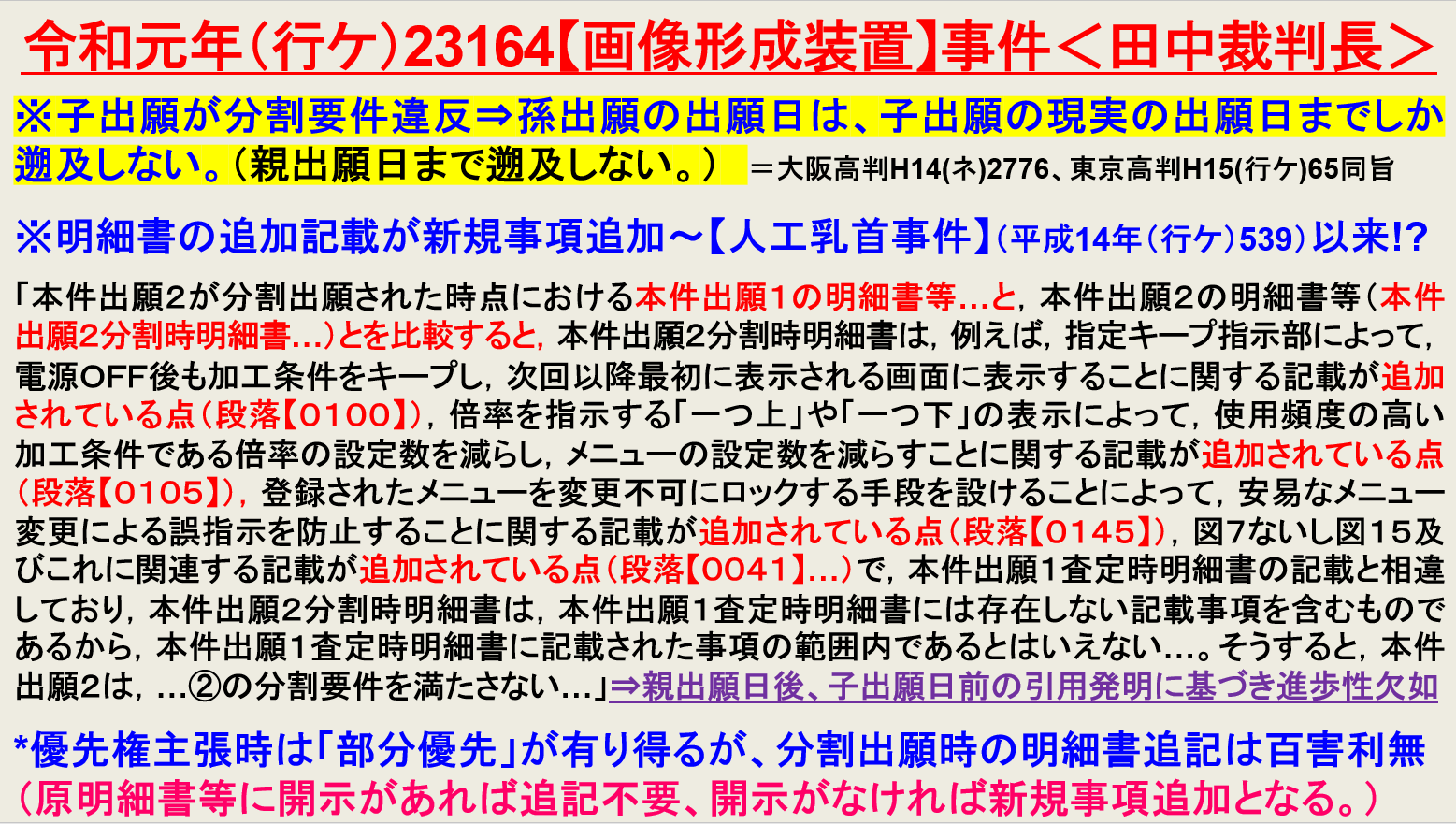
English translation of the figure
Tokyo District Court, 2019 (Wa) 23164, “Image Forming Apparatus” <Presiding Judge Tanaka>.
If the child application violates the requirements for a divisional application, the filing date of the grandchild application goes back only to the actual filing date of the child application, not to the filing date of the parent application. Osaka High Court, 2002 (Ne) 2776, and Tokyo High Court, 2003 (Gyo-Ke) 65, are to the same effect.
Addition to the specification constitutes addition of new matter — since the “Artificial Nipple” case (2002 (Gyo-Ke) 539)!?
“Comparing the specification and other documents of Application 1 at issue … at the time Application 2 at issue was filed as a divisional application with the specification and other documents of Application 2 at issue (the specification of Application 2 at the time of division …), the latter differs from the specification of Application 1 at the time of the decision in that, for example: it adds a description concerning retention of processing conditions even after the power is switched off by means of a designated-keep instruction unit and displaying them on the screen first displayed on the next and subsequent occasions (paragraph [0100]); it adds a description concerning reduction in the number of magnification settings, which are frequently used processing conditions, and in the number of menu settings by means of ‘one above’ or ‘one below’ instructions indicating magnification (paragraph [0105]); it adds a description concerning prevention of erroneous instructions resulting from easy changes to the menu by providing means for locking registered menus so that they cannot be changed (paragraph [0145]); and it adds Figures 7 to 15 and associated descriptions (paragraph [0041] …). Because the specification of Application 2 at the time of division includes matters not present in the specification of Application 1 at the time of the decision, it cannot be said to fall within the scope of the matters described in the latter. … Accordingly, Application 2 at issue does not satisfy divisional requirement (2). …” ⇒ Lack of novelty based on a cited invention that became public after the filing date of the parent application and before the filing date of the child application.
Although “partial priority” may be possible when claiming priority, additions to the specification when filing a divisional application bring harm and no benefit. If disclosed in the original specification and other documents, addition is unnecessary; if not disclosed, it constitutes addition of new matter.
(Note) The figure gives the case number as “2019 (Gyo-Ke) 23164” and the conclusion as “lack of inventive step.” The correct case number is 2019 (Wa) 23164, and the court found lack of novelty under Article 29(1)(iii) of the Patent Act (judgment, p. 32, lines 5–7).
Osaka District Court, 2020 (Wa) 3474 [Lighting fixture] <Tani>
Original Ameblo publication: 2022-11-12
Ameblo: https://ameblo.jp/hideki-takaishi/entry-12774170415.html
Osaka District Court, 2020 (Wa) 3474 [Lighting fixture] <Tani>
When the plaintiff learned of the respective accused products and suspected, from their appearance, infringement of the patent at issue, it could readily have examined their structures and other details.
⇒ At that point, it knew of the damage and the person causing it to a degree enabling it to claim damages.
⇒ The limitation period began to run.
https://www.courts.go.jp/assets/hanrei/hanrei-pdf-90665.pdf
[Article] “Practice of Patent Licensing Agreements” (Professor Masayasu Ishida)
Original Ameblo publication: 2022-11-14
Ameblo: https://ameblo.jp/hideki-takaishi/entry-12774431585.html
[Article] “Practice of Patent Licensing Agreements” (Professor Masayasu Ishida)
Examines related issues and is useful in practice!
Intellectual property issues concerning the results of joint research and development
Warranty issues in licensing agreements
Treatment of a licensee’s improvements
Points for licensors to bear in mind in licensing agreements
Utilization of intellectual property and legal risk management
https://system.jpaa.or.jp/patent/viewPdf/2818
Tokyo District Court, 2014 (Wa) 17797 [Compression-bonded herbaceous material] <Okinaka> Substantial quantities outside the numerical range ⇒ Claim limitation not satisfied
Original Ameblo publication: 2022-11-15
Ameblo: https://ameblo.jp/hideki-takaishi/entry-12774588127.html
Tokyo District Court, 2014 (Wa) 17797 [Compression-bonded herbaceous material] <Okinaka>
*There is a numerical limitation requiring bulk specific gravity to be adjusted to the range of 0.15–0.25 or less, while the specification contains no statement permitting values outside that numerical range.
⇒ Adjustment must be made consistently within the above range.
⇒ If substantial quantities fall outside the numerical range, the limitation is not satisfied.
[Claim 1] …A loosened material obtained by … bonding pulverized lignin-rich herbaceous material whose bulk specific gravity has been adjusted to 0.15–0.25 or less to form a compression-bonded material, and then loosening the compression bond.
(Excerpts from the judgment)
…There is a numerical limitation requiring the bulk specific gravity of the pulverized herbaceous material to be adjusted to a range of 0.15–0.25 or less, but no statement is found indicating that the bulk specific gravity of some portion of the pulverized herbaceous material may fall outside that range. Accordingly, for the defendant’s product to satisfy Claim Element B, it must at least be the case that the bulk specific gravity of the pulverized material in the defendant’s product is adjusted consistently within that range. If the bulk specific gravity is unstable and substantial quantities of the pulverized material fall outside that range, it cannot be said that its bulk specific gravity has been adjusted to that range, and Claim Element B cannot be found satisfied.
https://www.courts.go.jp/assets/hanrei/hanrei-pdf-85655.pdf
IP High Court, 2021 (Gyo-Ke) 10111 [Laser processing apparatus] <Kanno> Correction to a negative limitation ⇒ Inventive step satisfied
Original Ameblo publication: 2022-11-16
Ameblo: https://ameblo.jp/hideki-takaishi/entry-12774757781.html
IP High Court, 2021 (Gyo-Ke) 10111 [Laser Processing Apparatus] <Kanno>
The absence of grooves was discerned from the specification’s drawings, and correction to a negative limitation was allowed. Because grooves are essential to the cited invention, there is a teaching away.
⇒ Inventive step affirmed.
My impression is that amendments adding negative limitations to avoid Article 29-2 (conflict with an earlier-filed, later-published application) are often passed over as not introducing new technical matter.
On the other hand, my impression is that amendments adding negative limitations to overcome inventive-step objections receive a thorough examination of the disclosure in the specification.
⇒ Both should be issues of added new matter under the “Solder Resist IP High Court Grand Panel judgment,” but I sense a difference.
⇒ The Japanese Examination Guidelines, US MPEP, and the Guidelines for Examination in the EPO also distinguish between them. …But there appears to be no legal basis for this distinction.
(Excerpts from the judgment)
<Addition of new matter>
Correction 1 merely excludes from the invention of claim 1 before correction the conceptually encompassed “silicon wafer in which a groove along said planned cutting line is formed in the silicon single-crystal structure portion,” or a groove-essential apparatus. Thus, Correction 1, whose purpose is to narrow the scope of the claims, does not add a new technical matter to the “laser processing apparatus” of the invention of claim 1. Even in light of the description, … Figures 1 and 3 are plan views depicting planned cutting lines on workpiece 1, while neither Figure 2, a cross-sectional view along line II–II in Figure 1, nor Figure 4, a cross-sectional view along line IV–IV in Figure 3, shows a groove being formed. … In Figures 1 through 4, “planned cutting lines” are depicted but “grooves” are not. If the invention before correction presupposed the presence of “grooves,” it would be unnatural to depict “planned cutting lines” yet deliberately omit “grooves.”
<Inventive step>
It is inconceivable that a person skilled in the art encountering Exhibit Ko 11 would disregard, from substrate 201, groove 203, which provides the internal stress used to cut the semiconductor wafer. Not only is there no motivation to adopt, as the object to be processed, a substrate 201 without grooves along the break lines and modify it to form a processing-modified portion inside substrate 201 whose surface has no grooves, but rather there is a teaching away from such a modification….
Tokyo District Court, 2019 (Wa) 33246 [(Sequel) case] <Kokubu> ⇒ Pursuing the earlier infringement action was not a tort.
Original Ameblo publication: 2022-11-17
Ameblo: https://ameblo.jp/hideki-takaishi/entry-12774916332.html
Tokyo District Court, 2019 (Wa) 33246 [(Sequel) case] <Kokubu>
It is not unnatural that the party may not have recognized the existence of a “gap” in its own past products.
⇒ Pursuing the earlier infringement action was not a tort.
<Earlier action>
Tokyo District Court, 2017 (Wa) 17791 (=IP High Court, 2018 (Ne) 10088)
⇒ Public working through its own past products
“…After the heat-staking horn of the heat-staking machine is lowered and crushes the heat-staking protrusion from above, when the horn reverses and rises, the heat-staking protrusion springs back slightly due to stress, which is thought to create a gap in the direction of the shaft’s rotational axis (Exhibit Otsu 13). In the plaintiff’s water-flow experiment, although No-Gap 1 through No-Gap 5 were manufactured to have as little gap as possible, gaps as described above arose. This can be said to show that creation of a gap in the direction of the shaft’s rotational axis is unavoidable during heat staking with the plaintiff’s heat-staking machine.”
https://www.courts.go.jp/assets/hanrei/hanrei-pdf-91228.pdf
My posts were mentioned in “Sotoku Diary.”
Original Ameblo publication: 2022-11-18
Ameblo: https://ameblo.jp/hideki-takaishi/entry-12775073927.html
My posts were mentioned in “Sotoku Diary.”
“[Claim 1] A product having Configuration A (which may or may not produce Effect X).
[Claim 2] A product having Configuration A and producing Effect X.
Whereas Claim 1 includes both ‘products producing Effect X’ and ‘products not producing Effect X,’ Claim 2 excludes ‘products not producing Effect X.’ Since Claim 2 therefore does not require support for ‘products not producing Effect X,’ can it be said that the support requirement is easier to satisfy for Claim 2 than for Claim 1?”
My view is as follows.
The support requirement depends on the problem addressed by the invention.
⇒ If the invention’s problem is to provide A (a new substance), the ease of satisfying the support requirement is considered the same for Claims 1 and 2.
However, if the invention’s problem is Effect X, I consider the support requirement easier to satisfy for Claim 2 than for Claim 1, at least comparatively.
⇒ Taking into account that the invention’s problem itself may become an issue in litigation, I consider Claim 2 useful in practice.
https://thinkpat.seesaa.net/article/493159174.html
IP High Court, 2020 (Ne) 10004 <Otaka> [Light irradiation apparatus] =Osaka District Court, 2017 (Wa) 7532 <Sugiura>
Original Ameblo publication: 2022-11-18
Ameblo: https://ameblo.jp/hideki-takaishi/entry-12775074275.html
IP High Court, 2020 (Ne) 10004 <Otaka> [Light irradiation apparatus]
The product lineup (2004– Comprehensive LED Lighting Catalog), including publicly worked products, was used as a reason to reject obviousness. A prior-use right through “encroachment” was not established.
⇒ A prior-use right is not established where the prior-use invention falls outside the scope of the post-correction invention, even if it fell within the scope of the pre-correction invention.
=Osaka District Court, 2017 (Wa) 7532 <Sugiura>
*Inventive step was found even using the publicly worked invention = prior-use invention as a reference.
(Excerpts from the judgment)
As an exception to the first-to-file principle (Article 39(1)), the Patent Act recognizes a statutory non-exclusive license based on prior use (prior-use right) where the requirements of Article 79 are met. The person entitled to a prior-use right is defined as “a person who, without knowing the contents of the invention pertaining to a patent application, independently made that invention … and, at the time of filing the patent application, is actually engaged in business implementing that invention in Japan or preparing for such business.” The natural textual interpretation is that “that invention” in each instance refers to “the invention pertaining to the patent application.” In addition, given that a prior-use right is, as stated above, a non-exclusive license of the patented invention, the invention covered by the prior-use right is understood to mean one identical to the patented invention or at least a part of it. Accordingly, establishment of a prior-use right requires the prior-use invention to fall within the technical scope of the patented invention.… Once the decision concerning the re-correction at issue became final and binding, the patent application, registration of the patent right, and other acts concerning the patent are deemed to have been made on the basis of the claims after that re-correction (Article 128 of the Patent Act). …Even if the invention fell within the technical scope of the corrected invention at issue …, this does not alter the conclusion. Furthermore, even with this interpretation, correction means that the patentee’s rights are recognized only within the technical scope of the patented invention based on the post-correction claims. This interpretation therefore cannot be said to conflict with the purpose of the prior-use-right system, which seeks fairness between the patentee and a person who had previously worked the patented invention.
089805_hanrei.pdf (courts.go.jp)
English translation of the figure
IP High Court, 2020 (Ne) 10004, “Light Irradiation” <Otaka>; first instance: Osaka District Court, 2017 (Wa) 7532.
A general proposition was stated that a prior-use right cannot arise by “encroachment” ⇒ prior-use right denied.
Patent Act Article 79: A person who, without knowing the content of the invention in the patent application, independently makes an invention … and, at the time of the patent application, … is conducting or preparing a business working that invention is entitled to a prior-use right.
(Excerpts from the judgment) (1) It is natural to interpret “that invention” in each instance as referring to “the invention in the patent application.” (2) In view of the fact that a prior-use right is a non-exclusive license to the patented invention, the invention relating to prior use means one that is identical to, or at least part of, the patented invention.
⇒ The invention relating to prior use must fall within the technical scope of the patented invention. ⇒ Because correction has retroactive effect, it must fall within the technical scope of the corrected invention. Even if the invention relating to prior use fell within the technical scope before correction, that does not affect the conclusion.
Left, before correction: “Prior-used article 1” falls within the invention at issue ⇒ prior-use right permitted. Right, after correction (narrowing): “Prior-used article 1” does not fall within the invention at issue ⇒ prior-use right denied.
Diagram labels: patented invention at issue; prior-used article 2; accused product; prior-used article 1. Left diagram: × between prior-used article 2 and the accused product; ○ between the accused product and prior-used article 1. Right diagram: × on both of those connections.
IP High Court, 2014 (Gyo-Ke) 10059 Ishii Package containing a dry liposomal pharmaceutical composition containing an iodophor
Original Ameblo publication: 2022-11-21
Ameblo: https://ameblo.jp/hideki-takaishi/entry-12775556560.html
IP High Court, 2014 (Gyo-Ke) 10059 [Package containing a dry liposomal pharmaceutical composition containing an iodophor] <Ishii>
*The configuration was obvious.
⇒ Adopting the claimed invention’s configuration relating to Difference (A) automatically achieves the claimed effect (“storage stability”) as well.
⇒ Inventive step denied.
[Claim 1] …A storage-stable package containing a dry liposomal pharmaceutical composition containing an iodophor.
(Excerpts from the judgment)
…The decision erred … in determining that Difference (B) was not a substantive difference on the ground that the iodophor-containing dry liposomal pharmaceutical composition in the Reference 1 invention satisfies “storage-stable” in the claimed invention regardless of the material of the storage container…. …
However, …a person skilled in the art could readily have conceived of adopting, in the Reference 1 invention, the claimed invention’s configuration relating to Difference (A), and the configuration relating to Difference (B) is achieved simultaneously. It can therefore be said that a person skilled in the art could also readily have adopted the configuration relating to Difference (B) in the Reference 1 invention. Accordingly, the claimed invention should be considered one that a person skilled in the art could readily have conceived on the basis of the inventions described in References 1 and 2, and …the above error in the decision does not affect its conclusion.
https://www.courts.go.jp/assets/hanrei/hanrei-pdf-84708.pdf
Tokyo District Court, 2020 (Wa) 8506 […Work gloves] <Sato>
Original Ameblo publication: 2022-11-21
Ameblo: https://ameblo.jp/hideki-takaishi/entry-12775556998.html
Tokyo District Court, 2020 (Wa) 8506 […Work gloves] <Sato>
“The plaintiff … argues that the ‘irregularities’ must have been intentionally formed, and that the irregularities in question are merely ‘surface roughness’ inevitably arising during manufacture. However, …on the surface of the Exhibit Otsu 1 gloves …the irregularities cannot be said to have arisen inevitably during manufacture, but were intentionally formed.”
⇒ Does public working require intentional formation?
Even exclusive sales constitute “disclosure to a third party” and thus public working. (*No evidence establishing a confidentiality agreement.)
The irregularities on the surface of the publicly worked product were intentionally formed.
Other points not limited by the claim language are not differences.
Defendant Yotsugi sold the product to Tohoku Electric Power and transferred ownership, and there is insufficient evidence to find that Tohoku Electric Power … was obliged not to disclose it to third parties.
…Because the Exhibit Otsu 1 product was used by Tohoku Electric Power’s on-site workers, the contents of the Exhibit Otsu 1 invention had been disclosed to third parties….
https://www.courts.go.jp/assets/hanrei/hanrei-pdf-90942.pdf
YouTube [Patents] Inventive step (parameter inventions)
Original Ameblo publication: 2022-11-21
Ameblo: https://ameblo.jp/hideki-takaishi/entry-12775557918.html
YouTube [Patents] Inventive step (parameter inventions)
“Celecoxib” case
Focusing on the parameter was found not obvious; inventive step satisfied.
⇒ The key is the invention’s problem plus whether the parameter could have been identified.
In the “Base fabric for airbags” case…,
Even with motivation to focus on the “numerical value” of a publicly worked product and move that value toward the invention at issue, inventive step was satisfied.
https://www.youtube.com/watch?v=jTjDl9d8dFI
[Trademarks] Osaka District Court, 2020 (Wa) 3646
Original Ameblo publication: 2022-11-21
Ameblo: https://ameblo.jp/hideki-takaishi/entry-12775558236.html
[Trademarks] Osaka District Court, 2020 (Wa) 3646
“This is not a case … in which selling under the defendants’ marks indicated superiority over the plaintiff’s … goods. Rather, the plaintiff argues that changing the product name from the plaintiff’s mark to the defendants’ marks constitutes the tort of removing the plaintiff’s mark.”
⇒ No tort established
https://www.courts.go.jp/assets/hanrei/hanrei-pdf-90734.pdf
IP High Court, 2021 (Ne) 10029 [Handrail installation method] case <Shoji> ≪Multi-actor infringement≫ ⇒ Joint direct infringement established
Original Ameblo publication: 2022-11-21
Ameblo: https://ameblo.jp/hideki-takaishi/entry-12775631886.html
[YouTube Individual Cases]
IP High Court, 2021 (Ne) 10029 [Handrail installation method] case <Shoji>
≪Multi-actor infringement≫ Another person performed part of a method invention. ⇒ Joint direct infringement established
=First instance: Osaka District Court, 2017 (Wa) No. 10716 <Sugiura>
“The defendant … performed the steps of the defendant’s method up to installing the glass-mounting frame on the handrail body, and another contractor performed the glass-installation work.… However, …the contractor performing the glass-installation work used the defendant’s product, followed the defendant’s designated method, and carried out installation following the defendant’s work.… In this respect, the defendant and the contractor performing the glass-installation work can be assessed as having jointly implemented the defendant’s method.”
*Osaka District Court, May 4, 1961, Kaminshu 12.5.937 [Styrobeads] discussed in dicta circumstances in which joint direct infringement may arise; cases finding sole direct infringement under the instrumentality theory include Tokyo District Court, 2000 (Wa) No. 20503 [Method for forming an electrodeposited image].
*Under the control theory, Tokyo District Court, 2004 (Wa) No. 25576 [Method for supplying beveled spectacle lenses] (the [HOYA] case) found sole direct infringement of a product (system) invention involving multiple actors.
“…Who may be subjected to an injunction and damages based on patent infringement—that is, who performs the acts of working the invention—should, unlike the question of satisfaction of claim elements, be determined by deciding who controls and manages the system.”
*US judicial practice likewise establishes, under the control theory, “direct infringement (Section 271(a))” rather than “induced infringement (Section 271(b)).”
(The August 2015 CAFC en banc AKAMAI case following the June 2014 Supreme Court judgment) (≈ the Japanese [HOYA] case cited above)
⇒ Specific examples of direct infringement given were ① “directing or controlling” another, and ② forming a “joint enterprise” with another. ⇒ Further, as categories of “direction or control,” taking account of general principles of vicarious liability, the court listed ❶ an agency relationship (agent), ❷ a contractual relationship (contract), and ❸ the alleged infringer conditioning participation in a particular activity or receipt of a benefit on another person’s performance of one or more steps of a patented method (first prong), where the alleged infringer establishes the manner or timing of performance (second prong) (two-prong test).
Tokyo District Court, 2018 (Wa) 1130 [Printed retroreflective sheeting] <Tanaka> Damages
Original Ameblo publication: 2022-11-22
Ameblo: https://ameblo.jp/hideki-takaishi/entry-12775717187.html
Tokyo District Court, 2018 (Wa) 1130 [Printed retroreflective sheeting] <Tanaka>
Before filing this action, the plaintiff proposed 5% to the 3M group, including the defendants.
…
Defendant 3M Japan and the other parties asserted 10% in the patent-infringement action they brought against the plaintiff.
…
The royalty rate to be determined after the fact is 10%.
⇒ ¥1.5 billion awarded
(Excerpts from the judgment)
It is found that, before filing this action, the plaintiff proposed a 5% royalty rate for the patent at issue to the 3M group, including the defendants …; meanwhile, US 3M had asserted in a previous patent-infringement action against a third party that the royalty rate for a patent concerning retroreflective sheeting was 9% …; US 3M and the other parties had agreed to a royalty rate of 20% in a previous action against a third party …; and …defendant 3M Japan and the other parties asserted a 10% royalty rate in a patent-infringement action they brought against the plaintiff.…
The royalty rate receivable for the working at issue, to be determined after the fact for the defendants who infringed the patent at issue, is not less than 10%….
IP High Court, 2021 (Ne) 10088 and other cases [Information communication unit]—No concurrent application of paragraphs (2) and (3) to deductions for competing products
Original Ameblo publication: 2022-11-24
Ameblo: https://ameblo.jp/hideki-takaishi/entry-12776051541.html
On appeal, the IP High Court likewise held in 2021 (Ne) 10088 and other cases [Information communication unit] <Kanno> that paragraphs (2) and (3) do not apply concurrently to deductions for competing products (the same as the first-instance judgment).
First instance: Osaka District Court, 2019 (Wa) 9113
“Foreign-exchange gains … should be assessed as cost together with the purchase price and included in calculating the defendant’s profits.”
(Excerpt from the judgment / First instance: Osaka District Court, 2019 (Wa) 9113)
…Foreign-exchange gains are understood to arise in connection with settlement in foreign currency of purchases of each of the defendant’s products. Accordingly, when calculating the amount of profit the defendant obtained from sales of those products, the calculated foreign-exchange gains against the exchange rate at the time of the import contract, arising from foreign-currency settlement of purchases during a certain period, should be assessed as part of cost together with the purchase price of each product, and should appropriately be included in calculating the defendant’s profits.
With respect to concurrent application of Article 102(2) and (3) of the Patent Act, …the only circumstance to be considered as rebutting the presumption of the amount of damages under paragraph (2) is the existence of competing products. For the portion rebutted on the basis of such a circumstance, which is not directly related to the defendant’s sales performance of each accused product, there is no basis for applying paragraph (3).
https://www.courts.go.jp/assets/hanrei/hanrei-pdf-91319.pdf
[Copyright] Osaka District Court, 2021 (Wa) 3208 Sale of pirated copies ⇒ Damages under Article 114(3) of the Copyright Act
Original Ameblo publication: 2022-11-24
Ameblo: https://ameblo.jp/hideki-takaishi/entry-12776051678.html
[Copyright] 2021 (Wa) 3208
Sale of pirated copies ⇒ Damages under Article 114(3) of the Copyright Act
“The list price of the perpetual-license version of the plaintiff’s product … is the amount receivable for the exercise of the copyright”; “an amount equivalent to the list price of the perpetual-license version that would have been received was not received.”
Cf. Tokyo District Court, May 16, 2001, “LEC case”
https://www.courts.go.jp/assets/hanrei/hanrei-pdf-90685.pdf
IP High Court, 2017 (Ne) 10090 [Pharmaceutical] case <Takabe>
Original Ameblo publication: 2022-11-24
Ameblo: https://ameblo.jp/hideki-takaishi/entry-12776051865.html
IP High Court, 2017 (Ne) 10090 [Pharmaceutical] case <Takabe>
(Although obiter dictum,) the court held that, even if the prior-use pharmaceutical unintentionally fell within the invention’s numerical range, there was no technical idea of bringing it within that range, and no prior-use right was established.
⇒ In the second action (claim for damages), the support requirement failed at first instance and inventive step failed on appeal.
https://www.youtube.com/watch?v=pyijXtGm9so
English translation of the figure
IP High Court, 2017 (Ne) 10090, “Pharmaceutical” <Takabe>.
(Although obiter dictum,) the court held that, even if the prior-used pharmaceutical unintentionally fell within the numerical range of the invention, there was no technical concept of keeping it within that numerical range, and a prior-use right was not established.
(Excerpt from the judgment) “Invention 2 at issue has the technical concept of setting the water content of a solid preparation of pitavastatin or a salt thereof within the range of 1.5–2.9% by mass. In contrast, the sample drugs have neither the technical concept of keeping the water content of the tablets within the range of 1.5–2.9% by mass or a range included therein, nor the technical concept of setting their water content at a particular value within the range of 1.5–2.9% by mass. Accordingly, the technical concept embodied in the sample drugs cannot be said to be an invention having the same content as Invention 2 at issue.”
No extension to publicly worked inventions is seen. (It was not protected even as prior use.)
3. Completion of a publicly worked “invention” — whether intention or recognition is necessary (cf. prior-used inventions). Tokyo District Court, 2017 (Wa) 17791, “Magnetic Gear” <Sato> ⇒ patentee lost. Formation of a gap was inevitable ⇒ public working established; no novelty. (An “intention to create a gap” in the publicly worked product was not required.)
Tokyo District Court, 2011 (Wa) 21311, “Printed-Matter Quality Management Apparatus (Offset Rotary Press Plate Cylinder)” <Osuga> ⇒ patentee lost. An invalidity ground based on public working was established through measurements taken 20 years after delivery ⇒ no novelty. (An “intention to control the surface roughness Rz of the rotary press plate cylinder” in the publicly worked product was not required.) ⇒ On appeal, 2013 (Ne) 10051, rebuttal based on correction ⇒ inventive step recognized.
Cf. prior-use-right judgment: 2017 (Ne) 10090, “Pharmaceutical” <Takabe> (obiter dictum). “In the sample drugs, the technical concept of keeping the water content of the tablets within the range of 1.5–2.9% by mass or a range included therein … does not exist. Accordingly, the technical concept embodied in the sample drugs cannot be said to be an invention having the same content as Invention 2 at issue.” ⇒ Prior-use right not established.
Tokyo District Court, 2020 (Wa) 13326, 13331 [Forearm-fracture inhibitor containing eldecalcitol] <Shibata>
Original Ameblo publication: 2022-11-25
Ameblo: https://ameblo.jp/hideki-takaishi/entry-12776211867.html
2020 (Wa) 13326, 13331 [Forearm-fracture inhibitor containing eldecalcitol] <Shibata>
Lack of novelty of a use invention
“The configuration for use in preventing fractures of the radius should be regarded as identical to the invention described in Exhibit Otsu 1 and lacks novelty.”
⇒ A meaningful precedent for situations under Article 29-2
(Excerpts from the judgment)
Regarding the limitation of the subjects of administration to patients with Type I osteoporosis, at the priority date at issue, it had been proposed to classify as Type I osteoporosis the osteoporosis occurring in women during the first 15–20 years after menopause, characterized by an excessive and disproportionate phenomenon in cancellous bone compared with cortical bone…. It is clear that Type I osteoporosis as thus proposed is a type of osteoporosis. On the other hand, the specification contains no description whatsoever of effects or the like arising from distinguishing patients with Type I osteoporosis from the osteoporosis patients targeted by the Exhibit Otsu 1 invention as subjects of administration. Accordingly, limiting the subjects of administration to Type I osteoporosis patients should be assessed as a use contemplated by the Exhibit Otsu 1 invention, and cannot be said to constitute a difference from that invention.
https://www.courts.go.jp/assets/hanrei/hanrei-pdf-91266.pdf
IP High Court, 2020 (Ne) 10048 <Tsuruoka> ⇒ A case denying a claim for employee-invention remuneration for know-how
Original Ameblo publication: 2022-11-26
Ameblo: https://ameblo.jp/hideki-takaishi/entry-12776425364.html
IP High Court, 2020 (Ne) 10048 <Tsuruoka>
First instance: Tokyo District Court, 2018 (Wa) 36424
⇒ A case denying a claim for employee-invention remuneration for know-how
*Patentability of the know-how was denied.
⇒ Conversely, if know-how is patentable, a claim for employee-invention remuneration may be allowed!!
(Excerpts from the judgment)
…The appellant also argues that the know-how at issue is groundbreaking in combining a main game with a payout rate of 90% and a subgame with a payout rate of 100%, thereby balancing the interests of the game arcade and its customers. However, the question of what payout rate to set is not, in itself, a technical question but merely a matter of arrangement. Thus, the point advanced by the appellant does not constitute a circumstance supporting the patentability of the know-how at issue.
https://www.courts.go.jp/assets/hanrei/hanrei-pdf-90409.pdf
https://www.youtube.com/watch?v=SPbJ4sPVgAQ
[Patents] Offer for assignment: Tokyo District Court, 2016 (Wa) 25436 [Method for producing L-glutamic acid] <Yamada>
Original Ameblo publication: 2022-11-26
Ameblo: https://ameblo.jp/hideki-takaishi/entry-12776425643.html
(YouTube) [Patents] Offer for assignment
Tokyo District Court, 2016 (Wa) 25436 [Method for producing L-glutamic acid] <Yamada>
1. Even where the transferor and the offeror differ, an “offer for assignment” is established if they have a certain relationship.
2. An “offer for assignment” was established even though the “assignment” took place abroad.
3. Article 102(2) of the Patent Act was applied on the basis of overseas sales.
https://www.youtube.com/watch?v=2U8_ddBQLNI&feature=youtu.be


English translation of the first figure
(Summary/TIP) Offers for assignment and similar acts: (1) location (domestic or overseas) and (2) timing (immediately before expiration).
1. Must the act of “offering for assignment” take place within Japan? Japan — yes: 2010 (Ne) 10001, “Motor” <Nakano>, a case in which international jurisdiction was disputed. United States — not necessary? (Is it sufficient if the “sale” is within the United States?) (Transocean, 2010.)
2. Can an “offer for assignment” be established even if the “assignment” is overseas? Japan — many academic views take the position that an “offer for assignment” is not established. The “Method for Producing L-Glutamic Acid” case involved special circumstances: all overseas sales were intended to be sales to Japanese purchasers. United States — not established unless the anticipated location of the future sale is within the United States (TAOS, 2018).
Meaning of “assignment” (“domestically”): “transfer of possession” and “transfer of ownership”? ⇒ If the product itself is overseas, is a “domestic” assignment not established even if the sales contract is concluded domestically? (There is a US district court judgment to the same effect.)
3. Where “assignment” is scheduled to occur after expiration of the patent term ⇒ infringement established.
4. Other: a “general standard” under which introduction on a website constitutes an “offer for assignment” (2015 (Ne) 10109).
English translation of the second figure
Tokyo District Court, 2016 (Wa) 25436, “Method for Producing L-Glutamic Acid” <Yamada>.
(1) Even if the assignor and the person making the offer differ, an “offer for assignment” is established where they have a certain relationship. (2) An “offer for assignment” was established although the “assignment” was overseas. (3) Article 102(2) of the Patent Act was applied using overseas sales as the basis. (There were special circumstances: all overseas sales were to Japanese purchasers, and even if delivery itself occurred at shipment, subsequent importation into Japan by the purchaser was planned.)
“… Even if the act of making an offer for assignment is not performed by the seller who is the assignor, if there are circumstances such as performance by a person having a certain relationship with that seller, that act may be interpreted as an offer for assignment. … CJ Indonesia and the defendant belonged to the same corporate group and had a close relationship, including entering into the commission agreement at issue and distributing profits in relation to the CJ Indonesia sales. Therefore, the fact that the party to the sales contracts for the CJ Indonesia sales was CJ Indonesia rather than the defendant does not preclude a finding that the defendant’s … involvement constitutes an offer for assignment of the MSG at issue. …
Certainly, … although the assignment to the purchasers of the MSG at issue relating to the CJ Indonesia sales is found to have occurred outside Japan, all the CJ Indonesia sales were to Japanese purchasers, and even if delivery of the MSG at issue itself occurred at shipment, the MSG at issue was intended subsequently to be imported into Japan by the purchasers. In light of the purpose of treating an offer for assignment as an act of working separate from assignment itself, for products such as the MSG at issue relating to the CJ Indonesia sales, which are sold to Japanese purchasers and imported into Japan as a result of business activities in Japan, it would not be appropriate to reach different conclusions as to whether those business activities constitute an offer for assignment in Japan solely because assignment to the purchasers occurs outside rather than within Japan. … It is appropriate to interpret the defendant’s and CJ Indonesia’s joint conduct in Japan of business activities relating to the CJ Indonesia sales as an “offer for assignment” by the defendant; the defendant’s argument on this point cannot be accepted. …
Since the defendant and CJ Indonesia are joint tortfeasors with respect to the CJ Indonesia sales, the profits not only of the defendant but also of CJ Indonesia should be taken into account in calculating damages. … All the CJ Indonesia sales were to Japanese purchasers, and importation into Japan after delivery to the purchasers was planned. Therefore, even if the “assignment” itself occurred outside Japan, it is appropriate, in applying Article 102(2) of the Patent Act, to regard the profits of the defendant and CJ Indonesia calculated from sales of the CJ Indonesia sales as profits received by them through the domestic “offer for assignment.” The defendant’s above argument cannot be accepted.”
(Note) The figure gives the presiding judge as <Yano>. The presiding judge in this case was Judge Mami Yamada (judgment, p. 243, lines 5–6).
IP High Court, 2010 (Ne) 10001 [Motor] <Nakano> *International jurisdiction
Original Ameblo publication: 2022-11-28
Ameblo: https://ameblo.jp/hideki-takaishi/entry-12776704886.html
IP High Court, 2010 (Ne) 10001 [Motor] <Nakano>
*International jurisdiction
With respect to an “act of offering for assignment,” whether Japan has international jurisdiction is determined by whether, as an objective matter of fact, the act of transmitting the offer or the result of its receipt occurred within Japan.
⇒ The defendant was found to have conducted sales activities in Japan.
(Excerpts from the judgment)
…In applying Article 5(ix) of the Code of Civil Procedure, which is considered when determining the existence of international jurisdiction, the place having jurisdiction over an action relating to a tort is the “place where the tort occurred.” This “place where the tort occurred” is understood to include both the place where the harmful act was committed (“place of the harmful act”) and the place where the result occurred (“place of the result”). Because the right the appellant (plaintiff at first instance) alleges was infringed in this action is Japanese Patent No. 3688015, it is appropriate to understand that, with respect to the appellee’s (defendant at first instance) “act of offering for assignment,” which the appellant alleges constitutes a tort, whether Japan has international jurisdiction is determined by whether, as an objective matter of fact, the act of transmitting the offer or the result of its receipt occurred within Japan.…
The appellee operates an English-language website that lists one of the accused products and lists “Japan” under “Sales Inquiry,” with the address, telephone number, and fax number of its Japanese base (Minato-ku, Tokyo) under “Sales Headquarter”; its Japanese-language website also contains a webpage introducing the “Slim ODD Motor,” and selecting the “Inquiries concerning purchase” item on that page allows a user to prepare an inquiry form concerning sales of the “Slim ODD Motor”; the appellant’s sales manager states in a written statement that the appellee’s sales representatives conduct sales activities in Japan concerning ODD motors and that the accused products are being evaluated at … for incorporation into products (ODDs); A, a management adviser to the appellee, prepares and uses business cards bearing that title, the appellee’s company name, and an address in Minato-ku, Tokyo, in Japanese; and there is a strong possibility that a DVD multi-drive incorporating one of the accused products is manufactured and sold by a domestic manufacturer and distributed domestically. Assessing these circumstances comprehensively, it is appropriate to find that, with respect to the act of offering the accused products for assignment that the appellant alleges constitutes a tort, the appellee’s act of transmitting the offer or the result of its receipt occurred in Japan.…
https://www.courts.go.jp/assets/hanrei/hanrei-pdf-80702.pdf
“Dispatch of Lecturers—Strong Support for Developing In-House Intellectual Property Personnel—” has been uploaded to the Nakamura & Partners website
Original Ameblo publication: 2022-11-28
Ameblo: https://ameblo.jp/hideki-takaishi/entry-12776705043.html
“Dispatch of Lecturers—Strong Support for Developing In-House Intellectual Property Personnel—” has been uploaded to the Nakamura & Partners website.
For companies, including their management, it is essential to continue striving daily to build appropriate organizations and systems and to develop and secure suitable personnel for each of the above departments and stages.
https://www.nakapat.gr.jp/ja/practices-details/dispatch-lecturer/
[US Patents] 2022.06 CAFC Novartis v. Accord Healthcare
Original Ameblo publication: 2022-11-28
Ameblo: https://ameblo.jp/hideki-takaishi/entry-12776705315.html
[US Patents] 2022.06 CAFC Novartis v. Accord Healthcare
For a negative limitation to satisfy the written description requirement of Section 112(a), the specification, considered as a whole, must contain a description from which it can be understood that the inventor intended to exclude that feature.
⇒ Written description requirement not satisfied (district court judgment reversed).
<Trademarks> IP High Court, 2021 (Gyo-Ke) 10013 “Lingua Franca” Cancellation for non-use
Original Ameblo publication: 2022-11-29
Ameblo: https://ameblo.jp/hideki-takaishi/entry-12776863375.html
<Trademarks> IP High Court, 2021 (Gyo-Ke) 10013 “Lingua Franca” Cancellation for non-use
An advertising video concerning a service that ended before the period for which use must be proved and that the trademark owner did not take over is not used for services provided in the course of trade. Therefore, even if the trademark at issue appears in it, this is not trademark use.
https://www.courts.go.jp/assets/hanrei/hanrei-pdf-90491.pdf
Tokyo High Court, 2001 (Gyo-Ke) 489 [Spring structure] <Tsukahara> *No patentability even if a previously known product happens to fall within the numerical range.
Original Ameblo publication: 2022-11-30
Ameblo: https://ameblo.jp/hideki-takaishi/entry-12777050238.html
Tokyo High Court, 2001 (Gyo-Ke) 489 [Spring structure] <Tsukahara>
*No patentability even if a previously known product happens to fall within the numerical range.
Even if the concept D/h had not attracted attention in previously known spring structures … it is entirely possible to discover that they happen to fall within that numerical range … this would amount to granting a patent on the previously known spring structure itself … improper …
(Excerpts from the judgment)
…Even if nobody had focused on D/h before the application, and the concept D/h had not attracted attention in previously known spring structures, its constituent elements D (diameter of the rubber plates) and h (total thickness of the rubber plates) themselves naturally existed in a state in which they could be known. Thus, if it is discovered that spring structures whose ratio D/h lies within a particular numerical range have superior performance, it is entirely possible that calculating the D/h of a previously known spring structure will reveal that it happens to lie within that range. In such a case, granting a patent on spring structures whose D/h lies within a particular numerical range would amount to granting a patent on the previously known spring structure itself, and it is clear that this would be improper.
https://www.youtube.com/watch?v=DlVnhbFibS0
https://www.courts.go.jp/assets/hanrei/hanrei-pdf-10813.pdf
[Article] (United States) ITC Features Worth Knowing for Litigation Strategy (IP Management, Vol. 69, No. 1, 2019)
Original Ameblo publication: 2022-12-01
Ameblo: https://ameblo.jp/hideki-takaishi/entry-12777183094.html
[Article] (United States) ITC Features Worth Knowing for Litigation Strategy (IP Management, Vol. 69, No. 1, 2019)
The four requirements for an injunction under eBay do not apply to issuance of exclusion orders in ITC Section 337 proceedings.
⇒ Injunctive relief is easier to obtain at the ITC than in US courts.
Bringing a case before the ITC requires standing (the domestic-industry requirement)!!
https://www.youtube.com/watch?v=spPaitOtvR8
[Article] A case dismissing an action against a corporate representative because the arbitration agreement extended to the representative (JCA Journal, Vol. 69, No. 8)
Original Ameblo publication: 2022-12-02
Ameblo: https://ameblo.jp/hideki-takaishi/entry-12777349214.html
[Article] A case dismissing an action against a corporate representative because the arbitration agreement extended to the representative (JCA Journal, Vol. 69, No. 8)
International: [Ring Ring Circus case], Supreme Court, September 4, 1997
Domestic: Nagoya District Court, October 27, 1995
Bringing an action against a representative over what is substantively a claim against the corporation and joining the corporation as a party substantively violates the arbitration agreement.
[Copyright] Tokyo District Court, 2020 (Wa) 19840 <Nakashima> Copyrightability denied for a company name (trade name) rendered as a logotype
Original Ameblo publication: 2022-12-04
Ameblo: https://ameblo.jp/hideki-takaishi/entry-12777668717.html
[Copyright] Tokyo District Court, 2020 (Wa) 19840 <Nakashima>
Copyrightability denied for a company name (trade name) rendered as a logotype.
The defendant had neither the intention nor the need to exploit the plaintiff’s name recognition or reputation.
⇒ The defendant’s trade name was independently devised.
⇒ “Improper purpose” under Article 8(1) of the Companies Act and “purpose of obtaining an illicit gain” under Article 2(1)(xix) of the Unfair Competition Prevention Act were denied.
https://www.courts.go.jp/assets/hanrei/hanrei-pdf-90848.pdf
Osaka District Court, 2020 (Wa) 4023 […Attachment-assisting plate] <Tani>
Original Ameblo publication: 2022-12-04
Ameblo: https://ameblo.jp/hideki-takaishi/entry-12777669036.html
Osaka District Court, 2020 (Wa) 4023 […Attachment-assisting plate] <Tani>
Unless the plate can retain its shape even under the weight of the cover body, it is difficult to keep the cover body in an elevated position.
⇒ Something that bends under its own weight and has neither rigidity nor elasticity does not constitute a “plate” (some products did not satisfy the limitation).
https://www.courts.go.jp/assets/hanrei/hanrei-pdf-90666.pdf
Osaka District Court, 2018 (Wa) 866 <Claim for employee-invention remuneration> Exclusivity benefit denied ⇒ Claim dismissed
Original Ameblo publication: 2022-12-05
Ameblo: https://ameblo.jp/hideki-takaishi/entry-12777820542.html
Osaka District Court, 2018 (Wa) 866 <Claim for employee-invention remuneration>
Exclusivity benefit denied
⇒ Claim dismissed
“There are no circumstances such as an increase in the defendant’s market share … it cannot be said that the existence of the patent rights caused competitors to refrain from working the inventions at issue.… This is also consistent with … allowing the respective patents to lapse … through nonpayment of patent fees.”
https://www.courts.go.jp/assets/hanrei/hanrei-pdf-91579.pdf
Tokyo High Court, 2001 (Ne) 2630 […Reinforcing rod] <Shinohara> Equivalent substantially identical to an earlier-filed, later-published application
Original Ameblo publication: 2022-12-06
Ameblo: https://ameblo.jp/hideki-takaishi/entry-12777995151.html
Tokyo High Court, 2001 (Ne) 2630 […Reinforcing rod] <Shinohara>
Equivalent substantially identical to an earlier-filed, later-published application
⇒ Fourth requirement not satisfied
“Requirement ④′ … is based on the view that something for which nobody should have been able to obtain utility model registration cannot be regarded as falling within the technical scope of the registered utility model.”
⇒ Utility model right holder loses on reversal
⇒ What about other patentability requirements?
(Even if the equivalent is a support-requirement issue, is it acceptable to find equivalence? …I cannot even find discussion of this point.)
(Excerpts from the judgment)
…Regarding requirement ④′ (not being publicly known technology), the appellant argues that the thinking underlying the above Supreme Court judgment is that expansion of the technical scope of a registered utility model through the doctrine of equivalents is impermissible if it results in including a ground for invalidity of that utility model registration; that, if a configuration in which the upper end of the reinforcing rod is attached to the side rod of the platform frame is equivalent to one in which it is attached to the rear rod, the device at issue, with its technical scope thus expanded, would be identical to the device described in the earlier application’s specification and would include a ground for invalidity under the main text of Article 3-2 of the Utility Model Act; and that the appellee’s assertion of equivalence therefore cannot stand.
Considering the appellant’s argument, as stated above, requirement ④′ is based on the view that something for which nobody should have been able to obtain utility model registration in the first place cannot be regarded as falling within the technical scope of a registered utility model. Where a registered utility model is identical to a device described in the specification or drawings originally attached to another utility model application filed before its filing date and published after its filing, the main text of Article 3-2 of the Utility Model Act likewise means that nobody should have been able to obtain utility model registration for that device. In such a case, as with the circumstances specified in requirement ④′, it is inappropriate to treat the device as falling within the technical scope of the registered utility model.
Accordingly, where the accused product is identical to a device described in the specification or drawings of an earlier application for the registered utility model as provided in the main text of Article 3-2 of the Utility Model Act, it should be treated analogously to publicly known technology at the time of filing. It cannot be construed as falling within the technical scope of the registered utility model as an equivalent of the configuration recited in its claims.
Osaka District Court, 1999 (Wa) 12699 [Infringement of an inventor’s right of honor] <Komatsu> True inventor may demand amendment of the inventor field
Original Ameblo publication: 2022-12-07
Ameblo: https://ameblo.jp/hideki-takaishi/entry-12778141075.html
Osaka District Court, 1999 (Wa) 12699 [Infringement of an inventor’s right of honor] <Komatsu>
The true inventor may demand amendment of the statement in the application’s inventor field.
“[The plaintiff] has an inventor’s right of honor (right to be named as inventor), a personality right … the statement in the application that Defendant B is the inventor infringes the plaintiff’s inventor’s right of honor.”
https://www.courts.go.jp/assets/hanrei/hanrei-pdf-11858.pdf
IP High Court, 2019 (Gyo-Ke) 10132 <Tsuruoka> [Brunnian link-making device and kit]
Original Ameblo publication: 2022-12-08
Ameblo: https://ameblo.jp/hideki-takaishi/entry-12778317333.html
IP High Court, 2019 (Gyo-Ke) 10132 <Tsuruoka>
[Brunnian link-making device and kit]
① Partial priority
(Note) Where a new configuration added in the later application is not included in the priority application, priority is denied for that component. However, that fact alone does not render the patent invalid; the component must be found to lack novelty or inventive step in light of the cited invention.
② Deleting a feature not essential to solving the problem does not add new matter.
⇒ Amendment requirements satisfied
=IP High Court, 2014 (Gyo-Ke) 10087; IP High Court, 2019 (Gyo-Ke) 10046
③ Whether the amended invention includes an integrally molded configuration is unrelated to new matter.
(Excerpts from the judgment)
It is clear that the invention at issue … includes a configuration without points ①–④ that the plaintiff contends are new configurations—that is, the configuration exactly as in the embodiment described in the specification of the US provisional application at issue…. This configuration constitutes one complete invention; it does not become complete as an invention only upon supplementation with configurations ①–④. In such a case, under Article 4F of the Paris Convention, priority may not be refused, nor may a patent application filed with a claim to Paris Convention priority be rejected, on the ground that it contains elements not included in the priority application. Rather, Paris Convention priority is denied only for the elements not included in the underlying application. Thus, to invalidate a patent arising from such an application, it is not enough merely to find that the patent contains elements absent from the application underlying Paris Convention priority; those elements must be found to lack novelty or inventive step in light of the cited invention…. …Otherwise, for example, suppose a patentee files a foreign application for an invention with Configuration A; after Invention B, which includes that configuration, becomes publicly known, the patentee files in Japan, claiming Paris Convention priority, an invention with Configuration A+C, combining Configuration A with Configuration C, which was not included in the foreign application but has novelty and inventive step over Invention B. Although the foreign application precedes Invention B for the Configuration A portion, priority is claimed, and Configuration C has novelty and inventive step over Invention B, the mere inclusion of Configuration C, absent from the foreign application, would necessarily result in denial even of priority for Configuration A and rejection of the application. Such a result is considered wholly unacceptable under Article 4F of the Paris Convention. Furthermore, because ①–④ can each constitute elements of independent inventions, novelty and inventive step over the cited invention must be considered separately for each configuration.… The tool in the Exhibit Ko 1 video has Configuration ③…. Because the claims of the invention at issue … include Configuration ③ …, the invention at issue … lacks novelty in relation to that video…. Accordingly, to determine whether Paris Convention priority is recognized, it is further necessary to determine whether Configuration ③ is absent from the US provisional application at issue. In contrast, the tool in the Exhibit Ko 1 video is not found to include Configurations ①, ②, or ④, leaving no room for a novelty issue, and there is insufficient argument or evidence to establish that these configurations lack inventive step over the invention in that video. Thus, without needing to determine whether these configurations are absent from the US provisional application, the plaintiff’s argument must be deemed unfounded.… Configuration ③ cannot be said to be absent from the US provisional application, so the plaintiff’s argument on this point is also unfounded.… The invention at issue is not found to have a ground for invalidity based on lack of novelty or inventive step in relation to the Exhibit Ko 1 video.
The plaintiff argues that the amendment resulted in inclusion of a configuration in which each of the multiple pins is directly fixed to the base. However, …in the embodiments, the “pin bar” is a configuration for achieving various arrangements of multiple pins, not one essential to solving the invention’s problem. Thus, it cannot be said that the original specification and other documents excluded a configuration without a pin bar—that is, the technical idea of supporting pins on the base without a “pin bar”…. The plaintiff also argues that “given that the decision considers the pins supported on the base in Invention 6 to include an integrally molded configuration of pins and base, it is clear that such a configuration is not disclosed.” However, the amendment did not recite the specific configuration of integral molding in the claims, and whether such a configuration is included in Invention 6 does not affect whether new matter has been added (it is merely a question of construing Invention 6). Accordingly, none of the plaintiff’s above arguments can be accepted.
https://www.courts.go.jp/assets/hanrei/hanrei-pdf-89824.pdf
IP High Court, 2019 (Gyo-Ke) 10120 [Oil-cooled screw compressor] <Tsuruoka> Motivation found from a general problem
Original Ameblo publication: 2022-12-09
Ameblo: https://ameblo.jp/hideki-takaishi/entry-12778473480.html
IP High Court, 2019 (Gyo-Ke) 10120 [Oil-Cooled Screw Compressor] <Tsuruoka>
Although not mentioned in the cited document, a general problem recognizable to a person skilled in the art at the filing date was held also to apply to the cited invention, establishing motivation.⇒ No inventive step
The judgment does not examine “the problem of the invention at issue.” Is this because the well-known problem is also the invention’s problem?
(Excerpts from the judgment)
…A person skilled in the art is found able to recognize that the problem of reverse thrust force (a reverse thrust-load state) … arises in screw compressors generally, and can recognize that it also arises in the Exhibit Ko 1 invention…. Thus, for the Exhibit Ko 1 invention as well, …motivation arises to provide an unpressurized path to eliminate the reverse thrust load in order to solve that problem…. Accordingly, even if Exhibit Ko 1 does not directly mention the technical problem of reverse thrust force (a reverse thrust-load state) arising or the resolution of that problem, motivation arises to provide an unpressurized path in the Exhibit Ko 1 invention to solve it….
Tokyo District Court, 2020 (Wa) 13326, 13331 <Shibata> [Forearm-fracture inhibitor containing eldecalcitol]
Original Ameblo publication: 2022-12-10
Ameblo: https://ameblo.jp/hideki-takaishi/entry-12778700212.html
Tokyo District Court, 2020 (Wa) 13326, 13331 <Shibata>
[Forearm-fracture inhibitor containing eldecalcitol]
*Novelty of the “use” was denied.
“Limiting the subjects of administration to Type I osteoporosis patients should be assessed as a use contemplated by the Exhibit Otsu 1 invention, and cannot be said to constitute a difference from that invention.”
⇒ Found to lack novelty, rather than inventive step.
⇒ A useful holding, since it can also be used in cases involving an earlier-filed, later-published application (Article 29-2)!!
(Excerpts from the judgment)
Regarding the limitation of the subjects of administration to patients with Type I osteoporosis, at the priority date at issue, it had been proposed to classify as Type I osteoporosis the osteoporosis occurring in women during the first 15–20 years after menopause, characterized by an excessive and disproportionate phenomenon in cancellous bone compared with cortical bone…. It is clear that Type I osteoporosis as thus proposed is a type of osteoporosis. On the other hand, the specification contains no description whatsoever of effects or the like arising from distinguishing patients with Type I osteoporosis from the osteoporosis patients targeted by the Exhibit Otsu 1 invention as subjects of administration. Accordingly, limiting the subjects of administration to Type I osteoporosis patients should be assessed as a use contemplated by the Exhibit Otsu 1 invention, and cannot be said to constitute a difference from that invention.
https://www.courts.go.jp/assets/hanrei/hanrei-pdf-91266.pdf
IP High Court, 2021 (Ne) 10031 <Shoji> [Semiconductor integrated circuit device] =Tokyo District Court, 2020 (Wa) 6675
Original Ameblo publication: 2022-12-12
Ameblo: https://ameblo.jp/hideki-takaishi/entry-12778940481.html
IP High Court, 2021 (Ne) 10031 <Shoji>
[Semiconductor integrated circuit device] =Tokyo District Court, 2020 (Wa) 6675
Although “semiconductor integrated circuit device” in the claims may include DRAM in its general meaning, the detailed description uses it to mean a system LSI.
⇒ Product A, which is DRAM, does not satisfy the limitation.
https://www.courts.go.jp/assets/hanrei/hanrei-pdf-90865.pdf
Tokyo District Court, 1997 (Wa) 938 [Fragrant liquid bleach composition] (Kabi Killer)
Original Ameblo publication: 2022-12-12
Ameblo: https://ameblo.jp/hideki-takaishi/entry-12778943331.html
Tokyo District Court, 1997 (Wa) 938
[Fragrant liquid bleach composition] (Kabi Killer)
*The claim term “containing” = in its ordinary sense, it is enough that the substance is contained.
*Direct infringement found for a product that changes over time.
Cf. Tokyo High Court, 2002 (Ne) 4193 “Doctor Blade case” (a referenced decision not separately discussed in this collection)
Cf. 2007 (Wa) 10364
Cf. IP High Court, 2011 (Ne) 10074
(Excerpts from the judgment)
Patented Invention 1 at issue is a product invention concerning a fragrant liquid bleach composition, with no limitation on its manufacturing method. Therefore, its technical scope should include not only cases where a fragrance recited in the claims is added from the outset, but also cases where, during manufacture, another fragrance capable of producing the claimed fragrance is added so that the claimed fragrance comes to be contained between manufacture and use.
…Even the defendant’s experimental results establish that, 28 days after the experiment began, approximately one-third of the “dimethylbenzylcarbinyl isobutyrate” had changed into “dimethylbenzylcarbinol.” The defendant’s product is a household mold remover, and the period of 28–30 days is by no means excessively long compared with the normal period from manufacture through distribution until the product reaches ordinary consumers. Moreover, the contents of a bottle of household mold remover are rarely used up at once; it is ordinarily kept in the home and used for cleaning and the like over a certain period. Accordingly, it is appropriate to find that a considerable portion of the “dimethylbenzylcarbinyl isobutyrate” in the defendant’s product has changed into “dimethylbenzylcarbinol” by the time it is used by consumers.
Thus, although at the time of manufacture (the configuration described in item 1 of the attached “List of Defendant’s Products”) the defendant’s product does not contain any fragrance recited in Claim Element (1) of Patented Invention 1, subsequent changes over time inevitably cause it to contain the “dimethylbenzylcarbinol” recited in Claim Element (1). The defendant’s act of manufacturing that product should therefore be regarded as an act of working Patented Invention 1.…
https://www.courts.go.jp/assets/hanrei/hanrei-pdf-13508.pdf
IP High Court, 2019 (Gyo-Ke) 10041 [Wound dressing] <Kanno> Support requirement satisfied; inventive step satisfied
Original Ameblo publication: 2022-12-13
Ameblo: https://ameblo.jp/hideki-takaishi/entry-12779095646.html
IP High Court, 2019 (Gyo-Ke) 10041 [Wound dressing] <Kanno>
<Support requirement>
*The support requirement was satisfied by a calculation based on the respective minimum values of two numerical ranges described in the specification.
“Calculating on the basis of the minimum diameter of 280 μm and the minimum density of 50 holes/cm² … gives an open-area ratio of 3.07%.… This is a matter equivalent to one described….”
<Inventive step>
*No motivation to extract only part of the secondary cited invention and apply it to the primary cited invention.
(Excerpts from the judgment)
<Support requirement>
…As to the open-area ratio of through-holes for retaining an appropriate amount of exudate on the wound site, the specification states that “the opening area at the first surface (11) preferably corresponds to a circle with a diameter of 280–1,400 μm” … and that “the through-holes (13) are preferably present at a density of 50–400 holes/cm², and more preferably at a density of 60–325 holes/cm²”…. Calculating from the minimum diameter of 280 μm and minimum density of 50 holes/cm² within the preferred ranges for through-hole diameter and density … gives an open-area ratio of 3.07%.… Although the invention-defining matter “an open-area ratio of 3.07% or more” is not directly stated in the detailed description, it can be said to be equivalent to a matter described there. Accordingly, it can be recognized that setting the through-holes to that open-area ratio solves the invention’s problem.
<Inventive step>
…The invention described in Exhibit Ko 4 has an integrated structure comprising a first layer with numerous holes that form an appropriate storage space between the wound surface and the second layer, retain an appropriate amount of exudate on the wound surface, and prevent exudate from spreading in the in-plane direction; a second layer that is an initial water-pressure-resistant sheet material; and a sheet material capable of absorbing and retaining water (third layer). Because its technical significance lies in maintaining a moist wound surface through that structure, there is no motivation to extract only the first layer of the Exhibit Ko 4 invention and apply it to the Exhibit Ko 1 invention.… The three functions of Common General Technical Knowledge 1 asserted by the plaintiff are merely described in the above three patent documents concerning wound dressings having such functions. Disregarding the specific configurations of those wound dressings, those descriptions are insufficient to establish that, for wound dressings generally, providing the functions of Common General Technical Knowledge 1 is common general technical knowledge for effective moist wound therapy.
https://www.courts.go.jp/assets/hanrei/hanrei-pdf-90012.pdf
Damages (concurrent application of paragraphs (2) and (3)): IP High Court (Grand Panel), 2020 (Ne) 10024; IP High Court, 2021 (Ne) 10088
Original Ameblo publication: 2022-12-14
Ameblo: https://ameblo.jp/hideki-takaishi/entry-12779252643.html
IP High Court Grand Panel judgment, 2020 (Ne) 10024 [Chair-type massage machine]
Among the grounds for rebutting the presumption under Article 102(2), the court denied application of paragraph (3) to the portion … rebutted on the ground that the patented invention was implemented only in part of the infringing product, but allowed application of paragraph (3) to the portion … rebutted on the ground that the markets were not identical.
https://www.ip.courts.go.jp/vc-files/ip/2022/Re2ne10024-zen.pdf
IP High Court, 2021 (Ne) 10088 [Information communication unit] <Kanno> Damages ⇒ Concurrent application of paragraphs (2) and (3)
“For the portion of the presumption rebutted because of the probability that competing products would have been sold, the patent owner … is not, in the first place, in a relationship of granting a license to the appellant, and there is no room to receive an amount equivalent to a royalty under paragraph (3)….”
⇒ Concurrent application of paragraphs (2) and (3) denied
https://www.courts.go.jp/assets/hanrei/hanrei-pdf-91319.pdf
[US Patents] 2009 CAFC Section 271(f) of the US Patent Act does not apply to method claims.
Original Ameblo publication: 2022-12-16
Ameblo: https://ameblo.jp/hideki-takaishi/entry-12779552281.html
[US Patents] 2009.08 CAFC en banc
Cardiac Pacemakers v. St. Jude Medical
Section 271(f) of the US Patent Act does not apply to method claims.
*The CAFC, sitting en banc, overruled Union Carbide v. Shell Oil Co., 425 F.3d 1366 (Fed. Cir. 2005).
https://www.jpaa.or.jp/old/about_us/organization/affiliation/chuuou/pdf/no22/no22-3.pdf
https://www.youtube.com/watch?v=H9q946WD_Z0
[US Patents] 2016.03 CAFC Could have been raised ⇒ IPR not instituted ⇒ No estoppel for invalidity grounds
Original Ameblo publication: 2022-12-17
Ameblo: https://ameblo.jp/hideki-takaishi/entry-12779781682.html
[US Patents] 2016.03 CAFC Shaw Industries v. Automated Creel
In its 2016 Shaw decision, the Federal Circuit held that estoppel concerning grounds that were “raised or reasonably could have been raised” did not extend to grounds on which the PTAB had not instituted IPR.
(Note) The approach taken in Shaw in 2016 was overruled by California Institute of Technology v. Broadcom on February 4, 2022. The latter decision held that estoppel also extends to grounds that reasonably could have been included in the petition.
https://www.youtube.com/watch?v=4C9YW0eD9dE
[Individual Case Introduction] Tokyo District Court, 2019 (Wa) 30991 […Composition] <Tanaka>
Original Ameblo publication: 2022-12-17
Ameblo: https://ameblo.jp/hideki-takaishi/entry-12779781843.html
[Individual Case Introduction] Tokyo District Court, 2019 (Wa) 30991 […Composition] <Tanaka>
“Although … each is described individually in the original specification, they are not described as a combination of three particular compounds, nor is any basis stated for that combination of three particular compounds being inevitable.”
https://www.youtube.com/watch?v=qWW83hjTF9Q
[US Patents] 2016 Supreme Court Claim construction in IPR proceedings also followed the BRI standard under the rules then in force
Original Ameblo publication: 2022-12-17
Ameblo: https://ameblo.jp/hideki-takaishi/entry-12779782093.html
[US Patents] 2016.06 US Supreme Court Cuozzo Speed v. Lee
Under the rules in force at the time of the 2016 decision, claims in IPR proceedings were construed under the Broadest Reasonable Interpretation (BRI) standard.
Under the claim-construction rules then in force, IPR could be more favorable to the petitioner challenging validity than an invalidity defense in federal district court.
2019.05 US Supreme Court Mission Product v. Tempnology
Original Ameblo publication: 2022-12-19
Ameblo: https://ameblo.jp/hideki-takaishi/entry-12780010844.html
2019.05 US Supreme Court Mission Product v. Tempnology
Even where a trademark licensor went bankrupt and rejected performance of an executory contract under Section 365(a) of the Bankruptcy Code, the licensee was permitted to continue using the trademark (the license).
The issue arose because trademarks are excluded from the definition of “intellectual property” in 11 U.S.C. § 101(35A), and thus fall outside the special rule in § 365(n).
https://www.supremecourt.gov/opinions/18pdf/17-1657_4f15.pdf
[United States] Section 337 of the US Tariff Act—Also covers products that do not satisfy the claim limitations at importation but do when customers use them after importation
Original Ameblo publication: 2022-12-20
Ameblo: https://ameblo.jp/hideki-takaishi/entry-12780167792.html
[US Patents] 2020.03 CAFC
Comcast v. ITC
Section 337 of the US Tariff Act also applies to products that do not satisfy the claim limitations at importation but do when customers use them after importation.
(Note) In this case, products that were non-infringing at importation were subject to Section 337 of the US Tariff Act on the basis of direct infringement by customers through post-importation use and induced infringement by Comcast.
https://openlegalcommunity.com/itc-infringement-after-importation-method-claim/
[United States] Statements made during prosecution of a parent application affect claim construction in a continuation if relevant to the continuation’s patent claims
Original Ameblo publication: 2022-12-20
Ameblo: https://ameblo.jp/hideki-takaishi/entry-12780168052.html
[US Patents] 2019.08 CAFC
Iridescent Networks v. AT&T
Statements made during prosecution of the parent application affect claim construction in the continuation application if they relate to the continuation’s patent claims.
Enablement arguments result in a narrower claim scope – Open Legal Community
[US Patents] Scope in which an implied license is presumed from settlement of earlier litigation (general proposition)
Original Ameblo publication: 2022-12-21
Ameblo: https://ameblo.jp/hideki-takaishi/entry-12780319955.html
[US Patents] 2014.03 CAFC Endo Pharmaceuticals v. Actavis
Scope in which an implied license is presumed from settlement of earlier patent-infringement litigation (general proposition)
An implied license is presumed for continuation patents of the licensed patent.
Merely sharing a provisional application with the licensed patent does not give rise to a presumed implied license.
https://www.oliff.com/wp-content/uploads/2019/06/2018-1054-OBJP.pdf
[US Patents] Induced infringement found for a skinny-label generic pharmaceutical product.
Original Ameblo publication: 2022-12-22
Ameblo: https://ameblo.jp/hideki-takaishi/entry-12780473549.html
[US Patents] 2021.08 CAFC Glaxosmithkline v. Teva
Induced infringement was found for a generic pharmaceutical product with a skinny label (a label excluding the patented method).
Teva had marketed the product as effective for congestive heart failure, physicians knew this, and it did not remove matters concerning hypertension and other indications from the label.
=Japan’s IP High Court, 2005 (Ne) 10125
[US Patents] 2014.06 US Supreme Court Nautilus v. Biosig Standard for the definiteness requirement
Original Ameblo publication: 2022-12-26
Ameblo: https://ameblo.jp/hideki-takaishi/entry-12781115200.html
[US Patents] 2014.06 US Supreme Court Nautilus v. Biosig
The standard for the definiteness requirement was changed from the previous “insolubly ambiguous” standard to the “reasonable certainty” standard (indefinite where a person skilled in the art, even considering the specification and prosecution history, cannot understand the scope of the invention with reasonable certainty).
⇒ It is easier to find a violation of the definiteness requirement.
U.S. Case Report: Nautilus, Inc. v. Biosig Instruments, Inc. (jpaa.or.jp)
[Article] “US Patent Litigation as an Intellectual Property Strategy” Section 252 of the US Patent Act—Effect of reissue (intervening rights)
Original Ameblo publication: 2022-12-26
Ameblo: https://ameblo.jp/hideki-takaishi/entry-12781115371.html
[Article] “US Patent Litigation as an Intellectual Property Strategy” (Yoshinari Kishimoto, Nikkei Publishing, p. 159)
Section 252 of the US Patent Act—Effect of reissue (intervening rights)
⇒ If the reissued patent claims are substantially identical to the original patent claims, no intervening rights arise, and damages may also be claimed for infringing acts committed before reissue.
[US Patents] HZNP v. Actavis “consisting essentially of”
Original Ameblo publication: 2022-12-27
Ameblo: https://ameblo.jp/hideki-takaishi/entry-12781256241.html
[US Patents] 2019.10 CAFC HZNP v. Actavis
The phrase “consisting essentially of” is not inherently indefinite. It can encompass compositions containing unlisted ingredients that do not materially affect the basic and novel properties. Those properties and the resulting claim boundaries must nevertheless be understood by a person of ordinary skill with reasonable certainty.
⇒ The standard in the Supreme Court’s Nautilus judgment requires that the characteristics be known and definite.
⇒ Indefinite.
https://www.oliff.com/wp-content/uploads/2019/11/2017-2149-OBJP.pdf
IP High Court, 2017 (Gyo-Ke) 10089, 10090 [Medical flexible container] case <Takabe>
Original Ameblo publication: 2022-12-27
Ameblo: https://ameblo.jp/hideki-takaishi/entry-12781256642.html
(YouTube Individual Patent Cases)
IP High Court, 2017 (Gyo-Ke) 10089, 10090 [Medical flexible container] case <Takabe>
<Deletion of claim elements and addition of new matter>
Deleting a matter specifying the invention is permissible if it is not essential (an indispensable element) in relation to the invention’s problem!!
=IP High Court, 2014 (Gyo-Ke) 10087
=Examination Handbook, Annex A, section 7 (Amendments Adding New Matter), Example 7
https://www.youtube.com/watch?v=Y8NpVGolOeg

English translation of the figure
IP High Court, 2017 (Gyo-Ke) 10089 and 10090, “Medical Flexible Container” <Takabe>.
Deletion of a constituent feature and addition of new matter: in relation to the problem of the invention, deletion of a matter specifying the invention is permitted if it is not essential (indispensable)!! Amendment: the “through passage” for inserting a finger was deleted.
(Excerpt from the judgment) “… According to the description of the function of the opening operation portion adopted as a means for solving the problem in the original specification and other documents at issue, a person skilled in the art can easily understand that it is sufficient as a means for solving the problem of the invention in the application at issue if only one end of the opening operation portion is open. In addition, the through passage described in the original specification and other documents merely describes insertion of a finger from the right ‘or’ the left; it does not describe the necessity of insertion from both the right and the left, or of the inserted finger protruding from the other end. …
In this way, from the description in the original specification and other documents, a person skilled in the art can easily recognize a structure in which only one end of the opening operation portion is open, can easily understand that such a structure is sufficient as a means for solving the problem of the invention in the application at issue, and can further understand that it is not limited to a structure in which both ends of the opening operation portion are open. Therefore, even if the original specification and other documents describe the opening operation portion as a through passage and describe only embodiments in which the opening operation portion passes through, a person skilled in the art should be able to recognize, from that description, the configuration of a medical flexible container having an opening operation portion closed at one end.”
2014 (Gyo-Ke) 10087, “Buckle Locking Device” <Shitara>, to the same effect. Appendix A to the Examination Handbook, “Case Examples concerning Amendments that Add New Matter,” Examples 4 and 7. Displayed link: https://www.jpo.go.jp/…/handbook_…/document/app_a7.pdf.
[US Patents] Eli Lilly v. Teva The purpose of a method of use is construed restrictively by the preamble
Original Ameblo publication: 2022-12-28
Ameblo: https://ameblo.jp/hideki-takaishi/entry-12781407031.html
[US Patents] 2021.08 CAFC Eli Lilly v. Teva
A method of using an apparatus or composition … ordinarily depends entirely on “what the method does.”
Because what the method does is ordinarily stated in the preamble, the purpose of a method of use tends to be construed restrictively by the preamble.
*In the United States as well, a method claim’s preamble may be construed as limiting in light of the specification and other relevant context; it was held limiting in this case.
https://www.cafc.uscourts.gov/opinions-orders/20-1876.opinion.8-16-2021_1819528.pdf
“Valuation of Intellectual Property Rights” has been uploaded to the Nakamura & Partners website.
Original Ameblo publication: 2022-12-28
Ameblo: https://ameblo.jp/hideki-takaishi/entry-12781456203.html
“Valuation of Intellectual Property Rights—Ensuring an Objective Valuation When Transferring … Within a Group—” has been uploaded to the Nakamura & Partners website.
“You can fulfill the company’s accountability obligations or an individual director’s duty of care of a prudent manager.”
(Recently, directors have been held personally liable in a succession of patent-infringement cases in which the patentees prevailed.)
https://www.nakapat.gr.jp/ja/practices-details/ip-valuation/
[United States] CAFC Evolusion v. Juggernaut Construction of claim language
Original Ameblo publication: 2022-12-31
Ameblo: https://ameblo.jp/hideki-takaishi/entry-12781984188.html
[US Patents] 2022.01 CAFC Evolusion v. Juggernaut
Where the same claim language is used in another claim, it is construed to have a consistent meaning unless it clearly has a different meaning.
Even if an embodiment includes a particular limiting element, the claim is not thereby limited in that way.
⇒ There is no Japanese precedent to the same effect!!
https://www.oliff.com/wp-content/uploads/2022/02/2021-1987-OBJP.pdf
“Valuation of Intellectual Property Rights—Ensuring an Objective Valuation When Transferring … Within a Group—”
Original Ameblo publication: 2022-12-31
Ameblo: https://ameblo.jp/hideki-takaishi/entry-12781985011.html
“Valuation of Intellectual Property Rights—Ensuring an Objective Valuation When Transferring … Within a Group—” has been posted on the Nakamura & Partners website.
“You can fulfill the company’s accountability obligations or an individual director’s duty of care of a prudent manager.”
(Recently, directors have been held personally liable in a succession of cases.)
https://www.youtube.com/watch?v=P43hYOZIhAA
https://www.nakapat.gr.jp/ja/practices-details/ip-valuation/
WORD:Hideki Takaishi Article Collection 2022