【Trademark】 Case Concerning the Distinctiveness of the Trademark “AIアナウンサー”(AI Anaunsā; “AI Announcer” )
the Intellectual Property High Court (IP High Court) April 22, 2026 Case No. 2025 (Gyo-Ke) 10115 Action for Revocation of Trial Decision
Summary
This case concerned an action brought by the Plaintiff seeking revocation of a trial decision that invalidated the registration, with respect to the designated services in Class 42, of a trademark consisting of the words “AI Announcer.” The court held that, as of April 22, 2019, the examination decision date in this case, when the trademark “AI Announcer” was used in connection with the Class 42 designated services, namely, “computer software design, computer programming, or maintenance of computer software; providing computer programs on data networks” (hereinafter referred to as the “designated services subject to invalidation”), it would be recognized as indicating the quality of the designated services, namely, services relating to a system that reads news scripts using AI (artificial intelligence). The court further held that, if used in connection with services not corresponding to that meaning, it would be likely to mislead as to the quality of the services. Accordingly, the court affirmed that the trademark fell under Article 3(1)(iii) and Article 4(1)(xvi) of the Trademark Act and dismissed the Plaintiff’s claim.
Case Overview
Subject Mark
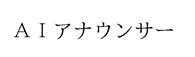
The Plaintiff is the owner of Trademark Registration No. 6152270, consisting of the standard characters “AIアナウンサー” (AI Anaunsā; “AI Announcer”). The trademark was filed on April 19, 2018, received an examiner’s decision of registration on April 22, 2019, and was registered on June 14, 2019. The designated services covered services in Classes 35, 38, 41, and 42, among which the Class 42 services were “computer software design, computer programming, or maintenance of computer software; providing computer programs on data networks.”
On June 14, 2024, the Defendant filed a trial for invalidation of trademark registration, alleging that part of the designated services of the trademark fell under Article 3(1)(iii), Article 4(1)(xvi), and Article 4(1)(vii) of the Trademark Act.
In response, the Japan Patent Office rendered a trial decision holding that all designated services in Class 42 fell under Article 3(1)(iii) and Article 4(1)(xvi) of the Trademark Act and invalidated the registration in respect of those services, while holding that the petition with respect to the remaining designated services was not well founded.
The Plaintiff argued that the findings regarding applicability of Article 3(1)(iii) and Article 4(1)(xvi) of the Trademark Act were erroneous and sought revocation of the trial decision insofar as it invalidated the registration with respect to all designated services in Class 42.
Court’s Decision
(1) Applicability of Article 3(1)(iii) and Article 4(1)(xvi) of the Trademark Act
The court first found that it was readily apparent that the trademark consisted of a combination of the terms “AI” and “announcer.” The court further found that, as of the examination decision date in this case, among traders and consumers of the designated services subject to invalidation, “AI” was widely understood to mean artificial intelligence, and “announcer” was widely understood to mean a person who reads news, acts as a host, provides live commentary, or broadcasts using a microphone.
The court further found that, as of the examination decision date in this case, multiple programs capable of reading news scripts and similar materials in place of human announcers had been developed and were actually used in news programs and the like. The court also found that these programs had been referred to as “AI announcers” because AI performed announcements in place of human announcers.
Based on the foregoing, the court held that, as of the examination decision date in this case, when the trademark was used in connection with the designated services subject to invalidation, traders and consumers would recognize it as indicating services relating to the design, provision, or maintenance of systems (programs) that use AI to read news scripts, namely, as indicating the quality of the services.
The court further held that the trademark consisted of the standard-character expression “AIアナウンサー,” and that it contained no element adding any special distinctiveness. Accordingly, it constituted “a mark consisting solely of a mark indicating the quality of the services in a commonly used manner.”
As a result, the court held that, as of the examination decision date in this case, the trademark constituted a mark consisting solely of a mark indicating the quality of the services in a commonly used manner in relation to the designated services subject to invalidation, and therefore fell under Article 3(1)(iii) of the Trademark Act. The court further held that, on that premise, if the trademark were used in connection with services other than services relating to programs that use AI to read news scripts, it would be likely to mislead as to the quality of the services and therefore also fell under Article 4(1)(xvi) of the Trademark Act.
(2) Plaintiff’s Argument Concerning the Figurative and Polysemous Nature of the Trademark
The Plaintiff argued that the term “AI Announcer” was figurative and polysemous and was also used to refer to a personified being (character) representing a real-world announcer. According to the Plaintiff, the term was therefore not univocal as a term describing the content of services (programs), and thus the trademark did not indicate the quality of the designated services.
In response, the court held that, even if the term “AI Announcer” had been used to refer to a personified being (character) representing a real-world announcer, by the examination decision date in this case, systems using AI to read news scripts had already been developed and put into practical use and were being reported under the name “AI Announcer.” In addition, it was known that “AI” constituted a type of computer program. Accordingly, the court found that, even when the trademark was used in connection with the designated services subject to invalidation, it could not be regarded as so figurative or polysemous that the content of the services could not be recognized, and therefore rejected the Plaintiff’s argument.
For these reasons, the court held that there was no error in the findings regarding applicability of Article 3(1)(iii) and Article 4(1)(xvi) of the Trademark Act and dismissed the Plaintiff’s action seeking revocation of the trial decision.
Key Findings and Practical Implications
In this judgment, when assessing the distinctiveness of the trademark, the court considered not only the ordinary meanings of the constituent characters of the trademark but also the actual circumstances of trade existing as of the examination decision date in this case, including that (1) multiple programs capable of reading news scripts and similar materials in place of human announcers had been developed and were actually used in news programs and the like, and (2) these programs had been referred to as “AI announcers” because AI performed announcements in place of human announcers. Taking these circumstances into account, the court found that the trademark indicated the quality of the services.
Thus, in addition to the dictionary meanings of the constituent characters of the trademark, this judgment assessed the distinctiveness of the trademark in light of the actual circumstances of trade, including the fact that, as of the examination decision date in this case, the term “AI Announcer” was actually used as an expression indicating the content and functions of programs relating to the designated services.
In recent years, with the spread and penetration of AI, names consisting of combinations such as “AI + occupation name” and “AI + function name” have frequently been used as names of various goods and services or as names of functions. Particularly in the AI field, new services and functions spread rapidly, and the names and function names used for them may become established within a short period as terms indicating the content or functions of goods and services. Therefore, even a coined word not appearing in dictionaries is not necessarily recognized as possessing distinctiveness at the time of examination. It should be noted that distinctiveness is determined not only on the basis of the meanings of the constituent characters but also in light of actual usage conditions at the time of examination, the perceptions of traders and consumers, the degree to which the constituent terms of the trademark have become widespread, and similar factors.
The Plaintiff also argued that the term “AI Announcer” was figurative and polysemous and was also used to refer to a personified being representing a real-world announcer, and therefore the content of the services (programs) could not be recognized in a univocal and direct manner from the trademark. However, the court held that, even if the term “AI Announcer” had been used in that sense, because (1) systems using AI to read news scripts had already been developed and put into practical use as of the examination decision date in this case, (2) such systems had been reported under the name “AI Announcer,” and (3) it was also known that “AI” constituted a type of computer program, the trademark could not be regarded as so figurative or polysemous that the content of the services could not be recognized when used in connection with the designated services subject to invalidation.
This judgment may be understood as demonstrating that, even where a term constituting a trademark is used in a sense other than the content of goods or services (in this case, as the name of a character), that fact alone does not establish distinctiveness. Rather, where the content or functions of the designated goods or services are specifically recognized from the trademark in relation to those goods or services, in light of the actual circumstances of trade at the time of examination, the trademark may fall under Article 3(1)(iii) of the Trademark Act.
In practice, when a lack of distinctiveness is alleged, it is common to argue in response that the trademark is figurative or polysemous. However, merely demonstrating that the trademark has another meaning or usage is not sufficient. It is important to explain, in light of the perceptions of traders and consumers and actual usage conditions, that the content, functions, and similar characteristics of the designated goods or services are not specifically and readily recognized from the trademark in relation to those goods or services.
※This article is intended solely to provide general information and should not be construed as legal advice.
Author: Yuko Kandai