【Copyright★★】A case in which the Court found that the plaintiff’s work titled “Message” is recognized as having copyrightability mainly in that a phone receiver of a public telephone is fixed in the state of being taken off the hook and floating in water, and bubbles are generated from the receiver, and that the defendant’s work has commonalities with the plaintiff’s work in all of the parts that contain creative expressions, and the defendant’s work is made in dependence upon the plaintiff’s work; therefore, the defendant’s work is a reproduction or adaptation of the plaintiff’s work.
Osaka High Court Decision of January 14, 2021 (Case No. 2019 [Ne] 1735―Presiding Judge Yozo YAMADA)
【Summary of the Judgment】
- Regarding Requirements for Copyright Protection
- Regarding Copyrightability of the Plaintiff’s Work titled “Message”
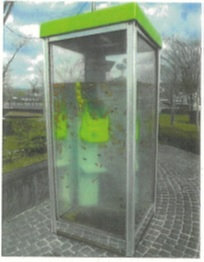
【Plaintiff’s Work cited from List of Plaintiff’s Work attached to Written Judgment】
While on the other hand, the personality of the author is expressed in the different part ④ a phone receiver of a public telephone is fixed in the state of being taken off the hook and floating in the water, and bubbles are generated from the receiver. The reason therefor is that the different part ④ is an extraordinary scene that would never occur in reality, from which a state of communicating with someone can be imaged, and which has much impact on viewers.
It is noted that the color of the roof and the public telephone of the telephone booth of the plaintiff’s work is yellowish green, on which the plaintiff places importance since the plaintiff’s work is themed on environmental issues, and this part is common with actual public telephone booths; therefore, such part itself lacks creative expression.
From the above, it is recognized that the personality of the author is expressed in the plaintiff’s work by combining part ④ with parts ① and ③, and it thus should be said that the plaintiff’s work corresponds to an artistic work as an art which exhibits creative expression.
- Regarding Requirements for Reproduction or Adaptation of a Work
- Regarding Identicalness or Similarity
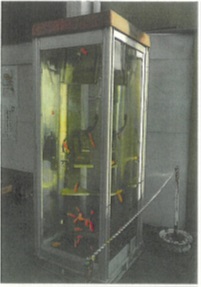
【Defendant’s Work cited from List of Defendant’s Work attached to Written Judgment】
【Comments】
- Regarding the summary of Judgment 1, the Court found with regard to requirements to be protected as a work that creative expressions require to exhibit the personality of the author as in many court cases (the Tokyo High Court Decision of February 19, 1987 [the electability prediction table case] etc.) and majority theories (Hiroshi Saito “Copyright Act [the third edition]”, p.77 etc.), while indicating the idea-expression distinction which is generally accepted doctrine, based on the definition of a work (Article 2, Paragraph 1, Item 1 of the Copyright Act). On that basis, the Court found, as in many court cases (the Intellectual Property High Court of July 17, 2008 [Livedoor-litigation observation record case] etc.), that commonplace expression does not exhibit an author’s personality, and lacks “creativity”, and indicated the generally accepted merger doctrine. No divergent opinions are found with respect to the summary of Judgment 1, except that there is the influentialtheory in recent years that regards creativity as a range of choices of expression (Nobuhiro Nakayama “Copyright Act [the third edition]”, p.70).
- Regarding the summary of Judgment 2, the Court affirmed, based on the summary of Judgment 1, the copyrightability, and especially, the creativity of the plaintiff’s work by placing importance only on the following difference in appearance between the plaintiff’s work and the actual telephone booth: ④ a phone receiver of a public telephone is fixed in the state of being taken off the hook and floating in the water, and bubbles are generated from the receiver.
- Regarding the summary of Judgment 3, the Court indicated requirements for reproduction and adaptation of a work based on the definition of reproduction (Article 2, Paragraph 1, Item 15 of the Copyright Act), the Supreme Court Decision of September 7, 1978 (the One Rainy Night in Tokyo Case) concerning the meaning of reproduction including that of an intangible work or adaptation under the previous Copyright Act, and the Supreme Court Decision of June 28, 2001 (the Esashi-Oiwake Case) concerning the meaning of adaptation under the current Copyright Act. No divergent opinions are found in court cases and theories.
- Regarding the summary of Judgment 4, the Court determined, based on the summary of Judgment 3 concerning requirements for reproduction or adaptation of a work, that since the defendant’s work has commonalities with the plaintiff’s work in all of the parts that contain creative expressions (①, ③, and ④ stated in the summary of Judgment 2), requirements for reproduction of a work other than dependence are satisfied, and even if creativity is recognized in the choice of the different type and color of the public telephone and different color of the roof of the telephone booth, and the defendant’s work can be said to be a different work from the plaintiff’s work, requirements for adaptation other than dependence are still satisfied.
Further, the summary of Judgment 4 is characteristic in that the defendant’s work as a whole is acknowledged as an adaptation of the plaintiff’s work even if hypothetical creative expressions in the defendant’s work, which are different from the creative expressions in the plaintiff’s work, are taken into account, and in terms of the overall comparison theory under which adaptation is often denied.
With respect to the summary of Judgment 4, some studies suggest that Judgment 4 is influenced by the fact that the defendant’s dependence on the plaintiff’s work and untrue statements of a representative of the defendant were acknowledged by the Court of the appeal case (Kodai Kimura “Goldfish wavering between ‘Idea’ and ‘Expression’ / Considerations regarding the Osaka High Court Decision on the Goldfish-filled Telephone Booth Case” Yahoo! News (https://news.yahoo.co.jp/articles/daa625b2d2b9e275f325d8e287512168bebf76af).
【Keywords】Copyrightability, idea-expression distinction, creative expression, expression of the personality of an author, range of choice of expression, commonplace expressions, merger doctrine, ready-made, Message, reproduction, identicalness, adaptation, similarity, two-step test, overall comparison theory, dependence, goldfish-filled telephone booth, Koriyama Yanagimachi Shopping District
※ The contents of this article are intended to convey general information only and not to provide any legal advice.
Kei IIDA (Writer)
Attorney at Law & Patent Attorney (Daini Tokyo Bar Association)
Contact information for inquiries: k_iida@nakapat.gr.jp