
OUTLINE OF DESIGN PROSECUTION IN JAPAN
1. Protectable Designs
Under the Japanese Design Act, (1) Article Design, (2) Graphic Image Design, and (3) Building Design can be registered for protection. Additionally, by combining these designs, (4) Design for A Set of Articles, and (5) Interior Design can be also registered for protection. Each design can be registered as a partial design or an entire design.
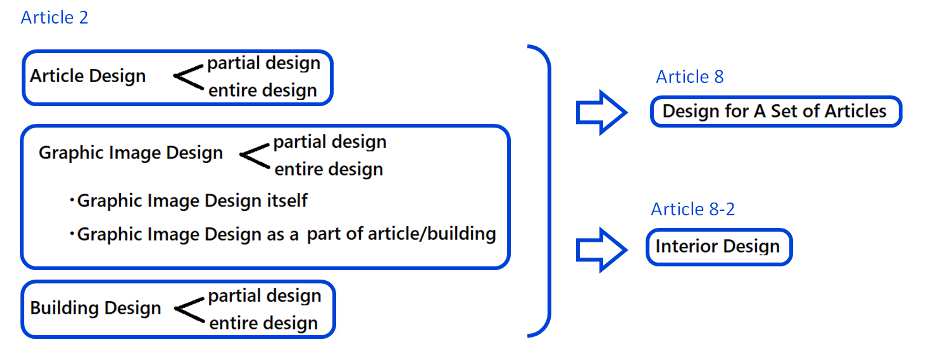
(1) Article Design (Article 2)
Articles subject to the Design Act are tangible objects which are movables distributed on markets. Regarding a subject matter which is a part of an article, a component constituting a part of a finished product (a component product) is found to be an article if it is interchangeable and is traded as an independent product in a normal trading state.
(2) Graphic Image Design (Article 2)
There are two ways for registering a design which includes a graphic image. The first one is (2-1) Graphic Image Design itself which is separated from the article/building, and the second one is (2-2) Design including a graphic image as a part of an article/building. Media contents such as graphic images of TV shows, movies, or games, and landscape photographs are not found to be protectable designs under the Japanese Design Act.
(2-1) Graphic Image Design itself, separated from the article/building
This type of design became registrable from April 1, 2020. The Graphic Image Design itself is required to be (i) an “Operation Image” used for operation of an equipment, and/or (ii) a “Display Image” to be displayed as a result of the equipment performing its function. It does not matter whether or not the data to display the relevant graphic image is installed into the article/building or what kind of things the graphic images are displayed on. For example, the data may be stored on the Cloud, and the graphic images may be displayed on a wall or a road.
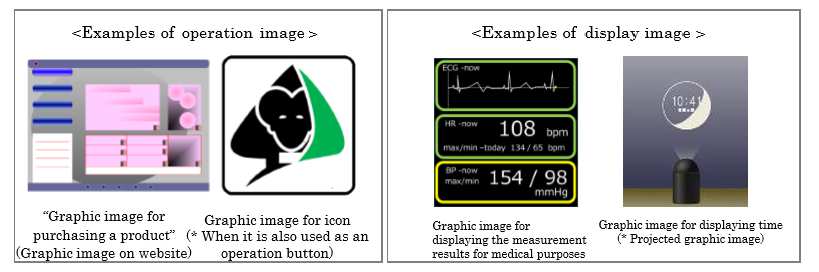
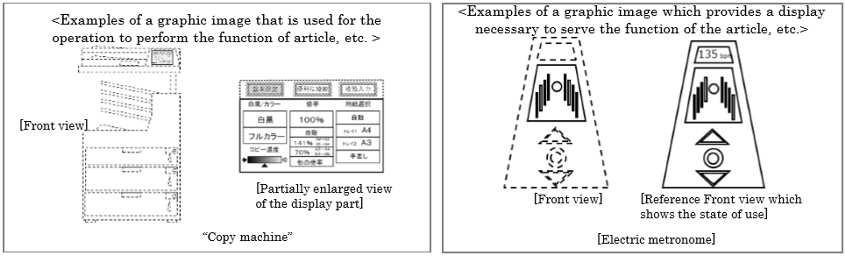
(2-2) Design including a graphic image on a screen as a part of the article/building which is displayed on the display part of the article/building
This type of design is required (i) to be used for the operation of equipment to perform the function of articles/building, and/or (ii) to be provided on a display necessary to serve the function of the article/building. This type of design is limited to graphic images recorded on an article or building and shown on the display part of the article/building.
(3) Building design (Article 2)
External appearances of buildings are registrable. This type of design became registrable from April 1, 2020. The building design is required to be (i) a land fixture, and (ii) an artificial construction (including civil engineering construction). The fixture is an object continuously fixed and used on the land which also cannot be moved arbitrarily. The definition of the construction has a broader meaning than the term used in the Building Standards Act and refers to objects that are constructed which include the civil construction. For those constructions whose internal configurations are visible under the normal conditions of use, the internal configurations are also included.
[Examples]

(4) Design for a set of articles or buildings or Graphic Images (Article 8)
This type of design meets all of the requirements that (i) the subject matter stated in the column of “Article to the design” of the application is designated to the Ordinance of the Ministry of Economy, Trade and Industry, (ii) the subject matter be a combination of articles, buildings, and/or graphic images used at the same time, and (iii) the subject matter be coordinated as a whole. Partial design for a set of articles can be registered. Not only the combination of article designs, but also the combination of building designs, the combination of graphic image designs, and the combination of different kinds of designs can be registered.
(5) Interior design (Article 8-2)
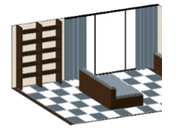
Interior design is required (i) to be the inside of shops, offices, or other facilities, (ii) to consist of multiple articles, buildings, or graphic images under the Design Act, and (iii) to consistently create an aesthetic impression as the entire interior. If the subject matter is designed for people to spend some time therein, it is determined as “shops, offices, or other facilities”. This excludes the scope where the users of the relevant facility will not recognize by the naked eye under the normal conditions of use in view of the use and the function of the facility such as when they only enter for the purpose of maintenance.
[Examples] Shops, Offices, Accommodation facilities, Medical facilities, Entertainment facilities, Residences, Passenger ships, Railroad cars
2. Application
(1) Title
For the Article Design and the Design including a graphic image on a screen as a part of the article, a title is the name of the article.
For the Graphic Image Design itself, a title is required to specify a concrete usage of the Graphic Image Design, such as “Graphic Image for XX (usage)”.
For the Building Design, a title is usage of the building, such as “school”.
For the Design for a set of articles/buildings/Graphic Images, a title be selected from a list prescribed in the ordinance of the Ministry of Economy, Trade and Industry.
For the Interior Design, a title is required to specify a concrete usage of the Interior Design, such as “Interior of XX (usage)”.
In case of filing a so-called partial design where a design of a part of an article is claimed, the title of the design may not be that of the part for which design protection is sought (“the claimed portion”); instead, it must be that of the entire article. For example, in a case where a design protection for the handle part of a coffee cup is sought, a title such as “HANDLE FOR COFFEE CUP” is not permissible; it should be “COFFEE CUP.”
(2) Drawings
Drawings must show a claimed design clearly. Basically, it is sufficient to show the claimed design in six views of the embodying article: front, rear, left side and right side, and top plan and bottom plan views, preferably with a perspective view.
But, some of the views can be omitted, depending on the case. If a part of the portions of the design is not appeared in drawings, the design will be considered as a partial design wherein the portions which do not appear in any figures are disclaimed under the Japanese design system. Shading for showing the surface shape of the article is not prohibited. In the case of filing a partial design, the claimed portion is normally depicted in solid lines and the remaining portion (“the unclaimed portion”) in broken lines.
(3) Paris Convention Priority
A priority under the Paris Convention can be claimed. The grace period for claiming the priority is six months from the filing date of the earliest design application. A certified copy or DAS code of the basic application must be filed within 3 months from the filing date of the Japanese application.
(4) Exceptions to Loss of Novelty
In a case where a design has been intentionally disclosed to the public by the person having the right to obtain a design registration (“the Person”) or unintentionally disclosed to the public by a third party, it is deemed that the novelty has not been lost (“exception to loss of novelty”) if the following conditions are met:
(a) It is required that the Person file a design application in Japan within one year from the first disclosure date.
(b) In the case of an intentional disclosure, the request for the exception to loss of novelty should be indicated in the application. Further, it is required that the Person submit to the Japan Patent Office (“the JPO”) a document proving that the design was disclosed by the Person and giving the date and the situation of the disclosure within 30 days from the filing date of the design application. With regard to an unintentional disclosure, there are no such requirements since it is often the case where the applicant is not aware of the unintentional disclosure at the time of filing.
(c) The exception does not apply where the design has been disclosed in a patent, utility model, design or trademark official gazette published anywhere in the world before the filing date of the design application.
3. Registration Requirements
(1) Industrial Use Requirement
A creator of a design that is industrially applicable may be entitled to obtain a design registration for the design. In order to be considered as industrially applicable, the article on which the design is used should be capable of being mass-produced and be tradable in market. Mere graphic symbols and logos, surface patterns, ornamentation, or characters are not registrable.
(2) Novelty Requirement
If a design is publicly known anywhere in the world prior to the filing of a design application, it is not registrable. In particular, if a design has been described in a distributed publication, or has been made publicly available through electronic telecommunication, such as the Internet, anywhere in the world, prior to the filing of an application for design registration, it is not registrable. In addition, a design that is similar to the publicly known or published design is also not registrable. However, there is an exception to loss of novelty. Please see Subsection (4) above.
(3) Preclusion of Design of Later-filed Application
A design of an application filed later (“the later application”) that is identical or similar to a part of a design of another application filed earlier (“the earlier application”) by another applicant cannot be registered. This rule applies even if the later application is filed before the publication of the design of the earlier application in an official gazette, and/or even if both designs as a whole are not similar to each other. It does not apply to the case where the applicant of the earlier application and that of the later application are the same.
(4) Easy-to-create Requirement
Even if a design is novel, if the design is one which a person ordinarily skilled in the art of the design (“the skilled artisan”) would be able to easily create, the design is not registrable. In particular, if, prior to the filing of an application for design registration, a skilled artisan would have been able to easily create the design based on shape, patterns or colors, or any combination of these that were publicly known in Japan or a foreign country, a design registration shall not be granted.
(5) First-to-File Principle
The first-to-file principle applies not only to design registration applications covering identical designs, but also to those applications covering similar designs. In case two or more design applications are filed on different dates with respect to an identical design or similar designs, only the applicant of the design application with the earliest filing date (or the earliest priority date in case of a design application claiming the Paris Convention priority) may obtain a design registration with respect to such design.
When two or more design applications are filed with respect to similar designs by the same applicant on the same date, such designs can be registered as “related designs”, explained below.
(6) One-Design-per-Application Principle
A separate design application must be filed for each design for each article, building, or Graphic image (Article 7, Rule 2(1)). As exceptions, design for a set of articles or buildings or Graphic Images (Article 8) and Interior design (Article 8-2) can be registered, as advised on pages 2 to 3 above. Please contact us to see what sets of articles and so on are acceptable.
Please be informed that multiple design applications can be bundled by a single request from April 1, 2021 (Article 7, Rule 2-2).
4. Related design system (Article 10)
(1) Background
Protection of a registered design covers the same design and its similar designs (Article 23). The related design system is an exception to double patenting for the owner of a design right. Namely, a design (principal design) and its similar design (related design) of the same owner can be registered (Article 10). Before the amendment, the related designs must be similar to only one principal design, and the related design can be filed until the registration of the principal design is published. The expiration date of the related design right is the same as that of the principal design right.
(2) Requirements
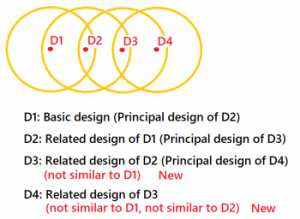
- Designs which are similar only to a related design can be registered (D3, D4).
- A related design can be filed within ten years from the filing date (priority date, if applicable) of the basic design D1.
5. Substantive Examination
(1) Examination procedure
Since there is no system of deferred examination of applications, the next step concerns substantive examination of the design application. If, during the substantive examination, the Examiner finds any reason to reject the application, he/she issues a notice of reasons for rejection. The Examiner gives the applicant an opportunity to submit his/her arguments against the indicated rejection and/or to make an amendment within 3 months from the issuance date of the notice. If, in spite of the applicant’s argument or amendment, the Examiner still maintains his/her reasons for rejection, he/she issues a decision of rejection. The applicant may then file an appeal before the Patent Office. The board of appeals, consisting of three appeal Examiners, reviews the rejected application.
(2) Registration
If the Examiner finds no reason for rejection, he/she issues an allowance. For an application to proceed to registration, the applicant must pay the first year’s registration fee within thirty days from receiving the Examiner’s decision to register.
Upon timely payment, the design right is established by registration.
(3) Publication of Design
After registration, the design is published in the Design Gazette. When an applicant wishes to keep a design secret, the applicant can request deferment of the publication for a desired period up to three years from the registration date of the design. Such a request can be made at the time of filing or at the time of paying the registration fee.
If the applicant requests deferment of the publication, only formal matters such as the name and address of the design owner, a design application number and filing date, a design registration number and a registration date will be published during the requested period.
(4) Protection period for design rights (Article 21)
For applications filed on or after April 1, 2020, the protection period for design rights is 25 years from the application date. Protection period for related design rights is 25 years from the application date of the basic principal design.
For application filed between April 1, 2007 and April 1, 2020, the protection period for design rights is 20 years from the registration date. Protection period for related design rights is 20 years from the registration date of the principal design.
For application filed before April 1, 2007, protection period for design rights is 15 years from the registration date.
6. International Registration of Industrial Designs under Hague Agreement
Beginning May 13, 2015, applicants filing international design applications can designate Japan for design protection. If an international design application designating Japan is filed, the WIPO will review whether it complies with the prescribed formal requirements. If an international application complies with the formal requirements, the WIPO will record it in the International Register by publishing the corresponding registration in the International Designs Bulletin (“the Bulletin”).
Please note that, if the Paris Convention priority is claimed, the priority document must be submitted to the JPO within 3 months from the publication date of the Bulletin. Further, if an applicant wishes to claim the exception to the loss of novelty (See Section 1(4) above), the claim can be made to the WIPO on filing the International Registration of Industrial Designs under Hague Agreement or to the JPO within 30 days from the publication date of the Bulletin. The evidence showing that the exception is applicable must be submitted on the filing date in the former case and within the 30-day period from the publication date in the latter case. In order to submit all the necessary documents to the JPO in a timely manner, it is important that you notify us, preferably soon after the Bulletin has been published, to arrange for its submission.
If an International design application that designates Japan has been published in the Bulletin, it will be subject to substantive examination by the JPO based on the Japanese Examination Guidelines for Design.
7. Invalidation Trial
Reasons for invalidation of a registration (Design Act, Article 48) are almost the same as those used by the Examiner to reject a design registration application. One of the differences is that a design registration cannot be invalidated on the ground that the application for such design registration violates the one-design-per-application principle of Article 7 of the Design Act.
A trial for invalidation may be demanded by any person demonstrating a valid interest in the invalidation at any time during the term and even after expiration of a design right.
When the decision in a trial to invalidate a design registration has become final and conclusive, the design right shall be deemed never to have existed. However, when the reasons for invalidation arose after the registration, the design right shall be not to have existed from the time such reasons arose.